EP1237892B1 - Method for producing epinastine hydrochloride in the high-melting crystal modification - Google Patents
Method for producing epinastine hydrochloride in the high-melting crystal modification Download PDFInfo
- Publication number
- EP1237892B1 EP1237892B1 EP00985110A EP00985110A EP1237892B1 EP 1237892 B1 EP1237892 B1 EP 1237892B1 EP 00985110 A EP00985110 A EP 00985110A EP 00985110 A EP00985110 A EP 00985110A EP 1237892 B1 EP1237892 B1 EP 1237892B1
- Authority
- EP
- European Patent Office
- Prior art keywords
- hydrochloric acid
- process according
- epinastine
- epinastine hydrochloride
- formula
- Prior art date
- Legal status (The legal status is an assumption and is not a legal conclusion. Google has not performed a legal analysis and makes no representation as to the accuracy of the status listed.)
- Expired - Lifetime
Links
- WHWZLSFABNNENI-UHFFFAOYSA-N NC1=NCC2N1c1ccccc1Cc1c2cccc1 Chemical compound NC1=NCC2N1c1ccccc1Cc1c2cccc1 WHWZLSFABNNENI-UHFFFAOYSA-N 0.000 description 1
Images

Classifications
-
- C—CHEMISTRY; METALLURGY
- C07—ORGANIC CHEMISTRY
- C07D—HETEROCYCLIC COMPOUNDS
- C07D487/00—Heterocyclic compounds containing nitrogen atoms as the only ring hetero atoms in the condensed system, not provided for by groups C07D451/00 - C07D477/00
- C07D487/02—Heterocyclic compounds containing nitrogen atoms as the only ring hetero atoms in the condensed system, not provided for by groups C07D451/00 - C07D477/00 in which the condensed system contains two hetero rings
- C07D487/04—Ortho-condensed systems
-
- A—HUMAN NECESSITIES
- A61—MEDICAL OR VETERINARY SCIENCE; HYGIENE
- A61P—SPECIFIC THERAPEUTIC ACTIVITY OF CHEMICAL COMPOUNDS OR MEDICINAL PREPARATIONS
- A61P11/00—Drugs for disorders of the respiratory system
- A61P11/06—Antiasthmatics
-
- A—HUMAN NECESSITIES
- A61—MEDICAL OR VETERINARY SCIENCE; HYGIENE
- A61P—SPECIFIC THERAPEUTIC ACTIVITY OF CHEMICAL COMPOUNDS OR MEDICINAL PREPARATIONS
- A61P37/00—Drugs for immunological or allergic disorders
-
- A—HUMAN NECESSITIES
- A61—MEDICAL OR VETERINARY SCIENCE; HYGIENE
- A61P—SPECIFIC THERAPEUTIC ACTIVITY OF CHEMICAL COMPOUNDS OR MEDICINAL PREPARATIONS
- A61P37/00—Drugs for immunological or allergic disorders
- A61P37/08—Antiallergic agents
-
- A—HUMAN NECESSITIES
- A61—MEDICAL OR VETERINARY SCIENCE; HYGIENE
- A61P—SPECIFIC THERAPEUTIC ACTIVITY OF CHEMICAL COMPOUNDS OR MEDICINAL PREPARATIONS
- A61P43/00—Drugs for specific purposes, not provided for in groups A61P1/00-A61P41/00
Definitions
- the invention relates to a process for the preparation of epinastine hydrochloride in the high-melting crystal modification.
- the compound epinastine (3-amino-9,13b-dihydro-1H-dibenz- [c, f] imidazole [1,5-a] azepine) belongs to the group of 2-aminoimidazolines and is therapeutic effective substance, which is mainly characterized by its anti-allergic and Characterized antihistaminergic effect (EP 35749).
- Epinastine hydrochloride 250 ° to 263 ° C melts (low melting crystal modification) and one others that melt at approx. 275-281 ° C (high-melting crystal modification). Due to the use of alcohols proposed in EP 35749 Precipitation of Epinastine hydrochloride results in a loss of quality gradual decomposition of the product.
- the product contains in this process also according to DSC (Differential Scanning Calorimetry) up to about 5% of the low melting crystal modification. That disclosed by DE 41 02 148
- the process for making Epinastine hydrochloride includes Use of dimethylformamide, which due to its high boiling point the drying is only removed from the process product at high temperatures can be. As a result, the product begins to melt partially and discolored. It also requires drying on an industrial scale an undesirably high expenditure of energy. Eventually dimethylformamide classified as harmful to the fruit, so that its presence in a drug under should be avoided in all circumstances.
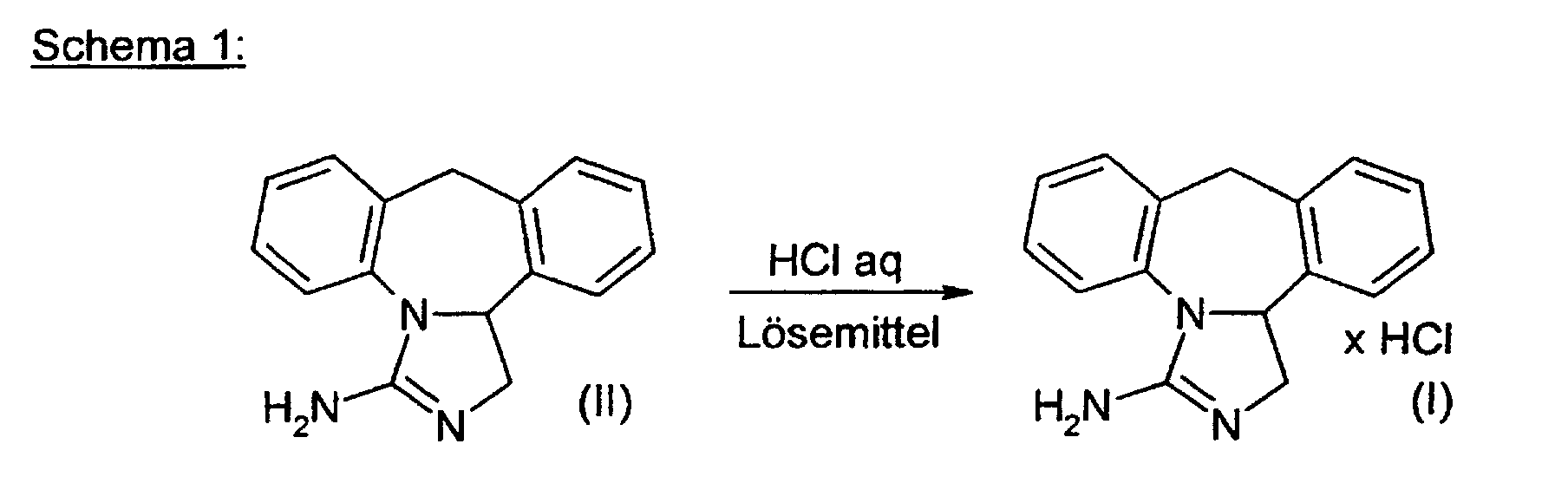
- the invention relates to a process for the preparation of epinastine hydrochloride (formula I) (3-amino-9,13b-dihydro-1H-dibenzo- [c, f] imidazole [1,5-a] azepine hydrochloride) starting from the high-melting crystal modification of epinastine base (II) according to (Scheme 1).
- epinastine hydrochloride in connection with the legal regulations for Quality control of pharmaceutical products, it is imperative that Medicines containing epinastine hydrochloride contain this active substance only in one single crystal modification included.
- the procedure is as follows in a preferred manner.
- Epinastine Base (II) in Water suspended and between 20 and 90 ° C, preferably 40 to 80 ° C, particularly preferably at 50 to 70 ° C by adding aqueous hydrochloric acid a pH that should not fall below 7. It is about make sure that the pH value is acidic enough that the Epinastine Base (II) dissolves in the water, but the pH remains basic enough that the Epinastine hydrochloride (I) has not yet failed.
- the pH value is preferably Solution between 7.5 and 9, a pH of 8 is particularly preferred
- Hydrochloric acid is preferably used in concentrated form
- Concentrated form means an approximately 32% by weight aqueous hydrochloric acid becomes.
- the solution thus obtained is then with the organic, not with Water miscible, solvent extracted.
- solvents for example halogenated hydrocarbons, such as methylene chloride, Carbon tetrachloride, esters such as ethyl acetate or Butyl acetate, ethers, such as dimethyl or diethyl ester or others from the State of the art for extracting aqueous phases known organic Solvent.
- Organic esters are preferably used, very particularly preferably butyl acetate.
- the solution is at least once, preferably several times with the organic Solvent extracted. After separating the organic solvent are remaining residues of the organic solvent in the aqueous Phase removed azeotropically by distillation. Therefore, as organic Solvents used for extraction preferably those that are made up of water Allow to be removed by azeotropic distillation.
- Activated carbon is added to the aqueous solution thus obtained, which is filtered off after some time.
- the mixture is preferred at one temperature from ⁇ 50 ° C and 100 ° C stirred for some time, preferably between 70 ° C and 95 ° C, very particularly preferably at 80 ° C to 90 ° C.
- the clear solution is cooled to below 50 ° C and with hydrochloric acid, preferably concentrated hydrochloric acid has a pH of ⁇ 6. Is preferred a pH of 3 to 5, particularly preferably from 3.5 to 4.5.
- the temperature of the solution should not fall below 25 ° C in order to Avoid premature crystallization of the product.
- The is preferred Temperature kept between 30 ° C and 40 ° C.
- the crystal slurry is filtered off and washed with water. Ice water is preferably used for washing. The product is then dried.
- not failed product in the filtrate can according to the methods known from the prior art can be followed.
- the product obtained by the process is according to the common analysis methods for pure epinastine hydrochloride (I) in the higher melting crystal modification.
- the procedure can be repeated. If necessary, the last sub-steps repeated.
- the advantage of the method according to the invention is that compared to the process known from the prior art, dimethylformamide completely replaced with water. This will make the pharmaceutical quality of the product (I) advantageously improved because, among other things the product shows no traces Contains dimethylformamide or its decomposition products and the product gentle temperatures can be dried.
- Epinastine base (124.5 g) is in a defined amount of water (390 ml) suspended and at a temperature of 60 ° C by adding 32% Hydrochloric acid (approx. 50 ml) adjusted to pH 8. After extracting the aqueous solution with butyl acetate at 60 ° C (150 ml and 75 ml) and separation of the organic phase, a portion of water is distilled off under normal pressure, to azeotropically remove the remaining butyl acetate. Then you put that Residue at approx. 90 ° C activated carbon (LX - Ultra, water-moist), stirred for 30 minutes and then filters the product solution bare and washes the filtered coal with approx.
- the mixture is stirred for about 30-45 minutes at 20 ° C. and cooled then in 1-2 hours at 0-5 ° C, stirring for 30 minutes at 0-5 ° C, the crystals suck and wash with ice-cold water (approx. 100 ml).
- the yield is 86.8% of theory. By obtaining post-yield it can be increased to 90% of theory.
- the product obtained is to the desired refractory modification of Epinastine hydrochloride.
Landscapes
- Chemical & Material Sciences (AREA)
- Organic Chemistry (AREA)
- Health & Medical Sciences (AREA)
- Life Sciences & Earth Sciences (AREA)
- General Health & Medical Sciences (AREA)
- General Chemical & Material Sciences (AREA)
- Medicinal Chemistry (AREA)
- Nuclear Medicine, Radiotherapy & Molecular Imaging (AREA)
- Bioinformatics & Cheminformatics (AREA)
- Pharmacology & Pharmacy (AREA)
- Engineering & Computer Science (AREA)
- Animal Behavior & Ethology (AREA)
- Chemical Kinetics & Catalysis (AREA)
- Public Health (AREA)
- Veterinary Medicine (AREA)
- Pulmonology (AREA)
- Immunology (AREA)
- Nitrogen Condensed Heterocyclic Rings (AREA)
- Pharmaceuticals Containing Other Organic And Inorganic Compounds (AREA)
- Organic Low-Molecular-Weight Compounds And Preparation Thereof (AREA)
- Preparation Of Compounds By Using Micro-Organisms (AREA)
Abstract
Description
Die Erfindung betrifft ein Verfahren zur Herstellung von Epinastine-Hydrochlorid in der hochschmelzenden Kristallmodifikation.The invention relates to a process for the preparation of epinastine hydrochloride in the high-melting crystal modification.
Die Verbindung Epinastine (3-Amino-9,13b-dihydro-1H-dibenz-[c,f]imidazol[1,5-a]azepin) gehört zur Gruppe der 2-Aminoimidazoline und stellt eine therapeutisch wirksame Substanz dar, die sich vor allem durch ihre antiallergische und antihistaminerge Wirkung auszeichnet (EP 35749).The compound epinastine (3-amino-9,13b-dihydro-1H-dibenz- [c, f] imidazole [1,5-a] azepine) belongs to the group of 2-aminoimidazolines and is therapeutic effective substance, which is mainly characterized by its anti-allergic and Characterized antihistaminergic effect (EP 35749).
Verfahren zur Herstellung von Epinastine-Hydrochlorid sind aus dem Stand der Technik bekannt. In der EP 35749 wird Epinastine-Hydrochlorid durch Fällung aus einer methanolischen Lösung mit Ether erhalten. Die DE 41 02 148 offenbart die Bildung von Epinastine-Hydrochlorid durch Umsetzung der freien Epinastine-Base mit HCI in Dimethylformamid. Vorstehend genannte, aus dem Stand der Technik bekannte Verfahren zur Herstellung des Epinastine-Hydrochlorids weisen allerdings Nachteile auf. So ist durch die genannten Verfahren Epinastine-Hydrochlorid nicht immer in Reinform darstellbar oder fällt in verschiedenen Kristallmodifikationen an. Diesbezüglich bekannt ist eine Modifikation, die bei ca. 250° bis 263°C schmilzt (niedrigschmelzende Kristallmodifikation) und eine andere, die bei ca. 275-281°C schmilzt (hochschmelzende Kristallmodifikation). Durch die in der EP 35749 vorgeschlagene Verwendung von Alkoholen bei der Ausfällung von Epinastine-Hydrochlorid kommt es zu einem Qualitätsverlust durch allmähliche Zersetzung des Produkts. Das Produkt enthält bei diesem Verfahren auch laut DSC (DSC = Differential Scanning Calorimetry) bis zu etwa 5 % der niedrigschmelzenden Kristallmodifikation. Das durch DE 41 02 148 offenbarte Verfahren zur Herstellung des Epinastine-Hydrochlorids beinhaltet die Verwendung von Dimethylformamid, was aufgrund seines hohen Siedepunkts bei der Trocknung nur bei hohen Temperaturen aus dem Verfahrensprodukt entfernt werden kann. Dies führt dazu, daß das Produkt teilweise zu schmelzen beginnt und sich verfärbt. Auch bedarf es für die Trocknung in großtechnischem Maßstab eines unerwünscht hohen Energieaufwands. Schließlich wird Dimethylformamid als fruchtschädigend eingestuft, so daß seine Präsenz in einem Arzneimittel unter allen Umständen zu vermeiden ist. Processes for the preparation of epinastine hydrochloride are known from the prior art Technology known. In EP 35749, epinastine hydrochloride is precipitated obtained a methanolic solution with ether. DE 41 02 148 discloses the Formation of Epinastine hydrochloride by reaction of the free Epinastine base with HCI in dimethylformamide. The aforementioned, from the prior art known methods for the preparation of the Epinastine hydrochloride however disadvantages. So is through the procedures mentioned Epinastine hydrochloride not always representable in pure form or falls in different Crystal modifications. In this regard, a modification is known which occurs at approx. 250 ° to 263 ° C melts (low melting crystal modification) and one others that melt at approx. 275-281 ° C (high-melting crystal modification). Due to the use of alcohols proposed in EP 35749 Precipitation of Epinastine hydrochloride results in a loss of quality gradual decomposition of the product. The product contains in this process also according to DSC (Differential Scanning Calorimetry) up to about 5% of the low melting crystal modification. That disclosed by DE 41 02 148 The process for making Epinastine hydrochloride includes Use of dimethylformamide, which due to its high boiling point the drying is only removed from the process product at high temperatures can be. As a result, the product begins to melt partially and discolored. It also requires drying on an industrial scale an undesirably high expenditure of energy. Eventually dimethylformamide classified as harmful to the fruit, so that its presence in a drug under should be avoided in all circumstances.
Es ist Aufgabe der vorliegenden Erfindung, ein Verfahren zur Herstellung von Epinastine-Hydrochlorid bereitzustellen, bei dem die bei den aus dem Stand der Technik bekannten Verfahren auftretenden Nachteile vermieden werden.It is an object of the present invention to provide a method for producing To provide Epinastine hydrochloride, in which the from the prior art Disadvantages occurring in technology known methods can be avoided.
Die Erfindung betrifft ein Verfahren zur Herstellung von Epinastine-Hydrochlorid
(Formel I) (3-Amino-9,13b-dihydro-1H-dibenzo-[c,f]imidazol[1,5-a]azepinhydrochlorid)
in der hochschmelzenden Kristallmodifikation ausgehend von
Epinastine-Base (II) gemäß (Schema 1).
Es ist eine weitere Aufgabe der vorliegenden Erfindung, ein Verfahren zur Herstellung von Epinastine-Hydrochlorid bereitzustellen, welches zur alleinigen Bildung von Epinastine-Hydrochlorid in der hochschmelzenden Kristallmodifikation führt. im Hinblick auf die pharmazeutische Verwendung von Epinastine-Hydrochlorid in Verbindung mit den gesetzlichen Vorschriften zur Qualitätskontrolle pharmazeutischer Produkte ist es zwingend erforderlich, daß Epinastine-Hydrochlorid enthaltende Arzneimittel diesen Wirkstoff nur in einer einzigen Kristallmodifikation enthalten.It is another object of the present invention to provide a method for Provide production of Epinastine hydrochloride, which is used alone Formation of Epinastine hydrochloride in the high-melting crystal modification leads. regarding the pharmaceutical use of epinastine hydrochloride in connection with the legal regulations for Quality control of pharmaceutical products, it is imperative that Medicines containing epinastine hydrochloride contain this active substance only in one single crystal modification included.
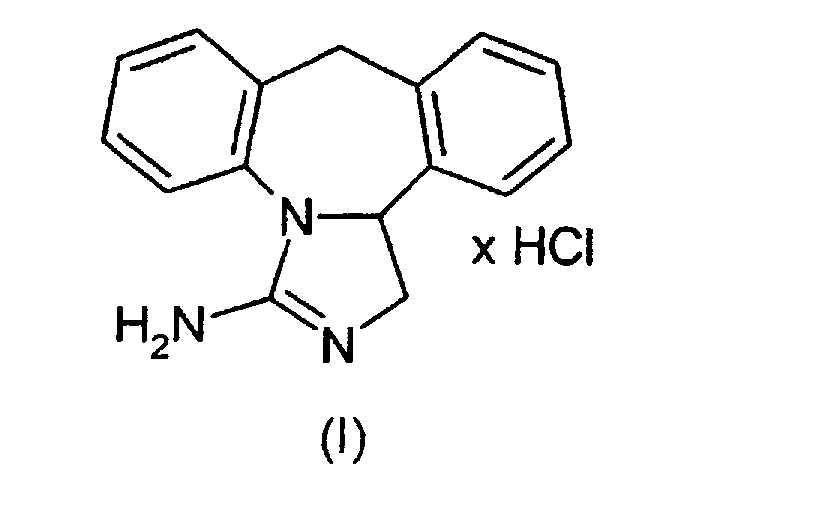
Das erfindungsgemäße Verfahren betrifft die Herstellung von Epinastine-Hydrochlorid
der Formel (I)
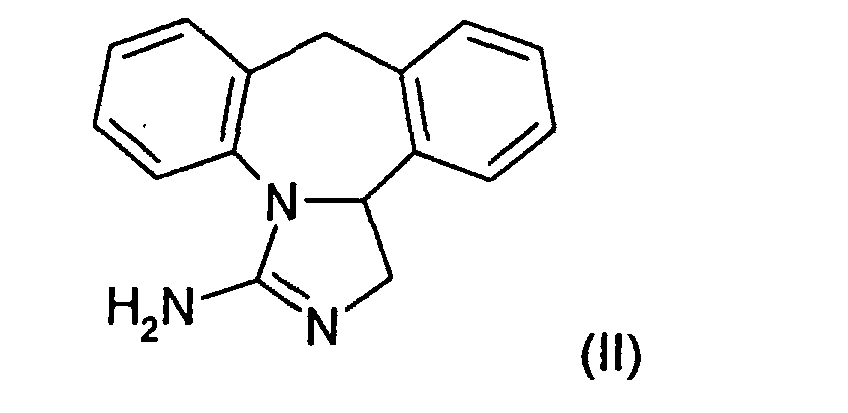
- einen ersten Schritt, bei dem Epinastine-Base der Formel (II)
in Wasser suspendiert wird und durch Zugabe von wässriger Salzsäure bei einem pH-Wert ≥7 gelöst wird,

- einen zweiten Schritt, bei dem die aus dem ersten Schritt zugängliche wäßrige Lösung mit einem organischen, nicht mit Wasser mischbaren Lösungsmittel extrahiert wird und das Extraktionsmittel anschließend entfernt wird und
- einen dritten Schritt, bei dem das Produkt der Formel (I) aus der durch den zweiten Schritt zugänglichen wässrigen Lösung durch Zugabe von Salzsäure bei einem pH-Wert ≤6 gefällt und getrocknet wird.
- a first step in which epinastine base of the formula (II) is suspended in water and dissolved by adding aqueous hydrochloric acid at pH ≥7,
- a second step in which the aqueous solution obtainable from the first step is extracted with an organic, water-immiscible solvent and the extractant is then removed and
- a third step in which the product of the formula (I) is precipitated from the aqueous solution accessible by the second step by adding hydrochloric acid at a pH ≤ 6 and is dried.
Erfindungsgemäß wird in bevorzugter Art und Weise wie folgt vorgegangen. In einem geeignet dimensionierten Reaktionskessel wird Epinastine Base (II) in Wasser suspendiert und zwischen 20 und 90°C, bevorzugt 40 bis 80°C, besonders bevorzugt bei 50 bis 70°C durch Zugabe von wässriger Salzsäure bei einem pH-Wert, der 7 nicht unterschreiten sollte, gelöst. Dabei ist darauf zu achten, den pH-Wert sauer genug einzustellen, daß sich die Epinastine Base (II) im Wasser löst, aber der pH-Wert dennoch basisch genug bleibt, daß das Epinastine-Hydrochlorid (I) noch nicht ausfällt. Bevorzugt liegt der pH-Wert der Lösung zwischen 7,5 und 9, besonders bevorzugt ist ein pH-Wert von 8. Die Salzsäure wird bevorzugt in konzentrierter Form eingesetzt, wobei unter dem Begrirff "konzentrierte Form" eine ca. 32 Gew.%ige wäßrige Salzsäure verstanden wird. According to the invention, the procedure is as follows in a preferred manner. In In a suitably dimensioned reaction kettle, Epinastine Base (II) in Water suspended and between 20 and 90 ° C, preferably 40 to 80 ° C, particularly preferably at 50 to 70 ° C by adding aqueous hydrochloric acid a pH that should not fall below 7. It is about make sure that the pH value is acidic enough that the Epinastine Base (II) dissolves in the water, but the pH remains basic enough that the Epinastine hydrochloride (I) has not yet failed. The pH value is preferably Solution between 7.5 and 9, a pH of 8 is particularly preferred Hydrochloric acid is preferably used in concentrated form The term "concentrated form" means an approximately 32% by weight aqueous hydrochloric acid becomes.
Die so erhaltene Lösung wird anschließend mit dem organischen, nicht mit Wasser mischbaren, Lösungsmittel extrahiert. Als Lösungsmittel eignen sich beispielsweise halogenierte Kohlenwasserstoffe, wie Methylenchlorid, Tetrachlorkohlenstoff, Ester wie beispielsweise Essigsäureethylester oder Essigsäurebutylester, Ether, wie Dimethyl- oder Diethylester oder andere aus dem Stand der Technik zum Extrahieren von wässrigen Phasen bekannte organische Lösungsmittel. Bevorzugt werden organische Ester eingesetzt, ganz besonders bevorzugt Butylacetat.The solution thus obtained is then with the organic, not with Water miscible, solvent extracted. Are suitable as solvents for example halogenated hydrocarbons, such as methylene chloride, Carbon tetrachloride, esters such as ethyl acetate or Butyl acetate, ethers, such as dimethyl or diethyl ester or others from the State of the art for extracting aqueous phases known organic Solvent. Organic esters are preferably used, very particularly preferably butyl acetate.
Die Lösung wird mindestens einmal, bevorzugt mehrmals mit dem organischen Lösungsmittel extrahiert. Nach Abtrennen des organischen Lösungsmittels werden verbleibende Reste des organischen Lösungsmittels in der wässrigen Phase durch Destillation azeotrop entfernt. Daher werden als organische Lösungsmittel zum Extrahieren bevorzugt solche verwendet, die sich aus Wasser mittels azeotroper Destillation entfemen lassen.The solution is at least once, preferably several times with the organic Solvent extracted. After separating the organic solvent are remaining residues of the organic solvent in the aqueous Phase removed azeotropically by distillation. Therefore, as organic Solvents used for extraction preferably those that are made up of water Allow to be removed by azeotropic distillation.
Der so erhaltenen wässrigen Lösung wird im Warmen Aktivkohle zugesetzt, die nach einiger Zeit abfiltriert wird. Bevorzugt wird das Gemisch bei einer Temperatur von ≥50°C und 100°C einige Zeit gerührt, bevorzugt zwischen 70°C und 95°C, ganz besonders bevorzugt bei 80°C bis 90°C.Activated carbon is added to the aqueous solution thus obtained, which is filtered off after some time. The mixture is preferred at one temperature from ≥50 ° C and 100 ° C stirred for some time, preferably between 70 ° C and 95 ° C, very particularly preferably at 80 ° C to 90 ° C.
Nach Filtration wird die klare Lösung auf unter 50°C abgekühlt und mit Salzsäure, bevorzugt konzentrierter Salzsäure ein pH-Wert von ≤6 eingestellt. Bevorzugt wird ein pH-Wert von 3 bis 5 eingestellt, besonders bevorzugt von 3,5 bis 4,5. Die Temperatur der Lösung sollte dabei 25°C nicht unterschreiten, um ein vorschnelles Auskristallisieren des Produkts zu vermeiden. Bevorzugt wird die Temperatur zwischen 30°C und 40°C gehalten. Sobald der gewünschte pH-Wert eingestellt ist, läßt man die Lösung vorsichtig unter Rühren abkühlen, bevorzugt auf ca. 20°C. Nach einigen Minuten fällt das Produkt (I) unter Wärmeentwicklung, die durch Kühlen abgefangen werden sollte, spontan aus.After filtration, the clear solution is cooled to below 50 ° C and with hydrochloric acid, preferably concentrated hydrochloric acid has a pH of ≤6. Is preferred a pH of 3 to 5, particularly preferably from 3.5 to 4.5. The The temperature of the solution should not fall below 25 ° C in order to Avoid premature crystallization of the product. The is preferred Temperature kept between 30 ° C and 40 ° C. Once the desired pH is set, the solution is allowed to cool carefully with stirring, preferably to approx. 20 ° C. After a few minutes the product (I) falls under heat, that should be intercepted by cooling spontaneously.
Nach abgeschlossener Kristallisation, die gegebenenfalls durch Abkühlen beschleunigt und/oder vervollständigt werden kann, wird der Kristallbrei abfiltriert und mit Wasser gewaschen. Bevorzugt wird Eiswasser zum Waschen eingesetzt. Anschließend wird das Produkt getrocknet. After crystallization, if necessary by cooling can be accelerated and / or completed, the crystal slurry is filtered off and washed with water. Ice water is preferably used for washing. The product is then dried.
Eventuell noch vorhandenes, nicht ausgefallenes Produkt im Filtrat kann nach den aus dem Stand der Technik bekannten Methoden nachgefällt werden.Possibly still present, not failed product in the filtrate can according to the methods known from the prior art can be followed.
Bei dem durch das Verfahren erhaltenen Produkt handelt es sich gemäß den gängigen Analysenmethoden um reines Epinastine-Hydrochlorid (I) in der höherschmelzenden Kristallmodifikation.The product obtained by the process is according to the common analysis methods for pure epinastine hydrochloride (I) in the higher melting crystal modification.
Durch das erfindungsgemäße Verfahren sind Ausbeuten des Produkts (I) in der höherschmelzenden Kristallmodifikation von über 80% der Theorie zugänglich.Yields of the product (I) in the higher melting crystal modification of over 80% of theory accessible.
Entspricht die Reinheit des Produkts nicht den gewünschten Erfordernissen, kann das Verfahren wiederholt werden. Gegebenenfalls werden die letzten Teilschritte wiederholt.If the purity of the product does not meet the required requirements, can the procedure can be repeated. If necessary, the last sub-steps repeated.
Der Vorteil des erfindungsgemäßen Verfahrens besteht darin, daß gegenüber dem aus dem Stand der Technik bekannten Verfahren, Dimethylformamid vollständig gegen Wasser ersetzt wird. Dadurch wird die pharmazeutische Qualität des Produkts (I) vorteilhaft verbessert, weil u.a. das Produkt keine Restspuren Dimethylformamid oder seiner Zersetzungsprodukte enthält und das Produkt bei schonenden Temperaturen getrocknet werden kann.The advantage of the method according to the invention is that compared to the process known from the prior art, dimethylformamide completely replaced with water. This will make the pharmaceutical quality of the product (I) advantageously improved because, among other things the product shows no traces Contains dimethylformamide or its decomposition products and the product gentle temperatures can be dried.
Epinastine-Base (124,5 g) wird in einer definierten Menge Wasser (390 ml) suspendiert und bei einer Temperatur von 60°C durch Zugabe von 32%iger Salzsäure (ca. 50 ml) auf pH 8 eingestellt. Nach zweimaliger Extraktion der wässigen Lösung mit Butylacetat bei 60°C (150 ml und 75 ml) und Abtrennung der organischen Phase, wird eine Teilmenge Wasser unter Normaldruck abdestilliert, um das restliche Butylacetat azeotrop zu entfernen. Anschließend setzt man dem Rückstand bei ca. 90°C Aktivkohle (LX - Ultra, wasserfeucht) zu, rührt 30 Minuten und filtriert sodann die Produktlösung blank und wäscht die abfiltrierte Kohle mit ca. 12,5 ml Wasser nach. In die blankfiltrierte Lösung wird bei 30 - 40°C Salzsäure bis pH 3,5 - 4,5 eindosiert (ca. 1 ml), auf 20°C abgekühlt und mit Epinastine-Hydrochlorid (kristallwasserhaltig und wasserfeucht) angeimpft. Nach ca. 5 - 10 Min. ist, unter leichtem Temperaturanstieg, ein dicker Kristallbrei entstanden. Epinastine base (124.5 g) is in a defined amount of water (390 ml) suspended and at a temperature of 60 ° C by adding 32% Hydrochloric acid (approx. 50 ml) adjusted to pH 8. After extracting the aqueous solution with butyl acetate at 60 ° C (150 ml and 75 ml) and separation of the organic phase, a portion of water is distilled off under normal pressure, to azeotropically remove the remaining butyl acetate. Then you put that Residue at approx. 90 ° C activated carbon (LX - Ultra, water-moist), stirred for 30 minutes and then filters the product solution bare and washes the filtered coal with approx. 12.5 ml of water. In the bright filtered solution at 30 - 40 ° C Dosed hydrochloric acid up to pH 3.5 - 4.5 (approx. 1 ml), cooled to 20 ° C and with Inoculated with Epinastine hydrochloride (containing water of crystallization and water). To approx. 5 - 10 min., with a slight increase in temperature, is a thick crystal slurry emerged.
Zur vollständigen Kristallisation rührt man noch ca. 30-45 Min. bei 20°C, kühlt danach in 1-2 Stunden auf 0-5°C, rührt noch 30 Min. bei 0-5°C, saugt die Kristalle ab und wäscht mit eiskaltem Wasser (ca. 100 ml) nach.For complete crystallization, the mixture is stirred for about 30-45 minutes at 20 ° C. and cooled then in 1-2 hours at 0-5 ° C, stirring for 30 minutes at 0-5 ° C, the crystals suck and wash with ice-cold water (approx. 100 ml).
Die Ausbeute beträgt 86,8% % der Theorie. Durch Gewinnung von Nachausbeute kann sie auf 90 % der Theorie erhöht werden.The yield is 86.8% of theory. By obtaining post-yield it can be increased to 90% of theory.
Gemäß dem DSC-Plot nach Figur 1 handelt es sich bei dem erhaltenen Produkt um die gewünschte, hoschschmelzende Modifikation von Epinastine-Hydrochlorid.According to the DSC plot according to FIG. 1, the product obtained is to the desired refractory modification of Epinastine hydrochloride.
Claims (8)
- Process for preparing epinastine hydrochloride of formula (I)characterised by a process which comprises the following steps:
 a first step in which epinastine base of formula (II)is suspended in water and dissolved by the addition of aqueous hydrochloric acid at a pH of ≥7,
 a second step in which the aqueous solution obtainable from the first step is extracted with an organic, water-immiscible solvent and the extraction agent is subsequently removed anda third step in which the product of formula (I) is precipitated from the aqueous solution obtained by means of the second step by the addition of hydrochloric acid at a pH of ≤6 and then dried.
 - Process according to claim 1, characterised in that the suspension of the epinastine base of formula (II) is combined with the hydrochloric acid in the first step of the process at a temperature of between 20 and 90°C, preferably 40 to 80°C, most preferably at 50 to 70°C.
- Process according to claim 1 or 2, characterised in that the pH during the first step of the process is between 7.5 and 9, a pH of 8 being preferred.
- Process according to one of claims 1, 2 or 3, characterised in that a halogenated hydrocarbon, an ether or an ester, preferably ethyl acetate or butyl acetate, particularly preferably butyl acetate, is used in the second step of the process.
- Process according to one of claims 1 to 4, characterised in that the extraction agent in the second step of the process is eliminated by decanting and/or optionally by azeotropic distillation.
- Process according to one of claims 1 to 5, characterised in that between the second and third steps of the process the aqueous phase is purified using activated charcoal at a temperature of between 50°C and 100°C, preferably between 70°C and 95°C, particularly preferably from 80°C to 90°C.
- Process according to one of claims 1 to 6, characterised in that in the third step of the process the pH is adjusted to 3 to 5, preferably 3.5 to 4.5, by the addition of hydrochloric acid.
- Process according to one of claims 1 to 6, characterised in that in the third step of the process the hydrochloric acid is added at a temperature of 25°C to 50°C, preferably 30°C to 50°C and then the aqueous phase is left to cool.
Applications Claiming Priority (3)
| Application Number | Priority Date | Filing Date | Title |
|---|---|---|---|
| DE19958460A DE19958460A1 (en) | 1999-12-03 | 1999-12-03 | Process for the preparation of epinastine hydrochloride in high-melting crystal modification |
| DE19958460 | 1999-12-03 | ||
| PCT/EP2000/011942 WO2001040229A2 (en) | 1999-12-03 | 2000-11-29 | Method for producing epinastine hydrochloride in the high-melting crystal modification |
Publications (2)
| Publication Number | Publication Date |
|---|---|
| EP1237892A2 EP1237892A2 (en) | 2002-09-11 |
| EP1237892B1 true EP1237892B1 (en) | 2003-04-23 |
Family
ID=7931396
Family Applications (1)
| Application Number | Title | Priority Date | Filing Date |
|---|---|---|---|
| EP00985110A Expired - Lifetime EP1237892B1 (en) | 1999-12-03 | 2000-11-29 | Method for producing epinastine hydrochloride in the high-melting crystal modification |
Country Status (23)
| Country | Link |
|---|---|
| US (1) | US6403790B1 (en) |
| EP (1) | EP1237892B1 (en) |
| JP (1) | JP4789383B2 (en) |
| KR (1) | KR100737191B1 (en) |
| CN (1) | CN1402728A (en) |
| AR (1) | AR026678A1 (en) |
| AT (1) | ATE238306T1 (en) |
| AU (1) | AU2163501A (en) |
| BR (1) | BR0016052A (en) |
| CA (1) | CA2389170C (en) |
| CO (1) | CO5251470A1 (en) |
| CZ (1) | CZ20021843A3 (en) |
| DE (2) | DE19958460A1 (en) |
| DK (1) | DK1237892T3 (en) |
| EA (1) | EA200200630A1 (en) |
| ES (1) | ES2198368T3 (en) |
| HU (1) | HUP0203501A2 (en) |
| IL (1) | IL149711A0 (en) |
| MX (1) | MXPA02005330A (en) |
| PL (1) | PL355628A1 (en) |
| PT (1) | PT1237892E (en) |
| UY (1) | UY26461A1 (en) |
| WO (1) | WO2001040229A2 (en) |
Families Citing this family (6)
| Publication number | Priority date | Publication date | Assignee | Title |
|---|---|---|---|---|
| DE19954516A1 (en) * | 1999-11-12 | 2001-05-17 | Boehringer Ingelheim Int | Solutions containing epinastine |
| JP4298212B2 (en) * | 2002-03-29 | 2009-07-15 | 大日本印刷株式会社 | Method for producing high melting point type epinastine hydrochloride |
| BR0313175A (en) * | 2002-08-02 | 2005-06-14 | Boehringer Ingelheim Int | Pharmaceutical formulations comprising combinations of epinastine, pseudoephedrine and methylphedrine |
| KR101386530B1 (en) | 2006-12-29 | 2014-04-18 | 케이피엑스 라이프사이언스 주식회사 | Preparation method for 3-amino-9,13b-dihydro-1H-dibenz-[c,f]imidazo[1,5-a]-azepine hydrochloride having improved purity and yield |
| CN104098575B (en) * | 2013-04-15 | 2016-06-01 | 四川科瑞德凯华制药有限公司 | Brilliant type of a kind of Epinastine Hydrochloride and its production and use |
| CN115448927A (en) * | 2022-10-20 | 2022-12-09 | 重庆瑞泊莱医药科技有限公司 | Epinastine hydrobromide crystal form II and preparation method thereof |
Family Cites Families (7)
| Publication number | Priority date | Publication date | Assignee | Title |
|---|---|---|---|---|
| DE3008944A1 (en) * | 1980-03-08 | 1981-09-24 | C.H. Boehringer Sohn, 6507 Ingelheim | DIBENZIMIDAZOAZEPINE, THEIR PRODUCTION AND USE |
| DE4102148A1 (en) * | 1991-01-25 | 1992-07-30 | Boehringer Ingelheim Kg | METHOD FOR PRODUCING 3-AMINO-9,13B-DIHYDRO-1H-DIBENZ- (C, F) IMIDAZOLE (1,5-A) AZEPINE HYDROCHLORIDE |
| JP3726291B2 (en) * | 1993-07-05 | 2005-12-14 | 三菱ウェルファーマ株式会社 | Benzoxazine compound having stable crystal structure and process for producing the same |
| JPH083160A (en) * | 1994-06-22 | 1996-01-09 | Nippon Kayaku Co Ltd | Method for separating and purifying 6- (1-H-imidazol-1-yl) -7-nitro-2,3- (1H, 4H) -quinoxalinedione hydrochloride or sulfate |
| JP3755908B2 (en) * | 1994-08-17 | 2006-03-15 | 塩野義製薬株式会社 | Crystallization of cephalosporin compounds |
| JPH0948765A (en) * | 1995-08-04 | 1997-02-18 | Toyama Chem Co Ltd | Triazole derivative having stable crystal structure and method for producing the same |
| DE19542281C2 (en) * | 1995-11-14 | 1997-12-04 | Boehringer Ingelheim Kg | Use of Epinastin for the treatment of migraines |
-
1999
- 1999-12-03 DE DE19958460A patent/DE19958460A1/en not_active Withdrawn
-
2000
- 2000-11-20 US US09/716,355 patent/US6403790B1/en not_active Expired - Lifetime
- 2000-11-29 CN CN00816517A patent/CN1402728A/en active Pending
- 2000-11-29 JP JP2001540984A patent/JP4789383B2/en not_active Expired - Lifetime
- 2000-11-29 PL PL00355628A patent/PL355628A1/en not_active Application Discontinuation
- 2000-11-29 ES ES00985110T patent/ES2198368T3/en not_active Expired - Lifetime
- 2000-11-29 MX MXPA02005330A patent/MXPA02005330A/en active IP Right Grant
- 2000-11-29 DK DK00985110T patent/DK1237892T3/en active
- 2000-11-29 HU HU0203501A patent/HUP0203501A2/en unknown
- 2000-11-29 PT PT00985110T patent/PT1237892E/en unknown
- 2000-11-29 CA CA002389170A patent/CA2389170C/en not_active Expired - Lifetime
- 2000-11-29 AT AT00985110T patent/ATE238306T1/en active
- 2000-11-29 BR BR0016052-0A patent/BR0016052A/en not_active Application Discontinuation
- 2000-11-29 UY UY26461A patent/UY26461A1/en not_active Application Discontinuation
- 2000-11-29 AU AU21635/01A patent/AU2163501A/en not_active Abandoned
- 2000-11-29 EA EA200200630A patent/EA200200630A1/en unknown
- 2000-11-29 CZ CZ20021843A patent/CZ20021843A3/en unknown
- 2000-11-29 EP EP00985110A patent/EP1237892B1/en not_active Expired - Lifetime
- 2000-11-29 KR KR1020027007120A patent/KR100737191B1/en not_active Expired - Lifetime
- 2000-11-29 IL IL14971100A patent/IL149711A0/en unknown
- 2000-11-29 DE DE50001920T patent/DE50001920D1/en not_active Expired - Lifetime
- 2000-11-29 WO PCT/EP2000/011942 patent/WO2001040229A2/en not_active Ceased
- 2000-12-01 CO CO00092015A patent/CO5251470A1/en not_active Application Discontinuation
- 2000-12-01 AR ARP000106338A patent/AR026678A1/en active IP Right Grant
Also Published As
| Publication number | Publication date |
|---|---|
| CO5251470A1 (en) | 2003-02-28 |
| EA200200630A1 (en) | 2002-12-26 |
| WO2001040229A2 (en) | 2001-06-07 |
| CZ20021843A3 (en) | 2002-08-14 |
| JP4789383B2 (en) | 2011-10-12 |
| ES2198368T3 (en) | 2004-02-01 |
| DE19958460A1 (en) | 2001-06-07 |
| JP2003515536A (en) | 2003-05-07 |
| UY26461A1 (en) | 2001-07-31 |
| MXPA02005330A (en) | 2003-01-28 |
| PL355628A1 (en) | 2004-05-04 |
| PT1237892E (en) | 2003-08-29 |
| EP1237892A2 (en) | 2002-09-11 |
| CA2389170C (en) | 2008-01-08 |
| HUP0203501A2 (en) | 2003-03-28 |
| AR026678A1 (en) | 2003-02-19 |
| ATE238306T1 (en) | 2003-05-15 |
| CN1402728A (en) | 2003-03-12 |
| KR20020058080A (en) | 2002-07-12 |
| AU2163501A (en) | 2001-06-12 |
| DK1237892T3 (en) | 2003-08-04 |
| BR0016052A (en) | 2002-07-23 |
| DE50001920D1 (en) | 2003-05-28 |
| KR100737191B1 (en) | 2007-07-10 |
| US6403790B1 (en) | 2002-06-11 |
| WO2001040229A3 (en) | 2001-12-06 |
| IL149711A0 (en) | 2002-11-10 |
| CA2389170A1 (en) | 2001-06-07 |
Similar Documents
| Publication | Publication Date | Title |
|---|---|---|
| DE19901921C2 (en) | Polymorphs of telmisartan, process for their preparation and their use in the manufacture of a medicament | |
| DE69905176T2 (en) | METHOD FOR PRODUCING CLARITHROMYCINE CRYSTALS OF FORM II | |
| EP0403993B1 (en) | Process for the preparation of sodium or potassium l-ascorbate | |
| DE2628558A1 (en) | PROCESS FOR THE PREPARATION OF LOFEPRAMINE HYDROCHLORIDE | |
| WO1998047872A1 (en) | Process for preparing pure flupirtin maleate and its modification a | |
| DE19958460A1 (en) | Process for the preparation of epinastine hydrochloride in high-melting crystal modification | |
| DE102011117510A1 (en) | Process for the recovery of phytosterols and / or tocopherols from residues of a distillation of esters of vegetable oils, preferably from distillation residues from a transesterification of vegetable oils | |
| DE10311850A1 (en) | Preparation of vinpocetin used as vasodilator and nootropic agent, comprises dehydrating vincamine ester to apovincamine derivative and transesterifying | |
| CH656128A5 (en) | OPTICALLY ACTIVE AND RACEMIC 1-ALKYL-1,2,3,4,6,7,12,12B-OCTAHYDROINDOLO (2,3-A) CHINOLIZINE, METHOD FOR THE PRODUCTION THEREOF AND MEDICINAL PRODUCTS CONTAINING THESE COMPOUNDS. | |
| EP1060177B1 (en) | Method for producing doxazodin mesylate in a crystal modification designated as form a and intermediate product for producing the same | |
| DE60105016T3 (en) | PROCESS FOR CLEANING A SALT OF CLAVLANIC ACID | |
| DE4002351A1 (en) | Process for purificn. and crystallisation of amphotericin b - by dissolving in methanol, DMF and acid, adding methylene chloride and water, neutralising, heating and recovering prod. | |
| DE69503196T2 (en) | Process for the production of ranitdin base in pharmaceutical purity | |
| DE69003546T2 (en) | Process for the purification of crude tetrabromobisphenol sulfone by extraction. | |
| EP1165548A1 (en) | Novel method for producing doxazosin mesylate in a crystalline modification designated as form a | |
| EP1187823B1 (en) | Recovery of isoquercetin from bioflavanoid pastes | |
| DE3236144A1 (en) | METHOD FOR THE PRODUCTION OF VINCAMINIC ACID ESTERS | |
| AT326638B (en) | PROCESS FOR THE PREPARATION OF N (BETA DIETYLAMINO ETHYL) -4-AMINO-5-CHLORO-2-METHOXYBENZAMIDE | |
| DE1593659A1 (en) | N-disubstituted N-aminofumaramide acids and their derivatives and processes for their preparation | |
| AT358174B (en) | METHOD FOR PRODUCING NEW 2-LOW. ALKYL-7-SUBST.-2 OR -3-CEPHEM-4-CARBONIC ACID COMPOUNDS | |
| DE1954280C3 (en) | Process for obtaining a germin adduct from germin values | |
| DE2816174A1 (en) | PROCESS FOR THE PREPARATION OF N, N, N ', N'-TETRAACETYLAETHYLENEDIAMINE | |
| DE1618053C (en) | Process for making steroid compounds | |
| AT218176B (en) | Method for the extraction of tetracyclines | |
| DD247673A1 (en) | PROCESS FOR CLEANING 5-BENZOYL-1H-BENZIMIDAZOLE-2-YL-CARBAMINE ACID METHYL ESTER AND SIMULTANEOUS CRYSTALLIZATION IN B-MODIFICATION |
Legal Events
| Date | Code | Title | Description |
|---|---|---|---|
| PUAI | Public reference made under article 153(3) epc to a published international application that has entered the european phase |
Free format text: ORIGINAL CODE: 0009012 |
|
| 17P | Request for examination filed |
Effective date: 20020703 |
|
| AK | Designated contracting states |
Kind code of ref document: A2 Designated state(s): AT BE CH CY DE DK ES FI FR GB GR IE IT LI LU MC NL PT SE TR |
|
| AX | Request for extension of the european patent |
Free format text: LT PAYMENT 20020703;LV PAYMENT 20020703;RO PAYMENT 20020703;SI PAYMENT 20020703 |
|
| GRAH | Despatch of communication of intention to grant a patent |
Free format text: ORIGINAL CODE: EPIDOS IGRA |
|
| GRAH | Despatch of communication of intention to grant a patent |
Free format text: ORIGINAL CODE: EPIDOS IGRA |
|
| GRAA | (expected) grant |
Free format text: ORIGINAL CODE: 0009210 |
|
| RAP1 | Party data changed (applicant data changed or rights of an application transferred) |
Owner name: BOEHRINGER INGELHEIM PHARMA GMBH & CO.KG |
|
| AK | Designated contracting states |
Designated state(s): AT BE CH CY DE DK ES FI FR GB GR IE IT LI LU MC NL PT SE TR |
|
| AX | Request for extension of the european patent |
Extension state: LT LV RO SI |
|
| REG | Reference to a national code |
Ref country code: GB Ref legal event code: FG4D Free format text: NOT ENGLISH |
|
| REG | Reference to a national code |
Ref country code: CH Ref legal event code: EP |
|
| REF | Corresponds to: |
Ref document number: 50001920 Country of ref document: DE Date of ref document: 20030528 Kind code of ref document: P |
|
| REG | Reference to a national code |
Ref country code: IE Ref legal event code: FG4D Free format text: GERMAN |
|
| REG | Reference to a national code |
Ref country code: SE Ref legal event code: TRGR |
|
| REG | Reference to a national code |
Ref country code: GR Ref legal event code: EP Ref document number: 20030402063 Country of ref document: GR |
|
| REG | Reference to a national code |
Ref country code: DK Ref legal event code: T3 |
|
| GBT | Gb: translation of ep patent filed (gb section 77(6)(a)/1977) | ||
| LTIE | Lt: invalidation of european patent or patent extension |
Effective date: 20030423 |
|
| ET | Fr: translation filed | ||
| REG | Reference to a national code |
Ref country code: ES Ref legal event code: FG2A Ref document number: 2198368 Country of ref document: ES Kind code of ref document: T3 |
|
| PLBE | No opposition filed within time limit |
Free format text: ORIGINAL CODE: 0009261 |
|
| STAA | Information on the status of an ep patent application or granted ep patent |
Free format text: STATUS: NO OPPOSITION FILED WITHIN TIME LIMIT |
|
| 26N | No opposition filed |
Effective date: 20040126 |
|
| REG | Reference to a national code |
Ref country code: FR Ref legal event code: PLFP Year of fee payment: 16 |
|
| REG | Reference to a national code |
Ref country code: FR Ref legal event code: PLFP Year of fee payment: 17 |
|
| REG | Reference to a national code |
Ref country code: FR Ref legal event code: PLFP Year of fee payment: 18 |
|
| PGFP | Annual fee paid to national office [announced via postgrant information from national office to epo] |
Ref country code: LU Payment date: 20191120 Year of fee payment: 20 |
|
| PGFP | Annual fee paid to national office [announced via postgrant information from national office to epo] |
Ref country code: DE Payment date: 20191121 Year of fee payment: 20 Ref country code: CY Payment date: 20191126 Year of fee payment: 20 Ref country code: PT Payment date: 20191021 Year of fee payment: 20 Ref country code: IE Payment date: 20191121 Year of fee payment: 20 Ref country code: FI Payment date: 20191121 Year of fee payment: 20 Ref country code: NL Payment date: 20191120 Year of fee payment: 20 Ref country code: MC Payment date: 20191114 Year of fee payment: 20 Ref country code: SE Payment date: 20191121 Year of fee payment: 20 |
|
| PGFP | Annual fee paid to national office [announced via postgrant information from national office to epo] |
Ref country code: DK Payment date: 20191122 Year of fee payment: 20 Ref country code: IT Payment date: 20191128 Year of fee payment: 20 Ref country code: BE Payment date: 20191120 Year of fee payment: 20 Ref country code: FR Payment date: 20191120 Year of fee payment: 20 Ref country code: GR Payment date: 20191122 Year of fee payment: 20 Ref country code: ES Payment date: 20191220 Year of fee payment: 20 |
|
| PGFP | Annual fee paid to national office [announced via postgrant information from national office to epo] |
Ref country code: CH Payment date: 20191121 Year of fee payment: 20 Ref country code: AT Payment date: 20191121 Year of fee payment: 20 Ref country code: TR Payment date: 20191121 Year of fee payment: 20 |
|
| PGFP | Annual fee paid to national office [announced via postgrant information from national office to epo] |
Ref country code: GB Payment date: 20191120 Year of fee payment: 20 |
|
| REG | Reference to a national code |
Ref country code: DE Ref legal event code: R071 Ref document number: 50001920 Country of ref document: DE |
|
| REG | Reference to a national code |
Ref country code: DK Ref legal event code: EUP Expiry date: 20201129 Ref country code: CH Ref legal event code: PL |
|
| REG | Reference to a national code |
Ref country code: NL Ref legal event code: MK Effective date: 20201128 |
|
| REG | Reference to a national code |
Ref country code: FI Ref legal event code: MAE |
|
| REG | Reference to a national code |
Ref country code: GB Ref legal event code: PE20 Expiry date: 20201128 Ref country code: IE Ref legal event code: MK9A |
|
| REG | Reference to a national code |
Ref country code: AT Ref legal event code: MK07 Ref document number: 238306 Country of ref document: AT Kind code of ref document: T Effective date: 20201129 Ref country code: BE Ref legal event code: MK Effective date: 20201129 |
|
| PG25 | Lapsed in a contracting state [announced via postgrant information from national office to epo] |
Ref country code: IE Free format text: LAPSE BECAUSE OF EXPIRATION OF PROTECTION Effective date: 20201129 Ref country code: GB Free format text: LAPSE BECAUSE OF EXPIRATION OF PROTECTION Effective date: 20201128 |
|
| REG | Reference to a national code |
Ref country code: ES Ref legal event code: FD2A Effective date: 20220103 |
|
| PG25 | Lapsed in a contracting state [announced via postgrant information from national office to epo] |
Ref country code: ES Free format text: LAPSE BECAUSE OF EXPIRATION OF PROTECTION Effective date: 20201130 |