EP1237295B1 - Balanced transmission termination device - Google Patents
Balanced transmission termination device Download PDFInfo
- Publication number
- EP1237295B1 EP1237295B1 EP02003231A EP02003231A EP1237295B1 EP 1237295 B1 EP1237295 B1 EP 1237295B1 EP 02003231 A EP02003231 A EP 02003231A EP 02003231 A EP02003231 A EP 02003231A EP 1237295 B1 EP1237295 B1 EP 1237295B1
- Authority
- EP
- European Patent Office
- Prior art keywords
- impedance
- common mode
- balanced transmission
- choke coil
- mode choke
- Prior art date
- Legal status (The legal status is an assumption and is not a legal conclusion. Google has not performed a legal analysis and makes no representation as to the accuracy of the status listed.)
- Expired - Lifetime
Links
Images


Classifications
-
- H—ELECTRICITY
- H03—ELECTRONIC CIRCUITRY
- H03H—IMPEDANCE NETWORKS, e.g. RESONANT CIRCUITS; RESONATORS
- H03H11/00—Networks using active elements
- H03H11/02—Multiple-port networks
- H03H11/32—Networks for transforming balanced signals into unbalanced signals and vice versa, e.g. baluns
-
- H—ELECTRICITY
- H04—ELECTRIC COMMUNICATION TECHNIQUE
- H04B—TRANSMISSION
- H04B3/00—Line transmission systems
- H04B3/02—Details
- H04B3/30—Reducing interference caused by unbalanced currents in a normally balanced line
Definitions
- the present invention relates to a balanced transmission termination device comprising a common mode choke coil for restraining a common mode noise in a balanced transmission system in which a paired cable is employed, and to a receiver unit composed of such a device.
- Common mode choke coil 34 is for attenuating a common mode noise that has been mixed into balanced transmission line 32. Details of this operation are described hereunder.
- Japanese Unexamined Patent No.Hei-7-240652 also discloses a related prior art.
- This prior art is related to a balanced-to-unbalanced transducer comprising a transformer (corresponding to a common mode choke coil).
- an excessive amount of common mode current Ic may cause damage to thin coils having a small diameter.
- the second aspect of the invention provides a balanced transmission termination device according to the first aspect, wherein each of the primary impedance elements is a resistance element.
- the fourth aspect of the invention provides a receiver unit, in addition to the third aspect, wherein each of the primary impedance elements disposed in the balanced transmission termination device is a resistance element.
- An end of one of the windings of common mode choke coil 23 is connected to nodal point N2 where impedance element R1 and lead 4 are connected, and the other end is connected to nodal point N4 where impedance element R2 and lead 6 are connected.
- an end of the other winding of common mode choke coil 23 is connected to nodal point N3 where impedance element R1 and lead 5 are connected, and the other end is connected to nodal point N5 where impedance element R2 and lead 7 are connected.
- common mode choke coil 23 is disposed posterior to two impedance elements R1, and impedance element R2 is disposed posterior to common mode choke coil 23.
- Impedance of impedance element R1 connected to lead 4 and that of impedance element R1 connected to lead 5 are set at substantially the same value. Because of such a setting balanced transmission in differential mode can be maintained.
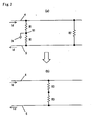
- Fig. 2(a) is a circuit diagram equivalent to balanced transmission termination device 21 of Fig. 1, in differential mode.
- Fig. 2(b) is a circuit diagram equivalent to the circuit of Fig. 2(a).
- balanced transmission termination device 21 becomes equivalent to the circuit shown in Fig. 2(a).
- circuit of Fig. 2(a) is equivalent to that of Fig. 2(b). More specifically, the circuit of Fig. 2(a) is equivalent to that of Fig. 2(b) consisting of two impedance elements R3 connected in series between lead 4 and lead 5.
- R1 impedance of impedance element R1
- R2 impedance of impedance element R2
- R3 resistance of impedance element R3
- R3 is a composite impedance of R1 and R2/2. Therefore, it is preferable to determine values of R1 and R2 in such a manner that R3 becomes substantially the same value as Zo/2 when characteristic impedance of balanced transmission line 3 is denoted as "Zo".
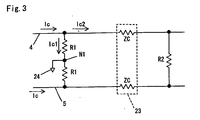
- Fig. 3 is a circuit diagram equivalent to balanced transmission termination device 21 of Fig. 1, in common mode.
- impedance of common mode choke coil 23 becomes greater since magnetic fluxes will participate as in the case of Fig. 5(b).
- balanced transmission termination device 21 becomes equivalent to the circuit of Fig. 3.
- ZC stands for impedance of a winding that constitutes common mode choke coil 23.
- ZC of [Formula 2] is substituted with impedance ZC of common mode choke coil 23 for use.
- An impedance value obtained when a current of a certain frequency is applied to common mode choke coil 23 is adopted as impedance ZC of common mode choke coil 23.
- rated current Ir corresponds to a current level above which a common mode choke coil will be saturated and will no longer be able to effectively perform its function.
- rated current Ir a rated current of a common mode choke coil is specified by the manufacturer of the common mode choke coil.
- rated current Ir herein referred to does not necessarily have to correspond with a rated current specified by the manufacturer.
- impedance of two impedance elements R1 is set at substantially the same value
- impedance of R3 that is a composite impedance of R1 and R2/2 is set at substantially the same value as Zo/2.
- common mode choke coil 23 can effectively perform its function of attenuating common mode noise even when an excessive common mode current is generated in balanced transmission line 3. Also, influence of common mode noise to main body circuit 22 in receiver unit 2 can be minimized.
- each of the impedance elements R1 is a resistance element.
- This prior art is related to a balanced-to-unbalanced transducer comprising a transformer (corresponding to a common mode choke coil).
- common mode noise is sent to a ground through an impedance element disposed between signal lines on the balanced side, for preventing influence of common mode noise.
- the prior art cannot be associated with such an object as preventing saturation of a transformer by restraining the flow of common mode current into the transformer.
- resistance elements are used as impedance elements R1 and R2 in Fig. 1, capacitors or inductors, or a combination thereof can also be employed instead, without limiting resistance elements.
Landscapes
- Engineering & Computer Science (AREA)
- Computer Networks & Wireless Communication (AREA)
- Signal Processing (AREA)
- Cable Transmission Systems, Equalization Of Radio And Reduction Of Echo (AREA)
- Dc Digital Transmission (AREA)
- Input Circuits Of Receivers And Coupling Of Receivers And Audio Equipment (AREA)
- Filters And Equalizers (AREA)
Description
- The present invention relates to a balanced transmission termination device comprising a common mode choke coil for restraining a common mode noise in a balanced transmission system in which a paired cable is employed, and to a receiver unit composed of such a device.
- Fig. 4 is a block diagram showing a balanced transmission system provided with a conventionally balanced transmission termination device. As shown in Fig. 4, this balanced transmission system comprises a
transmitter unit 30 and areceiver unit 31.Transmitter unit 30 andreceiver unit 31 carry out communications throughbalanced transmission line 32 consisting of a pair ofleads -
Receiver unit 31 comprises a conventionally balancedtransmission termination device 42 and amain body circuit 33. Balancedtransmission termination device 42 is placed at the termination ofbalanced transmission line 32, and comprises a commonmode choke coil 34 and an impedance element R. - Common
mode choke coil 34 is for attenuating a common mode noise that has been mixed intobalanced transmission line 32. Details of this operation are described hereunder. - Fig. 5 includes explanatory drawings of common
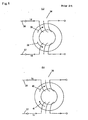
mode choke coil 34. Fig. 5 (a) is an explanatory drawing for a differential mode, and Fig. 5 (b) is an explanatory drawing for a common mode. - Referring to Fig. 5 (a), when a current Id flowing through the pair of
leads magnetic fluxes mode choke coil 34 will not cause any influence to transmission signals. - On the other hand, when a current Ic flowing through the pair of
leads magnetic fluxes mode choke coil 34 becomes greater. - As a result of the foregoing, common
mode choke coil 34 will only attenuate common mode current (common mode noise) Ic that has been mixed as noise, without affecting differential mode current (differential signal) Id, which is the object to be transmitted. - Furthermore, Japanese Unexamined Patent No.Hei-7-240652 also discloses a related prior art. This prior art is related to a balanced-to-unbalanced transducer comprising a transformer (corresponding to a common mode choke coil).
- Now, as shown in Fig. 5, common
mode choke coil 34 utilizes an effect of the magnetic fluxes generated by a current flowing through the coil. - Therefore, in a case where an excessive amount of common mode current Ic flows through common
mode choke coil 34, the core of commonmode choke coil 34 becomes saturated, and disturbs the effective performance of commonmode choke coil 34. - Also, an excessive amount of common mode current Ic may cause damage to thin coils having a small diameter.
- Especially, when the aforementioned balanced transmission system is employed in a moving object such as automobile or aircraft, the system is prone to cause the mentioned problems since an engine in an automobile or aircraft generates a large amount of common mode noise.
- Furthermore, such a moving object as stated above will often pass through the proximity of a radio wave tower or a high-tension cable, which is another cause of the mentioned problems.
- In view of the foregoing, an object of the present invention is to provide a balanced transmission termination device that can restrain saturation of a common mode choke coil and prevent damage thereof, and a receiver unit provided with such a balanced transmission termination device.
- Reference may be made to US-A-5659273 which discloses the pre-characterising features of the present invention, and to US-A-5179362.
- The first aspect of the invention provides a balanced transmission termination device provided at the termination of a balanced transmission line consisting of a pair of leads, comprising: two primary impedance elements connected in series between the pair of leads with a nodal point therebetween that is grounded, the primary impedance elements having an impedance that can maintain balanced transmission in a differential mode; a common mode choke coil disposed in cascade after the primary impedance elements for attenuating a common mode noise generated in the balanced transmission line; characterized by a secondary impedance element disposed in cascade after the common mode choke coil for impedance matching with the primary impedance elements; wherein the primary and secondary impedance elements have an impedance that allows impedance matching with a characteristic impedance of the balanced transmission line; and the impedance of the common mode choke coil, primary impedance elements and a secondary impedance element are determined in such a manner that a common mode current flowing into the common mode choke coil will not exceed a predetermined value.
- By such a construction, an excessive common mode current can be prevented from flowing into the common mode choke coil. As a result, saturation and damage of the common mode choke coil can be restrained even when an excessive common mode current is generated in the balanced transmission line.
- The second aspect of the invention provides a balanced transmission termination device according to the first aspect, wherein each of the primary impedance elements is a resistance element.
- By such a construction, a balanced transmission termination device that can restrain the saturation and damage of the common mode choke coil can be easily obtained.
- The third aspect of the invention provides a receiver unit provided with a balanced transmission termination device according to the first aspect.
- By such a construction, an excessive common mode current can be prevented from flowing into the common mode choke coil, and saturation and damage of the common mode choke coil can be restrained. As a result, the common mode choke coil can be effectively performed, and influence of common mode noise can be minimized even when an excessive common mode current is generated in the balanced transmission line.
- The fourth aspect of the invention provides a receiver unit, in addition to the third aspect, wherein each of the primary impedance elements disposed in the balanced transmission termination device is a resistance element.
- By such a construction, a receiver unit that can minimize influence of a common mode noise can be easily obtained.
- The above, and other objects, features and advantages of the present invention will become apparent from the following description read in conjunction with the accompanying drawings, in which like reference numerals designate the same elements.
- Fig. 1 is a block diagram of a balanced transmission system according to the embodiment of the present invention.
- Fig. 2 (a) is an explanatory drawing to explain an operation in a differential transmission.
- Fig. 2(b) is an explanatory drawing to explain another operation in a differential transmission.
- Fig. 3 is an explanatory drawing to explain an operation in an in-phase transmission.
- Fig. 4 is a block diagram of a conventionally balanced transmission system.
- Fig. 5(a) is an explanatory drawing of a common mode choke coil in a differential transmission.
- Fig. 5(b) is an explanatory drawing of a common mode choke coil in an in-phase transmission.
- The embodiment of the present invention shall now be described hereunder referring to the accompanying drawings.
- Fig. 1 is a block diagram of a balanced transmission system according to the embodiment of the invention. As shown in Fig. 1, the balanced transmission system is provided with a transmitter unit 1 and a
receiver unit 2. And transmitter unit 1 andreceiver unit 2 carry out communications through balanced transmission line 3 consisting of a pair ofleads -
Receiver unit 2 comprises a balancedtransmission termination device 21 and amain body circuit 22. This balancedtransmission termination device 21 is placed at the termination of balanced transmission line 3 and comprises two impedance elements R1, a commonmode choke coil 23 and an impedance element R2. - In Fig. 1, resistance elements are employed as impedance elements R1 and R2.
- The connection relationships are as follows. In the balanced
transmission termination device 21, two impedance elements R1 are connected in series betweenlead 4 andlead 5. And a nodal point N1, where one of the impedance elements R1 is connected with the other impedance element R1, is connected to grounding 24. Impedance element R2 is connected betweenlead 6 andlead 7. - An end of one of the windings of common
mode choke coil 23 is connected to nodal point N2 where impedance element R1 andlead 4 are connected, and the other end is connected to nodal point N4 where impedance element R2 andlead 6 are connected. Likewise, an end of the other winding of commonmode choke coil 23 is connected to nodal point N3 where impedance element R1 andlead 5 are connected, and the other end is connected to nodal point N5 where impedance element R2 andlead 7 are connected. - Accordingly, common
mode choke coil 23 is disposed posterior to two impedance elements R1, and impedance element R2 is disposed posterior to commonmode choke coil 23. - Each of the mentioned components functions and operates as follows. The construction, function and operation of common
mode choke coil 23 is similar to those of commonmode choke coil 34 shown in Fig. 5. Also,main body circuit 22 ofreceiver unit 2 receives signals transmitted by transmitter unit 1 through balancedtransmission termination device 21 and executes the prescribed process. - The function of maintaining balanced transmission in differential mode (differential transmission) is described as follows.
- Impedance of impedance element R1 connected to
lead 4 and that of impedance element R1 connected tolead 5 are set at substantially the same value. Because of such a setting balanced transmission in differential mode can be maintained. - Now referring to Fig. 2, the function in differential mode shall be described hereunder. Fig. 2(a) is a circuit diagram equivalent to balanced
transmission termination device 21 of Fig. 1, in differential mode. Fig. 2(b) is a circuit diagram equivalent to the circuit of Fig. 2(a). - Similarly to the construction of Fig. 5(a), impedance of common
mode choke coil 23 becomes close to zero in the differential mode. - Therefore, since common
mode choke coil 23 scarcely causes an influence in the differential mode, balancedtransmission termination device 21 becomes equivalent to the circuit shown in Fig. 2(a). - Further, the circuit of Fig. 2(a) is equivalent to that of Fig. 2(b). More specifically, the circuit of Fig. 2(a) is equivalent to that of Fig. 2(b) consisting of two impedance elements R3 connected in series between
lead 4 andlead 5. - Here, when "R1" stands for impedance of impedance element R1, "R2" for that of impedance element R2 and "R3" for that of impedance element R3, the following formula can be established.

- This formula shows that R3 is a composite impedance of R1 and R2/2. Therefore, it is preferable to determine values of R1 and R2 in such a manner that R3 becomes substantially the same value as Zo/2 when characteristic impedance of balanced transmission line 3 is denoted as "Zo".
- As a result of such a setting impedance matching can be performed, and a correct matching can be achieved for a differential mode current (differential signal) Id. Consequently, the function as a termination device can be secured.
- Referring to Fig. 3, the function in common mode (in-phase transmission) shall now be described hereunder. Fig. 3 is a circuit diagram equivalent to balanced
transmission termination device 21 of Fig. 1, in common mode. - A common mode current Ic generated by a common mode noise that has intruded from outside flows as in-phase current through a pair of
leads mode choke coil 23 becomes greater since magnetic fluxes will participate as in the case of Fig. 5(b). - In the common mode, therefore, balanced
transmission termination device 21 becomes equivalent to the circuit of Fig. 3. In Fig. 3, "ZC" stands for impedance of a winding that constitutes commonmode choke coil 23. - Then a flow of common mode current Ic generated in balanced transmission line 3 is divided into current Ic1 and current Ic2, by R1 and composite impedance of R2 and ZC, as shown in Fig. 3.
- Here, it is preferable to determine values of R1 and R2 and Zc in such a manner that a value of current Ic2 flowing into common
mode choke coil 23 will not exceed a value of rated current Ir (a predetermined value) of commonmode choke coil 23. Such setting shall be described in further detail hereunder. - Current Ic2 flowing into common
mode choke coil 23 is defined as followingFormula 2, according to which values of R1 and R2 and ZC are determined so that a value of current Ic2 will not exceed a value of rated current Ir.
- An example of steps for setting values of R1 and R2 and ZC according to [Formula 2] is given below. An assumed value of common mode current Ic that is likely to intrude into balanced transmission line 3 is substituted for "Ic" in [Formula 2]. For this operation, the following phenomena can be generally taken into consideration.
- Under a strong electric field, a common mode voltage of several to tens of V (volts) is induced. And in a transmission medium that has characteristic impedance of tens to hundreds of Ω, common mode current of hundreds of mA (milliampere) to several A (ampere) are generated.
- Accordingly, based on the foregoing it is preferable to substitute "Ic" of [Formula 2] with a value of hundreds of mA to several A.
- "ZC" of [Formula 2] is substituted with impedance ZC of common
mode choke coil 23 for use. An impedance value obtained when a current of a certain frequency is applied to commonmode choke coil 23 is adopted as impedance ZC of commonmode choke coil 23. - Also, common mode choke coils are generally designed taking characteristic impedance of a transmission medium into consideration. For example, when characteristic impedance of a transmission medium is tens to hundreds of Ω as above, an entire common mode choke coil is designed to have a greater impedance than the characteristic impedance of the transmission medium, for instance hundreds of Ω to several kΩ. In such a case, for "Zc" of [Formula 2] a value of (hundreds of Ω several kΩ)/2 is substituted.
- Then values of "R1" and "R2" in [Formula 2] are determined in such a manner that a value of current Ic2 will not exceed a value of rated current Ir.
- By the foregoing arrangement, an overcurrent Ic2 that exceeds a rated current Ir of common
mode choke coil 23 can be prevented from flowing into commonmode choke coil 23. In other words, an overcurrent Ic2 that will saturate the core or damage the winding can be prevented from flowing into commonmode choke coil 23. - Here, rated current Ir corresponds to a current level above which a common mode choke coil will be saturated and will no longer be able to effectively perform its function.
- Usually a rated current of a common mode choke coil is specified by the manufacturer of the common mode choke coil. However, "rated current Ir" herein referred to does not necessarily have to correspond with a rated current specified by the manufacturer.
- In common mode, a voltage outputted to
main body circuit 22 is divided into ZC and R2, and an influence of common mode noise will be further restrained in the condition of ZC>>R2. - Meanwhile, common mode current Ic1 is consumed by impedance element R1.
- According to the aforementioned embodiment of the invention, impedance of two impedance elements R1 is set at substantially the same value, and impedance of R3 that is a composite impedance of R1 and R2/2 is set at substantially the same value as Zo/2.
- As a result, balanced transmission can be maintained in differential mode and impedance matching can be performed. Also, in addition to securing such functions as a termination device for maintaining balanced transmission, the following advantages can be attained.
- According to this embodiment, impedance of common
mode choke coil 23, impedance elements R1 and impedance element R2 are determined in such a manner that common mode current Ic2 flowing into commonmode choke coil 23 will not exceed a rated current value Ir (a predetermined value). - By such an arrangement, an excessive common mode current can be prevented from flowing into common
mode choke coil 23. Therefore, saturation and damage of the commonmode choke coil 23 can be restrained even when an excessive common mode current is generated in balanced transmission line 3. - As a result, common
mode choke coil 23 can effectively perform its function of attenuating common mode noise even when an excessive common mode current is generated in balanced transmission line 3. Also, influence of common mode noise tomain body circuit 22 inreceiver unit 2 can be minimized. - Further, according to this embodiment, each of the impedance elements R1 is a resistance element. By such a construction, balanced
transmission termination device 21 that can restrain saturation and damage of commonmode choke coil 23 can be easily obtained. - Hereunder, differences between this embodiment and the prior art disclosed in the aforementioned Japanese Unexamined Patent No. Hei-7-240652 shall be described. This prior art is related to a balanced-to-unbalanced transducer comprising a transformer (corresponding to a common mode choke coil).
- According to the prior art, common mode noise is sent to a ground through an impedance element disposed between signal lines on the balanced side, for preventing influence of common mode noise.
- Accordingly, the prior art is not intended for attenuating common mode noise using a transformer.
- Therefore, the prior art cannot be associated with such an object as preventing saturation of a transformer by restraining the flow of common mode current into the transformer.
- Consequently, it is natural that no countermeasure for restraining the flow of common mode current into the transformer is referred to in the prior art.
- More specifically, no disclosure is made regarding the method for establishing correlations among impedance of the transformer, that of an impedance element disposed anterior to the transformer and that of an impedance element disposed posterior to the transformer.
- In view of the foregoing, it is to be understood that the embodiment of the present invention and the prior art have quite different objects, functions and effects.
- In addition, though resistance elements are used as impedance elements R1 and R2 in Fig. 1, capacitors or inductors, or a combination thereof can also be employed instead, without limiting resistance elements.
- Having described preferred embodiments of the invention with reference to the accompanying drawings, it is to be understood that the invention is not limited to those precise embodiments, and that various changes and modifications may be effected therein by one skilled in the art without departing from the scope of the invention as defined in the appended claims.
Claims (8)
- A balanced transmission termination device (21) provided at the termination of a balanced transmission line (3) consisting of a pair of leads (4,5), comprising:two primary impedance elements (R1) connected in series between said pair of leads (4,5) with a nodal point(N1) therebetween that is grounded, said primary impedance elements (R1) having an impedance that can maintain balanced transmission in differential mode;a common mode choke coil (23) disposed in cascade after said primary impedance elements (R1) for attenuating a common mode noise generated in said balanced transmission line (3);characterized by
a secondary impedance element (R2) disposed in cascade after said common mode choke coil(23) for impedance matching with said primary impedance elements (R1); wherein
said primary and secondary impedance elements (R1,R2) have an impedance that allows impedance matching with a characteristic impedance of said balanced transmission line (3); and
impedance of said common mode choke coil(23), primary impedance elements (R1) and secondary impedance element(R2) are determined in such a manner that a common mode current flowing
into said common mode choke coil(23) will not exceed a predetermined value. - The balanced transmission termination device (21) as set forth in Claim 1, wherein
impedance of said two primary impedance elements (R1) is set at substantially the same value; and
values of "R1", "R2" and "ZC" are determined so as to satisfy

wherein "Zo" stands for characteristic impedance of said balanced transmission line (3), "R1" for impedance of said primary impedance element(R1), "R2" for impedance of said secondary impedance element (R2), "ZC" for impedance of one of the windings of said common mode choke coil(23), "Ic" for an assumed value of common mode current, and "Ir" for a predetermined value that is in accordance with a rated current value of said common mode choke coil(23). - The balanced transmission termination device(21) as set forth in Claim 1, wherein each of said primary impedance elements (R1) is a resistance element.
- The balanced transmission termination device(21) as set forth in Claim 2, wherein each of said primary impedance elements (R1) is a resistance element.
- A receiver unit (2) comprising the balanced transmission termination device(21) as set forth in Claim 1.
- The receiver unit (2) as set forth in Claim 5, wherein in said balanced transmission termination device(21),
impedance of said two primary impedance elements (R1) is set at substantially the same value; and
values of "R1", "R2" and "ZC" are determined so as to satisfy

wherein "Zo" stands for characteristic impedance of said balanced transmission line (3), "R1" for impedance of said primary impedance element(R1), "R2" for impedance of said secondary impedance element (R2), "ZC" for impedance of one of the windings of said common mode choke coil(23), "Ic" for an assumed value of common mode current, and "Ir" for a predetermined value that is in accordance with a rated current value of said common mode choke coil(23). - The receiver unit (2) as set forth in Claim 5, wherein each of said primary impedance elements (R1) disposed in said balanced transmission termination device(21) is a resistance element.
- The receiver unit (2) as set forth in Claim 6, wherein each of said primary impedance elements (R1) disposed in said balanced transmission termination device(21) is a resistance element.
Applications Claiming Priority (2)
| Application Number | Priority Date | Filing Date | Title |
|---|---|---|---|
| JP2001054226A JP4468602B2 (en) | 2001-02-28 | 2001-02-28 | Balanced transmission terminator and receiver using the same |
| JP2001054226 | 2001-02-28 |
Publications (2)
| Publication Number | Publication Date |
|---|---|
| EP1237295A1 EP1237295A1 (en) | 2002-09-04 |
| EP1237295B1 true EP1237295B1 (en) | 2006-05-03 |
Family
ID=18914590
Family Applications (1)
| Application Number | Title | Priority Date | Filing Date |
|---|---|---|---|
| EP02003231A Expired - Lifetime EP1237295B1 (en) | 2001-02-28 | 2002-02-20 | Balanced transmission termination device |
Country Status (5)
| Country | Link |
|---|---|
| US (1) | US6677829B2 (en) |
| EP (1) | EP1237295B1 (en) |
| JP (1) | JP4468602B2 (en) |
| KR (1) | KR100821422B1 (en) |
| DE (1) | DE60211052T2 (en) |
Families Citing this family (12)
| Publication number | Priority date | Publication date | Assignee | Title |
|---|---|---|---|---|
| AU2002368534A1 (en) | 2002-12-27 | 2004-07-29 | Matsushita Electric Industrial Co., Ltd. | Receiver |
| US7430291B2 (en) * | 2003-09-03 | 2008-09-30 | Thunder Creative Technologies, Inc. | Common mode transmission line termination |
| JP2005245118A (en) * | 2004-02-26 | 2005-09-08 | Mitsubishi Electric Corp | Electrical device with inverter circuit |
| US7385466B2 (en) | 2004-03-30 | 2008-06-10 | Matsushita Electric Industrial Co., Ltd. | Differential transmission circuit and common mode choke coil |
| KR100681131B1 (en) * | 2004-12-02 | 2007-02-08 | 주식회사 로템 | Noise suppression circuit for SIP monitor card of electric car |
| US7339443B2 (en) * | 2004-12-06 | 2008-03-04 | Matsushita Electric Industrial Co., Ltd. | Common mode radiation inhibit circuit and electronic equipment |
| US7388449B2 (en) * | 2004-12-10 | 2008-06-17 | Matsushita Electric Industrial Co., Ltd. | Radiation noise suppression circuit for differential transmission line |
| CN1787504B (en) * | 2004-12-10 | 2011-05-04 | 松下电器产业株式会社 | Radiation noise suppression circuit for differential transmission line |
| JP5386055B2 (en) * | 2005-08-30 | 2014-01-15 | 株式会社日立製作所 | Characteristic evaluation apparatus and characteristic evaluation method |
| JP2007274884A (en) * | 2006-02-02 | 2007-10-18 | Fuji Electric Device Technology Co Ltd | Power converter |
| US7436203B1 (en) * | 2007-04-18 | 2008-10-14 | National Semiconductor Corporation | On-chip transformer arrangement |
| US20090058559A1 (en) * | 2007-08-31 | 2009-03-05 | Pakkala William F | Microprocessor common-mode emissions reduction circuit |
Family Cites Families (7)
| Publication number | Priority date | Publication date | Assignee | Title |
|---|---|---|---|---|
| US4283604A (en) * | 1979-06-04 | 1981-08-11 | Tellabs, Inc. | Current source circuits with common mode noise rejection |
| EP0325379B1 (en) * | 1988-01-14 | 1997-03-19 | Kabushiki Kaisha Toshiba | Value determining method for line filter and its components |
| JPH0333424A (en) | 1989-06-29 | 1991-02-13 | Fuji Heavy Ind Ltd | Inner-cylinder direct injection type two cycle engine |
| US5179362A (en) * | 1989-12-15 | 1993-01-12 | Kabushiki Kaisha Toshiba | Power line filter |
| JP3033424B2 (en) | 1994-02-28 | 2000-04-17 | 松下電工株式会社 | Balance-unbalance converter |
| AU3083595A (en) * | 1994-08-03 | 1996-03-04 | Madge Networks Limited | Electromagnetic interference isolator |
| US6150896A (en) * | 1994-12-19 | 2000-11-21 | Bh Electronics, Inc. | Coupling device connecting an unbalanced signal line to a balanced signal line |
-
2001
- 2001-02-28 JP JP2001054226A patent/JP4468602B2/en not_active Expired - Lifetime
-
2002
- 2002-02-20 EP EP02003231A patent/EP1237295B1/en not_active Expired - Lifetime
- 2002-02-20 DE DE60211052T patent/DE60211052T2/en not_active Expired - Lifetime
- 2002-02-27 KR KR1020020010361A patent/KR100821422B1/en not_active Expired - Lifetime
- 2002-02-27 US US10/086,185 patent/US6677829B2/en not_active Expired - Lifetime
Also Published As
| Publication number | Publication date |
|---|---|
| KR100821422B1 (en) | 2008-04-10 |
| DE60211052D1 (en) | 2006-06-08 |
| EP1237295A1 (en) | 2002-09-04 |
| JP2002261842A (en) | 2002-09-13 |
| US6677829B2 (en) | 2004-01-13 |
| KR20020070134A (en) | 2002-09-05 |
| DE60211052T2 (en) | 2006-11-02 |
| US20020145485A1 (en) | 2002-10-10 |
| JP4468602B2 (en) | 2010-05-26 |
Similar Documents
| Publication | Publication Date | Title |
|---|---|---|
| US6677829B2 (en) | Balanced transmission termination device and receiver unit composed thereof | |
| US20030095036A1 (en) | Power line communication system and power line branching apparatus | |
| EP0096965B1 (en) | Active impedance transformer assisted line feed circuit | |
| CA1226919A (en) | Receiving circuit for a data transmission system | |
| EP1492287A1 (en) | Receiver | |
| JPH08115820A (en) | Common-mode choke coil | |
| EP0098066B1 (en) | A data transmission system | |
| US4951312A (en) | Balanced transmission device | |
| JPH1168497A (en) | Common mode filter | |
| EP1465218B1 (en) | Electric device with a noise filter and air conditioner with such a device | |
| EP0876667B1 (en) | Ground skew protection method and apparatus | |
| US4998079A (en) | Bi-directional signal coupler for a balanced data transmission line | |
| US4453131A (en) | Transformer coupled amplifier circuit | |
| US6087822A (en) | Power transformer with internal differential mode distortion cancellation | |
| JP3164567B2 (en) | Noise filter | |
| JPH07297035A (en) | Noise reduction unit and transmission system using the unit | |
| JP3303047B2 (en) | Interference wave applying device | |
| JP2675584B2 (en) | Immunity test circuit | |
| JP3243674B2 (en) | CM type directional coupler | |
| JPS6177445A (en) | Line coupling circuit | |
| JPS5975172A (en) | Transmitter and receiver driving circuit of sonnar | |
| JPS60250739A (en) | Console unit for remote control | |
| JPH07321717A (en) | Transmission equipment | |
| JPH06163261A (en) | Integrated circuit device | |
| JPS6224606A (en) | Branch transformer |
Legal Events
| Date | Code | Title | Description |
|---|---|---|---|
| PUAI | Public reference made under article 153(3) epc to a published international application that has entered the european phase |
Free format text: ORIGINAL CODE: 0009012 |
|
| AK | Designated contracting states |
Kind code of ref document: A1 Designated state(s): AT BE CH CY DE DK ES FI FR GB GR IE IT LI LU MC NL PT SE TR |
|
| AX | Request for extension of the european patent |
Free format text: AL;LT;LV;MK;RO;SI |
|
| 17P | Request for examination filed |
Effective date: 20020917 |
|
| AKX | Designation fees paid |
Designated state(s): DE FR GB IT SE |
|
| GRAP | Despatch of communication of intention to grant a patent |
Free format text: ORIGINAL CODE: EPIDOSNIGR1 |
|
| GRAS | Grant fee paid |
Free format text: ORIGINAL CODE: EPIDOSNIGR3 |
|
| GRAA | (expected) grant |
Free format text: ORIGINAL CODE: 0009210 |
|
| AK | Designated contracting states |
Kind code of ref document: B1 Designated state(s): DE FR GB IT SE |
|
| PG25 | Lapsed in a contracting state [announced via postgrant information from national office to epo] |
Ref country code: IT Free format text: LAPSE BECAUSE OF FAILURE TO SUBMIT A TRANSLATION OF THE DESCRIPTION OR TO PAY THE FEE WITHIN THE PRESCRIBED TIME-LIMIT;WARNING: LAPSES OF ITALIAN PATENTS WITH EFFECTIVE DATE BEFORE 2007 MAY HAVE OCCURRED AT ANY TIME BEFORE 2007. THE CORRECT EFFECTIVE DATE MAY BE DIFFERENT FROM THE ONE RECORDED. Effective date: 20060503 |
|
| REG | Reference to a national code |
Ref country code: GB Ref legal event code: FG4D |
|
| REF | Corresponds to: |
Ref document number: 60211052 Country of ref document: DE Date of ref document: 20060608 Kind code of ref document: P |
|
| REG | Reference to a national code |
Ref country code: SE Ref legal event code: TRGR |
|
| ET | Fr: translation filed | ||
| PLBE | No opposition filed within time limit |
Free format text: ORIGINAL CODE: 0009261 |
|
| STAA | Information on the status of an ep patent application or granted ep patent |
Free format text: STATUS: NO OPPOSITION FILED WITHIN TIME LIMIT |
|
| 26N | No opposition filed |
Effective date: 20070206 |
|
| REG | Reference to a national code |
Ref country code: FR Ref legal event code: PLFP Year of fee payment: 15 |
|
| REG | Reference to a national code |
Ref country code: FR Ref legal event code: PLFP Year of fee payment: 16 |
|
| REG | Reference to a national code |
Ref country code: FR Ref legal event code: PLFP Year of fee payment: 17 |
|
| PGFP | Annual fee paid to national office [announced via postgrant information from national office to epo] |
Ref country code: FR Payment date: 20210112 Year of fee payment: 20 |
|
| PGFP | Annual fee paid to national office [announced via postgrant information from national office to epo] |
Ref country code: SE Payment date: 20210210 Year of fee payment: 20 Ref country code: DE Payment date: 20210209 Year of fee payment: 20 Ref country code: GB Payment date: 20210210 Year of fee payment: 20 |
|
| PGFP | Annual fee paid to national office [announced via postgrant information from national office to epo] |
Ref country code: IT Payment date: 20210112 Year of fee payment: 20 |
|
| REG | Reference to a national code |
Ref country code: DE Ref legal event code: R071 Ref document number: 60211052 Country of ref document: DE |
|
| REG | Reference to a national code |
Ref country code: GB Ref legal event code: PE20 Expiry date: 20220219 |
|
| REG | Reference to a national code |
Ref country code: SE Ref legal event code: EUG |
|
| PG25 | Lapsed in a contracting state [announced via postgrant information from national office to epo] |
Ref country code: GB Free format text: LAPSE BECAUSE OF EXPIRATION OF PROTECTION Effective date: 20220219 |