EP1237000B1 - Verfahren zur Detektion und zur Kontrolle der Hydratbildung an allen Stellen von mehrphasigen Rohölflüssigkeiten transportierenden Rohren - Google Patents
Verfahren zur Detektion und zur Kontrolle der Hydratbildung an allen Stellen von mehrphasigen Rohölflüssigkeiten transportierenden Rohren Download PDFInfo
- Publication number
- EP1237000B1 EP1237000B1 EP02290415A EP02290415A EP1237000B1 EP 1237000 B1 EP1237000 B1 EP 1237000B1 EP 02290415 A EP02290415 A EP 02290415A EP 02290415 A EP02290415 A EP 02290415A EP 1237000 B1 EP1237000 B1 EP 1237000B1
- Authority
- EP
- European Patent Office
- Prior art keywords
- pipe
- hydrate
- mixture
- petroleum fluids
- fluids
- Prior art date
- Legal status (The legal status is an assumption and is not a legal conclusion. Google has not performed a legal analysis and makes no representation as to the accuracy of the status listed.)
- Expired - Lifetime
Links
- 239000012530 fluid Substances 0.000 title claims description 45
- 230000015572 biosynthetic process Effects 0.000 title claims description 32
- 238000000034 method Methods 0.000 title claims description 20
- 239000003208 petroleum Substances 0.000 title claims description 20
- 239000000203 mixture Substances 0.000 claims description 72
- 238000010494 dissociation reaction Methods 0.000 claims description 34
- 230000005593 dissociations Effects 0.000 claims description 34
- 239000000470 constituent Substances 0.000 claims description 7
- 238000010438 heat treatment Methods 0.000 claims description 4
- 238000001514 detection method Methods 0.000 claims description 3
- 238000012546 transfer Methods 0.000 claims description 3
- 239000003112 inhibitor Substances 0.000 claims description 2
- XLYOFNOQVPJJNP-UHFFFAOYSA-N water Substances O XLYOFNOQVPJJNP-UHFFFAOYSA-N 0.000 description 49
- 150000004677 hydrates Chemical class 0.000 description 42
- 239000012071 phase Substances 0.000 description 37
- 238000004364 calculation method Methods 0.000 description 16
- 238000004088 simulation Methods 0.000 description 16
- 229930195733 hydrocarbon Natural products 0.000 description 15
- 150000002430 hydrocarbons Chemical class 0.000 description 15
- 239000007789 gas Substances 0.000 description 14
- VNWKTOKETHGBQD-UHFFFAOYSA-N methane Chemical compound C VNWKTOKETHGBQD-UHFFFAOYSA-N 0.000 description 14
- CURLTUGMZLYLDI-UHFFFAOYSA-N Carbon dioxide Chemical compound O=C=O CURLTUGMZLYLDI-UHFFFAOYSA-N 0.000 description 12
- 238000004519 manufacturing process Methods 0.000 description 12
- ATUOYWHBWRKTHZ-UHFFFAOYSA-N Propane Chemical compound CCC ATUOYWHBWRKTHZ-UHFFFAOYSA-N 0.000 description 10
- NNPPMTNAJDCUHE-UHFFFAOYSA-N isobutane Chemical compound CC(C)C NNPPMTNAJDCUHE-UHFFFAOYSA-N 0.000 description 10
- IJGRMHOSHXDMSA-UHFFFAOYSA-N Atomic nitrogen Chemical compound N#N IJGRMHOSHXDMSA-UHFFFAOYSA-N 0.000 description 9
- 239000007788 liquid Substances 0.000 description 9
- 239000000126 substance Substances 0.000 description 9
- 239000004215 Carbon black (E152) Substances 0.000 description 8
- 229920000297 Rayon Polymers 0.000 description 8
- 239000008346 aqueous phase Substances 0.000 description 8
- 238000002347 injection Methods 0.000 description 8
- 239000007924 injection Substances 0.000 description 8
- 239000002964 rayon Substances 0.000 description 8
- OTMSDBZUPAUEDD-UHFFFAOYSA-N Ethane Chemical compound CC OTMSDBZUPAUEDD-UHFFFAOYSA-N 0.000 description 6
- 230000006399 behavior Effects 0.000 description 5
- 229910002092 carbon dioxide Inorganic materials 0.000 description 5
- 239000001569 carbon dioxide Substances 0.000 description 5
- 239000013078 crystal Substances 0.000 description 5
- 238000010586 diagram Methods 0.000 description 5
- 230000000694 effects Effects 0.000 description 5
- 230000003993 interaction Effects 0.000 description 5
- 239000001282 iso-butane Substances 0.000 description 5
- 235000013847 iso-butane Nutrition 0.000 description 5
- 239000001294 propane Substances 0.000 description 5
- RWSOTUBLDIXVET-UHFFFAOYSA-N Dihydrogen sulfide Chemical compound S RWSOTUBLDIXVET-UHFFFAOYSA-N 0.000 description 4
- 230000004907 flux Effects 0.000 description 4
- 230000004048 modification Effects 0.000 description 4
- 238000012986 modification Methods 0.000 description 4
- 229910052757 nitrogen Inorganic materials 0.000 description 4
- 239000003921 oil Substances 0.000 description 4
- 238000001179 sorption measurement Methods 0.000 description 4
- WSNMPAVSZJSIMT-UHFFFAOYSA-N COc1c(C)c2COC(=O)c2c(O)c1CC(O)C1(C)CCC(=O)O1 Chemical compound COc1c(C)c2COC(=O)c2c(O)c1CC(O)C1(C)CCC(=O)O1 WSNMPAVSZJSIMT-UHFFFAOYSA-N 0.000 description 3
- 241000897276 Termes Species 0.000 description 3
- 150000001875 compounds Chemical class 0.000 description 3
- 238000012937 correction Methods 0.000 description 3
- -1 cyclic alkenes Chemical class 0.000 description 3
- 230000014509 gene expression Effects 0.000 description 3
- 230000001936 parietal effect Effects 0.000 description 3
- 238000009491 slugging Methods 0.000 description 3
- 230000005514 two-phase flow Effects 0.000 description 3
- 230000009471 action Effects 0.000 description 2
- 235000021183 entrée Nutrition 0.000 description 2
- 230000007717 exclusion Effects 0.000 description 2
- 238000009413 insulation Methods 0.000 description 2
- 239000007791 liquid phase Substances 0.000 description 2
- 238000012544 monitoring process Methods 0.000 description 2
- IJDNQMDRQITEOD-UHFFFAOYSA-N n-butane Chemical compound CCCC IJDNQMDRQITEOD-UHFFFAOYSA-N 0.000 description 2
- 239000003345 natural gas Substances 0.000 description 2
- 230000001052 transient effect Effects 0.000 description 2
- 101100322245 Caenorhabditis elegans des-2 gene Proteins 0.000 description 1
- 238000004510 Lennard-Jones potential Methods 0.000 description 1
- 238000002940 Newton-Raphson method Methods 0.000 description 1
- 241001080024 Telles Species 0.000 description 1
- 238000002441 X-ray diffraction Methods 0.000 description 1
- 239000000654 additive Substances 0.000 description 1
- 150000001298 alcohols Chemical class 0.000 description 1
- 150000001335 aliphatic alkanes Chemical class 0.000 description 1
- 229910052799 carbon Inorganic materials 0.000 description 1
- 230000008859 change Effects 0.000 description 1
- 238000004140 cleaning Methods 0.000 description 1
- 230000000052 comparative effect Effects 0.000 description 1
- 229910003460 diamond Inorganic materials 0.000 description 1
- 239000010432 diamond Substances 0.000 description 1
- 238000005553 drilling Methods 0.000 description 1
- 238000005516 engineering process Methods 0.000 description 1
- 238000011156 evaluation Methods 0.000 description 1
- 239000006260 foam Substances 0.000 description 1
- 238000009472 formulation Methods 0.000 description 1
- 230000005484 gravity Effects 0.000 description 1
- 230000002706 hydrostatic effect Effects 0.000 description 1
- 229910052500 inorganic mineral Inorganic materials 0.000 description 1
- 238000003780 insertion Methods 0.000 description 1
- 230000037431 insertion Effects 0.000 description 1
- 238000002955 isolation Methods 0.000 description 1
- 244000239634 longleaf box Species 0.000 description 1
- 239000011159 matrix material Substances 0.000 description 1
- 238000005259 measurement Methods 0.000 description 1
- 238000010946 mechanistic model Methods 0.000 description 1
- 239000002184 metal Substances 0.000 description 1
- 239000011707 mineral Substances 0.000 description 1
- 238000002156 mixing Methods 0.000 description 1
- QJGQUHMNIGDVPM-UHFFFAOYSA-N nitrogen group Chemical group [N] QJGQUHMNIGDVPM-UHFFFAOYSA-N 0.000 description 1
- 230000008520 organization Effects 0.000 description 1
- 238000005192 partition Methods 0.000 description 1
- 229910052698 phosphorus Inorganic materials 0.000 description 1
- 238000005381 potential energy Methods 0.000 description 1
- 238000005086 pumping Methods 0.000 description 1
- 238000003303 reheating Methods 0.000 description 1
- 230000000717 retained effect Effects 0.000 description 1
- 238000012502 risk assessment Methods 0.000 description 1
- 150000003839 salts Chemical class 0.000 description 1
- 238000000926 separation method Methods 0.000 description 1
- 239000007787 solid Substances 0.000 description 1
- 239000000243 solution Substances 0.000 description 1
- 230000006641 stabilisation Effects 0.000 description 1
- 238000011105 stabilization Methods 0.000 description 1
- 238000003860 storage Methods 0.000 description 1
- 238000012876 topography Methods 0.000 description 1
- 230000003827 upregulation Effects 0.000 description 1
- 238000010200 validation analysis Methods 0.000 description 1
- 239000001993 wax Substances 0.000 description 1
Images



Classifications
-
- E—FIXED CONSTRUCTIONS
- E21—EARTH OR ROCK DRILLING; MINING
- E21B—EARTH OR ROCK DRILLING; OBTAINING OIL, GAS, WATER, SOLUBLE OR MELTABLE MATERIALS OR A SLURRY OF MINERALS FROM WELLS
- E21B49/00—Testing the nature of borehole walls; Formation testing; Methods or apparatus for obtaining samples of soil or well fluids, specially adapted to earth drilling or wells
-
- G—PHYSICS
- G01—MEASURING; TESTING
- G01N—INVESTIGATING OR ANALYSING MATERIALS BY DETERMINING THEIR CHEMICAL OR PHYSICAL PROPERTIES
- G01N33/00—Investigating or analysing materials by specific methods not covered by groups G01N1/00 - G01N31/00
- G01N33/26—Oils; Viscous liquids; Paints; Inks
- G01N33/28—Oils, i.e. hydrocarbon liquids
- G01N33/2823—Raw oil, drilling fluid or polyphasic mixtures
-
- Y—GENERAL TAGGING OF NEW TECHNOLOGICAL DEVELOPMENTS; GENERAL TAGGING OF CROSS-SECTIONAL TECHNOLOGIES SPANNING OVER SEVERAL SECTIONS OF THE IPC; TECHNICAL SUBJECTS COVERED BY FORMER USPC CROSS-REFERENCE ART COLLECTIONS [XRACs] AND DIGESTS
- Y10—TECHNICAL SUBJECTS COVERED BY FORMER USPC
- Y10T—TECHNICAL SUBJECTS COVERED BY FORMER US CLASSIFICATION
- Y10T436/00—Chemistry: analytical and immunological testing
- Y10T436/11—Automated chemical analysis
Definitions
- the present invention relates to a method for detecting and controlling the formation of hydrates at any point in a pipe in which multiphase petroleum fluids circulate.
- Late detection of the presence of hydrates can lead to costly production problems: complete blockage of production lines and / or transport. It is therefore important for the operator, to have means of risk assessment of any kind, so as to set up regulation and intervention techniques and thus to ensure a good flow of fluids in circulation.
- the flow patterns of multiphase fluids in tubes are extremely varied and complex.
- the two-phase flows for example, can be stratified, the liquid phase flowing in the lower part of the pipe, or intermittent with a succession of liquid and gaseous plugs, or even dispersed, the liquid being entrained in the form of fine droplets .
- the flow mode and the slip between the phases vary in particular with the inclination of the pipes with respect to the horizontal and depend on the flow rate, the temperature, etc.
- the numerical scheme is conservative and not dissipative. It provides a good balance of mass and energy at all points of the drive and at all times.
- An implicit / explicit mixed scheme is used to optimize the calculation time and the ability to track the edges of vacuum rate waves, which is particularly important in the case where the configuration of the terrain followed by the pipeline or its own configuration, promotes the formation of liquid plugs with propagation of vacuum waves in the two opposite directions of the pipeline, phenomena that specialists commonly refer to as “slugging” or "severe slugging”.
- the so-called flash module provides precise tracking of the composition of fluids both in space and in time, throughout the simulation.
- compositional monitoring makes the TACITE code particularly suitable for accurately predicting the risk of hydrate formation, as will be seen later.
- the hydrodynamic module calculates the flow regime, the slip speed between phases and the friction terms.
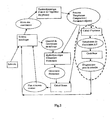
- the method according to the invention makes it possible to continuously detect at any point in a pipe in which a multiphase mixture of petroleum fluids circulates, the thermodynamic conditions for the formation of hydrates. It involves the use of a mechanistic hydrodynamic module and an integrated compositional thermodynamic module to define the properties of the phases and the resolution of mass conservation equations, conservation of momentum and energy transfer. within the mixture, considering that the mixture of fluids is substantially at equilibrium at each instant, that the composition of the multiphase mixture is variable throughout the pipe and that the mass of each constituent of the mixture is defined globally by a conservation equation of the mass regardless of its phase state. Petroleum fluids are grouped into a limited number of pseudo-components, each grouping together certain hydrocarbon fractions.
- thermodynamic conditions of hydrate formation are detected after having carried out a particular grouping of the petroleum fluids into pseudo-components so as to isolate the hydrate-forming components, with definition for each of them of a mass fraction and a certain number of characteristic physical quantities, and one applies to the thermodynamic and hydrodynamic modules, data relating to these pseudo-components selected so as to determine in all points the temperature (Td) of dissociation of the hydrates .
- the invention also relates to a method for continuously monitoring at any point in a pipe in which multiphase petroleum fluids circulate, the formation of hydrates. It comprises the detection of the thermodynamic hydrate formation conditions as defined above, the use of a control member to compare the temperature of the petroleum fluids at this temperature of dissociation (Td) and the application commissioned by this body of control, of measures intended to combat the formation of hydrates.
- Td temperature of dissociation
- heating means associated with the pipe are used to raise the temperature of the petroleum fluids above the dissociation temperature.
- the pipe is included with at least a second conduit in a tube isolated from the outside environment, the second conduit is used to circulate a hot fluid.
- hydrate inhibitors are injected into the pipe.
- Hydrates are solid compounds consisting of hydrocarbon molecules (methane, ethane, carbon dioxide etc.) trapped at high pressure and low temperature inside approximately spherical cages formed by a three-dimensional crystal lattice of water molecules. This structure is metastable in the absence of hydrocarbons and requires a minimum filling rate to ensure its stabilization. Unlike the ice crystal lattice, the hydrate lattice can remain stable above 0 ° C.
- W ( r ) is the potential energy of interaction between the water molecules forming the cavity and the gas molecule at a distance r from the center of the cavity.
- There are several forms of potential, the most used are Lennard-Jones potential, Kihara potential and square well potential.
- ⁇ water aqueous P T ⁇ water 0 P T + RT ln ⁇ x , where ⁇ is the water activity coefficient, x the molar fraction of water in the aqueous phase and ⁇ water 0 P T the chemical potential of pure water. It is in this calculation of the activity of water in aqueous phase that the effects of salts and alcohols are taken into account, among other things.
- the different hydrate prediction modules are all based on the formalism described above. These modules will essentially differentiate in the choice of the water-hydrocarbon interaction potential, in the choice of the state equation used for the calculation of the fugacities as well as in the calculation module of the water activity. liquid phase. In what follows, we present more precisely the module that we adapted for the needs of TACITE.
- the hydrate prediction module implemented in TACITE is inspired by the Munck module as described by Munck, J. et al, "Computations of the formation of gas hydrates", Chem. Eng. Sci 43, 2661 (1988) ). It makes it possible to calculate the dissociation temperature of hydrates at pressure given in the case of a gas, a liquid or a two - phase gas - liquid mixture in contact with liquid water.
- the fugacities of the various constituents present in the mixture, hydrate formers or not, are calculated using the Soave-Redlich-Kwong state equation already mentioned. Such a calculation is done by the call to the fixed pressure and temperature flash module integrated in TACITE.
- ⁇ 0 H 0 is the corresponding difference in enthalpy .DELTA.C p the difference in heat capacity and ⁇ V the difference in volume.
- the modulus used gives excellent predictions of equilibrium hydrate conditions. For 99% of the points, the temperature is predicted at ⁇ 1 ° C. In all cases, the maximum difference between the calculated and measured dissociation temperatures does not exceed 1.6 ° C.
- the histogram concerning the data of mixtures of hydrocarbons, natural gases or oils, is presented on the Fig.12 .
- the experimental data used to calculate this histogram come from eight different mixtures, six of natural gas type and two oils. A very good description of the behavior of these systems is again observed by the prediction module used.
- This file contains as many lines as pseudo-components defined in the ".PVT” file and the component information takes into account the order in which the components are stored in the ".PVT” file.
- the i th line concerns the identifier of the nature of the i th component.
- a first mode of action is to heat the circulating fluids to bring them above the hydrate dissociation temperature that has been predicted, at least at the points of the pipe where the risk has occurred.
- Oil pipes for deep-sea marine production are generally included with other lines in a metal pipe T coated externally with an insulating layer.
- This set of lines (referred to as "bundies" by those skilled in the art) is often divided into several beams such as F1, F2 (cf. Fig.4 ).
- Each beam generally comprises one or more transport lines 1, 2, 3 for monophasic or multiphase fluids that can be collected in a common tube 4 possibly itself covered externally with an insulating layer.
- the interior of each tube 4 is filled most often with a monophasic fluid.
- the interior space of the pipe T, between the different beams F1, F2 is filled for example with a thermally insulating foam 5.
- One of the transport lines 2, 3 can be used for example to circulate if necessary. , a heating fluid.
- a second mode of action consists in injecting into the fluids inhibiting additives of known type that oppose the formation of hydrates.
- compositional code such as the TACITE code allows at any point of the pipeline, an exact calculation, at the computed pressure of the fluid and for the local composition calculated during simulation, the dissociation temperature of the hydrates, and consequently a much better simulation of the risks of appearance of hydrates than codes where the composition is supposed fixed, corresponding to that which one injects at the entry of the pipe. It has been verified, for example, that the injection of gas at the foot of a "riser” (a technique well known to those skilled in the art), modified the local thermodynamic conditions of a given mixture of petroleum fluids, to the point that the formation of hydrates could be predicted, whereas assuming a fixed composition of the mixture, this risk was not detected at all.
- the simulation is carried out considering that the initial mixture was modified by an injection at the bottom of the riser, of methane favoring the formation of hydrates.
Landscapes
- Life Sciences & Earth Sciences (AREA)
- Engineering & Computer Science (AREA)
- Chemical & Material Sciences (AREA)
- Geology (AREA)
- Mining & Mineral Resources (AREA)
- Health & Medical Sciences (AREA)
- Physics & Mathematics (AREA)
- Fluid Mechanics (AREA)
- Medicinal Chemistry (AREA)
- General Chemical & Material Sciences (AREA)
- Analytical Chemistry (AREA)
- Biochemistry (AREA)
- General Health & Medical Sciences (AREA)
- General Physics & Mathematics (AREA)
- Immunology (AREA)
- Environmental & Geological Engineering (AREA)
- Pathology (AREA)
- Oil, Petroleum & Natural Gas (AREA)
- Chemical Kinetics & Catalysis (AREA)
- Food Science & Technology (AREA)
- General Life Sciences & Earth Sciences (AREA)
- Geochemistry & Mineralogy (AREA)
- Pipeline Systems (AREA)
- Organic Low-Molecular-Weight Compounds And Preparation Thereof (AREA)
- Production Of Liquid Hydrocarbon Mixture For Refining Petroleum (AREA)
- Loading And Unloading Of Fuel Tanks Or Ships (AREA)
- Management, Administration, Business Operations System, And Electronic Commerce (AREA)
Claims (5)
- Verfahren zum kontinuierlichen Erfassen der thermodynamischen Bedingungen der Hydratbildung an jedem Punkt einer Leitung (1), in der ein mehrphasiges Gemisch aus Erdölfluiden zirkuliert, wobei ein mechanistisches hydrodynamisches Modul und ein integriertes thermodynamisches Modul für die Zusammensetzung verwendet wird, um die Eigenschaften der Phasen zu definieren, und Masseerhaltungs- und Impulserhaltungsgleichungen sowie Gleichungen der Energieübertragung innerhalb des Gemischs angewendet werden, wobei berücksichtigt wird, dass das Fluidgemisch im Wesentlichen zu jedem Zeitpunkt im Gleichgewicht ist, dass die Zusammensetzung des mehrphasigen Gemischs über die gesamte Leitung variabel ist und dass die Masse jedes Bestandteils des Gemischs insgesamt, ohne Berücksichtigung seines Phasenzustands, durch eine Masseerhaltungsgleichung definiert wird, und die Erdölfluide in eine begrenzte Anzahl von Pseudobestandteilen umgruppiert werden, dadurch gekennzeichnet, dass die thermodynamischen Bedingungen der Hydratbildung erfasst werden:- indem eine Umgruppierung der Erdölfluide in Pseudobestandteile vorgenommen wird, wobei die Bestandteile, die Hydratbilder sind, isoliert werden, und indem für jeden Pseudobestandteil Daten definiert werden, die eine Massefraktion und physikalische Größen umfassen, die für den Pseudobestandteil kennzeichnend sind; und- indem auf die Module die für die Pseudobestandteile definierten Daten angewendet werden, um an jedem Punkt die Temperatur der Hydratdissoziation (Td) zu bestimmen.
- Verfahren nach Anspruch 1, wobei an jedem Punkt der Leitung die Hydratbildung kontinuierlich kontrolliert wird, indem die folgenden Schritte angewendet werden:a) Es wird eine Kontrollvorrichtung (C) verwendet, um die Temperatur der Erdölfluide mit der Hydratdissoziationstemperatur (Td) zu vergleichen; undb) unter der Kontrolle dieser Kontrollvorrichtung (C) werden Maßnahmen angewendet, die dazu bestimmt sind, der Hydratbildung entgegenzuwirken.
- Verfahren nach Anspruch 2, dadurch gekennzeichnet, dass Mittel zum Erwärmen verwendet werden, die mit der Leitung (1) assoziiert sind, um die Temperatur der Erdölfluide über die Dissoziationstemperatur zu erhöhen.
- Verfahren nach Anspruch 3, dadurch gekennzeichnet, dass, wobei Leitung (1) zusammen mit mindestens einer zweiten Leitung (2, 3) in einem Rohr (T) enthalten ist, das vom umgebenden Medium isoliert ist, die zweite Leitung (2, 3) verwendet wird, um dort ein warmes Fluid zirkulieren zu lassen.
- Verfahren nach Anspruch 2, dadurch gekennzeichnet, dass, gesteuert durch die Kontrollvorrichtung (C), Hydratinhibitoren in die Leitung (1) injiziert werden.
Applications Claiming Priority (2)
| Application Number | Priority Date | Filing Date | Title |
|---|---|---|---|
| FR0102842A FR2821675B1 (fr) | 2001-03-01 | 2001-03-01 | Methode pour detecter et controler la formation d'hydrates en tout point d'une conduite ou circulent des fluides petroliers polyphasiques |
| FR0102842 | 2001-03-01 |
Publications (2)
| Publication Number | Publication Date |
|---|---|
| EP1237000A1 EP1237000A1 (de) | 2002-09-04 |
| EP1237000B1 true EP1237000B1 (de) | 2010-04-14 |
Family
ID=8860642
Family Applications (1)
| Application Number | Title | Priority Date | Filing Date |
|---|---|---|---|
| EP02290415A Expired - Lifetime EP1237000B1 (de) | 2001-03-01 | 2002-02-21 | Verfahren zur Detektion und zur Kontrolle der Hydratbildung an allen Stellen von mehrphasigen Rohölflüssigkeiten transportierenden Rohren |
Country Status (7)
| Country | Link |
|---|---|
| US (1) | US6871118B2 (de) |
| EP (1) | EP1237000B1 (de) |
| BR (1) | BR0200499A (de) |
| CA (1) | CA2374089C (de) |
| DE (1) | DE60235933D1 (de) |
| FR (1) | FR2821675B1 (de) |
| NO (1) | NO322148B1 (de) |
Families Citing this family (25)
| Publication number | Priority date | Publication date | Assignee | Title |
|---|---|---|---|---|
| US6853921B2 (en) | 1999-07-20 | 2005-02-08 | Halliburton Energy Services, Inc. | System and method for real time reservoir management |
| US7584165B2 (en) * | 2003-01-30 | 2009-09-01 | Landmark Graphics Corporation | Support apparatus, method and system for real time operations and maintenance |
| US20050065660A1 (en) * | 2003-09-16 | 2005-03-24 | Jostein Aleksandersen | Method for repairing an oil or gas pipeline |
| US20050076085A1 (en) * | 2003-09-18 | 2005-04-07 | Vulcan Portals Inc. | Method and system for managing email attachments for an electronic device |
| WO2005038409A2 (en) * | 2003-10-17 | 2005-04-28 | Invensys Systems, Inc. | Flow assurance monitoring |
| US7676352B1 (en) | 2004-04-19 | 2010-03-09 | Invensys Systems, Inc. | System and method for efficient computation of simulated thermodynamic property and phase equilibrium characteristics using comprehensive local property models |
| US20050283276A1 (en) * | 2004-05-28 | 2005-12-22 | Prescott Clifford N | Real time subsea monitoring and control system for pipelines |
| CN1310026C (zh) * | 2004-10-12 | 2007-04-11 | 中国科学院广州能源研究所 | 原位测量气体水合物及含水合物沉积物热物性的方法和装置 |
| GB0425180D0 (en) * | 2004-11-16 | 2004-12-15 | Univ Heriot Watt | Methods for monitoring hydrate inhibition an early warning system for hydrate formation |
| US20070032994A1 (en) * | 2005-08-02 | 2007-02-08 | Kimminau Stephen J | System and method of flow assurance in a well |
| BRPI0706580A2 (pt) * | 2006-01-20 | 2011-03-29 | Landmark Graphics Corp | gerenciamento dinámico de sistema de produção |
| FR2917170B1 (fr) * | 2007-06-07 | 2009-07-24 | Inst Francais Du Petrole | Methode pour determiner la viscosite d'un effluent petrolier en circulation dans une conduite, dans des conditions de formations d'hydrates |
| EP2179338A1 (de) * | 2007-08-14 | 2010-04-28 | Shell Internationale Research Maatschappij B.V. | System und verfahren für kontinuierliche online-überwachung einer chemischen anlage oder raffinerie |
| US8469090B2 (en) * | 2009-12-01 | 2013-06-25 | Schlumberger Technology Corporation | Method for monitoring hydrocarbon production |
| WO2012011831A1 (en) | 2010-07-20 | 2012-01-26 | Siemens Aktiengesellschaft | System and method for determination of desposits in multi-phase fluid flow |
| WO2013025420A2 (en) * | 2011-08-16 | 2013-02-21 | Schlumberger Canada Limited | Hydrocarbon recovery employing an injection well and a production well having multiple tubing strings with active feedback control |
| BR112015013691A2 (pt) * | 2012-12-27 | 2020-10-20 | Halliburton Energy Services, Inc. | dispositivo óptico e método para prever e atenuar a formação de hidrato usando um elemento computacional integrado |
| CN104462684A (zh) * | 2014-12-02 | 2015-03-25 | 辽宁石油化工大学 | 一种天然气管道水合物生成的预测方法 |
| WO2016154160A1 (en) * | 2015-03-23 | 2016-09-29 | Schlumberger Technology Corporation | Extended isenthalpic and/or isothermal flash calculation for hydrocarbon components that are soluble in oil, gas and water |
| NO342457B1 (no) * | 2015-06-22 | 2018-05-22 | Future Subsea As | System for injeksjon av voks- og/eller hydratinhibitor i subsea, olje- og gassfasiliteter |
| CN109996987B (zh) | 2016-09-09 | 2021-06-18 | 恩文特服务有限责任公司 | 自动再熔化控制系统 |
| CN111157510A (zh) * | 2020-01-03 | 2020-05-15 | 浙江工业大学 | 一种原位在线测定co2在烷烃中溶解度的方法及装置 |
| WO2024196416A1 (en) * | 2023-03-21 | 2024-09-26 | Chevron U.S.A. Inc. | Systems and methods for measuring hydrate deposition within a pipeline |
| CN119849340B (zh) * | 2025-03-20 | 2025-07-15 | 中国石油大学(华东) | 一种基于机器学习相识别模型的三相闪蒸计算方法 |
| CN121838901B (zh) * | 2026-03-13 | 2026-05-08 | 中国石油大学(华东) | 一种用于外推高甲烷浓度条件下水合物解离时间的方法 |
Family Cites Families (9)
| Publication number | Priority date | Publication date | Assignee | Title |
|---|---|---|---|---|
| FR2687223B1 (fr) * | 1992-02-12 | 1995-04-07 | Inst Francais Du Petrole | Dispositif et methode pour surveiller les variations de consistance d'un melange. |
| FR2697264B1 (fr) * | 1992-10-23 | 1994-12-30 | Inst Francais Du Petrole | Procédé pour réduire la tendance à l'agglomération des hydrates dans les effluents de production. |
| US5550761A (en) * | 1994-02-08 | 1996-08-27 | Institut Francais Du Petrole | Method for modelling multiphase flows in pipelines |
| FR2733056B1 (fr) * | 1995-04-13 | 1997-05-23 | Inst Francais Du Petrole | Appareil de mesure en dynamique des proprietes d'un fluide en evolution |
| FR2756044B1 (fr) * | 1996-11-18 | 1998-12-24 | Inst Francais Du Petrole | Methode pour constituer un modele representatif d'ecoulements polyphasiques dans des conduites de production petroliere |
| FR2756045B1 (fr) * | 1996-11-18 | 1998-12-24 | Inst Francais Du Petrole | Methode pour former un modele de simulation d'ecoulements diphasiques transitoires dans des conduites d'acheminement |
| GB9706991D0 (en) * | 1997-04-05 | 1997-05-21 | Univ Heriot Watt | Clathrate hydrate dissociation point detection and measurement |
| US6155102A (en) * | 1998-08-06 | 2000-12-05 | Alberta Research Council | Method and apparatus for use in determining a property of a multiphase fluid |
| WO2001003514A1 (en) * | 1999-07-12 | 2001-01-18 | Halliburton Energy Services, Inc. | Method for reducing solids buildup in hydrocarbon streams produced from wells |
-
2001
- 2001-03-01 FR FR0102842A patent/FR2821675B1/fr not_active Expired - Fee Related
-
2002
- 2002-02-21 DE DE60235933T patent/DE60235933D1/de not_active Expired - Lifetime
- 2002-02-21 EP EP02290415A patent/EP1237000B1/de not_active Expired - Lifetime
- 2002-02-25 US US10/080,682 patent/US6871118B2/en not_active Expired - Fee Related
- 2002-02-26 CA CA2374089A patent/CA2374089C/fr not_active Expired - Fee Related
- 2002-02-28 NO NO20020993A patent/NO322148B1/no not_active IP Right Cessation
- 2002-03-01 BR BR0200499-2A patent/BR0200499A/pt not_active Application Discontinuation
Also Published As
| Publication number | Publication date |
|---|---|
| CA2374089A1 (fr) | 2002-09-01 |
| FR2821675B1 (fr) | 2003-06-20 |
| FR2821675A1 (fr) | 2002-09-06 |
| NO322148B1 (no) | 2006-08-21 |
| BR0200499A (pt) | 2002-12-31 |
| US20020166818A1 (en) | 2002-11-14 |
| NO20020993L (no) | 2002-09-02 |
| US6871118B2 (en) | 2005-03-22 |
| DE60235933D1 (de) | 2010-05-27 |
| NO20020993D0 (no) | 2002-02-28 |
| EP1237000A1 (de) | 2002-09-04 |
| CA2374089C (fr) | 2011-01-11 |
Similar Documents
| Publication | Publication Date | Title |
|---|---|---|
| CA2374089C (fr) | Methode pour detecter et controler la formation d'hydrates en tout point d'une conduite ou circulent des fluides petroliers polyphasiques | |
| Haghighi et al. | Methane and water phase equilibria in the presence of single and mixed electrolyte solutions using the cubic-plus-association equation of state | |
| Yan et al. | Application of the CPA equation of state to reservoir fluids in presence of water and polar chemicals | |
| Cheng et al. | Experimental study on the morphology and memory effect of methane hydrate reformation | |
| Miri | Effects of CO2-Brine-Rock interactions on CO2 injectivity–implications for CCS | |
| Khosharay | Linear gradient theory for modeling investigation on the surface tension of (CH4+ H2O),(N2+ H2O) and (CH4+ N2)+ H2O systems | |
| Rashid et al. | Evolving a robust approach for accurate prediction of methane hydrate formation temperature in the presence of salt inhibitor | |
| Argo et al. | Commercial deployment of low-dosage hydrate inhibitors in a Southern North Sea 69 km wet-gas subsea pipeline | |
| Adeniyi et al. | Hydrate decomposition conditions for liquid water and propane | |
| Sansot et al. | Modeling high‐pressure wax formation in petroleum fluids | |
| Mohammadi et al. | Development of Predictive Techniques for Estimating Liquid Water‐Hydrate Equilibrium of Water‐Hydrocarbon System | |
| Wu et al. | Risk prediction of natural gas hydrate formation in subsea wet gas pipelines with monoethylene glycol injection | |
| Peat et al. | Laboratory Testing to Assess Suitability of Geological Storage Prospects and the Associated Risks of CO2 Hydrates During CO2Injection (III)–Assessment of Thermal Hydrate Inhibitors | |
| Javanmardi et al. | Methane hydrate dissociation conditions in the presence of triethanolamine aqueous solution: experimental measurement and thermodynamic modeling | |
| Naseh et al. | Investigation of ethane hydrate formation during isobaric and isothermal conditions | |
| Favero et al. | Simulating the displacement of a heavy oil by a lighter oil in an offshore production line | |
| Navaneetha Kannan et al. | Gas Hydrate Formation Assessment in Deadlegs and Jumpers: A Comprehensive Review and Field Case Study Analysis | |
| Harun et al. | Managing hydrate risks for a black oil long subsea tie-back when water cut predictions exceed original design | |
| Odutola et al. | Hydrate Risk Management and Evaluation for Gas-Dominated Systems Using Machine Learning | |
| Volk | Displacement & Mixing in Subsea Jumpers–Experimental Data & CFD Simulations | |
| Bruinsma et al. | Methanol losses to the hydrocarbon phases in offshore pipelines and its effect on economics | |
| Cicchini et al. | Comparing equations of state for their prediction of physical properties and pressure rise in confined water–MEG subsea systems | |
| Razavizadeh et al. | Experimental and modeling investigation of gas hydrate phase equilibrium for methane/propane/n-heptane (MPH) ternary hydrates | |
| Ratnakar et al. | Effect of GOR on Gas Diffusivity in Reservoir Fluid Systems | |
| Ayirala et al. | Application of a new mechanistic parachor model to predict dynamic gas-oil miscibility in reservoir crude oil-solvent systems |
Legal Events
| Date | Code | Title | Description |
|---|---|---|---|
| PUAI | Public reference made under article 153(3) epc to a published international application that has entered the european phase |
Free format text: ORIGINAL CODE: 0009012 |
|
| AK | Designated contracting states |
Kind code of ref document: A1 Designated state(s): AT BE CH CY DE DK ES FI FR GB GR IE IT LI LU MC NL PT SE TR |
|
| AX | Request for extension of the european patent |
Free format text: AL;LT;LV;MK;RO;SI |
|
| 17P | Request for examination filed |
Effective date: 20030304 |
|
| AKX | Designation fees paid |
Designated state(s): DE GB IT NL |
|
| 17Q | First examination report despatched |
Effective date: 20090622 |
|
| GRAP | Despatch of communication of intention to grant a patent |
Free format text: ORIGINAL CODE: EPIDOSNIGR1 |
|
| GRAS | Grant fee paid |
Free format text: ORIGINAL CODE: EPIDOSNIGR3 |
|
| GRAA | (expected) grant |
Free format text: ORIGINAL CODE: 0009210 |
|
| AK | Designated contracting states |
Kind code of ref document: B1 Designated state(s): DE GB IT NL |
|
| REG | Reference to a national code |
Ref country code: GB Ref legal event code: FG4D Free format text: NOT ENGLISH |
|
| REG | Reference to a national code |
Ref country code: NL Ref legal event code: T3 |
|
| REF | Corresponds to: |
Ref document number: 60235933 Country of ref document: DE Date of ref document: 20100527 Kind code of ref document: P |
|
| PLBE | No opposition filed within time limit |
Free format text: ORIGINAL CODE: 0009261 |
|
| STAA | Information on the status of an ep patent application or granted ep patent |
Free format text: STATUS: NO OPPOSITION FILED WITHIN TIME LIMIT |
|
| 26N | No opposition filed |
Effective date: 20110117 |
|
| PGFP | Annual fee paid to national office [announced via postgrant information from national office to epo] |
Ref country code: IT Payment date: 20110219 Year of fee payment: 10 Ref country code: DE Payment date: 20110315 Year of fee payment: 10 Ref country code: NL Payment date: 20110228 Year of fee payment: 10 |
|
| REG | Reference to a national code |
Ref country code: DE Ref legal event code: R081 Ref document number: 60235933 Country of ref document: DE Owner name: IFP ENERGIES NOUVELLES, FR Free format text: FORMER OWNER: INSTITUT FRANCAIS DU PETROLE, RUEIL-MALMAISON, FR Effective date: 20110331 Ref country code: DE Ref legal event code: R081 Ref document number: 60235933 Country of ref document: DE Owner name: IFP ENERGIES NOUVELLES, FR Free format text: FORMER OWNER: INSTITUT FRANCAIS DU PETROLE, RUEIL-MALMAISON, HAUTS-DE-SEINE, FR Effective date: 20110331 |
|
| PGFP | Annual fee paid to national office [announced via postgrant information from national office to epo] |
Ref country code: GB Payment date: 20110224 Year of fee payment: 10 |
|
| REG | Reference to a national code |
Ref country code: NL Ref legal event code: V1 Effective date: 20120901 |
|
| GBPC | Gb: european patent ceased through non-payment of renewal fee |
Effective date: 20120221 |
|
| PG25 | Lapsed in a contracting state [announced via postgrant information from national office to epo] |
Ref country code: IT Free format text: LAPSE BECAUSE OF NON-PAYMENT OF DUE FEES Effective date: 20120221 |
|
| REG | Reference to a national code |
Ref country code: DE Ref legal event code: R119 Ref document number: 60235933 Country of ref document: DE Effective date: 20120901 |
|
| PG25 | Lapsed in a contracting state [announced via postgrant information from national office to epo] |
Ref country code: GB Free format text: LAPSE BECAUSE OF NON-PAYMENT OF DUE FEES Effective date: 20120221 Ref country code: NL Free format text: LAPSE BECAUSE OF NON-PAYMENT OF DUE FEES Effective date: 20120901 |
|
| PG25 | Lapsed in a contracting state [announced via postgrant information from national office to epo] |
Ref country code: DE Free format text: LAPSE BECAUSE OF NON-PAYMENT OF DUE FEES Effective date: 20120901 |