EP1235359A2 - Dynamischer Selektion von CDMA Spreizkoden - Google Patents
Dynamischer Selektion von CDMA Spreizkoden Download PDFInfo
- Publication number
- EP1235359A2 EP1235359A2 EP01660197A EP01660197A EP1235359A2 EP 1235359 A2 EP1235359 A2 EP 1235359A2 EP 01660197 A EP01660197 A EP 01660197A EP 01660197 A EP01660197 A EP 01660197A EP 1235359 A2 EP1235359 A2 EP 1235359A2
- Authority
- EP
- European Patent Office
- Prior art keywords
- signal
- code
- channel
- spreading
- codes
- Prior art date
- Legal status (The legal status is an assumption and is not a legal conclusion. Google has not performed a legal analysis and makes no representation as to the accuracy of the status listed.)
- Withdrawn
Links
Images
Classifications
-
- H—ELECTRICITY
- H04—ELECTRIC COMMUNICATION TECHNIQUE
- H04W—WIRELESS COMMUNICATION NETWORKS
- H04W36/00—Hand-off or reselection arrangements
- H04W36/06—Reselecting a communication resource in the serving access point
-
- H—ELECTRICITY
- H04—ELECTRIC COMMUNICATION TECHNIQUE
- H04J—MULTIPLEX COMMUNICATION
- H04J13/00—Code division multiplex systems
- H04J13/0007—Code type
- H04J13/004—Orthogonal
-
- H—ELECTRICITY
- H04—ELECTRIC COMMUNICATION TECHNIQUE
- H04J—MULTIPLEX COMMUNICATION
- H04J13/00—Code division multiplex systems
- H04J13/16—Code allocation
- H04J13/18—Allocation of orthogonal codes
-
- H—ELECTRICITY
- H04—ELECTRIC COMMUNICATION TECHNIQUE
- H04W—WIRELESS COMMUNICATION NETWORKS
- H04W72/00—Local resource management
- H04W72/02—Selection of wireless resources by user or terminal
-
- H—ELECTRICITY
- H04—ELECTRIC COMMUNICATION TECHNIQUE
- H04W—WIRELESS COMMUNICATION NETWORKS
- H04W88/00—Devices specially adapted for wireless communication networks, e.g. terminals, base stations or access point devices
- H04W88/08—Access point devices
Definitions
- the present invention relates to CDMA radio channels, and particularly to enhancing performance through dynamically reselecting spreading codes according to current conditions.
- CDMA Code-division multiple access
- MS mobile stations
- CDMA Code-division multiple access
- Each user's signal is spread by multiplying it by a combination of a long code common to all mobile stations communicating with a particular base station and a pseudo-noise (PN) code unique to each of those mobile stations.
- PN pseudo-noise
- the users are thus co-occupying all of the available bandwidth.
- each user's signal is recovered by correlating against a combination of the long code and the user's PN code. This operation is also called despreading.
- the spreading codes are chosen from a set of orthogonal codes, so that a signal intended for a mobile station will exhibit low cross-correlation with signals intended for other mobile stations. When correlating a particular mobile station's signal, all other mobile stations' signals are cancelled due to low cross-correlation.
- the transmission delays of each multipath at each mobile station are determined by a searcher, and the signals are delayed accordingly for correlation.
- the searcher can determine delays for each multipath component, and a known rake receiver (see, for example, CDMA IS-95 for Cellular and PCS, Harte et al, McGraw Hill, New York, N.Y., 1999, ISBN No. 0-07-027070-8, pp. 64-66) can recover signal from several different multipath components by having a correlator for each multipath component, each operating on signal delayed by the appropriate amount. The outputs of the several correlators are then summed.
- the PN codes are chosen for orthogonality (i.e., low cross-correlation) in order to minimize the apparent noise presented by other mobile stations' signals when correlating for a particular mobile station.
- the third-generation (3G) standard for CDMA calls for wideband CDMA (WCDMA), and includes time-division duplex (TDD).
- TDD-WCDMA simulations show that the limited auto-correlation and cross-correlation properties of relatively short orthogonal variable spreading factor (OVSF) codes have a significant effect on the channel performance.
- OVSF codes are chosen for orthogonality, when signals spread by the various OVSF codes are delayed by significantly different amounts, on the order of multiple chip times, the effect of orthogonality diminishes.
- the present invention dynamically reselects channel spreading codes according to current transmission delay and signal strength for each multipath component of each channel upon determination that a channel has degraded to an unacceptable error rate, or when a new connection between a base stations and a mobile station is initiated, or when a mobile station is handed off from one base station's coverage area to another.
- a base station communicates by radio with a plurality of mobile stations (MS) within range of the BS.
- CDMA is the medium used for this radio communication.
- TDD Time-Division Duplex
- 3G UMTS Third-Generation Universal Mobile Telephone System
- the invention may be practiced in any CDMA system.
- the methods described may be employed for code set selection in each time slot of a TDD CDMA system, or to adjust the one set of codes in a CDMA system that does not employ time division.
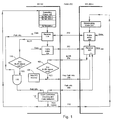
- Fig. 1 is a high-level diagram depicting communication between a BS 100, over an airlink 200, with a plurality of MSs 300 (only one representative one, designated MS 300-n, is shown).
- BS 100 has a list 102 of spreading codes used for spreading the signal to each MS 300.
- Each MS 300 has a copy 302 of its spreading code.
- the spreading code for each MS 300 is determined according to a combination of a long code employed in the particular BS 100, and pseudo-noise (PN) codes uniquely assigned to each MS 300.
- PN pseudo-noise
- the invention may be practiced based on downlink signals (BS 100 to MS 300) or based on uplink (MS 300 to BS 100) signals.
- data is typically divided into blocks (e.g., the 20-millisecond frames employed in 2G CDMA).
- data blocks are input to transmitter 104 for transmission to MSs 300.
- the data for a particular MS 300 is prepared for transmission, which includes spreading by the spreading code 102 associated with that particular MS 300.
- the spread data for all MS 300's is transmitted simultaneously in transmission 202 over a traffic channel of airlink 200, known as the forward link traffic channel or the downlink traffic channel.
- the data for each particular MS 300 is often referred to as a forward link channel or downlink channel.
- common usage contains the redundancy that a plurality of downlink channels exist within the downlink traffic channel.
- Receiver 304 of each MS 300 receives the downlink traffic channel transmission 202 containing the signal channels for all MSs 300, and correlates in its receiver 304 with the spreading code 302 for the particular MS 300. Receiver 304 is thus able to extract the signal intended for the particular MS 300, while the spread signal for all other MSs 300 is cancelled due to low cross-correlation.
- Receiver 304 includes a searcher and several correlators arranged in a rake receiver (known in the art and not shown). In the process of correlating the received signal, the receiver 304 components determine transmission delay and signal strength (relative amplitude or power of the main signal and its delayed multipath components, and decodes the data block from the received signal. Then the block is checked for errors.
- Some error statistic is typically determined for the received signal.
- One such error statistic is the block error ratio (BLER), which is a long-time average of the ratio of erroneous blocks to all received blocks during that time.
- Other error statistics such as frame error ratio (FER), are in use.
- BLER discussed here as an example error statistic
- FER frame error ratio
- the BLER (discussed here as an example error statistic) or other such error indicator is periodically reported by each MS 300 to BS 100 in transmission 204.
- transmissions 204 through 210 take place over a dedicated control channel (DCCH) and not over a traffic channel.
- DCCH dedicated control channel
- signal channels received by an MS 300 in transmission 202 may exhibit a higher degree of cross-correlation because of variations in transmission delay of the signal and because the signal may be received with multipath components having other degrees of delay.
- the signal spread by another MS 300's codes may have a delayed component which partially correlates with the present MS 300's codes. This has the effect of degrading the signal perceived by the user of the MS 300, and of raising the BLER or other such error indicator in that MS 300.
- BS 100 the BLER's received from all the MS 300's are checked in block 106. If any BLER or other such error indicator exceeds a predetermined limit, BS 100 originates transmission 206, which requests MSs 300 to forward their path information (delay estimates and amplitude or power indications). The path information is forwarded from receivers 304 in transmission 208.
- Path information is received from all MSs 300, and in block 110 of BS 100 a new code combination predicted to have lower cross-correlation under current conditions is determined. This determination is contingent on there being available codes not presently in use, i.e., that there presently are fewer MSs 300 in communication with BS 100 than there are available spreading codes.
- 3G TDD CDMA for example, there are 16 codes for each time slot.
- 2G CDMA for example, there are 64 codes.
- the reselection of downlink spreading codes may be performed based on the delays measured in receiver block 114 of BS 100 in systems using the same frequency band for uplink and downlink. In this case transmissions 204 and 206 are not needed.
- the new code combination is determined in block 110 of BS 100.
- a similar reselection of spreading codes may be performed on uplink.
- Data to be uplinked from a MS 300 is input to transmitter 306, where it is prepared for transmission including being spread by the long code and the MS 300's particular spreading code. It is transmitted in transmission 212 to the BS 100, where in receiver 114 it is despread according to the long code and the MS 300's particular spreading code.
- Receiver 114 similarly to receiver 304, produces path information (delay estimates and amplitude or power indications) and an error indication such as BLER for each MS 300.
- the error indications for all the MS 300's are assessed in block 116. If any of the error indications are above a predetermined limit, all path info is provided to block 110 (represented symbolically by AND gate 118).
- new codes are selected in block 110, they are loaded for use by BS 100 and MS 300.
- the new codes are loaded into spreading codes list 102.
- the new codes are forwarded in transmissions 210 to each MS 300, where each MS 300 loads its new code as despreading code 302.
- the next data transmission 202 will be spread and despread according to the new codes.
- the code recalculation features of the present invention will again be invoked in the same manner as described above.
- the invention is also used to determine optimum codes when a new mobile station is being initiated on a channel or in a time slot of a TDD channel, that is, during handoff or MS switch-on.
- a new MS 300 is being initiated. This initiates the same chain of events as block 106's detection of a low BLER or other performance limit.
- Transmission 206 requests all other MS 300's to forward their path information in transmissions 208.
- optimum codes are determined for the configuration including the newly initiated MS 300. New codes are propagated to lists 102 and 302, and subsequent data transmissions 202 and 212 are spread and despread according to the new codes.
- Cross correlation X AB between spreading codes c A and c B with d chips delay between the multipaths can be calculated by the following formula: where N is the length of the spreading code. Selecting the codes can be done by minimizing the values of X AB with the detected delays d . The set of X AB values is calculated by using different possible spreading codes as c A and c B .
Landscapes
- Engineering & Computer Science (AREA)
- Computer Networks & Wireless Communication (AREA)
- Signal Processing (AREA)
- Mobile Radio Communication Systems (AREA)
Applications Claiming Priority (2)
| Application Number | Priority Date | Filing Date | Title |
|---|---|---|---|
| US794934 | 1985-12-30 | ||
| US09/794,934 US6567393B2 (en) | 2001-02-27 | 2001-02-27 | Dynamic reselection of CDMA spreading codes |
Publications (2)
| Publication Number | Publication Date |
|---|---|
| EP1235359A2 true EP1235359A2 (de) | 2002-08-28 |
| EP1235359A3 EP1235359A3 (de) | 2003-06-04 |
Family
ID=25164127
Family Applications (1)
| Application Number | Title | Priority Date | Filing Date |
|---|---|---|---|
| EP01660197A Withdrawn EP1235359A3 (de) | 2001-02-27 | 2001-10-25 | Dynamischer Selektion von CDMA Spreizkoden |
Country Status (2)
| Country | Link |
|---|---|
| US (1) | US6567393B2 (de) |
| EP (1) | EP1235359A3 (de) |
Cited By (1)
| Publication number | Priority date | Publication date | Assignee | Title |
|---|---|---|---|---|
| AU771222B2 (en) * | 1999-11-04 | 2004-03-18 | Nec Corporation | Path timing detection circuit and detection method thereof |
Families Citing this family (11)
| Publication number | Priority date | Publication date | Assignee | Title |
|---|---|---|---|---|
| JP2001086034A (ja) * | 1999-09-14 | 2001-03-30 | Nec Corp | とまり木チャネル検出回路における拡散コード検出方法およびその回路 |
| EP1483858A2 (de) * | 2002-02-22 | 2004-12-08 | Arizona Board of Regents | Nicht blockierende ovsf-codes für drahtlose 3g-systeme und darüber hinaus |
| US7251228B2 (en) * | 2002-03-05 | 2007-07-31 | Lucent Technologies Inc. | Method for cell switching in wireless communication systems |
| EP1898535A3 (de) * | 2002-06-13 | 2008-04-23 | Nokia Corporation | Verfahren, System und Vorrichtung zur adaptiven Reservierung von Kanalisierungscodes oder zum Einstellen der erlaubten Leistung |
| JP4128880B2 (ja) * | 2003-01-16 | 2008-07-30 | 株式会社エヌ・ティ・ティ・ドコモ | 無線制御装置及び拡散コード選択方法 |
| US7292874B2 (en) * | 2003-11-17 | 2007-11-06 | Interdigital Technology Corporation | Method, access point and WTRU for controlling transmission power levels of uplink/downlink communication in a wireless communication system |
| US7353436B2 (en) * | 2004-07-21 | 2008-04-01 | Pulse-Link, Inc. | Synchronization code methods |
| US7587660B2 (en) * | 2005-04-22 | 2009-09-08 | Kansas State University Research Foundation | Multiple-access code generation |
| US8009637B2 (en) * | 2006-03-10 | 2011-08-30 | Motorola Solutions, Inc. | Method and apparatus for spreading channel code selection |
| JP4812478B2 (ja) * | 2006-03-20 | 2011-11-09 | 株式会社エヌ・ティ・ティ・ドコモ | 符号評価装置、符号評価方法、無線通信システム、基地局および移動局 |
| CN109075898B (zh) * | 2016-05-12 | 2021-07-06 | 瑞典爱立信有限公司 | Mbms承载质量评估 |
Family Cites Families (12)
| Publication number | Priority date | Publication date | Assignee | Title |
|---|---|---|---|---|
| US5483669A (en) * | 1993-09-09 | 1996-01-09 | Hughes Aircraft Company | Dynamic thresholding for mobile assisted handoff in a digital cellular communication system |
| FR2722628B1 (fr) * | 1994-07-13 | 1996-08-09 | Tabbane Sami | Selection de cellule dans un reseau radiotelephonique cellulaire multicouche |
| JPH08163085A (ja) * | 1994-12-02 | 1996-06-21 | Toshiba Corp | 情報通信装置 |
| US5930710A (en) * | 1996-03-07 | 1999-07-27 | Telefonaktiebolaget L M Ericsson | Control/pilot channel reselection between cells belonging to different registration areas |
| CA2210582C (en) * | 1996-07-24 | 2001-01-30 | Ntt Mobile Communications Network Inc. | Method and apparatus for receiving cdma radio communication |
| CA2242773C (en) * | 1996-11-07 | 2001-10-02 | Matsushita Electric Industrial Co., Ltd. | Code generating method and code selecting method |
| US5903839A (en) * | 1997-06-02 | 1999-05-11 | Nokia Mobile Phones Limited | Method and apparatus to provide manual reselection on a digital control channel |
| US6317422B1 (en) * | 1998-04-15 | 2001-11-13 | Nortel Networks Limited | Methods and apparatus of N-chip resistant spreading in CDMA systems |
| FI107861B (fi) * | 1998-08-28 | 2001-10-15 | Nokia Mobile Phones Ltd | Naapurisolumittaukset solun uudelleenvalintaa varten |
| JP2000295198A (ja) * | 1999-04-01 | 2000-10-20 | Matsushita Electric Ind Co Ltd | Cdma基地局装置及びcdma通信方法 |
| US6349208B1 (en) * | 1999-04-28 | 2002-02-19 | Nokia Corporation | Apparatus and associated method for selectively permitting initiation or cell reselection in a radio communication system |
| JP3769432B2 (ja) * | 1999-11-01 | 2006-04-26 | 日本電気株式会社 | 符号分割多重セルラにおける拡散符号割り当て方法及び基地局 |
-
2001
- 2001-02-27 US US09/794,934 patent/US6567393B2/en not_active Expired - Fee Related
- 2001-10-25 EP EP01660197A patent/EP1235359A3/de not_active Withdrawn
Cited By (2)
| Publication number | Priority date | Publication date | Assignee | Title |
|---|---|---|---|---|
| AU771222B2 (en) * | 1999-11-04 | 2004-03-18 | Nec Corporation | Path timing detection circuit and detection method thereof |
| AU771222C (en) * | 1999-11-04 | 2005-04-14 | Nec Corporation | Path timing detection circuit and detection method thereof |
Also Published As
| Publication number | Publication date |
|---|---|
| EP1235359A3 (de) | 2003-06-04 |
| US20030043774A1 (en) | 2003-03-06 |
| US6567393B2 (en) | 2003-05-20 |
Similar Documents
| Publication | Publication Date | Title |
|---|---|---|
| US6408039B1 (en) | Radio communication apparatus employing a rake receiver | |
| US7035676B2 (en) | Power saving in mobile stations | |
| US7082108B2 (en) | Apparatus and method for controlling transmission power in an NB-TDD CDMA communication system | |
| US6320898B1 (en) | CDMA pseudo-smart antenna selection | |
| US6175587B1 (en) | Communication device and method for interference suppression in a DS-CDMA system | |
| CA2438364C (en) | Mobile communication system, base station, and communication control method | |
| US7443829B2 (en) | Uplink interference cancellation | |
| US8526402B2 (en) | Radio network controller and transmitting power control method | |
| US7492754B2 (en) | Method and apparatus in a CDMA communication system | |
| US5974057A (en) | Method and apparatus for correcting a measured round-trip delay time in a wireless communication system | |
| US6567393B2 (en) | Dynamic reselection of CDMA spreading codes | |
| KR20000013025A (ko) | 이동통신 시스템의 순방향 초기 송신전력 제어장치 및 방법 | |
| EP1306982A1 (de) | Vorrichtung und Verfahren zur Regelung der Leistung eines gemeinsamen Rückwärtsleistungsregelungskanals in einem mobilen Kommunikationssystem | |
| KR20010080680A (ko) | 무선 통신 시스템 동기화를 제공하기 위한 방법 및 장치 | |
| AU7111801A (en) | Method for performing USTS handover and USTS mode switching in a mobile communication system | |
| US6728304B2 (en) | Method and apparatus for performing a signal detection and assignment in a wireless communication system | |
| US6229839B1 (en) | Method and apparatus for time tracking | |
| EP0868789B1 (de) | Basisstationempfänger und verfahren zum signalempfang | |
| JP3459866B2 (ja) | 符号分割多元接続方式の送信電力制御方法 | |
| CN100544225C (zh) | 分布式天线系统中下行链路功率控制方法和装置 | |
| CA2156454C (en) | Code division multiple access communication system | |
| US7450556B2 (en) | Method and apparatus estimating cell interference and noise for CDMA packet data channels | |
| KR20010043940A (ko) | Cdma 기지국 장치 및 cdma 통신 방법 | |
| CA2623819A1 (en) | Cell search of time-overlapping cells in a mobile communication system | |
| US20050018758A1 (en) | Receiving spread spectrum signal in radio system |
Legal Events
| Date | Code | Title | Description |
|---|---|---|---|
| PUAI | Public reference made under article 153(3) epc to a published international application that has entered the european phase |
Free format text: ORIGINAL CODE: 0009012 |
|
| AK | Designated contracting states |
Kind code of ref document: A2 Designated state(s): AT BE CH CY DE DK ES FI FR GB GR IE IT LI LU MC NL PT SE TR |
|
| AX | Request for extension of the european patent |
Free format text: AL;LT;LV;MK;RO;SI |
|
| PUAL | Search report despatched |
Free format text: ORIGINAL CODE: 0009013 |
|
| AK | Designated contracting states |
Designated state(s): AT BE CH CY DE DK ES FI FR GB GR IE IT LI LU MC NL PT SE TR |
|
| AX | Request for extension of the european patent |
Extension state: AL LT LV MK RO SI |
|
| RIC1 | Information provided on ipc code assigned before grant |
Ipc: 7H 04L 1/00 B Ipc: 7H 04B 1/707 A |
|
| AKX | Designation fees paid | ||
| REG | Reference to a national code |
Ref country code: DE Ref legal event code: 8566 |
|
| STAA | Information on the status of an ep patent application or granted ep patent |
Free format text: STATUS: THE APPLICATION IS DEEMED TO BE WITHDRAWN |
|
| 18D | Application deemed to be withdrawn |
Effective date: 20031205 |