EP1234910A2 - Tissu ignifuge destiné à l'impression par jet d'encre et procédé pour sa préparation - Google Patents
Tissu ignifuge destiné à l'impression par jet d'encre et procédé pour sa préparation Download PDFInfo
- Publication number
- EP1234910A2 EP1234910A2 EP02004004A EP02004004A EP1234910A2 EP 1234910 A2 EP1234910 A2 EP 1234910A2 EP 02004004 A EP02004004 A EP 02004004A EP 02004004 A EP02004004 A EP 02004004A EP 1234910 A2 EP1234910 A2 EP 1234910A2
- Authority
- EP
- European Patent Office
- Prior art keywords
- ink
- flame
- layer
- jet recording
- fabric
- Prior art date
- Legal status (The legal status is an assumption and is not a legal conclusion. Google has not performed a legal analysis and makes no representation as to the accuracy of the status listed.)
- Withdrawn
Links
- 239000004744 fabric Substances 0.000 title claims abstract description 149
- RNFJDJUURJAICM-UHFFFAOYSA-N 2,2,4,4,6,6-hexaphenoxy-1,3,5-triaza-2$l^{5},4$l^{5},6$l^{5}-triphosphacyclohexa-1,3,5-triene Chemical compound N=1P(OC=2C=CC=CC=2)(OC=2C=CC=CC=2)=NP(OC=2C=CC=CC=2)(OC=2C=CC=CC=2)=NP=1(OC=1C=CC=CC=1)OC1=CC=CC=C1 RNFJDJUURJAICM-UHFFFAOYSA-N 0.000 title claims abstract description 78
- 239000003063 flame retardant Substances 0.000 title claims abstract description 71
- 238000000034 method Methods 0.000 title claims description 45
- 238000004519 manufacturing process Methods 0.000 title claims description 24
- 239000003340 retarding agent Substances 0.000 claims abstract description 61
- 239000000758 substrate Substances 0.000 claims abstract description 47
- 239000000835 fiber Substances 0.000 claims abstract description 27
- 239000004480 active ingredient Substances 0.000 claims abstract description 15
- 239000006185 dispersion Substances 0.000 claims abstract description 13
- XLYOFNOQVPJJNP-UHFFFAOYSA-N water Substances O XLYOFNOQVPJJNP-UHFFFAOYSA-N 0.000 claims description 40
- 239000003125 aqueous solvent Substances 0.000 claims description 6
- 239000010410 layer Substances 0.000 description 135
- 239000000976 ink Substances 0.000 description 109
- 239000000839 emulsion Substances 0.000 description 27
- 229920005989 resin Polymers 0.000 description 22
- 239000011347 resin Substances 0.000 description 22
- 239000000370 acceptor Substances 0.000 description 13
- 230000000052 comparative effect Effects 0.000 description 13
- 229910052736 halogen Inorganic materials 0.000 description 12
- 150000002367 halogens Chemical class 0.000 description 11
- OAICVXFJPJFONN-UHFFFAOYSA-N Phosphorus Chemical compound [P] OAICVXFJPJFONN-UHFFFAOYSA-N 0.000 description 10
- 229910052698 phosphorus Inorganic materials 0.000 description 10
- 239000011574 phosphorus Substances 0.000 description 10
- 150000001875 compounds Chemical class 0.000 description 9
- 238000007641 inkjet printing Methods 0.000 description 9
- -1 nitrogen containing flame-retardant compounds Chemical class 0.000 description 9
- 239000011247 coating layer Substances 0.000 description 8
- 238000004040 coloring Methods 0.000 description 8
- 239000011248 coating agent Substances 0.000 description 7
- 238000000576 coating method Methods 0.000 description 7
- 229920000728 polyester Polymers 0.000 description 7
- VYPSYNLAJGMNEJ-UHFFFAOYSA-N Silicium dioxide Chemical compound O=[Si]=O VYPSYNLAJGMNEJ-UHFFFAOYSA-N 0.000 description 6
- 238000001035 drying Methods 0.000 description 6
- 238000010438 heat treatment Methods 0.000 description 6
- 238000005259 measurement Methods 0.000 description 6
- 125000002091 cationic group Chemical group 0.000 description 5
- 238000007598 dipping method Methods 0.000 description 5
- 239000000463 material Substances 0.000 description 5
- 238000012360 testing method Methods 0.000 description 5
- 238000005452 bending Methods 0.000 description 4
- 229920006317 cationic polymer Polymers 0.000 description 4
- 229920001577 copolymer Polymers 0.000 description 4
- 239000000975 dye Substances 0.000 description 4
- 239000010419 fine particle Substances 0.000 description 4
- 239000007787 solid Substances 0.000 description 4
- 229910019142 PO4 Inorganic materials 0.000 description 3
- 239000011230 binding agent Substances 0.000 description 3
- 238000011156 evaluation Methods 0.000 description 3
- 235000021317 phosphate Nutrition 0.000 description 3
- 150000003013 phosphoric acid derivatives Chemical class 0.000 description 3
- 229920000642 polymer Polymers 0.000 description 3
- 229920001296 polysiloxane Polymers 0.000 description 3
- 239000004753 textile Substances 0.000 description 3
- SUBDBMMJDZJVOS-UHFFFAOYSA-N 5-methoxy-2-{[(4-methoxy-3,5-dimethylpyridin-2-yl)methyl]sulfinyl}-1H-benzimidazole Chemical compound N=1C2=CC(OC)=CC=C2NC=1S(=O)CC1=NC=C(C)C(OC)=C1C SUBDBMMJDZJVOS-UHFFFAOYSA-N 0.000 description 2
- IJGRMHOSHXDMSA-UHFFFAOYSA-N Atomic nitrogen Chemical compound N#N IJGRMHOSHXDMSA-UHFFFAOYSA-N 0.000 description 2
- VTYYLEPIZMXCLO-UHFFFAOYSA-L Calcium carbonate Chemical compound [Ca+2].[O-]C([O-])=O VTYYLEPIZMXCLO-UHFFFAOYSA-L 0.000 description 2
- 229920000877 Melamine resin Polymers 0.000 description 2
- NBIIXXVUZAFLBC-UHFFFAOYSA-N Phosphoric acid Chemical compound OP(O)(O)=O NBIIXXVUZAFLBC-UHFFFAOYSA-N 0.000 description 2
- 229920002873 Polyethylenimine Polymers 0.000 description 2
- PPBRXRYQALVLMV-UHFFFAOYSA-N Styrene Chemical compound C=CC1=CC=CC=C1 PPBRXRYQALVLMV-UHFFFAOYSA-N 0.000 description 2
- GWEVSGVZZGPLCZ-UHFFFAOYSA-N Titan oxide Chemical compound O=[Ti]=O GWEVSGVZZGPLCZ-UHFFFAOYSA-N 0.000 description 2
- 229920001807 Urea-formaldehyde Polymers 0.000 description 2
- XLOMVQKBTHCTTD-UHFFFAOYSA-N Zinc monoxide Chemical compound [Zn]=O XLOMVQKBTHCTTD-UHFFFAOYSA-N 0.000 description 2
- 150000001334 alicyclic compounds Chemical class 0.000 description 2
- 150000001408 amides Chemical class 0.000 description 2
- ADCOVFLJGNWWNZ-UHFFFAOYSA-N antimony trioxide Chemical compound O=[Sb]O[Sb]=O ADCOVFLJGNWWNZ-UHFFFAOYSA-N 0.000 description 2
- 239000007864 aqueous solution Substances 0.000 description 2
- TZCXTZWJZNENPQ-UHFFFAOYSA-L barium sulfate Chemical compound [Ba+2].[O-]S([O-])(=O)=O TZCXTZWJZNENPQ-UHFFFAOYSA-L 0.000 description 2
- 230000015572 biosynthetic process Effects 0.000 description 2
- 230000000740 bleeding effect Effects 0.000 description 2
- OSGAYBCDTDRGGQ-UHFFFAOYSA-L calcium sulfate Chemical compound [Ca+2].[O-]S([O-])(=O)=O OSGAYBCDTDRGGQ-UHFFFAOYSA-L 0.000 description 2
- 230000006866 deterioration Effects 0.000 description 2
- 239000000986 disperse dye Substances 0.000 description 2
- 239000002270 dispersing agent Substances 0.000 description 2
- 230000000694 effects Effects 0.000 description 2
- 230000007613 environmental effect Effects 0.000 description 2
- 150000002170 ethers Chemical class 0.000 description 2
- 239000012796 inorganic flame retardant Chemical class 0.000 description 2
- 239000001023 inorganic pigment Substances 0.000 description 2
- 229910017464 nitrogen compound Inorganic materials 0.000 description 2
- 150000002830 nitrogen compounds Chemical class 0.000 description 2
- 239000003921 oil Substances 0.000 description 2
- 239000012860 organic pigment Substances 0.000 description 2
- 239000003960 organic solvent Substances 0.000 description 2
- 239000002245 particle Substances 0.000 description 2
- 230000000149 penetrating effect Effects 0.000 description 2
- NBIIXXVUZAFLBC-UHFFFAOYSA-K phosphate Chemical compound [O-]P([O-])([O-])=O NBIIXXVUZAFLBC-UHFFFAOYSA-K 0.000 description 2
- 239000010452 phosphate Substances 0.000 description 2
- 150000003018 phosphorus compounds Chemical class 0.000 description 2
- 239000000049 pigment Substances 0.000 description 2
- 229920006122 polyamide resin Polymers 0.000 description 2
- 229920005749 polyurethane resin Polymers 0.000 description 2
- 238000007639 printing Methods 0.000 description 2
- 239000002904 solvent Substances 0.000 description 2
- 239000000126 substance Substances 0.000 description 2
- 229920002803 thermoplastic polyurethane Polymers 0.000 description 2
- 230000000007 visual effect Effects 0.000 description 2
- JIAARYAFYJHUJI-UHFFFAOYSA-L zinc dichloride Chemical compound [Cl-].[Cl-].[Zn+2] JIAARYAFYJHUJI-UHFFFAOYSA-L 0.000 description 2
- DEIGXXQKDWULML-UHFFFAOYSA-N 1,2,5,6,9,10-hexabromocyclododecane Chemical compound BrC1CCC(Br)C(Br)CCC(Br)C(Br)CCC1Br DEIGXXQKDWULML-UHFFFAOYSA-N 0.000 description 1
- LHHMNJZNWUJFOC-UHFFFAOYSA-N 1-chloro-2-[2-chloroethoxy(ethenyl)phosphoryl]oxyethane Chemical compound ClCCOP(=O)(C=C)OCCCl LHHMNJZNWUJFOC-UHFFFAOYSA-N 0.000 description 1
- OEPOKWHJYJXUGD-UHFFFAOYSA-N 2-(3-phenylmethoxyphenyl)-1,3-thiazole-4-carbaldehyde Chemical compound O=CC1=CSC(C=2C=C(OCC=3C=CC=CC=3)C=CC=2)=N1 OEPOKWHJYJXUGD-UHFFFAOYSA-N 0.000 description 1
- VEORPZCZECFIRK-UHFFFAOYSA-N 3,3',5,5'-tetrabromobisphenol A Chemical compound C=1C(Br)=C(O)C(Br)=CC=1C(C)(C)C1=CC(Br)=C(O)C(Br)=C1 VEORPZCZECFIRK-UHFFFAOYSA-N 0.000 description 1
- SMGMJAHLBLICEW-UHFFFAOYSA-N 3-bis(3-amino-3-oxopropyl)phosphanylpropanamide Chemical compound NC(=O)CCP(CCC(N)=O)CCC(N)=O SMGMJAHLBLICEW-UHFFFAOYSA-N 0.000 description 1
- RTPJQJWHYUSMRD-UHFFFAOYSA-N 3-bis(3-amino-3-oxopropyl)phosphorylpropanamide Chemical compound NC(=O)CCP(=O)(CCC(N)=O)CCC(N)=O RTPJQJWHYUSMRD-UHFFFAOYSA-N 0.000 description 1
- LWFBRHSTNWMMGN-UHFFFAOYSA-N 4-phenylpyrrolidin-1-ium-2-carboxylic acid;chloride Chemical compound Cl.C1NC(C(=O)O)CC1C1=CC=CC=C1 LWFBRHSTNWMMGN-UHFFFAOYSA-N 0.000 description 1
- GZVHEAJQGPRDLQ-UHFFFAOYSA-N 6-phenyl-1,3,5-triazine-2,4-diamine Chemical compound NC1=NC(N)=NC(C=2C=CC=CC=2)=N1 GZVHEAJQGPRDLQ-UHFFFAOYSA-N 0.000 description 1
- NIXOWILDQLNWCW-UHFFFAOYSA-M Acrylate Chemical compound [O-]C(=O)C=C NIXOWILDQLNWCW-UHFFFAOYSA-M 0.000 description 1
- 229920002972 Acrylic fiber Polymers 0.000 description 1
- 239000004925 Acrylic resin Substances 0.000 description 1
- NLHHRLWOUZZQLW-UHFFFAOYSA-N Acrylonitrile Chemical compound C=CC#N NLHHRLWOUZZQLW-UHFFFAOYSA-N 0.000 description 1
- 239000005995 Aluminium silicate Substances 0.000 description 1
- QGZKDVFQNNGYKY-UHFFFAOYSA-O Ammonium Chemical compound [NH4+] QGZKDVFQNNGYKY-UHFFFAOYSA-O 0.000 description 1
- 239000004254 Ammonium phosphate Substances 0.000 description 1
- 239000004114 Ammonium polyphosphate Substances 0.000 description 1
- 229920002134 Carboxymethyl cellulose Polymers 0.000 description 1
- 102000011632 Caseins Human genes 0.000 description 1
- 108010076119 Caseins Proteins 0.000 description 1
- 108010010803 Gelatin Proteins 0.000 description 1
- 239000005909 Kieselgur Substances 0.000 description 1
- 239000004640 Melamine resin Substances 0.000 description 1
- CNCOEDDPFOAUMB-UHFFFAOYSA-N N-Methylolacrylamide Chemical compound OCNC(=O)C=C CNCOEDDPFOAUMB-UHFFFAOYSA-N 0.000 description 1
- 206010067482 No adverse event Diseases 0.000 description 1
- SJEYSFABYSGQBG-UHFFFAOYSA-M Patent blue Chemical compound [Na+].C1=CC(N(CC)CC)=CC=C1C(C=1C(=CC(=CC=1)S([O-])(=O)=O)S([O-])(=O)=O)=C1C=CC(=[N+](CC)CC)C=C1 SJEYSFABYSGQBG-UHFFFAOYSA-M 0.000 description 1
- XYFCBTPGUUZFHI-UHFFFAOYSA-N Phosphine Natural products P XYFCBTPGUUZFHI-UHFFFAOYSA-N 0.000 description 1
- 229920000297 Rayon Polymers 0.000 description 1
- XUIMIQQOPSSXEZ-UHFFFAOYSA-N Silicon Chemical compound [Si] XUIMIQQOPSSXEZ-UHFFFAOYSA-N 0.000 description 1
- 229920002472 Starch Polymers 0.000 description 1
- NINIDFKCEFEMDL-UHFFFAOYSA-N Sulfur Chemical compound [S] NINIDFKCEFEMDL-UHFFFAOYSA-N 0.000 description 1
- IDCBOTIENDVCBQ-UHFFFAOYSA-N TEPP Chemical compound CCOP(=O)(OCC)OP(=O)(OCC)OCC IDCBOTIENDVCBQ-UHFFFAOYSA-N 0.000 description 1
- YSMRWXYRXBRSND-UHFFFAOYSA-N TOTP Chemical compound CC1=CC=CC=C1OP(=O)(OC=1C(=CC=CC=1)C)OC1=CC=CC=C1C YSMRWXYRXBRSND-UHFFFAOYSA-N 0.000 description 1
- PQYJRMFWJJONBO-UHFFFAOYSA-N Tris(2,3-dibromopropyl) phosphate Chemical compound BrCC(Br)COP(=O)(OCC(Br)CBr)OCC(Br)CBr PQYJRMFWJJONBO-UHFFFAOYSA-N 0.000 description 1
- BZHJMEDXRYGGRV-UHFFFAOYSA-N Vinyl chloride Chemical compound ClC=C BZHJMEDXRYGGRV-UHFFFAOYSA-N 0.000 description 1
- 229920002978 Vinylon Polymers 0.000 description 1
- FMRLDPWIRHBCCC-UHFFFAOYSA-L Zinc carbonate Chemical compound [Zn+2].[O-]C([O-])=O FMRLDPWIRHBCCC-UHFFFAOYSA-L 0.000 description 1
- YKTSYUJCYHOUJP-UHFFFAOYSA-N [O--].[Al+3].[Al+3].[O-][Si]([O-])([O-])[O-] Chemical compound [O--].[Al+3].[Al+3].[O-][Si]([O-])([O-])[O-] YKTSYUJCYHOUJP-UHFFFAOYSA-N 0.000 description 1
- USDJGQLNFPZEON-UHFFFAOYSA-N [[4,6-bis(hydroxymethylamino)-1,3,5-triazin-2-yl]amino]methanol Chemical compound OCNC1=NC(NCO)=NC(NCO)=N1 USDJGQLNFPZEON-UHFFFAOYSA-N 0.000 description 1
- DZHMRSPXDUUJER-UHFFFAOYSA-N [amino(hydroxy)methylidene]azanium;dihydrogen phosphate Chemical compound NC(N)=O.OP(O)(O)=O DZHMRSPXDUUJER-UHFFFAOYSA-N 0.000 description 1
- 239000006096 absorbing agent Substances 0.000 description 1
- 239000000980 acid dye Substances 0.000 description 1
- 239000000654 additive Substances 0.000 description 1
- WNROFYMDJYEPJX-UHFFFAOYSA-K aluminium hydroxide Chemical compound [OH-].[OH-].[OH-].[Al+3] WNROFYMDJYEPJX-UHFFFAOYSA-K 0.000 description 1
- PNEYBMLMFCGWSK-UHFFFAOYSA-N aluminium oxide Inorganic materials [O-2].[O-2].[O-2].[Al+3].[Al+3] PNEYBMLMFCGWSK-UHFFFAOYSA-N 0.000 description 1
- 235000012211 aluminium silicate Nutrition 0.000 description 1
- 229920003180 amino resin Polymers 0.000 description 1
- 229910000148 ammonium phosphate Inorganic materials 0.000 description 1
- 235000019289 ammonium phosphates Nutrition 0.000 description 1
- 235000019826 ammonium polyphosphate Nutrition 0.000 description 1
- 229920001276 ammonium polyphosphate Polymers 0.000 description 1
- 125000000129 anionic group Chemical group 0.000 description 1
- 239000003963 antioxidant agent Substances 0.000 description 1
- 235000006708 antioxidants Nutrition 0.000 description 1
- ZSTLPJLUQNQBDQ-UHFFFAOYSA-N azanylidyne(dihydroxy)-$l^{5}-phosphane Chemical compound OP(O)#N ZSTLPJLUQNQBDQ-UHFFFAOYSA-N 0.000 description 1
- DAMJCWMGELCIMI-UHFFFAOYSA-N benzyl n-(2-oxopyrrolidin-3-yl)carbamate Chemical compound C=1C=CC=CC=1COC(=O)NC1CCNC1=O DAMJCWMGELCIMI-UHFFFAOYSA-N 0.000 description 1
- 229910000019 calcium carbonate Inorganic materials 0.000 description 1
- 239000000378 calcium silicate Substances 0.000 description 1
- 229910052918 calcium silicate Inorganic materials 0.000 description 1
- OYACROKNLOSFPA-UHFFFAOYSA-N calcium;dioxido(oxo)silane Chemical compound [Ca+2].[O-][Si]([O-])=O OYACROKNLOSFPA-UHFFFAOYSA-N 0.000 description 1
- 235000010948 carboxy methyl cellulose Nutrition 0.000 description 1
- BECPQYXYKAMYBN-UHFFFAOYSA-N casein, tech. Chemical compound NCCCCC(C(O)=O)N=C(O)C(CC(O)=O)N=C(O)C(CCC(O)=N)N=C(O)C(CC(C)C)N=C(O)C(CCC(O)=O)N=C(O)C(CC(O)=O)N=C(O)C(CCC(O)=O)N=C(O)C(C(C)O)N=C(O)C(CCC(O)=N)N=C(O)C(CCC(O)=N)N=C(O)C(CCC(O)=N)N=C(O)C(CCC(O)=O)N=C(O)C(CCC(O)=O)N=C(O)C(COP(O)(O)=O)N=C(O)C(CCC(O)=N)N=C(O)C(N)CC1=CC=CC=C1 BECPQYXYKAMYBN-UHFFFAOYSA-N 0.000 description 1
- 229940021722 caseins Drugs 0.000 description 1
- 235000021240 caseins Nutrition 0.000 description 1
- 239000001913 cellulose Substances 0.000 description 1
- 229920002678 cellulose Polymers 0.000 description 1
- 235000010980 cellulose Nutrition 0.000 description 1
- 238000006243 chemical reaction Methods 0.000 description 1
- 239000003795 chemical substances by application Substances 0.000 description 1
- 239000004927 clay Substances 0.000 description 1
- 229910052570 clay Inorganic materials 0.000 description 1
- 239000003086 colorant Substances 0.000 description 1
- DMSZORWOGDLWGN-UHFFFAOYSA-N ctk1a3526 Chemical compound NP(N)(N)=O DMSZORWOGDLWGN-UHFFFAOYSA-N 0.000 description 1
- 239000008367 deionised water Substances 0.000 description 1
- 229910021641 deionized water Inorganic materials 0.000 description 1
- 230000001419 dependent effect Effects 0.000 description 1
- 239000002274 desiccant Substances 0.000 description 1
- MNNHAPBLZZVQHP-UHFFFAOYSA-N diammonium hydrogen phosphate Chemical compound [NH4+].[NH4+].OP([O-])([O-])=O MNNHAPBLZZVQHP-UHFFFAOYSA-N 0.000 description 1
- 239000000982 direct dye Substances 0.000 description 1
- ZTWTYVWXUKTLCP-UHFFFAOYSA-L ethenyl-dioxido-oxo-$l^{5}-phosphane Chemical compound [O-]P([O-])(=O)C=C ZTWTYVWXUKTLCP-UHFFFAOYSA-L 0.000 description 1
- 239000012757 flame retardant agent Substances 0.000 description 1
- 238000007667 floating Methods 0.000 description 1
- 239000000499 gel Substances 0.000 description 1
- 229920000159 gelatin Polymers 0.000 description 1
- 235000019322 gelatine Nutrition 0.000 description 1
- 235000011852 gelatine desserts Nutrition 0.000 description 1
- 239000003317 industrial substance Substances 0.000 description 1
- 150000002484 inorganic compounds Chemical class 0.000 description 1
- 229910010272 inorganic material Inorganic materials 0.000 description 1
- NLYAJNPCOHFWQQ-UHFFFAOYSA-N kaolin Chemical compound O.O.O=[Al]O[Si](=O)O[Si](=O)O[Al]=O NLYAJNPCOHFWQQ-UHFFFAOYSA-N 0.000 description 1
- 238000010030 laminating Methods 0.000 description 1
- VTHJTEIRLNZDEV-UHFFFAOYSA-L magnesium dihydroxide Chemical compound [OH-].[OH-].[Mg+2] VTHJTEIRLNZDEV-UHFFFAOYSA-L 0.000 description 1
- 239000000347 magnesium hydroxide Substances 0.000 description 1
- 229910001862 magnesium hydroxide Inorganic materials 0.000 description 1
- HCWCAKKEBCNQJP-UHFFFAOYSA-N magnesium orthosilicate Chemical compound [Mg+2].[Mg+2].[O-][Si]([O-])([O-])[O-] HCWCAKKEBCNQJP-UHFFFAOYSA-N 0.000 description 1
- 239000000391 magnesium silicate Substances 0.000 description 1
- 229910052919 magnesium silicate Inorganic materials 0.000 description 1
- 235000019792 magnesium silicate Nutrition 0.000 description 1
- 239000011159 matrix material Substances 0.000 description 1
- 239000000178 monomer Substances 0.000 description 1
- 229910052757 nitrogen Inorganic materials 0.000 description 1
- QJGQUHMNIGDVPM-UHFFFAOYSA-N nitrogen group Chemical group [N] QJGQUHMNIGDVPM-UHFFFAOYSA-N 0.000 description 1
- 235000011007 phosphoric acid Nutrition 0.000 description 1
- XFZRQAZGUOTJCS-UHFFFAOYSA-N phosphoric acid;1,3,5-triazine-2,4,6-triamine Chemical compound OP(O)(O)=O.NC1=NC(N)=NC(N)=N1 XFZRQAZGUOTJCS-UHFFFAOYSA-N 0.000 description 1
- 229910000073 phosphorus hydride Inorganic materials 0.000 description 1
- LFGREXWGYUGZLY-UHFFFAOYSA-N phosphoryl Chemical group [P]=O LFGREXWGYUGZLY-UHFFFAOYSA-N 0.000 description 1
- 229920001200 poly(ethylene-vinyl acetate) Polymers 0.000 description 1
- 229920002037 poly(vinyl butyral) polymer Polymers 0.000 description 1
- 229920000058 polyacrylate Polymers 0.000 description 1
- 229920000768 polyamine Polymers 0.000 description 1
- 229920001225 polyester resin Polymers 0.000 description 1
- 239000004645 polyester resin Substances 0.000 description 1
- 238000006116 polymerization reaction Methods 0.000 description 1
- 229920000193 polymethacrylate Polymers 0.000 description 1
- 229920002451 polyvinyl alcohol Polymers 0.000 description 1
- 235000019422 polyvinyl alcohol Nutrition 0.000 description 1
- 239000002964 rayon Substances 0.000 description 1
- 239000000985 reactive dye Substances 0.000 description 1
- 239000000741 silica gel Substances 0.000 description 1
- 229910002027 silica gel Inorganic materials 0.000 description 1
- 229910052710 silicon Inorganic materials 0.000 description 1
- 239000010703 silicon Substances 0.000 description 1
- 239000000377 silicon dioxide Substances 0.000 description 1
- 229920002379 silicone rubber Polymers 0.000 description 1
- 239000002356 single layer Substances 0.000 description 1
- 229910021647 smectite Inorganic materials 0.000 description 1
- 239000000243 solution Substances 0.000 description 1
- 239000000992 solvent dye Substances 0.000 description 1
- 238000009987 spinning Methods 0.000 description 1
- 238000005507 spraying Methods 0.000 description 1
- 235000019698 starch Nutrition 0.000 description 1
- 229920003048 styrene butadiene rubber Polymers 0.000 description 1
- NVBFHJWHLNUMCV-UHFFFAOYSA-N sulfamide Chemical class NS(N)(=O)=O NVBFHJWHLNUMCV-UHFFFAOYSA-N 0.000 description 1
- 229940124530 sulfonamide Drugs 0.000 description 1
- 229910052717 sulfur Inorganic materials 0.000 description 1
- 239000011593 sulfur Substances 0.000 description 1
- 229920002994 synthetic fiber Polymers 0.000 description 1
- 239000012209 synthetic fiber Substances 0.000 description 1
- 239000000454 talc Substances 0.000 description 1
- 229910052623 talc Inorganic materials 0.000 description 1
- 238000010998 test method Methods 0.000 description 1
- 238000007669 thermal treatment Methods 0.000 description 1
- HPGGPRDJHPYFRM-UHFFFAOYSA-J tin(iv) chloride Chemical compound Cl[Sn](Cl)(Cl)Cl HPGGPRDJHPYFRM-UHFFFAOYSA-J 0.000 description 1
- 239000004408 titanium dioxide Substances 0.000 description 1
- 238000012546 transfer Methods 0.000 description 1
- SFENPMLASUEABX-UHFFFAOYSA-N trihexyl phosphate Chemical compound CCCCCCOP(=O)(OCCCCCC)OCCCCCC SFENPMLASUEABX-UHFFFAOYSA-N 0.000 description 1
- DHNUXDYAOVSGII-UHFFFAOYSA-N tris(1,3-dichloropropyl) phosphate Chemical compound ClCCC(Cl)OP(=O)(OC(Cl)CCCl)OC(Cl)CCCl DHNUXDYAOVSGII-UHFFFAOYSA-N 0.000 description 1
- JZZBTMVTLBHJHL-UHFFFAOYSA-N tris(2,3-dichloropropyl) phosphate Chemical compound ClCC(Cl)COP(=O)(OCC(Cl)CCl)OCC(Cl)CCl JZZBTMVTLBHJHL-UHFFFAOYSA-N 0.000 description 1
- WTLBZVNBAKMVDP-UHFFFAOYSA-N tris(2-butoxyethyl) phosphate Chemical compound CCCCOCCOP(=O)(OCCOCCCC)OCCOCCCC WTLBZVNBAKMVDP-UHFFFAOYSA-N 0.000 description 1
- HQUQLFOMPYWACS-UHFFFAOYSA-N tris(2-chloroethyl) phosphate Chemical compound ClCCOP(=O)(OCCCl)OCCCl HQUQLFOMPYWACS-UHFFFAOYSA-N 0.000 description 1
- BIKXLKXABVUSMH-UHFFFAOYSA-N trizinc;diborate Chemical compound [Zn+2].[Zn+2].[Zn+2].[O-]B([O-])[O-].[O-]B([O-])[O-] BIKXLKXABVUSMH-UHFFFAOYSA-N 0.000 description 1
- 229920002554 vinyl polymer Polymers 0.000 description 1
- 239000011667 zinc carbonate Substances 0.000 description 1
- 235000004416 zinc carbonate Nutrition 0.000 description 1
- 229910000010 zinc carbonate Inorganic materials 0.000 description 1
- 239000011592 zinc chloride Substances 0.000 description 1
- 235000005074 zinc chloride Nutrition 0.000 description 1
- 239000011787 zinc oxide Substances 0.000 description 1
Images
Classifications
-
- D—TEXTILES; PAPER
- D06—TREATMENT OF TEXTILES OR THE LIKE; LAUNDERING; FLEXIBLE MATERIALS NOT OTHERWISE PROVIDED FOR
- D06P—DYEING OR PRINTING TEXTILES; DYEING LEATHER, FURS OR SOLID MACROMOLECULAR SUBSTANCES IN ANY FORM
- D06P5/00—Other features in dyeing or printing textiles, or dyeing leather, furs, or solid macromolecular substances in any form
- D06P5/30—Ink jet printing
-
- B—PERFORMING OPERATIONS; TRANSPORTING
- B41—PRINTING; LINING MACHINES; TYPEWRITERS; STAMPS
- B41M—PRINTING, DUPLICATING, MARKING, OR COPYING PROCESSES; COLOUR PRINTING
- B41M5/00—Duplicating or marking methods; Sheet materials for use therein
- B41M5/50—Recording sheets characterised by the coating used to improve ink, dye or pigment receptivity, e.g. for ink-jet or thermal dye transfer recording
- B41M5/502—Recording sheets characterised by the coating used to improve ink, dye or pigment receptivity, e.g. for ink-jet or thermal dye transfer recording characterised by structural details, e.g. multilayer materials
- B41M5/506—Intermediate layers
-
- B—PERFORMING OPERATIONS; TRANSPORTING
- B41—PRINTING; LINING MACHINES; TYPEWRITERS; STAMPS
- B41M—PRINTING, DUPLICATING, MARKING, OR COPYING PROCESSES; COLOUR PRINTING
- B41M5/00—Duplicating or marking methods; Sheet materials for use therein
- B41M5/50—Recording sheets characterised by the coating used to improve ink, dye or pigment receptivity, e.g. for ink-jet or thermal dye transfer recording
- B41M5/502—Recording sheets characterised by the coating used to improve ink, dye or pigment receptivity, e.g. for ink-jet or thermal dye transfer recording characterised by structural details, e.g. multilayer materials
- B41M5/508—Supports
-
- D—TEXTILES; PAPER
- D06—TREATMENT OF TEXTILES OR THE LIKE; LAUNDERING; FLEXIBLE MATERIALS NOT OTHERWISE PROVIDED FOR
- D06N—WALL, FLOOR, OR LIKE COVERING MATERIALS, e.g. LINOLEUM, OILCLOTH, ARTIFICIAL LEATHER, ROOFING FELT, CONSISTING OF A FIBROUS WEB COATED WITH A LAYER OF MACROMOLECULAR MATERIAL; FLEXIBLE SHEET MATERIAL NOT OTHERWISE PROVIDED FOR
- D06N3/00—Artificial leather, oilcloth or other material obtained by covering fibrous webs with macromolecular material, e.g. resins, rubber or derivatives thereof
- D06N3/0056—Artificial leather, oilcloth or other material obtained by covering fibrous webs with macromolecular material, e.g. resins, rubber or derivatives thereof characterised by the compounding ingredients of the macro-molecular coating
-
- D—TEXTILES; PAPER
- D06—TREATMENT OF TEXTILES OR THE LIKE; LAUNDERING; FLEXIBLE MATERIALS NOT OTHERWISE PROVIDED FOR
- D06M—TREATMENT, NOT PROVIDED FOR ELSEWHERE IN CLASS D06, OF FIBRES, THREADS, YARNS, FABRICS, FEATHERS OR FIBROUS GOODS MADE FROM SUCH MATERIALS
- D06M2200/00—Functionality of the treatment composition and/or properties imparted to the textile material
- D06M2200/30—Flame or heat resistance, fire retardancy properties
-
- Y—GENERAL TAGGING OF NEW TECHNOLOGICAL DEVELOPMENTS; GENERAL TAGGING OF CROSS-SECTIONAL TECHNOLOGIES SPANNING OVER SEVERAL SECTIONS OF THE IPC; TECHNICAL SUBJECTS COVERED BY FORMER USPC CROSS-REFERENCE ART COLLECTIONS [XRACs] AND DIGESTS
- Y10—TECHNICAL SUBJECTS COVERED BY FORMER USPC
- Y10T—TECHNICAL SUBJECTS COVERED BY FORMER US CLASSIFICATION
- Y10T442/00—Fabric [woven, knitted, or nonwoven textile or cloth, etc.]
- Y10T442/20—Coated or impregnated woven, knit, or nonwoven fabric which is not [a] associated with another preformed layer or fiber layer or, [b] with respect to woven and knit, characterized, respectively, by a particular or differential weave or knit, wherein the coating or impregnation is neither a foamed material nor a free metal or alloy layer
- Y10T442/2631—Coating or impregnation provides heat or fire protection
-
- Y—GENERAL TAGGING OF NEW TECHNOLOGICAL DEVELOPMENTS; GENERAL TAGGING OF CROSS-SECTIONAL TECHNOLOGIES SPANNING OVER SEVERAL SECTIONS OF THE IPC; TECHNICAL SUBJECTS COVERED BY FORMER USPC CROSS-REFERENCE ART COLLECTIONS [XRACs] AND DIGESTS
- Y10—TECHNICAL SUBJECTS COVERED BY FORMER USPC
- Y10T—TECHNICAL SUBJECTS COVERED BY FORMER US CLASSIFICATION
- Y10T442/00—Fabric [woven, knitted, or nonwoven textile or cloth, etc.]
- Y10T442/20—Coated or impregnated woven, knit, or nonwoven fabric which is not [a] associated with another preformed layer or fiber layer or, [b] with respect to woven and knit, characterized, respectively, by a particular or differential weave or knit, wherein the coating or impregnation is neither a foamed material nor a free metal or alloy layer
- Y10T442/2631—Coating or impregnation provides heat or fire protection
- Y10T442/2672—Phosphorus containing
-
- Y—GENERAL TAGGING OF NEW TECHNOLOGICAL DEVELOPMENTS; GENERAL TAGGING OF CROSS-SECTIONAL TECHNOLOGIES SPANNING OVER SEVERAL SECTIONS OF THE IPC; TECHNICAL SUBJECTS COVERED BY FORMER USPC CROSS-REFERENCE ART COLLECTIONS [XRACs] AND DIGESTS
- Y10—TECHNICAL SUBJECTS COVERED BY FORMER USPC
- Y10T—TECHNICAL SUBJECTS COVERED BY FORMER US CLASSIFICATION
- Y10T442/00—Fabric [woven, knitted, or nonwoven textile or cloth, etc.]
- Y10T442/20—Coated or impregnated woven, knit, or nonwoven fabric which is not [a] associated with another preformed layer or fiber layer or, [b] with respect to woven and knit, characterized, respectively, by a particular or differential weave or knit, wherein the coating or impregnation is neither a foamed material nor a free metal or alloy layer
- Y10T442/2631—Coating or impregnation provides heat or fire protection
- Y10T442/2672—Phosphorus containing
- Y10T442/2697—Phosphorus and halogen containing compound
-
- Y—GENERAL TAGGING OF NEW TECHNOLOGICAL DEVELOPMENTS; GENERAL TAGGING OF CROSS-SECTIONAL TECHNOLOGIES SPANNING OVER SEVERAL SECTIONS OF THE IPC; TECHNICAL SUBJECTS COVERED BY FORMER USPC CROSS-REFERENCE ART COLLECTIONS [XRACs] AND DIGESTS
- Y10—TECHNICAL SUBJECTS COVERED BY FORMER USPC
- Y10T—TECHNICAL SUBJECTS COVERED BY FORMER US CLASSIFICATION
- Y10T442/00—Fabric [woven, knitted, or nonwoven textile or cloth, etc.]
- Y10T442/20—Coated or impregnated woven, knit, or nonwoven fabric which is not [a] associated with another preformed layer or fiber layer or, [b] with respect to woven and knit, characterized, respectively, by a particular or differential weave or knit, wherein the coating or impregnation is neither a foamed material nor a free metal or alloy layer
- Y10T442/2631—Coating or impregnation provides heat or fire protection
- Y10T442/2672—Phosphorus containing
- Y10T442/2705—A phosphorus containing compound and a halogen containing compound
-
- Y—GENERAL TAGGING OF NEW TECHNOLOGICAL DEVELOPMENTS; GENERAL TAGGING OF CROSS-SECTIONAL TECHNOLOGIES SPANNING OVER SEVERAL SECTIONS OF THE IPC; TECHNICAL SUBJECTS COVERED BY FORMER USPC CROSS-REFERENCE ART COLLECTIONS [XRACs] AND DIGESTS
- Y10—TECHNICAL SUBJECTS COVERED BY FORMER USPC
- Y10T—TECHNICAL SUBJECTS COVERED BY FORMER US CLASSIFICATION
- Y10T442/00—Fabric [woven, knitted, or nonwoven textile or cloth, etc.]
- Y10T442/20—Coated or impregnated woven, knit, or nonwoven fabric which is not [a] associated with another preformed layer or fiber layer or, [b] with respect to woven and knit, characterized, respectively, by a particular or differential weave or knit, wherein the coating or impregnation is neither a foamed material nor a free metal or alloy layer
- Y10T442/2631—Coating or impregnation provides heat or fire protection
- Y10T442/2713—Halogen containing
Definitions
- the present invention relates to a fabric for ink-jet recording and a process for manufacturing the same, and more particularly to a sufficiently flame-retardant fabric for ink-jet recording with an ink accepting layer on its one side at least, the ink acceptability of which is the same as that of its non-flame-retardant counterpart.
- ink jet equipment intended for ink-jet printing onto paper, resin sheet and other similar substrates.
- Such ink jet equipment provides for manufacturing of large-sized products printed with deep- and brilliant-shade full color, only possible to manufacture with ink-jet printing, such as hanging screens and banners in length exceeding several meters.
- hanging screens and banners manufactured using paper, resin sheet and other similar material as their substrates are not necessarily resistant to bending (and are thus liable to creasing), while presenting problems associated with strength such as durability.
- fiber fabric which is light in weight and highly resistant to bending, as well as excellent in durability and tear strength, has attracted attention.
- fabric has such large surface irregularities compared to those of paper or resin sheet (the surface of which is smooth) that particles of coloring material in the ink applied onto the fabric are liable to diffuse over and into it, resulting in its poor surface shade depth. This makes it difficult for ink-jet printing onto fabric to achieve such a brilliant color image as achieved in the case with paper or resin sheet.
- fabric which is generally liable to catch fire or inflammable, is often required to be more flame retardant if used as a substrate of a hanging screen or banner for indoor use than otherwise.
- one prior proposal is to prepare fabric with an ink accepting layer flame retarded, which, however, has proved to result in extremely difficult representation of a highly deep and brilliant shade color image onto the fabric. This is still further true, especially when the ink to be applied onto such fabric is of a type prepared with its water insoluble coloring matter dispersed in water.
- Many techniques have been already disclosed to provide effective methods for ink-jet printing of paper and resin sheet with highly deep and brilliant shade color representation as well as flame retardancy. However, it is impossible to apply these techniques to fabric, which has surface irregularities and a peculiar propensity to cause the ink applied to it to bleed (with poor ink dot shape), in the same way as in the case of paper or resin sheet.
- a fabric is impregnated with an ink acceptor to form an ink accepting layer on the fabric and then with a flame retarding agent to make it flame retardant as a whole.
- this technique has the disadvantage of causing the ink accepting layer formed on fabric to be necessarily covered with a subsequently applied flame retardant agent and any dispersant and/or viscosity improver contained in the agent, resulting in deterioration in its ink accepting function that may not otherwise occur.
- Fabric treated according the above-mentioned prior technique especially when printed with ink of water-insoluble coloring matter dispersed in water, fails to yield deep shade and sharp color images:
- the present invention has successfully solved the above-mentioned prior art problems through its specific eight aspects as described below.
- the first aspect of the present invention provides a flame-retardant fabric for ink-jet recording, consisting of a flame retarded fiber substrate with an ink accepting layer on its one side at least, which is made up of top and bottom sub-layers with a flame retarding agent contained only in the bottom sub-layer.
- the second aspect of the present invention provides a flame-retardant fabric for ink-jet recording as specified in the first aspect of the present invention, wherein said flame retarding agent has its active ingredient accounting for 4 to 30% of the entire ink accepting layer by weight.
- the third aspect of the present invention provides a flame-retardant fabric for ink-jet recording as specified in the first aspect of the present invention, wherein said flame retarding agent is readily soluble or dispersible in water or aqueous solvent.
- the fourth aspect of the present invention provides a flame-retardant fabric for ink-jet recording as specified in the first aspect of the present invention, wherein said top sub-layer is 3 to 12 ⁇ m in thickness.
- the fifth aspect of the present invention provides a flame-retardant fabric for ink-jet recording, consisting of a flame retarded fiber substrate with an ink accepting layer on its one side at least, which is made up of a top sub-layer 3 to 12_m in thickness and a bottom sub-layer with a flame retarding agent contained only in the bottom sub-layer, wherein said flame retarding agent has its active ingredient applied to the substrate in an aqueous dispersion, accounting for 4 to 30% of the entire ink accepting layer by weight.
- the sixth aspect of the present invention provides a process for manufacturing a flame-retardant fabric for ink-jet recording, consisting of a flame retarded fiber substrate with an ink accepting layer on its one side at least, by forming said ink accepting layer as two sub-layers in two steps - first, a bottom sub-layer containing a flame retarding agent and then, a top sub-layer containing no flame retarding agent.
- the seventh aspect of the present invention provides a process for manufacturing a flame-retardant fabric for ink-jet recording, consisting of a flame retarded fiber substrate with an ink accepting layer on its one side at least, by forming said ink accepting layer as two sub-layers in two steps - first, a bottom sub-layer containing a flame retarding agent and then, a top sub-layer 3 to 12 ⁇ m in thickness containing no flame retarding agent.
- the eighth aspect of the present invention provides a process for manufacturing a flame-retardant fabric for ink-jet recording as specified in the seventh aspect of the present invention, wherein said flame retarding agent has its active ingredient accounting for 4 to 30% of the entire ink accepting layer by weight and is readily soluble or dispersible in water or aqueous solvent.
- the present invention permits two or more of its aspects 1 to 5 mentioned above to be combined for its embodiment unless such combination departs from the scope and purpose of the present invention.
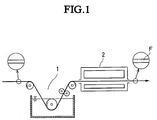
- Fig.1 illustrates a dipping system to apply a flame-retardant finish to a cloth as a substrate of a fabric for ink-jet recording of the present invention and a drying system linked with the dipping system to dry the flame retardant finished cloth after its such finishing.
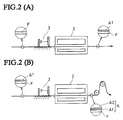
- Fig.2 (A) and (B) illustrate a specific process using a knife-on-bed coater system to treat cloth (prepared as shown in Fig.1) to form a bottom sub-layer and a top sub-layer on it, respectively, according to the present invention.
- the above-mentioned aspects of the present invention are more specifically explained by describing its representative embodiments which are as follows.
- the basic feature of the present invention which characterizes it is the provision of a flame-retardant fabric for ink-jet recording, consisting of a flame retarded fiber substrate with an ink accepting layer on its one side at least, which is made up of top and bottom sub-layers with a flame retarding agent contained only in the bottom sub-layer.
- top sub-layer refers to one of the two components constituting an ink accepting layer formed on the surface of a fiber substrate according to the present invention, which is located remote from the fiber substrate surface, while the term “bottom sub-layer” as used herein refers to the other component of the ink accepting layer, which is located close to the fiber substrate surface.
- the present invention requires the use of a flame retarded cloth as a substrate of its intended flame retardant fabric for ink-jet recording.
- the useful flame retarded fiber substrates of flame-retardant fabric contemplated by the present invention include flame-retardant rayon such as BELLFLAME (Kanebo, Ltd.) or TOBIREN (Toho Rayon Co., Ltd.) made by spinning cellulose blended with a phosphorus-based flame retarding agent, flame-retardant acrylic fiber such as KANEKARON (Kaneka Corporation), LUFNEN (Kanebo, Ltd.) or EXLAN NX (Toyobo Co., Ltd.) made by copolymerizing acrylonitrile with vinyl chloride or vinylidene chloride, flame-retadant vinylon such as VINARL (Kuraray Co., Ltd.), flame-retadant polyester such as TETRON UNFLA (Toray Industries, Inc.), EXTER
- a useful flame retarded fiber substrate of a flame-retardant fabric for ink-jet recording as referred to in the present invention may be prepared from a non-flame-retardant cloth by treating the cloth with a publicly-known flame retarding agent, such as a halogen-based compound, phosphate-based compound, phosphorus-based compound or inorganic compound, dissolved, emulsified or dispersed in water with or without a resin binder in the water in order to make it flame retardant.
- a publicly-known flame retarding agent such as a halogen-based compound, phosphate-based compound, phosphorus-based compound or inorganic compound, dissolved, emulsified or dispersed in water with or without a resin binder in the water in order to make it flame retardant.
- polyester fiber is preferable for use in the present invention in terms of its strength, durability and dimensional stability.
- any flame retarded cloth as described above when subsequently treated to form an ink accepting layer on the cloth for conversion into a fabric for ink-jet recording, fails to give sufficient flame retadancy as a whole unless the ink accepting layer has been flame retarded, causing the cloth's printing side to become flame retardant.
- the present invention has proposed for formation of an ink accepting layer on a flame retarded cloth as a substrate of an ink-jet recording fabric with a flame retarding agent contained in part of the ink accepting layer (which specifically constitutes its bottom sub-layer according to the present invention) in order to provide the resultant ink-jet recording fabric with sufficient flame retardancy.
- fabric for ink-jet recording is dependent upon the ink acceptability of the ink accepting layer formed on the fabric, onto which ink is directly dropped, for the color shade depth and brilliancy of the images rendered on it. Therefore, fabric with an ink accepting layer, the ink acceptability is insufficient, fails to render deep and brilliant shade color images, especially ink of water-insoluble coloring matter (such as pigment) dispersed in water is applied onto such an ink accepting layer, resulting in the coloring matter in the ink being coagulated in the layer.
- water-insoluble coloring matter such as pigment
- the present invention has proposed treating a flame retarded cloth as a substrate of fabric for ink-jet recording so as to form an ink accepting layer on the cloth, constituting two sub-layers - top and bottom - with a flame retarding agent contained only in the bottom sub-layer, to provide the layer as a whole with sufficient flame retardancy, while maintaining its ink acceptability at the same level of that of its non-flame-retardant counterpart.
- the top or bottom sub-layer of the present invention may be modified so that it is of multi-layer structure to increase the thickness of the ink accepting layer unless such sub-layer structure results in failure to achieve the purpose of the present invention.
- the present invention has the advantage of providing a fabric substrate with the function of preventing the ink applied to it from bleeding or penetrating through it to its back side and the function of being flame retardant only by taking into consideration the ink accepting layer to be formed on it, which fact, in turn, allows its intended treatment for the purpose of the present invention to be achieved in a simple and efficient manner as described herein later.
- the present invention is extremely advantageous in only treating a fabric substrate to form an ink accepting layer on its one side at least without any flame retardant layer on its other side to provide it with both the function of preventing the ink applied to it from bleeding or penetrating through it to its back side and the function of being flame retardant, thus having no adverse effects on its bending resistance.
- Flame retarding agents that are useful in forming the sufficiently flame-retardant ink accepting layer of the present invention can comprise any of a variety of publicly-known flame retardants including, but not limited to, halogen-based flame-retardant compounds, phosphorus-based flame-retardant compounds, inorganic flame-retardant compounds, nitrogen containing flame-retardant compounds and silicone-based flame-retardant compounds.
- Said halogen-based flame retardant compounds include hexabromocyclododecane, tetrabromobisphenol A and polybromobiphenyl ethers.
- Said phosphorus-based flame-retardant compounds include phosphate compounds such as tributoxyethyl phosphate, trihexyl phosphate, tricresyl phosphate, tris(2,3-dibromopropyl) phosphate, tris(2,3-dichloropropyl) phosphate, tris(1,3-dichloropropyl) phosphate, tris(2-chloroethyl) phosphate, bis( ⁇ -chloroethyl) vinylphosphonate and triarylphospahte, and phosphorus compounds such as orthophosphoric acid, ammonium phosphate, ammonium polyphosphate, urea phosphate, guanyl urea phosphate, polyphosphoryl amide, melamine phosphate, ammonium polyphosphoryl amide, phosphoryl trianilide, phosphonitrile, tris(2-carbamoylethyl) phosphine, tris(2-
- Said inorganic flame-retardant compounds include antimony trioxide, antimony trichloride, zinc chloride, tin chloride and zinc borate.
- Said nitrogen-containing flame-retardant compounds include trimethylol melamine and N-methylol acrylamide.
- Said silicone-based flame-retardant compounds include silicone elastomers, silicon oils and commercially-available products XC99-B5664, DC4-7045, DC4-7051 and DC4-7081 (all made by GE Toshiba Silicones Co., Ltd.) and EPX-02 (made by Shin-Etsu Chemical Co., Ltd.).
- the present invention involves the treatment of a cloth as a substitute of fabric for ink-jet recording to form an ink accepting layer on the surface of the cloth mainly by coating it with an ink acceptor, preferably compatible with aqueous solvent or water from the point of view of safety and environmental protection, which, in turn, recommends that a useful flame retarding agent of the present invention to be added to such an ink acceptor should be readily soluble or dispersible in water or aqueous solvent.
- an ink acceptor preferably compatible with aqueous solvent or water from the point of view of safety and environmental protection
- Such useful flame retarding agents of the present invention include phosphon carboxylic acid amide derivatives, organic phosphorus/nitrogen containing compounds, organic phosphorus/halogen containing compounds, phosphorus/halogen compounds, phosphorus/sulfoamide compound complexes, alkyl phosphate derivatives, amino resin phosphates, halogen-containing sulfamide compounds, guanyl sulfonamide compounds, halogen-containing nitrogen compounds, sulfur-containing nitrogen compounds, organic phosphate-based nitrogen/halogen containing compounds, organic halogen-containing phosphate compounds and cyclic halogen complexes.
- the top sub-layer formed on a fiber substrate with no flame retarding agent contained in it according to the present invention is preferably 3 ⁇ m to 12 ⁇ m in thickness. If the top sub-layer formed containing no flame retarding agent according to the present invention is below 3 ⁇ m in thickness, it is subject to transfer of the flame retarding agent contained in the bottom sub-layer formed just below it in accordance with the present invention to its surface, causing deterioration in the color shade depth and brilliancy of the images printed onto it.
- top sub-layer formed containing no flame retarding agent according to the present invention is above 12 ⁇ m in thickness, it tends to become so thick in relation to the bottom sub-layer formed containing a flame retarding agent below it in accordance with the present invention as to cause the ink accepting layer composed of both sub-layers to fail to possess sufficient flame retardancy as a whole.
- a fiber substrate treated with an ink acceptor to form an ink accepting layer on it at a given thickness according to the present invention is to be subsequently subjected to such a process as drying for its thermal treatment at 100°C to 200°C as described herein later.
- the bottom sub-layer formed on a fiber substrate according to the present invention preferably contains a flame retarding agent so that its active ingredient accounts for 4 to 30 weight % of the ink accepting layer formed of both sub-layers on the substrate as a whole in accordance with the present invention. If the flame retarding agent contained in the bottom sub-layer of the present invention in terms of its active ingredient accounts for less than 4 weight % of the ink accepting layer formed of both sub-layers, it is not sufficient to make up for the non-flame-retardancy of the top sub-layer, causing the ink accepting layer to fail to give sufficient flame retardancy as a whole.
- a useful flame retarding agent of the present invention is preferably a water-insoluble retardant dispersed in water so that its active ingredient is applied onto a fiber substrate of the present invention in an aqueous dispersion.
- a useful flame retarding agent of the present invention can also comprise any of publicly-known water-soluble flame retardants, although it should be understood that such a flame retardant is poorly water-resistant and its use as a flame-retardant component of the bottom sub-layer of the present invention results in a limited scope of application of the resultant fabric for ink-jet recording.
- Ink acceptors that are useful in forming an ink accepting layer (excluding a flame retarding agent) on a fiber substrate according to the present invention can mainly comprise any of a variety of binders, water-retentive or water-absorptive fine particles, and cationic resins and other similar materials.
- Useful ink acceptors of the present invention may contain any of anti-oxidants, UV absorbers, anti-desiccants, viscosity controllers, pH controllers and other additives that may help achieve the objects of the present invention and/or further improve the properties and characteristics of the resultant fabric for ink-jet printing as commercial goods without departing from the scope of the present invention.
- Said binders can comprise one or more of starches and their derivatives, carboxymethyl celluloses, caseins, gelatins, polyvinyl alcohols and their derivatives polyvinyl butyral resins, polyethylene imine resins, polyvinyl pyrolidone resins, poly(meth)acrylate resins, acrylate resins, polyurethane resins, polyamide resins, polyacylamide resins, polyester resins, urea resins, melamine resins, styrene-butadiene copolymers, methylmetacrylate-butadiene copolymers, ethylene-vinylacetate copolymers and other similar polymers or copolymers dissolved or dispersed in water, and the above-mentioned polymers or copolymers modified with anionic or cationic residues introduced into them, and other similar publicly-known polymer or copolymer materials.
- Said water-retentive or water absorptive fine particles can comprise one or more of inorganic pigments such as aluminum silicate, calcium silicate, magnesium silicate, amorphous silica, alumina, aluminum hydroxide, magnesium hydroxide, calcium carbonate, kaolin, talc, calcium sulfate, barium sulfate, titanium dioxide, smectite, clay, zinc oxide, zinc carbonate, diatomaceous earth and organic pigments such as styrene resin, acrylate resin, urea resin, melamine resin and benzoguanamine resin.
- Said cationic resins can comprise one or more of polyethylene imine resins, polyamine resins, polyamide resins, polyacrylate resins, polyurethane resins and other cationic polymer compounds.
- the useful methods for applying an ink acceptor to a fiber substrate according to the present invention include, without limitation, coating, dipping, laminating, printing (screen, roller, or rotary), spraying and other techniques available for such application.
- the particularly preferable method for the present invention is coating which can be provided by gravure roll coater, reverse roll coater, kiss roll coater, roll-on-roll coater, knife-on-roll coater, knife-on-bed coater, floating knife coater and other coater systems that allow an ink acceptor of the present invention to be applied to a fiber substrate in such a manner as to provide a fabric for ink-jet recording claimed in the present invention.
- a useful process for manufacturing a flame-retardant fabric for ink-jet recording according to the present invention can be achieved by using a flame retarded cloth as a substrate of the flame-retardant fabric as described with reference to the accompanying drawings.
- Fig.1 illustrates a dipping system (dipper 1) to apply a flame-retardant finish to a cloth as a substrate of a fabric for ink-jet recording of the present invention and a drying system (dryer 2) linked with the dipping system to dry the flame retardant finished cloth immediately after its such finishing.
- the cloth flame-retarded as described above is subjected to treatment by two major processes as described below to form an ink accepting layer made up of two sub-layers - top and bottom - on the cloth to manufacture a fabric for ink-jet recording of the present invention.
- the flame-retarded cloth is first treated by the process of forming a bottom sub-layer containing a flame retarding agent on it [bottom sub-layer forming process].
- Fig.2 (A) illustrates a specific example of the bottom sub-layer forming process involving the use of a knife-on-bed coater (indicated by 3 in the figure) to apply an ink acceptor containing a flame retarding agent to the surface of a flame retarded cloth as a substrate of a fabric for ink-jet recording of the present invention.
- this knife-on-bed coater system is only one of the application methods available for the bottom sub-layer forming process of the present invention, which can also be carried out by using such application methods as mentioned herein earlier, provided, however, that the resultant bottom sub-layer should be preferably formed containing a flame retarding agent so that its active ingredient accounts for 4 to 30 weight % of the ink accepting layer made up of both sub-layers as a whole as claimed in the present invention.
- the flame retarded cloth (indicated by F in the figure) subjected to the bottom sub-layer forming process is then passed through a dryer (indicated by 2 in the figure) for heat treatment (for example, at 140 to 150°C for one minute) [first drying process] to form a bottom sub-layer referred to herein above (indicated by A1 in the figure) on the cloth F.
- the flame retarded cloth subjected to the first drying process as described above is then treated by the process of forming a top sub-layer containing no flame retarding agent on the bottom sub-layer formed on it [top sub-layer forming process].
- Fig.2 (B) illustrates a specific example of the top sub-layer forming process involving the use of a knife-on-bed coater (indicated by 3 in the figure) to apply an ink acceptor containing no flame retarding agent to the surface of the bottom sub-layer formed on the flame retarded cloth.
- the bottom or top sub-layer forming process of the present invention can be performed so that the resultant bottom or top sub-layer is of multi-layer structure as required unless such sub-layer structure results in
- a flame-retardant fabric for ink-jet recording of the present invention is preferably ink-jet printed with ink of water-insoluble coloring matter such as organic or inorganic pigment dispersed in water or organic solvent.
- ink in the present invention is prone to coagulate on the surface of a useful ink accepting layer of the present invention with resultant poor color shade depth and saturation, and is low in coloring power, requiring it to be applied onto the ink accepting layer in a large quantity, which fact, in turn, contributes to increased effects of the present invention.
- a flame-retardant fabric for ink-jet recording of the present invention can also be ink-jet printed with water-based dye ink such as reactive dyes, acid dyes, direct dyes, disperse dyes or other water soluble or dispersible dyes dissolved or dispersed in water, or solvent-based dye ink such as disperse dyes, solvent dyes or other water-insoluble dyes dissolved in organic solvent, unless the resultant ink-jet printed fabric is thereafter subjected to any process for removal of its ink accepting layer.
- water-based dye ink such as reactive dyes, acid dyes, direct dyes, disperse dyes or other water soluble or dispersible dyes dissolved or dispersed in water
- solvent-based dye ink such as disperse dyes, solvent dyes or other water-insoluble dyes dissolved in organic solvent
- Emulsion A Emulsion B Emulsion C Emulsion D Binder 50.0% 50.0% 50.0% 50.0% PASCOL JK830 (Aqueous emulsion of cationic urethane resin with a solid content of 30%, made by Meisei Chemical Works, Ltd.) Water-absorptive fine particles: MIZUKASIL (Silica gel with a solid content of 100%, made by Mizusawa Industrial Chemicals, Ltd.) 15.0% 15.0% 15.0% 5.0% Cationic polymer: SUMIREZ RESIN 1001 (Aqueous solution of cationic polymer with a solid content of 30%, made by Sumitomo Chemical Co., Ltd.) 8.0% 8.0% 8.0% 8.0% 8.0% Flame retarding agent "a”: PHOSCON MK-10B (Aqueous emulsion halogen-based alicyclic compound with an active ingredient of 42% and a solid content of 45%, made by Meisei Chemical Works, Ltd.) 15.0% 6.0% Flame retarding agent "b”:
- the ink acceptors comprised a cationic urethane resin emulsion as its binding component, a gel type silica (with an average particle size of 3.3 ⁇ m and an oil absorptive capacity of 250ml/100g) as its water-absorptive fine particle component and a cationic polymer as its fixing component.
- the flame-retardant ink acceptors - emulsions B, C and D - were prepared containing either of two types of flame retarding agents - a water-insoluble halogen-based alicyclic compound emulsified in water (hereinafter referred to as flame retarding agent "a”) and a water-soluble phosphorus-based compound dissolved in water (hereinafter referred to as flame retarding agent "b").
- Emulsion A containing no flame retarding agent was used as a top coat applied to a substrate cloth to constitute the top sub-layer of the ink accepting layer on the cloth with its active flame retardant component assumed as 0 (zero) % in a dry state.
- Emulsion B containing flame retarding agent "a” was used as a base coat applied to a substrate cloth to constitute the bottom sub-layer of the ink accepting layer on the cloth with its active flame retardant component assumed as approximately 16% in a dry state.
- Emulsion C containing flame retarding agent "a” and Emulsion D containing flame retarding agent "b” were used similarly with their respective active flame retardant components assumed as approximately 7% and 17% in a dry state.
- the substrate of the fabric for ink-jet recording manufactured in the examples and comparative examples was prepared using two types of polyester plain-weave cloth - cloth A (Teijin Ltd.-made flame-retardant polyester cloth SUPER EXTER woven with flame-retardant fiber used for its weft yarn) and cloth B (polyester cloth woven with ordinary fiber used both for its warp and weft) - as shown in Table 2.
- Cloth A (Flame-retardant polyester cloth)
- Cloth B (polyester cloth)
- deniers/48 filaments 150 deniers/48 filaments
- Weft yarn 300 deniers/96 filaments (flame-retardant fiber) 300 deniers/96 filaments
- Cloth A (shown in Table 2) was treated with Emulsion B (shown in Table 1) using a knife-on-bed coater system to form a 5_m-thick coating layer (which corresponds to an "ink accepting layer” referred to in the present invention, hereinafter defined as such) on it as a base coat (which corresponds to a "bottom sub-layer” referred to in the present invention, hereinafter defined as such) and then subjected to heat treatment at 140°C for one minute.
- a knife-on-bed coater system to form a 5_m-thick coating layer (which corresponds to an "ink accepting layer” referred to in the present invention, hereinafter defined as such) on it as a base coat (which corresponds to a "bottom sub-layer” referred to in the present invention, hereinafter defined as such) and then subjected to heat treatment at 140°C for one minute.
- Emulsion A shown in Table 1
- a top coat which corresponds to a "top sub-layer” referred to in the present invention, hereinafter defined as such
- a fabric for ink-jet recording with an ink accepting layer formed on it, consisting of two sub-layers, top and bottom, with a total coating thickness of 10 ⁇ m.
- Cloth A (shown in Table 2) was treated with Emulsion B (shown in Table 1) using a knife-on-bed coater system to form a 10 ⁇ m-thick coating layer on it as a base coat and then subjected to heat treatment at 140°C for one minute.
- the cloth was then treated with Emulsion A (shown in Table 1) in a similar manner to form another 10 ⁇ m-thick coating layer on it as a top coat before being heat-treated to manufacture a fabric for ink-jet recording with an ink accepting layer formed on it, consisting of two sub-layers, top and bottom, with a total coating thickness of 20 ⁇ m.
- Example 3> This example was implemented pursuant to Example 1, except that the top coat was formed with a thickness of 2 ⁇ m, to manufacture a fabric for ink-jet recording, which was only different from the one manufactured in Example 1 in their top coat thicknesses.
- Example 4> This example was implemented pursuant to Example 1, except that the top coat was formed with a thickness of 15 ⁇ m, to manufacture a fabric for ink-jet recording, which was only different from the one manufactured in Example 1 in their top coat thicknesses.
- Example 5> This example was implemented pursuant to Example 1, except that the base coat was formed using Emulsion C (shown in Table 1), to manufacture a fabric for ink-jet recording, which was only different from the one manufactured in Example 1 in that the former had a lower flame retarding agent content in its base coat than the latter.
- Emulsion C shown in Table 1
- Example 6> This example was implemented pursuant to Example 1, except that the base coat was formed using Emulsion D (shown in Table 1), to manufacture a fabric for ink-jet recording, which was only different from the one manufactured in Example 1 in the types of the flame retarding agents contained in their base coats.
- Emulsion D shown in Table 1
- Cloth B (shown in Table 2) was treated in the same manner as described in Example 1 to manufacture a fabric for ink-jet recording, which was only different from the one manufactured in Example 1 in their cloth substrates.
- Cloth A (shown in Table 2) was treated with Emulsion A (shown in Table 1) using a knife-on-bed coater system to form a 10 ⁇ m-thick coating layer on it and then subjected for heat treatment at 140°C for one minute to manufacture a fabric for ink-jet recording with an ink accepting layer formed on it as a single layer with a total coating thickness of 10 ⁇ m.
- Cloth A (shown in Table 2) was treated with Emulsion A (shown in Table 1) using a knife-on-bed coater system to form a 5 ⁇ m-thick coating layer on it as a base coat and then subjected to heat treatment at 140°C for one minute.
- the cloth was then treated with Emulsion B (shown in Table 1) in a similar manner to form another coating layer on it as a top coat before being heat-treated to manufacture a fabric for ink-jet recording with an ink accepting layer formed on it, consisting of two sub-layers, top and bottom, with a total coating thickness of 10 ⁇ m.
- the fabrics for ink-jet recording manufactured in Examples 1 to 6 and Comparative Examples 1 to 4 are summarized in Table 3.
- FIG.2 The cross-sectional profile of the fabric for ink-jet recording of the present invention is schematically illustrated in Fig.2.
- the flame retardancy of each fabric was evaluated pursuant to JIS No.L1091 (Test Method for Flammability of Textiles) A-1 Method designed to test a textile specimen set at an inclination of 45° for flammability using a micro-burner as an source of ignition (hereinafter referred to as the "45° Micro-burner Method”) to subject the specimen to the flame of the micro-burner for a given period of time to burn it for measurement of its burnt area, after flame time, after flame time + after glow time and burnt length, and then pursuant to JIS No.L1091 D Method designed to test a textile specimen rolled and placed into a coil set at an inclination of 45° for flammability using a micro-burner as an source of ignition (hereinafter referred to as the "45° Coil Method”) to subject the specimen to the flame of the micro-burner to burn it for measurement of its ignition count required for its complete burning.
- the results of the test measurements were rated according to the following three-grade ( ⁇ ) scale specified for
- the durability of the flame retardancy of each fabric against exposure to water was evaluated by immersing a test specimen cut from the fabric in running water for 24 hours before subjecting the specimen to the same flame retardancy tests as described in 1 above.
- the color pattern image recorded on each fabric was evaluated for the shade depth of each of its four colors - yellow, magenta, cyan and black - both by visual observation and measurement with spectrophotometer Macbeth RD918.
- the results of the visual observation and spectrophotometer measurement were rated according to the following three-grade ( ⁇ ) scale.
- the color pattern image recorded on each fabric was observed with a microscope to evaluate the shapes of the dots ink-jet printed to create the image.
- the results of the microscope observation were rated according to the following three-grade ( ⁇ ) scale.
- the present invention provides a sufficiently flame-retardant fabric for ink-jet recording with an ink accepting layer on its one side at least, the ink acceptability of which is the same as that of its non-flame-retardant counterpart, allowing it to render high image quality (such as color shade depth, saturation and sharpness). Therefore, a flame-retardant fabric for ink-jet recording according to the present invention can offer large-sized full-color goods such as hanging screens and banners with satisfactory color shade depth and brilliancy, and bending resistance superior to that of paper and resin sheet, which have been otherwise used as a substrate of such goods.
Landscapes
- Engineering & Computer Science (AREA)
- Textile Engineering (AREA)
- Coloring (AREA)
- Ink Jet Recording Methods And Recording Media Thereof (AREA)
- Treatments For Attaching Organic Compounds To Fibrous Goods (AREA)
- Ink Jet (AREA)
Applications Claiming Priority (2)
| Application Number | Priority Date | Filing Date | Title |
|---|---|---|---|
| JP2001051298 | 2001-02-26 | ||
| JP2001051298A JP3923739B2 (ja) | 2001-02-26 | 2001-02-26 | 難燃性能を有するインクジェット記録用布帛及びその製造方法 |
Publications (2)
| Publication Number | Publication Date |
|---|---|
| EP1234910A2 true EP1234910A2 (fr) | 2002-08-28 |
| EP1234910A3 EP1234910A3 (fr) | 2004-05-12 |
Family
ID=18912106
Family Applications (1)
| Application Number | Title | Priority Date | Filing Date |
|---|---|---|---|
| EP20020004004 Withdrawn EP1234910A3 (fr) | 2001-02-26 | 2002-02-22 | Tissu ignifuge destiné à l'impression par jet d'encre et procédé pour sa préparation |
Country Status (3)
| Country | Link |
|---|---|
| US (1) | US6670001B2 (fr) |
| EP (1) | EP1234910A3 (fr) |
| JP (1) | JP3923739B2 (fr) |
Cited By (1)
| Publication number | Priority date | Publication date | Assignee | Title |
|---|---|---|---|---|
| EP2011918A1 (fr) * | 2007-07-02 | 2009-01-07 | Mimaki Engineering Co., Ltd. | Procédé d'impression, objet imprimé, et imprimante |
Families Citing this family (17)
| Publication number | Priority date | Publication date | Assignee | Title |
|---|---|---|---|---|
| DE60120846T2 (de) * | 2000-07-26 | 2007-01-11 | Seiren Co. Ltd. | Verfahren zur Herstellung eines Gewebes für Tintenstrahldruck |
| US20050118919A1 (en) * | 2002-10-01 | 2005-06-02 | Eberhard Link | Flame blocking liner materials |
| US20090233075A1 (en) | 2002-10-01 | 2009-09-17 | Freudenberg Nonwovens Limited Partnership | Flame Blocking Liner Materials |
| US20040062912A1 (en) * | 2002-10-01 | 2004-04-01 | Mason Charles R. | Flame blocking liner materials |
| US20050126408A1 (en) * | 2003-11-25 | 2005-06-16 | Lavin Clement M. | All-in-one textile and media preparation machine for digital printing applications |
| US20070011819A1 (en) * | 2005-07-07 | 2007-01-18 | Screen-Trans Development Corp. | Method and composition for pretreating fabric for direct printing |
| KR100929346B1 (ko) | 2008-01-21 | 2009-12-03 | 김치수 | 인쇄용 방염 원단의 제조방법 |
| KR101046661B1 (ko) * | 2008-07-22 | 2011-07-06 | (주)디케이티 | 비할로겐계 난연스크린 및 그 제조방법 |
| JP5139356B2 (ja) * | 2009-03-24 | 2013-02-06 | 株式会社新日本プロセス広芸社 | 防炎加工プリント布帛及びその製造方法 |
| EP2855162B1 (fr) | 2012-06-04 | 2016-11-16 | Hewlett-Packard Development Company, L.P. | Tissus supports d'impression |
| US10357986B2 (en) * | 2012-07-18 | 2019-07-23 | Hewlett-Packard Development Company, L.P. | Fabric print media |
| WO2015041666A1 (fr) | 2013-09-20 | 2015-03-26 | Hewlett-Packard Development Company, L.P. | Support d'impression en tissu |
| JP2015078452A (ja) * | 2013-10-15 | 2015-04-23 | セーレン株式会社 | インクジェットプリント物 |
| CN106661337A (zh) | 2014-07-04 | 2017-05-10 | 富士胶片株式会社 | 新型化合物、染色或印花用着色组合物、喷墨用油墨、布帛印花方法及被染色或印花布帛 |
| WO2019164530A1 (fr) | 2018-02-26 | 2019-08-29 | Hewlett-Packard Development Company, L.P. | Support imprimable en tissu |
| WO2019182557A1 (fr) | 2018-03-19 | 2019-09-26 | Hewlett-Packard Development Company, L.P. | Support imprimable en tissu |
| US11325410B2 (en) | 2018-03-19 | 2022-05-10 | Hewlett-Packard Development Company, L.P. | Fabric printable medium |
Family Cites Families (10)
| Publication number | Priority date | Publication date | Assignee | Title |
|---|---|---|---|---|
| US4879148A (en) * | 1987-03-02 | 1989-11-07 | Raychem Limited | Marker assembly |
| US5013634A (en) * | 1988-10-12 | 1991-05-07 | Ricoh Company, Ltd. | Optical information recording medium and nickel complex compounds employed in the same |
| US4877679A (en) * | 1988-12-19 | 1989-10-31 | Ppg Industries, Inc. | Multilayer article of microporous and porous materials |
| US5618546A (en) * | 1994-04-15 | 1997-04-08 | Wood; Monte D. | Composite of selectively removable layers of silk screen printing ink |
| JP3546530B2 (ja) * | 1995-05-22 | 2004-07-28 | 旭硝子株式会社 | インクジェット記録用布帛の製造方法 |
| JPH09262934A (ja) * | 1995-09-20 | 1997-10-07 | Dainippon Printing Co Ltd | リコート用化粧シート及びリコート用化粧材 |
| US5693410A (en) * | 1996-09-03 | 1997-12-02 | Xerox Corporation | Ink jet transparencies |
| US6326323B1 (en) * | 1998-02-13 | 2001-12-04 | Komatsu Seiren Co., Ltd. | Fabric for ink-jet recording |
| JP4060975B2 (ja) * | 1999-01-19 | 2008-03-12 | 東洋クロス株式会社 | 画像表示用平面支持体 |
| JP4219478B2 (ja) * | 1999-04-14 | 2009-02-04 | ゼネラル株式会社 | インク受容繊維布 |
-
2001
- 2001-02-26 JP JP2001051298A patent/JP3923739B2/ja not_active Expired - Lifetime
-
2002
- 2002-02-22 EP EP20020004004 patent/EP1234910A3/fr not_active Withdrawn
- 2002-02-25 US US10/082,505 patent/US6670001B2/en not_active Expired - Lifetime
Cited By (1)
| Publication number | Priority date | Publication date | Assignee | Title |
|---|---|---|---|---|
| EP2011918A1 (fr) * | 2007-07-02 | 2009-01-07 | Mimaki Engineering Co., Ltd. | Procédé d'impression, objet imprimé, et imprimante |
Also Published As
| Publication number | Publication date |
|---|---|
| US20020164462A1 (en) | 2002-11-07 |
| EP1234910A3 (fr) | 2004-05-12 |
| JP2002249991A (ja) | 2002-09-06 |
| JP3923739B2 (ja) | 2007-06-06 |
| US6670001B2 (en) | 2003-12-30 |
Similar Documents
| Publication | Publication Date | Title |
|---|---|---|
| US6670001B2 (en) | Flame-retardant fabric for ink-jet recording and process for manufacturing the same | |
| AU2001263156B2 (en) | Improved porous inkjet receptor media | |
| AU2006267605B2 (en) | Artificial sueded leather being excellent in flame retardance and method of producing the same | |
| US9770931B2 (en) | Fabric print medium | |
| US10239329B2 (en) | Fabric print medium | |
| US20100247843A1 (en) | Flame-retardant leather-like sheet and process for producing the same | |
| EP3592568A1 (fr) | Support d'impression en tissu | |
| US6371610B1 (en) | Ink-jet printing method and ink-jet printed cloth | |
| EP1185423B1 (fr) | Materiau macroporeux imprimable par jet d'encre | |
| KR102062044B1 (ko) | 인쇄가능한 매체 | |
| US20210079591A1 (en) | Fabric printable medium | |
| US10619295B2 (en) | Fabric print medium | |
| EP1081274B1 (fr) | Procédé pour imprimer un tissu par jet d'encre | |
| US11396198B2 (en) | Embossed print media | |
| US20200407910A1 (en) | Fabric printable medium | |
| US20190184729A1 (en) | Fabric print medium | |
| JPH10121386A (ja) | 難燃性を有する転写捺染布帛の製造方法およびそれにより得られる転写捺染布帛 | |
| JPS61231286A (ja) | 極細繊維構造物の染色法 | |
| JP2000017579A (ja) | 印刷用シート | |
| EP3765301A1 (fr) | Support imprimable en tissu |
Legal Events
| Date | Code | Title | Description |
|---|---|---|---|
| PUAI | Public reference made under article 153(3) epc to a published international application that has entered the european phase |
Free format text: ORIGINAL CODE: 0009012 |
|
| AK | Designated contracting states |
Kind code of ref document: A2 Designated state(s): AT BE CH CY DE DK ES FI FR GB GR IE IT LI LU MC NL PT SE TR |
|
| AX | Request for extension of the european patent |
Free format text: AL;LT;LV;MK;RO;SI |
|
| PUAL | Search report despatched |
Free format text: ORIGINAL CODE: 0009013 |
|
| AK | Designated contracting states |
Kind code of ref document: A3 Designated state(s): AT BE CH CY DE DK ES FI FR GB GR IE IT LI LU MC NL PT SE TR |
|
| AX | Request for extension of the european patent |
Extension state: AL LT LV MK RO SI |
|
| 17P | Request for examination filed |
Effective date: 20040624 |
|
| AKX | Designation fees paid |
Designated state(s): AT BE CH CY DE DK ES FI FR GB GR IE IT LI LU MC NL PT SE TR |
|
| GRAP | Despatch of communication of intention to grant a patent |
Free format text: ORIGINAL CODE: EPIDOSNIGR1 |
|
| STAA | Information on the status of an ep patent application or granted ep patent |
Free format text: STATUS: THE APPLICATION IS DEEMED TO BE WITHDRAWN |
|
| 18D | Application deemed to be withdrawn |
Effective date: 20060419 |