EP1231609A1 - Procédé de dissolution et de decontamination - Google Patents
Procédé de dissolution et de decontamination Download PDFInfo
- Publication number
- EP1231609A1 EP1231609A1 EP02290283A EP02290283A EP1231609A1 EP 1231609 A1 EP1231609 A1 EP 1231609A1 EP 02290283 A EP02290283 A EP 02290283A EP 02290283 A EP02290283 A EP 02290283A EP 1231609 A1 EP1231609 A1 EP 1231609A1
- Authority
- EP
- European Patent Office
- Prior art keywords
- ruthenium
- aqueous solution
- ozone
- mol
- perruthenate
- Prior art date
- Legal status (The legal status is an assumption and is not a legal conclusion. Google has not performed a legal analysis and makes no representation as to the accuracy of the status listed.)
- Granted
Links
Images
Classifications
-
- C—CHEMISTRY; METALLURGY
- C01—INORGANIC CHEMISTRY
- C01G—COMPOUNDS CONTAINING METALS NOT COVERED BY SUBCLASSES C01D OR C01F
- C01G55/00—Compounds of ruthenium, rhodium, palladium, osmium, iridium, or platinum
-
- C—CHEMISTRY; METALLURGY
- C23—COATING METALLIC MATERIAL; COATING MATERIAL WITH METALLIC MATERIAL; CHEMICAL SURFACE TREATMENT; DIFFUSION TREATMENT OF METALLIC MATERIAL; COATING BY VACUUM EVAPORATION, BY SPUTTERING, BY ION IMPLANTATION OR BY CHEMICAL VAPOUR DEPOSITION, IN GENERAL; INHIBITING CORROSION OF METALLIC MATERIAL OR INCRUSTATION IN GENERAL
- C23F—NON-MECHANICAL REMOVAL OF METALLIC MATERIAL FROM SURFACE; INHIBITING CORROSION OF METALLIC MATERIAL OR INCRUSTATION IN GENERAL; MULTI-STEP PROCESSES FOR SURFACE TREATMENT OF METALLIC MATERIAL INVOLVING AT LEAST ONE PROCESS PROVIDED FOR IN CLASS C23 AND AT LEAST ONE PROCESS COVERED BY SUBCLASS C21D OR C22F OR CLASS C25
- C23F1/00—Etching metallic material by chemical means
- C23F1/10—Etching compositions
- C23F1/14—Aqueous compositions
- C23F1/32—Alkaline compositions
- C23F1/40—Alkaline compositions for etching other metallic material
-
- G—PHYSICS
- G21—NUCLEAR PHYSICS; NUCLEAR ENGINEERING
- G21F—PROTECTION AGAINST X-RADIATION, GAMMA RADIATION, CORPUSCULAR RADIATION OR PARTICLE BOMBARDMENT; TREATING RADIOACTIVELY CONTAMINATED MATERIAL; DECONTAMINATION ARRANGEMENTS THEREFOR
- G21F9/00—Treating radioactively contaminated material; Decontamination arrangements therefor
- G21F9/001—Decontamination of contaminated objects, apparatus, clothes, food; Preventing contamination thereof
Definitions
- the present invention relates to a method of dissolution of ruthenium deposits present on a surface, as well as a decontamination process for internal circuits of a reprocessing plant nuclear fuels using said process dissolution.
- the present invention therefore relates in particular to decontamination of internal factory circuits reprocessing of irradiated nuclear fuels.
- the process of the present invention makes it possible to extract pipelines and devices of such factories deposits partly composed of ruthenium.
- Radioactive ruthenium ie the isotopes 106 Ru and 103 Ru, or stable is one of the fission products present in nuclear fuel after irradiation in a reactor.
- the ruthenium content is of the order of 0.2% of the mass of initial uranium.
- the vast majority of this ruthenium is found in the circuits and devices of reprocessing plants in various chemical forms.
- Some species are soluble in the attack medium of the fuel generally used, ie nitric acid. These species are for example the complexes of ruthenium nitrosyl nitro nitrate nitro RuNO (NO 3 ) 3 (H 2 O) 2 .
- Other species are particularly insoluble in this medium such as the ruthenium oxides RuO 2 and RuO 2 .x (H 2 O) 2 ⁇ x ⁇ 3 or even metallic ruthenium.
- the insoluble ruthenium fraction generally represents between 25 and 90% depending on the type of fuel.
- these insoluble species are found in various places in reprocessing plants such as in the circuits of dissolution at the start of the process, at the level of the first extraction cycle or concentration circuits and for the storage of fission products.
- Elimination of these various ruthenium deposits is therefore an essential step in sanitation of a reprocessing plant spent fuel.
- Patent application EP-A-0 247 933 describes a process for decontaminating solid materials contaminated with radioactive elements such as ruthenium.
- the part to be decontaminated is first brought into contact with a decontaminating solution of sodium hydroxide at 8 mol.l -1 and K 2 S 2 O 8 at 25 gl -1 and then rinsed with a solution of sulfuric acid. at 0.5 mol.l -1 .
- the process JP-A-63 243232 presents a process for decontamination of parts contaminated with Ru by contacting with a gaseous flow of ozone, formation of volatile RuO 4 , trapping of RuO 4 on a specific adsorbent and reduction of ruthenium trapped under metal Ru shape.
- ozone as an oxidizing agent makes it possible to maintain the ruthenium in volatile form, that is to say that there are no polymerization phenomena on the metallic aerial parts, up to the recovery reactor.
- Oxidation of ruthenium by ozone in phase liquid is also used for purification and recovering ruthenium from catalysts and electrodes.
- Document JP-A-10 273327 describes a means of synthesis of RuO 4 by reaction of rutheniated species, Ru metal, trihalide, sulfate, oxide or in the form of soluble complexes, by ozone in water at lower pH or equal to 7 and at a temperature ideally between 5 and 50 ° C.
- the object of the present invention is precisely to provide a process which meets this objective and which overcomes the aforementioned drawbacks.
- the present invention provides a method of dissolving deposits of ruthenium present on a surface comprising a in contact with said surface with an aqueous solution of perruthenate, said aqueous solution having a pH greater than or equal to 12.
- the ruthenium deposits are for example ruthenium metal or ruthenium oxides such as the ruthenium oxides RuO 2 and RuO 2 .x (H 2 O) 2 ⁇ x ⁇ 3 .
- the reaction involved can be written in schematic form: Solid Ru + RuO - 4 aq ⁇ 2 RuO 4 2- aq with solid Ru, the ruthenium constituting the deposit to be dissolved, RuO 4 - aq , the perruthenate of the basic aqueous solution used to dissolve the ruthenium deposits according to the present invention, and RuO 4 2- aq the ruthenium which has been dissolved in the aqueous solution in its ruthenate form.
- perruthenate can be regenerated in situ by injection, into the aqueous solution in contact with said surface with a regenerating agent gaseous.
- the gas regenerating agent can be by example of ozone, a mixture of air and ozone, nitrogen and ozone or oxygen and ozone.
- Ozone can be produced from a generator discharge in which either air is circulated industrial, that is, nitrogen and pure oxygen.
- ozone plays a dual role perruthenate regenerator and direct oxidation of the deposit.
- the process of the present invention can therefore allow continuous regeneration of perruthenates to from the ruthenates formed by the dissolution of ruthenium deposits, and possibly the transition to solution of part of the ozone that can act directly on the ruthenium deposits.
- Regenerating agent can be injected into the solution for dissolving ruthenium deposits at from any injection point already existing in a reprocessing facility irradiated fuels, such as an air lift such as air-lift for transfer and / or stirring, a cane or bubbling ramp, etc. ....
- irradiated fuels such as an air lift such as air-lift for transfer and / or stirring, a cane or bubbling ramp, etc.
- the most complete solubilization of this agent by example of ozone, in the aqueous phase will be sought.
- the injection of the gas regeneration agent allows advantageously a continuous renewal of the liquid / solid interface between the basic solution of dissolution of ruthenium deposits and the surface to treat, favoring dissolution reactions of insoluble species, ie of said deposits.
- the contacting is preference carried out for a sufficient time to dissolve all of the ruthenium deposits.
- This duration is therefore a function of the concentration in perruthenate from the basic aqueous solution used, and the amount of ruthenium deposit to dissolve.
- Those skilled in the art will be able to adapt this duration according to these parameters and requirements such as the time allotted for a such operation.
- the aqueous solution can advantageously be put into circulation at surface contact with ruthenium deposition to dissolve in order to facilitate exchanges between the solution and deposits to dissolve. for example when it comes to the internal surface of a duct, the solution can be circulated inside the leads.
- the aqueous solution is a basic aqueous solution containing a ruthenium salt with valence VII, perruthenate RuO 4 - .
- this aqueous solution can have a concentration C in mol.l -1 of perruthenate, with 0 ⁇ C ⁇ 0.1, for example around 10 -4 mol.l -1 .
- the pH ⁇ 12 makes it possible to obtain the ruthenates and perruthenates, and to avoid or limit the formation of ruthenium tetraoxide due to the reduction reaction of this one by the hydroxide ions present in solution according to the following reaction: 2 RuO 4 + 2 OH - ⁇ 2 RuO - 4 + H 2 O + 1 ⁇ 2 O 2
- the concentration of OH - must not be too high so as to limit the consumption of ozone by OH - , a reaction which transforms molecular ozone dissolved in ineffective radical species.
- the basic aqueous solution preferably has a concentration of OH ions - ranging from 0.01 to 6 mol.l -1 , preferably from 0.03 to 0.6 mol.l -1 , for example of 0.5 mol.l -1 .
- the aqueous solution can be made basic by for example with sodium hydroxide.
- the contacting can be carried out at a temperature ranging from 5 to 50 ° C., for example at ambient temperature, for example at a temperature from 15 to 30 ° C.
- a higher temperature decreases the solubility of ozone and increases the rate of consumption of molecular ozone by reaction with OH - .
- gases such as excess ozone and RuO 4 leaving the aqueous solution during the dissolution process, can be recovered by washing using a washing solution for these gases.
- the gas washing solution can be an aqueous solution comprising from 0.01 to 10 mol.l -1 of OH ions - , for example from 0.5 to 2 mol.l -1 , for example a soda solution.
- the concentration of soda can for example be around 1 mol.l -1 . Soda plays the double role of destroying excess ozone by the formation of radical species which decompose instantly into oxygen, and of recovering ruthenium in the form of a soluble ruthenate / perruthenate mixture.
- the gas washing can be carried out at a temperature ranging from 0 to 100 ° C, preferably at room temperature, for example at a temperature of 15 to 30 ° C.
- the process of the present invention consists of sum in decontamination by oxidative dissolution of the different Ruthenian species present on a surface, for example in circuits and devices of a nuclear fuel reprocessing plant irradiated.
- the present invention therefore also relates to a decontamination process for a reprocessing of irradiated nuclear fuels implementing the process for dissolving the present invention.
- the cost of treatment of the dissolution effluent from the process of the present invention is reduced due to the regeneration of the oxidizing agent.
- Example 1 Speed of dissolution of a deposit of ruthenium as a function of the concentration perruthenate from an aqueous solution of perruthenate according to the method of the present invention.
- Table 1 illustrates the dependence of the dissolution rate of a ruthenium deposit on the ruthenate content by presenting the time required for the dissolution of a 0.2 g deposit of ruthenium dioxide hydrated with an ozone gas flow of 4.2 gh -1 in 0.5 molar soda.
- the volume of the reactor was 3 liters.
- Each of the reactions was carried out under similar hydrodynamic conditions and at 20 ° C.
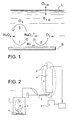
- FIG. 1 The chemical reactions involved are shown diagrammatically in FIG. 1.
- S surface on which the ruthenium deposit is located
- L basic aqueous solution. Evolution of the decontamination speed as a function of the initial ruthenate content Ruthenate concentration / mol.l -1 Reaction time / min 0 12 10 -4 6 10 -3 2
- Example 2 process of the present invention in the absence and in the presence of a regenerating agent gaseous
- Table 2 shows the potential for abandoning an aqueous sodium hydroxide solution in the presence or absence of bubbling gas: oxygen or ozonated oxygen.
- Table 2 illustrates that the introduction ozone in the solution significantly increases the oxidizing power of this and makes possible oxidation reactions of different species Ruthenian to be dissolved.
- Table 3 shows the evolution of the oxidizing potential of a sodium hydroxide solution in the presence of ozone according to the sodium hydroxide concentration. Evolution of the potential as a function of the soda content Soda content (mol.l -1 ) Potential (mV / ENH) 1 220 0.5 300 0.1 500
- the oxidizing power of the solution therefore increases when the soda concentration is reduced.
- the lowering of the soda content therefore decreases the dissolution time of hydrated ruthenium up to one threshold for a concentration close to 0.5 mol per liter of solution.
- Table 6 illustrates the independence of the reaction rate with respect to the temperature between 20 and 40 ° C by presenting the time necessary for the dissolution of a deposit of 0.2 g of hydrated ruthenium dioxide with a flow rate of 4.2 gh -1 gaseous ozone in 0.5 molar soda and similar hydrodynamic conditions. Evolution of the decontamination speed as a function of the temperature Temperature / ° C Reaction time / min 20 11 40 12
- Example 4 device for implementing the method of the present invention
- Tank includes a tank 3 provided with a system gas injection 2, for example an air lift.
- Tank is contaminated with a deposit 4 containing ruthenium.
- the tank is filled with an aqueous solution made basic with sodium hydroxide, at a concentration of 0.3 mol.l -1 to which sodium ruthenate has been added, at a concentration of 100 mg / l -1 .
- the tank is stirred through the air-lift by supplying the gas circuit 1 of the air-lift 2 with a gas mixture containing ozone and at least one gas chosen from nitrogen and oxygen.
- a volatilized fraction of ruthenium is entrained towards a gas treatment circuit 5 equipped with a gas / liquid contactor 7 consisting of a gas washing column, in which a basic washing solution 6 of sodium hydroxide, at a concentration of 1 mol.l -1 is brought into contact with the gas phase before the departure thereof to the vent circuit 8.
- the reaction zone involved in this step is zone C corresponding to the washing column gases in which the destruction of excess ozone and the solubilization of RuCO 4 takes place by reduction with sodium hydroxide in the form of perruthenates.
- Example 5 Process of the invention with a solution aqueous perruthenate and sodium hydroxide in the absence regeneration agent
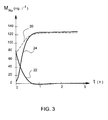
- FIG. 3 illustrates the evolution of the composition of the decontamination solution during the dissolution of 50 mg of insoluble ruthenium in the form of hydrated ruthenium dioxide by contacting with an aqueous sodium hydroxide solution 0.1 mol.l -1 containing perruthenates in solution at a rate of 75 mg / l of Ru in the form of perruthenates at 25 ° C. in the absence of perruthenate regenerating agent.
- reference 20 indicates the evolution of the concentration of total Ru in the decontamination solution (mg.l -1 )
- reference 22 indicates the evolution of the concentration of perruthenate in the decontamination solution (mg. l -1 )
- reference 24 indicates the evolution of the ruthenate concentration in the decontamination solution (mg.l -1 ), all as a function of time in hours.
Landscapes
- Chemical & Material Sciences (AREA)
- Engineering & Computer Science (AREA)
- Organic Chemistry (AREA)
- Physics & Mathematics (AREA)
- High Energy & Nuclear Physics (AREA)
- Mechanical Engineering (AREA)
- Metallurgy (AREA)
- General Chemical & Material Sciences (AREA)
- Life Sciences & Earth Sciences (AREA)
- Food Science & Technology (AREA)
- Chemical Kinetics & Catalysis (AREA)
- General Engineering & Computer Science (AREA)
- Materials Engineering (AREA)
- Inorganic Chemistry (AREA)
- Cleaning And De-Greasing Of Metallic Materials By Chemical Methods (AREA)
- Inorganic Compounds Of Heavy Metals (AREA)
- Agricultural Chemicals And Associated Chemicals (AREA)
- Detergent Compositions (AREA)
- Catalysts (AREA)
- Micro-Organisms Or Cultivation Processes Thereof (AREA)
Abstract
Description
- du fait de son activité spécifique, le ruthénium actif déposé représente une part importante de l'activité résiduelle et l'entraínement de ce ruthénium constitue un moyen privilégié de réduction du débit de dose des installations avant leur démantèlement ;
- le ruthénium précipite en entraínant des radioéléments, tels que U ou Pu par exemple. Ces dépôts irradiants recouvrent les parois métalliques et limitent de ce fait l'efficacité des séquences de décapage des parois métalliques qui représentent les phases ultimes d'assainissement.
- elle utilise une solution fortement sodique à environ 184 g.l-1 de sodium, ce qui engendre un nombre de verres important pour traiter les effluents générés, et
- elle utilise des sulfates, ce qui est pénalisant en terme d'exutoire et peut poser des problèmes de corrosion en milieu acide sur certaines nuances d'acier tels que les aciers austénitiques.
- la décontamination se fait à haute température or, il n'est pas possible de chauffer, sauf investissements lourds, l'ensemble des circuits à décontaminer,
- ce procédé implique de créer un réacteur de piégeage du ruthénium, ce qui constitue une modification d'installation délicate,
- ce procédé implique une unité de récupération du Ru qu'il faudrait créer de toute pièce pour le projet d'assainissement.
- son potentiel d'oxydation est assez élevé pour oxyder les dépôts de ruthénium visés dans le procédé de la présente invention,
- il est soluble sous sa forme oxydée et sous sa forme réduite, ceci évite les phénomènes de précipitation tels que ceux rencontrés dans l'art antérieur avec le couple MnO4 -/MnO2.
- La figure 1 est une représentation schématique des différentes réactions chimiques qui peuvent être mises en jeu dans le procédé de la présente invention,
- La figure 2 est une représentation schématique d'un dispositif de mise en oeuvre du procédé de la présente invention, et
- La figure 3 est une représentation graphique de l'évolution de la concentration en espèces ruthéniées en fonction du temps dans une solution de perruthénate selon le procédé de la présente invention.
| Evolution de la vitesse de décontamination en fonction de la teneur initiale en ruthénate | |
| Concentration en ruthénate/mol.l-1 | Temps de réaction/min |
| 0 | 12 |
| 10-4 | 6 |
| 10-3 | 2 |
| Potentiel oxydant des solutions de soude en présence d'ozone | |
| Milieu | Potentiel (mV/ENH) |
| Soude 1 mol.l-1 | 60 |
| Soude 1 mol.l-1 + O2 | 110 |
| Soude 1 mol.l-1 + O2/O3 | 220 |
| Evolution du potentiel en fonction de la teneur en soude | |
| Teneur en soude (mol.l-1) | Potentiel (mV/ENH) |
| 1 | 220 |
| 0,5 | 300 |
| 0,1 | 500 |
| Evolution de la vitesse de réaction en fonction de la teneur en soude | |
| Teneur en soude (mol.l-1) | Temps de réaction (min) |
| 1 | 20 |
| 0,5 | 11 |
| 0,25 | 13 |
| Evolution du potentiel d'oxydation en fonction de la température | |
| Température/°C | Potentiel/mV |
| 25 | 300 |
| 40 | 200 |
| Evolution de la vitesse de décontamination en fonction de la température | |
| Température/°C | Temps de réaction/min |
| 20 | 11 |
| 40 | 12 |
Claims (12)
- Procédé de dissolution de dépôts de ruthénium présents sur une surface comprenant une mise en contact de ladite surface avec une solution aqueuse de perruthénate, ladite solution aqueuse ayant un pH supérieur ou égal à 12.
- Procédé selon la revendication 1, dans lequel ladite solution aqueuse a une concentration C en mol.l-1 de perruthénate, avec 0 < C ≤ 0,1.
- Procédé selon la revendication 1, dans lequel ladite solution aqueuse a une concentration C de perruthénate de 10-4 mol.l-1.
- Procédé selon la revendication 1 ou 2, dans laquelle la solution aqueuse a une concentration en ions OH- allant de 0,01 à 6 mol.l-1.
- Procédé selon la revendication 1 ou 2, dans laquelle la solution aqueuse a une concentration en ions OH- de 0,03 à 0,6 mol.l-1.
- Procédé selon la revendication 1 ou 2, dans lequel la mise en contact est effectuée à une température allant de 5 à 50°C.
- Procédé selon la revendication 1, dans lequel le perruthénate régénéré in situ par injection, dans la solution aqueuse en contact avec ladite surface, d'un agent de régénération gazeux.
- Procédé selon la revendication 7, dans lequel l'agent de régénération est un mélange d'air et d'ozone, d'azote et d'ozone ou d'oxygène et d'ozone.
- Procédé selon la revendication 7, dans lequel l'agent de régénération est injecté au moyen d'un air-lift ou de rampes de bullage.
- Procédé selon la revendication 7, dans lequel des gaz tels que de l'ozone excédentaire et du RuO4 sortant de la solution aqueuse lors du procédé de dissolution, ils sont récupérés et soumis à un traitement de lavage au moyen d'une solution de lavage de ces gaz.
- Procédé selon la revendication 10, dans lequel la solution de lavage des gaz est une solution aqueuse comprenant de 0,01 à 10 mol.l-1 d'ions OH-.
- Procédé de décontamination de circuits d'une usine de retraitement de combustibles nucléaires, ledit procédé comprenant la mise en oeuvre d'un procédé selon l'une quelconque des revendications 1 à 11 précédentes.
Applications Claiming Priority (2)
| Application Number | Priority Date | Filing Date | Title |
|---|---|---|---|
| FR0101704A FR2820417B1 (fr) | 2001-02-08 | 2001-02-08 | Procede de dissolution et de decontamination |
| FR0101704 | 2001-02-08 |
Publications (2)
| Publication Number | Publication Date |
|---|---|
| EP1231609A1 true EP1231609A1 (fr) | 2002-08-14 |
| EP1231609B1 EP1231609B1 (fr) | 2008-07-16 |
Family
ID=8859768
Family Applications (1)
| Application Number | Title | Priority Date | Filing Date |
|---|---|---|---|
| EP02290283A Expired - Lifetime EP1231609B1 (fr) | 2001-02-08 | 2002-02-06 | Procédé de dissolution et de decontamination |
Country Status (7)
| Country | Link |
|---|---|
| US (1) | US6716402B2 (fr) |
| EP (1) | EP1231609B1 (fr) |
| JP (1) | JP4306999B2 (fr) |
| AT (1) | ATE401653T1 (fr) |
| DE (1) | DE60227583D1 (fr) |
| ES (1) | ES2310582T3 (fr) |
| FR (1) | FR2820417B1 (fr) |
Families Citing this family (4)
| Publication number | Priority date | Publication date | Assignee | Title |
|---|---|---|---|---|
| JP6343929B2 (ja) * | 2013-12-26 | 2018-06-20 | 株式会社Ihi | 高レベル放射性廃液中のルテニウム除去方法及び装置 |
| US9257638B2 (en) | 2014-03-27 | 2016-02-09 | Lam Research Corporation | Method to etch non-volatile metal materials |
| US11495471B2 (en) * | 2019-09-26 | 2022-11-08 | Taiwan Semiconductor Manufacturing Co., Ltd. | Slurry compositions for chemical mechanical planarization |
| KR20220014299A (ko) * | 2020-07-28 | 2022-02-04 | 가부시끼가이샤 도꾸야마 | 루테늄 함유액으로부터의 루테늄 함유 가스의 발생 억제 방법 |
Citations (3)
| Publication number | Priority date | Publication date | Assignee | Title |
|---|---|---|---|---|
| EP0247933A1 (fr) * | 1986-05-27 | 1987-12-02 | Commissariat A L'energie Atomique | Procédé de décontamination de matériaux solides contaminés par des éléments contaminants, en particulier par des éléments radioactifs tels que le ruthénium |
| JPS63243232A (ja) * | 1987-03-31 | 1988-10-11 | Ishikawajima Harima Heavy Ind Co Ltd | 放射性廃棄物からのルテニウム回収方法 |
| US5248496A (en) * | 1989-10-27 | 1993-09-28 | Basf Aktiengesellschaft | Method of obtaining ruthenium tetroxide by oxidation of an aqueous alkali metal ruthenate solution |
Family Cites Families (5)
| Publication number | Priority date | Publication date | Assignee | Title |
|---|---|---|---|---|
| US2967209A (en) * | 1948-06-18 | 1961-01-03 | William E Grummitt | Recovery of ruthenium values |
| FR2124126B1 (fr) * | 1971-02-08 | 1974-03-01 | Commissariat Energie Atomique | |
| JP2503496B2 (ja) * | 1987-03-31 | 1996-06-05 | 石川島播磨重工業株式会社 | 放射性廃棄物からのルテニウム回収方法 |
| JPH10273327A (ja) | 1997-03-27 | 1998-10-13 | Mitsubishi Gas Chem Co Inc | 四酸化ルテニウムの製造方法 |
| JP3108648B2 (ja) | 1997-03-31 | 2000-11-13 | 日本無機株式会社 | クリーンルーム用フィルタ装置 |
-
2001
- 2001-02-08 FR FR0101704A patent/FR2820417B1/fr not_active Expired - Fee Related
-
2002
- 2002-01-22 US US10/050,915 patent/US6716402B2/en not_active Expired - Lifetime
- 2002-02-06 AT AT02290283T patent/ATE401653T1/de not_active IP Right Cessation
- 2002-02-06 DE DE60227583T patent/DE60227583D1/de not_active Expired - Lifetime
- 2002-02-06 ES ES02290283T patent/ES2310582T3/es not_active Expired - Lifetime
- 2002-02-06 EP EP02290283A patent/EP1231609B1/fr not_active Expired - Lifetime
- 2002-02-07 JP JP2002031041A patent/JP4306999B2/ja not_active Expired - Fee Related
Patent Citations (3)
| Publication number | Priority date | Publication date | Assignee | Title |
|---|---|---|---|---|
| EP0247933A1 (fr) * | 1986-05-27 | 1987-12-02 | Commissariat A L'energie Atomique | Procédé de décontamination de matériaux solides contaminés par des éléments contaminants, en particulier par des éléments radioactifs tels que le ruthénium |
| JPS63243232A (ja) * | 1987-03-31 | 1988-10-11 | Ishikawajima Harima Heavy Ind Co Ltd | 放射性廃棄物からのルテニウム回収方法 |
| US5248496A (en) * | 1989-10-27 | 1993-09-28 | Basf Aktiengesellschaft | Method of obtaining ruthenium tetroxide by oxidation of an aqueous alkali metal ruthenate solution |
Non-Patent Citations (1)
| Title |
|---|
| DATABASE WPI Section Ch Week 198846, Derwent World Patents Index; Class K07, AN 1988-327938, XP002181487 * |
Also Published As
| Publication number | Publication date |
|---|---|
| FR2820417B1 (fr) | 2003-05-30 |
| ES2310582T3 (es) | 2009-01-16 |
| JP4306999B2 (ja) | 2009-08-05 |
| JP2002267798A (ja) | 2002-09-18 |
| US20020150196A1 (en) | 2002-10-17 |
| ATE401653T1 (de) | 2008-08-15 |
| EP1231609B1 (fr) | 2008-07-16 |
| DE60227583D1 (de) | 2008-08-28 |
| US6716402B2 (en) | 2004-04-06 |
| FR2820417A1 (fr) | 2002-08-09 |
Similar Documents
| Publication | Publication Date | Title |
|---|---|---|
| EP2437270B1 (fr) | Procédé de suppression d'adhérence d'une substance radioactive | |
| EP1231609B1 (fr) | Procédé de dissolution et de decontamination | |
| JP4167052B2 (ja) | 有機化合物汚染の浄化方法 | |
| MXPA00010614A (es) | Procedimiento para reducir el nivel de radioactividad de una pieza metalica. | |
| EP2507556B1 (fr) | Procédé et dispositif pour le traitement des déchets par injection dans un plasma immergé | |
| FR2743064A1 (fr) | Procede et dispositif de traitement d'un effluent aqueux comprenant une charge organique | |
| EP0406098A1 (fr) | Procédé de dissolution d'oxyde déposé sur un substrat métallique et son application à la décontamination | |
| FR2952945A1 (fr) | Procede de dissolution chimique de produits de corrosion | |
| EP1414755B1 (fr) | Procede de traitement d'un effluent, notamment radioactif, contenant des matieres organiques | |
| EP1060476B1 (fr) | Procede et installation de decontamination de surfaces metalliques | |
| EP1192623B1 (fr) | Procede et dispositif de decontamination radioactive d'une paroi en acier | |
| BE1008429A6 (fr) | Procede photocatalytique de purification d'eau polluee. | |
| ES2932356T3 (es) | Procedimiento de atenuación de recontaminación por pasivación de acero al carbono de sistemas y componentes nucleares | |
| FR2826354A1 (fr) | Procede de decomposition de l'hydrazine contenue dans un liquide aqueux | |
| FR2599543A1 (fr) | Procede de decontamination de materiaux solides contamines par des elements contaminants, en particulier par des elements radioactifs tels que le ruthenium | |
| WO2002097824A1 (fr) | Procede de decontamination ou de prevention de la contamination de surfaces par un mecanisme d'echange. | |
| TWI417250B (zh) | 污水處理方法 | |
| WO2024121501A1 (fr) | Procédé de dissolution d'oxydes contenant une contamination en argent et cobalt sur un substrat métallique | |
| EP1624466B1 (fr) | Procédé de décontamination d'objets en plomb | |
| FR3108771A1 (fr) | Procédé de décontamination de couche d'oxyde | |
| FR2738502A1 (fr) | Procede d'epuration par voie humide d'effluents gazeux contenant des oxydes d'azote et eventuellement de l'iode | |
| JP2004305959A (ja) | 汚染土壌および地下水の浄化方法 | |
| JPH11114362A (ja) | 排ガス・ばい煙の処理方法とその装置 | |
| JPH07116674A (ja) | 石英ジャケットの洗浄方法 | |
| JP2003010867A (ja) | 塩類と難分解性化合物を含有する排水処理方法及び排水処理装置 |
Legal Events
| Date | Code | Title | Description |
|---|---|---|---|
| PUAI | Public reference made under article 153(3) epc to a published international application that has entered the european phase |
Free format text: ORIGINAL CODE: 0009012 |
|
| AK | Designated contracting states |
Kind code of ref document: A1 Designated state(s): AT BE CH CY DE DK ES FI FR GB GR IE IT LI LU MC NL PT SE TR |
|
| AX | Request for extension of the european patent |
Free format text: AL;LT;LV;MK;RO;SI |
|
| 17P | Request for examination filed |
Effective date: 20030125 |
|
| AKX | Designation fees paid |
Designated state(s): AT BE CH CY DE DK ES FI FR GB GR IE IT LI LU MC NL PT SE TR |
|
| RAP1 | Party data changed (applicant data changed or rights of an application transferred) |
Owner name: COMMISSARIAT A L'ENERGIE ATOMIQUE |
|
| RIC1 | Information provided on ipc code assigned before grant |
Ipc: G21F 9/28 20060101AFI20071123BHEP Ipc: C23F 1/40 20060101ALI20071123BHEP Ipc: C01G 55/00 20060101ALI20071123BHEP |
|
| GRAP | Despatch of communication of intention to grant a patent |
Free format text: ORIGINAL CODE: EPIDOSNIGR1 |
|
| GRAS | Grant fee paid |
Free format text: ORIGINAL CODE: EPIDOSNIGR3 |
|
| GRAA | (expected) grant |
Free format text: ORIGINAL CODE: 0009210 |
|
| AK | Designated contracting states |
Kind code of ref document: B1 Designated state(s): AT BE CH CY DE DK ES FI FR GB GR IE IT LI LU MC NL PT SE TR |
|
| REG | Reference to a national code |
Ref country code: GB Ref legal event code: FG4D Free format text: NOT ENGLISH |
|
| REG | Reference to a national code |
Ref country code: CH Ref legal event code: EP |
|
| REF | Corresponds to: |
Ref document number: 60227583 Country of ref document: DE Date of ref document: 20080828 Kind code of ref document: P |
|
| REG | Reference to a national code |
Ref country code: IE Ref legal event code: FG4D Free format text: LANGUAGE OF EP DOCUMENT: FRENCH |
|
| NLV1 | Nl: lapsed or annulled due to failure to fulfill the requirements of art. 29p and 29m of the patents act | ||
| REG | Reference to a national code |
Ref country code: ES Ref legal event code: FG2A Ref document number: 2310582 Country of ref document: ES Kind code of ref document: T3 |
|
| PG25 | Lapsed in a contracting state [announced via postgrant information from national office to epo] |
Ref country code: PT Free format text: LAPSE BECAUSE OF FAILURE TO SUBMIT A TRANSLATION OF THE DESCRIPTION OR TO PAY THE FEE WITHIN THE PRESCRIBED TIME-LIMIT Effective date: 20081216 Ref country code: NL Free format text: LAPSE BECAUSE OF FAILURE TO SUBMIT A TRANSLATION OF THE DESCRIPTION OR TO PAY THE FEE WITHIN THE PRESCRIBED TIME-LIMIT Effective date: 20080716 |
|
| PG25 | Lapsed in a contracting state [announced via postgrant information from national office to epo] |
Ref country code: AT Free format text: LAPSE BECAUSE OF FAILURE TO SUBMIT A TRANSLATION OF THE DESCRIPTION OR TO PAY THE FEE WITHIN THE PRESCRIBED TIME-LIMIT Effective date: 20080716 |
|
| REG | Reference to a national code |
Ref country code: IE Ref legal event code: FD4D |
|
| REG | Reference to a national code |
Ref country code: FR Ref legal event code: RT |
|
| PG25 | Lapsed in a contracting state [announced via postgrant information from national office to epo] |
Ref country code: IE Free format text: LAPSE BECAUSE OF FAILURE TO SUBMIT A TRANSLATION OF THE DESCRIPTION OR TO PAY THE FEE WITHIN THE PRESCRIBED TIME-LIMIT Effective date: 20080716 Ref country code: DK Free format text: LAPSE BECAUSE OF FAILURE TO SUBMIT A TRANSLATION OF THE DESCRIPTION OR TO PAY THE FEE WITHIN THE PRESCRIBED TIME-LIMIT Effective date: 20080716 |
|
| PLBE | No opposition filed within time limit |
Free format text: ORIGINAL CODE: 0009261 |
|
| STAA | Information on the status of an ep patent application or granted ep patent |
Free format text: STATUS: NO OPPOSITION FILED WITHIN TIME LIMIT |
|
| 26N | No opposition filed |
Effective date: 20090417 |
|
| PG25 | Lapsed in a contracting state [announced via postgrant information from national office to epo] |
Ref country code: MC Free format text: LAPSE BECAUSE OF NON-PAYMENT OF DUE FEES Effective date: 20090228 |
|
| REG | Reference to a national code |
Ref country code: FR Ref legal event code: ST Effective date: 20091030 |
|
| PG25 | Lapsed in a contracting state [announced via postgrant information from national office to epo] |
Ref country code: SE Free format text: LAPSE BECAUSE OF FAILURE TO SUBMIT A TRANSLATION OF THE DESCRIPTION OR TO PAY THE FEE WITHIN THE PRESCRIBED TIME-LIMIT Effective date: 20081016 |
|
| PG25 | Lapsed in a contracting state [announced via postgrant information from national office to epo] |
Ref country code: FR Free format text: LAPSE BECAUSE OF NON-PAYMENT OF DUE FEES Effective date: 20090302 |
|
| PG25 | Lapsed in a contracting state [announced via postgrant information from national office to epo] |
Ref country code: GR Free format text: LAPSE BECAUSE OF FAILURE TO SUBMIT A TRANSLATION OF THE DESCRIPTION OR TO PAY THE FEE WITHIN THE PRESCRIBED TIME-LIMIT Effective date: 20081017 |
|
| PG25 | Lapsed in a contracting state [announced via postgrant information from national office to epo] |
Ref country code: LU Free format text: LAPSE BECAUSE OF NON-PAYMENT OF DUE FEES Effective date: 20090206 |
|
| PG25 | Lapsed in a contracting state [announced via postgrant information from national office to epo] |
Ref country code: TR Free format text: LAPSE BECAUSE OF FAILURE TO SUBMIT A TRANSLATION OF THE DESCRIPTION OR TO PAY THE FEE WITHIN THE PRESCRIBED TIME-LIMIT Effective date: 20080716 |
|
| PG25 | Lapsed in a contracting state [announced via postgrant information from national office to epo] |
Ref country code: CY Free format text: LAPSE BECAUSE OF FAILURE TO SUBMIT A TRANSLATION OF THE DESCRIPTION OR TO PAY THE FEE WITHIN THE PRESCRIBED TIME-LIMIT Effective date: 20080716 |
|
| PGFP | Annual fee paid to national office [announced via postgrant information from national office to epo] |
Ref country code: ES Payment date: 20180327 Year of fee payment: 17 Ref country code: FI Payment date: 20180125 Year of fee payment: 17 Ref country code: CH Payment date: 20180214 Year of fee payment: 17 |
|
| PGFP | Annual fee paid to national office [announced via postgrant information from national office to epo] |
Ref country code: IT Payment date: 20180212 Year of fee payment: 17 |
|
| PGFP | Annual fee paid to national office [announced via postgrant information from national office to epo] |
Ref country code: GB Payment date: 20190215 Year of fee payment: 18 Ref country code: DE Payment date: 20190211 Year of fee payment: 18 |
|
| PGFP | Annual fee paid to national office [announced via postgrant information from national office to epo] |
Ref country code: BE Payment date: 20190222 Year of fee payment: 18 |
|
| REG | Reference to a national code |
Ref country code: CH Ref legal event code: PL |
|
| PG25 | Lapsed in a contracting state [announced via postgrant information from national office to epo] |
Ref country code: FI Free format text: LAPSE BECAUSE OF NON-PAYMENT OF DUE FEES Effective date: 20190206 |
|
| PG25 | Lapsed in a contracting state [announced via postgrant information from national office to epo] |
Ref country code: CH Free format text: LAPSE BECAUSE OF NON-PAYMENT OF DUE FEES Effective date: 20190228 Ref country code: LI Free format text: LAPSE BECAUSE OF NON-PAYMENT OF DUE FEES Effective date: 20190228 |
|
| PG25 | Lapsed in a contracting state [announced via postgrant information from national office to epo] |
Ref country code: IT Free format text: LAPSE BECAUSE OF NON-PAYMENT OF DUE FEES Effective date: 20190206 |
|
| REG | Reference to a national code |
Ref country code: ES Ref legal event code: FD2A Effective date: 20200327 |
|
| PG25 | Lapsed in a contracting state [announced via postgrant information from national office to epo] |
Ref country code: ES Free format text: LAPSE BECAUSE OF NON-PAYMENT OF DUE FEES Effective date: 20190207 |
|
| REG | Reference to a national code |
Ref country code: DE Ref legal event code: R119 Ref document number: 60227583 Country of ref document: DE |
|
| GBPC | Gb: european patent ceased through non-payment of renewal fee |
Effective date: 20200206 |
|
| REG | Reference to a national code |
Ref country code: BE Ref legal event code: MM Effective date: 20200229 |
|
| PG25 | Lapsed in a contracting state [announced via postgrant information from national office to epo] |
Ref country code: GB Free format text: LAPSE BECAUSE OF NON-PAYMENT OF DUE FEES Effective date: 20200206 Ref country code: DE Free format text: LAPSE BECAUSE OF NON-PAYMENT OF DUE FEES Effective date: 20200901 |
|
| PG25 | Lapsed in a contracting state [announced via postgrant information from national office to epo] |
Ref country code: BE Free format text: LAPSE BECAUSE OF NON-PAYMENT OF DUE FEES Effective date: 20200229 |