EP1231601B1 - Information recording apparatus - Google Patents
Information recording apparatus Download PDFInfo
- Publication number
- EP1231601B1 EP1231601B1 EP02250857A EP02250857A EP1231601B1 EP 1231601 B1 EP1231601 B1 EP 1231601B1 EP 02250857 A EP02250857 A EP 02250857A EP 02250857 A EP02250857 A EP 02250857A EP 1231601 B1 EP1231601 B1 EP 1231601B1
- Authority
- EP
- European Patent Office
- Prior art keywords
- information recording
- information
- layer
- recording layer
- recording
- Prior art date
- Legal status (The legal status is an assumption and is not a legal conclusion. Google has not performed a legal analysis and makes no representation as to the accuracy of the status listed.)
- Expired - Lifetime
Links
- 230000000694 effects Effects 0.000 claims description 18
- 230000002401 inhibitory effect Effects 0.000 claims description 9
- 230000004907 flux Effects 0.000 claims description 8
- 230000003287 optical effect Effects 0.000 description 59
- 238000002834 transmittance Methods 0.000 description 14
- 238000010586 diagram Methods 0.000 description 10
- 238000000034 method Methods 0.000 description 10
- 238000009826 distribution Methods 0.000 description 4
- 239000000758 substrate Substances 0.000 description 4
- 239000000463 material Substances 0.000 description 3
- 125000006850 spacer group Chemical group 0.000 description 2
- 230000007547 defect Effects 0.000 description 1
- 230000001678 irradiating effect Effects 0.000 description 1
- 239000000203 mixture Substances 0.000 description 1
- 229920000515 polycarbonate Polymers 0.000 description 1
- 239000004417 polycarbonate Substances 0.000 description 1
- 239000004065 semiconductor Substances 0.000 description 1
- 238000009827 uniform distribution Methods 0.000 description 1
Images


Classifications
-
- G—PHYSICS
- G11—INFORMATION STORAGE
- G11B—INFORMATION STORAGE BASED ON RELATIVE MOVEMENT BETWEEN RECORD CARRIER AND TRANSDUCER
- G11B7/00—Recording or reproducing by optical means, e.g. recording using a thermal beam of optical radiation by modifying optical properties or the physical structure, reproducing using an optical beam at lower power by sensing optical properties; Record carriers therefor
- G11B7/08—Disposition or mounting of heads or light sources relatively to record carriers
- G11B7/09—Disposition or mounting of heads or light sources relatively to record carriers with provision for moving the light beam or focus plane for the purpose of maintaining alignment of the light beam relative to the record carrier during transducing operation, e.g. to compensate for surface irregularities of the latter or for track following
- G11B7/0901—Disposition or mounting of heads or light sources relatively to record carriers with provision for moving the light beam or focus plane for the purpose of maintaining alignment of the light beam relative to the record carrier during transducing operation, e.g. to compensate for surface irregularities of the latter or for track following for track following only
-
- G—PHYSICS
- G11—INFORMATION STORAGE
- G11B—INFORMATION STORAGE BASED ON RELATIVE MOVEMENT BETWEEN RECORD CARRIER AND TRANSDUCER
- G11B7/00—Recording or reproducing by optical means, e.g. recording using a thermal beam of optical radiation by modifying optical properties or the physical structure, reproducing using an optical beam at lower power by sensing optical properties; Record carriers therefor
- G11B7/004—Recording, reproducing or erasing methods; Read, write or erase circuits therefor
- G11B7/0045—Recording
-
- G—PHYSICS
- G11—INFORMATION STORAGE
- G11B—INFORMATION STORAGE BASED ON RELATIVE MOVEMENT BETWEEN RECORD CARRIER AND TRANSDUCER
- G11B7/00—Recording or reproducing by optical means, e.g. recording using a thermal beam of optical radiation by modifying optical properties or the physical structure, reproducing using an optical beam at lower power by sensing optical properties; Record carriers therefor
- G11B2007/0003—Recording, reproducing or erasing systems characterised by the structure or type of the carrier
- G11B2007/0009—Recording, reproducing or erasing systems characterised by the structure or type of the carrier for carriers having data stored in three dimensions, e.g. volume storage
- G11B2007/0013—Recording, reproducing or erasing systems characterised by the structure or type of the carrier for carriers having data stored in three dimensions, e.g. volume storage for carriers having multiple discrete layers
Definitions
- the present invention relates to a multilayer optical information recording medium having a plurality of information recording layers where information is recorded and an information recording apparatus for recording information onto the multilayer optical information recording medium.
- mass-storage optical disks typically CD or DVD
- mass-storage optical disks typically CD or DVD
- a multilayer optical disk having two or more information recording layers is under development.
- each information recording layer is formed by a phase change recording layer, it becomes possible to realize a multilayer optical disk capable of recording information in addition to reproducing information.
- the phase change recording layer of the multilayer optical disk is put in a crystalline state initially before recording, while it is put in an amorphous state after the recording.
- an unrecorded area having the phase change recording layer in the crystalline state differs from a recorded area having the phase change recording layer in the amorphous state in a reflectance and a transmittance.
- the recording is affected by a reflectance or a transmittance of an overlying information recording layer. Unless a uniform distribution is observed in the transmittance or the reflectance of each information recording layer, an intensity distribution may be uniformless in the optical beam of an optical detector.
- a variation of the transmittance or the reflectance remarkably affects the tracking servo.
- the recorded area is mixed with the unrecorded area in the information recording layer, components caused by the variation of the transmittance or the reflectance are superposed on the light intensity distribution in the optical detector.
- a laser beam is transmitted or reflected in the vicinity of a boundary portion between the recorded area and the unrecorded area, it may cause an offset in a tracking error in the information recording layer which is an object of recording.
- the offset occurs in the tracking error since the effect of the boundary portion causes laser power to be asymmetric between one side and the other side in the disk radial direction even if a track is traced accurately in detecting a tracking error in the push-pull method generally used for the information recording apparatus.
- a performance of the tracking servo is unsuccessfully secured due to the offset of the tracking error caused by a recording condition of each information recording layer when information is recorded onto a recordable multilayer optical disk.
- JP-A-2000293947 and EP-A-0957477 both disclose information recording apparatus in which data detecting devices are provided.
- the document JP-A-2000293947 discloses an optical information recording apparatus for optically recording information onto an optical disk comprising a first information layer and a second information layer, the first information layer being closer to the surface irradiated by the light beam at the time of recording.
- Each of the information layers consists of two or more zones dividing the optical disk in the radial direction, wherein each zone has a record status flag indicating whether the zone is recorded or not.
- the status of the zones M-1, M, and M+1 of the first information layer is first checked. When these three zones of the first information layer are (1) all unrecorded or (2) all recorded, then the recording on the zone M of the second information layer takes place. Otherwise, when none of the conditions (1) or (2) is met, the recording onto the zone M of the second recording layer is inhibited.
- the present invention is provided in view of these problems and it is an object of the present invention to provide an information recording apparatus capable of detecting an accurate tracking error without affecting a tracking servo in other information recording layers even if a reflectance or a transmittance of each information recording layer varies according to a presence or absence of a recorded area when information is recorded onto a multilayer optical information recording medium.
- an information recording apparatus for optically recording information onto an information recording medium having a plurality of information layers, characterized by:
- a detecting device detects a position of a boundary portion between a recorded area where the information has already been recorded and an unrecorded area in the information recording layer. Then an inhibiting device inhibits recording the information onto an area in one information recording layer in a case where the boundary portion in an information recording layer may affect a tracking servo for recording the information onto said one information recording layer.
- the number of recorded or unrecorded tracks is identified within a range of a diameter of a luminous flux in the boundary portion irradiated with the light beam when information is recorded onto the multilayer optical information recording medium, thereby enabling a rough area comparison between the recorded areas and the unrecorded areas and facilitating a determination of whether there is an effect on the tracking servo.
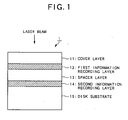
- FIG. 1 there is shown a diagram of a sectional structure of a two-layer optical disk 1 which is an example of a multilayer optical information recording medium according to this embodiment.
- the two-layer optical disk 1 has a sectional structure formed by a cover layer 11, a first information recording layer 12, a spacer layer 13, a second information recording layer 14, and a disk substrate 15 sequentially.
- an information recording and reproducing apparatus When an information recording and reproducing apparatus according to this embodiment described later records information on the two-layer optical disk 1, a laser beam is emitted from the upper side in FIG. 1 .
- the cover layer 11 is used for protecting the first information recording layer 12, having a given thickness.
- the first information recording layer 12, which has a phase change recording layer for recording information on the basis of a phase change, is a recording layer located relatively near the laser beam emitting source.
- the spacer layer 13 is a transparent layer arranged between the first information recording layer 12 and the second information recording layer 14.
- the second information recording layer 14, which has a phase change recording layer in the same manner as for the first information recording layer 12, is a recording layer located relatively far from the laser beam emitting source.
- the disk substrate 15 is a substrate having a given thickness, made of polycarbonate material or the like.
- the phase change recording layers formed on the first information recording layer 12 and the second information recording layer 14 are crystalline in its initial state, while their characteristic changes to an amorphous state by being irradiated with a laser beam at recording and reproducing.
- a recorded area in which information is recorded is put in the amorphous state and an unrecorded area is put in the crystalline state.
- a reflectance for a laser beam depends upon the crystalline state or the amorphous state on the basis of characteristics of the phase change recording material. In other words, the reflectance varies according to the recorded area or the unrecorded area in the first information recording layer 12 or the second information recording layer 14.
- recording onto the first information recording layer 12 is affected by a reflectance of the second information recording layer 14.
- a reflectance of the second information recording layer 14 when a laser beam is condensed on the first information recording layer 12 and its reflected light is detected by an optical detector, a reflected light from the second information recording layer 14 reaches the optical detector as a stray light component and therefore a detected level varies according to the reflectance.
- a reflectance and a transmittance of the first information recording layer 12 affect recording onto the second information recording layer 14.
- a laser beam passes through the first information recording layer 12 when it is condensed on the second information recording layer 14, and therefore a light intensity distribution of the irradiation varies according to its reflectance and a reflected light from the first information recording layer 12 have an effect with the same action as for the above.
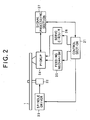
- FIG. 2 there is shown a block diagram of a schematic configuration of the information recording and reproducing apparatus according to this embodiment.
- the information recording and reproducing apparatus shown in FIG. 2 comprises a control section 21, a spindle motor 22, a spindle driver 23, a pickup 24, a feeding mechanism 25, a servo circuit 26, and a signal processing section 27 and performs a recording operation of the mounted two-layer optical disk 1.
- control section 21 controls the recording operation of the information recording apparatus as a whole.
- the control section 21 is connected to respective components shown in FIG. 2 to control the operation by exchanging data or control signals.
- This control section 21 has a role of executing and controlling the record processing in this embodiment as described later.
- the two-layer optical disk 1 mounted on the information recording and reproducing apparatus is irradiated with a laser beam by the pickup 24 while it is driven rotatively by the spindle motor 22.
- the spindle driver 23 controls the rotation of the spindle motor 22 so that a regular linear velocity is maintained for the two-layer optical disk 1.
- the feeding mechanism 25 controls a movement of the pickup 24 in a radial direction of the two-layer optical disk 1 by driving and controlling a feeding motor so as to move the pickup 24 to a track position corresponding to the above recorded area at recording and reproducing.
- the servo circuit 26 controls an actuator of the pickup 24 for a focusing servo and a tracking servo.
- the signal processing section 27 drives and controls a semiconductor laser of the pickup 24 on the basis of the recorded information and performs signal processing for generating various signals on the basis of a light receiving output of the pickup 24.
- the pickup 24 detects a tracking error in the push-pull method so as to enable the servo circuit 26 to perform a tracking servo.
- the pickup 24 detects the tracking error on the basis of a differential output between a disk inner circumferential side and a disk outer circumferential side at tracing on tracks. If a recorded area is mixed with an unrecorded area on the two-layer optical disk 1 as set forth in the above, then there is a problem that an offset of the tracking error is caused by an effect of their boundary portion.
- FIG. 3 there is shown a diagram of assistance in explaining a condition affected by the first information recording layer 12 at recording and reproducing to or from the second information recording layer 14 of the two-layer optical disk 1.
- FIG. 3A shows a condition of a cross section at recording and reproducing to or from the second information recording layer 14, in which a recorded area 31 where information has already been recorded is adjacent to an unrecorded area 32 maintaining an initial state in a boundary portion 33 in the first information recording layer 12.
- the cross section is put in the condition shown in FIG. 3A if a part of a track range remains in the initial state when information is written onto the first information recording layer 12 a plurality of times.
- the laser beam emitted from the side of the cover layer 11 passes through the first information recording layer 12 and is condensed on the second information recording layer 14 to form a beam spot BS.
- an irradiated area 34 of the first information recording layer 12 is irradiated in a defocus state with the laser beam and a reflection of its partial area affects a reflectance in the irradiated area 34.
- FIG. 3B there is shown a diagram of assistance in typically explaining a condition of the first information recording layer 12, which is a top view of FIG. 3A .
- the irradiated area 34 in the first information recording layer 12 is in the defocus state and therefore spreads in a relatively wide area including a plurality of tracks T ( FIG. 3B shows an example in which the irradiated area 34 includes ten tracks T).
- FIG. 3A shows an example in which the irradiated area 34 includes ten tracks T.
- a center of the irradiated area 34 almost matches the boundary portion 33 and the irradiated area includes almost the same area of the recorded area 31 as for the unrecorded area 32.
- a reflectance of the phase change recording layer in the crystalline state is higher than that a reflectance in the amorphous state and therefore a reflectance of the unrecorded area 32 is lower than a reflectance of the recorded area 31. Accordingly, the reflected light from the irradiated area 34 is received by the pickup 24 in a state of an asymmetric light intensity distribution in the disk radial direction. As a result of a superposition of this light on the reflected light from the second information recording layer 14, an offset occurs in the tracking error as described later.
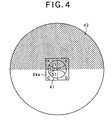
- FIG. 4 there is shown a diagram of a light receiving pattern corresponding to the condition shown in FIG. 3 in a light receiving position of the pickup 24.
- the light receiving pattern shown in FIG. 4 includes a light receiving pattern 41 corresponding to a beam spot BS of the second information recording layer 14 and a light receiving pattern 42 corresponding to an irradiated area 34 of the first information recording layer 12 superposed on it.
- an optical detector 24a having a tetrameric configuration is arranged in the position of the light receiving pattern 41 corresponding to the beam spot BS.
- the optical detector 24a is assumed to comprise segmented areas A, B, C, and D, with the areas A and B in one side and the areas C and D in the other side with respect to a disk radial direction.
- a tracking error in the push-pull method can be detected by obtaining a differential output (A+B)-(C+D) based on respective segmented areas.
- the light receiving pattern 41 corresponding to the beam spot BS is made of a primary diffracted light S1 corresponding to a track groove superposed on a zero-order diffracted light S0 which is the main component.
- the primary diffracted light S1 is distributed symmetrically with respect to the track, thereby causing no tracking error.
- the light receiving pattern 42 in the irradiated area 34 affects a tracking error.
- the boundary portion 34 matches the position corresponding to the track to be traced, and therefore one side of the area in the disk radial direction overlaps the recorded area 31 and the other side of the area overlaps the unrecorded area 32, thereby causing a light receiving level to be asymmetric with respect to the disk radial direction.
- the differential output (A+B)-(C+D) with the optical detector 24a does not equal 0 even if the beam spot BS traces the center of the track, thereby causing an offset in the tracking error.
- step S1 After the record processing is started, it is determined whether recording position information of the multilayer optical disk is readable (step S1).
- This recording position information indicates a recording position in each information recording layer forming the multilayer optical disk. In other words, the positions of the recorded area 31, the unrecorded area 32, and the boundary portion 33 therebetween can be identified on the basis of this recording position information.
- step S1 If the above recording position information is recorded in a given record area of the multilayer optical disk (step S1), it should be read for use. On the other hand, the recording position information cannot be read from the multilayer optical disk in some cases (step S1: NO).
- step S2 the respective information recording layers forming the multilayer optical disk are scanned to check the recorded condition (step S2). At this point, phase change recording layers of the information recording layers are scanned at high speed and the recorded condition is identified on the basis of the reflected light level or a significance of a tracking error, by which the recording position information can be determined.
- a focused layer (an information recording layer to be focused on as an object of recording) is set to a given information recording layer (step S3).
- the information recording layer can be appropriately selected so as to meet a convenience of record processing.
- step S4: NO it is determined whether a free area required for recording exists in the focused layer on the basis of the recording position information obtained in the steps S1 and S2.
- the boundary portion 33 of each information recording layer other than the focused layer is identified on the basis of the recording position information (step S6). In other words, it is to inhibit an area affected by the boundary portion 33 from being recorded in order to prevent the condition described in FIG. 2 and FIG. 3 . Then, an effect of the boundary portion 33 identified in the step S6 on a tracking servo is determined to judge whether it is within an allowable range of a normal tracking servo (step S7).
- the determination can be made on the basis of a ratio of the number of tracks included within the range of the luminous flux diameter D in the above expression (1) in the vicinity of the boundary portion 33 on a given overlying layer.
- the threshold TH can be appropriately set according to a size of the luminous flux diameter D or a difference of a reflectance or a transmittance between the recorded area 31 and the unrecorded area 32.
- Step S7 If the effect on the tracking servo is determined to be outside the allowable range in the step S7 (Step S7: NO), information is inhibited from being recorded onto the corresponding areas in the focused layer (step S8). In other words, it is possible to prevent recording onto the focused layer in the condition described by referring to FIG. 3 and FIG. 4 .
- step S9 information starts to be recorded in areas other than the inhibited areas in the focused layer.
- step S10 the recording is terminated when the required information has been recorded. This termination of the recording is determined on the basis of the information in the record area predetermined in the optical disk 1. At this point, it is permitted to leave unrecorded areas 33 as remainders not affecting the tracking servo in other information recording layers.
- a reflected light from a beam spot on the tracks of the information recording layer keeps symmetricity of power in the disk radial direction, thereby realizing an accurate tracking servo without causing a tracking offset.
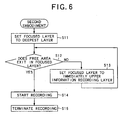
- FIG. 6 there is shown a flowchart of assistance in explaining a procedure for record processing corresponding to the example.
- the processing in the example is performed on condition that an absence of the boundary portion 33 in all information recording layers is confirmed on the basis of recording position information previous to recording onto a multilayer optical disk. If the boundary portion 33 exists in a specific information recording layer, the above embodiment is executed, for example.
- the focused layer is set to the deepest layer (the deepest layer viewed from an angle of the laser beam emitting source) on the above condition (step S11). Then, it is determined whether a free area required for recording exists in the focused layer on the basis of the recording position information (step S12). If the free area in the focused layer is insufficient as a result (step S12: NO), an information recording layer on the information recording layer is set as a focused layer (step S13) and then the control progresses to the step S12 again. When the focused layer reaches the top information recording layer, the processing in FIG. 6 is terminated.
- step S14 recording information is started in the given free area in the information recording layer corresponding to the focused layer. Then, after required information is recorded, the record processing is terminated (step S15).
- the record processing is terminated (step S15). In this condition, while generally recording is advanced sequentially from the inner circumferential side to the outer circumferential side, it is possible to advance it sequentially from the outer circumferential side to the inner circumferential side. Otherwise, it is possible to record information in random positions in an information recording layer.
- information is recorded onto all areas in the deepest layer initially and then the operation progresses to the upper layer when no unrecorded area 32 remains in recording onto the multilayer optical disk. After that, the operation progresses to the upper layer sequentially on condition that information is recorded onto all areas in each information recording layer in the same manner.
- the recording is performed under the condition that recording is completed in all underlying layers of the information recording layer, which is an object of recording, without laser beam reflected nor transmitted on the boundary portion 33 while no information is recorded in overlying layers. Therefore, there is no need for identifying the boundary portion 33 whenever information is recorded, thereby resolving the problem in the tracking servo caused by the laser beam transmitted or reflected on areas in the vicinity of the boundary portion 33.
- While the operation is advanced from the deepest layer to the upper layer sequentially in the recording order preset for the information recording layers in the example, it is possible to advance it from the top layer to the lower layer sequentially in contrast or to set a given recording order to each information recording layer.
- the present invention when information is recorded in a multilayer optical information recording medium, information is recorded in such a procedure that recording is inhibited in positions where it is affected by a boundary portion between a recorded area and an unrecorded area, thereby realizing an information recording apparatus capable of detecting an accurate tracking error without affecting a tracking servo in an information recording layer to be an object of recording even if a reflectance or a transmittance varies in each information recording layer.
Landscapes
- Optical Recording Or Reproduction (AREA)
Applications Claiming Priority (2)
| Application Number | Priority Date | Filing Date | Title |
|---|---|---|---|
| JP2001033963 | 2001-02-09 | ||
| JP2001033963A JP4268764B2 (ja) | 2001-02-09 | 2001-02-09 | 情報記録装置 |
Publications (3)
| Publication Number | Publication Date |
|---|---|
| EP1231601A2 EP1231601A2 (en) | 2002-08-14 |
| EP1231601A3 EP1231601A3 (en) | 2005-01-19 |
| EP1231601B1 true EP1231601B1 (en) | 2010-03-31 |
Family
ID=18897642
Family Applications (1)
| Application Number | Title | Priority Date | Filing Date |
|---|---|---|---|
| EP02250857A Expired - Lifetime EP1231601B1 (en) | 2001-02-09 | 2002-02-07 | Information recording apparatus |
Country Status (4)
| Country | Link |
|---|---|
| US (1) | US6970409B2 (enExample) |
| EP (1) | EP1231601B1 (enExample) |
| JP (1) | JP4268764B2 (enExample) |
| DE (1) | DE60235782D1 (enExample) |
Families Citing this family (15)
| Publication number | Priority date | Publication date | Assignee | Title |
|---|---|---|---|---|
| WO2003094161A1 (en) * | 2002-04-30 | 2003-11-13 | Sony Corporation | Optical recording medium manufacturing device, method, optical recording medium, reproduction device, method, recording device, and method |
| JP3735594B2 (ja) * | 2002-06-28 | 2006-01-18 | 株式会社東芝 | 光ディスク装置と光ディスク装置の待機方法 |
| JP4379726B2 (ja) * | 2002-08-21 | 2009-12-09 | 日本電気株式会社 | 光学的情報記録方法および光学的情報記録装置 |
| JP4249663B2 (ja) * | 2004-06-10 | 2009-04-02 | パイオニア株式会社 | 情報記録媒体、並びに情報記録装置及び方法 |
| JP2006031740A (ja) | 2004-06-17 | 2006-02-02 | Ricoh Co Ltd | 情報記録媒体、記録方法、データ構造、情報記録装置、プログラム及び記録媒体 |
| KR100765981B1 (ko) * | 2004-08-30 | 2007-10-10 | 파이오니아 가부시키가이샤 | 정보 기록 장치 |
| JP4254688B2 (ja) * | 2004-10-29 | 2009-04-15 | ティアック株式会社 | 光ディスク装置及びそのデータ記録装置 |
| WO2006057271A1 (ja) * | 2004-11-26 | 2006-06-01 | Pioneer Corporation | 境界検出装置、境界検出方法及び境界検出用プログラム並びに情報記録媒体 |
| JP4390207B2 (ja) * | 2004-12-17 | 2009-12-24 | パイオニア株式会社 | オフセット量測定方法及び装置 |
| WO2006075698A1 (ja) * | 2005-01-14 | 2006-07-20 | Pioneer Corporation | 情報記録装置及び方法、並びに記録制御用のコンピュータプログラム |
| JP4699142B2 (ja) * | 2005-08-31 | 2011-06-08 | 株式会社アルメディオ | 検査用光ディスク、および、光ディスクドライブまたは光ピックアップの検査方法 |
| WO2008069141A1 (ja) | 2006-11-30 | 2008-06-12 | National University Corporation Shizuoka University | 半導体測距素子及び固体撮像装置 |
| JP2009093707A (ja) | 2007-10-04 | 2009-04-30 | Sony Corp | 記録装置、記録方法 |
| JP2012155816A (ja) * | 2011-01-28 | 2012-08-16 | Sony Corp | ディスクドライブ装置、トラッキングサーボ引込方法 |
| KR102154075B1 (ko) * | 2013-10-21 | 2020-09-09 | 삼성전자주식회사 | 반도체 소자의 검사 방법 및 반도체 검사 시스템 |
Family Cites Families (6)
| Publication number | Priority date | Publication date | Assignee | Title |
|---|---|---|---|---|
| JP3266627B2 (ja) * | 1991-10-11 | 2002-03-18 | 株式会社日立製作所 | 情報再生装置 |
| EP0957477A3 (en) | 1998-05-15 | 2003-11-05 | Matsushita Electric Industrial Co., Ltd. | Optical information recording medium, recording and reproducing method therefor and optical information recording and reproduction apparatus |
| KR20010024838A (ko) * | 1998-11-09 | 2001-03-26 | 요트.게.아. 롤페즈 | 다층의 광 기록가능한 정보매체에 기록하는 방법 |
| JP2000285469A (ja) * | 1999-03-31 | 2000-10-13 | Toshiba Corp | 光記録媒体および光記録再生装置 |
| JP2000293947A (ja) | 1999-04-08 | 2000-10-20 | Matsushita Electric Ind Co Ltd | 光ディスク及び光ディスク記録再生装置、方法 |
| JP4349692B2 (ja) * | 1999-07-07 | 2009-10-21 | 株式会社日立製作所 | 情報記録方法及び情報記録装置 |
-
2001
- 2001-02-09 JP JP2001033963A patent/JP4268764B2/ja not_active Expired - Fee Related
-
2002
- 2002-02-07 DE DE60235782T patent/DE60235782D1/de not_active Expired - Lifetime
- 2002-02-07 EP EP02250857A patent/EP1231601B1/en not_active Expired - Lifetime
- 2002-02-08 US US10/068,024 patent/US6970409B2/en not_active Expired - Fee Related
Also Published As
| Publication number | Publication date |
|---|---|
| US6970409B2 (en) | 2005-11-29 |
| JP4268764B2 (ja) | 2009-05-27 |
| JP2002237050A (ja) | 2002-08-23 |
| EP1231601A3 (en) | 2005-01-19 |
| EP1231601A2 (en) | 2002-08-14 |
| DE60235782D1 (de) | 2010-05-12 |
| US20020110068A1 (en) | 2002-08-15 |
Similar Documents
| Publication | Publication Date | Title |
|---|---|---|
| US6970409B2 (en) | Information recording apparatus | |
| KR101016122B1 (ko) | 정보 기록 매체 및 재생 방법 | |
| US7787334B2 (en) | Optical recording method on multilayer optical recording medium, optical recording apparatus, and multilayer optical recording medium | |
| EP1235209B1 (en) | Information recording and reproducing apparatus | |
| EP2259258B1 (en) | Recording method of a multilayered optical disk | |
| EP2109103B1 (en) | Multilayer optical recording medium | |
| US8125865B2 (en) | Optical disc and optical disc apparatus | |
| US7907502B2 (en) | Optical information recording medium, its information recording/reproducing method, and information recording/reproducing device | |
| US7933184B2 (en) | Multilayered optical disc and its recording method | |
| US20070279479A1 (en) | Information Recording Drive, Information Recording Media and Detection Method of Deterioration Situation of Information Recording Media | |
| EP2273497B1 (en) | Multilayered optical disc and its recording method | |
| EP2458591A1 (en) | Method for positioning a focus beam spot with a multilayer optical disc | |
| EP1603125B1 (en) | Optical disc recording method and apparatus | |
| JP4699142B2 (ja) | 検査用光ディスク、および、光ディスクドライブまたは光ピックアップの検査方法 | |
| JP5828091B2 (ja) | 光学的情報記録媒体及び光学的情報記録装置 | |
| CN102282613A (zh) | 光信息记录介质、光信息记录介质记录再生装置 | |
| CN101103394A (zh) | 信息记录装置和方法以及用于记录控制的计算机程序 | |
| JP2002298395A (ja) | トラッキングエラー検出方法及び装置 | |
| JP2005158174A (ja) | データ記録方法および記録装置 |
Legal Events
| Date | Code | Title | Description |
|---|---|---|---|
| PUAI | Public reference made under article 153(3) epc to a published international application that has entered the european phase |
Free format text: ORIGINAL CODE: 0009012 |
|
| AK | Designated contracting states |
Kind code of ref document: A2 Designated state(s): AT BE CH CY DE DK ES FI FR GB GR IE IT LI LU MC NL PT SE TR |
|
| AX | Request for extension of the european patent |
Free format text: AL;LT;LV;MK;RO;SI |
|
| PUAL | Search report despatched |
Free format text: ORIGINAL CODE: 0009013 |
|
| AK | Designated contracting states |
Kind code of ref document: A3 Designated state(s): AT BE CH CY DE DK ES FI FR GB GR IE IT LI LU MC NL PT SE TR |
|
| AX | Request for extension of the european patent |
Extension state: AL LT LV MK RO SI |
|
| RIC1 | Information provided on ipc code assigned before grant |
Ipc: 7G 11B 7/0045 B Ipc: 7G 11B 7/09 A |
|
| 17P | Request for examination filed |
Effective date: 20050225 |
|
| AKX | Designation fees paid |
Designated state(s): DE FR GB |
|
| 17Q | First examination report despatched |
Effective date: 20070521 |
|
| GRAP | Despatch of communication of intention to grant a patent |
Free format text: ORIGINAL CODE: EPIDOSNIGR1 |
|
| GRAS | Grant fee paid |
Free format text: ORIGINAL CODE: EPIDOSNIGR3 |
|
| GRAA | (expected) grant |
Free format text: ORIGINAL CODE: 0009210 |
|
| AK | Designated contracting states |
Kind code of ref document: B1 Designated state(s): DE FR GB |
|
| REG | Reference to a national code |
Ref country code: GB Ref legal event code: FG4D |
|
| REF | Corresponds to: |
Ref document number: 60235782 Country of ref document: DE Date of ref document: 20100512 Kind code of ref document: P |
|
| RAP2 | Party data changed (patent owner data changed or rights of a patent transferred) |
Owner name: PIONEER CORPORATION |
|
| PLBE | No opposition filed within time limit |
Free format text: ORIGINAL CODE: 0009261 |
|
| STAA | Information on the status of an ep patent application or granted ep patent |
Free format text: STATUS: NO OPPOSITION FILED WITHIN TIME LIMIT |
|
| 26N | No opposition filed |
Effective date: 20110104 |
|
| REG | Reference to a national code |
Ref country code: GB Ref legal event code: 746 Effective date: 20130114 |
|
| REG | Reference to a national code |
Ref country code: DE Ref legal event code: R084 Ref document number: 60235782 Country of ref document: DE Effective date: 20130107 |
|
| PGFP | Annual fee paid to national office [announced via postgrant information from national office to epo] |
Ref country code: DE Payment date: 20130131 Year of fee payment: 12 Ref country code: FR Payment date: 20130301 Year of fee payment: 12 Ref country code: GB Payment date: 20130207 Year of fee payment: 12 |
|
| REG | Reference to a national code |
Ref country code: DE Ref legal event code: R119 Ref document number: 60235782 Country of ref document: DE |
|
| GBPC | Gb: european patent ceased through non-payment of renewal fee |
Effective date: 20140207 |
|
| REG | Reference to a national code |
Ref country code: FR Ref legal event code: ST Effective date: 20141031 |
|
| REG | Reference to a national code |
Ref country code: DE Ref legal event code: R119 Ref document number: 60235782 Country of ref document: DE Effective date: 20140902 |
|
| PG25 | Lapsed in a contracting state [announced via postgrant information from national office to epo] |
Ref country code: DE Free format text: LAPSE BECAUSE OF NON-PAYMENT OF DUE FEES Effective date: 20140902 Ref country code: FR Free format text: LAPSE BECAUSE OF NON-PAYMENT OF DUE FEES Effective date: 20140228 Ref country code: GB Free format text: LAPSE BECAUSE OF NON-PAYMENT OF DUE FEES Effective date: 20140207 |