EP1230772B1 - Method and system for blind detection of modulation - Google Patents
Method and system for blind detection of modulation Download PDFInfo
- Publication number
- EP1230772B1 EP1230772B1 EP00981243A EP00981243A EP1230772B1 EP 1230772 B1 EP1230772 B1 EP 1230772B1 EP 00981243 A EP00981243 A EP 00981243A EP 00981243 A EP00981243 A EP 00981243A EP 1230772 B1 EP1230772 B1 EP 1230772B1
- Authority
- EP
- European Patent Office
- Prior art keywords
- modulation
- modulation scheme
- bursts
- burst
- received
- Prior art date
- Legal status (The legal status is an assumption and is not a legal conclusion. Google has not performed a legal analysis and makes no representation as to the accuracy of the status listed.)
- Expired - Lifetime
Links
Images

Classifications
-
- H—ELECTRICITY
- H04—ELECTRIC COMMUNICATION TECHNIQUE
- H04L—TRANSMISSION OF DIGITAL INFORMATION, e.g. TELEGRAPHIC COMMUNICATION
- H04L1/00—Arrangements for detecting or preventing errors in the information received
- H04L1/004—Arrangements for detecting or preventing errors in the information received by using forward error control
- H04L1/0056—Systems characterized by the type of code used
- H04L1/0059—Convolutional codes
-
- H—ELECTRICITY
- H04—ELECTRIC COMMUNICATION TECHNIQUE
- H04L—TRANSMISSION OF DIGITAL INFORMATION, e.g. TELEGRAPHIC COMMUNICATION
- H04L1/00—Arrangements for detecting or preventing errors in the information received
- H04L1/0001—Systems modifying transmission characteristics according to link quality, e.g. power backoff
- H04L1/0002—Systems modifying transmission characteristics according to link quality, e.g. power backoff by adapting the transmission rate
- H04L1/0003—Systems modifying transmission characteristics according to link quality, e.g. power backoff by adapting the transmission rate by switching between different modulation schemes
-
- H—ELECTRICITY
- H04—ELECTRIC COMMUNICATION TECHNIQUE
- H04L—TRANSMISSION OF DIGITAL INFORMATION, e.g. TELEGRAPHIC COMMUNICATION
- H04L1/00—Arrangements for detecting or preventing errors in the information received
- H04L1/0001—Systems modifying transmission characteristics according to link quality, e.g. power backoff
- H04L1/0023—Systems modifying transmission characteristics according to link quality, e.g. power backoff characterised by the signalling
- H04L1/0025—Transmission of mode-switching indication
-
- H—ELECTRICITY
- H04—ELECTRIC COMMUNICATION TECHNIQUE
- H04L—TRANSMISSION OF DIGITAL INFORMATION, e.g. TELEGRAPHIC COMMUNICATION
- H04L1/00—Arrangements for detecting or preventing errors in the information received
- H04L1/0001—Systems modifying transmission characteristics according to link quality, e.g. power backoff
- H04L1/0036—Systems modifying transmission characteristics according to link quality, e.g. power backoff arrangements specific to the receiver
- H04L1/0038—Blind format detection
-
- H—ELECTRICITY
- H04—ELECTRIC COMMUNICATION TECHNIQUE
- H04L—TRANSMISSION OF DIGITAL INFORMATION, e.g. TELEGRAPHIC COMMUNICATION
- H04L27/00—Modulated-carrier systems
- H04L27/0012—Modulated-carrier systems arrangements for identifying the type of modulation
-
- H—ELECTRICITY
- H04—ELECTRIC COMMUNICATION TECHNIQUE
- H04L—TRANSMISSION OF DIGITAL INFORMATION, e.g. TELEGRAPHIC COMMUNICATION
- H04L27/00—Modulated-carrier systems
- H04L27/18—Phase-modulated carrier systems, i.e. using phase-shift keying
- H04L27/20—Modulator circuits; Transmitter circuits
- H04L27/2003—Modulator circuits; Transmitter circuits for continuous phase modulation
- H04L27/2007—Modulator circuits; Transmitter circuits for continuous phase modulation in which the phase change within each symbol period is constrained
- H04L27/2017—Modulator circuits; Transmitter circuits for continuous phase modulation in which the phase change within each symbol period is constrained in which the phase changes are non-linear, e.g. generalized and Gaussian minimum shift keying, tamed frequency modulation
-
- H—ELECTRICITY
- H04—ELECTRIC COMMUNICATION TECHNIQUE
- H04L—TRANSMISSION OF DIGITAL INFORMATION, e.g. TELEGRAPHIC COMMUNICATION
- H04L27/00—Modulated-carrier systems
- H04L27/18—Phase-modulated carrier systems, i.e. using phase-shift keying
- H04L27/20—Modulator circuits; Transmitter circuits
- H04L27/2032—Modulator circuits; Transmitter circuits for discrete phase modulation, e.g. in which the phase of the carrier is modulated in a nominally instantaneous manner
- H04L27/2053—Modulator circuits; Transmitter circuits for discrete phase modulation, e.g. in which the phase of the carrier is modulated in a nominally instantaneous manner using more than one carrier, e.g. carriers with different phases
- H04L27/206—Modulator circuits; Transmitter circuits for discrete phase modulation, e.g. in which the phase of the carrier is modulated in a nominally instantaneous manner using more than one carrier, e.g. carriers with different phases using a pair of orthogonal carriers, e.g. quadrature carriers
- H04L27/2067—Modulator circuits; Transmitter circuits for discrete phase modulation, e.g. in which the phase of the carrier is modulated in a nominally instantaneous manner using more than one carrier, e.g. carriers with different phases using a pair of orthogonal carriers, e.g. quadrature carriers with more than two phase states
-
- H—ELECTRICITY
- H04—ELECTRIC COMMUNICATION TECHNIQUE
- H04L—TRANSMISSION OF DIGITAL INFORMATION, e.g. TELEGRAPHIC COMMUNICATION
- H04L1/00—Arrangements for detecting or preventing errors in the information received
- H04L1/12—Arrangements for detecting or preventing errors in the information received by using return channel
- H04L1/16—Arrangements for detecting or preventing errors in the information received by using return channel in which the return channel carries supervisory signals, e.g. repetition request signals
- H04L1/18—Automatic repetition systems, e.g. Van Duuren systems
Definitions
- the present invention relates in general to wireless communication systems, and in particular to blind detection of modulation schemes in wireless data communications.
- EDGE Enhanced Data rates for Global Evolution
- GPRS General Packet Radio Service
- kbit/s kbit/s
- EDGE technology can increase end user data rates up to 384 kbit/s, and potentially higher in high quality radio environments.
- data is transferred in packets via a wireless communication link.
- a sequence of four consecutive bursts is used for transferring one or two blocks of data.
- the EDGE-system operates according to Link Quality Control (LQC) methods that estimate the predicted channel conditions and, as a result of the estimates, switch a radio transmitter that is used for the data transmissions between robust and less robust modulation schemes.
- LQC Link Quality Control
- the four consecutive bursts are transmitted using the same modulation.
- the four burst sequence can be modulated, for example, using either gaussian minimum shift keying (GMSK) or linear 8-phase shift keying (8-PSK), depending on channel quality predictions.
- GMSK gaussian minimum shift keying
- 8-PSK linear 8-phase shift keying
- the modulation scheme for the wireless communication link has to change very quickly, without being signaled in advance.
- a receiver to which the data packets are being transmitted utilizes blind detection of modulation.
- the receiver detects the type of modulation used for each burst based on an analysis of the burst pattern itself.
- each symbol represents three bits. If the modulation type is not correctly detected, the number of bits assumed to be encoded in each symbol will also be erroneous. In addition, if the Uplink State Flags in the bursts are not correctly decoded by a mobile station that is receiving the transmission, the mobile station might start a transmission at the wrong time, thereby causing interference in the system.
- One possible solution for improving the modulation detection decision process is to perform a "brute force" search, in which the received signals are demodulated according to all of the possible modulation schemes (e.g., through parallel demodulation) and the resulting demodulated signals are analyzed to identify the result that is most likely correct.
- the problem with this solution is that it requires large amounts of memory and/or additional processing power, which means that this solution is expensive and places an excessive drain on limited resources.
- the present invention comprises a method and system for blind detection of modulation in a wireless telecommunication network according to claims 1 and 13.
- a first modulation scheme is selected for use in transmitting a plurality of bursts.
- the first modulation scheme is selected according to a current channel quality of a radio link between a transmitting station and a receiving station.
- the plurality of bursts are modulated using the selected first modulation scheme and are received at the receiving station.
- modulation detection statistics are calculated for each burst.
- the modulation detection statistics include a correlation quality measure between a known training sequence and a training sequence contained within each received burst. Using these modulation detection statistics, a probable modulation scheme that was likely used in transmitting the burst is identified. Once a probable modulation scheme for each of the plurality of received bursts is identified, the various probable modulation schemes are compared to determine if they all match. Ifnot, then the modulation detection statistics are analyzed to identify a single modulation scheme that was most likely used in modulating all of the plurality of bursts.
- the modulation detection statistics are analyzed to determine if a majority of the identified probable modulation schemes match. For example, it is determined whether the same modulation scheme has been detected for three out of four bursts. If so, then a "majority vote" is taken and the modulation scheme detected for a majority of the received bursts is selected as the single modulation scheme most likely used in modulating all of the bursts.
- an examination of the identified probable modulation schemes will not reveal a majority. For example, if four bursts are transmitted and received, the identified likely modulation scheme for two of the received bursts might differ from the identified probable modulation scheme for the other two bursts.
- additional modulation detection information is analyzed to identify the single modulation scheme most likely used in modulating all of the bursts.
- This additional information can include correlation quality measurements between a known training sequence and the training sequence contained within each of the bursts.
- this additional information can include historical modulation scheme information or, as an additional alternative, data indicating a bias toward a particular modulation scheme.
- any faulty bursts for which the probable modulation scheme differs from the identified single modulation scheme are processed to reduce the effect of the faulty bursts.
- soft values which relate to a probability that each symbol in the received bursts has a particular value, are altered for any of the received bursts for which the initially identified probable modulation scheme differs from the identified single modulation scheme.
- such soft values are altered by setting them to a predefined value indicating that each symbol value has equal probability, thus preventing the faulty burst from having an adverse impact on proper decoding of the demodulated bursts.
- the predefined value can be zero.
- a wireless data communication system includes a receiving station for receiving a plurality of burst signals that are transmitted over an air interface.
- the receiving station is capable of blind detection of modulation schemes that are used to transmit the plurality of burst signals.
- the receiving station includes at least one channel estimation device, a modulation detection unit, and a modulation correction unit.
- the at least one channel estimation device is used for calculating modulation detection statistics for each of the plurality of received burst signals.
- the modulation detection unit analyzes these modulation detection statistics for each received burst signal to identify a probable modulation scheme for that received burst signal. Once a probable modulation scheme has been identified for each of the plurality of burst signals, the modulation correction unit compares the various probable modulation schemes to determine whether they all match. If not, the modulation correction unit selects a single modulation scheme most likely used in modulating the plurality of burst signals. This selection can be made using a majority vote procedure for the identified probable modulation schemes or by examining additional modulation detection information to determine a modulation scheme that was most likely used for all of the plurality of burst signals.
- a decoder decodes the plurality of received bursts according to at least one of a convolution procedure and a de-interleaving procedure.
- the decoder operates to reduce an effect, on the convolution procedure and the de-interleaving procedure, of a received burst signal having an identified probable modulation scheme that does not match the single modulation scheme most likely used in modulating the plurality of burst signals.
- modulation detection statistics are analyzed to improve the accuracy and reliability of blind modulation detection in Enhanced Data rates for Global Evolution (EDGE) technology.
- EDGE Enhanced Data rates for Global Evolution
- the invention is described herein in connection with EDGE technology and with current EDGE modulation schemes, it will be understood that the invention is applicable in other areas where burst-wise or blind detection of modulation is used and where other types of modulation schemes (e.g., quadrature phase shift keying (QPSK)) are used.
- QPSK quadrature phase shift keying
- EDGE supports two modulation schemes: linear 8PSK and GMSK.
- linear 8PSK In the current version of EDGE packet data transfer mode, five different coding rates can be used with 8PSK modulation and four different coding rates can be used with GMSK modulation.
- These various coding and modulation schemes correspond to data rates from about 9.05 kilobits per second (kbps) to about 69.2 kbps.
- EDGE technology provides improved data rate transmissions by relying upon link adaptation to select the best combination of modulation and coding for each individual radio link. In particular, data is transmitted using the modulation and coding scheme that achieves the highest radio interface packet bit rate for the current channel quality.
- the transmission system quickly adapts the modulation and coding scheme without sending advance notification to the receiver.
- This aspect of EDGE improves the overall transmission rate by allowing the transmission system to take advantage of periods in which there is high channel quality by using a modulation and coding combination that increases the current data transmission rate.
- Such rapid modulation and coding changes are possible because the transmission system does not notify the receiver in advance of the changes.
- the receiver uses a blind modulation detection procedure to determine the type of modulation used for received data messages.
- FIGURE 1 there is shown a diagram exemplifying a segmentation of data in connection with EDGE technology.
- EDGE is designed to be compatible with existing Global System for Mobile Communications (GSM) systems
- GSM Global System for Mobile Communications
- the data is processed and arranged for transmission in EDGE in much the same way as in GSM.
- a data message 10 to be sent over a wireless interface is segmented into a number of Radio Link Control (RLC) blocks 12.
- RLC Radio Link Control
- Each RLC block 12 is block encoded (including the addition of Uplink State Flags (USFs)), convolution encoded, and interleaved, and the resulting data structure is mapped (as indicated at 14) into a sequence of four consecutive bursts 16.
- USFs Uplink State Flags
- the bursts 16 are then modulated using an appropriate modulation and coding scheme, as selected depending upon the current channel quality. Each set of four bursts 16 are modulated using the same modulation and coding scheme. Then, each burst 16 is transmitted over the air interface in a TDMA time slot 20 that has been assigned to the receiver.
- GSM radio channels are divided into TDMA frames 18, each of which includes eight time slots 20. In this case, it is assumed that time slot 2 has been assigned for use by the intended receiving station of the data message 10. Thus, the four bursts 16 are transmitted in time slot 2 of four consecutive TDMA frames 18.
- each burst 16 includes a training sequence, which is a known bit sequence.
- the same bit sequence is used for both GMSK and 8PSK modulation.
- the training sequence is rotated ninety (90) degrees (i.e., ⁇ /2) in one direction for GMSK modulation, while the training sequence is rotated sixty-seven and a half (67.5) degrees (i.e., 3 ⁇ /8) in the other direction for 8PSK modulation.
- the bursts are then demodulated according to the identified modulation scheme, and, during the demodulation, "soft values" are calculated.
- the soft values represent a probability value for the symbols or bits that are being demodulated. This probability value identifies a certain probability that a particular bit has a value of "one" or "zero.”
- the demodulated signal is de-interleaved and then channel decoded. The soft values are used to help the channel decoder make the correct bit or symbol decisions.
- FIGURE 2 there is illustrated one example of a process for improving the blind detection of modulation in accordance with the present invention. If one of the bursts 16 is determined to have a different modulation scheme than the other three, then a majority vote is taken. In this case, it is assumed that the first, second, and fourth bursts 16(1), 16(2), and 16(4) are determined to have been originally modulated using GMSK, while the third burst 16(3) is determined to have been modulated using 8PSK. By taking a majority vote, it is determined that modulation scheme identification for the third burst 16(3) is faulty.
- the detected modulation scheme for the third burst 16(3) is converted (as indicated at 24) into GMSK, and all four of the bursts 16(1)', 16(2)', 16(3)', and 16(4)' are further processed under the assumption that they were originally modulated using GMSK.
- GMSK consists of one bit per symbol
- 8-PSK consists of 3 bits per symbol
- a conversion from an 8-PSK burst to a GMSK burst is made by changing the burst symbols from three bits and three soft values to symbols with one bit and one soft value, where the single soft value is set to a predefined value, e.g. zero, indicating that the bit decision of a "one" and a "zero" has equal probability.
- the conversion involves adjusting the bits per symbol together with zeroing the soft information.
- the burst symbols are changed from one bit and one soft value to symbols with three bits and three soft values, where the three soft values are set to a predefined value.
- the soft values for the converted third burst 16(3)' are set to zero, indicating that it is equally probable that each bit has a value of "one" as a value of "zero” (i.e., neither bit value decision is favored over the other).
- the soft values for the converted third burst 16(3)' are adjusted in some other way to reduce, or otherwise alter, the effect of the converted third burst 16(3)' during subsequent decoding. This operation enhances the decoding process because soft information that is known to be erroneous is not used to decode the demodulated signals. Instead, best effort probability information is used to decode the demodulated signals.
- the best effort probability decoding relates to the convolution and interleaving procedures.
- the data is subjected to a convolution process and then distributed across the four bursts through interleaving (i.e., allowing there to be some redundancy and robustness in the coding).
- interleaving i.e., allowing there to be some redundancy and robustness in the coding.
- the data in one burst is treated during decoding in a way that does not cause the channel decoder to favor one bit decision over the other (i.e., the soft values for that burst are set to zero)
- the data in the other three bursts can be relied upon more heavily to attempt to correctly decode (or make a best effort at correctly decoding) the transmitted data.
- the ability to successfully decode the data contained in the four bursts when the soft values for one of the bursts are set to zero (or are otherwise adjusted to prevent that one burst from adversely affecting the bit decisions) depends on the coding rate used. For example, if the highest coding rate in 8PSK is used (i.e., 1384 bits for each RLC block), there is no data redundancy and little or no robustness. Thus, best effort probability information would not result in successful decoding, and the data would have to be resent. On the other hand, the lower the coding rate, the greater the redundancy and the more robustness of the data transmission. Accordingly, the best effort probability information is more likely to allow for successful decoding in cases where lower coding rates are used.
- Taking a majority vote and setting the soft values for the converted third burst 16(3)' to zero also improves the quality of the data communication in other ways as well. For example, these steps improve the processing and decoding of the USFs, which helps to prevent the receiving device from starting uplink transmissions at the wrong time. In contrast to the ordinary transmitted data, USFs are protected by redundant coding. Thus, the procedures of the invention enhance the USF detection process regardless of the coding rate that is used. These steps also reduce the risk of faulty receptions of data transmissions. In other words, the risk of errors in the receiving and decoding process is reduced.
- the initial decoding might fail because, for instance, not enough reliable information is received to accurately decode the received signals or because an analysis ofparity bits included in the transmitted bursts indicate that an attempt to decode the bursts is erroneous.
- the information in the four burst sequence is retransmitted, which allows improved decoding after the retransmission and soft combining.
- bits and soft values for blocks that are not decoded correctly are saved in memory (at least for those bursts that are determined to be correctly received), and the stored soft values are combined with the soft values for the retransmitted blocks to improve decoding after the retransmission.
- blind detection of modulation can also be improved when two of the four bursts have a different detected modulation scheme than the other two bursts.
- a simple majority vote procedure will not result in a selection of a particular modulation scheme.
- additional information is used in an attempt to identify the correct modulation scheme for the four burst sequence. Referring again to FIGURE 2, it is assumed in this case that only the first and fourth bursts 16(1) and 16(4) are determined to have been modulated using GMSK, while the second and third bursts 16(2) and 16(3) are determined to have been modulated using 8-PSK. A majority vote does not reveal any preference for one modulation scheme over the other.
- an attempt to identify the appropriate modulation scheme requires the use of additional information.
- additional information might reveal that it is more probable that the four-burst sequence was originally modulated using GMSK.
- the detected modulation scheme for the second and third bursts 16(2) and 16(3) are converted into GMSK, and all four of the bursts 16(1)', 16(2)', 16(3)', and 16(4)' are further processed under the assumption that they were originally modulated using GMSK.
- the additional information comprises the values of the correlation quality measures that are made after the four-burst sequence is received. Accordingly, the correlation quality measurements for each of the four bursts are evaluated to identify the more likely modulation scheme. For example, if two of the bursts highly correlate with a training sequence rotation that indicates GMSK modulation, while the correlation quality measures for the other two bursts only slightly favor 8-PSK modulation, then it can be presumed that GMSK modulation was used during transmission and should therefore be used to process all four of the bursts.
- historical modulation information can be used to bias the modulation detection mechanism.
- the modulation detection mechanism can examine a memory that stores data indicating the type of modulation that was used for a selected number of previous four-burst sequences. This data can then be used to help select the type of modulation scheme to be used for demodulating the signals. For instance, if the preceding three four-burst sequences have used 8-PSK modulation, then it might be more likely that the current four-burst sequence also uses 8-PSK modulation. Therefore, if the modulation detection process is inconclusive, the historical information can be used to select 8-PSK modulation as the appropriate modulation scheme.
- a detection that two out of the four bursts have a particular modulation scheme, while the other two have a different detected modulation scheme might favor a selection of one type of modulation over the other.
- the fact that the modulation detection process is inconclusive would typically suggest that relatively poor conditions exist on the radio channel.
- the modulation detection mechanism could be preprogrammed to exhibit a bias toward GMSK modulation, as opposed to 8-PSK modulation, in such a case.
- a selection of this type of bias is because, if poor radio conditions exist, it is likely that a more robust modulation scheme would have been selected for transmitting the four-burst sequence. Accordingly, because GMSK modulation is more robust than 8-PSK modulation, the bias would preferably favor GMSK modulation.
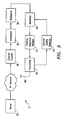
- FIGURE 3 there is illustrated a block diagram of the network side of a system 2 for implementing EDGE technology.
- the system 2 is designed for transmitting data messages from a server 30 to a receiving station (see FIGURE 4).
- Data messages are transmitted from the server 30 over an IP network 32 to a channel encoder 34.
- each RLC block 12 is block encoded and convolutional encoded by the channel encoder 34.
- the resulting encoded bit sequence is then interleaved and formed into four bursts 16 by an interleaver 36.
- the four bursts 16 are fed into a multiplexer 38 that places the bursts 16 in a selected time slot 20 of four consecutive TDMA frames 18 on an appropriate radio channel (see FIGURE 1).
- each radio channel in GSM is divided into eight time slots 20 that are used for communicating up to eight different data streams.
- Each receiving station is typically allocated one or more time slots 20 of a particular radio channel that are used for communications with that receiving station.
- the multiplexer 38 functions to place bursts 16 from up to eight different data streams into their respective allocated time slots 20.
- the four bursts 16 to be transmitted to the receiving station are modulated by a modulator 40.
- the particular modulation scheme used by the modulator 40 is selected in accordance with the current channel quality of the air interface between a transmitter 44 on the network side of the system 2 and the receiving station.
- the current channel quality is determined by a channel quality detector 46 that receives and analyzes information about communications on the radio channel from the transmitter 44. If the current channel quality is relatively high, a less robust modulation and coding scheme can be used, thereby maximizing the data rate on the air interface. Conversely, if the current channel quality is relatively low, a more robust modulation and coding scheme is used so as to increase the probability of accurate transmission and reception of the transmitted data.
- the training sequence is rotated using a rotation that corresponds to the selected modulation scheme (e.g., ⁇ /2 for GMSK or 3 ⁇ /8 for 8-PSK).
- the modulated bursts 16 with the rotated training sequences are then forwarded to the transmitter 44, which transmits the bursts 16 over the air interface as part of the TDMA frames 18.
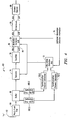
- the receiving station 60 includes an antenna 62 and a radio front end section 64 for receiving the bursts 16 that are transmitted in the time slot or slots 20 that have been allocated to the receiving station 60.
- Each burst 16 of the four-burst sequence is received, one at a time, and is stored in a buffer 66 while the training sequence for the burst 16 is analyzed to identify the applicable modulation scheme for the burst 16.
- the training sequence contained within the particular burst 16 is fed from the buffer 66 to each of a plurality of de-rotation blocks 68.
- the receiving station 60 includes one de-rotation block 68 for each possible modulation scheme. Accordingly, a first de-rotation block 68(1) de-rotates the training sequence according to the rotation used for GMSK, while another de-rotation block 68(n) de-rotates the training sequence according to the rotation used for 8-PSK. In addition, other de-rotation blocks 68 can be included if other modulation schemes are used.
- a first synchronization/channel estimation block 70(1) correlates the de-rotated training sequence from the first de-rotation block 68(1) to the known training sequence to calculate a GMSK correlation quality measure and attempts to synchronize the receiving station 60 with the received burst 16
- another synchronization/channel estimation block 70(n) correlates the de-rotated training sequence from the other de-rotation block 68(n) to the known training sequence to calculate an 8-PSK correlation quality measure and attempts to synchronize the receiving station 60 with the received burst 16.
- correlation quality measures are then used by a modulation detection unit 72 to determine which modulation scheme was most likely used for the burst 16. Generally, the correlation quality measure with the highest value will indicate that the modulation scheme that corresponds to that correlation quality measure was used for the transmission. Accordingly, the modulation detection unit 72 selects the corresponding modulation scheme for the burst 16.
- the modulation detection unit 72 then instructs a derotator 74 to derotate the burst 16 according to the rotation used for the selected modulation scheme.
- the derotated signals are then analyzed by an equalizer 78.
- the equalizer 78 demodulates the derotated burst 16 in accordance with the respective modulation scheme selected for the particular burst 16 and creates a mathematical model of the transmission channel (i.e., the air interface) based on the training sequence.
- the equalizer 78 further processes the data bits of the demodulated signals to generate a most probable bit pattern as well as soft values for each of the bits in the bit pattern. As discussed above, the soft values indicate a probability that each of the bits in the most probable bit pattern is correct.
- the equalizer 78 forwards the most probable bit pattern (as indicated at 80) and the soft values (as indicated at 82) to a modulation correction unit 84.
- the modulation detection unit 72 forwards data identifying the modulation schemes for each of the four bursts to the modulation correction unit 84, which compares the four selected modulation schemes to determine whether they match. If one of the selected modulation schemes does not match the other three, the modulation correction unit 84 takes a majority vote and converts the selected modulation scheme for the dissimilar burst 16 so that it matches the other three. In addition to the majority vote, the modulation correction unit 84 can also use other modulation detection information 76 to further influence the modulation conversion process.
- the modulation correction unit 84 uses additional modulation detection information 76 to determine the appropriate modulation scheme.
- This additional modulation detection information 76 can include, for example, the correlation quality measures for the four bursts 16, historical modulation information, or information indicating a bias favoring a particular modulation scheme or schemes.
- the modulation correction unit 84 identifies which bursts 16, if any, were initially determined to have a modulation scheme that differs from the identified single modulation scheme. For such a burst 16, the modulation correction unit 84 adjusts the soft values for that burst 16, by setting the soft values to zero, for example, which indicates that each bit of the most probable bit pattern for that burst 16 is equally likely to be a "1" as a "0". This ensures that information received in a burst 16 that is not reliable does not have an adverse effect on the subsequent channel decoding.
- the most probable bit pattern and soft values, as adjusted by the modulation correction unit 84 are de-interleaved by a de-interleaver 86.
- the de-interleaved signals bit pattern is decoded by a channel decoder 88 using the soft values to produce the bit sequence of the original RLC block 12.
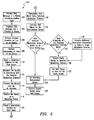
- FIGURE 5 there is illustrated a flow diagram depicting a preferred method 100 for implementing blind detection of modulation in accordance with the present invention.
- data messages to be transmitted to a receiving station are received at mobile telecommunications node.
- the data messages are organized into a plurality of bursts at step 104, and an initial four of the bursts are channel encoded at step 106.
- the four bursts are interleaved, and a modulation scheme is selected for the bursts at step 110.
- the selection of a modulation scheme is dependent upon a current channel quality of the radio channel used for communications between the mobile telecommunications node and the receiving station.
- the bursts are then modulated in accordance with the selected modulation scheme at step 112 and are transmitted over an air interface at step 114.
- the bursts are received at a receiving station at step 116, and a modulation scheme for each burst is detected at step 118 using the de-rotation and correlation procedures discussed above.
- each burst is demodulated using the modulation scheme detected at step 118, and soft values for the symbols in each burst are calculated at step 122.
- step 124 it is determined whether the detected modulation schemes match for all four of the received bursts at step 124. If the detected modulation scheme does not match for all four of the received bursts, then it is determined whether a majority of the detected modulation schemes match (i.e., the same modulation scheme is detected for three of the four received bursts) at step 126. If so, then the modulation scheme that is detected for a majority of the received bursts is selected, and the faulty burst is converted (i.e., by changing the number of bits and the number of soft values) at step 128 to the same modulation scheme as was detected for the majority of the bursts.
- additional modulation detection information is examined at step 130 to select a single modulation scheme to which the faulty bursts are converted at step 128.
- this additional modulation detection information can include correlation quality measures for the four bursts, historical modulation information, or information indicating a bias favoring a particular modulation scheme or schemes.
- the calculated soft values are adjusted to zero at step 132 for any bursts (i.e., faulty bursts) for which the initially detected modulation scheme, as detected at step 118, was different than the selected single modulation scheme used at step 128. This removes any adverse effect that might be caused by data in an unreliable burst.
- the demodulated bursts are then de-interleaved at step 136, and finally, the four received bursts are channel decoded at step 138 using the de-interleaved data in the demodulated bursts and using the soft values, as calculated at step 132 and adjusted at step 134.
Landscapes
- Engineering & Computer Science (AREA)
- Computer Networks & Wireless Communication (AREA)
- Signal Processing (AREA)
- Quality & Reliability (AREA)
- Physics & Mathematics (AREA)
- Nonlinear Science (AREA)
- Digital Transmission Methods That Use Modulated Carrier Waves (AREA)
- Mobile Radio Communication Systems (AREA)
- Detection And Prevention Of Errors In Transmission (AREA)
- Cash Registers Or Receiving Machines (AREA)
- Geophysics And Detection Of Objects (AREA)
- Radar Systems Or Details Thereof (AREA)
- Burglar Alarm Systems (AREA)
Priority Applications (1)
| Application Number | Priority Date | Filing Date | Title |
|---|---|---|---|
| EP06025593A EP1760979A1 (en) | 1999-11-19 | 2000-11-09 | Method and system for blind detection of modulation |
Applications Claiming Priority (3)
| Application Number | Priority Date | Filing Date | Title |
|---|---|---|---|
| US09/443,932 US6400928B1 (en) | 1999-11-19 | 1999-11-19 | Method and system for blind detection of modulation |
| US443932 | 1999-11-19 | ||
| PCT/EP2000/011082 WO2001039449A1 (en) | 1999-11-19 | 2000-11-09 | Method and system for blind detection of modulation |
Related Child Applications (1)
| Application Number | Title | Priority Date | Filing Date |
|---|---|---|---|
| EP06025593A Division EP1760979A1 (en) | 1999-11-19 | 2000-11-09 | Method and system for blind detection of modulation |
Publications (2)
| Publication Number | Publication Date |
|---|---|
| EP1230772A1 EP1230772A1 (en) | 2002-08-14 |
| EP1230772B1 true EP1230772B1 (en) | 2007-02-07 |
Family
ID=23762770
Family Applications (2)
| Application Number | Title | Priority Date | Filing Date |
|---|---|---|---|
| EP00981243A Expired - Lifetime EP1230772B1 (en) | 1999-11-19 | 2000-11-09 | Method and system for blind detection of modulation |
| EP06025593A Withdrawn EP1760979A1 (en) | 1999-11-19 | 2000-11-09 | Method and system for blind detection of modulation |
Family Applications After (1)
| Application Number | Title | Priority Date | Filing Date |
|---|---|---|---|
| EP06025593A Withdrawn EP1760979A1 (en) | 1999-11-19 | 2000-11-09 | Method and system for blind detection of modulation |
Country Status (9)
| Country | Link |
|---|---|
| US (1) | US6400928B1 (enExample) |
| EP (2) | EP1230772B1 (enExample) |
| JP (1) | JP4713045B2 (enExample) |
| CN (1) | CN1391752B (enExample) |
| AT (1) | ATE353512T1 (enExample) |
| AU (1) | AU1856001A (enExample) |
| DE (1) | DE60033313T2 (enExample) |
| ES (1) | ES2276707T3 (enExample) |
| WO (1) | WO2001039449A1 (enExample) |
Families Citing this family (83)
| Publication number | Priority date | Publication date | Assignee | Title |
|---|---|---|---|---|
| US6895057B1 (en) * | 1998-11-03 | 2005-05-17 | Lucent Technologies Inc. | System and method for wireless communication supporting link adaptation and incremental redundancy |
| US6574796B1 (en) * | 1999-01-08 | 2003-06-03 | Cisco Technology, Inc. | Fast and reliable data carrier detection by a cable modem in a cable television plant |
| US6782037B1 (en) * | 1999-07-27 | 2004-08-24 | Lucent Technologies Inc. | Demodulation method for receiver |
| US6628706B1 (en) * | 1999-12-06 | 2003-09-30 | Telefonaktiebolaget Lm Ericsson (Publ) | Method and apparatus for transforming a channel estimate |
| US6859466B1 (en) * | 2000-02-29 | 2005-02-22 | Hughes Electronics Corporation | Physical layer header for packet data |
| US20020032030A1 (en) * | 2000-08-28 | 2002-03-14 | Berglund Arne Kristian | Communication system |
| AU2002213703A1 (en) * | 2000-10-24 | 2002-05-06 | Nortel Networks Limited | Shared channel structure, arq systems and methods |
| US7302628B2 (en) | 2000-12-14 | 2007-11-27 | Telefonaktiebolaget L M Ericsson (Publ) | Data compression with incremental redundancy |
| US6981060B2 (en) * | 2000-12-14 | 2005-12-27 | Telefonaktiebolaget L M Ericsson (Publ) | Compression based on channel characteristics |
| US6865235B2 (en) * | 2001-03-06 | 2005-03-08 | Agere Systems Inc. | Multi-protocol modulator |
| DE10111206C2 (de) * | 2001-03-08 | 2003-04-03 | Infineon Technologies Ag | Blinde Detektion für Mobilfunkempfänger |
| US7142882B2 (en) | 2001-03-09 | 2006-11-28 | Schmidt Dominik J | Single chip wireless communication integrated circuit |
| WO2002073916A1 (en) * | 2001-03-13 | 2002-09-19 | Matsushita Electric Industrial Co. Ltd. | Method and system for blind detection of modulation type |
| EP1248396A1 (en) * | 2001-04-02 | 2002-10-09 | Alcatel | Method and receiver for evaluating a radio link quality in a wireless communication network |
| US8498368B1 (en) * | 2001-04-11 | 2013-07-30 | Qualcomm Incorporated | Method and system for optimizing gain changes by identifying modulation type and rate |
| DE10124782B8 (de) * | 2001-05-21 | 2012-09-13 | Intel Mobile Communications GmbH | Übermittlung und Erkennung der Modulationsart in digitalen Kommunikationssystemen mittels eines der Trainingssequenz aufgeprägten Phasenrotationsfaktors |
| US7020472B2 (en) * | 2001-06-22 | 2006-03-28 | Gallitzin Allegheny Llc | Cellular channel bonding for improved data transmission |
| US7577100B2 (en) * | 2001-07-27 | 2009-08-18 | Stephen Pollmann | System and method for measuring signal to noise values in an adaptive wireless communication system |
| US7058040B2 (en) * | 2001-09-21 | 2006-06-06 | Schmidt Dominik J | Channel interference reduction |
| US7187663B2 (en) * | 2001-10-09 | 2007-03-06 | Schmidt Dominik J | Flexible processing system |
| GB0124321D0 (en) * | 2001-10-10 | 2001-11-28 | Nokia Corp | Modulation determination |
| JP3555943B2 (ja) * | 2002-02-27 | 2004-08-18 | 松下電器産業株式会社 | 無線受信装置、変調方式判定方法および符号化方式判定方法 |
| JP4158703B2 (ja) * | 2002-03-04 | 2008-10-01 | ソニー株式会社 | 無線通信システム、無線通信装置及び無線通信方法、並びにコンピュータ・プログラム |
| US8090928B2 (en) * | 2002-06-28 | 2012-01-03 | Intellectual Ventures I Llc | Methods and apparatus for processing scalar and vector instructions |
| US6769086B2 (en) * | 2002-07-22 | 2004-07-27 | Motorola, Inc. | Apparatus and methods for a coding scheme selection |
| US7313110B2 (en) * | 2002-10-09 | 2007-12-25 | Telefonaktiebolaget L.M. Ericsson | Methods, systems, and computer program products for allocating bandwidth in a radio packet data system based on data rate estimates determined for one or more idle transmitter/sector scenarios |
| US7489703B2 (en) | 2002-12-20 | 2009-02-10 | Motorola, Inc. | Apparatus and method for a coding scheme selection |
| JP4512096B2 (ja) * | 2003-05-16 | 2010-07-28 | トムソン ライセンシング | 積層化及び階層的変調システムの統合受信機 |
| US7406139B2 (en) * | 2003-06-16 | 2008-07-29 | Broadcom Corporation | System and method to identify a modulation format of a data frame within a cellular wireless network |
| US7203461B2 (en) * | 2003-06-16 | 2007-04-10 | Broadcom Corporation | Adaptive channel quality estimation algorithm to support link adaptation |
| US7342956B2 (en) * | 2003-06-16 | 2008-03-11 | Broadcom Corporation | System and method to extract uplink status flag bits in a cellular wireless network |
| US20080312941A1 (en) * | 2007-06-14 | 2008-12-18 | Qualcomm Incorporated | Separable billing for personal data services |
| US20050084040A1 (en) * | 2003-10-20 | 2005-04-21 | Stewart Kenneth A. | Method for modulation detection |
| WO2005048551A1 (en) * | 2003-10-28 | 2005-05-26 | Sepura Limited | Blind modulation detection |
| TWI271071B (en) * | 2003-11-06 | 2007-01-11 | Ind Tech Res Inst | Communication method of scalable QAM and scalable QAM system |
| US7450948B2 (en) * | 2004-01-15 | 2008-11-11 | Cingular Wireless Ii, Llc | Method and apparatus for use in provisioning resources for a backhaul link |
| JP4777907B2 (ja) | 2004-01-20 | 2011-09-21 | クゥアルコム・インコーポレイテッド | 同期型ブロードキャスト/マルチキャスト通信 |
| US7680278B2 (en) * | 2004-02-04 | 2010-03-16 | Microsoft Corporation | Domino scheme for wireless cryptographic communication and communication method incorporating same |
| US7916811B2 (en) * | 2004-02-11 | 2011-03-29 | General Instrument Corporation | Method and apparatus for improved burst acquisition in a digital receiver |
| US20050220227A1 (en) * | 2004-03-31 | 2005-10-06 | Eyal Krupka | Method and apparatus to detect modulation scheme |
| US7830975B2 (en) * | 2004-04-12 | 2010-11-09 | Nokia Corporation | I/Q MIMO detection for single antenna interference cancellation |
| US8107560B2 (en) * | 2004-05-12 | 2012-01-31 | Telefonaktiebolaget Lm Ericsson (Publ) | Method and apparatus for interference cancellation in communication signal processing |
| US7502412B2 (en) * | 2004-05-20 | 2009-03-10 | Qisda Corporation | Adaptive channel estimation using decision feedback |
| US8009761B2 (en) * | 2004-06-24 | 2011-08-30 | Qualcomm Incorporation | Unified modulator for continuous phase modulation and phase-shift keying |
| US7525946B2 (en) * | 2004-08-20 | 2009-04-28 | Nokia Corporation | System and method for decoding signalling messages on FLO HR channels |
| US7643549B2 (en) * | 2004-09-28 | 2010-01-05 | Broadcom Corporation | Wireless device having a hardware accelerator to support equalization processing |
| KR100587978B1 (ko) * | 2004-11-29 | 2006-06-08 | 한국전자통신연구원 | 위성통신시스템에서 블라인드 변조 분류 장치 및 그 방법 |
| KR100611507B1 (ko) | 2005-02-07 | 2006-08-11 | 삼성전자주식회사 | 무선 통신 수신기에 있어서의 블라인드 디텍션 방법 및장치, 이를 포함하는 무선 통신 수신기 |
| US7499506B2 (en) * | 2005-03-22 | 2009-03-03 | Qualcomm Incorporated | Detection of signal modulation format type |
| US7894551B2 (en) * | 2005-08-29 | 2011-02-22 | Mediatek Inc. | Modulation scheme detecting apparatus and related method |
| US8358723B1 (en) * | 2005-11-12 | 2013-01-22 | The United States Of America As Represented By The Administrator Of The National Aeronautics And Space Administration | Self-configurable radio receiver system and method for use with signals without prior knowledge of signal defining characteristics |
| KR100880171B1 (ko) * | 2005-12-29 | 2009-01-23 | 삼성전자주식회사 | 무선 통신 시스템에서 단말의 디코딩 장치 및 방법 |
| CN100574291C (zh) * | 2006-05-10 | 2009-12-23 | 威盛电子股份有限公司 | 盲调制制式检测方法和装置及解码方法和装置 |
| US7926668B2 (en) * | 2006-05-18 | 2011-04-19 | Southern Imperial, Inc. | Trackless retail pusher system |
| JP2008054235A (ja) * | 2006-08-28 | 2008-03-06 | Matsushita Electric Ind Co Ltd | 変調方式判定装置、受信装置、変調方式判定方法及び変調方式判定プログラム |
| US7974370B2 (en) * | 2006-12-27 | 2011-07-05 | Freescale Semiconductor, Inc. | Parallel processing for single antenna interference cancellation |
| US8095097B1 (en) * | 2007-08-06 | 2012-01-10 | Marvell International Ltd. | Increasing the robustness of channel estimates derived through sounding for WLAN |
| WO2009088160A1 (en) * | 2008-01-09 | 2009-07-16 | Lg Electronics Inc. | Method of requesting and reporting link quality in an egprs2 system |
| CN101610574B (zh) * | 2008-06-16 | 2011-08-17 | 展讯通信(上海)有限公司 | 时分同步码分多址系统中收发方法及设备 |
| CN101610097B (zh) * | 2008-06-16 | 2012-12-12 | 展讯通信(上海)有限公司 | 时分同步码分多址系统中盲检收发方法及设备 |
| CN101656580B (zh) * | 2008-08-22 | 2013-03-20 | 中兴通讯股份有限公司 | 全速率语音的处理方法和装置 |
| US8331498B2 (en) * | 2009-04-13 | 2012-12-11 | Telefonaktiebolaget L M Ericsson (Publ) | Blind modulation detection |
| US9887768B1 (en) * | 2009-06-15 | 2018-02-06 | Rockwell Collins, Inc. | Tactical spectrum harvesting |
| US8588086B2 (en) | 2009-11-30 | 2013-11-19 | Qualcomm Incorporated | Reverse link data rate indication for satellite-enabled communications systems |
| CN101741461B (zh) * | 2009-12-29 | 2014-04-02 | 华为技术有限公司 | 邻区干扰消除方法、装置和接收机 |
| US20110170443A1 (en) * | 2010-01-13 | 2011-07-14 | Ronald Gerald Murias | Link sensitive aodv for wireless data transfer |
| US9154363B2 (en) | 2011-05-13 | 2015-10-06 | Qualcomm Incorporated | Systems and methods for wireless communication of packets having a plurality of formats |
| US8824371B2 (en) * | 2011-05-13 | 2014-09-02 | Qualcomm Incorporated | Systems and methods for wireless communication of packets having a plurality of formats |
| US9385911B2 (en) | 2011-05-13 | 2016-07-05 | Sameer Vermani | Systems and methods for wireless communication of packets having a plurality of formats |
| US8934413B2 (en) | 2011-05-13 | 2015-01-13 | Qualcomm Incorporated | Systems and methods for wireless communication of packets having a plurality of formats |
| US20130170842A1 (en) * | 2012-01-04 | 2013-07-04 | Toshiaki Koike-Akino | Method and System for Equalization and Decoding Received Signals Based on High-Order Statistics in Optical Communication Networks |
| US9374166B2 (en) * | 2012-02-13 | 2016-06-21 | Ciena Corporation | High speed optical communication systems and methods with flexible bandwidth adaptation |
| JP5668003B2 (ja) * | 2012-03-09 | 2015-02-12 | 株式会社東芝 | 信号識別装置 |
| CN104040926A (zh) * | 2012-11-19 | 2014-09-10 | 华为技术有限公司 | 调制方式识别方法、发送设备、接收设备和系统 |
| US8942316B2 (en) | 2013-03-15 | 2015-01-27 | Samsung Electronics Co., Ltd. | Wireless communication system with signal processing mechanism and method of operation thereof |
| WO2014167861A1 (ja) * | 2013-04-12 | 2014-10-16 | パナソニック インテレクチュアル プロパティ コーポレーション オブ アメリカ | 送信方法 |
| EP3106147B1 (de) | 2015-06-17 | 2019-09-04 | Clariant International Ltd | Verfahren zur herstellung von polymeren auf basis von acryloyldimethyltaurat, neutralen monomeren, monomeren mit cabonsäuren und speziellen vernetzern |
| EP3106471A1 (de) | 2015-06-17 | 2016-12-21 | Clariant International Ltd | Verfahren zur herstellung von polymeren auf basis von acryloyldimethyltaurat, neutralen monomeren und speziellen vernetzern |
| EP3106470A1 (de) | 2015-06-17 | 2016-12-21 | Clariant International Ltd | Verfahren zur herstellung von polymeren auf basis von acryloyldimethyltaurat und speziellen vernetzern |
| CN105553619B (zh) * | 2015-12-24 | 2018-10-12 | 成都国恒空间技术工程有限公司 | 基于调制识别辅助的突发信号检测方法 |
| WO2018172552A1 (en) | 2017-03-24 | 2018-09-27 | Telefonaktiebolaget Lm Ericsson (Publ) | Detection of inconsistent data in a data transmission |
| CN108242979B (zh) * | 2018-01-10 | 2020-12-22 | 四川阵风科技有限公司 | 译码方法、装置、频谱检测仪及存储介质 |
| US11424970B1 (en) * | 2021-08-30 | 2022-08-23 | Rockwell Collins, Inc. | Converting GMSK impulse responses and optimal sequences |
Family Cites Families (9)
| Publication number | Priority date | Publication date | Assignee | Title |
|---|---|---|---|---|
| US4788711A (en) | 1985-11-25 | 1988-11-29 | Cellular Communications Corporation | Apparatus and method for a cellular freeway emergency telephone service |
| US5289476A (en) | 1991-05-10 | 1994-02-22 | Echelon Corporation | Transmission mode detection in a modulated communication system |
| US5347542A (en) * | 1991-06-28 | 1994-09-13 | Motorola, Inc. | Demodulation selection for a communication signal |
| US5479482A (en) | 1993-08-30 | 1995-12-26 | At&T Corp. | Cellular terminal for providing public emergency call location information |
| CN2297026Y (zh) * | 1997-07-25 | 1998-11-11 | 电子工业部第五十四研究所 | 通信中改变传输速率的装置 |
| JPH11239192A (ja) * | 1998-02-23 | 1999-08-31 | Hitachi Ltd | 復調装置および復調方法 |
| EP0984595B1 (en) * | 1998-09-03 | 2007-04-25 | Sony Deutschland GmbH | Blind modulation detection |
| FI112892B (fi) * | 1999-04-14 | 2004-01-30 | Nokia Corp | Menetelmä ja vastaanotin eri modulaatiomenetelmillä moduloitujen signaalien vastaanottamiseksi ja dekoodaamiseksi |
| US6687507B2 (en) * | 2000-05-03 | 2004-02-03 | Telefonaktiebolaget Lm Ericsson (Publ) | Time of arrival estimation for edge/GSM |
-
1999
- 1999-11-19 US US09/443,932 patent/US6400928B1/en not_active Expired - Lifetime
-
2000
- 2000-11-09 DE DE60033313T patent/DE60033313T2/de not_active Expired - Lifetime
- 2000-11-09 ES ES00981243T patent/ES2276707T3/es not_active Expired - Lifetime
- 2000-11-09 WO PCT/EP2000/011082 patent/WO2001039449A1/en not_active Ceased
- 2000-11-09 CN CN00815885.1A patent/CN1391752B/zh not_active Expired - Lifetime
- 2000-11-09 EP EP00981243A patent/EP1230772B1/en not_active Expired - Lifetime
- 2000-11-09 EP EP06025593A patent/EP1760979A1/en not_active Withdrawn
- 2000-11-09 AU AU18560/01A patent/AU1856001A/en not_active Abandoned
- 2000-11-09 JP JP2001540478A patent/JP4713045B2/ja not_active Expired - Lifetime
- 2000-11-09 AT AT00981243T patent/ATE353512T1/de not_active IP Right Cessation
Also Published As
| Publication number | Publication date |
|---|---|
| EP1760979A1 (en) | 2007-03-07 |
| CN1391752A (zh) | 2003-01-15 |
| US6400928B1 (en) | 2002-06-04 |
| ATE353512T1 (de) | 2007-02-15 |
| WO2001039449A1 (en) | 2001-05-31 |
| DE60033313D1 (de) | 2007-03-22 |
| JP2003515973A (ja) | 2003-05-07 |
| JP4713045B2 (ja) | 2011-06-29 |
| CN1391752B (zh) | 2011-08-17 |
| EP1230772A1 (en) | 2002-08-14 |
| AU1856001A (en) | 2001-06-04 |
| DE60033313T2 (de) | 2007-06-21 |
| ES2276707T3 (es) | 2007-07-01 |
Similar Documents
| Publication | Publication Date | Title |
|---|---|---|
| US6400928B1 (en) | Method and system for blind detection of modulation | |
| US7130587B2 (en) | Communication quality estimation method, communication quality estimation apparatus, and communication system | |
| US7200128B2 (en) | Methods and systems for multiplexing of multiple users for enhanced capacity radiocommunications | |
| EP1142244B1 (en) | Method and system for the transmission, reception and processing of 4-level and 8-level signaling symbols | |
| EP1367789B1 (en) | Transmission apparatus, reception apparatus, transmission method and reception method | |
| US7656960B2 (en) | Adaptive modulation method and coding rate control method | |
| US6865233B1 (en) | Method and system for control signalling enabling flexible link adaptation in a radiocommunication system | |
| US6389066B1 (en) | System and method for adaptive modification of modulated and coded schemes in a communication system | |
| US6717934B1 (en) | Wireless telecommunication system having improved recognition of modulation type in GPRS | |
| US5737365A (en) | Method and apparatus for determining a received signal quality estimate of a trellis code modulated signal | |
| JP4554291B2 (ja) | 無線通信システムにおける信号品質の推定 | |
| CN100479446C (zh) | 通信质量估计方法、通信质量估计设备和通信系统 | |
| JP3712184B2 (ja) | 異なる変調方式による変調信号の受信並びに復号化方法及び受信装置 | |
| CN101032156B (zh) | 基于学习无线链路自适应(rla)为数字传输段选择前向纠错(fec)/星座图配对的方法 | |
| KR100687119B1 (ko) | 결합된 하이브리드 자동 재전송 요구 스킴 | |
| US7180962B2 (en) | Apparatus and method for demodulation using detection of channel adaptive modulation scheme | |
| US8804876B2 (en) | Enhanced modulation detection | |
| JP2005057670A (ja) | デジタル通信装置及びデジタル通信システム | |
| US20020155850A1 (en) | Method, apparatus and system for synchronization in radio communication systems | |
| JP4355241B2 (ja) | データ伝送装置 | |
| GB2389757A (en) | Multiplexing multiple users into a single multibit 8-PSK symbol for enhanced capacity radiocommunications | |
| MXPA00010714A (en) | Method and system for multiplexing of multiple users for enhanced capacity radiocommunications |
Legal Events
| Date | Code | Title | Description |
|---|---|---|---|
| PUAI | Public reference made under article 153(3) epc to a published international application that has entered the european phase |
Free format text: ORIGINAL CODE: 0009012 |
|
| 17P | Request for examination filed |
Effective date: 20020610 |
|
| AK | Designated contracting states |
Kind code of ref document: A1 Designated state(s): AT BE CH CY DE DK ES FI FR GB GR IE IT LI LU MC NL PT SE TR |
|
| AX | Request for extension of the european patent |
Free format text: AL;LT;LV;MK;RO;SI |
|
| RAP1 | Party data changed (applicant data changed or rights of an application transferred) |
Owner name: TELEFONAKTIEBOLAGET LM ERICSSON (PUBL) |
|
| 17Q | First examination report despatched |
Effective date: 20040602 |
|
| GRAP | Despatch of communication of intention to grant a patent |
Free format text: ORIGINAL CODE: EPIDOSNIGR1 |
|
| GRAS | Grant fee paid |
Free format text: ORIGINAL CODE: EPIDOSNIGR3 |
|
| GRAA | (expected) grant |
Free format text: ORIGINAL CODE: 0009210 |
|
| AK | Designated contracting states |
Kind code of ref document: B1 Designated state(s): AT BE CH CY DE DK ES FI FR GB GR IE IT LI LU MC NL PT SE TR |
|
| PG25 | Lapsed in a contracting state [announced via postgrant information from national office to epo] |
Ref country code: AT Free format text: LAPSE BECAUSE OF FAILURE TO SUBMIT A TRANSLATION OF THE DESCRIPTION OR TO PAY THE FEE WITHIN THE PRESCRIBED TIME-LIMIT Effective date: 20070207 Ref country code: BE Free format text: LAPSE BECAUSE OF FAILURE TO SUBMIT A TRANSLATION OF THE DESCRIPTION OR TO PAY THE FEE WITHIN THE PRESCRIBED TIME-LIMIT Effective date: 20070207 Ref country code: FI Free format text: LAPSE BECAUSE OF FAILURE TO SUBMIT A TRANSLATION OF THE DESCRIPTION OR TO PAY THE FEE WITHIN THE PRESCRIBED TIME-LIMIT Effective date: 20070207 Ref country code: LI Free format text: LAPSE BECAUSE OF FAILURE TO SUBMIT A TRANSLATION OF THE DESCRIPTION OR TO PAY THE FEE WITHIN THE PRESCRIBED TIME-LIMIT Effective date: 20070207 Ref country code: DK Free format text: LAPSE BECAUSE OF FAILURE TO SUBMIT A TRANSLATION OF THE DESCRIPTION OR TO PAY THE FEE WITHIN THE PRESCRIBED TIME-LIMIT Effective date: 20070207 Ref country code: CH Free format text: LAPSE BECAUSE OF FAILURE TO SUBMIT A TRANSLATION OF THE DESCRIPTION OR TO PAY THE FEE WITHIN THE PRESCRIBED TIME-LIMIT Effective date: 20070207 |
|
| REG | Reference to a national code |
Ref country code: GB Ref legal event code: FG4D |
|
| REG | Reference to a national code |
Ref country code: CH Ref legal event code: EP |
|
| REG | Reference to a national code |
Ref country code: IE Ref legal event code: FG4D |
|
| REF | Corresponds to: |
Ref document number: 60033313 Country of ref document: DE Date of ref document: 20070322 Kind code of ref document: P |
|
| REG | Reference to a national code |
Ref country code: SE Ref legal event code: TRGR |
|
| REG | Reference to a national code |
Ref country code: ES Ref legal event code: FG2A Ref document number: 2276707 Country of ref document: ES Kind code of ref document: T3 |
|
| PG25 | Lapsed in a contracting state [announced via postgrant information from national office to epo] |
Ref country code: PT Free format text: LAPSE BECAUSE OF FAILURE TO SUBMIT A TRANSLATION OF THE DESCRIPTION OR TO PAY THE FEE WITHIN THE PRESCRIBED TIME-LIMIT Effective date: 20070709 |
|
| REG | Reference to a national code |
Ref country code: CH Ref legal event code: PL |
|
| ET | Fr: translation filed | ||
| PLBE | No opposition filed within time limit |
Free format text: ORIGINAL CODE: 0009261 |
|
| STAA | Information on the status of an ep patent application or granted ep patent |
Free format text: STATUS: NO OPPOSITION FILED WITHIN TIME LIMIT |
|
| 26N | No opposition filed |
Effective date: 20071108 |
|
| PG25 | Lapsed in a contracting state [announced via postgrant information from national office to epo] |
Ref country code: GR Free format text: LAPSE BECAUSE OF FAILURE TO SUBMIT A TRANSLATION OF THE DESCRIPTION OR TO PAY THE FEE WITHIN THE PRESCRIBED TIME-LIMIT Effective date: 20070508 |
|
| PG25 | Lapsed in a contracting state [announced via postgrant information from national office to epo] |
Ref country code: MC Free format text: LAPSE BECAUSE OF NON-PAYMENT OF DUE FEES Effective date: 20071130 |
|
| PG25 | Lapsed in a contracting state [announced via postgrant information from national office to epo] |
Ref country code: IE Free format text: LAPSE BECAUSE OF NON-PAYMENT OF DUE FEES Effective date: 20071109 |
|
| PG25 | Lapsed in a contracting state [announced via postgrant information from national office to epo] |
Ref country code: CY Free format text: LAPSE BECAUSE OF FAILURE TO SUBMIT A TRANSLATION OF THE DESCRIPTION OR TO PAY THE FEE WITHIN THE PRESCRIBED TIME-LIMIT Effective date: 20070207 |
|
| PG25 | Lapsed in a contracting state [announced via postgrant information from national office to epo] |
Ref country code: LU Free format text: LAPSE BECAUSE OF NON-PAYMENT OF DUE FEES Effective date: 20071109 |
|
| REG | Reference to a national code |
Ref country code: FR Ref legal event code: PLFP Year of fee payment: 16 |
|
| REG | Reference to a national code |
Ref country code: FR Ref legal event code: PLFP Year of fee payment: 17 |
|
| REG | Reference to a national code |
Ref country code: FR Ref legal event code: PLFP Year of fee payment: 18 |
|
| PGFP | Annual fee paid to national office [announced via postgrant information from national office to epo] |
Ref country code: NL Payment date: 20191126 Year of fee payment: 20 Ref country code: DE Payment date: 20191127 Year of fee payment: 20 Ref country code: SE Payment date: 20191127 Year of fee payment: 20 |
|
| PGFP | Annual fee paid to national office [announced via postgrant information from national office to epo] |
Ref country code: IT Payment date: 20191125 Year of fee payment: 20 Ref country code: FR Payment date: 20191125 Year of fee payment: 20 Ref country code: ES Payment date: 20191202 Year of fee payment: 20 |
|
| PGFP | Annual fee paid to national office [announced via postgrant information from national office to epo] |
Ref country code: TR Payment date: 20191025 Year of fee payment: 20 |
|
| PGFP | Annual fee paid to national office [announced via postgrant information from national office to epo] |
Ref country code: GB Payment date: 20191127 Year of fee payment: 20 |
|
| REG | Reference to a national code |
Ref country code: DE Ref legal event code: R071 Ref document number: 60033313 Country of ref document: DE |
|
| REG | Reference to a national code |
Ref country code: NL Ref legal event code: MK Effective date: 20201108 |
|
| REG | Reference to a national code |
Ref country code: GB Ref legal event code: PE20 Expiry date: 20201108 |
|
| PG25 | Lapsed in a contracting state [announced via postgrant information from national office to epo] |
Ref country code: GB Free format text: LAPSE BECAUSE OF EXPIRATION OF PROTECTION Effective date: 20201108 |
|
| REG | Reference to a national code |
Ref country code: ES Ref legal event code: FD2A Effective date: 20211207 |
|
| PG25 | Lapsed in a contracting state [announced via postgrant information from national office to epo] |
Ref country code: ES Free format text: LAPSE BECAUSE OF EXPIRATION OF PROTECTION Effective date: 20201110 |