EP1228919A2 - Système d'alimentation d'un véhicule à traction électrique - Google Patents
Système d'alimentation d'un véhicule à traction électrique Download PDFInfo
- Publication number
- EP1228919A2 EP1228919A2 EP02290036A EP02290036A EP1228919A2 EP 1228919 A2 EP1228919 A2 EP 1228919A2 EP 02290036 A EP02290036 A EP 02290036A EP 02290036 A EP02290036 A EP 02290036A EP 1228919 A2 EP1228919 A2 EP 1228919A2
- Authority
- EP
- European Patent Office
- Prior art keywords
- vehicle
- supply device
- autonomous
- station
- stop station
- Prior art date
- Legal status (The legal status is an assumption and is not a legal conclusion. Google has not performed a legal analysis and makes no representation as to the accuracy of the status listed.)
- Granted
Links
Images

Classifications
-
- B—PERFORMING OPERATIONS; TRANSPORTING
- B60—VEHICLES IN GENERAL
- B60M—POWER SUPPLY LINES, AND DEVICES ALONG RAILS, FOR ELECTRICALLY- PROPELLED VEHICLES
- B60M7/00—Power lines or rails specially adapted for electrically-propelled vehicles of special types, e.g. suspension tramway, ropeway, underground railway
- B60M7/003—Power lines or rails specially adapted for electrically-propelled vehicles of special types, e.g. suspension tramway, ropeway, underground railway for vehicles using stored power (e.g. charging stations)
-
- B—PERFORMING OPERATIONS; TRANSPORTING
- B60—VEHICLES IN GENERAL
- B60L—PROPULSION OF ELECTRICALLY-PROPELLED VEHICLES; SUPPLYING ELECTRIC POWER FOR AUXILIARY EQUIPMENT OF ELECTRICALLY-PROPELLED VEHICLES; ELECTRODYNAMIC BRAKE SYSTEMS FOR VEHICLES IN GENERAL; MAGNETIC SUSPENSION OR LEVITATION FOR VEHICLES; MONITORING OPERATING VARIABLES OF ELECTRICALLY-PROPELLED VEHICLES; ELECTRIC SAFETY DEVICES FOR ELECTRICALLY-PROPELLED VEHICLES
- B60L50/00—Electric propulsion with power supplied within the vehicle
- B60L50/30—Electric propulsion with power supplied within the vehicle using propulsion power stored mechanically, e.g. in fly-wheels
-
- B—PERFORMING OPERATIONS; TRANSPORTING
- B60—VEHICLES IN GENERAL
- B60L—PROPULSION OF ELECTRICALLY-PROPELLED VEHICLES; SUPPLYING ELECTRIC POWER FOR AUXILIARY EQUIPMENT OF ELECTRICALLY-PROPELLED VEHICLES; ELECTRODYNAMIC BRAKE SYSTEMS FOR VEHICLES IN GENERAL; MAGNETIC SUSPENSION OR LEVITATION FOR VEHICLES; MONITORING OPERATING VARIABLES OF ELECTRICALLY-PROPELLED VEHICLES; ELECTRIC SAFETY DEVICES FOR ELECTRICALLY-PROPELLED VEHICLES
- B60L50/00—Electric propulsion with power supplied within the vehicle
- B60L50/50—Electric propulsion with power supplied within the vehicle using propulsion power supplied by batteries or fuel cells
- B60L50/51—Electric propulsion with power supplied within the vehicle using propulsion power supplied by batteries or fuel cells characterised by AC-motors
-
- B—PERFORMING OPERATIONS; TRANSPORTING
- B60—VEHICLES IN GENERAL
- B60L—PROPULSION OF ELECTRICALLY-PROPELLED VEHICLES; SUPPLYING ELECTRIC POWER FOR AUXILIARY EQUIPMENT OF ELECTRICALLY-PROPELLED VEHICLES; ELECTRODYNAMIC BRAKE SYSTEMS FOR VEHICLES IN GENERAL; MAGNETIC SUSPENSION OR LEVITATION FOR VEHICLES; MONITORING OPERATING VARIABLES OF ELECTRICALLY-PROPELLED VEHICLES; ELECTRIC SAFETY DEVICES FOR ELECTRICALLY-PROPELLED VEHICLES
- B60L53/00—Methods of charging batteries, specially adapted for electric vehicles; Charging stations or on-board charging equipment therefor; Exchange of energy storage elements in electric vehicles
- B60L53/10—Methods of charging batteries, specially adapted for electric vehicles; Charging stations or on-board charging equipment therefor; Exchange of energy storage elements in electric vehicles characterised by the energy transfer between the charging station and the vehicle
- B60L53/11—DC charging controlled by the charging station, e.g. mode 4
-
- B—PERFORMING OPERATIONS; TRANSPORTING
- B60—VEHICLES IN GENERAL
- B60L—PROPULSION OF ELECTRICALLY-PROPELLED VEHICLES; SUPPLYING ELECTRIC POWER FOR AUXILIARY EQUIPMENT OF ELECTRICALLY-PROPELLED VEHICLES; ELECTRODYNAMIC BRAKE SYSTEMS FOR VEHICLES IN GENERAL; MAGNETIC SUSPENSION OR LEVITATION FOR VEHICLES; MONITORING OPERATING VARIABLES OF ELECTRICALLY-PROPELLED VEHICLES; ELECTRIC SAFETY DEVICES FOR ELECTRICALLY-PROPELLED VEHICLES
- B60L53/00—Methods of charging batteries, specially adapted for electric vehicles; Charging stations or on-board charging equipment therefor; Exchange of energy storage elements in electric vehicles
- B60L53/30—Constructional details of charging stations
- B60L53/32—Constructional details of charging stations by charging in short intervals along the itinerary, e.g. during short stops
-
- B—PERFORMING OPERATIONS; TRANSPORTING
- B60—VEHICLES IN GENERAL
- B60L—PROPULSION OF ELECTRICALLY-PROPELLED VEHICLES; SUPPLYING ELECTRIC POWER FOR AUXILIARY EQUIPMENT OF ELECTRICALLY-PROPELLED VEHICLES; ELECTRODYNAMIC BRAKE SYSTEMS FOR VEHICLES IN GENERAL; MAGNETIC SUSPENSION OR LEVITATION FOR VEHICLES; MONITORING OPERATING VARIABLES OF ELECTRICALLY-PROPELLED VEHICLES; ELECTRIC SAFETY DEVICES FOR ELECTRICALLY-PROPELLED VEHICLES
- B60L9/00—Electric propulsion with power supply external to the vehicle
- B60L9/16—Electric propulsion with power supply external to the vehicle using AC induction motors
- B60L9/18—Electric propulsion with power supply external to the vehicle using AC induction motors fed from DC supply lines
-
- B—PERFORMING OPERATIONS; TRANSPORTING
- B60—VEHICLES IN GENERAL
- B60L—PROPULSION OF ELECTRICALLY-PROPELLED VEHICLES; SUPPLYING ELECTRIC POWER FOR AUXILIARY EQUIPMENT OF ELECTRICALLY-PROPELLED VEHICLES; ELECTRODYNAMIC BRAKE SYSTEMS FOR VEHICLES IN GENERAL; MAGNETIC SUSPENSION OR LEVITATION FOR VEHICLES; MONITORING OPERATING VARIABLES OF ELECTRICALLY-PROPELLED VEHICLES; ELECTRIC SAFETY DEVICES FOR ELECTRICALLY-PROPELLED VEHICLES
- B60L2200/00—Type of vehicles
- B60L2200/26—Rail vehicles
-
- Y—GENERAL TAGGING OF NEW TECHNOLOGICAL DEVELOPMENTS; GENERAL TAGGING OF CROSS-SECTIONAL TECHNOLOGIES SPANNING OVER SEVERAL SECTIONS OF THE IPC; TECHNICAL SUBJECTS COVERED BY FORMER USPC CROSS-REFERENCE ART COLLECTIONS [XRACs] AND DIGESTS
- Y02—TECHNOLOGIES OR APPLICATIONS FOR MITIGATION OR ADAPTATION AGAINST CLIMATE CHANGE
- Y02E—REDUCTION OF GREENHOUSE GAS [GHG] EMISSIONS, RELATED TO ENERGY GENERATION, TRANSMISSION OR DISTRIBUTION
- Y02E60/00—Enabling technologies; Technologies with a potential or indirect contribution to GHG emissions mitigation
- Y02E60/16—Mechanical energy storage, e.g. flywheels or pressurised fluids
-
- Y—GENERAL TAGGING OF NEW TECHNOLOGICAL DEVELOPMENTS; GENERAL TAGGING OF CROSS-SECTIONAL TECHNOLOGIES SPANNING OVER SEVERAL SECTIONS OF THE IPC; TECHNICAL SUBJECTS COVERED BY FORMER USPC CROSS-REFERENCE ART COLLECTIONS [XRACs] AND DIGESTS
- Y02—TECHNOLOGIES OR APPLICATIONS FOR MITIGATION OR ADAPTATION AGAINST CLIMATE CHANGE
- Y02T—CLIMATE CHANGE MITIGATION TECHNOLOGIES RELATED TO TRANSPORTATION
- Y02T10/00—Road transport of goods or passengers
- Y02T10/60—Other road transportation technologies with climate change mitigation effect
- Y02T10/64—Electric machine technologies in electromobility
-
- Y—GENERAL TAGGING OF NEW TECHNOLOGICAL DEVELOPMENTS; GENERAL TAGGING OF CROSS-SECTIONAL TECHNOLOGIES SPANNING OVER SEVERAL SECTIONS OF THE IPC; TECHNICAL SUBJECTS COVERED BY FORMER USPC CROSS-REFERENCE ART COLLECTIONS [XRACs] AND DIGESTS
- Y02—TECHNOLOGIES OR APPLICATIONS FOR MITIGATION OR ADAPTATION AGAINST CLIMATE CHANGE
- Y02T—CLIMATE CHANGE MITIGATION TECHNOLOGIES RELATED TO TRANSPORTATION
- Y02T10/00—Road transport of goods or passengers
- Y02T10/60—Other road transportation technologies with climate change mitigation effect
- Y02T10/70—Energy storage systems for electromobility, e.g. batteries
-
- Y—GENERAL TAGGING OF NEW TECHNOLOGICAL DEVELOPMENTS; GENERAL TAGGING OF CROSS-SECTIONAL TECHNOLOGIES SPANNING OVER SEVERAL SECTIONS OF THE IPC; TECHNICAL SUBJECTS COVERED BY FORMER USPC CROSS-REFERENCE ART COLLECTIONS [XRACs] AND DIGESTS
- Y02—TECHNOLOGIES OR APPLICATIONS FOR MITIGATION OR ADAPTATION AGAINST CLIMATE CHANGE
- Y02T—CLIMATE CHANGE MITIGATION TECHNOLOGIES RELATED TO TRANSPORTATION
- Y02T10/00—Road transport of goods or passengers
- Y02T10/60—Other road transportation technologies with climate change mitigation effect
- Y02T10/7072—Electromobility specific charging systems or methods for batteries, ultracapacitors, supercapacitors or double-layer capacitors
-
- Y—GENERAL TAGGING OF NEW TECHNOLOGICAL DEVELOPMENTS; GENERAL TAGGING OF CROSS-SECTIONAL TECHNOLOGIES SPANNING OVER SEVERAL SECTIONS OF THE IPC; TECHNICAL SUBJECTS COVERED BY FORMER USPC CROSS-REFERENCE ART COLLECTIONS [XRACs] AND DIGESTS
- Y02—TECHNOLOGIES OR APPLICATIONS FOR MITIGATION OR ADAPTATION AGAINST CLIMATE CHANGE
- Y02T—CLIMATE CHANGE MITIGATION TECHNOLOGIES RELATED TO TRANSPORTATION
- Y02T90/00—Enabling technologies or technologies with a potential or indirect contribution to GHG emissions mitigation
- Y02T90/10—Technologies relating to charging of electric vehicles
- Y02T90/12—Electric charging stations
-
- Y—GENERAL TAGGING OF NEW TECHNOLOGICAL DEVELOPMENTS; GENERAL TAGGING OF CROSS-SECTIONAL TECHNOLOGIES SPANNING OVER SEVERAL SECTIONS OF THE IPC; TECHNICAL SUBJECTS COVERED BY FORMER USPC CROSS-REFERENCE ART COLLECTIONS [XRACs] AND DIGESTS
- Y02—TECHNOLOGIES OR APPLICATIONS FOR MITIGATION OR ADAPTATION AGAINST CLIMATE CHANGE
- Y02T—CLIMATE CHANGE MITIGATION TECHNOLOGIES RELATED TO TRANSPORTATION
- Y02T90/00—Enabling technologies or technologies with a potential or indirect contribution to GHG emissions mitigation
- Y02T90/10—Technologies relating to charging of electric vehicles
- Y02T90/14—Plug-in electric vehicles
Definitions
- the invention relates to a system for supplying electrical energy to electrically-powered public transport vehicles and relates in particular to electric power supply to trams.
- the invention therefore aims to remedy these drawbacks by proposing a system supply of electric energy to a vehicle with electric traction which allows rapid recharging of the autonomous power supply device on board the vehicle while maintaining electrical power infrastructure at the level stop stations of modest power and which is simple and economical to produce.
- the subject of the invention is a power system for a traction vehicle electric fitted with electric traction motors comprising a device autonomous rechargeable power supply on board the vehicle to power electric traction motors, at least one stopping station equipped with a device power supply connected to an electrical network, and means of connection ensuring the electrical connection, when approaching the stop station, autonomous vehicle supply system with the vehicle supply system stop station to ensure the recharging of the autonomous supply device when the vehicle is stopped in the station, characterized in that the device autonomous power supply on board the vehicle includes a battery supercapacitors and in that the shutdown station supply device has a kinetic energy storage system.
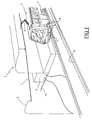
- FIG. 1 represents a railroad track equipped with a stopping station 1 in which a rail vehicle 2, of the tramway type, is stopped.
- Tram 2 is equipped with electric traction motors 3 which are connected to an electronic circuit of power 4 made from IGBT 13 transistors and supplied on the one hand with a regime conventional by a pantograph 5 from a catenary 7, with current return by a rail 11 of the track, and on the other hand in autonomous mode by a device autonomous power supply 6 on board the tram 2.
- the pantograph 5 is associated with an electronic device rectifier 12 which regulates a unipolar mean current if the catenary 7 is supplied with alternating voltage, for example by chopping or controlling the conduction, and which is conductive when the catenary 7 is supplied with voltage continues classic.
- Traction motors 3 are reversible motors, say that they absorb electrical energy during the moments of traction and provide electrical energy during braking moments.
- the autonomous power supply device consists mainly of a battery of supercapacitors 6, also called double layer capacitors, distributed in the structure of tram 2 and capable of absorbing or restoring a large amount of electrical energy with good efficiency and great speed.
- supercapacitors are for example described in the patent application WO 96/11 486.
- the voltage of the autonomous supply device 6 is fixed either at a value of the order of 750 V, or 1500 V if the vehicle is also intended for travel on portions of conventional railways.
- the stop station 1 has a canopy which carries the catenary cable 7 above the track, catenary 7 being intended to cooperate with the pantograph 5 of the tram 2 to ensure the recharging of the device autonomous power supply 6 during the tram 2 stop in station 1.
- the catenary 7 extends on either side of the stop station 1 over a few tens of meters, so as to allow the connection of the pantograph 5 with the catenary 7 during the acceleration and deceleration phase of the tram 2 near stop station 1.
- catenary 7 is supported, at the entrance and at the exit of the stop station 1, by a pylon 8 supporting the catenary cable 7 at a height slightly greater than the height of the catenary cable 7 in the stop station 1, so as to form a gradual slope of contact and unloading of the pantograph 5 respectively during the arrival and departure of the tram 2 from stop station 1.
- Catenary 7 is powered by a kinetic energy storage system 9 comprising an electromechanical device of the flywheel type, constituted by example of an asynchronous generator motor or a synchronous magnet motor permanent whose rotor drives a flywheel rotating under vacuum on low friction bearings such as magnetic bearings or higher economically ceramic bearings.
- the flywheel can still be driven by the association of an asynchronous motor with a synchronous motor, the asynchronous motor then playing a driving role by being powered by three-phase current and the synchronous motor then providing current single-phase supplying the catenary 7.
- the output voltage of the accumulation system kinetics of energy 9 is fixed at a value close to that of the device autonomous power supply 6 to allow identical operation of the circuit of power 4 of the traction motors 3 that this is powered directly by the capacitor bank 6 disposed on board tram 2, or across the pantograph 5 and catenary 7, by the kinetic energy accumulation system 9 from a stop station 1.
- This kinetic energy accumulation system 9 is connected to an electrical network 10 distribution ensuring the progressive drive of the motor rotor, to reduced power consumption, when no tram 2 is at around the station 1.
- pantograph 5 When the tram 2 is located between two stop stations 1, in an area not equipped with catenary 7, pantograph 5 is either lowered or free completely extension, and the traction motors 3 are supplied, through the circuit of power 4, by the autonomous power supply device, and in particular by the battery supercapacitors 6, thus causing the progressive discharge of the latter.
- the system kinetic energy accumulation 9 of each stop station 1 is connected to the electrical network 10 so as to gradually charge the steering wheel with energy of inertia while consuming reduced power.
- the pantograph 5 is placed, if necessary by driver command, at a waiting height corresponding to a height slightly less than the height of the catenary cable 7 at the level of the first pylon 8 of stop station 1.
- the pantograph 5 in the standby position comes touch the catenary cable 7 from the stop station 1 shortly after passing up to the first pylon 8, this instant corresponding substantially to the start of the tramway braking phase 2.
- the motors of traction 3 provide energy which is either transferred quickly, by the pantograph 5 and the catenary 7, to the accumulation system kinetics of energy 9 of the stop station 1 thus causing the increase in the speed of rotation of the flywheel by the motor previously used for generator, without transfer of energy to the electricity network 10, i.e. more classic stored on board the vehicle and transferred to the battery supercapacitors 6, a combination of these two solutions also being possible.
- Tram 2 then starts from station 1 and during this phase the engines traction 3 are powered by the catenary 7 and receive mainly the energy of the kinetic energy storage system 9 as well as, to a lesser extent, the energy supplied by the electrical network 10 of the stopping station 1. During this same start-up phase, the energy available at catenary 7 is also used to maintain the charge of the supercapacitor battery 6.
- power circuit 4 detects the interruption of energy supply by catenary 7 and then controls the supply of energy to the traction motors 3 by the autonomous supply device 6 until the tram 2 reaches the next station 1.
- the system kinetic accumulation of energy 9 of the previously requested stop station 1 is charged again at reduced power, from the electrical network 10, up to the arrival of the next tram 2.
- Such a power system has the advantage of allowing rapid recharging of the autonomous tram supply system with a supply network low power electric at the stop stations.
- an autonomous power supply device on board the vehicle based on supercapacitors able to be distributed in the structure of the vehicle allows also optimize the behavior of the vehicle and has the advantage of offering high robustness and high tolerance to vibrations and movements usually present on rail vehicles.
- the supercapacitor battery can be associated with conventional batteries, in order to increase the capacity of storage of the autonomous power supply device or constitute a system backup autonomy.
- the means of connection ensuring the electrical connection, near each stop station, of the autonomous power supply device with the power supply device of the station stop could be constituted by a rail / pad type system.
- the vehicle could be road and roll on tires provided that you are guided around the station and have a pair of electrical energy collection devices, such as side rails also serving as a guide, or as a practically contactless feeding device as a mutual induction system operating for example at the frequency generated by the stationary kinetic energy storage system.
- a pair of electrical energy collection devices such as side rails also serving as a guide, or as a practically contactless feeding device as a mutual induction system operating for example at the frequency generated by the stationary kinetic energy storage system.
Landscapes
- Engineering & Computer Science (AREA)
- Mechanical Engineering (AREA)
- Power Engineering (AREA)
- Transportation (AREA)
- Sustainable Energy (AREA)
- Sustainable Development (AREA)
- Life Sciences & Earth Sciences (AREA)
- Electric Propulsion And Braking For Vehicles (AREA)
- Control Of Throttle Valves Provided In The Intake System Or In The Exhaust System (AREA)
- Automatic Cycles, And Cycles In General (AREA)
- Current-Collector Devices For Electrically Propelled Vehicles (AREA)
- Devices For Conveying Motion By Means Of Endless Flexible Members (AREA)
- Forklifts And Lifting Vehicles (AREA)
- Lubrication Of Internal Combustion Engines (AREA)
- Auxiliary Drives, Propulsion Controls, And Safety Devices (AREA)
Abstract
Description
- le système à accumulation cinétique d'énergie récupère l'énergie de freinage du véhicule lorsque le véhicule se présente à l'approche de la station d'arrêt ;
- le système à accumulation cinétique d'énergie fournit de l'énergie au dispositif d'alimentation autonome du véhicule lorsque le véhicule est en phase d'accélération au départ de la station d'arrêt ;
- les moyens de connexions sont constitués d'une caténaire disposée dans chaque station d'arrêt et coopérant avec un pantographe porté par le véhicule, le retour de courant étant réalisé par les roues et les rails.
- la figure 1 est une vue schématique en perspective d'une station d'arrêt et d'un tramway équipé d'un système d'alimentation selon l'invention ;
- la figure 2 est un schéma électrique du circuit de puissance du système d'alimentation de la figure 1.
Claims (4)
- Système d'alimentation d'un véhicule (2) à traction électrique équipé de moteurs électriques de traction (3) comportant un dispositif d'alimentation autonome (6) rechargeable embarqué à bord du véhicule (2) pour alimenter les moteurs électriques de traction (3), au moins une station d'arrêt (1) munie d'un dispositif d'alimentation électrique raccordé à un réseau électrique (10), et des moyens de connexion (5,7) assurant le raccordement électrique, à l'approche de la station d'arrêt (1), du dispositif d'alimentation autonome (6) du véhicule avec le dispositif d'alimentation de la station d'arrêt (1) afin d'assurer la recharge du dispositif d'alimentation autonome lorsque le véhicule est arrêté dans la station (1), caractérisé en ce que ledit dispositif d'alimentation autonome à bord du véhicule comprend une batterie de supercondensateurs (6) et en ce que ledit dispositif d'alimentation de la station d'arrêt comporte un système à accumulation cinétique d'énergie (9).
- Système d'alimentation d'un véhicule (2) à traction électrique selon la revendication 1, caractérisé en ce que ledit système à accumulation cinétique d'énergie (9) récupère l'énergie de freinage du véhicule (2) lorsque le véhicule (2) se présente à l'approche de la station d'arrêt (1).
- Système d'alimentation d'un véhicule (2) à traction électrique selon l'une quelconque des revendications 1 à 2, caractérisé en ce que ledit système à accumulation cinétique d'énergie (9) fournit de l'énergie au dispositif d'alimentation autonome (6) du véhicule (2) lorsque le véhicule est en phase d'accélération au départ de la station d'arrêt (1).
- Système d'alimentation d'un véhicule à traction électrique selon l'une quelconque des revendications 1 à 3, caractérisé en ce que les moyens de connexions sont constitués d'une caténaire (7) disposée dans chaque station d'arrêt (1) et coopérant avec un pantographe (5) porté par le véhicule (2).
Applications Claiming Priority (2)
| Application Number | Priority Date | Filing Date | Title |
|---|---|---|---|
| FR0100951 | 2001-01-24 | ||
| FR0100951A FR2819759B1 (fr) | 2001-01-24 | 2001-01-24 | Systeme d'alimentation d'un vehicule a traction electrique |
Publications (3)
| Publication Number | Publication Date |
|---|---|
| EP1228919A2 true EP1228919A2 (fr) | 2002-08-07 |
| EP1228919A3 EP1228919A3 (fr) | 2002-08-21 |
| EP1228919B1 EP1228919B1 (fr) | 2011-04-27 |
Family
ID=8859190
Family Applications (1)
| Application Number | Title | Priority Date | Filing Date |
|---|---|---|---|
| EP02290036A Expired - Lifetime EP1228919B1 (fr) | 2001-01-24 | 2002-01-08 | Système d'alimentation d'un véhicule à traction électrique |
Country Status (10)
| Country | Link |
|---|---|
| US (1) | US6557476B2 (fr) |
| EP (1) | EP1228919B1 (fr) |
| JP (1) | JP2002238107A (fr) |
| AT (1) | ATE507103T1 (fr) |
| CA (1) | CA2368037C (fr) |
| DE (1) | DE60239843D1 (fr) |
| ES (1) | ES2362996T3 (fr) |
| FR (1) | FR2819759B1 (fr) |
| HK (1) | HK1050166B (fr) |
| PL (1) | PL351805A1 (fr) |
Cited By (10)
| Publication number | Priority date | Publication date | Assignee | Title |
|---|---|---|---|---|
| WO2006048431A1 (fr) * | 2004-11-05 | 2006-05-11 | Siemens Aktiengesellschaft | Reservoir d'energie constitue de condensateurs a double couche, son utilisation dans des vehicules sur rails, et vehicule sur rails correspondant |
| WO2008020463A3 (fr) * | 2006-08-17 | 2008-04-17 | Sequoia Automation S R L | Système d'alimentation en énergie à rechargement rapide pour moyens de transport avec traction électrique |
| DE102009039684A1 (de) | 2009-09-02 | 2011-03-31 | Voith Patent Gmbh | Hybridantrieb für Schienenfahrzeuge |
| CN104859463A (zh) * | 2014-02-24 | 2015-08-26 | 张传玺 | 电动汽车行驶中充电装置及充电方法 |
| CN105438008A (zh) * | 2014-09-25 | 2016-03-30 | 中车大连电力牵引研发中心有限公司 | 轨道车辆牵引系统 |
| WO2016113766A1 (fr) | 2015-01-12 | 2016-07-21 | Sequoia Automation S.R.L. | Système de charge électrique pour drones |
| CN106080253A (zh) * | 2016-08-12 | 2016-11-09 | 张茜 | 电动列车 |
| CN107757407A (zh) * | 2017-10-30 | 2018-03-06 | 中车株洲电力机车有限公司 | 一种智能充电方法、系统、设备及计算机可读存储介质 |
| FR3055840A1 (fr) * | 2016-09-15 | 2018-03-16 | Alstom Transp Tech | Reseau de transport public a gestion d'energie electrique optimisee |
| CN111976507A (zh) * | 2014-09-02 | 2020-11-24 | 葛炽昌 | 具有交换电池组的电动车 |
Families Citing this family (48)
| Publication number | Priority date | Publication date | Assignee | Title |
|---|---|---|---|---|
| CA2400762C (fr) * | 2000-03-31 | 2009-05-26 | Inventio Ag | Dispositif d'alimentation de secours pour installations d'ascenseur |
| US7549521B2 (en) * | 2001-02-15 | 2009-06-23 | Integral Technologies, Inc. | Low cost electrical power connectivity for railway systems manufactured from conductive loaded resin-based materials |
| AT500328B1 (de) * | 2002-02-07 | 2010-03-15 | Elin Ebg Traction Gmbh | Fahrzeug mit einem elektrischen antrieb und verfahren zum betrieb eines solchen fahrzeuges |
| DE10341512A1 (de) * | 2003-09-05 | 2005-04-14 | Bombardier Transportation Gmbh | Stromrichteranordnung |
| JP3989450B2 (ja) * | 2004-02-20 | 2007-10-10 | 財団法人鉄道総合技術研究所 | 回路装置及び車両運行システム |
| FR2866607A1 (fr) * | 2004-02-23 | 2005-08-26 | Herve Benjamin Afriat | Systeme d'alimentation en energie electrique a tres basse tension par des rails pour vehicule ferroviaire a stockage d'energie embarque |
| FR2871744B1 (fr) * | 2004-06-21 | 2008-02-22 | Alstom Sa | Dispositif d'alimentation embarque sur un vehicule de traction, procede d'alimentation et support d'enregistrement de ce procede |
| US7481728B2 (en) | 2004-06-29 | 2009-01-27 | Siemens Energy & Automation, Inc. | System and apparatus for driving a track mounted robot |
| JP2006238652A (ja) * | 2005-02-25 | 2006-09-07 | Toshiba Corp | 鉄道エネルギー補給システム |
| JP4615574B2 (ja) * | 2005-03-14 | 2011-01-19 | 株式会社神戸製鋼所 | 電動車走行システム |
| JP4102826B2 (ja) * | 2005-03-14 | 2008-06-18 | 株式会社神戸製鋼所 | 電動車及びその走行システム |
| US20070062771A1 (en) * | 2005-09-17 | 2007-03-22 | Dingzhong Li | An electrical vehicle transportation system |
| DE102006006692A1 (de) * | 2006-02-14 | 2007-08-23 | Alois Schrimpf | Kraftfahrzeug mit Kurzzeitenergiespeicher und Verfahren zu dessen Betrieb |
| EP1864849A1 (fr) * | 2006-05-19 | 2007-12-12 | Siemens Transportation System S.A.S. | Système de régulation d'énergie pour un véhicule |
| JP4841441B2 (ja) * | 2007-01-09 | 2011-12-21 | 川崎重工業株式会社 | 鉄道車両のバッテリ用充電装置 |
| FR2912699B1 (fr) * | 2007-02-20 | 2013-11-08 | Alstom Transport Sa | Equipement electrique dispose en toiture d'un vehicule ferroviaire a traction electrique |
| JP4568736B2 (ja) * | 2007-02-27 | 2010-10-27 | 三菱重工業株式会社 | 架線レス交通システム及びその充電方法 |
| JP5210308B2 (ja) * | 2007-06-25 | 2013-06-12 | 長江 竹嶋 | 車両及び交通システム |
| CA2725409C (fr) * | 2008-04-30 | 2014-11-25 | Mitsubishi Electric Corporation | Systeme de chemin de fer electrique |
| FI125622B (fi) * | 2008-06-13 | 2015-12-31 | Cargotec Finland Oy | Konttilukin, terminaalitraktorin tai vastaavan käyttöjärjestelmä |
| US8324858B2 (en) | 2008-07-01 | 2012-12-04 | Proterra Inc. | Charging stations for electric vehicles |
| US8302719B2 (en) * | 2009-03-12 | 2012-11-06 | Honda Motor Co., Ltd. | Vehicle having power stocking mechanism and vehicle system containing the same |
| US20100270859A1 (en) * | 2009-04-24 | 2010-10-28 | Zhengda Gong | Distributed Ultracapacitor Monitoring System Based on iCAN Protocol |
| DE102009055845A1 (de) * | 2009-11-26 | 2011-06-01 | Schaeffler Technologies Gmbh & Co. Kg | Aufladestation für elektrisch betriebene Fahrzeuge |
| KR20120101566A (ko) | 2009-12-23 | 2012-09-13 | 프로테라 인크 | 전기 차량용 충전소 |
| DE102010053528A1 (de) * | 2010-11-30 | 2012-05-31 | Dialogika Gesellschaft Für Angewandte Informatik Mbh | System für das automatische An- und Abdrahten während der Fahrt eines Oberleitungsfahrzeuges |
| BR112013015730A2 (pt) * | 2010-12-23 | 2018-05-15 | Siemens S.A.S | método de regulagem de tensão de alimentação elétrica para um funcionamento de pelo menos um veículo alimentado eletricamente. |
| ES2388842B1 (es) | 2011-03-22 | 2013-06-12 | Construcciones Y Auxiliar De Ferrocarriles, S.A. | Sistema de carga eléctrica para acumuladores de energía de vehículos ferroviarios. |
| US20130175985A1 (en) * | 2012-01-10 | 2013-07-11 | Thomas Percich | Rapid charge, on-the-go transportation system |
| DE102012215366A1 (de) * | 2012-08-30 | 2014-03-06 | Siemens Aktiengesellschaft | Autarker mobiler Eisenbahn-Magnetresonanz-Tomograph |
| US10479380B2 (en) * | 2016-03-07 | 2019-11-19 | Westinghouse Air Brake Technologies Corporation | Hazardous event alert systems and methods |
| US11148692B2 (en) * | 2012-09-20 | 2021-10-19 | Westinghouse Air Brake Technologies Corporation | Alerting system and method |
| US9381818B2 (en) * | 2012-09-28 | 2016-07-05 | Siemens Aktiengesellschaft | Non-track-bound vehicle |
| CN103496329B (zh) * | 2013-07-08 | 2015-08-12 | 马焕行 | 车辆施行电气化滑触运行专用三相或直流刚性立体电网 |
| US11916205B2 (en) * | 2013-10-02 | 2024-02-27 | Lt 350, Llc | Energy storage canopy |
| CN103738196A (zh) * | 2013-12-03 | 2014-04-23 | 方清 | 一种纯电动商用车集中驱动式电动化辅助动力总成 |
| RU2016141581A (ru) * | 2014-03-26 | 2018-04-26 | Секвоя Отомейшн С.Р.Л. | Система зарядки энергией, связанная с остановкой электрического транспортного средства |
| CN104149630A (zh) * | 2014-08-11 | 2014-11-19 | 南车株洲电力机车有限公司 | 一种轨道车牵引供电系统 |
| CN104527463B (zh) * | 2015-01-20 | 2017-01-18 | 南车株洲电力机车有限公司 | 一种储能式轨道交通车辆的移动充电系统 |
| EP3085570B1 (fr) * | 2015-04-20 | 2019-12-04 | ALSTOM Transport Technologies | Système d'alimentation électrique pour un véhicule à propulsion électrique et procédés de commande d'un tel système d'alimentation électrique |
| US10536026B2 (en) * | 2015-07-29 | 2020-01-14 | Toshiba International Corporation | Compact passenger station structure containing vehicle charging components |
| FR3048387B1 (fr) * | 2016-03-02 | 2019-06-21 | Alstom Transport Technologies | Installation amelioree de recharge par conduction d'un vehicule |
| US10399551B2 (en) | 2016-03-07 | 2019-09-03 | Westinghouse Air Brake Technologies Corporation | System, method, and apparatus for improving safety of ECP-equipped trains with flammable cargo |
| US10011181B2 (en) * | 2016-09-27 | 2018-07-03 | Ford Global Technologies, Llc | Vehicle-to-vehicle charging system |
| CA3079939A1 (fr) * | 2016-10-30 | 2018-05-03 | Chakratec Ltd. | Systeme et procede pour une station fournissant un support de reseau electrique |
| CN108382402B (zh) * | 2018-03-12 | 2023-12-29 | 中铁第四勘察设计院集团有限公司 | 一种智轨电车首末端充电站台系统构造 |
| CN110203095B (zh) * | 2019-05-10 | 2021-07-20 | 湖南科技大学 | 超级电容驱动型电机车配套的快速充电桩 |
| CN119872277B (zh) * | 2025-03-10 | 2026-02-24 | 重庆清电新能源开发有限公司 | 一种风电直流并入的轨道交通列车起停充放电系统 |
Family Cites Families (13)
| Publication number | Priority date | Publication date | Assignee | Title |
|---|---|---|---|---|
| US714196A (en) * | 1901-10-18 | 1902-11-25 | Martin T A Kubierschky | Regenerative system. |
| US714157A (en) * | 1902-03-29 | 1902-11-25 | Gen Electric | Regenerative system. |
| US744187A (en) * | 1903-04-13 | 1903-11-17 | Gibbs Engineering And Mfg Company | System of electric traction. |
| US807029A (en) * | 1904-09-16 | 1905-12-12 | Joseph H Hoadley | System of electric railways. |
| US881387A (en) * | 1907-03-06 | 1908-03-10 | Arthur C Eastwood | System of control for electric motors. |
| US1188570A (en) * | 1913-05-29 | 1916-06-27 | Victor O Strobel | Power system. |
| US1216694A (en) * | 1914-12-16 | 1917-02-20 | Charles Francis Jenkins | Gravity-railway device. |
| AT370043B (de) * | 1980-01-22 | 1983-02-25 | Siemens Ag Oesterreich | Stromversorgungseinrichtung fuer elektrofahrzeuge |
| IT1251206B (it) * | 1991-09-18 | 1995-05-04 | Magneti Marelli Spa | Impianto elettrico di un autoveicolo, comprendente almeno un supercondensatore. |
| FR2719011B1 (fr) * | 1994-04-22 | 1996-07-12 | Pomagalski Sa | Installation de transport à câble tracteur et à moteur embarqué. |
| JP3245334B2 (ja) * | 1995-08-03 | 2002-01-15 | 本田技研工業株式会社 | 電動車両の電源制御装置 |
| FR2782680B1 (fr) * | 1998-08-28 | 2000-11-17 | Alstom Technology | Systeme d'alimentation d'un vehicule a traction electrique |
| US6252760B1 (en) * | 1999-05-26 | 2001-06-26 | Sun Microsystems, Inc. | Discrete silicon capacitor |
-
2001
- 2001-01-24 FR FR0100951A patent/FR2819759B1/fr not_active Expired - Fee Related
-
2002
- 2002-01-08 DE DE60239843T patent/DE60239843D1/de not_active Expired - Lifetime
- 2002-01-08 EP EP02290036A patent/EP1228919B1/fr not_active Expired - Lifetime
- 2002-01-08 ES ES02290036T patent/ES2362996T3/es not_active Expired - Lifetime
- 2002-01-08 AT AT02290036T patent/ATE507103T1/de active
- 2002-01-15 US US10/044,906 patent/US6557476B2/en not_active Expired - Lifetime
- 2002-01-22 PL PL02351805A patent/PL351805A1/xx not_active Application Discontinuation
- 2002-01-22 CA CA2368037A patent/CA2368037C/fr not_active Expired - Lifetime
- 2002-01-22 JP JP2002012439A patent/JP2002238107A/ja active Pending
-
2003
- 2003-02-07 HK HK03100926.6A patent/HK1050166B/zh not_active IP Right Cessation
Cited By (15)
| Publication number | Priority date | Publication date | Assignee | Title |
|---|---|---|---|---|
| WO2006048431A1 (fr) * | 2004-11-05 | 2006-05-11 | Siemens Aktiengesellschaft | Reservoir d'energie constitue de condensateurs a double couche, son utilisation dans des vehicules sur rails, et vehicule sur rails correspondant |
| NO338763B1 (no) * | 2006-08-17 | 2016-10-17 | Sequoia Automation Srl | Hurtig oppladende energimatingssystem for transportmidler med elektrisk dragkraft |
| WO2008020463A3 (fr) * | 2006-08-17 | 2008-04-17 | Sequoia Automation S R L | Système d'alimentation en énergie à rechargement rapide pour moyens de transport avec traction électrique |
| US7984774B2 (en) | 2006-08-17 | 2011-07-26 | Sequoia Automation S.R.L. | Quick-recharging energy feeding system for means of transport with electric traction |
| DE102009039684A1 (de) | 2009-09-02 | 2011-03-31 | Voith Patent Gmbh | Hybridantrieb für Schienenfahrzeuge |
| CN104859463B (zh) * | 2014-02-24 | 2017-04-05 | 张芹 | 电动汽车行驶中充电装置及充电方法 |
| CN104859463A (zh) * | 2014-02-24 | 2015-08-26 | 张传玺 | 电动汽车行驶中充电装置及充电方法 |
| CN111976507A (zh) * | 2014-09-02 | 2020-11-24 | 葛炽昌 | 具有交换电池组的电动车 |
| CN111976507B (zh) * | 2014-09-02 | 2021-12-24 | 葛炽昌 | 具有交换电池组的电动车 |
| CN105438008A (zh) * | 2014-09-25 | 2016-03-30 | 中车大连电力牵引研发中心有限公司 | 轨道车辆牵引系统 |
| WO2016113766A1 (fr) | 2015-01-12 | 2016-07-21 | Sequoia Automation S.R.L. | Système de charge électrique pour drones |
| CN106080253A (zh) * | 2016-08-12 | 2016-11-09 | 张茜 | 电动列车 |
| FR3055840A1 (fr) * | 2016-09-15 | 2018-03-16 | Alstom Transp Tech | Reseau de transport public a gestion d'energie electrique optimisee |
| EP3296145A1 (fr) * | 2016-09-15 | 2018-03-21 | ALSTOM Transport Technologies | Réseau de transport public à gestion d'énergie électrique optimisée |
| CN107757407A (zh) * | 2017-10-30 | 2018-03-06 | 中车株洲电力机车有限公司 | 一种智能充电方法、系统、设备及计算机可读存储介质 |
Also Published As
| Publication number | Publication date |
|---|---|
| ATE507103T1 (de) | 2011-05-15 |
| DE60239843D1 (de) | 2011-06-09 |
| CA2368037A1 (fr) | 2002-07-24 |
| EP1228919A3 (fr) | 2002-08-21 |
| HK1050166B (zh) | 2012-02-24 |
| CA2368037C (fr) | 2010-04-13 |
| ES2362996T3 (es) | 2011-07-18 |
| FR2819759A1 (fr) | 2002-07-26 |
| US20020096412A1 (en) | 2002-07-25 |
| JP2002238107A (ja) | 2002-08-23 |
| PL351805A1 (en) | 2002-07-29 |
| HK1050166A1 (en) | 2003-06-13 |
| US6557476B2 (en) | 2003-05-06 |
| FR2819759B1 (fr) | 2003-05-23 |
| EP1228919B1 (fr) | 2011-04-27 |
Similar Documents
| Publication | Publication Date | Title |
|---|---|---|
| CA2368037C (fr) | Systeme d'alimentation d'un vehicule a traction electrique | |
| EP1938438B1 (fr) | Poste de recharge et vehicule electrique associe | |
| CA2778162C (fr) | Procede d'alimentation electrique d'un vehicule ferroviaire, systeme d'alimentation en station, systeme de stockage d'energie embarque et vehicule ferroviaire associes | |
| EP0982176B1 (fr) | Système d'alimentation d'un véhicule à traction électrique | |
| EP1725424B1 (fr) | Systeme d'alimentation en energie electrique a tres basse tension pour vehicule a traction electrique a stockage d'energie embarque | |
| EP0968873B1 (fr) | Réseau de transport en commun avec véhicules électriques | |
| FR2822764A1 (fr) | Procede et dispositif de pilotage de l'alimentation en energie d'un vehicule a traction electrique destine a fonctionner en mode d'alimentation externe ou en mode d'alimentation autonome | |
| EP2162313B1 (fr) | Installation d'alimentation d'un vehicule ferroviaire | |
| US10682923B2 (en) | On-board charging system for electric vehicles | |
| FR3031846A1 (fr) | Systeme de chargement d’elements de stockage d’energie electrique d’un vehicule | |
| EP1765631B1 (fr) | Utilisation d'un dispositif d'alimentation, procede d'alimentation de consommateurs d'electricite de ce vehicule de traction et support d'enregistrement de ce procede | |
| FR2822759A1 (fr) | Vehicule terrestre hybride a deux moteurs desaccouples | |
| EP2038139B1 (fr) | Perfectionnement a un systeme d'alimentation en energie electrique a tres basse tension pour vehicule a traction electrique a stockage d'energie embarque | |
| FR2934529A1 (fr) | Procede de freinage electrique additionnel pour vehicule tenant compte de l'etat de charge d'un stockeur electrique | |
| FR2974041A1 (fr) | Systeme d'alimentation embarque dans un vehicule, procede d'alimentation electrique et vehicule associes | |
| FR3001666A1 (fr) | Tramway electrique et reseau de transport associe | |
| FR3145317A1 (fr) | Véhicule ferroviaire à stockage d’énergie électrique | |
| FR2897018A1 (fr) | Rame de metro. |
Legal Events
| Date | Code | Title | Description |
|---|---|---|---|
| PUAI | Public reference made under article 153(3) epc to a published international application that has entered the european phase |
Free format text: ORIGINAL CODE: 0009012 |
|
| PUAL | Search report despatched |
Free format text: ORIGINAL CODE: 0009013 |
|
| AK | Designated contracting states |
Kind code of ref document: A2 Designated state(s): AT BE CH CY DE DK ES FI FR GB GR IE IT LI LU MC NL PT SE TR |
|
| AX | Request for extension of the european patent |
Free format text: AL;LT;LV;MK;RO;SI |
|
| AK | Designated contracting states |
Kind code of ref document: A3 Designated state(s): AT BE CH CY DE DK ES FI FR GB GR IE IT LI LU MC NL PT SE TR |
|
| AX | Request for extension of the european patent |
Free format text: AL;LT;LV;MK;RO;SI |
|
| 17P | Request for examination filed |
Effective date: 20030221 |
|
| AKX | Designation fees paid |
Designated state(s): AT BE CH CY DE DK ES FI FR GB GR IE IT LI LU MC NL PT SE TR |
|
| RAP1 | Party data changed (applicant data changed or rights of an application transferred) |
Owner name: ALSTOM |
|
| RAP1 | Party data changed (applicant data changed or rights of an application transferred) |
Owner name: ALSTOM TRANSPORT SA |
|
| 17Q | First examination report despatched |
Effective date: 20100218 |
|
| GRAP | Despatch of communication of intention to grant a patent |
Free format text: ORIGINAL CODE: EPIDOSNIGR1 |
|
| GRAS | Grant fee paid |
Free format text: ORIGINAL CODE: EPIDOSNIGR3 |
|
| GRAA | (expected) grant |
Free format text: ORIGINAL CODE: 0009210 |
|
| REG | Reference to a national code |
Ref country code: DE Ref legal event code: R081 Ref document number: 60239843 Country of ref document: DE Owner name: ALSTOM TRANSPORT TECHNOLOGIES, FR Free format text: FORMER OWNER: ALSTOM T & D S.A., PARIS, FR |
|
| AK | Designated contracting states |
Kind code of ref document: B1 Designated state(s): AT BE CH CY DE DK ES FI FR GB GR IE IT LI LU MC NL PT SE TR |
|
| REG | Reference to a national code |
Ref country code: GB Ref legal event code: FG4D Free format text: NOT ENGLISH |
|
| REG | Reference to a national code |
Ref country code: CH Ref legal event code: EP |
|
| REG | Reference to a national code |
Ref country code: IE Ref legal event code: FG4D Free format text: LANGUAGE OF EP DOCUMENT: FRENCH |
|
| REF | Corresponds to: |
Ref document number: 60239843 Country of ref document: DE Date of ref document: 20110609 Kind code of ref document: P |
|
| REG | Reference to a national code |
Ref country code: DE Ref legal event code: R096 Ref document number: 60239843 Country of ref document: DE Effective date: 20110609 |
|
| REG | Reference to a national code |
Ref country code: ES Ref legal event code: FG2A Ref document number: 2362996 Country of ref document: ES Kind code of ref document: T3 Effective date: 20110718 |
|
| REG | Reference to a national code |
Ref country code: NL Ref legal event code: VDEP Effective date: 20110427 |
|
| PG25 | Lapsed in a contracting state [announced via postgrant information from national office to epo] |
Ref country code: SE Free format text: LAPSE BECAUSE OF FAILURE TO SUBMIT A TRANSLATION OF THE DESCRIPTION OR TO PAY THE FEE WITHIN THE PRESCRIBED TIME-LIMIT Effective date: 20110427 Ref country code: PT Free format text: LAPSE BECAUSE OF FAILURE TO SUBMIT A TRANSLATION OF THE DESCRIPTION OR TO PAY THE FEE WITHIN THE PRESCRIBED TIME-LIMIT Effective date: 20110829 |
|
| REG | Reference to a national code |
Ref country code: IE Ref legal event code: FD4D |
|
| PG25 | Lapsed in a contracting state [announced via postgrant information from national office to epo] |
Ref country code: GR Free format text: LAPSE BECAUSE OF FAILURE TO SUBMIT A TRANSLATION OF THE DESCRIPTION OR TO PAY THE FEE WITHIN THE PRESCRIBED TIME-LIMIT Effective date: 20110728 Ref country code: FI Free format text: LAPSE BECAUSE OF FAILURE TO SUBMIT A TRANSLATION OF THE DESCRIPTION OR TO PAY THE FEE WITHIN THE PRESCRIBED TIME-LIMIT Effective date: 20110427 Ref country code: CY Free format text: LAPSE BECAUSE OF FAILURE TO SUBMIT A TRANSLATION OF THE DESCRIPTION OR TO PAY THE FEE WITHIN THE PRESCRIBED TIME-LIMIT Effective date: 20110427 |
|
| PG25 | Lapsed in a contracting state [announced via postgrant information from national office to epo] |
Ref country code: NL Free format text: LAPSE BECAUSE OF FAILURE TO SUBMIT A TRANSLATION OF THE DESCRIPTION OR TO PAY THE FEE WITHIN THE PRESCRIBED TIME-LIMIT Effective date: 20110427 |
|
| PG25 | Lapsed in a contracting state [announced via postgrant information from national office to epo] |
Ref country code: IE Free format text: LAPSE BECAUSE OF FAILURE TO SUBMIT A TRANSLATION OF THE DESCRIPTION OR TO PAY THE FEE WITHIN THE PRESCRIBED TIME-LIMIT Effective date: 20110427 |
|
| REG | Reference to a national code |
Ref country code: HK Ref legal event code: GR Ref document number: 1050166 Country of ref document: HK |
|
| PG25 | Lapsed in a contracting state [announced via postgrant information from national office to epo] |
Ref country code: DK Free format text: LAPSE BECAUSE OF FAILURE TO SUBMIT A TRANSLATION OF THE DESCRIPTION OR TO PAY THE FEE WITHIN THE PRESCRIBED TIME-LIMIT Effective date: 20110427 |
|
| PLBE | No opposition filed within time limit |
Free format text: ORIGINAL CODE: 0009261 |
|
| STAA | Information on the status of an ep patent application or granted ep patent |
Free format text: STATUS: NO OPPOSITION FILED WITHIN TIME LIMIT |
|
| 26N | No opposition filed |
Effective date: 20120130 |
|
| REG | Reference to a national code |
Ref country code: DE Ref legal event code: R097 Ref document number: 60239843 Country of ref document: DE Effective date: 20120130 |
|
| PG25 | Lapsed in a contracting state [announced via postgrant information from national office to epo] |
Ref country code: IT Free format text: LAPSE BECAUSE OF FAILURE TO SUBMIT A TRANSLATION OF THE DESCRIPTION OR TO PAY THE FEE WITHIN THE PRESCRIBED TIME-LIMIT Effective date: 20110427 |
|
| BERE | Be: lapsed |
Owner name: ALSTOM TRANSPORT SA Effective date: 20120131 |
|
| PG25 | Lapsed in a contracting state [announced via postgrant information from national office to epo] |
Ref country code: MC Free format text: LAPSE BECAUSE OF NON-PAYMENT OF DUE FEES Effective date: 20120131 |
|
| GBPC | Gb: european patent ceased through non-payment of renewal fee |
Effective date: 20120108 |
|
| PG25 | Lapsed in a contracting state [announced via postgrant information from national office to epo] |
Ref country code: GB Free format text: LAPSE BECAUSE OF NON-PAYMENT OF DUE FEES Effective date: 20120108 |
|
| PG25 | Lapsed in a contracting state [announced via postgrant information from national office to epo] |
Ref country code: BE Free format text: LAPSE BECAUSE OF NON-PAYMENT OF DUE FEES Effective date: 20120131 |
|
| PG25 | Lapsed in a contracting state [announced via postgrant information from national office to epo] |
Ref country code: TR Free format text: LAPSE BECAUSE OF FAILURE TO SUBMIT A TRANSLATION OF THE DESCRIPTION OR TO PAY THE FEE WITHIN THE PRESCRIBED TIME-LIMIT Effective date: 20110427 |
|
| PG25 | Lapsed in a contracting state [announced via postgrant information from national office to epo] |
Ref country code: LU Free format text: LAPSE BECAUSE OF NON-PAYMENT OF DUE FEES Effective date: 20120108 |
|
| REG | Reference to a national code |
Ref country code: FR Ref legal event code: TP Owner name: ALSTOM TRANSPORT TECHNOLOGIES, FR Effective date: 20141209 |
|
| REG | Reference to a national code |
Ref country code: CH Ref legal event code: PUE Owner name: ALSTOM TRANSPORT TECHNOLOGIES, FR Free format text: FORMER OWNER: ALSTOM TRANSPORT SA, FR |
|
| REG | Reference to a national code |
Ref country code: DE Ref legal event code: R081 Ref document number: 60239843 Country of ref document: DE Owner name: ALSTOM TRANSPORT TECHNOLOGIES, FR Free format text: FORMER OWNER: ALSTOM TRANSPORT SA, LEVALLOIS-PERRET, FR |
|
| REG | Reference to a national code |
Ref country code: FR Ref legal event code: PLFP Year of fee payment: 15 |
|
| REG | Reference to a national code |
Ref country code: FR Ref legal event code: PLFP Year of fee payment: 16 |
|
| REG | Reference to a national code |
Ref country code: DE Ref legal event code: R081 Ref document number: 60239843 Country of ref document: DE Owner name: ALSTOM TRANSPORT TECHNOLOGIES, FR Free format text: FORMER OWNER: ALSTOM TRANSPORT TECHNOLOGIES, LEVALLOIS-PERRET, FR |
|
| REG | Reference to a national code |
Ref country code: CH Ref legal event code: PCOW Free format text: NEW ADDRESS: 48 RUE ALBERT DHALENNE, 93400 SAINT-OUEN (FR) Ref country code: CH Ref legal event code: NV Representative=s name: BUGNION S.A., CH |
|
| REG | Reference to a national code |
Ref country code: FR Ref legal event code: PLFP Year of fee payment: 17 |
|
| REG | Reference to a national code |
Ref country code: FR Ref legal event code: CA Effective date: 20180103 |
|
| REG | Reference to a national code |
Ref country code: AT Ref legal event code: PC Ref document number: 507103 Country of ref document: AT Kind code of ref document: T Owner name: ALSTOM TRANSPORT TECHNOLOGIES, FR Effective date: 20180220 |
|
| REG | Reference to a national code |
Ref country code: DE Ref legal event code: R079 Ref document number: 60239843 Country of ref document: DE Free format text: PREVIOUS MAIN CLASS: B60L0011180000 Ipc: B60L0050500000 |
|
| PGFP | Annual fee paid to national office [announced via postgrant information from national office to epo] |
Ref country code: ES Payment date: 20200221 Year of fee payment: 19 Ref country code: DE Payment date: 20200121 Year of fee payment: 19 Ref country code: AT Payment date: 20200122 Year of fee payment: 19 |
|
| PGFP | Annual fee paid to national office [announced via postgrant information from national office to epo] |
Ref country code: CH Payment date: 20200121 Year of fee payment: 19 |
|
| PGFP | Annual fee paid to national office [announced via postgrant information from national office to epo] |
Ref country code: FR Payment date: 20200121 Year of fee payment: 19 |
|
| REG | Reference to a national code |
Ref country code: DE Ref legal event code: R119 Ref document number: 60239843 Country of ref document: DE |
|
| REG | Reference to a national code |
Ref country code: CH Ref legal event code: PL |
|
| REG | Reference to a national code |
Ref country code: AT Ref legal event code: MM01 Ref document number: 507103 Country of ref document: AT Kind code of ref document: T Effective date: 20210108 |
|
| PG25 | Lapsed in a contracting state [announced via postgrant information from national office to epo] |
Ref country code: AT Free format text: LAPSE BECAUSE OF NON-PAYMENT OF DUE FEES Effective date: 20210108 Ref country code: FR Free format text: LAPSE BECAUSE OF NON-PAYMENT OF DUE FEES Effective date: 20210131 |
|
| PG25 | Lapsed in a contracting state [announced via postgrant information from national office to epo] |
Ref country code: LI Free format text: LAPSE BECAUSE OF NON-PAYMENT OF DUE FEES Effective date: 20210131 Ref country code: DE Free format text: LAPSE BECAUSE OF NON-PAYMENT OF DUE FEES Effective date: 20210803 Ref country code: CH Free format text: LAPSE BECAUSE OF NON-PAYMENT OF DUE FEES Effective date: 20210131 |
|
| REG | Reference to a national code |
Ref country code: ES Ref legal event code: FD2A Effective date: 20220413 |
|
| PG25 | Lapsed in a contracting state [announced via postgrant information from national office to epo] |
Ref country code: ES Free format text: LAPSE BECAUSE OF NON-PAYMENT OF DUE FEES Effective date: 20210109 |