EP1227263A1 - Rotary damper and assist grip device - Google Patents
Rotary damper and assist grip device Download PDFInfo
- Publication number
- EP1227263A1 EP1227263A1 EP02001103A EP02001103A EP1227263A1 EP 1227263 A1 EP1227263 A1 EP 1227263A1 EP 02001103 A EP02001103 A EP 02001103A EP 02001103 A EP02001103 A EP 02001103A EP 1227263 A1 EP1227263 A1 EP 1227263A1
- Authority
- EP
- European Patent Office
- Prior art keywords
- housing
- engaging
- rotary damper
- rotor
- assist grip
- Prior art date
- Legal status (The legal status is an assumption and is not a legal conclusion. Google has not performed a legal analysis and makes no representation as to the accuracy of the status listed.)
- Granted
Links
- 238000007789 sealing Methods 0.000 claims abstract description 21
- 239000012530 fluid Substances 0.000 claims abstract description 15
- 238000003780 insertion Methods 0.000 claims description 39
- 230000037431 insertion Effects 0.000 claims description 39
- 210000000078 claw Anatomy 0.000 claims description 17
- 238000013016 damping Methods 0.000 claims description 6
- 230000000694 effects Effects 0.000 description 4
- 230000007246 mechanism Effects 0.000 description 2
- 229920002545 silicone oil Polymers 0.000 description 2
- 229920003002 synthetic resin Polymers 0.000 description 2
- 239000000057 synthetic resin Substances 0.000 description 2
- 238000000034 method Methods 0.000 description 1
- 238000009751 slip forming Methods 0.000 description 1
Images



Classifications
-
- B—PERFORMING OPERATIONS; TRANSPORTING
- B60—VEHICLES IN GENERAL
- B60N—SEATS SPECIALLY ADAPTED FOR VEHICLES; VEHICLE PASSENGER ACCOMMODATION NOT OTHERWISE PROVIDED FOR
- B60N3/00—Arrangements or adaptations of other passenger fittings, not otherwise provided for
- B60N3/02—Arrangements or adaptations of other passenger fittings, not otherwise provided for of hand grips or straps
- B60N3/023—Arrangements or adaptations of other passenger fittings, not otherwise provided for of hand grips or straps movable
-
- F—MECHANICAL ENGINEERING; LIGHTING; HEATING; WEAPONS; BLASTING
- F16—ENGINEERING ELEMENTS AND UNITS; GENERAL MEASURES FOR PRODUCING AND MAINTAINING EFFECTIVE FUNCTIONING OF MACHINES OR INSTALLATIONS; THERMAL INSULATION IN GENERAL
- F16F—SPRINGS; SHOCK-ABSORBERS; MEANS FOR DAMPING VIBRATION
- F16F7/00—Vibration-dampers; Shock-absorbers
- F16F7/02—Vibration-dampers; Shock-absorbers with relatively-rotatable friction surfaces that are pressed together
- F16F7/04—Vibration-dampers; Shock-absorbers with relatively-rotatable friction surfaces that are pressed together in the direction of the axis of rotation
-
- F—MECHANICAL ENGINEERING; LIGHTING; HEATING; WEAPONS; BLASTING
- F16—ENGINEERING ELEMENTS AND UNITS; GENERAL MEASURES FOR PRODUCING AND MAINTAINING EFFECTIVE FUNCTIONING OF MACHINES OR INSTALLATIONS; THERMAL INSULATION IN GENERAL
- F16F—SPRINGS; SHOCK-ABSORBERS; MEANS FOR DAMPING VIBRATION
- F16F9/00—Springs, vibration-dampers, shock-absorbers, or similarly-constructed movement-dampers using a fluid or the equivalent as damping medium
- F16F9/10—Springs, vibration-dampers, shock-absorbers, or similarly-constructed movement-dampers using a fluid or the equivalent as damping medium using liquid only; using a fluid of which the nature is immaterial
- F16F9/12—Devices with one or more rotary vanes turning in the fluid any throttling effect being immaterial, i.e. damping by viscous shear effect only
-
- F—MECHANICAL ENGINEERING; LIGHTING; HEATING; WEAPONS; BLASTING
- F16—ENGINEERING ELEMENTS AND UNITS; GENERAL MEASURES FOR PRODUCING AND MAINTAINING EFFECTIVE FUNCTIONING OF MACHINES OR INSTALLATIONS; THERMAL INSULATION IN GENERAL
- F16F—SPRINGS; SHOCK-ABSORBERS; MEANS FOR DAMPING VIBRATION
- F16F9/00—Springs, vibration-dampers, shock-absorbers, or similarly-constructed movement-dampers using a fluid or the equivalent as damping medium
- F16F9/32—Details
- F16F9/3207—Constructional features
- F16F9/3235—Constructional features of cylinders
- F16F9/3242—Constructional features of cylinders of cylinder ends, e.g. caps
-
- F—MECHANICAL ENGINEERING; LIGHTING; HEATING; WEAPONS; BLASTING
- F16—ENGINEERING ELEMENTS AND UNITS; GENERAL MEASURES FOR PRODUCING AND MAINTAINING EFFECTIVE FUNCTIONING OF MACHINES OR INSTALLATIONS; THERMAL INSULATION IN GENERAL
- F16F—SPRINGS; SHOCK-ABSORBERS; MEANS FOR DAMPING VIBRATION
- F16F2230/00—Purpose; Design features
- F16F2230/30—Sealing arrangements
Definitions
- the invention relates to a rotary damper for damping a relative rotation of a housing or a rotor by resistance of a viscous fluid, and an assist grip device using the same.
- Fig. 6 is a perspective view showing an example of a conventional rotary damper
- Fig. 7 is a sectional view taken along line 7-7 in Fig. 6.
- D represents a rotary damper.
- the rotary damper includes a housing 1; a rotor 8 and a main portion 9 which are inserted into an annular chamber 5 of the housing 1; O-shaped rings 12 and 13 as sealing members for sealing between the rotor 8 and the housing 1; and a viscous fluid 15, such as silicone oil, to be filled into a fill space 14 formed by the housing 1, rotor 8 and O-shaped rings 12 and 13.
- the housing 1 includes a bottom 2 in an annular ring shape; an outer cylindrical circumferential wall 3 continuously disposed on an outer circumferential edge of the bottom 2; and an inner cylindrical circumferential wall 4 continuously disposed on an inner circumferential edge of the bottom 2.
- the outer circumferential wall 3 is provided with an annular step 3a on an inner side of a forward end thereof for receiving therein the O-shaped ring 12; an annular portion 3b on the forward end side of the step 3a; and a protrusion 3c extending in an axial direction on an outer circumference thereof with a predetermined height.
- the inner circumferential wall 4 includes an annular step 4a for receiving therein the O-shaped ring 13 on an outer side of the forward end thereof.
- the circular annular chamber 5 is formed of the bottom 2, the outer circumferential wall 3 and the inner circumferential wall 4.
- An insertion hole 6 is formed at the center, i.e. inner side, of the inner circumferential wall 4.
- the rotor 8 is structured by a rotor main portion 9 to be inserted into the annular chamber 5 of the housing 1; a circular through-hole 10a continuously connected to the rotor main portion 9 and communicating with the insertion hole 6 of the housing 1; and a circular cap portion 10 for closing the annular chamber 5.
- the cap portion 10 is provided, on an outer circumferential surface thereof, with an annular convex portion 10b to fit the annular portion 3b of the outer circumferential wall 3, and on an outer side surface thereof, with engaging projections 10c extending along a diameter direction.
- the rotary damper D structured as described above, damps relative rotation of the housing 1 and the rotor 8, when the housing 1 and the rotor 8 are relatively rotated, by the viscous and shear resistance of the viscous fluid 15 passing between the outer circumferential wall 3 and the rotor main portion 9 and between the inner circumferential wall 4 and the rotor main portion 9.
- the rotary damper D as described above is disclosed in, for example, West Germany Utility Model No. 296 04 260 U1.
- the conventional rotary damper D as described above has a simple structure such that the annular convex portion 10b of the cap portion 10 is fit into the annular concave portion 3b of the outer circumferential wall 3 to thereby attach the rotor 8 to the housing 1. Therefore, it is possible to lower a cost of an attaching structure, so that the rotary damper can be provided at a low cost.
- the main portion 9 of the rotor 8 and the cap portion 10 can be structured separately so that the rotor can rotate, and then the cap portion 10 is welded to the housing.
- this structure it is possible to secure the sealing and prevent the viscous fluid leak.
- the structure cost for securing the sealing becomes higher, resulting in a higher price of the rotary damper.
- the present invention has been made to obviate the above-described disadvantages, and an object of the present invention is to provide a rotary damper, wherein sufficient sealing ability can be obtained and the rotary damper can be produced at a low cost.
- Another object of the present invention is to provide an assist grip device using the rotary damper as stated above.
- a rotary damper in the present invention, includes a housing having an annular chamber; a rotor with a main body inserted into the annular chamber and a cap portion to close the annular chamber; sealing members for sealing between the rotor and the housing; and a viscous fluid filled in a fill space formed by the housing, rotor and sealing members. More specifically, the rotor is attached to the housing with a structure such that an engaging shoulder portion is provided on one of the housing and the rotor, and an engaging portion is provided on the other thereof. As the engaging portion engages the engaging shoulder portion, the rotor can be securely attached to the housing with tight sealing, and the rotor and the housing can be easily assembled.
- an insertion hole is provided at the center of the annular chamber of the housing; an insertion cylinder communicating with the through hole arid to be fitted into the insertion hole is provided to the rotor; an engaging portion is provided to the insertion cylinder; an engaging shoulder portion is provided to the housing; and, further, the engaging portion is formed by clamping.
- Fig. 1 is a vertical section view of a rotary damper according to the present invention
- Fig. 2 is an exploded perspective view of the rotary damper as shown in Fig. 1.
- D represents a rotary damper.
- the rotary damper D includes a housing 21 made of a synthetic resin; a rotor 28 also made of a synthetic resin, wherein a rotor main portion 29 is inserted into an annular chamber or groove 25 of the housing 21; O-shaped rings 32, 33 as sealing members for sealing between the rotor 28 and the housing 21; and a viscous fluid 35, such as silicone oil, to be filled into a fill space 34 formed of the housing 21, rotor 28 and O-shaped rings 32, 33.
- a viscous fluid 35 such as silicone oil
- the housing 21 is formed of a bottom 22 in an annulus ring shape, a cylindrical outer circumferential wall 23 continuously connected to an outer circumferential edge of the bottom 22; and a cylindrical inner circumferential wall 24 continuously connected to an inner circumferential edge of the bottom 22.
- the outer circumferential wall 23 of the housing 21 includes an annular step 23a for receiving thereon the O-shaped ring 32 at an inner side of the forward end thereof, and a protrusion 23c extending in an axial direction of an outer circumference with a predetermined height.
- the inner circumferential wall 24 includes an annular step 24a for receiving thereon the O-shaped ring 33 on an outer side of the forward end thereof.
- the annular chamber 25 is formed of the bottom 22, outer circumferential wall 23 and the inner circumferential wall 24.
- An insertion hole 26 is provided at the center, i.e. an inner side, of the inner circumferential wall 24, and an engagement shoulder portion 27 is formed of the outer circumferential wall 23 and the bottom 22 on the side opposite to the annular chamber 25 so as to communicate with the insertion hole 26.
- the above described rotor 28 includes the cylindrical rotor main portion 29 to be inserted into the annular chamber 25 of the housing 21; a circular through-hole 30a to be entered into the insertion hole 26 of the housing 21 and continuously formed with the rotor main portion 29; and a circular cap portion 30 to close the annular chamber 25.
- the rotor main portion 29 has a base 29a having a thickness greater than that of the rotor main portion 29 or thin portion.
- the base 29a directly contacts the O-shaped rings 32, 33 to seal thereat, and the thin portion is located in the fill space 34 as the damping portion.
- annular engaging projections 30c with a whirl-stopper which is called an I-shaped cut, formed by notches provided in symmetry in an axial direction, in a cylindrical shape concentrically with the through-hole 30a.
- annular engaging projections 30c with a whirl-stopper which is called an I-shaped cut, formed by notches provided in symmetry in an axial direction, in a cylindrical shape concentrically with the through-hole 30a.
- an insertion cylinder 31 defining the through-hole 30a and fitting into the insertion hole 26 of the housing 21.
- a viscous fluid 35 is injected into the annular chamber 25 of the housing 21 by a predetermined quantity.
- the insertion cylinder 31 is inserted into the insertion hole 26.
- the forward end of the rotor main portion 29 is inserted into the annular chamber 25, and the rotor 28 is pushed in until the cap portion 30 abuts against the inner and the outer circumferential wall 24, 23.
- the space between the housing 21 and the rotor 28, i.e. the fill space 34, is sealed by the O-shaped rings 32, 33 received at the steps 23a, 24a, and the insertion cylinder 31 slightly projects downward from the lower end of the housing 21, as shown by a dotted line in Fig. 1.
- the lower end of the insertion cylinder 31 is clamped to form a clamped portion 31a, i.e. an engaging portion, by using a clamping jig.
- the clamped portion 31a engages the engaging shoulder portion 27, and at the same time, the clamped portion 31a is received in the engaging shoulder portion 27 to thereby complete the assembly.
- the rotary damper D of the present invention since the rotary damper D is structured such that after the insertion cylinder 31 is inserted into the insertion hole 26, the lower end of the insertion cylinder 31 projecting downward from the engaging shoulder portion 27 is clamped to form the clamped portion 31a, i.e. an engaging portion, and the clamped portion 31a is engaged with the engaging shoulder portion 27, the rotor 28 is securely attached to the housing 21 with tight sealing and easily assembled thereto.
- the viscous fluid 35 will not leak through the secure attachment of the rotor 28 to the housing 21 easily, the constant torque can be achieved for a highly reliable rotary damper D. Further, since the assembly cost of the rotating damper D can be lowered due to a good workability, a lower cost rotary damper D can be provided.
- the clamped portion 31a i.e. an engaging portion
- the clamped portion 31a does not protrude outwardly from the housing 21, so that the appearance of the rotary damper D is preserved, and at the same time, no protrusion is formed which may catch the bottom 22 otherwise.
- Fig. 3 shows a front view, with a section on a right half side, of the second embodiment of a rotary damper according to the present invention, wherein the portions corresponding to those in Figs. 1 and 2 are represented by the same symbols and explanations thereof are omitted.
- reference numeral 23d represents an engaging shoulder portion, and is formed in an annular shape on an outer side of the forward end of the outer circumferential wall 23 so that an inclined surface is formed toward the forward end side of the outer circumferential wall 23 to be contracted in a shape of a conical surface.
- the engaging shoulder portion 23d is formed such that when the engaging claw 30d, described later, engages the engaging shoulder portion 23d, an outer circumferential surface of the engaging claw 30d does not protrude from the outer circumferential surface of the outer circumferential wall 23.
- both outer circumferential surfaces are to be aligned in the same surface.
- a viscous fluid 35 is injected into the annular chamber 25 of the housing 21 with a predetermined quantity.
- the insertion cylinder 31 is inserted into the insertion hole 26.
- the forward end of the rotor main portion 29 is inserted into the annular chamber 25 and the rotor 28 is pushed in until the cap portion 30 abuts against the inner and the outer circumferential walls 24, 23.
- the fill space 34 i.e. the space between the housing 21 and the rotor 28, is sealed by the O-shaped rings 32, 33 received at the steps 23a, 24a.
- each engaging claw 30d is bent outward and returns to the original state by its own elasticity, when the engaging claw 30d passes over the engaging shoulder portion 23d, as shown in Fig. 3, the engaging claw 30d engages the engaging shoulder portion 23d to thereby complete the assembling.
- the same effects as those in the first embodiment of the rotary damper D can be obtained. Since only the engaging claws 30d, i.e. engaging portions, engage the engaging shoulder portion 23d, the assembling thereof is simple and the engaging claws 30d can be securely engaged with the engaging shoulder portion 23d.
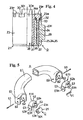
- Fig. 4 is a front view, with a section on the right half side, of the third embodiment of a rotary damper according to the present invention, and the same portions as, or portions corresponding to, those in Figs. 1 - 3 are represented by the same symbols, and explanations thereof are omitted.
- reference numeral 23e represents an engaging claw 23e as an engaging portion, and a plurality of the engaging claws is disposed with a predetermined interval therebetween along an outer circumferential edge of the outer circumferential wall 23, in the same direction as that of the outer circumferential wall 23.
- the circumferential edge of the outer side surface of the cap portion 30 corresponds to the engaging shoulder portion.
- the plural engaging claws 23e are disposed such that the outer circumferential surfaces of the engaging claws 23e do not protrude from the outer circumferential surface of the outer circumferential wall 23, or preferably are aligned in the same surface.
- Fig. 5 is a partially omitted exploded perspective view of an embodiment of an assist grip device according to the present invention, wherein portions same as, or corresponding to, those in Figs. 1 to 4 are represented by the same symbols, and explanations thereof are omitted.
- the first embodiment of the rotary damper D is employed in the embodiment of the assist grip device.
- a letter A represents an assist grip device.
- the assist grip device A includes brackets (holders) 61A and 61B for attaching an assist grip 81, described later, to a predetermined position; a rotary damper D for damping rotation of the assist grip 81; a torsion spring 71 as an urging device for urging the assist grip 81 to a return position; a U-shaped assist grip 81 with both ends being attached to the brackets 61A and 61B; and supporting shafts 91 for attaching the rotary damper D, torsion spring 71 and assist grip 81 to the brackets 61A, 61B.
- Each of the brackets 61A and 61B is formed of an attaching portion 62 having an attaching hole 62a, a pair of shaft supporting holes 63a for supporting the supporting shaft 91 and a pair of supporting members 63 facing each other and suspended from the attaching portion 62.
- An interval between the supporting members 63 is substantially a height of the rotary damper D (a height H except for the annular engaging projection 30c as shown in Fig. 1).
- a groove 63b as an engaging portion, which engages the annular engaging projection 30c of the rotary damper D, is provided linearly on an inner side of one of the supporting members 63 of the bracket 61A from one end thereof so as to slightly pass through the shaft supporting hole 63a.
- Both end portions of the assist grip 81 for covering the brackets 61A and 61B are provided with facing insertion holes 82 for inserting the supporting shaft 91 therein.
- the end portion of the assist grip 81 for covering the bracket 61A is provided with a fitting opening 83, or fitting concave portion, that fits the protrusion 23c of the rotary damper D.
- each bracket 61A and 61B is attached to a predetermined position, not shown, by using attaching screws (not shown) and the attaching holes 62a. Then, the annular engaging projection 30c is fit into the groove 63b to thereby position the rotary damper D between the supporting members 63 of the bracket 61A. At this time, the housing 21 is rotated to a position where the protrusion 23c fits the fitting opening 83 when the assist grip 81 is attached later.
- the brackets 61A and 61B are covered by the end portions of the assist grip 81 while the protrusion 23c is being fitted into the fitting opening 83.
- the supporting shaft 91 is inserted into the through-hole 82, the annular engaging projection 30c, the through-hole 30a, the insertion cylinder 31 and the insertion hole 82 to thereby attach one end of the assist grip 81 to the bracket 61A.
- another supporting shaft 91 is inserted into the through-hole 82, the torsion spring 71 and the through-hole 82 to thereby attach the other end of the assist grip 81 to the bracket 61B.
- the torsion spring 71 is provided so as to urge the assist grip 81 to return to a return position, for example, a predetermined upper position.
- the assist grip 81 rotates back by the urging force of the torsion spring 71. During the return movement, the rotation of the assist grip 81 is damped.
- the housing 21 and the rotor 28 can be relatively rotated.
- the protrusion 23c as an engaging device is provided on the outer circumferential wall 23 of the housing 21 and engages the fitting opening 83 of the assist grip 81.
- an outer shape of the outer circumferential wall 23 may be formed to be a shape other than a circular shape and the housing 21 may be rotated together with the assist grip 81 so as to also work as an engaging device.
- the engaging portion may be structured such that an engaging claw having an elasticity is provided as an engaging portion at the forward end of the insertion cylinder 31, and the engaging claw is engaged with the engaging shoulder portion 27.
- the rotary damper D may be disposed on an extended line of the supporting shaft 91 as the supporting shaft, or there may be employed a structure such that the rotary damper D is disposed at a position away from the supporting shaft 91, and the rotating force of the supporting shaft 91 rotating together with the assist grip 81 is transmitted to the rotor 28 by a transmitting mechanism through gears. With these mechanisms, the rotation of the assist grip 81 can be damped.
- a rotor is attached to a housing with a structure such that an engaging shoulder portion is provided to one of the housing and the rotor and an engaging portion is provided to the other thereof.
- the engaging portion can engage the engaging shoulder portion, the rotor can be securely attached to the housing with tight sealing and, at the same time, the rotor and housing can be easily assembled.
- a highly reliable rotary damper can be provided. Also, since the rotary damper can be easily assembled with good workability, a rotary damper can be manufactured at a lower cost to thereby provide the rotary damper at a low price.
- An insertion hole is disposed at the center of the annular chamber of the housing.
- the rotor is provided with an insertion cylinder to be fitted into the insertion hole. Additionally, the insertion cylinder is provided with an engaging portion. Consequently, the rotor can rotate easily and is securely attached to the housing by just inserting the insertion cylinder into the insertion hole.
- the engaging shoulder portion is provided to at a recess portion of the housing, the engaging portion engages the engaging shoulder portion so that the engaging portion does not protrude from the housing. Thus, a good appearance is preserved and there is no protrusion which may catch other parts.
- the rotor is more securely attached to the housing.
- the assist grip device of the present invention since the rotation of the assist grip is damped by the rotary damper of the present invention, reliable damping effects can be obtained.
Landscapes
- Engineering & Computer Science (AREA)
- General Engineering & Computer Science (AREA)
- Mechanical Engineering (AREA)
- Transportation (AREA)
- Fluid-Damping Devices (AREA)
- Passenger Equipment (AREA)
Abstract
Description
Claims (7)
- A rotary damper (D) comprising:a housing (21) having an annular groove (25) with an inlet portion;a rotor (28) having a main annular portion (29) to be inserted into said annular groove, and a cap portion (30) attached at one side of the main annular portion, said main annular portion (29) being inserted into the annular groove to form a space (34) therein so that the cap portion closes the annular groove,a plurality of sealing members (32, 33) situated on inner and outer sides of the main annular portion for sealing the space, anda viscous fluid (35) filled in the space,said rotary damper (D) being characterized in that said rotary damper further includes an engaging shoulder portion (27, 23d) provided on one of said housing and rotor; and an engaging portion (31a, 30d, 23e)) provided on the other of the housing and rotor for engaging said engaging shoulder portion.
- A rotary damper as claimed in claim 1, wherein said housing (21) has an insertion hole (30a) at a center thereof, and said rotor (28) has an insertion cylinder (31) situated radially inside the main annular portion (29) and rotationally located in the insertion hole.
- A rotary damper as claimed in claim 2, wherein said housing (21) has a recess portion (27) facing the insertion hole at a side opposite to the inlet portion to form the engaging shoulder portion thereat, and said engaging portion (31a) is formed on the insertion cylinder (31) at a side opposite to the cap.
- A rotary damper as claimed in claim 2 or 3, wherein said engaging portion is projections (31a) formed on the insertion cylinder (31) bent toward the engaging shoulder portion to engage the same.
- A rotary damper as claimed in claim 1 or 2, wherein said cap (30) has projections with engaging claws (30d) at an outer periphery thereof extending in a direction as in the main annular portion (29) as the engaging portion, and said housing (21) has the engaging shoulder portion outside the annular groove (25) to engage the engaging claws.
- A rotary damper as claimed in any one of claims 1 through 5, wherein said main annular portion (29) has a base (29a) and a front portion extending from the base, said base having a thickness greater than that of the front portion and directly contacting the sealing members (32, 33) to seal thereat, said front portion being located in the annular groove as a damping portion.
- An assist grip device comprising:an assist grip (A),an urging device (71) attached to the assist grip to urge the assist grip to return to a return position, andsaid rotary damper as claimed in any one of claims 1 through 6 and attached to the assist grip.
Applications Claiming Priority (2)
| Application Number | Priority Date | Filing Date | Title |
|---|---|---|---|
| JP2001018113 | 2001-01-26 | ||
| JP2001018113A JP4524771B2 (en) | 2001-01-26 | 2001-01-26 | Rotating damper and assist grip device |
Publications (2)
| Publication Number | Publication Date |
|---|---|
| EP1227263A1 true EP1227263A1 (en) | 2002-07-31 |
| EP1227263B1 EP1227263B1 (en) | 2005-10-05 |
Family
ID=18884176
Family Applications (1)
| Application Number | Title | Priority Date | Filing Date |
|---|---|---|---|
| EP02001103A Expired - Lifetime EP1227263B1 (en) | 2001-01-26 | 2002-01-23 | Rotary damper and assist grip device |
Country Status (8)
| Country | Link |
|---|---|
| US (1) | US6604614B2 (en) |
| EP (1) | EP1227263B1 (en) |
| JP (1) | JP4524771B2 (en) |
| KR (1) | KR100489965B1 (en) |
| CN (1) | CN1218133C (en) |
| ES (1) | ES2250524T3 (en) |
| HK (1) | HK1048154B (en) |
| TW (1) | TW531605B (en) |
Cited By (3)
| Publication number | Priority date | Publication date | Assignee | Title |
|---|---|---|---|---|
| EP1527947A3 (en) * | 2003-11-03 | 2006-01-04 | Illinois Tool Works Inc. | Pin-less damper assembly for an assist grip handle |
| US7753181B2 (en) | 2005-01-31 | 2010-07-13 | Illinois Tool Works Inc. | Damper having silicone impregnated and silicone containing components |
| DE102005056132B4 (en) * | 2004-11-30 | 2012-07-12 | Nifco Inc. | rotary damper |
Families Citing this family (43)
| Publication number | Priority date | Publication date | Assignee | Title |
|---|---|---|---|---|
| DE60036740T2 (en) * | 1999-08-05 | 2008-02-07 | Nifco Inc., Yokohama | Cylindrical rotary damper with oil |
| USD489028S1 (en) | 2002-07-24 | 2004-04-27 | Nifco Inc. | Rotational damper |
| ITTO20020966A1 (en) * | 2002-11-08 | 2004-05-09 | Itw Ind Components Srl | SLOW MOTION IN PARTICULAR FOR THE INSERTION BETWEEN TWO RELATIVELY MOBILE BODIES, DEVELOPING HIGH RESISTANCE |
| JP4058685B2 (en) * | 2003-03-26 | 2008-03-12 | 東海ゴム工業株式会社 | Fluid filled vibration isolator |
| US6968929B2 (en) * | 2003-04-15 | 2005-11-29 | Illinois Tool Works Inc. | Damper |
| CN100366943C (en) * | 2003-04-15 | 2008-02-06 | 伊利诺斯器械工程公司 | damper |
| WO2004098944A1 (en) * | 2003-05-12 | 2004-11-18 | Oiles Corporation | Damper for car seat and car seat mechanism having the damper |
| JP4391397B2 (en) * | 2004-07-14 | 2009-12-24 | 株式会社ニフコ | Rotating damper |
| JP2006300088A (en) * | 2005-04-15 | 2006-11-02 | Somic Ishikawa Inc | Rotary damper |
| KR100960250B1 (en) | 2005-06-30 | 2010-06-01 | 아사히 가세이 케미칼즈 가부시키가이샤 | Method for preparing substituted cyclopentanone |
| EP2025968B1 (en) * | 2006-06-05 | 2014-05-21 | Bridgestone Corporation | Vibration isolation device |
| WO2009084055A1 (en) * | 2007-12-31 | 2009-07-09 | Antonino Cultraro | A rotary damper having improved braking features |
| JP5330965B2 (en) * | 2009-11-18 | 2013-10-30 | 株式会社ニフコ | Rotating body braking structure |
| CN101920294B (en) * | 2010-08-20 | 2011-12-14 | 慈溪市福尔达实业有限公司 | Inner and outer shell riveting device of handle damper |
| USD670298S1 (en) * | 2011-03-02 | 2012-11-06 | Nifco Inc. | Rotational damper |
| USD669484S1 (en) * | 2011-03-02 | 2012-10-23 | Nifco Inc. | Damper |
| USD670301S1 (en) * | 2011-04-27 | 2012-11-06 | Nifco Inc. | Damper |
| USD670299S1 (en) * | 2011-04-27 | 2012-11-06 | Nifco Inc. | Damper |
| USD670302S1 (en) * | 2011-04-27 | 2012-11-06 | Nifco Inc. | Damper |
| USD670300S1 (en) * | 2011-04-27 | 2012-11-06 | Nifco Inc. | Damper |
| USD669485S1 (en) * | 2011-04-27 | 2012-10-23 | Nifco Inc. | Damper |
| USD670303S1 (en) * | 2011-05-20 | 2012-11-06 | Nifco Inc. | Rotary damper |
| USD670307S1 (en) * | 2011-05-20 | 2012-11-06 | Nifco Inc. | Rotary damper |
| AT512300B1 (en) | 2012-01-25 | 2013-07-15 | Fulterer Gmbh | DEVICE FOR CONTROLLING MOVEMENT OF A MOVABLE COMPONENT |
| US9777513B2 (en) | 2012-01-25 | 2017-10-03 | Fulterer Gesellschaft Mbh | Pull-out device for at least two pull-out furniture parts |
| AT512306B1 (en) | 2012-01-25 | 2013-07-15 | Fulterer Gmbh | DEVICE FOR CONTROLLING MOVEMENT OF A MOVABLE COMPONENT |
| CN102562905B (en) * | 2012-02-20 | 2013-09-18 | 东南大学 | Rotary fluid damper |
| JP5922446B2 (en) | 2012-03-08 | 2016-05-24 | 株式会社ニフコ | Rotating damper |
| AT512415B1 (en) | 2012-03-20 | 2013-08-15 | Fulterer Gmbh | Catching device for a movably mounted furniture part |
| CN102927196B (en) * | 2012-11-05 | 2014-11-19 | 中国船舶重工集团公司第七〇五研究所 | Extrusion oil film damper running synchronously with propulsion shaft system |
| US20150014111A1 (en) * | 2013-07-15 | 2015-01-15 | Nien Made Enterprise Co., Ltd. | One-way resistance roll-up apparatus |
| JP6262488B2 (en) | 2013-10-10 | 2018-01-17 | 株式会社パイオラックス | Damper and handle device including the same |
| JP6150737B2 (en) * | 2014-02-03 | 2017-06-21 | 株式会社ニフコ | Damper device |
| WO2015148322A1 (en) * | 2014-03-28 | 2015-10-01 | Burton Technologies, Llc | Variable rate friction damper |
| JP6339949B2 (en) * | 2015-02-20 | 2018-06-06 | 株式会社ニフコ | Damper and damper manufacturing method |
| JP1536916S (en) * | 2015-04-24 | 2015-11-02 | ||
| JP1550670S (en) * | 2015-05-20 | 2016-05-30 | ||
| CN105564284B (en) * | 2016-01-05 | 2018-03-20 | 安徽江淮汽车集团股份有限公司 | A kind of automobile ceiling handrail |
| KR102397188B1 (en) * | 2016-03-02 | 2022-05-12 | 워터 피크 인코포레이티드 | Actuating Assembly for Mouthwash |
| CN106894536A (en) * | 2017-04-10 | 2017-06-27 | 广州大学 | A kind of novel damping oil damper |
| DE102018120898A1 (en) * | 2018-08-27 | 2020-02-27 | Thyssenkrupp Ag | Steering column for a motor vehicle |
| CN109736031A (en) * | 2019-03-27 | 2019-05-10 | 杰克缝纫机股份有限公司 | Sewing machine, forward and reverse stitch switching structure and damping rotator |
| CN112576686B (en) * | 2019-09-27 | 2023-03-14 | 新疆金风科技股份有限公司 | Damping device, yaw system, wind generating set and yaw damping method |
Citations (6)
| Publication number | Priority date | Publication date | Assignee | Title |
|---|---|---|---|---|
| US4513473A (en) * | 1982-12-23 | 1985-04-30 | Nifco Inc. | Sealed rotary motion damper |
| US4869125A (en) * | 1987-10-08 | 1989-09-26 | Nifco Inc. | Rotary oil damper |
| EP0540298A1 (en) * | 1991-10-29 | 1993-05-05 | Kuroishi Iron Works Co. Ltd. | Parking brakes for cars and one-way dampers suitable for use therein |
| DE29604260U1 (en) * | 1996-03-08 | 1996-04-25 | ITW-Ateco GmbH, 97285 Röttingen | Folding handle |
| WO2001010672A1 (en) * | 1999-08-05 | 2001-02-15 | Nifco Inc. | Oil cylindrical rotational damper |
| EP1125790A2 (en) * | 2000-02-18 | 2001-08-22 | Piolax Inc. | Rotary damper |
Family Cites Families (10)
| Publication number | Priority date | Publication date | Assignee | Title |
|---|---|---|---|---|
| JPH056426Y2 (en) * | 1984-09-07 | 1993-02-18 | ||
| IT8553304U1 (en) * | 1985-04-24 | 1986-10-24 | Foggini Progetti | DEVICE FOR SLOWING AND LOCKING DOORS AND DRAWERS, PARTICULARLY IN MOTOR VEHICLES. |
| JPH0742999B2 (en) * | 1986-08-05 | 1995-05-15 | 株式会社ニフコ | Oil type damper |
| JP2544628B2 (en) * | 1987-07-10 | 1996-10-16 | 株式会社 ニフコ | Rotation damper |
| US5211269A (en) * | 1989-05-02 | 1993-05-18 | Sugatsune Industrial Co., Ltd. | Damper for a flapdoor using viscous fluid |
| JP2916785B2 (en) * | 1989-11-16 | 1999-07-05 | 日本発条株式会社 | Release device |
| JPH06248844A (en) * | 1993-02-26 | 1994-09-06 | Nikko Kogyo Kk | Rotary damper |
| SE509769C2 (en) * | 1993-09-03 | 1999-03-08 | Itw Ateco Gmbh | rotational dampers |
| JP4249808B2 (en) * | 1997-04-21 | 2009-04-08 | 不二ラテックス株式会社 | Rotary damper and reclining member using the same |
| JP3582376B2 (en) * | 1998-10-06 | 2004-10-27 | トヨタ自動車株式会社 | Rotary assist grip for vehicles |
-
2001
- 2001-01-26 JP JP2001018113A patent/JP4524771B2/en not_active Expired - Lifetime
- 2001-12-05 TW TW090130061A patent/TW531605B/en not_active IP Right Cessation
- 2001-12-20 CN CN011433965A patent/CN1218133C/en not_active Expired - Lifetime
-
2002
- 2002-01-12 KR KR10-2002-0001871A patent/KR100489965B1/en not_active Expired - Lifetime
- 2002-01-17 US US10/050,884 patent/US6604614B2/en not_active Expired - Lifetime
- 2002-01-23 EP EP02001103A patent/EP1227263B1/en not_active Expired - Lifetime
- 2002-01-23 ES ES02001103T patent/ES2250524T3/en not_active Expired - Lifetime
-
2003
- 2003-01-07 HK HK03100141.5A patent/HK1048154B/en not_active IP Right Cessation
Patent Citations (6)
| Publication number | Priority date | Publication date | Assignee | Title |
|---|---|---|---|---|
| US4513473A (en) * | 1982-12-23 | 1985-04-30 | Nifco Inc. | Sealed rotary motion damper |
| US4869125A (en) * | 1987-10-08 | 1989-09-26 | Nifco Inc. | Rotary oil damper |
| EP0540298A1 (en) * | 1991-10-29 | 1993-05-05 | Kuroishi Iron Works Co. Ltd. | Parking brakes for cars and one-way dampers suitable for use therein |
| DE29604260U1 (en) * | 1996-03-08 | 1996-04-25 | ITW-Ateco GmbH, 97285 Röttingen | Folding handle |
| WO2001010672A1 (en) * | 1999-08-05 | 2001-02-15 | Nifco Inc. | Oil cylindrical rotational damper |
| EP1125790A2 (en) * | 2000-02-18 | 2001-08-22 | Piolax Inc. | Rotary damper |
Cited By (4)
| Publication number | Priority date | Publication date | Assignee | Title |
|---|---|---|---|---|
| EP1527947A3 (en) * | 2003-11-03 | 2006-01-04 | Illinois Tool Works Inc. | Pin-less damper assembly for an assist grip handle |
| US7103939B2 (en) | 2003-11-03 | 2006-09-12 | Illinois Tool Works Inc | Pin-less damper assembly for an assist grip handle |
| DE102005056132B4 (en) * | 2004-11-30 | 2012-07-12 | Nifco Inc. | rotary damper |
| US7753181B2 (en) | 2005-01-31 | 2010-07-13 | Illinois Tool Works Inc. | Damper having silicone impregnated and silicone containing components |
Also Published As
| Publication number | Publication date |
|---|---|
| HK1048154B (en) | 2006-01-13 |
| EP1227263B1 (en) | 2005-10-05 |
| CN1367326A (en) | 2002-09-04 |
| HK1048154A1 (en) | 2003-03-21 |
| JP4524771B2 (en) | 2010-08-18 |
| KR20020063111A (en) | 2002-08-01 |
| KR100489965B1 (en) | 2005-05-17 |
| TW531605B (en) | 2003-05-11 |
| CN1218133C (en) | 2005-09-07 |
| US6604614B2 (en) | 2003-08-12 |
| ES2250524T3 (en) | 2006-04-16 |
| JP2002221247A (en) | 2002-08-09 |
| US20020101014A1 (en) | 2002-08-01 |
Similar Documents
| Publication | Publication Date | Title |
|---|---|---|
| EP1227263B1 (en) | Rotary damper and assist grip device | |
| EP1202873B1 (en) | Oil cylindrical rotational damper | |
| US4513473A (en) | Sealed rotary motion damper | |
| KR100751827B1 (en) | Rotary damper | |
| CN1954165B (en) | Shaft seal assembly with retaining ring and gasket | |
| JP4413902B2 (en) | Rotating spring | |
| US7353923B2 (en) | Damper device | |
| CN103328851A (en) | Damping device | |
| JP2002021902A (en) | Rotary damper and assist grip device | |
| KR960034798A (en) | Rotary damper | |
| JP4418581B2 (en) | Rotating damper and assist grip device | |
| JP2519149Y2 (en) | Rotating damper | |
| KR100368337B1 (en) | oil type cylindrical rotary damper | |
| JP2603377Y2 (en) | Rotary damper | |
| JP4157360B2 (en) | Orifice member for liquid-filled vibration isolator and jig used for assembly of the orifice member | |
| JP2003130112A (en) | Rotation damper | |
| JPH09144795A (en) | Rotary damper | |
| JPS6236988Y2 (en) | ||
| KR100493803B1 (en) | Rotary damper | |
| JP4420500B2 (en) | Pipe fitting | |
| JPH02304230A (en) | Vibration isolator | |
| KR0158134B1 (en) | Oil leakage prevention structure of oil case | |
| KR200242488Y1 (en) | Rotary damper | |
| JPS6325230B2 (en) | ||
| JPH0710574U (en) | Rotating damper |
Legal Events
| Date | Code | Title | Description |
|---|---|---|---|
| PUAI | Public reference made under article 153(3) epc to a published international application that has entered the european phase |
Free format text: ORIGINAL CODE: 0009012 |
|
| AK | Designated contracting states |
Kind code of ref document: A1 Designated state(s): AT BE CH CY DE DK ES FI FR GB GR IE IT LI LU MC NL PT SE TR |
|
| AX | Request for extension of the european patent |
Free format text: AL;LT;LV;MK;RO;SI |
|
| 17P | Request for examination filed |
Effective date: 20030102 |
|
| AKX | Designation fees paid |
Designated state(s): BE ES FR GB |
|
| REG | Reference to a national code |
Ref country code: DE Ref legal event code: 8566 |
|
| 17Q | First examination report despatched |
Effective date: 20041026 |
|
| GRAP | Despatch of communication of intention to grant a patent |
Free format text: ORIGINAL CODE: EPIDOSNIGR1 |
|
| GRAS | Grant fee paid |
Free format text: ORIGINAL CODE: EPIDOSNIGR3 |
|
| GRAA | (expected) grant |
Free format text: ORIGINAL CODE: 0009210 |
|
| AK | Designated contracting states |
Kind code of ref document: B1 Designated state(s): BE ES FR GB |
|
| REG | Reference to a national code |
Ref country code: GB Ref legal event code: FG4D |
|
| PG25 | Lapsed in a contracting state [announced via postgrant information from national office to epo] |
Ref country code: BE Free format text: LAPSE BECAUSE OF NON-PAYMENT OF DUE FEES Effective date: 20060131 |
|
| REG | Reference to a national code |
Ref country code: ES Ref legal event code: FG2A Ref document number: 2250524 Country of ref document: ES Kind code of ref document: T3 |
|
| ET | Fr: translation filed | ||
| PLBE | No opposition filed within time limit |
Free format text: ORIGINAL CODE: 0009261 |
|
| STAA | Information on the status of an ep patent application or granted ep patent |
Free format text: STATUS: NO OPPOSITION FILED WITHIN TIME LIMIT |
|
| 26N | No opposition filed |
Effective date: 20060706 |
|
| BERE | Be: lapsed |
Owner name: *NIFCO INC. Effective date: 20060131 |
|
| PG25 | Lapsed in a contracting state [announced via postgrant information from national office to epo] |
Ref country code: FR Free format text: LAPSE BECAUSE OF NON-PAYMENT OF DUE FEES Effective date: 20060131 |
|
| REG | Reference to a national code |
Ref country code: FR Ref legal event code: ST Effective date: 20111125 |
|
| PGFP | Annual fee paid to national office [announced via postgrant information from national office to epo] |
Ref country code: GB Payment date: 20210113 Year of fee payment: 20 Ref country code: ES Payment date: 20210203 Year of fee payment: 20 |
|
| REG | Reference to a national code |
Ref country code: GB Ref legal event code: PE20 Expiry date: 20220122 |
|
| PG25 | Lapsed in a contracting state [announced via postgrant information from national office to epo] |
Ref country code: GB Free format text: LAPSE BECAUSE OF EXPIRATION OF PROTECTION Effective date: 20220122 |
|
| REG | Reference to a national code |
Ref country code: ES Ref legal event code: FD2A Effective date: 20220429 |
|
| PG25 | Lapsed in a contracting state [announced via postgrant information from national office to epo] |
Ref country code: ES Free format text: LAPSE BECAUSE OF EXPIRATION OF PROTECTION Effective date: 20220124 |