EP1226748A1 - Method of forming an artificial shiro of matsutake - Google Patents
Method of forming an artificial shiro of matsutake Download PDFInfo
- Publication number
- EP1226748A1 EP1226748A1 EP02445009A EP02445009A EP1226748A1 EP 1226748 A1 EP1226748 A1 EP 1226748A1 EP 02445009 A EP02445009 A EP 02445009A EP 02445009 A EP02445009 A EP 02445009A EP 1226748 A1 EP1226748 A1 EP 1226748A1
- Authority
- EP
- European Patent Office
- Prior art keywords
- matsutake
- hyphae
- active principle
- aseptically
- culturing
- Prior art date
- Legal status (The legal status is an assumption and is not a legal conclusion. Google has not performed a legal analysis and makes no representation as to the accuracy of the status listed.)
- Granted
Links
Images

Classifications
-
- A—HUMAN NECESSITIES
- A01—AGRICULTURE; FORESTRY; ANIMAL HUSBANDRY; HUNTING; TRAPPING; FISHING
- A01G—HORTICULTURE; CULTIVATION OF VEGETABLES, FLOWERS, RICE, FRUIT, VINES, HOPS OR SEAWEED; FORESTRY; WATERING
- A01G18/00—Cultivation of mushrooms
- A01G18/40—Cultivation of spawn
-
- A—HUMAN NECESSITIES
- A01—AGRICULTURE; FORESTRY; ANIMAL HUSBANDRY; HUNTING; TRAPPING; FISHING
- A01G—HORTICULTURE; CULTIVATION OF VEGETABLES, FLOWERS, RICE, FRUIT, VINES, HOPS OR SEAWEED; FORESTRY; WATERING
- A01G18/00—Cultivation of mushrooms
- A01G18/20—Culture media, e.g. compost
-
- A—HUMAN NECESSITIES
- A01—AGRICULTURE; FORESTRY; ANIMAL HUSBANDRY; HUNTING; TRAPPING; FISHING
- A01G—HORTICULTURE; CULTIVATION OF VEGETABLES, FLOWERS, RICE, FRUIT, VINES, HOPS OR SEAWEED; FORESTRY; WATERING
- A01G18/00—Cultivation of mushrooms
- A01G18/50—Inoculation of spawn
Definitions
- the present invention relates to a method of forming an artificial Shiro of Tricholoma Matsutake (hereinafter referred to as "Matsutake").
- Matsutake forms a mycorrhizal association with a root of a red pine (Masui, K. (1927), Mem. Coll. Sci. Kyoto Univ. B (2) 2, 149-279).
- Tominaga has investigated the optimal conditions for growth of Matsutake hyphae (Tominaga, Y. (1965) Bull. Hiroshima Agri. Coll. 2: 242-246).
- Ogawa et al. have investigated the formation of a Matsutake fruit body primordium by axenic culture (Ogawa, M & Hamada, M (1975), Trans. Mycol. Soc. Japan 16: 406-415).
- success in the induction of Matsutake Shiro formation has not yet been reported.
- the present inventors have focused on the fact that the Matsutake hyphae grow extremely slowly. They considered that the slow growth of the hyphae might be one of the factors that hindered advancements of artificial cultivation of Matsutake mushrooms.
- the slow growth of the hyphae might be one of the factors that hindered advancements of artificial cultivation of Matsutake mushrooms.
- Matsutake hyphae have not grown to form a Shiro to the extent of practical use. Therefore, it is presently considered difficult to cultivate Matsutake mushrooms artificially.
- an object of the present invention is to provide a method capable of rapidly forming an artificial Shiro of Matsutake.
- the present inventors found an active principle capable of promoting the growth of Matsutake hyphae. Based on this finding, they established a method of proliferating Matsutake hyphae in a short time, thereby accomplishing the present invention. More specifically, the present invention is achieved by the means described below.
- a Matsutake strain to be used in the present invention a commercially available strain from ATCC (American Type Culture Collection), such as ATCC 34979, ATCC 34981, and ATCC 34988 may be used.
- ATCC American Type Culture Collection
- ATCC 34979, ATCC 34981, and ATCC 34988 a commercially available strain from ATCC (American Type Culture Collection), such as ATCC 34979, ATCC 34981, and ATCC 34988 may be used.
- ATCC American Type Culture Collection
- the Matsutake strain can be proliferated in a medium generally used for maintaining a symbiotic fungus in the art, such as Ohta medium (Ohta, A. (1990) Trans. Mycol. Soc. Japan 31: 323-334), MMN medium (Marx, D. H. (1969) Phytopathology 59: 153-163), and Hamada medium (Hamada (1964) Matsutake, 97-100). Of them, Ohta medium is preferable for proliferating the Matsutake strain from the viewpoint of its proliferation efficiency.
- the medium may be either a solid medium (e.g., agar) or a liquid medium.
- the Matsutake strain is aseptically subcultured in darkness at a temperature of about 20-25°C.
- Matsutake hyphae are cultured in a culture substrate containing a substance capable of controlling the cell membrane permeability of the hyphae as an active principle.
- the substance capable of controlling the cell membrane permeability of the hyphae is not particularly limited, as long as it enhances the cell membrane permeability of the hyphae. Several types of such a substance may be used in combination.
- Such a substance capable of controlling the cell membrane permeability of the hyphae is considered to facilitate release of an enzyme such as cellulase (that is present within the hyphae) from the hyphae.
- Preferable examples of the substance capable of controlling the cell membrane permeability of the hyphae may be a surfactant and a natural vegetable oil.
- Matsutake hyphae is cultured in a culture substrate containing a substance capable of enhancing the hydrophilic property of the hyphae as an active principle.
- the substance capable of enhancing the hydrophilic property of the hyphae is not particularly limited, as long as it promotes intrusion of the hyphae into the culture substrate and contributes to an increase in absorption amount of nutrient by the hyphae.
- a substance capable of enhancing the hydrophilic property of the hyphae may be used in combination.
- the substance capable of enhancing the hydrophilic property of the hyphae may be a surfactant and a natural vegetable oil.
- Matsutake hyphae are cultured in a culture substrate containing a surfactant and/or a natural vegetable oil as an active principle.
- a surfactant and/or a natural vegetable oil may be contained as an active principle, or alternatively, the both may be contained.
- the active principle of the present invention even if it does not necessarily control the cell membrane permeability of the hyphae.
- the active principle of the present invention even if it does not necessarily enhance the hydrophilic property of the hyphae.
- the surfactant to be used in the present invention is not particularly limited, as long as it is called as a surfactant.
- a nonionic surfactant may be used, and more preferably a Tween series surfactant such as Tween 80 and Tween 40 may be used.
- Tween 80 and Tween 40 may be used.
- Tween 80 and Tween 40 may be used.
- surfactants may be used in combination.
- the natural vegetable oil to be used in the present invention is not particularly limited, as long as it is called as a natural vegetable oil.
- a natural vegetable oil For example, olive oil, safflower oil, or grape-seed oil may be used.
- Several types of natural vegetable oils may be used in combination.
- the active principle preferably used in the present invention may be also expressed as fatty acid esters, according to another concept.
- Matsutake hyphae are cultured in a culture substrate containing a fatty acid ester as an active principle.
- the fatty acid ester is preferably a higher fatty acid ester, more preferably a fatty acid ester having a fatty acid of 12-18 carbon atoms, further preferably, an unsaturated fatty acid ester having a fatty acid of 12-18 carbon atoms, and still preferably, oleic acid ester.
- a fat and oil containing the aforementioned preferable fatty acid may be used as the active principle.
- fatty acid esters may be used in combination as the active principle.
- the fatty acid ester may be used in combination with a substance other than the fatty acid ester, the substance being capable of controlling the cell membrane permeability of the hyphae.
- the fatty acid ester may be used in combination with a substance other than the fatty acid ester, the substance being capable of enhancing the hydrophilic property of the hyphae.
- the fatty acid ester can be used as the active principle in the present invention is considered to be closely related to the facts that the aforementioned fatty acid ester is contained in some of the surfactants and the natural vegetable oils. Therefore, if a substance falls under the category of the fatty acid ester and the substance is contained in the surfactant or the natural vegetable oil, naturally it can be used as the active principle in the present invention.
- the aforementioned active principle is preferably added to a culture substrate in a state of a solution containing the active principle.
- the solution containing the active principle such as the substance capable of controlling the cell membrane permeability of the hyphae (e.g., a surfactant and/or a natural vegetable oil) is preferably prepared by diluting it with an organic solvent (preferably ethanol) and distilled water to a desired concentration before being added to a culture substrate.
- a solution containing the substance capable of controlling the cell membrane permeability of the hyphae is preferably prepared by diluting it to a concentration of 0.2 to 10 wt%.
- a solution containing the substance capable of enhancing the hydrophilic property of the hyphae is preferably prepared by diluting it to a concentration of 0.2 to 10 wt%.
- the dilution concentration of the surfactant is generally 0.2 wt% or more, preferably 0.2 to 10 wt%, and more preferably 1 to 5 wt%.
- the dilution concentration of less than 0.2 wt% is not preferable for the reason that the remarkable effect of the surfactant on growth of the hyphae cannot be brought about.
- the dilution concentration of the natural vegetable oil is generally 0.2 wt% or more, preferably 0.2 to 5 wt%, and more preferably 0.5 to 2 wt%.
- the dilution concentration of less than 0.2 wt% is not preferable for the reason that the remarkable effect of the natural vegetable oil on growth of the hyphae cannot be brought about.
- the dilution concentration is set at generally 0.2 wt% or more, preferably 0.2 to 10 wt%, and more preferably 0.5 to 5 wt%, in total.
- the dilution concentration of the fatty acid ester is generally 0.2 wt% or more, preferably 0.2 to 10 wt%, and more preferably 0.5 to 5 wt%.
- the solution containing the active principle is preferably prepared by diluting it as follows.
- the active principle such as the substance capable of controlling the cell membrane permeability of the hyphae (e.g., a surfactant and/or a natural vegetable oil) is dissolved in an organic solvent (preferably ethanol), and the resultant solution is stirred for 5 to 10 minutes to obtain a homogeneous solution. Thereafter, distilled water is added to the homogenous solution to obtain a solution containing the active principle at a desired concentration.
- the final concentration of the organic solvent is set at generally 0.2 to 5 wt%, preferably about 2 wt%.
- the organic solvent for use in preparing the solution is not particularly limited, as long as it does not negatively affect the growth of Matsutake hyphae.
- Ethanol is preferably used.
- a solution containing 1 wt% Tween 80 can be prepared by mixing 1 g of Tween 80 (commercially available) with 2 mL of 99.5% ethanol and then adding 98 mL of distilled water thereto. In this manner, it is possible to prepare a solution containing an active principle such as a surfactant and/or a natural vegetable oil homogenously (hereinafter also referred to as "a prepared solution containing an active principle").
- an active principle such as a surfactant and/or a natural vegetable oil homogenously
- a culture substrate for adding the aforementioned active principle is not particularly limited, as long as Matsutake hyphae can grow therein.
- Both soil collected from a natural environment and an artificial substrate for example, soil and vermiculite at a ratio of 1:1
- black soil was used, which contains a loamy layer of the Kanto Plain as a base.
- Such a culture substrate is preferably sifted through a sieve to render the grain size of the substrate small and uniform.
- the grain size of the soil is adjusted preferably to about 3 mm or less, and more specifically about 2 to 3 mm.
- the grain size is preferably adjusted to about 2 mm or less, and more specifically about 1 to 2 mm.
- the culture substrate that is made uniform in grain size as described above can be dried by dry heat.
- the dry heat is sufficient if it is performed at about 60°C for about 20-30 hours as an example.
- the aforementioned active principle is added.
- the prepared solution containing an active principle such as a surfactant and/or a natural vegetable oil at a desired concentration is added.
- the prepared solution is preferably spread throughout the culture substrate such that the resultant culture substrate is not obtained in a wet state but a dry-touched state.
- the culture substrate is preferably prepared so as to contain the prepared solution in an amount of 15 to 30 wt% and more preferably 20 to 25 wt%, to the total weight.
- the active principle such as a surfactant and/or a natural vegetable oil is added to the culture substrate, and then it is sterilized and used as the culture substrate for Matsutake hyphae.
- the sterilization can be performed, for example, by autoclaving it at 120°C for 30 minutes or by ⁇ -ray irradiation at 50-60 kGy.
- the culture substrate prepared in this manner is suitable for growing Matsutake hyphae.
- the culture substrate containing an active principle prepared as described above is put into a sterile container (a Petri-dish, etc.).
- a hypha solution containing Matsutake hyphae is inoculated into the culture substrate in the sterile container such that the hypha solution is spread throughout the culture substrate.
- Culture of Matsutake hyphae can be performed at 25 ⁇ 1°C in the dark.
- a piece of the grown hyphae i.e., a Shiro
- Ergosterol can be quantified as follows.
- the Matsutake hyphae grow with a remarkably larger growth amount than those cultured in a culture substrate containing no active principle.
- an active principle e.g., a surfactant and/or a natural vegetable oil
- the artificial Shiro formation method of the present invention it is possible to form a Shiro containing hyphae in an amount corresponding to that of a natural Shiro in a Matsutake-producing forest, in a short culture period of several months.
- the artificial Shiro formation method of the present invention is therefore extremely useful since it becomes a base for artificially cultivating Matsutake mushrooms.
- An artificial Shiro of Matsutake can be induced by culturing Matsutake hyphae in a culture substrate containing the aforementioned active principle such as a substance capable of controlling the cell membrane permeability of Matsutake hyphae (e.g., a surfactant and/or a natural vegetable oil), as described above.
- a substance capable of controlling the cell membrane permeability of Matsutake hyphae e.g., a surfactant and/or a natural vegetable oil
- an inoculum of actively growing Matsutake hyphae is first prepared, and then the inoculum is cultured in a culture substrate containing the aforementioned active principle.
- the method of preparing an inoculum of actively growing Matsutake hyphae comprises (1) a step of inducing growth of matsutake hyphae and (2) a step of preparing an inoculum of matsutake hyphae.
- the step of inducing growth of Matsutake hyphae is performed by aseptically homogenizing a colony of Matsutake hyphae and aseptically culturing the obtained hyphae in a liquid nutrient medium.
- a colony of Matsutake hyphae which is aseptically subcultured on a solid medium (such as Ohta agar medium) may be used.
- the colony i.e., mycelia
- the colony may be prepared by taking a piece of the colony subcultured on the solid medium, inoculating it in a liquid medium having the same composition, and further culturing it at 20-25°C in the dark for 2-3 weeks.
- a piece of the aforementioned colony is taken out from the culture medium, a fresh liquid medium having the same composition is added to the colony, and it is homogenized aseptically, thereby obtaining a suspension of the hypha cells.
- the aseptic homogenization herein means that each hypha cell itself are not destroyed but separated from each other.
- the aseptic homogenization can be performed in a clean bench by using a dry heat sterilized homogenizer.
- the colony may be homogenized with a homogenizer at about 80 ⁇ 100 rpm to 120 ⁇ 100 rpm, preferably 100 ⁇ 100 rpm, for about 4 to 8 seconds, preferably 6 seconds.
- the suspension of the hypha cells that is obtained by the homogenization is further cultured for 3 to 5 days in the same liquid medium under the aforementioned conditions. In this manner, it is possible to obtain a suspension of actively growing Matsutake hyphae.
- each of the hypha cells forming the colony is roughly separated from each other.
- the Matsutake hypha cells having the capability to grow rapidly can be obtained. This is presumably because each of the separated hypha cells intakes nutrition at a higher rate from the culture medium and it hastens the apical growth of the hypha cells, compared with the hypha cells in the form of a colony.
- the step of preparing an inoculum of Matsutake hyphae is performed by aseptically replacing the liquid nutrient medium containing the growth-induced Matsutake hyphae which is obtained in the aforementioned step (1), with a liquid nutrient medium containing no carbon source.
- the preparation of the inoculum can be performed as follows.
- the liquid nutrient medium containing Matsutake hyphae (preferably the liquid medium containing Matsutake hyphae having the capability to grow rapidly which is obtained in the aforementioned step (1)) is first filtered, by use of a mesh such as a nylon mesh filter (average pore size 24 ⁇ 30 ⁇ m).
- the hyphae obtained by the filtration are aseptically rinsed with a liquid medium which is modified so as not to contain a carbon source (hereinafter also referred to as "a modified liquid medium”).
- the rinsing is preferably performed at least three times with 10 mL of the modified liquid medium.
- the modified liquid medium for rinsing is not limited as long as it is obtained by removing carbon source from a liquid medium capable of using for culturing the hyphae.
- a modified liquid medium that is prepared by removing glucose from SH liquid medium is used (Schenk, R. U. & Hildebrandt, A. C. (1972) Can. J. Bot. 50: 199-204).
- an appropriate amount of the modified liquid medium is added to the hyphae, thereby obtaining an inoculum of the hyphae wherein original liquid medium is replaced with the modified liquid medium containing no carbon source.
- Ohta medium Composition Concentration (/1000 mL) Glucose 10 g Citric acid 1 g Ammonium tartrate 1 g KH 2 PO 4 1 g MgSO 4 ⁇ 7H 2 O 1 g CaCl 2 ⁇ 2H 2 O 50 mg HEPES 7 g Mineral solution 10 ml Vitamin solution 10 ml pH Adjusted to 5.1 with 1N KOH
- the grown hyphae were cut in a size of about 2 mm ⁇ 2 mm from the agar medium, and they were cultured in fresh liquid Ohta medium for 3 weeks. A colony of the obtained hyphae was homogenized with a homogenizer and re-cultured for 3 days. After the culturing, the resultant hyphae were rinsed three times with a glucose-free liquid medium (a modified SH liquid medium), and suspended in the same glucose-free liquid medium. In this manner, an inoculum of Matsutake hyphae was prepared. The composition of the glucose-free medium is shown below.
- Tween 80 Polyoxyethylene (20) Sorbitan Monooleate, available from Wako Pure Chemical Industries, Ltd.
- Tween 80/ethanol solution distilled water was added to prepare a Tween 80 additive.
- 1 wt% of Tween 80 additive was prepared by adding 1g of Tween 80 (commercially available) to 2 mL of 99.5% ethanol, followed by adding 98 mL of distilled water. The final concentration of ethanol resulted in about 2 wt%.
- Soil was taken from a site under a bush in the campus of the University of Tokyo.
- the soil was sifted through a sieve to adjust the grain size to 3 mm or less.
- the soil (uniform in grain size) was dried at 60°C for 24 hours with a dry heat sterilizer.
- the additive containing 0 wt% Tween 80 ethanol was added in the same amount as the cases of the Tween 80 additives containing 1 wt%, 2 wt%, and 5 wt% Tween 80, and ethanol concentration was 2% in each Tween 80 additive.
- the soil was prepared so as to contain the Tween 80 additive in an amount of 20 wt% to the total weight, and then the soil was sterilized in an autoclave at 121°C for 30 minutes. In this manner, the soil for culturing Matsutake hyphae was prepared.
- the soil for culturing (prepared in step (3) of Example 1) was put in an amount of 30 mL to a sterile Petri-dish (90 mm diameter).
- 5 mL of Matsutake hyphae solution i.e., the inoculum prepared in step (1) of Example 1 was inoculated into the soil in the Petri-dish so as to spread throughout the soil. Thereafter, the Petri-dish was incubated at 25 ⁇ 1°C in the dark.
- the amount of ergosterol which is a component of the cell membrane of Matsutake hyphae, was measured to determine the amount of the hyphae (Martin et al. (1990) Mycol. Res.
- the amount of ergosterol indicates the amount of Matsutake hyphae.
- the measurement of the amount of ergosterol was performed by collecting soil (1g) from each sample, extracting ergosterol therefrom, and quantifying. As the control, soil was taken from a natural Shiro in a Matsutake-producing forest (Ina, Nagano prefecture, October, 2000) and subjected to the same measurement. From the measurement results of ergosterol (FIG. 1), it is found that growth of Matsutake hyphae is significantly enhanced by the addition of Tween 80. On the other hand, the ergosterol amount in the natural Shiro derived from the Matsutake-producing forest (Ina) was 59.68 ⁇ g/g dry soil.
- Olive oil (Ajinomoto Co. Inc.) was mixed with 99.5% ethanol, and stirred for 5 minutes.
- distilled water was added to prepare an olive oil additive.
- an additive containing 1 wt% olive oil was prepared by mixing 1g of olive oil (commercially available) and 2 mL of 99.5% ethanol, followed by adding 98 mL of distilled water. The final concentration of ethanol resulted in about 2 wt%.
- Preparation of soil for culturing Matsutake hyphae was performed in the same manner as described in the step (3) of Example 1, except that olive oil additive containing olive oil at amounts of 0%, 1%, or 2% (prepared in step (2) of Example 2) was added to the soil for culturing.
- the soil for culturing (prepared in step (3) of Example 2) was put in an amount of 30 mL to a sterile Petri-dish (90 mm diameter).
- 5 mL of Matsutake hyphae solution i.e., the inoculum prepared in step (1) of Example 2 was inoculated into the soil in the Petri-dish so as to spread throughout the soil. Thereafter, the Petri-dish was incubated at 25 ⁇ 1°C in the dark.
- the amount of ergosterol which is a component of the cell membrane of the Matsutake hyphae, was measured to determine the amount of the hyphae (Martin et al. (1990) Mycol. Res.
- the measurement of the amount of ergosterol was performed by collecting soil (1g) from each sample, extracting ergosterol therefrom, and quantifying. As the control, soil was taken from a natural Shiro in a Matsutake-producing forest (Ina, Nagano prefecture, October, 2000) and subjected to the same measurement. From the measurement results of ergosterol (FIG. 2), it is found that the growth of Matsutake hyphae is significantly enhanced by the addition of olive oil. On the other hand, the amount of ergosterol in the natural Shiro derived from the Matsutake-producing forest (Ina) was 59.68 ⁇ g/g dry soil. The ergosterol amount in the artificial Shiro obtained after 3 month's incubation is increased by the addition of olive oil to a level nearly equivalent to that in the natural Shiro derived from the Matsutake-producing forest.
- the advantage of the present invention resides in that the growth of Matsutake hyphae is induced to a satisfactory level by adding an active principle(s), such as a substance capable of controlling the cell membrane permeability of the hyphae and/or a substance capable of enhancing the hydrophilic property of the hyphae, to a culture substrate such as sterile soil or an artificial substrate, without using other nutritional elements.
- an active principle(s) such as a substance capable of controlling the cell membrane permeability of the hyphae and/or a substance capable of enhancing the hydrophilic property of the hyphae
- the method of the preset invention is superior in forming the Matsutake Shiro containing the hyphae in an amount equivalent to that of a naturally occurring Shiro in a Matsutake-producing forest, in a short period.
- Direct inoculation of Matsutake hyphae into a natural red pine forest can be performed by using an artificial Shiro induced by the method of the present invention.
- the method of rapidly forming an artificial Shiro of Matsutake of the present invention becomes a base for establishing a technique of artificial cultivation of Matsutake mushrooms.
Landscapes
- Life Sciences & Earth Sciences (AREA)
- Mycology (AREA)
- Environmental Sciences (AREA)
- Micro-Organisms Or Cultivation Processes Thereof (AREA)
- Mushroom Cultivation (AREA)
Abstract
Description
- The present invention relates to a method of forming an artificial Shiro of Tricholoma Matsutake (hereinafter referred to as "Matsutake").
- Generally, as a method for efficiently cultivating a large amount of mushrooms, a method of proliferating mycelia of the mushroom in a liquid culture medium is known. However, in case of Matsutake mushrooms, their production requires a root of a living tree, because Matsutake is an ectomycorrhizal fungus. An assembly of hyphae called a "Shiro" is present in the site where a Matsutake mushroom grows, and therefore induction of the Shiro formation is an important step toward increasing the production of Matsutake mushrooms (Makoto Ogawa, Biology of Matsutake, pp 333, published by Tsukiji Shokan).
- However, in a natural environment, saprobe and sugar fungus preferentially proliferate in the nutrient site where a red pine (i.e., a host plant of a Matsutake fungus) grows. Because of this, it is difficult for a Matsutake fungus (a symbiotic fungus) to form its Shiro.
- Various studies have been made on artificial cultivation of Matsutake mushrooms (Tricholoma Matsutake (S. Ito et Imai) Sing.) from long ago. Nevertheless, it is still impossible to cultivate Matsutake mushrooms artificially.
- The results of studies that have been made on the artificial cultivation of Matsutake mushrooms will be described below.
- Masui has experimentally showed that Matsutake forms a mycorrhizal association with a root of a red pine (Masui, K. (1927), Mem. Coll. Sci. Kyoto Univ. B (2) 2, 149-279). Tominaga has investigated the optimal conditions for growth of Matsutake hyphae (Tominaga, Y. (1965) Bull. Hiroshima Agri. Coll. 2: 242-246). Ogawa et al. have investigated the formation of a Matsutake fruit body primordium by axenic culture (Ogawa, M & Hamada, M (1975), Trans. Mycol. Soc. Japan 16: 406-415). However, success in the induction of Matsutake Shiro formation has not yet been reported.
- To make the present invention, the present inventors have focused on the fact that the Matsutake hyphae grow extremely slowly. They considered that the slow growth of the hyphae might be one of the factors that hindered advancements of artificial cultivation of Matsutake mushrooms. Up to now, in an attempt to produce Matsutake mushrooms in a large amount, artificial formation of a new Shiro has been tried by inoculating Matsutake hyphae into a host plant-growing forest. However, by such a trial, Matsutake hyphae have not grown to form a Shiro to the extent of practical use. Therefore, it is presently considered difficult to cultivate Matsutake mushrooms artificially.
- In view of the aforementioned background, the present inventors have made extensive studies on a method of inducing the formation of an artificial Shiro of Matsutake, which is an important step toward increasing the production of Matsutake mushrooms. Therefore, an object of the present invention is to provide a method capable of rapidly forming an artificial Shiro of Matsutake.
- The present inventors found an active principle capable of promoting the growth of Matsutake hyphae. Based on this finding, they established a method of proliferating Matsutake hyphae in a short time, thereby accomplishing the present invention. More specifically, the present invention is achieved by the means described below.
- (1) A method of forming an artificial Shiro of
Matsutake comprising:
- culturing Matsutake hyphae in a culture substrate containing a substance capable of controlling the cell membrane permeability of the hyphae as an active principle.
- (2) A method of forming an artificial Shiro of
Matsutake comprising:
- culturing Matsutake hyphae in a culture substrate containing a substance capable of enhancing the hydrophilic property of the hyphae as an active principle.
- (3) A method of forming an artificial Shiro of
Matsutake comprising:
- culturing Matsutake hyphae in a culture substrate containing a surfactant and/or a natural vegetable oil as an active principle.
- (4) A method of forming an artificial Shiro of
Matsutake comprising:
- culturing Matsutake hyphae in a culture substrate containing a fatty acid ester as an active principle.
- (5) A method of forming an artificial Shiro of
Matsutake, comprising:
- inducing growth of Matsutake hyphae by aseptically homogenizing a colony of Matsutake hyphae and aseptically culturing the obtained hyphae in a liquid nutrient medium;
- preparing an inoculum of Matsutake hyphae by aseptically replacing the liquid nutrient medium containing the growth-induced Matsutake hyphae with a liquid nutrient medium containing no carbon source; and
- culturing aseptically the inoculum of the Matsutake hyphae in a culture substrate containing a substance capable of controlling the cell membrane permeability of the hyphae as an active principle.
- (6) A method of forming an artificial Shiro of
Matsutake, comprising:
- inducing growth of Matsutake hyphae by aseptically homogenizing a colony of Matsutake hyphae and aseptically culturing the obtained hyphae in a liquid nutrient medium;
- preparing an inoculum of Matsutake hyphae by aseptically replacing the liquid nutrient medium containing the growth-induced Matsutake hyphae with a liquid nutrient medium containing no carbon source; and
- culturing aseptically the inoculum of the Matsutake hyphae in a culture substrate containing a substance capable of enhancing the hydrophilic property of the hyphae as an active principle.
- (7) A method of forming an artificial Shiro of
Matsutake, comprising:
- inducing growth of Matsutake hyphae by aseptically homogenizing a colony of Matsutake hyphae and aseptically culturing the obtained hyphae in a liquid nutrient medium;
- preparing an inoculum of Matsutake hyphae by aseptically replacing the liquid nutrient medium containing the growth-induced Matsutake hyphae with a liquid nutrient medium containing no carbon source; and
- culturing aseptically the inoculum of the Matsutake hyphae in a culture substrate containing a surfactant and/or a natural vegetable oil as an active principle.
- (8) A method of forming an artificial Shiro of
Matsutake, comprising:
- inducing growth of Matsutake hyphae by aseptically homogenizing a colony of Matsutake hyphae and aseptically culturing the obtained hyphae in a liquid nutrient medium;
- preparing an inoculum of Matsutake hyphae by aseptically replacing the liquid nutrient medium containing the growth-induced Matsutake hyphae with a liquid nutrient medium containing no carbon source; and
- culturing aseptically the inoculum of the Matsutake hyphae in a culture substrate containing a fatty acid ester as an active principle.
- (9) The method of forming an artificial Shiro of Matsutake according to any one of (1) to (8), wherein a solution containing the active principle at the concentration of 0.2 to 10 wt% is used as the active principle.
- (10) The method of forming an artificial Shiro of Matsutake according to any one of (1) to (9), wherein a solution containing the active principle which is prepared using an organic solvent and distilled water is used as the active principle.
- (11) The method of forming an artificial Shiro of Matsutake according to any one of (1) to (10), wherein either one of soil having a grain size of 3 mm or less and an artificial substrate having a grain size of 2 mm or less is used as the culture substrate.
- (12) The method of forming an artificial Shiro of Matsutake according to any one of (1) to (11), wherein the active principle is added to the culture substrate in a state of a solution containing the active principle, and weight ratio of the solution containing the active principle to the total weight is 15 to 30 wt%.
-
- This summary of the invention does not necessarily describe all necessary features so that the invention may also be a sub-combination of these described features.
- The invention can be more fully understood from the following detailed description when taken in conjunction with the accompanying drawings, in which:
- FIG. 1 is a graph showing an increase of the amount of Matsutake hyphae by the addition of Tween 80.
- FIG. 2 is a graph showing an increase of the amount of Matsutake hyphae by the addition of olive oil.
-
- The method of forming an artificial Shiro of Matsutake of the present invention will be explained in detail below.
- As a Matsutake strain to be used in the present invention, a commercially available strain from ATCC (American Type Culture Collection), such as ATCC 34979, ATCC 34981, and ATCC 34988 may be used. Preferably, a good strain in growth is screened from commercially available strains and it may be put to use.
- The Matsutake strain can be proliferated in a medium generally used for maintaining a symbiotic fungus in the art, such as Ohta medium (Ohta, A. (1990) Trans. Mycol. Soc. Japan 31: 323-334), MMN medium (Marx, D. H. (1969) Phytopathology 59: 153-163), and Hamada medium (Hamada (1964) Matsutake, 97-100). Of them, Ohta medium is preferable for proliferating the Matsutake strain from the viewpoint of its proliferation efficiency. Generally, the medium may be either a solid medium (e.g., agar) or a liquid medium.
- Generally, the Matsutake strain is aseptically subcultured in darkness at a temperature of about 20-25°C.
- In the present invention, it is possible to use hyphae of any Matsutake stock strain that is subcultured in the aforementioned medium and under the aforementioned conditions.
- In one aspect of the present invention, Matsutake hyphae are cultured in a culture substrate containing a substance capable of controlling the cell membrane permeability of the hyphae as an active principle. In the present invention, the substance capable of controlling the cell membrane permeability of the hyphae is not particularly limited, as long as it enhances the cell membrane permeability of the hyphae. Several types of such a substance may be used in combination. Such a substance capable of controlling the cell membrane permeability of the hyphae is considered to facilitate release of an enzyme such as cellulase (that is present within the hyphae) from the hyphae. Preferable examples of the substance capable of controlling the cell membrane permeability of the hyphae may be a surfactant and a natural vegetable oil.
- In another aspect of the present invention, Matsutake hyphae is cultured in a culture substrate containing a substance capable of enhancing the hydrophilic property of the hyphae as an active principle. In the present invention, the substance capable of enhancing the hydrophilic property of the hyphae is not particularly limited, as long as it promotes intrusion of the hyphae into the culture substrate and contributes to an increase in absorption amount of nutrient by the hyphae. Several types of such a substance may be used in combination. Preferable examples of the substance capable of enhancing the hydrophilic property of the hyphae may be a surfactant and a natural vegetable oil.
- In another aspect of the present invention, Matsutake hyphae are cultured in a culture substrate containing a surfactant and/or a natural vegetable oil as an active principle. Either the surfactant or the natural vegetable oil may be contained as an active principle, or alternatively, the both may be contained. In the present invention, as long as a substance falls under the category of the surfactant or the natural vegetable oil, it can be used as the active principle of the present invention even if it does not necessarily control the cell membrane permeability of the hyphae. Similarly, in the present invention, as long as a substance falls under the category of the surfactant or the natural vegetable oil, it can be used as the active principle of the present invention even if it does not necessarily enhance the hydrophilic property of the hyphae.
- The surfactant to be used in the present invention is not particularly limited, as long as it is called as a surfactant. Preferably a nonionic surfactant may be used, and more preferably a Tween series surfactant such as
Tween 80 and Tween 40 may be used. Several types of surfactants may be used in combination. - The natural vegetable oil to be used in the present invention is not particularly limited, as long as it is called as a natural vegetable oil. For example, olive oil, safflower oil, or grape-seed oil may be used. Several types of natural vegetable oils may be used in combination.
- The active principle preferably used in the present invention may be also expressed as fatty acid esters, according to another concept. In one aspect of the present invention, Matsutake hyphae are cultured in a culture substrate containing a fatty acid ester as an active principle. In the present invention, the fatty acid ester is preferably a higher fatty acid ester, more preferably a fatty acid ester having a fatty acid of 12-18 carbon atoms, further preferably, an unsaturated fatty acid ester having a fatty acid of 12-18 carbon atoms, and still preferably, oleic acid ester. For example, a fat and oil containing the aforementioned preferable fatty acid may be used as the active principle. Several types of fatty acid esters may be used in combination as the active principle. Also, the fatty acid ester may be used in combination with a substance other than the fatty acid ester, the substance being capable of controlling the cell membrane permeability of the hyphae. The fatty acid ester may be used in combination with a substance other than the fatty acid ester, the substance being capable of enhancing the hydrophilic property of the hyphae.
- The fact that the fatty acid ester can be used as the active principle in the present invention is considered to be closely related to the facts that the aforementioned fatty acid ester is contained in some of the surfactants and the natural vegetable oils. Therefore, if a substance falls under the category of the fatty acid ester and the substance is contained in the surfactant or the natural vegetable oil, naturally it can be used as the active principle in the present invention.
- The aforementioned active principle is preferably added to a culture substrate in a state of a solution containing the active principle. The solution containing the active principle such as the substance capable of controlling the cell membrane permeability of the hyphae (e.g., a surfactant and/or a natural vegetable oil) is preferably prepared by diluting it with an organic solvent (preferably ethanol) and distilled water to a desired concentration before being added to a culture substrate. A solution containing the substance capable of controlling the cell membrane permeability of the hyphae is preferably prepared by diluting it to a concentration of 0.2 to 10 wt%. Similarly, a solution containing the substance capable of enhancing the hydrophilic property of the hyphae is preferably prepared by diluting it to a concentration of 0.2 to 10 wt%.
- More specifically, when a surfactant is used as the active principle, the dilution concentration of the surfactant is generally 0.2 wt% or more, preferably 0.2 to 10 wt%, and more preferably 1 to 5 wt%. The dilution concentration of less than 0.2 wt% is not preferable for the reason that the remarkable effect of the surfactant on growth of the hyphae cannot be brought about.
- When a natural vegetable oil is used as the active principle, the dilution concentration of the natural vegetable oil is generally 0.2 wt% or more, preferably 0.2 to 5 wt%, and more preferably 0.5 to 2 wt%. Similarly, the dilution concentration of less than 0.2 wt% is not preferable for the reason that the remarkable effect of the natural vegetable oil on growth of the hyphae cannot be brought about.
- In the case where the surfactant and the natural vegetable oil are used together as the active principle, the dilution concentration is set at generally 0.2 wt% or more, preferably 0.2 to 10 wt%, and more preferably 0.5 to 5 wt%, in total.
- When a fatty acid ester is used as the active principle, the dilution concentration of the fatty acid ester is generally 0.2 wt% or more, preferably 0.2 to 10 wt%, and more preferably 0.5 to 5 wt%.
- The solution containing the active principle is preferably prepared by diluting it as follows. The active principle such as the substance capable of controlling the cell membrane permeability of the hyphae (e.g., a surfactant and/or a natural vegetable oil) is dissolved in an organic solvent (preferably ethanol), and the resultant solution is stirred for 5 to 10 minutes to obtain a homogeneous solution. Thereafter, distilled water is added to the homogenous solution to obtain a solution containing the active principle at a desired concentration. The final concentration of the organic solvent is set at generally 0.2 to 5 wt%, preferably about 2 wt%. The organic solvent for use in preparing the solution is not particularly limited, as long as it does not negatively affect the growth of Matsutake hyphae. Ethanol is preferably used. For example, a solution containing 1
wt% Tween 80 can be prepared by mixing 1 g of Tween 80 (commercially available) with 2 mL of 99.5% ethanol and then adding 98 mL of distilled water thereto. In this manner, it is possible to prepare a solution containing an active principle such as a surfactant and/or a natural vegetable oil homogenously (hereinafter also referred to as "a prepared solution containing an active principle"). - A culture substrate for adding the aforementioned active principle (such as a substance capable of controlling the cell membrane permeability of Matsutake hyphae) is not particularly limited, as long as Matsutake hyphae can grow therein. Both soil collected from a natural environment and an artificial substrate (for example, soil and vermiculite at a ratio of 1:1) may be used as the culture substrate. In Examples of the present invention, black soil was used, which contains a loamy layer of the Kanto Plain as a base.
- Such a culture substrate is preferably sifted through a sieve to render the grain size of the substrate small and uniform. The grain size of the soil is adjusted preferably to about 3 mm or less, and more specifically about 2 to 3 mm. In the case of the artificial substrate, the grain size is preferably adjusted to about 2 mm or less, and more specifically about 1 to 2 mm.
- The culture substrate that is made uniform in grain size as described above can be dried by dry heat. The dry heat is sufficient if it is performed at about 60°C for about 20-30 hours as an example.
- To the dried culture substrate, the aforementioned active principle is added. Preferably, to the dried culture substrate, the prepared solution containing an active principle such as a surfactant and/or a natural vegetable oil at a desired concentration, is added. At this time, the prepared solution is preferably spread throughout the culture substrate such that the resultant culture substrate is not obtained in a wet state but a dry-touched state. In other words, the culture substrate is preferably prepared so as to contain the prepared solution in an amount of 15 to 30 wt% and more preferably 20 to 25 wt%, to the total weight. The active principle such as a surfactant and/or a natural vegetable oil is added to the culture substrate, and then it is sterilized and used as the culture substrate for Matsutake hyphae. The sterilization can be performed, for example, by autoclaving it at 120°C for 30 minutes or by γ-ray irradiation at 50-60 kGy.
- The culture substrate prepared in this manner is suitable for growing Matsutake hyphae.
- The culture substrate containing an active principle prepared as described above is put into a sterile container (a Petri-dish, etc.). A hypha solution containing Matsutake hyphae is inoculated into the culture substrate in the sterile container such that the hypha solution is spread throughout the culture substrate. Culture of Matsutake hyphae can be performed at 25±1°C in the dark. After 1 to 3 month's culture of Matsutake hyphae, a piece of the grown hyphae (i.e., a Shiro) are taken as a sample, and the growth amount of the hyphae is determined based on the amount of ergosterol. Ergosterol can be quantified as follows. After a sample of a Shiro is freeze-dried (EYELA, FDU-830), 1 g of the sample is taken and extracted with 2.5 mL of ethanol (99.5%). The obtained extract is loaded into HPLC (high-performance liquid chromatography; HITACHI, Column L-7300; UV Detector L-7400; Autosampler L-7200; Pump L-7100; Integrator D-7500) to quantify the amount of ergosterol in the extract. With respect to the details of the quantification procedure, reference should be made to Martin et al. (1990) Mycol. Res. 94: 1059-1064. About one week after the initiation of the culture, it is observed that the hyphae are grown on the surface of the culture substrate. About 4 weeks after the initiation of the culture, increase in the growth amount of the hyphae is found.
- As described above, when Matsutake hyphae are cultured in a culture substrate containing an active principle (e.g., a surfactant and/or a natural vegetable oil), the Matsutake hyphae grow with a remarkably larger growth amount than those cultured in a culture substrate containing no active principle. According to the artificial Shiro formation method of the present invention, it is possible to form a Shiro containing hyphae in an amount corresponding to that of a natural Shiro in a Matsutake-producing forest, in a short culture period of several months. The artificial Shiro formation method of the present invention is therefore extremely useful since it becomes a base for artificially cultivating Matsutake mushrooms.
- Preferred embodiments of the method of the present invention will be explained below.
- An artificial Shiro of Matsutake can be induced by culturing Matsutake hyphae in a culture substrate containing the aforementioned active principle such as a substance capable of controlling the cell membrane permeability of Matsutake hyphae (e.g., a surfactant and/or a natural vegetable oil), as described above. Preferably, an inoculum of actively growing Matsutake hyphae is first prepared, and then the inoculum is cultured in a culture substrate containing the aforementioned active principle. The method of preparing an inoculum of actively growing Matsutake hyphae comprises (1) a step of inducing growth of matsutake hyphae and (2) a step of preparing an inoculum of matsutake hyphae.
- These two steps will be explained below. Both of the steps are aseptically performed.
- The step of inducing growth of Matsutake hyphae is performed by aseptically homogenizing a colony of Matsutake hyphae and aseptically culturing the obtained hyphae in a liquid nutrient medium.
- In this step, as the colony of Matsutake hyphae, a colony of Matsutake hyphae which is aseptically subcultured on a solid medium (such as Ohta agar medium) may be used. Preferably, the colony (i.e., mycelia) may be prepared by taking a piece of the colony subcultured on the solid medium, inoculating it in a liquid medium having the same composition, and further culturing it at 20-25°C in the dark for 2-3 weeks.
- A piece of the aforementioned colony is taken out from the culture medium, a fresh liquid medium having the same composition is added to the colony, and it is homogenized aseptically, thereby obtaining a suspension of the hypha cells. The aseptic homogenization herein means that each hypha cell itself are not destroyed but separated from each other. For example, the aseptic homogenization can be performed in a clean bench by using a dry heat sterilized homogenizer. The colony may be homogenized with a homogenizer at about 80 × 100 rpm to 120 × 100 rpm, preferably 100 × 100 rpm, for about 4 to 8 seconds, preferably 6 seconds.
- The suspension of the hypha cells that is obtained by the homogenization is further cultured for 3 to 5 days in the same liquid medium under the aforementioned conditions. In this manner, it is possible to obtain a suspension of actively growing Matsutake hyphae.
- By homogenizing the colony as mentioned above, each of the hypha cells forming the colony is roughly separated from each other. By virtue of the separation, the Matsutake hypha cells having the capability to grow rapidly can be obtained. This is presumably because each of the separated hypha cells intakes nutrition at a higher rate from the culture medium and it hastens the apical growth of the hypha cells, compared with the hypha cells in the form of a colony.
- The step of preparing an inoculum of Matsutake hyphae is performed by aseptically replacing the liquid nutrient medium containing the growth-induced Matsutake hyphae which is obtained in the aforementioned step (1), with a liquid nutrient medium containing no carbon source.
- More specifically, the preparation of the inoculum can be performed as follows. The liquid nutrient medium containing Matsutake hyphae (preferably the liquid medium containing Matsutake hyphae having the capability to grow rapidly which is obtained in the aforementioned step (1)) is first filtered, by use of a mesh such as a nylon mesh filter (average pore size 24 × 30 µm).
- Next, the hyphae obtained by the filtration are aseptically rinsed with a liquid medium which is modified so as not to contain a carbon source (hereinafter also referred to as "a modified liquid medium"). The rinsing is preferably performed at least three times with 10 mL of the modified liquid medium. The modified liquid medium for rinsing is not limited as long as it is obtained by removing carbon source from a liquid medium capable of using for culturing the hyphae. Preferably, a modified liquid medium that is prepared by removing glucose from SH liquid medium is used (Schenk, R. U. & Hildebrandt, A. C. (1972) Can. J. Bot. 50: 199-204).
- After rinsing the hyphae, an appropriate amount of the modified liquid medium is added to the hyphae, thereby obtaining an inoculum of the hyphae wherein original liquid medium is replaced with the modified liquid medium containing no carbon source.
- When an artificial Shiro of Matsutake is induced using the inoculum of actively growing hyphae which is prepared by the steps (1) and (2), the advantageous effect of the present invention can be more remarkable.
- The present invention will be explained in more detail by way of examples below, but the invention is not limited to these examples.
- Method of forming an artificial Shiro of Matsutake using a surfactant (Tween 80)
- A piece of hyphae was taken from stock hyphae of a Matsutake strain (Tm 89; stored at the laboratory of the present inventors), and cultured on Ohta agar medium for 4 weeks. The composition of Ohta medium is shown below.
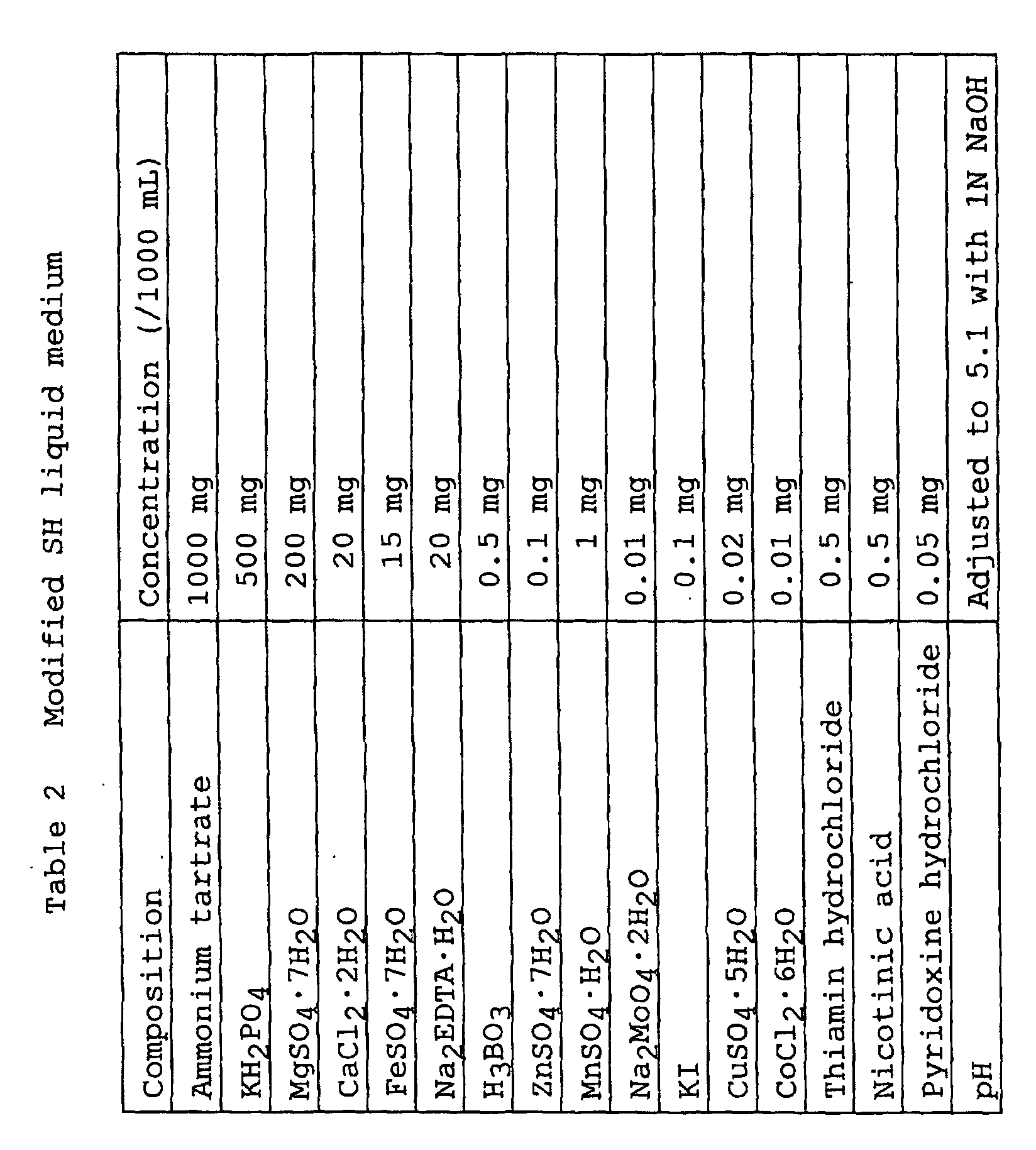
Ohta medium Composition Concentration (/1000 mL) Glucose 10 g Citric acid 1 g Ammonium tartrate 1 g KH2PO4 1 g MgSO4·7H2O 1 g CaCl2·2H2O 50 mg HEPES 7 g Mineral solution 10 ml Vitamin solution 10 ml pH Adjusted to 5.1 with 1N KOH - The grown hyphae were cut in a size of about 2 mm × 2 mm from the agar medium, and they were cultured in fresh liquid Ohta medium for 3 weeks. A colony of the obtained hyphae was homogenized with a homogenizer and re-cultured for 3 days. After the culturing, the resultant hyphae were rinsed three times with a glucose-free liquid medium (a modified SH liquid medium), and suspended in the same glucose-free liquid medium. In this manner, an inoculum of Matsutake hyphae was prepared. The composition of the glucose-free medium is shown below.
- Tween 80 (Polyoxyethylene (20) Sorbitan Monooleate, available from Wako Pure Chemical Industries, Ltd.) was mixed with 99.5% ethanol and stirred for 5 minutes. To the resultant mixture of
Tween 80/ethanol solution, distilled water was added to prepare aTween 80 additive. For example, 1 wt% ofTween 80 additive was prepared by adding 1g of Tween 80 (commercially available) to 2 mL of 99.5% ethanol, followed by adding 98 mL of distilled water. The final concentration of ethanol resulted in about 2 wt%. - Soil was taken from a site under a bush in the campus of the University of Tokyo. The soil was sifted through a sieve to adjust the grain size to 3 mm or less. The soil (uniform in grain size) was dried at 60°C for 24 hours with a dry heat sterilizer.
Tween 80 additive containingTween 80 in amounts of 0 wt%, 1 wt%, 2 wt%, or 5 wt% (prepared in step (2) of Example 1) was added to the soil and mixed well. In the case of the additive containing 0wt% Tween 80, ethanol was added in the same amount as the cases of theTween 80 additives containing 1 wt%, 2 wt%, and 5wt% Tween 80, and ethanol concentration was 2% in eachTween 80 additive. The soil was prepared so as to contain theTween 80 additive in an amount of 20 wt% to the total weight, and then the soil was sterilized in an autoclave at 121°C for 30 minutes. In this manner, the soil for culturing Matsutake hyphae was prepared. - The soil for culturing (prepared in step (3) of Example 1) was put in an amount of 30 mL to a sterile Petri-dish (90 mm diameter). 5 mL of Matsutake hyphae solution (i.e., the inoculum prepared in step (1) of Example 1) was inoculated into the soil in the Petri-dish so as to spread throughout the soil. Thereafter, the Petri-dish was incubated at 25±1°C in the dark. One month after the initiation of the incubation, the amount of ergosterol, which is a component of the cell membrane of Matsutake hyphae, was measured to determine the amount of the hyphae (Martin et al. (1990) Mycol. Res. 94: 1059-1064). The amount of ergosterol indicates the amount of Matsutake hyphae. The measurement of the amount of ergosterol was performed by collecting soil (1g) from each sample, extracting ergosterol therefrom, and quantifying. As the control, soil was taken from a natural Shiro in a Matsutake-producing forest (Ina, Nagano prefecture, October, 2000) and subjected to the same measurement. From the measurement results of ergosterol (FIG. 1), it is found that growth of Matsutake hyphae is significantly enhanced by the addition of
Tween 80. On the other hand, the ergosterol amount in the natural Shiro derived from the Matsutake-producing forest (Ina) was 59.68 µg/g dry soil. - Method of forming an artificial Shiro of Matsutake using natural vegetable oil (olive oil)
- Preparation of an inoculum of Matsutake hyphae was performed in the same manner as described in the step (1) of Example 1, except that Tm2 (stored in the laboratory of the inventors) was used as the Matsutake strain.
- Olive oil (Ajinomoto Co. Inc.) was mixed with 99.5% ethanol, and stirred for 5 minutes. To the resultant mixture of olive oil/ethanol solution, distilled water was added to prepare an olive oil additive. For example, an additive containing 1 wt% olive oil was prepared by mixing 1g of olive oil (commercially available) and 2 mL of 99.5% ethanol, followed by adding 98 mL of distilled water. The final concentration of ethanol resulted in about 2 wt%.
- Preparation of soil for culturing Matsutake hyphae was performed in the same manner as described in the step (3) of Example 1, except that olive oil additive containing olive oil at amounts of 0%, 1%, or 2% (prepared in step (2) of Example 2) was added to the soil for culturing.
- The soil for culturing (prepared in step (3) of Example 2) was put in an amount of 30 mL to a sterile Petri-dish (90 mm diameter). 5 mL of Matsutake hyphae solution (i.e., the inoculum prepared in step (1) of Example 2) was inoculated into the soil in the Petri-dish so as to spread throughout the soil. Thereafter, the Petri-dish was incubated at 25±1°C in the dark. Three months after the initiation of the incubation, the amount of ergosterol, which is a component of the cell membrane of the Matsutake hyphae, was measured to determine the amount of the hyphae (Martin et al. (1990) Mycol. Res. 94: 1059-1064). The measurement of the amount of ergosterol was performed by collecting soil (1g) from each sample, extracting ergosterol therefrom, and quantifying. As the control, soil was taken from a natural Shiro in a Matsutake-producing forest (Ina, Nagano prefecture, October, 2000) and subjected to the same measurement. From the measurement results of ergosterol (FIG. 2), it is found that the growth of Matsutake hyphae is significantly enhanced by the addition of olive oil. On the other hand, the amount of ergosterol in the natural Shiro derived from the Matsutake-producing forest (Ina) was 59.68 µg/g dry soil. The ergosterol amount in the artificial Shiro obtained after 3 month's incubation is increased by the addition of olive oil to a level nearly equivalent to that in the natural Shiro derived from the Matsutake-producing forest.
- At present, artificial cultivation of Matsutake mushrooms has not yet been achieved.
- The advantage of the present invention resides in that the growth of Matsutake hyphae is induced to a satisfactory level by adding an active principle(s), such as a substance capable of controlling the cell membrane permeability of the hyphae and/or a substance capable of enhancing the hydrophilic property of the hyphae, to a culture substrate such as sterile soil or an artificial substrate, without using other nutritional elements. The method of the preset invention is superior in forming the Matsutake Shiro containing the hyphae in an amount equivalent to that of a naturally occurring Shiro in a Matsutake-producing forest, in a short period.
- Direct inoculation of Matsutake hyphae into a natural red pine forest can be performed by using an artificial Shiro induced by the method of the present invention. The method of rapidly forming an artificial Shiro of Matsutake of the present invention becomes a base for establishing a technique of artificial cultivation of Matsutake mushrooms.
Claims (12)
- A method of forming an artificial Shiro of Matsutake characterized by comprising:culturing Matsutake hyphae in a culture substrate containing a substance capable of controlling the cell membrane permeability of the hyphae as an active principle.
- A method of forming an artificial Shiro of Matsutake characterized by comprising:culturing Matsutake hyphae in a culture substrate containing a substance capable of enhancing the hydrophilic property of the hyphae as an active principle.
- A method of forming an artificial Shiro of Matsutake characterized by comprising:culturing Matsutake hyphae in a culture substrate containing a surfactant and/or a natural vegetable oil as an active principle.
- A method of forming an artificial Shiro of Matsutake characterized by comprising:culturing Matsutake hyphae in a culture substrate containing a fatty acid ester as an active principle.
- A method of forming an artificial Shiro of Matsutake, characterized by comprising:inducing growth of Matsutake hyphae by aseptically homogenizing a colony of Matsutake hyphae and aseptically culturing the obtained hyphae in a liquid nutrient medium;preparing an inoculum of Matsutake hyphae by aseptically replacing the liquid nutrient medium containing the growth-induced Matsutake hyphae with a liquid nutrient medium containing no carbon source; andculturing aseptically the inoculum of the Matsutake hyphae in a culture substrate containing a substance capable of controlling the cell membrane permeability of the hyphae as an active principle.
- A method of forming an artificial Shiro of Matsutake, characterized by comprising:inducing growth of Matsutake hyphae by aseptically homogenizing a colony of Matsutake hyphae and aseptically culturing the obtained hyphae in a liquid nutrient medium;preparing an inoculum of Matsutake hyphae by aseptically replacing the liquid nutrient medium containing the growth-induced Matsutake hyphae with a liquid nutrient medium containing no carbon source; andculturing aseptically the inoculum of the Matsutake hyphae in a culture substrate containing a substance capable of enhancing the hydrophilic property of the hyphae as an active principle.
- A method of forming an artificial Shiro of Matsutake, characterized by comprising:inducing growth of Matsutake hyphae by aseptically homogenizing a colony of Matsutake hyphae and aseptically culturing the obtained hyphae in a liquid nutrient medium;preparing an inoculum of Matsutake hyphae by aseptically replacing the liquid nutrient medium containing the growth-induced Matsutake hyphae with a liquid nutrient medium containing no carbon source; andculturing aseptically the inoculum of the Matsutake hyphae in a culture substrate containing a surfactant and/or a natural vegetable oil as an active principle.
- A method of forming an artificial Shiro of Matsutake, characterized by comprising:inducing growth of Matsutake hyphae by aseptically homogenizing a colony of Matsutake hyphae and aseptically culturing the obtained hyphae in a liquid nutrient medium;preparing an inoculum of Matsutake hyphae by aseptically replacing the liquid nutrient medium containing the growth-induced Matsutake hyphae with a liquid nutrient medium containing no carbon source; andculturing aseptically the inoculum of the Matsutake hyphae in a culture substrate containing a fatty acid ester as an active principle.
- The method of forming an artificial Shiro of Matsutake according to any one of claims 1 to 8, characterized in that a solution containing the active principle at the concentration of 0.2 to 10 wt% is used as the active principle.
- The method of forming an artificial Shiro of Matsutake according to any one of claims 1 to 9, characterized in that a solution containing the active principle which is prepared using an organic solvent and distilled water is used as the active principle.
- The method of forming an artificial Shiro of Matsutake according to any one of claims 1 to 10, characterized in that either one of soil having a grain size of 3 mm or less and an artificial substrate having a grain size of 2 mm or less is used as the culture substrate.
- The method of forming an artificial Shiro of Matsutake according to any one of claims 1 to 11, characterized in that the active principle is added to the culture substrate in a state of a solution containing the active principle, and weight ratio of the solution containing the active principle to the total weight is 15 to 30 wt%.
Applications Claiming Priority (2)
| Application Number | Priority Date | Filing Date | Title |
|---|---|---|---|
| JP2001018691 | 2001-01-26 | ||
| JP2001018691A JP3530932B2 (en) | 2001-01-26 | 2001-01-26 | Method for forming artificial white of Matsutake |
Publications (2)
| Publication Number | Publication Date |
|---|---|
| EP1226748A1 true EP1226748A1 (en) | 2002-07-31 |
| EP1226748B1 EP1226748B1 (en) | 2007-01-10 |
Family
ID=18884677
Family Applications (1)
| Application Number | Title | Priority Date | Filing Date |
|---|---|---|---|
| EP02445009A Expired - Lifetime EP1226748B1 (en) | 2001-01-26 | 2002-01-25 | Method of forming an artificial shiro of matsutake |
Country Status (5)
| Country | Link |
|---|---|
| US (1) | US6803226B2 (en) |
| EP (1) | EP1226748B1 (en) |
| JP (1) | JP3530932B2 (en) |
| CN (1) | CN1199554C (en) |
| NZ (1) | NZ516810A (en) |
Cited By (1)
| Publication number | Priority date | Publication date | Assignee | Title |
|---|---|---|---|---|
| WO2006060968A1 (en) * | 2004-12-08 | 2006-06-15 | Instituto Nacional De Ciencias Agrícolas (Inca) | Liquid mycorrhizal inoculant |
Families Citing this family (8)
| Publication number | Priority date | Publication date | Assignee | Title |
|---|---|---|---|---|
| WO2004092334A2 (en) * | 2003-04-09 | 2004-10-28 | Jarrow Formulas, Inc. | Methods of producing edible fungi containing activated folates and nutritional supplements containing activated folates |
| JP2007129904A (en) * | 2005-11-07 | 2007-05-31 | Katsunori Nito | Medium for artificial cultivation of Matsutake fruiting bodies, basic medium or additional liquid medium therefor, and method for artificial cultivation of Matsutake fruiting bodies therewith |
| US20100223843A1 (en) * | 2009-03-03 | 2010-09-09 | Xenon Corporation | Increasing vitamin d content of mushrooms with uv light |
| JP5754684B2 (en) * | 2010-10-08 | 2015-07-29 | 国立大学法人鳥取大学 | Fruit body production technology by inoculating mycelium mycelium |
| CN102477409A (en) * | 2011-09-05 | 2012-05-30 | 周浩 | Culture medium for promoting suspension growth of purple non-sulfur bacteria |
| CN105505786A (en) * | 2015-12-21 | 2016-04-20 | 宋瑞鹏 | Culture method for tricholoma matsutake liquid strain |
| CN105918743A (en) * | 2016-04-21 | 2016-09-07 | 张晓芬 | Sugarfree inonotuso bliquus(Fr )Pilat health-care beverage and making method thereof |
| WO2018088874A1 (en) * | 2016-11-14 | 2018-05-17 | 주식회사 파이안바이오테크놀로지 | Method for delivering exogenous mitochondria into cells |
Citations (5)
| Publication number | Priority date | Publication date | Assignee | Title |
|---|---|---|---|---|
| JPS55118389A (en) * | 1978-12-27 | 1980-09-11 | Takeda Chem Ind Ltd | Incubation of mycorrhiza-forming fungi |
| JPH01101880A (en) * | 1987-10-14 | 1989-04-19 | Seiichi Murata | Rockwool cultivation of 'matsutake' mushroom |
| JPH0220283A (en) * | 1988-07-08 | 1990-01-23 | Kibun Kk | Method for increasing fragrant component of matsutake mushroom |
| JPH05211819A (en) * | 1992-01-31 | 1993-08-24 | Mizushi Fujimoto | Culture medium for mushrooms forming mycorrhiza |
| JPH07135847A (en) * | 1993-11-17 | 1995-05-30 | Mizushi Fujimoto | Additives for mycorrhizal fungal medium |
Family Cites Families (9)
| Publication number | Priority date | Publication date | Assignee | Title |
|---|---|---|---|---|
| JPS503840A (en) | 1973-05-08 | 1975-01-16 | ||
| JPS54111449A (en) | 1978-02-14 | 1979-08-31 | Nippon Beet Sugar Mfg | Culture of *maitake* mushroom |
| JPS54117747A (en) | 1978-03-03 | 1979-09-12 | Oriza Yuka Kk | Preparation of mushroom culture medium |
| US4420319A (en) * | 1981-08-09 | 1983-12-13 | Spawn Mate, Inc. | Mushroom growth enhancers and method for preparing same |
| US4421543A (en) * | 1981-04-06 | 1983-12-20 | Spawn Mate, Inc. | Nutrient for mushroom growth process for producing same |
| JPS5856677A (en) | 1981-09-28 | 1983-04-04 | Masao Wakabayashi | Cultivation of seed fungus of mushroom |
| US4776872A (en) * | 1985-09-30 | 1988-10-11 | Monterey Mushrooms, Inc. | Method and composition for enhancing mushroom growth |
| JPS6368027A (en) | 1986-09-10 | 1988-03-26 | 明治製菓株式会社 | Medium for mushrooms |
| JPH09252648A (en) | 1996-03-19 | 1997-09-30 | Toyo Kinoko Kenkyusho:Kk | Spawn culture method and cultivation method for matsutake mashroom |
-
2001
- 2001-01-26 JP JP2001018691A patent/JP3530932B2/en not_active Expired - Lifetime
-
2002
- 2002-01-24 US US10/053,549 patent/US6803226B2/en not_active Expired - Fee Related
- 2002-01-24 NZ NZ516810A patent/NZ516810A/en not_active IP Right Cessation
- 2002-01-25 CN CNB021028532A patent/CN1199554C/en not_active Expired - Fee Related
- 2002-01-25 EP EP02445009A patent/EP1226748B1/en not_active Expired - Lifetime
Patent Citations (5)
| Publication number | Priority date | Publication date | Assignee | Title |
|---|---|---|---|---|
| JPS55118389A (en) * | 1978-12-27 | 1980-09-11 | Takeda Chem Ind Ltd | Incubation of mycorrhiza-forming fungi |
| JPH01101880A (en) * | 1987-10-14 | 1989-04-19 | Seiichi Murata | Rockwool cultivation of 'matsutake' mushroom |
| JPH0220283A (en) * | 1988-07-08 | 1990-01-23 | Kibun Kk | Method for increasing fragrant component of matsutake mushroom |
| JPH05211819A (en) * | 1992-01-31 | 1993-08-24 | Mizushi Fujimoto | Culture medium for mushrooms forming mycorrhiza |
| JPH07135847A (en) * | 1993-11-17 | 1995-05-30 | Mizushi Fujimoto | Additives for mycorrhizal fungal medium |
Non-Patent Citations (5)
| Title |
|---|
| PATENT ABSTRACTS OF JAPAN vol. 004, no. 178 (C - 034) 10 December 1980 (1980-12-10) * |
| PATENT ABSTRACTS OF JAPAN vol. 013, no. 315 (C - 619) 18 July 1989 (1989-07-18) * |
| PATENT ABSTRACTS OF JAPAN vol. 014, no. 149 (C - 0705) 22 March 1990 (1990-03-22) * |
| PATENT ABSTRACTS OF JAPAN vol. 017, no. 655 (C - 1136) 6 December 1993 (1993-12-06) * |
| PATENT ABSTRACTS OF JAPAN vol. 1995, no. 08 29 September 1995 (1995-09-29) * |
Cited By (1)
| Publication number | Priority date | Publication date | Assignee | Title |
|---|---|---|---|---|
| WO2006060968A1 (en) * | 2004-12-08 | 2006-06-15 | Instituto Nacional De Ciencias Agrícolas (Inca) | Liquid mycorrhizal inoculant |
Also Published As
| Publication number | Publication date |
|---|---|
| NZ516810A (en) | 2002-12-20 |
| JP3530932B2 (en) | 2004-05-24 |
| US6803226B2 (en) | 2004-10-12 |
| US20020142450A1 (en) | 2002-10-03 |
| EP1226748B1 (en) | 2007-01-10 |
| JP2002218843A (en) | 2002-08-06 |
| CN1366804A (en) | 2002-09-04 |
| CN1199554C (en) | 2005-05-04 |
Similar Documents
| Publication | Publication Date | Title |
|---|---|---|
| KR101035898B1 (en) | Shiitake mushroom shiitake JNA01 | |
| CN105103947B (en) | The application method for the special bacterium source that exotrophic mycorrhiza synthesizes under a kind of wildwood | |
| US6803226B2 (en) | Method of forming an artificial Shiro of Matsutake | |
| CN115039638A (en) | Ganoderma resinatum strain H63 and application thereof | |
| Guerin-Laguette et al. | Growth stimulation of a Shiro-like, mycorrhiza forming, mycelium of Tricholoma matsutake on solid substrates by non-ionic surfactants or vegetable oil | |
| JP2012080811A (en) | Production technique of fruiting body by inoculation of truffle cultured mycelium | |
| CN102845218A (en) | Original ecological separation method of cordyceps sinensis hirsutella sinensis | |
| KR102947195B1 (en) | Massive culturing method of isotropic ball-shaped mycelium having shortened culture period | |
| CN108076962B (en) | A kind of artificial cultivation method of dry fungus | |
| CN109220514B (en) | Isolation of a new wild edible fungus and its artificial domestication and cultivation method | |
| KR102754232B1 (en) | Method for Producing Fermented Feed for Insects Using Mycelium with Highly Concentrated Nutrition | |
| KR101905677B1 (en) | Organic liquid fertilizer for promoting growth of Gastrodia elata | |
| JP3263730B2 (en) | Rapid artificial synthesis of matsutake mycorrhiza | |
| KR102923935B1 (en) | Fabrication method of alternative leather using mushroom mycelium | |
| CN1287660C (en) | In vitro screening method of jiegua (Banincasa hispida variant) anti-blight varient | |
| JP3355151B2 (en) | Mushroom bed for larva breeding of stag beetle | |
| CN115104478B (en) | A field cultivation method for royal cluster fungus | |
| CN112586270A (en) | Lucid ganoderma double-film bag-clamping cultivation method | |
| CN117467585B (en) | An isolated soil bacterium that promotes the occurrence of Morchella primordium and ascocarp and its application | |
| KR20260028313A (en) | Massive culturing method of ectomycorrhizal fungi mycelium using biodegradable mycelium root inducing matrix | |
| JPH06233627A (en) | Method for artificial mass cultivation of cordyceps sinensis sacc. of imperfect state and perfect stage | |
| CN1442480A (en) | Method of cultivating wild rare edible fungus using fusion technology to domesticate | |
| Douglas et al. | Subterranean aspects of rhododendrons: their mycorrhizal roots | |
| JP3517841B2 (en) | Aqueous solution containing Agaricus blazeimril, culture medium for mushrooms using the same, and method for cultivating mushrooms | |
| US7074609B2 (en) | Clavaria fungus |
Legal Events
| Date | Code | Title | Description |
|---|---|---|---|
| PUAI | Public reference made under article 153(3) epc to a published international application that has entered the european phase |
Free format text: ORIGINAL CODE: 0009012 |
|
| AK | Designated contracting states |
Kind code of ref document: A1 Designated state(s): AT BE CH CY DE DK ES FI FR GB GR IE IT LI LU MC NL PT SE TR |
|
| AX | Request for extension of the european patent |
Free format text: AL;LT;LV;MK;RO;SI |
|
| 17P | Request for examination filed |
Effective date: 20021209 |
|
| AKX | Designation fees paid |
Designated state(s): SE |
|
| REG | Reference to a national code |
Ref country code: DE Ref legal event code: 8566 |
|
| 17Q | First examination report despatched |
Effective date: 20050630 |
|
| GRAP | Despatch of communication of intention to grant a patent |
Free format text: ORIGINAL CODE: EPIDOSNIGR1 |
|
| GRAS | Grant fee paid |
Free format text: ORIGINAL CODE: EPIDOSNIGR3 |
|
| GRAA | (expected) grant |
Free format text: ORIGINAL CODE: 0009210 |
|
| AK | Designated contracting states |
Kind code of ref document: B1 Designated state(s): SE |
|
| REG | Reference to a national code |
Ref country code: SE Ref legal event code: TRGR |
|
| PLBE | No opposition filed within time limit |
Free format text: ORIGINAL CODE: 0009261 |
|
| STAA | Information on the status of an ep patent application or granted ep patent |
Free format text: STATUS: NO OPPOSITION FILED WITHIN TIME LIMIT |
|
| 26N | No opposition filed |
Effective date: 20071011 |
|
| PGFP | Annual fee paid to national office [announced via postgrant information from national office to epo] |
Ref country code: SE Payment date: 20120116 Year of fee payment: 11 |
|
| REG | Reference to a national code |
Ref country code: SE Ref legal event code: EUG |
|
| PG25 | Lapsed in a contracting state [announced via postgrant information from national office to epo] |
Ref country code: SE Free format text: LAPSE BECAUSE OF NON-PAYMENT OF DUE FEES Effective date: 20130126 |