-
This invention relates to a mowing machine, such as, for
instance, a grass-cutter comprising a combustion engine and a
mowing means drivable by this engine. In this patent
application the matter is more particularly about a mowing
machine of which the sound produced by its engine is muffled.
-
This invention relates more particularly to a mowing machine
with a combustion engine whose engine and/or exhaust are at
least partly surrounded by a sound deadening wall.
-
In this patent application, the term mowing machine applies,
among others, to grass cutters irrespective of type, operating
principle, capacity or size. Not only the traditional grass
cutters, but also the so-called self-propelled mowers provided
with a seat for the operator are included. Besides, the term
mowing machines refers likewise to other machines, devices or
tools meant to remove at least part of the overgrowth or
vegetation, such as among others mowing machines for woods or
agricultural or farming machines.
-
The term mowing means is used in this context in the sense of
any element intended to cause, by its movement, the said
removal of (a part of) the overgrowth or vegetation. In doing
so, the mowing means may operate by any principle and may
have, for instance, a cutting or chopping action. In the known
traditional grass cutters the mowing means is generally a
rotatable knife.
-
Machines with a combustion engine have the great disadvantage
that the combustion engine produces rather much noise when
operating. Particularly as far as machines are concerned which
are used in more or less the same place during a long period,
such as, for instance, grass cutters or mowing machines for
woods and similar machines, the constant engine noise can be
very disturbing for people in the vicinity. Moreover, machines
or devices for the maintenance of gardens, such as lawn
mowers, are used in the open air and often also in densely
populated neighbourhoods at times when most people living in
the neighbourhood are at home. This noise pollution can
therefore be very disturbing for a great number of people.
-
It is known to reduce noise pollution by using walls of a
sound deadening material. Where combustion engines are the
sound source an efficient sound deadening wall should surround
both engine and exhaust, but then there is the problem that
the temperature in the enclosed space will rise too high,
whereas moreover the sound deadening wall acts as a thermal
insulating wall. Applying known cooling systems in order to
solve this problem would make the machine too expensive and/or
complicated. Additional disadvantages of these cooling systems
are their energy consumption and/or the space they require.
-
One purpose of the invention is to provide a mowing machine
with a combustion engine causing notably less noise pollution
than the known machines and which moreover can be carried out
in a simple, compact and cheap manner. An additional purpose
consists in taking care that the sound deadening measures will
increase engine fuel consumption only to a very small extent.
-
These aims will be obtained with a mowing machine comprising a
combustion engine, a mowing means drivable by this engine, and
a wall provided opposite this mowing means, whereas the
machine according to this invention is provided to let the
exhaust gases escape on the side of said wall where the mowing
means is situated.
-
In most mowing machines the mowing means is surrounded on one
or several sides by a covering or shielding hood or a covering
or shielding plate, most of the time for the sake of safety.
For the mowing means, which can be very dangerous during its
movement, is situated within a well shielded space. Most of
the time, this space is confined on top and on one or several
sides.
-
A great deal of the noise caused by the operation of a
combustion engine is evacuated via the exhaust. In letting
escape the exhaust gases on the side of the wall where the
mowing means is situated, the sound waves arrive in a more or
less surrounded space. Moreover, during normal use of the
mowing machine, this space is confined at the bottom by an
overgrowth or ground or soil (with a grass cutter this is the
ground covered with grass). In this space, the intensity of
the noise will strongly decrease, by repeated reverberations
of the sound waves against the surfaces confining this space
(the wall of the machine and the overgrowth or the soil) on
the one hand, and because a strong absorption of the sound may
occur in the ground.
-
In a very simple embodiment according to this invention,
connecting the exhaust of the engine to the space, in which
the mowing means is situated, by means of a pipe or duct will
suffice. This can be a rather short piece of pipe, so that the
invention can be realized in a very simple and cheap manner.
Because the exhaust gases being are diverted only over a short
distance, there will be hardly any additional fuel consumption
of the engine.
-
In a preferred embodiment, said wall is constituted by a
shielding element situated opposite the mowing means, and the
machine is provided to let the exhaust gases escape into the
operating space of the mowing means confined by this shielding
element.
-
When the mowing machine is provided to mow the overgrowth or
vegetation growing on a ground or soil, the exhaust gases are
preferably conducted to escape in the direction of the soil or
ground when the mowing machine is used as intended. Because of
this a good sound absorption is obtained in the soil or ground
and/or in the overgrowth on it.
-
When the machine is provided to make its exhaust gases escape
in a direction more or less perpendicular with said ground or
soil the sound absorption wall be optimal.
-
Preferably, there are at least two exhaust openings for the
exhaust gases, ending on the side of said wall, where the
mowing means is situated. These exhaust openings end, for
instance, in the operating space of the mowing means confined
by a shielding plate. This may occur, if required, via a
number of ducts, which are connected to a central receiving
space for exhaust gases, but of course also directly by means
of an engine exhaust with several outlets.
-
In the wall provided opposite the mowing means or the said
shielding element, at least one opening is provided for the
supply of exhaust gases, to which a pipe or duct connected to
the engine exhaust is connected. This embodiment can be
realized in a particular simple, quick and cheap manner.
-
In order to realize an additional sound deadening and to
obtain a very noiseless mowing machine the engine and/or the
exhaust can be installed in a space which is at least partly
surrounded by a sound deadening wall.
-
In order to avoid that the temperature in the space surrounded
by the sound absorbing wall becomes too high it is better to
provide a cooling system, intended to take in air and to bring
it into that space.
-
It is likewise a purpose of this invention to provide a mowing
machine with a combustion engine and a cooling system, the
cooling system of which is simple, compact and cheap and
causing only a small increase of the engine fuel consumption.
-
This aim is obtained when the mowing machine comprises a
combustion engine and a cooling system provided to take in air
and to conduct it to one or more parts or spaces to be cooled,
whereas this device comprises at least one intake body which
is rotatable in order to take in the air and which is
installed in such a manner that it can be rotated by the flow
of exhaust gases originating from the combustion engine or by
an air flow caused by this flow of exhaust gases.
-
By using a flow of exhaust gases, or an air flow caused by it,
as driving means for the intake body, this cooling device is
particularly energy saving. Moreover, it can be realized in a
simple, compact and relatively cheap embodiment. An air flow
caused by the flow of exhaust gases can also be itself a flow
of cooling air, which is obtained with the help of an intake
body which, according to this invention, is rotated by the
exhaust gases. Taking in the cooling air by means of another
air flow has the advantage that a construction is possible
where the exhaust gases cannot pollute this cooling air.
-
Also a mowing machine with a combustion engine where the
exhaust gases are not discharged on the side of the wall
(shielding hood) where the mowing means is situated can be
equipped with such a cooling system to be realized in a simple
manner. A noiseless mowing machine can also be realized only
by installing a sound deadening hood, preferably in
combination with the cooling system described above, without
having the exhaust gases discharged on the side of the wall
(shielding hood) where the mowing means is situated.
-
Preferably this cooling system is carried out in such a manner
that it comprises one or several intake ducts for taking in
air and an exhaust duct to discharge the exhaust gases,
whereas the intake body comprises at least one surface
rotating around a shaft, which alternately is brought into the
intake duct and into the exhaust duct, via a connecting
opening which connects the two parts of these ducts, running
one beside the other.
-
The air taken in may be used for cooling the exhaust gases
and/or cooling the exhaust duct and/or cooling the engine.
-
The said intake body comprises, for instance, a surface
rotatable around a shaft, which, by said rotation, is brought
alternately into the intake duct and into the exhaust duct via
a connecting opening connecting parts of these pipes running
one beside the other.
-
A similar intake body can, for instance, be carried out in a
very simple manner as a blade wheel rotatably installed or as
a number of surfaces radially protruding rotatably together
around a common shaft. In the exhaust duct, the rotatable
surfaces are moved forward by the flow of exhaust gases, so
that the intake body is driven. Because of this the surfaces
in the intake duct are also moved as a result of which an
intake effect is produced and consequently air is taken in. An
additional advantage of such an intake element is that the
intensity of the sound waves in the ducts is reduced, because
the sound waves reverberate against the rotating surfaces.
-
Preferably the sound deadening wall consists of at least two
layers of sound deadening material, whereas between each two
successive layers of sound deadening material a respective
intermediate space is provided. A similar wall provides an
excellent sound deadening.
-
In order to deaden the sound in an efficient manner the engine
device is carried out such, that the exhaust duct of the
combustion engine ends in an intermediate space between two
successive layers of sound deadening material.
-
In the most preferred embodiment of the engine device
according to this invention the sound deadening wall comprises
an inner layer, a middle layer and an outer layer of sound
deadening material, whereas the exhaust duct of the combustion
engine ends in the intermediate space between the inner layer
and the middle layer, and the intake duct is provided to take
in air from the intermediate space between the middle layer
and the outer layer.
-
So, taking in air occurs in a space which is well separated
from the space in which the exhaust gases end up. Furthermore,
the outer layer of sound deadening material acts as a filter
for the intake duct, as a result of which dirt flying about is
prevented from entering the cooling duct.
-
After the exhaust gases have pushed on operating in
conjunction with the intake body and/or in the said
intermediate space between two layers of sound deadening
material, they are discharged - according to this invention -
on the side of the shielding plate, where the mowing means is
situated.
-
In a particular embodiment the mowing machine is provided with
a rotatable mowing means and the cooling system is provided
with conducting means to conduct the exhaust gases flowing
out, to the mowing means in a flowing direction corresponding
with the sense of rotation of the cutting means.
-
As a result of which, the rotating parts of the mowing means
are surrounded by a flow of a mixture of exhaust gases and air
moving in the same direction. Consequently these rotating
parts meet with less resistance. This may cause an additional
sound deadening.By the combination of these sound deadening
measures, a particularly noiseless mowing machine is obtained.
-
In the following detailed description of a number of examples
of embodiments of this invention, the characteristics and
advantages of the invention are further explained and the
additional characteristics and advantages are indicated. The
intention of this description is only to explain the general
principles of this invention and therefore may never be
interpreted as a limitation of the field of application of the
invention or of the patent rights claimed in the claims.
-
In this description reference is made to the attached figures
1 to 9 by means of reference numbers, of which
- the figures 1 and 2 respectively represent an upper view
and a side view of a part of a grass cutter with a combustion
engine according to this invention, the exhaust gases of
which are discharged under the shielding hood next to the
rotating knife,
- figure 3 represent in a schematic manner a horizontal
cross section of a part of an engine with cooling system
according to this invention,
- figure 4 represents a schematic side view of a part of
the cooling system of figure 3,
- the figures 5 and 6 respectively represent a vertical
cross section and a horizontal cross section of an upper part
of a grass cutter with sound deadening hoods according to
this invention,
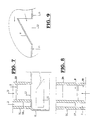
- the figures 7 and 8 respectively represent a vertical and
a horizontal cross section of a part of the grass cutter
represented in the figures 5 and 6, and
- figure 9 is a vertical cross section in the plane
coinciding with the direction of the flow of exhaust gases in
the intermediate space between the inner hood and the middle
hood of this grass cutter.
-
The grass cutter represented in the figures 1 and 2 comprises
a rotatable knife (12) above which a shielding hood (16) in
metal or synthetic material is provided. This shielding hood
(16) is made from plate-shaped material and comprises a flat
rectangular part, which extends above the knife (12) and
which, over its entire circumference changes into a flank
extending downwards. In this manner this shielding hood (16)
confines the operating space (18) of the knife (12) on top and
on the sides.
-
Furthermore, this grass cutter comprises a combustion engine
(1) with an engine exhaust or muffler (14) to which an exhaust
pipe (17) is connected. These parts are provided above the
said shielding hood (16).
-
In the horizontal part of the shielding hood (16) an opening
has been provided. The extremity of the exhaust pipe (17) is
attached with the exhaust opening opposite the opening in the
shielding hood (16). This can be done, for instance, by means
of a flange which is attached to the shielding hood (16) by
means of a little fastening plate.
-
Via the exhaust pipe (17) and the opening in the shielding
hood (16), the exhaust gases end up in the space (18) under
the shielding hood (16). The direction of the outflow of these
exhaust gases is perpendicular to the plane of rotation of the
knife (12) and therefore also perpendicular to the ground
surface covered with grass, during the time the grass cutter
is used. Because of this a good sound absorption is obtained
in the ground.
-
According to an alternative embodiment a pipe (19) is attached
to the underside of the rectangular part of the shielding hood
(16), which consists of four straight parts connected together
forming a rectangle, so that they constitute a circuit. This
pipe (19) (indicated in figure 2 by means of a dot and dash
line) is connected to the exhaust pipe (17) via the said
opening in the shielding hood (16). On each side of the
rectangle this pipe (19) has an exhaust opening (20) for the
exhaust gases. In this embodiment also, the exhaust openings
are at right angles to the ground surface when using the grass
cutter.
-
An existing grass cutter can be transformed into a grass
cutter according to the invention with very little means and
in a very simple and cheap manner.
-
Only an opening to be provided in the shielding hood (16) is
needed and a pipe connected to the engine exhaust on the one
hand and attached to the shielding hood (16) on the other hand
in such a way that the exhaust gases are conducted to the
space (18) in which the knife (12) is situated via the opening
in the shielding hood (16).
-
The piping system conducting the exhaust gases to the
operating space (18) of the knife (12) may consist of any
material. By this piping system the sound leaving the engine
device via the exhaust, is conducted under the shielding hood
(16). Because this sound is absorbed by the lawn to be mowed
and by the ground underneath and which is repeatedly reflected
on the shielding hood, a deadening of this sound is obtained.
Because of this it is possible that the rotating parts of the
knife will experience very little resistance, but at the same
time they will further the absorption of the sound. The
contact with the rotating knives (the mowing means in general)
also will cause a small additional deadening of the sound.
-
The exhaust pipe (17) can have several branches (see figure
2), so that several exhaust openings for the exhaust gases can
be obtained. The number of openings and their positions in the
shielding hood (16) is determined in function of the
construction of the mowing machine and of the sound deadening
desired.
-
A mowing machine according to this invention, carried out
differently, is provided with a sound deadening hood (9)
surrounding the engine (1) and/or the exhaust at least partly,
and comprises a cooling system to cool the space (2) inside
this hood (9) sufficiently (see figures 3 to 9). This mowing
machine has a combustion engine (1) with a muffler (14) to
which an exhaust pipe (5) is connected. A pipe (4) to take in
cooling air runs along the exhaust pipe (5). Both the exhaust
pipe (5) and the pipe for the cooling air (4) have a square or
rectangular section. In three different places an opening has
been provided in the adjoining walls of the two ducts (4),(5)
connecting both ducts with each other. In each opening there
is a multiple valve (3) with a number of radially directed
wings (7) rotatable around a thin shaft (6). The thin shaft
(6) is situated in the plane of the opening between these two
ducts (4),(5). Each valve (3) has two, three or four radial
wings (7) and is, as a whole, rotatable around its shaft (6).
The flow of exhaust gases (see arrow from right to left in the
exhaust pipe (5) in figure 1) causes the anti-clockwise
rotating movement of the valves (3). Each time a wing (7)
moves in the cooling air pipe (4) it causes a suction effect
in that pipe (4), because of which cooling air is taken in
(from left to right in figure 3: see arrow in the cooling air
pipe (4)). Because of the rotating wings (7) the sound waves
in the exhaust pipe (5) are also broken and the sound waves in
the cooling air pipe (4) are hit towards the exhaust pipe (5)
via the opening between the two ducts (4),(5). Also note that
possible sound waves in the cooling air pipe move from right
to left (see figure 5) away from the engine, and therefore
will move against the flow of cooling air, so that in doing so
they are up against a strong resistance. Because of this an
additional deadening of the sound is obtained. The cooling air
is blown into the space (2) where the engine is situated
and/or into the space (10) provided in which the exhaust pipe
(5) ends (see further on).
-
A grass cutter with sound deadening hoods according to the
present invention (see figures 5 and 6) comprises a shielding
hood (16) with a horizontal plate on which a petrol engine (1)
with a muffler (14) is installed. The shaft (15) of the engine
(1) extends via a passage in this plate of the shielding hood
(16) below this plate where it is connected to a horizontal
body extending symmetrically with respect to the shaft (15)
and carrying a respective knife (12) on both extremities.
A set of three hoods (9A), (9B), (9C) with intermediate spaces
(2), (10), (11) is provided on the plate (16), so that the
combustion engine (1) and the muffler (14) are situated in a
central space (2) which sideways and on top is confined by the
inner hood (9A). The middle hood (9B) surrounds the inner hood
(9A) sideways and at the top and the outer hood (9C) surrounds
the middle hood sideways and at the top. Between the
successive hoods an intermediate space (10), (11) is provided
each time. The horizontal plate of the shielding hood (16)
confines all spaces (2), (10), (11) at the bottom. The exhaust
pipe (5) runs through an opening in the inner hood (9A) into
the space (10) between the inner hood (9A) and the middle hood
(9B), extends in this space according to the sense of rotation
of the knives (12) and ends in this space (10). In this space
the exhaust gases are therefore ejected clockwise. This is
also the sense of rotation of the knives (12).
-
Each hood (9A), (9B), (9C) is carried out separately, but two
or three hoods together may form a whole. The hoods may also
consist of two or several parts which are easily detachable in
order the get access to the confined spaces (2), (10), (11).
Known sound deadening materials are, for instance, glass wool
and rock wool or other fibrous structures, but it is an
understood thing that all sound shielding, sound insulating or
sound absorbing materials are suitable materials for
manufacturing the hoods (9A), (9B), (9C). Also materials which
are not commercialized as such, such as for instance synthetic
materials, may have a sound deadening effect and can be used
in this invention with good results. Therefore the term "sound
deadening" in the sense of this patent application aims at the
effect of the material used and not, or not only, at the
principal characteristic of the material used. Therefore the
invention can be realized with one or several hoods made from
all possible materials.
-
In four different places spread over the circumference of this
exhaust space (10), the horizontal plate of the shielding hood
(16) has rectangular openings (13) which are formed because
rectangular parts (8) of this plate have been cut out on three
sides, and while remaining connected to the plate with one
side, are sloping upwards against the direction of the flow of
the exhaust gases (see also figures 7, 8 and 9). Each opening
(13) lets through a part of the exhaust gases above the
sloping parts of the plate and catches a portion of the
exhaust gases, so that they reach the knives (12) with an
anti-clockwise direction of the flow, corresponding with the
sense of rotation of the knives (12).
-
In the exhaust space three cooling air pipes (4) are provided,
which extend beside the exhaust pipe (5) and, as described
above, are provided with multiple valves (3) which can rotate
in both pipes (4), (5) via openings (which connect the exhaust
pipe (5) with the cooling air pipe (4). The cooling air pipes
(4) have their intake opening in an opening in the middle hood
(9B). Therefore the cooling air originates from the space (11)
between the middle hood (9B) and the outer hood (9C). The
cooling air pipe (4) represented at the bottom of figure 6
brings cooling air into the central space (2) in which the
engine (1) and the muffler (14) are installed. The two other
cooling air pipes (4) bend down and end in the exhaust space
(10) in order to cool this space (10) also. The cooling air
circulates in this space (10) and will also cool down the
exhaust pipe (5) installed in this space.
-
Via the opening in which a valve (3) rotates in the exhaust
pipe (5) and the cooling air pipe (4), exhaust gases might
enter the cooling air pipe (4) and thus be conducted to the
central engine space (2), causing ignition problems. In order
to avoid this, all said cooling air pipe (4) are made to end
in the exhaust space (10) and an additional cooling air pipe
(not represented in the figure) is provided next to the first
cooling air pipe (4). In an opening connecting the first
cooling air pipe (4) to the additional cooling air pipe, a
multiple valve (3) is provided as described above. This valve
(3) is installed before the valve (3) between the first
cooling air pipe (4) and the exhaust pipe (5) seen in the
direction of the flow in this first cooling air pipe (4) and
can be rotated by fresh air flowing in the first cooling air
pipe (4). Because of this, cooling air is also taken in via
the additional cooling air pipe. This cooling air is not
polluted and can be conducted to the central engine space
without any risk.
-
Of course, it can be necessary to adapt the form of the hoods
to certain parts of the grass cutter. Thus, the grass
collecting bin and the passage ending in this collecting bin
require a specific design. Openings might be provided through
the hoods, for instance to allow the throttle lever to pass
through or to give access to an oil gauge or oil tank.
-
Preferably, the petrol tank is installed outside the hoods.
-
This grass cutter is simple and particularly noiseless because
of the combination of letting the exhaust gases escape under
the shielding hood (16) on the one hand, and to provide for a
sound deadening hood (9) with the simple and the energy
economical cooling system on the other hand. However, each of
these measures can be applied separately and result in a
considerable limitation of the sound level.