EP1222795B1 - Benutzerschnittstelle mit sprachlichen aufforderungen und binären sensoren für ein unterhaltungselektronikgerät - Google Patents
Benutzerschnittstelle mit sprachlichen aufforderungen und binären sensoren für ein unterhaltungselektronikgerät Download PDFInfo
- Publication number
- EP1222795B1 EP1222795B1 EP00967471A EP00967471A EP1222795B1 EP 1222795 B1 EP1222795 B1 EP 1222795B1 EP 00967471 A EP00967471 A EP 00967471A EP 00967471 A EP00967471 A EP 00967471A EP 1222795 B1 EP1222795 B1 EP 1222795B1
- Authority
- EP
- European Patent Office
- Prior art keywords
- user
- companion
- telecommunicator
- processor
- series
- Prior art date
- Legal status (The legal status is an assumption and is not a legal conclusion. Google has not performed a legal analysis and makes no representation as to the accuracy of the status listed.)
- Expired - Lifetime
Links
Images




Classifications
-
- H—ELECTRICITY
- H04—ELECTRIC COMMUNICATION TECHNIQUE
- H04M—TELEPHONIC COMMUNICATION
- H04M1/00—Substation equipment, e.g. for use by subscribers
- H04M1/72—Mobile telephones; Cordless telephones, i.e. devices for establishing wireless links to base stations without route selection
- H04M1/724—User interfaces specially adapted for cordless or mobile telephones
- H04M1/72475—User interfaces specially adapted for cordless or mobile telephones specially adapted for disabled users
-
- A—HUMAN NECESSITIES
- A63—SPORTS; GAMES; AMUSEMENTS
- A63H—TOYS, e.g. TOPS, DOLLS, HOOPS OR BUILDING BLOCKS
- A63H2200/00—Computerized interactive toys, e.g. dolls
-
- H—ELECTRICITY
- H04—ELECTRIC COMMUNICATION TECHNIQUE
- H04M—TELEPHONIC COMMUNICATION
- H04M2250/00—Details of telephonic subscriber devices
- H04M2250/56—Details of telephonic subscriber devices including a user help function
Definitions
- This invention relates to a user interface method for personal communication devices that operates using audio prompts, simple binary state sensors and timing circuitry.
- the user interface guides the user through option menus and the selection process.
- This invention has been designed to solve problems presented by conventional user interfaces in consumer electronic products. It relates to a process and the configuration of apparatus that can accurately and automatically interpret the user's desired selection without the requirement that the user be able to read.
- One aspect of the interface of the present invention resides in its ease of use, especially for children, for illiterate people and people less technically able.
- the device can be embedded inside almost any product but the preferred embodiment is directed to telecommunication devices such as cell phones embedded in a product, without affecting the external aesthetics of the product.
- Applicant is aware of prior art within the field of user interfaces for consumer electronic products, for example interfaces employing voice recognition, graphic touch panels, and intelligent keypads.
- Such prior art user interfaces for consumer electronic products consist of a broad range of technology mixes.
- the current trend is to use a more organic style of interface such as voice recognition or graphical interfaces rather than arrays of mechanical buttons.
- Some devices attempt to guess a user's most probable decisions, making navigating complex decision trees more tolerable.
- the present invention is derived out of necessity for an easy-to-use interface that may be embedded in a plush toy and operate without a keypad or display, which would detract from the aesthetics of the plush design of such a toy.
- voice recognition is a viable contender for the desired application of the present invention in that voice recognition does not alter the external aesthetics of a product in which the device is embedded.
- the current limitations of voice recognition technology make it less well suited for the design of the present invention unless used only as a binary state device as better described below.
- U.S. Patent No. 5,746,602 describes an interactive system for teaching, entertaining and habituating a child and utilises an interactive entity such as a doll.
- the doll has a microphone and speaker and controlled circuitry mounted therein and is connected to a personal computer by a bidirectional communication link.
- the doll can be connected to a remote location by using a modem in the computer to create a telecommunication link.
- scripted data stored in the computer directs doll activity in verbal articulation, and utilises a response from the user, through the doll to the computer, in directing output to the doll.
- the system relies on software to convert a verbal response from the user, through the microphone in the doll, into an appropriate command, which is utilised by the computer to output further information from its data store to the speaker in the doll.
- Such a system necessarily requires a bidirectional link between the doll and the computer and is limited to a quasi classroom type situation.
- U.S. Patent No. 5,345,226 describes an environmental control system for the handicapped, which provides a user interface, which is totally integrated and programmable.
- An audible nested control option selection structure organises logically related tasks and sub-tasks in a natural fashion.
- the user interacts with the system through an input device, which will accept only a single input.
- the user decides between three choices when making this single input. For example, the user inputs the chosen option by positioning a joystick in one of three positions, a left-position-on position, a center off position, or a right-position-on position.
- One object of this invention is to provide an alternative method of operating complex electronic equipment such as cellular or wireless telephones or other personal communication devices, wherein audio prompts guide the user through options, and the user responds with a timely action to accept or reject the specific option presented during a corresponding time window.
- complex electronic equipment such as cellular or wireless telephones or other personal communication devices
- the user of a telecommunication device is presented with an action, an option or a series of options via audio messages.
- the user indicates acceptance or rejection of an option with a timely action, such as pressing a button disguised within a product such as a plush doll.
- the timely action must occur during the time window in which the audio message implicitly or explicitly indicates the intention to accept or reject an option. Otherwise, the interface indicates the default selection to the device.
- the interface is thus well adapted for use by a child, or for example by a visually impaired person, or even merely for use by people who are driving automobiles and should not be taking their eyes from the road ahead.
- the invention is thus, in one aspect, a process of navigating menus or selecting actions or options.
- the process utilises a sensor system configured to behave as a binary state switch along with an audio presentation and feedback system. These two elements are synchronised to permit correlation analysis of signals, which yields information or signals that indicate the user's selected option or desired action.
- the novelty lies, at least in part, in the ability of a binary device, such as a push button, to select one of multiple options by indicating the option as desired or undesired as they are presented through time via speech. Acceptance or rejection is indicated by the presence of one or the other of the two possible binary states during the corresponding time window.
- a binary device such as a push button
- the binary state switch could be a push button switch, a microphone with audio detection processing, a motion sensor, a light detector, a rotary encoder, voice recognition processing or any other devices or processes configured to be a binary state indicator, either in singularity or plurality.
- the selection time window can be within the time domain of spoken words or sounds of the prompt, which may include quiet time and may also include, or consist only of, other audible queues or music.
- This interface protocol permits functional manipulation of complex devices, such as personal telecommunication devices without the necessity of the visual feedback via textual or graphic data. Since the sensor functions change with time rather than placement, both visual and tactile demands placed upon the user are dramatically reduced, offering an advantage over the complex array of graphic symbols and the symbolic placement of buttons found on multifunction keypads.
- an action is converted to a binary electrical impulse, which is correlated to a precisely timed audible audio data stream.
- the correlated data indicates the desired action or option selected by the user.
- This allows a device such as a telecommunication device to be embedded in a product without altering the external aesthetics of the product.
- the product can be, but is not limited to, a plush toy. In some cases, the ability to be hidden within the product will be an essential component of the invention's application.
- the present invention is a communication protocol that defines the parameters of actions, data transfer, acknowledgment and response for the purpose of a user interface in a consumer electronic device.
- the user/operator listens to a stream of audio messages that indicate available options.
- the user selects an action, an option or an optional path through a menu tree by biasing, such as toggling or otherwise reversing the state of the binary state device, so as to select the alternative choice, action or path available at that moment.
- biasing such as toggling or otherwise reversing the state of the binary state device, so as to select the alternative choice, action or path available at that moment.
- the user makes no selection, which indicates acceptance of a default choice, direction or action.
- the audio stream may present an ongoing list during which the user intervenes to select the desired option.
- the default action in this embodiment may then be to merely present the next item in the list.
- the present invention may be described as a binary state time domain multiple selection protocol in which a binary state indicates a selection by inversion of the binary state during the defined time window for the desired selection utilising mechanical, electromechanical and electronic circuitry.
- the present invention requires the presence of three key elements, a binary input mechanism, an audible output system and a method for keeping track of the state of the binary state input device as the messages are being presented.
- the user interface is a timing based multiple selection protocol consisting of mechanical, electromechanical and electronic circuitry for a novel method of making and selection from a menu or list of items.
- the present invention consists of a binary state, time domain, multiple selection protocol in which a binary state indicates selection of an option by inversion of the binary state during the defined time window for the desired action or option.
- the action or option is presented in an audible audio information stream that is precisely timed or synchronised with the monitoring of the binary state sensors to allow electronic signals to indicate and be processed in such a manner as to yield information regarding the user's choice.
- the audio stream presents a series of actions or options from which the user may select an option via any binary state indicator, such as a push button switch.
- the device may also operate with a limited binary state voice recognition interface.
- a preset default option is assumed unless indicated by reversing the state of the indicator during the time domain of presentation of information pertaining to the desired option.
- Presented information is any audio information that could be used to indicate the nature of an option and its selection time frame.
- the configuration of electronic components, circuitry, mechanical or electromechanical sensors and/or computer software/firmware for providing information to the user and the host system regarding the user-desired action or option uses such physical resources and time stamping to determine the user's activity and report information via an electronic or mechanical signal that a processor can process as a specific action or intent.
- a device incorporating the present invention may operate while embedded in another product, without altering the external aesthetics of the product, and without visually disclosing the embedded functionality.
- the product may be a soft or flexible toy such as a plush doll or figure.
- the present invention may be summarized as an audio prompted telecommunication interface device using a binary state time domain multiple selection protocol wherein the device includes:
- the device housing has a flexible surface and the input receiver is mounted beneath the flexible surface.
- the device housing has an audio transmitting surface and the broadcaster is mounted beneath the audio transmitting surface.
- the device housing may be a soft toy such as a plush toy.
- the plush toy may have at least one appendage.
- Such an appendage would be pivotally mounted to a body of the plush toy.
- the appendage cooperates with the processor so that a first position of the appendage relative to the body switches the processor into a stand-by mode, and a second position of the appendage relative to the body switches the processor into an active mode so as to trigger the series of prompts.
- the appendage is an opposed pair of elongate appendages such as arms, legs or the like.
- the pair of appendages may pivot relative to the body between a resiliently clamped, closed position wherein the appendages are adjacent, and a spread position wherein the pair of appendages are spaced apart.
- the first position may be the closed position and the second position may be the spread position.
- the first and second positions lie substantially in a first plane.
- the pair of appendages are elevated out of the first plane.
- the audio broadcaster audibly transmits at a first audible volume and in the third position the audio broadcaster audibly transmits at a second audible volume, wherein the first audible volume may be greater than the second audible volume.
- the ends of the arms which may be shaped as hands, cup a mouth of the plush toy.
- the audio broadcaster may be mounted behind the mouth of the plush toy.
- the input switch is a push-button switch
- the series of audible prompts are prompts in a multi-level menu tree.
- the input switch may also be the microphone in conjunction with software to detect any audible response versus no audible response, the audible response biasing the binary switch to its opposite binary state.
- the series of audible prompts comprise a sequentially audibly broadcast list of names from a list of names in the memory, wherein the single prompt is a single name from the list and the single action corresponding to the single name is to dial a telephone number, from a corresponding list of telephone numbers, corresponding to the single name.
- the list of names may be statistically ordered based on frequency and time of calling by the user so as to present first numbers most likely to be called.
- the input button switch may be biased a plurality of times in rapid succession and the action corresponding to the single action is different depending on the number of times the input switch is biased in rapid succession.
- the speed of audible presentation of the prompts may be increased by compressing the audio data in the prompts, and in such a case the prompts may be sped-up in an adaptive feedback loop so as to increase the presentation speed until user mistakes meet a threshold cut-off level.
- the invention also provides a binary state time window multiple selection protocol method in an audio prompted telecommunication interface device which includes a telecommunication device housing, and mounted in said housing a processor and cooperating memory, a power supply, an audio broadcaster, an input device, a timer and a telecommunication transceiver.
- the method of the present invention comprises the steps of:
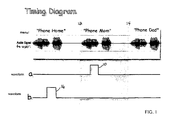
- the upper line describes an audio signal, that is, a plot of signal intensity over time.
- the audible signal level increases as diagrammatically illustrated in the "audible signal” line and time transpires.
- the middle and lower lines indicates two of the three possible selections, so that in the case where the user desires to "phone mom", the user's timely input (for example by squeezing a flexible toy so as to toggle a push-button switch) would cause a waveform having a pulse within the "phone mom" selection time window.
- waveform "a” would result in a selection to phone mom.
- the pulse 10 indicating a state change could have occurred any time between time lines 12 and 14.
- the pulse 16 in waveform "b" is well outside the phone mom selection window and would make a different selection, in this case to "phone home". This is a simple example of the user interface of the present invention.
- the interface of the present invention is a departure from current interface design in its operational style, its elegance and simplicity. However, it does have its drawbacks. It tends to be slow compared to normal operation of a conventional keypad and is best suited to tasks that do not require the user to remember past actions. For example, entering long strings of numbers can be taxing for the user.
- the interface is only suitable for some products and, even then, only within limited markets. However its appeal is, firstly, in its ease-of-use and, secondly, that it can be embedded in a product without altering the external aesthetics of the product. The cosmetic impact is especially important when attempting to embed communications products such as wireless telephones into, for example, plush toys, without adversely affecting aesthetics.
- a physical embodiment of the present invention requires three elements, namely:
- At least three further processing features enhance operation of the interface of the present invention, namely:
- the companion telecommunicator appears to talk naturally, prompting the user with options.
- the user places a call, makes emergency contact, records reminders and saves phone numbers.
- Call lists maintained by the companion telecommunicator processor are updated and sorted automatically, chronologically or according to popularity, with most recent or most frequently called numbers at the beginning.
- the companion telecommunicator tells the user that someone is calling by announcing the caller's name, or with a customized greeting, or with a standard telephone ring, a melody or by vibrating.
- companion telecommunicator 100 attaches to the clothes of a user 102 or for example to a user's backpack (not shown) for transport by the resilient clamping together of the hands 106.
- the companion telecommunicator may also have loops (not shown) that will attach to key rings or clips for easy transport.
- companion telecommunicator 100 After long periods of inactivity, companion telecommunicator 100 will go dormant. Companion telecommunicator 100 is woken up by squeezing its tummy 104 as seen in Figure 5 gently for three seconds. Companion telecommunicator 100 greets user 102 then audibly broadcasts that it is in stand-by, speaking or whisper mode. Companion telecommunicator 100 may be intentionally made dormant or "put to sleep" by gently squeezing tummy 104 for three seconds. Companion telecommunicator 100 counts down “three", "two", “one” then says "good-bye”. Squeezing for three seconds will not however put the companion telecommunicator to sleep during a conversation or while announcing a call.
- companion telecommunicator 100 When companion telecommunicator 100 is in stand-by mode, it is ready to receive calls. User 102 can ensure that companion telecommunicator 100 is awake by giving it a gentle shake. If it giggles, it's awake. The companion telecommunicator's hands 106 are positioned as if clapping to put it in stand-by mode, as seen in Figure 6. Thus companion telecommunicator 100 can hold on to user 102 while in stand-by mode as seen in Figure 4.
- Whisper mode is for private conversations.
- the audible volume is lowered so that user 102 may hold the microphone 108a embedded in, for example, the mouth 108 of companion telecommunicator 100 near to the user's ear.
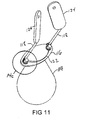
- Companion telecommunicator 100 is put into whisper mode by lifting arms 110 out of plane A so that it looks like companion telecommunicator 100 is whispering as seen in Figures 5 and 7.
- Mouth 108 of companion telecommunicator 100 is brought to the user's ear so that the user can listen for directions.
- Speaking Mode allows the companion telecommunicator to speak loudly so that the audible directions can be heard by a group of people.
- Companion telecommunicator 100 is placed into speaking mode by opening the arms 110 as seen in Figure 8. In speaking mode the arms have been rotated in plane A from the clapping position to the spread apart position.
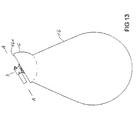
- companion telecommunicator 100 To use companion telecommunicator 100, all user 102 has to do is hold the companion telecommunicator, listen and squeeze tummy 104. This depresses an internal push-button switch 112 mounted in rigid processor housing 114 seen in Figures 9-14.
- the companion telecommunicator speaks via microphone 108a
- the user squeezes tummy 104 so as to depress switch 112 to tell the companion telecommunicator what the user wants.
- the companion telecommunicator When the companion telecommunicator is in whisper or speaking mode, it talks to the user. To make a selection, the user squeezes the companion telecommunicator while it's talking, or during the moment before the next selection.
- the companion telecommunicator uses a 3.6 volt lithium ion battery (not shown). If the battery is getting low the companion telecommunicator will periodically say “low battery”. This alarm will increase in frequency as the battery power gets lower.
- Companion telecommunicator 100 uses a mechanical endoskeleton mounted within the arms and body of the telecommunicator so as to transmit the arm position information to the processor (not shown) housed within processor housing 114.
- a shoulder or shelf 116 is mounted onto or otherwise formed on the upper end of housing 114.
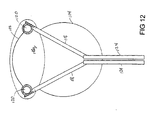
- shoulder 116 has an upper planar surface 116a on which are pivotally mounted a pair of arm struts 118.
- Planar surface 116a is parallel to plane A in which arm struts 118 rotate on stub shafts 120. Rotation of stub shafts 120 about axes of rotation B transmits the arm position information via a position sensor (not shown) to the processor within housing 114.
- Leaf spring 122 rigidly mounted between stub shafts 120 resiliently biases arm struts 118 into either the closed position of Figures 9 and 12 wherein hand paddles 124 mounted on the distal ends of arm struts 118 are resiliently clamped together or the speaking mode open position of Figure 10 wherein arm struts 118 are rotated in direction C into their fully spread apart position.
- arm struts 118 are themselves pivotally mounted to stub shafts 120 for rotation relative to stub shafts 120 about axes of rotation D on stub axles 126. Rotating arm struts 118 about axes D allows movement of the arms out of plane A so as to put the arms into the whisper mode position of Figure 11.
- FIG. 16 An alternative embodiment is illustrated in Figure 16 in which, as labeled, all of the various components are built into the processor housing with the exception of a remote speaker and microphone for which only the respective connectors are illustrated.
- the housing 114 is enlarged so as to enclose shoulder 116, the gear ends of arm struts 118, the gears, etc. Consistent with all embodiments of housing 114, the circuit boards 130 containing the processors, the power supply, and the audio amplifier are all contained within the egg-shaped housing, tilted for example as illustrated so as to optimize use of the interior space of the housing. Arm struts rotate relative to the housing in cut-out channels 128.
- the audible menu for the companion telecommunicator works like a menu tree. Every choice made by the user leads to more choices until the function that the user wants is presented. Some prompts appear in more than one menu.
- the companion telecommunicator When the companion telecommunicator asks "what would you like to do?" the user has several choices. Each choice performs a specific function or presents more options. The choices are presented in the following order: "Present Lists", “Enter A Number”, “Play Sound Clips”, “Record Sound Clip”, “Provide Status Information”, and “Set Preferences”. The choices are audibly repeated by the companion telecommunicator sequentially several times. If the user does not make a choice, the companion telecommunicator returns to stand-by mode.
- the "Present Lists" choice lists stored phone numbers to call.
- the stored telephone numbers are sorted for presentation depending on the type of list selected.
- the choices are "Personal Call List”, “Emergency Call List”, "Incoming History List” and "Outgoing History List”.
- the Personal Call List is automatically updated, according to frequency of use.
- the Emergency Call List presents the most important numbers first.
- the Incoming History List is updated according to the last number that called the companion telecommunicator.
- the Outgoing History List sorts the user's calls, starting with the most recent number.
- the "Enter a Number” choice guides the user through telephone number entry and lets the user add the number to the phone list.
- Sound Clip choice lets the user record, play back or delete sound clips. Sound clips may be recorded during conversations, as reminders or transferred from the network or the user's home computer.
- the "Provide Status Information" choice announces the user's phone number and the time and date, then tells the user if there are messages waiting, and reports battery level, signal strength, roaming status, available memory, and the like.
- the "Set Preferences" choice customizes the way the companion telecommunicator responds and presents information.
- the user can cancel any choice and return to the previous menu at any time by squeezing the companion telecommunicator three times.
- the user squeezes the companion telecommunicator's hand 106 when the user is in that part of the menu.
- a sensor in the hand triggers the processor provide context sensitive audible help prompts.
- the user To answer a call in Whisper Mode, the user lifts the companion telecommunicator's hands 106 to mouth 108, then places companion telecommunicator 100 near the user's ear.
- user 102 To answer a call in Speaking Mode, user 102 opens the companion telecommunicator's arms 110. The volume is automatically increased so as to be loud enough for a group of people to hear the conversation.
- user 102 places the companion telecommunicator in stand-by mode by closing arms 110.
- the user starts with the companion telecommunicator's arms in the Stand-by position.
- the user squeezes the companion telecommunicator and raises the arms to Whisper or Speaking Mode.
- the companion telecommunicator will say: "Squeeze to place emergency call”.
- the user squeezes to make the call. If the user doesn't squeeze within a few seconds, the companion telecommunicator will cancel the request.
- the companion telecommunicator can record both sides of the conversation.
- the user squeezes and holds the companion telecommunicator and the volume will increase to maximum volume level, then decrease to minimum. The user lets go once the volume has reached the desired level. The user can also adjust the volume by squeezing the companion telecommunicator's ears. The user increases the volume by squeezing the right ear, and decreases the volume by squeezing the left ear. The user lets go once the volume has reached the desired level.
- the companion telecommunicator has several methods of indicating an incoming call: Caller Announce, Greeting, Tone, Melody, Vibrate.
- Caller Announce mode the companion telecommunicator announces the name of the caller if the caller is in the user's Personal Call List. If the name is not in the user's Personal Call List, the companion telecommunicator announces the phone number calling. If telephone number identification is unavailable, the companion telecommunicator says: "Caller Unknown”.
- Greeting mode the companion telecommunicator says: "It's for you”.
- Tone mode the companion telecommunicator rings with normal cellular tones.
- Melody mode the companion telecommunicator gets the user's attention with a musical greeting.
- Vibrate mode the companion telecommunicator vibrates to alert the user to an incoming call.
- the user changes the call alert volume during an incoming call. While the companion telecommunicator is receiving a call, the user squeezes and holds. The volume will decrease to minimum volume level, then increase to maximum. The user lets go once the volume has reached the desired level. The user can also adjust the volume by squeezing the companion telecommunicator's ears. The user increase the volume by squeezing the right ear, and decreases the volume by squeezing the left ear. The user lets go once the volume has reached the desired level.
- the user can choose the amount of information the companion telecommunicator will give the user during audio prompts.
- the Make it Brief option gives the user short audio prompts.
- the Tell Me Lots option gives the user longer, detailed audio prompts.
- the Set Level of Assistance option lets the user select the information level during audio prompts.
- the user places the companion telecommunicator in Whisper or Speaking Mode. The user squeezes when the user hears: "Set Preferences”. The companion telecommunicator will report the current prompt level. The user squeezes once to choose the other level.
- the Getting Status Information option allows the user to get status information about the companion telecommunicator.
- the user places the companion telecommunicator in Whisper or Speaking Mode. The user squeezes when the user hears: "Provide Status Information”.
- the companion telecommunicator announces the telephone number and time and date and tells the user if the user has messages waiting, then reports current battery level, signal strength, roaming status, memory available in minutes and seconds, the current billing rate, and balance remaining on card (optional). The user squeezes to advance to the next report.
Landscapes
- Engineering & Computer Science (AREA)
- Human Computer Interaction (AREA)
- Computer Networks & Wireless Communication (AREA)
- Signal Processing (AREA)
- Telephone Function (AREA)
- Toys (AREA)
- Details Of Television Systems (AREA)
- Communication Control (AREA)
- Reduction Or Emphasis Of Bandwidth Of Signals (AREA)
- Closed-Circuit Television Systems (AREA)
Claims (21)
- Eine akustisch aktivierte Telekommunikations-Schnittstellenvorrichtung (100), die ein Binärzustands-Zeitfenster-Mehrfachwahlprotokoll verwendet, umfassend:ein Gehäuse (114) für ein Telekommunikationsgerät,einen Prozessor und einen damit zusammenwirkenden Speicher sowie eine Stromversorgung, die in dem Gehäuse (114) angebracht sind,einen im Gehäuse (114) angebrachten Audiolautsprecher, der mit dem Prozessor zusammenwirkt, um außerhalb des Gehäuses (114) eine Aufeinanderfolge von hörbaren Kommandos akustisch abzugeben, die vom Prozessor an den Audiolautsprecher geliefert werden,eine im Gehäuse (114) angebrachte Eingabevorrichtung (108a; 112), die dazu ausgelegt ist, als Reaktion auf ein Einzelkommando aus der Folge von hörbaren Kommandos eine Eingabe von einem Benutzer zu empfangen, wobei die Eingabe in einer Binärzustandseingabe besteht, die eine binäre Vorspannung der Eingabevorrichtung (108a; 112) von einem binären Zustand zum anderen binären Zustand von nur zwei möglichen binären Zuständen hervorruft,ein im Gehäuse (114) angebrachtes Telekommunikationssende- und Empfangsgerät,ein Zeitgeber, der dazu vorgesehen ist, mit dem Prozessor zusammenzuwirken, wobei der Prozessor dazu ausgelegt ist, die Reaktion auf das Einzelkommando mit einem entsprechenden einzelnen Zeitfenster innerhalb einer Aufeinanderfolge von Zeitfenstern zu korrelieren, die vom Zeitgeber zeitlich festgelegt werden, wobei der Prozessor das einzelne Zeitfenster mit dem Einzelkommando korreliert und gemäß einem Befehlssatz im Speicher eine dem Einzelkommando entsprechende Einzelmaßnahme durchführt, derart, dass der Prozessor die Einzelmaßnahme in weiterem Zusammenwirken mit dem Telekommunikationssende- und Empfangsgerät ausführt, wenn es sich bei der Einzelmaßnahme um eine Telekommunikationsaktivität handelt,wobei der Prozessor, der Speicher, die Stromversorgung, der Audiolautsprecher, die Eingabevorrichtung (108a; 112), der Zeitgeber und das Telekommunikationssende- und Empfangsgerät im Inneren des Gerätegehäuses (114) verborgen sind, um dessen äußere Erscheinung nicht zu verändern,wobei die Folge hörbarer Kommandos eine nacheinander akustisch ausgegebene Liste von Namen aus einer Namensliste im Speicher sind, wobei das Einzelkommando ein einzelner Name aus der Liste ist und die dem einzelnen Namen entsprechende Einzelmaßnahme darin besteht, eine dem einzelnen Namen entsprechende Telefonnummer aus einer entsprechenden Liste von Telefonnummern zu wählen,wobei die die Folge hörbarer Kommandos enthaltenden Audiodaten komprimiert werden, um die Geschwindigkeit zu erhöhen, mit der die Folge hörbarer Kommandos präsentiert wird, unddadurch gekennzeichnet, dass sich die Präsentationsgeschwindigkeit der Folge hörbarer Kommandos gemäß einer Rückkopplung in eine aktive Rückkopplungsschleife erhöht, wobei sich die Präsentationsgeschwindigkeit solange erhöht, bis ein Grad an vom Benutzer begangenen Fehlern einen Schwellenwert erreicht, an dem sich die Präsentationsgeschwindigkeit nicht mehr weiter erhöht.
- Vorrichtung nach Anspruch 1, wobei das Gerätegehäuse (114) eine flexible Oberfläche hat und die Eingabevorrichtung (108a; 112) unterhalb dieser flexiblen Oberfläche angebracht ist.
- Vorrichtung nach Anspruch 2, wobei das Gerätegehäuse (114) ein Stofftier ist.
- Vorrichtung nach Anspruch 3, wobei das Gerätegehäuse (114) ein Plüschtier ist.
- Vorrichtung nach Anspruch 2, wobei das Gerätegehäuse (114) eine Schallabstrahlfläche aufweist und der Lautsprecher unterhalb der Abstrahlfläche angebracht ist.
- Vorrichtung nach Anspruch 4, wobei das Plüschtier zumindest ein Anhangsgebilde (110) hat, das schwenkbar an einem Körper des Plüschtiers angebracht ist, wobei das zumindest eine Anhangsgebilde (110) mit dem Prozessor so zusammenwirkt, dass eine erste Position des zumindest einen Anhangsgebildes (110) relativ zum Körper den Prozessor in einen Bereitschaftsmodus versetzt, und eine zweite Position des zumindest einen Anhangsgebildes (110) relativ zum Körper den Prozessor in einen Aktivmodus versetzt, so dass die Folge von Kommandos ausgelöst wird.
- Vorrichtung nach Anspruch 6, wobei das zumindest eine Anhangsgebilde (110) in einem Paar lang gestreckter, gegenständiger Anhangsgebilde (110) besteht.
- Vorrichtung nach Anspruch 7, wobei das Paar Anhangsgebilde (110) relativ zum Körper zwischen einer federunterstützten, geschlossenen Klemmposition, in der die Anhangsgebilde (110) aneinander anliegen, und einer ausgebreiteten Position verschwenkt wird, in der die Anhangsgebilde (110) des Paars voneinander beabstandet sind.
- Vorrichtung nach Anspruch 8, wobei die erste Position die geschlossene Position und die zweite Position die ausgebreitete Position ist.
- Vorrichtung nach Anspruch 9, wobei die erste und zweite Position im Wesentlichen in einer ersten Ebene liegen und die beiden Anhangsgebilde (110) in einer dritten Position aus der Ebene herausgehoben sind, wobei der Audiolautsprecher in der zweiten Position hörbar mit einer ersten hörbaren Lautstärke sendet und der Audiolautsprecher in der dritten Position hörbar mit einer zweiten hörbaren Lautstärke sendet.
- Vorrichtung nach Anspruch 10, wobei die erste hörbare Lautstärke lauter als die zweite hörbare Lautstärke ist.
- Vorrichtung nach Anspruch 11, wobei das Paar Anhangsgebilde (110) Arme (110) darstellt und sich die Enden der Arme (110), wenn sie sich in der dritten Position befinden, um einen Mund (108) des Plüschtiers legen.
- Vorrichtung nach Anspruch 12, wobei der Audiolautsprecher hinter dem Mund (108) des Plüschtiers angebracht ist.
- Vorrichtung nach Anspruch 13, wobei die Enden der Arme (110) Hände (106) darstellen, und sich die Hände (106) in der ersten Position zusammen vor dem Plüschtier befinden, und die Hände (106) in der zweiten Position weit ausgebreitet sind.
- Vorrichtung nach Anspruch 4, wobei die Eingabevorrichtung ein Druckschalter ist.
- Vorrichtung nach Anspruch 1, wobei die Folge hörbarer Kommandos aus einem Menübaum mit mehreren Ebenen stammende Kommandos sind.
- Vorrichtung nach Anspruch 1, wobei die Eingabevorrichtung (108a; 112) mehrere Male in schneller Aufeinanderfolge beaufschlagt werden kann und die der Einzelmaßnahme entsprechende Maßnahme jeweils eine andere ist, abhängig davon, wie oft die Eingabevorrichtung (108a; 112) in der schnellen Aufeinanderfolge beaufschlagt wird.
- Vorrichtung nach Anspruch 1, wobei die Eingabevorrichtung (108a) ein Mikrophon (108a) ist, das mit einer Einrichtung zur Erfassung einer akustischen Eingabe in das Mikrophon (108a) innerhalb des einzelnen Zeitbereichs zusammenwirkt, wobei die Einrichtung auch zur Registrierung der akustischen Eingabe in das Mikrophon (108a) als die Eingabe zur binären Vorspannung der Eingabevorrichtung (108a) dient.
- Vorrichtung nach Anspruch 1, wobei die Namensliste basierend auf der Häufigkeit entsprechender Anrufe statistisch geordnet wird.
- Vorrichtung nach Anspruch 19, wobei die Namensliste basierend auf der Dauer der entsprechenden Anrufe statistisch geordnet wird.
- Binärzustands-Zeitfenster-Mehrfachwahlprotokollverfahren in einer akustisch aktivierten Telekommunikations-Schnittstellenvorrichtung (100), die ein Gehäuse (114) für ein Telekommunikationsgerät aufweist, und in dem Gehäuse (114) ein Prozessor und ein damit zusammenwirkender Speicher, eine Stromversorgung, ein Audiolautsprecher, eine Eingabevorrichtung (108a; 112), ein Zeitgeber und ein Telekommunikationssende- und Empfangsgerät angebracht sind, wobei das Verfahren folgende Schritte umfasst:a) durch den Lautsprecher erfolgende akustische Abgabe einer Aufeinanderfolge von hörbaren Kommandos außerhalb des Gehäuses (114), die vom Prozessor an den Audiolautsprecher geliefert werden,b) Empfangen einer von einem Benutzer stammenden Eingabe in die Eingabevorrichtung (108a; 112), als Reaktion auf ein Einzelkommando aus der Folge hörbarer Kommandos, wobei die Eingabe eine binäre Vorspannung der Eingabevorrichtung (108a; 112) von einem binären Zustand zum anderen binären Zustand von nur zwei möglichen binären Zuständen hervorruft,c) zeitliches Festlegen einer Aufeinanderfolge von Zeitfenstern durch den Zeitgeber,d) durch den Prozessor erfolgendes Korrelieren der Reaktion auf das Einzelkommando mit einem entsprechenden einzelnen Zeitfenster innerhalb der Aufeinanderfolge von Zeitfenstern,e) durch den Prozessor erfolgendes Korrelieren des einzelnen Zeitfensters mit dem Einzelkommando,f) Ausführen einer dem Einzelkommando entsprechenden Einzelmaßnahme gemäß einem Befehlssatz im Speicher,g) wobei die Folge hörbarer Kommandos eine nacheinander akustisch ausgegebene Liste von Namen aus einer Namensliste im Speicher sind, und wobei das Einzelkommando ein einzelner Name aus der Liste ist, wobei die dem einzelnen Namen entsprechende Einzelmaßnahme darin besteht, eine dem einzelnen Namen entsprechende Telefonnummer aus einer entsprechenden Liste von Telefonnummern zu wählen,h) Komprimieren der die Folge hörbarer Kommandos enthaltenden Audiodaten, um die Geschwindigkeit zu erhöhen, mit der die Folge hörbarer Kommandos präsentiert wird, und
dadurch gekennzeichnet, dass das Verfahren folgende weitere Schritte enthält:i) Erhöhen der Präsentationsgeschwindigkeit der Folge hörbarer Kommandos gemäß einer Rückkopplung in eine aktive Rückkopplungsschleife, wobei sich die Präsentationsgeschwindigkeit solange erhöht, bis ein Grad an vom Benutzer begangenen Fehlern einen Schwellenwert erreicht, an dem sich die Präsentationsgeschwindigkeit nicht mehr weiter erhöht.
Applications Claiming Priority (3)
| Application Number | Priority Date | Filing Date | Title |
|---|---|---|---|
| US16063799P | 1999-10-20 | 1999-10-20 | |
| US160637P | 1999-10-20 | ||
| PCT/CA2000/001186 WO2001030047A2 (en) | 1999-10-20 | 2000-10-13 | Audio prompted, binary sensors user interface for a consumer electronic device |
Publications (2)
| Publication Number | Publication Date |
|---|---|
| EP1222795A2 EP1222795A2 (de) | 2002-07-17 |
| EP1222795B1 true EP1222795B1 (de) | 2006-12-27 |
Family
ID=22577736
Family Applications (1)
| Application Number | Title | Priority Date | Filing Date |
|---|---|---|---|
| EP00967471A Expired - Lifetime EP1222795B1 (de) | 1999-10-20 | 2000-10-13 | Benutzerschnittstelle mit sprachlichen aufforderungen und binären sensoren für ein unterhaltungselektronikgerät |
Country Status (6)
| Country | Link |
|---|---|
| EP (1) | EP1222795B1 (de) |
| AT (1) | ATE349848T1 (de) |
| AU (1) | AU7766100A (de) |
| CA (1) | CA2321014C (de) |
| DE (1) | DE60032619T2 (de) |
| WO (1) | WO2001030047A2 (de) |
Families Citing this family (100)
| Publication number | Priority date | Publication date | Assignee | Title |
|---|---|---|---|---|
| US8645137B2 (en) | 2000-03-16 | 2014-02-04 | Apple Inc. | Fast, language-independent method for user authentication by voice |
| US20040224717A1 (en) * | 2003-05-09 | 2004-11-11 | Todd Hertzberg | Communication device with a voice user interface |
| US8677377B2 (en) | 2005-09-08 | 2014-03-18 | Apple Inc. | Method and apparatus for building an intelligent automated assistant |
| US9318108B2 (en) | 2010-01-18 | 2016-04-19 | Apple Inc. | Intelligent automated assistant |
| US8977255B2 (en) | 2007-04-03 | 2015-03-10 | Apple Inc. | Method and system for operating a multi-function portable electronic device using voice-activation |
| US9330720B2 (en) | 2008-01-03 | 2016-05-03 | Apple Inc. | Methods and apparatus for altering audio output signals |
| US8996376B2 (en) | 2008-04-05 | 2015-03-31 | Apple Inc. | Intelligent text-to-speech conversion |
| US10496753B2 (en) | 2010-01-18 | 2019-12-03 | Apple Inc. | Automatically adapting user interfaces for hands-free interaction |
| US20100030549A1 (en) | 2008-07-31 | 2010-02-04 | Lee Michael M | Mobile device having human language translation capability with positional feedback |
| US8862252B2 (en) * | 2009-01-30 | 2014-10-14 | Apple Inc. | Audio user interface for displayless electronic device |
| US9858925B2 (en) | 2009-06-05 | 2018-01-02 | Apple Inc. | Using context information to facilitate processing of commands in a virtual assistant |
| US10241644B2 (en) | 2011-06-03 | 2019-03-26 | Apple Inc. | Actionable reminder entries |
| US10241752B2 (en) | 2011-09-30 | 2019-03-26 | Apple Inc. | Interface for a virtual digital assistant |
| US10255566B2 (en) | 2011-06-03 | 2019-04-09 | Apple Inc. | Generating and processing task items that represent tasks to perform |
| US9431006B2 (en) | 2009-07-02 | 2016-08-30 | Apple Inc. | Methods and apparatuses for automatic speech recognition |
| US10679605B2 (en) | 2010-01-18 | 2020-06-09 | Apple Inc. | Hands-free list-reading by intelligent automated assistant |
| US10553209B2 (en) | 2010-01-18 | 2020-02-04 | Apple Inc. | Systems and methods for hands-free notification summaries |
| US10705794B2 (en) | 2010-01-18 | 2020-07-07 | Apple Inc. | Automatically adapting user interfaces for hands-free interaction |
| US10276170B2 (en) | 2010-01-18 | 2019-04-30 | Apple Inc. | Intelligent automated assistant |
| DE202011111062U1 (de) | 2010-01-25 | 2019-02-19 | Newvaluexchange Ltd. | Vorrichtung und System für eine Digitalkonversationsmanagementplattform |
| US8682667B2 (en) | 2010-02-25 | 2014-03-25 | Apple Inc. | User profiling for selecting user specific voice input processing information |
| US9262612B2 (en) | 2011-03-21 | 2016-02-16 | Apple Inc. | Device access using voice authentication |
| US10057736B2 (en) | 2011-06-03 | 2018-08-21 | Apple Inc. | Active transport based notifications |
| US8994660B2 (en) | 2011-08-29 | 2015-03-31 | Apple Inc. | Text correction processing |
| US9483461B2 (en) | 2012-03-06 | 2016-11-01 | Apple Inc. | Handling speech synthesis of content for multiple languages |
| US9280610B2 (en) | 2012-05-14 | 2016-03-08 | Apple Inc. | Crowd sourcing information to fulfill user requests |
| US9721563B2 (en) | 2012-06-08 | 2017-08-01 | Apple Inc. | Name recognition system |
| US9495129B2 (en) | 2012-06-29 | 2016-11-15 | Apple Inc. | Device, method, and user interface for voice-activated navigation and browsing of a document |
| US9547647B2 (en) | 2012-09-19 | 2017-01-17 | Apple Inc. | Voice-based media searching |
| WO2014197336A1 (en) | 2013-06-07 | 2014-12-11 | Apple Inc. | System and method for detecting errors in interactions with a voice-based digital assistant |
| US9582608B2 (en) | 2013-06-07 | 2017-02-28 | Apple Inc. | Unified ranking with entropy-weighted information for phrase-based semantic auto-completion |
| WO2014197334A2 (en) | 2013-06-07 | 2014-12-11 | Apple Inc. | System and method for user-specified pronunciation of words for speech synthesis and recognition |
| WO2014197335A1 (en) | 2013-06-08 | 2014-12-11 | Apple Inc. | Interpreting and acting upon commands that involve sharing information with remote devices |
| US10176167B2 (en) | 2013-06-09 | 2019-01-08 | Apple Inc. | System and method for inferring user intent from speech inputs |
| KR101959188B1 (ko) | 2013-06-09 | 2019-07-02 | 애플 인크. | 디지털 어시스턴트의 둘 이상의 인스턴스들에 걸친 대화 지속성을 가능하게 하기 위한 디바이스, 방법 및 그래픽 사용자 인터페이스 |
| US9842101B2 (en) | 2014-05-30 | 2017-12-12 | Apple Inc. | Predictive conversion of language input |
| US9715875B2 (en) | 2014-05-30 | 2017-07-25 | Apple Inc. | Reducing the need for manual start/end-pointing and trigger phrases |
| US9430463B2 (en) | 2014-05-30 | 2016-08-30 | Apple Inc. | Exemplar-based natural language processing |
| WO2015184186A1 (en) | 2014-05-30 | 2015-12-03 | Apple Inc. | Multi-command single utterance input method |
| US9760559B2 (en) | 2014-05-30 | 2017-09-12 | Apple Inc. | Predictive text input |
| US9785630B2 (en) | 2014-05-30 | 2017-10-10 | Apple Inc. | Text prediction using combined word N-gram and unigram language models |
| US10078631B2 (en) | 2014-05-30 | 2018-09-18 | Apple Inc. | Entropy-guided text prediction using combined word and character n-gram language models |
| US10659851B2 (en) | 2014-06-30 | 2020-05-19 | Apple Inc. | Real-time digital assistant knowledge updates |
| US9338493B2 (en) | 2014-06-30 | 2016-05-10 | Apple Inc. | Intelligent automated assistant for TV user interactions |
| DE212015000194U1 (de) | 2014-08-06 | 2017-05-31 | Apple Inc. | Verkleinerte Benutzeroberflächen für Batteriemanagement |
| US10446141B2 (en) | 2014-08-28 | 2019-10-15 | Apple Inc. | Automatic speech recognition based on user feedback |
| KR102016160B1 (ko) | 2014-09-02 | 2019-08-29 | 애플 인크. | 경고를 관리하기 위한 축소된 크기의 인터페이스 |
| US9818400B2 (en) | 2014-09-11 | 2017-11-14 | Apple Inc. | Method and apparatus for discovering trending terms in speech requests |
| US9668121B2 (en) | 2014-09-30 | 2017-05-30 | Apple Inc. | Social reminders |
| US9886432B2 (en) | 2014-09-30 | 2018-02-06 | Apple Inc. | Parsimonious handling of word inflection via categorical stem + suffix N-gram language models |
| US10074360B2 (en) | 2014-09-30 | 2018-09-11 | Apple Inc. | Providing an indication of the suitability of speech recognition |
| US9646609B2 (en) | 2014-09-30 | 2017-05-09 | Apple Inc. | Caching apparatus for serving phonetic pronunciations |
| US10127911B2 (en) | 2014-09-30 | 2018-11-13 | Apple Inc. | Speaker identification and unsupervised speaker adaptation techniques |
| US10552013B2 (en) | 2014-12-02 | 2020-02-04 | Apple Inc. | Data detection |
| US20160224973A1 (en) | 2015-02-01 | 2016-08-04 | Apple Inc. | User interface for payments |
| US9865280B2 (en) | 2015-03-06 | 2018-01-09 | Apple Inc. | Structured dictation using intelligent automated assistants |
| US10567477B2 (en) | 2015-03-08 | 2020-02-18 | Apple Inc. | Virtual assistant continuity |
| US9886953B2 (en) | 2015-03-08 | 2018-02-06 | Apple Inc. | Virtual assistant activation |
| US9721566B2 (en) | 2015-03-08 | 2017-08-01 | Apple Inc. | Competing devices responding to voice triggers |
| US9899019B2 (en) | 2015-03-18 | 2018-02-20 | Apple Inc. | Systems and methods for structured stem and suffix language models |
| US9842105B2 (en) | 2015-04-16 | 2017-12-12 | Apple Inc. | Parsimonious continuous-space phrase representations for natural language processing |
| US10083688B2 (en) | 2015-05-27 | 2018-09-25 | Apple Inc. | Device voice control for selecting a displayed affordance |
| US10127220B2 (en) | 2015-06-04 | 2018-11-13 | Apple Inc. | Language identification from short strings |
| US10101822B2 (en) | 2015-06-05 | 2018-10-16 | Apple Inc. | Language input correction |
| US9578173B2 (en) | 2015-06-05 | 2017-02-21 | Apple Inc. | Virtual assistant aided communication with 3rd party service in a communication session |
| US11025565B2 (en) | 2015-06-07 | 2021-06-01 | Apple Inc. | Personalized prediction of responses for instant messaging |
| US10186254B2 (en) | 2015-06-07 | 2019-01-22 | Apple Inc. | Context-based endpoint detection |
| US10255907B2 (en) | 2015-06-07 | 2019-04-09 | Apple Inc. | Automatic accent detection using acoustic models |
| US10747498B2 (en) | 2015-09-08 | 2020-08-18 | Apple Inc. | Zero latency digital assistant |
| US10671428B2 (en) | 2015-09-08 | 2020-06-02 | Apple Inc. | Distributed personal assistant |
| US9697820B2 (en) | 2015-09-24 | 2017-07-04 | Apple Inc. | Unit-selection text-to-speech synthesis using concatenation-sensitive neural networks |
| US10366158B2 (en) | 2015-09-29 | 2019-07-30 | Apple Inc. | Efficient word encoding for recurrent neural network language models |
| US11010550B2 (en) | 2015-09-29 | 2021-05-18 | Apple Inc. | Unified language modeling framework for word prediction, auto-completion and auto-correction |
| US11587559B2 (en) | 2015-09-30 | 2023-02-21 | Apple Inc. | Intelligent device identification |
| US10691473B2 (en) | 2015-11-06 | 2020-06-23 | Apple Inc. | Intelligent automated assistant in a messaging environment |
| US10049668B2 (en) | 2015-12-02 | 2018-08-14 | Apple Inc. | Applying neural network language models to weighted finite state transducers for automatic speech recognition |
| US10223066B2 (en) | 2015-12-23 | 2019-03-05 | Apple Inc. | Proactive assistance based on dialog communication between devices |
| US10446143B2 (en) | 2016-03-14 | 2019-10-15 | Apple Inc. | Identification of voice inputs providing credentials |
| US9934775B2 (en) | 2016-05-26 | 2018-04-03 | Apple Inc. | Unit-selection text-to-speech synthesis based on predicted concatenation parameters |
| US9972304B2 (en) | 2016-06-03 | 2018-05-15 | Apple Inc. | Privacy preserving distributed evaluation framework for embedded personalized systems |
| US10249300B2 (en) | 2016-06-06 | 2019-04-02 | Apple Inc. | Intelligent list reading |
| US10049663B2 (en) | 2016-06-08 | 2018-08-14 | Apple, Inc. | Intelligent automated assistant for media exploration |
| DK179588B1 (en) | 2016-06-09 | 2019-02-22 | Apple Inc. | INTELLIGENT AUTOMATED ASSISTANT IN A HOME ENVIRONMENT |
| US10490187B2 (en) | 2016-06-10 | 2019-11-26 | Apple Inc. | Digital assistant providing automated status report |
| US10067938B2 (en) | 2016-06-10 | 2018-09-04 | Apple Inc. | Multilingual word prediction |
| US10586535B2 (en) | 2016-06-10 | 2020-03-10 | Apple Inc. | Intelligent digital assistant in a multi-tasking environment |
| US10192552B2 (en) | 2016-06-10 | 2019-01-29 | Apple Inc. | Digital assistant providing whispered speech |
| US10509862B2 (en) | 2016-06-10 | 2019-12-17 | Apple Inc. | Dynamic phrase expansion of language input |
| DK179415B1 (en) | 2016-06-11 | 2018-06-14 | Apple Inc | Intelligent device arbitration and control |
| DK179343B1 (en) | 2016-06-11 | 2018-05-14 | Apple Inc | Intelligent task discovery |
| DK201670540A1 (en) | 2016-06-11 | 2018-01-08 | Apple Inc | Application integration with a digital assistant |
| DK179049B1 (en) | 2016-06-11 | 2017-09-18 | Apple Inc | Data driven natural language event detection and classification |
| US10043516B2 (en) | 2016-09-23 | 2018-08-07 | Apple Inc. | Intelligent automated assistant |
| US10593346B2 (en) | 2016-12-22 | 2020-03-17 | Apple Inc. | Rank-reduced token representation for automatic speech recognition |
| DK201770439A1 (en) | 2017-05-11 | 2018-12-13 | Apple Inc. | Offline personal assistant |
| DK179745B1 (en) | 2017-05-12 | 2019-05-01 | Apple Inc. | SYNCHRONIZATION AND TASK DELEGATION OF A DIGITAL ASSISTANT |
| DK179496B1 (en) | 2017-05-12 | 2019-01-15 | Apple Inc. | USER-SPECIFIC Acoustic Models |
| DK201770432A1 (en) | 2017-05-15 | 2018-12-21 | Apple Inc. | Hierarchical belief states for digital assistants |
| DK201770431A1 (en) | 2017-05-15 | 2018-12-20 | Apple Inc. | Optimizing dialogue policy decisions for digital assistants using implicit feedback |
| DK179560B1 (en) | 2017-05-16 | 2019-02-18 | Apple Inc. | FAR-FIELD EXTENSION FOR DIGITAL ASSISTANT SERVICES |
Family Cites Families (7)
| Publication number | Priority date | Publication date | Assignee | Title |
|---|---|---|---|---|
| US5016003A (en) * | 1988-10-27 | 1991-05-14 | Rice-Kelly Research And Engineering, Inc. | Environmental control system for the handicapped |
| DE4008598C2 (de) * | 1990-03-17 | 1995-08-17 | Philips Patentverwaltung | Mobilfunkgerät mit einem mindestens eine Funktionstaste aufweisenden Bedienteil |
| US5746602A (en) * | 1996-02-27 | 1998-05-05 | Kikinis; Dan | PC peripheral interactive doll |
| WO1997041936A1 (en) * | 1996-04-05 | 1997-11-13 | Maa Shalong | Computer-controlled talking figure toy with animated features |
| DE19729508C2 (de) * | 1997-07-10 | 2001-08-30 | Dirk Pohl | Kommunikationsgerät |
| WO1999017854A1 (en) * | 1997-10-07 | 1999-04-15 | Health Hero Network, Inc. | Remotely programmable talking toy |
| AU2937400A (en) * | 1999-03-02 | 2000-09-21 | Creator Ltd. | Computer controlled toys that provide messages to the user |
-
2000
- 2000-09-29 CA CA2321014A patent/CA2321014C/en not_active Expired - Fee Related
- 2000-10-13 AU AU77661/00A patent/AU7766100A/en not_active Abandoned
- 2000-10-13 WO PCT/CA2000/001186 patent/WO2001030047A2/en not_active Ceased
- 2000-10-13 AT AT00967471T patent/ATE349848T1/de active
- 2000-10-13 DE DE60032619T patent/DE60032619T2/de not_active Expired - Lifetime
- 2000-10-13 EP EP00967471A patent/EP1222795B1/de not_active Expired - Lifetime
Also Published As
| Publication number | Publication date |
|---|---|
| AU7766100A (en) | 2001-04-30 |
| ATE349848T1 (de) | 2007-01-15 |
| WO2001030047A8 (en) | 2002-08-08 |
| CA2321014A1 (en) | 2001-04-20 |
| CA2321014C (en) | 2012-06-19 |
| DE60032619T2 (de) | 2007-10-04 |
| WO2001030047A2 (en) | 2001-04-26 |
| EP1222795A2 (de) | 2002-07-17 |
| WO2001030047A3 (en) | 2001-09-20 |
| DE60032619D1 (de) | 2007-02-08 |
| WO2001030047A9 (en) | 2002-11-07 |
Similar Documents
| Publication | Publication Date | Title |
|---|---|---|
| EP1222795B1 (de) | Benutzerschnittstelle mit sprachlichen aufforderungen und binären sensoren für ein unterhaltungselektronikgerät | |
| US6771982B1 (en) | Single action audio prompt interface utlizing binary state time domain multiple selection protocol | |
| US8611955B2 (en) | Single action audio interface utilising binary state time domain multiple selection protocol | |
| US6018671A (en) | Silent call accept | |
| US5657380A (en) | Interactive door answering and messaging device with speech synthesis | |
| EP1982257A2 (de) | Elektronische informationsvorrichtung mit ereignisbenachrichtigungsprofil | |
| CN107995105A (zh) | 一种具有盲操作软件的智能终端 | |
| CN106911840A (zh) | 移动终端及其语音服务方法和装置 | |
| US9232037B2 (en) | Single action sensory prompt interface utilising binary state time domain selection protocol | |
| US8295449B2 (en) | Method and system for creating audio identification messages | |
| CN111775165A (zh) | 一种实现移动式智能客服机器人的系统、机器人终端以及后端处理模块 | |
| US7187767B2 (en) | Communication device with dual-mode muting and method therefor | |
| CN211149537U (zh) | 一种基于智能门锁的个性化留言装置 | |
| JPH08307488A (ja) | 着信音自動調整機能付携帯電話機 | |
| CN114051066A (zh) | 一种穿戴设备及其来电控制方法、装置和可读存储介质 | |
| CN100463576C (zh) | 导向语音个人移动通讯装置及其处理方法 | |
| WO2009104195A1 (en) | Voice based man- machine interface (mmi) for mobile communication devices | |
| US20030220124A1 (en) | Anthropomorphic mobile telecommunication apparatus | |
| US20110223896A1 (en) | Meeting mode for cell phones | |
| KR200333333Y1 (ko) | 유아 및 노인용 핸드폰 | |
| KR200196387Y1 (ko) | 휴대폰의 음성 및 음향 메시지 출력 장치 | |
| JP2000188629A (ja) | 通信装置 | |
| JP3055512U (ja) | 相手番号告知及び録音機能付き無線呼出し器 | |
| JP2003125033A (ja) | 介護用携帯電話機 | |
| CN118433292A (zh) | 一种智能手表的闹钟铃声自定义方法 |
Legal Events
| Date | Code | Title | Description |
|---|---|---|---|
| PUAI | Public reference made under article 153(3) epc to a published international application that has entered the european phase |
Free format text: ORIGINAL CODE: 0009012 |
|
| 17P | Request for examination filed |
Effective date: 20020322 |
|
| AK | Designated contracting states |
Kind code of ref document: A2 Designated state(s): AT BE CH CY DE DK ES FI FR GB GR IE IT LI LU MC NL PT SE |
|
| AX | Request for extension of the european patent |
Free format text: AL;LT PAYMENT 20020315;LV PAYMENT 20020315;MK;RO PAYMENT 20020315;SI PAYMENT 20020315 |
|
| 17Q | First examination report despatched |
Effective date: 20030513 |
|
| GRAP | Despatch of communication of intention to grant a patent |
Free format text: ORIGINAL CODE: EPIDOSNIGR1 |
|
| GRAS | Grant fee paid |
Free format text: ORIGINAL CODE: EPIDOSNIGR3 |
|
| GRAA | (expected) grant |
Free format text: ORIGINAL CODE: 0009210 |
|
| AK | Designated contracting states |
Kind code of ref document: B1 Designated state(s): AT BE CH CY DE DK ES FI FR GB GR IE IT LI LU MC NL PT SE |
|
| AX | Request for extension of the european patent |
Extension state: LT LV RO SI |
|
| PG25 | Lapsed in a contracting state [announced via postgrant information from national office to epo] |
Ref country code: IT Free format text: LAPSE BECAUSE OF FAILURE TO SUBMIT A TRANSLATION OF THE DESCRIPTION OR TO PAY THE FEE WITHIN THE PRESCRIBED TIME-LIMIT;WARNING: LAPSES OF ITALIAN PATENTS WITH EFFECTIVE DATE BEFORE 2007 MAY HAVE OCCURRED AT ANY TIME BEFORE 2007. THE CORRECT EFFECTIVE DATE MAY BE DIFFERENT FROM THE ONE RECORDED. Effective date: 20061227 Ref country code: FI Free format text: LAPSE BECAUSE OF FAILURE TO SUBMIT A TRANSLATION OF THE DESCRIPTION OR TO PAY THE FEE WITHIN THE PRESCRIBED TIME-LIMIT Effective date: 20061227 Ref country code: DK Free format text: LAPSE BECAUSE OF FAILURE TO SUBMIT A TRANSLATION OF THE DESCRIPTION OR TO PAY THE FEE WITHIN THE PRESCRIBED TIME-LIMIT Effective date: 20061227 Ref country code: NL Free format text: LAPSE BECAUSE OF FAILURE TO SUBMIT A TRANSLATION OF THE DESCRIPTION OR TO PAY THE FEE WITHIN THE PRESCRIBED TIME-LIMIT Effective date: 20061227 |
|
| REG | Reference to a national code |
Ref country code: GB Ref legal event code: FG4D |
|
| REG | Reference to a national code |
Ref country code: IE Ref legal event code: FG4D |
|
| REF | Corresponds to: |
Ref document number: 60032619 Country of ref document: DE Date of ref document: 20070208 Kind code of ref document: P |
|
| PG25 | Lapsed in a contracting state [announced via postgrant information from national office to epo] |
Ref country code: SE Free format text: LAPSE BECAUSE OF FAILURE TO SUBMIT A TRANSLATION OF THE DESCRIPTION OR TO PAY THE FEE WITHIN THE PRESCRIBED TIME-LIMIT Effective date: 20070327 |
|
| PG25 | Lapsed in a contracting state [announced via postgrant information from national office to epo] |
Ref country code: ES Free format text: LAPSE BECAUSE OF FAILURE TO SUBMIT A TRANSLATION OF THE DESCRIPTION OR TO PAY THE FEE WITHIN THE PRESCRIBED TIME-LIMIT Effective date: 20070407 |
|
| REG | Reference to a national code |
Ref country code: CH Ref legal event code: NV Representative=s name: A. BRAUN, BRAUN, HERITIER, ESCHMANN AG PATENTANWAE |
|
| PG25 | Lapsed in a contracting state [announced via postgrant information from national office to epo] |
Ref country code: PT Free format text: LAPSE BECAUSE OF FAILURE TO SUBMIT A TRANSLATION OF THE DESCRIPTION OR TO PAY THE FEE WITHIN THE PRESCRIBED TIME-LIMIT Effective date: 20070528 |
|
| NLV1 | Nl: lapsed or annulled due to failure to fulfill the requirements of art. 29p and 29m of the patents act | ||
| LTIE | Lt: invalidation of european patent or patent extension |
Effective date: 20061227 |
|
| ET | Fr: translation filed | ||
| PLBE | No opposition filed within time limit |
Free format text: ORIGINAL CODE: 0009261 |
|
| STAA | Information on the status of an ep patent application or granted ep patent |
Free format text: STATUS: NO OPPOSITION FILED WITHIN TIME LIMIT |
|
| 26N | No opposition filed |
Effective date: 20070928 |
|
| PG25 | Lapsed in a contracting state [announced via postgrant information from national office to epo] |
Ref country code: GR Free format text: LAPSE BECAUSE OF FAILURE TO SUBMIT A TRANSLATION OF THE DESCRIPTION OR TO PAY THE FEE WITHIN THE PRESCRIBED TIME-LIMIT Effective date: 20070328 |
|
| PG25 | Lapsed in a contracting state [announced via postgrant information from national office to epo] |
Ref country code: MC Free format text: LAPSE BECAUSE OF NON-PAYMENT OF DUE FEES Effective date: 20071031 |
|
| REG | Reference to a national code |
Ref country code: CH Ref legal event code: PFA Owner name: CURO INTERACTIVE INCORPORATED Free format text: CURO INTERACTIVE INCORPORATED#200 DOUGALL ROAD NORTH, SUITE 101#KELOWNA, BRITISH COLUMBIA V1X 4K5 (CA) -TRANSFER TO- CURO INTERACTIVE INCORPORATED#200 DOUGALL ROAD NORTH, SUITE 101#KELOWNA, BRITISH COLUMBIA V1X 4K5 (CA) |
|
| PG25 | Lapsed in a contracting state [announced via postgrant information from national office to epo] |
Ref country code: IE Free format text: LAPSE BECAUSE OF NON-PAYMENT OF DUE FEES Effective date: 20071015 |
|
| PG25 | Lapsed in a contracting state [announced via postgrant information from national office to epo] |
Ref country code: CY Free format text: LAPSE BECAUSE OF FAILURE TO SUBMIT A TRANSLATION OF THE DESCRIPTION OR TO PAY THE FEE WITHIN THE PRESCRIBED TIME-LIMIT Effective date: 20061227 Ref country code: LU Free format text: LAPSE BECAUSE OF NON-PAYMENT OF DUE FEES Effective date: 20071013 |
|
| PGFP | Annual fee paid to national office [announced via postgrant information from national office to epo] |
Ref country code: DE Payment date: 20120430 Year of fee payment: 12 Ref country code: CH Payment date: 20120423 Year of fee payment: 12 |
|
| PGFP | Annual fee paid to national office [announced via postgrant information from national office to epo] |
Ref country code: GB Payment date: 20120423 Year of fee payment: 12 Ref country code: FR Payment date: 20120511 Year of fee payment: 12 Ref country code: BE Payment date: 20120515 Year of fee payment: 12 |
|
| PGFP | Annual fee paid to national office [announced via postgrant information from national office to epo] |
Ref country code: AT Payment date: 20120425 Year of fee payment: 12 |
|
| BERE | Be: lapsed |
Owner name: CURO INTERACTIVE INCORPORATED Effective date: 20121031 |
|
| REG | Reference to a national code |
Ref country code: CH Ref legal event code: PL |
|
| REG | Reference to a national code |
Ref country code: AT Ref legal event code: MM01 Ref document number: 349848 Country of ref document: AT Kind code of ref document: T Effective date: 20121013 |
|
| GBPC | Gb: european patent ceased through non-payment of renewal fee |
Effective date: 20121013 |
|
| REG | Reference to a national code |
Ref country code: FR Ref legal event code: ST Effective date: 20130628 |
|
| PG25 | Lapsed in a contracting state [announced via postgrant information from national office to epo] |
Ref country code: AT Free format text: LAPSE BECAUSE OF NON-PAYMENT OF DUE FEES Effective date: 20121013 Ref country code: LI Free format text: LAPSE BECAUSE OF NON-PAYMENT OF DUE FEES Effective date: 20121031 Ref country code: BE Free format text: LAPSE BECAUSE OF NON-PAYMENT OF DUE FEES Effective date: 20121031 Ref country code: DE Free format text: LAPSE BECAUSE OF NON-PAYMENT OF DUE FEES Effective date: 20130501 Ref country code: GB Free format text: LAPSE BECAUSE OF NON-PAYMENT OF DUE FEES Effective date: 20121013 Ref country code: CH Free format text: LAPSE BECAUSE OF NON-PAYMENT OF DUE FEES Effective date: 20121031 |
|
| REG | Reference to a national code |
Ref country code: DE Ref legal event code: R119 Ref document number: 60032619 Country of ref document: DE Effective date: 20130501 |
|
| PG25 | Lapsed in a contracting state [announced via postgrant information from national office to epo] |
Ref country code: FR Free format text: LAPSE BECAUSE OF NON-PAYMENT OF DUE FEES Effective date: 20121031 |