EP1220787B1 - Verfahren zur sterilisation von pet-flaschen - Google Patents
Verfahren zur sterilisation von pet-flaschen Download PDFInfo
- Publication number
- EP1220787B1 EP1220787B1 EP00962281A EP00962281A EP1220787B1 EP 1220787 B1 EP1220787 B1 EP 1220787B1 EP 00962281 A EP00962281 A EP 00962281A EP 00962281 A EP00962281 A EP 00962281A EP 1220787 B1 EP1220787 B1 EP 1220787B1
- Authority
- EP
- European Patent Office
- Prior art keywords
- bottles
- peroxide
- procedure
- accordance
- temperature
- Prior art date
- Legal status (The legal status is an assumption and is not a legal conclusion. Google has not performed a legal analysis and makes no representation as to the accuracy of the status listed.)
- Expired - Lifetime
Links
Images
Classifications
-
- B—PERFORMING OPERATIONS; TRANSPORTING
- B65—CONVEYING; PACKING; STORING; HANDLING THIN OR FILAMENTARY MATERIAL
- B65B—MACHINES, APPARATUS OR DEVICES FOR, OR METHODS OF, PACKAGING ARTICLES OR MATERIALS; UNPACKING
- B65B55/00—Preserving, protecting or purifying packages or package contents in association with packaging
- B65B55/02—Sterilising, e.g. of complete packages
- B65B55/027—Packaging in aseptic chambers
-
- A—HUMAN NECESSITIES
- A61—MEDICAL OR VETERINARY SCIENCE; HYGIENE
- A61L—METHODS OR APPARATUS FOR STERILISING MATERIALS OR OBJECTS IN GENERAL; DISINFECTION, STERILISATION OR DEODORISATION OF AIR; CHEMICAL ASPECTS OF BANDAGES, DRESSINGS, ABSORBENT PADS OR SURGICAL ARTICLES; MATERIALS FOR BANDAGES, DRESSINGS, ABSORBENT PADS OR SURGICAL ARTICLES
- A61L2/00—Disinfection or sterilisation of materials or objects, in general; Accessories therefor
- A61L2/16—Disinfection or sterilisation of materials or objects, in general; Accessories therefor using chemical substances
- A61L2/22—Phase substances, e.g. smokes or aerosols
-
- B—PERFORMING OPERATIONS; TRANSPORTING
- B65—CONVEYING; PACKING; STORING; HANDLING THIN OR FILAMENTARY MATERIAL
- B65B—MACHINES, APPARATUS OR DEVICES FOR, OR METHODS OF, PACKAGING ARTICLES OR MATERIALS; UNPACKING
- B65B55/00—Preserving, protecting or purifying packages or package contents in association with packaging
- B65B55/02—Sterilising, e.g. of complete packages
- B65B55/04—Sterilising wrappers or receptacles prior to, or during, packaging
- B65B55/10—Sterilising wrappers or receptacles prior to, or during, packaging by liquids or gases
Definitions
- the invention relates to a method for the sterilization of along a conveying path cyclically advanced containers by use of a sterilizing agent, at the heated in the interior of the container peroxide aerosol blown and on the inner wall of the containers a peroxide condensate film is formed, and then heated air in the interior of the Is blown containers until the aerosol condensate is evaporated.
- the invention is concerned with the problem of a method of the type mentioned
- the sterilization of temperature-sensitive bottles with Help of peroxide as a sterilizing agent allows and easy and fast within a short conveying distance is feasible.
- the inventive method allows sterilization of the bottles with Help of a peroxide mist, for the temporary formation of a condensate on the inner surface of the bottles is blown into them, whereby the peroxide due to its heating to a sterilization start temperature already in a stage in which already at the introduction of a certain part of Peroxide in gaseous form passes.
- a sterilization start temperature already in a stage in which already at the introduction of a certain part of Peroxide in gaseous form passes.
- sterile air with a Activation temperature for the peroxide becomes the peroxide at the same time
- Dissolving the condensate film activated by oxygen cleavage which leads Sterilization brought about and then with remaining residual components blown out of the interior of the bottles.
- a wall temperature of 55 ° C is not exceeded, so that the sensitive Material of the bottles, as is the case in particular with PET bottles, no impairment.
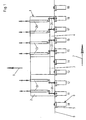
- the drawing shows schematically a sterile chamber 1, the one Injection 2, a first sterile room 3 and a second sterile room. 4 each formed by groups of e.g. ten in the plane of the drawing be traversed through bottles 8.
- This is supported the bottles 8 each in bottle carriers 5 in the form of a beam, which by means of a only schematically represented by a dash-dot line conveyor 6 be conveyed horizontally in the direction of arrow 7.
- the promotion takes place gradually in time, causing the groups of bottles each with 10 to 19 go through designated standstill positions.
- the Position 10 more positions in advance and the position 19 more Positions can follow, in each of which acted on the bottles is, for example, by prior rinsing and drying operations and by subsequent filling and closing operations.
- a peroxide aerosol heated to a sterilization starting temperature is blown into the bottles 8 of temperature-sensitive plastic, in particular PET bottles, which takes place with the aid of a lance 20, which together with its supply line 21 in the direction of the arrow 9 from a upper starting position in the illustrated lower operating position by means of a non-illustrated drive is movable.
- the supply line 21 leads to a peroxide aerosol generator, not shown, which generates peroxide aerosol with overpressure and, when the lance 20 is lowered, causes the peroxide or H 2 O 2 mist to be blown into the interior of the bottles 8.
- the introduced into the bottles 8 via the lances 20 peroxide mist has a sterilization start temperature of about 60 to 90 ° C and preferably from about 70 to 80 ° C, in which already a certain part of the H 2 O 2 with elimination of oxygen in gaseous form. Nevertheless, the temperature is so low that even with repetition of the same process in the position 12 in the formation of a condensate film on the inside of the bottle 8 whose bottle wall undergoes no warming, which comes in a threatening proximity to the limit temperature of for example 55 ° C.
- This sterile air injected in positions 15 and 16 has an activation temperature from about 90 to 120 ° C, preferably about 110 ° C, and causes by blowing it, that the condensate film on the inner surface of the Bottles are evaporated.
- This process of dissolving the aerosol condensate film is distributed in two stages in positions 15 and 16 and only in the Position 16 completed, in which the same blowing from on Activation temperature heated sterile air repeated.
- the blowing in of the sterile air with activation temperature occurs only briefly in a period of about 1 to 3 seconds, preferably 2 seconds, and at a flow rate from about 25 to 30 m / s, preferably about 28 m / s.
- the wall of the bottles 8 remains in the positions 15 and 16 in a temperature range below the limit temperature of about 55 ° C.
- the sterile air Although reduced temperature causes an effective expulsion of peroxide radicals and safe drying of the bottles 8 on its inside, avoids but also a transition of heat to the bottles 8 in one Extent that a warming of the bottle walls above limit temperature could bring about.
- the blowing in happens (similar to the positions 11 and 12 or 15 and 16) in each case with the aid of a lance 24 connected to a supply line 25 connected and together with this in the direction of arrow 9 from an upper Starting position downward in the illustrated lower operating position and is inversely movable.
- the lances 20 in the positions 11 and 12, 22 in the Positions 15 and 16 and 24 in positions 17 and 18 can each by means of one and the same drive in each case be moved up and down together.
- the amount of aerosol used which is preferably atomized at ambient temperature and heated to the sterilization start temperature only on the way to the lances 21, depends on the bottle size and is preferably about 0.15 ml of peroxide per 100 cm 2 interior surface of the bottles eighth
- the blowing-in processes can also take place in a single stage, eg in positions 15 and 17.
- the division into a plurality of stages is more favorable in terms of the course of the heat transfer to the bottle walls in the sense of avoiding a temperature rise to the limit temperature.
- more than two stages may be provided instead of two stages for the injection of peroxide aerosol and for the processing break and for the injection of sterile air, but this is accompanied by an extension of the sterilization time and the distance, which cause correspondingly increased costs ,
Landscapes
- Health & Medical Sciences (AREA)
- Mechanical Engineering (AREA)
- Engineering & Computer Science (AREA)
- Epidemiology (AREA)
- General Chemical & Material Sciences (AREA)
- Chemical Kinetics & Catalysis (AREA)
- Chemical & Material Sciences (AREA)
- Life Sciences & Earth Sciences (AREA)
- Animal Behavior & Ethology (AREA)
- General Health & Medical Sciences (AREA)
- Public Health (AREA)
- Veterinary Medicine (AREA)
- Apparatus For Disinfection Or Sterilisation (AREA)
- Processing And Handling Of Plastics And Other Materials For Molding In General (AREA)
Description
Claims (15)
- Verfahren zur Sterilisation von entlang einem Förderweg tatktweise vorbewegten Behältnissen durch Einsatz eines Sterilisationsmittels, bei dem in den Innenraum der Behältnisse erwärmtes Peroxyd-Aerosol eingeblasen und auf der Innenwand der Behältnisse ein Peroxyd-Kondensatfilm gebildet wird, und bei dem anschließend erwärmte Luft in den Innenraum der Behältnisse eingeblasen wird, bis das Aerosol-Kondensat verdampft ist, dadurch gekennzeichnet, daß zur Sterilisation von Flaschen aus temperaturempfindlichem Kunststoff, insbesondere PET-Flaschen, zur Kondensatfilmbildung Peroxyd-Aerosol in die Flaschen lediglich mit einer Sterilisations-Starttemperatur eingeblasen wird, anschließend bis zum Auflösen des Kondensatfilms durch Verdampfen Sterilluft mit einer die Sterilisations-Starttemperatur des Peroxyd-Aerosols übersteigenden Aktivierungstemperatur eingeblasen wird, und danach durch in einem weiteren gesonderten Schritt erfolgendes Einblasen von Sterilluft Peroxydreste aus dem Innenraum der Flaschen ausgetrieben werden.
- Verfahren nach Anspruch 1, dadurch gekennzeichnet, daß das Peroxid bei Umgebungstemperatur zum Aerosol vernebelt und auf dem Wege zum Innenraum der Flaschen auf Sterilisations-Starttemperatur erwärmt wird.
- Verfahren nach Anspruch 1 oder 2, dadurch gekennzeichnet, daß das Peroxid-Aerosol vor dem Einbringen in die Flaschen auf etwa 60 bis 90 °C, vorzugsweise etwa 70 bis 80 °C, als Sterilisations-Starttemperatur erwärmt wird.
- Verfahren nach einem der Ansprüche 1 bis 3, dadurch gekennzeichnet, daß das Peroxid-Aerosol vor seinem Einblasen in die Flaschen in einen auf Aktivierungstemperatur erwärmten Sterilluftstrom eingebracht und durch diesen auf dem Wege zum Innenraum der Flaschen auf die Sterilisations-Starttemperatur erwärmt wird.
- Verfahren nach einem der Ansprüche 1 bis 3, dadurch gekennzeichnet, daß das Peroxid-Aerosol und die Sterilluft bis zum Eintritt in den Innenraum der Flaschen getrennt geführt werden.
- Verfahren nach einem der Ansprüche 1 bis 5, dadurch gekennzeichnet, daß das Einbringen von Peroxid-Aerosol in den Innenraum der Flaschen in zumindest zwei getrennten, aufeinanderfolgenden Schritten vorgenommen wird.
- Verfahren nach einem der Ansprüche 1 bis 6, dadurch gekennzeichnet, daß dem Einblasen von auf Aktivierungstemperatur erwärmter Sterilluft in den Innenraum der Flaschen zumindest eine dem Einblasen von Peroxid-Aerosol nachfolgende, zumindest einen Fördertakt der Flaschen entsprechende Einwirkungspause vorgeschaltet wird.
- Verfahren nach einem der Ansprüche 1 bis 7, dadurch gekennzeichnet, daß das nach der Bildung des Peroxyd-Kondensatfilms erfolgende Einblasen von Sterilluft in zumindest zwei getrennten, jeweils einen Fördertakt der Flaschen entsprechenden Schritten vorgenommen wird.
- Verfahren nach einem der Ansprüche 1 bis 8, dadurch gekennzeichnet, daß die Sterilluft auf eine Aktivierungstemperatur von etwa 90 bis 120 °C, vorzugsweise etwa 110 °C, erwärmt wird.
- Verfahren nach einem der Ansprüche 1 bis 9, dadurch gekennzeichnet daß die nach dem Einblasen von Sterilluft mit Aktivierungstemperatur eingeblasene Sterilluft eine geminderte Temperatur aufweist.
- Verfahren nach Anspruch 10, dadurch gekennzeichnet, daß die geminderte Temperatur der Sterilluft etwa 75 bis 85 °C, vorzugsweise etwa 80°C, beträgt.
- Verfahren nach einem der Ansprüche 1 bis 11, dadurch gekennzeichnet, daß die Sterilluft mit Aktivierungstemperatur mit einer Strömungsgeschwindigkeit von etwa 25 bis 30 m/s, vorzugsweise etwa 28 m/s, in den Innenraum der Flaschen eingeblasen wird.
- Verfahren nach einem der Ansprüche 1 bis 12, dadurch gekennzeichnet, daß die Sterilluft mit geminderter Temperatur mit einer Strömungsgeschwindigkeit von etwa 70 bis 90 m/s, vorzugsweise etwa 80 m/s, in den Innenraum der Flaschen eingeblasen wird.
- Verfahren nach einem der Ansprüche 1 bis 12, dadurch gekennzeichnet, daß das Einblasen von Sterilluft jeweils über einen Zeitraum von etwa 1 bis 3 Sekunden, vorzugsweise etwa 2 Sekunden, vorgenommen wird.
- Verfahren nach einem oder mehreren der Ansprüche 1 bis 14, dadurch gekennzeichnet, daß etwa 0,15 ml Peroxid je 100 cm2 Innenraumfläche der Flaschen in diese eingebracht wird.
Applications Claiming Priority (3)
| Application Number | Priority Date | Filing Date | Title |
|---|---|---|---|
| DE19949692A DE19949692A1 (de) | 1999-10-15 | 1999-10-15 | Verfahren zur Sterilisation von PET-Flaschen |
| DE19949692 | 1999-10-15 | ||
| PCT/EP2000/007214 WO2001028863A1 (de) | 1999-10-15 | 2000-07-27 | Verfahren zur sterilisation von pet-flaschen |
Publications (2)
| Publication Number | Publication Date |
|---|---|
| EP1220787A1 EP1220787A1 (de) | 2002-07-10 |
| EP1220787B1 true EP1220787B1 (de) | 2003-09-17 |
Family
ID=7925729
Family Applications (1)
| Application Number | Title | Priority Date | Filing Date |
|---|---|---|---|
| EP00962281A Expired - Lifetime EP1220787B1 (de) | 1999-10-15 | 2000-07-27 | Verfahren zur sterilisation von pet-flaschen |
Country Status (7)
| Country | Link |
|---|---|
| EP (1) | EP1220787B1 (de) |
| JP (1) | JP2003512260A (de) |
| AT (1) | ATE249971T1 (de) |
| DE (2) | DE19949692A1 (de) |
| DK (1) | DK1220787T3 (de) |
| ES (1) | ES2208422T3 (de) |
| WO (1) | WO2001028863A1 (de) |
Cited By (3)
| Publication number | Priority date | Publication date | Assignee | Title |
|---|---|---|---|---|
| WO2013004324A1 (de) | 2011-07-05 | 2013-01-10 | Khs Gmbh | Transporteur |
| WO2013107680A3 (en) * | 2012-01-16 | 2013-09-19 | Tetra Laval Holdings & Finance S.A. | Sterilization unit and method for a filling machine |
| US11147894B2 (en) | 2007-11-19 | 2021-10-19 | Sidel Participations | Device for transporting a hollow body, installation provided with such devices, and method for conveying a hollow body attached to such a device |
Families Citing this family (16)
| Publication number | Priority date | Publication date | Assignee | Title |
|---|---|---|---|---|
| US20020085971A1 (en) * | 2001-01-03 | 2002-07-04 | Raniwala Subodh K. | Bottle sterilizing system and method |
| JP2006089146A (ja) * | 2001-09-05 | 2006-04-06 | Dainippon Printing Co Ltd | 物品の殺菌方法及び殺菌装置 |
| WO2003022689A1 (en) * | 2001-09-05 | 2003-03-20 | Dai Nippon Printing Co., Ltd. | Article sterilizing method and sterilizing device |
| DE102004030957A1 (de) * | 2004-06-26 | 2006-01-12 | Khs Maschinen- Und Anlagenbau Ag | Verfahren zum Sterilisieren von Flaschen oder dgl. Behälter sowie Sterilisator zum Durchführen des Verfarhens |
| FR2887526B1 (fr) * | 2005-06-24 | 2007-09-07 | Sidel Sas | Procede de sterilisation de preformes et installation produisant des bouteilles steriles a partir de ces preformes |
| DE102006007944A1 (de) * | 2006-02-21 | 2007-08-30 | Khs Ag | Verfahren zum Sterilisieren von Flaschen oder dergleichen Behältern sowie Vorrichtung zum Durchführen dieses Verfahrens |
| DE102007020458A1 (de) * | 2007-04-27 | 2008-10-30 | Khs Ag | Verfahren zum Sterilisieren von Behältern |
| US9120660B2 (en) | 2007-04-27 | 2015-09-01 | Khs Gmbh | Method and apparatus for the cleaning of containers such as plastic bottles in a bottle filling plant or containers in a container filling plant |
| DE102007020457A1 (de) * | 2007-04-27 | 2008-10-30 | Khs Ag | Verfahren zum Sterilisieren von Behältern |
| DE102008031369B4 (de) * | 2008-07-04 | 2011-04-07 | Khs Gmbh | Verfahren zur Behandlung von Kunststoff-Einwegbehältern |
| DE102008039674A1 (de) * | 2008-08-26 | 2010-03-04 | Khs Ag | Verfahren und Vorrichtung zur Sterilisierung von Behältern |
| DE102009011054A1 (de) * | 2009-03-02 | 2010-09-09 | Khs Ag | Verfahren zur Behandlung von Flaschen oder Behältern mit einem Wasserstoffperoxid enthaltenden Behandlungsmedium |
| DE102010054788A1 (de) | 2010-12-16 | 2012-06-21 | Krones Aktiengesellschaft | Vorrichtung zum Sterilisieren von Behältnissen |
| DE102011013121A1 (de) * | 2011-03-04 | 2012-09-20 | Krones Aktiengesellschaft | Blasformmaschine mit Sterilraum und Beheizung |
| DE102017104153A1 (de) | 2017-02-28 | 2018-08-30 | Sig Technology Ag | Verfahren und Füllmaschine zum Füllen von einseitig offenen Packungen |
| DE102019131494B4 (de) * | 2019-11-21 | 2023-10-05 | Khs Gmbh | Vorrichtung und Verfahren zum Behandeln von Behältern |
Family Cites Families (18)
| Publication number | Priority date | Publication date | Assignee | Title |
|---|---|---|---|---|
| WO1979001074A1 (en) * | 1978-05-16 | 1979-12-13 | Ex Cell O Corp | Method and means for applying bactericide to container for sterilization |
| DE3339930A1 (de) * | 1983-11-04 | 1985-05-23 | Hamba-Maschinenfabrik Hans A.Müller GmbH & Co KG, 5600 Wuppertal | Verfahren und vorrichtung zum sterilisieren von zur aufnahme von molkereiprodukten bestimmter becherfoermiger behaelter |
| JPS6228326A (ja) * | 1985-07-16 | 1987-02-06 | 東洋製罐株式会社 | 殺菌方法 |
| JPS6311163A (ja) * | 1986-03-24 | 1988-01-18 | 雪印乳業株式会社 | 殺菌方法及び装置 |
| JPH0320714Y2 (de) * | 1986-05-27 | 1991-05-02 | ||
| JP2670062B2 (ja) * | 1987-12-16 | 1997-10-29 | 大日本印刷株式会社 | 包装容器の殺菌方法 |
| JP2623630B2 (ja) * | 1988-01-21 | 1997-06-25 | 凸版印刷株式会社 | 無菌包装システムにおける殺菌剤乾燥方法 |
| JPH0523454Y2 (de) * | 1988-03-04 | 1993-06-16 | ||
| EP0375166B1 (de) * | 1988-12-19 | 1993-03-03 | Elopak Systems Ag | Verfahren zum Sterilisieren |
| JPH0356221A (ja) * | 1989-07-26 | 1991-03-11 | Dainippon Printing Co Ltd | 包装材料の殺菌方法 |
| SE463240B (sv) * | 1989-11-07 | 1990-10-29 | Tetra Pak Holdings & Finance | Saett att framstaella gasformigt, vaeteperoxidinnehaallande steriliseringsfluidum |
| FR2666299B1 (fr) * | 1990-09-03 | 1994-10-21 | Cmb Remy | Installation de sterilisation de recipients a l'aide de peroxyde d'hydrogene et procede d'utilisation. |
| GB9022268D0 (en) * | 1990-10-13 | 1990-11-28 | Cmb Foodcan Plc | Sterilising apparatus |
| SE507994C2 (sv) * | 1996-10-14 | 1998-08-10 | Tetra Laval Holdings & Finance | Sätt att sterilisera förpackningsmaterial |
| DE19642987A1 (de) * | 1996-10-18 | 1998-04-23 | Tetra Laval Holdings & Finance | Verfahren und Vorrichtung zum Sterilisieren und Befüllen von Verpackungsbehältern |
| ATE200269T1 (de) * | 1997-01-07 | 2001-04-15 | Gea Finnah Gmbh | Verfahren und maschine zum vorbereiten von flaschen für eine befüllung und befüllen der flaschen |
| ID26315A (id) * | 1997-12-12 | 2000-12-14 | Tetra Pak Plastics Ltd | Suatu proses kontinyu untuk hiperaktivasi fluida-fluida untuk sterilisasi |
| SE511861C2 (sv) * | 1998-04-07 | 1999-12-06 | Tetra Laval Holdings & Finance | Sätt och anordning för att framställa en steril förpackningsbehållare |
-
1999
- 1999-10-15 DE DE19949692A patent/DE19949692A1/de not_active Withdrawn
-
2000
- 2000-07-27 ES ES00962281T patent/ES2208422T3/es not_active Expired - Lifetime
- 2000-07-27 DE DE50003757T patent/DE50003757D1/de not_active Expired - Lifetime
- 2000-07-27 AT AT00962281T patent/ATE249971T1/de active
- 2000-07-27 EP EP00962281A patent/EP1220787B1/de not_active Expired - Lifetime
- 2000-07-27 WO PCT/EP2000/007214 patent/WO2001028863A1/de not_active Ceased
- 2000-07-27 DK DK00962281T patent/DK1220787T3/da active
- 2000-07-27 JP JP2001531665A patent/JP2003512260A/ja active Pending
Cited By (6)
| Publication number | Priority date | Publication date | Assignee | Title |
|---|---|---|---|---|
| US11147894B2 (en) | 2007-11-19 | 2021-10-19 | Sidel Participations | Device for transporting a hollow body, installation provided with such devices, and method for conveying a hollow body attached to such a device |
| WO2013004324A1 (de) | 2011-07-05 | 2013-01-10 | Khs Gmbh | Transporteur |
| DE102011106761A1 (de) | 2011-07-05 | 2013-01-10 | Khs Gmbh | Transporteur |
| WO2013107680A3 (en) * | 2012-01-16 | 2013-09-19 | Tetra Laval Holdings & Finance S.A. | Sterilization unit and method for a filling machine |
| US9481483B2 (en) | 2012-01-16 | 2016-11-01 | Tetra Laval Holdings & Finance S.A. | Sterilization unit for a filling machine |
| US10392147B2 (en) | 2012-01-16 | 2019-08-27 | Tetra Laval Holdings & Finance S.A. | Sterilization unit for a filling machine |
Also Published As
| Publication number | Publication date |
|---|---|
| DK1220787T3 (da) | 2004-01-26 |
| DE50003757D1 (de) | 2003-10-23 |
| WO2001028863A1 (de) | 2001-04-26 |
| ES2208422T3 (es) | 2004-06-16 |
| JP2003512260A (ja) | 2003-04-02 |
| ATE249971T1 (de) | 2003-10-15 |
| EP1220787A1 (de) | 2002-07-10 |
| DE19949692A1 (de) | 2001-04-19 |
Similar Documents
| Publication | Publication Date | Title |
|---|---|---|
| EP0951437B1 (de) | Verfahren und maschine zum vorbereiten von flaschen für eine befüllung und befüllen der flaschen | |
| WO2001028863A1 (de) | Verfahren zur sterilisation von pet-flaschen | |
| EP0932577B1 (de) | Verfahren und vorrichtung zum sterilisieren und befüllen von verpackungsbehältern | |
| EP2349354B1 (de) | Verfahren zur vorbehandlung von vorformlingen und streckblasmaschine zur vorbehandlung und zum streckblasen von vorformlingen zu behältern | |
| EP2138298B1 (de) | Vorrichtung und Verfahren zum Herstellen von Kunststoffbehältnissen | |
| EP2420258B1 (de) | Vorrichtung zum Behandeln von Verpackungen | |
| EP0381841A1 (de) | Verfahren und Vorrichtung zum Reinigen und Sterilisieren von Behältern | |
| EP4008364B1 (de) | Vorrichtung und verfahren zum sterilisieren von kunststoffvorformlingen | |
| DE102006023764A1 (de) | Verfahren sowie Vorrichtung zum Sterilisieren von Flaschen oder dergleichen Behälter | |
| DE2507790B2 (de) | Verfahren zum Desinfizieren der Sterilkammer einer Verpackungsmaschine | |
| EP2008667B1 (de) | Vorrichtung zum Behandeln von Gefäßen in einem Gefäßdesinfektionssystem | |
| WO2002053487A1 (de) | Vorrichtung zum sterilen befüllen von flaschenförmigen packungen | |
| DE2251455A1 (de) | Verfahren und vorrichtung zum behandeln von artikeln mit einem sterilisierungsmedium | |
| DE3701915A1 (de) | Verfahren und maschine zur sterilverpackung von fuellguetern in behaeltern | |
| EP2387422B1 (de) | Verfahren und vorrichtung zur sterilisation eines oder mehrerer gegenstände | |
| DE102010032601A1 (de) | Sterilisationsmodul zur Sterilisation von Behältnissen und Verfahren | |
| DE68905163T2 (de) | Verfahren zum sterilisieren. | |
| EP2987618B1 (de) | Formfüllmaschine und Verfahren zum Formen und Füllen von Behältern | |
| WO2021198493A1 (de) | Verfahren und vorrichtung zum sterilisieren von preforms oder von daraus geformten behältern | |
| WO2006053745A1 (de) | Verfahren und vorrichtung zum sterilisieren kontinuierlich bewegter kunststoffflaschen | |
| EP0486711B1 (de) | Vorrichtung zum Abblasen einer Flüssigkeit von einem Gegenstand | |
| DE102013204668A1 (de) | Verfahren und Vorrichtung zum Kühlen von zuvor sterilisierten pharmazeutischen Behältern | |
| DE102008049296A1 (de) | Vorrichtung zum Abblasen oder Trocknen von Kästen oder dergleichen Behältern | |
| WO2016050481A1 (de) | Vorrichtung und verfahren zum vertikalen fördern von orientierten formteilen | |
| EP4061765B1 (de) | Vorrichtung und verfahren zum behandeln von behältern |
Legal Events
| Date | Code | Title | Description |
|---|---|---|---|
| PUAI | Public reference made under article 153(3) epc to a published international application that has entered the european phase |
Free format text: ORIGINAL CODE: 0009012 |
|
| 17P | Request for examination filed |
Effective date: 20020315 |
|
| AK | Designated contracting states |
Kind code of ref document: A1 Designated state(s): AT BE CH CY DE DK ES FI FR GB GR IE IT LI LU MC NL PT SE |
|
| AX | Request for extension of the european patent |
Free format text: AL;LT;LV;MK;RO;SI |
|
| RIN1 | Information on inventor provided before grant (corrected) |
Inventor name: NIEHR, THOMAS Inventor name: WEGNER, HERBERT Inventor name: STEINHAUSER, ULRICH |
|
| GRAH | Despatch of communication of intention to grant a patent |
Free format text: ORIGINAL CODE: EPIDOS IGRA |
|
| GRAH | Despatch of communication of intention to grant a patent |
Free format text: ORIGINAL CODE: EPIDOS IGRA |
|
| GRAA | (expected) grant |
Free format text: ORIGINAL CODE: 0009210 |
|
| AK | Designated contracting states |
Kind code of ref document: B1 Designated state(s): AT BE CH CY DE DK ES FI FR GB GR IE IT LI LU MC NL PT SE |
|
| PG25 | Lapsed in a contracting state [announced via postgrant information from national office to epo] |
Ref country code: CY Free format text: LAPSE BECAUSE OF FAILURE TO SUBMIT A TRANSLATION OF THE DESCRIPTION OR TO PAY THE FEE WITHIN THE PRESCRIBED TIME-LIMIT Effective date: 20030917 |
|
| REG | Reference to a national code |
Ref country code: GB Ref legal event code: FG4D Free format text: NOT ENGLISH |
|
| REG | Reference to a national code |
Ref country code: CH Ref legal event code: EP |
|
| REF | Corresponds to: |
Ref document number: 50003757 Country of ref document: DE Date of ref document: 20031023 Kind code of ref document: P |
|
| REG | Reference to a national code |
Ref country code: IE Ref legal event code: FG4D Free format text: GERMAN |
|
| REG | Reference to a national code |
Ref country code: SE Ref legal event code: TRGR |
|
| PG25 | Lapsed in a contracting state [announced via postgrant information from national office to epo] |
Ref country code: PT Free format text: LAPSE BECAUSE OF FAILURE TO SUBMIT A TRANSLATION OF THE DESCRIPTION OR TO PAY THE FEE WITHIN THE PRESCRIBED TIME-LIMIT Effective date: 20031229 |
|
| REG | Reference to a national code |
Ref country code: DK Ref legal event code: T3 |
|
| GBT | Gb: translation of ep patent filed (gb section 77(6)(a)/1977) |
Effective date: 20040103 |
|
| REG | Reference to a national code |
Ref country code: GR Ref legal event code: EP Ref document number: 20030405022 Country of ref document: GR |
|
| LTIE | Lt: invalidation of european patent or patent extension |
Effective date: 20030917 |
|
| REG | Reference to a national code |
Ref country code: CH Ref legal event code: PUE Owner name: SIG TECHNOLOGY AG Free format text: GEA FINNAH GMBH#EINSTEINSTRASSE 18#48683 AHAUS (DE) -TRANSFER TO- SIG TECHNOLOGY AG#LAUFENGASSE 18#8212 NEUHAUSEN AM RHEINFALL (CH) Ref country code: CH Ref legal event code: NV Representative=s name: PATENTANWAELTE FELDMANN & PARTNER AG |
|
| RAP2 | Party data changed (patent owner data changed or rights of a patent transferred) |
Owner name: SIG TECHNOLOGY AG |
|
| REG | Reference to a national code |
Ref country code: ES Ref legal event code: FG2A Ref document number: 2208422 Country of ref document: ES Kind code of ref document: T3 |
|
| ET | Fr: translation filed | ||
| NLT2 | Nl: modifications (of names), taken from the european patent patent bulletin |
Owner name: SIG TECHNOLOGY AG |
|
| PLBE | No opposition filed within time limit |
Free format text: ORIGINAL CODE: 0009261 |
|
| STAA | Information on the status of an ep patent application or granted ep patent |
Free format text: STATUS: NO OPPOSITION FILED WITHIN TIME LIMIT |
|
| PG25 | Lapsed in a contracting state [announced via postgrant information from national office to epo] |
Ref country code: LU Free format text: LAPSE BECAUSE OF NON-PAYMENT OF DUE FEES Effective date: 20040727 |
|
| PG25 | Lapsed in a contracting state [announced via postgrant information from national office to epo] |
Ref country code: MC Free format text: LAPSE BECAUSE OF NON-PAYMENT OF DUE FEES Effective date: 20040731 |
|
| 26N | No opposition filed |
Effective date: 20040618 |
|
| REG | Reference to a national code |
Ref country code: FR Ref legal event code: CD Ref country code: FR Ref legal event code: TP Ref country code: FR Ref legal event code: CA |
|
| PGFP | Annual fee paid to national office [announced via postgrant information from national office to epo] |
Ref country code: GR Payment date: 20060519 Year of fee payment: 7 |
|
| REG | Reference to a national code |
Ref country code: CH Ref legal event code: PFA Owner name: SIG TECHNOLOGY AG Free format text: SIG TECHNOLOGY AG#LAUFENGASSE 18#8212 NEUHAUSEN AM RHEINFALL (CH) -TRANSFER TO- SIG TECHNOLOGY AG#LAUFENGASSE 18#8212 NEUHAUSEN AM RHEINFALL (CH) |
|
| PG25 | Lapsed in a contracting state [announced via postgrant information from national office to epo] |
Ref country code: GR Free format text: LAPSE BECAUSE OF NON-PAYMENT OF DUE FEES Effective date: 20080206 |
|
| REG | Reference to a national code |
Ref country code: CH Ref legal event code: PUE Owner name: KHS CORPOPLAST GMBH & CO. KG Free format text: SIG TECHNOLOGY AG#LAUFENGASSE 18#8212 NEUHAUSEN AM RHEINFALL (CH) -TRANSFER TO- KHS CORPOPLAST GMBH & CO. KG#MEIENDORFER STRASSE 203#20439 HAMBURG (DE) |
|
| REG | Reference to a national code |
Ref country code: CH Ref legal event code: NV Representative=s name: SCHNEIDER FELDMANN AG PATENT- UND MARKENANWAELTE |
|
| NLS | Nl: assignments of ep-patents |
Owner name: KHS CORPOPLAST GMBH & CO. KG Effective date: 20091110 Owner name: SIG TECHNOLOGY AG Effective date: 20091110 |
|
| NLT1 | Nl: modifications of names registered in virtue of documents presented to the patent office pursuant to art. 16 a, paragraph 1 |
Owner name: GEA ABFUELLTECHNIK GMBH |
|
| REG | Reference to a national code |
Ref country code: GB Ref legal event code: 732E Free format text: REGISTERED BETWEEN 20100107 AND 20100113 |
|
| REG | Reference to a national code |
Ref country code: FR Ref legal event code: TP |
|
| REG | Reference to a national code |
Ref country code: ES Ref legal event code: PC2A Owner name: KHS CORPOPLAST GMBH & CO.KG Effective date: 20110215 |
|
| REG | Reference to a national code |
Ref country code: DE Ref legal event code: R081 Ref document number: 50003757 Country of ref document: DE Owner name: KHS CORPOPLAST GMBH, DE Free format text: FORMER OWNER: GEA FINNAH GMBH, 48683 AHAUS, DE Effective date: 20110504 |
|
| PGFP | Annual fee paid to national office [announced via postgrant information from national office to epo] |
Ref country code: FI Payment date: 20130711 Year of fee payment: 14 Ref country code: DK Payment date: 20130719 Year of fee payment: 14 Ref country code: BE Payment date: 20130719 Year of fee payment: 14 Ref country code: IE Payment date: 20130726 Year of fee payment: 14 |
|
| REG | Reference to a national code |
Ref country code: CH Ref legal event code: PFA Owner name: KHS CORPOPLAST GMBH, DE Free format text: FORMER OWNER: KHS CORPOPLAST GMBH AND CO. KG, DE |
|
| REG | Reference to a national code |
Ref country code: FR Ref legal event code: CJ Effective date: 20140107 Ref country code: FR Ref legal event code: CD Owner name: KHS CORPOPLAST GMBH, DE Effective date: 20140107 Ref country code: FR Ref legal event code: CA Effective date: 20140107 |
|
| REG | Reference to a national code |
Ref country code: NL Ref legal event code: SD Effective date: 20140520 |
|
| REG | Reference to a national code |
Ref country code: DK Ref legal event code: EBP Effective date: 20140731 |
|
| REG | Reference to a national code |
Ref country code: IE Ref legal event code: MM4A |
|
| PG25 | Lapsed in a contracting state [announced via postgrant information from national office to epo] |
Ref country code: FI Free format text: LAPSE BECAUSE OF NON-PAYMENT OF DUE FEES Effective date: 20140727 |
|
| REG | Reference to a national code |
Ref country code: DE Ref legal event code: R082 Ref document number: 50003757 Country of ref document: DE |
|
| PG25 | Lapsed in a contracting state [announced via postgrant information from national office to epo] |
Ref country code: DK Free format text: LAPSE BECAUSE OF NON-PAYMENT OF DUE FEES Effective date: 20140731 |
|
| PG25 | Lapsed in a contracting state [announced via postgrant information from national office to epo] |
Ref country code: IE Free format text: LAPSE BECAUSE OF NON-PAYMENT OF DUE FEES Effective date: 20140727 |
|
| REG | Reference to a national code |
Ref country code: FR Ref legal event code: PLFP Year of fee payment: 17 |
|
| REG | Reference to a national code |
Ref country code: FR Ref legal event code: PLFP Year of fee payment: 18 |
|
| PG25 | Lapsed in a contracting state [announced via postgrant information from national office to epo] |
Ref country code: BE Free format text: LAPSE BECAUSE OF NON-PAYMENT OF DUE FEES Effective date: 20140731 |
|
| REG | Reference to a national code |
Ref country code: FR Ref legal event code: PLFP Year of fee payment: 19 |
|
| PGFP | Annual fee paid to national office [announced via postgrant information from national office to epo] |
Ref country code: NL Payment date: 20190719 Year of fee payment: 20 |
|
| PGFP | Annual fee paid to national office [announced via postgrant information from national office to epo] |
Ref country code: DE Payment date: 20190719 Year of fee payment: 20 Ref country code: SE Payment date: 20190719 Year of fee payment: 20 Ref country code: FR Payment date: 20190719 Year of fee payment: 20 Ref country code: IT Payment date: 20190730 Year of fee payment: 20 Ref country code: ES Payment date: 20190822 Year of fee payment: 20 |
|
| PGFP | Annual fee paid to national office [announced via postgrant information from national office to epo] |
Ref country code: AT Payment date: 20190722 Year of fee payment: 20 Ref country code: GB Payment date: 20190719 Year of fee payment: 20 |
|
| PGFP | Annual fee paid to national office [announced via postgrant information from national office to epo] |
Ref country code: CH Payment date: 20190719 Year of fee payment: 20 |
|
| REG | Reference to a national code |
Ref country code: DE Ref legal event code: R071 Ref document number: 50003757 Country of ref document: DE |
|
| REG | Reference to a national code |
Ref country code: NL Ref legal event code: MK Effective date: 20200726 |
|
| REG | Reference to a national code |
Ref country code: CH Ref legal event code: PL |
|
| REG | Reference to a national code |
Ref country code: GB Ref legal event code: PE20 Expiry date: 20200726 |
|
| REG | Reference to a national code |
Ref country code: SE Ref legal event code: EUG |
|
| REG | Reference to a national code |
Ref country code: AT Ref legal event code: MK07 Ref document number: 249971 Country of ref document: AT Kind code of ref document: T Effective date: 20200727 |
|
| REG | Reference to a national code |
Ref country code: SE Ref legal event code: EUG |
|
| PG25 | Lapsed in a contracting state [announced via postgrant information from national office to epo] |
Ref country code: GB Free format text: LAPSE BECAUSE OF EXPIRATION OF PROTECTION Effective date: 20200726 |
|
| REG | Reference to a national code |
Ref country code: ES Ref legal event code: FD2A Effective date: 20201106 |
|
| PG25 | Lapsed in a contracting state [announced via postgrant information from national office to epo] |
Ref country code: ES Free format text: LAPSE BECAUSE OF EXPIRATION OF PROTECTION Effective date: 20200728 |