EP1220007A2 - Breitband-Teleskop mit senkrechtem Lichteinfall - Google Patents
Breitband-Teleskop mit senkrechtem Lichteinfall Download PDFInfo
- Publication number
- EP1220007A2 EP1220007A2 EP01130980A EP01130980A EP1220007A2 EP 1220007 A2 EP1220007 A2 EP 1220007A2 EP 01130980 A EP01130980 A EP 01130980A EP 01130980 A EP01130980 A EP 01130980A EP 1220007 A2 EP1220007 A2 EP 1220007A2
- Authority
- EP
- European Patent Office
- Prior art keywords
- light rays
- surface part
- reflecting mirror
- sector
- energy
- Prior art date
- Legal status (The legal status is an assumption and is not a legal conclusion. Google has not performed a legal analysis and makes no representation as to the accuracy of the status listed.)
- Withdrawn
Links
Images




Classifications
-
- G—PHYSICS
- G02—OPTICS
- G02B—OPTICAL ELEMENTS, SYSTEMS OR APPARATUS
- G02B5/00—Optical elements other than lenses
- G02B5/08—Mirrors
- G02B5/0891—Ultraviolet [UV] mirrors
-
- B—PERFORMING OPERATIONS; TRANSPORTING
- B82—NANOTECHNOLOGY
- B82Y—SPECIFIC USES OR APPLICATIONS OF NANOSTRUCTURES; MEASUREMENT OR ANALYSIS OF NANOSTRUCTURES; MANUFACTURE OR TREATMENT OF NANOSTRUCTURES
- B82Y10/00—Nanotechnology for information processing, storage or transmission, e.g. quantum computing or single electron logic
-
- G—PHYSICS
- G02—OPTICS
- G02B—OPTICAL ELEMENTS, SYSTEMS OR APPARATUS
- G02B23/00—Telescopes, e.g. binoculars; Periscopes; Instruments for viewing the inside of hollow bodies; Viewfinders; Optical aiming or sighting devices
- G02B23/02—Telescopes, e.g. binoculars; Periscopes; Instruments for viewing the inside of hollow bodies; Viewfinders; Optical aiming or sighting devices involving prisms or mirrors
- G02B23/06—Telescopes, e.g. binoculars; Periscopes; Instruments for viewing the inside of hollow bodies; Viewfinders; Optical aiming or sighting devices involving prisms or mirrors having a focussing action, e.g. parabolic mirror
-
- G—PHYSICS
- G02—OPTICS
- G02B—OPTICAL ELEMENTS, SYSTEMS OR APPARATUS
- G02B5/00—Optical elements other than lenses
- G02B5/08—Mirrors
- G02B5/0816—Multilayer mirrors, i.e. having two or more reflecting layers
- G02B5/085—Multilayer mirrors, i.e. having two or more reflecting layers at least one of the reflecting layers comprising metal
- G02B5/0858—Multilayer mirrors, i.e. having two or more reflecting layers at least one of the reflecting layers comprising metal the reflecting layers comprising a single metallic layer with one or more dielectric layers
-
- G—PHYSICS
- G21—NUCLEAR PHYSICS; NUCLEAR ENGINEERING
- G21K—HANDLING OF PARTICLES OR IONISING RADIATION NOT OTHERWISE PROVIDED FOR; IRRADIATION DEVICES; GAMMA RAY OR X-RAY MICROSCOPES
- G21K1/00—Arrangements for handling particles or ionising radiation, e.g. focusing or moderating
- G21K1/06—Arrangements for handling particles or ionising radiation, e.g. focusing or moderating using diffraction, refraction or reflection, e.g. monochromators
-
- G—PHYSICS
- G21—NUCLEAR PHYSICS; NUCLEAR ENGINEERING
- G21K—HANDLING OF PARTICLES OR IONISING RADIATION NOT OTHERWISE PROVIDED FOR; IRRADIATION DEVICES; GAMMA RAY OR X-RAY MICROSCOPES
- G21K1/00—Arrangements for handling particles or ionising radiation, e.g. focusing or moderating
- G21K1/06—Arrangements for handling particles or ionising radiation, e.g. focusing or moderating using diffraction, refraction or reflection, e.g. monochromators
- G21K1/062—Devices having a multilayer structure
Definitions
- the present invention relates to a wide band normal incident telescope, and more particularly to a wide band normal incident telescope used suitably for astronomic observation wherein emission line extending over a wide energy band are input vertically.
- a normal incident telescope for observing emission of a predetermined energy which involves a mirror reflecting only light having a predetermined energy corresponding to a multilayer film formed on a surface of the mirror at high reflectivity, and a detector such as a semiconductor detector for detecting light of the predetermined energy as a result of condensing light reflected by the reflecting mirror has been known.
- a normal incident telescope by which rays in a wide energy band can be observed is desired.
- rays in a region extending from extreme ultraviolet to soft X-ray are absorbed by atmospheric air. In these circumstances, a normal incident telescope by which observation can be made outside aerosphere is desired.
- a normal incident telescope of the prior art only light having a predetermined energy in response to a multilayer film of a reflecting mirror can be observed. Accordingly, in order to observe photons in a wide energy band, it is required to use a plurality of conventional normal incident telescopes each of them comprises a reflecting mirror involving a multilayer film reflecting light rays of a different energy from one another, so that there has been a problem of giving rise to increase costs for requiring the plurality of normal incident telescopes.
- the present invention has been made in view of the above-described problems involved in the prior art.
- An object of the invention is to provide a wide band normal incident telescope in which light rays in a wide energy band, for example, extending from visible light to soft X-ray are reflected, respectively, at high reflectivity by a single reflecting mirror, whereby light rays in a wide energy band can be observed.
- Another object of the present invention is to provide a wide band normal incident telescope by which light rays in a wide energy band, for example, a region extending from visible light to soft X-ray are reflected, respectively, at high reflectivity by a single reflecting mirror, whereby it makes no need for using a plurality of normal incident telescopes to achieve decrease in its costs, besides, light rays in a wide energy band can be efficiently observed.
- a wide band normal incident telescope comprises a reflecting mirror involving a surface part wherein different types of multilayer films have been formed, respectively, in every regions of predetermined shapes, and reflecting light rays, which were input, by the surface part; and a detector to which the light rays reflected by the surface part are input, and which detects spectrally the light rays thus input.
- a wide band normal incident telescope is constituted in such that different types of multilayer films on the surface part are the ones reflecting respectively photons having predetermined energies in a region extending from extreme ultraviolet ray to soft X-ray as well as having high reflection factors due to total reflection over a region extending from visible light to vacuum ultraviolet ray,
- light rays having predetermined energies in a region extending from extreme ultraviolet ray to soft X-ray are reflected by a boundary surface defined between layers of a multilayer film in the plurality of the regions of the single reflecting mirror, so that these light rays are reflected at high reflectivity due to interference, besides respective photons over a region from visible light to vacuum ultraviolet ray are reflected by the surface of the multilayer films at high reflectivity due to total reflection (specular reflection), so that light rays in a region of wide energy band extending from visible light to soft X-ray, which are input, can be simultaneously observed.
- a wide band normal incident telescope according to the present invention may be constituted in such that the surface part involves a circular shape and which has been divided into a plurality of sector-shaped areas each having a predetermined central angle containing a central portion of the circular shape as its apex,
- a wide band normal incident telescope according to the present invention may be constituted in such that the surface part is composed of a plurality of sections each involving a predetermined number of the sector-shaped areas in which types of multilayer films formed therein and orders in alignment of the multilayer films coincide with each other in the plural sections, respectively.
- the same multilayer films may be provided over the whole surface of a reflecting mirror in the present invention.
- a wide band normal incident telescope may be constituted to comprise a reflecting mirror involving a surface part wherein multilayer films have been formed, and reflecting light rays, which were input, by the surface part, wherein each periodic length is changed continuously in each of the multilayer films along its depth direction of the multilayer film to reflect, respectively, light rays each having a predetermined energy in a region extending from extreme ultraviolet to soft X-ray, and the multilayer films have also high reflection factors due to total reflection over a region extending from vacuum ultraviolet ray to visible light; and a detector to which the light rays reflected by said surface part of said reflecting mirror are input, and which detects spectrally the incidence rays.
- respective light rays in a wide energy band, which were input to the surface part of the reflecting mirror, are reflected by a boundary surface defined between layers each having a corresponding periodic length of supermirrors being the multilayer films wherein such periodic length is changed continuously in the depth direction thereof in the present invention, whereby the light rays reflected by the surface part of the reflecting mirror are detected spectrally by means of the detector, so that light rays input in a wide energy band of a region extending from visible light to soft X-ray can be observed simultaneously.
- a wide band normal incident telescope comprises a first reflecting mirror involving a first surface part in which multilayer films have been formed, and reflecting light rays, which were input, by the first surface part, wherein each periodic length is changed continuously in each of the multilayer films along the depth direction of the multilayer films to reflect, respectively, light rays each having a predetermined energy in a region extending from soft X-ray to extreme ultraviolet, and the multilayer films have high reflection factors due to total reflection over a region extending from visible light to vacuum ultraviolet ray; a second reflecting mirror involving a second surface part wherein multilayer films have been formed, and reflecting light rays, which were reflected by the first surface part of the first reflecting mirror, by the second surface wherein each periodic length is changed continuously in each of the multilayer films along the depth direction thereof in response to the first surface of the first reflecting mirror to reflect, respectively, light rays each having a predetermined energy in a region extending from extreme ultraviolet ray to soft X-ray, and the multilayer films
- respective light rays in a wide energy band, which were input to the first surface part of the first reflecting mirror, are reflected by a boundary surface defined between layers each having a corresponding periodic length of supermirrors being the multilayer films wherein such periodic length is changed continuously in the depth direction thereof in the present invention, whereby the light rays reflected by the first surface part of the first reflecting mirror are reflected by the second surface of the second reflecting mirror to be detected spectrally by means of the detector, so that light rays input in a wide energy band of a region extending from visible light to soft x-ray can be observed simultaneously.
- the second reflecting mirror reflecting the light rays, which were reflected by the first surface part of the first reflecting mirror, is used, aberration correction can be made.
- the light rays reflected by the second reflecting mirror are input to the detector, so that it becomes possible to place the detector on a rear side of the first surface of the first reflecting mirror.
- a wide band normal incident teles cope according to the present invention may be constituted in such that the above-described detector is a superconducting tunnel junction device.
- respective light rays in a wide energy band reflected by a single reflecting mirror or a plurality of reflecting mirrors can be detected spectrally by means of a single detector as a result of employing a superconducting tunnel junction device which functions as a detector having high sensitivity and high spectroscopic capability in a wide band extending from infrared ray to X-ray in the present invention.
- a wide band normal incident telescope comprises a reflecting mirror having a surface part involving four sections forming a circular shape, each section being prepared by disposing clockwise sequentially nine sector-shaped areas, each having a central angle of ten degrees, of a first sector-shaped area in which a multilayer film reflecting light rays of 100 eV energy has been formed, a second sector-shaped area in which a multilayer film reflecting light rays of 90 eV energy has been formed, a third sector-shaped area in which a multilayer film reflecting light rays of 80 eV energy has been formed, a fourth sector-shaped area in which a multilayer film reflecting light rays of 70 eV energy has been formed, a fifth sector-shaped area in which a multilayer film reflecting light rays of 60 eV energy has been formed, a sixth sector-shaped area in which a multilayer film reflecting light rays of 50 eV energy has been formed, a seventh sector-shaped area in which a multilayer film reflecting light
- FIG. 1 is an explanatory view of a conceptual constitution illustrating the first embodiment of a wide band normal incident telescope according to the present invention
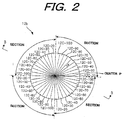
- FIG. 2 is an explanatory view in the direction of the arrow A in FIG. 1
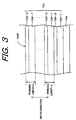
- FIG. 3 is a partly enlarged explanatory view in a section taken along the line B-B of FIG. 2.
- a wide band normal incident telescope 10 as shown in FIG. 1 comprises a reflecting mirror 12 to which light rays are vertically input, and a superconducting tunnel junction (STJ) device 14 being a detector to which light rays reflected by the reflecting mirror are condensed.
- STJ superconducting tunnel junction
- the reflecting mirror 12 is a dish-shaped body 12a the whole configuration of which is circular, and a surface part 12b of the dish-shaped body 12a is formed into a paraboloid of revolution, which is concavely recessed centering around a central portion P.
- the surface part 12b having a circular shape in the reflecting mirror 12 is sectioned into a plurality of sector-shaped areas 12c each of which is configured to involve a central portion P as its apex.
- Each of the plurality of sector-shaped areas 12c in the surface part 12b is fabricated in the form of multilayer films 12d, which reflect respectively light rays of each of predetermined energies in a region extending from soft X-ray to extreme ultraviolet ray, and have high reflection factors due to total internal reflection in a region extending from visible light to vacuum ultraviolet ray (see FIG. 3).
- the surface part 12b in the reflecting mirror 12 is sectioned into thirty-six sector-shaped areas 12c, each of which is configured to have a central angle ⁇ of ten degrees involving the central portion P as its apex, and each of them has an equal area.
- nine sector-shaped areas 12c are grouped into one section as a set in the thirty-six sector-shaped areas 12c, so that four sections reside in the surface part 12b.
- Each of these sector-shaped areas 12c-100, 12c-90, 12c-80, 12c-70, 12c-60, 12c-50, 12c-40, 12c-30, and 12c-20 has a structure of the same multilayer film 12d as that shown in FIG. 3 as described above.
- the multilayer film 12d is formed as follows. Namely, a first layer 12d-1 having a predetermined refractive index is formed on the dish-shaped body 12a of the reflecting mirror 12, and a second layer 12d-2 having a different refractive index from that of the first refractive index 12d-1 is formed on the above-described first layer 12d-1. Then, two layers of the first layer 12d-1 and the second layer 12d-2, which was laminated on the above-described first layer 12d-1, are grouped as a set, and a predetermined number n of lamination layers wherein "n" is a positive integer is laminated.
- thin films having different refractive indexes from one another are superposed in a multi-layered form, besides, a periodic length d corresponding to a film thickness of a set of the first layer 12d-1 and the second layer 12d-2 is formed so as to utilize Bragg reflection.
- a periodic length d corresponding to a film thickness of a set of the first layer 12d-1 and the second layer 12d-2 is formed so as to utilize Bragg reflection.
- light input to the multilayer film 12d is reflected by a boundary surface defined between the first layer 12d-1 and the second layer 12d-2 to generate interference of the light reflected by the boundary surface between the first layer 12d-1 and the second layer 12d-2, whereby light having a predetermined energy is reflected at high reflectivity.
- Respective multilayer films of the sector-shaped areas 12c-100, 12c-90, 12c-80, 12c-70, 12c-60, 12c-50,12c-40,12c-30, and 12c-20 in the above-described surface part 12b are formed by laminating the predetermined number n of lamination layers of the first layer 12d-1 and the second layer 12d-2 each of which has a predetermined refractive index with the periodic length d in such that light of a corresponding predetermined energy is reflected at high reflectivity.
- the first layer 12d-1 is made from, for example, a heavy element such as Ni (nickel), and Mo (molybdenum)
- the second layer 12d-2 is made from, for example, a light element such as C (carbon) and Si (silicon).
- the multilayer film 12d which reflects light of a predetermined energy, in the respective sector-shaped areas 12c in the surface part 12b of the reflecting mirror 12.
- a detailed explanation of an apparatus for film formation and a method for the film formation are omitted herein.
- the multilayer film 12d is formed in the predetermined sector-shaped areas 12c in the surface part 12b of the reflecting mirror 12, it may be arranged in such that sector-shaped areas 12c other than the predetermined sector-shaped areas 12c are masked, and film formation is sequentially made in every sector-shaped areas 12c. As another manner, it may be arranged in such that the reflecting mirror 12 is divided into thirty-six small pieces in every sector-shaped areas 12c in the surface part 12b, a film is formed on each of these thirty-six small pieces, and then these pieces are incorporated into a single surface part 12b to obtain the reflecting mirror 12.
- the superconducting tunnel junction device 14 is a kind of Josephson device, which has a structure wherein a thin insulation film (e.g., alumina) is sandwiched in superconducting metallic thin films (e.g., niobium).
- a thin insulation film e.g., alumina
- superconducting metallic thin films e.g., niobium
- the superconducting tunnel junction device 14 is a detector condensing light rays reflected by the reflecting mirror 12 as described above. More specifically, the superconducting tunnel junction device 14 operates at cryogenic temperature of around 0.3 K, and when light is input to the superconducting tunnel junction device 14, energy of the light thus input is absorbed by the superconducting metallic thin film.
- the superconducting tunnel junction device 14 functions as a detector.
- the superconducting tunnel junction device 14 functions as a detector having high sensitivity and high spectroscopic capability in a wide band extending from X-ray to infrared ray.
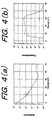
- FIG. 4(a) indicates reflectivity on the surface of the superconducting tunnel junction device 14
- FIG. 4(b) indicates transmittance on the surface of the superconducting tunnel junction device 14.
- absorptance in photon of the superconducting tunnel junction device 14 is 95% or higher.
- the superconducting tunnel junction device 14 has very high absorptance of photon in a region extending from soft X-ray to extreme ultraviolet ray, so that when the superconducting tunnel junction device 14 exhibiting behavior for producing signals due to absorption of photon is used in accordance with a manner as described above, spectral detection of light is realized in a region extending from soft X-ray to visible light.
- FIG. 5 is a graph indicating an example of energy resolving power of the superconducting tunnel junction device 14 in a region extending from soft X-ray to extreme ultraviolet ray.
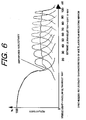
- a light ray having 100 ev energy, a light ray having 90 eV energy, a light ray having 80 eV energy, a light ray having 70 eV energy, a light ray having 60 ev energy, a light ray having 50 eV energy, a light ray having 40 eV energy, a light ray having 30 eV energy, and a light ray having 20 eV energy are reflected at high reflectivity, respectively, in the sector-shaped area 12c-100, the sector-shaped area 12c-90, the sector-shaped area 12c-80, the sector-shaped area 12c-70, the sector-shaped area 12c-60, the sector-shaped area 12c-50, the sector-shaped area 12c-40, the sector-shaped area 12c-30, and the sector-shaped area 12c-20 among light rays in the wide energy band, which were input to the surface part 12b of the reflecting mirror 12 (see FIG. 6).
- a reflectivity in the surface part 12d of the reflecting mirror 12 is the one which is obtained by combining respective reflection factors in the sector-shaped areas 12c with reflectivity in the surface 12dd of the multilayer film 12d (see FIG. 6). Accordingly, respective light rays in a region extending from soft X-ray to visible light among light rays input in a wide energy band are reflected by the surface part 12d of the reflecting mirror 12 at high reflection factors.
- the light rays reflected by the surface part 12d of the reflecting mirror 12 are condensed into the superconducting tunnel junction device 14.
- light rays reflected by four sector-shaped areas 12c corresponding to four sections in the surface part 14b of the reflecting mirror 12, in other words, four places are condensed into the superconducting tunnel junction device 14 with respect to respective light rays each having a predetermined energy in the region extending from soft X-ray to extreme ultraviolet ray, so that high imaging performance is obtained.
- the reflecting mirror 12 wherein a plurality of sector-shaped areas 12c in which the multilayer film 12d corresponding to light rays in the region extending from soft X-ray to visible light is disposed on the surface part 12b, and the superconducting tunnel junction device 14 having high sensitivity and high spectral capability in a wide band extending from X-ray to infrared ray is disposed as described above.
- respective light rays in a wide energy band i.e., light rays in the region extending from soft X-ray to visible light, particularly light rays in a region extending from soft X-ray to extreme ultraviolet ray can be observed by the wide band normal incident telescope 10 according to the present invention.
- the wide band normal incident telescope 10 since light rays in a wide energy band in the region extending from soft X-ray to visible light are reflected by the single reflecting mirror 12 at high reflection factors, respectively, in the wide band normal incident telescope 10 according to the present invention, it is sufficient to provide a single superconducting tunnel junction device 14, which condenses light rays reflected by the reflecting mirror 12, so that reduction in costs can be achieved, besides space saving can be realized in an astronomical satellite into which the wide band normal incident telescope 10 is to be mounted in case of astronomic observation, because it is sufficient to provide a single cooler for cooling the superconducting tunnel junction device 14.
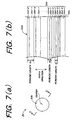
- FIGS. 7(a) and 7(b) a second embodiment of a wide band normal incident telescope according to the present invention will be described by referring to FIGS. 7(a) and 7(b).
- the second embodiment differs from the above-described first embodiment in that the plurality of sector-shaped areas 12c in which the multilayer film 12d corresponding to respective light rays each having a predetermined energy has been formed are disposed on the surface part 12b in the reflecting mirror 12 of the above-described first embodiment (see FIGS. 2 and 3), while a multilayer film 32d each having different periodic length is formed in a surface part 32b of a reflecting mirror 32 in the second embodiment.
- each periodic length d in the multilayer film 12d of the reflecting mirror 12 in the above-described first embodiment does not vary in the depth direction of the multilayer films 12d to coincide with each other (see FIG. 3), while each periodic length d in the multilayer film 32d of the reflecting mirror 32 in the second embodiment varies continuously in the depth direction of the multilayer film 32d (see FIG. 7(b)).
- each periodic length d becomes shorter with drawing apart from a surface 32dd in the depth direction of the multilayer film 32d, while each periodic length becomes longer with approaching to the surface 32dd.
- a periodic length d 1 positioned at the farthermost away from the surface 32dd, a periodic length d 2 positioned at a halfway point in the depth direction, and a periodic length d 3 positioned in the vicinity of the surface 32dd of the multilayer film 32d are in a relationship of the periodic length d 1 ⁇ the periodic length d 2 ⁇ the periodic length d 3 .
- the surface part 32b of such reflecting mirror 32 is not divided into a plurality of sector-shaped areas unlike the surface part 12b of the reflecting mirror 12 have been divided into the plurality of the sector-shaped areas 12c in the first embodiment.
- each periodic length d of the multilayer film 32d in the surface part 32b of the reflecting mirror 32 varies continuously in the depth direction of the multilayer film 32d so as to correspond respectively to light rays each having a predetermined energy in a region extending from soft X-ray to extreme ultraviolet ray.
- energies of light rays reflected by utilizing Bragg reflection in a boundary surface defined between a first layer 32d-1 and a second layer 32d-2 in each of different periodic lengths d (for example, periodic lengths d 1 , d 2 , and d 3 ), become different from one another.
- the light rays in a wide energy band are input vertically to the surface part 32b of the reflecting mirror 32, respectively, in a wide band normal incident telescope of the second embodiment, the light rays each having a predetermined energy transmit into the multilayer film 32d of the reflecting mirror 32 in the depth direction in response to magnitude of the energies, and the light rays thus transmitted are reflected by a boundary surface defined between the first layer 32d-1 and the second layer 32d-2 each of them having a corresponding periodic length d.
- light rays in the wide energy band in the region extending from soft X-ray to visible light particularly, respectiye light rays in a region extending from soft X-ray to extreme ultraviolet ray can be observed also in a wide band normal incident telescope according to the second embodiment as in the above-described wide band normal incident telescope 10 of the first embodiment, whereby reduction in costs can be achieved, and light rays in a wide energy band can be observed efficiently, besides, space saving can be realized in an astronomical satellite or the like wherein the wide band normal incident telescope is to be disposed in case of astronomic observation.
- the surface part 32b of the reflecting mirror 32 has not been divided into a plurality of sector-shaped areas, but each of periodic lengths d in the multilayer film 32d has been continuously changed in the depth direction of the multilayer film 32d in the whole circular region of the surface part 32b (see FIG. 7(b)) with such modification that the surface part 32b of the reflecting mirror 32 has not been divided into a plurality of sector-shaped areas.
- the surface part 32b of the reflecting mirror 32 is divided into a plurality of sector-shaped areas, and the plurality of the respective sector-shaped areas form different types of supermirrors.
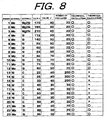
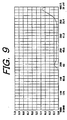
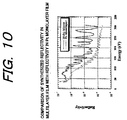
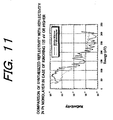
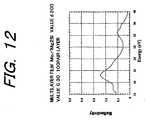
- FIGS. 8 through 12 indicate results of simulations as to reflectivity of reflecting mirrors corresponding to the reflecting mirror 12 in the wide band normal incident telescope 10 according to the first embodiment (see FIGS. 1 through 6) wherein FIG. 8 is a table showing theoretical reflectivity data in plural types of respective sector-shaped areas in a surface part of each reflecting mirror used, FIG. 9 is a graphical representation indicating theoretical values of reflectivity in a multilayer film (reference number 3) in the theoretical reflectivity data shown in FIG. 8, FIG. 10 is a graphical representation indicating theoretical values of synthesized reflectivity of a reflecting mirror in the case where energies up to 300 eV are considered, FIG.
- FIG. 11 is a graphical representation indicating theoretical values of synthesized reflectivity of a reflecting mirror in the case where energies 125 eV or higher are not considered
- FIG. 12 is a graphical representation indicating theoretical values of synthesized reflectivity of a reflecting mirror with respect to light rays having energies 30 eV or lower, respectively.
- a reflecting mirror as to which the results of simulations are indicated in FIGS. 8 through 12 corresponds to the reflecting mirror 12 in the wide band normal incident telescope 10 of the first embodiment (see FIGS. 1 through 6).
- the reflecting mirror 12 involves nine sector-shaped areas 12c in a section so that nine types of multilayer films 12d have been formed, while a reflecting mirror used in the simulations involves twenty-three sector-shaped areas in a section so that twenty-three types of multilayer films have been formed.
- a column “Number” in the table of FIG. 8 means each reference number of twenty-three types of different multilayer films
- a column “Material 1” means a material for preparing a thin film corresponding to the first layer 12d-1 in the reflecting mirror 12
- a column “Material 2” means a material for preparing a thin film corresponding to the second layer 12d-2 in the reflecting mirror 12
- a column “valued” means periodic length d
- a column “value Y” means a film thickness ratio of a pair of layers, i.e., a ratio of film thickness of the material 1/(film thickness of the material 1 + film thickness of the material 2)
- a column “Number of Pair Layer” means a predetermined number n of laminations in a multilayer film.
- a column "Theoretical Calculation 1" indicates a type of multilayer film constituting a reflecting mirror in the case where energies of up to 300 eV are considered, and in this case, a simulation is conducted by using a reflecting mirror wherein twenty-three types of multilayer films have been formed.
- a column "Theoretical Calculation 2" indicates a type of multilayer film constituting a reflecting mirror in the case where energies of 125 eV or higher are not considered, and in this case, a simulation is conducted by using a reflecting mirror wherein fifteen types of multilayer films of those represented by reference numbers 1 through 12 as well as those represented by reference numbers 21 through 23 have been formed.
- a multilayer film represented by reference number 3 indicates values of reflectivity as shown in FIG. 9.
- Synthesized reflectivity of a reflecting mirror wherein these twenty-three types of multilayer films have been formed, and energies up to 300 eV are considered is about five times better than synthesized reflectivity of a reflecting mirror wherein a single Pt layer film has been formed on a surface part over the substantially whole area in its energy band as shown in FIG. 10.
- synthesized reflectivity of a reflecting mirror wherein fifteen types of multilayer films have been formed without considering energies of 125 eV or higher is better effective synthesized reflectivity in comparison with that of a reflecting mirror wherein twenty-three types of multilayer films have been formed with taking energies up to 300 eV into consideration (see FIG. 11).
- a reflecting mirror under a condition wherein effective synthesized reflectivity is elevated can be realized in the case where 125 eV or higher energies are not considered by means of multilayer films of less types than that of a reflectingmirror wherein energies up to 300 eV are considered.
- reflection factors of from several percent to several tens percent can be maintained in an extent from soft X-ray to vacuum ultraviolet ray in a reflecting mirror wherein twenty-three types of multilayer films have been formed with taking energies of up to 300 eV into consideration.
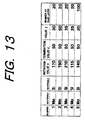
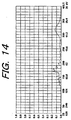
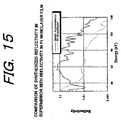
- FIGS. 13 through 15 results of a simulation as to reflectivity of a reflecting mirror corresponding to the reflecting mirror 32 in the wide band normal incident telescope according to the above-described second embodiment (see FIGS. 7(a) and 7(b)) are shown.
- FIG. 13 is a table indicating theoretical reflectivity data with respect to plural types of respective supermirrors in its surface part of a reflecting mirror used.
- FIG. 14 is a graphical representation indicating respective theoretical values of reflectivity as to a supermirror (reference number 4) with respect to the theoretical reflectivity data shown in FIG. 13.
- FIG. 15 is a graphical representation indicating theoretical values of synthesized reflectivity of a reflecting mirror having a surface part composed of plural types of supermirrors with respect to the theoretical reflectivity data shown in FIG. 13.
- a reflecting mirror indicating simulated results of FIGS. 13 through 15 corresponds to the reflecting mirror 32 in a wide band normal incident telescope of the above-described second embodiment (see FIGS. 7 (a) and 7 (b))
- a single type of supermirror has been formed with such a modification that the surface part 32b of the reflecting mirror 32 is not divided into a plurality of sector-shaped areas, while a reflecting mirror used in the simulation is the one wherein a surface part has been divided into a plurality of sector-shaped areas, whereby five types of supermirrors have been formed.
- FIG. 13 respective theoretical reflectivity data of the five types of supermirrors in the reflecting mirror used in the simulation are shown in FIG. 13.
- a column “Number” represents reference numbers of five types of different supermirrors
- a column “Material 1” indicates a material for forming a thin film corresponding to a first layer 32d-1 in a reflecting mirror 32
- a column “Material 2” indicates a material for forming a thin film corresponding to a second layer 32d-2 in the reflecting mirror 32
- a column “Initiation Value d” represents a periodic length corresponding to that of d 3 in the vicinity of a surface 32dd in a multilayer film 32d of the reflecting mirror 32
- a column “Termination Value d” represents a periodic length corresponding to that of d 1 in the vicinity of a main body part 32a in the multilayer film 32d of the reflecting mirror 32
- a column of "Value Y" represents a ratio of film thickness of a pair of
- a supermirror designated by reference number 4 indicates reflection factors as shown in FIG. 14. Synthesized reflectivity in a reflecting mirror wherein these five types of supermirrors are formed is better than that of a reflecting mirror wherein a Pt single layer film is formed within a range of energy band from about 40 eV to about 120 eV as shown in FIG. 15.
- a top coating of Pt or the like may be further applied to the surface 12dd being the uppermost layer of the multilayer film 12d in the surface part 12b of the reflecting mirror 10.
- Each dimension of diameters, curvatures in a curved surface and the like in the surface parts 12b and 32b of the reflecting mirror 10 in the above-described first and second embodiments may be determined in accordance with an object to be observed by the reflecting mirror 10, a space in an astronomical satellite in which a telescope containing the reflecting mirror 10 is to be mounted, and the like situations.
- band pass filters for selecting soft X-ray, extreme ultravioletray, ultravioletray, and visible light, respectively are prepared, spectral detection for light rays in a region extending from soft X-ray to visible light can be made more positively.
- a thin film filter utilizing absorption structure of material e.g., Al/C (aluminum/carbon) metallic thin film filter can be used for light rays of from soft X-ray to vacuum ultraviolet ray (see FIGS. 16(a) and 16(b)), and a filter utilizing absorption structure of material, a band pass filter utilizing interference or the like can be used for light rays of from vacuum ultraviolet ray to visible light.
- absorption structure of material e.g., Al/C (aluminum/carbon) metallic thin film filter
- a filter utilizing absorption structure of material, a band pass filter utilizing interference or the like can be used for light rays of from vacuum ultraviolet ray to visible light.
- respective events of soft X-ray, extreme ultraviolet ray, ultraviolet ray, and visible light may be separated from respective phonon events by means of a rise-up time of electrical signals detected as a result of inputting reflected light to the superconducting tunnel junction device 14 without using such band pass filter as described above.
- a plurality of the superconducting tunnel junction devices 14 may be used to implement spectroscopic imaging, and in such case, a variety of circuit systems may be changed or arranged.
- the surface 12b of the reflecting mirror 10 has been divided into sector-shaped areas 12c each having a central portion P as its apex to form the multilayer film 12d by which light rays of nine types of energies are reflected
- the invention is not limited thereto as a matter of course, but types of such multilayer films are not limited to nine types as shown in FIGS. 8 through 12.
- a multilayer film by which light rays in a region extending from soft X-ray to visible light are reflected may be formed in the respective sector-shaped areas by the use of a predetermined material, respectively.
- such multilayer film by which light rays each having a predetermined energy are reflected may be formed with such design (i.e., an order in alignment of sector-shaped areas, the number of sections and the like) , a ratio of sectioning (i.e., magnitude of central angle ⁇ ) so as to maximize intensity of reflection as to respective energies at detecting positions.
- magnitude of the central angle ⁇ may be arranged so as to increase with increase in energies of light rays reflected by a multilayer film formed in sector-shaped areas. According to such an arrangement as described above, light ray having the higher energy among light rays input to a surface part of a reflecting mirror in a wide energy band is reflected at the higher reflectivity in its corresponding sector-shaped area involving a wide area.
- a specified wavelength is meaningless in view of observation
- a sector-shaped area wherein a multilayer film reflecting an energy of 50 eV has been formed is changed into a sector-shaped area wherein a multilayer film reflecting an energy of 100 eV.
- light rays of 100 eV come to be reflected at higher reflectivity, so that an amount of light of 100 eV can be increased.
- a manner for sectioning is not limited also to a manner for slicing a pie in sector-shaped areas as a matter of course, but it may be arranged, for example, in such that the surface 12b of the reflecting mirror 10 is divided into areas each having a predetermined shape, and plural types of multilayer films by which light rays in a region extending from soft X-ray to visible light are reflected are formed in the respective areas having the predetermined shapes.
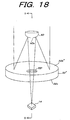
- the invention is not limited thereto as a matter of course, but it may be arranged, for example, as shown in FIG. 17(b) and FIG. 18 in such that a superconducting tunnel junction device 14 is not disposed on a side of the surface part 32b' in the reflecting mirror 32', but it is disposed on a side of a rear part 32e positioned on a side opposite to the surface part 32b' of the reflecting mirror 32', whereby a Cassegrain type telescope is fabricated.
- the surface part 32b' of the reflecting mirror 32' is composed of supermirrors a situation of which is the same as the surface part 32b of the reflecting mirror 32 in the above-described second embodiment. Furthermore, a hole portion 32f, which is opened in the surface part 32b' and the rear part 32e, is bored at a central region of the reflecting mirror 32'.
- the superconducting tunnel junction device 14 is disposed on the side of the rear part 32e of the reflecting mirror 32', and a reflecting mirror 40 is disposed on the side of the surface part 32b' of the reflecting mirror 32'.
- a surface part 40a of the reflecting mirror 40 has a convex surface and is composed of supermirrors. More specifically, the supermirrors of the reflecting mirror 40 reflect respectively light rays each having a predetermined energy in a region extending from soft X-ray to extreme ultraviolet ray, besides it exhibits high reflection factors due to total reflection over a region extending from vacuum ultraviolet ray to visible light.
- a system of a wide band normal incident telescope may be designed in response to a variety of conditions such as types, focal distances and the like of supermirrors constituting the surface part 32b' being the concaved surface of the reflecting mirror 32'.
- the reflecting mirror 32' being a primary mirror and the reflecting mirror 40 being a secondary mirror are used, light rays in a wide energy band input to the surface part 32b' of the reflecting mirror 32' are reflected twice, and its optical path is folded back by the reflecting mirror 40 to be focused on the rear side of the reflecting mirror 32'.
- the superconducting tunnel junction device 14 is disposed on the rear side of the reflecting mirror 32' of the primary mirror, incorporation of a cooling system such as a cooling device for cooling the superconducting tunnel junction device 14 becomes easy.
- the present invention has been constituted as described above, light rays in a wide energy band can be reflected, respectively, by a single reflecting mirror at each high reflectivity, so that there is such an excellent advantage that light rays in a wide energy band, for example, those in a region extending from soft X-ray to visible light can be observed.
- the present invention has been constituted as described above, light rays in a wide energy band can be reflected, respectively, by a single reflecting mirror at each high reflectivity, whereby there is no need of employing a plurality of normal incident telescopes, so that there are such an excellent advantages that reduction in costs can be achieved and that light rays in a wide energy band can be efficiently observed.
Landscapes
- Physics & Mathematics (AREA)
- Engineering & Computer Science (AREA)
- General Physics & Mathematics (AREA)
- Optics & Photonics (AREA)
- Chemical & Material Sciences (AREA)
- Spectroscopy & Molecular Physics (AREA)
- General Engineering & Computer Science (AREA)
- High Energy & Nuclear Physics (AREA)
- Nanotechnology (AREA)
- Theoretical Computer Science (AREA)
- Crystallography & Structural Chemistry (AREA)
- Mathematical Physics (AREA)
- Astronomy & Astrophysics (AREA)
- Optical Elements Other Than Lenses (AREA)
- Photometry And Measurement Of Optical Pulse Characteristics (AREA)
- Spectrometry And Color Measurement (AREA)
- Telescopes (AREA)
- Optical Filters (AREA)
Applications Claiming Priority (4)
| Application Number | Priority Date | Filing Date | Title |
|---|---|---|---|
| JP2000400417 | 2000-12-28 | ||
| JP2000400417 | 2000-12-28 | ||
| JP2001382599A JP2002286547A (ja) | 2000-12-28 | 2001-12-17 | 広帯域直入射望遠鏡 |
| JP2001382599 | 2001-12-17 |
Publications (2)
| Publication Number | Publication Date |
|---|---|
| EP1220007A2 true EP1220007A2 (de) | 2002-07-03 |
| EP1220007A3 EP1220007A3 (de) | 2003-12-03 |
Family
ID=26607025
Family Applications (1)
| Application Number | Title | Priority Date | Filing Date |
|---|---|---|---|
| EP01130980A Withdrawn EP1220007A3 (de) | 2000-12-28 | 2001-12-28 | Breitband-Teleskop mit senkrechtem Lichteinfall |
Country Status (3)
| Country | Link |
|---|---|
| US (1) | US20020089739A1 (de) |
| EP (1) | EP1220007A3 (de) |
| JP (1) | JP2002286547A (de) |
Cited By (1)
| Publication number | Priority date | Publication date | Assignee | Title |
|---|---|---|---|---|
| CZ306934B6 (cs) * | 2011-05-17 | 2017-09-27 | Rigaku Innovative Technologies Europe S.R.O. | Rentgenový optický systém |
Families Citing this family (6)
| Publication number | Priority date | Publication date | Assignee | Title |
|---|---|---|---|---|
| US7615385B2 (en) | 2006-09-20 | 2009-11-10 | Hypres, Inc | Double-masking technique for increasing fabrication yield in superconducting electronics |
| JP6193553B2 (ja) * | 2012-11-02 | 2017-09-06 | 日本信号株式会社 | テラヘルツ波検出センサ |
| CN105204153A (zh) * | 2015-09-16 | 2015-12-30 | 中国科学院国家天文台南京天文光学技术研究所 | 大型天文望远镜拼接镜面子镜的装卸方法 |
| JP6921391B2 (ja) * | 2017-01-24 | 2021-08-18 | 国立研究開発法人宇宙航空研究開発機構 | 望遠鏡システム |
| US10468149B2 (en) * | 2017-02-03 | 2019-11-05 | Globalfoundries Inc. | Extreme ultraviolet mirrors and masks with improved reflectivity |
| CN114879355B (zh) * | 2021-02-05 | 2024-09-20 | 中国科学院苏州纳米技术与纳米仿生研究所 | 一种望远镜结构及其制作方法 |
Family Cites Families (3)
| Publication number | Priority date | Publication date | Assignee | Title |
|---|---|---|---|---|
| JPH02210299A (ja) * | 1989-02-10 | 1990-08-21 | Olympus Optical Co Ltd | X線用光学系及びそれに用いる多層膜反射鏡 |
| FR2696544B1 (fr) * | 1992-10-05 | 1995-06-23 | Europ Agence Spatiale | Cellule de detection, detecteur, capteur et spectroscope. |
| US5303256A (en) * | 1993-03-12 | 1994-04-12 | Hughes Aircraft Company | Quasi-monolithic saturable optical element |
-
2001
- 2001-12-17 JP JP2001382599A patent/JP2002286547A/ja active Pending
- 2001-12-28 EP EP01130980A patent/EP1220007A3/de not_active Withdrawn
- 2001-12-28 US US10/029,036 patent/US20020089739A1/en not_active Abandoned
Cited By (1)
| Publication number | Priority date | Publication date | Assignee | Title |
|---|---|---|---|---|
| CZ306934B6 (cs) * | 2011-05-17 | 2017-09-27 | Rigaku Innovative Technologies Europe S.R.O. | Rentgenový optický systém |
Also Published As
| Publication number | Publication date |
|---|---|
| US20020089739A1 (en) | 2002-07-11 |
| JP2002286547A (ja) | 2002-10-03 |
| EP1220007A3 (de) | 2003-12-03 |
Similar Documents
| Publication | Publication Date | Title |
|---|---|---|
| US9810822B2 (en) | Angular optical filtering element for angular filtering having controlled angular selectivity | |
| US5016265A (en) | Variable magnification variable dispersion glancing incidence imaging x-ray spectroscopic telescope | |
| Inoue et al. | Cryogenic infrared filter made of alumina for use at millimeter wavelength | |
| Ragozin et al. | Soft X-ray spectrometers based on aperiodic reflection gratings and their application | |
| Tamura et al. | Supermirror design for hard x-ray telescopes on-board Hitomi (ASTRO-H) | |
| JPH02210299A (ja) | X線用光学系及びそれに用いる多層膜反射鏡 | |
| US20020089739A1 (en) | Wide band normal incident telescope | |
| US7450299B2 (en) | Broadband telescope | |
| Hawkins et al. | Cooled infrared filters and dichroics for the Sea and Land Surface Temperature Radiometer | |
| US4941163A (en) | Multispectral glancing incidence X-ray telescope | |
| US3580679A (en) | Solar spectrographs | |
| Hawkins et al. | Infrared filters and coatings for the high resolution dynamics Limb sounder (6–18 µm) | |
| WO2023158385A2 (en) | Method of forming a metalens, a metalens and devices comprising metalenses | |
| Zhou et al. | Optical design of the Lyman alpha based beam emission spectroscopy (LAB) diagnostic on the HL-2A tokamak | |
| Panini et al. | Multilayer Mirror Based High-Resolution Solar Soft X-Ray Spectrometer | |
| Uno | Wideband multichroic detector architecture for millimeter and submillimeter imaging observations | |
| Sako et al. | Developing metal coated mesh filters for mid-infrared astronomy | |
| Hennessy et al. | Advanced imaging capabilities by incorporating plasmonics and metamaterials in detectors | |
| Lindblom et al. | Performance of the Multi-Spectral Solar Telescope Array IV: the soft x-ray and extreme ultraviolet filters | |
| Corso et al. | Non-periodic multilayer coatings for solar applications: advantages and future perspectives | |
| Catura et al. | Calculated performance of a Wolter Type I x-ray telescope coated by multilayers | |
| US20230418051A1 (en) | Monolithic mirror and method for designing same | |
| Auchère et al. | Development of multilayer thin film filters for the full-sun imager on Solar Orbiter | |
| Kowalski et al. | High-resolution EUV spectroscopy: performance of spherical multilayer-coated gratings operated at near normal incidence | |
| Lee | Sinx/Al Metamaterial-Based Terahertz-To-Infrared Converter For Real-Time Imaging |
Legal Events
| Date | Code | Title | Description |
|---|---|---|---|
| PUAI | Public reference made under article 153(3) epc to a published international application that has entered the european phase |
Free format text: ORIGINAL CODE: 0009012 |
|
| AK | Designated contracting states |
Kind code of ref document: A2 Designated state(s): AT BE CH CY DE DK ES FI FR GB GR IE IT LI LU MC NL PT SE TR |
|
| AX | Request for extension of the european patent |
Free format text: AL;LT;LV;MK;RO;SI |
|
| PUAL | Search report despatched |
Free format text: ORIGINAL CODE: 0009013 |
|
| AK | Designated contracting states |
Kind code of ref document: A3 Designated state(s): AT BE CH CY DE DK ES FI FR GB GR IE IT LI LU MC NL PT SE TR |
|
| AX | Request for extension of the european patent |
Extension state: AL LT LV MK RO SI |
|
| 17P | Request for examination filed |
Effective date: 20040601 |
|
| AKX | Designation fees paid |
Designated state(s): AT BE CH CY DE DK ES FI FR GB GR IE IT LI LU MC NL PT SE TR |
|
| 17Q | First examination report despatched |
Effective date: 20040721 |
|
| STAA | Information on the status of an ep patent application or granted ep patent |
Free format text: STATUS: THE APPLICATION IS DEEMED TO BE WITHDRAWN |
|
| 18D | Application deemed to be withdrawn |
Effective date: 20050201 |