EP1219977A1 - Rod lens having inclined surface - Google Patents
Rod lens having inclined surface Download PDFInfo
- Publication number
- EP1219977A1 EP1219977A1 EP01130502A EP01130502A EP1219977A1 EP 1219977 A1 EP1219977 A1 EP 1219977A1 EP 01130502 A EP01130502 A EP 01130502A EP 01130502 A EP01130502 A EP 01130502A EP 1219977 A1 EP1219977 A1 EP 1219977A1
- Authority
- EP
- European Patent Office
- Prior art keywords
- end surface
- rod lens
- optical element
- rod
- central axis
- Prior art date
- Legal status (The legal status is an assumption and is not a legal conclusion. Google has not performed a legal analysis and makes no representation as to the accuracy of the status listed.)
- Withdrawn
Links
Images

Classifications
-
- G—PHYSICS
- G02—OPTICS
- G02B—OPTICAL ELEMENTS, SYSTEMS OR APPARATUS
- G02B6/00—Light guides; Structural details of arrangements comprising light guides and other optical elements, e.g. couplings
- G02B6/24—Coupling light guides
- G02B6/26—Optical coupling means
- G02B6/28—Optical coupling means having data bus means, i.e. plural waveguides interconnected and providing an inherently bidirectional system by mixing and splitting signals
- G02B6/293—Optical coupling means having data bus means, i.e. plural waveguides interconnected and providing an inherently bidirectional system by mixing and splitting signals with wavelength selective means
- G02B6/29346—Optical coupling means having data bus means, i.e. plural waveguides interconnected and providing an inherently bidirectional system by mixing and splitting signals with wavelength selective means operating by wave or beam interference
- G02B6/29361—Interference filters, e.g. multilayer coatings, thin film filters, dichroic splitters or mirrors based on multilayers, WDM filters
-
- G—PHYSICS
- G02—OPTICS
- G02B—OPTICAL ELEMENTS, SYSTEMS OR APPARATUS
- G02B13/00—Optical objectives specially designed for the purposes specified below
- G02B13/0095—Relay lenses or rod lenses
-
- G—PHYSICS
- G02—OPTICS
- G02B—OPTICAL ELEMENTS, SYSTEMS OR APPARATUS
- G02B3/00—Simple or compound lenses
- G02B3/0087—Simple or compound lenses with index gradient
-
- G—PHYSICS
- G02—OPTICS
- G02B—OPTICAL ELEMENTS, SYSTEMS OR APPARATUS
- G02B6/00—Light guides; Structural details of arrangements comprising light guides and other optical elements, e.g. couplings
- G02B6/24—Coupling light guides
- G02B6/26—Optical coupling means
- G02B6/32—Optical coupling means having lens focusing means positioned between opposed fibre ends
-
- G—PHYSICS
- G02—OPTICS
- G02B—OPTICAL ELEMENTS, SYSTEMS OR APPARATUS
- G02B6/00—Light guides; Structural details of arrangements comprising light guides and other optical elements, e.g. couplings
- G02B6/24—Coupling light guides
- G02B6/26—Optical coupling means
- G02B6/32—Optical coupling means having lens focusing means positioned between opposed fibre ends
- G02B6/327—Optical coupling means having lens focusing means positioned between opposed fibre ends with angled interfaces to reduce reflections
Definitions
- the present invention relates to an optical element, such as a gradient-index rod-lens and a capillary. More particularly, the present invention pertains to an optical element having at least one end surface that is inclined with respect to a central axis of the rod lens or the capillary.
- a typical gradient-index rod-lens converts light that is sent from a light source, such as a laser diode and a light emitting diode (LED), to a parallel light or converges light that is received through an optical fiber at a predetermined position.
- a light source such as a laser diode and a light emitting diode (LED)
- LED light emitting diode
- two rod lenses are arranged to contact each other.
- a filter which has desired optical characteristics, is placed between two rod lenses.
- the lens length of the rod lens is determined according to the intended purpose of the rod lens. For example, the lens length of the rod lens is set in accordance with the distance between the output end of the optical fiber and the rod lens or the distance between the two rod lenses such that the coupling loss is minimized.
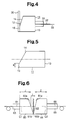
- Fig. 6 illustrates conventional rod lenses 60, 61 used in an optical communication module.
- the rod lens 60 on the left side has an output side end surface 60a, which is inclined with respect to a central axis C1 of the rod lens 60.
- the rod lens 61 on the right side has an input side end surface 61a, which is inclined with respect to a central axis C2 of the rod lens 61.
- An optical fiber 64 is held by a capillary 63 and an optical fiber 66 is held by a capillary 65.
- a filter 62 is placed between a distal end portion 60b of the rod lens 60 and a distal end portion 61b of the rod lens 61.
- the rod lens 60 converts light that is emitted from the output end of the optical fiber 64 to a parallel light.
- the parallel light is transmitted through the filter 62 and enters the rod lens 61.
- the rod lens 61 converges the parallel light at the input end of the optical fiber 66.
- the converged light travels through the optical fiber 66 and is sent to another optical element.
- the two rod lenses 60, 61 optically couple the two optical fibers 64, 66.
- the lens length Z of the rod lens 60 is the length of the central axis C1 between both end surfaces.
- the lens length Z of the rod lens 61 is the length of the central axis C2 between both end surfaces.
- the distance L between the two rod lenses 60, 61 is the distance between the output side end surface 60a and the input side end surface 61a along the central axes C1, C2.
- the distal end portions 60b, 61b of the conventional rod lenses 60, 61 are sharp and easily damaged.
- the distal end portions 60b, 61b could get chipped when placing the filter 62 between the distal end portions 60b, 61b, or when the distal end portions 60b, 61b are arranged to contact each other. If the distal end portions 60b, 61b get chipped, the distance L changes. Therefore, the lens length Z, which is optimized in accordance with the distance L before the distal end portions 60b, 61b get chipped, is not optimum.
- the optical communication module that uses the rod lenses 60, 61 having chipped distal end portions 60b, 61b has great coupling loss.
- the optical fibers 64, 66 are not optically coupled in the optimum manner. Also, when inserting the rod lenses 60, 61 into a holder such as a cylindrical sleeve, the sharp distal end portions 60b, 61b could contact the holder and get chipped. In this case, the optical module is defective. Similar problem occurs when the end surface of each capillary 63, 65 is inclined. If the sharp distal end portions of the rod lenses 60, 61 or the capillaries 63, 65 get chipped, the chipped pieces could further increase the coupling loss.
- the objective of the present invention is to provide an optical element for an optical communication module that is not easily damaged, improves the defect rate, and reduces the coupling loss.
- Another objective of the present invention is to provide an optical element for an optical communication module that minimizes the coupling loss without performing alignment during the assembly of various types of optical modules.
- the optical element includes a first end surface and a second end surface. At least one of the first end surface and the second end surface includes an inclined surface, which is inclined by a predetermined angle with respect to a central axis of the optical element, and a distal end surface, which is adjacent to the inclined surface.
- the present invention also provides a cylindrical optical element.
- the cylindrical optical element includes a first end surface, a second end surface, and an outer circumferential surface.
- the first end surface intersects a central axis of the optical element.
- the second end surface intersects the central axis.
- the outer circumferential surface extends along the central axis.
- At least one of the first end surface and the second end surface includes an inclined surface, which is inclined by a predetermined angle with respect to the central axis of the optical element, and a contact surface, which is adjacent to the inclined surface and is perpendicular to the central axis.
- a term “optical element” includes a gradient-index rod-lens, a capillary, which holds an optical fiber, and an optical member such as an optical crystal used for, for example, an optical isolator.
- an optical member such as an optical crystal used for, for example, an optical isolator.
- a term “effective diameter of a rod lens” refers to the maximum diameter of a lens that provides an optical aberration that is less than or equal to a predetermined value.
- FIG. 2 is a view looking at the rod lens 11 shown in Fig. 1 from a direction indicated by an arrow A.
- the rod lens 11 is a cylindrical glass having a predetermined gradient index.
- the rod lens 11 has an input side end surface 12 and an output side end surface 13.
- the output side end surface 13 is a flat surface that is perpendicular to a central axis C3 of the rod lens 11.
- the input side end surface 12 includes an inclined surface 14 and a contact surface 15.
- the inclined surface 14 is inclined by a predetermined inclination angle ⁇ with respect to the central axis C3.
- the contact surface 15 is a distal end portion that is adjacent to the inclined surface 14.
- the contact surface 15 is preferably a flat surface that is perpendicular to the central axis C3.
- the outer circumferential surface of the rod lens 11 and the contact surface 15 preferably form an angle of at least 90 degrees in relation to each other.
- the lens length (light path length) Zl of the rod lens 11 is determined in accordance with the gradient index characteristics ( ⁇ A) of the rod lens 11 and the distance L (see Fig. 3) required by an application (an optical communication module) in which the rod lens 11 is used.
- the contact surface 15 and the inclined surface 14 are formed on the input side end surface 12 of the rod lens 11 such that the rod lens 11 has the determined lens length Zl. More specifically, the dimension h of the contact surface 15, which is perpendicular to the central axis C3, is determined in accordance with the lens length Z1 and the distance L.
- the inclination angle ⁇ of the inclined surface 14 is determined such that the distal end portion of the input side end surface 12 has the contact surface 15, which has the dimension h.
- the contact surface 15 is preferably formed outside an effective diameter area 17 of the rod lens 11.
- Fig. 3 shows the rod lens 11 used in an optical communication module.
- the optical communication module includes the rod lens 11 and a rod lens 11A, which is a mirror image of the rod lens 11.
- the rod lens 11A has the same structure as the rod lens 11.
- the rod lens 11 and the rod lens 11A are coaxial.
- the input side end surface 13A of the rod lens 11A is a flat surface that is perpendicular to the central axis C4 of the rod lens 11A.
- the output side end surface 12A of the rod lens 11A includes the inclined surface 14A and the contact surface 15A.
- the inclined surface 14A is inclined by the predetermined inclination angle ⁇ with respect to the central axis C4.
- the contact surface 15A is perpendicular to the central axis C4.
- a filter 16 is located between the contact surface 15A of the rod lens 11A and the contact surface 15 of the rod lens 11.
- a capillary 20, which holds an optical fiber 21, is secured to the input side end surface 13A of the rod lens 11A.
- a capillary 22, which holds an optical fiber 23, is secured to the output side end surface 13 of the rod lens 11.
- the rod lens 11A converts the light that is emitted from the optical fiber 21 to a parallel light and emits the parallel light to the filter 16.
- the light that is transmitted through the filter 16 is converged by the rod lens 11.
- the converged light enters the optical fiber 23 and is sent to another optical element, which is not shown.
- the two rod lenses 11A, 11 optically couple the two optical fibers 21, 23.
- the rod lenses 11A, 11 according to the preferred embodiment provides the following advantages.
- optical fibers 32, 33 are optically coupled in the optimum manner by only arranging the reflection surface of the mirror 30 to contact the contact surface 15 of the rod lens 11. Therefore, the coupling loss is minimized without performing alignment of the rod lens 11 with respect to the mirror 30.
- the present invention is applied to the gradient-index rod-lens 11, 11A.
- the present invention may be applied to any one of the capillaries 20, 22, 31, which hold the optical fibers 21, 23, 32, 33. That is, the inclined surface and the distal end, which is adjacent to the inclined surface and has no sharp edge, may be formed on at least one of the ends of the capillary 20, 22, 31.
- the distal end is preferably a flat surface that is perpendicular to the optical axis of the capillary 20, 22, 31 as the contact surface 15. In this case, the distal end of the capillary 20, 22, 31 does not easily get chipped even when the distal end contacts the cylindrical holder such as the sleeve. This improves the defect rate during manufacturing of various types of optical modules.
- the contact surface 15 may be curved.
- the inclined surface 14 and the contact surface 15 may be formed on both end surfaces 12, 13 of the rod lens 11.
- an inclined surface may be formed on the input side end surface 13A of the left side rod lens 11A. Then, an inclined surface, which corresponds to the inclined surface of the input side end surface 13A, may be formed on the end surface of the left side capillary 20. In this case, the inclined surface of the rod lens 11A and the inclined surface of the capillary 20 are located with a predetermined space in between.
- the right side capillary 22 and the right side rod lens 11 may be formed in the same manner.
- the rod lens 11 need not be cylindrical.
- the rod lens 11 may be square.
Landscapes
- Physics & Mathematics (AREA)
- General Physics & Mathematics (AREA)
- Optics & Photonics (AREA)
- Optical Couplings Of Light Guides (AREA)
Applications Claiming Priority (2)
| Application Number | Priority Date | Filing Date | Title |
|---|---|---|---|
| JP2000398571 | 2000-12-27 | ||
| JP2000398571A JP2002196182A (ja) | 2000-12-27 | 2000-12-27 | 傾斜面を有する光学素子 |
Publications (1)
| Publication Number | Publication Date |
|---|---|
| EP1219977A1 true EP1219977A1 (en) | 2002-07-03 |
Family
ID=18863506
Family Applications (1)
| Application Number | Title | Priority Date | Filing Date |
|---|---|---|---|
| EP01130502A Withdrawn EP1219977A1 (en) | 2000-12-27 | 2001-12-21 | Rod lens having inclined surface |
Country Status (5)
| Country | Link |
|---|---|
| US (1) | US6687434B2 (enExample) |
| EP (1) | EP1219977A1 (enExample) |
| JP (1) | JP2002196182A (enExample) |
| CN (1) | CN1362628A (enExample) |
| CA (1) | CA2365802A1 (enExample) |
Cited By (2)
| Publication number | Priority date | Publication date | Assignee | Title |
|---|---|---|---|---|
| EP1847863A4 (en) * | 2005-01-31 | 2010-11-10 | Hitachi Metals Ltd | OPTICAL POWER MONITOR AND MANUFACTURING METHOD THEREFOR |
| EP2515150A4 (en) * | 2009-12-14 | 2014-04-02 | Toyo Seikan Group Holdings Ltd | LATERAL EMITTER AND MANUFACTURING METHOD THEREFOR |
Families Citing this family (15)
| Publication number | Priority date | Publication date | Assignee | Title |
|---|---|---|---|---|
| JP3687848B2 (ja) * | 2001-11-28 | 2005-08-24 | 日立金属株式会社 | 光合分波器用薄膜フィルターおよびその製造方法 |
| US7052155B2 (en) * | 2003-08-14 | 2006-05-30 | Gavin Lawrence E | Illuminated magnetic retrieval apparatus |
| US8520989B2 (en) | 2010-03-19 | 2013-08-27 | Corning Incorporated | Fiber optic interface devices for electronic devices |
| US20110229077A1 (en) | 2010-03-19 | 2011-09-22 | Davide Domenico Fortusini | Small-form-factor fiber optic interface devices with an internal lens |
| JP2013522688A (ja) | 2010-03-19 | 2013-06-13 | コーニング インコーポレイテッド | 電子装置用光ファイバインタフェース装置 |
| EP2548067A4 (en) | 2010-03-19 | 2014-04-02 | Corning Inc | FIBER OPTIC INTERFACE DEVICE COMPRISING A TRANSLATABLE RING |
| US8774577B2 (en) | 2010-12-07 | 2014-07-08 | Corning Cable Systems Llc | Optical couplings having coded magnetic arrays and devices incorporating the same |
| US8781273B2 (en) | 2010-12-07 | 2014-07-15 | Corning Cable Systems Llc | Ferrule assemblies, connector assemblies, and optical couplings having coded magnetic arrays |
| US9405078B2 (en) | 2011-08-30 | 2016-08-02 | Opsens Inc. | Method for disposable guidewire optical connection |
| US8936401B2 (en) | 2011-08-30 | 2015-01-20 | Claude Belleville | Method for disposable guidewire optical connection |
| US8734024B2 (en) | 2011-11-28 | 2014-05-27 | Corning Cable Systems Llc | Optical couplings having a coded magnetic array, and connector assemblies and electronic devices having the same |
| US9304265B2 (en) | 2012-07-26 | 2016-04-05 | Corning Cable Systems Llc | Fiber optic connectors employing moveable optical interfaces with fiber protection features and related components and methods |
| WO2014209671A2 (en) | 2013-06-25 | 2014-12-31 | Corning Optical Communications LLC | Optical plug having a translating cover and a complimentary receptacle |
| WO2016048825A1 (en) | 2014-09-23 | 2016-03-31 | Corning Optical Communications LLC | Optical connectors and complimentary optical receptacles having magnetic attachment |
| JP1557563S (enExample) | 2015-10-30 | 2016-08-29 |
Family Cites Families (12)
| Publication number | Priority date | Publication date | Assignee | Title |
|---|---|---|---|---|
| JPH0814661B2 (ja) * | 1986-02-17 | 1996-02-14 | オリンパス光学工業株式会社 | 視野変換光学系 |
| US5074682A (en) * | 1988-03-02 | 1991-12-24 | Fujitsu Limited | Semiconductor laser module and positioning method thereof |
| US5221839A (en) * | 1991-02-15 | 1993-06-22 | Hewlett-Packard Company | Double bevel gradient-index rod lens optical receiver having high optical return loss |
| US5172271A (en) * | 1991-11-26 | 1992-12-15 | Jds Fitel Inc. | Graded index lens structure suitable for optical fiber termination |
| US5757993A (en) * | 1995-06-05 | 1998-05-26 | Jds Fitel Inc. | Method and optical system for passing light between an optical fiber and grin lens |
| US6055112A (en) * | 1998-04-24 | 2000-04-25 | Campbell-Miller; Margot | Lensed cascaded optical filter |
| US6253007B1 (en) * | 1998-07-08 | 2001-06-26 | Optical Switch Corporation | Method and apparatus for connecting optical fibers |
| WO2000058766A1 (en) * | 1999-03-29 | 2000-10-05 | Scimed Life Systems, Inc. | Single mode optical fiber coupling systems |
| US6445939B1 (en) * | 1999-08-09 | 2002-09-03 | Lightlab Imaging, Llc | Ultra-small optical probes, imaging optics, and methods for using same |
| US6408115B1 (en) * | 2000-06-02 | 2002-06-18 | Mcintyre Kevin J. | Multi-port optical coupling system using anamorphic lenses to correct for aberration |
| US6633701B2 (en) * | 2001-01-16 | 2003-10-14 | Foxconn Optical Technology, Inc. | Method of manufacturing a core collimating assembly for DWDM devices |
| US6748137B2 (en) * | 2001-04-30 | 2004-06-08 | Jds Uniphase Corporation | Lensed optical fiber |
-
2000
- 2000-12-27 JP JP2000398571A patent/JP2002196182A/ja active Pending
-
2001
- 2001-12-19 US US10/027,258 patent/US6687434B2/en not_active Expired - Lifetime
- 2001-12-21 EP EP01130502A patent/EP1219977A1/en not_active Withdrawn
- 2001-12-21 CA CA002365802A patent/CA2365802A1/en not_active Abandoned
- 2001-12-27 CN CN01144835.0A patent/CN1362628A/zh active Pending
Non-Patent Citations (1)
| Title |
|---|
| "SELFOC Product Guide", September 1993, NSG EUROPE, XP002190689 * |
Cited By (2)
| Publication number | Priority date | Publication date | Assignee | Title |
|---|---|---|---|---|
| EP1847863A4 (en) * | 2005-01-31 | 2010-11-10 | Hitachi Metals Ltd | OPTICAL POWER MONITOR AND MANUFACTURING METHOD THEREFOR |
| EP2515150A4 (en) * | 2009-12-14 | 2014-04-02 | Toyo Seikan Group Holdings Ltd | LATERAL EMITTER AND MANUFACTURING METHOD THEREFOR |
Also Published As
| Publication number | Publication date |
|---|---|
| JP2002196182A (ja) | 2002-07-10 |
| CA2365802A1 (en) | 2002-06-27 |
| US6687434B2 (en) | 2004-02-03 |
| US20020110324A1 (en) | 2002-08-15 |
| CN1362628A (zh) | 2002-08-07 |
Similar Documents
| Publication | Publication Date | Title |
|---|---|---|
| US6687434B2 (en) | Optical element having inclined surface | |
| US6501878B2 (en) | Optical fiber termination | |
| US9069142B2 (en) | Small-form-factor fiber optic interface devices with an internal lens | |
| US4281891A (en) | Device for excellently coupling a laser beam to a transmission medium through a lens | |
| US6862384B2 (en) | Light source-optical fiber coupler | |
| EP0872747B1 (en) | Optical module | |
| US7215863B1 (en) | Light pipe optical coupling utilizing convex-shaped light pipe end | |
| KR20040015329A (ko) | 혼성 광섬유 확장 광선 커넥터 및 그 혼성 광섬유 확장광선 커넥터의 제작 방법과 사용 방법 | |
| JP2007193006A (ja) | 光通信用光学部品 | |
| GB2397895A (en) | Optical fibre connector with clamp to grip ferrule | |
| JP2002131589A (ja) | 光源−光ファイバ結合器 | |
| KR20030047739A (ko) | 쌍방향 광통신용 광학부품 | |
| US20090016683A1 (en) | Angled fiber ferrule having off-axis fiber through-hole and method of coupling an optical fiber at an off-axis angle | |
| US7011455B2 (en) | Opto-electronic TO-package and method for laser | |
| US6478479B1 (en) | Optical connector module with optical fibers for connecting optical module and optical fiber connector | |
| US7206140B2 (en) | Lens, lens array and optical receiver | |
| EP1217406B1 (en) | Optical transceiver connector | |
| JP4306595B2 (ja) | 光モジュール | |
| US20050220410A1 (en) | Low reflectance optical coupling | |
| WO2019105048A1 (zh) | 光发射次模块及光收发组件 | |
| US20050213984A1 (en) | Duplex optical transceiver | |
| US6882774B2 (en) | Wavelength division multiplexing coupler | |
| JP4525236B2 (ja) | 光レセプタクル及び光モジュール | |
| JP2006276736A (ja) | 光レセプタクル及びそれを用いた光モジュール | |
| JP2901337B2 (ja) | レセプタクル |
Legal Events
| Date | Code | Title | Description |
|---|---|---|---|
| PUAI | Public reference made under article 153(3) epc to a published international application that has entered the european phase |
Free format text: ORIGINAL CODE: 0009012 |
|
| AK | Designated contracting states |
Kind code of ref document: A1 Designated state(s): AT BE CH CY DE DK ES FI FR GB GR IE IT LI LU MC NL PT SE TR |
|
| AX | Request for extension of the european patent |
Free format text: AL;LT;LV;MK;RO;SI |
|
| 17P | Request for examination filed |
Effective date: 20020805 |
|
| AKX | Designation fees paid |
Designated state(s): DE FR GB |
|
| 17Q | First examination report despatched |
Effective date: 20030314 |
|
| STAA | Information on the status of an ep patent application or granted ep patent |
Free format text: STATUS: THE APPLICATION IS DEEMED TO BE WITHDRAWN |
|
| 18D | Application deemed to be withdrawn |
Effective date: 20040615 |