EP1219970B1 - MRI apparatus to improve myocardial infarction detection with blood pool signal suppression - Google Patents
MRI apparatus to improve myocardial infarction detection with blood pool signal suppression Download PDFInfo
- Publication number
- EP1219970B1 EP1219970B1 EP01310500A EP01310500A EP1219970B1 EP 1219970 B1 EP1219970 B1 EP 1219970B1 EP 01310500 A EP01310500 A EP 01310500A EP 01310500 A EP01310500 A EP 01310500A EP 1219970 B1 EP1219970 B1 EP 1219970B1
- Authority
- EP
- European Patent Office
- Prior art keywords
- slice
- pulse
- blood
- inversion
- notched
- Prior art date
- Legal status (The legal status is an assumption and is not a legal conclusion. Google has not performed a legal analysis and makes no representation as to the accuracy of the status listed.)
- Expired - Lifetime
Links
- 210000004369 blood Anatomy 0.000 title claims description 72
- 239000008280 blood Substances 0.000 title claims description 72
- 230000001629 suppression Effects 0.000 title claims description 31
- 208000010125 myocardial infarction Diseases 0.000 title claims description 13
- 238000001514 detection method Methods 0.000 title claims description 3
- 239000002872 contrast media Substances 0.000 claims description 36
- 230000002107 myocardial effect Effects 0.000 claims description 35
- 238000002595 magnetic resonance imaging Methods 0.000 claims description 10
- 230000005284 excitation Effects 0.000 claims description 9
- 230000002123 temporal effect Effects 0.000 claims description 3
- 210000001519 tissue Anatomy 0.000 description 49
- 238000000034 method Methods 0.000 description 21
- 238000003384 imaging method Methods 0.000 description 20
- 230000005415 magnetization Effects 0.000 description 17
- 230000010412 perfusion Effects 0.000 description 17
- 238000001208 nuclear magnetic resonance pulse sequence Methods 0.000 description 14
- 210000004165 myocardium Anatomy 0.000 description 13
- 230000017531 blood circulation Effects 0.000 description 9
- 230000002861 ventricular Effects 0.000 description 9
- 238000002075 inversion recovery Methods 0.000 description 6
- 229910052688 Gadolinium Inorganic materials 0.000 description 5
- 230000000747 cardiac effect Effects 0.000 description 5
- UIWYJDYFSGRHKR-UHFFFAOYSA-N gadolinium atom Chemical compound [Gd] UIWYJDYFSGRHKR-UHFFFAOYSA-N 0.000 description 5
- 230000002159 abnormal effect Effects 0.000 description 4
- 238000011084 recovery Methods 0.000 description 4
- 230000007423 decrease Effects 0.000 description 3
- 238000010586 diagram Methods 0.000 description 3
- 230000000694 effects Effects 0.000 description 3
- 239000000700 radioactive tracer Substances 0.000 description 3
- 230000035945 sensitivity Effects 0.000 description 3
- 238000003491 array Methods 0.000 description 2
- 230000005779 cell damage Effects 0.000 description 2
- 230000008859 change Effects 0.000 description 2
- 239000003795 chemical substances by application Substances 0.000 description 2
- 230000001010 compromised effect Effects 0.000 description 2
- 230000006378 damage Effects 0.000 description 2
- 230000006735 deficit Effects 0.000 description 2
- 230000003111 delayed effect Effects 0.000 description 2
- 230000001419 dependent effect Effects 0.000 description 2
- 230000001771 impaired effect Effects 0.000 description 2
- 238000005259 measurement Methods 0.000 description 2
- 238000002360 preparation method Methods 0.000 description 2
- 230000004044 response Effects 0.000 description 2
- 238000004904 shortening Methods 0.000 description 2
- 238000003860 storage Methods 0.000 description 2
- 239000000126 substance Substances 0.000 description 2
- 208000013875 Heart injury Diseases 0.000 description 1
- 230000001154 acute effect Effects 0.000 description 1
- 238000002583 angiography Methods 0.000 description 1
- 230000003466 anti-cipated effect Effects 0.000 description 1
- QVGXLLKOCUKJST-UHFFFAOYSA-N atomic oxygen Chemical compound [O] QVGXLLKOCUKJST-UHFFFAOYSA-N 0.000 description 1
- 230000002238 attenuated effect Effects 0.000 description 1
- 230000008081 blood perfusion Effects 0.000 description 1
- 230000001413 cellular effect Effects 0.000 description 1
- 239000013522 chelant Substances 0.000 description 1
- 239000012141 concentrate Substances 0.000 description 1
- 238000009792 diffusion process Methods 0.000 description 1
- 238000009826 distribution Methods 0.000 description 1
- 210000001723 extracellular space Anatomy 0.000 description 1
- 230000006870 function Effects 0.000 description 1
- 230000005283 ground state Effects 0.000 description 1
- 230000006872 improvement Effects 0.000 description 1
- 230000002452 interceptive effect Effects 0.000 description 1
- 238000010253 intravenous injection Methods 0.000 description 1
- 210000005240 left ventricle Anatomy 0.000 description 1
- 230000004807 localization Effects 0.000 description 1
- 238000007726 management method Methods 0.000 description 1
- 238000004519 manufacturing process Methods 0.000 description 1
- 239000011159 matrix material Substances 0.000 description 1
- 230000007246 mechanism Effects 0.000 description 1
- 238000012544 monitoring process Methods 0.000 description 1
- 210000003205 muscle Anatomy 0.000 description 1
- 229910052760 oxygen Inorganic materials 0.000 description 1
- 239000001301 oxygen Substances 0.000 description 1
- 230000036961 partial effect Effects 0.000 description 1
- 230000009467 reduction Effects 0.000 description 1
- 230000002829 reductive effect Effects 0.000 description 1
- 230000000241 respiratory effect Effects 0.000 description 1
- 230000000284 resting effect Effects 0.000 description 1
- 239000000243 solution Substances 0.000 description 1
- 208000011580 syndromic disease Diseases 0.000 description 1
- 230000001052 transient effect Effects 0.000 description 1
- 238000011269 treatment regimen Methods 0.000 description 1
- 230000002792 vascular Effects 0.000 description 1
Images
Classifications
-
- G—PHYSICS
- G01—MEASURING; TESTING
- G01R—MEASURING ELECTRIC VARIABLES; MEASURING MAGNETIC VARIABLES
- G01R33/00—Arrangements or instruments for measuring magnetic variables
- G01R33/20—Arrangements or instruments for measuring magnetic variables involving magnetic resonance
- G01R33/44—Arrangements or instruments for measuring magnetic variables involving magnetic resonance using nuclear magnetic resonance [NMR]
- G01R33/48—NMR imaging systems
- G01R33/54—Signal processing systems, e.g. using pulse sequences ; Generation or control of pulse sequences; Operator console
- G01R33/56—Image enhancement or correction, e.g. subtraction or averaging techniques, e.g. improvement of signal-to-noise ratio and resolution
- G01R33/5601—Image enhancement or correction, e.g. subtraction or averaging techniques, e.g. improvement of signal-to-noise ratio and resolution involving use of a contrast agent for contrast manipulation, e.g. a paramagnetic, super-paramagnetic, ferromagnetic or hyperpolarised contrast agent
-
- G—PHYSICS
- G01—MEASURING; TESTING
- G01R—MEASURING ELECTRIC VARIABLES; MEASURING MAGNETIC VARIABLES
- G01R33/00—Arrangements or instruments for measuring magnetic variables
- G01R33/20—Arrangements or instruments for measuring magnetic variables involving magnetic resonance
- G01R33/44—Arrangements or instruments for measuring magnetic variables involving magnetic resonance using nuclear magnetic resonance [NMR]
- G01R33/48—NMR imaging systems
- G01R33/54—Signal processing systems, e.g. using pulse sequences ; Generation or control of pulse sequences; Operator console
- G01R33/56—Image enhancement or correction, e.g. subtraction or averaging techniques, e.g. improvement of signal-to-noise ratio and resolution
- G01R33/563—Image enhancement or correction, e.g. subtraction or averaging techniques, e.g. improvement of signal-to-noise ratio and resolution of moving material, e.g. flow contrast angiography
Definitions
- the present invention relates generally magnetic resonance imaging (MRI), and more particularly, to an apparatus to achieve greater sensitivity in detecting infarcted myocardial tissue.
- MRI magnetic resonance imaging
- MRI utilizes radio frequency pulses and magnetic field gradients applied to a subject in a strong magnetic field to produce viewable images.
- a substance containing nuclei with net nuclear magnetic moment such as the protons in human tissue
- polarizing field B 0 a uniform magnetic field
- the individual magnetic moments of the spins in the tissue attempt to align with this polarizing field (assumed to be in the z-direction), but precess about the direction of this magnetic field at a characteristic frequency known as the Larmor frequency.
- the net aligned moment, or "longitudinal magnetization", M z may be nutated, or "tipped", into the x-y plane to produce a net transverse magnetic moment M t .
- a signal is emitted by the excited spins after the excitation signal B 1 is terminated (as the excited spins decays to the ground state) and this signal may be received and processed to form an image.
- magnetic field gradients G x G y and G z
- the region to be imaged is scanned by a sequence of measurement cycles in which these gradients vary according to the particular localization method being used.
- the resulting MR signals are digitized and processed to reconstruct the image using one of many well-known reconstruction techniques.
- Myocardial infarction is a type of cardiac syndrome in which oxygen is deprived from a portion of the heart.
- the size of the myocardial infarct has been demonstrated to have a strong correlation with patient outcome/recovery.
- Myocardial perfusion imaging is a technique in which regions of abnormal or impaired blood flow to the heart are detected by tracking the passage of a tracer or contrast agent through myocardial tissue. Regions of impaired blood flow or poor perfusion would not exhibit the presence of the contrast material or tracer whereas in tissues with normal perfusion, the presence of the contrast material or tracer would be indicated.
- MR perfusion imaging is performed by injecting a volume a contrast agent, such as gadolinium chelate, into the blood stream, conventionally via an intravenous injection.
- a volume a contrast agent such as gadolinium chelate
- the volume or mass of contrast agent administered is typically referred to as a bolus as it is delivered in a tight volume at a relatively high volume delivery rate (usually 1-5 ml/sec).
- Differing agents can either decrease the T 1 of blood to enhance the detected MR signal, or decrease the T 2 of blood to attenuate the detected MR signal.
- the enhanced or attenuated signal increases or decreases the signal intensity observed in perfused tissue, but not in the non-perfused tissue.
- the degree of signal change in the observed tissue as compared with baseline images acquired prior to the arrival of the contrast material can be used to determine the degree of tissue perfusion. Since perfusion measurements are based on the change in tissue signal intensity between the baseline and during the first pass passage of the contrast material, it is important that the MR signal strength be made insensitive to variations from other factors unrelated to the primary mechanism for signal intensity changes due to perfusion.
- One such variable is the magnitude of the longitudinal magnetization M z , which is tipped into the transverse plane by the RF excitation pulse in the MR pulse sequence.
- the longitudinal magnetization After each excitation, the longitudinal magnetization is reduced and recovers magnitude at a rate determined by the T 1 constant of the particular spins being imaged. If another pulse sequence is played out before the longitudinal magnetization has fully recovered, the magnitude of the acquired MR signal will be less than the signal produced by a pulse sequence which is delayed long enough to allow full recovery of the longitudinal magnetization. Moreover, if the delay time varies as a result of variations in the patient's cardiac heart rate, the amount of longitudinal magnetization available will vary between heartbeat to heartbeat. This will cause fluctuations or variations in the signal intensity in the myocardial tissue independent of perfusion. It is known that the use of a saturation rf pulse with a flip angle of 90° will set the longitudinal magnetization to zero.
- the re-growth the longitudinal magnetization is dependent on the tissue spin-lattice relaxation time, T 1 . Since the contrast agent effects T 1 , the use of a saturation rf pulse will yield a signal intensity that is dependent on the concentration of the contrast material present in a region of myocardial tissue and not variations in the patient's heart rate. The same technique is also applicable to T 2 or T 2 * shortening agents.
- perfusion imaging is a technique used to rapidly acquire images during the first pass of the contrast agent/bolus through the blood stream by using carefully optimized pulse sequence parameters.
- the goal of myocardial perfusion imaging is to detect and characterize any abnormal distribution of myocardial blood flow.
- Perfusion deficits are indicative of areas of compromised blood flow. These perfusion deficits may be transient, whereby the region of myocardial tissue is still viable and continues to receive some supply of blood, or acute where the blood flow to that region has been compromised sufficiently to render cellular damage to the myocardial tissue (i.e., myocardial infarction).
- Non-viable infarcted tissue undergoes cellular changes that damage the ability of the myocardial tissue or muscle to contract.
- regions of myocardial infarction are often characterized by having abnormal cardiac wall motion at rest. Under certain conditions where the tissue is still viable, with increased blood flow to that region, the myocardial tissue begins normal contractile motion. This type of characteristic is attributed to stunned or hibernating myocardium where the tissue is still viable but severely under perfused.
- the area of cellular damage or myocardial infarction is often assessed to better determine the course of patient management. In some cases, in the periphery of the infarcted tissue, some recovery of function may be possible. However, in regions where the damage leads to micro-vascular obstruction, no recovery is possible.
- the use of imaging of myocardial infarcted regions allows the assessment of the extent of the cardiac injury and permits the monitoring of the patient's response to a specific treatment regimen.
- an inversion recovery pulse sequence is routinely employed to suppress normal myocardial tissue subsequent to the administration of the contrast bolus, which is typically between 0.1 and 0.2 mmol/kg of gadolinium contrast material.
- the bolus has the effect of shortening the T 1 time of the blood.
- the infarcted region may be identified by regions of abnormal perfusion. That is to say, the infarcted zones, having very low blood perfusion would be hypo-intense relative to normal, healthy myocardium.
- transport of the contrast material to the site of the myocardial infarct is by the limited blood flow to the affected region or by diffusion into the extra-cellular space. Consequently, the uptake of contrast material by infarcted tissue occurs at a much slower rate than normal, healthy myocardial tissue. As the uptake of the contrast material is slow, so is the wash-out of the contrast material from the infarcted zones.
- an inversion recovery magnetization preparation pulse sequence is designed with an inversion time, TI, to suppress signal from normal, healthy myocardial tissue to yield regions with high signal intensity in the infarcted zones.
- TI inversion time
- the concentration of contrast material in the blood is still relatively high, but less than that in infarcted tissue, the ventricular blood pool will still exhibit high signal intensity relative to the infarcted tissue such that delineation of the myocardial boundaries with the ventricular blood pool cavity is difficult. That is, an MR image of blood acquired using a fast gradient echo pulse sequence, or similar technique, will display blood with a high signal intensity with respect to adjacent stationary tissue of the vessel structure.
- it is important in the diagnosing of the extent of myocardial infarction to be able to discriminate between the margins of the infarcted tissue, especially sub-endocardially, and the ventricular blood cavity.
- a method of contrast-enhanced first pass myocardial perfusion imaging is known from Wilke N. et al, Magn. Reson. Med., 29:485-497, 1993 .
- the method applies an inversion pulse followed by a delay and subsequent acquisition of a FLASH image.
- the inversion preparation pulse enables T1-weighted contrast and the selected delay enables nulling the signal from myocardium and blood, thus providing maximal sensitivity to the Gd-DTPA induced T1-reduction.
- the present invention relates to an MRI apparatus for acquiring MR images to detect infarcted myocardial tissue that solves the aforementioned problems.
- the characteristics of the apparatus are set out in claim 1.
- the invention includes the use of a blood suppression pulse used in conjunction with an inversion recovery pulse in a gated, segmented k-space gradient echo acquisition to improve the delineation of infarcted myocardium from the ventricular blood pool.
- the technique uses a notched inversion RF pulse with a stop- band positioned over the imaged slice. In this manner, the contrast in the imaged slice is unaffected by the blood suppression pulse.
- the inversion time is chosen such that blood inverted in the pass-band of the notched RF pulse, will be at or close to the null point at the time of the gradient echo read-out segment It is expected that the concentration of the contrast material in the infarcted zones is higher than in the normal, healthy myocardium about 5-15 minutes after the administration of the contrast material.
- the concentration of the contrast material in blood is higher than that of the normal, healthy myocardium, signal intensity of the ventricular blood is higher than that of the normal myocardium.
- the relative concentration of the contrast material between the infarcted tissue and blood is not well defined as it is affected by several physiological factors. It is safe to assume that the concentration of contrast agent in the ventricular blood is at least as high as that in the infarcted tissue, leading to both tissues having similar T 1 relaxation times and similar signal intensities.
- the notched inversion pulse inverts the spins of blood outside of the imaged slice while not affecting the spins in the imaged slice.
- blood from within the imaged slice would be replaced by spins from outside of the slice, thereby achieving blood suppression without affecting the signal from the infarcted zones.
- the longitudinal magnetization from the blood in regions outside of the imaged slice by the notched inversion rf pulse is affected in a manner such that at the time when MR data is acquired, signal from blood outside of the imaged slice that flows into the specific region-of-interest is suppressed.
- the invention makes use of an MR pulse sequence having at least a primary slice-selection inversion RF pulse, a notched inversion RF pulse, and at least one imaging RF pulse.
- the primary slice-selection inversion RF pulse has a pass band greater in width than that of the image slice pulse.
- the notched inversion RF pulse is transmitted after the primary slice-selection inversion RF pulse and has a stop-band coincident with that of the primary slice-selective inversion RF pulse.
- a segmented k-space gradient echo imaging segment acquisition can be used in which the imaging RF pulses are separated by an inversion time TI BSP from the notched inversion RF pulse to allow excited blood from the pass-band to flow into the imaged slice region at the point when the longitudinal magnetization of the blood is close to the null point to substantially reduce the signal from blood in the imaged slice.
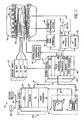
- FIG. 1 the major components of a preferred MRI system 10 incorporating the present invention are shown.
- the operation of the system is controlled from an operator console 12 which includes a keyboard or other input device 13, a control panel 14, and a display 16.
- the console 12 communicates through a link 18 with a separate computer system 20 that enables an operator to control the production and display of images on the screen 16.
- the computer system 20 includes a number of modules which communicate with each other through a backplane 20a. These include an image processor module 22, a CPU module 24 and a memory module 26, known in the art as a frame buffer for storing image data arrays.
- the computer system 20 is linked to a disk storage 28 and a tape drive 30 for storage of image data and programs, and it communicates with a separate system control 32 through a high speed serial link 34.
- the input device 13 can include a mouse, joystick, keyboard, track ball, touch screen, light wand, voice control, or similar device, and may be used for interactive geometry prescription.
- the system control 32 includes a set of modules connected together by a backplane 32a. These include a CPU module 36 and a pulse generator module 38 which connects to the operator console 12 through a serial link 40.
- the pulse generator module 38 operates the system components to carry out the desired scan sequence and produces data which indicates the timing, strength and shape of the RF pulses produced, and the timing and length of the data acquisition window.
- the pulse generator module 38 connects to a set of gradient amplifiers 42, to indicate the timing and shape of the gradient pulses that are produced during the scan.
- the pulse generator module 38 also receives patient data from a physiological acquisition controller 44 that receives signals from a number of different sensors connected to the patient, such as ECG signals from electrodes attached to the patient.
- the pulse generator module 38 connects to a scan room interface circuit 46 which receives signals from various sensors associated with the condition of the patient and the magnet system. It is also through the scan room interface circuit 46 that a patient positioning system 48 receives commands to move the patient to the desired position for the scan.
- the gradient waveforms produced by the pulse generator module 38 are applied to the gradient amplifier system 42 having G x , G y , and G z amplifiers.
- Each gradient amplifier excites a corresponding physical gradient coil in an assembly generally designated 50 to produce the magnetic field gradients used for spatially encoding acquired signals.
- the gradient coil assembly 50 forms part of a magnet assembly 52 which includes a polarizing magnet 54 and a whole-body RF coil 56.
- a transceiver module 58 in the system control 32 produces pulses which are amplified by an RF amplifier 60 and coupled to the RF coil 56 by a transmit/receive switch 62.
- the resulting signals emitted by the excited nuclei in the patient may be sensed by the same RF coil 56 and coupled through the transmit/receive switch 62 to a preamplifier 64.
- the amplified MR signals are demodulated, filtered, and digitized in the receiver section of the transceiver 58.
- the transmit/receive switch 62 is controlled by a signal from the pulse generator module 38 to electrically connect the RF amplifier 60 to the coil 56 during the transmit mode and to connect the preamplifier 64 during the receive mode.
- the transmit/receive switch 62 also enables a separate RF coil (for example, a surface coil) to be used in either the transmit or receive mode.
- the MR signals picked up by the RF coil 56 are digitized by the transceiver module 58 and transferred to a memory module 66 in the system control 32.
- a memory module 66 in the system control 32.
- this raw k-space data is rearranged into separate k-space data arrays for each image to be reconstructed, and each of these is input to an array processor 68 which operates to Fourier transform the data into an array of image data.
- This image data is conveyed through the serial link 34 to the computer system 20 where it is stored in the disk memory 28.
- this image data may be archived on the tape drive 30, or it may be further processed by the image processor 22 and conveyed to the operator console 12 and presented on the display 16.
- the present invention includes a method and system suitable for use with the above-referenced NMR system, or any similar or equivalent system for obtaining MR images.
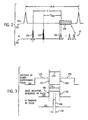
- the radio-frequency (rf) section of a pulse sequence 100 is shown illustrating the relative temporal positions of various RF pulses and with respect to an R-R interval of an ECG cycle 102.
- the first RF pulse played out is a slice-selective inversion pulse 104 having an inversion time TI as measured from the peak of the slice-selective inversion pulse 104 to a peak of a first excitation RF pulse 106 for image acquisition 108.
- the slice-selective inversion pulse 104 is designed with a section thickness of between 1.0 and 3 times the section thickness of an imaged slice, as will be described with reference to Fig. 3.
- the slice-selective inversion pulse is preferably played out with an inversion time of approximately 100-450 msec, in one embodiment.
- This inversion time is selected to null signal from normal myocardium and is varied depending on the concentration of the contrast material used (which impacts the residual concentration of the contrast material in normal, healthy myocardium), and the delay time from the initial contrast material administration.
- a notched RF inversion pulse 110 is transmitted to invert the longitudinal magnetization from blood outside of the imaged slice-of-interest.
- the notched RF inversion pulse also referred to as a blood suppression pulse, has an inversion time TI DDP of approximately 120-150 msec. (in one embodiment).
- TI DDP inversion time
- the longitudinal magnetization of blood outside of the imaged slice-of-interest recovers from an inverted state through zero or null. It is anticipated that the blood flow during this TI BSP time is sufficient that the blood outside of the imaged slice-of-interest will flow into the region when the image slice is acquired so that the longitudinal magnetization of the blood is close to its null point. This expanded region substantially reduces the signal from blood within the image slice.
- the pulse sequence 100 also includes at least one, but preferably a number of excitation RF pulses 112 to acquire data 108.
- the acquisition of data takes place, preferably, in the mid-diastole region. It is also preferable to acquire the data during a single breath-hold by the patient.
- the excitation RF pulses 112 of the pulse sequence 100 are of a known segmented k-space gradient echo imaging technique. Although the aforementioned technique is described with reference to a two-dimensional acquisition strategy, it is also applicable for a three-dimensional image acquisition sequence with segmented acquisition across multiple cardiac cycles.
- the relative spatial positions and section thickness of the primary slice-selective inversion pulse 104, the notched blood suppression pulse 110, and the imaged slice 106 are shown.
- the width 114 of the pass-band 116 of the slice-selective inversion RF pulse 104 is selected to accommodate cardiac and respiratory motion of the imaged slice during the inversion time TI.
- This pass-band 116 is therefore selected approximately 1 - 3 or more times that of the imaged section thickness 118.
- the notched RF suppression pulse 110 has a stop-band 120 that is coincident with that of the pass-band 116 of the primary slice-selective inversion RF pulse 104.
- the width 122 of the stop-band 120 of the notched RF pulse 110 is sized about the same as that of the pass-band 116 of the slice-selective inversion pulse 104.
- the pass-bands 124 of the notched RF pulse 110 are sized large enough to invert regions outside the imaged slice 106 to include blood that may flow into the region-of-interest of the imaged slice during data acquisition. Because the inversion time for blood suppression is less than that used for normal myocardial tissue suppression, the inversion time of the blood suppression pulse 110 is less than the inversion time for the slice-selective inversion RF pulse 104. The inversion time of the blood suppression pulse 110 must also take into account the time after the initial contrast material is administered and the amount of the dose administered. It is also noted that the notched RF blood suppression pulse 110 has a 180° flip angle, in one embodiment but can have a flip angle from 90° to 180°.
- notched RF pulse 110 for blood suppression does not affect the primary slice-selective inversion pulse 104 for normal myocardial tissue suppression. Therefore, the equations used to determine the necessary inversion times for both contrast-enhanced blood and normal myocardium are uncoupled and independent.
- M Z t M Z , EQ cos ⁇ exp ⁇ - t / T 1 + M o ⁇ 1 - exp - t / T 1
- M z (t) is the longitudinal magnetization at the of image acquisition
- M z EQ
- ⁇ is the inversion recovery rf pulse flip angle
- M o is the thermal equilibrium longitudinal magnetization
- T 1 is the spin-lattice relaxation time
- t is the time after the inversion pulse.
- the present invention has been shown to be an effective blood suppression technique to detect the presence of infarcted myocardial tissue. Without a blood suppression RF pulse, there is difficulty in distinguishing between enhanced infarcted myocardial tissue and the ventricular blood cavity. With this blood suppression technique, the endo-cardial boundaries of the infarcted tissue can be clearly delineated, thereby allowing better appreciation of the extent of myocardial infarction.
- the apparatus according to the invention may be used to preform a method of MR imaging with blood pool suppression that includes administering a contrast agent into the blood stream of a patient, and then applying a pulse sequence having a slice-selective inversion RF pulse and a notched inversion RF pulse.
- a contrast bolus of gadolinium contrast material and a dosage of between 0.1-0.2 mmol/kg, it is preferable to wait 5-15 minutes after the administration of the contrast material for normal myocardium suppression.
- the slice-selective RF pulse is designed to suppress myocardial tissue, and is followed by the notched inversion RF pulse that is designed to suppress blood pool.
- the suppression of blood pool signal is preferably done in a region larger than that where data is acquired so that when acquiring MR data, the blood that has flowed into the region is nulled.
- An MR image can then be reconstructed from the acquired MR data to assess a presence of myocardial infarction. This technique not only increases the sensitivity to detect infarcted myocardial tissue, but also allows much better discrimination between the endo-cardial boundaries of the infarcted tissue and the ventricular cavity.
- the apparatus makes use of a computer programmed to control the MRI system, such as that disclosed with reference to Fig. 1, and also programmed to apply a pulse sequence such as that disclosed with reference to Figs. 2 and 3. That is, the computer is programmed to transmit a slice-selection inversion pulse to suppress signals from normal myocardial tissue, and then transmit a notched inversion RF pulse with an inversion time selected to invert regions inside and outside of a desired imaging slice such that signals from blood flowing into the desired imaging slice are also suppressed. The computer is also programmed to transmit excitation RF pulses, and then cause the acquisition of data from the desired imaging slice wherein the data has signal suppression from both normal myocardial tissue and blood. Note that to reduce the inversion delay times (TI and TI BSP ), partial inversion rf pulses with flip angles from 90° to 180° may be used without loss of effect.
- TI and TI BSP partial inversion rf pulses with flip angles from 90° to 180° may be used without loss of effect.
- Experimental data using the present technique provided results with marked improvement over images without blood suppression.
- Two sets of images were acquired of the same subject approximately 4 minutes apart. The first set of images had no blood suppression, while the second set employed the blood suppression technique of the present invention.
- the resulting images show a significant reduction in blood signal and the endo-cardial boundaries of the infarcted tissue that can be clearly differentiated in the blood suppressed images, whereas the images acquired without blood pool suppression do not clearly show the boundaries nor the infarcted areas nearly as well.
Landscapes
- Physics & Mathematics (AREA)
- Health & Medical Sciences (AREA)
- General Health & Medical Sciences (AREA)
- Nuclear Medicine, Radiotherapy & Molecular Imaging (AREA)
- Radiology & Medical Imaging (AREA)
- Engineering & Computer Science (AREA)
- Signal Processing (AREA)
- High Energy & Nuclear Physics (AREA)
- Condensed Matter Physics & Semiconductors (AREA)
- General Physics & Mathematics (AREA)
- Magnetic Resonance Imaging Apparatus (AREA)
Applications Claiming Priority (2)
| Application Number | Priority Date | Filing Date | Title |
|---|---|---|---|
| US681081 | 2000-12-29 | ||
| US09/681,081 US6526307B2 (en) | 2000-12-29 | 2000-12-29 | Method and apparatus to improve myocardial infarction detection with blood pool signal suppression |
Publications (3)
| Publication Number | Publication Date |
|---|---|
| EP1219970A2 EP1219970A2 (en) | 2002-07-03 |
| EP1219970A3 EP1219970A3 (en) | 2003-05-28 |
| EP1219970B1 true EP1219970B1 (en) | 2007-11-07 |
Family
ID=24733729
Family Applications (1)
| Application Number | Title | Priority Date | Filing Date |
|---|---|---|---|
| EP01310500A Expired - Lifetime EP1219970B1 (en) | 2000-12-29 | 2001-12-17 | MRI apparatus to improve myocardial infarction detection with blood pool signal suppression |
Country Status (4)
| Country | Link |
|---|---|
| US (2) | US6526307B2 (https=) |
| EP (1) | EP1219970B1 (https=) |
| JP (1) | JP3950689B2 (https=) |
| DE (1) | DE60131244T2 (https=) |
Families Citing this family (37)
| Publication number | Priority date | Publication date | Assignee | Title |
|---|---|---|---|---|
| US6889071B2 (en) * | 2000-12-19 | 2005-05-03 | General Electric Company | Acquisition of high-temporal free-breathing MR images |
| US6611701B2 (en) * | 2000-12-30 | 2003-08-26 | Ge Medical Systems Global Technology Company, Llc | Method and apparatus for fast breath-held 3D MR data acquisition using variable sampling |
| US20030120151A1 (en) * | 2001-01-10 | 2003-06-26 | Johns Hopkins University | Magnetic resonance imaging methods and compositions |
| US7327862B2 (en) * | 2001-04-30 | 2008-02-05 | Chase Medical, L.P. | System and method for facilitating cardiac intervention |
| US7526112B2 (en) | 2001-04-30 | 2009-04-28 | Chase Medical, L.P. | System and method for facilitating cardiac intervention |
| US20050043609A1 (en) * | 2003-01-30 | 2005-02-24 | Gregory Murphy | System and method for facilitating cardiac intervention |
| WO2004068406A2 (en) * | 2003-01-30 | 2004-08-12 | Chase Medical, L.P. | A method and system for image processing and contour assessment |
| JP4634934B2 (ja) * | 2003-09-05 | 2011-02-16 | 株式会社日立メディコ | 磁気共鳴イメージング装置 |
| US8010179B2 (en) * | 2003-09-25 | 2011-08-30 | General Electric Company | Method and apparatus of gradient echo imaging with on-the-fly optimization of tissue suppression |
| US6903548B2 (en) * | 2003-10-21 | 2005-06-07 | General Electric Company | Method and apparatus for MR perfusion image acquisition using non-selective and notched RF saturation pulses |
| JP4446049B2 (ja) * | 2003-11-06 | 2010-04-07 | 株式会社三重ティーエルオー | 心筋血流の定量化装置 |
| US20070014452A1 (en) * | 2003-12-01 | 2007-01-18 | Mitta Suresh | Method and system for image processing and assessment of a state of a heart |
| US7333643B2 (en) * | 2004-01-30 | 2008-02-19 | Chase Medical, L.P. | System and method for facilitating cardiac intervention |
| WO2005079274A2 (en) * | 2004-02-12 | 2005-09-01 | Mount Sinai School Of Medicine | Magnetic resonance imaging of atherosclerotic plaque |
| EP1593984A1 (en) * | 2004-04-29 | 2005-11-09 | Koninklijke Philips Electronics N.V. | Inversion recovery magnetic resonance angiography |
| US7809426B2 (en) | 2004-04-29 | 2010-10-05 | The Cleveland Clinic Foundation | Acquiring contrast-enhanced, T1 weighted, cine magnetic resonance images |
| DE102004022061A1 (de) * | 2004-05-05 | 2005-12-08 | Siemens Ag | Verfahren zur verbesserten interventionallen Bildgebung in der Magnet-Resonanz-Tomographie |
| US8112145B2 (en) * | 2004-06-03 | 2012-02-07 | Wisconsin Alumni Research Foundation | MRI method for assessing myocardial viability |
| DE102005023193B4 (de) * | 2005-05-19 | 2015-07-02 | Siemens Aktiengesellschaft | Verfahren zum Abbilden eines Untersuchungsvolumens in einem MR-Spektrometer |
| DE102005044336A1 (de) * | 2005-09-16 | 2007-04-05 | Siemens Ag | Verfahren zur Aufnahme von Bilddaten des Herzens |
| JP5121219B2 (ja) * | 2006-12-07 | 2013-01-16 | ジーイー・メディカル・システムズ・グローバル・テクノロジー・カンパニー・エルエルシー | 磁気共鳴イメージング装置および磁気共鳴イメージング方法 |
| US8086297B2 (en) * | 2007-01-31 | 2011-12-27 | Duke University | Dark blood delayed enhancement magnetic resonance viability imaging techniques for assessing subendocardial infarcts |
| DE102007018089B4 (de) * | 2007-04-02 | 2010-10-14 | Siemens Ag | Herz-Bildgebung mittels MRI mit adaptiver Inversionszeit |
| KR20100027101A (ko) | 2007-04-11 | 2010-03-10 | 오레곤 헬스 앤드 사이언스 유니버시티 | 심장에서 섬유증을 비침윤적으로 및 정량적으로 검출하는 방법 및 장치 |
| SE0702063L (sv) | 2007-05-31 | 2009-01-13 | Colloidal Resource Ab | Metod, system, datoravläsbart medium och användning för magnetisk resonanstomografi |
| JP5546735B2 (ja) * | 2008-02-29 | 2014-07-09 | ジーイー・メディカル・システムズ・グローバル・テクノロジー・カンパニー・エルエルシー | Mri装置 |
| US9448296B2 (en) * | 2008-03-18 | 2016-09-20 | University Of Washington | Motion-sensitized driven equilibrium blood-suppression sequence for vessel wall imaging |
| JP5215036B2 (ja) * | 2008-05-19 | 2013-06-19 | 株式会社東芝 | 医用画像処理装置、及び医用画像処理プログラム |
| JP5373416B2 (ja) * | 2009-01-30 | 2013-12-18 | ジーイー・メディカル・システムズ・グローバル・テクノロジー・カンパニー・エルエルシー | 磁気共鳴イメージング装置およびプログラム |
| JP5633896B2 (ja) * | 2009-02-27 | 2014-12-03 | ジーイー・メディカル・システムズ・グローバル・テクノロジー・カンパニー・エルエルシー | 磁気共鳴イメージング装置 |
| CN102860827B (zh) * | 2009-09-18 | 2017-05-17 | 东芝医疗系统株式会社 | 磁共振成像装置以及磁共振成像方法 |
| US9131870B2 (en) | 2010-05-05 | 2015-09-15 | Duke University | Blood signal suppressed contrast enhanced magnetic resonance imaging |
| US9149203B2 (en) | 2010-05-05 | 2015-10-06 | Duke University | Blood signal suppressed enhanced magnetic resonance imaging |
| US9734573B2 (en) * | 2013-04-17 | 2017-08-15 | The United States Of America, As Represented By The Secretary, Dept. Of Health And Human Services | Methods and systems for automatically determining magnetic field inversion time of a tissue species |
| JP6132653B2 (ja) * | 2013-05-08 | 2017-05-24 | 東芝メディカルシステムズ株式会社 | 画像処理装置及び磁気共鳴イメージング装置 |
| US20150094562A1 (en) * | 2013-10-01 | 2015-04-02 | General Electric Company | Magnetic resonance imaging with dynamic inversion preparation |
| US10338179B2 (en) * | 2016-02-17 | 2019-07-02 | Siemens Healthcare Gmbh | Magnetic resonance method and apparatus for quantitative time-resolved assessment of tissue displacement and related biomarker parameters with blood suppression in the whole cardiac cycle |
Family Cites Families (3)
| Publication number | Priority date | Publication date | Assignee | Title |
|---|---|---|---|---|
| US4678995A (en) * | 1984-12-12 | 1987-07-07 | Yale University | Apparatus and method for determining the presence of substances in a sample by NMR and producing an NMR image thereof |
| US5999839A (en) * | 1998-01-30 | 1999-12-07 | General Electric Company | Arterial MRI with chemical-shift nulling |
| US6205349B1 (en) * | 1998-09-29 | 2001-03-20 | Siemens Medical Systems, Inc. | Differentiating normal living myocardial tissue, injured living myocardial tissue, and infarcted myocardial tissue in vivo using magnetic resonance imaging |
-
2000
- 2000-12-29 US US09/681,081 patent/US6526307B2/en not_active Expired - Lifetime
-
2001
- 2001-12-17 EP EP01310500A patent/EP1219970B1/en not_active Expired - Lifetime
- 2001-12-17 DE DE60131244T patent/DE60131244T2/de not_active Expired - Lifetime
- 2001-12-28 JP JP2001399035A patent/JP3950689B2/ja not_active Expired - Lifetime
-
2002
- 2002-12-20 US US10/248,159 patent/US6662037B2/en not_active Expired - Lifetime
Also Published As
| Publication number | Publication date |
|---|---|
| EP1219970A2 (en) | 2002-07-03 |
| JP2002306450A (ja) | 2002-10-22 |
| US6662037B2 (en) | 2003-12-09 |
| EP1219970A3 (en) | 2003-05-28 |
| DE60131244D1 (de) | 2007-12-20 |
| DE60131244T2 (de) | 2008-08-28 |
| US20020087067A1 (en) | 2002-07-04 |
| JP3950689B2 (ja) | 2007-08-01 |
| US20030069496A1 (en) | 2003-04-10 |
| US6526307B2 (en) | 2003-02-25 |
Similar Documents
| Publication | Publication Date | Title |
|---|---|---|
| EP1219970B1 (en) | MRI apparatus to improve myocardial infarction detection with blood pool signal suppression | |
| US6078175A (en) | Acquistion of segmented cardiac gated MRI perfusion images | |
| EP0894272B1 (en) | Method for performing magnetic resonance angiography using a contrast agent | |
| US7064545B2 (en) | Method and apparatus of background suppression in MR imaging using spin locking | |
| US6268730B1 (en) | Multi-slab multi-window cardiac MR imaging | |
| US6078176A (en) | Fast spin echo pulse sequence for diffusion weighted imaging | |
| US5492123A (en) | Diffusion weighted magnetic resonance imaging | |
| US6498946B1 (en) | Efficient multi-slice acquisition with black blood contrast | |
| US7772844B2 (en) | System and method for tissue specific MR imaging of metabolites using spectral-spatially formed stimulated echo | |
| EP1083437B1 (en) | Method and apparatus for MR data acquisition using a notched RF saturation pulse | |
| US6807441B2 (en) | Evaluation of tumor angiogenesis using magnetic resonance imaging | |
| US5999839A (en) | Arterial MRI with chemical-shift nulling | |
| US7689263B1 (en) | Method and apparatus for acquiring free-breathing MR images using navigator echo with saturation RF pulse | |
| EP1344079B1 (en) | Preparatory pulse sequence for suppression of artifacts in mr images | |
| US10712419B2 (en) | Selective size imaging using filters via diffusion times | |
| US20070007958A1 (en) | Method and system of MR imaging with simultaneous fat suppression and T1 inversion recovery contrast | |
| US7546155B2 (en) | Efficient multi-slice acquisition with black blood contrast in fast spin echo imaging | |
| WO2006014260A2 (en) | Magnetic resonance imaging of amyloid plaque | |
| US20090060841A1 (en) | Apparatus and method for combined use of variable flip angles and centric phase encoding in hyperpolarized 13c imaging | |
| JP4980013B2 (ja) | 核磁気共鳴装置 | |
| US6903548B2 (en) | Method and apparatus for MR perfusion image acquisition using non-selective and notched RF saturation pulses | |
| Hauser et al. | The promise of whole-heart coronary MRI | |
| Reiser et al. | Recent and future advances in high-speed imaging | |
| Jerosch-Herold et al. | Cardiac Magnetic Resonance Imaging |
Legal Events
| Date | Code | Title | Description |
|---|---|---|---|
| PUAI | Public reference made under article 153(3) epc to a published international application that has entered the european phase |
Free format text: ORIGINAL CODE: 0009012 |
|
| AK | Designated contracting states |
Kind code of ref document: A2 Designated state(s): AT BE CH CY DE DK ES FI FR GB GR IE IT LI LU MC NL PT SE TR |
|
| AX | Request for extension of the european patent |
Free format text: AL;LT;LV;MK;RO;SI |
|
| PUAL | Search report despatched |
Free format text: ORIGINAL CODE: 0009013 |
|
| RIC1 | Information provided on ipc code assigned before grant |
Ipc: 7G 01R 33/563 B Ipc: 7G 01R 33/28 A |
|
| AK | Designated contracting states |
Designated state(s): AT BE CH CY DE DK ES FI FR GB GR IE IT LI LU MC NL PT SE TR |
|
| AX | Request for extension of the european patent |
Extension state: AL LT LV MK RO SI |
|
| 17P | Request for examination filed |
Effective date: 20031128 |
|
| AKX | Designation fees paid |
Designated state(s): DE NL |
|
| RTI1 | Title (correction) |
Free format text: MRI APPARATUS TO IMPROVE MYOCARDIAL INFARCTION DETECTION WITH BLOOD POOL SIGNAL SUPPRESSION |
|
| 17Q | First examination report despatched |
Effective date: 20051227 |
|
| GRAP | Despatch of communication of intention to grant a patent |
Free format text: ORIGINAL CODE: EPIDOSNIGR1 |
|
| GRAS | Grant fee paid |
Free format text: ORIGINAL CODE: EPIDOSNIGR3 |
|
| GRAA | (expected) grant |
Free format text: ORIGINAL CODE: 0009210 |
|
| AK | Designated contracting states |
Kind code of ref document: B1 Designated state(s): DE NL |
|
| REF | Corresponds to: |
Ref document number: 60131244 Country of ref document: DE Date of ref document: 20071220 Kind code of ref document: P |
|
| PLBE | No opposition filed within time limit |
Free format text: ORIGINAL CODE: 0009261 |
|
| STAA | Information on the status of an ep patent application or granted ep patent |
Free format text: STATUS: NO OPPOSITION FILED WITHIN TIME LIMIT |
|
| 26N | No opposition filed |
Effective date: 20080808 |
|
| PGFP | Annual fee paid to national office [announced via postgrant information from national office to epo] |
Ref country code: NL Payment date: 20161226 Year of fee payment: 16 |
|
| REG | Reference to a national code |
Ref country code: NL Ref legal event code: MM Effective date: 20180101 |
|
| PG25 | Lapsed in a contracting state [announced via postgrant information from national office to epo] |
Ref country code: NL Free format text: LAPSE BECAUSE OF NON-PAYMENT OF DUE FEES Effective date: 20180101 |
|
| PGFP | Annual fee paid to national office [announced via postgrant information from national office to epo] |
Ref country code: DE Payment date: 20181126 Year of fee payment: 18 |
|
| REG | Reference to a national code |
Ref country code: DE Ref legal event code: R119 Ref document number: 60131244 Country of ref document: DE |
|
| PG25 | Lapsed in a contracting state [announced via postgrant information from national office to epo] |
Ref country code: DE Free format text: LAPSE BECAUSE OF NON-PAYMENT OF DUE FEES Effective date: 20200701 |