EP1219598A1 - Phenolic compounds and recording materials containing the same - Google Patents
Phenolic compounds and recording materials containing the same Download PDFInfo
- Publication number
- EP1219598A1 EP1219598A1 EP00964635A EP00964635A EP1219598A1 EP 1219598 A1 EP1219598 A1 EP 1219598A1 EP 00964635 A EP00964635 A EP 00964635A EP 00964635 A EP00964635 A EP 00964635A EP 1219598 A1 EP1219598 A1 EP 1219598A1
- Authority
- EP
- European Patent Office
- Prior art keywords
- hydroxy
- integer
- recording material
- acid
- proviso
- Prior art date
- Legal status (The legal status is an assumption and is not a legal conclusion. Google has not performed a legal analysis and makes no representation as to the accuracy of the status listed.)
- Granted
Links
Classifications
-
- C—CHEMISTRY; METALLURGY
- C07—ORGANIC CHEMISTRY
- C07C—ACYCLIC OR CARBOCYCLIC COMPOUNDS
- C07C317/00—Sulfones; Sulfoxides
- C07C317/16—Sulfones; Sulfoxides having sulfone or sulfoxide groups and singly-bound oxygen atoms bound to the same carbon skeleton
- C07C317/22—Sulfones; Sulfoxides having sulfone or sulfoxide groups and singly-bound oxygen atoms bound to the same carbon skeleton with sulfone or sulfoxide groups bound to carbon atoms of six-membered aromatic rings of the carbon skeleton
-
- B—PERFORMING OPERATIONS; TRANSPORTING
- B41—PRINTING; LINING MACHINES; TYPEWRITERS; STAMPS
- B41M—PRINTING, DUPLICATING, MARKING, OR COPYING PROCESSES; COLOUR PRINTING
- B41M5/00—Duplicating or marking methods; Sheet materials for use therein
- B41M5/26—Thermography ; Marking by high energetic means, e.g. laser otherwise than by burning, and characterised by the material used
- B41M5/30—Thermography ; Marking by high energetic means, e.g. laser otherwise than by burning, and characterised by the material used using chemical colour formers
- B41M5/333—Colour developing components therefor, e.g. acidic compounds
- B41M5/3333—Non-macromolecular compounds
- B41M5/3335—Compounds containing phenolic or carboxylic acid groups or metal salts thereof
- B41M5/3336—Sulfur compounds, e.g. sulfones, sulfides, sulfonamides
-
- B—PERFORMING OPERATIONS; TRANSPORTING
- B41—PRINTING; LINING MACHINES; TYPEWRITERS; STAMPS
- B41M—PRINTING, DUPLICATING, MARKING, OR COPYING PROCESSES; COLOUR PRINTING
- B41M5/00—Duplicating or marking methods; Sheet materials for use therein
- B41M5/124—Duplicating or marking methods; Sheet materials for use therein using pressure to make a masked colour visible, e.g. to make a coloured support visible, to create an opaque or transparent pattern, or to form colour by uniting colour-forming components
- B41M5/132—Chemical colour-forming components; Additives or binders therefor
- B41M5/155—Colour-developing components, e.g. acidic compounds; Additives or binders therefor; Layers containing such colour-developing components, additives or binders
-
- C—CHEMISTRY; METALLURGY
- C07—ORGANIC CHEMISTRY
- C07C—ACYCLIC OR CARBOCYCLIC COMPOUNDS
- C07C317/00—Sulfones; Sulfoxides
- C07C317/24—Sulfones; Sulfoxides having sulfone or sulfoxide groups and doubly-bound oxygen atoms bound to the same carbon skeleton
-
- C—CHEMISTRY; METALLURGY
- C07—ORGANIC CHEMISTRY
- C07C—ACYCLIC OR CARBOCYCLIC COMPOUNDS
- C07C317/00—Sulfones; Sulfoxides
- C07C317/44—Sulfones; Sulfoxides having sulfone or sulfoxide groups and carboxyl groups bound to the same carbon skeleton
-
- C—CHEMISTRY; METALLURGY
- C07—ORGANIC CHEMISTRY
- C07C—ACYCLIC OR CARBOCYCLIC COMPOUNDS
- C07C323/00—Thiols, sulfides, hydropolysulfides or polysulfides substituted by halogen, oxygen or nitrogen atoms, or by sulfur atoms not being part of thio groups
- C07C323/22—Thiols, sulfides, hydropolysulfides or polysulfides substituted by halogen, oxygen or nitrogen atoms, or by sulfur atoms not being part of thio groups containing thio groups and doubly-bound oxygen atoms bound to the same carbon skeleton
-
- C—CHEMISTRY; METALLURGY
- C07—ORGANIC CHEMISTRY
- C07C—ACYCLIC OR CARBOCYCLIC COMPOUNDS
- C07C323/00—Thiols, sulfides, hydropolysulfides or polysulfides substituted by halogen, oxygen or nitrogen atoms, or by sulfur atoms not being part of thio groups
- C07C323/50—Thiols, sulfides, hydropolysulfides or polysulfides substituted by halogen, oxygen or nitrogen atoms, or by sulfur atoms not being part of thio groups containing thio groups and carboxyl groups bound to the same carbon skeleton
- C07C323/51—Thiols, sulfides, hydropolysulfides or polysulfides substituted by halogen, oxygen or nitrogen atoms, or by sulfur atoms not being part of thio groups containing thio groups and carboxyl groups bound to the same carbon skeleton having the sulfur atoms of the thio groups bound to acyclic carbon atoms of the carbon skeleton
- C07C323/60—Thiols, sulfides, hydropolysulfides or polysulfides substituted by halogen, oxygen or nitrogen atoms, or by sulfur atoms not being part of thio groups containing thio groups and carboxyl groups bound to the same carbon skeleton having the sulfur atoms of the thio groups bound to acyclic carbon atoms of the carbon skeleton with the carbon atom of at least one of the carboxyl groups bound to nitrogen atoms
Definitions
- the present invention is related to novel phenol compounds and recording materials containing the phenol compound and having excellent image storing and stabilizing properties.
- Recording materials employing a manner of coloring by a reaction of a color forming dye and a developer have been widely used in thermal recording papers for recording outputted information from facsimiles, printers, etc. and pressure-sensitive copying papers for concurrently producing a plurality of copies, because such recording materials enable to record images in a short time by employing a relatively simple apparatus without requiring complex process such as development and fixation.
- a material capable of instantly color forming, keeping whiteness of the part where no color is formed hereinafter referred to as "background", and providing high hardness of the color formed images is required.
- background a material capable of providing excellent lightfastness to the color formed images is particularly desired.
- the present invention is directed to phenol compounds represented by a general formula (I); wherein
- examples for the group represented by R 1 and R 2 include hydrogen; C1-C6 alkyl, such as methyl, ethyl, n-propyl, isopropyl, n-butyl, sec-butyl, tert-butyl, n-pentyl, isopentyl, neopentyl, tert-pentyl, n-hexyl, isohexyl, 1-methylpentyl and 2-methylpentyl,
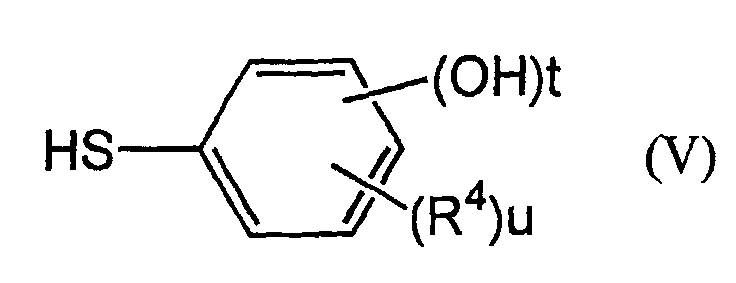
- the compounds represented by the general formula (I), wherein the portion of S(O)n is S, to be used in the present invention may be obtained by forcing a compound represented by a general formula (VI); Wherein R 1 , R 2 , R 3 , Y, m, p and q are as defined above, X represents halogen, such as chlorine and bromine, to a reaction with a compound represented by a general formula (V); wherein R 4 , t and u are as defined above, in an organic solvent, for example, methanol in the presence of a base.
- Compounds represented by the general formula (I), wherein the portion of S(O)n is SO or SO 2 may be obtained by oxidizing the compound obtained by the reaction hereinabove with an oxidizing agent, such as aqueous solution of hydrogen peroxide and m-chloroperbenzoic acid in an appropriate solvent.
- an oxidizing agent such as aqueous solution of hydrogen peroxide and m-chloroperbenzoic acid in an appropriate solvent.
- the present invention may be applied for any use for recording materials as far as they employ a color forming dye, for example, for thermal recording materials and pressure-sensitive copying materials.
- each of a compound of the present invention in fine particles and a color forming dye in fine particles are dispersed in an aqueous solution of an aqueous binding agent, such as polyvinyl alcohol and cellulose, and the resultant suspension is mixed and coated onto a support material, for example a paper, and then dried to obtain a thermal recording paper.
- an aqueous binding agent such as polyvinyl alcohol and cellulose
- the ratio of the compound represented by the general formula (I) of the present invention to be used with respect to a color forming dye is 1 to 10 parts by weight based on 1 part by weight of a color forming dye, and preferably 1.5 to 5 parts by weight.
- the recording material of the present invention may also contain one or more of a known developer, an image stabilizer, a sensitizer, a filler, a dispersing agent, an antioxidant, a desensitizer, an antitack agent, an antifoamer, a photo stabilizer, a fluorescence brightener, and the like upon requirement in addition to a color forming dye and the compound represented by the general formula (I).
- These additional agents may be contained either in the color former layer, or in an arbitrary layer, for example a protecting layer when the recording material is configured by a multi-layer structure.
- an antioxidant, a photosensitizer and the like may be contained in these layers.
- said antioxidant and photosensitizer may be contained in the overcoat and undercoat layers in a form of microcapsules in which these agents are enclosed.
- Examples of the color forming dye used for the recording material of the present invention include leuco dyes based on fluoran, phthalide, lactam, triphenyl methane, fenothiazine, and spiropyran.
- the color forming dyes are not limited to these leuco dyes, and any color forming dyes may be used as far as it forms color by contacting with a developer of an acidic substance.
- Each of these color forming dyes can form a color independently, and it naturally constitutes a recording material having a color that is formed by the color forming dye, and two or more of these color forming dyes may be used in combination.
- a recording material that forms true black may be prepared by combining color forming dyes each forming red, blue and green and a color forming dye forming black.
- Examples of the color forming dyes based on fluoran include 3-diethylamino-6-methyl-7-anilinofluoran, 3-dibutylamino-6-methyl-7-anilinofluoran, 3-(N-ethyl-N-isobutylamino)-6-methyl-7-anilinofluoran, 3-(N-methyl-N-propylamino)-6-methyl-7-anilinofluoran, 3-(N-ethyl-N-isopentylamino)-6-methyl-7-anilinofluoran, 3-diethylamino-7-(o-chloroanilino)fluoran, 3-dibutylamino-7-(o-chloroanilino)fluoran, 3-(N-ethyl-p-toluidino)-6-methyl-7-anilinofluoran, 3-(N-cyclohexyl-N-methylamino)-6-methyl-7-anilinofluor
- 3-(4-(4-(4-anilino)-anilino)anilino-6-methyl-7-chlorofluoran, 3,3-bis(2-(4-dimethylaminophenyl)-2-(4-methoxyphenyl)vinyl)-4,5,6,7-tetrachlorophthalide, 3,6,6'-tris(dimethylamino)spiro[fluorine-9,3'-phthalide and the like may be exampled.
- Examples for the developer include bisphenol compounds, such as bisphenol A, 4,4'-sec-butylidenebisphenol, 4,4'-cyclohexylidenebisphenol, 2,2-dimethyl-3,3-bis(4-hydroxyphenyl)butane, 2,2'-dihydroxydiphenyl, pentamethylene-bis(4-hydroxybenzoate), 2,2-dimethyl-3,3-di(4-hydroxyphenyl)pentane, 2,2-di (4-hydroxyphenyl)hexane; metal salts of benzoic acid, such as zinc benzoate and zinc 4-nitrobenzoate; salicylates, such as salicylic 4-(2-(4-methoxyphenyloxy)ethyloxy); metal salts of salicylic acid, such as zinc salicylate and bis[4-(octyloxycarbonylamino)-2-hydroxybenzoic acid; hydroxysulfones, such as 4,4'-dihydroxydiphenylsulfone, 2,4
- Examples for the image stabilizing agent include epoxycontaining diphenylsulfones, such as 4-benzyloxy-4'-(2-methylglycidyloxy)-diphenylsulfone, and 4,4'-diglycidyloxydiphenylsulfone; 1,4-diglycidyloxybenzene; 4-( ⁇ -(hydroxymethyl)benzyloxy)-4'-hydroxydiphenylsulfone; 2-propanol derivatives; salicylic acid derivatives; metal salts of oxynaphthoic acid derivatives (particularly, zinc salts) and other water-insoluble zinc-containing compounds.
- epoxycontaining diphenylsulfones such as 4-benzyloxy-4'-(2-methylglycidyloxy)-diphenylsulfone, and 4,4'-diglycidyloxydiphenylsulfone
- 1,4-diglycidyloxybenzene 4-( ⁇ -(hydroxymethyl)benzyloxy)-4'-hydroxydipheny
- sensitizer examples include higher fatty acid amides, such as stearic amide, benzamide, stearic anilide, acetoacetic anilide, thioacetoanilide, dibenzyl oxalate, di(4-methylbenzyl) oxalate, di(4-chlorobenzyl) oxalate, dimethyl phthalate, dimethyl telephthalate, dibenzyl telephthalate, dibenzyl isophthalate, bis(tert-butylphenol)s, diethers of 4,4'-dihydroxydiphenylsulfone, diethers of 2,4'-dihydroxydiphenylsulfone, 1,2-bis(phenoxy)ethane, 1,2-bis(4-methylphenoxy)ethane, 1,2-bis(3-methylphenoxy)ethane, 2-naphtholbenzyl ether, diphenylamine, carbazole, 2,3-di-m-tolylbutane,
- silica, clay, kaolin, burned kaolin, talc, satin white, aluminum hydroxide, calcium carbonate, magnesium carbonate, zinc oxide, titanium oxide, barium sulfate, magnesium silicate, aluminum silicate, plastic pigment and the like may be used.
- salts of alkaline earth metals are particularly preferable, and carbonates, such as calcium carbonate and magnesium carbonate are further preferable.
- the ratio of the filler to be used is 0.1 to 15 parts by weight, preferably 1 to 10 parts by weight, relative to 1 part by weight of a color forming dye.
- other types of fillers may be used in combination with the above-mentioned materials.
- dispersing agent examples include sulfosuccinic esters, such as dioctylsodium sulfosuccinate, sodium dodecylbenzene sulfonate, and sodium salt and fatty acid salt of lauryl alcohol sulfuric ester.
- sulfosuccinic esters such as dioctylsodium sulfosuccinate, sodium dodecylbenzene sulfonate, and sodium salt and fatty acid salt of lauryl alcohol sulfuric ester.
- antioxidants examples include 2,2'-methylenebis(4-methyl-6-tert-butylphenol), 2,2'-methylenebis(4-ethyl-6-tert-butylphenol), 4,4'-propylmethylenebis(3-methyl-6-tert-butylphenol), 4,4'-bytylidenebis(3-methyl-6-tert-butylphenol), 4,4'-thiobis(2-tert-butyl-5-methylphenol), 1,1,3-tris(2-methyl-4-hydroxy-5-tert-butylphenyl)butane, and 1,1,3-tris(2-methyl-4-hydroxy-5-cyclohexylphenyl) butane.
- 2,2'-methylenebis(4-methyl-6-tert-butylphenol), 2,2'-methylenebis(4-ethyl-6-tert-butylphenol), 4,4'-propylmethylenebis(3-methyl-6-tert-butylphenol), 1,1,3-tris(2-methyl-4-hydroxy-5-tert-butylphenyl)butane, and 1,1,3-tris(2-methyl-4-hydroxy-5-cyclohexylphenyl)butane are particularly effective compounds for improving a heat and humidity of the compounds according to the present invention.
- 1,1,3-tris(2-methyl-4-hydroxy-5-tert-butylphenyl)butane, and 1,1,3-tris(2-methyl-4-hydroxy-5-cyclohexylphenyl)butane have excellent effect against heat and humidity.
- aliphatic higher alcohols polyethylene glycol, guanidine derivatives and the like may be exampled.
- antitack agent examples include stearic acid, zinc stearate, calcium stearate, carnauba wax, paraffin wax, and ester wax.
- photostabilizing agent examples include salicylic acid based ultraviolet radiation absorbents, such as phenyl salicylate, p-tert-butylphenyl salicylate and p-octylphenyl salicylate; benzophenone based ultraviolet radiation absorbents, such as 2,4-dihydroxybenzophenone, 2-hydroxy-4-methoxybenzophenone, 2-hydroxy-4-benzyloxybenzophenone, 2-hydroxy-4-octyloxybenzophenone, 2-hydroxy-4-dodecyloxybenzophenone, 2,2'-dihydroxy-4-methoxybenzophenone, 2,2'-dihydroxy-4,4'-dimethoxybenzophenone and 2-hydroxy-4-methoxy-5-sulfobenzophenone; benzotriazole based ultraviolet radiation absorbents, such as 2-(2'-hydroxy-5'-methylphenyl)benzotriazole, 2-(2'-hydroxy-5'-tert-butylphenyl)benzotri
- fluorescent dye examples include 4,4'-bis[2-anilino-4-(2-hydroxyethyl)amino-1,3,5-triazinyl-6-amino]stilbene-2,2'-disulfonic acid disodium salt, 4,4'-bis[2-anilino-4-bis(hydroxyethyl)amino-1,3,5-triazinyl-6-amino]stilbene-2,2'-disulfonic acid disodium salt, 4,4'-bis[2-methoxy-4-(2-hydroxyethyl)amino-1,3,5-triazinyl-6-amino]stilbene-2,2'-disulfonic acid disodium salt, 4,4'-bis[2-methoxy-4-(2-hydroxypropyl)amino-1,3,5-triazinyl-6-amino]stilbene-2,2'-disulfonic acid disodium salt, 4,4'-bis[2-m-sulfoanilino-4-bis(
- the compounds of the present invention may be used for producing pressure-sensitive copying papers according to the same process for using a known image storing and stabilizing agent, a known developer and a known sensitizer.
- a color forming dye prepared into a form of microcapsule is dispersed by using an appropriated dispersing agent according to a known procedure, and the resultant dispersion is coated onto a paper to obtain a sheet coated with a color forming dye.
- a dispersion of a developer is coated onto a paper to prepare a sheet coated with a developer.
- the compound of the present invention when used as an image storing and stabilizing agent, the compound may be used by means of incorporating it into a dispersed solution of any component to be used for preparing a coupler sheet or a developer sheet.
- the both sheets prepared as described above are combined to prepare a pressure-sensitive copying paper.
- the pressure-sensitive copying paper may be an unit paper comprising an upper layer sheet holding a microcapsule layer enclosing an organic solvent solution of a color forming dye onto the underside face and an under sheet layer holding a developer (an acidic substance) onto the upper side face or self content paper coated with the microcapsule dispersion and a developer dispersion on the identical face of a support paper.
- developer to be used for producing pressure-sensitive copying papers and the developer to be used in combination with the compound of the present invention for the same application known developers having been conventionally used may be used.
- developers include inorganic acidic substance, such as acid clay, activated clay, apataljite, bentonite, colloidal silica, aluminum silicate, magnesium silicate, zinc silicate, tin silicate, burned kaolin and talc; aliphatic carboxylic acid, such as oxalic acid, maleic acid, tartaric acid, citric acid, succinic acid and suiaric acid; aromatic carboxylic acid, such as benzoic acid, p-tert-butylbenzoic acid, phthalic acid, gallic acid, salicylic acid, 3-isopropylsalicylic acid, 3-phenylsalicylic acid, 3-cyclohexylsalicylic acid, 3,5-di-tert-butylsalicylic acid, 3-methyl-5-benzylsalicylic
- the solution was extracted with methyl isobutyl ketone, hereinafter referred to as MIBK, and MIBK was distilled out of the extract under reduced pressure.
- MIBK methyl isobutyl ketone
- the obtained residue was subjected to recrystallization process with toluene to thereby obtain 19.0 g of 2'-hydroxy-2-(4-hydroxyphenylthio)acetophenone.
- the yield was 93% and the melting point thereof was in a range of 139 to 141°C.
- the MIBK in the solution was distilled out under reduced pressure, and the resultant residue was subjected to recrystallization with ethyl acetate to obtain 4.5 g of 2'-hydroxy-2-(4-hydroxyphenylsulfinyl) acetophenone.
- the yield was 71% and the melting point of the compound was in a range of 166 to 167°C.
- the chloroform layer was washed with aqueous solution of sodium hydrogencarbonate.
- the chloroform in the solution was distilled out under reduced pressure, and the resultant residue was subjected to recrystallization with toluene to obtain 5.0 g of 2'-hydroxy-2-(4-hydroxyphenylsulfonyl)acetophenone.
- the yield was 74% and the melting point of the compound was in a range of 143 to 146°C.
- 4'-hydroxy-2-(4-hydroxyphenylthio)acetophenone in an amount of 17.5 g was obtained by proceeding the same reaction and post-reaction as described in the Example 1, except that 2'-hydroxyphenacyl bromide is replaced by 4'-hydroxyphenacyl bromide.
- the yield was 86% and the melting point of the compound was in a range of 194 to 197°C.
- 4'-hydroxy-2-(4-hydroxyphenylsulfinyl)acetophenone in an amount of 4.8 g was obtained according to the same process as described in the Example 2, except that 2'-hydroxy-2-(4-hydroxyphenylthio)acetophenone is replaced by 4'-hydroxy-2-(4-hydroxyphenylthio)acetophenone.
- the yield was 75% and the melting point of the compound was in a range of 167 to 169°C.
- 4'-hydroxy-2-(4-hydroxyphenylsulfonyl)acetophenone in an amount of 5.4 g was obtained according to the same process as described in the Example 3, except that 2'-hydroxy-2-(4-hydroxyphenylthio)acetophenone is replaced by 4'-hydroxy-2-(4-hydroxyphenylthio)acetophenone.
- the yield was 80% and the melting point of the compound was in a range of 212 to 214°C.
- the MIBK in the solution was distilled out under reduced pressure, and the resultant residue was subjected to recrystallization with MIBK to obtain 5.9 g of 2-(4-hydroxyphenylsulfinyl)acetoanilide.
- the yield was 93% and the melting point of the compound was in a range of 208 to 210°C.
- the MIBK in the solution was distilled out under reduced pressure, and the resultant residue was subjected to recrystallization with MIBK to obtain 5.8 g of 2-(4-hydroxyphenylsulfonyl) acetoanilide.
- the yield was 86% and the melting point of the compound was in a range of 188 to 189°C.
- Dye dispersion (A solution) 3-di-n-butylamino-6-methyl-7-anilinofluoran 16 parts 10% aqueous solution of polyvinyl alcohol 84 parts Developer dispersion (B solution) 4'-hydroxy-2-(4-hydroxyphenylsulfonyl)acetophenone (Compound No.I-108) 16 parts 10% aqueous solution of polyvinyl alcohol 84 parts Filler dispersion (C solution) Calcium carbonate 27.8 parts 10% aqueous solution of polyvinyl alcohol 26.2 parts Water 71 parts
- All components for each of A solution, B solution and C solution shown above were mixed and thoroughly grinded by using a sand grinder, respectively, to prepare each dispersed solutions of A to C. 1 part by weight of A solution, 2 parts by weight of B solution and 4 parts by weight of C solution were mixed to prepare a coating solution.
- the coating solution was coated onto a white paper by using a wire rod (No. 12) and then dried. The coated paper was then subjected to calendaring to prepare a thermal recording paper. (The amount of the coating solution based on the dry weight was approximately 5.5 g/m 2 .)
- the thermal recording material of the present invention was prepared according to the same process as described in Example 9, except that 3'-hydroxy-2-(4-hydroxyphenylsulfonyl)acetophenone (Compound No. I-60) was used in place of the developer used in Example 9.
- the thermal recording material of the present invention was prepared according to the same process as described in Example 9, except that 2-(4-hydroxyphenylsulfonyl)acetoanilide (Compound No. II-2) was used in place of the developer used in Example 9.
- the thermal recording material of the present invention was prepared according to the same process as described in Example 9, except that 2'-hydroxy-(4-hydroxyphenylthio)-2-acetoanilide (Compound No. II-65) was used in place of the developer used in Example 9.
- the thermal recording material of the present invention was prepared according to the same process as described in Example 9, except that 2-(4-hydroxyphenylthio)-(2'-hydroxy-5'-chloro)acetoanilide (Compound No. II-127) was used in place of the developer used in Example 9.
- the thermal recording material of the present invention was prepared according to the same process as described in Example 9, except that 2-phenylthio-2'-hydroxy-acetoanilide (Compound No. II-74) was used in place of the developer used in Example 9.
- thermal recording material of the present invention was prepared according to the same process as described in Example 9, except that 4-hydroxy-4'-isopropoxydiphenylsulfone was used in place of the developer used in Example 9.
- the thermal recording material of the present invention was prepared according to the same process as described in Example 9, except that 2,4'-dihydroxydiphenylsulfone was used in place of the developer used in Example 9.
- thermal recording material of the present invention was prepared according to the same process as described in Example 9, except that 2-(4-hydroxyphenylsulfonyl)acetophenone was used in place of the developer used in Example 9.
- the thermal recording material of the present invention was prepared according to the same process as described in Example 9, except that 3',4'-dihydroxy-2-(4-hydroxyphenylsulfonyl) acetophenone was used in place of the developer used in Example 9.
- thermal recording material of the present invention was prepared according to the same process as described in Example 9, except that 2-(4-hydroxyphenylthio)acetoanilide was used in place of the developer used in Example 9.
- thermal recording papers prepared in Examples 9 to 12 and Comparative Examples 1 to 4 were recorded under a condition of 0.38 mJ and 0.50 mJ per dot by using Thermal Recording Paper Color Forming Testing Apparatus (manufactured by Okura Denki Co., Ltd., Type: TH-PMD), and the density of the images was measured by means of Macbeth densitometer, RD-514. The results are shown in Table 3.
- thermohygrostat Type: GL-42, manufactured by Futaba Science, under a temperature of 50°C and humidity of 80%.
- the density of the color formed images after 2 and 24 hours were measured. The results are shown in Table 4.
- thermal recording papers prepared in Examples 9 to 14 and Comparative Examples 1 to 5 was recorded according to the same procedures as described in Test Example 1.
- the images were subjected to lightfast tests where a lightfast testing apparatus (Ultraviolet Radiation Long Life Fade Meter, Type: FAL-5, manufactured by Suga Shikenki Co., Ltd.) is employed for the measurement.
- the densities of the tested images after 48 hours were measured. The results are shown in Table 4.
- the recording material using the phenol compound of the present invention as a developer provides images with more improved storing and stabilizing property than images formed with conventional recording materials.
- a recording material having excellent dynamic sensitivity and preservative properties of image and background can be obtained.
Landscapes
- Chemical & Material Sciences (AREA)
- Organic Chemistry (AREA)
- Chemical Kinetics & Catalysis (AREA)
- General Chemical & Material Sciences (AREA)
- Physics & Mathematics (AREA)
- Optics & Photonics (AREA)
- Heat Sensitive Colour Forming Recording (AREA)
- Color Printing (AREA)
- Organic Low-Molecular-Weight Compounds And Preparation Thereof (AREA)
Abstract

Description




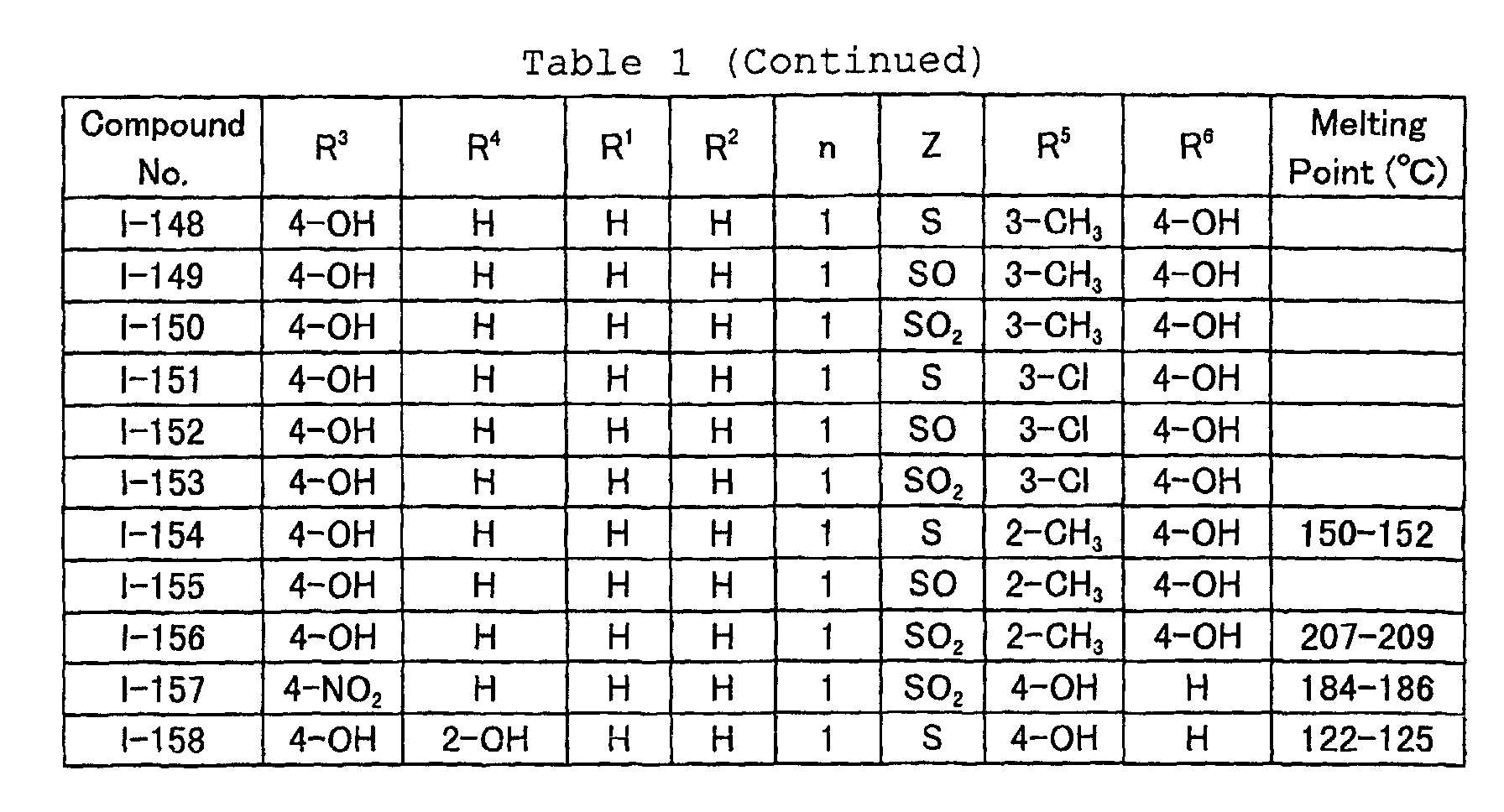



| Dye dispersion (A solution) | |
| 3-di-n-butylamino-6-methyl-7-anilinofluoran | 16 parts |
| 10% aqueous solution of polyvinyl alcohol | 84 parts |
| Developer dispersion (B solution) | |
| 4'-hydroxy-2-(4-hydroxyphenylsulfonyl)acetophenone (Compound No.I-108) | 16 parts |
| 10% aqueous solution of polyvinyl alcohol | 84 parts |
| Filler dispersion (C solution) | |
| Calcium carbonate | 27.8 parts |
| 10% aqueous solution of polyvinyl alcohol | 26.2 parts |
| Water | 71 parts |
| Evaluation Results of Dynamic Sensitivity | ||
| Quantity of Energy | ||
| 0.38mj/dot | 0.50mj/dot | |
| Example 9 | 0.36 | 0.82 |
| Example 10 | 0.42 | 0.90 |
| Example 11 | 0.36 | 0.90 |
| Example 12 | 0.33 | 0.94 |
| Comparative Example 1 | 0.85 | 1.19 |
| Comparative Example 2 | 0.57 | 1.15 |
| Comparative Example 3 | 0.88 | 1.19 |
| Comparative Example 4 | 0.21 | 0.47 |
 |
| (Evaluation Results on Backgrounds and Images) | ||||||||
| Background | Image | |||||||
| Original | Heat and Humidity | Original | Lightfastness | |||||
| 2hr | 24hr | 6hr | 12hr | 24hr | 48hr | |||
| Example 9 | 0.05 | 0.05 | 0.05 | 1.13 | 1.10 | 1.06 | 1.03 | 0.95 |
| <98> | <94> | <91> | <85> | |||||
| Example 10 | 0.06 | 0.07 | 0.07 | 1.12 | 1.14 | 1.09 | 1.06 | 0.90 |
| <102> | <97> | <94> | <80> | |||||
| Example 11 | 0.05 | 0.05 | 0.05 | 1.17 | 1.11 | 0.98 | 0.91 | 0.74 |
| <95> | <83> | <78> | <63> | |||||
| Example 12 | 0.07 | 0.06 | 0.06 | 1.32 | 1.29 | 1.26 | 1.33 | 1.35 |
| <98> | <95> | <101> | <102> | |||||
| Example 13 | 0.06 | 0.06 | 0.06 | 1.23 | 1.20 | 1.21 | 1.13 | 1.07 |
| <98> | <98> | <92> | <87> | |||||
| Example 14 | 0.05 | 0.05 | 0.05 | 0.58 | 0.65 | 0.57 | 0.55 | 0.48 |
| <112> | <98> | <95> | <83> | |||||
| Comparative Example 1 | 0.08 | 0.07 | 0.07 | 1.26 | 1.08 | 0.60 | 0.29 | 0.14 |
| <86> | <48> | <23> | <11> | |||||
| Comparative Example 2 | 0.10 | 0.10 | 0.10 | 1.25 | 1.19 | 1.08 | 0.96 | 0.76 |
| <96> | <87> | <76> | <61> | |||||
| Comparative Example 3 | 0.11 | 0.16 | 0.18 | 1.22 | 1.23 | 1.11 | 1.00 | 0.59 |
| <101> | <91> | <82> | <48> | |||||
| Comparative Example 4 | 0.09 | 0.09 | 0.09 | 1.06 | 1.03 | 0.96 | 0.82 | 0.72 |
| <97> | <91> | <77> | <68> | |||||
| Comparative Example 5 | 0.04 | 0.04 | 0.05 | 1.25 | 1.23 | 1.14 | 1.07 | 0.89 |
| <98> | <91> | <85> | <72> | |||||
| |
Claims (6)
- Phenol compounds represented by a general formula (I);wherein R1 and R2 represent hydrogen or C1-C6 alkyl,
 m represents an integer of 1 to 6,n represents an integer of 0 to 2,p and t represent an integer of 0 to 3, with proviso that p and t never be 0, concurrently,R3 and R4 nitro, carboxyl, halogen, C1-C6 alkyl, C1-C6 alkoxy, C1-C6 alkoxycarbonyl, sulfamoyl, phenylsulfamoyl, C1-C6 alkylsulfamoyl, di(C1-C6 alkylsulfamoyl), carbamoyl, phenylcarbamoyl, C1-C6 alkylcarbamoyl or di(C1-C6 alkylcarbamoyl),q and u represent an integer of 0 to 2,R3 and R4 may be different to each other when q and u are 2,Y represents CO or NR5CO,R5 represents hydrogen, C1-C6 alkyl, optionally-substituted phenyl or optionally-substituted benzyl,with proviso that p is 1 when Y is CO, andn is not 0 when p is 0 and Y is NR5CO.
 - Phenol compounds represented by a general formula (II);wherein R1, R2, R3, R4, R5, m, n, p and t are as defined above, with proviso that p and t may be 0.

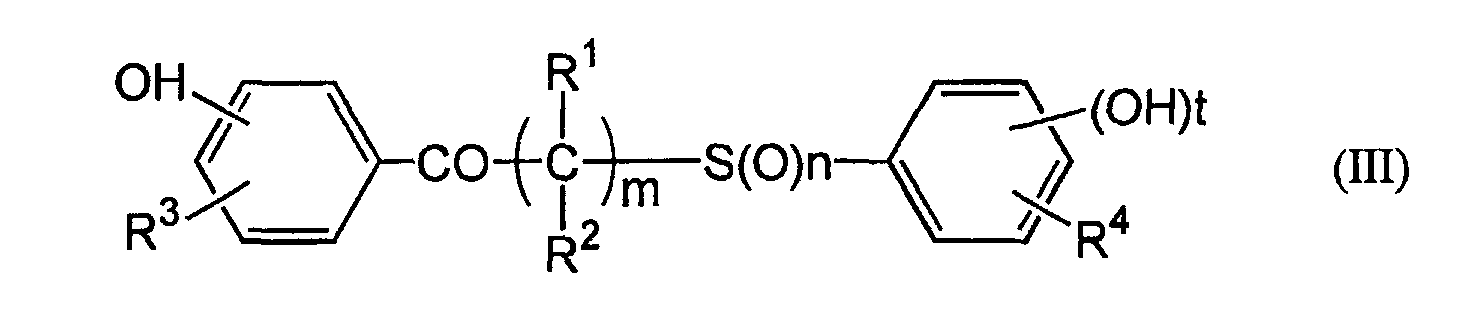
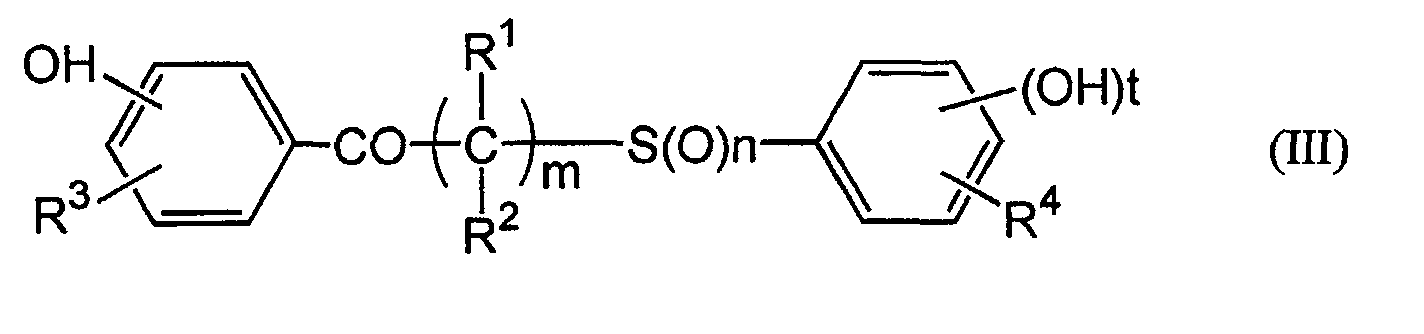
- Phenol compounds represented by a general formula (III);wherein R1, R2, R3, R4, R5, m, n and t are as defined above, with proviso that t may be 0.
- A recording material containing a color forming dye characterized in that the recording material comprises at least one of the phenol compounds represented by a general formula (I)wherein R1 and R2 represent hydrogen or C1-C6 alkyl,
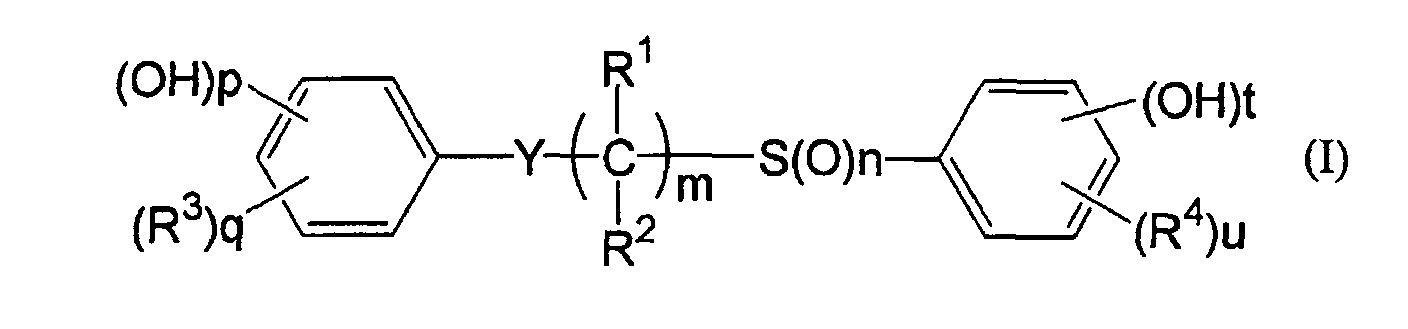 m represents an integer of 1 to 6,n represents an integer of 0 to 2,p and t represent an integer of 0 or 1, with proviso that p and t never be 0, concurrently,R3 and R4 represent hydrogen, hydroxy, carboxyl, halogen, C1-C6 alkyl, C1-C6 alkoxy, C1-C6 alkoxycarbonyl, sulfamoyl, phenylsulfamoyl, C1-C6 alkylsulfamoyl, di(C1-C6 alkylsulfamoyl), carbamoyl, phenylcarbamoyl, C1-C6 alkylcarbamoyl or di(C1-C6 alkylcarbamoyl),q and u represent an integer of 1 to 2, andR3 and R4 may be different to each other when q and u are 2,Y represents CO or NR5CO,R5 represents hydrogen, C1-C6 alkyl, optionally-substituted phenyl or optionally-substituted benzyl,with proviso that p is 1 and R3 is not hydroxy when Y is CO, and n and t are not 0 when p is 0 and Y is NR5CO.
 - A recording material containing a color forming dye characterized in that the recording material comprises at least one of the phenol compounds represented by a general formula (II);wherein R1, R2, R3, R4, R5, m, n, p and t are as defined above, with proviso that p and t may be 0.
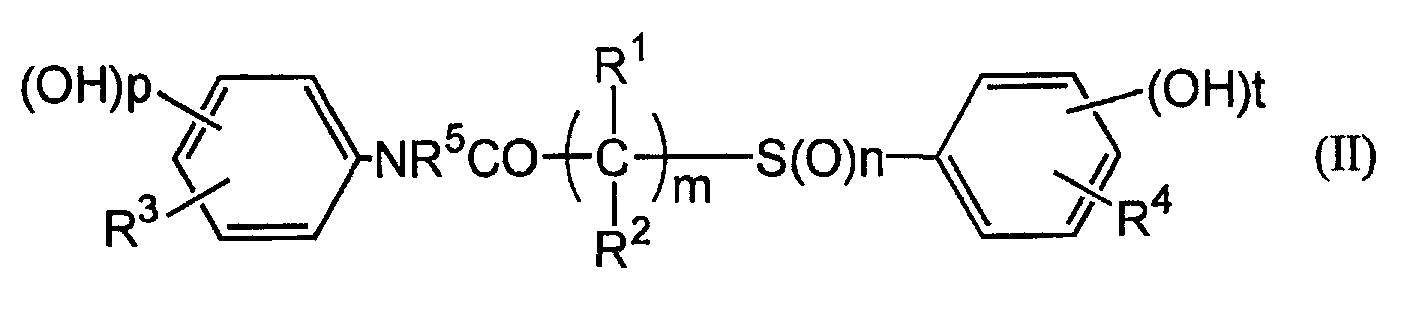
- A recording material containing a color forming dye characterized in that the recording material comprises at least one of the phenol compounds represented by a general formula (III);wherein R1, R2, R3, R4, m, n and t are as defined above, with proviso that t may be 0.
Priority Applications (1)
| Application Number | Priority Date | Filing Date | Title |
|---|---|---|---|
| EP08007433A EP1967514B1 (en) | 1999-10-04 | 2000-10-04 | Phenolic compounds and recording materials containing the same |
Applications Claiming Priority (5)
| Application Number | Priority Date | Filing Date | Title |
|---|---|---|---|
| JP28257799 | 1999-10-04 | ||
| JP28257799 | 1999-10-04 | ||
| JP2000037488 | 2000-02-16 | ||
| JP2000037488 | 2000-02-16 | ||
| PCT/JP2000/006892 WO2001025193A1 (en) | 1999-10-04 | 2000-10-04 | Phenolic compounds and recording materials containing the same |
Related Child Applications (2)
| Application Number | Title | Priority Date | Filing Date |
|---|---|---|---|
| EP08007433A Division EP1967514B1 (en) | 1999-10-04 | 2000-10-04 | Phenolic compounds and recording materials containing the same |
| EP08007433.9 Division-Into | 2008-04-16 |
Publications (3)
| Publication Number | Publication Date |
|---|---|
| EP1219598A1 true EP1219598A1 (en) | 2002-07-03 |
| EP1219598A4 EP1219598A4 (en) | 2005-05-25 |
| EP1219598B1 EP1219598B1 (en) | 2011-08-31 |
Family
ID=26554664
Family Applications (2)
| Application Number | Title | Priority Date | Filing Date |
|---|---|---|---|
| EP08007433A Expired - Lifetime EP1967514B1 (en) | 1999-10-04 | 2000-10-04 | Phenolic compounds and recording materials containing the same |
| EP00964635A Expired - Lifetime EP1219598B1 (en) | 1999-10-04 | 2000-10-04 | Phenolic compounds and recording materials containing the same |
Family Applications Before (1)
| Application Number | Title | Priority Date | Filing Date |
|---|---|---|---|
| EP08007433A Expired - Lifetime EP1967514B1 (en) | 1999-10-04 | 2000-10-04 | Phenolic compounds and recording materials containing the same |
Country Status (11)
| Country | Link |
|---|---|
| US (1) | US7012159B1 (en) |
| EP (2) | EP1967514B1 (en) |
| JP (1) | JP4583688B2 (en) |
| KR (1) | KR100511732B1 (en) |
| CN (1) | CN1193986C (en) |
| AT (1) | ATE522501T1 (en) |
| AU (1) | AU776196B2 (en) |
| BR (1) | BR0014494B1 (en) |
| ES (1) | ES2398986T3 (en) |
| HK (1) | HK1047576B (en) |
| WO (1) | WO2001025193A1 (en) |
Families Citing this family (7)
| Publication number | Priority date | Publication date | Assignee | Title |
|---|---|---|---|---|
| WO2003101751A1 (en) * | 2002-06-03 | 2003-12-11 | Nippon Soda Co.,Ltd. | Recording material and recording sheet |
| CN1294116C (en) * | 2001-04-04 | 2007-01-10 | 日本曹达株式会社 | Documentary material and documentaries |
| US7169737B2 (en) | 2002-03-14 | 2007-01-30 | Nippon Soda Co., Ltd. | Phenolic compound and recording material using the same |
| AU2002953533A0 (en) * | 2002-12-24 | 2003-01-16 | Arthron Limited | Fc receptor modulating compounds and compositions |
| KR101504991B1 (en) | 2007-08-21 | 2015-03-23 | 닛폰세이시가부시키가이샤 | Thermosensitive recording medium |
| JPWO2011114780A1 (en) | 2010-03-15 | 2013-06-27 | 日本製紙株式会社 | Thermal recording material |
| EP3397256A4 (en) | 2015-12-29 | 2019-12-11 | The Scripps Research Institute | REGULATORS OF THE NETWORK OF THE ENDOPLASMIC RETICULUM INVOLVED IN PROTESTASY |
Family Cites Families (23)
| Publication number | Priority date | Publication date | Assignee | Title |
|---|---|---|---|---|
| GB800713A (en) * | 1955-04-27 | 1958-09-03 | Boots Pure Drug Co Ltd | Sulphur-containing benzoxazole derivatives and compositions containing them |
| GB811130A (en) * | 1955-07-08 | 1959-04-02 | Geigy Ag J R | Improvements in and relating to n-acylated benzylamino phenols |
| DE1810561A1 (en) * | 1968-11-23 | 1970-07-02 | Merck Anlagen Gmbh | 3-aryl benzazines |
| DE1809454A1 (en) * | 1968-11-18 | 1970-07-09 | Merck Anlagen Gmbh | Low friction gear sets for fluid pressure devices |
| SU379570A1 (en) * | 1969-05-29 | 1973-04-20 | Институт химии присадок Азербайджанской ССР | METHOD OF OBTAINING TIOKETONOV |
| AU509682B2 (en) | 1975-10-28 | 1980-05-22 | Eli Lilly And Company | 2-Aroyl-3-Phenylbenzothiophene Derivatives |
| JPS6127955A (en) | 1984-07-18 | 1986-02-07 | Hokko Chem Ind Co Ltd | Arylsulfonyl fatty acid amide derivative, its preparation and herbicide |
| AU584669B2 (en) * | 1985-02-04 | 1989-06-01 | G.D. Searle & Co. | Novel disubstituted 4-hydroxyphenylthio anilides |
| US5071876A (en) | 1985-02-04 | 1991-12-10 | G. D. Searle & Co. | Novel disubstituted 4-hydroxyphenylthio anilides |
| JPS6210502A (en) | 1985-07-09 | 1987-01-19 | Inshinaa Kogyo Kk | Full automatic boiler burning equipment using chaff and powdered fuel etc. |
| JP2615073B2 (en) | 1987-09-16 | 1997-05-28 | 株式会社リコー | Thermal recording material |
| JPH01186951A (en) * | 1988-01-20 | 1989-07-26 | Fuji Photo Film Co Ltd | Silver halide color photographic sensitive material |
| JPH0229382A (en) | 1988-04-27 | 1990-01-31 | Dainippon Ink & Chem Inc | Thermal sensitive recording sheet |
| JP2887288B2 (en) * | 1989-02-03 | 1999-04-26 | 株式会社リコー | Recording material |
| JPH03293195A (en) * | 1990-04-11 | 1991-12-24 | Mitsubishi Paper Mills Ltd | heat sensitive recording material |
| JPH04217657A (en) | 1990-10-19 | 1992-08-07 | Toyo Gosei Kogyo Kk | 4-(n-arylcarbamoylalkylthio)phenolic compound and heat-sensitive recording material produced by using the same |
| WO1992007825A1 (en) * | 1990-11-05 | 1992-05-14 | Taisho Pharmaceutical Co., Ltd. | Phenol derivative |
| JPH04173775A (en) * | 1990-11-05 | 1992-06-22 | Taisho Pharmaceut Co Ltd | Anilide derivative |
| JP3376610B2 (en) * | 1991-09-24 | 2003-02-10 | 日本曹達株式会社 | 2-propanol compound and recording material using the same |
| JP2656417B2 (en) * | 1991-12-18 | 1997-09-24 | 富士写真フイルム株式会社 | Polymerizable phenol derivative |
| JP3582070B2 (en) * | 1994-08-11 | 2004-10-27 | 日本曹達株式会社 | Phenylethane derivative and thermal recording material using the same |
| US5614357A (en) | 1996-06-10 | 1997-03-25 | Eastman Kodak Company | Photographic element containing a particular cyan coupler bearing a sulfonyl containing ballast |
| AU1911200A (en) * | 1998-11-09 | 2000-05-29 | Atherogenics, Inc. | Methods and compositions to lower plasma cholesterol levels |
-
2000
- 2000-10-04 EP EP08007433A patent/EP1967514B1/en not_active Expired - Lifetime
- 2000-10-04 EP EP00964635A patent/EP1219598B1/en not_active Expired - Lifetime
- 2000-10-04 AU AU75555/00A patent/AU776196B2/en not_active Ceased
- 2000-10-04 AT AT00964635T patent/ATE522501T1/en not_active IP Right Cessation
- 2000-10-04 ES ES08007433T patent/ES2398986T3/en not_active Expired - Lifetime
- 2000-10-04 CN CNB008138184A patent/CN1193986C/en not_active Expired - Lifetime
- 2000-10-04 WO PCT/JP2000/006892 patent/WO2001025193A1/en not_active Ceased
- 2000-10-04 US US10/089,131 patent/US7012159B1/en not_active Expired - Lifetime
- 2000-10-04 JP JP2001528141A patent/JP4583688B2/en not_active Expired - Lifetime
- 2000-10-04 KR KR10-2002-7004062A patent/KR100511732B1/en not_active Expired - Lifetime
- 2000-10-04 BR BRPI0014494-0A patent/BR0014494B1/en not_active IP Right Cessation
- 2000-10-04 HK HK02109130.0A patent/HK1047576B/en not_active IP Right Cessation
Also Published As
| Publication number | Publication date |
|---|---|
| AU776196B2 (en) | 2004-09-02 |
| EP1219598A4 (en) | 2005-05-25 |
| US7012159B1 (en) | 2006-03-14 |
| HK1047576A1 (en) | 2003-02-28 |
| HK1047576B (en) | 2005-06-10 |
| AU7555500A (en) | 2001-05-10 |
| ATE522501T1 (en) | 2011-09-15 |
| BR0014494A (en) | 2002-08-20 |
| CN1193986C (en) | 2005-03-23 |
| EP1219598B1 (en) | 2011-08-31 |
| EP1967514B1 (en) | 2013-01-02 |
| JP4583688B2 (en) | 2010-11-17 |
| CN1377340A (en) | 2002-10-30 |
| EP1967514A1 (en) | 2008-09-10 |
| BR0014494B1 (en) | 2010-12-28 |
| KR100511732B1 (en) | 2005-09-01 |
| ES2398986T3 (en) | 2013-03-25 |
| WO2001025193A1 (en) | 2001-04-12 |
| KR20020033836A (en) | 2002-05-07 |
Similar Documents
| Publication | Publication Date | Title |
|---|---|---|
| EP1375182B1 (en) | Composition, recording material, and recording sheet | |
| EP2289704B1 (en) | Color-developing composition and recording material containing the same | |
| JP3664840B2 (en) | Chromogenic recording material | |
| EP1491529A1 (en) | Phenolic compound and recording material containing the same | |
| JP3664839B2 (en) | Recording material | |
| JP4583688B2 (en) | Phenolic compound and recording material using the same | |
| JP3835749B2 (en) | Recording materials using phenolic compounds | |
| JP4169986B2 (en) | Phenolic compound and recording material using the same | |
| JPWO2001025193A1 (en) | Phenolic compounds and recording materials using the same | |
| JP5441248B2 (en) | Developable composition and recording material containing the same | |
| JP4252221B2 (en) | Bisphenol compound and recording material using the same | |
| JP3964668B2 (en) | Phenolic compound and recording material using the same | |
| JP3743987B2 (en) | Chromogenic recording material | |
| JP4149182B2 (en) | Phenolic compound and recording material using the same | |
| US20060063669A1 (en) | Recording material comprising diphenyl sulfone derivative and novel diphenyl sulfone derivative compound | |
| JP4104355B2 (en) | Phenolic compound and recording material using the same | |
| JP4217514B2 (en) | Phenolic compound and recording material using the same | |
| JP4252245B2 (en) | Bisphenol compound and recording material using the same | |
| JP4204881B2 (en) | Phenolic compound and recording material using the same | |
| JP4226366B2 (en) | Phenolic compound and recording material using the same | |
| JP3976833B2 (en) | Triazine derivative and chromogenic recording material using the same | |
| JP2004203790A (en) | (thio)urea compound and recording material using the same | |
| JPH1035104A (en) | Coloring recording material | |
| JP2005034996A (en) | Recording material and recording sheet |
Legal Events
| Date | Code | Title | Description |
|---|---|---|---|
| PUAI | Public reference made under article 153(3) epc to a published international application that has entered the european phase |
Free format text: ORIGINAL CODE: 0009012 |
|
| 17P | Request for examination filed |
Effective date: 20020405 |
|
| AK | Designated contracting states |
Kind code of ref document: A1 Designated state(s): AT BE CH CY DE DK ES FI FR GB GR IE IT LI LU MC NL PT SE |
|
| RIC1 | Information provided on ipc code assigned before grant |
Ipc: 7C 07C 317/44 B Ipc: 7C 07C 317/46 B Ipc: 7C 07C 323/22 B Ipc: 7B 41M 5/30 B Ipc: 7C 07C 317/24 B Ipc: 7C 07C 323/51 B Ipc: 7C 07C 323/20 B Ipc: 7C 07C 317/22 A Ipc: 7C 09B 67/20 B Ipc: 7B 41M 5/155 B Ipc: 7C 07C 323/29 B Ipc: 7C 07C 317/32 B |
|
| A4 | Supplementary search report drawn up and despatched |
Effective date: 20050411 |
|
| 17Q | First examination report despatched |
Effective date: 20050914 |
|
| APBN | Date of receipt of notice of appeal recorded |
Free format text: ORIGINAL CODE: EPIDOSNNOA2E |
|
| APBR | Date of receipt of statement of grounds of appeal recorded |
Free format text: ORIGINAL CODE: EPIDOSNNOA3E |
|
| APBV | Interlocutory revision of appeal recorded |
Free format text: ORIGINAL CODE: EPIDOSNIRAPE |
|
| GRAP | Despatch of communication of intention to grant a patent |
Free format text: ORIGINAL CODE: EPIDOSNIGR1 |
|
| GRAC | Information related to communication of intention to grant a patent modified |
Free format text: ORIGINAL CODE: EPIDOSCIGR1 |
|
| GRAS | Grant fee paid |
Free format text: ORIGINAL CODE: EPIDOSNIGR3 |
|
| GRAA | (expected) grant |
Free format text: ORIGINAL CODE: 0009210 |
|
| AK | Designated contracting states |
Kind code of ref document: B1 Designated state(s): AT BE CH CY DE DK ES FI FR GB GR IE IT LI LU MC NL PT SE |
|
| REG | Reference to a national code |
Ref country code: CH Ref legal event code: EP Ref country code: GB Ref legal event code: FG4D |
|
| REG | Reference to a national code |
Ref country code: IE Ref legal event code: FG4D |
|
| REG | Reference to a national code |
Ref country code: DE Ref legal event code: R096 Ref document number: 60046410 Country of ref document: DE Effective date: 20111103 |
|
| REG | Reference to a national code |
Ref country code: NL Ref legal event code: VDEP Effective date: 20110831 |
|
| PG25 | Lapsed in a contracting state [announced via postgrant information from national office to epo] |
Ref country code: SE Free format text: LAPSE BECAUSE OF FAILURE TO SUBMIT A TRANSLATION OF THE DESCRIPTION OR TO PAY THE FEE WITHIN THE PRESCRIBED TIME-LIMIT Effective date: 20110831 Ref country code: NL Free format text: LAPSE BECAUSE OF FAILURE TO SUBMIT A TRANSLATION OF THE DESCRIPTION OR TO PAY THE FEE WITHIN THE PRESCRIBED TIME-LIMIT Effective date: 20110831 |
|
| REG | Reference to a national code |
Ref country code: AT Ref legal event code: MK05 Ref document number: 522501 Country of ref document: AT Kind code of ref document: T Effective date: 20110831 |
|
| PG25 | Lapsed in a contracting state [announced via postgrant information from national office to epo] |
Ref country code: GR Free format text: LAPSE BECAUSE OF FAILURE TO SUBMIT A TRANSLATION OF THE DESCRIPTION OR TO PAY THE FEE WITHIN THE PRESCRIBED TIME-LIMIT Effective date: 20111201 Ref country code: AT Free format text: LAPSE BECAUSE OF FAILURE TO SUBMIT A TRANSLATION OF THE DESCRIPTION OR TO PAY THE FEE WITHIN THE PRESCRIBED TIME-LIMIT Effective date: 20110831 Ref country code: CY Free format text: LAPSE BECAUSE OF FAILURE TO SUBMIT A TRANSLATION OF THE DESCRIPTION OR TO PAY THE FEE WITHIN THE PRESCRIBED TIME-LIMIT Effective date: 20110831 |
|
| PG25 | Lapsed in a contracting state [announced via postgrant information from national office to epo] |
Ref country code: BE Free format text: LAPSE BECAUSE OF FAILURE TO SUBMIT A TRANSLATION OF THE DESCRIPTION OR TO PAY THE FEE WITHIN THE PRESCRIBED TIME-LIMIT Effective date: 20110831 |
|
| PG25 | Lapsed in a contracting state [announced via postgrant information from national office to epo] |
Ref country code: PT Free format text: LAPSE BECAUSE OF FAILURE TO SUBMIT A TRANSLATION OF THE DESCRIPTION OR TO PAY THE FEE WITHIN THE PRESCRIBED TIME-LIMIT Effective date: 20120102 Ref country code: MC Free format text: LAPSE BECAUSE OF NON-PAYMENT OF DUE FEES Effective date: 20111031 |
|
| REG | Reference to a national code |
Ref country code: CH Ref legal event code: PL |
|
| PG25 | Lapsed in a contracting state [announced via postgrant information from national office to epo] |
Ref country code: DK Free format text: LAPSE BECAUSE OF FAILURE TO SUBMIT A TRANSLATION OF THE DESCRIPTION OR TO PAY THE FEE WITHIN THE PRESCRIBED TIME-LIMIT Effective date: 20110831 |
|
| PLBE | No opposition filed within time limit |
Free format text: ORIGINAL CODE: 0009261 |
|
| STAA | Information on the status of an ep patent application or granted ep patent |
Free format text: STATUS: NO OPPOSITION FILED WITHIN TIME LIMIT |
|
| PG25 | Lapsed in a contracting state [announced via postgrant information from national office to epo] |
Ref country code: CH Free format text: LAPSE BECAUSE OF NON-PAYMENT OF DUE FEES Effective date: 20111031 Ref country code: LI Free format text: LAPSE BECAUSE OF NON-PAYMENT OF DUE FEES Effective date: 20111031 |
|
| REG | Reference to a national code |
Ref country code: IE Ref legal event code: MM4A |
|
| 26N | No opposition filed |
Effective date: 20120601 |
|
| REG | Reference to a national code |
Ref country code: DE Ref legal event code: R097 Ref document number: 60046410 Country of ref document: DE Effective date: 20120601 |
|
| PG25 | Lapsed in a contracting state [announced via postgrant information from national office to epo] |
Ref country code: IE Free format text: LAPSE BECAUSE OF NON-PAYMENT OF DUE FEES Effective date: 20111004 |
|
| PGFP | Annual fee paid to national office [announced via postgrant information from national office to epo] |
Ref country code: FR Payment date: 20121031 Year of fee payment: 13 Ref country code: DE Payment date: 20121023 Year of fee payment: 13 Ref country code: FI Payment date: 20121011 Year of fee payment: 13 |
|
| PGFP | Annual fee paid to national office [announced via postgrant information from national office to epo] |
Ref country code: GB Payment date: 20121019 Year of fee payment: 13 Ref country code: IT Payment date: 20121026 Year of fee payment: 13 |
|
| PG25 | Lapsed in a contracting state [announced via postgrant information from national office to epo] |
Ref country code: ES Free format text: LAPSE BECAUSE OF FAILURE TO SUBMIT A TRANSLATION OF THE DESCRIPTION OR TO PAY THE FEE WITHIN THE PRESCRIBED TIME-LIMIT Effective date: 20111211 |
|
| PG25 | Lapsed in a contracting state [announced via postgrant information from national office to epo] |
Ref country code: LU Free format text: LAPSE BECAUSE OF NON-PAYMENT OF DUE FEES Effective date: 20111004 |
|
| GBPC | Gb: european patent ceased through non-payment of renewal fee |
Effective date: 20131004 |
|
| PG25 | Lapsed in a contracting state [announced via postgrant information from national office to epo] |
Ref country code: GB Free format text: LAPSE BECAUSE OF NON-PAYMENT OF DUE FEES Effective date: 20131004 |
|
| REG | Reference to a national code |
Ref country code: DE Ref legal event code: R119 Ref document number: 60046410 Country of ref document: DE Effective date: 20140501 |
|
| REG | Reference to a national code |
Ref country code: FR Ref legal event code: ST Effective date: 20140630 |
|
| PG25 | Lapsed in a contracting state [announced via postgrant information from national office to epo] |
Ref country code: FI Free format text: LAPSE BECAUSE OF NON-PAYMENT OF DUE FEES Effective date: 20131004 Ref country code: FR Free format text: LAPSE BECAUSE OF NON-PAYMENT OF DUE FEES Effective date: 20131031 Ref country code: DE Free format text: LAPSE BECAUSE OF NON-PAYMENT OF DUE FEES Effective date: 20140501 Ref country code: IT Free format text: LAPSE BECAUSE OF NON-PAYMENT OF DUE FEES Effective date: 20131004 |