EP1213328A1 - Oxazinderivate - Google Patents
Oxazinderivate Download PDFInfo
- Publication number
- EP1213328A1 EP1213328A1 EP00127005A EP00127005A EP1213328A1 EP 1213328 A1 EP1213328 A1 EP 1213328A1 EP 00127005 A EP00127005 A EP 00127005A EP 00127005 A EP00127005 A EP 00127005A EP 1213328 A1 EP1213328 A1 EP 1213328A1
- Authority
- EP
- European Patent Office
- Prior art keywords
- derivative according
- oxazine
- oxazine derivative
- reactive group
- ester
- Prior art date
- Legal status (The legal status is an assumption and is not a legal conclusion. Google has not performed a legal analysis and makes no representation as to the accuracy of the status listed.)
- Withdrawn
Links
- 150000004893 oxazines Chemical class 0.000 title claims description 63
- -1 cyano, carbonyl Chemical group 0.000 claims abstract description 69
- 239000000463 material Substances 0.000 claims abstract description 44
- 150000002148 esters Chemical class 0.000 claims abstract description 29
- 239000002253 acid Substances 0.000 claims abstract description 19
- 238000000034 method Methods 0.000 claims abstract description 17
- 150000001875 compounds Chemical class 0.000 claims abstract description 16
- 125000003178 carboxy group Chemical group [H]OC(*)=O 0.000 claims abstract description 13
- 150000003839 salts Chemical class 0.000 claims abstract description 12
- 125000003118 aryl group Chemical group 0.000 claims abstract description 10
- 150000004820 halides Chemical class 0.000 claims abstract description 10
- 229910052736 halogen Inorganic materials 0.000 claims abstract description 10
- 150000002367 halogens Chemical class 0.000 claims abstract description 10
- 125000003342 alkenyl group Chemical group 0.000 claims abstract description 8
- 125000003545 alkoxy group Chemical group 0.000 claims abstract description 8
- 125000004453 alkoxycarbonyl group Chemical group 0.000 claims abstract description 8
- 125000000217 alkyl group Chemical group 0.000 claims abstract description 8
- 125000002252 acyl group Chemical group 0.000 claims abstract description 7
- 229920006395 saturated elastomer Polymers 0.000 claims abstract description 7
- 125000000472 sulfonyl group Chemical group *S(*)(=O)=O 0.000 claims abstract description 7
- 230000027455 binding Effects 0.000 claims abstract description 6
- 125000002924 primary amino group Chemical group [H]N([H])* 0.000 claims abstract description 3
- 238000002360 preparation method Methods 0.000 claims abstract 2
- ZMXDDKWLCZADIW-UHFFFAOYSA-N N,N-Dimethylformamide Chemical compound CN(C)C=O ZMXDDKWLCZADIW-UHFFFAOYSA-N 0.000 claims description 88
- 238000006243 chemical reaction Methods 0.000 claims description 18
- 108090000623 proteins and genes Proteins 0.000 claims description 16
- 102000004169 proteins and genes Human genes 0.000 claims description 16
- 239000012620 biological material Substances 0.000 claims description 12
- 239000011859 microparticle Substances 0.000 claims description 12
- 239000003550 marker Substances 0.000 claims description 11
- YBJHBAHKTGYVGT-ZKWXMUAHSA-N (+)-Biotin Chemical compound N1C(=O)N[C@@H]2[C@H](CCCCC(=O)O)SC[C@@H]21 YBJHBAHKTGYVGT-ZKWXMUAHSA-N 0.000 claims description 10
- 150000001412 amines Chemical class 0.000 claims description 10
- 150000001540 azides Chemical class 0.000 claims description 10
- 150000002540 isothiocyanates Chemical class 0.000 claims description 10
- 239000000126 substance Substances 0.000 claims description 10
- 238000004458 analytical method Methods 0.000 claims description 9
- 125000005647 linker group Chemical group 0.000 claims description 9
- 150000008065 acid anhydrides Chemical class 0.000 claims description 8
- 125000005521 carbonamide group Chemical group 0.000 claims description 8
- 150000003949 imides Chemical class 0.000 claims description 8
- 150000003461 sulfonyl halides Chemical class 0.000 claims description 8
- 125000002877 alkyl aryl group Chemical group 0.000 claims description 7
- 125000000753 cycloalkyl group Chemical group 0.000 claims description 7
- 239000000203 mixture Substances 0.000 claims description 7
- 239000002245 particle Substances 0.000 claims description 7
- BTBUEUYNUDRHOZ-UHFFFAOYSA-N Borate Chemical compound [O-]B([O-])[O-] BTBUEUYNUDRHOZ-UHFFFAOYSA-N 0.000 claims description 6
- 239000013543 active substance Substances 0.000 claims description 6
- 125000004423 acyloxy group Chemical group 0.000 claims description 6
- 125000002915 carbonyl group Chemical group [*:2]C([*:1])=O 0.000 claims description 6
- 125000004356 hydroxy functional group Chemical group O* 0.000 claims description 6
- 229960002685 biotin Drugs 0.000 claims description 5
- 235000020958 biotin Nutrition 0.000 claims description 5
- 239000011616 biotin Substances 0.000 claims description 5
- 125000004185 ester group Chemical group 0.000 claims description 5
- 125000001424 substituent group Chemical group 0.000 claims description 5
- VEXZGXHMUGYJMC-UHFFFAOYSA-N Hydrochloric acid Chemical compound Cl VEXZGXHMUGYJMC-UHFFFAOYSA-N 0.000 claims description 4
- 238000001042 affinity chromatography Methods 0.000 claims description 4
- 239000012876 carrier material Substances 0.000 claims description 4
- 150000002500 ions Chemical class 0.000 claims description 4
- XSYUPRQVAHJETO-WPMUBMLPSA-N (2s)-2-[[(2s)-2-[[(2s)-2-[[(2s)-2-[[(2s)-2-[[(2s)-2-amino-3-(1h-imidazol-5-yl)propanoyl]amino]-3-(1h-imidazol-5-yl)propanoyl]amino]-3-(1h-imidazol-5-yl)propanoyl]amino]-3-(1h-imidazol-5-yl)propanoyl]amino]-3-(1h-imidazol-5-yl)propanoyl]amino]-3-(1h-imidaz Chemical compound C([C@H](N)C(=O)N[C@@H](CC=1NC=NC=1)C(=O)N[C@@H](CC=1NC=NC=1)C(=O)N[C@@H](CC=1NC=NC=1)C(=O)N[C@@H](CC=1NC=NC=1)C(=O)N[C@@H](CC=1NC=NC=1)C(O)=O)C1=CN=CN1 XSYUPRQVAHJETO-WPMUBMLPSA-N 0.000 claims description 3
- BDNKZNFMNDZQMI-UHFFFAOYSA-N 1,3-diisopropylcarbodiimide Chemical compound CC(C)N=C=NC(C)C BDNKZNFMNDZQMI-UHFFFAOYSA-N 0.000 claims description 3
- CPELXLSAUQHCOX-UHFFFAOYSA-M Bromide Chemical compound [Br-] CPELXLSAUQHCOX-UHFFFAOYSA-M 0.000 claims description 3
- 230000015572 biosynthetic process Effects 0.000 claims description 3
- 230000008569 process Effects 0.000 claims description 3
- 238000000926 separation method Methods 0.000 claims description 3
- 108091032973 (ribonucleotides)n+m Proteins 0.000 claims description 2
- 108020004414 DNA Proteins 0.000 claims description 2
- PEEHTFAAVSWFBL-UHFFFAOYSA-N Maleimide Chemical compound O=C1NC(=O)C=C1 PEEHTFAAVSWFBL-UHFFFAOYSA-N 0.000 claims description 2
- DFPAKSUCGFBDDF-UHFFFAOYSA-N Nicotinamide Chemical class NC(=O)C1=CC=CN=C1 DFPAKSUCGFBDDF-UHFFFAOYSA-N 0.000 claims description 2
- 108091034117 Oligonucleotide Proteins 0.000 claims description 2
- JLCPHMBAVCMARE-UHFFFAOYSA-N [3-[[3-[[3-[[3-[[3-[[3-[[3-[[3-[[3-[[3-[[3-[[5-(2-amino-6-oxo-1H-purin-9-yl)-3-[[3-[[3-[[3-[[3-[[3-[[5-(2-amino-6-oxo-1H-purin-9-yl)-3-[[5-(2-amino-6-oxo-1H-purin-9-yl)-3-hydroxyoxolan-2-yl]methoxy-hydroxyphosphoryl]oxyoxolan-2-yl]methoxy-hydroxyphosphoryl]oxy-5-(5-methyl-2,4-dioxopyrimidin-1-yl)oxolan-2-yl]methoxy-hydroxyphosphoryl]oxy-5-(6-aminopurin-9-yl)oxolan-2-yl]methoxy-hydroxyphosphoryl]oxy-5-(6-aminopurin-9-yl)oxolan-2-yl]methoxy-hydroxyphosphoryl]oxy-5-(6-aminopurin-9-yl)oxolan-2-yl]methoxy-hydroxyphosphoryl]oxy-5-(6-aminopurin-9-yl)oxolan-2-yl]methoxy-hydroxyphosphoryl]oxyoxolan-2-yl]methoxy-hydroxyphosphoryl]oxy-5-(5-methyl-2,4-dioxopyrimidin-1-yl)oxolan-2-yl]methoxy-hydroxyphosphoryl]oxy-5-(4-amino-2-oxopyrimidin-1-yl)oxolan-2-yl]methoxy-hydroxyphosphoryl]oxy-5-(5-methyl-2,4-dioxopyrimidin-1-yl)oxolan-2-yl]methoxy-hydroxyphosphoryl]oxy-5-(5-methyl-2,4-dioxopyrimidin-1-yl)oxolan-2-yl]methoxy-hydroxyphosphoryl]oxy-5-(6-aminopurin-9-yl)oxolan-2-yl]methoxy-hydroxyphosphoryl]oxy-5-(6-aminopurin-9-yl)oxolan-2-yl]methoxy-hydroxyphosphoryl]oxy-5-(4-amino-2-oxopyrimidin-1-yl)oxolan-2-yl]methoxy-hydroxyphosphoryl]oxy-5-(4-amino-2-oxopyrimidin-1-yl)oxolan-2-yl]methoxy-hydroxyphosphoryl]oxy-5-(4-amino-2-oxopyrimidin-1-yl)oxolan-2-yl]methoxy-hydroxyphosphoryl]oxy-5-(6-aminopurin-9-yl)oxolan-2-yl]methoxy-hydroxyphosphoryl]oxy-5-(4-amino-2-oxopyrimidin-1-yl)oxolan-2-yl]methyl [5-(6-aminopurin-9-yl)-2-(hydroxymethyl)oxolan-3-yl] hydrogen phosphate Polymers Cc1cn(C2CC(OP(O)(=O)OCC3OC(CC3OP(O)(=O)OCC3OC(CC3O)n3cnc4c3nc(N)[nH]c4=O)n3cnc4c3nc(N)[nH]c4=O)C(COP(O)(=O)OC3CC(OC3COP(O)(=O)OC3CC(OC3COP(O)(=O)OC3CC(OC3COP(O)(=O)OC3CC(OC3COP(O)(=O)OC3CC(OC3COP(O)(=O)OC3CC(OC3COP(O)(=O)OC3CC(OC3COP(O)(=O)OC3CC(OC3COP(O)(=O)OC3CC(OC3COP(O)(=O)OC3CC(OC3COP(O)(=O)OC3CC(OC3COP(O)(=O)OC3CC(OC3COP(O)(=O)OC3CC(OC3COP(O)(=O)OC3CC(OC3COP(O)(=O)OC3CC(OC3COP(O)(=O)OC3CC(OC3COP(O)(=O)OC3CC(OC3CO)n3cnc4c(N)ncnc34)n3ccc(N)nc3=O)n3cnc4c(N)ncnc34)n3ccc(N)nc3=O)n3ccc(N)nc3=O)n3ccc(N)nc3=O)n3cnc4c(N)ncnc34)n3cnc4c(N)ncnc34)n3cc(C)c(=O)[nH]c3=O)n3cc(C)c(=O)[nH]c3=O)n3ccc(N)nc3=O)n3cc(C)c(=O)[nH]c3=O)n3cnc4c3nc(N)[nH]c4=O)n3cnc4c(N)ncnc34)n3cnc4c(N)ncnc34)n3cnc4c(N)ncnc34)n3cnc4c(N)ncnc34)O2)c(=O)[nH]c1=O JLCPHMBAVCMARE-UHFFFAOYSA-N 0.000 claims description 2
- 150000001299 aldehydes Chemical class 0.000 claims description 2
- 125000001931 aliphatic group Chemical group 0.000 claims description 2
- 239000000427 antigen Substances 0.000 claims description 2
- 102000036639 antigens Human genes 0.000 claims description 2
- 108091007433 antigens Proteins 0.000 claims description 2
- 210000000170 cell membrane Anatomy 0.000 claims description 2
- 210000003850 cellular structure Anatomy 0.000 claims description 2
- 238000012512 characterization method Methods 0.000 claims description 2
- 238000002405 diagnostic procedure Methods 0.000 claims description 2
- BGRWYRAHAFMIBJ-UHFFFAOYSA-N diisopropylcarbodiimide Natural products CC(C)NC(=O)NC(C)C BGRWYRAHAFMIBJ-UHFFFAOYSA-N 0.000 claims description 2
- 239000001257 hydrogen Substances 0.000 claims description 2
- 229910052739 hydrogen Inorganic materials 0.000 claims description 2
- 150000002576 ketones Chemical class 0.000 claims description 2
- 150000002632 lipids Chemical class 0.000 claims description 2
- 150000002832 nitroso derivatives Chemical class 0.000 claims description 2
- 239000002773 nucleotide Substances 0.000 claims description 2
- 125000003729 nucleotide group Chemical group 0.000 claims description 2
- 150000003141 primary amines Chemical class 0.000 claims description 2
- 108090000765 processed proteins & peptides Proteins 0.000 claims description 2
- 102000004196 processed proteins & peptides Human genes 0.000 claims description 2
- 239000007858 starting material Substances 0.000 claims description 2
- 239000000758 substrate Substances 0.000 claims description 2
- 125000000542 sulfonic acid group Chemical group 0.000 claims description 2
- YBBRCQOCSYXUOC-UHFFFAOYSA-N sulfuryl dichloride Chemical compound ClS(Cl)(=O)=O YBBRCQOCSYXUOC-UHFFFAOYSA-N 0.000 claims description 2
- 238000002560 therapeutic procedure Methods 0.000 claims description 2
- 229940006460 bromide ion Drugs 0.000 claims 2
- 150000001491 aromatic compounds Chemical class 0.000 claims 1
- 229940088623 biologically active substance Drugs 0.000 claims 1
- 238000004140 cleaning Methods 0.000 claims 1
- 125000004435 hydrogen atom Chemical class [H]* 0.000 claims 1
- 125000000467 secondary amino group Chemical class [H]N([*:1])[*:2] 0.000 claims 1
- 238000012360 testing method Methods 0.000 abstract description 6
- ZOQBMQREQNVKHB-UHFFFAOYSA-N 2-(azidodisulfanyl)-5-(1-methylpyrrolidin-2-yl)pyridine Chemical class N(=[N+]=[N-])SSC1=NC=C(C=C1)C1N(C)CCC1 ZOQBMQREQNVKHB-UHFFFAOYSA-N 0.000 abstract 1
- 150000008064 anhydrides Chemical class 0.000 abstract 1
- 229910052799 carbon Inorganic materials 0.000 abstract 1
- 125000001475 halogen functional group Chemical group 0.000 abstract 1
- 125000001810 isothiocyanato group Chemical group *N=C=S 0.000 abstract 1
- 239000000243 solution Substances 0.000 description 56
- YMWUJEATGCHHMB-UHFFFAOYSA-N Dichloromethane Chemical compound ClCCl YMWUJEATGCHHMB-UHFFFAOYSA-N 0.000 description 50
- 239000000975 dye Substances 0.000 description 33
- JGFZNNIVVJXRND-UHFFFAOYSA-N N,N-Diisopropylethylamine (DIPEA) Chemical compound CCN(C(C)C)C(C)C JGFZNNIVVJXRND-UHFFFAOYSA-N 0.000 description 22
- OKKJLVBELUTLKV-UHFFFAOYSA-N Methanol Chemical compound OC OKKJLVBELUTLKV-UHFFFAOYSA-N 0.000 description 21
- QTBSBXVTEAMEQO-UHFFFAOYSA-N Acetic acid Chemical compound CC(O)=O QTBSBXVTEAMEQO-UHFFFAOYSA-N 0.000 description 16
- DTQVDTLACAAQTR-UHFFFAOYSA-N Trifluoroacetic acid Chemical compound OC(=O)C(F)(F)F DTQVDTLACAAQTR-UHFFFAOYSA-N 0.000 description 16
- 235000018102 proteins Nutrition 0.000 description 15
- 239000011347 resin Substances 0.000 description 15
- 229920005989 resin Polymers 0.000 description 15
- BCHZICNRHXRCHY-UHFFFAOYSA-N 2h-oxazine Chemical compound N1OC=CC=C1 BCHZICNRHXRCHY-UHFFFAOYSA-N 0.000 description 12
- LFQSCWFLJHTTHZ-UHFFFAOYSA-N Ethanol Chemical compound CCO LFQSCWFLJHTTHZ-UHFFFAOYSA-N 0.000 description 10
- XLYOFNOQVPJJNP-UHFFFAOYSA-N water Substances O XLYOFNOQVPJJNP-UHFFFAOYSA-N 0.000 description 10
- 238000004440 column chromatography Methods 0.000 description 9
- 230000005284 excitation Effects 0.000 description 9
- 229960000583 acetic acid Drugs 0.000 description 8
- 239000012043 crude product Substances 0.000 description 8
- 239000012362 glacial acetic acid Substances 0.000 description 8
- 239000003480 eluent Substances 0.000 description 7
- 238000002372 labelling Methods 0.000 description 7
- 239000007850 fluorescent dye Substances 0.000 description 6
- FRGXAQMDKHJKCA-UHFFFAOYSA-N 3-[[1-[ethyl(3-sulfopropyl)amino]-10H-phenoxazin-2-yl]-methylamino]propanoic acid Chemical compound O1C2=CC=CC=C2NC2=C1C=CC(N(C)CCC(O)=O)=C2N(CCCS(O)(=O)=O)CC FRGXAQMDKHJKCA-UHFFFAOYSA-N 0.000 description 5
- 229910004298 SiO 2 Inorganic materials 0.000 description 5
- 238000009826 distribution Methods 0.000 description 5
- CSCPPACGZOOCGX-UHFFFAOYSA-N Acetone Chemical compound CC(C)=O CSCPPACGZOOCGX-UHFFFAOYSA-N 0.000 description 4
- 0 Cc1ccc(ccc*2NCCC(O)=O)c2c1 Chemical compound Cc1ccc(ccc*2NCCC(O)=O)c2c1 0.000 description 4
- CDBYLPFSWZWCQE-UHFFFAOYSA-L Sodium Carbonate Chemical compound [Na+].[Na+].[O-]C([O-])=O CDBYLPFSWZWCQE-UHFFFAOYSA-L 0.000 description 4
- 239000008186 active pharmaceutical agent Substances 0.000 description 4
- 238000004128 high performance liquid chromatography Methods 0.000 description 4
- 230000003993 interaction Effects 0.000 description 4
- 238000011068 loading method Methods 0.000 description 4
- 239000000047 product Substances 0.000 description 4
- 239000000523 sample Substances 0.000 description 4
- BZLVMXJERCGZMT-UHFFFAOYSA-N Methyl tert-butyl ether Chemical compound COC(C)(C)C BZLVMXJERCGZMT-UHFFFAOYSA-N 0.000 description 3
- HEMHJVSKTPXQMS-UHFFFAOYSA-M Sodium hydroxide Chemical compound [OH-].[Na+] HEMHJVSKTPXQMS-UHFFFAOYSA-M 0.000 description 3
- 238000010219 correlation analysis Methods 0.000 description 3
- 239000013078 crystal Substances 0.000 description 3
- 238000011835 investigation Methods 0.000 description 3
- 229920000642 polymer Polymers 0.000 description 3
- 125000006239 protecting group Chemical group 0.000 description 3
- 238000000746 purification Methods 0.000 description 3
- 238000006862 quantum yield reaction Methods 0.000 description 3
- 230000035484 reaction time Effects 0.000 description 3
- 238000001953 recrystallisation Methods 0.000 description 3
- 239000002904 solvent Substances 0.000 description 3
- 238000001179 sorption measurement Methods 0.000 description 3
- 230000003595 spectral effect Effects 0.000 description 3
- 238000011282 treatment Methods 0.000 description 3
- BYEAHWXPCBROCE-UHFFFAOYSA-N 1,1,1,3,3,3-hexafluoropropan-2-ol Chemical compound FC(F)(F)C(O)C(F)(F)F BYEAHWXPCBROCE-UHFFFAOYSA-N 0.000 description 2
- MYRTYDVEIRVNKP-UHFFFAOYSA-N 1,2-Divinylbenzene Chemical compound C=CC1=CC=CC=C1C=C MYRTYDVEIRVNKP-UHFFFAOYSA-N 0.000 description 2
- 125000000143 2-carboxyethyl group Chemical group [H]OC(=O)C([H])([H])C([H])([H])* 0.000 description 2
- 229940018563 3-aminophenol Drugs 0.000 description 2
- NXYYRSJPSPRDEO-UHFFFAOYSA-N 5-(diethylamino)-2-nitrosophenol Chemical compound CCN(CC)C1=CC=C(N=O)C(O)=C1 NXYYRSJPSPRDEO-UHFFFAOYSA-N 0.000 description 2
- WKZLNEWVIAGNAW-UHFFFAOYSA-N 5-Carboxyamidotryptamine Chemical compound C1=C(C(N)=O)C=C2C(CCN)=CNC2=C1 WKZLNEWVIAGNAW-UHFFFAOYSA-N 0.000 description 2
- 206010001497 Agitation Diseases 0.000 description 2
- IJGRMHOSHXDMSA-UHFFFAOYSA-N Atomic nitrogen Chemical compound N#N IJGRMHOSHXDMSA-UHFFFAOYSA-N 0.000 description 2
- 108090001008 Avidin Proteins 0.000 description 2
- IVRMZWNICZWHMI-UHFFFAOYSA-N Azide Chemical compound [N-]=[N+]=[N-] IVRMZWNICZWHMI-UHFFFAOYSA-N 0.000 description 2
- CQTKUEOHELQPQK-UHFFFAOYSA-N C(=O)(OC(C)(C)C)NCCCCCN.C(C)(C)(C)OC(=O)C(CCN)CCN Chemical compound C(=O)(OC(C)(C)C)NCCCCCN.C(C)(C)(C)OC(=O)C(CCN)CCN CQTKUEOHELQPQK-UHFFFAOYSA-N 0.000 description 2
- 239000002202 Polyethylene glycol Substances 0.000 description 2
- 238000001261 affinity purification Methods 0.000 description 2
- 125000003277 amino group Chemical group 0.000 description 2
- 239000012491 analyte Substances 0.000 description 2
- 239000007864 aqueous solution Substances 0.000 description 2
- 230000008901 benefit Effects 0.000 description 2
- 239000000872 buffer Substances 0.000 description 2
- 125000004432 carbon atom Chemical group C* 0.000 description 2
- 150000001732 carboxylic acid derivatives Chemical class 0.000 description 2
- 125000002091 cationic group Chemical group 0.000 description 2
- 230000008859 change Effects 0.000 description 2
- 239000000412 dendrimer Substances 0.000 description 2
- 229920000736 dendritic polymer Polymers 0.000 description 2
- 238000004043 dyeing Methods 0.000 description 2
- 238000002060 fluorescence correlation spectroscopy Methods 0.000 description 2
- 238000002866 fluorescence resonance energy transfer Methods 0.000 description 2
- 239000011521 glass Substances 0.000 description 2
- GRHBQAYDJPGGLF-UHFFFAOYSA-N isothiocyanic acid Chemical compound N=C=S GRHBQAYDJPGGLF-UHFFFAOYSA-N 0.000 description 2
- 238000004519 manufacturing process Methods 0.000 description 2
- 238000005259 measurement Methods 0.000 description 2
- BWWSSJKXSQGUGW-UHFFFAOYSA-N methyl 2-(3-hydroxy-n-methylanilino)propanoate Chemical compound COC(=O)C(C)N(C)C1=CC=CC(O)=C1 BWWSSJKXSQGUGW-UHFFFAOYSA-N 0.000 description 2
- CMWYAOXYQATXSI-UHFFFAOYSA-N n,n-dimethylformamide;piperidine Chemical compound CN(C)C=O.C1CCNCC1 CMWYAOXYQATXSI-UHFFFAOYSA-N 0.000 description 2
- 230000007935 neutral effect Effects 0.000 description 2
- 230000009871 nonspecific binding Effects 0.000 description 2
- 125000001997 phenyl group Chemical group [H]C1=C([H])C([H])=C(*)C([H])=C1[H] 0.000 description 2
- 229920001223 polyethylene glycol Polymers 0.000 description 2
- 238000010992 reflux Methods 0.000 description 2
- 229910000029 sodium carbonate Inorganic materials 0.000 description 2
- 238000004611 spectroscopical analysis Methods 0.000 description 2
- 238000003786 synthesis reaction Methods 0.000 description 2
- DPLOGSUBQDREOU-UHFFFAOYSA-N tert-butyl n-(5-aminopentyl)carbamate Chemical compound CC(C)(C)OC(=O)NCCCCCN DPLOGSUBQDREOU-UHFFFAOYSA-N 0.000 description 2
- WROMPOXWARCANT-UHFFFAOYSA-N tfa trifluoroacetic acid Chemical compound OC(=O)C(F)(F)F.OC(=O)C(F)(F)F WROMPOXWARCANT-UHFFFAOYSA-N 0.000 description 2
- 125000003088 (fluoren-9-ylmethoxy)carbonyl group Chemical group 0.000 description 1
- ZIRURAJAJIQZFG-UHFFFAOYSA-N 1-aminopropane-1-sulfonic acid Chemical compound CCC(N)S(O)(=O)=O ZIRURAJAJIQZFG-UHFFFAOYSA-N 0.000 description 1
- LYLKYOCIGPXQFH-UHFFFAOYSA-N 2,3,4,5-tetrafluoro-6-hydroxybenzenesulfonic acid Chemical class OC1=C(F)C(F)=C(F)C(F)=C1S(O)(=O)=O LYLKYOCIGPXQFH-UHFFFAOYSA-N 0.000 description 1
- 150000003923 2,5-pyrrolediones Chemical class 0.000 description 1
- OALHHIHQOFIMEF-UHFFFAOYSA-N 3',6'-dihydroxy-2',4',5',7'-tetraiodo-3h-spiro[2-benzofuran-1,9'-xanthene]-3-one Chemical compound O1C(=O)C2=CC=CC=C2C21C1=CC(I)=C(O)C(I)=C1OC1=C(I)C(O)=C(I)C=C21 OALHHIHQOFIMEF-UHFFFAOYSA-N 0.000 description 1
- WAVOOWVINKGEHS-UHFFFAOYSA-N 3-(diethylamino)phenol Chemical compound CCN(CC)C1=CC=CC(O)=C1 WAVOOWVINKGEHS-UHFFFAOYSA-N 0.000 description 1
- BQGXXEGJJMEZMZ-UHFFFAOYSA-N 3-(n-ethyl-3-hydroxy-4-nitrosoanilino)propane-1-sulfonic acid Chemical compound OS(=O)(=O)CCCN(CC)C1=CC=C(N=O)C(O)=C1 BQGXXEGJJMEZMZ-UHFFFAOYSA-N 0.000 description 1
- DDZGIYZMSTUQCR-UHFFFAOYSA-N 3-(n-methyl-4-nitrosoanilino)propanoic acid Chemical compound OC(=O)CCN(C)C1=CC=C(N=O)C=C1 DDZGIYZMSTUQCR-UHFFFAOYSA-N 0.000 description 1
- OAWWYNFKJSVRGC-UHFFFAOYSA-N 3-[(7-sulfonaphthalen-1-yl)amino]propanoic acid Chemical compound C1=C(S(O)(=O)=O)C=C2C(NCCC(=O)O)=CC=CC2=C1 OAWWYNFKJSVRGC-UHFFFAOYSA-N 0.000 description 1
- CWLKGDAVCFYWJK-UHFFFAOYSA-N 3-aminophenol Chemical compound NC1=CC=CC(O)=C1 CWLKGDAVCFYWJK-UHFFFAOYSA-N 0.000 description 1
- WHNPOQXWAMXPTA-UHFFFAOYSA-N 3-methylbut-2-enamide Chemical compound CC(C)=CC(N)=O WHNPOQXWAMXPTA-UHFFFAOYSA-N 0.000 description 1
- ZCYVEMRRCGMTRW-UHFFFAOYSA-N 7553-56-2 Chemical compound [I] ZCYVEMRRCGMTRW-UHFFFAOYSA-N 0.000 description 1
- 241000283690 Bos taurus Species 0.000 description 1
- WKBOTKDWSSQWDR-UHFFFAOYSA-N Bromine atom Chemical compound [Br] WKBOTKDWSSQWDR-UHFFFAOYSA-N 0.000 description 1
- VDNFGIQLHYXLSO-IMVLJIQESA-N CCN(CC)c(cc1O)ccc1/N=C(\C(CC1NCCC(O)=O)=C)/c2c1cc(CO)cc2 Chemical compound CCN(CC)c(cc1O)ccc1/N=C(\C(CC1NCCC(O)=O)=C)/c2c1cc(CO)cc2 VDNFGIQLHYXLSO-IMVLJIQESA-N 0.000 description 1
- FVLRXZZEVBKKNJ-UHFFFAOYSA-N CN(CCC(O)=O)C1=C[C]2Oc3cc(NCCC[S](C)(O)(=O)=O)c(cccc4)c4c3N=C2C=C1 Chemical compound CN(CCC(O)=O)C1=C[C]2Oc3cc(NCCC[S](C)(O)(=O)=O)c(cccc4)c4c3N=C2C=C1 FVLRXZZEVBKKNJ-UHFFFAOYSA-N 0.000 description 1
- DOIHCDACELRCLO-UHFFFAOYSA-N CN(CCC(OC)=O)c1cccc(O)c1 Chemical compound CN(CCC(OC)=O)c1cccc(O)c1 DOIHCDACELRCLO-UHFFFAOYSA-N 0.000 description 1
- ZAMOUSCENKQFHK-UHFFFAOYSA-N Chlorine atom Chemical compound [Cl] ZAMOUSCENKQFHK-UHFFFAOYSA-N 0.000 description 1
- PXGOKWXKJXAPGV-UHFFFAOYSA-N Fluorine Chemical compound FF PXGOKWXKJXAPGV-UHFFFAOYSA-N 0.000 description 1
- UFHFLCQGNIYNRP-UHFFFAOYSA-N Hydrogen Chemical compound [H][H] UFHFLCQGNIYNRP-UHFFFAOYSA-N 0.000 description 1
- AVXURJPOCDRRFD-UHFFFAOYSA-N Hydroxylamine Chemical compound ON AVXURJPOCDRRFD-UHFFFAOYSA-N 0.000 description 1
- LEVWYRKDKASIDU-IMJSIDKUSA-N L-cystine Chemical compound [O-]C(=O)[C@@H]([NH3+])CSSC[C@H]([NH3+])C([O-])=O LEVWYRKDKASIDU-IMJSIDKUSA-N 0.000 description 1
- NQTADLQHYWFPDB-UHFFFAOYSA-N N-Hydroxysuccinimide Chemical compound ON1C(=O)CCC1=O NQTADLQHYWFPDB-UHFFFAOYSA-N 0.000 description 1
- 239000004793 Polystyrene Substances 0.000 description 1
- 241000589614 Pseudomonas stutzeri Species 0.000 description 1
- VYPSYNLAJGMNEJ-UHFFFAOYSA-N Silicium dioxide Chemical compound O=[Si]=O VYPSYNLAJGMNEJ-UHFFFAOYSA-N 0.000 description 1
- DPOPAJRDYZGTIR-UHFFFAOYSA-N Tetrazine Chemical compound C1=CN=NN=N1 DPOPAJRDYZGTIR-UHFFFAOYSA-N 0.000 description 1
- 239000003875 Wang resin Substances 0.000 description 1
- NERFNHBZJXXFGY-UHFFFAOYSA-N [4-[(4-methylphenyl)methoxy]phenyl]methanol Chemical compound C1=CC(C)=CC=C1COC1=CC=C(CO)C=C1 NERFNHBZJXXFGY-UHFFFAOYSA-N 0.000 description 1
- 238000010521 absorption reaction Methods 0.000 description 1
- 230000004913 activation Effects 0.000 description 1
- 235000001014 amino acid Nutrition 0.000 description 1
- 150000001413 amino acids Chemical class 0.000 description 1
- 150000001449 anionic compounds Chemical class 0.000 description 1
- 150000001450 anions Chemical class 0.000 description 1
- 125000002102 aryl alkyloxo group Chemical group 0.000 description 1
- ZYGHJZDHTFUPRJ-UHFFFAOYSA-N benzo-alpha-pyrone Natural products C1=CC=C2OC(=O)C=CC2=C1 ZYGHJZDHTFUPRJ-UHFFFAOYSA-N 0.000 description 1
- 230000004071 biological effect Effects 0.000 description 1
- 238000009835 boiling Methods 0.000 description 1
- GDTBXPJZTBHREO-UHFFFAOYSA-N bromine Substances BrBr GDTBXPJZTBHREO-UHFFFAOYSA-N 0.000 description 1
- 229910052794 bromium Inorganic materials 0.000 description 1
- 235000014633 carbohydrates Nutrition 0.000 description 1
- 150000001720 carbohydrates Chemical class 0.000 description 1
- 239000001913 cellulose Substances 0.000 description 1
- 229920002678 cellulose Polymers 0.000 description 1
- 230000005591 charge neutralization Effects 0.000 description 1
- 229910052801 chlorine Inorganic materials 0.000 description 1
- 239000000460 chlorine Substances 0.000 description 1
- 238000004587 chromatography analysis Methods 0.000 description 1
- 229920001577 copolymer Polymers 0.000 description 1
- 235000001671 coumarin Nutrition 0.000 description 1
- 150000004775 coumarins Chemical class 0.000 description 1
- 125000000151 cysteine group Chemical group N[C@@H](CS)C(=O)* 0.000 description 1
- 229960003067 cystine Drugs 0.000 description 1
- 230000006378 damage Effects 0.000 description 1
- 230000009881 electrostatic interaction Effects 0.000 description 1
- 238000010828 elution Methods 0.000 description 1
- 125000001495 ethyl group Chemical group [H]C([H])([H])C([H])([H])* 0.000 description 1
- 238000011156 evaluation Methods 0.000 description 1
- 238000002270 exclusion chromatography Methods 0.000 description 1
- 238000002474 experimental method Methods 0.000 description 1
- 239000004744 fabric Substances 0.000 description 1
- 239000000835 fiber Substances 0.000 description 1
- 238000001917 fluorescence detection Methods 0.000 description 1
- 238000002875 fluorescence polarization Methods 0.000 description 1
- 238000001506 fluorescence spectroscopy Methods 0.000 description 1
- 229910052731 fluorine Inorganic materials 0.000 description 1
- 239000011737 fluorine Substances 0.000 description 1
- 125000005842 heteroatom Chemical group 0.000 description 1
- 239000008241 heterogeneous mixture Substances 0.000 description 1
- 238000013537 high throughput screening Methods 0.000 description 1
- 150000002431 hydrogen Chemical class 0.000 description 1
- 230000002209 hydrophobic effect Effects 0.000 description 1
- 238000007901 in situ hybridization Methods 0.000 description 1
- 239000004615 ingredient Substances 0.000 description 1
- 229910001412 inorganic anion Inorganic materials 0.000 description 1
- 229910052740 iodine Inorganic materials 0.000 description 1
- 239000011630 iodine Substances 0.000 description 1
- 229920000126 latex Polymers 0.000 description 1
- 239000004816 latex Substances 0.000 description 1
- 239000007788 liquid Substances 0.000 description 1
- 125000003588 lysine group Chemical group [H]N([H])C([H])([H])C([H])([H])C([H])([H])C([H])([H])C([H])(N([H])[H])C(*)=O 0.000 description 1
- 125000000250 methylamino group Chemical group [H]N(*)C([H])([H])[H] 0.000 description 1
- PSHKMPUSSFXUIA-UHFFFAOYSA-N n,n-dimethylpyridin-2-amine Chemical compound CN(C)C1=CC=CC=N1 PSHKMPUSSFXUIA-UHFFFAOYSA-N 0.000 description 1
- AYGYHGXUJBFUJU-UHFFFAOYSA-N n-[2-(prop-2-enoylamino)ethyl]prop-2-enamide Chemical compound C=CC(=O)NCCNC(=O)C=C AYGYHGXUJBFUJU-UHFFFAOYSA-N 0.000 description 1
- 229910052757 nitrogen Inorganic materials 0.000 description 1
- 150000002894 organic compounds Chemical class 0.000 description 1
- 229920000620 organic polymer Polymers 0.000 description 1
- 239000001301 oxygen Substances 0.000 description 1
- 229910052760 oxygen Inorganic materials 0.000 description 1
- ALAGDBVXZZADSN-UHFFFAOYSA-N pentazine Chemical compound C1=NN=NN=N1 ALAGDBVXZZADSN-UHFFFAOYSA-N 0.000 description 1
- 239000012071 phase Substances 0.000 description 1
- 230000002186 photoactivation Effects 0.000 description 1
- 229920002401 polyacrylamide Polymers 0.000 description 1
- 125000003367 polycyclic group Chemical group 0.000 description 1
- 229920000570 polyether Polymers 0.000 description 1
- 238000003752 polymerase chain reaction Methods 0.000 description 1
- 229920005862 polyol Polymers 0.000 description 1
- 150000003077 polyols Chemical class 0.000 description 1
- 229920002223 polystyrene Polymers 0.000 description 1
- 239000011148 porous material Substances 0.000 description 1
- 238000007639 printing Methods 0.000 description 1
- 230000009257 reactivity Effects 0.000 description 1
- 238000004621 scanning probe microscopy Methods 0.000 description 1
- 150000003335 secondary amines Chemical class 0.000 description 1
- 239000000741 silica gel Substances 0.000 description 1
- 229910002027 silica gel Inorganic materials 0.000 description 1
- 239000007790 solid phase Substances 0.000 description 1
- 238000010532 solid phase synthesis reaction Methods 0.000 description 1
- 239000011877 solvent mixture Substances 0.000 description 1
- 241000894007 species Species 0.000 description 1
- 238000006467 substitution reaction Methods 0.000 description 1
- 239000000725 suspension Substances 0.000 description 1
- 239000012209 synthetic fiber Substances 0.000 description 1
- 229920002994 synthetic fiber Polymers 0.000 description 1
- 230000002123 temporal effect Effects 0.000 description 1
- 239000004753 textile Substances 0.000 description 1
- 125000003396 thiol group Chemical group [H]S* 0.000 description 1
- 150000003573 thiols Chemical class 0.000 description 1
- 238000012546 transfer Methods 0.000 description 1
- 238000010023 transfer printing Methods 0.000 description 1
- 238000005406 washing Methods 0.000 description 1
- 229920003169 water-soluble polymer Polymers 0.000 description 1
Images

Classifications
-
- C—CHEMISTRY; METALLURGY
- C07—ORGANIC CHEMISTRY
- C07D—HETEROCYCLIC COMPOUNDS
- C07D265/00—Heterocyclic compounds containing six-membered rings having one nitrogen atom and one oxygen atom as the only ring hetero atoms
- C07D265/28—1,4-Oxazines; Hydrogenated 1,4-oxazines
- C07D265/34—1,4-Oxazines; Hydrogenated 1,4-oxazines condensed with carbocyclic rings
-
- C—CHEMISTRY; METALLURGY
- C09—DYES; PAINTS; POLISHES; NATURAL RESINS; ADHESIVES; COMPOSITIONS NOT OTHERWISE PROVIDED FOR; APPLICATIONS OF MATERIALS NOT OTHERWISE PROVIDED FOR
- C09B—ORGANIC DYES OR CLOSELY-RELATED COMPOUNDS FOR PRODUCING DYES, e.g. PIGMENTS; MORDANTS; LAKES
- C09B19/00—Oxazine dyes
-
- G—PHYSICS
- G01—MEASURING; TESTING
- G01N—INVESTIGATING OR ANALYSING MATERIALS BY DETERMINING THEIR CHEMICAL OR PHYSICAL PROPERTIES
- G01N33/00—Investigating or analysing materials by specific methods not covered by groups G01N1/00 - G01N31/00
- G01N33/48—Biological material, e.g. blood, urine; Haemocytometers
- G01N33/50—Chemical analysis of biological material, e.g. blood, urine; Testing involving biospecific ligand binding methods; Immunological testing
- G01N33/53—Immunoassay; Biospecific binding assay; Materials therefor
- G01N33/531—Production of immunochemical test materials
- G01N33/532—Production of labelled immunochemicals
- G01N33/533—Production of labelled immunochemicals with fluorescent label
Definitions
- the present invention relates to oxazine derivatives, a process for their production and their use as fluorescent dyes for marking biological and non-biological Material in the red spectral range.
- Oxazine-based dyes are widely used. You can find them often in the textile industry for dyeing fabrics of various types. For example, EP-B-0 603 129 describes oxazine dyes, the amino groups on the benzene rings, which may be substituted. The difficult Soluble salts of these basic oxazine dyes are suitable for dyeing or printing natural fibers and full synthetic fibers.
- a cationic oxazine dye is known from US-A-5656759, who also substituted two exo amino groups can be has.
- the oxazine dyes that pass through Substitution of inorganic anions can be made hydrophobic can, in particular in the color layer of an ink ribbon used for thermal transfer printing.
- oxazine dyes which are known as Fluorescent markers used in conjunction with biological molecules become.
- the absorption range of these conjugates lies at 645 - 700 nm and corresponds to the red spectral range.
- the Couplable oxazine derivatives are at least tetracyclic Systems in which at least one of the two is exocyclic Nitrogen is integrated in the ring structure. Because of the complex polycyclic framework is the effort very high for the synthesis of these dyes.
- the object of the present invention is to be red-excitable To provide fluorescent dyes that are good are water-soluble, preserving the photochemical properties stay. Furthermore, the dye is said to be in the manner be activated so that it can be linked to biological and is capable of non-biological materials or molecules without that there is a negative interaction with those to be marked Materials or molecules is coming.
- the radicals R 1 to R 10 can represent and / or contain the reactive group, for. B. a substituent may represent the reactive group.
- the oxazine derivative may have a reactive group if the residues do not include a reactive group. This reactive group can e.g. B. bound to the non-reactive substituents.
- the oxazine derivatives according to the invention can be present as a tri- or tetra / pentazine cycle.
- R 1 with R 2 and / or R 9 with R 10 forms a saturated or unsaturated C4 bridge.
- R 1 with R 2 or R 9 with R 10 forms a saturated or unsaturated C4 bridge, which forms a further six-membered ring on the tricyclic, which is optionally substituted.
- R 1 very particularly preferably forms an unsaturated C 4 bridge with R 2 .
- the reactive group serves to activate the dye, i.e. H. to offer a position that binds to the person to be examined Material creates.
- Reactive groups in the sense of the invention include activatable and activated groups.
- the connection The material to be examined can be covalent or non-covalent Be natural, although the covalent connection is preferred. It is preferred that only one reactive group is present per dye molecule.
- the activation can e.g. B. also done by light (photoactivation).
- the reactive group can be any group that is linked enabled with the material to be examined. If that material to be examined is, for example, a protein, then there are different groups for connecting to the Dye on. These include, for example, amines from lysine residues or thiols from free cystine or cysteine residues.
- An exemplary list of preferred reactive groups includes groups such as an acid ester, acid anhydride, Acid halide, imide, imidyl ester, carboxyl, carbonamide, halocarbonamide, Sulfonyl halide, isothiocyanate, amine, aryldiazo, Azide, aryldiazo, aldehyde, ketone or dithionicotin derivative.
- Particularly preferred reactive groups are an acid ester, acid anhydride, Acid halide, imide, imidyl ester, carboxyl, carbonamide, Halocarbonamide, sulfonyl halide, isothiocyanate, amine, Azide, aryldiazo or dithionicotin derivative.
- Very particularly preferred reactive groups are an N-succinimidyl ester, which is optionally substituted, maleimide, carboxyl, Haloacetamide, isothiocyanate, aryldiazo, azide, sulfonyl chloride, Sulfo-tetrafluorophenol esters or primary or secondary Amine.
- a preferred substituent is the sulfonic acid group.
- the oxazine dyes can also contain a linker compound.
- This linker connection is connected between a reactive group and a non-bridge-forming radical R 1 , R 2 , R 3 , R 4 , R 5 , R 6 , R 7 , R 8 , R 9 or R 10 .
- At least one reactive group is bound to the linker compound.
- the linker connections are introduced when there is a need to change the reactive group in a simple way, ie to change the functionality.
- the carboxylic acid or the N-succinimidyl ester can be converted into an amine by means of a linker compound.
- the linker compounds make it possible to vary the distance between the dye and the material to be examined.
- Suitable linker compounds include, for example, polyoxyalkyl compounds, aliphatic, cycloaliphatic or aromatic Links. They can be branched or unbranched and optionally unsaturated units and heteroatoms, z. B. nitrogen.
- polyoxyalkyl units mentioned are polymeric or oligomeric organic residues linked to each other via oxygen bridges are linked. These include, for example, polyethers, polyols, soluble carbohydrates, derivatives thereof or water-soluble polymers.
- Linker compounds can be exemplified as follows (Y in the following examples means "reactive group”):
- radicals and substituents alkyl, cycloalkyl, alkenyl, alkenoxy, Alkylaryl, arylalkoxy, alkoxy, halocarbonamide and alkoxycarbonyl usually have 1 to 10, preferably 1 to 7 carbon atoms and can be straight or branched. 1 to 4 carbon atoms are particularly preferred. At aryl it is preferably benzene rings.
- Halogen, fluorine, chlorine, bromine or iodine are suitable as halogens.
- Any anion which is suitable for charge neutralization and is compatible with the cationic backbone and which does not reduce the water solubility of the overall compound can be used as the counter ion.
- Halide ions, BF 4 - or tetraphenyl borate are preferred. Chloride or bromide ions or tetraphenyl borate are particularly preferred.
- Particularly preferred oxazine derivatives are special embodiments which are represented by the formulas II to V and VIII - IX: where X is OH or an N-succinimidyl ester group which is optionally substituted, salts of which are also included.
- protein labeling is intended to show another decisive advantage over known marking techniques of the dyes according to the invention are shown.
- conventional protein labeling methods e.g. the implementation an activated carboxylic acid with Lys residues of the protein or of maleimides with free thiol groups of the protein several of these groups of the protein are always addressed, so that it becomes a statistical by the labeling reaction Distribution of the label on the protein comes i.e. some protein molecules have none, others have one, two, three or more marks.
- highly sensitive Fluorescence techniques such as B.
- FCS Fluorescence Correlation Spectroscopy
- FIDA Fluorescence Intensity Distribution Analysis
- the oxazine derivatives according to the invention can additionally at least have an affinity marker that is a simple Purification by affinity chromatography enabled.
- the affinity marker can e.g. B. bound to the linker compound his.
- the oxazine derivatives only one affinity marker.
- any affinity marker can be used, which is suitable in the subsequent affinity chromatography a clean separation perform.
- affinity markers such as biotin, hexa-his or haptens.
- the biotin unit represents any affinity marker, oxazine derivative III for a dye according to the invention and the N-succinimidyl ester for any reactive group.
- Such a molecule reacts with the protein analogously to the conventional labeling method, which results in a heterogeneous mixture as described above.
- affinity purification on a suitable carrier material here monomeric avidin
- careful elution allows single-labeled proteins to be eluted, while double- and higher-labeled proteins remain bound to the carrier material due to the cooperatively enhanced binding.
- a homogeneous analyte can thus be obtained with exactly one dye marker per protein molecule.
- the material to be examined can be covalent or non-covalent be bound to the oxazine dye, although it is preferred is covalently bound.
- the material to be examined it is preferably a biological material, a chemical compound, especially a biologically active one Substance and / or an active pharmaceutical ingredient, a synthetic or biological microparticles or a combination from that.
- the chemical compounds can be all synthetic compounds include that as a single molecule or aggregate, for example as a small organic compound and also as Oligomer or polymer are present. It is preferably in the chemical compounds around biologically active substances and / or active pharmaceutical ingredients.
- Synthetic microparticles i.e. in particular soluble and suspendable Backing materials refer to any type of synthetic Microparticles in a liquid, in particular an aqueous solution, can be dissolved or suspended.
- the diameters d of the microparticles are the same or smaller than 1 ⁇ m, preferably in the range of 1 nm ⁇ d ⁇ 1 ⁇ m, particularly preferably in the range of 10 nm d d 500 500 nm, very particularly preferably in the range of 50 nm d d 300 300 nm.
- Examples for the synthetic microparticles include those made of organic Polymers.
- dendrimer-based polymers preferably uses polyethylene glycol based on dendrimer become.
- any synthetic microparticle used under the experimental conditions are soluble or suspendable, especially glass particles defined pore size, cellulose, silica gel and other types of polystyrene particles, the latter optionally crosslinked with Divinylbenzene and / or grafted with polyethylene glycol and / or functionalized with amino, hydroxy, carboxyl or halogen.
- Further examples of possible synthetic microparticles include grafted co-polymer, polyacrylamide, latex, optionally dimethylacrylamide particles grafted with N, N'-bis-acryloylethylenediamine and polymer coated glass particles. Both biological microparticles are preferably vesicular Particles or virus-like particles.
- the biological material can be, for example Nucleotides, oligonucleotides, sugar, lipids, membranes, cells, Cell components, DNA, RNA, peptides, proteins, antibodies, haptens or act on antigens.
- the present invention also relates to a marking kit of a material to be examined as described above.
- this kit includes an oxazine derivative according to general formula I. Common ingredients are z. B. buffers, analysis vessels and instructions for implementation of investigations.
- the kit is an oxazine derivative of the formula II, III, IV, V, VIII or IX, in particular in the form of an N-succinimidyl ester, the may be substituted.
- the material to be examined is preferably a biological one Material, a chemical compound, especially a biological one active substance and / or an active pharmaceutical ingredient, a synthetic or biological microparticle or a Combination of them.
- the individual materials are already above have been described.
- the oxazine derivatives according to the invention are outstandingly suitable for chemical or biotechnical investigations. These include: the identification and characterization of biological material or chemical compounds, looking for biologically active Substances and / or active pharmaceutical ingredients that Identification of analytes in diagnostic and / or therapeutic Processes, genome analysis or purification and Concentration of substrates.
- the investigations mentioned are preferably carried out by means of laser light analysis and fluorescence detection.
- the measuring methods used include practically all methods with which the oxazine derivative can be measured. These methods include spectrometry, multi-photon excitation, in particular two-photon excitation, laser scanning microscopy, near-field spectroscopy, photon distribution analyzes, in particular FIDA and 2-D-FIDA, fluorescence lifetime analysis and fluorescence polarization analysis.
- the measurements are very particularly preferably carried out using a confocal microscope or other confocal optics.
- the data is preferably evaluated through auto-correlation analysis and / or cross-correlation analysis.
- a measurement volume a sample with two wavelengths irradiated simultaneously and the information about a temporal coincidence analysis of two Dye species, such as the dyes according to the invention in combination with green excitable fluorescent dyes.
- oxazine derivatives according to the invention are also very good in FISH (fluorescence in situ hybridization) or PCR methods (Polymerase chain reaction) can be used.
- the oxazine dyes according to the invention are synthetically simple accessible what they of the much more difficult to manufacture Compounds of the prior art differs.
- the invention Dyes all have a very compact molecular Structure on, so that the interaction with the investigated Material can be assessed as extremely low. In particular become the biological properties of biological Material not changed.
- the generally neutral total charge minimizes the electrostatic interaction between the Dye and the labeled component.
- the invention Fluorescent dyes are highly reactive towards one another the materials to be examined, in particular amines, a high fluorescence quantum yield, high solvent resistance and pH resistance, high chemical stability and an NIR excitability.
- the dyes of the present Invention are characterized by a low excitation energy and thus a slight photo destruction.
- Excitation and emission wavelengths of the invention Dyes allow the use of commercially available Filter systems.
- the low background fluorescence is also advantageous of chemical and biological materials with red excitation compared to higher-energy excitation wavelengths.
- the dyes according to the invention are therefore very good at red spectral range can be used.
- the high chemical stability is particularly under conditions of solid phase synthesis of Importance.
- the dyes according to the invention show a low level Adsorption or non-specific binding tendency and are very readily water soluble. They are therefore ideal for chemical and biotechnical Tests can be used in aqueous solutions.
- oxazine derivatives according to the invention are, for example can be represented in the following way:
- a 3-aminophenol of formula VI is with a nitrosophenyl compound of formula VII implemented in an acid medium over medium heat over a period of 10 minutes to 5 hours.
- the radicals R 1 to R 10 have the meanings already given above.
- the reaction occurs at a temperature in the range from 50 to 70 ° C, preferably 55 to 65 ° C, is carried out.
- the 3-amino-phenol compound in For example, glacial acetic acid dissolved, after which within a period in the area the nitroso compound is added from 10 minutes to 5 hours becomes. After creating a deep blue solution, the The reaction is usually over. Then it is cleaned usually via column chromatography.
- 5-CT 5-carboxyamidotryptamine
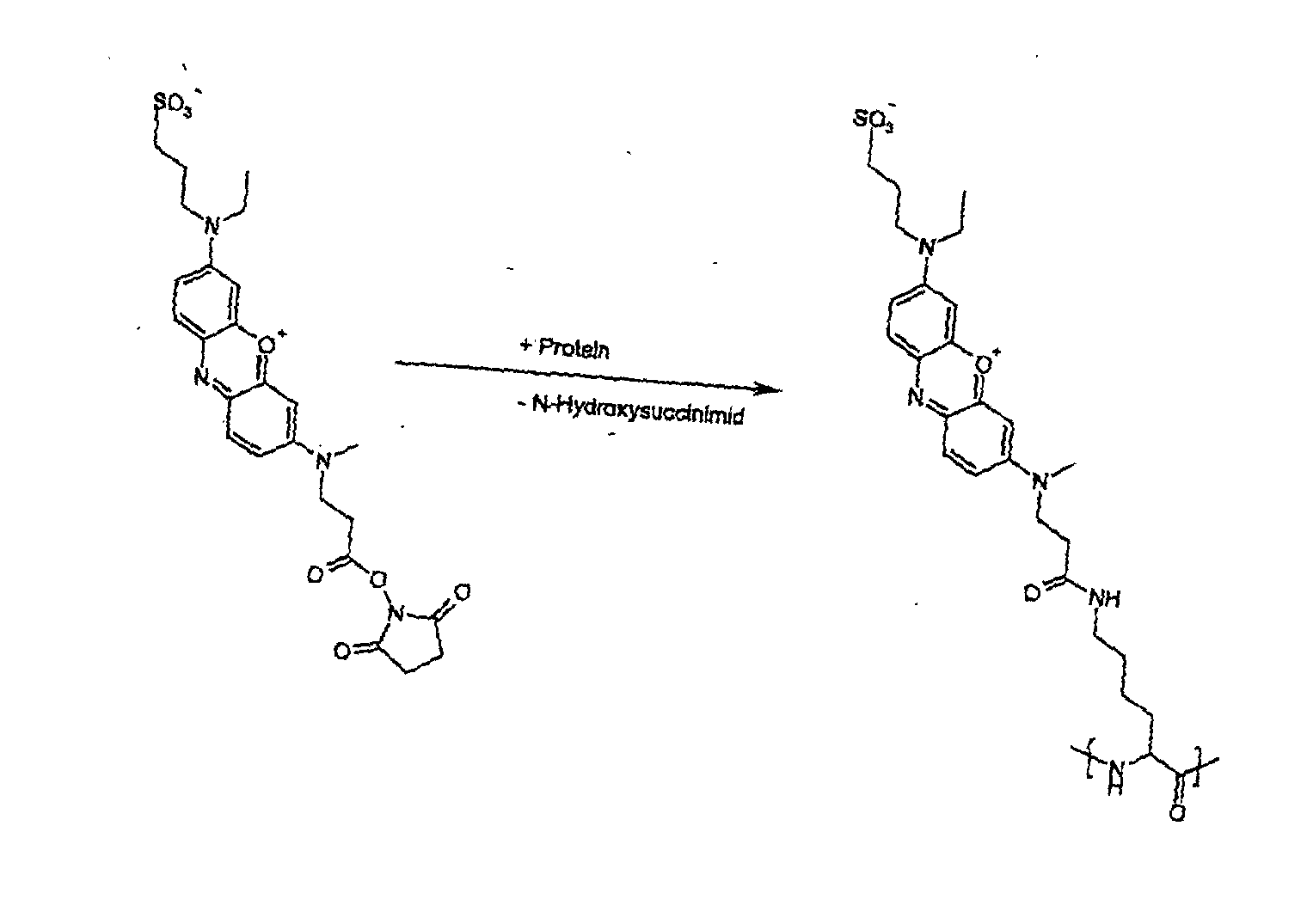
- 50 ⁇ l of N, N-dimethylformamide a solution of 1.5 ⁇ mol [(2-carboxy-ethyl) methylamino] - [ethyl- (3-sulfo propyl) amino] phenoxazin-5-ylium succinimidyl ester in 200 ul N, N-dimethylformamide added.
- 250 ⁇ l of 0.15 M borate buffer pH 8.6 are added to this solution and the reaction solution is shaken for 3 hours at room temperature.
- the solution is then evaporated to dryness and the crude product is purified by column chromatography (eluent: methanol / water gradient: 0% methanol to 100% methanol in 30 minutes; carrier: reversed phase C18).
- Bovine IgG 10 nmol Bovine IgG are dissolved in 150 ⁇ l water. This solution is mixed with 15 ⁇ l 1 M sodium carbonate solution pH 9.3 and 331.4 ⁇ l 0.1 M sodium carbonate solution pH 9.3 and a solution of 50 nmol [(2-carboxy-ethyl) -methyl-amino] - [ethyl- (3-sulfo-propyl) -amino] -phenoxazin-5-ylium-succinimidyl ester in 3.6 ⁇ l of N, N-dimethylformamide and the reaction solution was shaken for 1 hour at room temperature. The reaction is then stopped by adding 50 ⁇ l of 1.5 M hydroxylamine solution. The crude product is purified by exclusion chromatography (eluent: PBS pH 7.4).
- the resin was then washed six times with 2 ml of N, N-dimethylformamide and three times with 2 ml of dichloromethane and six times with 2 ml of t- butyl methyl ether, dried and weighed to determine the load.
- the determined loading of the resin was 0.8 mmol / g resin.
- the 9-fluorenylmethoxycarbonyl protective group (FMOC) was first split off by means of two treatments for 5 or 15 minutes with a solution of 20% piperidine in N, N-dimethylformamide.
- the resin was then washed six times with 2 ml of N, N-dimethylformamide.
- the 9-fluorenylmethoxycarbonyl protective group was cleaved off by means of two treatments for 5 or 15 minutes with a solution of 20% piperidine in N, N-dimethylformamide.
- the resin was then washed again six times with 2 ml of N, N-dimethylformamide.
- the reaction was then carried out using 250 ⁇ mol of biotinoylaminohexanoyl-N-hydroxy-succinimidyl ester in 300 ⁇ l of N, N-dimethylformamide.
- reaction solution was filtered off with suction and the resin was washed six times with 2 ml of N, N-dimethylformamide and three times with 2 ml of dichloromethane and six times with 2 ml of t- butyl methyl ether and dried.
- reaction was then carried out with 25 ⁇ mol [(2-carboxyethyl) methylamino] ethyl (3-sulfo-propyl) amino] phenoxin-5-ylium succinimidyl ester in 300 ⁇ l of N, N-dimethylformamide for three hours at room temperature.
- the resin was washed six times with 2 ml of N, N-dimethylformamide, six times with 2 ml dichloromethane, six times with 2 ml methanol and six times with 2 ml t- butyl methyl ether and dried.
- the product was then cleaved from the resin using a mixture of 95% trifluoroacetic acid (TFA), 2.5% water and 2.5% triispropylsilane (TIS). After a reaction time of two hours, the solution was removed from the resin and the solution was filtered off from the resin and concentrated in vacuo. The crude product remaining as a residue was then taken up in methanol and purified by chromatography.
- TSA trifluoroacetic acid
- TIS triispropylsilane
Landscapes
- Health & Medical Sciences (AREA)
- Chemical & Material Sciences (AREA)
- Immunology (AREA)
- Organic Chemistry (AREA)
- Life Sciences & Earth Sciences (AREA)
- Engineering & Computer Science (AREA)
- Biomedical Technology (AREA)
- Urology & Nephrology (AREA)
- Molecular Biology (AREA)
- Hematology (AREA)
- Microbiology (AREA)
- Cell Biology (AREA)
- Biotechnology (AREA)
- Food Science & Technology (AREA)
- Medicinal Chemistry (AREA)
- Physics & Mathematics (AREA)
- Analytical Chemistry (AREA)
- Biochemistry (AREA)
- General Health & Medical Sciences (AREA)
- General Physics & Mathematics (AREA)
- Pathology (AREA)
- Heterocyclic Carbon Compounds Containing A Hetero Ring Having Nitrogen And Oxygen As The Only Ring Hetero Atoms (AREA)
Abstract
Es werden Oxazinderivate beschrieben, mit denen ein breites Spektrum von zu untersuchendem Material markiert und mittels Fluoreszenztechniken identifiziert werden kann.
Description
Die vorliegende Erfindung betrifft Oxazinderivate, ein Verfahren
zur ihrer Herstellung und ihre Anwendung als Fluoreszenzfarbstoffe
zur Markierung von biologischem und nichtbiologischem
Material im roten Spektralbereich.
Farbstoffe auf Oxazinbasis sind weit verbreitet. Man findet sie
oftmals im Bereich der Textilindustrie zum Färben von Stoffen
verschiedener Art. So beschreibt die EP-B-0 603 129 Oxazinfarbstoffe,
die jeweils an den Benzolringen exoständige Aminogruppen,
die substituiert sein können, aufweisen. Die schwer
löslichen Salze dieser basischen Oxazinfarbstoffe eignen sich
zum Färben oder zum Bedrucken von natürlichen Fasern und voll
synthetischen Fasern.
Aus der US-A-5656759 ist ein kationischer Oxazinfarbstoff bekannt,
der ebenfalls zwei exoständige Aminogruppen, die substituiert
sein können, aufweist. Die Oxazinfarbstoffe, die durch
Substitution anorganischer Anionen hydrophob gemacht werden
können, werden insbesondere in der Farbschicht eines Farbbandes
für den Thermotransferdruck verwendet.
Aus der EP-A-0 747 447 sind Oxazinfarbstoffe bekannt, die als
Fluoreszenzmarker in Verbindung mit biologischen Molekülen verwendet
werden. Der Absorptionsbereich dieser Konjugate liegt
bei 645 - 700 nm und entspricht dem roten Spektralbereich. Die
kupplungsfähigen Oxazinderivate sind mindestens tetrazyklische
Systeme, in denen mindestens einer der beiden exozyklischen
Stickstoffe in die Ringstruktur integriert ist. Auf Grund des
komplexen polyzyklischen Grundgerüsts ist allerdings der Aufwand
zur Synthese dieser Farbstoffe sehr hoch.
Insbesondere für das Hochdurchsatzscreening mit konfokaler Fluoreszenzspektroskopie
werden Farbstoffe benötigt, die sich
durch eine hohe Fluoreszenzquantenausbeute, hohe Wasserlöslichkeit,
hohe Fotostabilität sowie die Fähigkeit, an biologische
und nicht-biologische Materialien bzw. Moleküle zu binden, auszeichnen.
Durch den kostengünstigen Zugang zu rotemittierenden LaserLichtquellen
sowie die geringe Hintergrundfluoreszenz von biologischem
Material bei roter Anregung gegenüber energiereicheren
Anregungswellenlängen kommt dem Einsatz von rot-anregbaren
Fluoreszenzfarbstoffen, zu denen unter anderem auch die Oxazin-Farbstoffe
zählen, steigende Bedeutung zu.
Die Aufgabe der vorliegenden Erfindung besteht darin, rotanregbare
Fluoreszenzfarbstoffe zur Verfügung zu stellen, die gut
wasserlöslich sind, wobei die photochemischen Eigenschaften erhalten
bleiben. Des weiteren soll der Farbstoff in der Weise
aktiviert sein, dass er zur Anknüpfung an biologische und
nicht-biologische Materialien bzw. Moleküle befähigt ist, ohne
dass es zu einer negativen Wechselwirkung mit den zu markierenden
Materialien bzw. Molekülen kommt.
Diese Aufgabe wird mit den Oxazinderivaten gelöst, die in Patentanspruch
1 definiert sind.
Gegenstand der Erfindung sind Oxazinderivate der allgemeinen
Formel I
 worin
worin
Die Unteransprüche betreffen bevorzugte Ausführungsformen der
erfindungsgemäßen Oxazinderivate.
Im erfindungsgemäßen Sinne können die Reste R1 bis R10 die reaktive
Gruppe darstellen und/oder diese enthalten, z. B. kann
ein Substituent die reaktive Gruppe darstellen. Zusätzlich kann
das Oxazinderivat eine reaktive Gruppe besitzen, wenn die Reste
keine reaktive Gruppe umfassen. Diese reaktive Gruppe kann z.
B. an die nicht-reaktiven Substituenten gebunden sein.
Die erfindungsgemäßen Oxazinderivate können als Tri- bzw. Tetra-/Pentazyklus
vorliegen. In einer bevorzugten Ausführungsform
bildet R1 mit R2 und/oder R9 mit R10 eine gesättigte oder ungesättigte
C4-Brücke. Insbesondere bildet R1 mit R2 oder R9 mit
R10 eine gesättigte oder ungesättigte C4-Brücke, womit ein weiterer
Sechsring am Trizyklus entsteht, der gegebenenfalls substituiert
ist. Ganz besonders bevorzugt bildet R1 mit R2 eine
ungesättigte C4-Brücke.
Die reaktive Gruppe dient dazu, den Farbstoff zu aktivieren, d.
h. eine Stelle anzubieten, die eine Bindung zu dem zu untersuchenden
Material schafft. Reaktive Gruppen im Sinne der Erfindung
umfassen aktivierbare und aktivierte Gruppen. Die Bindung
zum zu untersuchenden Material kann kovalenter oder nichtkovalenter
Natur sein, wobei allerdings die kovalente Anknüpfung
bevorzugt ist. Bevorzugt ist, dass nur eine reaktive Gruppe
pro Farbstoffmolekül vorhanden ist. Die Aktivierung kann z.
B. auch durch Licht erfolgen (Photoaktivierung).
Die reaktive Gruppe kann jede Gruppe sein, die zu einer Verknüpfung
mit dem zu untersuchenden Material befähigt. Wenn das
zu untersuchende Material beispielsweise ein Protein ist, dann
bieten sich verschiedene Gruppen für die Anknüpfung an den
Farbstoff an. Dazu zählen beispielsweise Amine aus Lysinresten
oder Thiole aus freien Cystin- oder Cysteinresten.
Eine beispielhafte Aufzählung von bevorzugten reaktiven Gruppen
umfasst Gruppierungen, wie ein Säureester, Säureanhydrid,
Säurehalogenid, Imid, Imidylester, Carboxyl, Carbonamid, Halogencarbonamid,
Sulfonylhalogenid, Isothiocyanat, Amin, Aryldiazo,
Azid, Aryldiazo, Aldehyd, Keton oder Dithionicotin-Derivat.
Besonders bevorzugte reaktive Gruppen sind ein Säureester, Säureanhydrid,
Säurehalogenid, Imid, Imidylester, Carboxyl, Carbonamid,
Halogencarbonamid, Sulfonylhalogenid, Isothiocyanat, Amin,
Azid, Aryldiazo oder Dithionicotin-Derivat.
Ganz besonders bevorzugte reaktive Gruppen sind ein N-Succinimidylester,
der ggf. substituiert ist, Maleimid, Carboxyl,
Halogenacetamid, Isothiocyanat, Aryldiazo, Azid, Sulfonylchlorid,
Sulfo-Tetrafluorphenolester oder primäres bzw. sekundäres
Amin.
Für den Fall, dass der N-Succinimidylester substituiert ist,
ist ein bevorzugter Substituent die Sulfonsäuregruppe.
Es hat sich erfindungsgemäß herausgestellt, dass die Oxazinfarbstoffe
ebenfalls eine Linkerverbindung enthalten können.
Diese Linkerverbindung ist zwischen reaktiver Gruppe und einem
nicht-brückebildenden Rest R1, R2, R3, R4, R5, R6, R7, R8, R9 oder R10
geschaltet. An die Linkerverbindung ist mindestens eine reaktive
Gruppe gebunden. Die Linkerverbindungen werden eingeführt,
wenn ein Bedarf dahingehend besteht, die reaktive Gruppe auf
einfachem Weg zu verändern, d. h. die Funktionalität zu ändern.
Beispielsweise kann mittels einer Linkerverbindung die Carbonsäure
oder der N-Succinimidylester in ein Amin umgewandelt werden.
Zum anderen ermöglichen es die Linkerverbindungen, den Abstand
zwischen Farbstoff und dem zu untersuchenden Material zu
variieren.
Zu geeigneten Linkerverbindungen zählen beispielsweise Polyoxyalkylverbindungen,
aliphatische, cykloaliphatische oder aromatische
Verbindungen. Sie können verzweigt oder unverzweigt sein
und gegebenenfalls ungesättigte Einheiten und Heteroatome,
z. B. Stickstoff, enthalten.
Die genannten Polyoxyalkyleinheiten sind polymere oder oligomere
organische Reste, die über Sauerstoffbrücken miteinander
verknüpft sind. Dazu zählen beispielsweise Polyether, Polyole,
lösliche Carbohydrate, Derivate davon oder wasserlösliche Polymere.
Exemplarisch können Linkerverbindungen wie folgt dargestellt
werden (Y bedeutet in den nachfolgenden Beispielen "reaktive
Gruppe"):
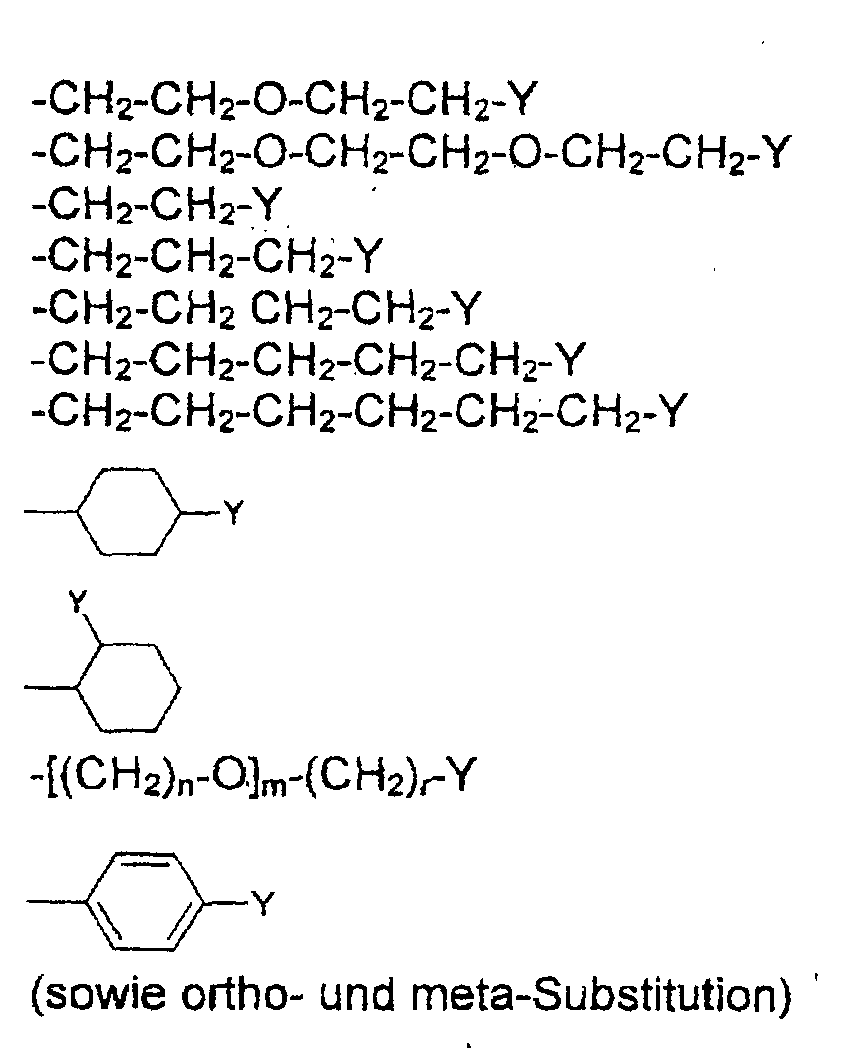
Die Reste und Substituenten Alkyl, Cycloalkyl, Alkenyl, Alkenoxy,
Alkylaryl, Arylalkoxy, Alkoxy, Halogencarbonamid und Alkoxycarbonyl
weisen in der Regel 1 bis 10, bevorzugt 1 bis 7 Kohlenstoffatome
auf und können geradkettig oder verzweigt sein.
Besonders bevorzugt sind 1 bis 4 Kohlenstoffatome. Bei Aryl
handelt es sich vorzugsweise um Benzolringe.
Als Halogene kommen Fluor-, Chlor-, Brom- oder Jod in Frage.
Als Gegenion kann jedes zur Ladungsneutralisierung geeignete
und mit dem kationischen Grundgerüst kompatible Anion verwendet
werden, das die Wasserlöslichkeit der Gesamtverbindung nicht
herabsetzt. Bevorzugt sind Halogenidionen, BF4 - oder Tetraphenylborat.
Besonders bevorzugt sind Chlorid- oder Bromidionen
oder Tetraphenylborat.
Besonders bevorzugte Oxazinderivate sind spezielle Ausführungsformen,
die durch die Formeln II bis V und VIII - IX wiedergegeben
werden:

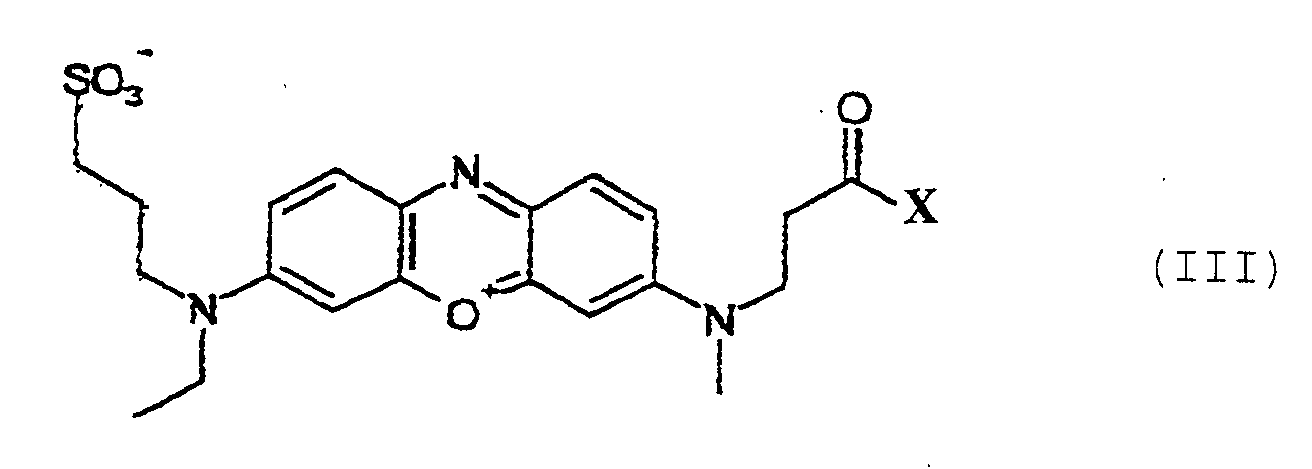
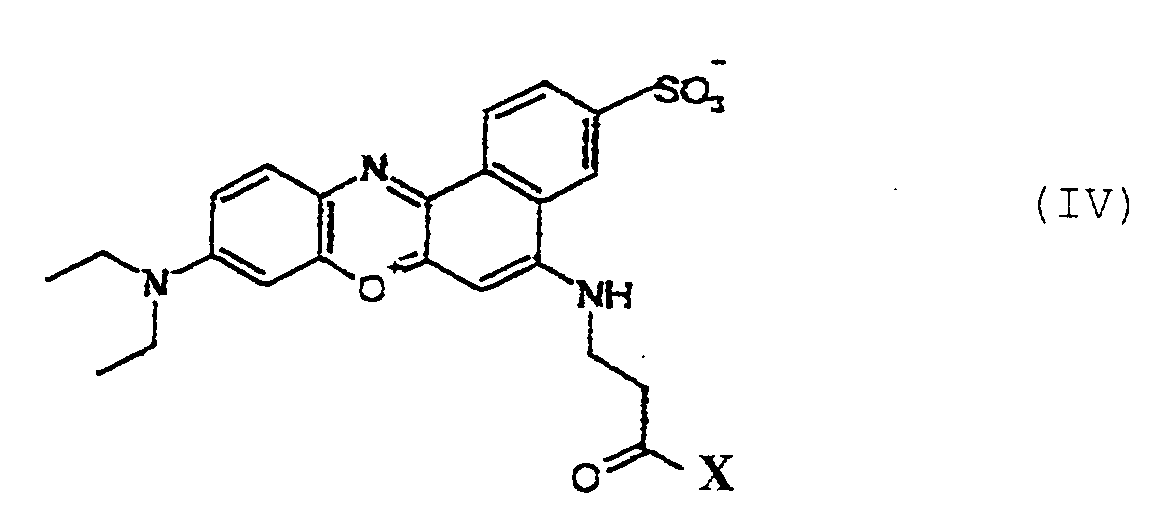


 worin X OH oder eine N-Succinimidylestergruppe, die ggf. substituiert
ist, bedeutet, wobei ebenfalls Salze davon eingeschlossen
sind.
worin X OH oder eine N-Succinimidylestergruppe, die ggf. substituiert
ist, bedeutet, wobei ebenfalls Salze davon eingeschlossen
sind.
Die Vorteile der erfindungsgemäßen Oxazinfarbstoffe gegenüber
den bisher bekannten UV-Farbstoffen, wie Cumarine oder Farbstoffen,
die mit blauem oder grünen Licht angeregt werden, wie
Fluoresceine und Rhodamine, sind die folgenden:
- hohe Reaktivität gegenüber Aminen, so dass ein großer Bereich von zu untersuchenden Substanzen auf einfache Weise kovalent markiert werden kann;
- hohe Wasserlöslichkeit, was zu einer minimalen Adsorption und einer minimalen unspezifischen Bindung führt;
- Anregung bei 630 bis 650 nm mittels kostengünstiger Laserdioden oder HeNe-Lasern;
- Emission mit einem Maximum im Bereich von 670 nm, wobei übliche Filteranordnungen verwendet werden können;
- hohe Fluoreszenzquantenausbeute, was klare und deutliche Fluoreszenzsignale hervorbringt;
- Lösungsmittelstabilität und pH-Stabilität (pH 1-10), so dass sie für sehr viele Anwendungen geeignet sind;
- neutrale Gesamtladung, was dazu führt, dass kein elektrostatischer Einfluß auf das markierte Molekül stattfindet;
- chemische Stabilität und daher eine außerordentliche Eignung in der organischen Chemie (Lösung und Festphase); und
- NIR-Anregbarkeit, was zu einer geringen Hintergrundfluoreszenz des zu untersuchenden Materials führt.
Am folgenden Beispiel der Proteinmarkierung soll ein weiterer
entscheidender Vorteil gegenüber bekannten Markierungstechniken
der erfindungsgemäßen Farbstoffe gezeigt werden. Durch
herkömmliche Proteinmarkierungsverfahren, wie z.B. die Umsetzung
einer aktivierten Carbonsäure mit Lys-Resten des Proteins
bzw. von Maleimiden mit freien Thiol-Gruppen des Proteins
werden immer mehrere dieser Gruppen des Proteins angesprochen,
so dass es durch die Markierungsreaktion zu einer statistischen
Verteilung der Markierung auf dem Protein kommt,
d.h. einige Proteinmoleküle besitzen keinen, andere einen,
zwei, drei oder mehrere Markierungen. In hochempfindlichen
Fluoreszenztechniken, wie z. B. FCS (Fluorescence Correlation
Spectroscopy) und FIDA (Fluorescence Intensity Distribution
Analysis), kommt es durch diese heterogene Analytmischung
auch zu heterogenen Signalverteilungen, die eine Auswertung
der Daten erschwert. Darüber hinaus kommt es in Proteinen,
die zwei, drei oder mehrere Label tragen, zu Farbstoff-Farbstoff-Wechselwirkungen,
die das Fluoreszenzsignal drastisch
abschwächen.
Mit den erfindungsgemäßen Oxazinderivaten ist es allerdings
möglich, ein einfach markiertes zu untersuchendes Material
für die Analyse zur Verfügung zu stellen. Damit ist gewährleistet,
dass keine heterogene Signalverteilungen und Farbstoff-Farbstoff-Wechselwirkungen
auftreten.
Die erfindungsgemäßen Oxazinderivate können zusätzlich mindestens
einen Affinitätsmarker aufweisen, der eine einfache
Reinigung durch Affinitätschromatographie ermöglicht. Der Affinitätsmarker
kann z. B. an die Linkerverbindung gebunden
sein.
In einer bevorzugten Ausführungsform weisen die Oxazinderivate
nur einen Affinitätsmarker auf. Im Prinzip kann jeder Affinitätsmarker
verwendet werden, der geeignet ist, in der
nachfolgenden Affinitätschromatographie eine saubere Trennung
durchzuführen. Als Beispiele können an dieser Stelle Affinitätsmarker,
wie Biotin, Hexa-His oder Haptene genannt werden.
Ein Verfahren zur gezielten Markierung von zu untersuchendem
Material mittels der affinitätsmarkierten Oxazinderivate kann
wie folgt durchgeführt werden:
Nachfolgend wird beispielhaft eine derartige Affinitätsaufreinigung
mit dem System Biotin/Avidin (Affinitätsmarker/Trägermaterial)
vorgestellt.
Durch den Einsatz des unten dargestellten affinitätsmarkierten
erfindungsgemäßen Farbstoff-Reaktiv-Moleküls kann der oben beschriebene
Nachteil der bekannten Markierungstechniken umgangen
werden. Dabei steht die Biotin-Einheit stellvertretend für einen
beliebigen Affinitätsmarker, Oxazinderivat III für einen
erfindungsgemäßen Farbstoff und der N-Succinimidylester für eine
beliebige reaktive Gruppe. Ein solches Molekül reagiert analog
dem herkömmlichen Markierungsverfahren mit dem Protein, was
in einer heterogenenen Mischung wie oben beschrieben resultiert.
Durch eine nachfolgende Affinitätsreinigung an einem geeigneten
Trägermaterial (hier monomeres Avidin) werden unmarkierte
Proteine aus der Probe entfernt. Durch nachfolgende vorsichtige
Elution können einfachmarkierte Proteine eluiert werden,
während doppel- und höhermarkierte Proteine aufgrund der
kooperativ verstärkten Bindung an das Trägermaterial gebunden
bleiben. Somit kann ein homogener Analyt mit exakt einem Farbstoffmarker
pro Proteinmolekül erhalten werden.

Das zu untersuchende Material kann kovalent oder nicht-kovalent
an den Oxazinfarbstoff gebunden sein, wobei es allerdings bevorzugt
kovalent gebunden ist. Bei dem zu untersuchenden Material
handelt es sich vorzugsweise um ein biologisches Material,
eine chemische Verbindung, insbesondere eine biologisch aktive
Substanz und/oder einen pharmazeutischen Wirkstoff, einen synthetischen
oder biologischen Mikropartikel oder eine Kombination
davon.
Die chemischen Verbindungen können alle synthetischen Verbindungen
umfassen, die als ein einzelnes Molekül oder Aggregat,
beispielsweise als kleine organische Verbindung und auch als
Oligomer oder Polymer vorliegen. Vorzugsweise handelt es sich
bei den chemischen Verbindungen um biologisch aktive Substanzen
und/oder pharmazeutische Wirkstoffe.
Synthetische Mikropartikel, d.h. insbesondere lösliche und suspendierbare
Trägermaterialien, bezeichnen jede Art von synthetischen
Mikropartikeln, die in einer Flüssigkeit, insbesondere
einer wässrigen Lösung, gelöst oder suspendiert werden können.
Die Durchmesser d der Mikropartikel sind gleich oder kleiner
als 1 µm, bevorzugt liegen sie im Bereich von 1 nm ≤ d ≤ 1 µm,
besonders bevorzugt im Bereich von 10 nm ≤ d ≤ 500 nm, ganz besonders
bevorzugt im Bereich von 50 nm ≤ d ≤ 300 nm. Beispiele
für die synthetischen Mikropartikel umfassen solche aus organischen
Polymeren. Zum Beispiel können Polymere auf Dendrimer-Basis,
bevorzugt Polyethylenglykol auf Dendrimer-Basis verwendet
werden. Es können jedoch alle synthetischen Mikropartikel
verwendet werden, die unter den experimentellen Bedingungen
löslich oder suspendierbar sind, insbesondere Glaspartikel mit
definierter Porengröße, Cellulose-, Silikagel- und andere Typen
von Polystyrolpartikeln, letztere gegebenenfalls vernetzt mit
Divinylbenzol und/oder gepropft mit Polyethylenglykol und/oder
funktionalisiert mit Amino, Hydroxy, Carboxyl oder Halogen.
Weitere Beispiele von möglichen synthetischen Mikropartikeln
umfassen gepropfte Co-Polymer-, Polyacrylamid-, Latex-, gegebenenfalls
mit N,N'-bis-Acryloylethylendiamin gepropfte Dimethylacrylamidpartikel
und polymerüberzogene Glaspartikel. Bei den
biologischen Mikropartikeln handelt es sich vorzugsweise um vesikuläre
Partikel oder virus-ähnliche Partikel.
Bei dem biologischen Material kann es sich beispielsweise um
Nukleotide, Oligonukleotide, Zucker, Lipide, Membranen, Zellen,
Zellbestandteile, DNA, RNA, Peptide, Proteine, Antikörper, Haptene
oder Antigene handeln.
Die vorliegende Erfindung betrifft auch ein Kit zur Markierung
eines, wie oben beschriebenen, zu untersuchenden Materials.
Dieses Kit umfasst, neben üblichen Bestandteilen, ein Oxazinderivat
nach der allgemeinen Formel I. Übliche Bestandteile sind
z. B. Puffer, Analysegefäße und Instruktionen zur Durchführung
der Untersuchungen. In einer bevorzugten Ausführungsform enthält
das Kit ein Oxazinderivat der Formel II, III, IV, V , VIII
oder IX, insbesondere in Form eines N-Succinimidylesters, der
ggf. substituiert sein kann.
Das zu untersuchende Material ist vorzugsweise ein biologisches
Material, eine chemische Verbindung, insbesondere eine biologisch
aktive Substanz und/oder ein pharmazeutischer Wirkstoff,
ein synthetischer oder biologischer Mikropartikel oder eine
Kombination davon. Die einzelnen Materialien sind bereits oben
beschrieben worden.
Die erfindungsgemäßen Oxazinderivate eignen sich hervorragend
für chemische oder biotechnische Untersuchungen. Dazu zählen:
die Identifizierung und Charakterisierung von biologischem Material
oder chemischen Verbindungen, Suche nach biologisch aktiven
Substanzen und/oder pharmazeutischen Wirkstoffen, die
Identifizierung von Analyten in diagnostischen und/oder therapeutischen
Verfahren, die Genomanalyse oder die Reinigung und
Konzentrierung von Substraten.
Die genannten Untersuchungen werden bevorzugt mittels Laserlichtanalytik
und Fluoreszenzdetektion durchgeführt.
Die dabei angewandten Messverfahren schließen praktisch alle Verfahren ein, mit denen das Oxazinderivat gemessen werden kann. Zu diesen Verfahren zählen die Spektrometrie, Mehrphotonenanregung, insbesondere Zwei-Photonen-Anregung, Laser-Scanning-Mikroskopie, Nahfeldspektroskopie, Photonenverteilungsanalysen, insbesondere FIDA und 2-D-FIDA, Fluoreszenz-Lebensdauer-Analyse und Fluoreszenz-Polarisationsanalyse.
Ganz besonders bevorzugt werden die Messungen unter Verwendung eines konfokalen Mikroskops oder anderen konfokalen Optiken durchgeführt.
Die dabei angewandten Messverfahren schließen praktisch alle Verfahren ein, mit denen das Oxazinderivat gemessen werden kann. Zu diesen Verfahren zählen die Spektrometrie, Mehrphotonenanregung, insbesondere Zwei-Photonen-Anregung, Laser-Scanning-Mikroskopie, Nahfeldspektroskopie, Photonenverteilungsanalysen, insbesondere FIDA und 2-D-FIDA, Fluoreszenz-Lebensdauer-Analyse und Fluoreszenz-Polarisationsanalyse.
Ganz besonders bevorzugt werden die Messungen unter Verwendung eines konfokalen Mikroskops oder anderen konfokalen Optiken durchgeführt.
Die Auswertung der Daten erfolgt schließlich vorzugsweise
durch Autokorrelationsanalyse und /oder Kreuzkorrelationsanalyse.
Bei der 2-D-FIDA und Kreuz-Korrelationsanalyse wird ein Messvolumen
einer Probe mit zwei Wellenlängen simultan bestrahlt und
die Information über eine zeitliche Koinzidenzanalyse von zwei
Farbstoffspezies, wie die erfindungsgemäßen Farbstoffe in Kombination
mit grün anregbaren Fluoreszenzfarbstoffen, erhalten.
Ähnlich ist der Einsatz in Fluoreszenz-Resonanz-Energie-Transfer-Experimenten
(FRET) von großem Nutzen, wobei die erfindungsgemäßen
Oxazinderivate mit einer Reihe von bekannten
Xanthenen als Paar für den Energie-Transfer verwendet werden.
Die erfindungsgemäßen Oxazinderivate können ebenfalls sehr gut
in FISH-(Fluorescence-in-situ-hybridization) oder PCR-Verfahren
(Polymerase-chain reaction) verwendet werden.
Die erfindungsgemäßen Oxazinfarbstoffe sind synthetisch einfach
zugänglich, was sie von den wesentlich schwerer herstellbaren
Verbindungen des Standes der Technik unterscheidet. Die erfindungsgemäßen
Farbstoffe weisen alle eine sehr kompakte molekulare
Struktur auf, so dass die Wechselwirkung mit dem zu untersuchenden
Material als äußerst gering einzuschätzen ist. Insbesondere
werden die biologischen Eigenschaften von biologischem
Material nicht verändert. Die in der Regel neutrale Gesamtladung
minimiert die elektrostatische Wechselwirkung zwischen dem
Farbstoff und der markierten Komponente. Die erfindungsgemäßen
Fluoreszenzfarbstoffe weisen eine hohe Reaktivität gegenüber
den zu untersuchenden Materialien, insbesondere Aminen, eine
hohe Fluoreszenzquantenausbeute, eine hohe Lösungsmittelbeständigkeit
und pH-Beständigkeit, eine hohe chemische Stabilität
und eine NIR-Anregbarkeit auf. Die Farbstoffe der vorliegenden
Erfindung sind durch eine geringe Anregungsenergie und somit
einer geringen Photozerstörung gekennzeichnet. Die besonderen
Anregungs- und Emissionswellenlängen der erfindungsgemäßen
Farbstoffe ermöglichen die Verwendung von kommerziell erhältlichen
Filtersystemen. Vorteilhaft ist weiterhin die geringe Hintergrundfluoreszenz
von chemischen und biologischen Materialien
bei roter Anregung gegenüber energiereicheren Anregungwellenlängen.
Die erfindungsgemäßen Farbstoffe sind somit sehr gut im
roten Spetralbereich einsetzbar. Die hohe chemische Stabilität
ist insbesondere unter Bedingungen der Festphasensynthese von
Bedeutung. Die erfingungsgemäßen Farbstoffe zeigen eine geringe
Adsorptions- oder unspezifische Bindungstendenz und sind sehr
gut wasserlöslich. Sie sind somit ideal für chemische und biotechnische
Untersuchungen in wässrigen Lösungen verwendbar.
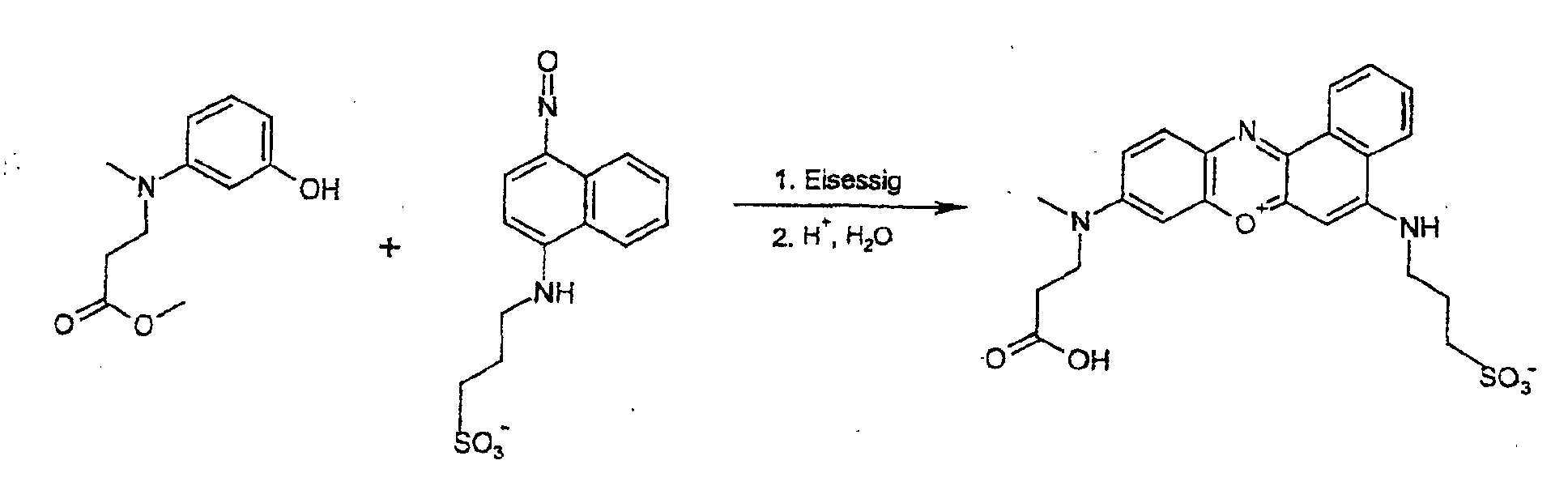
Die erfindungsgemäßen Oxazinderivate sind beispielsweise auf
folgendem Wege darstellbar:
Ein 3-Aminophenol der Formel VI
 wird mit einer Nitrosophenylverbindung der Formel VII
 im sauren Medium bei mittlerer Hitze während eines Zeitraumes
von 10 Minuten bis 5 Stunden umgesetzt. Die Reste R1 bis R10 haben
die bereits oben angegebenen Bedeutungen.
im sauren Medium bei mittlerer Hitze während eines Zeitraumes
von 10 Minuten bis 5 Stunden umgesetzt. Die Reste R1 bis R10 haben
die bereits oben angegebenen Bedeutungen.
Es hat sich herausgestellt, dass die Reaktion bei einer Temperatur
im Bereich von 50 bis 70°C, vorzugsweise 55 bis 65°C,
durchgeführt wird. Dazu wird die 3-Amino-Phenol-Verbindung in
bspw. Eisessig gelöst, wonach innerhalb eines Zeitraumes im Bereich
von 10 Minuten bis 5 Stunden die Nitrosoverbindung hinzugegeben
wird. Nach Entstehen einer tiefblauen Lösung wird die
Reaktion in der Regel beendet sein. Anschließend wird gereinigt,
normalerweise über eine Säulenchromatographie.
Des Weiteren sind noch folgende Synthesemöglichkeiten eingeschlossen,
in denen die Ausgangsverbindungen II die nachfolgend
gezeigten Strukturen aufweisen:


Die nachfolgenden Beispiele dienen zur Erläuterung der vorliegenden
Erfindung.


Ausbeute: 10 %


Einführung eines Linkers in Oxazinderivat (III)

1,0 eq Oxazinderivat (III)
2,0 eq PyBOP
5,0 eq DIPEA
Einführung eines Linkers in Oxazinderivat (III)

1,0 eq Oxazinderivat (III)
1,0 eq PyBOP
4,0 eq DIPEA
1 mmol N-ε-(9-Fluorenylmethoxycarbonyl)-aminohexansäure wurden
in 1200 µl Dichlormethan und 300 µl N,N-Dimethylformamid (DMF)
gelöst und auf 0°C abgekühlt. 500 µmol N,N'-Diisopropylcarbodiimid
wurden in 80 µl N,N-Dimethylformamid gelöst und zur
Lösung der Aminosäure hinzugegeben. Die Reaktionslösung wurde
30 Minuten bei 0°C stehengelassen und anschließend das Dichlormethan
im Vakuum entfernt. Der Rückstand wurde mit 1000 µl
N,N-Dimethylformamid aufgenommen, wobei eine klare Lösung erhalten
wurde. Diese Lösung wurde zu 100 µmol Wang Harz (Wang
Resin) in einer 5 ml Spritze mit Fritte gegeben. Zu der Suspension
wurden 10 µmol Dimethylaminopyridin in 25 µl
N,N-Dimethylformamid gegeben, die Mischung wurde über Nacht
stehengelassen.
Das Harz wurde anschließend sechsmal mit 2 ml N,N-Dimethylformamid
und dreimal mit 2 ml Dichlormethan und sechsmal mit 2
ml t-Butylmethylether gewaschen, getrocknet und zur Bestimmung
der Beladung ausgewogen. Die bestimmte Beladung des Harzes betrug
0.8 mmol/g Harz. Zur weiteren Beladung wurde zunächst die
9-Fluorenylmethoxycarbonyl-Schutzgruppe (FMOC) mittels zweimaliger
Behandlung für 5 bzw. 15 Minuten mit einer Lösung von
20 % Piperidin in N,N-Dimethylformamid abgespalten. Das Harz
wurde danach sechsmal mit 2 ml N,N-Dimethylformamid gewaschen.
1 mmol N-α-(9-Fluorenylmethoxycarbonyl)-ε-(4-methyltrityl)-Llysin,
gelöst in 120 µl N,N-Dimethylformamid sowie 1 mmol
1-[Bis(dimethylamino)methyliumyl]-1H-1,2,3-triazolo[4,5-b]pyridin-3-oxid
hexafluorophosphat gelöst in 120 µl
N,N-Dimethylformamid wurden zusammen mit 2 mmol
N,N-Diisopropylethylamin zum Harz gegeben. Die Reaktionslösung
wurde nach 30 Minuten abgezogen und der Vorgang der Beladung
unter identischen Bedingungen nochmals wiederholt. Nach sechsmaligem
Waschen des Harzes mit je 2 ml N,N-Dimethylformamid
wurde die 9-Fluorenylmethoxycarbonyl Schutzgruppe mittels zweimaliger
Behandlung für 5 bzw. 15 Minuten mit einer Lösung von
20 % Piperidin in N,N-Dimethylformamid abgespalten. Das Harz
wurde danach wiederum sechsmal mit 2 ml N,N-Dimethylformamid
gewaschen. Anschließend erfolgte die Umsetzung mit 250 µmol Biotinoylaminohexanoyl-N-hydroxy-succinimidylester
in 300 µl
N,N-Dimethylformamid. Nach 10 stündiger Reaktion wurde die Reaktionslösung
abgesaugt und das Harz sechsmal mit 2 ml
N,N-Dimethylformamid und dreimal mit 2 ml Dichlormethan und
sechsmal mit 2 ml t-Butylmethylether gewaschen und getrocknet.
Zur Beladung mit dem Fluoreszenzfarbstoff (dye) wurden 10 µmol
des Harzes abgenommen und in eine 5 ml Spritze überführt. Nachdem
das Harz in 2 ml Dichlormethan vorgequollen wurde, erfolgte
die Abspaltung der 4-Methyltrityl-Schutzgruppe (MTT) mittels
fünfmaliger jeweils dreiminütiger Behandlung mit je 2 ml 30 %
Hexafluorisopropanol (HFIP) in Dichlormethan. Danach wurde das
Harz sechsmal mit 2 ml Dichlormethan und dreimal mit 2 ml
N,N-Dimethylformamid gewaschen. Anschließend erfolgte die Umsetzung
mit 25 µmol [(2-Carboxy-ethyl)-methyl-amino]-ethyl-(3-sulfo-propyl)-amino]-phenoxin-5-ylium-succinimidylester
in 300
µl N,N-Dimethylformamid für drei Stunden bei Raumtemperatur.
Nach erfolgter Reaktion wurde das Harz sechsmal mit 2 ml
N,N-Dimethylformamid, sechsmal mit 2 ml Dichlormethan, sechsmal
mit 2 ml Methanol und sechsmal mit 2 ml t-Butylmethylether gewaschen
und getrocknet. Das Produkt wurde nunmehr mittels einer
Mischung von 95 % Trifluoressigsäure (TFA), 2,5 % Wasser und
2,5 % Triispropylsilan (TIS) vom Harz abgespalten. Nach
zweistündiger Reaktionszeit wurde die Lösung vom Harz
stündiger Reaktionszeit wurde die Lösung vom Harz abfiltriert
und im Vakuum eingeengt. Das als Rückstand verbleibende Rohprodukt
wurde anschließend in Methanol aufgenommen und chromatographisch
aufgereinigt.
Claims (36)
- Oxazinderivat der allgemeinen Formel (I)worin:
 (a) die Reste R1, R2, R3, R4, R5, R6, R7, R8, R9 und R10 voneinander unabhängig Wasserstoff, Alkyl, Cycloalkyl, Alkenyl, Alkenoxy, Aryl, Aryldiazo, Alkylaryl, Arylalkoxyl, Alkoxy, Alkoxycarbonyl, Hydroxy, Halogen, Cyan, Carbonyl, Acyl, Acyloxy, Carboxyl, Carbonamid, Halogencarbonamid, Sulfonyl, Sulfonylhalogenid, Säureester, Säureanhydrid, Säurehalogenid, Imid, Imidylester, Isothiocyanat, Azid, Dithionicotin-Derivat oder Amin bedeuten und gegebenenfalls substituiert sind,(b) R1 mit R2 und/oder R9 mit R10 eine gesättigte oder ungesättigte C3- oder C4-Brücke bilden kann/können, die gegebenenfalls substituiert ist/sind;(c) die Substituenten unabhängig voneinander Alkyl, Cycloalkyl, Alkenyl, Alkenoxy, Aryl, Aryldiazo, Alkylaryl, Arylalkoxyl, Alkoxy, Alkoxycarbonyl, Hydroxy, Halogen, Cyan, Carbonyl, Acyl, Acyloxy, Carboxyl, Carbonamid, Halogencarbonamid, Sulfonyl, Sulfonylhalogenid, Säureester, Säureanhydrid, Säurehalogenid, Imid, Imidylester, Isothiocyanat, Azid, Dithionicotin-Derivat oder Amin bedeuten können; und(d) mindestens einer der Reste R1, R2, R3, R4, R5, R6, R7, R8, R9 oder R10 mindestens eine reaktive Gruppe für die Bindung an ein zu untersuchendes Material umfasst, oder mindestens eine reaktive Gruppe zusätzlich besitzt, oder ein Salz davon.
 - Oxazinderivat nach Anspruch 1, dadurch gekennzeichnet, dass R1 mit R2 und/oder R9 mit R10 eine gesättigte oder ungesättigte C4-Brücke bildet.
- Oxazinderivat nach Anspruch 2, dadurch gekennzeichnet, dass R1 mit R2 oder R9 mit R10 eine gesättigte oder ungesättigte C4-Brücke bildet.
- Oxazinderivat nach mindestens einem der Ansprüche 1 bis 3, dadurch gekennzeichnet, dass R3, R4, R7 oder R8 eine reaktive Gruppe umfasst oder besitzt.
- Oxazinderivat nach mindestens einem der Ansprüche 1 bis 4, dadurch gekennzeichnet, dass die reaktive Gruppe ein Säureester, Säureanhydrid, Säurehalogenid, Imid, Imidylester, Carboxyl, Carbonamid, Halogencarbonamid, Sulfonylhalogenid, Isothiocyanat, Amin, Azid, Aryldiazo, Aldehyd, Keton oder Dithionicotin-Derivat ist.
- Oxazinderivat nach Anspruch 5, dadurch gekennzeichnet, dass die reaktive Gruppe ein Säureester, Säureanhydrid, Säurehalogenid, Imid, Imidylester, Carboxyl, Carbonamid, Halogencarbonamid, Sulfonylhalogenid, Isothiocyanat, Amin, Azid, Aryldiazo oder Dithionicotin-Derivat ist.
- Oxazinderivat nach Anspruch 6, dadurch gekennzeichnet, dass die reaktive Gruppe ein N-Succinimidylester, der ggf. substituiert ist, Maleimid, Carboxyl, Halogenacetamid, Isothiocyanat, Aryldiazo, Azid, Sulfonylchlorid, Sulfo-Tetrafluorphenolester oder primäres bzw. sekundäres Amin ist.
- Oxazinderivat nach Anspruch 7, dadurch gekennzeichnet, dass der N-Succinimidylester mit einer Sulfonsäuregruppe substituiert ist.
- Oxazinderivat nach mindestens einem der Ansprüche 1 bis 8, dadurch gekennzeichnet, dass zwischen reaktiver Gruppe und einem nicht-brückebildenden Rest R1, R2, R3, R4, R5, R6, R7, R8, R9 oder R10 eine Linkerverbindung geschaltet ist.
- Oxazinderivat nach Anspruch 9, dadurch gekennzeichnet, dass es sich bei den Linkerverbindungen um Polyoxyalkylverbindungen, aliphatische, cykloaliphatische oder aromatische Verbindungen handelt, die gegebenenfalls substituiert sein können.
- Oxazinderivat nach Anspruch 1, dadurch gekennzeichnet, dass das Salz davon ein Gegenion enthält, das aus einem Halogenidion, einem BF4 --Ion oder Tetraphenylborat gewählt ist.
- Oxazinderivat nach Anspruch 11, dadurch gekennzeichnet, dass das Gegenion ein Chlorid- oder Bromidion oder Tetraphenylborat ist.
- Oxazinderivat nach Anspruch 1, mit der Formel (II)worin X OH oder eine N-Succinimidylestergruppe, die ggf. substituiert ist, bedeutet oder ein Salz davon.

- Oxazinderivat nach Anspruch 1, mit der Formel(III)worin X OH oder eine N-Succinimidylestergruppe, die ggf. substituiert ist, bedeutet oder ein Salz davon.

- Oxazinderivat nach Anspruch 1, mit der Formel (IV)worin X OH oder eine N-Succinimidylestergruppe, die ggf. substituiert ist, bedeutet oder ein Salz davon.

- Oxazinderivat nach Anspruch 1, mit der Formel (V)worin X OH oder eine N-Succinimidylestergruppe, die ggf. substituiert ist, bedeutet oder ein Salz davon.
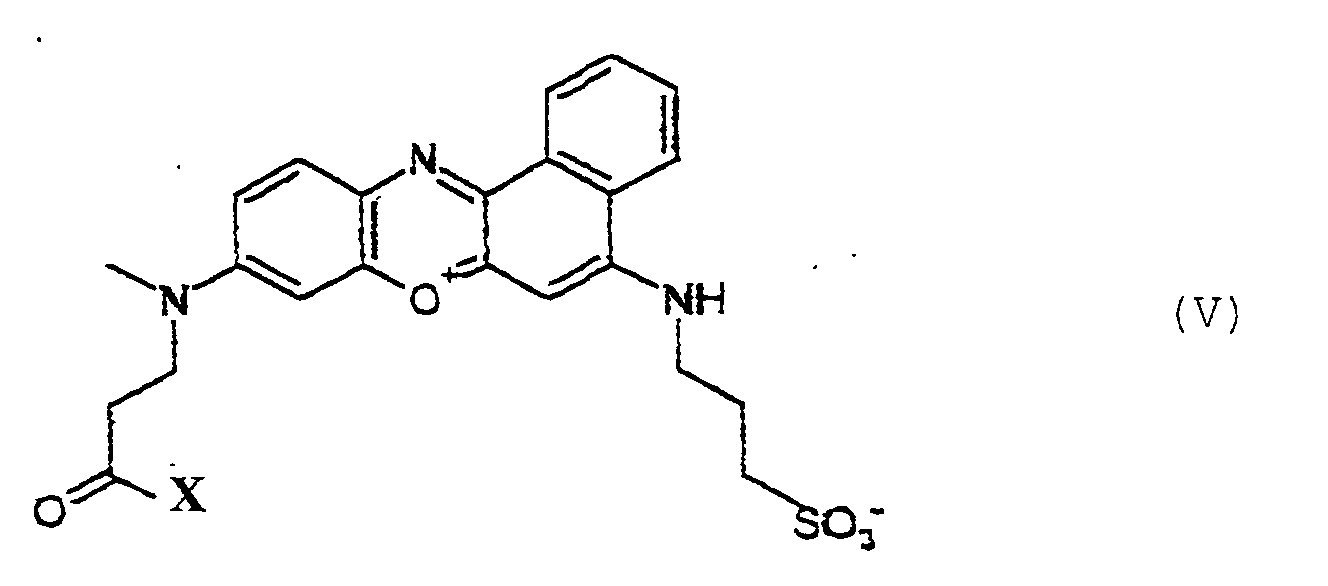
- Oxazinderivat nach einem der Ansprüche 13 bis 16, dadurch gekennzeichnet, dass das Salz davon ein Gegenion enthält, das aus einem Halogenidion, einem BF4 --Ion oder Tetraphenylborat gewählt ist.
- Oxazinderivat nach Anspruch 17, dadurch gekennzeichnet, dass das Gegenion ein Chlorid- oder Bromidion oder Tetraphenylborat ist.
- Oxazinderivat nach mindestens einem der Ansprüche 1 bis 18, dadurch gekennzeichnet, dass die Derivate mindestens einen Affinitätsmarker aufweisen.
- Oxazinderivat nach Anspruch 19, dadurch gekennzeichnet, dass die Derivate nur einen Affinitätsmarker aufweisen.
- Oxazinderivat nach Anspruch 19 oder 20, dadurch gekennzeichnet, dass es sich bei den Affinitätsmarkern um Biotin, Hexa-His oder Haptene handelt.
- Oxazinderivat nach mindestens einem der Ansprüche 1 bis 21, dadurch gekennzeichnet, dass die reaktive Gruppe an ein zu untersuchendes Material gebunden ist.
- Oxazinderivat nach mindestens einem der Ansprüche 1 bis 22, dadurch gekennzeichnet, dass es sich bei dem zu untersuchenden Material um i) ein biologisches Material, ii) eine chemische Verbindung, insbesondere eine biologisch aktive Substanz und/oder einen pharmazeutischen Wirkstoff, iii) einen synthetischen oder biologischen Mikropartikel oder iv) eine Kombination davon handelt.
- Oxazinderivat nach Anspruch 23, dadurch gekennzeichnet, dass es sich bei den synthetischen Mikropartikeln um lösliche oder suspendierbare Trägermaterialien handelt.
- Oxazinderivat nach Anspruch 23, dadurch gekennzeichnet, dass es sich bei den biologischen Mikropartikeln um vesikuläre oder virus-ähnliche Partikel handelt.
- Oxazinderivat nach Anspruch 23, dadurch gekennzeichnet, dass das biologische Material Nukleotide, Oligonukleotide, Zucker, Lipide, Membranen, Zellen, Zellbestandteile, DNA, RNA, Peptide, Proteine, Antikörper, Haptene oder Antigene umfasst.
- Kit zur Markierung eines zu untersuchenden Materials, umfassend ein Oxazinderivat nach mindestens einem der Ansprüche 1 bis 26.
- Kit nach Anspruch 27, dadurch gekennzeichnet, dass es ein Oxazinderivat nach mindestens einem der Ansprüche 13 bis 18 umfasst.
- Verwendung eines Kits nach Anspruch 27 oder 28 oder eines Oxazinderivates nach mindestens einem der Ansprüche 1 bis 26 in chemischen oder biotechnischen Anwendungen.
- Verwendung nach Anspruch 29, dadurch gekennzeichnet, dass das Kit oder das Oxazinderivat i) zur Identifizierung und Charakterisierung von biologischem Material oder chemischen Verbindungen, ii) zur Suche nach biologisch aktiven Substanzen und/oder pharmazeutischen Wirkstoffen, iii) zur Identifizierung von Analyten in diagnostischen und/oder therapeutischen Verfahren, iv) zur Genomanalyse oder v) zur Reinigung und Konzentrierung von Substraten verwendet wird.
- Verfahren zur Herstellung der Oxazinderivate nach mindestens einem der Ansprüche 1 bis 26, bei dem man eine Verbindung der Formel VIim sauren Medium bei mittlerer Hitze während eines Zeitraumes von 10 Minuten bis 5 Stunden mit einer Verbindung der Formel VII
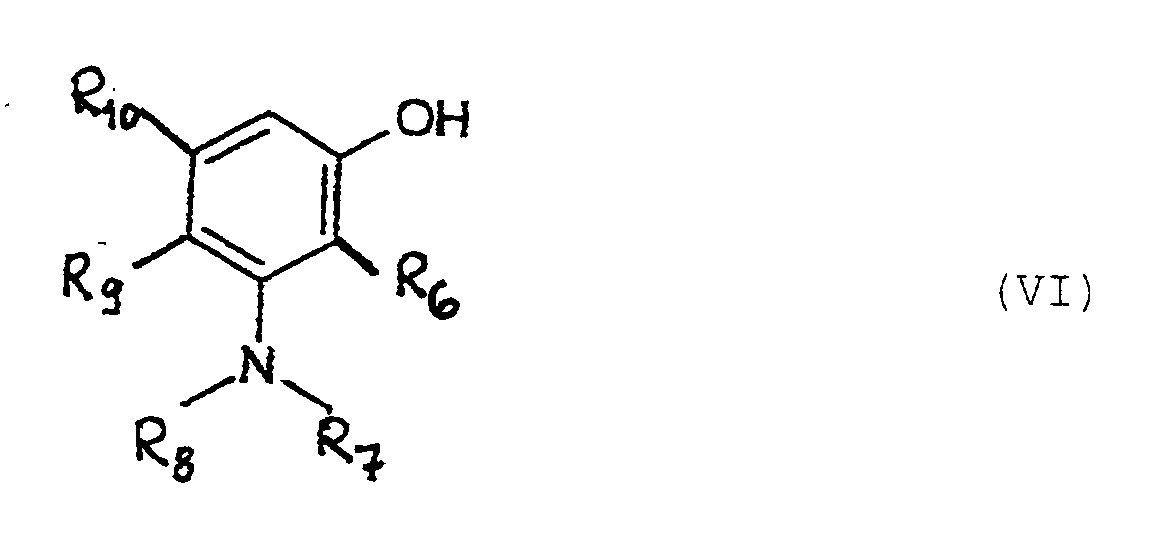 worin R1 bis R10 die in Anspruch 1 angegebenen Bedeutungen haben, umsetzt.
- Verfahren nach Anspruch 31, dadurch gekennzeichnet, dass man als Ausgangsverbindungen folgende Aminoverbindungen und Nitrosoverbindungen verwendet:
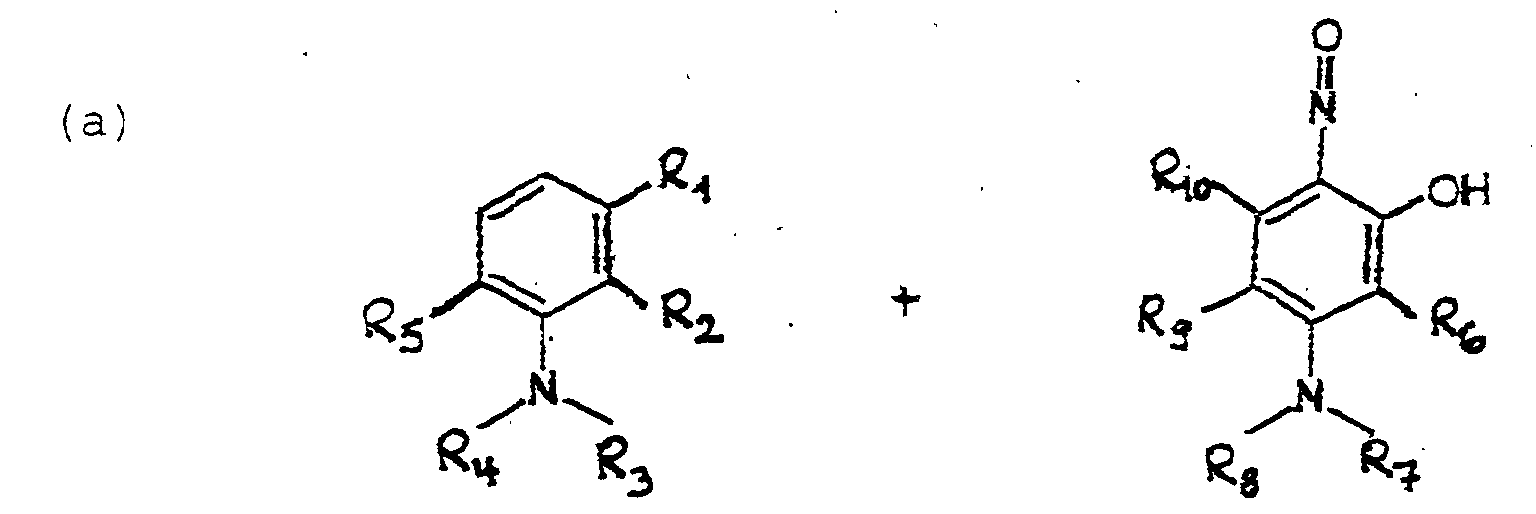


- Verfahren nach Anspruch 31 oder 32, dadurch gekennzeichnet, dass das Oxazinderivat durch Umsetzung mit N-Succinimidylester in Gegenwart von N,N-Dimethylformamid und Diisopropylcarbodiimid aktiviert wird.
- Verfahren zur gezielten Markierung von zu untersuchendem Material, dadurch gekennzeichnet, dass es die folgenden Schritte umfasst:a) Bereitstellung einer Probe umfassend ein zu untersuchendes Material;b) Umsetzung des zu untersuchenden Materials mit einem einen Affinitätsmarker enthaltenen Oxazinderivat gemäß mindestens einem der Ansprüche 17 bis 19, unter Bildung von markiertem zu untersuchendem Material, das als Mischung kein, ein oder mehrere Oxazinderivate als Markierung aufweist;c) Auftrennung des zu untersuchenden Materials in nicht, einfach oder mehrfach markierte Oxazinderivate davon durch Affinitätschromatographie.
- Verfahren nach Anspruch 34, dadurch gekennzeichnet, dass als Affinitätsmarker Biotin, Hexa-His oder Haptene verwendet werden.
- Verfahren nach Anspruch 34 oder 35, dadurch gekennzeichnet, dass für die anschließende Untersuchung des Materials die Fraktion verwendet wird, die einfach markiert ist.
Priority Applications (10)
| Application Number | Priority Date | Filing Date | Title |
|---|---|---|---|
| EP00127005A EP1213328A1 (de) | 2000-12-08 | 2000-12-08 | Oxazinderivate |
| PCT/EP2001/010236 WO2002020670A1 (de) | 2000-09-06 | 2001-09-05 | Oxazinderivate |
| AT05000174T ATE518913T1 (de) | 2000-09-06 | 2001-09-05 | Verfahren zur gezielten markierung mittels affinitätsmarkierter detektionsmarker |
| US10/363,813 US7101999B2 (en) | 2000-09-06 | 2001-09-05 | Oxazine derivatives |
| DE50105139T DE50105139D1 (en) | 2000-09-06 | 2001-09-05 | Oxazinderivate |
| JP2002525681A JP2004508448A (ja) | 2000-09-06 | 2001-09-05 | オキサジン誘導体 |
| EP05000174A EP1535967B1 (de) | 2000-09-06 | 2001-09-05 | Verfahren zur gezielten Markierung mittels affinitätsmarkierter Detektionsmarker |
| AT01978341T ATE287430T1 (de) | 2000-09-06 | 2001-09-05 | Oxazinderivate |
| EP01978341A EP1317511B1 (de) | 2000-09-06 | 2001-09-05 | Oxazinderivate |
| US11/379,433 US20060240455A1 (en) | 2000-09-06 | 2006-04-20 | Oxazine derivatives |
Applications Claiming Priority (1)
| Application Number | Priority Date | Filing Date | Title |
|---|---|---|---|
| EP00127005A EP1213328A1 (de) | 2000-12-08 | 2000-12-08 | Oxazinderivate |
Publications (1)
| Publication Number | Publication Date |
|---|---|
| EP1213328A1 true EP1213328A1 (de) | 2002-06-12 |
Family
ID=8170617
Family Applications (1)
| Application Number | Title | Priority Date | Filing Date |
|---|---|---|---|
| EP00127005A Withdrawn EP1213328A1 (de) | 2000-09-06 | 2000-12-08 | Oxazinderivate |
Country Status (1)
| Country | Link |
|---|---|
| EP (1) | EP1213328A1 (de) |
Cited By (3)
| Publication number | Priority date | Publication date | Assignee | Title |
|---|---|---|---|---|
| WO2003080736A1 (de) * | 2002-03-22 | 2003-10-02 | Gnothis Holding Sa | Verwendung von oxazin-farbstoffen als markierungsgruppen für die einzelmolekülanalyse |
| EP1703271A1 (de) * | 2005-03-18 | 2006-09-20 | BAM Bundesanstalt für Materialforschung und -prüfung | Kalibriereinrichtung und Farbstoffkit sowie ihre Verwendung zur Charakterisierung von Lumineszenzmesssystemen |
| CN111592501A (zh) * | 2020-06-29 | 2020-08-28 | 遵义医科大学 | 一种1,3-噁嗪类羟化物的合成方法 |
Citations (10)
| Publication number | Priority date | Publication date | Assignee | Title |
|---|---|---|---|---|
| DE2411761A1 (de) * | 1974-03-12 | 1975-10-16 | Hoechst Ag | Basische oxazinfarbstoffe, verfahren zu ihrer herstellung und ihre verwendung |
| US4714763A (en) * | 1985-07-11 | 1987-12-22 | Viomedics Inc. | Novel oxazine-ureas and thiazine urea chromophors as fluorescent labels |
| US4780535A (en) * | 1986-11-21 | 1988-10-25 | Spyros Theodoropulos | Maleic and phthalic diamides |
| US5532171A (en) * | 1991-04-26 | 1996-07-02 | Takeda Chemical Industries, Ltd. | Phenothiazine derivatives, their production and use |
| EP0747447A2 (de) * | 1995-06-10 | 1996-12-11 | Roche Diagnostics GmbH | Neue Oxazinfarbstoffe und ihre Verwendung als Fluoreszenzmarker |
| WO1997029154A1 (en) * | 1996-02-05 | 1997-08-14 | Amersham Pharmacia Biotech Uk Limited | Benzophenoxazine dyes |
| US5739318A (en) * | 1990-11-14 | 1998-04-14 | Axis Research As | Labelling agents comprising boronic acid conjugates |
| US5792389A (en) * | 1993-10-27 | 1998-08-11 | United States Of America | Water soluble laser dyes |
| WO1999007793A1 (en) * | 1997-08-04 | 1999-02-18 | Nycomed Amersham Plc | Dye intermediate and method to manufacture dyes |
| US6140500A (en) * | 1999-09-03 | 2000-10-31 | Pe Corporation | Red-emitting [8,9]benzophenoxazine nucleic acid dyes and methods for their use |
-
2000
- 2000-12-08 EP EP00127005A patent/EP1213328A1/de not_active Withdrawn
Patent Citations (10)
| Publication number | Priority date | Publication date | Assignee | Title |
|---|---|---|---|---|
| DE2411761A1 (de) * | 1974-03-12 | 1975-10-16 | Hoechst Ag | Basische oxazinfarbstoffe, verfahren zu ihrer herstellung und ihre verwendung |
| US4714763A (en) * | 1985-07-11 | 1987-12-22 | Viomedics Inc. | Novel oxazine-ureas and thiazine urea chromophors as fluorescent labels |
| US4780535A (en) * | 1986-11-21 | 1988-10-25 | Spyros Theodoropulos | Maleic and phthalic diamides |
| US5739318A (en) * | 1990-11-14 | 1998-04-14 | Axis Research As | Labelling agents comprising boronic acid conjugates |
| US5532171A (en) * | 1991-04-26 | 1996-07-02 | Takeda Chemical Industries, Ltd. | Phenothiazine derivatives, their production and use |
| US5792389A (en) * | 1993-10-27 | 1998-08-11 | United States Of America | Water soluble laser dyes |
| EP0747447A2 (de) * | 1995-06-10 | 1996-12-11 | Roche Diagnostics GmbH | Neue Oxazinfarbstoffe und ihre Verwendung als Fluoreszenzmarker |
| WO1997029154A1 (en) * | 1996-02-05 | 1997-08-14 | Amersham Pharmacia Biotech Uk Limited | Benzophenoxazine dyes |
| WO1999007793A1 (en) * | 1997-08-04 | 1999-02-18 | Nycomed Amersham Plc | Dye intermediate and method to manufacture dyes |
| US6140500A (en) * | 1999-09-03 | 2000-10-31 | Pe Corporation | Red-emitting [8,9]benzophenoxazine nucleic acid dyes and methods for their use |
Cited By (4)
| Publication number | Priority date | Publication date | Assignee | Title |
|---|---|---|---|---|
| WO2003080736A1 (de) * | 2002-03-22 | 2003-10-02 | Gnothis Holding Sa | Verwendung von oxazin-farbstoffen als markierungsgruppen für die einzelmolekülanalyse |
| EP1703271A1 (de) * | 2005-03-18 | 2006-09-20 | BAM Bundesanstalt für Materialforschung und -prüfung | Kalibriereinrichtung und Farbstoffkit sowie ihre Verwendung zur Charakterisierung von Lumineszenzmesssystemen |
| CN111592501A (zh) * | 2020-06-29 | 2020-08-28 | 遵义医科大学 | 一种1,3-噁嗪类羟化物的合成方法 |
| CN111592501B (zh) * | 2020-06-29 | 2023-04-07 | 遵义医科大学 | 一种1,3-噁嗪类羟化物的合成方法 |
Similar Documents
| Publication | Publication Date | Title |
|---|---|---|
| DE69817165T2 (de) | Sulfonierte xanthenderivate | |
| DE60001531T2 (de) | Xanthenfarbstoffe und ihre anwendung als lumineszenzlöschende verbindungen | |
| DE69731179T2 (de) | Fluorierte xanthenderivate | |
| EP0567622B1 (de) | Neue pentacyclische verbindungen und ihre verwendung als absorptions- oder fluoreszenzfarbstoffe | |
| EP1283855B1 (de) | Stabile nir-marker-farbstoffe auf der basis von benzopyrylium-polymethinen | |
| EP0209875A1 (de) | Resorufin-Derivate sowie Verfahren zu deren Herstellung | |
| EP0747447B1 (de) | Neue Oxazinfarbstoffe und ihre Verwendung als Fluoreszenzmarker | |
| DE10258150A1 (de) | Hydrophile Marker auf der Basis von Benzopyrylo-Polymethinen | |
| EP1317511B1 (de) | Oxazinderivate | |
| EP2445969A1 (de) | Neue fluorierte rhodamine als fotostabile fluoreszenzfarbstoffe für markierungs- und bildgebungstechniken | |
| CN109824565B (zh) | 一种光响应性多功能化学交联剂及其制备方法与应用 | |
| DE19937024A1 (de) | Verwendung von Acylsulfonamido substituierten Polymethin-Farbstoffen als Fluoreszenz-Farbstoffe und/oder Marker | |
| CA2490961A1 (en) | Fluorescent dyes, energy transfer couples and methods | |
| Roubinet et al. | Photoactivatable rhodamine spiroamides and diazoketones decorated with “Universal Hydrophilizer” or hydroxyl groups | |
| CN112250700B (zh) | 氟硼二吡咯类蛋白质错误折叠探针Halo-BODIPY及其制备方法与应用 | |
| DE29610062U1 (de) | Versteifte Monomethincyanin-Farbstoffe | |
| CN114702447B (zh) | 一种萘酰亚胺衍生物及其制备方法与应用 | |
| EP1213328A1 (de) | Oxazinderivate | |
| EP1308728A2 (de) | Verfahren und Verbindungen zur Fluoreszenzmarkierung von Biomolekülen und Polymerpartikeln | |
| DE60102014T2 (de) | Synthese von cyaninfarbstoffen an fester phase | |
| US20060286626A1 (en) | Selective chromophores | |
| DE10317817A1 (de) | Pyrrolopyrrole als fluoreszente Marker für Biomoleküle und sphärische Partikel | |
| CN111621289A (zh) | 一种光控双通道荧光染料及其制备方法和应用 | |
| US4789742A (en) | Isomaleimide and isophthalimide derivatives of chromophors | |
| DE10196853B4 (de) | Farbstoffe auf Squarain-Basis und Verfahren zur Herstellung davon |
Legal Events
| Date | Code | Title | Description |
|---|---|---|---|
| PUAI | Public reference made under article 153(3) epc to a published international application that has entered the european phase |
Free format text: ORIGINAL CODE: 0009012 |
|
| AK | Designated contracting states |
Kind code of ref document: A1 Designated state(s): AT BE CH CY DE DK ES FI FR GB GR IE IT LI LU MC NL PT SE TR |
|
| AX | Request for extension of the european patent |
Free format text: AL;LT;LV;MK;RO;SI |
|
| AKX | Designation fees paid | ||
| REG | Reference to a national code |
Ref country code: DE Ref legal event code: 8566 |
|
| STAA | Information on the status of an ep patent application or granted ep patent |
Free format text: STATUS: THE APPLICATION IS DEEMED TO BE WITHDRAWN |
|
| 18D | Application deemed to be withdrawn |
Effective date: 20021218 |