EP1212188B1 - Uv-illumination device - Google Patents
Uv-illumination device Download PDFInfo
- Publication number
- EP1212188B1 EP1212188B1 EP00943875A EP00943875A EP1212188B1 EP 1212188 B1 EP1212188 B1 EP 1212188B1 EP 00943875 A EP00943875 A EP 00943875A EP 00943875 A EP00943875 A EP 00943875A EP 1212188 B1 EP1212188 B1 EP 1212188B1
- Authority
- EP
- European Patent Office
- Prior art keywords
- lamp
- illuminating device
- radiation
- mould
- optical fibre
- Prior art date
- Legal status (The legal status is an assumption and is not a legal conclusion. Google has not performed a legal analysis and makes no representation as to the accuracy of the status listed.)
- Expired - Lifetime
Links
- 238000005286 illumination Methods 0.000 title claims abstract description 7
- 230000003287 optical effect Effects 0.000 claims abstract description 23
- 239000000463 material Substances 0.000 claims abstract description 15
- 238000000465 moulding Methods 0.000 claims abstract description 13
- 238000004132 cross linking Methods 0.000 claims abstract description 10
- 238000005266 casting Methods 0.000 claims abstract description 9
- 230000005855 radiation Effects 0.000 claims description 20
- 239000013307 optical fiber Substances 0.000 claims description 15
- 239000010453 quartz Substances 0.000 claims description 11
- VYPSYNLAJGMNEJ-UHFFFAOYSA-N silicon dioxide Inorganic materials O=[Si]=O VYPSYNLAJGMNEJ-UHFFFAOYSA-N 0.000 claims description 11
- 239000007788 liquid Substances 0.000 claims description 4
- QSHDDOUJBYECFT-UHFFFAOYSA-N mercury Chemical compound [Hg] QSHDDOUJBYECFT-UHFFFAOYSA-N 0.000 claims description 4
- 229910052753 mercury Inorganic materials 0.000 claims description 4
- 230000001105 regulatory effect Effects 0.000 claims description 4
- 238000005259 measurement Methods 0.000 claims description 3
- 238000000295 emission spectrum Methods 0.000 claims description 2
- 238000000034 method Methods 0.000 abstract description 11
- 230000008878 coupling Effects 0.000 abstract description 8
- 238000010168 coupling process Methods 0.000 abstract description 8
- 238000005859 coupling reaction Methods 0.000 abstract description 8
- 230000008569 process Effects 0.000 abstract description 8
- 239000007858 starting material Substances 0.000 description 5
- 238000004519 manufacturing process Methods 0.000 description 3
- XLYOFNOQVPJJNP-UHFFFAOYSA-N water Substances O XLYOFNOQVPJJNP-UHFFFAOYSA-N 0.000 description 3
- 239000004743 Polypropylene Substances 0.000 description 2
- 230000005540 biological transmission Effects 0.000 description 2
- 230000001419 dependent effect Effects 0.000 description 2
- 230000006872 improvement Effects 0.000 description 2
- -1 polypropylene Polymers 0.000 description 2
- 229920001155 polypropylene Polymers 0.000 description 2
- VYZAMTAEIAYCRO-UHFFFAOYSA-N Chromium Chemical compound [Cr] VYZAMTAEIAYCRO-UHFFFAOYSA-N 0.000 description 1
- 230000009471 action Effects 0.000 description 1
- 230000032683 aging Effects 0.000 description 1
- 229910052804 chromium Inorganic materials 0.000 description 1
- 239000011651 chromium Substances 0.000 description 1
- 238000010276 construction Methods 0.000 description 1
- 238000001816 cooling Methods 0.000 description 1
- 238000009826 distribution Methods 0.000 description 1
- 230000000694 effects Effects 0.000 description 1
- 238000000605 extraction Methods 0.000 description 1
- 239000000835 fiber Substances 0.000 description 1
- 230000009969 flowable effect Effects 0.000 description 1
- 239000011521 glass Substances 0.000 description 1
- 238000007527 glass casting Methods 0.000 description 1
- 239000000203 mixture Substances 0.000 description 1
- 238000012667 polymer degradation Methods 0.000 description 1
- 238000002360 preparation method Methods 0.000 description 1
- 230000035945 sensitivity Effects 0.000 description 1
- 238000007493 shaping process Methods 0.000 description 1
- 238000004659 sterilization and disinfection Methods 0.000 description 1
Images
Classifications
-
- B—PERFORMING OPERATIONS; TRANSPORTING
- B29—WORKING OF PLASTICS; WORKING OF SUBSTANCES IN A PLASTIC STATE IN GENERAL
- B29C—SHAPING OR JOINING OF PLASTICS; SHAPING OF MATERIAL IN A PLASTIC STATE, NOT OTHERWISE PROVIDED FOR; AFTER-TREATMENT OF THE SHAPED PRODUCTS, e.g. REPAIRING
- B29C35/00—Heating, cooling or curing, e.g. crosslinking or vulcanising; Apparatus therefor
- B29C35/02—Heating or curing, e.g. crosslinking or vulcanizing during moulding, e.g. in a mould
- B29C35/08—Heating or curing, e.g. crosslinking or vulcanizing during moulding, e.g. in a mould by wave energy or particle radiation
- B29C35/0888—Heating or curing, e.g. crosslinking or vulcanizing during moulding, e.g. in a mould by wave energy or particle radiation using transparant moulds
-
- B—PERFORMING OPERATIONS; TRANSPORTING
- B29—WORKING OF PLASTICS; WORKING OF SUBSTANCES IN A PLASTIC STATE IN GENERAL
- B29D—PRODUCING PARTICULAR ARTICLES FROM PLASTICS OR FROM SUBSTANCES IN A PLASTIC STATE
- B29D11/00—Producing optical elements, e.g. lenses or prisms
- B29D11/00009—Production of simple or compound lenses
- B29D11/00038—Production of contact lenses
- B29D11/00125—Auxiliary operations, e.g. removing oxygen from the mould, conveying moulds from a storage to the production line in an inert atmosphere
- B29D11/00134—Curing of the contact lens material
-
- B—PERFORMING OPERATIONS; TRANSPORTING
- B29—WORKING OF PLASTICS; WORKING OF SUBSTANCES IN A PLASTIC STATE IN GENERAL
- B29D—PRODUCING PARTICULAR ARTICLES FROM PLASTICS OR FROM SUBSTANCES IN A PLASTIC STATE
- B29D11/00—Producing optical elements, e.g. lenses or prisms
- B29D11/00009—Production of simple or compound lenses
- B29D11/00432—Auxiliary operations, e.g. machines for filling the moulds
- B29D11/00442—Curing the lens material
-
- G—PHYSICS
- G02—OPTICS
- G02B—OPTICAL ELEMENTS, SYSTEMS OR APPARATUS
- G02B6/00—Light guides; Structural details of arrangements comprising light guides and other optical elements, e.g. couplings
- G02B6/24—Coupling light guides
- G02B6/42—Coupling light guides with opto-electronic elements
- G02B6/4298—Coupling light guides with opto-electronic elements coupling with non-coherent light sources and/or radiation detectors, e.g. lamps, incandescent bulbs, scintillation chambers
-
- B—PERFORMING OPERATIONS; TRANSPORTING
- B29—WORKING OF PLASTICS; WORKING OF SUBSTANCES IN A PLASTIC STATE IN GENERAL
- B29C—SHAPING OR JOINING OF PLASTICS; SHAPING OF MATERIAL IN A PLASTIC STATE, NOT OTHERWISE PROVIDED FOR; AFTER-TREATMENT OF THE SHAPED PRODUCTS, e.g. REPAIRING
- B29C35/00—Heating, cooling or curing, e.g. crosslinking or vulcanising; Apparatus therefor
- B29C35/02—Heating or curing, e.g. crosslinking or vulcanizing during moulding, e.g. in a mould
- B29C35/08—Heating or curing, e.g. crosslinking or vulcanizing during moulding, e.g. in a mould by wave energy or particle radiation
- B29C35/0805—Heating or curing, e.g. crosslinking or vulcanizing during moulding, e.g. in a mould by wave energy or particle radiation using electromagnetic radiation
- B29C2035/0827—Heating or curing, e.g. crosslinking or vulcanizing during moulding, e.g. in a mould by wave energy or particle radiation using electromagnetic radiation using UV radiation
-
- B—PERFORMING OPERATIONS; TRANSPORTING
- B29—WORKING OF PLASTICS; WORKING OF SUBSTANCES IN A PLASTIC STATE IN GENERAL
- B29L—INDEXING SCHEME ASSOCIATED WITH SUBCLASS B29C, RELATING TO PARTICULAR ARTICLES
- B29L2011/00—Optical elements, e.g. lenses, prisms
- B29L2011/0016—Lenses
- B29L2011/0041—Contact lenses
Definitions
- the invention relates to a method and device for crosslinking a biocompatible, polymerisable material in order to produce an ophthalmic moulding, especially an ophthalmic lens, particularly a contact lens.
- Contact lenses which are to be manufactured economically in large unit numbers, are preferably manufactured by the so-called mould or full-mould process. In these processes, the lenses are manufactured into their final shape between two mould halves, so that there is no need to subsequently finish the surfaces of the lenses, nor to finish the edges. Mould processes are described for example in PCT patent application no. WO/87/04390 or in EP-A 0 367.513.
- the contact lenses produced in this manner are moulded parts having little mechanical stability and a water content of more than 60 % by weight. After manufacture, the lens is inspected, then packed and subjected to heat sterilisation at 121°C in an autoclave.
- the geometry of the contact lenses to be manufactured is defined by the mould cavity.
- the edge of the contact lens is likewise formed by the mould which normally consists of two mould halves.
- the geometry of the edge is defined by the contour of the two mould halves in the area in which they make contact.
- a contact lens To manufacture a contact lens, first of all a certain amount of a flowable starting material is placed in the female mould half. Afterwards, the mould is closed by placing the male mould half thereon. Normally, a surplus of starting material is used, so that, when the mould is closed, the excess amount is expelled out into an overflow area adjacent to the mould cavity. The subsequent polymerisation or crosslinking of the starting material takes place by radiation with UV light, or by heat action, or by another non-thermal method.
- EP-A-0 637 490 describes a process by means of which a further improvement may be obtained in the preparation process of contact lenses with the prepolymer described in US-A-5,508,317.
- the material is filled into a mould comprising two halves, whereby the two mould halves do not touch, but a thin circular gap is located between them. The gap is linked to the mould cavity, so that surplus lens material can flow away into the gap.
- reusable quartz/glass moulds may be used. Because of the water-soluble basic chemistry, after a lens has been produced, the uncrosslinked prepolymer and other residues can be removed from the moulds rapidly and effectively with water, and the moulds dried in the air.
- the moulding may have a varying degree of crosslinking, which has a negative effect on the stability of the moulding.
- the edges in particular are frequently insufficiently polymerised, so that the borders of the moulding are not clearly defined.
- the invention is concerned with the problem of further improving the crosslinking process for ophthalmic mouldings consisting of biocompatible polymerisable materials, especially for contact lenses, in order to ensure constant quality of the mouldings.
- an ultraviolet lamp By coupling the UV light into the mould cavity using optical fibres, homogeneous illumination is assured, together with high intensity of radiation of the mould cavity.
- an ultraviolet lamp By attaching a number of optical fibres to an ultraviolet lamp, an ultraviolet lamp can be used to crosslink a number of casting moulds, whereupon a very high intensity of illumination can be attained in an efficient manner, enabling rapid polymerisation of the filled moulding material to take place.
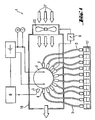
- the UV illuminating device 1 illustrated schematically in fig. 1 is preferably mounted in a housing 16 illustrated only schematically here, and consists of a UV lamp 2 and several, advantageously 5 to 50, preferably 10 to 30 optical fibres 3, which surround the UV lamp 2 and are each fixed by a holder 4.
- the UV lamp 2 in question is suitably a mercury lamp, especially a doped medium pressure mercury lamp, whereby a medium pressure lamp HPA 2020 from Philips or a comparable medium pressure lamp from the company Heraeus can be used for example.
- the optical fibres 3 conveniently have a length of 0.3 to 2 m and are advantageously formed as liquid optical fibres, since these are particularly well suited to the transmission of UV light.
- Liquid optical fibres are notable for their high UV transmission, their more homogeneous distribution of intensity of the emerging light rays compared with quartz fibre bundles, and their higher usable cross-sectional area given the same diameter.
- the UV lamp 2 can be suitably mounted on a quick-change cradle (not illustrated) to enable the lamp 2 to be exchanged easily.
- the emission spectrum of the UV lamp 2 advantageously has a high UV intensity in the wavelength range 280 - 360 nm, since in this range various types of photoinitiators that can be used in lens material can be activated, for example Irgacure 2050.
- a high proportion of the radiation emitting from the UV lamp 2 can be coupled into the optical fibres 3 and thus used for crosslinking.
- the maximum number of optical fibres that can be used is dependent on the diameter of the UV lamp 2 and the distance to the UV lamp.
- a sensor 5 which measures the intensity of UV radiation. It is located near to the UV lamp 2. The measurement is passed on to a regulating unit 6 which compares the measured intensity of radiation with a theoretical value and regulates the current intensity I to keep it constant.
- a cool stream of air 7 is provided to cool the UV lamp 2.
- the airstream is controlled by one or more temperature sensors 8 which measure the temperature inside the housing.
- the cool air stream ensures that the UV lamp 2 bums at an optimum temperature and that the components in the housing of the lamp do not become overheated. In this way, constant operating conditions are assured, which also prolong the life of the UV lamp 2.
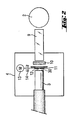
- the coupling of UV light into the optical fibres 3 is illustrated in more detail in fig. 2.
- a minimum distance to the UV lamp is required, advantageously ca. 1 mm. Since the surface of the UV lamp reaches a temperature or more than 800°C, direct coupling to a liquid optical fibre is impossible owing to its temperature sensitivity. Therefore, the light emitting from the UV lamp is firstly coupled into a quartz rod 9, the diameter of which is co-ordinated with that of the optical fibre 3.
- the length of the quartz rod 9 depends on the effectiveness of cooling produced by the stream of air. In a first approximation, the length of the quartz rod 9 has no affect on the light intensity that can be coupled into the optical fibres 3.
- the length of the quartz rod 9 is advantageously between 50 and 120 mm.
- a cut-on filter 10 which shades out the short-waved UV radiation ⁇ 280 nm, since this causes a more rapid ageing of the optical fibres 3.
- the cut-on filter additionally prevents polymer degradation of the lens material.
- the cut-on filter 10 is suitably a WG 305 or 295 filter from the company Schott.
- a diaphragm 11 is provided between the cut-on filter 10 and the optical fibre admission area 30.
- the intensity of radiation entering the optical fibre 3 can be regulated.
- the distance between the optical fibre admission area 30 and the quartz rod 9 can also be modified. If a high UV intensity is desired, the distance should be as short as possible.
- the diaphragm aperture 12 may be controlled via a stepping motor unit 13 which is linked to the diaphragm 11 in particular by a flexible coupling 14, whereby adjustment of the diaphragm aperture 12 can be regulated by the measurement of light intensity using a suitable UV measuring unit 15 at the light exit.
- the diaphragm 11 of each optical fibre 3 may be adjustable independently.
- the diaphragms 11 may also be controlled manually if desired.
- the optical fibres 3 emerge from the housing 16 and are respectively arranged over a casting mould 17.
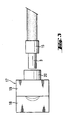
- Fig. 3 depicts the exposure of a casting mould 17 consisting of a lower mould half 18 and an upper mould half 19.
- a UV condenser 20 Arranged between the end of an optical fibre 3 and the upper mould half 19 is preferably a UV condenser 20, which consists of tempered quartz lenses.
- the condenser 20 serves to bundle the emitting ray of light.
- the optics thereof are co-ordinated with the geometry of the casting mould.
- the distances between the end of the optical fibre 3 and the condenser 20 and between the condenser 20 and the upper mould half 19 are crucial.
- a diaphragm must be provided in the upper mould half 19.
- the distance between the condenser 20 and the casting mould 17 is increased, the intensity of radiation is reduced. This leads to slower polymerisation of the lens material. However, if there is constant exposure time and the intensity of radiation is too high, the contact lenses become brittle and the quality of the edges of the contact lenses deteriorates.
- an optimum setting must be found, which also depends on the geometry of the upper mould half. This distance is suitably between 30 and 5 mm.
- the invention enables the mould cavity to be illuminated evenly.
- a very high and even intensity of illumination can be attained in an efficient manner, so that it is possible to polymerise the introduced moulding material very rapidly.
Landscapes
- Health & Medical Sciences (AREA)
- Engineering & Computer Science (AREA)
- Physics & Mathematics (AREA)
- Manufacturing & Machinery (AREA)
- Mechanical Engineering (AREA)
- Ophthalmology & Optometry (AREA)
- Thermal Sciences (AREA)
- Oral & Maxillofacial Surgery (AREA)
- Toxicology (AREA)
- General Physics & Mathematics (AREA)
- Optics & Photonics (AREA)
- Heating, Cooling, Or Curing Plastics Or The Like In General (AREA)
- Casting Or Compression Moulding Of Plastics Or The Like (AREA)
- Eyeglasses (AREA)
- Polarising Elements (AREA)
- Non-Portable Lighting Devices Or Systems Thereof (AREA)
Priority Applications (1)
| Application Number | Priority Date | Filing Date | Title |
|---|---|---|---|
| EP00943875A EP1212188B1 (en) | 1999-06-25 | 2000-06-23 | Uv-illumination device |
Applications Claiming Priority (4)
| Application Number | Priority Date | Filing Date | Title |
|---|---|---|---|
| EP99112256 | 1999-06-25 | ||
| EP99112256 | 1999-06-25 | ||
| PCT/EP2000/005835 WO2001000393A2 (en) | 1999-06-25 | 2000-06-23 | Uv-illumination device |
| EP00943875A EP1212188B1 (en) | 1999-06-25 | 2000-06-23 | Uv-illumination device |
Publications (2)
| Publication Number | Publication Date |
|---|---|
| EP1212188A2 EP1212188A2 (en) | 2002-06-12 |
| EP1212188B1 true EP1212188B1 (en) | 2004-05-19 |
Family
ID=8238429
Family Applications (1)
| Application Number | Title | Priority Date | Filing Date |
|---|---|---|---|
| EP00943875A Expired - Lifetime EP1212188B1 (en) | 1999-06-25 | 2000-06-23 | Uv-illumination device |
Country Status (6)
| Country | Link |
|---|---|
| EP (1) | EP1212188B1 (enExample) |
| JP (1) | JP4717304B2 (enExample) |
| AT (1) | ATE267080T1 (enExample) |
| AU (1) | AU5819100A (enExample) |
| DE (1) | DE60010904T2 (enExample) |
| WO (1) | WO2001000393A2 (enExample) |
Families Citing this family (9)
| Publication number | Priority date | Publication date | Assignee | Title |
|---|---|---|---|---|
| DE3127774A1 (de) * | 1981-07-14 | 1983-02-03 | Knorr-Bremse GmbH, 8000 München | Beschleuniger fuer steuerventile, insbesondere dreidrucksteuerventile von schienenfahrzeug-druckluftbremsanlagen |
| AU2001238306A1 (en) * | 2000-03-31 | 2001-10-15 | Bausch And Lomb Incorporated | Method and device to control polymerization |
| EP1314527B1 (en) * | 2001-11-14 | 2009-08-26 | Novartis AG | Contact lens manufacture using UV light |
| CN100355546C (zh) * | 2003-06-27 | 2007-12-19 | 中国科学院沈阳自动化研究所 | 一种用于快速成型的紫外光学系统 |
| WO2005032791A1 (ja) * | 2003-10-06 | 2005-04-14 | Menicon Co., Ltd. | 眼用レンズ物品の製造方法及びそれに用いられる製造装置 |
| US7790094B2 (en) | 2005-02-07 | 2010-09-07 | Henkel Corporation | Injection molding process, apparatus and material for forming cured-in-place gaskets |
| US9073241B2 (en) | 2005-02-07 | 2015-07-07 | Henkel IP & Holding GmbH | Injection molding process and compositions with improved sealing characteristics for mold-in-place gaskets |
| US7785092B2 (en) | 2005-08-09 | 2010-08-31 | Coopervision International Holding Company, Lp | Systems and methods for producing contact lenses from a polymerizable composition |
| EP1757435A1 (en) * | 2005-08-24 | 2007-02-28 | Novartis AG | Process for the manufacture of an ophthalmic lens |
Family Cites Families (15)
| Publication number | Priority date | Publication date | Assignee | Title |
|---|---|---|---|---|
| DE3245655A1 (de) * | 1982-09-01 | 1984-06-14 | Johann Josef 8918 Diessen Kerschgens | Uv-bestrahlungsvorrichtung vorzugsweise als vorsatzeinrichtung fuer einen foen |
| JPS59215838A (ja) * | 1983-05-24 | 1984-12-05 | Mitsubishi Electric Corp | 成形装置 |
| JPS61261009A (ja) * | 1985-05-15 | 1986-11-19 | Kawasumi Lab Inc | 医療用針の組み立て方法 |
| JPS62132595A (ja) * | 1985-12-05 | 1987-06-15 | Miyama Kogyo Kk | ばつ気槽用加温装置 |
| GB8601967D0 (en) * | 1986-01-28 | 1986-03-05 | Coopervision Optics | Manufacturing contact lenses |
| DE3737605A1 (de) * | 1987-11-05 | 1989-05-18 | Mutzhas Maximilian F | Ulraviolett leuchtstofflampe ohne uv-b-strahlung |
| JP2682017B2 (ja) * | 1988-06-21 | 1997-11-26 | 株式会社ニコン | 投影型露光装置および露光方法 |
| DE68927648T2 (de) * | 1988-11-02 | 1997-04-24 | British Tech Group | Giessen und Verpacken von Kontaktlinsen |
| JPH02187707A (ja) * | 1989-01-14 | 1990-07-23 | Sumitomo Electric Ind Ltd | 光ファイバ融着接続部のモールド成形補強方法 |
| DE4014363C2 (de) * | 1990-05-04 | 2000-10-26 | Guenther Nath | UV-Polymerisationsgerät für industrielle Zwecke |
| ES2130384T3 (es) * | 1993-07-19 | 1999-07-01 | Novartis Ag | Procedimiento y dispositivo para la obtencion de cuerpos moldeados, asi como cuerpos moldeados obtenidos segun el procedimiento. |
| TW272976B (enExample) * | 1993-08-06 | 1996-03-21 | Ciba Geigy Ag | |
| IL113904A0 (en) * | 1994-06-10 | 1995-08-31 | Johnson & Johnson Vision Prod | Mold clamping and precure of a polymerizable hydrogel |
| JP3115822B2 (ja) * | 1996-06-04 | 2000-12-11 | 松下電子工業株式会社 | 紫外線照射装置およびその照射方法 |
| TW429327B (en) * | 1997-10-21 | 2001-04-11 | Novartis Ag | Single mould alignment |
-
2000
- 2000-06-23 JP JP2001506082A patent/JP4717304B2/ja not_active Expired - Lifetime
- 2000-06-23 AU AU58191/00A patent/AU5819100A/en not_active Abandoned
- 2000-06-23 WO PCT/EP2000/005835 patent/WO2001000393A2/en not_active Ceased
- 2000-06-23 AT AT00943875T patent/ATE267080T1/de not_active IP Right Cessation
- 2000-06-23 DE DE60010904T patent/DE60010904T2/de not_active Expired - Lifetime
- 2000-06-23 EP EP00943875A patent/EP1212188B1/en not_active Expired - Lifetime
Also Published As
| Publication number | Publication date |
|---|---|
| WO2001000393A3 (en) | 2002-04-11 |
| DE60010904D1 (de) | 2004-06-24 |
| EP1212188A2 (en) | 2002-06-12 |
| DE60010904T2 (de) | 2005-05-25 |
| JP4717304B2 (ja) | 2011-07-06 |
| JP2003503234A (ja) | 2003-01-28 |
| ATE267080T1 (de) | 2004-06-15 |
| AU5819100A (en) | 2001-01-31 |
| WO2001000393A2 (en) | 2001-01-04 |
Similar Documents
| Publication | Publication Date | Title |
|---|---|---|
| US5135686A (en) | Method and apparatus for continuous hardening of light-curing resins | |
| US5928575A (en) | Methods for eyeglass lens curing using ultraviolet light | |
| US6280171B1 (en) | El apparatus for eyeglass lens curing using ultraviolet light | |
| US6712596B1 (en) | System for producing ultraviolet blocking lenses | |
| EP1212188B1 (en) | Uv-illumination device | |
| KR100193488B1 (ko) | 플라스틱 렌즈를 제조하기 위한 방법과 장치 | |
| US4728469A (en) | Method and apparatus for making a plastic lens | |
| EP1197769A1 (en) | Method of manufacturing plastic optical fiber | |
| WO2005032791A1 (ja) | 眼用レンズ物品の製造方法及びそれに用いられる製造装置 | |
| US6737661B2 (en) | Pre-treatment of molds | |
| RU2000126815A (ru) | Способ изготовления искусственных хрусталиков глаза | |
| WO2004091883A1 (en) | Method for the manufacture of molded polymeric articles using variable frequency microwaves | |
| CN101535034A (zh) | 高强度uv模具预处理 | |
| US20060104062A1 (en) | Apparatus for the transport of light emitted by a short-arc lamp | |
| TH15304A (th) | วิธีการและอุปกรณ์สำหรับการผลิตเลนส์พลาสติก |
Legal Events
| Date | Code | Title | Description |
|---|---|---|---|
| PUAI | Public reference made under article 153(3) epc to a published international application that has entered the european phase |
Free format text: ORIGINAL CODE: 0009012 |
|
| 17P | Request for examination filed |
Effective date: 20011207 |
|
| AK | Designated contracting states |
Kind code of ref document: A2 Designated state(s): AT BE CH CY DE DK ES FI FR GB GR IE IT LI LU MC NL |
|
| AX | Request for extension of the european patent |
Free format text: AL;LT;LV;MK;RO;SI |
|
| 17Q | First examination report despatched |
Effective date: 20020626 |
|
| RAP1 | Party data changed (applicant data changed or rights of an application transferred) |
Owner name: NOVARTIS AG Owner name: NOVARTIS PHARMA GMBH |
|
| RAP1 | Party data changed (applicant data changed or rights of an application transferred) |
Owner name: NOVARTIS AG Owner name: NOVARTIS PHARMA GMBH |
|
| GRAP | Despatch of communication of intention to grant a patent |
Free format text: ORIGINAL CODE: EPIDOSNIGR1 |
|
| RAP1 | Party data changed (applicant data changed or rights of an application transferred) |
Owner name: NOVARTIS PHARMA GMBH Owner name: NOVARTIS AG |
|
| GRAS | Grant fee paid |
Free format text: ORIGINAL CODE: EPIDOSNIGR3 |
|
| GRAA | (expected) grant |
Free format text: ORIGINAL CODE: 0009210 |
|
| AK | Designated contracting states |
Kind code of ref document: B1 Designated state(s): AT BE CH CY DE DK ES FI FR GB GR IE IT LI LU MC NL PT SE |
|
| PG25 | Lapsed in a contracting state [announced via postgrant information from national office to epo] |
Ref country code: IT Free format text: LAPSE BECAUSE OF FAILURE TO SUBMIT A TRANSLATION OF THE DESCRIPTION OR TO PAY THE FEE WITHIN THE PRESCRIBED TIME-LIMIT;WARNING: LAPSES OF ITALIAN PATENTS WITH EFFECTIVE DATE BEFORE 2007 MAY HAVE OCCURRED AT ANY TIME BEFORE 2007. THE CORRECT EFFECTIVE DATE MAY BE DIFFERENT FROM THE ONE RECORDED. Effective date: 20040519 Ref country code: AT Free format text: LAPSE BECAUSE OF FAILURE TO SUBMIT A TRANSLATION OF THE DESCRIPTION OR TO PAY THE FEE WITHIN THE PRESCRIBED TIME-LIMIT Effective date: 20040519 Ref country code: NL Free format text: LAPSE BECAUSE OF FAILURE TO SUBMIT A TRANSLATION OF THE DESCRIPTION OR TO PAY THE FEE WITHIN THE PRESCRIBED TIME-LIMIT Effective date: 20040519 Ref country code: FI Free format text: LAPSE BECAUSE OF FAILURE TO SUBMIT A TRANSLATION OF THE DESCRIPTION OR TO PAY THE FEE WITHIN THE PRESCRIBED TIME-LIMIT Effective date: 20040519 Ref country code: LI Free format text: LAPSE BECAUSE OF FAILURE TO SUBMIT A TRANSLATION OF THE DESCRIPTION OR TO PAY THE FEE WITHIN THE PRESCRIBED TIME-LIMIT Effective date: 20040519 Ref country code: CY Free format text: LAPSE BECAUSE OF FAILURE TO SUBMIT A TRANSLATION OF THE DESCRIPTION OR TO PAY THE FEE WITHIN THE PRESCRIBED TIME-LIMIT Effective date: 20040519 Ref country code: CH Free format text: LAPSE BECAUSE OF FAILURE TO SUBMIT A TRANSLATION OF THE DESCRIPTION OR TO PAY THE FEE WITHIN THE PRESCRIBED TIME-LIMIT Effective date: 20040519 |
|
| REG | Reference to a national code |
Ref country code: GB Ref legal event code: FG4D |
|
| RIN1 | Information on inventor provided before grant (corrected) |
Inventor name: SEIFERLING, BERNHARD Inventor name: HEINRICH, AXEL Inventor name: MUELLER, ACHIM |
|
| REG | Reference to a national code |
Ref country code: CH Ref legal event code: EP |
|
| REG | Reference to a national code |
Ref country code: IE Ref legal event code: FG4D |
|
| PG25 | Lapsed in a contracting state [announced via postgrant information from national office to epo] |
Ref country code: LU Free format text: LAPSE BECAUSE OF NON-PAYMENT OF DUE FEES Effective date: 20040623 |
|
| REF | Corresponds to: |
Ref document number: 60010904 Country of ref document: DE Date of ref document: 20040624 Kind code of ref document: P |
|
| PG25 | Lapsed in a contracting state [announced via postgrant information from national office to epo] |
Ref country code: MC Free format text: LAPSE BECAUSE OF NON-PAYMENT OF DUE FEES Effective date: 20040630 Ref country code: BE Free format text: LAPSE BECAUSE OF NON-PAYMENT OF DUE FEES Effective date: 20040630 |
|
| PG25 | Lapsed in a contracting state [announced via postgrant information from national office to epo] |
Ref country code: SE Free format text: LAPSE BECAUSE OF FAILURE TO SUBMIT A TRANSLATION OF THE DESCRIPTION OR TO PAY THE FEE WITHIN THE PRESCRIBED TIME-LIMIT Effective date: 20040819 Ref country code: DK Free format text: LAPSE BECAUSE OF FAILURE TO SUBMIT A TRANSLATION OF THE DESCRIPTION OR TO PAY THE FEE WITHIN THE PRESCRIBED TIME-LIMIT Effective date: 20040819 Ref country code: GR Free format text: LAPSE BECAUSE OF FAILURE TO SUBMIT A TRANSLATION OF THE DESCRIPTION OR TO PAY THE FEE WITHIN THE PRESCRIBED TIME-LIMIT Effective date: 20040819 |
|
| PG25 | Lapsed in a contracting state [announced via postgrant information from national office to epo] |
Ref country code: ES Free format text: LAPSE BECAUSE OF FAILURE TO SUBMIT A TRANSLATION OF THE DESCRIPTION OR TO PAY THE FEE WITHIN THE PRESCRIBED TIME-LIMIT Effective date: 20040830 |
|
| LTIE | Lt: invalidation of european patent or patent extension |
Effective date: 20040519 |
|
| NLV1 | Nl: lapsed or annulled due to failure to fulfill the requirements of art. 29p and 29m of the patents act | ||
| REG | Reference to a national code |
Ref country code: CH Ref legal event code: PL |
|
| BERE | Be: lapsed |
Owner name: *NOVARTIS A.G. Effective date: 20040630 |
|
| ET | Fr: translation filed | ||
| PLBE | No opposition filed within time limit |
Free format text: ORIGINAL CODE: 0009261 |
|
| STAA | Information on the status of an ep patent application or granted ep patent |
Free format text: STATUS: NO OPPOSITION FILED WITHIN TIME LIMIT |
|
| 26N | No opposition filed |
Effective date: 20050222 |
|
| PG25 | Lapsed in a contracting state [announced via postgrant information from national office to epo] |
Ref country code: PT Free format text: LAPSE BECAUSE OF NON-PAYMENT OF DUE FEES Effective date: 20041019 |
|
| REG | Reference to a national code |
Ref country code: FR Ref legal event code: PLFP Year of fee payment: 17 |
|
| REG | Reference to a national code |
Ref country code: FR Ref legal event code: PLFP Year of fee payment: 18 |
|
| REG | Reference to a national code |
Ref country code: FR Ref legal event code: PLFP Year of fee payment: 19 |
|
| PGFP | Annual fee paid to national office [announced via postgrant information from national office to epo] |
Ref country code: DE Payment date: 20190612 Year of fee payment: 20 Ref country code: IE Payment date: 20190610 Year of fee payment: 20 |
|
| PGFP | Annual fee paid to national office [announced via postgrant information from national office to epo] |
Ref country code: FR Payment date: 20190604 Year of fee payment: 20 |
|
| PGFP | Annual fee paid to national office [announced via postgrant information from national office to epo] |
Ref country code: GB Payment date: 20190619 Year of fee payment: 20 |
|
| REG | Reference to a national code |
Ref country code: DE Ref legal event code: R082 Ref document number: 60010904 Country of ref document: DE Representative=s name: MAIWALD PATENTANWALTS- UND RECHTSANWALTSGESELL, DE Ref country code: DE Ref legal event code: R081 Ref document number: 60010904 Country of ref document: DE Owner name: ALCON INC., CH Free format text: FORMER OWNER: NOVARTIS AG, 4056 BASEL, CH |
|
| REG | Reference to a national code |
Ref country code: GB Ref legal event code: 732E Free format text: REGISTERED BETWEEN 20200123 AND 20200129 |
|
| REG | Reference to a national code |
Ref country code: DE Ref legal event code: R071 Ref document number: 60010904 Country of ref document: DE |
|
| REG | Reference to a national code |
Ref country code: GB Ref legal event code: PE20 Expiry date: 20200622 |
|
| REG | Reference to a national code |
Ref country code: IE Ref legal event code: MK9A |
|
| PG25 | Lapsed in a contracting state [announced via postgrant information from national office to epo] |
Ref country code: GB Free format text: LAPSE BECAUSE OF EXPIRATION OF PROTECTION Effective date: 20200622 |
|
| PG25 | Lapsed in a contracting state [announced via postgrant information from national office to epo] |
Ref country code: IE Free format text: LAPSE BECAUSE OF EXPIRATION OF PROTECTION Effective date: 20200623 |