EP1211702A1 - Activated carbon for electric double layer capacitor - Google Patents
Activated carbon for electric double layer capacitor Download PDFInfo
- Publication number
- EP1211702A1 EP1211702A1 EP01926133A EP01926133A EP1211702A1 EP 1211702 A1 EP1211702 A1 EP 1211702A1 EP 01926133 A EP01926133 A EP 01926133A EP 01926133 A EP01926133 A EP 01926133A EP 1211702 A1 EP1211702 A1 EP 1211702A1
- Authority
- EP
- European Patent Office
- Prior art keywords
- activated carbon
- double layer
- electric double
- electrode
- layer capacitors
- Prior art date
- Legal status (The legal status is an assumption and is not a legal conclusion. Google has not performed a legal analysis and makes no representation as to the accuracy of the status listed.)
- Granted
Links
Classifications
-
- H—ELECTRICITY
- H01—ELECTRIC ELEMENTS
- H01G—CAPACITORS; CAPACITORS, RECTIFIERS, DETECTORS, SWITCHING DEVICES, LIGHT-SENSITIVE OR TEMPERATURE-SENSITIVE DEVICES OF THE ELECTROLYTIC TYPE
- H01G11/00—Hybrid capacitors, i.e. capacitors having different positive and negative electrodes; Electric double-layer [EDL] capacitors; Processes for the manufacture thereof or of parts thereof
- H01G11/22—Electrodes
- H01G11/30—Electrodes characterised by their material
- H01G11/32—Carbon-based
- H01G11/42—Powders or particles, e.g. composition thereof
-
- C—CHEMISTRY; METALLURGY
- C01—INORGANIC CHEMISTRY
- C01B—NON-METALLIC ELEMENTS; COMPOUNDS THEREOF; METALLOIDS OR COMPOUNDS THEREOF NOT COVERED BY SUBCLASS C01C
- C01B32/00—Carbon; Compounds thereof
- C01B32/30—Active carbon
- C01B32/312—Preparation
- C01B32/318—Preparation characterised by the starting materials
- C01B32/324—Preparation characterised by the starting materials from waste materials, e.g. tyres or spent sulfite pulp liquor
-
- C—CHEMISTRY; METALLURGY
- C01—INORGANIC CHEMISTRY
- C01B—NON-METALLIC ELEMENTS; COMPOUNDS THEREOF; METALLOIDS OR COMPOUNDS THEREOF NOT COVERED BY SUBCLASS C01C
- C01B32/00—Carbon; Compounds thereof
- C01B32/30—Active carbon
- C01B32/312—Preparation
- C01B32/336—Preparation characterised by gaseous activating agents
-
- H—ELECTRICITY
- H01—ELECTRIC ELEMENTS
- H01G—CAPACITORS; CAPACITORS, RECTIFIERS, DETECTORS, SWITCHING DEVICES, LIGHT-SENSITIVE OR TEMPERATURE-SENSITIVE DEVICES OF THE ELECTROLYTIC TYPE
- H01G11/00—Hybrid capacitors, i.e. capacitors having different positive and negative electrodes; Electric double-layer [EDL] capacitors; Processes for the manufacture thereof or of parts thereof
- H01G11/22—Electrodes
- H01G11/24—Electrodes characterised by structural features of the materials making up or comprised in the electrodes, e.g. form, surface area or porosity; characterised by the structural features of powders or particles used therefor
-
- H—ELECTRICITY
- H01—ELECTRIC ELEMENTS
- H01G—CAPACITORS; CAPACITORS, RECTIFIERS, DETECTORS, SWITCHING DEVICES, LIGHT-SENSITIVE OR TEMPERATURE-SENSITIVE DEVICES OF THE ELECTROLYTIC TYPE
- H01G11/00—Hybrid capacitors, i.e. capacitors having different positive and negative electrodes; Electric double-layer [EDL] capacitors; Processes for the manufacture thereof or of parts thereof
- H01G11/22—Electrodes
- H01G11/30—Electrodes characterised by their material
- H01G11/32—Carbon-based
- H01G11/34—Carbon-based characterised by carbonisation or activation of carbon
-
- H—ELECTRICITY
- H01—ELECTRIC ELEMENTS
- H01G—CAPACITORS; CAPACITORS, RECTIFIERS, DETECTORS, SWITCHING DEVICES, LIGHT-SENSITIVE OR TEMPERATURE-SENSITIVE DEVICES OF THE ELECTROLYTIC TYPE
- H01G11/00—Hybrid capacitors, i.e. capacitors having different positive and negative electrodes; Electric double-layer [EDL] capacitors; Processes for the manufacture thereof or of parts thereof
- H01G11/22—Electrodes
- H01G11/30—Electrodes characterised by their material
- H01G11/32—Carbon-based
- H01G11/38—Carbon pastes or blends; Binders or additives therein
-
- Y—GENERAL TAGGING OF NEW TECHNOLOGICAL DEVELOPMENTS; GENERAL TAGGING OF CROSS-SECTIONAL TECHNOLOGIES SPANNING OVER SEVERAL SECTIONS OF THE IPC; TECHNICAL SUBJECTS COVERED BY FORMER USPC CROSS-REFERENCE ART COLLECTIONS [XRACs] AND DIGESTS
- Y02—TECHNOLOGIES OR APPLICATIONS FOR MITIGATION OR ADAPTATION AGAINST CLIMATE CHANGE
- Y02E—REDUCTION OF GREENHOUSE GAS [GHG] EMISSIONS, RELATED TO ENERGY GENERATION, TRANSMISSION OR DISTRIBUTION
- Y02E60/00—Enabling technologies; Technologies with a potential or indirect contribution to GHG emissions mitigation
- Y02E60/13—Energy storage using capacitors
-
- Y—GENERAL TAGGING OF NEW TECHNOLOGICAL DEVELOPMENTS; GENERAL TAGGING OF CROSS-SECTIONAL TECHNOLOGIES SPANNING OVER SEVERAL SECTIONS OF THE IPC; TECHNICAL SUBJECTS COVERED BY FORMER USPC CROSS-REFERENCE ART COLLECTIONS [XRACs] AND DIGESTS
- Y02—TECHNOLOGIES OR APPLICATIONS FOR MITIGATION OR ADAPTATION AGAINST CLIMATE CHANGE
- Y02T—CLIMATE CHANGE MITIGATION TECHNOLOGIES RELATED TO TRANSPORTATION
- Y02T10/00—Road transport of goods or passengers
- Y02T10/60—Other road transportation technologies with climate change mitigation effect
- Y02T10/70—Energy storage systems for electromobility, e.g. batteries
Definitions
- This invention relates to activated carbon for used in electric double layer capacitors and, more particularly, to activated carbon for use in electric double layer capacitors manufactured from coconut shell and having excellent performance of a high output density and an excellent durability.
- Electric double layer capacitors demanded for the use of hybrid vehicles and electric vehicles are required to have not only an electrostatic capacity (F) but a high power (W) density permitting repeated charge-and-discharge at a large current of 100 A order as well, and many technical problems still remain unsolved.
- electrode-manufacturing techniques as that thickness of porous electrodes mainly comprising activated carbon, thickness of current collectors and thickness of separators are made adequate (Japanese Patent Laid-Open No. 317332/1999) and that a composite electrode of activated carbon impregnated with aluminum is made as a polarizable electrode (International Patent Laid-Open No. 509560/1998).
- Japanese Patent Laid-Open No. 321620/1989 discloses to use powdery activated carbon having been heat-treated at 1000°C as an electrode material for capacitors
- Japanese Patent Laid-Open No. 180013/1991 discloses that electrostatic capacity of an electric double layer capacitor can be improved by adjusting amount of oxygen contained in activated carbon to from 25 to 35% by weight.
- kinds and physical properties of the activated carbon are not disclosed at all.
- capacitors using activated carbon having an average pore diameter of 1.5 nm (15 ⁇ ) or more as an electrode material for the capacitor show excellent temperature properties and, in Japanese Patent Laid-Open No. 187614/1988, it is disclosed that powdery activated carbon showing a high electrostatic capacity has a specific surface area of 1800 to 3500 m 2 /g and an average pore diameter of 0.5 to 1.5 nm (5 to 15 ⁇ ), with the ratio of pore volume of pores having a diameter of 2.0 nm (20 ⁇ ) or more to the total pore volume being 20 to 40%.
- Japanese Patent Publication No. 15138/1985 discloses that fibrous carbon obtained by carbonizing phenolic fibers and conducting activation treatment is suited as an electrode material for capacitors and, in Japanese Patent Publication No. 56827/1994, it is disclosed that carbon fibers or carbon powder having a surface acidic functional group at a concentration of 1.0 meq./g or less is used as an electrode material for capacitors, that those with a specific surface area of 500 m 2 /g or more are preferred, and that phenol resin-based activated carbon fibers are specifically used.
- Japanese Patent Publication No. 44407/1992 discloses to use a product obtained by carbonizing and activating a specific phenol resin foam as an electrode material for capacitors.
- activated carbons obtained by carbonizing and activation-treating phenol resin-based materials as disclosed in Japanese Patent Publication Nos. 15138/1985, 56827/1994 and 44407/1992 have about the same specific area as that in the invention but, since the phenol resin-based carbonization products to be activated are of generally amorphous carbon, most of pores formed in the activated carbon obtained by activating the carbonization products have a pore diameter of 15 ⁇ or less.
- the activated carbon usually has an average pore diameter of 18 ⁇ or less which is smaller than the average pore diameter in the invention, and have substantially no pore distribution in a comparatively large pore region of 5.0 to 30.0 nm.
- electrode materials for electric double layer capacitors disclosed in these publications are intended to increase electrostatic capacity per unit weight or per unit volume (F/g or F/cm 3 ), discharge current density per unit area of the electrode shown in the charging and discharging test conducted in the specific examples is at a considerably low level of about 0.1 to about 2 mA/cm 2 , and effects as electrode material at a high current density of, for example, 10 mA/cm 2 or more are not confirmed at all, thus these publications not disclosing activated carbons suited for the high power density uses at all.
- the electric double layer capacitors using as electrode material the activated carbons disclosed in these publications are not necessarily said to give a large output density per unit volume, though they show an increased energy density due to a comparatively large electrostatic capacity thereof.
- advantages required for the electric double layer capacitors are that number of usable charge-and-discharge cycles be large and that they have a high durability such as that they undergo a smaller decrease in capacity in a continuously voltage-applying test, as compared with those of the conventional secondary batteries.
- the electric double layer capacitor using, as an electrode material, activated carbon containing a large amount of oxygen as disclosed in the foregoing Japanese Patent Laid-Open No. 180013/1991 suffers a serious decrease in capacity due to an increase in resistance or the like upon charging and discharging, thus involving a serious problem as to durability.
- An object of the present invention is to provide an activated carbon suited for producing an electric double layer capacitor which shows a large output density per unit volume and which, even when subjected to repeated charge-and-discharge cycles at a large electric current or even when a constant voltage is continuously applied thereto for a long period of time, undergoes only a slight decrease in power density.
- activated carbon obtained by subjecting a specific raw material to an activation treatment under appropriate conditions has an adequate pore distribution, an adequate specific surface area, an adequate surface state and adequate electrochemical properties, and shows a large output density per unit volume and an excellent durability due to the adequate properties, thus having achieved the invention based on the finding.
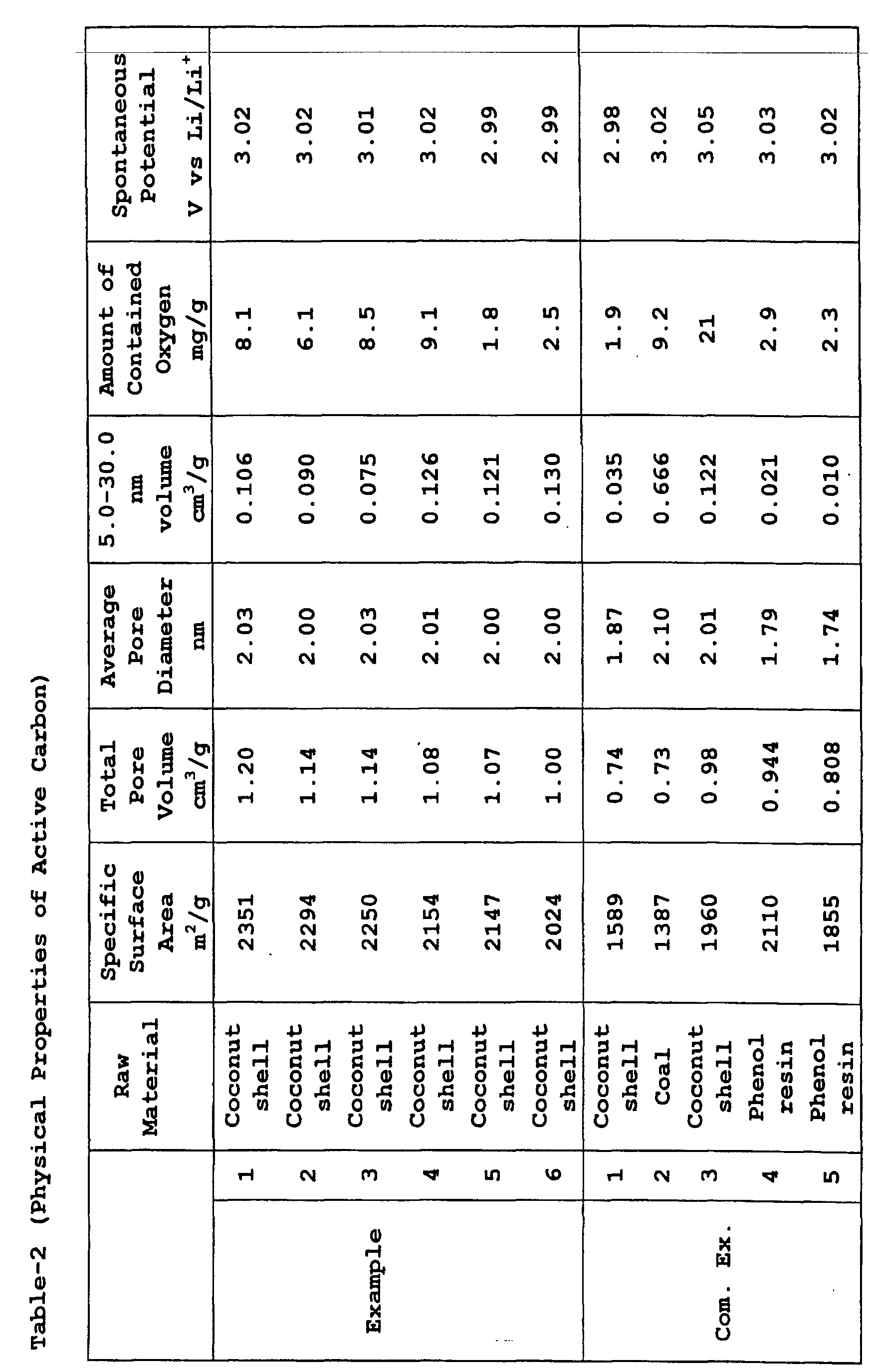
- the gist of the invention lies an activated carbon for use in electric double layer capacitors produced by carbonization of coconut shell, which is characterized in that a BET specific surface area is 2000 m 2 /g to 2500 m 2 /g, an average pore diameter is 1.95 nm (19.5 ⁇ ) to 2.20 nm (22 ⁇ ) and a pore volume of pores having a pore diameter calculated according to a Cranston-Inkley method of 5.0 nm (50 ⁇ ) to 30.0 nm (300 ⁇ ) is 0.05 cm 3 /g to 0.15 cm 3 /g.
- an oxygen content per g of the active carbon is 1 mg to 20 mg
- a rest potential vs a lithium electrode is 2.85 V to 3.03 V in a nonaqueous electrolytic solution
- the activated carbon obtained by subjecting a coconut shell carbonization product to steam activation.
- the activated carbon of the invention for use in electric double layer capacitors is an activated carbon produced by carbonization of coconut shell, which must satisfy the conditions on the physical properties of a BET specific surface area of 2000 m 2 /g to 2500 m 2 /g, an average pore diameter of 1.95 nm (19.5 ⁇ ) to 2.20 nm (22 ⁇ ) and a pore volume of pores having a pore diameter calculated according to a Cranston-Inkley method of 5.0 nm (50 ⁇ ) to 30.0 nm (300 ⁇ ), of 0.05 cm 3 /g to 0.15 cm 3 /g and, preferably, satisfies the conditions on the physical properties on the physical properties of an oxygen content of 1 mg to 20 mg per g of the active carbon, and a rest potential vs a lithium electrode of 2.85 V to 3.03 V in a nonaqueous electrolytic solution.
- an electric double layer capacitor using the activated carbon of the invention satisfying the conditions on the physical properties as a material for polarizable electrodes, bulk density of the activated carbon is enough high, and ion conductivity of electrolyte ion and solvent molecule of an electrolytic solution existing in the pores of the activated carbon is enough large to give a sufficiently high power even upon charging and discharging under a large electric current.
- durability of the electric double layer capacitor can be more improved by adjusting the amount of oxygen contained in the activated carbon to an adequate amount and adjusting a rest potential of the activated carbon electrode in a nonaqueous electrolytic solution to an adequate range.
- the invention can realize such excellent properties of the activated carbon obtained from coconut shell, and hence the activated carbon of the invention has advantages over those obtained from expensive synthetic resins such as a phenol resin in productivity and cost.
- the activated carbon of the invention for use in electric double layer capacitors prefferably has a BET specific surface area, determined by the BET method according to a nitrogen adsorption method, of 2000 m 2 /g to 2500 m 2 /g, preferably 2000 m 2 /g to 2400 m 2 /g, more preferably 2050 m 2 /g to 2250 m 2 /g, because, in case where specific surface area of the activated carbon is too large, there results a decrease in bulk density, leading to a decrease in power per unit volume. In case where the specific surface area is smaller than the range, there results a decrease in output per unit weight, thus such specific surface area not being preferred.
- the activated carbon of the invention for use in electric double layer capacitors to have an average pore diameter of 1.95 nm (19.5 ⁇ ) to 2.20 nm (22 ⁇ ).
- the average pore diameter is too small, electric resistance increases so much apparently due to diffusion resistance of electrolyte ion within the pores upon charging and discharging under a large electric current that the resulting capacitors are not suited for uses requiring a high output.
- the average pore diameter is too large, there results a decrease in bulk density of the activated carbon and a decrease in output per unit volume, thus such pore diameter not being preferred.
- the pore diameter is preferably 2.00 nm (20.0 ⁇ ) to 2.15 nm (21.5 ⁇ ), more preferably 2.02 nm (20.2 ⁇ ) to 2.15 nm (21.5 ⁇ ).
- the activated carbon of the invention for use in electric double layer capacitors to have a pore volume of pores having a pore diameter calculated according to the Cranston-Inkley method of 5.0 nm (50 ⁇ ) to 30.0 nm (300 ⁇ ), of 0.05 cm 3 /g to 0.15 cm 3 /g.
- the pore volume is preferably 0.07 to 0.13 cm 3 /g, more preferably 0.08 to 0.12 cm 3 /g.
- activated carbon of the invention for use in electric double layer capacitors to be produced from coconut shell.
- coconut shell As common raw materials for activated carbon other than coconut shell, there are illustrated various ones such as petroleum-based pitch, petroleum coke, fibers obtained by spinning tar pitch, synthetic polymers, phenol resin, furan resin, polyvinyl chloride resin, polyvinylidene chloride resin, polyimide resin, polyamide resin, liquid crystal polymers, plastic wastes and wasted tires.
- the activated carbon of the invention is obtained by carbonizing coconut shell, then activating the carbonization product.
- Activating methods are roughly classified into a gas activation method and a chemical agent activation method.
- the gas activation method which is also called physical activation in contrast to that the chemical agent activation is chemical activation, is an activation to produce activated carbon by bringing the carbonized raw material into contact with steam, carbonic acid gas, oxygen or other oxidizing gas at a high temperature to conduct reaction.
- the chemical agent activation method is a method of uniformly impregnating the raw material with an activating chemical agent, heating it in an inert gas atmosphere to cause dehydration and oxidation reaction of the chemical agent to thereby obtain activated carbon.
- chemical agents to be used there are illustrated zinc chloride, phosphoric acid, sodium phosphate, calcium chloride, potassium sulfide, potassium hydroxide, sodium hydroxide, potassium carbonate, sodium carbonate, sodium sulfate, potassium sulfate and calcium carbonate.
- Methods for producing activated carbon are not particularly limited and, so long as the resultant activated carbon satisfies the requirements on the above-described properties, the methods are not limited to the above-mentioned methods.
- steam activation method is advantageous since activated carbon obtained by steam activation method shows an excellent durability when used in electric double layer capacitors and can be produced at a low production cost.
- shape of activated carbon there are various shapes such as pulverized shape, particulate shape, granular shape, fiber shape, felt shape, woven fabric and sheet, and activated carbon of any of them may be used in the invention.
- the activated carbon in the invention obtained by steam activation method is obtained by pulverizing coconut shell, adjusting particle size of the pulverized product, then carbonizing (dry distillation) it in an inert atmosphere, and heat-treating the resulting coconut shell char at a temperature of 800°C to 1300°C, preferably 850 to 1200°C, more preferably 900 to 1100°C, in an inert gas of nitrogen, argon or a combustion exhaust gas containing a steam gas atmosphere in a content of 30% by volume to 100% by volume.
- Activated carbons from which metal impurities, ashes, etc. are removed by washing coconut shell before activation treatment, coconut shell char or activated carbon obtained by activation treatment, in an aqueous solution of hydrochloric acid, nitric acid, sulfuric acid or the like, are also included in the invention.
- the average particle diameter is preferably 30 ⁇ m or less, more preferably 7 to 20 ⁇ m, in the point of improving bulk density of electrode and reducing its inner electrical resistance.
- the activated carbon of the invention for use in electric double layer capacitors shows a rest potential vs Li/Li + as a counter electrode of preferably 2.85 V to 3.03 V, more preferably 2.90 to 3.00 V, in a nonaqueous electrolytic solution, in the electric double layer capacitor using the nonaqueous electrolytic solution.
- a rest potential vs Li/Li + as a counter electrode of preferably 2.85 V to 3.03 V, more preferably 2.90 to 3.00 V
- a nonaqueous electrolytic solution in the electric double layer capacitor using the nonaqueous electrolytic solution.
- the spontaneous potential is too large, there results reduction in durability of an electric double layer capacitor assembled using such activated carbon as, for example, a positive electrode, in which capacitor electric potential of the positive electrode after charging by applying a voltage of 2.5 V or more becomes about 4.3 V (vs Li/Li + ) to reach the oxidation decomposition potential of the electrolytic solution (4.3 V or more), thus decomposition reaction of the electrolytic solution occurring.
- the rest potential of the carbonaceous electrode functioning as positive electrode in the invention is measured in a common electrochemical manner. Measurement of the potential in a nonaqueous electrolytic solution is not so strictly defined as with the standard hydrogen electrode in an aqueous solution. Actually, however, it has widely been conducted using such electrode as a silver-silver chloride electrode, a platinum electrode or a lithium electrode. In the invention, too, the potential can be measured according to the same methods.
- Amount of oxygen contained in the activated carbon is a factor exerting some influence on durability of the electric double layer capacitor and, therefore, it is preferred to control the oxygen amount to an adequate amount.
- the oxygen amount per g of the activated carbon is preferably 1 mg to 20 mg, more preferably 2 mg to 10 mg.
- the amount of oxygen contained in the activated carbon is a value which is obtained by heat-treating the activated carbon at around 1000°C in vacuo or in an inert gas atmosphere of an argon gas or a nitrogen gas, determining carbon monoxide (CO) and carbon dioxide (CO 2 ) contained in the decomposition gas generated upon the heat treatment, and calculating the total amount of oxygen contained in these molecules.
- this oxygen amount corresponds to that of oxygen-containing functional groups in the activated carbon, i.e., carboxyl group, phenol group, ketone group, and the like and, in other words, the oxygen content in the invention can be said to be an indication of the total amount of oxygen-containing functional groups contained in the activated carbon.
- the oxygen amount per g of the activated carbon exceeds the above-described range, there results an increase in electrical resistance due to generation of gases inside the cell assumed to be caused by decomposition, or reaction with the electrolytic solution, of the oxygen-containing functional groups upon charging and discharging of the electric double layer capacitor and, as a result, durability of the capacitor will be decreased, thus such oxygen amount not being preferred.
- the oxygen amount is less than the above-described range, there results a decrease in affinity of the activated carbon with a binder for electrode upon preparing electrodes and, as a result, bulk density of the electrode decreases, leading to a decrease in output per unit volume, thus such oxygen amount not being preferred.
- Polarizable electrodes composed mainly of the activated carbon can be formed in a conventional manner and are mainly constituted by the activated carbon and a binder and, further, a conductive material may be added thereto for imparting conductivity to the electrodes.
- the activated carbon can be molded in a conventionally known manner.
- an electrode can be obtained as a molding by adding polytetrafluoroethylene to a mixture of the activated carbon and acetylene black, mixing them, then press-molding the mixture.
- an electrode can be obtained as a molding by adding coal pitch having a comparatively high softening point as a binder to the activated carbon, mixing them, molding the mixture, then calcining the molding to a temperature of the thermal decomposition temperature of the binder or higher in an inert atmosphere. Further, it is also possible to prepare a polarizable electrode by calcining only the activated carbon without using the conductive material and the binder.
- the electrode may be formed as a thin coat film, a sheet-like molding or a plate-like molding, or a plate-like molding composed of a composite material.
- the activated carbon may be pulverized to a desired granular shape before mixing with a binder, or may be mixed as particles having a comparatively large particle diameter with a binder, followed by pulverizing together with the binder to obtain a product as a mixture slurry or a dry pulverization product.
- the conductive material to be used for the activated carbon electrode at least one conductive material selected from the group consisting of carbon black such as acetylene black and KETJEN BLACK, natural graphite, thermal expansion graphite, carbon fibers, ruthenium oxide, titanium oxide, and metal fibers such as aluminum and nickel.
- carbon black such as acetylene black and KETJEN BLACK
- natural graphite such as acetylene black and KETJEN BLACK
- carbon fibers such as acetylene black and KETJEN BLACK
- ruthenium oxide titanium oxide
- metal fibers such as aluminum and nickel.
- Amount of the conductive material based on the activated carbon is preferably 5 to 50% by weight, particularly preferably 10 to 30% by weight, though depending upon bulk density of the activated carbon, because, in case where the amount of conductive material is too large, proportion of the activated carbon is decreased, leading to a decreased volume of the electrode.
- binder there is preferably used at least one of polytetrafluoroethylene, polyvinylidene fluoride, carboxy cellulose, methyl cellulose, crosslinked fluoro-olefin copolymer, polyvinyl alcohol, polyacrylic acid, polyimide, petroleum pitch, coal pitch and phenol resin.
- a current collector is not particularly limited, and any one that has enough corrosion resistance both electrochemically and chemically may be used.
- a current collector for a positive electrode that made of stainless steel, aluminum, titanium or tantalum is illustrated and, as a current collector for a negative electrode, that made of stainless steel, nickel, aluminum or copper is preferably used.
- the electrolytic solution is preferably a nonaqueous electrolytic solution.
- a salt of a combination of a quaternary onium cation exemplified by R 4 N + , R 4 P + (wherein R represents an alkyl group shown by C n H 2n+1 ; n 1 to 4) or triethylmethyl ammonium ion and an anion of BF 4 - , PF 6 - , ClO 4 - , SbF 6 - or CF 3 SO 3 - ; or a lithium salt wherein cation is lithium ion is used.
- lithium salt one or more substances selected from among LiBF 4 , LiC1O 4 , LiPF 6 , LiSbF 6 , LiAsF 6 , LiCF 3 SO 3 , LiC(CF 3 SO 2 ) 3 , LiB(C 6 H 5 ) 4 , LiC 4 F 9 SO 3 , LiC 8 F 17 SO 3 and LiN(CF 3 SO 2 ) 2 are preferred.
- Concentration of the solute in the nonaqueous electrolytic solution is preferably 0.3 to 2.0 mols/liter so as to sufficiently obtain characteristic properties of the electric double layer capacitor, with 0.7 mol/liter to 1.9 mols/liter being particularly preferred to obtain a higher conductivity.
- a concentration of not less than 2.0 mols/liter is not preferred because, upon charging and discharging at a low temperature of -20°C or lower, conductivity of the electrolytic solution is decreased.
- a concentration of not more than 0.3 mol/liter is not preferred because conductivity becomes small at room temperature or at lower temperatures.
- Et 4 NB 4 tetraethylammonium tetrafluoroborate
- concentration of Et 4 NB 4 is preferably 0.5 to 1.0 mol/liter.
- Solvents for the nonaqueous electrolytic solution are not particularly limited, but are preferably one or more organic solvents selected from among propylene carbonate, ethylene carbonate, butylene carbonate, dimethyl carbonate, methyl ethyl carbonate, diethyl carbonate, sulfolane, methylsulfolane, ⁇ -butyrolactone, ⁇ -valorolactone, N-methyloxazolidinone, dimethylsulfoxide and trimethylsulfoxide.
- organic solvents selected from among propylene carbonate, ethylene carbonate, butylene carbonate, dimethyl carbonate, methyl ethyl carbonate, diethyl carbonate, sulfolane, methylsulfolane, ⁇ -butyrolactone, ⁇ -valorolactone, N-methyloxazolidinone, dimethylsulfoxide and trimethylsulfoxide.
- one or more organic solvents selected from among propylene carbonate, ethylene carbonate, butylene carbonate, dimethyl carbonate, methyl ethyl carbonate, diethyl carbonate, sulfolane, methylsulfolane and ⁇ -butyrolactone are particularly preferred.
- high-melting point solvents such as ethylene carbonate cannot be used independently because they become solid at lower temperatures, and must be used as a mixed solvent with low-melting point solvents such as propylene carbonate or the like.
- Water content in the nonaqueous electrolytic solution is preferably 200 ppm or lower, more preferably 50 ppm or lower, so as to obtain a high withstand voltage.
- Example 1 Comparative Examples 1, 3
- Comparative Example 2 the same procedure as in Example 1 was conducted except for using a pulverized product of bituminous coal in place of the coconut shell char to obtain activated carbon powders
- Comparative Examples 4, 5 the same procedure as in Example 1 was conducted except for respectively using carbonized products obtained by carbonizing phenol resin (novolak) cured product at 700°C in a nitrogen atmosphere in place of the coconut shell char to obtain activated carbon powders.
- Example 1 80 930 135 2 80 930 125 3 60 900 150 4 60 900 135 5 60 900 130 6 60 900 125 Com. Ex.1 60 900 80 2 60 900 140 3 60 900 130 4 60 900 140 5 60 900 130
- BET specific surface area, pore volume of pores having a pore diameter of 5.0 nm (50 ⁇ ) to 30.0 nm (300 ⁇ ), and total pore volume, of activated carbon powders thus obtained were calculated from adsorption isotherm of activated carbon obtained by measuring equilibrium adsorption amount of nitrogen gas of each activated carbon powder under each relative pressure at a liquid nitrogen temperature using a Sorptomatic Model 1800 (made by Faison).
- Average pore diameter of the activated carbon powder was calculated from the total pore volume and the BET specific surface area determined from the above-described isotherm of nitrogen gas assuming that the pore of the active carbon is of a cylindrical shape.
- Amount of oxygen contained in the activated carbon was determined as follows.
- a quartz glass-made reaction tube containing therein about 1 g of activated carbon powder was heated to about 1000°C, and a gas generated during the heating was injected into a gas chromatograph analyzer to determine a CO component and a CO 2 component in the generated gas. Sum of the oxygen amounts of determined CO and CO 2 components was calculated to obtain the amount of oxygen contained per g of the activated carbon.
- Each of the activated carbons obtained in the above-described examples of producing activated carbons was tested as follows. A mixture composed of 80% by weight of the activated carbon powder, 10% by weight of acetylene black and 10% by weight of polytetrafluoroethylene was kneaded, and press-molded into a disc-like molding of 10 mm in diameter and 0.5 mm in thickness under a pressure of 50 kgf/cm 2 through an oil hydraulic press using a tablet-molding apparatus (made by Nippon Bunko Co., Ltd.), thus a positive electrode molding being obtained. Similarly, another sheet of the molding was prepared to use as a negative electrode molding. The thus obtained two moldings were dried at 300°C for 3 hours under a vacuum of 0.1 torr or lower.
- the thus dried two moldings were transferred into a dry box kept in a nitrogen gas atmosphere, then the positive and negative electrode moldings were impregnated with an electrolytic solution of a solution of (C 2 H 5 ) 4 NBF 4 in propylene carbonate in vacuo. Subsequently, the positive electrode molding and the negative electrode molding impregnated with the electrolytic solution were disposed in confronting relation to each other with a polyethylene-made separator interposed therebetween, followed by caulk-sealing the assembly inside a stainless steel-made coin cell to obtain a coin cell type electric double layer capacitor.
- Distilled water was added to a mixture composed of 8 parts by weight of each of the activated carbons obtained in the examples of producing the activated carbon, 3 parts by weight of conductive carbon black and 3 parts by weight of cellulose series binder, then kneading the mixture to obtain a coating paste of an electrode.
- the thus obtained paste was coated on an etched aluminum foil, followed by drying to obtain an electrode body having coated thereon a 40- ⁇ m thick activated carbon paste. From this electrode body were obtained two electrode bodies having an effective electrode area of 7.07 cm x 7.07 cm (50 cm 2 ), one being used as a positive electrode and the other as a negative electrode.
- the positive and negative electrodes were disposed in confronting relation to each other with the activated carbon electrode coat inside, with a cellulose series separator being provided therebetween, to obtain an electrochemical element.
- This element was sandwiched between glass plates, and the glass plates were sandwiched between stainless steel-made plates, followed by fixing the element using bolts and nuts to obtain an electric double layer capacitor element.
- the thus obtained capacitor element was heat-dried in vacuo to remove impurities. Subsequently, the element was impregnated with an electrolytic solution of a solution of (C 2 H 5 ) 4 NBF 4 in propylene carbonate to obtain an electric double layer capacitor.
- Electrostatic capacity (F/cm 3 ), inner electrical resistance ( ⁇ ) and power density (W/cm 3 ) obtained by discharging from 2.5 V to 1.5 V for 2 seconds were calculated from the discharge curve.
- Capacitor performances per unit volume (F/cm 3 and W/cm 3 ) were calculated by converting the electrostatic capacity (F) and output (W) determined from the obtained discharge curve to values per volume of the activated carbon electrode coat. The thus calculated capacitor properties are shown in Table-4.
- a mixture composed of 80% by weight of the activated carbon powder of each of the activated carbons obtained in the above-described examples of producing the activated carbon, 10% by weight of acetylene black and 10% by weight of polytetrafluoroethylene was kneaded, and press-molded into a disc-like molding of 10 mm in diameter and 0.5 mm in thickness under a pressure of 50 kgf/cm 2 through an oil hydraulic press using a tablet-molding apparatus (made by Nippon Bunko Co., Ltd.), thus a positive electrode molding being obtained.
- another sheet of the molding was prepared to use as a negative electrode molding.
- the thus obtained two moldings were dried at 300°C for 3 hours under a vacuum of 0.1 torr or lower.
- the thus dried two moldings were transferred into a dry box kept in a nitrogen gas atmosphere, then the positive and negative electrode moldings were impregnated with an electrolytic solution of a solution of (C 2 H 5 ) 4 NBF 4 in propylene carbonate in vacuo. Subsequently, the positive electrode molding and the negative electrode molding impregnated with the electrolytic solution were disposed in confronting relation to each other with a polyethylene-made separator interposed therebetween, followed by caulk-sealing the assembly in a stainless steel-made coin cell to obtain a coin cell type electric double layer capacitor.
- a mixture composed of 80% by weight of the activated carbon powder of each of the activated carbons obtained in the examples of producing the activated carbon, 10% by weight of acetylene black and 10% by weight of polytetrafluoroethylene was kneaded, and press-molded into a disc-like molding of 10 mm in diameter and 0.5 mm in thickness under a pressure of 50 kgf/cm 2 through an oil hydraulic press using a tablet-molding apparatus (made by Nihon Bunko Co., Ltd.).
- the thus obtained molding was dried at 300°C for 3 hours under a vacuum of 0.1 torr or lower.
- the thus dried activated carbon electrode and a metallic lithium foil of 0.5 mm in thickness punched as a 10-mm diameter piece were disposed in confronting relation to each other with a polyethylene-made separator (made by Mitsubisi Chemical Corporation) interposed therebetween, followed by sandwiching the activated carbon electrode and the metallic lithium foil from outside by platinum plates functioning as a current collector.
- the resulting assembly was then held from the outermost sides by two sheets of 5-mm thick Teflon plate having four bolt holes to securely contact the current collectors, the activated carbon electrodes and the separator to each other. This was then dipped in a 1 mol/liter solution of LiBF 4 in propylene carbonate placed in a beaker.
- An electric double layer capacitor which can give a large power density per unit volume and which, even when charge-and-discharge cycle is repeated under a large current or a constant voltage is continuously applied for a long time, undergoes less decrease in power density can be provided by using activated carbon of the invention manufactured from coconut shell and having an adequate pore distribution, an adequate specific surface area, an adequate surface state and adequate electrochemical properties.
Landscapes
- Engineering & Computer Science (AREA)
- Chemical & Material Sciences (AREA)
- Power Engineering (AREA)
- Materials Engineering (AREA)
- Microelectronics & Electronic Packaging (AREA)
- Organic Chemistry (AREA)
- Inorganic Chemistry (AREA)
- Environmental & Geological Engineering (AREA)
- Electric Double-Layer Capacitors Or The Like (AREA)
- Carbon And Carbon Compounds (AREA)
Abstract
Description
| Steam Concentration (vol %) | Activation Temperature °C | Activation Time min. | |
| Example 1 | 80 | 930 | 135 |
| 2 | 80 | 930 | 125 |
| 3 | 60 | 900 | 150 |
| 4 | 60 | 900 | 135 |
| 5 | 60 | 900 | 130 |
| 6 | 60 | 900 | 125 |
| Com. Ex.1 | 60 | 900 | 80 |
| 2 | 60 | 900 | 140 |
| 3 | 60 | 900 | 130 |
| 4 | 60 | 900 | 140 |
| 5 | 60 | 900 | 130 |
| (Initial performance 25°C/2.5 V coin cell) | ||
| Electrostatic Capacity (F) | IR-drop (V) | |
| Example 1 | 0.96 | 0.05 |
| 2 | 0.98 | 0.10 |
| 3 | 1.02 | 0.12 |
| 4 | 0.97 | 0.13 |
| 5 | 1.03 | 0.10 |
| 6 | 1.00 | 0.13 |
| Comparative | 0.90 | 0.25 |
| Example 1 | ||
| 2 | 0.88 | 0.26 |
| 3 | 0.90 | 0.30 |
| 4 | 0.88 | 0.33 |
| 5 | 0.88 | 0.34 |
| (Initial properties of capacitors, 25°C/2.5 V) | |||
| Electrostatic Capacity F/cm3 | Inner Electrical Resistance Ω | 2-Sec. Power Density W/cm3 | |
| Example 3 | 13.0 | 0.15 | 7.8 |
| Example 4 | 12.2 | 0.14 | 7.4 |
| Example 5 | 1.00 | 0.14 | 7.7 |
| Comparative Example 1 | 12.1 | 0.19 | 6.8 |
| Comparative Example 2 | 9.7 | 0.15 | 6.6 |
| (durability, 70°C/2.8 V) | |||
| Initial Capacity F | After 500 hrs F | Rate of Change % | |
| Example 2 | 1.50 | 1.38 | 92 |
| Example 3 | 1.57 | 1.43 | 91 |
| Example 4 | 1.49 | 1.37 | 92 |
| Example 6 | 1.49 | 1.39 | 93 |
| Comparative Example 3 | 1.47 | 1.15 | 78 |
Claims (9)
- An activated carbon for electric double layer capacitors produced by carbonization of coconut shell, wherein a BET specific surface area is 2000 m2/g to 2500 m2/g, an average pore diameter is 1.95 nm (19.5 Å) to 2.20 nm (22 Å) and a pore volume of pores having a pore diameter calculated according to a Cranston-Inkley method of 5.0 nm (50 Å) to 30.0 nm (300 Å) is 0.05 cm3/g to 0.15 cm3/g.
- The activated carbon for electric double layer capacitors as claimed in claim 1, wherein the amount of oxygen contained per g of the activated carbon is 1 mg to 20 mg, and a spontaneous potential vs a lithium electrode is 2.85 V to 3.03 V in a nonaqueous electrolytic solution.
- The activated carbon for electric double layer capacitors as claimed in claim 1 or 2, wherein the activated carbon is obtained by subjecting a coconut shell carbonization product to steam activation.
- The activated carbon for electric double layer capacitors as claimed in claim 1, wherein the BET specific surface area is 2000 m2/g to 2400 m2/g.
- The activated carbon for electric double layer capacitors as claimed in claim 1, wherein the BET specific surface area is 2050 m2/g to 2250 m2/g.
- The activated carbon for electric double layer capacitors as claimed in claim 1, wherein the pore volume of pores having a pore diameter calculated according to a Cranston-Inkley method of 5.0 nm (50 Å) to 30.0 nm (300 Å) is 0.07 cm3/g to 0.13 cm3/g.
- The activated carbon for electric double layer capacitors as claimed in claim 1, wherein the pore volume of pores having a pore diameter calculated according to a Cranston-Inkley method of 5.0 nm (50 Å) to 30.0 nm (300 Å) is 0.08 cm3/g to 0.12 cm3/g.
- The activated carbon for electric double layer capacitors as claimed in claim 1, wherein the average pore diameter is 2.00 nm to 2.15 nm.
- The activated carbon for electric double layer capacitors as claimed in claim 1, wherein the average pore diameter is 2.02 nm to 2.15 nm.
Applications Claiming Priority (3)
| Application Number | Priority Date | Filing Date | Title |
|---|---|---|---|
| JP2000136253 | 2000-05-09 | ||
| JP2000136253 | 2000-05-09 | ||
| PCT/JP2001/003820 WO2001086674A1 (en) | 2000-05-09 | 2001-05-07 | Activated carbon for electric double layer capacitor |
Publications (3)
| Publication Number | Publication Date |
|---|---|
| EP1211702A1 true EP1211702A1 (en) | 2002-06-05 |
| EP1211702A4 EP1211702A4 (en) | 2005-08-17 |
| EP1211702B1 EP1211702B1 (en) | 2006-07-26 |
Family
ID=18644228
Family Applications (1)
| Application Number | Title | Priority Date | Filing Date |
|---|---|---|---|
| EP01926133A Expired - Lifetime EP1211702B1 (en) | 2000-05-09 | 2001-05-07 | Activated carbon for electric double layer capacitor |
Country Status (4)
| Country | Link |
|---|---|
| US (2) | US7625839B2 (en) |
| EP (1) | EP1211702B1 (en) |
| DE (1) | DE60121705T2 (en) |
| WO (1) | WO2001086674A1 (en) |
Cited By (12)
| Publication number | Priority date | Publication date | Assignee | Title |
|---|---|---|---|---|
| FR2886045A1 (en) * | 2005-05-23 | 2006-11-24 | Ceca Sa Sa | ELECTRODE FOR ENERGY STORAGE SYSTEMS, METHOD FOR MANUFACTURING SAME, AND ENERGY STORAGE SYSTEM COMPRISING SAME |
| WO2010053939A1 (en) * | 2008-11-04 | 2010-05-14 | Corning Incorporated | Highly porous activated carbon with controlled oxygen content |
| US7799733B2 (en) | 2004-03-31 | 2010-09-21 | Council Of Scientific And Industrial Research | Process for preparing high surface area carbon |
| WO2011090993A3 (en) * | 2010-01-22 | 2011-11-17 | Corning Incorporated | High-capacitance and low-oxygen porous carbon for edlcs |
| CN103140442A (en) * | 2010-10-08 | 2013-06-05 | 西门子工业公司 | Mesoporous activated carbon and methods of producing same |
| EP2695176A4 (en) * | 2011-04-07 | 2015-04-29 | Retriev Technologies Inc | Carbon electrodes and electrochemical capacitors |
| EP2541566A4 (en) * | 2010-02-26 | 2016-01-13 | Shanghai Aowei Technology Dev | Manufacturing method for long-lived negative electrode and capacitor battery adopting the same |
| WO2016022615A1 (en) * | 2014-08-08 | 2016-02-11 | Corning Incorporated | High pore volume utilization carbon and electric double layer capacitor |
| US9318273B2 (en) | 2013-07-26 | 2016-04-19 | Corning Incorporated | High voltage EDLC electrodes containing CO2 activated coconut char |
| WO2016123271A1 (en) * | 2015-01-30 | 2016-08-04 | Corning Incorporated | Anode for lithium ion capacitor based on carbonized coconut shell |
| WO2016094266A3 (en) * | 2014-12-12 | 2016-10-06 | Corning Incorporated | Activated carbon and electric double layer capacitor thereof |
| EP3825279A4 (en) * | 2018-07-20 | 2022-04-20 | Kuraray Co., Ltd. | CARBON MATERIAL AND METHOD FOR PRODUCTION THEREOF, ACTIVE ELECTRODE MATERIAL FOR ELECTROCHEMICAL DEVICES, ELECTRODE FOR ELECTROCHEMICAL DEVICES AND ELECTROCHEMICAL DEVICE |
Families Citing this family (78)
| Publication number | Priority date | Publication date | Assignee | Title |
|---|---|---|---|---|
| DE60121705T2 (en) | 2000-05-09 | 2007-08-02 | Mitsubishi Chemical Corp. | ACTIVATED CARBON FOR ELECTRIC DOUBLE-LAYER CAPACITOR |
| WO2004091781A1 (en) * | 2003-04-17 | 2004-10-28 | Sony Corporation | Catalyst and process for producing the same, catalytic electrode and process for producing the same, membrane/electrode union, and electrochemical device |
| US7791860B2 (en) | 2003-07-09 | 2010-09-07 | Maxwell Technologies, Inc. | Particle based electrodes and methods of making same |
| US7352558B2 (en) | 2003-07-09 | 2008-04-01 | Maxwell Technologies, Inc. | Dry particle based capacitor and methods of making same |
| EP1666412A4 (en) * | 2003-08-26 | 2010-04-14 | Osaka Gas Co Ltd | Hydrocarbon material and method for preparation thereof |
| US7920371B2 (en) | 2003-09-12 | 2011-04-05 | Maxwell Technologies, Inc. | Electrical energy storage devices with separator between electrodes and methods for fabricating the devices |
| US7090946B2 (en) | 2004-02-19 | 2006-08-15 | Maxwell Technologies, Inc. | Composite electrode and method for fabricating same |
| JP4705566B2 (en) * | 2004-03-31 | 2011-06-22 | 富士重工業株式会社 | Electrode material and manufacturing method thereof |
| US7492574B2 (en) * | 2005-03-14 | 2009-02-17 | Maxwell Technologies, Inc. | Coupling of cell to housing |
| US7440258B2 (en) | 2005-03-14 | 2008-10-21 | Maxwell Technologies, Inc. | Thermal interconnects for coupling energy storage devices |
| ES2259920B1 (en) * | 2005-04-01 | 2007-11-01 | Consejo Superior Investig. Cientificas | PROCEDURE FOR THE PRODUCTION OF ACTIVE CARBONS FROM APPLE PULP FOR USE IN ELECTRODES OF DOUBLE CAPE ELECTRICAL CONDENSERS (EDLC). |
| CA2612636C (en) * | 2005-06-24 | 2013-10-15 | Samvel Avakovich Kazaryan | Heterogeneous electrochemical supercapacitor and method of manufacture |
| CA2612642A1 (en) * | 2005-06-24 | 2007-01-04 | Valery Pavlovich Nedoshivin | Electrode and current collector for electrochemical capacitor having double electric layer and double electric layer electrochemical capacitor formed therewith |
| MX2007016485A (en) * | 2005-06-24 | 2008-03-11 | Universal Supercapacitors Llc | Current collector for double electric layer electrochemical capacitors and method of manufacture thereof. |
| US20070048605A1 (en) * | 2005-08-23 | 2007-03-01 | Pez Guido P | Stable electrolyte counteranions for electrochemical devices |
| US7723262B2 (en) * | 2005-11-21 | 2010-05-25 | Energ2, Llc | Activated carbon cryogels and related methods |
| DE202006016898U1 (en) * | 2006-10-12 | 2007-11-22 | BLüCHER GMBH | High performance adsorbents based on activated carbon with high microporosity |
| US7974073B2 (en) * | 2006-11-13 | 2011-07-05 | Mitsubishi Electric Corporation | Electric double-layer capacitor with a negative electrode containing a carbon material and a titanium oxide |
| JP2010510674A (en) * | 2006-11-15 | 2010-04-02 | エナジーツー・インコーポレイテッド | Electric double layer capacitor device |
| RU2483383C2 (en) * | 2006-11-27 | 2013-05-27 | ЮНИВЕРСАЛ СУПЕРКАПАСИТОРЗ ЭлЭлСи | Electrode for use in electrochemical capacitor with double electric layer (versions) |
| US20080204973A1 (en) * | 2007-02-28 | 2008-08-28 | Maxwell Technologies, Inc. | Ultracapacitor electrode with controlled iron content |
| US20080201925A1 (en) | 2007-02-28 | 2008-08-28 | Maxwell Technologies, Inc. | Ultracapacitor electrode with controlled sulfur content |
| WO2008123527A1 (en) * | 2007-03-27 | 2008-10-16 | Sumitomo Chemical Company, Limited | Method for producing liquid dispersion of solid fine particle, method for producing electrode and method for manufacturing electric double layer capacitor |
| US8804309B2 (en) * | 2008-06-05 | 2014-08-12 | California Institute Of Technology | Low temperature double-layer capacitors using asymmetric and spiro-type quaternary ammonium salts |
| US8293818B2 (en) | 2009-04-08 | 2012-10-23 | Energ2 Technologies, Inc. | Manufacturing methods for the production of carbon materials |
| KR101830879B1 (en) * | 2009-07-01 | 2018-02-21 | 바스프 에스이 | Ultrapure synthetic carbon materials |
| BR112012014092A2 (en) * | 2009-12-11 | 2016-07-05 | Energ2 Technologies Inc | coal materials comprising an electrochemical modifier. |
| US8377297B2 (en) * | 2009-12-23 | 2013-02-19 | Bae Systems Information And Electronic Systems Integration Inc. | Water desalination apparatus |
| US8916296B2 (en) | 2010-03-12 | 2014-12-23 | Energ2 Technologies, Inc. | Mesoporous carbon materials comprising bifunctional catalysts |
| US8198210B2 (en) | 2010-05-27 | 2012-06-12 | Corning Incorporated | Halogenated activated carbon materials for high energy density ultracapacitors |
| WO2012045002A1 (en) | 2010-09-30 | 2012-04-05 | Energ2 Technologies, Inc. | Enhanced packing of energy storage particles |
| US8482900B2 (en) | 2010-11-30 | 2013-07-09 | Corning Incorporated | Porous carbon for electrochemical double layer capacitors |
| EP2659498B1 (en) | 2010-12-28 | 2020-07-22 | Basf Se | Carbon materials comprising enhanced electrochemical properties |
| KR101109747B1 (en) * | 2011-04-06 | 2012-02-15 | (주)신행건설 | Method of preparation of activated carbon and method of prepartion of electrode thin-plate activated carbon film for simultaneous gas and dust removal in air polluion and electrode thin-plate preparaed by the method |
| US20120262127A1 (en) | 2011-04-15 | 2012-10-18 | Energ2 Technologies, Inc. | Flow ultracapacitor |
| CN103947017B (en) | 2011-06-03 | 2017-11-17 | 巴斯福股份公司 | Carbon-lead blends for use in hybrid energy storage devices |
| US8842417B2 (en) | 2011-09-23 | 2014-09-23 | Corning Incorporated | High voltage electro-chemical double layer capacitor |
| KR102029464B1 (en) * | 2011-10-21 | 2019-10-17 | 삼성전기주식회사 | Electric Double Layer Capacitor |
| US8982535B2 (en) * | 2011-11-16 | 2015-03-17 | Corning Incorporated | Cell design for high energy density electrochemical double layer capacitors |
| US20130120906A1 (en) * | 2011-11-16 | 2013-05-16 | Mark J. Soulliere | Cell design for high energy density electrochemical double layer capacitors |
| US9312077B2 (en) | 2011-12-16 | 2016-04-12 | Calgon Carbon Corporation | Double layer capacitors |
| US20130194721A1 (en) * | 2012-01-26 | 2013-08-01 | Samsung Electro-Mechanics Co., Ltd. | Activated carbon for lithium ion capacitor, electrode including the activated carbon as active material, and lithium ion capacitor using the electrode |
| US9409777B2 (en) | 2012-02-09 | 2016-08-09 | Basf Se | Preparation of polymeric resins and carbon materials |
| US20120177923A1 (en) * | 2012-03-20 | 2012-07-12 | Haycarb PLC | Low ash activated carbon and methods of making same |
| TWI472483B (en) * | 2012-10-30 | 2015-02-11 | Ind Tech Res Inst | Porous carbon material and manufacturing method thereof and supercapacitor |
| JP6033395B2 (en) | 2013-02-20 | 2016-11-30 | 大阪ガスケミカル株式会社 | Granular activated carbon and method for producing the same |
| CN105008277B (en) * | 2013-02-20 | 2018-06-29 | 大阪燃气化学株式会社 | Granular active carbon and its manufacturing method more than mesoporous |
| CN105190948B (en) | 2013-03-14 | 2019-04-26 | 14族科技公司 | Composite carbon materials containing lithium alloyed electrochemical modifiers |
| US9914110B2 (en) | 2013-03-15 | 2018-03-13 | Evoqua Water Technologies Llc | Mesoporous activated carbon |
| WO2014208474A1 (en) | 2013-06-26 | 2014-12-31 | ダイキン工業株式会社 | Electrolyte solution and electrochemical device |
| US10320000B2 (en) * | 2013-07-18 | 2019-06-11 | Ut-Battelle, Llc | Pyrolytic carbon black composite and method of making the same |
| US9136064B2 (en) * | 2013-07-26 | 2015-09-15 | Corning Incorporated | Carbon for high voltage EDLCs |
| US10195583B2 (en) | 2013-11-05 | 2019-02-05 | Group 14 Technologies, Inc. | Carbon-based compositions with highly efficient volumetric gas sorption |
| JP6665121B2 (en) | 2014-03-14 | 2020-03-13 | グループ14・テクノロジーズ・インコーポレイテッドGroup14 Technologies, Inc. | Novel method for sol-gel polymerization in solvent-free and preparation of variable carbon structures derived from sol-gel polymerization |
| CN106660797B (en) * | 2014-07-03 | 2019-07-12 | 东丽株式会社 | The manufacturing method of Porous carbon material and Porous carbon material |
| EP3171431B1 (en) * | 2014-07-15 | 2019-03-06 | Toray Industries, Inc. | Electrode material and a lithium-ion battery or lithium ion capacitor using same |
| US10249881B2 (en) * | 2014-07-15 | 2019-04-02 | Toray Industries, Inc. | Electrode material for metal-air battery |
| WO2016043154A1 (en) * | 2014-09-17 | 2016-03-24 | 東レ株式会社 | Electrode material for electrochemical capacitor, electrode coating solution for electrochemical capacitor, electrode for electrochemical capacitor, and electrochemical capacitor |
| US9607778B2 (en) | 2015-01-30 | 2017-03-28 | Corning Incorporated | Poly-vinylidene difluoride anode binder in a lithium ion capacitor |
| US9672992B2 (en) | 2015-01-30 | 2017-06-06 | Corning Incorporated | Coke sourced anode for lithium ion capacitor |
| US9911545B2 (en) | 2015-01-30 | 2018-03-06 | Corning Incorporated | Phenolic resin sourced carbon anode in a lithium ion capacitor |
| US9679704B2 (en) | 2015-01-30 | 2017-06-13 | Corning Incorporated | Cathode for a lithium ion capacitor |
| US9941058B2 (en) * | 2015-05-26 | 2018-04-10 | Ut-Battelle, Llc | Flexible and conductive waste tire-derived carbon/polymer composite paper as pseudocapacitive electrode |
| TWI726887B (en) | 2015-06-12 | 2021-05-11 | 日商可樂麗股份有限公司 | Carbonaceous material for electronic materials and manufacturing method thereof |
| US20190097222A1 (en) | 2015-08-14 | 2019-03-28 | Energ2 Technologies, Inc. | Composites of porous nano-featured silicon materials and carbon materials |
| EP4286355A3 (en) | 2015-08-28 | 2024-05-01 | Group14 Technologies, Inc. | Novel materials with extremely durable intercalation of lithium and manufacturing methods thereof |
| US9884804B2 (en) | 2016-05-24 | 2018-02-06 | Ut-Battelle, Llc | Surface treated carbon catalysts produced from waste tires for fatty acids to biofuel conversion |
| KR102130931B1 (en) * | 2016-11-15 | 2020-07-08 | 주식회사 쿠라레 | Carbonaceous material for electric double layer capacitor and method for manufacturing the same |
| DE102016123166A1 (en) | 2016-11-30 | 2018-05-30 | Zentrum für Sonnenenergie- und Wasserstoff-Forschung Baden-Württemberg Gemeinnützige Stiftung | ACTIVATED CARBON AND ITS USE AS A CAPACITOR ELECTRODE IN A DOUBLE-LAYER CONDENSER |
| US11611071B2 (en) | 2017-03-09 | 2023-03-21 | Group14 Technologies, Inc. | Decomposition of silicon-containing precursors on porous scaffold materials |
| CN110582464B (en) * | 2017-05-10 | 2023-06-06 | 株式会社可乐丽 | Modified activated carbon and method for producing same |
| WO2020096008A1 (en) | 2018-11-09 | 2020-05-14 | 株式会社クラレ | Carbonaceous material, method for producing same, electrode active material for electrochemical device, electrode for electrochemical device, and electrochemical device |
| WO2022035879A1 (en) | 2020-08-10 | 2022-02-17 | Group14 Technologies, Inc. | Vibro-thermally assisted chemical vapor infiltration |
| US11335903B2 (en) | 2020-08-18 | 2022-05-17 | Group14 Technologies, Inc. | Highly efficient manufacturing of silicon-carbon composites materials comprising ultra low z |
| KR102600078B1 (en) | 2020-08-18 | 2023-11-08 | 그룹14 테크놀로지스, 인코포레이티드 | Manufacturing of silicon-carbon composite materials |
| US11639292B2 (en) | 2020-08-18 | 2023-05-02 | Group14 Technologies, Inc. | Particulate composite materials |
| US11174167B1 (en) | 2020-08-18 | 2021-11-16 | Group14 Technologies, Inc. | Silicon carbon composites comprising ultra low Z |
| CA3195890A1 (en) | 2020-09-30 | 2022-04-07 | Group14 Technologies, Inc. | Methods of passivation to control oxygen content and reactivity of silicon-carbon composite materials |
Family Cites Families (30)
| Publication number | Priority date | Publication date | Assignee | Title |
|---|---|---|---|---|
| US3624004A (en) * | 1968-02-16 | 1971-11-30 | Standard Oil Co | Process for the production of active carbons |
| JPS6015138A (en) | 1983-07-08 | 1985-01-25 | 凸版印刷株式会社 | Manufacture of square pillar vessel |
| JPS63187614A (en) | 1987-01-30 | 1988-08-03 | 旭硝子株式会社 | Electric double-layer capacitor |
| JP2666848B2 (en) | 1988-06-22 | 1997-10-22 | 日本電気株式会社 | Carbon paste electrode |
| JPH0297414A (en) * | 1988-10-01 | 1990-04-10 | Kansai Coke & Chem Co Ltd | Production of active carbon having superior quality |
| JP3074175B2 (en) | 1989-06-14 | 2000-08-07 | 科学技術振興事業団 | Microcluster device and method and apparatus for manufacturing the same |
| JPH0338676A (en) | 1989-07-05 | 1991-02-19 | Victor Co Of Japan Ltd | Transfer method for charged image |
| JPH0795504B2 (en) | 1989-12-08 | 1995-10-11 | 日本電気株式会社 | Electric double layer capacitor |
| EP0514545A4 (en) | 1990-02-09 | 1993-03-17 | Takeda Chemical Industries, Ltd. | Carbonaceous material with high electrostatic capacitance |
| US5430606A (en) * | 1990-02-09 | 1995-07-04 | Takeda Chemical Industries, Ltd. | Double layer capacitor with high capacitance carbonaceous material electrodes |
| JPH0744411B2 (en) | 1990-06-11 | 1995-05-15 | ローム株式会社 | Gain control circuit |
| JPH0470770A (en) | 1990-07-11 | 1992-03-05 | Mita Ind Co Ltd | Image forming device |
| DE4139520A1 (en) * | 1991-11-30 | 1993-06-03 | Basf Ag | METHOD FOR PRODUCING FLUOROCHLOROCHOES OXYGEN FREE FORM BODIES CONTAINING URETHANO GROUPS, WITH A CELL CORE AND A COMPRESSED EDGE ZONE |
| EP0558445A1 (en) | 1992-02-20 | 1993-09-01 | Ciba-Geigy Ag | Sulfonylureas as herbicides |
| US5626637A (en) * | 1993-10-25 | 1997-05-06 | Westvaco Corporation | Low pressure methane storage with highly microporous carbons |
| US5416056A (en) * | 1993-10-25 | 1995-05-16 | Westvaco Corporation | Production of highly microporous activated carbon products |
| EP0680061A1 (en) * | 1994-03-09 | 1995-11-02 | TDK Corporation | Electric double-layer capacitor |
| JP3446339B2 (en) * | 1994-10-18 | 2003-09-16 | 三菱化学株式会社 | Activated carbon production method |
| US5965479A (en) * | 1995-02-03 | 1999-10-12 | Mitsubishi Chemical Corporation | Activated carbon and process for producing the same |
| US5926361A (en) * | 1995-09-28 | 1999-07-20 | Westvaco Corporation | High power density double layer energy storage devices |
| JPH09328308A (en) * | 1996-04-10 | 1997-12-22 | Mitsubishi Chem Corp | Activated carbon, method of manufacturing the same, and capacitor using the same |
| JPH09320906A (en) | 1996-05-27 | 1997-12-12 | Honda Motor Co Ltd | Activated carbon for electric double layer capacitor electrode, method for producing the same and electric double layer capacitor electrode |
| US6225733B1 (en) * | 1997-11-18 | 2001-05-01 | Corning Incorporated | Activated carbon electrodes for electrical double layer capacitors |
| EP0938109A3 (en) | 1998-02-20 | 2003-06-04 | Asahi Glass Company Ltd. | Electric double layer capacitor |
| IL125137A (en) * | 1998-06-29 | 2001-07-24 | Maavar Kb Recycling And Prodouction Of Carbon Ltd | Process for preparing activated carbon from urban waste |
| EP0973180A3 (en) | 1998-07-14 | 2003-11-19 | Asahi Glass Company Ltd. | Secondary power source |
| CN1204577C (en) * | 1998-08-25 | 2005-06-01 | 钟纺株式会社 | Electrode material and method for producing the same |
| US6865068B1 (en) * | 1999-04-30 | 2005-03-08 | Asahi Glass Company, Limited | Carbonaceous material, its production process and electric double layer capacitor employing it |
| US6599856B1 (en) * | 1999-10-21 | 2003-07-29 | Tennex Corporation | Formed activated carbon and process for producing the same |
| DE60121705T2 (en) | 2000-05-09 | 2007-08-02 | Mitsubishi Chemical Corp. | ACTIVATED CARBON FOR ELECTRIC DOUBLE-LAYER CAPACITOR |
-
2001
- 2001-05-07 DE DE60121705T patent/DE60121705T2/en not_active Expired - Lifetime
- 2001-05-07 US US11/471,701 patent/US7625839B2/en not_active Expired - Lifetime
- 2001-05-07 EP EP01926133A patent/EP1211702B1/en not_active Expired - Lifetime
- 2001-05-07 WO PCT/JP2001/003820 patent/WO2001086674A1/en not_active Ceased
-
2002
- 2002-01-09 US US10/040,419 patent/US7091156B2/en not_active Expired - Lifetime
Cited By (20)
| Publication number | Priority date | Publication date | Assignee | Title |
|---|---|---|---|---|
| US7799733B2 (en) | 2004-03-31 | 2010-09-21 | Council Of Scientific And Industrial Research | Process for preparing high surface area carbon |
| FR2886045A1 (en) * | 2005-05-23 | 2006-11-24 | Ceca Sa Sa | ELECTRODE FOR ENERGY STORAGE SYSTEMS, METHOD FOR MANUFACTURING SAME, AND ENERGY STORAGE SYSTEM COMPRISING SAME |
| WO2006125901A3 (en) * | 2005-05-23 | 2007-03-08 | Ceca Sa | Electrode for energy storage systems, production method thereof and energy storage system comprising said electrode |
| WO2010053939A1 (en) * | 2008-11-04 | 2010-05-14 | Corning Incorporated | Highly porous activated carbon with controlled oxygen content |
| US8541338B2 (en) | 2008-11-04 | 2013-09-24 | Corning Incorporated | Highly porous activated carbon with controlled oxygen content |
| US9006136B2 (en) | 2008-11-04 | 2015-04-14 | Corning Incorporated | Highly porous activated carbon with controlled oxygen content |
| WO2011090993A3 (en) * | 2010-01-22 | 2011-11-17 | Corning Incorporated | High-capacitance and low-oxygen porous carbon for edlcs |
| US8524632B2 (en) | 2010-01-22 | 2013-09-03 | Corning Incorporated | High-capacitance and low-oxygen porous carbon for EDLCs |
| EP2541566A4 (en) * | 2010-02-26 | 2016-01-13 | Shanghai Aowei Technology Dev | Manufacturing method for long-lived negative electrode and capacitor battery adopting the same |
| CN103140442B (en) * | 2010-10-08 | 2015-10-14 | 伊沃夸水处理技术有限责任公司 | Mesopore activated carbon and preparation method thereof |
| CN103140442A (en) * | 2010-10-08 | 2013-06-05 | 西门子工业公司 | Mesoporous activated carbon and methods of producing same |
| EP2695176A4 (en) * | 2011-04-07 | 2015-04-29 | Retriev Technologies Inc | Carbon electrodes and electrochemical capacitors |
| US9318273B2 (en) | 2013-07-26 | 2016-04-19 | Corning Incorporated | High voltage EDLC electrodes containing CO2 activated coconut char |
| WO2016022615A1 (en) * | 2014-08-08 | 2016-02-11 | Corning Incorporated | High pore volume utilization carbon and electric double layer capacitor |
| US9799459B2 (en) | 2014-08-08 | 2017-10-24 | Corning Incorporated | High pore volume utilization carbon and electric double layer capacitor |
| WO2016094266A3 (en) * | 2014-12-12 | 2016-10-06 | Corning Incorporated | Activated carbon and electric double layer capacitor thereof |
| US10068715B2 (en) | 2014-12-12 | 2018-09-04 | Corning Incorporated | Activated carbon and electric double layer capacitor thereof |
| WO2016123271A1 (en) * | 2015-01-30 | 2016-08-04 | Corning Incorporated | Anode for lithium ion capacitor based on carbonized coconut shell |
| EP3825279A4 (en) * | 2018-07-20 | 2022-04-20 | Kuraray Co., Ltd. | CARBON MATERIAL AND METHOD FOR PRODUCTION THEREOF, ACTIVE ELECTRODE MATERIAL FOR ELECTROCHEMICAL DEVICES, ELECTRODE FOR ELECTROCHEMICAL DEVICES AND ELECTROCHEMICAL DEVICE |
| US11731880B2 (en) | 2018-07-20 | 2023-08-22 | Kuraray Co., Ltd. | Carbonaceous material and method for producing same, electrode active material for electrochemical devices, electrode for electrochemical devices, and electrochemical device |
Also Published As
| Publication number | Publication date |
|---|---|
| US20060240979A1 (en) | 2006-10-26 |
| EP1211702A4 (en) | 2005-08-17 |
| US7625839B2 (en) | 2009-12-01 |
| US20020114126A1 (en) | 2002-08-22 |
| EP1211702B1 (en) | 2006-07-26 |
| DE60121705D1 (en) | 2006-09-07 |
| WO2001086674A1 (en) | 2001-11-15 |
| DE60121705T2 (en) | 2007-08-02 |
| US7091156B2 (en) | 2006-08-15 |
Similar Documents
| Publication | Publication Date | Title |
|---|---|---|
| US7091156B2 (en) | Activated carbon for use in electric double layer capacitors | |
| JP4618929B2 (en) | Activated carbon for electric double layer capacitors | |
| US6094338A (en) | Electric double-layer capacitor | |
| US9053871B2 (en) | High surface area and low structure carbon blacks for energy storage applications | |
| JP5931326B2 (en) | Activated carbon for electric double layer capacitors | |
| EP1876663B1 (en) | Negative electrode active material for charging device | |
| EP3076416B1 (en) | Lithium ion capacitor | |
| US20090201630A1 (en) | Phosphorus compound-complexed activated carbon for electric double layer capacitor and method for producing the same | |
| JP2005243933A (en) | Electric double layer capacitor | |
| EP2879143B1 (en) | Polarizable electrode material and electric double layer capacitor using same | |
| JP4503134B2 (en) | Activated carbon for electric double layer capacitors | |
| JP4066506B2 (en) | A method for producing a carbonaceous material. | |
| JP3837866B2 (en) | Electric double layer capacitor | |
| JPH11145009A (en) | Electric double layer capacitor | |
| JP7744195B2 (en) | Non-aqueous alkali metal energy storage element | |
| US20020036883A1 (en) | Activated carbon for electric double layer capacitor | |
| JP3800810B2 (en) | Electric double layer capacitor | |
| JP2000124084A (en) | Electric double layer capacitor | |
| JP2006131464A (en) | Porous carbon material, method for producing the same, and electric double layer capacitor | |
| JP3440515B2 (en) | Electrode for electric double layer capacitor | |
| JP2007269518A (en) | Porous carbon material and method for producing the same, polarizable electrode for electric double layer capacitor, and electric double layer capacitor | |
| JP3837880B2 (en) | Electric double layer capacitor | |
| JP3843558B2 (en) | Electric double layer capacitor | |
| JPH11297580A (en) | Electric double layer capacitor | |
| JP2008050258A (en) | Carbonaceous material and electric double layer capacitor using the same |
Legal Events
| Date | Code | Title | Description |
|---|---|---|---|
| PUAI | Public reference made under article 153(3) epc to a published international application that has entered the european phase |
Free format text: ORIGINAL CODE: 0009012 |
|
| 17P | Request for examination filed |
Effective date: 20020109 |
|
| AK | Designated contracting states |
Kind code of ref document: A1 Designated state(s): DE |
|
| RAP1 | Party data changed (applicant data changed or rights of an application transferred) |
Owner name: MITSUBISHI CHEMICAL CORPORATION Owner name: TOYOTA JIDOSHA KABUSHIKI KAISHA |
|
| A4 | Supplementary search report drawn up and despatched |
Effective date: 20050704 |
|
| RIC1 | Information provided on ipc code assigned before grant |
Ipc: 7H 01G 9/058 A Ipc: 7H 01G 9/00 B Ipc: 7C 01B 31/08 B |
|
| GRAP | Despatch of communication of intention to grant a patent |
Free format text: ORIGINAL CODE: EPIDOSNIGR1 |
|
| GRAS | Grant fee paid |
Free format text: ORIGINAL CODE: EPIDOSNIGR3 |
|
| GRAA | (expected) grant |
Free format text: ORIGINAL CODE: 0009210 |
|
| AK | Designated contracting states |
Kind code of ref document: B1 Designated state(s): DE |
|
| REF | Corresponds to: |
Ref document number: 60121705 Country of ref document: DE Date of ref document: 20060907 Kind code of ref document: P |
|
| RAP2 | Party data changed (patent owner data changed or rights of a patent transferred) |
Owner name: MITSUBISHI CHEMICAL CORPORATION Owner name: TOYOTA JIDOSHA KABUSHIKI KAISHA |
|
| PLBE | No opposition filed within time limit |
Free format text: ORIGINAL CODE: 0009261 |
|
| STAA | Information on the status of an ep patent application or granted ep patent |
Free format text: STATUS: NO OPPOSITION FILED WITHIN TIME LIMIT |
|
| 26N | No opposition filed |
Effective date: 20070427 |
|
| REG | Reference to a national code |
Ref country code: DE Ref legal event code: R084 Ref document number: 60121705 Country of ref document: DE |
|
| REG | Reference to a national code |
Ref country code: DE Ref legal event code: R082 Ref document number: 60121705 Country of ref document: DE Representative=s name: VOSSIUS & PARTNER PATENTANWAELTE RECHTSANWAELT, DE Ref country code: DE Ref legal event code: R081 Ref document number: 60121705 Country of ref document: DE Owner name: MITSUBISHI CHEMICAL CORPORATION, JP Free format text: FORMER OWNERS: MITSUBISHI CHEMICAL CORP., TOKIO/TOKYO, JP; TOYOTA JIDOSHA KABUSHIKI KAISHA, TOYOTA-SHI, AICHI-KEN, JP Ref country code: DE Ref legal event code: R081 Ref document number: 60121705 Country of ref document: DE Owner name: TOYOTA JIDOSHA KABUSHIKI KAISHA, TOYOTA-SHI, JP Free format text: FORMER OWNERS: MITSUBISHI CHEMICAL CORP., TOKIO/TOKYO, JP; TOYOTA JIDOSHA KABUSHIKI KAISHA, TOYOTA-SHI, AICHI-KEN, JP |
|
| PGFP | Annual fee paid to national office [announced via postgrant information from national office to epo] |
Ref country code: DE Payment date: 20200422 Year of fee payment: 20 |
|
| REG | Reference to a national code |
Ref country code: DE Ref legal event code: R071 Ref document number: 60121705 Country of ref document: DE |