EP1207797B1 - Methode zur intrazellulären elektro-manipulation - Google Patents
Methode zur intrazellulären elektro-manipulation Download PDFInfo
- Publication number
- EP1207797B1 EP1207797B1 EP00955350A EP00955350A EP1207797B1 EP 1207797 B1 EP1207797 B1 EP 1207797B1 EP 00955350 A EP00955350 A EP 00955350A EP 00955350 A EP00955350 A EP 00955350A EP 1207797 B1 EP1207797 B1 EP 1207797B1
- Authority
- EP
- European Patent Office
- Prior art keywords
- pulse
- cells
- pulses
- electric field
- nsec
- Prior art date
- Legal status (The legal status is an assumption and is not a legal conclusion. Google has not performed a legal analysis and makes no representation as to the accuracy of the status listed.)
- Expired - Lifetime
Links
Images









Classifications
-
- A—HUMAN NECESSITIES
- A61—MEDICAL OR VETERINARY SCIENCE; HYGIENE
- A61B—DIAGNOSIS; SURGERY; IDENTIFICATION
- A61B18/00—Surgical instruments, devices or methods for transferring non-mechanical forms of energy to or from the body
- A61B18/04—Surgical instruments, devices or methods for transferring non-mechanical forms of energy to or from the body by heating
- A61B18/12—Surgical instruments, devices or methods for transferring non-mechanical forms of energy to or from the body by heating by passing a current through the tissue to be heated, e.g. high-frequency current
- A61B18/1206—Generators therefor
-
- A—HUMAN NECESSITIES
- A61—MEDICAL OR VETERINARY SCIENCE; HYGIENE
- A61P—SPECIFIC THERAPEUTIC ACTIVITY OF CHEMICAL COMPOUNDS OR MEDICINAL PREPARATIONS
- A61P3/00—Drugs for disorders of the metabolism
- A61P3/04—Anorexiants; Antiobesity agents
-
- A—HUMAN NECESSITIES
- A61—MEDICAL OR VETERINARY SCIENCE; HYGIENE
- A61P—SPECIFIC THERAPEUTIC ACTIVITY OF CHEMICAL COMPOUNDS OR MEDICINAL PREPARATIONS
- A61P35/00—Antineoplastic agents
Definitions
- Biological cells consist of cytoplasm surrounded by a membrane.
- the cytoplasm is conducting, the membrane, which is made up of a lipid bilayer, can be considered a dielectric.
- the application of electric fields to biological cells causes buildup of electrical charge at the cell membrane, and consequently a change in voltage across the membrane.
- the transmembrane voltage under equilibrium condition is approximately 70 mV.
- the amplitude of these fields (“ E ") must be such that it generates a potential difference ("V m ”) at least on the same order as the resting potential.
- the external electric field required to generate a voltage of the same amplitude as the resting potential across the membrane is on the order of 100 V/cm. Due to their smaller size, the electric field required to affect the membrane permeability of bacteria is much higher, on the order of kV/cm.
- the effect of electric fields on biological cells is not simply dependent on the magnitude of the applied electric field, but also on its duration.
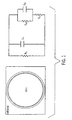
- the model shown in Fig. 1 does not take the effect of structures inside the cell into account.
- the cell (in suspension) is modeled by a resistance and capacitance.
- the capacitive component of the suspension impedance can be neglected.
- the dielectric relaxation time is on the order of nanoseconds.
- the cell membrane can be modeled as capacitor, the cytoplasm as a resistor.
- the outer membrane contains channels which are affected by the applied voltage and allow flow of ions through the membrane, representing a leakage current.
- the voltage-gated channels can be modeled as variable, voltage-dependent resistors.
- ⁇ 1 the resistivity of the suspending medium, e.g. water
- ⁇ 2 being the resistivity of the cytoplasm
- C the capacitance per unit area
- r cell radius (spherical cell).
- the medium was placed in commercially available cuvettes between two plane aluminium electrodes. With a minimum distance of 1 mm, maximum electric fields of 100 kV/cm could be obtained in the 60 and 300 ns systems. However, surface flashover at the suspension surface has limited the maximum field to about 80 kV/cm.
- an electrode array comprising at least one pair of needles capable of being inserted into tissue in vivo , the tissue containing target cells, and being capable of directing the ultrashort electric pulses to said target cells in vivo.
- WO 98/47562 relates to an electrode array apparatus which facilitates the efficient delivery of electrical waveforms, and particularly delivery to a pre-determined three-dimensional region of tissue within a patient.
- a system is provided wherein the electrode array is located in situ in a patient.
- the pre-determined treatment region can then be subject to the electropermeabilisation effects of the electric fields, promoting the introduction of therapeutic agents into cells within the region.
- the electrical waveform provided by a generator can be an exponentially decaying pulse, a square pulse, a unipolar oscillating pulse train or a bipolar pulse train.
- the electric field strength can desirably be between 0.2 kV/cm to 20 kV/cm, more commonly 0.5 kV/cm to 3 kV/cm.
- the pulse duration can be from 100 nanoseconds to 100 milliseconds and there can be from 1 to 10,000 pulses per second. There is no disclosure of electric pulses having a pulse duration of no more than 1 microsecond and an electric field strength of greater than 10 kV/cm.
- Modifications of cells which lead to rupture of the cell membrane can lead to cell death via necrosis, a nonphysiological type of cell destruction. It would be advantageous to be able to initiate cell death via apoptosis in a selective manner. This would allow the destruction of cells without engendering the non-specific damage to surrounding tissues due to inflammation and scarring that is normally observed with necrosis.
- the ability to selectively modify cells in ways that lead to apoptosis could provide a new method for the selective destruction of undesired cells/tissue (e.g., tumor cells, fat cells or cartilage cells) while minimizing side effects on surrounding tissue.
- the present invention relates to an apparatus for destroying target cells according to claims.
- the ultrashort electric field pulse generally has at least a sufficient amplitude and duration when applied as a sequence of pulses to modify subcellular structures in the target cells in at least a transient fashion.
- the amplitude of individual pulses do not exceed the irreversible breakdown field of the target cells.
- the amplitude and duration of the ultrashort electric field pulse(s) are typically chosen so as to be insufficient to permanently alter permeability of surface membranes of the target cells, e.g., by rupturing the surface membranes.
- tissue electroporation consists of electroporation of individual cells. There are two major differences between the electroporation of individual cells in a suspension and the electroporation of tissue.
- tissue the local extracellular electric field depends in a complicated way on the many neighboring cells.
- the ratio of the extra- to intracellular volume is usually small, just the opposite of most in vitro electroporation conditions. This means that if chemical exchange between the intra- and extracellular volumes is the main cause of cell stress, and therefore cell death, tissue electroporation with microsecond pulses may be intrinsically less damaging in vivo than most in vitro electroporation conditions. Since ultrashort pulses can affect only the interior of the cell, such pulses are expected to have roughly the same effect on tissues as on individual cells.
- ultrashort pulses of the type employed in the present method is the low energy of these pulses.
- the electrical power of the pulses may be many megawatts, the energy of these pulses is often so low (due to their extremely short duration) that any thermal effects on cells can be neglected.
- the present pulse power method is thus a "cold" method which can allow modification of cells via electrical effects without creating any substantial related thermal effects.
- the thermal effects associated with the pulses employed in the present method typically only generate temperature increases in the bulk medium or tissue on the order of 1-2°C.
- the ability to electrically modify cells in a "cold" manner is particularly useful where the intent is to selectively modify subcellular structures within a target cell without substantially effecting the cell membrane.
- the apparatus includes a pulse generator capable of producing an ultrashort electric pulse output and a delivery system capable of directing the electric pulse output to target cells, e.g., capable of selectively directing the electric pulse output to targeted cells in vivo in a manner which avoids causing substantial injury to the surrounding tissue.
- the cell was modeled as a homogeneous, conductive medium surrounded by a dielectric membrane. Taking substructures in cells into account, such as the cell nucleus in eukaryotic cells, requires a more complex model of the equivalent circuit.
- HL-60 Leukemia cells can be used to demonstrate the complexity of structures inside the cell.
- the nucleus is clearly visible as are smaller substructures within it, e.g., nucleoli.
- the substructures can be modeled by treating the membrane surrounding the nucleus as a capacitor and the interior of the nucleus as a resistor, both elements in series and in parallel to the resistance which describes the cytoplasm in the first, simplified, equivalent circuit (see, e.g., Fig. 3 ).
- the nucleoli can also be described by an additional capacitor resistor arrangement in parallel to the nucleus resistance.
- p is the resistivity of the target intracellular structure.
- the value for the capacitance of the outer cell surface membrane has been reported in published work (see, e.g., Schwan, Biophysik, 1, 190 (1963 )) and the capacitance of intracellular structures is assumed to be either the same or half of this value, depending on the structure of the specific intracellular membrane.
- the nucleus is surrounded by two lipid bilayer membranes that make up the nuclear envelope, whereas other intracellular structures (e.g., intracellular granules) may have only one lipid bilayer membrane surrounding them.
- IEM intracellular electromanipulation
- the present method typically employs ultrashort electric field pulses having sufficient amplitude and duration to modify subcellular structures in the target cells, at least when applied as a sequence of ultrashort pulses within a relatively short time period, e.g., a sequence of 3-5 ultrashort pulses within a time interval of 10 seconds or less.
- the amplitude and duration of each ultrashort electric field pulse can be chosen so that it is insufficient to alter permeability of surface membranes of the target cells, e.g., by inducing pores in the cell membranes.
- the target cells are present as part of a tissue.
- Each ultrashort electric field pulses typically has a pulse duration of no more than about 1 microsecond and an amplitude of at least about 20 kV/cm.
- the ultrashort electric field pulses typically have a pulse duration of no more than about 1 microsecond and provide a total energy density of at least about 75 mJ/cc. Preferably, the ultrashort electric field pulses provide total energy density of no more than about 10 J/cc.
- the total energy density provided by each ultrashort electric field pulse is about 75 mJ/cc to about 2,000 mJ/cc and, preferably, about 100 mJ/cc to about 1,000 mJ/cc, In instances where extremely short pulses are applied, e.g., pulses having a duration of about 10 nanoseconds or less, the total energy density provided by the electric field pulse may only be on the order of about 10 to 20 ml/cc. In addition to having short durations, the electric field pulses used in the present methods commonly have rise times of 50 nsec or less.
- the amplitude of an electric field (the applied voltage divided by distance between electrodes) pulse is generally at least about 20 kV/cm, but should not exceed the breakdown field of the tissue which includes the target cells.
- the breakdown field increases with decreasing pulse duration, and can be experimentally determined. Under the conditions commonly employed in the present method, however, the breakdown field does generally not exceed 500 kV/cm.
- Electric field pulses employed in the present methods which have durations of 10 to 500 nsec typically have amplitudes of about 20 kV/cm to about 300 kV/cm.
- the electrical field pulses generally have a rapid rise time and short duration.
- the pulses should preferably be less than one microsecond, but more than 100 picoseconds in duration.
- a common pulse duration is about 1 nanosecond to about 500 nanoseconds, with pulses typically having a duration, of about 10 to a 300 nanoseconds.
- the optimum pulse duration will vary depending on the cell type, tissue type and desired treatment, among other factors.
- the pulse should be preferentially rectangular or trapezoidal, but other pulse shapes may also used. For example, in order to open both the outer and inner cell membranes, an intense short pulse might be combined with a less intense longer pulse. Other examples of suitable pulse shapes include exponential decaying pulses, unipolar pulses and bipolar pulses.
- the rise time of the ultrashort electric field pulse is typically no more than about 20% and, preferably, no more than about 10% of the pulse duration. For example, if the pulse duration is about 100 nanoseconds, the rise time of the pulse is preferably about 10 nanoseconds or shorter. For pulses with pulse durations of about 400 nanoseconds or longer, the pulse rise times of about 30-40 nanoseconds are common. With pulses having extremely short durations, e.g., one nanosecond or less, the rise time is often a greater percentage of the pulse duration. For example, pulses with a duration of less than one nanosecond, can commonly have a rise time which is up to about 50 % of the pulse duration.
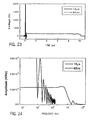
- Figure 24 shows the Fourier spectrum of a short pulse (60 nsec) which extends to the 10 MHz range and for a long pulse (10 microsec) which extends up to the 100 KHz range.
- increasing frequency i.e., decreasing pulse rise time
- the outer surface membrane of the target With increasing frequency (i.e., decreasing pulse rise time), the outer surface membrane of the target will be effectively shorted out, and the applied voltage will appear across the inner (nucleus) membrane.
- Fig. 4 where the voltage across the surface (outer) membrane and that across the nucleus membrane is plotted versus frequency.
- Electric field pulses with duration of less than about 1 microsecond and rise times of 40 nanoseconds or less have Fourier transforms which include frequencies above 1 MHz with substantial amplitudes.
- the Fourier spectrum of the pulses which are employed in the present methods can include frequencies with substantial amplitudes up to about 1 GHz.
- the pulses employed in the present methods have Fourier spectra which include frequencies above 1 MHz with amplitudes greater than 50% of the maximum voltage in the spectrum (referred to hereinafter as greater than "V MAX /2").
- the Fourier spectra of the pulses includes frequencies between 5 to 50 MHz with amplitude greater than V MAX /2.
- a 60 nanosecond rectangular pulse such as depicted in Fig. 21 has a Fourier spectrum which includes frequencies with amplitude greater than V MAX /2 up to about 10 MHz.
- the Fourier spectrum of a 10 microsecond rectangular pulse only has frequencies of this amplitude up to about 200-500 kHz (see comparison in Figs. 23 and 24 ).
- ultrashort electric field pulses within a relatively short time interval.
- a sequence of 3 to 5 ultrashort electric field pulses e.g., trapezoidal pulses with durations of 10-300 nsec and amplitudes of about 25 to 300 kV/cm
- the application of a multipulse sequence with a roughly one second interval (delay) between pulses can rupture granules within eosinophils without significant damage to the outer cell membrane.
- the time interval between subsequent pulses may vary over a wide range, e.g., between 1.0 millisecond and 100 seconds.
- multiple pulse sequences with time interval between pulses of about 0.1 - 3 seconds are quite suitable for initiating apoptosis.
- the multipulse sequences utilized in the present methods typically include up to about 20 pulses, which are generally spaced at regular time intervals.
- Suitable results can often be obtained for certain types of cells (e.g., eosinophils, neutrophils and T-lymphocytes) by applying 3-5 ultrashort electric field pulses within a relatively short time period, e.g., within a time period no longer than about 5 to 10 seconds.
- the amplitude and duration of the ultrashort electric field pulse are typically chosen so that the sequence of pulses does not permanently alter permeability of surface membranes of the target cells, e.g., by rupturing the surface membranes.
- the present method may be used to modify a variety of cells,
- the target cells may be any of a variety of common cells, such as fat cells, bone cells, vascular cells, muscle cells, cartilage cells and the like.
- the technique may be used to selectively modify certain types of cells in the presence of other cells.
- the parameters of the present method may be adjusted to selectively induce apoptosis in tumor cells in vivo (e.g., carcinoma cells, sarcoma cells, or papilloma cells) without substantially affecting normal cells in surrounding tissue.
- the technique may be utilized to selectively destroy eosinophils in a mixture including eosinophils and neutrophils (see, e.g., Table II in Example 4 herein).
- the experiments described herein indicate that the present techniques may be used to selectively modify faster growing cells in the presence of slower growing cells (e,g., cells in stationary phase).
- the selectivity may be simply based on spatially limiting the application of the ultrashort electric field pulse(s).
- cells within a predetermined area of tissue may be selectively modified in vivo (e.g., through initiation of apoptosis) without altering cells in the immediately surrounding tissue.
- Devices which incorporate such electrode configuration are currently employed with conventional electroporation pulses (pulses with ⁇ sec duration) to enhance the delivery of therapeutic drugs to cells within a predetermined area.
- the apparatus of the invention may be used in a method that can be used to initiate apoptosis in target cells by applying at least one ultrashort electric field pulse with a pulse duration of no more than about 1 microsecond to the target cells.
- electric field pulse commonly provides a total energy density of at least about 75 mJ/cc, although pulses with lower energy may be employed, in particular where the pulse has an extremely short duration and a relatively high amplitude or where sequences of multiple pulses are applied to the target cells within a relatively short time interval, e.g., with a spacing of 1-2 seconds between succeeding pulses.
- the present method can be employed to selectively destroying target cells in a mixture including the target cells and a second type of cells.
- the method can be used to selectively destroy eosinophils in a mixture including eosinophils and neutrophils.
- the present method typically employs an apparatus for intracellular electro-manipulation which includes a pulse generator and a delivery system adapted to direct the electric pulse output to target cells.
- the pulse generator includes a pulse forming network and a high voltage switch.
- the pulse forming network may be a high voltage cable, a strip-line, or a pulse forming network constructed of individual capacitors and inductors in a transmission line arrangement.
- the high voltage switch can suitably be a gaseous, liquid or solid state switch.
- the energy in the pulse forming network may be stored capacitively, which requires a closing switch to release a pulse, or inductively, which requires an opening switch to release a pulse.
- an electrical pulse is launched into the load, i.e., the target cells in tissue form.
- the switch can be triggered by a variety of common methods, e.g., optically or electrically. The latter can be accomplished by employing a third electrode or by overvolting the switch.
- An example of a suitable cable pulsed power system, designed to generate ultrashort pulses of the type employed in the present method is shown in Figure 20 .
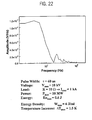
- Figure 21 shows a typical shape of a pulse employed in the present methods and the corresponding Fourier spectrum of the pulse is shown in Figure 22 .
- the electrical field pulses can be varied in length ("duration") by changing the pulse forming network, such as by reducing or increasing the length of the cable or stripline, or by using a switch which can be closed and opened.
- One specific example of an apparatus suitable for modifying cells by intracellular electro-manipulation is described in Example 10 herein.
- the "load,” which includes the target cells in tissue is located between two or more electrodes. These electrodes may be solid material, wires or combinations thereof. One (set of) electrode(s) is connected to the high voltage connection of the pulse generator, and a second (set of) electrode(s) is connected to the ground connection of the pulse generator in a suitable manner, e.g., via a second stripline or high voltage cable.
- the electrode material is a conductor, most commonly metal.
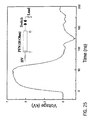
- a typical ultrashort pulse electric field generator (“USPEF generator”) includes a distributed pulse forming network, a switch to allow rapid transfer of electrical energy into the load, and the load itself (see, e.g., Figure 25 , inset). If such a pulse-forming network is charged up to 18 kV, and then released, this charge can produce an almost rectangular ultra-short duration pulse (see Figure 25 ), which when applied to a 10 ⁇ load, produced a maximum voltage of 9 megavolts. The corresponding electric field intensity between two electrodes separated by 1.4 mm is 90 kV/cm. The maximum electrical power, V 2 /R, which can be achieved with these conditions is 8.1 MW, while the energy (power x pulse duration) transferred into the load is only 0.49 Joule. For a 100 ⁇ L volume of cell suspension, the energy density is consequently 4.5 J/cc. This energy transfer results in a calculated maximum temperature increase of only about 1°K for a single pulse.
- the apparatus includes a pulse generator capable of producing ultrashort electric pulses and a delivery system capable of selectively directing the electric pulse output to targeted cells in vivo, e.g., capable of selectively directing the electric pulse output to tumor cells in vivo in a manner which avoids causing substantial injury to the surrounding tissue.
- the pulse generator in an apparatus of this type is typically capable of generating electric pulses having a duration of 1 to 500 nanoseconds and amplitudes of at least 10 kV/cm.
- the delivery system includes one or more pairs of electrodes capable of being inserted into tissue in vivo in the form of an array of needle electrodes. In another configuration, delivery system includes at least one electrode which is an component of a catheter. Basic configurations for such delivery systems are described in WO-A-97/49 450 . For use in the present methods, such delivery systems need not include an infusion port for intravascular administration of a pharmaceutical composition.
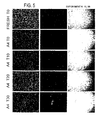
- calcein-AM a green fluorescent probe that stains the cytoplasm of live, intact cells, and then exposed to the various IEM pulses.
- the cells were stained with ethidium bromide homodimer (EtBr), a membrane non-permeable red fluorescent probe that stains the nucleus of cells that exhibit plasma membrane damage.
- EtBr ethidium bromide homodimer
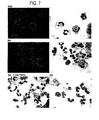
- the cells were centrifuged onto glass slides (cytospin). The cells were observed under conditions for calcein (left panel) or EtBr (middle panel) fluorescence (see Figs. 5-7 ). Images were captured, and the fields marked. The cells were then stained with Wright stain (right panel), the same fields were observed, and images were captured under conditions for light microscopy Images were observed at 10X magnification.
- IEM parameters included sham or control (fresh), A4 (60 nsec, 60 kV/cm), B6 (300 nsec, 40 kV/cm), and B8 (300 nsec, 60 kV/cm). All exposures were at immediately after IEM exposure (T0) and images were at 160X magnification ( Fig. 7 ) or 280X magnification ( Figures 8 and 9 ).
- B8 pulse parameters at T0 after IEM cytoplasmic staining is nearly gone and nuclear staining exhibits significant "pores" or "holes” (right panel).
- the B8 control left panel, Wright stain shows neutrophils not exposed to IEM (normal), but prepared at the same time as B8 IEM exposed neutrophils.
- B5 (right panel, Wright stain) shows IEM conditions (300 nsec, 30 kV/cm) between A4 and B6. Note how "pores" or “holes” begin to become evident in the cytoplasm.
- the B5 control (left panel, Wright stain) shows neutrophils not exposed to IEM (normal), but prepared at the same time as B5 IEM exposed neutrophils.
- Figure 8 Neutrophils from A4 and B6 pulse parameters are shown at higher magnification (280X) to more clearly show the cytoplasmic characteristics. The "pores" or “holes” are present in B6, but not A4.
- Figure 9 .
- Neutrophils are shown after myeloperoxidase staining, which stains neutrophil vesicles that contain proteases used for killing bacteria.
- Myeloperoxidase staining at T0 in fresh and A4 IEM parameter appear relatively granular, indicating the presence of numerous small protease-containing vesicles.
- B6 IEM parameters the staining is more diffuse, indicating the presence of vesicle rupture.
- B8 IEM parameters the staining is nearing gone, indicating that nearly all of the vesicles have bee ruptured with the higher energy / power conditions.
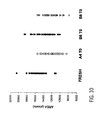
- IEM parameters include sham or control (fresh), A4 (60 nsec, 60 kV/cm), B6 (300 nsec, 40 kV/cm), and B8 (300 nsec, 60 kV/cm).
- Cells were stained with Wright stain immediately after being subjected to the IEM pulse, nuclei were set to gray scale and pixel area was determined. Nucleus sizes from 30 to 42 cells were determined and each one plotted according to pixel area.
- IEM parameters required to induce cell death in different cell types were examined. Eosinophils were observed to be more sensitive to IEM than neutrophils. Method: IEM parameters included sham or control (fresh), A4 (60 nsec, 6kV), B6 (300 nsec, 4kV), and B8 (300 nsec, 6kV) as well as additional IEM parameters as indicated.
- Human neutrophil preparations include some contaminating eosinophils, which are more abundant during hay fever/allergy seasons (at the time of these studies). The number of eosinophils was determined as a percentage of the number of neutrophils by morphology and cell counting under light microscopy.
- IEM alters neutrophil function without disrupting the plasma membrane.
- the effects on chemotaxis are different than the effects on unstimulated movement, suggesting a selective effect on neutrophil function.
- Method IEM parameters included sham or control (S), A4 (60 nsec, 60 kV/cm), B6 (300 nsec, 40 kV/cm), and B8 (300 nsec, 60 kV/cm).
- S sham or control
- A4 60 nsec, 60 kV/cm
- B6 300 nsec, 40 kV/cm
- B8 300 nsec, 60 kV/cm
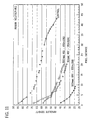
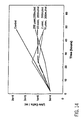
- HL-60 cells were maintained at a density of 100-300,000 cells / ml, conditions for maximal cell doubling time (10-14 h, log phase growth). Cells were exposed to various IEM parameters by maintaining a constant energy exposure (200-250 mJ/ml) at different pulse durations as indicated. The cells were then diluted to 50,000 cells/ml and the viable cell number (cells that excluded trypan blue; i.e.
- live cells was determined after 0, 24, and 48 hours using a hemocytometer under light microscopy. Results: The number of viable cells was not different from control immediately after treatment with IEM (see Fig. 14 ). Twenty-four hours after IEM, treated cells grew at rates similar to control, except under the condition of the longest pulse time (200 ⁇ sec). After 48 hours, the proliferation rate of cells exposed to a pulse of 0.06-10 ⁇ sec began to decrease, indicating more death events than proliferation events. Cells exposed to a pulse of 200 ⁇ sec increased their proliferation rate to near the control rate.
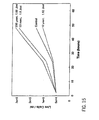
- HL-60 cells were maintained at a density of 1-3,000,000 cells/ml for 3-5 days, conditions for minimal cell doubling time (near stationary phase growth). Cells were exposed to various IEM parameters by maintaining a constant energy exposure (1.7-1.9 J/ml) at different pulse durations as indicated. The cells were then diluted to 50,000 cells/ml and the viable cell number (cells that excluded trypan blue; i.e. live cells) was determined after 0, 24, and 48 hours using a hemocytometer under light microscopy.
- Results The number of viable cells was not significant different from control immediately after treatment with IEM (see Fig. 15 ). After 24 and 48 hours, the proliferation rates were greater than control for cells exposed to a pulse of 0.05 or 200 ⁇ sec. The proliferation rate was less than control for cells exposed to a pulse of 10 ⁇ sec. A pulse duration minimum is observed to inhibit the proliferation of slowly growing cells.
- IEM parameters include sham or control (fresh), A4 (60 nsec, 60 kV/cm, 216 mJ/cc), B6 (300 nsec, 40 kV/cm, 480 mJ/cc), and B8 (300 nsec, 60 kV/cm, 1.08 J/cc).
- Annexin-V-FITC Ethidium bromide homodimer
- Annexin-V-FITC binding was used as a quantitative apoptosis marker.
- Annexin-V exhibits calcium-dependent binding to phosphatidylserine. While phosphatidylserine is typically restricted to the inner leaflet of the cell membrane in normal cells and is therefore inaccessible to Annexin-V in solution, apoptotic cells express phosphatidylserine in their outer membrane leaflet, resulting in ready binding of Annexin-V to their surfaces.
- EtBr binds to DNA, but is impermeable to the cell membrane.
- EtBr fluorescence occurs only in cells that have ruptured membranes. Therefore, apoptotic cells exhibit only Annexin fluorescence while necrotic cells exhibit fluorescence for EtBr plus or minus Annexin fluorescence.
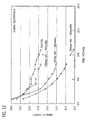
- Cells are exposed to IEM and at the indicated times after IEM, cells are evaluated by fluorescence microscopy, counted, and expressed as percent cells showing apoptosis and necrosis. Results: Control cells (human neutrophils) do not exhibit significant markers for apoptosis or necrosis during the time course of the experiment (see Figs. 16 and 17 ). This indicates that these pulses do not kill the cell by membrane rupture.
- HL-60 cells exposed to IEM conditions A4, B6, and B8 show a time-dependent and an energy- or power-dependent increase in apoptosis.
- A4, B6, and B8, cells begin to show the apoptosis marker after 5, 3, and 1 hours, respectively (see Fig. 16 ).
- necrosis occurs, secondary to apoptosis (see Fig. 17 ). This is indicated by the appearance of necrosis only after apoptosis. Secondary necrosis is an in vitro -specific effect.
- the apoptotic cells are remove by phagocytosis before necrosis and inflammation occur.
- Figures 18 and 19 show similar results for human neutrophils.
- Free calcein is a highly fluorescent modified fluorescein with 6 negative and 2 positive charges that is membrane impermeant. In its methyl ester form, calcein-AM, it is non-fluorescent and membrane permeable. When used as a fluorescent stain for cells, calcein-AM passes through the surface membrane and is cleaved to free calcein + the methyl ester residue by intracellular esterase activities. This modification traps the free calcein in the cytoplasm of the cell, and retention of the free calcein is a common criterion for intactness of the surface membrane.
- the intracellular free calcein In addition to remaining trapped within the cell, the intracellular free calcein also remains excluded from other intracellular membrane-bound compartments because of its membrane impermeant nature (an effect illustrated in calcein-AM labeled eosinophils which show bright cytoplasmic free calcein fluorescence and "negative staining" of their large intracellular granules).
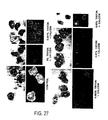
- Calcein-AM stained eosinophils trap free calcein in their cytoplasm after staining (left), and the intracellular free calcein is excluded from the eosinophil's large granules as shown on the left. Without Triton treatment, free calcein is incapable of staining eosinophil cytoplasm (center): only eosinophil autofluorescence visible. With incubation in 0.001% Triton, free calcein continues to be excluded from eosinophils, but stains the fine granules of a PMN showing obvious detergent effects (right) (see Fig. 27 ).
- Triton treatment With 0.005% Triton treatment (left), the morphology of some eosinophils suggests partial detergent solubilization which is accompanied by bright free calcein staining of eosinophil granules, and detergent solubilized PMN show very fine, fluorescent "calcein sand" staining patterns. With 0.01 % Triton + 1 ⁇ M free calcein treatment (center), all eosinophils show nuclear changes suggestive of detergent effect, and many contain 1-2 bright granules on a background of red autofluorescence.
- a typical pulse generator for producing USPEF effects is illustrated in Figure 25 , and consists of a pulse forming network (typically a coaxial cable or a strip line), a switch and the load.
- a pulse forming network typically a coaxial cable or a strip line
- the voltage pulse across the load has an amplitude of half the voltage applied to the pulse-forming network (for the experiments described, the pulse-forming network comprised 5 high voltage 50 ⁇ cables in parallel, which achieved the required 10 ⁇ impedance for matched operation).
- the pulse duration is twice the length of the cable or strip line, divided by the speed of the electromagnetic wave in the dielectric of the pulse-forming network.
- the switch is a simple spark gap in atmospheric air.
- the breakdown voltage is set by varying the gap distance.
- the load consists of the 100 ⁇ L of cell suspension to be exposed to the USPEF, and when Hanks Balanced Salt Solution without Ca ++ and Mg ++ (HBSSw/o) is used to suspend the cells, has an electrical resistivity of 100 ⁇ cm.
- PMN Polymorphonuclear leukocytes
- “Sparkler” cells (cells with cytoplasmic calcein staining plus centrally-located, large, bright fluorescent granules) were seen with both electric field intensities when ⁇ 3 USPEF applications were used (see Table 1). When examined by Wright-Giemsa stain, the “sparkler” cells were always eosinophils, and often appeared “shrunken” relative to the appearance of eosinophils in the control condition.
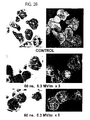
- Figure 26 shows "sparkler" cells in an eosinophil preparation exposed to USPEF treatments (60 nsec, 53 kV/cm x3 (middle) and x5 (below)).
- Control eosinophils labeled with calcein-AM (top) show bright cytoplasmic free calcein staining with exclusion of fluorescence from intracellular granules.
- Application of multiple USPEF treatments to this cell preparation results in appearance of "sparkler" cells with bright cytoplasmic free calcein staining (indicating that the surface membrane is intact) and bright fluorescence of some intracellular granules, indicating that intracellular free calcein has gained access to and labeled the cationic intragranular components.
- the middle panels also illustrate the "shrunken" eosinophil morphology frequently noted in the 60 nsec, 53 kV/m x3 and x5 conditions.
- a normal sized eosinophil with bright cytoplasmic free calcein staining/unstained granules is at right, and 3 "shrunken" eosinophils, all "sparkler” cells, are on the left.
- Eosinophil granules contain a variety of cationic proteins which could potentially bind the highly anionic free calcein if the granule membrane were breached, as shown in the Triton solubilization experiment. Therefore, we conclude that development of "sparkler" morphology in calcein-AM loaded eosinophils following repeated USPEF applications is the result of selective poration/disruption of the eosinophil granule membrane during USPEF applications, which allowed cytoplasmic free calcein to enter the granule and bind to the cationic granule components. We interpret this as strong evidence that selective poration/disruption of intracellular membranes without loss of surface membrane integrity can be achieved with USPEF applications.
- mice Seven to 8 week old immunocompetent C57B1/6 mice were inoculated subcutaneously with 1.5x10 6 B10.2 mouse fibrosarcoma cells in 0.1 ml PBS using a 1 cc syringe fitted with a 27-gauge needle. The injection site was either in the flank region or on the back of the animal. Two to three weeks later the tumors were excised and sliced into two pieces along the equatorial axis. One piece served as a matched control and the other piece was exposed to three pulses each at 300 nsec and 60 kV/cm (1.08 J/cc).
- Tumor slices (0.1 cm thickness) were placed in an electroporation cuvette between two electrodes spaced 0.1 cm apart and Hank's balanced salt solution was added to fill the cuvette.
- the tissues were exposed to pulses as indicated, removed, and prepared for analysis.
- the tissues were incubated for 5 hours at 37°C in RPMI media with 10% fetal bovine serum.
- the tissues were then fixed in 10% buffered formalin for 18 hours.
- the air was removed from the tissues using a vacuum and the degassed tissues were embedded in paraffin.
- Four micron slices were prepared and placed on glass slides pretreated with 2 % APES in acetone.
- the paraffin was removed by successive washes in xylene, absolute ethanol, 95 % ethanol, 70 % ethanol, and PBS.
- the tissue slices were incubated with proteinase K (40ug/ml) for 15 minutes at 40°C.
- the tissue slides were prepared for examination of DNA fragmentation as a marker for apoptosis using a rhodamine-labeled sheep anti-digoxigenin antibody (Apop-tag TM from Intergen) and fluorescence microscopy according to the manufacturers protocol.
- the slides were counterstained with DAPI. Normal nuclei were stained blue by DAPI and apoptotic nuclear were stained red with rhodamine. Two to three hundred cells were counted and scored as blue (normal) or red (apoptotic).
- the apoptotic index is defined as the number of apoptotic nuclei divided by the total number of nuclei. The results are shown in Table IV below.
- Table IV illustrates the apoptotic index (percentage of apoptotic cells) in a representative tumor that was exposed to three consecutive 300 nsec pulses at 6 kV in comparison to an unpulsed control. About 6 % of the nuclei from the control tumor were apoptotic when sampled from four different sections of the same tumor. In contrast, 35% of the nuclei were apoptotic from the tumor exposed to the sequence of ultra-short, high intensity pulses. This represents a 6-fold increase in apoptotic nuclei after exposure to these pulses.
- mice For the mouse fibrosarcoma tumors, the immunocompetent C57B1/6 mouse model will be used. Seven to 8 week old mice will be inoculated subcutaneously or intradermally with 5x10 6 B 10.2 mouse fibrosarcoma cells in 0.1 ml phosphate buffered saline ("PBS ”) using a lcc syringe fitted with a 27-gauge needle. The injection site will be on the back of the animal so as not to interfere with its movement or feeding. Tumor masses are expected to form over a 6-week period into a mass about 5-10 mm in diameter. The mass of the resulting tumor will not be allowed to exceed 10% of body weight before being subjected to the ultrashort electric pulse treatment.
- PBS phosphate buffered saline
- mice with induced subcutaneous tumors will be divided into six different groups and five of the groups will have their tumors exposed to ultrashort electric pulse treatment in vivo.
- the six group will serve as an untreated control group to monitor the course of tumor development.
- the pulse parameters for the five different treatments will be used based on results from the ex vivo experiments.
- the ultrashort electric pulse conditions for the five different groups are shown in Table V below.
- pulses will be delivered through an electrode array consisting of a pair of stainless steel needles the size of acupuncture needles spaced 5mm apart. The pair of needles will be inserted into the tumor or the surrounding margin of healthy tissue at least the depth of the tumor.
- the current will pass synchronously through opposite pairs of needle yielding a homogenous field within and just outside the cross section defined by the needles (see Figure 28 for a depiction of the electric field generated during the pulse).
- the energy density is strongest in the plane bounded by the two needles and decreases outside this plane.
- the needle pairs will be energized in both polarities.
- the pair of needles will be removed and reinserted in two additional positions so that the overall composite of the positions corresponds roughly to a regular hexagon (see Figure 29 ).
- Treatment of the tumor with sequential pulses from each of the three positions is referred to herein as "one pulse cycle.”
- the needle array will be inserted into the healthy tissue just surrounding the tumor so that the tumor is contained within the hexagon defined by the array.
- One pulse cycle will be delivered per tumor, unless the tumor exceeds the bounds of the array, in which case a second pulse cycle will be delivered in an array offset to encompass the portion of the tumor not covered by the first pulse cycle.
- sequences of multiple pulses will be applied to the tumor within a relatively short time interval, e.g., sequences of 5-10 pulses with a spacing of 1-2 seconds between succeeding pulses will be applied at each position.
- mice When tumors are treated with ultrashort electric pulses in vivo, the mice will be placed in a system with oxygen and 2 % Isofluorane input to allow continued sedation during entire surgical procedure. The area around the tumor is shaved with electric clippers and prepped with betadine. An array of electrodes the size of acupuncture needles will be inserted into or surrounding the tumor and ultrashort electric pulses will be delivered within a relatively short period of time. The total procedure time is less than 10 minutes. The mouse will then be placed into a fresh cage and is expected to be ambulatory within 2 minutes.
- apoptosis analysis will be utilized including one or more of the following:
Landscapes
- Health & Medical Sciences (AREA)
- Life Sciences & Earth Sciences (AREA)
- Engineering & Computer Science (AREA)
- Nuclear Medicine, Radiotherapy & Molecular Imaging (AREA)
- Surgery (AREA)
- Veterinary Medicine (AREA)
- Public Health (AREA)
- General Health & Medical Sciences (AREA)
- Animal Behavior & Ethology (AREA)
- Chemical Kinetics & Catalysis (AREA)
- Medical Informatics (AREA)
- General Chemical & Material Sciences (AREA)
- Organic Chemistry (AREA)
- Pharmacology & Pharmacy (AREA)
- Chemical & Material Sciences (AREA)
- Molecular Biology (AREA)
- Medicinal Chemistry (AREA)
- Heart & Thoracic Surgery (AREA)
- Biomedical Technology (AREA)
- Physics & Mathematics (AREA)
- Plasma & Fusion (AREA)
- Otolaryngology (AREA)
- Child & Adolescent Psychology (AREA)
- Bioinformatics & Cheminformatics (AREA)
- Diabetes (AREA)
- Hematology (AREA)
- Obesity (AREA)
- Immobilizing And Processing Of Enzymes And Microorganisms (AREA)
- Micro-Organisms Or Cultivation Processes Thereof (AREA)
- Apparatus Associated With Microorganisms And Enzymes (AREA)
- Electrotherapy Devices (AREA)
- Medicines That Contain Protein Lipid Enzymes And Other Medicines (AREA)
- Secondary Cells (AREA)
Claims (9)
- Vorrichtung zur Zerstörung von Targetzellen, umfassend:(i) einen Pulsgenerator;(ii) ein Elektrodenarray, wobei das Elektrodenarray wenigstens ein Nadelpaar umfasst, das in Gewebe im lebenden Organismus eingeführt werden kann, wobei das Gewebe Targetzellen enthält, und das die ultrakurzen elektrischen Pulse auf die Targetzellen im lebenden Organismus richten kann; und(iii) ein Zuleitungssystem, das ausgelegt ist, einen oder mehrere ultrakurze elektrische Pulse von dem Pulsgenerator an das Elektrodenarray zu übertragen, gekennzeichnet dadurch, dass der Pulsgenerator ausgelegt ist, den einen oder die mehreren ultrakurzen elektrischen Pulse mit einer Pulsdauer von nicht mehr als 1 Mikrosekunde und einer elektrischen Feldstärke von mehr als 10 kV/cm zu erzeugen.
- Vorrichtung gemäß Anspruch 1, worin die Pulsdauer wenigstens 100 Pikosekunden beträgt.
- Vorrichtung gemäß Anspruch 1, worin die Pulsdauer 1 bis 500 Nanosekunden beträgt,
- Vorrichtung gemäß einem der Ansprüche 1 bis 3, worin der Pulsgenerator ausgelegt ist, ultrakurze elektrische Pulse mit einer elektrischen Feldstärke von wenigstens 20 kV/cm zu erzeugen.
- Vorrichtung gemäß Anspruch 4, worin der Pulsgenerator ausgelegt ist, einen Puls mit einer elektrischen Feldstärke von nicht mehr als 200 kV/cm zu erzeugen.
- Vorrichtung gemäß einem der Ansprüche 1 bis 5, worin der Pulsgenerator ausgelegt ist, jeden ultrakurzen elektrischen Puls mit einer Gesamtenergiedichte von 75 mJ/cm3 bis 2.000 mJ/cm3 zu erzeugen.
- Vorrichtung gemäß einem der Ansprüche 1 bis 6. worin der Pulsgenerator ausgelegt ist, jeden ultrakurzen Puls derart zu erzeugen, dass er ein Fourier-Spektrum aufweist, das die Frequenzen zwischen 1 MHz und 1 GHz beinhaltet
- Vorrichtung gemäß einem der Ansprüche 1 bis 7, worin der Pulsgenerator ausgelegt ist, jeden ultrakurzen elektrischen Puls derart zu erzeugen, dass der Puls eine Anstiegszeit aufweist, die nicht mehr als 20% seiner Pulsdauer beträgt.
- Vorrichtung gemäß einem der Ansprüche 1 bis 7, worin der Pulsgenerator ausgelegt ist, jeden ultrakurzen elektrischen Puls derart zu erzeugen, dass er eine Anstiegszelt von nicht mehr als 40 ns aufweist.
Applications Claiming Priority (5)
| Application Number | Priority Date | Filing Date | Title |
|---|---|---|---|
| US14709999P | 1999-08-04 | 1999-08-04 | |
| US147099P | 1999-08-04 | ||
| US09/546,754 US6326177B1 (en) | 1999-08-04 | 2000-04-11 | Method and apparatus for intracellular electro-manipulation |
| US546754 | 2000-04-11 | ||
| PCT/US2000/021197 WO2001010319A1 (en) | 1999-08-04 | 2000-08-02 | Method and apparatus for intracellular electro-manipulation |
Publications (2)
| Publication Number | Publication Date |
|---|---|
| EP1207797A1 EP1207797A1 (de) | 2002-05-29 |
| EP1207797B1 true EP1207797B1 (de) | 2008-02-13 |
Family
ID=26844575
Family Applications (1)
| Application Number | Title | Priority Date | Filing Date |
|---|---|---|---|
| EP00955350A Expired - Lifetime EP1207797B1 (de) | 1999-08-04 | 2000-08-02 | Methode zur intrazellulären elektro-manipulation |
Country Status (8)
| Country | Link |
|---|---|
| US (1) | US6326177B1 (de) |
| EP (1) | EP1207797B1 (de) |
| JP (2) | JP4728546B2 (de) |
| AT (1) | ATE385746T1 (de) |
| AU (1) | AU785506B2 (de) |
| DE (1) | DE60038026T2 (de) |
| ES (1) | ES2300272T3 (de) |
| WO (1) | WO2001010319A1 (de) |
Cited By (32)
| Publication number | Priority date | Publication date | Assignee | Title |
|---|---|---|---|---|
| US9598691B2 (en) | 2008-04-29 | 2017-03-21 | Virginia Tech Intellectual Properties, Inc. | Irreversible electroporation to create tissue scaffolds |
| US9867652B2 (en) | 2008-04-29 | 2018-01-16 | Virginia Tech Intellectual Properties, Inc. | Irreversible electroporation using tissue vasculature to treat aberrant cell masses or create tissue scaffolds |
| US10117707B2 (en) | 2008-04-29 | 2018-11-06 | Virginia Tech Intellectual Properties, Inc. | System and method for estimating tissue heating of a target ablation zone for electrical-energy based therapies |
| US10154874B2 (en) | 2008-04-29 | 2018-12-18 | Virginia Tech Intellectual Properties, Inc. | Immunotherapeutic methods using irreversible electroporation |
| US10238447B2 (en) | 2008-04-29 | 2019-03-26 | Virginia Tech Intellectual Properties, Inc. | System and method for ablating a tissue site by electroporation with real-time monitoring of treatment progress |
| US10245105B2 (en) | 2008-04-29 | 2019-04-02 | Virginia Tech Intellectual Properties, Inc. | Electroporation with cooling to treat tissue |
| US10272178B2 (en) | 2008-04-29 | 2019-04-30 | Virginia Tech Intellectual Properties Inc. | Methods for blood-brain barrier disruption using electrical energy |
| US10292755B2 (en) | 2009-04-09 | 2019-05-21 | Virginia Tech Intellectual Properties, Inc. | High frequency electroporation for cancer therapy |
| US10471254B2 (en) | 2014-05-12 | 2019-11-12 | Virginia Tech Intellectual Properties, Inc. | Selective modulation of intracellular effects of cells using pulsed electric fields |
| US10470822B2 (en) | 2008-04-29 | 2019-11-12 | Virginia Tech Intellectual Properties, Inc. | System and method for estimating a treatment volume for administering electrical-energy based therapies |
| US10694972B2 (en) | 2014-12-15 | 2020-06-30 | Virginia Tech Intellectual Properties, Inc. | Devices, systems, and methods for real-time monitoring of electrophysical effects during tissue treatment |
| US10702326B2 (en) | 2011-07-15 | 2020-07-07 | Virginia Tech Intellectual Properties, Inc. | Device and method for electroporation based treatment of stenosis of a tubular body part |
| US11254926B2 (en) | 2008-04-29 | 2022-02-22 | Virginia Tech Intellectual Properties, Inc. | Devices and methods for high frequency electroporation |
| US11272979B2 (en) | 2008-04-29 | 2022-03-15 | Virginia Tech Intellectual Properties, Inc. | System and method for estimating tissue heating of a target ablation zone for electrical-energy based therapies |
| US11311329B2 (en) | 2018-03-13 | 2022-04-26 | Virginia Tech Intellectual Properties, Inc. | Treatment planning for immunotherapy based treatments using non-thermal ablation techniques |
| US11382681B2 (en) | 2009-04-09 | 2022-07-12 | Virginia Tech Intellectual Properties, Inc. | Device and methods for delivery of high frequency electrical pulses for non-thermal ablation |
| US11453873B2 (en) | 2008-04-29 | 2022-09-27 | Virginia Tech Intellectual Properties, Inc. | Methods for delivery of biphasic electrical pulses for non-thermal ablation |
| US11607537B2 (en) | 2017-12-05 | 2023-03-21 | Virginia Tech Intellectual Properties, Inc. | Method for treating neurological disorders, including tumors, with electroporation |
| US11638603B2 (en) | 2009-04-09 | 2023-05-02 | Virginia Tech Intellectual Properties, Inc. | Selective modulation of intracellular effects of cells using pulsed electric fields |
| US11707629B2 (en) | 2009-05-28 | 2023-07-25 | Angiodynamics, Inc. | System and method for synchronizing energy delivery to the cardiac rhythm |
| US11723710B2 (en) | 2016-11-17 | 2023-08-15 | Angiodynamics, Inc. | Techniques for irreversible electroporation using a single-pole tine-style internal device communicating with an external surface electrode |
| US11779395B2 (en) | 2011-09-28 | 2023-10-10 | Angiodynamics, Inc. | Multiple treatment zone ablation probe |
| US11925405B2 (en) | 2018-03-13 | 2024-03-12 | Virginia Tech Intellectual Properties, Inc. | Treatment planning system for immunotherapy enhancement via non-thermal ablation |
| US11931096B2 (en) | 2010-10-13 | 2024-03-19 | Angiodynamics, Inc. | System and method for electrically ablating tissue of a patient |
| US11950835B2 (en) | 2019-06-28 | 2024-04-09 | Virginia Tech Intellectual Properties, Inc. | Cycled pulsing to mitigate thermal damage for multi-electrode irreversible electroporation therapy |
| US11957405B2 (en) | 2013-06-13 | 2024-04-16 | Angiodynamics, Inc. | Methods of sterilization and treating infection using irreversible electroporation |
| US12102376B2 (en) | 2012-02-08 | 2024-10-01 | Angiodynamics, Inc. | System and method for increasing a target zone for electrical ablation |
| US12114911B2 (en) | 2014-08-28 | 2024-10-15 | Angiodynamics, Inc. | System and method for ablating a tissue site by electroporation with real-time pulse monitoring |
| US12201349B2 (en) | 2009-04-03 | 2025-01-21 | Angiodynamics, Inc. | Congestive obstruction pulmonary disease (COPD) |
| US12214189B2 (en) | 2019-07-24 | 2025-02-04 | Virginia Tech Intellectual Properties, Inc. | Fourier analysis spectroscopy for monitoring tissue impedance changes and treatment outcome during electroporation-based-therapies |
| US12390262B2 (en) | 2018-03-13 | 2025-08-19 | Virginia Tech Intellectual Properties, Inc. | Treatment planning system for immunotherapy enhancement via non-thermal ablation |
| US12485279B2 (en) | 2020-11-25 | 2025-12-02 | Virginia Tech Intellectual Properties, Inc. | Methods for modulating temporal infrastructure of pulsed electric fields |
Families Citing this family (209)
| Publication number | Priority date | Publication date | Assignee | Title |
|---|---|---|---|---|
| US7456012B2 (en) * | 1997-11-06 | 2008-11-25 | Cellectricon Ab | Method and apparatus for spatially confined electroporation |
| US6300108B1 (en) | 1999-07-21 | 2001-10-09 | The Regents Of The University Of California | Controlled electroporation and mass transfer across cell membranes |
| US20030216784A1 (en) * | 2000-02-22 | 2003-11-20 | Richard Heller | Cellular electromanipulation waveforms |
| US6892099B2 (en) * | 2001-02-08 | 2005-05-10 | Minnesota Medical Physics, Llc | Apparatus and method for reducing subcutaneous fat deposits, virtual face lift and body sculpturing by electroporation |
| US8251986B2 (en) * | 2000-08-17 | 2012-08-28 | Angiodynamics, Inc. | Method of destroying tissue cells by eletroporation |
| US6697670B2 (en) | 2001-08-17 | 2004-02-24 | Minnesota Medical Physics, Llc | Apparatus and method for reducing subcutaneous fat deposits by electroporation with improved comfort of patients |
| US6795728B2 (en) * | 2001-08-17 | 2004-09-21 | Minnesota Medical Physics, Llc | Apparatus and method for reducing subcutaneous fat deposits by electroporation |
| US7481781B2 (en) * | 2000-11-17 | 2009-01-27 | Gendel Limited | Ultrasound therapy |
| US20050043726A1 (en) * | 2001-03-07 | 2005-02-24 | Mchale Anthony Patrick | Device II |
| US6994706B2 (en) | 2001-08-13 | 2006-02-07 | Minnesota Medical Physics, Llc | Apparatus and method for treatment of benign prostatic hyperplasia |
| USRE42016E1 (en) | 2001-08-13 | 2010-12-28 | Angiodynamics, Inc. | Apparatus and method for the treatment of benign prostatic hyperplasia |
| EP1448771B1 (de) * | 2001-11-27 | 2007-01-03 | Cellectricon AB | Verfahren zur kombinierten parallelen zuführung von agentien und elektroporation für zellstrukturen und verwendung davon |
| US20030170898A1 (en) * | 2001-12-04 | 2003-09-11 | Gundersen Martin A. | Method for intracellular modifications within living cells using pulsed electric fields |
| CA2475348A1 (en) * | 2002-02-12 | 2003-08-21 | Cellectricon Ab | Systems and methods for rapidly changing the solution environment around sensors |
| EP1494720A4 (de) * | 2002-03-22 | 2009-12-30 | Univ California | Verfahren und gerät zur verwendung eines elektromagnetischen felds bei der zelltransplantation |
| US20070135875A1 (en) | 2002-04-08 | 2007-06-14 | Ardian, Inc. | Methods and apparatus for thermally-induced renal neuromodulation |
| US8774913B2 (en) | 2002-04-08 | 2014-07-08 | Medtronic Ardian Luxembourg S.A.R.L. | Methods and apparatus for intravasculary-induced neuromodulation |
| US9636174B2 (en) | 2002-04-08 | 2017-05-02 | Medtronic Ardian Luxembourg S.A.R.L. | Methods for therapeutic renal neuromodulation |
| US7853333B2 (en) | 2002-04-08 | 2010-12-14 | Ardian, Inc. | Methods and apparatus for multi-vessel renal neuromodulation |
| US20070129761A1 (en) | 2002-04-08 | 2007-06-07 | Ardian, Inc. | Methods for treating heart arrhythmia |
| US9308044B2 (en) | 2002-04-08 | 2016-04-12 | Medtronic Ardian Luxembourg S.A.R.L. | Methods for therapeutic renal neuromodulation |
| US8145316B2 (en) | 2002-04-08 | 2012-03-27 | Ardian, Inc. | Methods and apparatus for renal neuromodulation |
| US20060206150A1 (en) | 2002-04-08 | 2006-09-14 | Ardian, Inc. | Methods and apparatus for treating acute myocardial infarction |
| US8131371B2 (en) | 2002-04-08 | 2012-03-06 | Ardian, Inc. | Methods and apparatus for monopolar renal neuromodulation |
| US7162303B2 (en) | 2002-04-08 | 2007-01-09 | Ardian, Inc. | Renal nerve stimulation method and apparatus for treatment of patients |
| US7620451B2 (en) | 2005-12-29 | 2009-11-17 | Ardian, Inc. | Methods and apparatus for pulsed electric field neuromodulation via an intra-to-extravascular approach |
| US8347891B2 (en) | 2002-04-08 | 2013-01-08 | Medtronic Ardian Luxembourg S.A.R.L. | Methods and apparatus for performing a non-continuous circumferential treatment of a body lumen |
| US20080213331A1 (en) | 2002-04-08 | 2008-09-04 | Ardian, Inc. | Methods and devices for renal nerve blocking |
| US7653438B2 (en) | 2002-04-08 | 2010-01-26 | Ardian, Inc. | Methods and apparatus for renal neuromodulation |
| US8150519B2 (en) | 2002-04-08 | 2012-04-03 | Ardian, Inc. | Methods and apparatus for bilateral renal neuromodulation |
| US20140018880A1 (en) | 2002-04-08 | 2014-01-16 | Medtronic Ardian Luxembourg S.A.R.L. | Methods for monopolar renal neuromodulation |
| US7756583B2 (en) | 2002-04-08 | 2010-07-13 | Ardian, Inc. | Methods and apparatus for intravascularly-induced neuromodulation |
| US8145317B2 (en) | 2002-04-08 | 2012-03-27 | Ardian, Inc. | Methods for renal neuromodulation |
| US6978174B2 (en) | 2002-04-08 | 2005-12-20 | Ardian, Inc. | Methods and devices for renal nerve blocking |
| US8774922B2 (en) | 2002-04-08 | 2014-07-08 | Medtronic Ardian Luxembourg S.A.R.L. | Catheter apparatuses having expandable balloons for renal neuromodulation and associated systems and methods |
| US7617005B2 (en) | 2002-04-08 | 2009-11-10 | Ardian, Inc. | Methods and apparatus for thermally-induced renal neuromodulation |
| US9308043B2 (en) | 2002-04-08 | 2016-04-12 | Medtronic Ardian Luxembourg S.A.R.L. | Methods for monopolar renal neuromodulation |
| WO2004036202A1 (en) | 2002-10-16 | 2004-04-29 | Cellectricon Ab | Nanoelectrodes and nanotips for recording transmembrane currents in a plurality of cells |
| US7211083B2 (en) * | 2003-03-17 | 2007-05-01 | Minnesota Medical Physics, Llc | Apparatus and method for hair removal by electroporation |
| CA2533116C (en) | 2003-07-18 | 2016-06-07 | Eastern Virginia Medical School | Apparatus for generating electrical pulses and methods of using the same |
| CN100542482C (zh) * | 2003-09-12 | 2009-09-23 | 肾脏研究所有限公司 | 生物阻抗方法和仪器 |
| US8298222B2 (en) | 2003-12-24 | 2012-10-30 | The Regents Of The University Of California | Electroporation to deliver chemotherapeutics and enhance tumor regression |
| AU2012220523B2 (en) * | 2003-12-24 | 2015-01-22 | The Regents Of The University Of California | Tissue ablation with irreversible electroporation |
| PL1696812T3 (pl) * | 2003-12-24 | 2015-12-31 | Univ California | Ablacja tkanki nieodwracalną elektroporacją |
| CN1976738B (zh) * | 2004-04-23 | 2010-09-01 | 诺沃库勒有限公司 | 使用不同频率的电场治疗肿瘤等 |
| US20050261672A1 (en) * | 2004-05-18 | 2005-11-24 | Mark Deem | Systems and methods for selective denervation of heart dysrhythmias |
| US7937143B2 (en) | 2004-11-02 | 2011-05-03 | Ardian, Inc. | Methods and apparatus for inducing controlled renal neuromodulation |
| US7565201B2 (en) * | 2004-12-17 | 2009-07-21 | Eastern Virginia Medical School | Activation of calcium-mediated cell functions in cells and tissues, including aggregation of human platelets. by nanosecond pulsed electric fields |
| CA2555674C (en) * | 2005-06-07 | 2008-10-07 | Transfert Plus S.E.C. | Methods of increasing lipolysis |
| US20060293730A1 (en) | 2005-06-24 | 2006-12-28 | Boris Rubinsky | Methods and systems for treating restenosis sites using electroporation |
| US8114070B2 (en) * | 2005-06-24 | 2012-02-14 | Angiodynamics, Inc. | Methods and systems for treating BPH using electroporation |
| US20070021803A1 (en) | 2005-07-22 | 2007-01-25 | The Foundry Inc. | Systems and methods for neuromodulation for treatment of pain and other disorders associated with nerve conduction |
| US20070149901A1 (en) * | 2005-12-08 | 2007-06-28 | Em-Probe, Inc. | Methods and apparatus for pulsed electromagnetic therapy |
| US8150421B2 (en) * | 2005-12-30 | 2012-04-03 | Trueposition, Inc. | User plane uplink time difference of arrival (U-TDOA) |
| EP1968470B1 (de) * | 2006-01-03 | 2010-05-05 | Alcon, Inc. | System zur spaltung und entfernung von proteinösem gewebe |
| WO2008048350A2 (en) * | 2006-02-24 | 2008-04-24 | Nanovibronix Inc. | System and method for surface acoustic wave treatment of skin |
| CA2643210C (en) * | 2006-02-24 | 2018-05-01 | Eastern Virginia Medical School | Nanosecond pulsed electric fields cause melanomas to self-destruct |
| US7750605B2 (en) * | 2006-09-21 | 2010-07-06 | Bio-Rad Laboratories, Inc. | Controlling an electrical signal sent to a sample load using a pulse modulated resistance |
| WO2008048620A2 (en) | 2006-10-16 | 2008-04-24 | The Regents Of The University Of California | Gels with predetermined conductivity used in irreversible electroporation of tissue |
| US7655004B2 (en) | 2007-02-15 | 2010-02-02 | Ethicon Endo-Surgery, Inc. | Electroporation ablation apparatus, system, and method |
| US7815662B2 (en) | 2007-03-08 | 2010-10-19 | Ethicon Endo-Surgery, Inc. | Surgical suture anchors and deployment device |
| US8075572B2 (en) | 2007-04-26 | 2011-12-13 | Ethicon Endo-Surgery, Inc. | Surgical suturing apparatus |
| US8100922B2 (en) | 2007-04-27 | 2012-01-24 | Ethicon Endo-Surgery, Inc. | Curved needle suturing tool |
| CN101622339B (zh) * | 2007-06-14 | 2012-05-23 | 三井造船株式会社 | 具有细胞分级分离处理功能的流式细胞仪以及活细胞分级分离处理方法 |
| US8579897B2 (en) | 2007-11-21 | 2013-11-12 | Ethicon Endo-Surgery, Inc. | Bipolar forceps |
| US8568410B2 (en) | 2007-08-31 | 2013-10-29 | Ethicon Endo-Surgery, Inc. | Electrical ablation surgical instruments |
| US8262655B2 (en) | 2007-11-21 | 2012-09-11 | Ethicon Endo-Surgery, Inc. | Bipolar forceps |
| US8673623B2 (en) * | 2007-08-31 | 2014-03-18 | Board Of Regents, The University Of Texas System | Apparatus for performing magnetic electroporation |
| US20090087900A1 (en) * | 2007-09-28 | 2009-04-02 | Kent Davey | Apparatus for Performing Electrodistention on Algae Cells |
| US8480657B2 (en) | 2007-10-31 | 2013-07-09 | Ethicon Endo-Surgery, Inc. | Detachable distal overtube section and methods for forming a sealable opening in the wall of an organ |
| US20090112059A1 (en) | 2007-10-31 | 2009-04-30 | Nobis Rudolph H | Apparatus and methods for closing a gastrotomy |
| US20090198231A1 (en) * | 2007-12-06 | 2009-08-06 | Massachusetts Institute Of Technology | Methods to treat unwanted tissue with electric pulses |
| US8262680B2 (en) | 2008-03-10 | 2012-09-11 | Ethicon Endo-Surgery, Inc. | Anastomotic device |
| US20090247933A1 (en) | 2008-03-27 | 2009-10-01 | The Regents Of The University Of California; Angiodynamics, Inc. | Balloon catheter method for reducing restenosis via irreversible electroporation |
| US8926606B2 (en) | 2009-04-09 | 2015-01-06 | Virginia Tech Intellectual Properties, Inc. | Integration of very short electric pulses for minimally to noninvasive electroporation |
| US8348938B2 (en) | 2008-05-06 | 2013-01-08 | Old Dominian University Research Foundation | Apparatus, systems and methods for treating a human tissue condition |
| US20090281477A1 (en) | 2008-05-09 | 2009-11-12 | Angiodynamics, Inc. | Electroporation device and method |
| US8317806B2 (en) | 2008-05-30 | 2012-11-27 | Ethicon Endo-Surgery, Inc. | Endoscopic suturing tension controlling and indication devices |
| US8652150B2 (en) | 2008-05-30 | 2014-02-18 | Ethicon Endo-Surgery, Inc. | Multifunction surgical device |
| US8114072B2 (en) | 2008-05-30 | 2012-02-14 | Ethicon Endo-Surgery, Inc. | Electrical ablation device |
| US8771260B2 (en) | 2008-05-30 | 2014-07-08 | Ethicon Endo-Surgery, Inc. | Actuating and articulating surgical device |
| US8070759B2 (en) | 2008-05-30 | 2011-12-06 | Ethicon Endo-Surgery, Inc. | Surgical fastening device |
| US8679003B2 (en) | 2008-05-30 | 2014-03-25 | Ethicon Endo-Surgery, Inc. | Surgical device and endoscope including same |
| US8906035B2 (en) | 2008-06-04 | 2014-12-09 | Ethicon Endo-Surgery, Inc. | Endoscopic drop off bag |
| US8403926B2 (en) | 2008-06-05 | 2013-03-26 | Ethicon Endo-Surgery, Inc. | Manually articulating devices |
| US9173704B2 (en) | 2008-06-20 | 2015-11-03 | Angiodynamics, Inc. | Device and method for the ablation of fibrin sheath formation on a venous catheter |
| US9681909B2 (en) | 2008-06-23 | 2017-06-20 | Angiodynamics, Inc. | Treatment devices and methods |
| US20090324786A1 (en) * | 2008-06-25 | 2009-12-31 | Mcnaughton James L | Underwater Pressure Arc Discharge System for Disinfection of Food and Food Products |
| US8361112B2 (en) | 2008-06-27 | 2013-01-29 | Ethicon Endo-Surgery, Inc. | Surgical suture arrangement |
| US8262563B2 (en) | 2008-07-14 | 2012-09-11 | Ethicon Endo-Surgery, Inc. | Endoscopic translumenal articulatable steerable overtube |
| US8888792B2 (en) | 2008-07-14 | 2014-11-18 | Ethicon Endo-Surgery, Inc. | Tissue apposition clip application devices and methods |
| US8211125B2 (en) | 2008-08-15 | 2012-07-03 | Ethicon Endo-Surgery, Inc. | Sterile appliance delivery device for endoscopic procedures |
| US8529563B2 (en) | 2008-08-25 | 2013-09-10 | Ethicon Endo-Surgery, Inc. | Electrical ablation devices |
| US8241204B2 (en) | 2008-08-29 | 2012-08-14 | Ethicon Endo-Surgery, Inc. | Articulating end cap |
| US8480689B2 (en) | 2008-09-02 | 2013-07-09 | Ethicon Endo-Surgery, Inc. | Suturing device |
| US8409200B2 (en) | 2008-09-03 | 2013-04-02 | Ethicon Endo-Surgery, Inc. | Surgical grasping device |
| US8114119B2 (en) | 2008-09-09 | 2012-02-14 | Ethicon Endo-Surgery, Inc. | Surgical grasping device |
| US8337394B2 (en) | 2008-10-01 | 2012-12-25 | Ethicon Endo-Surgery, Inc. | Overtube with expandable tip |
| US20110318319A1 (en) | 2008-11-13 | 2011-12-29 | Old Dominion University | ACTIVATION and AGGREGATION OF HUMAN PLATELETS AND FORMATION OF PLATELET GELS BY NANOSECOND PULSED ELECTRIC FIELDS |
| US8157834B2 (en) | 2008-11-25 | 2012-04-17 | Ethicon Endo-Surgery, Inc. | Rotational coupling device for surgical instrument with flexible actuators |
| US8172772B2 (en) | 2008-12-11 | 2012-05-08 | Ethicon Endo-Surgery, Inc. | Specimen retrieval device |
| US8652129B2 (en) | 2008-12-31 | 2014-02-18 | Medtronic Ardian Luxembourg S.A.R.L. | Apparatus, systems, and methods for achieving intravascular, thermally-induced renal neuromodulation |
| US8828031B2 (en) | 2009-01-12 | 2014-09-09 | Ethicon Endo-Surgery, Inc. | Apparatus for forming an anastomosis |
| US8361066B2 (en) | 2009-01-12 | 2013-01-29 | Ethicon Endo-Surgery, Inc. | Electrical ablation devices |
| US8753335B2 (en) | 2009-01-23 | 2014-06-17 | Angiodynamics, Inc. | Therapeutic energy delivery device with rotational mechanism |
| US9226772B2 (en) | 2009-01-30 | 2016-01-05 | Ethicon Endo-Surgery, Inc. | Surgical device |
| US8252057B2 (en) | 2009-01-30 | 2012-08-28 | Ethicon Endo-Surgery, Inc. | Surgical access device |
| US8037591B2 (en) | 2009-02-02 | 2011-10-18 | Ethicon Endo-Surgery, Inc. | Surgical scissors |
| US8231603B2 (en) | 2009-02-10 | 2012-07-31 | Angiodynamics, Inc. | Irreversible electroporation and tissue regeneration |
| US20100240995A1 (en) * | 2009-03-17 | 2010-09-23 | Bioelectromed Corp. | System and method for treating tumors |
| US8709006B2 (en) * | 2009-04-14 | 2014-04-29 | Old Dominion Research Foundation | System and method for applying plasma sparks to tissue |
| USD630321S1 (en) | 2009-05-08 | 2011-01-04 | Angio Dynamics, Inc. | Probe handle |
| US8772004B2 (en) | 2009-06-25 | 2014-07-08 | Old Dominion University Research Foundation | System and method for high-voltage pulse assisted aggregation of algae |
| US8835166B2 (en) * | 2009-09-04 | 2014-09-16 | The Regents Of The University Of California | Extracellular matrix material created using non-thermal irreversible electroporation |
| WO2011032149A2 (en) * | 2009-09-14 | 2011-03-17 | Board Of Regents, The University Of Texas System | Bipolar solid state marx generator |
| US20110098704A1 (en) | 2009-10-28 | 2011-04-28 | Ethicon Endo-Surgery, Inc. | Electrical ablation devices |
| US8608652B2 (en) | 2009-11-05 | 2013-12-17 | Ethicon Endo-Surgery, Inc. | Vaginal entry surgical devices, kit, system, and method |
| US20110118729A1 (en) * | 2009-11-13 | 2011-05-19 | Alcon Research, Ltd | High-intensity pulsed electric field vitrectomy apparatus with load detection |
| US20110118732A1 (en) | 2009-11-19 | 2011-05-19 | The Regents Of The University Of California | Controlled irreversible electroporation |
| US20110135626A1 (en) * | 2009-12-08 | 2011-06-09 | Alcon Research, Ltd. | Localized Chemical Lysis of Ocular Tissue |
| US20110144638A1 (en) * | 2009-12-14 | 2011-06-16 | Alcon Research, Ltd. | Localized Shockwave-Induced Tissue Disruption |
| US20110144562A1 (en) * | 2009-12-14 | 2011-06-16 | Alcon Research, Ltd. | Localized Pharmacological Treatment of Ocular Tissue Using High-Intensity Pulsed Electrical Fields |
| WO2011081897A1 (en) * | 2009-12-15 | 2011-07-07 | Alcon Research, Ltd. | High-intensity pulsed electric field vitrectomy apparatus |
| US8353487B2 (en) | 2009-12-17 | 2013-01-15 | Ethicon Endo-Surgery, Inc. | User interface support devices for endoscopic surgical instruments |
| US8496574B2 (en) | 2009-12-17 | 2013-07-30 | Ethicon Endo-Surgery, Inc. | Selectively positionable camera for surgical guide tube assembly |
| US9028483B2 (en) | 2009-12-18 | 2015-05-12 | Ethicon Endo-Surgery, Inc. | Surgical instrument comprising an electrode |
| US8506564B2 (en) | 2009-12-18 | 2013-08-13 | Ethicon Endo-Surgery, Inc. | Surgical instrument comprising an electrode |
| US9005198B2 (en) | 2010-01-29 | 2015-04-14 | Ethicon Endo-Surgery, Inc. | Surgical instrument comprising an electrode |
| US8546979B2 (en) | 2010-08-11 | 2013-10-01 | Alcon Research, Ltd. | Self-matching pulse generator with adjustable pulse width and pulse frequency |
| US8652130B2 (en) | 2010-08-18 | 2014-02-18 | Invasix Ltd. | Method and device for soft tissue ablation |
| WO2012061153A1 (en) | 2010-10-25 | 2012-05-10 | Medtronic Ardian Luxembourg S.A.R.L. | Devices, systems and methods for evaluation and feedback of neuromodulation treatment |
| US10092291B2 (en) | 2011-01-25 | 2018-10-09 | Ethicon Endo-Surgery, Inc. | Surgical instrument with selectively rigidizable features |
| US9233241B2 (en) | 2011-02-28 | 2016-01-12 | Ethicon Endo-Surgery, Inc. | Electrical ablation devices and methods |
| US9254169B2 (en) | 2011-02-28 | 2016-02-09 | Ethicon Endo-Surgery, Inc. | Electrical ablation devices and methods |
| US9314620B2 (en) | 2011-02-28 | 2016-04-19 | Ethicon Endo-Surgery, Inc. | Electrical ablation devices and methods |
| WO2012125785A1 (en) | 2011-03-17 | 2012-09-20 | Ethicon Endo-Surgery, Inc. | Hand held surgical device for manipulating an internal magnet assembly within a patient |
| US9656055B2 (en) | 2011-08-03 | 2017-05-23 | Pulse Biosciences, Inc. | In vivo treatment of skin lesions by electrical nanopulses |
| US9956391B2 (en) | 2011-12-12 | 2018-05-01 | Pulse Biosciences, Inc. | Electric pulse generators |
| US8986199B2 (en) | 2012-02-17 | 2015-03-24 | Ethicon Endo-Surgery, Inc. | Apparatus and methods for cleaning the lens of an endoscope |
| CN104271062B (zh) | 2012-03-08 | 2017-07-07 | 美敦力Af卢森堡有限责任公司 | 采用神经调节装置的生物标志物取样和相关系统及方法 |
| WO2013134548A2 (en) | 2012-03-08 | 2013-09-12 | Medtronic Ardian Luxembourg S.A.R.L. | Ovarian neuromodulation and associated systems and methods |
| US9427255B2 (en) | 2012-05-14 | 2016-08-30 | Ethicon Endo-Surgery, Inc. | Apparatus for introducing a steerable camera assembly into a patient |
| US9078662B2 (en) | 2012-07-03 | 2015-07-14 | Ethicon Endo-Surgery, Inc. | Endoscopic cap electrode and method for using the same |
| US8709250B2 (en) | 2012-07-12 | 2014-04-29 | Heliae Development, Llc | Tubular electro-acoustic aggregation device |
| US8709258B2 (en) | 2012-07-12 | 2014-04-29 | Heliae Development, Llc | Patterned electrical pulse microorganism aggregation |
| US8673154B2 (en) | 2012-07-12 | 2014-03-18 | Heliae Development, Llc | Tunable electrical field for aggregating microorganisms |
| US8702991B2 (en) | 2012-07-12 | 2014-04-22 | Heliae Development, Llc | Electrical microorganism aggregation methods |
| US8668827B2 (en) | 2012-07-12 | 2014-03-11 | Heliae Development, Llc | Rectangular channel electro-acoustic aggregation device |
| US9545290B2 (en) | 2012-07-30 | 2017-01-17 | Ethicon Endo-Surgery, Inc. | Needle probe guide |
| US10314649B2 (en) | 2012-08-02 | 2019-06-11 | Ethicon Endo-Surgery, Inc. | Flexible expandable electrode and method of intraluminal delivery of pulsed power |
| US9572623B2 (en) | 2012-08-02 | 2017-02-21 | Ethicon Endo-Surgery, Inc. | Reusable electrode and disposable sheath |
| US9277957B2 (en) | 2012-08-15 | 2016-03-08 | Ethicon Endo-Surgery, Inc. | Electrosurgical devices and methods |
| US20140110296A1 (en) | 2012-10-19 | 2014-04-24 | Medtronic Ardian Luxembourg S.A.R.L. | Packaging for Catheter Treatment Devices and Associated Devices, Systems, and Methods |
| FR2998813B1 (fr) * | 2012-12-04 | 2015-02-13 | Commissariat Energie Atomique | Dispositif d'application de champ electromagnetique sur un echantillon biologique |
| US10098527B2 (en) | 2013-02-27 | 2018-10-16 | Ethidcon Endo-Surgery, Inc. | System for performing a minimally invasive surgical procedure |
| DK3003470T3 (en) * | 2013-06-03 | 2017-10-09 | Pulse Biosciences Inc | Methods and Devices to Stimulate an Immune Response Using Nanosecond Pulsed Electric Fields |
| US9078862B2 (en) * | 2013-06-06 | 2015-07-14 | General Electric Company | Platelet activation using long electric field pulses |
| EP3030185B1 (de) * | 2013-08-06 | 2023-05-10 | Memorial Sloan Kettering Cancer Center | System und computerzugängliches medium zur in-vivo-gewebeablation und/oder -schädigung |
| US10166321B2 (en) | 2014-01-09 | 2019-01-01 | Angiodynamics, Inc. | High-flow port and infusion needle systems |
| US9708597B2 (en) | 2014-01-17 | 2017-07-18 | General Electric Company | Electric pulse generation systems using capacitive coupling |
| US10421956B2 (en) | 2014-01-17 | 2019-09-24 | General Electric Company | Electric pulse generation systems using capacitive coupling |
| US9452199B2 (en) | 2014-01-17 | 2016-09-27 | General Electric Company | Platelet activation and growth factor release using electric pulses |
| EP3113605B1 (de) | 2014-03-04 | 2018-10-31 | Pulse Biosciences, Inc. | Markierung von gewebeoberflächen zur behandlung von läsionen durch elektrische nanoimpulse |
| US10194980B1 (en) | 2014-03-28 | 2019-02-05 | Medtronic Ardian Luxembourg S.A.R.L. | Methods for catheter-based renal neuromodulation |
| US10194979B1 (en) | 2014-03-28 | 2019-02-05 | Medtronic Ardian Luxembourg S.A.R.L. | Methods for catheter-based renal neuromodulation |
| US9980766B1 (en) | 2014-03-28 | 2018-05-29 | Medtronic Ardian Luxembourg S.A.R.L. | Methods and systems for renal neuromodulation |
| WO2016089781A1 (en) | 2014-12-01 | 2016-06-09 | Electroblate, Inc. | Nanoelectroablation control and vaccination |
| US9752120B2 (en) | 2015-03-31 | 2017-09-05 | General Electric Company | Activated platelet composition with tunable growth factor level |
| IL300334B1 (en) | 2015-10-07 | 2025-11-01 | Mayo Found Medical Education & Res | Electroporation for obesity or diabetes treatment |
| US10874451B2 (en) | 2016-02-29 | 2020-12-29 | Pulse Biosciences, Inc. | High-voltage analog circuit pulser and pulse generator discharge circuit |
| US10548665B2 (en) | 2016-02-29 | 2020-02-04 | Pulse Biosciences, Inc. | High-voltage analog circuit pulser with feedback control |
| US10821283B2 (en) * | 2016-04-04 | 2020-11-03 | Novocure Gmbh | Reducing motility of cancer cells using tumor treating fields (TTFields) |
| US20170319851A1 (en) | 2016-05-06 | 2017-11-09 | Pulse Biosciences, Inc. | Low-voltage impedance check pulse generator |
| WO2017200954A1 (en) | 2016-05-16 | 2017-11-23 | Pulse Biosciences, Inc. | Pulse applicator |
| WO2017201394A1 (en) | 2016-05-20 | 2017-11-23 | Pulse Biosciences, Inc. | Optimizing total energy delivered in nanosecond pulses for triggering apoptosis in cultured cells |
| CA3029260A1 (en) | 2016-06-27 | 2018-01-04 | Gala Therapeutics, Inc. | Generator and a catheter with an electrode and a method for treating a lung passageway |
| US12403305B2 (en) | 2016-06-27 | 2025-09-02 | Galvanize Therapeutics, Inc. | Immunostimulation in the treatment of viral infection |
| US10543357B2 (en) | 2016-09-19 | 2020-01-28 | Pulse Biosciences, Inc. | High voltage connectors for pulse generators |
| EP3528730B1 (de) | 2016-10-20 | 2025-12-03 | Old Dominion University Research Foundation | Vorrichtungen zur verwendung von elektrischen impulsen im submikrosekundenbereich zum auslösen von apoptose |
| WO2018106672A1 (en) | 2016-12-05 | 2018-06-14 | Old Dominion University Research Foundation | Methods and devices for treatment of tumors with nano-pulse stimulation |
| US10946193B2 (en) | 2017-02-28 | 2021-03-16 | Pulse Biosciences, Inc. | Pulse generator with independent panel triggering |
| US11590345B2 (en) | 2017-08-08 | 2023-02-28 | Pulse Biosciences, Inc. | Treatment of tissue by the application of energy |
| US10850095B2 (en) | 2017-08-08 | 2020-12-01 | Pulse Biosciences, Inc. | Treatment of tissue by the application of energy |
| CN111031949A (zh) | 2017-08-16 | 2020-04-17 | 弗吉尼亚州研究基金会 | 通过两极纳秒脉冲的干扰进行的靶向远程电刺激 |
| US10857347B2 (en) | 2017-09-19 | 2020-12-08 | Pulse Biosciences, Inc. | Treatment instrument and high-voltage connectors for robotic surgical system |
| US11045648B2 (en) | 2017-11-14 | 2021-06-29 | Boston Scientific Scimed, Inc. | Irreversible electroporation through a combination of substance injection and electrical field application |
| EP4218641B1 (de) | 2017-12-26 | 2025-05-07 | Galvanize Therapeutics, Inc. | Optimierung der energieabgabe für verschiedene anwendungen |
| JP7045464B2 (ja) | 2018-01-23 | 2022-03-31 | ボストン サイエンティフィック サイムド,インコーポレイテッド | 腫瘍アブレーションのための強化ニードルアレイと治療方法 |
| AU2019222659B2 (en) | 2018-02-13 | 2024-04-04 | Nanovis, LLC | Inactivating bacteria with electric pulses and antibiotics |
| WO2019177987A1 (en) | 2018-03-13 | 2019-09-19 | Pulse Biosciences, Inc. | Moving electrodes for the application of electrical therapy within a tissue |
| CN112823035A (zh) | 2018-10-10 | 2021-05-18 | 脉冲生物科学有限公司 | 通过施加非热能治疗皮腺 |
| CN112969500B (zh) * | 2018-11-08 | 2024-10-29 | 弗吉尼亚州研究基金会 | 纳秒脉冲突发的兆赫压缩 |
| US11043745B2 (en) | 2019-02-11 | 2021-06-22 | Old Dominion University Research Foundation | Resistively loaded dielectric biconical antennas for non-invasive treatment |
| US11571569B2 (en) | 2019-02-15 | 2023-02-07 | Pulse Biosciences, Inc. | High-voltage catheters for sub-microsecond pulsing |
| CN113573656B (zh) | 2019-03-15 | 2025-05-30 | 波士顿科学国际有限公司 | 用于选择性细胞消融的波形发生器和控制 |
| WO2020190691A1 (en) | 2019-03-15 | 2020-09-24 | Boston Scientific Scimed, Inc. | Time multiplexed waveform for selective cell ablation |
| US12133674B2 (en) | 2019-03-21 | 2024-11-05 | Pulse Biosciences, Inc. | Tattoo removal |
| CA3147592A1 (en) | 2019-07-16 | 2021-01-21 | Galary, Inc. | Treatment of the reproductive tract with pulsed electric fields |
| CA3153139A1 (en) | 2019-10-01 | 2021-04-08 | Pulse Biosciences, Inc. | Apparatuses and methods for limiting load current in nanosecond pulsed power sources |
| WO2021076624A1 (en) | 2019-10-15 | 2021-04-22 | Boston Scientific Scimed, Inc. | Control system and user interface for an ablation system |
| AU2020371627B2 (en) | 2019-10-21 | 2025-12-11 | Endogenex, Inc. | Devices, systems, and methods for pulsed electric field treatment of the duodenum |
| US11452870B2 (en) | 2019-12-18 | 2022-09-27 | Pulse Biosciences, Inc. | Nanosecond pulsed power sources having multi-core transformers |
| US11992260B2 (en) | 2020-03-31 | 2024-05-28 | Boston Scientific Scimed, Inc. | Smart probe identification for ablation modalities |
| US11904164B2 (en) | 2020-07-27 | 2024-02-20 | Pulse Biosciences, Inc. | Nanosecond pulsed electric field system |
| EP4534029A3 (de) | 2020-09-02 | 2025-05-28 | Pulse Biosciences, Inc. | Universales handstück für einen elektrischen behandlungsapplikator |
| KR20230161488A (ko) | 2021-04-26 | 2023-11-27 | 펄스 바이오사이언스, 인크. | 원주 방향 절제 장치 및 방법 |
| US12446944B2 (en) | 2021-04-26 | 2025-10-21 | Pulse Biosciences, Inc. | Mapping and ablation applicators |
| US12564440B2 (en) | 2021-04-26 | 2026-03-03 | Pulse Biosciences, Inc. | Multi-strut ablation and sensing catheter devices and methods |
| US12042653B2 (en) | 2021-12-30 | 2024-07-23 | Pulse Biosciences, Inc. | Electrical applicators with non-penetrating electrodes for applying energy to tissue surfaces |
Family Cites Families (27)
| Publication number | Priority date | Publication date | Assignee | Title |
|---|---|---|---|---|
| GB1481480A (en) | 1974-02-02 | 1977-07-27 | Kernforschungsanlage Juelich | Process and apparatus for increasing the permeability of the membrane of cells of organisms |
| US4429694A (en) | 1981-07-06 | 1984-02-07 | C. R. Bard, Inc. | Electrosurgical generator |
| US5389069A (en) | 1988-01-21 | 1995-02-14 | Massachusetts Institute Of Technology | Method and apparatus for in vivo electroporation of remote cells and tissue |
| ATE131081T1 (de) | 1988-01-21 | 1995-12-15 | Massachusetts Inst Technology | Molekültransport durch gewebe mit der verwendung von elektroporation. |
| US5545130A (en) | 1992-04-08 | 1996-08-13 | Genetronics, Inc. | Flow through electroporation method |
| US5304120A (en) | 1992-07-01 | 1994-04-19 | Btx Inc. | Electroporation method and apparatus for insertion of drugs and genes into endothelial cells |
| US5688233A (en) | 1992-08-17 | 1997-11-18 | Genetronics, Inc. | Electronincorporation enhanced transdermal delivery of molecules |
| US6009345A (en) | 1992-08-17 | 1999-12-28 | Genetronics, Inc. | Method and apparatus for a combination of electroporation and iontophoresis for the delivery of drugs and genes |
| US5464386A (en) | 1992-08-17 | 1995-11-07 | Genetronics, Inc. | Transdermal drug delivery by electroincorporation of vesicles |
| US5386837A (en) | 1993-02-01 | 1995-02-07 | Mmtc, Inc. | Method for enhancing delivery of chemotherapy employing high-frequency force fields |
| FR2703253B1 (fr) | 1993-03-30 | 1995-06-23 | Centre Nat Rech Scient | Applicateur d'impulsions electriques pour traitement de tissus biologiques. |
| US5702359A (en) | 1995-06-06 | 1997-12-30 | Genetronics, Inc. | Needle electrodes for mediated delivery of drugs and genes |
| US5993434A (en) | 1993-04-01 | 1999-11-30 | Genetronics, Inc. | Method of treatment using electroporation mediated delivery of drugs and genes |
| IL108775A (en) | 1994-02-25 | 2003-09-17 | Univ Ramot | Method for efficient incorporation of molecules into cells |
| US5527352A (en) * | 1994-08-05 | 1996-06-18 | Vona; Matthew J. | Time focused induction of preferential necrosis |
| US5810762A (en) | 1995-04-10 | 1998-09-22 | Genetronics, Inc. | Electroporation system with voltage control feedback for clinical applications |
| US6041252A (en) | 1995-06-07 | 2000-03-21 | Ichor Medical Systems Inc. | Drug delivery system and method |
| US5859327A (en) | 1995-08-22 | 1999-01-12 | Genetronics, Inc. | Electroporation-mediated molecular transfer in intact plants |
| US5776175A (en) | 1995-09-29 | 1998-07-07 | Esc Medical Systems Ltd. | Method and apparatus for treatment of cancer using pulsed electromagnetic radiation |
| US5944710A (en) | 1996-06-24 | 1999-08-31 | Genetronics, Inc. | Electroporation-mediated intravascular delivery |
| US5911223A (en) | 1996-08-09 | 1999-06-15 | Massachusetts Institute Of Technology | Introduction of modifying agents into skin by electroporation |
| US6055453A (en) | 1997-08-01 | 2000-04-25 | Genetronics, Inc. | Apparatus for addressing needle array electrodes for electroporation therapy |
| EP1003847A4 (de) * | 1997-09-04 | 2005-04-06 | Science Res Lab Inc | Zelltrennung mittels elektrischer felder |
| TW368420B (en) | 1997-11-04 | 1999-09-01 | Genetronics Inc | Apparatus and method for transdermal molecular delivery by applying sufficient amplitude of electric field to induce migration of molecules through pores in the stratum corneum |
| US6135990A (en) | 1997-12-17 | 2000-10-24 | University Of South Florida | Electroporation device and method |
| US6120493A (en) | 1998-01-27 | 2000-09-19 | Genetronics, Inc. | Method for the introduction of therapeutic agents utilizing an electroporation apparatus |
| US6027488A (en) | 1998-06-03 | 2000-02-22 | Genetronics, Inc. | Flow-through electroporation system for ex vivo gene therapy |
-
2000
- 2000-04-11 US US09/546,754 patent/US6326177B1/en not_active Expired - Lifetime
- 2000-08-02 JP JP2001514848A patent/JP4728546B2/ja not_active Expired - Lifetime
- 2000-08-02 ES ES00955350T patent/ES2300272T3/es not_active Expired - Lifetime
- 2000-08-02 AU AU67568/00A patent/AU785506B2/en not_active Ceased
- 2000-08-02 WO PCT/US2000/021197 patent/WO2001010319A1/en not_active Ceased
- 2000-08-02 EP EP00955350A patent/EP1207797B1/de not_active Expired - Lifetime
- 2000-08-02 AT AT00955350T patent/ATE385746T1/de not_active IP Right Cessation
- 2000-08-02 DE DE60038026T patent/DE60038026T2/de not_active Expired - Lifetime
-
2011
- 2011-02-23 JP JP2011036521A patent/JP5503575B2/ja not_active Expired - Fee Related
Non-Patent Citations (1)
| Title |
|---|
| K.H. Schoenbach et al.: "The Effect of Pulse Electric Fields on Biological Cells: Experiments and Applications; IEEE Transactions of Plasma Science, Vol. 25, No. 2, April 1997, pages 284-292 * |
Cited By (51)
| Publication number | Priority date | Publication date | Assignee | Title |
|---|---|---|---|---|
| US10828086B2 (en) | 2008-04-29 | 2020-11-10 | Virginia Tech Intellectual Properties, Inc. | Immunotherapeutic methods using irreversible electroporation |
| US10828085B2 (en) | 2008-04-29 | 2020-11-10 | Virginia Tech Intellectual Properties, Inc. | Immunotherapeutic methods using irreversible electroporation |
| US10117707B2 (en) | 2008-04-29 | 2018-11-06 | Virginia Tech Intellectual Properties, Inc. | System and method for estimating tissue heating of a target ablation zone for electrical-energy based therapies |
| US10154874B2 (en) | 2008-04-29 | 2018-12-18 | Virginia Tech Intellectual Properties, Inc. | Immunotherapeutic methods using irreversible electroporation |
| US10238447B2 (en) | 2008-04-29 | 2019-03-26 | Virginia Tech Intellectual Properties, Inc. | System and method for ablating a tissue site by electroporation with real-time monitoring of treatment progress |
| US10245105B2 (en) | 2008-04-29 | 2019-04-02 | Virginia Tech Intellectual Properties, Inc. | Electroporation with cooling to treat tissue |
| US10245098B2 (en) | 2008-04-29 | 2019-04-02 | Virginia Tech Intellectual Properties, Inc. | Acute blood-brain barrier disruption using electrical energy based therapy |
| US10272178B2 (en) | 2008-04-29 | 2019-04-30 | Virginia Tech Intellectual Properties Inc. | Methods for blood-brain barrier disruption using electrical energy |
| US11890046B2 (en) | 2008-04-29 | 2024-02-06 | Virginia Tech Intellectual Properties, Inc. | System and method for ablating a tissue site by electroporation with real-time monitoring of treatment progress |
| US11737810B2 (en) | 2008-04-29 | 2023-08-29 | Virginia Tech Intellectual Properties, Inc. | Immunotherapeutic methods using electroporation |
| US9598691B2 (en) | 2008-04-29 | 2017-03-21 | Virginia Tech Intellectual Properties, Inc. | Irreversible electroporation to create tissue scaffolds |
| US12390268B2 (en) | 2008-04-29 | 2025-08-19 | Virginia Tech Intellectual Properties, Inc. | System and method for estimating tissue heating of a target ablation zone for electrical-energy based therapies |
| US10470822B2 (en) | 2008-04-29 | 2019-11-12 | Virginia Tech Intellectual Properties, Inc. | System and method for estimating a treatment volume for administering electrical-energy based therapies |
| US10537379B2 (en) | 2008-04-29 | 2020-01-21 | Virginia Tech Intellectual Properties, Inc. | Irreversible electroporation using tissue vasculature to treat aberrant cell masses or create tissue scaffolds |
| US9867652B2 (en) | 2008-04-29 | 2018-01-16 | Virginia Tech Intellectual Properties, Inc. | Irreversible electroporation using tissue vasculature to treat aberrant cell masses or create tissue scaffolds |
| US11655466B2 (en) | 2008-04-29 | 2023-05-23 | Virginia Tech Intellectual Properties, Inc. | Methods of reducing adverse effects of non-thermal ablation |
| US10286108B2 (en) | 2008-04-29 | 2019-05-14 | Virginia Tech Intellectual Properties, Inc. | Irreversible electroporation to create tissue scaffolds |
| US12173280B2 (en) | 2008-04-29 | 2024-12-24 | Virginia Tech Intellectual Properties, Inc. | Methods of reducing adverse effects of non-thermal ablation |
| US10959772B2 (en) | 2008-04-29 | 2021-03-30 | Virginia Tech Intellectual Properties, Inc. | Blood-brain barrier disruption using electrical energy |
| US11254926B2 (en) | 2008-04-29 | 2022-02-22 | Virginia Tech Intellectual Properties, Inc. | Devices and methods for high frequency electroporation |
| US11272979B2 (en) | 2008-04-29 | 2022-03-15 | Virginia Tech Intellectual Properties, Inc. | System and method for estimating tissue heating of a target ablation zone for electrical-energy based therapies |
| US12059197B2 (en) | 2008-04-29 | 2024-08-13 | Virginia Tech Intellectual Properties, Inc. | Blood-brain barrier disruption using reversible or irreversible electroporation |
| US11607271B2 (en) | 2008-04-29 | 2023-03-21 | Virginia Tech Intellectual Properties, Inc. | System and method for estimating a treatment volume for administering electrical-energy based therapies |
| US11974800B2 (en) | 2008-04-29 | 2024-05-07 | Virginia Tech Intellectual Properties, Inc. | Irreversible electroporation using tissue vasculature to treat aberrant cell masses or create tissue scaffolds |
| US11453873B2 (en) | 2008-04-29 | 2022-09-27 | Virginia Tech Intellectual Properties, Inc. | Methods for delivery of biphasic electrical pulses for non-thermal ablation |
| US11952568B2 (en) | 2008-04-29 | 2024-04-09 | Virginia Tech Intellectual Properties, Inc. | Device and methods for delivery of biphasic electrical pulses for non-thermal ablation |
| US12201349B2 (en) | 2009-04-03 | 2025-01-21 | Angiodynamics, Inc. | Congestive obstruction pulmonary disease (COPD) |
| US11382681B2 (en) | 2009-04-09 | 2022-07-12 | Virginia Tech Intellectual Properties, Inc. | Device and methods for delivery of high frequency electrical pulses for non-thermal ablation |
| US11638603B2 (en) | 2009-04-09 | 2023-05-02 | Virginia Tech Intellectual Properties, Inc. | Selective modulation of intracellular effects of cells using pulsed electric fields |
| US10448989B2 (en) | 2009-04-09 | 2019-10-22 | Virginia Tech Intellectual Properties, Inc. | High-frequency electroporation for cancer therapy |
| US10292755B2 (en) | 2009-04-09 | 2019-05-21 | Virginia Tech Intellectual Properties, Inc. | High frequency electroporation for cancer therapy |
| US11707629B2 (en) | 2009-05-28 | 2023-07-25 | Angiodynamics, Inc. | System and method for synchronizing energy delivery to the cardiac rhythm |
| US11931096B2 (en) | 2010-10-13 | 2024-03-19 | Angiodynamics, Inc. | System and method for electrically ablating tissue of a patient |
| US10702326B2 (en) | 2011-07-15 | 2020-07-07 | Virginia Tech Intellectual Properties, Inc. | Device and method for electroporation based treatment of stenosis of a tubular body part |
| US12232792B2 (en) | 2011-07-15 | 2025-02-25 | Virginia Tech Intellectual Properties, Inc. | Device and method for electroporation based treatment |
| US11779395B2 (en) | 2011-09-28 | 2023-10-10 | Angiodynamics, Inc. | Multiple treatment zone ablation probe |
| US12102376B2 (en) | 2012-02-08 | 2024-10-01 | Angiodynamics, Inc. | System and method for increasing a target zone for electrical ablation |
| US11957405B2 (en) | 2013-06-13 | 2024-04-16 | Angiodynamics, Inc. | Methods of sterilization and treating infection using irreversible electroporation |
| US10471254B2 (en) | 2014-05-12 | 2019-11-12 | Virginia Tech Intellectual Properties, Inc. | Selective modulation of intracellular effects of cells using pulsed electric fields |
| US11406820B2 (en) | 2014-05-12 | 2022-08-09 | Virginia Tech Intellectual Properties, Inc. | Selective modulation of intracellular effects of cells using pulsed electric fields |
| US12114911B2 (en) | 2014-08-28 | 2024-10-15 | Angiodynamics, Inc. | System and method for ablating a tissue site by electroporation with real-time pulse monitoring |
| US11903690B2 (en) | 2014-12-15 | 2024-02-20 | Virginia Tech Intellectual Properties, Inc. | Devices, systems, and methods for real-time monitoring of electrophysical effects during tissue treatment |
| US10694972B2 (en) | 2014-12-15 | 2020-06-30 | Virginia Tech Intellectual Properties, Inc. | Devices, systems, and methods for real-time monitoring of electrophysical effects during tissue treatment |
| US11723710B2 (en) | 2016-11-17 | 2023-08-15 | Angiodynamics, Inc. | Techniques for irreversible electroporation using a single-pole tine-style internal device communicating with an external surface electrode |
| US11607537B2 (en) | 2017-12-05 | 2023-03-21 | Virginia Tech Intellectual Properties, Inc. | Method for treating neurological disorders, including tumors, with electroporation |
| US11311329B2 (en) | 2018-03-13 | 2022-04-26 | Virginia Tech Intellectual Properties, Inc. | Treatment planning for immunotherapy based treatments using non-thermal ablation techniques |
| US12390262B2 (en) | 2018-03-13 | 2025-08-19 | Virginia Tech Intellectual Properties, Inc. | Treatment planning system for immunotherapy enhancement via non-thermal ablation |
| US11925405B2 (en) | 2018-03-13 | 2024-03-12 | Virginia Tech Intellectual Properties, Inc. | Treatment planning system for immunotherapy enhancement via non-thermal ablation |
| US11950835B2 (en) | 2019-06-28 | 2024-04-09 | Virginia Tech Intellectual Properties, Inc. | Cycled pulsing to mitigate thermal damage for multi-electrode irreversible electroporation therapy |
| US12214189B2 (en) | 2019-07-24 | 2025-02-04 | Virginia Tech Intellectual Properties, Inc. | Fourier analysis spectroscopy for monitoring tissue impedance changes and treatment outcome during electroporation-based-therapies |
| US12485279B2 (en) | 2020-11-25 | 2025-12-02 | Virginia Tech Intellectual Properties, Inc. | Methods for modulating temporal infrastructure of pulsed electric fields |
Also Published As
| Publication number | Publication date |
|---|---|
| AU785506B2 (en) | 2009-09-10 |
| WO2001010319A1 (en) | 2001-02-15 |
| DE60038026D1 (de) | 2008-03-27 |
| JP2003506064A (ja) | 2003-02-18 |
| ES2300272T3 (es) | 2008-06-16 |
| JP4728546B2 (ja) | 2011-07-20 |
| EP1207797A1 (de) | 2002-05-29 |
| DE60038026T2 (de) | 2009-02-05 |
| ATE385746T1 (de) | 2008-03-15 |
| JP2011137025A (ja) | 2011-07-14 |
| JP5503575B2 (ja) | 2014-05-28 |
| AU6756800A (en) | 2001-03-05 |
| WO2001010319A8 (en) | 2001-06-14 |
| US6326177B1 (en) | 2001-12-04 |
Similar Documents
| Publication | Publication Date | Title |
|---|---|---|
| EP1207797B1 (de) | Methode zur intrazellulären elektro-manipulation | |
| US20020010491A1 (en) | Method and apparatus for intracellular electro-manipulation | |
| Schoenbach et al. | Bioelectrics-new applications for pulsed power technology | |
| US10660693B2 (en) | Electromanipulation of cells and other biological tissues by pulsed electric fields at elevated temperatures | |
| CN109124760B (zh) | 协同脉冲不可逆电穿孔装置 | |
| US9493765B2 (en) | Compact subnanosecond high voltage pulse generation system for cell electro-manipulation | |
| US20170348525A1 (en) | Methods for enhancing and modulating reversible and irreversible electroporation lesions by manipulating pulse waveforms | |
| EP3528730B1 (de) | Vorrichtungen zur verwendung von elektrischen impulsen im submikrosekundenbereich zum auslösen von apoptose | |
| AU2007221182B2 (en) | Nanosecond pulsed electric fields cause melanomas to self-destruct | |
| US6078490A (en) | Method of treating materials with pulsed electrical fields | |
| Chen et al. | Long term survival of mice with hepatocellular carcinoma after pulse power ablation with nanosecond pulsed electric fields | |
| US20170333112A1 (en) | Optimizing Total Energy Delivered in Nanosecond Pulses for Triggering Apoptosis in Cultured Cells | |
| US7565201B2 (en) | Activation of calcium-mediated cell functions in cells and tissues, including aggregation of human platelets. by nanosecond pulsed electric fields | |
| US20060062074A1 (en) | Method for intracellular modifications within living cells using pulsed electric fields | |
| AU2020202271B2 (en) | Combination therapy for treating cancer and method for treating cancer using a combination therapy | |
| Hair et al. | Sub-microsecond, intense pulsed electric field applications to cells show specificity of effects | |
| Novickij et al. | Sub-microsecond electrotransfection using new modality of high frequency electroporation | |
| Sun et al. | Compact, nanosecond, high repetition rate, pulse generator for bioelectric studies | |
| Beebe et al. | Nanosecond pulsed electric field (nsPEF) effects on cells and tissues: apoptosis induction and tumor growth inhibition | |
| Kumar et al. | Effective proliferation control of MCF7 breast cancer using microsecond duration electrical pulse | |
| Wang et al. | Augmenting the Electrosensitivity of Tumor Cells by Combining Nanosecond and Microsecond Pulsed Electric Fields | |
| Young | Initiation of apoptosis by application of high-intensity electric fields |
Legal Events
| Date | Code | Title | Description |
|---|---|---|---|
| PUAI | Public reference made under article 153(3) epc to a published international application that has entered the european phase |
Free format text: ORIGINAL CODE: 0009012 |
|
| 17P | Request for examination filed |
Effective date: 20020304 |
|
| AK | Designated contracting states |
Kind code of ref document: A1 Designated state(s): AT BE CH CY DE DK ES FI FR GB GR IE IT LI LU MC NL PT SE |
|
| AX | Request for extension of the european patent |
Free format text: AL PAYMENT 20020304;LT PAYMENT 20020304;LV PAYMENT 20020304;MK PAYMENT 20020304;RO PAYMENT 20020304;SI PAYMENT 20020304 |
|
| 17Q | First examination report despatched |
Effective date: 20050216 |
|
| GRAP | Despatch of communication of intention to grant a patent |
Free format text: ORIGINAL CODE: EPIDOSNIGR1 |
|
| GRAS | Grant fee paid |
Free format text: ORIGINAL CODE: EPIDOSNIGR3 |
|
| GRAA | (expected) grant |
Free format text: ORIGINAL CODE: 0009210 |
|
| RAP1 | Party data changed (applicant data changed or rights of an application transferred) |
Owner name: OLD DOMINION UNIVERSITY RESEARCH FOUNDATION Owner name: EASTERN VIRGINIA MEDICAL SCHOOL OF THE MEDICAL COL |
|
| AK | Designated contracting states |
Kind code of ref document: B1 Designated state(s): AT BE CH CY DE DK ES FI FR GB GR IE IT LI LU MC NL PT SE |
|
| AX | Request for extension of the european patent |
Extension state: AL LT LV MK RO SI |
|
| REG | Reference to a national code |
Ref country code: GB Ref legal event code: FG4D |
|
| REG | Reference to a national code |
Ref country code: CH Ref legal event code: EP |
|
| REG | Reference to a national code |
Ref country code: IE Ref legal event code: FG4D |
|
| REF | Corresponds to: |
Ref document number: 60038026 Country of ref document: DE Date of ref document: 20080327 Kind code of ref document: P |
|
| REG | Reference to a national code |
Ref country code: ES Ref legal event code: FG2A Ref document number: 2300272 Country of ref document: ES Kind code of ref document: T3 |
|
| PG25 | Lapsed in a contracting state [announced via postgrant information from national office to epo] |
Ref country code: FI Free format text: LAPSE BECAUSE OF FAILURE TO SUBMIT A TRANSLATION OF THE DESCRIPTION OR TO PAY THE FEE WITHIN THE PRESCRIBED TIME-LIMIT Effective date: 20080213 |
|
| NLV1 | Nl: lapsed or annulled due to failure to fulfill the requirements of art. 29p and 29m of the patents act | ||
| PG25 | Lapsed in a contracting state [announced via postgrant information from national office to epo] |
Ref country code: AT Free format text: LAPSE BECAUSE OF FAILURE TO SUBMIT A TRANSLATION OF THE DESCRIPTION OR TO PAY THE FEE WITHIN THE PRESCRIBED TIME-LIMIT Effective date: 20080213 |
|
| PG25 | Lapsed in a contracting state [announced via postgrant information from national office to epo] |
Ref country code: BE Free format text: LAPSE BECAUSE OF FAILURE TO SUBMIT A TRANSLATION OF THE DESCRIPTION OR TO PAY THE FEE WITHIN THE PRESCRIBED TIME-LIMIT Effective date: 20080213 |
|
| ET | Fr: translation filed | ||
| PG25 | Lapsed in a contracting state [announced via postgrant information from national office to epo] |
Ref country code: NL Free format text: LAPSE BECAUSE OF FAILURE TO SUBMIT A TRANSLATION OF THE DESCRIPTION OR TO PAY THE FEE WITHIN THE PRESCRIBED TIME-LIMIT Effective date: 20080213 Ref country code: SE Free format text: LAPSE BECAUSE OF FAILURE TO SUBMIT A TRANSLATION OF THE DESCRIPTION OR TO PAY THE FEE WITHIN THE PRESCRIBED TIME-LIMIT Effective date: 20080513 Ref country code: PT Free format text: LAPSE BECAUSE OF FAILURE TO SUBMIT A TRANSLATION OF THE DESCRIPTION OR TO PAY THE FEE WITHIN THE PRESCRIBED TIME-LIMIT Effective date: 20080714 Ref country code: DK Free format text: LAPSE BECAUSE OF FAILURE TO SUBMIT A TRANSLATION OF THE DESCRIPTION OR TO PAY THE FEE WITHIN THE PRESCRIBED TIME-LIMIT Effective date: 20080213 |
|
| PLBE | No opposition filed within time limit |
Free format text: ORIGINAL CODE: 0009261 |
|
| STAA | Information on the status of an ep patent application or granted ep patent |
Free format text: STATUS: NO OPPOSITION FILED WITHIN TIME LIMIT |
|
| 26N | No opposition filed |
Effective date: 20081114 |
|
| PG25 | Lapsed in a contracting state [announced via postgrant information from national office to epo] |
Ref country code: MC Free format text: LAPSE BECAUSE OF NON-PAYMENT OF DUE FEES Effective date: 20080831 |
|
| REG | Reference to a national code |
Ref country code: CH Ref legal event code: PL |
|
| PG25 | Lapsed in a contracting state [announced via postgrant information from national office to epo] |
Ref country code: LI Free format text: LAPSE BECAUSE OF NON-PAYMENT OF DUE FEES Effective date: 20080831 Ref country code: CH Free format text: LAPSE BECAUSE OF NON-PAYMENT OF DUE FEES Effective date: 20080831 |
|
| PG25 | Lapsed in a contracting state [announced via postgrant information from national office to epo] |
Ref country code: IE Free format text: LAPSE BECAUSE OF NON-PAYMENT OF DUE FEES Effective date: 20080804 Ref country code: CY Free format text: LAPSE BECAUSE OF FAILURE TO SUBMIT A TRANSLATION OF THE DESCRIPTION OR TO PAY THE FEE WITHIN THE PRESCRIBED TIME-LIMIT Effective date: 20080213 |
|
| PG25 | Lapsed in a contracting state [announced via postgrant information from national office to epo] |
Ref country code: LU Free format text: LAPSE BECAUSE OF NON-PAYMENT OF DUE FEES Effective date: 20080802 |
|
| PG25 | Lapsed in a contracting state [announced via postgrant information from national office to epo] |
Ref country code: GR Free format text: LAPSE BECAUSE OF FAILURE TO SUBMIT A TRANSLATION OF THE DESCRIPTION OR TO PAY THE FEE WITHIN THE PRESCRIBED TIME-LIMIT Effective date: 20080514 |
|
| REG | Reference to a national code |
Ref country code: FR Ref legal event code: PLFP Year of fee payment: 17 |
|
| REG | Reference to a national code |
Ref country code: FR Ref legal event code: PLFP Year of fee payment: 18 |
|
| REG | Reference to a national code |
Ref country code: FR Ref legal event code: PLFP Year of fee payment: 19 |
|
| PGFP | Annual fee paid to national office [announced via postgrant information from national office to epo] |
Ref country code: IT Payment date: 20190826 Year of fee payment: 20 Ref country code: ES Payment date: 20190902 Year of fee payment: 20 Ref country code: FR Payment date: 20190826 Year of fee payment: 20 |
|
| PGFP | Annual fee paid to national office [announced via postgrant information from national office to epo] |
Ref country code: GB Payment date: 20190827 Year of fee payment: 20 |
|
| REG | Reference to a national code |
Ref country code: DE Ref legal event code: R119 Ref document number: 60038026 Country of ref document: DE |
|
| PG25 | Lapsed in a contracting state [announced via postgrant information from national office to epo] |
Ref country code: DE Free format text: LAPSE BECAUSE OF NON-PAYMENT OF DUE FEES Effective date: 20200303 |
|
| REG | Reference to a national code |
Ref country code: GB Ref legal event code: PE20 Expiry date: 20200801 |
|
| PG25 | Lapsed in a contracting state [announced via postgrant information from national office to epo] |
Ref country code: GB Free format text: LAPSE BECAUSE OF EXPIRATION OF PROTECTION Effective date: 20200801 |
|
| REG | Reference to a national code |
Ref country code: ES Ref legal event code: FD2A Effective date: 20201201 |
|
| PG25 | Lapsed in a contracting state [announced via postgrant information from national office to epo] |
Ref country code: ES Free format text: LAPSE BECAUSE OF EXPIRATION OF PROTECTION Effective date: 20200803 |