EP1202111A2 - Verfahren und Vorrichtung zum drucken von mehrere Formate mittels einen räumlicher Lichtmodulator - Google Patents
Verfahren und Vorrichtung zum drucken von mehrere Formate mittels einen räumlicher Lichtmodulator Download PDFInfo
- Publication number
- EP1202111A2 EP1202111A2 EP01203981A EP01203981A EP1202111A2 EP 1202111 A2 EP1202111 A2 EP 1202111A2 EP 01203981 A EP01203981 A EP 01203981A EP 01203981 A EP01203981 A EP 01203981A EP 1202111 A2 EP1202111 A2 EP 1202111A2
- Authority
- EP
- European Patent Office
- Prior art keywords
- spatial light
- media
- printer
- light modulator
- modulator
- Prior art date
- Legal status (The legal status is an assumption and is not a legal conclusion. Google has not performed a legal analysis and makes no representation as to the accuracy of the status listed.)
- Withdrawn
Links
- 238000007639 printing Methods 0.000 title claims description 63
- 238000000034 method Methods 0.000 title abstract description 19
- 238000003384 imaging method Methods 0.000 claims abstract description 48
- 230000010287 polarization Effects 0.000 claims abstract description 48
- 238000001914 filtration Methods 0.000 claims description 2
- 238000005286 illumination Methods 0.000 abstract description 21
- 238000013461 design Methods 0.000 abstract description 9
- 238000002059 diagnostic imaging Methods 0.000 abstract description 4
- 239000012736 aqueous medium Substances 0.000 abstract description 2
- 230000003287 optical effect Effects 0.000 description 21
- 230000008901 benefit Effects 0.000 description 20
- 230000009467 reduction Effects 0.000 description 19
- 239000002609 medium Substances 0.000 description 12
- 230000000694 effects Effects 0.000 description 11
- 238000005516 engineering process Methods 0.000 description 10
- 239000004973 liquid crystal related substance Substances 0.000 description 7
- 238000000926 separation method Methods 0.000 description 7
- 238000003491 array Methods 0.000 description 6
- 238000013459 approach Methods 0.000 description 5
- 238000011161 development Methods 0.000 description 5
- 230000004044 response Effects 0.000 description 5
- 239000002131 composite material Substances 0.000 description 4
- 239000006059 cover glass Substances 0.000 description 4
- 230000004048 modification Effects 0.000 description 4
- 238000012986 modification Methods 0.000 description 4
- 230000004075 alteration Effects 0.000 description 3
- 230000006870 function Effects 0.000 description 3
- 239000000654 additive Substances 0.000 description 2
- 230000000996 additive effect Effects 0.000 description 2
- 230000001419 dependent effect Effects 0.000 description 2
- 229910052736 halogen Inorganic materials 0.000 description 2
- 150000002367 halogens Chemical class 0.000 description 2
- 230000007246 mechanism Effects 0.000 description 2
- 238000005192 partition Methods 0.000 description 2
- 230000008569 process Effects 0.000 description 2
- 238000012545 processing Methods 0.000 description 2
- 230000035945 sensitivity Effects 0.000 description 2
- 230000003213 activating effect Effects 0.000 description 1
- 230000001154 acute effect Effects 0.000 description 1
- 230000000712 assembly Effects 0.000 description 1
- 238000000429 assembly Methods 0.000 description 1
- 230000008033 biological extinction Effects 0.000 description 1
- 230000001427 coherent effect Effects 0.000 description 1
- 239000003086 colorant Substances 0.000 description 1
- 150000001875 compounds Chemical class 0.000 description 1
- 230000007547 defect Effects 0.000 description 1
- 238000001514 detection method Methods 0.000 description 1
- 238000001035 drying Methods 0.000 description 1
- 238000010894 electron beam technology Methods 0.000 description 1
- 239000000839 emulsion Substances 0.000 description 1
- 238000005538 encapsulation Methods 0.000 description 1
- 230000007613 environmental effect Effects 0.000 description 1
- 230000004907 flux Effects 0.000 description 1
- 238000003707 image sharpening Methods 0.000 description 1
- 230000006872 improvement Effects 0.000 description 1
- 238000010348 incorporation Methods 0.000 description 1
- 230000003993 interaction Effects 0.000 description 1
- 230000007774 longterm Effects 0.000 description 1
- 239000000203 mixture Substances 0.000 description 1
- 238000004806 packaging method and process Methods 0.000 description 1
- 230000000135 prohibitive effect Effects 0.000 description 1
- 239000004065 semiconductor Substances 0.000 description 1
- 238000007493 shaping process Methods 0.000 description 1
- 238000009987 spinning Methods 0.000 description 1
- 239000000126 substance Substances 0.000 description 1
- 238000012546 transfer Methods 0.000 description 1
Images



Classifications
-
- G—PHYSICS
- G03—PHOTOGRAPHY; CINEMATOGRAPHY; ANALOGOUS TECHNIQUES USING WAVES OTHER THAN OPTICAL WAVES; ELECTROGRAPHY; HOLOGRAPHY
- G03B—APPARATUS OR ARRANGEMENTS FOR TAKING PHOTOGRAPHS OR FOR PROJECTING OR VIEWING THEM; APPARATUS OR ARRANGEMENTS EMPLOYING ANALOGOUS TECHNIQUES USING WAVES OTHER THAN OPTICAL WAVES; ACCESSORIES THEREFOR
- G03B27/00—Photographic printing apparatus
- G03B27/72—Controlling or varying light intensity, spectral composition, or exposure time in photographic printing apparatus
Definitions
- This invention relates generally to a printing apparatus and method for imaging onto photosensitive media by spatially and temporally modulating a light beam, and more particularly to a film recording apparatus that provides a plurality of output formats using the same exposure optics, allowing the apparatus to record images onto different sizes of media in different formats and the exposure of multiple images at one time.
- printers generally adapted to record images provided from digital data onto photosensitive media apply light exposure energy that may originate from a number of different sources and may be modulated in a number of different ways.
- light exposure energy can be applied from a CRT printer.
- CRT printer the digital data is used to modulate a Cathode Ray Tube (CRT) which provides exposure energy by scanning an electron beam of variable intensity along its phosphorescent screen.
- light exposure energy can be applied from a laser printer, as is disclosed in U.S. Patent No. 4,728,965 (Kessler, et al.)
- the digital data is used to modulate the duration of laser on-time or intensity as the beam is scanned by a rotating polygon onto the imaging plane.
- CRT and laser printers perform satisfactorily for photoprocessing applications, that is, for printing of photographs for consumer and commercial markets.
- alternative technologies have been considered for use in photoprocessing printers.
- suitable candidate technologies under development are two-dimensional spatial light modulators.
- Two-dimensional spatial light modulators such as those using a digital micromirror device (DMD) from Texas Instruments, Dallas, Texas, or using a liquid crystal device (LCD) can be used to modulate an incoming optical beam for imaging.
- a spatial light modulator can be considered essentially as a two-dimensional array of light-valve elements, each element corresponding to an image pixel. Each array element is separately addressable and digitally controlled to modulate incident light from a light source by modulating the polarization state of the light. Polarization considerations are, therefore, important in the overall design of support optics for a spatial light modulator.
- the first type developed was the transmissive spatial light modulator, which, as its name implies, operates by modulating an optical beam that is transmitted through individual array elements.
- the second type, a later development, is a reflective spatial light modulator.
- the reflective spatial light modulator operates by modulating a reflected optical beam through individual array elements.
- a suitable example of an LCD reflective spatial light modulator relevant to this application utilizes an integrated CMOS backplane, allowing a small footprint and improved uniformity characteristics.
- LCD spatial light modulators have been developed and employed for digital projection systems for image display, such as is disclosed in U.S. Patent No. 5,325,137 (Konno et al.) and in miniaturized image display apparatus suitable for mounting within a helmet or supported by eyeglasses, as is disclosed in U.S. Patent No. 5,808,800 (Handschy et al.) LCD projector and display designs in use typically employ one or more spatial light modulators, such as using one for each of the primary colors, as is disclosed in U.S. Patent No. 5,743,610 (Yajima et al.).
- imaging requirements for projector and display use differ significantly from imaging requirements for printing.
- Projectors are optimized to provide maximum luminous flux to a screen, with secondary emphasis placed on characteristics important in printing, such as contrast and resolution.
- Optical systems for projector and display applications are designed for the response of the human eye, which, when viewing a display, is relatively insensitive to image artifacts and aberrations and to image non-uniformity, since the displayed image is continually refreshed and is viewed from a distance.
- a preferred approach for photoprocessing printers uses an LCD spatial light modulator.
- Liquid crystal modulators can be a low cost solution for applications requiring spatial light modulators.
- Photographic printers using commonly available LCD technology are disclosed in U.S. Patent Nos. 5,652,661; 5,701,185 (Reiss et al.); and 5,745,156 (Federico et al.)
- references to LCD in the subsequent description can be generalized, for the most part, to other types of spatial light modulators, such as the DMD noted above.
- spatial light modulators have largely been adapted for continuous tone (contone) color imaging applications. Unlike other digital printing devices, such as the CRT and laser-based devices mentioned above that scan a beam in a two-dimensional pattern, spatial light modulators image one complete frame at a time. Using an LCD, the total exposure duration and overall exposure energy supplied for a frame can be varied as necessary in order to achieve the desired image density and to control media reciprocity characteristics.
- the capability for timing and intensity control of each individual pixel allows an LCD printer to provide grayscale imaging.
- Printing systems for micrographics or Computer Output Microfilm (COM) imaging, diagnostic imaging, and other specialized monochrome imaging applications present a number of unique challenges for optical systems.
- images are archived for long-term storage and retrievability.
- microfilm archives for example, are intended to last for hundreds of years in some environments. This archival requirement has, in turn, driven a number of related requirements for image quality.
- image reproduction quality for example, one of the key expectations for micrographics applications is that all images stored on archival media will be written as high-contrast black and white images.
- Color film is not used as a medium for COM applications since it degrades much too quickly for archive purposes and is not capable of providing the needed resolution.
- Grayscale representation meanwhile, has not been available for conventional micrographics printers.
- bitonal representation is appropriate for storage of alphanumeric characters and for standard types of line drawings such as those used in engineering and utilities environments, for example.
- exposure energy applied by the printer is either on or off, to create high-contrast images without intermediate levels or grayscale representation.
- micrographics media is designed to provide much higher resolution than conventional dye-based media provides for color photographic imaging.
- micrographics media employs a much smaller AgX grain size in its photosensitive emulsion.
- Optics components for COM systems are correspondingly designed to maximize resolution, more so than with optical components designed for conventional color photoprocessing apparatus.
- CRT printers for COM use such as disclosed in U.S. Patent No. 4,624,558 (Johnson) are relatively costly and can be bulky.
- Laser printers, such as disclosed in U.S. Patent No. 4,777,514 (Theer et al.) present size and cost constraints and can be mechanically more complex, since the laser imaging system with its spinning polygon and beam-shaping optics must be designed specifically for the printer application.
- laser printers exhibit high-intensity reciprocity failure when used with conventional photosensitive media, thus necessitating the design of special media for COM use.
- linear arrays such as linear light-emitting diode (LED) arrays, for example, as are used in the Model 4800 Document Archive Writer, manufactured by Eastman Kodak Company, Rochester, New York.
- LED linear light-emitting diode
- Another alternative is use of a linear light-valve array, such as is disclosed in U.S. Patent No. 5,030,970 (Rau et al.)
- COM writers continue to be relatively expensive, largely due to the cost of support components and to the complexity of drive electronics. There is a long-felt need to lower cost and reduce size and complexity for COM devices, without sacrificing performance or robustness.
- microfilm has been used for 11 x 14 inch computer output documents, for letter-sized documents (8.5 x 11 inches) or for A4 size documents (approximately 8.27 x 11.69 inches, 210 x 297 mm).
- Standard 16mm microfilm allows documents having these sizes to be reduced by suitable factors, typically ranging from 20X to 50X reduction. Using different reduction ratios, documents can be arranged in different ways along the film.
- conventional 16mm film there are standard simplex or "1-up" arrangements at lower reduction ratios and "2-up” arrangements at higher reduction ratios, with ratios often commonly agreed upon by COM equipment and media manufacturers.
- 16mm microfilm severely constrains the maximum size of documents that can be faithfully preserved in reduced form.
- A2 size (16.54 x 23.39 in, 420 x 594 mm) or larger 16mm microfilm is unsatisfactory.
- a larger format microfilm such as 35mm microfilm
- 35mm microfilm may be more appropriate.
- the larger 35mm format allows high-quality digital printing of A2 and larger documents onto COM media at standard reduction ratios.
- engineering drawings that have traditionally been archived using aperture cards may now be conveniently stored on 35mm microfilm using digital COM film writers.
- the 35mm film allows greater potential flexibility not only for storage of larger documents, but also where documents may need to be stored at lower reduction ratios.
- Some types of documents may have image content such as fine lines or highly detailed areas that cannot be faithfully preserved at 24:1 or greater reduction.
- the 35mm media also allows enhanced flexibility, allowing alternate arrangements of images on the COM media. For example, different arrangements could be proposed for storing color separations, such as Red, Green, and Blue additive color separations or Cyan, Magenta, and Yellow subtractive color separations, where the separations themselves are printed on COM media in monochromatic or grayscale form.
- Some types of COM printing apparatus have been designed to print onto the larger 35mm microfilm media and thereby provide the advantages that result from enhanced flexibility of image formats.
- the Microbox Polycom Laser Plotter manufactured by Microbox located in Bad Nauheim, Germany is a COM imaging apparatus employing laser scanning, designed to use 35mm format.
- conventional COM printing apparatus that are designed for imaging onto the larger-format 35mm media do not provide efficient and affordable solutions for imaging onto the smaller-format 16mm media Using conventional COM imaging optics, the cost and complexity of a COM printing apparatus can be prohibitive.
- use of the larger 35mm format requires proportionally larger beam incident angles in an apparatus using scanning techniques such as laser and CRT devices employ.
- a further drawback of conventional COM imaging approaches relates to productivity constraints inherent to scanning and to line array imaging devices.
- Conventional COM imaging methods which operate generally by exposing pixels in a line-by-line fashion, are not easily adapted to take advantage of expanded possibilities for using varied imaging formats and of opportunities for writing multiple images in a single exposure.
- the present invention provides a printing apparatus for recording an image from digital image data onto a photosensitive medium disposed at an image plane, wherein the photosensitive medium presents, at the image plane, a width dimension that is selected from of a plurality of width dimensions, the printing apparatus comprising:
- the printing apparatus uses the indicated width of the photosensitive media as a factor in determining an output format of the exposed image.
- a monochromatic exposure light is passed through a uniformizer or integrator to provide a source of spatially uniform, monochromatic light for the printing apparatus.
- the monochromatic light is then polarized and passed through a beamsplitter, which directs a polarized beam onto a spatial light modulator.
- Individual array elements of the spatial light modulator, controlled according to digital image data, are turned on or off in order to modulate the polarization rotation of the incident light.
- Modulation for each pixel can be effected by controlling the level of the light from the light source, by control of the drive voltage to each individual pixel in the spatial light modulator, or by controlling the duration of on-time for each individual array element.
- the resulting light is then directed through a lens assembly to expose the photosensitive medium.
- the width of the photosensitive medium is detected automatically and the printing apparatus responds to width detection by exposing images in a preferred orientation, based on the detected width.
- An advantage of the present invention is that it allows a single monochrome printing apparatus to be used with microfilm having one of a set of allowed widths.
- a COM equipment operator using a printer of the present invention has the option to load photosensitive media having dimensions that best suit the type of documents being stored.
- a further advantage of the present invention is that it provides a mechanism for automatically selecting an appropriate output image format, based on detecting the width of the COM media loaded in the printing apparatus, thus eliminating operator interaction and possible operator error.
- a further advantage of the present invention is that it provides potential productivity gains by allowing a COM printer to print by exposing multiple separate images onto photosensitive medium at one time. This can allow writing multiple images simultaneously to the same COM film or to two separate films loaded in the COM printer.
- a further advantage of the present invention is that it provides the flexibility for imaging in multiple output formats without increasing the complexity or cost of the optical system.
- a further advantage of the present invention is that it allows larger format COM imaging without compromising throughput speed.
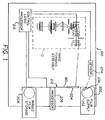
- Figure 1 illustrates an archival printer, such as a COM printer, referred to in general by numeral 100.
- Printer 100 comprises an image forming assembly 10 and a media handling subsystem 212.
- Media handling subsystem 212 comprises a media supply 202, which is typically a film supply, an exposure section 204, an optional film processor 206, and a film storage unit 208.
- a control logic processor 210 such as a microprocessor or other computer adapted to control printer 100, accepts and processes image data for printer 100 and controls the overall operation of image forming assembly 10 and media handling subsystem 212 components.
- the operation of printer 100 is straightforward, following the general pattern used for COM printers overall.
- an undeveloped section of a photosensitive media 160 is advanced from media supply 202 into exposure section 204.
- Image forming assembly 10 cooperates with control logic processor 210 to print image data onto photosensitive media 160.
- the exposed section of photosensitive media 160 is then ready for processing in order to develop the image.
- film processor 206 may be built into printer 100 itself, as is represented in Figure 1.
- the exposed section of photosensitive media 160 is advanced to film processor 206, where the latent exposed image is developed using a heat process.
- the image development function of processor 206 is carried out by a separate developing apparatus (not shown), using conventional silver-halide film development chemicals and techniques.
- film storage unit 208 is typically a cassette, designed to keep the exposed photosensitive media 160 protected from ambient light and to provide a means for transfer of media 160 to the separate developing apparatus.
- media supply 202 can provide COM media having a number of different sizes and formats.
- media supply 202 could comprise a single roll 252 of photosensitive media 160 for imaging.
- Photosensitive media 160 could be, for example, 16mm or 35mm film.
- media supply 202 could comprise multiple rolls 252 of photosensitive media 160, placed side by side.
- media supply 202 could provide two rolls 252 of 16mm film in juxtaposition for imaging, where two or more images are simultaneously exposed, as is described subsequently. Regardless of media dimensions or number of rolls 252, the general image processing sequence described herein would apply.
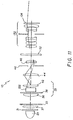
- Illumination optics 11 comprises a light source 29 which is selectable and can be implemented using a number of types of lamp or electro-optical components, as is described subsequently. If light source 29 comprises a halogen lamp, it is advisable to incorporate an infrared rejecting filter 31 following the lamp in the assembly, as shown in Figure 2. Light emitted from light source 29 is focused by a lens 37 and directed to a uniformizer 35.
- Uniformizer 35 comprises two field lenses 36 and 42 and a lenslet array assembly 40, acting as an uniformizer for the light.
- Lenslet array assembly 40 includes two lenslet arrays 40a and 40b.
- Lenses 36 and 37 direct the monochromatic light into the entrance aperture of lenslet array assembly 40.
- Conjugate planes within image forming assembly 10 are indicated by dotted lines 28.
- the light at the intermediate illumination plane is broken into a number of portions equivalent to the number of elements in lenslet array 40a.
- the individual portions are then imaged and magnified by second lenslet array 40b and second field lens 42.
- Light passing through uniformizer 35 is directed within first lens assembly 41 to a field lens 44, is passed through an optional aperture stop 46 and a relay lens 48.
- Relay lens 48 is positioned immediately before a polarization beamsplitter element 50. It should also be noted that, although relay lens 48 and field lens 44 are shown as separate elements in Figure 2, a single compound lens 49 (not shown) providing uniform illumination could be employed instead of the two individual lens elements 48 and 44 as is depicted in Figure 2.
- linear polarizer 38 may be incorporated prior to beamsplitter element 50. There are several places where a linear polarizer 38 can be placed; one such position is immediately preceding lenslet array assembly 40. Linear polarizer 38 is used to isolate the polarization state parallel to the axis of polarization beamsplitter element 50. This serves to reinforce the polarization state determined by polarization beamsplitter element 50, decrease leakage light and thereby increase the resulting contrast ratio.
- a first lens assembly 41 for directing the polarized light to the spatial light modulator 52 comprises field lens 44, relay lens 48, and polarization beamsplitter element 50.
- spatial light modulator 52 of this system is designed for a two dimensional reflective polarization-based spatial light modulator.
- Spatial light modulator 52 includes a plurality of modulator sites 53, each of which can be individually modulated.
- Light passes through spatial light modulator 52, is reflected off the back reflective surface of spatial light modulator 52, and returns through spatial light modulator 52 to be directed through a second lens assembly 132, which acts as a print lens assembly, onto an image plane 150 ( Figure 2).
- a modulator site 53 is "on” or bright, during the round-trip through spatial light modulator 52, the polarization state of the light is rotated. In an ideal case the light is rotated 90 degrees when site 53 is in an "on” state. However, this ideal degree of rotation is rarely easily achieved.
- a given modulator site is "off" or dark, the light is not rotated.
- the light that is not rotated is not passed straight through beamsplitter element 50 but is redirected away from the media plane by polarization beamsplitter element 50.
- light which is rotated by spatial light modulator 52 may become elliptically polarized. Upon passing through a linear polarizer, the light will regain linearity. However, light that is not passed through a linear polarizer will retain ellipticity.
- the reflective liquid crystal modulator As noted above, the most readily available choice from among reflective polarization based modulators is the reflective liquid crystal modulator. Such modulators, originally developed for use in projection display, can have thousands of modulator sites along each orthogonal dimension, with footprints as small as a 0.9 inch diagonal. These high resolution reflective LCDs are often twisted nematic LCDs or homeotropically aligned reflective LCDs, although other types of reflective LCDs such as ferroelectric are often employed in projection display. Some of the key characteristics of these LCDs are high resolution, high contrast ( >100:1), fast frame rate of 70 frames per second or higher, and high aperture ratios (>90%). In addition, the incorporation of a CMOS backplane increases the uniformity across the array.
- the LCDs are also capable of producing an eight bit gray scale either through pulse width modulation or through analog operation. In either case data is introduced digitally to the printing system, as controlled by control logic processor 210 ( Figure 1). These characteristics ensure that the reflective LCD is an excellent choice for use in a reflective printing system.
- Spatial light modulator 52 can be designed in a number of different configurations. The most amenable to a low cost printing system is a single chip system. In the preferred embodiment, spatial light modulator 52 would be a single-chip device having a large number of pixels, specifically designed for single color use, providing optimum frame speed.
- the resulting polarization rotation on an incident beam may vary with wavelength so that the efficiency and contrast of the modulation can vary as a function of wavelength. In the bright, or "on" state, this difference in rotation can effect the efficiency of the system. In other words, the percentage of incident light that is actually rotated and imaged on the media plane can vary.
- This difference in wavelength efficiency can be accounted for by adapting the illumination strength and exposure time, based on wavelength, in order to obtain the power density required by the media, using techniques well-known in the imaging art.
- the problem is particularly acute in the dark or "off state". In this state, the light is not rotated and should not be directed though polarization beamsplitter element 50 and imaged. If the light is in fact, rotated, light will leak through the imaging system and decrease the contrast.
- contrast can be adjusted for wavelength using polarization compensation or selection devices.
- a polarization compensator 76 may be introduced to the surface of spatial light modulator 52.
- the top surface or layer includes compensator 76
- the second surface or layer is a cover glass 74 of spatial light modulator 52
- the third layer is spatial light modulator 52 itself, with a reflective backplane.
- Behind spatial light modulator 52 are mounted actuators 70, 72 or mounts for actuators to position spatial light modulator 52.
- An alternate method for contrast adjustment is to incorporate a polarization compensator in the path of the optical beam to correct the polarization state of the light.
- a single compensator may be placed in the optical path to particularly correct the off-state of the light.
- polarization compensation devices can be expensive.
- An efficient but inexpensive means to accomplish the same results can be obtained using linear polarizers.
- a single LCD imparts a degree of polarization rotation dependent on the color of illumination. In an effort to maximize contrast, special care must be taken to provide a truly dark "off state". Because the rotation of the light from spatial light modulator 52 is not always crossed perfectly with beamsplitter element 50 in the off state, additional polarization selection must be incorporated into the optical path.
- polarization beamsplitter element 50 is not perfect and will leak some amount of light.
- an additional sheet polarizer can be disposed either immediately before or after second lens assembly 132.
- This additional polarizer serves to reject leakage light that is passed through polarization beamsplitter element 50.
- the dark state of the light is actually rotated 7 degrees from the polarization transmitting direction of polarization beamsplitter element 50.
- a second polarizer 134 ( Figure 2) is provided, rotated 7 degrees off-axis to suppress leakage light.
- the particular angle at which polarizer 134 must be placed is a function of the particular reflective LCD chosen for the printing system.
- a suggested placement of polarizer 134 in the optics path is shown in Figure 2.
- dithering may be used to increase the inherent LCD resolution and to compensate for modulator site defects.
- a dithering pattern for a standard high aperture ratio LCD modulator 52 is shown in Figures 5a-5d.
- spatial light modulator 52 is first positioned at a first modulator position 61 and modulator sites 63 are positioned and imaged ( Figure 5a).
- Spatial light modulator 52 is then moved to a second modulator position 62 ( Figure 5b) which is one half of a modulator site laterally displaced from previous position 61. Spatial light modulator 52 is then imaged at position 62. Spatial light modulator 52 is then displaced one half of a modulator site longitudinally from previous position 62, which means it is diagonally displaced from initial position 61 to a third modulator position 64 ( Figure 5d). Modulator sites 63 are illuminated and the media exposed again. Spatial light modulator 52 is then moved to a fourth modulator position 65 that is laterally displaced from third position 64 ( Figure 5c). The media is then exposed at this position. Using this pattern, there is effectively a fourfold increase in the amount of data written.
- Dithering requires motion of the modulator in two directions .
- Each increment of motion is approximately between 5 um and 20 um for a typical reflective LCD modulator.
- many different actuator 54 or motion assemblies, as shown in Figure 2 can be employed.
- the assembly can use two piezo-electric actuators.
- the device can be sub-apertured.
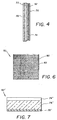
- the modulator can contain an aperture ratio that is relatively small. Ideally this aperture must be symmetrically placed within each modulator site. The result is a modulator site for which only a fraction of the area transmits light. Referring to Figure 6, there is shown an illustration of a sub-apertured area modulator. Black regions 80 represent the non reflecting, non-transmitting regions of the device. Clear areas 82 represent the sub-apertured transmitting areas of the LCD.
- Figure 7 is a cross-sectional view of an alternate two-dimensional LCD spatial light modulator 52'.
- a frame 78' which can be in the form of a CMOS backplane on top of which rests an LCD 76'.
- a cover glass 74' Above the LCD 76' is a cover glass 74'.
- Sub-apertures, to effect the pattern of Figure 6, may exist as a mask in frame 78', as a pattern in LCD 76', or as a pattern on the surface of cover glass 74' closest to LCD 76'.
- a sub-aperture of approximately 25% may be employed. By dithering a 25% aperture ratio device, it is possible to double the resolution in the image.
- Figures 8a-8d represent the dithering of a sub-apertured device.
- Spatial light modulator 52 is positioned at a first modulator position 84 ( Figure 8a) and sub-apertured modulator sites 92 are positioned and exposed while darkened (non reflecting) regions 94 are not imaged onto photosensitive media 160.
- Spatial light modulator 52 is moved to a second modulator position 86 ( Figure 8b) a half full modulator site (sub-aperture and surrounding non-reflective area) laterally displaced from previous position 84. Spatial light modulator 52 is then exposed at position 86.
- Spatial light modulator 52 is then displaced a half a full modulator site longitudinally from previous position 86 to third modulator position 88 ( Figure 8c), which means it is diagonally displaced from the starting point at first modulator position 84. Spatial light modulator 52 is then illuminated and the media exposed again. Spatial light modulator 52 is then moved to a fourth modulator position 90 ( Figure 8d) that is laterally displaced from third position 88. The media is exposed at this position. Effectively, there is a four times increase in the amount of data written. This serves to increase image resolution and to provide means for further image sharpening.
- a sub-aperture of 25% by area, as approximated in Figure 6, will give the highest image quality for a four step dither, however, in an effort to allow for redundancy in the modulator sites, it is better to use a sub-aperture ratio of greater than 25 % by area.
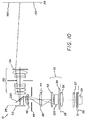
- spatial light modulator 52 is left undithered. But, dithering takes place in one of conjugate image planes 28 as is shown in Figure 9.
- conjugate plane 28 a mask 184 containing the sub-aperture is placed. It is mask 184 that is dithered while the information content to the modulator sites at spatial light modulator 52 is updated. This allows a sub-apertured image to be recorded although the device may not be sub-apertured. It is also possible to create an intermediate image plane, however, this will prove cumbersome.
- mask 184 Another means by which to accomplish the dithering through the use of mask 184 is to place mask 184 in the image plane immediately before media 160. This mask 184 can then be dithered while data is refreshed to the device between dither positions. This method of dither will accomplish the same effect as the previous method of the intermediate image.
- Second lens assembly 132 provides the correct demagnification of the image of spatial light modulator 52 to image plane 150 where photosensitive media 160 is located. It should be noted that second lens assembly 132 can be configured for reduction (as is needed for micrographics in the preferred embodiment) or for magnification (as is needed for diagnostic imaging). The configuration of second lens assembly 132 components is dependent on how printer 100 is used. With this arrangement, the same illumination optics 11 and spatial light modulator 52 components can be used with different printer 100 types.
- the optical system designed using the arrangement disclosed in Figure 1 has been shown to be compact, low in cost, and efficient.
- image forming assembly 10 is capable of providing high exposure energy, image forming assembly 10 allows printer 100 to use dry-process media when provided with a light source having sufficient power and wavelength characteristics, thereby providing performance and environmental benefits.
- Printer 100 is capable of achieving sufficient uniformity while retaining the grayscale performance.
- Spatial light modulator 52 alone can receive up to 8 bits of bit depth. However, 8 bits to the modulator may not translate to 8 bits at the media.
- LCD modulators are known to exhibit some measure of roll-off or loss of contrast at the edges of the device.
- the present invention can take advantage of the fact that spatial light modulators 52 designed for projection display generally refresh data faster than is required for printing. Consequently, it is possible to create a single image at the media 160 as a super-position of a series of images. The individual images that comprise the final image can vary both in information content and illumination.
- printer 100 can build a composite image out of a series of preliminary images. The superposition of the images of varied information content and varied illumination level introduces additional bit depth to the composite image.
- printer 100 can control image forming assembly 10 to correct for some non-uniformity such as roll-off at spatial light modulator 52 edges.
- One way to accomplish this is to introduce additional image data to spatial light modulator 52, activating only individual modulator sites 53 on the outer edge of spatial light modulator 52. These added images can then be exposed and superimposed on the other images thus giving additional depth to the edge regions.
- An example method would be to scan a series of images taken at LCD spatial light modulator 52, create data maps and convolve all input data with an initial map of LCD spatial light modulator 52 to correct the image. Similar techniques can be used to adjust for modulator non-uniformities that are known prior to operation.
- printer 100 allows a number of alternate embodiments within the scope of the present invention.
- the printing solutions described above provide an adequate bit depth and reasonable timing for use in a COM printer.
- Using the printer of the present invention takes advantage of economical, commodity LCD technology to produce low cost, high resolution prints, with high productivity.
- dithering particularly sub-apertured dithering, provides means to further increase the resolution and avoid artifacts due to modulator site failure.
- Light source 29 of illumination optics 11 must provide monochromatic light at a wavelength that is best suited to the sensitivity of photosensitive media 160.
- light source 29 is selectable, allowing printer 100 to utilize any of a number of different types of photosensitive media 160.
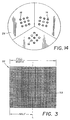
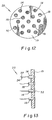
- light source 29 comprises one or more LEDs, grouped by emitted wavelength. Referring to Figure 12, there is shown an arrangement of LEDs within a circular aperture 20, for example: red wavelength LEDs 14, green wavelength LEDs 16, and blue wavelength LEDs 18. With this arrangement, the LEDs are distributed so as to provide exposure light evenly. LEDs of a desired color are energized under the control of control logic processor 210, based on the wavelength required for a specific photosensitive media 160.
- printer 100 can be automatically adapted to use one or another type of photosensitive media 160 and to provide the required exposure characteristics needed by that type of media 160.
- control logic processor 210 would enable red wavelength LEDs 14, for example.
- FIG. 13 there is shown a cross-sectional view of red LEDs 14, green LEDs 16, and blue LEDs 18 mounted with collimating lenses 32 into a frame 19. Individual collimating lenses 32 are optional but might be useful to aid in encapsulation and position of LEDs 14, 16, and 18.
- a rotatable LED wheel 26 comprises grouped LEDs 14, 16, and 18 that can be rotated into position by control logic processor 210 for providing exposure energy.
- the arrangement of Figure 14 might be most suitable where it is advantageous to obtain concentrated light energy from a close grouping of multiple LEDs 14, 16, and 18.
- the disadvantage presented using the arrangement of Figure 14 relates to rotation of rotatable wheel 26, since this requires an added motor or manual operation.
- the preferred embodiment would use distributed LEDs 14, 16, and 18 as shown in Figure 12, arranged for selective energization as electronically switched by control logic processor 210.
- the arrangement of Figure 12 requires no moving parts and can be implemented at lower cost than that shown in Figure 14.
- LEDs 14, 16, and 18 would be specified based on exposure sensitivity characteristics of each type of photosensitive media 160 to be used in printer 100.
- a number of alternate arrangements are possible, including use of LEDs of any suitable color, emitting the desired wavelength.
- different groupings of red LEDs could be used for types of media 160 that differ only slightly in terms of wavelength response.
- a single LED could be used for any one media 160 type; however, the use of multiple LEDs provides additional output intensity to be directed by image forming assembly 10.
- light source 29 there are a number of other alternatives for light source 29 that would allow the use of multiple types of photosensitive media 160 to be used by the same printer 100.
- a halogen lamp could be used to provide a broadband light beam transmitted through a filter element (for example, red, green, or blue filter) to provide a monochromatic light beam.
- a filter element for example, red, green, or blue filter
- lasers could also be employed as light sources 29.
- a sensor 234 connected to control logic processor 210, is disposed to sense an encoding 236 that is coupled to media supply 202.
- Transponder containing a memory that includes identifying data for the media, such as an RF transponder, "SAMPT” ( S elective A ddressable M ulti- P age T ransponder), part number “RI-TRP-IR2B” available from Texas Instruments, Incorporated.
- Transceiver such as an RF transceiver, for example, "Model S2000”TM transceiver, available from Texas Instruments, Incorporated, located in Dallas, Texas, USA.
- Magnetically encoded strip Magnetic strip reader Memory device such as an I-button, manufactured by Dallas Semiconductor Corp., Dallas, TX I-button reader Trace pattern, such as an embedded trace pattern Trace pattern reader
- Encoding 236 could be printed or attached to media 160 packaging or could be provided from a network connection or manually entered by an operator. Using this option with the preferred embodiment, upon sensing media 160 width from encoding 236, control logic processor 210 would respond by using the preferred output format for imaging onto media 160. Encoding 236 could include dimension data, for example, or could even include instructions or an algorithm that controls printer 100 response to the media 160 type that is loaded.
- a mechanical, electromagnetic, or optical sensor could alternately be used to indicate media 160 width.
- printer 100 can be adapted to accept COM media 160 in any of a set of widths, with only minor modifications to COM media handling hardware. This would allow, therefore, printer 100 to handle a range of media 160 types, resulting in cost benefits and increased efficiency.
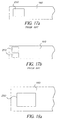
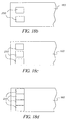
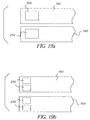
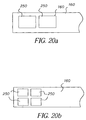
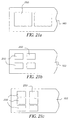
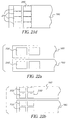
- Figures 17 through 22 illustrate some examples of possible layouts for output images 250 exposed onto photosensitive media 160. It must be stressed that the layouts shown in Figures 17 through 22 are by way of example, and are not by way of limitation. Many similar formats could alternately be used, within the scope of the present invention. Images 250 and photosensitive media 160 are representative only and are not drawn to scale.
- Output image 250 for Figure 17a could be, for example, an A4 sized image at 24X reduction.
- Output images 250 in Figure 17b could be, for example, A4 sized images at 40X reduction.
- the arrangement of Figure 17b could be used for the front and back of the same document, for example.
- Output image 250 in Figure 18a could be, for example, an A4 sized image at 20X reduction or an A3 sized image at 24X reduction.
- Output images 250 in Figure 18b could be, for example, two A3 sized images at 40X reduction or two A4 images at 32X reduction.
- Output images 250 in Figure 18c could be, for example, three A4 sized images at 32X reduction.
- the arrangement of Figure 18c might be well suited, for example, for storing grayscale versions of color separations, such as the additive Red, Green, and Blue separations, or the subtractive Cyan, Magenta, and Yellow separations.
- Output images 250 in Figure 18d could be, for example, four A4 sized images.
- the arrangement of Figure 18d might be well suited, for example, for storing front and back sides of two separate documents or for storing four different documents. Using spatial light modulator 52, output images 250 in Figures 18b, 18c, and 18d can be exposed simultaneously.
- FIGS 19a and 19b there are shown exemplary layout formats for output images 250 imaged onto photosensitive media 160, where media 160 is made up of two widths of 16mm microfilm, both disposed at image plane 150 at the same time.
- the 2-up arrangement of Figure 19a shows two images in similar format to that illustrated in Figure 17a.
- the 4-up arrangement of Figure 19b shows four images in similar format to that illustrated in Figure 17b.
- output images 250 in Figures 19a and 19b can be exposed simultaneously, effectively doubling the productivity.
- Figures 20a and 20b there are shown exemplary layout formats that can be employed for simultaneous exposure of multiple output images 250 onto photosensitive media 160, where media 160 is narrow-width, 16mm microfilm.
- the arrangement of Figures 20a and 20b is similar to the arrangement shown in Figures 17a and 17b, with the advantage that, using spatial light modulator 52, both output images 250 in Figure 20a and all four output images 250 in Figure 20b can be exposed simultaneously.
- FIGS 21a through 21d there are shown exemplary layout formats for output images 250 imaged onto photosensitive media 160, where media 160 is wider, 35mm microfilm.
- spatial light modulator 52 uses spatial light modulator 52 to expose all output images 250 in each format shown in Figures 20a through 20d to be exposed simultaneously, with substantial gains in throughput.
- FIGs 22a and 22b there are shown exemplary layout formats for output images 250 imaged onto photosensitive media 160, where media 160 is narrower, 16mm microfilm.
- spatial light modulator 52 Using spatial light modulator 52, all output images 250 in each format shown in Figures 22a and 22b can be exposed simultaneously, with substantial gains in throughput.
- spatial light modulator 52 provides distinctive advantages for COM output imaging, allowing a varied arrangement of output image 250 formats onto photosensitive media 160 having a range of widths, even where two rolls of media 252 supply two segments of media 160 as illustrated in Figures 19a, 19b, 22a, and 22b.
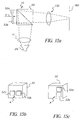
- FIG. 15a there is shown one possible arrangement using multiple spatial light modulators 52a and 52b, both disposed on the same side of polarization beamsplitter element 50. Using such an arrangement, it would be possible to write different parts of a larger image onto media 160 using tiling techniques that are familiar in the imaging arts. Alternately, using multiple spatial light modulators 52, different documents could be written to COM media 160 at the same time, such as to provide the 2-up arrangement shown in the example of Figure 17b. Spatial light modulators 52 can be disposed in a number of arrangements with respect to polarization beamsplitter element 50.
- FIGS 15b and 15c there are shown possible arrangements of spatial light modulators 52a and 52b, disposed horizontally and vertically with relation to each other.
- Dotted reference line A in Figure 15a corresponds to the same reference line A in Figures 15b and 15c.
- Two spatial light modulators 52 are shown; however, more than two spatial light modulators 52 could be disposed horizontally and/or vertically with relation to each other on the same face of polarization beamsplitter element 50.
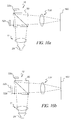
- FIG 16a there is shown an alternate arrangement using multiple spatial light modulators 52a and 52b that are each disposed parallel to a different face of polarization beamsplitter element 50. More than two spatial light modulators 52 could be used, such as to provide large format or 2-up printing or for the arrangements shown in Figures 17 through 22.
- Figure 16b shows yet another possible arrangement using three spatial light modulators 52a, 52b, and 52c. A number of other possible arrangements using three or more spatial light modulators 52 on different sides of polarization beamsplitter element 50 could be used, in addition to those shown in Figures 16a and 16b.
- Figs 15a, 15b, 15c, 16a, and 16b could also employ a pellicle 220 for directing the beam as an alternative to polarization beamsplitter element 50.
- a single printer 100 can be configured to allow loading of photosensitive media 160 having any one of a number of suitable width dimensions, and to adjust its output imaging characteristics in order to record output images in an appropriate format for media 160 having that width dimension.
- Printer 100 can prompt an operator to specify one of a set of available output formats, based on the width dimension detected.
- use of spatial light modulator 52 enables printer 100 to expose multiple images at one time. This capability increases the potential throughput productivity of printer 100 and even allows printer 100 to image simultaneously onto two separate rolls 252 of media 160 at one time.
- dotted line L shows a possible division of spatial light modulator 52 into two segments or partitions, right and left, for use in 2-up printing.
- Drive signals for the modulator sites of the two segments originate from a composite image that is formed by two different, smaller images placed side by side. Each segment would then be able to write a separate image 250.
- the right half of modulator 52 could expose the rightmost image 250 of Figure 20a at the same time that the left half of modulator 52 would expose the leftmost image 250 of Figure 20a.
- each modulator is provided with drive signals from a different image data file at the same time.
- modulator 52a could be used to write one image, modulator 52b to write another image.
- Numerous alternative ways of driving partitions of a larger modulator and/or multiple modulators are also possible to effect simultaneous exposure of multiple images, with results such as shown in Figs 17-22. It can be readily appreciated that the resulting productivity gains could be substantial.
- photosensitive media 160 could be provided from roll 252 or in some other form. Numerous formats are available for the placement of images onto narrow 16mm or wider 35mm media 160. A number of modifications could be made to image forming assembly 10 components without departing from the scope of this invention.
- a film recording apparatus that provides a plurality of output formats using the same exposure optics, allowing the recording of images onto different sizes of media in different formats and allowing the exposure of multiple images at one time.
Landscapes
- Physics & Mathematics (AREA)
- Spectroscopy & Molecular Physics (AREA)
- General Physics & Mathematics (AREA)
- Printers Or Recording Devices Using Electromagnetic And Radiation Means (AREA)
- Projection-Type Copiers In General (AREA)
- Liquid Crystal (AREA)
Applications Claiming Priority (2)
| Application Number | Priority Date | Filing Date | Title |
|---|---|---|---|
| US699552 | 2000-10-30 | ||
| US09/699,552 US6580490B1 (en) | 2000-10-30 | 2000-10-30 | Method and apparatus for printing images in multiple formats using a spatial light modulator |
Publications (1)
| Publication Number | Publication Date |
|---|---|
| EP1202111A2 true EP1202111A2 (de) | 2002-05-02 |
Family
ID=24809837
Family Applications (1)
| Application Number | Title | Priority Date | Filing Date |
|---|---|---|---|
| EP01203981A Withdrawn EP1202111A2 (de) | 2000-10-30 | 2001-10-18 | Verfahren und Vorrichtung zum drucken von mehrere Formate mittels einen räumlicher Lichtmodulator |
Country Status (3)
| Country | Link |
|---|---|
| US (1) | US6580490B1 (de) |
| EP (1) | EP1202111A2 (de) |
| JP (1) | JP2002207258A (de) |
Cited By (2)
| Publication number | Priority date | Publication date | Assignee | Title |
|---|---|---|---|---|
| EP1380885A1 (de) * | 2002-07-11 | 2004-01-14 | Agfa-Gevaert AG | Vorrichtung und Verfahren zum Aufbelichten von digitalisierten Bildinformationen auf ein lichtempfindliches Material |
| WO2004107733A1 (en) * | 2003-05-28 | 2004-12-09 | G.P.E. Srl | Device to effect micro-displacements of a display for digital images |
Families Citing this family (19)
| Publication number | Priority date | Publication date | Assignee | Title |
|---|---|---|---|---|
| DE20000906U1 (de) * | 2000-01-20 | 2000-03-16 | Göhner, Helmut, 32791 Lage | Vorrichtung zum Vergrößern und Belichten von digitalen Belichtungsanlagen auf lichtempfliches Fotopapier |
| US6930797B2 (en) * | 2001-02-27 | 2005-08-16 | Eastman Kodak Company | Method and apparatus for printing high resolution images using multiple reflective spatial light modulators |
| US20020135795A1 (en) * | 2001-03-22 | 2002-09-26 | Hoi-Sing Kwok | Method and apparatus for printing photographs from digital images |
| US6980321B2 (en) * | 2001-08-20 | 2005-12-27 | Eastman Kodak Company | Method and apparatus for printing high resolution images using multiple reflective spatial light modulators |
| ITPN20010084A1 (it) * | 2001-11-29 | 2003-05-29 | Gpe Srl | Dispositivo di controllo adattabile a qualsiasi genere di laboratoriodi sviluppo e stampa di tipo professionale e/o amatoriale di fotografi |
| TW521320B (en) * | 2001-12-10 | 2003-02-21 | Via Tech Inc | Device and method for substrate exposure |
| JP3959011B2 (ja) * | 2002-10-15 | 2007-08-15 | 株式会社リコー | 印刷管理システム |
| US7042483B2 (en) * | 2003-03-10 | 2006-05-09 | Eastman Kodak Company | Apparatus and method for printing using a light emissive array |
| US7023463B2 (en) * | 2003-07-22 | 2006-04-04 | Eastman Kodak Company | Method and apparatus for printing images from digital image data |
| JP2007518262A (ja) * | 2004-01-08 | 2007-07-05 | マイクロニック レーザー システムズ アクチボラゲット | データ完全性チェックのための方法およびデバイス |
| US7012674B2 (en) * | 2004-01-13 | 2006-03-14 | Asml Holding N.V. | Maskless optical writer |
| US6863400B1 (en) | 2004-01-21 | 2005-03-08 | Eastman Kodak Company | Tiled projection display using spatial light modulators |
| US7489329B2 (en) * | 2004-04-29 | 2009-02-10 | Samsung Electro-Mechanics Co., Ltd. | Scanning apparatus using vibration light modulator |
| DE102004038554A1 (de) * | 2004-08-06 | 2006-03-16 | Thomson Broadcast And Media Solutions Gmbh | Filmbelichter und Verfahren zur Belichtung von lichtempfindlichen Filmen |
| DE102006034588B4 (de) * | 2005-07-29 | 2017-10-12 | Chromasens Gmbh | Verfahren und Vorrichtung zum Belichten eines Mikrofilms |
| DE102005035650A1 (de) * | 2005-07-29 | 2007-02-01 | Chromasens Gmbh | Verfahren und Vorrichtung zum Belichten eines Mikrofilms |
| WO2014190228A1 (en) * | 2013-05-23 | 2014-11-27 | President And Fellows Of Harvard College | Pixelated tunable color filter |
| DE102017200795B4 (de) | 2017-01-19 | 2022-03-03 | Robert Bosch Gmbh | LIDAR-Vorrichtung mit einer Anordnung zum Bereitstellen mindestens eines Strahls mit zumindest reduzierten Störreflexen |
| EP4080282B1 (de) | 2018-09-13 | 2025-11-05 | Charles Beseler Company | Vorrichtung und verfahren zur vergrösserung von digitalen fotos auf fotopapier |
Citations (8)
| Publication number | Priority date | Publication date | Assignee | Title |
|---|---|---|---|---|
| US4728965A (en) | 1986-06-20 | 1988-03-01 | Eastman Kodak Company | Laser printer having means for correcting laser pointing errors |
| US5325137A (en) | 1991-08-28 | 1994-06-28 | Victor Company Of Japan, Ltd. | Overhead projector with a spatial light modulator |
| US5461411A (en) | 1993-03-29 | 1995-10-24 | Texas Instruments Incorporated | Process and architecture for digital micromirror printer |
| US5504514A (en) | 1992-02-13 | 1996-04-02 | Texas Instruments Incorporated | System and method for solid state illumination for spatial light modulators |
| US5521748A (en) | 1994-06-16 | 1996-05-28 | Eastman Kodak Company | Light modulator with a laser or laser array for exposing image data |
| US5652661A (en) | 1995-06-07 | 1997-07-29 | Eastman Kodak Company | High speed photographic printer using optical and digital printing with an active matrix LCD |
| US5743610A (en) | 1994-12-27 | 1998-04-28 | Seiko Epson Corporation | Projection-type display apparatus |
| US5808800A (en) | 1994-12-22 | 1998-09-15 | Displaytech, Inc. | Optics arrangements including light source arrangements for an active matrix liquid crystal image generator |
Family Cites Families (16)
| Publication number | Priority date | Publication date | Assignee | Title |
|---|---|---|---|---|
| US4624558A (en) | 1985-10-15 | 1986-11-25 | Bell & Howell Company | Microimage recorder |
| DE3615780A1 (de) | 1986-05-10 | 1987-11-12 | Agfa Gevaert Ag | Laser computer output mirkofilm-kamera |
| DE3826375A1 (de) | 1988-08-03 | 1990-02-22 | Agfa Gevaert Ag | Computer-output-mikrofilm-printer |
| US5504555A (en) * | 1993-04-26 | 1996-04-02 | Noritsu Koki Co., Ltd. | Apparatus for supplying photosensitive material |
| US5745156A (en) | 1994-04-28 | 1998-04-28 | Xerox Corporation | Digital printer using two-dimensional, full frame light valve |
| US5701185A (en) | 1994-11-21 | 1997-12-23 | Polaroid Corporation | Spatial light modulator assembly for adapting a photographic printer to print electronic images |
| US5757348A (en) * | 1994-12-22 | 1998-05-26 | Displaytech, Inc. | Active matrix liquid crystal image generator with hybrid writing scheme |
| US5517359A (en) * | 1995-01-23 | 1996-05-14 | Gelbart; Daniel | Apparatus for imaging light from a laser diode onto a multi-channel linear light valve |
| US5808657A (en) * | 1996-06-17 | 1998-09-15 | Eastman Kodak Company | Laser printer with low fill modulator array and high pixel fill at a media plane |
| US5754305A (en) * | 1996-12-03 | 1998-05-19 | Eastman Kodak Company | Method and apparatus for correcting light non-uniformity in an LCD photographic printer |
| JP4056590B2 (ja) * | 1997-07-28 | 2008-03-05 | 富士フイルム株式会社 | 画像記録装置 |
| SE9800665D0 (sv) * | 1998-03-02 | 1998-03-02 | Micronic Laser Systems Ab | Improved method for projection printing using a micromirror SLM |
| US6204875B1 (en) * | 1998-10-07 | 2001-03-20 | Barco Graphics, Nv | Method and apparatus for light modulation and exposure at high exposure levels with high resolution |
| US6356380B1 (en) * | 1998-11-04 | 2002-03-12 | Barco Graphics Nv | Apparatus for imaging light from multifaceted laser diodes onto a multichannel spatial light modulator |
| US6215547B1 (en) * | 1998-11-19 | 2001-04-10 | Eastman Kodak Company | Reflective liquid crystal modulator based printing system |
| US6480259B1 (en) * | 2000-09-28 | 2002-11-12 | Eastman Kodak Company | Method and apparatus for printing monochromatic images using a spatial light modulator having a selectable light source |
-
2000
- 2000-10-30 US US09/699,552 patent/US6580490B1/en not_active Expired - Lifetime
-
2001
- 2001-10-18 EP EP01203981A patent/EP1202111A2/de not_active Withdrawn
- 2001-10-25 JP JP2001327653A patent/JP2002207258A/ja active Pending
Patent Citations (8)
| Publication number | Priority date | Publication date | Assignee | Title |
|---|---|---|---|---|
| US4728965A (en) | 1986-06-20 | 1988-03-01 | Eastman Kodak Company | Laser printer having means for correcting laser pointing errors |
| US5325137A (en) | 1991-08-28 | 1994-06-28 | Victor Company Of Japan, Ltd. | Overhead projector with a spatial light modulator |
| US5504514A (en) | 1992-02-13 | 1996-04-02 | Texas Instruments Incorporated | System and method for solid state illumination for spatial light modulators |
| US5461411A (en) | 1993-03-29 | 1995-10-24 | Texas Instruments Incorporated | Process and architecture for digital micromirror printer |
| US5521748A (en) | 1994-06-16 | 1996-05-28 | Eastman Kodak Company | Light modulator with a laser or laser array for exposing image data |
| US5808800A (en) | 1994-12-22 | 1998-09-15 | Displaytech, Inc. | Optics arrangements including light source arrangements for an active matrix liquid crystal image generator |
| US5743610A (en) | 1994-12-27 | 1998-04-28 | Seiko Epson Corporation | Projection-type display apparatus |
| US5652661A (en) | 1995-06-07 | 1997-07-29 | Eastman Kodak Company | High speed photographic printer using optical and digital printing with an active matrix LCD |
Cited By (3)
| Publication number | Priority date | Publication date | Assignee | Title |
|---|---|---|---|---|
| EP1380885A1 (de) * | 2002-07-11 | 2004-01-14 | Agfa-Gevaert AG | Vorrichtung und Verfahren zum Aufbelichten von digitalisierten Bildinformationen auf ein lichtempfindliches Material |
| US6867847B2 (en) | 2002-07-11 | 2005-03-15 | Agfa-Gevaert Aktiengesellschaft | Apparatus and method for projecting graphic information onto a light-sensitive material |
| WO2004107733A1 (en) * | 2003-05-28 | 2004-12-09 | G.P.E. Srl | Device to effect micro-displacements of a display for digital images |
Also Published As
| Publication number | Publication date |
|---|---|
| US6580490B1 (en) | 2003-06-17 |
| JP2002207258A (ja) | 2002-07-26 |
Similar Documents
| Publication | Publication Date | Title |
|---|---|---|
| US6580490B1 (en) | Method and apparatus for printing images in multiple formats using a spatial light modulator | |
| US6215547B1 (en) | Reflective liquid crystal modulator based printing system | |
| EP1177908B1 (de) | Verfahren und Gerät zum monochromatischen Drucken unter Verwendung eines räumlichen Lichtmodulators | |
| EP1291711B1 (de) | Printer für lichtempfindliche Medien mit einer hybriden Lichtquelle | |
| US6574032B1 (en) | Imaging apparatus using dither to minimize pixel effects | |
| US6646716B1 (en) | Method and apparatus for printing multiple simultaneous images onto a photosensitive media | |
| EP1285769B1 (de) | Verfahren und Vorrichtung zum Drucken von Bildern mit hoher Auflösung mit vielfach reflektierenden räumlichen Lichtmodulatoren | |
| US6624949B2 (en) | Printing apparatus for photosensitive media using dichroic prism in illumination path | |
| US6480259B1 (en) | Method and apparatus for printing monochromatic images using a spatial light modulator having a selectable light source | |
| US6930797B2 (en) | Method and apparatus for printing high resolution images using multiple reflective spatial light modulators | |
| US5684620A (en) | High resolution imaging system and method of imaging using the same | |
| US6980280B2 (en) | Two level image writer | |
| US7023463B2 (en) | Method and apparatus for printing images from digital image data | |
| US6734889B2 (en) | Color printer comprising a linear grating spatial light modulator | |
| US7164434B2 (en) | LCD based imaging apparatus for printing multiple formats | |
| US20070153080A1 (en) | High-speed continuous film writer |
Legal Events
| Date | Code | Title | Description |
|---|---|---|---|
| PUAI | Public reference made under article 153(3) epc to a published international application that has entered the european phase |
Free format text: ORIGINAL CODE: 0009012 |
|
| AK | Designated contracting states |
Kind code of ref document: A2 Designated state(s): AT BE CH CY DE DK ES FI FR GB GR IE IT LI LU MC NL PT SE TR |
|
| AX | Request for extension of the european patent |
Free format text: AL;LT;LV;MK;RO;SI |
|
| STAA | Information on the status of an ep patent application or granted ep patent |
Free format text: STATUS: THE APPLICATION IS DEEMED TO BE WITHDRAWN |
|
| 18D | Application deemed to be withdrawn |
Effective date: 20071101 |