EP1199557A1 - Method for measuring thermal diffusivity and interface thermal resistance - Google Patents
Method for measuring thermal diffusivity and interface thermal resistance Download PDFInfo
- Publication number
- EP1199557A1 EP1199557A1 EP20010308796 EP01308796A EP1199557A1 EP 1199557 A1 EP1199557 A1 EP 1199557A1 EP 20010308796 EP20010308796 EP 20010308796 EP 01308796 A EP01308796 A EP 01308796A EP 1199557 A1 EP1199557 A1 EP 1199557A1
- Authority
- EP
- European Patent Office
- Prior art keywords
- layer
- metal film
- substance
- measuring
- thermal diffusivity
- Prior art date
- Legal status (The legal status is an assumption and is not a legal conclusion. Google has not performed a legal analysis and makes no representation as to the accuracy of the status listed.)
- Granted
Links
- 238000000034 method Methods 0.000 title abstract description 40
- 239000002184 metal Substances 0.000 abstract description 35
- 229910052751 metal Inorganic materials 0.000 abstract description 35
- 239000000126 substance Substances 0.000 abstract description 35
- 229910052755 nonmetal Inorganic materials 0.000 abstract description 25
- 239000000758 substrate Substances 0.000 abstract description 9
- 238000005259 measurement Methods 0.000 abstract description 6
- 239000010408 film Substances 0.000 description 72
- 238000009792 diffusion process Methods 0.000 description 17
- 238000010438 heat treatment Methods 0.000 description 15
- 239000000523 sample Substances 0.000 description 15
- 239000010409 thin film Substances 0.000 description 9
- 239000004065 semiconductor Substances 0.000 description 6
- 230000003287 optical effect Effects 0.000 description 5
- 238000005316 response function Methods 0.000 description 5
- 239000011159 matrix material Substances 0.000 description 4
- 230000001052 transient effect Effects 0.000 description 4
- 239000000463 material Substances 0.000 description 3
- 239000007769 metal material Substances 0.000 description 3
- 239000000203 mixture Substances 0.000 description 3
- RTZKZFJDLAIYFH-UHFFFAOYSA-N Diethyl ether Chemical compound CCOCC RTZKZFJDLAIYFH-UHFFFAOYSA-N 0.000 description 2
- 230000015572 biosynthetic process Effects 0.000 description 2
- 238000009529 body temperature measurement Methods 0.000 description 2
- 238000010586 diagram Methods 0.000 description 2
- 230000000630 rising effect Effects 0.000 description 2
- 238000012546 transfer Methods 0.000 description 2
- XUIMIQQOPSSXEZ-UHFFFAOYSA-N Silicon Chemical compound [Si] XUIMIQQOPSSXEZ-UHFFFAOYSA-N 0.000 description 1
- RTAQQCXQSZGOHL-UHFFFAOYSA-N Titanium Chemical compound [Ti] RTAQQCXQSZGOHL-UHFFFAOYSA-N 0.000 description 1
- 238000004364 calculation method Methods 0.000 description 1
- 230000001419 dependent effect Effects 0.000 description 1
- 238000011161 development Methods 0.000 description 1
- 230000000694 effects Effects 0.000 description 1
- 230000005281 excited state Effects 0.000 description 1
- 230000002045 lasting effect Effects 0.000 description 1
- 239000012768 molten material Substances 0.000 description 1
- 238000009877 rendering Methods 0.000 description 1
- 238000011160 research Methods 0.000 description 1
- 229910052710 silicon Inorganic materials 0.000 description 1
- 239000010703 silicon Substances 0.000 description 1
- 230000001360 synchronised effect Effects 0.000 description 1
- 239000010936 titanium Substances 0.000 description 1
- 229910052719 titanium Inorganic materials 0.000 description 1
- 230000007704 transition Effects 0.000 description 1
Images



Classifications
-
- G—PHYSICS
- G01—MEASURING; TESTING
- G01N—INVESTIGATING OR ANALYSING MATERIALS BY DETERMINING THEIR CHEMICAL OR PHYSICAL PROPERTIES
- G01N25/00—Investigating or analyzing materials by the use of thermal means
- G01N25/18—Investigating or analyzing materials by the use of thermal means by investigating thermal conductivity
Definitions
- the present invention relates to a method for measuring a thermal diffusivity within a substance having a three-layer laminated structure.
- this invention relates to a method for measuring a thermal diffusivity and an interface thermal resistance, which method is suitable for correctly measuring a thermal diffusivity within a three-layer film structure containing a non-metal substance, such as a semiconductor device and an optical disc type data recording medium.
- thin film technique is considered to be the most advanced technique and has attracted a considerable public attention.
- thin film structure plays an important role in a highly integrated semiconductor device, DVD ⁇ RAM, MO and the like.
- a multi-layered thin film structure has been put into practical use, so that analyzing the properties thereof has become an important task in this field.
- the present situation is that there has not been a sufficient progress in the measurement of thermophysical properties of such a thin film structure.
- thermophysical properties of such a thin film structure it is demanded that a rapid development take place in the field of the measurement of the thin film's thermophysical properties.
- the inventors of the present invention have previously developed a picosecond thermoreflectance method which involves a backside heating and a front side temperature measuring, and have been successful in measuring a thermal diffusivity in the thickness direction of a metal film having a thickness of 100 nm, as well as an interface thermal resistance between metal films.
- this method has already been suggested and described in Japanese Unexamined Patent Application Publication No. 2000-83113.
- a metal film 10 is deposited on a transparent substrate 11. Afterwards, an interface 12 formed between the metal film 10 and the transparent substrate 11 is irradiated with a heating pulse light H so as to be heated. Meanwhile, one surface 13 of the metal film 10 is irradiated with a temperature measuring pulse light P, while a reflected light of the pulse light P is measured, thereby measuring a surface temperature of the metal film 10.
- Fig. 6 is a block diagram showing the aforementioned thermoreflectance system involving the backside heating and the front side temperature measuring, which has already been put into practical use on the base of the above discussed principle.
- a light beam emitted from a titanium/sapphire laser 21 capable of generating a picosecond pulse light is splitted by a beam splitter 22, so as to be divided into two light beams, with one being a heating beam H and the other serving as a temperature measuring beam P.
- the heating beam H is modulated by a frequency which may be for example 1 MHz, using an acoustic optical modulator 23 controlled by an oscillator 29.
- the modulated heating beam H is then caused to travel through an optical delay line 25 capable of alterring a light path length by moving a prism 24.
- the heating beam H having passed through the optical delay line 25 is then passed through a lens 26a so as to be focused on to an interface 30 between a metal film 27 and a transparent substrate 28.
- the temperature measuring beam P is passed through a ⁇ /2 plate 33 and a lens 26b, so as to be focused on to the metal film's another surface 32 just opposite to the heated surface.
- the temperature measuring beam reflected from the surface 32 is thus detected by a silicon photo-diode 34.
- AC component of photo-diode signal synchronized by a modulation frequency provided by the above transient thermoreflcetance oscillator 29 is detected by a lock-in amplifier 35.
- a signal is recorded by moving the prism 24 along the delay line 25.
- a non-metal film such as a semiconductor film which is different from a metal film
- a laser pulse in order for a laser pulse to be absorbed into the film at a depth of about 10 nm from the surface thereof, it is necessary to use a light source capable of emitting a light beam having a short wavelength.
- a time period much longer than 1 picosecond is usually needed for arriving at a local thermal equilibrium state in which energy has been relaxed in lattice system. For this reason, the aforementioned measuring method has been found to be extremely difficult in measuring the thermal diffusivity of a non-metallic thin film such as a semiconductor thin film.
- the invention seeks to measure correctly the thermal diffusivity of a substance, even if it is non-metallic, and to measure thermal diffusivity within a three-layer film structure.
- Embodiments of the invention make it possible to deal with even a non-metallic substance, i.e. to measure simultaneously thermal diffusivity as well as the interface thermal resistance of the non-metallic substance, by forming metal layers on both sides of the non-metallic substance, using a conventional picosecond thermoreflectance method.
- Embodiments of the invention also make it possible to measure thermal diffusivity within the above three-layer film substance, by preparing a plurality of substances which are different from one another only in their thicknesses and whose thermophysical properties values are unknown, and by analyzing data measured in the three-layer sample, thereby making it possible to measure correctly the thermal diffusivity within the above three-layer substance.
- Embodiments of the invention also make it possible to use a response function method to measure correctly thermal diffusivity within a three-layer film structure, on the basis of the above method for measuring thermal diffusivity within the three-layer substance. This is carried out with an area defined by a transient temperature history curve, on the back of the pulse-heated three-layer structure, as well as with the horizontal axis corresponding to a pulse-heating time.
- thermophysical properties of a three-layer substance including a middle layer whose thermophysical properties are unknown and two other layers formed on both sides of the middle layer, said two other layers belonging to the same sort of substance and having known thermophysical properties, is defined by claim 1.
- the method of the invention preferably includes the step of preparing a plurality of substances which are different from one another only in their thicknesses and whose thermophysical properties values are unknown, forming on both sides of each of the substances other substance layers which are in the same identical state and whose thermophysical properties are known, measuring the thermal diffusivity and the interface thermal resistance of each of the three-layer substances.
- the invention also preferably includes the step of calculating an area defined by a transient temperature history curve on the back of the pulse-heated three-layer substance and a horizontal axis corresponding to a pulse-heating time, thereby simultaneously measuring thermal diffusivity within the three-layer substance as well as the interface thermal resistance.
- the sample material is a three layer structure including a non-metal film 1 whose thermal properties are unknown, a first metal film 2 disposed on one side (an upper surface when viewed in Fig. 1) of the non-metal film 1, and a second metal film 3 disposed on the other side (a lower surface when viewed in Fig. 1) of the non-metal film 1.
- the first and second metal films 2, 3 are the same identical substance whose thermophysical properties are known, and so formed that they have the same thickness when used in this manner.
- the three-layer structure is disposed on a transparent substrate 4.
- the sample material having such a structure is to be actually formed, it is allowed to use a film formation technique to form the above film layers having predetermined thicknesses, successively on the transparent substrate 4.
- thermoreflectance method involving backside heating and front side temperature measuring
- the picosecond thermoreflectance method involving backside heating and front side temperature measuring
- the lower surface of the second metal film 3 is heated by virtue of an irradiation using a picosecond light pulse coming from below (when viewed in Fig. 1) and passing through the transparent substrate 4.
- the light pulse for use in the irradiation is converted into a heat in the second metal film 3 within only one picosecond.
- Such heat is then caused to diffuse through interface/non-metal film /interface, so as to arrive at the first metal film 2.
- the thermoreflectance method explained in Fig. 5 and 6 is used to measure a temperature change on the surface of the first metal film 2, it is possible to measure a heat diffusion passing through the three-layer film structure.
- such an arrangement is geometrically equivalent to the case where a laser flash method is used to measure a multi layered structure.
- it corresponds to a situation in which a heat diffusion is measured under a condition where a transparent sample material 5 has on either side thereof a blackened thin film 6 (as shown in Fig. 4A), as well as another situation in which a heat diffusion is measured under a condition where a molten material 7 has been sealed into an opaque container 8 (as shown in Fig. 4B).
- Fig. 2A and Fig. 2C show some results shown in Fig. 2A and Fig. 2C, which indicate that the above problems can be solved if the compositions of metal films 2,3 and the non-metal film 1 are completely the same as those obtainable in a film formation method, and if a plurality of three-layer film structures (only the thicknesses of their non-metal film layers 1 are different from each other) are used to carry out the above measurement.
- an area A defined by a sample material backside temperature history curve (after pulse heating) and a straight line of maximum temperature rising may be calculated by the following equation (1).
- an area has a time dimension and can also be referred to as "areal heat diffusion time".
- a 1 in Fig. 2B and A 2 in Fig. 2D are areal heat diffusion times corresponding to the respective sample materials.
- a 3 is the three-layer film structure's areal heat diffusion time when an interface thermal resistance is 0, and can be represented by the following equation.
- composition and thickness of the metal film on the front side are all the same as those on the backside.
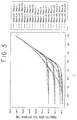
- Fig. 3 is a graph which can be used to indicate how the areal heat diffusion time changes when ⁇ and ⁇ are used as parameters and ⁇ is changed. It is understood that the value of ⁇ can be evaluated from an area where ⁇ value is small and that an interface thermal resistance can be calculated. On the other hand, in an area where ⁇ value is large, areal heat diffusion time is no longer dependent on ⁇ , if the thermal diffusivity and the thermal effusivity of the respective metal films as well as the thickness of each film layer are known, it is possible to evaluate a thermal diffusivity of a non-metal film.
- thermoreflectance method As described in the above, it is understood that using temperature change curves obtained when using the backside heating/front side temperature measuring type picosecond thermoreflectance method to measure the three-layer film structure associated with interface thermal resistance, it is possible to separately calculate the thermal diffusivity of the non-metal film as well as the thermal resistance on interfaces between the metal films and the non-metal film, and such a calculation may be carried out by using a response function method.
- thermoreflectance method even if a substance to be measured is a non-metal substance, providing a metal layer on ether side of the non-metal substance makes it possible to simultaneously measure thermal diffusivity and interface thermal resistances, by virtue of a picosecond thermoreflectance method.
- thermoreflectance method for measuring a thermal diffusivity within a three-layer substance
- a plurality of substances which are different from one another only in their thickness and their thermophysical properties are unknown
- both sides of each of the substances are formed with other layers which belong to the same sort of substance and are in the same state and have the predetermined known thermophysical properties, thereby carrying out the above measurement on each of the three-layer substances. Therefore, by using the same picosecond thermoreflectance method to measure the respective three-layer substances and analyzing the measured data, it is possible to correctly measure the thermal diffusivity within each of the three layer film structures.
- the method for measuring a thermal diffusivity within a three-layer substance by calculating an area defined by a transient temperature history curve on the backside of the pulse-heated three-layer substance and also by the horizontal axis corresponding to a pulse-heating time, it is possible to simultaneously measure thermal diffusivity of the three-layer substance as well as interface thermal resistances. Therefore, it is possible to use a response function method to correctly measure the thermal diffusivity within each three-layer film structure.
Landscapes
- Physics & Mathematics (AREA)
- Health & Medical Sciences (AREA)
- Life Sciences & Earth Sciences (AREA)
- Chemical & Material Sciences (AREA)
- Analytical Chemistry (AREA)
- Biochemistry (AREA)
- General Health & Medical Sciences (AREA)
- General Physics & Mathematics (AREA)
- Immunology (AREA)
- Pathology (AREA)
- Investigating Or Analyzing Materials Using Thermal Means (AREA)
Abstract
Description
- The present invention relates to a method for measuring a thermal diffusivity within a substance having a three-layer laminated structure. In particular, this invention relates to a method for measuring a thermal diffusivity and an interface thermal resistance, which method is suitable for correctly measuring a thermal diffusivity within a three-layer film structure containing a non-metal substance, such as a semiconductor device and an optical disc type data recording medium.
- With regard to various technical fields, thin film technique is considered to be the most advanced technique and has attracted a considerable public attention. Particularly, thin film structure plays an important role in a highly integrated semiconductor device, DVD·RAM, MO and the like. Specifically, a multi-layered thin film structure has been put into practical use, so that analyzing the properties thereof has become an important task in this field. On the other hand, although there has been a great progress in the measurement of electric, magnetic and optical properties of the above described thin film, the present situation is that there has not been a sufficient progress in the measurement of thermophysical properties of such a thin film structure. Thus, it is demanded that a rapid development take place in the field of the measurement of the thin film's thermophysical properties.
- In order to fulfil the above task, the inventors of the present invention have previously developed a picosecond thermoreflectance method which involves a backside heating and a front side temperature measuring, and have been successful in measuring a thermal diffusivity in the thickness direction of a metal film having a thickness of 100 nm, as well as an interface thermal resistance between metal films. In fact, this method has already been suggested and described in Japanese Unexamined Patent Application Publication No. 2000-83113.
- The basic principle of the above suggested method can be shown in Fig. 5. Namely, a metal film 10 is deposited on a transparent substrate 11. Afterwards, an interface 12 formed between the metal film 10 and the transparent substrate 11 is irradiated with a heating pulse light H so as to be heated. Meanwhile, one surface 13 of the metal film 10 is irradiated with a temperature measuring pulse light P, while a reflected light of the pulse light P is measured, thereby measuring a surface temperature of the metal film 10. In this way, it becomes possible to directly measure the thermal diffusivity of the metal film, in accordance with the metal film's thickness d which has been measured in advance, as well as a passed time period lasting from the irradiation using the heating pulse light H to the temperature measurement using the temperature measuring pulse light P.
- Fig. 6 is a block diagram showing the aforementioned thermoreflectance system involving the backside heating and the front side temperature measuring, which has already been put into practical use on the base of the above discussed principle. As shown in the drawing, a light beam emitted from a titanium/sapphire laser 21 capable of generating a picosecond pulse light is splitted by a beam splitter 22, so as to be divided into two light beams, with one being a heating beam H and the other serving as a temperature measuring beam P. The heating beam H is modulated by a frequency which may be for example 1 MHz, using an acoustic optical modulator 23 controlled by an oscillator 29. The modulated heating beam H is then caused to travel through an optical delay line 25 capable of alterring a light path length by moving a prism 24.
- The heating beam H having passed through the optical delay line 25 is then passed through a lens 26a so as to be focused on to an interface 30 between a metal film 27 and a transparent substrate 28. On the other hand, the temperature measuring beam P is passed through a λ/2 plate 33 and a lens 26b, so as to be focused on to the metal film's another surface 32 just opposite to the heated surface. The temperature measuring beam reflected from the surface 32 is thus detected by a silicon photo-diode 34. Meanwhile, AC component of photo-diode signal synchronized by a modulation frequency provided by the above transient thermoreflcetance oscillator 29 is detected by a lock-in amplifier 35. At this time, a signal is recorded by moving the prism 24 along the delay line 25. In fact, the above process for measuring a thermal diffusivity has been formed into a practically useful formula, and has been described in detail in a specification of a former patent application of the inventors.
- On the other hand, in order to analyze the heat transfer properties of a multi-layered film structure such as a semiconductor device, DVD-ROM and MO disc, it is absolutely necessary to know not only the values of thermophysical properties of the respective layers forming the multi layered film structure, but also the value of an interface thermal resistance existing between every two mutually adjacent film layers. However, in the case where it is required to measure an interface thermal resistance as well as a thermal diffusivity of a multi-layered film structure, the prior art method as described in the above has been proved to be extremely difficult in separately measuring a thermal diffusivity of each film layer and interface thermal resistance.
- Further, with regard to a non-metal film such as a semiconductor film which is different from a metal film, in order for a laser pulse to be absorbed into the film at a depth of about 10 nm from the surface thereof, it is necessary to use a light source capable of emitting a light beam having a short wavelength. Moreover, since an absorbed light energy is usually accumulated in an excited state due to electron transition between different energy bands, a time period much longer than 1 picosecond is usually needed for arriving at a local thermal equilibrium state in which energy has been relaxed in lattice system. For this reason, the aforementioned measuring method has been found to be extremely difficult in measuring the thermal diffusivity of a non-metallic thin film such as a semiconductor thin film.
- The invention seeks to measure correctly the thermal diffusivity of a substance, even if it is non-metallic, and to measure thermal diffusivity within a three-layer film structure.
- Embodiments of the invention make it possible to deal with even a non-metallic substance, i.e. to measure simultaneously thermal diffusivity as well as the interface thermal resistance of the non-metallic substance, by forming metal layers on both sides of the non-metallic substance, using a conventional picosecond thermoreflectance method.
- Embodiments of the invention also make it possible to measure thermal diffusivity within the above three-layer film substance, by preparing a plurality of substances which are different from one another only in their thicknesses and whose thermophysical properties values are unknown, and by analyzing data measured in the three-layer sample, thereby making it possible to measure correctly the thermal diffusivity within the above three-layer substance.
- Embodiments of the invention also make it possible to use a response function method to measure correctly thermal diffusivity within a three-layer film structure, on the basis of the above method for measuring thermal diffusivity within the three-layer substance. This is carried out with an area defined by a transient temperature history curve, on the back of the pulse-heated three-layer structure, as well as with the horizontal axis corresponding to a pulse-heating time.
- A method of measuring thermal diffusivity of a three-layer substance, including a middle layer whose thermophysical properties are unknown and two other layers formed on both sides of the middle layer, said two other layers belonging to the same sort of substance and having known thermophysical properties, is defined by claim 1.
- The method of the invention preferably includes the step of preparing a plurality of substances which are different from one another only in their thicknesses and whose thermophysical properties values are unknown, forming on both sides of each of the substances other substance layers which are in the same identical state and whose thermophysical properties are known, measuring the thermal diffusivity and the interface thermal resistance of each of the three-layer substances.
- The invention also preferably includes the step of calculating an area defined by a transient temperature history curve on the back of the pulse-heated three-layer substance and a horizontal axis corresponding to a pulse-heating time, thereby simultaneously measuring thermal diffusivity within the three-layer substance as well as the interface thermal resistance.
- Embodiments of the invention will now be described with reference to the accompanying drawings, in which:
- Fig. 1 is a cross-sectional view schematically indicating a principle used in embodiments of the invention.
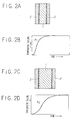
- Fig. 2A and Fig. 2C are explanatory views showing two three-layer film structures used in embodiments of the present invention, which contain non-metallic film layers having the same identical composition but having different thicknesses. Fig. 2B and Fig. 2D are explanatory views showing areal heat diffusion times, on the sample materials of Fig. 2A and Fig. 2C.
- Fig. 3 is a graph showing how an areal heat diffusion time changes, in accordance with embodiments of the invention.
- Fig. 4A and Fig. 4B are explanatory views showing three-layer structures measured by a laser flash method which is geometrically equivalent to embodiments of the invention.
- Fig. 5 is an explanatory view showing the principle of picosecond thermoreflectance method formerly suggested by the inventors
- Fig. 6 is a block diagram showing an apparatus for carrying out the picosecond thermoreflectance method.
-
- An embodiment of the present invention will be described below in accordance with the accompanying drawings.
- According to the present invention, when a thermal diffusivity of an object substance is to be measured, if the object substance is a non-metal substance such as a semiconductor, it is required to prepare a sample material in a manner as shown in Fig. 1. In detail, the sample material is a three layer structure including a non-metal film 1 whose thermal properties are unknown, a first metal film 2 disposed on one side (an upper surface when viewed in Fig. 1) of the non-metal film 1, and a second metal film 3 disposed on the other side (a lower surface when viewed in Fig. 1) of the non-metal film 1. Here, the first and second metal films 2, 3 are the same identical substance whose thermophysical properties are known, and so formed that they have the same thickness when used in this manner. The three-layer structure is disposed on a transparent substrate 4. However, when the sample material having such a structure is to be actually formed, it is allowed to use a film formation technique to form the above film layers having predetermined thicknesses, successively on the transparent substrate 4. On the other hand, it is also possible to measure thermal diffusivity and interface thermal resistance of bulk three-layer material by a laser flash method, thereby allowing the present invention to be applied in the same manner.
- In this way, by using the sample material shown in Fig. 1, it is possible to employ the picosecond thermoreflectance method (involving backside heating and front side temperature measuring) formerly suggested by the inventors of the present invention, thereby making it possible to measure a thermal diffusivity within the sample material. Namely, the lower surface of the second metal film 3 is heated by virtue of an irradiation using a picosecond light pulse coming from below (when viewed in Fig. 1) and passing through the transparent substrate 4. The light pulse for use in the irradiation is converted into a heat in the second metal film 3 within only one picosecond. Such heat is then caused to diffuse through interface/non-metal film /interface, so as to arrive at the first metal film 2. In this way, if the thermoreflectance method explained in Fig. 5 and 6 is used to measure a temperature change on the surface of the first metal film 2, it is possible to measure a heat diffusion passing through the three-layer film structure.
- However, such an arrangement is geometrically equivalent to the case where a laser flash method is used to measure a multi layered structure. For example, it corresponds to a situation in which a heat diffusion is measured under a condition where a transparent sample material 5 has on either side thereof a blackened thin film 6 (as shown in Fig. 4A), as well as another situation in which a heat diffusion is measured under a condition where a molten material 7 has been sealed into an opaque container 8 (as shown in Fig. 4B).
- Nevertheless, with regard to the three-layer film structure shown in Fig. 1, it is not allowed to disregard the presence of interface thermal resistance between the metal films and the non-metal film, since it is not negligible as compared with the thermal resistances acting in the thickness direction of both the metal films and the non-metal film. On the other hand, when a commonly used laser flash method is employed to measure a heat diffusion within a multi-layered bulk structure, an interface thermal resistance is usually found to be much smaller than the thermal resistance of each layer.
- Namely, if the picosecond thermoreflectance method formerly suggested by the inventors of the present invention is used to measure the thermal diffusivity of the three-layer film structure shown in Fig. 1, it is extremely difficult to distinguish the contribution of various film layers over the contribution of interface thermal resistance only by analyzing the sample material temperature variation graphs obtained in this method.
- The inventors of the present invention, after carrying out various and repeated researches for solving the above problems, have found some results shown in Fig. 2A and Fig. 2C, which indicate that the above problems can be solved if the compositions of metal films 2,3 and the non-metal film 1 are completely the same as those obtainable in a film formation method, and if a plurality of three-layer film structures (only the thicknesses of their non-metal film layers 1 are different from each other) are used to carry out the above measurement.
- Namely, with regard to a sample material shown in Fig. 2C (whose non-metal film layer has a relatively large thickness), its temperature rising will be later than the sample material shown in Fig. 2A. Thus, according to a view point that such a temperature change is caused by an increased heat diffusion time within a non-metal film, it is in principle possible to separately obtain a thermal diffusivity of the non-metal film and an interface thermal resistance between metal films, provided that the thermophysical properties of the non-metal film are known. In practice, it is allowed to use a response function method to obtain the above thermal diffusivity and the interface thermal resistance, thereby rendering the method of the present invention more concrete.
- According to the response function method, an area A defined by a sample material backside temperature history curve (after pulse heating) and a straight line of maximum temperature rising may be calculated by the following equation (1). In fact, such an area has a time dimension and can also be referred to as "areal heat diffusion time". Here, A1 in Fig. 2B and A2 in Fig. 2D are areal heat diffusion times corresponding to the respective sample materials.
- The meanings of various marks used in the following equations are as follows.
-
- ξ : Laplace parameter
- (ξ) : Laplace transform of temperature

- (ξ) : Four-pole matrix

- d : Thickness
- α : Thermal diffusivity
- b : Thermal effusivity
- τ = d 2 /α : Heat diffusion time across the film
- A : Areal heat diffusion time
- R : Interface thermal resistance
-
-
- i : i-th layer (i = 1 :heated face)
- ij : boundary between i-th layer and j-th layer
- m :metal, n :nonmetal

-
- When deriving an analytical solution of the three-layer film structure's sample temperature change associated with an interface thermal resistance as shown in Fig. 2, an effect of heat effusion into the substrate is disregard and it is assumed that the three-layer film structure is thermally insulated from the surrounding environment. Further. it is assumed that the heating treatment using the laser pulse as well as the temperature measurement using the thermoreflectance are all carried out on an infinitely thin flat plane and that the heat diffusion is only one-dimensional heat diffusion in the thickness direction. At this time, a four-terminal matrix for the three-layer film structure may be expressed in the following equation.

- If the four-terminal matrix is calculated and then converted into a transfer function matrix, further, if the sample material temperature change in Laplace space is calculated and then used to substitute in the above equation (1), as well as an areal heat diffusion time is calculated, it is allowed to obtain the following equation.
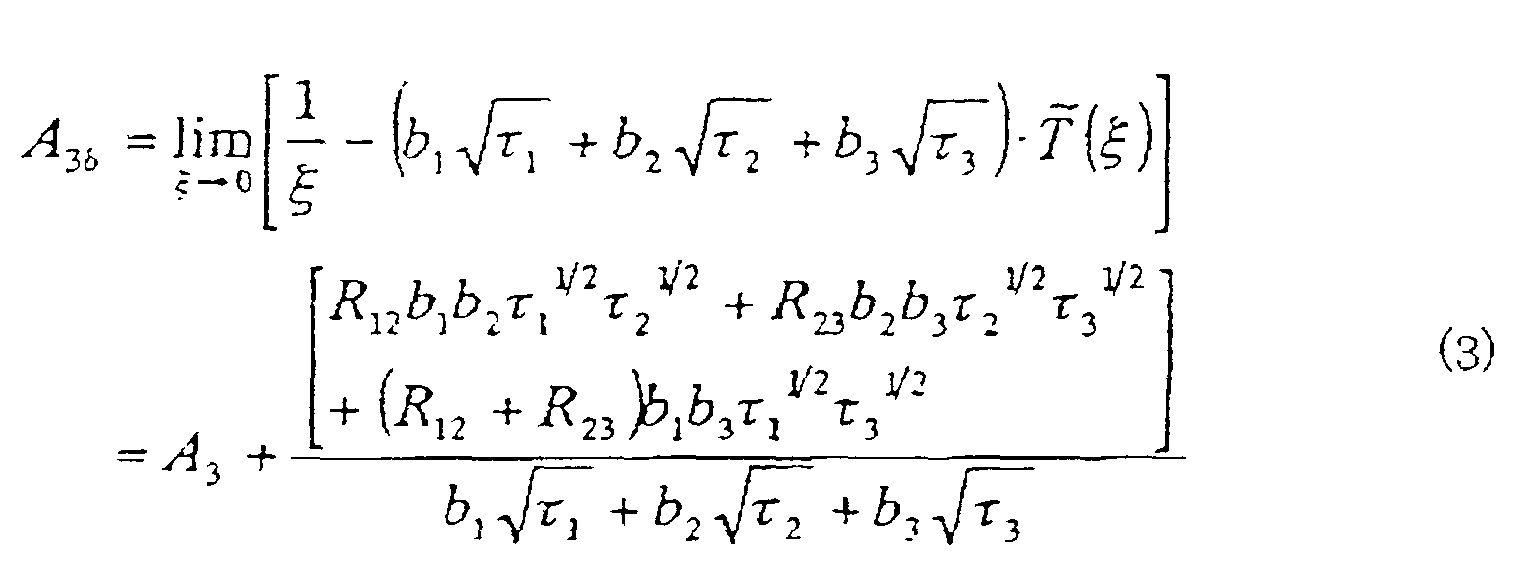
- Here, A3 is the three-layer film structure's areal heat diffusion time when an interface thermal resistance is 0, and can be represented by the following equation.
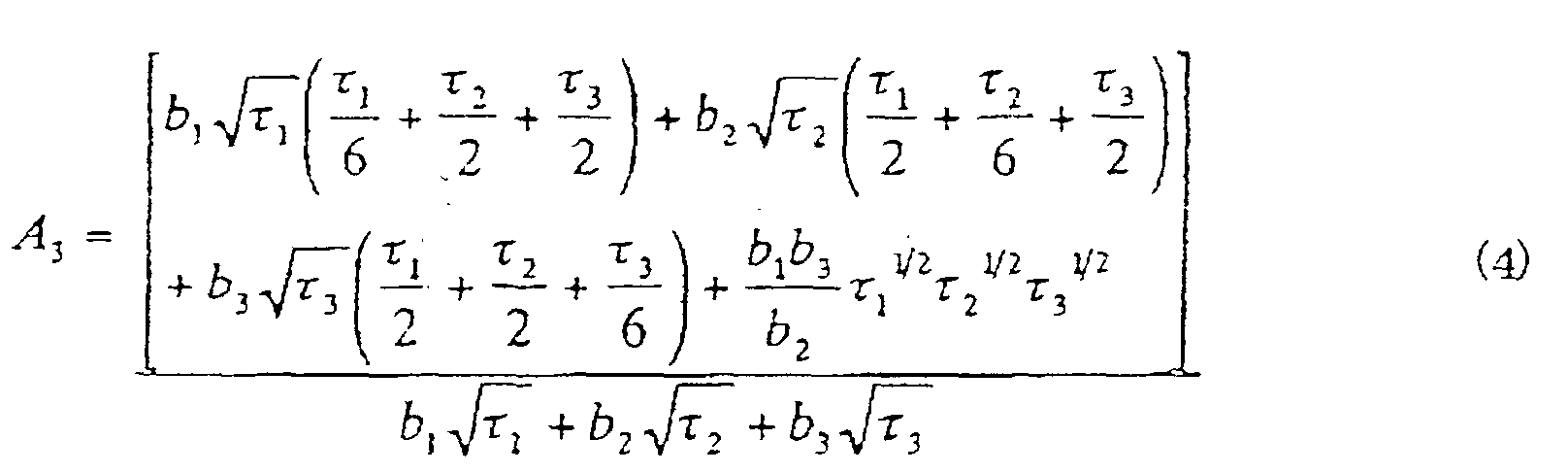
- Here, it is assumed that the composition and thickness of the metal film on the front side are all the same as those on the backside.
- Further, when

- In equation (5), when χ = 0, the following equation can be obtained.
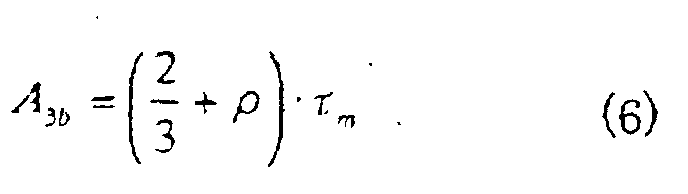
- When χ → ∞, the following equation can be obtained.

- When β =1, the following equation can be obtained.

- Furthermore, a parameter represented by the following equation
- As described in the above, it is understood that using temperature change curves obtained when using the backside heating/front side temperature measuring type picosecond thermoreflectance method to measure the three-layer film structure associated with interface thermal resistance, it is possible to separately calculate the thermal diffusivity of the non-metal film as well as the thermal resistance on interfaces between the metal films and the non-metal film, and such a calculation may be carried out by using a response function method.
- In this way, with the use of the present invention, even if a substance to be measured is a non-metal substance, providing a metal layer on ether side of the non-metal substance makes it possible to simultaneously measure thermal diffusivity and interface thermal resistances, by virtue of a picosecond thermoreflectance method.
- Further, according to the method for measuring a thermal diffusivity within a three-layer substance, a plurality of substances (which are different from one another only in their thickness and their thermophysical properties are unknown) are prepared both sides of each of the substances are formed with other layers which belong to the same sort of substance and are in the same state and have the predetermined known thermophysical properties, thereby carrying out the above measurement on each of the three-layer substances. Therefore, by using the same picosecond thermoreflectance method to measure the respective three-layer substances and analyzing the measured data, it is possible to correctly measure the thermal diffusivity within each of the three layer film structures.
- Moreover, according to the method for measuring a thermal diffusivity within a three-layer substance, by calculating an area defined by a transient temperature history curve on the backside of the pulse-heated three-layer substance and also by the horizontal axis corresponding to a pulse-heating time, it is possible to simultaneously measure thermal diffusivity of the three-layer substance as well as interface thermal resistances. Therefore, it is possible to use a response function method to correctly measure the thermal diffusivity within each three-layer film structure.
Claims (3)
- A method for measuring a thermal diffusivity and interface thermal resistances of a three-layer substance including a middle layer whose thermophysical properties are unknown, and two other layers formed on both sides of the middle layer, said two other layers belonging to the same sort of substance and having known thermal properties, characterized in that:one side of the three-layer substance is heated by a pulse light, while at the same time a transitive temperature rising on the opposite side of the three-layer substance is observed, thereby measuring a thermal diffusivity and interface thermal resistances.
- A method for measuring a thermal diffusivity and interface thermal resistances of a three-layer substance according to claim 1, characterized in that said method comprises:preparing a plurality of substances which are different from one another only in their thicknesses and whose thermophysical properties are unknown, forming on both sides of each of the substances other substance layers which are in the same identical state and whose thermophysical properties are known, measuring the thermal diffusivity and the interface thermal resistance of each of the three-layer substances.
- A method for measuring a thermal diffusivity and interface thermal resistances of a three-layer substance according to claim 1 or 2, characterized in that said method comprises:calculating an area defined by a transient temperature histroy curve on the backside of the pulse-heated three-layer substance and a horizontal axis corresponding to a pulse-heating time, thereby simultaneously measuring thermal diffusivity within the three-layer substance as well as the interface thermal resistance.
Applications Claiming Priority (2)
| Application Number | Priority Date | Filing Date | Title |
|---|---|---|---|
| JP2000317107A JP3430258B2 (en) | 2000-10-17 | 2000-10-17 | Measurement method of thermal diffusivity and interfacial thermal resistance |
| JP2000317107 | 2000-10-17 |
Publications (2)
| Publication Number | Publication Date |
|---|---|
| EP1199557A1 true EP1199557A1 (en) | 2002-04-24 |
| EP1199557B1 EP1199557B1 (en) | 2015-09-16 |
Family
ID=18795954
Family Applications (1)
| Application Number | Title | Priority Date | Filing Date |
|---|---|---|---|
| EP01308796.0A Expired - Lifetime EP1199557B1 (en) | 2000-10-17 | 2001-10-16 | Method for measuring thermal diffusivity and interface thermal resistance |
Country Status (3)
| Country | Link |
|---|---|
| US (1) | US6592252B2 (en) |
| EP (1) | EP1199557B1 (en) |
| JP (1) | JP3430258B2 (en) |
Cited By (2)
| Publication number | Priority date | Publication date | Assignee | Title |
|---|---|---|---|---|
| CN104849308A (en) * | 2015-05-13 | 2015-08-19 | 北京工业大学 | Test method of interference thermal resistance of semiconductor device |
| CN113218991A (en) * | 2021-04-08 | 2021-08-06 | 同济大学 | Non-contact self-heating measuring device and method for micro-nano interface thermal resistance |
Families Citing this family (23)
| Publication number | Priority date | Publication date | Assignee | Title |
|---|---|---|---|---|
| CN100416243C (en) | 2001-12-26 | 2008-09-03 | 加拿大马特森技术有限公司 | Method and system for measuring temperature and heat treatment |
| JP2003322628A (en) * | 2002-04-30 | 2003-11-14 | National Institute Of Advanced Industrial & Technology | High-speed pulse high-speed time response measurement method and apparatus |
| JP3731053B2 (en) * | 2002-12-18 | 2006-01-05 | 独立行政法人 宇宙航空研究開発機構 | Method for measuring diffusion coefficient in conductive melt and apparatus for measuring diffusion coefficient in conductive melt |
| DE10393962B4 (en) * | 2002-12-20 | 2019-03-14 | Mattson Technology Inc. | Method and device for supporting a workpiece and for heat treating the workpiece |
| JP4203596B2 (en) * | 2003-05-07 | 2009-01-07 | 独立行政法人産業技術総合研究所 | Thin film thermophysical property measuring method and measuring device |
| JP4195935B2 (en) | 2004-03-01 | 2008-12-17 | 独立行政法人産業技術総合研究所 | Thermophysical property measuring method and apparatus |
| JP4925571B2 (en) * | 2004-08-09 | 2012-04-25 | アプライド マテリアルズ インコーポレイテッド | Method for determining thermal properties of substrate and method for determining heat treatment conditions |
| JP2006242789A (en) * | 2005-03-04 | 2006-09-14 | Fujitsu Ltd | Surface analysis method and surface analysis apparatus |
| US7490981B2 (en) * | 2005-12-01 | 2009-02-17 | Basf Catalysts Llc | Method for determining thermal effusivity and/or thermal conductivity of sheet material |
| FR2895688B1 (en) * | 2005-12-30 | 2010-08-27 | Pellenc Selective Technologies | AUTOMATIC METHOD AND MACHINE FOR INSPECTING AND SORTING NON-METALLIC OBJECTS |
| JP4756275B2 (en) * | 2006-10-11 | 2011-08-24 | 独立行政法人産業技術総合研究所 | Calculation method of temperature response of multilayer material |
| EP2204232A4 (en) * | 2007-10-23 | 2011-11-02 | Shigeo Ando | High-pressure homogenizer |
| KR101610269B1 (en) | 2008-05-16 | 2016-04-07 | 맷슨 테크놀로지, 인크. | Workpiece breakage prevention method and apparatus |
| JP5598813B2 (en) * | 2009-03-19 | 2014-10-01 | 独立行政法人物質・材料研究機構 | Thin film thermophysical property measuring device and method of measuring thermal conductivity and interfacial thermal resistance using this measuring device |
| JP5646973B2 (en) * | 2010-12-01 | 2014-12-24 | エスペック株式会社 | Thermal conductivity measurement device, thermal conductivity calculation device, thermal conductivity calculation program, and thermal conductivity measurement method |
| ITTO20110589A1 (en) * | 2011-07-04 | 2013-01-05 | Avio Spa | APPARATUS AND METHOD FOR DETERMINING THE EFFECTIVE DEPTH OF CEMENTATION OR NITRURATION OF STEEL COMPONENTS, IN PARTICULAR GEARS |
| JP6127019B2 (en) * | 2014-05-29 | 2017-05-10 | 株式会社超高温材料研究センター | Method for measuring thermal diffusivity of translucent materials |
| JP6604210B2 (en) | 2016-01-13 | 2019-11-13 | 株式会社ジェイテクト | Optical nondestructive inspection method and optical nondestructive inspection apparatus |
| JP6399329B1 (en) * | 2017-11-07 | 2018-10-03 | 株式会社ピコサーム | Physical property value measuring apparatus, physical property value measuring method and program |
| US11175249B2 (en) | 2017-11-07 | 2021-11-16 | Netzsch Japan K.K. | Physical property value measurement device, physical property value measurement method, and recording medium |
| CN113419120B (en) * | 2021-05-08 | 2022-10-25 | 同济大学 | Method and system for measuring thermal resistance of dielectric film and metal interface |
| US12584803B2 (en) | 2022-10-18 | 2026-03-24 | Battelle Energy Alliance, Llc | Methods of measuring thermal properties, and related apparatuses |
| EP4722701A1 (en) * | 2024-10-07 | 2026-04-08 | Netzsch Gerätebau GmbH | Thermophysical property value measurement device and thermophysical property value measurement method |
Citations (4)
| Publication number | Priority date | Publication date | Assignee | Title |
|---|---|---|---|---|
| JPH08261967A (en) * | 1995-03-27 | 1996-10-11 | Chiyoukouon Zairyo Kenkyusho:Kk | Method and apparatus for measuring thermal constant using laser flash method |
| JPH09159631A (en) * | 1995-12-06 | 1997-06-20 | Chokoon Zairyo Kenkyusho:Kk | Thermal constant analysis method using laser flash method |
| JPH10160590A (en) * | 1996-11-26 | 1998-06-19 | Agency Of Ind Science & Technol | Measuring method for thermal diffusivity using parallel three-layer model |
| JP2001083113A (en) * | 1999-09-14 | 2001-03-30 | Agency Of Ind Science & Technol | Method for measuring thermal diffusivity by thermo- reflectance method |
Family Cites Families (8)
| Publication number | Priority date | Publication date | Assignee | Title |
|---|---|---|---|---|
| US4137991A (en) * | 1976-11-23 | 1979-02-06 | International Business Machines Corporation | Clamped acoustic elastic wave generator |
| US4243327A (en) * | 1979-01-31 | 1981-01-06 | Nasa | Double-beam optical method and apparatus for measuring thermal diffusivity and other molecular dynamic processes in utilizing the transient thermal lens effect |
| US4513384A (en) * | 1982-06-18 | 1985-04-23 | Therma-Wave, Inc. | Thin film thickness measurements and depth profiling utilizing a thermal wave detection system |
| US4928254A (en) * | 1988-04-28 | 1990-05-22 | Knudsen Arne K | Laser flash thermal conductivity apparatus and method |
| US5080495A (en) * | 1989-08-30 | 1992-01-14 | Mitsui Toatsu Chemicals, Inc. | Method and apparatus for measuring thermal diffusivity by ac joule-heating |
| US5112136A (en) * | 1990-09-24 | 1992-05-12 | Kiyoshi Sakuma | Method of and apparatus for measuring thermal conductivity |
| US5667300A (en) * | 1994-06-22 | 1997-09-16 | Mandelis; Andreas | Non-contact photothermal method for measuring thermal diffusivity and electronic defect properties of solids |
| US5688049A (en) * | 1996-01-25 | 1997-11-18 | Inrad | Method and apparatus for measuring the thermal conductivity of thin films |
-
2000
- 2000-10-17 JP JP2000317107A patent/JP3430258B2/en not_active Expired - Lifetime
-
2001
- 2001-10-16 EP EP01308796.0A patent/EP1199557B1/en not_active Expired - Lifetime
- 2001-10-17 US US09/978,003 patent/US6592252B2/en not_active Expired - Lifetime
Patent Citations (4)
| Publication number | Priority date | Publication date | Assignee | Title |
|---|---|---|---|---|
| JPH08261967A (en) * | 1995-03-27 | 1996-10-11 | Chiyoukouon Zairyo Kenkyusho:Kk | Method and apparatus for measuring thermal constant using laser flash method |
| JPH09159631A (en) * | 1995-12-06 | 1997-06-20 | Chokoon Zairyo Kenkyusho:Kk | Thermal constant analysis method using laser flash method |
| JPH10160590A (en) * | 1996-11-26 | 1998-06-19 | Agency Of Ind Science & Technol | Measuring method for thermal diffusivity using parallel three-layer model |
| JP2001083113A (en) * | 1999-09-14 | 2001-03-30 | Agency Of Ind Science & Technol | Method for measuring thermal diffusivity by thermo- reflectance method |
Non-Patent Citations (4)
| Title |
|---|
| PATENT ABSTRACTS OF JAPAN vol. 1997, no. 02 28 February 1997 (1997-02-28) * |
| PATENT ABSTRACTS OF JAPAN vol. 1997, no. 10 31 October 1997 (1997-10-31) * |
| PATENT ABSTRACTS OF JAPAN vol. 1998, no. 11 30 September 1998 (1998-09-30) * |
| PATENT ABSTRACTS OF JAPAN vol. 2000, no. 20 10 July 2001 (2001-07-10) * |
Cited By (2)
| Publication number | Priority date | Publication date | Assignee | Title |
|---|---|---|---|---|
| CN104849308A (en) * | 2015-05-13 | 2015-08-19 | 北京工业大学 | Test method of interference thermal resistance of semiconductor device |
| CN113218991A (en) * | 2021-04-08 | 2021-08-06 | 同济大学 | Non-contact self-heating measuring device and method for micro-nano interface thermal resistance |
Also Published As
| Publication number | Publication date |
|---|---|
| EP1199557B1 (en) | 2015-09-16 |
| US20020080850A1 (en) | 2002-06-27 |
| JP3430258B2 (en) | 2003-07-28 |
| JP2002122559A (en) | 2002-04-26 |
| US6592252B2 (en) | 2003-07-15 |
Similar Documents
| Publication | Publication Date | Title |
|---|---|---|
| EP1199557B1 (en) | Method for measuring thermal diffusivity and interface thermal resistance | |
| US7182510B2 (en) | Apparatus and method for measuring thermal conductivity | |
| US6317216B1 (en) | Optical method for the determination of grain orientation in films | |
| US4710030A (en) | Optical generator and detector of stress pulses | |
| US7894070B2 (en) | Optical method and system for the characterization of laterally-patterned samples in integrated circuits | |
| US4243327A (en) | Double-beam optical method and apparatus for measuring thermal diffusivity and other molecular dynamic processes in utilizing the transient thermal lens effect | |
| TW544832B (en) | Evaluating sidewall coverage in a semiconductor wafer | |
| US6381019B1 (en) | Ultrasonic generator and detector using an optical mask having a grating for launching a plurality of spatially distributed, time varying strain pulses in a sample | |
| US10113861B2 (en) | Optical system and methods for the determination of stress in a substrate | |
| JP3252155B2 (en) | Thermal diffusivity measurement method by thermoreflectance method | |
| Bonello et al. | Photothermal properties of bulk and layered materials by the picosecond acoustics technique | |
| CN115639242B (en) | Measurement methods and systems for simultaneously determining thermal conductivity, specific heat capacity, and interfacial thermal resistance | |
| JP4025369B2 (en) | Optical method for discriminating mechanical properties of materials | |
| US20050002436A1 (en) | Method for measuring thermophysical property of thin film and apparatus therefor | |
| Veinhard et al. | Effect of non-linear amplification of phase and amplitude modulations on laser-induced damage of thick fused silica optics with large beams at 351 nm | |
| Harada et al. | Development of laser heterodyne photothermal displacement method for mapping carrier nonradiative recombination centers in semiconductors | |
| TW447062B (en) | Optical method for the characterization of the electrical properties of semiconductors and insulating films | |
| Bengtsson et al. | Repetitive non-thermal melting as a timing monitor for femtosecond pump/probe X-ray experiments | |
| JP2001108641A (en) | Measuring method of contact thermal resistance | |
| Matsui et al. | Analysis of thermal diffusivity of Ti thin film by thermoreflectance and periodic heating technique | |
| Vermeersch et al. | Ballistic heat transport and associated frequency dependence of thermal conductivity in semiconductor alloys | |
| JP3294206B2 (en) | Micro-area thermophysical property measurement device | |
| JP3294206B6 (en) | Micro-area thermophysical property measurement device | |
| WO2024166786A1 (en) | Measurement sample, thermal behavior measurement kit, thermal behavior measurement device, and thermal behavior measurement method | |
| Green | Nanoscale Thermal Transport in Thermally Isolated Nanostructures |
Legal Events
| Date | Code | Title | Description |
|---|---|---|---|
| PUAI | Public reference made under article 153(3) epc to a published international application that has entered the european phase |
Free format text: ORIGINAL CODE: 0009012 |
|
| AK | Designated contracting states |
Kind code of ref document: A1 Designated state(s): DE FR GB Kind code of ref document: A1 Designated state(s): AT BE CH CY DE DK ES FI FR GB GR IE IT LI LU MC NL PT SE TR |
|
| AX | Request for extension of the european patent |
Free format text: AL;LT;LV;MK;RO;SI |
|
| 17P | Request for examination filed |
Effective date: 20020709 |
|
| AKX | Designation fees paid |
Free format text: DE FR GB |
|
| 17Q | First examination report despatched |
Effective date: 20071025 |
|
| GRAP | Despatch of communication of intention to grant a patent |
Free format text: ORIGINAL CODE: EPIDOSNIGR1 |
|
| INTG | Intention to grant announced |
Effective date: 20150326 |
|
| RAP1 | Party data changed (applicant data changed or rights of an application transferred) |
Owner name: NATIONAL INSTITUTE OF ADVANCED INDUSTRIAL SCIENCE |
|
| RIN1 | Information on inventor provided before grant (corrected) |
Inventor name: BABA, TETSUYA |
|
| GRAS | Grant fee paid |
Free format text: ORIGINAL CODE: EPIDOSNIGR3 |
|
| GRAA | (expected) grant |
Free format text: ORIGINAL CODE: 0009210 |
|
| RIN1 | Information on inventor provided before grant (corrected) |
Inventor name: BABA, TETSUYA |
|
| AK | Designated contracting states |
Kind code of ref document: B1 Designated state(s): DE FR GB |
|
| REG | Reference to a national code |
Ref country code: GB Ref legal event code: FG4D |
|
| REG | Reference to a national code |
Ref country code: FR Ref legal event code: PLFP Year of fee payment: 15 |
|
| REG | Reference to a national code |
Ref country code: DE Ref legal event code: R096 Ref document number: 60149586 Country of ref document: DE |
|
| REG | Reference to a national code |
Ref country code: DE Ref legal event code: R097 Ref document number: 60149586 Country of ref document: DE |
|
| PLBE | No opposition filed within time limit |
Free format text: ORIGINAL CODE: 0009261 |
|
| STAA | Information on the status of an ep patent application or granted ep patent |
Free format text: STATUS: NO OPPOSITION FILED WITHIN TIME LIMIT |
|
| 26N | No opposition filed |
Effective date: 20160617 |
|
| REG | Reference to a national code |
Ref country code: FR Ref legal event code: PLFP Year of fee payment: 16 |
|
| REG | Reference to a national code |
Ref country code: FR Ref legal event code: PLFP Year of fee payment: 17 |
|
| REG | Reference to a national code |
Ref country code: FR Ref legal event code: PLFP Year of fee payment: 18 |
|
| PGFP | Annual fee paid to national office [announced via postgrant information from national office to epo] |
Ref country code: FR Payment date: 20200824 Year of fee payment: 20 Ref country code: GB Payment date: 20200824 Year of fee payment: 20 |
|
| PGFP | Annual fee paid to national office [announced via postgrant information from national office to epo] |
Ref country code: DE Payment date: 20200820 Year of fee payment: 20 |
|
| REG | Reference to a national code |
Ref country code: DE Ref legal event code: R071 Ref document number: 60149586 Country of ref document: DE |
|
| REG | Reference to a national code |
Ref country code: GB Ref legal event code: PE20 Expiry date: 20211015 |
|
| PG25 | Lapsed in a contracting state [announced via postgrant information from national office to epo] |
Ref country code: GB Free format text: LAPSE BECAUSE OF EXPIRATION OF PROTECTION Effective date: 20211015 |