EP1199333A1 - Resin composition containing crystalline polyimide - Google Patents
Resin composition containing crystalline polyimide Download PDFInfo
- Publication number
- EP1199333A1 EP1199333A1 EP00925587A EP00925587A EP1199333A1 EP 1199333 A1 EP1199333 A1 EP 1199333A1 EP 00925587 A EP00925587 A EP 00925587A EP 00925587 A EP00925587 A EP 00925587A EP 1199333 A1 EP1199333 A1 EP 1199333A1
- Authority
- EP
- European Patent Office
- Prior art keywords
- polyimide
- resin composition
- polyester
- thermoplastic resin
- formula
- Prior art date
- Legal status (The legal status is an assumption and is not a legal conclusion. Google has not performed a legal analysis and makes no representation as to the accuracy of the status listed.)
- Granted
Links
- 229920001721 polyimide Polymers 0.000 title claims abstract description 213
- 239000004642 Polyimide Substances 0.000 title claims abstract description 211
- 239000011342 resin composition Substances 0.000 title claims abstract description 72
- 229920000728 polyester Polymers 0.000 claims abstract description 103
- 229920001169 thermoplastic Polymers 0.000 claims abstract description 46
- 239000004416 thermosoftening plastic Substances 0.000 claims abstract description 45
- 239000000203 mixture Substances 0.000 claims abstract description 44
- 125000003118 aryl group Chemical group 0.000 claims abstract description 34
- 229910052799 carbon Inorganic materials 0.000 claims abstract description 30
- 238000002156 mixing Methods 0.000 claims abstract description 30
- OKTJSMMVPCPJKN-UHFFFAOYSA-N Carbon Chemical compound [C] OKTJSMMVPCPJKN-UHFFFAOYSA-N 0.000 claims abstract description 27
- 125000001424 substituent group Chemical group 0.000 claims abstract description 24
- 125000001931 aliphatic group Chemical group 0.000 claims abstract description 22
- 238000006116 polymerization reaction Methods 0.000 claims description 93
- 238000000034 method Methods 0.000 claims description 67
- 229920005992 thermoplastic resin Polymers 0.000 claims description 55
- 238000002844 melting Methods 0.000 claims description 37
- 230000008018 melting Effects 0.000 claims description 37
- 229920000139 polyethylene terephthalate Polymers 0.000 claims description 32
- 239000005020 polyethylene terephthalate Substances 0.000 claims description 32
- 238000004519 manufacturing process Methods 0.000 claims description 28
- 230000008569 process Effects 0.000 claims description 28
- -1 polyethylene terephthalate Polymers 0.000 claims description 27
- 239000012765 fibrous filler Substances 0.000 claims description 20
- 239000007790 solid phase Substances 0.000 claims description 20
- ANSXAPJVJOKRDJ-UHFFFAOYSA-N furo[3,4-f][2]benzofuran-1,3,5,7-tetrone Chemical compound C1=C2C(=O)OC(=O)C2=CC2=C1C(=O)OC2=O ANSXAPJVJOKRDJ-UHFFFAOYSA-N 0.000 claims description 15
- 125000002947 alkylene group Chemical group 0.000 claims description 13
- 239000003365 glass fiber Substances 0.000 claims description 11
- 239000000155 melt Substances 0.000 claims description 9
- 229920001707 polybutylene terephthalate Polymers 0.000 claims description 6
- 238000013329 compounding Methods 0.000 claims 1
- 229920003207 poly(ethylene-2,6-naphthalate) Polymers 0.000 claims 1
- 239000011112 polyethylene naphthalate Substances 0.000 claims 1
- 125000001033 ether group Chemical group 0.000 abstract description 5
- 239000000463 material Substances 0.000 abstract description 3
- 239000010408 film Substances 0.000 description 62
- LYCAIKOWRPUZTN-UHFFFAOYSA-N Ethylene glycol Chemical compound OCCO LYCAIKOWRPUZTN-UHFFFAOYSA-N 0.000 description 36
- 229920000642 polymer Polymers 0.000 description 36
- YXFVVABEGXRONW-UHFFFAOYSA-N Toluene Chemical compound CC1=CC=CC=C1 YXFVVABEGXRONW-UHFFFAOYSA-N 0.000 description 21
- 229920005989 resin Polymers 0.000 description 18
- 239000011347 resin Substances 0.000 description 18
- NAQMVNRVTILPCV-UHFFFAOYSA-N hexane-1,6-diamine Chemical compound NCCCCCCN NAQMVNRVTILPCV-UHFFFAOYSA-N 0.000 description 16
- 230000000694 effects Effects 0.000 description 15
- 239000000047 product Substances 0.000 description 15
- 238000006243 chemical reaction Methods 0.000 description 14
- 230000032798 delamination Effects 0.000 description 14
- 239000000835 fiber Substances 0.000 description 14
- 238000010438 heat treatment Methods 0.000 description 14
- 238000001746 injection moulding Methods 0.000 description 14
- 150000004985 diamines Chemical class 0.000 description 13
- QFTYSVGGYOXFRQ-UHFFFAOYSA-N dodecane-1,12-diamine Chemical compound NCCCCCCCCCCCCN QFTYSVGGYOXFRQ-UHFFFAOYSA-N 0.000 description 12
- IJGRMHOSHXDMSA-UHFFFAOYSA-N Atomic nitrogen Chemical compound N#N IJGRMHOSHXDMSA-UHFFFAOYSA-N 0.000 description 11
- 239000000945 filler Substances 0.000 description 11
- 229920002959 polymer blend Polymers 0.000 description 11
- SECXISVLQFMRJM-UHFFFAOYSA-N N-Methylpyrrolidone Chemical compound CN1CCCC1=O SECXISVLQFMRJM-UHFFFAOYSA-N 0.000 description 10
- 239000000314 lubricant Substances 0.000 description 10
- 238000000465 moulding Methods 0.000 description 10
- 239000000243 solution Substances 0.000 description 10
- 239000000758 substrate Substances 0.000 description 10
- OFOBLEOULBTSOW-UHFFFAOYSA-N Malonic acid Chemical compound OC(=O)CC(O)=O OFOBLEOULBTSOW-UHFFFAOYSA-N 0.000 description 9
- 239000004697 Polyetherimide Substances 0.000 description 9
- 239000002253 acid Substances 0.000 description 9
- 239000000654 additive Substances 0.000 description 9
- 230000000052 comparative effect Effects 0.000 description 9
- WGCNASOHLSPBMP-UHFFFAOYSA-N hydroxyacetaldehyde Natural products OCC=O WGCNASOHLSPBMP-UHFFFAOYSA-N 0.000 description 9
- 229920001601 polyetherimide Polymers 0.000 description 9
- YQLZOAVZWJBZSY-UHFFFAOYSA-N decane-1,10-diamine Chemical compound NCCCCCCCCCCN YQLZOAVZWJBZSY-UHFFFAOYSA-N 0.000 description 8
- 230000006872 improvement Effects 0.000 description 8
- 239000002245 particle Substances 0.000 description 8
- 150000000000 tetracarboxylic acids Chemical class 0.000 description 8
- XLYOFNOQVPJJNP-UHFFFAOYSA-N water Substances O XLYOFNOQVPJJNP-UHFFFAOYSA-N 0.000 description 8
- 239000003054 catalyst Substances 0.000 description 7
- MTHSVFCYNBDYFN-UHFFFAOYSA-N diethylene glycol Chemical compound OCCOCCO MTHSVFCYNBDYFN-UHFFFAOYSA-N 0.000 description 7
- 229910052751 metal Inorganic materials 0.000 description 7
- 239000002184 metal Substances 0.000 description 7
- 239000012299 nitrogen atmosphere Substances 0.000 description 7
- WFDIJRYMOXRFFG-UHFFFAOYSA-N Acetic anhydride Chemical compound CC(=O)OC(C)=O WFDIJRYMOXRFFG-UHFFFAOYSA-N 0.000 description 6
- VTYYLEPIZMXCLO-UHFFFAOYSA-L Calcium carbonate Chemical compound [Ca+2].[O-]C([O-])=O VTYYLEPIZMXCLO-UHFFFAOYSA-L 0.000 description 6
- KKEYFWRCBNTPAC-UHFFFAOYSA-N Terephthalic acid Chemical compound OC(=O)C1=CC=C(C(O)=O)C=C1 KKEYFWRCBNTPAC-UHFFFAOYSA-N 0.000 description 6
- WERYXYBDKMZEQL-UHFFFAOYSA-N butane-1,4-diol Chemical compound OCCCCO WERYXYBDKMZEQL-UHFFFAOYSA-N 0.000 description 6
- 239000013078 crystal Substances 0.000 description 6
- 229920005575 poly(amic acid) Polymers 0.000 description 6
- KIDHWZJUCRJVML-UHFFFAOYSA-N putrescine Chemical compound NCCCCN KIDHWZJUCRJVML-UHFFFAOYSA-N 0.000 description 6
- 238000007363 ring formation reaction Methods 0.000 description 6
- 238000005809 transesterification reaction Methods 0.000 description 6
- 239000003795 chemical substances by application Substances 0.000 description 5
- 238000001816 cooling Methods 0.000 description 5
- 229910001873 dinitrogen Inorganic materials 0.000 description 5
- 238000004898 kneading Methods 0.000 description 5
- 238000006068 polycondensation reaction Methods 0.000 description 5
- 229910000679 solder Inorganic materials 0.000 description 5
- 238000005476 soldering Methods 0.000 description 5
- 230000002087 whitening effect Effects 0.000 description 5
- QPFMBZIOSGYJDE-UHFFFAOYSA-N 1,1,2,2-tetrachloroethane Chemical compound ClC(Cl)C(Cl)Cl QPFMBZIOSGYJDE-UHFFFAOYSA-N 0.000 description 4
- PWGJDPKCLMLPJW-UHFFFAOYSA-N 1,8-diaminooctane Chemical compound NCCCCCCCCN PWGJDPKCLMLPJW-UHFFFAOYSA-N 0.000 description 4
- CSCPPACGZOOCGX-UHFFFAOYSA-N Acetone Chemical compound CC(C)=O CSCPPACGZOOCGX-UHFFFAOYSA-N 0.000 description 4
- JUJWROOIHBZHMG-UHFFFAOYSA-N Pyridine Chemical compound C1=CC=NC=C1 JUJWROOIHBZHMG-UHFFFAOYSA-N 0.000 description 4
- 125000000217 alkyl group Chemical group 0.000 description 4
- TZCXTZWJZNENPQ-UHFFFAOYSA-L barium sulfate Chemical compound [Ba+2].[O-]S([O-])(=O)=O TZCXTZWJZNENPQ-UHFFFAOYSA-L 0.000 description 4
- IISBACLAFKSPIT-UHFFFAOYSA-N bisphenol A Chemical compound C=1C=C(O)C=CC=1C(C)(C)C1=CC=C(O)C=C1 IISBACLAFKSPIT-UHFFFAOYSA-N 0.000 description 4
- VHRGRCVQAFMJIZ-UHFFFAOYSA-N cadaverine Chemical compound NCCCCCN VHRGRCVQAFMJIZ-UHFFFAOYSA-N 0.000 description 4
- 125000005442 diisocyanate group Chemical group 0.000 description 4
- 230000009477 glass transition Effects 0.000 description 4
- 238000009998 heat setting Methods 0.000 description 4
- XXMIOPMDWAUFGU-UHFFFAOYSA-N hexane-1,6-diol Chemical compound OCCCCCCO XXMIOPMDWAUFGU-UHFFFAOYSA-N 0.000 description 4
- QQVIHTHCMHWDBS-UHFFFAOYSA-N isophthalic acid Chemical compound OC(=O)C1=CC=CC(C(O)=O)=C1 QQVIHTHCMHWDBS-UHFFFAOYSA-N 0.000 description 4
- 229920002521 macromolecule Polymers 0.000 description 4
- 239000012046 mixed solvent Substances 0.000 description 4
- 239000003607 modifier Substances 0.000 description 4
- DDLUSQPEQUJVOY-UHFFFAOYSA-N nonane-1,1-diamine Chemical compound CCCCCCCCC(N)N DDLUSQPEQUJVOY-UHFFFAOYSA-N 0.000 description 4
- 239000002667 nucleating agent Substances 0.000 description 4
- 239000004014 plasticizer Substances 0.000 description 4
- 229920006267 polyester film Polymers 0.000 description 4
- YPFDHNVEDLHUCE-UHFFFAOYSA-N propane-1,3-diol Chemical compound OCCCO YPFDHNVEDLHUCE-UHFFFAOYSA-N 0.000 description 4
- 239000000126 substance Substances 0.000 description 4
- 238000011282 treatment Methods 0.000 description 4
- XFNJVJPLKCPIBV-UHFFFAOYSA-N trimethylenediamine Chemical compound NCCCN XFNJVJPLKCPIBV-UHFFFAOYSA-N 0.000 description 4
- 125000002723 alicyclic group Chemical group 0.000 description 3
- 239000012298 atmosphere Substances 0.000 description 3
- 230000008901 benefit Effects 0.000 description 3
- 229910000019 calcium carbonate Inorganic materials 0.000 description 3
- 125000004432 carbon atom Chemical group C* 0.000 description 3
- 238000007334 copolymerization reaction Methods 0.000 description 3
- 238000002425 crystallisation Methods 0.000 description 3
- 230000008025 crystallization Effects 0.000 description 3
- 230000018044 dehydration Effects 0.000 description 3
- 238000006297 dehydration reaction Methods 0.000 description 3
- 230000006866 deterioration Effects 0.000 description 3
- 239000004611 light stabiliser Substances 0.000 description 3
- 230000014759 maintenance of location Effects 0.000 description 3
- KYTZHLUVELPASH-UHFFFAOYSA-N naphthalene-1,2-dicarboxylic acid Chemical compound C1=CC=CC2=C(C(O)=O)C(C(=O)O)=CC=C21 KYTZHLUVELPASH-UHFFFAOYSA-N 0.000 description 3
- 229910052757 nitrogen Inorganic materials 0.000 description 3
- 239000008188 pellet Substances 0.000 description 3
- 239000000843 powder Substances 0.000 description 3
- 239000002904 solvent Substances 0.000 description 3
- 238000012546 transfer Methods 0.000 description 3
- KLNPWTHGTVSSEU-UHFFFAOYSA-N undecane-1,11-diamine Chemical compound NCCCCCCCCCCCN KLNPWTHGTVSSEU-UHFFFAOYSA-N 0.000 description 3
- RNLHGQLZWXBQNY-UHFFFAOYSA-N 3-(aminomethyl)-3,5,5-trimethylcyclohexan-1-amine Chemical compound CC1(C)CC(N)CC(C)(CN)C1 RNLHGQLZWXBQNY-UHFFFAOYSA-N 0.000 description 2
- NEQFBGHQPUXOFH-UHFFFAOYSA-N 4-(4-carboxyphenyl)benzoic acid Chemical compound C1=CC(C(=O)O)=CC=C1C1=CC=C(C(O)=O)C=C1 NEQFBGHQPUXOFH-UHFFFAOYSA-N 0.000 description 2
- WXNZTHHGJRFXKQ-UHFFFAOYSA-N 4-chlorophenol Chemical compound OC1=CC=C(Cl)C=C1 WXNZTHHGJRFXKQ-UHFFFAOYSA-N 0.000 description 2
- CNPURSDMOWDNOQ-UHFFFAOYSA-N 4-methoxy-7h-pyrrolo[2,3-d]pyrimidin-2-amine Chemical compound COC1=NC(N)=NC2=C1C=CN2 CNPURSDMOWDNOQ-UHFFFAOYSA-N 0.000 description 2
- XKRFYHLGVUSROY-UHFFFAOYSA-N Argon Chemical compound [Ar] XKRFYHLGVUSROY-UHFFFAOYSA-N 0.000 description 2
- SDDLEVPIDBLVHC-UHFFFAOYSA-N Bisphenol Z Chemical compound C1=CC(O)=CC=C1C1(C=2C=CC(O)=CC=2)CCCCC1 SDDLEVPIDBLVHC-UHFFFAOYSA-N 0.000 description 2
- PIICEJLVQHRZGT-UHFFFAOYSA-N Ethylenediamine Chemical compound NCCN PIICEJLVQHRZGT-UHFFFAOYSA-N 0.000 description 2
- QIGBRXMKCJKVMJ-UHFFFAOYSA-N Hydroquinone Chemical compound OC1=CC=C(O)C=C1 QIGBRXMKCJKVMJ-UHFFFAOYSA-N 0.000 description 2
- 238000012695 Interfacial polymerization Methods 0.000 description 2
- ALQSHHUCVQOPAS-UHFFFAOYSA-N Pentane-1,5-diol Chemical compound OCCCCCO ALQSHHUCVQOPAS-UHFFFAOYSA-N 0.000 description 2
- ATUOYWHBWRKTHZ-UHFFFAOYSA-N Propane Chemical compound CCC ATUOYWHBWRKTHZ-UHFFFAOYSA-N 0.000 description 2
- VYPSYNLAJGMNEJ-UHFFFAOYSA-N Silicium dioxide Chemical compound O=[Si]=O VYPSYNLAJGMNEJ-UHFFFAOYSA-N 0.000 description 2
- GWEVSGVZZGPLCZ-UHFFFAOYSA-N Titan oxide Chemical compound O=[Ti]=O GWEVSGVZZGPLCZ-UHFFFAOYSA-N 0.000 description 2
- RTAQQCXQSZGOHL-UHFFFAOYSA-N Titanium Chemical compound [Ti] RTAQQCXQSZGOHL-UHFFFAOYSA-N 0.000 description 2
- 229920004738 ULTEM® Polymers 0.000 description 2
- YIMQCDZDWXUDCA-UHFFFAOYSA-N [4-(hydroxymethyl)cyclohexyl]methanol Chemical compound OCC1CCC(CO)CC1 YIMQCDZDWXUDCA-UHFFFAOYSA-N 0.000 description 2
- 230000000996 additive effect Effects 0.000 description 2
- 229910000323 aluminium silicate Inorganic materials 0.000 description 2
- 229920006231 aramid fiber Polymers 0.000 description 2
- 238000010533 azeotropic distillation Methods 0.000 description 2
- 239000000919 ceramic Substances 0.000 description 2
- 239000012295 chemical reaction liquid Substances 0.000 description 2
- 239000004927 clay Substances 0.000 description 2
- 229910052570 clay Inorganic materials 0.000 description 2
- 150000001875 compounds Chemical class 0.000 description 2
- 239000000470 constituent Substances 0.000 description 2
- 238000007796 conventional method Methods 0.000 description 2
- 229920001577 copolymer Polymers 0.000 description 2
- YMHQVDAATAEZLO-UHFFFAOYSA-N cyclohexane-1,1-diamine Chemical compound NC1(N)CCCCC1 YMHQVDAATAEZLO-UHFFFAOYSA-N 0.000 description 2
- GYUVMLBYMPKZAZ-UHFFFAOYSA-N dimethyl naphthalene-2,6-dicarboxylate Chemical compound C1=C(C(=O)OC)C=CC2=CC(C(=O)OC)=CC=C21 GYUVMLBYMPKZAZ-UHFFFAOYSA-N 0.000 description 2
- 150000002009 diols Chemical class 0.000 description 2
- HNPSIPDUKPIQMN-UHFFFAOYSA-N dioxosilane;oxo(oxoalumanyloxy)alumane Chemical compound O=[Si]=O.O=[Al]O[Al]=O HNPSIPDUKPIQMN-UHFFFAOYSA-N 0.000 description 2
- USIUVYZYUHIAEV-UHFFFAOYSA-N diphenyl ether Chemical compound C=1C=CC=CC=1OC1=CC=CC=C1 USIUVYZYUHIAEV-UHFFFAOYSA-N 0.000 description 2
- 238000004090 dissolution Methods 0.000 description 2
- 238000005886 esterification reaction Methods 0.000 description 2
- CEIPQQODRKXDSB-UHFFFAOYSA-N ethyl 3-(6-hydroxynaphthalen-2-yl)-1H-indazole-5-carboximidate dihydrochloride Chemical compound Cl.Cl.C1=C(O)C=CC2=CC(C3=NNC4=CC=C(C=C43)C(=N)OCC)=CC=C21 CEIPQQODRKXDSB-UHFFFAOYSA-N 0.000 description 2
- 239000003063 flame retardant Substances 0.000 description 2
- 238000010528 free radical solution polymerization reaction Methods 0.000 description 2
- 230000006870 function Effects 0.000 description 2
- 229910052732 germanium Inorganic materials 0.000 description 2
- GNPVGFCGXDBREM-UHFFFAOYSA-N germanium atom Chemical compound [Ge] GNPVGFCGXDBREM-UHFFFAOYSA-N 0.000 description 2
- 239000011521 glass Substances 0.000 description 2
- 239000012760 heat stabilizer Substances 0.000 description 2
- 238000003780 insertion Methods 0.000 description 2
- 230000037431 insertion Effects 0.000 description 2
- 239000007788 liquid Substances 0.000 description 2
- 239000010445 mica Substances 0.000 description 2
- 229910052618 mica group Inorganic materials 0.000 description 2
- 239000000178 monomer Substances 0.000 description 2
- 239000011368 organic material Substances 0.000 description 2
- TWNQGVIAIRXVLR-UHFFFAOYSA-N oxo(oxoalumanyloxy)alumane Chemical compound O=[Al]O[Al]=O TWNQGVIAIRXVLR-UHFFFAOYSA-N 0.000 description 2
- 239000012071 phase Substances 0.000 description 2
- 238000005191 phase separation Methods 0.000 description 2
- 125000001997 phenyl group Chemical group [H]C1=C([H])C([H])=C(*)C([H])=C1[H] 0.000 description 2
- 150000003014 phosphoric acid esters Chemical class 0.000 description 2
- XNGIFLGASWRNHJ-UHFFFAOYSA-N phthalic acid Chemical compound OC(=O)C1=CC=CC=C1C(O)=O XNGIFLGASWRNHJ-UHFFFAOYSA-N 0.000 description 2
- 230000000704 physical effect Effects 0.000 description 2
- 239000000049 pigment Substances 0.000 description 2
- 239000009719 polyimide resin Substances 0.000 description 2
- 239000002244 precipitate Substances 0.000 description 2
- UMJSCPRVCHMLSP-UHFFFAOYSA-N pyridine Natural products COC1=CC=CN=C1 UMJSCPRVCHMLSP-UHFFFAOYSA-N 0.000 description 2
- CYIDZMCFTVVTJO-UHFFFAOYSA-N pyromellitic acid Chemical compound OC(=O)C1=CC(C(O)=O)=C(C(O)=O)C=C1C(O)=O CYIDZMCFTVVTJO-UHFFFAOYSA-N 0.000 description 2
- 238000001226 reprecipitation Methods 0.000 description 2
- GHMLBKRAJCXXBS-UHFFFAOYSA-N resorcinol Chemical compound OC1=CC=CC(O)=C1 GHMLBKRAJCXXBS-UHFFFAOYSA-N 0.000 description 2
- 150000003839 salts Chemical class 0.000 description 2
- 238000010008 shearing Methods 0.000 description 2
- 230000007480 spreading Effects 0.000 description 2
- 238000003892 spreading Methods 0.000 description 2
- 239000003381 stabilizer Substances 0.000 description 2
- 238000003756 stirring Methods 0.000 description 2
- 239000000454 talc Substances 0.000 description 2
- 229910052623 talc Inorganic materials 0.000 description 2
- 229910052719 titanium Inorganic materials 0.000 description 2
- 239000010936 titanium Substances 0.000 description 2
- OGIDPMRJRNCKJF-UHFFFAOYSA-N titanium oxide Inorganic materials [Ti]=O OGIDPMRJRNCKJF-UHFFFAOYSA-N 0.000 description 2
- CNHDIAIOKMXOLK-UHFFFAOYSA-N toluquinol Chemical compound CC1=CC(O)=CC=C1O CNHDIAIOKMXOLK-UHFFFAOYSA-N 0.000 description 2
- WZCQRUWWHSTZEM-UHFFFAOYSA-N 1,3-phenylenediamine Chemical compound NC1=CC=CC(N)=C1 WZCQRUWWHSTZEM-UHFFFAOYSA-N 0.000 description 1
- VLDPXPPHXDGHEW-UHFFFAOYSA-N 1-chloro-2-dichlorophosphoryloxybenzene Chemical compound ClC1=CC=CC=C1OP(Cl)(Cl)=O VLDPXPPHXDGHEW-UHFFFAOYSA-N 0.000 description 1
- RNFJDJUURJAICM-UHFFFAOYSA-N 2,2,4,4,6,6-hexaphenoxy-1,3,5-triaza-2$l^{5},4$l^{5},6$l^{5}-triphosphacyclohexa-1,3,5-triene Chemical compound N=1P(OC=2C=CC=CC=2)(OC=2C=CC=CC=2)=NP(OC=2C=CC=CC=2)(OC=2C=CC=CC=2)=NP=1(OC=1C=CC=CC=1)OC1=CC=CC=C1 RNFJDJUURJAICM-UHFFFAOYSA-N 0.000 description 1
- DPQHRXRAZHNGRU-UHFFFAOYSA-N 2,4,4-trimethylhexane-1,6-diamine Chemical compound NCC(C)CC(C)(C)CCN DPQHRXRAZHNGRU-UHFFFAOYSA-N 0.000 description 1
- ZRPKEUVFESZUKX-UHFFFAOYSA-N 2-(2-hydroxyethoxy)benzoic acid Chemical compound OCCOC1=CC=CC=C1C(O)=O ZRPKEUVFESZUKX-UHFFFAOYSA-N 0.000 description 1
- XRCRJFOGPCJKPF-UHFFFAOYSA-N 2-butylbenzene-1,4-diol Chemical compound CCCCC1=CC(O)=CC=C1O XRCRJFOGPCJKPF-UHFFFAOYSA-N 0.000 description 1
- FZZMTSNZRBFGGU-UHFFFAOYSA-N 2-chloro-7-fluoroquinazolin-4-amine Chemical compound FC1=CC=C2C(N)=NC(Cl)=NC2=C1 FZZMTSNZRBFGGU-UHFFFAOYSA-N 0.000 description 1
- ZPXGNBIFHQKREO-UHFFFAOYSA-N 2-chloroterephthalic acid Chemical compound OC(=O)C1=CC=C(C(O)=O)C(Cl)=C1 ZPXGNBIFHQKREO-UHFFFAOYSA-N 0.000 description 1
- RLHGFJMGWQXPBW-UHFFFAOYSA-N 2-hydroxy-3-(1h-imidazol-5-ylmethyl)benzamide Chemical compound NC(=O)C1=CC=CC(CC=2NC=NC=2)=C1O RLHGFJMGWQXPBW-UHFFFAOYSA-N 0.000 description 1
- UPHOPMSGKZNELG-UHFFFAOYSA-N 2-hydroxynaphthalene-1-carboxylic acid Chemical compound C1=CC=C2C(C(=O)O)=C(O)C=CC2=C1 UPHOPMSGKZNELG-UHFFFAOYSA-N 0.000 description 1
- AIDLAEPHWROGFI-UHFFFAOYSA-N 2-methylbenzene-1,3-dicarboxylic acid Chemical compound CC1=C(C(O)=O)C=CC=C1C(O)=O AIDLAEPHWROGFI-UHFFFAOYSA-N 0.000 description 1
- UFMBOFGKHIXOTA-UHFFFAOYSA-N 2-methylterephthalic acid Chemical compound CC1=CC(C(O)=O)=CC=C1C(O)=O UFMBOFGKHIXOTA-UHFFFAOYSA-N 0.000 description 1
- ZFMFIBDSZCASNS-UHFFFAOYSA-N 2-pentylbenzene-1,4-diol Chemical compound CCCCCC1=CC(O)=CC=C1O ZFMFIBDSZCASNS-UHFFFAOYSA-N 0.000 description 1
- WMNWJTDAUWBXFJ-UHFFFAOYSA-N 3,3,4-trimethylheptane-2,2-diamine Chemical compound CCCC(C)C(C)(C)C(C)(N)N WMNWJTDAUWBXFJ-UHFFFAOYSA-N 0.000 description 1
- WSQZNZLOZXSBHA-UHFFFAOYSA-N 3,8-dioxabicyclo[8.2.2]tetradeca-1(12),10,13-triene-2,9-dione Chemical compound O=C1OCCCCOC(=O)C2=CC=C1C=C2 WSQZNZLOZXSBHA-UHFFFAOYSA-N 0.000 description 1
- SMDGQEQWSSYZKX-UHFFFAOYSA-N 3-(2,3-dicarboxyphenoxy)phthalic acid Chemical compound OC(=O)C1=CC=CC(OC=2C(=C(C(O)=O)C=CC=2)C(O)=O)=C1C(O)=O SMDGQEQWSSYZKX-UHFFFAOYSA-N 0.000 description 1
- DYNDHWOAZSWVRR-UHFFFAOYSA-N 3-(2,3-dicarboxyphenyl)sulfonyloxyphthalic acid Chemical compound OC(=O)C1=CC=CC(OS(=O)(=O)C=2C(=C(C(O)=O)C=CC=2)C(O)=O)=C1C(O)=O DYNDHWOAZSWVRR-UHFFFAOYSA-N 0.000 description 1
- KRPRVQWGKLEFKN-UHFFFAOYSA-N 3-(3-aminopropoxy)propan-1-amine Chemical compound NCCCOCCCN KRPRVQWGKLEFKN-UHFFFAOYSA-N 0.000 description 1
- AJOFTHXPSROLPE-UHFFFAOYSA-N 3-[2-(3-aminopropoxy)butoxy]propan-1-amine Chemical compound NCCCOC(CC)COCCCN AJOFTHXPSROLPE-UHFFFAOYSA-N 0.000 description 1
- POTQBGGWSWSMCX-UHFFFAOYSA-N 3-[2-(3-aminopropoxy)ethoxy]propan-1-amine Chemical compound NCCCOCCOCCCN POTQBGGWSWSMCX-UHFFFAOYSA-N 0.000 description 1
- USNBVHYUYWSPNK-UHFFFAOYSA-N 3-[3-(3-aminopropoxy)-2,2-dimethylpropoxy]propan-1-amine Chemical compound NCCCOCC(C)(C)COCCCN USNBVHYUYWSPNK-UHFFFAOYSA-N 0.000 description 1
- KTPTVBSTBVSUKT-UHFFFAOYSA-N 3-methylcyclohex-3-ene-1,2-dicarboxylic acid Chemical compound CC1=CCCC(C(O)=O)C1C(O)=O KTPTVBSTBVSUKT-UHFFFAOYSA-N 0.000 description 1
- KOGSPLLRMRSADR-UHFFFAOYSA-N 4-(2-aminopropan-2-yl)-1-methylcyclohexan-1-amine Chemical compound CC(C)(N)C1CCC(C)(N)CC1 KOGSPLLRMRSADR-UHFFFAOYSA-N 0.000 description 1
- UITKHKNFVCYWNG-UHFFFAOYSA-N 4-(3,4-dicarboxybenzoyl)phthalic acid Chemical compound C1=C(C(O)=O)C(C(=O)O)=CC=C1C(=O)C1=CC=C(C(O)=O)C(C(O)=O)=C1 UITKHKNFVCYWNG-UHFFFAOYSA-N 0.000 description 1
- NZGQHKSLKRFZFL-UHFFFAOYSA-N 4-(4-hydroxyphenoxy)phenol Chemical compound C1=CC(O)=CC=C1OC1=CC=C(O)C=C1 NZGQHKSLKRFZFL-UHFFFAOYSA-N 0.000 description 1
- FJKROLUGYXJWQN-UHFFFAOYSA-N 4-hydroxybenzoic acid Chemical compound OC(=O)C1=CC=C(O)C=C1 FJKROLUGYXJWQN-UHFFFAOYSA-N 0.000 description 1
- LLLVZDVNHNWSDS-UHFFFAOYSA-N 4-methylidene-3,5-dioxabicyclo[5.2.2]undeca-1(9),7,10-triene-2,6-dione Chemical compound C1(C2=CC=C(C(=O)OC(=C)O1)C=C2)=O LLLVZDVNHNWSDS-UHFFFAOYSA-N 0.000 description 1
- VQVIHDPBMFABCQ-UHFFFAOYSA-N 5-(1,3-dioxo-2-benzofuran-5-carbonyl)-2-benzofuran-1,3-dione Chemical compound C1=C2C(=O)OC(=O)C2=CC(C(C=2C=C3C(=O)OC(=O)C3=CC=2)=O)=C1 VQVIHDPBMFABCQ-UHFFFAOYSA-N 0.000 description 1
- JVERADGGGBYHNP-UHFFFAOYSA-N 5-phenylbenzene-1,2,3,4-tetracarboxylic acid Chemical compound OC(=O)C1=C(C(O)=O)C(C(=O)O)=CC(C=2C=CC=CC=2)=C1C(O)=O JVERADGGGBYHNP-UHFFFAOYSA-N 0.000 description 1
- 0 C*OC(NC(OC)=O)=O Chemical compound C*OC(NC(OC)=O)=O 0.000 description 1
- OYPRJOBELJOOCE-UHFFFAOYSA-N Calcium Chemical compound [Ca] OYPRJOBELJOOCE-UHFFFAOYSA-N 0.000 description 1
- 229920000049 Carbon (fiber) Polymers 0.000 description 1
- YCKRFDGAMUMZLT-UHFFFAOYSA-N Fluorine atom Chemical compound [F] YCKRFDGAMUMZLT-UHFFFAOYSA-N 0.000 description 1
- 239000005058 Isophorone diisocyanate Substances 0.000 description 1
- FYYHWMGAXLPEAU-UHFFFAOYSA-N Magnesium Chemical compound [Mg] FYYHWMGAXLPEAU-UHFFFAOYSA-N 0.000 description 1
- 229920000914 Metallic fiber Polymers 0.000 description 1
- 229920002292 Nylon 6 Polymers 0.000 description 1
- 229920002302 Nylon 6,6 Polymers 0.000 description 1
- 239000002202 Polyethylene glycol Substances 0.000 description 1
- 239000004734 Polyphenylene sulfide Substances 0.000 description 1
- 239000004793 Polystyrene Substances 0.000 description 1
- 239000005700 Putrescine Substances 0.000 description 1
- 229910052775 Thulium Inorganic materials 0.000 description 1
- ATJFFYVFTNAWJD-UHFFFAOYSA-N Tin Chemical compound [Sn] ATJFFYVFTNAWJD-UHFFFAOYSA-N 0.000 description 1
- 229920004747 ULTEM® 1000 Polymers 0.000 description 1
- ORLQHILJRHBSAY-UHFFFAOYSA-N [1-(hydroxymethyl)cyclohexyl]methanol Chemical compound OCC1(CO)CCCCC1 ORLQHILJRHBSAY-UHFFFAOYSA-N 0.000 description 1
- FDLQZKYLHJJBHD-UHFFFAOYSA-N [3-(aminomethyl)phenyl]methanamine Chemical compound NCC1=CC=CC(CN)=C1 FDLQZKYLHJJBHD-UHFFFAOYSA-N 0.000 description 1
- ARVXKJTZQNPREM-UHFFFAOYSA-N [4-(2-hydroxyethoxy)phenyl] 4-(2-hydroxyethoxy)benzenesulfonate Chemical compound C1=CC(OCCO)=CC=C1OS(=O)(=O)C1=CC=C(OCCO)C=C1 ARVXKJTZQNPREM-UHFFFAOYSA-N 0.000 description 1
- ISKQADXMHQSTHK-UHFFFAOYSA-N [4-(aminomethyl)phenyl]methanamine Chemical compound NCC1=CC=C(CN)C=C1 ISKQADXMHQSTHK-UHFFFAOYSA-N 0.000 description 1
- RHUSPSRLFVISPM-UHFFFAOYSA-N [4-[4-(aminomethyl)phenyl]phenyl]methanamine Chemical group C1=CC(CN)=CC=C1C1=CC=C(CN)C=C1 RHUSPSRLFVISPM-UHFFFAOYSA-N 0.000 description 1
- 239000006096 absorbing agent Substances 0.000 description 1
- GTDPSWPPOUPBNX-UHFFFAOYSA-N ac1mqpva Chemical compound CC12C(=O)OC(=O)C1(C)C1(C)C2(C)C(=O)OC1=O GTDPSWPPOUPBNX-UHFFFAOYSA-N 0.000 description 1
- 230000009471 action Effects 0.000 description 1
- 150000001298 alcohols Chemical class 0.000 description 1
- 150000007824 aliphatic compounds Chemical group 0.000 description 1
- 125000003545 alkoxy group Chemical group 0.000 description 1
- 125000005263 alkylenediamine group Chemical group 0.000 description 1
- 229910045601 alloy Inorganic materials 0.000 description 1
- 239000000956 alloy Substances 0.000 description 1
- 150000001412 amines Chemical class 0.000 description 1
- 229910052787 antimony Inorganic materials 0.000 description 1
- WATWJIUSRGPENY-UHFFFAOYSA-N antimony atom Chemical compound [Sb] WATWJIUSRGPENY-UHFFFAOYSA-N 0.000 description 1
- 239000003963 antioxidant agent Substances 0.000 description 1
- 230000003078 antioxidant effect Effects 0.000 description 1
- 239000004760 aramid Substances 0.000 description 1
- 229910052786 argon Inorganic materials 0.000 description 1
- 150000001491 aromatic compounds Chemical group 0.000 description 1
- 229920003235 aromatic polyamide Polymers 0.000 description 1
- 239000010425 asbestos Substances 0.000 description 1
- QVGXLLKOCUKJST-UHFFFAOYSA-N atomic oxygen Chemical compound [O] QVGXLLKOCUKJST-UHFFFAOYSA-N 0.000 description 1
- 238000005452 bending Methods 0.000 description 1
- 230000015572 biosynthetic process Effects 0.000 description 1
- 239000002981 blocking agent Substances 0.000 description 1
- 238000009835 boiling Methods 0.000 description 1
- YHWCPXVTRSHPNY-UHFFFAOYSA-N butan-1-olate;titanium(4+) Chemical compound [Ti+4].CCCC[O-].CCCC[O-].CCCC[O-].CCCC[O-] YHWCPXVTRSHPNY-UHFFFAOYSA-N 0.000 description 1
- 229910052791 calcium Inorganic materials 0.000 description 1
- 239000011575 calcium Substances 0.000 description 1
- 239000004917 carbon fiber Substances 0.000 description 1
- BVKZGUZCCUSVTD-UHFFFAOYSA-N carbonic acid Chemical compound OC(O)=O BVKZGUZCCUSVTD-UHFFFAOYSA-N 0.000 description 1
- 239000007795 chemical reaction product Substances 0.000 description 1
- 229910052681 coesite Inorganic materials 0.000 description 1
- 238000009833 condensation Methods 0.000 description 1
- 230000005494 condensation Effects 0.000 description 1
- 230000001143 conditioned effect Effects 0.000 description 1
- 239000007822 coupling agent Substances 0.000 description 1
- 229910052906 cristobalite Inorganic materials 0.000 description 1
- STZIXLPVKZUAMV-UHFFFAOYSA-N cyclopentane-1,1,2,2-tetracarboxylic acid Chemical compound OC(=O)C1(C(O)=O)CCCC1(C(O)=O)C(O)=O STZIXLPVKZUAMV-UHFFFAOYSA-N 0.000 description 1
- FOTKYAAJKYLFFN-UHFFFAOYSA-N decane-1,10-diol Chemical compound OCCCCCCCCCCO FOTKYAAJKYLFFN-UHFFFAOYSA-N 0.000 description 1
- 238000000354 decomposition reaction Methods 0.000 description 1
- 230000003247 decreasing effect Effects 0.000 description 1
- 230000007547 defect Effects 0.000 description 1
- 230000001419 dependent effect Effects 0.000 description 1
- 238000011161 development Methods 0.000 description 1
- 238000010790 dilution Methods 0.000 description 1
- 239000012895 dilution Substances 0.000 description 1
- NJLLQSBAHIKGKF-UHFFFAOYSA-N dipotassium dioxido(oxo)titanium Chemical compound [K+].[K+].[O-][Ti]([O-])=O NJLLQSBAHIKGKF-UHFFFAOYSA-N 0.000 description 1
- 239000006185 dispersion Substances 0.000 description 1
- 238000009826 distribution Methods 0.000 description 1
- GHLKSLMMWAKNBM-UHFFFAOYSA-N dodecane-1,12-diol Chemical compound OCCCCCCCCCCCCO GHLKSLMMWAKNBM-UHFFFAOYSA-N 0.000 description 1
- 238000001035 drying Methods 0.000 description 1
- 239000000975 dye Substances 0.000 description 1
- 238000005516 engineering process Methods 0.000 description 1
- 230000032050 esterification Effects 0.000 description 1
- 150000002148 esters Chemical class 0.000 description 1
- 125000001495 ethyl group Chemical group [H]C([H])([H])C([H])([H])* 0.000 description 1
- 125000000219 ethylidene group Chemical group [H]C(=[*])C([H])([H])[H] 0.000 description 1
- 238000001125 extrusion Methods 0.000 description 1
- 239000002657 fibrous material Substances 0.000 description 1
- 238000001914 filtration Methods 0.000 description 1
- 229910052731 fluorine Inorganic materials 0.000 description 1
- 239000011737 fluorine Substances 0.000 description 1
- 239000007789 gas Substances 0.000 description 1
- 125000005843 halogen group Chemical group 0.000 description 1
- 125000004051 hexyl group Chemical group [H]C([H])([H])C([H])([H])C([H])([H])C([H])([H])C([H])([H])C([H])([H])* 0.000 description 1
- 230000007062 hydrolysis Effects 0.000 description 1
- 238000006460 hydrolysis reaction Methods 0.000 description 1
- NWVVVBRKAWDGAB-UHFFFAOYSA-N hydroquinone methyl ether Natural products COC1=CC=C(O)C=C1 NWVVVBRKAWDGAB-UHFFFAOYSA-N 0.000 description 1
- 238000006358 imidation reaction Methods 0.000 description 1
- 239000011261 inert gas Substances 0.000 description 1
- 229910010272 inorganic material Inorganic materials 0.000 description 1
- 239000011147 inorganic material Substances 0.000 description 1
- 238000011835 investigation Methods 0.000 description 1
- 230000001788 irregular Effects 0.000 description 1
- NIMLQBUJDJZYEJ-UHFFFAOYSA-N isophorone diisocyanate Chemical compound CC1(C)CC(N=C=O)CC(C)(CN=C=O)C1 NIMLQBUJDJZYEJ-UHFFFAOYSA-N 0.000 description 1
- 125000001449 isopropyl group Chemical group [H]C([H])([H])C([H])(*)C([H])([H])[H] 0.000 description 1
- 238000010030 laminating Methods 0.000 description 1
- 238000003475 lamination Methods 0.000 description 1
- 238000011031 large-scale manufacturing process Methods 0.000 description 1
- 239000004973 liquid crystal related substance Substances 0.000 description 1
- 229940018564 m-phenylenediamine Drugs 0.000 description 1
- 229910052749 magnesium Inorganic materials 0.000 description 1
- 239000011777 magnesium Substances 0.000 description 1
- WPBNNNQJVZRUHP-UHFFFAOYSA-L manganese(2+);methyl n-[[2-(methoxycarbonylcarbamothioylamino)phenyl]carbamothioyl]carbamate;n-[2-(sulfidocarbothioylamino)ethyl]carbamodithioate Chemical compound [Mn+2].[S-]C(=S)NCCNC([S-])=S.COC(=O)NC(=S)NC1=CC=CC=C1NC(=S)NC(=O)OC WPBNNNQJVZRUHP-UHFFFAOYSA-L 0.000 description 1
- VNWKTOKETHGBQD-UHFFFAOYSA-N methane Chemical compound C VNWKTOKETHGBQD-UHFFFAOYSA-N 0.000 description 1
- 125000002496 methyl group Chemical group [H]C([H])([H])* 0.000 description 1
- 230000004048 modification Effects 0.000 description 1
- 238000012986 modification Methods 0.000 description 1
- 239000012778 molding material Substances 0.000 description 1
- 125000004108 n-butyl group Chemical group [H]C([H])([H])C([H])([H])C([H])([H])C([H])([H])* 0.000 description 1
- 125000004123 n-propyl group Chemical group [H]C([H])([H])C([H])([H])C([H])([H])* 0.000 description 1
- 125000005487 naphthalate group Chemical group 0.000 description 1
- MZYHMUONCNKCHE-UHFFFAOYSA-N naphthalene-1,2,3,4-tetracarboxylic acid Chemical compound C1=CC=CC2=C(C(O)=O)C(C(=O)O)=C(C(O)=O)C(C(O)=O)=C21 MZYHMUONCNKCHE-UHFFFAOYSA-N 0.000 description 1
- SLCVBVWXLSEKPL-UHFFFAOYSA-N neopentyl glycol Chemical compound OCC(C)(C)CO SLCVBVWXLSEKPL-UHFFFAOYSA-N 0.000 description 1
- 229910052758 niobium Inorganic materials 0.000 description 1
- 239000010955 niobium Substances 0.000 description 1
- GUCVJGMIXFAOAE-UHFFFAOYSA-N niobium atom Chemical compound [Nb] GUCVJGMIXFAOAE-UHFFFAOYSA-N 0.000 description 1
- QUMITRDILMWWBC-UHFFFAOYSA-N nitroterephthalic acid Chemical compound OC(=O)C1=CC=C(C(O)=O)C([N+]([O-])=O)=C1 QUMITRDILMWWBC-UHFFFAOYSA-N 0.000 description 1
- 239000000615 nonconductor Substances 0.000 description 1
- SBOJXQVPLKSXOG-UHFFFAOYSA-N o-amino-hydroxylamine Chemical compound NON SBOJXQVPLKSXOG-UHFFFAOYSA-N 0.000 description 1
- OEIJHBUUFURJLI-UHFFFAOYSA-N octane-1,8-diol Chemical compound OCCCCCCCCO OEIJHBUUFURJLI-UHFFFAOYSA-N 0.000 description 1
- 230000003287 optical effect Effects 0.000 description 1
- 239000011146 organic particle Substances 0.000 description 1
- 230000003647 oxidation Effects 0.000 description 1
- 238000007254 oxidation reaction Methods 0.000 description 1
- 230000001590 oxidative effect Effects 0.000 description 1
- 239000001301 oxygen Substances 0.000 description 1
- 229910052760 oxygen Inorganic materials 0.000 description 1
- 239000005022 packaging material Substances 0.000 description 1
- 125000001147 pentyl group Chemical group C(CCCC)* 0.000 description 1
- 230000002093 peripheral effect Effects 0.000 description 1
- OJMIONKXNSYLSR-UHFFFAOYSA-N phosphorous acid Chemical class OP(O)O OJMIONKXNSYLSR-UHFFFAOYSA-N 0.000 description 1
- XKJCHHZQLQNZHY-UHFFFAOYSA-N phthalimide Chemical class C1=CC=C2C(=O)NC(=O)C2=C1 XKJCHHZQLQNZHY-UHFFFAOYSA-N 0.000 description 1
- 229920001281 polyalkylene Polymers 0.000 description 1
- 229920006122 polyamide resin Polymers 0.000 description 1
- 229920001225 polyester resin Polymers 0.000 description 1
- 239000004645 polyester resin Substances 0.000 description 1
- 229920001223 polyethylene glycol Polymers 0.000 description 1
- 229920006290 polyethylene naphthalate film Polymers 0.000 description 1
- 229920000151 polyglycol Polymers 0.000 description 1
- 239000010695 polyglycol Substances 0.000 description 1
- 230000000379 polymerizing effect Effects 0.000 description 1
- 229920000069 polyphenylene sulfide Polymers 0.000 description 1
- 229920002223 polystyrene Polymers 0.000 description 1
- 230000001376 precipitating effect Effects 0.000 description 1
- 239000001294 propane Substances 0.000 description 1
- 239000002994 raw material Substances 0.000 description 1
- 238000001953 recrystallisation Methods 0.000 description 1
- 230000009467 reduction Effects 0.000 description 1
- 238000010992 reflux Methods 0.000 description 1
- 239000012744 reinforcing agent Substances 0.000 description 1
- 238000011160 research Methods 0.000 description 1
- 239000003340 retarding agent Substances 0.000 description 1
- 229910052895 riebeckite Inorganic materials 0.000 description 1
- 125000002914 sec-butyl group Chemical group [H]C([H])([H])C([H])([H])C([H])(*)C([H])([H])[H] 0.000 description 1
- HBMJWWWQQXIZIP-UHFFFAOYSA-N silicon carbide Chemical compound [Si+]#[C-] HBMJWWWQQXIZIP-UHFFFAOYSA-N 0.000 description 1
- 229910010271 silicon carbide Inorganic materials 0.000 description 1
- 239000000377 silicon dioxide Substances 0.000 description 1
- 238000004513 sizing Methods 0.000 description 1
- 239000007787 solid Substances 0.000 description 1
- 230000001954 sterilising effect Effects 0.000 description 1
- 238000004659 sterilization and disinfection Methods 0.000 description 1
- 229910052682 stishovite Inorganic materials 0.000 description 1
- 125000000999 tert-butyl group Chemical group [H]C([H])([H])C(*)(C([H])([H])[H])C([H])([H])[H] 0.000 description 1
- LUEGQDUCMILDOJ-UHFFFAOYSA-N thiophene-2,3,4,5-tetracarboxylic acid Chemical compound OC(=O)C=1SC(C(O)=O)=C(C(O)=O)C=1C(O)=O LUEGQDUCMILDOJ-UHFFFAOYSA-N 0.000 description 1
- 229910052718 tin Inorganic materials 0.000 description 1
- 229910052905 tridymite Inorganic materials 0.000 description 1
- ZIBGPFATKBEMQZ-UHFFFAOYSA-N triethylene glycol Chemical compound OCCOCCOCCO ZIBGPFATKBEMQZ-UHFFFAOYSA-N 0.000 description 1
- 239000006097 ultraviolet radiation absorber Substances 0.000 description 1
- 238000005292 vacuum distillation Methods 0.000 description 1
- 230000000007 visual effect Effects 0.000 description 1
- 235000012431 wafers Nutrition 0.000 description 1
- 238000005406 washing Methods 0.000 description 1
Classifications
-
- C—CHEMISTRY; METALLURGY
- C08—ORGANIC MACROMOLECULAR COMPOUNDS; THEIR PREPARATION OR CHEMICAL WORKING-UP; COMPOSITIONS BASED THEREON
- C08L—COMPOSITIONS OF MACROMOLECULAR COMPOUNDS
- C08L67/00—Compositions of polyesters obtained by reactions forming a carboxylic ester link in the main chain; Compositions of derivatives of such polymers
- C08L67/02—Polyesters derived from dicarboxylic acids and dihydroxy compounds
-
- C—CHEMISTRY; METALLURGY
- C08—ORGANIC MACROMOLECULAR COMPOUNDS; THEIR PREPARATION OR CHEMICAL WORKING-UP; COMPOSITIONS BASED THEREON
- C08G—MACROMOLECULAR COMPOUNDS OBTAINED OTHERWISE THAN BY REACTIONS ONLY INVOLVING UNSATURATED CARBON-TO-CARBON BONDS
- C08G73/00—Macromolecular compounds obtained by reactions forming a linkage containing nitrogen with or without oxygen or carbon in the main chain of the macromolecule, not provided for in groups C08G12/00 - C08G71/00
- C08G73/06—Polycondensates having nitrogen-containing heterocyclic rings in the main chain of the macromolecule
- C08G73/10—Polyimides; Polyester-imides; Polyamide-imides; Polyamide acids or similar polyimide precursors
- C08G73/1075—Partially aromatic polyimides
- C08G73/1082—Partially aromatic polyimides wholly aromatic in the tetracarboxylic moiety
-
- C—CHEMISTRY; METALLURGY
- C08—ORGANIC MACROMOLECULAR COMPOUNDS; THEIR PREPARATION OR CHEMICAL WORKING-UP; COMPOSITIONS BASED THEREON
- C08J—WORKING-UP; GENERAL PROCESSES OF COMPOUNDING; AFTER-TREATMENT NOT COVERED BY SUBCLASSES C08B, C08C, C08F, C08G or C08H
- C08J5/00—Manufacture of articles or shaped materials containing macromolecular substances
- C08J5/18—Manufacture of films or sheets
-
- C—CHEMISTRY; METALLURGY
- C08—ORGANIC MACROMOLECULAR COMPOUNDS; THEIR PREPARATION OR CHEMICAL WORKING-UP; COMPOSITIONS BASED THEREON
- C08K—Use of inorganic or non-macromolecular organic substances as compounding ingredients
- C08K7/00—Use of ingredients characterised by shape
- C08K7/02—Fibres or whiskers
- C08K7/04—Fibres or whiskers inorganic
- C08K7/14—Glass
-
- C—CHEMISTRY; METALLURGY
- C08—ORGANIC MACROMOLECULAR COMPOUNDS; THEIR PREPARATION OR CHEMICAL WORKING-UP; COMPOSITIONS BASED THEREON
- C08L—COMPOSITIONS OF MACROMOLECULAR COMPOUNDS
- C08L79/00—Compositions of macromolecular compounds obtained by reactions forming in the main chain of the macromolecule a linkage containing nitrogen with or without oxygen or carbon only, not provided for in groups C08L61/00 - C08L77/00
- C08L79/04—Polycondensates having nitrogen-containing heterocyclic rings in the main chain; Polyhydrazides; Polyamide acids or similar polyimide precursors
- C08L79/08—Polyimides; Polyester-imides; Polyamide-imides; Polyamide acids or similar polyimide precursors
-
- C—CHEMISTRY; METALLURGY
- C08—ORGANIC MACROMOLECULAR COMPOUNDS; THEIR PREPARATION OR CHEMICAL WORKING-UP; COMPOSITIONS BASED THEREON
- C08J—WORKING-UP; GENERAL PROCESSES OF COMPOUNDING; AFTER-TREATMENT NOT COVERED BY SUBCLASSES C08B, C08C, C08F, C08G or C08H
- C08J2300/00—Characterised by the use of unspecified polymers
- C08J2300/22—Thermoplastic resins
-
- C—CHEMISTRY; METALLURGY
- C08—ORGANIC MACROMOLECULAR COMPOUNDS; THEIR PREPARATION OR CHEMICAL WORKING-UP; COMPOSITIONS BASED THEREON
- C08L—COMPOSITIONS OF MACROMOLECULAR COMPOUNDS
- C08L2203/00—Applications
- C08L2203/16—Applications used for films
-
- Y—GENERAL TAGGING OF NEW TECHNOLOGICAL DEVELOPMENTS; GENERAL TAGGING OF CROSS-SECTIONAL TECHNOLOGIES SPANNING OVER SEVERAL SECTIONS OF THE IPC; TECHNICAL SUBJECTS COVERED BY FORMER USPC CROSS-REFERENCE ART COLLECTIONS [XRACs] AND DIGESTS
- Y10—TECHNICAL SUBJECTS COVERED BY FORMER USPC
- Y10T—TECHNICAL SUBJECTS COVERED BY FORMER US CLASSIFICATION
- Y10T428/00—Stock material or miscellaneous articles
- Y10T428/31504—Composite [nonstructural laminate]
- Y10T428/31721—Of polyimide
Definitions
- the present invention relates to a thermoplastic resin composition composed mainly of a crystalline polyimide and a thermoplastic polyester. More particularly it relates to a polyimide/polyester-based thermoplastic resin composition having excellent heat-resistance, mechanical characteristics such as mechanical strength and elastic modulus and/or moldability such as the fluidity in molding and usable as a molded article such as an electronic part suitable for surface mounting and a film.
- a surface-mounting process using a surface-mounting technology (SMT) is being spreading in the field of electronic parts. Furthermore, improvement on the mechanical strength, moldability and heat-resistance has been required for a resin for surface-mounting electronic parts because of the miniaturizing and thinning tendency of electronic parts and the exposure of the material for electronic part such as connector to severe temperature condition compared with conventional mounting process by the adoption of soldering process.
- SMT surface-mounting technology
- polyamide resin such as nylon 6 resin and nylon 66 resin
- a semi-aromatic polyester resin such as polyethylene terephthalate (PET) and polybutylene terephthalate (PBT)
- PET polyethylene terephthalate
- PBT polybutylene terephthalate
- polyphenylene sulfide resin and an aromatic polyamide resin has been investigated.
- an amorphous polyether imide e.g. ULTEM100, product of GE
- PET glass transition temperature
- Tg glass transition temperature
- JP-A 51-143060 discloses a polymer blend containing a specific polyether imide and a specific polyester.
- the polymer blend has a melt viscosity lower than that of polyether imide, however, a slight improvement on the mechanical strength is found only at a polyether imide content of 90% by weight or more and the improving effect is insufficient.
- JP-A 59-37161 discloses a heat-resistant polyester container formed of a non-oriented amorphous sheet made of a resin composition composed of 60 to 99% by weight of PET and 40 to 1% by weight of a polyether imide.
- the polyether imide disclosed in the above specification is same as the one described in the specification of the above-mentioned JP-A 51-143060, and there is no description on the improvement of mechanical properties.
- a polyimide composed of the monomer unit of 3,3',4,4'-benzophenonetetracarboxylic acid dianhydride and the monomer unit of 1,4-diaminobutane and a polymer blend of the polyimide and a thermoplastic polymer including PET and PBT are disclosed in the specification of JP-A 6-49206, however, there is no description on the improvement of the mechanical strength of such polymer blend.
- the Tg of the polymer blend is increased owing to high Tg of ULTEM1000, and the molding becomes difficult owing to the increased melt viscosity.
- the produced molded article is brittle and there is no improvement on the delamination trouble of a film caused by bending the film to apply a stress.
- a resin composition containing a copolymerized polyester composed of 4,4'-biphenyldicarboxylic acid as the acid component and 1,4-cyclohexane dimethanol and ethylene glycol as the glycol component in combination with a modifier (for example, ULTEM of GE) is disclosed in the specification of USP 5057595.
- USP 5037946 discloses a resin composition containing a copolymerized polyester composed of 4,4'-biphenyldicarboxylic acid as the acid component and 1,6-hexanediol and ethylene glycol as the glycol component in combination with a modifier similar to the above.
- JP-A 10-330604 discloses that the crystallinity, melt-formability, weather resistance and delamination resistance can be improved by blending a polyimide having low-Tg and composed of specific repeating units to a polyalkylene naphthalate, however, the improvement is insufficient because there is no improvement of the mechanical properties.
- JP-A 51-143060, JP-A 59-37161, JP-A 6-49206, USP 5057595, USP 5037946 and JP-A 10-330604 relate to a polymer blend produced by using amorphous polyimide or polyether imide, and lack the description or suggestion of the crystalline polyimide of the present invention.
- Melt polymerization, solution polymerization, solid-phase polymerization, interfacial polymerization, etc. are known as the methods for the production of a polyimide.
- the hydrolysis of a polyamic acid and the imidation reaction competitively proceed in either of the method to imidate by thermal cyclization and the method to imidate by chemical cyclization and, accordingly, polyimide having sufficiently high polymerization degree cannot be produced.
- Reaction of a tetracarboxylic acid dianhydride with a diisocyanate is also known as a process for the production of a polyimide, however, it is difficult to synthesize the objective polymer in high polymerization degree because diisocyanate is expensive and extremely unstable.
- Another known method for the production of a semi-aromatic polyimide is the reaction of a salt composed of an aliphatic diamine and an aromatic tetracarboxylic acid or a salt composed of an aliphatic diamine and an aromatic tetracarboxylic acid dialkyl ester under high pressure (ACS Polym. Prep. 1994 35(1), Macromolecules 1994, 27, 4101-4105, Macromolecules 1995, 28, 6368-6370, Macromol, Chem. Phys.
- the polymerization degree represented by ⁇ inh c (dL/g) of the produced semi-aromatic polyimide is 0.45 to 2.89 or thereabout and a polyimide having high polymerization degree cannot be produced.
- the object of the present invention is to provide a thermoplastic resin composition composed of a crystalline polyimide and a thermoplastic polyester and having excellent heat-resistance, moldability and/or mechanical properties such as high elastic modulus and Izod impact strength and provide its production process.
- Another object of the present invention is to provide a molded article such as a surface-mounting electronic part and a film produced by using the above thermoplastic resin composition.
- the other object of the present invention is to provide a crystalline polyimide having high polymerization degree and usable as the above crystalline polyimide and provide its production process.
- the objects can be achieved by blending a crystalline polyimide with a thermoplastic polyester in a manner to compatibilize said polyimide with said polyester at least in molten state.
- the present invention comprises a thermoplastic resin composition containing a crystalline polyimide and a thermoplastic polyester wherein said polyimide and said polyester are compatibilized at least in molten state, a process for the production of the thermoplastic resin composition, and a molded article produced by using the thermoplastic resin composition.
- the present invention comprises a modification process for improving the mechanical characteristics of a thermoplastic polyester by mixing the thermoplastic polyester with a crystalline polyimide in a manner to compatibilize said polyimide with said polyester at least in molten state.
- the present invention comprises a crystalline polyimide having high polymerization degree represented by the intrinsic viscosity ([ ⁇ ]) of 2.5 (dl/g) or above and 15.0 or below and its production process.
- the crystalline polyimide of the present invention includes a semi-aromatic polyimide crystallizable by various crystallization treatments, to say nothing of a semi-aromatic polyimide crystallizable e.g. by cooling from molten state.
- a semi-aromatic polyimide crystallizable e.g. by cooling from molten state.
- the crystallization treatment there is no particular restriction on the crystallization treatment, and concrete examples of the treatment are the heat-treatment at or above Tg, the recrystallization or reprecipitation from a solution, and the addition of a plasticizer or a crystallization agent such as nucleation agent. Two or more of the above treatments may be used in combination.
- Such crystalline polyimide are one or more kinds of semi-aromatic polyimides containing the repeating unit of the following formula (1) (in the formula, R 1 is a bivalent organic aromatic group or aliphatic group having a carbon number of 2 to 30 and optionally containing substituents, and Ar 1 is an aromatic group having a carbon number of 6 to 45 and optionally containing substituents) as a main component.
- R 1 is a bivalent organic aromatic group or aliphatic group having a carbon number of 2 to 30 and optionally containing substituents
- Ar 1 is an aromatic group having a carbon number of 6 to 45 and optionally containing substituents
- the group R 1 in the above formula (1) is a bivalent organic aromatic group or aliphatic group having a carbon number of 2 to 30 and optionally having substituents, and may contain a non-reactive group such as an ether group or an aromatic group in the main chain, preferably a bivalent organic aromatic group or aliphatic group having a carbon number of 6 to 30 and optionally having substituents. Two or more kinds of the group R 1 may be used in combination.
- the substituent of the group R 1 is a group non-reactive with polyesters, for example, an alkyl group having a carbon number of 1 to 6, an alkoxy group having a carbon number of 1 to 6 and a halogen atom.
- an alkyl group of these substituents a straight or branched alkyl group such as methyl, ethyl, n- or iso-propyl, n-, sec-, or tert-butyl, pentyl, hexyl group is exemprified.
- R 1 is an organic aromatic group
- such R 1 group is for example a bivalent organic aromatic group having a carbon number of 6 to 30 and optionally containing a non-reactive group such as ether group or an aromatic group (phenyl group) in the main chain.
- the groups expressed by the following formulas (1-a) can be cited as preferable examples.
- a group derived from m-phenylenediamine and expressed by the following formula (1-b) is especially preferable.
- the aliphatic group having a carbon number of 2 to 30 is for example an aliphatic group having a carbon number of 2 to 30 and optionally containing a non-reactive group such as ether group and an aromatic group (phenyl group) in the main chain.
- a non-reactive group such as ether group and an aromatic group (phenyl group) in the main chain.
- Concrete examples of the group are aliphatic alkylene group and alicyclic alkylene group induced from the following diamine compound or diisocyanate compound and capable of forming an imide bond.
- Examples of the aliphatic alkylene group are 2,2,4- or 2,4,4-trimethylhexamethylenediamine, ethylenediamine, trimethylenediamine, tetramethylenediamine, pentamethylenediamine, hexamethylenediamine, octamethylenediamine, nonanediamine, decamethylenediamine, undecamethylenediamine, dodecamethylenediamine, bis(3-aminopropyl) ether, 1,2-bis-(3-aminopropoxy)ethane, 1,2-bis-(3-aminopropoxy)butane, 1,3-bis-(3-aminopropoxy)-2,2-dimethylpropane, ⁇ , ⁇ -bis-(3-aminopropyl) diethyleneglycol ether, p-xylylenediamine, m-xylylenediamine, 4,4'-bis(aminomethyl)biphenyl or a group produced by substituting the diamine with di
- Examples of the alicyclic alkylene group are isophoronediamine, cyclohexanediamine and 1,8-diamino-p-menthane.
- Aliphatic alkylene groups expressed by -(CH 2 ) n - (n represents an integer of 6 to 18) are preferable among the above examples. More preferable groups among the above groups are aliphatic alkylene groups having an n-value of 6 or more and derived from hexamethylenediamine, octamethylenediamine, nonanediamine, decamethylenediamine, undecamethylenediamine or dodecamethylenediamine because these groups give a polyimide having a melting point falling within a preferable range relative to the decomposition point of the semi-aromatic polyester, sufficiently soluble in blending and free from the action to lower the crystallinity.
- a polyimide derived from an aliphatic alkylene group having an n-value of 4 has relatively high crystallinity, however, the blending of the polymer is difficult owing to its high melting point.
- the alkylene groups having an n-value of 9 to 12 are preferable above all, and an aliphatic alkylene group derived from dodecamethylenediamine is especially preferable.
- the group Ar 1 in the above formula (1) is an aromatic residue having a carbon number of 6 to 18 and optionally having substituents. Substituents cited in the above group R 1 can be used as the substituents of the group Ar 1 .
- Ar 1 is preferably an aromatic group having a carbon number of 6 to 18 and optionally having substituents. More preferably, concrete examples of preferable group An are aromatic residue selected from the following formula (1-c) (in the formula, the definition of R 2 is same as R 1 of above formula (1)).
- R 2 is preferably expressed by the above formulas (1-a) and (1-b) or -(CH 2 ) n - (n is an integer of 2 to 30).
- a group derived from pyromellitic anhydride and expressed by the following formula (1-d) is especially preferable as the group Ar 1 .
- R 1 and Ar 1 in the above formula (1) in the crystalline polyimide of the present invention are the case that R 1 is an aliphatic alkylene group having a carbon number of 6 to 18, especially 9 to 12 and optionally containing substituents and Ar 1 is an aromatic group having a carbon number of 6 to 18, expressed by the above formula (1-c) and optionally containing substituents, especially a group derived from pyromellitic anhydride and expressed by the above formula (1-d).
- the polyimide to be used in the present invention is preferably a polyimide composed of the repeating unit obtained from an aliphatic diamine and pyromellitic anhydride and expressed by the following formula (1-e) (in the formula, n is an integer of 9 to 12) and especially preferably a crystalline semi-aromatic polyimide composed of two or more kinds of these repeating units.
- the term "semi-aromatic" means that the whole or a part of the diamine component and/or a part of the tetracarboxylic acid component are aromatic groups.
- the polyimide in the thermoplastic resin composition of the present invention (which may be abbreviated as "the composition” hereafter).
- the composition which may be abbreviated as "the composition” hereafter.
- decanediamine and hexamethylenediamine or decanediamine and dodecamethylenediamine are used as the main diamine component constituting the crystalline polyimide.
- the mixing ratio may be arbitrarily selected.
- Pyromellitic acid is used as the main tetracarboxylic acid component.
- the polyimide may contain plural copolymerized components, which may be used as a diamine component, a tetracarboxylic acid component or a combination of both components.
- the diamine component to be copolymerized is for example an alkylenediamine such as ethylenediamine, trimethylenediamine, tetramethylenediamine, pentamethylenediamine, hexamethylenediamine, octamethylenediamine, nonanediamine, decamethylenediamine, undecamethylenediamine, dodecamethylenediamine, tridecamethylene-diamine and tetramethylhexanediamine, an aliphatic diaminoether such as 1,12-(4,9-dioxa)dodecamethylenediamine, 1,8-(3,6-dioxa)octamethylene-diamine and jeffamine and a diamine containing alicyclic hydrocarbon group such as cyclohexanediamine and isophoronediamine, and these examples do not restrict the scope of the present invention.
- an alkylenediamine such as ethylenediamine, trimethylenediamine, tetramethylenedi
- An aromatic tetracarboxylic acid, an aliphatic tetracarboxylic acid, etc. can be used as the tetracarboxylic acid component to be copolymerized.
- the tetracarboxylic acid components are those derived from benzophenonetetracarboxylic acid, biphenyltetracarboxylic acid, bis(dicarboxyphenyl)propane, 4,4'-[2,2,2-trifluoromethyl]ethylidene]bis(1,2-benzenedicarboxylic acid), bis(dicarboxyphenyl)sulfonic acid, bis(dicarboxyphenyl) ether, thiophenetetracarboxylic acid, naphthalenetetracarboxylic acid, 1,2,3,4-butanetetracarboxylic acid, cyclopentanetetracarboxylic acid, 5(2,5-dioxotetrahydrofuryl) 3-methyl-3-cyclo
- Especially preferable polymer is a copolymer produced by using decamethylenediamine and hexamethylenediamine as the diamine component and pyromellitic dianhydride as the tetracarboxylic acid component because the polymer has lowered melting point without decreasing the crystallinity and is producible at a reduced cost.
- the preferable copolymerization ratio of hexamethylenediamine is 10 to 40 mol% based on the total diamine.
- the copolymerization ratio there is no particular restriction on the copolymerization ratio unless the produced copolymer is not deviated from the object of the present invention, and the constituent units other than the above-mentioned units can be used at a ratio smaller than 50 mol% based on the amine component or tetracarboxylic acid component in the total polyimide.
- the melting point (Tm) of the produced polyimide is below 200°C, the use of said thermoplastic resin composition for surface-mounting use becomes difficult and, accordingly, the copolymerization is preferably carried out at a composition containing increased amount of the above alkylene pyromellitimide unit, more preferably a composition containing the above alkylene pyromellitimide unit in an amount of 70 mol% or more.
- the melting point Tm of the crystalline polyimide of the present invention is preferably 200°C or above, especially 250°C or above for the application to the surface-mounting use.
- the molecular weight of the crystalline polyimide there is no particular restriction on the molecular weight of the crystalline polyimide to be used in the present invention.
- the molecular weight of the polyimide may be low to an extent not to deteriorate the mechanical properties of the molded article, however, the molecular weight of the polyimide is preferably high within a range not to deteriorate the moldability when the addition amount is large.
- the intrinsic viscosity ([ ⁇ ]) of the crystalline polyimide is preferably between 0.5 and 15 determined by dissolving the polyimide in a mixture of p-chlorophenol/tetrachloroethane (weight ratio, 60/40) and measuring the viscosity at 35°C and a polymer concentration of 0.5 g/dl.
- the intrinsic viscosity of smaller than 0.5 is sometimes insufficient for improving the mechanical strength.
- the intrinsic viscosity exceeding 15 is unpreferable because the mixing of both components becomes difficult owing to too large melt viscosity difference between the crystalline polyimide, especially crystalline polyimide having high polymerization degree and the thermoplastic polyester.
- the intrinsic viscosity of the polyimide is preferably 0.5 or above and smaller than 2.5 (dl/g) to develop good moldability and high heat-resistant effect caused by the high crystallinity of the resin composition and preferably 2.5 or above and 15 or below to exhibit the improving effect on the mechanical properties caused by the molecular entanglement.
- a crystalline polyimide produced by any process such as melt-polymerization, solution polymerization, solid-phase polymerization or interfacial polymerization can be used in the present invention.
- Prevailing methods are, for example, (1) the reaction of a tetracarboxylic acid dianhydride with a diamine in a solvent followed by the thermal or chemical cyclization of resultant polyamic acid using acetic anhydride and pyridine, (2) the thermal dehydrative cyclization of said polyamic acid, (3) the dehydrative polymerization of a tetracarboxylic acid dianhydride and a diisocyanate under heating, and (4) the dealcoholating cyclization by the reaction of a tetracarboxylic acid di- or tetraester with a diamine.
- a crystalline polyimide having high polymerization degree with intrinsic viscosity of 2.5 to 15 (dl/g) can be produced by the solid phase polymerization of a crystalline polyimide having low polymerization degree (or medium polymerization degree) with intrinsic viscosity of 0.05 to 4.5 (dl/g).
- the polymerization degree of the crystalline polyimide having high polymerization degree in the present invention is represented by the intrinsic viscosity of 2.5 to 15.
- the intrinsic viscosity is smaller than 2.5, the development of the physical properties of the polyimide by the increase of polymerization degree is ineffective and sufficient mechanical properties are not expectable.
- the intrinsic viscosity exceeds 15, the solution viscosity becomes extremely high to deteriorate the moldability of the resin.
- the more preferable range of the intrinsic viscosity is 4.5 to 9.
- the crystalline polyimide having high polymerization degree may contain additives as necessary similar to the crystalline polyimide of the present invention.
- additives are various fillers such as talc, calcium carbonate, mica, clay, titanium oxide, aluminum oxide, glass flake, metal flake, metal powder, glass fiber, metal fiber, aramid fiber and ceramic fiber, heat-stabilizer represented by phosphoric acid ester and phosphorous acid ester, light stabilizer, ultraviolet absorber, lubricant, flame-retardant, flame-retarding assistant, plasticizer, crystal nucleation agent, etc., polyesters represented by PET and PEN, and other polymers.
- the addition amount depends upon the purpose of the additive and is not particularly restricted, however, preferable amount is about 0.1 to 15% for various stabilizers, about 0.1 to 15% for nucleation agents, plasticizers, etc., about 1 to 60% for other reinforcing agents and about 5 to 40% for flame retardants.
- the crystalline polyimide having low polymerization degree (or medium polymerization degree) to be used in the production of a crystalline polyimide of the present invention having high polymerization degree can be produced by conventional process or the process of the present invention and there is no particular restriction on the production process.
- the polymerization degree of the crystalline polyimide having low polymerization degree corresponds to the intrinsic viscosity of 0.05 to 4.5 (dl/g).
- the polymerization degree of the crystalline polyimide having low polymerization degree preferably corresponds to the intrinsic viscosity of 0.5 to 4. More preferably, the intrinsic viscosity is 0.8 to 3.5.
- the polyimide having low polymerization degree may be incorporated with additives as necessary.
- the solid phase polymerization in the present invention is carried out by polymerizing a crystalline polyimide of low polymerization degree (or medium polymerization degree) while keeping the polyimide in solid state.
- the solid phase polymerization can minimize the thermal and/or oxidative deterioration of polymer and smoothly increase the polymerization degree. As a result, a crystalline polyimide having high polymerization degree and excellent color can be produced.
- the reaction temperature of solid phase polymerization is not lower than Tg and not higher than Tm of the crystalline semi-aromatic polyimide.
- Tg the reaction temperature
- Tm the reaction temperature
- the reaction temperature is preferably between Tg+20°C and Tm-5°C, more preferably Tg+30°C and Tm-10°C.
- the solid phase polymerization may be performed under normal pressure or reduced pressure.
- the system is preferably maintained in an atmosphere of an inert gas such as nitrogen or argon.
- Polymerization in an atmosphere containing oxygen is unpreferable owing to the possibility to cause the deterioration of the obtained polyimide.
- a crystalline polyimide having the desired high polymerization degree is smoothly producible by the solid phase polymerization of a polyimide having low polymerization degree (or medium polymerization degree).
- the crystalline polyimide having high polymerization degree is a thermoplastic and/or soluble polymer expectable to enable remarkable improve of various mechanical properties when used in the form of various molded articles such as fiber, film or resin or used as a modifying agent to be blended to other polymer.
- the production process of the polyimide is suitable for large-scale production at a low cost and, accordingly, the polyimide is extremely useful in various industrial fields.
- the crystalline polyimide of the present invention may have blocked terminals.
- the terminal blocking agents are phthalimide derivatives, monoamine derivatives, alcohols, etc., and properly selectable according to the purpose.
- thermoplastic polyester in the present invention.
- thermoplastic polyester having a melting point lower than that of the polyimide or an amorphous polyester can be used as the above thermoplastic polyester, or a polyimide having a melting point lower than the melting point of the polyester to be blended can be used as the crystalline polyimide.
- thermoplastic polyester can be used for the purpose provided that either one of the main diol component or dicarboxylic acid component constituting said polyester is an aliphatic compound and the other component is an aromatic compound, and especially preferable examples of the polyester is the one composed mainly of a semi-aromatic ester expressed by the formula (2) (in the formula, Ar' is an aromatic group having a carbon number of 6 to 18 and optionally containing substituents, and R' is an aliphatic group having a carbon number of 2 to 20 and optionally containing substituents).
- the group Ar' which is an aromatic group having a carbon number of 6 to 18 and optionally containing substituents may contain an ether group in the main chain and is an aromatic dicarboxylic acid component corresponding to the acid component of the polyester and, preferably, an acid component composed mainly of an aromatic dicarboxylic acid having a carbon number of 6 to 18.
- aromatic dicarboxylic acid examples include terephthalic acid, isophthalic acid, naphthalenedicarboxylic acid, diphenyldicarboxylic acid, diphenylsulfonedicarboxylic acid, diphenyl ether dicarboxylic acid, diphenoxyethanedicarboxylic acid, methylterephthalic acid, methylisophthalic acid, chloroterephthalic acid and nitroterephthalic acid. More preferably, the main acid component of the polyester is terephthalic acid, isophthalic acid or naphthalenedicarboxylic acid, especially preferably terephthalic acid or naphthalenedicarboxylic acid. Two or more kinds of the above dicarboxylic acid components may be used in combination.
- the group R' which is an aliphatic group having a carbon number of 2 to 20 and optionally containing substituents corresponds to the diol component constituting the polyester and preferably has 2 to 20 carbon atoms.
- the group are aliphatic glycols such as ethylene glycol, diethylene glycol, trimethylene glycol, tetramethylene glycol, pentamethylene glycol, neopentyl glycol, hexamethylene glycol, octamethylene glycol, decamethylene glycol and dodecamethylene glycol; alicyclic glycols such as 1,4-cyclohexylenedimethanol, 1,1-cyclohexanedimethanol and 1,4-cyclohexane dimethanol; polyglycols such as diethylene glycol, triethylene glycol, polyethylene glycol and polytetramethylene glycol; and aromatic dihydroxy compounds such as hydroquinone, methylhydroquinone, butylhydroquinone, amylhydroquinone,
- the main glycol component is ethylene glycol, trimethylene glycol, tetramethylene glycol, pentamethylene glycol or hexamethylene glycol, especially preferably ethylene glycol, tetramethylene glycol or hexamethylene glycol.
- the above polyester may contain a hydroxycarboxylic acid component such as hydroxybenzoic acid, hydroxynaphthoic acid and ⁇ -hydroxyethoxybenzoic acid in addition to the above dicarboxylic acid component and glycol component.
- a polyester having an aromatic group of a carbon atoms of from 6 to 10 as Ar' and an aliphatic alkyl group of a carbon atoms of from 2 to 4 as R' is preferable, and more concretely a polyester containing an alkylene terephthalate, especially ethylene terephthalate or tetramethylene terephthalate and/or ethylene-2,6-naphthalenedicarboxylate as a main component of the constituent unit (PET, PBT and/or PEN) is especially preferable as the semi-aromatic polyester from the viewpoint of the heat-resistance and cost of the composition of the present invention.
- the polyester may be used singly or in the form of a combination of two or more kinds in the present invention.
- the polyester to be used in the present invention may be produced by conventional production process and there is no particular restriction on the production process.
- it is produced by the direct esterification of a dicarboxylic acid with a glycol, the transesterification reaction of a dicarboxylic acid ester derivative with a glycol followed by the polycondensation of the product, the polycondensation of a dicarboxylic acid ester derivative composed of a dicarboxylic acid and a glycol, etc.
- the objective polyester having a desired intrinsic viscosity can be produced by charging the above raw materials into a reactor, subjecting to transesterification reaction or esterification reaction in the presence of a catalyst and carrying out polycondensation of the product in high vacuum in the presence of a catalyst.
- a catalyst for transesterification reaction and polycondensation there is no particular restriction on the catalyst for transesterification reaction and polycondensation, and catalysts used in conventional technique can be used for the purpose.
- the transesterification catalyst are titanium, manganese, magnesium, germanium and calcium and those of the polycondensation catalyst are compounds of titanium, niobium, germanium, tin and antimony. Two or more of these substances may be used in combination.
- the above-mentioned polymerization of the polyester is carried out in the presence of a polyimide.
- the intrinsic viscosity of the thermoplastic polyester is preferably 0.2 (dl/g) or above and 5.0 or below, more preferably 0.4 or above and 2.0 or below, and especially preferably 0.4 or above and 1.5 or below.
- thermoplastic resin composition of the present invention is produced by blending a crystalline polyimide with a thermoplastic polyester, thereby compatibilizing said polyimide with said polyester at least in molten state.
- compatibilize means that said polyimide and said polyester are completely homogeneously miscible at least in molten state by the melting and mixing of the polymers and the molten mixture is transparent by visual observation.
- the commonly observable incompatible polymer blends show strong optical scattering and are free from transparency.
- the resin of the present invention produced by compatibilization exhibits highly homogeneous crystal nuclei formation and growth even in a crystalline phase separation step, does not generate irregular coarse phase separation interface and easily forms a crystal having highly homogeneous and continuous structure as a whole. Such a higher-order structure increases the heat-resistance of the composition of the present invention.
- the mixing weight ratio A:B of the crystalline polyimide (A) to the thermoplastic polyester (B) is preferably within the range of from 0.01:99.99 to 90:10.
- the amount of the crystalline polyimide is less than 0.01 part by weight, sufficient addition effect is hardly attainable.
- the melt viscosity of the thermoplastic resin composition becomes extremely high when the amount of the crystalline polyimide is larger than 90 parts by weight to often cause the difficulty in molding.
- the ratio is more preferably from 0.5:99.5 to 50:50, further preferably from 1:99 to 30:70.
- the addition of the polyimide exceeding the above range gives a resin composition having remarkably high melt viscosity and liable to cause difficulty in molding to a film, etc.
- the crystalline polyimide of the present invention especially a specific polyimide having high melting point and high crystallinity is intimately mixed (blended) with a thermoplastic polyester
- these resins form a network structure to improve the flow starting temperature of the composition of the present invention and impart the composition with high heat-resistance.
- the polyimide crystal is preferably sufficiently crystallized to form a continuous macroscopic structure in the case of using the composition as a heat-resistant molding material.
- the crystallinity of the polyimide component is improved by the plasticizing effect of the thermoplastic polyester and, accordingly, even a small amount of addition is effective for the improvement of the heat-resistance.
- too much thermoplastic polyester may deteriorate the heat-resistance owing to the dilution effect of the polyimide over the plasticizing effect.
- the limit of the heat-resistance depends also upon the combination of the thermoplastic polyester and the polyimide and, if the crystals of the polyimide have no junction point owing to excessive use of the thermoplastic polyester, it is difficult to obtain a resin composition having heat-resistance exceeding that of the thermoplastic polyester. Accordingly, the addition of more than 90 parts by weight of thermoplastic polyester is undesirable and, preferably, the addition amount of the thermoplastic polyester is not more than 70 parts by weight to get sufficiently high soldering heat-resistance.
- the present invention provides a process for the production of a thermoplastic resin composition composed of a crystalline polyimide and a thermoplastic polyester comprising the mixing of said polyimide with said polyester to effect the compatibilization of said polyimide and said polyester at least in molten state.
- the first example of the production process is the kneading or mixing of separately produced crystalline polyimide and thermoplastic polyester in molten state to form a thermoplastic resin composition containing said polyimide and said polyester in compatibilized state at least in molten state.
- the process can be carried out by melting the polymers with a batch-type melting apparatus and kneading or mixing the molten polymers or melting the polymers under the application of shearing force with an extruder, etc.
- said polyimide and said polyester are dissolved and mixed in the presence of a solvent, however, the kneading of the polymers in molten state is preferable.
- the second example of the process for the production of the composition of the present invention is characterized by the polymerization of a thermoplastic polyester in the presence of a crystalline polyimide to obtain a thermoplastic resin composition composed of said polyimide and said polyester and containing said polyimide and said polyester in compatibilized state at least in molten state.
- a step to uniformly melt the system under normal pressure at (the melting point of said polyimide minus 40°C) or above and 300°C or below and (2) a step to carry out the polymerization by evacuating the system are preferably included in the production process to facilitate the mixing of a crystalline polyimide having high melting point with a thermoplastic polyester and, above all, the polymerization of polyester is carried out preferably in the presence of a crystalline polyimide having a melting point of 280 to 340°C.
- a crystalline polyimide having high polymerization degree has high melt viscosity and sufficient kneadability is sometimes unattainable by conventional melt blending, it is especially preferable to carry out the polymerization of a polyester in the presence of a polyimide and the melt-kneading of a semi-aromatic polyester with the resin composition produced by the polymerization of polyester in the presence of a polyimide.
- the melt viscosity of the composition of the present invention is preferably 50,000 poise or below, more preferably 5,000 poise or below.
- the crystalline polyimide of the present invention especially a crystalline polyimide having high polymerization degree is extremely useful as a modifier for improving the mechanical characteristics of thermoplastic polyesters.
- PEN which is a thermoplastic polyester often exhibits low impact resistance or delamination defect in the form of a molded article such as bottle for drink and film. Accordingly, it is especially desirable to remarkably improve the mechanical characteristics of PEN by using a crystalline polyimide having high polymerization degree as a modifier.
- thermoplastic polyester including PET exhibits an unknown phase behavior to be miscible with said polyimide in molten state and preferentially crystallize the polyimide quickly in cooling.
- a polymer alloy containing ultrafine crystals in uniformly distributed state and having high uniformity can be produced owing to the above phase behavior by the molding of the composition of the present invention e.g. by injection molding.
- the structure is different from a heterogeneous structure containing coarse phase-separated domains generally observable in incompatible polymer blend.
- the effect is completely unchanged or becomes more remarkable by the addition of fillers and additives such as glass fiber to enable the production of a molded article having a heat distortion temperature exceeding the melting point of the thermoplastic polyester even in the case of a thermoplastic resin composition containing a semi-aromatic polyester in an amount essentially exceeding the amount of the polyimide.
- a fibrous filler, an additive, etc. may be compounded as necessary in the mixing (blending) of the above polymers.
- the fibrous filler has functions to improve the mechanical strength of the composition of the present invention and impart the composition with heat-resistance.
- Various fibrous materials including heat-resistant organic materials and inorganic materials can be used as the fibrous filler, and the addition of such fibrous filler is effective for remarkably improving the heat distortion temperature of the composition and imparting the composition with high heat-deformation resistance (heat-resistance).
- the fibrous filler suitable for the use in the present invention usually has an aspect ratio of 10 or more.
- the aspect ratio is the ratio of the length to the diameter of the fiber.
- the average value is defined as the aspect ratio of the fibrous filler.
- fibers having an average fiber diameter of 0.5 to 20 ⁇ m and an average fiber length of 0.5 to 30 mm are preferably used in the present invention. These fibers may be ground and used in the form of milled fiber.
- Such fibrous fillers are glass fiber, metallic fiber, carbon fiber, aramid fiber, ceramic fiber, silicon carbide fiber, potassium titanate whisker and asbestos.
- Glass fiber is especially preferable among the above examples owing to its economical merit and excellent heat-resistance of a thermoplastic resin composition filled with the filler.
- the glass fiber may be coated with a surface-treating agent such as coupling agent and sizing agent.
- any process can be adopted in the mixing of the crystalline polyimide of the present invention with the fibrous filler provided that the process contains the molten state of the polyimide.
- the polyimide is mixed with the filler in molten state with an extruder or melted and kneaded in a melting vessel.
- the filler can be used in an amount of 1 to 70% by weight based on the total thermoplastic resin composition (thermoplastic resin composition including the filler). The amount is preferably between 25% by weight and 65% by weight.
- a polyimide resin composition having excellent heat-resistance and mechanical characteristics can be produced also in the case of using the crystalline polyimide of the present invention in place of the above composition, i.e. in the case of a polyimide resin composition produced by mixing the crystalline polyimide of the present invention with a fibrous filler.
- a polyimide similar to the above-mentioned preferable crystalline polyimide can be used as the crystalline polyimide of the above case.
- Suitable kind of the fibrous filler and weight ratio of the crystalline polyimide to the fibrous filler are, for example, those similar to the fibrous filler of the present invention and the weight ratio of the thermoplastic resin composition to the fibrous filler.
- the composition of the present invention preferably has an intrinsic viscosity of 0.2 (dl/g) or above.
- the intrinsic viscosity is smaller than 0.2, the mechanical properties of the molded article such as the polyester film become insufficient.
- the value is more preferably 0.25 or above, especially preferably 0.3 or above.
- the upper limit it is practically about 4 or below, preferably 3 or below taking consideration of the moldability, etc.
- the heat distortion temperature of the composition of the present invention is preferably 150°C or above, especially 200°C or above and further preferably 250°C or above.
- a composition having a heat distortion temperature below the above limit is difficult to be suitably used in heat-resistant use.
- a composition having a heat distortion temperature of 250°C or above is especially suitably usable as an electronic part for surface-mounting use.
- the heat distortion temperature is preferably adjusted to 250°C or above, especially 250 to 350°C by properly selecting the composition and polymerization degree of the crystalline polyimide of the present invention, mixing ratio of the polyimide to the fibrous filler such as glass fiber, etc.
- composition of the present invention may be incorporated with various non-fibrous additives as necessary.
- suitable additives are various fillers such as talc, calcium carbonate, mica, clay, titanium oxide, aluminum oxide, glass flake, metal flake and metal powder, heat-stabilizers represented by phosphoric acid esters and phosphorous acid esters and oxidation stabilizers, light stabilizers, ultraviolet absorbers, lubricants, pigments, flame-retarding agents, flame-retarding assistants, plasticizers and nucleation agents.
- composition of the present invention can be suitably used in the form of various molded articles by extrusion molding, injection molding, etc., taking advantage of its moldability.
- the present invention relates also to a molded article produced by using the above-mentioned composition of the present invention.
- molded article means various molded articles such as fiber, film, resin, packaging material and electronic part for surface-mounting. Electronic part for surface-mounting and film are especially preferable among the above molded articles owing to the excellent mechanical properties and heat-resistance of the thermoplastic resin composition of the present invention.
- molded articles such as electronic part for surface-mounting and heat-resistant container are preferable owing to the excellent effect for improving the heat-resistance and mechanical properties.
- a molded article for film is a preferable example in the case of a composition free from fibrous filler.
- the term "electronic part for surface-mounting” means an electronic part to be soldered on a substrate by surface-mounting method.
- the surface-mounting method is a method to fix an electronic part by placing the electronic part on a solder printed on a printed circuit board and passing through a heating oven called as reflow oven together with the substrate to melt the solder, in contrast with conventional insertion mounting method to pass the leads of an electronic part through through-holes of a substrate and directly solder the leads (flow soldering or wave soldering) on the face opposite to the mounting face of the electronic part.
- the surface mounting method has various advantages such as the increase of mounting density, mounting to both surfaces and reduction of cost by improved efficiency, it is becoming the mainstream of the soldering method according to the recent tendency of electronic equipment to decrease the size and weight, improve the function and reduce the cost, and its application field is spreading to household electronic appliances such as camera-integrated VTR, electronic calculator, camera, watch, liquid crystal TV, electronic game machine, personal computer and PC card, industrial electronic machines such as miniature computer, office computer, work station, peripheral equipment, terminal equipment and measuring instrument and further to space aeronautic equipment.
- household electronic appliances such as camera-integrated VTR, electronic calculator, camera, watch, liquid crystal TV, electronic game machine, personal computer and PC card, industrial electronic machines such as miniature computer, office computer, work station, peripheral equipment, terminal equipment and measuring instrument and further to space aeronautic equipment.
- the heating of a substrate in a reflow oven in surface mounting is carried out e.g. by the heat-conduction method to heat the substrate placed on a heat-resistant belt moving on a heater, the VPS method to use the latent heat of condensation of a fluorine-based liquid having a boiling point of about 220°C, the hot-air convection heat-transfer method to pass a substrate through a forcibly circulating hot air stream, the far infrared heating method to heat the substrate with far infrared rays from the top or from the top and the bottom, a combination of the hot-air heating and the far infrared heating, etc., and the major trend is the far infrared heating method and the hot-air convection heat-transfer method from the viewpoint of running cost, etc.
- the resin material to be used in the electronic parts is subjected to extremely severe condition in these heating methods since these parts are also heated at or above the melting point of the solder.
- the electronic parts for surface mounting are the main body of various connectors, switches, relays, coil bobbins, variable resistors, sockets, plug boards, terminal boards, sensors, resistors, transformers, ICs (integrated circuits), etc., or mainly housings (case, body and cover), frames, electrical insulators, slides (sliders), bases, wafers, rencam, spools, cards, yokes, etc.
- the present invention aims at resin-made electronic parts to be mounted on a substrate by the above surface mounting method.
- a wire-to-wire connector junction connector
- a wire-to-substrate connector and a substrate-to-substrate connector represented by a connector for FFC (Flexible Flat Cable)/FPC ( Flexible Printed Circuit)
- an SIMM socket a socket for ROM
- a connector for interface a board-in connector
- a connector for jumper wire a connector for jumper wire.
- the type of the connector may be straight type, right angle type, multiple harness type, inject lever type, clip mounting type, bottom entry type, strain relief type, etc.
- the connection type may be stack connection, horizontal connection or vertical connection.
- the composition of the present invention can be used as a heat-resistant container (molded article) taking advantage of its excellent heat-resistance and elastic modulus.
- a heat-resistant container molded article
- the heat-resistant container include e.g. various servers, food-heating trays, vessel for the heating and transfer of towel, steamed washcloth, etc., baskets, various table wares and ashtrays and these containers can be used in the field necessitating heat-resistance against hot water washing, steam sterilization, etc., which do not restrict the scope of the present invention.
- a polyester film having excellent delamination resistance and mechanical strength as well as good color and high transparency can be produced by using the molded article of the present invention. Above all, a biaxially oriented film for photographic film and magnetic recording medium is produced therefrom.
- composition of the present invention may be incorporated with additives such as conventional lubricant, pigment, dye, antioxidant, light stabilizer and light shielding agent to an extent not to deteriorate the transparency, surface flatness and thermal stability of the film.
- composition of the present invention may be imparted with slipperiness according to the use.
- Conventional means can be used as a means for imparting slipperiness such as the dispersion of lubricant particles in the polymer and the application of a slippery layer on the surface of the film.
- the method for dispersing the lubricant particles in the polymer is carried out e.g. by adding particles of SiO 2 , BaSO 4 , CaCO 3 , aluminosilicate or crosslinked organic material into a polymer or by precipitating catalyst residue, etc., in the polymerization of the polyester.
- the addition of lubricant particles to the polymer is preferable because of remarkable slipperiness imparting effect.
- lubricant particles having refractive index close to that of the polyester and/or the resin composition of the film, e.g. BaSO 4 , aluminosilicate or crosslinked organic particles (e.g. crosslinked polystyrene particles).
- the slipperiness can be effectively imparted by this method while keeping high transparency of the film.
- the application of a slippery layer on the surface of the film is preferably carried out by laminating a thin layer containing lubricant particles on at least one surface of a polyester film essentially free from lubricant particle.
- a film having good slipperiness and transparency can be produced by this method.
- the lamination is preferably carried out by the coextrusion using a combination of plural extruders, feed blocks and multiple manifolds.
- the thickness of the film of the present invention and a biaxially oriented film derived therefrom can be selected according to the use of the film.
- the biaxially oriented film preferably has a Young's modulus of 500 kg/mm 2 or above in both longitudinal and lateral directions from the viewpoint of mechanical strength.
- a film having a Young's modulus of smaller than 500 kg/mm 2 has improved delamination resistance, however, it is not preferable because of the possible loss of the film strength.
- the film of the present invention can be produced by conventional process for the production of a polyester film and there is no particular restriction on the process.
- it can be produced by melting the composition (and semi-aromatic polyester) of the present invention with an extruder, extruding in the form of a sheet, cooling with a cooling drum to obtain an undrawn film, biaxially drawing the undrawn film, heat-setting the product and optionally subjecting the film to relaxed heat-treatment.
- the properties of the film such as surface characteristics, density and heat shrinkage are dependent upon the drawing condition and other production conditions and, accordingly, the conditions are properly selected at need in the production of the film.
- thermoplastic polyester used in this case, polyethylene terephthalate (PET), polyethylene-2,6-naphthalene dicarboxylate (PEN) may be mentioned as a preferable polyester.
- PET polyethylene terephthalate
- PEN polyethylene-2,6-naphthalene dicarboxylate
- the crystalline polyimide a polyimide represented by the formula (1) wherein Ar 1 is an aromatic group selected from the formula (1-a) and R 1 is -(CH 2 ) n (n is an integer of from 6 to 18) , and especially a polyimide represented by the formula (1-e), are more preferable.
- the resin composition is melted at a temperature between Tm+10°C and Tm+30°C (Tm is the melting point of the resin composition), the molten resin composition is extruded to obtain an undrawn film, the film is drawn in one direction (longitudinal or lateral direction) at a temperature between Tg-10°C and Tg+50°C (Tg is the glass transition temperature of the resin composition) at a draw ratio of 2 to 6 and the uniaxially drawn film is drawn in the direction perpendicular to the first drawing direction (the second stage drawing direction is lateral when the first stage drawing direction is longitudinal) at a temperature between Tg and Tg+50°C at a draw ratio of 2 to 6.
- the biaxially drawn film is subjected to heat-setting at Tg+60°C to Tg+20°C (Tg is the glass transition temperature of the resin composition) for 0.2 to 20 seconds.
- Tg is the glass transition temperature of the resin composition
- the biaxially oriented film obtained as above is suitable for photograpphic film and as base film of magnetic recording medium according to the known method, and accordingly photographic film and magnetic recording medium can be obtained.
- a film specimen of 10 mm width was set on a tensile tester at a chuck distance of 100 mm and pulled at 23°C and 50% RH at a pulling rate of 10 mm/min to determine the Young's moduli in machine direction (MD) and transversal direction (TD).
- a mixed solvent consisting of 2.5 kg of NMP and 0.75 kg of toluene was charged with 200.37 g (1.0 mol) of 1,12-dodecamethylenediamine in a reactor furnished with a stirrer, a temperature controlling apparatus and an azeotropic dehydration column in nitrogen atmosphere to effect the dissolution of the diamine.
- the solution was conditioned to 25°C, added with 218.12 g (1.0 mol) of pyromellitic anhydride and reacted for 0.5 hour to obtain a polyamic acid solution.
- the obtained solution was heated to 120°C, stirred for 2 hours in nitrogen atmosphere, and heated to 150°C to remove water by the azeotropic reflux of toluene/water.
- a reactor furnished with a stirrer, a nitrogen. gas inlet and a nitrogen gas outlet is charged with 130 g of the polyimide produced by the Synthetic Example 4 and having low polymerization degree and the polymer was subjected to solid phase polymerization in normal pressure nitrogen atmosphere (nitrogen gas flow rate : 2 L/min) in powdery form at 260°C.
- nitrogen gas flow rate 2 L/min
- the intrinsic viscosity values (dl/g) and the melting points (°C) of the polyimide having high polymerization degree (PI-C12 ⁇ P) at various solid phase polymerization times were shown in Table 1 and Table 2, respectively.
- Solid phase polymerization temperature (°C) Nitrogen gas flow rate (L/min) Intrinsic viscosity ([ ⁇ ]) of crystalline polyimide at each solid phase polymerization time 0 hr 2 hr 4 hr 8 hr 12 hr Synthetic Example 5 260 2.0 1.785 4.99 6.27 7.48 8.23 Synthetic Example 6 280 2.0 1.785 6.48 7.38 8.23 - Solid phase polymerization temperature (°C) Nitrogen gas flow rate (L/min) Melting point of crystalline polyimide at each solid phase polymerization time (°C) 0 hr 2 hr 4 hr 8 hr 12 hr Synthetic Example 5 260 2.0 293.0 295.6 295.6 296.6 297.1 Synthetic Example 6 280 2.0 293.0 295.7 296.3 297.3 -
- a mixed solvent consisting of 270 ml of NMP and 900 ml of toluene was charged with 0.35 mol of 1,12-dodecamethylenediamine and 0.35 mol of 1,10-decamethylenediamine in a reactor furnished with a stirrer, a temperature controlling apparatus and an azeotropic dehydration column in nitrogen atmosphere and the system was heated to 60°C to effect the dissolution of the diamines.
- the solution was added with 0.75 mol of pyromellitic anhydride and slowly heated.
- PI-C12 ⁇ P polyimide obtained by the Synthetic Example 1
- PCM30 coaxial rotary twin-screw extruder
- a molded plate having a size of 120 mm ⁇ 12 mm ⁇ 3 mm was produced by mixing 60 parts of chips obtained by crushing the thermoplastic resin composition (crushed chip) with 40 parts of glass fiber (manufactured by Asahi Fiber Glass Co., "Glasslon" chopped strand, fiber length 3 mm, aspect ratio 230) and molding the mixture with an injection molding machine at a cylinder temperature of 280 to 320°C and a mold temperature of 40°C. The injection molding was easy and the moldability was good.
- the heat-distortion temperature of the molded product was 263°C and the flexural modulus was 108.9 MPa (1111.3 Kgf/cm 2 ).
- a molded plate was produced by a method similar to the Example 1 except for the use of 10 parts of the polyimide and 90 parts of the PET. The injection molding was easy and the moldability was good.
- the heat-distortion temperature of the molded product was 257°C and the flexural modulus was 93.1 MPa (950 Kgf/cm 2 ).
- a molded plate was produced by a method similar the Example 1 except for the exclusive use of 60 parts by weight of the polyimide.
- the heat-distortion temperature of the molded article was higher than 300°C, however, the flexural modulus was 92.6 MPa (945.0 Kgf/cm 2 ).
- a molded plate was produced by a method similar to the Example 1 except for the exclusive use of 60 parts by weight of PET chips.
- the heat-distortion temperature of the molded product was 86°C and the flexural modulus was 89.0 MPa (907.7 Kgf/cm 2 ).
- a molded plate was produced by a method similar to the Example 1 except for the use of a polyimide obtained by the Synthetic Example 2.
- the injection molding was easy and the moldability was good.
- the heat-distortion temperature of the molded product was 262°C and the flexural modulus was 103.5 MPa (1055.7 Kgf/mm 2 ).
- a molded plate was produced by a method similar to the Example 3 except for the use of 50 parts of polyimide and 50 parts of PET. The injection molding was easy and the moldability was good.
- the heat-distortion temperature of the molded product was 272°C and the flexural modulus was 97.2 MPa (991.5 Kgf/mm 2 ).
- a molded plate was produced by a method similar to the Example 3 except for the use of 30 parts of polyimide obtained by Synthetic Example 3 and 70 parts of PET. The injection molding was easy and the moldability was good.
- the heat-distortion temperature of the molded product was 254°C and the flexural modulus was 104.8 MPa (1069.5 Kgf/mm 2 ).
- the results of these Examples 3 to 5 are collectively shown in the Table 4.
- PI PES PI PES Polymer :filler Heat distortion temp.
- Injection molding was carried out in a manner similar to the Example 1 using 60 parts by weight of crushed chips obtained by melting respective polyimides of the Examples 4 and 5 (Synthetic Example 2 and Synthetic Example 3) and 40 parts by weight of glass fiber of the Example 1.
- the injection molding was easy in the Referential Examples 1 and 2 and the molded articles had good forms. Both of these molded articles had heat-distortion temperature of 300°C or above and the flexural moduli were about 90 MPa (926 Kgf/mm 2 ) (Referential Example 1) and 100.8 MPa (1028.9 Kgf/mm 2 ) (Referential Example 2).
- the Izod impact strength of the molded product was 3.3 kgf ⁇ cm/cm 2 .
- the melt viscosity of the thermoplastic resin composition consisting of 30 parts by weight of the polyimide and 70 parts by weight of PEN was 4,200 poise.
- a polyamic acid solution was produced according to the Synthetic Example 7 except for the use of 23 kg of NMP and 23 mol of 1,10-decanediamine in place of toluene and dodecamethylenediamine, adding 23 mol of 4,4'-hydroxydiphthalic acid dianhydride in place of pyromellitic anhydride and reacting for 24 hours.
- the temperature of the reaction liquid was increased to 88°C by the heat of reaction.
- the polyamic acid solution was added with 50 mol of acetic anhydride and 50 mol of pyridine and subjected to chemical cyclization in nitrogen atmosphere under stirring at 45°C for 3 hours.
- the Izod impact strength of the molded product was 2.2 kgf ⁇ cm/cm 2 and the melt viscosity of the thermoplastic resin composition consisting of 30 parts by weight of the polyimide and 70 parts by weight of PEN was 2,500 poise.
- the Izod impact strength of the molded product was 2.4 kgf ⁇ cm/cm 2 and the melt viscosity of the PEN was 3,500 poise.
- a reactor furnished with a stirring device and a vacuum distillation system was charged with 10.98 g (0.045 mol) of 2,6-naphthalenedicarboxylic acid dimethyl ester, 5.86 g (0.0945 mol) of ethylene glycol, 0.668 g of the polyimide obtained by the Synthetic Example 4 and 4.6 mg (0.0135 mmol) of tetrabutyl titanate, transesterification reaction was performed in nitrogen atmosphere under normal pressure at 200°C for 30 minutes, and the reaction product was heated to 290°C under normal pressure and stirred for 15 minutes.
- the polyester oligomer and the polyimide were homogeneously mixed by this process to give a transparent molten liquid.
- the product was heated to 300°C under a pressure of 200 mmHg and to 310°C under a pressure of 100 mmHg and polymerized at 310°C under 20 mmHg pressure for 15 minutes and then under 0.3 mmHg pressure for 30 minutes.
- Example 10 the system was heated to 240°C after the transesterification reaction, stirred for 15 minutes under normal pressure and then for 15 minutes under a pressure of 20 mmHg, heated to 290°C under a pressure of 200 mmHg and polymerized for 15 minutes under 200 mmHg pressure, for 15 minutes under 20 mmHg pressure and then for 30 minutes under 0.3 mmHg pressure.
- the polyimide remained in undissolved state and a homogeneous thermoplastic resin composition consisting of polyimide and PEN was not produced.
- a box connector having dimensions of 30 mm ⁇ 5 mm ⁇ 5 mm and a wall thickness of 0.4 mm was molded at a mold temperature of 40°C using the thermoplastic resin composition produced by the Example 3.
- the connector was (before inserting a pin) immersed in a solder bath at 250°C for about 20 seconds, taken out of the bath and observed. There was absolutely no partial melt, blister, deformation, etc., on the surface and the product was sufficiently suitable as a part for surface mounting.
- a connector molded from the resin composition obtained by the Referential Example 1 by the same molding method had good physical properties similar to the above case and was sufficiently suitable as a part for surface mounting.
- An undrawn film was produced by drying the pellets of the composition of the Example 10 at 180°C for 3 hours, supplying to the hopper of an extruder, melting at 300°C and extruding through a slit die having a slit gap of 1.3 mm on a rotary cooling drum having a surface temperature of 40°C.
- the produced undrawn film was preheated to 120°C, heated with an IR heater of 900°C placed 15 mm above the film between a low-speed roll and a high-speed roll and drawn in longitudinal direction at a draw ratio of 3.6.
- the uniaxially drawn film was supplied to a tenter and drawn in lateral direction at 140°C at a draw ratio of 5.0.
- the biaxially oriented film was subjected to heat-setting at 210°C for 5 seconds to obtain a polyimide/polyethylene naphthalate film having a thickness of 4.5 ⁇ m. The characteristics of the obtained film are shown in the Table 6.
- a biaxially oriented film was produced by a method similar to the Example 11 provided that the polyethylene-2,6-naphthalate film was produced by using 100 parts of naphthalene-2,6-dicarboxylic acid dimethyl ester without adding an ultra-high molecular weight polyimide.
- the characteristics of the obtained film are shown in the Table 6.
- Film thickness ( ⁇ m) Intrinsic Intrinsic viscosity Tg (°C) Delamination whitening width ( ⁇ m/sheet) Young's modulus MD/TD (kg/mm 2 )
- Example 12 4.6 0.486 117 15.6 562/902 Comparative Example 5 4.5 0.513 121 18.0 616/877
- the film of the present invention has excellent delamination resistance and mechanical strength. Accordingly, the biaxially oriented film is suitable for the use as a biaxially oriented film for photographic film, a base film for magnetic recording medium, etc.
Landscapes
- Chemical & Material Sciences (AREA)
- Health & Medical Sciences (AREA)
- Chemical Kinetics & Catalysis (AREA)
- Medicinal Chemistry (AREA)
- Polymers & Plastics (AREA)
- Organic Chemistry (AREA)
- Engineering & Computer Science (AREA)
- Manufacturing & Machinery (AREA)
- Materials Engineering (AREA)
- Compositions Of Macromolecular Compounds (AREA)
Abstract

Description
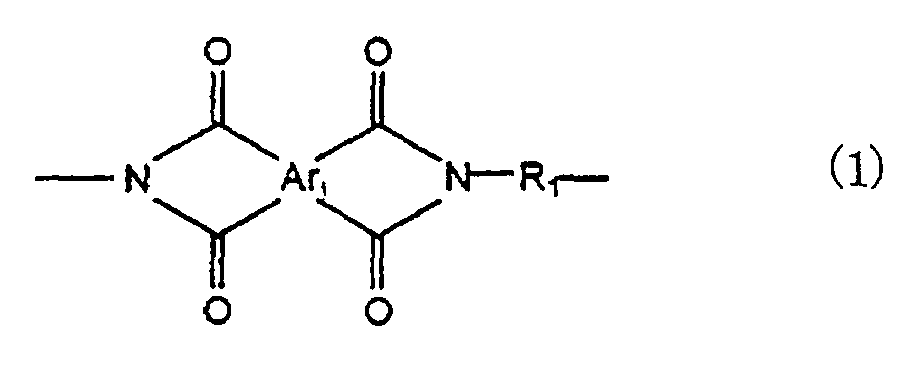


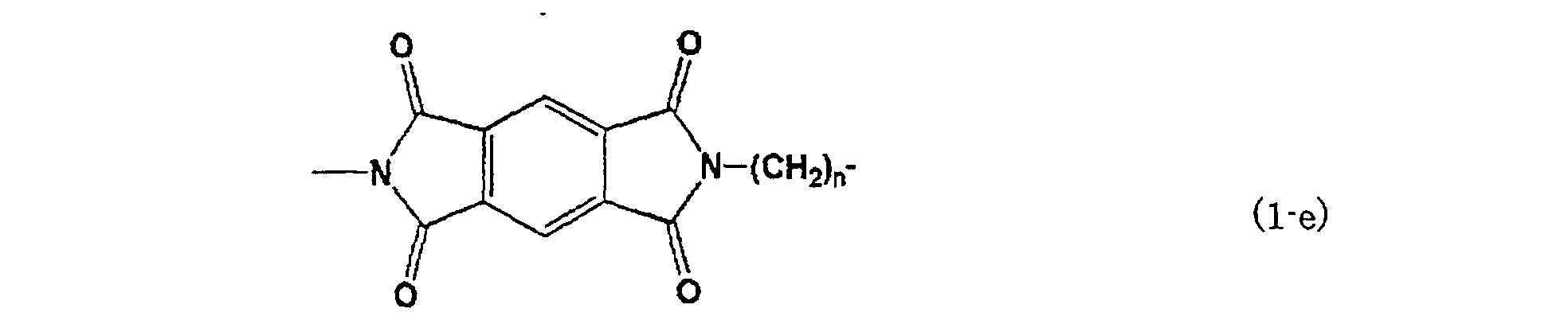

| Solid phase polymerization temperature (°C) | Nitrogen gas flow rate (L/min) | Intrinsic viscosity ([η]) of crystalline polyimide at each solid phase polymerization time | |||||
| 0 hr | 2 hr | 4 hr | 8 hr | 12 hr | |||
| Synthetic Example 5 | 260 | 2.0 | 1.785 | 4.99 | 6.27 | 7.48 | 8.23 |
| Synthetic Example 6 | 280 | 2.0 | 1.785 | 6.48 | 7.38 | 8.23 | - |
| Solid phase polymerization temperature (°C) | Nitrogen gas flow rate (L/min) | Melting point of crystalline polyimide at each solid phase polymerization time (°C) | |||||
| 0 hr | 2 hr | 4 hr | 8 hr | 12 hr | |||
| Synthetic Example 5 | 260 | 2.0 | 293.0 | 295.6 | 295.6 | 296.6 | 297.1 |
| Synthetic Example 6 | 280 | 2.0 | 293.0 | 295.7 | 296.3 | 297.3 | - |
| Polyimide | : | Polymer :filler | Heat distortion temp. (°C) | Elastic modulus (MPa) | ||||||
| P | ||||||||||
| Example 1 | - | - | - | 2.0 | 2.0 | PET | 30:70 | 60:40 | 263 | 108.9 |
| Example 2 | - | - | - | 2.0 | 2.0 | PET | 10:90 | 60:40 | 257 | 93.1 |
| Comparative Example 1 | - | - | - | 2.0 | 2.0 | - | 100:0 | 60:40 | >300 | 92.6 |
| Comparative Example 2 | - | - | - | - | - | 0:100 | 60:40 | 86 | 89.0 |
| PI | PES | PI: PES | Polymer :filler | Heat distortion temp. (°C) | Elastic modulus (MPa) | |||||
| C6 | C9 | C 10 | C 12 | P | ||||||
| Example 3 | 0.5 | - | 1.5 | - | 2.0 | PET | 30:70 | 60:40 | 262 | 103.5 |
| Example 4 | 0.5 | - | 1.5 | - | 2.0 | PET | 50:50 | 60:40 | 272 | 97.2 |
| Example 5 | - | 2.0 | - | - | 2.0 | PET | 30:70 | 60:40 | 254 | 104.8 |
| Note: The meanings of PI, PES, C6, C9, C10, C12, PET, etc., are same as those described in the note of the Table 3. |
| PI | Polymer :filler | Heat distortion temp. (°C) | Elastic modulus (MPa) | |||||
| C6 | C9 | C 10 | C 12 | P | ||||
| Referential Example 1 | 0.5 | - | 1.5 | - | 2.0 | 60:40 | >300 | about 90 |
| Referential Example 2 | - | 2.0 | - | - | 2.0 | 60:40 | >300 | 100.8 |
| Referential Example 3 | 0.5 | - | 1.5 | - | 2.0 | 100:0 | <200 | 17.6 |
| Referential Example 4 | - | 2.0 | - | - | 2.0 | 100:0 | <200 | 21.7 |
| Note: The meanings of PI, C6, C9, C10, C12, etc., are same as those described in the note of the Table 3. |
| Film thickness (µm) | Intrinsic Intrinsic viscosity | Tg (°C) | Delamination whitening width (µm/sheet) | Young's modulus MD/TD (kg/mm2) | |
| Example 12 | 4.6 | 0.486 | 117 | 15.6 | 562/902 |
| Comparative Example 5 | 4.5 | 0.513 | 121 | 18.0 | 616/877 |
Claims (43)
- A thermoplastic resin composition containing a crystalline polyimide and a thermoplastic polyester characterized in that said polyimide and said polyester are compatibilized at least in molten state.
- The thermoplastic resin composition of Claim 1 wherein said polyimide has a melting point lower than the melting point of said polyester.
- The thermoplastic resin composition of Claim 1 or 2 wherein said polyimide is at least one kind of semi-aromatic polyimide composed mainly of the repeating unit expressed by the formula (1)(in the formula, R1 is a bivalent organic aromatic group or aliphatic group having a carbon number of 2 to 30, optionally containing substituents, and Ar1 is an aromatic group having a carbon number of 6 to 45 and optionally containing substituents).

- The thermoplastic resin composition of Claim 3 wherein Ar1 is an aromatic residue having a carbon number of 6 to 15 and optionally containing substituents.
- The thermoplastic resin composition of Claim 3 wherein Ar1 is an aromatic residue selected from the group consisting of the following formula (1-e)
 (in the formula, the definition of R2 is same as that of R1 of the formula (1)).
- The thermoplastic resin composition of Claim 3 wherein Ar1 is a group derived from pyromellitic anhydride and expressed by the following formula (1-d).

- The thermoplastic resin composition of either one of Claims 3 to 6 wherein R1 is an aliphatic alkylene group expressed by -(CH2)n- (in the formula, n is an integer of from 6 to 18) and optionally containing substituents.
- The thermoplastic resin composition of Claim 3 wherein Ar1 is an aromatic group expressed by the above formula (1-d) and R1 is an aliphatic alkylene group expressed by -(CH2)n- (in the formula, n is an integer of from 9 to 12).
- The thermoplastic resin composition of either one of Claims 1 to 8 wherein said polyimide has an intrinsic viscosity ([η]) of 0.5 (dl/g) or above and 15 or below.
- The thermoplastic resin composition of either one of Claims 1 to 8 wherein said polyimide has an intrinsic viscosity ([η]) of 0.5 (dl/g) or above and smaller than 2.5.
- The thermoplastic resin composition of either one of Claims 1 to 8 wherein said polyimide has an intrinsic viscosity ([η]) of 2.5 (dl/g) or above and 15 or below.
- The thermoplastic resin composition of either one of Claims 1 to 11 wherein said polyester has a melting point lower than the melting point of said polyimide or said polyester is an amorphous.
- The thermoplastic resin composition of either one of Claims 1 to 11 wherein said polyester is a polyester composed mainly of a semi-aromatic ester expressed by the formula (2)(in the formula, Ar' is an aromatic group having a carbon number of 6 to 18, optionally containing substituents, and R' is an aliphatic group having a carbon number of 2 to 20 and optionally containing substituents).

- The thermoplastic resin composition of either one of Claims 1 to 11 wherein Ar' is an aromatic group having a carbon number of 6 to 10 and R' is an aliphatic alkylene group having a carbon number of 2 to 4.
- The thermoplastic resin composition of either one of Claims 1 to 11 wherein said polyester is polyethylene terephthalate or polybutylene terephthalate.
- The thermoplastic resin composition of either one of Claims 1 to 11 wherein said polyester is polyethylene-2,6-naphthalenedicarboxylate.
- The thermoplastic resin composition of Claim 1 wherein a fibrous filler is mixed to the composition.
- The thermoplastic resin composition of Claim 17 wherein said fibrous filler is glass fiber.
- The thermoplastic resin composition of Claim 17 or Claim 18 wherein the content of said fibrous filler is 1 to 70% by weight based on the total thermoplastic resin composition.
- The thermoplastic resin composition of Claim 1 wherein the compounding weight ratio of said polyimide (A) to said polyester (B) (A:B) is within the range of 0.01:99.99 to 90:10.
- The thermoplastic resin composition of Claim 1 having a melt viscosity of 50,000 poise or below at 300°C.
- The thermoplastic resin composition of Claim 1 having a heat-distortion temperature of 150°C or below.
- A process for the production of a thermoplastic resin composition containing a crystalline polyimide and a thermoplastic polyester comprising the mixing of said polyimide with said polyester to compatibilize said polyimide with said polyester at least in molten state.
- A process for the production of a thermoplastic resin composition containing a crystalline polyimide and a thermoplastic polyester comprising the polymerization of said polyester in the presence of said polyimide to compatibilize said polyimide with said polyester at least in molten state.
- The process of Claim 24 containing (1) a step to homogeneously melt the system at a temperature between (the melting point of said polyimide minus 40°C) and 300°C under normal pressure and (2) a subsequent step to evacuate the system and proceed the polymerization.
- The process of Claim 24 or Claim 25 wherein said polyimide has a melting point of from 280°C to 340°C.
- The process of either one of Claims 23 to 26 wherein said polyimide is a semi-aromatic polyimide composed mainly of the repeating unit expressed by the above formula (1).
- The process of Claim 27 wherein Ar1 is an aromatic residue selected from the group of the above formula (1-a) and R1 is expressed by -(CH2)n- (in the formula, n is an integer of from 6 to 18).
- A crystalline polyimide having high polymerization degree and an intrinsic viscosity ([η]) of 2.5 (dl/g) or above and 15.0 or below.
- The crystalline polyimide of Claim 29 having high polymerization degree and comprising a semi-aromatic polyimide composed mainly of the repeating unit expressed by the above formula (1).
- The crystalline polyimide of Claim 29 or Claim 30 having high polymerization degree wherein Ar1 is an aromatic residue selected from the group of the above formula (1-a) and R1 is expressed by -(C2)n-(in the formula, n is an integer of from 6 to 18).
- A process for the production of a crystalline polyimide having high polymerization degree and an intrinsic viscosity of 2.5 (dl/g) or above and 15 or below by the solid phase polymerization of a crystalline polyimide having low polymerization degree (or medium polymerization degree) and an intrinsic viscosity of 0.05 (dl/g) or above and 4.5 or below.
- A modifying method for improving the mechanical characteristics of a thermoplastic polyester comprising the mixing of a crystalline polyimide to said thermoplastic polyester to compatibilize said polyimide with said polyester at least in molten state.
- The modifying method of Claim 33 wherein said polyimide is a semi-aromatic polyimide composed mainly of the repeating unit expressed by the above formula (1).
- The modifying method of Claims 33 or 34 wherein said polyimide has an intrinsic viscosity ([η]) of 0.5 (dl/g) or above and 15.0 or below.
- A molded article made of the thermoplastic resin composition of either one of Claims 1 to 22.
- The molded article of Claim 36 comprising an electronic part for surface mounting.
- The molded article of Claim 36 comprising a film.
- A biaxially oriented film produced by the biaxial drawing of the film of Claim 38.
- The biaxially oriented film of Claim 39 having Young's modulus of 500 kg/mm2 or above in each orientation direction of the film.
- The biaxially oriented film of Claims 39 or 40 wherein said thermoplastic polyester is polyethylene naphthalate or polyethylene-2, 6-naphthalenedicarboxylate.
- A photographic film produced by using the biaxially oriented film of Claim 41 as the base film.
- A magnetic recording medium produced by using the biaxially oriented film of Claim 41 as the base film.
Applications Claiming Priority (13)
| Application Number | Priority Date | Filing Date | Title |
|---|---|---|---|
| JP12841199 | 1999-05-10 | ||
| JP12841199 | 1999-05-10 | ||
| JP14632599 | 1999-05-26 | ||
| JP14632599 | 1999-05-26 | ||
| JP15919699 | 1999-06-07 | ||
| JP15919699 | 1999-06-07 | ||
| JP16077399 | 1999-06-08 | ||
| JP16077399 | 1999-06-08 | ||
| JP17102499 | 1999-06-17 | ||
| JP17102499 | 1999-06-17 | ||
| JP35435799 | 1999-12-14 | ||
| JP35435799 | 1999-12-14 | ||
| PCT/JP2000/002976 WO2000068318A1 (en) | 1999-05-10 | 2000-05-10 | Resin composition containing crystalline polyimide |
Publications (3)
| Publication Number | Publication Date |
|---|---|
| EP1199333A1 true EP1199333A1 (en) | 2002-04-24 |
| EP1199333A4 EP1199333A4 (en) | 2002-10-30 |
| EP1199333B1 EP1199333B1 (en) | 2004-07-14 |
Family
ID=27552724
Family Applications (1)
| Application Number | Title | Priority Date | Filing Date |
|---|---|---|---|
| EP20000925587 Expired - Lifetime EP1199333B1 (en) | 1999-05-10 | 2000-05-10 | Resin composition containing crystalline polyimide |
Country Status (8)
| Country | Link |
|---|---|
| US (1) | US6646060B1 (en) |
| EP (1) | EP1199333B1 (en) |
| KR (1) | KR20020005031A (en) |
| AT (1) | ATE271102T1 (en) |
| AU (1) | AU4429900A (en) |
| CA (1) | CA2372573A1 (en) |
| DE (1) | DE60012185T2 (en) |
| WO (1) | WO2000068318A1 (en) |
Cited By (4)
| Publication number | Priority date | Publication date | Assignee | Title |
|---|---|---|---|---|
| EP1113045A2 (en) * | 1999-12-30 | 2001-07-04 | Eastman Kodak Company | In-situ blending of polyesters with poly(ether imide) |
| EP1394212A1 (en) * | 2002-08-27 | 2004-03-03 | Fuji Photo Film Co., Ltd. | Polyester resin composition containing inorganic filler, polyetherimide, and polymer containing polyethylene naphthalate in constituent unit thereof |
| CN103890042A (en) * | 2011-09-20 | 2014-06-25 | 罗地亚经营管理公司 | thermoplastic polyimide |
| EP3266813A4 (en) * | 2015-03-05 | 2018-09-26 | Toray Industries, Inc. | Polyester film and electrical insulation sheet manufactured using same, wind power generator, and adhesive tape |
Families Citing this family (15)
| Publication number | Priority date | Publication date | Assignee | Title |
|---|---|---|---|---|
| US6674494B2 (en) * | 2000-12-28 | 2004-01-06 | Optrex Corporation | Liquid crystal optical element and test method for its boundary layer |
| US6881820B1 (en) * | 2002-05-13 | 2005-04-19 | The United States Of America As Represented By The Administrator Of The National Aeronautics And Space Administration | Rod-coil block polyimide copolymers |
| JP3878521B2 (en) * | 2002-07-18 | 2007-02-07 | 本田技研工業株式会社 | Proton conducting polymer solid electrolyte and method for producing the same |
| JP4665428B2 (en) * | 2003-04-23 | 2011-04-06 | 東レ株式会社 | Biaxially oriented polyester film |
| CN100349951C (en) * | 2005-11-04 | 2007-11-21 | 东华大学 | Solid phase polymerization process for preparing ethylene telephthalate and aromatic diamine copolymer |
| US7771696B2 (en) * | 2006-07-27 | 2010-08-10 | University Of Dayton | Nanocomposites and functionalized carbon nanofibers |
| US20080118730A1 (en) * | 2006-11-22 | 2008-05-22 | Ta-Hua Yu | Biaxially oriented film, laminates made therefrom, and method |
| JP5740834B2 (en) * | 2009-05-11 | 2015-07-01 | 三菱化学株式会社 | Liquid crystalline polyimide, liquid crystalline resin composition containing the same, and resin film for semiconductor element |
| JPWO2011033751A1 (en) * | 2009-09-18 | 2013-02-07 | 三井化学株式会社 | Transparent thermoplastic polyimide and transparent substrate containing the same |
| CN102127457A (en) * | 2010-12-30 | 2011-07-20 | 深圳超多维光电子有限公司 | Alignment layer material, alignment layer and preparation method thereof, and birefringent liquid crystal film and preparation method thereof |
| FR2980203B1 (en) * | 2011-09-20 | 2014-12-26 | Rhodia Operations | THERMOPLASTIC COPOLYIMIDES |
| WO2013041531A1 (en) * | 2011-09-20 | 2013-03-28 | Rhodia Operations | Thermoplastic polyimides |
| EP3514869B1 (en) * | 2017-08-23 | 2023-10-04 | UBE Corporation | Binder resin for electrodes, electrode mixture paste, electrode and method for producing electrode |
| KR20200027368A (en) * | 2018-09-04 | 2020-03-12 | 에스케이씨 주식회사 | Cable with insulating layer and manufacturing method of the insulating layer |
| CN112442201A (en) * | 2020-12-03 | 2021-03-05 | 宁波东旭成新材料科技有限公司 | Preparation method of polyimide optical reflecting film |
Family Cites Families (25)
| Publication number | Priority date | Publication date | Assignee | Title |
|---|---|---|---|---|
| US4141927A (en) | 1975-05-22 | 1979-02-27 | General Electric Company | Novel polyetherimide-polyester blends |
| US4358562A (en) | 1981-07-24 | 1982-11-09 | Standard Oil Company (Indiana) | Copolyimides from tetramethylcyclobutane-1,2,3,4-tetracarboxylic dianhydride and a mixture of diamines |
| US4417045A (en) * | 1981-08-19 | 1983-11-22 | Standard Oil Company (Indiana) | Polyimides and polyimide-amides |
| US4725647A (en) | 1981-08-27 | 1988-02-16 | Amoco Corporation | Process for preparing polyesters in the presence of a processing aid |
| JPS62185713A (en) | 1986-02-10 | 1987-08-14 | Tonen Sekiyukagaku Kk | Novel polyimide compound |
| US5037946A (en) | 1988-12-23 | 1991-08-06 | Eastman Kodak Company | Copolyesters from 4,4'-biphenyldicarboxylic acid, 1,6-hexanediol and ethylene glycol |
| US5057595A (en) | 1988-12-23 | 1991-10-15 | Eastman Kodak Company | Copolyesters from 4,4'-biphenyldicarboxylic acid, 1,4-cyclohexanedimethanol and ethylene glycol |
| JP2535666B2 (en) * | 1989-11-30 | 1996-09-18 | 三井東圧化学株式会社 | Polyimide resin composition |
| US5276133A (en) | 1991-06-14 | 1994-01-04 | Mitsui Toatsu Chemicals, Inc. | Favorably processable polyimide and process for preparing polyimide |
| NL9101219A (en) | 1991-07-11 | 1993-02-01 | Dsm Nv | THERMOPLASTIC POLYIMIDE. |
| JPH0525370A (en) | 1991-07-24 | 1993-02-02 | Dainippon Ink & Chem Inc | Copolyester composition |
| US5366663A (en) | 1991-11-30 | 1994-11-22 | Hoechst Ag | Mixtures of liquid crystalline copolymers, polyether imides and compatibilizers and use thereof |
| FI94054C (en) * | 1992-09-18 | 1995-07-10 | Neste Oy | Melt-machinable polyesterimide block copolymer and process for its preparation |
| US5395917A (en) | 1993-05-21 | 1995-03-07 | E. I. Du Pont De Nemours And Company | Polyimides from 4-(3-aminophenoxy)benzoic acid |
| US5378420A (en) * | 1993-06-16 | 1995-01-03 | Edison Polymer Innovation Corporation | Process for preparing aromatic polyimide fibers |
| JP3668748B2 (en) | 1995-11-08 | 2005-07-06 | ダイキン工業株式会社 | Non-adhesive molding material for sliding parts, separation claw and paper discharge roller |
| US5599658A (en) | 1995-12-19 | 1997-02-04 | Eastman Kodak Company | Photographic film-base and photographic elements |
| US5633319A (en) | 1996-01-16 | 1997-05-27 | General Electric Company | Compatibilized blends of polyetherimides and liquid crystalline polyesters |
| TW400351B (en) | 1996-02-27 | 2000-08-01 | Toray Industries | Armoatic polyamide and/or armoatic polyimide film |
| JPH09272799A (en) | 1996-04-08 | 1997-10-21 | Mitsui Toatsu Chem Inc | Thermoplastic polyimide resin composition and use thereof |
| CA2244269C (en) * | 1996-11-25 | 2004-03-30 | Teijin Limited | Thermoplastic resin compositions containing non-crystalline polyimide |
| US5939497A (en) | 1997-09-05 | 1999-08-17 | General Electric Company | Polyetherimide resin/polyester resin blends |
| DE69936497T2 (en) | 1998-09-11 | 2008-04-03 | Toray Industries, Inc. | Multilayer, biaxially oriented polyester film and process for its preparation |
| US6103806A (en) * | 1998-12-21 | 2000-08-15 | Mitsui Chemicals, Inc. | Polyimide resin composition |
| US6599991B1 (en) | 1999-12-30 | 2003-07-29 | Eastman Kodak Company | In-situ blending of polyesters with poly(ether imide) |
-
2000
- 2000-05-10 US US09/743,408 patent/US6646060B1/en not_active Expired - Fee Related
- 2000-05-10 CA CA 2372573 patent/CA2372573A1/en not_active Abandoned
- 2000-05-10 AU AU44299/00A patent/AU4429900A/en not_active Abandoned
- 2000-05-10 DE DE2000612185 patent/DE60012185T2/en not_active Expired - Fee Related
- 2000-05-10 WO PCT/JP2000/002976 patent/WO2000068318A1/en not_active Ceased
- 2000-05-10 EP EP20000925587 patent/EP1199333B1/en not_active Expired - Lifetime
- 2000-05-10 KR KR1020017014361A patent/KR20020005031A/en not_active Ceased
- 2000-05-10 AT AT00925587T patent/ATE271102T1/en not_active IP Right Cessation
Cited By (4)
| Publication number | Priority date | Publication date | Assignee | Title |
|---|---|---|---|---|
| EP1113045A2 (en) * | 1999-12-30 | 2001-07-04 | Eastman Kodak Company | In-situ blending of polyesters with poly(ether imide) |
| EP1394212A1 (en) * | 2002-08-27 | 2004-03-03 | Fuji Photo Film Co., Ltd. | Polyester resin composition containing inorganic filler, polyetherimide, and polymer containing polyethylene naphthalate in constituent unit thereof |
| CN103890042A (en) * | 2011-09-20 | 2014-06-25 | 罗地亚经营管理公司 | thermoplastic polyimide |
| EP3266813A4 (en) * | 2015-03-05 | 2018-09-26 | Toray Industries, Inc. | Polyester film and electrical insulation sheet manufactured using same, wind power generator, and adhesive tape |
Also Published As
| Publication number | Publication date |
|---|---|
| US6646060B1 (en) | 2003-11-11 |
| AU4429900A (en) | 2000-11-21 |
| EP1199333A4 (en) | 2002-10-30 |
| WO2000068318A1 (en) | 2000-11-16 |
| ATE271102T1 (en) | 2004-07-15 |
| CA2372573A1 (en) | 2000-11-16 |
| DE60012185D1 (en) | 2004-08-19 |
| KR20020005031A (en) | 2002-01-16 |
| DE60012185T2 (en) | 2005-07-28 |
| WO2000068318A8 (en) | 2001-03-22 |
| EP1199333B1 (en) | 2004-07-14 |
Similar Documents
| Publication | Publication Date | Title |
|---|---|---|
| EP1199333B1 (en) | Resin composition containing crystalline polyimide | |
| JP3263247B2 (en) | Halogen free flame retardant blend | |
| JP2010007067A (en) | Liquid crystal polymer composition containing nano-structured hollow carbon material, and molded article thereof | |
| WO2000050514A1 (en) | Resin composition and jig for use in transportation | |
| KR20110098651A (en) | Liquid crystal polymer composition and molded article thereof | |
| WO2021106768A1 (en) | Lcp resin composition for circuit boards, lcp film for circuit boards and method for producing same | |
| JP2010215905A (en) | Thermoplastic resin composition, method for producing the same, and molded article | |
| WO2000032691A1 (en) | Polyimide/polyarylate resin compositions and moldings thereof | |
| CN104024224B (en) | There is the copolyester imide of poly-(the terephthalic acid alkylene ester) of high glass-transition temperature and film prepared therefrom | |
| EP0579087B1 (en) | Process for producing polyester film | |
| JP2004244452A (en) | Aromatic liquid crystal polyester and its film | |
| JP2005029688A (en) | Biaxially oriented polyester film | |
| JP5050514B2 (en) | Liquid crystal polyester solution composition and use thereof | |
| JP2003101166A (en) | Polyester film for reinforcement | |
| JP4887645B2 (en) | Liquid crystalline resin composition and molded article comprising the same | |
| JP2005002265A (en) | Biaxially oriented polyester film | |
| JPWO2000068318A1 (en) | Resin composition containing crystalline polyimide | |
| JP2004250688A (en) | Aromatic liquid crystal polyester film | |
| JP2008239640A (en) | High-thermal-conductivity thermoplastic resin composition and molded article | |
| JP2005329580A (en) | Biaxially oriented laminated thermoplastic film | |
| JP2004107471A (en) | Biaxially oriented polyester film | |
| JPH10139885A (en) | Liquid crystalline resin pellets and thermoplastic resin composition using the same, and method for producing the same | |
| JP2007291222A (en) | Biaxially oriented polyarylene sulfide film and method for producing biaxially oriented polyarylene sulfide film | |
| JPH0481426A (en) | Production of liquid crystalline polymer film | |
| JP4369037B2 (en) | Transportation jigs in the electronics field |
Legal Events
| Date | Code | Title | Description |
|---|---|---|---|
| PUAI | Public reference made under article 153(3) epc to a published international application that has entered the european phase |
Free format text: ORIGINAL CODE: 0009012 |
|
| 17P | Request for examination filed |
Effective date: 20010119 |
|
| AK | Designated contracting states |
Kind code of ref document: A1 Designated state(s): AT BE CH CY DE DK ES FI FR GB GR IE IT LI LU MC NL PT SE |
|
| A4 | Supplementary search report drawn up and despatched |
Effective date: 20020913 |
|
| AK | Designated contracting states |
Kind code of ref document: A4 Designated state(s): AT BE CH CY DE DK ES FI FR GB GR IE IT LI LU MC NL PT SE |
|
| 17Q | First examination report despatched |
Effective date: 20030407 |
|
| GRAP | Despatch of communication of intention to grant a patent |
Free format text: ORIGINAL CODE: EPIDOSNIGR1 |
|
| GRAS | Grant fee paid |
Free format text: ORIGINAL CODE: EPIDOSNIGR3 |
|
| GRAA | (expected) grant |
Free format text: ORIGINAL CODE: 0009210 |
|
| AK | Designated contracting states |
Kind code of ref document: B1 Designated state(s): AT BE CH CY DE DK ES FI FR GB GR IE IT LI LU MC NL PT SE |
|
| PG25 | Lapsed in a contracting state [announced via postgrant information from national office to epo] |
Ref country code: NL Free format text: LAPSE BECAUSE OF FAILURE TO SUBMIT A TRANSLATION OF THE DESCRIPTION OR TO PAY THE FEE WITHIN THE PRESCRIBED TIME-LIMIT Effective date: 20040714 Ref country code: LI Free format text: LAPSE BECAUSE OF FAILURE TO SUBMIT A TRANSLATION OF THE DESCRIPTION OR TO PAY THE FEE WITHIN THE PRESCRIBED TIME-LIMIT Effective date: 20040714 Ref country code: IT Free format text: LAPSE BECAUSE OF FAILURE TO SUBMIT A TRANSLATION OF THE DESCRIPTION OR TO PAY THE FEE WITHIN THE PRESCRIBED TIME-LIMIT;WARNING: LAPSES OF ITALIAN PATENTS WITH EFFECTIVE DATE BEFORE 2007 MAY HAVE OCCURRED AT ANY TIME BEFORE 2007. THE CORRECT EFFECTIVE DATE MAY BE DIFFERENT FROM THE ONE RECORDED. Effective date: 20040714 Ref country code: FR Free format text: LAPSE BECAUSE OF FAILURE TO SUBMIT A TRANSLATION OF THE DESCRIPTION OR TO PAY THE FEE WITHIN THE PRESCRIBED TIME-LIMIT Effective date: 20040714 Ref country code: FI Free format text: LAPSE BECAUSE OF FAILURE TO SUBMIT A TRANSLATION OF THE DESCRIPTION OR TO PAY THE FEE WITHIN THE PRESCRIBED TIME-LIMIT Effective date: 20040714 Ref country code: ES Free format text: LAPSE BECAUSE OF FAILURE TO SUBMIT A TRANSLATION OF THE DESCRIPTION OR TO PAY THE FEE WITHIN THE PRESCRIBED TIME-LIMIT Effective date: 20040714 Ref country code: CH Free format text: LAPSE BECAUSE OF FAILURE TO SUBMIT A TRANSLATION OF THE DESCRIPTION OR TO PAY THE FEE WITHIN THE PRESCRIBED TIME-LIMIT Effective date: 20040714 Ref country code: BE Free format text: LAPSE BECAUSE OF FAILURE TO SUBMIT A TRANSLATION OF THE DESCRIPTION OR TO PAY THE FEE WITHIN THE PRESCRIBED TIME-LIMIT Effective date: 20040714 Ref country code: AT Free format text: LAPSE BECAUSE OF FAILURE TO SUBMIT A TRANSLATION OF THE DESCRIPTION OR TO PAY THE FEE WITHIN THE PRESCRIBED TIME-LIMIT Effective date: 20040714 |
|
| REG | Reference to a national code |
Ref country code: GB Ref legal event code: FG4D |
|
| REG | Reference to a national code |
Ref country code: CH Ref legal event code: EP |
|
| REF | Corresponds to: |
Ref document number: 60012185 Country of ref document: DE Date of ref document: 20040819 Kind code of ref document: P |
|
| REG | Reference to a national code |
Ref country code: IE Ref legal event code: FG4D |
|
| PG25 | Lapsed in a contracting state [announced via postgrant information from national office to epo] |
Ref country code: SE Free format text: LAPSE BECAUSE OF FAILURE TO SUBMIT A TRANSLATION OF THE DESCRIPTION OR TO PAY THE FEE WITHIN THE PRESCRIBED TIME-LIMIT Effective date: 20041014 Ref country code: GR Free format text: LAPSE BECAUSE OF FAILURE TO SUBMIT A TRANSLATION OF THE DESCRIPTION OR TO PAY THE FEE WITHIN THE PRESCRIBED TIME-LIMIT Effective date: 20041014 Ref country code: DK Free format text: LAPSE BECAUSE OF FAILURE TO SUBMIT A TRANSLATION OF THE DESCRIPTION OR TO PAY THE FEE WITHIN THE PRESCRIBED TIME-LIMIT Effective date: 20041014 |
|
| NLV1 | Nl: lapsed or annulled due to failure to fulfill the requirements of art. 29p and 29m of the patents act | ||
| REG | Reference to a national code |
Ref country code: CH Ref legal event code: PL |
|
| PGFP | Annual fee paid to national office [announced via postgrant information from national office to epo] |
Ref country code: GB Payment date: 20050425 Year of fee payment: 6 |
|
| PG25 | Lapsed in a contracting state [announced via postgrant information from national office to epo] |
Ref country code: LU Free format text: LAPSE BECAUSE OF NON-PAYMENT OF DUE FEES Effective date: 20050510 Ref country code: IE Free format text: LAPSE BECAUSE OF NON-PAYMENT OF DUE FEES Effective date: 20050510 Ref country code: CY Free format text: LAPSE BECAUSE OF FAILURE TO SUBMIT A TRANSLATION OF THE DESCRIPTION OR TO PAY THE FEE WITHIN THE PRESCRIBED TIME-LIMIT Effective date: 20050510 |
|
| PLBE | No opposition filed within time limit |
Free format text: ORIGINAL CODE: 0009261 |
|
| STAA | Information on the status of an ep patent application or granted ep patent |
Free format text: STATUS: NO OPPOSITION FILED WITHIN TIME LIMIT |
|
| PG25 | Lapsed in a contracting state [announced via postgrant information from national office to epo] |
Ref country code: MC Free format text: LAPSE BECAUSE OF NON-PAYMENT OF DUE FEES Effective date: 20050531 |
|
| PGFP | Annual fee paid to national office [announced via postgrant information from national office to epo] |
Ref country code: DE Payment date: 20050609 Year of fee payment: 6 |
|
| 26N | No opposition filed |
Effective date: 20050415 |
|
| EN | Fr: translation not filed | ||
| REG | Reference to a national code |
Ref country code: IE Ref legal event code: MM4A |
|
| PG25 | Lapsed in a contracting state [announced via postgrant information from national office to epo] |
Ref country code: GB Free format text: LAPSE BECAUSE OF NON-PAYMENT OF DUE FEES Effective date: 20060510 |
|
| PG25 | Lapsed in a contracting state [announced via postgrant information from national office to epo] |
Ref country code: DE Free format text: LAPSE BECAUSE OF NON-PAYMENT OF DUE FEES Effective date: 20061201 |
|
| GBPC | Gb: european patent ceased through non-payment of renewal fee |
Effective date: 20060510 |
|
| PG25 | Lapsed in a contracting state [announced via postgrant information from national office to epo] |
Ref country code: PT Free format text: LAPSE BECAUSE OF NON-PAYMENT OF DUE FEES Effective date: 20041214 |