EP1199124A1 - Lubricant for die lubrication and method for producing high density product of forming of iron base powder - Google Patents
Lubricant for die lubrication and method for producing high density product of forming of iron base powder Download PDFInfo
- Publication number
- EP1199124A1 EP1199124A1 EP01915739A EP01915739A EP1199124A1 EP 1199124 A1 EP1199124 A1 EP 1199124A1 EP 01915739 A EP01915739 A EP 01915739A EP 01915739 A EP01915739 A EP 01915739A EP 1199124 A1 EP1199124 A1 EP 1199124A1
- Authority
- EP
- European Patent Office
- Prior art keywords
- die
- lubricant
- group
- powder
- iron
- Prior art date
- Legal status (The legal status is an assumption and is not a legal conclusion. Google has not performed a legal analysis and makes no representation as to the accuracy of the status listed.)
- Granted
Links
Classifications
-
- B—PERFORMING OPERATIONS; TRANSPORTING
- B30—PRESSES
- B30B—PRESSES IN GENERAL
- B30B15/00—Details of, or accessories for, presses; Auxiliary measures in connection with pressing
- B30B15/0005—Details of, or accessories for, presses; Auxiliary measures in connection with pressing for briquetting presses
- B30B15/0011—Details of, or accessories for, presses; Auxiliary measures in connection with pressing for briquetting presses lubricating means
-
- B—PERFORMING OPERATIONS; TRANSPORTING
- B22—CASTING; POWDER METALLURGY
- B22F—WORKING METALLIC POWDER; MANUFACTURE OF ARTICLES FROM METALLIC POWDER; MAKING METALLIC POWDER; APPARATUS OR DEVICES SPECIALLY ADAPTED FOR METALLIC POWDER
- B22F1/00—Metallic powder; Treatment of metallic powder, e.g. to facilitate working or to improve properties
- B22F1/10—Metallic powder containing lubricating or binding agents; Metallic powder containing organic material
-
- B—PERFORMING OPERATIONS; TRANSPORTING
- B22—CASTING; POWDER METALLURGY
- B22F—WORKING METALLIC POWDER; MANUFACTURE OF ARTICLES FROM METALLIC POWDER; MAKING METALLIC POWDER; APPARATUS OR DEVICES SPECIALLY ADAPTED FOR METALLIC POWDER
- B22F1/00—Metallic powder; Treatment of metallic powder, e.g. to facilitate working or to improve properties
- B22F1/10—Metallic powder containing lubricating or binding agents; Metallic powder containing organic material
- B22F1/108—Mixtures obtained by warm mixing
-
- B—PERFORMING OPERATIONS; TRANSPORTING
- B22—CASTING; POWDER METALLURGY
- B22F—WORKING METALLIC POWDER; MANUFACTURE OF ARTICLES FROM METALLIC POWDER; MAKING METALLIC POWDER; APPARATUS OR DEVICES SPECIALLY ADAPTED FOR METALLIC POWDER
- B22F2998/00—Supplementary information concerning processes or compositions relating to powder metallurgy
-
- B—PERFORMING OPERATIONS; TRANSPORTING
- B22—CASTING; POWDER METALLURGY
- B22F—WORKING METALLIC POWDER; MANUFACTURE OF ARTICLES FROM METALLIC POWDER; MAKING METALLIC POWDER; APPARATUS OR DEVICES SPECIALLY ADAPTED FOR METALLIC POWDER
- B22F2999/00—Aspects linked to processes or compositions used in powder metallurgy
Definitions
- This invention relates to lubricants for die lubrication and a manufacturing method for an iron-based powder compact for powder metallurgy. This invention especially relates to improving lubricants for die lubrication which is used for compacting high density iron-based powder compacts.
- iron-based powder compacts for powder metallurgy are manufactured by the steps of mixing an iron-based powder, alloying powder(s), for example, a copper powder and/or a graphite powder, and furthermore, a lubricant, for example, zinc stearate or lead stearate, to prepare an iron-based mixed powder; filling a die with the iron-based mixed powder; and compacting. Densities of the resulting compacts are generally 6.6 to 7.1 Mg/m 3 .
- iron-based powder compacts are sintered and are further sized or cut as necessary to make powder metallurgy products.
- a carburization heat-treatment, or a bright heat-treatment may be performed after completion of the sintering.
- sintered components In order to increase the strength of powder metallurgy products (sintered components), it is effective to increase the density of sintered components by increasing the density of compacts. Accompanying the increase in the density of sintered components, porosities in the components are decreased, and mechanical properties, for example, tensile strength, impact value, and fatigue strength are improved.
- the double compaction and double sintering method in which iron-based mixed powder is subjected to ordinary compaction and sintering, and thereafter, is subjected to another compaction and sintering
- the sintering and forging method in which after once compacting and once sintering are performed, hot forging is performed, have been suggested.
- the warm compaction technique in which metallic powders are compacted while being heated is disclosed in Japanese Unexamined Patent Application Publication No. 2-156002, Japanese Examined Patent Application Publication No. 7-103404 and U.S. Patents Nos. 5,256,185 and 5,368,630.
- This warm compaction technique is intended to decrease frictional resistance between the particles and between the compact and the die, and to improve the compactibility by a portion of, or by the entirety of the lubricant, being melted during the warm compaction, and thereby, being uniformly dispersed between the powder particles. It is believed that this warm compaction technique has the most advantageous cost among the above-mentioned manufacturing methods for high-density compacts.
- an iron-based mixed powder prepared by mixing 0.5% by weight of graphite and 0.6% by weight of lubricant to Fe-4Ni-0.5Mo-1.5Cu partially alloyed iron powder can be compacted at 130°C and at a pressure of 7t/cm 2 (686 MPa) to produce a compact having a density of about 7.30 Mg/m 3 .
- the lubricant is contained in the iron-based mixed powder in order to decrease frictional resistance between the particles and between the compact and the die and to improve the compactibility.
- a part of, or the entirety of, the lubricant is, however, melted during the warm compaction so as to be pushed out to the vicinity of the surface of the compact.
- the lubricant is pyrolyzed or vaporized and dissipated from the compact and coarse pores are formed in the vicinity of the surface of the sintered materiaL Therefore, there has been a problem that the mechanical strength of the sintered material is decreased.
- lubricants for die lubrication are intended for use at room temperature. Therefore, when these commercially available lubricants for die lubrication are adhered by electrification to preheated dies, there are problems that the lubricants may be completely melted on the surface of the dies and not uniformly adhered, and the lubricants are likely to move during the compaction pressure, such that the compact and the surface of the dies may be directly contacted so as to increase the ejection pressure.
- Objects of this invention are to advantageously solve the above-mentioned problems of conventional techniques, and to provide manufacturing methods for high-density iron-based powder compacts.
- an iron-based mixed powder prepared by blending 0.5% by weight of graphite to a partially alloyed iron powder having a composition of Fe-4Ni-0.5Mo-1.5Cu is subjected to an ordinary temperature compaction pressure at room temperature and at a pressure of 7t/cm 2 (686 MPa), and high-density compacts having a density of at least 7.30 Mg/m 3 can be produced by one time compacting.
- high-density compacts having a density of at least 7.40 Mg/m 3 can be produced by one time compacting.
- a mixture (lubricant) of at least two kinds of lubricants each having a melting point higher than the predetermined temperature of the compaction pressure, is effective as a lubricant for die lubrication which can adhere by electrification to the surface of a die that is at room temperature or preheated.
- a first aspect of this invention is a lubricant for die lubrication used during compaction pressure of a powder with a die while the lubricant is adhered by electrification to the surface of the die.
- the lubricant is comprised of a mixed powder of at least two kinds of lubricants each having a melting point higher than a predetermined temperature of the compaction pressure.
- the above-mentioned at least two kinds of lubricants each having a melting point higher than a predetermined temperature of the compaction pressure are preferably at least two materials selected from one of the following groups or from at least two of the following groups (groups A to I):
- the die is preferably a preheated die.
- a second aspect of this invention is a manufacturing method for high-density iron-based powder compacts including filling a die with an iron-based mixed powder and subsequently performing compaction pressure at a predetermined temperature, in which the die has the surface to which a lubricant for die lubrication is adhered by electrification, and a mixed powder of at least two kinds of lubricants each having a melting point higher than a predetermined temperature of the compaction pressure is used as the above-mentioned lubricant for die lubrication.
- the above-mentioned at least two kinds of lubricants each having a melting point higher than the predetermined temperature of the compaction pressure are preferably at least two materials selected from one of the following groups or from at least two of the following groups (groups A to IS):
- the die is preferably a preheated die and the above-mentioned iron-based mixed powder is preferably a pre-heated powder.
- the above-mentioned iron-based mixed powder is a mixture of the iron-based powder and a lubricant (lubricant for compacted powder), or is a mixture further comprising powder(s) for alloying.
- the content of the lubricant for compacting powder is preferably 0.05 to 0.40% by weight relative to the entire iron-based mixed powder.
- the lubricant for compacting powder is preferably one kind or at least two kinds of lubricant having a melting point higher than a predetermined temperature of the compaction pressure, or more preferably, is a mixed lubricant including a lubricant having a low melting point equivalent to, or lower than, the predetermined temperature of the compaction pressure and a lubricant having a melting point higher than the predetermined temperature of the compaction pressure.
- the content of the above-mentioned lubricant having a low melting point equivalent to, or lower than, the predetermined temperature of the compaction pressure is preferably 10 to 75% by weight relative to the entirety of the contained lubricant for powder compacting, and the content of the lubricant having a melting point higher than the predetermined temperature of the pressure molding is preferably the balance of 25 to 90% by weight.
- a high-density compact can be produced with one time of compaction pressure.
- a die is filled with an iron-based mixed powder, and then compaction pressure is performed at a predetermined temperature, that is, at ordinary temperature, or at "warm” temperature of 70 to 200°C, to produce an iron-based powder compact
- the die for compacting is used at ordinary temperature without preheating in the ordinary compaction temperature, or the die is used after being preheated to a predetermined temperature in the warm compaction.
- the preheating temperature of the die is not specifically limited as long as the iron-based mixed powder can be kept at the predetermined temperature of the compaction pressure.
- the preheating temperature is preferably 20 to 60°C higher than the predetermined temperature of the compaction pressure. In the ordinary compaction temperature, even if the die is used without being first preheated, the temperature of the die is raised to about 80°C after continual uses.
- An electrified lubricant for die lubrication is introduced into the die so that it is adhered by electrification to the surface of the die.
- the lubricant for die lubrication (solid powder) is preferably put into a die lubrication apparatus, for example, the Die Wall Lubricant System manufactured by Gasbarre Products, Inc., and is electrified by contact electrification of the lubricant (solid) and the inner wall of the apparatus.
- the electrified lubricant for die lubrication is sprayed above the die, and is introduced into the die so that it adheres by electrification to the surface of the die.
- the lubricant (lubricant for die lubrication) adhered to the surface of the die can decrease frictional resistance between the surface (wall) of the die and the powder during the compaction of the iron-based powder so as to decrease "pressure loss", that is, the escape of compaction pressure to the surface (wall) of the die, and to effectively transfer the pressure to the powder. Therefore, the density of the compact is increased and the ejection pressure required for ejecting the compact from the die is decreased.
- the lubricant powder must be uniformly adhered to the surface of the die.
- the lubricant for die lubrication (solid powder) is preferably adhered by electrification.
- the lubricant for die lubrication (solid powder) must be reliably electrified in a charging device of the die lubrication apparatus.
- the specific surface area of the lubricant for die lubrication (solid powder) is preferably small, that is, the particle diameter is preferably small.
- the particle diameters of 90% or more of the lubricant for die lubrication (solid powder) are preferably 50 ⁇ m or less.
- the electrification may become insufficient, and furthermore, the lubricant may fall under its own weight after being adhered to the die so that the adherence of the lubricant to the surface of the die becomes insufficient.
- the lubricant for die lubrication (solid powder) at least two kinds of different powder materials (lubricant powders) are mixed and used.
- the at least two kinds of different lubricant powders By mixing the at least two kinds of different lubricant powders, not only the lubricant for die lubrication (solid powder) is electrified in the die lubrication apparatus (charging device), but also the at least two kinds of different powders are contacted with each other in the die lubrication apparatus (charging device) so as to be contact electrified.
- the amount of electrical charge on the entirety of the powders becomes greater than that in the case in which one kind of lubricant is used. Therefore, the lubricant powders are adhered to the surface of the die with reliability.
- the lubricant for die lubrication solid powder
- a mixed powder prepared by mixing at least two kinds of lubricants each having a melting point higher than the predetermined temperature of the compaction pressure is used.
- the predetermined temperature of the compaction pressure in the invention means the temperature at the surface of the die during the compaction pressure.
- the lubricant for die lubrication has a melting point higher than the predetermined temperature of the compaction pressure, the lubricant is not melted and is present as a solid powder on the surface of the die so that the function of lubricating on the surface of the die is maintained, the density of the compact is increased, and the ejection pressure is not decreased.
- the lubricant for die lubrication has a melting point lower than the predetermined temperature of the compaction pressure, the lubricant melts on the surface of the die and spreads in a liquid state.
- the lubricant may be suctioned into the powder by a capillary phenomenon during the compaction of the iron-based mixed powder so that the lubricant remaining on the surface of the die may be decreased.
- the function of lubricating on the surface of the die may be reduced and the ejection pressure may be increased.
- the lubricant for die lubrication having a melting point higher than the predetermined temperature of the compaction pressure is not melted in the die during the compaction, and functions as a solid lubricant like a "roller" in the die so as to also have an effect of decreasing the ejection pressure.
- lubricant solid powder having the melting point higher than the temperature of the compaction pressure
- at least two powder materials selected from one or at least two of the following groups (groups A to I) are preferred:
- the lubricant for die lubrication according to the invention may be at least two materials selected from the group A consisting of metallic soaps, or it may be at least one material selected from the group A consisting of metallic soaps and at least one material selected from the other groups. Similar combinations of materials can be selected for each of other groups.
- Exemplary materials classified as metallic soaps of group A include, for example, lithium stearate, lithium laurate, lithium hydroxystearate, and calcium stearate. Needless to say, in the invention, they are not limited to above-mentioned metallic soaps.
- Exemplary materials classified as polyethylenes of group B include, for example, polyethylenes having different molecular weights. Among these materials, a polyethylene powder having a molecular weight of 5,000 to 100,000 is preferred.
- Exemplary materials classified as amide-based waxes of group C include, for example, stearic acid amide (melting point 103°C), ethylene-bis-stearoamide (melting point 148°C), and long-alkyl chain ethylene-bis-alkylamides, e.g., Light Amide WH215® manufactured by Kyoeisha Kagaku Co., Ltd., (melting point 215°C), Light Amide WH255® manufactured by Kyoeisha Kagaku Co., Ltd., (melting point 255°C). Needless to say, in the invention, they are not limited to above-mentioned amide-based waxes.
- Exemplary materials classified as polyamides of group D include, for example, polyamides having different molecular weights. Among these materials, polyamides having a melting point of 210 to 270°C (nylon) are preferred.
- Exemplary materials classified as polypropylenes of group E include, for example, polypropylenes having different molecular weights. Polypropylene powders having a molecular weight of 5,000 to 100,000 are preferred.
- Exemplary materials classified as polymers comprised of acrylic acid esters of group F include polymers of the same kind of monomers and copolymers of a plurality of kinds of monomers, such as, for example, polymethylacrylate and polyethylacrylate. Needless to say, in the invention, they are not limited to above-mentioned acrylic acid esters polymers.
- Exemplary materials classified as polymers comprised of methacrylic acid esters of group G include polymers of the same kind of monomers and copolymers of a plurality of kinds of monomers, for example, polymethylmethacrylate and polyethylmethacrylate. Needless to say, in the invention, they are not limited to above-mentioned methacrylic acid ester polymers.
- Exemplary materials classified as fluoroplastics of group H include polymers of the same kind of monomers and copolymers of a plurality of kinds of monomers, for example, polytetrafluoroethylene, tetrafluoroethylene-perfluoroalkylvinyl ether copolymer, and tetrafluoroethylene-hexafluoropropylene copolymer. Needless to say, in the invention, they are not limited to above-mentioned fluoroplastics.
- Exemplary materials classified as lubricants having layered crystal structure of group I include inorganic or organic lubricants having layered crystal structures.
- Inorganic lubricants having layered crystal structures include, for example, graphite, MoS 2 and carbonfluoride.
- Organic lubricants having layered crystal structures include, for example, melamine-cyanuric acid adducts (MCA) and N-alkylaspartic acid- ⁇ -alkyl ester. Needless to say, in the invention, they are not limited to above-mentioned layered lubricants.
- the adhesion amount of the lubricant for die lubrication adhered by electrification to the surface of the die is preferably 0.5 to 10 mg/cm 2 .
- the adhesion amount is less than 0.5 mg/cm 2 , the effect of lubricating is insufficient so that the ejection force after the compaction is increased.
- the adhesion amount exceeds 10 mg/cm 2 , the lubricant remains on the surface of the compact so that the appearance of the compact becomes inferior.
- the iron-based mixed powder is filled in the die to which the lubricant for die lubrication has been adhered by electrification, and compaction pressure is performed to produce the iron-based powder compact.
- the iron-based mixed powder is preferably also used at ordinary temperature without specific heating.
- the iron-based mixed powder is preferably heated to a temperature of 200°C or less, preferably to a temperature of 70°C or more. When the heating temperature exceeds 200°C, the density is not substantially increased, and the iron powder may be oxidized. Therefore, the heating temperature of the iron-based mixed powder is preferably 200°C or less.
- the iron-based mixed powder is a mixture of the iron-based powder and a lubricant (lubricant for powder molding), or it is a mixture further comprising powders for alloying.
- iron-based powder in the invention pure iron powders, for example, an atomized iron powder or a reduced iron powder, or partially alloyed steel powders, completely alloyed steel powders, or mixed powders thereof are preferable.
- the mixing method for the iron-based powder and the lubricant for compacting powder, or for the iron-based powder, the lubricants for compacting powder, and the powders for alloying is not specifically limited, and any generally-known mixing method can be suitably used.
- a mixing method including the steps of primarily mixing the iron-based powder, the powder for alloying, and a portion of the lubricants for compacting powder; agitating the resulting mixture while heating to a temperature equivalent to or higher than the melting point of at least one kind of lubricant in the above-mentioned lubricants for compacting powder so as to melt at least one kind of lubricant in the above-mentioned lubricants for compacting powder ; cooling the mixture after the melting while agitating so as to fix the melted lubricant to the surface of the above-mentioned iron-based powder, and thereby, to adhere
- the content of the lubricants for compacting powder in the iron-based mixed powder is preferably 0.05% to 0.40% by weight relative to the entire iron-based mixed powder.
- the content of the lubricants for compacting powder is less than 0.05% by weight, the effect of the powders lubricating each other during compacting is reduced so that the density of the compact is decreased.
- the content of the lubricants for compacting powder exceeds 0.40% by weight, the proportion of the lubricant having a smaller density is increased, so that the density of the compact is decreased.
- the lubricant for compacting powder in the iron-based mixed powder may preferably be each of one or at least two lubricant having a melting point higher than the predetermined temperature during the compaction; a mixed lubricant including a lubricant having a low melting point equivalent to, or lower than, the predetermined temperature during the compaction and a lubricant having a melting point higher than the predetermined temperature during the compaction; and one or at least two lubricant having a low melting point equivalent to, or lower than, the predetermined temperature of the compaction pressure.
- the mixed lubricant including the lubricant having a low melting point equivalent to, or lower than, the predetermined temperature during the compaction and the lubricant having a melting point higher than the predetermined temperature during the compaction is preferred.
- the content of the lubricant having a low melting point equivalent to, or lower than, the predetermined temperature during the compaction is preferably 10% to 75% by weight relative to the entire contained lubricants for powder compacting, and the content of the lubricant having a melting point higher than the predetermined temperature during the compaction is preferably the balance of 25 to 90% by weight.
- the lubricant having a low melting point equivalent to, or lower than, the predetermined temperature during the compaction is melted during the compaction, penetrated between the particles of the powder by capillary force, and is uniformly dispersed in the particles of the powder so as to decrease the contact resistance between the particles, accelerating the rearrangement of the particles, and accelerating the increase in density of the compact.
- the content of the lubricant having a low melting point equivalent to, or lower than, the predetermined temperature during the compaction is less than 10% by weight, the lubricant is not uniformly dispersed in the particles of the powder so that the density of the compact is decreased.
- the lubricant having a melting point higher than the predetermined temperature during the compaction contained in the iron-based mixed powder is present in the solid state during the compacting, and functions as a "roller" at convex portions of the surface of the iron-based mixed powder at which the melted lubricant is repelled so as to accelerate the rearrangement of the particles and increase the density of the compact.
- the lubricant having a melting point higher than the predetermined temperature of the compaction pressure at least one lubricant selected from the group consisting of metallic soaps, thermoplastic resins, thermoplastic elastomers, and inorganic or organic lubricants having layered crystal structures is preferable.
- This lubricant is appropriately selected from the lubricants described below in accordance with the predetermined temperature during the compaction.
- the metallic soap lithium stearate, lithium hydroxystearate and the like are preferable.
- the thermoplastic resin polystyrene, polyamide, fluoroplastics, and the like, are preferable.
- the thermoplastic elastomer polystyrene-based elastomers, polyamide-based elastomers, etc., are preferable.
- the inorganic lubricant having a layered crystal structure each of graphite, MoS 2 and fluorocarbon can be used and the ejection force is effectively decreased with a decrease in particle size.
- the organic lubricant having a layered crystal structure each of melamine-cyanuric acid adducts (MCA) and N-alkylaspartic acid- ⁇ -alkyl ester can be used.
- the lubricant having a low melting point equivalent to, or lower than, the predetermined temperature during the compaction one or at least two lubricant selected from the group consisting of metallic soaps, amide-based waxes, polyethylenes, and eutectic mixtures of at least two lubricants are preferable.
- This lubricant is appropriately selected from the lubricants described below in accordance with the predetermined temperature during the compaction.
- the metallic soap zinc stearate, calcium stearate, and the like
- the amide-based wax ethylene-bis-stearoamide, stearic acid monoamide, and the like
- the eutectic mixture a eutectic mixture of oleic acid and zinc stearate; a eutectic mixture of ethylene-bis-stearoamide and polyethylene; a eutectic mixture of ethylene-bis-stearoamide and stearic acid amide; a eutectic mixture of ethylene-bis-stearoamide and zinc stearate; a eutectic mixture of ethylene-bis-stearoamide and calcium stearate; a eutectic mixture of calcium stearate and lithium stearate, and the like, are preferable.
- a portion of these lubricants may be used as a lubricant having a melting point higher than the temperature during the
- the graphite contained in the iron-based mixed powder as a powder for alloying has the effect of strengthening the sintered material
- the content of the graphite is decreased, the effect of strengthening the sintered material is insufficient.
- the content is overly increased, pre-eutectoid cementite is precipitated, which decreases the strength. Therefore, the content of the graphite in the iron-based mixed powder is preferably 0.1% to 2.0% by weight relative to the entire iron-based mixed powder.
- the compact produced as described above is subjected to a sintering treatment, and furthermore can be subjected, for example, to a carburization heat-treatment, a bright heat-treatment as necessary, so as to be used as a powder metallurgy product.
- an iron-based powder a partially alloyed steel powder having a composition of Fe-4Ni-0.5Mo-1.5Cu was used.
- This partially alloyed steel powder was mixed with a graphite powder and lubricants for compacting powder by a heat mixing method using a high-speed mixer so as to produce an iron-based mixed powder.
- the additive amount of the graphite was 0.5% by weight relative to the entire iron-based mixed powder.
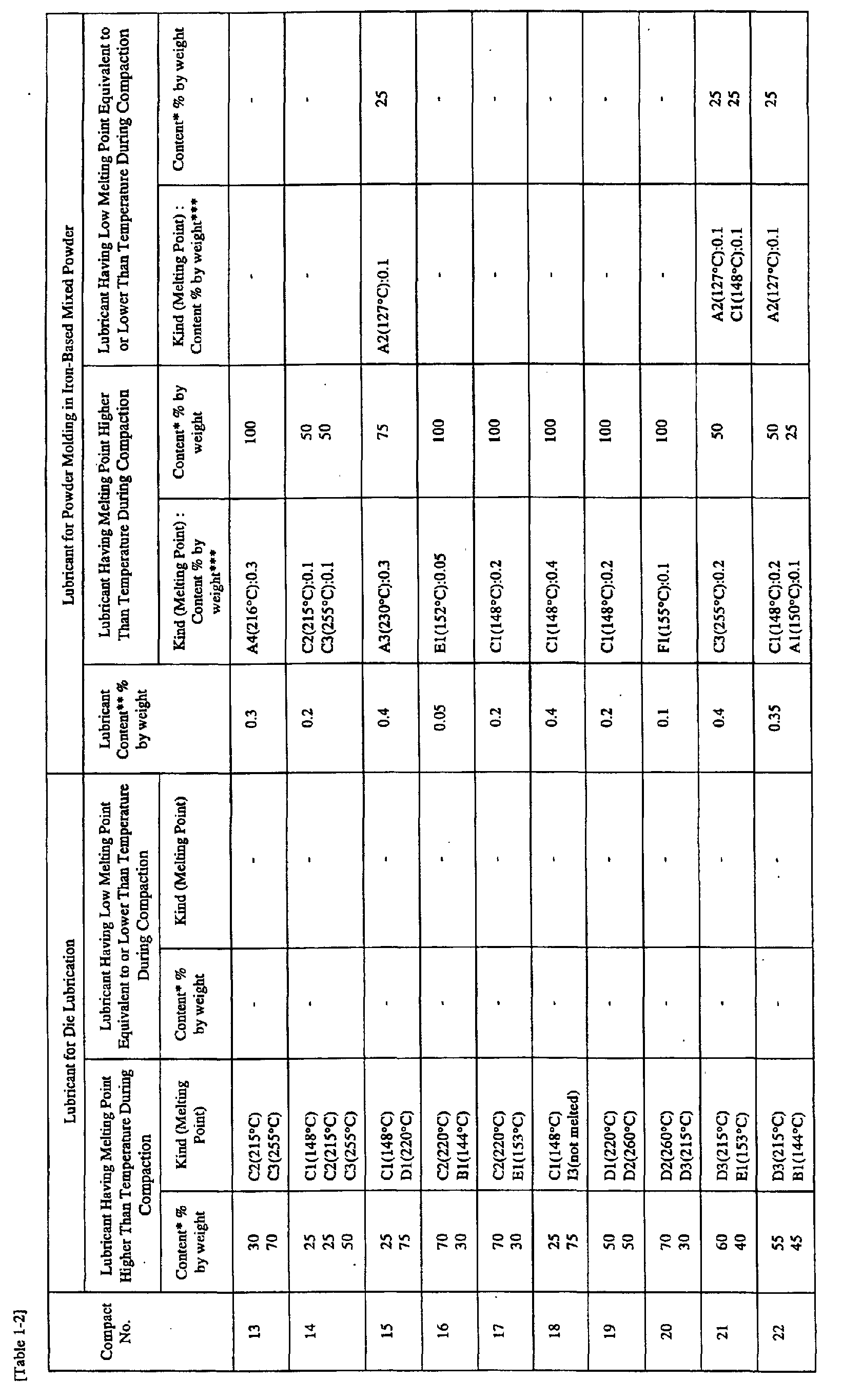
- the kinds and the additive amounts relative to the entire iron-based mixed powder of the lubricants for compacting powder were as shown in Table 1.
- the temperature of the die for the compacting pressure was adjusted as shown in Table 1, that is, at ordinary temperature, or to temperatures raised by preheating.
- a lubricant for die lubrication electrified using a die lubrication apparatus manufactured by Gasbarre Products, Inc.
- the lubricant for die lubrication was a mixture of at least two kinds of lubricants having melting points higher than the temperature during the compaction, and was prepared by mixing at least two kinds of materials (lubricants) selected from one or at least two group of the groups A to I as shown in Table 2.
- the die treated as described above was filled with the iron-based mixed powder.
- the temperature of the iron-based mixed powder was adjusted at ordinary temperature or to temperatures raised by heating in accordance with the treatment of the die.
- compaction pressure was performed so as to produce a compact in the shape of a rectangular parallelepiped of 10 mm ⁇ 10 mm ⁇ 55 mm dimension.
- the applied pressure was 7 t/cm 2 (686 MPa).
- the compacting conditions used are shown in Table 1.
- the lubricants for compacting powder in the iron-based mixed powder were selected from various lubricants as shown in Table 2, and the lubricants having melting points higher than the temperature during the compaction as shown in Table 1, or the mixtures of the lubricants having low melting points equivalent to, or lower than, the temperature during the compaction and lubricants having melting points higher than the temperature during the compaction as shown in Table 1, were used.
- a die not coated with a lubricant for die lubrication was filled with the iron-based mixed powder.
- the temperature of the iron-based mixed powder was adjusted at ordinary temperature (25°C) or at temperatures raised by heating in accordance with the treatment of the die. Then, compaction was performed so as to produce compacts (Compact Nos. 28 and 32) in the shape of a rectangular parallelepiped similar to that of the above-mentioned Example.
- the densities were measured by the Archimedes method, which is a method for determining the density based on the volume of the compact (the object for measurement) measured by soaking it in water.
- the resulting compacts were cut at their centers, embedded in a resin and polished. Thereafter, the presence or absence of a pore in the cross section was observed with an optical microscope.
- the ejection pressures after compacting was as low as 20 MPa or less, and the density was as high as 7.30 Mg/m 3 or more in the ordinary compaction temperature and was 7.40 Mg/m 3 or more in the warm compaction.
- defects such as flaws and fractures were not observed.
- the properties of sectional microstructure of the compact were normal, and no coarse pores were observed.
- the ejection pressures were as high as more than 20 MPa, the densities in the ordinary compaction temperature were as low as 7.25 Mg/m 3 or less, the densities in the warm compaction were as low as 7.35 Mg/m 3 or less, scratches were observed on the surfaces of the compacts, or coarse pores were observed in the vicinity of the surfaces of the cross sections of the compacts.
- the lubricant for die lubrication was only one lubricant having a melting point higher than the temperature during compaction (Compact Nos. 30 and 33), or the lubricant for die lubrication was only one lubricant having a melting point lower than the temperature during compaction (Compact No. 31), the densities of the compacts were decreased, and the ejection pressures were increased.
- high-density compacts having excellent appearances and excellent sectional properties can be compacted with decreased ejection pressures.
- high-density compacts having excellent appearances and excellent sectional properties can be produced by one time compacting, the ejection pressures after compacting can be decreased, lifetimes of the dies can be increased, and high-density sintered materials can be produced with ease.
Landscapes
- Engineering & Computer Science (AREA)
- Mechanical Engineering (AREA)
- Lubricants (AREA)
- Powder Metallurgy (AREA)
- Moulds For Moulding Plastics Or The Like (AREA)
- Extrusion Moulding Of Plastics Or The Like (AREA)
- Soft Magnetic Materials (AREA)
Abstract
The at least two different lubricants having melting points higher than the predetermined temperature during compaction are preferably at least two materials selected from at least one of the following groups: metallic soaps, amide-based waxes, polyamides, polyethylenes, polypropylenes, polymers comprised of acrylic acid esters, polymers having methacrylic acid ester, fluoroplastics and lubricants having layered crystal structures.
Description




| Group | Reference Numeral | Kind of Lubricant | Group | Reference Numeral | Kind of Lubricant | ||
| Group A | A1 | Calcium stearate | Metallic soap | Group C | C1 | Ethylene-bis-stearoamide | Amide-based wax |
| A2 | Zinc stearate | C2 | Light Amide WH215 | ||||
| A3 | Lithium stearate | C3 | Light Amide WH255 | ||||
| A4 | Lithium hydroxystearate | Group D | D1 | Polyamide 6 | Polyamide | ||
| Group B | B1 | Straight chain low density polyethylene | Polyethylene Polypropylene | D2 | Polyamide 66 | ||
| Group E | E1 | Polypropylene | D3 | Polyamide 610 | |||
| Group G | G1 | Poly(methylmethacrylate) | Polymers comprised of methacrylic acid esters | Group F | F1 | Poly(methylacrylate) | Polymer comprised of acrylic acid ester |
| G2 | Poly(ethylmethacrylate ) | F2 | Poly(ethylacrylate) | ||||
| Group J | J1 | Eutectic mixture of Ethylene-bis-stearoamide and Polyethylene | Eutectic mixture | Group H | H1 | Polytetrafluoro ethylene | Fluoroplastic |
| J2 | Eutectic mixture of Ethylene-bis-stearoamide and Zinc stearate | Group I | I2 | MoS2 | |||
| J3 | Eutectic mixture of Ethylene-bis-stearoamide and Calcium stearate | 12 | Carbon Fluoride | Layered lubricant | |||
| J4 | Eutectic mixture of Oleic acid and Zinc stearate | 13 | Melamine-cyanuric acid adducts (MCA) | ||||
| J5 | Eutectic mixture of Stearic acid amide and Ethylene-bis-stearic acid amide |
Claims (6)
- A lubricant for die lubrication used during compaction of a powder with a die while the lubricant is adhered by electrification to the surface of the die, the lubricant comprising a mixed powder of at least two lubricants each having a melting point higher than a predetermined temperature during compaction.
- The lubricant for die lubrication according to claim 1, wherein the at least two lubricants each having a melting point higher than the predetermined temperature during compaction are at least two materials selected from one or at least two of the following groups A to I:group A: one or at least two of the materials classified as metallic soaps;group B: one or at least two of the materials classified as polyethylenes;group C: one or at least two of the materials classified as amide-based waxes;group D: one or at least two of the materials classified as polyamides;group E: one or at least two of the materials classified as polypropylenes;group F: one or at least two of the materials classified as polymers comprised of acrylic acid esters;group G: one or at least two of the materials classified as polymers comprised of methacrylic acid esters;group H: one or at least two of the materials classified as fluoroplastics; andgroup I: one or at least two of the materials classified as lubricants having layered structures.
- The lubricant for die lubrication according to claims 1 or 2, wherein the die is a preheated die.
- A method of manufacturing a high-density iron-based powder compact, comprising:wherein the die has the surface on which a lubricant for die lubrication is adhered by electrification, and a mixed powder comprising at least two lubricants each having a melting point higher than the predetermined temperature during compaction is used as the lubricant for die lubrication.filling an iron-based mixed powder in a die; andsubsequently compacting the iron-based mixed powder at a predetermined temperature,
- The method of manufacturing a high-density iron-based powder compact according to claim 5, wherein the at least two lubricants each having a melting point higher than a predetermined temperature during compaction are at least two materials selected from one or at least two of the following groups A to I:group A: one or at least two of the materials classified as metallic soaps;group B: one or at least two of the materials classified as polyethylenes;group C: one or at least two of the materials classified as amide-based waxes;group D: one or at least two of the materials classified as polyamides;group E: one or at least two of the materials classified as polypropylenes;group F: one or at least two of the materials classified as polymers comprised of acrylic acid esters;group G: one or at least two of the materials classified as polymers comprised of methacrylic acid esters;group H: one or at least two of the materials classified as fluoroplastics; andgroup I: one or at least two of the materials classified as lubricants having layered structures.
- The method of manufacturing a high-density iron-based powder compact according to claims 4 or 5, wherein the die is a preheated die and the iron-based mixed powder is a preheated powder.
Applications Claiming Priority (5)
| Application Number | Priority Date | Filing Date | Title |
|---|---|---|---|
| JP2000089015 | 2000-03-28 | ||
| JP2000089015 | 2000-03-28 | ||
| JP2001045036A JP4228547B2 (en) | 2000-03-28 | 2001-02-21 | Lubricant for mold lubrication and method for producing high-density iron-based powder compact |
| JP2001045036 | 2001-02-21 | ||
| PCT/JP2001/002358 WO2001072457A1 (en) | 2000-03-28 | 2001-03-23 | Lubricant for die lubrication and method for producing high density product of forming of iron base powder |
Publications (3)
| Publication Number | Publication Date |
|---|---|
| EP1199124A1 true EP1199124A1 (en) | 2002-04-24 |
| EP1199124A4 EP1199124A4 (en) | 2003-05-14 |
| EP1199124B1 EP1199124B1 (en) | 2005-06-01 |
Family
ID=26588577
Family Applications (1)
| Application Number | Title | Priority Date | Filing Date |
|---|---|---|---|
| EP01915739A Expired - Lifetime EP1199124B1 (en) | 2000-03-28 | 2001-03-23 | Lubricant for die lubrication and method for producing high density product of forming of iron base powder |
Country Status (8)
| Country | Link |
|---|---|
| US (1) | US6861028B2 (en) |
| EP (1) | EP1199124B1 (en) |
| JP (1) | JP4228547B2 (en) |
| AT (1) | ATE296701T1 (en) |
| CA (1) | CA2374728A1 (en) |
| DE (1) | DE60111156T2 (en) |
| TW (1) | TW495403B (en) |
| WO (1) | WO2001072457A1 (en) |
Cited By (3)
| Publication number | Priority date | Publication date | Assignee | Title |
|---|---|---|---|---|
| EP1640469A4 (en) * | 2003-06-27 | 2007-05-02 | Mitsubishi Materials Pmg Corp | IRON-BASED FRITTLE ALLOY HAVING HIGH SURFACE DENSITY AND SURFACE HARDNESS, AND PROCESS FOR PRODUCING THE SAME |
| EP1688199A4 (en) * | 2003-11-25 | 2008-11-05 | Mitsubishi Materials Pmg Corp | RAW MATERIAL POWDER FOR HOT COMPACTION AND ASSOCIATED HOT COMPACTION METHOD |
| EP1829633A4 (en) * | 2004-12-21 | 2009-09-16 | Mitsubishi Materials Pmg Corp | Process for producing product of powder sintering |
Families Citing this family (18)
| Publication number | Priority date | Publication date | Assignee | Title |
|---|---|---|---|---|
| EP1270708B1 (en) * | 2001-06-13 | 2005-10-26 | Kabushiki Kaisha Toyota Chuo Kenkyusho | Pressurizing forming process and pressurized-and-formed member |
| JP3945455B2 (en) * | 2002-07-17 | 2007-07-18 | 株式会社豊田中央研究所 | Powder molded body, powder molding method, sintered metal body and method for producing the same |
| KR101045735B1 (en) * | 2002-11-21 | 2011-06-30 | 오이레스 고교 가부시끼가이샤 | Solid lubricants and sliding members |
| JP2004261832A (en) * | 2003-02-28 | 2004-09-24 | Nissan Motor Co Ltd | Mold lubricant for powder molding |
| JP2005095939A (en) * | 2003-09-25 | 2005-04-14 | Sumitomo Electric Ind Ltd | Powder molding method |
| SE0303453D0 (en) * | 2003-12-22 | 2003-12-22 | Hoeganaes Ab | Metal powder composition and preparation thereof |
| JP4300217B2 (en) * | 2004-01-20 | 2009-07-22 | 株式会社神戸製鋼所 | Lubricant for powder metallurgy, mixed powder for powder metallurgy, and method for producing sintered body |
| EP1792677A4 (en) * | 2004-09-03 | 2009-07-01 | Sumitomo Electric Industries | PROCESS FOR FORMING POWDER IN METALLURGY OF POWDERS AND PROCESS FOR PRODUCING SINTERED BODIES |
| JP4798994B2 (en) * | 2004-12-28 | 2011-10-19 | 日産自動車株式会社 | Mold adhesion lubricant |
| JP4801734B2 (en) * | 2005-06-15 | 2011-10-26 | ホガナス アクチボラゲット | Electromagnetic soft composite material |
| JP5066803B2 (en) | 2005-11-16 | 2012-11-07 | 株式会社ジェイテクト | Actuator |
| JP4712768B2 (en) * | 2007-07-03 | 2011-06-29 | 株式会社神戸製鋼所 | Molding method for large, high-density compacts |
| JP2009280908A (en) * | 2008-04-22 | 2009-12-03 | Jfe Steel Corp | Method for molding iron powder mixture for powder metallurgy |
| JP5339770B2 (en) * | 2008-04-25 | 2013-11-13 | 本田技研工業株式会社 | Method for manufacturing sintered body |
| CN103025818B (en) * | 2010-07-28 | 2015-06-17 | 埃克森美孚化学专利公司 | Viscosity modifiers comprising blends of ethylene-based copolymers |
| JP5906054B2 (en) * | 2011-10-14 | 2016-04-20 | 住友電気工業株式会社 | Molding method of green compact |
| JP5831440B2 (en) * | 2012-12-17 | 2015-12-09 | 株式会社ダイヤメット | Raw material powder for powder metallurgy |
| JP6450213B2 (en) * | 2015-02-13 | 2019-01-09 | 株式会社豊田中央研究所 | Warm forming method |
Family Cites Families (16)
| Publication number | Priority date | Publication date | Assignee | Title |
|---|---|---|---|---|
| IT999894B (en) * | 1973-12-05 | 1976-03-10 | Olivetti & Co Spa | DEVICE FOR THE LUBRICATION OF DIES FOR COMPACTION OF POWDER MATERIALS FOR SINTERED PIECES |
| US4225546A (en) * | 1977-07-14 | 1980-09-30 | General Electric Company | Method of compacting dry powder into shapes |
| GB8530365D0 (en) * | 1985-12-10 | 1986-01-22 | Univ Bath | Manufacture of moulded products |
| IT1224294B (en) | 1988-10-28 | 1990-10-04 | Nuova Merisinter Spa | PROCEDURE FOR POWDER COMPACTION IN PREPARATION FOR SINTERING OPERATIONS |
| JP2765015B2 (en) * | 1989-03-13 | 1998-06-11 | トヨタ自動車株式会社 | Compacting equipment for sintering compact |
| EP0468278B1 (en) * | 1990-07-12 | 1996-04-10 | DAIDO MACHINERY, Ltd. | A forging lubricant and a method for forming a lubricant coat on the surface of a linear material |
| DE69314098T2 (en) * | 1992-06-24 | 1998-03-12 | Sumitomo Spec Metals | Process for producing R-Fe-B type sintered magnets by injection molding |
| US5256185A (en) | 1992-07-17 | 1993-10-26 | Hoeganaes Corporation | Method for preparing binder-treated metallurgical powders containing an organic lubricant |
| US5368630A (en) | 1993-04-13 | 1994-11-29 | Hoeganaes Corporation | Metal powder compositions containing binding agents for elevated temperature compaction |
| JPH07103404A (en) | 1993-10-04 | 1995-04-18 | Nikkiso Co Ltd | Method for judging silica blow of drum water in drum type boiler plant |
| ES2147583T3 (en) | 1994-08-24 | 2000-09-16 | Quebec Metal Powders Ltd | PROCEDURE AND INSTALLATION OF THE METALLURGY OF POWDERS THAT INCLUDES AN ELECTROSTATIC LUBRICATION OF THE MATRIX WALLS. |
| US5682591A (en) * | 1994-08-24 | 1997-10-28 | Quebec Metal Powders Limited | Powder metallurgy apparatus and process using electrostatic die wall lubrication |
| WO1998041347A1 (en) * | 1997-03-19 | 1998-09-24 | Kawasaki Steel Corporation | Iron base powder mixture for powder metallurgy excellent in fluidity and moldability, method of production thereof, and method of production of molded article by using the iron base powder mixture |
| JPH11193404A (en) * | 1997-12-26 | 1999-07-21 | Hitachi Powdered Metals Co Ltd | Lubricant for metal powder molding |
| JP3931503B2 (en) * | 1999-02-05 | 2007-06-20 | Jfeスチール株式会社 | Lubricant for warm mold lubrication, high-density iron-based powder molded body, and method for producing high-density iron-based sintered body |
| EP1145788B1 (en) * | 1999-10-29 | 2004-12-15 | JFE Steel Corporation | Lubricating agent for mold at elevated temperature and method for producing high density iron-based sintered compact |
-
2001
- 2001-02-21 JP JP2001045036A patent/JP4228547B2/en not_active Expired - Fee Related
- 2001-03-23 DE DE60111156T patent/DE60111156T2/en not_active Expired - Lifetime
- 2001-03-23 AT AT01915739T patent/ATE296701T1/en active
- 2001-03-23 WO PCT/JP2001/002358 patent/WO2001072457A1/en not_active Ceased
- 2001-03-23 CA CA002374728A patent/CA2374728A1/en not_active Abandoned
- 2001-03-23 EP EP01915739A patent/EP1199124B1/en not_active Expired - Lifetime
- 2001-03-27 TW TW090107215A patent/TW495403B/en not_active IP Right Cessation
- 2001-03-27 US US09/817,171 patent/US6861028B2/en not_active Expired - Fee Related
Cited By (5)
| Publication number | Priority date | Publication date | Assignee | Title |
|---|---|---|---|---|
| EP1640469A4 (en) * | 2003-06-27 | 2007-05-02 | Mitsubishi Materials Pmg Corp | IRON-BASED FRITTLE ALLOY HAVING HIGH SURFACE DENSITY AND SURFACE HARDNESS, AND PROCESS FOR PRODUCING THE SAME |
| EP1688199A4 (en) * | 2003-11-25 | 2008-11-05 | Mitsubishi Materials Pmg Corp | RAW MATERIAL POWDER FOR HOT COMPACTION AND ASSOCIATED HOT COMPACTION METHOD |
| US7582255B2 (en) | 2003-11-25 | 2009-09-01 | Mitsubishi Materials Pmg Corporation | Warm molding raw material powder and warm molding method |
| EP1829633A4 (en) * | 2004-12-21 | 2009-09-16 | Mitsubishi Materials Pmg Corp | Process for producing product of powder sintering |
| US8795586B2 (en) | 2004-12-21 | 2014-08-05 | Diamet Corporation | Method of producing powder sintered product |
Also Published As
| Publication number | Publication date |
|---|---|
| DE60111156T2 (en) | 2005-10-20 |
| US6861028B2 (en) | 2005-03-01 |
| JP4228547B2 (en) | 2009-02-25 |
| DE60111156D1 (en) | 2005-07-07 |
| EP1199124B1 (en) | 2005-06-01 |
| WO2001072457A1 (en) | 2001-10-04 |
| ATE296701T1 (en) | 2005-06-15 |
| US20010038802A1 (en) | 2001-11-08 |
| TW495403B (en) | 2002-07-21 |
| JP2001342478A (en) | 2001-12-14 |
| EP1199124A4 (en) | 2003-05-14 |
| CA2374728A1 (en) | 2001-10-04 |
Similar Documents
| Publication | Publication Date | Title |
|---|---|---|
| EP1199124B1 (en) | Lubricant for die lubrication and method for producing high density product of forming of iron base powder | |
| US6860918B2 (en) | Powder additive for powder metallurgy, iron-based powder mixture for powder metallurgy, and method for manufacturing the same | |
| EP1023383B1 (en) | Improved metallurgical compositions containing binding agent/lubricant and process for preparing same | |
| US6280683B1 (en) | Metallurgical compositions containing binding agent/lubricant and process for preparing same | |
| EP1145788B1 (en) | Lubricating agent for mold at elevated temperature and method for producing high density iron-based sintered compact | |
| CA2305187A1 (en) | Lubricant for metallurgical powder compositions | |
| KR20030036642A (en) | A method of producing a composite body by coalescence and the composite body produced | |
| JP2008115471A (en) | Lubricant for metallurgical powder composition | |
| US20170304893A1 (en) | Lubricant, mixed powder for powder metallurgy, and method for producing sintered body | |
| JP5012645B2 (en) | Method for producing high-density iron-based powder compact | |
| JP4507348B2 (en) | High-density iron-based powder molded body and method for producing high-density iron-based sintered body | |
| US6316393B1 (en) | Modified lubricated ferrous powder compositions for cold and warm pressing applications | |
| JP3931503B2 (en) | Lubricant for warm mold lubrication, high-density iron-based powder molded body, and method for producing high-density iron-based sintered body | |
| JP2001234205A (en) | Manufacturing method of metal powder compact | |
| JP4770667B2 (en) | Iron-based powder mixture for warm mold lubrication molding | |
| JP3873609B2 (en) | Iron-based mixed powder for powder metallurgy and iron-based sintered body | |
| JP3822372B2 (en) | Powder metallurgy powder compression molding method | |
| KR102228107B1 (en) | Mixed powder for powder metallurgy | |
| CA2322308C (en) | Modified lubricated ferrous powder compositions for cold and warm pressing applications | |
| JP2002155303A (en) | Manufacturing method of iron-based sintered body | |
| JP6450213B2 (en) | Warm forming method | |
| MXPA00003906A (en) | Improved metallurgical compositions containing binding agent/lubricantand process for preparing same | |
| JPH03502470A (en) | self-lubricating material |
Legal Events
| Date | Code | Title | Description |
|---|---|---|---|
| PUAI | Public reference made under article 153(3) epc to a published international application that has entered the european phase |
Free format text: ORIGINAL CODE: 0009012 |
|
| 17P | Request for examination filed |
Effective date: 20020204 |
|
| AK | Designated contracting states |
Kind code of ref document: A1 Designated state(s): AT BE CH CY DE DK ES FI FR GB GR IE IT LI LU MC NL PT SE TR |
|
| RIC1 | Information provided on ipc code assigned before grant |
Ipc: 7C 22C 33/02 B Ipc: 7B 22F 3/02 A Ipc: 7B 30B 15/00 B Ipc: 7B 22F 1/00 B Ipc: 7C 10M 171/00 B Ipc: 7B 21J 3/00 B |
|
| A4 | Supplementary search report drawn up and despatched |
Effective date: 20030327 |
|
| 17Q | First examination report despatched |
Effective date: 20030530 |
|
| RAP1 | Party data changed (applicant data changed or rights of an application transferred) |
Owner name: JFE STEEL CORPORATION |
|
| RBV | Designated contracting states (corrected) |
Designated state(s): AT DE SE |
|
| GRAP | Despatch of communication of intention to grant a patent |
Free format text: ORIGINAL CODE: EPIDOSNIGR1 |
|
| GRAS | Grant fee paid |
Free format text: ORIGINAL CODE: EPIDOSNIGR3 |
|
| GRAA | (expected) grant |
Free format text: ORIGINAL CODE: 0009210 |
|
| AK | Designated contracting states |
Kind code of ref document: B1 Designated state(s): AT DE SE |
|
| REF | Corresponds to: |
Ref document number: 60111156 Country of ref document: DE Date of ref document: 20050707 Kind code of ref document: P |
|
| REG | Reference to a national code |
Ref country code: SE Ref legal event code: TRGR |
|
| PLBE | No opposition filed within time limit |
Free format text: ORIGINAL CODE: 0009261 |
|
| STAA | Information on the status of an ep patent application or granted ep patent |
Free format text: STATUS: NO OPPOSITION FILED WITHIN TIME LIMIT |
|
| 26N | No opposition filed |
Effective date: 20060302 |
|
| PGFP | Annual fee paid to national office [announced via postgrant information from national office to epo] |
Ref country code: DE Payment date: 20130320 Year of fee payment: 13 |
|
| PGFP | Annual fee paid to national office [announced via postgrant information from national office to epo] |
Ref country code: AT Payment date: 20130226 Year of fee payment: 13 |
|
| REG | Reference to a national code |
Ref country code: DE Ref legal event code: R119 Ref document number: 60111156 Country of ref document: DE |
|
| REG | Reference to a national code |
Ref country code: AT Ref legal event code: MM01 Ref document number: 296701 Country of ref document: AT Kind code of ref document: T Effective date: 20140323 |
|
| REG | Reference to a national code |
Ref country code: DE Ref legal event code: R119 Ref document number: 60111156 Country of ref document: DE Effective date: 20141001 |
|
| PG25 | Lapsed in a contracting state [announced via postgrant information from national office to epo] |
Ref country code: DE Free format text: LAPSE BECAUSE OF NON-PAYMENT OF DUE FEES Effective date: 20141001 |
|
| PG25 | Lapsed in a contracting state [announced via postgrant information from national office to epo] |
Ref country code: AT Free format text: LAPSE BECAUSE OF NON-PAYMENT OF DUE FEES Effective date: 20140323 |
|
| PGFP | Annual fee paid to national office [announced via postgrant information from national office to epo] |
Ref country code: SE Payment date: 20160311 Year of fee payment: 16 |
|
| REG | Reference to a national code |
Ref country code: SE Ref legal event code: EUG |
|
| PG25 | Lapsed in a contracting state [announced via postgrant information from national office to epo] |
Ref country code: SE Free format text: LAPSE BECAUSE OF NON-PAYMENT OF DUE FEES Effective date: 20170324 |