EP1191702A1 - Bimodaler Sendeempfänger für UMTS - Google Patents
Bimodaler Sendeempfänger für UMTS Download PDFInfo
- Publication number
- EP1191702A1 EP1191702A1 EP01000454A EP01000454A EP1191702A1 EP 1191702 A1 EP1191702 A1 EP 1191702A1 EP 01000454 A EP01000454 A EP 01000454A EP 01000454 A EP01000454 A EP 01000454A EP 1191702 A1 EP1191702 A1 EP 1191702A1
- Authority
- EP
- European Patent Office
- Prior art keywords
- mode
- channel
- reception
- fdd
- transmission
- Prior art date
- Legal status (The legal status is an assumption and is not a legal conclusion. Google has not performed a legal analysis and makes no representation as to the accuracy of the status listed.)
- Granted
Links
- 230000005540 biological transmission Effects 0.000 claims abstract description 31
- 230000006854 communication Effects 0.000 claims description 13
- 238000001914 filtration Methods 0.000 description 9
- 230000003321 amplification Effects 0.000 description 3
- 230000009977 dual effect Effects 0.000 description 3
- 238000003199 nucleic acid amplification method Methods 0.000 description 3
- 230000008901 benefit Effects 0.000 description 2
- 230000007175 bidirectional communication Effects 0.000 description 2
- 230000000295 complement effect Effects 0.000 description 2
- 230000006978 adaptation Effects 0.000 description 1
- 230000000903 blocking effect Effects 0.000 description 1
- 230000003247 decreasing effect Effects 0.000 description 1
- 230000000694 effects Effects 0.000 description 1
- 238000000034 method Methods 0.000 description 1
- 238000005303 weighing Methods 0.000 description 1
Images
Classifications
-
- H—ELECTRICITY
- H04—ELECTRIC COMMUNICATION TECHNIQUE
- H04B—TRANSMISSION
- H04B1/00—Details of transmission systems, not covered by a single one of groups H04B3/00 - H04B13/00; Details of transmission systems not characterised by the medium used for transmission
- H04B1/38—Transceivers, i.e. devices in which transmitter and receiver form a structural unit and in which at least one part is used for functions of transmitting and receiving
- H04B1/40—Circuits
- H04B1/403—Circuits using the same oscillator for generating both the transmitter frequency and the receiver local oscillator frequency
- H04B1/406—Circuits using the same oscillator for generating both the transmitter frequency and the receiver local oscillator frequency with more than one transmission mode, e.g. analog and digital modes
Definitions
- the present invention relates to a dual mode UMTS transceiver. It thus applies to the field of mobile telephony according to the standard UMTS (Universal Mobile Telephony System in English for communication system universal telephony).
- a UMTS transceiver can operate according to two different embodiments. These modes allow you to determine a method of accessing a communication channel. It is generally a mobile radio channel.
- a first access mode is a so-called FDD mode (for Frequency Division Duplex in English for duplex by division of frequency).
- FDD mode for Frequency Division Duplex in English for duplex by division of frequency
- a transceiver produced in this FDD mode uses for emission an emission frequency, taken in a frequency band transmission frequency, and for reception a reception frequency, taken from a reception frequency band, different from the transmission frequency.
- This FDD mode corresponds to a two-way simultaneous communication which is more commonly known as full duplex communication.
- a second mode is a TDD mode (Time Division Duplex in English for duplex by time division).
- TDD Time Division Duplex in English for duplex by time division.
- a transceiver produced according to this mode TDD uses only one frequency for the emission and for reception, this type of transceiver then using alternation to ensure communication between two transceivers using the TDD mode. This is called alternating bidirectional communication or more commonly Half Duplex communication.
- the object of the invention is to provide a transmitter architecture receiver including these two access modes FDD and TDD while minimizing a cost price of such a dual mode transceiver.
- a duplexer filter is a device providing a filtering referral function.
- a filter duplexer providing a switching function among two channels thus comprises a first channel tuned on a first frequency band and a second channel tuned to a second frequency band.
- the object of the present invention is to remedy these problems by proposing a new architecture in which the stress is reduced filtering weighing on the TDD transmission reception channel by taking advantage of the presence of the duplexer filter in this UMTS transceiver. This has effect of decreasing a number of filters in this transceiver and lead to a reduction in the cost price of this transceiver.
- the invention therefore relates to a UMTS transmission reception circuit allowing two modes of access to a communication channel, a first mode being a time division access mode and a second mode being a frequency division access mode, comprising an antenna characterized in that the antenna is connected to an input output of a filter two-channel duplexer, the first channel accepting the frequency band associated with the first access mode as well as the associated transmission band to the second access mode, the second channel accepting the band of reception of the second mode.
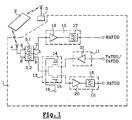
- FIG. 1 shows a simplified architecture of a transmission circuit 1 UMTS standard reception.
- UMTS standard allows two modes access to a communication channel 2.
- This channel 2 represents the support physical allowing the exchange of information between circuit 1 and another transmission transmission circuit 3.
- the UMTS standard defines a communication system using a transmission by code.
- a signal associated with a first code can coexist in the channel 2 without interference with a signal associated with a second code at the same frequency.
- the codes are orthogonal that is to say we can easily find by correlation a signal associated with a code among many.
- a first mode is a time division access mode or still TDD mode. This TDD mode allows to implement for a alternate type communication, i.e. the caller and the called party use the same transmission frequency but access to channel 2 is alternated.
- a second mode is an access mode by frequency division or still FDD mode.
- This FDD mode makes it possible to implement a communication of the simultaneous type that is to say that a transmission and a reception use two different frequencies.
- access to channel 2 in FDD mode is simultaneous on the part of circuit 1 and circuit 3 when these two circuits communicate together.
- the UMTS standard defines a frequency plan for operation in TDD and FDD mode. This plan of frequency defines a transmit frequency band and a reception frequency for FDD mode and a frequency band associated with TDD mode. TDD mode frequency band is split in two parts arranged on either side of the mode transmission band FDD.
- Circuit 1 includes an antenna 4 for transmitting reception ensuring the adaptation between circuit 1 and channel 2.
- the circuit 1 comprises a duplexer filter 5 with two channels 5_1 and 5_2 or filters 5_1 and 5_2.
- a duplexer filter is a circuit providing a multiplexing demultiplexing function. So the way 5_1 is sized to accept a frequency band associated with the FDD access mode in reception. Channel 5_2 accepts, according to one of the characteristics of the invention, the frequency band associated with the mode TDD and the transmission frequency band associated with the FDD mode.
- the way 5_1 has a first end 6 and a second end 7.
- the track 5_2 has a first end 8 and a second end 9. The ends 6 and 8 are connected to antenna 4.
- Circuit 1 has several ways of treatment.
- Channel 10 for FDD reception a channel 11 transmitting FDD and TDD as well as a channel 12 receiving TDD.
- Track 10 is connected to the end 7 of the filter 5_1.
- Channels 11 and 12 are connected to the end 9 of the filter 5_2 by means of a switching means 13.
- This means 13 can be achieved using two transistors 14 and 15 by example and whose operation is complementary. So these two transistors 14 and 15 are connected to the same control 16 with two states, one first state for controlling one of the transistors and blocking the other, the other state performing the complementary function.
- reception channels 10 and 12 benefit from a pre-filtering of the share of filters 5_1 and 5_2 respectively and therefore only requires the presence of filters 17 and 18 after amplification by amplifiers 19 and 20 at low noise.
- the filter 5_2 provides a filtering function for a signal to be emitted produced by an amplifier 21 on channel 11. The presence of duplexer 5 thus makes it possible to distribute the selectivity with filters 17 and 18.
- the filter 5_1 and or the filter 5_2 are symmetrical. This means that the frequency response of filters 5_1 and or 5_2 in considering ends 6 and 8 as outputs is the same as if the ends 7 and 9 were considered outputs. this is particularly interesting for the filter 5_2. Indeed, the end 9 is connected on the one hand to channel 11 which is in transmission and to channel 12 which is in reception. Thus the ends 8 and 9 play the role of input output and not only entry or exit. In a preferred embodiment of the duplexer 5, according to this latter variant, and at least of the filter 5_2, this last to behave as a bandpass filter
Landscapes
- Engineering & Computer Science (AREA)
- Computer Networks & Wireless Communication (AREA)
- Signal Processing (AREA)
- Transceivers (AREA)
Applications Claiming Priority (2)
| Application Number | Priority Date | Filing Date | Title |
|---|---|---|---|
| FR0011956A FR2814316B1 (fr) | 2000-09-20 | 2000-09-20 | Emetteur recepteur umts bimode |
| FR0011956 | 2000-09-20 |
Publications (2)
| Publication Number | Publication Date |
|---|---|
| EP1191702A1 true EP1191702A1 (de) | 2002-03-27 |
| EP1191702B1 EP1191702B1 (de) | 2006-10-18 |
Family
ID=8854476
Family Applications (1)
| Application Number | Title | Priority Date | Filing Date |
|---|---|---|---|
| EP20010000454 Expired - Lifetime EP1191702B1 (de) | 2000-09-20 | 2001-09-13 | Bimodaler Sendeempfänger für UMTS |
Country Status (3)
| Country | Link |
|---|---|
| EP (1) | EP1191702B1 (de) |
| DE (1) | DE60123902T2 (de) |
| FR (1) | FR2814316B1 (de) |
Cited By (2)
| Publication number | Priority date | Publication date | Assignee | Title |
|---|---|---|---|---|
| EP1283600A1 (de) * | 2001-08-09 | 2003-02-12 | Sagem SA | Sende- und Empfangssystem fÜr ein Mehrband und multimode Mobiltelefon |
| CN100401658C (zh) * | 2005-02-07 | 2008-07-09 | 上海贝尔阿尔卡特股份有限公司 | 传输信号的方法及实现该方法的蜂窝系统 |
Citations (3)
| Publication number | Priority date | Publication date | Assignee | Title |
|---|---|---|---|---|
| EP0820154A2 (de) * | 1996-07-18 | 1998-01-21 | Nokia Mobile Phones Ltd. | Zweibandsendeempfänger |
| EP0823790A2 (de) * | 1996-08-07 | 1998-02-11 | Nokia Mobile Phones Ltd. | Mobiles Zweibandfunkgerät mit kreuzverbundenen Sender- und Empfänger-Schaltungen |
| GB2346049A (en) * | 1999-01-19 | 2000-07-26 | Roke Manor Research | Duplex filtering |
-
2000
- 2000-09-20 FR FR0011956A patent/FR2814316B1/fr not_active Expired - Fee Related
-
2001
- 2001-09-13 EP EP20010000454 patent/EP1191702B1/de not_active Expired - Lifetime
- 2001-09-13 DE DE2001623902 patent/DE60123902T2/de not_active Expired - Lifetime
Patent Citations (3)
| Publication number | Priority date | Publication date | Assignee | Title |
|---|---|---|---|---|
| EP0820154A2 (de) * | 1996-07-18 | 1998-01-21 | Nokia Mobile Phones Ltd. | Zweibandsendeempfänger |
| EP0823790A2 (de) * | 1996-08-07 | 1998-02-11 | Nokia Mobile Phones Ltd. | Mobiles Zweibandfunkgerät mit kreuzverbundenen Sender- und Empfänger-Schaltungen |
| GB2346049A (en) * | 1999-01-19 | 2000-07-26 | Roke Manor Research | Duplex filtering |
Cited By (2)
| Publication number | Priority date | Publication date | Assignee | Title |
|---|---|---|---|---|
| EP1283600A1 (de) * | 2001-08-09 | 2003-02-12 | Sagem SA | Sende- und Empfangssystem fÜr ein Mehrband und multimode Mobiltelefon |
| CN100401658C (zh) * | 2005-02-07 | 2008-07-09 | 上海贝尔阿尔卡特股份有限公司 | 传输信号的方法及实现该方法的蜂窝系统 |
Also Published As
| Publication number | Publication date |
|---|---|
| DE60123902D1 (de) | 2006-11-30 |
| DE60123902T2 (de) | 2007-05-16 |
| FR2814316A1 (fr) | 2002-03-22 |
| FR2814316B1 (fr) | 2005-08-12 |
| EP1191702B1 (de) | 2006-10-18 |
Similar Documents
| Publication | Publication Date | Title |
|---|---|---|
| KR101444997B1 (ko) | 상이한 주파수 대역들에서의 무선 주파수 송신들을 동시에 수신하기 위한 무선 회로 | |
| CN114337718B (zh) | 聚合载波的单独载波的功率检测 | |
| US6987950B2 (en) | Radio with duplexer bypass capability | |
| KR101505753B1 (ko) | 고조파 간섭을 감소시킨 무선 회로 | |
| US6434122B2 (en) | Filtering method to allow FDD and TDD operation in PCS transreceivers | |
| KR20040014598A (ko) | Gps 기능 안테나 제공 시스템 및 방법 | |
| EP1175018A1 (de) | Multimodale Eingangsschaltung und drahtlose Kommunikationsvorrichtung | |
| FI80972B (fi) | Antennomkopplaranordning i en digital resetelefon. | |
| EP1374424B1 (de) | Funksendeempfänger | |
| JP3878811B2 (ja) | 周波数多重トランシーバー及び漏話の消去方法 | |
| EP1191702B1 (de) | Bimodaler Sendeempfänger für UMTS | |
| US20070202893A1 (en) | Radio repeater | |
| EP1189356B1 (de) | Multimodales Kommunikationsgerät mit einem Sendeempfänger mit mehreren Eingängen | |
| EP0963053A2 (de) | Verfahren und Schaltung für einen bidirektionalen Filter eines Funksendeempfägers mit einer Einseitenbande | |
| JP3105768B2 (ja) | 受信回路 | |
| EP1499028A1 (de) | Mobilkommunikationsgerät | |
| KR101000157B1 (ko) | 듀플렉서 회로 | |
| EP3092719B1 (de) | Filtervorrichtung für tragbare mobile endstation pmr, mobile endstation | |
| JP2003069445A (ja) | 移動体電話機のアンテナ共用送受信装置 | |
| JPH09191269A (ja) | 復信送受信機の構成法 | |
| JPS6039931A (ja) | トランシ−バ | |
| JPH1141120A (ja) | 送信装置 | |
| KR20060019478A (ko) | 기지국과 중계기간 정합 장치 및 그 방법 | |
| JP2001024530A (ja) | 受信回路 | |
| JPS6040222B2 (ja) | 無線通信方式 |
Legal Events
| Date | Code | Title | Description |
|---|---|---|---|
| PUAI | Public reference made under article 153(3) epc to a published international application that has entered the european phase |
Free format text: ORIGINAL CODE: 0009012 |
|
| AK | Designated contracting states |
Kind code of ref document: A1 Designated state(s): DE FR GB Kind code of ref document: A1 Designated state(s): AT BE CH CY DE DK ES FI FR GB GR IE IT LI LU MC NL PT SE TR |
|
| AX | Request for extension of the european patent |
Free format text: AL;LT;LV;MK;RO;SI |
|
| 17P | Request for examination filed |
Effective date: 20020312 |
|
| 17Q | First examination report despatched |
Effective date: 20020621 |
|
| AKX | Designation fees paid |
Free format text: DE FR GB |
|
| RAP1 | Party data changed (applicant data changed or rights of an application transferred) |
Owner name: SAGEM COMMUNICATION |
|
| GRAP | Despatch of communication of intention to grant a patent |
Free format text: ORIGINAL CODE: EPIDOSNIGR1 |
|
| GRAS | Grant fee paid |
Free format text: ORIGINAL CODE: EPIDOSNIGR3 |
|
| GRAA | (expected) grant |
Free format text: ORIGINAL CODE: 0009210 |
|
| AK | Designated contracting states |
Kind code of ref document: B1 Designated state(s): DE FR GB |
|
| REG | Reference to a national code |
Ref country code: GB Ref legal event code: FG4D Free format text: NOT ENGLISH |
|
| REF | Corresponds to: |
Ref document number: 60123902 Country of ref document: DE Date of ref document: 20061130 Kind code of ref document: P |
|
| GBT | Gb: translation of ep patent filed (gb section 77(6)(a)/1977) |
Effective date: 20070123 |
|
| PLBE | No opposition filed within time limit |
Free format text: ORIGINAL CODE: 0009261 |
|
| STAA | Information on the status of an ep patent application or granted ep patent |
Free format text: STATUS: NO OPPOSITION FILED WITHIN TIME LIMIT |
|
| 26N | No opposition filed |
Effective date: 20070719 |
|
| PGFP | Annual fee paid to national office [announced via postgrant information from national office to epo] |
Ref country code: GB Payment date: 20090827 Year of fee payment: 9 |
|
| PGFP | Annual fee paid to national office [announced via postgrant information from national office to epo] |
Ref country code: DE Payment date: 20091008 Year of fee payment: 9 |
|
| REG | Reference to a national code |
Ref country code: FR Ref legal event code: TP |
|
| PGFP | Annual fee paid to national office [announced via postgrant information from national office to epo] |
Ref country code: FR Payment date: 20091021 Year of fee payment: 9 |
|
| GBPC | Gb: european patent ceased through non-payment of renewal fee |
Effective date: 20100913 |
|
| REG | Reference to a national code |
Ref country code: FR Ref legal event code: ST Effective date: 20110531 |
|
| REG | Reference to a national code |
Ref country code: DE Ref legal event code: R119 Ref document number: 60123902 Country of ref document: DE Effective date: 20110401 |
|
| PG25 | Lapsed in a contracting state [announced via postgrant information from national office to epo] |
Ref country code: DE Free format text: LAPSE BECAUSE OF NON-PAYMENT OF DUE FEES Effective date: 20110401 Ref country code: FR Free format text: LAPSE BECAUSE OF NON-PAYMENT OF DUE FEES Effective date: 20100930 |
|
| PG25 | Lapsed in a contracting state [announced via postgrant information from national office to epo] |
Ref country code: GB Free format text: LAPSE BECAUSE OF NON-PAYMENT OF DUE FEES Effective date: 20100913 |