EP1191114A1 - High tensile hot-rolled steel sheet having excellent strain aging hardening properties and method for producing the same - Google Patents
High tensile hot-rolled steel sheet having excellent strain aging hardening properties and method for producing the same Download PDFInfo
- Publication number
- EP1191114A1 EP1191114A1 EP01906129A EP01906129A EP1191114A1 EP 1191114 A1 EP1191114 A1 EP 1191114A1 EP 01906129 A EP01906129 A EP 01906129A EP 01906129 A EP01906129 A EP 01906129A EP 1191114 A1 EP1191114 A1 EP 1191114A1
- Authority
- EP
- European Patent Office
- Prior art keywords
- less
- rolling
- steel sheet
- mass
- group
- Prior art date
- Legal status (The legal status is an assumption and is not a legal conclusion. Google has not performed a legal analysis and makes no representation as to the accuracy of the status listed.)
- Granted
Links
Images

Classifications
-
- C—CHEMISTRY; METALLURGY
- C21—METALLURGY OF IRON
- C21D—MODIFYING THE PHYSICAL STRUCTURE OF FERROUS METALS; GENERAL DEVICES FOR HEAT TREATMENT OF FERROUS OR NON-FERROUS METALS OR ALLOYS; MAKING METAL MALLEABLE, e.g. BY DECARBURISATION OR TEMPERING
- C21D8/00—Modifying the physical properties of ferrous metals or ferrous alloys by deformation combined with, or followed by, heat treatment
- C21D8/02—Modifying the physical properties of ferrous metals or ferrous alloys by deformation combined with, or followed by, heat treatment during manufacturing of plates or strips
- C21D8/0221—Modifying the physical properties of ferrous metals or ferrous alloys by deformation combined with, or followed by, heat treatment during manufacturing of plates or strips characterised by the working steps
- C21D8/0226—Hot rolling
-
- C—CHEMISTRY; METALLURGY
- C22—METALLURGY; FERROUS OR NON-FERROUS ALLOYS; TREATMENT OF ALLOYS OR NON-FERROUS METALS
- C22C—ALLOYS
- C22C38/00—Ferrous alloys, e.g. steel alloys
- C22C38/001—Ferrous alloys, e.g. steel alloys containing N
-
- C—CHEMISTRY; METALLURGY
- C22—METALLURGY; FERROUS OR NON-FERROUS ALLOYS; TREATMENT OF ALLOYS OR NON-FERROUS METALS
- C22C—ALLOYS
- C22C38/00—Ferrous alloys, e.g. steel alloys
- C22C38/002—Ferrous alloys, e.g. steel alloys containing In, Mg, or other elements not provided for in one single group C22C38/001 - C22C38/60
-
- C—CHEMISTRY; METALLURGY
- C22—METALLURGY; FERROUS OR NON-FERROUS ALLOYS; TREATMENT OF ALLOYS OR NON-FERROUS METALS
- C22C—ALLOYS
- C22C38/00—Ferrous alloys, e.g. steel alloys
- C22C38/02—Ferrous alloys, e.g. steel alloys containing silicon
-
- C—CHEMISTRY; METALLURGY
- C22—METALLURGY; FERROUS OR NON-FERROUS ALLOYS; TREATMENT OF ALLOYS OR NON-FERROUS METALS
- C22C—ALLOYS
- C22C38/00—Ferrous alloys, e.g. steel alloys
- C22C38/04—Ferrous alloys, e.g. steel alloys containing manganese
-
- C—CHEMISTRY; METALLURGY
- C22—METALLURGY; FERROUS OR NON-FERROUS ALLOYS; TREATMENT OF ALLOYS OR NON-FERROUS METALS
- C22C—ALLOYS
- C22C38/00—Ferrous alloys, e.g. steel alloys
- C22C38/06—Ferrous alloys, e.g. steel alloys containing aluminium
-
- C—CHEMISTRY; METALLURGY
- C22—METALLURGY; FERROUS OR NON-FERROUS ALLOYS; TREATMENT OF ALLOYS OR NON-FERROUS METALS
- C22C—ALLOYS
- C22C38/00—Ferrous alloys, e.g. steel alloys
- C22C38/12—Ferrous alloys, e.g. steel alloys containing tungsten, tantalum, molybdenum, vanadium, or niobium
-
- C—CHEMISTRY; METALLURGY
- C21—METALLURGY OF IRON
- C21D—MODIFYING THE PHYSICAL STRUCTURE OF FERROUS METALS; GENERAL DEVICES FOR HEAT TREATMENT OF FERROUS OR NON-FERROUS METALS OR ALLOYS; MAKING METAL MALLEABLE, e.g. BY DECARBURISATION OR TEMPERING
- C21D2221/00—Treating localised areas of an article
- C21D2221/02—Edge parts
-
- C—CHEMISTRY; METALLURGY
- C21—METALLURGY OF IRON
- C21D—MODIFYING THE PHYSICAL STRUCTURE OF FERROUS METALS; GENERAL DEVICES FOR HEAT TREATMENT OF FERROUS OR NON-FERROUS METALS OR ALLOYS; MAKING METAL MALLEABLE, e.g. BY DECARBURISATION OR TEMPERING
- C21D8/00—Modifying the physical properties of ferrous metals or ferrous alloys by deformation combined with, or followed by, heat treatment
- C21D8/02—Modifying the physical properties of ferrous metals or ferrous alloys by deformation combined with, or followed by, heat treatment during manufacturing of plates or strips
- C21D8/0221—Modifying the physical properties of ferrous metals or ferrous alloys by deformation combined with, or followed by, heat treatment during manufacturing of plates or strips characterised by the working steps
- C21D8/0236—Cold rolling
Definitions
- the present invention relates to high tensile strength hot-rolled steel sheets having superior strain aging hardenability. More particularly, the invention relates to a high tensile strength hot-rolled steel sheet having a TS (tensile strength) of 440 MPa or more, and relates to a method for producing the same.
- the high tensile strength hot-rolled steel sheet is mainly used for automobiles as a thin hot-rolled steel sheet having high workability. Furthermore, the high tensile strength hot-rolled steel sheet is used as a replacement for a thin cold-rolled steel sheet having a thickness of approximately 4.0 mm or less and which was employed because it was difficult to produce a steel sheet with such a small thickness by hot rolling.
- the applications of the steel sheet in accordance with the present invention extend over a wide range from use for relatively light working, such as slight bending and forming of pipes by roll forming, to relatively heavy working, such as drawing by a press.
- the present invention concerns not only hot-rolled steel sheets but also electroplated steel sheets and hot-dip plated steel sheets using the hot-rolled steel sheets as mother plates.
- press forming is performed to steel sheets when automotive components are manufactured.
- Excessively high strength of the steel sheets gives rise to problems; for example, shape fixability is degraded, and defects, such as cracking and necking, are caused during formation due to a decrease in ductility. Such problems have hindered the expansion of the application of high tensile strength steel sheets to automobile bodies.
- a steel sheet production technique in which an ultra low carbon steel is used as a raw material and the C amount ultimately remaining in the dissolved state is restricted within an appropriate range.
- a strain aging hardening phenomenon which occurs in a paint baking step performed at 170°C ⁇ approximately 20 minutes after press forming, is used. Shape fixability and ductility are secured during formation by maintaining the softness, and dent resistance is secured after formation by an increase in YS (yield stress) due to strain aging hardening.
- YS yield stress
- the present inventors have produced various steel sheets by changing compositions and production methods and have conducted many material evaluation tests.
- N which has not been used positively in the field where high workability is required, as a strengthening element, and by effectively using a large strain aging hardening phenomenon exhibited by the action of N as the strengthening element.
- the strain aging hardening phenomenon by N In order to effectively use the strain aging hardening phenomenon by N, the strain aging hardening phenomenon by N must be effectively combined with paint baking conditions for automobiles and heat-treating conditions after formation.
- the present inventors have found that it is effective to adjust the microstructure and the amount of dissolved N in a steel sheet within predetermined ranges by optimizing the hot rolling conditions. It has also been found that in order to stably cause the strain aging hardening phenomenon by N, it is particularly important to control the Al content according to the N content in terms of compositions.
- the thin hot-rolled steel sheet used for automobile bodies must have very accurate shape and dimension. It has been found that accuracy of shape and dimension is greatly improved by employing a continuous rolling technique which has recently been put into practical use in the hot rolling process for producing the steel sheet of the present invention. Furthermore, it has been found that variations in material properties can be greatly decreased by partially heating or cooling the rolled material so that the temperature profiles in the width direction and in the lengthwise direction become uniform.
- the C content is an element which increases the strength of steel sheets, and in order to ensure desired strength, the C content is preferably set at 0.005% or more.
- the C content is also preferably set at 0.005% or more in order to suppress grain coarsening. If the C content exceeds 0.15%, the following problems arise. (1) Since the percentage of carbides in steel becomes excessive and the ductility of steel sheets is greatly decreased, formability is degraded. (2) Spot weldability and arc weldability are greatly degraded. (3) With respect to hot rolling of a steel sheet with a large width and a small thickness, deformation resistance greatly increases below the austenite low temperature range, and the rolling force rises suddenly, resulting in a difficulty in rolling. Therefore, the C content is set at 0.15% or less. Additionally, in view of an improvement in formability, the C content is preferably 0.08% or less, and in applications where good ductility is particularly important, the C content is more preferably 0.05% or less.
- the C content is preferably set at 0.03% to 0.1%.
- C is an element which increases the strength of steel sheets and ensures desired strength by formation of carbonitrides with Nb and V (precipitates), and thus the C content is preferably set at 0.03% or more. In order to suppress grain coarsening, preferably, the C content is also set at 0.03% or more.
- the carbonitrides in order to finely precipitate carbonitrides of Nb and V, after hot rolling is completed, the carbonitrides must be precipitated in the low-temperature ferrite phase. If the C content exceeds 0.1% at this stage, coarse carbonitrides are formed during hot rolling, resulting in a decrease in the strength of the steel sheet. Therefore, the C content is set at 0.1% or less.
- Si is an effective element which increases the strength of steel sheets without greatly decreasing the ductility of steel.
- Si greatly increases the Ar 3 transformation temperature, a large amount of the ferrite phase tends to be generated during finish rolling. Si also adversely affects steel sheets, for example, degrading of surface properties and glossy surface.
- the Si content is preferably set at 0.1% or more. If the Si content is 2.0% or less, it is possible to inhibit a large increase of the transformation temperature by adjusting the amount of Mn which is added to steel in combination with Si, and satisfactory surface properties are also ensured. Therefore, the Si content is set at 2.0% or less. Additionally, in order to ensure high ductility with a TS of more than 500 MPa, in view of the balance between strength and ductility, the Si content is preferably set at 0.3% or more.
- Mn decreases the Ar 3 transformation temperature, and it is possible to make Mn counter the action of Si for increasing the transformation temperature.
- Mn is an element which is effective in preventing hot brittleness due to S, and in view of preventing hot brittleness, Mn is preferably added according to the amount of S. Since Mn has a grain refining effect, it is desirable that Mn be actively added so that Mn is used for improving material properties.
- the Mn content is preferably set at approximately 0.2% or more, and in order to meet the strength requirement of TS 500 MPa class, the Mn content is preferably set at 1.2% or more, and more preferably, at 1.5% or more.
- the Mn content exceeds 3.0%, the following problems arise. (1) Although the detailed mechanism is unknown, the deformation resistance at elevated temperatures of steel sheets tends to be increased. (2) Weldability and formability at the welding zone tend to be degraded. (3) Since the generation of ferrite is greatly suppressed, ductility is degraded. Therefore, the Mn content is preferably limited to 3.0% or less. Additionally, in applications where more satisfactory corrosion resistance and formability are required, the Mn content is preferably set at 2.5% or less.
- the ratio Mn/Si (ratio between the Mn amount and the Si amount) is preferably set at 3 or more.
- the Mn content is preferably set at 1.0% to 3.0%. If the Mn content is less than 1.0%, the Ar 3 transformation temperature increases, and carbonitrides are remarkably formed in the high-temperature ferrite phase, and since the carbonitrides coarsen, it becomes difficult to ensure desired strength. Therefore, the Mn content must be 1.0% or more.
- the P content is set at 0.08% or less. Additionally, when the stretch-flanging property and toughness at the welding zone are regarded as particularly important, the P content is preferably set at 0.04% or less.
- the S content is an element which is present as an inclusion, degrades the ductility of the steel sheet, and also degrades the corrosion resistance. Therefore, the S content is limited to 0.02% or less. In applications where particularly good workability is required, the S content is preferably set at 0.015%. When the required level of the stretch-flanging property, which is particularly susceptible to the S amount, is high, the S content is preferably 0.008% or less. Although the detailed mechanism is unknown, if the S content is decreased to 0.008% or less, the strain aging hardenability of the hot-rolled steel sheet tends to be stabilized at a higher level. For this reason, the S content is also preferably 0.008% or less.
- Al is added to steel as a deoxidizing element, which is effective in improving the cleanness of the steel, and Al is also preferably added to the steel in order to achieve texture refinement.
- Al content is excessive, the following problems arise. (1) The surface properties of steel sheets are degraded. (2) The amount of dissolved N which is important in the present invention is decreased. (3) Even if dissolved N is ensured, if the Al content exceeds 0.02%, variations in strain aging hardenability due to the change in production conditions are increased. Therefore, the Al content is limited to 0.02% or less. Additionally, in view of material stability, the Al content is more preferably set at 0.001% to 0.016%
- N is the most important constituent element in the present invention. That is, by the addition of an appropriate amount of N to control the production conditions, it is possible to secure a necessary and sufficient amount of N in the dissolved state in the mother plate (as hot rolled). Thereby, the effect of an increase in strength (YS, TS) due to solid-solution strengthening and strain aging hardening is satisfactorily exhibited, and it is possible to stably satisfy the mechanical property conditions of the steel sheet of the present invention, i.e., TS of 440 MPa or more, BH of 80 MPa ore more, and ⁇ TS of 40 MPa or more. N also decreases the Ar 3 transformation temperature. Since it is possible to prevent a thin steel sheet, whose temperature is easily decreased during hot rolling, from being rolled at a temperature lower than the Ar 3 transformation temperature, N is effective in stabilizing operation.
- the N content is set at 0.0050% to 0.0250%.
- the N content is preferably set at 0.0070% to 0.0170%. Additionally, if the N content is in the range of the present invention, there are no adverse effects on weldability.
- dissolved N 0.0010% or more of N in the dissolved state
- the amount of dissolved N is found by subtracting the amount of precipitated N from the total amount of N in steel.
- a method for extracting precipitated N i.e., as a method for dissolving ferrite, an acidolysis, a halogen process, or an electrolytic process may be used.
- the present inventors have found that the electrolytic process is most superior.
- the electrolytic process only ferrite can be stably dissolved without decomposing significantly unstable. precipitates, such as carbides and nitrides.
- precipitated N is extracted by dissolving ferrite using the electrolytic process.
- an electrolytic solution an acetylacetone-based solution is used, and electrolysis is performed at a constant potential.
- the residue extracted by the electrolytic process is chemically analyzed to find the N amount in the residue, which is defined as the amount of precipitated N.
- the amount of dissolved N is preferably set at 0.0020% or more, and in order to achieve larger BH and ⁇ TS, the amount of dissolved N is preferably set at 0.0030% or more.
- the amount of Al which is an element for strongly fixing N, must be limited to 0.02% or less.
- the ratio N/Al must be 0.3 or more.
- cooling conditions and the coiling temperature condition after finish-rolling must be set in the ranges described below. Therefore, the Al amount is limited to N/0.3 or less.
- Group a 1.0% or less in total of at least one of Cu, Ni, Cr, and Mo
- the total amount of Group a is preferably 1.0% or less.
- Group b 0.1% or less in total of Nb, Ti, and V
- the total amount of Group b is preferably 0.1% or less.
- the element B in Group c improve the hardenability of steel.
- B is appropriately added to steel in order to increase the strength of the steel by changing the structure phases other than ferrite to low-temperature transformation phases.
- the amount is excessive, since B precipitates as BN, it is not possible to secure the dissolved N. Therefore, the B content must be limited to 0.0030% or less.
- Group d 0.0010% to 0.010% in total of at least one of Ca and REM
- the elements Ca and REM in Group d control the shapes of inclusions, and, in particular, when the stretch-flanging property is required, they are added alone or in combination. In such a case, if the total amount is less than 0.0010%, the control effect is insufficient. On the other hand, if the total amount exceeds 0.010%, the occurrence of surface defects becomes conspicuous. Therefore, the total amount of Group d to be added is preferably set in the range of 0.0010% to 0.010%.
- Nb and V are added in the present invention, preferably, 0.1% in total of at least one of more than 0.02% to 0.1% of Nb and more than 0.02% to 0.1% of V is contained.
- Nb and V are important constituent elements in the present invention.
- Nb and V are important constituent elements in the present invention.
- Nb and V By adding appropriate amounts of Nb and V and by controlling the production conditions as described below, it is possible to form an appropriate amount of significantly fine carbonitrides, and desired strength is ensured and the yield ratio can be greatly increased. Thereby, fatigue resistance and impact resistance are remarkably improved.
- the fine carbonitrides of Nb and V improve the strain aging hardenability and contribute to refinement and uniformization of the ferrite grain size. If the content of Nb or V (i.e., the concentration of the additive constituent in steel) is 0.02% or less, the effect thereof is small, and therefore, the content of Nb or V is set at more than 0.02%.
- the content of Nb and V (total content when both elements are added in combination) exceeding 0.1% gives rise to problems; for example, (1) an increase in deformation resistance at elevated temperatures, (2) degradation of chemical conversion properties and surface treatment properties, such as paintability, and (3) degradation of formability at the welding zone due to hardening at the welding zone. Therefore, the content of Nb and V (total content when both elements are added in combination) is set at 0.1% or less.
- Nb and V are precipitated as fine carbonitrides, thus increasing strength and improving strain aging hardenability. If the amount of Nb or V present as carbonitrides, or the total amount of these when Nb and V are added in combination, is less than 0.015%, the strength increasing effect and the strain aging hardenability improving effect are not exhibited sufficiently.
- the amount of Nb and the amount of V present as carbonitrides of Nb and V are determined by measuring the amount of precipitated Nb and the amount of precipitated V, respectively. Therefore, the total amount of precipitated Nb and precipitated V is limited to 0.015% or more.
- extraction is performed by the electrolysis process described above, and the amount of Nb and the amount of V in the residue are determined as precipitated Nb and precipitated V.
- the areal rate of the ferrite phase is preferably 50% or more.
- the areal rate of the ferrite phase is set at less than 50%, and the areal rate of the bainite phase or the martensite phase is set at 35% or more, or the total areal rate thereof is set at 35% or more.
- the steel sheet having a tensile strength of 780 Mpa or more, as steel sheet tensile characteristics, is easily obtained.
- the steel sheet is preferably applied to a section in which an emphasis is placed on strength rather than on ductility in the automotive application.
- the areal rate of the ferrite phase is preferably set at 70% or more, and when more satisfactory ductility is required, the areal rate of the ferrite phase is more preferably set at 80% or more.
- examples of ferrite also include bainitic ferrite and acicular ferrite which do not contain carbides, in addition to so-called ferrite (polygonal ferrite).
- phases other than the ferrite phase are not specifically limited, in view of increasing strength, each single phase of bainite, martensite, and retained austenite or a mixed phase thereof is preferred.
- Average Grain Size of Ferrite Phase 10 ⁇ m or less
- the average grain size is determined by the value which is larger when compared between the value measured by mensuration according to ASTM based on a photograph of the sectional structure and the nominal grain size measured by an intercept method (for example, refer to "Thermal Treatment” 24 (1984) 334 by Umemoto, et al.).
- the average grain size of the ferrite phase must be set at 10 ⁇ m or less. Additionally, in order to further improve and stabilize BH and ⁇ TS, the average grain size is preferably set at 8 ⁇ m or less.
- the areal rate of the M phase is preferably 5% or more.
- the areal rate of the M phase is preferably less than 35%, and more preferably, 7% to 20%.
- the bainite phase, the pearlite phase, etc. may be contained in the structure if the areal rate thereof is several percent.
- the areal rate of the M phase is preferably 35% or more, or the total area rate of the M phase and the bainite phase is preferably 35% or more.
- the structure may contain the pearlite phase and the retained austenite phase at the areal rate of several percent, in addition to the ferrite, bainite, and martensite phases.
- the average grain size of the precipitate comprising Nb or V carbonitrides is preferably 0.05 ⁇ m or less.
- the carbonitrides of Nb or V In order for the carbonitrides of Nb or V to increase strength and to improve strain aging hardenability, the carbonitrides must be precipitated finely. If the average grain size of the carbonitrides is coarser than 0.05 ⁇ m, the effects thereof are not exhibited. Therefore, the average grain size of the carbonitrides is set at 0.05 ⁇ m or less.
- the grain size of the carbonitrides of Nb and V at least 20 visual fields are observed by a transmission electron microscope with a magnifying power of 100,000 using thin films. With respect to the precipitates observed, carbonitrides of Nb and V are identified using an energy-dispersive X-ray analyzer (EDX).
- EDX energy-dispersive X-ray analyzer
- the grain size is defined as 1/2 of the sum of the determined breadth and length of the carbonitride of Nb and V.
- the grain size is measured for all the carbonitrides of Nb and V in the visual field, and the average of the total sum is defined as the average grain size.
- a steel sheet used for structural members of automobile bodies must have a TS of 440 MPa or more.
- a steel sheet used for structural members in which further strength is required must have a TS of 540 MPa or more.
- 170°C ⁇ 20 minutes is adopted as the standard. Therefore, 170°C ⁇ 20 minutes is defined as the aging treatment conditions. Additionally, when a strain of 5% or more is applied to a steel sheet of the present invention containing a large amount of dissolved N, hardening is performed by treatment at a lower temperature. In other words, the aging conditions may be set more widely. In general, in order to increase the amount of hardening, retention at a higher temperature for a longer time is advantageous as long as softening is prevented.
- the lower limit of the heating temperature in which hardening is noticeable after predeformation is approximately 100°C.
- the heating temperature exceeds 300°C, hardening hits the peak, and if the heating temperature is 400°C or more, a tendency toward slightly softening appears, and also thermal strain and temper color become conspicuous.
- the retention time hardening is satisfactorily achieved if the retention time is set at approximately 30 seconds at a heating temperature of approximately 200°C.
- the retention time is preferably set at 60 seconds or more. However, even if retention is performed for more than 20 minutes, no further hardening is achieved, and production efficiency is reduced, resulting in no practical benefits.
- the heating temperature is set at 100 to 300°C and the retention time is set at 30 seconds to 20 minutes as the aging treatment conditions.
- the method for heating is not specifically limited, and in addition to atmospheric heating using a furnace which is employed for general paint baking, induction heating, heating by non-oxidizing flame, laser beam, or plasma, or the like may be preferably used.
- Automobile components must have strength which can cope with complex stress loading from outside. Therefore, it is important for the material steel sheet to have a strength characteristic in the small strain range as well as a strength characteristic in the large strain range. From this viewpoint, the present inventors have limited BH to 80 MPa or more and TS to 40 MPa or more with respect to the steel sheet of the present invention to be used as a material for automobile components. More preferably, BH is set at 100 MPa or more and ⁇ TS is set at 50 MPa or more. It is to be understood that the above limitations define BH and ⁇ TS under the conditions of aging treatment of 170°C ⁇ 20 minutes after a prestrain of 5% is applied. BH and ⁇ TS may be increased also by setting the heating temperature higher and/or by setting the retention time longer.
- the steel sheet of the present invention preferably has a thickness of 4.0 mm or less.
- a plated steel sheet obtained by electroplating or hot-dip plating the steel sheet of the present invention also has TS, BH, and ⁇ TS which are substantially the same as those before plating.
- TS, BH, and ⁇ TS are substantially the same as those before plating.
- any one of electro-galvanizing, hot-dip galvanizing, hot-dip galvannealing, electrotinning, electrolytic chromium plating, and electrolytic nickel plating may be preferably used.
- the steel sheet of the present invention is produced basically by a hot-rolling process in which a steel slab having the composition within the ranges of the present invention is heated, the steel slab is rough-rolled to form a sheet bar, the sheet bar is finish-rolled, and coiling is performed after cooling.
- the slab is preferably formed by continuous casting in order to avoid macroscopic segregation of constituents, the slab may be formed by an ingot-making method, or a thin slab continuous casting method.
- an energy-saving process such as a process in which a hot slab without cooling is inserted into a furnace or a direct rolling process in which a produced slab is directly rolled after slight retention of heat, may be used.
- direct rolling is one of the effective techniques.
- Hot-rolling conditions are defined as follows.
- the slab heating temperature (hereinafter referred to as "SRT") is set at 1,000°C or more. Additionally, in order to avoid an increase in loss due to oxidation weight gain, the SRT is preferably 1,280°C or less. Rough-rolling of the heated slab may be performed in a known method.
- finish-rolling is preferably performed continuously by joining consecutive sheet bars to each other between rough-rolling and finish-rolling.
- joining means fusion-pressure welding, laser beam welding, electron beam welding, or the like may be appropriately used.
- a sheet bar edge heater for heating a widthwise end of the sheet bar and a sheet bar heater for heating a lengthwise end of the sheet bar is used between the steps of rough-rolling and finish-rolling so that the temperature profiles in the width direction and in the lengthwise direction become uniform. Thereby, the variations in material properties within the steel sheet can be further decreased.
- a sheet bar edge heater or sheet bar heater of induction heating type is preferably used.
- the temperature variation in the width direction is compensated for by the sheet bar edge heater.
- heating is preferably adjusted so that the temperature range in the width direction at the finishing side in finish-rolling is within approximately 20°C, although it depends on the steel composition, etc.
- the temperature variation in the longitudinal direction is compensated for by the sheet bar heater.
- heating is preferably adjusted so that the temperature in the lengthwise end is higher than the temperature in the center by approximately 20°C.
- Finishing Temperature in Finish-rolling 800°C or more
- the finishing temperature in finish-rolling (hereinafter referred to as "FDT") is set at 800°C or more. If the FDT is less than 800°C, the finish-rolling temperature is too low and the texture becomes nonuniform, and deformation textures partially remain, which may result in various problems during press forming. Although the remaining of such deformation textures may be avoided by high-temperature coiling, if high-temperature coiling is performed, coarse grains are generated and strength is decreased, and also the amount of dissolved N is also greatly decreased. Therefore, it becomes difficult to obtain a target TS of 440 MPa. Additionally, in order to further improve the mechanical properties, the FDT is preferably set at 820°C or more.
- the coefficient of friction is preferably in the range of 0.25 to 0.10, and it is desirable that the lubrication-rolling be performed in combination with the continuous rolling in view of the operational stability in hot-rolling.
- Cooling after Rolling Water-cooling at a cooling rate of 20°C/s or more started within 0.5 second after rolling
- the average cooling rate is preferably set at 300°C/s or less.
- cooling may be performed continuously as is usually done, or in order to control the ⁇ to ⁇ transformation during cooling and to achieve the phase separation in the structure advantageously, it is also effective to perform slow cooling (interruption of rapid cooling) for approximately 1 to 5 seconds at a rate of 10°C/s or less in the temperature range of 700 to 800°C.
- slow cooling interruption of rapid cooling
- rapid cooling must be performed again at a rate of 20°C/s or more.
- CT coiling temperature
- the coiling temperature is preferably set at 450°C or less.
- the strength of the steel sheet increases as the coiling temperature decreases.
- the CT is set at 450°C or less.
- the CT is set at 450°C or less.
- the CT is less than 100°C, the shape of the steel sheet is easily disturbed and the possibility of causing problems in practical use increases. Therefore, the CT is preferably 100°C or more. In view of material uniformity, the CT is preferably 150°C or more.
- the coiling temperature is preferably set at 550 to 650°C.
- the coiling temperature is higher than 650°C, since carbonitrides of Nb and V are coarsened, it becomes difficult to adjust the grain size thereof to 0.05 ⁇ m or less and the strength of the steel sheet is also decreased.
- the CT is lower than 550°C, since precipitation of carbonitrides of Nb and V is suppressed, the predetermined amount of carbonitrides cannot be secured. Therefore, the CT is set at 550 to 650°C.
- working is performed by at least one of skin pass rolling and leveling with an elongation of 1.5% to 10% after coiling is performed. Additionally, the elongation of skin pass rolling is equal to the reduction rate of skin pass rolling.
- Skin pass rolling and leveling are usually performed to adjust roughness and to correct shape.
- skin pass rolling and leveling are effective in increasing and stabilizing the BH and ⁇ TS. Such an effect is remarkably caused at an elongation of 1.5% or more. However, if the elongation exceeds 10%, ductility is decreased. Therefore, working after hot-rolling is preferably performed with an elongation of 1.5% to 10%. Additionally, although the working mode is different between skin pass rolling and leveling (the former is rolling and the latter is repeated bending and stretching), the effects of the elongation on the strain aging hardenability of the steel sheet of the present invention in both workings are substantially the same.
- acid pickling may be performed before or after the working after hot-rolling.
- Each of the steels having the compositions shown in Table 1 was melted in a converter, and a slab was formed by continuous casting.
- the slab was hot-rolled under the conditions shown in Table 2 to produce a hot-rolled steel sheet.
- sheet bars were not joined to each other and tandem rolling was performed for the individual sheet bars.
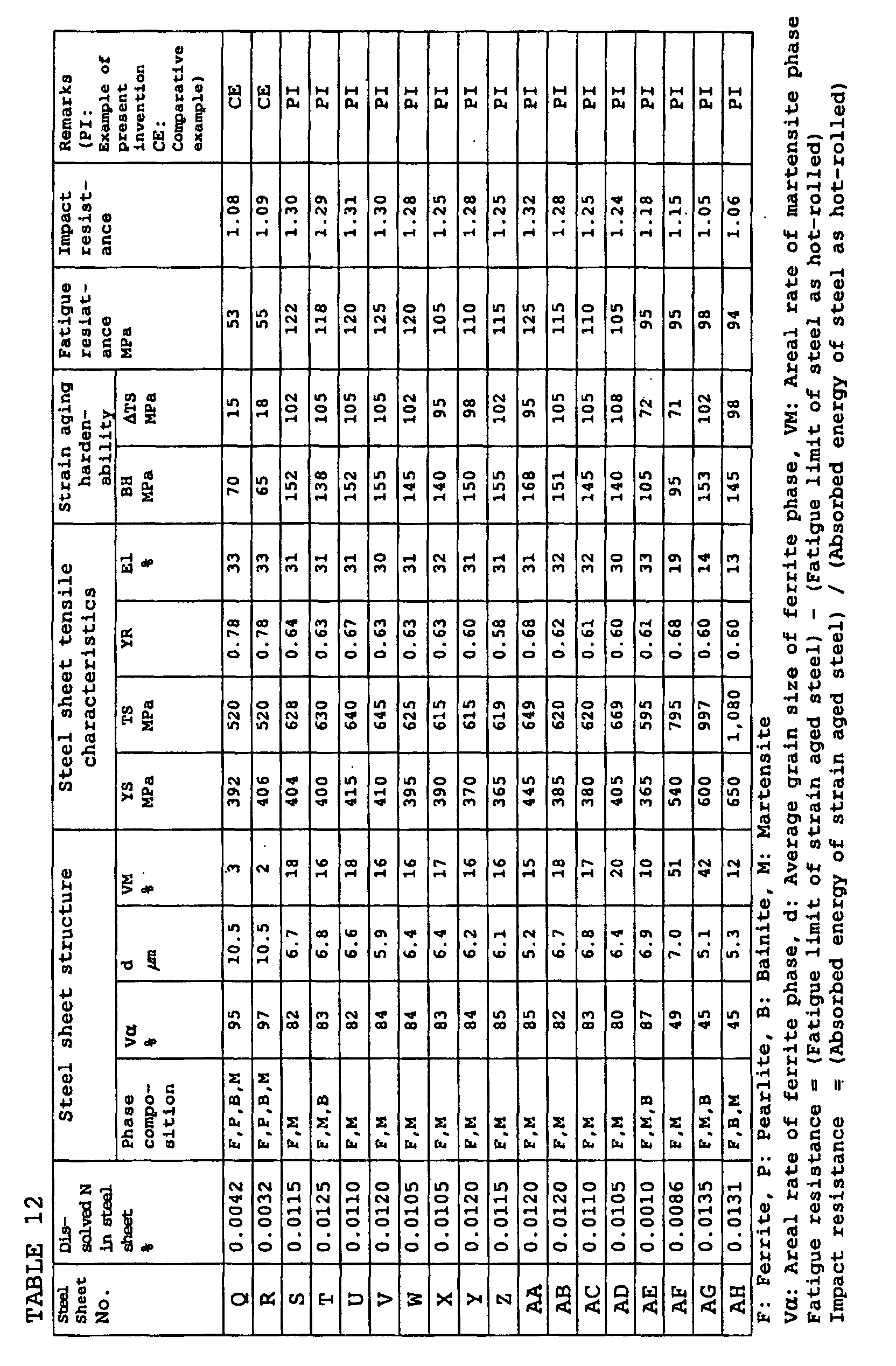
- the resultant hot-rolled steel sheet the dissolved N, the microstructure, the tensile characteristics, the strain aging hardenability, and improvements in fatigue resistance and impact resistance due to strain aging treatment were investigated.
- the amount of dissolved N was measured by the method described above.
- the tensile tests for checking the tensile characteristics and the strain aging hardenability were performed according to JIS Z 2241 using JIS No. 5 test pieces.
- the strain aging treatment was performed with a prestrain of 5% under the aging treatment conditions: 170°C ⁇ 20 minutes.
- the fatigue resistance was evaluated by the fatigue limit obtained by a tensile fatigue test according to JIS Z 2273.
- the impact resistance was evaluated by the absorbed energy found by integrating stress in the strain range of 0 to 30% with respect to the stress-strain curve measured at a strain rate of 2,000/s according to a high-speed tensile test method described in "Journal of the Society of Materials Science Japan. 47,10(1998)1058".
- the characteristics of plated steel sheets obtained by hot-dip galvanizing the steel Nos. C and D were substantially the same as those of the steel sheets before plating.
- the steel sheet was immersed in a galvanizing bath and after the immersed steel sheet was retrieved, the areal weight was adjusted by gas-wiping.
- the plating treatment was performed under the conditions of sheet temperature: 475°C, plating bath: 0.13% Al-Zn, bath temperature: 475°C, immersion time: 3 seconds, and areal weight: 45 g/m 2 .
- the steel having the composition shown in Table 4 was cast into a slab in the same manner as Example 1, and the slab was hot-rolled under the conditions shown in Table 5. Thereby, hot-rolled steel sheets (with a thickness of 1.6 mm) in which the average cooling rates were greatly varied were obtained.
- finish-rolling was performed, consecutive sheet bars with a thickness of 25 mm were joined to each other by fusion-pressure welding at the initial stand, and tandem rolling was performed continuously. Between rough-rolling and finish-rolling, the temperature of the sheet bar was adjusted using a sheet bar edge heater and a sheet bar heater of induction heating type.
- the resultant hot-rolled steel sheets were investigated in the same manner as Example 1.
- Example 6 The results thereof are shown in Table 6.
- Example 2 due to the continuous rolling and the temperature adjustment of the sheet bar, the thickness accuracy and the shape were improved compared to Example 1. Furthermore, since finish-rolling was continuously performed by joining consecutive sheet bars to each other, the rolling conditions and cooling conditions for one sheet bar were uniformly set in the entire length in the longitudinal direction. As a result, stable strain aging hardenability was confirmed over the entire length of the steel sheet.
- Each of the steels having the compositions shown in Tables 7 and 8 was melted in a converter, and a slab was formed by continuous casting.
- the slab was hot-rolled under the conditions shown in Tables 9 and 10 to produce a hot-rolled steel sheet.
- the resultant hot-rolled steel sheet the dissolved N, the microstructure, the tensile characteristics, strain aging hardenability, and improvements in fatigue resistance and impact resistance due to strain aging treatment were investigated.
- the amount of dissolved N was measured by the method described above.
- the tensile tests for checking the tensile characteristics and the strain aging hardenability were performed according to JIS Z 2241 using JIS No. 5 test pieces.
- the strain aging treatment was performed with a prestrain of 5% under the aging treatment conditions: 170°C ⁇ 20 minutes.
- the characteristics of plated steel sheets obtained by hot-dip galvanizing the steel Nos. C and D were substantially the same as those of the steel sheets before plating.
- the steel sheet was immersed in a galvanizing bath and after the immersed steel sheet was retrieved, the areal weight was adjusted by gas-wiping.
- the plating treatment was performed under the conditions of sheet temperature: 475°C, plating bath: 0.13% Al-Zn, bath temperature: 475°C, immersion time: 3 seconds, and areal weight 45 g/m 2 .
- the steel No. A of the present invention exhibits high values of BH and ⁇ TS even under the relatively low-temperature, short-time aging treatment conditions of 100°C ⁇ 30 seconds.
- Each of the steels having the compositions shown in Table 14 was melted in a converter, and a slab was formed by continuous casting.
- the slab was hot-rolled under the conditions shown in Table 15 to produce a hot-rolled steel sheet.
- sheet bars were not joined to each other and tandem rolling was performed for the individual sheet bars.
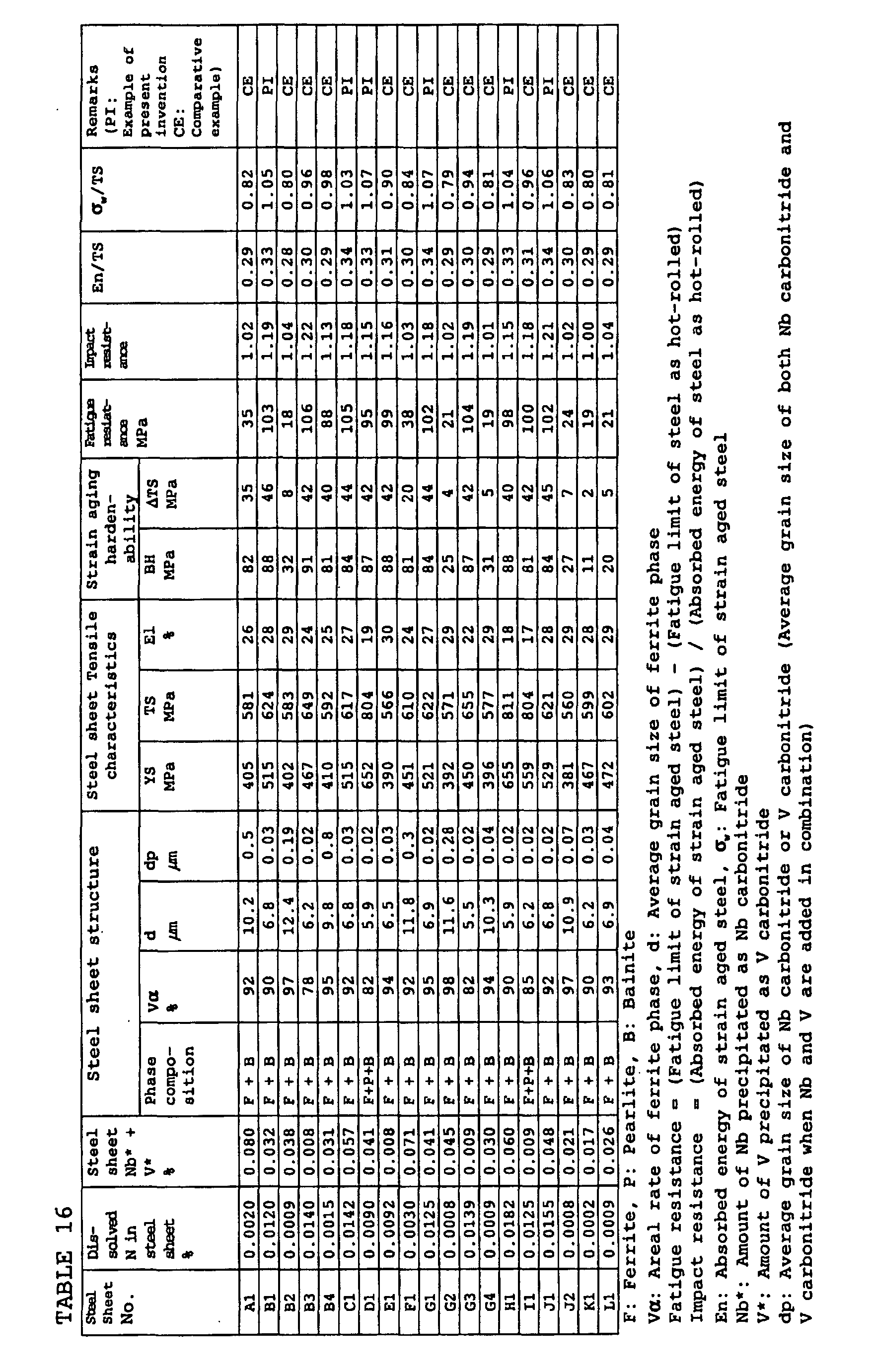
- the resultant hot-rolled steel sheet the dissolved N, the microstructure, the tensile characteristics, the strain aging hardenability, and improvements in fatigue resistance and impact resistance due to strain aging treatment were investigated.
- the amount of dissolved N, the amount of precipitated Nb*, and the amount of precipitated V were measured by the methods described above.
- the tensile tests for checking the tensile characteristics and the strain aging hardenability were performed according to JIS Z 2241 using JIS No. 5 test pieces.
- the strain aging treatment was performed with a prestrain of 5% under the aging treatment conditions: 170°C ⁇ 20 minutes.
- the fatigue resistance and the impact resistance were evaluated by the methods described in Example 1. Furthermore, in order to evaluate the impact resistance and the fatigue resistance relative to the strength level of the steel sheet (strain aged steel), the ratio of absorbed energy En (MJ/ ) to the tensile strength TS (MPa) of the strain aged steel, En/TS (MJ/( MPa)) and the ratio of the fatigue limit ⁇ w (MPa) to the tensile strength TS (MPa) of the strain aged steel, ⁇ w/TS were obtained.
- the characteristics of a plated steel sheet obtained by hot-dip galvanizing the steel sheet No. C1 were substantially the same as those of the steel sheet before plating.
- the steel sheet was immersed in a galvanizing bath and after the immersed steel sheet was retrieved, the areal weight was adjusted by gas-wiping.
- the plating treatment was performed under the conditions of sheet temperature: 475°C, plating bath: 0.13% Al-Zn, bath temperature: 475°C, immersion time: 3 seconds, and areal weight 45 g/m 2 .
- the strength of the mother plate with a TS of 440 MPa or more is exhibited, and superior strain aging hardenability with a BH of 80 MPa or more and a ⁇ TS of 40 MPa or more is exhibited after strain aging treatment is performed.
- the same characteristics are exhibited after plating is performed, and moreover, it is possible to perform hot-rolling inexpensively without disturbing the shape.
- the thickness of the steel sheet used for automotive components can be decreased, for example, from approximately 2.0 mm to approximately 1.6 mm, thus greatly contributing to lightening of automobile bodies.
Landscapes
- Chemical & Material Sciences (AREA)
- Engineering & Computer Science (AREA)
- Materials Engineering (AREA)
- Mechanical Engineering (AREA)
- Metallurgy (AREA)
- Organic Chemistry (AREA)
- Physics & Mathematics (AREA)
- Thermal Sciences (AREA)
- Crystallography & Structural Chemistry (AREA)
- Heat Treatment Of Sheet Steel (AREA)
- Metal Rolling (AREA)
Abstract
Description
Additionally, in order to ensure high ductility with a TS of more than 500 MPa, in view of the balance between strength and ductility, the Si content is preferably set at 0.3% or more.
Additionally, the method for heating is not specifically limited, and in addition to atmospheric heating using a furnace which is employed for general paint baking, induction heating, heating by non-oxidizing flame, laser beam, or plasma, or the like may be preferably used.
Additionally, in order to avoid an increase in loss due to oxidation weight gain, the SRT is preferably 1,280°C or less. Rough-rolling of the heated slab may be performed in a known method.
Additionally, if the CT is less than 200°C, the shape of the steel sheet is easily disturbed and problems may arise in practical use, and therefore, CT is preferably 200°C or more. In view of material uniformity, CT is preferably 300°C or more, and more preferably, more than 450°C.
Furthermore, in order to evaluate the impact resistance and the fatigue resistance relative to the strength level of the steel sheet (strain aged steel), the ratio of absorbed energy En (MJ/ ) to the tensile strength TS (MPa) of the strain aged steel, En/TS (MJ/( MPa)) and the ratio of the fatigue limit σw (MPa) to the tensile strength TS (MPa) of the strain aged steel, σw/TS were obtained.
| Steel No. | C % | Si % | Mn % | P % | S % | Al % | N % | N/Al | Others % |
| 1 | 0.07 | 0.25 | 1.80 | 0.015 | 0.003 | 0.012 | 0.0105 | 0.88 | - |
| 2 | 0.05 | 0.50 | 1.60 | 0.008 | 0.002 | 0.008 | 0.0150 | 1.88 | - |
| 3 | 0.08 | 0.15 | 2.00 | 0.010 | 0.002 | 0.011 | 0.0095 | 0.86 | - |
| 4 | 0.05 | 0.35 | 1.75 | 0.005 | 0.002 | 0.011 | 0.0120 | 1.09 | Mo:0.15 |
| 5 | 0.05 | 0.45 | 1.65 | 0.045 | 0.001 | 0.007 | 0.0123 | 1.76 | - |
| 6 | 0.05 | 0.15 | 2.00 | 0.008 | 0.001 | 0.004 | 0.0140 | 3.50 | Ti:0.015 |
| 7 | 0.03 | 0.15 | 2.00 | 0.008 | 0.001 | 0.011 | 0.0140 | 1.27 | Nb:0.015,B:0.0008 |
| 8 | 0.05 | 0.15 | 1.55 | 0.004 | 0.003 | 0.011 | 0.0121 | 1.10 | Ni:0.05 |
| 9 | 0.05 | 0.15 | 1.61 | 0.008 | 0.002 | 0.005 | 0.0118 | 2.36 | Cu:0.10,Ni:0.05 |
| 10 | 0.07 | 0.25 | 1.80 | 0.015 | 0.003 | 0.004 | 0.0042 | 0.08 | - |
| 11 | 0.05 | 0.15 | 1.80 | 0.007 | 0.002 | 0.004 | 0.0140 | 3.50 | Cu:0.15 |
| 12 | 0.05 | 0.15 | 1.80 | 0.007 | 0.002 | 0.004 | 0.0145 | 3.63 | v:0.015 |
| 13 | 0.05 | 0.15 | 1.77 | 0.007 | 0.002 | 0.004 | 0.0142 | 3.55 | Cr:0.15,Ti:0.015 |
| 14 | 0.06 | 0.15 | 1.78 | 0.005 | 0.002 | 0.004 | 0.0141 | 3.53 | Nb:0.015,V:0.015 |
| 15 | 0.04 | 0.15 | 1.82 | 0.004 | 0.002 | 0.004 | 0.0139 | 3.48 | Ni:0.05,Ti:0.015 |
| 16 | 0.05 | 0.15 | 1.81 | 0.005 | 0.002 | 0.004 | 0.0141 | 3.53 | Cu:0.10,B:0.003 |
| 17 | 0.05 | 0.15 | 1.80 | 0.007 | 0.002 | 0.004 | 0.0140 | 3.50 | Ca:0.0015 |
| 18 | 0.04 | 0.15 | 1.78 | 0.007 | 0.002 | 0.004 | 0.0141 | 3.53 | Cu:0.10,Ca:0.002 |
| 19 | 0.05 | 0.15 | 1.77 | 0.005 | 0.002 | 0.004 | 0.0140 | 3.53 | Nb:0.020, REM:0.002 |
| 20 | 0.05 | 0.15 | 1.81 | 0.006 | 0.002 | 0.004 | 0.0140 | 3.50 | B:0.0003 |
| 21 | 0.05 | 0.15 | 1.80 | 0.007 | 0.002 | 0.004 | 0.0140 | 3.50 | B:0.0002,REM:0.002 |
| 22 | 0.04 | 0.15 | 1.79 | 0.007 | 0.002 | 0.004 | 0.0141 | 3.53 | Cr:0.10,Nb:0.02 B:0.0003,Ca:0.0015 |
| 23 | 0.08 | 0.15 | 2.00 | 0.010 | 0.002 | 0.016 | 0.0050 | 0.31 | - |
| (The balance being Fe and incidental impurities) |
| Steel Sheet No. | Steel No. | SRT °C | FDT °C | Thickness mm | Δts | V °C/s | CT °C | Others |
| A | 1 | 1,220 | 880 | 1.6 | 0.2 | 80 | 520 | - |
| B | 2 | 1,200 | 890 | 1.8 | 0.2 | 65 | 540 | - |
| C | 3 | 1,150 | 890 | 1.4 | 0.1 | 75 | 520 | - |
| D | 4 | 1,220 | 850 | 1.6 | 0.1 | 75 | 570 | - |
| E | 5 | 1,270 | 850 | 1.8 | 0.2 | 65 | 580 | - |
| F | 6 | 1,200 | 890 | 1.8 | 0.3 | 65 | 520 | - |
| G | 7 | 1,100 | 840 | 2.3 | 0.2 | 55 | 530 | - |
| H | 8 | 1,100 | 845 | 2.0 | 0.3 | 60 | 540 | - |
| I | 9 | 1,100 | 850 | 1.8 | 0.4 | 70 | 530 | HCR |
| J | 10 | 1,100 | 880 | 1.8 | 0.3 | 70 | 530 | - |
| K | 1 | 1,130 | 840 | 1.8 | 1.5 | 70 | 540 | - |
| L | 1 | 1,220 | 850 | 1.8 | 0.3 | 70 | 680 | - |
| M | 1 | 1,220 | 880 | 1.8 | 0.2 | 70 | 600 | - |
| N | 1 | 1,220 | 890 | 1.8 | 0.2 | 70 | 250 | LV |
| O | 1 | 1,230 | 880 | 1.4 | 0.2 | 73 | 420 | SK |
| P | 11 | 1,200 | 890 | 1.8 | 0.3 | 65 | 530 | - |
| Q | 12 | 1,200 | 890 | 1.8 | 0.3 | 65 | 530 | - |
| R | 13 | 1,200 | 890 | 1.8 | 0.3 | 65 | 530 | - |
| S | 14 | 1,200 | 890 | 1.8 | 0.3 | 65 | 530 | - |
| T | 15 | 1,200 | 890 | 1.8 | 0.3 | 65 | 530 | - |
| U | 16 | 1,200 | 890 | 1.8 | 0.3 | 65 | 530 | - |
| V | 17 | 1,200 | 890 | 1.8 | 0.3 | 65 | 530 | - |
| W | 18 | 1,200 | 890 | 1.8 | 0.3 | 65 | 530 | - |
| X | 19 | 1,200 | 890 | 1.8 | 0.3 | 65 | 530 | - |
| Y | 20 | 1,200 | 890 | 1.8 | 0.3 | 65 | 530 | - |
| Z | 21 | 1,200 | 890 | 1.8 | 0.3 | 65 | 530 | - |
| AA | 22 | 1,200 | 890 | 1.8 | 0.3 | 65 | 530 | - |
| AB | 23 | 1,150 | 890 | 1.4 | 0.5 | 40 | 646 | - |
| SRT: Slab heating temperature | ||||||||
| FDT: Finishing temperature in finish-rolling | ||||||||
| CT: coiling temperature | ||||||||
| Δt: Cooling delay time | ||||||||
| V: Average cooling rate | ||||||||
| HCR: Hot slab (900°C or more) was inserted into furnace. | ||||||||
| LV: Leveling after coiling (Elongation 1.5%) | ||||||||
| SK: Skin pass rolling after coiling (Reduction rate 2.0%) |
| Steel Sheet No. | Dissolved N in steel sheet % | Steel sheet structure | Steel sheet tensile characteristics | Strain aging hardenability | Fatigue resiatance MPa | Impact resistance | Remarks (PI: Example of present invention CE: Comparative example) | |||||
| Phase composition | vα % | d µm | YS MPa | TS MPa | El % | BH MPa | ΔTS Mpa | |||||
| A | 0.0071 | F,P,B | 85 | 8.2 | 351 | 474 | 38 | 113 | 55 | 95 | 1.18 | PI |
| B | 0.0121 | F,P,B | 90 | 8.4 | 368 | 469 | 36 | 110 | 52 | 90 | 1.15 | PI |
| C | 0.0060 | F,B | 85 | 7.9 | 355 | 512 | 35 | 115 | 61 | 97 | 1.19 | PI |
| D | 0.0082 | F,B | 87 | 7.8 | 365 | 532 | 34 | 115 | 63 | 98 | 1.18 | PI |
| E | 0.0112 | F,P,B | 92 | 8.1 | 338 | 485 | 37 | 108 | 55 | 94 | 1.16 | PI |
| F | 0.0075 | F,B | 85 | 7.4 | 353 | 508 | 36 | 92 | 62 | 98 | 1.19 | PI |
| G | 0.0088 | F,B | 83 | 5.9 | 411 | 610 | 31 | 112 | 74 | 101 | 1.19 | PI |
| H | 0.0084 | F,P | 93 | 7.8 | 326 | 465 | 37 | 108 | 52 | 88 | 1.15 | PI |
| I | 0.0102 | F,B | 88 | 8.3 | 331 | 475 | 38 | 105 | 55 | 89 | 1.13 | PI |
| J | 0.0002 | F,P,B | 85 | 8.4 | 334 | 454 | 37 | 22 | 5 | 0 | 1.00 | CE |
| K | 0.0008 | F,P,B | 90 | 10.8 | 332 | 434 | 38 | 32 | 15 | 20 | 1.01 | CE |
| L | 0.0005 | F,P | 95 | 11.0 | 295 | 411 | 38 | 10 | 12 | 18 | 0.99 | CE |
| M | 0.0065 | R,P,B | 86 | 8.3 | 348 | 468 | 38 | 110 | 50 | 93 | 1.13 | PI |
| N | 0.0100 | F,M | 83 | 7.9 | 363 | 605 | 34 | 155 | 105 | 125 | 1.25 | PI |
| O | 0.0105 | F,M,B | 86 | 7.6 | 355 | 481 | 37 | 118 | 63 | 112 | 1.20 | PI |
| P | 0.0095 | F,B | 85 | 7.7 | 361 | 485 | 38 | 120 | 69 | 105 | 1.21 | PI |
| Q | 0.0093 | F,B | 87 | 7.4 | 371 | 480 | 36 | 118 | 59 | 98 | 1.18 | PI |
| R | 0.0082 | F,B,M | 82 | 6.5 | 365 | 505 | 38 | 119 | 71 | 102 | 1.18 | PI |
| S | 0.0075 | F,B | 82 | 6.3 | 381 | 485 | 37 | 119 | 69 | 103 | 1.20 | PI |
| T | 0.0085 | F,B | 85 | 6.5 | 359 | 479 | 38 | 115 | 56 | 99 | 1.19 | PI |
| U | 0.0072 | F,B | 84 | 7.2 | 358 | 480 | 38 | 115 | 57 | 98 | 1.18 | PI |
| V | 0.0098 | F,B | 85 | 8.1 | 355 | 475 | 39 | 102 | 65 | 101 | 1.19 | PI |
| W | 0.0101 | F,B | 83 | 8.0 | 365 | 480 | 38 | 113 | 69 | 104 | 1.18 | PI |
| X | 0.0095 | F,B | 81 | 5.9 | 480 | 510 | 36 | 119 | 75 | 102 | 1.19 | PI |
| Y | 0.0120 | F,B | 85 | 7.1 | 355 | 475 | 39 | 115 | 59 | 99 | 1.19 | PI |
| Z | 0.0115 | F,B | 85 | 7.2 | 360 | 479 | 38 | 115 | 61 | 102 | 1.18 | PI |
| AA | 0.0115 | F,B | 82 | 5.8 | 369 | 525 | 37 | 118 | 65 | 109 | 1.19 | PI |
| AB | 0.0011 | F,P,B | 85 | 9.5 | 368 | 471 | 36 | 99 | 53 | 88 | 1.18 | PI |
| F: Ferrite | ||||||||||||
| P: Pearlite | ||||||||||||
| B: Bainite | ||||||||||||
| M: Martensite | ||||||||||||
| Vα: Areal rate of ferrite phase | ||||||||||||
| d: Average grain size of ferrite phase | ||||||||||||
| Fatigue resistance | ||||||||||||
| = (Fatigue limit of strain aged steel) - (Fatigue limit of steel as hot-rolled) | ||||||||||||
| Impact resistance | ||||||||||||
| = (Absorbed energy of strain aged steel) / (Absorbed energy of steel as hot | ||||||||||||
| rolled) |
| Steel No. | C % | Si % | Mn % | P % | S % | Al % | N % | N/Al | Others % |
| 24 | 0.08 | 0.35 | 1.55 | 0.009 | 0.002 | 0.012 | 00135 | 1.11 | - |
| (The balance being Fe and incidental impurities) |
| Steel Sheet No. | Steel No. | SRT °C | FDT °C | Thickness mm | Δts | V °C/s | CT °C | Others | Remarks |
| AC | 11 | 1,280 | 920 | 1.6 | 0.2 | 95 | 480 | Continuous rolling | PI |
| AD | 11 | 1,220 | 890 | 1.6 | 0.2 | 65 | 520 | Continuous rolling | PI |
| AE | 11 | 1,180 | 925 | 1.6 | 0.1 | 100 | 520 | Continuous rolling | PI |
| Steel sheet No. | Dissolved N in steel sheet % | Steel sheet structure | Steel sheet tensile characteristics | Strain aging hardenability | Fatigue resistance MPa | Impact resistance | Remarks (PI: Example of present invention CE: Comparative example) | |||||
| Phase composition | vα % | d µm | YS MPa | TS MPa | El % | BH MPa | ΔTS MPa | |||||
| AC | 0.0095 | F, P, B | 88 | 8.1 | 351 | 474 | 38 | 115 | 58 | 95 | 1.19 | PI |
| AD | 0.0092 | F, P, B | 89 | 8.3 | 368 | 469 | 37 | 110 | 52 | 90 | 1.15 | PI |
| AE | 0.0088 | F, P, B | 85 | 7.6 | 364 | 495 | 37 | 115 | 65 | 100 | 1,18 | PI |
| Steel No. | C % | Si % | Mn % | P % | S % | Al | N % | N/Al | Others % |
| 1 | 0.07 | 0.25 | 1.80 | 0.015 | 0.003 | 0.012 | 0.0105 | 0.88 | - |
| 2 | 0.05 | 0.50 | 1.60 | 0.008 | 0.002 | 0.008 | 0.0150 | 1.88 | - |
| 3 | 0.08 | 0.15 | 2.00 | 0.010 | 0.002 | 0.011 | 0.0095 | 0.86 | - |
| 4 | 0.05 | 0.35 | 1.75 | 0.005 | 0.002 | 0.011 | 0.0120 | 1.09 | Mo:0.15 |
| 5 | 0.05 | 0.45 | 1.65 | 0.045 | 0.001 | 0.007 | 0.0123 | 1.76 | - |
| 6 | 0.05 | 0.15 | 2.00 | 0.008 | 0.001 | 0.004 | 0.0140 | 3.50 | Ti:0.015 |
| 7 | 0.03 | 0.15 | 2.00 | 0.008 | 0.001 | 0.011 | 0.0140 | 1.27 | Nb:0.015,B:0,0008 |
| 8 | 0.05 | 0.15 | 1.55 | 0.004 | 0.003 | 0.011 | 0.0121 | 1.10 | Ni:0.05 |
| 9 | 0.05 | 0.15 | 1.61 | 0.008 | 0.002 | 0.005 | 0.0118 | 2.36 | Cu:0.10,Ni:0.05 |
| 10 | 0.07 | 0.25 | 1.80 | 0.015 | 0.003 | 0.055 | 0.0042 | 0.08 | - |
| 11 | 0.08 | 0.35 | 1.55 | 0.009 | 0.002 | 0.012 | 0.0135 | 1.12 | Mo:0.50 |
| 12 | 0.05 | 0.15 | 1.80 | 0.007 | 0.002 | 0.004 | 0.0140 | 3.50 | Cu:0.15 |
| (The balance being Fe and incidental impurities) |
| Steel No. | C % | Si % | Mn % | P % | S % | Al % | N % | N/Al | Others % |
| 13 | 0.05 | 0.15 | 1.80 | 0.007 | 0.002 | 0.004 | 0.0145 | 3.63 | V:0.015 |
| 14 | 0.05 | 0.15 | 1.77 | 0.007 | 0.002 | 0.004 | 0.0142 | 3.55 | Cr:0.15,Ti:0.015 |
| 15 | 0.06 | 0.15 | 1.78 | 0.005 | 0.002 | 0.004 | 0.0141 | 3.53 | Nb:0.015,V:0.015 |
| 16 | 0.04 | 0.15 | 1.82 | 0.004 | 0.002 | 0.004 | 0.0139 | 3.48 | Ni:0.05,Ti:0.015 |
| 17 | 0.05 | 0.15 | 1.81 | 0.005 | 0.002 | 0.004 | 0.0141 | 3.53 | Cu:0.10,B:0.0030 |
| 18 | 0.05 | 0.15 | 1.80 | 0.007 | 0.002 | 0.004 | 0.0140 | 3.50 | Ca:0.0015 |
| 19 | 0.04 | 0.15 | 1.78 | 0.007 | 0.002 | 0.004 | 0.0141 | 3.53 | Cu:0.10,Ca:0.0020 |
| 20 | 0.05 | 0.15 | 1.77 | 0.005 | 0.002 | 0.004 | 0.0140 | 3.53 | Nb:0.020,REM:0,0020 |
| 21 | 0.05 | 0.15 | 1.81 | 0.006 | 0.002 | 0.004 | 0.0140 | 3.50 | B:0.0003 |
| 22 | 0.05 | 0.15 | 1.80 | 0.007 | 0.002 | 0.004 | 0.0140 | 3.50 | B:0.0002,REM:0.0020 |
| 23 | 0.04 | 0.15 | 1.79 | 0.007 | 0.002 | 0.004 | 0.0141 | 3.53 | Cr:0.10,Nb:0.02 B:0.003,Ca:0.0015 |
| 24 | 0.08 | 0.15 | 2.00 | 0.010 | 0.002 | 0.016 | 0.0050 | 0.31 | - |
| 25 | 0.06 | 0.15 | 2.65 | 0.015 | 0.002 | 0.012 | 0.0142 | 1.18 | Nb:0.008,Ti:0.005 |
| 26 | 0.08 | 0.15 | 2.95 | 0.015 | 0.002 | 0.005 | 0.0180 | 3.60 | - |
| 27 | 0.08 | 0.45 | 2.90 | 0.011 | 0.002 | 0.011 | 0.0175 | 1.59 | Nb:0.038 |
| (The balance being Fe and incidental impurities) |
| Steel Sheet No. | Steel No. | SRT °C | FDT °C | Thickness mm | Δts | V °C/s | CT °C | Others |
| A | 1 | 1,180 | 880 | 2.3 | 0.3 | 55 | 280 | - |
| B | 2 | 1,180 | 880 | 2.3 | 0.3 | 55 | 400 | - |
| C | 3 | 1,170 | 880 | 2.3 | 0.3 | 55 | 380 | - |
| D | 4 | 1,200 | 890 | 1.6 | 0.3 | 60 | 380 | - |
| E | 5 | 1,220 | 890 | 1.6 | 0.3 | 60 | 400 | JCR |
| F | 6 | 1,200 | 890 | 1.6 | 0.3 | 60 | 325 | - |
| G | 7 | 1,220 | 870 | 1.6 | 0.3 | 60 | 280 | - |
| H | 8 | 1,270 | 870 | 1.6 | 0.3 | 60 | 250 | - |
| I | 9 | 1,250 | 850 | 1.8 | 0.2 | 60 | 320 | HCR |
| J | 10 | 1,250 | 850 | 1.8 | 0.2 | 60 | 350 | - |
| K | 1 | 1,270 | 850 | 1.8 | 0.2 | 60 | 350 | - |
| L | 1 | 1,250 | 850 | 1.4 | 0.2 | 70 | 290 | LV |
| M | 1 | 1,250 | 850 | 1.4 | 0.2 | 70 | 320 | - |
| N | 1 | 1,250 | 850 | 1.4 | 0.2 | 70 | 560 | - |
| 0 | 1 | 950 | 720 | 1.4 | 0.2 | 70 | 350 | - |
| P | 11 | 1,180 | 880 | 2.0 | 0.2 | 50 | 350 | SK |
| SRT: Slab heating temperature | ||||||||
| FDT: Finishing temperature in finish-rolling | ||||||||
| CT: coiling temperature | ||||||||
| Δt: Cooling delay time | ||||||||
| V: Average cooling rate | ||||||||
| HCR: Hot slab (900°C or more) was inserted into furnace. | ||||||||
| JCR: Sheet bar joining and continuous rolling | ||||||||
| LV: Leveling after coiling (Elongation 2%) | ||||||||
| SK: Skin pass rolling after coiling (Reduction rate 1.0%) |
| Steel Sheet No. | Steel No. | SRT °C | FDT °C | Thickness mm | Δts | V °C/s | CT °C | Others |
| Q | 11 | 1,180 | 880 | 2.0 | 2.0 | 55 | 360 | - |
| R | 11 | 1,180 | 880 | 2.0 | 0.2 | 10 | 350 | - |
| S | 12 | 1,200 | 885 | 1.6 | 0.3 | 55 | 250 | - |
| T | 13 | 1,220 | 890 | 1.6 | 0.3 | 60 | 350 | - |
| U | 14 | 1,220 | 900 | 1.6 | 0.2 | 55 | 300 | - |
| V | 15 | 1,220 | 885 | 1.6 | 0.3 | 55 | 300 | - |
| W | 16 | 1,200 | 895 | 1.6 | 0.3 | 55 | 300 | - |
| X | 17 | 1,200 | 890 | 1.6 | 0.3 | 55 | 280 | - |
| Y | 18 | 1,220 | 900 | 1.6 | 0.3 | 60 | 250 | - |
| Z | 19 | 1,200 | 905 | 1.6 | 0.3 | 55 | 280 | - |
| | 20 | 1,220 | 910 | 1.6 | 0.3 | 50 | 250 | - |
| AB | 21 | 1,180 | 910 | 1.6 | 0.2 | 55 | 250 | - |
| AC | 22 | 1,180 | 910 | 1.6 | 0.3 | 60 | 280 | - |
| AD | 23 | 1,200 | 900 | 1.6 | 0.2 | 65 | 250 | - |
| AE | 24 | 1,210 | 890 | 1.6 | 0.4 | 40 | 320 | - |
| AF | 25 | 1,170 | 870 | 1.6 | 0.4 | 45 | 380 | - |
| AG | 26 | 1,200 | 890 | 1.6 | 0.4 | 85 | 400 | - |
| AH | 27 | 1,250 | 910 | 1.6 | 0.3 | 65 | 420 | - |
| SRT: Slab heating temperature | ||||||||
| FDT: Finishing temperature in finish-rolling | ||||||||
| CT: coiling temperature | ||||||||
| Δt: Cooling delay time | ||||||||
| V: Average cooling rate | ||||||||
| HCR: Hot slab (900°C or more) was inserted into furnace. | ||||||||
| JCR: Sheet bar joining and continuous rolling | ||||||||
| LV: Leveling after coiling (Elongation 2%) | ||||||||
| SK: Skin pass rolling after coiling (Reduction rate 1.0%) |

| Aging treatment conditions | A (Steel of present invention) | O (Comparative steel) | |||
| Heat-treating temperature | Heat-treating time | BH (MPa) | ΔTS (MPa) | BH (MPa) | ΔTS (MPa) |
| 100°C | 30 sec | 120 | 60 | 20 | 3 |
| 100°C | 10 min | 130 | 70 | 24 | 3 |
| 100°C | 20 min | 135 | 75 | 25 | 4 |
| 300°C | 30 sec | 140 | 65 | 30 | 5 |
| 300°C | 10 min | 155 | 70 | 35 | 5 |
| 300°C | 20 min | 160 | 70 | 40 | 10 |
| 170°C | 20 min | 151 | 85 | 40 | 10 |
| Steel No. | C % | Si % | Mn % | P % | S % | Al % | N % | Nb % | V % | N/Al - |
| A | 0.06 | 0.02 | 1.2 | 0.012 | 0.0030 | 0.015 | 0.015 | 0.2 | - | 1.0 |
| B | 0.08 | 0.02 | 1.0 | 0.010 | 0.0050 | 0.015 | 0.015 | 0.040 | - | 1.0 |
| C | 0.05 | 0.02 | 1.4 | 0.010 | 0.0040 | 0.012 | 0.015 | 0.070 | - | 1.25 |
| D | 0.08 | 0.4 | 1.7 | 0.015 | 0.0040 | 0.015 | 0.015 | 0.050 | - | 1.0 |
| E | 0.05 | 0.2 | 1.2 | 0.010 | 0.0050 | 0.011 | 0.015 | 0.010 | - | 1.36 |
| F | 0.04 | 0.1 | 1.3 | 0.012 | 0.0030 | 0.015 | 0.017 | - | 0.15 | 1.13 |
| G | 0.08 | 0.02 | 1.4 | 0.015 | 0.0040 | 0.015 | 0.015 | - | 0.05 | 1.0 |
| H | 0.06 | 0.7 | 0.9 | 0.010 | 0.0030 | 0.017 | 0.020 | - | 0.08 | 1.18 |
| I | 0.08 | 0.8 | 1.8 | 0.007 | 0.0020 | 0.004 | 0.014 | - | 0.010 | 3.5 |
| J | 0.05 | 0.1 | 1.2 | 0.010 | 0.0040 | 0.010 | 0.018 | 0.03 | 0.03 | 1.8 |
| K | 0.03 | 0.2 | 1.8 | 0.010 | 0.0030 | 0.012 | 0.0010 | 0.04 | - | 0.08 |
| L | 0.06 | 0.01 | 1.5 | 0.015 | 0.0050 | 0.010 | 0.004 | - | 0.05 | 0.4 |
| (The balance being Fe and incidental impurities) |
| Steel No. | Steel sheet No. | SRT °C | FDT °C | Thickness mm | Δts | V °C/s | CT °C |
| A | Al | 1,220 | 820 | 1.6 | 0.2 | 50 | 600 |
| B | B1 | 1,250 | 850 | 1.8 | 0.1 | 50 | 550 |
| B2 | 1,250 | 850 | 1.8 | 0.1 | 50 | 700 | |
| B3 | 1,250 | 850 | 1.8 | 0.1 | 50 | 450 | |
| B4 | 1.050 | 850 | 1.8 | 0.1 | 50 | 600 | |
| C | C1 | 1,250 | 880 | 1.4 | 0.1 | 80 | 550 |
| D | D1 | 1,220 | 880 | 2.9 | 0.3 | 50 | 600 |
| E | E1 | 1,220 | 850 | 1.8 | 0.2 | 50 | 600 |
| F | F1 | 1,250 | 850 | 1.6 | 0.2 | 60 | 640 |
| G | G1 | 1,220 | 850 | 1.4 | 0.1 | 100 | 550 |
| G2 | 1,220 | 850 | 1.4 | 0.1 | 100 | 720 | |
| G3 | 1,220 | 850 | 1.4 | 0.1 | 100 | 450 | |
| G4 | 1,220 | 850 | 1.4 | 1.0 | 100 | 600 | |
| H | H1 | 1,250 | 880 | 2.3 | 0.2 | 50 | 600 |
| I | I1 | 1,250 | 850 | 1.6 | 0.2 | 50 | 540 |
| J | J1 | 1,230 | 880 | 2.0 | 0.2 | 50 | 560 |
| J2 | 1,250 | 880 | 2.0 | 0.2 | 10 | 640 | |
| K | K1 | 1,250 | 880 | 1.8 | 0.1 | 60 | 580 |
| L | L1 | 1,250 | 850 | 1.6 | 0.3 | 50 | 600 |
| SRT: Slab heating temperature | |||||||
| FDT: Finishing temperature in finish-rolling | |||||||
| CT: coiling temperature | |||||||
| Δt: Cooling delay time | |||||||
| V: Average cooling rate |
Claims (13)
- A high tensile strength hot-rolled steel sheet having superior strain aging hardenability comprising: in percent by mass,0.15% or less of C;2.0% or less of Si;3.0% or less of Mn;0.08% or less of P;0.02% or less of S;0.02% or less of Al;0.0050% to 0.0250% of N; andthe balance being Fe and incidental impurities,the ratio N (mass%)/Al (mass%) being 0.3 or more,N in the dissolved state being 0.0010% or more.
- A high tensile strength hot-rolled steel sheet having superior strain aging hardenability with a tensile strength of 440 MPa or more comprising: in percent by mass,wherein the hot-rolled steel sheet has a structure in which the areal rate of the ferrite phase having an average grain size of 10 µm or less is 50% or more.0.15% or less of C;2.0% or less of Si;3.0% or less of Mn;0.08% or less of P;0.02% or less of S;0.02% or less of Al;0.0050% to 0.0250% of N; andthe balance being Fe and incidental impurities,the ratio N (mass%)/Al (mass%) being 0.3 or more, N in the dissolved state being 0.0010% or more,
- A steel sheet according to Claim 2 further comprising at least one selected from the group consisting of the following Group a to Group d:Group a: 1.0% or less in total of at least one of Cu, Ni, Cr, and MoGroup b: 0.1% or less in total of at least one of Nb, Ti, and VGroup c: 0.0030% or less of BGroup d: 0.0010% to 0.010% in total of at least one of Ca and REM.
- A steel sheet according to either Claim 2 or 3,
wherein the high tensile strength hot-rolled sheet has a thickness of 4.0 mm or less. - A high tensile strength hot-rolled plated steel sheet produced by electroplating or hot-dip plating a steel sheet according to any one of Claims 2 to 4.
- A method for producing a high tensile strength hot-rolled steel sheet having superior strain aging hardenability with a tensile strength of 440 MPa or more comprising the steps of:heating a steel slab to 1,000°C or more, the steel slab comprising: in percent by mass,0.15% or less of C;2.0% or less of Si;3.0% or less of Mn;0.08% or less of P;0.02% or less of S;0.02% or less of Al;0.0050% to 0.0250% of N; andoptionally further comprising at least one selected from the group consisting of the following Group a to Group d, the ratio N (mass%)/Al (mass%) being 0.3 or more:Group a: 1.0% or less in total of at least one of Cu, Ni, Cr, and MoGroup b: 0.1% or less in total of at least one of Nb, Ti, and VGroup c: 0.0030% or less of BGroup d: 0.0010% to 0.010% in total of at least one of Ca and REM;rough-rolling the steel slab to form a sheet bar; finish-rolling the sheet bar at a finishing temperature of 800°C or more;cooling at a cooling rate of 20°C/s or more within 0.5 second after the finish-rolling; andcoiling at a temperature of 650°C or less.
- A method according to according to Claim 6, further comprising the step of performing at least one of skin pass rolling and leveling with an elongation of 1.5% to 10% after the coiling step is performed.
- A method according to either Claim 6 or 7, further comprising the step of joining consecutive sheet bars to each other between the steps of rough-rolling and finish-rolling.
- A method according to any one of Claims 6 to 8, further comprising the step of using at least one of a sheet bar edge heater for heating a widthwise end of the sheet bar and a sheet bar heater for heating a lengthwise end of the sheet bar between the steps of rough-rolling and finish-rolling.
- A high tensile strength hot-rolled steel sheet having superior strain aging hardenability with a BH of 80 MPa or more, a ΔTS of 40 MPa or more, and a tensile strength of 440 MPa or more comprising, in percent by mass,wherein the hot-rolled steel sheet has a structure in which the areal rate of the ferrite phase having an average grain size of 10 µm or less is 70% or more, and the areal rate of the martensite phase is 5% or more.0.15% or less of C;2.0% or less of Si;3.0% or less of Mn;0.08% or less of P;0.02% or less of S;0.02% or less of Al;0.0050% to 0.0250% of N; andthe balance being Fe and incidental impurities,the ratio N (mass%)/Al (mass%) being 0.3 or more, N in the dissolved state being 0.0010% or more,
- A method for producing a high tensile strength hot-rolled steel sheet having superior strain aging hardenability with a BH of 80 MPa or more, a ΔTS of 40 MPa or more, and a tensile strength of 440 MPa or more comprising the steps of:heating a steel slab to 1,000°C or more, the steel slab comprising: in percent by mass,0.15% or less of C;2.0% or less of Si;3.0% or less of Mn;0.08% or less of P;0.02% or less of S;0.02% or less of Al;0.0050% to 0.0250% of N; andoptionally further comprising at least one selected from the group consisting of the following Group a to Group d, the ratio N (mass%)/Al (mass%) being 0.3 or more:Group a: 1.0% or less in total of at least one of Cu, Ni, Cr, and MoGroup b: 0.1% or less in total of at least one of Nb, Ti, and VGroup c: 0.0030% or less of BGroup d: 0.0010% to 0.010% in total of at least one of Ca and REM;rough-rolling the steel slab to form a sheet bar;finish-rolling the sheet bar at a finishing temperature of 800°C or more;cooling at a cooling rate of 20°C/s or more within 0.5 second after the finish-rolling; and
coiling at a temperature of 450°C or less. - A high tensile strength hot-rolled steel sheet having superior strain aging hardenability comprising: in percent by mass,wherein the hot-rolled steel sheet has a structure in which the areal rate of the ferrite phase having an average grain size of 10 µm or less is 80% or more, and the average grain size of a precipitate comprising a Nb carbonitride or a V carbonitride is 0.05 µm or less.0.03% to 0.1% of C;2.0% or less of Si;1.0% to 3.0% of Mn;0.08% or less of P;0.02% or less of S;0.02% or less of Al;0.0050% to 0.0250% of N;0.1% or less in total of at least one of more than 0.02% to 0.1% of Nb and more than 0.02% to 0.1% of V; andthe balance being Fe and incidental impurities,the ratio N (mass%)/Al (mass%) being 0.3 or more,N in the dissolved state being 0.0010% or more,the total of precipitated Nb and precipitated V being 0.015% or more,
- A method for producing a high tensile strength hot-rolled steel sheet having superior strain aging hardenability comprising the steps of:heating a steel slab to 1,100°C or more, the steel slab comprising: in percent by mass,0.03% to 0.1% of C;2.0% or less of Si;1.0% to 3.0% of Mn;0.08% or less of P;0.02% or less of S;0.02% or less of Al;0.0050% to 0.0250% of N:0.1% or less in total of at least one of more than0.02% to 0.1% of Nb and more than 0.02% to 0.1% of V; andthe balance being Fe and incidental impurities;rough-rolling the steel slab to form a sheet bar;finish-rolling the sheet bar at a finishing temperature of 800°C or more;cooling at a cooling rate of 40°C/s or more within 0.5 second after the finish-rolling; andcoiling in the temperature range of 550 to 650°C.
Priority Applications (1)
| Application Number | Priority Date | Filing Date | Title |
|---|---|---|---|
| EP04016479A EP1493832B1 (en) | 2000-02-23 | 2001-02-14 | High tensile strength hot-rolled steel sheet having superior strain aging hardenability and method for producing the same |
Applications Claiming Priority (7)
| Application Number | Priority Date | Filing Date | Title |
|---|---|---|---|
| JP2000046335 | 2000-02-23 | ||
| JP2000046335 | 2000-02-23 | ||
| JP2000053439 | 2000-02-29 | ||
| JP2000053439 | 2000-02-29 | ||
| JP2000156272 | 2000-05-26 | ||
| JP2000015627 | 2000-05-26 | ||
| PCT/JP2001/001005 WO2001062997A1 (en) | 2000-02-23 | 2001-02-14 | High tensile hot-rolled steel sheet having excellent strain aging hardening properties and method for producing the same |
Related Child Applications (1)
| Application Number | Title | Priority Date | Filing Date |
|---|---|---|---|
| EP04016479A Division EP1493832B1 (en) | 2000-02-23 | 2001-02-14 | High tensile strength hot-rolled steel sheet having superior strain aging hardenability and method for producing the same |
Publications (3)
| Publication Number | Publication Date |
|---|---|
| EP1191114A1 true EP1191114A1 (en) | 2002-03-27 |
| EP1191114A4 EP1191114A4 (en) | 2004-03-03 |
| EP1191114B1 EP1191114B1 (en) | 2006-12-06 |
Family
ID=27342459
Family Applications (2)
| Application Number | Title | Priority Date | Filing Date |
|---|---|---|---|
| EP01906129A Expired - Lifetime EP1191114B1 (en) | 2000-02-23 | 2001-02-14 | High tensile hot-rolled steel sheet having excellent strain aging hardening properties and method for producing the same |
| EP04016479A Expired - Lifetime EP1493832B1 (en) | 2000-02-23 | 2001-02-14 | High tensile strength hot-rolled steel sheet having superior strain aging hardenability and method for producing the same |
Family Applications After (1)
| Application Number | Title | Priority Date | Filing Date |
|---|---|---|---|
| EP04016479A Expired - Lifetime EP1493832B1 (en) | 2000-02-23 | 2001-02-14 | High tensile strength hot-rolled steel sheet having superior strain aging hardenability and method for producing the same |
Country Status (9)
| Country | Link |
|---|---|
| US (3) | US20030041932A1 (en) |
| EP (2) | EP1191114B1 (en) |
| JP (1) | JP5163356B2 (en) |
| KR (1) | KR100614026B1 (en) |
| CN (1) | CN1183268C (en) |
| CA (1) | CA2369510C (en) |
| DE (2) | DE60124792T2 (en) |
| TW (1) | TW558569B (en) |
| WO (1) | WO2001062997A1 (en) |
Cited By (17)
| Publication number | Priority date | Publication date | Assignee | Title |
|---|---|---|---|---|
| RU2237108C1 (en) * | 2003-08-05 | 2004-09-27 | Общество с ограниченной ответственностью "НОРМА-ИМПОРТ ИНСО" | High-strength structural steel |
| EP1905848A3 (en) * | 2000-08-04 | 2008-06-18 | Nippon Steel Corporation | Cold-rolled steel sheet or hot-rolled steel sheet excellent in painting bake hardenability and anti aging property at room temperature, and method of producing the same |
| EP1939309A1 (en) * | 2006-12-28 | 2008-07-02 | Kabushiki Kaisha Kobe Seiko Sho | Steel for high-speed cold working and method for production thereof, and part formed by high-speed cold working and method for production thereof |
| EP1870483A4 (en) * | 2005-03-31 | 2009-08-26 | Jfe Steel Corp | Hot-rolled steel sheet, method for production thereof and molded article formed from hot-rolled steel sheet |
| US7608155B2 (en) | 2006-09-27 | 2009-10-27 | Nucor Corporation | High strength, hot dip coated, dual phase, steel sheet and method of manufacturing same |
| US7879160B2 (en) | 2004-11-24 | 2011-02-01 | Nucor Corporation | Cold rolled dual-phase steel sheet |
| US7959747B2 (en) | 2004-11-24 | 2011-06-14 | Nucor Corporation | Method of making cold rolled dual phase steel sheet |
| US8337643B2 (en) | 2004-11-24 | 2012-12-25 | Nucor Corporation | Hot rolled dual phase steel sheet |
| RU2505618C1 (en) * | 2012-12-04 | 2014-01-27 | Закрытое акционерное общество "Омутнинский металлургический завод" | Low-alloy structural steel with increased strength |
| US8747577B2 (en) | 2003-09-30 | 2014-06-10 | Nippon Steel & Sumitomo Metal Corporation | High yield ratio and high-strength thin steel sheet superior in weldability and ductility, high-yield ratio high-strength hot-dip galvanized thin steel sheet, high-yield ratio high-strength hot-dip galvannealed thin steel sheet, and methods of production of same |
| EP2746416A4 (en) * | 2011-08-17 | 2015-11-11 | Kobe Steel Ltd | HIGHLY RESISTANT STEEL SHEET WITH EXCELLENT HOT-TEMPERATURE AND HOT-TEMPERATURE MOLDING CAPABILITY, AND HOT MOLDING METHOD THEREOF |
| EP2835438A4 (en) * | 2012-04-06 | 2015-12-23 | Jfe Steel Corp | EASILY FAVORABLE STEEL SHEET, OF HIGH STRENGTH, AND METHOD FOR MANUFACTURING THE SAME |
| EP3020839A4 (en) * | 2013-07-09 | 2016-06-29 | Jfe Steel Corp | HOT ROLLED STEEL SHEET WITH HIGH CARBON CONTENT AND PROCESS FOR PRODUCING THE SAME |
| RU2609155C1 (en) * | 2015-12-07 | 2017-01-30 | Юлия Алексеевна Щепочкина | Steel |
| EP3260570A4 (en) * | 2015-04-22 | 2018-09-05 | Nippon Steel & Sumitomo Metal Corporation | Hot-rolled steel sheet, steel member, and method for manufacturing hot-rolled steel sheet |
| US10400299B2 (en) | 2013-07-09 | 2019-09-03 | Jfe Steel Corporation | High-carbon hot-rolled steel sheet and method for manufacturing the same |
| US11155902B2 (en) | 2006-09-27 | 2021-10-26 | Nucor Corporation | High strength, hot dip coated, dual phase, steel sheet and method of manufacturing same |
Families Citing this family (45)
| Publication number | Priority date | Publication date | Assignee | Title |
|---|---|---|---|---|
| US20050199322A1 (en) * | 2004-03-10 | 2005-09-15 | Jfe Steel Corporation | High carbon hot-rolled steel sheet and method for manufacturing the same |
| US10071416B2 (en) * | 2005-10-20 | 2018-09-11 | Nucor Corporation | High strength thin cast strip product and method for making the same |
| ATE432376T1 (en) * | 2006-10-30 | 2009-06-15 | Thyssenkrupp Steel Ag | METHOD FOR PRODUCING FLAT STEEL PRODUCTS FROM A MULTIPHASE STEEL MICRO-ALLOYED WITH BORON |
| KR100782785B1 (en) | 2006-12-22 | 2007-12-05 | 주식회사 포스코 | Ultrafine grained hot rolled steel and its manufacturing method |
| JP5040475B2 (en) * | 2007-06-29 | 2012-10-03 | Jfeスチール株式会社 | Thick-walled hot-rolled steel sheet with excellent workability and excellent strength and toughness after heat treatment and method for producing the same |
| CA2701903C (en) | 2007-10-10 | 2017-02-28 | Nucor Corporation | Complex metallographic structured steel and method of manufacturing same |
| KR100928787B1 (en) * | 2007-12-27 | 2009-11-25 | 주식회사 포스코 | Thick sheet with excellent strain aging impact toughness and its manufacturing method |
| CN102015155B (en) * | 2008-03-19 | 2013-11-27 | 纽科尔公司 | Strip casting apparatus with casting roll positioning |
| JP5234921B2 (en) * | 2008-03-19 | 2013-07-10 | 株式会社神戸製鋼所 | High-strength thick steel plate with excellent strain aging characteristics and manufacturing method thereof |
| US20090236068A1 (en) | 2008-03-19 | 2009-09-24 | Nucor Corporation | Strip casting apparatus for rapid set and change of casting rolls |
| CN101983251A (en) * | 2008-04-03 | 2011-03-02 | 杰富意钢铁株式会社 | High-strength steel plate for cans and manufacturing method thereof |
| JP5434212B2 (en) * | 2008-04-11 | 2014-03-05 | Jfeスチール株式会社 | Steel plate for high-strength container and manufacturing method thereof |
| US20090288798A1 (en) * | 2008-05-23 | 2009-11-26 | Nucor Corporation | Method and apparatus for controlling temperature of thin cast strip |
| US20100215981A1 (en) * | 2009-02-20 | 2010-08-26 | Nucor Corporation | Hot rolled thin cast strip product and method for making the same |
| JP5407552B2 (en) * | 2009-05-25 | 2014-02-05 | Jfeスチール株式会社 | Hot-rolled steel sheet with excellent formability and manufacturing method thereof |
| CN101623714B (en) * | 2009-08-04 | 2011-05-18 | 武汉钢铁(集团)公司 | Production method of hot-rolled structural steel for clad layer with yield strength of 460MPa |
| WO2011100798A1 (en) | 2010-02-20 | 2011-08-25 | Bluescope Steel Limited | Nitriding of niobium steel and product made thereby |
| JP5759109B2 (en) * | 2010-03-09 | 2015-08-05 | 株式会社神戸製鋼所 | Steel material excellent in brittle crack propagation stop property and method for producing the same |
| WO2011135700A1 (en) * | 2010-04-28 | 2011-11-03 | 住友金属工業株式会社 | Hot rolled dual phase steel sheet having excellent dynamic strength, and method for producing same |
| JP5348071B2 (en) | 2010-05-31 | 2013-11-20 | Jfeスチール株式会社 | High strength hot rolled steel sheet and method for producing the same |
| JP5765116B2 (en) * | 2010-09-29 | 2015-08-19 | Jfeスチール株式会社 | High-strength hot-dip galvanized steel sheet excellent in deep drawability and stretch flangeability and method for producing the same |
| JP5695381B2 (en) * | 2010-09-30 | 2015-04-01 | 株式会社神戸製鋼所 | Manufacturing method of press-molded products |
| JP5662903B2 (en) * | 2010-11-18 | 2015-02-04 | 株式会社神戸製鋼所 | High-strength steel sheet with excellent formability, warm working method, and warm-worked automotive parts |
| DE102011001140A1 (en) * | 2011-03-08 | 2012-09-13 | Thyssenkrupp Steel Europe Ag | Flat steel product, method for producing a flat steel product and method for producing a component |
| KR101368547B1 (en) * | 2011-10-28 | 2014-02-28 | 현대제철 주식회사 | High strength hot-rolled steel sheet and method of manufacturing the hot-rolled steel sheet |
| WO2014019844A1 (en) * | 2012-08-03 | 2014-02-06 | Tata Steel Ijmuiden Bv | A process for producing hot-rolled steel strip and a steel strip produced therewith |
| KR101400494B1 (en) * | 2012-12-07 | 2014-05-28 | 현대제철 주식회사 | High-strength precipitation hardening hot-rolled plating steel sheet and method of manufacturing the same |
| JP6058439B2 (en) * | 2013-01-10 | 2017-01-11 | 株式会社神戸製鋼所 | Hot-rolled steel sheet with excellent cold workability and surface hardness after processing |
| JP5884781B2 (en) * | 2013-07-09 | 2016-03-15 | Jfeスチール株式会社 | High carbon hot rolled steel sheet excellent in hardenability and workability and method for producing the same |
| JP6244701B2 (en) * | 2013-07-09 | 2017-12-13 | Jfeスチール株式会社 | High carbon hot rolled steel sheet excellent in hardenability and workability and method for producing the same |
| KR101569357B1 (en) * | 2013-12-25 | 2015-11-16 | 주식회사 포스코 | Low yield ratio high strength hot-rolled steel sheet with solid diffusion bonding properties, and method for producing the same |
| JP6284813B2 (en) * | 2014-04-18 | 2018-02-28 | 株式会社神戸製鋼所 | Hot-rolled steel sheet with excellent cold workability and excellent hardness after processing |
| GB2548049B (en) | 2014-12-19 | 2021-12-29 | Nucor Corp | Hot rolled light-gauge martensitic steel sheet and method for making the same |
| KR101672103B1 (en) * | 2014-12-22 | 2016-11-02 | 주식회사 포스코 | Hot rolled steel sheet for hot galvanized iron having high surface quality and high strength, and method for producing the same |
| KR101746995B1 (en) | 2015-12-24 | 2017-06-28 | 주식회사 포스코 | Plated hot rolled steel sheet having excellent formability and method for manufacturing same |
| US10174398B2 (en) * | 2016-02-22 | 2019-01-08 | Nucor Corporation | Weathering steel |
| CN106756517B (en) * | 2017-02-17 | 2018-06-01 | 上海海事大学 | A kind of steel plate and its manufacturing method for polar region ship |
| KR101999030B1 (en) * | 2017-12-26 | 2019-10-01 | 주식회사 포스코 | Ultra thin hot rolled steel sheet having excellent isotropic properties and method of manufacturing the same |
| KR102010081B1 (en) | 2017-12-26 | 2019-08-12 | 주식회사 포스코 | Hot-rolled steel sheet having high-strength and high-toughness and method for producing the same |
| CN109811681A (en) * | 2019-01-21 | 2019-05-28 | 北京中交畅观科技发展有限公司 | A kind of highway barrier and its manufacturing method |
| KR102237622B1 (en) * | 2019-08-26 | 2021-04-07 | 현대제철 주식회사 | High-strength hot-rolled steel sheet and method of manufacturing the same |
| CN112517863A (en) * | 2019-09-19 | 2021-03-19 | 宝山钢铁股份有限公司 | High-strength thin-specification patterned steel plate/belt and manufacturing method thereof |
| CN113337772B (en) * | 2021-05-24 | 2022-09-09 | 河钢股份有限公司承德分公司 | Method for producing IF steel by using vanadium-extracting semisteel |
| CN114888115A (en) * | 2022-04-28 | 2022-08-12 | 湖南华菱湘潭钢铁有限公司 | Production method of hot-rolled cold-heading steel wire rod |
| KR20250090684A (en) * | 2023-12-13 | 2025-06-20 | 주식회사 포스코 | Hot rolled steel sheet for vacuum train tube |
Family Cites Families (25)
| Publication number | Priority date | Publication date | Assignee | Title |
|---|---|---|---|---|
| US145920A (en) * | 1873-12-23 | Improvement in extinguishing fires in high buildings | ||
| US188811A (en) * | 1877-03-27 | Improvement in seed-planters | ||
| JPS5544551A (en) * | 1978-09-25 | 1980-03-28 | Nippon Steel Corp | Production of low yield ratio high tension hot rolled steel plate of superior ductility |
| JPS60145355A (en) * | 1984-01-06 | 1985-07-31 | Kawasaki Steel Corp | Low yield ratio high tension hot rolled steel sheet having good ductility without deterioration with age and its production |
| DE3440752A1 (en) * | 1984-11-08 | 1986-05-22 | Thyssen Stahl AG, 4100 Duisburg | METHOD FOR PRODUCING HOT TAPE WITH A TWO-PHASE TEXTURE |
| JPS6396248A (en) * | 1986-10-14 | 1988-04-27 | Nippon Steel Corp | Baking hardenable hot rolled steel sheet |
| JPH0730408B2 (en) * | 1987-04-02 | 1995-04-05 | 川崎製鉄株式会社 | Method for producing hot-rolled thin steel sheet having bake hardenability by normal temperature aging |
| US5074926A (en) * | 1989-11-16 | 1991-12-24 | Kawasaki Steel Corp. | High tensile cold rolled steel sheet and high tensile hot dip galvanized steel sheet having improved stretch flanging property and process for producing same |
| JPH0823048B2 (en) * | 1990-07-18 | 1996-03-06 | 住友金属工業株式会社 | Method for producing hot rolled steel sheet with excellent bake hardenability and workability |
| JP3219820B2 (en) * | 1991-12-27 | 2001-10-15 | 川崎製鉄株式会社 | Low yield ratio high strength hot rolled steel sheet and method for producing the same |
| JP3550729B2 (en) * | 1994-05-20 | 2004-08-04 | 住友金属工業株式会社 | Manufacturing method of hot rolled steel sheet with excellent formability, corrosion resistance and bake hardening ability |
| US5545270A (en) * | 1994-12-06 | 1996-08-13 | Exxon Research And Engineering Company | Method of producing high strength dual phase steel plate with superior toughness and weldability |
| JP4045602B2 (en) * | 1995-10-05 | 2008-02-13 | Jfeスチール株式会社 | Manufacturing method of steel sheet for cans with excellent drawability |
| JP3713804B2 (en) * | 1996-05-02 | 2005-11-09 | Jfeスチール株式会社 | Thin hot-rolled steel sheet with excellent formability |
| JP3900619B2 (en) * | 1996-10-31 | 2007-04-04 | Jfeスチール株式会社 | Hot rolled steel sheet, plated steel sheet, and hot rolled steel sheet manufacturing method excellent in bake hardenability and room temperature aging resistance |
| JPH10146601A (en) * | 1996-11-15 | 1998-06-02 | Nippon Steel Corp | Manufacturing method of thin-scale hot-rolled steel sheet using hot-rolling continuous process |
| CA2283924C (en) * | 1997-03-17 | 2006-11-28 | Nippon Steel Corporation | Dual-phase type high-strength steel sheets having high impact energy absorption properties and a method of producing the same |
| WO1998049362A1 (en) * | 1997-04-30 | 1998-11-05 | Kawasaki Steel Corporation | Steel material having high ductility and high strength and process for production thereof |
| JP3400351B2 (en) * | 1997-05-29 | 2003-04-28 | 川崎製鉄株式会社 | Manufacturing method of high strength and high workability hot rolled steel sheet with excellent impact resistance |
| KR20000068896A (en) * | 1997-09-04 | 2000-11-25 | 에모토 간지 | Steel plates for drum cans, method of manufacturing the same, and drum can |
| EP0922777A1 (en) * | 1997-11-19 | 1999-06-16 | RECHERCHE ET DEVELOPPEMENT DU GROUPE COCKERILL SAMBRE, en abrégé: RD-CS | Flat product, such as sheet, made from ductile high-yield steel and process for manufacturing the same |
| JPH11279693A (en) * | 1998-03-27 | 1999-10-12 | Nippon Steel Corp | Good workability high-strength hot-rolled steel sheet with excellent bake hardenability and method for producing the same |
| JP2000054071A (en) * | 1998-07-30 | 2000-02-22 | Kawasaki Steel Corp | Thin hot-rolled steel sheet and method for producing the same |
| CA2297291C (en) * | 1999-02-09 | 2008-08-05 | Kawasaki Steel Corporation | High tensile strength hot-rolled steel sheet and method of producing the same |
| CA2368504C (en) * | 2000-02-29 | 2007-12-18 | Kawasaki Steel Corporation | High tensile strength cold rolled steel sheet having excellent strain age hardening characteristics and the production thereof |
-
2001
- 2001-02-14 DE DE60124792T patent/DE60124792T2/en not_active Expired - Lifetime
- 2001-02-14 KR KR1020017013519A patent/KR100614026B1/en not_active Expired - Fee Related
- 2001-02-14 CN CNB018010555A patent/CN1183268C/en not_active Expired - Fee Related
- 2001-02-14 EP EP01906129A patent/EP1191114B1/en not_active Expired - Lifetime
- 2001-02-14 CA CA002369510A patent/CA2369510C/en not_active Expired - Fee Related
- 2001-02-14 TW TW090103280A patent/TW558569B/en not_active IP Right Cessation
- 2001-02-14 EP EP04016479A patent/EP1493832B1/en not_active Expired - Lifetime
- 2001-02-14 WO PCT/JP2001/001005 patent/WO2001062997A1/en not_active Ceased
- 2001-02-14 US US09/937,889 patent/US20030041932A1/en not_active Abandoned
- 2001-02-14 DE DE60124999T patent/DE60124999T2/en not_active Expired - Lifetime
-
2003
- 2003-08-18 US US10/643,227 patent/US7252724B2/en not_active Expired - Fee Related
-
2008
- 2008-08-18 JP JP2008209413A patent/JP5163356B2/en not_active Expired - Fee Related
-
2009
- 2009-02-09 US US12/367,577 patent/US20090202384A1/en not_active Abandoned
Cited By (25)
| Publication number | Priority date | Publication date | Assignee | Title |
|---|---|---|---|---|
| EP1905848A3 (en) * | 2000-08-04 | 2008-06-18 | Nippon Steel Corporation | Cold-rolled steel sheet or hot-rolled steel sheet excellent in painting bake hardenability and anti aging property at room temperature, and method of producing the same |
| RU2237108C1 (en) * | 2003-08-05 | 2004-09-27 | Общество с ограниченной ответственностью "НОРМА-ИМПОРТ ИНСО" | High-strength structural steel |
| US8747577B2 (en) | 2003-09-30 | 2014-06-10 | Nippon Steel & Sumitomo Metal Corporation | High yield ratio and high-strength thin steel sheet superior in weldability and ductility, high-yield ratio high-strength hot-dip galvanized thin steel sheet, high-yield ratio high-strength hot-dip galvannealed thin steel sheet, and methods of production of same |
| US7879160B2 (en) | 2004-11-24 | 2011-02-01 | Nucor Corporation | Cold rolled dual-phase steel sheet |
| US7959747B2 (en) | 2004-11-24 | 2011-06-14 | Nucor Corporation | Method of making cold rolled dual phase steel sheet |
| US8337643B2 (en) | 2004-11-24 | 2012-12-25 | Nucor Corporation | Hot rolled dual phase steel sheet |
| US8366844B2 (en) | 2004-11-24 | 2013-02-05 | Nucor Corporation | Method of making hot rolled dual phase steel sheet |
| EP1870483A4 (en) * | 2005-03-31 | 2009-08-26 | Jfe Steel Corp | Hot-rolled steel sheet, method for production thereof and molded article formed from hot-rolled steel sheet |
| US7608155B2 (en) | 2006-09-27 | 2009-10-27 | Nucor Corporation | High strength, hot dip coated, dual phase, steel sheet and method of manufacturing same |
| US11155902B2 (en) | 2006-09-27 | 2021-10-26 | Nucor Corporation | High strength, hot dip coated, dual phase, steel sheet and method of manufacturing same |
| EP1939309A1 (en) * | 2006-12-28 | 2008-07-02 | Kabushiki Kaisha Kobe Seiko Sho | Steel for high-speed cold working and method for production thereof, and part formed by high-speed cold working and method for production thereof |
| EP2746416A4 (en) * | 2011-08-17 | 2015-11-11 | Kobe Steel Ltd | HIGHLY RESISTANT STEEL SHEET WITH EXCELLENT HOT-TEMPERATURE AND HOT-TEMPERATURE MOLDING CAPABILITY, AND HOT MOLDING METHOD THEREOF |
| US9657381B2 (en) | 2011-08-17 | 2017-05-23 | Kobe Steel, Ltd. | High-strength steel sheet having excellent room-temperature formability and warm formability, and warm forming method thereof |
| EP2835438A4 (en) * | 2012-04-06 | 2015-12-23 | Jfe Steel Corp | EASILY FAVORABLE STEEL SHEET, OF HIGH STRENGTH, AND METHOD FOR MANUFACTURING THE SAME |
| RU2505618C1 (en) * | 2012-12-04 | 2014-01-27 | Закрытое акционерное общество "Омутнинский металлургический завод" | Low-alloy structural steel with increased strength |
| WO2014088454A1 (en) * | 2012-12-04 | 2014-06-12 | Закрытое акционерное общество "Омутнинский металлургический завод" | Low-alloy, high-strength structural steel |
| US10400299B2 (en) | 2013-07-09 | 2019-09-03 | Jfe Steel Corporation | High-carbon hot-rolled steel sheet and method for manufacturing the same |
| EP3190202A1 (en) * | 2013-07-09 | 2017-07-12 | JFE Steel Corporation | High-carbon hot-rolled steel sheet and method for producing the same |
| CN108315637A (en) * | 2013-07-09 | 2018-07-24 | 杰富意钢铁株式会社 | High-carbon hot-rolled steel sheet and its manufacturing method |
| US10400298B2 (en) | 2013-07-09 | 2019-09-03 | Jfe Steel Corporation | High-carbon hot-rolled steel sheet and method for producing the same |
| CN108315637B (en) * | 2013-07-09 | 2021-01-15 | 杰富意钢铁株式会社 | High carbon hot-rolled steel sheet and method for producing same |
| EP3020839A4 (en) * | 2013-07-09 | 2016-06-29 | Jfe Steel Corp | HOT ROLLED STEEL SHEET WITH HIGH CARBON CONTENT AND PROCESS FOR PRODUCING THE SAME |
| EP3260570A4 (en) * | 2015-04-22 | 2018-09-05 | Nippon Steel & Sumitomo Metal Corporation | Hot-rolled steel sheet, steel member, and method for manufacturing hot-rolled steel sheet |
| US10718040B2 (en) | 2015-04-22 | 2020-07-21 | Nippon Steel Corporation | Hot-rolled steel sheet, steel material, and method for producing hot-rolled steel sheet |
| RU2609155C1 (en) * | 2015-12-07 | 2017-01-30 | Юлия Алексеевна Щепочкина | Steel |
Also Published As
| Publication number | Publication date |
|---|---|
| US20040031547A1 (en) | 2004-02-19 |
| DE60124999T2 (en) | 2007-03-15 |
| TW558569B (en) | 2003-10-21 |
| DE60124792T2 (en) | 2007-03-29 |
| KR20010112945A (en) | 2001-12-22 |
| JP5163356B2 (en) | 2013-03-13 |
| EP1493832B1 (en) | 2006-11-22 |
| EP1493832A1 (en) | 2005-01-05 |
| US20090202384A1 (en) | 2009-08-13 |
| DE60124792D1 (en) | 2007-01-04 |
| JP2009041104A (en) | 2009-02-26 |
| EP1191114A4 (en) | 2004-03-03 |
| CN1183268C (en) | 2005-01-05 |
| US20030041932A1 (en) | 2003-03-06 |
| CA2369510A1 (en) | 2001-08-30 |
| US7252724B2 (en) | 2007-08-07 |
| WO2001062997A1 (en) | 2001-08-30 |
| CA2369510C (en) | 2007-02-27 |
| EP1191114B1 (en) | 2006-12-06 |
| DE60124999D1 (en) | 2007-01-18 |
| CN1366558A (en) | 2002-08-28 |
| KR100614026B1 (en) | 2006-08-23 |
Similar Documents
| Publication | Publication Date | Title |
|---|---|---|
| US7252724B2 (en) | High tensile hot-rolled steel sheet having excellent strain aging hardening properties and method for producing the same | |
| KR100595946B1 (en) | High tensile cold rolled steel with excellent strain aging hardening properties and its manufacturing method | |
| KR100611541B1 (en) | Cold rolled steel with excellent strain aging hardening properties and its manufacturing method | |
| EP1498507B1 (en) | Cold-rolled steel sheet and galvanized steel sheet having excellent strain age hardenability and method of producing the same | |
| US20040261920A1 (en) | Cold rolled steel sheet and galvanized steel sheet having strain age hardenability and method of producing the same | |
| JP3846206B2 (en) | High tensile cold-rolled steel sheet with excellent strain age hardening characteristics and method for producing the same | |
| JP4265545B2 (en) | High tensile cold-rolled steel sheet with excellent strain age hardening characteristics and method for producing the same | |
| JP6947327B2 (en) | High-strength steel sheets, high-strength members and their manufacturing methods | |
| US12565691B2 (en) | Steel sheet, member, and methods for manufacturing the same | |
| EP4079883A1 (en) | Steel sheet, member, and methods respectively for producing said steel sheet and said member | |
| EP4079884A1 (en) | Steel sheet, member, and methods respectively for producing said steel sheet and said member | |
| JP4665302B2 (en) | High-tensile cold-rolled steel sheet having high r value, excellent strain age hardening characteristics and non-aging at room temperature, and method for producing the same | |
| JP2001342541A (en) | High-strength hot-dip galvanized steel sheet and manufacturing method thereof | |
| JP4519373B2 (en) | High-tensile cold-rolled steel sheet excellent in formability, strain age hardening characteristics and room temperature aging resistance, and method for producing the same | |
| JP4747473B2 (en) | Hot-rolled steel sheet and hot-dip galvanized steel sheet excellent in stretch flangeability and methods for producing them | |
| JP4453183B2 (en) | Thin hot rolled mild steel sheet and method for producing the same |
Legal Events
| Date | Code | Title | Description |
|---|---|---|---|
| PUAI | Public reference made under article 153(3) epc to a published international application that has entered the european phase |
Free format text: ORIGINAL CODE: 0009012 |
|
| 17P | Request for examination filed |
Effective date: 20011024 |
|
| AK | Designated contracting states |
Kind code of ref document: A1 Designated state(s): AT BE CH CY DE DK ES FI FR GB GR IE IT LI LU MC NL PT SE TR |
|
| RIC1 | Information provided on ipc code assigned before grant |
Ipc: 7C 21D 8/02 B Ipc: 7C 22C 38/58 B Ipc: 7C 22C 38/06 B Ipc: 7C 21D 9/46 B Ipc: 7C 22C 38/00 A |
|
| RAP1 | Party data changed (applicant data changed or rights of an application transferred) |
Owner name: JFE STEEL CORPORATION |
|
| PUAF | Information related to the publication of a search report (a3 document) modified or deleted |
Free format text: ORIGINAL CODE: 0009199SEPU |
|
| A4 | Supplementary search report drawn up and despatched |
Effective date: 20040121 |
|
| D17D | Deferred search report published (deleted) | ||
| DA4 | Supplementary search report drawn up and despatched (deleted) | ||
| RBV | Designated contracting states (corrected) |
Designated state(s): BE DE FR GB IT |
|
| RA4 | Supplementary search report drawn up and despatched (corrected) |
Effective date: 20040622 |
|
| 17Q | First examination report despatched |
Effective date: 20041013 |
|
| RIN1 | Information on inventor provided before grant (corrected) |
Inventor name: TOMINAGA, YOICHI, JFE STEEL CORPORATION Inventor name: FURUKIMI, OSAMU,TECHNICAL RES. LAB. Inventor name: KUROSAWA, NOBUTAKA,TECHNICAL RES. LAB. Inventor name: KANEKO, SINJIRO,TECHNICAL RES. LAB. Inventor name: KATAYAMA, NORIYUKI, JFE STEEL CORPORATION Inventor name: SAKATA, KEI,TECHNICAL RES. LAB. Inventor name: TOSAKA, AKIO,CHIBA WORKS, KAWASAKI STEEL CORP. |
|
| GRAP | Despatch of communication of intention to grant a patent |
Free format text: ORIGINAL CODE: EPIDOSNIGR1 |
|
| GRAS | Grant fee paid |
Free format text: ORIGINAL CODE: EPIDOSNIGR3 |
|
| GRAA | (expected) grant |
Free format text: ORIGINAL CODE: 0009210 |
|
| AK | Designated contracting states |
Kind code of ref document: B1 Designated state(s): BE DE FR GB IT |
|
| PG25 | Lapsed in a contracting state [announced via postgrant information from national office to epo] |
Ref country code: IT Free format text: LAPSE BECAUSE OF FAILURE TO SUBMIT A TRANSLATION OF THE DESCRIPTION OR TO PAY THE FEE WITHIN THE PRESCRIBED TIME-LIMIT;WARNING: LAPSES OF ITALIAN PATENTS WITH EFFECTIVE DATE BEFORE 2007 MAY HAVE OCCURRED AT ANY TIME BEFORE 2007. THE CORRECT EFFECTIVE DATE MAY BE DIFFERENT FROM THE ONE RECORDED. Effective date: 20061206 Ref country code: BE Free format text: LAPSE BECAUSE OF FAILURE TO SUBMIT A TRANSLATION OF THE DESCRIPTION OR TO PAY THE FEE WITHIN THE PRESCRIBED TIME-LIMIT Effective date: 20061206 |
|
| REG | Reference to a national code |
Ref country code: GB Ref legal event code: FG4D |
|
| REF | Corresponds to: |
Ref document number: 60124999 Country of ref document: DE Date of ref document: 20070118 Kind code of ref document: P |
|
| ET | Fr: translation filed | ||
| PLBE | No opposition filed within time limit |
Free format text: ORIGINAL CODE: 0009261 |
|
| STAA | Information on the status of an ep patent application or granted ep patent |
Free format text: STATUS: NO OPPOSITION FILED WITHIN TIME LIMIT |
|
| 26N | No opposition filed |
Effective date: 20070907 |
|
| REG | Reference to a national code |
Ref country code: FR Ref legal event code: PLFP Year of fee payment: 16 |
|
| PGFP | Annual fee paid to national office [announced via postgrant information from national office to epo] |
Ref country code: DE Payment date: 20160209 Year of fee payment: 16 |
|
| PGFP | Annual fee paid to national office [announced via postgrant information from national office to epo] |
Ref country code: FR Payment date: 20160108 Year of fee payment: 16 Ref country code: GB Payment date: 20160210 Year of fee payment: 16 |
|
| REG | Reference to a national code |
Ref country code: DE Ref legal event code: R119 Ref document number: 60124999 Country of ref document: DE |
|
| GBPC | Gb: european patent ceased through non-payment of renewal fee |
Effective date: 20170214 |
|
| REG | Reference to a national code |
Ref country code: FR Ref legal event code: ST Effective date: 20171031 |
|
| PG25 | Lapsed in a contracting state [announced via postgrant information from national office to epo] |
Ref country code: FR Free format text: LAPSE BECAUSE OF NON-PAYMENT OF DUE FEES Effective date: 20170228 Ref country code: DE Free format text: LAPSE BECAUSE OF NON-PAYMENT OF DUE FEES Effective date: 20170901 |
|
| PG25 | Lapsed in a contracting state [announced via postgrant information from national office to epo] |
Ref country code: GB Free format text: LAPSE BECAUSE OF NON-PAYMENT OF DUE FEES Effective date: 20170214 |