EP1186541A1 - Meal kit packaging system - Google Patents
Meal kit packaging system Download PDFInfo
- Publication number
- EP1186541A1 EP1186541A1 EP01307569A EP01307569A EP1186541A1 EP 1186541 A1 EP1186541 A1 EP 1186541A1 EP 01307569 A EP01307569 A EP 01307569A EP 01307569 A EP01307569 A EP 01307569A EP 1186541 A1 EP1186541 A1 EP 1186541A1
- Authority
- EP
- European Patent Office
- Prior art keywords
- container
- packaging system
- meal kit
- wall
- kit packaging
- Prior art date
- Legal status (The legal status is an assumption and is not a legal conclusion. Google has not performed a legal analysis and makes no representation as to the accuracy of the status listed.)
- Granted
Links
- 235000012054 meals Nutrition 0.000 title claims abstract description 89
- 238000004806 packaging method and process Methods 0.000 title claims abstract description 41
- 235000013305 food Nutrition 0.000 claims abstract description 64
- 235000013361 beverage Nutrition 0.000 claims abstract description 38
- 239000000853 adhesive Substances 0.000 claims description 18
- 230000001070 adhesive effect Effects 0.000 claims description 18
- 238000000926 separation method Methods 0.000 claims description 15
- 238000002360 preparation method Methods 0.000 claims description 7
- 235000021487 ready-to-eat food Nutrition 0.000 claims description 6
- 238000002955 isolation Methods 0.000 claims description 2
- 235000021485 packed food Nutrition 0.000 abstract 1
- 239000011087 paperboard Substances 0.000 description 6
- 235000013550 pizza Nutrition 0.000 description 6
- 238000010438 heat treatment Methods 0.000 description 5
- 239000000463 material Substances 0.000 description 5
- 230000008901 benefit Effects 0.000 description 4
- 229920003023 plastic Polymers 0.000 description 3
- 235000015067 sauces Nutrition 0.000 description 3
- 238000003860 storage Methods 0.000 description 3
- 238000006467 substitution reaction Methods 0.000 description 3
- 206010039509 Scab Diseases 0.000 description 2
- 230000015572 biosynthetic process Effects 0.000 description 2
- 235000008429 bread Nutrition 0.000 description 2
- 230000002860 competitive effect Effects 0.000 description 2
- 238000010276 construction Methods 0.000 description 2
- 238000001816 cooling Methods 0.000 description 2
- 239000011888 foil Substances 0.000 description 2
- 238000004519 manufacturing process Methods 0.000 description 2
- 235000013372 meat Nutrition 0.000 description 2
- 239000000203 mixture Substances 0.000 description 2
- 239000004033 plastic Substances 0.000 description 2
- 235000012046 side dish Nutrition 0.000 description 2
- 230000004083 survival effect Effects 0.000 description 2
- 235000019640 taste Nutrition 0.000 description 2
- 230000000007 visual effect Effects 0.000 description 2
- 239000011800 void material Substances 0.000 description 2
- 239000004820 Pressure-sensitive adhesive Substances 0.000 description 1
- 101150095510 TMEM35A gene Proteins 0.000 description 1
- 244000299461 Theobroma cacao Species 0.000 description 1
- 235000009470 Theobroma cacao Nutrition 0.000 description 1
- XAGFODPZIPBFFR-UHFFFAOYSA-N aluminium Chemical compound [Al] XAGFODPZIPBFFR-UHFFFAOYSA-N 0.000 description 1
- 229910052782 aluminium Inorganic materials 0.000 description 1
- 235000012791 bagels Nutrition 0.000 description 1
- 235000021152 breakfast Nutrition 0.000 description 1
- 230000008859 change Effects 0.000 description 1
- 235000013351 cheese Nutrition 0.000 description 1
- 239000012141 concentrate Substances 0.000 description 1
- 235000013409 condiments Nutrition 0.000 description 1
- 235000021185 dessert Nutrition 0.000 description 1
- 239000000428 dust Substances 0.000 description 1
- 230000001788 irregular Effects 0.000 description 1
- 238000005304 joining Methods 0.000 description 1
- 235000013622 meat product Nutrition 0.000 description 1
- 235000012459 muffins Nutrition 0.000 description 1
- 235000021178 picnic Nutrition 0.000 description 1
- 239000002985 plastic film Substances 0.000 description 1
- 235000013606 potato chips Nutrition 0.000 description 1
- 230000009467 reduction Effects 0.000 description 1
- 235000013599 spices Nutrition 0.000 description 1
- 235000012033 vegetable salad Nutrition 0.000 description 1
Images


Classifications
-
- B—PERFORMING OPERATIONS; TRANSPORTING
- B65—CONVEYING; PACKING; STORING; HANDLING THIN OR FILAMENTARY MATERIAL
- B65D—CONTAINERS FOR STORAGE OR TRANSPORT OF ARTICLES OR MATERIALS, e.g. BAGS, BARRELS, BOTTLES, BOXES, CANS, CARTONS, CRATES, DRUMS, JARS, TANKS, HOPPERS, FORWARDING CONTAINERS; ACCESSORIES, CLOSURES, OR FITTINGS THEREFOR; PACKAGING ELEMENTS; PACKAGES
- B65D5/00—Rigid or semi-rigid containers of polygonal cross-section, e.g. boxes, cartons or trays, formed by folding or erecting one or more blanks made of paper
- B65D5/42—Details of containers or of foldable or erectable container blanks
- B65D5/54—Lines of weakness to facilitate opening of container or dividing it into separate parts by cutting or tearing
- B65D5/548—Lines of weakness to facilitate opening of container or dividing it into separate parts by cutting or tearing for opening containers formed by erecting a blank to U-shape
-
- Y—GENERAL TAGGING OF NEW TECHNOLOGICAL DEVELOPMENTS; GENERAL TAGGING OF CROSS-SECTIONAL TECHNOLOGIES SPANNING OVER SEVERAL SECTIONS OF THE IPC; TECHNICAL SUBJECTS COVERED BY FORMER USPC CROSS-REFERENCE ART COLLECTIONS [XRACs] AND DIGESTS
- Y10—TECHNICAL SUBJECTS COVERED BY FORMER USPC
- Y10S—TECHNICAL SUBJECTS COVERED BY FORMER USPC CROSS-REFERENCE ART COLLECTIONS [XRACs] AND DIGESTS
- Y10S229/00—Envelopes, wrappers, and paperboard boxes
- Y10S229/902—Box for prepared or processed food
- Y10S229/904—Compartmented fast food holder or lap tray
Definitions
- the present invention relates to packaging systems for food products such as meal kits.
- the invention relates to a packaging system which, when opened, provides multiple food preparation modules.
- Meal kits pre-packaged and ready for immediate serving, heating or cooling, have increased in popularity.
- meal kits contain a variety of ready-to-eat food items chosen to provide an essentially complete meal.
- the various food items may comprise a complete food serving, a side dish, condiments or spices provided either in a separate form or in sauces or dips.
- the food servings may include meat, meat products, cheese, beverage and dessert items.
- United States Patent No. 3,167,181 provides for the packaging of various dealer-aid advertising newspaper mats on a common backer member folded to resemble a portfolio. Double-faced tape is used to secure the mats to the backer.
- United States Patent No. 3,323,643 discloses packages for first-aid and survival kits in which individual articles are arranged in a container according to a pre-determined pattern. Several items are disposed on the lid flaps of the package and are secured thereto with pressure-sensitive adhesive.
- United States Patent No. 3,389,784 provides a sheet of backing material to which a plurality of different survival kit items are secured, using adhesive.
- the same food items of a meal kit may be served at different temperatures.
- consumers may prefer to serve several different food items of a meal kit at different temperatures. Accordingly, the need has arisen for packaging systems to accommodate these various consumer preferences.
- some of the meal kits offered by a provider such as a vegetable salad, may lend themselves to a cold serving, while a hot serving is preferred for other types of meal kits, such as pizza.
- a provider of meal kits one individual may prefer to consume a food item, such as a meat sandwich, at a lower temperature, while another individual may prefer to consume the same food item at a heated temperature. It is desirable that a meal kit packaging system be suitable for both heating and cooling, according to individual consumer tastes.
- the food items of many meal kits display a wide variety of texture and softness, as well as varying susceptibility to crushing.
- Food items may be individually pre-packaged in a variety of different ways, including containers having removable lids, pouches, film wrap, plastic bags and small paperboard containers. Due to shipping constraints placed on commercially competitive meal kits, packaging systems for individual food items cannot provide optimal crush resistance. For example, potato chips and other low density chip products are packaged in a foil bag, being rendered susceptible to crumbling into smaller pieces under applied pressure from a heavier component of the meal kit, such as a beverage container. Other products are also susceptible to applied pressure.
- bread sticks and pizza dough may be deformed by a heavy item placed on them orbit. It is desirable to arrange the various food items of a meal kit so as to separate heavy and crushable items during shipping and handling and to prevent crushing and the like pressure-related damage to the food items so as to preserve the desired visual presentation of the meal kit when opened by a consumer.
- One problem that has arisen is that of adequately constraining food items included in the meal kit which may be heavier or more dense than the other food items. If the heavy food items are not adequately contained in a generally stable position, they may crush food items in the package and may re-arrange the contents of the package in an undesirable manner. For example, it is desirable to isolate a beverage container, when provided, from the other items in the meal kit package. At times, this may be difficult or impossible because of the relative size of the beverage container with respect to the size of the other items, and to the overall internal volume within the meal kit package. For example, certain popular food items such as pizza crusts, bread sticks and nacho chips frequently have a size as large as the major dimensions of the packaging system itself.
- Meal kits may take on various levels of complexity, depending upon the nature of the food items included.
- a pizza meal kit may require a pizza crust to be loaded with a variety of optional toppings and then covered in a sauce.
- the pizza, with its toppings and sauce must be heated in some manner, before serving. Beverages and side dishes provided in the same meal kit may be best served when chilled. Accordingly, when opening the meal kit package, food items contained in the package must be separated into two or more groups, one to be maintained in a chilled condition and the other to be heated before serving. It is desirable to provide multiple packaging components for use by a consumer in organizing the meal kit for preparation and serving.
- Portability is an attractive feature of meal kits, allowing the meals to be consumed at a place in which table and chairs may not be provided. For example, a consumer may wish to enjoy a meal kit in a park setting on a bench or on an improvised seat, for example. It is important that the meal kits be self supporting when opened and remain self-supporting so as to allow a consumer to concentrate on the meal presented, rather than on preserving the integrity of a flexible package. It is further desirable that the package be separable into individual package parts to allow the consumer an ability to organize the food items as desired.
- a meal kit packaging system for ready-to-eat food and beverage items comprising:
- the meal kit packaging system includes a carton 12 which is generally rectilinear and is preferably formed of paperboard material, from a single carton blank 8.
- Fig. 3 shows the various parts of container 12 formed from the integral paperboard blank 8, with the dashed lines indicating fold lines, with fold line 24 further serving as a hinge joining a lid member and a base member together, as will be described herein.
- Carton 12 includes lines of separation in the form of tear strips 70 diagonally arranged along its end walls 16. When tear strip 70 is removed from carton 12, end walls 16 are divided into two portions, an upper portion 16a and a lower portion 16b. A perforated line or other line of weakness could also be used in place of the tear strip, if desired.
- the carton 12 is shown in an opened position with an upper tray module or lid member generally indicated at 20, hingedly joined to a lower tray module or base member 22 along the hinge line 24.
- hinge line 24 is weakened so as to be selectably separable by the user, if desired. If the hinge line 24 is left intact, as illustrated in Fig. 2, carton 12 is reclosable by the user, allowing continued storage of various food items 30 and a beverage item 32.
- Beverage item 32 is shown in the form of a soft package or liquid-type pouch, but could also comprise an aluminum can or other conventional beverage container.
- the food items 30 are provided in separate, independent packages. Due to shipping constraints placed on commercially competitive meal kits, it is generally preferred that the packaging systems for the individual food items 30 are compact and light weight and are not capable of optimal crush resistance. Accordingly, fragile and deformable food items are rendered susceptible to damage with applied pressure from heavier components of the meal kit, such as the beverage item 32. Accordingly, it is preferred that the various food items of the meal kit are arranged so as to isolate heavy items from deformable or crushable items. It is further preferred that the isolation of heavy and soft or crushable food items be provided with a minimum of additional paperboard material, such as dividers located internally within container 12. It is most preferred that the heavy and crushable items be separated through the use of adhesives. As illustrated in Fig. 2, beverage item 32 is held in place on lid member 20 by a suitable adhesive. Accordingly, lid member 20 supports the weight of beverage container 32, thereby avoiding the need to subject food items 30 to this weight.
- the lid member 20 of carton 12 includes an upper support or lid wall 40, surrounded by upstanding containment walls which include a front wall 42 and end wall portions 16a.
- Lid member 20 has the stiffness and strength to function as a tray for food preparation and serving. Efficient use of the preferred integral blank allows lid member 20 to retain its properties as a self-supporting tray whether it is left joined to the bottom portion 22 or it is separated for independent use.
- Base member 22 includes a lower, bottom wall 46, front and rear walls 48, 50 and end walls 52.
- the partial end walls 16b are originally provided as part of the lid member 20 and after removal of tear strips 70 remain joined to end walls 52 of bottom member 22 by a suitable adhesive.
- the preferred carton blank is divided into container walls and flaps or tabs which are secured to the container walls in a manner providing improved strength and rigidity in each container part which functions as an independent, separable tray module. When combined in a reclosable container, strength and rigidity of the tray parts are combined to form the strength and rigidity of the overall container 12.
- flaps 56 extend from front wall 48 and are secured to end walls 52
- flaps 58 extend from rear wall 50 and are secured to end walls 52, as shown in Figure 2.
- the upper lid member 20 includes flaps 62 which extend from front wall 42 and are secured to end wall portions 16a. Upper lid member 20 also includes a hingable tab 66 formed in front wall 42 by lines of weakness, allowing a user to readily obtain a secure finger hold on lid member 20 (see Fig. 1).
- the opened container 20 shown in Fig. 2 can be separated into independent tray modules by severing along hinge line 24.
- the upper tray module comprises the substantial portion of lid member 20, except for end wall portions 16b which remain secured to the second tray module comprised substantially of base member 22.
- Each tray module exhibits the rigidity, stiffness and strength required for stand alone support and containment of food and beverage items that a user may desire.
- the tray module comprising the substantial portion of lid member 20 includes a major supporting surface 40 enclosed on three sides by upstanding containment walls 16a, 42.
- the tray module formed from the upper lid member is configured with the strength and rigidity needed to be self supporting, even on an irregular surface such as might be encountered in a picnic or park bench setting.
- a user may wish to organize the food and beverage items in different groups.
- a user can separate food and beverage items into different categories, such as one category requiring heating and the other category to remain at pre-chilled temperatures.
- the user may wish to organize items to be heated in a tray module.
- either tray module can be used for heating of desired food and beverage items in a microwave oven or other heating appliance.
- the beverage container 32 may contain a hot cocoa mix to be heated in a microwave oven along with food items such as breakfast rolls, bagels or muffins.
- the tray module formed from the upper lid member has reinforced corners, with tabs 62 overlying end wall portion 16a.
- the remaining tray module comprised substantially of base member 22, includes a major support surface (lower bottom wall 46) bordered by four upstanding containment walls.
- the corners of the lower tray module are reinforced by tabs 56, 58 and by added end wall thickness members 16b.
- Fig. 14 the lower central portion of Fig. 1 is shown on an enlarged scale.
- the leading end 70a of tear strip 70 has a free end located immediately adjacent front wall 42. Portions of the end wall 16 are removed adjacent leading end 70a to allow a user an opportunity to grasp a portion of the tear strip before tearing is initiated.
- Fig. 15 an alternative arrangement is shown with a shortened front wall 42. The arrangement of Fig. 15 allows a user to grasp the lower edge 42a of front wall 42, once tear strip 70 is removed, to open the container.
- the leading end 70a of tear strip 70 is exposed to a greater extent, further contributing to the ease with which a user can grasp the tear strip, prior to tearing.
- a portion 42b is relieved preventing formation of a corner between front wall 42 and end wall 16. This allows the front wall 42 to be swung slightly away from front wall 48 as the container is opened, preventing inward crushing of front wall 48 which might crush or otherwise disturb fragile food items disposed within the container.
- container 12 An important feature of container 12 is its ability to be top-loaded with the various food and beverage items prior to closure. This arrangement allows use of the container in an economical, high speed production line environment, where the food and beverage items are picked and placed as required to meet a particular meal kit composition.
- Carton 12 could, for example, be transported down an assembly line containing food and beverage items for a number of different meal kit products.
- the manufacturer lowers lid member 20 (with its lower end portion 16b and tear strips 70 remaining intact -- see Fig. 3) onto a fully formed base member.
- Adhesive portion 72 shown in Fig. 3 joins end wall portions 16b to end walls 52, with carton 12 thereby being made ready for shipment to a consumer of the meal kit product.
- container blank 8 further adds to the inherent strength of the container when employed in a reclosable manner.
- the front wall 42, upper lid wall 40, rear wall 50, lower bottom wall 46 and front wall 48 are joined together as a continuous strip of blank material.
- tabs 56, 58 and 62 extend to join end walls to this continuous structure.
- Container 12 can be completely formed using conventional tray forming equipment.
- the carton formed from blank 8 allows top loading of food and beverage items into the container interior, prior to adhesive joinder of lid and base members by the manufacturer.
- the container 12 When loaded by the manufacturer, the container 12 generally resembles the arrangement shown in Fig. 2, except that lower end wall portions 16b are joined to the upper end wall portions 16a by tear strips 70.
- container 12 can be used with cost effective computer-controlled pick and place equipment to select food and beverage items from a large variety located along an automated assembly line. With computerized control, container 12 can be advanced along the assembly line to allow picking and placing of those particular food and beverage items as may be required for a particular meal kit product. In this manner, a number of different meal kit products can be assembled from a common assembly line, for example.
- the lid member is lowered onto the base member bringing end wall 16 in overlying relationship with end walls 52, being secured thereto with a suitable adhesive.
- carton 12 can be fabricated from two separate components, a lid member component 20' shown in Fig. 4 and a base member component 22 shown in Fig. 5.
- lid member 20' is formed to include a rear wall 78 which overlays rear wall 50 of base member 22, being secured thereto with adhesive portions 80 shown in Fig. 4.
- An optional window 86 is shown formed in upper lid wall 40.
- a sheet of translucent or transparent plastic film is secured to the inside surface of upper lid wall 40 by a suitable adhesive, thereby providing a dust seal for the window opening formed in the upper lid wall.
- the size and shape of window 86 can vary, as desired. For example, window 86 can be reduced in size and shifted to allow adhesive joinder of a food or beverage item to lid member 20' without obstructing view through the window.
- a container 90 includes an upper lid member 92 and a lower base member 94.
- Container 90 is substantially identical to container 12 except for the substitution of a weakened line or line of separation 93, provided in place of tear strips 70.
- Fig. 9 shows base member 94 fully assembled and awaiting joinder with lid member portion 98, shown in Fig. 8.
- Figure 9 shows optional adhesive portions which may be employed, if desired, to secure food and beverage items to the lower, bottom wall 46.
- Figures 8 and 10 show an alternative arrangement for carton 90, in which separate lid member and base member portions are provided.
- Fig. 8 shows a lid member portion 98 including a rear wall 102 carrying adhesive 104 for joinder to rear wall 50 of base member portion 94 shown in Fig. 10.
- Other features are the same as those described above for carton 90, shown in Fig. 7.
- FIG. 6 shows the carton blank 91 from which carton 90 is formed.
- carton blank 91 is substantially identical to carton blank 8 except for the substitution of weakened lines 93, preferably single perforation lines, for the tear strips 70.
- a meal kit is generally indicated at 110 and includes the carton 112 shown in Fig. 11.
- Meal kit 110 includes ready-to-eat food items 114, preferably individually wrapped and placed within container 112 in a desired, pre-determined pattern.
- a beverage item 116 is also provided and is shown carried on the upper portion of container 112, although, as mentioned above, the beverage item could also be obtained in the lower portion of the container. If desired, one or more food items could be carried by the upper portion of container 112. In the preferred embodiment, food and beverage items are held in place by adhesive portions 118 shown in Fig. 11.
- container 112 includes a lid member 120 hingedly joined at 124 to a base member 122.
- container 112 is formed from a unitary paperboard blank with hinge line 124 being provided as a line of weakness formed in the container blank.
- Lid member 120 includes an upper lid wall 128, a front wall comprising a center portion 130 and lateral portions 132.
- Base member 122 includes a lower bottom wall 152, end walls 154, a front wall 156 and a rear wall 158 joined to upper lid wall 128 by hinge line 124.
- FIG. 11 shows container 112 in an opened condition with a line of weakness, comprising either a tear strip or a perforated line, for example, having been severed, allowing the lid member 120 to be opened in the manner shown in Fig. 11.
- the lateral portions 132 remain secured to base member 122 by adhesive, not shown.
- Lid member 120 further includes end walls including portions 136 and 138.
- a line of weakness 142 has been severed to allow lid member 120 to be swung open in the manner indicated in Fig. 11. Separation of severing line 142 causes end wall portions 138 to remain secured to base member 122 by adhesive (not shown).
- hinge line 124 is readily separable by the user, when formation of separate, independent tray modules is desired. With separation along hinge line 124, lid member 120 can be discarded, leaving base member 122 with the stiffness and strength required to function as an independent tray. Food and beverage items from the meal kit can then be arranged in the base member, as desired. Alternatively, hinge line 124 can be left intact, thereby allowing container 112 to be re-closed so as to allow subsequent storage of the food and beverage items, as desired. As will now be appreciated, with reclosure, container 112 retains its original stacking strength with upper lid wall 128 coming into contact with the upper edges of base member 122, and with the base member 122, and with the base member 122 retaining its reinforced corner construction.
- FIG. 13 a carton blank 170 is shown, for an alternative meal kit container, according to principles of the present invention.
- container blank 170 bears resemblance to container blank 91, except for the omission of diagonal lines of weakness in end wall 16 and the addition of an extra, closure wall 174 joined to front wall 4 of the base member.
- Closure wall 174 includes portions 176, 178 joined together by a tear strip 182.
- Closure wall 174 is secured by adhesive portion 184 to a front edge portion of lid member 46. With removal of tear strip 182, a user is allowed to gain access to the interior of the container and to the food and beverage items located therein.
- overlying end walls of the upper lid member and lower base member are not secured together with adhesive, nor are the overlying front walls 42, 48. Accordingly, with removal of tear strip 182 the lid member is allowed to be swung away from the base member, with flexure about hinge line 192.
- meal kit packaging systems provide an attractive, cost effective delivery of ready-to-eat food items and beverages for use in outdoor work sites and natural settings as well as kitchens and dining rooms.
- the package system provides separable tray modules suitable for food preparation as well as meal servings.
- the packaging system can be left intact, once opened, so as to be reclosable for storage, awaiting a subsequent meal serving when desired by the user.
- packaging systems for meal kits provide advantages to meal kit manufacturers by improving automated assembly of meal kits in a high speed production environment.
Landscapes
- Engineering & Computer Science (AREA)
- Mechanical Engineering (AREA)
- Packages (AREA)
- Cartons (AREA)
- Meat, Egg Or Seafood Products (AREA)
Abstract
Description
- The present invention relates to packaging systems for food products such as meal kits. In particular, the invention relates to a packaging system which, when opened, provides multiple food preparation modules.
- Meal kits, pre-packaged and ready for immediate serving, heating or cooling, have increased in popularity. Generally, meal kits contain a variety of ready-to-eat food items chosen to provide an essentially complete meal. The various food items may comprise a complete food serving, a side dish, condiments or spices provided either in a separate form or in sauces or dips. The food servings may include meat, meat products, cheese, beverage and dessert items.
- In the prior art, arrangements have been provided for assembling a variety of different items in a pre-arranged kit form. For example, United States Patent No. 3,167,181 provides for the packaging of various dealer-aid advertising newspaper mats on a common backer member folded to resemble a portfolio. Double-faced tape is used to secure the mats to the backer. United States Patent No. 3,323,643 discloses packages for first-aid and survival kits in which individual articles are arranged in a container according to a pre-determined pattern. Several items are disposed on the lid flaps of the package and are secured thereto with pressure-sensitive adhesive. United States Patent No. 3,389,784 provides a sheet of backing material to which a plurality of different survival kit items are secured, using adhesive. The sheet is folded and stored in an outer container. In United States Patent No. 4,294,352 a variety of emergency kit items are disposed in a metalized foil pouch. In United States Patent No. 4,702,378 a sanitary disposable baby change kit is provided. Elements of the kit are secured to a plastic backer which is folded into the form of a pouch for ready transport.
- The above-mentioned arrangements are generally unsuitable for use with meal kit packaging systems. For example, a need arises in packaging meal kits for separating relatively heavy items from food items which are fragile. Further, the above arrangements do not provide self-supporting container means needed to preserve the food quality and attractiveness unique to meal kit systems. While various paperboard cartons have been made available, such as those disclosed in United States Patent Nos. 3,240,419; 3,310,222; 4,083,455 and Reissue Patent No. Re. 26,471 the need remains for a commercially effective packaging system especially adapted to the requirements of meal kit systems.
- Depending on the food products involved and the taste of the consumer, the same food items of a meal kit may be served at different temperatures. In addition, consumers may prefer to serve several different food items of a meal kit at different temperatures. Accordingly, the need has arisen for packaging systems to accommodate these various consumer preferences. For example, some of the meal kits offered by a provider, such as a vegetable salad, may lend themselves to a cold serving, while a hot serving is preferred for other types of meal kits, such as pizza. As a further challenge to providers of meal kits, one individual may prefer to consume a food item, such as a meat sandwich, at a lower temperature, while another individual may prefer to consume the same food item at a heated temperature. It is desirable that a meal kit packaging system be suitable for both heating and cooling, according to individual consumer tastes.
- Typically the food items of many meal kits display a wide variety of texture and softness, as well as varying susceptibility to crushing. For a variety of reasons it is desirable to provide the food items (i.e., the various components of a meal kit system) in separate, independent packages. Food items may be individually pre-packaged in a variety of different ways, including containers having removable lids, pouches, film wrap, plastic bags and small paperboard containers. Due to shipping constraints placed on commercially competitive meal kits, packaging systems for individual food items cannot provide optimal crush resistance. For example, potato chips and other low density chip products are packaged in a foil bag, being rendered susceptible to crumbling into smaller pieces under applied pressure from a heavier component of the meal kit, such as a beverage container. Other products are also susceptible to applied pressure. For example, bread sticks and pizza dough may be deformed by a heavy item placed on them orbit. It is desirable to arrange the various food items of a meal kit so as to separate heavy and crushable items during shipping and handling and to prevent crushing and the like pressure-related damage to the food items so as to preserve the desired visual presentation of the meal kit when opened by a consumer.
- Care must therefore be exercised in arranging the food items in the container during transport and handling to prevent unfavorable and unintended consequences. One problem that has arisen is that of adequately constraining food items included in the meal kit which may be heavier or more dense than the other food items. If the heavy food items are not adequately contained in a generally stable position, they may crush food items in the package and may re-arrange the contents of the package in an undesirable manner. For example, it is desirable to isolate a beverage container, when provided, from the other items in the meal kit package. At times, this may be difficult or impossible because of the relative size of the beverage container with respect to the size of the other items, and to the overall internal volume within the meal kit package. For example, certain popular food items such as pizza crusts, bread sticks and nacho chips frequently have a size as large as the major dimensions of the packaging system itself.
- It is generally desirable to limit the size (and especially the ratio of package material to product weight or volume) of a commercial package, particularly packages which are sold in great numbers. As mentioned, meal kit packaging systems are becoming increasingly popular and a significant number of products units are required to meet market demand. Accordingly, attention has been paid to the overall density of meal kit packaging systems and ways for reducing void space within such systems are continually being sought. As mentioned, it is desirable to isolate heavy items from items which are crushable and deformable, an objective which is at odds with reduction of package void space. A need still remains to develop an optimized meal kit packaging system which strikes an optimal balance between competing considerations, such as those mentioned above.
- Meal kits may take on various levels of complexity, depending upon the nature of the food items included. For example, a pizza meal kit may require a pizza crust to be loaded with a variety of optional toppings and then covered in a sauce. Typically, the pizza, with its toppings and sauce, must be heated in some manner, before serving. Beverages and side dishes provided in the same meal kit may be best served when chilled. Accordingly, when opening the meal kit package, food items contained in the package must be separated into two or more groups, one to be maintained in a chilled condition and the other to be heated before serving. It is desirable to provide multiple packaging components for use by a consumer in organizing the meal kit for preparation and serving.
- Portability is an attractive feature of meal kits, allowing the meals to be consumed at a place in which table and chairs may not be provided. For example, a consumer may wish to enjoy a meal kit in a park setting on a bench or on an improvised seat, for example. It is important that the meal kits be self supporting when opened and remain self-supporting so as to allow a consumer to concentrate on the meal presented, rather than on preserving the integrity of a flexible package. It is further desirable that the package be separable into individual package parts to allow the consumer an ability to organize the food items as desired.
- Some meal kits have become more sophisticated, requiring a number of ordered steps to be taken to prepare the meal. At the same time, considerable effort has been expended to make the advantages of meal kits available to children and young adults. It is possible to present the food items of a meal kit in such a way as to suggest the order of their assembly and use, and such is an object of the present invention. Such suggestion can be especially helpful for children and young adults in helping them to learn meal presentation skills. It is generally preferred that useful suggestions be provided in some manner other than an instruction sheet, such as by giving the consumer visual cues from the ordered arrangement of the food items within the meal kit package.
- These and other objects of the present invention are provided in a meal kit packaging system for ready-to-eat food and beverage items, comprising:
- a container having first and second parts joined together by a hinge;
- at least one line of separation dividing the container into said first and said second parts, with one container part to be hingedly movable toward and away from the other container part so as to render the container reclosable;
- the first and second parts of the container each having a support wall at least partly surrounded by containment walls upstanding from the support surface; and
- the first and second parts of the container having sufficient strength and stiffness to function as tray modules for food preparation and serving.
-
-
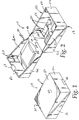
- FIG. 1 is a perspective view of a meal kit packaging system according to principles of the present invention;
- FIG. 2 shows the meal kit package in an opened position;
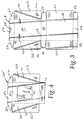
- FIG. 3 is a plan view of a single piece carton blank for the meal kit system;
- FIGS. 4 and 5 show carton blanks which, when folded and combined together, result in the package for the meal kit system of FIGS. 1 and 2;
- FIG. 6 is a plan view of a blank for an alternative carton for use with the meal kit system;
- FIG. 7 shows a meal kit system with a carton constructed from the blank of FIG. 6;
- FIGS. 8 and 10 are plan views of cooperating carton blanks;
- FIG. 9 shows the blank of FIGURE 10 folded and assembled;
- FIG. 11 is a perspective view similar to that of FIG. 12 but with the contents of the meal kit system removed;
- FIG. 12 is a perspective view of an alternative meal kit system;
- FIG.13 is a plan view of a carton blank for an alternative carton for a meal kit assembly; and
- FIGS. 14 and 15 are fragmentary perspective views of variations of the carton shown in FIG. 1.
-
- Referring now to the drawings and initially to Figs. 1-3, a meal kit packaging system is generally indicated at 10. The meal kit packaging system includes a
carton 12 which is generally rectilinear and is preferably formed of paperboard material, from a single carton blank 8. Fig. 3 shows the various parts ofcontainer 12 formed from the integral paperboard blank 8, with the dashed lines indicating fold lines, withfold line 24 further serving as a hinge joining a lid member and a base member together, as will be described herein.Carton 12 includes lines of separation in the form of tear strips 70 diagonally arranged along itsend walls 16. Whentear strip 70 is removed fromcarton 12,end walls 16 are divided into two portions, anupper portion 16a and a lower portion 16b. A perforated line or other line of weakness could also be used in place of the tear strip, if desired. - Referring to Figure 2, the
carton 12 is shown in an opened position with an upper tray module or lid member generally indicated at 20, hingedly joined to a lower tray module orbase member 22 along thehinge line 24. Preferably,hinge line 24 is weakened so as to be selectably separable by the user, if desired. If thehinge line 24 is left intact, as illustrated in Fig. 2,carton 12 is reclosable by the user, allowing continued storage ofvarious food items 30 and abeverage item 32.Beverage item 32 is shown in the form of a soft package or liquid-type pouch, but could also comprise an aluminum can or other conventional beverage container. - Preferably, the
food items 30 are provided in separate, independent packages. Due to shipping constraints placed on commercially competitive meal kits, it is generally preferred that the packaging systems for theindividual food items 30 are compact and light weight and are not capable of optimal crush resistance. Accordingly, fragile and deformable food items are rendered susceptible to damage with applied pressure from heavier components of the meal kit, such as thebeverage item 32. Accordingly, it is preferred that the various food items of the meal kit are arranged so as to isolate heavy items from deformable or crushable items. It is further preferred that the isolation of heavy and soft or crushable food items be provided with a minimum of additional paperboard material, such as dividers located internally withincontainer 12. It is most preferred that the heavy and crushable items be separated through the use of adhesives. As illustrated in Fig. 2,beverage item 32 is held in place onlid member 20 by a suitable adhesive. Accordingly,lid member 20 supports the weight ofbeverage container 32, thereby avoiding the need to subjectfood items 30 to this weight. - Turning again to Fig. 2, the
lid member 20 ofcarton 12 includes an upper support orlid wall 40, surrounded by upstanding containment walls which include afront wall 42 andend wall portions 16a.Lid member 20 has the stiffness and strength to function as a tray for food preparation and serving. Efficient use of the preferred integral blank allowslid member 20 to retain its properties as a self-supporting tray whether it is left joined to thebottom portion 22 or it is separated for independent use. -
Base member 22 includes a lower,bottom wall 46, front andrear walls walls 52. The partial end walls 16b are originally provided as part of thelid member 20 and after removal of tear strips 70 remain joined to endwalls 52 ofbottom member 22 by a suitable adhesive. The preferred carton blank is divided into container walls and flaps or tabs which are secured to the container walls in a manner providing improved strength and rigidity in each container part which functions as an independent, separable tray module. When combined in a reclosable container, strength and rigidity of the tray parts are combined to form the strength and rigidity of theoverall container 12. For example, flaps 56 extend fromfront wall 48 and are secured to endwalls 52, whileflaps 58 extend fromrear wall 50 and are secured to endwalls 52, as shown in Figure 2. Theupper lid member 20 includesflaps 62 which extend fromfront wall 42 and are secured to endwall portions 16a.Upper lid member 20 also includes ahingable tab 66 formed infront wall 42 by lines of weakness, allowing a user to readily obtain a secure finger hold on lid member 20 (see Fig. 1). - If desired, the opened
container 20 shown in Fig. 2 can be separated into independent tray modules by severing alonghinge line 24. The upper tray module comprises the substantial portion oflid member 20, except for end wall portions 16b which remain secured to the second tray module comprised substantially ofbase member 22. Each tray module exhibits the rigidity, stiffness and strength required for stand alone support and containment of food and beverage items that a user may desire. As can be seen for example in Fig. 2, the tray module comprising the substantial portion oflid member 20 includes a major supportingsurface 40 enclosed on three sides byupstanding containment walls - A user may wish to organize the food and beverage items in different groups. With two independent tray modules a user can separate food and beverage items into different categories, such as one category requiring heating and the other category to remain at pre-chilled temperatures. In a kitchen setting, the user may wish to organize items to be heated in a tray module. Further, either tray module can be used for heating of desired food and beverage items in a microwave oven or other heating appliance. For example, the
beverage container 32 may contain a hot cocoa mix to be heated in a microwave oven along with food items such as breakfast rolls, bagels or muffins. - As can be seen in Fig. 2, the tray module formed from the upper lid member has reinforced corners, with
tabs 62 overlyingend wall portion 16a. The remaining tray module, comprised substantially ofbase member 22, includes a major support surface (lower bottom wall 46) bordered by four upstanding containment walls. As can be seen in Fig. 2, the corners of the lower tray module are reinforced bytabs - Turning now to Fig. 14, the lower central portion of Fig. 1 is shown on an enlarged scale. As shown, the leading end 70a of
tear strip 70 has a free end located immediately adjacentfront wall 42. Portions of theend wall 16 are removed adjacent leading end 70a to allow a user an opportunity to grasp a portion of the tear strip before tearing is initiated. Referring to Fig. 15, an alternative arrangement is shown with a shortenedfront wall 42. The arrangement of Fig. 15 allows a user to grasp thelower edge 42a offront wall 42, oncetear strip 70 is removed, to open the container. As a further advantage, it is noted that the leading end 70a oftear strip 70 is exposed to a greater extent, further contributing to the ease with which a user can grasp the tear strip, prior to tearing. As can be seen in Fig. 15, a portion 42b is relieved preventing formation of a corner betweenfront wall 42 andend wall 16. This allows thefront wall 42 to be swung slightly away fromfront wall 48 as the container is opened, preventing inward crushing offront wall 48 which might crush or otherwise disturb fragile food items disposed within the container. - An important feature of
container 12 is its ability to be top-loaded with the various food and beverage items prior to closure. This arrangement allows use of the container in an economical, high speed production line environment, where the food and beverage items are picked and placed as required to meet a particular meal kit composition.Carton 12 could, for example, be transported down an assembly line containing food and beverage items for a number of different meal kit products. After the required food and beverage items are loaded into the carton, the manufacturer lowers lid member 20 (with its lower end portion 16b and tearstrips 70 remaining intact -- see Fig. 3) onto a fully formed base member.Adhesive portion 72 shown in Fig. 3 joins end wall portions 16b to endwalls 52, withcarton 12 thereby being made ready for shipment to a consumer of the meal kit product. - With additional reference to Fig. 3, the layout of container blank 8 further adds to the inherent strength of the container when employed in a reclosable manner. For example, it will be observed that the
front wall 42,upper lid wall 40,rear wall 50,lower bottom wall 46 andfront wall 48 are joined together as a continuous strip of blank material. Further,tabs Container 12 can be completely formed using conventional tray forming equipment. - As a further advantage, the carton formed from blank 8 allows top loading of food and beverage items into the container interior, prior to adhesive joinder of lid and base members by the manufacturer. When loaded by the manufacturer, the
container 12 generally resembles the arrangement shown in Fig. 2, except that lower end wall portions 16b are joined to the upperend wall portions 16a by tear strips 70. If desired,container 12 can be used with cost effective computer-controlled pick and place equipment to select food and beverage items from a large variety located along an automated assembly line. With computerized control,container 12 can be advanced along the assembly line to allow picking and placing of those particular food and beverage items as may be required for a particular meal kit product. In this manner, a number of different meal kit products can be assembled from a common assembly line, for example. When all of the desired items are located in the container, and principally on the major surfaces of the lid wall and bottom wall, the lid member is lowered onto the base member bringingend wall 16 in overlying relationship withend walls 52, being secured thereto with a suitable adhesive. - Turning now to Figs. 4 and 5,
carton 12 can be fabricated from two separate components, a lid member component 20' shown in Fig. 4 and abase member component 22 shown in Fig. 5. Using this arrangement, lid member 20' is formed to include arear wall 78 which overlaysrear wall 50 ofbase member 22, being secured thereto with adhesive portions 80 shown in Fig. 4. An optional window 86 is shown formed inupper lid wall 40. A sheet of translucent or transparent plastic film is secured to the inside surface ofupper lid wall 40 by a suitable adhesive, thereby providing a dust seal for the window opening formed in the upper lid wall. The size and shape of window 86 can vary, as desired. For example, window 86 can be reduced in size and shifted to allow adhesive joinder of a food or beverage item to lid member 20' without obstructing view through the window. - Turning now to Figs. 6-10, a
container 90 includes anupper lid member 92 and alower base member 94.Container 90 is substantially identical tocontainer 12 except for the substitution of a weakened line or line of separation 93, provided in place of tear strips 70. Preferably, all other features are the same as those shown and described above forcarton 12. Fig. 9 showsbase member 94 fully assembled and awaiting joinder withlid member portion 98, shown in Fig. 8. Figure 9 shows optional adhesive portions which may be employed, if desired, to secure food and beverage items to the lower,bottom wall 46. Figures 8 and 10 show an alternative arrangement forcarton 90, in which separate lid member and base member portions are provided. Fig. 8 shows alid member portion 98 including arear wall 102 carrying adhesive 104 for joinder to rearwall 50 ofbase member portion 94 shown in Fig. 10. Other features are the same as those described above forcarton 90, shown in Fig. 7. - Fig. 6 shows the carton blank 91 from which
carton 90 is formed. As can be seen by comparing Figs. 3 and 6, carton blank 91 is substantially identical to carton blank 8 except for the substitution of weakened lines 93, preferably single perforation lines, for the tear strips 70. - Turning now to Figs. 11 and 12, a meal kit is generally indicated at 110 and includes the
carton 112 shown in Fig. 11. Meal kit 110 includes ready-to-eatfood items 114, preferably individually wrapped and placed withincontainer 112 in a desired, pre-determined pattern. Abeverage item 116 is also provided and is shown carried on the upper portion ofcontainer 112, although, as mentioned above, the beverage item could also be obtained in the lower portion of the container. If desired, one or more food items could be carried by the upper portion ofcontainer 112. In the preferred embodiment, food and beverage items are held in place byadhesive portions 118 shown in Fig. 11. - Referring again to Fig. 11,
container 112 includes alid member 120 hingedly joined at 124 to abase member 122. Preferably,container 112 is formed from a unitary paperboard blank withhinge line 124 being provided as a line of weakness formed in the container blank.Lid member 120 includes anupper lid wall 128, a front wall comprising acenter portion 130 andlateral portions 132.Base member 122 includes alower bottom wall 152, endwalls 154, afront wall 156 and a rear wall 158 joined toupper lid wall 128 byhinge line 124. Fig. 11 showscontainer 112 in an opened condition with a line of weakness, comprising either a tear strip or a perforated line, for example, having been severed, allowing thelid member 120 to be opened in the manner shown in Fig. 11. Thelateral portions 132 remain secured tobase member 122 by adhesive, not shown.Lid member 120 further includes endwalls including portions weakness 142 has been severed to allowlid member 120 to be swung open in the manner indicated in Fig. 11. Separation of severingline 142 causes endwall portions 138 to remain secured tobase member 122 by adhesive (not shown). - Preferably,
hinge line 124 is readily separable by the user, when formation of separate, independent tray modules is desired. With separation alonghinge line 124,lid member 120 can be discarded, leavingbase member 122 with the stiffness and strength required to function as an independent tray. Food and beverage items from the meal kit can then be arranged in the base member, as desired. Alternatively,hinge line 124 can be left intact, thereby allowingcontainer 112 to be re-closed so as to allow subsequent storage of the food and beverage items, as desired. As will now be appreciated, with reclosure,container 112 retains its original stacking strength withupper lid wall 128 coming into contact with the upper edges ofbase member 122, and with thebase member 122, and with thebase member 122 retaining its reinforced corner construction. - Turning now to Fig. 13, a carton blank 170 is shown, for an alternative meal kit container, according to principles of the present invention. As can be seen upon comparison with Fig. 6, container blank 170 bears resemblance to container blank 91, except for the omission of diagonal lines of weakness in
end wall 16 and the addition of an extra, closure wall 174 joined to front wall 4 of the base member. Closure wall 174 includesportions 176, 178 joined together by atear strip 182. Closure wall 174 is secured byadhesive portion 184 to a front edge portion oflid member 46. With removal oftear strip 182, a user is allowed to gain access to the interior of the container and to the food and beverage items located therein. Unlike the preceding embodiments, overlying end walls of the upper lid member and lower base member are not secured together with adhesive, nor are the overlyingfront walls tear strip 182 the lid member is allowed to be swung away from the base member, with flexure abouthinge line 192. - As can be seen from the above, meal kit packaging systems according to principles of the present invention provide an attractive, cost effective delivery of ready-to-eat food items and beverages for use in outdoor work sites and natural settings as well as kitchens and dining rooms. The package system provides separable tray modules suitable for food preparation as well as meal servings. Alternatively, the packaging system can be left intact, once opened, so as to be reclosable for storage, awaiting a subsequent meal serving when desired by the user. Further, as indicated above, packaging systems for meal kits, according to principles of the present invention, provide advantages to meal kit manufacturers by improving automated assembly of meal kits in a high speed production environment.
- The drawings and the foregoing descriptions are not intended to represent the only forms of the invention in regard to the details of its construction and manner of operation. Changes in form and in the proportion of parts, as well as the substitution of equivalents, are contemplated as circumstances may suggest or render expedient; and although specific terms have been employed, they are intended in a generic and descriptive sense only and not for the purposes of limitation, the scope of the invention being delineated by the following claims.
Claims (15)
- A meal kit packaging system for ready-to-eat food and beverage items (30, 32; -, -; -, 32; -, -; 114, 116; -, -), comprising:a container (12; -; 90; 90; 112; -) having first and second parts (20, 22; 20', 22; 92, 94; 92, 94; 120, 122; -, -) joined together by a hinge (24; -; 24; -; 124; 192);at least one line of separation (70; 70; 93; -; -, 142; 182) dividing the container (12; -; 90; 90; 112; -) into said first and said second parts (20, 22; 20', 22; 92, 94; 92, 94; 120, 122; -, -), with one container part (20; 20'; 92; 92; 120; -) to be hingedly movable toward and away from the other container part (22; 22; 94; 94; 122; -) so as to render the container (12; -; 90; 90; 112; -) reclosable;the first and second parts (20, 22; 20', 22; 92, 94; 92, 94; 120, 133; -, -) of the container (12; -; 90; 90; 112; -) each having a support wall (40, 46; 40, 46; 40, 46; 40, 46; 128, 152; 40, 46) at least partly surrounded by containment walls (42, 16, 48, 52; 42, 16, 48, 52; 42, 16, 48, 52; 42, 16, 48, 52; 42, 16, 48, 52; 130 & 132, 136, 154, 156, 158; 42, 16, 48, 52) upstanding from the support wall (40, 46; 40, 46; 40, 46; 40, 46; 128, 152; 40, 46) andthe first and second parts (20, 22; 20', 22; 98, 94; 98, 94; 98, 94; 120, 122; -, -) having sufficient strength and stiffness to function as tray modules for food preparation and serving.
- A meal kit packaging system according to claim 1, wherein the containment walls (42, 16, 48, 52; 42, 16, 48, 52; 42, 16, 48, 52; 42, 16, 48, 52; 130, 132, 136, 138, 154, 156, 158) of the packaging system include rectangular end walls (16, 52; 16, 52; 16, 52; 16, 52; 136, 154) and the line of separation (70; 70; 93; -; 142) extends in a generally diagonal direction.
- A meal kit packaging system according to claim 1 or claim 2, wherein said container (12; -; 90; 90; 112; -) has an interior surface, said ready-to-eat food and beverage items (30, 32; -, -; -, 32; -, -; 114, 116; -, -) are disposed within the container (12; -; 90; 90; 112; -) with at least some of the food and beverage items (30, 32; -, -; -, 32; -, -; 114, 116; -, -) secured to the interior surface of said container (12; -; 90; 90; 112; -) with individual securements (-; -; -; -; 118; -) to provide mechanical isolation of at least some of the food and beverage items (30, 32; -, -; -, 32; -, -; 114, 116; -, -) from one another.
- A meal kit packaging system according to claim 3, wherein said individual securements comprise portions of adhesive (-; -; -; -, 118; -).
- A meal kit packaging system according to any one of claims 1 to 4, wherein the line of separation comprises a line of weakness (93).
- A meal kit packaging system according to any one of claims 1 to 4, wherein the line of separation comprises a tear strip (70; 182).
- A meal kit packaging system according to any one of claims 1 to 6, wherein:the support walls (40, 46; 40, 46; 40, 46; 40, 46; 128, 152) of the first and second parts (20, 22; 20', 22; 92, 94; 92, 94; 120, 122) of the container (12; -; 90; 90; 112) comprise an upper lid wall (40; 40; 40; 40; 128) and a lower bottom wall (46; 46; 46; 46; 152), respectively;the container (12; -; 90; 90; 112) further comprises end walls (16; 16; 16; 16; 128) located between said upper lid wall (40; 40; 40; 40; 128) and said lower bottom wall (46; 46; 46; 46; 152); andsaid line of separation (70; 70; 93; -; -) divides each end wall (16; 16; 16; 16; 136) into two portions (16a, 16b; 16a, 16b; 16a, 16b; 16a, 16b; 136, 138) associated with respective ones of said first and second parts (20, 22; 20', 22; 92, 94; 92, 94; 120, 122).
- A meal kit packaging system according to claim 7, wherein portions (132) of the front wall (130 & 132) carried by the first container part (120) remain attached to the second container part (122) to reinforce corners of the second container part (122) after separation along said at least one line of separation (134).
- A meal kit packaging system according to claim 7 or claim 8, wherein at least one of the end walls is generally rectangular and said at least one line of separations (70; 70; 93; -; -) extends diagonally across said at least one end wall (16; 16; 16; 16; 136).
- A meal kit packaging system according to any one of claims 1 to 6, wherein:the support walls (130 & 132, 136, 154, 156) of the first and second parts (120, 122) of the container (112) comprise an upper lid wall (128) and a lower bottom wall (152), respectively;the container (112) further comprises end walls (136, 154) located between said upper lid wall (128) and said lower bottom wall (152);the container (112) further includes a rear wall (158) and a pair of overlying front walls (130 & 132, 156) carried by said first and second parts (120, 122) of the container (112) so as to be located between said upper lid wall (128) and said lower bottom wall (152) respectively; andsaid line of separation (134) extends through the front wall (130 & 132) carried by the first tray module (120).
- A meal kit packaging system according to any one of claims 1 to 10, wherein the container is formed from a unitary one-piece blank (8; 91; 170).
- A meal kit packaging system according to claim 11, wherein:the first and second parts (20, 22; 92, 94; 120, 122) are joined together by a selectably separable hinge (24; 24; 124);the at least one line of separation (70; 93; 142) extends from said hinge (24; 24; 124) to divide the container (12; 90; 112) into said first and said second parts (20, 22; 92, 94; 120, 122); andthe first and second parts (20, 22; 92, 94; 120, 122) of the container (12; 90; 112), when separated from one another, have sufficient strength and stiffness to function as tray modules for food preparation and serving.
- A meal kit packaging system according to any one of claims 1 to 10, wherein the container is formed from two unitary one-piece blanks (20', 22; 98, 94) joined together.
- A meal kit packaging system according to any one of claims 1 to 13, wherein the container (12; -; 90; 90; 112; -) is rectilinear.
- A meal kit packaging system according to any one of claims 1 to 14, wherein the first container part (20', 22) includes a window (86) through which contents of the container interior may be viewed.
Applications Claiming Priority (2)
| Application Number | Priority Date | Filing Date | Title |
|---|---|---|---|
| US656157 | 2000-09-06 | ||
| US09/656,157 US6575299B1 (en) | 2000-09-06 | 2000-09-06 | Meal kit packaging system |
Publications (2)
| Publication Number | Publication Date |
|---|---|
| EP1186541A1 true EP1186541A1 (en) | 2002-03-13 |
| EP1186541B1 EP1186541B1 (en) | 2005-03-16 |
Family
ID=24631879
Family Applications (1)
| Application Number | Title | Priority Date | Filing Date |
|---|---|---|---|
| EP01307569A Expired - Lifetime EP1186541B1 (en) | 2000-09-06 | 2001-09-06 | Meal kit packaging system |
Country Status (6)
| Country | Link |
|---|---|
| US (2) | US6575299B1 (en) |
| EP (1) | EP1186541B1 (en) |
| AT (1) | ATE290983T1 (en) |
| CA (1) | CA2356735A1 (en) |
| DE (1) | DE60109375D1 (en) |
| MX (1) | MXPA01009016A (en) |
Cited By (1)
| Publication number | Priority date | Publication date | Assignee | Title |
|---|---|---|---|---|
| WO2005016788A1 (en) * | 2003-08-19 | 2005-02-24 | Unilever N.V. | Kit containing meal components |
Families Citing this family (50)
| Publication number | Priority date | Publication date | Assignee | Title |
|---|---|---|---|---|
| US6575299B1 (en) * | 2000-09-06 | 2003-06-10 | Kraft Foods Holdings, Inc. | Meal kit packaging system |
| US20030234599A1 (en) * | 2002-06-21 | 2003-12-25 | Dunn Gary D. | Weather resistant document case with rolled document compartment and cover prop |
| US20040232026A1 (en) * | 2003-03-13 | 2004-11-25 | Goeking Harold J. | Microwaveable food storage container with freshness indicator and steam vent |
| US20050040051A1 (en) * | 2003-06-04 | 2005-02-24 | Martin Christine M. | Method and kit for teaching home cooking, food and wine pairing, and entertaining |
| JP4369770B2 (en) * | 2003-06-16 | 2009-11-25 | 株式会社秀英 | Paper container |
| US7886924B2 (en) | 2003-11-05 | 2011-02-15 | By The Glass, Llc | Wine glass |
| US20050109642A1 (en) * | 2003-11-25 | 2005-05-26 | Karen Lawhorn Huff | Qwiki-Pak |
| US7568611B2 (en) * | 2004-04-30 | 2009-08-04 | Meadwestvaco Packaging Systems, Llc | Carton having stacking strength-enhancing feature |
| US20050281921A1 (en) * | 2004-06-18 | 2005-12-22 | Kraft Foods Holdings, Inc. | Multiple-option meal kit |
| US20100092108A1 (en) * | 2004-10-26 | 2010-04-15 | Crystal Figlietti | Eco-friendly food container |
| ES2321324T3 (en) | 2004-11-05 | 2009-06-04 | Meadwestvaco Packaging Systems Llc | PROCEDURE AND EQUIPMENT TO BUILD A BOX OF CARTON. |
| US8623437B2 (en) * | 2005-11-23 | 2014-01-07 | Little Caesar Enterprises, Inc. | Combination breadsticks and pizza product |
| US8820621B2 (en) | 2006-03-27 | 2014-09-02 | Graphic Packaging International, Inc. | Blank and methods of constructing a food holder from the blank |
| US20080245829A1 (en) * | 2007-04-05 | 2008-10-09 | Del Monte Foods Incorporated | Backpack meal container systems and methods |
| EP2195578B1 (en) * | 2007-10-03 | 2014-09-24 | Graphic Packaging International, Inc. | Microwave heating sleeve |
| CA2643470A1 (en) * | 2007-11-07 | 2009-05-07 | Laurent Laboise | Customizable food kit with customized multimedia instructions |
| US20090181134A1 (en) * | 2008-01-10 | 2009-07-16 | Sallyann Hayden Lefevre | Keepsake cake kit |
| US20090181131A1 (en) * | 2008-01-11 | 2009-07-16 | Forbes-Roberts Victoria D | Meal preparation system and methods |
| JP5422893B2 (en) * | 2008-02-12 | 2014-02-19 | 大日本印刷株式会社 | carton |
| EP2150091B1 (en) * | 2008-07-31 | 2012-06-27 | Graphic Packaging International, Inc. | Microwave heating apparatus |
| US20110024413A1 (en) * | 2008-09-17 | 2011-02-03 | Cole Lorin R | Construct for Browning and Crisping a Food Item in a Microwave Oven |
| JP5496207B2 (en) * | 2008-09-17 | 2014-05-21 | グラフィック パッケージング インターナショナル インコーポレイテッド | Structure for baking and crunching food in a microwave oven |
| US20100078467A1 (en) * | 2008-10-01 | 2010-04-01 | Steve Mortimore | Product container |
| GB0821509D0 (en) * | 2008-11-25 | 2008-12-31 | Cadbury Uk Ltd | Product mounting sheet |
| US20100196555A1 (en) * | 2009-01-30 | 2010-08-05 | Elizabeth Guidobono | Kit for making a non-frozen dessert and a method of assembly |
| US20100237068A1 (en) * | 2009-03-17 | 2010-09-23 | Rubbermaid Incorporated | Container With In-Molded Exposed Panel |
| USD643747S1 (en) | 2010-04-12 | 2011-08-23 | On Food Inc. | Container for food items |
| US20120022913A1 (en) * | 2010-07-20 | 2012-01-26 | Target Brands, Inc. | Planogram Generation for Peg and Shelf Items |
| WO2014067658A1 (en) | 2012-10-31 | 2014-05-08 | Philip Morris Products S.A. | Container with removeable portion |
| US10220982B2 (en) | 2013-02-12 | 2019-03-05 | Luft Industrie Inc. | Food pouch |
| USD747186S1 (en) * | 2013-03-15 | 2016-01-12 | Medline Industries, Inc. | Tear-away package |
| EP3003903B1 (en) * | 2013-06-03 | 2019-09-18 | Graphic Packaging International, LLC | Container with window and microwave energy interactive material |
| USD848830S1 (en) * | 2016-02-06 | 2019-05-21 | Harry P. Nouhan, JR. | Box structure |
| USD832696S1 (en) * | 2016-04-13 | 2018-11-06 | Parker Square, Inc. | Jewelry box |
| USD838165S1 (en) * | 2017-01-31 | 2019-01-15 | Kaethe Kruse Gmbh | Packaging |
| US20190124962A1 (en) * | 2017-10-26 | 2019-05-02 | The Paget Group, Inc. | Raw, frozen ground beef (and/or other meat), method for making same, and packaging for displaying same |
| US11252981B1 (en) | 2017-10-26 | 2022-02-22 | Swift Beef Company | Raw, frozen ground beef (and/or other meat), method for making same, and packaging for displaying same |
| US11377255B2 (en) * | 2018-04-09 | 2022-07-05 | Colgate-Palmolive Company | Packaged set of articles and method of loading packages onto a support member |
| US20190344924A1 (en) * | 2018-05-08 | 2019-11-14 | Delkor Systems, Inc. | Product Engagement Packaging System and Display |
| USD885884S1 (en) * | 2018-05-10 | 2020-06-02 | Reckitt Benckiser Health Limited | Box |
| USD885885S1 (en) * | 2018-05-10 | 2020-06-02 | Reckitt Benckiser Health Limited | Box |
| USD863954S1 (en) * | 2018-08-23 | 2019-10-22 | JL Trust | Glassware box |
| USD936474S1 (en) * | 2020-01-03 | 2021-11-23 | lOSUE ASSOCIATES, INC. | Gift card box |
| CA236826S (en) * | 2021-04-15 | 2025-01-21 | Nicoventures Trading Ltd | Packaging lid |
| USD1004425S1 (en) * | 2021-10-15 | 2023-11-14 | Nicoventures Trading Limited | Packaging box |
| DK181716B1 (en) * | 2022-08-19 | 2024-10-31 | Vkr Holding As | A packed roof window product and a method for packing a roof window product |
| DE202022104856U1 (en) | 2022-08-29 | 2024-01-11 | Gpi Frankfurt & Augsburg Gmbh | Folding box with click tabs |
| AU2023379486A1 (en) * | 2022-11-16 | 2025-05-01 | Graphic Packaging International, Llc | Carton with locking features, related systems and methods |
| AU2024377633A1 (en) * | 2023-11-08 | 2026-04-16 | Graphic Packaging International, Llc | Carton with locking features |
| USD1100654S1 (en) | 2023-11-14 | 2025-11-04 | Graphic Packaging International, Llc | Carton |
Citations (6)
| Publication number | Priority date | Publication date | Assignee | Title |
|---|---|---|---|---|
| US3323643A (en) * | 1965-09-23 | 1967-06-06 | Acr Electronics Corp | Package and the method for making same |
| FR2596730A2 (en) * | 1985-11-08 | 1987-10-09 | Nicollet Hugues Sa | Parallelepipedal packaging for a product in portions, and corresponding blanks |
| US4919785A (en) * | 1988-04-28 | 1990-04-24 | Kraft General Foods, Inc. | Microwave carton |
| US4946094A (en) * | 1988-09-20 | 1990-08-07 | Stang Michael Andrew | Container system |
| US5105971A (en) * | 1991-09-17 | 1992-04-21 | American Packaging Corporation | Carton |
| FR2783811A1 (en) * | 1998-09-28 | 2000-03-31 | Sodiaal International Societe | Packaging box for food products comprises hinged cover fitting over side walls and includes tamper evident feature using flaps with preformed cut lines. |
Family Cites Families (26)
| Publication number | Priority date | Publication date | Assignee | Title |
|---|---|---|---|---|
| USRE26471E (en) | 1968-10-01 | Tamperproof reclosable carton | ||
| US1311049A (en) | 1919-07-22 | Evapobatdstg-pakt | ||
| US2744624A (en) | 1954-11-12 | 1956-05-08 | Norton Co | Packaging device |
| US3144191A (en) * | 1961-10-06 | 1964-08-11 | Integral Packaging Company | Reclosable carton |
| GB1018420A (en) * | 1962-09-22 | 1966-01-26 | Cartotecnica Poligrafica A & G | Airtight box and a blank of cardboard or the like for making said box |
| US3246829A (en) | 1962-12-28 | 1966-04-19 | Int Paper Co | Foldable boxes with interlocking cover structure |
| US3167181A (en) | 1963-06-10 | 1965-01-26 | Matmakers Inc | Packaging and storing of dealer-aid advertising newspaper mats |
| US3240419A (en) * | 1964-09-15 | 1966-03-15 | American Can Co | Carton with integral tear-strip sealing means |
| US3310222A (en) * | 1965-04-27 | 1967-03-21 | Brown Co | Recloseable tear strip carton having cover lock |
| US3374884A (en) * | 1967-04-13 | 1968-03-26 | Chinkes Sam | Display package |
| US3389784A (en) | 1967-10-20 | 1968-06-25 | Rocket Jet Engineering Corp | Package kit |
| US3976241A (en) | 1974-03-20 | 1976-08-24 | Bemiss Robert P | Method of forming, filling and closing cartons, and specific cartons therefor |
| US3981434A (en) * | 1975-04-10 | 1976-09-21 | American Can Company | Easy opening carton for frozen comestible |
| US4083455A (en) | 1977-03-16 | 1978-04-11 | Universal Folding Box Co., Inc. | Reclosable carton and blank therefor |
| DE2922507C2 (en) | 1979-05-31 | 1982-04-22 | Rudolf 1000 Berlin Fitzke | Civil protection pack |
| US4325482A (en) * | 1980-11-20 | 1982-04-20 | The Procter & Gamble Company | Flip top, reclosable carton |
| US4553666A (en) * | 1985-02-04 | 1985-11-19 | Owens-Illinois, Inc. | Shipping and display carton with cut protection for contents |
| US4702378A (en) | 1986-09-30 | 1987-10-27 | Henry Finkel | Sanitary, disposable baby change kit |
| FR2622544B1 (en) * | 1987-11-04 | 1990-03-09 | Lapoule Patrick | COMPOSITE BOX |
| US5060852A (en) * | 1990-03-08 | 1991-10-29 | Package Products, Inc. | Windowed boxes, blanks for making the same and associated method |
| US5097958A (en) * | 1990-10-19 | 1992-03-24 | Somerville Packaging, A Division Of Paperboard Industries | Carton and blank and method of forming the carton from a blank |
| US5358176A (en) * | 1994-05-05 | 1994-10-25 | Westvaco Corporation | Tear strip opening for a paperboard container |
| GB9420338D0 (en) * | 1994-10-08 | 1994-11-23 | Emi Compact Disc Holland Bv | Packaging for consumer goods |
| US6257403B1 (en) * | 2000-02-08 | 2001-07-10 | Kraft Foods, Inc. | Packaging system for meal kit |
| USD472463S1 (en) * | 2000-08-30 | 2003-04-01 | Kraft Foods Holdings, Inc. | Container for food products |
| US6575299B1 (en) * | 2000-09-06 | 2003-06-10 | Kraft Foods Holdings, Inc. | Meal kit packaging system |
-
2000
- 2000-09-06 US US09/656,157 patent/US6575299B1/en not_active Expired - Fee Related
-
2001
- 2001-09-05 CA CA002356735A patent/CA2356735A1/en not_active Abandoned
- 2001-09-06 AT AT01307569T patent/ATE290983T1/en not_active IP Right Cessation
- 2001-09-06 DE DE60109375T patent/DE60109375D1/en not_active Expired - Lifetime
- 2001-09-06 EP EP01307569A patent/EP1186541B1/en not_active Expired - Lifetime
- 2001-09-06 MX MXPA01009016A patent/MXPA01009016A/en active IP Right Grant
-
2003
- 2003-05-19 US US10/440,618 patent/US7097038B2/en not_active Expired - Fee Related
Patent Citations (6)
| Publication number | Priority date | Publication date | Assignee | Title |
|---|---|---|---|---|
| US3323643A (en) * | 1965-09-23 | 1967-06-06 | Acr Electronics Corp | Package and the method for making same |
| FR2596730A2 (en) * | 1985-11-08 | 1987-10-09 | Nicollet Hugues Sa | Parallelepipedal packaging for a product in portions, and corresponding blanks |
| US4919785A (en) * | 1988-04-28 | 1990-04-24 | Kraft General Foods, Inc. | Microwave carton |
| US4946094A (en) * | 1988-09-20 | 1990-08-07 | Stang Michael Andrew | Container system |
| US5105971A (en) * | 1991-09-17 | 1992-04-21 | American Packaging Corporation | Carton |
| FR2783811A1 (en) * | 1998-09-28 | 2000-03-31 | Sodiaal International Societe | Packaging box for food products comprises hinged cover fitting over side walls and includes tamper evident feature using flaps with preformed cut lines. |
Cited By (1)
| Publication number | Priority date | Publication date | Assignee | Title |
|---|---|---|---|---|
| WO2005016788A1 (en) * | 2003-08-19 | 2005-02-24 | Unilever N.V. | Kit containing meal components |
Also Published As
| Publication number | Publication date |
|---|---|
| US20030213722A1 (en) | 2003-11-20 |
| US7097038B2 (en) | 2006-08-29 |
| ATE290983T1 (en) | 2005-04-15 |
| MXPA01009016A (en) | 2005-06-30 |
| CA2356735A1 (en) | 2002-03-06 |
| US6575299B1 (en) | 2003-06-10 |
| EP1186541B1 (en) | 2005-03-16 |
| DE60109375D1 (en) | 2005-04-21 |
Similar Documents
| Publication | Publication Date | Title |
|---|---|---|
| EP1186541B1 (en) | Meal kit packaging system | |
| US8492688B2 (en) | Meal kit and cooking tray | |
| US3964669A (en) | Composite wrapper combining rigid and flexible elements | |
| US8607986B2 (en) | Wraparound packaging sleeve with stand-up feature | |
| EP2675716B1 (en) | Dividable tray and method for making same | |
| US20020109004A1 (en) | Flip-top package for shipping and display of a multi-component meal kit | |
| EP0420429A1 (en) | Compact package for food product | |
| US5148972A (en) | Fast food container | |
| US20120160735A1 (en) | Two-Piece Shipping Container With Frangible Overlapping Glued Retainer Areas | |
| US6892513B1 (en) | Method of forming and filling an end load carton with a food delivery system | |
| PL198830B1 (en) | Set of articles of food | |
| US6257403B1 (en) | Packaging system for meal kit | |
| US20250033826A1 (en) | Container With Denesting Features | |
| EP1755964A1 (en) | Reclosable carton | |
| WO2021102102A1 (en) | Container with liner | |
| US20130129883A1 (en) | Packaging and Process for Cooking Food Products in an Oven | |
| US20190193914A1 (en) | Food container with integrated condiment holder | |
| US12054323B2 (en) | Multi-unit stackable display with shelf-ready packaging | |
| EP0500318A1 (en) | Food package having opposed compartmentalized trays | |
| WO2025081329A1 (en) | Disposable container and packaging system for molten food product | |
| US20060208049A1 (en) | Dual compartment container | |
| US20060172045A1 (en) | Peelable handheld food container | |
| CA2308558A1 (en) | Packaging system for meal kit | |
| CA2323411A1 (en) | Packaging including food delivery system | |
| CA2323415A1 (en) | Side-load carton packaging including food delivery system |
Legal Events
| Date | Code | Title | Description |
|---|---|---|---|
| PUAI | Public reference made under article 153(3) epc to a published international application that has entered the european phase |
Free format text: ORIGINAL CODE: 0009012 |
|
| 17P | Request for examination filed |
Effective date: 20010920 |
|
| AK | Designated contracting states |
Kind code of ref document: A1 Designated state(s): AT BE CH CY DE DK ES FI FR GB GR IE IT LI LU MC NL PT SE TR |
|
| AX | Request for extension of the european patent |
Free format text: AL;LT;LV;MK;RO;SI |
|
| AKX | Designation fees paid |
Free format text: AT BE CH CY DE DK ES FI FR GB GR IE IT LI LU MC NL PT SE TR |
|
| 17Q | First examination report despatched |
Effective date: 20021218 |
|
| GRAP | Despatch of communication of intention to grant a patent |
Free format text: ORIGINAL CODE: EPIDOSNIGR1 |
|
| GRAS | Grant fee paid |
Free format text: ORIGINAL CODE: EPIDOSNIGR3 |
|
| GRAA | (expected) grant |
Free format text: ORIGINAL CODE: 0009210 |
|
| AK | Designated contracting states |
Kind code of ref document: B1 Designated state(s): AT BE CH CY DE DK ES FI FR GB GR IE IT LI LU MC NL PT SE TR |
|
| PG25 | Lapsed in a contracting state [announced via postgrant information from national office to epo] |
Ref country code: IT Free format text: LAPSE BECAUSE OF FAILURE TO SUBMIT A TRANSLATION OF THE DESCRIPTION OR TO PAY THE FEE WITHIN THE PRESCRIBED TIME-LIMIT;WARNING: LAPSES OF ITALIAN PATENTS WITH EFFECTIVE DATE BEFORE 2007 MAY HAVE OCCURRED AT ANY TIME BEFORE 2007. THE CORRECT EFFECTIVE DATE MAY BE DIFFERENT FROM THE ONE RECORDED. Effective date: 20050316 Ref country code: LI Free format text: LAPSE BECAUSE OF FAILURE TO SUBMIT A TRANSLATION OF THE DESCRIPTION OR TO PAY THE FEE WITHIN THE PRESCRIBED TIME-LIMIT Effective date: 20050316 Ref country code: NL Free format text: LAPSE BECAUSE OF FAILURE TO SUBMIT A TRANSLATION OF THE DESCRIPTION OR TO PAY THE FEE WITHIN THE PRESCRIBED TIME-LIMIT Effective date: 20050316 Ref country code: AT Free format text: LAPSE BECAUSE OF FAILURE TO SUBMIT A TRANSLATION OF THE DESCRIPTION OR TO PAY THE FEE WITHIN THE PRESCRIBED TIME-LIMIT Effective date: 20050316 Ref country code: FI Free format text: LAPSE BECAUSE OF FAILURE TO SUBMIT A TRANSLATION OF THE DESCRIPTION OR TO PAY THE FEE WITHIN THE PRESCRIBED TIME-LIMIT Effective date: 20050316 Ref country code: TR Free format text: LAPSE BECAUSE OF FAILURE TO SUBMIT A TRANSLATION OF THE DESCRIPTION OR TO PAY THE FEE WITHIN THE PRESCRIBED TIME-LIMIT Effective date: 20050316 Ref country code: CH Free format text: LAPSE BECAUSE OF FAILURE TO SUBMIT A TRANSLATION OF THE DESCRIPTION OR TO PAY THE FEE WITHIN THE PRESCRIBED TIME-LIMIT Effective date: 20050316 Ref country code: BE Free format text: LAPSE BECAUSE OF FAILURE TO SUBMIT A TRANSLATION OF THE DESCRIPTION OR TO PAY THE FEE WITHIN THE PRESCRIBED TIME-LIMIT Effective date: 20050316 |
|
| REG | Reference to a national code |
Ref country code: GB Ref legal event code: FG4D |
|
| REG | Reference to a national code |
Ref country code: CH Ref legal event code: EP |
|
| REG | Reference to a national code |
Ref country code: IE Ref legal event code: FG4D |
|
| REF | Corresponds to: |
Ref document number: 60109375 Country of ref document: DE Date of ref document: 20050421 Kind code of ref document: P |
|
| PG25 | Lapsed in a contracting state [announced via postgrant information from national office to epo] |
Ref country code: GR Free format text: LAPSE BECAUSE OF FAILURE TO SUBMIT A TRANSLATION OF THE DESCRIPTION OR TO PAY THE FEE WITHIN THE PRESCRIBED TIME-LIMIT Effective date: 20050616 Ref country code: DK Free format text: LAPSE BECAUSE OF FAILURE TO SUBMIT A TRANSLATION OF THE DESCRIPTION OR TO PAY THE FEE WITHIN THE PRESCRIBED TIME-LIMIT Effective date: 20050616 |
|
| PG25 | Lapsed in a contracting state [announced via postgrant information from national office to epo] |
Ref country code: DE Free format text: LAPSE BECAUSE OF FAILURE TO SUBMIT A TRANSLATION OF THE DESCRIPTION OR TO PAY THE FEE WITHIN THE PRESCRIBED TIME-LIMIT Effective date: 20050617 |
|
| PG25 | Lapsed in a contracting state [announced via postgrant information from national office to epo] |
Ref country code: ES Free format text: LAPSE BECAUSE OF FAILURE TO SUBMIT A TRANSLATION OF THE DESCRIPTION OR TO PAY THE FEE WITHIN THE PRESCRIBED TIME-LIMIT Effective date: 20050627 |
|
| PGFP | Annual fee paid to national office [announced via postgrant information from national office to epo] |
Ref country code: MC Payment date: 20050819 Year of fee payment: 5 |
|
| PGFP | Annual fee paid to national office [announced via postgrant information from national office to epo] |
Ref country code: GB Payment date: 20050831 Year of fee payment: 5 |
|
| NLV1 | Nl: lapsed or annulled due to failure to fulfill the requirements of art. 29p and 29m of the patents act | ||
| PG25 | Lapsed in a contracting state [announced via postgrant information from national office to epo] |
Ref country code: CY Free format text: LAPSE BECAUSE OF FAILURE TO SUBMIT A TRANSLATION OF THE DESCRIPTION OR TO PAY THE FEE WITHIN THE PRESCRIBED TIME-LIMIT Effective date: 20050906 |
|
| PG25 | Lapsed in a contracting state [announced via postgrant information from national office to epo] |
Ref country code: PT Free format text: LAPSE BECAUSE OF FAILURE TO SUBMIT A TRANSLATION OF THE DESCRIPTION OR TO PAY THE FEE WITHIN THE PRESCRIBED TIME-LIMIT Effective date: 20050907 |
|
| PGFP | Annual fee paid to national office [announced via postgrant information from national office to epo] |
Ref country code: IE Payment date: 20050920 Year of fee payment: 5 |
|
| REG | Reference to a national code |
Ref country code: CH Ref legal event code: PL |
|
| PGFP | Annual fee paid to national office [announced via postgrant information from national office to epo] |
Ref country code: LU Payment date: 20051004 Year of fee payment: 5 |
|
| PLBE | No opposition filed within time limit |
Free format text: ORIGINAL CODE: 0009261 |
|
| STAA | Information on the status of an ep patent application or granted ep patent |
Free format text: STATUS: NO OPPOSITION FILED WITHIN TIME LIMIT |
|
| 26N | No opposition filed |
Effective date: 20051219 |
|
| EN | Fr: translation not filed | ||
| PG25 | Lapsed in a contracting state [announced via postgrant information from national office to epo] |
Ref country code: IE Free format text: LAPSE BECAUSE OF NON-PAYMENT OF DUE FEES Effective date: 20060906 |
|
| PG25 | Lapsed in a contracting state [announced via postgrant information from national office to epo] |
Ref country code: MC Free format text: LAPSE BECAUSE OF NON-PAYMENT OF DUE FEES Effective date: 20060930 |
|
| GBPC | Gb: european patent ceased through non-payment of renewal fee |
Effective date: 20060906 |
|
| REG | Reference to a national code |
Ref country code: IE Ref legal event code: MM4A |
|
| PG25 | Lapsed in a contracting state [announced via postgrant information from national office to epo] |
Ref country code: GB Free format text: LAPSE BECAUSE OF NON-PAYMENT OF DUE FEES Effective date: 20060906 |
|
| PG25 | Lapsed in a contracting state [announced via postgrant information from national office to epo] |
Ref country code: SE Free format text: LAPSE BECAUSE OF FAILURE TO SUBMIT A TRANSLATION OF THE DESCRIPTION OR TO PAY THE FEE WITHIN THE PRESCRIBED TIME-LIMIT Effective date: 20050616 |
|
| PG25 | Lapsed in a contracting state [announced via postgrant information from national office to epo] |
Ref country code: LU Free format text: LAPSE BECAUSE OF NON-PAYMENT OF DUE FEES Effective date: 20060906 |
|
| PGFP | Annual fee paid to national office [announced via postgrant information from national office to epo] |
Ref country code: FR Payment date: 20070930 Year of fee payment: 7 |
|
| PG25 | Lapsed in a contracting state [announced via postgrant information from national office to epo] |
Ref country code: FR Free format text: LAPSE BECAUSE OF NON-PAYMENT OF DUE FEES Effective date: 20080929 |