EP1185669B1 - Promoteur permettant l'expression de transgenes dans toute la plante hormis dans la graine - Google Patents
Promoteur permettant l'expression de transgenes dans toute la plante hormis dans la graine Download PDFInfo
- Publication number
- EP1185669B1 EP1185669B1 EP00940461A EP00940461A EP1185669B1 EP 1185669 B1 EP1185669 B1 EP 1185669B1 EP 00940461 A EP00940461 A EP 00940461A EP 00940461 A EP00940461 A EP 00940461A EP 1185669 B1 EP1185669 B1 EP 1185669B1
- Authority
- EP
- European Patent Office
- Prior art keywords
- sequence
- plant
- gene
- promoter
- protein
- Prior art date
- Legal status (The legal status is an assumption and is not a legal conclusion. Google has not performed a legal analysis and makes no representation as to the accuracy of the status listed.)
- Expired - Lifetime
Links
- 230000014509 gene expression Effects 0.000 title claims abstract description 47
- 108700019146 Transgenes Proteins 0.000 title claims abstract description 17
- 108090000623 proteins and genes Proteins 0.000 claims abstract description 84
- 230000009261 transgenic effect Effects 0.000 claims abstract description 11
- 230000036579 abiotic stress Effects 0.000 claims abstract description 8
- 230000004790 biotic stress Effects 0.000 claims abstract description 8
- 241000196324 Embryophyta Species 0.000 claims description 76
- 102000004169 proteins and genes Human genes 0.000 claims description 34
- 101150094145 FAH gene Proteins 0.000 claims description 19
- 239000013598 vector Substances 0.000 claims description 16
- 229920001184 polypeptide Polymers 0.000 claims description 15
- 108090000765 processed proteins & peptides Proteins 0.000 claims description 15
- 102000004196 processed proteins & peptides Human genes 0.000 claims description 15
- 238000000034 method Methods 0.000 claims description 14
- 210000004027 cell Anatomy 0.000 claims description 13
- 238000011161 development Methods 0.000 claims description 13
- 230000009466 transformation Effects 0.000 claims description 11
- 241000219194 Arabidopsis Species 0.000 claims description 9
- 230000000692 anti-sense effect Effects 0.000 claims description 9
- 108091026890 Coding region Proteins 0.000 claims description 7
- 241000589158 Agrobacterium Species 0.000 claims description 6
- 230000004060 metabolic process Effects 0.000 claims description 6
- 239000002773 nucleotide Substances 0.000 claims description 6
- 125000003729 nucleotide group Chemical group 0.000 claims description 6
- 238000012546 transfer Methods 0.000 claims description 6
- 230000000295 complement effect Effects 0.000 claims description 5
- 239000002207 metabolite Substances 0.000 claims description 5
- 230000015572 biosynthetic process Effects 0.000 claims description 4
- 238000010367 cloning Methods 0.000 claims description 4
- 239000005556 hormone Substances 0.000 claims description 4
- 229940088597 hormone Drugs 0.000 claims description 4
- 238000004519 manufacturing process Methods 0.000 claims description 4
- 238000012163 sequencing technique Methods 0.000 claims description 4
- 230000019491 signal transduction Effects 0.000 claims description 4
- 102000004190 Enzymes Human genes 0.000 claims description 3
- 108090000790 Enzymes Proteins 0.000 claims description 3
- 239000012634 fragment Substances 0.000 claims description 3
- 230000002401 inhibitory effect Effects 0.000 claims description 3
- 240000002791 Brassica napus Species 0.000 claims description 2
- 235000004977 Brassica sinapistrum Nutrition 0.000 claims description 2
- 235000010469 Glycine max Nutrition 0.000 claims description 2
- 244000020551 Helianthus annuus Species 0.000 claims description 2
- 235000003222 Helianthus annuus Nutrition 0.000 claims description 2
- 240000004713 Pisum sativum Species 0.000 claims description 2
- 235000010582 Pisum sativum Nutrition 0.000 claims description 2
- 235000021307 Triticum Nutrition 0.000 claims description 2
- 241000209140 Triticum Species 0.000 claims description 2
- 240000008042 Zea mays Species 0.000 claims description 2
- 235000002017 Zea mays subsp mays Nutrition 0.000 claims description 2
- 238000012258 culturing Methods 0.000 claims description 2
- 210000001161 mammalian embryo Anatomy 0.000 claims description 2
- 238000011144 upstream manufacturing Methods 0.000 claims description 2
- 230000022131 cell cycle Effects 0.000 claims 2
- 244000068988 Glycine max Species 0.000 claims 1
- 235000016383 Zea mays subsp huehuetenangensis Nutrition 0.000 claims 1
- 210000002308 embryonic cell Anatomy 0.000 claims 1
- 235000009973 maize Nutrition 0.000 claims 1
- 230000032361 posttranscriptional gene silencing Effects 0.000 claims 1
- 238000002955 isolation Methods 0.000 abstract description 4
- 238000012512 characterization method Methods 0.000 abstract description 2
- 230000008121 plant development Effects 0.000 abstract 1
- 210000001519 tissue Anatomy 0.000 description 16
- 241000219195 Arabidopsis thaliana Species 0.000 description 15
- 108020004414 DNA Proteins 0.000 description 12
- 230000018109 developmental process Effects 0.000 description 12
- 102100027280 Fanconi anemia group A protein Human genes 0.000 description 10
- 241000894006 Bacteria Species 0.000 description 9
- 239000000047 product Substances 0.000 description 9
- 230000035882 stress Effects 0.000 description 9
- 108700008625 Reporter Genes Proteins 0.000 description 8
- 230000006870 function Effects 0.000 description 7
- 239000013612 plasmid Substances 0.000 description 7
- 102100027297 Fatty acid 2-hydroxylase Human genes 0.000 description 6
- 101000937693 Homo sapiens Fatty acid 2-hydroxylase Proteins 0.000 description 6
- 230000008595 infiltration Effects 0.000 description 6
- 238000001764 infiltration Methods 0.000 description 6
- XLYOFNOQVPJJNP-UHFFFAOYSA-N water Substances O XLYOFNOQVPJJNP-UHFFFAOYSA-N 0.000 description 6
- 230000003321 amplification Effects 0.000 description 5
- 239000000872 buffer Substances 0.000 description 5
- 108020004999 messenger RNA Proteins 0.000 description 5
- 238000003199 nucleic acid amplification method Methods 0.000 description 5
- 238000013518 transcription Methods 0.000 description 4
- 230000035897 transcription Effects 0.000 description 4
- JXCKZXHCJOVIAV-UHFFFAOYSA-N 6-[(5-bromo-4-chloro-1h-indol-3-yl)oxy]-3,4,5-trihydroxyoxane-2-carboxylic acid;cyclohexanamine Chemical compound [NH3+]C1CCCCC1.O1C(C([O-])=O)C(O)C(O)C(O)C1OC1=CNC2=CC=C(Br)C(Cl)=C12 JXCKZXHCJOVIAV-UHFFFAOYSA-N 0.000 description 3
- 241000589155 Agrobacterium tumefaciens Species 0.000 description 3
- LZZYPRNAOMGNLH-UHFFFAOYSA-M Cetrimonium bromide Chemical compound [Br-].CCCCCCCCCCCCCCCC[N+](C)(C)C LZZYPRNAOMGNLH-UHFFFAOYSA-M 0.000 description 3
- LFQSCWFLJHTTHZ-UHFFFAOYSA-N Ethanol Chemical compound CCO LFQSCWFLJHTTHZ-UHFFFAOYSA-N 0.000 description 3
- 241000700605 Viruses Species 0.000 description 3
- 239000002299 complementary DNA Substances 0.000 description 3
- 238000010276 construction Methods 0.000 description 3
- 230000001276 controlling effect Effects 0.000 description 3
- 238000004520 electroporation Methods 0.000 description 3
- 239000003550 marker Substances 0.000 description 3
- 230000008569 process Effects 0.000 description 3
- 108091032973 (ribonucleotides)n+m Proteins 0.000 description 2
- 206010002660 Anoxia Diseases 0.000 description 2
- BHELIUBJHYAEDK-OAIUPTLZSA-N Aspoxicillin Chemical compound C1([C@H](C(=O)N[C@@H]2C(N3[C@H](C(C)(C)S[C@@H]32)C(O)=O)=O)NC(=O)[C@H](N)CC(=O)NC)=CC=C(O)C=C1 BHELIUBJHYAEDK-OAIUPTLZSA-N 0.000 description 2
- IJGRMHOSHXDMSA-UHFFFAOYSA-N Atomic nitrogen Chemical compound N#N IJGRMHOSHXDMSA-UHFFFAOYSA-N 0.000 description 2
- 241000219193 Brassicaceae Species 0.000 description 2
- 241000218980 Brassicales Species 0.000 description 2
- 108090000994 Catalytic RNA Proteins 0.000 description 2
- 102000053642 Catalytic RNA Human genes 0.000 description 2
- HEDRZPFGACZZDS-UHFFFAOYSA-N Chloroform Chemical compound ClC(Cl)Cl HEDRZPFGACZZDS-UHFFFAOYSA-N 0.000 description 2
- 102000007605 Cytochromes b5 Human genes 0.000 description 2
- 108010007167 Cytochromes b5 Proteins 0.000 description 2
- LMKYZBGVKHTLTN-NKWVEPMBSA-N D-nopaline Chemical compound NC(=N)NCCC[C@@H](C(O)=O)N[C@@H](C(O)=O)CCC(O)=O LMKYZBGVKHTLTN-NKWVEPMBSA-N 0.000 description 2
- 241000588724 Escherichia coli Species 0.000 description 2
- 241000206602 Eukaryota Species 0.000 description 2
- 241001312526 Euphyllophyta Species 0.000 description 2
- 241000233866 Fungi Species 0.000 description 2
- 108091092195 Intron Proteins 0.000 description 2
- KFZMGEQAYNKOFK-UHFFFAOYSA-N Isopropanol Chemical compound CC(C)O KFZMGEQAYNKOFK-UHFFFAOYSA-N 0.000 description 2
- TWRXJAOTZQYOKJ-UHFFFAOYSA-L Magnesium chloride Chemical compound [Mg+2].[Cl-].[Cl-] TWRXJAOTZQYOKJ-UHFFFAOYSA-L 0.000 description 2
- 241000218922 Magnoliophyta Species 0.000 description 2
- 241000244206 Nematoda Species 0.000 description 2
- CBENFWSGALASAD-UHFFFAOYSA-N Ozone Chemical compound [O-][O+]=O CBENFWSGALASAD-UHFFFAOYSA-N 0.000 description 2
- 101900093000 Saccharomyces cerevisiae Cytochrome b5 Proteins 0.000 description 2
- 241000592344 Spermatophyta Species 0.000 description 2
- 241001493533 Streptophyta Species 0.000 description 2
- 241000592342 Tracheophyta Species 0.000 description 2
- 241001464837 Viridiplantae Species 0.000 description 2
- 230000003115 biocidal effect Effects 0.000 description 2
- 238000005119 centrifugation Methods 0.000 description 2
- 238000006243 chemical reaction Methods 0.000 description 2
- 230000000694 effects Effects 0.000 description 2
- 241001233957 eudicotyledons Species 0.000 description 2
- 238000002474 experimental method Methods 0.000 description 2
- 238000000605 extraction Methods 0.000 description 2
- 235000013305 food Nutrition 0.000 description 2
- 108020001507 fusion proteins Proteins 0.000 description 2
- 102000037865 fusion proteins Human genes 0.000 description 2
- 230000002068 genetic effect Effects 0.000 description 2
- 230000012010 growth Effects 0.000 description 2
- 238000005805 hydroxylation reaction Methods 0.000 description 2
- 238000005213 imbibition Methods 0.000 description 2
- 239000000463 material Substances 0.000 description 2
- 239000000203 mixture Substances 0.000 description 2
- 238000001823 molecular biology technique Methods 0.000 description 2
- 238000010369 molecular cloning Methods 0.000 description 2
- 244000045947 parasite Species 0.000 description 2
- 244000052769 pathogen Species 0.000 description 2
- 239000008188 pellet Substances 0.000 description 2
- 230000019935 photoinhibition Effects 0.000 description 2
- 238000002360 preparation method Methods 0.000 description 2
- 230000022983 regulation of cell cycle Effects 0.000 description 2
- 108091092562 ribozyme Proteins 0.000 description 2
- 241001233863 rosids Species 0.000 description 2
- 150000003408 sphingolipids Chemical class 0.000 description 2
- 238000000844 transformation Methods 0.000 description 2
- 150000004669 very long chain fatty acids Chemical class 0.000 description 2
- 108700026220 vif Genes Proteins 0.000 description 2
- FLUSEOZMBNGLSB-HNTFPEDGSA-N (2S,3R,4R,5R,6R)-2-bromo-3-chloro-3,4,5,6-tetrahydroxy-4-(1H-indol-2-yl)oxane-2-carboxylic acid Chemical compound O[C@H]1[C@H](O)O[C@](Br)(C(O)=O)[C@](O)(Cl)[C@@]1(O)C1=CC2=CC=CC=C2N1 FLUSEOZMBNGLSB-HNTFPEDGSA-N 0.000 description 1
- ZBMRKNMTMPPMMK-UHFFFAOYSA-N 2-amino-4-[hydroxy(methyl)phosphoryl]butanoic acid;azane Chemical compound [NH4+].CP(O)(=O)CCC(N)C([O-])=O ZBMRKNMTMPPMMK-UHFFFAOYSA-N 0.000 description 1
- OPIFSICVWOWJMJ-AEOCFKNESA-N 5-bromo-4-chloro-3-indolyl beta-D-galactoside Chemical compound O[C@@H]1[C@@H](O)[C@@H](O)[C@@H](CO)O[C@H]1OC1=CNC2=CC=C(Br)C(Cl)=C12 OPIFSICVWOWJMJ-AEOCFKNESA-N 0.000 description 1
- 235000001674 Agaricus brunnescens Nutrition 0.000 description 1
- 108700028369 Alleles Proteins 0.000 description 1
- 241000976983 Anoxia Species 0.000 description 1
- 101100027969 Caenorhabditis elegans old-1 gene Proteins 0.000 description 1
- 241000701489 Cauliflower mosaic virus Species 0.000 description 1
- 208000005156 Dehydration Diseases 0.000 description 1
- KCXVZYZYPLLWCC-UHFFFAOYSA-N EDTA Chemical compound OC(=O)CN(CC(O)=O)CCN(CC(O)=O)CC(O)=O KCXVZYZYPLLWCC-UHFFFAOYSA-N 0.000 description 1
- 102000004533 Endonucleases Human genes 0.000 description 1
- 108010042407 Endonucleases Proteins 0.000 description 1
- 108700024394 Exon Proteins 0.000 description 1
- 108700039691 Genetic Promoter Regions Proteins 0.000 description 1
- 102000053187 Glucuronidase Human genes 0.000 description 1
- 108010060309 Glucuronidase Proteins 0.000 description 1
- 241000238631 Hexapoda Species 0.000 description 1
- 206010021143 Hypoxia Diseases 0.000 description 1
- 241000500891 Insecta Species 0.000 description 1
- 241001465754 Metazoa Species 0.000 description 1
- ZMXDDKWLCZADIW-UHFFFAOYSA-N N,N-Dimethylformamide Chemical compound CN(C)C=O ZMXDDKWLCZADIW-UHFFFAOYSA-N 0.000 description 1
- 239000002202 Polyethylene glycol Substances 0.000 description 1
- 108010076504 Protein Sorting Signals Proteins 0.000 description 1
- VMHLLURERBWHNL-UHFFFAOYSA-M Sodium acetate Chemical compound [Na+].CC([O-])=O VMHLLURERBWHNL-UHFFFAOYSA-M 0.000 description 1
- FAPWRFPIFSIZLT-UHFFFAOYSA-M Sodium chloride Chemical compound [Na+].[Cl-] FAPWRFPIFSIZLT-UHFFFAOYSA-M 0.000 description 1
- 108700026226 TATA Box Proteins 0.000 description 1
- 108010006785 Taq Polymerase Proteins 0.000 description 1
- 108091036066 Three prime untranslated region Proteins 0.000 description 1
- 229920004890 Triton X-100 Polymers 0.000 description 1
- 241000726445 Viroids Species 0.000 description 1
- 241000607479 Yersinia pestis Species 0.000 description 1
- 235000005824 Zea mays ssp. parviglumis Nutrition 0.000 description 1
- 238000013019 agitation Methods 0.000 description 1
- AVKUERGKIZMTKX-NJBDSQKTSA-N ampicillin Chemical compound C1([C@@H](N)C(=O)N[C@H]2[C@H]3SC([C@@H](N3C2=O)C(O)=O)(C)C)=CC=CC=C1 AVKUERGKIZMTKX-NJBDSQKTSA-N 0.000 description 1
- 229960000723 ampicillin Drugs 0.000 description 1
- 230000007953 anoxia Effects 0.000 description 1
- -1 antisense Proteins 0.000 description 1
- 238000013459 approach Methods 0.000 description 1
- 230000010310 bacterial transformation Effects 0.000 description 1
- 230000008901 benefit Effects 0.000 description 1
- 230000008859 change Effects 0.000 description 1
- 238000004590 computer program Methods 0.000 description 1
- 238000012790 confirmation Methods 0.000 description 1
- 235000005822 corn Nutrition 0.000 description 1
- 230000008878 coupling Effects 0.000 description 1
- 238000010168 coupling process Methods 0.000 description 1
- 238000005859 coupling reaction Methods 0.000 description 1
- 230000007812 deficiency Effects 0.000 description 1
- 238000012217 deletion Methods 0.000 description 1
- 230000037430 deletion Effects 0.000 description 1
- 238000004925 denaturation Methods 0.000 description 1
- 230000036425 denaturation Effects 0.000 description 1
- 101150106284 deoR gene Proteins 0.000 description 1
- 239000003599 detergent Substances 0.000 description 1
- 235000014113 dietary fatty acids Nutrition 0.000 description 1
- 235000018927 edible plant Nutrition 0.000 description 1
- 210000002257 embryonic structure Anatomy 0.000 description 1
- 238000005516 engineering process Methods 0.000 description 1
- 239000003623 enhancer Substances 0.000 description 1
- 239000011536 extraction buffer Substances 0.000 description 1
- 239000000194 fatty acid Substances 0.000 description 1
- 229930195729 fatty acid Natural products 0.000 description 1
- 150000004665 fatty acids Chemical class 0.000 description 1
- 230000004927 fusion Effects 0.000 description 1
- 101150045500 galK gene Proteins 0.000 description 1
- 101150041954 galU gene Proteins 0.000 description 1
- 150000004676 glycans Chemical class 0.000 description 1
- 101150096208 gtaB gene Proteins 0.000 description 1
- 230000036541 health Effects 0.000 description 1
- 238000000338 in vitro Methods 0.000 description 1
- 239000002919 insect venom Substances 0.000 description 1
- 238000003780 insertion Methods 0.000 description 1
- 230000037431 insertion Effects 0.000 description 1
- 238000002743 insertional mutagenesis Methods 0.000 description 1
- 230000010354 integration Effects 0.000 description 1
- 230000003993 interaction Effects 0.000 description 1
- BPHPUYQFMNQIOC-NXRLNHOXSA-N isopropyl beta-D-thiogalactopyranoside Chemical compound CC(C)S[C@@H]1O[C@H](CO)[C@H](O)[C@H](O)[C@H]1O BPHPUYQFMNQIOC-NXRLNHOXSA-N 0.000 description 1
- 238000005304 joining Methods 0.000 description 1
- 231100000518 lethal Toxicity 0.000 description 1
- 230000001665 lethal effect Effects 0.000 description 1
- 150000002632 lipids Chemical class 0.000 description 1
- 239000007788 liquid Substances 0.000 description 1
- 229920002521 macromolecule Polymers 0.000 description 1
- 229910001629 magnesium chloride Inorganic materials 0.000 description 1
- 230000035800 maturation Effects 0.000 description 1
- 101150023497 mcrA gene Proteins 0.000 description 1
- 230000001404 mediated effect Effects 0.000 description 1
- 244000005700 microbiome Species 0.000 description 1
- 230000035772 mutation Effects 0.000 description 1
- 229910052757 nitrogen Inorganic materials 0.000 description 1
- 108020004707 nucleic acids Proteins 0.000 description 1
- 102000039446 nucleic acids Human genes 0.000 description 1
- 150000007523 nucleic acids Chemical class 0.000 description 1
- 101150012154 nupG gene Proteins 0.000 description 1
- 235000015097 nutrients Nutrition 0.000 description 1
- 235000016709 nutrition Nutrition 0.000 description 1
- 210000000056 organ Anatomy 0.000 description 1
- 210000003463 organelle Anatomy 0.000 description 1
- 230000002018 overexpression Effects 0.000 description 1
- 239000002245 particle Substances 0.000 description 1
- 239000008363 phosphate buffer Substances 0.000 description 1
- 239000013600 plasmid vector Substances 0.000 description 1
- 230000008488 polyadenylation Effects 0.000 description 1
- 229920001223 polyethylene glycol Polymers 0.000 description 1
- 229920001282 polysaccharide Polymers 0.000 description 1
- 239000005017 polysaccharide Substances 0.000 description 1
- 238000012545 processing Methods 0.000 description 1
- 230000001737 promoting effect Effects 0.000 description 1
- 230000008844 regulatory mechanism Effects 0.000 description 1
- 230000010076 replication Effects 0.000 description 1
- 238000011160 research Methods 0.000 description 1
- 238000012552 review Methods 0.000 description 1
- 230000005070 ripening Effects 0.000 description 1
- 229920002477 rna polymer Polymers 0.000 description 1
- 101150098466 rpsL gene Proteins 0.000 description 1
- 229920006395 saturated elastomer Polymers 0.000 description 1
- 230000028327 secretion Effects 0.000 description 1
- 238000002791 soaking Methods 0.000 description 1
- 235000017281 sodium acetate Nutrition 0.000 description 1
- 239000001632 sodium acetate Substances 0.000 description 1
- 239000011780 sodium chloride Substances 0.000 description 1
- 239000007787 solid Substances 0.000 description 1
- 238000009331 sowing Methods 0.000 description 1
- 238000010186 staining Methods 0.000 description 1
- 238000010561 standard procedure Methods 0.000 description 1
- 239000008223 sterile water Substances 0.000 description 1
- 238000003756 stirring Methods 0.000 description 1
- 239000000126 substance Substances 0.000 description 1
- 239000006228 supernatant Substances 0.000 description 1
- 238000001308 synthesis method Methods 0.000 description 1
- 238000003786 synthesis reaction Methods 0.000 description 1
- 230000009897 systematic effect Effects 0.000 description 1
- 230000008685 targeting Effects 0.000 description 1
- 230000005026 transcription initiation Effects 0.000 description 1
- 238000013519 translation Methods 0.000 description 1
- 230000002792 vascular Effects 0.000 description 1
- DGVVWUTYPXICAM-UHFFFAOYSA-N β‐Mercaptoethanol Chemical compound OCCS DGVVWUTYPXICAM-UHFFFAOYSA-N 0.000 description 1
Images


Classifications
-
- C—CHEMISTRY; METALLURGY
- C12—BIOCHEMISTRY; BEER; SPIRITS; WINE; VINEGAR; MICROBIOLOGY; ENZYMOLOGY; MUTATION OR GENETIC ENGINEERING
- C12N—MICROORGANISMS OR ENZYMES; COMPOSITIONS THEREOF; PROPAGATING, PRESERVING, OR MAINTAINING MICROORGANISMS; MUTATION OR GENETIC ENGINEERING; CULTURE MEDIA
- C12N9/00—Enzymes; Proenzymes; Compositions thereof; Processes for preparing, activating, inhibiting, separating or purifying enzymes
- C12N9/0004—Oxidoreductases (1.)
- C12N9/0071—Oxidoreductases (1.) acting on paired donors with incorporation of molecular oxygen (1.14)
-
- C—CHEMISTRY; METALLURGY
- C12—BIOCHEMISTRY; BEER; SPIRITS; WINE; VINEGAR; MICROBIOLOGY; ENZYMOLOGY; MUTATION OR GENETIC ENGINEERING
- C12N—MICROORGANISMS OR ENZYMES; COMPOSITIONS THEREOF; PROPAGATING, PRESERVING, OR MAINTAINING MICROORGANISMS; MUTATION OR GENETIC ENGINEERING; CULTURE MEDIA
- C12N15/00—Mutation or genetic engineering; DNA or RNA concerning genetic engineering, vectors, e.g. plasmids, or their isolation, preparation or purification; Use of hosts therefor
- C12N15/09—Recombinant DNA-technology
- C12N15/63—Introduction of foreign genetic material using vectors; Vectors; Use of hosts therefor; Regulation of expression
- C12N15/79—Vectors or expression systems specially adapted for eukaryotic hosts
- C12N15/82—Vectors or expression systems specially adapted for eukaryotic hosts for plant cells, e.g. plant artificial chromosomes (PACs)
- C12N15/8216—Methods for controlling, regulating or enhancing expression of transgenes in plant cells
Definitions
- the present invention relates to the isolation and characterization of a promoter which allows the expression of transgenes in the adult plant, in order to improve the development of the plant, without the product of this transgene being present in the mature and dry seed.
- the invention also relates to transgenic plants. comprising a gene of interest fused to said promoter sequence.
- the specificity of expression of the transgenes introduced is essentially based on the use of promoter sequences of plants or microorganisms.
- the search for specific promoters is therefore of importance capital for plant biotechnologies.
- the seeds are a component important for agriculture, as seeds, but also in food or the processing industry. As such, the presence of proteins and products new to the seed can cause problems. It therefore appears interesting to be able to have an active promoter in all vegetative tissues, but ineffective in the seeds.
- the objective underlying the present invention is to identify a promoter which would allow strong expression of a transgene in all plant tissues except in the seed.
- promoter trapping a powerful tool for dissecting developmental processes (Topping and Lindsey 1995 for review), a been implemented.
- This strategy is based on the use of a vector of transformation of plants having, at one of its ends, a reporter gene (GUS or GFP most often) without promoter. If integration takes place in a region coding and if the reporter gene sequence is in phase there will be fusion translational between the endogenous protein and the marker gene protein.
- the gene trapping strategies have a major advantage over the classic insertional mutagenesis because the phenotype (expression of the reporter gene GUS) is dominant. This dominance of the phenotype (GUS) makes it possible to follow the alleles mutated to the heterozygous state. This is very interesting for the study of mutations which are lethal in the homozygous state. This approach also makes it possible to characterize a gene by its expression.
- the present invention relates to a promoter sequence allowing the expression of a gene of interest in the tissues of a plant except in the maturing seed and in the dry seed.
- said sequence comprising a sequence having at least 80% of identity with the sequence or a portion of the sequence of the promoter of the gene for FAH of Arabidopsis.
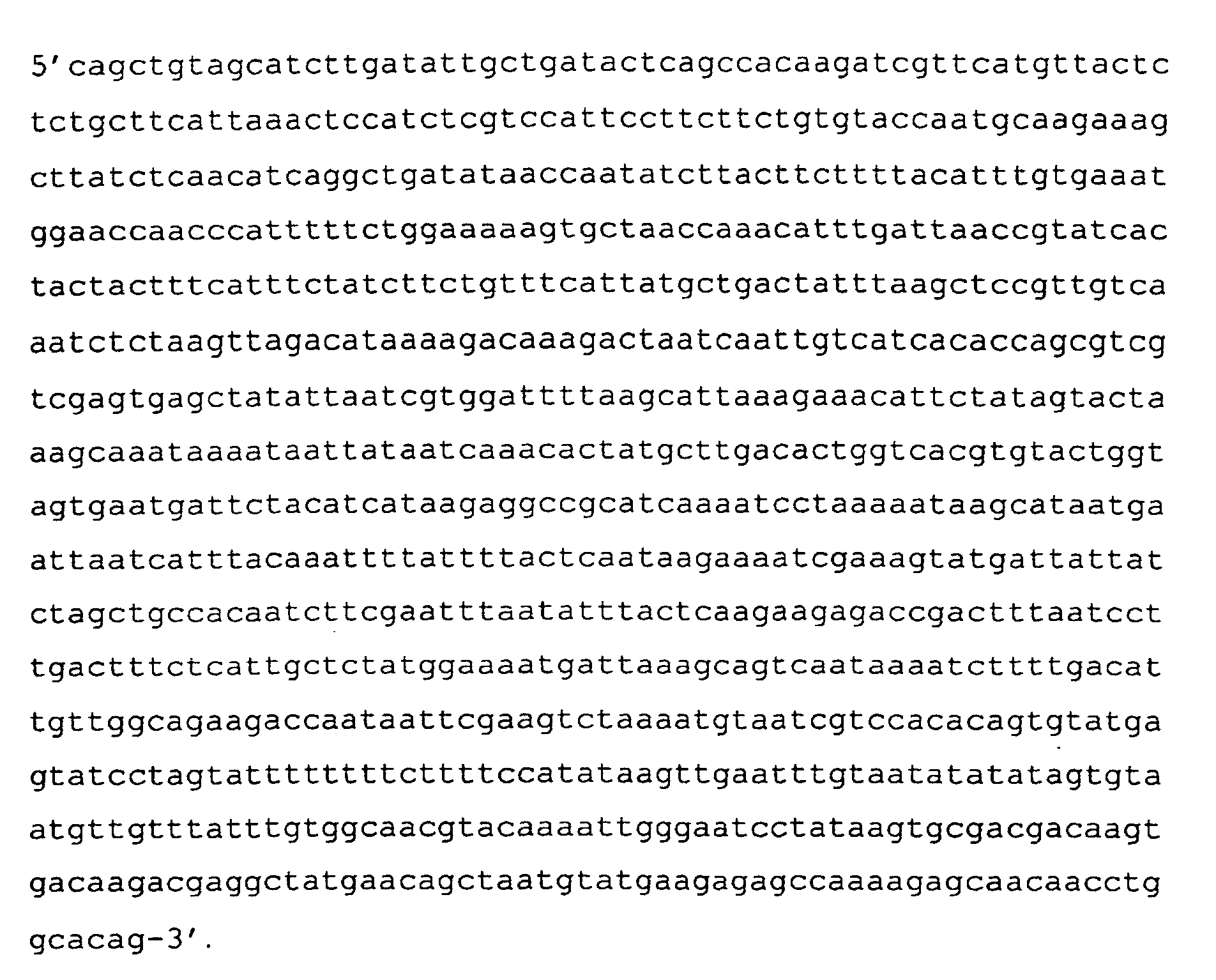
- this sequence comprises a sequence having at least 80% identity with the sequence or a portion of the sequence SEQ ID No. 1.
- % identity is meant the percentage of identical nucleotides which can easily be calculated by a person skilled in the art using a computer program for sequence comparison such as the DNASIS program (Version 2.5 for Windows; Hitachi Software Engineering Co. , Ltd, South San Francisco, CA) using the standard parameters described in the manufacturer's manual, incorporated into the description by reference.
- the sequences and the percentages of identity can also be obtained by using internet computing resources.
- sequence according to the invention has the following sequence or a portion of the sequence SEQ ID No. 1:
- the invention also relates to the use of a portion of the sequence SEQ ID No. 1 for the identification of fragments capable of promoting the expression of a gene of interest in a plant except in the seed. It is thus possible to define the region minimum of the FAH gene promoter sequence to ensure expression effective. In this sense, the promoter can be modified by adding sequences such as enhancers, by deletion of non-essential and / or unwanted regions.
- the promoter can include synthetic and / or natural sequences.
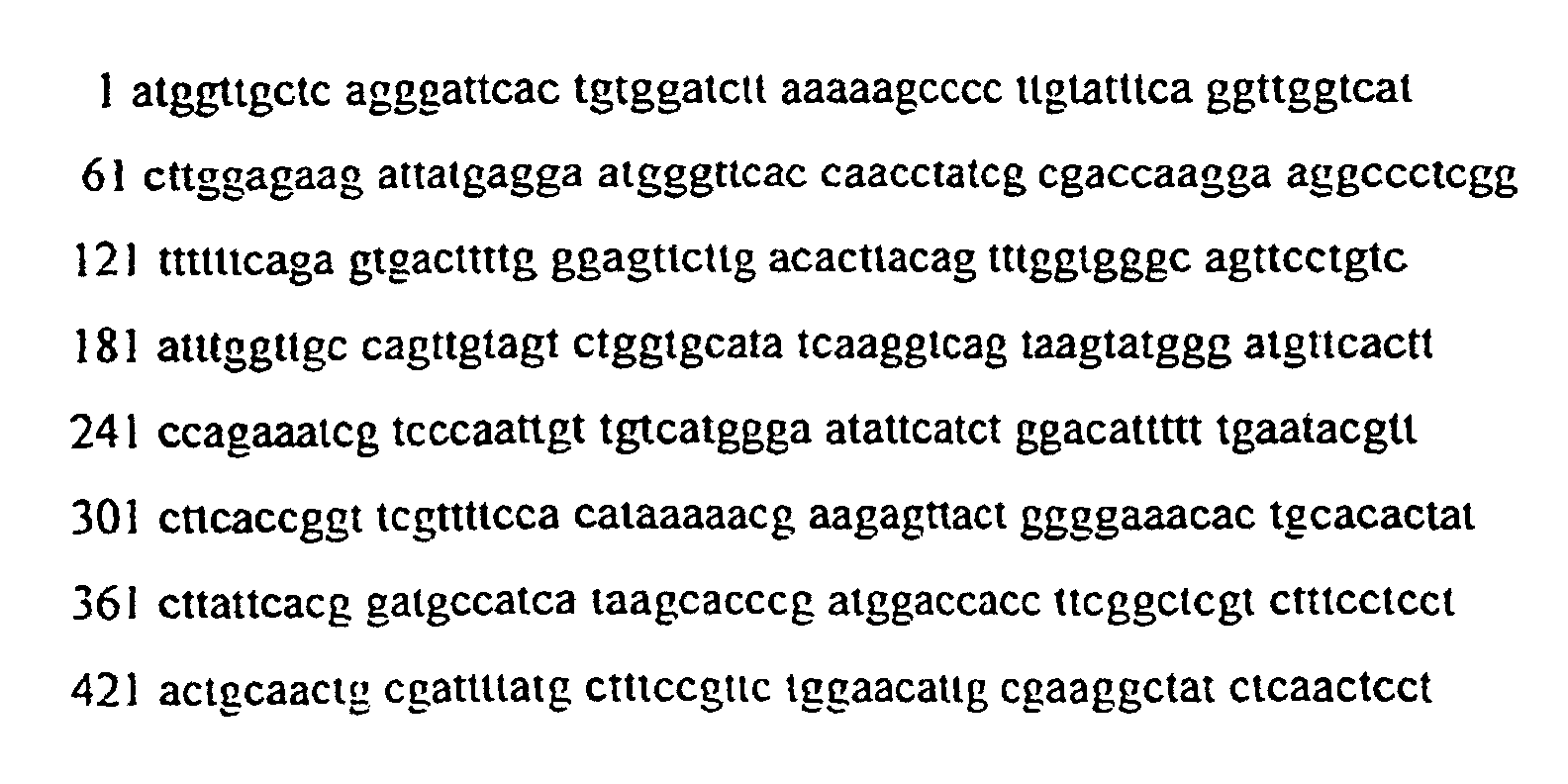
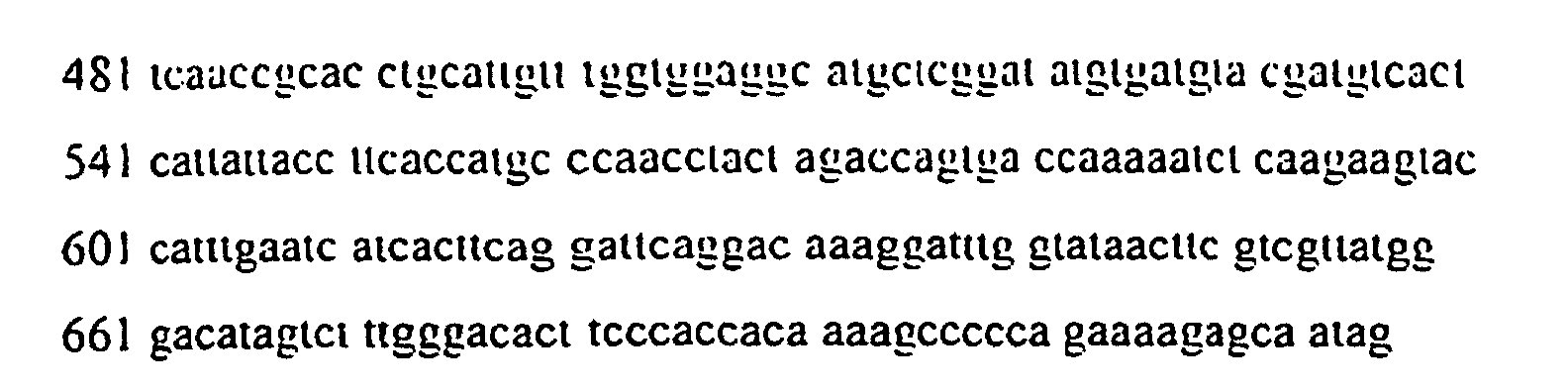
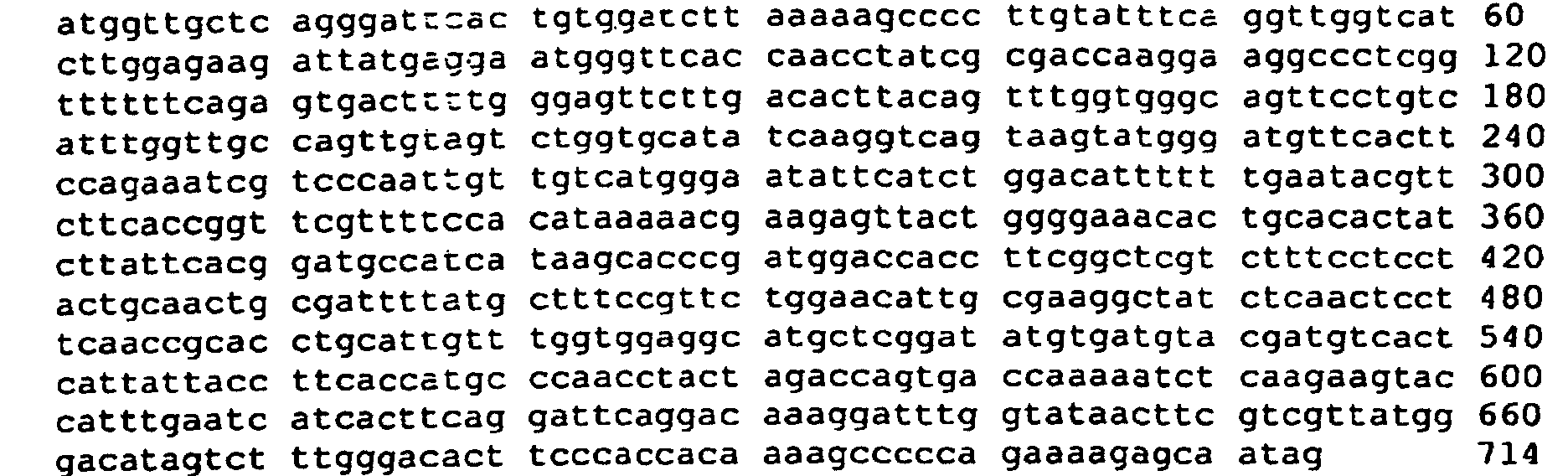
- a primer comprising a sequence having at least 80% identity with a sequence having at least 10 consecutive nucleotides of the genomic sequence of the FAH gene of Arabidopsis (introns and exons) which is accessible to a person skilled in the art under the number AC003096 or a primer which hybridizes under stringent conditions to any coding sequence for the following SEQ ID No. 4 (Arabidopsis thaliana, fatty acid hydroxylase Fahlp):
- the promoter sequence allowing the expression of a gene of interest in the plant tissue, except in the maturing seed and in the dry seed may also be characterized in that it comprises a sequence having at least 80% of identity with the sequence or a portion of the sequence of the promoter of the gene for FAH capable of being obtained from the process described above.
- Another aspect of the invention relates to an expression cassette which comprises a sequence of interest fused to a sequence comprising a promoter sequence as defined above.
- Said sequence of interest can code for an RNA, a protein or a polypeptide which protects the plant against biotic or abiotic stress.
- the cassette can allow the co-suppression of the expression of a gene characterized in that said sequence of interest codes for a protein or a polypeptide capable of replacing the function of an endogenous protein or polypeptide.
- the sequence of interest can also code for an antisense sequence directed against a target gene. This makes it possible, by coupling with the ectopic overexpression of a gene of interest in the seeds, to prevent any expression of this gene in other tissues. the antisense is not expressed there.
- the cassette according to the invention can also comprise a selection marker gene, a leader sequence controlling the transit, secretion or targeting of the expression product in different organelles, a signal sequence for the termination of transcription and translation.
- the gene of interest according to the invention can also be a gene controlling the development such as for example a gene involved in the metabolism of hormones, in signal transduction, or in cell cycle control.
- Another aspect of the invention relates to a vector, in particular a plasmid vector, comprising an expression cassette as defined above.
- the invention also relates to a plant cell transformed with the cassette or with a vector comprising said cassette and a plant transformation kit comprising said cassette or said vector.
- the transfer of DNA inside plant cells may be performed by standard techniques (Plant Cell Report, 10, 595, 1992), in particular by transfer via Agrobacterium (Plant J., 1994. 6, 271), by electroporation (Nature, 1987, 327, 70), laserporation (Barlev Genetics. 1991 VI, 231), by polyethylene glycol, or by the biolistic method called "gun particle” (Nature, 1987, 327, 70).
- Plant Cell Report, 10, 595, 1992 in particular by transfer via Agrobacterium (Plant J., 1994. 6, 271), by electroporation (Nature, 1987, 327, 70), laserporation (Barlev Genetics. 1991 VI, 231), by polyethylene glycol, or by the biolistic method called "gun particle” (Nature, 1987, 327, 70).
- agrobacterium infiltration in planta Bechtold et al.
- the transformation vectors carry selection markers, T-DNA borders, cloning sites, functions of replication, as well as other elements if necessary for the proper transfer of transgenes (Bouchez et al. 1993).
- the above-mentioned publications are incorporated into the description by references.
- the subject of the present invention is a transgenic plant capable of to be obtained by implementing the method mentioned above.
- plant capable of being obtained any plant expressing a transgene in its tissues except in mature and dry seeds, said plant having a promoter according to the invention. Plants obtained by any process equivalent leading to the same result are also subject of the invention.
- the list plants in which this promoter sequence can be used includes more especially plants which are useful for any industry. We can quote by example rapeseed, cruciferous, corn, soy, wheat, sunflower, pea, plants ornamental, and trees.
- the invention relates to a plant, as defined above, which expresses in its tissues, except in seeds, a gene whose product (RNA or protein) protects the plant against biotic or abiotic stress, an antisense sequence directed against a target gene, a protein or a polypeptide capable of replacing the function of a endogenous protein or polypeptide or a coding sequence for a protein involved in the biosynthesis of metabolites or a gene controlling development such as for example a gene involved in the metabolism of hormones, in the signal transduction, or in cell cycle control.
- RNA or protein whose product
- an antisense sequence directed against a target gene a protein or a polypeptide capable of replacing the function of a endogenous protein or polypeptide or a coding sequence for a protein involved in the biosynthesis of metabolites or a gene controlling development such as for example a gene involved in the metabolism of hormones, in the signal transduction, or in cell cycle control.
- the plant according to the invention can also express a protein of interest under the control of a promoter other than the promoter of the FAH gene and an antisense sequence capable to inhibit the expression of said protein of interest under the control of the promoter of the FAH gene, so that the gene of interest is only expressed in seeds.
- the method used for the extraction of genomic DNA from Arabidopsis is inspired by that described by Doyle and Doyle (1990). The principle is based on the properties cetyltrimethylammonium bromide detergents (CTAB; Sigma Chemical Co., USA) allowing specific denaturation of protein macromolecules and polysaccharide. About 2g of plant material (seedlings grown in vitro, old 1 to 2 weeks) are finely ground in liquid nitrogen and transferred to a tube 50ml of FALCON type (Costar, USA), containing 7.5ml of extraction buffer preheated to 65 ° C. The extraction is carried out at 65 ° C for 30 minutes, with stirring regular.
- CAB cetyltrimethylammonium bromide detergents
- Proteins denatured by ⁇ -mercaptoethanol and CTAB buffer are then extracted into a volume of chloroform and then eliminated after centrifugation (4430g. 10min).
- the supernatant nucleic acids are precipitated by one volume of isopropanol in the presence of 3M sodium acetate (1/10, v / v), centrifuged (7900g, 10min) then rinsed with 70% ethanol.
- the pellet is taken up in an Eppendorf tube in 100 ⁇ l of water and the ribonucleic acids are eliminated by adding 3 ⁇ l of Rnase A at 10mg / ml (Sigma Chemical Co .. USA). DNA is deproteinized and then again precipitated with absolute ethanol. After centrifugation in an Eppendorf tube, the pellet is washed. dried, taken up in 50 to 100 ⁇ l of water and stored at -20 ° C. before analyzes.
- the promoter sequence was amplified using PCR technology which is a known technique (Sambrook et al. 1989). Primers corresponding to the 5 '(upper) and 3' (lower) part of the promoter sequence were derived from the genomic sequence of BAC T29F13 (AC003096) (See FIG. 1). Genomic DNA from a wild-type line (Ler) was used as a template for amplification of the promoter part.
- the amplification reactions were carried out on a thermocycler (MJ Research PTC100 -96), in 0.2 ml tubes (Prolabo) containing the following mixture: 1 ⁇ l (10ng) DNA, 2 ⁇ l Buffer 10 x (BRL), 2 ⁇ l MgCl2 25mM, 0.8 ⁇ l dNTP 5mM, 1 ⁇ l Primer 1 (10 pmole/ ⁇ l), 1 ⁇ l Primer 2 (10 pmole/ ⁇ l), 0.5 ⁇ l (1U) Taq DNA polymerase (5U / ⁇ l), H2O qs 20 ⁇ l
- the genotypes of bacteria used for carrying out the experiments are:
- E. Coli strain DH12S ( ⁇ 80 dlacZ ⁇ M15 mcrA ⁇ (mrr-hsdRMS-mcrBC) araD139 ⁇ (ara, leu) 7697 ⁇ lacX74 galU galK rpsL deoR nupG recAl / F'proAB + laclq Z ⁇ M15).
- the transformation of bacteria E. coli strain DH12S by a recombinant plasmid is performed by electroporation (Potter, 1993).
- electroporation tank (1ml, width 0.1cm)
- 2 ⁇ l of the ligation reaction are mixed with 50 ⁇ l of bacteria thawed and kept in ice.
- the tank is then placed in a electroporator (Gene Pulser II System: BIO-RAD, FRANCE) and a voltage of 1.25kV is applied for a time which is a function of the resistance (200 ⁇ ) and the capacity (25 ⁇ F) of the circuit.
- BIO-RAD BIO-RAD
- FRANCE electroporator
- a voltage of 1.25kV is applied for a time which is a function of the resistance (200 ⁇ ) and the capacity (25 ⁇ F) of the circuit.
- One ml of SOC medium is added to promote growth bacteria and the whole is incubated in a 10 ml tube for 2 hours at 37 ° C.
- the transformed bacteria are then spread on boxes containing solid LB medium supplemented with the appropriate antibiotic and incubated at 37 ° C overnight.
- the selection of bacteria transformed by the recombinant pMeca plasmid is made with 0.04 mg / ml of ampicillin in the presence of 0.2mg / ml of X-Gal and 0.05mg / ml of IPTG.
- the bacteria are selected on an LB medium with the appropriate antibiotic for a final concentration of 0.04mg / ml.
- the sequence of the gene in question was obtained using sequences from the systematic sequencing of the Arabidopsis thaliana genome and is found to be localized on the BACT29F13.
- An expressed sequence (EST TAI234) has been identified in databases and appears to correspond to a full length sequence of mRNA FAH. This allowed the identification of the untranslated 5 'transcribed sequence and of the intended location of the promoter sequence.
- the intron / exon structure has been deduced, at the level of the untranslated transcribed part, the alignment of the BAC with the EST TAI234 ( Figure 1).
- the promoter was amplified by PCR from the primer pFAH / upper and the primer A1, placed in the untranslated transcribed part 5 ′ (FIG. 2).
- a study of the sequence has shown that the amplified sequence has a putative TATA box at -100bp from the site of suspected transcription initiation (based on full-length cDNA) and a box CCAAT at -190bp from the same start of transcription.
- the amplified PCR fragment (932pb) was cloned into a vector pGEM-T (PROMEGA), sequence, then introduced in a binary vector (pBI101, Clontech) containing a GUS reporter gene without promoter (Figure 3). This construction was then introduced by transformation in planta, via Agrobacterium, in wild type plants (Ws ecotype). Thirteen primary transformants were obtained, which were tested for their GUS activity during their development.
- the expression is strong from 20 hours after the start of imbibition in the embryo. During development, expression is strong in all tissues, with a certain preference for vascular tissues.
- GUS reporter gene expression profile cotyledons adult leaf roots flower silicic germinating seeds Dry seeds 1 ++ +++ ++ ++ +++ +++ - 2 +++ +++ ++ ++ +++ +++ - 3 +++ +++ ++ ++ nd ++ - 4 +++ +++ ++ ++ ++ nd ++ - 5 +++ +++ ++ ++ nd +++ - 6 + +++ ++ ++ nd +++ - 7 +++ +++ ++ ++ + - 8 ++ +++ ++ ++ +++ +++ +++ - 9 +++ +++ ++ ++ ++ - - -
- the expression of the marker confirms the functionality of the promoter and its specificity.
- This type of promoter is therefore of great interest for applications biotechnology, such as the expression of an anti-insect toxin (type Bt) in plants and the expression of any transgene making it possible to improve, so quantitative or qualitative, the development and growth of the plant without the protein encoded by the transgene is present in the seed.
- type Bt anti-insect toxin
Landscapes
- Health & Medical Sciences (AREA)
- Life Sciences & Earth Sciences (AREA)
- Genetics & Genomics (AREA)
- Engineering & Computer Science (AREA)
- Chemical & Material Sciences (AREA)
- Zoology (AREA)
- Organic Chemistry (AREA)
- Bioinformatics & Cheminformatics (AREA)
- Wood Science & Technology (AREA)
- General Engineering & Computer Science (AREA)
- Biomedical Technology (AREA)
- Biotechnology (AREA)
- Microbiology (AREA)
- Biochemistry (AREA)
- General Health & Medical Sciences (AREA)
- Molecular Biology (AREA)
- Medicinal Chemistry (AREA)
- Cell Biology (AREA)
- Physics & Mathematics (AREA)
- Biophysics (AREA)
- Plant Pathology (AREA)
- Breeding Of Plants And Reproduction By Means Of Culturing (AREA)
- Agricultural Chemicals And Associated Chemicals (AREA)
- Cultivation Of Plants (AREA)
- Hydroponics (AREA)
Description
On entend par « % d'identité » le pourcentage de nucléotides identiques qui peut facilement être calculé par l'homme du métier en utilisant un programme informatique de comparaison de séquence tel que le programme DNASIS (Version 2.5 pour Windows ; Hitachi Software Engineering Co., Ltd, South San Francisco, CA) en utilisant les paramètres standards décrits dans le manuel du fabriquant, incorporé dans la description par référence.
Dans ce contexte, les séquences et les pourcentages d'identité peuvent également être obtenus en utilisant les ressources informatiques internet. On peut citer le programme Blast (WWW.ncbi.nlm.nih.gov) et le programme FastDB avec les paramètres suivants « Mismatch penalty 1.00 ; Gap Penalty 1.00 ; Gap Size Penalty 0.33 ; joining penalty 30.0. Ces algorithmes sont présentés dans Current Methods in Sequencing and synthesis Methods and Applications, pages 127-149, 1988, Ala R. Liss, Inc, incorporé dans la description par référence
On peut également définir les séquences ayant 80% d'identité comme étant des séquences s'hybridant à la séquence SEQ ID N°1 avec des conditions de stringence fortes. Ces conditions sont présentées dans Sambrook et al. Molecular Cloning A Laboratory Manual (Cold Spring Harbor Press, 1989) aux paragraphes 11.1 à 11.61, incorporés dans la description par référence.

La cassette peut permettre la co-suppression de l'expression d'un gène caractérisée en ce que ladite séquence d'intérêt code pour une protéine ou un polypeptide capable de se substituer à la fonction d'une protéine ou d'un polypeptide endogène. La séquence d'intérêt peut également coder pour une séquence antisens dirigée contre un gène cible. Ceci permet en couplant avec la surexpression ectopique d'un gène d'intérêt dans les graines d'empêcher toute expression de ce gène dans d'autres tissus. l'antisens n'y étant pas exprimé. Ceci s'avère tout à fait utile dans le cas où l'on souhaite surexprimer une protéine dans les graines sans perturber le développement d'autres tissus de la plante.
La cassette selon l'invention peut comprendre en outre un gène marqueur de sélection, une séquence leader contrôlant le transit, la sécrétion ou le ciblage du produit d'expression dans différents organelles une séquence signal de la terminaison de la transcription et de la traduction.
- des stress biotiques : protection contre les pathogènes, bactéries, champignons, insectes, nématodes, parasites ou ravageurs, protection contres les virus et pathogènes intacellulaires, en particulier ceux qui ne sont pas transmis par les graines
- des stress abiotiques : protection contres la chaleur et le froid, le gel, les stress hydriques tels que la sécheresse ou à l'inverse l'anoxie, la pollution (ozone, SO2), la photoinhibition et les stress lumineux, la verse, la phytorémédiation, ou les stress nutritionnels occasionnés par une carence ou excès d'un élément nutritif (en particulier un stress salin).
L'invention a également pour objet une cellule de plante transformée avec la cassette ou avec un vecteur comprenant ladite cassette et un kit de transformation de plante comprenant ladite cassette ou ledit vecteur.
La construction des vecteurs utilisables pour les expériences de transformation fait partie des techniques de biologie moléculaire connues et pratiquées de façon routinière dans ce champ d'applications.
Les rectangles avec les rayures représentent les introns.
L'échelle est présentée sur la figure.
T29F13 est un bac et TA1234un ADNc.
PFAH upper et Al représentent les amorces utilisées pour séquencer le promoteur.
Les rectangles avec les rayures représentent la partie 5' transcrite non traduite.
L'échelle est présentée sur la figure.
Carte du plasmide pB1 101 contenant le promoteur pFAH utilisé.
1 µl (10ng) ADN, 2µl Tampon 10 x (BRL), 2µl MgCl2 25mM, 0,8µl dNTP 5mM, 1µl Amorce 1 (10pmole/µl), 1µl Amorce 2 (10pmole/µl), 0,5µl (1U) Taq DNA polymérase (5U/µl), H2O qsp 20µl


L'infiltration est effectuée sous-vide (dans une cloche à vide):
- le vide est cassé 2 fois.
- le vide est maintenu pendant 1 heure, puis les échantillons sont placés à 37°C pour la nuit.
Ces résultats démontrent que la séquence promotrice isolée confère bien un profil d'expression très spécifique au gène rapporteur utilisé (GUS), le promoteur est actif tout au long du développement de la plante, dans tous les tissus testés (feuilles, fleurs. tiges, racines etc...) sauf dans la graine en cours de maturation (Voir tableau I ci-dessous).
| Profil d'expression du gène rapporteur GUS | |||||||
| cotylédons | feuille adulte | Racines | fleur | silique | graines en germination | Graines sèches | |
| 1 | ++ | +++ | ++ | ++ | +++ | +++ | - |
| 2 | +++ | +++ | ++ | ++ | +++ | +++ | - |
| 3 | +++ | +++ | ++ | ++ | nd | ++ | - |
| 4 | +++ | +++ | ++ | ++ | nd | ++ | - |
| 5 | +++ | +++ | ++ | ++ | nd | +++ | - |
| 6 | + | +++ | ++ | ++ | nd | +++ | - |
| 7 | +++ | +++ | ++ | ++ | +++ | + | - |
| 8 | ++ | +++ | ++ | ++ | +++ | +++ | - |
| 9 | +++ | +++ | ++ | ++ | +++ | ++ | - |




Claims (23)
- Séquence promotrice permettant l'expression d'un gène d'intérêt dans les tissus d'une plante, hormis dans la graine en maturation et dans la graine sèche, caractérisée en ce qu'elle comprend une séquence ayant au moins 80% d'identité avec la séquence SEQ ID N°1 du promoteur du gène de la FAH d'Arabidopsis.
- Séquence selon la revendication 1 caractérisée en ce qu'elle comprend une séquence s'hybridant avec des conditions de fortes stringence à la séquence SEQ ID N°1.
- Séquence selon la revendication 1 caractérisée en ce qu'elle comprend la séquence SEQ ID N°1.
- Procédé permettant l'isolement et la caractérisation du promoteur du gène de la FAH chez les plantes comprenant les étapes suivantes :a) Utilisation d'une amorce comprenant une séquence ayant au moins 80% d'identité avec une séquence possédant au moins 10 nucléotides consécutifs de la séquence SEQ ID N°5 ou une séquence complémentaire, une amorce qui s'hybride dans des conditions stringentes fortes à toute séquence codante pour la SEQ ID N°4 ou une séquence ayant au moins 80% d'identité avec une séquence possédant au moins 10 nucléotides consécutifs de la séquence génomique du gène de la FAH d'Arabidopsis accessible sous le numéro AC003096 ou une séquence complémentaire, pour l'isolement et/ou l'amplification de la séquence en amont de l'extrémité 5' du gène de la FAH,b) Clonage et séquençage de la séquence obtenue à l'étape a).
- Utilisation d'une séquence selon l'une des revendications 1 à 3 pour l'identification de fragments de la séquence SEQ ID N°1 permettant l'expression d'un gène d'intérêt dans les tissus d'une plante, hormis dans la graine en maturation et dans la graine sèche.
- Cassette d'expression caractérisée en ce qu'elle comporte une séquence d'intérêt fusionnée à une séquence comprenant une séquence promotrice selon l'une des revendications 1 à 3.
- Cassette d'expression selon la revendication 6 caractérisée en ce que ladite séquence d'intérêt code pour un ARN, une protéine ou un polypeptide qui protège la plante contre un stress biotique ou abiotique, ou qui est impliquée dans le développement notamment dans le métabolisme des hormones, dans la transduction des signaux, ou dans le contrôle du cycle cellulaire.
- Cassette d'expression selon la revendication 6 permettant la co-suppression d'un gène caractérisée en ce que ladite séquence d'intérêt code pour une protéine ou un polypeptide capable de se substituer à la fonction d'une protéine ou d'un polypeptide endogène.
- Cassette d'expression selon la revendication 6 caractérisée en ce que ladite séquence d'intérêt code pour une séquence antisens dirigée contre un gène cible.
- Cassette d'expression selon la revendication 6 caractérisée en ce que ladite séquence d'intérêt code pour une enzyme impliquée dans la production de métabolites par une plante.
- Vecteur comprenant une cassette d'expression selon l'une des revendications 6 à 9.
- Cellule de plante transformée avec une cassette selon l'une des revendications 6 à 9 ou un vecteur selon la revendication 11.
- Kit de transformation de plante comprenant une cassette selon l'une des revendications 6 à 9 ou un vecteur selon la revendication 11.
- Procédé de préparation de plantes transgéniques dans lesquelles un gène d'intérêt est exprimé dans tous les tissus sauf dans la graine en maturation et dans la graine sèche caractérisé en ce qu'il comprend les étapes suivantes :a) Transfert d'une cassette selon l'une des revendications 6 à 9 ou d'un vecteur selon la revendication 11 dans des cellules de plantes,b) Mise en culture des cellules transformées obtenues à l'étape a) de manière à obtenir lesdites plantes transgéniques.
- Procédé selon la revendication 14 caractérisé en ce que les cellules sont choisies parmi les cellules embryonnaires provenant d'un embryon immature.
- Procédé selon l'une des revendications 14 et 15 caractérisé en ce que le transfert est effectué en utilisant Agrobacterium, de préférence Agrobacterium tumefaciens.
- Plante transgénique caractérisée en ce qu'elle comprend une cassette selon les revendications 6 à 10.
- Plante selon la revendication 17 caractérisée en ce qu'elle exprime dans ses tissus, sauf dans les graines matures et sèches, un ARN, une séquence antisens dirigée contre un gène cible.
- Plante selon la revendication 17 caractérisée en ce qu'elle exprime dans ses tissus, sauf dans les graines matures et sèches, un ARN, une protéine ou un polypeptide capable de se substituer à la fonction d'une protéine ou d'un polypeptide endogène.
- Plante selon la revendication 17 caractérisée en ce qu'elle exprime une protéine d'intérêt sous le contrôle d'un promoteur autre que le promoteur du gène de la FAH et une séquence antisens capable d'inhiber l'expression de ladite protéine d'intérêt sous le contrôle du promoteur du gène de la FAH, de telle sorte que la protéine d'intérêt n'est exprimée que dans les graines.
- Plante selon la revendication 17 caractérisée en ce qu'elle exprime dans ses tissus. sauf dans les graines matures et sèches, une séquence codante pour une protéine impliquée dans la biosynthèse de métabolites, pour une protéine ou un polypeptide qui protège la plante contre un stress biotique ou abiotique, une protéine contrôlant le développement notamment dans le métabolisme des hormones, dans la transduction des signaux, ou dans le contrôle du cycle cellulaire.
- Plante selon l'une des revendications 17 à 21 caractérisée en ce qu'elle est choisie notamment parmi le colza, les crucifères, le maïs, le soja, le blé, le tournesol, le pois, les plantes ornementales, et les arbres.
- Graines obtenues à partir d'une plante transgénique selon l'une des revendications 17 à 22 caractérisées en ce qu'elles ne contiennent pas le produit d'expression du transgène, lesdites graines comprenant une cassette selon l 'une des revendications 6 à 10 ou un vecteur selon la revendication 11.
Applications Claiming Priority (3)
| Application Number | Priority Date | Filing Date | Title |
|---|---|---|---|
| FR9907362A FR2794772B1 (fr) | 1999-06-10 | 1999-06-10 | Promoteur permettant l'expression de transgenes dans toute la plante hormis dans la graine |
| FR9907362 | 1999-06-10 | ||
| PCT/FR2000/001574 WO2000077223A1 (fr) | 1999-06-10 | 2000-06-08 | Promoteur permettant l'expression de transgenes dans toute la plante hormis dans la graine |
Publications (2)
| Publication Number | Publication Date |
|---|---|
| EP1185669A1 EP1185669A1 (fr) | 2002-03-13 |
| EP1185669B1 true EP1185669B1 (fr) | 2004-08-18 |
Family
ID=9546638
Family Applications (1)
| Application Number | Title | Priority Date | Filing Date |
|---|---|---|---|
| EP00940461A Expired - Lifetime EP1185669B1 (fr) | 1999-06-10 | 2000-06-08 | Promoteur permettant l'expression de transgenes dans toute la plante hormis dans la graine |
Country Status (9)
| Country | Link |
|---|---|
| EP (1) | EP1185669B1 (fr) |
| AT (1) | ATE274062T1 (fr) |
| AU (1) | AU5539500A (fr) |
| CA (1) | CA2376878A1 (fr) |
| DE (1) | DE60013123T2 (fr) |
| ES (1) | ES2223533T3 (fr) |
| FR (1) | FR2794772B1 (fr) |
| PT (1) | PT1185669E (fr) |
| WO (1) | WO2000077223A1 (fr) |
Families Citing this family (6)
| Publication number | Priority date | Publication date | Assignee | Title |
|---|---|---|---|---|
| MXPA04000366A (es) * | 2001-07-13 | 2004-05-04 | Pioneer Hi Bred Int | Promotores preferidos de tejido vascular. |
| FR2828210B1 (fr) * | 2001-08-01 | 2004-08-06 | Agronomique Inst Nat Rech | Acide nucleique regulateur permettant l'expression d'un polynucleotide d'interet specifiquement dans l'endothelium d'une graine de plante, et ses applications |
| EP2166098B1 (fr) * | 2004-10-05 | 2013-11-06 | SunGene GmbH | Cassettes d'expression constitutive pour la régulation de l'expression chez les plantes |
| BRPI0608829A2 (pt) | 2005-04-19 | 2011-03-15 | Basf Plant Science Gmbh | método para a expressão transgênica com especificidade intensificada em uma planta, uso de um construto de ácido nucleico quimérico, seqüência de ribonucleotìdeo quimérica, construto de expressão, vetor de expressão, organismo não-humano ou célula transformada, semente transformada, e, preparação farmacêutica |
| WO2006131490A1 (fr) * | 2005-06-09 | 2006-12-14 | Basf Plant Science Gmbh | Cassettes d’expression pour l’expression preferentielle dans une graine de plantes |
| WO2018089099A1 (fr) | 2016-10-11 | 2018-05-17 | Dow Agrosciences Llc | Modulation de l'expression de transgènes dans des plantes |
Family Cites Families (2)
| Publication number | Priority date | Publication date | Assignee | Title |
|---|---|---|---|---|
| US6310194B1 (en) * | 1994-09-26 | 2001-10-30 | Carnegie Institution Of Washington | Plant fatty acid hydroxylases |
| GB9706381D0 (en) * | 1997-03-27 | 1997-05-14 | Cambridge Advanced Tech | Improvements relating to the specificity of gene expression |
-
1999
- 1999-06-10 FR FR9907362A patent/FR2794772B1/fr not_active Expired - Fee Related
-
2000
- 2000-06-08 AT AT00940461T patent/ATE274062T1/de not_active IP Right Cessation
- 2000-06-08 ES ES00940461T patent/ES2223533T3/es not_active Expired - Lifetime
- 2000-06-08 AU AU55395/00A patent/AU5539500A/en not_active Abandoned
- 2000-06-08 DE DE60013123T patent/DE60013123T2/de not_active Expired - Fee Related
- 2000-06-08 EP EP00940461A patent/EP1185669B1/fr not_active Expired - Lifetime
- 2000-06-08 WO PCT/FR2000/001574 patent/WO2000077223A1/fr not_active Ceased
- 2000-06-08 CA CA002376878A patent/CA2376878A1/fr not_active Abandoned
- 2000-06-08 PT PT00940461T patent/PT1185669E/pt unknown
Also Published As
| Publication number | Publication date |
|---|---|
| CA2376878A1 (fr) | 2000-12-21 |
| DE60013123T2 (de) | 2005-08-11 |
| WO2000077223A1 (fr) | 2000-12-21 |
| ATE274062T1 (de) | 2004-09-15 |
| DE60013123D1 (de) | 2004-09-23 |
| ES2223533T3 (es) | 2005-03-01 |
| EP1185669A1 (fr) | 2002-03-13 |
| FR2794772B1 (fr) | 2001-09-21 |
| AU5539500A (en) | 2001-01-02 |
| FR2794772A1 (fr) | 2000-12-15 |
| PT1185669E (pt) | 2004-12-31 |
Similar Documents
| Publication | Publication Date | Title |
|---|---|---|
| AU2003251579B2 (en) | Intron double stranded RNA constructs and uses thereof | |
| Yin et al. | High-oleic peanut oils produced by HpRNA-mediated gene silencing of oleate desaturase | |
| JP2001519668A (ja) | 植物種子脂質組成の改変のためのオレオシン5’調節領域 | |
| KR101156092B1 (ko) | 우산이끼 유래의 불포화 지방산 합성효소 유전자 및 그 이용 | |
| EP1196581B1 (fr) | Promoteur s'exprimant specifiquement dans les cellules de racines de plantes, vecteurs et cellules hotes recombinantes comprenant un tel promoteur et plantes transgeniques obtenues | |
| FR2794772A1 (fr) | Promoteur permettant l'expression de transgenes dans toute la plante hormis dans la graine | |
| EP1218510B1 (fr) | Promoteurs specifiques de l'albumen des graines de vegetaux | |
| FR2913694A1 (fr) | Elements regulateurs d'expression | |
| WO2019224324A1 (fr) | Promoteurs meiotiques et leurs utilisations | |
| FR2798139A1 (fr) | Vecteurs synthetiques propres, plasmides, plantes et parties de plantes transgeniques les contenant, et leurs methodes d'obtention | |
| EP2627772B1 (fr) | Obtention de plantes ayant une tolérance améliorée à un déficit hydrique | |
| WO2002036788A2 (fr) | Acides nucleiques et polypeptides exprimes specifiquement dans les cellules de la zone de transfert d'un grain de plante et leurs applications | |
| CA2737405A1 (fr) | Importation d'un ribozyme dans les mitochondries vegetales par un pseudo-arnt aminoacylable par la valine | |
| FR2827613A1 (fr) | Acides nucleiques codant pour un polypeptide isum2a et utilisation de ces acides nucleiques pour l'obtention de plantes transformees produisant des graines affectees dans le developpement du germe | |
| EP1244792B1 (fr) | Procede d'obtention de plantes a teneur enrichie en cysteine et glutathion | |
| EP1121451B1 (fr) | Procede d'obtention de plantes transgeniques exprimant une proteine a activite productrice de peroxyde d'hydrogene par transformation par agrobacterium rhizogenes | |
| CN107683088A (zh) | 赋予对半翅目害虫的耐性的thread核酸 | |
| WO2005063989A1 (fr) | Sequences nucleotidiques promotrices inductibles par infection par les pathogenes. | |
| CA2295989A1 (fr) | Plante monocotyledone resistant aux agents pathogenes et procede associe | |
| WO1999064613A1 (fr) | Gene de d-ribulose-5-phosphate-3-epimerase de la reponse aux nematodes | |
| JPWO2000019806A1 (ja) | 高温耐性植物 |
Legal Events
| Date | Code | Title | Description |
|---|---|---|---|
| PUAI | Public reference made under article 153(3) epc to a published international application that has entered the european phase |
Free format text: ORIGINAL CODE: 0009012 |
|
| 17P | Request for examination filed |
Effective date: 20020102 |
|
| AK | Designated contracting states |
Kind code of ref document: A1 Designated state(s): AT BE CH CY DE DK ES FI FR GB GR IE IT LI LU MC NL PT SE |
|
| AX | Request for extension of the european patent |
Free format text: AL;LT;LV;MK;RO;SI |
|
| 17Q | First examination report despatched |
Effective date: 20030605 |
|
| GRAP | Despatch of communication of intention to grant a patent |
Free format text: ORIGINAL CODE: EPIDOSNIGR1 |
|
| GRAS | Grant fee paid |
Free format text: ORIGINAL CODE: EPIDOSNIGR3 |
|
| GRAA | (expected) grant |
Free format text: ORIGINAL CODE: 0009210 |
|
| AK | Designated contracting states |
Kind code of ref document: B1 Designated state(s): AT BE CH CY DE DK ES FI FR GB GR IE IT LI LU MC NL PT SE |
|
| REG | Reference to a national code |
Ref country code: GB Ref legal event code: FG4D Free format text: NOT ENGLISH |
|
| REG | Reference to a national code |
Ref country code: CH Ref legal event code: NV Representative=s name: MICHELI & CIE INGENIEURS-CONSEILS Ref country code: CH Ref legal event code: EP |
|
| GBT | Gb: translation of ep patent filed (gb section 77(6)(a)/1977) |
Effective date: 20040818 |
|
| REG | Reference to a national code |
Ref country code: IE Ref legal event code: FG4D Free format text: FRENCH |
|
| REF | Corresponds to: |
Ref document number: 60013123 Country of ref document: DE Date of ref document: 20040923 Kind code of ref document: P |
|
| REG | Reference to a national code |
Ref country code: SE Ref legal event code: TRGR |
|
| REG | Reference to a national code |
Ref country code: GR Ref legal event code: EP Ref document number: 20040403382 Country of ref document: GR |
|
| REG | Reference to a national code |
Ref country code: PT Ref legal event code: SC4A Free format text: AVAILABILITY OF NATIONAL TRANSLATION Effective date: 20041109 |
|
| LTIE | Lt: invalidation of european patent or patent extension |
Effective date: 20040818 |
|
| REG | Reference to a national code |
Ref country code: ES Ref legal event code: FG2A Ref document number: 2223533 Country of ref document: ES Kind code of ref document: T3 |
|
| PGFP | Annual fee paid to national office [announced via postgrant information from national office to epo] |
Ref country code: AT Payment date: 20050527 Year of fee payment: 6 |
|
| PGFP | Annual fee paid to national office [announced via postgrant information from national office to epo] |
Ref country code: SE Payment date: 20050607 Year of fee payment: 6 |
|
| PG25 | Lapsed in a contracting state [announced via postgrant information from national office to epo] |
Ref country code: CY Free format text: LAPSE BECAUSE OF FAILURE TO SUBMIT A TRANSLATION OF THE DESCRIPTION OR TO PAY THE FEE WITHIN THE PRESCRIBED TIME-LIMIT Effective date: 20050608 |
|
| PGFP | Annual fee paid to national office [announced via postgrant information from national office to epo] |
Ref country code: GB Payment date: 20050608 Year of fee payment: 6 Ref country code: FI Payment date: 20050608 Year of fee payment: 6 |
|
| PGFP | Annual fee paid to national office [announced via postgrant information from national office to epo] |
Ref country code: BE Payment date: 20050609 Year of fee payment: 6 Ref country code: FR Payment date: 20050609 Year of fee payment: 6 Ref country code: CH Payment date: 20050609 Year of fee payment: 6 |
|
| PGFP | Annual fee paid to national office [announced via postgrant information from national office to epo] |
Ref country code: DK Payment date: 20050624 Year of fee payment: 6 |
|
| PLBE | No opposition filed within time limit |
Free format text: ORIGINAL CODE: 0009261 |
|
| STAA | Information on the status of an ep patent application or granted ep patent |
Free format text: STATUS: NO OPPOSITION FILED WITHIN TIME LIMIT |
|
| PGFP | Annual fee paid to national office [announced via postgrant information from national office to epo] |
Ref country code: LU Payment date: 20050627 Year of fee payment: 6 |
|
| PG25 | Lapsed in a contracting state [announced via postgrant information from national office to epo] |
Ref country code: MC Free format text: LAPSE BECAUSE OF NON-PAYMENT OF DUE FEES Effective date: 20050630 |
|
| PGFP | Annual fee paid to national office [announced via postgrant information from national office to epo] |
Ref country code: NL Payment date: 20050630 Year of fee payment: 6 Ref country code: DE Payment date: 20050630 Year of fee payment: 6 |
|
| 26N | No opposition filed |
Effective date: 20050519 |
|
| PGFP | Annual fee paid to national office [announced via postgrant information from national office to epo] |
Ref country code: IE Payment date: 20060510 Year of fee payment: 7 |
|
| PGFP | Annual fee paid to national office [announced via postgrant information from national office to epo] |
Ref country code: ES Payment date: 20060511 Year of fee payment: 7 |
|
| PGFP | Annual fee paid to national office [announced via postgrant information from national office to epo] |
Ref country code: GR Payment date: 20060512 Year of fee payment: 7 |
|
| PGFP | Annual fee paid to national office [announced via postgrant information from national office to epo] |
Ref country code: PT Payment date: 20060515 Year of fee payment: 7 |
|
| PG25 | Lapsed in a contracting state [announced via postgrant information from national office to epo] |
Ref country code: GB Free format text: LAPSE BECAUSE OF NON-PAYMENT OF DUE FEES Effective date: 20060608 Ref country code: FI Free format text: LAPSE BECAUSE OF NON-PAYMENT OF DUE FEES Effective date: 20060608 Ref country code: AT Free format text: LAPSE BECAUSE OF NON-PAYMENT OF DUE FEES Effective date: 20060608 |
|
| PG25 | Lapsed in a contracting state [announced via postgrant information from national office to epo] |
Ref country code: SE Free format text: LAPSE BECAUSE OF NON-PAYMENT OF DUE FEES Effective date: 20060609 |
|
| PG25 | Lapsed in a contracting state [announced via postgrant information from national office to epo] |
Ref country code: LI Free format text: LAPSE BECAUSE OF NON-PAYMENT OF DUE FEES Effective date: 20060630 Ref country code: DK Free format text: LAPSE BECAUSE OF NON-PAYMENT OF DUE FEES Effective date: 20060630 Ref country code: CH Free format text: LAPSE BECAUSE OF NON-PAYMENT OF DUE FEES Effective date: 20060630 Ref country code: BE Free format text: LAPSE BECAUSE OF NON-PAYMENT OF DUE FEES Effective date: 20060630 |
|
| PGFP | Annual fee paid to national office [announced via postgrant information from national office to epo] |
Ref country code: IT Payment date: 20060630 Year of fee payment: 7 |
|
| PG25 | Lapsed in a contracting state [announced via postgrant information from national office to epo] |
Ref country code: NL Free format text: LAPSE BECAUSE OF NON-PAYMENT OF DUE FEES Effective date: 20070101 |
|
| PG25 | Lapsed in a contracting state [announced via postgrant information from national office to epo] |
Ref country code: DE Free format text: LAPSE BECAUSE OF NON-PAYMENT OF DUE FEES Effective date: 20070103 |
|
| REG | Reference to a national code |
Ref country code: DK Ref legal event code: EBP |
|
| REG | Reference to a national code |
Ref country code: CH Ref legal event code: PL |
|
| EUG | Se: european patent has lapsed | ||
| GBPC | Gb: european patent ceased through non-payment of renewal fee |
Effective date: 20060608 |
|
| NLV4 | Nl: lapsed or anulled due to non-payment of the annual fee |
Effective date: 20070101 |
|
| REG | Reference to a national code |
Ref country code: FR Ref legal event code: ST Effective date: 20070228 |
|
| REG | Reference to a national code |
Ref country code: PT Ref legal event code: MM4A Free format text: LAPSE DUE TO NON-PAYMENT OF FEES Effective date: 20071210 |
|
| BERE | Be: lapsed |
Owner name: INSTITUT NATIONAL DE LA RECHERCHE *AGRONOMIQUE Effective date: 20060630 |
|
| PG25 | Lapsed in a contracting state [announced via postgrant information from national office to epo] |
Ref country code: PT Free format text: LAPSE BECAUSE OF NON-PAYMENT OF DUE FEES Effective date: 20071210 |
|
| REG | Reference to a national code |
Ref country code: IE Ref legal event code: MM4A |
|
| PG25 | Lapsed in a contracting state [announced via postgrant information from national office to epo] |
Ref country code: FR Free format text: LAPSE BECAUSE OF NON-PAYMENT OF DUE FEES Effective date: 20060630 |
|
| PG25 | Lapsed in a contracting state [announced via postgrant information from national office to epo] |
Ref country code: IE Free format text: LAPSE BECAUSE OF NON-PAYMENT OF DUE FEES Effective date: 20070608 |
|
| PG25 | Lapsed in a contracting state [announced via postgrant information from national office to epo] |
Ref country code: LU Free format text: LAPSE BECAUSE OF NON-PAYMENT OF DUE FEES Effective date: 20060608 |
|
| REG | Reference to a national code |
Ref country code: ES Ref legal event code: FD2A Effective date: 20070609 |
|
| PG25 | Lapsed in a contracting state [announced via postgrant information from national office to epo] |
Ref country code: ES Free format text: LAPSE BECAUSE OF NON-PAYMENT OF DUE FEES Effective date: 20070609 |
|
| PG25 | Lapsed in a contracting state [announced via postgrant information from national office to epo] |
Ref country code: GR Free format text: LAPSE BECAUSE OF NON-PAYMENT OF DUE FEES Effective date: 20080104 |
|
| PG25 | Lapsed in a contracting state [announced via postgrant information from national office to epo] |
Ref country code: IT Free format text: LAPSE BECAUSE OF NON-PAYMENT OF DUE FEES Effective date: 20070608 |