EP1182831A2 - Routenaktualisierungsverfahren für Micromobilitätsnetzwerk - Google Patents
Routenaktualisierungsverfahren für Micromobilitätsnetzwerk Download PDFInfo
- Publication number
- EP1182831A2 EP1182831A2 EP20010120230 EP01120230A EP1182831A2 EP 1182831 A2 EP1182831 A2 EP 1182831A2 EP 20010120230 EP20010120230 EP 20010120230 EP 01120230 A EP01120230 A EP 01120230A EP 1182831 A2 EP1182831 A2 EP 1182831A2
- Authority
- EP
- European Patent Office
- Prior art keywords
- route
- radio base
- base station
- router
- routers
- Prior art date
- Legal status (The legal status is an assumption and is not a legal conclusion. Google has not performed a legal analysis and makes no representation as to the accuracy of the status listed.)
- Granted
Links
- 238000000034 method Methods 0.000 title claims description 24
- 230000005540 biological transmission Effects 0.000 claims abstract description 44
- 230000004308 accommodation Effects 0.000 claims abstract description 8
- 230000008034 disappearance Effects 0.000 description 8
- 238000004891 communication Methods 0.000 description 6
- 238000010586 diagram Methods 0.000 description 5
- 238000012546 transfer Methods 0.000 description 4
- 238000012545 processing Methods 0.000 description 3
- 230000001413 cellular effect Effects 0.000 description 2
- 230000011664 signaling Effects 0.000 description 2
- 238000013459 approach Methods 0.000 description 1
- 238000012552 review Methods 0.000 description 1
- 230000008054 signal transmission Effects 0.000 description 1
Images


Classifications
-
- H—ELECTRICITY
- H04—ELECTRIC COMMUNICATION TECHNIQUE
- H04W—WIRELESS COMMUNICATION NETWORKS
- H04W40/00—Communication routing or communication path finding
- H04W40/24—Connectivity information management, e.g. connectivity discovery or connectivity update
-
- H—ELECTRICITY
- H04—ELECTRIC COMMUNICATION TECHNIQUE
- H04L—TRANSMISSION OF DIGITAL INFORMATION, e.g. TELEGRAPHIC COMMUNICATION
- H04L45/00—Routing or path finding of packets in data switching networks
-
- H—ELECTRICITY
- H04—ELECTRIC COMMUNICATION TECHNIQUE
- H04L—TRANSMISSION OF DIGITAL INFORMATION, e.g. TELEGRAPHIC COMMUNICATION
- H04L45/00—Routing or path finding of packets in data switching networks
- H04L45/02—Topology update or discovery
- H04L45/025—Updating only a limited number of routers, e.g. fish-eye update
-
- H—ELECTRICITY
- H04—ELECTRIC COMMUNICATION TECHNIQUE
- H04L—TRANSMISSION OF DIGITAL INFORMATION, e.g. TELEGRAPHIC COMMUNICATION
- H04L45/00—Routing or path finding of packets in data switching networks
- H04L45/02—Topology update or discovery
- H04L45/028—Dynamic adaptation of the update intervals, e.g. event-triggered updates
Definitions
- the present invention relates to a micromobility network wherein routers are connected in a tree connection and radio base stations are connected to the routers in the lowest layer such that an updating notification of a route from a mobile terminal is repeated in order from a radio base station to successive higher order routers to update the route and a packet is distributed along the updated route, and more particularly to a route updating method for the micromobility network.
- a conventional mobile support network which is an object of improvement of the present invention is defined in a draft of standards of the Cellular IP (A. G. Valko, "Cellular IP-A New Approach to Internet Host Mobility", ACM Computer Communication Review , January 1999) or the like.
- FIG. 1 A mobile support network to which the technique described is applied shown in FIG. 1.
- fixed nodes are connected in a tree connection by transmission devices not shown.
- Radio base stations are connected to those of the nodes which are on the bottom side of the tree and communicate with mobile stations by radio transmission.
- the root node of the tree is connected to an external network. All packets of mobile terminals to be interchanged with the external network are distributed through the root node. While a mobile terminal remains connected to a radio base station of the mobile support network, to whichever radio base station the mobile terminal is connected, the transportability from the external network is assured with the same address.
- a route to a mobile terminal is held separately by separate routers. Each time a mobile terminal moves, it transmits a route updating notification.
- the route updating notification is successively repeated from the ratio base station of the lowest layer to which the mobile terminal is connected to the router of the highest layer through the intervening routers, and such movement of the mobile terminal is coped with by updating the route on the routers through which the updating notification passes.
- route information is realized by the soft state.
- the route disappears automatically.
- the mobile terminal subjectively holds its route.
- the mobile terminal intermittently transmits a route updating notification in order to hold the route.
- Distribution of a packet from the external network to a mobile terminal is performed in the following manner by a router. If a packet arrives at a router from a higher order network interface, then a route information search section searches for route information from the destination of the packet to determine an output destination network interface for the packet and signals the packet from the determined interface. If a transfer destination cannot be determined even if the route information is searched from the destination of the packet, then the packet is abandoned.
- This procedure is repeated by each router, and the packet passes a radio base station from a router of the lowermost layer and arrives at the mobile terminal.
- a packet transmitted from a mobile terminal is processed in the following manner by a router.
- the route information search section searches for route information from a transmission source of the packet. As a result, if route information corresponding to the transmission source of the packet is found, then the route information is updated in accordance with a method described below and the packet is signaled from the higher order network interface. If the search for route information from the transmission source of the packet results in failure, then the packet is abandoned.
- the packet arriving from the lower order network interface is a route updating notification packet
- the route is updated in accordance with information included in the updating notification.
- the packet is any other packet, then the disappearance time of the route information corresponding to the origination source of the packet is extended.
- the procedure described above is repeated until the packet transmitted from the mobile terminal arrives at the highest layer of the network.
- the packet is a route updating notification, it is abandoned in the highest layer of the network. If the packet is any other packet, then it is distributed to the external network. Updating of the route when the mobile terminal moves is performed in the following manner.
- a beacon signal for notification of position information, the identification number of the base station and so forth is transmitted intermittently.
- the mobile terminal receives the beacon signal from the radio base station and detects its movement when the radio base station connected thereto changes.
- the mobile terminal transmits a packet of a route updating notification every time.
- the route updating notification is distributed in accordance with the method described above, and the route to the mobile terminal is updated or produced.
- the route information in each router disappears automatically when a time designated in advance elapses after the route information is updated. While the mobile terminal continues to transmit data, the route information is successively updated as a result of passage of the data. If such data is not transmitted, then the mobile station transmits a route updating notification at intervals shorter than the disappearance time to assure the transportability to the terminal from the outside.
- updating notification a route information updating notification
- a reaching range is introduced into an updating notification such that an updating notification which is to reach a higher layer of a network is circulated in a lower frequency than another updating notification which is to reach only a lower layer of the network.
- the disappearance time of a route in a router positioned in a higher layer of the network is set to a longer time than that in another router positioned in a lower layer of the network. Consequently, updating of a route is performed in a lower frequency with the router positioned in the higher layer of the network than with the router positioned in the lower layer of the network.
- a route updating method for a micromobility network wherein routers are connected in a tree connection and radio base stations are connected to the routers in the lowest layer, and an updating notification of a route from a mobile terminal is repeated in order from a radio base station to successive higher order routers to update the route and a packet is distributed along the updated route, wherein a reaching range of an updating notification from the radio base station toward the higher order routers is set so that the reaching frequency of the updating notification is lower with a higher order router.
- directly lower order routers to each router are numbered to the numbers 1 to n with reference to the direct lower order router accommodation number n and a route from the radio base station to the router in the highest layer represented by a route number composed of the numbers of the thus numbered routers is applied to the radio base station, and upon updating notification, the route number is referred to to determine a stage number m of a transmission range and the updating notification is transmitted to a higher order router corresponding to the stage number m.
- the transmission range of a packet is set to the router in the higher order m+1th stage from the radio base station once per n m times.
- a notification of the route number applied to the radio base station may be issued from the radio base station to the mobile terminal, and the mobile terminal may determine the stage number m of the transmission range and transmits the stage number m together with the updating notification.
- the radio base station which receives the updating notification from the mobile terminal may determine the stage number m of the transmission range.
- a route holding time of each of the routers may be n times that of the routers which are in the directly lower order to the router.
- a route updating notification reaches a router of a higher layer of a network less frequently. Since a router positioned in a higher layer of the network holds a route for a longer period of time, even if an updating notification reaches the router less frequently, a route to a mobile terminal continues to be held. While a router positioned in a higher layer of the network need hold routes of a greater number of moving hosts, since the reaching frequency of an updating notification of each moving host is lower with a router of a higher layer of the network, the scalability with regard to the number of moving hosts which can be accommodated in the network is improved.
- FIG. 2 there is shown a micromobility network to which a route updating method according to the present invention is applied.
- routers R are connected in a tree connection, and an external network is connected to one of the routers which is in the highest layer of the network while a radio base station BS is connected to each of the routers R of the lowest layer.
- the routers R and the radio base stations BS are connected to each other by transmission devices not shown.
- a mobile terminal MT transmits and receives data through a radio base station BS.
- the mobile terminal MT and the radio base station are connected to each other by a transmission device not shown.
- the directly lower order router accommodation number (lower order network interface number) of each router is represented by n
- R1, R2, R3, respectively the three routers in the third layer directly below the first (R1) router are numbered as 1, 2, 3 (represented as R1, R2, R3 similarly); also the three routers in the third layer directly below the second (R2) router are numbered as 1, 2, 3 (represented as R1, R2, R3 similarly); also the three routers in the third layer directly below the third (R3) router are numbered as 1, 2, 3 (represented as R1, R2, R3 similarly) ; and also the other routers are numbered in a similar manner.
- a route from the radio base station to the router of the highest layer is applied in advance with the numbers of the routers numbered in such a manner as described above in addition to an identification number unique to the radio base station BS.
- a route number of "3211" wherein the number of the router in the lowest layer is the most significant digit and the number of the router in the highest layer is the least significant digit is applied to the left side radio base station (in FIG. 2, the route number is denoted as BS3211) while another route number of "1311" is applied similarly to the right side radio base station (in FIG. 2, the route number is denoted as BS1311).
- the mth digit from the most significant digit of a route number applied in this manner is the number applied to the router higher by m stages as counted from the radio base station.
- the radio base station connected to a mobile terminal changes over, if the value of the mth digit changes, then this represents that the router in the mth stage changes.
- a route updating notification must be sent to the m+1th stage. This is because the router in the m+1th stage must change over the interface to be used for outputting.
- the mobile terminal MT has such a configuration as shown in FIG. 3.
- an antenna 1 is used for communication with a radio base station BS.
- the antenna 1 is connected to a radio interface 2 so that all packets which are transmitted and received through the antenna 1 pass through the radio interface 2.
- a communication function section 3 performs preparation, transmission and reception, and interpretation of communication data. Any function as viewed from the user of the mobile terminal MT is implemented by the communication function section 3.
- An updating notification transmission management section 4 performs transmission management of an updating notification.
- a beacon signal reception section 5 performs interpretation of a beacon signal which is transmitted intermittently from each radio base station BS.
- the mobile terminal MT discriminates the identification number of the radio base station BS connected thereto at present and the route number from the beacon signal from the radio base station BS.
- the updating notification transmission management section 4 supervises transmission of data and performs a process of transmitting an updating notification if data is not transmitted for a fixed time. Further, the updating notification transmission management section 4 supervises the radio base station identification number obtained from the beacon signal and performs a process of transmitting an updating notification if it receives a beacon signal which includes the number of a different radio base station. A transmission range calculation section (not shown) included in the updating notification transmission management section 4 calculates a range of transmission of an updating notification based on the route number from the radio base station BS.
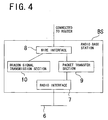
- the radio base station BS has such a configuration as shown in FIG. 4.
- an antenna 6 is used for transmission/reception to/from a mobile terminal MT.
- data passes through a radio interface 7.
- Connection to a router R is performed through a wire interface 8.
- a packet transfer section 9 performs a process of signaling data arriving at one of the interfaces 7 and 8 to the other interface 8 or 7.
- a beacon signal transmission section 10 performs a process of intermittently preparing a beacon signal packet and signaling the beacon signal packet from the radio interface 7.
- the radio base station BS includes the above-described route number applied to the radio base station into the beacon signal.
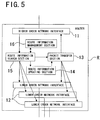
- Each router R has such a configuration as shown in FIG. 5.
- a higher order network interface 11 is used for connection to another router R on the farther side from the radio base station BS.
- n lower order network interfaces 12 are used for connection to the routers R on the nearer side to the radio base station BS.
- a packet transfer section 13 signals a packet to a designated one of the interfaces 11 and 12.
- a route information updating section 14 updates or prepares route information with designated contents.
- a route information search section 15 searches for route information in accordance with a designated method.
- a route information management section 16 stores route information and deletes any entry with regard to which a predetermined time elapses after it is updated.
- the disappearance time is set longer with a router positioned in a higher layer in the network.
- the disappearance time is set in accordance with the number of routers which are positioned immediately below the router. In particular, where the number of lower order network interfaces is n, the route holding time of the router is set to n times that of the routers immediately below the router.
- Each mobile terminal MT calculates, by the transmission range calculation section thereof, the transmission range of an updating notification in the following manner based on the route number included in the beacon signal from a radio base station BS, and signals the updating notification including information of the transmission range.
- the mobile terminal MT when it moves to another radio base station, it successively checks the digits of the route numbers applied to the new and old radio base stations to search for the lowest digit at which the value is different between the route numbers, and determines the searched out digit as the transmission range of the updating notification.
- the transmission range of the updating notification is determined as the third stage because the stage number must be m+1 as described above. Accordingly, in this instance, the updating notification is sent up to the router in the third stage from blow, but is not sent to a router in any higher stage.
- the transmission range calculation section of the mobile terminal MT changes the transmission range of an updating notification in the following manner.
- the transmission range of a packet is set to a router of the m+1th stage higher than the radio base station BS once by n m times. If a case wherein n is 3 and m is 2 is taken as an example, then the transmission range of an updating notification is varied in a period of once per 9 times in the following manner. 1, 1, 2, 1, 1, 2, 1, 1, 3, 1, 1, 2, 1, 1, 2, 1, 3, ...
- Each router R decrements, upon transfer processing of an updating notification, the transmission range by 1, and if the resulting value is 0, then the router abandons the packet without transferring it.
- the number of updating notifications which are circulated in order to hold a route in the mth network from below is 1/n per terminal when compared with that in the m-1th network from below.
- the number of routers accommodated is n
- the number of terminals to be managed increases to n times in average in a stage higher by one stage. Accordingly, the number of updating notifications which flow in the network is statistically equal between the mth stage and the m-1th stage, and the scalability is obtained without depending upon the performances of the routers.
- calculation of a transmission range is performed by each mobile terminal MT, since the mobile terminal MT may possibly have an operation power or processing capacity insufficient to perform fine control with regard to the transmission range of an updating notification, the calculation may be performed not by the mobile terminal MT but by each radio base station BS. In the following, operation in this instance is described.
- the mobile terminal MT transmits an updating notification without setting a transmission range.
- the identification number of the radio base station BS to which the mobile terminal MT has been connected formerly is included in the updating notification.
- the interval of an updating notification to be transmitted in order to hold the route is set with reference to a disappearance time of a route held by the routers R of the lowest layer.
- the radio base station BS has a route updating information holding section and holds a route information disappearance hour of the router R in the higher layer to the radio base station BS for each mobile terminal MT in the route updating information holding section. If a route updating notification from a mobile terminal MT arrives at the radio base station BS, then the radio base station BS determines a reaching range of the updating notification in a similar manner as in the procedure described hereinabove in the description of the embodiment and signals information of the reaching range together with the updating notification. Assuming that the updating notification is received immediately after it is signaled, the route information holding section in the radio base station BS updates the factor of the mobile terminal.
- the mobile terminal MT must only transmit an updating notification without being conscious of the transmission range, and the necessity for management of the disappearance time of a route in the router R of the higher layer or the range of movement is eliminated.
Landscapes
- Engineering & Computer Science (AREA)
- Computer Networks & Wireless Communication (AREA)
- Signal Processing (AREA)
- Mobile Radio Communication Systems (AREA)
- Data Exchanges In Wide-Area Networks (AREA)
- Small-Scale Networks (AREA)
Applications Claiming Priority (2)
| Application Number | Priority Date | Filing Date | Title |
|---|---|---|---|
| JP2000255872A JP3622648B2 (ja) | 2000-08-25 | 2000-08-25 | マイクロモビリティネットワークにおける経路更新方法 |
| JP2000255872 | 2000-08-25 |
Publications (3)
| Publication Number | Publication Date |
|---|---|
| EP1182831A2 true EP1182831A2 (de) | 2002-02-27 |
| EP1182831A3 EP1182831A3 (de) | 2003-10-08 |
| EP1182831B1 EP1182831B1 (de) | 2007-03-28 |
Family
ID=18744586
Family Applications (1)
| Application Number | Title | Priority Date | Filing Date |
|---|---|---|---|
| EP20010120230 Expired - Lifetime EP1182831B1 (de) | 2000-08-25 | 2001-08-23 | Routenaktualisierungsverfahren für Micromobilitätsnetzwerk |
Country Status (5)
| Country | Link |
|---|---|
| US (1) | US7158791B2 (de) |
| EP (1) | EP1182831B1 (de) |
| JP (1) | JP3622648B2 (de) |
| CN (1) | CN100461723C (de) |
| DE (1) | DE60127499T2 (de) |
Cited By (1)
| Publication number | Priority date | Publication date | Assignee | Title |
|---|---|---|---|---|
| WO2004021728A3 (en) * | 2002-08-30 | 2004-06-03 | Nokia Corp | Mobile unit attachment/update to cellular communication network |
Families Citing this family (18)
| Publication number | Priority date | Publication date | Assignee | Title |
|---|---|---|---|---|
| JP2003319442A (ja) * | 2002-04-25 | 2003-11-07 | Nec Corp | 移動通信システム |
| US8149707B2 (en) * | 2003-02-12 | 2012-04-03 | Rockstar Bidco, LP | Minimization of radio resource usage in multi-hop networks with multiple routings |
| JP4232544B2 (ja) * | 2003-06-11 | 2009-03-04 | 日本電気株式会社 | 移動体管理ネットワーク及びそれに用いる経路設定方法 |
| US7010299B2 (en) * | 2003-11-20 | 2006-03-07 | Motorola, Inc. | Method and apparatus for mobility in WLAN systems |
| EP1718004B1 (de) * | 2004-02-18 | 2017-06-21 | Ntt Docomo, Inc. | Paketübertragungssystem, drahtlose basisstation und routenoptimierung für die paketübertragung |
| CN100417110C (zh) * | 2004-09-24 | 2008-09-03 | 华为技术有限公司 | 基于汇聚型网络系统的路由更新方法 |
| FR2878676B1 (fr) * | 2004-11-30 | 2007-02-09 | Thales Sa | Systeme de routage multiple-topologie et multiple-services |
| JP4451325B2 (ja) * | 2005-02-01 | 2010-04-14 | 株式会社エヌ・ティ・ティ・ドコモ | 移動ノード、基地局、ルータおよびパケット通信システム |
| KR100713145B1 (ko) * | 2005-02-18 | 2007-05-02 | 삼성전자주식회사 | 무선 센서 네트워크에서의 전력소모를 최소화하는 네트워크형성방법 |
| JP5311889B2 (ja) * | 2008-06-11 | 2013-10-09 | 三菱電機株式会社 | 通信システム、移動通信装置、ホームエージェントおよび通信方法 |
| CN101651621B (zh) * | 2009-06-23 | 2012-09-05 | 中兴通讯股份有限公司 | 网络业务路由分配方法及装置 |
| WO2011056833A1 (en) * | 2009-11-04 | 2011-05-12 | Saudi Arabian Oil Company | Adaptive hybrid wireless and wired process control system and method |
| US9036589B2 (en) * | 2013-06-27 | 2015-05-19 | Verizon Patent And Licensing Inc. | Transmitting data flows via particular connection points accessible via one or more access points |
| JP2015046661A (ja) * | 2013-08-27 | 2015-03-12 | ソニー株式会社 | 情報処理装置および情報処理方法 |
| CN107040964B (zh) * | 2017-03-10 | 2020-12-18 | 台州市吉吉知识产权运营有限公司 | 一种基于wds的关联数限制的方法及系统 |
| US10608942B1 (en) * | 2017-11-30 | 2020-03-31 | Amazon Technologies, Inc. | Reducing routes based on network traffic utilization |
| US12056641B2 (en) * | 2020-11-20 | 2024-08-06 | Lyft, Inc. | Systems and methods for assigning tasks based on priorities determined for the tasks |
| US12413519B1 (en) * | 2022-03-28 | 2025-09-09 | Amazon Technologies, Inc. | Network devices programmed with most-used routes |
Family Cites Families (7)
| Publication number | Priority date | Publication date | Assignee | Title |
|---|---|---|---|---|
| US6421731B1 (en) * | 1996-10-29 | 2002-07-16 | Telxon Corporation | Dynamic next hop routing protocol |
| US6434134B1 (en) * | 1998-12-11 | 2002-08-13 | Lucent Technologies, Inc. | Dynamic address assignment for wireless devices accessing packet-based wired networks |
| US6654359B1 (en) * | 1998-12-11 | 2003-11-25 | Lucent Technologies Inc. | Wireless access to packet-based networks |
| US6751191B1 (en) * | 1999-06-29 | 2004-06-15 | Cisco Technology, Inc. | Load sharing and redundancy scheme |
| US6836463B2 (en) * | 1999-10-15 | 2004-12-28 | Nokia Corporation | System for communicating labeled routing trees to establish preferred paths and source routes with local identifiers in wireless computer networks |
| US6490259B1 (en) * | 2000-02-24 | 2002-12-03 | Telcordia Technologies, Inc. | Active link layer and intra-domain mobility for IP networks |
| US6907017B2 (en) * | 2000-05-22 | 2005-06-14 | The Regents Of The University Of California | Mobility management in wireless internet protocol networks |
-
2000
- 2000-08-25 JP JP2000255872A patent/JP3622648B2/ja not_active Expired - Fee Related
-
2001
- 2001-07-23 US US09/909,813 patent/US7158791B2/en not_active Expired - Fee Related
- 2001-08-01 CN CNB011238240A patent/CN100461723C/zh not_active Expired - Fee Related
- 2001-08-23 DE DE2001627499 patent/DE60127499T2/de not_active Expired - Lifetime
- 2001-08-23 EP EP20010120230 patent/EP1182831B1/de not_active Expired - Lifetime
Non-Patent Citations (4)
| Title |
|---|
| A.G.VALKO: "Cellular IP: A New Approach to Internet Host Mobility" ACM, [Online] XP002250272 Retrieved from the Internet: <URL:http://www.acm.org/sigcomm/ccr/archiv e/1999/jan99/ccr-9901-valko.pdf> [retrieved on 2003-08-01] * |
| CACERES R ET AL: "Fast and scalable wireless handoffs in support of mobile Internet audio" MOBILE NETWORKS AND APPLICATIONS, BALTZER SCIENCE PUBLISHERS, BUSSUM, NL, vol. 3, no. 4, 1998, pages 351-363, XP002135845 ISSN: 1383-469X * |
| ITU-T STUDY GROUP XI: "ITU-T Recommendation Q.708 Specifications of Signallilng System No.7. Numbering of International Signalling Point Codes" March 1993 (1993-03), ITU-T * |
| RAMJEE R ET AL: "HAWAII: a domain-based approach for supporting mobility in wide-area wireless networks" PROC. IEEE INTERNATIONAL CONFERENCE NETWORK PROTOCOLS, 31 October 1999 (1999-10-31), pages 283-292, XP010356967 * |
Cited By (2)
| Publication number | Priority date | Publication date | Assignee | Title |
|---|---|---|---|---|
| WO2004021728A3 (en) * | 2002-08-30 | 2004-06-03 | Nokia Corp | Mobile unit attachment/update to cellular communication network |
| US7130614B2 (en) | 2002-08-30 | 2006-10-31 | Nokia Corporation | Mobile unit attachment/update to cellular communication network |
Also Published As
| Publication number | Publication date |
|---|---|
| CN1340938A (zh) | 2002-03-20 |
| DE60127499D1 (de) | 2007-05-10 |
| EP1182831A3 (de) | 2003-10-08 |
| CN100461723C (zh) | 2009-02-11 |
| US7158791B2 (en) | 2007-01-02 |
| EP1182831B1 (de) | 2007-03-28 |
| US20020025817A1 (en) | 2002-02-28 |
| JP3622648B2 (ja) | 2005-02-23 |
| DE60127499T2 (de) | 2008-01-17 |
| JP2002077246A (ja) | 2002-03-15 |
Similar Documents
| Publication | Publication Date | Title |
|---|---|---|
| EP1182831A2 (de) | Routenaktualisierungsverfahren für Micromobilitätsnetzwerk | |
| JP3908977B2 (ja) | メッセージの経路指定システムおよび方法 | |
| JP3202928B2 (ja) | 通信ネットワークにおいて呼びを確立するシステム | |
| US8233471B2 (en) | Wireless network system and method for providing same | |
| US5802316A (en) | Routers connecting LANs through public network | |
| JP2577541B2 (ja) | 経路指定方法 | |
| US7389110B2 (en) | Mobile communication system and method for implementing handoff | |
| US7596151B2 (en) | System and method for discovering path MTU in ad hoc network | |
| JP2001245355A (ja) | 移動通信におけるパケット伝送システム | |
| EP1471696B1 (de) | Vorrichtung und Verfahren zur wiederholten Übertragung von Datenpaketen in einer mobilen ad hoc Umgebung | |
| JP2003516031A (ja) | アドホックネットワークにおけるルート更新 | |
| JP2004509481A5 (de) | ||
| US20040166898A1 (en) | Radio base station apparatus and inter-network interfacing apparatus | |
| WO2003098857A9 (en) | Technique for ip communication among wireless devices | |
| US7664111B2 (en) | Network switching system having a connection device management table commonly owned on a wireless network | |
| US20060120367A1 (en) | Method for transmitting short messages | |
| CN105657774B (zh) | 无线自组织网络中自适应核心转发网络的建立方法和系统 | |
| US20030091067A1 (en) | Computing system and method to select data packet | |
| US6693991B2 (en) | Priority auto-control method of signal routes in No. 7 signaling network | |
| EP2198650B1 (de) | Routen eines verkehrsweges in einem drahtlosen telekommunikationsnetz | |
| JPWO2007029337A1 (ja) | データ損失を低減するアドホック系ネットワーク装置 | |
| KR101110307B1 (ko) | 이동성 제공 인터넷 시스템 | |
| EP1819179B1 (de) | Verfahren zur Leitweglenkung von SMS Nachrichten | |
| JPH03216040A (ja) | ルーティング方式 | |
| KR20010008721A (ko) | 무선교환시스템에서 롱 사이즈 데이터 메시지의 송/수신방법 |
Legal Events
| Date | Code | Title | Description |
|---|---|---|---|
| PUAI | Public reference made under article 153(3) epc to a published international application that has entered the european phase |
Free format text: ORIGINAL CODE: 0009012 |
|
| AK | Designated contracting states |
Kind code of ref document: A2 Designated state(s): AT BE CH CY DE DK ES FI FR GB GR IE IT LI LU MC NL PT SE TR |
|
| AX | Request for extension of the european patent |
Free format text: AL;LT;LV;MK;RO;SI |
|
| PUAL | Search report despatched |
Free format text: ORIGINAL CODE: 0009013 |
|
| AK | Designated contracting states |
Kind code of ref document: A3 Designated state(s): AT BE CH CY DE DK ES FI FR GB GR IE IT LI LU MC NL PT SE TR |
|
| AX | Request for extension of the european patent |
Extension state: AL LT LV MK RO SI |
|
| 17P | Request for examination filed |
Effective date: 20030904 |
|
| 17Q | First examination report despatched |
Effective date: 20031107 |
|
| AKX | Designation fees paid |
Designated state(s): DE FR GB IT |
|
| GRAP | Despatch of communication of intention to grant a patent |
Free format text: ORIGINAL CODE: EPIDOSNIGR1 |
|
| GRAS | Grant fee paid |
Free format text: ORIGINAL CODE: EPIDOSNIGR3 |
|
| GRAA | (expected) grant |
Free format text: ORIGINAL CODE: 0009210 |
|
| AK | Designated contracting states |
Kind code of ref document: B1 Designated state(s): DE FR GB IT |
|
| REG | Reference to a national code |
Ref country code: GB Ref legal event code: FG4D |
|
| REF | Corresponds to: |
Ref document number: 60127499 Country of ref document: DE Date of ref document: 20070510 Kind code of ref document: P |
|
| PLBE | No opposition filed within time limit |
Free format text: ORIGINAL CODE: 0009261 |
|
| STAA | Information on the status of an ep patent application or granted ep patent |
Free format text: STATUS: NO OPPOSITION FILED WITHIN TIME LIMIT |
|
| 26N | No opposition filed |
Effective date: 20080102 |
|
| PGFP | Annual fee paid to national office [announced via postgrant information from national office to epo] |
Ref country code: FR Payment date: 20090814 Year of fee payment: 9 |
|
| PGFP | Annual fee paid to national office [announced via postgrant information from national office to epo] |
Ref country code: DE Payment date: 20090821 Year of fee payment: 9 Ref country code: GB Payment date: 20090818 Year of fee payment: 9 |
|
| PGFP | Annual fee paid to national office [announced via postgrant information from national office to epo] |
Ref country code: IT Payment date: 20090818 Year of fee payment: 9 |
|
| GBPC | Gb: european patent ceased through non-payment of renewal fee |
Effective date: 20100823 |
|
| REG | Reference to a national code |
Ref country code: FR Ref legal event code: ST Effective date: 20110502 |
|
| PG25 | Lapsed in a contracting state [announced via postgrant information from national office to epo] |
Ref country code: IT Free format text: LAPSE BECAUSE OF NON-PAYMENT OF DUE FEES Effective date: 20100823 |
|
| REG | Reference to a national code |
Ref country code: DE Ref legal event code: R119 Ref document number: 60127499 Country of ref document: DE Effective date: 20110301 |
|
| PG25 | Lapsed in a contracting state [announced via postgrant information from national office to epo] |
Ref country code: FR Free format text: LAPSE BECAUSE OF NON-PAYMENT OF DUE FEES Effective date: 20100831 Ref country code: DE Free format text: LAPSE BECAUSE OF NON-PAYMENT OF DUE FEES Effective date: 20110301 |
|
| PG25 | Lapsed in a contracting state [announced via postgrant information from national office to epo] |
Ref country code: GB Free format text: LAPSE BECAUSE OF NON-PAYMENT OF DUE FEES Effective date: 20100823 |