EP1181110B1 - Procede de preparation d'un plan de tri - Google Patents
Procede de preparation d'un plan de tri Download PDFInfo
- Publication number
- EP1181110B1 EP1181110B1 EP00918971A EP00918971A EP1181110B1 EP 1181110 B1 EP1181110 B1 EP 1181110B1 EP 00918971 A EP00918971 A EP 00918971A EP 00918971 A EP00918971 A EP 00918971A EP 1181110 B1 EP1181110 B1 EP 1181110B1
- Authority
- EP
- European Patent Office
- Prior art keywords
- sorting
- machine
- box
- compartments
- letters
- Prior art date
- Legal status (The legal status is an assumption and is not a legal conclusion. Google has not performed a legal analysis and makes no representation as to the accuracy of the status listed.)
- Expired - Lifetime
Links
Images




Classifications
-
- B—PERFORMING OPERATIONS; TRANSPORTING
- B07—SEPARATING SOLIDS FROM SOLIDS; SORTING
- B07C—POSTAL SORTING; SORTING INDIVIDUAL ARTICLES, OR BULK MATERIAL FIT TO BE SORTED PIECE-MEAL, e.g. BY PICKING
- B07C3/00—Sorting according to destination
- B07C3/02—Apparatus characterised by the means used for distribution
Definitions
- the present invention relates to a method for preparing a sorting plan of a batch of objects of the folds, letters type, for a sorting machine operating in sorting reversed, for the distribution of said objects by a person responsible for this mission, attendant or other.
- This sorting is carried out by the so-called reverse sorting method, which method allows sorting in an appropriate sorting machine, and with a reduced number of passes, a large number of objects attributed to many distribution points.
- One of the first problems encountered on these sorting machines is related to the capacity of the boxes or receptacles which receive the objects as and when sorting. This problem is for example treated in documents EP-A2-0718049 and DE-A1-19709232.
- the present invention provides a process which has a greater simplicity and which also offers the operator the possibility of seeing the implementation of the process on the machine.
- the method for preparing the sorting plan consists, from data on the actual batch to be sorted or statistical data to be inserted in the list non-zero numbers representing the quantity of objects for each point of distribution, in the order of the route, a number of zeros up to the separating power available on the sorting machine, and the number of passes of sorting, and to arrange said zeros in the distribution matrix illustrating said plane of sorting, so that some boxes of the sorting machine, which appear as empty, be used as duplication boxes of the first box previous not empty, so as to take into account and process the point (s) distribution for which the number of objects or the sum of these numbers according to the case in each row or column of said matrix, is such that it exceeds the capacity of a single box, which amounts to assimilating one or more boxes consecutive to one and the same direction, playing the role of receptacles multiple capacity.
- Reverse sorting also involves repeating tasks on the part of the operator.
- the operator recovers in an order specifies the content of each box and positions said content while respecting the recovery order, either in the sorting machine store for a new sorting operation, either in a container or box for the distribution when this recovery follows the last pass.
- duration of this decasing operation is linked to the number of boxes in which the sorted objects are positioned.
- the present invention proposes to remedy these drawbacks, that is to say to reduce the arduousness and the time of this operation by implementing means which make it possible to reduce the number of boxes used for carry out the sorting operation.
- These means consist, on the matrix distribution of the sorting plan, to place in the first row (s) of said matrix, zeros distributed in rows and / or columns so as to be able to reduce the number of boxes used on the machine, when sorting and, moreover, filling said boxes to a value close to their maximum capacity.
- sorting machines In the case of sorting machines whose boxes have a capacity relatively small and fixed, sorting operations on the one hand, and sorting operations on the other hand, successive stripping.
- the invention proposes to make a partition of the boxes to form at least two geographically distinct sets on said machine, allowing to superimpose over time, the automatic sorting operation of a first batch of objects, and the crushing operation of another batch already sorted.
- the method also consists in accumulate several lots of objects to sort, so as to use among the boxes available, as many boxes as possible, which boxes receiving each a quantity of objects close to their maximum capacity.
- the process for preparing a sorting plan also applies to the arrangement of the sorting plan represented in the form of parallelepiped matrix corresponding to a sort carried out in three passes.
- the process according to the invention may consist in adjusting the filling rate of each of the boxes so that automatic filling and manual crushing, without risk of overflow.
- the invention also relates to machines for setting up process work and in particular a machine like the office machine which includes for example several superimposed and horizontal lines of juxtaposed boxes, each line comprising thirteen boxes, one of which, the last, constitutes a waste and / or overflow reception area; each box has a capacity of around 50 letters of conventional mail and includes means for detecting the achievement of its maximum capacity, so as to orient either towards the overflow box, or to open the following boxes qualified as duplication boxes, reserved for this purpose to accommodate the overflow from the previous box.
- this machine comprises a module to optimize the distribution of the lot (s) to be sorted, in the matrix representation, in order to provide the automaton of said machine with a sorting plan adapted to said lots, that is to say a plan which makes it possible to use the better the possibilities of the machine, in the interest of the operator.
- FIG. 1 shows, placed in a box 1, a batch of objects to be sorted and especially letters 2.
- the batch of letters can be delivered to the distributor office with information.
- This information can be transmitted by any means suitable for the distributor office by computer network or for example, as shown, using a floppy disk 3.
- This information or data are also shown in Figure 1 and consist of a list of numbers which correspond to the quantity of letters assigned to each of the factor distribution points, which numbers are listed in order of said points.
- Factor distribution points are mentioned on the first line 4, numbered from 1 to 55 as an example.
- Each distribution point on line 4 corresponds, as mentioned on the bottom line 5, a certain amount of letters.
- This machine comprises a magazine 10 in which the operator (attendant, postman, etc.) can dispose of his batch of letters 2.
- Each letter is removed by means of a destacker device 11 and follows a circuit which leads it into the one of the boxes 12 marked 1, 2, 3 etc ... up to 12 or even 24 and more, with at the end a box R for scrap or other.
- the letter circuit consists of a conveyor system 13 to the end of which the letters are oriented in the appropriate boxes 12. Each letter is sent to a box using a referral system 14 by means of a tilting deflector 15 controlled by means appropriate connected to an automaton 16 shown diagrammatically on the machine in the form of a rectangle.
- the deflector 15 causes a deviation of each letter towards the box appropriate and the letters are guided by means of a hinged flap 17, which allows the arrangement of letters one behind the other in the boxes.
- Each flap 17 is articulated so as to move as the corresponding box is filled.
- the flap 17 actuates a detector device consisting of a sensor 19 and this sensor 19 provides information which makes it possible, via the automaton 16 and the switching device 14, to orient the letters either to the R waste box, or simply to the next box, which is provided in the sorting plan as an overflow box.
- the controller 16 receives information from a read head 20 who, at the time of the passage of each letter, reads the information printed on said letter, in the form of a barcode. This reading identifies the point of distribution of the letter, and, according to a distribution of said points which will be detailed below, the automaton 16 directs the letter in question towards one boxes 12 corresponding to its destination, either box 1, 2 or 3, etc ...
- the automaton controls the switches 14 according to the destinations. These destinations are listed in a memory 21 which corresponds to the sorting plan prepared from known information, i.e. either information that comes from disk 3, that is information that come from the performance of a previous sorting such as the sorting of the day previous or an average established over several days.
- This preparation is carried out in a module 22 consisting of a computer programmed to use the data concerning the lots to be sorted, according to an appropriate program.
- sorting operation is carried out in the present case in two passes, by the reverse sorting method.
- the first sort is launched on the available boxes of the machine in based on criteria which arise from the sorting plan prepared in advance in the form matrix.
- the operator collects the letters in each box and reposition them in the same order, in the store 10 for a second sorting operation at the end of which the objects are classified one after the other, by points of distribution.
- the operator At the end of the first sorting pass, the operator must arrange the packages of letters in a certain order in store 10 and in particular in the order of the boxes numbered from 1 to 12 or from 1 to 24 or other as the case may be.
- the capacity K of the boxes 12 of the sorting machine is of the order of 50 ordinary letters, which corresponds to a handful of letters easily grasped by the operator during the decasing operation, that is to say the 'operation which consists in removing in each of the boxes the sorted letter packet either to make a new sorting pass, or for a delivery in boxes for the realization of the round.
- This capacity may prove to be insufficient for certain points or distribution point groups.
- the boxes to which these points 31 and 48 are assigned will receive approximately 50 letters each and, as soon as the sensor 19 will give the information of maximum filling of the box d 'reception, the additional letters will be directed to box R which corresponds to the scrap or overflow box in which the mail is unsorted.
- FIG. 3 corresponds to a matrix representation of the quantities of letters to distribute, in a matrix including the number of lines and the number of columns correspond to the number of boxes available for sorting on a machine by the so-called reverse sorting method.
- the number of points in the matrix corresponds to the separating power of the machine.
- the matrix has 24 horizontal lines and 24 vertical columns; the number of rows and columns is chosen according to the capacity and the number of boxes of the machine, available to perform the different sorting passes. The number of boxes used can vary from move on to the next.
- This matrix is filled with the numbers that correspond to quantities of letters allocated to each distribution point according to the example of Figure 1. So, in the first column # 1, we see appear the number 8 then the number 7 corresponding respectively to the first point and at the second distribution point.
- the number 3 appears in the first line of column 2 followed by the number 10.
- the number 3 appears in the third column, etc ...
- the route of the factor can be read in the matrix in Figure 3 and in the following matrices, starting from the first row of column 1 to the line 24, then column 2 from line 1 to line 24, etc ... to column 24, line 24.
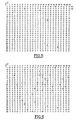
- Figure 4 shows a 24-row, 24-column matrix in which the non-zero numbers of the matrix of figure 3, have been replaced through the corresponding distribution points 1 to 55.
- the sorting operation by the reverse sorting method is performed on the basis of information given by the matrix in Figure 4.
- This matrix is listed in the memory 21 of the sorting machine.
- the sorting operation consists, for the first pass, identify each letter using reader 20 and send it thanks to the automaton 16, in the appropriate box 12 according to its position which is listed in the matrix. So a letter corresponding to a point distribution which is located in the first line of the matrix, is oriented towards box n ° 1; each letter whose destination corresponds to a point of distribution placed line 2, is oriented towards box n ° 2, etc ..., etc ... until letters from line 24 assigned to box 24.
- line 1 of the matrix in Figure 3 has a total of 8 letters which will be collected in box n ° 1. These letters are intended, according to the matrix shown in Figure 4, for three of them, to distribution point n ° 3, for three others of them at point n ° 39 and for the last two at point 45.
- Box 2 receives five letters.
- box n ° 10 receives 122 letters, i.e. a quantity significantly higher than its capacity. These 122 letters are intended, according to the matrix of figure 4, for four of them at the point of distribution n ° 20, for 54 of them at distribution point n ° 31 and, for all others, point 48.
- Figure 5 shows an optimized distribution of quantities of letters assigned to each point, and this for each line and each column of the matrix.
- Line 2 has only 34 letters corresponding to the point of distribution n ° 19, which will be assigned to box n ° 2.
- Line 3 has 54 letters corresponding to distribution point n ° 31, which will be assigned in part to box n ° 3 and the rest to the R scrap box.
- the sum of the quantities of letters contained in the other lines, is less than 50.
- column 1 is assigned to the box n ° 1
- column 2 is assigned to box n ° 2
- column 24 is assigned to box 24.
- Figure 6 shows the position of distribution points 1 to 55, according to the matrix distribution shown in Figure 5.
- Figure 7 shows a solution in the distribution of quantities in the 24-24 matrix, which allows, when a row or column has a number of letters greater than the capacity of the corresponding box, to release the boxes following this normally overloaded box, in order to be able to direct the surplus letters towards this box or these following boxes rather than towards the waste box R.
- This distribution is carried out by keeping the order, column by column, of the different distribution points, as shown in figure 8.
- This column 14 has a total of 59 letters which will be distributed in box 14 for a game, and in the next box 15.
- the column 15 is a column filled with zeros. No letters are affected automatically in this box n ° 15.
- This box n ° 15 will be a duplication box which will complement, i.e. increase the capacity of box 14 when this box n ° 14 will have reached its maximum filling level.
- This feature has the advantage of not disturbing the distribution boxes and especially to allow during the decasing, to keep the order of letters when taken from successive boxes for a new positioning in the store if this decasing follows a first pass, or in a box if these letters are crushed following the last pass.
- Figure 7 we note that the number 64 which appears column 20, line 23, is followed by two columns 21 and 22 filled with zeros, and a line 24 also filled with zeros. This means that line 24 corresponding to box no. 24 proposes said box no. 24 as a box for duplication of the previous box n ° 23 during the first pass.
- Figure 9 shows the development of a distribution which limits the number of boxes used on the sorting machine. This operation consists of combine the quantities of letters in a number of rows and columns relatively small.
- lines 1 to 8 only have zeros of same as columns 1 to 8, which means that in a sorting machine with 24 boxes, only 16 boxes are useful for performing the operation sorting, both the first pass and the second pass, taking into account the matrix distribution of letter quantities.
- This distribution is arranged in the matrix shown in FIG. 9, of in such a way that the large distribution points, i.e. points n ° 31 and 48 in the example of figure 1, are isolated or possibly grouped with other points and followed by a column and a line filled with zeros so to automatically create duplication boxes.
- Line 16 which includes 55 letters, is followed by line 17 filled with zeros.
- Box 17 is a duplication box in box 16.
- column 17 contains 79 letters which will be distributed in box 17 and in the box duplication n ° 18 taking into account the fact that column 18 is filled with zeros.
- Box 22 is assigned as a duplicate box n ° 21 to accommodate the surplus of letters.
- This massification operation carried out in the matrix shown figure 9 allows on the one hand, to keep the order of the letters for each pass sorting and, on the other hand, limit the number of crushing operations.
- Figure 10 shows the matrix representation of the points of distribution corresponding to the quantities entered in the matrix in Figure 9.
- line 9 can correspond to the box 1 of the sorting machine which receives the letters from the distribution points 16, 22 and 45.
- the box numbers are placed to the left of the numbers lines and above the column numbers.
- Line 10 corresponding for example to box 2, receives during the first pass, letters assigned to distribution points 1, 17, 28, 37, 46 and 49.
- Line 16 which corresponds for example to box 8, receives the letters to distribution points 10 and 31, the number of which is greater than the capacity of box n ° 16. The surplus letters will be oriented towards box n ° 9 qualified as a duplication box in box n ° 8 previous.
- n ° 15 This same diagram is found at line 23 corresponding to box n ° 15 which will receive letters from distribution points n ° 8, 15, 21, 36 and 55.
- the number of letters in this box n ° 15 is 57, according to the matrix shown in figure 9.
- Box n ° 16 constitutes the duplication box in box 15 to receive excess letters.
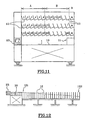
- Figure 11 shows a sorting machine that has three lines of boxes.
- This sorting machine has a capacity which is for example 36 boxes plus, at the end of each of the lines, waste boxes R.
- the distribution of letter quantities in the preparation matrix of the sorting plan can be carried out preferentially, with a program suitable for performing quantity calculations at high speed of objects corresponding to the different distribution points, per line and per column as these points and quantities move in the matrix in order to obtain, as shown in FIGS. 5 and 6, an optimization of the quantities per row and per column or, in Figures 7 and 8, an arrangement which performs automatic duplication of overloaded boxes or as shown in figures 9 and 10, an automatic duplication with reduction in the number of boxes required to perform the sorting operation.
- the optimization module 22 which can be part of the machine, which module is associated with the desk 23, Figures 11 and 12, which allows to control the machine.
- the module 22 is connected to the communication network through which the operator can access the data of the batches to be sorted, or else he is equipped with a drive suitable for reading 3 or other floppy disks.
- the machine shown in Figure 11, has a separating power equal to 16 x 16 for its part A and the same separating power 16 x 16, ie 256, for its second part B.
- each part A and B of the machine is approximately 800 letters, (50 x the number of boxes).
- This grouping of lots, each corresponding to a district, can be proposed to the operator, directly on the machine, from the data provided by upstream sorting centers, accessible through a network of appropriate communication.
- a first operation consists in classifying each batch by taking as criteria the number of distribution points, then to form clusters.
- Each group of lots consists of the first lot not yet grouped in the list, and of a set of batches not yet grouped consecutively in the list.
- Each set must consist of as many lots as possible, themselves as big as possible.
- the grouping criterion is the possible sorting massified on a machine “space” allowing sorting in hidden time. The number of groups is therefore minimized as well as, therefore, the numbers changes of tasks and decasings. The process stops when all the lots are grouped.
- each group is taken up (this time seen as a lot), optimized and massified. It is therefore necessarily friable using a number of boxes lower (but close) to the desired machine “space”, while ensuring filling the boxes close to their capacity.
- the route in this case can be read, for example, layer by layer, from before back, then for each layer, column by column from left to right and for each column, line by line from top to bottom.
- Figure 12 shows schematically another type of sorting machine. Boxes 12 or receptacles are distributed over a long line and each box has a large capacity, greater than 400 or even 500 letters.
- This type of machine can operate continuously, i.e. it it is possible to carry out consecutive sorting operations which overlap manual crushing operations.
- the process for preparing the sorting plan consists in providing a different filling rate for the boxes and particular a gradual reduction in the number of objects starting from the first box served until the last, that is to say that one performs at level of the matrix distribution, an optimization of the sum of the objects of each row and each column of the matrix that follows a progression allowing to place in the first box 121 a sum of objects close to the maximum capacity of the space whereas for the last space 122, this sum of objects is lower, to be adjusted according to the machine.
- the filling takes the form of a ramp and this optimization process is moreover compatible with the duplication and massification developed previously.
Landscapes
- Sorting Of Articles (AREA)
Description
- la figure 1 représente un lot d'objets à trier (lettres) et les données concernant ce lot ;
- la figure 2 représente d'une façon schématique, une machine de tri pour le lot de lettres qui est représenté figure 1 par exemple ;
- la figure 3 représente sous forme matricielle, la préparation du plan de tri faisant apparaítre les nombres correspondant aux quantités d'objets à distribuer, lesquels nombres sont répartis les uns à la suite des autres, colonne par colonne, dans la matrice avec insertion de zéros dans lesdites colonnes ;
- la figure 4 représente la matrice de la figure 3 avec, à la place des quantités d'objets, une indication des points de distribution correspondants ;
- la figure 5 représente un aménagement de la matrice de la figure 3 permettant d'améliorer le tri en optimisant la répartition des quantités de lettres disposées dans les lignes et dans les colonnes ;
- la figure 6 représente la position des points de distribution de la matrice détaillée figure 5 ;
- la figure 7 représente un autre aménagement de la matrice représentée figure 3, avec un dédoublement des lignes et colonnes trop chargées, c'est-à-dire dont la somme des quantités de chaque point inscrit sur lesdites lignes et colonnes est supérieure à la capacité d'accueil d'une case seule ;
- la figure 8 représente la position des points de distribution de la matrice détaillée figure 7 ;
- la figure 9 représente un autre aménagement de la matrice représentée figure 3, pour réduire le nombre de cases utilisées lors de l'opération de tri ;
- la figure 10 représente la position des points de distribution de la matrice détaillée figure 9 ;
- la figure 11 représente une machine de tri du type de celle susceptible de mettre en oeuvre le plan de tri matriciel représenté précédemment, figure 10 ;
- la figure 12 représente une machine de tri du genre machine à tasseurs, pour laquelle le plan de tri permet un remplissage à taux variable des différents réceptacles.
Claims (10)
- Procédé de préparation d'un plan de tri d'objets du type lettres par exemple, mis en oeuvre par une machine de tri qui procède par tri inversé, lequel procédé consiste - à aménager la répartition matricielle du lot d'objets à trier, par une insertion d'un certain nombre de zéros à concurrence du pouvoir séparateur disponible sur ladite machine et du nombre de passes de tri, laquelle insertion est effectuée dans la liste des nombres non nuls qui représentent ledit lot d'objets et qui sont classés dans l'ordre de l'itinéraire de distribution desdits objets, et - à disposer dans la matrice de répartition, les zéros de telle façon que certaines cases de la machine de tri, qui apparaissent comme vides, soient utilisées comme cases de dédoublement de la première case précédente non vide, afin de prendre en compte et de traiter un ou plusieurs points de distribution pour lesquels le nombre d'objets ou la somme de ces nombres selon le cas dans chaque ligne ou colonne de ladite matrice, est tel qu'il dépasse la capacité d'accueil d'une simple case, assimilant ainsi une ou plusieurs cases consécutives à une seule et même direction, jouant le rôle de cases de plus grande capacité.
- Procédé selon la revendication 1, caractérisé en ce qu'il consiste à rechercher l'utilisation d'un nombre minimum de cases sur la machine de tri, lesquelles cases étant remplies à une valeur proche de leur capacité maximale, laquelle recherche s'effectue par le placement de lignes de zéros dans la matrice de répartition, lesquelles lignes se retrouvant concentrées au(x) premier(s) rang(s) de ladite matrice.
- Procédé selon la revendication 2, caractérisé en ce qu'il consiste, dans le cas d'une machine de tri dont le nombre de cases est tel que sa capacité d'accueil est au moins deux fois supérieure à la quantité d'objets à trier, à réaliser une partition des cases pour former au moins deux ensembles A et B distincts géographiquement sur ladite machine, lesquels ensembles permettent de superposer dans le temps, l'opération automatique de tri d'un flux d'objets et l'opération de décasage d'un flux déjà trié.
- Procédé selon la revendication 3, caractérisé en ce qu'il consiste, en fonction des capacités de la machine de tri, à cumuler plusieurs lots d'objets à trier de façon à utiliser le plus grand nombre de cases possible, chaque case recevant une quantité d'objets qui est proche de sa capacité d'accueil maximale.
- Procédé selon l'une quelconque des revendications 1 à 4, caractérisé en ce que l'aménagement de la répartition matricielle s'effectue sur une représentation matricielle cubique correspondant à un tri réalisé en trois passes de tri inversé.
- Procédé selon l'une quelconque des revendications 1 à 5, caractérisé en ce qu'il consiste dans le cas d'une machine munie de cases de grande capacité susceptibles d'être remplies sans avoir été préalablement vidées, comme par exemple une machine à tasseurs dont les cases s'étendent en ligne sur une grande longueur, à aménager le taux de remplissage de chacune des cases de façon à réaliser simultanément le remplissage automatique et le décasage manuel, sans risque de débordement, lequel aménagement consiste à effectuer une réduction progressive du nombre d'objets dirigés vers les cases, partant de la première case jusqu'à la dernière.
- Machine permettant la mise en oeuvre du procédé selon l'une quelconque des revendications 1 à 5, caractérisée en ce qu'elle comporte des cases juxtaposées disposées selon trois lignes superposées et horizontales, chaque ligne comportant par exemple 13 cases dont l'une, la dernière, constitue une case d'accueil du rebut et/ou du débordement éventuel, chaque case ayant une capacité d'accueil de l'ordre de 50 lettres de courrier classique.
- Machine selon la revendication 7, caractérisée en ce que chaque case (12) comporte des moyens pour détecter le niveau de remplissage maximum de ladite case, lesquels moyens de détection, en forme de capteurs (19), donnent une information qui est utilisée soit pour orienter vers la case de débordement, soit pour ouvrir la case suivante en cas de dédoublement.
- Machine pour la mise en oeuvre du procédé selon la revendication 6, caractérisée en ce qu'elle comprend des réceptacles du type à tasseurs, disposés selon une ligne horizontale de grande longueur, lesquels réceptacles ont une capacité d'accueil importante, supérieure à 450 lettres par exemple.
- Machine selon l'une quelconque des revendications 7 à 9, caractérisée en ce qu'elle comporte un module d'optimisation (22) du type calculateur programmé, chargé de mettre en oeuvre le procédé de préparation du tri de lot(s) d'objets selon l'une quelconque des revendications 1 à 6.
Applications Claiming Priority (3)
| Application Number | Priority Date | Filing Date | Title |
|---|---|---|---|
| FR9905010 | 1999-04-16 | ||
| FR9905010A FR2792227B1 (fr) | 1999-04-16 | 1999-04-16 | Procede de preparation d'un plan de tri d'un lot d'objets (plis,lettres, ...) pour machine de tri fonctionnant en tri inverse |
| PCT/FR2000/000960 WO2000062947A1 (fr) | 1999-04-16 | 2000-04-13 | Procede de preparation d'un plan de tri |
Publications (2)
| Publication Number | Publication Date |
|---|---|
| EP1181110A1 EP1181110A1 (fr) | 2002-02-27 |
| EP1181110B1 true EP1181110B1 (fr) | 2003-02-12 |
Family
ID=9544674
Family Applications (1)
| Application Number | Title | Priority Date | Filing Date |
|---|---|---|---|
| EP00918971A Expired - Lifetime EP1181110B1 (fr) | 1999-04-16 | 2000-04-13 | Procede de preparation d'un plan de tri |
Country Status (5)
| Country | Link |
|---|---|
| EP (1) | EP1181110B1 (fr) |
| AU (1) | AU3973800A (fr) |
| DE (1) | DE60001405T2 (fr) |
| FR (1) | FR2792227B1 (fr) |
| WO (1) | WO2000062947A1 (fr) |
Families Citing this family (4)
| Publication number | Priority date | Publication date | Assignee | Title |
|---|---|---|---|---|
| DE10145295A1 (de) * | 2001-09-14 | 2003-04-24 | Siemens Dematic Ag | Verfahren zur Verteilreihenfolgesortierung |
| US8504192B2 (en) | 2007-12-13 | 2013-08-06 | Solystic | Method of sorting mailpieces by using a process for dynamically allocating sorting outlets |
| DE102009011428A1 (de) * | 2009-03-03 | 2010-09-16 | Siemens Aktiengesellschaft | Sortierverfahren und Sortieranlage mit zwei verschiedenen Gruppen von Ausgabeeinrichtung |
| CN112354868A (zh) * | 2020-10-15 | 2021-02-12 | 西安邮电大学 | 一种自动化分拣系统的二次分拣方法 |
Family Cites Families (4)
| Publication number | Priority date | Publication date | Assignee | Title |
|---|---|---|---|---|
| FR2681263B1 (fr) * | 1991-09-18 | 1993-11-12 | Cga Hbs Cie Gle Automatisme | Procede de tri d'objets. |
| JP3389717B2 (ja) * | 1994-12-22 | 2003-03-24 | 株式会社日立製作所 | 紙葉類区分方法及びその装置 |
| JPH09239325A (ja) * | 1996-03-11 | 1997-09-16 | Hitachi Ltd | 郵便物配達順並べ替え区分方法および装置 |
| NL1003154C2 (nl) * | 1996-05-17 | 1997-11-18 | Nederland Ptt | Werkwijze voor het sorteren op bestelvolgorde van poststukken. |
-
1999
- 1999-04-16 FR FR9905010A patent/FR2792227B1/fr not_active Expired - Lifetime
-
2000
- 2000-04-13 WO PCT/FR2000/000960 patent/WO2000062947A1/fr not_active Ceased
- 2000-04-13 AU AU39738/00A patent/AU3973800A/en not_active Abandoned
- 2000-04-13 DE DE60001405T patent/DE60001405T2/de not_active Expired - Fee Related
- 2000-04-13 EP EP00918971A patent/EP1181110B1/fr not_active Expired - Lifetime
Also Published As
| Publication number | Publication date |
|---|---|
| AU3973800A (en) | 2000-11-02 |
| EP1181110A1 (fr) | 2002-02-27 |
| FR2792227A1 (fr) | 2000-10-20 |
| DE60001405T2 (de) | 2003-11-06 |
| DE60001405D1 (de) | 2003-03-20 |
| WO2000062947A1 (fr) | 2000-10-26 |
| FR2792227B1 (fr) | 2001-07-27 |
Similar Documents
| Publication | Publication Date | Title |
|---|---|---|
| EP0533536B1 (fr) | Procédé de tri d'objets | |
| EP0092460B1 (fr) | Dispositif de classement d'objets manutentionnés | |
| EP3245147B1 (fr) | Système et procédé de séquencement pour au moins un poste de préparation | |
| FR2480545A1 (fr) | Dispositif et procede pour imprimer un deplacement angulaire a une image de television | |
| FR3051948A1 (fr) | Systeme de stockage tampon et de sequencement de charges comprenant deux elevateurs. | |
| EP1722900B1 (fr) | Procede et dispositif pour preparer une tournee du facteur avec a la fois des lettres et des objets de grand format | |
| FR2671201A1 (fr) | Preparation de listes d'objets a charger dans des contenants. | |
| FR2792227A1 (fr) | Procede de preparation d'un plan de tri d'un lot d'objets (plis,lettres, ...) pour machine de tri fonctionnant en tri inverse | |
| EP2239220B1 (fr) | Installation et procede de traitement d'imprimes | |
| EP0597784B1 (fr) | Ligne de reconnaissance et de traitement pour produits d'édition ou imprimés | |
| EP1736250B1 (fr) | Procédé pour fusionner des lettres et des objets postaux de grand format et/ou non mécanisables dans une tournée unique du facteur | |
| EP2569099B1 (fr) | Méthode pour optimiser un processus de traitement et de transport du courrier en bacs utilisant un tri stratifié | |
| EP1355453B1 (fr) | Dispositif d'aiguillage à commutation et routage centralisés | |
| EP1618969B1 (fr) | Procédé de traitement d'envois postaux pour la préparation et la séparation des tournées de facteur et machine de tri correpondante | |
| EP3854728A1 (fr) | Installation et procédé de préparation de commandes | |
| FR2552686A1 (fr) | Dispositif modulable et methodes de classement d'objets indexes | |
| EP1704931B1 (fr) | Procédé de traitement d'envois postaux incluant un contrôle de rang | |
| EP0408638B1 (fr) | Procede et dispositif d'accumulation et de convoyage d'articles pour presenter ces articles a un poste fixe dans un ordre arbitraire determine | |
| FR2565852A1 (fr) | Procede et dispositif de mise en ordre d'objets | |
| EP1118556B1 (fr) | Système de distribution automatique d'articles pour la préparation d'une ou plusieurs commandes de tels articles | |
| FR2459196A1 (fr) | Appareil d'alimentation reguliere en pieces pour une machine de traitement en continu de ces pieces | |
| FR3102153A1 (fr) | Système et procédé automatisé de remplissage de plateaux d’œufs en défilement | |
| EP4282792A1 (fr) | Procédé de réception, de stockage et de prélèvement d'articles | |
| EP1778415A1 (fr) | Installation de triage et de regroupement d'objets, recipients ou autres | |
| EP0752577A1 (fr) | Procédé et dispositif de conditionnement à poids constant de tranches de viande ou de poisson |
Legal Events
| Date | Code | Title | Description |
|---|---|---|---|
| PUAI | Public reference made under article 153(3) epc to a published international application that has entered the european phase |
Free format text: ORIGINAL CODE: 0009012 |
|
| 17P | Request for examination filed |
Effective date: 20011116 |
|
| AK | Designated contracting states |
Kind code of ref document: A1 Designated state(s): AT BE CH CY DE DK ES FI FR GB GR IE IT LI LU MC NL PT SE |
|
| GRAG | Despatch of communication of intention to grant |
Free format text: ORIGINAL CODE: EPIDOS AGRA |
|
| 17Q | First examination report despatched |
Effective date: 20020618 |
|
| GRAG | Despatch of communication of intention to grant |
Free format text: ORIGINAL CODE: EPIDOS AGRA |
|
| GRAH | Despatch of communication of intention to grant a patent |
Free format text: ORIGINAL CODE: EPIDOS IGRA |
|
| GRAH | Despatch of communication of intention to grant a patent |
Free format text: ORIGINAL CODE: EPIDOS IGRA |
|
| GRAA | (expected) grant |
Free format text: ORIGINAL CODE: 0009210 |
|
| AK | Designated contracting states |
Designated state(s): DE IT |
|
| REF | Corresponds to: |
Ref document number: 60001405 Country of ref document: DE Date of ref document: 20030320 Kind code of ref document: P |
|
| PLBE | No opposition filed within time limit |
Free format text: ORIGINAL CODE: 0009261 |
|
| STAA | Information on the status of an ep patent application or granted ep patent |
Free format text: STATUS: NO OPPOSITION FILED WITHIN TIME LIMIT |
|
| 26N | No opposition filed |
Effective date: 20031113 |
|
| PGFP | Annual fee paid to national office [announced via postgrant information from national office to epo] |
Ref country code: DE Payment date: 20070327 Year of fee payment: 8 |
|
| PGFP | Annual fee paid to national office [announced via postgrant information from national office to epo] |
Ref country code: IT Payment date: 20070619 Year of fee payment: 8 |
|
| PG25 | Lapsed in a contracting state [announced via postgrant information from national office to epo] |
Ref country code: DE Free format text: LAPSE BECAUSE OF NON-PAYMENT OF DUE FEES Effective date: 20081101 |
|
| PG25 | Lapsed in a contracting state [announced via postgrant information from national office to epo] |
Ref country code: IT Free format text: LAPSE BECAUSE OF NON-PAYMENT OF DUE FEES Effective date: 20080413 |