EP1179421A2 - Biaxially oriented polyester film for window application - Google Patents
Biaxially oriented polyester film for window application Download PDFInfo
- Publication number
- EP1179421A2 EP1179421A2 EP01119045A EP01119045A EP1179421A2 EP 1179421 A2 EP1179421 A2 EP 1179421A2 EP 01119045 A EP01119045 A EP 01119045A EP 01119045 A EP01119045 A EP 01119045A EP 1179421 A2 EP1179421 A2 EP 1179421A2
- Authority
- EP
- European Patent Office
- Prior art keywords
- film
- biaxially oriented
- coating
- polyester film
- window application
- Prior art date
- Legal status (The legal status is an assumption and is not a legal conclusion. Google has not performed a legal analysis and makes no representation as to the accuracy of the status listed.)
- Withdrawn
Links
Classifications
-
- B—PERFORMING OPERATIONS; TRANSPORTING
- B32—LAYERED PRODUCTS
- B32B—LAYERED PRODUCTS, i.e. PRODUCTS BUILT-UP OF STRATA OF FLAT OR NON-FLAT, e.g. CELLULAR OR HONEYCOMB, FORM
- B32B27/00—Layered products comprising a layer of synthetic resin
- B32B27/18—Layered products comprising a layer of synthetic resin characterised by the use of special additives
-
- B—PERFORMING OPERATIONS; TRANSPORTING
- B32—LAYERED PRODUCTS
- B32B—LAYERED PRODUCTS, i.e. PRODUCTS BUILT-UP OF STRATA OF FLAT OR NON-FLAT, e.g. CELLULAR OR HONEYCOMB, FORM
- B32B27/00—Layered products comprising a layer of synthetic resin
- B32B27/36—Layered products comprising a layer of synthetic resin comprising polyesters
-
- Y—GENERAL TAGGING OF NEW TECHNOLOGICAL DEVELOPMENTS; GENERAL TAGGING OF CROSS-SECTIONAL TECHNOLOGIES SPANNING OVER SEVERAL SECTIONS OF THE IPC; TECHNICAL SUBJECTS COVERED BY FORMER USPC CROSS-REFERENCE ART COLLECTIONS [XRACs] AND DIGESTS
- Y10—TECHNICAL SUBJECTS COVERED BY FORMER USPC
- Y10T—TECHNICAL SUBJECTS COVERED BY FORMER US CLASSIFICATION
- Y10T428/00—Stock material or miscellaneous articles
- Y10T428/26—Web or sheet containing structurally defined element or component, the element or component having a specified physical dimension
- Y10T428/263—Coating layer not in excess of 5 mils thick or equivalent
- Y10T428/264—Up to 3 mils
- Y10T428/265—1 mil or less
-
- Y—GENERAL TAGGING OF NEW TECHNOLOGICAL DEVELOPMENTS; GENERAL TAGGING OF CROSS-SECTIONAL TECHNOLOGIES SPANNING OVER SEVERAL SECTIONS OF THE IPC; TECHNICAL SUBJECTS COVERED BY FORMER USPC CROSS-REFERENCE ART COLLECTIONS [XRACs] AND DIGESTS
- Y10—TECHNICAL SUBJECTS COVERED BY FORMER USPC
- Y10T—TECHNICAL SUBJECTS COVERED BY FORMER US CLASSIFICATION
- Y10T428/00—Stock material or miscellaneous articles
- Y10T428/31504—Composite [nonstructural laminate]
- Y10T428/31786—Of polyester [e.g., alkyd, etc.]
-
- Y—GENERAL TAGGING OF NEW TECHNOLOGICAL DEVELOPMENTS; GENERAL TAGGING OF CROSS-SECTIONAL TECHNOLOGIES SPANNING OVER SEVERAL SECTIONS OF THE IPC; TECHNICAL SUBJECTS COVERED BY FORMER USPC CROSS-REFERENCE ART COLLECTIONS [XRACs] AND DIGESTS
- Y10—TECHNICAL SUBJECTS COVERED BY FORMER USPC
- Y10T—TECHNICAL SUBJECTS COVERED BY FORMER US CLASSIFICATION
- Y10T428/00—Stock material or miscellaneous articles
- Y10T428/31504—Composite [nonstructural laminate]
- Y10T428/31786—Of polyester [e.g., alkyd, etc.]
- Y10T428/31797—Next to addition polymer from unsaturated monomers
Definitions
- the present invention relates to a biaxially oriented polyester film for window application, more particularly to a biaxially oriented polyester film which, in use, is applied (stuck) on glass such as windows of automobiles and architectural structures.
- Polyester films having excellent transparency, light resistance, water resistance, heat resistance, chemical resistance and mechanical strength are popularly used as films for window application - films which are applied (stuck) on the windows of automobiles, buildings, etc., for the purposes of protection of privacy, impartation of aesthetic effect, adjustment of the sunshine, prevention of scattering of glass pieces in the event of accidental break of glass, etc.
- the present inventors had already proposed in Japanese Patent No. 2,699,397 use of a composite polyester film of three or more laminations containing a dye in the intermediate layer as a light-shielding film for windows.
- These light-shielding films are mostly of a layer structure in which usually a hard coat is provided on one side while a paste is applied on the opposite side to attach a release film.
- it usually needs to conduct solvent type hard coating and pasting.
- the problem involved in this operation is that static electricity is generated with a random or regular pattern on the film surface, so that when hard coating or pasting is performed on this film, there tends to arise coating irregularity of the same pattern as that of static electricity generated on the film surface.
- the present invention has been attained on the basis of the above finding.
- the object of the present invention is to provide a film having excellent light-shielding effect, good coating and adhesive properties with hard coating materials and pastes (sticking agents and adhesives), and capable of long-time use as a light-shielding film for windows.
- a biaxially oriented polyester film for window application which is a co-extruded laminated polyester film comprising at least three polyester layers including an intermediate layer containing a dye, said film having an antistatic coating on at least one side thereof, said antistatic coating having a specific surface resistance of not more than 1.0 ⁇ 10 13 ⁇ .
- a biaxially oriented polyester film for window application which is a co-extruded laminated polyester film comprising at least three polyester layers including an intermediate layer containing a dye, said film having on at least one side thereof a 0.01 to 1 ⁇ m thick antistatic coating comprising an antistatic agent and an organic polymeric binder, said antistatic coating having a specific surface resistance of not more than 1.0 ⁇ 10 13 ⁇ , said film having a haze of not more than 5.0% as the whole structure and a visible light transmittance of 3 to 70%.
- the aromatic dicarboxylic acid there is and the like can be used as the aromatic dicarboxylic acid, and ethylene glycol, diethylene glycol, 1,4-cyclohexanedimethanol and the like can be used as the aliphatic glycol.
- Typical examples of the polyesters usable in the present invention are polyethylene terephthalate (PET) and polyethylene-2,6-naphthalene dicarboxylate (PEN), PET being especially preferred because of a good balance of properties and cost.
- the polyester used in the present invention may be a copolymer containing a third component(s) provided that the overall amount of such third component(s) is not more than 10 mol%, preferably not more than 5 mol%.
- the dicarboxylic acid moiety of the copolymer polyester may comprise one or more of isophthalic acid, phthalic acid, terephthalic acid, 2,6-naphthalenedicarboxylic acid, adipic acid, sebacic acid, oxycarboxylic acid (such as p-oxybenzoic acid) and the like, and the glycol moiety may comprise one or more of ethylene glycol, diethylene glycol, propylene glycol, butanediol, 1,4-cyclohexanedimethanol, neopentyl glycol and the like.
- the dye used in the present invention needs to be one which shows absorption in the visible light region (380-780 nm).
- the visible light transmittance of the whole film is controlled to the range of 3 to 70%, preferably 5 to 50%.
- the dye used in the present invention can be substantially dissolved in polyesters.
- substantially dissolved used here means that when the dye is mixed and kneaded with a polyester in its molten state, they are uniformly mixed up without leaving any aggregates, allowing the produced biaxially oriented film to have a haze of not more than 5.0%, preferably not more than 4.0%, as further discussed later.
- the dye used in the present invention is preferably the one which is minimized in decomposition at the polyester molding temperature.
- the said dye are anthraquinone dyes, perinone dyes, perillene dyes, azomethine dyes, and heterocyclic dyes, but disperse dyes and oil-soluble dyes are advantageous in terms of dye formulation.
- the materials which are generally classified as pigment are also usable as dye if they can be dissolved in the molten polyester as mentioned above. Examples of such materials are the complex salts of phthalocyanine pigments with metallic ions such as copper, cobalt, nickel, zinc and chromium ions.
- the content of the dyes in the polyester may be properly selected from the range of usually 0.01 to 10.0% by weight, preferably 0.05 to 5.0% by weight.
- a known ultraviolet absorber, radical trapping agent and/or other additives may be allowed to exist with the said dyes in the coextruded intermediate layer, but their addition should be confined within limits not causing cloudiness of the film and keeping the haze in the above-defined range.
- a method may be employed in which they are added in the form of powder, paste or liquid when a film is melt molded, but in view of the problem of contamination of the apparatus and ease of change of formulation, it is preferable to use a method in which a master batch of the dye(s) and other base materials is prepared first and this master batch is added while being diluted with a clear resin in the course of melt molding of a film. In this melt molding operation, it is preferable to use a double-screw extruder for performing the operation while conducting mixing with good dispersion in the polyester.
- the fine particles of a size and amount sufficient to allow formation of fine protrusions on the coextruded surface layers on both sides there may be contained the fine particles of a size and amount sufficient to allow formation of fine protrusions on the coextruded surface layers on both sides.
- fine particles it is possible to use, for example, one or a mixture of two or more of powdered silicon oxide, calcium carbonate, kaolin and crosslinked organic polymers having an average particle size of 0.02 to 5.0 ⁇ m.
- the amount of such fine particles to be added is properly selected from the range of 0.001 to 0.5% by weight, preferably 0.01 to 0.1% by weight, because this range of amount makes it possible to provide the minimum necessary slipperiness without increasing the film haze.
- the film is allowed to have an average surface roughness Ra of 0.005 to 0.05 ⁇ m by containing the said particles.
- polyester comprising the coextruded surface layers
- known additives such as infrared absorber, ultraviolet absorber, etc., may be contained in the amounts commonly used.
- the surface layers are preferably as small in thickness as possible for preventing the film from becoming clouded (increased in haze) as a whole.
- the surface layers are rather required to be as large as possible in thickness for preventing bleeding of the dye and other additives present in the intermediate layer.
- the thickness of the surface layer on each side is preferably in the range of 0.5 to 5.0 ⁇ m, regardless of the overall thickness of the film. Both surface layers may be the same or different in thickness, but when different, both layers preferably have the thickness within the abovespecified range.
- the biaxially oriented polyester film of the present invention has on at least one of its external layers an antistatic coating having a specific surface resistance of not more than 1.0 ⁇ 10 13 ⁇ , preferably not more than 1.0 ⁇ 10 12 ⁇ .
- a specific surface resistance of not more than 1.0 ⁇ 10 13 ⁇ , preferably not more than 1.0 ⁇ 10 12 ⁇ .
- the antistatic coating may be provided on the film which has gone through crystal orientation after biaxial stretching and heat setting, but it is more preferable to use so-called in-line coating in which coating is performed with a coating material diluted with a water-based solvent in the process of film formation, especially at the point of completion of longitudinal stretching (stretching in the machine direction), and the coated film is dried, stretched transversely and heat set to accomplish crystal orientation of the film and formation of the antistatic coating at the same time.
- an antistatic agent is added to provide the specific surface resistance mentioned above.
- the antistatic agents usable in the present invention include anionic antistatic agents such as metal salts and quaternary amine salts of alkylsulfonic acid, metal salts and quaternary amine salts of alkylbenzenesulfonic acid, metal salts and quaternary amine salts of phosphoric esters, metal salts and quaternary amine salts of polystyrenesulfonic acid, and metal salts and quaternary amine salts of copolymers or oligomers of styrenesulfonic acid and monomers capable of radical polymerization and having double bonds (such as ethylene, styrene, acrylic acid, acrylic esters, methacrylic acid, methacrylic esters, vinyl chloride, vinyl acetate and vinyl ether). Of these compounds, salts of copolymer of styrenesulfonic acid are preferred.
- cationic antistatic agents such as alkylammonium chloride, alkylbenzene ammonium chloride, and polymers containing ionized nitrogen atoms or pyrrolidinium rings in the backbone.
- Ionene polymers can be cited as examples of the polymers containing ionized nitrogen atoms in the backbone.
- KKOKU Japanese Patent Publication
- KKAI Japanese Patent Application Laid-Open
- 47-34581, 56-76451, 58-93710, 61-18750 and63-68687 can be cited.
- polypyrrolidinium compounds are preferred.
- alkylene glycol polymers having a molecular weight of usually 100 to 2,000, preferably 500 to 1,000, such as polymethylene glycol, polyethylene glycol and polytetramethylene glycol. These alkylene glycol polymers are used for the purpose of lowering specific surface resistance or mitigating temperature dependency of antistatic performance.
- an organic polymeric binder for improving durability of the coating and adhesion of the hard coat applied thereon.
- an organic polymeric binder polyurethane resins, polyester resins, polyacrylate resins and their modified versions or mixtures are preferably used as they serve for bettering adhesion with the hard coat.
- both an antistatic agent and an organic polymeric binder are contained in the antistatic coating in such amounts that their content ratio will fall within the range of 1:9 to 8:2 (by weight). If the ratio of the antistatic agent is less than 10% by weight, there may not be obtained satisfactory antistatic effect, while if its ratio exceeds 80% by weight, desired coating durability may not be provided, and in case where a hard coat is provided on the antistatic coating, their adhesion may prove unsatisfactory.
- a crosslinking agent may be further incorporated in the antistatic coating.
- the crosslinking agents usable in the present invention include hydroxymethylated or hydroxyalkylated urea-based compounds, melamine-based compounds, guanamine-based compounds, acrylamide-based compounds, polyamide-based compounds, epoxy compounds, oxazoline-based compounds, aziridine compounds, blocked polyisocyanate compounds, silane coupling agents, titanium coupling agents, zirco-aluminate coupling agents and the like.
- the crosslinking agent may be previously combined with the binder polymer.
- inorganic particles such as pulverized silica, alumina, kaolin, calcium carbonate, titanium oxide, barium salt, etc.
- inorganic particles such as pulverized silica, alumina, kaolin, calcium carbonate, titanium oxide, barium salt, etc.
- other additives such as defoaming agent, coating properties improver, thickener, organic lubricant, organic polymer particles, antioxidant, etc., may also be contained.
- the thickness of the antistatic coating in the film of the present invention is usually 0.01 to 1 ⁇ m, preferably 0.02 to 0.5 ⁇ m. If the thickness of this coating layer is less than 0.01 ⁇ m, the coating thickness may become non-uniform and the desired antistatic effect may not be obtained, or adhesion to the hard coat may prove unsatisfactory. On the other hand, if coating is applied in excess of 1 ⁇ m, there tend to arise the problems such as blocking of the films and deterioration of slip characteristics.
- the haze of the whole film including the said antistatic coating is not more than 5.0%, more preferably not more than 4.0%. If the film haze exceeds 5.0%, the film becomes cloudy conspicuously and loses enough transparency when applied on window glass.
- a known type of heat-curing or ultraviolet-curing hard coat mainly comprising an acrylic or methacrylic acid derivative may be provided on the said antistatic coating.
- This hard coat is not in-line coating but is formed by applying and drying a coating material, as a post-work and usually using an organic solvent, on the antistatic coating of the biaxially oriented polyester film finished with crystal orientation.
- This hard coat can be formed by using a known coating device such as reverse gravure coater, gravure coater, rod coater, air doctor coater, etc. Since an antistatic coating is provided in the biaxially oriented polyester film of the present invention, no random or regular pattern of static electricity is generated on the film surface, eliminating the possibility of causing nonuniformity of static electricity pattern in the hard coat forming operation.
- the haze of the whole film including the hard coat is preferably not more than 5.0%, more preferably not more than 4.0%, especially not more than 3.0%. Since this hard coat is positioned on the exposed side when the film is stuck on a window, this layer preferably has a surface hardness not below "H” in rating by pencil hardness so that it will not scratch easily.
- the hard coat surface preferably has a specific resistance of not more than 1.0 ⁇ 10 14 ⁇ , more preferably not more than 1.0 ⁇ 10 13 ⁇ , to minimize deposition of dust, tobacco tar or such.
- This level of specific surface resistance may be provided by separately adding an antistatic agent in the hard coat, but this tends to cause clouding of the hard coat itself. To prevent this, it is preferred to make use of the antistatic effect of the antistatic coating present beneath the hard coat, without adding an extra antistatic agent to the hard coat.
- the thickness (dry thickness) of the hard coat is preferably set to fall within the range of 0.5 to 3.0 ⁇ m.
- a known sticking agent or adhesive is applied for pasting the film on window glass.
- Application of such a sticking agent or adhesive on the film can be effected in the same way as in the case of providing the hard coat - applying and drying a coating material as post-work usually using an organic solvent on the antistatic coating of the biaxially oriented polyester film finished with orientation crystallization. Therefore, in the biaxially oriented polyeter film of the present invention, it is preferable that the said antistatic coating be provided on both sides so that no random or regular pattern of static electricity will be formed on both surfaces of the film.
- a known ultraviolet absorber may be blended in the sticking agent or adhesive, or an infrared absorber may be added in an appropriate amount as practiced in the art.
- a known plastic film which has been subjected to a release treatment by silicone coating may be pasted as a separator film to the sticking agent or adhesive.
- the respective polyester materials are laminated and melt extruded into a multilayered sheet by using plural sets of extruder and a multi-manifold die or feed block, and the extrudate is cooled and solidified by the cooling rolls to obtain a non-stretched sheet.
- non-stretched film is then stretched in the two axial directions to effect biaxial orientation. That is, the non-stretched film is first stretched usually 2.5 to 7 times, preferably 3.0 to 6 times in the machine direction at usually 70 to 120°C, preferably 80 to 110°C, by a roll stretcher, then further stretched usually 3.0 to 7 times, preferably 3.5 to 6 times in the transverse direction at usually 70 to 120°C, preferably 80 to 115°C, and successively heat treated at 170 to 250°C under tension or relaxation of not more than 30% to obtain a biaxially stretched film.
- Stretching may be performed either by a method in which the film is stretched to the prescribed ratio by one stretching operation or a method in which the film is stretched in two or more stages until it has the prescribed stretch ratio. In the latter case, too, stretching is preferably conducted so that the stretch ratios in the two directions will finally come within the above-defined ranges. If necessary, the stretched film may be re-stretched in the machine direction and/or in the transverse direction before or after the heat treatment.
- an antistatic coating on the surface of at least one side of the film, and especially in case where such an antistatic coating is formed by in-line coating, preferably a coating solution using a water-based solvent is applied on the film surface upon completion of stretching in the machine direction in the above process, and the coated film is dried, pre-heated and stretched transversely by a tenter and then heat set.
- This antistatic coating may be formed by using a conventional coating device such as reverse gravure coater, gravure coater, rod coater, air doctor coater, etc.
- the hard coat surface was cleaned with moisten absorbent cotton, and after wiping out water with a fabric spectacle lens cleaner, the hard coat surface was rubbed with a dry fabric lens cleaner by moving it 10 times both ways at a constant speed with substantially no force applied.
- the comminuted cigarette ash was brought close to the hard coat surface, and the state of ash being drawn up by the film was evaluated and ranked as follows.
- Polyester A was supplied to a vented double-screw extruder, to which Diaresin Red HS, Blue H3G and Yellow F (all products of Mitsubishi Chemical Co., Ltd.) were added in admixture to the concentrations of 3.0% by weight, 5.5% by weight and 1.5% by weight, respectively, and the mixture was melted, kneaded and chipped to obtain a dye masterbatch (polyester C).
- Chips of polyester A and polyester C were supplied to an extruder for intermediate layer in an A:C ratio of 78.0:22.0 (Example 1) and 95.5:4.5 (Example 2) as the intermediate layer resins.
- chips of polyester A and polyester B were supplied to an extruder for external layers in an A:B ratio of 93.0:7.0 (same in both Example 1 and Example 2) as the external layer resins.
- Each of the extruders was a vented turning-in-different-direction double-screw extruder. The resins were extruded at the melting temperature of 290°C without drying, and the molten polymers were joined in the feed block and laminated.
- the extrudate was cooled and solidified on a cooling drum set to a surface temperature of 40°C using an electrostatic pinning method to obtain a three-layer laminated non-stretched sheet.
- This sheet was stretched 3.6 times in the machine direction at 83°C.
- a water-dispersible coating material of the formulation shown below as antistatic coating composition 1 was uniformly applied to a coating thickness of 0.025 ⁇ m after formation of the film.
- the film was led into a tenter where the film was dried and preheated, then stretched 3.8 times in the transverse direction and heat set at 225°C. Thereafter, the film was relaxed 5% in the width direction at 185°C, then cooled and wound up to form a roll of biaxially oriented film.
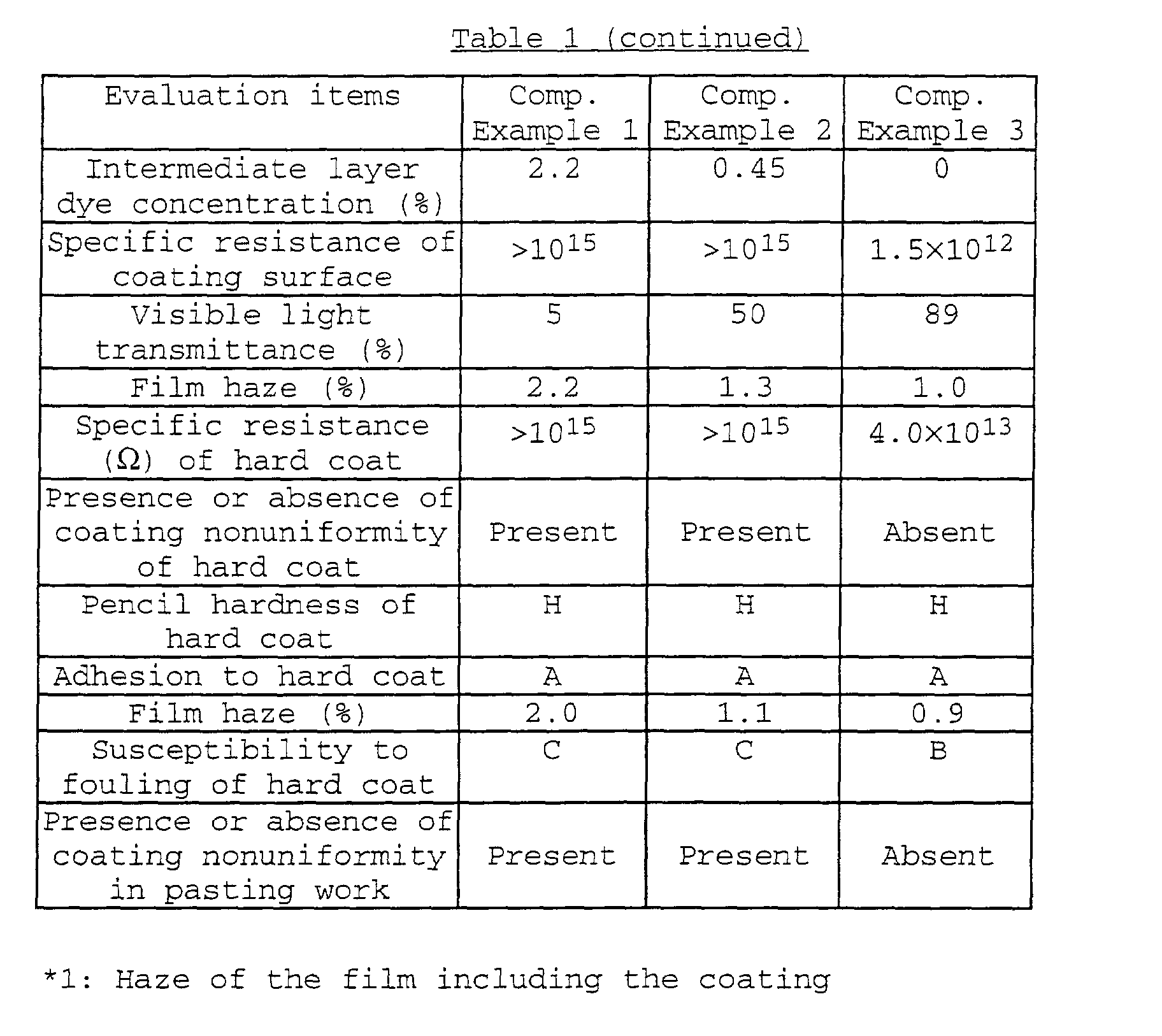
- the layer thickness profile of this film was 2/21/2 ⁇ m, with the overall thickness being 25 ⁇ m. The properties of this film are shown in Table 1.
- the obtained rolled film was slit into a predetermined width, in a state where a cross-cut pattern of static electricity is liable to form, by using a hard rubber-made roll having a diamond cross-cut pattern on the surface as contact roll.
- This film was then led into a tenter where it was dried, pre-heated, stretched in the transverse direction, heat set, relaxed in the width direction and cooled in the same way as in Examples 1 and 2, and then taken up to obtain a roll of biaxially oriented film.
- the layer thickness profile of this film was 2/21/2 ⁇ m, with the overall thickness being 25 ⁇ m.
- the properties of this film are shown in Table 1.
- This film was slit to a predetermined width, in a state where a cross-cut pattern of static electricity is liable to form, by the same slitter as used in Examples 1 and 2.
- the thus obtained film roll was subjected to the same coating operation as in Examples 1 and 2 to form a hard coat. Examination of the formed hard coat surface showed occurrence of nonuniformity of coating in the form of impression pattern of the cross-cut roll used for the slitter.
- this hardcoated film was again set in the coater and subjected to coating in the same way as in Examples 1 and 2 to provide an adhesive layer on the side opposite from the hard coat.
- polyester A was used 100% as the resin for the intermediate layer while using the resin of Example 1 for the external layers, and otherwise the same operations (melt extrusion (co-extrusion), stretching in the machine direction, in-line coating, drying, pre-heating, stretching in the transverse direction, heat setting and relaxing in the width direction) as in Example 1 were carried out, the produced film being cooled and taken up to obtain a roll of biaxially oriented film.
- the layer thickness profile of this film was 2/21/2 ⁇ m, with the overall thickness being 25 ⁇ m.
- the properties of this film are shown in Table 1.
- This rolled film was slit to a predetermined width, in a state where a cross-cut pattern of static electricity is liable to form, by the same slitter as used in Examples 1 and 2.
- a hard coat was formed on this film in the same way as in Examples 1 and 2. Examination of the formed hard coat surface showed that it had no nonuniformity of coating in the form of the impression pattern of the cross-cut roll used for slitting.
- this hard coated film was again set in the coater and subjected to the same coating operation as in Examples 1 and 2 to provide an adhesive layer on the side opposite from the hard coat. There was observed no nonuniformity of coating in the form of the impression pattern of the cross-cut roll used for the slitter.
- the film had not light-shielding ability as no dye was added in the intermediate layer of the film.
- melt extrusion co-extrusion
- stretching in the machine direction were conducted in the same way as in Examples 1 and 2.
- a water-dispersible coating material of the formulation (solids weight ratios) shown as antistatic coating composition 2 below was uniformly applied on both sides of the monoaxially stretched film to a coating thickness of 0.04 ⁇ m after film formation.
- This film was led into a tenter for performing drying, pre-heating, stretching in the machine direction, heat setting and relaxing in the width direction in the same way as in Examples 1 and 2, then cooled and taken up to obtain a roll of biaxially oriented film.
- the layer thickness profile of the film was 2/21/2 ⁇ m, with the overall thickness being 25 ⁇ m.
- the properties of this film are shown in Table 1.
- This rolled film was slit to a predetermined width, in a state where a cross-cut pattern of static electricity is liable to form, by the same slitter as used in Examples 1 and 2 to make a film roll.
- a hard coat was formed on this rolled film by the same operation as in Examples 1 and 2. Examination of the formed hard coat surface confirmed no nonuniformity of coating in the form of the impression pattern of the crosscut roll used for the slitter.
- this hard coated film was again set in the coater and subjected to the same coating operation as in Examples 1 and 2 to provide an adhesive layer on the side opposite from the hard coat.
- this hard coated film was again set in the coater and subjected to the same coating operation as in Examples 1 and 2 to provide an adhesive layer on the side opposite from the hard coat.
Landscapes
- Laminated Bodies (AREA)
Abstract
Description

Claims (14)
- A biaxially oriented polyester film for window application, which is a co-extruded laminated polyester film comprising at least three polyester layers including an intermediate layer containing a dye, said film having an antistatic coating on at least one side thereof, said antistatic coating having a specific surface resistance of not more than 1.0 × 10¹⁴ Ω.
- A biaxially oriented polyester film for window application according to Claim 1 wherein the haze of the whole film is not more than 5.0%.
- A biaxially oriented polyester film for window application according to Claim 1, said film having a visible light transmittance of 3 to 70%.
- A biaxially oriented polyester film for window application according to Claim 1, wherein the thickness of the antistatic coating is 0.01 to 1 µm.
- A biaxially oriented polyester film for window application according to Claim 1, wherein the antistatic coating comprises an antistatic agent and an organic polymeric binder.
- A biaxially oriented polyester film for window application according to Claim 5, wherein the weight ratio of said antistatic agent/organic polymeric binder is 1/9 to 8/2.
- A biaxially oriented polyester film for window application according to Claim 1, wherein a hard coat is provided on the antistatic coating on one side of the film.
- A biaxially oriented polyester film for window application according to Claim 7, wherein the specific surface resistance of the hard coat is not more than 1.0 × 10¹⁴ Ω.
- A biaxially oriented polyester film for window application according to Claim 1 having an antistatic coating on both sides of the film.
- A biaxially oriented polyester film for window application according to Claim 9, wherein a hard coat comprising principally an acrylic acid derivative or a methacrylic acid derivative is provided on the antistatic coating on one side of the film.
- A biaxially oriented polyester film for window application according to Claim 1, wherein the antistatic coating is formed by in-line coating.
- A biaxially oriented polyester film for window application, which is a co-extruded laminated polyester film comprising at least three polyester layers including an intermediate layer containing a dye, said film having on at least one side thereof a 0.01 to 1 µm thick antistatic coating comprising an antistatic agent and an organic polymeric binder, said antistatic coating having a specific surface resistance of not more than 1.0 × 10¹³ Ω, said film having a haze of not more than 5.0% as the whole structure and a visible light transmittance of 3 to 70%.
- A biaxially oriented polyester film for window application, which is a co-extruded laminated polyester film comprising at least three polyester layers including an intermediate layer containing a dye, said film having on at least one side thereof a 0.01 to 1 µm thick antistatic coating comprising an antistatic agent and an organic polymeric binder, said antistatic coating having a specific surface resistance of not more than 1.0 × 10¹³ Ω and formed by in-line coating, said film having a haze of not more than 5.0% as the whole structure and a visible light transmittance of 3 to 70%.
- A biaxially oriented polyester film for window application, which is a co-extruded laminated polyester film comprising at least three polyester layers including an intermediate layer containing a dye, said film having on both sides thereof a 0.01 to 1 µm thick antistatic coating comprising an antistatic agent and an organic polymeric binder, said antistatic coating having a specific surface resistance of not more than 1.0 × 10¹³ Ω, the antistatic coating on one side having formed thereon a hard coat comprising principally an acrylic acid derivative or a methacrylic acid derivative and having a specific surface resistance of not more than 1.0 × 10¹⁴ Ω, said film having a haze of not more than 5.0% as the whole structure and a visible light transmittance of 3 to 70%.
Applications Claiming Priority (2)
| Application Number | Priority Date | Filing Date | Title |
|---|---|---|---|
| JP2000244318A JP4518646B2 (en) | 2000-08-11 | 2000-08-11 | Biaxially oriented polyester film for window pasting |
| JP2000244318 | 2000-08-11 |
Publications (2)
| Publication Number | Publication Date |
|---|---|
| EP1179421A2 true EP1179421A2 (en) | 2002-02-13 |
| EP1179421A3 EP1179421A3 (en) | 2002-04-17 |
Family
ID=18735024
Family Applications (1)
| Application Number | Title | Priority Date | Filing Date |
|---|---|---|---|
| EP01119045A Withdrawn EP1179421A3 (en) | 2000-08-11 | 2001-08-07 | Biaxially oriented polyester film for window application |
Country Status (4)
| Country | Link |
|---|---|
| US (1) | US20020064650A1 (en) |
| EP (1) | EP1179421A3 (en) |
| JP (1) | JP4518646B2 (en) |
| KR (1) | KR20020013726A (en) |
Cited By (3)
| Publication number | Priority date | Publication date | Assignee | Title |
|---|---|---|---|---|
| WO2004050364A1 (en) * | 2002-12-02 | 2004-06-17 | Mitsubishi Polyester Film Corporation | Biaxially oriented laminated polyester film |
| KR100781396B1 (en) | 2006-08-04 | 2007-11-30 | 도레이새한 주식회사 | Biaxially Oriented Polyester Laminated Film |
| CN108949075A (en) * | 2018-07-11 | 2018-12-07 | 翟琳 | A kind of preparation method of concrete crack repair sheets |
Families Citing this family (18)
| Publication number | Priority date | Publication date | Assignee | Title |
|---|---|---|---|---|
| US6761958B2 (en) | 2001-09-06 | 2004-07-13 | Toray Plastics (America), Inc. | Embossable thermoplastic polyester film and method for producing the film |
| JP4137551B2 (en) * | 2002-08-09 | 2008-08-20 | 日東電工株式会社 | Surface protective film for transparent conductive substrate and transparent conductive substrate with surface protective film |
| CN100439429C (en) * | 2003-03-25 | 2008-12-03 | 帝人杜邦菲林日本株式会社 | Antistatic Laminated Polyester Film |
| US20060154050A1 (en) * | 2004-05-18 | 2006-07-13 | Toray Plastics (America), Inc., A Corporation Of Rhode Island | Holographic transfer thermoplastic sheet |
| EP1728815B1 (en) * | 2005-06-01 | 2008-07-23 | Mitsubishi Polyester Film GmbH | White opaque film with low transparency with high dielectric strength |
| JP5416864B2 (en) * | 2008-03-22 | 2014-02-12 | 三菱樹脂株式会社 | Optical laminated polyester film |
| JP2010058267A (en) * | 2008-09-01 | 2010-03-18 | Tokyo Printing Ink Mfg Co Ltd | Antistatic hard coat laminate |
| JP5467752B2 (en) * | 2008-10-06 | 2014-04-09 | 三菱樹脂株式会社 | Biaxially stretched polyester film |
| JP5281554B2 (en) * | 2009-11-30 | 2013-09-04 | 三菱樹脂株式会社 | Release film |
| JP5700439B2 (en) * | 2011-06-14 | 2015-04-15 | 三菱樹脂株式会社 | Substrate-less double-sided adhesive sheet |
| JP5700438B2 (en) * | 2011-06-14 | 2015-04-15 | 三菱樹脂株式会社 | Substrate-less double-sided adhesive sheet |
| JP2013199051A (en) * | 2012-03-26 | 2013-10-03 | Mitsubishi Plastics Inc | Laminated polyester film |
| JP2013231137A (en) * | 2012-04-28 | 2013-11-14 | Mitsubishi Plastics Inc | Substrateless double-sided pressure-sensitive adhesive sheet |
| CN105008131B (en) * | 2013-03-29 | 2016-10-26 | 东丽株式会社 | Laminate film |
| US11028299B2 (en) | 2013-11-19 | 2021-06-08 | Mitsubishi Polyester Film, Inc | Anti-powdering and anti-static polymer film for digital printing |
| CN106061729A (en) * | 2014-03-07 | 2016-10-26 | 3M创新有限公司 | Durable extruded dyed polyester film |
| JP6303769B2 (en) * | 2014-04-25 | 2018-04-04 | 三菱ケミカル株式会社 | Laminated polyester film |
| KR20160066283A (en) | 2014-12-02 | 2016-06-10 | 최병옥 | Pattern glass and manufacture method for pattern glass |
Family Cites Families (12)
| Publication number | Priority date | Publication date | Assignee | Title |
|---|---|---|---|---|
| DE1544840A1 (en) * | 1965-05-28 | 1969-07-24 | Blau Karl Ludwig | Process for the production of antistatic composite films |
| JPS6012437U (en) * | 1983-07-05 | 1985-01-28 | 東洋メタライジング株式会社 | Silicone coated plastic film with conductive layer |
| JP2699397B2 (en) * | 1988-04-18 | 1998-01-19 | ダイアホイルヘキスト株式会社 | Composite polyester film |
| JPH0464442A (en) * | 1990-07-04 | 1992-02-28 | Toray Ind Inc | Polyester resin film |
| US5306606A (en) * | 1990-12-31 | 1994-04-26 | Konica Corporation | Biaxially stretched polyester film comprising a coating layer containing a salt of a sulfonic acid type polymer |
| JP3176194B2 (en) * | 1993-09-27 | 2001-06-11 | 三菱化学ポリエステルフィルム株式会社 | Laminated polyester film |
| JP3325980B2 (en) * | 1993-12-21 | 2002-09-17 | 三菱化学ポリエステルフィルム株式会社 | Laminated polyester film |
| JPH10130596A (en) * | 1996-09-03 | 1998-05-19 | Lintec Corp | Removable window film for automobiles |
| JPH10230577A (en) * | 1996-12-17 | 1998-09-02 | Diafoil Co Ltd | Oriented laminate polyester film for sticking on automobile window |
| EP0893248B1 (en) * | 1996-12-17 | 2004-05-19 | Mitsubishi Polyester Film Corporation | Oriented laminated polyester film to be pasted on automobile windowpanes |
| JPH11278050A (en) * | 1998-03-27 | 1999-10-12 | Tdk Corp | Film for pane |
| JP4498565B2 (en) * | 2000-08-11 | 2010-07-07 | 三菱樹脂株式会社 | Biaxially oriented polyester film for window pasting |
-
2000
- 2000-08-11 JP JP2000244318A patent/JP4518646B2/en not_active Expired - Fee Related
-
2001
- 2001-08-06 KR KR1020010047299A patent/KR20020013726A/en not_active Withdrawn
- 2001-08-07 EP EP01119045A patent/EP1179421A3/en not_active Withdrawn
- 2001-08-08 US US09/924,373 patent/US20020064650A1/en not_active Abandoned
Cited By (5)
| Publication number | Priority date | Publication date | Assignee | Title |
|---|---|---|---|---|
| WO2004050364A1 (en) * | 2002-12-02 | 2004-06-17 | Mitsubishi Polyester Film Corporation | Biaxially oriented laminated polyester film |
| US7223467B2 (en) * | 2002-12-02 | 2007-05-29 | Mitsubishi Polyester Film Corporation | Biaxially oriented laminated polyester film |
| EP1568488A4 (en) * | 2002-12-02 | 2011-01-05 | Mitsubishi Polyester Film Corp | BIAXIALLY ORIENTED LAMINATED POLYESTER FILM |
| KR100781396B1 (en) | 2006-08-04 | 2007-11-30 | 도레이새한 주식회사 | Biaxially Oriented Polyester Laminated Film |
| CN108949075A (en) * | 2018-07-11 | 2018-12-07 | 翟琳 | A kind of preparation method of concrete crack repair sheets |
Also Published As
| Publication number | Publication date |
|---|---|
| US20020064650A1 (en) | 2002-05-30 |
| JP2002052675A (en) | 2002-02-19 |
| EP1179421A3 (en) | 2002-04-17 |
| KR20020013726A (en) | 2002-02-21 |
| JP4518646B2 (en) | 2010-08-04 |
Similar Documents
| Publication | Publication Date | Title |
|---|---|---|
| US20020064650A1 (en) | Biaxially oriented polyester film for window application | |
| KR100992515B1 (en) | Polyester film for display | |
| KR100880671B1 (en) | Infrared filter | |
| JP2001246698A (en) | Release film | |
| KR100928148B1 (en) | Polyester release film for polarizing plate | |
| JP2001239579A (en) | Biaxially oriented polyester film for insert molding | |
| JP4498565B2 (en) | Biaxially oriented polyester film for window pasting | |
| JP4155082B2 (en) | Release film | |
| JP4055071B2 (en) | Double-sided release film | |
| JP2005105255A (en) | Biaxially oriented polyester film | |
| US7223467B2 (en) | Biaxially oriented laminated polyester film | |
| JP4441837B2 (en) | Polyester laminated film containing voids for form printing | |
| JP4357069B2 (en) | Polyester film | |
| JP4311838B2 (en) | Biaxially oriented polyester film for window pasting | |
| JP4334108B2 (en) | Biaxially oriented polyester film for window pasting | |
| JP2001047580A (en) | Release film | |
| KR100573647B1 (en) | Optical adhesive film | |
| JP3622860B2 (en) | Polyester film for delivery slips | |
| JP4233396B2 (en) | Biaxially oriented laminated polyester film for window pasting | |
| JP2008142916A (en) | Antistatic polyester film | |
| JP2000198175A (en) | Laminated polyester film for car window application | |
| JP5107543B2 (en) | Optical laminated polyester film | |
| JP2015016676A (en) | Release polyester film | |
| JPH10100354A (en) | Surface treated plastic film | |
| JP4804273B2 (en) | Antistatic polyester film |
Legal Events
| Date | Code | Title | Description |
|---|---|---|---|
| PUAI | Public reference made under article 153(3) epc to a published international application that has entered the european phase |
Free format text: ORIGINAL CODE: 0009012 |
|
| AK | Designated contracting states |
Kind code of ref document: A2 Designated state(s): DE FR GB IT LU NL Kind code of ref document: A2 Designated state(s): AT BE CH CY DE DK ES FI FR GB GR IE IT LI LU MC NL PT SE TR |
|
| AX | Request for extension of the european patent |
Free format text: AL;LT;LV;MK;RO;SI |
|
| PUAL | Search report despatched |
Free format text: ORIGINAL CODE: 0009013 |
|
| AK | Designated contracting states |
Kind code of ref document: A3 Designated state(s): AT BE CH CY DE DK ES FI FR GB GR IE IT LI LU MC NL PT SE TR |
|
| AX | Request for extension of the european patent |
Free format text: AL;LT;LV;MK;RO;SI |
|
| RIC1 | Information provided on ipc code assigned before grant |
Free format text: 7B 32B 27/36 A, 7B 32B 27/18 B |
|
| 17P | Request for examination filed |
Effective date: 20020918 |
|
| 17Q | First examination report despatched |
Effective date: 20021104 |
|
| AKX | Designation fees paid |
Free format text: DE FR GB IT LU NL |
|
| STAA | Information on the status of an ep patent application or granted ep patent |
Free format text: STATUS: THE APPLICATION IS DEEMED TO BE WITHDRAWN |
|
| 18D | Application deemed to be withdrawn |
Effective date: 20030515 |