EP1178025A2 - Piezoelectric ceramic material - Google Patents
Piezoelectric ceramic material Download PDFInfo
- Publication number
- EP1178025A2 EP1178025A2 EP01306465A EP01306465A EP1178025A2 EP 1178025 A2 EP1178025 A2 EP 1178025A2 EP 01306465 A EP01306465 A EP 01306465A EP 01306465 A EP01306465 A EP 01306465A EP 1178025 A2 EP1178025 A2 EP 1178025A2
- Authority
- EP
- European Patent Office
- Prior art keywords
- piezoelectric ceramic
- ceramic material
- crystal
- max
- tinbo
- Prior art date
- Legal status (The legal status is an assumption and is not a legal conclusion. Google has not performed a legal analysis and makes no representation as to the accuracy of the status listed.)
- Granted
Links
- 229910010293 ceramic material Inorganic materials 0.000 title claims abstract description 29
- 239000013078 crystal Substances 0.000 claims abstract description 42
- 229910052797 bismuth Inorganic materials 0.000 claims abstract description 13
- 150000001875 compounds Chemical class 0.000 claims abstract description 10
- JCXGWMGPZLAOME-UHFFFAOYSA-N bismuth atom Chemical compound [Bi] JCXGWMGPZLAOME-UHFFFAOYSA-N 0.000 claims abstract description 9
- 229910052719 titanium Inorganic materials 0.000 claims abstract description 6
- 229910052779 Neodymium Inorganic materials 0.000 claims description 4
- 229910052777 Praseodymium Inorganic materials 0.000 claims description 4
- 229910052746 lanthanum Inorganic materials 0.000 claims description 4
- 229910052721 tungsten Inorganic materials 0.000 claims description 4
- 229910052684 Cerium Inorganic materials 0.000 claims description 3
- 229910052692 Dysprosium Inorganic materials 0.000 claims description 3
- 229910052691 Erbium Inorganic materials 0.000 claims description 3
- 229910052693 Europium Inorganic materials 0.000 claims description 3
- 229910052688 Gadolinium Inorganic materials 0.000 claims description 3
- 229910052689 Holmium Inorganic materials 0.000 claims description 3
- 229910052772 Samarium Inorganic materials 0.000 claims description 3
- 229910052771 Terbium Inorganic materials 0.000 claims description 3
- 229910052775 Thulium Inorganic materials 0.000 claims description 3
- 229910052769 Ytterbium Inorganic materials 0.000 claims description 3
- 229910052804 chromium Inorganic materials 0.000 claims description 3
- 229910052742 iron Inorganic materials 0.000 claims description 3
- 229910052726 zirconium Inorganic materials 0.000 claims description 3
- 239000000463 material Substances 0.000 description 23
- 238000002156 mixing Methods 0.000 description 16
- 239000000203 mixture Substances 0.000 description 13
- 239000000919 ceramic Substances 0.000 description 12
- 239000007858 starting material Substances 0.000 description 11
- GWEVSGVZZGPLCZ-UHFFFAOYSA-N Titan oxide Chemical compound O=[Ti]=O GWEVSGVZZGPLCZ-UHFFFAOYSA-N 0.000 description 10
- WMWLMWRWZQELOS-UHFFFAOYSA-N bismuth(iii) oxide Chemical compound O=[Bi]O[Bi]=O WMWLMWRWZQELOS-UHFFFAOYSA-N 0.000 description 10
- ZKATWMILCYLAPD-UHFFFAOYSA-N niobium pentoxide Chemical compound O=[Nb](=O)O[Nb](=O)=O ZKATWMILCYLAPD-UHFFFAOYSA-N 0.000 description 10
- 239000000843 powder Substances 0.000 description 10
- 239000006104 solid solution Substances 0.000 description 10
- 230000000694 effects Effects 0.000 description 9
- MCMNRKCIXSYSNV-UHFFFAOYSA-N Zirconium dioxide Chemical compound O=[Zr]=O MCMNRKCIXSYSNV-UHFFFAOYSA-N 0.000 description 6
- AYJRCSIUFZENHW-UHFFFAOYSA-L barium carbonate Chemical compound [Ba+2].[O-]C([O-])=O AYJRCSIUFZENHW-UHFFFAOYSA-L 0.000 description 6
- 238000010304 firing Methods 0.000 description 6
- HTUMBQDCCIXGCV-UHFFFAOYSA-N lead oxide Chemical compound [O-2].[Pb+2] HTUMBQDCCIXGCV-UHFFFAOYSA-N 0.000 description 6
- VTYYLEPIZMXCLO-UHFFFAOYSA-L Calcium carbonate Chemical compound [Ca+2].[O-]C([O-])=O VTYYLEPIZMXCLO-UHFFFAOYSA-L 0.000 description 4
- 238000007792 addition Methods 0.000 description 4
- 238000004458 analytical method Methods 0.000 description 4
- 230000000052 comparative effect Effects 0.000 description 4
- QDOXWKRWXJOMAK-UHFFFAOYSA-N dichromium trioxide Chemical compound O=[Cr]O[Cr]=O QDOXWKRWXJOMAK-UHFFFAOYSA-N 0.000 description 4
- MRELNEQAGSRDBK-UHFFFAOYSA-N lanthanum oxide Inorganic materials [O-2].[O-2].[O-2].[La+3].[La+3] MRELNEQAGSRDBK-UHFFFAOYSA-N 0.000 description 4
- 229910000464 lead oxide Inorganic materials 0.000 description 4
- 238000000034 method Methods 0.000 description 4
- KTUFCUMIWABKDW-UHFFFAOYSA-N oxo(oxolanthaniooxy)lanthanum Chemical compound O=[La]O[La]=O KTUFCUMIWABKDW-UHFFFAOYSA-N 0.000 description 4
- 238000000634 powder X-ray diffraction Methods 0.000 description 4
- 238000006467 substitution reaction Methods 0.000 description 4
- 229910002637 Pr6O11 Inorganic materials 0.000 description 3
- QVGXLLKOCUKJST-UHFFFAOYSA-N atomic oxygen Chemical compound [O] QVGXLLKOCUKJST-UHFFFAOYSA-N 0.000 description 3
- 239000011230 binding agent Substances 0.000 description 3
- RKTYLMNFRDHKIL-UHFFFAOYSA-N copper;5,10,15,20-tetraphenylporphyrin-22,24-diide Chemical compound [Cu+2].C1=CC(C(=C2C=CC([N-]2)=C(C=2C=CC=CC=2)C=2C=CC(N=2)=C(C=2C=CC=CC=2)C2=CC=C3[N-]2)C=2C=CC=CC=2)=NC1=C3C1=CC=CC=C1 RKTYLMNFRDHKIL-UHFFFAOYSA-N 0.000 description 3
- CMIHHWBVHJVIGI-UHFFFAOYSA-N gadolinium(III) oxide Inorganic materials [O-2].[O-2].[O-2].[Gd+3].[Gd+3] CMIHHWBVHJVIGI-UHFFFAOYSA-N 0.000 description 3
- 238000010348 incorporation Methods 0.000 description 3
- PLDDOISOJJCEMH-UHFFFAOYSA-N neodymium oxide Inorganic materials [O-2].[O-2].[O-2].[Nd+3].[Nd+3] PLDDOISOJJCEMH-UHFFFAOYSA-N 0.000 description 3
- 229910052760 oxygen Inorganic materials 0.000 description 3
- 239000001301 oxygen Substances 0.000 description 3
- 230000010287 polarization Effects 0.000 description 3
- 238000005245 sintering Methods 0.000 description 3
- LEDMRZGFZIAGGB-UHFFFAOYSA-L strontium carbonate Chemical compound [Sr+2].[O-]C([O-])=O LEDMRZGFZIAGGB-UHFFFAOYSA-L 0.000 description 3
- 229910000018 strontium carbonate Inorganic materials 0.000 description 3
- PBCFLUZVCVVTBY-UHFFFAOYSA-N tantalum pentoxide Inorganic materials O=[Ta](=O)O[Ta](=O)=O PBCFLUZVCVVTBY-UHFFFAOYSA-N 0.000 description 3
- 229910003781 PbTiO3 Inorganic materials 0.000 description 2
- -1 Pm2O3 Inorganic materials 0.000 description 2
- 239000004372 Polyvinyl alcohol Substances 0.000 description 2
- 229910000019 calcium carbonate Inorganic materials 0.000 description 2
- 230000008859 change Effects 0.000 description 2
- 230000008878 coupling Effects 0.000 description 2
- 238000010168 coupling process Methods 0.000 description 2
- 238000005859 coupling reaction Methods 0.000 description 2
- 230000003247 decreasing effect Effects 0.000 description 2
- 230000005684 electric field Effects 0.000 description 2
- 238000001704 evaporation Methods 0.000 description 2
- 230000008020 evaporation Effects 0.000 description 2
- JEIPFZHSYJVQDO-UHFFFAOYSA-N iron(III) oxide Inorganic materials O=[Fe]O[Fe]=O JEIPFZHSYJVQDO-UHFFFAOYSA-N 0.000 description 2
- 239000011656 manganese carbonate Substances 0.000 description 2
- 229910000016 manganese(II) carbonate Inorganic materials 0.000 description 2
- 229910052758 niobium Inorganic materials 0.000 description 2
- 230000010355 oscillation Effects 0.000 description 2
- 229920002451 polyvinyl alcohol Polymers 0.000 description 2
- ZNOKGRXACCSDPY-UHFFFAOYSA-N tungsten(VI) oxide Inorganic materials O=[W](=O)=O ZNOKGRXACCSDPY-UHFFFAOYSA-N 0.000 description 2
- 238000009834 vaporization Methods 0.000 description 2
- 230000008016 vaporization Effects 0.000 description 2
- XLYOFNOQVPJJNP-UHFFFAOYSA-N water Substances O XLYOFNOQVPJJNP-UHFFFAOYSA-N 0.000 description 2
- MYMOFIZGZYHOMD-UHFFFAOYSA-N Dioxygen Chemical compound O=O MYMOFIZGZYHOMD-UHFFFAOYSA-N 0.000 description 1
- 206010021143 Hypoxia Diseases 0.000 description 1
- 229910021578 Iron(III) chloride Inorganic materials 0.000 description 1
- 229910020854 La(OH)3 Inorganic materials 0.000 description 1
- 238000003915 air pollution Methods 0.000 description 1
- 230000004075 alteration Effects 0.000 description 1
- 239000007864 aqueous solution Substances 0.000 description 1
- 229910002113 barium titanate Inorganic materials 0.000 description 1
- 230000008901 benefit Effects 0.000 description 1
- 150000004649 carbonic acid derivatives Chemical class 0.000 description 1
- CETPSERCERDGAM-UHFFFAOYSA-N ceric oxide Chemical compound O=[Ce]=O CETPSERCERDGAM-UHFFFAOYSA-N 0.000 description 1
- 229910000422 cerium(IV) oxide Inorganic materials 0.000 description 1
- 238000003486 chemical etching Methods 0.000 description 1
- 239000002131 composite material Substances 0.000 description 1
- 238000013461 design Methods 0.000 description 1
- 239000003989 dielectric material Substances 0.000 description 1
- 238000009792 diffusion process Methods 0.000 description 1
- 238000001035 drying Methods 0.000 description 1
- NLQFUUYNQFMIJW-UHFFFAOYSA-N dysprosium(III) oxide Inorganic materials O=[Dy]O[Dy]=O NLQFUUYNQFMIJW-UHFFFAOYSA-N 0.000 description 1
- 239000012776 electronic material Substances 0.000 description 1
- VQCBHWLJZDBHOS-UHFFFAOYSA-N erbium(III) oxide Inorganic materials O=[Er]O[Er]=O VQCBHWLJZDBHOS-UHFFFAOYSA-N 0.000 description 1
- RSEIMSPAXMNYFJ-UHFFFAOYSA-N europium(III) oxide Inorganic materials O=[Eu]O[Eu]=O RSEIMSPAXMNYFJ-UHFFFAOYSA-N 0.000 description 1
- 238000011156 evaluation Methods 0.000 description 1
- 230000006355 external stress Effects 0.000 description 1
- JYTUFVYWTIKZGR-UHFFFAOYSA-N holmium oxide Inorganic materials [O][Ho]O[Ho][O] JYTUFVYWTIKZGR-UHFFFAOYSA-N 0.000 description 1
- 150000004679 hydroxides Chemical class 0.000 description 1
- RBTARNINKXHZNM-UHFFFAOYSA-K iron trichloride Chemical compound Cl[Fe](Cl)Cl RBTARNINKXHZNM-UHFFFAOYSA-K 0.000 description 1
- 229910003443 lutetium oxide Inorganic materials 0.000 description 1
- 238000004519 manufacturing process Methods 0.000 description 1
- 238000002844 melting Methods 0.000 description 1
- 230000008018 melting Effects 0.000 description 1
- 229910052751 metal Inorganic materials 0.000 description 1
- 238000012986 modification Methods 0.000 description 1
- 230000004048 modification Effects 0.000 description 1
- 150000002823 nitrates Chemical class 0.000 description 1
- 150000003891 oxalate salts Chemical class 0.000 description 1
- 230000002265 prevention Effects 0.000 description 1
- 238000010298 pulverizing process Methods 0.000 description 1
- 238000011160 research Methods 0.000 description 1
- FKTOIHSPIPYAPE-UHFFFAOYSA-N samarium(III) oxide Inorganic materials [O-2].[O-2].[O-2].[Sm+3].[Sm+3] FKTOIHSPIPYAPE-UHFFFAOYSA-N 0.000 description 1
- 229920002545 silicone oil Polymers 0.000 description 1
- 229910052715 tantalum Inorganic materials 0.000 description 1
- 238000007669 thermal treatment Methods 0.000 description 1
- ZIKATJAYWZUJPY-UHFFFAOYSA-N thulium (III) oxide Inorganic materials [O-2].[O-2].[O-2].[Tm+3].[Tm+3] ZIKATJAYWZUJPY-UHFFFAOYSA-N 0.000 description 1
- 238000011282 treatment Methods 0.000 description 1
- 238000003826 uniaxial pressing Methods 0.000 description 1
- FIXNOXLJNSSSLJ-UHFFFAOYSA-N ytterbium(III) oxide Inorganic materials O=[Yb]O[Yb]=O FIXNOXLJNSSSLJ-UHFFFAOYSA-N 0.000 description 1
Images


Classifications
-
- H—ELECTRICITY
- H10—SEMICONDUCTOR DEVICES; ELECTRIC SOLID-STATE DEVICES NOT OTHERWISE PROVIDED FOR
- H10N—ELECTRIC SOLID-STATE DEVICES NOT OTHERWISE PROVIDED FOR
- H10N30/00—Piezoelectric or electrostrictive devices
- H10N30/80—Constructional details
- H10N30/85—Piezoelectric or electrostrictive active materials
- H10N30/853—Ceramic compositions
-
- C—CHEMISTRY; METALLURGY
- C04—CEMENTS; CONCRETE; ARTIFICIAL STONE; CERAMICS; REFRACTORIES
- C04B—LIME, MAGNESIA; SLAG; CEMENTS; COMPOSITIONS THEREOF, e.g. MORTARS, CONCRETE OR LIKE BUILDING MATERIALS; ARTIFICIAL STONE; CERAMICS; REFRACTORIES; TREATMENT OF NATURAL STONE
- C04B35/00—Shaped ceramic products characterised by their composition; Ceramics compositions; Processing powders of inorganic compounds preparatory to the manufacturing of ceramic products
- C04B35/01—Shaped ceramic products characterised by their composition; Ceramics compositions; Processing powders of inorganic compounds preparatory to the manufacturing of ceramic products based on oxide ceramics
- C04B35/46—Shaped ceramic products characterised by their composition; Ceramics compositions; Processing powders of inorganic compounds preparatory to the manufacturing of ceramic products based on oxide ceramics based on titanium oxides or titanates
- C04B35/462—Shaped ceramic products characterised by their composition; Ceramics compositions; Processing powders of inorganic compounds preparatory to the manufacturing of ceramic products based on oxide ceramics based on titanium oxides or titanates based on titanates
- C04B35/475—Shaped ceramic products characterised by their composition; Ceramics compositions; Processing powders of inorganic compounds preparatory to the manufacturing of ceramic products based on oxide ceramics based on titanium oxides or titanates based on titanates based on bismuth titanates
Definitions
- the present invention relates to a piezoelectric ceramic material having the potential to find wide applications in fields including resonators and high-temperature pressure sensors.
- a piezoelectric material has the piezoelectric effect that causes an electric polarization change when it receives external stresses and the inverse piezoelectric effect that causes distortion at an applied electric field. Piezoelectric materials are now applied to sensors, resonators, actuators, etc.
- Piezoelectric materials currently put to practical use, for the most part, are generally provided by ferroelectric materials having perovskite structures based on tetragonal or rhombohedral crystal system PZT (PbZrO 3 -PbTiO 3 solid solutions) or tetragonal crystal system PT (PbTiO 3 ). To meet a variety of requirements, a variety of subordinate components are added to these materials.
- PZT or PT piezoelectric materials have Curie points of the order of 200 to 400°C on practical compositions, and have difficulty in high-temperature applications because they become normal dielectric materials and lose their piezoelectric properties at temperatures higher than those.
- These lead-base piezoelectric materials are also not preferable in view of ecological consideration and prevention of pollution, because of containing a large amount (about 60 to 70% by mass) of lead oxide (PbO) having extremely high vaporization even at low temperatures.
- PbO lead oxide
- lead oxide released during material production may be recovered; however, lead oxide contained in piezoelectric commodities on the market can hardly be done under the present situations. This lead oxide, when spewed into the environment over a wide area, would result inevitably in air pollution.
- BaTiO 3 having a perovskite structure belonging to the tetragonal crystal system is well known.
- this material is less than practical because of having a Curie point as low as 120°C.
- a bismuth layer compound For piezoelectric materials having a relatively high Curie point, for instance, a bismuth layer compound is known.
- the bismuth layer compound is represented by the following general formula: (Bi 2 O 2 ) 2+ (A m-1 B m O 3m+1 ) 2-
- the element A is Ca, Sr, Ba or the like and the element B is Ti, Nb, Ta, W or the like.
- the c axis of the crystal is longer than the a and b axes and the more the value of m in the aforesaid general formula, the longer the c axis is.
- An object of the present invention is to provide a piezoelectric ceramic that is free from lead, has a high enough Curie point and possesses improved piezoelectric properties.
- the key composition for the piezoelectric ceramic material of the invention is a solid solution of Bi 3 TiNbO 9 and MBi 2 Nb 2 O 9 . If the mixing ratio of MBi 2 Nb 2 O 9 in this solid solution is limited to within the range defined by the invention, then the value of Q max can be critically increased.
- SrBi 2 Nb 2 O 9 is a known piezoelectric material.
- the Q max of SrBi 2 Nb 2 O 9 is small, as can be appreciated from the comparative samples in the examples of the invention.
- no prior art shows that BaBi 2 Nb 2 O 9 and CaBi 2 Nb 2 O 9 have piezoelectric properties.
- no prior art shows that Bi 3 TiNbO 9 has piezoelectric properties.
- the Q max of Bi 3 TiNbO 9 is nearly close to zero.
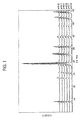
- Fig. 1 is a chart illustrative of the results of analysis of powder X-ray diffraction of (1 - x)Bi 3 TiNbO 9 + xSrBi 2 Nb 2 O 9 with varying x values.
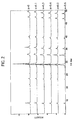
- Fig. 2 is a chart illustrative of the results of analysis of powder X-ray diffraction of (1 - x)Bi 3 TiNbO 9 + xBaBi 2 Nb 2 O 9 with varying x values.
- Fig. 3 is a drawing substitute photograph illustrative of grain structure, viz., a scanning electron microscope photograph of a section of one ceramic material.
- Fig. 4 is a drawing substitute photograph illustrative of grain structure, viz., a scanning electron microscope photograph of a section of another ceramic material.
- Fig. 5 is a drawing substitute photograph illustrative of grain structure, viz., a scanning electron microscope photograph of a section of yet another ceramic material.
- the piezoelectric ceramic material of the invention is a composite oxide containing Bi, Ti, M and Nb as main component elements.
- the element M is at least one element selected from Sr, Ba and Ca.
- the molar ratio of the main component elements on an oxide basis is given by the following formula I: (1 - x)Bi 3 TiNbO 9 + xMBi 2 Nb 2 O 9
- the small letter x is the molar ratio indicative of the mixing ratio of MBi 2 Nb 2 O 9 with respect to the total of Bi 3 TiNbO 9 and MBi 2 Nb 2 O 9 .
- the piezoelectric ceramic material of the invention includes a Bi 3 TiNbO 9 crystal and/or an MBi 2 Nb 2 O 9 crystal which are each a bismuth layer compound.
- the Bi 3 TiNbO 9 crystal and MBi 2 Nb 2 O 9 crystal are each in a single phase form.
- the Bi 3 TiNbO 9 crystal is a orthorhombic crystal while the MBi 2 Nb 2 O 9 crystal is a pseudo-tetragonal crystal.
- MBi 2 Nb 2 O 9 crystal used herein is meant an SrBi 2 Nb 2 O 9 crystal, a BaBi 2 Nb 2 O 9 crystal, and a CaBi 2 Nb 2 O 9 crystal. Wherever the MBi 2 Nb 2 O 9 crystal is present, at least one of these crystals must be present.
- the piezoelectric ceramic material of the invention should preferably be composed only of the Bi 3 TiNbO 9 crystal and/or the MBi 2 Nb 2 O 9 crystal, and especially be made up of the single phase of either crystal.
- the piezoelectric ceramic material of the invention may contain some foreign phases, or it is not necessarily homogeneous. For instance, the mixing ratios of all the crystals in the piezoelectric ceramic material are not necessarily identical.
- the molar ratio of the aforesaid main component elements may more or less deviate from the aforesaid formula I.
- the composition represented by this formula I may be rewritten as (Bi 3-x M x )(Nb 1+x Ti 1-x )O 9
- the ratio of M + Bi with respect to Nb + Ti is 3/2.
- a deviation of ca. ⁇ 5% from this value is acceptable.
- the piezoelectric ceramic material of the invention should preferably be defined by (Bi 3-x M x ) z (Nb 1+x Ti 1-x )O 9 provided that 0.95 ⁇ z ⁇ 1.05. It is here appreciated that the amount of oxygen, too, can change depending on the valence of the metal elements, oxygen deficiencies, etc. and, hence, the number of moles of oxygen in formula II is not necessarily 9.
- the molar ratio, M/(M + Bi), of M with respect to M + Bi is represented by x/3 where x corresponds to the mixing ratio x in the aforesaid formula I.
- x S , x B and x C stand for the molar ratios of Sr, Ba and Ca in the element M, respectively.
- x x S + x B + x C
- the molar ratios of Sr, Ba and Ca with respect to M + Bi are represented by x S /3, x B /3 and x C /3, respectively.
- the ranges of x S , x B and x C in formula III are the same as defined in conjunction with formula I.
- the piezoelectric ceramic material of the invention may contain other elements as subordinate components.
- the subordinate component elements should preferably be contained in the form of oxides.
- the total content of the subordinate component elements in the piezoelectric ceramic material of the invention should preferably be less than 1% by mass, and especially 0.8% by mass or less, as calculated on an oxide basis. When the content of the subordinate component elements is too much, Q max often diminishes. It is here appreciated that the content of the subordinate component elements, as calculated on an oxide basis, is determined on the premise that the subordinate component oxides are incorporated in the form of oxides in stoichiometric composition.
- the subordinate component element used should be at least one of La, Ce, Pr, Nd, Pm, Sm, Eu, Gd, Tb, Dy, Ho, Er, Tm, Yb, Lu, Ta, Zr, Cr, Fe and W, and especially at least one of La, Pr, Nd and Gd.
- the subordinate component elements By the incorporation of these subordinate component elements, it is possible to achieve a further increase in Q max . This effect on Q max improvements is much more enhanced especially when Sr is contained in the element M. To take full advantage of the effect on Q max improvements, it is preferable to use the subordinate component elements in an amount of 0.1% by mass or more as calculated on an oxide basis.
- these subordinate component elements are determined on the premise that they are present in the states of La 2 O 3, CeO 2 , Pr 6 O 11 , Nd 2 O 3 , Pm 2 O 3 , Sm 2 O 3 , Eu 2 O 3 , Gd 2 O 3 , Tb 4 O 7 , Dy 2 O 3 , Ho 2 O 3 , Er 2 O 3 , Tm 2 O 3 , Yb 2 O 3 , Lu 2 O 3 , Ta 2 O 5 , ZrO 2 , Cr 2 O 3 , Fe 2 O 3 and WO 3 .
- the subordinate component element or elements should be quite free from Pb.
- the presence of Pb in an amount of 0.5% by mass or less as calculated on a PbO basis is practically insignificant.
- the crystal grains of the piezoelectric ceramic material of the invention are present in plate or acicular forms.
- the mean crystal grain diameter is not critical, yet it should be preferably 1 to 10 ⁇ m, and more preferably 3 to 5 ⁇ m as measured in the lengthwise direction. With too large crystal grains, any large enough electromechanical coupling factor can hardly be obtained due to decreased sintering density. With too small crystal grains, on the other hand, insufficient sintering results again in decreased sintering density.
- the piezoelectric ceramic material of the invention is typically suitable for resonators operable in every mode from thickness extensional vibration mode to thickness shear vibration mode.
- Powders of the starting oxides or the starting compounds that can be converted by firing into oxides that is , carbonates , hydroxides, oxalates or nitrates, for instance, SrCO 3 , BaCO 3 , CaCO 3 , La 2 O 3 , La(OH) 3 , Bi 2 O 3 , TiO 2 , Nb 2 O 5 , etc. are wet mixed together in a ball mill or the like.
- the mixture is calcined at about 650 to 1,000°C for about 1 to 3 hours, and the resultant calcined product was slurried and wet pulverized in a ball mill or the like.
- the powders of the calcined product were pressed at a pressure of about 100 to 400 MPa with the addition thereto of a small amount (of the order of 4 to 8% by mass) of water, thereby obtaining a compact.
- a binder such as polyvinyl alcohol may be added to the powders.
- the firing temperature is preferably selected from the range of 950 to 1,250°C and the firing time is preferably of the order of about 1 to 5 hours.
- the firing may be carried out in the atmosphere. Alternatively, the firing may be performed in an atmosphere having a partial pressure of oxygen lower or higher than that in the atmosphere, or in an atmosphere of pure oxygen.
- Piezoelectric ceramic samples shown in Table 1 were prepared according to the following procedure.
- Bi 2 O 3 , Nb 2 O 5 , TiO 2 and SrCO 3 were provided as the starting materials for the main components , La 2 O 3 , Pr 6 O 11 , Nd 2 O 3 , Gd 2 O 3 , Ta 2 O 5 , ZrO 2 , Cr 2 O 3 , Fe 2 O 3 and WO 3 as the starting materials for the subordinate components, and MnCO 3 for the purpose of comparisons with the subordinate components.
- the powders of the starting main component materials were blended together in such a way as to provide the following composition as calculated on an oxide basis. (1 - x)Bi 3 TiNbO 9 + xSrBi 2 Nb 2 O 9
- the value of x in each sample is indicated in Table 1.
- the powders of the starting subordinate component materials were added to the starting main component materials. Table 1 also shows the contents, as calculated on an oxide basis, of the subordinate component elements in the piezoelectric ceramic samples.
- the resultant sintered compact was lapped to a thickness of 0.5 mm, and cut to a plane size of 15 mm x 15 mm, thereby obtaining a thin sheet.
- Cu electrodes were deposited by evaporation on the upper and lower sides of this thin sheet. Then, an electric field of 5 to 15 MV/m was applied to the thin sheet for 1 to 30 minutes in a silicone oil bath of 150 to 300° C for polarization treatment.
- the Cu electrodes were etched away using an aqueous solution of ferric chloride, and the thin sheet was thereafter ground to a thickness of 0.41 mm. Subsequently, the thin sheet was cut to a plane size of 7 mm x 4.5 mm in such a way as to align the direction of polarization with the thickness direction, thereby obtaining a chip.
- Ag electrodes were deposited by evaporation on the upper and lower sides of the chip. Each Ag electrode had a diameter of 1.5 mm and a thickness of 1 ⁇ m.
- Fig. 1 Shown in Fig. 1 are the results of powder X-ray diffraction analysis of a plurality of samples represented by (1 - x)Bi 3 TiNbO 9 + xSrBi 2 Nb 2 O 9 where x stands for different values. From Fig. 1, it is found that single-phase sintered compacts in perfect solid solution forms, whatever of value of x indicative of the mixing ratio, are achievable. In Fig. 1, orthorhombic crystals occur at x ⁇ 0.2 and pseudo-tetragonal crystals at x ⁇ 0.3.
- Piezoelectric ceramic samples shown in Table 2 were prepared according to the following procedure.
- Bi 2 O 3 , Nb 2 O 5 , TiO 2 and BaCO 3 were provided as the starting materials for the main components.
- the powders of the starting main component materials were blended together in such a way as to provide the following composition as calculated on an oxide basis. (1 - x)Bi 3 TiNbO 9 + XBaBi 2 Nb 2 O 9
- the value of x in each sample is indicated in Table 2.
- the piezoelectric ceramic samples were obtained as in Example 1 with the exception of using these starting materials.
- Fig. 2 Shown in Fig. 2 are the results of powder X-ray diffraction analysis of a plurality of samples represented by (1 - x)Bi 3 TiNbO 9 + xBaBi 2 Nb 2 O 9 where n stands for different values. From Fig. 2, it is found that single-phase sintered compacts in perfect solid solution forms, whatever of value of x indicative of the mixing ratio, are achievable. In Fig. 2, orthorhombic crystals occur at x ⁇ 0.1 and pseudo-tetragonal crystals at x ⁇ 0.3.
- inventive sample No. 202 having an increased Q max is made up of plate crystal grains having an increased degree of grain growth; however, comparative sample No. 201 has a reduced degree of grain growth although it is made up of plate crystal grains. It is also seen that comparative sample No. 206 is made up of amorphous crystal grains having a reduced degree of grain growth.
- Piezoelectric ceramic samples shown in Table 3 were prepared according to the following procedure.
- Bi 2 O 3 , Nb 2 O 5 , TiO 2 , SrCO 3 and BaCO 3 were provided as the starting materials for the main components , and La 2 O 3 , Pr 6 O 11 , Nd 2 O 3 , Gd 2 O 3 and Ta 2 O 5 as the starting materials for the subordinate components.
- the powders of these starting main component materials were blended together in such a way as to provide the following composition as calculated on an oxide basis. (1 - x S - x B )Bi 3 TiNbO 9 + (x S )SrBi 2 Nb 2 O 9 + (x B )BaBi 2 Nb 2 O 9
- the values of x S and x B in each sample are shown in Table 3.
- the powders of the starting subordinate component materials were added to the starting main component materials.
- Table 3 also indicates the contents, as calculated on an oxide basis, of the subordinate component elements in the piezoelectric ceramic samples.
- the piezoelectric ceramic samples were obtained as in Example 1 with the exception of using these starting materials.
- Piezoelectric ceramic samples shown in Table 4 were prepared according to the following procedure.
- Bi 2 O 3 , Nb 2 O 5 , TiO 2 and CaCO 3 were provided as the starting materials for the main components.
- the powders of the starting main component materials were blended together in such a way as to provide the following composition as calculated on an oxide basis. (1 - x)Bi 3 TiNbO 9 + xCaBi 2 Nb 2 O 9
- the value of x in each sample is indicated in Table 4.
- the piezoelectric ceramic samples were obtained as in Example 1 with the exception of using these starting materials.
Landscapes
- Engineering & Computer Science (AREA)
- Chemical & Material Sciences (AREA)
- Ceramic Engineering (AREA)
- Manufacturing & Machinery (AREA)
- Materials Engineering (AREA)
- Structural Engineering (AREA)
- Organic Chemistry (AREA)
- Compositions Of Oxide Ceramics (AREA)
Abstract
Description
- The present invention relates to a piezoelectric ceramic material having the potential to find wide applications in fields including resonators and high-temperature pressure sensors.
- A piezoelectric material has the piezoelectric effect that causes an electric polarization change when it receives external stresses and the inverse piezoelectric effect that causes distortion at an applied electric field. Piezoelectric materials are now applied to sensors, resonators, actuators, etc.
- Piezoelectric materials currently put to practical use, for the most part, are generally provided by ferroelectric materials having perovskite structures based on tetragonal or rhombohedral crystal system PZT (PbZrO3-PbTiO3 solid solutions) or tetragonal crystal system PT (PbTiO3). To meet a variety of requirements, a variety of subordinate components are added to these materials.
- However, most of PZT or PT piezoelectric materials have Curie points of the order of 200 to 400°C on practical compositions, and have difficulty in high-temperature applications because they become normal dielectric materials and lose their piezoelectric properties at temperatures higher than those. These lead-base piezoelectric materials are also not preferable in view of ecological consideration and prevention of pollution, because of containing a large amount (about 60 to 70% by mass) of lead oxide (PbO) having extremely high vaporization even at low temperatures. For instance, when these lead-base piezoelectric materials are produced in the form of ceramics or single crystals, very large amounts - even on industrial levels - of vaporous lead oxide are released by vaporization and diffusion into the atmosphere through unavoidable thermal treatments such as firing and melting. Lead oxide released during material production may be recovered; however, lead oxide contained in piezoelectric commodities on the market can hardly be done under the present situations. This lead oxide, when spewed into the environment over a wide area, would result inevitably in air pollution.
- For piezoelectric materials that do not contain lead at all, for instance, BaTiO3 having a perovskite structure belonging to the tetragonal crystal system is well known. However, this material is less than practical because of having a Curie point as low as 120°C.
- For piezoelectric materials having a relatively high Curie point, for instance, a bismuth layer compound is known. The bismuth layer compound is represented by the following general formula:
- Most of bismuth layer compounds, because of having high Curie points, have properties satisfactory enough for high-temperature sensors. However, a problem with some bismuth layer compounds free from lead whatsoever is that their Qmax important for resonators is small. Here Qmax is defined by tan max where max is the maximum value of a phase angle. That is, Qmax is the maximum value of Q (= |X|/R) between a resonant frequency and an anti-resonant frequency, where X is reactance and R is resistance. The larger Qmax or the closer max is to 90°, the more stable oscillation is and the lower is the temperature at which oscillation occurs.
- An object of the present invention is to provide a piezoelectric ceramic that is free from lead, has a high enough Curie point and possesses improved piezoelectric properties.
- This object is achievable by the following embodiments (1) to (3) of the present invention.
- (1) A piezoelectric ceramic material comprising a Bi3TiNbO9 crystal and/or an MBi2Nb2O9 crystal which are each a bismuth layer compound, where M represents at least one element selected from Sr, Ba and Ca, and containing Bi, Ti, M and Nb as main component elements, wherein a molar ratio as oxides of said main component elements is given by (Bi3-xMx)z (Nb1+yTi1-y)O9 provided that 0 < x, y ≤ 0.8 and 0.95 ≤ z ≤ 1.05, and 0 ≤ xB ≤ 0.5 and 0 ≤ xC < 0.4 wherein a molar ratio of Ba/(M + Bi) is given by xB/3 and a molar ratio of Ca/(M + Bi) is given by xC/3.
- (2) The piezoelectric ceramic material of (1) above, wherein x - 0.5 ≤ y ≤ x + 0.5.
- (3) The piezoelectric ceramic material of (1) or (2) above, which further contains as a subordinate component element at least one element selected from La, Ce, Pr, Nd, Pm, Sm, Eu, Gd, Tb, Dy, Ho, Er, Tm, Yb, Lu, Ta, Zr, Cr, Fe and W.
-
- According to the present invention, it is possible to achieve a piezoelectric ceramic material that is free from lead and has a high-enough Curie point and a large value for the aforesaid Qmax.
- The key composition for the piezoelectric ceramic material of the invention is a solid solution of Bi3TiNbO9 and MBi2Nb2O9. If the mixing ratio of MBi2Nb2O9 in this solid solution is limited to within the range defined by the invention, then the value of Qmax can be critically increased.
- As already mentioned, SrBi2Nb2O9 is a known piezoelectric material. However, the Qmax of SrBi2Nb2O9 is small, as can be appreciated from the comparative samples in the examples of the invention. As again mentioned above, no prior art shows that BaBi2Nb2O9 and CaBi2Nb2O9 have piezoelectric properties. Also, no prior art shows that Bi3TiNbO9 has piezoelectric properties. As can be appreciated from the comparative samples in the examples of the invention, the Qmax of Bi3TiNbO9 is nearly close to zero. With the invention, it is possible to achieve an unexpected effect that some considerable large value is obtained for Qmax by mixing SrBi2Nb2O9 with limited Qmax and BaBi2Nb2O9 or CaBi2Nb2O9 with nothing reported about their piezoelectric properties in Bi3TiNbO9 with nothing reported about its piezoelectric properties.
- Fig. 1 is a chart illustrative of the results of analysis of powder X-ray diffraction of (1 - x)Bi3TiNbO9 + xSrBi2Nb2O9 with varying x values.
- Fig. 2 is a chart illustrative of the results of analysis of powder X-ray diffraction of (1 - x)Bi3TiNbO9 + xBaBi2Nb2O9 with varying x values.
- Fig. 3 is a drawing substitute photograph illustrative of grain structure, viz., a scanning electron microscope photograph of a section of one ceramic material.
- Fig. 4 is a drawing substitute photograph illustrative of grain structure, viz., a scanning electron microscope photograph of a section of another ceramic material.
- Fig. 5 is a drawing substitute photograph illustrative of grain structure, viz., a scanning electron microscope photograph of a section of yet another ceramic material.
- The piezoelectric ceramic material of the invention is a composite oxide containing Bi, Ti, M and Nb as main component elements. The element M is at least one element selected from Sr, Ba and Ca. The molar ratio of the main component elements on an oxide basis is given by the following formula I:
- for x,
- 0 < x ≤ 0.8
preferably 0.05 ≤ x ≤ 0.8
more preferably 0.1 ≤ x ≤ 0.7 - for xB,
- 0 ≤ xB ≤ 0.5
preferably 0 ≤ xB ≤ 0.4
more preferably 0 ≤ xB ≤ 0.3 - for xC,
- 0 ≤ xC < 0.4
preferably 0 ≤ xC ≤ 0.3 - for xS,
- preferably 0.2 ≤ xS ≤ 0.7
- The piezoelectric ceramic material of the invention includes a Bi3TiNbO9 crystal and/or an MBi2Nb2O9 crystal which are each a bismuth layer compound. Usually, the Bi3TiNbO9 crystal and MBi2Nb2O9 crystal are each in a single phase form. The Bi3TiNbO9 crystal is a orthorhombic crystal while the MBi2Nb2O9 crystal is a pseudo-tetragonal crystal. Whether the piezoelectric material of the invention is in a Bi3TiNbO9 single crystal form or an MBi2Nb2O9 single crystal form is determined depending on the amount of substitution x, with the boundary being x = ca. 0.1 to 0.3. By the MBi2Nb2O9 crystal used herein is meant an SrBi2Nb2O9 crystal, a BaBi2Nb2O9 crystal, and a CaBi2Nb2O9 crystal. Wherever the MBi2Nb2O9 crystal is present, at least one of these crystals must be present.
- The piezoelectric ceramic material of the invention should preferably be composed only of the Bi3TiNbO9 crystal and/or the MBi2Nb2O9 crystal, and especially be made up of the single phase of either crystal. However, the piezoelectric ceramic material of the invention may contain some foreign phases, or it is not necessarily homogeneous. For instance, the mixing ratios of all the crystals in the piezoelectric ceramic material are not necessarily identical.
- The molar ratio of the aforesaid main component elements may more or less deviate from the aforesaid formula I. The composition represented by this formula I may be rewritten as
- For composition control of the piezoelectric ceramic material of the invention, it is unnecessary to vary Nb/(Nb + Ti) and M/(M + Bi) in perfect sync. For instance, the substitution of parameter x by y with respect to Nb and Ti in formula II gives
- for x and y,
- 0 < x, y ≤ 0.8
preferably 0.05 ≤ x, y ≤ 0.8
more preferably 0.1 ≤ x, y ≤ 0.7 - for z,
- 0.95 ≤ z ≤ 1.05
- In the aforesaid formula III, the molar ratio, M/(M + Bi), of M with respect to M + Bi is represented by x/3 where x corresponds to the mixing ratio x in the aforesaid formula I. Referring to formula III, let xS, xB and xC stand for the molar ratios of Sr, Ba and Ca in the element M, respectively. Then,
- In addition to the aforesaid main component elements, the piezoelectric ceramic material of the invention may contain other elements as subordinate components. Usually, the subordinate component elements should preferably be contained in the form of oxides. The total content of the subordinate component elements in the piezoelectric ceramic material of the invention should preferably be less than 1% by mass, and especially 0.8% by mass or less, as calculated on an oxide basis. When the content of the subordinate component elements is too much, Qmax often diminishes. It is here appreciated that the content of the subordinate component elements, as calculated on an oxide basis, is determined on the premise that the subordinate component oxides are incorporated in the form of oxides in stoichiometric composition. Preferably but not exclusively, the subordinate component element used should be at least one of La, Ce, Pr, Nd, Pm, Sm, Eu, Gd, Tb, Dy, Ho, Er, Tm, Yb, Lu, Ta, Zr, Cr, Fe and W, and especially at least one of La, Pr, Nd and Gd. By the incorporation of these subordinate component elements, it is possible to achieve a further increase in Qmax. This effect on Qmax improvements is much more enhanced especially when Sr is contained in the element M. To take full advantage of the effect on Qmax improvements, it is preferable to use the subordinate component elements in an amount of 0.1% by mass or more as calculated on an oxide basis. It is here appreciated that the contents of these subordinate component elements, as calculated on an oxide basis, are determined on the premise that they are present in the states of La2O3, CeO2, Pr6O11, Nd2O3, Pm2O3, Sm2O3, Eu2O3, Gd2O3, Tb4O7, Dy2O3, Ho2O3, Er2O3, Tm2O3, Yb2O3, Lu2O3, Ta2O5, ZrO2, Cr2O3, Fe2O3 and WO3.
- In the most preferable embodiment of the invention, the subordinate component element or elements should be quite free from Pb. However, the presence of Pb in an amount of 0.5% by mass or less as calculated on a PbO basis is practically insignificant.
- The crystal grains of the piezoelectric ceramic material of the invention are present in plate or acicular forms. Although the mean crystal grain diameter is not critical, yet it should be preferably 1 to 10 µm, and more preferably 3 to 5 µm as measured in the lengthwise direction. With too large crystal grains, any large enough electromechanical coupling factor can hardly be obtained due to decreased sintering density. With too small crystal grains, on the other hand, insufficient sintering results again in decreased sintering density.
- The piezoelectric ceramic material of the invention is typically suitable for resonators operable in every mode from thickness extensional vibration mode to thickness shear vibration mode.
- One embodiment of how to fabricate the piezoelectric ceramic material of the invention is now explained.
- Powders of the starting oxides or the starting compounds that can be converted by firing into oxides, that is , carbonates , hydroxides, oxalates or nitrates, for instance, SrCO3, BaCO3, CaCO3, La2O3, La(OH)3, Bi2O3, TiO2, Nb2O5, etc. are wet mixed together in a ball mill or the like.
- Then, the mixture is calcined at about 650 to 1,000°C for about 1 to 3 hours, and the resultant calcined product was slurried and wet pulverized in a ball mill or the like.
- After completion of wet pulverization and drying, the powders of the calcined product were pressed at a pressure of about 100 to 400 MPa with the addition thereto of a small amount (of the order of 4 to 8% by mass) of water, thereby obtaining a compact. In this case, a binder such as polyvinyl alcohol may be added to the powders.
- Then, the compact is fired to obtain a piezoelectric ceramic material. The firing temperature is preferably selected from the range of 950 to 1,250°C and the firing time is preferably of the order of about 1 to 5 hours. The firing may be carried out in the atmosphere. Alternatively, the firing may be performed in an atmosphere having a partial pressure of oxygen lower or higher than that in the atmosphere, or in an atmosphere of pure oxygen.
- Piezoelectric ceramic samples shown in Table 1 were prepared according to the following procedure.
- Bi2O3, Nb2O5, TiO2 and SrCO3 were provided as the starting materials for the main components , La2O3, Pr6O11, Nd2O3, Gd2O3, Ta2O5, ZrO2, Cr2O3, Fe2O3 and WO3 as the starting materials for the subordinate components, and MnCO3 for the purpose of comparisons with the subordinate components. The powders of the starting main component materials were blended together in such a way as to provide the following composition as calculated on an oxide basis.
- These starting materials were wet mixed together for 15 hours in a ball mill using zirconia balls in pure water. Then, the mixture was fully dried, pressed, and calcined at 750 to 900° C for 2 hours. The resultant calcined product was pulverized in a ball mill, dried, and granulated with the addition of a binder (polyvinyl alcohol) thereto. Using a uniaxial pressing machine, the resultant granulated powders were pressed with the application thereto of a pressure of 200 to 300 MPa into a plate form of compact having a plane size of 20 mm x 20 mm and a thickness of ca. 1.5 mm. The obtained compact was thermally treated to burn out the binder, and then fired at 1,050 to 1,250°C for 2 to 4 hours.
- The resultant sintered compact was lapped to a thickness of 0.5 mm, and cut to a plane size of 15 mm x 15 mm, thereby obtaining a thin sheet. Cu electrodes were deposited by evaporation on the upper and lower sides of this thin sheet. Then, an electric field of 5 to 15 MV/m was applied to the thin sheet for 1 to 30 minutes in a silicone oil bath of 150 to 300° C for polarization treatment.
- Then, the Cu electrodes were etched away using an aqueous solution of ferric chloride, and the thin sheet was thereafter ground to a thickness of 0.41 mm. Subsequently, the thin sheet was cut to a plane size of 7 mm x 4.5 mm in such a way as to align the direction of polarization with the thickness direction, thereby obtaining a chip. For the evaluation of thickness extensional vibration, Ag electrodes were deposited by evaporation on the upper and lower sides of the chip. Each Ag electrode had a diameter of 1.5 mm and a thickness of 1 µm.
- Using an impedance analyzer HP4194A, Hewlett-Packard Co., each sample was measured for Qmax in the thickness extensional third vibration mode at about 16 MHz. The results are set out in Table 1.
(M = Sr) Subordinate Component Sample No. x Type Content (% by mass) Qmax 101(comp.) 0* - - 0.1 102 0.2 - - 5.2 103 0.4 - - 4.3 104 0.5 - - 3.4 105 0.7 - - 3.0 106 0.8 - - 2.3 107 (comp.) 1.0 - - 1.6 108 0.5 La 0.1 4.2 109 0.5 La 0.3 7.5 110 0.5 Pr 0.1 4.6 111 0.5 Pr 0.3 8.4 112 0.5 Nd 0.3 7.0 113 0.5 Gd 0.3 7.2 114 0.5 Ta 0.1 6.0 115 0.5 Ta 0.3 5.7 116 0.5 Ta 0.5 4.8 117 0.5 Zr 0.1 5.5 118 0.5 Zr 0.3 5.6 119 0.5 Zr 0.5 5.6 120 0.5 Cr 0.3 4.0 121 0.5 Fe 0.3 4.2 122 0.5 W 0.3 4.4 123 0.5 Mn* 0.3 0.5 - From Table 1, it is found that by mixing the given amount of SrBi2Nb2O9 in Bi3TiNbO9 to form a solid solution, Qmax is much more increased than could be achieved with the single phase of Bi3TiNbO9, and the single phase of SrBi2Nb2O9. It is also found that by the incorporation of the subordinate component such as La, Qmax is much more increased. As can be seen from the fact that the inventive samples set out in Table 1 have Curie points in the range of 450 to 940° C, sufficiently high Curie points are obtainable according to the invention.
- Shown in Fig. 1 are the results of powder X-ray diffraction analysis of a plurality of samples represented by
- Piezoelectric ceramic samples shown in Table 2 were prepared according to the following procedure.
- Bi2O3, Nb2O5, TiO2 and BaCO3 were provided as the starting materials for the main components. The powders of the starting main component materials were blended together in such a way as to provide the following composition as calculated on an oxide basis.
- Each sample was measured for Qmax as in Example 1. The results are set out in Table 2.
(M = Ba) Sample No. x Qmax 201 (comp.) 0 0.1 202 0.1 6.8 203 0.3 4.4 204 0.4 3.2 205 0.5 2.1 206 (comp.) 0.6 0.0 - From Table 2, it is found that by mixing the given amount of BaBi2Nb2O9 in Bi3TiNbO9 to form a solid solution, Qmax is much more increased than could be achieved with the single phase of Bi3TiNbO9. As can be seen from the fact that the inventive samples set out in Table 2 have Curie points in the range of 450 to 940° C, sufficiently high Curie points are obtainable according to the invention.
- Shown in Fig. 2 are the results of powder X-ray diffraction analysis of a plurality of samples represented by
- Scanning electron microscope photographs taken of the sections of sample Nos. 201, 202 and 206 after chemical etching are attached hereto as Figs. 3, 4 and 5, respectively. It is seen that inventive sample No. 202 having an increased Qmax is made up of plate crystal grains having an increased degree of grain growth; however, comparative sample No. 201 has a reduced degree of grain growth although it is made up of plate crystal grains. It is also seen that comparative sample No. 206 is made up of amorphous crystal grains having a reduced degree of grain growth.
- Piezoelectric ceramic samples shown in Table 3 were prepared according to the following procedure.
- Bi2O3, Nb2O5, TiO2, SrCO3 and BaCO3 were provided as the starting materials for the main components , and La2O3, Pr6O11, Nd2O3, Gd2O3 and Ta2O5 as the starting materials for the subordinate components. The powders of these starting main component materials were blended together in such a way as to provide the following composition as calculated on an oxide basis.
- Each sample was measured for Qmax as in Example 1. The results are set out in Table 3.
(M = Sr, Ba) Subordinate Component Sample No. xS xB Type Content (% by mass) Qmax 301 (comp.) 0 0 - - 0.1 302 0.05 0.05 - - 4.5 303 0.05 0.10 - - 5.0 304 0.10 0.05 - - 4.9 305 0.10 0.10 - - 6.4 306 0.125 0.125 - - 7.3 307 0.15 0.05 - - 4.9 308 0.15 0.15 - - 7.6 309 0.20 0.20 - - 5.5 310 0.40 0.10 - - 4.5 311 (comp.) 1.00 0 - - 1.6 312 0.10 0.10 La 0.3 8.5 313 0.10 0.10 Pr 0.3 9.3 314 0.10 0.10 Nd 0.3 8.0 315 0.10 0.10 Gd 0.3 8.1 316 0.10 0.10 Ta 0.1 6.5 - From Table 3, it is found that by mixing the given amount of MBi2Nb2O9 in Bi3TiNbO9 to form a solid solution, Qmax is much more increased than could be achieved with the single phase of Bi3TiNbO9. It is also found that even when both Sr and Ba are used as the element M, Qmax is by far much more increased by the incorporation of the subordinate component element such as La. As can be seen from the fact that the inventive samples set out in Table 3 have Curie points in the range of 450 to 940°C, sufficiently high Curie points are obtainable according to the invention. The samples shown in Table 3 were all in single phase states.
- Piezoelectric ceramic samples shown in Table 4 were prepared according to the following procedure.
- Bi2O3, Nb2O5, TiO2 and CaCO3 were provided as the starting materials for the main components. The powders of the starting main component materials were blended together in such a way as to provide the following composition as calculated on an oxide basis.
- Each sample was measured for Qmax as in Example 1. The results are set out in Table 4.
(M = Ca) Sample No. x Qmax 401 (comp.) 0 0.1 402 0.1 2.6 403 0.2 4.5 404 0.3 2.3 405 (comp.) 0.4 1.5 406 (comp.) 0.5 0.8 407 (comp.) 0.6 -0.5 - From Table 4, it is found that by mixing the given amount of CaBi2Nb2O9 in Bi3TiNbO9 to form a solid solution, Qmax is much more increased than could be achieved with the single phase of Bi3TiNbO9. As can be seen from the fact that the inventive samples set out in Table 4 have Curie points in the range of 450 to 940° C, sufficiently high Curie points are obtainable according to the invention. The samples shown in Table 4 were all in single phase states.
- Whereas the invention has been shown and described in connection with the preferred embodiments thereof, it should be understood that many modifications, substitutions and additions may be made which are within the intended scope of the appended claims.
Claims (3)
- A piezoelectric ceramic material comprising a Bi3TiNbO9 crystal and/or an MBi2Nb2O9 crystal which are each a bismuth layer compound, where M represents at least one element selected from Sr, Ba and Ca, and containing Bi, Ti, M and Nb as main component elements, wherein a molar ratio as oxides of said main component elements is given by
(Bi3-xMx)z (Nb1+yTi1-y)O9 provided that 0 < x, y ≤ 0.8 and 0.95 ≤ z ≤ 1.05, and 0 ≤ xB ≤ 0.5 and 0 ≤ xC < 0.4 wherein a molar ratio of Ba/(M + Bi) is given by xB/3 and a molar ratio of Ca/(M + Bi) is given by xC/3. - The piezoelectric ceramic material according to claim 1, wherein x - 0.5 ≤ y ≤ x + 0.5.
- The piezoelectric ceramic material according to claim 1 or 2, which further contains as a subordinate component element at least one element selected from La, Ce, Pr, Nd, Pm, Sm, Eu, Gd, Tb, Dy, Ho, Er, Tm, Yb, Lu, Ta, Zr, Cr, Fe and W.
Applications Claiming Priority (8)
| Application Number | Priority Date | Filing Date | Title |
|---|---|---|---|
| JP2000228514 | 2000-07-28 | ||
| JP2000228514 | 2000-07-28 | ||
| JP2000241826 | 2000-08-09 | ||
| JP2000241826 | 2000-08-09 | ||
| JP2000296992 | 2000-09-28 | ||
| JP2000296992 | 2000-09-28 | ||
| JP2001083778A JP2002173369A (en) | 2000-07-28 | 2001-03-22 | Piezoelectric ceramic |
| JP2001083778 | 2001-03-22 |
Publications (3)
| Publication Number | Publication Date |
|---|---|
| EP1178025A2 true EP1178025A2 (en) | 2002-02-06 |
| EP1178025A3 EP1178025A3 (en) | 2003-08-06 |
| EP1178025B1 EP1178025B1 (en) | 2006-11-02 |
Family
ID=27481487
Family Applications (1)
| Application Number | Title | Priority Date | Filing Date |
|---|---|---|---|
| EP01306465A Expired - Lifetime EP1178025B1 (en) | 2000-07-28 | 2001-07-27 | Piezoelectric ceramic material |
Country Status (5)
| Country | Link |
|---|---|
| US (1) | US6685850B2 (en) |
| EP (1) | EP1178025B1 (en) |
| JP (1) | JP2002173369A (en) |
| CN (1) | CN1309682C (en) |
| DE (1) | DE60124182T2 (en) |
Cited By (6)
| Publication number | Priority date | Publication date | Assignee | Title |
|---|---|---|---|---|
| US6734606B2 (en) * | 2001-12-14 | 2004-05-11 | Murata Manufacturing Co., Ltd | Piezoelectric ceramic composition and piezoelectric ceramic element using the same |
| CN110423116A (en) * | 2019-07-24 | 2019-11-08 | 桂林理工大学 | A kind of X7R type ceramic capacitor dielectric material and preparation method thereof |
| EP3750859A4 (en) * | 2018-03-20 | 2021-11-17 | Kabushiki Kaisha Toyota Chuo Kenkyusho | OXIDION CONDUCTOR AND ELECTROCHEMICAL DEVICE |
| CN114560698A (en) * | 2022-04-15 | 2022-05-31 | 中国科学院合肥物质科学研究院 | Method for enhancing performance of calcium bismuth niobate high-temperature piezoelectric ceramic by inducing texture through oxide sintering aid |
| CN115433008A (en) * | 2021-06-04 | 2022-12-06 | 中国科学院上海硅酸盐研究所 | Bismuth calcium niobate piezoelectric ceramic with high piezoelectric property and high-temperature resistivity regulated and controlled by components and preparation method thereof |
| CN119118649A (en) * | 2024-05-13 | 2024-12-13 | 湖南大学 | A CaBi2Nb2O9 ceramic and its preparation method and application |
Families Citing this family (20)
| Publication number | Priority date | Publication date | Assignee | Title |
|---|---|---|---|---|
| JP3815197B2 (en) * | 2000-09-22 | 2006-08-30 | 株式会社村田製作所 | Piezoelectric ceramic composition and piezoelectric ceramic element using the same |
| JP4396136B2 (en) * | 2003-05-21 | 2010-01-13 | 株式会社村田製作所 | Piezoelectric ceramic composition and piezoelectric ceramic element using the same |
| JP2007217233A (en) * | 2006-02-17 | 2007-08-30 | Toko Inc | Piezoelectric ceramics |
| US8157538B2 (en) * | 2007-07-23 | 2012-04-17 | Emerson Climate Technologies, Inc. | Capacity modulation system for compressor and method |
| JP5072760B2 (en) * | 2008-07-28 | 2012-11-14 | 京セラ株式会社 | Piezoelectric ceramic and piezoelectric element using the same |
| CN102260080B (en) * | 2010-05-31 | 2013-05-29 | 中国科学院上海硅酸盐研究所 | Modified CaBi2Nb209 bismuth layered piezoceramic material and preparation method thereof |
| CN101982441A (en) * | 2010-09-03 | 2011-03-02 | 中国地质大学(北京) | A bismuth layered piezoelectric ceramic material doped with Ca2+ and its preparation method |
| CN101948310A (en) * | 2010-09-09 | 2011-01-19 | 同济大学 | Transition metal element-doped bismuth calcium niobate ceramic material and preparation method thereof |
| CN101941841A (en) * | 2010-09-09 | 2011-01-12 | 同济大学 | Doping modified bismuth calcium niobate ceramic material and preparation method thereof |
| CN104529447B (en) * | 2014-12-26 | 2017-07-14 | 中国科学院声学研究所 | Bismuth layered composite structure piezoceramic material and preparation method thereof |
| RU2624473C1 (en) * | 2016-05-20 | 2017-07-04 | Акционерное общество "Научно-исследовательский институт физических измерений" | Piezoceramic material |
| CN106478090B (en) * | 2016-09-30 | 2019-11-08 | 西安交通大学 | Preparation method of bismuth titanate-calcium niobate solid solution high-frequency dielectric ceramics |
| CN106946563B (en) * | 2017-04-20 | 2019-05-03 | 成都新柯力化工科技有限公司 | A kind of low-cost lead-free piezoelectric ceramic and preparation method thereof |
| CN109704760B (en) * | 2019-01-07 | 2022-07-01 | 陕西科技大学 | Single-phase multiferroic ceramic with Oliviz structure and non-stoichiometric ratio and preparation method thereof |
| CN109796205B (en) * | 2019-02-20 | 2021-12-28 | 山东大学 | Bismuth-layer-structured bismuth titanium tantalate high-temperature piezoelectric ceramic material and preparation method thereof |
| CN111253151B (en) * | 2020-03-14 | 2022-05-17 | 杭州电子科技大学 | Bismuth ferrite barium titanate-based ceramics with high energy storage density and high power density and preparation method thereof |
| CN113321500B (en) * | 2021-06-30 | 2022-06-24 | 山东大学 | A kind of high Curie temperature piezoelectric ceramic and preparation method thereof |
| CN118239773B (en) * | 2022-12-23 | 2026-01-06 | 国科大杭州高等研究院 | A high-entropy bismuth layered piezoelectric material and its preparation method |
| CN116495783B (en) * | 2023-05-19 | 2025-03-11 | 扬州大学 | Preparation method of symbiotic bismuth-based layered ferroelectric material Bi5TiNbWO15, its products and applications |
| CN117326868B (en) * | 2023-12-02 | 2024-02-13 | 山东利恩斯智能科技有限公司 | Ceramic material, preparation method thereof and application thereof in piezoelectricity |
Family Cites Families (3)
| Publication number | Priority date | Publication date | Assignee | Title |
|---|---|---|---|---|
| CN1067037A (en) * | 1992-05-11 | 1992-12-16 | 上海无线电六厂 | High-k, high stable, low-loss ceramic medium material and manufacture method |
| JP2942535B1 (en) * | 1998-03-06 | 1999-08-30 | ティーディーケイ株式会社 | Piezoelectric porcelain composition |
| JP3399364B2 (en) * | 1998-05-20 | 2003-04-21 | 株式会社村田製作所 | Piezoelectric ceramic composition |
-
2001
- 2001-03-22 JP JP2001083778A patent/JP2002173369A/en not_active Withdrawn
- 2001-07-27 CN CNB011243503A patent/CN1309682C/en not_active Expired - Fee Related
- 2001-07-27 US US09/915,347 patent/US6685850B2/en not_active Expired - Lifetime
- 2001-07-27 DE DE60124182T patent/DE60124182T2/en not_active Expired - Fee Related
- 2001-07-27 EP EP01306465A patent/EP1178025B1/en not_active Expired - Lifetime
Non-Patent Citations (4)
| Title |
|---|
| JIMENEZ B ET AL: "Thermal behavior of the elastic (young's) modulus in SBN-derived compounds (Bi2SrNb2O9)" JOURNAL OF THE EUROPEAN CERAMIC SOCIETY, ELSEVIER SCIENCE PUBLISHERS, BARKING, ESSEX, GB, vol. 19, no. 6-7, June 1999 (1999-06), pages 1315-1319, XP004166084 ISSN: 0955-2219 * |
| JIMENEZ, B. ET AL: "Influence of the preparation on the microstructure and ferroelectricity o the (SBN)1-x(BTN)x ceramics" FERROELECTRICS (2000), 241(1-4), 1923-1930, XP009011992 * |
| L. PARDO ET AL.: "(Bi3TiNbO9)x(SrBi2Nb2O9)1-x Aurivillius Type Structure Piezoelectric Ceramics Obtained From Mechanochemically Activated Oxides" ACTA MATER. , vol. 48, no. 9, 29 May 2000 (2000-05-29), pages 2421-2428, XP002243623 * |
| SUBBARAO E C: "A FAMILY OF FERROELECTRIC BISMUTH COMPOUNDS" JOURNAL OF PHYSICS AND CHEMISTRY OF SOLIDS, PERGAMON PRESS, LONDON, GB, vol. 23, 1962, pages 665-676, XP000573145 ISSN: 0022-3697 * |
Cited By (7)
| Publication number | Priority date | Publication date | Assignee | Title |
|---|---|---|---|---|
| US6734606B2 (en) * | 2001-12-14 | 2004-05-11 | Murata Manufacturing Co., Ltd | Piezoelectric ceramic composition and piezoelectric ceramic element using the same |
| EP3750859A4 (en) * | 2018-03-20 | 2021-11-17 | Kabushiki Kaisha Toyota Chuo Kenkyusho | OXIDION CONDUCTOR AND ELECTROCHEMICAL DEVICE |
| CN110423116A (en) * | 2019-07-24 | 2019-11-08 | 桂林理工大学 | A kind of X7R type ceramic capacitor dielectric material and preparation method thereof |
| CN110423116B (en) * | 2019-07-24 | 2021-07-02 | 桂林理工大学 | A kind of X7R type ceramic capacitor dielectric material and preparation method thereof |
| CN115433008A (en) * | 2021-06-04 | 2022-12-06 | 中国科学院上海硅酸盐研究所 | Bismuth calcium niobate piezoelectric ceramic with high piezoelectric property and high-temperature resistivity regulated and controlled by components and preparation method thereof |
| CN114560698A (en) * | 2022-04-15 | 2022-05-31 | 中国科学院合肥物质科学研究院 | Method for enhancing performance of calcium bismuth niobate high-temperature piezoelectric ceramic by inducing texture through oxide sintering aid |
| CN119118649A (en) * | 2024-05-13 | 2024-12-13 | 湖南大学 | A CaBi2Nb2O9 ceramic and its preparation method and application |
Also Published As
| Publication number | Publication date |
|---|---|
| CN1309682C (en) | 2007-04-11 |
| EP1178025A3 (en) | 2003-08-06 |
| DE60124182T2 (en) | 2007-09-06 |
| US20020035027A1 (en) | 2002-03-21 |
| CN1335284A (en) | 2002-02-13 |
| US6685850B2 (en) | 2004-02-03 |
| DE60124182D1 (en) | 2006-12-14 |
| JP2002173369A (en) | 2002-06-21 |
| EP1178025B1 (en) | 2006-11-02 |
Similar Documents
| Publication | Publication Date | Title |
|---|---|---|
| US6685850B2 (en) | Piezoelectric ceramic material | |
| Hirose et al. | Piezoelectric properties of SrBi4Ti4O15-based ceramics | |
| US6426018B1 (en) | Piezoelectric ceramic compositions | |
| US8273675B2 (en) | Ferroelectric ceramic material | |
| US6461532B1 (en) | Piezoelectric ceramic material | |
| US6551522B2 (en) | Piezoelectric ceramics | |
| JP3367929B2 (en) | Piezoelectric ceramics | |
| JP3032761B1 (en) | Piezoelectric ceramics | |
| JP4423872B2 (en) | Piezoelectric ceramics and manufacturing method thereof | |
| JP3020493B1 (en) | Piezoelectric ceramics | |
| JPH1160334A (en) | Piezoelectric ceramic composition for actuator | |
| JP4369558B2 (en) | Piezoelectric ceramics | |
| JP4260410B2 (en) | Piezoelectric ceramics | |
| JP2000264733A (en) | Piezoelectric ceramics | |
| JP2002284574A (en) | Manufacturing method of piezoelectric ceramic | |
| JP4108349B2 (en) | Piezoelectric ceramics | |
| JP3382200B2 (en) | Piezoelectric ceramics | |
| JP3261356B2 (en) | Piezoelectric ceramics | |
| JP2000264732A (en) | Piezoelectric ceramics | |
| Takenaka et al. | Development of new piezoelectric ceramics with bismuth perovskites | |
| JP2005162556A (en) | Piezoelectric ceramic and piezoelectric element | |
| JP2001294486A (en) | Piezoelectric ceramic | |
| JP2004292241A (en) | Piezoelectric ceramic | |
| JP2004189507A (en) | Piezoelectric ceramic and its manufacturing method | |
| JP2001278658A (en) | Piezoelectric ceramics |
Legal Events
| Date | Code | Title | Description |
|---|---|---|---|
| PUAI | Public reference made under article 153(3) epc to a published international application that has entered the european phase |
Free format text: ORIGINAL CODE: 0009012 |
|
| AK | Designated contracting states |
Kind code of ref document: A2 Designated state(s): AT BE CH CY DE DK ES FI FR GB GR IE IT LI LU MC NL PT SE TR |
|
| AX | Request for extension of the european patent |
Free format text: AL;LT;LV;MK;RO;SI |
|
| PUAL | Search report despatched |
Free format text: ORIGINAL CODE: 0009013 |
|
| AK | Designated contracting states |
Designated state(s): AT BE CH CY DE DK ES FI FR GB GR IE IT LI LU MC NL PT SE TR |
|
| AX | Request for extension of the european patent |
Extension state: AL LT LV MK RO SI |
|
| RIC1 | Information provided on ipc code assigned before grant |
Ipc: 7C 04B 35/495 B Ipc: 7C 04B 35/475 A Ipc: 7H 01L 41/187 B |
|
| 17P | Request for examination filed |
Effective date: 20040119 |
|
| 17Q | First examination report despatched |
Effective date: 20040219 |
|
| AKX | Designation fees paid |
Designated state(s): DE FR GB NL |
|
| GRAP | Despatch of communication of intention to grant a patent |
Free format text: ORIGINAL CODE: EPIDOSNIGR1 |
|
| GRAS | Grant fee paid |
Free format text: ORIGINAL CODE: EPIDOSNIGR3 |
|
| GRAA | (expected) grant |
Free format text: ORIGINAL CODE: 0009210 |
|
| AK | Designated contracting states |
Kind code of ref document: B1 Designated state(s): DE FR GB NL |
|
| REG | Reference to a national code |
Ref country code: GB Ref legal event code: FG4D |
|
| REF | Corresponds to: |
Ref document number: 60124182 Country of ref document: DE Date of ref document: 20061214 Kind code of ref document: P |
|
| ET | Fr: translation filed | ||
| PLBE | No opposition filed within time limit |
Free format text: ORIGINAL CODE: 0009261 |
|
| STAA | Information on the status of an ep patent application or granted ep patent |
Free format text: STATUS: NO OPPOSITION FILED WITHIN TIME LIMIT |
|
| 26N | No opposition filed |
Effective date: 20070803 |
|
| PGFP | Annual fee paid to national office [announced via postgrant information from national office to epo] |
Ref country code: FR Payment date: 20090710 Year of fee payment: 9 |
|
| PGFP | Annual fee paid to national office [announced via postgrant information from national office to epo] |
Ref country code: DE Payment date: 20090723 Year of fee payment: 9 Ref country code: GB Payment date: 20090722 Year of fee payment: 9 Ref country code: NL Payment date: 20090715 Year of fee payment: 9 |
|
| REG | Reference to a national code |
Ref country code: NL Ref legal event code: V1 Effective date: 20110201 |
|
| GBPC | Gb: european patent ceased through non-payment of renewal fee |
Effective date: 20100727 |
|
| REG | Reference to a national code |
Ref country code: FR Ref legal event code: ST Effective date: 20110331 |
|
| PG25 | Lapsed in a contracting state [announced via postgrant information from national office to epo] |
Ref country code: DE Free format text: LAPSE BECAUSE OF NON-PAYMENT OF DUE FEES Effective date: 20110201 |
|
| REG | Reference to a national code |
Ref country code: DE Ref legal event code: R119 Ref document number: 60124182 Country of ref document: DE Effective date: 20110201 |
|
| PG25 | Lapsed in a contracting state [announced via postgrant information from national office to epo] |
Ref country code: NL Free format text: LAPSE BECAUSE OF NON-PAYMENT OF DUE FEES Effective date: 20110201 Ref country code: FR Free format text: LAPSE BECAUSE OF NON-PAYMENT OF DUE FEES Effective date: 20100802 |
|
| PG25 | Lapsed in a contracting state [announced via postgrant information from national office to epo] |
Ref country code: GB Free format text: LAPSE BECAUSE OF NON-PAYMENT OF DUE FEES Effective date: 20100727 |