EP1177796B1 - Medicament for prevention or therapeutic treatment of liver disease - Google Patents
Medicament for prevention or therapeutic treatment of liver disease Download PDFInfo
- Publication number
- EP1177796B1 EP1177796B1 EP00921077A EP00921077A EP1177796B1 EP 1177796 B1 EP1177796 B1 EP 1177796B1 EP 00921077 A EP00921077 A EP 00921077A EP 00921077 A EP00921077 A EP 00921077A EP 1177796 B1 EP1177796 B1 EP 1177796B1
- Authority
- EP
- European Patent Office
- Prior art keywords
- alkyl
- hydrogen
- aralkyl
- trans
- pyridylcarbamoyl
- Prior art date
- Legal status (The legal status is an assumption and is not a legal conclusion. Google has not performed a legal analysis and makes no representation as to the accuracy of the status listed.)
- Expired - Lifetime
Links
- 0 C1*2C1CCCC2 Chemical compound C1*2C1CCCC2 0.000 description 5
Images


Classifications
-
- A—HUMAN NECESSITIES
- A61—MEDICAL OR VETERINARY SCIENCE; HYGIENE
- A61K—PREPARATIONS FOR MEDICAL, DENTAL OR TOILETRY PURPOSES
- A61K31/00—Medicinal preparations containing organic active ingredients
- A61K31/33—Heterocyclic compounds
- A61K31/395—Heterocyclic compounds having nitrogen as a ring hetero atom, e.g. guanethidine or rifamycins
- A61K31/435—Heterocyclic compounds having nitrogen as a ring hetero atom, e.g. guanethidine or rifamycins having six-membered rings with one nitrogen as the only ring hetero atom
- A61K31/44—Non condensed pyridines; Hydrogenated derivatives thereof
- A61K31/445—Non condensed piperidines, e.g. piperocaine
- A61K31/4523—Non condensed piperidines, e.g. piperocaine containing further heterocyclic ring systems
-
- C—CHEMISTRY; METALLURGY
- C07—ORGANIC CHEMISTRY
- C07D—HETEROCYCLIC COMPOUNDS
- C07D471/00—Heterocyclic compounds containing nitrogen atoms as the only ring hetero atoms in the condensed system, at least one ring being a six-membered ring with one nitrogen atom, not provided for by groups C07D451/00 - C07D463/00
- C07D471/02—Heterocyclic compounds containing nitrogen atoms as the only ring hetero atoms in the condensed system, at least one ring being a six-membered ring with one nitrogen atom, not provided for by groups C07D451/00 - C07D463/00 in which the condensed system contains two hetero rings
- C07D471/04—Ortho-condensed systems
-
- A—HUMAN NECESSITIES
- A61—MEDICAL OR VETERINARY SCIENCE; HYGIENE
- A61K—PREPARATIONS FOR MEDICAL, DENTAL OR TOILETRY PURPOSES
- A61K31/00—Medicinal preparations containing organic active ingredients
- A61K31/16—Amides, e.g. hydroxamic acids
-
- A—HUMAN NECESSITIES
- A61—MEDICAL OR VETERINARY SCIENCE; HYGIENE
- A61K—PREPARATIONS FOR MEDICAL, DENTAL OR TOILETRY PURPOSES
- A61K31/00—Medicinal preparations containing organic active ingredients
- A61K31/33—Heterocyclic compounds
- A61K31/395—Heterocyclic compounds having nitrogen as a ring hetero atom, e.g. guanethidine or rifamycins
- A61K31/435—Heterocyclic compounds having nitrogen as a ring hetero atom, e.g. guanethidine or rifamycins having six-membered rings with one nitrogen as the only ring hetero atom
- A61K31/4353—Heterocyclic compounds having nitrogen as a ring hetero atom, e.g. guanethidine or rifamycins having six-membered rings with one nitrogen as the only ring hetero atom ortho- or peri-condensed with heterocyclic ring systems
- A61K31/437—Heterocyclic compounds having nitrogen as a ring hetero atom, e.g. guanethidine or rifamycins having six-membered rings with one nitrogen as the only ring hetero atom ortho- or peri-condensed with heterocyclic ring systems the heterocyclic ring system containing a five-membered ring having nitrogen as a ring hetero atom, e.g. indolizine, beta-carboline
-
- A—HUMAN NECESSITIES
- A61—MEDICAL OR VETERINARY SCIENCE; HYGIENE
- A61K—PREPARATIONS FOR MEDICAL, DENTAL OR TOILETRY PURPOSES
- A61K31/00—Medicinal preparations containing organic active ingredients
- A61K31/33—Heterocyclic compounds
- A61K31/395—Heterocyclic compounds having nitrogen as a ring hetero atom, e.g. guanethidine or rifamycins
- A61K31/435—Heterocyclic compounds having nitrogen as a ring hetero atom, e.g. guanethidine or rifamycins having six-membered rings with one nitrogen as the only ring hetero atom
- A61K31/44—Non condensed pyridines; Hydrogenated derivatives thereof
-
- A—HUMAN NECESSITIES
- A61—MEDICAL OR VETERINARY SCIENCE; HYGIENE
- A61K—PREPARATIONS FOR MEDICAL, DENTAL OR TOILETRY PURPOSES
- A61K31/00—Medicinal preparations containing organic active ingredients
- A61K31/33—Heterocyclic compounds
- A61K31/395—Heterocyclic compounds having nitrogen as a ring hetero atom, e.g. guanethidine or rifamycins
- A61K31/435—Heterocyclic compounds having nitrogen as a ring hetero atom, e.g. guanethidine or rifamycins having six-membered rings with one nitrogen as the only ring hetero atom
- A61K31/44—Non condensed pyridines; Hydrogenated derivatives thereof
- A61K31/4409—Non condensed pyridines; Hydrogenated derivatives thereof only substituted in position 4, e.g. isoniazid, iproniazid
-
- A—HUMAN NECESSITIES
- A61—MEDICAL OR VETERINARY SCIENCE; HYGIENE
- A61P—SPECIFIC THERAPEUTIC ACTIVITY OF CHEMICAL COMPOUNDS OR MEDICINAL PREPARATIONS
- A61P1/00—Drugs for disorders of the alimentary tract or the digestive system
- A61P1/16—Drugs for disorders of the alimentary tract or the digestive system for liver or gallbladder disorders, e.g. hepatoprotective agents, cholagogues, litholytics
-
- A—HUMAN NECESSITIES
- A61—MEDICAL OR VETERINARY SCIENCE; HYGIENE
- A61P—SPECIFIC THERAPEUTIC ACTIVITY OF CHEMICAL COMPOUNDS OR MEDICINAL PREPARATIONS
- A61P29/00—Non-central analgesic, antipyretic or antiinflammatory agents, e.g. antirheumatic agents; Non-steroidal antiinflammatory drugs [NSAID]
-
- A—HUMAN NECESSITIES
- A61—MEDICAL OR VETERINARY SCIENCE; HYGIENE
- A61P—SPECIFIC THERAPEUTIC ACTIVITY OF CHEMICAL COMPOUNDS OR MEDICINAL PREPARATIONS
- A61P35/00—Antineoplastic agents
-
- C—CHEMISTRY; METALLURGY
- C07—ORGANIC CHEMISTRY
- C07D—HETEROCYCLIC COMPOUNDS
- C07D213/00—Heterocyclic compounds containing six-membered rings, not condensed with other rings, with one nitrogen atom as the only ring hetero atom and three or more double bonds between ring members or between ring members and non-ring members
- C07D213/02—Heterocyclic compounds containing six-membered rings, not condensed with other rings, with one nitrogen atom as the only ring hetero atom and three or more double bonds between ring members or between ring members and non-ring members having three double bonds between ring members or between ring members and non-ring members
- C07D213/04—Heterocyclic compounds containing six-membered rings, not condensed with other rings, with one nitrogen atom as the only ring hetero atom and three or more double bonds between ring members or between ring members and non-ring members having three double bonds between ring members or between ring members and non-ring members having no bond between the ring nitrogen atom and a non-ring member or having only hydrogen or carbon atoms directly attached to the ring nitrogen atom
- C07D213/60—Heterocyclic compounds containing six-membered rings, not condensed with other rings, with one nitrogen atom as the only ring hetero atom and three or more double bonds between ring members or between ring members and non-ring members having three double bonds between ring members or between ring members and non-ring members having no bond between the ring nitrogen atom and a non-ring member or having only hydrogen or carbon atoms directly attached to the ring nitrogen atom with hetero atoms or with carbon atoms having three bonds to hetero atoms with at the most one bond to halogen, e.g. ester or nitrile radicals, directly attached to ring carbon atoms
- C07D213/72—Nitrogen atoms
- C07D213/75—Amino or imino radicals, acylated by carboxylic or carbonic acids, or by sulfur or nitrogen analogues thereof, e.g. carbamates
Definitions
- the present invention relates to the use of a compound having a Rho kinase inhibitory activity for the manufacture of a medicament for the prophylaxis and treatment of liver disease.
- Liver diseases are caused by various factors, such as virus infection, excessive intake of alcohol, bilharziasis and the like. These initial etiologic factors cause gradual replacement of liver parenchyma with connective tissues, leading to fibrogenesis in progress. The progress of fibrogenesis in the liver inhibits hemodynamics, and impairs the process of liver regeneration, making the disease state of liver failure irreversible, which often results in transition to hepatic cirrhosis and hepatic cancer.
- the hepatic stellate cell (also called fat storing cell) is a major cell that produces extracellular matrix both in normal liver and liver with advanced fibrogenesis.
- the hepatic stellate cell In a general state, the hepatic stellate cell is supplied as a vitamin A storage site. This cell is in a resting state, scarcely shows a proliferation acticity, and is limited to be an element to constitute connective tissues. In a wounded liver and a fibrogenetic liver, however, the hepatic stellate cell loses lipid droplet thereof and changes to a cell such as myofibroblast.
- This myofibroblast-like cell is an "activated" cell exhibiting a high proliferation acticity, and synthesizes a large amount of collagen and other extracellular matrix proteins, and expresses smooth muscle type ⁇ -actin and desmin. Therefore, the hepatic stellate cell is considered to play a major role in fibrogenesis of the liver, and further in the etiology of of hepatic fibrosis ( Shimizu, I. et. al., Gut 44(1), 127-136 (1999 )).
- a substance that inhibits activation of hepatic stellate cell is considered to be effective for the prophylaxis and treatment of fibrogenesis of the liver, which is caused by the activation of hepatic stellate cell.
- Rho signalling pathway directs activation-associated changes in rat hepatic stellate cells.
- Rho-associated kinase plays an essential role in the transcellular invasion of tumor cells.
- a compound having a Rho kinase inhibitory activity is described in WO98/0643 as being widely useful as a therapeutic agent of hypertension, a therapeutic agent of angina pectoris, a cerebrovascular spasm suppressant, a therapeutic agent of asthma, a therapeutic agent of peripheral circulatory disturbance, a premature delivery preventive, a therapeutic agent of arterial sclerosis, an anticancer drug, an anti-inflammatory agent, an immunosuppressant, a therapeutic agent of autoimmune diseases, an anti-AIDS agent, a therapeutic agent of osteoporosis, a therapeutic agent of retinopathy, a cerebral function improver, a contraceptive drug, and a gastrointestinal tract infection preventive.
- WO98/0643 does not contain a description of its usefulness as an inhibitor of the activation of hepatic stellate cells or an agent for the prophylaxis and treatment of liver diseases, or a description to suggest such effect.
- the compound of the formula (I) has been already known to be useful as an agent for the prophylaxis and treatment of disorders of circulatory organs such as coronary, cerebral, renal, peripheral artery and the like (e.g., a therapeutic agent of hypertension, a therapeutic agent of angina pectoris, a therapeutic agent of renal and peripheral circulation disorder, a suppressive agent of cerebrovascular contraction and the like), which is potent and long lasting, and also as a therapeutic agent of asthma ( JP-A-62-89679 , JP-A-3-218356 , JP-A-4-273821 , JP-A-5-194401 , JP-A-6-41080 and WO95/28387 ).
- a therapeutic agent of hypertension e.g., a therapeutic agent of angina pectoris, a therapeutic agent of renal and peripheral circulation disorder, a suppressive agent of cerebrovascular contraction and the like
- a therapeutic agent of asthma JP-A-62-89679 , JP-A-3-218356
- the isoquinolinesulfonamide derivative described in the above-mentioned WO98/0643 is known to be effective as a vasodilating agent, a therapeutic agent of hypertension, a cerebral function improver, an anti-asthma agent, a heart protecting agent, a platelet aggregation inhibitor, a therapeutic agent of neurologic manifestation, an anti-inflammatory agent, an agent for the prevention and treatment of hyperviscosity syndrome, a therapeutic agent of glaucoma, a diminished tension agent, a motor paralysis improver of cerebral thorombosis, an agent for prevention and treatment of virus infection and transcriptional control factor inhibitor ( JP-A-57-200366 , JP-A-61-227581 , JP-A-2-256617 , JP-A-4-264030 , JP-A-6-56668 , JP-A-6-80569 , JP-A-6-293643 , JP-A-7-41424 , JP-A-7-277979
- the isoquinoline derivative described in the above-mentioned publication ( Naunyn-Schmiedeberg's Archives of Pharmacology 385(1) Suppl., R219, 1998 ) is known to be useful as an agent for the prevention and treatment of brain tissue disorder due to vasospasm ( WO97/28130 ).
- usefulness of the compounds having a Rho kinase inhibitory activity as activators of hepatic stellate cells or an agent for the prophylaxis and treatment of liver diseases is not disclosed, and there is no description suggestive of such usefulness.
- the present invention intends to solve the above-mentioned problems relating to liver diseases, particularly fibrogenesis of the liver, and aims at providing an agent for the prophylaxis and treatment of liver diseases and an activation inhibitor of hepatic stellate cells.
- the present invention aims at providing an agent for the prophylaxis and treatment of hepatitis, hepatic fibrosis, hepatic cirrhosis, hepatic cancer and the like.
- the present inventors have conducted intensive studies in an attempt to solve the above-mentioned problems and found that a compound having a Rho kinase inhibitory activity inhibits activation of hepatic stellate cells and suppresses hepatic fibrogenesis in liver tissues, and that the compound is useful as an activation inhibitor of hepatic stellate cells and for the prophylaxis and treatment of liver diseases such as hepatitis, hepatic fibrosis, hepatic cirrhosis, hepatic cancer and the like, which resulted in the completion of the present invention.
- the present invention provides the following.
- hepatic stellate cell by the "activation" of hepatic stellate cell is meant a state associated with increased synthesis of collagen type I and type III, cell proliferation, expression of smooth muscle type ⁇ -actin and the like in the liver. Morphologically, non-active type cell has a spindle like shape with dendroidal protrusions. On the other hand, activated hepatic stellate cells lose lipid droplet thereof and change into cells with an extended shape of, for example, myofibroblast.
- Hepatitis is divided into virus hepatitis, toxic hepatitis, autoimmune hepatitis and the like, and into acute hepatitis and chronic hepatitis according to the mode of progress.
- the hepatitis in the present invention encompasses any type irrespective of the cause thereof, as long as it provides degenerative findings in hepatocytes due to the factors such as activation of hepatic stellate cell and the like.
- hepatic fibrosis in the present invention encompass any type caused by various factors such as activation of hepatic stellate cell and the like.
- Rho kinase means serine/threonine kinase activated along with the activation of Rho.
- ROK ⁇ ROCKII: Leung, T. et al, J. Biol. Chem., 270, 29051-29054, 1995
- p160 ROCK ROCK ⁇ , ROCK-I: Ishizaki, T. et al, The EMBO J., 15(8), 1885-1893, 1996
- other proteins having a serine/threonine kinase activity are exemplified.
- the compound having a Rho kinase inhibitory activity which is used as an active ingredient in the present invention, is a compound of the above mentioned formula (I), particularly a compound of the formula (I').
- one kind of a compound having a Rho kinase inhibitory activity may be used alone, or, where necessary, several kinds may be concurrently used.
- Alkyl at R, R' and R 1 is linear or branched alkyl having 1 to 10 carbon atoms, which is exemplified by methyl, ethyl, propyl, isopropyl, butyl, isobutyl, sec-butyl, tert-butyl, pentyl, hexyl, heptyl, octyl, nonyl, decyl and the like, with preference given to alkyl having 1 to 4 carbon atoms.
- Cycloalkyl at R, R' and R 1 has 3 to 7 carbon atoms and is exemplified by cyclopropyl, cyclobutyl, cyclopentyl, cyclohexyl, cycloheptyl and the like.
- Cycloalkylalkyl at R, R' and R 1 is that wherein the cycloalkyl moiety is the above-mentioned cycloalkyl having 3 to 7 carbon atoms and the alkyl moiety is linear or branched alkyl having 1 to 6 carbon atoms (e.g., methyl, ethyl, propyl, isopropyl, butyl, pentyl, hexyl and the like), which is exemplified by cyclopropylmethyl, cyclobutylmethyl, cyclopentylmethyl, cyclohexylmethyl, cycloheptylmethyl, cyclopropylethyl, cyclopentylethyl, cyclohexylethyl, cycloheptylethyl, cyclopropylpropyl, cyclopentylpropyl, cyclohexylpropyl, cycloheptylpropyl, cycl
- Aralkyl at R, R' and R 1 is that wherein alkyl moiety is alkyl having 1 to 4 carbon atoms and is exemplified by phenylalkyl such as benzyl, 1-phenylethyl, 2-phenylethyl, 3-phenylpropyl, 4-phenylbutyl and the like.
- the substituent of optionally substituted cycloalkyl, cycloalkylalkyl, phenyl and aralkyl on the ring at R, R' and R 1 is halogen (e.g., chlorine, bromine, fluorine and iodine), alkyl (same as alkyl at R, R' and R 1 ), alkoxy (linear or branched alkoxy having 1 to 6 carbon atoms, such as methoxy, ethoxy, propoxy, isopropoxy, butoxy, isobutoxy, sec-butoxy, tert-butoxy, pentyloxy, hexyloxy and the like), aralkyl (same as aralkyl at R, R' and R 1 ) or haloalkyl (alkyl at R, R' and R 1 which is substituted by 1-5 halogen, and exemplified by fluoromethyl, difluoromethyl, trifluoromethyl, 2,2,2-triflu
- the group formed by R and R 1 or R' and R 1 in combination together with the adjacent nitrogen atom, which forms a heterocycle optionally having, in the ring, oxygen atom, sulfur atom or optionally substituted nitrogen atom is preferably a 5 or 6-membered ring and bonded ring thereof.
- Examples thereof include 1-pyrrolidinyl, piperidino, 1-piperazinyl, morpholino, thiomorpholino, 1-imidazolyl, 2,3-dihydrothiazol-3-yl and the like.
- the substituent of the optionally substituted nitrogen atom is exemplified by alkyl, aralkyl, haloalkyl and the like.
- alkyl, aralkyl and haloalkyl are as defined for R, R' and R 1 .
- Alkyl at R 2 is as defined for R, R' and R 1 .
- Halogen, alkyl, alkoxy and aralkyl at R 3 and R 4 are as defined for R, R' and R 1 .
- Acyl at R 3 and R 4 is alkanoyl having 2 to 6 carbon atoms (e.g., acetyl, propionyl, butyryl, valeryl, pivaloyl and the like), benzoyl or phenylalkanoyl wherein the alkanoyl moiety has 2 to 4 carbon atoms (e.g., phenylacetyl, phenylpropionyl, phenylbutyryl and the like).
- alkanoyl having 2 to 6 carbon atoms e.g., acetyl, propionyl, butyryl, valeryl, pivaloyl and the like
- Alkylamino at R 3 and R 4 is that wherein the alkyl moiety is linear or branched alkyl having 1 to 6 carbon atoms. Examples thereof include methylamino, ethylamino, propylamino, isopropylamino, butylamino, isobutylamino, sec-butylamino, tert-butylamino, pentylamino, hexylamino and the like.
- Acylamino at R 3 and R 4 is that wherein acyl moiety is alkanoyl having 2 to 6 carbon atoms, benzoyl, phenylalkanoyl wherein the alkanoyl moiety has 2 to 4 carbon atoms and the like, which is exemplified by acetylamino, propionylamino, butyrylamino, valerylamino, pivaloylamino, benzoylamino, phenylacetylamino, phenylpropionylamino, phenylbutyrylamino and the like.
- Alkylthio at R 3 and R 4 is that wherein the alkyl moiety is linear or branched alkyl having 1 to 6 carbon atoms, which is exemplified by methylthio, ethylthio, propylthio, isopropylthio, butylthio, isobutylthio, sec-butylthio, tert-butylthio, pentylthio, hexylthio and the like.
- Aralkyloxy at R 3 and R 4 is that wherein the alkyl moiety is alkyl having 1 to 4 carbon atoms, which is exemplified by benzyloxy, 1-phenylethyloxy, 2-phenylethyloxy, 3-phenylpropyloxy, 4-phenylbutyloxy and the like.
- Aralkylthio at R 3 and R 4 is that wherein the alkyl moiety is alkyl having 1 to 4 carbon atoms, which is exemplified by benzylthio, 1-phenylethylthio, 2-phenylethylthio, 3-phenylpropylthio, 4-phenylbutylthio and the like.
- Alkoxycarbonyl at R 3 and R 4 is that wherein the alkoxy moiety is linear or branched alkoxy having 1 to 6 carbon atoms, which is exemplified by methoxycarbonyl, ethoxycarbonyl, propoxycarbonyl, isopropoxycarbonyl, butoxycarbonyl, isobutoxycarbonyl, sec-butoxycarbonyl, tert-butoxycarbonyl, pentyloxycarbonyl, hexyloxycarbonyl and the like.
- Mono- or dialkylcarbamoyl at R 3 and R 4 is carbamoyl mono- or di-substituted by alkyl having 1 to 4 carbon atoms, which is exemplified by methylcarbamoyl, dimethylcarbamoyl, ethylcarbamoyl, diethylcarbamoyl, propylcarbamoyl, dipropylcarbamoyl, butylcarbamoyl, dibutylcarbamoyl and the like.
- Alkoxy at R 5 is as defined for R, R' and R 1 .
- Alkoxycarbonyloxy at R 5 is that wherein the alkoxy moiety is linear or branched alkoxy having 1 to 6 carbon atoms, which is exemplified by methoxycarbonyloxy, ethoxycarbonyloxy, propoxycarbonyloxy, isopropoxycarbonyloxy, butoxycarbonyloxy, isobutoxycarbonyloxy, sec-butoxycarbonyloxy, tert-butoxycarbonyloxy, pentyloxycarbonyloxy, hexyloxycarbonyloxy and the like.
- Alkanoyloxy at R 5 is that wherein the alkanoyl moiety is alkanoyl having 2 to 6 carbon atoms, which is exemplified by acetyloxy, propionyloxy, butyryloxy, valeryloxy, pivaloyloxy and the like.
- Aralkyloxycarbonyloxy at R 5 is that wherein the aralkyl moiety is aralkyl having C 1 -C 4 alkyl, which is exemplified by benzyloxycarbonyloxy, 1-phenylethyloxycarbonyloxy, 2-phenylethyloxycarbonyloxy, 3-phenylpropyloxycarbonyloxy, 4-phenylbutyloxycarbonyloxy and the like.
- Alkyl at R 6 is as defined for R, R' and R 1 ; alkyl at R 8 and R 9 is as defined for R, R' and R 1 ; and aralkyl at R 8 and R 9 is as defined for R, R' and R 1 .
- Alkyl at R 7 is as defined for R, R' and R 1 and aralkyl at R 7 is as defined for R, R' and R 1 .
- R 6 and R 7 in combination which forms a heterocycle optionally having, in the ring, oxygen atom, sulfur atom or optionally substituted nitrogen atom, is imidazol-2-yl, thiazol-2-yl, oxazol-2-yl, imidazolin-2-yl, 3,4,5,6-tetrahydropyridin-2-yl, 3,4,5,6-tetrahydropyrimidin-2-yl, 1,3-oxazolin-2-yl, 1,3-thiazolin-2-yl or optionally substituted benzoimidazol-2-yl, benzothiazol-2-yl, benzoxazol-2-yl and the like having a substituent such as halogen, alkyl, alkoxy, haloalkyl, nitro, amino, phenyl, aralkyl and the like.
- halogen, alkyl, alkoxy, haloalkyl and aralkyl are examples of substituent such as
- alkyl aralkyl, haloalkyl and the like.
- alkyl, aralkyl and haloalkyl are as defined for R, R' and R 1 .
- Hydroxyalkyl at R 10 and R 11 is linear or branched alkyl having 1 to 6 carbon atoms which is substituted by 1 to 3 hydroxy, which is exemplified by hydroxymethyl, 2-hydroxyethyl, 1-hydroxyethyl, 3-hydroxypropyl, 4-hydroxybutyl and the like.
- Alkyl at R 10 and R 11 is as defined for R, R' and R 1 ; haloalkyl and alkoxycarbonyl at R 10 and R 11 are as defined for R, R' and R 1 ; aralkyl at R 10 and R 11 is as defined for R, R' and R 1 .
- Cycloalkyl formed by R 10 and R 11 in combination is the same as cycloalkyl at R, R' and R 1 .
- Alkyl at L is as defined for R, R' and R 1 .
- Aminoalky at L is a linear or branched alkyl having 1 to 6 carbon atoms, which is substituted by amino, which is exemplified by aminomethyl, 2-aminoethyl, 1-aminoethyl, 3-aminopropyl, 4-aminobutyl, 5-aminopentyl, 6-aminohexyl and the like.
- Mono- or dialkylaminoalkyl at L is mono- or di-substituted aminoalkyl with alkyl having 1 to 4 carbon atoms, which is exemplified by methylaminomethyl, dimethylaminomethyl, ethylaminomethyl, diethylaminomethyl, propylaminomethyl, dipropylaminomethyl, butylaminomethyl, dibutylaminomethyl, 2-dimethylaminoethyl, 2-diethylaminoethyl and the like.
- Carbamoylalkyl at L is linear or branched alkyl having 1 to 6 carbon atoms substituted by carbamoyl, which is exemplified by carbamoylmethyl, 2-carbamoylethyl, 1-carbamoylethyl, 3-carbamoylpropyl, 4-carbamoylbutyl, 5-carbamoylpentyl, 6-carbamoylhexyl and the like.
- Phthalimidoalkyl at L is linear or branched alkyl having 1 to 6 carbon atoms, which is substituted by phthalimide. Examples thereof include phthalimidomethyl, 2-phthalimidoethyl, 1-phthalimidoethyl, 3-phthalimidopropyl, 4-phthalimidobutyl, 5-phthalimidopentyl, 6-phthalimidohexyl and the like.
- Alkyl at B is as defined for R, R' and R 1 .
- Alkoxy at B is as defined for R, R' and R 1 .
- Aralkyl at B is as defined for R, R' and R 1 .
- Aralkyloxy at B is as defined for R 3 and R 4 .
- Aminoalkyl at B is as defined for L.
- Alkanoyloxyalkyl at B is that wherein linear or branched alkyl having 1 to 6 carbon atoms is substituted by alkanoyloxy having alkanoyl moiety having 2 to 6 carbon atoms, which is exemplified by acetyloxymethyl, propionyloxymethyl, butyryloxymethyl, valeryloxymethyl, pivaloyloxymethyl, acetyloxyethyl, propionyloxyethyl, butyryloxyethyl, valeryloxyethyl, pivaloyloxyethyl and the like.
- Alkoxycarbonylalkyl at B is that wherein linear or branched alkyl having 1 to 6 carbon atoms is substituted by alkoxycarbonyl having alkoxy moiety having 1 to 6 carbon atoms, which is exemplified by methoxycarbonylmethyl, ethoxycarbonylmethyl, propoxycarbonylmethyl, isopropoxycarbonylmethyl, butoxycarbonylmethyl, isobutoxycarbonylmethyl, sec-butoxycarbonylmethyl, tert-butoxycarbonylmethyl, pentyloxycarbonylmethyl, hexyloxycarbonylmethyl, methoxycarbonylethyl, ethoxycarbonylethyl, propoxycarbonylethyl, isopropoxycarbonylethyl, butoxycarbonylethyl, isobutoxycarbonylethyl, sec-butoxycarbonylethyl, tert-butoxycarbonylethyl, pentyloxycarbonylethyl, hex
- Halogen at Q 1 , Q 2 and Q 3 is as defined for R, R' and R 1 .
- Aralkyloxy at Q 1 and Q 2 is as defined for R 3 and R 4 .
- Alkoxy at Q 3 is as defined for R, R' and R 1 .
- Alkylene at W, X and Y is linear or branched alkylene having 1 to 6 carbon atoms, which is exemplified by methylene, ethylene, trimethylene, propylene, tetramethylene, pentamethylene, hexamethylene and the like.
- Alkenylene at Y is linear or branched alkenylene having 2 to 6 carbon atoms, which is exemplified by vinylene, propenylene, butenylene, pentenylene and the like.
- Alkyl at Rb is as defined for R, R' and R 1 .
- Aralkyl at Rb is as defined for R, R' and R 1 .
- Aminoalkyl at Rb is as defined for L.
- Mono- or dialkylaminoalkyl at Rb is as defined for L.
- the heterocycle containing nitrogen at Rc is pyridine, pyrimidine, pyridazine, triazine, pyrazole, triazole and the like when it is monocycle, and when it is a condensed ring, it is exemplified by pyrrolopyridine (e.g., 1H-pyrrolo[2,3-b]pyridine, 1H-pyrrolo[3,2-b]pyridine, 1H-pyrrolo[3,4-b]pyridine and the like), pyrazolopyridine (e.g., 1H-pyrazolo[3,4-b]pyridine, 1H-pyrazolo[4,3-b]pyridine and the like), imidazopyridine (e.g., 1H-imidazo[4,5-b]pyridine and the like), pyrrolopyrimidine (e.g., 1H-pyrrolo[2,3-d]pyrimidine, 1H-pyrrolo[3,2-d]pyrimidine, 1H-pyrrolo
- the carbon atom in the ring may be carbonyl and includes, for example, 2,3-dihydro-2-oxopyrrolopyridine, 2,3-dihydro-2,3-dioxopyrrolopyridine, 7,8-dihydro-7-oxo-1,8-naphthyridine, 5,6,7,8-tetrahydro-7-oxo-1,8-naphthyridine and the like.
- These rings may be substituted by a substituent such as halogen, alkyl, alkoxy, aralkyl, haloalkyl, nitro, amino, alkylamino, cyano, formyl, acyl, aminoalkyl, mono- or dialkylaminoalkyl, azide, carboxy, alkoxycarbonyl, carbamoyl, mono- or dialkylcarbamoyl, alkoxyalkyl (e.g., methoxymethyl, methoxyethyl, methoxypropyl, ethoxymethyl, ethoxyethyl, ethoxypropyl and the like), optionally substituted hydrazino and the like.
- a substituent such as halogen, alkyl, alkoxy, aralkyl, haloalkyl, nitro, amino, alkylamino, cyano, formyl, acyl, aminoalkyl, mono- or dialkylaminoalkyl,
- the substituent of the optionally substituted hydrazino includes alkyl, aralkyl, nitro, cyano and the like, wherein alkyl and aralkyl are as defined for R, R' and R 1 and exemplified by methylhydrazino, ethylhydrazino, benzylhydrazino and the like.
- the compound of the formula (I) is exemplified by the following compounds.
- the compound having a Rho kinase inhibitory activity may be a pharmaceutically acceptable acid addition salt, wherein the acid is exemplified by inorganic acid such as hydrochloric acid, hydrobromic acid, sulfuric acid and the like, and organic acid such as methanesulfonic acid, fumaric acid, maleic acid, mandelic acid, citric acid, tartaric acid, salicylic acid and the like.
- a compound having a carboxyl group can be converted to a salt with a metal such as sodium, potassium, calcium, magnesium, aluminum and the like, a salt with an amino acid such as lysine and the like.
- monohydrate, dihydrate, 1/2 hydrate, 1/3 hydrate, 1/4 hydrate, 2/3 hydrate, 3/2 hydrate and the like are encompassed in the present invention.
- the compound of the formula (I) can be synthesized by a method described in, for example, JP-A-62-89679 , JP-A-3-218356 , JP-A-5-194401 , JP-A-6-41080 , WO95/28387 , WO98/06433 and the like.
- Rho kinase inhibitory activity has an optical isomer, its racemate or cis-trans isomers, all of them can be used in the present invention.
- These isomers can be isolated by a conventional method or can be produced using starting materials of the isomers.
- a compound having a Rho kinase inhibitory activity particularly, a compound of the formula (I), an isomer thereof and/or a pharmaceutically acceptable acid addition salt thereof have various actions such as an inhibitory action on the activation of hepatic stellate cell, suppression of fibrogenesis in liver tissue and the like, in mammals inclusive of human, cow, horse, dog, mouse, rat and the like.
- hepatic stellate cells can be preferably used as an inhibitor of activation of hepatic stellate cell, an agent for the prophylaxis and treatment of liver diseases such as hepatitis, hepatic fibrosis, hepatic cirrhosis, hepatic cancer and the like, or an agent for the prophylaxis and treatment of liver diseases caused by activation of hepatic stellate cell.
- the compound having a Rho kinase inhibitory activity When used as a pharmaceutical, it is produced as a general pharmaceutical preparation and administered orally or parenterally.
- the compound having a Rho kinase inhibitory activity is mixed with a pharmaceutically acceptable carrier (e.g., excipient, binder, disintegrator, corrective, corrigent, emulsifier, diluent, solubilizer and the like) to give a pharmaceutical composition or a pharmaceutical preparation in the form of tablet, pill, powder, granule, capsule, troche, syrup, liquid, emulsion, suspension, injection (e.g., liquid, suspension and the like), suppository, inhalant, percutaneous absorber, eye drop, eye ointment and the like in the form suitable for oral or parenteral preparation.
- a pharmaceutically acceptable carrier e.g., excipient, binder, disintegrator, corrective, corrigent, emulsifier, diluent, solubilizer and the like
- a pharmaceutical composition or a pharmaceutical preparation in the form of tablet, pill, powder, granule, capsule, troche, syrup, liquid, emulsion, suspension
- additives such as sucrose, lactose, cellulose sugar, D-mannitol, maltitol, dextran, starches, agar, arginates, chitins, chitosans, pectines, tragacanth gum, gum arabic, gelatins, collagens, casein, albumin, calcium phosphate, sorbitol, glycine, carboxymethylcellulose, polyvinylpyrrolidone, hydroxypropylcellulose, hydroxypropylmethylcellulose, glycerol, polyethyleneglycol, sodium hydrogencarbonate, magnesium stearate, talc and the like are used. Tablets can be applied with a typical coating, where necessary, to give sugar coated tablets, enteric tablets, film-coated tablets, two-layer tablets and multi-layer tablets.
- animal and plant fats and oils e.g., olive oil, corn oil, castor oil and the like
- mineral fats and oils e.g., petrolatum, white petrolatum, solid paraffin and the like
- wax e.g., jojoba oil, carnauba wax, bee wax and the like
- glycerol fatty acid esters e.g., lauric acid, myristic acid, palmitic acid and the like
- Examples of commercially available products of these include Witepsol (manufactured by Dynamitnovel Ltd.), Farmazol (NOF Corporation) and the like.
- an additive such as sodium chloride, glucose, sorbitol, glycerol, olive oil, propylene glycol, ethyl alcohol and the like
- a sterile aqueous solution such as physiological saline, isotonic solution, oil (e.g., sesame oil and soybean oil) and the like are used.
- a suitable suspending agent such as sodium carboxymethylcellulose, nonionic surfactant, solubilizer (e.g., benzyl benzoate and benzyl alcohol), and the like can be concurrently used.
- an aqueous liquid or solution is used, which is particularly a sterile injectable aqueous solution.
- the eye drop can appropriately contain various additives such as buffer (borate buffer, acetate buffer, carbonate buffer and the like are preferable for reducing irritation), isotonicity agent, solubilizer, preservative, thickener, chelating agent, pH adjusting agent (generally, pH is preferably adjusted to about 6 - 8.5) and aromatic.
- the dose of the compound having a Rho kinase inhibitory activity which is the active ingredient of these preparations, is 0.1 - 100 wt%, suitably 1 - 50 wt%, of the preparation. While the dose varies depending on the symptom, body weight, age and the like of patients, it is generally about 1 - 500 mg a day for an adult, which is administered preferably once to several times a day.
- the compound used in the present invention is also referred to conveniently as the inventive compound.
- the compound of the present invention lactose, corn starch and crystalline cellulose were mixed, kneaded with polyvinylpyrrolidone K30 paste solution and passed through a 20-mesh sieve for granulation. After drying at 50°C for 2 hours, the granules were passed through a 24-mesh sieve, and talc and magnesium stearate were added. Using a ⁇ 7 mm punch, tablets weighing 120 mg per tablet were prepared.
- the compound of the present invention, lactose and corn starch were mixed, kneaded with polyvinylpyrrolidone K30 paste solution and passed through a 20-mesh sieve for granulation. After drying at 50°C for 2 hours, the granules were passed through a 24-mesh sieve and talc and magnesium stearate were added. The mixture was filled in hard capsules (No. 4) to give capsules weighing 120 mg.
- HSC Hepatic stellate cells
- HSC to be subjected to the experiment were sown in a dish treated with fibronectin (10 ⁇ g/ml), cultured in DMEM medium containing 20% FCS for 24 hours and changed to DMEM medium containing 1% FCS or DMEM medium containing Y-27632 (30 ⁇ M) and 1% FCS.
- HSC were fixed with a 3.7% formaldehyde solution and observed under a phase contrast microscope.
- cells were extended (active type) in a medium without Y-27632 but assumed a spindle-like shape with dendroidal protrusions (non-active type) by the addition of Y-27632.
- the results are shown in Figs. 1-2 .
- HSC human liver and cultured in DMEM medium containing 20% FCS for 8 days and changed to DMEM medium without FCS or DMEM medium containing Y-27632 (30 ⁇ M) but without FCS. After 48 hours of culture, the amount of collagen I contained in the supernatant was measured by ELISA (enzyme-linked immunosorbent assay) ( Moshage H, et al., Hepatology 1990; 12: 511-518 ).
- 1% Dimethylnitrosamine (100 ⁇ l/100 g rat body weight) was intraperitoneally administered to male Wistar rats for 3 consecutive days per week for 4 weeks (12 times in total) to prepare a hepatic fibrosis model rat.
- Y-27632 (30 mg/kg) was orally administered every day for 4 weeks from the day when the dimethylnitrosamine administration was started.
- physiological saline was administered. Four weeks later, the liver was removed and the level of fibrogenesis of the tissue, collagen content and hydroxyproline amount were measured.
- the level of fibrogenesis was measured as follows. A part of the removed liver was fixed with a formalin solution overnight, and a paraffin embedded piece was prepared and stained by Masson trichrome stain. The stained images were input in a computer through a digital camera (Fujix HC-1000, Fuji Film, Tokyo, Japan) and, using a computer-assisted morphometric analyzer (MacScope, Mitani corporation, Fukui, Japan), the area ratio of the collagen portion stained in bright green was determined as the degree of fibrogenesis.
- the amout of tissue collagen was measured as follows according to the method of Shiba et al. ( Shiba M, et al. Liver, 1998, Jun; 18(3): 196-204 ). That is, a part of the removed liver was homogenized with a 33-fold amount (ml/g) of 0.5M aqueous acetic acid solution in a Polytron PCU-2 homogenizer (Kinematica, Luzern, Switzerland). The homogenate was subjected to ultrasonication treatment for 2 min after freeze-thawing. After extraction with an acid, a fraction containing insoluble collagen was heated at 80°C for 60 minutes to convert the insoluble collagen to water-soluble gelatin. The amount of gelatin was measured with a Sircol collagen assay kit (Biocolor, Harbor, Northern Ireland).
- the amount of hydroxyproline was measured as follows. A part of the removed liver was homogenized with a 10-fold amount (ml/g) of physiological saline in a Polytron PCU-2 homoginizer (Kinematica, Luzern, Switzerland). The amount of hydroxyproline was measured according to the method of Fujiwara et al. ( Fujiwara et al., Anal. Biochem., 1987; 166: 72-8 ) with a high performance liquid chromatography system (SRL Inc., Tachikawa, Japan).
- the level of fibrogenesis was 13.4 ⁇ 2.3% for the control group (4 rats) but 6.3 ⁇ 0.7% for the Y-27632 administration group (5 rats) (p ⁇ 0.05 by Mann-Whiteney significance test), showing significant suppression of fibrogenesis by the administration of Y-27632.
- the content of collagen in the tissue was 808.5 ⁇ 122.4 ⁇ g/100 mg-rat liver weight for the control group (4 rats) and 601.3 ⁇ 67.7 ⁇ g/100 mg-rat liver weight for the Y-27632 administration group (5 rats) (p ⁇ 0.05 by Mann-Whiteney significance test), showing significant lowering of tissue collagen content by the administration of Y-27632.
- the content of hydroxyproline in the tissue was 59.5 ⁇ 14.1 ⁇ mol/g-rat liver weight for the control group (4 rats) and 29.8 ⁇ 9.1 ⁇ mol/g-rat liver weight for the Y-27632 administration group (5 rats) (p ⁇ 0.05 by Mann-Whiteney significance test), showing significant lowering of tissue hydroxyproline content by the administration of Y-27632.
- Rho kinase inhibitory activity is useful as an agent for the prophylaxis and treatment of hepatic fibrosis because it inhibits activation of hepatic stellate cells and suppresses hepatic fibrogenesis in animal models of hepatic fibrosis.
Landscapes
- Health & Medical Sciences (AREA)
- Chemical & Material Sciences (AREA)
- Organic Chemistry (AREA)
- Veterinary Medicine (AREA)
- Medicinal Chemistry (AREA)
- Pharmacology & Pharmacy (AREA)
- Life Sciences & Earth Sciences (AREA)
- Animal Behavior & Ethology (AREA)
- General Health & Medical Sciences (AREA)
- Public Health (AREA)
- Epidemiology (AREA)
- Nuclear Medicine, Radiotherapy & Molecular Imaging (AREA)
- General Chemical & Material Sciences (AREA)
- Chemical Kinetics & Catalysis (AREA)
- Rheumatology (AREA)
- Gastroenterology & Hepatology (AREA)
- Engineering & Computer Science (AREA)
- Bioinformatics & Cheminformatics (AREA)
- Pain & Pain Management (AREA)
- Pharmaceuticals Containing Other Organic And Inorganic Compounds (AREA)
- Pyridine Compounds (AREA)
- Medicines Containing Material From Animals Or Micro-Organisms (AREA)
- Medicines Containing Plant Substances (AREA)
- Acyclic And Carbocyclic Compounds In Medicinal Compositions (AREA)
- Medicines That Contain Protein Lipid Enzymes And Other Medicines (AREA)
- Nitrogen Condensed Heterocyclic Rings (AREA)
- Plural Heterocyclic Compounds (AREA)
Abstract
Description
- The present invention relates to the use of a compound having a Rho kinase inhibitory activity for the manufacture of a medicament for the prophylaxis and treatment of liver disease.
- Liver diseases are caused by various factors, such as virus infection, excessive intake of alcohol, bilharziasis and the like. These initial etiologic factors cause gradual replacement of liver parenchyma with connective tissues, leading to fibrogenesis in progress. The progress of fibrogenesis in the liver inhibits hemodynamics, and impairs the process of liver regeneration, making the disease state of liver failure irreversible, which often results in transition to hepatic cirrhosis and hepatic cancer.
- The hepatic stellate cell (also called fat storing cell) is a major cell that produces extracellular matrix both in normal liver and liver with advanced fibrogenesis. In a general state, the hepatic stellate cell is supplied as a vitamin A storage site. This cell is in a resting state, scarcely shows a proliferation acticity, and is limited to be an element to constitute connective tissues. In a wounded liver and a fibrogenetic liver, however, the hepatic stellate cell loses lipid droplet thereof and changes to a cell such as myofibroblast. This myofibroblast-like cell is an "activated" cell exhibiting a high proliferation acticity, and synthesizes a large amount of collagen and other extracellular matrix proteins, and expresses smooth muscle type α-actin and desmin. Therefore, the hepatic stellate cell is considered to play a major role in fibrogenesis of the liver, and further in the etiology of of hepatic fibrosis (Shimizu, I. et. al., Gut 44(1), 127-136 (1999)).
- Accordingly, a substance that inhibits activation of hepatic stellate cell is considered to be effective for the prophylaxis and treatment of fibrogenesis of the liver, which is caused by the activation of hepatic stellate cell.
- As a low molecular weight compound having an inhibitory action on the activation of hepatic stellate cell, only a histone deacetylase inhibitor represented by trichostatin and estradiol have been heretofore reported (
JP-A-10-114681, Shimizu, I. et al. - On the other hand, Yee, H. F. Jr., Hepathology 28(3), 843-850 (1998) reports that Rho signalling pathway directs activation-associated changes in rat hepatic stellate cells. Furthermore, Itoh, K. et al., Nature Medicine 5(2), 221-225 (1999) reports that Rho-associated kinase plays an essential role in the transcellular invasion of tumor cells.
- In
WO98/06433 - A compound having a Rho kinase inhibitory activity is described in
WO98/0643 WO98/0643 - Furthermore, the compound of the formula (I) has been already known to be useful as an agent for the prophylaxis and treatment of disorders of circulatory organs such as coronary, cerebral, renal, peripheral artery and the like (e.g., a therapeutic agent of hypertension, a therapeutic agent of angina pectoris, a therapeutic agent of renal and peripheral circulation disorder, a suppressive agent of cerebrovascular contraction and the like), which is potent and long lasting, and also as a therapeutic agent of asthma (
JP-A-62-89679 JP-A-3-218356 JP-A-4-273821 JP-A-5-194401 JP-A-6-41080 WO95/28387 - The isoquinolinesulfonamide derivative described in the above-mentioned
WO98/0643 JP-A-57-200366 JP-A-61-227581 JP-A-2-256617 JP-A-4-264030 JP-A-6-56668 JP-A-6-80569 JP-A-6-293643 JP-A-7-41424 JP-A-7-277979 WO97/23222 JP-A-9-227381 JP-A-10-45598 JP-A-10-87491 - Moreover, the isoquinoline derivative described in the above-mentioned publication (Naunyn-Schmiedeberg's Archives of Pharmacology 385(1) Suppl., R219, 1998) is known to be useful as an agent for the prevention and treatment of brain tissue disorder due to vasospasm (
WO97/28130 - The present invention intends to solve the above-mentioned problems relating to liver diseases, particularly fibrogenesis of the liver, and aims at providing an agent for the prophylaxis and treatment of liver diseases and an activation inhibitor of hepatic stellate cells. In other words, the present invention aims at providing an agent for the prophylaxis and treatment of hepatitis, hepatic fibrosis, hepatic cirrhosis, hepatic cancer and the like.
- The present inventors have conducted intensive studies in an attempt to solve the above-mentioned problems and found that a compound having a Rho kinase inhibitory activity inhibits activation of hepatic stellate cells and suppresses hepatic fibrogenesis in liver tissues, and that the compound is useful as an activation inhibitor of hepatic stellate cells and for the prophylaxis and treatment of liver diseases such as hepatitis, hepatic fibrosis, hepatic cirrhosis, hepatic cancer and the like, which resulted in the completion of the present invention.
- Accordingly, the present invention provides the following.
- (1) Use of a compound having a Rho kinase inhibitory activity for the manufacture of a medicament for prophylaxis or treatment of hepatic fibrosis,
wherein the compound having a Rho kinase inhibitory activity is an amide compound of the following formula (I)
Ra is a group of the formula

- R
- is hydrogen, alkyl, or cycloalkyl, cycloalkylalkyl, phenyl or aralkyl, which optionally has a substituent on the ring, or a group of the formula

- R1
- is hydrogen, alkyl, or cycloalkyl, cycloalkylalkyl, phenyl or aralkyl, which optionally has a substituent on the ring, or
- R and R1
- in combination form, together with the adjacent nitrogen atom, a group forming a heterocycle optionally having, in the ring, oxygen atom, sulfur atom or optionally substituted nitrogen atom,
- R2
- is hydrogen or alkyl,
- R3 and R4
- are the same or different and each is hydrogen, alkyl, aralkyl, halogen, nitro, amino, alkylamino, acylamino, hydroxy, alkoxy, aralkyloxy, cyano, acyl, mercapto, alkylthio, aralkylthio, carboxy, alkoxycarbonyl, carbamoyl, mono- or dialkylcarbamoyl or azide, and
- A
- is a group of the formula

- L
- is hydrogen, alkyl, aminoalkyl, mono- or dialkylaminoalkyl, tetrahydrofurfuryl, carbamoylalkyl, phthalimidoalkyl, amidino or a group of the formula


Q1 is hydrogen, halogen, hydroxy, aralkyloxy or thienylmethyl,
W is alkylene,
Q2 is hydrogen, halogen, hydroxy or aralkyloxy,
X is alkylene,
Q3 is hydrogen, halogen, hydroxy, alkoxy, nitro, amino, 2,3-dihydrofuryl or 5-methyl-3-oxo-2,3,4,5-tetrahydropyridazin-6-yl;
and Y is a single bond, alkylene or alkenylene, and in the formula (c),
a broken line is a single bond or a double bond, and - R5
- is hydrogen, hydroxy, alkoxy, alkoxycarbonyloxy, alkanoyloxy or aralkyloxycarbonyloxy;
- Rb
- is a hydrogen, an alkyl, an aralkyl, an aminoalkyl or a mono- or dialkylaminoalkyl; and
- Rc
- is an optionally substituted heterocycle containing nitrogen,
- (2) The use as defined in (1) above,
wherein the compound having a Rho kinase inhibitory activity is an amide compound of the following formula (I')
- Ra'
- is a group of the formula

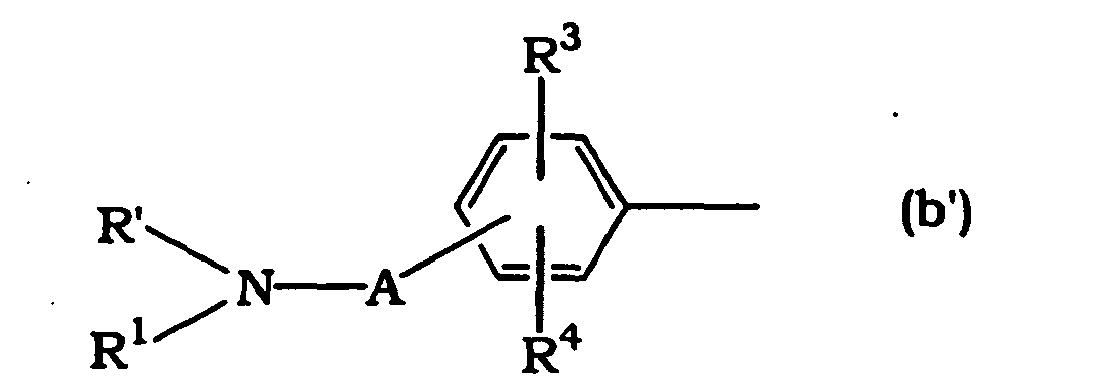
- R'
- is hydrogen, alkyl, or cycloalkyl, cycloalkylalkyl, phenyl or aralkyl, which optionally has a substituent on the ring,
- R1
- is hydrogen, alkyl, or cycloalkyl, cycloalkylalkyl, phenyl or aralkyl, which optionally has a substituent on the ring, or
- R' and R1
- in combination form, together with the adjacent nitrogen atom, a group forming a heterocycle optionally having, in the ring, oxygen atom, sulfur atom or optionally substituted nitrogen atom,
- R2
- is hydrogen or alkyl,
- R3 and R4
- are the same or different and each is hydrogen, alkyl, aralkyl, halogen, nitro, amino, alkylamino, acylamino, hydroxy, alkoxy, aralkyloxy, cyano, acyl, mercapto, alkylthio, aralkylthio, carboxy, alkoxycarbonyl, carbamoyl, mono- or dialkylcarbamoyl or azide, and
- A
- is a group of the formula

- Rb
- is a hydrogen, an alkyl, an aralkyl, an aminoalkyl or a mono- or dialkylaminoalkyl; and
- Rc
- is an optionally substituted heterocycle containing nitrogen,
- (3) The use as defined in
- (1) above, wherein the compound having a Rho kinase inhibitory activity is a compound selected from the group consisting of (+)-trans-4-(1-aminoethyl)-1-(4-pyridylcarbamoyl)cyclohexane, (+)-trans-N-(1H-pyrrolo[2,3-b]pyridin-4-yl)-4-(1-aminoethyl)cyclohexanecarboxamide, (R)-(+)-N-(4-pyridyl)-4-(1-aminoethyl)benzamide and (R)-(+)-N-(1H-pyrrolo[2,3-b]pyridin-4-yl)-4-(1-aminoethyl)benzamide, and/or a pharmaceutically acceptable acid addition salt thereof.
- (4) The use as defined in
- (1) above, wherein the compound having a Rho kinase inhibitory activity is (+)-trans-4-(1-aminoethyl)-1-(4-pyridylcarbamoyl)cyclohexane and/or a pharmaceutically acceptable acid addition salt thereof.
- (5) The use as defined in any one of (1) to (4) above,
wherein the liver disease is caused by activation of hepatic stellate cell. -
-
Fig. 1 is a phase contrast microscopic photograph of hepatic stellate cells without Y-27632 [Y-27632: (+)-trans-4-(1-aminoethyl)-1-(4-pyridylcarbamoyl)cyclohexane 2HCl·H2O]. -
Fig. 2 is a phase contrast microscopic photograph of hepatic stellate cells with the addition of Y-27632. -
Fig 3 shows an exemplary photograph of rat (control group) liver tissue stained by Masson trichrome stain. -
Fig. 4 shows an exemplary photograph of rat (Y-27632 administration group) liver tissue stained with Masson trichrome stain. - In the present invention, by the "activation" of hepatic stellate cell is meant a state associated with increased synthesis of collagen type I and type III, cell proliferation, expression of smooth muscle type α-actin and the like in the liver. Morphologically, non-active type cell has a spindle like shape with dendroidal protrusions. On the other hand, activated hepatic stellate cells lose lipid droplet thereof and change into cells with an extended shape of, for example, myofibroblast.
- Hepatitis is divided into virus hepatitis, toxic hepatitis, autoimmune hepatitis and the like, and into acute hepatitis and chronic hepatitis according to the mode of progress. The hepatitis in the present invention encompasses any type irrespective of the cause thereof, as long as it provides degenerative findings in hepatocytes due to the factors such as activation of hepatic stellate cell and the like.
- In addition, the hepatic fibrosis, in the present invention encompass any type caused by various factors such as activation of hepatic stellate cell and the like.
- In the present invention, Rho kinase means serine/threonine kinase activated along with the activation of Rho. For example, ROKα (ROCKII: Leung, T. et al, J. Biol. Chem., 270, 29051-29054, 1995), p160 ROCK (ROKβ, ROCK-I: Ishizaki, T. et al, The EMBO J., 15(8), 1885-1893, 1996) and other proteins having a serine/threonine kinase activity are exemplified.
- The compound having a Rho kinase inhibitory activity, which is used as an active ingredient in the present invention, is a compound of the above mentioned formula (I), particularly a compound of the formula (I').
- In the present invention, one kind of a compound having a Rho kinase inhibitory activity may be used alone, or, where necessary, several kinds may be concurrently used.
- In the present specification, each symbol of the formulas (I) and (I') is defined as follows.
- Alkyl at R, R' and R1 is linear or branched alkyl having 1 to 10 carbon atoms, which is exemplified by methyl, ethyl, propyl, isopropyl, butyl, isobutyl, sec-butyl, tert-butyl, pentyl, hexyl, heptyl, octyl, nonyl, decyl and the like, with preference given to alkyl having 1 to 4 carbon atoms.
- Cycloalkyl at R, R' and R1 has 3 to 7 carbon atoms and is exemplified by cyclopropyl, cyclobutyl, cyclopentyl, cyclohexyl, cycloheptyl and the like.
- Cycloalkylalkyl at R, R' and R1 is that wherein the cycloalkyl moiety is the above-mentioned cycloalkyl having 3 to 7 carbon atoms and the alkyl moiety is linear or branched alkyl having 1 to 6 carbon atoms (e.g., methyl, ethyl, propyl, isopropyl, butyl, pentyl, hexyl and the like), which is exemplified by cyclopropylmethyl, cyclobutylmethyl, cyclopentylmethyl, cyclohexylmethyl, cycloheptylmethyl, cyclopropylethyl, cyclopentylethyl, cyclohexylethyl, cycloheptylethyl, cyclopropylpropyl, cyclopentylpropyl, cyclohexylpropyl, cycloheptylpropyl, cyclopropylbutyl, cyclopentylbutyl, cyclohexylbutyl, cycloheptylbutyl, cyclopropylhexyl, cyclopentylhexyl, cyclohexylhexyl, cycloheptylhexyl and the like.
- Aralkyl at R, R' and R1 is that wherein alkyl moiety is alkyl having 1 to 4 carbon atoms and is exemplified by phenylalkyl such as benzyl, 1-phenylethyl, 2-phenylethyl, 3-phenylpropyl, 4-phenylbutyl and the like.
- The substituent of optionally substituted cycloalkyl, cycloalkylalkyl, phenyl and aralkyl on the ring at R, R' and R1 is halogen (e.g., chlorine, bromine, fluorine and iodine), alkyl (same as alkyl at R, R' and R1), alkoxy (linear or branched alkoxy having 1 to 6 carbon atoms, such as methoxy, ethoxy, propoxy, isopropoxy, butoxy, isobutoxy, sec-butoxy, tert-butoxy, pentyloxy, hexyloxy and the like), aralkyl (same as aralkyl at R, R' and R1) or haloalkyl (alkyl at R, R' and R1 which is substituted by 1-5 halogen, and exemplified by fluoromethyl, difluoromethyl, trifluoromethyl, 2,2,2-trifluoroethyl, 2,2,3,3,3-pentafluoropropyl and the like), nitro, amino, cyano, azide and the like.
- The group formed by R and R1 or R' and R1 in combination together with the adjacent nitrogen atom, which forms a heterocycle optionally having, in the ring, oxygen atom, sulfur atom or optionally substituted nitrogen atom is preferably a 5 or 6-membered ring and bonded ring thereof. Examples thereof include 1-pyrrolidinyl, piperidino, 1-piperazinyl, morpholino, thiomorpholino, 1-imidazolyl, 2,3-dihydrothiazol-3-yl and the like. The substituent of the optionally substituted nitrogen atom is exemplified by alkyl, aralkyl, haloalkyl and the like. As used herein, alkyl, aralkyl and haloalkyl are as defined for R, R' and R1.
- Alkyl at R2 is as defined for R, R' and R1.
- Halogen, alkyl, alkoxy and aralkyl at R3 and R4 are as defined for R, R' and R1.
- Acyl at R3 and R4 is alkanoyl having 2 to 6 carbon atoms (e.g., acetyl, propionyl, butyryl, valeryl, pivaloyl and the like), benzoyl or phenylalkanoyl wherein the alkanoyl moiety has 2 to 4 carbon atoms (e.g., phenylacetyl, phenylpropionyl, phenylbutyryl and the like).
- Alkylamino at R3 and R4 is that wherein the alkyl moiety is linear or branched alkyl having 1 to 6 carbon atoms. Examples thereof include methylamino, ethylamino, propylamino, isopropylamino, butylamino, isobutylamino, sec-butylamino, tert-butylamino, pentylamino, hexylamino and the like.
- Acylamino at R3 and R4 is that wherein acyl moiety is alkanoyl having 2 to 6 carbon atoms, benzoyl, phenylalkanoyl wherein the alkanoyl moiety has 2 to 4 carbon atoms and the like, which is exemplified by acetylamino, propionylamino, butyrylamino, valerylamino, pivaloylamino, benzoylamino, phenylacetylamino, phenylpropionylamino, phenylbutyrylamino and the like.
- Alkylthio at R3 and R4 is that wherein the alkyl moiety is linear or branched alkyl having 1 to 6 carbon atoms, which is exemplified by methylthio, ethylthio, propylthio, isopropylthio, butylthio, isobutylthio, sec-butylthio, tert-butylthio, pentylthio, hexylthio and the like.
- Aralkyloxy at R3 and R4 is that wherein the alkyl moiety is alkyl having 1 to 4 carbon atoms, which is exemplified by benzyloxy, 1-phenylethyloxy, 2-phenylethyloxy, 3-phenylpropyloxy, 4-phenylbutyloxy and the like.
- Aralkylthio at R3 and R4 is that wherein the alkyl moiety is alkyl having 1 to 4 carbon atoms, which is exemplified by benzylthio, 1-phenylethylthio, 2-phenylethylthio, 3-phenylpropylthio, 4-phenylbutylthio and the like.
- Alkoxycarbonyl at R3 and R4 is that wherein the alkoxy moiety is linear or branched alkoxy having 1 to 6 carbon atoms, which is exemplified by methoxycarbonyl, ethoxycarbonyl, propoxycarbonyl, isopropoxycarbonyl, butoxycarbonyl, isobutoxycarbonyl, sec-butoxycarbonyl, tert-butoxycarbonyl, pentyloxycarbonyl, hexyloxycarbonyl and the like.
- Mono- or dialkylcarbamoyl at R3 and R4 is carbamoyl mono- or di-substituted by alkyl having 1 to 4 carbon atoms, which is exemplified by methylcarbamoyl, dimethylcarbamoyl, ethylcarbamoyl, diethylcarbamoyl, propylcarbamoyl, dipropylcarbamoyl, butylcarbamoyl, dibutylcarbamoyl and the like.
- Alkoxy at R5 is as defined for R, R' and R1.
- Alkoxycarbonyloxy at R5 is that wherein the alkoxy moiety is linear or branched alkoxy having 1 to 6 carbon atoms, which is exemplified by methoxycarbonyloxy, ethoxycarbonyloxy, propoxycarbonyloxy, isopropoxycarbonyloxy, butoxycarbonyloxy, isobutoxycarbonyloxy, sec-butoxycarbonyloxy, tert-butoxycarbonyloxy, pentyloxycarbonyloxy, hexyloxycarbonyloxy and the like.
- Alkanoyloxy at R5 is that wherein the alkanoyl moiety is alkanoyl having 2 to 6 carbon atoms, which is exemplified by acetyloxy, propionyloxy, butyryloxy, valeryloxy, pivaloyloxy and the like.
- Aralkyloxycarbonyloxy at R5 is that wherein the aralkyl moiety is aralkyl having C1-C4 alkyl, which is exemplified by benzyloxycarbonyloxy, 1-phenylethyloxycarbonyloxy, 2-phenylethyloxycarbonyloxy, 3-phenylpropyloxycarbonyloxy, 4-phenylbutyloxycarbonyloxy and the like.
- Alkyl at R6 is as defined for R, R' and R1; alkyl at R8 and R9 is as defined for R, R' and R1; and aralkyl at R8 and R9 is as defined for R, R' and R1.
- Alkyl at R7 is as defined for R, R' and R1 and aralkyl at R7 is as defined for R, R' and R1.
- The group formed by R6 and R7 in combination, which forms a heterocycle optionally having, in the ring, oxygen atom, sulfur atom or optionally substituted nitrogen atom, is imidazol-2-yl, thiazol-2-yl, oxazol-2-yl, imidazolin-2-yl, 3,4,5,6-tetrahydropyridin-2-yl, 3,4,5,6-tetrahydropyrimidin-2-yl, 1,3-oxazolin-2-yl, 1,3-thiazolin-2-yl or optionally substituted benzoimidazol-2-yl, benzothiazol-2-yl, benzoxazol-2-yl and the like having a substituent such as halogen, alkyl, alkoxy, haloalkyl, nitro, amino, phenyl, aralkyl and the like. As used herein, halogen, alkyl, alkoxy, haloalkyl and aralkyl are as defined for R, R' and R1.
- The substituent of the above-mentioned optionally substituted nitrogen atom is exemplified by alkyl, aralkyl, haloalkyl and the like. As used herein, alkyl, aralkyl and haloalkyl are as defined for R, R' and R1 .
- Hydroxyalkyl at R10 and R11 is linear or branched alkyl having 1 to 6 carbon atoms which is substituted by 1 to 3 hydroxy, which is exemplified by hydroxymethyl, 2-hydroxyethyl, 1-hydroxyethyl, 3-hydroxypropyl, 4-hydroxybutyl and the like.
- Alkyl at R10 and R11 is as defined for R, R' and R1; haloalkyl and alkoxycarbonyl at R10 and R11 are as defined for R, R' and R1; aralkyl at R10 and R11 is as defined for R, R' and R1.
- Cycloalkyl formed by R10 and R11 in combination is the same as cycloalkyl at R, R' and R1.
- Alkyl at L is as defined for R, R' and R1.
- Aminoalky at L is a linear or branched alkyl having 1 to 6 carbon atoms, which is substituted by amino, which is exemplified by aminomethyl, 2-aminoethyl, 1-aminoethyl, 3-aminopropyl, 4-aminobutyl, 5-aminopentyl, 6-aminohexyl and the like.
- Mono- or dialkylaminoalkyl at L is mono- or di-substituted aminoalkyl with alkyl having 1 to 4 carbon atoms, which is exemplified by methylaminomethyl, dimethylaminomethyl, ethylaminomethyl, diethylaminomethyl, propylaminomethyl, dipropylaminomethyl, butylaminomethyl, dibutylaminomethyl, 2-dimethylaminoethyl, 2-diethylaminoethyl and the like.
- Carbamoylalkyl at L is linear or branched alkyl having 1 to 6 carbon atoms substituted by carbamoyl, which is exemplified by carbamoylmethyl, 2-carbamoylethyl, 1-carbamoylethyl, 3-carbamoylpropyl, 4-carbamoylbutyl, 5-carbamoylpentyl, 6-carbamoylhexyl and the like.
- Phthalimidoalkyl at L is linear or branched alkyl having 1 to 6 carbon atoms, which is substituted by phthalimide. Examples thereof include phthalimidomethyl, 2-phthalimidoethyl, 1-phthalimidoethyl, 3-phthalimidopropyl, 4-phthalimidobutyl, 5-phthalimidopentyl, 6-phthalimidohexyl and the like.
- Alkyl at B is as defined for R, R' and R1.
- Alkoxy at B is as defined for R, R' and R1.
- Aralkyl at B is as defined for R, R' and R1.
- Aralkyloxy at B is as defined for R3 and R4.
- Aminoalkyl at B is as defined for L.
- Hydroxyalkyl at B is as defined for R10 and R11. Alkanoyloxyalkyl at B is that wherein linear or branched alkyl having 1 to 6 carbon atoms is substituted by alkanoyloxy having alkanoyl moiety having 2 to 6 carbon atoms, which is exemplified by acetyloxymethyl, propionyloxymethyl, butyryloxymethyl, valeryloxymethyl, pivaloyloxymethyl, acetyloxyethyl, propionyloxyethyl, butyryloxyethyl, valeryloxyethyl, pivaloyloxyethyl and the like.
- Alkoxycarbonylalkyl at B is that wherein linear or branched alkyl having 1 to 6 carbon atoms is substituted by alkoxycarbonyl having alkoxy moiety having 1 to 6 carbon atoms, which is exemplified by methoxycarbonylmethyl, ethoxycarbonylmethyl, propoxycarbonylmethyl, isopropoxycarbonylmethyl, butoxycarbonylmethyl, isobutoxycarbonylmethyl, sec-butoxycarbonylmethyl, tert-butoxycarbonylmethyl, pentyloxycarbonylmethyl, hexyloxycarbonylmethyl, methoxycarbonylethyl, ethoxycarbonylethyl, propoxycarbonylethyl, isopropoxycarbonylethyl, butoxycarbonylethyl, isobutoxycarbonylethyl, sec-butoxycarbonylethyl, tert-butoxycarbonylethyl, pentyloxycarbonylethyl, hexyloxycarbonylethyl and the like.
- Halogen at Q1, Q2 and Q3 is as defined for R, R' and R1. Aralkyloxy at Q1 and Q2 is as defined for R3 and R4.
- Alkoxy at Q3 is as defined for R, R' and R1.
- Alkylene at W, X and Y is linear or branched alkylene having 1 to 6 carbon atoms, which is exemplified by methylene, ethylene, trimethylene, propylene, tetramethylene, pentamethylene, hexamethylene and the like.
- Alkenylene at Y is linear or branched alkenylene having 2 to 6 carbon atoms, which is exemplified by vinylene, propenylene, butenylene, pentenylene and the like.
- Alkyl at Rb is as defined for R, R' and R1.
- Aralkyl at Rb is as defined for R, R' and R1.
- Aminoalkyl at Rb is as defined for L.
- Mono- or dialkylaminoalkyl at Rb is as defined for L.
- The heterocycle containing nitrogen at Rc is pyridine, pyrimidine, pyridazine, triazine, pyrazole, triazole and the like when it is monocycle, and when it is a condensed ring, it is exemplified by pyrrolopyridine (e.g., 1H-pyrrolo[2,3-b]pyridine, 1H-pyrrolo[3,2-b]pyridine, 1H-pyrrolo[3,4-b]pyridine and the like), pyrazolopyridine (e.g., 1H-pyrazolo[3,4-b]pyridine, 1H-pyrazolo[4,3-b]pyridine and the like), imidazopyridine (e.g., 1H-imidazo[4,5-b]pyridine and the like), pyrrolopyrimidine (e.g., 1H-pyrrolo[2,3-d]pyrimidine, 1H-pyrrolo[3,2-d]pyrimidine, 1H-pyrrolo[3,4-d]pyrimidine and the like), pyrazolopyrimidine (e.g., 1H-pyrazolo[3,4-d]pyrimidine, pyrazolo[1,5-a]pyrimidine, 1H-pyrazolo[4,3-d]pyrimidine and the like), imidazopyrimidine (e.g., imidazo[1,2-a]pyrimidine, 1H-imidazo[4,5-d]pyrimidine and the like), pyrrolotriazine (e.g., pyrrolo[1,2-a]-1,3,5-triazine, pyrrolo[2,1-f]-1,2,4-triazine), pyrazolotriazine (e.g., pyrazolo[1,5-a]-1,3,5-triazine and the like), triazolopyridine (e.g., 1H-1,2,3-triazolo[4,5-b]pyridine and the like), triazolopyrimidine (e.g., 1,2,4-triazolo[1,5-a]pyrimidine, 1,2,4-triazolo[4,3-a]pyrimidine, 1H-1,2,3-triazolo[4,5-d]pyrimidine and the like), cinnoline, quinazoline, quinoline, pyridopyridazine (e.g., pyrido[2,3-c]pyridazine and the like), pyridopyrazine (e.g., pyrido[2,3-b]pyrazine and the like), pyridopyrimidine (e.g., pyrido[2,3-d]pyrimidine, pyrido[3,2-d]pyrimidine and the like), pyrimidopyrimidine (e.g., pyrimido[4,5-d]pyrimidine, pyrimido[5,4-d]pyrimidine and the like), pyrazinopyrimidine (e.g., pyrazino[2,3-d]pyrimidine and the like), naphthyridine (e.g., 1,8-naphthyridine and the like), tetrazolopyrimidine (e.g., tetrazolo[1,5-a]pyrimidine and the like), thienopyridine (e.g., thieno[2,3-b]pyridine and the like), thienopyrimidine (e.g., thieno[2,3-d]pyrimidine and the like), thiazolopyridine (e.g., thiazolo[4,5-b]pyridine, thiazolo[5,4-b]pyridine and the like), thiazolopyrimidine (e.g., thiazolo[4,5-d]pyrimidine, thiazolo[5,4-d]pyrimidine and the like), oxazolopyridine (e.g., oxazolo[4,5-b]pyridine, oxazolo[5,4-b]pyridine and the like), oxazolopyrimidine (e.g., oxazolo[4,5-d]pyrimidine, oxazolo[5,4-d]pyrimidine and the like), furopyridine (e.g., furo[2,3-b]pyridine, furo[3,2-b]pyridine and the like), furopyrimidine (e.g., furo[2,3-d]pyrimidine, furo[3,2-d]pyrimidine and the like), 2,3-dihydropyrrolopyridine (e.g., 2,3-dihydro-1H-pyrrolo[2,3-b]pyridine, 2,3-dihydro-1H-pyrrolo[3,2-b]pyridine and the like), 2,3-dihydropyrrolopyrimidine (e.g., 2,3-dihydro-1H-pyrrolo[2,3-d]pyrimidine, 2,3-dihydro-1H-pyrrolo[3,2-d]pyrimidine and the like), 5,6,7,8-tetrahydropyrido[2,3-d]pyrimidine, 5,6,7,8-tetrahydro-1,8-naphthyridine, 5,6,7,8-tetrahydroquinoline and the like. When these rings form a hydrogenated aromatic ring, the carbon atom in the ring may be carbonyl and includes, for example, 2,3-dihydro-2-oxopyrrolopyridine, 2,3-dihydro-2,3-dioxopyrrolopyridine, 7,8-dihydro-7-oxo-1,8-naphthyridine, 5,6,7,8-tetrahydro-7-oxo-1,8-naphthyridine and the like.
- These rings may be substituted by a substituent such as halogen, alkyl, alkoxy, aralkyl, haloalkyl, nitro, amino, alkylamino, cyano, formyl, acyl, aminoalkyl, mono- or dialkylaminoalkyl, azide, carboxy, alkoxycarbonyl, carbamoyl, mono- or dialkylcarbamoyl, alkoxyalkyl (e.g., methoxymethyl, methoxyethyl, methoxypropyl, ethoxymethyl, ethoxyethyl, ethoxypropyl and the like), optionally substituted hydrazino and the like.
- As used herein, the substituent of the optionally substituted hydrazino includes alkyl, aralkyl, nitro, cyano and the like, wherein alkyl and aralkyl are as defined for R, R' and R1 and exemplified by methylhydrazino, ethylhydrazino, benzylhydrazino and the like.
- The compound of the formula (I) is exemplified by the following compounds.
- (1) 4-(2-pyridylcarbamoyl)piperidine
- (2) 1-benzyloxycarbonyl-4-(4-pyridylcarbamoyl)piperidine
- (3) 1-benzoyl-4-(4-pyridylcarbamoyl)piperidine
- (4) 1-propyl-4-(4-pyridylcarbamoyl)piperidine
- (5) [3-(2-(2-thienylmethyl)phenoxy)-2-hydroxypropyl]-4-(4-pyridylcarbamoyl)piperidine
- (6) 4-(4-pyridylcarbamoyl)piperidine
- (7) 1-benzyl-4-(4-pyridylcarbamoyl)-1,2,5,6-tetrahydropyridine
- (8) 3-(4-pyridylcarbamoyl)piperidine
- (9) 1-benzyl-3-(4-pyridylcarbamoyl)piperidine
- (10) 1-(2-(4-benzyloxyphenoxy)ethyl)-4-(N-(2-pyridyl)-N-benzylcarbamoyl)pyridine
- (11) 1-formyl-4-(4-pyridylcarbamoyl)piperidine
- (12) 4-(3-pyridylcarbamoyl)piperidine
- (13) 1-isopropyl-4-(4-pyridylcarbamoyl)piperidine
- (14) 1-methyl-4-(4-pyridylcarbamoyl)piperidine
- (15) 1-hexyl-4-(4-pyridylcarbamoyl)piperidine
- (16) 1-benzyl-4-(4-pyridylcarbamoyl)piperidine
- (17) 1-(2-phenylethyl)-4-(4-pyridylcarbamoyl)piperidine
- (18) 1-(2-(4-methoxyphenyl)ethyl)-4-(4-pyridylcarbamoyl)piperidine
- (19) 1-(2-(4-methoxyphenyl)ethyl)-4-(2-pyridylcarbamoyl)piperidine
- (20) 1-(2-(4-chlorophenyl)ethyl)-4-(4-pyridylcarbamoyl)piperidine
- (21) 1-diphenylmethyl-4-(2-pyridylcarbamoyl)piperidine
- (22) 1-[2-(4-(5-methyl-3-oxo-2,3,4,5-tetrahydropyridazin-6-yl)phenyl)ethyl]-4-(2-pyridylcarbamoyl)piperidine
- (23) 1-(4-(4,5-dihydro-2-furyl)phenyl)-4-(4-pyridylcarbamoyl)-piperidine
- (24) 1-(2-nitrophenyl)-4-(4-pyridylcarbamoyl)piperidine
- (25) 1-(2-aminophenyl)-4-(4-pyridylcarbamoyl)piperidine
- (26) 1-nicotinoyl-4-(4-pyridylcarbamoyl)piperidine
- (27) 1-isonicotinoyl-4-(4-pyridylcarbamoyl)piperidine
- (28) 1-(3,4,5-trimethoxybenzoyl)-4-(4-pyridylcarbamoyl)piperidine
- (29) 1-acetyl-4-(4-pyridylcarbamoyl)piperidine
- (30) 1-(3-(4-fluorobenzoyl)propyl)-4-(4-pyridylcarbamoyl)-piperidine
- (31) 1-(3-(4-fluorobenzoyl)propyl)-4-(2-pyridylcarbamoyl)-piperidine
- (32) 1-(1-(4-hydroxybenzoyl)ethyl)-4-(2-pyridylcarbamoyl)-piperidine
- (33) 1-(1-(4-benzyloxybenzoyl)ethyl)-4-(2-pyridylcarbamoyl)-piperidine
- (34) 1-(2-(4-hydroxyphenoxy)ethyl)-4-(2-pyridylcarbamoyl)-piperidine
- (35) 1-(4-(4-fluorophenyl)-4-hydroxybutyl)-4-(4-pyridylcarbamoyl)piperidine
- (36) 1-(1-methyl-2-(4-hydroxyphenyl)-2-hydroxyethyl)-4-(2-pyridylcarbamoyl) piperidine
- (37) 1-cinnamyl-4-(2-pyridylcarbamoyl)piperidine
- (38) 1-(2-hydroxy-3-phenoxypropyl)-4-(4-pyridylcarbamoyl)-piperidine
- (39) 1-(2-hydroxy-3-phenoxypropyl)-4-(3-pyridylcarbamoyl)-piperidine
- (40) 1-(2-hydroxy-3-phenoxypropyl)-4-(2-pyridylcarbamoyl)-piperidine
- (41) 1-(2-phenylethyl)-4-[N-(2-pyridyl)-N-(2-(N,N-dimethylamino)ethyl)carbamoyl]piperidine
- (42) 1-benzyloxycarbonyl-4-(2-pyridylcarbamoyl)piperidine
- (43) 1-(3-chlorophenyl)carbamoyl-4-(4-pyridylcarbamoyl)piperidine
- (44) 1-[N-(2-pyridyl)-N-(2-(N,N-dimethylamino)ethyl)-carbamoyl]piperidine
- (45) 1-methyl-4-(4-pyridylcarbamoyl)-1,2,5,6-tetrahydropyridine
- (46) 1-nicotinoyl-3-(4-pyridylcarbamoyl)piperidine
- (47) 1-[2-(4-fluorobenzoyl)ethyl]-4-(4-pyridylcarbamoyl)piperidine
- (48) 1-(6-chloro-2-methylimidazo[1,2-a]pyridine-3-carbonyl)-4-(4-pyridylcarbamoy)piperidine
- (49) 1-(4-nitrobenzyl)-4-(4-pyridylcarbamoyl)piperidine
- (50) 1-hexyl-4-(4-pyridylcarbamoyl)piperidine
- (51) 1-benzyloxycarbonyl-4-(2-chloro-4-pyridylcarbamoyl)piperidine
- (52) 4-(2-chloro-4-pyridylcarbamoyl)piperidine
- (53) 1-(2-chloronicotinoyl)-4-(4-pyridylcarbamoyl)piperidine
- (54) 3-(2-chloro-4-pyridylcarbamoyl)piperidine
- (55) 1-(4-phthalimidobutyl)-4-(4-pyridylcarbamoyl)piperidine
- (56) 1-(3,5-di-tert-butyl-4-hydroxycinnamoyl)-4-(4-pyridylcarbamoyl)piperidine
- (57) 1-carbamoylmethyl-4-(4-pyridylcarbamoyl)piperidine
- (58) 1-benzyloxycarbonyl-4-(5-nitro-2-pyridylcarbamoyl)piperidine
- (59) 4-(5-nitro-2-pyridylcarbamoyl)piperidine
- (60) trans-4-benzyloxycarboxamidomethyl-1-(4-pyridylcarbamoyl)-cyclohexane
- (61) trans-4-aminomethyl-1-(4-pyridylcarbamoyl)cyclohexane
- (62) trans-4-formamidomethyl-1-(4-pyridylcarbamoyl)cyclohexane
- (63) trans-4-dimethylaminomethyl-1-(4-pyridylcarbamoyl)cyclohexane
- (64) N-benzylidene-trans-(4-pyridylcarbamoyl)cyclohexylmethylamine
- (65) trans-4-benzylaminomethyl-1-(4-pyridylcarbamoyl)cyclohexane
- (66) trans-4-isopropylaminomethyl-1-(4-pyridylcarbamoyl)-cyclohexane
- (67) trans-4-nicotinoylaminomethyl-1-(4-pyridylcarbamoyl)-cyclohexane
- (68) trans-4-cyclohexylaminomethyl-1-(4-pyridylcarbamoyl)-cyclohexane
- (69) trans-4-benzyloxycarboxamide-1-(4-pyridylcarbamoyl)-cyclohexane
- (70) trans-4-amino-1-(4-pyridylcarbamoyl)cyclohexane
- (71) trans-4-(1-aminoethyl)-1-(4-pyridylcarbamoyl)cyclohexane
- (72) trans-4-aminomethyl-cis-2-methyl-1-(4-pyridylcarbamoyl)-cyclohexane
- (73) (+)-trans-4-(1-benzyloxycarboxamidopropyl)-1-cyclohexanecarboxylic acid
- (74) (+)-trans-4-(1-benzyloxycarboxamidopropyl)-1-(4-pyridylcarbamoyl)cyclohexane
- (75) (-)-trans-4-(1-benzyloxycarboxamidpropyl)-1-(4-pyridylcarbamoyl)cyclohexane
- (76) (+)-trans-4-(1-aminopropyl)-1-(4-pyridylcarbamoyl)cyclohexane
- (77) (-)-trans-4-(1-aminopropyl)-1-(4-pyridylcarbamoyl)cyclohexane
- (78) (-)-trans-4-(1-benzyloxycarboxamidoethyl)-1-(4-pyridylcarbamoyl)cyclohexane
- (79) (+)-trans-4-(1-benzyloxycarboxamidoethyl)-1-(4-pyridylcarbamoyl)cyclohexane
- (80) (+)-trans-4-(1-aminoethyl)-1-(4-pyridylcarbamoyl)cyclohexane
- (81) (-)-trans-4-(1-aminoethyl)-1-(4-pyridylcarbamoyl)cyclohexane
- (82) trans-4-(4-chlorobenzoyl)aminomethyl-1-(4-pyridylcarbamoyl)-cyclohexane
- (83) trans-4-aminomethyl-1-(2-pyridylcarbamoyl)cyclohexane
- (84) trans-4-benzyloxycarboxamidomethyl-1-(2-pyridylcarbamoyl)-cyclohexane
- (85) trans-4-methylaminomethyl-1-(4-pyridylcarbamoyl)cyclohexane
- (86) trans-4-(N-benzyl-N-methylamino)methyl-1-(4-pyridylcarbamoyl)cyclohexane
- (87) trans-4-aminomethyl-1-(3-pyridylcarbamoyl)cyclohexane
- (88) trans-4-aminomethyl-1-[(3-hydroxy-2-pyridyl)carbamoyl]-cyclohexane
- (89) trans-4-benzyloxycarboxamidomethyl-1-(3-pyridylcarbamoyl)-cyclohexane
- (90) trans-4-benzyloxycarboxamidomethyl-1-[(3-benzyloxy-2-pyridyl)carbamoyl]cyclohexane
- (91) trans-4-phthalimidomethyl-1-(4-pyridylcarbamoyl)cyclohexane
- (92) trans-4-benzyloxycarboxamidomethyl-1-(3-methyl-4-pyridylcarbamoyl)cyclohexane
- (93) trans-4-aminomethyl-1-(3-methyl-4-pyridylcarbamoyl)-cyclohexane
- (94) 4-(trans-4-benzyloxycarboxamidomethylcyclohexylcarbonyl)-amino-2,6-dimethylpyridine-N-oxide
- (95) 4-(trans-4-aminomethylcyclohexylcarbonyl)amino-2,6-dimethylpyridine-N-oxide
- (96) trans-4-aminomethyl-1-(2-methyl-4-pyridylcarbamoyl)-cyclohexane
- (97) trans-4-(1-benzyloxycarboxamidoethyl)-1-(4-pyridylcarbamoyl)cyclohexane
- (98) trans-4-(1-amino-1-methylethyl)-1-(4-pyridylcarbamoyl)-cyclohexane
- (99) trans-4-(2-aminoethyl)-1-(4-pyridylcarbamoyl)cyclohexane
- (100) trans-4-(2-amino-1-methylethyl)-1-(4-pyridylcarbamoyl)-cyclohexane
- (101) trans-4-(1-aminopropyl)-1-(4-pyridylcarbarnoyl)cyclohexane
- (102) trans-4-aminomethyl-trans-1-methyl-1-(4-pyridylcarbamoyl)-cyclohexane
- (103) trans-4-benzylaminomethyl-cis-2-methyl-1-(4-pyridylcarbamoyl)cyclohexane
- (104) trans-4-(1-benzyloxycarboxamide-1-methylethyl)-1-(4-pyridylcarbamoyl)cyclohexane
- (105) trans-4-benzyloxycarboxamidomethyl-1-(N-methyl-4-pyridylcarbamoyl)cyclohexane
- (106) trans-4-(1-acetamide-1-methylethyl)-1-(4-pyridylcarbamoyl)-cyclohexane
- (107) trans-N-(6-amino-4-pyrimidyl)-4-aminomethylcyclohexanecarboxamide
- (108) trans-N-(1H-pyrrolo[2,3-b]pyridin-4-yl)-4-aminomethyl-cyclohexanecarboxamide
- (109) (+)-trans-N-(1H-pyrrolo[2,3-b]pyridin-4-yl)-4-(1-aminoethyl)cyclohexanecarboxamide
- (110) trans-N-(1H-pyrrolo[2,3-b]pyridin-4-yl)-4-(1-amino-1-methylethyl)cyclohexanecarboxamide
- (111) trans-N-(1H-pyrazolo[3,4-b]pyridin-4-yl)-4-aminomethyl-cyclohexanecarboxamide
- (112) (+)-trans-N-(1H-pyrazolo[3,4-b]pyridin-4-yl)-4-(1-aminoethyl)cyclohexanecarboxamide
- (113) trans-N-(1H-pyrazolo[3,4-b]pyridin-4-yl)-4-(1-amino-1-methylethyl)cyclohexanecarboxamide
- (114) (+)-trans-N-(2-amino-4-pyridyl)-4-(1-aminoethyl)-cyclohexanecarboxamide
- (115) trans-N-(1H-pyrazolo[3,4-d]pyrimidin-4-yl)-4-aminomethylcyclohexanecarboxamide
- (116) (+)-trans-N-(1H-pyrazolo[3,4-d]pyrimidin-4-yl)-4-(1-aminoethyl)cyclohexanecarboxamide
- (117) trans-N-(1H-pyrazolo[3,4-d]pyrimidin-4-yl)-4-(1-amino-1-methylethyl)cyclohexanecarboxamide
- (118) trans-N-(4-pyrimidinyl)-4-aminomethylcyclohexanecarboxamide
- (119) trans-N-(3-amino-4-pyridyl)-4-aminomethylcyclohexanecarboxamide
- (120) trans-N-(7H-imidazo[4,5-d]pyrimidin-6-yl)-4-aminomethyl-cyclohexanecarboxamide
- (121) trans-N-(3H-1,2,3-triazolo[4,5-d]pyrimidin-7-yl)-4-aminomethylcyclohexanecarboxamide
- (122) trans-N-(1-benzyl-1H-pyrazolo[3,4-b]pyridin-4-yl)-4-aminomethylcyclohexanecarboxamide
- (123) trans-N-(1H-5-pyrazolyl)-4-aminomethylcyclohexanecarboxamide
- (124) trans-N-(1H-pyrazolo[3,4-b]pyridin-4-yl)-4-aminomethyl-cyclohexanecarboxamide
- (125) trans-N-(4-pyridazinyl)-4-aminomethylcyclohexanecarboxamide
- (126) trans-N-(7H-pyrrolo[2,3-d]pyrimidin-4-yl)-4-aminomethyl-cyclohexanecarboxamide
- (127) trans-N-(2-amino-4-pyridyl)-4-aminomethylcyclohexanecarboxamide
- (128) trans-N-(thieno[2,3-d]pyrimidin-4-yl)-4-aminomethyl-cyclohexanecarboxamide
- (129) trans-N-(5-methyl-1,2,4-triazolo[1,5-a]pyrimidin-7-yl)-4-aminomethylcyclohexanecarboxamide
- (130) trans-N-(3-cyano-5-methylpyrazolo[1,5-a]pyrimidin-7-yl)-4-aminomethylcyclohexanecarboxamide
- (131) trans-N-(1H-pyrazolo[3,4-b]pyridin-4-yl)-4-(1-amino-1-methylethyl)cyclohexanecarboxamide
- (132) trans-N-(2-(1-pyrrolidinyl)-4-pyridyl)-4-aminomethyl-cyclohexanecarboxamide
- (133) trans-N-(2,6-diamino-4-pyrimidyl)-4-aminomethylcyclohexane-carboxamide
- (134) (+)-trans-N-(7-methyl-1,8-naphthyridin-4-yl)-4-(1-aminoethyl)cyclohexanecarboxamide
- (135) trans-N-(1-benzyloxymethylpyrrolo[2,3-b]pyridin-4-yl)-4-aminomethylcyclohexanecar-boxamide
- (136) (+)-trans-N-(1-methylpyrrolo[2,3-b]pyridin-4-yl)-4-(1-aminoethyl)cyclohexanecarboxamide
- (137) trans-N-benzyl-N-(2-benzylamino-4-pyridyl)-4-(1-amino-1-methylethyl)cyclohexanecarboxamide
- (138) trans-N-(2-azide-4-pyridyl)-4-aminomethylcyclohexanecarboxamide
- (139) trans-N-(2,3-dihydro-1H-pyrrolo[2,3-b]pyridin-4-yl)-4-aminomethylcyclohexanecarboxamide
- (140) trans-N-(2,3-dihydro-1H-pyrrolo[2,3-b]pyridin-4-yl)-4-(1-amino-1-methylethyl)cyclohexanecarboxamide
- (141-1) trans-N-(2-carboxy-4-pyridyl)-4-aminomethylcyclohexanecarboxamide
- (141-2) (R)-(+)-trans-N-(3-bromo-1H-pyrrolo[2,3-b]pyridin-4-yl)-4-(1-aminoethyl)cyclohexanecarboxamide
- (142) trans-N-(1H-pyrrolo[2,3-b]pyridin-4-yl)-4-guanidinomethyl-cyclohexanecarboxamide
- (143) trans-N-(1H-pyrazolo[3,4-b]pyridin-4-yl)-4-guanidinomethyl-cyclohexanecarboxamide
- (144) trans-N-(4-pyridyl)-4-guanidinomethylcyclohexanecarboxamide
- (145) trans-N-(1-methylpyrrolo[2,3-b]pyridin-4-yl)-4-(guanidinomethyl)cyclohexanecarboxamide
- (146) trans-N-(1H-pyrrolo[2,3-b]pyridin-4-yl)-4-(2-imidazolin-2-yl)aminomethylcyclohexanecarboxamide
- (147) trans-N-(1-benzyloxymethylpyrrolo[2,3-b]pyridin-4-yl)-4-guanidinomethylcyclohexanecarboxamide
- (148) trans-N-(2-amino-4-pyridyl)-4-guanidinomethylcyclohexanecarboxamide
- (149) trans-N-(1-benzyloxymethyl-1H-pyrrolo[2,3-b]pyridin-4-yl)-4-(2-imidazolin-2-yl)aminomethylcyclohexanecarboxamide
- (150) trans-N-(1H-pyrrolo[2,3-b]pyridin-4-yl)-4-(3-benzylguanidinomethyl)cyclohexanecarboxamide
- (151) trans-N-(1H-pyrrolo[2,3-b]pyridin-4-yl)-4-(3-phenylguanidinomethyl)cyclohexanecarboxamide
- (152) trans-N-(1H-pyrrolo[2,3-b]pyridin-4-yl)-4-(3-propylguanidinomethyl)cyclohexanecarboxamide
- (153) trans-N-(1H-pyrrolo[2,3-b]pyridin-4-yl)-4-(3-octylguanidinomethyl)cyclohexanecarboxamide
- (154) trans-N-(1-benzyloxymethylpyrrolo[2,3-b]pyridin-4-yl)-4-(2-benzyl-3-ethylguanidinomethyl)cyclohexanecarboxamide
- (155) trans-N-(1H-pyrrolo[2,3-b]pyridin-4-yl)-4-(imidazol-2-yl)aminomethylcyclohexanecarboxamide
- (156) trans-N-(1H-pyrrolo[2,3-b]pyridin-4-yl)-4-(thiazol-2-yl)aminomethylcyclohexanecarboxamide
- (157) (R)-(+)-N-(4-pyridyl)-4-(1-aminoethyl)benzamide
- (158) N-(4-pyridyl)-4-(1-amino-1-methylethyl)benzamide
- (159) N-(4-pyridyl)-4-aminomethyl-2-benzyloxybenzamide
- (160) N-(4-pyridyl)-4-aminomethyl-2-ethoxybenzamide
- (161) (R)-(-)-N-(4-pyridyl)-4-(1-aminoethyl)-3-nitrobenzamide
- (162) (R)-(-)-N-(4-pyridyl)-3-amino-4-(1-aminoethyl)benzamide
- (163) (R)-(+)-N-(4-pyridyl)-4-(1-aminoethyl)-3-chlorobenzamide
- (164) N-(4-pyridyl)-3-aminomethylbenzamide
- (165) (R)-(+)-N-(1H-pyrrolo[2,3-b]pyridin-4-yl)-4-(1-aminoethyl)benzamide
- (166) (R)-(+)-N-(1H-pyrazolo[3,4-b]pyridin-4-yl)-4-(1-aminoethyl)benzamide
- (167) N-(1H-pyrazolo[3,4-b]pyridin-4-yl)-4-guanidinomethylbenzamide
- (168) N-(4-pyridyl)-4-guanidinomethylbenzamide
- (169) (R)-(+)-N-(4-pyridyl)-4-(1-aminoethyl)-3-fluorobenzamide
- (170) N-(4-pyridyl)-4-aminomethylbenzamide
- (171) N-(4-pyridyl)-4-aminomethyl-2-hydroxybenzamide
- (172) N-(4-pyridyl)-4-(2-aminoethyl)benzamide
- (173) N-(4-pyridyl)-4-aminomethyl-3-nitrobenzamide
- (174) N-(4-pyridyl)-3-amino-4-aminomethylbenzamide
- (175) (S)-(-)-N-(4-pyridyl)-4-(1-aminoethyl)benzamide
- (176) (S)-(-)-N-(4-pyridyl)-2-(1-aminoethyl)benzamide
- (177) (R)-(+)-N-(4-pyridyl)-4-(1-aminoethyl)-2-chlorobenzamide
- (178) (R)-(+)-N-(1H-pyrrolo[2,3-b]pyridin-4-yl)-4-(1-(3-propylguanidino)ethyl)benzamide
- (179) (R)-(-)-N-(1H-pyrrolo[2,3-b]pyridin-4-yl)-4-(1-aminoethyl)-3-azidebenzamide
- (180) (R)-(+)-N-(4-pyridyl)-4-(1-aminoethyl)-2-nitrobenzamide
- (181) (R)-(-)-N-(4-pyridyl)-4-(1-aminoethyl)-3-ethoxybenzamide
- (182) (R)-(+)-N-(3-iodo-1H-pyrrolo[2,3-b]pyridin-4-yl)-4-(1-aminoethyl)benzamide
- (183) (R)-(+)-N-(3-iodo-1H-pyrrolo[2,3-b]pyridin-4-yl)-4-(1-aminoethyl)-3-azidebenzamide
- (184) (R)-(-)-N-(4-pyridyl)-4-(1-aminoethyl)-3-hydroxybenzamide
- (185) N-(1H-pyrazolo[3,4-b]pyridin-4-yl)-4-guanidinomethyl-3-nitrobenzamide
- (186) (R)-N-(1H-pyrazolo[3,4-b]pyridin-4-yl)-4-(1-guanidinoethyl)-3-nitrobenzamide
- (187) (R)-N-(1H-pyrazolo[3,4-b]pyridin-4-yl)-4-(1-aminoethyl)-2-nitrobenzamide
- (188) N-(1H-pyrazolo[3,4-b]pyridin-4-yl)-4-guanidinobenzamide
- (189) (R)-N-(1H-pyrazolo[3,4-b]pyridin-4-yl)-4-(1-aminoethyl)-3-nitrobenzamide
- (190) (R)-N-(1H-pyrazolo[3,4-b]pyridin-4-yl)-4-(1-guanidinoethyl)benzamide
- (191) N-(1H-pyrazolo[3,4-b]pyridin-4-yl)-4-(1-amino-2-hydroxyethyl)benzamide
- (192) N-(1H-pyrazolo[3,4-b]pyridin-4-yl)-4-aminomethyl-3-nitrobenzamide
- (193) N-(1H-pyrrolo[2,3-b]pyridin-4-yl)-4-piperidinecarboxamide
- (194) N-(1H-pyrazolo[3,4-b]pyridin-4-yl)-4-piperidinecarboxamide
- (195) N-(1H-pyrazolo[3,4-b]pyridin-4-yl)-1-aminoacetyl-4-piperidinecarboxamide
- (196) N-(1-methoxymethyl-1H-pyrazolo[3,4-b]pyridin-4-yl)-4-piperidinecarboxamide
- (197) N-(2,3-dihydro-1H-pyrrolo[2,3-b]pyridin-4-yl)-4-piperidinecarboxamide
- (198) N-(1H-pyrrolo[2,3-b]pyridin-4-yl)-1-(2-phenylethyl)-4-piperidinecarboxamide
- (199) N-(1H-pyrrolo[2,3-b]pyridin-4-yl)-1-amidino-4-piperidinecarboxamide
- (200) N-(1H-pyrrolo[2,3-b]pyridin-4-yl)-1-(3-phenylpropyl)-4-piperidinecarboxamide
- (201) N-(1H-pyrrolo[2,3-b]pyridin-4-yl)-1-benzyl-4-piperidinecarboxamide
- (202) N-(1H-pyrazolo[3,4-b]pyridin-4-yl)-1-(2-phenylethyl)-4-piperidinecarboxamide
- (203) N-(1H-pyrazolo[3,4-b]pyridin-4-yl)-1-(3-phenylpropyl)-4-piperidinecarboxamide
- Preferred are compounds (80), (109), (110), (112), (115), (142), (143), (144), (145), (153), (157), (163), (165), (166) and (179).
- The compound having a Rho kinase inhibitory activity may be a pharmaceutically acceptable acid addition salt, wherein the acid is exemplified by inorganic acid such as hydrochloric acid, hydrobromic acid, sulfuric acid and the like, and organic acid such as methanesulfonic acid, fumaric acid, maleic acid, mandelic acid, citric acid, tartaric acid, salicylic acid and the like. A compound having a carboxyl group can be converted to a salt with a metal such as sodium, potassium, calcium, magnesium, aluminum and the like, a salt with an amino acid such as lysine and the like. Further, monohydrate, dihydrate, 1/2 hydrate, 1/3 hydrate, 1/4 hydrate, 2/3 hydrate, 3/2 hydrate and the like are encompassed in the present invention.
- The compound of the formula (I) can be synthesized by a method described in, for example,
JP-A-62-89679 JP-A-3-218356 JP-A-5-194401 JP-A-6-41080 WO95/28387 WO98/06433 - When the above-mentioned compound having a Rho kinase inhibitory activity has an optical isomer, its racemate or cis-trans isomers, all of them can be used in the present invention. These isomers can be isolated by a conventional method or can be produced using starting materials of the isomers.
- A compound having a Rho kinase inhibitory activity, particularly, a compound of the formula (I), an isomer thereof and/or a pharmaceutically acceptable acid addition salt thereof have various actions such as an inhibitory action on the activation of hepatic stellate cell, suppression of fibrogenesis in liver tissue and the like, in mammals inclusive of human, cow, horse, dog, mouse, rat and the like. Therefore, they can be preferably used as an inhibitor of activation of hepatic stellate cell, an agent for the prophylaxis and treatment of liver diseases such as hepatitis, hepatic fibrosis, hepatic cirrhosis, hepatic cancer and the like, or an agent for the prophylaxis and treatment of liver diseases caused by activation of hepatic stellate cell.
- When the compound having a Rho kinase inhibitory activity is used as a pharmaceutical, it is produced as a general pharmaceutical preparation and administered orally or parenterally.
- For example, the compound having a Rho kinase inhibitory activity is mixed with a pharmaceutically acceptable carrier (e.g., excipient, binder, disintegrator, corrective, corrigent, emulsifier, diluent, solubilizer and the like) to give a pharmaceutical composition or a pharmaceutical preparation in the form of tablet, pill, powder, granule, capsule, troche, syrup, liquid, emulsion, suspension, injection (e.g., liquid, suspension and the like), suppository, inhalant, percutaneous absorber, eye drop, eye ointment and the like in the form suitable for oral or parenteral preparation.
- When preparing a solid preparation, additives such as sucrose, lactose, cellulose sugar, D-mannitol, maltitol, dextran, starches, agar, arginates, chitins, chitosans, pectines, tragacanth gum, gum arabic, gelatins, collagens, casein, albumin, calcium phosphate, sorbitol, glycine, carboxymethylcellulose, polyvinylpyrrolidone, hydroxypropylcellulose, hydroxypropylmethylcellulose, glycerol, polyethyleneglycol, sodium hydrogencarbonate, magnesium stearate, talc and the like are used. Tablets can be applied with a typical coating, where necessary, to give sugar coated tablets, enteric tablets, film-coated tablets, two-layer tablets and multi-layer tablets.
- When preparing a semi-solid preparation, animal and plant fats and oils (e.g., olive oil, corn oil, castor oil and the like), mineral fats and oils (e.g., petrolatum, white petrolatum, solid paraffin and the like), wax (e.g., jojoba oil, carnauba wax, bee wax and the like), partly or entirely synthesized glycerol fatty acid esters (e.g., lauric acid, myristic acid, palmitic acid and the like), and the like are used.
- Examples of commercially available products of these include Witepsol (manufactured by Dynamitnovel Ltd.), Farmazol (NOF Corporation) and the like.
- When preparing a liquid preparation, an additive, such as sodium chloride, glucose, sorbitol, glycerol, olive oil, propylene glycol, ethyl alcohol and the like, is used. When preparing an injection, a sterile aqueous solution such as physiological saline, isotonic solution, oil (e.g., sesame oil and soybean oil) and the like are used. Where necessary, a suitable suspending agent such as sodium carboxymethylcellulose, nonionic surfactant, solubilizer (e.g., benzyl benzoate and benzyl alcohol), and the like can be concurrently used. Moreover, when an eye drop is prepared, an aqueous liquid or solution is used, which is particularly a sterile injectable aqueous solution. The eye drop can appropriately contain various additives such as buffer (borate buffer, acetate buffer, carbonate buffer and the like are preferable for reducing irritation), isotonicity agent, solubilizer, preservative, thickener, chelating agent, pH adjusting agent (generally, pH is preferably adjusted to about 6 - 8.5) and aromatic.
- The dose of the compound having a Rho kinase inhibitory activity, which is the active ingredient of these preparations, is 0.1 - 100 wt%, suitably 1 - 50 wt%, of the preparation. While the dose varies depending on the symptom, body weight, age and the like of patients, it is generally about 1 - 500 mg a day for an adult, which is administered preferably once to several times a day.
- The present invention is explained in detail by referring to Formulation Examples and pharmacological action.
- The method of formulating the preparation of the present invention is explained by referring to Formulation Examples.
- The compound used in the present invention is also referred to conveniently as the inventive compound.
-
Compound of the present invention 10.0 mg Lactose 50.0 mg Corn starch 20.0 mg Crystalline cellulose 29.7 mg Polyvinylpyrrolidone K30 5.0 mg Talc 5.0 mg Magnesium stearate 0.3 mg 120.0 mg - The compound of the present invention, lactose, corn starch and crystalline cellulose were mixed, kneaded with polyvinylpyrrolidone K30 paste solution and passed through a 20-mesh sieve for granulation. After drying at 50°C for 2 hours, the granules were passed through a 24-mesh sieve, and talc and magnesium stearate were added. Using a φ7 mm punch, tablets weighing 120 mg per tablet were prepared.
-
Compound of the present invention 10.0 mg Lactose 70.0 mg Corn starch 35.0 mg Polyvinylpyrrolidone K30 2.0 mg Talc 2.7 mg Magnesium stearate 0.3 mg 120.0 mg - The compound of the present invention, lactose and corn starch were mixed, kneaded with polyvinylpyrrolidone K30 paste solution and passed through a 20-mesh sieve for granulation. After drying at 50°C for 2 hours, the granules were passed through a 24-mesh sieve and talc and magnesium stearate were added. The mixture was filled in hard capsules (No. 4) to give capsules weighing 120 mg.
- The pharmacological action of the pharmaceutical agent of the present invention is explained in the following by referring to Experimental Examples.
- In the following Experimental Examples, a compound having a Rho kinase inhibitory activity: (+)-trans-4-(1-aminoethyl)-1-(4-pyridylcarbamoyl)cyclohexane 2HCl·1H2O (hereinafter Y-27632) was used.
- Hepatic stellate cells (HSC) were prepared from the liver of male Wistar rat according to the method of Friedman et al (Friedman S.L, et al., Proc Natl Acad Sci USA 1985; 82: 8681-8685). HSC were cultured in Dulbecco's modified Eagle's medium (DMEM) containing 20% fetal calf serum (FCS) and the cells after 3 to 8 passages were used. HSC to be subjected to the experiment were sown in a dish treated with fibronectin (10 µg/ml), cultured in DMEM medium containing 20% FCS for 24 hours and changed to DMEM medium containing 1% FCS or DMEM medium containing Y-27632 (30 µM) and 1% FCS. One hour later, HSC were fixed with a 3.7% formaldehyde solution and observed under a phase contrast microscope. As a result, cells were extended (active type) in a medium without Y-27632 but assumed a spindle-like shape with dendroidal protrusions (non-active type) by the addition of Y-27632. The results are shown in
Figs. 1-2 . - In the same manner as in Experimental Example 1, HSC were prepared from rat liver and cultured in DMEM medium containing 20% FCS for 8 days and changed to DMEM medium without FCS or DMEM medium containing Y-27632 (30 µM) but without FCS. After 48 hours of culture, the amount of collagen I contained in the supernatant was measured by ELISA (enzyme-linked immunosorbent assay) (Moshage H, et al., Hepatology 1990; 12: 511-518). As a result, the amount was 19.5±3.0 µg/µg DNA for the group without Y-27632 and 8.2±2.3 µg/µg DNA for the group with the addition of Y-27632, showing a significant low level for the group with the addition of Y-27632 (p<0.01, n=4).
- 1% Dimethylnitrosamine (100 µl/100 g rat body weight) was intraperitoneally administered to male Wistar rats for 3 consecutive days per week for 4 weeks (12 times in total) to prepare a hepatic fibrosis model rat. To the Y-27632 administration group, Y-27632 (30 mg/kg) was orally administered every day for 4 weeks from the day when the dimethylnitrosamine administration was started. To the control group, physiological saline was administered. Four weeks later, the liver was removed and the level of fibrogenesis of the tissue, collagen content and hydroxyproline amount were measured.
- The level of fibrogenesis was measured as follows. A part of the removed liver was fixed with a formalin solution overnight, and a paraffin embedded piece was prepared and stained by Masson trichrome stain. The stained images were input in a computer through a digital camera (Fujix HC-1000, Fuji Film, Tokyo, Japan) and, using a computer-assisted morphometric analyzer (MacScope, Mitani corporation, Fukui, Japan), the area ratio of the collagen portion stained in bright green was determined as the degree of fibrogenesis.
- The amout of tissue collagen was measured as follows according to the method of Shiba et al. (Shiba M, et al. Liver, 1998, Jun; 18(3): 196-204). That is, a part of the removed liver was homogenized with a 33-fold amount (ml/g) of 0.5M aqueous acetic acid solution in a Polytron PCU-2 homogenizer (Kinematica, Luzern, Switzerland). The homogenate was subjected to ultrasonication treatment for 2 min after freeze-thawing. After extraction with an acid, a fraction containing insoluble collagen was heated at 80°C for 60 minutes to convert the insoluble collagen to water-soluble gelatin. The amount of gelatin was measured with a Sircol collagen assay kit (Biocolor, Belfast, Northern Ireland).
- The amount of hydroxyproline was measured as follows. A part of the removed liver was homogenized with a 10-fold amount (ml/g) of physiological saline in a Polytron PCU-2 homoginizer (Kinematica, Luzern, Switzerland). The amount of hydroxyproline was measured according to the method of Fujiwara et al. (Fujiwara et al., Anal. Biochem., 1987; 166: 72-8) with a high performance liquid chromatography system (SRL Inc., Tachikawa, Japan).
- The level of fibrogenesis was 13.4±2.3% for the control group (4 rats) but 6.3±0.7% for the Y-27632 administration group (5 rats) (p<0.05 by Mann-Whiteney significance test), showing significant suppression of fibrogenesis by the administration of Y-27632. The content of collagen in the tissue was 808.5 ± 122.4 µg/100 mg-rat liver weight for the control group (4 rats) and 601.3 ± 67.7 µg/100 mg-rat liver weight for the Y-27632 administration group (5 rats) (p<0.05 by Mann-Whiteney significance test), showing significant lowering of tissue collagen content by the administration of Y-27632. The content of hydroxyproline in the tissue was 59.5±14.1 µmol/g-rat liver weight for the control group (4 rats) and 29.8±9.1 µmol/g-rat liver weight for the Y-27632 administration group (5 rats) (p<0.05 by Mann-Whiteney significance test), showing significant lowering of tissue hydroxyproline content by the administration of Y-27632.
- The photographs of tissues stained by Masson trichrome stain are shown in
Figs. 3-4 . - From the above-mentioned Formulation Examples and pharmacological tests, it is evident that the compound having a Rho kinase inhibitory activity is useful as an agent for the prophylaxis and treatment of hepatic fibrosis because it inhibits activation of hepatic stellate cells and suppresses hepatic fibrogenesis in animal models of hepatic fibrosis.
Claims (5)
- Use of a compound having a Rho kinase inhibitory activity for the manufacture of a medicament for prophylaxis or treatment of hepatic fibrosis, wherein the compound having a Rho kinase inhibitory activity is an amide compound of the following formula (I)
 Ra is a group of the formula
 R is hydrogen, alkyl, or cycloalkyl, cycloalkylalkyl, phenyl or aralkyl, which optionally has a substituent on the ring, or a group of the formula
 R1 is hydrogen, alkyl, or cycloalkyl, cycloalkylalkyl, phenyl, or aralkyl, which optionally has a substituent on the ring, orR and R1 in combination form, together with the adjacent nitrogen atom, a group forming a heterocycle optionally having, in the ring, oxygen atom, sulfur atom or optionally substituted nitrogen atom,R2 is hydrogen or alkyl,R3 and R4 are the same or different and each is hydrogen, alkyl, aralkyl, halogen, nitro, amino, alkylamino, acylamino, hydroxy, alkoxy, aralkyloxy, cyano, acyl, mercapto, alkylthio, aralkylthio, carboxy, alkoxycarbonyl, carbamoyl, mono- or dialkylcarbamoyl or azide, andA is a group of the formulain the formula (c),
 L is hydrogen, alkyl, aminoalkyl, mono- or dialkylaminoalkyl, tetrahydrofurfuryl, carbamoylalkyl, phthalimidoalkyl, amidino or a group of the formulaa broken line is a single bond or a double bond, and

Q1 is hydrogen, halogen, hydroxy, aralkyloxy or thienylmethyl,
W is alkylene,
Q2 is hydrogen, halogen, hydroxy or aralkyloxy, X is alkylene,
Q3 is hydrogen, halogen, hydroxy, alkoxy, nitro, amino, 2,3-dihydrofuryl or 5 methyl-3-oxo-2,3,4,5-tetrahydropyridazin-6-yl;
and Y is a single bond, alkylene or alkenylene, and in the formula (c),R5 is hydrogen, hydroxy, alkoxy, alkoxycarbonyloxy, alkanoyloxy or aralkyloxycarbonyloxy;Rb is a hydrogen, an alkyl, an aralkyl, an aminoalkyl or a mono- or dialkylaminoalkyl; andRc is an optionally substituted heterocycle containing nitrogen,an isomer thereof and/or a pharmaceutically acceptable acid addition salt thereof. - The use of claim 1, wherein the compound having a Rho kinase inhibitory activity is an amide compound of the following formula (I')
wherein Ra' is a group of the formulawherein
 R' is hydrogen, alkyl, or cycloalkyl, cycloalkylalkyl, phenyl or aralkyl, which optionally has a substituent on the ring,R1 is hydrogen, alkyl, or cycloalkyl, cycloalkylalkyl, phenyl or aralkyl, which optionally has a substituent on the ring, orR' and R1 in combination form, together with the adjacent nitrogen atom, a group forming a heterocycle optionally having, in the ring, oxygen atom, sulfur atom or optionally substituted nitrogen atom,R2 is hydrogen or alkyl,R3 and R4 are the same or different and each is hydrogen, alkyl, aralkyl, halogen, nitro, amino, alkylamino, acylamino, hydroxy, alkoxy, aralkyloxy, cyano, acyl, mercapto, alkylthio, aralkylthio, carboxy, alkoxycarbonyl, carbamoyl, mono- or dialkylcarbamoyl or azide, andA is a group of the formula
 Rb is a hydrogen, an alkyl, an aralkyl, an aminoalkyl or a mono- or dialkylaminoalkyl; andRc is an optionally substituted heterocycle containing nitrogen,an isomer thereof and/or a pharmaceutically acceptable acid addition salt thereof.
 - The use of claim 1, wherein the compound having a Rho kinase inhibitory activity is a compound selected from the group consisting of (+)-trans-4-(1-aminoethyl)-1-(4-pyridylcarbamoyl)cyclohexane, (+)-trans-N-(1H-pyrrolo[2,3-b]pyridin-4-yl)-4-(1-aminoethyl)cyclohexanecarboxamide, (R)-(+)-N-(4-pyridyl)-4-(1-aminoethyl)benzamide and (R)-(+)-N-(1H-pyrrolo[2,3-b]pyridin-4-yl)-4-(1-aminoethyl)benzamide, and/or a pharmaceutically acceptable acid addition salt thereof.
- The use of claim 1, wherein the compound having a Rho kinase inhibitory activity is a (+) -trans-4- (1-aminoethyl) -1- (4-pyridylcarbamoyl)cyclohexane, and/or a pharmaceutically acceptable acid addition salt thereof.
- The use of any of claims 1 to 4, wherein the hepatic fibrosis is caused by activation of hepatic stellate cell.
Applications Claiming Priority (3)
| Application Number | Priority Date | Filing Date | Title |
|---|---|---|---|
| JP12062499 | 1999-04-27 | ||
| JP12062499 | 1999-04-27 | ||
| PCT/JP2000/002797 WO2000064478A1 (en) | 1999-04-27 | 2000-04-27 | Preventives/remedies for liver diseases |
Publications (3)
| Publication Number | Publication Date |
|---|---|
| EP1177796A1 EP1177796A1 (en) | 2002-02-06 |
| EP1177796A4 EP1177796A4 (en) | 2003-11-19 |
| EP1177796B1 true EP1177796B1 (en) | 2011-04-27 |
Family
ID=14790843
Family Applications (1)
| Application Number | Title | Priority Date | Filing Date |
|---|---|---|---|
| EP00921077A Expired - Lifetime EP1177796B1 (en) | 1999-04-27 | 2000-04-27 | Medicament for prevention or therapeutic treatment of liver disease |
Country Status (11)
| Country | Link |
|---|---|
| US (1) | US6794398B1 (en) |
| EP (1) | EP1177796B1 (en) |
| JP (1) | JP4509395B2 (en) |
| KR (1) | KR100812972B1 (en) |
| CN (1) | CN100438910C (en) |
| AT (1) | ATE506967T1 (en) |
| AU (1) | AU4144400A (en) |
| CA (1) | CA2369560C (en) |
| DE (1) | DE60045890D1 (en) |
| ES (1) | ES2365692T3 (en) |
| WO (1) | WO2000064478A1 (en) |
Families Citing this family (33)
| Publication number | Priority date | Publication date | Assignee | Title |
|---|---|---|---|---|
| CA2413313C (en) * | 2000-06-23 | 2011-06-14 | Mitsubishi Pharma Corporation | Antitumor effect potentiators |
| CA2422488A1 (en) | 2000-09-20 | 2002-03-28 | Merck Patent Gesellschaft Mit Beschraenkter Haftung | 4-amino-quinazolines |
| JP4851003B2 (en) * | 2000-12-21 | 2012-01-11 | 田辺三菱製薬株式会社 | Preventive and therapeutic agents for diseases based on liver damage |
| US7442686B2 (en) | 2001-04-12 | 2008-10-28 | Bioaxone Therapeutique Inc. | Treatment of macular degeneration with ADP-ribosyl transferase fusion protein therapeutic compositions |
| US20060134140A1 (en) * | 2001-04-12 | 2006-06-22 | Dana Lasko | Compositions and methods for treating tumor spreading |
| US7829566B2 (en) | 2001-09-17 | 2010-11-09 | Werner Mederski | 4-amino-quinazolines |
| JP4505228B2 (en) | 2002-01-10 | 2010-07-21 | バイエル・シェーリング・ファルマ・アクチェンゲゼルシャフト | Rho-kinase inhibitor |
| US6924290B2 (en) | 2002-01-23 | 2005-08-02 | Bayer Pharmaceuticals Corporation | Rho-kinase inhibitors |
| MXPA04007196A (en) | 2002-01-23 | 2005-06-08 | Bayer Pharmaceuticals Corp | Rho-kinase inhibitors. |
| US7645878B2 (en) | 2002-03-22 | 2010-01-12 | Bayer Healthcare Llc | Process for preparing quinazoline Rho-kinase inhibitors and intermediates thereof |
| PE20050206A1 (en) * | 2003-05-26 | 2005-03-26 | Schering Ag | PHARMACEUTICAL COMPOSITION CONTAINING AN INHIBITOR OF HISTONE DEACETILASE |
| WO2004108142A2 (en) * | 2003-06-06 | 2004-12-16 | The University Of Manchester | Inhibitors of tip-1 for treatment tissue damage |
| AU2005320014B2 (en) | 2004-12-22 | 2011-05-26 | Nitto Denko Corporation | Drug carrier and drug carrier kit for inhibiting fibrosis |
| JP2009221164A (en) | 2008-03-17 | 2009-10-01 | Nitto Denko Corp | Drug for treating pulmonary fibrosis |
| CA2590261C (en) * | 2004-12-27 | 2011-08-16 | Alcon, Inc. | Aminopyrazine analogs for treating glaucoma and other rho kinase-mediated diseases and conditions |
| BRPI0617548A2 (en) * | 2005-10-13 | 2017-10-03 | Devgen Nv | KINASE INHIBITORS |
| JP2009521494A (en) * | 2005-12-22 | 2009-06-04 | アルコン リサーチ, リミテッド | (Indazol-5-yl) -pyrazine and (1,3-dihydroindol-2-one) -pyrazine for treating rho kinase-mediated diseases and conditions |
| US9572886B2 (en) | 2005-12-22 | 2017-02-21 | Nitto Denko Corporation | Agent for treating myelofibrosis |
| US7867999B1 (en) | 2005-12-22 | 2011-01-11 | Alcon Research, Ltd. | Hydroxyamino- and amino-substituted pyridine analogs for treating rho kinase-mediated diseases and conditions |
| BRPI0719189A2 (en) * | 2006-10-12 | 2018-08-14 | Univ Kyushu Nat Univ Corp | use of modified cyclosporins |
| AR064420A1 (en) * | 2006-12-21 | 2009-04-01 | Alcon Mfg Ltd | OPHTHALMIC PHARMACEUTICAL COMPOSITIONS THAT INCLUDE AN EFFECTIVE AMOUNT OF ANALOGS OF 6-AMINOIMIDAZO [1,2B] PIRIDAZINAS, USEFUL FOR THE TREATMENT OF GLAUCOMA AND / OR CONTROL THE NORMAL OR ELEVATED INTRAOCULAR PRESSURE (IOP). |
| US8273900B2 (en) | 2008-08-07 | 2012-09-25 | Novartis Ag | Organic compounds |
| WO2011021221A2 (en) | 2009-08-17 | 2011-02-24 | Reliance Life Sciences Pvt. Ltd. | Compositions for spinal cord injury |
| JP5950428B2 (en) | 2010-08-05 | 2016-07-13 | 日東電工株式会社 | Composition for regenerating normal tissue from fibrotic tissue |
| JP6340162B2 (en) | 2012-12-20 | 2018-06-06 | 日東電工株式会社 | Apoptosis inducer |
| KR101660815B1 (en) | 2013-06-13 | 2016-09-29 | 한국생명공학연구원 | Pharmaceutical composition for prevention or treatment of viral disease containing tetracycline derivative, pharmacutically acceptable salt thereof or stereoisomer thereof as an active ingredient |
| FR3017868A1 (en) | 2014-02-21 | 2015-08-28 | Servier Lab | ISOQUINOLINE DERIVATIVES, PROCESS FOR PREPARING THEM AND PHARMACEUTICAL COMPOSITIONS CONTAINING SAME |
| CN106164089B (en) | 2014-04-02 | 2020-11-03 | 日东电工株式会社 | Targeting molecules and their uses |
| KR102256453B1 (en) | 2014-04-07 | 2021-05-25 | 닛토덴코 가부시키가이샤 | Novel polymer-based hydrotropes for hydrophobic drug delivery |
| AU2017324935B2 (en) | 2016-09-06 | 2021-10-21 | Mti Biotech, Inc. | Compositions and methods of use of gamma-ketoaldehyde scavengers for treating, preventing or improving nonalcoholic fatty liver disease (NAFLD), NASH, ALD or conditions related to the liver |
| RU2019112148A (en) * | 2016-09-27 | 2020-10-29 | Мицубиси Танабе Фарма Корпорейшн | PHARMACEUTICAL COMPOSITION AND METHOD FOR TREATMENT OF NON-ALCOHOLIC FATTY LIVER DISEASE |
| KR20210081366A (en) * | 2018-10-19 | 2021-07-01 | 더 제너럴 하스피탈 코포레이션 | Compositions and methods for the treatment of liver disease |
| WO2021138331A2 (en) * | 2019-12-30 | 2021-07-08 | Memorial Sloan Kettering Cancer Center | Small molecule inhibitors of ulk1 |
Family Cites Families (29)
| Publication number | Priority date | Publication date | Assignee | Title |
|---|---|---|---|---|
| JPS57200366A (en) | 1981-06-01 | 1982-12-08 | Asahi Chem Ind Co Ltd | Isoquinoline compound |
| JPS61227581A (en) | 1985-04-02 | 1986-10-09 | Asahi Chem Ind Co Ltd | Isoquinoline derivative bearing sulfone group |
| JPH0680054B2 (en) | 1985-06-19 | 1994-10-12 | 吉富製薬株式会社 | Piperidine derivative |
| JPS63185921A (en) * | 1987-01-28 | 1988-08-01 | Takeda Chem Ind Ltd | Remedy for hepatic disease |
| WO1990005723A1 (en) * | 1988-11-24 | 1990-05-31 | Yoshitomi Pharmaceutical Industries, Ltd. | Trans-4-amino(alkyl)-1-pyridylcarbamoyl-cyclohexane compounds and their medicinal use |
| JP2770497B2 (en) | 1988-11-24 | 1998-07-02 | 吉富製薬株式会社 | Trans-4-amino (alkyl) -1-pyridylcarbamoylcyclohexane compounds and their pharmaceutical uses |
| JP2720348B2 (en) | 1989-03-30 | 1998-03-04 | 旭化成工業株式会社 | Brain cell dysfunction improver |
| JP3408546B2 (en) | 1991-02-19 | 2003-05-19 | 旭化成株式会社 | Anti-asthmatic |
| JP2864489B2 (en) | 1991-02-27 | 1999-03-03 | 吉富製薬株式会社 | Asthma treatment |
| JP3275389B2 (en) | 1991-09-06 | 2002-04-15 | 三菱ウェルファーマ株式会社 | 4-amino (alkyl) cyclohexane-1-carboxylic acid amide compound |
| JPH0597834A (en) * | 1991-10-11 | 1993-04-20 | Morishita Roussel Kk | 2,3,6-trimethyl-5-(tetrahydrofuran-2-yl)benzoquinone |
| JP3265695B2 (en) | 1992-05-12 | 2002-03-11 | 三菱ウェルファーマ株式会社 | 4-substituted amino (alkyl) cyclohexane-1-carboxylic acid amide compound |
| JP2893029B2 (en) | 1992-08-10 | 1999-05-17 | 旭化成工業株式会社 | Cardioprotectant |
| JPH0680569A (en) | 1992-09-03 | 1994-03-22 | Asahi Chem Ind Co Ltd | Antithrombotic agent |
| JP3464012B2 (en) | 1993-04-05 | 2003-11-05 | 旭化成株式会社 | Psychotic treatment |
| JPH0741424A (en) | 1993-07-28 | 1995-02-10 | Asahi Chem Ind Co Ltd | Anti-inflammatory agent |
| JPH07277979A (en) | 1994-04-12 | 1995-10-24 | Asahi Chem Ind Co Ltd | Therapeutic or preventive agent for hyperviscosity syndrome |
| EP1195372A1 (en) | 1994-04-18 | 2002-04-10 | Mitsubishi Pharma Corporation | N-heterocyclic substituted benzamide derivatives with antihypertensive activity |
| JPH0867637A (en) * | 1994-08-31 | 1996-03-12 | Ajinomoto Co Inc | Prophylactic and therapeutic agent for hepatopathy |
| US5906819A (en) | 1995-11-20 | 1999-05-25 | Kirin Beer Kabushiki Kaisha | Rho target protein Rho-kinase |
| JP3421217B2 (en) * | 1995-11-20 | 2003-06-30 | 麒麟麦酒株式会社 | Rho target protein Rho kinase |
| DE69634414T2 (en) | 1995-12-21 | 2005-11-17 | Alcon Laboratories, Inc., Fort Worth | USE OF SUBSTITUTED ISOCHINOLINSULFONYL COMPOUNDS FOR THE MANUFACTURE OF A MEDICAMENT FOR THE TREATMENT OF GLUCKOM AND OKULAR ISCHEMIA |
| KR19990082174A (en) | 1996-02-02 | 1999-11-25 | 니뽄 신야쿠 가부시키가이샤 | Isoquinoline Derivatives and Medicines |
| JPH09227381A (en) | 1996-02-29 | 1997-09-02 | Asahi Chem Ind Co Ltd | Improving agent for motor paralysis in cerebral thorombosis |
| JPH1045598A (en) | 1996-04-10 | 1998-02-17 | Asahi Chem Ind Co Ltd | Preventive and therapeutic agent for virus infectious disease |
| JPH10201480A (en) * | 1996-07-24 | 1998-08-04 | Kirin Brewery Co Ltd | Human-derived Rho target protein Rho kinase and gene thereof |
| JPH1087491A (en) | 1996-07-26 | 1998-04-07 | Asahi Chem Ind Co Ltd | Transcription control factor inhibitor |
| NZ334613A (en) | 1996-08-12 | 2002-02-01 | Welfide Corp | Pharmaceutical agents comprising Rho kinase inhibitor |
| EP0827742A1 (en) | 1996-09-04 | 1998-03-11 | Vrije Universiteit Brussel | Use of histone deacetylase inhibitors for treating fribosis or cirrhosis |
-
2000
- 2000-04-27 EP EP00921077A patent/EP1177796B1/en not_active Expired - Lifetime
- 2000-04-27 WO PCT/JP2000/002797 patent/WO2000064478A1/en not_active Ceased
- 2000-04-27 CA CA2369560A patent/CA2369560C/en not_active Expired - Fee Related
- 2000-04-27 DE DE60045890T patent/DE60045890D1/en not_active Expired - Lifetime
- 2000-04-27 CN CNB008096171A patent/CN100438910C/en not_active Expired - Fee Related
- 2000-04-27 US US09/959,441 patent/US6794398B1/en not_active Expired - Lifetime
- 2000-04-27 KR KR1020017013603A patent/KR100812972B1/en not_active Expired - Fee Related
- 2000-04-27 JP JP2000613468A patent/JP4509395B2/en not_active Expired - Fee Related
- 2000-04-27 AU AU41444/00A patent/AU4144400A/en not_active Abandoned
- 2000-04-27 ES ES00921077T patent/ES2365692T3/en not_active Expired - Lifetime
- 2000-04-27 AT AT00921077T patent/ATE506967T1/en not_active IP Right Cessation
Also Published As
| Publication number | Publication date |
|---|---|
| DE60045890D1 (en) | 2011-06-09 |
| KR100812972B1 (en) | 2008-03-13 |
| CN100438910C (en) | 2008-12-03 |
| ATE506967T1 (en) | 2011-05-15 |
| ES2365692T3 (en) | 2011-10-10 |
| JP4509395B2 (en) | 2010-07-21 |
| EP1177796A1 (en) | 2002-02-06 |
| US6794398B1 (en) | 2004-09-21 |
| AU4144400A (en) | 2000-11-10 |
| EP1177796A4 (en) | 2003-11-19 |
| WO2000064478A1 (en) | 2000-11-02 |
| CA2369560C (en) | 2011-02-01 |
| CN1362884A (en) | 2002-08-07 |
| CA2369560A1 (en) | 2000-11-02 |
| KR20010110805A (en) | 2001-12-13 |
Similar Documents
| Publication | Publication Date | Title |
|---|---|---|
| US6794398B1 (en) | Preventive/remedies for liver diseases | |
| US7109208B2 (en) | Visual function disorder improving agents | |
| EP1295607B9 (en) | Antitumor effect potentiators | |
| CA2368675C (en) | Agent for prophylaxis and treatment of interstitial pneumonia and pulmonary fibrosis | |
| EP1459742B1 (en) | Agent for prophylaxis and treatment of asthenopia and pseudomyopia | |
| JPWO2000064478A1 (en) | Preventive and therapeutic drugs for liver disease | |
| EP1174150A1 (en) | Preventives/remedies for angiostenosis | |
| CA2404594C (en) | Agent for prophylaxis and treatment of renal disease | |
| JP4851003B2 (en) | Preventive and therapeutic agents for diseases based on liver damage | |
| JP2004250410A (en) | Agent for treating ischemia-reperfusion injury in the kidney | |
| HK1061803A (en) | Visual function disorder improving agents | |
| HK1069121B (en) | Agent for prophylaxis and treatment of asthenopia and pseudomyopia | |
| JPWO2000064477A1 (en) | Preventive and therapeutic drugs for vascular stenosis |
Legal Events
| Date | Code | Title | Description |
|---|---|---|---|
| PUAI | Public reference made under article 153(3) epc to a published international application that has entered the european phase |
Free format text: ORIGINAL CODE: 0009012 |
|
| 17P | Request for examination filed |
Effective date: 20011123 |
|
| AK | Designated contracting states |
Kind code of ref document: A1 Designated state(s): AT BE CH CY DE DK ES FI FR GB GR IE IT LI LU MC NL PT SE |
|
| AX | Request for extension of the european patent |
Free format text: AL PAYMENT 20011123;LT PAYMENT 20011123;LV PAYMENT 20011123;MK PAYMENT 20011123;RO PAYMENT 20011123;SI PAYMENT 20011123 |
|
| RIN1 | Information on inventor provided before grant (corrected) |
Inventor name: NAWATA, HAJIME Inventor name: UEHATA, MASAYOSHI, MISUBISHI PHARMA CORPORATION Inventor name: NAKAMUTA, MAKOTO |
|
| A4 | Supplementary search report drawn up and despatched |
Effective date: 20031007 |
|
| RIC1 | Information provided on ipc code assigned before grant |
Ipc: 7A 61P 1/16 B Ipc: 7A 61K 31/27 B Ipc: 7A 61K 31/443 B Ipc: 7A 61K 31/44 B Ipc: 7A 61K 31/445 B Ipc: 7A 61K 31/415 B Ipc: 7A 61K 31/4439 B Ipc: 7A 61K 31/437 B Ipc: 7A 61K 45/00 A Ipc: 7A 61K 31/4433 B Ipc: 7A 61K 31/4409 B |
|
| RAP1 | Party data changed (applicant data changed or rights of an application transferred) |
Owner name: MITSUBISHI TANABE PHARMA CORPORATION |
|
| GRAP | Despatch of communication of intention to grant a patent |
Free format text: ORIGINAL CODE: EPIDOSNIGR1 |
|
| RTI1 | Title (correction) |
Free format text: MEDICAMENT FOR PREVENTION OR THERAPEUTIC TREATMENT OF LIVER DISEASE |
|
| GRAS | Grant fee paid |
Free format text: ORIGINAL CODE: EPIDOSNIGR3 |
|
| GRAA | (expected) grant |
Free format text: ORIGINAL CODE: 0009210 |
|
| RIN1 | Information on inventor provided before grant (corrected) |
Inventor name: NAKAMUTA, MAKOTO Inventor name: NAWATA, HAJIME Inventor name: UEHATA, MASAYOSHI,MISUBISHI TANABE PHARMA CORPORAT |
|
| AK | Designated contracting states |
Kind code of ref document: B1 Designated state(s): AT BE CH CY DE DK ES FI FR GB GR IE IT LI LU MC NL PT SE |
|
| AX | Request for extension of the european patent |
Extension state: AL LT LV MK RO SI |
|
| REG | Reference to a national code |
Ref country code: GB Ref legal event code: FG4D |
|
| REG | Reference to a national code |
Ref country code: CH Ref legal event code: EP |
|
| REG | Reference to a national code |
Ref country code: IE Ref legal event code: FG4D |
|
| REF | Corresponds to: |
Ref document number: 60045890 Country of ref document: DE Date of ref document: 20110609 Kind code of ref document: P |
|
| REG | Reference to a national code |
Ref country code: DE Ref legal event code: R096 Ref document number: 60045890 Country of ref document: DE Effective date: 20110609 |
|
| REG | Reference to a national code |
Ref country code: NL Ref legal event code: VDEP Effective date: 20110427 |
|
| RAP2 | Party data changed (patent owner data changed or rights of a patent transferred) |
Owner name: MITSUBISHI TANABE PHARMA CORPORATION |
|
| RIN2 | Information on inventor provided after grant (corrected) |
Inventor name: NAKAMUTA, MAKOTO Inventor name: NAWATA, HAJIME Inventor name: UEHATA, MASAYOSHIC/O MITSUBISHI TANABE PHARMA CORP |
|
| LTIE | Lt: invalidation of european patent or patent extension |
Effective date: 20110427 |
|
| REG | Reference to a national code |
Ref country code: ES Ref legal event code: FG2A Ref document number: 2365692 Country of ref document: ES Kind code of ref document: T3 Effective date: 20111010 |
|
| PG25 | Lapsed in a contracting state [announced via postgrant information from national office to epo] |
Ref country code: SE Free format text: LAPSE BECAUSE OF FAILURE TO SUBMIT A TRANSLATION OF THE DESCRIPTION OR TO PAY THE FEE WITHIN THE PRESCRIBED TIME-LIMIT Effective date: 20110427 Ref country code: PT Free format text: LAPSE BECAUSE OF FAILURE TO SUBMIT A TRANSLATION OF THE DESCRIPTION OR TO PAY THE FEE WITHIN THE PRESCRIBED TIME-LIMIT Effective date: 20110829 |
|
| PG25 | Lapsed in a contracting state [announced via postgrant information from national office to epo] |
Ref country code: AT Free format text: LAPSE BECAUSE OF FAILURE TO SUBMIT A TRANSLATION OF THE DESCRIPTION OR TO PAY THE FEE WITHIN THE PRESCRIBED TIME-LIMIT Effective date: 20110427 Ref country code: GR Free format text: LAPSE BECAUSE OF FAILURE TO SUBMIT A TRANSLATION OF THE DESCRIPTION OR TO PAY THE FEE WITHIN THE PRESCRIBED TIME-LIMIT Effective date: 20110728 Ref country code: FI Free format text: LAPSE BECAUSE OF FAILURE TO SUBMIT A TRANSLATION OF THE DESCRIPTION OR TO PAY THE FEE WITHIN THE PRESCRIBED TIME-LIMIT Effective date: 20110427 Ref country code: MC Free format text: LAPSE BECAUSE OF NON-PAYMENT OF DUE FEES Effective date: 20110430 Ref country code: BE Free format text: LAPSE BECAUSE OF FAILURE TO SUBMIT A TRANSLATION OF THE DESCRIPTION OR TO PAY THE FEE WITHIN THE PRESCRIBED TIME-LIMIT Effective date: 20110427 Ref country code: CY Free format text: LAPSE BECAUSE OF FAILURE TO SUBMIT A TRANSLATION OF THE DESCRIPTION OR TO PAY THE FEE WITHIN THE PRESCRIBED TIME-LIMIT Effective date: 20110427 |
|
| REG | Reference to a national code |
Ref country code: CH Ref legal event code: PL |
|
| PG25 | Lapsed in a contracting state [announced via postgrant information from national office to epo] |
Ref country code: NL Free format text: LAPSE BECAUSE OF FAILURE TO SUBMIT A TRANSLATION OF THE DESCRIPTION OR TO PAY THE FEE WITHIN THE PRESCRIBED TIME-LIMIT Effective date: 20110427 |
|
| PG25 | Lapsed in a contracting state [announced via postgrant information from national office to epo] |
Ref country code: CH Free format text: LAPSE BECAUSE OF NON-PAYMENT OF DUE FEES Effective date: 20110430 Ref country code: LI Free format text: LAPSE BECAUSE OF NON-PAYMENT OF DUE FEES Effective date: 20110430 |
|
| REG | Reference to a national code |
Ref country code: IE Ref legal event code: MM4A |
|
| PG25 | Lapsed in a contracting state [announced via postgrant information from national office to epo] |
Ref country code: DK Free format text: LAPSE BECAUSE OF FAILURE TO SUBMIT A TRANSLATION OF THE DESCRIPTION OR TO PAY THE FEE WITHIN THE PRESCRIBED TIME-LIMIT Effective date: 20110427 |
|
| PLBE | No opposition filed within time limit |
Free format text: ORIGINAL CODE: 0009261 |
|
| STAA | Information on the status of an ep patent application or granted ep patent |
Free format text: STATUS: NO OPPOSITION FILED WITHIN TIME LIMIT |
|
| 26N | No opposition filed |
Effective date: 20120130 |
|
| PG25 | Lapsed in a contracting state [announced via postgrant information from national office to epo] |
Ref country code: IE Free format text: LAPSE BECAUSE OF NON-PAYMENT OF DUE FEES Effective date: 20110427 |
|
| REG | Reference to a national code |
Ref country code: DE Ref legal event code: R097 Ref document number: 60045890 Country of ref document: DE Effective date: 20120130 |
|
| PG25 | Lapsed in a contracting state [announced via postgrant information from national office to epo] |
Ref country code: LU Free format text: LAPSE BECAUSE OF NON-PAYMENT OF DUE FEES Effective date: 20110427 |
|
| REG | Reference to a national code |
Ref country code: FR Ref legal event code: PLFP Year of fee payment: 17 |
|
| PGFP | Annual fee paid to national office [announced via postgrant information from national office to epo] |
Ref country code: ES Payment date: 20160311 Year of fee payment: 17 |
|
| PGFP | Annual fee paid to national office [announced via postgrant information from national office to epo] |
Ref country code: FR Payment date: 20160309 Year of fee payment: 17 |
|
| PGFP | Annual fee paid to national office [announced via postgrant information from national office to epo] |
Ref country code: GB Payment date: 20160427 Year of fee payment: 17 Ref country code: DE Payment date: 20160419 Year of fee payment: 17 |
|
| PGFP | Annual fee paid to national office [announced via postgrant information from national office to epo] |
Ref country code: IT Payment date: 20160418 Year of fee payment: 17 |
|
| REG | Reference to a national code |
Ref country code: DE Ref legal event code: R119 Ref document number: 60045890 Country of ref document: DE |
|
| GBPC | Gb: european patent ceased through non-payment of renewal fee |
Effective date: 20170427 |
|
| REG | Reference to a national code |
Ref country code: FR Ref legal event code: ST Effective date: 20171229 |
|
| PG25 | Lapsed in a contracting state [announced via postgrant information from national office to epo] |
Ref country code: DE Free format text: LAPSE BECAUSE OF NON-PAYMENT OF DUE FEES Effective date: 20171103 Ref country code: FR Free format text: LAPSE BECAUSE OF NON-PAYMENT OF DUE FEES Effective date: 20170502 |
|
| PG25 | Lapsed in a contracting state [announced via postgrant information from national office to epo] |
Ref country code: GB Free format text: LAPSE BECAUSE OF NON-PAYMENT OF DUE FEES Effective date: 20170427 |
|
| REG | Reference to a national code |
Ref country code: ES Ref legal event code: FD2A Effective date: 20180510 |
|
| PG25 | Lapsed in a contracting state [announced via postgrant information from national office to epo] |
Ref country code: IT Free format text: LAPSE BECAUSE OF NON-PAYMENT OF DUE FEES Effective date: 20170427 |
|
| PG25 | Lapsed in a contracting state [announced via postgrant information from national office to epo] |
Ref country code: ES Free format text: LAPSE BECAUSE OF NON-PAYMENT OF DUE FEES Effective date: 20170428 |