EP1175887A1 - Verwendung von Biochinonen zur Herstellung kosmetischer oder dermatologischer Zubereitungen zur Behandlung der Haare und der Kopfhaut - Google Patents
Verwendung von Biochinonen zur Herstellung kosmetischer oder dermatologischer Zubereitungen zur Behandlung der Haare und der Kopfhaut Download PDFInfo
- Publication number
- EP1175887A1 EP1175887A1 EP01117422A EP01117422A EP1175887A1 EP 1175887 A1 EP1175887 A1 EP 1175887A1 EP 01117422 A EP01117422 A EP 01117422A EP 01117422 A EP01117422 A EP 01117422A EP 1175887 A1 EP1175887 A1 EP 1175887A1
- Authority
- EP
- European Patent Office
- Prior art keywords
- acid
- derivatives
- hair
- compounds
- carnitine
- Prior art date
- Legal status (The legal status is an assumption and is not a legal conclusion. Google has not performed a legal analysis and makes no representation as to the accuracy of the status listed.)
- Withdrawn
Links
Classifications
-
- A—HUMAN NECESSITIES
- A61—MEDICAL OR VETERINARY SCIENCE; HYGIENE
- A61Q—SPECIFIC USE OF COSMETICS OR SIMILAR TOILETRY PREPARATIONS
- A61Q5/00—Preparations for care of the hair
- A61Q5/006—Antidandruff preparations
-
- A—HUMAN NECESSITIES
- A61—MEDICAL OR VETERINARY SCIENCE; HYGIENE
- A61K—PREPARATIONS FOR MEDICAL, DENTAL OR TOILETRY PURPOSES
- A61K8/00—Cosmetics or similar toiletry preparations
- A61K8/18—Cosmetics or similar toiletry preparations characterised by the composition
- A61K8/30—Cosmetics or similar toiletry preparations characterised by the composition containing organic compounds
- A61K8/33—Cosmetics or similar toiletry preparations characterised by the composition containing organic compounds containing oxygen
- A61K8/35—Ketones, e.g. benzophenone
- A61K8/355—Quinones
-
- A—HUMAN NECESSITIES
- A61—MEDICAL OR VETERINARY SCIENCE; HYGIENE
- A61K—PREPARATIONS FOR MEDICAL, DENTAL OR TOILETRY PURPOSES
- A61K8/00—Cosmetics or similar toiletry preparations
- A61K8/18—Cosmetics or similar toiletry preparations characterised by the composition
- A61K8/30—Cosmetics or similar toiletry preparations characterised by the composition containing organic compounds
- A61K8/40—Cosmetics or similar toiletry preparations characterised by the composition containing organic compounds containing nitrogen
- A61K8/44—Aminocarboxylic acids or derivatives thereof, e.g. aminocarboxylic acids containing sulfur; Salts; Esters or N-acylated derivatives thereof
-
- A—HUMAN NECESSITIES
- A61—MEDICAL OR VETERINARY SCIENCE; HYGIENE
- A61Q—SPECIFIC USE OF COSMETICS OR SIMILAR TOILETRY PREPARATIONS
- A61Q7/00—Preparations for affecting hair growth
-
- A—HUMAN NECESSITIES
- A61—MEDICAL OR VETERINARY SCIENCE; HYGIENE
- A61Q—SPECIFIC USE OF COSMETICS OR SIMILAR TOILETRY PREPARATIONS
- A61Q19/00—Preparations for care of the skin
- A61Q19/10—Washing or bathing preparations
-
- A—HUMAN NECESSITIES
- A61—MEDICAL OR VETERINARY SCIENCE; HYGIENE
- A61Q—SPECIFIC USE OF COSMETICS OR SIMILAR TOILETRY PREPARATIONS
- A61Q5/00—Preparations for care of the hair
- A61Q5/02—Preparations for cleaning the hair
-
- A—HUMAN NECESSITIES
- A61—MEDICAL OR VETERINARY SCIENCE; HYGIENE
- A61Q—SPECIFIC USE OF COSMETICS OR SIMILAR TOILETRY PREPARATIONS
- A61Q5/00—Preparations for care of the hair
- A61Q5/06—Preparations for styling the hair, e.g. by temporary shaping or colouring
-
- A—HUMAN NECESSITIES
- A61—MEDICAL OR VETERINARY SCIENCE; HYGIENE
- A61Q—SPECIFIC USE OF COSMETICS OR SIMILAR TOILETRY PREPARATIONS
- A61Q5/00—Preparations for care of the hair
- A61Q5/12—Preparations containing hair conditioners
Definitions
- the invention relates to agents for treating the hair and scalp, which prolong the anagen phase of the hair growth cycle or are effective against dandruff.
- Papilla hair will Called hair, which is in the growing season, also called anagene Phase or anagen phase is called. At this stage, the hair is with his Papilla anchored in the skin. About 80% of the scalp hair is about 3 to 5 Years in the anagen phase. In a subsequent transition phase (Catagen phase) the hair migrates to the skin surface and for about 2 weeks then remains in a resting state (telogen phase) for about 3 to 4 months until it eventually fails.
- transition phase transition phase
- Hair loss that goes beyond normal levels is usually considered severe cosmetic disorder, as well as other growth disorders of the Hair. Therefore, many remedies have been used to treat hair loss and baldness as well as hair restorer suggested hair growth maintain or promote.
- German patent 12 96 310 and from PCT document WO 85/04577 also known substances that prolong the growth period or Extend the anagen phase. It is a substituted amino acid or substituted pyridylpyrimidines.
- PCT publication WO 88/03015 describes aqueous preparations which Contain ubidecarenone (ubiquinone-10) and certain amphipatic compounds, which form micellar and liposominal aggregates with the ubidecarenone. at Various cosmetic effects are to be obtained on the skin, including stimulation of hair growth.
- ubidecarenone ubiquinone-10
- amphipatic compounds which form micellar and liposominal aggregates with the ubidecarenone.
- Dandruff is another unpleasant cosmetic disorder of the scalp (Dandruff) viewed. Many have also been treated for it Made suggestions.
- Topical cosmetic preparations are therefore desirable not only have a beneficial effect on hair growth, but also the scalp maintain and seborrhoeic manifestations, especially the formation of dandruff reduce or prevent.
- the object of the invention is therefore to provide better means of influencing hair growth and for the prophylaxis and treatment of seborrhoeic symptoms, in particular to provide dandruff (dandruff).
- the invention relates to the use of one or more compounds from the group of bioquinones for the production of cosmetic or dermatological Preparations for the treatment of the scalp and hair for extension the anagen phase and / or for the treatment and prophylaxis of seborrhoeic Apparitions, possibly with the additional use of a Compound or several compounds from the group formed by carnitine, Arginine, succinic acid, folic acid, conjugated fatty acid and their respective Derivatives, as well as antioxidants.
- the invention also relates to preparations containing one or several compounds from the group of bioquinones and one compound or several compounds from the group formed by carnitine, arginine, Succinic acid, folic acid, conjugated fatty acid and their derivatives, and Antioxidants.
- Cosmetic or dermatological preparations are preferred.
- the invention also relates to the use of one or more Compounds from the group of bioquinones for the extension of the anagen Phase and / or for the treatment and prophylaxis of seborrhoeic Apparitions, possibly with the additional use of a Compound or several compounds from the group formed by carnitine, Arginine, succinic acid, folic acid, conjugated fatty acid and their respective Derivatives, as well as antioxidants.
- the invention also relates to the use of one or more Compounds from the group of bioquinones for the production of cosmetic or dermatological preparations for the treatment of the scalp and hair to extend the anagen phase and / or for treatment and prophylaxis of seborrhoeic phenomena with the additional use of one Compound or several compounds from the group formed by carnitine, Arginine, succinic acid, folic acid, conjugated fatty acid and their respective Derivatives, as well as antioxidants.
- the invention also relates to the combination of one or more Compounds from the group of bioquinones with one or more compounds Compounds from the group formed by carnitine, arginine, succinic acid, Folic acid, conjugated fatty acid and their derivatives, as well as antioxidants.
- the agents according to the invention are preferably applied topically.
- bioquinones Different substituted prenylated quinones are called bioquinones, that occur in humans, animals and plants.
- Preferred bioquinones are ubiquinones, plastoquinones and bovichinones, in particular but ubiquinone.
- Q-10 predominates in most mammals, including humans.
- Coenzyme Q-10 is preferred. It is characterized by the following structural formula: Ubiquinones serve the organisms as electron carriers in the respiratory chain. They are located in the mitochondria where they enable the cyclic oxidation and reduction of the substrates of the citric acid cycle.
- the preferred bioquinone according to the invention is the coenzyme Q-10.
- concentrations of 0.000.001-10 in the finished preparations Wt .-%. In particular 0.001-1% by weight, of one or more bioquinones, preferred to choose coenzyme Q-10, each based on the total weight of the Preparations.
- the preparations that contain at least one bioquinone as an active ingredient can preferably other active ingredients such as carnitine, arginine, succinic acid, conjugated Fatty acid and / or folic acid or their derivatives and / or optionally one or more compounds from the group of Antioxidants are added, e.g. to improve the effect.
- other active ingredients such as carnitine, arginine, succinic acid, conjugated Fatty acid and / or folic acid or their derivatives and / or optionally one or more compounds from the group of Antioxidants are added, e.g. to improve the effect.
- Suitable derivatives of carnitine are, for example, 0-acylcarnitines with straight-chain or branched C 1 -C 12 -alkyl groups of the alkylcarbonyl radical (acyl radical).
- Acetylcarnitine and its derivatives, for example as indicated below, are preferred.
- Carnitine and the acylcarnitines can also be used as salts, acid addition salts, esters or amides can be used.
- Preferred salts are water soluble salts, e.g. Sodium, potassium and ammonium salts. This also applies to the acid addition salts. Suitable acid addition salts are obtained with inorganic and organic acids. The are preferred Hydrochloride, sulfate, acetate, caprylate or citrate.
- Suitable esters are e.g. those with short chain, medium chain or long-chain alcohols are obtained, preferably mono-alcohols, but especially methanol, ethanol or propanol.
- The are preferred Ethyl ester.
- Preferred amides are short- or medium-chain or long-chain mono- and di-alkylamides.
- Alkyls of the above substituents contain e.g. up to 20, preferably up to 6 carbon atoms, especially one or two carbon atoms.
- Carnitine and / or its derivatives are in the preparations according to the invention preferably in amounts of 0.00001 to 10% by weight, in particular 0.01 to 1.5% by weight, each based on the total weight of the preparations.
- Arginine can be present as a racemate or in optically active form (D- or L-). L-arginine and / or its derivatives are preferred.
- Suitable derivatives of arginine are, for example, its salts, acid addition salts Esters or amides.
- Preferred salts of arginine are water soluble salts, e.g. Sodium, potassium and Ammonium salts. This also applies to the acid addition salts. Suitable acid addition salts are obtained with inorganic or organic acids. Prefers are the hydrochlorides, sulfates, acetates, caprylates or citrates.
- Suitable esters of arginine are e.g. those with short chain or medium-chain or long-chain alcohols are obtained, preferably mono-alcohols, but especially methanol, ethanol or propanol. To be favoured the ethyl esters.
- Preferred amides are short- or medium-chain or long-chain mono- and di-alkylamides.
- Alkyls of the above substituents contain e.g. up to 20, preferably up to 6 carbon atoms, especially one or two carbon atoms.
- Arginine and its derivatives are also characterized by a particularly good skin penetration ability out.
- Arginine and its derivatives are preferably in amounts of 0.01 to 30% by weight, particularly preferably 0.01 to 10% by weight, in particular 0.1 to 7.5% by weight, in each case based on the entire preparation, in the cosmetic according to the invention and contain dermatological preparations.
- Suitable derivatives of succinic acid are for example the succinates, i.e. the Succinic acid esters and salts, as well as the respective hydrogen succinates and also the acid addition salts, but also succinic acid amides or the corresponding Hydrogen-amides.
- Preferred salts, acid addition salts or esters are those such as those for Arginine derivatives have been described.
- Disodium succinate is preferred.
- Succinic acid and / or its derivatives are preferably in amounts from 0.001 to 30% by weight, particularly preferably 0.01 to 20% by weight, particularly preferably 0.01 up to 10 wt .-%, in particular 0.1 - 7.5 wt .-%, each based on the total Preparation, in the cosmetic and dermatological preparations according to the invention contain.
- Suitable derivatives of folic acid are, for example, their salts, acid addition salts, Esters or amides. Such salts, acid addition salts, Esters or amides as already described for the arginine derivatives.
- Folic acid is preferably used.
- Folic acid and / or its derivatives are preferred in the preparations according to the invention in amounts of 0.0001 to 5% by weight, in particular 0.01 to 1.5% by weight, each based on the total weight of the preparations.
- conjugated fatty acids i.e. Monocarboxylic acids with at least two conjugated multiple bonds, especially double bonds and their Derivatives. They are also called "CFA" here. All are well suited geometric isomeric forms and positionally isomeric forms as well as the Mixtures of such compounds and their derivatives, for example the salts, Esters or amides.
- conjugated fatty acids are known and according to known methods available, for example by alkaline isomerization of the corresponding Fatty acids with isolated multiple bonds or double bonds.
- Fatty acids that are well suited can, for example, each have up to 24, preferably have up to 18, especially up to 12 carbon atoms and e.g. straight or branched alkyl monocarboxylic acids or cycloalkyl monocarboxylic acids. For example, you can have two to six conjugated multiple bonds, in particular have double bonds.
- Preferred salts are water soluble salts, e.g. Sodium, potassium and Ammonium salts.
- Suitable esters are e.g. those with short chain, medium chain or long-chain alcohols are obtained, preferably monoalcohols, but especially methanol, ethanol or propanol.
- The are preferred Ethyl ester.
- Preferred amides are short- or medium-chain or long-chain mono- and di-alkylamides.
- Alkyls of the above substituents are e.g. up to 20, preferably up to 6 carbon atoms, especially one or two carbon atoms.
- a preferred CFA e.g. improves the energy metabolism of the hair root, besides carnitine, arginine, succinic acid, folic acid, conjugated linoleic acid, also called "CLA”, in all its geometric isomeric forms and positionally isomeric forms and the mixtures of such compounds and their Derivatives, in particular as described above.
- CLA conjugated linoleic acid
- Linoleic acid (cis, cis-9,12-octadecadienoic acid) has no conjugate Double bonds.
- Safflower oil and sunflower oil have a high proportion this acid.
- the conjugated compounds On preferred mixture of isomers is also described in the literature (Lipids, vol. 34, No. 9 (1999) pp. 997-1000, table 1).
- the conjugates are preferably located Double bonds of the CFAs in the range of carbon atoms 9 to 12.
- CFAs or CLA and / or the derivatives are in the invention Preparations preferably in amounts of 0.0001 to 5% by weight, in particular 0.01 up to 1.5% by weight, based in each case on the total weight of the preparations contain.
- Carnitine and / or its derivatives are preferred in combination with CFAs and / or their derivatives used, in particular in the specified Weights.
- the ratio of the amounts by weight of these combination active ingredients Carnitine / CFAs can vary widely in the preparations. For example it can be 1/10 to 10/1, or 5/1 to 1/5. But preferably it can also 1/2 to 2/1 and in particular 1/1.
- a consequence of the prolongation of the anagen phase of the growth cycle of the hair is the increase in the density of the hair, i.e. on a given Unit area of the scalp contains a larger number of hairs, and intact hair. Furthermore, the length of the hair increases because more time to Continuing to grow is available.
- the extension of the anagen phase according to the invention is normal Hair growth achieved, but also with disturbed, shortened anagen phase, i.e. also in conditions that are associated with low hair density.
- preparations according to the invention are preferably used directly applied to the scalp in the manner known for such agents, for example twice a day.
- Suitable are e.g. Solutions, gels, ointments, suspensions or emulsions such as Creams or lotions containing the active ingredients according to the invention.
- hair treatment compositions containing the inventive Active ingredients are suitable, especially those that remain in the hair or with longer exposure time can be used. In this way, too Active ingredients in or on the scalp or in the area of the hair roots. Hair treatment products that are only in contact with the skin or hair for a short time Come into contact, e.g. Shampoos, for example, can have higher levels of active ingredients to have.
- Hair treatment agents are, for example, shampoos, hair care products such as Hair lotions, hairdressing aids, hair rinses, hair treatments, spa packs, Hair setting agents such as foam set, hair spray, hair lacquer, hair shaping agents and Hair dye.
- Cosmetic and optionally dermatological preparations according to the invention can be in various forms. So you can e.g. a Solution, an anhydrous preparation, an emulsion or microemulsion from Type water-in-oil (W / O) or type oil-in-water (O / W), a multiple Emulsions, for example of the water-in-oil-in-water (W / O / W) type Gel, a solid stick, an ointment or an aerosol.
- one or more bioquinones in encapsulated Present form e.g. in collagen matrices and other common encapsulation materials, e.g. as cellulose encapsulation, in gelatin, wax matrices or encapsulated liposomally.
- wax matrices as in the DE-OS 43 08 282 described have proven to be favorable exposed.
- the cosmetic and dermatological preparations according to the invention can contain cosmetic auxiliaries, as usually found in such Preparations are used, e.g. Preservatives, bactericides, Perfumes, anti-foaming substances, dyes, pigments, which have a coloring effect, thickeners, surface-active Substances, emulsifiers, softening, moisturizing and / or moisturizing substances, fats, oils, waxes or other common ingredients a cosmetic or dermatological formulation such as alcohols, Polyols, polymers, foam stabilizers, electrolytes, organic solvents or silicone derivatives.
- cosmetic auxiliaries e.g. Preservatives, bactericides, Perfumes, anti-foaming substances, dyes, pigments, which have a coloring effect, thickeners, surface-active Substances, emulsifiers, softening, moisturizing and / or moisturizing substances, fats, oils, waxes or other common ingredients
- bioquinones used according to the invention can also be treated with antioxidants, including radical scavengers.
- antioxidants are advantageously selected from the group consisting of amino acids (eg glycine, histidine, tyrosine, tryptophan) and their derivatives, imidazoles (eg urocanic acid) and their derivatives, peptides such as D, L-carnosine, D-carnosine, L-carnosine and their derivatives (e.g. anserine), carotenoids, carotenes (e.g. ⁇ -carotene, ⁇ -carotene, lycopene) and their derivatives, chlorogenic acid and their derivatives, lipoic acid and their derivatives (e.g.
- amino acids eg glycine, histidine, tyrosine, tryptophan
- imidazoles eg urocanic acid
- peptides such as D, L-carnosine, D-carnosine, L-carnosine and their derivatives (e.g. anserine)
- carotenoids e.g.
- thiols e.g. thioredoxin, Glutathione, cysteine, cystine, cystamine and their glycosyl, N-acetyl, methyl, ethyl, propyl, amyl, butyl and lauryl, palmitoyl, oleyl, ⁇ -linoleyl, cholesteryl and glyceryl esters
- salts dilauryl thiodipropionate, distearyl thiodipropionate, thiodipropionic acid and their derivatives (esters, ethers, peptides, lipids, nucleotides, nucleosides and salts) as well as sulfoximine compounds (e.g.
- buthioninsulfoximines homocysteine sulfoximine, buthioninsulfones, penta-, hexa- , Heptathioninsulfoximine
- very low tolerable doses e.g. pmol to ⁇ mol / kg
- metal chelators e.g. ⁇ -hydroxy fatty acids, palmitic acid, phytic acid, lactoferrin
- ⁇ -hydroxy acids e.g. citric acid, lactic acid, malic acid
- humic acid Bile acid, bile extracts, bilirubin, biliverdin, EDTA, EGTA and their derivatives, unsaturated fatty acids and their derivatives (e.g.
- linoleic acid, oleic acid), tocopherols and derivatives e.g. vitamin E acetate
- vitamin A and derivatives vitamin A palmitate
- coniferyl benzoate of benzoin, flavonoids for example alphaGlucosylrutin, rutinic acid and derivatives thereof, butylhydroxytoluene, butylhydroxyanisole, Nordihydroguajakharzklare, nordihydroguaiaretic acid, trihydroxybutyrophenone, uric acid and derivatives thereof, mannose and derivatives thereof, sesamol, sesamolin, zinc and derivatives thereof (for example ZnO, ZnSO 4)
- Selenium and its derivatives eg selenium methionine
- stilbenes and their derivatives eg stilbene oxide, trans-stilbene oxide
- Suitable derivatives salts, esters, ethers, sugars, nucleotides, nucleosides, peptides and lipids
- the amount of the aforementioned antioxidants (one or more compounds) in the preparations is preferably 0.001 to 30% by weight, particularly preferably 0.05-20% by weight, in particular 1-10% by weight on the total weight of the preparation.
- the additional antioxidants represent is advantageous, their respective concentrations from the Range of 0.001-10% by weight, based on the total weight of the formulation, to choose.
- vitamin A or vitamin A derivatives, or carotenes or their derivatives the one or more additional antioxidants is advantageous, their respective Concentrations in the range of 0.001-10% by weight based on the total weight of the formulation.
- emulsions are advantageous embodiments of the invention and contain e.g. the mentioned fats, oils, waxes and other fat bodies, as well as water and an emulsifier, as is customary for such Type of formulation used.
- the oil phase of the emulsions, oleogels or hydrodispersions or lipodispersions is advantageous the group of esters from saturated and / or unsaturated, branched and / or unbranched alkane carboxylic acids with a chain length of 3 to 30 carbon atoms and saturated and / or unsaturated, branched and / or unbranched alcohols with a chain length of 3 to 30 carbon atoms, from which Group of esters from aromatic carboxylic acids and saturated and / or unsaturated, branched and / or unbranched alcohols of a chain length from 3 to 30 carbon atoms.
- ester oils can then advantageously be chosen are selected from the group of isopropyl myristate, isopropyl palmitate, isopropyl stearate, Isopropyl oleate, n-butyl stearate, n-hexyl laurate, n-decyl oleate, isooctyl stearate, Isononyl stearate, isononyl isononanoate, 2-ethylhexyl palmitate, 2-ethylhexyl laurate, 2-hexyldecyl stearate, 2-octyldodecyl palmitate, oleyl oleate, olerlerucate, Erucyl oleate, erucylerucate as well as synthetic, semi-synthetic and natural Mixtures of such esters, e.g. Jojoba oil.
- the oil phase can advantageously be selected from the group of the branched ones and unbranched hydrocarbons and waxes, the silicone oils, the dialkyl ether, the group of saturated or unsaturated, branched or unbranched alcohols, and the fatty acid triglycerides, especially the Triglycerol esters saturated and / or unsaturated, branched and / or unbranched Alkane carboxylic acids with a chain length of 8 to 24, in particular 12 - 18 carbon atoms.
- the fatty acid triglycerides can be advantageous, for example are selected from the group of synthetic, semi-synthetic and natural oils, e.g. Olive oil, sunflower oil, soybean oil, peanut oil, rapeseed oil, Almond oil, palm oil, coconut oil, palm kernel oil and the like.
- waxes for example cetyl palmitate, as the sole Use lipid component of the oil phase.
- the oil phase is advantageously selected from the group consisting of 2-ethylhexyl isostearate, octyldodecanol, isotridecyl isononanoate, isoeicosane, 2-ethylhexyl cocoate, C 12-15 alkyl benzoate, caprylic capric acid triglyceride, dicaprylyl ether.
- hydrocarbons paraffin oil, squalane and squalene are advantageous to use in the sense of the present invention.
- the oil phase can also advantageously have a cyclic or linear content Have silicone oils or consist entirely of such oils, wherein however, an additional one is preferred in addition to the silicone oil or the silicone oils Content of other oil phase components to use.
- Cyclomethicone (octamethylcyclotetrasiloxane) is advantageous as according to the invention silicone oil to be used.
- silicone oils are to be used advantageously for the purposes of the present invention, for example Hexamethylcyclotrisiloxane, polydimethylsiloxane, Poly (methylphenylsiloxane).
- Mixtures of cyclomethicone and isotridecyl isononanoate are also particularly advantageous. from cyclomethicone and 2-ethylhexyl isostearate.
- aqueous preparations according to the invention or the aqueous phase of the Preparations according to the invention optionally advantageously contain alcohols, Diols or polyols of low C number, and their ethers, preferably Ethanol, isopropanol, propylene glycol, glycerin, ethylene glycol, ethylene glycol monoethyl or monobutyl ether, propylene glycol monomethyl, monoethyl or monobutyl ether, diethylene glycol monomethyl or monoethyl ether and analog products, furthermore low C number alcohols, e.g.
- Water can be another ingredient in alcoholic solvents his.
- gels are understood to mean: Relatively dimensionally stable, easily deformable disperse systems from at least two components, which usually from a - mostly solid - colloidal material made of long-chain Molecular groupings (e.g. gelatin, silica, polysaccharides) as a scaffolding agent and a liquid dispersing agent (e.g. water) consist.
- the colloidally divided substance is often used as a thickening or gelling agent designated. It forms a spatial network in the dispersant, with individual colloidal particles via electrostatic interaction can be more or less firmly linked.
- the dispersant, that surrounds the network is characterized electrostatic affinity for the gelling agent, i.e. a predominantly polar one (in particular: hydrophilic) gelling agent preferably gels a polar one Dispersant (especially: water), whereas a predominantly non-polar gelling agent preferably non-polar gelling agent gelled.
- Hydrogels can consist of almost 100% water (in addition to, for example, approx. 0.2 - 1.0% a gelling agent) and have a firm consistency.
- blowing agent for preparations according to the invention which can be sprayed from aerosol containers are the usual known volatile, liquefied Blowing agents, for example hydrocarbons (propane, butane, isobutane), which can be used alone or in a mixture with one another. Compressed air can also be used advantageously.
- volatile, liquefied Blowing agents for example hydrocarbons (propane, butane, isobutane), which can be used alone or in a mixture with one another. Compressed air can also be used advantageously.
- Preparations according to the invention can also advantageously be substances contain that absorb UV radiation in the UVB range, the total amount the filter substances e.g. 0.1% to 30% by weight, preferably 0.5 is up to 10 wt .-%, in particular 1.0 to 6.0 wt .-%, based on the Total weight of the preparations to make up cosmetic preparations To provide the hair or skin in front of the entire area protect the ultraviolet radiation. You can also use it as a sunscreen serve for hair or skin.
- UVB filters mentioned in combination with the invention Active ingredient combinations can be used, of course not be limiting.
- the invention also relates to the use of a combination of the invention used bioquinones with at least one UVB filter as Antioxidant or the use of a combination of the invention used bioquinones with at least one UVB filter as an antioxidant in a cosmetic or dermatological preparation for use on Hair..
- bioquinones used according to the invention may also be advantageous to use to combine with UVA filters, which were previously common in cosmetic preparations are included.
- These substances are preferably derivatives of dibenzoylmethane, in particular 1- (4'-tert-butylphenyl) -3- (4'-methoxyphenyl) propane-1,3-dione and 1-phenyl-3- (4'-isopropylphenyl) propane-1,3-dione.
- These combinations or preparations, which contain these combinations are the subject of the invention.
- the quantities used for the UVB combination can be used become.
- the cosmetic and dermatological preparations according to the invention can contain cosmetic auxiliaries, as usually found in such Preparations are used, e.g. Preservatives, bactericides, Perfumes, anti-foaming substances, dyes, pigments, which have a coloring effect, thickeners, surface-active Substances, emulsifiers, softening, moisturizing and / or moisturizing Substances, fats, oils, waxes or other common ingredients a cosmetic or dermatological formulation such as alcohols, Polyols, polymers, foam stabilizers, electrolytes, organic Solvents, silicone derivatives and / or comb polymers.
- cosmetic auxiliaries e.g. Preservatives, bactericides, Perfumes, anti-foaming substances, dyes, pigments, which have a coloring effect, thickeners, surface-active Substances, emulsifiers, softening, moisturizing and / or moisturizing Substances, fats, oils,
- Comb polymers to be used according to the invention preferably in concentrations from 0.5 to 30 percent by weight.
- the hair setting compositions of the invention can present as hair sprays or foam aerosols and the usual ones and state-of-the-art additives, if one there is corresponding compatibility.
- these are, for example, other solvents such as lower polyalcohols and their toxicologically acceptable ones Ethers and esters, plasticizers, volatile and low volatile silicones, light and difficultly volatile branched or unbranched hydrocarbons, Emulsifiers, antioxidants, waxes, stabilizers, pH regulators, Dyes, consistency agents, antistatic agents, UV absorbers, perfumes, etc.
- composition according to the invention as a hair spray or foam aerosol are used, a blowing agent is usually added.
- Blowing agents are lower alkanes, for example propane, butane or isobutane, Dimethyl ether, nitrogen, nitrogen dioxide or carbon dioxide or mixtures from these substances.
- blowing agent When used in mechanical spray or foam devices, for example Spray pumps or manual foam pumps or squeeze systems, the blowing agent can usually be omitted.
- cosmetic and dermatological preparations according to the invention for example, it can also be a shampoo, Preparations for blow drying or pickling hair, preparations for Dye to be a styling or treatment lotion.
- Preparations according to the invention can, if appropriate, be advantageous characterized by a content of surfactants.
- Surfactants are amphiphilic substances which can dissolve organic, non-polar substances in water. You worry due to their specific molecular structure with at least one hydrophilic and a hydrophobic part of the molecule, for a reduction in Surface tension of the water, the wetting of the skin, the relief dirt removal and solution, easy rinsing and - each on request - for foam regulation.
- Anionic surfactants generally have carboxylate, sulfate or sulfonate groups as functional groups. In an aqueous solution they form negatively charged organic ions in an acidic or neutral environment. Cationic surfactants are characterized almost exclusively by the presence of a quaternary ammonium group. In aqueous solution they form positively charged organic ions in an acidic or neutral environment. Amphoteric surfactants contain both anionic and cationic groups and accordingly behave like anionic or cationic surfactants in aqueous solution depending on the pH. They have a positive charge in a strongly acidic environment and a negative charge in an alkaline environment.
- Non-ionic surfactants do not form ions in an aqueous medium.
- the cosmetic and dermatological contain active ingredients and auxiliary substances, as is usually the case for this type of hair care preparation and Hair treatment can be used.
- Preservatives serve as auxiliary substances, surfactants, substances for preventing the Foaming, thickening agents, emulsifiers, fats, oils, waxes, organic Solvents, bactericides, perfumes, dyes or pigments, their task it is the hair or the cosmetic or dermatological Preparation to color yourself, electroyte, substances against greasing the Hair.
- electrolytes include water-soluble alkali metal, Ammonium, alkaline earth (including magnesium) and Zinc salts of inorganic anions and any mixtures of such salts to understand, it must be ensured that these salts by distinguish pharmaceutical or cosmetic safety.
- the anions according to the invention are preferably selected from the group chlorides, sulfates and hydrogen sulfates, phosphates, hydrogen phosphates and the linear and cyclic oligophosphates as well as the carbonates and hydrogen carbonates.
- the surface-active substance or the mixtures can be used in a concentration between 1% and 50% by weight % By weight are present in the shampoo.
- compositions according to the invention optionally contain the in additives customary in cosmetics, for example perfume, thickeners, dyes, Deodorants, antimicrobials, moisturizing agents, complexing and sequestering agents, pearlescent agents, plant extracts, Vitamins, active ingredients and the like.
- in additives customary in cosmetics for example perfume, thickeners, dyes, Deodorants, antimicrobials, moisturizing agents, complexing and sequestering agents, pearlescent agents, plant extracts, Vitamins, active ingredients and the like.
- CLA1 means the following fatty acid CLA isomer preparation:
- Pearlescent conditioner shampoo 1 2 3 Polyquaternium-10 0.5 0.5 0.5 0.5 sodium laureth sulfate 9.0 9.0 9.0 cocoamidopropyl 2.5 2.5 2.5 pearlizing 2.0 2.0 2.0 Coenzyme Q10 0.3 0.03 3.5 carnitine - 0.5 - CL A1 - - 0.3 Preservative, perfume, thickener, pH adjustment and solubilizer q.s. q.s. q.s. Water, VES (fully desalinated) ad 100.0 ad 100.0 ad 100.0 ad 100.0 ad 100.0 ad 100.0
- the pH is adjusted to 6.
- the pH is adjusted to 6.
- the pH is adjusted to 5.5.
- hair spray 10 11 Octylacrylamide / Acrylates / Butylaminoethyl Methacrylate Copolymer 2.5 2.5 Coenzyme Q10 0.05 0.08 1- (4'-tert-butylphenyl) -3- (4'-methoxy-phenyl) propane-1,3-dione (Parsol 1789) 1.0 - 2,4,6-trianilino- (p-carbo-2'-ethyl-1'-hexyloxy) -1,3,5-triazine - 1.0 Ethanol abs. 39.0 39.0 Perfume, solubilizer, neutralizing agent / pH adjustment, care products q.s. q.s.
- conditioner 14 15 16 hydroxypropyl methylcellulose 0.5 0.5 0.5 cetrimonium 1.0 1.0 1.0 glycerin 3.0 3.0 3.0 cetearyl 2.5 2.5 2.5 glyceryl stearate 2.0 2.0 2.0 Ubiquinone Q10 0.02 0.0002 0.2 carnitine 2.0 0.4 - CL A1 - 0.5 - lipoic acid - 0.3 1.0 Alphaglucosylrutin - 0.2 - arginine - - 1.5 Preservative, perfume, pH adjustment q.s. q.s. q.s. Water, VES (fully desalinated) ad 100.0 ad 100.0 ad 100.0 ad 100.0 ad 100.0
- the pH is adjusted to 3.5.
- hair conditioner 17 18 19 behentrimonium 1.0 1.0 1.0 glycerin 3.0 3.0 3.0 hydroxyethyl 0.2 0.2 0.2 cetearyl 3.0 3.0 3.0 Ubiquinone Q10 0.0004 0.05 0.5 folic acid 0.8 - - Vitamin E. - 0.2 - disodium - - 1.0 Preservative, perfume, pH adjustment q.s. q.s. q.s. Water, VES ad 100.0 ad 100.0 ad 100.0 ad 100.0 ad 100.0 ad 100.0 ad 100.0
- the pH is adjusted to 3.0.
- styling gels 24 25 PVP / VA copolymer 5.0 5.0 Ceteareth-25 0.1 0.1 Carbomer 0.8 0.8 Coenzyme Q10 0.01 0.001 acetylcarnitine 0.2 - Alphaglucosylrutin 0.2 - CL A1 - 0.5 Perfume, solubilizer, care products, neutralizing agent / pH adjustment q.s. q.s. Ethanol abs. 10.0 10.0 Water, VES ad 100.0 ad 100.0
- Octyldodecanol (Eutanol G, Henkel KGaA) 9.3 Cetearyl alcohol / PEG-40 castor oil / sodium cetearyl sulfate (Emulgade F, Henkel KGaA) 3.7 Water VES 72.7 Glycerin DAB 9 4.6 Paraffin oil (mineral oil 5E, Shell) 7.7 Coenzyme Q10 0.9 arginine 1.0
- Steareth-2 3.0 Steareth-21 2.0 Cetearyl alcohol / PEG-40 castor oil / sodium cetearyl sulfate (Emulgade F, Henkel KGaA) 2.5 Paraffin oil (mineral oil 5E, Shell) 14.4 propylene glycol 1.0 Coenzyme Q10 0.1 folic acid 0.9 glycerin 1.0 Water VES 74.3 Total additives (perfume, preservation, stabilization) 0.8
- Octyldodecanol (Eutanol G, Henkel KGaA) 5.6 Cetearyl alcohol / PEG-40 castor oil / sodium cetearyl sulfate (Emulgade F, Henkel KGaA) 8.9 Cetearyl isononanoate (Cetiol 5N, Henkel KGaA) 7.5 Water VES 62.3 Glycerin DAB 9 4.7 Paraffin oil (mineral oil 5E, Shell) 10.0 Coenzyme Q10 0.4 disodium 0.6
- Glyceryl tricaprylate (Miglyol 812, Dynamit Nobel) 21.0 Hexyl laurate (Cetiol A, Henkel KGaA) 20.0 Octyl stearate (Cetiol 886, Henkel KGaA) 20.0 Paraffin oil (mineral oil 5E, Shell) 35.0 CL A1 2.0 Coenzyme Q9 1.6 Coenzyme Q10 0.4
- the components are stirred at 25 ° C until a uniform, clear mixture arose.
- the ingredients are mixed and dissolved.
Landscapes
- Health & Medical Sciences (AREA)
- Life Sciences & Earth Sciences (AREA)
- Animal Behavior & Ethology (AREA)
- General Health & Medical Sciences (AREA)
- Public Health (AREA)
- Veterinary Medicine (AREA)
- Birds (AREA)
- Epidemiology (AREA)
- Emergency Medicine (AREA)
- Dermatology (AREA)
- Cosmetics (AREA)
Abstract
Verwendung einer oder mehrerer Verbindungen aus der Gruppe der Biochinone zur Herstellung kosmetischer oder dermatologischer Zubereitungen für die Behandlung der Kopfhaut und der Haare zur Verlängerung der anagenen Phase und/oder zur Behandlung und Prophylaxe von seborrhoeischen Erscheinungen, gegebenenfalls unter zusätzlicher Verwendung von einer Verbindung oder mehreren Verbindungen aus der Gruppe, gebildet von Carnitin, Arginin, Bernsteinsäure, Folsäure, konjugierter Fettsäure und jeweils deren Derivaten, sowie Antioxidantien.
Description
Gegenstand der Erfindung sind Mittel zur Behandlung der Haare und der Kopfhaut,
die eine Verlängerung der anagenen Phase des Haarwachstumszyklus bewirken
oder auch gegen Schuppen wirksam sind.
Bekanntlich entspricht das Haarwachstum einem Zyklus. Papillenhaar wird das
Haar genannt, das sich in der Wachstumsperiode befindet, die auch anagene
Phase oder Anagenphase genannt wird. In dieser Phase ist das Haar mit seiner
Papille in der Haut verankert. Etwa 80% der Kopfhaare befinden sich etwa 3 bis 5
Jahre lang in der Anagenphase. In einer sich anschließenden Übergangsphase
(Katagenphase) wandert das Haar etwa 2 Wochen lang an die Hautoberfläche und
bleibt dann etwa 3 bis 4 Monate lang in einem Ruhestadium (Telogenphase) bis es
schließlich ausfällt.
Ein über das normale Maß hinausgehender Haarausfall wird zumeist als schwere
kosmetische Störung angesehen, ebenso wie andere Wachstumsstörungen der
Haare. Daher wurden schon viele Mittel zur Behandlung von Haarausfall und Glatzenbildung
sowie Haarwuchsmittel vorgeschlagen, die das Wachstum der Haare
erhalten oder fördern sollen.
Aus dem deutschen Patent 12 96 310 und aus der PCT-Schrift WO 85/04577 sind
auch schon Stoffe bekannt, die eine Verlängerung der Wachstumsperiode bzw. eine
Verlängerung der anagenen Phase bewirken. Es handelt sich dabei um eine
substituierte Aminosäure oder um substituierte Pyridylpyrimidine.
Aus dem US-Patent 4,654,373 ist weiterhin die topische Anwendung der Verbindung
Coenzym Q10 zur Prävention dystrophischer oder dysmetabolischer Zustände
der Haut oder ihrer Anhänge bekannt.
In der PCT-Schrift WO 88/03015 sind wässrige Zubereitungen beschrieben, die
Ubidecarenon (Ubichinon-10) und bestimmte amphipatische Verbindungen enthalten,
die mit dem Ubidecarenon micellare und liposominale Aggregate bilden. Bei
Anwendung auf der Haut sollen verschiedene kosmetische Effekte erhalten werden,
darunter auch die Anregung des Haarwuchses.
Aus EP-A-0 100 915 ist ein Haarwuchsmittel bekannt, das Ubichinone (Coenzym Qn
n=7-10) enthält und gegebenenfalls auch zusätzlich in der Haut, peripher, wirksame
Vasodilatoren.
Alle diese Dokumente konnten jedoch nicht den Weg zu der vorliegenden Erfindung
bahnen.
Als eine weitere unangenehme kosmetische Störung der Kopfhaut werden Schuppen
(Kopfschuppen) angesehen. Auch zu ihrer Behandlung wurden schon viele
Vorschläge gemacht.
Wünschenswert sind daher insbesondere topische kosmetische Zubereitungen, die
sich nicht nur auf das Haarwachstum günstig auswirken, sondern auch die Kopfhaut
pflegen und seborrhoeische Erscheinungen, insbesondere die Schuppenbildung
verringern oder verhindern.
Bekannte Haarbehandlungsmittel haben oft Nachteile. Häufig ist ihre Wirkung nicht
zufriedenstellend oder sie sind gesundheitlich nicht unbedenklich, gerade bei ständiger
Anwendung.
Die Aufgabe der Erfindung besteht daher darin, bessere Mittel zur Beeinflussung
des Haarwachstums und zur Prophylaxe und Behandlung von seborrhoeischen Erscheinungen,
insbesondere Schuppen (Kopfschuppen) bereitzustellen.
Diese Aufgaben werden erfindungsgemäß gelöst.
Gegenstand der Erfindung ist die Verwendung einer oder mehrerer Verbindungen
aus der Gruppe der Biochinone zur Herstellung kosmetischer oder dermatologischer
Zubereitungen für die Behandlung der Kopfhaut und der Haare zur Verlängerung
der anagenen Phase und/oder zur Behandlung und Prophylaxe von seborrhoeischen
Erscheinungen, gegebenenfalls unter zusätzlicher Verwendung von einer
Verbindung oder mehreren Verbindungen aus der Gruppe, gebildet von Carnitin,
Arginin, Bernsteinsäure, Folsäure, konjugierter Fettsäure und jeweils deren
Derivaten, sowie Antioxidantien.
Gegenstand der Erfindung sind auch Zubereitungen mit einem Gehalt an einer oder
mehrerer Verbindungen aus der Gruppe der Biochinone und einer Verbindung oder
mehreren Verbindungen aus der Gruppe, gebildet von Carnitin, Arginin,
Bernsteinsäure, Folsäure, konjugierter Fettsäure und jeweils deren Derivaten, sowie
Antioxidantien.
Bevorzugt werden kosmetische oder dermatologische Zubereitungen.
Gegenstand der Erfindung ist auch die Verwendung einer oder mehrerer
Verbindungen aus der Gruppe der Biochinone zur Verlängerung der anagenen
Phase und/oder zur Behandlung und Prophylaxe von seborrhoeischen
Erscheinungen, gegebenenfalls unter zusätzlicher Verwendung von einer
Verbindung oder mehreren Verbindungen aus der Gruppe, gebildet von Carnitin,
Arginin, Bernsteinsäure, Folsäure, konjugierter Fettsäure und jeweils deren
Derivaten, sowie Antioxidantien.
Gegenstand der Erfindung ist auch die Verwendung einer oder mehrerer
Verbindungen aus der Gruppe der Biochinone zur Herstellung kosmetischer oder
dermatologischer Zubereitungen für die Behandlung der Kopfhaut und der Haare
zur Verlängerung der anagenen Phase und/oder zur Behandlung und Prophylaxe
von seborrhoeischen Erscheinungen unter zusätzlicher Verwendung von einer
Verbindung oder mehreren Verbindungen aus der Gruppe, gebildet von Carnitin,
Arginin, Bernsteinsäure, Folsäure, konjugierter Fettsäure und jeweils deren
Derivaten, sowie Antioxidantien.
Gegenstand der Erfindung ist auch die Kombination einer oder mehrerer
Verbindungen aus der Gruppe der Biochinone mit einer Verbindung oder mehreren
Verbindungen aus der Gruppe, gebildet von Carnitin, Arginin, Bernsteinsäure,
Folsäure, konjugierter Fettsäure und jeweils deren Derivaten, sowie Antioxidantien.
Die erfindungsgemäßen Mittel werden vorzugsweise topisch angewendet.
Als Biochinone werden unterschiedlich substituierte prenylierte Chinone bezeichnet,
die in Menschen, Tieren und Pflanzen vorkommen.
Bevorzugte Biochinone sind Ubichinone, Plastochinone und Bovichinone, insbesondere
aber Ubichinone.
Gut geeignete Ubichinone zeichnen sich durch die Strukturformel
 aus (n = 1-10) und stellen die am weitesten verbreiteten und damit am besten
untersuchten Biochinone dar. Ubichinone werden je nach Zahl der in der Seitenkette
verknüpften Isopren-Einheiten als Q-1, Q-2, Q-3 usw. oder nach Anzahl der C-Atome
als U-5, U-10, U-15 usw. bezeichnet. Sie treten bevorzugt mit bestimmten
Kettenlängen auf, z. B. in einigen Mikroorganismen u. Hefen mit n=6. Bei den meisten
Säugetieren einschließlich des Menschen überwiegt Q-10.
aus (n = 1-10) und stellen die am weitesten verbreiteten und damit am besten
untersuchten Biochinone dar. Ubichinone werden je nach Zahl der in der Seitenkette
verknüpften Isopren-Einheiten als Q-1, Q-2, Q-3 usw. oder nach Anzahl der C-Atome
als U-5, U-10, U-15 usw. bezeichnet. Sie treten bevorzugt mit bestimmten
Kettenlängen auf, z. B. in einigen Mikroorganismen u. Hefen mit n=6. Bei den meisten
Säugetieren einschließlich des Menschen überwiegt Q-10.
Coenzym Q-10 wird bevorzugt. Es ist durch folgende Strukturformel gekennzeichnet:
 Ubichinone dienen den Organismen als Elektronenüberträger in der Atmungskette.
Sie befinden sich in den Mitochondrien wo sie die cyclische Oxidation und Reduktion
der Substrate des Citronensäure-Cyclus ermöglichen.
Ubichinone dienen den Organismen als Elektronenüberträger in der Atmungskette.
Sie befinden sich in den Mitochondrien wo sie die cyclische Oxidation und Reduktion
der Substrate des Citronensäure-Cyclus ermöglichen.
Gut geeignete Plastochinone weisen die allgemeine Strukturformel (n = 1-10)
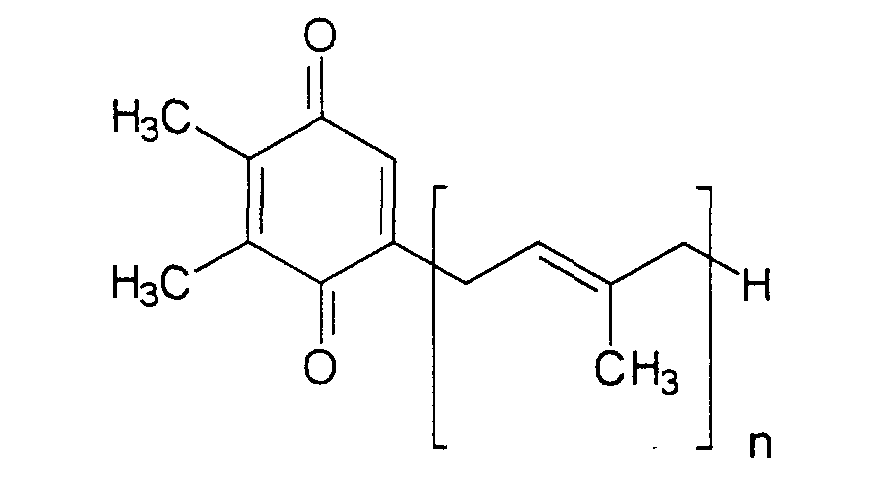 auf. Sie können aus Chloroplasten isoliert werden und spielen als Redoxsubstrate in
der Photosynthese beim cyclischen und nichtcyclischen Elektronentransport eine
Rolle, wobei sie reversibel in die entsprechenden Hydrochinone (Plastochinol) übergehen.
Plastochinone unterscheiden sich in der Anzahl n der Isopren-Reste und werden
endsprechend bezeichnet, z. B. PQ-9 (n=9). Ferner existieren andere Plastochinone
mit unterschiedlichen Substituenten am Chinon-Ring.
auf. Sie können aus Chloroplasten isoliert werden und spielen als Redoxsubstrate in
der Photosynthese beim cyclischen und nichtcyclischen Elektronentransport eine
Rolle, wobei sie reversibel in die entsprechenden Hydrochinone (Plastochinol) übergehen.
Plastochinone unterscheiden sich in der Anzahl n der Isopren-Reste und werden
endsprechend bezeichnet, z. B. PQ-9 (n=9). Ferner existieren andere Plastochinone
mit unterschiedlichen Substituenten am Chinon-Ring.
Erfindungsgemäß bevorzugtes Biochinon ist das Coenzym Q-10.
Es ist vorteilhaft, in den fertigen Zubereitungen Konzentrationen von 0,000.001 - 10
Gew.-%. Insbesondere 0,001 - 1 Gew.-%, an einem oder mehreren Biochinonen,
bevorzugt Coenzym Q-10, zu wählen, jeweils bezogen auf das Gesamtgewicht der
Zubereitungen.
Den Zubereitungen, die mindestens ein Biochinon als Wirkstoff enthalten, können
vorzugsweise weitere Wirkstoffe wie Carnitin, Arginin, Bernsteinsäure, konjugierte
Fettsäure und/oder Folsäure bzw. auch jeweils deren Derivate und/oder
gegebenenfalls eine Verbindung oder mehrere Verbindungen aus der Gruppe der
Antioxidantien zugesetzt werden, z.B. um die Wirkung zu verbessern.
Geeignete Derivate des Carnitins sind beispielsweise 0-Acylcarnitine mit geradkettigen
oder verzweigten C1 - C12-Alkylgruppen des Alkylcarbonylrestes (Acylrestes).
Acetylcarnitin und dessen Derivate, z.B. wie nachstehend angegeben, werden
bevorzugt.
Carnitin und die Acylcarnitine können auch als Salze, Säureadditionssalze, Ester
oder Amide verwendet werden.
Bevorzugte Salze sind wasserlösliche Salze, z.B. Natrium-, Kalium- und Ammoniumsalze.
Dies gilt auch für die Säureadditionssalze. Geeignete Säureadditionssalze
werden mit anorganischen und organischen Säuren erhalten. Bevorzugt werden die
Hydrochloride, Sulfate, Acetate, Caprylate oder Zitrate.
Geeignete Ester sind z.B. solche, die mit kurzkettigen, mittelkettigen oder
langkettigen Alkoholen erhalten werden, vorzugsweise mono-Alkohole,
insbesondere aber Methanol, Ethanol oder Propanol. Bevorzugt werden die
Ethylester.
Bevorzugte Amide sind kurz- oder mittelkettige oder langkettige mono- und di-Alkylamide.
Alkyle der vorstehenden Substituenten enthalten z.B. bis zu 20, vorzugsweise bis zu
6 Kohlenstoffatome, insbesondere ein oder zwei Kohlenstoffatome.
Carnitin und/oder seine Derivate sind in den erfindungsgemäßen Zubereitungen
bevorzugt in Mengen von 0,00001 bis 10 Gew.-%, insbesondere 0,01 bis 1,5 Gew.-%,
jeweils bezogen auf das Gesamtgewicht der Zubereitungen enthalten.
Arginin kann als Racemat oder in optisch aktiver Form (D- oder L-) vorliegen.
Bevorzugt werden L-Arginin und/oder dessen Derivate.
Geeignete Derivate des Arginins sind beispielsweise dessen Salze, Säureadditionssalze
Ester oder Amide.
Bevorzugte Salze von Arginin sind wasserlösliche Salze, z.B. Natrium-, Kalium- und
Ammoniumsalze. Dies gilt auch für die Säureadditionssalze. Geeignete Säureadditionssalze
werden mit anorganischen oder organischen Säuren erhalten. Bevorzugt
werden die Hydrochloride, Sulfate, Acetate, Caprylate oder Zitrate.
Geeignete Ester des Arginins sind z.B. solche, die mit kurzkettigen oder
mittelkettigen oder langkettigen Alkoholen erhalten werden, vorzugsweise mono-Alkohole,
insbesondere aber Methanol, Ethanol oder Propanol. Bevorzugt werden
die Ethylester.
Bevorzugte Amide sind kurz- oder mittelkettige oder langkettige mono- und di-Alkylamide.
Alkyle der vorstehenden Substituenten enthalten z.B. bis zu 20, vorzugsweise bis zu
6 Kohlenstoffatome, insbesondere ein oder zwei Kohlenstoffatome.
Arginin und seine Derivate zeichnen sich auch durch ein besonders gutes Hautpenetrationsvermögen
aus.
Arginin und seine Derivate sind vorzugsweise in Mengen von 0,01 bis 30 Gew.-%,
besonders bevorzugt 0,01 bis 10 Gew.-%, insbesondere 0,1 - 7,5 Gew.-%, jeweils
bezogen auf die gesamte Zubereitung, in den erfindungsgemäßen kosmetischen
und dermatologischen Zubereitungen enthalten.
Geeignete Derivate der Bernsteinsäure sind beispielsweise die Succinate, d.h. die
Bernsteinsäure-Ester und -Salze, sowie die jeweiligen Hydrogensuccinate und auch
die Säureadditionssalze, aber auch Bernsteinsäure-Amide oder die entsprechenden
Hydrogen-Amide.
Bevorzugte Salze, Säureadditionssalze oder Ester sind solche, wie sie schon für die
Argininderivate beschrieben wurden.
Bevorzugt wird Dinatriumsuccinat.
Bernsteinsäure und/oder ihre Derivate sind vorzugsweise in Mengen von 0,001 bis
30 Gew.-%, besonders bevorzugt 0,01 bis 20 Gew.-%, besonders bevorzugt 0,01
bis 10 Gew.-%, insbesondere 0,1 - 7,5 Gew.-%, jeweils bezogen auf die gesamte
Zubereitung, in den erfindungsgemäßen kosmetischen und dermatologischen Zubereitungen
enthalten.
Geeignete Derivate der Folsäure sind beispielsweise deren Salze, Säureadditionssalze,
Ester oder Amide. Bevorzugt werden solche Salze, Säureadditionssalze,
Ester oder Amide wie sie schon für die Argininderivate beschrieben wurden.
Vorzugsweise wird Folsäure verwendet.
Folsäure und/oder ihre Derivate sind in den erfindungsgemäßen Zubereitungen bevorzugt
in Mengen von 0,0001 bis 5 Gew.-%, insbesondere 0,01 bis 1,5 Gew.-%,
jeweils bezogen auf das Gesamtgewicht der Zubereitungen enthalten.
Weitere wichtige Komponenten, die neben Carnitin, Arginin, Bernsteinsäure,
Folsäure geeignet sind z.B. den Energiestoffwechsel der Haarwurzeln zu
verbessern, sind konjugierte Fettsäuren, d.h. Monocarbonsäuren mit mindestens
zwei konjugierten Mehrfachbindungen, insbesondere Doppelbindungen und deren
Derivate. Sie werden hier auch "CFA" genannt. Gut geeignet sind alle
geometrischen isomeren Formen und stellungsisomeren Formen sowie die
Gemische solcher Verbindungen sowie deren Derivate, beispielsweise die Salze,
Ester oder Amide.
Solche konjugierten Fettsäuren sind bekannt und nach bekannten Verfahren
erhältlich, beispielsweise durch alkalische Isomerisierung der entsprechenden
Fettsäuren mit isolierten Mehrfachbindungen bzw. Doppelbindungen.
Gut geeignete Fettsäuren können beispielsweise jeweils bis zu 24, vorzugsweise
bis zu 18, insbesondere bis zu 12 Kohlenstoffatome besitzen und z.B. geradkettige
oder verzweigte Alkyl-Monocarbonsäuren oder Cycloalkyl-Monocarbonsäuren sein.
Sie können beispielsweise zwei bis sechs konjugierte Mehrfachbindungen,
insbesondere Doppelbindungen besitzen.
Bevorzugte Salze sind wasserlösliche Salze, z.B. Natrium-, Kalium- und
Ammoniumsalze.
Geeignete Ester sind z.B. solche, die mit kurzkettigen, mittelkettigen oder
langkettigen Alkoholen erhalten werden, vorzugsweise Mono-Alkohole,
insbesondere aber Methanol, Ethanol oder Propanol. Bevorzugt werden die
Ethylester.
Bevorzugte Amide sind kurz- oder mittelkettige oder langkettige mono- und di-Alkylamide.
Alkyle der vorstehenden Substituenten erhalten z.B. bis zu 20, vorzugsweise bis zu
6 Kohlenstoffatome, insbesondere ein oder zwei Kohlenstoffatome.
Eine bevorzugte CFA, die z.B. den Energiestoffwechsel der Haarwurzel verbessert,
ist neben Carnitin, Arginin, Bernsteinsäure, Folsäure die konjugierte Linolsäure,
auch "CLA" genannt, in allen ihren geometrischen isomeren Formen und
stellungsisomeren Formen sowie den Gemischen solcher Verbindungen sowie ihren
Derivaten, insbesondere wie vorstehend beschrieben.
Linolsäure (cis, cis-9,12-Octadecadiensäure) hat keine konjugierten
Doppelbindungen. Distelöl und Sonnenblumenöl besitzen einen hohen Anteil an
dieser Säure. Beispielsweise aus der Linolsäure dieser Rohstoffe erhält man durch
alkalische Isomerisierung in bekannter Weise die konjugierten Verbindungen. Ein
bevorzugtes Isomerengemisch ist auch in der Literatur beschrieben (Lipids, vol. 34,
Nr. 9 (1999) S. 997-1000, Tabelle 1). Bevorzugt liegen die konjugierten
Doppelbindungen der CFAs im Bereich der Kohlenstoffatome 9 bis 12.
CFAs oder CLA und/oder die Derivate sind in den erfindungsgemäßen
Zubereitungen bevorzugt in Mengen von 0,0001 bis 5 Gew.-%, insbesondere 0,01
bis 1,5 Gew.-%, jeweils bezogen auf das Gesamtgewicht der Zubereitungen
enthalten.
Vorzugsweise werden Carnitin und/oder seine Derivate in Kombination mit CFAs
und/oder deren Derivaten verwendet, insbesondere in den jeweils angegebenen
Gewichtsmengen. Das Verhältnis der Gewichtsmengen dieser Kombinations-Wirkstoffe
Carnitin/CFAs kann in den Zubereitungen stark variieren. Beispielsweise
kann es 1/10 bis 10/1, oder 5/1 bis 1/5 betragen. Vorzugsweise kann es aber auch
1/2 bis 2/1 und insbesondere 1/1 betragen.
Eine Folge der zeitlichen Verlängerung der anagenen Phase des Wachstumszyklus
der Haare ist die Erhöhung der Dichte der Haare, d.h. auf einer gegebenen
Flächeneinheit der Kopfhaut befindet sich eine größere Anzahl von Haaren, und
zwar intakten Haaren. Weiterhin nimmt die Länge der Haare zu, weil mehr Zeit zum
Weiterwachsen zur Verfügung steht.
Die erfindungsgemäße Verlängerung der Anagenphase wird bei normalem
Haarwachstum erreicht, aber auch bei gestörter, verkürzter Anagenphase, d.h. auch
bei Zuständen, die mit geringer Haardichte einhergehen.
Damit wird auch erreicht, dass sich ein größerer Prozentanteil der vorhandenen
Haare in der Anagenphase befindet.
Weiterhin wird erfindungsgemäß die Bildung von Kopfschuppen verhindert oder
stark vermindert.
Zur Anwendung werden die erfindungsgemäßen Zubereitungen vorzugsweise direkt
auf die Kopfhaut aufgebracht, und zwar in der für solche Mittel bekannten Weise,
beispielsweise zweimal täglich.
Geeignet sind z.B. Lösungen, Gele, Salben, Suspensionen oder Emulsionen wie
Cremes oder Lotionen mit einem Gehalt an den erfindungsgemäßen Wirkstoffen.
Auch Haarbehandlungsmittel mit einem Gehalt an den erfindungsgemäßen
Wirkstoffen sind geeignet, insbesondere solche, die im Haar verbleiben oder mit
längerer Einwirkzeit verwendet werden. Auch auf diese Weise gelangen die
Wirkstoffe in oder auf die Kopfhaut oder in den Bereich der Haarwurzeln.
Haarbehandlungsmittel, die nur kurze Zeit mit der Haut oder den Haaren in
Berührung kommen, z.B. Shampoos, können beispielsweise höhere Wirkstoffanteile
haben.
Haarbehandlungsmittel sind beispielsweise Haarwaschmittel, Haarpflegemittel wie
Haarwässer, Frisierhilfsmittel, Haarspülungen, Haarkuren, Kurpackungen,
Haarfestiger wie Schaumfestiger, Haarspray, Haarlack, Haarverformungsmittel und
Haarfärbemittel.
Erfindungsgemäße kosmetische und gegebenenfalls dermatologische Zubereitungen
können in verschiedenen Formen vorliegen. So können sie z.B. eine
Lösung, eine wasserfreie Zubereitung, eine Emulsion oder Mikroemulsion vom
Typ Wasser-in-Öl (W/O) oder vom Typ Öl-in-Wasser (O/W), eine multiple
Emulsionen, beispielsweise vom Typ Wasser-in-Öl-in-Wasser (W/O/W), ein
Gel, einen festen Stift, eine Salbe oder auch ein Aerosol darstellen. Es ist auch
erfindungsgemäße vorteilhaft, ein oder mehrere Biochinone in verkapselter
Form darzureichen, z.B. in Kollagenmatrices und anderen üblichen Verkapselungsmaterialien,
z.B. als Celluloseverkapselungen, in Gelatine, Wachsmatrices
oder liposomal verkapselt. Insbesondere Wachsmatrices wie sie in
der DE-OS 43 08 282 beschrieben werden, haben sich als günstig
herausgestellt.
Die erfindungsgemäßen kosmetischen und dermatologischen Zubereitungen
können kosmetische Hilfsstoffe enthalten, wie sie üblicherweise in solchen
Zubereitungen verwendet werden, z.B. Konservierungsmittel, Bakterizide,
Parfüme, Substanzen zum Verhindern des Schäumens, Farbstoffe, Pigmente,
die eine färbende Wirkung haben, Verdickungsmittel, oberflächenaktive
Substanzen, Emulgatoren, weichmachende, anfeuchtende und/oder
feuchthaltende Substanzen, Fette, Öle, Wachse oder andere übliche Bestandteile
einer kosmetischen oder dermatologischen Formulierung wie Alkohole,
Polyole, Polymere, Schaumstabilisatoren, Elektrolyte, organische Lösemittel
oder Silikonderivate.
Insbesondere können erfindungsgemäß verwendete Biochinone auch mit Antioxidantien,
darunter auch Radikalfängern, kombiniert werden.
Vorteilhaft werden solche Antioxidantien gewählt aus der Gruppe bestehend
aus Aminosäuren (z.B. Glycin, Histidin, Tyrosin, Tryptophan) und deren Derivate,
Imidazole (z.B. Urocaninsäure) und deren Derivate, Peptide wie D,L-Carnosin,
D-Carnosin, L-Carnosin und deren Derivate (z.B. Anserin),
Carotinoide, Carotine (z.B. α-Carotin, β-Carotin, Lycopin) und deren Derivate,
Chlorogensäure und deren Derivate, Liponsäure und deren Derivate (z.B.
Dihydroliponsäure), Aurothioglucose, Propylthiouracil und andere Thiole (z.B.
Thioredoxin, Glutathion, Cystein, Cystin, Cystamin und deren Glycosyl-, N-Acetyl-,
Methyl-, Ethyl-, Propyl-, Amyl-, Butyl- und Lauryl-, Palmitoyl-, Oleyl-, γ-Linoleyl-,
Cholesteryl- und Glycerylester) sowie deren Salze, Dilaurylthiodipropionat,
Distearylthiodipropionat, Thiodipropionsäure und deren Derivate (Ester,
Ether, Peptide, Lipide, Nukleotide, Nukleoside und Salze) sowie Sulfoximinverbindungen
(z.B. Buthioninsulfoximine, Homocysteinsulfoximin, Buthioninsulfone,
Penta-, Hexa-, Heptathioninsulfoximin) in sehr geringen verträglichen Dosierungen
(z.B. pmol bis µmol/kg), ferner (Metall)-Chelatoren (z.B. α-Hydroxyfettsäuren,
Palmitinsäure, Phytinsäure, Lactoferrin), α-Hydroxysäuren (z.B. Citronensäure,
Milchsäure, Apfelsäure), Huminsäure, Gallensäure, Gallenextrakte,
Bilirubin, Biliverdin, EDTA, EGTA und deren Derivate, ungesättigte
Fettsäuren und deren Derivate (z.B. Linolsäure, Ölsäure), Tocopherole und
Derivate (z.B. Vitamin-E-acetat), Vitamin A und Derivate (Vitamin-A-palmitat)
sowie Koniferylbenzoat des Benzoeharzes, Flavonoide, z.B. alphaGlucosylrutin,
Rutinsäure und deren Derivate, Butylhydroxytoluol, Butylhydroxyanisol,
Nordihydroguajakharzsäure, Nordihydroguajaretsäure, Trihydroxybutyrophenon,
Harnsäure und deren Derivate, Mannose und deren Derivate,
Sesamol, Sesamolin, Zink und dessen Derivate (z.B. ZnO, ZnSO4) Selen und
dessen Derivate (z.B. Selenmethionin), Stilbene und deren Derivate (z.B. Stilbenoxid,
Trans-Stilbenoxid) und die erfindungsgemäß geeigneten Derivate
(Salze, Ester, Ether, Zucker, Nukleotide, Nukleoside, Peptide und Lipide) dieser
genannten Wirkstoffe.
Die Menge der vorgenannten Antioxidantien (eine oder mehrere Verbindungen)
in den Zubereitungen beträgt vorzugsweise 0,001 bis 30 Gew.-%, besonders
bevorzugt 0,05 - 20 Gew.-%, insbesondere 1 - 10 Gew.-%, bezogen
auf das Gesamtgewicht der Zubereitung.
Sofern Vitamin E und/oder dessen Derivate das oder die zusätzlichen Antioxidantien
darstellen, ist vorteilhaft, deren jeweilige Konzentrationen aus dem
Bereich von 0,001 - 10 Gew.-%, bezogen auf das Gesamtgewicht der Formulierung,
zu wählen.
Sofern Vitamin A, bzw. Vitamin-A-Derivate, bzw. Carotine bzw. deren Derivate
das oder die zusätzlichen Antioxidantien darstellen, ist vorteilhaft, deren jeweilige
Konzentrationen aus dem Bereich von 0,001 - 10 Gew.-%, bezogen
auf das Gesamtgewicht der Formulierung, zu wählen.
Erfindungsgemäß sind Emulsionen vorteilhafte Verkörperung der Erfindung
und enthalten z.B. die genannten Fette, Öle, Wachse und anderen Fettkörper,
sowie Wasser und einen Emulgator, wie er üblicherweise für einen solchen
Typ der Formulierung verwendet wird.
Die Lipidphase kann vorteilhaft gewählt werden aus folgender Substanzgruppe:
- Mineralöle, Mineralwachse
- Öle, wie Triglyceride der Caprin- oder der Caprylsäure, ferner natürliche Öle wie z.B. Rizinusöl;
- Fette, Wachse und andere natürliche und synthetische Fettkörper, vorzugsweise Ester von Fettsäuren mit Alkoholen niedriger C-Zahl, z.B. mit Isopropanol, Propylenglykol oder Glycerin, oder Ester von Fettalkoholen mit Alkansäuren niedriger C-Zahl oder mit Fettsäuren;
- Alkylbenzoate;
- Silikonöle wie Dimethylpolysiloxane, Diethylpolysiloxane, Diphenylpolysiloxane sowie Mischformen daraus.
Die Ölphase der Emulsionen, Oleogele bzw. Hydrodispersionen oder Lipodispersionen
im Sinne der vorliegenden Erfindung wird vorteilhaft gewählt aus
der Gruppe der Ester aus gesättigten und/oder ungesättigten, verzweigten
und/oder unverzweigten Alkancarbonsäuren einer Kettenlänge von 3 bis 30 C-Atomen
und gesättigten und/oder ungesättigten, verzweigten und/oder
unverzweigten Alkoholen einer Kettenlänge von 3 bis 30 C-Atomen, aus der
Gruppe der Ester aus aromatischen Carbonsäuren und gesättigten und/oder
ungesättigten, verzweigten und/oder unverzweigten Alkoholen einer Kettenlänge
von 3 bis 30 C-Atomen. Solche Esteröle können dann vorteilhaft gewählt
werden aus der Gruppe Isopropylmyristat, Isopropylpalmitat, Isopropylstearat,
Isopropyloleat, n-Butylstearat, n-Hexyllaurat, n-Decyloleat, Isooctylstearat,
Isononylstearat, Isononylisononanoat, 2-Ethylhexylpalmitat, 2-Ethylhexyllaurat,
2-Hexyldecylstearat, 2-Octyldodecylpalmitat, Oleyloleat, Oleylerucat,
Erucyloleat, Erucylerucat sowie synthetische, halbsynthetische und natürliche
Gemische solcher Ester, z.B. Jojobaöl.
Ferner kann die Ölphase vorteilhaft gewählt werden aus der Gruppe der verzweigten
und unverzweigten Kohlenwasserstoffe und -wachse, der Silkonöle,
der Dialkylether, der Gruppe der gesättigten oder ungesättigten, verzweigten
oder unverzweigten Alkohole, sowie der Fettsäuretriglyceride, namentlich der
Triglycerinester gesättigter und/oder ungesättigter, verzweigter und/oder unverzweigter
Alkancarbonsäuren einer Kettenlänge von 8 bis 24, insbesondere
12 - 18 C-Atomen. Die Fettsäuretriglyceride können beispielsweise vorteilhaft
gewählt werden aus der Gruppe der synthetischen, halbsynthetischen und
natürlichen Öle, z.B. Olivenöl, Sonnenblumenöl, Sojaöl, Erdnußöl, Rapsöl,
Mandelöl, Palmöl, Kokosöl, Palmkernöl und dergleichen mehr.
Auch beliebige Abmischungen solcher Öl- und Wachskomponenten sind vorteilhaft
im Sinne der vorliegenden Erfindung einzusetzen. Es kann auch gegebenenfalls
vorteilhaft sein, Wachse, beispielsweise Cetylpalmitat, als alleinige
Lipidkomponente der Ölphase einzusetzen.
Vorteilhaft wird die Ölphase gewählt aus der Gruppe 2-Ethylhexylisostearat,
Octyldodecanol, Isotridecylisononanoat, Isoeicosan, 2-Ethylhexylcocoat, C12-15-Alkylbenzoat,
Capryl-Caprinsäure-triglycerid, Dicaprylylether.
Besonders vorteilhaft sind Mischungen aus C12-15-Alkylbenzoat und 2-Ethylhexylisostearat,
Mischungen aus C12-15-Alkylbenzoat und Isotridecylisononanoat
sowie Mischungen aus C12-15-Alkylbenzoat, 2-Ethylhexylisostearat
und Isotridecylisononanoat.
Von den Kohlenwasserstoffen sind Paraffinöl, Squalan und Squalen vorteilhaft
im Sinne der vorliegenden Erfindung zu verwenden.
Vorteilhaft kann die Ölphase ferner einen Gehalt an cyclischen oder linearen
Silikonölen aufweisen oder vollständig aus solchen Ölen bestehen, wobei
allerdings bevorzugt wird, außer dem Silikonöl oder den Silikonölen einen zusätzlichen
Gehalt an anderen Ölphasenkomponenten zu verwenden.
Vorteilhaft wird Cyclomethicon (Octamethylcyclotetrasiloxan) als erfindungsgemäß
zu verwendendes Silikonöl eingesetzt. Aber auch andere Silikonöle
sind vorteilhaft im Sinne der vorliegenden Erfindung zu verwenden, beispielsweise
Hexamethylcyclotrisiloxan, Polydimethylsiloxan,
Poly(methylphenylsiloxan).
Besonders vorteilhaft sind ferner Mischungen aus Cyclomethicon und Isotridecylisononanoat,
aus Cyclomethicon und 2-Ethylhexylisostearat.
Die wäßrigen erfindungsgemäßen Zubereitungen bzw. die wäßrige Phase der
erfindungsgemäßen Zubereitungen enthält gegebenenfalls vorteilhaft Alkohole,
Diole oder Polyole niedriger C-Zahl, sowie deren Ether, vorzugsweise
Ethanol, Isopropanol, Propylenglykol, Glycerin, Ethylenglykol, Ethylenglykolmonoethyl-
oder -monobutylether, Propylenglykolmonomethyl, -monoethyl-
oder -monobutylether, Diethylenglykolmonomethyl- oder -monoethylether und
analoge Produkte, ferner Alkohole niedriger C-Zahl, z.B. Ethanol, Isopropanol,
1,2-Propandiol, Glycerin sowie insbesondere ein oder mehrere Verdickungsmittel,
welches oder welche vorteilhaft gewählt werden können aus der Gruppe
Siliciumdioxid, Aluminiumsilikate, Polysaccharide bzw. deren Derivate, z.B. Hyaluronsäure,
Xanthangummi, Hydroxypropylmethylcellulose, besonders vorteilhaft
aus der Gruppe der Polyacrylate, bevorzugt ein Polyacrylat aus der Gruppe
der sogenannten Carbopole, beispielsweise Carbopole der Typen 980, 981,
1382, 2984, 5984, jeweils einzeln oder in Kombination.
Insbesondere werden Gemische der vorstehend genannten Lösemittel verwendet.
Bei alkoholischen Lösemitteln kann Wasser ein weiterer Bestandteil
sein.
Im technischen Sinne werden unter Gelen verstanden: Relativ formbeständige,
leicht verformbare disperse Systeme aus zumindest zwei Komponenten, welche
in der Regel aus einem - meist festen - kolloid zerteilten Stoff aus langkettigen
Molekülgruppierungen (z.B. Gelatine, Kieselsäure, Polysaccharide)
als Gerüstbildner und einem flüssigen Dispersionsmittel (z.B. Wasser)
bestehen. Der kolloidal zerteilte Stoff wird oft als Verdickungs- oder Geliermittel
bezeichnet. Er bildet ein räumliches Netzwerk im Dispersionsmittel,
wobei einzelne kolloidal vorliegende Partikel über elektrostatische Wechselwirkung
miteinander mehr oder weniger fest verknüpft sein können. Das Dispersionsmittel,
welches das Netzwerk umgibt, zeichnet sich durch
elektrostatische Affinität zum Geliermittel aus, d.h., ein vorwiegend polares
(insbesondere: hydrophiles) Geliermittel geliert vorzugsweise ein polares
Dispersionsmittel (insbesondere: Wasser), wohingegen ein vorwiegend
unpolares Geliermittel vorzugsweise unpolare Dispersionsmittel geliert.
Starke elektrostatische Wechselwirkungen, welche beispielsweise in Wasserstoffbrükkenbindungen
zwischen Geliermittel und Dispersionsmittel, aber auch
zwischen Dispersionsmittelmolekülen untereinander verwirklicht sind, können
zu starker Vernetzung auch des Dispersionsmittels führen. Hydrogele können
zu fast 100 % aus Wasser bestehen (neben beispielsweise ca. 0,2 - 1,0 %
eines Geliermittels) und dabei durchaus feste Konsistenz besitzen. Der
Wasseranteil liegt dabei in eisähnlichen Strukturelementen vor, so daß Gele
daher ihrer Namensherkunft [aus lat. "gelatum" = "Gefrorenes" über den alchimistischen
Ausdruck "gelatina" (16. Jhdt.) für nhdt. "Gelatine"] durchaus
gerecht werden.
Als Treibmittel für erfindungsgemäße, aus Aerosolbehältern versprühbare Zubereitungen
sind die üblichen bekannten leichtflüchtigen, verflüssigten
Treibmittel, beispielsweise Kohlenwasserstoffe (Propan, Butan, Isobutan) geeignet,
die allein oder in Mischung miteinander eingesetzt werden können.
Auch Druckluft ist vorteilhaft zu verwenden.
Vorteilhaft können erfindungsgemäße Zubereitungen außerdem Substanzen
enthalten, die UV-Strahlung im UVB-Bereich absorbieren, wobei die Gesamtmenge
der Filtersubstanzen z.B. 0,1 Gew.-% bis 30 Gew.-%, vorzugsweise 0,5
bis 10 Gew.-%, insbesondere 1,0 bis 6,0 Gew.-% beträgt, bezogen auf das
Gesamtgewicht der Zubereitungen, um kosmetische Zubereitungen zur
Verfügung zu stellen, die das Haar bzw. die Haut vor dem gesamten Bereich
der ultravioletten Strahlung schützen. Sie können auch als Sonnenschutzmittel
fürs Haar oder die Haut dienen.
Enthalten die erfindungsgemäßen Zubereitungen UVB-Filtersubstanzen,
können diese öllöslich oder wasserlöslich sein. Erfindungsgemäß vorteilhafte
öllösliche UVB-Filter sind z.B.:
- 3-Benzylidencampher-Derivate, vorzugsweise 3-(4-Methylbenzyliden)campher, 3-Benzylidencampher;
- 4-Aminobenzoësäure-Derivate, vorzugsweise 4-(Dimethylamino)-benzoësäure(2-ethylhexyl)ester, 4-(Dimethylamino)benzoësäureamylester;
- Ester der Zimtsäure, vorzugsweise 4-Methoxyzimtsäure(2-ethylhexyl)ester, 4-Methoxyzimtsäureisopentylester;
- Ester der Salicylsäure, vorzugsweise Salicylsäure(2-ethylhexyl)ester, Salicylsäure(4-isopropylbenzyl)ester, Salicylsäurehomomenthylester,
- Derivate des Benzophenons, vorzugsweise 2-Hydroxy-4-methoxybenzophenon, 2-Hydroxy-4-methoxy-4'-methylbenzophenon, 2,2'-Dihydroxy-4-methoxybenzophenon;
- Ester der Benzalmalonsäure, vorzugsweise 4-Methoxybenzalmalonsäuredi(2-ethylhexyl)ester, - 2,4,6-Trianilino-(p-carbo-2'-ethyl-1'-hexyloxy) -1,3,5-triazin.
Vorteilhafte wasserlösliche UVB-Filter sind z.B.:
- Salze der 2-Phenylbenzimidazol-5-sulfonsäure wie ihr Natrium-, Kalium- oder ihr Triethanolammonium-Salz, sowie die Sulfonsäure selbst;
- Sulfonsäure-Derivate von Benzophenonen, vorzugsweise 2-Hydroxy-4-methoxybenzophenon-5-sulfonsäure und ihre Salze;
- Sulfonsäure-Derivate des 3-Benzylidencamphers, wie z.B. 4-(2-Oxo-3-bornylidenmethyl)benzolsulfonsäure, 2-Methyl-5-(2-oxo-3-bornylidenmethyl)sulfonsäure und ihre Salze sowie das 1,4-di(2-oxo-10-Sulfo-3-bornylidenmethyl)-Benzol und dessen Salze (die entprehenden 10-Sulfato-verbindungen, beispielsweise das entsprechende Natrium-, Kalium- oder Triethanolammonium-Salz), auch als Benzol-1,4-di(2-oxo-3-bornylidenmethyl-10-Sulfonsäure bezeichnet
Die Liste der genannten UVB-Filter, die in Kombination mit den erfindungsgemäßen
Wirkstoffkombinationen verwendet werden können, soll selbstverständlich
nicht limitierend sein.
Gegenstand der Erfindung ist auch die Verwendung einer Kombination der erfindungsgemäß
verwendeten Biochinone mit mindestens einem UVB-Filter als
Antioxidans bzw. die Verwendung einer Kombination der erfindungsgemäß
verwendeten Biochinone mit mindestens einem UVB-Filter als Antioxidans in
einer kosmetischen oder dermatologischen Zubereitung zur Anwendung am
Haar..
Es kann auch von Vorteil sein, die erfindungsgemäß verwendeten Biochinone
mit UVA-Filtern zu kombinieren, die bisher üblicherweise in kosmetischen Zubereitungen
enthalten sind. Bei diesen Substanzen handelt es sich
vorzugsweise um Derivate des Dibenzoylmethans, insbesondere um 1-(4'-tert.Butylphenyl)-3-(4'-methoxyphenyl)propan-1,3-dion
und um 1-Phenyl-3-(4'-isopropylphenyl)propan-1,3-dion.
Auch diese Kombinationen bzw. Zubereitungen,
die diese Kombinationen enthalten, sind Gegenstand der Erfindung.
Es können die für die UVB-Kombination verwendeten Mengen eingesetzt
werden.
Die erfindungsgemäßen kosmetischen und dermatologischen Zubereitungen
können kosmetische Hilfsstoffe enthalten, wie sie üblicherweise in solchen
Zubereitungen verwendet werden, z.B. Konservierungsmittel, Bakterizide,
Parfüme, Substanzen zum Verhindern des Schäumens, Farbstoffe, Pigmente,
die eine färbende Wirkung haben, Verdickungsmittel, oberflächenaktive
Substanzen, Emulgatoren, weichmachende, anfeuchtende und/oder feuchhaltende
Substanzen, Fette, Öle, Wachse oder andere übliche Bestandteile
einer kosmetischen oder dermatologischen Formulierung wie Alkohole,
Polyole, Polymere, Schaumstabilisatoren, Elektrolyte, organische
Lösungsmittel, Siliconderivate und/oder Kammpolymere.
In kosmetischen Zubereitungen zur Festigung der Haare, wie z.B. Haarsprays,
Haarlacke, Schaumfestiger, Flüssigfestiger, Stylinggele usw., können die
erfindungsgemäß einzusetzenden Kammpolymere vorzugsweise in Konzentrationen
von 0,5 bis 30 Gewichtsprozent eingesetzt werden.
Die erfindungsgemäßen Zusammensetzungen zur Festigung der Haare können
als Haarsprays oder Schaumaerosole vorliegen und die dafür üblichen
und dem Stand der Technik entsprechenden Zusätze enthalten, sofern eine
entsprechende Kompatibilität vorliegt. Dies sind beispielsweise weitere Lösungsmittel
wie niedere Polyalkohole und deren toxikologisch verträglichen
Ether und Ester, Weichmacher, leicht- und schwerflüchtige Silicone, leicht- und
schwerflüchtige verzweigte bzw. unverzweigte Kohlenwasserstoffe,
Emulgatoren, Antioxidantien, Wachse, Stabilisatoren, pH-Wert-Regulatoren,
Farbstoffe, Konsistenzgeber, Antistatika, UV-Absorber, Parfums, usw.
Soll die erfindungsgemäße Zusammensetzung als Haarspray oder Schaumaerosol
verwendet werden, so wird in der Regel ein Treibmittel zugesetzt. Übliche
Treibmittel sind niedere Alkane, beispielsweise Propan, Butan oder Isobutan,
Dimethylether, Stickstoff, Stickstoffdioxid oder Kohlendioxid oder Gemische
aus diesen Substanzen.
Bei Verwendung in mechanischen Sprüh- oder Schaumvorrichtungen, beispielsweise
Sprühpumpen oder manuellen Schaumpumpen bzw. Squeezesystemen,
kann das Treibmittel in der Regel entfallen.
Bei kosmetischen und dermatologischen Zubereitungen gemäß der Erfindung
beispielsweise kann es sich beispielsweise auch um Shampoonierungsmittel,
Zubereitungen zum Fönen oder Einlegen der Haare, Zubereitungen zum
Färben, um eine Frisier- oder Behandlungslotion handeln.
Erfindungsgemäße Zubereitungen können sich gegebenenfalls vorteilhaft
durch einen Gehalt an Tensiden auszeichnen. Tenside sind amphiphile Stoffe,
die organische, unpolare Substanzen in Wasser lösen können. Sie sorgen,
bedingt durch ihren spezifischen Molekülaufbau mit mindestens einem
hydrophilen und einem hydrophoben Molekülteil, für eine Herabsetzung der
Oberflächenspannung des Wassers, die Benetzung der Haut, die Erleichterung
der Schmutzentfernung und -lösung, ein leichtes Abspülen und - je
nach Wunsch - für Schaumregulierung.
Bei den hydrophilen Anteilen eines Tensidmoleküls handelt es sich meist um
polare funktionelle Gruppen, beispielweise -COO-, -OSO3 2-, -SO3 -, während
die hydrophoben Teile in der Regel unpolare Kohlenwasserstoffreste darstellen.
Tenside werden im allgemeinen nach Art und Ladung des hydrophilen
Molekülteils klassifiziert. Hierbei können vier Gruppen unterschieden werden:
- anionische Tenside,
- kationische Tenside,
- amphotere Tenside und
- nichtionische Tenside.
Anionische Tenside weisen als funktionelle Gruppen in der Regel Carboxylat-,
Sulfat- oder Sulfonatgruppen auf. In wäßriger Lösung bilden sie im sauren
oder neutralen Milieu negativ geladene organische Ionen. Kationische Tenside
sind beinahe ausschließlich durch das Vorhandensein einer quarternären
Ammoniumgruppe gekennzeichnet. In wäßriger Lösung bilden sie im sauren
oder neutralen Milieu positiv geladene organische Ionen. Amphotere Tenside
enthalten sowohl anionische als auch kationische Gruppen und verhalten sich
demnach in wäßriger Lösung je nach pH-Wert wie anionische oder kationische
Tenside. Im stark sauren Milieu besitzen sie eine positive und im alkalischen
Milieu eine negative Ladung. Im neutralen pH-Bereich hingegen sind sie
zwitterionisch, wie das folgende Beispiel verdeutlichen soll:
RNH2 +CH2CH2COOH X- (bei pH=2) X- = beliebiges Anion, z.B. Cl-
RNH2 +CH2CH2COO- (bei pH=7)
RNHCH2CH2COO- B+ (bei pH=12) B+ = beliebiges Kation, z.B. Na+
Typisch für nicht-ionische Tenside sind Polyether-Ketten. Nicht-ionische Tenside
bilden in wäßrigem Medium keine Ionen.
Vorteilhaft zu verwendende anionische Tenside sind
Acylaminosäuren (und deren Salze), wie
- 1. Carbonsäuren, beispielsweise Laurinsäure, Aluminiumstearat, Magnesiumalkanolat und Zinkundecylenat,
- 2. Ester-Carbonsäuren, beispielsweise Calciumstearoyllactylat, Laureth-6 Citrat und Natrium PEG-4 Lauramidcarboxylat,
- 3. Ether-Carbonsäuren, beispielsweise Natriumlaureth-13 Carboxylat und Natrium PEG-6 Cocamide Carboxylat,
Phosphorsäureester und Salze, wie beispielsweise DEA-Oleth-10-Phosphat
und Dilaureth-4 Phosphat,
Sulfonsäuren und Salze, wie
Sulfonsäuren und Salze, wie
Schwefelsäureester, wie
- 1. Alkylethersulfat, beispielsweise Natrium-, Ammonium-, Magnesium-, MIPA-, TIPA- Laurethsulfat, Natriummyrethsulfat und Natrium C12-13 Parethsulfat,
- 2. Alkylsulfate, beispielsweise Natrium-, Ammonium- und TEA- Laurylsulfat.
Gegebenenfalls vorteilhaft zu verwendende kationische Tenside sind
Vorteilhaft zu verwendende amphotere Tenside sind
Vorteilhaft zu verwendende nicht-ionische Tenside sind
Vorteilhaft ist ferner die Verwendung einer Kombination von anionischen
und/oder amphoteren Tensiden mit einem oder mehreren nicht-ionischen
Tensiden.
In der Regel ist im Sinne der vorliegenden Erfindung die Verwendung von anionischen,
amphoteren und/oder nicht-ionischen Tensiden gegenüber der
Verwendung von kationischen Tensiden bevorzugt.
Die kosmetischen und dermatologischen enthalten Wirkstoffe und Hilfsstoffe,
wie sie üblicherweise für diesen Typ von Zubereitungen zur Haarpflege und
Haarbehandlung verwendet werden. Als Hilfsstoffe dienen Konservierungsmittel,
oberflächenaktive Substanzen, Substanzen zum Verhindern des
Schäumens, Verdickungsmittel, Emulgatoren, Fette, Öle, Wachse, organische
Lösungsmittel, Bakterizide, Parfüme, Farbstoffe oder Pigmente, deren Aufgabe
es ist, die Haare oder die kosmetische oder dermatologische
Zubereitung selbst zu färben, Elektroyte, Substanzen gegen das Fetten der
Haare.
Unter Elektrolyten im Sinne der vorliegenden Erfindung sind wasserlösliche Alkali-,
Ammonium-, Erdalkali- (unter Einbeziehung des Magnesiums) und
Zinksalze anorganischer Anionen und beliebige Gemische aus solchen Salzen
zu verstehen, wobei gewährleistet sein muß, daß sich diese Salze durch
pharmazeutische oder kosmetische Unbedenklichkeit auszeichnen.
Die erfindungsgemäßen Anionen werden bevorzugt gewählt aus der Gruppe
der Chloride, der Sulfate und Hydrogensulfate, der Phosphate, Hydrogenphosphate
und der linearen und cyclischen Oligophosphate sowie der Carbonate
und Hydrogencarbonate.
Kosmetische Zubereitungen, die ein Shampoonierungsmittel darstellen, enthalten
vorzugsweise mindestens eine anionische, nicht-ionische oder amphotere
oberflächenaktive Substanz, oder auch Gemische aus solchen
Substanzen im wäßrigen Medium und Hilfsmittel, wie sie üblicherweise dafür
verwendet werden. Die oberflächenaktive Substanz bzw. die Gemische aus
diesen Substanzen können in einer Konzentration zwischen 1 Gew.-% und 50
Gew.-% in dem Shampoonierungsmittel vorliegen.
Eine kosmetische Zubereitung in Form einer Lotion, die nicht ausgespült wird,
insbesondere eine Lotion zum Einlegen der Haare, eine Lotion, die beim Fönen
der Haare verwendet wird, eine Frisier- und Behandlungslotion, stellt im
allgemeinen eine wäßrige, alkoholische oder wäßrig-alkoholische Lösung dar
und enthält z.B. auch Kammpolymere.
Die erfindungsgemäßen Zusammensetzungen enthalten gegebenenfalls die in
der Kosmetik üblichen Zusatzstoffe, beispielsweise Parfüm, Verdicker, Farbstoffe,
Desodorantien, antimikrobielle Stoffe, rückfettende Agentien, Komplexierungs-
und Sequestrierungsagentien, Perlglanzagentien, Pflanzenextrakte,
Vitamine, Wirkstoffe und dergleichen.
Alle Mengenangaben, Anteile und Prozentanteile sind, soweit nicht anders angegeben,
auf das Gewicht und die Gesamtmenge bzw. auf das Gesamtgewicht
der Zubereitungen bezogen.
Die nachfolgenden Beispiele sollen die vorliegende Erfindung verdeutlichen,
ohne sie einzuschränken. Es werden Gewichtsprozente angegeben.
CLA1 bedeutet in den folgenden Beispielen die folgende Fettsäure-CLA-Isomeren-Zubereitung:
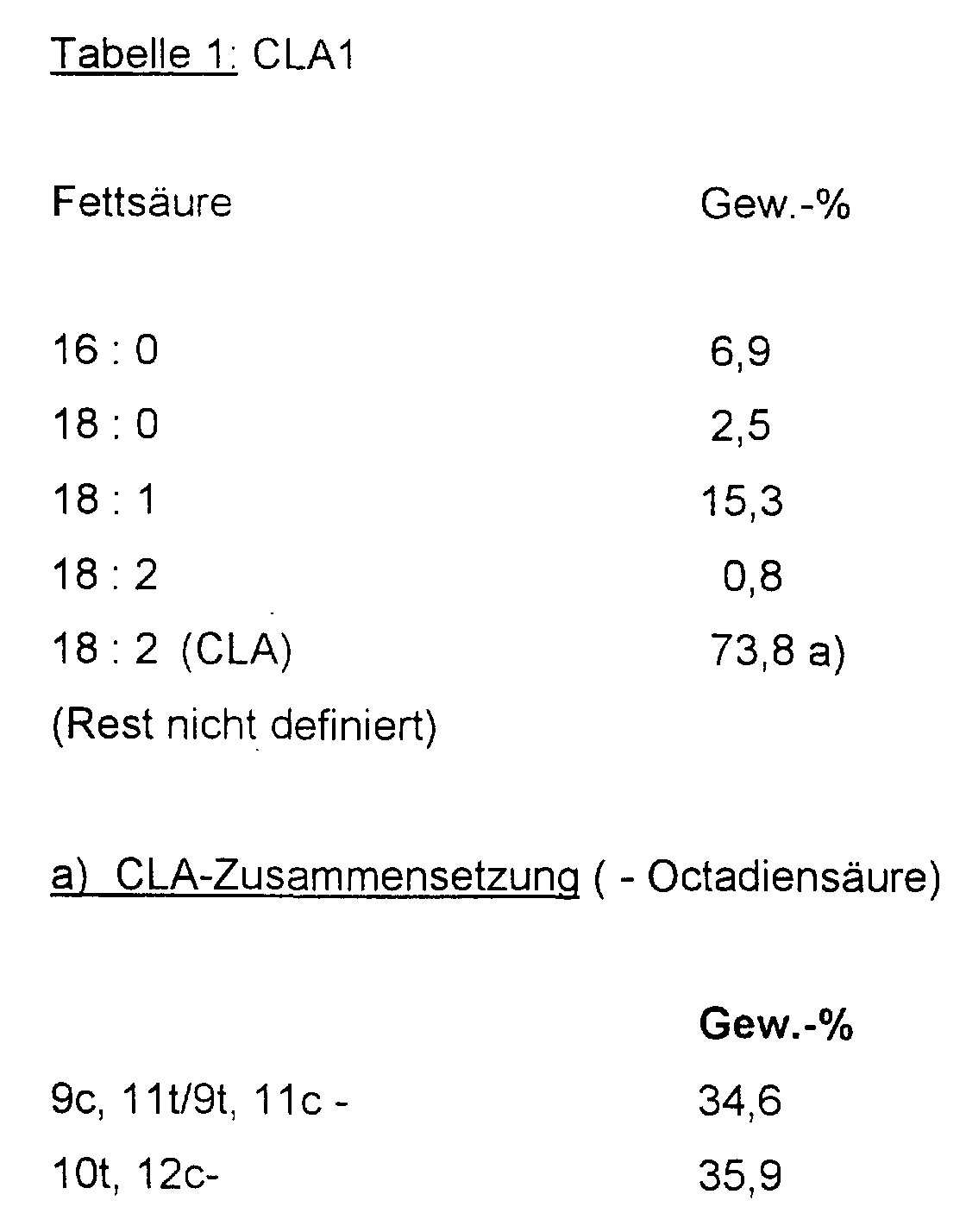

| Conditioner-Shampoo mit Perlglanz | |||
| 1 | 2 | 3 | |
| Polyquaternium-10 | 0,5 | 0,5 | 0,5 |
| Natriumlaurethsulfat | 9,0 | 9,0 | 9,0 |
| Cocoamidopropylbetain | 2,5 | 2,5 | 2,5 |
| Perlglanzmittel | 2,0 | 2,0 | 2,0 |
| Coenzym Q10 | 0,3 | 0,03 | 3,5 |
| Carnitin | - | 0,5 | - |
| CLA1 | - | - | 0,3 |
| Konservierungsmittel, Parfüm, Verdicker, pH-Einstellung und Lösungsvermittler | q.s. | q.s. | q.s. |
| Wasser, VES (vollentsalzt) | ad 100,0 | ad 100,0 | ad 100,0 |
Der pH-Wert wird auf 6 eingestellt.
| klares Conditioner-Shampoo | |||
| 4 | 5 | 6 | |
| Polyquaternium-10 | 0,5 | 0,5 | 0,5 |
| Natriumlaurethsulfat | 9,0 | 9,0 | 9,0 |
| Cocoamidopropylbetain | 2,5 | 2,5 | 2,5 |
| Coenzym Q10 | 0,1 | 0,4 | 0,2 |
| Liponsäure | 0,2 | - | - |
| Folsäure | - | 0,2 | - |
| Arginin | - | - | 1,0 |
| Konservierungsmittel, Parfüm, Verdicker, pH-Einstellung und Lösungsvermittler | q.s. | q.s. | q.s. |
| Wasser, VES | ad 100,0 | ad 100,0 | ad 100,0 |
Der pH-Wert wird auf 6 eingestellt.
| klares Light-Shampoo mit Volumeneffekt | |||
| 7 | 8 | 9 | |
| Natriumlaurethsulfat | 10,0 | 10,0 | 10,0 |
| Cocoamidopropylbetain | 2,5 | 2,5 | 2,5 |
| Coenzym Q10 | 0,8 | 0,5 | 0,4 |
| Acetylcarnitin | 1,0 | 0,1 | - |
| Dinatriumsuccinat | - | 1,0 | - |
| Liponsäure | - | - | 0,5 |
| Carnitin | - | - | 0,1 |
| Arginin | - | - | 0,2 |
| Konservierungsmittel, Parfüm, Verdicker, pH-Einstellung und Lösungsvermittler | q.s. | q.s. | q.s. |
| Wasser, VES | ad 100,0 | ad 100,0 | ad 100,0 |
Der pH-Wert wird auf 5,5 eingestellt.
| Haarspray | ||
| 10 | 11 | |
| Octylacrylamide/Acrylates/ Butylaminoethyl Methacrylate Copolymer | 2,5 | 2,5 |
| Coenzym Q10 | 0,05 | 0,08 |
| 1-(4'-tert.Butylphenyl)-3-(4'methoxy-phenyl)propan-1,3-dion (Parsol 1789) | 1,0 | - |
| 2,4,6-Trianilino-(p-carbo-2'-ethyl-1'-hexyloxy)-1,3,5,-triazin | - | 1,0 |
| Ethanol abs. | 39,0 | 39,0 |
| Parfüm, Lösungsvermittler, Neutralisationsmittel/pH-Einstellung, Pflegestoffe | q.s. | q.s. |
| Dimethylether | ad 100 | ad 100 |
| 12 | 13 | |
| PVP/VA Copolymer | 8,0 | 8,0 |
| Coenzym Q10 | 0,01 | 0,05 |
| 3-(4-Methylbenzyliden)-campher | 1,0 | - |
| 4-Methoxyzimtsäure-(2-ethylhexyl)-ester | - | 1,0 |
| Ethanol abs. | 39,0 | 39,0 |
| Parfüm, Lösungsvermittler, Pflegestoffe | q.s. | q.s. |
| Dimethylether | ad 100 | ad 100 |
| Haarkur | |||
| 14 | 15 | 16 | |
| Hydroxypropylmethylcellulose | 0,5 | 0,5 | 0,5 |
| Cetrimoniumbromid | 1,0 | 1,0 | 1,0 |
| Glycerin | 3,0 | 3,0 | 3,0 |
| Cetearylalkohol | 2,5 | 2,5 | 2,5 |
| Glycerylstearat | 2,0 | 2,0 | 2,0 |
| Ubichinon Q10 | 0,02 | 0,0002 | 0,2 |
| Carnitin | 2,0 | 0,4 | - |
| CLA1 | - | 0,5 | - |
| Liponsäure | - | 0,3 | 1,0 |
| Alphaglucosylrutin | - | 0,2 | - |
| Arginin | - | - | 1,5 |
| Konservierungsmittel, Parfüm, pH-Einstellung | q.s. | q.s. | q.s. |
| Wasser, VES (vollentsalzt) | ad 100,0 | ad 100,0 | ad 100,0 |
Der pH-Wert wird auf 3,5 eingestellt.
| Haarspülung | |||
| 17 | 18 | 19 | |
| Behentrimoniumchlorid | 1,0 | 1,0 | 1,0 |
| Glycerin | 3,0 | 3,0 | 3,0 |
| Hydroxyethylcellulose | 0,2 | 0,2 | 0,2 |
| Cetearylalkohol | 3,0 | 3,0 | 3,0 |
| Ubichinon Q10 | 0,0004 | 0,05 | 0,5 |
| Folsäure | 0,8 | - | - |
| Vitamin E | - | 0,2 | - |
| Dinatriumsuccinat | - | - | 1,0 |
| Konservierungsmittel, Parfüm, pH-Einstellung | q.s. | q.s. | q.s. |
| Wasser, VES | ad 100,0 | ad 100,0 | ad 100,0 |
Der pH-Wert wird auf 3,0 eingestellt.
| Schaumfestiger | ||
| 20 | 21 | |
| PVP/VA Copolymer | 8,0 | 8,0 |
| Hydroxyethyl Cetyldimonium Phosphate | 0,1 | 0,1 |
| Coenzym Q10 | 0,07 | 0,01 |
| Carnitin | 0,1 | - |
| Arginin | - | 1,0 |
| Parfüm, Lösungsvermittler, Pflegestoffe | q.s. | q.s. |
| Ethanol abs. | 10,0 | 10,0 |
| Propan/Butan | 10,0 | 10,0 |
| Wasser, VES (vollentsalzt) | ad 100,0 | ad 100,0 |
| 22 | 23 | |
| PVP/VA Copolymer | 5,0 | 5,0 |
| Polyquaternium-16 | 2.0 | 2.0 |
| Hydroxyethyl Cetyldimonium Phosphate | 0,1 | 0,1 |
| Coenzym Q10 | 0,0001 | 0,004 |
| Carnitin | - | 1,0 |
| Arginin | - | 2,0 |
| Liponsäure | 0,2 | 0,5 |
| CLA1 | - | 1,0 |
| 1-(4'-tert.Butylphenyl)-3-(4'methoxyphenyl)propan-1,3-dion (Parsol 1789) | 1,0 | 2,0 |
| 2,4,6-Trianilino-(p-carbo-2'ethyl-1'hexyloxy)-1,3,5-triazin | 1,0 | 2,0 |
| Parfüm, Lösungsvermittler, Pflegestoffe | q.s. | q.s. |
| Ethanol abs. | 10,0 | 10,0 |
| Propan/Butan | 10,0 | 10,0 |
| Wasser, VES | ad 100,0 | ad 100,0 |
| Stylinggele | ||
| 24 | 25 | |
| PVP/VA Copolymer | 5,0 | 5,0 |
| Ceteareth-25 | 0,1 | 0,1 |
| Carbomer | 0,8 | 0,8 |
| Coenzym Q10 | 0,01 | 0,001 |
| Acetylcarnitin | 0,2 | - |
| Alphaglucosylrutin | 0,2 | - |
| CLA1 | - | 0,5 |
| Parfüm, Lösungsvermittler, Pflegestoffe Neutralisationsmittel/pH-Einstellung | q.s. | q.s. |
| Ethanol abs. | 10,0 | 10,0 |
| Wasser, VES | ad 100,0 | ad 100,0 |
| W/O-Creme | |
| Gew.-% | |
| Vaseline DAB 9 | 13,0 |
| Glycerin DAB 9 | 6,3 |
| Wasser VES | 34,4 |
| Paraffinöl (Mineralöl 5E, Shell) | 43,2 |
| Cetearylalkohol/PEG-40-Castor Oil/Natriumcetearyl-sulfat (Emulgade F, Henkel KGaA) | 2,5 |
| Coenzym Q10 | 0,6 |
In die 75° C warme Fettphase werden 0,6 Teile Coenzym Q10 in 3 Teilen Paraffinöl
gelöst eingearbeitet. Die Fettphase wird sodann zu der 75°C warmen Wasserphase
gegeben, verrührt und homogenisiert, bis eine gleichmäßige hellgelbe Creme
entstanden ist.
| W/O-Creme | |
| Gew.-% | |
| PEG-1 Glyceryl-Oleostearat + Paraffinwachs | 8,0 |
| Vaseline DAB | 2,8 |
| Paraffinwachs/Paraffin | 1,8 |
| Paraffinöl (Mineralöl 5E Shell) | 11,5 |
| Ceresin | 2,2 |
| Octyldodecanol | 10,0 |
| Coenzym Q10 | 0,8 |
| Propylenglycol | 1,0 |
| Glycerin | 1,0 |
| Carnitin | 0,7 |
| Wasser VES | 59,4 |
| Summe Additive (Parfüm, Konservierung, Stabilisation | 0,8 |
In die 75°C warme Fettphase werden 0,8 Teile Coenzym Q10 in 6 Teilen Paraffinöl
gelöst eingearbeitet. Die Fettphase wird sodann zu der 75°C warmen Wasserphase
gegeben, verrührt und homogenisiert, bis eine gleichmäßige hellgelbe Creme
entstanden ist.
| O/W-Creme | |
| Gew.-% | |
| Octyldodecanol (Eutanol G, Henkel KGaA) | 9,3 |
| Cetearylalkohol/PEG-40-Castor-Oil/Natriumcetearylsulfat (Emulgade F, Henkel KGaA) | 3,7 |
| Wasser VES | 72,7 |
| Glycerin DAB 9 | 4,6 |
| Paraffinöl (Mineralöl 5E, Shell) | 7,7 |
| Coenzym Q10 | 0,9 |
| Arginin | 1,0 |
In die 75°C warme Fettphase werden 0,9 Teile Coenzym Q10 in 4 Teilen Paraffinöl
gelöst eingearbeitet. Die Fettphase wird sodann zu der 75°C warmen Wasserphase
gegeben, verrührt und homogenisiert, bis eine gleichmäßige hellgelbe Creme
entstanden ist.
| O/W-Lotion | |
| Gew.-% | |
| Steareth-2 | 3,0 |
| Steareth-21 | 2,0 |
| Cetearylalkohol/PEG-40-Castor-Oil/Natriumcetearylsulfat (Emulgade F, Henkel KGaA) | 2,5 |
| Paraffinöl (Mineralöl 5E, Shell) | 14,4 |
| Propylenglycol | 1,0 |
| Coenzym Q10 | 0,1 |
| Folsäure | 0,9 |
| Glycerin | 1,0 |
| Wasser VES | 74,3 |
| Summe Additive (Parfum, Konservierung, Stabilisation) | 0,8 |
In die 75° C warme Fettphase werden 0,1 Teile Coenzym Q10 in 5,2 Teilen
Paraffinöl gelöst eingearbeitet. Die Fettphase wird sodann zu der 75°C warmen
Wasserphase gegeben, verrührt und homogenisiert, bis eine gleichmäßige hellgelbe
Lotion entstanden ist.
| O/W-Lotion | |
| Gew.-% | |
| Octyldodecanol (Eutanol G, Henkel KGaA) | 5,6 |
| Cetearylalkohol/PEG-40-Castor-Oil/Natriumcetearylsulfat (Emulgade F, Henkel KGaA) | 8,9 |
| Cetearylisononanoat (Cetiol 5N, Henkel KGaA) | 7,5 |
| Wasser VES | 62.3 |
| Glycerin DAB 9 | 4,7 |
| Paraffinöl (Mineralöl 5E, Shell) | 10,0 |
| Coenzym Q10 | 0,4 |
| Dinatriumsuccinat | 0,6 |
In die 75° C warme Fettphase werden 0,4 Teile Coenzym Q10 in 6 Teilen Paraffinöl
gelöst eingearbeitet. Die Fettphase wird sodann zu der 75°C warmen Wasserphase
gegeben, verrührt und homogenisiert, bis eine gleichmäßige hellgelbe Lotion
entstanden ist.
| Öl | |
| Gew.-Teile | |
| Glyceryltricaprylat (Miglyol 812, Dynamit Nobel) | 21,0 |
| Hexyllaurat (Cetiol A, Henkel KGaA) | 20,0 |
| Octylstearat (Cetiol 886, Henkel KGaA) | 20,0 |
| Paraffinöl (Mineralöl 5E, Shell) | 35,0 |
| CLA1 | 2,0 |
| Coenzym Q9 | 1,6 |
| Coenzym Q10 | 0,4 |
Die Komponenten werden bei 25°C verrührt, bis eine gleichmäßige, klare Mischung
entstanden ist.
| Haarwasser | |
| Gew.-% | |
| Coenzym Q10 | 1,0 |
| Ethanol | 10,0 |
| Wasser | 89,0 |
Die Bestandteile werden vermischt und gelöst.
Claims (8)
- Verwendung einer oder mehrerer Verbindungen aus der Gruppe der Biochinone zur Herstellung kosmetischer oder dermatologischer Zubereitungen für die Behandlung der Kopfhaut und der Haare zur Verlängerung der anagenen Phase und/oder zur Behandlung und Prophylaxe von seborrhoeischen Erscheinungen, gegebenenfalls unter zusätzlicher Verwendung von einer Verbindung oder mehreren Verbindungen aus der Gruppe, gebildet von Carnitin, Arginin, Bernsteinsäure, Folsäure, konjugierter Fettsäure und jeweils deren Derivaten, sowie Antioxidantien.
- Zubereitungen mit einem Gehalt an einer oder mehreren Verbindungen aus der Gruppe der Biochinone und einer Verbindung oder mehreren Verbindungen aus der Gruppe, gebildet von Carnitin, Arginin, Bemsteinsäure, Folsäure, konjugierter Fettsäure und jeweils deren Derivaten, sowie Antioxidantien.
- Verwendung einer oder mehrerer Verbindungen aus der Gruppe der Biochinone zur Verlängerung der anagenen Phase und/oder zur Behandlung und Prophylaxe von seborrhoeischen Erscheinungen, gegebenenfalls unter zusätzlicher Verwendung von einer Verbindung oder mehreren Verbindungen aus der Gruppe, gebildet von Carnitin, Arginin, Bernsteinsäure, Folsäure, konjugierter Fettsäure und jeweils deren Derivaten, sowie Antioxidantien.
- Verwendung einer oder mehrerer Verbindungen aus der Gruppe der Biochinone gemäß Anspruch 1 zur Herstellung kosmetischer oder dermatologischer Zubereitungen für die Behandlung der Kopfhaut und der Haare zur Verlängerung der anagenen Phase und/oder zur Behandlung und Prophylaxe von seborrhoeischen Erscheinungen unter zusätzlicher Verwendung von einer Verbindung oder mehreren Verbindungen aus der Gruppe, gebildet von Carnitin, Arginin, Bernsteinsäure, Folsäure, konjugierter Fettsäure und jeweils deren Derivaten, sowie Antioxidantien.
- Kombination einer oder mehrerer Verbindungen aus der Gruppe der Biochinone mit einer Verbindung oder mehreren Verbindungen aus der Gruppe, gebildet von Carnitin, Arginin, Bernsteinsäure, Folsäure, konjugierter Fettsäure und jeweils deren Derivaten, sowie Antioxidantien.
- Verwendung gemäß Anspruch 1, dadurch gekennzeichnet, daß als Biochinon Ubichinone, insbesondere Coenzym Q10, verwendet wird.
- Verwendung gemäß Anspruch 1, dadurch gekennzeichnet, daß Coenzym Q10 und Carnitin und/oder Acetylcarnitin oder jeweils deren Derivate verwendet werden.
- Verwendung gemäß Anspruch 1, dadurch gekennzeichnet, daß Coenzym Q10 und Carnitin und/oder Acylcarnitin und konjugierte Fettsäuren verwendet werden.
Applications Claiming Priority (2)
| Application Number | Priority Date | Filing Date | Title |
|---|---|---|---|
| DE10036798 | 2000-07-28 | ||
| DE10036798A DE10036798A1 (de) | 2000-07-28 | 2000-07-28 | Mittel zur Behandlung der Haare und der Kopfhaut |
Publications (1)
| Publication Number | Publication Date |
|---|---|
| EP1175887A1 true EP1175887A1 (de) | 2002-01-30 |
Family
ID=7650528
Family Applications (1)
| Application Number | Title | Priority Date | Filing Date |
|---|---|---|---|
| EP01117422A Withdrawn EP1175887A1 (de) | 2000-07-28 | 2001-07-19 | Verwendung von Biochinonen zur Herstellung kosmetischer oder dermatologischer Zubereitungen zur Behandlung der Haare und der Kopfhaut |
Country Status (4)
| Country | Link |
|---|---|
| US (1) | US20030180277A1 (de) |
| EP (1) | EP1175887A1 (de) |
| DE (1) | DE10036798A1 (de) |
| WO (1) | WO2002009657A1 (de) |
Cited By (4)
| Publication number | Priority date | Publication date | Assignee | Title |
|---|---|---|---|---|
| WO2002074265A1 (de) * | 2001-03-19 | 2002-09-26 | Hans Schwarzkopf Gmbh & Co. Kg | Haarbehandlungsmittel mit betainen |
| WO2008028775A1 (de) * | 2006-09-06 | 2008-03-13 | Henkel Ag & Co. Kgaa | Mittel, enthaltend biochinone und betaine |
| WO2008028772A1 (de) * | 2006-09-06 | 2008-03-13 | Henkel Ag & Co. Kgaa | Biochinone zur stimulierung der keratinsynthese |
| US8440239B2 (en) | 2004-12-24 | 2013-05-14 | Dolphst Pty Ltd. | Formulations and treatments for trichology |
Families Citing this family (16)
| Publication number | Priority date | Publication date | Assignee | Title |
|---|---|---|---|---|
| SE0102380D0 (sv) * | 2001-07-02 | 2001-07-02 | Macronova Ab | Kräm för behandling av åldersförändringar i huden hos människa |
| DE10133200A1 (de) | 2001-07-07 | 2003-01-23 | Beiersdorf Ag | Carnitin enthaltende kosmetische und dermatologische Zubereitungen zur Behandlung und aktiven Prävention trockener Haut und anderer negativer Veränderungen der physiologischen Homöostase der gesunden Haut |
| KR20050042495A (ko) * | 2002-09-09 | 2005-05-09 | 네스텍소시에테아노님 | 모발 및 외피 성질을 개선시키기 위한 경구적으로 투여가능한 조성물 |
| TW200407172A (en) * | 2002-10-17 | 2004-05-16 | Unilever Nv | Scalp treatment |
| US7074418B2 (en) * | 2002-11-18 | 2006-07-11 | Changaris David G | Conjugated fatty acid based emulsion and methods for preparing and using same |
| JP4901853B2 (ja) * | 2005-03-12 | 2012-03-21 | ユニリーバー・ナームローゼ・ベンノートシヤープ | テルペノイド化合物を含む頭髪および/または頭皮ケア組成物 |
| EP1893289B1 (de) * | 2005-03-12 | 2010-07-07 | Unilever PLC | Haar- und/oder kopfhautpflegezusammensetzungen mit amino-oxo-indolyliden-verbindungen |
| WO2006097191A1 (en) * | 2005-03-12 | 2006-09-21 | Unilever Plc | Hair and/or scalp care compositions incorporating flavonoid compounds |
| DE102005011957A1 (de) * | 2005-03-14 | 2006-12-07 | Henkel Kgaa | Neues Haarbehandlungsmittel, enthaltend L-Carnitin oder L-Carnitinderivate |
| DE102005062356A1 (de) * | 2005-12-23 | 2007-06-28 | Henkel Kgaa | Verringerung der Haaralterung |
| AT503219B1 (de) | 2006-02-03 | 2008-07-15 | Annerl Brigitte | Kombinationspräparat auf basis von antioxidanzien zur verbesserung der samenqualität |
| WO2010005989A1 (en) * | 2008-07-09 | 2010-01-14 | Edison Pharmaceuticals, Inc. | Dermatological compositions with anti-aging and skin even-toning properties |
| US20100029784A1 (en) * | 2008-07-30 | 2010-02-04 | Hinman Andrew W | Naphthoquinone compositions with anti-aging, anti-inflammatory and skin even-toning properties |
| GB2550342B (en) * | 2016-05-12 | 2018-07-04 | Gordon Murray Design Ltd | Vehicle seat back |
| EP3254670A1 (de) * | 2016-06-07 | 2017-12-13 | Kao Germany GmbH | Verfahren zur haarbehandlung |
| JP7829123B2 (ja) * | 2022-03-29 | 2026-03-13 | 株式会社ピカソ美化学研究所 | 皮膚用組成物 |
Citations (8)
| Publication number | Priority date | Publication date | Assignee | Title |
|---|---|---|---|---|
| JPS5299223A (en) * | 1976-02-14 | 1977-08-19 | Eisai Co Ltd | Medicines for alopecia areata |
| EP0100915A2 (de) * | 1982-07-15 | 1984-02-22 | Eisai Co., Ltd. | Haarwuchsmittel |
| US4654373A (en) * | 1982-03-19 | 1987-03-31 | Italfarmaco S.A. | Pharmaceutical formulations containing coenzyme Q10 suitable for topic administration |
| WO1997002041A1 (en) * | 1995-07-03 | 1997-01-23 | Crandall Wilson T | Transdermal and oral treatment of androgenic alopecia |
| DE19806947A1 (de) * | 1998-02-19 | 1999-08-26 | Beiersdorf Ag | Kosmetische oder dermatologische Wirkstoffkombinationen aus mindestens einer Substanz gewählt aus der Gruppe, bestehend aus Carnitin und den Acylcarnitinen, und mindestens einem Chinon und oder mindestens einem Hydrochinon sowie Zubereitungen mit einem Gehalt an solchen Wirkstoffkombinationen |
| US6013279A (en) * | 1994-12-08 | 2000-01-11 | Klett-Loch; Lore Maria | Combination preparation for stimulating the growth of hair and optionally the growth of skin and nails as well as for preventing or eliminating the loss of hair |
| US6048886A (en) * | 1998-10-05 | 2000-04-11 | Neigut; Stanley | Compositions and delivery systems for the topical treatment of psoriasis and other conditions of the skin |
| EP1175898A2 (de) * | 2000-07-28 | 2002-01-30 | Beiersdorf Aktiengesellschaft | Kosmetische oder dermatologische Verwendung von Kombinationen mit einem Gehalt an Carnitinen |
Family Cites Families (12)
| Publication number | Priority date | Publication date | Assignee | Title |
|---|---|---|---|---|
| CH655005A5 (it) * | 1983-02-16 | 1986-03-27 | Sigma Tau Ind Farmaceuti | Composizione farmaceutica ad azione metabolica ed energetica utilizzabile in terapia cardiaca e vascolare. |
| KR900007659B1 (ko) * | 1987-02-23 | 1990-10-18 | 시세이도 가부시끼가이샤 | 경피 흡수촉진제 및 이를 함유하는 피부외용 제제 |
| US5378461A (en) * | 1991-07-12 | 1995-01-03 | Neigut; Stanley J. | Composition for the topical treatment of skin damage |
| FR2701396B1 (fr) * | 1993-02-12 | 1995-04-21 | Oreal | Procédé de stabilisation de vésicules de lipide(s) amphiphile(s) et composition pour application topique contenant lesdites vésicules stabilisées. |
| DE4410238A1 (de) * | 1994-03-25 | 1995-09-28 | Beiersdorf Ag | Hautpflegemittel |
| US5730992A (en) * | 1994-09-13 | 1998-03-24 | Ramot University Authority For Applied Research And Industrial Development, Ltd. | Compositions for the treatment of skin disorders |
| IL110943A (en) * | 1994-09-13 | 1997-02-18 | Univ Ramot | Compositions comprising an inhibitor of cholesterol synthesis for the treatment of skin disorders |
| US6080788A (en) * | 1997-03-27 | 2000-06-27 | Sole; Michael J. | Composition for improvement of cellular nutrition and mitochondrial energetics |
| DE19926167B4 (de) * | 1999-06-09 | 2012-08-30 | Henkel Ag & Co. Kgaa | Aerosol-Stylingmittel auf Wasserbasis mit Biochinonen |
| DE19926177A1 (de) * | 1999-06-09 | 2001-02-15 | Beiersdorf Ag | Haarpflegemittel mit Ubichinonen |
| DE19926168A1 (de) * | 1999-06-09 | 2000-12-14 | Beiersdorf Ag | Stylingmittel auf Alkoholbasis mit Biochinonen |
| US6465517B1 (en) * | 2000-07-11 | 2002-10-15 | N.V. Nutricia | Composition for the treatment of migraine |
-
2000
- 2000-07-28 DE DE10036798A patent/DE10036798A1/de not_active Withdrawn
-
2001
- 2001-07-19 EP EP01117422A patent/EP1175887A1/de not_active Withdrawn
- 2001-07-27 WO PCT/EP2001/008727 patent/WO2002009657A1/de not_active Ceased
- 2001-07-27 US US10/343,054 patent/US20030180277A1/en not_active Abandoned
Patent Citations (9)
| Publication number | Priority date | Publication date | Assignee | Title |
|---|---|---|---|---|
| JPS5299223A (en) * | 1976-02-14 | 1977-08-19 | Eisai Co Ltd | Medicines for alopecia areata |
| US4654373A (en) * | 1982-03-19 | 1987-03-31 | Italfarmaco S.A. | Pharmaceutical formulations containing coenzyme Q10 suitable for topic administration |
| EP0100915A2 (de) * | 1982-07-15 | 1984-02-22 | Eisai Co., Ltd. | Haarwuchsmittel |
| US4713397A (en) * | 1982-07-15 | 1987-12-15 | Eisai Co., Ltd. | Composition for reducing natural hair fall-out |
| US6013279A (en) * | 1994-12-08 | 2000-01-11 | Klett-Loch; Lore Maria | Combination preparation for stimulating the growth of hair and optionally the growth of skin and nails as well as for preventing or eliminating the loss of hair |
| WO1997002041A1 (en) * | 1995-07-03 | 1997-01-23 | Crandall Wilson T | Transdermal and oral treatment of androgenic alopecia |
| DE19806947A1 (de) * | 1998-02-19 | 1999-08-26 | Beiersdorf Ag | Kosmetische oder dermatologische Wirkstoffkombinationen aus mindestens einer Substanz gewählt aus der Gruppe, bestehend aus Carnitin und den Acylcarnitinen, und mindestens einem Chinon und oder mindestens einem Hydrochinon sowie Zubereitungen mit einem Gehalt an solchen Wirkstoffkombinationen |
| US6048886A (en) * | 1998-10-05 | 2000-04-11 | Neigut; Stanley | Compositions and delivery systems for the topical treatment of psoriasis and other conditions of the skin |
| EP1175898A2 (de) * | 2000-07-28 | 2002-01-30 | Beiersdorf Aktiengesellschaft | Kosmetische oder dermatologische Verwendung von Kombinationen mit einem Gehalt an Carnitinen |
Non-Patent Citations (1)
| Title |
|---|
| DATABASE WPI Section Ch Week 197739, Derwent World Patents Index; Class B05, AN 1977-69883Y * |
Cited By (5)
| Publication number | Priority date | Publication date | Assignee | Title |
|---|---|---|---|---|
| WO2002074265A1 (de) * | 2001-03-19 | 2002-09-26 | Hans Schwarzkopf Gmbh & Co. Kg | Haarbehandlungsmittel mit betainen |
| EP1709956A1 (de) * | 2001-03-19 | 2006-10-11 | Henkel Kommanditgesellschaft auf Aktien | Haarbehandlungsmittel mit Betainen |
| US8440239B2 (en) | 2004-12-24 | 2013-05-14 | Dolphst Pty Ltd. | Formulations and treatments for trichology |
| WO2008028775A1 (de) * | 2006-09-06 | 2008-03-13 | Henkel Ag & Co. Kgaa | Mittel, enthaltend biochinone und betaine |
| WO2008028772A1 (de) * | 2006-09-06 | 2008-03-13 | Henkel Ag & Co. Kgaa | Biochinone zur stimulierung der keratinsynthese |
Also Published As
| Publication number | Publication date |
|---|---|
| US20030180277A1 (en) | 2003-09-25 |
| DE10036798A1 (de) | 2002-02-07 |
| WO2002009657A1 (de) | 2002-02-07 |
Similar Documents
| Publication | Publication Date | Title |
|---|---|---|
| EP1305003B1 (de) | vERWENDUNG EINER BIOCHINONE ENTHALTENDEN WIRKSTOFFKOMBINATION ZUR HERSTELLUNG KOSMETISCHER ODER DERMATOLOGISCHER ZUBEREITUNGEN ZUR BEHANDLUNG UND PROPHYLAXE VON KOPFSCHUPPEN | |
| WO2002009657A1 (de) | Verwendung von biochinonen zur herstellung kosmetischer oder dermatologischer zubereitungen zur behandlung der haare und der kopfhaut | |
| WO2001003657A1 (de) | Topisch anzuwendendes mittel mit schützender und regenerativer wirkung, die idebenon enthalten | |
| EP0716847A1 (de) | Kosmetische oder dermatologische Wirkstoffkombinationen aus Zimtsäurederivaten und Flavonglycosiden | |
| DE19859427A1 (de) | Kosmetische oder pharmazeutische lecithinhaltige Gele oder niedrigviskose, lecithinhaltige O/W-Mikroemulsionen | |
| WO1994014412A1 (de) | Synergistische wirkstoffkombinationen zur kosmetischen oder dermatologischen pflege der haut oder der hautanhangsgebilde | |
| WO1994004129A2 (de) | Kosmetische und dermatologische lichtschutzformulierungen mit einem gehalt an thiolen und/oder thiolderivaten | |
| DE19806947A1 (de) | Kosmetische oder dermatologische Wirkstoffkombinationen aus mindestens einer Substanz gewählt aus der Gruppe, bestehend aus Carnitin und den Acylcarnitinen, und mindestens einem Chinon und oder mindestens einem Hydrochinon sowie Zubereitungen mit einem Gehalt an solchen Wirkstoffkombinationen | |
| WO2002009652A2 (de) | Carnitin enthaltende kosmetische oder dermatologische wirkstoffkombinationen und deren verwendung | |
| WO1994018942A1 (de) | Synergistische lichtschutzkombinationen und kosmetische und dermatologische formulierungen, solche kombinationen enthaltend | |
| EP1059077A2 (de) | Haarpflegemittel mit Ubichinonen | |
| EP1438014B1 (de) | O/w-emulsionen mit unpolaren wirkstoffen | |
| EP1059080A2 (de) | Haarkosmetische Zubereitungen insbesondere solche zur Verbesserung der Kämmbarkeit der Haare auf der Grundlage von Ubichinonen | |
| DE10123771A1 (de) | Verwendung von Elektrolyten zur Stärkung der Barrierefunktion der Haut | |
| EP0827392A1 (de) | Kosmetische oder dermatologische zubereitungen mit einem gehalt an phytinsäure | |
| EP1214927A1 (de) | Verwendung von Folsäure und/oder deren Derivaten zur Herstellung topischer Zubereitungen | |
| EP1733741A2 (de) | O/W-Emulsionen mit einem Gehalt an einem oder mehreren Biochinonen und einem erhöhten Gehalt an Glycerin | |
| DE19843566A1 (de) | Verwendung von Wirkstoffen, gewählt aus der Gruppe der 1,2-Diacylglycerole, zur Stärkung der Barrierefunktion der Haut | |
| EP1166780A2 (de) | Verwendung von physiologisch verträglichen Sulfinsäuren als Antioxidans oder Radikalfänger in kosmetischen oder dermatologischen Zubereitungen | |
| DE19806946A1 (de) | Kosmetische oder dermatologische Wirkstoffkombinationen aus mindestens einer Substanz gewählt aus der Gruppe, bestehend aus Carnitin und den Acylcarnitinen, und mindestens einem Retinoid sowie Zubereitungen mit einem Gehalt an solchen Wirkstoffkombinationen | |
| DE19518815A1 (de) | Kosmetische oder dermatologische Zubereitungen mit einem Gehalt an alpha-Hydroxyfettsäuren | |
| EP0706786A2 (de) | Verwendung von Chlorogensäure als Antioxidans in kosmetischen, insbesondere haarkosmetischen Zubereitungen, sowie Zubereitungen, Chlorogensaüre enthaltend | |
| DE19962267A1 (de) | Verwendung von Wirkstoffkombinationen aus einem oder mehreren NO-Synthasehemmern und einer oder mehreren Ascorbylverbindungen zur Stärkung der Barrierefunktion der Haut | |
| DE10316666B4 (de) | Kosmetische oder dermatologische Zubereitungen mit einer Kombination von Kreatinin mit Kreatin und Coenzym Q10 | |
| EP0943313A2 (de) | Haarkosmetische Zubereitungen enthaltend Sonnenblumenwachs und gewünschtenfalls Jojobawachs |
Legal Events
| Date | Code | Title | Description |
|---|---|---|---|
| PUAI | Public reference made under article 153(3) epc to a published international application that has entered the european phase |
Free format text: ORIGINAL CODE: 0009012 |
|
| AK | Designated contracting states |
Kind code of ref document: A1 Designated state(s): AT BE CH CY DE DK ES FI FR GB GR IE IT LI LU MC NL PT SE TR |
|
| AX | Request for extension of the european patent |
Free format text: AL;LT;LV;MK;RO;SI |
|
| 17P | Request for examination filed |
Effective date: 20020723 |
|
| AKX | Designation fees paid |
Free format text: AT BE CH CY DE DK ES FI FR GB GR IE IT LI LU MC NL PT SE TR |
|
| STAA | Information on the status of an ep patent application or granted ep patent |
Free format text: STATUS: THE APPLICATION IS DEEMED TO BE WITHDRAWN |
|
| 18D | Application deemed to be withdrawn |
Effective date: 20060503 |