EP1172948A1 - Dispositif gestionnaire de ressources pour un système de télécommunication par satellite - Google Patents
Dispositif gestionnaire de ressources pour un système de télécommunication par satellite Download PDFInfo
- Publication number
- EP1172948A1 EP1172948A1 EP01401551A EP01401551A EP1172948A1 EP 1172948 A1 EP1172948 A1 EP 1172948A1 EP 01401551 A EP01401551 A EP 01401551A EP 01401551 A EP01401551 A EP 01401551A EP 1172948 A1 EP1172948 A1 EP 1172948A1
- Authority
- EP
- European Patent Office
- Prior art keywords
- station
- satellite
- allocation
- congestion
- ues
- Prior art date
- Legal status (The legal status is an assumption and is not a legal conclusion. Google has not performed a legal analysis and makes no representation as to the accuracy of the status listed.)
- Granted
Links
- 238000013468 resource allocation Methods 0.000 claims abstract description 11
- 230000015654 memory Effects 0.000 claims description 24
- 239000000872 buffer Substances 0.000 claims description 21
- 238000007726 management method Methods 0.000 claims description 16
- 230000007423 decrease Effects 0.000 claims description 3
- 208000027744 congestion Diseases 0.000 description 71
- 239000003795 chemical substances by application Substances 0.000 description 22
- 210000004027 cell Anatomy 0.000 description 18
- 230000005540 biological transmission Effects 0.000 description 16
- 238000010586 diagram Methods 0.000 description 12
- 230000011664 signaling Effects 0.000 description 11
- 230000007246 mechanism Effects 0.000 description 7
- 101000911790 Homo sapiens Sister chromatid cohesion protein DCC1 Proteins 0.000 description 6
- 102100027040 Sister chromatid cohesion protein DCC1 Human genes 0.000 description 6
- 230000006870 function Effects 0.000 description 6
- 101100081581 Chlamydomonas reinhardtii ODA1 gene Proteins 0.000 description 4
- 230000001934 delay Effects 0.000 description 4
- 230000003449 preventive effect Effects 0.000 description 4
- 230000009467 reduction Effects 0.000 description 3
- YMQKPVAQCHGDGY-UHFFFAOYSA-N (4-ethenylphenyl)methyl n,n-diethylcarbamodithioate Chemical compound CCN(CC)C(=S)SCC1=CC=C(C=C)C=C1 YMQKPVAQCHGDGY-UHFFFAOYSA-N 0.000 description 2
- 238000006677 Appel reaction Methods 0.000 description 2
- 230000008901 benefit Effects 0.000 description 2
- 230000035484 reaction time Effects 0.000 description 2
- 241001644893 Entandrophragma utile Species 0.000 description 1
- 101000801643 Homo sapiens Retinal-specific phospholipid-transporting ATPase ABCA4 Proteins 0.000 description 1
- 102100033617 Retinal-specific phospholipid-transporting ATPase ABCA4 Human genes 0.000 description 1
- 240000008042 Zea mays Species 0.000 description 1
- 239000006096 absorbing agent Substances 0.000 description 1
- 230000009471 action Effects 0.000 description 1
- 230000003466 anti-cipated effect Effects 0.000 description 1
- 230000001186 cumulative effect Effects 0.000 description 1
- 230000003247 decreasing effect Effects 0.000 description 1
- 238000005516 engineering process Methods 0.000 description 1
- 239000000284 extract Substances 0.000 description 1
- 238000012544 monitoring process Methods 0.000 description 1
- 230000009257 reactivity Effects 0.000 description 1
- 230000000630 rising effect Effects 0.000 description 1
- 238000001228 spectrum Methods 0.000 description 1
- 230000003068 static effect Effects 0.000 description 1
- 230000002459 sustained effect Effects 0.000 description 1
Images


Classifications
-
- H—ELECTRICITY
- H04—ELECTRIC COMMUNICATION TECHNIQUE
- H04B—TRANSMISSION
- H04B7/00—Radio transmission systems, i.e. using radiation field
- H04B7/14—Relay systems
- H04B7/15—Active relay systems
- H04B7/185—Space-based or airborne stations; Stations for satellite systems
- H04B7/1853—Satellite systems for providing telephony service to a mobile station, i.e. mobile satellite service
- H04B7/18539—Arrangements for managing radio, resources, i.e. for establishing or releasing a connection
-
- H—ELECTRICITY
- H04—ELECTRIC COMMUNICATION TECHNIQUE
- H04B—TRANSMISSION
- H04B7/00—Radio transmission systems, i.e. using radiation field
- H04B7/14—Relay systems
- H04B7/15—Active relay systems
- H04B7/185—Space-based or airborne stations; Stations for satellite systems
- H04B7/1853—Satellite systems for providing telephony service to a mobile station, i.e. mobile satellite service
- H04B7/18558—Arrangements for managing communications, i.e. for setting up, maintaining or releasing a call between stations
Definitions
- the invention relates to a resource manager device for a system.
- satellite communications including a system where data is packet forwarded, and are switched by a packet switch on board a satellite.
- This satellite may or may not be geostationary.
- These packets can be asynchronous transfer mode cells (ATM, Asynchronous Transfer Mode), but this device can be adapted for all types of fixed or variable length package.
- ATM asynchronous transfer mode cells
- Such a telecommunications system includes a plurality of stations so-called terrestrial users who communicate with each other via at least one satellite. They compete to use the resources of this satellite.
- a manager device to manage the satellite resources: the bandwidth of each uplink radio link, the band bandwidth of each downlink, and switch resources embedded.
- the on-board switch distributes the data packets arriving on a plurality of uplinks, to a plurality of downlinks, depending routing data.
- a telecommunications system includes means to allocate the time and frequency resources of uplinks (stations users to the satellite). But that's not enough: On each of its outputs, the switch performs statistical multiplexing. Data packets have usually not a constant bit rate, but rather are transmitted in bursts. When many packets are destined for the same output at the same time (that's say must be supported by the same downlink from the satellite to one, or several, user station), this results in a conflict. This conflict is resolved by a buffer, usually one buffer per output. But this buffer has limited capacity. Buffer congestion causes loss of data packet.
- such a system includes a congestion control device which acts on the user station transmitting the packets, to slow the flow of packets dynamically during transmission.
- a congestion control device which acts on the user station transmitting the packets, to slow the flow of packets dynamically during transmission.
- such a system includes a connection intake device, which accepts the establishment of a new connection only if the resources available, at the moment considered, are sufficient. All of these devices constitutes a resource management device for a satellite. This set of devices can be located on the ground, or be shared between the ground and the satellite.
- DAMA Demand Assignment Multiple Access
- CAC Connection Admission Control
- a DAMA controller allocates user stations frequencies and time intervals respectively on an uplink (and the downlink associated with it), depending requests expressed explicitly or implicitly by these stations. Requests from all stations using a given satellite are sent to the DAMA controller managing the resources for that satellite, and they are served on a first-come-first-served basis.
- DAMA protocols which differ in the algorithms used to perform allocation on demand.
- a first known manager device performs a congestion control independent of the resource allocation protocol.
- This known device comprises a central entity, referenced OBMC1, which groups together a resource allocation controller, of DAMA type, referenced DAMAC1; and a first subset of the congestion controller referenced DCC1.
- OBMC1 central entity
- DAMA type resource allocation controller
- DCC1 resource allocation controller
- the user station UES1 includes a DAMA agent, referenced DAMAA1, and a second SCC subset of the congestion monitor.
- the SCC sub-assembly sends to the congestion controller DCC1 subset, an RR request indicating this flow required.
- the DCC1 sub-assembly responds by indicating an authorized debit AR, or a CO refusal when there is indeed a buffer congestion for the intended output.
- the DAMAA1 agent independently sends the DAMAC1 controller an RQ request requesting the allocation of certain resources.
- the DAMAC1 controller responds with a resource allocation message, BFTP (Burst Frequency Time Plan).
- the DAMAC1 allocation controller maximizes the load of the uplinks.
- the congestion controller DCC1 subset minimizes congestion of on-board switch buffer memories (not shown), limiting (by example by means of a classic flow control) the arrival of traffic at the level of the MAC layer of the UES1 station. It thus indirectly contributes to modulating the resource allocation requests from the DAMAA1 agent, but the asynchronism of the respective operations of the DAMAC1 allocation controller and the DCC1 subset of the congestion controller means that the capacity of the resources allocated by the DAMAC1 allocation controller does not does not always correspond to that authorized by the DCC1 subset of the controller congestion. This solution is therefore not very effective. It therefore requires memories high capacity buffers, in the on-board switch.
- the congestion controller comprises a single subset which is the subset DCC2 in the central entity OMBC2 located on board the satellite, the user station UES2 no longer comprising any subset SCC.
- the RQ 'requests from the allocation agent DAMAA2 are sent both to the allocation controller DAMAC2 and to the congestion controller DCC2.
- the DAMAC2 allocation controller sends allocation messages, BFTP, to the DAMAA2 agent.
- the DCC2 congestion controller responds to the DAMAA2 agent by indicating an authorized speed AR ', or a CO refusal' when there is effectively a buffer congestion for the targeted output.
- the information coming from the congestion controller DCC2 is therefore directly interpreted by the agent DAMAA2, at the level of the MAC layer for controlling access to the medium, of the user station UES2. With this information, the agent DAMAA2 sends allocation requests RQ 'which are modulated to take into account the state of congestion of each downlink that it wishes to use. This maximizes the use of each uplink, unlike the solution described above.
- FIG. 3 illustrates a third known device.
- the user station UES3 no longer has an SCC subset of the congestion controller.
- the RAM "requests from the DAMAC3 allocation agent are sent only to the DAMAC3 allocation controller, in the central entity OBMC3 located on board the satellite.
- the DAMAC3 allocation controller sends allocation messages, BFTP, to DAMAA3 agent.
- the DCC3 congestion controller sends the DAMAC3 controller a message indicating an authorized flow AR ", or a CO refusal" when there is effectively a buffer congestion for the targeted output.
- ERICA algorithm is applicable only to the first and second known device ( Figures 1 and 2).
- ABR Automatic Bit Rate
- VBRnRT type Variable Bit Rate, Non Real Time
- GFR Guard Frame Rate
- UBR Unspecified Bit Rate
- the object of the invention is to propose a manager device which does not have these disadvantages of known management devices.
- This management device makes it possible to use additional buffer memories small size because it reacts preventively to the risk of congestion, i.e. well before congestion begins, thanks to the fact that the congestion monitor receives debit allocation requests itself instead of leaving the controller DAMA receive these requests, and wait passively for congestion to occur manifest, and then react to congestion that has already started.
- This management device is compatible with all known types DAMA type algorithm. Its realization is simpler than that of the devices known managers, and it can possibly be installed entirely on the ground, because that it does not need to monitor the filling of the buffer memories of the switch on board the satellite.
- the managerial device thus characterized implements a mechanism early allocation which optimizes the allocation of resources for traffic non real time which is well characterized.
- the central entity CE is located at on board the satellite.
- the central entity CE is located on the ground, for example in one of the user stations, or it can be distributed in several control stations. The operating principle is then unchanged.
- the variant located on the ground has the advantage of making the satellite lighter, but has the disadvantage to require additional signaling messages between the ground and the satellite.
- the call control functions and the functions CAC call intake are on the ground in a common center. They can also be dispersed among different access providers, if there are several for one same satellite.
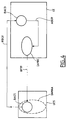
- Each UES user station has a DAMA agent modified according to the invention, and referenced DAMAA, which includes a BACS device which is a first subset of a device called a block admission controller.
- the entity CE control unit includes a DAMA controller, referenced DAMAC, and a second sub-assembly, referenced BACD, from the block admission controller.
- the controller DAMAA and the DAMAAC client have the main function of managing the resources of uplinks.
- the two subsets BACS and BACD of the admission controller function to manage the resources of the downlinks in addition avoiding as much as possible congestion on the outputs of the on-board switch.
- the BACS subset issues debit allocation requests, RBCR, representing the cumulative needs for each downlink, for this station UES data, based on traffic entering this UES station.
- Each request allocation RBCR therefore corresponds to a group of connections passing through this UES station and by the same on-board switch output, and not to a connection considered individually, nor to a downlink considered globally.
- BACD subset receives RBCR debit allocation requests transmitted by each UES station. These queries are used directly by this subset BACD to determine an authorized debit for each group of connection, for each output of the on-board switch, taking into account the speed maximum allowed respectively on each of these outputs.
- the BACD sub-assembly is connected directly to the DAMAC controller. But this direct link is used to indicate a speed authorized ABCR for each connection group, for each output of the on-board switch.
- the DAMAC controller deduces from it the bit rate it can allocate to each group of connections, for each uplink. He periodically sends a BFTP message allocating time and frequency to each UES station to tell him, for each group of connections, the speed allocated on the uplink which connects it to the satellite.
- the direct link between the BACD sub-assembly and the DAMAC controller makes congestion control unaffected by transmission delays between the central entity CE and stations: It allows to modulate, without delay, the flows allocated by the DAMAC controller, therefore with the best reactivity.
- the fact that the RBCR debit allocation requests are processed by the BACD subset for modulating the flows it authorizes provides adequate management of uplink resources and downlink resource management, therefore better efficiency of these two managements.
- the DAMAA agent receives from the central entity CE a debit allocation message, BFTP, for the uplink used by the UES station.
- the allocation of resources in time and frequency on an uplink is calculated by the DAMAC controller according to the speeds authorized by the sub-assembly BACD. These authorized debits are determined in order to avoid congestion, for example therefore the effective allocation of resources on uplinks prevents congestions.
- This dynamic and preventive congestion control completes a control of static congestion that is achieved at the time of establishment of each connection. Finally it allows the use of smaller buffers capabilities for a given packet loss rate.
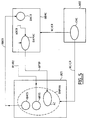
- FIG. 5 represents a more detailed block diagram of this exemplary embodiment of the device according to the invention.
- the central entity is assumed to be on board the satellite, and is referenced OBMC (On Board Multimedia Controller).
- FIG. 5 also represents, in the block diagram of the DAMAA agent, an NRTS signaling device dedicated to non-real-time traffic, and an AC controller for access to the uplink connecting the user station UES to satellite.
- the call admission controller, CAC which is located on the ground in a center referenced NCC (As indicated above, the central entity could be located on the ground and integrated into this center NCC in other examples of achievements).
- the CAC controller informs the AC access controller of each station UES user, and the BACD subset (located on board the satellite in this example), by messages referenced NC / CR, during each establishment and each connection loosening.
- NRTS signaling device manages traffic non-real time by issuing R1 debit allocation requests, and by issuing R2 flow release messages when a flow requested by a previous one debit allocation request is no longer justified (i.e. at the end of a burst of data packets).
- the allocation of resources on an uplink is carried out in advance, for non-real-time variable rate traffic, exploiting the fact that this traffic is well characterized.
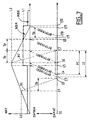
- FIG. 7 represents a timing diagram illustrating the operation of these means for allocating resources on an uplink, in advance, for non-real-time variable speed traffic.
- the upper part represents the filling level of the NRT memory of the DAMAA agent, and the data transmission rate which is read in this memory, while the lower part represents the sequence of message exchanges between the DAMAA subsets. and DAMAC, as a function of time. For clarity, not all BFTP messages are shown. They are in fact issued periodically by the DAMAC controller.
- the UES station receives a cell burst at pass.
- the allocated bit rate has a value MBR which is the value minimum for this amount link considered, and which is less than the debit of this gust.
- the filling level of the NRT memory exceeds a threshold fixed L0 because it receives more cells than it restores.
- the device NRTS signaling then sends an R1 request which contains no information precise flow but which signals a need for additional flow.
- This request can be included in the header of a data cell, or in a cell of signaling of the DAMA protocol.
- the transmission time Tp not being negligible, the threshold L0 is defined so that the available capacity of the NRT memory will not be full during the 2Tp round trip delay, if the burst keep on going.
- the request R1 reaches the DAMAC controller, located on board the satellite in this example.
- the DAMAC controller sends a BFTP message (NBR) allocating a new NBR flow, higher than NBR flow, the authorized increase in flow being equal to the difference between the peak value and the sustainable value, provided for the non-real-time connection with the highest peak value for the UES station considered.
- NBR BFTP message
- the DAMAC controller starts an LC counter which goes count the number of times it allocates the new NBR rate, in other words it determines the time elapsed since time t3. It will count until time t6 when the DAMAC controller receives an R2 request requesting a speed reduction. If the propagation time Tp was zero, measuring this elapsed time would allow the DAMAC controller to know directly the number of cells transmitted with the new NBR flow. But because of propagation delays, transmission with the new bit rate NBR does not start at time t 3, but at time t5; and she does not end when the DAMAC controller again allocates the lower MBR rate than the NBR flow. Knowing the delay Tp, it will be possible to deduce the number of cells which were transmitted with this bit rate, from time t5 when the UES station will have received the first BFTP message (NBR) allocating the new NBR speed.
- NBR first BFTP message
- the DAMAC controller sends a second BFTP message (NBR) further allocating the new NBR speed; and it starts an FC counter.
- NBR second BFTP message
- the burst ends.
- the DAMAA agent of the user station sees the end of the burst. It then issues an R2 request requesting a reduction of the allocated flow, and indicating the filling level: L2.
- An FC meter allows you to know this anticipation period, which could be less than 2 Tp if two R2 type messages arrived at the DAMAC controller in an interval of less than 2 Tp. This counter is reset to zero each time the DAMAC controller has finished serving a burst, which makes it possible to discern several bursts not dissociated in time, for a given station.
- MBR first BFTP message
- time t9 As soon as time t9 is reached, it waits for the next instant, t10, where it must send a BFTP message and then sends a first BFTP message (MBR). This message arrives at this station at a instant t12 after t11 where this filling is zero, but close to instant t11.
- MLR BFTP message
Landscapes
- Engineering & Computer Science (AREA)
- Physics & Mathematics (AREA)
- Astronomy & Astrophysics (AREA)
- Aviation & Aerospace Engineering (AREA)
- General Physics & Mathematics (AREA)
- Computer Networks & Wireless Communication (AREA)
- Signal Processing (AREA)
- Radio Relay Systems (AREA)
- Data Exchanges In Wide-Area Networks (AREA)
- Telephonic Communication Services (AREA)
- Mobile Radio Communication Systems (AREA)
Abstract
Description
- Optimiser l'utilisation des ressources radio, aussi bien celles des liens montants que celles des liens descendants.
- Garantir un taux de perte acceptable dans le commutateur embarqué, surtout dans le cas où celui-ci ne possède qu'une faible capacité de mémoire tampon.
- Limiter la complexité des éléments de commande du commutateur embarqué.
- Offrir un maximum de flexibilité et de reconfigurabilité.
- Pouvoir supporter un spectre de types de trafic, très large et évolutif.
- Pouvoir offrir et garantir différentes qualités de service.
- Rester cohérent avec les principes et les normes relatifs à la couche ATM, le protocole de gestion de ressources se situant dans la couche d'accès au médium (MAC, Medium Access Control) qui est située entre la couche ATM et la couche physique.
- Une part réservée (allouée constamment) qui ne nécessite pas de requête et qui est utilisée pour tous les types de trafic à débit constant, ou ne pouvant pas supporter le temps de latence dû à l'allocation dynamique (trafics dits à débit constant (CBR, Constant Bit Rate) ou à débit variable et en temps réel (VBRrt, Variable Bit Rate real time).
- Une part dynamique allouée en débit (dite RBDC - Rate-Based Dynamic Capacity) qui fonctionne sur un principe de requête/allocation, les requêtes étant exprimées en débit.
- Une part dynamique allouée en volume (dite VBDC - Volume-Based Dynamic Capacity) qui fonctionne sur un principe de requête/allocation, les requêtes étant exprimées en volume.
- Une part libre qui est la capacité restante après l'allocation des capacités précédentes.
- Un algorithme appelé « indication explicite de débit pour éviter une congestion », ou ERICA (Explicit Rate Indication for Congestion Avoidance). Il commande le débit connexion par connexion, au moyen de paquets de données dédiés pour transmettre des requêtes ou des indications.
- Un algorithme appelé «allocation diffusée pour la commande de débit» ou BRCA (Broadcast Rate Control Allocation), qui est une variante simplifiée du précédent, et dans lequel le contrôle de congestion est fait au niveau d'un couple lien-montant/lien-descendant, au lieu d'être fait connexion par connexion.
- Une grande complexité (nécessité de surveiller en continu l'état de remplissage des mémoires tampons du commutateur embarqué pour détecter une congestion).
- Une taille de mémoire tampon au moins moyenne, parce que le contrôle de congestion ne peut réagir qu'après avoir effectivement constaté un début de congestion.
- Le traitement connexion par connexion de l'algorithme ERICA provoque une charge de signalisation (paquets dédiés) importante qui s'ajoute à la charge de signalisation engendrée par le contrôleur d'allocation DAMAC.
- Le traitement par couple lien-montant/lien-descendant de l'algorithme BRCA ne permet pas un partage équitable des ressources, station utilisatrice par station utilisatrice, parce qu'il ne prend pas en compte leurs besoins spécifiques.
- Leurs implémentations respectives ne peuvent être faites qu'à bord du satellite, parce qu'elles nécessitent de surveiller l'état de remplissage des mémoires tampon, et pour obtenir un temps de réaction plus court.
- Par exemple, pour réduire la bande passante équivalente (calculée par le contrôleur d'admission des connexions, et représentative de la bande passante à réserver sur le lien descendant considéré) d'une connexion VBR-nRT, il faut une mémoire de capacité moyenne, dédiée au trafic VBR-nRT, pour chaque sortie.
- Par exemple, pour absorber l'arrivée incontrôlée de rafales GFR ou UBR, il faut une mémoire de capacité importante, dédiée à ces trafics, pour chaque sortie.
caractérisé en ce qu'il comporte, pour chaque satellite, une entité centrale qui comporte :
- un sous-ensemble du dispositif de contrôle de congestion, ce sous-ensemble
comportant des moyens pour :
- recevoir des requêtes émises par des stations utilisatrices du satellite considéré, chaque requête exprimant le débit nécessaire à un groupe de connexions supportées par une station utilisatrice et par un même lien descendant du satellite considéré,
- et déterminer le débit autorisé pour un tel groupe de connexions ;
- et un sous-ensemble du dispositif d'allocation de ressources à la demande, comportant des moyens pour allouer des ressources sur un lien montant, à chaque station utilisatrice, en fonction des débits autorisés par le sous-ensemble du dispositif de contrôle de congestion, et de manière globale pour l'ensemble des connexions supportées par cette station utilisatrice.
- recevoir une requête d'allocation de débit supplémentaire, émise par une station utilisatrice lorsqu'elle détecte le dépassement d'un seuil de remplissage d'une mémoire tampon destinée au trafic à débit variable non temps réel, alors qu'un débit minimal lui a été alloué ;
- envoyer à cette station des message d'allocation de débit autorisant un débit supérieur ;
- recevoir de cette station une requête indiquant que le remplissage a commencé à décroítre et indiquant le niveau de ce remplissage ;
- déterminer par anticipation l'instant où ce remplissage sera nul ;
- en déduire un instant où il pourra envoyer à cette station un message d'allocation de débit allouant de nouveau le débit minimal, cet instant étant choisi tel ce que ce message arrive à cette station à un instant voisin de l'instant où ce remplissage sera nul.
- La figure 1 représente le schéma synoptique du premier dispositif connu qui est décrit ci-dessus.
- La figure 2 représente le schéma synoptique du deuxième dispositif connu qui est décrit ci-dessus.
- La figure 3 représente le schéma synoptique du troisième dispositif connu qui est décrit ci-dessus.
- La figure 4 représente le schéma synoptique d'un exemple de réalisation du dispositif selon l'invention, en ne faisant figurer que les moyens essentiels pour contrôler la congestion de manière préventive.
- La figure 5 représente un schéma synoptique plus détaillé de cet exemple de réalisation du dispositif selon l'invention, en faisant figurer en outre les moyens essentiels pour un protocole d'accès de type DAMA avec un mécanisme d'allocation anticipée pour certains trafics.
- La figure 6 représente le schéma synoptique d'un exemple de réalisation d'un agent DAMA dans l'exemple de station utilisatrice représenté sur les figures 4 et 5.
- La figure 7 représente un chronogramme illustrant le fonctionnement des moyens situés dans cet agent DAMA pour allouer des ressources sur un lien montant, de manière anticipée, pour le trafic à débit variable non temps réel (VBRnRT).
- une partie propre à chaque station utilisatrice UES, et située dans cette station,
- et une entité centrale CE commune à toutes les stations (c'est à dire commune pour tous les liens reliant un satellite donné à des stations utilisatrices), ou commune à un sous-ensemble de stations (fournisseurs d'accès ou fournisseurs de réseau).
- Le trafic à haute priorité et le trafic en temps réels ne sont pas soumis au contrôle de congestion car il n'est pas question de rallonger leurs délais de transmission. Un contrôle préventif au niveau admission d'appels CAC suffit.
- Le trafic non temps réel peut supporter un rallongement des délais de transmission, et il est assez bien caractérisé (au moyen d'une valeur de débit dit soutenable) quand il est prédictible, ce qui permet d'utiliser un mécanisme de contrôle anticipé de congestion au niveau du contrôle d'admission d'appels CAC, qui est décrit ci-dessous. On peut également lui appliquer le mécanisme de contrôle de congestion BAC.
- Les trafics non temps réel et non prédictibles (ABR, UBR, GFR) peuvent supporter un rallongement des délais de transmission et sont donc soumis au contrôle de congestion, mais ils ne bénéficient pas du mécanisme de contrôle anticipé de congestion, parce qu'ils sont mal caractérisés.
- Une part des ressources est réservée de manière continue pour les trafics
bien caractérisés, cette part n'est donc pas affectée par le contrôle de
congestion exercé par le contrôleur BACD. Elle est déterminée lors de
chaque établissement ou relâchement de connexion, et est égale à la
somme des bandes équivalentes calculées par le dispositif d'admission de
connexions, CAC, et nécessaires à la garantie des débits suivants :
- des débits de crête (PCR) des connexions temps réel,
- des débits soutenus (SCR) des connexions non temps réel, lorsque le mécanisme de contrôlé de congestion, BAC, ne leur est pas appliqué ;
- et des débits minimaux (MCR) éventuellement garantis pour d'autres types de trafic (ABR, GFR, UBR, ...)
- Une part est la somme de tous les débits autorisés de manière dynamique par le contrôleur BACD.
- La part restante, si elle n'est pas nulle, est répartie équitablement par le contrôleur BACD entre les liens montants.
- une mémoire HP de type premier-entré-premier-sorti pour stocker les cellules du trafic dit à haute priorité qui attendent d'être émises en direction du satellite ;
- une mémoire RT de type premier-entré-premier-sorti pour stocker les cellules du trafic dit en temps réel, qui attendent d'être émises en direction du satellite ;
- une mémoire nRT de type premier-entré-premier-sorti pour stocker les cellules du trafic dit non temps réel, qui attendent d'être émises en direction du satellite ;
- une mémoire ABR de type premier-entré-premier-sorti pour stocker les cellules du trafic dit selon débit disponible (Trafic fourni par une source dont le débit est modulable à chaque instant par le réseau de transmission en fonction des ressources disponibles) qui attendent d'être émises en direction du satellite ;
- une mémoire UBR de type premier-entré-premier-sorti pour stocker les cellules du trafic dit à débit non spécifié (Trafic à transmettre au mieux en fonction des ressources restant disponibles) qui attendent d'être émises en direction du satellite ;
- un commutateur S1 qui reçoit les cellules montantes et les réparties dans les mémoires HP, RT, nRT, ABR, UBR, selon le type de trafic auquel elles appartiennent respectivement ;
- le contrôleur d'accès AC qui lit les cellules montantes dans les mémoires HP, RT, nRT, ABR, UBR, selon un ordre de priorités décroissantes fixé (HP, RT, nRT, ABR, UBR), et en fonction des allocations de débit contenus dans les messages BFTP envoyés par le contrôleur DAMAC, puis les multiplexe en temps et en fréquence sur le lien montant UL ;
- un commutateur S2 reçoit des cellules descendantes, et il extrait d'une part les messages BFTP qui sont fournis au contrôleur d'accès AC, et d'autre part la charge utile DD qui est envoyé vers un réseau de transmission terrestre ;
- le dispositif NRTS de signalisation dédié au trafic non temps réel, surveille le niveau de remplissage de la mémoire NRT, et il envoie un message de signalisation R1 requérant un débit fonction du niveau de remplissage, ce message étant acheminé via le contrôleur d'accès AC ;
- un dispositif BS de signalisation dédié au trafic non temps réel et non prédictif (trafic selon débit disponible, et trafic à débit non spécifié), qui surveille le niveau de remplissage des mémoires UBR et ABR, et qui envoie un message de signalisation R3 requérant un débit fonction de ces niveaux de remplissage, ce message étant acheminé via le contrôleur d'accès AC.
- l'instant de la fin de rafale, t6=t7-Tp,
- l'instant t8 =t7+Tp, où le message BFTP(NBR) émis à l'instant t7 atteindra la station utilisatrice,
- le niveau de remplissage L1 qui sera atteint lorsque le message BFTP(NBR), émis à l'instant t7, atteindra la station utilisatrice, à l'instant t8.
Claims (3)
- Dispositif gestionnaire de ressources pour un système de télécommunication par satellite, ce système comportant une pluralité de stations utilisatrices (UES) et au moins un satellite ; ce dispositif gestionnaire comportant un dispositif de contrôle de congestion, qui alloue des ressources sur des liens montants ; et un dispositif d'allocation de ressources à la demande, qui alloue des ressources des ressources sur des liens montants ;
caractérisé en ce qu'il comporte, pour chaque satellite, une entité centrale (CE ; OMBC) qui comporte :un sous-ensemble (BACD) du dispositif de contrôle de congestion, ce sous-ensemble comportant des moyens pour :recevoir des requêtes (RBCR) émises par des stations utilisatrices (UES) du satellite considéré, chaque requête exprimant le débit nécessaire à un groupe de connexions supportées par une station utilisatrice et par un même lien descendant du satellite considéré,et déterminer le débit autorisé pour un tel groupe de connexions ;et un sous-ensemble (DAMAC) du dispositif d'allocation de ressources à la demande, comportant des moyens pour allouer des ressources sur un lien montant, à chaque station utilisatrice (UES), en fonction des débits autorisés par le sous-ensemble (BACD) du dispositif de contrôle de congestion, et de manière globale pour l'ensemble des connexions supportées par cette station utilisatrice. - Dispositif gestionnaire selon la revendication 1, caractérisé en ce que, pour chaque station utilisatrice (UES), le sous-ensemble (DAMAC) du dispositif d'allocation de ressources à la demande, situé dans l'entité centrale (CE ; OBMC), comporte des moyens pour :recevoir une requête (R1) d'allocation de débit supplémentaire, émise par une station utilisatrice (UES) lorsqu'elle détecte le dépassement d'un seuil de remplissage (L0) d'une mémoire tampon (NRT) destinée au trafic à débit variable non temps réel, alors qu'un débit minimal (MBR) lui a été alloué,envoyer à cette station des message d'allocation de débit (BFTP(NBR)) autorisant un débit supérieur ;recevoir de cette station une requête (R2) indiquant que le remplissage a commencé à décroítre et indiquant le niveau (L2) de ce remplissage ;déterminer par anticipation l'instant (t11) où ce remplissage sera nul ;en déduire un instant (t9) où il pourra envoyer à cette station un message d'allocation de débit (BFTP(MBR)) allouant de nouveau le débit minimal, cet instant étant choisi tel ce que ce message arrive à cette station à un instant (t12) voisin de l'instant (t11) où ce remplissage sera nul.
- Dispositif gestionnaire selon la revendication 1, caractérisé en ce que, pour chaque station utilisatrice (UES), le sous-ensemble (BACD) du dispositif d'allocation de ressources à la demande, situé dans l'entité centrale (OMBC), comporte des moyens pour allouer, à la demande, les ressources sur les liens descendants, de telle manière que la somme des débits alloués aux différentes connexions supportées par un même lien descendant soit toujours inférieure au débit maximal permis par ce lien, en vue d'éviter une congestion sur les liens descendants.
Applications Claiming Priority (2)
| Application Number | Priority Date | Filing Date | Title |
|---|---|---|---|
| FR0009198A FR2811841B1 (fr) | 2000-07-13 | 2000-07-13 | Dispositif gestionnaire de ressources pour un systeme de telecommunication par satellite |
| FR0009198 | 2000-07-13 |
Publications (2)
| Publication Number | Publication Date |
|---|---|
| EP1172948A1 true EP1172948A1 (fr) | 2002-01-16 |
| EP1172948B1 EP1172948B1 (fr) | 2011-10-05 |
Family
ID=8852470
Family Applications (1)
| Application Number | Title | Priority Date | Filing Date |
|---|---|---|---|
| EP01401551A Expired - Lifetime EP1172948B1 (fr) | 2000-07-13 | 2001-06-14 | Dispositif gestionnaire de ressources pour un système de télécommunication par satellite |
Country Status (7)
| Country | Link |
|---|---|
| US (1) | US7142522B2 (fr) |
| EP (1) | EP1172948B1 (fr) |
| JP (1) | JP4727075B2 (fr) |
| AT (1) | ATE527763T1 (fr) |
| CA (1) | CA2351505C (fr) |
| ES (1) | ES2372271T3 (fr) |
| FR (1) | FR2811841B1 (fr) |
Families Citing this family (10)
| Publication number | Priority date | Publication date | Assignee | Title |
|---|---|---|---|---|
| US7024190B1 (en) * | 2000-03-02 | 2006-04-04 | Orbcomm Llc | Method of random access communication using subbanding and variable length messages |
| US6785543B2 (en) * | 2001-09-14 | 2004-08-31 | Mobile Satellite Ventures, Lp | Filters for combined radiotelephone/GPS terminals |
| FR2855007B1 (fr) * | 2003-05-13 | 2005-09-23 | Cit Alcatel | Gestion de ressources d'un reseau de communications de type point a multipont ou multipont a multipont, par deux niveaux d'allocation |
| US20060098664A1 (en) * | 2004-11-09 | 2006-05-11 | Tvblob S.R.I. | Intelligent application level multicast module for multimedia transmission |
| US7729244B2 (en) * | 2005-11-08 | 2010-06-01 | The Boeing Company | Dynamic resource allocation based on quality-of-service |
| US7688730B2 (en) * | 2007-12-20 | 2010-03-30 | Harris Corporation | System and method for multi-channel data-adaptive thresholding for shared channels with time-varying rate constraints |
| WO2009115970A1 (fr) * | 2008-03-21 | 2009-09-24 | Koninklijke Philips Electronics N.V. | Procédé de communication et station radio correspondante |
| EP2258136B1 (fr) * | 2008-03-21 | 2016-07-20 | Koninklijke Philips N.V. | Procédé de communication, station radio et système correspondante |
| KR20150034319A (ko) * | 2013-09-26 | 2015-04-03 | (주)엘지하우시스 | 진공단열재 및 그 제조방법 |
| EP3753245A4 (fr) | 2018-02-13 | 2021-04-14 | Satixfy Israel Ltd. | Procédé et appareil destinés à être utilisés dans un réseau de communications par satellites |
Citations (1)
| Publication number | Priority date | Publication date | Assignee | Title |
|---|---|---|---|---|
| EP0453355A2 (fr) * | 1990-04-13 | 1991-10-23 | Digital Equipment Corporation | Méthode pour éviter la congestion dans un réseau à haut débit transportant du trafic en rafale |
Family Cites Families (6)
| Publication number | Priority date | Publication date | Assignee | Title |
|---|---|---|---|---|
| JPH0738567A (ja) * | 1993-07-19 | 1995-02-07 | Oki Electric Ind Co Ltd | Atm交換網の呼受付制御方式及びatm交換ノード |
| US6850497B1 (en) * | 1995-09-19 | 2005-02-01 | Mobile Satellite Ventures, Lp | Satellite trunked radio service system |
| US6381228B1 (en) * | 1999-01-15 | 2002-04-30 | Trw Inc. | Onboard control of demand assigned multiple access protocol for satellite ATM networks |
| US6449267B1 (en) * | 1999-02-24 | 2002-09-10 | Hughes Electronics Corporation | Method and apparatus for medium access control from integrated services packet-switched satellite networks |
| US6604146B1 (en) * | 1999-06-15 | 2003-08-05 | Viasat, Inc. | Efficient internet service implementation for mesh satellite networks using centralized router server for distribution of destination tables |
| US6625129B1 (en) * | 1999-10-01 | 2003-09-23 | Motorola, Inc. | Demand assigned spatial multiplexing in satellite communication systems |
-
2000
- 2000-07-13 FR FR0009198A patent/FR2811841B1/fr not_active Expired - Fee Related
-
2001
- 2001-06-14 EP EP01401551A patent/EP1172948B1/fr not_active Expired - Lifetime
- 2001-06-14 AT AT01401551T patent/ATE527763T1/de not_active IP Right Cessation
- 2001-06-14 ES ES01401551T patent/ES2372271T3/es not_active Expired - Lifetime
- 2001-06-26 CA CA2351505A patent/CA2351505C/fr not_active Expired - Fee Related
- 2001-07-12 US US09/902,752 patent/US7142522B2/en not_active Expired - Fee Related
- 2001-07-12 JP JP2001212449A patent/JP4727075B2/ja not_active Expired - Lifetime
Patent Citations (1)
| Publication number | Priority date | Publication date | Assignee | Title |
|---|---|---|---|---|
| EP0453355A2 (fr) * | 1990-04-13 | 1991-10-23 | Digital Equipment Corporation | Méthode pour éviter la congestion dans un réseau à haut débit transportant du trafic en rafale |
Non-Patent Citations (2)
| Title |
|---|
| BAIOCCHI A ET AL: "DEFINITION AND PERFORMANCE ANALYSIS OF A SIMPLE, ABR-LIKE CONGESTION CONTROL SCHEME FOR SATELLITE ATM NETWORKS WITH GUARANTEED LOSS PERFORMANCE", IEEE JOURNAL ON SELECTED AREAS IN COMMUNICATIONS,IEEE INC. NEW YORK,US, vol. 17, no. 2, February 1999 (1999-02-01), pages 303 - 313, XP000851763, ISSN: 0733-8716 * |
| SUN Z ET AL: "ATM-over-satellite demonstration of broadband network interconnection", COMPUTER COMMUNICATIONS,GB,BUTTERWORTHS & CO. PUBLISHERS LTD, vol. 21, no. 12, 25 August 1998 (1998-08-25), pages 1090 - 1101, XP004146570, ISSN: 0140-3664 * |
Also Published As
| Publication number | Publication date |
|---|---|
| ATE527763T1 (de) | 2011-10-15 |
| FR2811841A1 (fr) | 2002-01-18 |
| JP2002118599A (ja) | 2002-04-19 |
| US7142522B2 (en) | 2006-11-28 |
| FR2811841B1 (fr) | 2003-01-17 |
| EP1172948B1 (fr) | 2011-10-05 |
| ES2372271T3 (es) | 2012-01-17 |
| US20020009052A1 (en) | 2002-01-24 |
| JP4727075B2 (ja) | 2011-07-20 |
| CA2351505A1 (fr) | 2002-01-13 |
| CA2351505C (fr) | 2010-08-10 |
Similar Documents
| Publication | Publication Date | Title |
|---|---|---|
| EP0431438B1 (fr) | Procédé de gestion des flux dans un réseau numérique de télécommunication à intégration de services, à large bande, et réseau pour la mise en oeuvre de ce procédé | |
| EP0591150B1 (fr) | Gestion d'encombrements basee sur une strategie d'encadrements multiples | |
| US5247516A (en) | Configurable composite data frame | |
| JP4115703B2 (ja) | 通信ネットワークにおける多重パケットをマルチレベルスケジューリングする方法 | |
| US6359883B1 (en) | Reducing the variability of the data rates of high-rate data streams in order to communicate such streams over a low-rate channel of fixed capacity | |
| EP0835010B1 (fr) | Système de gestion de trafic et de contrôle d'encombrement pour réseaux à base de paquets | |
| EP1172948B1 (fr) | Dispositif gestionnaire de ressources pour un système de télécommunication par satellite | |
| JP4844219B2 (ja) | 光ネットワーク及びノード | |
| EP0886455B1 (fr) | Procédé de gestion de largeurs de bandes allouées dans les réseaux locaux à accès partagés, protocole et filtre de mise en oeuvre | |
| FR2682243A1 (fr) | Procede d'allocation de ressources par reservation anticipee dans un reseau satellite a integration de services. | |
| JP2007300636A (ja) | 光学的光トレイルの帯域割当のための方法、論理装置及びシステム | |
| FR2801455A1 (fr) | Procede de transmission de flux de donnees sur un reseau atm, et dispositif pour la mise en oeuvre du procede | |
| JP4290357B2 (ja) | 高容量パケット切替型リングネットワーク | |
| FR2775546A1 (fr) | Commutateur de mode de transfert asynchrone avec une fonction d'attribution de file d'attente ayant un debit d'emission proche d'un debit declare | |
| EP0643505B1 (fr) | Trames multidébits pour réseau de télécommunications étoilé arborescent | |
| EP0885508B1 (fr) | Procede d'espacement de cellules atm et dispositif pour sa mise en oeuvre | |
| EP0961446B1 (fr) | Contrôle de congestion dans un noeud ATM | |
| EP3989494B1 (fr) | Procédé d'agrégation et de régulation de messages via un canal de communication bidirectionnel contraint | |
| EP1770927B1 (fr) | Système de commutation de paquets pour noeud de réseau de communication | |
| JP3686498B2 (ja) | 帯域割当回路 | |
| FR2749092A1 (fr) | Procede d'interconnexion des noeuds d'un calculateur parallele temps reel | |
| Wang et al. | Performance comparison of control schemes for ABR service in ATM LANs | |
| JP2002247064A (ja) | 親局装置、子局装置及び通信システム | |
| EP0840481A1 (fr) | Procédé d'émission de données sur un réseau ATM | |
| FR2825546A1 (fr) | Systeme de commutation de flux a debit garanti au travers d'une matrice |
Legal Events
| Date | Code | Title | Description |
|---|---|---|---|
| PUAI | Public reference made under article 153(3) epc to a published international application that has entered the european phase |
Free format text: ORIGINAL CODE: 0009012 |
|
| AK | Designated contracting states |
Kind code of ref document: A1 Designated state(s): AT BE CH CY DE DK ES FI FR GB GR IE IT LI LU MC NL PT SE TR |
|
| AX | Request for extension of the european patent |
Free format text: AL;LT;LV;MK;RO;SI |
|
| 17P | Request for examination filed |
Effective date: 20020716 |
|
| AKX | Designation fees paid |
Free format text: AT BE CH CY DE DK ES FI FR GB GR IE IT LI LU MC NL PT SE TR |
|
| 17Q | First examination report despatched |
Effective date: 20070302 |
|
| RAP1 | Party data changed (applicant data changed or rights of an application transferred) |
Owner name: ALCATEL LUCENT |
|
| GRAP | Despatch of communication of intention to grant a patent |
Free format text: ORIGINAL CODE: EPIDOSNIGR1 |
|
| GRAS | Grant fee paid |
Free format text: ORIGINAL CODE: EPIDOSNIGR3 |
|
| GRAA | (expected) grant |
Free format text: ORIGINAL CODE: 0009210 |
|
| RAP1 | Party data changed (applicant data changed or rights of an application transferred) |
Owner name: THALES |
|
| AK | Designated contracting states |
Kind code of ref document: B1 Designated state(s): AT BE CH CY DE DK ES FI FR GB GR IE IT LI LU MC NL PT SE TR |
|
| REG | Reference to a national code |
Ref country code: GB Ref legal event code: FG4D Free format text: NOT ENGLISH |
|
| REG | Reference to a national code |
Ref country code: CH Ref legal event code: EP |
|
| REG | Reference to a national code |
Ref country code: IE Ref legal event code: FG4D |
|
| REG | Reference to a national code |
Ref country code: DE Ref legal event code: R096 Ref document number: 60145427 Country of ref document: DE Effective date: 20111229 |
|
| REG | Reference to a national code |
Ref country code: ES Ref legal event code: FG2A Ref document number: 2372271 Country of ref document: ES Kind code of ref document: T3 Effective date: 20120117 |
|
| REG | Reference to a national code |
Ref country code: NL Ref legal event code: VDEP Effective date: 20111005 |
|
| REG | Reference to a national code |
Ref country code: AT Ref legal event code: MK05 Ref document number: 527763 Country of ref document: AT Kind code of ref document: T Effective date: 20111005 |
|
| REG | Reference to a national code |
Ref country code: IE Ref legal event code: FD4D |
|
| PG25 | Lapsed in a contracting state [announced via postgrant information from national office to epo] |
Ref country code: PT Free format text: LAPSE BECAUSE OF FAILURE TO SUBMIT A TRANSLATION OF THE DESCRIPTION OR TO PAY THE FEE WITHIN THE PRESCRIBED TIME-LIMIT Effective date: 20120206 Ref country code: SE Free format text: LAPSE BECAUSE OF FAILURE TO SUBMIT A TRANSLATION OF THE DESCRIPTION OR TO PAY THE FEE WITHIN THE PRESCRIBED TIME-LIMIT Effective date: 20111005 Ref country code: NL Free format text: LAPSE BECAUSE OF FAILURE TO SUBMIT A TRANSLATION OF THE DESCRIPTION OR TO PAY THE FEE WITHIN THE PRESCRIBED TIME-LIMIT Effective date: 20111005 Ref country code: GR Free format text: LAPSE BECAUSE OF FAILURE TO SUBMIT A TRANSLATION OF THE DESCRIPTION OR TO PAY THE FEE WITHIN THE PRESCRIBED TIME-LIMIT Effective date: 20120106 |
|
| PG25 | Lapsed in a contracting state [announced via postgrant information from national office to epo] |
Ref country code: CY Free format text: LAPSE BECAUSE OF FAILURE TO SUBMIT A TRANSLATION OF THE DESCRIPTION OR TO PAY THE FEE WITHIN THE PRESCRIBED TIME-LIMIT Effective date: 20111005 |
|
| PG25 | Lapsed in a contracting state [announced via postgrant information from national office to epo] |
Ref country code: IE Free format text: LAPSE BECAUSE OF FAILURE TO SUBMIT A TRANSLATION OF THE DESCRIPTION OR TO PAY THE FEE WITHIN THE PRESCRIBED TIME-LIMIT Effective date: 20111005 Ref country code: DK Free format text: LAPSE BECAUSE OF FAILURE TO SUBMIT A TRANSLATION OF THE DESCRIPTION OR TO PAY THE FEE WITHIN THE PRESCRIBED TIME-LIMIT Effective date: 20111005 |
|
| PLBE | No opposition filed within time limit |
Free format text: ORIGINAL CODE: 0009261 |
|
| STAA | Information on the status of an ep patent application or granted ep patent |
Free format text: STATUS: NO OPPOSITION FILED WITHIN TIME LIMIT |
|
| 26N | No opposition filed |
Effective date: 20120706 |
|
| REG | Reference to a national code |
Ref country code: DE Ref legal event code: R097 Ref document number: 60145427 Country of ref document: DE Effective date: 20120706 |
|
| BERE | Be: lapsed |
Owner name: THALES Effective date: 20120630 |
|
| PG25 | Lapsed in a contracting state [announced via postgrant information from national office to epo] |
Ref country code: MC Free format text: LAPSE BECAUSE OF NON-PAYMENT OF DUE FEES Effective date: 20120630 Ref country code: AT Free format text: LAPSE BECAUSE OF FAILURE TO SUBMIT A TRANSLATION OF THE DESCRIPTION OR TO PAY THE FEE WITHIN THE PRESCRIBED TIME-LIMIT Effective date: 20111005 |
|
| REG | Reference to a national code |
Ref country code: CH Ref legal event code: PL |
|
| REG | Reference to a national code |
Ref country code: CH Ref legal event code: PL |
|
| PG25 | Lapsed in a contracting state [announced via postgrant information from national office to epo] |
Ref country code: CH Free format text: LAPSE BECAUSE OF NON-PAYMENT OF DUE FEES Effective date: 20120630 Ref country code: BE Free format text: LAPSE BECAUSE OF NON-PAYMENT OF DUE FEES Effective date: 20120630 Ref country code: LI Free format text: LAPSE BECAUSE OF NON-PAYMENT OF DUE FEES Effective date: 20120630 |
|
| PG25 | Lapsed in a contracting state [announced via postgrant information from national office to epo] |
Ref country code: FI Free format text: LAPSE BECAUSE OF FAILURE TO SUBMIT A TRANSLATION OF THE DESCRIPTION OR TO PAY THE FEE WITHIN THE PRESCRIBED TIME-LIMIT Effective date: 20111005 |
|
| PG25 | Lapsed in a contracting state [announced via postgrant information from national office to epo] |
Ref country code: TR Free format text: LAPSE BECAUSE OF FAILURE TO SUBMIT A TRANSLATION OF THE DESCRIPTION OR TO PAY THE FEE WITHIN THE PRESCRIBED TIME-LIMIT Effective date: 20111005 |
|
| PG25 | Lapsed in a contracting state [announced via postgrant information from national office to epo] |
Ref country code: LU Free format text: LAPSE BECAUSE OF NON-PAYMENT OF DUE FEES Effective date: 20120614 |
|
| REG | Reference to a national code |
Ref country code: FR Ref legal event code: PLFP Year of fee payment: 16 |
|
| REG | Reference to a national code |
Ref country code: FR Ref legal event code: PLFP Year of fee payment: 17 |
|
| REG | Reference to a national code |
Ref country code: FR Ref legal event code: PLFP Year of fee payment: 18 |
|
| PGFP | Annual fee paid to national office [announced via postgrant information from national office to epo] |
Ref country code: DE Payment date: 20180530 Year of fee payment: 18 |
|
| PGFP | Annual fee paid to national office [announced via postgrant information from national office to epo] |
Ref country code: FR Payment date: 20180529 Year of fee payment: 18 |
|
| PGFP | Annual fee paid to national office [announced via postgrant information from national office to epo] |
Ref country code: IT Payment date: 20180625 Year of fee payment: 18 Ref country code: GB Payment date: 20180604 Year of fee payment: 18 Ref country code: ES Payment date: 20180702 Year of fee payment: 18 |
|
| REG | Reference to a national code |
Ref country code: DE Ref legal event code: R119 Ref document number: 60145427 Country of ref document: DE |
|
| GBPC | Gb: european patent ceased through non-payment of renewal fee |
Effective date: 20190614 |
|
| PG25 | Lapsed in a contracting state [announced via postgrant information from national office to epo] |
Ref country code: DE Free format text: LAPSE BECAUSE OF NON-PAYMENT OF DUE FEES Effective date: 20200101 Ref country code: GB Free format text: LAPSE BECAUSE OF NON-PAYMENT OF DUE FEES Effective date: 20190614 Ref country code: IT Free format text: LAPSE BECAUSE OF NON-PAYMENT OF DUE FEES Effective date: 20190614 |
|
| PG25 | Lapsed in a contracting state [announced via postgrant information from national office to epo] |
Ref country code: FR Free format text: LAPSE BECAUSE OF NON-PAYMENT OF DUE FEES Effective date: 20190630 |
|
| REG | Reference to a national code |
Ref country code: ES Ref legal event code: FD2A Effective date: 20201028 |
|
| PG25 | Lapsed in a contracting state [announced via postgrant information from national office to epo] |
Ref country code: ES Free format text: LAPSE BECAUSE OF NON-PAYMENT OF DUE FEES Effective date: 20190615 |