EP1171183B1 - Pressure-controlled continuous coronary sinus occlusion device - Google Patents
Pressure-controlled continuous coronary sinus occlusion device Download PDFInfo
- Publication number
- EP1171183B1 EP1171183B1 EP00918304A EP00918304A EP1171183B1 EP 1171183 B1 EP1171183 B1 EP 1171183B1 EP 00918304 A EP00918304 A EP 00918304A EP 00918304 A EP00918304 A EP 00918304A EP 1171183 B1 EP1171183 B1 EP 1171183B1
- Authority
- EP
- European Patent Office
- Prior art keywords
- valve
- lumen
- catheter
- pressure
- patient
- Prior art date
- Legal status (The legal status is an assumption and is not a legal conclusion. Google has not performed a legal analysis and makes no representation as to the accuracy of the status listed.)
- Expired - Lifetime
Links
- 210000003748 coronary sinus Anatomy 0.000 title claims description 31
- 239000008280 blood Substances 0.000 claims abstract description 34
- 210000004369 blood Anatomy 0.000 claims abstract description 34
- 238000004891 communication Methods 0.000 claims abstract description 4
- 230000002439 hemostatic effect Effects 0.000 claims description 11
- 230000010412 perfusion Effects 0.000 claims description 8
- 230000002107 myocardial effect Effects 0.000 claims description 4
- 239000000126 substance Substances 0.000 claims description 4
- 230000001225 therapeutic effect Effects 0.000 claims description 4
- 230000007423 decrease Effects 0.000 claims description 2
- 238000007789 sealing Methods 0.000 claims 4
- 238000001802 infusion Methods 0.000 claims 1
- 210000005166 vasculature Anatomy 0.000 abstract description 31
- 238000000034 method Methods 0.000 abstract description 21
- 230000000302 ischemic effect Effects 0.000 abstract description 9
- 210000004165 myocardium Anatomy 0.000 abstract description 9
- 238000013022 venting Methods 0.000 abstract description 5
- 210000004351 coronary vessel Anatomy 0.000 description 7
- 210000005245 right atrium Anatomy 0.000 description 7
- 210000002216 heart Anatomy 0.000 description 6
- 239000000463 material Substances 0.000 description 6
- 210000003462 vein Anatomy 0.000 description 6
- 238000002399 angioplasty Methods 0.000 description 5
- 230000000747 cardiac effect Effects 0.000 description 4
- 239000003814 drug Substances 0.000 description 4
- 210000001519 tissue Anatomy 0.000 description 4
- 238000011282 treatment Methods 0.000 description 4
- 229940079593 drug Drugs 0.000 description 3
- 210000005003 heart tissue Anatomy 0.000 description 3
- 239000003550 marker Substances 0.000 description 3
- 208000031225 myocardial ischemia Diseases 0.000 description 3
- 206010002383 Angina Pectoris Diseases 0.000 description 2
- 201000001320 Atherosclerosis Diseases 0.000 description 2
- 208000031481 Pathologic Constriction Diseases 0.000 description 2
- FAPWRFPIFSIZLT-UHFFFAOYSA-M Sodium chloride Chemical compound [Na+].[Cl-] FAPWRFPIFSIZLT-UHFFFAOYSA-M 0.000 description 2
- 230000003143 atherosclerotic effect Effects 0.000 description 2
- 230000009286 beneficial effect Effects 0.000 description 2
- 230000017531 blood circulation Effects 0.000 description 2
- -1 e.g. Substances 0.000 description 2
- 239000012530 fluid Substances 0.000 description 2
- 239000006260 foam Substances 0.000 description 2
- 230000007246 mechanism Effects 0.000 description 2
- 239000011780 sodium chloride Substances 0.000 description 2
- 230000036262 stenosis Effects 0.000 description 2
- 208000037804 stenosis Diseases 0.000 description 2
- 241000272525 Anas platyrhynchos Species 0.000 description 1
- 229940123457 Free radical scavenger Drugs 0.000 description 1
- 206010030113 Oedema Diseases 0.000 description 1
- 239000004698 Polyethylene Substances 0.000 description 1
- 206010040744 Sinus headache Diseases 0.000 description 1
- 230000001154 acute effect Effects 0.000 description 1
- 230000002491 angiogenic effect Effects 0.000 description 1
- 238000013459 approach Methods 0.000 description 1
- 210000001367 artery Anatomy 0.000 description 1
- 238000005452 bending Methods 0.000 description 1
- 239000012867 bioactive agent Substances 0.000 description 1
- 230000000903 blocking effect Effects 0.000 description 1
- 230000036772 blood pressure Effects 0.000 description 1
- 210000005242 cardiac chamber Anatomy 0.000 description 1
- 230000001684 chronic effect Effects 0.000 description 1
- 238000010276 construction Methods 0.000 description 1
- 201000010099 disease Diseases 0.000 description 1
- 208000037265 diseases, disorders, signs and symptoms Diseases 0.000 description 1
- 210000001174 endocardium Anatomy 0.000 description 1
- 238000005516 engineering process Methods 0.000 description 1
- PCHJSUWPFVWCPO-UHFFFAOYSA-N gold Chemical compound [Au] PCHJSUWPFVWCPO-UHFFFAOYSA-N 0.000 description 1
- 239000010931 gold Substances 0.000 description 1
- 229910052737 gold Inorganic materials 0.000 description 1
- 239000003102 growth factor Substances 0.000 description 1
- 238000002513 implantation Methods 0.000 description 1
- 238000011065 in-situ storage Methods 0.000 description 1
- 238000003780 insertion Methods 0.000 description 1
- 230000037431 insertion Effects 0.000 description 1
- 238000003698 laser cutting Methods 0.000 description 1
- 210000005240 left ventricle Anatomy 0.000 description 1
- 230000001926 lymphatic effect Effects 0.000 description 1
- 239000002207 metabolite Substances 0.000 description 1
- 229920000573 polyethylene Polymers 0.000 description 1
- 229920001296 polysiloxane Polymers 0.000 description 1
- 229920002635 polyurethane Polymers 0.000 description 1
- 239000004814 polyurethane Substances 0.000 description 1
- 229920000915 polyvinyl chloride Polymers 0.000 description 1
- 239000004800 polyvinyl chloride Substances 0.000 description 1
- 239000002516 radical scavenger Substances 0.000 description 1
- 230000001105 regulatory effect Effects 0.000 description 1
- 210000003752 saphenous vein Anatomy 0.000 description 1
- 239000007787 solid Substances 0.000 description 1
- 238000001356 surgical procedure Methods 0.000 description 1
- 229940124597 therapeutic agent Drugs 0.000 description 1
- 230000002792 vascular Effects 0.000 description 1
- 210000002620 vena cava superior Anatomy 0.000 description 1
- 238000003466 welding Methods 0.000 description 1
Images


Classifications
-
- A—HUMAN NECESSITIES
- A61—MEDICAL OR VETERINARY SCIENCE; HYGIENE
- A61M—DEVICES FOR INTRODUCING MEDIA INTO, OR ONTO, THE BODY; DEVICES FOR TRANSDUCING BODY MEDIA OR FOR TAKING MEDIA FROM THE BODY; DEVICES FOR PRODUCING OR ENDING SLEEP OR STUPOR
- A61M25/00—Catheters; Hollow probes
- A61M25/0067—Catheters; Hollow probes characterised by the distal end, e.g. tips
- A61M25/0074—Dynamic characteristics of the catheter tip, e.g. openable, closable, expandable or deformable
- A61M25/0075—Valve means
-
- A—HUMAN NECESSITIES
- A61—MEDICAL OR VETERINARY SCIENCE; HYGIENE
- A61B—DIAGNOSIS; SURGERY; IDENTIFICATION
- A61B17/00—Surgical instruments, devices or methods
- A61B17/12—Surgical instruments, devices or methods for ligaturing or otherwise compressing tubular parts of the body, e.g. blood vessels or umbilical cord
- A61B17/12022—Occluding by internal devices, e.g. balloons or releasable wires
-
- A—HUMAN NECESSITIES
- A61—MEDICAL OR VETERINARY SCIENCE; HYGIENE
- A61B—DIAGNOSIS; SURGERY; IDENTIFICATION
- A61B17/00—Surgical instruments, devices or methods
- A61B17/12—Surgical instruments, devices or methods for ligaturing or otherwise compressing tubular parts of the body, e.g. blood vessels or umbilical cord
- A61B17/12022—Occluding by internal devices, e.g. balloons or releasable wires
- A61B17/12099—Occluding by internal devices, e.g. balloons or releasable wires characterised by the location of the occluder
- A61B17/12109—Occluding by internal devices, e.g. balloons or releasable wires characterised by the location of the occluder in a blood vessel
-
- A—HUMAN NECESSITIES
- A61—MEDICAL OR VETERINARY SCIENCE; HYGIENE
- A61B—DIAGNOSIS; SURGERY; IDENTIFICATION
- A61B17/00—Surgical instruments, devices or methods
- A61B17/12—Surgical instruments, devices or methods for ligaturing or otherwise compressing tubular parts of the body, e.g. blood vessels or umbilical cord
- A61B17/12022—Occluding by internal devices, e.g. balloons or releasable wires
- A61B17/12131—Occluding by internal devices, e.g. balloons or releasable wires characterised by the type of occluding device
-
- A—HUMAN NECESSITIES
- A61—MEDICAL OR VETERINARY SCIENCE; HYGIENE
- A61B—DIAGNOSIS; SURGERY; IDENTIFICATION
- A61B17/00—Surgical instruments, devices or methods
- A61B17/12—Surgical instruments, devices or methods for ligaturing or otherwise compressing tubular parts of the body, e.g. blood vessels or umbilical cord
- A61B17/12022—Occluding by internal devices, e.g. balloons or releasable wires
- A61B17/12131—Occluding by internal devices, e.g. balloons or releasable wires characterised by the type of occluding device
- A61B17/12136—Balloons
-
- A—HUMAN NECESSITIES
- A61—MEDICAL OR VETERINARY SCIENCE; HYGIENE
- A61B—DIAGNOSIS; SURGERY; IDENTIFICATION
- A61B17/00—Surgical instruments, devices or methods
- A61B17/12—Surgical instruments, devices or methods for ligaturing or otherwise compressing tubular parts of the body, e.g. blood vessels or umbilical cord
- A61B17/12022—Occluding by internal devices, e.g. balloons or releasable wires
- A61B17/12131—Occluding by internal devices, e.g. balloons or releasable wires characterised by the type of occluding device
- A61B17/12181—Occluding by internal devices, e.g. balloons or releasable wires characterised by the type of occluding device formed by fluidized, gelatinous or cellular remodelable materials, e.g. embolic liquids, foams or extracellular matrices
- A61B17/1219—Occluding by internal devices, e.g. balloons or releasable wires characterised by the type of occluding device formed by fluidized, gelatinous or cellular remodelable materials, e.g. embolic liquids, foams or extracellular matrices expandable in contact with liquids
-
- A—HUMAN NECESSITIES
- A61—MEDICAL OR VETERINARY SCIENCE; HYGIENE
- A61M—DEVICES FOR INTRODUCING MEDIA INTO, OR ONTO, THE BODY; DEVICES FOR TRANSDUCING BODY MEDIA OR FOR TAKING MEDIA FROM THE BODY; DEVICES FOR PRODUCING OR ENDING SLEEP OR STUPOR
- A61M25/00—Catheters; Hollow probes
- A61M25/0067—Catheters; Hollow probes characterised by the distal end, e.g. tips
- A61M25/0074—Dynamic characteristics of the catheter tip, e.g. openable, closable, expandable or deformable
- A61M25/0075—Valve means
- A61M2025/0076—Unidirectional valves
-
- A—HUMAN NECESSITIES
- A61—MEDICAL OR VETERINARY SCIENCE; HYGIENE
- A61M—DEVICES FOR INTRODUCING MEDIA INTO, OR ONTO, THE BODY; DEVICES FOR TRANSDUCING BODY MEDIA OR FOR TAKING MEDIA FROM THE BODY; DEVICES FOR PRODUCING OR ENDING SLEEP OR STUPOR
- A61M25/00—Catheters; Hollow probes
- A61M25/10—Balloon catheters
- A61M2025/1043—Balloon catheters with special features or adapted for special applications
- A61M2025/1052—Balloon catheters with special features or adapted for special applications for temporarily occluding a vessel for isolating a sector
-
- A—HUMAN NECESSITIES
- A61—MEDICAL OR VETERINARY SCIENCE; HYGIENE
- A61M—DEVICES FOR INTRODUCING MEDIA INTO, OR ONTO, THE BODY; DEVICES FOR TRANSDUCING BODY MEDIA OR FOR TAKING MEDIA FROM THE BODY; DEVICES FOR PRODUCING OR ENDING SLEEP OR STUPOR
- A61M2210/00—Anatomical parts of the body
- A61M2210/12—Blood circulatory system
- A61M2210/125—Heart
Definitions
- the present invention relates to apparatus and methods for treating ischemic heart disease.
- the present invention relates to apparatus and methods that occlude a portion of the venous vasculature to perfuse the myocardium with blood from the venous system.
- the cardiac perfusion system is composed of the left and right coronary arteries, which perfuse the myocardium from the epicardial surface to the endocardium. Blood flows through the capillaries to the coronary veins, and into the right atrium via the coronary sinus. Two additional systems, the lymphatic and the Thebesian veins, drain a portion of the blood perfused into the myocardium directly into the heart chambers.
- the venous system has extensive collaterals and, unlike the coronary arteries, does not occlude in atherosclerotic disease.
- Atherosclerosis is a primary cause of myocardial ischemia.
- a number of techniques have been developed to treat atherosclerotic ischemic heart disease. These treatments have improved the lives of millions of patients worldwide, yet for certain classes of patients current technology offers little relief or hope.
- coronary artery bypass grafting wherein an incision is made to expose the patient's heart, and one or more coronary arteries are replaced with saphenous veins.
- Conventional open heart surgery is time-consuming and costly, involves a significant risk of mortality, requires a lengthy period of recuperation, and involves significant discomfort to the patient.
- PTA percutaneous transluminal angioplasty
- a balloon catheter typically is inserted into the stenosis and then inflated to compress and crack the plaque lining the vessel, thereby restoring patency to the vessel.
- a vascular prosthesis commonly referred to as a “stent,” may be inserted transluminally and expanded within the vessel after the angioplasty procedure, to maintain the patency of the vessel after the PTA procedure.
- U.S. Patent No. 5,824,071 to Nelson et al . which forms the basis for the two-part form of claim 1, describes a retroperfusion technique in which one or more passageways or conduits are formed between the left ventricle and the coronary venous vasculature to supply retrograde perfusion of the myocardium. That patent discloses a valve that vents excess blood from the venous system to retain the pressure in the venous system less than a predetermined value.
- PICSO pressure-controlled intermittent coronary sinus occlusion
- U.S. Patent No. 4,934,996 to Mohl et al describes PICSO apparatus that includes an inflatable balloon disposed on the end of a catheter, a pump and control circuitry.
- the distal end of the balloon catheter is inserted percutaneously or intraoperatively into the coronary sinus.
- the control circuitry issues a trigger signal that turns the pump on and inflates the balloon to occlude the coronary sinus.
- blood pressure in the coronary sinus increases, and blood draining into the coronary sinus through healthy heart tissue is forced back into ischemic tissue.
- Mohl et al. disclose that during occlusion, pressure in the coronary sinus reaches a plateau, and that continuing to occlude the coronary sinus once the plateau is reached could damage healthy heart tissue.
- control circuitry estimates the plateau level of the coronary sinus pressure during each occlusion, and interrupts the occlusion based on the estimate.
- Such previously known PICSO apparatus is cumbersome and expensive due to the complex pump and control system.
- an apparatus for providing retrograde transvenous myocardial perfusion as claimed in claim 1.
- a tubular member having an end region adapted to be disposed in a portion of a patient's venous vasculature, e.g., the coronary sinus or great cardiac vein.
- the end region includes a lumen and a valve disposed proximal of the occlusion element and in communication with the lumen.
- An occlusion element optionally may be disposed in the end region that retains the tubular member within the patient's venous vasculature and occludes the flow of blood around the lumen.
- the end region may be sized so that its diameter occludes the venous vasculature when urged into engagement with the walls of the lumen.
- the valve controls pressure within the occluded portion of the vasculature by venting excess blood proximal of the occlusion element via the valve.
- the valve is preferably a slit valve, although other types of valve mechanisms, such as a duck bill valve, may be employed.
- more than one valve may be provided, so that the degree of venting may be adjusted in-situ to suit a particular patient's needs.
- the tubular member forms an integral end of an elongated catheter adapted for percutaneous insertion.
- the catheter includes a proximal end that extends out of the patient's body, and includes a hemostatic valve through which therapeutic substances, e.g., drugs or other treatment fluids, may be injected into the patient's venous system, or through which blood may be periodically drawn, e.g., to analyze metabolites.
- the distal end region also includes an expandable member for regulating the pressure developed in the patient's vasculature.
- the tubular member may comprise a separate member which may be percutaneously deployed.
- Methods of using the apparatus of the present invention to provide acute or chronic perfusion of ischemic myocardium also are provided.
- the present invention provides apparatus for continuously occluding a portion of a patient's venous vasculature, to provide enhanced myocardial perfusion while limiting the pressure attained in the occluded portion of vasculature.
- a device constructed in accordance with principles of the present invention comprises a catheter having an end region adapted to be disposed in a portion of a patient's venous vasculature, such as the coronary sinus or great cardiac vein.
- the end region includes a lumen and one or more valves for venting blood through the lumen proximal to regulate the pressure attained in the occluded portion of the vasculature.
- An occlusion element preferably is included in the end region to occlude flow around the lumen and retains the tubular member in place.
- the end region may be sized so that its exterior surface sealingly engages the interior surface of a vessel when urged therein.
- a proximal end of the catheter includes a hemostatic valve that may be used to inject therapeutic substances into the patient's venous system.
- a distal end region also includes an expandable member that provides perfusion during diastole as well as systole.
- the device may comprise a separate unit that is affixed to the end of an elongated catheter for percutaneous placement, after which the catheter may be withdrawn, leaving the device in place.
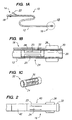
- Device 10 comprises catheter 12 having proximal end 14 and distal end region 16.
- Catheter 12 preferably comprises a biocompatible, flexible material typically used in catheters, for example, polyvinyl chloride, polyethylene, silicone, polyurethane, or combinations thereof.
- Proximal end 14 includes hemostatic valve 18, e.g., a Touhey-Borst valve, that permits a guide wire to be extended through lumen 20 of catheter 12, and inflation port 22.
- Distal end region 16 includes slit valve 24 and occlusion element 26, illustratively a balloon coupled to inflation port 22 by lumen 28.
- Lumen 20 extends from proximal end 14 to distal end region 16 of catheter 12 to permit therapeutic substances, such as drugs, bioactive agents, angiogenic growth factors, free radical scavengers, saline, etc., to be introduced into the patient's venous system via hemostatic valve 18 (or to permit blood to be withdrawn).
- Occlusion element 26 occludes the flow of blood through the venous vasculature around the exterior of catheter 12, and also anchors distal end region 16 at a selected location of the patient's venous vasculature.
- occlusion element 26 may comprise an expandable sponge or elastomeric plug, ribs, barbs or flanges. As further described below with respect to the embodiment of FIG. 8, occlusion element 26 may be omitted entirely, and distal end region 16 of catheter 12 sized to sealingly engage the interior walls of the targeted venous vessel.
- Distal end region 16 also may include radio-opaque marker ring 30, for example, a gold film, disposed on external surface of distal end region 16. Marker ring 30 enables the location of distal end region 16 to be determined using a fluoroscope.
- catheter 12 may include a radio-opaque material embedded within its walls, so that the entire catheter is visible under a fluoroscope.
- Slit valve 24 comprises a series of circumferentially spaced-apart through-wall slits 25, for example, four slits spaced apart 90°.
- a first predetermined pressure When the pressure within lumen 20 exceeds a first predetermined pressure, the wall segments between slits 25 bulge outward, thereby permitting blood to flow through the slits.
- a second predetermined pressure which may be the same as the first pressure) the segments close towards one another, thereby preventing further fluid from escaping through the slits.
- support structure 32 is illustratively affixed either to the inner surface of the catheter 12.
- support structure 32 may be disposed on the exterior of catheter 12, or may be embedded within the wall of the catheter.
- support structure 32 comprises, for example, tubular member 34 having a plurality of elongated slots 36 formed along a midportion of the length of the tubular member, e.g., by laser cutting.
- Support structure 32 is disposed in catheter 12 so that each slit 25 is aligned with a corresponding one of plurality of elongated slots 36.
- support structure may be formed by welding a plurality of struts at either end to a hoop.
- the material of catheter 12, and the size, number and spacing of slits 25 may be selected so that the wall segments between slits 25 bulge outward only when the pressure within lumen 20 exceeds a first predetermined pressure, thereby permitting some of the blood to be vented proximally of occlusion element 26.
- slit valve 24 may be configured to permit blood to be vented into through slits 25 when the pressure within lumen 20 exceeds 40 mm Hg.
- the material of catheter 12, and the size, number and spacing of slits 25 may be selected so that the wall segments between slits 25 re-seal only when the pressure within lumen 20 falls below a second predetermined pressure, thereby preventing further venting of blood into the right atrium.
- slit valve 24 may be configured so that slits 25 re-seal when the pressure within lumen 20 falls below 30 mm Hg.
- FIG. 2 illustrates an embodiment of the device of the present invention, in which like parts are indicated by like numbers.
- Catheter 40 includes expandable section 42 disposed in end region 16 proximal to valve 24.
- Expandable section 42 may comprise, for example, a thin-walled portion of catheter 40, or a separately formed section comprising a different material. Expandable section 42 accumulates blood flowing into lumen 20 during systole, and contracts slightly during diastole to maintain the pressure applied to the occluded portion of the patient's vasculature, as described in detail hereinafter.
- Distal end region 16 is illustratively shown placed in the coronary sinus using either a percutaneous or intraoperative approach.
- right atrium RA or the superior vena cava first is exposed, and an opening is made with a trocar or scalpel.
- a guidewire (not shown) then is inserted until its distal end is inserted through coronary ostium CO and into coronary sinus CS.
- Catheter 12 is advanced along the guidewire until distal end 16 is inserted through coronary ostium CO.
- Occlusion element 26 then is deployed, for example, by injecting an inflation medium, such as saline, into occlusion element 26 via inflation port 22.
- Inflation of occlusion element 26 not only anchors the distal end of catheter 12 in coronary sinus CO, but prevents blood draining into the coronary sinus from exiting through the coronary ostium into the right atrium.
- blood that normally would flow from the coronary sinus into right atrium RA instead accumulates in lumen 20 (this flow is illustrated by arrows AA), causing the pressure within lumen 20 and the rest of the venous vasculature to rise. This in turn forces blood draining into coronary sinus CS through healthy heart tissue to be forced back into ischemic tissue in heart H.
- valve 24 opens.
- a first predetermined pressure e.g. 40 mm Hg
- valve 24 opens.
- a second predetermined pressure e.g. 20 mm Hg
- distal end region 16 may be lodged in a portion of the patient's coronary venous vasculature other than the coronary sinus, as needed to address a smaller portion of ischemic myocardium.
- end region 16 may be disposed in the great cardiac vein.
- occlusion element 26 will effectively divide the venous system into a higher pressure region, distal to the occlusion element, and a lower pressure region, proximal of the occlusion element. Accordingly, when valve 24 opens, it vents excess blood to the lower pressure region through lumen 20 and valve 24, proximal to occlusion element 26.
- Expandable section 42 preferably comprises a soft balloon-like chamber that inflates at a third predetermined pressure, lower than the first and second predetermined pressures.
- expandable section 42 forms a reservoir that accumulates blood during systole, and maintains pressure in the venous system during diastole.
- valve 24 opens, expandable section 42 also urges blood out of lumen 20 until the pressure in lumen 20 falls below the second predetermined pressure.
- Device 50 comprises catheter 52 having proximal end 53 and distal end region 54 disposed within outer sheath 55.
- Catheter 52 includes a central lumen, hemostatic valve 56 at proximal end 53, and valves 57a-57c and occlusion element 58 in distal end region 54.
- Occlusion element 58 comprises, for example, a sponge-like foam that swells when exposed to blood for a predetermined interval.
- Catheter 52 is constructed as described hereinabove with respect to the embodiment of FIGS. 1, except that it includes multiple valves 57a-57c having different opening pressures.
- Outer sheath 55 is coupled to handle 59 that includes indicator window 60 indicating which of valves 57a-57c are exposed.
- sheath 55 may be disposed within the lumen of catheter 52 to selectively expose valves 57a-57c, and may in such an embodiment comprise a solid flexible member.
- valves 57a-57c preferably are arranged so that the valve 57a, closest to the distal end, has the highest opening pressure, while valve 57c, closest to the proximal end, has the lowest opening pressure.
- Outer sheath 55 is configured to slide proximally and distally along catheter 52, as indicated by arrows A, to selectably uncover one or more of valves 57a-57c.
- outer sheath 55 may be moved in the proximal or distal directions to uncover slit valves 57a, 57a-57b or 57a-57c, to adjust the pressure attained with the venous system.
- the central lumen of catheter 52 may be coupled through hemostatic valve 56 to a pressure monitor (not shown), and outer sheath 55 moved to adjust a measured pressure parameter, such as peak pressure or average pressure, to a desired value.
- a measured pressure parameter such as peak pressure or average pressure
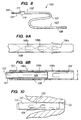
- FIGS. 6A-6C depict an alternative device of FIG. 5, in which an outer sheath is selectively positioned relative to a valved catheter to attain a desired pressure in the venous system.
- Catheter 70 is similar in appearance to catheter 50 of FIG. 5, and is similarly constructed, except that slit valves 57a-57c are replaced by duck-bill valves 72a-72c and through-wall apertures 73a-73c, respectively.
- Valve 73a closest to the distal end of catheter 70, has the highest opening pressure
- valve 73c closest to the proximal end, has the lowest opening pressure.
- the portions of lumen 74 located proximally of each duck-bill valve define successively lower pressure regions when apertures 73a-73c are uncovered.
- Outer sheath 75 is slidably disposed on catheter 70 and includes through-wall openings 76a and 76b. When outer sheath 75 is retracted to its proximal-most position, it blocks apertures 73b and 73c, so that blood exits only through valve 72a and aperture 73a. As depicted in FIG. 6B, outer sheath 75 may be moved in the distal direction so that opening 76a is aligned with aperture 73b, and apertures 73a and 73c are covered. In this position, blood exits only through aperture 73b and opening 76a, thereby providing an intermediate pressure level in the venous system. In FIG.
- outer sheath 75 is advanced to its distal-most position, at which opening 76b is aligned with aperture 73c, and apertures 73a and 73b are blocked. With outer sheath 75 in the position shown in FIG. 6C, blood exits only through apertures 73c and opening 76b, and the lowest pressure level is attained in catheter 70 and the venous vasculature.
- the valves of the embodiments of FIGS. 5 and 6 may be replaced with other suitable valve mechanisms and more or fewer valves may be employed to provide multiple selectable pressure levels.
- Device 80 comprises introducer catheter 82, push tube 84, and occlusion device 90.
- Occlusion device 90 is similar in construction to distal end region 16 of the embodiment of FIG. 1b, and comprises tubular member 91 having an internal lumen, occlusion element 92, radio-opaque marker band 93, slit valve 94 and expandable section 95.
- Occlusion device 90 further includes end cap 96 and pull wire 97. End cap 96 seals the proximal end of the internal lumen of member 91.
- Occlusion element 92 may comprise a detachable inflatable element, a sponge or foam plug, or an elastomeric ribs, barbs, etc., or simply a distal end of tubular member 91.
- Occlusion device 90 is disposed in introducer catheter 82 so that end cap 96 seats against push tube 84 and pull wire 97 extends out of the proximal end of introducer catheter 82.
- Device 80 is adapted to be inserted percutaneously or intraoperatively through into the patients's right atrium, and then through the coronary ostium, into the coronary sinus or another part of the venous system. Once so positioned, for example, as determined using a fluoroscope, push tube 84 is held stationary while introducer catheter 82 is retracted proximally. This action causes occlusion device 90 to be deployed in the patient's venous system, permitting occlusion element 92 to engage the interior surface of the vein (or coronary sinus). Introducer catheter 82 and push tube 84 may then be withdrawn, leaving pull wire 97 extending out of the patient's body.
- occlusion device 90 Operation of occlusion device 90 is as described for the distal end region of device 10 of FIGS. 1. If it is desired only to provide short-term transvenous myocardial perfusion, pull-wire 97 may be used to extract occlusion device 90 from the patient after treatment has been completed.
- Device 100 comprises catheter 101 having proximal end 102 and distal end region 103 disposed.
- Catheter 101 includes central lumen 104 and valves 106a-106c in distal end region 103.
- Distal end region 103 has diameter D selected so as to sealingly engage and occlude a targeted portion of a vessel when urged therein (see FIG. 10).
- Catheter 107 includes hemostatic valve 105 on its proximal end, and is slidably disposed with lumen 104 of catheter 101 to selectively close-off valves 106a-106c from the interior of lumen 104.
- Wire braid 108 preferably is embedded within the wall of catheter 101 to reduce the imposition of bending stresses on valves 106a-106c, much like tubular member 34 of FIG. 1C.
- Catheter 102 like the embodiment of FIGS. 5, preferably includes multiple valves 106a-106c having different opening pressures. As in the device of FIGS. 5, valves 106a-106c preferably are arranged so that the valve 106a, closest to the distal end, has the highest opening pressure, while valve 106c, closest to the proximal end, has the lowest opening pressure.
- Valves 106a-106c are a type of slit valve and are formed, for example, by incising a catheter to create elongated U-shaped flaps. When the pressure within lumen 104 exceeds a predetermined opening pressure, the flap bends outwards (as shown in dotted line in FIG. 9A), thus permitting blood to escape.
- the opening pressure of slit valves 106-106c may be empirically determined, and will depend on such factors as the stiffness of the catheter material and the width and length of the U-shaped flaps.
- catheter 107 is shown disposed within lumen 104 of catheter 102 with its distal end 109 blocking valves 106b and 106c.
- Catheter 107 extends through handle 110, so that an indicator mark on catheter 107 is visible through window 111.
- the clinician may move catheter 107 in the proximal or distal directions to block more or fewer of valves 106a-106c from communicating with the interior of lumen 104. This in turn permits the pressure attained in lumen 104 to be adjusted after implantation of the device.
- catheter 107 may be moved in the proximal or distal directions to uncover slit valves 106a, 106a-106b or 106a-106c, to adjust the pressure attained with the venous system.
- lumen 112 of catheter 107 may be coupled through hemostatic valve 105 to a pressure monitor (not shown), and catheter 107 then may be moved to adjust a measured pressure parameter, such as peak pressure or average pressure, to a desired value.
- catheter 101 could then be disconnected from the pressure monitor, and catheter 107 locked in place.
- drugs or other therapeutic agents such as described hereinabove, may be injected into the venous system via hemostatic valve 105 and lumen 112.
- distal end region 103 is illustratively shown passing through coronary ostium CO and engaged in coronary sinus CS. In this embodiment, no separate occlusion element is provided. Instead, distal end region 103 is simply advanced into the coronary sinus until the outer diameter of catheter 101 engages the interior surface of the venous vessel.
- occlusion of the vessel proximally of the point of occlusion of the vessel may be achieved without the need for a separate occlusion element.
Landscapes
- Health & Medical Sciences (AREA)
- Life Sciences & Earth Sciences (AREA)
- Surgery (AREA)
- Veterinary Medicine (AREA)
- Public Health (AREA)
- General Health & Medical Sciences (AREA)
- Engineering & Computer Science (AREA)
- Biomedical Technology (AREA)
- Heart & Thoracic Surgery (AREA)
- Animal Behavior & Ethology (AREA)
- Molecular Biology (AREA)
- Medical Informatics (AREA)
- Nuclear Medicine, Radiotherapy & Molecular Imaging (AREA)
- Vascular Medicine (AREA)
- Reproductive Health (AREA)
- Biophysics (AREA)
- Pulmonology (AREA)
- Anesthesiology (AREA)
- Hematology (AREA)
- Surgical Instruments (AREA)
- Media Introduction/Drainage Providing Device (AREA)
Applications Claiming Priority (3)
| Application Number | Priority Date | Filing Date | Title |
|---|---|---|---|
| US275797 | 1999-03-25 | ||
| US09/275,797 US6569145B1 (en) | 1999-03-25 | 1999-03-25 | Pressure-controlled continuous coronary sinus occlusion device and methods of use |
| PCT/US2000/007732 WO2000056387A1 (en) | 1999-03-25 | 2000-03-24 | Pressure-controlled continuous coronary sinus occlusion device and methods of use |
Publications (3)
| Publication Number | Publication Date |
|---|---|
| EP1171183A1 EP1171183A1 (en) | 2002-01-16 |
| EP1171183A4 EP1171183A4 (en) | 2005-10-05 |
| EP1171183B1 true EP1171183B1 (en) | 2007-11-28 |
Family
ID=23053844
Family Applications (1)
| Application Number | Title | Priority Date | Filing Date |
|---|---|---|---|
| EP00918304A Expired - Lifetime EP1171183B1 (en) | 1999-03-25 | 2000-03-24 | Pressure-controlled continuous coronary sinus occlusion device |
Country Status (7)
| Country | Link |
|---|---|
| US (1) | US6569145B1 (enExample) |
| EP (1) | EP1171183B1 (enExample) |
| JP (1) | JP2003521961A (enExample) |
| AU (1) | AU3913700A (enExample) |
| CA (1) | CA2368163A1 (enExample) |
| DE (1) | DE60037245T2 (enExample) |
| WO (1) | WO2000056387A1 (enExample) |
Cited By (7)
| Publication number | Priority date | Publication date | Assignee | Title |
|---|---|---|---|---|
| US9199067B2 (en) | 2009-01-29 | 2015-12-01 | Tufts Medical Center, Inc. | Endovascular cerebrospinal fluid shunt |
| US9387311B1 (en) | 2014-10-31 | 2016-07-12 | Cerevasc, Llc | Methods and systems for treating hydrocephalus |
| CN107693080A (zh) * | 2017-11-01 | 2018-02-16 | 成都吱吖科技有限公司 | 一种防止血管黏连的血流阻断支架 |
| CN107822686A (zh) * | 2017-11-01 | 2018-03-23 | 成都吱吖科技有限公司 | 一种外套式血流阻断塞 |
| US10272230B2 (en) | 2015-10-30 | 2019-04-30 | Cerevasc, Llc | Systems and methods for treating hydrocephalus |
| US11850390B2 (en) | 2018-03-08 | 2023-12-26 | CereVasc, Inc. | Systems and methods for minimally invasive drug delivery to a subarachnoid space |
| US12036375B2 (en) | 2016-10-11 | 2024-07-16 | CereVasc, Inc. | Methods and systems for treating hydrocephalus |
Families Citing this family (120)
| Publication number | Priority date | Publication date | Assignee | Title |
|---|---|---|---|---|
| US6231546B1 (en) | 1998-01-13 | 2001-05-15 | Lumend, Inc. | Methods and apparatus for crossing total occlusions in blood vessels |
| US6261304B1 (en) | 1998-09-10 | 2001-07-17 | Percardia, Inc. | Delivery methods for left ventricular conduit |
| US6641610B2 (en) | 1998-09-10 | 2003-11-04 | Percardia, Inc. | Valve designs for left ventricular conduits |
| EP1669042A3 (en) | 1998-09-10 | 2006-06-28 | Percardia, Inc. | TMR shunt |
| EP1112041A1 (en) * | 1998-09-10 | 2001-07-04 | Percardia, Inc. | Tmr shunt |
| US6290728B1 (en) | 1998-09-10 | 2001-09-18 | Percardia, Inc. | Designs for left ventricular conduit |
| US6254564B1 (en) | 1998-09-10 | 2001-07-03 | Percardia, Inc. | Left ventricular conduit with blood vessel graft |
| US6409697B2 (en) | 1999-05-04 | 2002-06-25 | Heartstent Corporation | Transmyocardial implant with forward flow bias |
| US7033372B1 (en) | 1999-08-04 | 2006-04-25 | Percardia, Inc. | Corkscrew reinforced left ventricle to coronary artery channel |
| US6638237B1 (en) | 1999-08-04 | 2003-10-28 | Percardia, Inc. | Left ventricular conduits and methods for delivery |
| US6302892B1 (en) | 1999-08-04 | 2001-10-16 | Percardia, Inc. | Blood flow conduit delivery system and method of use |
| JP3782297B2 (ja) * | 2000-03-28 | 2006-06-07 | 株式会社東芝 | 固体撮像装置及びその製造方法 |
| US6854467B2 (en) * | 2000-05-04 | 2005-02-15 | Percardia, Inc. | Methods and devices for delivering a ventricular stent |
| JP5088987B2 (ja) * | 2000-12-28 | 2012-12-05 | 日本コヴィディエン株式会社 | マルチルーメンカテーテル |
| US6976990B2 (en) | 2001-01-25 | 2005-12-20 | Percardia, Inc. | Intravascular ventriculocoronary bypass via a septal passageway |
| US6979322B2 (en) * | 2001-12-26 | 2005-12-27 | Scimed Life Systems, Inc. | Low profile adaptor for use with a medical catheter |
| US6949118B2 (en) | 2002-01-16 | 2005-09-27 | Percardia, Inc. | Encased implant and methods |
| JP2003210585A (ja) * | 2002-01-21 | 2003-07-29 | Hiroaki Nomori | 気管切開チューブ |
| US7008397B2 (en) | 2002-02-13 | 2006-03-07 | Percardia, Inc. | Cardiac implant and methods |
| US20080287939A1 (en) * | 2002-07-10 | 2008-11-20 | Appling William M | Endovascular thermal treatment device with flexible guide tip and method |
| US7326219B2 (en) | 2002-09-09 | 2008-02-05 | Wilk Patent Development | Device for placing transmyocardial implant |
| US6699275B1 (en) * | 2002-10-11 | 2004-03-02 | Enteromedics Inc. | Stent and delivery system |
| EP1428548B1 (en) * | 2002-12-12 | 2008-11-05 | Piolax Medical Devices, Inc. | Catheter for use in peritoneovenous shunt |
| US6928669B2 (en) * | 2003-01-10 | 2005-08-16 | Tyler Pipe Company | Closet carrier system and method of assembly |
| US20050015048A1 (en) * | 2003-03-12 | 2005-01-20 | Chiu Jessica G. | Infusion treatment agents, catheters, filter devices, and occlusion devices, and use thereof |
| US7250041B2 (en) * | 2003-03-12 | 2007-07-31 | Abbott Cardiovascular Systems Inc. | Retrograde pressure regulated infusion |
| US20050113631A1 (en) * | 2003-11-12 | 2005-05-26 | Bolling Steven F. | Cannulae having a redirecting tip |
| US7668594B2 (en) * | 2005-08-19 | 2010-02-23 | Cardiac Pacemakers, Inc. | Method and apparatus for delivering chronic and post-ischemia cardiac therapies |
| US20050278013A1 (en) * | 2004-05-26 | 2005-12-15 | Matthew Rust | Method for endovascular bypass stent graft delivery |
| AT500676B1 (de) | 2004-06-08 | 2007-04-15 | Mohl Werner Ddr | Vorrichtung zur intermittierenden okklusion des koronarsinus |
| US20050277870A1 (en) * | 2004-06-10 | 2005-12-15 | Robert Pecor | Cannula having reduced flow resistance |
| US7445592B2 (en) * | 2004-06-10 | 2008-11-04 | Orqis Medical Corporation | Cannulae having reduced flow resistance |
| AU2005277797A1 (en) * | 2004-08-19 | 2006-03-02 | Vein Rx, Inc. | An occludable intravascular catheter for drug delivery and method of using the same |
| GB0419954D0 (en) | 2004-09-08 | 2004-10-13 | Advotek Medical Devices Ltd | System for directing therapy |
| US7295874B2 (en) * | 2005-01-06 | 2007-11-13 | Cardiac Pacemakers, Inc. | Intermittent stress augmentation pacing for cardioprotective effect |
| DE102005003632A1 (de) | 2005-01-20 | 2006-08-17 | Fraunhofer-Gesellschaft zur Förderung der angewandten Forschung e.V. | Katheter für die transvaskuläre Implantation von Herzklappenprothesen |
| US7962208B2 (en) | 2005-04-25 | 2011-06-14 | Cardiac Pacemakers, Inc. | Method and apparatus for pacing during revascularization |
| US20060259088A1 (en) * | 2005-05-13 | 2006-11-16 | Pastore Joseph M | Method and apparatus for delivering pacing pulses using a coronary stent |
| US7917210B2 (en) * | 2005-05-13 | 2011-03-29 | Cardiac Pacemakers, Inc. | Method and apparatus for cardiac protection pacing |
| US7894896B2 (en) * | 2005-05-13 | 2011-02-22 | Cardiac Pacemakers, Inc. | Method and apparatus for initiating and delivering cardiac protection pacing |
| US20070005011A1 (en) * | 2005-06-20 | 2007-01-04 | Boston Scientific Scimed, Inc. | Method, system, apparatus, and kit for remote therapeutic delivery |
| EP4292548B1 (en) * | 2005-09-12 | 2025-08-27 | Boston Scientific Scimed, Inc. | Endovascular devices |
| US8083727B2 (en) | 2005-09-12 | 2011-12-27 | Bridgepoint Medical, Inc. | Endovascular devices and methods for exploiting intramural space |
| US11020141B2 (en) | 2005-09-12 | 2021-06-01 | Bridgepoint Medical, Inc. | Endovascular devices and methods |
| US8025655B2 (en) * | 2005-09-12 | 2011-09-27 | Bridgepoint Medical, Inc. | Endovascular devices and methods |
| US7918870B2 (en) * | 2005-09-12 | 2011-04-05 | Bridgepoint Medical, Inc. | Endovascular devices and methods |
| US8108034B2 (en) | 2005-11-28 | 2012-01-31 | Cardiac Pacemakers, Inc. | Systems and methods for valvular regurgitation detection |
| US7885710B2 (en) * | 2005-12-23 | 2011-02-08 | Cardiac Pacemakers, Inc. | Method and apparatus for tissue protection against ischemia using remote conditioning |
| US8961491B2 (en) * | 2006-04-21 | 2015-02-24 | Bayer Medical Care Inc | Catheters and related equipment |
| US20080125746A1 (en) * | 2006-08-18 | 2008-05-29 | James Edward Shapland | Collection catheter and method |
| US11298511B2 (en) | 2006-11-21 | 2022-04-12 | Bridgepoint Medical, Inc. | Endovascular devices and methods for exploiting intramural space |
| US10888354B2 (en) | 2006-11-21 | 2021-01-12 | Bridgepoint Medical, Inc. | Endovascular devices and methods for exploiting intramural space |
| US9060802B2 (en) | 2006-11-21 | 2015-06-23 | Bridgepoint Medical, Inc. | Endovascular devices and methods for exploiting intramural space |
| US8615296B2 (en) * | 2007-03-06 | 2013-12-24 | Cardiac Pacemakers, Inc. | Method and apparatus for closed-loop intermittent cardiac stress augmentation pacing |
| US7896915B2 (en) | 2007-04-13 | 2011-03-01 | Jenavalve Technology, Inc. | Medical device for treating a heart valve insufficiency |
| US8632556B2 (en) | 2007-10-22 | 2014-01-21 | Bridgepoint Medical, Inc. | Methods and devices for crossing chronic total occlusions |
| AU2009209397B2 (en) * | 2008-01-29 | 2012-08-02 | Cardiac Pacemakers, Inc | Configurable intermittent pacing therapy |
| US8337425B2 (en) | 2008-02-05 | 2012-12-25 | Bridgepoint Medical, Inc. | Endovascular device with a tissue piercing distal probe and associated methods |
| US11992238B2 (en) | 2008-02-05 | 2024-05-28 | Boston Scientific Scimed, Inc. | Endovascular device with a tissue piercing distal probe and associated methods |
| JP5631744B2 (ja) | 2008-02-05 | 2014-11-26 | ブリッジポイント、メディカル、インコーポレイテッドBridgepoint Medical, Inc. | 血管内の閉塞部分の横断 |
| US9044318B2 (en) | 2008-02-26 | 2015-06-02 | Jenavalve Technology Gmbh | Stent for the positioning and anchoring of a valvular prosthesis |
| WO2011104269A1 (en) | 2008-02-26 | 2011-09-01 | Jenavalve Technology Inc. | Stent for the positioning and anchoring of a valvular prosthesis in an implantation site in the heart of a patient |
| US8140155B2 (en) * | 2008-03-11 | 2012-03-20 | Cardiac Pacemakers, Inc. | Intermittent pacing therapy delivery statistics |
| US8483826B2 (en) * | 2008-03-17 | 2013-07-09 | Cardiac Pacemakers, Inc. | Deactivation of intermittent pacing therapy |
| WO2009134346A2 (en) | 2008-04-28 | 2009-11-05 | David Bryan Robinson | Methods and apparatus for crossing occlusions in blood vessels |
| JP2009273609A (ja) | 2008-05-14 | 2009-11-26 | Nippon Sherwood Medical Industries Ltd | 弁付きカテーテル |
| US20090318984A1 (en) * | 2008-06-19 | 2009-12-24 | Mokelke Eric A | External pacemaker with automatic cardioprotective pacing protocol |
| US8639357B2 (en) * | 2008-06-19 | 2014-01-28 | Cardiac Pacemakers, Inc. | Pacing catheter with stent electrode |
| US9037235B2 (en) | 2008-06-19 | 2015-05-19 | Cardiac Pacemakers, Inc. | Pacing catheter with expandable distal end |
| US8457738B2 (en) * | 2008-06-19 | 2013-06-04 | Cardiac Pacemakers, Inc. | Pacing catheter for access to multiple vessels |
| US8244352B2 (en) | 2008-06-19 | 2012-08-14 | Cardiac Pacemakers, Inc. | Pacing catheter releasing conductive liquid |
| US20090318749A1 (en) * | 2008-06-19 | 2009-12-24 | Craig Stolen | Method and apparatus for pacing and intermittent ischemia |
| US20090318994A1 (en) * | 2008-06-19 | 2009-12-24 | Tracee Eidenschink | Transvascular balloon catheter with pacing electrodes on shaft |
| US9409012B2 (en) * | 2008-06-19 | 2016-08-09 | Cardiac Pacemakers, Inc. | Pacemaker integrated with vascular intervention catheter |
| US8170661B2 (en) * | 2008-07-01 | 2012-05-01 | Cardiac Pacemakers, Inc. | Pacing system controller integrated into indeflator |
| US20100056858A1 (en) * | 2008-09-02 | 2010-03-04 | Mokelke Eric A | Pacing system for use during cardiac catheterization or surgery |
| US9005154B2 (en) * | 2008-09-26 | 2015-04-14 | Covidien Lp | Valved hemodialysis catheter |
| US8626316B2 (en) * | 2009-04-03 | 2014-01-07 | Miracor Medical Systems Gmbh | Device for the intermittent occlusion of the coronary sinus |
| US8983600B2 (en) | 2009-05-15 | 2015-03-17 | Cardiac Pacemakers, Inc. | Method and apparatus for safety control during cardiac pacing mode transition |
| US8958873B2 (en) * | 2009-05-28 | 2015-02-17 | Cardiac Pacemakers, Inc. | Method and apparatus for safe and efficient delivery of cardiac stress augmentation pacing |
| US8812104B2 (en) * | 2009-09-23 | 2014-08-19 | Cardiac Pacemakers, Inc. | Method and apparatus for automated control of pacing post-conditioning |
| EP2493560A1 (en) * | 2009-10-30 | 2012-09-05 | Cardiac Pacemakers, Inc. | Pacemaker with vagal surge monitoring and response |
| PL2359891T3 (pl) | 2010-02-16 | 2013-06-28 | Miracor Medical Systems Gmbh | Urządzenie sterujące i nadmuchujące dla cewnika balonikowego |
| US20110224606A1 (en) * | 2010-03-10 | 2011-09-15 | Shibaji Shome | Method and apparatus for remote ischemic conditioning during revascularization |
| US10856978B2 (en) | 2010-05-20 | 2020-12-08 | Jenavalve Technology, Inc. | Catheter system |
| WO2011147849A1 (en) | 2010-05-25 | 2011-12-01 | Jenavalve Technology Inc. | Prosthetic heart valve and transcatheter delivered endoprosthesis comprising a prosthetic heart valve and a stent |
| US11337707B2 (en) * | 2010-05-25 | 2022-05-24 | Miracor Medical Sa | Treating heart tissue |
| US10743780B2 (en) | 2010-05-25 | 2020-08-18 | Miracor Medical Sa | Catheter system and method for occluding a body vessel |
| US8267887B2 (en) * | 2010-05-26 | 2012-09-18 | Miracor Medical Systems Gmbh | Treating heart tissue |
| US8177704B1 (en) | 2011-12-22 | 2012-05-15 | Miracor Medical Systems Gmbh | System and method for treating heart tissue |
| US10143822B2 (en) | 2012-07-05 | 2018-12-04 | Covidien Lp | Valved tip catheters |
| EP4098226A1 (en) | 2013-08-30 | 2022-12-07 | JenaValve Technology, Inc. | Endoprosthesis comprising a radially collapsible frame and a prosthetic valve |
| US9855049B2 (en) | 2013-12-11 | 2018-01-02 | Miracor Medical Systems Gmbh | System and method for treating heart tissue |
| US9737696B2 (en) | 2014-01-15 | 2017-08-22 | Tufts Medical Center, Inc. | Endovascular cerebrospinal fluid shunt |
| JP6637430B2 (ja) | 2014-01-15 | 2020-01-29 | タフツ メディカル センター, インク.Tufts Medical Center, Inc. | 血管内脳脊髄液シャント |
| US9545263B2 (en) | 2014-06-19 | 2017-01-17 | Limflow Gmbh | Devices and methods for treating lower extremity vasculature |
| US20160096010A1 (en) * | 2014-10-02 | 2016-04-07 | AlgaMed Therapeutics | Applicator for application of a fluid substance within a body cavity and method of use thereof |
| EP3270825B1 (en) | 2015-03-20 | 2020-04-22 | JenaValve Technology, Inc. | Heart valve prosthesis delivery system |
| WO2016177562A1 (en) | 2015-05-01 | 2016-11-10 | Jenavalve Technology, Inc. | Device and method with reduced pacemaker rate in heart valve replacement |
| CN105380693B (zh) * | 2015-11-08 | 2017-09-22 | 南京畅丰生物科技有限公司 | 一种肝脏手术血流阻断装置 |
| EP4183371A1 (en) | 2016-05-13 | 2023-05-24 | JenaValve Technology, Inc. | Heart valve prosthesis delivery system and method for delivery of heart valve prosthesis with introducer sheath and loading system |
| US10974021B2 (en) | 2016-10-19 | 2021-04-13 | Daniel Ezra Walzman | Dual lumen microcatheter |
| JP7094965B2 (ja) | 2017-01-27 | 2022-07-04 | イエナバルブ テクノロジー インク | 心臓弁模倣 |
| US12102331B2 (en) | 2017-02-13 | 2024-10-01 | Daniel Ezra Walzman | Single lumen microcatheter for executing plugs near distal terminus of lumen |
| US10575856B2 (en) * | 2017-02-13 | 2020-03-03 | Daniel E. Walzman | Single lumen microcatheter for executing plugs near distal terminus of lumen |
| US12029432B2 (en) * | 2017-02-13 | 2024-07-09 | Daniel Ezra Walzman | Single lumen microcatheter for executing plugs near distal terminus of lumen and method |
| US12089851B2 (en) | 2017-02-13 | 2024-09-17 | Daniel Ezra Walzman | Microcatheters for injecting embolic liquid agents into vessels |
| EP3609415B1 (en) | 2017-04-10 | 2023-08-23 | LimFlow GmbH | Devices for treating lower extremity vasculature |
| KR102009567B1 (ko) * | 2017-10-24 | 2019-08-09 | 한양대학교 산학협력단 | 플라스마 치료 장치 |
| CN107693081B (zh) * | 2017-11-01 | 2020-05-15 | 张学利 | 一种手术用血流阻断支架 |
| CN107928741B (zh) * | 2017-12-12 | 2020-07-28 | 吴蓉洲 | 一种血管止血阻断支架 |
| US11382632B2 (en) * | 2018-06-27 | 2022-07-12 | Boston Scientific Scimed, Inc. | Vascular occlusion device |
| EP3863707A4 (en) | 2018-10-09 | 2022-07-13 | LimFlow GmbH | CATHETER ALIGNMENT DEVICES AND METHODS |
| AU2020373046A1 (en) | 2019-11-01 | 2022-05-12 | Limflow Gmbh | Devices and methods for increasing blood perfusion to a distal extremity |
| US20230071660A1 (en) * | 2020-02-18 | 2023-03-09 | Incube Labs, Llc | Delivery of medication to a treatment site within a body |
| US20220313948A1 (en) * | 2021-03-31 | 2022-10-06 | Ethicon, Inc. | Systems, devices and methods for dispensing flowable hemostats that incorporate safety mechanisms for preventing air embolisms |
| CN117677353A (zh) * | 2021-05-04 | 2024-03-08 | 波士顿科学国际有限公司 | 抽吸医疗装置 |
| CN116807515A (zh) * | 2022-03-21 | 2023-09-29 | 深圳微创踪影医疗装备有限公司 | 一种医用导管及系统 |
| WO2024102411A1 (en) | 2022-11-09 | 2024-05-16 | Jenavalve Technology, Inc. | Catheter system for sequential deployment of an expandable implant |
| WO2025210519A1 (en) | 2024-04-02 | 2025-10-09 | Revascardio Ltd. | Devices, systems, and methods for managing blood flow |
Family Cites Families (20)
| Publication number | Priority date | Publication date | Assignee | Title |
|---|---|---|---|---|
| US3833003A (en) | 1972-07-05 | 1974-09-03 | A Taricco | Intravascular occluding catheter |
| FR2502499B1 (fr) | 1981-03-27 | 1987-01-23 | Farcot Jean Christian | Appareil pour la retroperfusion sanguine, destine notamment au traitement d'infarctus par injection de sang arteriel dans le sinus coronaire |
| US4689041A (en) | 1984-01-20 | 1987-08-25 | Eliot Corday | Retrograde delivery of pharmacologic and diagnostic agents via venous circulation |
| US4969470A (en) | 1984-02-27 | 1990-11-13 | Boston Scientific Corporation | Heart analysis using pressure-controlled intermittent coronary sinus occlusion |
| US4934996A (en) | 1984-02-27 | 1990-06-19 | Boston Scientific Corporation | Pressure-controlled intermittent coronary sinus occlusion apparatus and method |
| US4648384A (en) | 1984-11-21 | 1987-03-10 | Schmukler Robert E | Retrograde coronary sinus perfusion device and method |
| US4771777A (en) * | 1987-01-06 | 1988-09-20 | Advanced Cardiovascular Systems, Inc. | Perfusion type balloon dilatation catheter, apparatus and method |
| US5024668A (en) | 1987-01-20 | 1991-06-18 | Rocky Mountain Research, Inc. | Retrograde perfusion system, components and method |
| US4850969A (en) * | 1987-10-01 | 1989-07-25 | Retroperfusion Systems, Inc. | Retroperfusion catheter and tip construction for use therewith |
| US4943277A (en) | 1989-03-24 | 1990-07-24 | Bolling Steven F | Retrograde coronary sinus cardioplegia cannula and method for using same in heart surgery |
| US5147332A (en) * | 1991-05-17 | 1992-09-15 | C.R. Bard, Inc. | Multi-valve catheter for improved reliability |
| US5180364A (en) * | 1991-07-03 | 1993-01-19 | Robert Ginsburg | Valved self-perfusing catheter guide |
| US5224938A (en) * | 1992-03-18 | 1993-07-06 | Strato Medical Corporation | Valved catheter |
| US5395331A (en) | 1992-04-27 | 1995-03-07 | Minnesota Mining And Manufacturing Company | Retrograde coronary sinus catheter having a ribbed balloon |
| US5597377A (en) | 1994-05-06 | 1997-01-28 | Trustees Of Boston University | Coronary sinus reperfusion catheter |
| EP0819014B1 (en) * | 1995-03-30 | 2003-02-05 | Heartport, Inc. | Endovascular cardiac venting catheter |
| US6007479A (en) * | 1996-07-08 | 1999-12-28 | H.D.S. Systems Ltd. | Heart assist system and method |
| IL119899A0 (en) * | 1996-12-24 | 1997-03-18 | Medicard Ltd | Heart assist valve |
| JPH1052489A (ja) * | 1996-08-12 | 1998-02-24 | Buaayu:Kk | カニューレ及び補助循環装置 |
| JPH10290841A (ja) * | 1997-04-21 | 1998-11-04 | Terumo Corp | マイクロカテーテル |
-
1999
- 1999-03-25 US US09/275,797 patent/US6569145B1/en not_active Expired - Lifetime
-
2000
- 2000-03-24 CA CA002368163A patent/CA2368163A1/en not_active Abandoned
- 2000-03-24 WO PCT/US2000/007732 patent/WO2000056387A1/en not_active Ceased
- 2000-03-24 AU AU39137/00A patent/AU3913700A/en not_active Abandoned
- 2000-03-24 EP EP00918304A patent/EP1171183B1/en not_active Expired - Lifetime
- 2000-03-24 DE DE60037245T patent/DE60037245T2/de not_active Expired - Lifetime
- 2000-03-24 JP JP2000606288A patent/JP2003521961A/ja active Pending
Cited By (14)
| Publication number | Priority date | Publication date | Assignee | Title |
|---|---|---|---|---|
| US9199067B2 (en) | 2009-01-29 | 2015-12-01 | Tufts Medical Center, Inc. | Endovascular cerebrospinal fluid shunt |
| US10058686B2 (en) | 2014-10-31 | 2018-08-28 | Cerevasc, Llc | Methods and systems for treating hydrocephalus |
| US9387311B1 (en) | 2014-10-31 | 2016-07-12 | Cerevasc, Llc | Methods and systems for treating hydrocephalus |
| US9545505B2 (en) | 2014-10-31 | 2017-01-17 | Cerevasc, Llc | Methods and systems for treating hydrocephalus |
| US9662479B2 (en) | 2014-10-31 | 2017-05-30 | Cerevasc, Llc | Methods and systems for treating hydrocephalus |
| US9669195B2 (en) | 2014-10-31 | 2017-06-06 | Cerevasc, Llc | Methods and systems for treating hydrocephalus |
| US9724501B2 (en) | 2014-10-31 | 2017-08-08 | Cerevasc, Llc | Methods and systems for treating hydrocephalus |
| US10279154B2 (en) | 2014-10-31 | 2019-05-07 | Cerevasc, Llc | Methods and systems for treating hydrocephalus |
| US10272230B2 (en) | 2015-10-30 | 2019-04-30 | Cerevasc, Llc | Systems and methods for treating hydrocephalus |
| US12036375B2 (en) | 2016-10-11 | 2024-07-16 | CereVasc, Inc. | Methods and systems for treating hydrocephalus |
| CN107822686A (zh) * | 2017-11-01 | 2018-03-23 | 成都吱吖科技有限公司 | 一种外套式血流阻断塞 |
| CN107693080A (zh) * | 2017-11-01 | 2018-02-16 | 成都吱吖科技有限公司 | 一种防止血管黏连的血流阻断支架 |
| CN107822686B (zh) * | 2017-11-01 | 2020-06-05 | 西安交通大学医学院第一附属医院 | 一种外套式血流阻断塞 |
| US11850390B2 (en) | 2018-03-08 | 2023-12-26 | CereVasc, Inc. | Systems and methods for minimally invasive drug delivery to a subarachnoid space |
Also Published As
| Publication number | Publication date |
|---|---|
| WO2000056387A1 (en) | 2000-09-28 |
| EP1171183A1 (en) | 2002-01-16 |
| EP1171183A4 (en) | 2005-10-05 |
| DE60037245T2 (de) | 2008-10-09 |
| DE60037245D1 (de) | 2008-01-10 |
| JP2003521961A (ja) | 2003-07-22 |
| US6569145B1 (en) | 2003-05-27 |
| CA2368163A1 (en) | 2000-09-28 |
| AU3913700A (en) | 2000-10-09 |
Similar Documents
| Publication | Publication Date | Title |
|---|---|---|
| EP1171183B1 (en) | Pressure-controlled continuous coronary sinus occlusion device | |
| JP7432021B2 (ja) | 医療用デバイスイントロデューサ用の統合型伸展可能アクセス | |
| US20250114586A1 (en) | Systems and methods for treating a carotid artery | |
| EP1011523B1 (en) | Apparatus for treating ischemic heart disease by providing transvenous myocardial perfusion | |
| US6447539B1 (en) | Method and apparatus for treating ischemic heart disease by providing transvenous myocardial perfusion | |
| US7083588B1 (en) | Apparatus for providing coronary retroperfusion and methods of use | |
| JP2024099840A (ja) | 血栓凝血塊の液圧変位および除去、ならびに液圧変位を実施するためのカテーテル | |
| JP6725414B2 (ja) | 大動脈内バルーン装置、補助装置ならびに血流、対抗脈動および血行動態を改善する方法 | |
| US6267747B1 (en) | Aortic catheter with porous aortic root balloon and methods for inducing cardioplegic arrest | |
| US6071271A (en) | Cardiopulmonary catheter system | |
| US6176851B1 (en) | Cardioplegia occluder | |
| JP2025060706A (ja) | 持続灌流用シース | |
| US8968233B2 (en) | Arteriovenous shunt having a moveable valve | |
| WO2014160887A2 (en) | Methods and systems for establishing retrograde carotid arterial blood flow | |
| US20050070993A1 (en) | Methods of retroperfusion and related devices | |
| KR102268984B1 (ko) | 위치조절 가능한 삼첨판막 역류증 시술용 기구 | |
| US20220387767A1 (en) | Hourglass Balloon for Transcatheter Aortic Valve Implantation | |
| AU761873B2 (en) | Apparatus for treating ischemic heart disease by providing transvenous myocardial perfusion | |
| AU4352497A (en) | Apparatus for treating ischemic heart disease by providing transvenous myocard ial perfusion |
Legal Events
| Date | Code | Title | Description |
|---|---|---|---|
| PUAI | Public reference made under article 153(3) epc to a published international application that has entered the european phase |
Free format text: ORIGINAL CODE: 0009012 |
|
| 17P | Request for examination filed |
Effective date: 20011015 |
|
| AK | Designated contracting states |
Kind code of ref document: A1 Designated state(s): AT BE CH CY DE DK ES FI FR GB GR IE IT LI LU MC NL PT SE |
|
| A4 | Supplementary search report drawn up and despatched |
Effective date: 20050824 |
|
| RIC1 | Information provided on ipc code assigned before grant |
Ipc: 7A 61M 25/00 A Ipc: 7A 61B 17/12 B |
|
| RAP1 | Party data changed (applicant data changed or rights of an application transferred) |
Owner name: MEDTRONIC AVE, INC. |
|
| RAP1 | Party data changed (applicant data changed or rights of an application transferred) |
Owner name: MEDTRONIC VASCULAR, INC. |
|
| GRAP | Despatch of communication of intention to grant a patent |
Free format text: ORIGINAL CODE: EPIDOSNIGR1 |
|
| GRAS | Grant fee paid |
Free format text: ORIGINAL CODE: EPIDOSNIGR3 |
|
| GRAA | (expected) grant |
Free format text: ORIGINAL CODE: 0009210 |
|
| AK | Designated contracting states |
Kind code of ref document: B1 Designated state(s): AT BE CH CY DE DK ES FI FR GB GR IE IT LI LU MC NL PT SE |
|
| REG | Reference to a national code |
Ref country code: GB Ref legal event code: FG4D |
|
| REG | Reference to a national code |
Ref country code: IE Ref legal event code: FG4D |
|
| REG | Reference to a national code |
Ref country code: CH Ref legal event code: EP |
|
| REF | Corresponds to: |
Ref document number: 60037245 Country of ref document: DE Date of ref document: 20080110 Kind code of ref document: P |
|
| PG25 | Lapsed in a contracting state [announced via postgrant information from national office to epo] |
Ref country code: SE Free format text: LAPSE BECAUSE OF FAILURE TO SUBMIT A TRANSLATION OF THE DESCRIPTION OR TO PAY THE FEE WITHIN THE PRESCRIBED TIME-LIMIT Effective date: 20080228 Ref country code: NL Free format text: LAPSE BECAUSE OF FAILURE TO SUBMIT A TRANSLATION OF THE DESCRIPTION OR TO PAY THE FEE WITHIN THE PRESCRIBED TIME-LIMIT Effective date: 20071128 Ref country code: ES Free format text: LAPSE BECAUSE OF FAILURE TO SUBMIT A TRANSLATION OF THE DESCRIPTION OR TO PAY THE FEE WITHIN THE PRESCRIBED TIME-LIMIT Effective date: 20080311 Ref country code: CH Free format text: LAPSE BECAUSE OF FAILURE TO SUBMIT A TRANSLATION OF THE DESCRIPTION OR TO PAY THE FEE WITHIN THE PRESCRIBED TIME-LIMIT Effective date: 20071128 Ref country code: LI Free format text: LAPSE BECAUSE OF FAILURE TO SUBMIT A TRANSLATION OF THE DESCRIPTION OR TO PAY THE FEE WITHIN THE PRESCRIBED TIME-LIMIT Effective date: 20071128 |
|
| NLV1 | Nl: lapsed or annulled due to failure to fulfill the requirements of art. 29p and 29m of the patents act | ||
| PG25 | Lapsed in a contracting state [announced via postgrant information from national office to epo] |
Ref country code: FI Free format text: LAPSE BECAUSE OF FAILURE TO SUBMIT A TRANSLATION OF THE DESCRIPTION OR TO PAY THE FEE WITHIN THE PRESCRIBED TIME-LIMIT Effective date: 20071128 |
|
| PGFP | Annual fee paid to national office [announced via postgrant information from national office to epo] |
Ref country code: GB Payment date: 20080108 Year of fee payment: 9 Ref country code: IE Payment date: 20080131 Year of fee payment: 9 Ref country code: IT Payment date: 20080118 Year of fee payment: 9 |
|
| REG | Reference to a national code |
Ref country code: CH Ref legal event code: PL |
|
| PG25 | Lapsed in a contracting state [announced via postgrant information from national office to epo] |
Ref country code: AT Free format text: LAPSE BECAUSE OF FAILURE TO SUBMIT A TRANSLATION OF THE DESCRIPTION OR TO PAY THE FEE WITHIN THE PRESCRIBED TIME-LIMIT Effective date: 20071128 |
|
| ET | Fr: translation filed | ||
| PG25 | Lapsed in a contracting state [announced via postgrant information from national office to epo] |
Ref country code: DK Free format text: LAPSE BECAUSE OF FAILURE TO SUBMIT A TRANSLATION OF THE DESCRIPTION OR TO PAY THE FEE WITHIN THE PRESCRIBED TIME-LIMIT Effective date: 20071128 |
|
| PG25 | Lapsed in a contracting state [announced via postgrant information from national office to epo] |
Ref country code: BE Free format text: LAPSE BECAUSE OF FAILURE TO SUBMIT A TRANSLATION OF THE DESCRIPTION OR TO PAY THE FEE WITHIN THE PRESCRIBED TIME-LIMIT Effective date: 20071128 |
|
| PG25 | Lapsed in a contracting state [announced via postgrant information from national office to epo] |
Ref country code: PT Free format text: LAPSE BECAUSE OF FAILURE TO SUBMIT A TRANSLATION OF THE DESCRIPTION OR TO PAY THE FEE WITHIN THE PRESCRIBED TIME-LIMIT Effective date: 20080428 |
|
| PLBE | No opposition filed within time limit |
Free format text: ORIGINAL CODE: 0009261 |
|
| STAA | Information on the status of an ep patent application or granted ep patent |
Free format text: STATUS: NO OPPOSITION FILED WITHIN TIME LIMIT |
|
| PG25 | Lapsed in a contracting state [announced via postgrant information from national office to epo] |
Ref country code: MC Free format text: LAPSE BECAUSE OF NON-PAYMENT OF DUE FEES Effective date: 20080331 |
|
| 26N | No opposition filed |
Effective date: 20080829 |
|
| PG25 | Lapsed in a contracting state [announced via postgrant information from national office to epo] |
Ref country code: GR Free format text: LAPSE BECAUSE OF FAILURE TO SUBMIT A TRANSLATION OF THE DESCRIPTION OR TO PAY THE FEE WITHIN THE PRESCRIBED TIME-LIMIT Effective date: 20080229 |
|
| PG25 | Lapsed in a contracting state [announced via postgrant information from national office to epo] |
Ref country code: CY Free format text: LAPSE BECAUSE OF FAILURE TO SUBMIT A TRANSLATION OF THE DESCRIPTION OR TO PAY THE FEE WITHIN THE PRESCRIBED TIME-LIMIT Effective date: 20071128 |
|
| GBPC | Gb: european patent ceased through non-payment of renewal fee |
Effective date: 20090324 |
|
| PG25 | Lapsed in a contracting state [announced via postgrant information from national office to epo] |
Ref country code: IE Free format text: LAPSE BECAUSE OF NON-PAYMENT OF DUE FEES Effective date: 20090324 |
|
| PG25 | Lapsed in a contracting state [announced via postgrant information from national office to epo] |
Ref country code: GB Free format text: LAPSE BECAUSE OF NON-PAYMENT OF DUE FEES Effective date: 20090324 |
|
| PG25 | Lapsed in a contracting state [announced via postgrant information from national office to epo] |
Ref country code: LU Free format text: LAPSE BECAUSE OF NON-PAYMENT OF DUE FEES Effective date: 20080324 |
|
| PG25 | Lapsed in a contracting state [announced via postgrant information from national office to epo] |
Ref country code: IT Free format text: LAPSE BECAUSE OF NON-PAYMENT OF DUE FEES Effective date: 20090324 |
|
| REG | Reference to a national code |
Ref country code: FR Ref legal event code: PLFP Year of fee payment: 17 |
|
| REG | Reference to a national code |
Ref country code: FR Ref legal event code: PLFP Year of fee payment: 18 |
|
| REG | Reference to a national code |
Ref country code: FR Ref legal event code: PLFP Year of fee payment: 19 |
|
| PGFP | Annual fee paid to national office [announced via postgrant information from national office to epo] |
Ref country code: DE Payment date: 20190219 Year of fee payment: 20 |
|
| PGFP | Annual fee paid to national office [announced via postgrant information from national office to epo] |
Ref country code: FR Payment date: 20190220 Year of fee payment: 20 |
|
| REG | Reference to a national code |
Ref country code: DE Ref legal event code: R071 Ref document number: 60037245 Country of ref document: DE |