EP1170864A1 - A robust adaptive filter for use in acoustic and network echo cancellation - Google Patents
A robust adaptive filter for use in acoustic and network echo cancellation Download PDFInfo
- Publication number
- EP1170864A1 EP1170864A1 EP01300126A EP01300126A EP1170864A1 EP 1170864 A1 EP1170864 A1 EP 1170864A1 EP 01300126 A EP01300126 A EP 01300126A EP 01300126 A EP01300126 A EP 01300126A EP 1170864 A1 EP1170864 A1 EP 1170864A1
- Authority
- EP
- European Patent Office
- Prior art keywords
- adaptive
- filter
- canceller
- error signal
- probability density
- Prior art date
- Legal status (The legal status is an assumption and is not a legal conclusion. Google has not performed a legal analysis and makes no representation as to the accuracy of the status listed.)
- Ceased
Links
- 230000003044 adaptive effect Effects 0.000 title claims abstract description 63
- 238000000034 method Methods 0.000 claims abstract description 27
- 230000004044 response Effects 0.000 claims abstract description 20
- 238000001914 filtration Methods 0.000 claims abstract description 8
- 238000002592 echocardiography Methods 0.000 claims description 7
- 238000001514 detection method Methods 0.000 claims description 6
- 230000006870 function Effects 0.000 description 34
- 230000006978 adaptation Effects 0.000 description 17
- 238000010586 diagram Methods 0.000 description 9
- 238000012546 transfer Methods 0.000 description 7
- 238000013459 approach Methods 0.000 description 3
- 230000008878 coupling Effects 0.000 description 3
- 238000010168 coupling process Methods 0.000 description 3
- 238000005859 coupling reaction Methods 0.000 description 3
- 238000009795 derivation Methods 0.000 description 3
- 238000005457 optimization Methods 0.000 description 3
- 230000008569 process Effects 0.000 description 3
- 238000007476 Maximum Likelihood Methods 0.000 description 2
- KGSSUTVUTPLSQW-UHFFFAOYSA-N Robustone Chemical compound C1=C2OCOC2=CC(C2=COC=3C=C4OC(C=CC4=C(O)C=3C2=O)(C)C)=C1 KGSSUTVUTPLSQW-UHFFFAOYSA-N 0.000 description 2
- 230000008859 change Effects 0.000 description 2
- 230000015556 catabolic process Effects 0.000 description 1
- 238000006731 degradation reaction Methods 0.000 description 1
- 238000013461 design Methods 0.000 description 1
- 230000000694 effects Effects 0.000 description 1
- 230000003993 interaction Effects 0.000 description 1
- 239000011159 matrix material Substances 0.000 description 1
- 230000003278 mimic effect Effects 0.000 description 1
- 238000012986 modification Methods 0.000 description 1
- 230000004048 modification Effects 0.000 description 1
- 230000007704 transition Effects 0.000 description 1
Images
Classifications
-
- H—ELECTRICITY
- H04—ELECTRIC COMMUNICATION TECHNIQUE
- H04M—TELEPHONIC COMMUNICATION
- H04M9/00—Arrangements for interconnection not involving centralised switching
- H04M9/08—Two-way loud-speaking telephone systems with means for conditioning the signal, e.g. for suppressing echoes for one or both directions of traffic
- H04M9/082—Two-way loud-speaking telephone systems with means for conditioning the signal, e.g. for suppressing echoes for one or both directions of traffic using echo cancellers
-
- H—ELECTRICITY
- H03—ELECTRONIC CIRCUITRY
- H03H—IMPEDANCE NETWORKS, e.g. RESONANT CIRCUITS; RESONATORS
- H03H21/00—Adaptive networks
- H03H21/0012—Digital adaptive filters
- H03H21/0025—Particular filtering methods
- H03H21/0029—Particular filtering methods based on statistics
-
- H—ELECTRICITY
- H03—ELECTRONIC CIRCUITRY
- H03H—IMPEDANCE NETWORKS, e.g. RESONANT CIRCUITS; RESONATORS
- H03H21/00—Adaptive networks
- H03H21/0012—Digital adaptive filters
- H03H2021/0085—Applications
- H03H2021/0089—System identification, i.e. modeling
Definitions
- the present invention relates generally to the field of acoustic and network echo cancellation and more particularly to an improved robust method for performing adaptive filtering therefor.
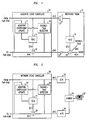
- Fig. 1 shows a diagram of an illustrative acoustic echo canceller.
- stereo echo cancellers are used, but in the context of the instant problem and the present invention, the illustrative use of a single-channel teleconferencing system will be adequate.
- the components and operation of Fig. 1 will be described in detail below.
- Fig. 2 shows a diagram of an illustrative network echo canceller. The components and operation of Fig. 2 will also be described in detail below.
- echo cancellation is typically performed with use of an adaptive filter, fully familiar to those of ordinary skill in the art.
- the echo canceller mitigates the echo effect by adjusting the transfer function (i.e. , the impulse response characteristic) of the adaptive filter in order to generate an estimate of the unwanted return signal.
- the filter is adapted to mimic the effective transfer function of the acoustic path from the loudspeaker to the microphone in the acoustic echo cancellation application, or the effective transfer function of the reflection in the network echo cancellation application.
- the incoming signal i.e. , the signal coming from the far-end
- the output of the filter will estimate the unwanted return signal.
- this estimate is subtracted from the outgoing signal (i.e., the return signal) to produce an error signal.
- the filter impulse response characteristic such that the error signal approaches zero, the echo is advantageously reduced or eliminated. That is, the filter coefficients, and hence the estimate of the unwanted echo, are updated in response to continuously received samples of the error signal for more closely effectuating as complete a cancellation of the echo as possible.
- double talk detectors are generally used in echo cancellers in order to disable the filter adaptation during double talk conditions. That is, when both the near end and the far end party to a conversation taking place across a telecommunications line speak simultaneously, it would be undesirable to attempt to minimize the entire "error signal," since that signal now also includes the "double talk” (i.e. , the speech of the near-end speaker). Specifically, the function of a double talk detector is to recognize that double talk is occurring, and to stop the filter from further adaptation until the double talk situation ceases.
- a fast converging coefficient adaptation algorithm such as those commonly employed in adaptive filters used in echo cancellation applications, may be advantageously modified based on a predetermined probability density function for the error signal upon which the adaptation process is based. That is, improved robustness may be achieved when one of certain particular probability density functions for the error signal is both assumed and then explicitly taken into account in the design of the filter adaptation algorithm.
- the use of certain advantageously selected non-Gaussian probability density functions has been shown to provide for particularly robust adaptation algorithms.
- the present invention provides an adaptive filter (and a corresponding adaptive filtering method) comprising a finite impulse response filter having a vector of adaptive coefficients, and an adaptive coefficient vector update module which modifies the vector of adaptive coefficients in response to an error signal and based on a predetermined probability density function for said error signal.
- Fig. 1 shows a block diagram of an acoustic echo canceller in accordance with an illustrative embodiment of the present invention.
- the environment in which the illustrative echo canceller operates includes (near-end) receiving room 12, which contains a conventional loudspeaker 13 and a conventional microphone 14.
- Loudspeaker 13 produces an acoustic signal from far-end signal x ( n ), which comprises speech received from a far-end talker.
- h ( n ) effectuated by the acoustic path(s) through room 12, an echo, y N( n ), is produced.
- Implicit transfer function h ( n ) is illustratively shown in the figure as filter 15.
- the transfer function h ( n ) is likely to change over time, as a result, for example, of movement within the room of either the loudspeaker, the microphone, the occupants, etc.
- the echo, y N( n ) is combined with the room's ambient noise, w ( n ), and if there is double-talk (i.e., a person in room 12 who is also talking), is also combined with the double-talk, v ( n ).
- This implicit combination of signals occurring in room 12 is illustratively shown in the figure as adder 16.
- the resultant combined signal is then picked up by microphone 14 which generates return signal y ( n ), which may contain, inter alia, an echo.
- Acoustic echo canceller 10 of Fig. 1 comprises (adaptive) filter 11, adaptive coefficient update module 17, double-talk detector 18, and conventional subtractor 19.
- Filter 11 may be a conventional adaptive finite impulse response (FIR) filter, and may, for example, have a filter length of either 512 or 1024.
- Double-talk detector (DTD) 18 may also be conventional using, for example, the Geigel DTD technique familiar to those skilled in the art.
- adaptive coefficient update module 17 advantageously implements a Fast Recursive Least Squares (FRLS) adaptive algorithm based on a predetermined probability density function as further described below.
- FRLS Fast Recursive Least Squares
- the illustrative acoustic echo canceller of Fig. 1 filters the far-end signal, x ( n ), to produce an echo estimate signal, ,with use of filter 11, the coefficients of which are advantageously continuously adapted in accordance with the illustrative inventive algorithm of adaptive coefficient update module 17.
- the echo estimate signal is then subtracted from the return signal y ( n ) by subtractor 19 to generate the error signal, e(n).
- the error signal serves both as the primary input to adaptive coefficient update module 17 (which signal adaptive coefficient update module 17 attempts to minimize by its continuous updates of the filter coefficients), and as the signal to be returned to the far-end of the telecommunications system.
- Fig. 2 shows a block diagram of an illustrative network echo canceller in accordance with an illustrative embodiment of the present invention.
- the environment in which the illustrative network echo canceller operates comprises conventional telephone set 22, connected to conventional hybrid 24, which is fed by conventional digital-to-analog (D/A) converter 23, and which, in turn, feeds conventional analog-to-digital (A/D) converter 25.
- D/A 23 is fed by far-end signal x ( n ), which comprises speech received from a far-end talker.
- return signal y ( n ) as generated by A/D 25 may contain, inter alia, an echo.
- Network echo canceller 20 of Fig. 2 like acoustic echo canceller 10 of Fig. 1, comprises (adaptive) filter 21, adaptive coefficient update module 27, double-talk detector 28, and conventional subtractor 29.
- Filter 21 may be a conventional adaptive finite impulse response (FIR) filter, and may, for example, have a filter length of either 512 or 1024.
- Double-talk detector (DTD) 28 may also be conventional using, for example, the Geigel DTD technique familiar to those skilled in the art.
- adaptive coefficient update module 27 advantageously implements a Fast Recursive Least Squares (FRLS) adaptive algorithm based on a predetermined probability density function as further described below.
- FRLS Fast Recursive Least Squares
- the illustrative network echo canceller of Fig. 2 like the illustrative acoustic echo canceller of Fig. 1, filters the far-end signal, x ( n ), to produce an echo estimate signal, ,with use of filter 21, the coefficients of which are advantageously continuously adapted in accordance with the algorithm of adaptive coefficient update module 27.
- the echo estimate signal is then subtracted from the return signal y(n) by subtractor 29 to generate the error signal, e(n).
- the error signal serves both as the primary input to adaptive coefficient update module 27 (which signal adaptive coefficient update module 27 attempts to minimize by its continuous updates of the filter coefficients), and as the signal to be returned to the far-end of the telephone network.
- the error signal, e(n) (which is by definition the difference between the system and model filter outputs), is implicitly assumed to be zero-mean, white, and Gaussian. That is, the recursive least squares algorithm which is typically employed can be regarded as a maximum likelihood estimator in which the error distribution has been assumed to be Gaussian, and as such, it is asymptotically efficient. While this supposition is very convenient and extremely useful in practice, adaptive algorithms so optimized may be very sensitive to minor deviations from the assumptions.
- EC network echo cancellation
- AEC acoustic echo cancellation
- the DTD sometimes will fail to detect the beginning or ending of a double-talk mode and as a result, a burst of speech at the output of the echo path will disturb the estimation process. The occurrence rate of these bursts depends on the efficiency of the DTD and the intensity of double-talk modes.
- a desirable property of an adaptive algorithm is fast tracking.
- a high false alarm rate of the DTD reduces the amount of information that enters the algorithm, thereby reducing the tracking rate. False alarms should therefore be advantageously minimized so that valuable data are not discarded. Fewer false alarms however, results in more detection misses and degradation of the transfer function estimate.
- robustness against detection errors is advantageously incorporated in the estimation algorithm itself. As is familiar to those skilled in the art of statistics, the term "robustness" is used to mean insensitivity to small deviations of the real distribution from the assumed model distribution.
- p 1 ( z ) advantageously has a high kurtosis, and as is well known to those skilled in the art, PDFs with a large kurtosis are good models for speech signals, which turns out to be desirable in the instant context of echo cancellation under double-talk conditions.
- This PDF is known in the statistics art as the PDF of the least informative distribution. Like p 1 ( z ), it also has a mean and a variance equal to 0 and 1, respectively.
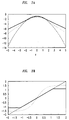
- Fig. 3 shows a graph illustrative of these three PDFs. Specifically, Fig. 3A shows the PDFs on a logarithmic scale and Fig. 3B shows the corresponding first derivatives, ⁇ ( z ), thereof. In the graphs, the dashed lines represent p G ( z ), the dotted lines represent p 1 (z) and the solid lines represent p 2 ( z ).
- T is the model filter
- superscript T denotes the transpose of a vector or a matrix.
- the first step in the derivation of a robust algorithm in accordance with the present invention is to choose an optimization criterion.
- ⁇ ( z ) ⁇ -ln[ p ( z )] is a convex function ( i.e. , ⁇ "( z ) > 0)
- s(n) is a positive scale factor more thoroughly described below.
- h (n) h (n-1)-R -1 ⁇ ⁇ J [ h ( n -1)], where ⁇ J ( h and ) is the gradient of the optimization criterion with respect to h and, and where R ⁇ , is an approximation of (See below -- note that E ⁇ denotes mathematical expectation.)
- R ⁇ ' E ⁇ x ( n ) x T ( n ) ⁇ . Since, in practice, R is not known, we advantageously estimate it recursively as follows: where ⁇ (0 ⁇ ⁇ ⁇ 1) is an exponential "forgetting" factor. The above choice of R ⁇ ' will advantageously allow us to derive a fast version of the robust algorithm.
- p 1 ( z ) the first illustrative PDF of the error signal described above:
- ⁇ ( z ) tanh( z )
- ⁇ '( z ) 1 cosh 2 ( z ) > 0, ⁇ z .
- 0 ⁇ ⁇ ' (z) ⁇ 1, ⁇ z , and ⁇ ' (z) can become very small.
- the error and the adaptation parts can be advantageously computed with 2L multiplications.
- this "problem" can be advantageously and easily fixed by simply re-initializing the predictor-based variables when instability is detected with the use of the maximum likelihood variable which is an inherent variable of the FRLS.
- a scale factor may be used to make a robust algorithm invariant to the noise level.
- it reflects the minimum mean square error, is robust to shorter burst disturbances (i.e., double-talk in our application), and tracks longer changes of the residual error (i.e. , echo path changes).
- ⁇ s 0.992
- ⁇ 1-1/(3 L )
- L is the filter length ( e.g. , 512 or 1024)
- s(n) is computed as described above but is advantageously limited so that it is never allowed to be lower than 0.01.
- processors may be provided through the use of dedicated hardware as well as hardware capable of executing software in association with appropriate software.
- the functions may be provided by a single dedicated processor, by a single shared processor, or by a plurality of individual processors, some of which may be shared.
- explicit use of the term "processor” or “controller” should not be construed to refer exclusively to, hardware capable of executing software, and may implicitly include, without limitation, digital signal processor (DSP) hardware, read-only memory (ROM) for storing software, random access memory (RAM), and non-volatile storage. Other hardware, conventional and/or custom, may also be included.
- DSP digital signal processor
- ROM read-only memory
- RAM random access memory
- non-volatile storage non-volatile storage
- any switches shown in the Figs. are conceptual only. Their function may be carried out through the operation of program logic, through dedicated logic, through the interaction of program control and dedicated logic, or even manually, the particular technique being selectable by the implementor as more specifically understood from the context.
- any element expressed as a means for performing a specified function is intended to encompass any way of performing that function including, for example, (a) a combination of circuit elements which performs that function or (b) software in any form, including, therefore, firmware, microcode or the like, combined with appropriate circuitry for executing that software to perform the function.
- the invention as defined by such claims resides in the fact that the functionalities provided by the various recited means are combined and brought together in the manner which the claims call for. Applicant thus regards any means which can provide those functionalities as equivalent (within the meaning of that term as used in 35 U.S.C. 112, paragraph 6) to those explicitly shown and described herein.
Landscapes
- Engineering & Computer Science (AREA)
- Signal Processing (AREA)
- Physics & Mathematics (AREA)
- Probability & Statistics with Applications (AREA)
- Cable Transmission Systems, Equalization Of Radio And Reduction Of Echo (AREA)
- Filters That Use Time-Delay Elements (AREA)
- Interconnected Communication Systems, Intercoms, And Interphones (AREA)
- Telephone Function (AREA)
Applications Claiming Priority (2)
| Application Number | Priority Date | Filing Date | Title |
|---|---|---|---|
| US603652 | 1990-10-26 | ||
| US09/603,652 US6377682B1 (en) | 2000-06-26 | 2000-06-26 | Robust adaptive filter for use in acoustic and network echo cancellation |
Publications (1)
| Publication Number | Publication Date |
|---|---|
| EP1170864A1 true EP1170864A1 (en) | 2002-01-09 |
Family
ID=24416367
Family Applications (1)
| Application Number | Title | Priority Date | Filing Date |
|---|---|---|---|
| EP01300126A Ceased EP1170864A1 (en) | 2000-06-26 | 2001-01-08 | A robust adaptive filter for use in acoustic and network echo cancellation |
Country Status (3)
| Country | Link |
|---|---|
| US (1) | US6377682B1 (enExample) |
| EP (1) | EP1170864A1 (enExample) |
| JP (1) | JP2002057606A (enExample) |
Families Citing this family (16)
| Publication number | Priority date | Publication date | Assignee | Title |
|---|---|---|---|---|
| US7072465B1 (en) * | 1999-01-06 | 2006-07-04 | Agere Systems, Inc. | Adaptive filter for network echo cancellation |
| US6944290B2 (en) * | 2001-04-14 | 2005-09-13 | Intel Coporation | Echo cancellation through auxiliary-vector filtering |
| US6947550B2 (en) * | 2002-04-30 | 2005-09-20 | Innomedia Pte Ltd. | Acoustic echo cancellation |
| US20040234067A1 (en) * | 2003-05-19 | 2004-11-25 | Acoustic Technologies, Inc. | Distributed VAD control system for telephone |
| US7031461B2 (en) * | 2004-01-12 | 2006-04-18 | Acoustic Technologies, Inc. | Robust adaptive filter for echo cancellation |
| US7187320B1 (en) | 2004-08-27 | 2007-03-06 | Lockheed Martin Corporation | Matched maneuver detector |
| JP4581114B2 (ja) * | 2005-05-16 | 2010-11-17 | 株式会社国際電気通信基礎技術研究所 | 適応型ビーム形成器 |
| JP4891805B2 (ja) * | 2007-02-23 | 2012-03-07 | 日本電信電話株式会社 | 残響除去装置、残響除去方法、残響除去プログラム、記録媒体 |
| KR100949910B1 (ko) | 2008-05-26 | 2010-03-30 | (주)제너시스템즈 | 스펙트럼 차감을 이용한 음향학적 반향 제거 방법 및 장치 |
| US9124769B2 (en) * | 2008-10-31 | 2015-09-01 | The Nielsen Company (Us), Llc | Methods and apparatus to verify presentation of media content |
| JP5438629B2 (ja) * | 2010-08-23 | 2014-03-12 | 日本電信電話株式会社 | ステレオ反響消去方法、ステレオ反響消去装置、ステレオ反響消去プログラム |
| GB2501234A (en) | 2012-03-05 | 2013-10-23 | Microsoft Corp | Determining correlation between first and second received signals to estimate delay while a disturbance condition is present on the second signal |
| US11445306B2 (en) | 2016-08-26 | 2022-09-13 | Starkey Laboratories, Inc. | Method and apparatus for robust acoustic feedback cancellation |
| US12192705B2 (en) | 2020-04-09 | 2025-01-07 | Starkey Laboratories, Inc. | Hearing device with feedback instability detector that changes an adaptive filter |
| EP4158902B1 (en) | 2020-05-29 | 2026-06-17 | Starkey Laboratories, Inc. | Hearing device with motion sensor used to detect feedback path instability |
| EP4243449B1 (en) | 2022-03-09 | 2026-04-15 | Starkey Laboratories, Inc. | Apparatus and method for speech enhancement and feedback cancellation using a neural network |
Citations (2)
| Publication number | Priority date | Publication date | Assignee | Title |
|---|---|---|---|---|
| US5157690A (en) * | 1990-10-30 | 1992-10-20 | Level One Communications, Inc. | Adaptive convergent decision feedback equalizer |
| EP0750395A1 (en) * | 1995-06-19 | 1996-12-27 | AT&T IPM Corp. | Adaptive filter and method for implementing echo cancellation |
Family Cites Families (6)
| Publication number | Priority date | Publication date | Assignee | Title |
|---|---|---|---|---|
| US5295136A (en) * | 1992-04-13 | 1994-03-15 | Motorola, Inc. | Method of performing convergence in a, least mean square, adaptive filter, echo canceller |
| US5553014A (en) * | 1994-10-31 | 1996-09-03 | Lucent Technologies Inc. | Adaptive finite impulse response filtering method and apparatus |
| US5828756A (en) | 1994-11-22 | 1998-10-27 | Lucent Technologies Inc. | Stereophonic acoustic echo cancellation using non-linear transformations |
| SE516835C2 (sv) * | 1995-02-15 | 2002-03-12 | Ericsson Telefon Ab L M | Ekosläckningsförfarande |
| US5657384A (en) * | 1995-03-10 | 1997-08-12 | Tandy Corporation | Full duplex speakerphone |
| US5631900A (en) * | 1995-09-29 | 1997-05-20 | Crystal Semiconductor | Double-Talk detector for echo canceller |
-
2000
- 2000-06-26 US US09/603,652 patent/US6377682B1/en not_active Expired - Lifetime
-
2001
- 2001-01-08 EP EP01300126A patent/EP1170864A1/en not_active Ceased
- 2001-06-26 JP JP2001192523A patent/JP2002057606A/ja active Pending
Patent Citations (2)
| Publication number | Priority date | Publication date | Assignee | Title |
|---|---|---|---|---|
| US5157690A (en) * | 1990-10-30 | 1992-10-20 | Level One Communications, Inc. | Adaptive convergent decision feedback equalizer |
| EP0750395A1 (en) * | 1995-06-19 | 1996-12-27 | AT&T IPM Corp. | Adaptive filter and method for implementing echo cancellation |
Non-Patent Citations (1)
| Title |
|---|
| SHELUKHIN ETAL: "Preliminary filtering in a Kalman filter with a priori uncertainty", TELECOMMUNICATIONS AND RADIO ENGINEERING., vol. 38/39, no. 9, September 1984 (1984-09-01), BEGELL HOUSE, INC., NEW YORK, NY., US, XP002168244, ISSN: 0040-2508 * |
Also Published As
| Publication number | Publication date |
|---|---|
| JP2002057606A (ja) | 2002-02-22 |
| US6377682B1 (en) | 2002-04-23 |
Similar Documents
| Publication | Publication Date | Title |
|---|---|---|
| US5278900A (en) | Digital echo canceller comprising a double-talk detector | |
| US6947549B2 (en) | Echo canceller | |
| US6377682B1 (en) | Robust adaptive filter for use in acoustic and network echo cancellation | |
| EP0746134B1 (en) | Acoustic echo canceler | |
| US5663955A (en) | Echo canceller system with shared coefficient memory | |
| EP0901267B1 (en) | The detection of the speech activity of a source | |
| EP1865615B1 (en) | Improved method and apparatus for detecting echo path changes in an acoustic echo canceller | |
| US5732134A (en) | Doubletalk detection by means of spectral content | |
| US20090123002A1 (en) | System and method for providing step size control for subband affine projection filters for echo cancellation applications | |
| US6928160B2 (en) | Estimating bulk delay in a telephone system | |
| US5734715A (en) | Process and device for adaptive identification and adaptive echo canceller relating thereto | |
| US6532289B1 (en) | Method and device for echo suppression | |
| US8116448B2 (en) | Acoustic echo canceler | |
| US6766019B1 (en) | Method and apparatus for performing double-talk detection in acoustic echo cancellation | |
| US8831210B2 (en) | Method and system for detection of onset of near-end signal in an echo cancellation system | |
| US7103177B2 (en) | Reduced complexity transform-domain adaptive filter using selective partial updates | |
| US6757384B1 (en) | Robust double-talk detection and recovery in a system for echo cancelation | |
| SE511073C2 (sv) | Sätt och anordning för ekoestimering och undertryckning i telefonsystem | |
| CN113241084B (zh) | 回声消除的方法、装置及设备 | |
| US10498389B2 (en) | Echo canceller device and voice telecommunications device | |
| US6580795B1 (en) | Echo canceller for a full-duplex communication system and method therefor | |
| EP1783923B1 (en) | Double-talk detector for acoustic echo cancellation | |
| US6574337B1 (en) | Adaptive echo canceler undoing adaptations made during double-talk | |
| Reza Asharif et al. | Correlation LMS algorithm and its application to double-talk echo cancelling | |
| Benesty et al. | A robust fast recursive least squares adaptive algorithm |
Legal Events
| Date | Code | Title | Description |
|---|---|---|---|
| PUAI | Public reference made under article 153(3) epc to a published international application that has entered the european phase |
Free format text: ORIGINAL CODE: 0009012 |
|
| 17P | Request for examination filed |
Effective date: 20010119 |
|
| AK | Designated contracting states |
Kind code of ref document: A1 Designated state(s): AT BE CH CY DE DK ES FI FR GB GR IE IT LI LU MC NL PT SE TR Kind code of ref document: A1 Designated state(s): DE FR GB |
|
| AX | Request for extension of the european patent |
Free format text: AL;LT;LV;MK;RO;SI |
|
| AKX | Designation fees paid |
Free format text: DE FR GB |
|
| STAA | Information on the status of an ep patent application or granted ep patent |
Free format text: STATUS: THE APPLICATION HAS BEEN REFUSED |
|
| 18R | Application refused |
Effective date: 20020720 |