EP1170298A1 - Polyfluoralkylsilane - Google Patents
Polyfluoralkylsilane Download PDFInfo
- Publication number
- EP1170298A1 EP1170298A1 EP01114733A EP01114733A EP1170298A1 EP 1170298 A1 EP1170298 A1 EP 1170298A1 EP 01114733 A EP01114733 A EP 01114733A EP 01114733 A EP01114733 A EP 01114733A EP 1170298 A1 EP1170298 A1 EP 1170298A1
- Authority
- EP
- European Patent Office
- Prior art keywords
- alkyl
- aryl
- formula
- compounds
- aryloxy
- Prior art date
- Legal status (The legal status is an assumption and is not a legal conclusion. Google has not performed a legal analysis and makes no representation as to the accuracy of the status listed.)
- Withdrawn
Links
- 150000001875 compounds Chemical class 0.000 claims abstract description 59
- 125000003118 aryl group Chemical group 0.000 claims abstract description 34
- 125000002252 acyl group Chemical group 0.000 claims abstract description 33
- 125000000472 sulfonyl group Chemical group *S(*)(=O)=O 0.000 claims abstract description 33
- 125000000217 alkyl group Chemical group 0.000 claims abstract description 29
- 229910052739 hydrogen Inorganic materials 0.000 claims abstract description 29
- 229910052731 fluorine Inorganic materials 0.000 claims abstract description 28
- -1 1,1,2-trifluoroethyl moiety Chemical group 0.000 claims abstract description 23
- 125000004469 siloxy group Chemical group [SiH3]O* 0.000 claims abstract description 17
- 239000004973 liquid crystal related substance Substances 0.000 claims abstract description 14
- 238000002360 preparation method Methods 0.000 claims abstract description 14
- 125000000753 cycloalkyl group Chemical group 0.000 claims abstract description 13
- 125000005553 heteroaryloxy group Chemical group 0.000 claims abstract description 11
- 125000003545 alkoxy group Chemical group 0.000 claims abstract description 10
- 125000001072 heteroaryl group Chemical group 0.000 claims abstract description 7
- 125000004414 alkyl thio group Chemical group 0.000 claims abstract description 5
- 125000005110 aryl thio group Chemical group 0.000 claims abstract description 5
- 239000012025 fluorinating agent Substances 0.000 claims abstract description 5
- 229910052710 silicon Inorganic materials 0.000 claims abstract description 5
- 229910052801 chlorine Inorganic materials 0.000 claims abstract description 4
- 125000003709 fluoroalkyl group Chemical group 0.000 claims abstract description 4
- 239000010703 silicon Substances 0.000 claims abstract description 4
- 229910052736 halogen Inorganic materials 0.000 claims description 48
- 150000002367 halogens Chemical class 0.000 claims description 47
- 125000005914 C6-C14 aryloxy group Chemical group 0.000 claims description 36
- 238000000034 method Methods 0.000 claims description 29
- 239000001257 hydrogen Substances 0.000 claims description 27
- 239000011737 fluorine Substances 0.000 claims description 25
- GBXQPDCOMJJCMJ-UHFFFAOYSA-M trimethyl-[6-(trimethylazaniumyl)hexyl]azanium;bromide Chemical compound [Br-].C[N+](C)(C)CCCCCC[N+](C)(C)C GBXQPDCOMJJCMJ-UHFFFAOYSA-M 0.000 claims description 25
- 125000001424 substituent group Chemical group 0.000 claims description 23
- UFHFLCQGNIYNRP-UHFFFAOYSA-N Hydrogen Chemical compound [H][H] UFHFLCQGNIYNRP-UHFFFAOYSA-N 0.000 claims description 21
- 125000004093 cyano group Chemical group *C#N 0.000 claims description 21
- 150000002431 hydrogen Chemical class 0.000 claims description 21
- 125000000449 nitro group Chemical group [O-][N+](*)=O 0.000 claims description 15
- 150000001412 amines Chemical class 0.000 claims description 11
- 238000004519 manufacturing process Methods 0.000 claims description 10
- IXMGFEWHPHOCQV-UHFFFAOYSA-N [SiH3]ON(C#N)[N+](=O)[O-] Chemical compound [SiH3]ON(C#N)[N+](=O)[O-] IXMGFEWHPHOCQV-UHFFFAOYSA-N 0.000 claims description 9
- 125000003710 aryl alkyl group Chemical group 0.000 claims description 7
- UUEVFMOUBSLVJW-UHFFFAOYSA-N oxo-[[1-[2-[2-[2-[4-(oxoazaniumylmethylidene)pyridin-1-yl]ethoxy]ethoxy]ethyl]pyridin-4-ylidene]methyl]azanium;dibromide Chemical compound [Br-].[Br-].C1=CC(=C[NH+]=O)C=CN1CCOCCOCCN1C=CC(=C[NH+]=O)C=C1 UUEVFMOUBSLVJW-UHFFFAOYSA-N 0.000 claims description 7
- 125000006763 (C3-C9) cycloalkyl group Chemical group 0.000 claims description 6
- 150000003254 radicals Chemical class 0.000 claims description 6
- CIUQDSCDWFSTQR-UHFFFAOYSA-N [C]1=CC=CC=C1 Chemical compound [C]1=CC=CC=C1 CIUQDSCDWFSTQR-UHFFFAOYSA-N 0.000 claims description 5
- 125000005010 perfluoroalkyl group Chemical group 0.000 claims description 5
- ZAMOUSCENKQFHK-UHFFFAOYSA-N Chlorine atom Chemical compound [Cl] ZAMOUSCENKQFHK-UHFFFAOYSA-N 0.000 claims description 4
- 235000010290 biphenyl Nutrition 0.000 claims description 4
- 239000004305 biphenyl Substances 0.000 claims description 4
- 239000003814 drug Substances 0.000 claims description 4
- ZUOUZKKEUPVFJK-UHFFFAOYSA-N phenylbenzene Natural products C1=CC=CC=C1C1=CC=CC=C1 ZUOUZKKEUPVFJK-UHFFFAOYSA-N 0.000 claims description 4
- YUDRVAHLXDBKSR-UHFFFAOYSA-N [CH]1CCCCC1 Chemical compound [CH]1CCCCC1 YUDRVAHLXDBKSR-UHFFFAOYSA-N 0.000 claims description 3
- 239000003905 agrochemical Substances 0.000 claims description 3
- 239000000460 chlorine Substances 0.000 claims description 3
- 125000001153 fluoro group Chemical group F* 0.000 claims description 2
- 230000003287 optical effect Effects 0.000 claims description 2
- PXGOKWXKJXAPGV-UHFFFAOYSA-N Fluorine Chemical compound FF PXGOKWXKJXAPGV-UHFFFAOYSA-N 0.000 claims 8
- 125000004104 aryloxy group Chemical group 0.000 abstract 4
- 125000001475 halogen functional group Chemical group 0.000 abstract 4
- 125000002924 primary amino group Chemical group [H]N([H])* 0.000 abstract 3
- 239000005046 Chlorosilane Substances 0.000 abstract 2
- JCXJVPUVTGWSNB-UHFFFAOYSA-N Nitrogen dioxide Chemical compound O=[N]=O JCXJVPUVTGWSNB-UHFFFAOYSA-N 0.000 abstract 2
- 125000004453 alkoxycarbonyl group Chemical group 0.000 abstract 2
- KOPOQZFJUQMUML-UHFFFAOYSA-N chlorosilane Chemical compound Cl[SiH3] KOPOQZFJUQMUML-UHFFFAOYSA-N 0.000 abstract 2
- 150000004756 silanes Chemical class 0.000 abstract 2
- LFQSCWFLJHTTHZ-UHFFFAOYSA-N Ethanol Chemical compound CCO LFQSCWFLJHTTHZ-UHFFFAOYSA-N 0.000 abstract 1
- 239000003795 chemical substances by application Substances 0.000 abstract 1
- YCKRFDGAMUMZLT-UHFFFAOYSA-N Fluorine atom Chemical compound [F] YCKRFDGAMUMZLT-UHFFFAOYSA-N 0.000 description 30
- 125000005915 C6-C14 aryl group Chemical group 0.000 description 17
- 125000004178 (C1-C4) alkyl group Chemical group 0.000 description 14
- 125000004169 (C1-C6) alkyl group Chemical group 0.000 description 10
- MZRVEZGGRBJDDB-UHFFFAOYSA-N N-Butyllithium Chemical compound [Li]CCCC MZRVEZGGRBJDDB-UHFFFAOYSA-N 0.000 description 10
- 238000006243 chemical reaction Methods 0.000 description 10
- 239000002585 base Substances 0.000 description 9
- 125000000229 (C1-C4)alkoxy group Chemical group 0.000 description 8
- IJGRMHOSHXDMSA-UHFFFAOYSA-N Atomic nitrogen Chemical compound N#N IJGRMHOSHXDMSA-UHFFFAOYSA-N 0.000 description 8
- BZLVMXJERCGZMT-UHFFFAOYSA-N Methyl tert-butyl ether Chemical compound COC(C)(C)C BZLVMXJERCGZMT-UHFFFAOYSA-N 0.000 description 8
- 125000004209 (C1-C8) alkyl group Chemical group 0.000 description 7
- IJOOHPMOJXWVHK-UHFFFAOYSA-N chlorotrimethylsilane Chemical compound C[Si](C)(C)Cl IJOOHPMOJXWVHK-UHFFFAOYSA-N 0.000 description 6
- FPGGTKZVZWFYPV-UHFFFAOYSA-M tetrabutylammonium fluoride Chemical compound [F-].CCCC[N+](CCCC)(CCCC)CCCC FPGGTKZVZWFYPV-UHFFFAOYSA-M 0.000 description 6
- 125000002023 trifluoromethyl group Chemical group FC(F)(F)* 0.000 description 6
- CSJLBAMHHLJAAS-UHFFFAOYSA-N diethylaminosulfur trifluoride Chemical compound CCN(CC)S(F)(F)F CSJLBAMHHLJAAS-UHFFFAOYSA-N 0.000 description 5
- 239000000203 mixture Substances 0.000 description 5
- 239000002904 solvent Substances 0.000 description 5
- 229930194542 Keto Natural products 0.000 description 4
- ZLMJMSJWJFRBEC-UHFFFAOYSA-N Potassium Chemical compound [K] ZLMJMSJWJFRBEC-UHFFFAOYSA-N 0.000 description 4
- WQDUMFSSJAZKTM-UHFFFAOYSA-N Sodium methoxide Chemical compound [Na+].[O-]C WQDUMFSSJAZKTM-UHFFFAOYSA-N 0.000 description 4
- DCFKHNIGBAHNSS-UHFFFAOYSA-N chloro(triethyl)silane Chemical compound CC[Si](Cl)(CC)CC DCFKHNIGBAHNSS-UHFFFAOYSA-N 0.000 description 4
- 125000004185 ester group Chemical group 0.000 description 4
- 150000002222 fluorine compounds Chemical class 0.000 description 4
- 125000002485 formyl group Chemical class [H]C(*)=O 0.000 description 4
- 239000007789 gas Substances 0.000 description 4
- 238000004817 gas chromatography Methods 0.000 description 4
- 125000000468 ketone group Chemical group 0.000 description 4
- 229910052757 nitrogen Inorganic materials 0.000 description 4
- 229910052700 potassium Inorganic materials 0.000 description 4
- 239000011591 potassium Substances 0.000 description 4
- 239000000243 solution Substances 0.000 description 4
- RTZKZFJDLAIYFH-UHFFFAOYSA-N Diethyl ether Chemical compound CCOCC RTZKZFJDLAIYFH-UHFFFAOYSA-N 0.000 description 3
- XUIMIQQOPSSXEZ-UHFFFAOYSA-N Silicon Chemical compound [Si] XUIMIQQOPSSXEZ-UHFFFAOYSA-N 0.000 description 3
- YXFVVABEGXRONW-UHFFFAOYSA-N Toluene Chemical compound CC1=CC=CC=C1 YXFVVABEGXRONW-UHFFFAOYSA-N 0.000 description 3
- 238000009835 boiling Methods 0.000 description 3
- 238000001816 cooling Methods 0.000 description 3
- 239000000706 filtrate Substances 0.000 description 3
- 229910052744 lithium Inorganic materials 0.000 description 3
- VLKZOEOYAKHREP-UHFFFAOYSA-N n-Hexane Chemical compound CCCCCC VLKZOEOYAKHREP-UHFFFAOYSA-N 0.000 description 3
- 125000006340 pentafluoro ethyl group Chemical group FC(F)(F)C(F)(F)* 0.000 description 3
- 239000011734 sodium Substances 0.000 description 3
- 239000005051 trimethylchlorosilane Substances 0.000 description 3
- XKRFYHLGVUSROY-UHFFFAOYSA-N Argon Chemical compound [Ar] XKRFYHLGVUSROY-UHFFFAOYSA-N 0.000 description 2
- 238000003747 Grignard reaction Methods 0.000 description 2
- DGAQECJNVWCQMB-PUAWFVPOSA-M Ilexoside XXIX Chemical compound C[C@@H]1CC[C@@]2(CC[C@@]3(C(=CC[C@H]4[C@]3(CC[C@@H]5[C@@]4(CC[C@@H](C5(C)C)OS(=O)(=O)[O-])C)C)[C@@H]2[C@]1(C)O)C)C(=O)O[C@H]6[C@@H]([C@H]([C@@H]([C@H](O6)CO)O)O)O.[Na+] DGAQECJNVWCQMB-PUAWFVPOSA-M 0.000 description 2
- WHXSMMKQMYFTQS-UHFFFAOYSA-N Lithium Chemical compound [Li] WHXSMMKQMYFTQS-UHFFFAOYSA-N 0.000 description 2
- XYFCBTPGUUZFHI-UHFFFAOYSA-N Phosphine Chemical compound P XYFCBTPGUUZFHI-UHFFFAOYSA-N 0.000 description 2
- WYURNTSHIVDZCO-UHFFFAOYSA-N Tetrahydrofuran Chemical compound C1CCOC1 WYURNTSHIVDZCO-UHFFFAOYSA-N 0.000 description 2
- 239000007983 Tris buffer Substances 0.000 description 2
- 239000013543 active substance Substances 0.000 description 2
- 239000003513 alkali Substances 0.000 description 2
- 229950003621 butoxylate Drugs 0.000 description 2
- 150000004694 iodide salts Chemical class 0.000 description 2
- 238000004949 mass spectrometry Methods 0.000 description 2
- NROKBHXJSPEDAR-UHFFFAOYSA-M potassium fluoride Chemical compound [F-].[K+] NROKBHXJSPEDAR-UHFFFAOYSA-M 0.000 description 2
- 229910052708 sodium Inorganic materials 0.000 description 2
- PUZPDOWCWNUUKD-UHFFFAOYSA-M sodium fluoride Chemical compound [F-].[Na+] PUZPDOWCWNUUKD-UHFFFAOYSA-M 0.000 description 2
- 229910000104 sodium hydride Inorganic materials 0.000 description 2
- 239000007858 starting material Substances 0.000 description 2
- 239000000126 substance Substances 0.000 description 2
- BEPCUGVFWAYLBF-UHFFFAOYSA-N 1,1,1,2-tetrafluoro-2-methoxyethane Chemical compound COC(F)C(F)(F)F BEPCUGVFWAYLBF-UHFFFAOYSA-N 0.000 description 1
- NCEMWHLBZAIVJN-UHFFFAOYSA-N 1,2,2,2-tetrafluoroethoxybenzene Chemical compound FC(F)(F)C(F)OC1=CC=CC=C1 NCEMWHLBZAIVJN-UHFFFAOYSA-N 0.000 description 1
- AZHLOUTUULYQSA-UHFFFAOYSA-N 1-n,1-n,1-n',1-n',1-n",1-n",2-n,2-n-octamethylethane-1,1,1,2-tetramine Chemical compound CN(C)CC(N(C)C)(N(C)C)N(C)C AZHLOUTUULYQSA-UHFFFAOYSA-N 0.000 description 1
- 0 CN(C)*1=CC1 Chemical compound CN(C)*1=CC1 0.000 description 1
- XDTMQSROBMDMFD-UHFFFAOYSA-N Cyclohexane Chemical compound C1CCCCC1 XDTMQSROBMDMFD-UHFFFAOYSA-N 0.000 description 1
- OTMSDBZUPAUEDD-UHFFFAOYSA-N Ethane Chemical compound CC OTMSDBZUPAUEDD-UHFFFAOYSA-N 0.000 description 1
- KRHYYFGTRYWZRS-UHFFFAOYSA-M Fluoride anion Chemical compound [F-] KRHYYFGTRYWZRS-UHFFFAOYSA-M 0.000 description 1
- SECXISVLQFMRJM-UHFFFAOYSA-N N-Methylpyrrolidone Chemical compound CN1CCCC1=O SECXISVLQFMRJM-UHFFFAOYSA-N 0.000 description 1
- CTQNGGLPUBDAKN-UHFFFAOYSA-N O-Xylene Chemical compound CC1=CC=CC=C1C CTQNGGLPUBDAKN-UHFFFAOYSA-N 0.000 description 1
- KEAYESYHFKHZAL-UHFFFAOYSA-N Sodium Chemical compound [Na] KEAYESYHFKHZAL-UHFFFAOYSA-N 0.000 description 1
- 238000010521 absorption reaction Methods 0.000 description 1
- 230000002411 adverse Effects 0.000 description 1
- 150000001335 aliphatic alkanes Chemical class 0.000 description 1
- XAGFODPZIPBFFR-UHFFFAOYSA-N aluminium Chemical compound [Al] XAGFODPZIPBFFR-UHFFFAOYSA-N 0.000 description 1
- 229910052782 aluminium Inorganic materials 0.000 description 1
- 238000004458 analytical method Methods 0.000 description 1
- 230000000843 anti-fungal effect Effects 0.000 description 1
- 230000000259 anti-tumor effect Effects 0.000 description 1
- 230000000840 anti-viral effect Effects 0.000 description 1
- 229940121375 antifungal agent Drugs 0.000 description 1
- 239000000010 aprotic solvent Substances 0.000 description 1
- 229910052786 argon Inorganic materials 0.000 description 1
- 150000004982 aromatic amines Chemical class 0.000 description 1
- NLANKNMPZSGGEF-UHFFFAOYSA-N butyl(triethyl)silane Chemical compound CCCC[Si](CC)(CC)CC NLANKNMPZSGGEF-UHFFFAOYSA-N 0.000 description 1
- 239000000969 carrier Substances 0.000 description 1
- 239000008139 complexing agent Substances 0.000 description 1
- 125000000113 cyclohexyl group Chemical group [H]C1([H])C([H])([H])C([H])([H])C([H])(*)C([H])([H])C1([H])[H] 0.000 description 1
- 125000004663 dialkyl amino group Chemical group 0.000 description 1
- 150000001983 dialkylethers Chemical class 0.000 description 1
- SBZXBUIDTXKZTM-UHFFFAOYSA-N diglyme Chemical compound COCCOCCOC SBZXBUIDTXKZTM-UHFFFAOYSA-N 0.000 description 1
- 238000004821 distillation Methods 0.000 description 1
- 229940079593 drug Drugs 0.000 description 1
- 239000001307 helium Substances 0.000 description 1
- 229910052734 helium Inorganic materials 0.000 description 1
- SWQJXJOGLNCZEY-UHFFFAOYSA-N helium atom Chemical compound [He] SWQJXJOGLNCZEY-UHFFFAOYSA-N 0.000 description 1
- 150000007529 inorganic bases Chemical class 0.000 description 1
- 150000007530 organic bases Chemical class 0.000 description 1
- NFHFRUOZVGFOOS-UHFFFAOYSA-N palladium;triphenylphosphane Chemical compound [Pd].C1=CC=CC=C1P(C=1C=CC=CC=1)C1=CC=CC=C1.C1=CC=CC=C1P(C=1C=CC=CC=1)C1=CC=CC=C1.C1=CC=CC=C1P(C=1C=CC=CC=1)C1=CC=CC=C1.C1=CC=CC=C1P(C=1C=CC=CC=1)C1=CC=CC=C1 NFHFRUOZVGFOOS-UHFFFAOYSA-N 0.000 description 1
- GTLACDSXYULKMZ-UHFFFAOYSA-N pentafluoroethane Chemical compound FC(F)C(F)(F)F GTLACDSXYULKMZ-UHFFFAOYSA-N 0.000 description 1
- 125000001997 phenyl group Chemical group [H]C1=C([H])C([H])=C(*)C([H])=C1[H] 0.000 description 1
- 229910000073 phosphorus hydride Inorganic materials 0.000 description 1
- 229920000570 polyether Polymers 0.000 description 1
- 229920000642 polymer Polymers 0.000 description 1
- 235000003270 potassium fluoride Nutrition 0.000 description 1
- 239000011698 potassium fluoride Substances 0.000 description 1
- NTTOTNSKUYCDAV-UHFFFAOYSA-N potassium hydride Chemical compound [KH] NTTOTNSKUYCDAV-UHFFFAOYSA-N 0.000 description 1
- 229910000105 potassium hydride Inorganic materials 0.000 description 1
- 230000001681 protective effect Effects 0.000 description 1
- 239000011541 reaction mixture Substances 0.000 description 1
- FZHAPNGMFPVSLP-UHFFFAOYSA-N silanamine Chemical class [SiH3]N FZHAPNGMFPVSLP-UHFFFAOYSA-N 0.000 description 1
- QDRKDTQENPPHOJ-UHFFFAOYSA-N sodium ethoxide Chemical compound [Na+].CC[O-] QDRKDTQENPPHOJ-UHFFFAOYSA-N 0.000 description 1
- 235000013024 sodium fluoride Nutrition 0.000 description 1
- 239000011775 sodium fluoride Substances 0.000 description 1
- 239000012312 sodium hydride Substances 0.000 description 1
- 150000003457 sulfones Chemical class 0.000 description 1
- YLQBMQCUIZJEEH-UHFFFAOYSA-N tetrahydrofuran Natural products C=1C=COC=1 YLQBMQCUIZJEEH-UHFFFAOYSA-N 0.000 description 1
- JYRZISDGRVMDJS-UHFFFAOYSA-N triethyl(1,1,2,2,2-pentafluoroethyl)silane Chemical compound CC[Si](CC)(CC)C(F)(F)C(F)(F)F JYRZISDGRVMDJS-UHFFFAOYSA-N 0.000 description 1
- MWKJTNBSKNUMFN-UHFFFAOYSA-N trifluoromethyltrimethylsilane Chemical compound C[Si](C)(C)C(F)(F)F MWKJTNBSKNUMFN-UHFFFAOYSA-N 0.000 description 1
- 239000008096 xylene Substances 0.000 description 1
Classifications
-
- C—CHEMISTRY; METALLURGY
- C07—ORGANIC CHEMISTRY
- C07F—ACYCLIC, CARBOCYCLIC OR HETEROCYCLIC COMPOUNDS CONTAINING ELEMENTS OTHER THAN CARBON, HYDROGEN, HALOGEN, OXYGEN, NITROGEN, SULFUR, SELENIUM OR TELLURIUM
- C07F7/00—Compounds containing elements of Groups 4 or 14 of the Periodic Table
- C07F7/02—Silicon compounds
- C07F7/08—Compounds having one or more C—Si linkages
- C07F7/0803—Compounds with Si-C or Si-Si linkages
- C07F7/0825—Preparations of compounds not comprising Si-Si or Si-cyano linkages
- C07F7/0827—Syntheses with formation of a Si-C bond
-
- A—HUMAN NECESSITIES
- A01—AGRICULTURE; FORESTRY; ANIMAL HUSBANDRY; HUNTING; TRAPPING; FISHING
- A01N—PRESERVATION OF BODIES OF HUMANS OR ANIMALS OR PLANTS OR PARTS THEREOF; BIOCIDES, e.g. AS DISINFECTANTS, AS PESTICIDES OR AS HERBICIDES; PEST REPELLANTS OR ATTRACTANTS; PLANT GROWTH REGULATORS
- A01N55/00—Biocides, pest repellants or attractants, or plant growth regulators, containing organic compounds containing elements other than carbon, hydrogen, halogen, oxygen, nitrogen and sulfur
-
- A—HUMAN NECESSITIES
- A61—MEDICAL OR VETERINARY SCIENCE; HYGIENE
- A61K—PREPARATIONS FOR MEDICAL, DENTAL OR TOILETRY PURPOSES
- A61K31/00—Medicinal preparations containing organic active ingredients
- A61K31/695—Silicon compounds
-
- C—CHEMISTRY; METALLURGY
- C07—ORGANIC CHEMISTRY
- C07F—ACYCLIC, CARBOCYCLIC OR HETEROCYCLIC COMPOUNDS CONTAINING ELEMENTS OTHER THAN CARBON, HYDROGEN, HALOGEN, OXYGEN, NITROGEN, SULFUR, SELENIUM OR TELLURIUM
- C07F7/00—Compounds containing elements of Groups 4 or 14 of the Periodic Table
- C07F7/02—Silicon compounds
- C07F7/08—Compounds having one or more C—Si linkages
- C07F7/0803—Compounds with Si-C or Si-Si linkages
- C07F7/081—Compounds with Si-C or Si-Si linkages comprising at least one atom selected from the elements N, O, halogen, S, Se or Te
-
- C—CHEMISTRY; METALLURGY
- C09—DYES; PAINTS; POLISHES; NATURAL RESINS; ADHESIVES; COMPOSITIONS NOT OTHERWISE PROVIDED FOR; APPLICATIONS OF MATERIALS NOT OTHERWISE PROVIDED FOR
- C09K—MATERIALS FOR MISCELLANEOUS APPLICATIONS, NOT PROVIDED FOR ELSEWHERE
- C09K19/00—Liquid crystal materials
- C09K19/04—Liquid crystal materials characterised by the chemical structure of the liquid crystal components, e.g. by a specific unit
- C09K19/40—Liquid crystal materials characterised by the chemical structure of the liquid crystal components, e.g. by a specific unit containing elements other than carbon, hydrogen, halogen, oxygen, nitrogen or sulfur, e.g. silicon, metals
- C09K19/406—Liquid crystal materials characterised by the chemical structure of the liquid crystal components, e.g. by a specific unit containing elements other than carbon, hydrogen, halogen, oxygen, nitrogen or sulfur, e.g. silicon, metals containing silicon
Definitions
- the invention relates to polyfluoroalkylsilanes, a process for their preparation and their use and liquid crystals made with them.
- Fluorinated organic molecules are of great importance for the production of Polymers, agrochemicals and pharmaceuticals. Especially in the field of Pharmacy has succeeded in a wide range of effective antiviral, antitumor and to develop antifungal substances, their effectiveness on the introduction of a or more polyfluorinated groups.
- perfluoroalkyl compounds In pharmacy, there is particular interest in perfluoroalkyl compounds since the Presence of perfluoroalkyl groups the transport and the rate of absorption of a favored medication in the body. Perfluoroalkyl compounds are also found their application in the manufacture of liquid crystals.
- Perfluoroalkylsilyl compounds are able to transfer perfluoroalkyl groups to others Transfer molecules.
- perfluoroalkylsilyl compounds by reacting perfluoroalkyl bromides or to produce iodides with trimethylchlorosilane.
- the implementation takes place in the presence of tris (diethylamido) phosphine (Ruppert et al., Tetrahedron Lett. 25, 1984, 2195-2198) or tetrakis (dimethylamino) ethane (Pawelke, J. Fluorine Chem. 42, 1989, 429-433).
- a disadvantage of this process is that perfluoroalkyl bromides and iodides are not available cheaply.
- the high cost of Output connections limit the applicability of those described above Industrial manufacturing processes strongly.
- Long chain perfluoroalkylsilanes can by reacting perfluoroalkyl halogens and trimethylchlorosilane via a Grignard reaction (See, for example, Smith et al., J. Organomet. Chem. 46, 1972, 251-254). adversely However, this method is that the method is not for manufacturing short perfluoroalkylsilanes such as trimethyltrifluoromethylsilane. Another disadvantage is that Grignard reactions are usually difficult have it checked and therefore only partially suitable for large-scale use Question come.
- the object was therefore to provide a method which is technically simple production of perfluoroalkylsilanes from inexpensive starting materials allowed.
- R 1 is halogen, C 1 -C 8 -alkyl, C 1 -C 8 -alkoxy or C 6 -C 14 -aryloxy and R 2 is fluorine.
- R 3 to R 5 are identical or different and stand for straight-chain or branched C 1 -C 6 -alkyl, which may or may not have one or more substituents from the halogen, C 1 -C 4 alkyl, C 1 -C 4 alkoxy, C 6 -C 14 aryloxy, silyloxy, nitro, cyano, disubstituted by C 1 -C 4 alkyl, acyl, sulfonyl or C 6 -C 14 aryl Amine, disilylamino and COO (C 1 -C 6 alkyl) carries.
- R 3 to R 5 are identical or different and stand for straight-chain or branched C 1 -C 6 -alkyl, which may or may not have one or more substituents from the halogen, C 1 -C 4 alkyl, C 1 -C 4 alkoxy, C 6 -C 14 aryloxy, silyloxy, nitro, cyano, disubstitute
- Compounds of the formula (III) are preferred in the process according to the invention in an amount of 0.5 to 20 equivalents, especially 0.9 to 5 equivalents and very particularly preferably from 1 to 2 equivalents, based on the Compounds of formula (II) used.
- Strong bases are preferably used in the process according to the invention.
- Preferred strong bases are, for example, strong inorganic bases such as Sodium and potassium hydride. These are preferably in the presence of a sulfone such as tetramethyl sulfone used.
- Preferred organic bases are alkoxylates of Lithium, sodium and potassium such as potassium tert-butoxylate, alkyl lithium, Alkyl sodium and alkyl potassium compounds such as n-butyllithium, Lithium and potassium dialkylamides and tris (trialkyl) silylamines.
- Especially preferred bases are n-butyllithium, potassium tert-butoxylate and sodium hydride in Presence of tetramethyl sulfone.
- the bases mentioned can, if appropriate by adding complexing agents such as tetrakis (dialkylamino) ethane to be activated.
- the base is preferably used in an amount of 0.5 to 20 equivalents, in particular from 0.9 to 5 equivalents and very particularly preferably from 1 to 2 equivalents, based on the compounds of formula (II) used.
- the process according to the invention can be carried out in bulk or in the presence of a solvent be performed. If the method according to the invention in substance carried out, an excess of compounds of formula (III) is advantageous. If the process according to the invention is carried out in the presence of a solvent, aprotic solvents are preferably used.
- Preferred solvents are mono- and polyethers, such as tetrahydrofuran, dialkyl ether or Diglyme, alkanes such as hexane or cyclohexane or aromatics such as toluene or xylene. Particularly preferred solvents are methyl tert-butyl ether and diethyl ether.
- the reaction can take place, for example, at temperatures from -100 ° C. to + 200 ° C. preferably from -20 ° C to + 20 ° C, particularly preferably from -5 ° C to + 10 ° C be performed.
- the reaction is preferably carried out under a protective gas such as nitrogen or helium or argon.
- the process according to the invention can be carried out in such a way that trialkylchlorosilane of formula (III), optionally in the presence of a solvent, in a Reaction vessel is submitted.
- the compound of formula (II) is preferred added.
- the base is preferably metered in.
- the mixture is preferably stirred, the progress of the reaction can be determined by means of gas chromatography Analysis can be checked. Working up the reaction mixture can be done by distillation.
- Preferred compounds of the formula (1) are those in which R 1 has the meaning given above, R 2 represents halogen and R 3 to R 5 are identical or different and represent straight-chain or branched C 1 -C 6 -alkyl, which, if appropriate one or more substituents from the series halogen, C 1 -C 4 alkyl, C 1 -C 4 alkoxy, C 6 -C 14 aryloxy, silyloxy, nitro, cyano, by C 1 -C 4 alkyl, acyl, Sulfonyl or C 6 -C 14 aryl disubstituted amine, disilylamino and COO (C 1 -C 6 alkyl).
- Particularly preferred compounds of the formula (I) are those in which R 1 is halogen, C 1 -C 8 alkyl, C 1 -C 8 alkoxy or C 6 -C 14 aryloxy, R 2 is fluorine and R 3 to R 5 are the same and represent C 1 -C 6 alkyl.
- the polyfluoroalkylsilanes according to the invention and those according to the invention Processed polyfluoroalkylsilanes can be used as carriers of polyfluoroalkyl groups in synthetic chemistry for the production of active substances in the field serve pharmaceuticals or agrochemicals.
- the polyfluoroalkylsilanes according to the invention and those according to the invention Process manufactured polyfluoroalkylsilanes for the production of high quality Liquid crystals can be used for optical displays. With that the Introduction of new polyfluoroalkyl groups in potential active substances and Liquid crystals possible.
- the cost of manufacturing polyfluoroalkylated compounds due to the low manufacturing costs of polyfluoroalkylsilanes according to the invention can be reduced.
- Examples of compounds that have a strong affinity for silicon those that act as fluoride or alkoxy donors, for example fluorides such as Tetrabutylammonium fluoride or alkoxylates such as sodium methoxide.
- Preferred fluorides are alkylammonium fluorides such as tetrabutylammonium fluoride or alkali fluorides such as sodium fluoride or potassium fluoride. Tetrabutylammonium fluoride is particularly preferred.
- Preferred alkoxylates are alkali alcoholates such as sodium methoxide or sodium ethanolate.
- Fluorinating agents are compounds that are capable of forming compounds Exchange formula (VI) OH for F, such as diethylaminosulfur trifluoride.
- Mass spectrometry (m / z): (M +. -29) 217, (M +. -129) 127, (M +. -153) 77, (M +. -187) 59, (M +. -217) 29 19 F NMR data ⁇ : -93ppm (s, 2F, CF 2 ); -126ppm (s, 2F, CF 2 )
Landscapes
- Chemical & Material Sciences (AREA)
- Organic Chemistry (AREA)
- Life Sciences & Earth Sciences (AREA)
- Engineering & Computer Science (AREA)
- Health & Medical Sciences (AREA)
- Crystallography & Structural Chemistry (AREA)
- Materials Engineering (AREA)
- General Health & Medical Sciences (AREA)
- Animal Behavior & Ethology (AREA)
- Pest Control & Pesticides (AREA)
- Pharmacology & Pharmacy (AREA)
- Medicinal Chemistry (AREA)
- Public Health (AREA)
- Veterinary Medicine (AREA)
- Agronomy & Crop Science (AREA)
- Epidemiology (AREA)
- Plant Pathology (AREA)
- Dentistry (AREA)
- Wood Science & Technology (AREA)
- Zoology (AREA)
- Environmental Sciences (AREA)
- Liquid Crystal Substances (AREA)
- Organic Low-Molecular-Weight Compounds And Preparation Thereof (AREA)
Abstract
Die Erfindung betrifft Polyfluoralkylsilane, ein Verfahren zu ihrer Herstellung, ihre Verwendung zur Herstellung von Flüssigkristallen, ein Verfahren zur Herstellung von Flüssigkristallen sowie neue Flüssigkristalle.
Description
Die Erfindung betrifft Polyfluoralkylsilane, ein Verfahren zu ihrer Herstellung sowie
ihre Verwendung und mit ihnen hergestellte Flüssigkristalle.
Fluorierte organische Moleküle sind von großer Bedeutung für die Herstellung von
Polymeren, Agrochemikalien und Pharmazeutika. Vor allem auf dem Gebiet der
Pharmazie gelang es, eine Vielzahl von wirksamen antiviralen, antitumoralen und
antifungalen Substanzen zu entwickeln, deren Wirksamkeit auf der Einführung einer
oder mehrerer polyfluorierter Gruppen basiert.
In der Pharmazie besteht besonderes Interesse an Perfluoralkylverbindungen, da die
Anwesenheit von Perfluoralkylgruppen den Transport und die Absorptionsrate eines
eingenommenen Medikamentes im Körper begünstigt. Weiterhin finden Perfluoralkylverbindungen
bei der Herstellung von Flüssigkristallen ihre Anwendung.
Perfluoralkylsilylverbindungen sind in der Lage, Perfluoralkylgruppen auf andere
Moleküle zu übertragen.
Es ist bekannt, Perfluoralkylsilylverbindungen durch Umsetzung von Perfluoralkylbromiden
oder -iodiden mit Trimethylchlorsilan herzustellen. Die Umsetzung erfolgt
in Gegenwart von Tris(diethylamido)phosphin (Ruppert et al., Tetrahedron Lett. 25,
1984, 2195-2198) oder Tetrakis(dimethylamino)ethan (Pawelke, J. Fluorine Chem.
42, 1989, 429-433). Nachteilig an diesen Verfahren ist, dass Perfluoralkylbromide
und -iodide nicht preiswert erhältlich sind. Die hohen Kosten der
Ausgangsverbindungen schränken die Anwendbarkeit der oben beschriebenen
Verfahren für industrielle Herstellung stark ein.
Es ist weiterhin bekannt. Perfluoralkylsilylverbindungen durch Umsetzung von Perfluoralkylbromiden
und Trialkylchlorsilanen in N-Methylpyrrolidon in Gegenwart
von Aluminium herzustellen (Grobe et al., Synlett, 1995, 641-642). Auch bei diesem
Verfahren sind die hohen Kosten der Ausgangsverbindungen nachteilig.
Langkettige Perfluoralkylsilane können durch Umsetzung von Perfluoralkylhalogenen
und Trimethylchlorsilan über eine Grignard-Reaktion hergestellt werden
(siehe beispielsweise Smith et al., J. Organomet. Chem. 46, 1972, 251-254). Nachteilig
bei diesem Verfahren ist jedoch, dass die Methode sich nicht zur Herstellung
kurzer Perfluoralkylsilane wie beispielsweise Trimethyltrifluormethylsilan eignet.
Weiterhin nachteilig ist, dass sich Grignard-Reaktionen meist nur schwer
kontrollieren lassen und sie daher für eine großtechnische Anwendung nur bedingt in
Frage kommen.
Es bestand daher die Aufgabe, ein Verfahren bereitzustellen, welches eine technisch
einfache Herstellung von Perfluoralkylsilanen ausgehend von preiswerten Ausgangsmaterialien
erlaubt.
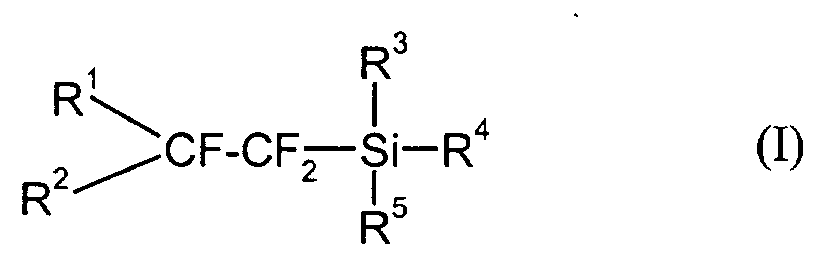
Überraschenderweise wurde nun ein Verfahren zur Herstellung von Polyfluoralkylsilanen
der Formel (I) gefunden,
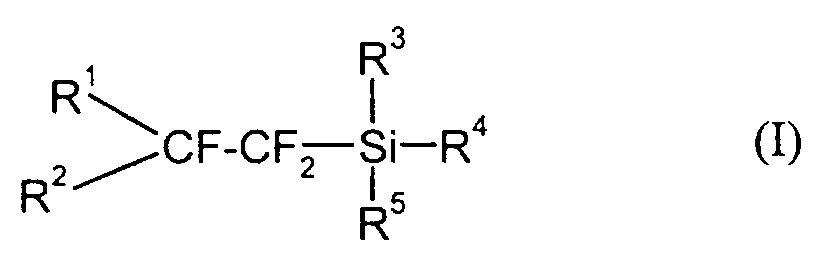 worin
worin
- R1 und R2
- gleich oder verschieden sind und für Wasserstoff, Halogen, geradkettiges oder verzweigtes C1-C8-Alkyl, C3-C9-Cycloalkyl, C1-C8-Alkyloxy, C1-C8-Alkylthio, C6-C14-Aryl, durch C1-C8-Alkyl, Acyl, Sulfonyl oder C6-C14-Aryl disubstituiertes Amin, C6-C14-Aryloxy, C6-C14-Arylthio, Heteroaryl, Heteroaryloxy oder Cyano stehen, wobei die genannten Reste, außer Wasserstoff und Halogen, gegebenenfalls einen oder mehrere Substituenten aus der Reihe Halogen, C1-C4-Alkyl, C1-C4-Alkoxy, C6-C14-Aryloxy, Silyloxy, Nitro, Cyano, durch C1-C4-Alkyl, Acyl, Sulfonyl oder C6-C14-Aryl disubstituiertes Amin, Disilylamino und COO(C1-C6-Alkyl) tragen,
- R3 bis R5
- gleich oder verschieden sind und für geradkettiges oder verzweigtes C1-C8-Alkyl oder C6-C14-Aryl stehen, welche gegebenenfalls einen oder mehrere Substituenten aus der Reihe Halogen, C1-C4-Alkyl, C1-C4-Alkoxy, C6-C14-Aryloxy, Silyloxy, Nitro, Cyano, durch C1-C4-Alkyl, Acyl, Sulfonyl oder C6-C14-Aryl disubstituiertes Amin, Disilylamino und COO(C1-C6-Alkyl) tragen,
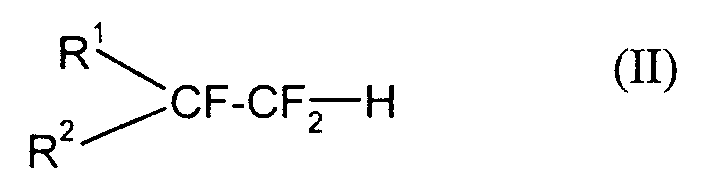
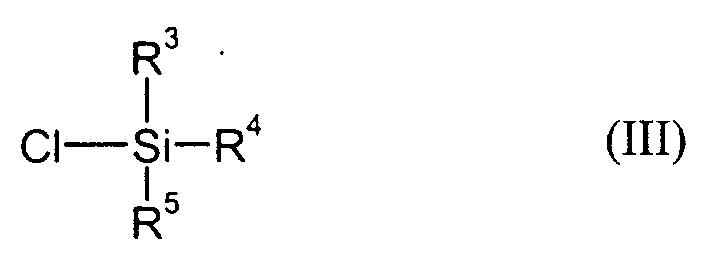
In das erfindungsgemäße Verfahren werden vorzugsweise Verbindungen der Formel
(II) eingesetzt, worin R1 die oben genannte Bedeutung hat und R2 für Halogen steht.
Besonders bevorzugt werden Verbindungen der Formel (II) eingesetzt, worin R1 für
Halogen, C1-C8-Alkyl, C1-C8-Alkoxy oder C6-C14-Aryloxy steht und R2 für Fluor
steht.
In das erfindungsgemäße Verfahren werden vorzugsweise Verbindungen der Formel
(III) eingesetzt, worin R3 bis R5 gleich oder verschieden sind und für geradkettiges
oder verzweigtes C1-C6-Alkyl stehen, welches gegebenenfalls einen oder mehrere
Substituenten aus der Reihe Halogen, C1-C4-Alkyl, C1-C4-Alkoxy, C6-C14-Aryloxy,
Silyloxy, Nitro, Cyano, durch C1-C4-Alkyl, Acyl, Sulfonyl oder C6-C14-Aryl disubstituiertes
Amin, Disilylamino und COO(C1-C6-Alkyl) trägt.
Besonders bevorzugt werden Verbindungen der Formel (III) eingesetzt, worin R3 bis
R5 gleich sind und für C1-C6-Alkyl stehen.
Ganz besonders bevorzugt werden in das erfindungsgemäße Verfahren Verbindungen
der Formel (II) eingesetzt, worin R1 für Halogen, C1-C8-Alkyl, C1-C8-Alkoxy oder
C6-C14-Aryloxy und R2 für Fluor stehen und Verbindungen der Formel (III), worin
R3 bis R5 gleich sind und für C1-C6-Alkyl stehen.
In das erfindungsgemäße Verfahren werden Verbindungen der Formel (III) vorzugsweise
in einer Menge von 0,5 bis 20 Äquivalenten, insbesondere von 0,9 bis 5 Äquivalenten
und ganz besonders bevorzugt von 1 bis 2 Äquivalenten, bezogen auf die
Verbindungen der Formel (II), eingesetzt.
In das erfindungsgemäße Verfahren werden vorzugsweise starke Basen eingesetzt.
Bevorzugte starke Basen sind beispielsweise starke anorganische Basen wie
Natrium- und Kaliumhydrid. Diese werden vorzugsweise in Gegenwart eines Sulfons
wie Tetramethylsulfon eingesetzt. Bevorzugte organische Basen sind Alkoxylate von
Lithium, Natrium und Kalium wie Kalium-tert.-butoxylat, Alkyllithium-,
Alkylnatrium- und Alkylkaliumverbindungen wie beispielsweise n-Butyllithium,
Lithium- und Kaliumdialkylamide sowie Tris(trialkyl)silylamine. Besonders
bevorzugte Basen sind n-Butyllithium, Kalium-tert.-butoxylat und Natriumhydrid in
Gegenwart von Tetramethylsulfon. Die genannten Basen können gegebenenfalls
durch Zugabe von Komplexbildnern wie beispielsweise Tetrakis-(dialkylamino)ethan
aktiviert werden.
Es können auch Mischungen verschiedener starker Basen eingesetzt werden.
Die Base wird vorzugsweise in einer Menge von 0,5 bis 20 Äquivalenten, insbesondere
von 0,9 bis 5 Äquivalenten und ganz besonders bevorzugt von 1 bis 2 Äquivalenten,
bezogen auf die Verbindungen der Formel (II), eingesetzt.
Das erfindungsgemäße Verfahren kann in Substanz oder in Gegenwart eines Lösungsmittels
durchgeführt werden. Wird das erfindungsgemäße Verfahren in Substanz
durchgeführt, ist ein Überschuss an Verbindungen der Formel (III) vorteilhaft.
Wird das erfindungsgemäße Verfahren in Gegenwart eines Lösungsmittels durchgeführt,
so werden bevorzugt aprotische Lösungsmittel eingesetzt. Bevorzugte Lösungsmittel
sind Mono- und Polyether, wie Tetrahydrofuran, Dialkylether oder
Diglyme, Alkane wie Hexan oder Cyclohexan oder Aromaten wie Toluol oder Xylol.
Besonders bevorzugte Lösungsmittel sind Methyl-tert.-butylether und Diethylether.
Die Umsetzung kann beispielsweise bei Temperaturen von -100°C bis +200°C,
bevorzugt von -20°C bis +20°C, besonders bevorzugt von -5°C bis +10°C
durchgeführt werden.
Die Umsetzung erfolgt vorzugsweise unter einem Schutzgas wie Stickstoff, Helium
oder Argon.
Das erfindungsgemäße Verfahren kann so durchgeführt werden, dass Trialkylchlorsilan
der Formel (III), gegebenenfalls in Anwesenheit eines Lösungsmittels, in einem
Reaktionsgefäß vorgelegt wird. Die Verbindung der Formel (II) wird vorzugsweise
zudosiert. Vorzugsweise erfolgt anschließend eine Zudosierung der Base. Die Mischung
wird vorzugsweise gerührt, der Reaktionsfortschritt kann mittels gaschromatographischer
Analyse kontrolliert werden. Die Aufarbeitung des Reaktionsgemisches
kann destillativ erfolgen.
Die vorliegende Erfindung betrifft weiterhin Verbindungen der Formel (I), worin
- R1 und R2
- gleich oder verschieden sind und für Wasserstoff, Halogen, geradkettiges oder verzweigtes C1-C8-Alkyl, C3-C9-Cycloalkyl, C1-C8-Alkyloxy, C1-C8-Alkylthio, C6-C14-Aryl, durch C1-C8-Alkyl, Acyl, Sulfonyl oder C6-C14-Aryl disubstituiertes Amin, C6-C14-Aryloxy, C6-C14-Arylthio, Heteroaryl, Heteroaryloxy oder Cyano stehen, wobei die genannten Reste, außer Wasserstoff und Halogen, gegebenenfalls einen oder mehrere Substituenten aus der Reihe Halogen, C1-C4-Alkyl, C1-C4-Alkoxy, C6-C14-Aryloxy, Silyloxy, Nitro, Cyano, durch C1-C4-Alkyl, Acyl, Sulfonyl oder C6-C14-Aryl disubstituiertes Amin, Disilylamino und COO(C1-C6-Alkyl) tragen,
- R3 bis R5
- gleich oder verschieden sind und für geradkettiges oder verzweigtes C1-C8-Alkyl oder C6-C14-Aryl stehen, welche gegebenenfalls einen oder mehrere Substituenten aus der Reihe Halogen, C1-C4-Alkyl, C1-C4-Alkoxy, C6-C14-Aryloxy, Silyloxy, Nitro, Cyano, durch C1-C4-Alkyl, Acyl, Sulfonyl oder C6-C14-Aryl disubstituiertes Amin, Disilylamino und COO(C1-C6-Alkyl) tragen,
Bevorzugte Verbindungen der Formel (1) sind solche, worin R1 die oben genannte
Bedeutung hat, R2 für Halogen steht und R3 bis R5 gleich oder verschieden sind und
für geradkettiges oder verzweigtes C1-C6-Alkyl stehen, welches gegebenenfalls
einen oder mehrere Substituenten aus der Reihe Halogen, C1-C4-Alkyl,
C1-C4-Alkoxy, C6-C14-Aryloxy, Silyloxy, Nitro, Cyano, durch C1-C4-Alkyl, Acyl,
Sulfonyl oder C6-C14-Aryl disubstituiertes Amin, Disilylamino und COO(C1-C6-Alkyl)
trägt.
Besonders bevorzugte Verbindungen der Formel (I) sind solche, worin R1 für Halogen,
C1-C8-Alkyl, C1-C8-Alkoxy oder C6-C14-Aryloxy steht, R2 für Fluor steht und
R3 bis R5 gleich sind und für C1-C6-Alkyl stehen.
Die erfindungsgemäßen Polyfluoralkylsilane sowie die nach dem erfindungsgemäßen
Verfahren hergestellten Polyfluoralkylsilane können als Überträger von Polyfluoralkylgruppen
in der synthetischen Chemie zur Herstellung von Wirkstoffen im Bereich
der Pharmazie oder Agrochemie dienen. Darüberhinaus können die
erfindungsgemäßen Polyfluoralkylsilane sowie die nach dem erfindungsgemäßen
Verfahren hergestellten Polyfluoralkylsilane zur Herstellung von hochwertigen
Flüssigkristallen für optische Anzeigen verwendet werden. Damit wird die
Einführung neuer Polyfluoralkylgruppen in potentielle Wirkstoffe und
Flüssigkristalle möglich. Zudem können die Kosten für die Herstellung von
polyfluoralkylierten Verbindungen durch die niedrigen Herstellkosten der
erfindungsgemäßen Polyfluoralkylsilane gesenkt werden.
Die vorliegende Erfindung betrifft weiterhin Flüssigkristalle der Formel (IV)
 worin
worin
- X
- für Fluor oder Wasserstoff steht,
- R6
- für Wasserstoff, Fluor, Polyfluor-C1-C8-alkyl, C1-C8-Alkoxy, C6-C14-Aryloxy oder Heteroaryloxy steht, wobei die genannten Reste, außer Wasserstoff und Fluor, gegebenenfalls einen oder mehrere Substituenten aus der Reihe Halogen, C1-C4-Alkyl, C1-C4-Alkoxy, C6-C14-Aryloxy, Silyloxy, Nitro, Cyano, durch C1-C4-Alkyl, Acyl, Sulfonyl oder C6-C14-Aryl disubstituiertes Amin, Disilylamino und COO(C1-C6-Alkyl) tragen und
- R7
- für gegebenenfalls substituiertes C6-C14-Aryl oder C6-C18-Cycloalkyl steht,
Bevorzugte Flüssigkristalle der Formel (IV) sind solche, worin
- X
- für Wasserstoff steht,
- R6
- für Wasserstoff, Fluor, Polyfluor-C1-C4-Alkyl, geradkettiges oder verzweigtes C1-C4-Alkoxy steht, welche außer Wasserstoff, Fluor und Polyfluoralkyl, durch ein oder mehrere Fluoratome substituiert sind, und
- R7
- für einen Phenylrest, einen Biphenylrest oder einen Cyclohexylrest steht, welche gegebenenfalls einen oder mehrere Substituenten aus der Reihe geradkettiges oder verzweigtes C4-C18-Alkyl, C1-C12-Alkyl-C5-C8-Cycloalkyl und C5-C8-Cycloalkyl tragen.
Besonders bevorzugte Flüssigkristalle der Formel (IV) sind solche, worin
- X
- für Wasserstoff,
- R6
- für Wasserstoff, Fluor, Trifluormethyl oder Pentafluorethyl und
- R7
- für einen Phenylrest stehen, welcher in para-Stellung einen Substituenten aus der Reihe C4-C18-Alkyl und C1-C12-Alkyl-C5-C8-Cycloalkyl trägt.
Die vorliegende Erfindung betrifft weiterhin ein Verfahren zur Herstellung von
Flüssigkristallen der Formel (IV) durch Umsetzung von Verbindungen der Formel
(I),
 worin
worin
- R1
- den gleichen Bedeutungsumfang hat wie R6 bei Formel (IV),
- R2
- für Fluor steht und
- R3 bis R5
- gleich oder verschieden sind und für geradkettiges oder verzweigtes C1-C8-Alkyl oder C6-C14-Aryl stehen, welche gegebenenfalls einen oder mehrere Substituenten aus der Reihe Halogen, C1-C4-Alkyl, C1-C4-Alkoxy, C6-C14-Aryloxy, Silyloxy, Nitro, Cyano, durch C1-C4-Alkyl, Acyl, Sulfonyl oder C6-C14-Aryl disubstituiertes Amin, Disilylamino und COO(C1-C6-Alkyl) tragen,
- Y
- für eine gegenüber -SiR3R4R5 reaktive Gruppe steht, vorzugsweise für eine Aldehyd-, Keto- oder Estergruppe, und
- R7
- für gegebenenfalls substituiertes C6-C14-Aryl oder C6-C18-Cycloalkyl steht,

- R6
- den gleichen Bedeutungsumfang hat wie R1 in Formel (I) und
- R7
- die bei Formel (V) angegebene Bedeutung hat,
Verbindungen, die eine starke Affinität zu Silizium aufweisen sind beispielsweise
solche, die als Fluorid- oder Alkoxyspender fungieren, beispielsweise Fluoride wie
Tetrabutylammoniumfluorid oder Alkoxylate wie Natriummethanolat.
Bevorzugte Fluoride sind Alkylammoniumfluoride wie beispielsweise Tetrabutylammoniumfluorid
oder Alkalifluoride wie beispielsweise Natriumfluorid oder Kaliumfluorid.
Besonders bevorzugt ist Tetrabutylammoniumfluorid.
Bevorzugte Alkoxylate sind Alkalialkoholate wie beispielsweise Natriummethanolat
oder Natriumethanolat.
Fluorierungsmittel sind Verbindungen, die in der Lage sind in Verbindungen der
Formel (VI) OH gegen F auszutauschen wie beispielsweise Diethylaminoschwefeltrifluorid.
Vorzugsweise werden im erfindungsgemäßen Verfahren zur Herstellung von
Verbindungen der Formel (IV) Verbindungen der Formel (I) eingesetzt, worin
- R1
- den bevorzugten Bedeutungsumfang hat wie für R6 bei Formel (IV) angegeben,
- R2
- für Fluor steht und
- R3 bis R5
- gleich oder verschieden sind und für geradkettiges oder verzweigtes C1-C6-Alkyl oder C6-C14-Aryl stehen, welche gegebenenfalls einen oder mehrere Substituenten aus der Reihe Halogen, C1-C4-Alkyl, C1-C4-Alkoxy, C6-C14-Aryloxy, Silyloxy, Nitro, Cyano, durch C1-C4-Alkyl, Acyl, Sulfonyl oder C6-C14-Aryl disubstituiertes Amin, Disilylamino und COO(C1-C6-Alkyl) tragen.
Besonders bevorzugt werden im erfindungsgemäßen Verfahren zur Herstellung von
Verbindungen der Formel (IV) Verbindungen der Formel (I) eingesetzt, worin
- R1
- Wasserstoff, Fluor, Trifluormethyl oder Pentafluorethyl und
- R2
- für Fluor stehen und
- R3 bis R5
- gleich sind und für C1-C6-Alkyl stehen.
Vorzugsweise werden im erfindungsgemäßen Verfahren zur Herstellung von
Verbindungen der Formel (IV) Verbindungen der Formel (V) eingesetzt, worin
- R7
- für einen Phenylrest, einen Biphenylrest oder einen C6-C18-Cyclohexylrest steht, welche gegebenenfalls Substituenten aus der Reihe geradkettiges oder verzweigtes C4-C18-Alkyl, C1-C12-Alkyl-C5-C8-cycloalkyl und C5-C8-Cycloalkyl tragen und
- Y
- für einen Aldehyd-, Keto- oder Estergruppe steht.
Besonders bevorzugt werden Verbindungen der Formel (V) eingesetzt, worin
- R7
- für einen Phenylrest steht, welcher in para-Stellung einen Substituenten aus der Reihe C4-C18-Alkyl und C1-C12-Alkyl-C5-C8-cycloalkyl trägt und
- Y
- für eine Aldehyd-, Keto- oder Estergruppe steht.
In einer besonders bevorzugten Ausführungsform werden im erfindungsgemäßen
Verfahren zur Herstellung von Verbindungen der Formel (IV) Verbindungen der
Formel (I), worin
- R1
- für Wasserstoff, Fluor, Trifluormethyl oder Pentafluorethyl,
- R2
- für Fluor und
- R3 bis R5
- gleich sind und für C1-C6-Alkyl stehen,
- R7
- für einen Phenyl- oder Biphenylrest steht, welcher in para-Stellung einen Substituenten aus der Reihe C4-C18-Alkyl- und C1-C12-Alkyl-C5-C8-cyclohexyl trägt und
- Y
- für eine Aldehyd-, Keto- oder Estergruppe steht
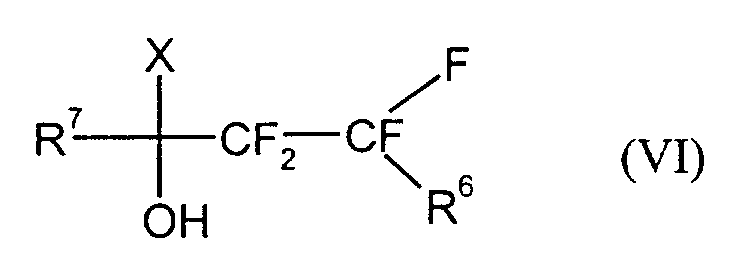
Im erfindungsgemäßen Verfahren zur Herstellung von Verbindungen der Formel
(IV) werden vorzugsweise 0,5 bis 20 Äquivalente, insbesondere 0,9 bis 5 Äquivalente,
ganz besonders bevorzugt 1 bis 2 Äquivalente an Verbindungen der Formel
(I), bezogen auf die Verbindungen der Formel (V) eingesetzt.
In einem 1 l Vierhalskolben mit Rührer, Thermometer und Gaseinlasskapillare wurden
unter Stickstoff 300 ml Methyl-tert.-butylether und 13,6 g (125,1 mmol) Trimethylchlorsilan
vorgelegt und auf 0°C abgekühlt. Nach Erreichen der Zieltemperatur
wurden 15,75 g (81,2 mmol) Phenoxytetrafluorethan zugetropft. Anschließend
wurden unter verstärkter Kühlung 50 ml (125 mmol) n-Butyllithium langsam zugetropft.
Das Gemisch wurde bei 0°C gerührt und der Reaktionsfortschritt mittels
Gaschromatographie kontrolliert. Nach Beendigung der Reaktion wurde die trübe
Lösung filtriert und das Filtrat destilliert.
Ausbeute: 9,2 g 1,1,2,2,-Tetrafluorethyl-2-phenoxy-trimethylsilan (43 % der Theorie).
Siedepunkt: 91 bis 92,5°C bei 10 mbar.
Massenspektrometrie (m/z): (M+.)266, (M+.-115) 151, (M+.-189)77, (M+.-215)51 19F-NMR-Daten δ: -86ppm (s, 2F, CF2); -131ppm (s, 2F, CF2)
Ausbeute: 9,2 g 1,1,2,2,-Tetrafluorethyl-2-phenoxy-trimethylsilan (43 % der Theorie).
Siedepunkt: 91 bis 92,5°C bei 10 mbar.
Massenspektrometrie (m/z): (M+.)266, (M+.-115) 151, (M+.-189)77, (M+.-215)51 19F-NMR-Daten δ: -86ppm (s, 2F, CF2); -131ppm (s, 2F, CF2)
In einem 1l Vierhalskolben mit Rührer, Thermometer und Gaseinlasskapillare wurden
unter Stickstoff 300 ml Methyl-tert.-butylether und 12,5 g (150 mmol) Triethylchlorsilan
vorgelegt und auf 0°C abgekühlt. Nach Erreichen der Zieltemperatur
wurden 10 g (83,4 mmol) Pentafluorethan zugetropft. Anschließend wurden unter
verstärkter Kühlung 62,5 ml (125 mmol) n-Butyllithium langsam zugetropft. Das
Gemisch wurde bei 0°C gerührt und der Reaktionsfortschritt mittels Gaschromatographie
kontrolliert. Nach Beendigung der Reaktion wurde die trübe Lösung filtriert
und das Filtrat destilliert.
Ausbeute: 10.5 g Triethyl-pentafluorethylsilan (54 % der Theorie).
Siedepunkt: 50°C bei 30 mbar
Ausbeute: 10.5 g Triethyl-pentafluorethylsilan (54 % der Theorie).
Siedepunkt: 50°C bei 30 mbar
In einem 1l Vierhalskolben mit Rührer, Thermometer und Gaseinlasskapillare
wurden unter Stickstoff 450 ml Methyl-tert.-butylether und 27g (180 mmol) Triethylchlorsilan
vorgelegt und auf 0°C abgekühlt. Nach Erreichen der Zieltemperatur
wurden 23,8 g (180 mmol) Methoxy-tetrafluorethan zugetropft. Anschließend
wurden unter verstärkter Kühlung 135 ml (270 mmol) n-Butyllithium langsam zugetropft.
Das Gemisch wurde bei 0°C gerührt und der Reaktionsfortschritt mittels Gaschromatographie
kontrolliert. Nach Beendigung der Reaktion wurde die trübe Lösung
filtriert, das Filtrat destilliert und 1,1,2,2,-Tetrafluorethyl-2-methoxytriethylsilan
als 10 %ige Lösung in Butyltriethylsilan erhalten
Siedepunkt: 32°C bei 64 mbar.
Siedepunkt: 32°C bei 64 mbar.
Massenspektrometrie (m/z): (M+.-29)217, (M+.-129) 127, (M+.-153)77, (M+.-187)59,
(M+.-217)29
19F-NMR-Daten δ: -93ppm (s, 2F, CF2); -126ppm (s, 2F, CF2)
19F-NMR-Daten δ: -93ppm (s, 2F, CF2); -126ppm (s, 2F, CF2)
Claims (13)
- Verfahren zur Herstellung von Verbindungen der Formel (I)worin
- R1 und R2
- gleich oder verschieden sind und für Wasserstoff, Halogen, geradkettiges oder verzweigtes C1-C8-Alkyl, C3-C9-Cycloalkyl, C1-C8-Alkyloxy, C1-C8-Alkylthio, C6-C14-Aryl, durch C1-C8-Alkyl, Acyl, Sulfonyl oder C6-C14-Aryl disubstituiertes Amin, C6-C14-Aryloxy, C6-C14-Arylthio, Heteroaryl, Heteroaryloxy oder Cyano stehen, wobei die genannten Reste, außer Wasserstoff und Halogen, gegebenenfalls einen oder mehrere Substituenten aus der Reihe Halogen, C1-C4-Alkyl, C1-C4-Alkoxy, C6-C14-Aryloxy, Silyloxy, Nitro, Cyano, durch C1-C4-Alkyl, Acyl, Sulfonyl oder C6-C14-Aryl disubstituiertes Amin, Disilylamino und COO(C1-C6-Alkyl) tragen,
- R3 bis R5
- gleich oder verschieden sind und für geradkettiges oder verzweigtes C1-C8-Alkyl oder C6-C14-Aryl stehen, welche gegebenenfalls einen oder mehrere Substituenten aus der Reihe Halogen, C1-C4-Alkyl, C1-C4-Alkoxy, C6-C14-Aryloxy, Silyloxy, Nitro, Cyano, durch C1-C4-Alkyl, Acyl, Sulfonyl oder C6-C14-Aryl disubstituiertes Amin, Disilylamino und COO(C1-C6-Alkyl) tragen,
in der R1 und R2 die oben angegebene Bedeutung haben,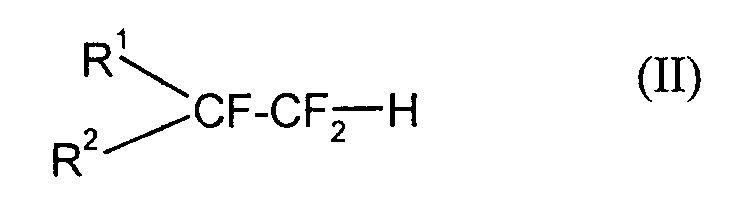
mit Verbindungen der Formel (III)in der R3 bis R5 die oben angegebene Bedeutung haben,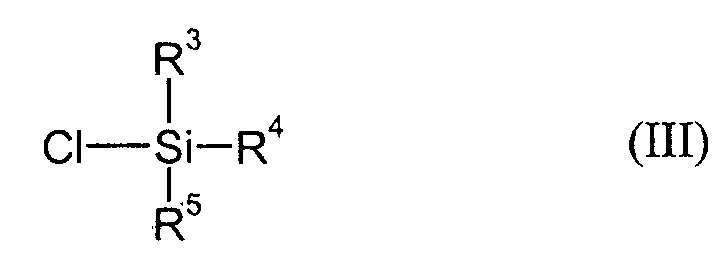
in Gegenwart einer Base umgesetzt werden. - Verfahren gemäß Anspruch 1, dadurch gekennzeichnet, dass Verbindungen der Formel (II) eingesetzt werden, worin
- R1
- die im Anspruch 1 angegebene Bedeutung hat und
- R2
- für Halogen steht.
- Verfahren gemäß Ansprüchen 1 bis 2, dadurch gekennzeichnet, dass Verbindungen der Formel (III) eingesetzt werden, worin
- R3 bis R5
- gleich oder verschieden sind und für geradkettiges oder verzweigtes C1-C6-Alkyl stehen, welches gegebenenfalls einen oder mehrere Substituenten aus der Reihe Halogen, C1-C4-Alkyl, C1-C4-Alkoxy, C6-C14-Aryloxy, Silyloxy, Nitro, Cyano, durch C1-C4-Alkyl, Acyl, Sulfonyl oder C6-C14-Aryl disubstituiertes Amin, Disilylamino und COO(C1-C6-Alkyl) trägt.
- Verfahren gemäß Ansprüchen 1 bis 3, dadurch gekennzeichnet, dass es sich bei der Base um eine starke Base handelt.
- Verfahren gemäß Ansprüchen 1 bis 4, dadurch gekennzeichnet, dass die Base in einer Menge von 0,5 bis 20 Äquivalenten, bezogen auf die Verbindungen der Formel (II), eingesetzt wird.
- Verbindungen der Formel (I)worin

- R1 und R2
- gleich oder verschieden sind und für Wasserstoff, Halogen, geradkettiges oder verzweigtes C1-C8-Alkyl, C3-C9-Cycloalkyl, C1-C8-Alkyloxy, C1-C8-Alkylthio, C6-C14-Aryl, durch C1-C8-Alkyl, Acyl, Sulfonyl oder C6-C14-Aryl disubstituiertes Amin, C6-C14-Aryloxy, C6-C14-Arylthio, Heteroaryl, Heteroaryloxy oder Cyano stehen, wobei die genannten Reste, außer Wasserstoff und Halogen, gegebenenfalls einen oder mehrere Substituenten aus der Reihe Halogen, C1-C4-Alkyl, C1-C4-Alkoxy, C6-C14-Aryloxy, Silyloxy, Nitro, Cyano, durch C1-C4-Alkyl, Acyl, Sulfonyl oder C6-C14-Aryl disubstituiertes Amin, Disilylamino und COO(C1-C6-Alkyl) tragen,
- R3 bis R5
- gleich oder verschieden sind und für geradkettiges oder verzweigtes C1-C8-Alkyl oder C6-C14-Aryl stehen, welche gegebenenfalls einen oder mehrere Substituenten aus der Reihe Halogen, C1-C4-Alkyl, C1-C4-Alkoxy, C6-C14-Aryloxy, Silyloxy, Nitro, Cyano, durch C1-C4-Alkyl, Acyl, Sulfonyl oder C6-C14-Aryl disubstituiertes Amin, Disilylamino und COO(C1-C6-Alkyl) tragen,
- Verbindungen gemäß Anspruch 6, worin
- R1
- die im Anspruch 6 angegebene Bedeutung hat,
- R2
- für Halogen steht und
- R3 bis R5
- gleich oder verschieden sind und für geradkettiges oder verzweigtes C1-C6-Alkyl stehen, welches gegebenenfalls einen oder mehrere Substituenten aus der Reihe Halogen, C1-C4-Alkyl, C1-C4-Alkoxy, C6-C14-Aryloxy, Silyloxy, Nitro, Cyano, durch C1-C4-Alkyl, Acyl, Sulfonyl oder C6-C14-Aryl disubstituiertes Amin, Disilylamino und COO(C1-C6-Alkyl) trägt,
- Verwendung der Verbindungen der Formel (I) gemäß Anspruch 1 zur Herstellung von Pharmazeutika und Agrochemikalien.
- Verwendung der Verbindungen der Formel (I) gemäß Anspruch 1 zur Herstellung von Flüssigkristallen.
- Flüssigkristalle der Formel (IV)worin

- X
- für Fluor oder Wasserstoff steht,
- R6
- für Wasserstoff, Fluor, Polyfluor-C1-C8-alkyl, C1-C4-Alkoxy, C6-C14-Aryloxy oder Heteroaryloxy steht, wobei die genannten Reste, außer Wasserstoff und Fluor, gegebenenfalls einen oder mehrere Substituenten aus der Reihe Halogen, C1-C4-Alkyl, C1-C4-Alkoxy, C6-C14-Aryloxy, Silyloxy, Nitro, Cyano, durch C1-C4-Alkyl. Acyl, Sulfonyl oder C6-C14-Aryl disubstituiertes Amin, Disilylamino und COO(C1-C6-Alkyl) tragen und
- R7
- für gegebenenfalls substituiertes C6-C14-Aryl oder C6-C18-Cycloalkyl steht.
- Flüssigkristalle gemäß Anspruch 10, dadurch gekennzeichnet, dass
- X
- für Wasserstoff steht,
- R6
- für Wasserstoff, Fluor, Polyfluor-C1-C4-Alkyl, geradkettiges oder verzweigtes C1-C8-Alkoxy, welche, außer Wasserstoff, Fluor und Perfluoralkyl durch ein oder mehrere Fluoratome substituiert sind, steht und
- R7
- für einen Phenylrest, einen Biphenylrest oder einen Cyclohexylrest steht, welche gegebenenfalls einen oder mehrere Substituenten aus der Reihe geradkettiges oder verzweigtes C4-C18-Alkyl, C1-C12-Alkyl-C5-C8-Cycloalkyl und C5-C8-Cycloalkyl tragen.
- Verfahren zur Herstellung von Flüssigkristallen gemäß Anspruch 1 durch Umsetzung von Verbindungen der Formel (I),worin

- R1
- den gleichen Bedeutungsumfang hat wie R6 bei Formel (IV) in Anspruch 10,
- R2
- für Fluor steht und
- R3 bis R5
- gleich oder verschieden sind und für geradkettiges oder verzweigtes C1-C8-Alkyl oder C6-C14-Aryl stehen, welche gegebenenfalls einen oder mehrere Substituenten aus der Reihe Halogen, C1-C4-Alkyl, C1-C4-Alkoxy, C6-C14-Aryloxy, Silyloxy, Nitro, Cyano, durch C1-C4-Alkyl, Acyl, Sulfonyl oder C6-C14-Aryl disubstituiertes Amin, Disilylamino und COO(C1-C6-Alkyl) tragen,
- Y
- für eine gegenüber -SiR3R4R5 reaktive Gruppe und
- R7
- für gegebenenfalls substituiertes C6-C14-Aryl oder C6-C18-Cycloalkyl steht,
in der
- R6
- den gleichen Bedeutungsumfang hat wie R1 in Formel (I) und
- R7
- die bei Formel (V) angegebene Bedeutung hat,
- Verwendung der Flüssigkristalle gemäß Anspruch 10 für optische Anzeigen.
Applications Claiming Priority (2)
| Application Number | Priority Date | Filing Date | Title |
|---|---|---|---|
| DE10032632A DE10032632A1 (de) | 2000-07-05 | 2000-07-05 | Polyfluoralkylsilane |
| DE10032632 | 2000-07-05 |
Publications (1)
| Publication Number | Publication Date |
|---|---|
| EP1170298A1 true EP1170298A1 (de) | 2002-01-09 |
Family
ID=7647850
Family Applications (1)
| Application Number | Title | Priority Date | Filing Date |
|---|---|---|---|
| EP01114733A Withdrawn EP1170298A1 (de) | 2000-07-05 | 2001-06-22 | Polyfluoralkylsilane |
Country Status (5)
| Country | Link |
|---|---|
| US (1) | US20020022734A1 (de) |
| EP (1) | EP1170298A1 (de) |
| JP (1) | JP2002080482A (de) |
| KR (1) | KR20020004868A (de) |
| DE (1) | DE10032632A1 (de) |
Cited By (1)
| Publication number | Priority date | Publication date | Assignee | Title |
|---|---|---|---|---|
| EP1266902A1 (de) * | 2001-06-13 | 2002-12-18 | Bayer Ag | Verfahren zur Herstellung von Polyfluoralkyllithium-Verbindungen |
Families Citing this family (2)
| Publication number | Priority date | Publication date | Assignee | Title |
|---|---|---|---|---|
| JP5644252B2 (ja) * | 2009-08-20 | 2014-12-24 | セントラル硝子株式会社 | 燃料電池用固体電解質膜およびその製造方法 |
| CN114437124B (zh) * | 2020-11-06 | 2024-03-15 | 华东师范大学 | 官能团化的氟代烷基硅烷及其合成方法和应用 |
Citations (4)
| Publication number | Priority date | Publication date | Assignee | Title |
|---|---|---|---|---|
| DE3730859A1 (de) * | 1987-04-16 | 1989-03-30 | Merck Patent Gmbh | Thiazol- und thiadiazol-derivate enthaltende medien mit smektischer fluessigkristalliner phase |
| US4886620A (en) * | 1985-09-18 | 1989-12-12 | Merck Patent Gesellschaft Mit Beschrankter Haftung | Smectic liquid-crystalline phases |
| JPH03258736A (ja) * | 1990-03-08 | 1991-11-19 | Sagami Chem Res Center | 1―アリールポリハロプロパン化合物 |
| JPH0959628A (ja) * | 1995-08-23 | 1997-03-04 | Canon Inc | 液晶素子及び液晶装置 |
-
2000
- 2000-07-05 DE DE10032632A patent/DE10032632A1/de not_active Withdrawn
-
2001
- 2001-06-22 EP EP01114733A patent/EP1170298A1/de not_active Withdrawn
- 2001-06-29 US US09/895,774 patent/US20020022734A1/en not_active Abandoned
- 2001-07-02 JP JP2001200780A patent/JP2002080482A/ja active Pending
- 2001-07-04 KR KR1020010039711A patent/KR20020004868A/ko not_active Withdrawn
Patent Citations (4)
| Publication number | Priority date | Publication date | Assignee | Title |
|---|---|---|---|---|
| US4886620A (en) * | 1985-09-18 | 1989-12-12 | Merck Patent Gesellschaft Mit Beschrankter Haftung | Smectic liquid-crystalline phases |
| DE3730859A1 (de) * | 1987-04-16 | 1989-03-30 | Merck Patent Gmbh | Thiazol- und thiadiazol-derivate enthaltende medien mit smektischer fluessigkristalliner phase |
| JPH03258736A (ja) * | 1990-03-08 | 1991-11-19 | Sagami Chem Res Center | 1―アリールポリハロプロパン化合物 |
| JPH0959628A (ja) * | 1995-08-23 | 1997-03-04 | Canon Inc | 液晶素子及び液晶装置 |
Non-Patent Citations (14)
| Title |
|---|
| BARTMANN E: "FLUESSIGKRISTALLE MIT FLUORHALTIGEN ALKYLGRUPPEN", BERICHTE DER BUNSEN-GESELLSCHAFT FUR PHYSIKALISCHE CHEMIE, VERLAG CHEMIE. WEINHEIM, DE, vol. 97, no. 10, 1993, pages 1349 - 1355, XP000891537, ISSN: 0005-9021 * |
| CHEN, G. J. RET AL., J. ORGANOMET. CHEM., no. 293, 1985, pages 313 - 322 * |
| DATABASE BEILSTEIN [online] BEILSTEIN INSTITUTE FOR ORGANIC CHEMISTRY, FRANKFURT/MAIN, DE; XP002175704, Database accession no. Product BRN 1985790 * |
| DATABASE BEILSTEIN [online] BEILSTEIN INSTITUTE FOR ORGANIC CHEMISTRY, FRANKFURT/MAIN, DE; XP002175705, Database accession no. BRN 2271549 * |
| DATABASE BEILSTEIN [online] BEILSTEIN INSTITUTE FOR ORGANIC CHEMISTRY, FRANKFURT/MAIN, DE; XP002175708, Database accession no. BRN 5131085; BRN 5127207 * |
| DATABASE BEILSTEIN [online] BEILSTEIN INSTITUTE FOR ORGANIC CHEMISTRY, FRANKFURT/MAIN, DE; XP002175709, Database accession no. BRN 5306502 * |
| DATABASE CHEMABS [online] CHEMICAL ABSTRACTS SERVICE, COLUMBUS, OHIO, US; GORRIA, P. ET AL: "Influence of structure on smectic A-smectic A phase separation", XP002175710, retrieved from STN Database accession no. 125:261894 * |
| DATABASE CHEMABS [online] CHEMICAL ABSTRACTS SERVICE, COLUMBUS, OHIO, US; HIYAMA, TAMEJIRO ET AL: "Preparation of 1-arylpolyhalopropanes", XP002175712, retrieved from STN Database accession no. 116:151299 * |
| DATABASE CHEMABS [online] CHEMICAL ABSTRACTS SERVICE, COLUMBUS, OHIO, US; YAMADA, NOBUTSUGU ET AL: "Liquid crystal element using chiral smectic liquid crystal", XP002175711, retrieved from STN Database accession no. 126:299740 * |
| DATABASE CHEMABS [online] CHEMICAL ABSTRACTS SERVICE, COLUMBUS, OHIO, US; ZIMIN, A. V. ET AL: "Study of the characteristics of the radiation-induced-chemical hydrosilylation of halogenated and nonhalogenated olefins", XP002175706, retrieved from STN Database accession no. 86:121428 * |
| DOKL. AKAD. NAUK SSSR (1976), 231(4), 870-3 [CHEM.] * |
| FIALKOV, YU. A. ET AL., J.ORG.CHEM. USSR (ENGL. TRANSL.), vol. 19, no. 5, 1983, pages 933 - 937 * |
| FIALKOV,YU. A. ET AL., J.ORG.CHEM. USSR, vol. 19, no. 10, 1983, pages 1781 - 1787 * |
| LIQ. CRYST. (1996), 21(4), 523-530 * |
Cited By (1)
| Publication number | Priority date | Publication date | Assignee | Title |
|---|---|---|---|---|
| EP1266902A1 (de) * | 2001-06-13 | 2002-12-18 | Bayer Ag | Verfahren zur Herstellung von Polyfluoralkyllithium-Verbindungen |
Also Published As
| Publication number | Publication date |
|---|---|
| US20020022734A1 (en) | 2002-02-21 |
| KR20020004868A (ko) | 2002-01-16 |
| JP2002080482A (ja) | 2002-03-19 |
| DE10032632A1 (de) | 2002-01-17 |
Similar Documents
| Publication | Publication Date | Title |
|---|---|---|
| EP1689756B1 (de) | Verfahren zur herstellung von salzen schwach koordinierender aniomen, derartige salze sowie deren verwendung | |
| DE69835304T2 (de) | Fluorierung mit Aminoschwefeltrifluoriden | |
| Ruff | The imidodisulfuryl fluoride ion | |
| DE102008010534A1 (de) | Neuartige Phosphonium-Basierte ionische Flüssigkeit sowie diese verwendendes Reaktionslösungsmittel | |
| EP1266904B1 (de) | Verbessertes Verfahren zur Herstellung kernfluorierter Aromaten | |
| DE602004002812T2 (de) | Alkyl- und Aryl-Trifluormethoxytetrafluorsulfurane | |
| WO2015049034A1 (de) | Perfluoralkylfluor- oder perfluoralkylchlorgermanate | |
| WO1997032832A1 (de) | Verfahren zur herstellung von fluorierten aromaten und fluorierten stickstoffhaltigen heteroaromaten | |
| DE3032471A1 (de) | Verfahren zur herstellung von fluorierten carbonylverbindungen | |
| WO2003106379A1 (de) | Verfahren zur herstellung substituierter organischer verbindungen und verwendung von katalysatoren für substitutionsreaktionen | |
| DE4333491A1 (de) | Verfahren zur Herstellung von Methylencyclopropan | |
| DE10100213B4 (de) | Verfahren zur Herstellung von 1,1,1,5,5,5-Hexafluoracetylaceton mit einer Reinheit von wenigstens 99,7% | |
| DE10032632A1 (de) | Polyfluoralkylsilane | |
| EP1495037B1 (de) | Verfahren zur herstellung von perfluoralkylphosphinen und deren verwendung als perfluoralkylierungsreagenzien | |
| DE2656545A1 (de) | Polyhalogenierte alpha, alpha'-difluordialkylaether und verfahren zu ihrer herstellung | |
| DE69914847T2 (de) | Verfahren zur Herstellung von Fluoraryl-Magnesium-Halogeniden | |
| EP1094999B1 (de) | Herstellung von fluoridarmen organischen verbindungen | |
| EP1439170B1 (de) | Fluorierungsmittel und verfahren zu deren herstellung | |
| EP0574839B1 (de) | Herstellung von Difluormethylethern und -estern | |
| DE10216996A1 (de) | Verfahren zur Perfluoralkylierung mittels Tris(perfluoralkyl)phosphinoxiden | |
| DE69724143T2 (de) | Herstellung von bis-trialkylsilylamiden, und diese verbindungen enthaltende zusammensetzungen | |
| DE102008028331A1 (de) | Verfahren zur Darstellung ionischer Verbindungen mit Anionen mit unterschiedlichen Liganden | |
| DE3723713A1 (de) | Alkoholfreie orthoester des zirkoniums und hafniums und verfahren zu deren herstellung | |
| DE1768428C3 (de) | Verfahren zur Herstellung von Organosiliciumhydriden | |
| DE102011108324A1 (de) | Verfahren zur Herstellung von Bis(perfluoralkyl)phosphinsäureanhydriden |
Legal Events
| Date | Code | Title | Description |
|---|---|---|---|
| PUAI | Public reference made under article 153(3) epc to a published international application that has entered the european phase |
Free format text: ORIGINAL CODE: 0009012 |
|
| AK | Designated contracting states |
Kind code of ref document: A1 Designated state(s): AT BE CH CY DE DK ES FI FR GB GR IE IT LI LU MC NL PT SE TR |
|
| AX | Request for extension of the european patent |
Free format text: AL;LT;LV;MK;RO;SI |
|
| AKX | Designation fees paid | ||
| REG | Reference to a national code |
Ref country code: DE Ref legal event code: 8566 |
|
| STAA | Information on the status of an ep patent application or granted ep patent |
Free format text: STATUS: THE APPLICATION IS DEEMED TO BE WITHDRAWN |
|
| 18D | Application deemed to be withdrawn |
Effective date: 20020710 |