EP1163504B1 - Procede de preparation de latex par (co)polymerisation en emulsion de monomeres ethyleniquement insatures, avec suivi direct en ligne par spectroscopie raman, et dispositif pour la mise en oeuvre du procede - Google Patents
Procede de preparation de latex par (co)polymerisation en emulsion de monomeres ethyleniquement insatures, avec suivi direct en ligne par spectroscopie raman, et dispositif pour la mise en oeuvre du procede Download PDFInfo
- Publication number
- EP1163504B1 EP1163504B1 EP00905130A EP00905130A EP1163504B1 EP 1163504 B1 EP1163504 B1 EP 1163504B1 EP 00905130 A EP00905130 A EP 00905130A EP 00905130 A EP00905130 A EP 00905130A EP 1163504 B1 EP1163504 B1 EP 1163504B1
- Authority
- EP
- European Patent Office
- Prior art keywords
- raman
- latex
- monomers
- emulsion
- polymerisation
- Prior art date
- Legal status (The legal status is an assumption and is not a legal conclusion. Google has not performed a legal analysis and makes no representation as to the accuracy of the status listed.)
- Expired - Lifetime
Links
- 238000000034 method Methods 0.000 title claims abstract description 115
- 239000000178 monomer Substances 0.000 title claims abstract description 81
- 229920000126 latex Polymers 0.000 title claims abstract description 69
- 239000004816 latex Substances 0.000 title claims abstract description 68
- 238000001069 Raman spectroscopy Methods 0.000 title claims abstract description 46
- 239000000839 emulsion Substances 0.000 title claims abstract description 22
- 238000012544 monitoring process Methods 0.000 title claims abstract description 18
- 238000004519 manufacturing process Methods 0.000 title claims description 5
- 239000000523 sample Substances 0.000 claims abstract description 22
- 230000003287 optical effect Effects 0.000 claims abstract description 20
- 239000000203 mixture Substances 0.000 claims abstract description 19
- 239000013307 optical fiber Substances 0.000 claims abstract description 12
- 230000008569 process Effects 0.000 claims description 69
- 229920000642 polymer Polymers 0.000 claims description 53
- PPBRXRYQALVLMV-UHFFFAOYSA-N Styrene Chemical compound C=CC1=CC=CC=C1 PPBRXRYQALVLMV-UHFFFAOYSA-N 0.000 claims description 50
- 238000001237 Raman spectrum Methods 0.000 claims description 31
- 238000006243 chemical reaction Methods 0.000 claims description 28
- 238000004458 analytical method Methods 0.000 claims description 26
- 239000012429 reaction media Substances 0.000 claims description 19
- KAKZBPTYRLMSJV-UHFFFAOYSA-N Butadiene Chemical compound C=CC=C KAKZBPTYRLMSJV-UHFFFAOYSA-N 0.000 claims description 18
- -1 2-ethylhexyl Chemical group 0.000 claims description 13
- 230000005855 radiation Effects 0.000 claims description 13
- NIXOWILDQLNWCW-UHFFFAOYSA-N acrylic acid group Chemical group C(C=C)(=O)O NIXOWILDQLNWCW-UHFFFAOYSA-N 0.000 claims description 11
- 238000002360 preparation method Methods 0.000 claims description 11
- 230000003595 spectral effect Effects 0.000 claims description 10
- 238000001228 spectrum Methods 0.000 claims description 10
- 230000006870 function Effects 0.000 claims description 9
- XLYOFNOQVPJJNP-UHFFFAOYSA-N water Substances O XLYOFNOQVPJJNP-UHFFFAOYSA-N 0.000 claims description 9
- 238000004422 calculation algorithm Methods 0.000 claims description 8
- IJGRMHOSHXDMSA-UHFFFAOYSA-N Atomic nitrogen Chemical compound N#N IJGRMHOSHXDMSA-UHFFFAOYSA-N 0.000 claims description 7
- 238000004364 calculation method Methods 0.000 claims description 7
- SMZOUWXMTYCWNB-UHFFFAOYSA-N 2-(2-methoxy-5-methylphenyl)ethanamine Chemical compound COC1=CC=C(C)C=C1CCN SMZOUWXMTYCWNB-UHFFFAOYSA-N 0.000 claims description 6
- XTXRWKRVRITETP-UHFFFAOYSA-N Vinyl acetate Chemical compound CC(=O)OC=C XTXRWKRVRITETP-UHFFFAOYSA-N 0.000 claims description 6
- 238000011065 in-situ storage Methods 0.000 claims description 6
- 238000010183 spectrum analysis Methods 0.000 claims description 6
- 230000009466 transformation Effects 0.000 claims description 6
- 229920002554 vinyl polymer Polymers 0.000 claims description 6
- RRHGJUQNOFWUDK-UHFFFAOYSA-N Isoprene Chemical compound CC(=C)C=C RRHGJUQNOFWUDK-UHFFFAOYSA-N 0.000 claims description 5
- SOGAXMICEFXMKE-UHFFFAOYSA-N Butylmethacrylate Chemical compound CCCCOC(=O)C(C)=C SOGAXMICEFXMKE-UHFFFAOYSA-N 0.000 claims description 4
- VZCYOOQTPOCHFL-OWOJBTEDSA-N Fumaric acid Chemical compound OC(=O)\C=C\C(O)=O VZCYOOQTPOCHFL-OWOJBTEDSA-N 0.000 claims description 4
- 238000013019 agitation Methods 0.000 claims description 4
- 125000004103 aminoalkyl group Chemical group 0.000 claims description 4
- MTAZNLWOLGHBHU-UHFFFAOYSA-N butadiene-styrene rubber Chemical compound C=CC=C.C=CC1=CC=CC=C1 MTAZNLWOLGHBHU-UHFFFAOYSA-N 0.000 claims description 4
- 125000004432 carbon atom Chemical group C* 0.000 claims description 4
- 239000011203 carbon fibre reinforced carbon Substances 0.000 claims description 4
- FQPSGWSUVKBHSU-UHFFFAOYSA-N methacrylamide Chemical compound CC(=C)C(N)=O FQPSGWSUVKBHSU-UHFFFAOYSA-N 0.000 claims description 4
- 238000012545 processing Methods 0.000 claims description 4
- VZCYOOQTPOCHFL-UHFFFAOYSA-N trans-butenedioic acid Natural products OC(=O)C=CC(O)=O VZCYOOQTPOCHFL-UHFFFAOYSA-N 0.000 claims description 4
- OSSNTDFYBPYIEC-UHFFFAOYSA-N 1-ethenylimidazole Chemical compound C=CN1C=CN=C1 OSSNTDFYBPYIEC-UHFFFAOYSA-N 0.000 claims description 3
- KGIGUEBEKRSTEW-UHFFFAOYSA-N 2-vinylpyridine Chemical class C=CC1=CC=CC=N1 KGIGUEBEKRSTEW-UHFFFAOYSA-N 0.000 claims description 3
- HRPVXLWXLXDGHG-UHFFFAOYSA-N Acrylamide Chemical compound NC(=O)C=C HRPVXLWXLXDGHG-UHFFFAOYSA-N 0.000 claims description 3
- NLHHRLWOUZZQLW-UHFFFAOYSA-N Acrylonitrile Chemical compound C=CC#N NLHHRLWOUZZQLW-UHFFFAOYSA-N 0.000 claims description 3
- CERQOIWHTDAKMF-UHFFFAOYSA-N Methacrylic acid Chemical compound CC(=C)C(O)=O CERQOIWHTDAKMF-UHFFFAOYSA-N 0.000 claims description 3
- CNCOEDDPFOAUMB-UHFFFAOYSA-N N-Methylolacrylamide Chemical compound OCNC(=O)C=C CNCOEDDPFOAUMB-UHFFFAOYSA-N 0.000 claims description 3
- 150000003926 acrylamides Chemical class 0.000 claims description 3
- 150000001252 acrylic acid derivatives Chemical class 0.000 claims description 3
- 150000001408 amides Chemical class 0.000 claims description 3
- 230000005540 biological transmission Effects 0.000 claims description 3
- YACLQRRMGMJLJV-UHFFFAOYSA-N chloroprene Chemical compound ClC(=C)C=C YACLQRRMGMJLJV-UHFFFAOYSA-N 0.000 claims description 3
- 150000001991 dicarboxylic acids Chemical class 0.000 claims description 3
- 150000001993 dienes Chemical class 0.000 claims description 3
- 230000002452 interceptive effect Effects 0.000 claims description 3
- 229910052757 nitrogen Inorganic materials 0.000 claims description 3
- HJWLCRVIBGQPNF-UHFFFAOYSA-N prop-2-enylbenzene Chemical compound C=CCC1=CC=CC=C1 HJWLCRVIBGQPNF-UHFFFAOYSA-N 0.000 claims description 3
- 239000004094 surface-active agent Substances 0.000 claims description 3
- 125000000391 vinyl group Chemical group [H]C([*])=C([H])[H] 0.000 claims description 3
- JAHNSTQSQJOJLO-UHFFFAOYSA-N 2-(3-fluorophenyl)-1h-imidazole Chemical compound FC1=CC=CC(C=2NC=CN=2)=C1 JAHNSTQSQJOJLO-UHFFFAOYSA-N 0.000 claims description 2
- JKNCOURZONDCGV-UHFFFAOYSA-N 2-(dimethylamino)ethyl 2-methylprop-2-enoate Chemical compound CN(C)CCOC(=O)C(C)=C JKNCOURZONDCGV-UHFFFAOYSA-N 0.000 claims description 2
- DPBJAVGHACCNRL-UHFFFAOYSA-N 2-(dimethylamino)ethyl prop-2-enoate Chemical compound CN(C)CCOC(=O)C=C DPBJAVGHACCNRL-UHFFFAOYSA-N 0.000 claims description 2
- QNIRRHUUOQAEPB-UHFFFAOYSA-N 2-(prop-2-enoylamino)butane-2-sulfonic acid Chemical compound CCC(C)(S(O)(=O)=O)NC(=O)C=C QNIRRHUUOQAEPB-UHFFFAOYSA-N 0.000 claims description 2
- DNLZVNZIAOXDTF-UHFFFAOYSA-N 2-[(dimethylamino)methyl]prop-2-enamide Chemical compound CN(C)CC(=C)C(N)=O DNLZVNZIAOXDTF-UHFFFAOYSA-N 0.000 claims description 2
- VMSBGXAJJLPWKV-UHFFFAOYSA-N 2-ethenylbenzenesulfonic acid Chemical compound OS(=O)(=O)C1=CC=CC=C1C=C VMSBGXAJJLPWKV-UHFFFAOYSA-N 0.000 claims description 2
- RUMACXVDVNRZJZ-UHFFFAOYSA-N 2-methylpropyl 2-methylprop-2-enoate Chemical compound CC(C)COC(=O)C(C)=C RUMACXVDVNRZJZ-UHFFFAOYSA-N 0.000 claims description 2
- CFVWNXQPGQOHRJ-UHFFFAOYSA-N 2-methylpropyl prop-2-enoate Chemical compound CC(C)COC(=O)C=C CFVWNXQPGQOHRJ-UHFFFAOYSA-N 0.000 claims description 2
- VVQNEPGJFQJSBK-UHFFFAOYSA-N Methyl methacrylate Chemical compound COC(=O)C(C)=C VVQNEPGJFQJSBK-UHFFFAOYSA-N 0.000 claims description 2
- GYCMBHHDWRMZGG-UHFFFAOYSA-N Methylacrylonitrile Chemical compound CC(=C)C#N GYCMBHHDWRMZGG-UHFFFAOYSA-N 0.000 claims description 2
- OFOBLEOULBTSOW-UHFFFAOYSA-N Propanedioic acid Natural products OC(=O)CC(O)=O OFOBLEOULBTSOW-UHFFFAOYSA-N 0.000 claims description 2
- 239000002174 Styrene-butadiene Substances 0.000 claims description 2
- 150000001298 alcohols Chemical class 0.000 claims description 2
- XYLMUPLGERFSHI-UHFFFAOYSA-N alpha-Methylstyrene Chemical compound CC(=C)C1=CC=CC=C1 XYLMUPLGERFSHI-UHFFFAOYSA-N 0.000 claims description 2
- 125000003277 amino group Chemical group 0.000 claims description 2
- 150000003863 ammonium salts Chemical class 0.000 claims description 2
- CQEYYJKEWSMYFG-UHFFFAOYSA-N butyl acrylate Chemical compound CCCCOC(=O)C=C CQEYYJKEWSMYFG-UHFFFAOYSA-N 0.000 claims description 2
- 150000001735 carboxylic acids Chemical class 0.000 claims description 2
- VLSUKBCMGJXDLA-UHFFFAOYSA-N ethenesulfonic acid;2-methylprop-2-enoic acid Chemical compound CC(=C)C(O)=O.OS(=O)(=O)C=C VLSUKBCMGJXDLA-UHFFFAOYSA-N 0.000 claims description 2
- UIWXSTHGICQLQT-UHFFFAOYSA-N ethenyl propanoate Chemical compound CCC(=O)OC=C UIWXSTHGICQLQT-UHFFFAOYSA-N 0.000 claims description 2
- SUPCQIBBMFXVTL-UHFFFAOYSA-N ethyl 2-methylprop-2-enoate Chemical compound CCOC(=O)C(C)=C SUPCQIBBMFXVTL-UHFFFAOYSA-N 0.000 claims description 2
- 239000001530 fumaric acid Substances 0.000 claims description 2
- 125000000623 heterocyclic group Chemical group 0.000 claims description 2
- 238000005305 interferometry Methods 0.000 claims description 2
- VZCYOOQTPOCHFL-UPHRSURJSA-N maleic acid Chemical compound OC(=O)\C=C/C(O)=O VZCYOOQTPOCHFL-UPHRSURJSA-N 0.000 claims description 2
- 239000011976 maleic acid Substances 0.000 claims description 2
- LVHBHZANLOWSRM-UHFFFAOYSA-N methylenebutanedioic acid Natural products OC(=O)CC(=C)C(O)=O LVHBHZANLOWSRM-UHFFFAOYSA-N 0.000 claims description 2
- PNXMTCDJUBJHQJ-UHFFFAOYSA-N propyl prop-2-enoate Chemical compound CCCOC(=O)C=C PNXMTCDJUBJHQJ-UHFFFAOYSA-N 0.000 claims description 2
- 239000011115 styrene butadiene Substances 0.000 claims description 2
- 229920003048 styrene butadiene rubber Polymers 0.000 claims description 2
- ISXSCDLOGDJUNJ-UHFFFAOYSA-N tert-butyl prop-2-enoate Chemical compound CC(C)(C)OC(=O)C=C ISXSCDLOGDJUNJ-UHFFFAOYSA-N 0.000 claims description 2
- 229920001567 vinyl ester resin Polymers 0.000 claims description 2
- NLVXSWCKKBEXTG-UHFFFAOYSA-N vinylsulfonic acid Chemical compound OS(=O)(=O)C=C NLVXSWCKKBEXTG-UHFFFAOYSA-N 0.000 claims description 2
- BAPJBEWLBFYGME-UHFFFAOYSA-N Methyl acrylate Chemical compound COC(=O)C=C BAPJBEWLBFYGME-UHFFFAOYSA-N 0.000 claims 2
- 125000000816 ethylene group Chemical group [H]C([H])([*:1])C([H])([H])[*:2] 0.000 claims 2
- QLIBJPGWWSHWBF-UHFFFAOYSA-N 2-aminoethyl methacrylate Chemical compound CC(=C)C(=O)OCCN QLIBJPGWWSHWBF-UHFFFAOYSA-N 0.000 claims 1
- UGIJCMNGQCUTPI-UHFFFAOYSA-N 2-aminoethyl prop-2-enoate Chemical compound NCCOC(=O)C=C UGIJCMNGQCUTPI-UHFFFAOYSA-N 0.000 claims 1
- VGGSQFUCUMXWEO-UHFFFAOYSA-N Ethene Chemical compound C=C VGGSQFUCUMXWEO-UHFFFAOYSA-N 0.000 claims 1
- JIGUQPWFLRLWPJ-UHFFFAOYSA-N Ethyl acrylate Chemical compound CCOC(=O)C=C JIGUQPWFLRLWPJ-UHFFFAOYSA-N 0.000 claims 1
- 239000005977 Ethylene Substances 0.000 claims 1
- 239000012190 activator Substances 0.000 claims 1
- 125000006222 dimethylaminomethyl group Chemical group [H]C([H])([H])N(C([H])([H])[H])C([H])([H])* 0.000 claims 1
- 159000000011 group IA salts Chemical class 0.000 claims 1
- 125000005397 methacrylic acid ester group Chemical group 0.000 claims 1
- PNJWIWWMYCMZRO-UHFFFAOYSA-N pent‐4‐en‐2‐one Natural products CC(=O)CC=C PNJWIWWMYCMZRO-UHFFFAOYSA-N 0.000 claims 1
- BDHFUVZGWQCTTF-UHFFFAOYSA-N sulfonic acid Chemical group OS(=O)=O BDHFUVZGWQCTTF-UHFFFAOYSA-N 0.000 claims 1
- 238000006116 polymerization reaction Methods 0.000 abstract description 54
- 230000001105 regulatory effect Effects 0.000 abstract description 4
- 238000012360 testing method Methods 0.000 description 17
- 238000005259 measurement Methods 0.000 description 12
- NIXOWILDQLNWCW-UHFFFAOYSA-M Acrylate Chemical compound [O-]C(=O)C=C NIXOWILDQLNWCW-UHFFFAOYSA-M 0.000 description 9
- 239000003153 chemical reaction reagent Substances 0.000 description 9
- 210000002196 fr. b Anatomy 0.000 description 8
- 235000014698 Brassica juncea var multisecta Nutrition 0.000 description 7
- 241000251184 Rajiformes Species 0.000 description 7
- 239000006185 dispersion Substances 0.000 description 7
- 238000005079 FT-Raman Methods 0.000 description 6
- 238000003756 stirring Methods 0.000 description 6
- CERQOIWHTDAKMF-UHFFFAOYSA-M Methacrylate Chemical compound CC(=C)C([O-])=O CERQOIWHTDAKMF-UHFFFAOYSA-M 0.000 description 5
- 239000010432 diamond Substances 0.000 description 5
- 239000000835 fiber Substances 0.000 description 5
- 230000035484 reaction time Effects 0.000 description 5
- 239000000126 substance Substances 0.000 description 5
- 238000012569 chemometric method Methods 0.000 description 4
- 238000009792 diffusion process Methods 0.000 description 4
- 230000004580 weight loss Effects 0.000 description 4
- LCPVQAHEFVXVKT-UHFFFAOYSA-N 2-(2,4-difluorophenoxy)pyridin-3-amine Chemical compound NC1=CC=CN=C1OC1=CC=C(F)C=C1F LCPVQAHEFVXVKT-UHFFFAOYSA-N 0.000 description 3
- VYPSYNLAJGMNEJ-UHFFFAOYSA-N Silicium dioxide Chemical compound O=[Si]=O VYPSYNLAJGMNEJ-UHFFFAOYSA-N 0.000 description 3
- HEMHJVSKTPXQMS-UHFFFAOYSA-M Sodium hydroxide Chemical compound [OH-].[Na+] HEMHJVSKTPXQMS-UHFFFAOYSA-M 0.000 description 3
- 239000000853 adhesive Substances 0.000 description 3
- 230000001070 adhesive effect Effects 0.000 description 3
- 238000000576 coating method Methods 0.000 description 3
- 238000012937 correction Methods 0.000 description 3
- 230000001186 cumulative effect Effects 0.000 description 3
- 229910003460 diamond Inorganic materials 0.000 description 3
- 239000003995 emulsifying agent Substances 0.000 description 3
- 210000003918 fraction a Anatomy 0.000 description 3
- 239000000123 paper Substances 0.000 description 3
- 238000000611 regression analysis Methods 0.000 description 3
- CHQMHPLRPQMAMX-UHFFFAOYSA-L sodium persulfate Substances [Na+].[Na+].[O-]S(=O)(=O)OOS([O-])(=O)=O CHQMHPLRPQMAMX-UHFFFAOYSA-L 0.000 description 3
- 238000004611 spectroscopical analysis Methods 0.000 description 3
- 238000007619 statistical method Methods 0.000 description 3
- URLKBWYHVLBVBO-UHFFFAOYSA-N Para-Xylene Chemical group CC1=CC=C(C)C=C1 URLKBWYHVLBVBO-UHFFFAOYSA-N 0.000 description 2
- UIIMBOGNXHQVGW-UHFFFAOYSA-M Sodium bicarbonate Chemical compound [Na+].OC([O-])=O UIIMBOGNXHQVGW-UHFFFAOYSA-M 0.000 description 2
- 239000003945 anionic surfactant Substances 0.000 description 2
- 125000004429 atom Chemical group 0.000 description 2
- 239000011248 coating agent Substances 0.000 description 2
- 150000002148 esters Chemical class 0.000 description 2
- 230000005284 excitation Effects 0.000 description 2
- 238000002474 experimental method Methods 0.000 description 2
- 210000000540 fraction c Anatomy 0.000 description 2
- 238000004817 gas chromatography Methods 0.000 description 2
- 238000000892 gravimetry Methods 0.000 description 2
- 239000004615 ingredient Substances 0.000 description 2
- 239000003999 initiator Substances 0.000 description 2
- 239000003973 paint Substances 0.000 description 2
- 239000003505 polymerization initiator Substances 0.000 description 2
- GOXQRTZXKQZDDN-UHFFFAOYSA-N 2-Ethylhexyl acrylate Chemical compound CCCCC(CC)COC(=O)C=C GOXQRTZXKQZDDN-UHFFFAOYSA-N 0.000 description 1
- QTBSBXVTEAMEQO-UHFFFAOYSA-M Acetate Chemical compound CC([O-])=O QTBSBXVTEAMEQO-UHFFFAOYSA-M 0.000 description 1
- QGZKDVFQNNGYKY-UHFFFAOYSA-O Ammonium Chemical compound [NH4+] QGZKDVFQNNGYKY-UHFFFAOYSA-O 0.000 description 1
- 206010003830 Automatism Diseases 0.000 description 1
- LSNNMFCWUKXFEE-UHFFFAOYSA-M Bisulfite Chemical compound OS([O-])=O LSNNMFCWUKXFEE-UHFFFAOYSA-M 0.000 description 1
- KCXVZYZYPLLWCC-UHFFFAOYSA-N EDTA Chemical compound OC(=O)CN(CC(O)=O)CCN(CC(O)=O)CC(O)=O KCXVZYZYPLLWCC-UHFFFAOYSA-N 0.000 description 1
- XBDQKXXYIPTUBI-UHFFFAOYSA-M Propionate Chemical compound CCC([O-])=O XBDQKXXYIPTUBI-UHFFFAOYSA-M 0.000 description 1
- 238000003841 Raman measurement Methods 0.000 description 1
- 241000897276 Termes Species 0.000 description 1
- 238000005299 abrasion Methods 0.000 description 1
- 238000010521 absorption reaction Methods 0.000 description 1
- 230000006978 adaptation Effects 0.000 description 1
- 239000003513 alkali Substances 0.000 description 1
- 150000001447 alkali salts Chemical class 0.000 description 1
- XKRFYHLGVUSROY-UHFFFAOYSA-N argon Substances [Ar] XKRFYHLGVUSROY-UHFFFAOYSA-N 0.000 description 1
- 229910052786 argon Inorganic materials 0.000 description 1
- 238000013528 artificial neural network Methods 0.000 description 1
- 239000012298 atmosphere Substances 0.000 description 1
- QVGXLLKOCUKJST-UHFFFAOYSA-N atomic oxygen Chemical compound [O] QVGXLLKOCUKJST-UHFFFAOYSA-N 0.000 description 1
- 230000006399 behavior Effects 0.000 description 1
- 230000000903 blocking effect Effects 0.000 description 1
- 150000001732 carboxylic acid derivatives Chemical class 0.000 description 1
- 230000008859 change Effects 0.000 description 1
- 239000003795 chemical substances by application Substances 0.000 description 1
- 238000004587 chromatography analysis Methods 0.000 description 1
- 239000000084 colloidal system Substances 0.000 description 1
- 150000001875 compounds Chemical class 0.000 description 1
- 230000001276 controlling effect Effects 0.000 description 1
- 229920001577 copolymer Polymers 0.000 description 1
- 238000007334 copolymerization reaction Methods 0.000 description 1
- 229920006037 cross link polymer Polymers 0.000 description 1
- 238000011161 development Methods 0.000 description 1
- 238000009826 distribution Methods 0.000 description 1
- 229920001971 elastomer Polymers 0.000 description 1
- 238000007720 emulsion polymerization reaction Methods 0.000 description 1
- 229940082150 encore Drugs 0.000 description 1
- 238000005516 engineering process Methods 0.000 description 1
- VRPOMBRJOIYWMM-UHFFFAOYSA-N ethyl prop-2-enoate;methyl prop-2-enoate Chemical compound COC(=O)C=C.CCOC(=O)C=C VRPOMBRJOIYWMM-UHFFFAOYSA-N 0.000 description 1
- 239000012530 fluid Substances 0.000 description 1
- 239000012535 impurity Substances 0.000 description 1
- 238000009434 installation Methods 0.000 description 1
- 230000001788 irregular Effects 0.000 description 1
- 239000000463 material Substances 0.000 description 1
- 239000004530 micro-emulsion Substances 0.000 description 1
- 150000002763 monocarboxylic acids Chemical class 0.000 description 1
- 238000010202 multivariate logistic regression analysis Methods 0.000 description 1
- HKTGZPQHFCONFD-UHFFFAOYSA-N n-[(dimethylamino)methyl]-2-methylprop-2-enamide Chemical compound CN(C)CNC(=O)C(C)=C HKTGZPQHFCONFD-UHFFFAOYSA-N 0.000 description 1
- 210000002569 neuron Anatomy 0.000 description 1
- QJGQUHMNIGDVPM-UHFFFAOYSA-N nitrogen group Chemical group [N] QJGQUHMNIGDVPM-UHFFFAOYSA-N 0.000 description 1
- 238000013386 optimize process Methods 0.000 description 1
- 230000010355 oscillation Effects 0.000 description 1
- 239000001301 oxygen Substances 0.000 description 1
- 229910052760 oxygen Inorganic materials 0.000 description 1
- 239000002245 particle Substances 0.000 description 1
- JRKICGRDRMAZLK-UHFFFAOYSA-L peroxydisulfate Chemical compound [O-]S(=O)(=O)OOS([O-])(=O)=O JRKICGRDRMAZLK-UHFFFAOYSA-L 0.000 description 1
- 125000002924 primary amino group Chemical group [H]N([H])* 0.000 description 1
- 238000004886 process control Methods 0.000 description 1
- 238000010926 purge Methods 0.000 description 1
- 238000000746 purification Methods 0.000 description 1
- 238000003908 quality control method Methods 0.000 description 1
- 239000010453 quartz Substances 0.000 description 1
- 230000036632 reaction speed Effects 0.000 description 1
- 238000012552 review Methods 0.000 description 1
- 239000005060 rubber Substances 0.000 description 1
- 238000005070 sampling Methods 0.000 description 1
- 230000035945 sensitivity Effects 0.000 description 1
- 239000000377 silicon dioxide Substances 0.000 description 1
- 229910000030 sodium bicarbonate Inorganic materials 0.000 description 1
- 235000017557 sodium bicarbonate Nutrition 0.000 description 1
- 241000894007 species Species 0.000 description 1
- 229910001220 stainless steel Inorganic materials 0.000 description 1
- 239000010935 stainless steel Substances 0.000 description 1
- 125000000542 sulfonic acid group Chemical group 0.000 description 1
- 239000004753 textile Substances 0.000 description 1
- 230000001131 transforming effect Effects 0.000 description 1
- 238000010200 validation analysis Methods 0.000 description 1
Images




Classifications
-
- C—CHEMISTRY; METALLURGY
- C08—ORGANIC MACROMOLECULAR COMPOUNDS; THEIR PREPARATION OR CHEMICAL WORKING-UP; COMPOSITIONS BASED THEREON
- C08F—MACROMOLECULAR COMPOUNDS OBTAINED BY REACTIONS ONLY INVOLVING CARBON-TO-CARBON UNSATURATED BONDS
- C08F2/00—Processes of polymerisation
- C08F2/12—Polymerisation in non-solvents
- C08F2/16—Aqueous medium
- C08F2/22—Emulsion polymerisation
-
- C—CHEMISTRY; METALLURGY
- C08—ORGANIC MACROMOLECULAR COMPOUNDS; THEIR PREPARATION OR CHEMICAL WORKING-UP; COMPOSITIONS BASED THEREON
- C08F—MACROMOLECULAR COMPOUNDS OBTAINED BY REACTIONS ONLY INVOLVING CARBON-TO-CARBON UNSATURATED BONDS
- C08F2/00—Processes of polymerisation
-
- C—CHEMISTRY; METALLURGY
- C08—ORGANIC MACROMOLECULAR COMPOUNDS; THEIR PREPARATION OR CHEMICAL WORKING-UP; COMPOSITIONS BASED THEREON
- C08F—MACROMOLECULAR COMPOUNDS OBTAINED BY REACTIONS ONLY INVOLVING CARBON-TO-CARBON UNSATURATED BONDS
- C08F212/00—Copolymers of compounds having one or more unsaturated aliphatic radicals, each having only one carbon-to-carbon double bond, and at least one being terminated by an aromatic carbocyclic ring
- C08F212/02—Monomers containing only one unsaturated aliphatic radical
- C08F212/04—Monomers containing only one unsaturated aliphatic radical containing one ring
- C08F212/06—Hydrocarbons
- C08F212/08—Styrene
-
- G—PHYSICS
- G01—MEASURING; TESTING
- G01N—INVESTIGATING OR ANALYSING MATERIALS BY DETERMINING THEIR CHEMICAL OR PHYSICAL PROPERTIES
- G01N21/00—Investigating or analysing materials by the use of optical means, i.e. using sub-millimetre waves, infrared, visible or ultraviolet light
- G01N21/62—Systems in which the material investigated is excited whereby it emits light or causes a change in wavelength of the incident light
- G01N21/63—Systems in which the material investigated is excited whereby it emits light or causes a change in wavelength of the incident light optically excited
- G01N21/65—Raman scattering
-
- C—CHEMISTRY; METALLURGY
- C08—ORGANIC MACROMOLECULAR COMPOUNDS; THEIR PREPARATION OR CHEMICAL WORKING-UP; COMPOSITIONS BASED THEREON
- C08F—MACROMOLECULAR COMPOUNDS OBTAINED BY REACTIONS ONLY INVOLVING CARBON-TO-CARBON UNSATURATED BONDS
- C08F2400/00—Characteristics for processes of polymerization
- C08F2400/02—Control or adjustment of polymerization parameters
Definitions
- the subject of the present invention is a new process for the preparation of latex by (co) polymerization in emulsion of ethylenically unsaturated monomers, in which the Direct online monitoring of (co) polymerization is performed by Raman spectroscopy.
- the latex-based compositions obtainable by the process of (co) polymerization in emulsion, the on-line monitoring of which is carried out by spectroscopy Raman, constitute the second object of the invention.
- the third object of the invention relates to a device for the implementation of the aforementioned method, this device comprising a reactor, at least one optical probe, a Raman spectrometer, optical fibers, a calculator and a PLC regulation.
- Latex compositions are used in many industries particularly in those of paints, coatings, adhesives, textiles, and paper sleeping.
- the (co) polymerization in emulsion is the most commonly used method.
- the properties of the (co) polymer forming the latex are closely related to its overall chemical composition, but also to its macromolecular characteristics such as the microstructure of the chains, their heterogeneity of chemical composition, their molecular weight distribution, and the fraction of (co) ) optionally crosslinked polymer.
- the properties required and sought are of course different depending on the field of application of the latex.
- the desired properties are for paper coating, dry tear resistance, wet peel resistance and blister resistance of coated papers, for coating carpets and rugs, mechanical strength and flexibility, for adhesives, adhesive strength and shear strength, for paints, wet abrasion resistance, blocking resistance and film temperature.
- reaction parameters of the latex preparation process by (co) polymerization to try to obtain a latex with adequate properties its use: for example by defining the temperature profiles and the addition of reagents such as the monomers during the reaction. These reaction parameters thus defined generally lead to a (co) polymerization speed profile which condition the characteristics of the latex obtained.
- reaction speed profile may be affected by other factors such as impurities in the reagents [water, monomer (s), surfactant (s), etc.], fluctuation of agitation speed, the state of reactor surface, particle size fluctuation, etc.
- the Raman spectrometer may be Fourier transform or dispersive optics.
- the spectrometer is Fourier transform (FT-Raman).
- One of the advantageous characteristics of the process according to the invention is especially in its continuous implementation requiring no sampling and / or sample preparation beforehand.
- a second advantageous characteristic of the process according to the invention is in minimizing its sensitivity to possible local inhomogeneities of the environment within the reactor; this being mainly due to the simultaneous determination of line intensities or concentrations of free monomer (s) and polymer got.
- a third advantageous characteristic of the invention lies in the perfect adaptation of the method according to the invention for direct on-line monitoring carried out in situ .
- Online monitoring means not only the direct online analysis of the (co) polymerization by recovering process data calculated in real time, and Raman spectra but also the online regulation, that is to say, the regulation of the reaction parameters according to the calculated data so optimize the process to obtain a latex of predetermined and adequate qualities for its future use.
- this regulation takes place in order to reduce the difference to a minimum, and preferably to a value close to zero, between the process data and reference data, these reference data being determined before, and corresponding to those observed in the case where the process is optimized for the preparation of said latex with predetermined qualities and desired.
- the reference data are selected from tests experimental methods leading to latexes with the desired properties. These data from reference are determined by measurement on samples taken in "off-line” analysis or preferably in "on-line” analysis. These reference data allow then establishing a reference curve for said latex.
- the process data which enables the establishment of the reference curve are established from the conversion instantaneous Xi and cumulative conversion Xc.
- This dispersion index which characterizes the variability of the process, will be calculated by analyzing the data according to well-known statistical methods as described in Draper NR, Smith H., Applied Regression Analysis, Second Edition, Wiley, 1981; Bates DM, Watts DG, Nonlinear Regression Analysis and its Applicafions , Wiley, 1988; and Tomassone R., Lesquoy E., Miller C., 'Regression, New Views on an Old Statistical Method', Masson, 1983.
- (co) polymerization is meant for the purpose of the present invention, also homopolymerization of the ethylenically unsaturated monomers that their copolymerization.
- Emulsion (co) polymerization refers to any process of (co) polymerization in emulsion, known to those skilled in the art, involving monomers as defined hereinafter, in the presence of emulsifying agents and (co) polymerization initiators.
- the nature of the emulsifying agents and initiators is not critical.
- the process according to the invention applies to any method of (co) polymerization in emulsion of ethylenically unsaturated monomers in the presence of initiators and agents common emulsifiers of these types of (co) polymerization.
- the direct online monitoring is carried out in calculating the concentrations of free monomer (s) and the polymer obtained by methods of multivariable chemometric analyzes, this calculation being carried out by a computer having in memory the equations establishing a correlation between the spectra Raman and the concentrations of free monomer (s) and polymer obtained and, measured Raman spectra being introduced into said memory in order to calculate the concentrations of free monomer (s) and the polymer obtained during the polymerization.
- the frequency of the recorded measurements is adapted according to the rate of change of the process data.
- records are at intervals of between 1 second and 30 minutes and, preferably, between 10 seconds and 10 minutes.
- the direct online monitoring is carried out by Fourier transform Raman spectroscopy, and relates to the (co) polymerization in aqueous emulsion of styrene and butadiene for the preparation of latex styrene-butadiene type.
- the Raman spectrometer used is preferably a Fourier (FT-Raman), and includes a source of light radiation, a system optical interferometry, a detector, an electronic system and a system computer science.
- FT-Raman Fourier
- This spectrometer makes it possible to obtain Raman spectra giving the intensity of the light scattered as a function of the wavelength shift with respect to the radiation incident.
- the computer coupled to the spectrometer performs data processing measurements of the intensity (area or height) of certain specific lines of the Raman scattering spectrum or preferably multivariable chemometric analysis.
- This chemometric analysis makes it possible to determine both the concentrations of monomer (s) present and the polymer.
- the calculator has memory the equations establishing a correlation between the Raman spectra obtained and the chemical composition of the latex during polymerization.
- the Raman spectra measured are introduced into said memory and the chemical composition of the latex in polymerization course is then calculated.
- the computer and the computer system of the Raman spectrometer can form two different and separate entities, or a single entity.
- the source of light radiation used for the incident irradiation is monochromatic. It is preferably a laser.
- An example of this is possible lasers an argon ion laser (514.5 nm) or advantageously a laser Nd: YAG (1064 nm).
- the source of light emits a irradiation with a wavelength between 200 nm and 1400 nm, and preferably between 700 nm and 1400 nm.
- Optical probes for analysis of reactor contents can be found in the trade.
- the optical analysis probe is positioned directly at proximity of the reactor indifferently, either in contact with the reaction medium, or placed behind a window so that there is no physical contact between said probe and the reaction medium.
- the optical probe be positioned in such a way it is drowned from the beginning of the polymerization; in these circumstances, the measures follow-up are representative of the current process.
- the optical probe arranged in the reactor is able to withstand the pressures developed during polymerization and at the depressions applied before polymerization to remove oxygen from the reactor. In addition, the probe must be perfectly sealed to exclude any leakage of gaseous monomer.
- the optical probe furthermore preferably comprises one or more means for to attenuate and / or eliminate the interfering spectrum (s).
- These means are, in particular first means for eliminating the Raman spectrum produced by the optical fiber carrying the incident irradiation, and a second means for attenuating the diffusion Rayleigh of the probed molecules.
- these means are optical filters chosen in particular from holographic filters, dielectric filters and filters dichroic.
- the controller is a programmable device consisting of at least one mathematical regulation algorithm, said apparatus being in conjunction with the computer coupled with the Raman spectrometer, allows to act continuously on the parameters of the process to preferably reproduce a predetermined instantaneous conversion profile.
- optical fibers As an example of optical fibers that can be used in the context of the invention, the fibers of the company CIC Photonics Inc./USA, the company C Technologies Inc./USA, from Sensotron Inc./USA, and Dow Corning / USA.
- These fibers are usually silica fibers or any other material having a low cross section effective Raman scattering and low optical absorption in the range of wavelengths used.
- optical fibers of the device according to the invention comprise ports separate and separated input and output signals by which the radiation is transmitted incidents and broadcast.
- reaction parameters reactive flow rates, temperature and pressure
- reaction parameters are controlled by a regulating automaton.
- An FT-Raman probe (Ramprobe, Bruker Optik, Germany) is installed opposite of a window fitted through the double jacket of the reactor, at the height of blades of the agitator.
- the window is quartz (Infrasil I, Heraeus, Germany).
- Rubber seal prevents stray light from interfering with signal recorded by the probe, and also allows to direct a flow of air to maintain a lower temperature of 5 to 15 ° C than the reactor.
- the probe is connected to a Fourier transform Raman spectrometer (RFS 100 / S, Bruker Optik, Germany) by a first optical fiber (forward direction) of transmission of the incident laser irradiation, and by a second optical fiber (return direction) of transmission of Raman scattering.
- RFS 100 / S Fourier transform Raman spectrometer
- the spectrometer is connected to a calculator in which the equations are stored of correlations and the chemometric processing algorithm of Raman spectra.
- concentrations of reagents (monomers, polymers, water, ...), determined by multivariable chemometric analysis of the Raman spectra of the latex, are transmitted to the control algorithm implemented in the control PLC.
- Example 1 Development of the online analysis method from Raman spectra. for measuring the concentration of free monomers and the concentration of obtained polymer.
- the method of analysis is established for an emulsion polymerization reaction styrene / butadiene / acrylic acid.
- Fraction A is charged with the exception of styrene and butadiene at a temperature 30 ° C; after purging the reactor with nitrogen, the mixture styrene and butadiene of the fraction A is charged and the temperature is raised from 30 ° C to 75 ° C in 1 h. As soon as temperature of 75 ° C is reached, the fraction B is added over 6h while controlling the temperature of the reactor at 75 ° C. The medium is maintained at this same temperature for an additional 6 hours during which fraction C is introduced. The reactor is then cooled to room temperature and degassed.
- Raman spectra are recorded every 6 minutes under the following conditions: 200 scans and 8 cm -1 of resolution. They are stored in the calculator and then analyzed and compared with the concentration data obtained "off-line”.
- Chemometric software based on the PLS (Partial Least Squares) method allows to obtain a set of correlation equations used to calibrate the analysis method.
- Example 2 Validation of the online analysis methods of Example 1.
- Example 1 The polymerization carried out in Example 1 is reproduced identically, except that the persulfate level is doubled.
- Raman spectra recorded every 6 minutes are processed online in the calculator with the correlation equations determined in Example 1, so as to calculate the concentrations of monomer (s) and polymer. In the same way as in Example 1 samples are taken "off-line” to analyze the concentrations in polymer and monomer (s).
- This example illustrates the ability of the device to measure reagent concentration by continuous from the Raman spectra acquired online, from the correlation equations established in Example 1.
- Fraction A is charged to the reactor at 30 ° C. The reactor is then purged with nitrogen and its temperature is brought to 85 ° C in one hour. Fraction B is then introduced in 260 mn and the fraction C in 420 mn.
- Example 3b The procedure of Example 3b is identical to that of Example 3a, except for the stirring speed which is 225 rpm.
- Example 3c The procedure of Example 3c is identical to that of Example 3a, except for the stirring speed which is 275 rpm.
- the polymerization procedure is identical to that of Example 1. However, the pump to introduce fraction B did not work properly during part of the polymerization (irregular flow).
- FIG. 7 The difference in the behavior of the pump is shown in FIG. 7 [abscissa: time (mn); ordinate: white square: weight loss (g) of the nurse containing the fraction B during Example 4a; dark diamond: weight loss (g) of the nanny containing fraction B during Example 4b. Weight loss is regular in the case of Example 4a while oscillations are visible in the case of Example 4b.
- Raman spectra recorded every 6 minutes are processed online in the calculator with the correlation equations determined in Example 1, so as to calculate the concentrations of monomer (s) and polymer.
- a confidence band is built by calculating beforehand an estimate of the pure error from all the experimental results by applying the methodology described in the following: Draper N.R., Smith H., Applied Regression Analysis, Second Edition, Wiley, 1981.
- the confidence level chosen is 99% (in other words, during a polymerization, the value of the process data at the moment considered is within the confidence band, this means that the probability that the course of the polymerization is not significantly different from that corresponding to the reference curve is greater than 0.99).
- the dispersion index (ID) is the area of the confidence band calculated on the domain defined by an abscissa (Xc) varying from 0 to 1 and an ordinate (Xi) varying from 0 to 1. Multiply this raw value by 1000. The smaller the ID, the less the process is dispersed and therefore more this process is reproducible, so more reliable.
- the calculations were performed with the SAS / STAT and SAS / IML SAS modules version 6.12, (SAS Institute, USA). The results are given in the table below.
- EXAMPLE 6 Process according to the invention: simultaneous online measurement of the concentration of free monomers and polymer obtained according to the method of Example 1 and online regulation.
- the series of tests 6-11 to 6-20 is carried out identically to the series of Example 5.
- the control algorithm is based on a PID type control ("proportional, integral and differential control").
- PID type control proportional, integral and differential control
- the statistical method presented above is used to calculate the confidence band over the 10 tests and to deduce the Dispersion Index (ID).
- ID Dispersion Index
Landscapes
- Chemical & Material Sciences (AREA)
- Health & Medical Sciences (AREA)
- Chemical Kinetics & Catalysis (AREA)
- Medicinal Chemistry (AREA)
- Polymers & Plastics (AREA)
- Organic Chemistry (AREA)
- Life Sciences & Earth Sciences (AREA)
- Physics & Mathematics (AREA)
- Nuclear Medicine, Radiotherapy & Molecular Imaging (AREA)
- Analytical Chemistry (AREA)
- Biochemistry (AREA)
- General Health & Medical Sciences (AREA)
- General Physics & Mathematics (AREA)
- Immunology (AREA)
- Pathology (AREA)
- Investigating, Analyzing Materials By Fluorescence Or Luminescence (AREA)
- Polymerisation Methods In General (AREA)
Description
- (ii) on capte et on transmet à un spectromètre Raman la lumière diffusée par le milieu réactionnel,
- (iii) on détermine le spectre Raman, portant l'énergie de la lumière diffusée en fonction du décalage en longueur d'onde par rapport au rayonnement lumineux incident,
- (iv) on calcule :
- a) soit les intensités (aires ou hauteurs) de raies du spectre spécifiques :
- de monomère(s) libre(s) non (co)polymérisé(s) dans le milieu réactionnel,
- et du polymère obtenu ;
- b) soit les concentrations de monomère(s) libre(s) non (co)polymérisé(s) dans le milieu réactionnel et du polymère obtenu à partir du spectre Raman à l'aide de méthodes d'analyses spectrales quantitatives, de préférence ces méthodes étant des méthodes chimiométriques multivariables ;
- d'une part, à environ 1635 ± 100 cm-1, raie associée à la vibration d'étirement de la double liaison carbone-carbone des monomères libres non encore (co)polymérisés,
- et d'autre part, à environ 1660 ± 100 cm-1, raie associée aux vibrations d'étirement des double liaisons carbone-carbone incorporées dans la chaíne principale du polymère lorsque le mélange monomère contient au moins un composé diénique.
- la technique des moindres carrés partiels ("Partial Least Squares"),
- la technique d'analyse par "réseau de neurones".
- du styrène et/ou ses dérivés, notamment les dérivés tels que l'alphaméthylstyrène ou le vinyltoluène ;
- des diènes tel que le butadiène, l'isoprène, le 2-chloro-1,3 butadiène ;
- des esters (méth)acryliques, ce terme désignant les esters de l'acide acrylique et de l'acide méthacrylique avec les alcools en C1-C12 hydrogénés ou fluorés, de préférence C1-C8, notamment l'acrylate de méthyle, l'acrylate d'éthyle, l'acrylate de propyle, l'acrylate de n-butyle, l'acrylate d'isobutyle, l'acrylate de 2-éthylehexyle, l'acrylate de tert-butyle, le méthacrylate de méthyle, le méthacrylate d'éthyle, le méthacrylate de n-butyle, le méthacrylate d'isobutyle ;
- des nitriles vinyliques, de préférence ceux ayant de 3 à 12 atomes de carbone, tel que l'acrylonitrile et le méthacrylonitrile ;
- des esters vinyliques d'acide carboxylique tels que l'acétate de vinyle, le versatate de vinyle, le propionate de vinyle ;
- des halogénures de vinyle ;
- et leur mélange.
- les acides mono- et di-carboxyliques insaturés éthyléniques comme l'acide acrylique, l'acide méthacrylique, l'acide itaconique, l'acide maléique, l'acide fumarique ;
- les mono-alkylesters des acides dicarboxyliques précités avec des alcanols, de préférence ayant de 1 à 4 atomes de carbone, et leurs dérivés N- substitués ;
- les amides des acides carboxyliques insaturés tels que l'acrylamide, le méthacrylamide, le N-méthylolacrylamide, le méthacrylamide, et les N-alkylacrylamides ;
- les monomères éthyléniques comportant un groupe acide sulfonique et ses sels alcalins ou d'ammonium tels que l'acide vinylsulfonique, l'acide vinyl-benzène sulfonique, l'acide alpha-acrylamido méthylpropane-sulfonique, le 2-sulfoéthylène-méthacrylate ;
- les monomères éthyléniques insaturés comportant un groupe amino secondaire, tertiaire ou quaternaire, ou un groupe hétérocyclique contenant de l'azote tels que par exemple les vinylpyridines, le vinylimidazole, les (méth)acrylates d'aminoalkyle et les (méth)acrylamides d'aminoalkyle comme le diméthylaminoéthyl-acrylate ou diméthyl-aminoéthyl-méthacrylate, le ditertiobutylaminoéthyl-acrylate ou le ditertiobutylamino-éthyl-méthacrylate, le diméthylaminométhyl-acrylamide ou diméthylaminométhylmétha-crylamide ;
- les monomères zwitterioniques tels que l'acrylate de sulfopropyl(diméthyl)amino propyle ;
- et leur mélange.
- par laquelle un rayonnement lumineux incident de longueur d'onde comprise entre 200 nm et 1400 nm, et de préférence entre 700 nm et 1400 nm, est acheminé du spectromètre Raman vers la sonde optique,
- et par laquelle la lumière diffusée par le milieu réactionnel est ré-acheminée vers
le spectromètre fournissant le spectre Raman,
la fibre optique étant identique ou différente pour l'acheminement et le ré-acheminement ;
- de monomère(s) libre(s) non (co)polymérisé(s) dans le milieu réactionnel
- et du polymère obtenu,
- une source de rayonnement lumineux destinée à provoquer une diffusion lumineuse par excitation photonique des molécules,
- un système optique interférométrique servant, entre autres, à filtrer la diffusion Rayleigh et à moduler le signal diffusé, modulation réalisée grâce à l'établissement d'interférences entre deux rayonnements lumineux,
- un détecteur transformant l'énergie lumineuse en énergie électrique,
- un système électronique qui a pour fonction, entre autres, de transformer le signal analogique en signal numérique utilisable par le système informatique,
- et un système informatique servant, entre autres, à piloter le spectromètre, à effectuer l'acquisition des données et à effectuer le traitement des données dont en particulier le transformée de Fourier inverse fournissant le spectre Raman.
| Fraction | Ingrédients | Masse (g.) |
| Eau | 1600 | |
| Persulfate de sodium | 12,1 | |
| A | Hydrogénocarbonate de sodium | 11,5 |
| Hydroxyde de sodium | 10,6 | |
| Anionic surfactant | 4,5 | |
| Acide acrylique | 63 | |
| Butadiène | 117 | |
| Styrène | 144 | |
| Styrène | 810 | |
| B | Butadiène | 657 |
| Ter-dodecylmercaptan | 18 | |
| C | Persulfate de sodium | 6,5 |
| Eau | 150 |
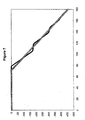
- figure 1 [abscisse : concentration en styrène mesurée par chromatographie "off-line" (ppm / masse de latex); ordonnée : concentration en styrène prédite par la calibration (ppm / masse de latex) ]
- et figure 2 [abscisse : concentration en polymère mesurée par gravimétrie "off-line" (% massique / masse de latex); ordonnée : concentration en polymère prédite par la calibration (% massique / masse de latex)].
| Fraction | Ingrédients | Masse (g.) |
| A | Eau | 1600 |
| Latex à 30% d'extrait sec | 23 | |
| EDTA | 0,4 | |
| acide acrylique | 63 | |
| B | Styrène | 1152 |
| Butadiène | 576 | |
| Ter-dodécylmercaptan | 18 | |
| C | Eau | 250 |
| Persulfate de sodium | 18 | |
| Anionic surfactant | 10 |
Les calculs de concentration en styrène par rapport au temps sont donnés figure 4. Le temps de la réaction en mn est en abscisse. Les carrés blancs correspondent à les concentrations en styrène de l'exemple 3a (ppm / masse de latex) ; les losanges blancs sont pour les concentrations en styrène de l'exemple 3b (ppm / masse de latex) ; et les cercles blancs représentent les concentrations en styrène de l'exemple 3c (ppm/masse de latex)]La concentration en polymère par rapport au temps est donnée figure 5 [abscisse : temps de la réaction en mn ; ordonnée : carré blanc : concentration en polymère de l'exemple 3a (%massique/masse de latex) ; losange blanc: concentration en polymère de l'exemple 3b (%massique/masse de latex) ; cercle blanc : concentration en polymère de l'exemple 3c (%massique/masse de latex)].
| Référence des essais | Indice de dispersion (ID) |
| 5-1 à 5-10 (sans régulation en ligne) | 87 |
| 6-11 à 6-20 (avec régulation en ligne) | 50 |
Claims (16)
- Procédé de préparation de latex aux propriétés prédéfinies par (co)polymérisation en émulsion d'au moins une espèce de monomères éthyléniquement insaturés, caractérisé en ce que le procédé est effectué par un suivi en continu in situ de la (co)polymérisation comprenant les étapes suivantes :(i) on émet dans l'émulsion un rayonnement lumineux incident compris dans la bande spectrale située entre 200 nm et 1400 nm, et de préférence entre 700 nm et 1400 nm,(ii) on capte et on transmet à un spectromètre Raman la lumière diffusée par le milieu réactionnel,(iii) on détermine le spectre Raman, portant l'énergie de la lumière diffusée en fonction du dèclage en longueur d'onde par rapport au rayonnement lumineux incident,(iv) on calcule :a) soit les intensités de raies du spectre spécifiques :de monomère(s) libre(s) non (co)polymérisé(s) dans le milieu réactionnelet du polymère obtenu,b) soit les concentrations de monomère(s) libre(s) non (co)polymérisé(s) dans le milieu réactionnel et du polymère obtenu à partir du spectre Raman à l'aide de méthodes d'analyses spectrales quantitatives, de préférence ces méthodes étant des méthodes chimiométriques multivariables;(v) on calcule les données de procédé à partir soit des concentrations de monomère(s) libre(s) et du polymère obtenu, soit des intensités de raies du spectre spécifiques de monomère(s) libre(s) dans le milieu réactionnel et des intensités de raies du spectre spécifiques du polymère obtenu;(vi) on compare ces données de procédé avec des données de référence spécifiques du procédé d'obtention du latex aux propriétés prédéfinies ;(vii) et on régule les paramètres réactionnels tels que la température, la pression, l'agitation du milieu et l'alimentation en monomères afin de minimiser l'écart entre les données de procédé mesurées en ligne et les données de procédé de référence.
- Procédé selon la revendication 1, caractérisé en ce que le spectromètre Raman est à transformée de Fourier ou à optique dispersive, de préférence à transformée de Fourier (FT-Raman).
- Procédé selon la revendication précédente, caractérisé en ce que le latex résulte de la (co)polymérisation en émulsion de monomères éthyléniquement insaturés, choisis dans le groupe constitué :du styrène et/ou de ses dérivés, notamment les dérivés tels que l'alphaméthylstyrène ou le vinyltoluène ;des diènes tels que le butadiène, l'isoprène, le 2-chloro-1,3 butadiène ;des esters (méth)acryliques, ce terme désignant les esters de l'acide acrylique et de l'acide méthacrylique avec les alcools en C1-C12 hydrogénés ou fluorés, de préférence C1-C8, notamment l'acrylate de méthyle, l'acrylate d'éthyle, l'acrylate de propyle, l'acrylate de n-butyle, l'acrylate d'isobutyle, l'acrylate de 2-éthylehexyle, l'acrylate de tert-butyle, le méthacrylate de méthyle, le méthacrylate d'éthyle, le méthacrylate de n-butyle, le méthacrylate d'isobutyle ;des nitriles vinyliques, de préférence ceux ayant de 3 à 12 atomes de carbone, tel que l'acrylonitrile et le méthacrylonitrile ;des esters vinyliques d'acide carboxylique tels que l'acétate de vinyle, le versatate de vinyle, le propionate de vinyle ;des halogenures de vinyle ;et leur mélange.
- Procédé selon la revendication précédente, caractérisé en ce que l'émulsion, en outre, comprend d'autres monomères éthyléniquement insaturés, (co)polymérisables avec les monomères de la revendication précédente, choisis parmi le groupe constitué par :les acides mono- et di-carboxyliques insaturés éthyléniques comme l'acide acrylique, l'acide méthacrylique, l'acide itaconique, l'acide maléique, l'acide fumarique ;les mono-alkylesters des acides dicarboxyliques précités avec des alcanols, de préférence ayant de 1 à 4 atomes de carbone, et leurs dérivés N- substitués ;les amides des acides carboxyliques insaturés tels que l'acrylamide, le méthacrylamide, le N-méthylolacrylamide, le méthacrylamide, et les N-alkylacrylamides ;les monomères éthyléniques comportant un groupe acide sulfonique et ses sels alcalins ou d'ammonium tels que l'acide vinylsulfonique, l'acide vinyl-benzène sulfonique, l'acide alpha-acrylamido méthylpropane-sulfonique, le 2-sulfoéthylèneméthacrylate.les monomères éthyléniques insaturés comportant un groupe amino secondaire, tertiaire ou quaternaire, ou un groupe hétérocyclique contenant de l'azote tels que par exemple les vinylpyridines, le vinylimidazole, les (méth)acrylates d'aminoalkyle et les (méth)acrylamides d'aminoalkyle comme le diméthylaminoéthyl-acrylate ou diméthylaminoéthyl-méthacrylate, le ditertiobutylaminoéthyl-acrylate ou le ditertio butylaminoéthyl-méthacrylate, le diméthylaminométhyl-acrylamide ou diméthyl aminométhyl-méthacrylamide ;les monomères zwitterioniques tels que l'acrylate de sulfopropyl(diméthyl)amino propyle ;et leur mélange.
- Procédé selon la revendication 4, caractérisé en ce que le suivi direct en ligne est effectué en continu pour la préparation de latex styrène-butadiène, par la (co)polymérisation en émulsion aqueuse du styrène avec le butadiène.
- Procédé selon l'une quelconque des revendications précédentes, caractérisé en ce que le suivi direct en ligne est effectué pour la préparation de latex par (co)polymérisation en émulsion dans laquelle la phase continue est constituée d'eau.
- Procédé selon l'une quelconque des revendications précédentes, caractérisé en ce qu'on calcule l'intensité des raies spécifiques du spectre de diffusion Raman :d'une part à environ 1635 ± 100 cm-1, raie associée à la vibration d'étirement de la double liaison carbone-carbone des monomères libres non encore (co)polymérisés,et d'autre part à environ 1660 ± 100 cm-1, raie associée aux vibrations d'étirement des double liaisons carbone-carbone incorporées dans la chaíne pcincipale du polymère obtenu, lorsque le mélange monomère contient au moins un composé diénique.
- Procédé selon l'une des revendications 1 à 6, caractérisé en ce que le suivi direct en ligne est effectué en calculant les concentrations de monomère(s) libre(s) et du polymère obtenu par des méthodes d'analyses chimiométriques multivariables, ce calcul étant effectué par un ordinateur ayant en mémoire les équations établissant une corrélation entre les spectres Raman et les concentrations de monomère(s) libre(s) et du polymère obtenu et, les spectres Raman mesurés étant introduits dans ladite mémoire afin de calculer les concentrations de monomère(s) libré(s) et du polymère obtenu lors de la polymérisation.
- Dispositif pour le suivi direct en ligne in situ du procédé de préparation de latex aux propriétés prédéfinies par (co)polymérisation en émulsion de monomères éthyléniquement insaturés selon l'une quelconque des revendications 1 à 8 comprenant :(i) un réacteur comprenant au moins un moyen d'alimentation de monomères, de tensioactifs, d'amorceur de (co)polymérisation, et d'eau ;(ii) au moins une sonde optique permettant d'analyser le contenu du réacteur ;(iii) un spectromètre Raman ;(iv) au moins une fibre optiquela fibre optique étant identique ou différente pour l'acheminement et le ré-acheminement ;par laquelle un rayonnement lumineux incident de longueur d'onde comprise entre 200 nm et 1400 nm, et de préférence entre 700 nm et 1400 nm, est acheminé du spectromètre Raman vers la sonde optique,et par laquelle la lumière diffusée par le milieu réactionnel est ré-acheminée vers le spectromètre fournissant le spectre Raman.(v) un calculateur couplé au spectromètre permettant de calculer à partir du spectre Raman :a) soit les intensités de raies du spectre spécifiquesde monomère(s) libre(s) non (co)polymérisé(s) dans le milieu réactionnelet du polymère obtenu,b) soit les concentrations des monomère(s) libre(s) non (co)polymérisé(s) dans le milieu réactionnel et du polymère obtenu à partir du spectre Raman à l'aide de méthodes d'analyses spectrales quantitatives, de préférence ces méthodes étant des méthodes chimiométriques multivariables ;(vi) et un automate de régulation dans lequel est programmé au moins un algorithme mathématique permettant de réguler les paramètres réactionnels tels que la température, la pression, la vitesse d'agitation du milieu, et l'alimentation en monomères afin de minimiser l'écart entre les données de procédé mesurées en ligne et les données de procédé de référence ; les données de procédé étant basées sur une transformation algébrique soit des intensités de raies ou des concentrations de monomère(s) libre(s) et du polymère obtenu et, les données de référence, basées sur cette même transformation algébrique, étant des données spécifiques du procédé d'obtention du latex aux propriétés prédéfinies.
- Dispositif selon la revendication précédente, caractérisé en ce que l'automate de régulation est un appareil programmable contenant au moins un algorithme mathématique, ledit appareil étant en liaison avec le calculateur couplé au spectromètre Raman, permet d'agir en continu sur les paramètres du procédé pour reproduire un profil de conversion instantanée prédéterminé.
- Dispositif selon l'une quelconque des revendications 9 et 10, caractérisé en ce que le spectromètre Raman est à transformée de Fourier et comprend une source de rayonnement lumineux, un système optique interférométrique, un détecteur, un système électronique et un système informatique.
- Dispositif selon l'une quelconque des revendications 9 à 11, caractérisé en ce que la sonde optique est positionnée directement à proximité du réacteur dans lequel la (co)polymérisation a lieu, indifféremmentsoit au contact du milieu réactionnel,soit placée derrière une fenêtre de façon à ce qu'il n'y ait aucun contact physique entre ladite sonde et le milieu réactionnel.
- Dispositif selon l'une quelconque des revendications 9 à 12, caractérisé en ce que la sonde comporte un ou plusieurs moyens destinés à atténuer et/ou à éliminer le(s) spectre(s) interférant(s).
- Dispositif selon la revendication précédente, caractérisé en ce que la sonde comporte un premier moyen destiné à éliminer le spectre Raman produit par la fibre optique transportant l'irradiation incidente, et un deuxième moyen destiné à atténuer la diffusion Rayleigh des molécules sondées.
- Dispositif selon l'une quelconque des revendications 9 à 14, caractérisé en ce que les premier et deuxième moyens sont des filtres optiques choisis notamment parmi les filtres holographiques, les filtres diélectriques et les filtres dichroïques.
- Dispositif selon l'une des revendications précédentes 9 à 15, caractérisé en ce que la transmission des rayonnements incident et diffusé se fait par l'intermédiaire des fibres optiques comportant des ports d'entrée et de sortie individuels et séparés.
Applications Claiming Priority (3)
| Application Number | Priority Date | Filing Date | Title |
|---|---|---|---|
| FR9902011 | 1999-02-18 | ||
| FR9902011A FR2790091B1 (fr) | 1999-02-18 | 1999-02-18 | Procede de preparation de latex par (co)polymerisation en emulsion de monomeres ethyleniquement insatures, avec suivi direct en ligne par spectroscopie raman |
| PCT/FR2000/000360 WO2000049395A1 (fr) | 1999-02-18 | 2000-02-14 | Procede de preparation de latex par (co)polymerisation en emulsion de monomeres ethyleniquement insatures, avec suivi direct en ligne par spectroscopie raman |
Publications (2)
| Publication Number | Publication Date |
|---|---|
| EP1163504A1 EP1163504A1 (fr) | 2001-12-19 |
| EP1163504B1 true EP1163504B1 (fr) | 2005-01-19 |
Family
ID=9542214
Family Applications (1)
| Application Number | Title | Priority Date | Filing Date |
|---|---|---|---|
| EP00905130A Expired - Lifetime EP1163504B1 (fr) | 1999-02-18 | 2000-02-14 | Procede de preparation de latex par (co)polymerisation en emulsion de monomeres ethyleniquement insatures, avec suivi direct en ligne par spectroscopie raman, et dispositif pour la mise en oeuvre du procede |
Country Status (9)
| Country | Link |
|---|---|
| US (1) | US6803020B1 (fr) |
| EP (1) | EP1163504B1 (fr) |
| AT (1) | ATE287532T1 (fr) |
| AU (1) | AU2676800A (fr) |
| BR (1) | BR0008342A (fr) |
| CA (1) | CA2362971A1 (fr) |
| DE (1) | DE60017548T2 (fr) |
| FR (1) | FR2790091B1 (fr) |
| WO (1) | WO2000049395A1 (fr) |
Families Citing this family (10)
| Publication number | Priority date | Publication date | Assignee | Title |
|---|---|---|---|---|
| US6608678B1 (en) * | 2000-10-19 | 2003-08-19 | General Electric Company | Situ determination of DPC and BPA in polycarbonate by Raman spectroscopy |
| CN1582391A (zh) * | 2001-10-30 | 2005-02-16 | 拜尔公司 | 接枝聚合物的生产方法 |
| AU2003255419A1 (en) * | 2002-08-12 | 2004-03-03 | Basell Polyolefine Gmbh | Determination of mechanical properties of polymer products using raman spectroscopy |
| DE10304817A1 (de) * | 2003-02-06 | 2004-09-02 | Bayer Ag | Verfahren zur verbesserten Herstellung von Pfropfpolymerisaten |
| WO2011110518A1 (fr) * | 2010-03-12 | 2011-09-15 | Basf Se | Procédé de fabrication de polymères styrène expansibles |
| EP2655439B1 (fr) * | 2010-12-21 | 2018-09-19 | Dow Global Technologies LLC | Procédé de polymérisation et analyse raman pour des polymères à base d'oléfines |
| EP3692358A1 (fr) | 2017-10-06 | 2020-08-12 | Lonza Ltd | Contrôle automatisé de culture cellulaire par spectroscopie raman |
| CN114752056B (zh) * | 2022-03-02 | 2024-01-26 | 双驱智能科技(宁波)有限公司 | 一种可重复稳定生产窄分子量分布聚芳醚酮的装置及方法 |
| CN117783086A (zh) * | 2023-12-28 | 2024-03-29 | 山东鸿瑞新材料科技有限公司 | 异丁烯聚合反应出料在线拉曼分析仪实施与运行方法 |
| CN120594492B (zh) * | 2025-08-08 | 2025-10-24 | 南京大学 | 一种针对固体顺-反式丁烯二酸的超快速且无损检测方法 |
Family Cites Families (6)
| Publication number | Priority date | Publication date | Assignee | Title |
|---|---|---|---|---|
| DE3524796A1 (de) * | 1984-07-14 | 1986-01-16 | Okura Kogyo K.K., Marugame, Kagawa | Verfahren zur herstellung von kunststoff-beton |
| US4802761A (en) * | 1987-08-31 | 1989-02-07 | Western Research Institute | Optical-fiber raman spectroscopy used for remote in-situ environmental analysis |
| US4802984A (en) * | 1988-05-04 | 1989-02-07 | Ionics, Incorporated | Composite semipermeable membrane |
| GB9208535D0 (en) * | 1992-04-21 | 1992-06-03 | Ici Plc | Co-polymers |
| US5312847A (en) * | 1993-03-16 | 1994-05-17 | The Dow Chemical Company | Polyurethane foam containing a particulate organic solid and a process for the preparation thereof |
| US6175409B1 (en) * | 1999-04-02 | 2001-01-16 | Symyx Technologies, Inc. | Flow-injection analysis and variable-flow light-scattering methods and apparatus for characterizing polymers |
-
1999
- 1999-02-18 FR FR9902011A patent/FR2790091B1/fr not_active Expired - Fee Related
-
2000
- 2000-02-14 AU AU26768/00A patent/AU2676800A/en not_active Abandoned
- 2000-02-14 US US09/913,838 patent/US6803020B1/en not_active Expired - Fee Related
- 2000-02-14 EP EP00905130A patent/EP1163504B1/fr not_active Expired - Lifetime
- 2000-02-14 DE DE60017548T patent/DE60017548T2/de not_active Expired - Fee Related
- 2000-02-14 AT AT00905130T patent/ATE287532T1/de not_active IP Right Cessation
- 2000-02-14 WO PCT/FR2000/000360 patent/WO2000049395A1/fr not_active Ceased
- 2000-02-14 BR BR0008342-9A patent/BR0008342A/pt not_active IP Right Cessation
- 2000-02-14 CA CA002362971A patent/CA2362971A1/fr not_active Abandoned
Also Published As
| Publication number | Publication date |
|---|---|
| FR2790091B1 (fr) | 2001-05-11 |
| US6803020B1 (en) | 2004-10-12 |
| AU2676800A (en) | 2000-09-04 |
| EP1163504A1 (fr) | 2001-12-19 |
| ATE287532T1 (de) | 2005-02-15 |
| BR0008342A (pt) | 2002-01-29 |
| DE60017548D1 (de) | 2005-02-24 |
| DE60017548T2 (de) | 2006-01-12 |
| WO2000049395A1 (fr) | 2000-08-24 |
| CA2362971A1 (fr) | 2000-08-24 |
| FR2790091A1 (fr) | 2000-08-25 |
Similar Documents
| Publication | Publication Date | Title |
|---|---|---|
| CA2362971A1 (fr) | Procede de preparation de latex par (co)polymerisation en emulsion de monomeres ethyleniquement insatures, avec suivi direct en ligne par spectroscopie raman | |
| Florenzano et al. | Absolute, on-line monitoring of molar mass during polymerization reactions | |
| EP0345182B1 (fr) | Procédé et appareillage de fabrication d'oléfines et de dioléfines par réaction de vapocraquage d'hydrocarbures contrôlée à l'aide d'un système comprenant un spectrophotomètre infrarouge | |
| Chambard et al. | Effect of solvent on the activation rate parameters for polystyrene and poly (butyl acrylate) macroinitiators in atom transfer radical polymerization | |
| Rahane et al. | Kinetics of surface-initiated photoiniferter-mediated photopolymerization | |
| FR2625506A1 (fr) | Procede et appareillage de fabrication de polymeres controlee a l'aide d'un systeme de regulation comprenant un spectrophotometre infrarouge | |
| Beuermann et al. | Propagation kinetics of methacrylic acid studied by pulsed-laser polymerization | |
| Buback et al. | Detailed kinetic and mechanistic insight into radical polymerization by spectroscopic techniques | |
| US9040605B2 (en) | Polymerization process and raman analysis for olefin-based polymers | |
| KR20200013801A (ko) | 시간-의존적 공정 동안 화학 종의 성질을 예측하고 제어하기 위한 방법 및 시스템 | |
| Skupov et al. | Kinetic and mechanistic aspects of ethylene and acrylates catalytic copolymerization in solution and in emulsion | |
| JP2005507456A (ja) | グラフト重合反応の反応進行の測定方法 | |
| Rahane et al. | Impact of added tetraethylthiuram disulfide deactivator on the kinetics of growth and reinitiation of poly (methyl methacrylate) brushes made by surface-initiated photoiniferter-mediated photopolymerization | |
| Chicoma et al. | In‐Line Monitoring of Particle Size during Emulsion Polymerization under Different Operational Conditions using NIR Spectroscopy | |
| Beuermann et al. | Pressure and temperature dependence of the propagation rate coefficient of free-radical styrene polymerization in supercritical carbon dioxide | |
| Rodríguez-Guadarrama | Application of online near infrared spectroscopy to study the kinetics of anionic polymerization of butadiene | |
| Gheghiani et al. | Monitoring of polymer content in an emulsion polymerization using spatially resolved spectroscopy in the near infrared region and Raman spectroscopy | |
| FR2794757A1 (fr) | Procede de polymerisation de l'isobutene | |
| Colombani et al. | Polymerization kinetics: monitoring monomer conversion using an internal standard and the key role of sample t 0 | |
| Sauer et al. | Static and dynamic interfacial tensions of a phospholipid monolayer at the oil/water interface: dipalmitoylphosphatidylcholine at heptane/water | |
| Revillon | Interpretation of the gel permeation chromatography behaviour of three types of copolymers | |
| Sahre et al. | Kinetic Studies of Metallocene‐Catalyzed Copolymerization of Propene with 10‐Undecene‐1‐ol Using In‐Line FTIR Spectroscopy | |
| Martínez et al. | Polymerization reactor monitoring by in-line Raman spectrometry | |
| Chicoma et al. | In Line monitoring of VAc‐BuA emulsion polymerization reaction in a continuous pulsed sieve plate reactor using NIR spectroscopy | |
| LU87762A1 (fr) | Systeme de controle de la production de noir de carbone |
Legal Events
| Date | Code | Title | Description |
|---|---|---|---|
| PUAI | Public reference made under article 153(3) epc to a published international application that has entered the european phase |
Free format text: ORIGINAL CODE: 0009012 |
|
| 17P | Request for examination filed |
Effective date: 20010830 |
|
| AK | Designated contracting states |
Kind code of ref document: A1 Designated state(s): AT BE CH CY DE DK ES FI FR GB GR IE IT LI LU MC NL PT SE |
|
| AX | Request for extension of the european patent |
Free format text: AL;LT;LV;MK;RO;SI |
|
| 17Q | First examination report despatched |
Effective date: 20030922 |
|
| GRAP | Despatch of communication of intention to grant a patent |
Free format text: ORIGINAL CODE: EPIDOSNIGR1 |
|
| RAP1 | Party data changed (applicant data changed or rights of an application transferred) |
Owner name: RAISIO CHEMICALS OY |
|
| RTI1 | Title (correction) |
Free format text: METHOD OF MANUFACTURING LATEX BY COPOLYMERISATION IN AN EMULSION OF ETHYLENICALLY UNSATURATER MONOMERS, WITH ONLINE MONIT |
|
| RTI1 | Title (correction) |
Free format text: METHOD OF MANUFACTURING LATEX BY (CO)POLYMERISATION IN AN EMULSION OF ETHYLENICALLY UNSATURATED MONOMERS, WITH ON-LINE MO |
|
| GRAS | Grant fee paid |
Free format text: ORIGINAL CODE: EPIDOSNIGR3 |
|
| GRAA | (expected) grant |
Free format text: ORIGINAL CODE: 0009210 |
|
| RAP1 | Party data changed (applicant data changed or rights of an application transferred) |
Owner name: CIBA SPECIALTY CHEMICALS HOLDING INC. |
|
| PGFP | Annual fee paid to national office [announced via postgrant information from national office to epo] |
Ref country code: FR Payment date: 20050118 Year of fee payment: 6 Ref country code: CH Payment date: 20050118 Year of fee payment: 6 |
|
| AK | Designated contracting states |
Kind code of ref document: B1 Designated state(s): AT BE CH CY DE DK ES FI FR GB GR IE IT LI LU MC NL PT SE |
|
| PG25 | Lapsed in a contracting state [announced via postgrant information from national office to epo] |
Ref country code: NL Free format text: LAPSE BECAUSE OF FAILURE TO SUBMIT A TRANSLATION OF THE DESCRIPTION OR TO PAY THE FEE WITHIN THE PRESCRIBED TIME-LIMIT Effective date: 20050119 Ref country code: IT Free format text: LAPSE BECAUSE OF FAILURE TO SUBMIT A TRANSLATION OF THE DESCRIPTION OR TO PAY THE FEE WITHIN THE PRESCRIBED TIME-LIMIT;WARNING: LAPSES OF ITALIAN PATENTS WITH EFFECTIVE DATE BEFORE 2007 MAY HAVE OCCURRED AT ANY TIME BEFORE 2007. THE CORRECT EFFECTIVE DATE MAY BE DIFFERENT FROM THE ONE RECORDED. Effective date: 20050119 Ref country code: IE Free format text: LAPSE BECAUSE OF FAILURE TO SUBMIT A TRANSLATION OF THE DESCRIPTION OR TO PAY THE FEE WITHIN THE PRESCRIBED TIME-LIMIT Effective date: 20050119 |
|
| REG | Reference to a national code |
Ref country code: GB Ref legal event code: FG4D Free format text: NOT ENGLISH |
|
| PGFP | Annual fee paid to national office [announced via postgrant information from national office to epo] |
Ref country code: SE Payment date: 20050121 Year of fee payment: 6 |
|
| PGFP | Annual fee paid to national office [announced via postgrant information from national office to epo] |
Ref country code: FI Payment date: 20050125 Year of fee payment: 6 |
|
| PGFP | Annual fee paid to national office [announced via postgrant information from national office to epo] |
Ref country code: GB Payment date: 20050126 Year of fee payment: 6 |
|
| PGFP | Annual fee paid to national office [announced via postgrant information from national office to epo] |
Ref country code: DE Payment date: 20050127 Year of fee payment: 6 |
|
| REG | Reference to a national code |
Ref country code: CH Ref legal event code: EP |
|
| GBT | Gb: translation of ep patent filed (gb section 77(6)(a)/1977) |
Effective date: 20050119 |
|
| PG25 | Lapsed in a contracting state [announced via postgrant information from national office to epo] |
Ref country code: LU Free format text: LAPSE BECAUSE OF NON-PAYMENT OF DUE FEES Effective date: 20050214 Ref country code: CY Free format text: LAPSE BECAUSE OF FAILURE TO SUBMIT A TRANSLATION OF THE DESCRIPTION OR TO PAY THE FEE WITHIN THE PRESCRIBED TIME-LIMIT Effective date: 20050214 |
|
| REG | Reference to a national code |
Ref country code: IE Ref legal event code: FG4D Free format text: FRENCH |
|
| REF | Corresponds to: |
Ref document number: 60017548 Country of ref document: DE Date of ref document: 20050224 Kind code of ref document: P |
|
| PG25 | Lapsed in a contracting state [announced via postgrant information from national office to epo] |
Ref country code: MC Free format text: LAPSE BECAUSE OF NON-PAYMENT OF DUE FEES Effective date: 20050228 Ref country code: BE Free format text: LAPSE BECAUSE OF NON-PAYMENT OF DUE FEES Effective date: 20050228 |
|
| PGFP | Annual fee paid to national office [announced via postgrant information from national office to epo] |
Ref country code: AT Payment date: 20050228 Year of fee payment: 6 |
|
| PG25 | Lapsed in a contracting state [announced via postgrant information from national office to epo] |
Ref country code: GR Free format text: LAPSE BECAUSE OF FAILURE TO SUBMIT A TRANSLATION OF THE DESCRIPTION OR TO PAY THE FEE WITHIN THE PRESCRIBED TIME-LIMIT Effective date: 20050419 Ref country code: DK Free format text: LAPSE BECAUSE OF FAILURE TO SUBMIT A TRANSLATION OF THE DESCRIPTION OR TO PAY THE FEE WITHIN THE PRESCRIBED TIME-LIMIT Effective date: 20050419 |
|
| PG25 | Lapsed in a contracting state [announced via postgrant information from national office to epo] |
Ref country code: ES Free format text: LAPSE BECAUSE OF FAILURE TO SUBMIT A TRANSLATION OF THE DESCRIPTION OR TO PAY THE FEE WITHIN THE PRESCRIBED TIME-LIMIT Effective date: 20050430 |
|
| REG | Reference to a national code |
Ref country code: SE Ref legal event code: TRGR |
|
| NLV1 | Nl: lapsed or annulled due to failure to fulfill the requirements of art. 29p and 29m of the patents act | ||
| REG | Reference to a national code |
Ref country code: IE Ref legal event code: FD4D |
|
| BERE | Be: lapsed |
Owner name: CIBA SPECIALTY CHEMICALS HOLDING INC. Effective date: 20050228 |
|
| PLBE | No opposition filed within time limit |
Free format text: ORIGINAL CODE: 0009261 |
|
| STAA | Information on the status of an ep patent application or granted ep patent |
Free format text: STATUS: NO OPPOSITION FILED WITHIN TIME LIMIT |
|
| 26N | No opposition filed |
Effective date: 20051020 |
|
| PG25 | Lapsed in a contracting state [announced via postgrant information from national office to epo] |
Ref country code: GB Free format text: LAPSE BECAUSE OF NON-PAYMENT OF DUE FEES Effective date: 20060214 Ref country code: FI Free format text: LAPSE BECAUSE OF NON-PAYMENT OF DUE FEES Effective date: 20060214 Ref country code: AT Free format text: LAPSE BECAUSE OF NON-PAYMENT OF DUE FEES Effective date: 20060214 |
|
| PG25 | Lapsed in a contracting state [announced via postgrant information from national office to epo] |
Ref country code: SE Free format text: LAPSE BECAUSE OF NON-PAYMENT OF DUE FEES Effective date: 20060215 |
|
| PG25 | Lapsed in a contracting state [announced via postgrant information from national office to epo] |
Ref country code: LI Free format text: LAPSE BECAUSE OF NON-PAYMENT OF DUE FEES Effective date: 20060228 Ref country code: CH Free format text: LAPSE BECAUSE OF NON-PAYMENT OF DUE FEES Effective date: 20060228 |
|
| PG25 | Lapsed in a contracting state [announced via postgrant information from national office to epo] |
Ref country code: DE Free format text: LAPSE BECAUSE OF NON-PAYMENT OF DUE FEES Effective date: 20060901 |
|
| REG | Reference to a national code |
Ref country code: CH Ref legal event code: PL |
|
| EUG | Se: european patent has lapsed | ||
| GBPC | Gb: european patent ceased through non-payment of renewal fee |
Effective date: 20060214 |
|
| REG | Reference to a national code |
Ref country code: FR Ref legal event code: ST Effective date: 20061031 |
|
| BERE | Be: lapsed |
Owner name: CIBA SPECIALTY CHEMICALS HOLDING INC. Effective date: 20050228 |
|
| PG25 | Lapsed in a contracting state [announced via postgrant information from national office to epo] |
Ref country code: PT Free format text: LAPSE BECAUSE OF NON-PAYMENT OF DUE FEES Effective date: 20050619 |
|
| PG25 | Lapsed in a contracting state [announced via postgrant information from national office to epo] |
Ref country code: FR Free format text: LAPSE BECAUSE OF NON-PAYMENT OF DUE FEES Effective date: 20060228 |