EP1162599A2 - Rekalibrierung eines aktiven Lärmunterdrückungssystems - Google Patents
Rekalibrierung eines aktiven Lärmunterdrückungssystems Download PDFInfo
- Publication number
- EP1162599A2 EP1162599A2 EP01201807A EP01201807A EP1162599A2 EP 1162599 A2 EP1162599 A2 EP 1162599A2 EP 01201807 A EP01201807 A EP 01201807A EP 01201807 A EP01201807 A EP 01201807A EP 1162599 A2 EP1162599 A2 EP 1162599A2
- Authority
- EP
- European Patent Office
- Prior art keywords
- environmental
- control unit
- noise
- assumption
- sound wave
- Prior art date
- Legal status (The legal status is an assumption and is not a legal conclusion. Google has not performed a legal analysis and makes no representation as to the accuracy of the status listed.)
- Withdrawn
Links
Images

Classifications
-
- G—PHYSICS
- G10—MUSICAL INSTRUMENTS; ACOUSTICS
- G10K—SOUND-PRODUCING DEVICES; METHODS OR DEVICES FOR PROTECTING AGAINST, OR FOR DAMPING, NOISE OR OTHER ACOUSTIC WAVES IN GENERAL; ACOUSTICS NOT OTHERWISE PROVIDED FOR
- G10K11/00—Methods or devices for transmitting, conducting or directing sound in general; Methods or devices for protecting against, or for damping, noise or other acoustic waves in general
- G10K11/16—Methods or devices for protecting against, or for damping, noise or other acoustic waves in general
- G10K11/175—Methods or devices for protecting against, or for damping, noise or other acoustic waves in general using interference effects; Masking sound
- G10K11/178—Methods or devices for protecting against, or for damping, noise or other acoustic waves in general using interference effects; Masking sound by electro-acoustically regenerating the original acoustic waves in anti-phase
- G10K11/1787—General system configurations
- G10K11/17879—General system configurations using both a reference signal and an error signal
- G10K11/17883—General system configurations using both a reference signal and an error signal the reference signal being derived from a machine operating condition, e.g. engine RPM or vehicle speed
-
- G—PHYSICS
- G10—MUSICAL INSTRUMENTS; ACOUSTICS
- G10K—SOUND-PRODUCING DEVICES; METHODS OR DEVICES FOR PROTECTING AGAINST, OR FOR DAMPING, NOISE OR OTHER ACOUSTIC WAVES IN GENERAL; ACOUSTICS NOT OTHERWISE PROVIDED FOR
- G10K11/00—Methods or devices for transmitting, conducting or directing sound in general; Methods or devices for protecting against, or for damping, noise or other acoustic waves in general
- G10K11/16—Methods or devices for protecting against, or for damping, noise or other acoustic waves in general
- G10K11/175—Methods or devices for protecting against, or for damping, noise or other acoustic waves in general using interference effects; Masking sound
- G10K11/178—Methods or devices for protecting against, or for damping, noise or other acoustic waves in general using interference effects; Masking sound by electro-acoustically regenerating the original acoustic waves in anti-phase
- G10K11/1781—Methods or devices for protecting against, or for damping, noise or other acoustic waves in general using interference effects; Masking sound by electro-acoustically regenerating the original acoustic waves in anti-phase characterised by the analysis of input or output signals, e.g. frequency range, modes, transfer functions
- G10K11/17813—Methods or devices for protecting against, or for damping, noise or other acoustic waves in general using interference effects; Masking sound by electro-acoustically regenerating the original acoustic waves in anti-phase characterised by the analysis of input or output signals, e.g. frequency range, modes, transfer functions characterised by the analysis of the acoustic paths, e.g. estimating, calibrating or testing of transfer functions or cross-terms
- G10K11/17817—Methods or devices for protecting against, or for damping, noise or other acoustic waves in general using interference effects; Masking sound by electro-acoustically regenerating the original acoustic waves in anti-phase characterised by the analysis of input or output signals, e.g. frequency range, modes, transfer functions characterised by the analysis of the acoustic paths, e.g. estimating, calibrating or testing of transfer functions or cross-terms between the output signals and the error signals, i.e. secondary path
-
- G—PHYSICS
- G10—MUSICAL INSTRUMENTS; ACOUSTICS
- G10K—SOUND-PRODUCING DEVICES; METHODS OR DEVICES FOR PROTECTING AGAINST, OR FOR DAMPING, NOISE OR OTHER ACOUSTIC WAVES IN GENERAL; ACOUSTICS NOT OTHERWISE PROVIDED FOR
- G10K2210/00—Details of active noise control [ANC] covered by G10K11/178 but not provided for in any of its subgroups
- G10K2210/10—Applications
- G10K2210/101—One dimensional
-
- G—PHYSICS
- G10—MUSICAL INSTRUMENTS; ACOUSTICS
- G10K—SOUND-PRODUCING DEVICES; METHODS OR DEVICES FOR PROTECTING AGAINST, OR FOR DAMPING, NOISE OR OTHER ACOUSTIC WAVES IN GENERAL; ACOUSTICS NOT OTHERWISE PROVIDED FOR
- G10K2210/00—Details of active noise control [ANC] covered by G10K11/178 but not provided for in any of its subgroups
- G10K2210/10—Applications
- G10K2210/128—Vehicles
- G10K2210/1282—Automobiles
-
- G—PHYSICS
- G10—MUSICAL INSTRUMENTS; ACOUSTICS
- G10K—SOUND-PRODUCING DEVICES; METHODS OR DEVICES FOR PROTECTING AGAINST, OR FOR DAMPING, NOISE OR OTHER ACOUSTIC WAVES IN GENERAL; ACOUSTICS NOT OTHERWISE PROVIDED FOR
- G10K2210/00—Details of active noise control [ANC] covered by G10K11/178 but not provided for in any of its subgroups
- G10K2210/30—Means
- G10K2210/301—Computational
- G10K2210/3055—Transfer function of the acoustic system
-
- G—PHYSICS
- G10—MUSICAL INSTRUMENTS; ACOUSTICS
- G10K—SOUND-PRODUCING DEVICES; METHODS OR DEVICES FOR PROTECTING AGAINST, OR FOR DAMPING, NOISE OR OTHER ACOUSTIC WAVES IN GENERAL; ACOUSTICS NOT OTHERWISE PROVIDED FOR
- G10K2210/00—Details of active noise control [ANC] covered by G10K11/178 but not provided for in any of its subgroups
- G10K2210/50—Miscellaneous
- G10K2210/503—Diagnostics; Stability; Alarms; Failsafe
-
- G—PHYSICS
- G10—MUSICAL INSTRUMENTS; ACOUSTICS
- G10K—SOUND-PRODUCING DEVICES; METHODS OR DEVICES FOR PROTECTING AGAINST, OR FOR DAMPING, NOISE OR OTHER ACOUSTIC WAVES IN GENERAL; ACOUSTICS NOT OTHERWISE PROVIDED FOR
- G10K2210/00—Details of active noise control [ANC] covered by G10K11/178 but not provided for in any of its subgroups
- G10K2210/50—Miscellaneous
- G10K2210/504—Calibration
Definitions
- This invention relates to an active method and system for controlling automotive induction noise.
- Active systems use a speaker to create a cancelling sound that attenuates engine noise.
- the sound created is out of phase with the engine noise and combines with this noise to result in its reduction.
- this sound is generated in proximity to the mouth of the air induction system.
- a control unit such as a digital signal processor, obtains data from the vehicle engine, creates a predictive model of engine noise, and thereby generates the appropriate cancellation signal based on the results of this model. This signal is then transmitted to the speaker, which transforms this signal into a cancelling sound. Because the control unit may not perfectly model engine noise, an error microphone is placed in proximity to the mouth of the air induction system to determine if engine noise need be further attenuated.
- the invention therefore provides a method of noise attenuation comprising the steps of: generating a noise cancelling signal from a control unit based on an environmental assumption; assessing the environmental assumption of the control unit; and altering the noise cancelling signal based on the assessment.
- a noise cancelling signal is generated by a control unit, such as a computer, that emits this signal, for example through a speaker, in proximity to the source of the noise.
- This noise cancelling signal is generated based on an environmental assumption about air temperature, humidity, air pressure, or other environmental condition. In this invention, however, the environmental assumption is assessed and the noise cancelling signal is altered based on the assessment.
- the assessment may comprise comparing the environmental assumption with actual environmental data.
- a test sound wave is generated to obtain actual environmental data. Because the test sound wave travels through the actual environment, the test sound wave is affected by the environment.
- the test sound wave is then compared with a model of a sound wave based on the environmental assumption. Differences between the test sound wave and the model of the sound wave based on the environmental assumption reveal environmental data that may then be used to alter the noise cancelling signal. For example, if the test sound wave differs in speed from the model of the sound wave based on the environmental assumption, the noise cancelling signal may require alteration.
- the environmental assumption may be assessed more than once as well as over a predetermined period of time. Such an assessment may take place while the noise cancelling feature is disabled such as when a system condition exists that may lead to the generation of undesirable noise by the noise attenuation system. In this situation, the test sound wave is generated following the disabling of the noise attenuation feature. A comparison of the test sound wave with the model of the sound wave based on the environmental assumption also takes place while the system is disabled. If differences arise between the two sound waves, then the noise cancelling signal may be altered.
- the foregoing method may be embodied in an air induction system comprising, an air induction body, a speaker in proximity to the air induction body, a microphone in communication with the speaker, a reference sensor, and a control unit with a noise attenuation feature based on an environmental assumption.
- the control unit communicates with the speaker, the microphone, and reference sensor, assessing the environmental assumption and potentially altering the noise attenuation feature based on the assessment.
- the control unit may assess the environmental assumption by comparing the environmental assumption with actual environmental data.
- the speaker may generate a test sound wave to obtain actual environmental data.
- the microphone may be arranged to receive this test sound wave.
- the control unit may compare the two sound waves in its determination of whether to alter the noise cancelling signal.
- the invention generates a noise cancelling signal from the control unit based on an environmental assumption, assesses the environmental assumption, and alters the noise cancelling signal based on the assessment. This process may be repeated at regular or sporadic intervals to permit continual assessment and alteration of the environmental assumptions. To ensure accurate measurement of the environmental condition, the condition may be sensed for a predetermined period of time.
- Figure 1 illustrates the method and system of noise attenuation of an embodiment of the invention.
- Pictured schematically are air induction body 10 and speaker 14, preferably disposed in air induction body 10, control unit 18, engine 22, microphone 26, and reference sensor 27, such as an engine tachometer.
- Engine noise 30 from engine 22 travels through air induction body 10 out of mouth 34 of air induction body 10.
- Control unit 18 is in communication with speaker 14, microphone 26, and reference sensor 27.
- reference sensor 27 serves to provide control unit 18 with information on the frequency content of engine noise 30 emanating from mouth 34.
- control unit 18 has a noise cancellation feature that generates a noise cancelling signal 38 through speaker 14. Because noise cancelling signal 38 is out of phase with engine noise 30, both noise cancelling signal 38 and engine noise 30 are thereby attenuated.
- the noise cancellation feature employs a model of engine noise that relies on environmental assumptions about air temperature, air pressure, humidity, and other environmental conditions affecting the communication of sound. Typically, such assumptions are preset.
- An embodiment of the invention employs control unit 18 to assess environmental assumptions and to alter the noise attenuation feature based on the assessment.
- Control unit 18 assesses the environmental assumptions by comparing these assumptions with actual environmental data.
- Speaker 14 may generate a test sound wave, which is received by microphone 26. Because the test sound wave travels through the actual environment, the test sound wave is affected by the environment and then compared by control unit 18 with a model of a sound wave based on the environmental assumption. Differences between the test sound wave and the model, such as their relative speeds, may reveal differences between the actual environment and the assumed environment. Such environmental data may then be used to recalibrate control unit 18 and thereby alter noise cancelling signal 38 to account for the changed environment.
- control unit 18 may determine other means to obtain actual environmental data used to assess any underlying environmental assumption of the model.
- the process of assessing by control unit 18 may occur more than once and over a predetermined period of time to ensure both accurate measurements of environmental data without significant burdening of control unit
- the present invention may be used in conjunction with the method of noise attenuation whereby noise attenuation is ceased under a certain system condition such as a condition likely to lead to the generation of unwanted noise by the system.
- a predetermined system condition is detected by microphone 26, the noise cancellation feature of control unit 18 is disabled.
- the predetermined system condition is based on engine noise level received by microphone 26, background noise level received by microphone 26, or a relationship between the level of the engine noise to be attenuated and the level of background noise around the engine compartment. For example, a low engine noise level to background noise level would indicate a situation where unwanted noise may be generated.
- control unit 18 disables the noise attenuation feature to prevent the generation of unwanted noise. While the noise attenuation feature is disabled, control unit 18 recalibrates as described above. The disabling of the noise attenuation feature may occur prior to the assessing of the environmental assumption of control unit 18.
- control unit 18 Another system condition reviewed by the system is the position of the vehicle throttle. Sensor 54 detects the position of the throttle blade and communicates this position to control unit 18. If microphone 26, detects a high pitch sound while sensor 54 detects the throttle position as moved toward closed, then control unit 18 deduces that the sound is unwanted noise from the system and shuts off its noise attenuation feature, thereby eliminating the high pitch sound while control unit 18 recalibrates.
- control unit 18 may again commence noise attenuation by generating another noise cancelling signal based on a model with updated environmental assumptions. Control unit 18 may further record the cessation of the generation of the noise cancelling signal based upon the system condition. Control unit 18 may read this cessation as a system error or malfunction. In this way, if the number of errors exceeds a preset level, then control unit 18 deduces a system error and ceases noise attenuation for a predetermined amount of time to permit systems conditions to change to where noise attenuation may proceed without undesirable noise. Control unit 18 may issue an error message to the driver as well. After a predetermined amount of time, the system once again commences noise attenuation. In the event errors persist, then control unit 18 may permanently disable noise attenuation until the system is serviced.
- the method of noise attenuation involves generating a noise cancelling signal 38 based on an environmental assumption from control unit 18, assessing the environmental assumption of control unit 18, and altering the noise cancelling signal 38 based on the assessment.
- the assessing may comprises comparing the environmental assumption with actual environmental data.
- the environmental data may be obtained by generating a test sound wave as described above.
- the test sound wave is then compared to a model of the sound wave based on the environmental assumption.
- the characteristics of the sound waves such as their relative speeds, may be compared to obtain important information about the actual environment.
- the environmental assumption may be assessed more than once and for a predetermined period of time to ensure accuracy of the modelling.
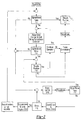
- FIG. 2 is a flowchart of an embodiment of the above described method and system.
- control unit 18 checks microphone 26 to determine whether the engine noise 30 to background noise ratio is above a predetermined level (n) to avoid generation of unwanted high pitch noise. If so, then normal operation of noise attenuation takes place and, as explained below, error counter is reset.
- Control unit 18 again checks microphone 26 to review the current engine noise 30 to background noise ratio following noise attenuation. If this ratio is greater than n, then control unit 18 checks sensor 54 to determine throttle position. If throttle position is open over a predetermined amount (d) as sensed by a throttle position sensor as known in the art, control unit 18 proceeds to determine whether control unit 18 need continue operation. If yes, then control unit 18 loops back to its noise attenuation routine. If not, then control unit 18 pauses noise attenuation. Attenuation is paused until throttle is once again open as detected. When throttle is moved to open above a predetermined level (d), then control unit 18 loops back to its noise attenuation routine. While noise attenuation is paused, control unit 18 recalibrates based on actual environmental condition as described above.
- control unit 18 determines that the ratio between engine noise 30 and background noise is less than a predetermined level n for normal operation of noise attenuation, then control unit 18 resets to clear any system problem and checks again the ratio of engine noise 30 to background noise. Following reset, control unit recalibrates. If the ratio is high, then control unit 18 checks the throttle position as shown. On the other hand, if the ratio is below a predetermined level n, then the error is counted and recorded. In the event that the number of errors exceeds a preset limit (q) as determined, then control unit 18 stops the noise attenuation process and notifies the engine computer of the error. Control unit 18 restarts, however, after a predetermined time period, in one example 120 seconds, to give the opportunity for the error to clear itself. After this period, control unit 18 recommences the process.
Landscapes
- Physics & Mathematics (AREA)
- Engineering & Computer Science (AREA)
- Acoustics & Sound (AREA)
- Multimedia (AREA)
- Soundproofing, Sound Blocking, And Sound Damping (AREA)
- Fittings On The Vehicle Exterior For Carrying Loads, And Devices For Holding Or Mounting Articles (AREA)
Applications Claiming Priority (4)
| Application Number | Priority Date | Filing Date | Title |
|---|---|---|---|
| US20953200P | 2000-06-05 | 2000-06-05 | |
| US209532P | 2000-06-05 | ||
| US827794 | 2001-04-06 | ||
| US09/827,794 US20010036280A1 (en) | 2000-06-05 | 2001-04-06 | Active noise cancellation system recalibration |
Publications (2)
| Publication Number | Publication Date |
|---|---|
| EP1162599A2 true EP1162599A2 (de) | 2001-12-12 |
| EP1162599A3 EP1162599A3 (de) | 2012-06-27 |
Family
ID=26904250
Family Applications (1)
| Application Number | Title | Priority Date | Filing Date |
|---|---|---|---|
| EP01201807A Withdrawn EP1162599A3 (de) | 2000-06-05 | 2001-05-15 | Rekalibrierung eines aktiven Lärmunterdrückungssystems |
Country Status (2)
| Country | Link |
|---|---|
| US (1) | US20010036280A1 (de) |
| EP (1) | EP1162599A3 (de) |
Families Citing this family (2)
| Publication number | Priority date | Publication date | Assignee | Title |
|---|---|---|---|---|
| JP4722878B2 (ja) * | 2007-04-19 | 2011-07-13 | ソニー株式会社 | ノイズ低減装置および音響再生装置 |
| DE102014113940A1 (de) * | 2014-09-25 | 2016-03-31 | Eberspächer Exhaust Technology GmbH & Co. KG | Überlastungsschutz für einen Aktor eines Systems zur Beeinflussung von in einer Abgasanlage geführtem Schall |
Family Cites Families (10)
| Publication number | Priority date | Publication date | Assignee | Title |
|---|---|---|---|---|
| US4862506A (en) * | 1988-02-24 | 1989-08-29 | Noise Cancellation Technologies, Inc. | Monitoring, testing and operator controlling of active noise and vibration cancellation systems |
| US4878188A (en) * | 1988-08-30 | 1989-10-31 | Noise Cancellation Tech | Selective active cancellation system for repetitive phenomena |
| US5321759A (en) * | 1992-04-29 | 1994-06-14 | General Motors Corporation | Active noise control system for attenuating engine generated noise |
| US5359662A (en) * | 1992-04-29 | 1994-10-25 | General Motors Corporation | Active noise control system |
| JP3176474B2 (ja) * | 1992-06-03 | 2001-06-18 | 沖電気工業株式会社 | 適応ノイズキャンセラ装置 |
| JPH0720884A (ja) * | 1993-07-01 | 1995-01-24 | Fuji Heavy Ind Ltd | 車室内騒音低減装置 |
| WO1995024309A2 (en) * | 1994-03-02 | 1995-09-14 | Noise Cancellation Technologies, Inc. | Non invasive error sensing dve method and apparatus |
| JPH08158966A (ja) * | 1994-11-30 | 1996-06-18 | Nippondenso Co Ltd | 内燃機関の騒音制御装置 |
| US5828759A (en) * | 1995-11-30 | 1998-10-27 | Siemens Electric Limited | System and method for reducing engine noise |
| US6594365B1 (en) * | 1998-11-18 | 2003-07-15 | Tenneco Automotive Operating Company Inc. | Acoustic system identification using acoustic masking |
-
2001
- 2001-04-06 US US09/827,794 patent/US20010036280A1/en not_active Abandoned
- 2001-05-15 EP EP01201807A patent/EP1162599A3/de not_active Withdrawn
Also Published As
| Publication number | Publication date |
|---|---|
| US20010036280A1 (en) | 2001-11-01 |
| EP1162599A3 (de) | 2012-06-27 |
Similar Documents
| Publication | Publication Date | Title |
|---|---|---|
| US7106866B2 (en) | Active noise cancellation stability solution | |
| CN107415870B (zh) | 用于控制反映发动机振动和驾驶状况的发动机噪声的设备 | |
| JP2533695B2 (ja) | こもり音低減装置 | |
| JP2001056693A (ja) | 騒音低減装置 | |
| JP5162469B2 (ja) | 騒音に能動的に影響を与える方法およびシステムならびに自動車におけるその使用方法 | |
| US8085944B2 (en) | Device and method for active noise cancellation in an exhaust gas channel of a combustion engine | |
| US10482869B1 (en) | System and method for noise cancellation in emergency response vehicles | |
| KR920008325A (ko) | 내연기관의 녹제어장치 | |
| EP1244092B1 (de) | Aktive Geräuschdämpfung für ein Kraftfahrzeugluftansaugsystem mit auswählbaren Lärmmodellen | |
| US20030112981A1 (en) | Active noise control with on-line-filtered C modeling | |
| EP1162599A2 (de) | Rekalibrierung eines aktiven Lärmunterdrückungssystems | |
| EP1148469A2 (de) | Offline-aktive Regelung zur Verminderung von Motorgeräuschen | |
| JP3039342B2 (ja) | 画像形成装置の消音装置および消音方法 | |
| JPH1083189A (ja) | 能動型騒音低減装置、その騒音低減方法および能動型騒音低減装置で用いる記録媒体 | |
| WO2003009275A1 (en) | Active noise cancellation system utilizing a signal delay to accommodate noise phase change | |
| CN120176257A (zh) | 一种空调器控制方法、装置、空调器及存储介质 | |
| US20070188308A1 (en) | Vehicular indicator audio controlling | |
| US20080152166A1 (en) | Canceling signal generator, noise reduction system and noise reduction program | |
| US6917687B2 (en) | Active noise control using a single sensor input | |
| EP1154402A2 (de) | Aktives Lärmunterdrückungssystem | |
| JP7278695B2 (ja) | 異常検知装置および異常検知方法 | |
| CN114236517B (zh) | 用于智能驾驶的环境温度获取的方法和装置 | |
| JP2026000244A (ja) | アクティブノイズ制御装置、アクティブノイズ制御方法及びアクティブノイズ制御プログラム | |
| JP7746878B2 (ja) | 情報処理装置、情報処理方法およびプログラム | |
| CN117991272A (zh) | 障碍物检测方法、装置、电子设备、车辆和计算机程序产品 |
Legal Events
| Date | Code | Title | Description |
|---|---|---|---|
| PUAI | Public reference made under article 153(3) epc to a published international application that has entered the european phase |
Free format text: ORIGINAL CODE: 0009012 |
|
| AK | Designated contracting states |
Kind code of ref document: A2 Designated state(s): AT BE CH CY DE DK ES FI FR GB GR IE IT LI LU MC NL PT SE TR |
|
| AX | Request for extension of the european patent |
Free format text: AL;LT;LV;MK;RO;SI |
|
| RAP1 | Party data changed (applicant data changed or rights of an application transferred) |
Owner name: SIEMENS VDO AUTOMOTIVE INC. |
|
| PUAL | Search report despatched |
Free format text: ORIGINAL CODE: 0009013 |
|
| AK | Designated contracting states |
Kind code of ref document: A3 Designated state(s): AT BE CH CY DE DK ES FI FR GB GR IE IT LI LU MC NL PT SE TR |
|
| AX | Request for extension of the european patent |
Extension state: AL LT LV MK RO SI |
|
| RIC1 | Information provided on ipc code assigned before grant |
Ipc: G10K 11/178 20060101AFI20120521BHEP |
|
| AKX | Designation fees paid |
Designated state(s): DE FR GB |
|
| STAA | Information on the status of an ep patent application or granted ep patent |
Free format text: STATUS: THE APPLICATION IS DEEMED TO BE WITHDRAWN |
|
| 18D | Application deemed to be withdrawn |
Effective date: 20130103 |