EP1161990B1 - Procédé de sélection de nouveaux matériaux par estimation de l'activité catalytique ou l'aptitude au stockage des radioéléments - Google Patents
Procédé de sélection de nouveaux matériaux par estimation de l'activité catalytique ou l'aptitude au stockage des radioéléments Download PDFInfo
- Publication number
- EP1161990B1 EP1161990B1 EP01401355A EP01401355A EP1161990B1 EP 1161990 B1 EP1161990 B1 EP 1161990B1 EP 01401355 A EP01401355 A EP 01401355A EP 01401355 A EP01401355 A EP 01401355A EP 1161990 B1 EP1161990 B1 EP 1161990B1
- Authority
- EP
- European Patent Office
- Prior art keywords
- mesh
- calculation
- descriptors
- atoms
- property
- Prior art date
- Legal status (The legal status is an assumption and is not a legal conclusion. Google has not performed a legal analysis and makes no representation as to the accuracy of the status listed.)
- Expired - Lifetime
Links
- 239000000463 material Substances 0.000 title claims abstract description 77
- 238000000034 method Methods 0.000 title claims abstract description 71
- 230000003197 catalytic effect Effects 0.000 title claims description 29
- 230000008569 process Effects 0.000 title claims description 19
- 230000002285 radioactive effect Effects 0.000 title description 12
- 238000006243 chemical reaction Methods 0.000 claims abstract description 33
- 238000004364 calculation method Methods 0.000 claims abstract description 27
- 239000000126 substance Substances 0.000 claims abstract description 23
- 230000015572 biosynthetic process Effects 0.000 claims abstract description 14
- 230000004048 modification Effects 0.000 claims abstract description 3
- 238000012986 modification Methods 0.000 claims abstract description 3
- UHOVQNZJYSORNB-UHFFFAOYSA-N Benzene Chemical compound C1=CC=CC=C1 UHOVQNZJYSORNB-UHFFFAOYSA-N 0.000 claims description 28
- 238000005984 hydrogenation reaction Methods 0.000 claims description 27
- 239000007787 solid Substances 0.000 claims description 14
- 229910052500 inorganic mineral Inorganic materials 0.000 claims description 13
- 239000011707 mineral Substances 0.000 claims description 12
- 239000003054 catalyst Substances 0.000 claims description 11
- VGGSQFUCUMXWEO-UHFFFAOYSA-N Ethene Chemical compound C=C VGGSQFUCUMXWEO-UHFFFAOYSA-N 0.000 claims description 10
- 239000005977 Ethylene Substances 0.000 claims description 9
- YXFVVABEGXRONW-UHFFFAOYSA-N Toluene Chemical compound CC1=CC=CC=C1 YXFVVABEGXRONW-UHFFFAOYSA-N 0.000 claims description 9
- UGFAIRIUMAVXCW-UHFFFAOYSA-N Carbon monoxide Chemical compound [O+]#[C-] UGFAIRIUMAVXCW-UHFFFAOYSA-N 0.000 claims description 8
- 229910002091 carbon monoxide Inorganic materials 0.000 claims description 8
- 238000010276 construction Methods 0.000 claims description 8
- 239000011159 matrix material Substances 0.000 claims description 6
- 230000000295 complement effect Effects 0.000 claims description 5
- 230000020335 dealkylation Effects 0.000 claims description 3
- 238000006900 dealkylation reaction Methods 0.000 claims description 3
- 238000010586 diagram Methods 0.000 claims description 3
- 238000002447 crystallographic data Methods 0.000 claims 2
- 239000011343 solid material Substances 0.000 claims 1
- 230000002265 prevention Effects 0.000 abstract 1
- 239000011575 calcium Substances 0.000 description 52
- 230000000694 effects Effects 0.000 description 38
- 125000004429 atom Chemical group 0.000 description 31
- KDLHZDBZIXYQEI-UHFFFAOYSA-N palladium Substances [Pd] KDLHZDBZIXYQEI-UHFFFAOYSA-N 0.000 description 25
- 229910052587 fluorapatite Inorganic materials 0.000 description 23
- 229910052751 metal Inorganic materials 0.000 description 23
- 239000002184 metal Substances 0.000 description 23
- BASFCYQUMIYNBI-UHFFFAOYSA-N platinum Substances [Pt] BASFCYQUMIYNBI-UHFFFAOYSA-N 0.000 description 18
- 239000000203 mixture Substances 0.000 description 15
- XEEYBQQBJWHFJM-UHFFFAOYSA-N iron Substances [Fe] XEEYBQQBJWHFJM-UHFFFAOYSA-N 0.000 description 14
- 238000003860 storage Methods 0.000 description 14
- 229910052791 calcium Inorganic materials 0.000 description 13
- 229910052723 transition metal Inorganic materials 0.000 description 13
- 150000003624 transition metals Chemical class 0.000 description 12
- 230000000875 corresponding effect Effects 0.000 description 10
- 238000006555 catalytic reaction Methods 0.000 description 9
- 238000006467 substitution reaction Methods 0.000 description 9
- 239000000956 alloy Substances 0.000 description 8
- 229910045601 alloy Inorganic materials 0.000 description 8
- 150000002739 metals Chemical class 0.000 description 8
- 229910052712 strontium Inorganic materials 0.000 description 8
- 238000003786 synthesis reaction Methods 0.000 description 8
- OYPRJOBELJOOCE-UHFFFAOYSA-N Calcium Chemical group [Ca] OYPRJOBELJOOCE-UHFFFAOYSA-N 0.000 description 7
- 229910052770 Uranium Inorganic materials 0.000 description 7
- 238000013461 design Methods 0.000 description 7
- 238000007210 heterogeneous catalysis Methods 0.000 description 7
- 150000001875 compounds Chemical class 0.000 description 6
- 229940077441 fluorapatite Drugs 0.000 description 6
- 229910052731 fluorine Inorganic materials 0.000 description 6
- VNWKTOKETHGBQD-UHFFFAOYSA-N methane Chemical compound C VNWKTOKETHGBQD-UHFFFAOYSA-N 0.000 description 6
- VSIIXMUUUJUKCM-UHFFFAOYSA-D pentacalcium;fluoride;triphosphate Chemical compound [F-].[Ca+2].[Ca+2].[Ca+2].[Ca+2].[Ca+2].[O-]P([O-])([O-])=O.[O-]P([O-])([O-])=O.[O-]P([O-])([O-])=O VSIIXMUUUJUKCM-UHFFFAOYSA-D 0.000 description 6
- 238000011160 research Methods 0.000 description 6
- 239000010948 rhodium Substances 0.000 description 6
- 229910004283 SiO 4 Inorganic materials 0.000 description 5
- 210000000988 bone and bone Anatomy 0.000 description 5
- 229910052799 carbon Inorganic materials 0.000 description 5
- 239000002178 crystalline material Substances 0.000 description 5
- 150000002500 ions Chemical class 0.000 description 5
- PXHVJJICTQNCMI-UHFFFAOYSA-N nickel Substances [Ni] PXHVJJICTQNCMI-UHFFFAOYSA-N 0.000 description 5
- CIOAGBVUUVVLOB-UHFFFAOYSA-N strontium atom Chemical compound [Sr] CIOAGBVUUVVLOB-UHFFFAOYSA-N 0.000 description 5
- CCEKAJIANROZEO-UHFFFAOYSA-N sulfluramid Chemical group CCNS(=O)(=O)C(F)(F)C(F)(F)C(F)(F)C(F)(F)C(F)(F)C(F)(F)C(F)(F)C(F)(F)F CCEKAJIANROZEO-UHFFFAOYSA-N 0.000 description 5
- 238000012360 testing method Methods 0.000 description 5
- 230000007704 transition Effects 0.000 description 5
- JFALSRSLKYAFGM-UHFFFAOYSA-N uranium(0) Chemical compound [U] JFALSRSLKYAFGM-UHFFFAOYSA-N 0.000 description 5
- 239000013078 crystal Substances 0.000 description 4
- 238000002474 experimental method Methods 0.000 description 4
- 239000010931 gold Substances 0.000 description 4
- 229910052740 iodine Inorganic materials 0.000 description 4
- 150000001247 metal acetylides Chemical group 0.000 description 4
- 230000003647 oxidation Effects 0.000 description 4
- 238000007254 oxidation reaction Methods 0.000 description 4
- 229910052763 palladium Inorganic materials 0.000 description 4
- ZCYVEMRRCGMTRW-UHFFFAOYSA-N 7553-56-2 Chemical compound [I] ZCYVEMRRCGMTRW-UHFFFAOYSA-N 0.000 description 3
- 238000013459 approach Methods 0.000 description 3
- 230000008901 benefit Effects 0.000 description 3
- 229910052792 caesium Inorganic materials 0.000 description 3
- 239000011737 fluorine Substances 0.000 description 3
- PCHJSUWPFVWCPO-UHFFFAOYSA-N gold Chemical group [Au] PCHJSUWPFVWCPO-UHFFFAOYSA-N 0.000 description 3
- 238000003780 insertion Methods 0.000 description 3
- 230000037431 insertion Effects 0.000 description 3
- 239000011630 iodine Substances 0.000 description 3
- 229910052741 iridium Inorganic materials 0.000 description 3
- -1 transition metal sulfides Chemical class 0.000 description 3
- 239000013598 vector Substances 0.000 description 3
- OKTJSMMVPCPJKN-UHFFFAOYSA-N Carbon Chemical compound [C] OKTJSMMVPCPJKN-UHFFFAOYSA-N 0.000 description 2
- 241000393496 Electra Species 0.000 description 2
- 229910002546 FeCo Inorganic materials 0.000 description 2
- PXGOKWXKJXAPGV-UHFFFAOYSA-N Fluorine Chemical compound FF PXGOKWXKJXAPGV-UHFFFAOYSA-N 0.000 description 2
- VYPSYNLAJGMNEJ-UHFFFAOYSA-N Silicium dioxide Chemical compound O=[Si]=O VYPSYNLAJGMNEJ-UHFFFAOYSA-N 0.000 description 2
- BQCADISMDOOEFD-UHFFFAOYSA-N Silver Chemical compound [Ag] BQCADISMDOOEFD-UHFFFAOYSA-N 0.000 description 2
- 229910052768 actinide Inorganic materials 0.000 description 2
- 150000001255 actinides Chemical class 0.000 description 2
- 238000004458 analytical method Methods 0.000 description 2
- 229910000182 britholite Inorganic materials 0.000 description 2
- TVFDJXOCXUVLDH-UHFFFAOYSA-N caesium atom Chemical compound [Cs] TVFDJXOCXUVLDH-UHFFFAOYSA-N 0.000 description 2
- 150000001768 cations Chemical class 0.000 description 2
- 229910052729 chemical element Inorganic materials 0.000 description 2
- 229910017052 cobalt Inorganic materials 0.000 description 2
- 239000010941 cobalt Substances 0.000 description 2
- GUTLYIVDDKVIGB-UHFFFAOYSA-N cobalt atom Chemical compound [Co] GUTLYIVDDKVIGB-UHFFFAOYSA-N 0.000 description 2
- 238000011960 computer-aided design Methods 0.000 description 2
- 230000002596 correlated effect Effects 0.000 description 2
- 238000011161 development Methods 0.000 description 2
- 230000018109 developmental process Effects 0.000 description 2
- 238000005516 engineering process Methods 0.000 description 2
- 238000011156 evaluation Methods 0.000 description 2
- 229910052737 gold Inorganic materials 0.000 description 2
- GKOZUEZYRPOHIO-UHFFFAOYSA-N iridium atom Chemical compound [Ir] GKOZUEZYRPOHIO-UHFFFAOYSA-N 0.000 description 2
- 229910052742 iron Inorganic materials 0.000 description 2
- 230000000670 limiting effect Effects 0.000 description 2
- 238000005259 measurement Methods 0.000 description 2
- MYWUZJCMWCOHBA-VIFPVBQESA-N methamphetamine Chemical compound CN[C@@H](C)CC1=CC=CC=C1 MYWUZJCMWCOHBA-VIFPVBQESA-N 0.000 description 2
- 229910052759 nickel Inorganic materials 0.000 description 2
- 229910052762 osmium Inorganic materials 0.000 description 2
- SYQBFIAQOQZEGI-UHFFFAOYSA-N osmium atom Chemical compound [Os] SYQBFIAQOQZEGI-UHFFFAOYSA-N 0.000 description 2
- 230000002829 reductive effect Effects 0.000 description 2
- 238000002407 reforming Methods 0.000 description 2
- 238000013519 translation Methods 0.000 description 2
- 230000014616 translation Effects 0.000 description 2
- 238000012795 verification Methods 0.000 description 2
- 239000004215 Carbon black (E152) Substances 0.000 description 1
- 102100033040 Carbonic anhydrase 12 Human genes 0.000 description 1
- 241000819038 Chichester Species 0.000 description 1
- 238000003775 Density Functional Theory Methods 0.000 description 1
- 229910002555 FeNi Inorganic materials 0.000 description 1
- 101000867855 Homo sapiens Carbonic anhydrase 12 Proteins 0.000 description 1
- 241000726306 Irus Species 0.000 description 1
- WHXSMMKQMYFTQS-UHFFFAOYSA-N Lithium Chemical compound [Li] WHXSMMKQMYFTQS-UHFFFAOYSA-N 0.000 description 1
- CTQNGGLPUBDAKN-UHFFFAOYSA-N O-Xylene Chemical compound CC1=CC=CC=C1C CTQNGGLPUBDAKN-UHFFFAOYSA-N 0.000 description 1
- 229910021124 PdAg Inorganic materials 0.000 description 1
- 229910052778 Plutonium Inorganic materials 0.000 description 1
- 229910018949 PtAu Inorganic materials 0.000 description 1
- 229910018879 Pt—Pd Inorganic materials 0.000 description 1
- 238000004618 QSPR study Methods 0.000 description 1
- KJTLSVCANCCWHF-UHFFFAOYSA-N Ruthenium Chemical compound [Ru] KJTLSVCANCCWHF-UHFFFAOYSA-N 0.000 description 1
- 101100290371 Schizosaccharomyces pombe (strain 972 / ATCC 24843) pca1 gene Proteins 0.000 description 1
- 238000005263 ab initio calculation Methods 0.000 description 1
- 230000009471 action Effects 0.000 description 1
- 239000011149 active material Substances 0.000 description 1
- 150000001336 alkenes Chemical class 0.000 description 1
- 238000005804 alkylation reaction Methods 0.000 description 1
- QVGXLLKOCUKJST-UHFFFAOYSA-N atomic oxygen Chemical compound [O] QVGXLLKOCUKJST-UHFFFAOYSA-N 0.000 description 1
- 239000004566 building material Substances 0.000 description 1
- 244000309464 bull Species 0.000 description 1
- 238000004422 calculation algorithm Methods 0.000 description 1
- 238000004517 catalytic hydrocracking Methods 0.000 description 1
- 239000000919 ceramic Substances 0.000 description 1
- 239000003153 chemical reaction reagent Substances 0.000 description 1
- 239000000470 constituent Substances 0.000 description 1
- 230000007797 corrosion Effects 0.000 description 1
- 238000005260 corrosion Methods 0.000 description 1
- 230000008878 coupling Effects 0.000 description 1
- 238000010168 coupling process Methods 0.000 description 1
- 238000005859 coupling reaction Methods 0.000 description 1
- 230000003247 decreasing effect Effects 0.000 description 1
- 230000008021 deposition Effects 0.000 description 1
- 150000001993 dienes Chemical class 0.000 description 1
- 238000009826 distribution Methods 0.000 description 1
- 239000003814 drug Substances 0.000 description 1
- 229940079593 drug Drugs 0.000 description 1
- 125000001153 fluoro group Chemical group F* 0.000 description 1
- 239000000446 fuel Substances 0.000 description 1
- 231100001261 hazardous Toxicity 0.000 description 1
- 239000002638 heterogeneous catalyst Substances 0.000 description 1
- 229930195733 hydrocarbon Natural products 0.000 description 1
- 150000002430 hydrocarbons Chemical class 0.000 description 1
- 125000002887 hydroxy group Chemical group [H]O* 0.000 description 1
- 230000006872 improvement Effects 0.000 description 1
- 150000002484 inorganic compounds Chemical class 0.000 description 1
- 229910010272 inorganic material Inorganic materials 0.000 description 1
- 230000010354 integration Effects 0.000 description 1
- 230000003993 interaction Effects 0.000 description 1
- 238000002955 isolation Methods 0.000 description 1
- 229910052744 lithium Inorganic materials 0.000 description 1
- 230000007774 longterm Effects 0.000 description 1
- 238000004519 manufacturing process Methods 0.000 description 1
- 238000007620 mathematical function Methods 0.000 description 1
- 150000002736 metal compounds Chemical class 0.000 description 1
- 238000012900 molecular simulation Methods 0.000 description 1
- 230000003287 optical effect Effects 0.000 description 1
- 238000005457 optimization Methods 0.000 description 1
- 150000002894 organic compounds Chemical class 0.000 description 1
- 230000008520 organization Effects 0.000 description 1
- 229910052760 oxygen Inorganic materials 0.000 description 1
- 239000001301 oxygen Substances 0.000 description 1
- 230000036961 partial effect Effects 0.000 description 1
- 239000002245 particle Substances 0.000 description 1
- 230000037361 pathway Effects 0.000 description 1
- 230000000737 periodic effect Effects 0.000 description 1
- 230000000704 physical effect Effects 0.000 description 1
- 229910052697 platinum Inorganic materials 0.000 description 1
- OYEHPCDNVJXUIW-UHFFFAOYSA-N plutonium atom Chemical compound [Pu] OYEHPCDNVJXUIW-UHFFFAOYSA-N 0.000 description 1
- 230000000607 poisoning effect Effects 0.000 description 1
- 239000002685 polymerization catalyst Substances 0.000 description 1
- 230000005855 radiation Effects 0.000 description 1
- 229910052761 rare earth metal Inorganic materials 0.000 description 1
- 150000002910 rare earth metals Chemical class 0.000 description 1
- 230000000717 retained effect Effects 0.000 description 1
- 229910052702 rhenium Inorganic materials 0.000 description 1
- WUAPFZMCVAUBPE-UHFFFAOYSA-N rhenium atom Chemical compound [Re] WUAPFZMCVAUBPE-UHFFFAOYSA-N 0.000 description 1
- 229910052703 rhodium Inorganic materials 0.000 description 1
- MHOVAHRLVXNVSD-UHFFFAOYSA-N rhodium atom Chemical compound [Rh] MHOVAHRLVXNVSD-UHFFFAOYSA-N 0.000 description 1
- 229910052707 ruthenium Inorganic materials 0.000 description 1
- 230000009919 sequestration Effects 0.000 description 1
- 239000000377 silicon dioxide Substances 0.000 description 1
- 229910052709 silver Inorganic materials 0.000 description 1
- 239000004332 silver Substances 0.000 description 1
- 239000007784 solid electrolyte Substances 0.000 description 1
- 239000006104 solid solution Substances 0.000 description 1
- 239000011232 storage material Substances 0.000 description 1
- 229910052717 sulfur Inorganic materials 0.000 description 1
- 239000011593 sulfur Substances 0.000 description 1
- 230000009897 systematic effect Effects 0.000 description 1
- 150000003568 thioethers Chemical class 0.000 description 1
- 238000012549 training Methods 0.000 description 1
- 238000012546 transfer Methods 0.000 description 1
- 229910000687 transition metal group alloy Inorganic materials 0.000 description 1
- 229910052720 vanadium Inorganic materials 0.000 description 1
- 239000008096 xylene Substances 0.000 description 1
Images

Classifications
-
- G—PHYSICS
- G21—NUCLEAR PHYSICS; NUCLEAR ENGINEERING
- G21F—PROTECTION AGAINST X-RADIATION, GAMMA RADIATION, CORPUSCULAR RADIATION OR PARTICLE BOMBARDMENT; TREATING RADIOACTIVELY CONTAMINATED MATERIAL; DECONTAMINATION ARRANGEMENTS THEREFOR
- G21F9/00—Treating radioactively contaminated material; Decontamination arrangements therefor
- G21F9/28—Treating solids
- G21F9/30—Processing
- G21F9/301—Processing by fixation in stable solid media
- G21F9/302—Processing by fixation in stable solid media in an inorganic matrix
-
- B—PERFORMING OPERATIONS; TRANSPORTING
- B01—PHYSICAL OR CHEMICAL PROCESSES OR APPARATUS IN GENERAL
- B01J—CHEMICAL OR PHYSICAL PROCESSES, e.g. CATALYSIS OR COLLOID CHEMISTRY; THEIR RELEVANT APPARATUS
- B01J19/00—Chemical, physical or physico-chemical processes in general; Their relevant apparatus
- B01J19/0046—Sequential or parallel reactions, e.g. for the synthesis of polypeptides or polynucleotides; Apparatus and devices for combinatorial chemistry or for making molecular arrays
-
- G—PHYSICS
- G21—NUCLEAR PHYSICS; NUCLEAR ENGINEERING
- G21F—PROTECTION AGAINST X-RADIATION, GAMMA RADIATION, CORPUSCULAR RADIATION OR PARTICLE BOMBARDMENT; TREATING RADIOACTIVELY CONTAMINATED MATERIAL; DECONTAMINATION ARRANGEMENTS THEREFOR
- G21F9/00—Treating radioactively contaminated material; Decontamination arrangements therefor
- G21F9/04—Treating liquids
- G21F9/06—Processing
- G21F9/16—Processing by fixation in stable solid media
- G21F9/162—Processing by fixation in stable solid media in an inorganic matrix, e.g. clays, zeolites
-
- B—PERFORMING OPERATIONS; TRANSPORTING
- B01—PHYSICAL OR CHEMICAL PROCESSES OR APPARATUS IN GENERAL
- B01J—CHEMICAL OR PHYSICAL PROCESSES, e.g. CATALYSIS OR COLLOID CHEMISTRY; THEIR RELEVANT APPARATUS
- B01J2219/00—Chemical, physical or physico-chemical processes in general; Their relevant apparatus
- B01J2219/00274—Sequential or parallel reactions; Apparatus and devices for combinatorial chemistry or for making arrays; Chemical library technology
- B01J2219/0068—Means for controlling the apparatus of the process
- B01J2219/00686—Automatic
- B01J2219/00689—Automatic using computers
-
- B—PERFORMING OPERATIONS; TRANSPORTING
- B01—PHYSICAL OR CHEMICAL PROCESSES OR APPARATUS IN GENERAL
- B01J—CHEMICAL OR PHYSICAL PROCESSES, e.g. CATALYSIS OR COLLOID CHEMISTRY; THEIR RELEVANT APPARATUS
- B01J2219/00—Chemical, physical or physico-chemical processes in general; Their relevant apparatus
- B01J2219/00274—Sequential or parallel reactions; Apparatus and devices for combinatorial chemistry or for making arrays; Chemical library technology
- B01J2219/0068—Means for controlling the apparatus of the process
- B01J2219/00695—Synthesis control routines, e.g. using computer programs
-
- B—PERFORMING OPERATIONS; TRANSPORTING
- B01—PHYSICAL OR CHEMICAL PROCESSES OR APPARATUS IN GENERAL
- B01J—CHEMICAL OR PHYSICAL PROCESSES, e.g. CATALYSIS OR COLLOID CHEMISTRY; THEIR RELEVANT APPARATUS
- B01J2219/00—Chemical, physical or physico-chemical processes in general; Their relevant apparatus
- B01J2219/00274—Sequential or parallel reactions; Apparatus and devices for combinatorial chemistry or for making arrays; Chemical library technology
- B01J2219/0068—Means for controlling the apparatus of the process
- B01J2219/007—Simulation or vitual synthesis
-
- B—PERFORMING OPERATIONS; TRANSPORTING
- B01—PHYSICAL OR CHEMICAL PROCESSES OR APPARATUS IN GENERAL
- B01J—CHEMICAL OR PHYSICAL PROCESSES, e.g. CATALYSIS OR COLLOID CHEMISTRY; THEIR RELEVANT APPARATUS
- B01J2219/00—Chemical, physical or physico-chemical processes in general; Their relevant apparatus
- B01J2219/00274—Sequential or parallel reactions; Apparatus and devices for combinatorial chemistry or for making arrays; Chemical library technology
- B01J2219/0068—Means for controlling the apparatus of the process
- B01J2219/00702—Processes involving means for analysing and characterising the products
- B01J2219/00707—Processes involving means for analysing and characterising the products separated from the reactor apparatus
-
- B—PERFORMING OPERATIONS; TRANSPORTING
- B01—PHYSICAL OR CHEMICAL PROCESSES OR APPARATUS IN GENERAL
- B01J—CHEMICAL OR PHYSICAL PROCESSES, e.g. CATALYSIS OR COLLOID CHEMISTRY; THEIR RELEVANT APPARATUS
- B01J2219/00—Chemical, physical or physico-chemical processes in general; Their relevant apparatus
- B01J2219/00274—Sequential or parallel reactions; Apparatus and devices for combinatorial chemistry or for making arrays; Chemical library technology
- B01J2219/00718—Type of compounds synthesised
- B01J2219/00745—Inorganic compounds
-
- B—PERFORMING OPERATIONS; TRANSPORTING
- B01—PHYSICAL OR CHEMICAL PROCESSES OR APPARATUS IN GENERAL
- B01J—CHEMICAL OR PHYSICAL PROCESSES, e.g. CATALYSIS OR COLLOID CHEMISTRY; THEIR RELEVANT APPARATUS
- B01J2219/00—Chemical, physical or physico-chemical processes in general; Their relevant apparatus
- B01J2219/00274—Sequential or parallel reactions; Apparatus and devices for combinatorial chemistry or for making arrays; Chemical library technology
- B01J2219/00718—Type of compounds synthesised
- B01J2219/00745—Inorganic compounds
- B01J2219/00747—Catalysts
-
- B—PERFORMING OPERATIONS; TRANSPORTING
- B01—PHYSICAL OR CHEMICAL PROCESSES OR APPARATUS IN GENERAL
- B01J—CHEMICAL OR PHYSICAL PROCESSES, e.g. CATALYSIS OR COLLOID CHEMISTRY; THEIR RELEVANT APPARATUS
- B01J2219/00—Chemical, physical or physico-chemical processes in general; Their relevant apparatus
- B01J2219/00274—Sequential or parallel reactions; Apparatus and devices for combinatorial chemistry or for making arrays; Chemical library technology
- B01J2219/00718—Type of compounds synthesised
- B01J2219/00745—Inorganic compounds
- B01J2219/0075—Metal based compounds
-
- B—PERFORMING OPERATIONS; TRANSPORTING
- B01—PHYSICAL OR CHEMICAL PROCESSES OR APPARATUS IN GENERAL
- B01J—CHEMICAL OR PHYSICAL PROCESSES, e.g. CATALYSIS OR COLLOID CHEMISTRY; THEIR RELEVANT APPARATUS
- B01J2219/00—Chemical, physical or physico-chemical processes in general; Their relevant apparatus
- B01J2219/00274—Sequential or parallel reactions; Apparatus and devices for combinatorial chemistry or for making arrays; Chemical library technology
- B01J2219/00718—Type of compounds synthesised
- B01J2219/00745—Inorganic compounds
- B01J2219/0075—Metal based compounds
- B01J2219/00752—Alloys
-
- B—PERFORMING OPERATIONS; TRANSPORTING
- B01—PHYSICAL OR CHEMICAL PROCESSES OR APPARATUS IN GENERAL
- B01J—CHEMICAL OR PHYSICAL PROCESSES, e.g. CATALYSIS OR COLLOID CHEMISTRY; THEIR RELEVANT APPARATUS
- B01J2219/00—Chemical, physical or physico-chemical processes in general; Their relevant apparatus
- B01J2219/00274—Sequential or parallel reactions; Apparatus and devices for combinatorial chemistry or for making arrays; Chemical library technology
- B01J2219/00718—Type of compounds synthesised
- B01J2219/00745—Inorganic compounds
- B01J2219/0075—Metal based compounds
- B01J2219/00754—Metal oxides
-
- C—CHEMISTRY; METALLURGY
- C40—COMBINATORIAL TECHNOLOGY
- C40B—COMBINATORIAL CHEMISTRY; LIBRARIES, e.g. CHEMICAL LIBRARIES
- C40B30/00—Methods of screening libraries
- C40B30/08—Methods of screening libraries by measuring catalytic activity
-
- C—CHEMISTRY; METALLURGY
- C40—COMBINATORIAL TECHNOLOGY
- C40B—COMBINATORIAL CHEMISTRY; LIBRARIES, e.g. CHEMICAL LIBRARIES
- C40B40/00—Libraries per se, e.g. arrays, mixtures
- C40B40/18—Libraries containing only inorganic compounds or inorganic materials
Definitions
- the invention relates to a method for estimating a property of use, which is either the activity of a catalyst, or the confinement capacity of a radioelement in a solid mineral matrix, of a material M AB whose the active element is AB.
- the method according to the invention makes it possible to classify crystalline solids in order of effectiveness for a large number of applications and thus to select new catalytic materials or storage of radioelements whose use involves the formation or modification of at least one chemical bond characterized by a descriptor D AB . or requires avoiding the formation of said connection.
- Quantum physics has provided the basis for a mathematical theory whose extreme precision is all the more true and in a wider field, as the increase in power of electronic computers allows the numerical resolution of constitutive equations for ever more complex chemical compositions.
- the combinations passing the tests make it possible to redefine a narrower exploration space, within which the combinatorial synthesis and test synthesis procedure can be repeated in order to refine the identification of the combinations that correspond to the initial target.
- the discovered combination (s) are then synthesized in larger quantities in order to measure their usage properties with precision.
- RQSP quantitative structure-property relationships
- the present invention describes how a family of theoretical descriptors of the chemical bond between atomic pairs in any crystalline solid can be used to find new solids for specific use. Unexpectedly, these new descriptors possess a predictive ability for the technological use properties of the following crystalline solids: catalytic activity or storage ability of radioelements.
- the present invention classifies crystalline solids in order of effectiveness for a large number of applications. It has a particular advantage when the new techniques of synthesis and high throughput sorting are used, in particular to find active materials in the form of crystalline or partially crystalline solids.
- the invention relates to a method for estimating a property of use of a material M AB which is either the catalytic activity or the storage ability of radioelements and whose active element is AB, from a descriptor.
- This descriptor is a calculated quantity, attached to each material, and correlable to the property of use of said material.
- This property of use is estimated by means of an index R AB which can be determined by means of the method according to the invention.
- R AB which can be determined by means of the method according to the invention.
- Said descriptor has the dimension of an energy and is considered representative of the chemical bonding energy between an element or set of elements B and the element or set of elements A, in a material of general formula AB .
- the method according to the invention is therefore a method for estimating a property of use of a material M AB which is either the catalytic activity or the storage ability of radioelements and whose active element is AB. . It is thus possible thanks to the method according to the invention to determine an index R AB which constitutes an estimate of the property of use of the material M AB .
- the present invention describes a method according to claim 1 for use in the selection of materials for use which is either the catalytic activity or the storage ability of radioelements of said material.
- the method according to the invention indeed makes it possible to estimate the usage property, and therefore the level of performance of a material in this use, for example for applications in heterogeneous catalysis.
- the method according to the invention is based on the calculation of quantities measuring the affinity of the material for a given chemical element, and thus predictive of a given use property.
- This use can be, for example, heterogeneous catalysis according to the Sabatier principle well known to those skilled in the art, the storage of radioactive elements by insertion into a mineral matrix.
- the method according to the invention uses an algorithm or calculation method, quantities of the type D XY (or D AB ) which have the dimension of an energy. Each of these amounts is called a chemical binding energy descriptor in a material of the general formula XY (or AB) between an element Y (B) and its complement X (A).
- X, Y, A or B may be any number of atoms and have variable stoichiometries.
- the method for identifying crystalline characteristics is well known to those skilled in the art: it consists in determining the elementary mesh of the crystal lattice of Bravais by the coordinates of its three unit vectors a, b, and c, in space three-dimensional Euclidean geometry, then the set of atoms constituting the asymmetric mesh and their coordinates in the reference constituted by the three vectors a, b and c and finally all the operations of symmetry to be applied to the positions of the atoms of the mesh asymmetric to reconstruct the set of atomic positions of the unit cell.
- the structure of the infinite perfect crystal is entirely determined by the operations of translation of the unitary cell in space according to the three vectors a, b and c.
- the set of operations of symmetry except the three translations forms a group in the sense of the mathematical theory of the groups, said group of space. The number of these groups is over, and there is a well-listed nomenclature.
- the crystalline characteristics of a very large number of materials have been determined experimentally and are listed in publicly accessible databases, such as for example the "Inorganic Crystal Structure Database (ICSD)" produced by the Gmelin Institute of Mineral Chemistry and the Gmelin-Institut fuer Anorganische Chemie and suinformationstechnik in Düsseldorf, Germany, or the Crystmet database produced by Professor John R. Rodgers' group in Ottawa, Canada.
- ISD Inorganic Crystal Structure Database
- These two databases are distributed in electronic form in particular by SciCo Inc. 5031 Palermo Drive, Oceanside, CA 92057, USA, and Materials Design Ltd. 44 Avenue FA Bartholdi, 72000, Le Mans, France.
- the method of calculating the total energy is preferably a method of solving the Schrödinger equation describing the movement of electrons of the material XY (or AB) in the periodic Coulomb field determined by the network of atomic nuclei located in a mesh. , and more preferably a method of resolution deduced from the density functional theory (see for example the article of E. Wimmer in "New Trends in Materials Chemistry", CRA Catlow and AK Cheetham Editors, Published by Kluwer Scientific, Dordrecht, p 195-238, 1997 ).
- the method for determining the number n of atoms of X (or A) present in the first coordination sphere of an atom Y (or B) in the optimal mesh of XY (or AB) is defined as follows: it requires the given the set of atomic positions of the atoms constituting the unit cell of the crystalline material of XY (or AB), according to the method described above.
- An atom Y (or B) is selected, and the position of its center of mass is chosen as the center of a sphere, called the "first coordination sphere", whose radius is fixed at a value corresponding to the usual lengths of chemical bonds , approximately 0.05 to 0.4 nanometers, preferably 0.1 to 0.3 nanometers, so as to include in this sphere the neighboring first atoms of Y (or B) situated at equal or comparable distances from Y (or B).
- the invention relates to a method E P for estimating a property of use of an M AB material whose active element is AB. It is indeed possible thanks to the method according to the invention to determine an index R AB which constitutes an estimate of the property of use of the material M AB .
- the descriptor D AB makes it possible to estimate the value of the property of use for the material M AB whose active element is a crystalline AB chemical material to which said descriptor relates.
- D AB is an excellent descriptor of the poisoning effect of a composition A catalyst by a B element.
- D AB descriptors have many applications in material design, especially when exploratory research coupling high-throughput experimentation and combinatorial exploration of a chemical composition space is envisaged: a priori calculation of D AB descriptors correlated alone or in isolation. combination with the desired use properties makes it possible to eliminate a large number of compositions without interest and to make a great economy by reserving the experimental verification only compositions whose interest is predicted by the descriptor (s) of the process according to the invention .
- the theoretical nature of the calculation allows the evaluation of the solubility of R e in an existing mineral and of known crystallographic structure in the composition of which would enter an isotope of R e . It also makes it possible to evaluate this solubility when R e enters insertion or substitution position in a mineral whose major elements are different from R e .
- the method according to the invention is therefore a very effective tool for the faster determination of crystalline structures or having at least one local atomic order, which are capable of ensuring effective sequestration of hazardous radioelements for our biosphere.
- the material AB can be for example a catalyst and the property of use can be for example the catalytic activity of said catalyst in a chemical reaction.
- the property of use may also possibly be the confinement capacity of a radioelement in a solid mineral matrix.
- This first series of examples illustrates the interest of the method according to the invention for identifying compositions of catalytic materials (catalysts) whose active component is an alloy of two transition metals, when the relative activities of the catalysts whose active component is each of the pure transition metals are known.
- the catalytic reactions studied are the hydrogenation of ethylene, the hydrogenation of benzene and the hydrogenation reaction of carbon monoxide to methane.
- the method according to the invention allows to calculate the descriptors D MC of the metal-carbon bond for all transition elements from the crystalline characteristics of the corresponding carbides. These characteristics were mostly recorded in the database "Crystmet", in the version distributed by the company Materials Design sarl under the interface MedeA version 1.1.1.4.
- Crystmet in the version distributed by the company Materials Design sarl under the interface MedeA version 1.1.1.4.
- the following procedure was adopted by retaining the perovskite structure M 4 C, of the BaTiO 3 type, which corresponds to the carbon insertion compound in the center of the cube in the cubic lattice. center face of the metal, and looking case by case the optimal cubic mesh, ie the value of the edge of the cubic lattice corresponding to the minimum of the total electronic energy.
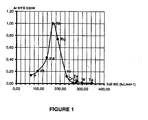
- R MC indices used in this example are the intrinsic catalytic activities A r hydC2H4 hydrogenation of ethylene, of a representative series of the transition elements. These activities were measured by various authors at 273K and 0.1MPa, on metallic films ( O. Beeck, Modem.Phys., 17, 61, 1945 and Disc. Faraday Soc., 8, 118, 1950 ) or in the state supported on silica ( GCA Schuit et al., Adv. Catalysis 10, 242, 1958 ). Both authors found essentially the same results for both forms of active metal implementation.
- Table 2 presents these available experimental results, and associates them with the values of descriptors D MC , calculated using the process according to the invention and extracted from Table 1.
- the figure 1 is a graphical representation of the results of Table 2 in which are plotted on the abscissa D MC and on the ordinate A r hydC2H4 .
- Each point of coordinates (D MC , A r hydC2H4 (M)) characterizes the intrinsic catalytic behavior of a metal M for the reaction considered independently of its mode of implementation.
- R MC indices used in this example are the intrinsic catalytic activities A r hydC6H6 in benzene hydrogenation. These activities were measured at 373 K and 0.1 MPa by different authors for a representative series of transition elements (see, for example, the French patent FR 2 072 586 , and the book “Catalysis of Contact”, English updated edition ("Applied Heterogeneous Catalysis") by JF Le Page et al., P 294, Technip, Paris, 1987 ).
- Table 3 presents these available experimental results, and associates them with the values of descriptors D MC , calculated using the process according to the invention and extracted from Table 1.
- each coordinate point (D MC , A r hydC6H8 (M)) represents the intrinsic catalytic behavior of a metal M for the reaction considered independently of its mode of implementation.
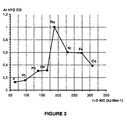
- Table 4 presents these experimental results, and associates them with the values of descriptors D MC , calculated according to the invention and extracted from Table 1.
- the figure 3 is a graphical representation of the results of Table 4, with the abscissa D MC and the ordinate A r hydCO .
- Each coordinate point (D MC, A hydCO r (M)) represents the intrinsic catalytic behavior of a metal M for the reaction under consideration irrespective of its implementation mode.
- Example 5 Comparison between the activities predicted and measured experimentally.
- Table 6 presents the values of the MC descriptors, the predicted activities and the activities measured experimentally for each alloy considered. This table demonstrates that the invention makes it possible to obtain a satisfactory agreement between predicted activities and experimental activities, taking into account the experimental measurement uncertainties, on the one hand, and the approximation that is made on the nature of the active bimetallic combination. , on the other hand.
- the values of D MC are in kJ.mol -1 .
- the reactions considered are the hydrogenation of benzene (HYD B, ref.a and b) or xylene (HYD X, ref.c), the hydrogenation of ethylene (HYD E, ref. hydrogenation of carbon monoxide to methane (Meth., ref. Experimental or predicted activities are expressed as relative values relative to that of a pure metal. The predicted activities are obtained by linear interpolation on the main curves of the Figures 1 to 3 .
- the method according to the invention therefore applies to combinations of elements in number and in any proportions and allows the evaluation for the purpose of sorting the property of use (catalytic activity) of this combination for catalytic reactions. whose master curves (Activity / D MC ) relating to the pure elements have been determined in advance.
- Example 6 Application to search for radioelement storage materials.
- Fluoroapatite Ca 10 (PO 4 ) 6 F 2 is known as one of the most resistant materials to radiation damage, which is why structural analogues of this mineral have been proposed for the storage of radioactive isotopes dangerous for the environment.
- structural analogues of this mineral There are also natural examples of such structural analogues, Oklo britholites, site of a fossil nuclear reactor ( R. Bros et al. Radiochim. Acta 74, 277, 1996 ). These britholites have the general formula Ca 10 .
- E represents a rare earth or an actinide with oxidation state 3 and y represents a real number between 0 and 6, and the same crystallographic structure derived from that of fluoroapatite, with in particular a hexagonal unit cell and symmetry less than or equal to that of the space group P63 / m.
- the cations occupy two crystallographically non-equivalent sites, the type (1) having in its first coordination sphere 9 first oxygen neighbors O, and the type (2) having in its first coordination sphere 6 first neighbors O and a first neighbor F, or O of an OH hydroxyl group.
- He is known experimentally ( J. Lin et al. Materials Chemistry and Physics, 38, pp 98-101, 1994 ) that higher ion cations and low charge cations have greater affinity for sites (1), while lower ionic and high charge ion cations have greater affinity for sites (2).
- the crystallographic characteristics of the fluoroapatite and britholith structures were found in the ICSD database (reference 9444 of the ICSD database).
- the ab initio determination of the total energies per mesh of the various complete or partial structures involved in the calculation of the different descriptors was obtained by implementing the "CASTEP" software, distributed by Molecular Simulations Inc., 6985 Scranton Road, CA 92121 -3752, USA.
- the complete meshes were not optimized, the initial mesh of fluoroapatite having been preserved.
- the different quantities involved in the calculation of the descriptors according to the invention and obtained for this example are collated in Table 8.
- the comparison of D mca1 and D mSr3 makes it possible to evaluate the ratio of the solubilities of Ca and Sr in site (1) in fluoroapatite on the one hand
- the comparison of D Ca2 and D Sr4 makes it possible to evaluate the ratio of the solubilities of Ca and Sr in site (2) in fluoroapatite on the other hand, and thus the potential of fluoroapatite for the storage of radioactive isotopes of strontium by substitution with calcium.
- a complementary comparison involves D mCa2bis and D mSr4bis : it makes it possible to evaluate the overall ratio of solubilities of Ca and Sr in any site in the fluoroapatite.
- Table 9 demonstrates that the process according to the invention makes it possible to sort according to a quantitative criterion the different crystalline materials envisaged, as a function of their ability to solubilize the radioactive isotopes of the strontium, cesium and uranium elements on the one hand and iodine on the other hand, by ionic substitution to the calcium elements on the one hand and fluorine on the other hand.
- the invention makes it possible to predict a very high affinity of fluoroapatite for iodine and its radioactive isotopes, in substitution for fluorine.
- Fluoroapatite makes it possible to partially substitute strontium and its radioactive isotopes for calcium, strontium remaining however less soluble than calcium in fluoroapatite.
- the Sr3 / Ca1 ratio obtained is higher than the Sr4 / Ca2 ratio.
- the method according to the invention therefore makes it possible to predict, in accordance with the experience of LIN et al. previously mentioned, that the crystallographic site (1) is preferred to the site (2), strontium +2 degree of oxidation having a higher ion radius (0.126 nm) than that of calcium (0.100 nm) for the same degree of oxidation +2.
- the method according to the invention makes it possible to predict a very great solubility of the uranium in site (2) of the britholite, which confirms the existence of the britholites rich in uranium fossil nuclear reactor at the Oklo site in Congo.
- the simultaneous substitution of a Ca +2 ion by a Cs +1 ion in site (1) and a Ca +2 ion by a U +2 ion in (2) site of fluoroapatite is the process according to the invention has an unfavorable process, because of the negative value of the descriptor D mCs9 (Table 8).
- the invention therefore makes it possible to eliminate a priori fluoroapatite as such for the storage of actinides, and makes it possible to understand why the skilled person prefers britholites.
Landscapes
- Chemical & Material Sciences (AREA)
- Organic Chemistry (AREA)
- Physics & Mathematics (AREA)
- Engineering & Computer Science (AREA)
- General Engineering & Computer Science (AREA)
- High Energy & Nuclear Physics (AREA)
- Inorganic Chemistry (AREA)
- Chemical Kinetics & Catalysis (AREA)
- Analysing Materials By The Use Of Radiation (AREA)
- Catalysts (AREA)
- Organic Low-Molecular-Weight Compounds And Preparation Thereof (AREA)
- Management, Administration, Business Operations System, And Electronic Commerce (AREA)
- Adhesives Or Adhesive Processes (AREA)
Applications Claiming Priority (2)
| Application Number | Priority Date | Filing Date | Title |
|---|---|---|---|
| FR0007473 | 2000-06-09 | ||
| FR0007473A FR2810112B1 (fr) | 2000-06-09 | 2000-06-09 | Conception de nouveaux materiaux dont l'usage fait intervenir une liaison chimique au moyen descripteur de ladite liaison |
Publications (2)
| Publication Number | Publication Date |
|---|---|
| EP1161990A1 EP1161990A1 (fr) | 2001-12-12 |
| EP1161990B1 true EP1161990B1 (fr) | 2012-02-29 |
Family
ID=8851184
Family Applications (1)
| Application Number | Title | Priority Date | Filing Date |
|---|---|---|---|
| EP01401355A Expired - Lifetime EP1161990B1 (fr) | 2000-06-09 | 2001-05-23 | Procédé de sélection de nouveaux matériaux par estimation de l'activité catalytique ou l'aptitude au stockage des radioéléments |
Country Status (7)
| Country | Link |
|---|---|
| EP (1) | EP1161990B1 (enExample) |
| JP (1) | JP5244276B2 (enExample) |
| AT (1) | ATE547172T1 (enExample) |
| CA (1) | CA2349699A1 (enExample) |
| DK (1) | DK1161990T3 (enExample) |
| ES (1) | ES2383513T3 (enExample) |
| FR (1) | FR2810112B1 (enExample) |
Families Citing this family (1)
| Publication number | Priority date | Publication date | Assignee | Title |
|---|---|---|---|---|
| JP2003053197A (ja) * | 2001-08-09 | 2003-02-25 | Inst Fr Petrole | 化学結合のデスクリプタを用いて前記化学結合を生じさせる使用法を有する新規物質の設計 |
Family Cites Families (5)
| Publication number | Priority date | Publication date | Assignee | Title |
|---|---|---|---|---|
| JP3378332B2 (ja) * | 1994-01-12 | 2003-02-17 | 株式会社東芝 | 材料設計支援システム及び材料設計支援方法 |
| WO1998006550A1 (en) * | 1996-08-08 | 1998-02-19 | Bridgestone Corporation | Method of designing multicomponent material, optimization analyzer and storage medium on which multicomponent material optimization analysis program is recorded |
| JP3335881B2 (ja) * | 1996-08-13 | 2002-10-21 | 株式会社東芝 | 材料設計支援システム、およびコンピュータシステムに系の安定構造や動的挙動を原子や分子レベルで解析させこれにより材料の設計支援を行うためのコンピュータプログラムを格納した記憶媒体 |
| FR2758278B1 (fr) * | 1997-01-15 | 1999-02-19 | Inst Francais Du Petrole | Catalyseur comprenant un sulfure mixte et utilisation en hydroraffinage et hydroconversion d'hydrocarbures |
| JPH10334515A (ja) * | 1997-05-30 | 1998-12-18 | Asahi Chem Ind Co Ltd | 相変化型光記録媒体の設計方法 |
-
2000
- 2000-06-09 FR FR0007473A patent/FR2810112B1/fr not_active Expired - Lifetime
-
2001
- 2001-05-23 ES ES01401355T patent/ES2383513T3/es not_active Expired - Lifetime
- 2001-05-23 DK DK01401355.1T patent/DK1161990T3/da active
- 2001-05-23 EP EP01401355A patent/EP1161990B1/fr not_active Expired - Lifetime
- 2001-05-23 AT AT01401355T patent/ATE547172T1/de active
- 2001-06-06 CA CA002349699A patent/CA2349699A1/fr not_active Withdrawn
- 2001-06-11 JP JP2001175271A patent/JP5244276B2/ja not_active Expired - Lifetime
Also Published As
| Publication number | Publication date |
|---|---|
| DK1161990T3 (da) | 2012-06-18 |
| JP2002011354A (ja) | 2002-01-15 |
| FR2810112A1 (fr) | 2001-12-14 |
| EP1161990A1 (fr) | 2001-12-12 |
| CA2349699A1 (fr) | 2001-12-09 |
| FR2810112B1 (fr) | 2007-08-03 |
| ES2383513T3 (es) | 2012-06-21 |
| JP5244276B2 (ja) | 2013-07-24 |
| ATE547172T1 (de) | 2012-03-15 |
Similar Documents
| Publication | Publication Date | Title |
|---|---|---|
| US6799089B2 (en) | Design of new materials whose use produces a chemical bond with a descriptor of said bond | |
| Butcher et al. | In situ oxidation study of Pt (110) and its interaction with CO | |
| Vicente et al. | Bragg coherent diffraction imaging for in situ studies in electrocatalysis | |
| Schmidt et al. | Performance of cluster expansions of coverage-dependent adsorption of atomic oxygen on Pt (111) | |
| US5200910A (en) | Method for modelling the electron density of a crystal | |
| Rodriguez et al. | Interaction of SO2 with MgO (100) and Cu/MgO (100): Decomposition Reactions and the Formation of SO3 and SO4 | |
| WO2007066787A1 (ja) | ハイブリッドgaによる複数パラメータの最適化方法、パターンマッチングによるデータ解析方法、放射線回折データに基づく物質構造の推定方法、ならびに関連するプログラム、記録媒体および各種装置 | |
| WO1993022740A1 (en) | High-resolution crystallographic modelling of a macromolecule | |
| Busnengo et al. | H2 Chemisorption on W (100) and W (110) Surfaces | |
| Dietze et al. | Comparison of sintering by particle migration and ripening through first-principles-based simulations | |
| Darby et al. | Carbon monoxide mediated hydrogen release from PtCu single-atom alloys: the punctured molecular cork effect | |
| Yau et al. | Imaging the hydrogen absorption dynamics of individual grains in polycrystalline palladium thin films in 3D | |
| CN113066534A (zh) | 一种利用dna序列进行信息写入和读取的方法 | |
| Das et al. | New dimensions in catalysis research with hard X‐ray tomography | |
| Noonan et al. | Atomic arrangements at metal surfaces | |
| EP1161990B1 (fr) | Procédé de sélection de nouveaux matériaux par estimation de l'activité catalytique ou l'aptitude au stockage des radioéléments | |
| Ontaneda et al. | Adsorption of methyl acetoacetate at Ni {111}: Experiment and theory | |
| Chakraborty et al. | Reversible atomization and nano-clustering of Pt as a strategy for designing ultra-low-metal-loading catalysts | |
| Albertin et al. | Oxidation and reduction of Ir (100) studied by high-energy surface X-ray diffraction | |
| Happel et al. | SO2 decomposition on Pt/CeO2 (111) model catalysts: on the reaction mechanism and the influence of H2 and CO | |
| Kim et al. | Correlation between Defect and Lattice States on Modulated TiO2 (110) during Redox Reaction | |
| FR2810113A1 (fr) | Conception de nouveaux materiaux dont l'usage fait intervenir une liaison chimique au moyen d'un descripteur de ladite liaison | |
| Hussain et al. | Water-induced reversal of the TiO2 (011)-(2× 1) surface reconstruction: observed with in situ surface X-ray diffraction | |
| Mammen et al. | Atomic-scale site characterization of Cu–Zn exchange on Cu (111) | |
| Ehrlich et al. | Atomic interactions on crystals: a review of quantitative experiments |
Legal Events
| Date | Code | Title | Description |
|---|---|---|---|
| PUAI | Public reference made under article 153(3) epc to a published international application that has entered the european phase |
Free format text: ORIGINAL CODE: 0009012 |
|
| AK | Designated contracting states |
Kind code of ref document: A1 Designated state(s): AT BE CH CY DE DK ES FI FR GB GR IE IT LI LU MC NL PT SE TR |
|
| AX | Request for extension of the european patent |
Free format text: AL;LT;LV;MK;RO;SI |
|
| 17P | Request for examination filed |
Effective date: 20020612 |
|
| AKX | Designation fees paid |
Free format text: AT BE CH CY DE DK ES FI FR GB GR IE IT LI LU MC NL PT SE TR |
|
| 17Q | First examination report despatched |
Effective date: 20050804 |
|
| RTI1 | Title (correction) |
Free format text: PROCESS OF SELECTON OF NOVELT MATERIALS BY ESTIMATING THEIR CATALYTIC ACTIVITY OR THE STORABILITY OF RADIOACTIVE ELEMENTS. |
|
| GRAP | Despatch of communication of intention to grant a patent |
Free format text: ORIGINAL CODE: EPIDOSNIGR1 |
|
| GRAC | Information related to communication of intention to grant a patent modified |
Free format text: ORIGINAL CODE: EPIDOSCIGR1 |
|
| GRAC | Information related to communication of intention to grant a patent modified |
Free format text: ORIGINAL CODE: EPIDOSCIGR1 |
|
| RTI1 | Title (correction) |
Free format text: PROCESS OF SELECTION OF NOVELTY MATERIALS BY ESTIMATING THEIR CATALYTIC ACTIVITY OR THE STORABILITY OF RADIOACTIVE ELEMENTS. |
|
| GRAS | Grant fee paid |
Free format text: ORIGINAL CODE: EPIDOSNIGR3 |
|
| GRAA | (expected) grant |
Free format text: ORIGINAL CODE: 0009210 |
|
| AK | Designated contracting states |
Kind code of ref document: B1 Designated state(s): AT BE CH CY DE DK ES FI FR GB GR IE IT LI LU MC NL PT SE TR |
|
| REG | Reference to a national code |
Ref country code: CH Ref legal event code: EP Ref country code: GB Ref legal event code: FG4D Free format text: NOT ENGLISH |
|
| REG | Reference to a national code |
Ref country code: AT Ref legal event code: REF Ref document number: 547172 Country of ref document: AT Kind code of ref document: T Effective date: 20120315 |
|
| REG | Reference to a national code |
Ref country code: IE Ref legal event code: FG4D Free format text: LANGUAGE OF EP DOCUMENT: FRENCH |
|
| REG | Reference to a national code |
Ref country code: DE Ref legal event code: R096 Ref document number: 60146183 Country of ref document: DE Effective date: 20120419 |
|
| REG | Reference to a national code |
Ref country code: NL Ref legal event code: T3 |
|
| REG | Reference to a national code |
Ref country code: DK Ref legal event code: T3 |
|
| REG | Reference to a national code |
Ref country code: ES Ref legal event code: FG2A Ref document number: 2383513 Country of ref document: ES Kind code of ref document: T3 Effective date: 20120621 |
|
| PG25 | Lapsed in a contracting state [announced via postgrant information from national office to epo] |
Ref country code: PT Free format text: LAPSE BECAUSE OF FAILURE TO SUBMIT A TRANSLATION OF THE DESCRIPTION OR TO PAY THE FEE WITHIN THE PRESCRIBED TIME-LIMIT Effective date: 20120629 Ref country code: GR Free format text: LAPSE BECAUSE OF FAILURE TO SUBMIT A TRANSLATION OF THE DESCRIPTION OR TO PAY THE FEE WITHIN THE PRESCRIBED TIME-LIMIT Effective date: 20120530 |
|
| REG | Reference to a national code |
Ref country code: AT Ref legal event code: MK05 Ref document number: 547172 Country of ref document: AT Kind code of ref document: T Effective date: 20120229 |
|
| REG | Reference to a national code |
Ref country code: IE Ref legal event code: FD4D |
|
| PG25 | Lapsed in a contracting state [announced via postgrant information from national office to epo] |
Ref country code: CY Free format text: LAPSE BECAUSE OF FAILURE TO SUBMIT A TRANSLATION OF THE DESCRIPTION OR TO PAY THE FEE WITHIN THE PRESCRIBED TIME-LIMIT Effective date: 20120229 |
|
| PG25 | Lapsed in a contracting state [announced via postgrant information from national office to epo] |
Ref country code: SE Free format text: LAPSE BECAUSE OF FAILURE TO SUBMIT A TRANSLATION OF THE DESCRIPTION OR TO PAY THE FEE WITHIN THE PRESCRIBED TIME-LIMIT Effective date: 20120229 Ref country code: IE Free format text: LAPSE BECAUSE OF FAILURE TO SUBMIT A TRANSLATION OF THE DESCRIPTION OR TO PAY THE FEE WITHIN THE PRESCRIBED TIME-LIMIT Effective date: 20120229 |
|
| PG25 | Lapsed in a contracting state [announced via postgrant information from national office to epo] |
Ref country code: MC Free format text: LAPSE BECAUSE OF NON-PAYMENT OF DUE FEES Effective date: 20120531 |
|
| REG | Reference to a national code |
Ref country code: CH Ref legal event code: PL |
|
| PLBE | No opposition filed within time limit |
Free format text: ORIGINAL CODE: 0009261 |
|
| STAA | Information on the status of an ep patent application or granted ep patent |
Free format text: STATUS: NO OPPOSITION FILED WITHIN TIME LIMIT |
|
| PG25 | Lapsed in a contracting state [announced via postgrant information from national office to epo] |
Ref country code: CH Free format text: LAPSE BECAUSE OF NON-PAYMENT OF DUE FEES Effective date: 20120531 Ref country code: AT Free format text: LAPSE BECAUSE OF FAILURE TO SUBMIT A TRANSLATION OF THE DESCRIPTION OR TO PAY THE FEE WITHIN THE PRESCRIBED TIME-LIMIT Effective date: 20120229 Ref country code: LI Free format text: LAPSE BECAUSE OF NON-PAYMENT OF DUE FEES Effective date: 20120531 |
|
| 26N | No opposition filed |
Effective date: 20121130 |
|
| REG | Reference to a national code |
Ref country code: DE Ref legal event code: R097 Ref document number: 60146183 Country of ref document: DE Effective date: 20121130 |
|
| PG25 | Lapsed in a contracting state [announced via postgrant information from national office to epo] |
Ref country code: TR Free format text: LAPSE BECAUSE OF FAILURE TO SUBMIT A TRANSLATION OF THE DESCRIPTION OR TO PAY THE FEE WITHIN THE PRESCRIBED TIME-LIMIT Effective date: 20120229 |
|
| PG25 | Lapsed in a contracting state [announced via postgrant information from national office to epo] |
Ref country code: LU Free format text: LAPSE BECAUSE OF NON-PAYMENT OF DUE FEES Effective date: 20120523 |
|
| REG | Reference to a national code |
Ref country code: FR Ref legal event code: PLFP Year of fee payment: 16 |
|
| REG | Reference to a national code |
Ref country code: FR Ref legal event code: PLFP Year of fee payment: 17 |
|
| REG | Reference to a national code |
Ref country code: FR Ref legal event code: PLFP Year of fee payment: 18 |
|
| PGFP | Annual fee paid to national office [announced via postgrant information from national office to epo] |
Ref country code: FI Payment date: 20200520 Year of fee payment: 20 Ref country code: FR Payment date: 20200527 Year of fee payment: 20 Ref country code: NL Payment date: 20200526 Year of fee payment: 20 Ref country code: ES Payment date: 20200609 Year of fee payment: 20 Ref country code: DK Payment date: 20200526 Year of fee payment: 20 |
|
| PGFP | Annual fee paid to national office [announced via postgrant information from national office to epo] |
Ref country code: BE Payment date: 20200527 Year of fee payment: 20 Ref country code: IT Payment date: 20200522 Year of fee payment: 20 Ref country code: GB Payment date: 20200528 Year of fee payment: 20 |
|
| PGFP | Annual fee paid to national office [announced via postgrant information from national office to epo] |
Ref country code: DE Payment date: 20200728 Year of fee payment: 20 |
|
| REG | Reference to a national code |
Ref country code: DE Ref legal event code: R071 Ref document number: 60146183 Country of ref document: DE |
|
| REG | Reference to a national code |
Ref country code: DK Ref legal event code: EUP Expiry date: 20210523 |
|
| REG | Reference to a national code |
Ref country code: NL Ref legal event code: MK Effective date: 20210522 |
|
| REG | Reference to a national code |
Ref country code: FI Ref legal event code: MAE |
|
| REG | Reference to a national code |
Ref country code: GB Ref legal event code: PE20 Expiry date: 20210522 |
|
| REG | Reference to a national code |
Ref country code: BE Ref legal event code: MK Effective date: 20210523 |
|
| REG | Reference to a national code |
Ref country code: ES Ref legal event code: FD2A Effective date: 20210830 |
|
| PG25 | Lapsed in a contracting state [announced via postgrant information from national office to epo] |
Ref country code: GB Free format text: LAPSE BECAUSE OF EXPIRATION OF PROTECTION Effective date: 20210522 |
|
| PG25 | Lapsed in a contracting state [announced via postgrant information from national office to epo] |
Ref country code: ES Free format text: LAPSE BECAUSE OF EXPIRATION OF PROTECTION Effective date: 20210524 |