EP1160905A2 - Nonaqueous electrolyte secondary battery - Google Patents
Nonaqueous electrolyte secondary battery Download PDFInfo
- Publication number
- EP1160905A2 EP1160905A2 EP01112471A EP01112471A EP1160905A2 EP 1160905 A2 EP1160905 A2 EP 1160905A2 EP 01112471 A EP01112471 A EP 01112471A EP 01112471 A EP01112471 A EP 01112471A EP 1160905 A2 EP1160905 A2 EP 1160905A2
- Authority
- EP
- European Patent Office
- Prior art keywords
- nonaqueous electrolyte
- secondary battery
- anode
- cathode
- electrolyte secondary
- Prior art date
- Legal status (The legal status is an assumption and is not a legal conclusion. Google has not performed a legal analysis and makes no representation as to the accuracy of the status listed.)
- Withdrawn
Links
Images


Classifications
-
- H—ELECTRICITY
- H01—ELECTRIC ELEMENTS
- H01M—PROCESSES OR MEANS, e.g. BATTERIES, FOR THE DIRECT CONVERSION OF CHEMICAL ENERGY INTO ELECTRICAL ENERGY
- H01M4/00—Electrodes
- H01M4/02—Electrodes composed of, or comprising, active material
- H01M4/36—Selection of substances as active materials, active masses, active liquids
- H01M4/48—Selection of substances as active materials, active masses, active liquids of inorganic oxides or hydroxides
- H01M4/50—Selection of substances as active materials, active masses, active liquids of inorganic oxides or hydroxides of manganese
- H01M4/505—Selection of substances as active materials, active masses, active liquids of inorganic oxides or hydroxides of manganese of mixed oxides or hydroxides containing manganese for inserting or intercalating light metals, e.g. LiMn2O4 or LiMn2OxFy
-
- H—ELECTRICITY
- H01—ELECTRIC ELEMENTS
- H01M—PROCESSES OR MEANS, e.g. BATTERIES, FOR THE DIRECT CONVERSION OF CHEMICAL ENERGY INTO ELECTRICAL ENERGY
- H01M10/00—Secondary cells; Manufacture thereof
- H01M10/05—Accumulators with non-aqueous electrolyte
- H01M10/056—Accumulators with non-aqueous electrolyte characterised by the materials used as electrolytes, e.g. mixed inorganic/organic electrolytes
- H01M10/0564—Accumulators with non-aqueous electrolyte characterised by the materials used as electrolytes, e.g. mixed inorganic/organic electrolytes the electrolyte being constituted of organic materials only
- H01M10/0566—Liquid materials
- H01M10/0567—Liquid materials characterised by the additives
-
- H—ELECTRICITY
- H01—ELECTRIC ELEMENTS
- H01M—PROCESSES OR MEANS, e.g. BATTERIES, FOR THE DIRECT CONVERSION OF CHEMICAL ENERGY INTO ELECTRICAL ENERGY
- H01M10/00—Secondary cells; Manufacture thereof
- H01M10/05—Accumulators with non-aqueous electrolyte
- H01M10/056—Accumulators with non-aqueous electrolyte characterised by the materials used as electrolytes, e.g. mixed inorganic/organic electrolytes
- H01M10/0564—Accumulators with non-aqueous electrolyte characterised by the materials used as electrolytes, e.g. mixed inorganic/organic electrolytes the electrolyte being constituted of organic materials only
- H01M10/0566—Liquid materials
- H01M10/0569—Liquid materials characterised by the solvents
-
- H—ELECTRICITY
- H01—ELECTRIC ELEMENTS
- H01M—PROCESSES OR MEANS, e.g. BATTERIES, FOR THE DIRECT CONVERSION OF CHEMICAL ENERGY INTO ELECTRICAL ENERGY
- H01M10/00—Secondary cells; Manufacture thereof
- H01M10/05—Accumulators with non-aqueous electrolyte
- H01M10/058—Construction or manufacture
-
- H—ELECTRICITY
- H01—ELECTRIC ELEMENTS
- H01M—PROCESSES OR MEANS, e.g. BATTERIES, FOR THE DIRECT CONVERSION OF CHEMICAL ENERGY INTO ELECTRICAL ENERGY
- H01M4/00—Electrodes
- H01M4/02—Electrodes composed of, or comprising, active material
- H01M4/36—Selection of substances as active materials, active masses, active liquids
- H01M4/362—Composites
- H01M4/364—Composites as mixtures
-
- H—ELECTRICITY
- H01—ELECTRIC ELEMENTS
- H01M—PROCESSES OR MEANS, e.g. BATTERIES, FOR THE DIRECT CONVERSION OF CHEMICAL ENERGY INTO ELECTRICAL ENERGY
- H01M10/00—Secondary cells; Manufacture thereof
- H01M10/05—Accumulators with non-aqueous electrolyte
- H01M10/052—Li-accumulators
- H01M10/0525—Rocking-chair batteries, i.e. batteries with lithium insertion or intercalation in both electrodes; Lithium-ion batteries
-
- H—ELECTRICITY
- H01—ELECTRIC ELEMENTS
- H01M—PROCESSES OR MEANS, e.g. BATTERIES, FOR THE DIRECT CONVERSION OF CHEMICAL ENERGY INTO ELECTRICAL ENERGY
- H01M10/00—Secondary cells; Manufacture thereof
- H01M10/05—Accumulators with non-aqueous electrolyte
- H01M10/056—Accumulators with non-aqueous electrolyte characterised by the materials used as electrolytes, e.g. mixed inorganic/organic electrolytes
- H01M10/0564—Accumulators with non-aqueous electrolyte characterised by the materials used as electrolytes, e.g. mixed inorganic/organic electrolytes the electrolyte being constituted of organic materials only
- H01M10/0565—Polymeric materials, e.g. gel-type or solid-type
-
- H—ELECTRICITY
- H01—ELECTRIC ELEMENTS
- H01M—PROCESSES OR MEANS, e.g. BATTERIES, FOR THE DIRECT CONVERSION OF CHEMICAL ENERGY INTO ELECTRICAL ENERGY
- H01M2300/00—Electrolytes
- H01M2300/0017—Non-aqueous electrolytes
- H01M2300/0025—Organic electrolyte
- H01M2300/0028—Organic electrolyte characterised by the solvent
- H01M2300/0037—Mixture of solvents
- H01M2300/0042—Four or more solvents
-
- H—ELECTRICITY
- H01—ELECTRIC ELEMENTS
- H01M—PROCESSES OR MEANS, e.g. BATTERIES, FOR THE DIRECT CONVERSION OF CHEMICAL ENERGY INTO ELECTRICAL ENERGY
- H01M2300/00—Electrolytes
- H01M2300/0085—Immobilising or gelification of electrolyte
-
- H—ELECTRICITY
- H01—ELECTRIC ELEMENTS
- H01M—PROCESSES OR MEANS, e.g. BATTERIES, FOR THE DIRECT CONVERSION OF CHEMICAL ENERGY INTO ELECTRICAL ENERGY
- H01M4/00—Electrodes
- H01M4/02—Electrodes composed of, or comprising, active material
- H01M4/13—Electrodes for accumulators with non-aqueous electrolyte, e.g. for lithium-accumulators; Processes of manufacture thereof
-
- H—ELECTRICITY
- H01—ELECTRIC ELEMENTS
- H01M—PROCESSES OR MEANS, e.g. BATTERIES, FOR THE DIRECT CONVERSION OF CHEMICAL ENERGY INTO ELECTRICAL ENERGY
- H01M50/00—Constructional details or processes of manufacture of the non-active parts of electrochemical cells other than fuel cells, e.g. hybrid cells
- H01M50/10—Primary casings; Jackets or wrappings
- H01M50/102—Primary casings; Jackets or wrappings characterised by their shape or physical structure
- H01M50/103—Primary casings; Jackets or wrappings characterised by their shape or physical structure prismatic or rectangular
-
- H—ELECTRICITY
- H01—ELECTRIC ELEMENTS
- H01M—PROCESSES OR MEANS, e.g. BATTERIES, FOR THE DIRECT CONVERSION OF CHEMICAL ENERGY INTO ELECTRICAL ENERGY
- H01M6/00—Primary cells; Manufacture thereof
- H01M6/04—Cells with aqueous electrolyte
- H01M6/06—Dry cells, i.e. cells wherein the electrolyte is rendered non-fluid
- H01M6/10—Dry cells, i.e. cells wherein the electrolyte is rendered non-fluid with wound or folded electrodes
-
- Y—GENERAL TAGGING OF NEW TECHNOLOGICAL DEVELOPMENTS; GENERAL TAGGING OF CROSS-SECTIONAL TECHNOLOGIES SPANNING OVER SEVERAL SECTIONS OF THE IPC; TECHNICAL SUBJECTS COVERED BY FORMER USPC CROSS-REFERENCE ART COLLECTIONS [XRACs] AND DIGESTS
- Y02—TECHNOLOGIES OR APPLICATIONS FOR MITIGATION OR ADAPTATION AGAINST CLIMATE CHANGE
- Y02E—REDUCTION OF GREENHOUSE GAS [GHG] EMISSIONS, RELATED TO ENERGY GENERATION, TRANSMISSION OR DISTRIBUTION
- Y02E60/00—Enabling technologies; Technologies with a potential or indirect contribution to GHG emissions mitigation
- Y02E60/10—Energy storage using batteries
-
- Y—GENERAL TAGGING OF NEW TECHNOLOGICAL DEVELOPMENTS; GENERAL TAGGING OF CROSS-SECTIONAL TECHNOLOGIES SPANNING OVER SEVERAL SECTIONS OF THE IPC; TECHNICAL SUBJECTS COVERED BY FORMER USPC CROSS-REFERENCE ART COLLECTIONS [XRACs] AND DIGESTS
- Y02—TECHNOLOGIES OR APPLICATIONS FOR MITIGATION OR ADAPTATION AGAINST CLIMATE CHANGE
- Y02P—CLIMATE CHANGE MITIGATION TECHNOLOGIES IN THE PRODUCTION OR PROCESSING OF GOODS
- Y02P70/00—Climate change mitigation technologies in the production process for final industrial or consumer products
- Y02P70/50—Manufacturing or production processes characterised by the final manufactured product
Definitions
- the present invention relates to a nonaqueous electrolyte battery comprising a cathode, an anode and a nonaqueous electrolyte. More particularly, the present invention relates to a nonaqueous electrolyte battery having a good cyclic characteristic under any environment of low temperature, ambient temperature and high temperature.
- lithium-cobalt composite oxides As cathode active materials used for the lithium-ion battery, lithium-cobalt composite oxides, lithium-manganese composite oxides, and lithium-nickel composite oxides have been put to practical use. While they have respectively advantages and disadvantages, the lithium-cobalt composite oxides have a most desirable balance from the viewpoints of capacity, cost and thermal stability, so that they are widely employed. Although the lithium-manganese composite oxides are low in their capacities and bad in their high temperature cyclic characteristics, they are more excellent than the lithium-cobalt composite oxides in view of costs and stability in supply of raw materials, and accordingly, they have been greatly anticipated and the study of them has been advanced.
- the lithium-ion secondary batteries there may be exemplified a cylindrical battery in which a spirally coiled electrode element is inserted into a cylindrical case and a rectangular battery in which a folded electrode or a rectangular laminated electrode element or a coiled electrode element formed by winding long bond shape cathodes and anodes is inserted into a rectangular case.
- the rectangular battery as the latter is higher in its space efficiency than that of the cylindrical battery.
- the above described compact secondary battery is used not only in an ordinary state, but also in a vehicle in the mid-summer day, high reliability is required for the secondary battery.
- the strength of a rectangular battery can is lower than that of a cylindrical battery can, it is apt to be deformed due to the increase of internal pressure of the battery. Therefore, in using case of a rectangular battery which is accommodated in the electronic device, when the battery is exposed to high temperature, the battery may possibly expand due to the decomposition of the electrolyte solution in the battery, which will cause the breakage of the battery or the damage of the device.
- the characteristic thereof is similar to that of the lithium-cobalt composite oxides or the lithium-nickel composite oxides at ambient temperature, however, a cyclic characteristic is incomplete at high temperature, because an insufficient battery property is obtained at high temperature (45°C to 60°C) resulting from a spinel lithium-manganese oxide.
- the CPU operates and charging and discharging cycles are frequently repeated at about 45°C in the note book type personal computer, the lithium-manganese composite oxides cannot be used, unless the battery properties at the high temperature (45°C to 60°C) resulting from the spinel lithium-manganese oxide are improved.
- the cyclic characteristics at low temperature and ambient temperature are equally important.
- the present invention was proposed with the above described circumstances into consideration and it is an object of the present invention to provide a nonaqueous electrolyte battery having a good cyclic characteristic under any environment of low temperature, ambient temperature and high temperature.
- a nonaqueous electrolyte battery according to the present invention comprises a cathode, an anode and nonaqueous electrolyte with which a sealed battery can is filled.
- the nonaqueous electrolyte includes unsaturated cyclic carbonate and/or halogenated methoxybenzene compounds.
- the cathode has a cathode active material capable of being electrochemically doped/dedoped with lithium.
- lithium composite oxides expressed by a general formula Li x MO 2 or intercalation compounds including Li can be used as the cathode active material.
- M indicates one or more kinds of transition metals and x is ordinarily a value located within a range from 0.05 or more to 1.10 or lower.
- the transition metals M for constituting the lithium composite oxides at least one kind of cobalt (Co), nickel (Ni), or manganese (Mn) is preferably used.
- the specific examples of the lithium composite oxides there may be exemplified LiCoO 2 , LiNiO 2 , Li x Ni y Co 1-y O 2 (the values of x and y are different depending on the charging and discharging states of the battery.
- the value of x is expressed by the relation 0 ⁇ x ⁇ 1
- the value of y is expressed by the relation 0.7 ⁇ y ⁇ 1.0) or LiMn 2 O 4 , or the like.
- the second lithium-containing compounds may be added to the above described lithium composite oxides and the obtained product may be used as the cathode active material.
- the second lithium-containing compounds for example, LiMn 2-y M y O 4 and LiMoS 2 , LiTiS 2 , LiP 2 O 5 , Li x FePO 4 , or the like may be enumerated.
- Each of these cathode active materials preferably has an average particle size ranging from 3 ⁇ m or more to 7 ⁇ m or lower.
- a nonaqueous electrolyte secondary battery comprising a cathode having a cathode active material capable of being electrochemically doped/dedoped with lithium; an anode having an anode active material capable of being electrochemically doped/dedoped with lithium and a nonaqueous electrolyte interposed between the cathode and the anode, wherein the cathode active material includes a lithium-manganese composite oxide expressed by a general formula Li x Mn 2-y M' y O 4 (here, x satisfies the relation expressed by x ⁇ 0.9, y satisfies the relation expressed by 0.5 ⁇ y ⁇ 0.01.
- M' indicates at least one or more elements selected from between Fe, Co, Ni, Cu, Zn, Al, Sn, Cr, V, Ti, Mg, Ca and Sr) and the nonaqueous electrolyte includes at least one or more kinds of vinylene carbonate, methoxybenzene compounds or antioxidants.
- the cyclic characteristic is more improved in a wider temperature range in the nonaqueous electrolyte battery according to the present invention.
- a nonaqueous electrolyte secondary battery comprising a cathode having a cathode active material capable of being electrochemically doped/dedoped with lithium; an anode having an anode active material capable of being electrochemically doped/dedoped with lithium and a nonaqueous electrolyte interposed between the cathode and the anode, wherein the cathode active material includes a lithium-manganese composite oxide expressed by a general formula Li x Mn 2-y M' y O 4 (here, x satisfies the relation expressed by x ⁇ 0.9 and y satisfies the relation expressed by 0.5 ⁇ y ⁇ 0.01.
- M' indicates at least one or more elements selected from between Fe, Co, Ni, Cu, Zn, Al, Sn, Cr, V, Ti, Mg, Ca, Sr) and a lithium composite oxide expressed by a general formula LiM" z O 2 (here, z satisfies the relation expressed by 1 ⁇ z ⁇ 0.5 and M" indicates at least one or more elements selected from between Fe, Co, Mn, Cu, Zn, Al, Sn, B, Ga, Cr, V, Ti, Mg, Ca, Sr) and the nonaqueous electrolyte includes at least one or more kinds of vinylene carbonate, methoxybenzene compounds or antioxidants.
- the cyclic characteristic is more improved in a wider temperature range in the nonaqueous electrolyte battery according to the present invention.
- Fig. 1 is a longitudinally sectional view showing one structural example of a nonaqueous electrolyte battery according to the present invention.
- This nonaqueous electrolyte battery 1 comprises a film type cathode 2, a film type anode 3 and a separator 4.
- the cathode 2 and the anode 3 are laminated through the separator 4 and the laminated body is tightly coiled to obtain a spirally coiled electrode body.
- the spirally coiled electrode body is inserted into a battery can 5.
- the cathode 2 is manufactured by applying a cathode compound mixture including a cathode active material and a binding agent to a current collector and drying the cathode compound mixture.
- a cathode compound mixture including a cathode active material and a binding agent
- a metal foil such as an aluminum foil is employed.
- lithium composite oxides expressed by a general formula Li x MO 2 or intercalation compounds including Li can be used as the cathode active material.
- M indicates one or more kinds of transition metals and x is ordinarily a value located within a range from 0.05 or more to 1.10 or lower.
- the transition metals M for constituting the lithium composite oxides at least one kind of material of cobalt (Co), nickel (Ni), or manganese (Mn) is preferably used.
- the specific examples of the lithium composite oxides there may be exemplified LiCoO 2 , LiNiO 2 , Li x Ni y Co 1-y O 2 (the values of x and y are different depending on the charging and discharging states of the battery.
- the value of x is expressed by the relation 0 ⁇ x ⁇ 1
- the value of y is expressed by the relation 0.7 ⁇ y ⁇ 1.0) or LiMn 2 O 4 , or the like.
- the second lithium-containing compounds may be added to the above described lithium composite oxides and the obtained product may be used as the cathode active material.
- the second lithium-containing compounds for example, LiMoS 2 , LiTiS 2 , LiP 2 O 5 , Li x FePO 4 , or the like may be enumerated.
- a lithium-manganese composite oxide expressed by a general formula Li x Mn 2-y M' y O 4 (here, x satisfies the relation expressed by x ⁇ 0.9, y satisfies the relation expressed by 0.5 ⁇ y ⁇ 0.01.
- M' indicates at least one or more elements selected from between Fe, Co, Ni, Cu, Zn, Al, Sn, Cr, V, Ti, Mg, Ca and Sr).
- a lithium composite oxide expressed by a general formula LiM" z O 2 (here, z satisfies the relation expressed by 1 ⁇ z ⁇ 0.5 and M" indicates at least one or more elements selected from between Fe, Co, Mn, Cu, Zn, Al, Sn, B, Ga, Cr, V, Ti, Mg, Ca, Sr) may be included in addition to the lithium-manganese composite oxide. It is to be understood that the content ratio the lithium-manganese composite oxide to the lithium composite oxide is not specifically limited.
- the average particle size of both the lithium-manganese composite oxide and the lithium composite oxide is desirably 30 ⁇ m or smaller.
- the above described lithium-manganese composite oxide or the lithium composite oxide is obtained by mixing carbonates of, for instance, lithium, nickel, manganese, or the like in accordance with its composition and sintering the mixture within the range of temperature of 600°C to 1000°C under an atmosphere in which oxygen exists.
- a starting material is not limited to carbonates and the above described composite oxide may be similarly synthesized from hydroxides, oxides, nitrates, organic acid salts, or the like.
- binding agent of the cathode compound mixture a well-known binding agent ordinarily used for the cathode compound mixture of such kind of battery can be used, and further, a well-known additive agent such as a conductive agent may be added to the cathode compound mixture.
- the anode 3 is manufactured by applying an anode compound mixture including an anode active material and a binding agent on a current collector and drying the anode compound mixture.
- a metal foil such as a copper foil is employed for the current collector.
- anode active material a material capable of being electrochemically doped/dedoped with lithium under a potential of 2.0 V or lower relative to the lithium metal may be utilized.
- materials which can be doped/dedoped with lithium may be used carbon materials, for instance, non-graphitizable carbon materials, graphite materials, or the like. More specifically, there may be used such carbon materials as natural graphites, pyrocarbons, cokes, graphites, vitreous carbon fibers, organic polymer compound sintered body, carbon fibers, activated carbons, carbon black, or the like.
- the cokes include pitch cokes, needle cokes, petroleum cokes or the like.
- the organic polymer compound sintered body indicates a material obtained by sintering and carbonizing a phenol resin or furan resin at suitable temperature.
- Metals capable of forming alloys together with lithium or alloys thereof are also used as the anode active material as well as the above described carbon materials. Specifically, there may be exemplified oxides or nitrates doped/dedoped with lithium under a relatively low potential such as iron oxide, ruthenium oxide, molybdenum oxide, tungstic oxide, titanium oxide, tin oxide, or the like.
- binding agent of the anode compound mixture a well-known binding agent ordinarily used for such kind of battery can be used. Besides, a well-known additive agent may be added to the anode compound mixture.
- the separator 4 is interposed between the cathode 2 and the anode 3 to prevent a short-circuit due to the physical contact of the cathode 2 and the anode 3.
- a microporous polyolefine film such as a polyethylene film, a polypropylene film or the like is employed.
- Nonaqueous electrolyte solution is prepared by dissolving an electrolyte in a nonaqueous solvent.
- electrolyte well-known electrolytes can be used in the electrolyte solution ordinarily employed for such kind of battery.
- lithium salts such as LiCl, LiBr, LiPF 6 , LiBF 4 , LiAsF 6 , LiClO 4 , LiB(C 6 H 5 ) 4 , LiCH 3 SO 3 , LiCF 3 SO 3 , LiN(SO 2 CF 3 ) 2 , LiC(SO 2 CF 3 ) 3 , LiAlCl 4 , LiSiF 6 or the like.
- LiPF 6 and LiBF 4 are desirable among them in view of stability in oxidation.
- the above described electrolyte is preferably dissolved in the nonaqueous solvent so as to have a concentration ranging from 0.1 mol/l to 3.0 mol/l. A more preferable concentration is located within a range of 0.5 mol/l to 2.0 mol/l.
- nonaqueous solvents various kinds of nonaqueous solvents which have been hitherto employed for the nonaqueous electrolyte solution can be employed.
- nonaqueous solvents there may be exemplified propylene carbonate, ethylene carbonate, diethyl carbonate, dimethyl carbonate, ethylmethyl carbonate, 1, 2-dimethoxyethane, 1, 2-diethoxyethane, ⁇ -butyrolactone, tetrahydrofuran, 2-methyl tetrahydrofuran, 1, 4-dioxolane, 4-methyl-1,3-dioxolane, diethyl ether, sulfolane, methyl sulfolane, acetonitrile, propiononitrile, acetic ester, butylate, propionic ester, or the like.
- These nonaqueous solvents may be independently used or a plurality of kinds of solvents may be mixed and used.
- the carbonate is preferably used in view of stability in
- At least one or more materials selected from between vinylene carbonate, methoxybenzene compounds or antioxidants are added to the nonaqueous electrolyte solution.
- the nonaqueous electrolyte solution containing the vinylene carbonate can maintain good ionic conductivity even under an environment of low temperature.
- the nonaqueous electrolyte battery using the nonaqueous electrolyte solution containing the vinylene carbonate is used under the environment of low temperature, its battery property is not deteriorated and its cyclic characteristic at low temperature is excellent.
- the methoxybenzene compounds effectively suppresses the deterioration of capacity generated when the battery is kept under a charged state at room temperature, as disclosed in, for instance, Japanese Patent Application Laid-open No. hei.7-302614.
- the methoxybenzene compounds there may be exemplified 4-fluoroanisole, 2, 4-difluoroanisole, 2-bromoanisole, 2, 3, 5, 6-tetrafluoro-4-methylanisole, or the like.
- the vinylene carbonate and the nonaqueous solvents used for the nonaqueous electrolyte solution are extremely apt to be decomposed by oxygen radicals generated in the battery under an environment of high temperature.
- the antioxidant is added to the nonaqueous electrolyte solution.
- the antioxidant is added to the nonaqueous electrolyte solution so that the decomposition of the vinylene carbonate or other nonaqueous solvents by the oxygen radicals can be suppressed and the cyclic characteristic under high temperature can be improved.
- the antioxidants for example, quinones, aromatic amines, phenols, vitamin E, vitamin C, sesamoles, quercetins, or the like can be employed.
- these vinylene carbonate, methoxybenzene compounds, or antioxidants may be independently added to the nonaqueous electrolyte solution, however, two or more of them may be preferably combined together and the obtained mixture may be added to the nonaqueous electrolyte solution in order to obtain the effects of the second invention.
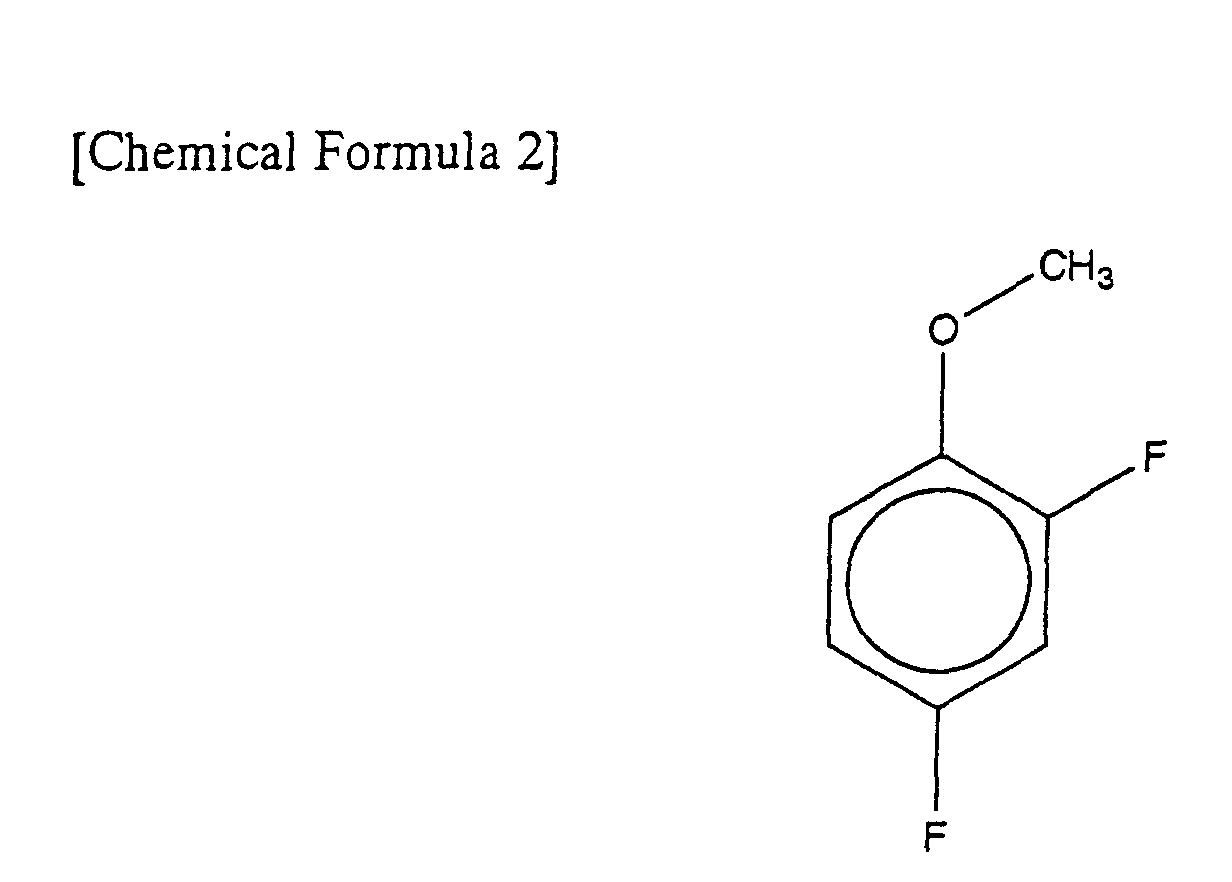
- the nonaqueous electrolyte solution containing unsaturated cyclic carbonate and/or halogenated methoxybenzene compounds particularly, the vinylene carbonate expressed by Chemical Formula 1 below, and 2, 4-difluoroanisole expressed by Chemical Formula 2 below, is employed, and accordingly, the generation of gas which results from the decomposition of the nonaqueous electrolyte solution can be prevented even when the battery is exposed to the high temperature.
- unsaturated cyclic carbonate and/or halogenated methoxybenzene compounds particularly, the vinylene carbonate expressed by Chemical Formula 1 below, and 2, 4-difluoroanisole expressed by Chemical Formula 2 below
- the nonaqueous electrolyte battery having the vinylene carbonate added to the nonaqueous electrolyte solution a low temperature characteristic is improved, however, a storage property under high temperature is extremely degraded.
- the capacity of the battery was extremely degraded when the battery was left for a long time under the environment of high temperature.
- the nonaqueous electrolyte solution containing the vinylene carbonate was seriously apt to be decomposed by the oxygen radicals generated in the battery when the battery is stored under the environment of high temperature.
- 2, 4-difluoroanisole as the halogenated methoxybenzene compound is added to the nonaqueous electrolyte solution as well as the vinylene carbonate.
- the 2, 4-difluoroanisole serves to supplement the oxygen radicals to suppress the reaction of the nonaqueous electrolyte solution, particularly, the vinylene carbonate with the oxygen radicals.
- the vinylene carbonate when added to the nonaqueous electrolyte solution together with the methoxybenzene compounds, the vinylene carbonate reacts on the active material, and produces a reaction product compound on the surface of the active material at the same time upon reaction, therefore suppressing the degradation of capacity due to the methoxybenzene compound as above mentioned, so that a higher suppressing effect may be possibly realized.
- the content of vinylene carbonate in the nonaqueous electrolyte solution is preferably located within a range of 0.3 wt% or more to 1.2 wt% or lower.
- the content of 2, 4-difluoroanisole in the nonaqueous electrolyte solution is preferably located within a range of 0.05 mol/l or more to 0.3 mol/l or lower.
- the vinylene carbonate effective for improving the cyclic characteristic at low temperature, the methoxybenzene compound effective for improving the cyclic characteristic at ambient temperature and the antioxidant effective for improving the cyclic characteristic at high temperature are combined together and employed so that the cyclic characteristic can be improved in a wider range of temperature.
- the amount of addition of vinylene carbonate is preferably located within a range of 0.05 wt% or more to 20 wt% or lower relative to all the nonaqueous electrolyte solution.
- the amount of addition of vinylene carbonate is located within the above described range, so that the cyclic characteristic of the battery can be enhanced without deteriorating the capacity of the battery.
- a more preferable amount of addition of the vinylene carbonate ranges from 0.08 wt% or more to 15 wt% or lower relative to all the nonaqueous electrolyte solution.
- the amount of addition of methoxybenzene compound is preferably located within a range of 0.01 wt% or more to 10 wt% or lower relative to all the nonaqueous electrolyte solution.
- the amount of addition of the methoxybenzene compound is less than 0.05 wt%, the effect for improving the cyclic characteristic cannot be sufficiently attained. Further, when the amount of addition of the methoxybenzene compound is too much, the capacity of the battery will be deteriorated.
- the amount of addition of the methoxybenzene compound is located within the above described range, so that the cyclic characteristic of the battery can be improved without generating the degradation of the capacity in the battery.
- a more preferable amount of addition of the methoxybenzene ranges from 0.02 wt% or more to 10 wt% or lower relative to all the nonaqueous electrolyte solution.
- the content of the vinylene carbonate is located within a range of 0.3 wt% or more to 1.2 wt % or lower and the content of 2, 4-difluoroanisole ranges from 0.05 mol/l or more to 0.3 mol/l or lower, so that even when the battery is kept under high temperature, the decomposition of the nonaqueous electrolyte solution can be suppressed, and the generation of gas resulting from the decomposition of the nonaqueous electrolyte solution can be prevented.
- a more preferable content of vinylene carbonate is located within a range of 0.6 wt% to 1.0 wt% and a more preferable content of 2, 4-difluoroanisole is located within a range of 0.1 mol/l or more to 0.3 mol/l or lower.
- the cyclic characteristic is improved in a wider range of temperature.
- the nonaqueous electrolyte battery 1 is manufactured in the following manner. It is to be understood that a method for manufacturing the battery according to the present invention is not limited to examples described below.
- the cathode 2 is manufactured by uniformly applying the cathode compound mixture including the cathode active material and the binding agent to a metallic foil such as an aluminum foil serving as a cathode current collector and drying the cathode compound mixture to form a cathode active material layer.
- a metallic foil such as an aluminum foil serving as a cathode current collector
- drying the cathode compound mixture to form a cathode active material layer.
- the binding agent of the cathode compound mixture not only a well-known binding agent can be used, but also a well-known additive agent or the like can be added to the cathode compound mixture.
- the anode 3 is manufactured by uniformly applying the anode compound mixture including the anode active material and the binding agent to a metallic foil such as a copper foil serving as an anode current collector and drying the anode compound mixture to form an anode active material layer.
- a binding agent of the anode compound mixture a well-known binding agent can be used, and further, a well-known additive agent or the like can be added to the anode compound mixture.
- the cathode 2 and the anode 3 formed in such a manner are allowed to come into tight contact with each other through the separator 4 made of, for instance, the microporous polypropylene film, and the obtained laminated body is coiled spirally many times to form a spirally coiled electrode body.
- an insulating plate 6 is inserted into the bottom part of an iron battery can 5 to the inside of which a nickel plating is applied and the spirally coiled electrode body is accommodated in the iron battery can 5. Then, in order to collect the electric current of the anode, one end of an anode lead 7 made of, for instance, nickel is pressed to the anode 3 and the other end thereof is welded to the battery can 5. Thus, the battery can 5 is conductively connected to the anode 3 to serve as the external anode of the nonaqueous electrolyte battery 1.
- a cathode lead 8 made of, for instance, aluminum is attached to the cathode 2 and the other end is electrically connected to a battery cover 10 through a current shutting-off thin plate 9.
- This current shutting-off thin plate 9 serves to shut off the electric current in accordance with the internal pressure of the battery.
- the battery cover 10 is conductively connected to the cathode 2 to serve as the external cathode of the nonaqueous electrolyte battery 1.
- the nonaqueous electrolyte solution is injected into the battery can 5.
- This nonaqueous electrolyte solution is prepared by dissolving an electrolyte in the nonaqueous solvent. At least one or more kinds of materials selected from between the vinylene carbonate, the methoxybenzene compounds or the antioxidants are added to the nonaqueous electrolyte solution.
- the battery can 5 is caulked through an insulating seal gasket 11 to which asphalt is applied so that the battery cover 10 is fixed to the battery can to form a cylindrical nonaqueous electrolyte battery 1.
- a center pin 12 is provided in the nonaqueous electrolyte battery 1, as shown in Fig. 1, a center pin 12 is provided. There are provided a safety valve device 13 for exhausting gas in the battery when the pressure in the battery is higher than a prescribed value and a PTC element 14 for preventing the rise of temperature in the battery.
- nonaqueous electrolyte battery using the nonaqueous electrolyte solution is described as an example, it is to be understood that the present invention is not limited thereto, and the present invention may be applied to a solid electrolyte battery using a solid polymer electrolyte containing the one or more substances or the mixture of conductive polymer compounds or a gel electrolyte battery using a gel solid electrolyte including a swelling solvent.
- the conductive polymer compounds contained in the solid polymer electrolyte or the gel electrolyte there are specifically exemplified silicone, acrylic polymer, acrylonitrile, modified polyphosphazene polymer, polyethylene oxide, polypropylene oxide, fluorinated polymer or composite polymers or cross-linked polymers or modified polymers of these compounds, or the like.
- the fluorinated polymers there may be enumerated polyvinylidene fluoride, polyvinylidene fluoride-co-hexafluoropropylene, polyvinylidene fluoride-co-tetrafluoroethylene, polyvinylidene fluoride-co-trifluoroethylene, or the like.
- the present invention is not limited thereto, and the present invention may be applied to a primary battery.
- the configuration of the battery of the present invention is not particularly limited, and accordingly, a cylindrical shape, a rectangular shape, a coin shape, a button shape, or the like may be employed.
- various kinds of size of batteries such as a thin type, a large type, or the like may be utilized.
- LiMO 2 M includes at least one kind or more of Co and Ni.
- a rectangular nonaqueous electrolyte secondary battery 21 shown in Fig. 4 and Fig. 5 was manufactured in the following manner.
- petroleum pitch suitably selected from a range of 0.6 to 0.8 in the atomic ratio of H/C was pulverized, and the pulverized product was subjected to an oxidation treatment in an air current to obtain a carbon precursor.
- the quinoline insoluble matter (JIS centrifuge method: K2425-1983) of the carbon precursor was 80 % and the content of oxygen (in accordance with an organic elemental analysis) was 15.4 wt%.
- the carbon precursor was thermally treated in nitrogen air current by raising temperature to 1000°C, and then, the thermally treated carbon precursor was pulverized to obtain carbon material powder with average particle size of 10 ⁇ m.
- the spacing of a (002) plane was 0.381 nm and a specific density was 1.54 g/cm 3 .
- anode compound mixture Ninety parts by weight of the carbon material was mixed with 10 parts by weight of polyvinylidene fluoride as a binder or a binding agent to prepare an anode compound mixture.
- This anode compound mixture was dispersed in N-methyl-2-pyrrolidone as a solvent to have slurry and prepare the anode slurry.
- the anode slurry obtained in such a manner was uniformly applied to both the surfaces of a bond shape copper foil with the thickness of 15 ⁇ m serving as an anode current collector, dried and the dried slurry was compressed and formed by a roll press machine to manufacture a bond shape anode 23.
- a cathode 2 was manufactured in such a manner as described below.
- Lithium carbonate was mixed with cobalt carbonate in the ratio 0.5 mol : 1.0 mol, and the mixture was sintered in air for 5 hours at 900° C to obtain LiCoO 2 having the particle size of 5.0 ⁇ 2.0 ⁇ m.
- LiCoO 2 obtained in such a way, 6 parts by weight of graphite as a conductive agent and 3 parts by weight of polyvinylidene fluoride as the binder or the binding agent were mixed together to prepare a cathode mixture.
- This cathode mixture was dispersed in N-methyl-2-pyrrolidone as the solvent to have slurry and prepare the cathode slurry.
- the cathode slurry got in such a way was uniformly applied to both the surfaces of a bond shape aluminum foil with the thickness of 20 ⁇ m serving as a cathode current collector, dried and the dried cathode slurry was compressed and formed by the roll press machine to form the bond shape cathode 22.
- the bond shape anode 23 and the bond shape cathode 22 formed as described above were laminated through separators 24 made of microporous polypropylene film with the thickness of 20 ⁇ m, and stacked the anode 23, the separator 24, the cathode 22 and the separator 24 respectively, and the laminated body was coiled many times. Then, the last end part of the copper foil as the anode current collector located at an outermost periphery was fixed by an element adhesive tape 33 with the width of 40 mm to form an electrode element 25 as shown in Fig. 5.
- the electrode element 25 manufactured as described above was accommodated in a flat battery can 27 to which a nickel plating is applied and an insulating sheet 26 were interposed on the lower end faces of the electrode element 25 as shown in Fig. 5.
- a cathode lead 32 made of aluminum was drawn from the cathode current collector, welded to a cathode terminal 31 previously attached to a battery cover 29 through a gasket 30 and the battery can 27 is fixed to the battery cover 29 by a laser welding as shown in Fig. 5.
- a rectangular type nonaqueous electrolyte secondary battery was manufactured in the same manner as that of the sample 1 except that vinylene carbonate was added to the nonaqueous electrolyte solution at the rate of 0.6 wt% and 2, 4-difluoroanisole was added to the nonaqueous electrolyte solution at the rate of 0.1 mol/l.
- a rectangular type nonaqueous electrolyte secondary battery was manufactured in the same manner as that of the sample 1 except that vinylene carbonate was added to the nonaqueous electrolyte solution at the rate of 1.0 wt% and 2, 4-difluoroanisole was added to the nonaqueous electrolyte solution at the rate of 0.1 mol/l.
- Arectangular type nonaqueous electrolyte secondary battery was manufactured in the same manner as that of the sample 1 except that vinylene carbonate was added to the nonaqueous electrolyte solution at the rate of 1.5 wt% and 2, 4-difluoroanisole was added to the nonaqueous electrolyte solution at the rate of 0.1 mol/l.
- Arectangular type nonaqueous electrolyte secondary battery was manufactured in the same manner as that of the sample 1 except that vinylene carbonate was added to the nonaqueous electrolyte solution at the rate of 2.0 wt% and 2, 4-difluoroanisole was added to the nonaqueous electrolyte solution at the rate of 0.1 mol/l.
- a rectangular type nonaqueous electrolyte secondary battery was manufactured in the same manner as that of the sample 1 except that any material was not added to the nonaqueous electrolyte solution.
- a rectangular type nonaqueous electrolyte secondary battery was manufactured in the same manner as that of the sample 1 except that vinylene carbonate was added to the nonaqueous electrolyte solution at the rate of 0.3 wt%.
- a rectangular type nonaqueous electrolyte secondary battery was manufactured in the same manner as that of the sample 1 except that vinylene carbonate was added to the nonaqueous electrolyte solution at the rate of 0.6 wt%.
- a rectangular type nonaqueous electrolyte secondary battery was manufactured in the same manner as that of the sample 1 except that vinylene carbonate was added to the nonaqueous electrolyte solution at the rate of 0.9 wt%.
- a rectangular type nonaqueous electrolyte secondary battery was manufactured in the same manner as that of the sample 1 except that vinylene carbonate was added to the nonaqueous electrolyte solution at the rate of 1.0 wt%.
- a rectangular type nonaqueous electrolyte secondary battery was manufactured in the same manner as that of the sample 1 except that vinylene carbonate was added to the nonaqueous electrolyte solution at the rate of 1.2 wt%.
- a rectangular type nonaqueous electrolyte secondary battery was manufactured in the same manner as that of the sample 1 except that vinylene carbonate was added to the nonaqueous electrolyte solution at the rate of 2.0 wt%.
- a rectangular type nonaqueous electrolyte secondary battery was manufactured in the same manner as that of the sample 1 except that vinylene carbonate was added to the nonaqueous electrolyte solution at the rate of 3.0 wt%.
- a rectangular type nonaqueous electrolyte secondary battery was manufactured in the same manner as that of the sample 1 except that vinylene carbonate was added to the nonaqueous electrolyte solution at the rate of 0.6 wt% and 2, 4-difluoroanisole was added to the nonaqueous electrolyte solution at the rate of 0.05 mol/l.
- a rectangular type nonaqueous electrolyte secondary battery was manufactured in the same manner as that of the sample 1 except that vinylene carbonate was added to the nonaqueous electrolyte solution at the rate of 0.6 wt% and 2, 4-difluoroanisole was added to the nonaqueous electrolyte solution at the rate of 0.1 mol/l.
- a rectangular type nonaqueous electrolyte secondary battery was manufactured in the same manner as that of the sample 1 except that vinylene carbonate was added to the nonaqueous electrolyte solution at the rate of 0.6 wt% and 2, 4-difluoroanisole was added to the nonaqueous electrolyte solution at the rate of 0.2 mol/l.
- a rectangular type nonaqueous electrolyte secondary battery was manufactured in the same manner as that of the sample 1 except that vinylene carbonate was added to the nonaqueous electrolyte solution at the rate of 0.6 wt% and 2, 4-difluoroanisole was added to the nonaqueous electrolyte solution at the rate of 0.3 mol/l.
- a rectangular type nonaqueous electrolyte secondary battery was manufactured in the same manner as that of the sample 1 except that 2, 4-difluoroanisole was added to the nonaqueous electrolyte solution at the rate of 0.05 mol/l.
- a rectangular type nonaqueous electrolyte secondary battery was manufactured in the same manner as that of the sample 1 except that 2, 4-difluoroanisole was added to the nonaqueous electrolyte solution at the rate of 0.2 mol/l.
- Arectangular type nonaqueous electrolyte secondary battery was manufactured in the same manner as that of the sample 1 except that 2, 4-difluoroanisole was added to the nonaqueous electrolyte solution at the rate of 0.3 mol/l.
- the thickness (T1) of the battery can 27 was measured.
- the thickness of the battery can 27 measured at the center of the side surface of the battery can 27, that is, a part A indicated by a mark ⁇ in Fig. 4 was considered to be a maximum thickness.
- the battery can 27 was kept for 168 hours at 80°C and then, the thickness (T2) of the battery can 27 was measured. Then, the rate (%) of increase of thickness of the battery can was calculated from (T2 - T1) / T2 ⁇ 100.
- the rate of increase of thickness of the battery can is decreased more in the samples 2 to 3 to which the vinylene carbonate is added within a range of 0.3 wt% or more to 1.2 wt% or lower than that in the sample 1 to which the vinylene carbonate is not added.
- the vinylene carbonate which is not decomposed and remains during the first charging operation is continuously decomposed under the high temperature so that the expansion of the battery can is increased.
- the amount of addition of vinylene carbonate has an optimum value, and when the amount of addition of vinylene carbonate ranges from 0.3 wt% or more to 1.2 wt% or lower, the rate of increase of thickness the battery can is low and the expansion of the battery can is suppressed. Further, it is understood that, when the amount of addition of vinylene carbonate is located within a range of 0.6 wt % or more to 1.0 wt % or lower, a preferable effect is specially obtained.
- both the vinylene carbonate and 2, 4-difluoroanisole are added to the electrolyte solution, so that the generation of gas due to the decomposition of the electrolyte solution can be apparently prevented and the expansion of the battery can be more effectively suppressed.
- the rate of increase of thickness of the battery can is reduced more in the samples 14 to 17 to which 2, 4-difluoroanisole is added within a range of 0.05 mol/l or more to 0.3 mol/l or lower than that of the sample 8 to which 2, 4-difluoroanisole is not added.
- 2, 4-difluoroanisole is added at the rate of 0.3 mol/l or more, the expansion of the battery can is increased.
- the amount of addition of 2,4-difluoroanisole has an optimum value. It is recognized that, when the amount of addition of 2, 4-difluoroanisole is located within a range of 0.05 mol/l or more to 0.3 mol/l or lower, the rate of increase of thickness of the battery can is decreased and the expansion of the battery can is suppressed. When the amount of addition of 2, 4-difluoroanisole ranges from 0.1 mol/l or more to 0.3 mol/l or lower, a specially preferable effect can be obtained.
- coal tar pitch as a binder was added to 100 parts by weight of coal coke as a filler, they were mixed together at about 100°C, and then, the mixture was compressed and formed by a press to obtain a precursor of a carbon compact.
- the precursor was thermally treated at 1000° C or lower to obtain a carbon material compact.
- the carbon material compact was repeatedly subjected to a pitch impregnating/sintering process in which the carbon material compact was impregnated with the binder pitch melted at 200°C or lower and the resultant product was thermally treated at 1000°C or lower. After that, the carbon compact was thermally treated in an inert atmosphere at 2800°C to obtain a graphitized compact, the graphitized compact was pulverized and the pulverized products were classified to prepare sample powder.
- the interplanar spacing of a (002) plane was 0.337 nm
- the thickness of the C-axis crystallite of the (002) plane was 50.0 nm
- specific density according to a pycnometer method was 2.23 g/cm 3
- specific surface area according to the BET (Brunauer-Emmett-Teller) method was 1.6 m 2 /g.
- an average particle size was 33.0 ⁇ m
- 10 % accumulation particle size was 13.3 ⁇ m
- 50 % accumulation particle size was 30.6 ⁇ m
- 90 % accumulation particle size was 55.7 ⁇ m.
- the average value of rupture strength of graphite particles was 7.1 kgf/mm 2
- the bulk density thereof was 0.98 g/cm 3 .
- a measuring cylinder with the capacity of 100 cm 3 whose mass was previously measured was positioned in an inclined state and gradually filled with the sample powder of 100 cm 3 by using a spoon. Then, all mass was measured up to a minimum scale of 0.1 g and the mass of the measuring cylinder was subtracted from all the mass to obtain the sample powder M.
- D indicates bulk density (g/cm 3 )
- W indicates the mass (g) of the sample powder in the measuring cylinder
- V indicates the volume (cm 3 ) of the sample powder in the measuring cylinder after the cylinder is dropped 50 times.
- sample powder acquired as described above was used as the anode active material to manufacture a cylindrical nonaqueous electrolyte battery.
- the anode compound mixture slurry was applied to both the surfaces of a bond shape copper foil with the thickness of 10 ⁇ m serving as an anode current collector, dried, and then, the dried slurry was compressed and formed under constant pressure to form a bond shape anode.
- a cathode was manufactured in the following manner.
- a cathode active material was manufactured in the following manner.
- This LiMn 1.8 Cr 0.2 O 4 was pulverized to obtain LiMn 1.8 Cr 0.2 O 4 powder whose 50% accumulation particle size obtained in accordance with the laser diffraction method was 20 ⁇ m. Then, 95 parts by weight of the LiMn 1.8 Cr 0.2 O 4 was mixed with 5 parts by weight of lithium carbonate powder. Then, 91 parts by weight of this mixture, 6 parts by weight of flaky graphite as a conductive agent and 3 parts by weight of polyvinylidene fluoride as a binding agent were mixed together to prepare a cathode compound mixture. The cathode compound mixture was dispersed in N-methyl pyrrolidone to make it slurry.
- the cathode slurry was applied to both the surfaces of a bond shape aluminum foil with the thickness of 20 ⁇ m serving as a cathode current collector and the slurry was dried and compressed and formed under constant pressure to form a bond shape cathode.
- the bond shape anode and the bond shape cathode manufactured as described above were laminated through separators made of microporous polypropylene film with the thickness of 25 ⁇ m, then stacked the anode, the separator, the cathode and the separator respectively.
- the obtained laminated body was coiled many times to obtain a spiral type electrode body whose outside diameter was 18 mm.
- the spiral type electrode body manufactured in such a manner was accommodated in an iron battery can to which a nickel plating was applied. Then, an insulating plate were provided on lower end faces of the spiral type electrode body. A cathode lead made of aluminum was drawn from the cathode current collector and welded to a battery cover. An anode lead made of nickel was drawn from the anode current collector and welded to the battery can.
- Nonaqueous electrolyte solution was injected into the battery can.
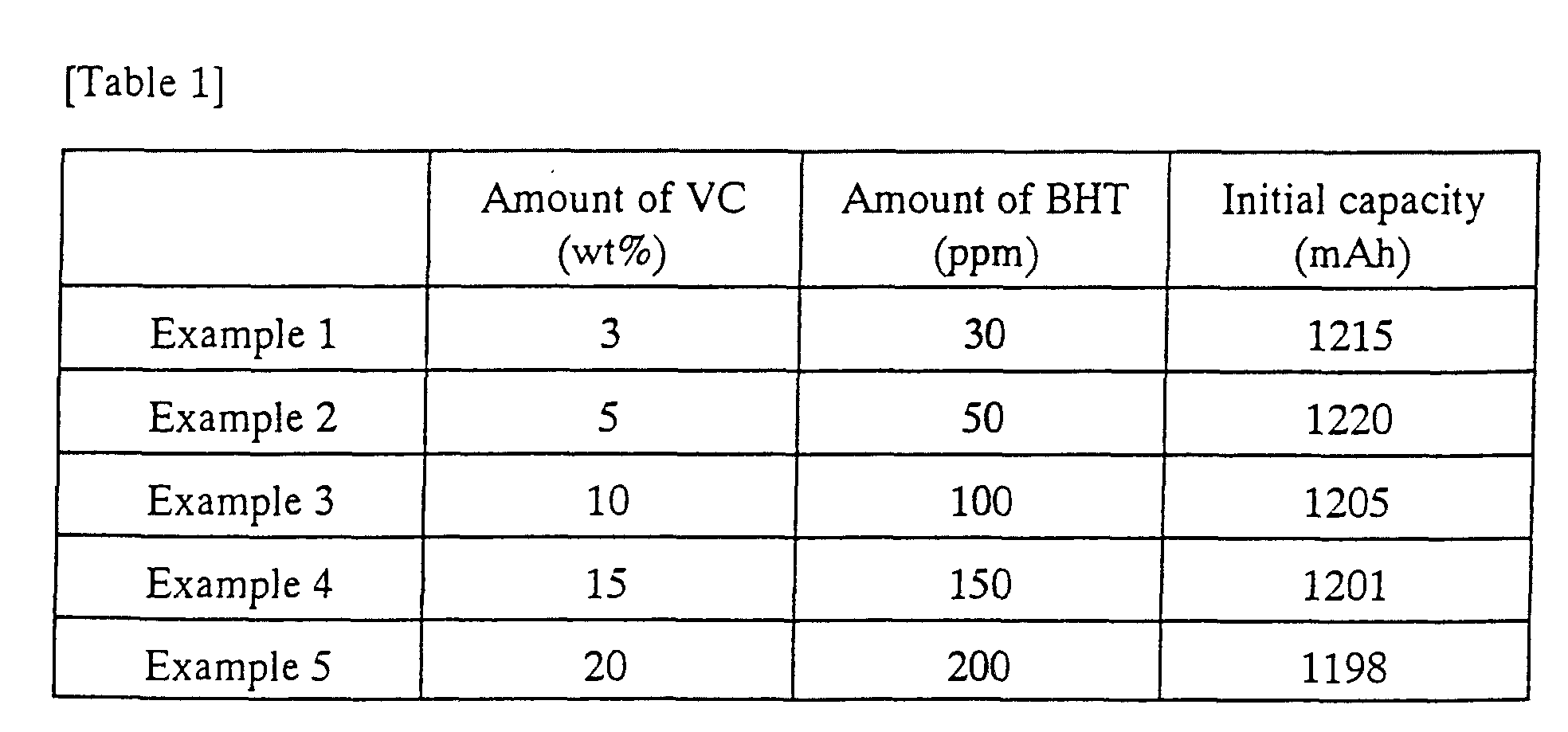
- This nonaqueous electrolyte solution was prepared in such a manner that LiPF 6 , ethylene carbonate (EC), propylene carbonate (PC), dimethyl carbonate (DMC) and vinylene carbonate (VC) were mixed together at prescribed rate and further, a prescribed amount of 2, 6-di-t-butyl-p-cresol (BHT) of phenols serving as an antioxidant was added to the mixture.
- the composition of the electrolyte solution included LiPF 6 , EC, PC, DMC and VC in the weight ratio 10 : 27 : 5 : 55 : 3 and further, the BHT was added to the electrolyte solution at the rate of 30 ppm.
- the battery can was caulked through an insulating seal gasket to the surface of which asphalt is applied so that a safety device having a current shutting-off mechanism, a PTC element and a battery cover were fixed to maintain airtightness in the battery.
- a cylindrical nonaqueous electrolyte secondary battery with the diameter of 18 mm the height of 65 mm was manufactured.
- a cylindrical nonaqueous electrolyte secondary battery was manufactured in the same manner as that of the Example 1 except that the composition of the nonaqueous electrolyte solution included LiPF 6 , EC, PC, DMC, VC in the weight ratio 10 : 25 : 5 : 55 : 5 and further, the BHT was added to the nonaqueous solution at the rate of 50 ppm.
- a cylindrical nonaqueous electrolyte secondary battery was manufactured in the same manner as that of the Example 1 except that the composition of the nonaqueous electrolyte solution included LiPF 6 , EC, PC, DMC, VC in the weight ratio 10 : 20 : 5 : 55 : 10 and further, the BHT was added to the nonaqueous solution at the rate of 100 ppm.
- a cylindrical nonaqueous electrolyte secondary battery was manufactured in the same manner as that of the Example 1 except that the composition of the nonaqueous electrolyte solution included LiPF 6 , EC, PC, DMC, VC in the weight ratio 10 : 15 : 5 : 55 : 15 and further, the BHT was added to the nonaqueous solution at the rate of 150 ppm.
- a cylindrical nonaqueous electrolyte secondary battery was manufactured in the same manner as that of the Example 1 except that the composition of the nonaqueous electrolyte solution included LiPF 6 , EC, PC, DMC, VC in the weight ratio 10 : 10 : 5 : 55 : 20 and further, the BHT was added to the nonaqueous solution at the rate of 200 ppm.
- a cylindrical nonaqueous electrolyte secondary battery was manufactured in the same manner as that of the Example 1 except that the composition of the nonaqueous electrolyte solution included LiPF 6 , EC, PC, DMC, VC in the weight ratio 10 : 29 : 5 : 55 : 1 and further, the BHT was added to the nonaqueous solution at the rate of 10 ppm.
- a cylindrical nonaqueous electrolyte secondary battery was manufactured in the same manner as that of the Example 1 except that the composition of the nonaqueous electrolyte solution included LiPF 6 , EC, PC, DMC, VC in the weight ratio 10 : 29.5 : 5 : 55 : 0.5 and further, the BHT was added to the nonaqueous solution at the rate of 5 ppm.
- a cylindrical nonaqueous electrolyte secondary battery was manufactured in the same manner as that of the Example 1 except that the composition of the nonaqueous electrolyte solution included LiPF 6 , EC, PC, DMC, VC in the weight ratio 10 : 29.9 : 5 : 55 : 0.1 and further, the BHT was added to the nonaqueous solution at the rate of 1 ppm.
- a cylindrical nonaqueous electrolyte secondary battery was manufactured in the same manner as that of the Example 1 except that the composition of the nonaqueous electrolyte solution included LiPF 6 , EC, PC, DMC, VC in the weight ratio 10 : 29.92 : 5 : 55 : 0.08 and further, the BHT was added to the nonaqueous solution at the rate of 0.8 ppm.
- a cylindrical nonaqueous electrolyte secondary battery was manufactured in the same manner as that of the Example 1 except that the composition of the nonaqueous electrolyte solution included LiPF 6 , EC, PC, DMC, VC in the weight ratio 10 : 29.95 : 5 : 55 : 0.05 and further, the BHT was added to the nonaqueous solution at the rate of 0.5 ppm.
- a cylindrical nonaqueous electrolyte secondary battery was manufactured in the same manner as that of the Example 1 except that the composition of the nonaqueous electrolyte solution included LiPF 6 , EC, PC, DMC in the weight ratio 10 : 30 : 5 : 55.
- a cylindrical nonaqueous electrolyte secondary battery was manufactured in the same manner as that of the Example 1 except that the composition of the nonaqueous electrolyte solution included LiPF 6 , EC, PC, DMC, in the weight ratio 10 : 30 : 5 : 55 and further, the BHT was added to the nonaqueous solution at the rate of 100 ppm.
- a cylindrical nonaqueous electrolyte secondary battery was manufactured in the same manner as that of the Example 1 except that the composition of the nonaqueous electrolyte solution included LiPF 6 , PC, DMC, VC in the weight ratio 10 : 5 : 55 : 30 and further, the BHT was added to the nonaqueous solution at the rate of 300 ppm.
- a cylindrical nonaqueous electrolyte secondary battery was manufactured in the same manner as that of the Example 1 except that the composition of the nonaqueous electrolyte solution included LiPF 6 , EC, PC, DMC, VC in the weight ratio 10 : 29.99 : 5 : 55 : 0.01 and further, the BHT was added to the nonaqueous solution at the rate of 0.10 ppm.
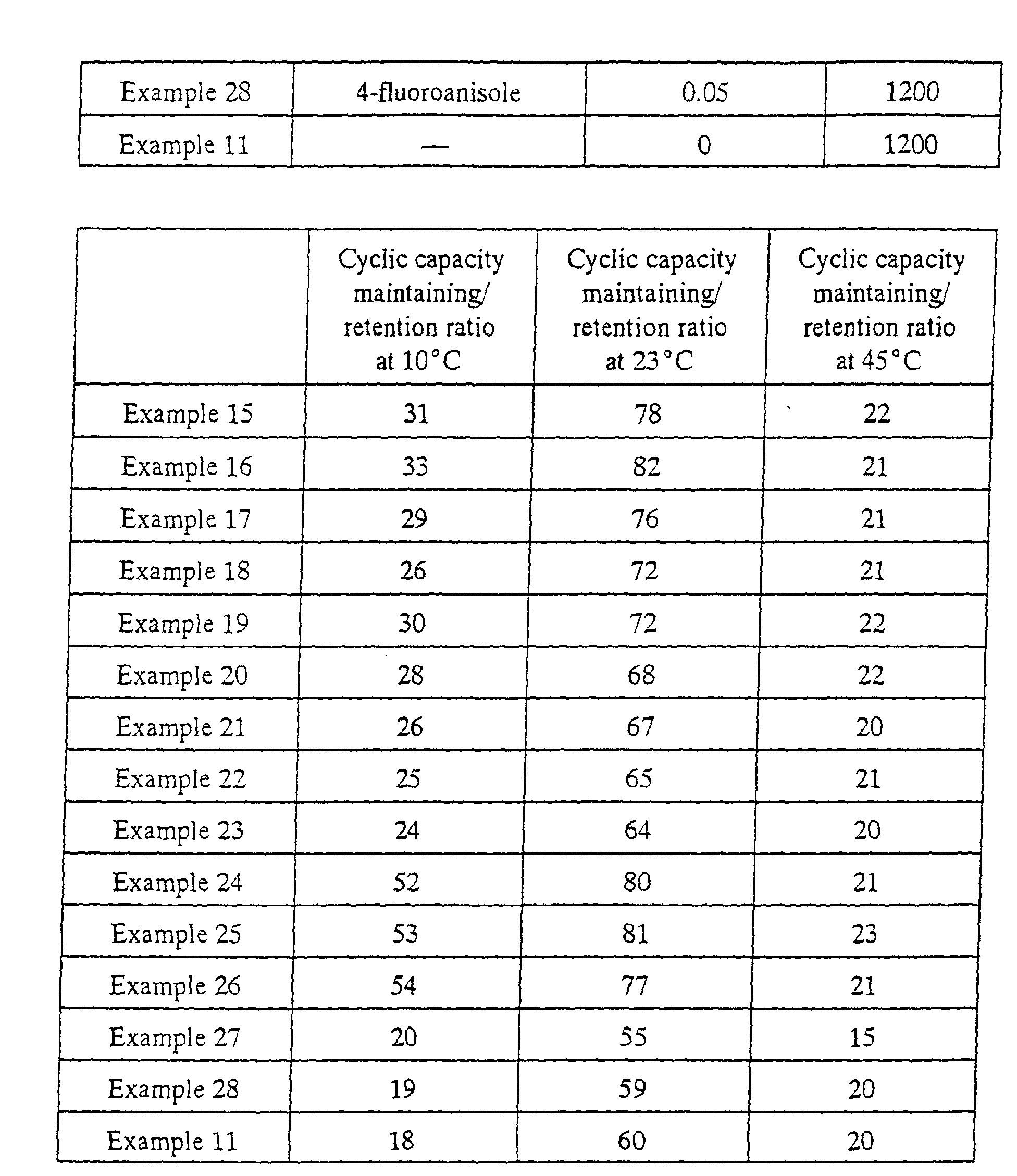
- a cyclic test under an atmosphere of low temperature was evaluated in the following manner. Initially, after a constant-current and constant-voltage charging operation was carried out relative to each battery under the condition of upper limit voltage of 4.2 V and current of 1A for 3 hours in a constant temperature bath at 10°C, a constant-current discharging operation of 0.4 A was carried out up to end voltage of 3.0 V. Under this condition, the charging and discharging operations were repeated 500 times so that the rate of a 500th capacity relative to a second capacity was considered to be a capacity maintaining/retention ratio (%) of a 500th cycle.
- a cyclic test under an atmosphere of high temperature was evaluated in the following manner. Initially, after a constant-current and constant-voltage charging operation was carried out relative to each battery under the condition of upper limit voltage of 4.2 V and current of 1A for 3 hours in a constant temperature bath at 45°C, a constant-current discharging operation with current 0.4 A was carried out up to the end voltage of 3.0 V. Under this condition, the charging and discharging operations were repeated 500 times so that the rate of a 500th capacity relative to a second capacity was considered to be a capacity maintaining/retention ratio (%) of a 500th cycle.
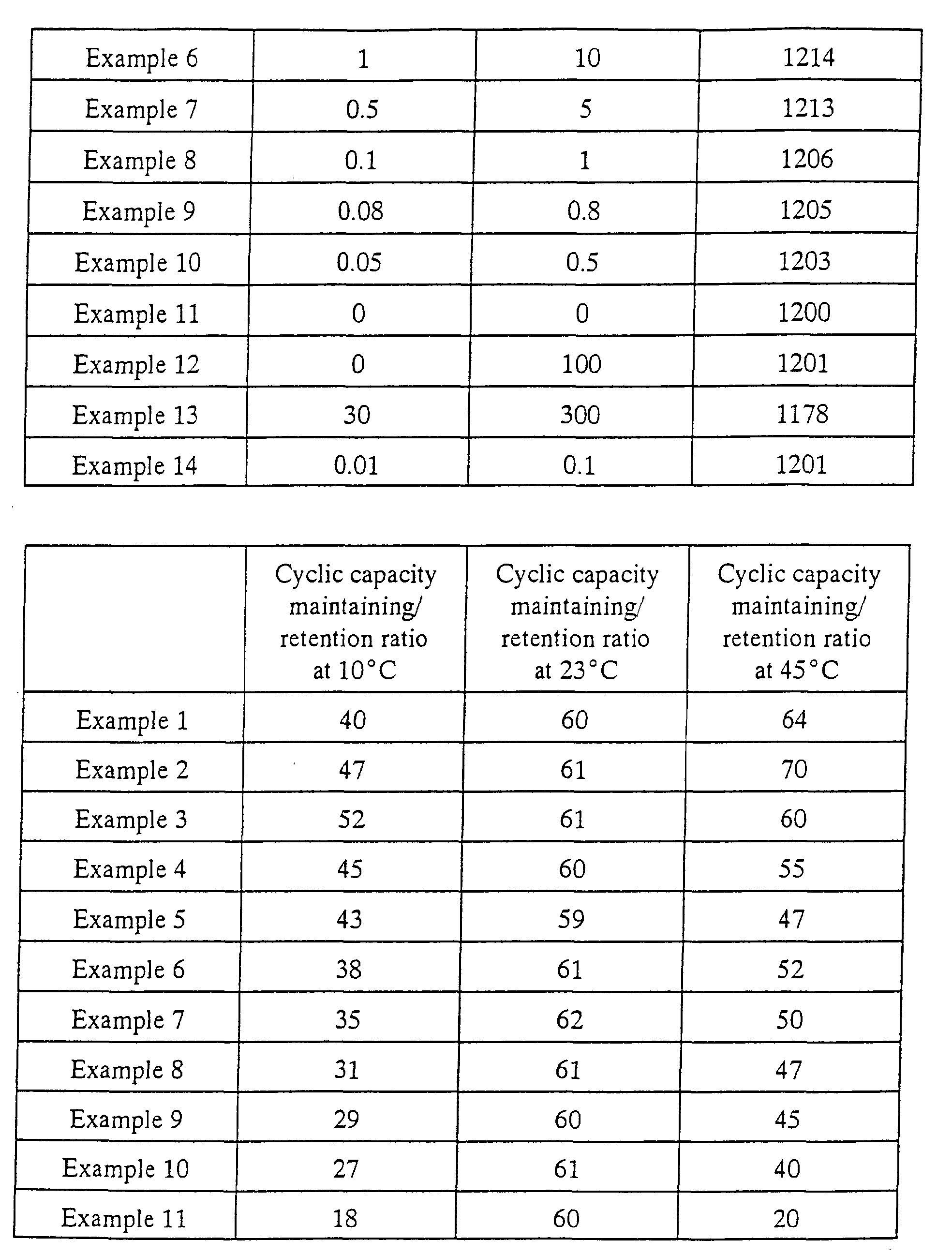
- the evaluated results of the batteries of the Examples 1 to 14 are shown in Table 1.
- Table 1 the composition of the electrolyte solution is also shown.
- Fig. 2 the relation between the amount of addition of vinylene carbonate and the battery property is shown in Fig. 2.
- Fig. 2 an initial capacity is indicated by a black circular mark, a cyclic characteristic at 10°C is designated by a white circular mark, a cyclic characteristic at 23°C is designated by a triangular mark and a cyclic characteristic at 45°C is designated by a square mark, respectively.
- the cyclic capacity maintaining/retention ratio at 10°C in the Examples 1 to 10 including the VC in the electrolyte solution were higher than those of the Examples 11 and 12 including no VC in the electrolyte solution. Since the freezing point of EC is as high as 38°C, it is disadvantageous to use the EC in order to improve the low temperature property of the battery. Therefore, the vinylene carbonate (VC) having its freezing point at about 22°C has been proposed as a solvent with a high dielectric constant in place of the EC.
- the antioxidant is added to the electrolyte solution so that the decomposition of the VC or other solvents may be suppressed and the cyclic characteristic under high temperature may be improved.
- the initial capacity is lowered. It is estimated that an excess VC is added to lower the capacity.
- the cyclic capacity maintaining/retention ratio at 10°C and 23°C are not substantially different from those of the Example 11. In other words, for the amount of addition of VC, an optimum ratio is present.
- the amount of addition of VC is preferably located within a range of 0.05 wt% or more to 20 wt% or lower, and more preferably located within a range of 0.08 wt % or more to 15 wt% or lower.
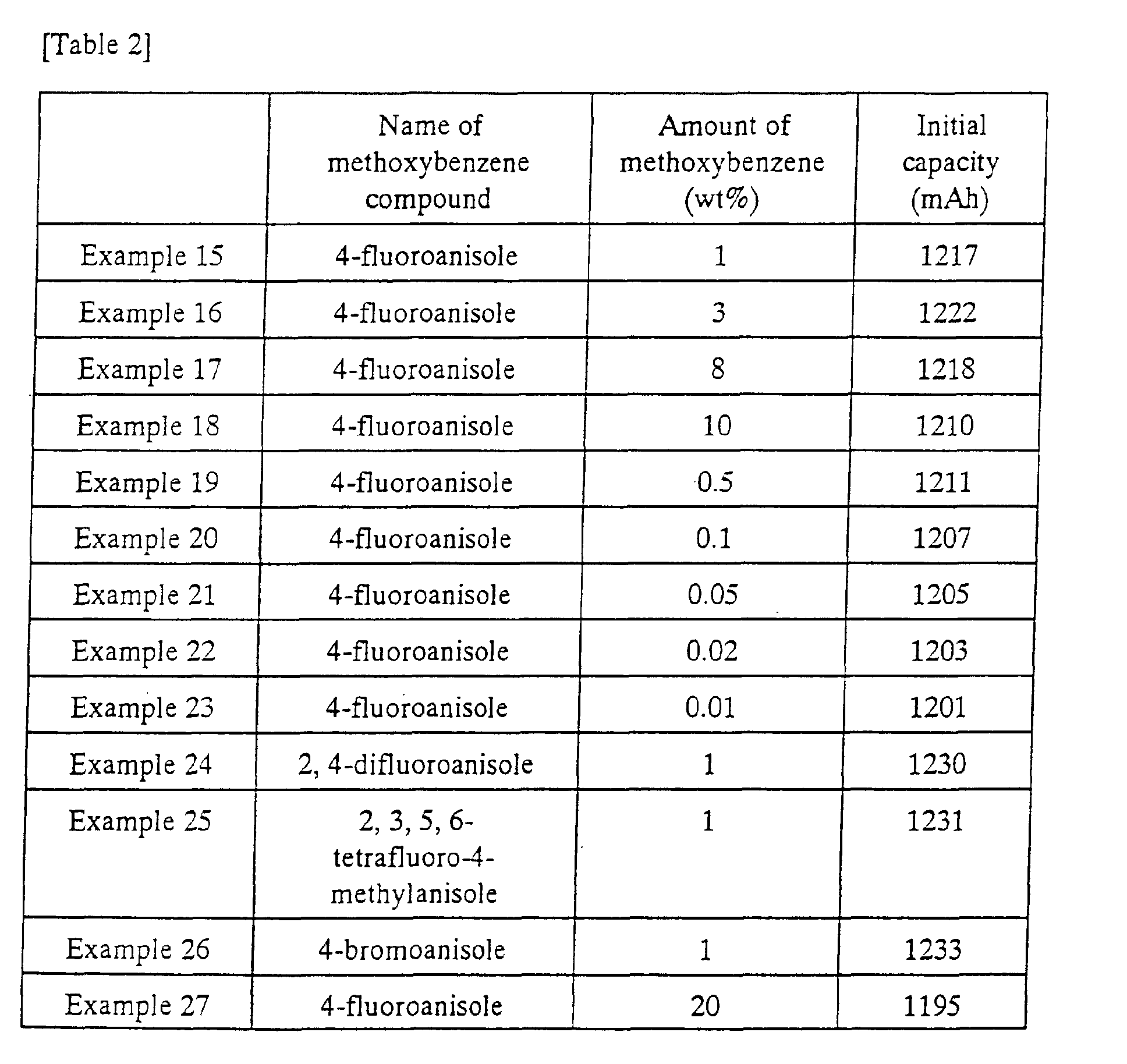
- a cylindrical nonaqueous electrolyte secondary battery was manufactured in the same manner as that of the Example 1 except that the composition of the nonaqueous electrolyte solution included LiPF 6 , EC, PC, DMC, 4-fluoroanisole in the weight ratio 10 : 29 : 5 : 55 : 1.
- a cylindrical nonaqueous electrolyte secondary battery was manufactured in the same manner as that of the Example 1 except that the composition of the nonaqueous electrolyte solution included LiPF 6 , EC, PC, DMC, 4-fluoroanisole in the weight ratio 10 : 27 : 5 : 55 : 3.
- a cylindrical nonaqueous electrolyte secondary battery was manufactured in the same manner as that of the Example 1 except that the composition of the nonaqueous electrolyte solution included LiPF 6 , EC, PC, DMC, 4-fluoroanisole in the weight ratio 10 : 22 : 5 : 55 : 8.
- a cylindrical nonaqueous electrolyte secondary battery was manufactured in the same manner as that of the Example 1 except that the composition of the nonaqueous electrolyte solution included LiPF 6 , EC, PC, DMC, 4-fluoroanisole in the weight ratio 10 : 20 : 5 : 55 : 10.
- a cylindrical nonaqueous electrolyte secondary battery was manufactured in the same manner as that of the Example 1 except that the composition of the nonaqueous electrolyte solution included LiPF 6 , EC, PC, DMC, 4-fluoroanisole in the weight ratio 10 : 29.5 : 5 : 55 : 0.5.
- a cylindrical nonaqueous electrolyte secondary battery was manufactured in the same manner as that of the Example 1 except that the composition of the nonaqueous electrolyte solution included LiPF 6 , EC, PC, DMC, 4-fluoroanisole in the weight ratio 10 : 29.9 : 5 : 55 : 0.1.
- a cylindrical nonaqueous electrolyte secondary battery was manufactured in the same manner as that of the Example 1 except that the composition of the nonaqueous electrolyte solution included LiPF 6 , EC, PC, DMC, 4-fluoroanisole in the weight ratio 10 : 29.95 : 5 : 55 : 0.05.
- a cylindrical nonaqueous electrolyte secondary battery was manufactured in the same manner as that of the Example 1 except that the composition of the nonaqueous electrolyte solution included LiPF 6 , EC, PC, DMC, 4-fluoroanisole in the weight ratio 10 : 29.98 : 5 : 55 : 0.02.
- a cylindrical nonaqueous electrolyte secondary battery was manufactured in the same manner as that of the Example 1 except that the composition of the nonaqueous electrolyte solution included LiPF 6 , EC, PC, DMC, 4-fluoroanisole in the weight ratio 10 : 29.99 : 5 : 55 : 0.01.
- a cylindrical nonaqueous electrolyte secondary battery was manufactured in the same manner as that of the Example 1 except that the composition of the nonaqueous electrolyte solution included LiPF 6 , EC, PC, DMC 2, 4-difluoroanisole in the weight ratio 10 : 29 : 5 : 55 : 1.
- a cylindrical nonaqueous electrolyte secondary battery was manufactured in the same manner as that of the Example 1 except that the composition of the nonaqueous electrolyte solution included LiPF 6 , EC, PC, DMC, 2, 3, 5, 6-tetrafluoro-4-methylanisole in the weight ratio 10 : 29 : 5 : 55 : 1.
- a cylindrical nonaqueous electrolyte secondary battery was manufactured in the same manner as that of the Example 1 except that the composition of the nonaqueous electrolyte solution included LiPF 6 , EC, PC, DMC, 4-bromoanisole in the weight ratio 10 : 29 : 5 : 55 : 1.
- a cylindrical nonaqueous electrolyte secondary battery was manufactured in the same manner as that of the Example 1 except that the composition of the nonaqueous electrolyte solution included LiPF 6 , EC, PC, DMC, 4-fluoroanisole in the weight ratio 10 : 10 : 5 : 55 : 20.
- a cylindrical nonaqueous electrolyte secondary battery was manufactured in the same manner as that of a Example 1 except that the composition of the nonaqueous electrolyte solution included LiPF 6 , EC, PC, DMC, 4-fluoroanisole in the weight ratio 10 : 29.995 : 5 : 55 : 0.005.
- Fig. 3 the initial capacity is designated by a black circular mark, a cyclic characteristic at 10°C is designated by a white circular mark, a cyclic characteristic at 23°C is indicated by a triangular mark and a cyclic characteristic at 45°C is designated by a square mark.
- the capacity maintaining/retention ratio at 23°C in the Examples 15 to 23 including the 4-fluoroanisole in the electrolyte solution were higher than that of the Example 11 including no methoxybenzene compound. Further, from the Examples 24 to 26 including methoxybenzene compounds other than 4-fluoroanisole, good results could be similarly obtained. Since the battery to which the methoxybenzene compound is added effectively suppresses the deterioration of capacity generated when the battery is kept in a charged state at room temperature, this effect may possibly contribute to good results in the cyclic characteristic at 23°C.
- Example 27 the cyclic characteristic at room temperature is deteriorated. It is estimated that an excess 4-fluoroanisole is added to the electrolyte solution to lower the capacity. Further, in the Example 28, since a small amount of 4-fluoroanisole is added to the electrolyte solution, the cyclic characteristics at 10°C, 23°C and 45°C are substantially the same as those of the Example 11. In other words, for the amount of addition of methoxybenzene compound, an optimum ratio exists. As apparent from Fig.
- the amount of addition of methoxybenzene compound is preferably located within a range of 0.01 wt% or more to 10 wt% or lower, and more preferably located within a range of 0.02 wt% or more to 10 wt% or lower.
- a cylindrical nonaqueous electrolyte secondary battery was manufactured in the same manner as that of the Example 1 except that the composition of the nonaqueous electrolyte solution included LiPF 6 , EC, PC, DMC, VC, 4-fluoroanisole in the weight ratio 10 : 26 : 5 : 55 : 3 : 1 and further, the BHT was added to the nonaqueous solution at the rate of 30 ppm.
- the composition of the nonaqueous electrolyte solution included LiPF 6 , EC, PC, DMC, VC, 4-fluoroanisole in the weight ratio 10 : 26 : 5 : 55 : 3 : 1 and further, the BHT was added to the nonaqueous solution at the rate of 30 ppm.
- a cylindrical nonaqueous electrolyte secondary battery was manufactured in the same manner as that of the Example 1 except that the composition of the nonaqueous electrolyte solution included LiPF 6 , EC, PC, DMC, 4-fluoroanisole in the weight ratio 10 : 29 : 5 : 55 : 1 and further, the BHT was added to the nonaqueous solution at the rate of 200 ppm.
- the composition of the nonaqueous electrolyte solution included LiPF 6 , EC, PC, DMC, 4-fluoroanisole in the weight ratio 10 : 29 : 5 : 55 : 1 and further, the BHT was added to the nonaqueous solution at the rate of 200 ppm.
- a cylindrical nonaqueous electrolyte secondary battery was manufactured in the same manner as that of the Example 1 except that the composition of the nonaqueous electrolyte solution included LiPF 6 , EC, PC, DMC, in the weight ratio 10 : 30 : 5 : 55 and further, the BHT was added to the nonaqueous solution at the rate of 200 ppm.
- a cylindrical nonaqueous electrolyte secondary battery was manufactured in the same manner as that of the Example 1 except that the composition of the nonaqueous electrolyte solution included LiPF 6 , EC, PC, DMC, VC in the weight ratio 10 : 27 : 5 : 55 : 3.
- a cylindrical nonaqueous electrolyte secondary battery was manufactured in the same manner as that of the Example 1 except that the composition of the nonaqueous electrolyte solution included LiPF 6 , EC, PC, DMC, VC, 4-fluoroanisole in the weight ratio 10 : 26 : 5 : 55 : 3 : 1.
- the VC good in its cyclic characteristics at 10°C and 45°C, the electrolyte solution to which the antioxidant was added and the 4-fluoroanisole good in its cyclic characteristic at 45°C were mixed together, so that excellent cyclic characteristics could be obtained in all the ranges. Further, a good cyclic characteristic could be obtained even by one or two kinds of these materials not in all the ranges but in a part of the ranges.
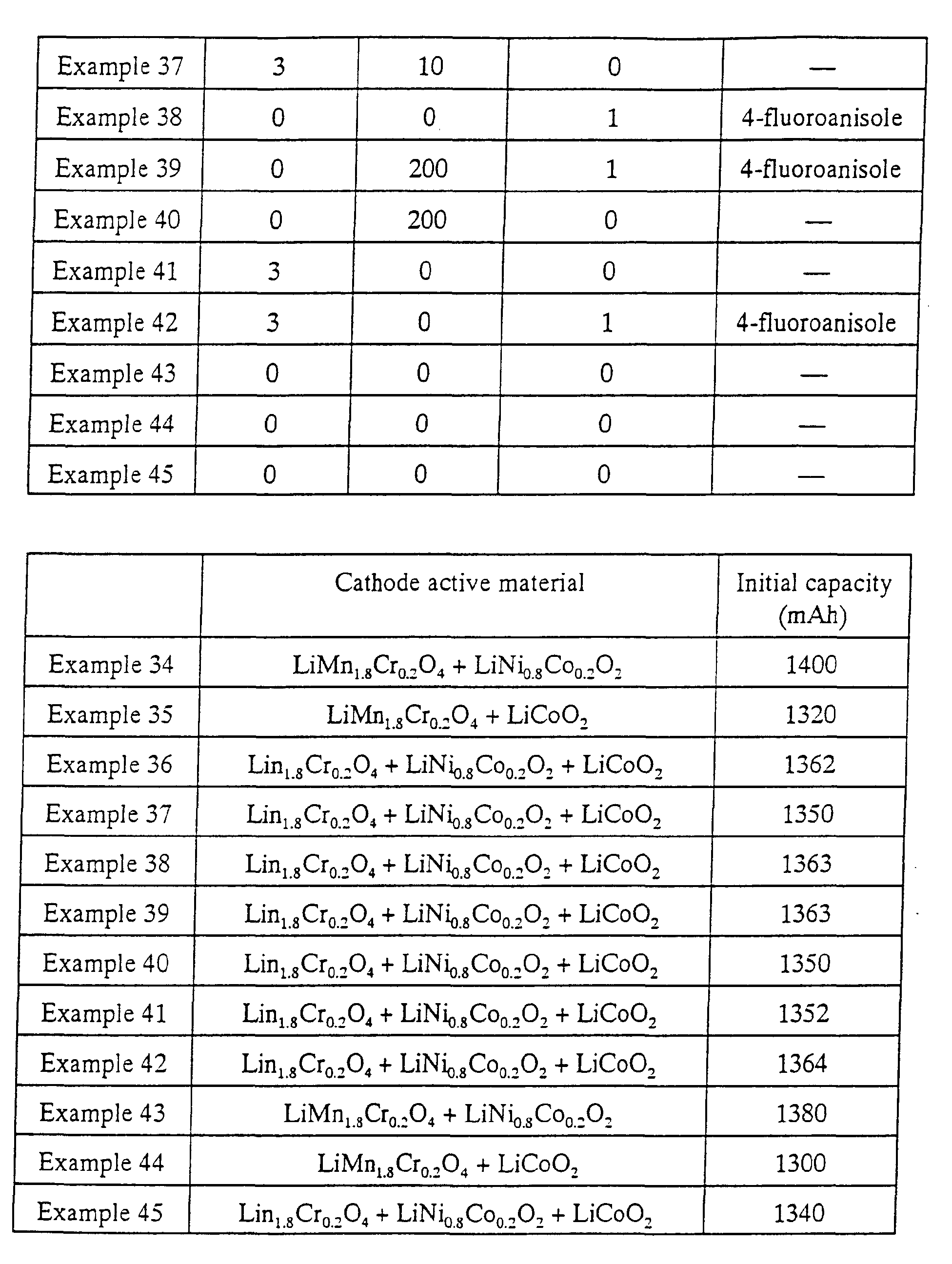
- a cylindrical nonaqueous electrolyte secondary battery was manufactured in the same manner as that of the Example 1 except that the composition of the cathode active material included LiMn 1.8 Cr 0.2 O 4 and LiNi 0.8 Co 0.2 O 2 in the weight ratio 80 : 20, the composition of the nonaqueous electrolyte solution included LiPF 6 , EC, PC, DMC, VC, and 4-fluoroanisole in the weight ratio 10 : 26 : 5 : 55 : 3 : 1 and further, the BHT was added to the nonaqueous electrolyte solution at the rate of 30 ppm.
- the composition of the cathode active material included LiMn 1.8 Cr 0.2 O 4 and LiNi 0.8 Co 0.2 O 2 in the weight ratio 80 : 20
- the composition of the nonaqueous electrolyte solution included LiPF 6 , EC, PC, DMC, VC, and 4-fluoroanisole in the weight ratio 10 : 26 : 5 : 55 : 3 : 1 and further
- a cylindrical nonaqueous electrolyte secondary battery was manufactured in the same manner as that of the Example 1 except that the composition of the cathode active material included LiMn 1.8 Cr 0.2 O 4 and LiCoO 2 in the weight ratio 80 : 20, the composition of the nonaqueous electrolyte solution included LiPF 6 , EC, PC, DMC, VC, and 4- fluoroanisole in the weight ratio 10 : 26 : 5 : 55 : 3 : 1 and further, the BHT was added to the nonaqueous electrolyte solution at the rate of 30 ppm.
- the composition of the cathode active material included LiMn 1.8 Cr 0.2 O 4 and LiCoO 2 in the weight ratio 80 : 20
- the composition of the nonaqueous electrolyte solution included LiPF 6 , EC, PC, DMC, VC, and 4- fluoroanisole in the weight ratio 10 : 26 : 5 : 55 : 3 : 1 and further, the BHT was added to the nonaqueous
- a cylindrical nonaqueous electrolyte secondary battery was manufactured in the same manner as that of the Example 1 except that the composition of the cathode active material included LiMn 1.8 Cr 0.2 O 4 , LiNi 0.8 Co 0.2 O 2 and LiCoO 2 in the weight ratio 80 : 10 : 10, the composition of the nonaqueous electrolyte solution included LiPF 6 , EC, PC, DMC, VC, and 4-fluoroanisole in the weight ratio 10 : 26 : 5 : 55 : 3 : 1 and further, the BHT was added to the nonaqueous electrolyte solution at the rate of 30 ppm.
- the composition of the cathode active material included LiMn 1.8 Cr 0.2 O 4 , LiNi 0.8 Co 0.2 O 2 and LiCoO 2 in the weight ratio 80 : 10 : 10
- the composition of the nonaqueous electrolyte solution included LiPF 6 , EC, PC, DMC, VC, and 4-fluoroanisole in the weight ratio
- a cylindrical nonaqueous electrolyte secondary battery was manufactured in the same manner as that of the Example 1 except that the composition of the cathode active material included LiMn 1.8 Cr 0.2 O 4 and LiNi 0.8 Co 0.2 O 2 and LiCoO 2 in the weight ratio 80 : 10 : 10, the composition of the nonaqueous electrolyte solution included LiPF 6 , EC, PC, DMC, VC in the weight ratio 10 : 27 : 5 : 55 : 3 and further, the BHT was added to the nonaqueous electrolyte solution at the rate of 10 ppm.
- the composition of the cathode active material included LiMn 1.8 Cr 0.2 O 4 and LiNi 0.8 Co 0.2 O 2 and LiCoO 2 in the weight ratio 80 : 10 : 10
- the composition of the nonaqueous electrolyte solution included LiPF 6 , EC, PC, DMC, VC in the weight ratio 10 : 27 : 5 : 55 : 3 and further, the BHT was added
- a cylindrical nonaqueous electrolyte secondary battery was manufactured in the same manner as that of the Example 1 except that the composition of the cathode active material included LiMn 1.8 Cr 0.2 O 4 , LiNi 0.8 Co 0.2 O 2 and LiCoO 2 in the weight ratio 80 : 10 : 10, the composition of the nonaqueous electrolyte solution included LiPF 6 , EC, PC, DMC, 4-fluoroanisole in the weight ratio 10 : 29 : 5 : 55 : 1.
- a cylindrical nonaqueous electrolyte secondary battery was manufactured in the same manner as that of the Example 1 except that the composition of the cathode active material included LiMn 1.8 Cr 0.2 O 4 , LiNi 0.8 Co 0.2 O 2 and LiCoO 2 in the weight ratio 80 : 10 : 10, the composition of the nonaqueous electrolyte solution included LiPF 6 , EC, PC, DMC, and 4-fluoroanisole in the weight ratio 10 : 29 : 5 : 55 : 1 and further, the BHT was added to the nonaqueous electrolyte solution at the rate of 200 ppm.
- the composition of the cathode active material included LiMn 1.8 Cr 0.2 O 4 , LiNi 0.8 Co 0.2 O 2 and LiCoO 2 in the weight ratio 80 : 10 : 10
- the composition of the nonaqueous electrolyte solution included LiPF 6 , EC, PC, DMC, and 4-fluoroanisole in the weight ratio 10 : 29 : 5 :
- a cylindrical nonaqueous electrolyte secondary battery was manufactured in the same manner as that of the Example 1 except that the composition of the cathode active material included LiMn 1.8 Cr 0.2 O 4 , LiNi 0.8 Co 0.2 O 2 and LiCoO 2 in the weight ratio 80 : 10 : 10, the composition of the nonaqueous electrolyte solution included LiPF 6 , EC, PC, DMC, in the weight ratio 10 : 30 : 5 : 55 and further, the BHT was added to the nonaqueous electrolyte solution at the rate of 200 ppm.
- the composition of the cathode active material included LiMn 1.8 Cr 0.2 O 4 , LiNi 0.8 Co 0.2 O 2 and LiCoO 2 in the weight ratio 80 : 10 : 10
- the composition of the nonaqueous electrolyte solution included LiPF 6 , EC, PC, DMC, in the weight ratio 10 : 30 : 5 : 55 and further, the BHT was added to the nonaqueous electroly
- a cylindrical nonaqueous electrolyte secondary battery was manufactured in the same manner as that of the Example 1 except that the composition of the cathode active material included LiMn 1.8 Cr 0.2 O 4 , LiNi 0.8 Co 0.2 O 2 and LiCoO 2 in the weight ratio 80 : 10 : 10, the composition of the nonaqueous electrolyte solution included LiPF 6 , EC, PC, DMC, VC, in the weight ratio 10 : 27 : 5 : 55 : 3.
- a cylindrical nonaqueous electrolyte secondary battery was manufactured in the same manner as that of the Example 1 except that the composition of the cathode active material included LiMn 1.8 Cr 0.2 O 4 and LiNi 0.8 Co 0.2 O 2 and LiCoO 2 in the weight ratio 80 : 10 : 10, the composition of the nonaqueous electrolyte solution included LiPF 6 , EC, PC, DMC, VC, 4-fluoroanisole in the weight ratio 10 : 26 : 5 : 55 : 3 : 1.
- a cylindrical nonaqueous electrolyte secondary battery was manufactured in the same manner as that of the Example 1 except that the composition of the cathode active material included LiMn 1.8 Cr 0.2 O 4 , LiNi 0.8 Co 0.2 O 2 in the weight ratio 80 : 20, and the composition of the nonaqueous electrolyte solution included LiPF 6 , EC, PC, DMC, in the weight ratio 10 : 30 : 5 : 55.
- a cylindrical nonaqueous electrolyte secondary battery was manufactured in the same manner as that of the Example 1 except that the composition of the cathode active material included LiMn 1.8 Cr 0.2 O 4 , and LiCoO 2 in the weight ratio 80 : 20 and the composition of the nonaqueous electrolyte solution included LiPF 6 , EC, PC, DMC in the weight ratio 10 : 30 : 5 : 55.
- a cylindrical nonaqueous electrolyte secondary battery was manufactured in the same manner as that of the Example 1 except that the composition of the cathode active material included LiMn 1.8 Cr 0.2 O 4 , LiNi 0.8 Co 0.2 O 2 and LiCoO 2 in the weight ratio 80 : 10 : 10 and the composition of the nonaqueous electrolyte solution included LiPF 6 , EC, PC, DMC, in the weight ratio 10 : 30 : 5 : 55.
- At least one or more kinds of materials of the vinylene carbonate effective for improving the cyclic characteristic at low temperature, the methoxybenzene compound effective for improving the cyclic characteristic at ambient temperature and the antioxidant effective for improving the cyclic characteristic at high temperature are combined together and the combination thereof is added to the nonaqueous electrolyte solution, and accordingly, the nonaqueous electrolyte battery having the good cyclic characteristics within a wider range of temperature can be realized.
- the unsaturated cyclic carbonate and/or the halogenated methoxybenzene compound particularly, both the vinylene carbonate and 2,4-difluoroanisole are added to the nonaqueous electrolyte solution. Therefore, even when the battery is exposed to high temperature, the generation of gas due to the decomposition of the electrolyte solution can be prevented and the expansion of the battery can be suppressed.
- the nonaqueous electrolyte battery with high reliability can be realized.
Landscapes
- Chemical & Material Sciences (AREA)
- General Chemical & Material Sciences (AREA)
- Chemical Kinetics & Catalysis (AREA)
- Electrochemistry (AREA)
- Inorganic Chemistry (AREA)
- Engineering & Computer Science (AREA)
- Manufacturing & Machinery (AREA)
- General Physics & Mathematics (AREA)
- Condensed Matter Physics & Semiconductors (AREA)
- Physics & Mathematics (AREA)
- Composite Materials (AREA)
- Secondary Cells (AREA)
- Battery Electrode And Active Subsutance (AREA)
Abstract
Description





Claims (24)
- A nonaqueous electrolyte secondary battery comprisesa cathode having a cathode active material capable of being electrochemically doped/dedoped with lithium;an anode having an anode active material capable of being electrochemically doped/dedoped with lithium anda nonaqueous electrolyte interposed between the cathode and the anode,wherein said cathode active material is a lithium composite oxide expressed by a general formula LixMO2 (here, x is not smaller than 0.9 and M indicates at least one or more elements selected from between Fe, Co, Mn, Cu, Zn, Al, Sn, B, Ga, Cr, V, Ti, Mg, Ca and Sr) andsaid nonaqueous electrolyte includes at least one or more kinds of vinylene carbonate, methoxybenzene compounds or antioxidants.
- A nonaqueous electrolyte secondary battery according to claim 1, wherein said nonaqueous electrolyte includes 0.05 wt% or more to 20 wt% or lower of the vinylene carbonate.
- A nonaqueous electrolyte secondary battery according to claim 1, wherein said nonaqueous electrolyte includes 0.01 wt% or more to 10 wt% or lower of the methoxybenzene compounds.
- A nonaqueous electrolyte secondary battery according to claim 1, wherein said antioxidants employ one kind of material selected from between quinones, aromatic amines, phenols, vitamin E, vitamin C, sesamoles and quercetins, and said methoxybenzene compounds employ one kind of material selected from between 4-fluoroanisole, 2, 4-difluoroanisole, 2-bromoanisole, 2, 3, 5, 6-tetrafluoro-4-methylanisole.
- A nonaqueous electrolyte secondary battery according to claim 1, wherein said cathode has a cathode active material layer formed by applying a cathode compound mixture including a cathode active material and a binding material to both the surfaces of a metal foil serving as a cathode current collector, said anode has an anode active material layer formed by uniformly applying an anode compound mixture including an anode active material and a binding agent to a metal foil serving as an anode current collector and drying the anode compound mixture and said cathode and the anode are laminated through microporous film separators and the obtained laminated body is coiled spirally a plurality of times to obtain a coiled electrode body.
- A nonaqueous electrolyte secondary battery according to claim 1, wherein said nonaqueous electrolyte secondary battery is a solid electrolyte battery using, as said electrolyte, a solid polymer electrolyte including one or more of substances or mixture of polymer compounds or a gel electrolyte battery using a gel solid electrolyte including a swelling solvent.
- A nonaqueous electrolyte secondary battery according to claim 1, wherein said antioxidants employ 2, 6-di-t-butyl-p-cresol (BHT).
- A nonaqueous electrolyte secondary battery according to claim 1, wherein said methoxybenzene compounds employ 4-fluoroanisole.
- A nonaqueous electrolyte secondary battery comprisesa cathode having a cathode active material capable of being electrochemically doped/dedoped with lithium;an anode having an anode active material capable of being electrochemically doped/dedoped with lithium anda nonaqueous electrolyte interposed between the cathode and the anode,wherein said cathode active material includes a lithium-manganese composite oxide expressed by a general formula LixMn2-yM'yO4 (here, x satisfies the relation expressed by x ≥ 0.9, y satisfies the relation expressed by 0.5 ≥ y ≥ 0.01. M' indicates at least one or more elements selected from between Fe, Co, Ni, Cu, Zn, Al, Sn, Cr, V, Ti, Mg, Ca and Sr) and said nonaqueous electrolyte includes at least one or more kinds of vinylene carbonate, methoxybenzene compounds or antioxidants.
- A nonaqueous electrolyte secondary battery according to claim 9, wherein said nonaqueous electrolyte includes 0.05 wt% or more to 20 wt% or lower of the vinylene carbonate.
- A nonaqueous electrolyte secondary battery according to claim 9, wherein said nonaqueous electrolyte includes 0.01 wt% or more to 10 wt% or lower of the methoxybenzene compounds.
- A nonaqueous electrolyte secondary battery according to claim 9, wherein said antioxidants employ one kind of material selected from between quinones, aromatic amines, phenols, vitamin E, vitamin C, sesamoles and quercetins, and said methoxybenzene compounds employ one kind of material selected from between 4-fluoroanisole, 2, 4-difluoroanisole, 2-bromoanisole, 2, 3, 5, 6-tetrafluoro-4-methylanisole.
- A nonaqueous electrolyte secondary battery according to claim 9, wherein said antioxidants employ 2- 6-di-t-butyl-p-cresol (BHT).
- A nonaqueous electrolyte secondary battery according to claim 9, wherein said methoxybenzene compounds employ 4-fluoroanisole.
- A nonaqueous electrolyte secondary battery according to claim 9, wherein said cathode has a cathode active material layer formed by applying a cathode compound mixture including a cathode active material and a binding material to both the surfaces of a metal foil serving as a cathode current collector, said anode has an anode active material layer formed by uniformly applying an anode compound mixture including an anode active material and a binding agent to a metal foil serving as an anode current collector and drying the anode compound mixture and said cathode and the anode are laminated through microporous film separators and the obtained laminated body is coiled spirally a plurality of times to obtain a coiled electrode body.
- A nonaqueous electrolyte secondary battery according to claim 9, wherein said nonaqueous electrolyte secondary battery is a solid electrolyte battery using, as said electrolyte, a solid polymer electrolyte including one or more of substances or mixture of polymer compounds or a gel electrolyte battery using a gel solid electrolyte including a swelling solvent.
- A nonaqueous electrolyte secondary battery comprisesa cathode having a cathode active material capable of being electrochemically doped/dedoped with lithium;an anode having an anode active material capable of being electrochemically doped/dedoped with lithium anda nonaqueous electrolyte interposed between the cathode and the anode,wherein said cathode active material includes a lithium-manganese composite oxide expressed by a general formula LixMn2-yM'yO4 (here, x satisfies the relation expressed by x ≥ 0.9 and y satisfies the relation expressed by 0.5 ≥ y ≥ 0.01. M' indicates at least one or more elements selected from between Fe, Co, Ni, Cu, Zn, Al, Sn, Cr, V, Ti, Mg, Ca and Sr) and a lithium composite oxide expressed by a general formula LiM"zO2 (here, z satisfies the relation expressed by 1 ≥ z ≥ 0.5 and M" indicates at least one or more elements selected from between Fe, Co, Mn, Cu, Zn, Al, Sn, B, Ga, Cr, V, Ti, Mg, Ca and Sr) and said nonaqueous electrolyte includes at least one or more kinds of vinylene carbonate, methoxybenzene compounds or antioxidants.
- A nonaqueous electrolyte secondary battery according to claim 17, wherein said nonaqueous electrolyte includes 0.05 wt% or more to 20 wt% or lower of the vinylene carbonate.
- A nonaqueous electrolyte secondary battery according to claim 17, wherein said nonaqueous electrolyte includes 0.01 wt% or more to 10 wt% or lower of the methoxybenzene compounds.
- A nonaqueous electrolyte secondary battery according to claim 17, wherein said antioxidants employ one kind of material selected from between quinones, aromatic amines, phenols, vitamin E, vitamin C, sesamoles and quercetins, and said methoxybenzene compounds employ one kind of material selected from between 4-fluoroanisole, 2, 4-difluoroanisole, 2-bromoanisole, 2, 3, 5, 6-tetrafluoro-4-methylanisole.
- A nonaqueous electrolyte secondary battery according to claim 17, wherein said cathode has a cathode active material layer formed by applying a cathode compound mixture including a cathode active material and a binding material to both the surfaces of a metal foil serving as a cathode current collector, said anode has an anode active material layer formed by uniformly applying an anode compound mixture including an anode active material and a binding agent to a metal foil serving as an anode current collector and drying the anode compound mixture and said cathode and the anode are laminated through microporous film separators and the obtained laminated body is coiled spirally a plurality of times to obtain a coiled electrode body.
- A nonaqueous electrolyte secondary battery according to claim 17, wherein said nonaqueous electrolyte secondary battery is a solid electrolyte battery using, as said electrolyte, a solid polymer electrolyte including one or more of substances or mixture of polymer compounds or a gel electrolyte battery using a gel solid electrolyte including a swelling solvent.
- A nonaqueous electrolyte secondary battery according to claim 17, wherein said antioxidants employ 2, 6-di-t-butyl-p-cresol (BHT).
- A nonaqueous electrolyte secondary battery according to claim 17, wherein said methoxybenzene compounds employ 4-fluoroanisole.
Applications Claiming Priority (4)
| Application Number | Priority Date | Filing Date | Title |
|---|---|---|---|
| JP2000157116A JP2001338684A (en) | 2000-05-26 | 2000-05-26 | Non-aqueous electrolyte battery |
| JP2000157116 | 2000-05-26 | ||
| JP2000200368A JP2002015769A (en) | 2000-06-30 | 2000-06-30 | Non-aqueous electrolyte battery |
| JP2000200368 | 2000-06-30 |
Publications (2)
| Publication Number | Publication Date |
|---|---|
| EP1160905A2 true EP1160905A2 (en) | 2001-12-05 |
| EP1160905A3 EP1160905A3 (en) | 2003-06-04 |
Family
ID=26592735
Family Applications (1)
| Application Number | Title | Priority Date | Filing Date |
|---|---|---|---|
| EP01112471A Withdrawn EP1160905A3 (en) | 2000-05-26 | 2001-05-22 | Nonaqueous electrolyte secondary battery |
Country Status (5)
| Country | Link |
|---|---|
| US (1) | US7014954B2 (en) |
| EP (1) | EP1160905A3 (en) |
| KR (1) | KR100812106B1 (en) |
| CN (1) | CN1191656C (en) |
| TW (1) | TW531924B (en) |
Cited By (9)
| Publication number | Priority date | Publication date | Assignee | Title |
|---|---|---|---|---|
| WO2002080291A3 (en) * | 2000-12-18 | 2003-12-11 | Du Pont | Additive for lithium-ion battery |
| WO2005099024A3 (en) * | 2004-04-01 | 2006-05-26 | 3M Innovative Properties Co | Redox shuttle for rechargeable lithium-ion cell |
| WO2005099025A3 (en) * | 2004-04-01 | 2006-07-20 | 3M Innovative Properties Co | Redox shuttle for overdischarge protection in rechargeable lithium-ion batteries |
| EP1598895A4 (en) * | 2003-02-27 | 2008-03-12 | Mitsubishi Chem Corp | WATER-FREE ELECTROLYTIC SOLUTION AND LITHIUM SECONDARY BATTERY |
| EP1463143A3 (en) * | 2003-03-24 | 2008-04-16 | Samsung SDI Co., Ltd. | A non-aqoeous electrolyte and a lithium secondary battery comprising the same |
| US8101302B2 (en) | 2008-02-12 | 2012-01-24 | 3M Innovative Properties Company | Redox shuttles for high voltage cathodes |
| EP2472662A1 (en) * | 2010-12-30 | 2012-07-04 | Samsung Electronics Co., Ltd. | Electrolyte for lithium secondary battery and lithium secondary battery including the same |
| EP3471191A1 (en) | 2017-10-11 | 2019-04-17 | Centre National De La Recherche Scientifique | Electrolyte composition including a specific combination of additives, its use as non-aqueous liquid electrolyte in a na-ion battery and na-ion battery including such an electrolyte composition |
| EP4322278A1 (en) * | 2022-08-10 | 2024-02-14 | CALB Co., Ltd. | Electrolyte and lithium-ion battery including the same |
Families Citing this family (53)
| Publication number | Priority date | Publication date | Assignee | Title |
|---|---|---|---|---|
| TW533612B (en) * | 2000-12-28 | 2003-05-21 | Sony Corp | Positive-electrode active material and non-aqueous electrolyte secondary battery |
| US7097673B2 (en) * | 2001-06-07 | 2006-08-29 | 3M Innovative Properties Company | Coating edge control |
| GB0117235D0 (en) * | 2001-07-14 | 2001-09-05 | Univ St Andrews | Improvements in or relating to electrochemical cells |
| JP3914048B2 (en) * | 2001-12-21 | 2007-05-16 | 日立マクセル株式会社 | Non-aqueous secondary battery and portable device using the same |
| JP4092618B2 (en) | 2001-12-26 | 2008-05-28 | 株式会社ジーエス・ユアサコーポレーション | Nonaqueous electrolyte secondary battery |
| KR100567112B1 (en) | 2002-07-08 | 2006-03-31 | 마쯔시다덴기산교 가부시키가이샤 | Negative electrode and lithium ion secondary battery using the same |
| JP4291987B2 (en) * | 2002-09-20 | 2009-07-08 | パナソニック株式会社 | Sealed secondary battery and battery module |
| KR100739921B1 (en) * | 2003-06-03 | 2007-07-16 | 가부시키가이샤 유아사코오포레이션 | Nonaqueous Electrolyte Cell |
| US8445144B2 (en) | 2003-12-15 | 2013-05-21 | Nec Corporation | Additive for an electrolyte solution for an electrochemical device |
| JP4725728B2 (en) * | 2003-12-15 | 2011-07-13 | 日本電気株式会社 | Secondary battery |
| KR100982323B1 (en) * | 2003-12-17 | 2010-09-15 | 삼성에스디아이 주식회사 | Electrolyte for lithium secondary battery and lithium secondary battery comprising same |
| CN101894975B (en) * | 2004-12-16 | 2011-09-14 | U芝加哥阿谷尼有限公司 | Long life lithium batteries with stabilized electrodes |
| US7811707B2 (en) | 2004-12-28 | 2010-10-12 | Boston-Power, Inc. | Lithium-ion secondary battery |
| US20080008933A1 (en) * | 2005-12-23 | 2008-01-10 | Boston-Power, Inc. | Lithium-ion secondary battery |
| CN100438198C (en) * | 2004-12-31 | 2008-11-26 | 比亚迪股份有限公司 | Mixed additive and electrolyte and lithium ion secondary battery containing same |
| JPWO2006082846A1 (en) * | 2005-02-02 | 2008-06-26 | ジオマテック株式会社 | Thin film solid secondary battery |
| JP4213688B2 (en) | 2005-07-07 | 2009-01-21 | 株式会社東芝 | Nonaqueous electrolyte battery and battery pack |
| CN101263396B (en) | 2005-07-14 | 2011-04-27 | 波士顿电力公司 | Control electronics for Li-ion batteries |
| US20070141470A1 (en) * | 2005-12-16 | 2007-06-21 | Kensuke Nakura | Lithium ion secondary battery |
| US20070181370A1 (en) * | 2006-02-06 | 2007-08-09 | Stephen Kemp-Banks | Stabilized ladder |
| TWI426678B (en) * | 2006-06-28 | 2014-02-11 | 波士頓電力公司 | Electronic device with multiple charging rate, battery pack, method for charging lithium ion charge storage power supply in electronic device and portable computer |
| US7718319B2 (en) | 2006-09-25 | 2010-05-18 | Board Of Regents, The University Of Texas System | Cation-substituted spinel oxide and oxyfluoride cathodes for lithium ion batteries |
| JP5415413B2 (en) | 2007-06-22 | 2014-02-12 | ボストン−パワー,インコーポレイテッド | CID holder for LI ion battery |
| US20090297937A1 (en) * | 2008-04-24 | 2009-12-03 | Lampe-Onnerud Christina M | Lithium-ion secondary battery |
| US20100108291A1 (en) * | 2008-09-12 | 2010-05-06 | Boston-Power, Inc. | Method and apparatus for embedded battery cells and thermal management |
| KR101023880B1 (en) | 2009-06-08 | 2011-03-22 | 삼성에스디아이 주식회사 | Secondary battery |
| US20110049977A1 (en) * | 2009-09-01 | 2011-03-03 | Boston-Power, Inc. | Safety and performance optimized controls for large scale electric vehicle battery systems |
| US8483886B2 (en) * | 2009-09-01 | 2013-07-09 | Boston-Power, Inc. | Large scale battery systems and method of assembly |
| US8993177B2 (en) * | 2009-12-04 | 2015-03-31 | Envia Systems, Inc. | Lithium ion battery with high voltage electrolytes and additives |
| US8765306B2 (en) | 2010-03-26 | 2014-07-01 | Envia Systems, Inc. | High voltage battery formation protocols and control of charging and discharging for desirable long term cycling performance |
| CN102263292B (en) * | 2011-06-24 | 2014-05-14 | 九江天赐高新材料有限公司 | Non-aqueous electrolytic solution used for lithium secondary batteries |
| US9159990B2 (en) | 2011-08-19 | 2015-10-13 | Envia Systems, Inc. | High capacity lithium ion battery formation protocol and corresponding batteries |
| JP5910066B2 (en) * | 2011-12-21 | 2016-04-27 | ソニー株式会社 | Lithium ion secondary battery, battery pack, electric vehicle, power storage system, electric tool and electronic device |
| US20140178770A1 (en) * | 2012-02-07 | 2014-06-26 | Battelle Memorial Institute | Electrolytes for dendrite-free energy storage devices having high coulombic effciency |
| CN104106162B (en) * | 2012-02-14 | 2017-09-01 | 三菱化学株式会社 | Active material for negative electrode of nonaqueous secondary battery, negative electrode using same, and nonaqueous secondary battery |
| CN103887560B (en) * | 2012-12-21 | 2016-04-27 | 上海比亚迪有限公司 | A kind of nonaqueous electrolytic solution and the lithium ion battery containing this nonaqueous electrolytic solution |
| US20160006075A1 (en) * | 2013-02-27 | 2016-01-07 | Daiso Co., Ltd. | Positive electrode and nonaqueous electrolyte secondary battery |
| US10411299B2 (en) | 2013-08-02 | 2019-09-10 | Zenlabs Energy, Inc. | Electrolytes for stable cycling of high capacity lithium based batteries |
| CN104733787B (en) * | 2013-12-20 | 2017-05-03 | 苏州宝时得电动工具有限公司 | Battery |
| KR102364846B1 (en) * | 2015-05-19 | 2022-02-18 | 삼성전자주식회사 | Battery pack and method of managing the battery pack |
| CN106129380A (en) * | 2016-08-31 | 2016-11-16 | 四川剑兴锂电池有限公司 | A kind of anode pole piece and the amorphous carbon lithium battery containing this positive plate |
| KR20190053365A (en) | 2017-11-10 | 2019-05-20 | 솔브레인 주식회사 | Electrolyte and lithium secondary battery comprising the same |
| JP6969518B2 (en) * | 2018-07-27 | 2021-11-24 | トヨタ自動車株式会社 | Manufacturing method of electrodes for solid-state batteries |
| US11973178B2 (en) | 2019-06-26 | 2024-04-30 | Ionblox, Inc. | Lithium ion cells with high performance electrolyte and silicon oxide active materials achieving very long cycle life performance |
| IL292842B1 (en) * | 2019-11-18 | 2026-04-01 | Albemarle Corp | Flame retardants for lithium batteries |
| CN110854428A (en) * | 2019-11-28 | 2020-02-28 | 成都新柯力化工科技有限公司 | Semi-solid lithium battery electrolyte and preparation method thereof |
| US12355079B2 (en) | 2020-07-02 | 2025-07-08 | Ionblox, Inc. | Lithium ion cells with silicon based active materials and negative electrodes with water-based binders having good adhesion and cohesion |
| CN116491008A (en) * | 2020-10-13 | 2023-07-25 | 赛昂能源有限公司 | Electrolyte for lithium batteries |
| JP7698471B2 (en) | 2021-05-26 | 2025-06-25 | Tdk株式会社 | Lithium-ion secondary battery |
| JP7698980B2 (en) | 2021-05-26 | 2025-06-26 | Tdk株式会社 | Lithium-ion secondary battery |
| JP7724637B2 (en) | 2021-05-26 | 2025-08-18 | Tdk株式会社 | Lithium-ion secondary battery |
| CN114149402B (en) * | 2021-11-30 | 2023-04-07 | 苏州华一新能源科技股份有限公司 | Preparation method of vinylene carbonate and lithium battery electrolyte applying vinylene carbonate |
| KR20250171611A (en) * | 2024-05-30 | 2025-12-09 | 삼성에스디아이 주식회사 | Electrolyte for rechargeable lithium battery and rechargeable lithium battery including the same |
Family Cites Families (29)
| Publication number | Priority date | Publication date | Assignee | Title |
|---|---|---|---|---|
| DE4025208A1 (en) * | 1990-08-09 | 1992-02-13 | Varta Batterie | ELECTROCHEMICAL SECONDARY ELEMENT |
| JP3244372B2 (en) * | 1993-12-24 | 2002-01-07 | 三洋電機株式会社 | Non-aqueous electrolyte battery |
| JP3809657B2 (en) * | 1994-03-07 | 2006-08-16 | ソニー株式会社 | Non-aqueous electrolyte secondary battery |
| JP3669024B2 (en) * | 1995-05-26 | 2005-07-06 | ソニー株式会社 | Non-aqueous electrolyte secondary battery |
| US5712059A (en) * | 1995-09-26 | 1998-01-27 | Valence Technology, Inc. | Carbonaceous electrode and compatible electrolyte solvent |
| JPH09167618A (en) * | 1995-12-19 | 1997-06-24 | Fuji Photo Film Co Ltd | Nonaqueous secondary battery |
| JPH09293512A (en) * | 1996-02-23 | 1997-11-11 | Fuji Photo Film Co Ltd | Lithium ion secondary battery and positive pole active material precursor |
| US5783333A (en) * | 1996-11-27 | 1998-07-21 | Polystor Corporation | Lithium nickel cobalt oxides for positive electrodes |
| JP3436033B2 (en) * | 1996-12-27 | 2003-08-11 | ソニー株式会社 | Non-aqueous electrolyte secondary battery |
| JP3959774B2 (en) * | 1997-03-04 | 2007-08-15 | 三菱化学株式会社 | Non-aqueous electrolyte and secondary battery using the same |
| JP4150087B2 (en) * | 1997-05-08 | 2008-09-17 | ソニー株式会社 | Non-aqueous electrolyte secondary battery |
| JPH1140194A (en) * | 1997-07-17 | 1999-02-12 | Denso Corp | Non-aqueous electrolyte secondary battery |
| JP3632389B2 (en) * | 1997-08-22 | 2005-03-23 | 宇部興産株式会社 | Lithium secondary battery |
| JP3604114B2 (en) * | 1997-08-29 | 2004-12-22 | 株式会社リコー | Non-aqueous electrolyte secondary battery |
| JP3560119B2 (en) * | 1997-10-13 | 2004-09-02 | 三菱化学株式会社 | Non-aqueous electrolyte secondary battery |
| JP4463333B2 (en) * | 1998-03-11 | 2010-05-19 | 三井化学株式会社 | Nonaqueous electrolyte and nonaqueous electrolyte secondary battery |
| JPH11273726A (en) * | 1998-03-24 | 1999-10-08 | Fuji Elelctrochem Co Ltd | Non-aqueous electrolyte secondary battery |
| JPH11283667A (en) * | 1998-03-30 | 1999-10-15 | Sanyo Electric Co Ltd | Lithium ion battery |
| JP4125420B2 (en) * | 1998-05-29 | 2008-07-30 | 三井化学株式会社 | Non-aqueous electrolyte and non-aqueous electrolyte secondary battery |
| JP2000021442A (en) * | 1998-06-30 | 2000-01-21 | Shin Kobe Electric Mach Co Ltd | Non-aqueous electrolyte secondary battery |
| JP2000021444A (en) * | 1998-06-30 | 2000-01-21 | Shin Kobe Electric Mach Co Ltd | Non-aqueous electrolyte secondary battery |
| JP3410027B2 (en) * | 1998-07-31 | 2003-05-26 | 日本電池株式会社 | Non-aqueous electrolyte battery |
| JP3921836B2 (en) * | 1998-09-29 | 2007-05-30 | 新神戸電機株式会社 | Organic electrolyte secondary battery |
| JP3957415B2 (en) * | 1998-10-20 | 2007-08-15 | 日立マクセル株式会社 | Non-aqueous secondary battery |
| TW431004B (en) * | 1998-10-29 | 2001-04-21 | Toshiba Corp | Nonaqueous electrolyte secondary battery |
| US6509123B1 (en) * | 1999-09-30 | 2003-01-21 | Sony Corporation | Gel electrolyte and gel electrolyte cell |
| JP3959915B2 (en) * | 1999-12-27 | 2007-08-15 | ソニー株式会社 | Non-aqueous electrolyte battery |
| JP4411735B2 (en) * | 2000-03-29 | 2010-02-10 | ソニー株式会社 | Lithium ion secondary battery |
| FR2808622B1 (en) * | 2000-05-04 | 2006-09-08 | Bollore | ELECTROCHEMICAL GENERATOR WITH POLYMERIC ELECTROLYTE COMPRISING FLUORINATED POLYMERS |
-
2001
- 2001-05-16 TW TW090111724A patent/TW531924B/en not_active IP Right Cessation
- 2001-05-22 EP EP01112471A patent/EP1160905A3/en not_active Withdrawn
- 2001-05-23 KR KR1020010028284A patent/KR100812106B1/en not_active Expired - Fee Related
- 2001-05-25 CN CNB011190531A patent/CN1191656C/en not_active Expired - Fee Related
- 2001-05-25 US US09/866,035 patent/US7014954B2/en not_active Expired - Fee Related
Cited By (14)
| Publication number | Priority date | Publication date | Assignee | Title |
|---|---|---|---|---|
| WO2002080291A3 (en) * | 2000-12-18 | 2003-12-11 | Du Pont | Additive for lithium-ion battery |
| EP1598895A4 (en) * | 2003-02-27 | 2008-03-12 | Mitsubishi Chem Corp | WATER-FREE ELECTROLYTIC SOLUTION AND LITHIUM SECONDARY BATTERY |
| EP1463143A3 (en) * | 2003-03-24 | 2008-04-16 | Samsung SDI Co., Ltd. | A non-aqoeous electrolyte and a lithium secondary battery comprising the same |
| US7648801B2 (en) | 2004-04-01 | 2010-01-19 | 3M Innovative Properties Company | Redox shuttle for overdischarge protection in rechargeable lithium-ion batteries |
| WO2005099025A3 (en) * | 2004-04-01 | 2006-07-20 | 3M Innovative Properties Co | Redox shuttle for overdischarge protection in rechargeable lithium-ion batteries |
| CN100517856C (en) * | 2004-04-01 | 2009-07-22 | 3M创新有限公司 | Redox pairs for over-discharge protection in rechargeable lithium-ion batteries |
| WO2005099024A3 (en) * | 2004-04-01 | 2006-05-26 | 3M Innovative Properties Co | Redox shuttle for rechargeable lithium-ion cell |
| US7811710B2 (en) | 2004-04-01 | 2010-10-12 | 3M Innovative Properties Company | Redox shuttle for rechargeable lithium-ion cell |
| US8101302B2 (en) | 2008-02-12 | 2012-01-24 | 3M Innovative Properties Company | Redox shuttles for high voltage cathodes |
| EP2472662A1 (en) * | 2010-12-30 | 2012-07-04 | Samsung Electronics Co., Ltd. | Electrolyte for lithium secondary battery and lithium secondary battery including the same |
| US9118086B2 (en) | 2010-12-30 | 2015-08-25 | Samsung Electronics Co., Ltd. | Electrolyte for lithium secondary battery and lithium secondary battery including the same |
| EP3471191A1 (en) | 2017-10-11 | 2019-04-17 | Centre National De La Recherche Scientifique | Electrolyte composition including a specific combination of additives, its use as non-aqueous liquid electrolyte in a na-ion battery and na-ion battery including such an electrolyte composition |
| WO2019072986A1 (en) | 2017-10-11 | 2019-04-18 | Centre National De La Recherche Scientifique | Electrolyte composition including a specific combination of additives, its use as non-aqueous liquid electrolyte in a na-ion battery and na-ion battery including such an electrolyte composition |
| EP4322278A1 (en) * | 2022-08-10 | 2024-02-14 | CALB Co., Ltd. | Electrolyte and lithium-ion battery including the same |
Also Published As
| Publication number | Publication date |
|---|---|
| EP1160905A3 (en) | 2003-06-04 |
| KR100812106B1 (en) | 2008-03-12 |
| US20020037458A1 (en) | 2002-03-28 |
| CN1326237A (en) | 2001-12-12 |
| CN1191656C (en) | 2005-03-02 |
| US7014954B2 (en) | 2006-03-21 |
| KR20010107665A (en) | 2001-12-07 |
| TW531924B (en) | 2003-05-11 |
Similar Documents
| Publication | Publication Date | Title |
|---|---|---|
| US7014954B2 (en) | Nonaqueous electrolyte secondary battery including vinylene carbonate and an antioxidant in the electrolyte | |
| US6730437B2 (en) | Anode for nonaqueous secondary electrochemical cells | |
| US7179565B2 (en) | Lithium ion secondary cell | |
| US20140154580A1 (en) | Positive electrode for lithium secondary battery and lithium secondary battery having the same | |
| EP1137092A1 (en) | Secondary cell | |
| EP2677572A1 (en) | Positive pole, non-aqueous electrolyte battery and battery pack | |
| US6497980B2 (en) | Organic electrolytic solution and lithium secondary battery adopting the same | |
| JP3436600B2 (en) | Rechargeable battery | |
| JP2001023687A (en) | Non-aqueous electrolyte battery | |
| JP2004227818A (en) | Non-aqueous electrolyte battery | |
| JP2000348768A (en) | Nitric ester additive for nonaqueous electrolytic solution in rechargeable electrochemical battery | |
| EP4064390B1 (en) | Cathode for lithium secondary battery and lithium secondary battery including the same | |
| EP1215746A1 (en) | Organic carbonate additives for nonaqueous electrolyte rechargeable electrochemical cells | |
| EP1278261A1 (en) | Nonaqueous electrolyte and nonaqueous electrolyte battery | |
| JP2001338684A (en) | Non-aqueous electrolyte battery | |
| US6649307B2 (en) | Non-aqueous electrolyte secondary cell | |
| JP4149042B2 (en) | Non-aqueous electrolyte for secondary battery and non-aqueous electrolyte secondary battery | |
| JP2001015156A (en) | Non-aqueous electrolyte battery | |
| EP0996187A1 (en) | Organic carbonate additives for nonaqueous electrolyte rechargeable cells | |
| KR20000071371A (en) | Non-Aqueous Electrolyte Battery | |
| JP2002015769A (en) | Non-aqueous electrolyte battery | |
| KR100635741B1 (en) | Cathode active material for lithium secondary battery and manufacturing method thereof | |
| JP4166295B2 (en) | Non-aqueous electrolyte battery | |
| JP4085481B2 (en) | battery | |
| US6503663B1 (en) | Organic electrolyte and lithium secondary battery |
Legal Events
| Date | Code | Title | Description |
|---|---|---|---|
| PUAI | Public reference made under article 153(3) epc to a published international application that has entered the european phase |
Free format text: ORIGINAL CODE: 0009012 |
|
| AK | Designated contracting states |
Kind code of ref document: A2 Designated state(s): AT BE CH CY DE DK ES FI FR GB GR IE IT LI LU MC NL PT SE TR |
|
| AX | Request for extension of the european patent |
Free format text: AL;LT;LV;MK;RO;SI |
|
| PUAL | Search report despatched |
Free format text: ORIGINAL CODE: 0009013 |
|
| AK | Designated contracting states |
Designated state(s): AT BE CH CY DE DK ES FI FR GB GR IE IT LI LU MC NL PT SE TR |
|
| AX | Request for extension of the european patent |
Extension state: AL LT LV MK RO SI |
|
| 17P | Request for examination filed |
Effective date: 20031009 |
|
| AKX | Designation fees paid |
Designated state(s): DE FR GB |
|
| 17Q | First examination report despatched |
Effective date: 20091124 |
|
| STAA | Information on the status of an ep patent application or granted ep patent |
Free format text: STATUS: THE APPLICATION IS DEEMED TO BE WITHDRAWN |
|
| 18D | Application deemed to be withdrawn |
Effective date: 20100406 |