EP1160346A1 - High strength galvanized steel plate excellent in adhesion of plated metal and formability in press working and high strength alloy galvanized steel plate and method for production thereof - Google Patents
High strength galvanized steel plate excellent in adhesion of plated metal and formability in press working and high strength alloy galvanized steel plate and method for production thereof Download PDFInfo
- Publication number
- EP1160346A1 EP1160346A1 EP99958479A EP99958479A EP1160346A1 EP 1160346 A1 EP1160346 A1 EP 1160346A1 EP 99958479 A EP99958479 A EP 99958479A EP 99958479 A EP99958479 A EP 99958479A EP 1160346 A1 EP1160346 A1 EP 1160346A1
- Authority
- EP
- European Patent Office
- Prior art keywords
- steel sheet
- high strength
- comp
- remainder
- unavoidable impurities
- Prior art date
- Legal status (The legal status is an assumption and is not a legal conclusion. Google has not performed a legal analysis and makes no representation as to the accuracy of the status listed.)
- Granted
Links
Images
Classifications
-
- C—CHEMISTRY; METALLURGY
- C22—METALLURGY; FERROUS OR NON-FERROUS ALLOYS; TREATMENT OF ALLOYS OR NON-FERROUS METALS
- C22C—ALLOYS
- C22C38/00—Ferrous alloys, e.g. steel alloys
-
- C—CHEMISTRY; METALLURGY
- C21—METALLURGY OF IRON
- C21D—MODIFYING THE PHYSICAL STRUCTURE OF FERROUS METALS; GENERAL DEVICES FOR HEAT TREATMENT OF FERROUS OR NON-FERROUS METALS OR ALLOYS; MAKING METAL MALLEABLE, e.g. BY DECARBURISATION OR TEMPERING
- C21D8/00—Modifying the physical properties of ferrous metals or ferrous alloys by deformation combined with, or followed by, heat treatment
- C21D8/02—Modifying the physical properties of ferrous metals or ferrous alloys by deformation combined with, or followed by, heat treatment during manufacturing of plates or strips
- C21D8/0278—Modifying the physical properties of ferrous metals or ferrous alloys by deformation combined with, or followed by, heat treatment during manufacturing of plates or strips involving a particular surface treatment
-
- C—CHEMISTRY; METALLURGY
- C22—METALLURGY; FERROUS OR NON-FERROUS ALLOYS; TREATMENT OF ALLOYS OR NON-FERROUS METALS
- C22C—ALLOYS
- C22C18/00—Alloys based on zinc
-
- C—CHEMISTRY; METALLURGY
- C22—METALLURGY; FERROUS OR NON-FERROUS ALLOYS; TREATMENT OF ALLOYS OR NON-FERROUS METALS
- C22C—ALLOYS
- C22C18/00—Alloys based on zinc
- C22C18/02—Alloys based on zinc with copper as the next major constituent
-
- C—CHEMISTRY; METALLURGY
- C22—METALLURGY; FERROUS OR NON-FERROUS ALLOYS; TREATMENT OF ALLOYS OR NON-FERROUS METALS
- C22C—ALLOYS
- C22C38/00—Ferrous alloys, e.g. steel alloys
- C22C38/02—Ferrous alloys, e.g. steel alloys containing silicon
-
- C—CHEMISTRY; METALLURGY
- C22—METALLURGY; FERROUS OR NON-FERROUS ALLOYS; TREATMENT OF ALLOYS OR NON-FERROUS METALS
- C22C—ALLOYS
- C22C38/00—Ferrous alloys, e.g. steel alloys
- C22C38/04—Ferrous alloys, e.g. steel alloys containing manganese
-
- C—CHEMISTRY; METALLURGY
- C22—METALLURGY; FERROUS OR NON-FERROUS ALLOYS; TREATMENT OF ALLOYS OR NON-FERROUS METALS
- C22C—ALLOYS
- C22C38/00—Ferrous alloys, e.g. steel alloys
- C22C38/06—Ferrous alloys, e.g. steel alloys containing aluminium
-
- C—CHEMISTRY; METALLURGY
- C22—METALLURGY; FERROUS OR NON-FERROUS ALLOYS; TREATMENT OF ALLOYS OR NON-FERROUS METALS
- C22C—ALLOYS
- C22C38/00—Ferrous alloys, e.g. steel alloys
- C22C38/08—Ferrous alloys, e.g. steel alloys containing nickel
-
- C—CHEMISTRY; METALLURGY
- C22—METALLURGY; FERROUS OR NON-FERROUS ALLOYS; TREATMENT OF ALLOYS OR NON-FERROUS METALS
- C22C—ALLOYS
- C22C38/00—Ferrous alloys, e.g. steel alloys
- C22C38/16—Ferrous alloys, e.g. steel alloys containing copper
-
- C—CHEMISTRY; METALLURGY
- C23—COATING METALLIC MATERIAL; COATING MATERIAL WITH METALLIC MATERIAL; CHEMICAL SURFACE TREATMENT; DIFFUSION TREATMENT OF METALLIC MATERIAL; COATING BY VACUUM EVAPORATION, BY SPUTTERING, BY ION IMPLANTATION OR BY CHEMICAL VAPOUR DEPOSITION, IN GENERAL; INHIBITING CORROSION OF METALLIC MATERIAL OR INCRUSTATION IN GENERAL
- C23C—COATING METALLIC MATERIAL; COATING MATERIAL WITH METALLIC MATERIAL; SURFACE TREATMENT OF METALLIC MATERIAL BY DIFFUSION INTO THE SURFACE, BY CHEMICAL CONVERSION OR SUBSTITUTION; COATING BY VACUUM EVAPORATION, BY SPUTTERING, BY ION IMPLANTATION OR BY CHEMICAL VAPOUR DEPOSITION, IN GENERAL
- C23C2/00—Hot-dipping or immersion processes for applying the coating material in the molten state without affecting the shape; Apparatus therefor
- C23C2/02—Pretreatment of the material to be coated, e.g. for coating on selected surface areas
-
- C—CHEMISTRY; METALLURGY
- C23—COATING METALLIC MATERIAL; COATING MATERIAL WITH METALLIC MATERIAL; CHEMICAL SURFACE TREATMENT; DIFFUSION TREATMENT OF METALLIC MATERIAL; COATING BY VACUUM EVAPORATION, BY SPUTTERING, BY ION IMPLANTATION OR BY CHEMICAL VAPOUR DEPOSITION, IN GENERAL; INHIBITING CORROSION OF METALLIC MATERIAL OR INCRUSTATION IN GENERAL
- C23C—COATING METALLIC MATERIAL; COATING MATERIAL WITH METALLIC MATERIAL; SURFACE TREATMENT OF METALLIC MATERIAL BY DIFFUSION INTO THE SURFACE, BY CHEMICAL CONVERSION OR SUBSTITUTION; COATING BY VACUUM EVAPORATION, BY SPUTTERING, BY ION IMPLANTATION OR BY CHEMICAL VAPOUR DEPOSITION, IN GENERAL
- C23C2/00—Hot-dipping or immersion processes for applying the coating material in the molten state without affecting the shape; Apparatus therefor
- C23C2/02—Pretreatment of the material to be coated, e.g. for coating on selected surface areas
- C23C2/022—Pretreatment of the material to be coated, e.g. for coating on selected surface areas by heating
- C23C2/0224—Two or more thermal pretreatments
-
- C—CHEMISTRY; METALLURGY
- C23—COATING METALLIC MATERIAL; COATING MATERIAL WITH METALLIC MATERIAL; CHEMICAL SURFACE TREATMENT; DIFFUSION TREATMENT OF METALLIC MATERIAL; COATING BY VACUUM EVAPORATION, BY SPUTTERING, BY ION IMPLANTATION OR BY CHEMICAL VAPOUR DEPOSITION, IN GENERAL; INHIBITING CORROSION OF METALLIC MATERIAL OR INCRUSTATION IN GENERAL
- C23C—COATING METALLIC MATERIAL; COATING MATERIAL WITH METALLIC MATERIAL; SURFACE TREATMENT OF METALLIC MATERIAL BY DIFFUSION INTO THE SURFACE, BY CHEMICAL CONVERSION OR SUBSTITUTION; COATING BY VACUUM EVAPORATION, BY SPUTTERING, BY ION IMPLANTATION OR BY CHEMICAL VAPOUR DEPOSITION, IN GENERAL
- C23C2/00—Hot-dipping or immersion processes for applying the coating material in the molten state without affecting the shape; Apparatus therefor
- C23C2/02—Pretreatment of the material to be coated, e.g. for coating on selected surface areas
- C23C2/024—Pretreatment of the material to be coated, e.g. for coating on selected surface areas by cleaning or etching
-
- C—CHEMISTRY; METALLURGY
- C23—COATING METALLIC MATERIAL; COATING MATERIAL WITH METALLIC MATERIAL; CHEMICAL SURFACE TREATMENT; DIFFUSION TREATMENT OF METALLIC MATERIAL; COATING BY VACUUM EVAPORATION, BY SPUTTERING, BY ION IMPLANTATION OR BY CHEMICAL VAPOUR DEPOSITION, IN GENERAL; INHIBITING CORROSION OF METALLIC MATERIAL OR INCRUSTATION IN GENERAL
- C23C—COATING METALLIC MATERIAL; COATING MATERIAL WITH METALLIC MATERIAL; SURFACE TREATMENT OF METALLIC MATERIAL BY DIFFUSION INTO THE SURFACE, BY CHEMICAL CONVERSION OR SUBSTITUTION; COATING BY VACUUM EVAPORATION, BY SPUTTERING, BY ION IMPLANTATION OR BY CHEMICAL VAPOUR DEPOSITION, IN GENERAL
- C23C2/00—Hot-dipping or immersion processes for applying the coating material in the molten state without affecting the shape; Apparatus therefor
- C23C2/34—Hot-dipping or immersion processes for applying the coating material in the molten state without affecting the shape; Apparatus therefor characterised by the shape of the material to be treated
- C23C2/36—Elongated material
- C23C2/40—Plates; Strips
-
- C—CHEMISTRY; METALLURGY
- C21—METALLURGY OF IRON
- C21D—MODIFYING THE PHYSICAL STRUCTURE OF FERROUS METALS; GENERAL DEVICES FOR HEAT TREATMENT OF FERROUS OR NON-FERROUS METALS OR ALLOYS; MAKING METAL MALLEABLE, e.g. BY DECARBURISATION OR TEMPERING
- C21D1/00—General methods or devices for heat treatment, e.g. annealing, hardening, quenching or tempering
- C21D1/18—Hardening; Quenching with or without subsequent tempering
- C21D1/185—Hardening; Quenching with or without subsequent tempering from an intercritical temperature
-
- C—CHEMISTRY; METALLURGY
- C21—METALLURGY OF IRON
- C21D—MODIFYING THE PHYSICAL STRUCTURE OF FERROUS METALS; GENERAL DEVICES FOR HEAT TREATMENT OF FERROUS OR NON-FERROUS METALS OR ALLOYS; MAKING METAL MALLEABLE, e.g. BY DECARBURISATION OR TEMPERING
- C21D2211/00—Microstructure comprising significant phases
- C21D2211/001—Austenite
-
- C—CHEMISTRY; METALLURGY
- C21—METALLURGY OF IRON
- C21D—MODIFYING THE PHYSICAL STRUCTURE OF FERROUS METALS; GENERAL DEVICES FOR HEAT TREATMENT OF FERROUS OR NON-FERROUS METALS OR ALLOYS; MAKING METAL MALLEABLE, e.g. BY DECARBURISATION OR TEMPERING
- C21D2211/00—Microstructure comprising significant phases
- C21D2211/002—Bainite
-
- C—CHEMISTRY; METALLURGY
- C21—METALLURGY OF IRON
- C21D—MODIFYING THE PHYSICAL STRUCTURE OF FERROUS METALS; GENERAL DEVICES FOR HEAT TREATMENT OF FERROUS OR NON-FERROUS METALS OR ALLOYS; MAKING METAL MALLEABLE, e.g. BY DECARBURISATION OR TEMPERING
- C21D2211/00—Microstructure comprising significant phases
- C21D2211/005—Ferrite
-
- C—CHEMISTRY; METALLURGY
- C21—METALLURGY OF IRON
- C21D—MODIFYING THE PHYSICAL STRUCTURE OF FERROUS METALS; GENERAL DEVICES FOR HEAT TREATMENT OF FERROUS OR NON-FERROUS METALS OR ALLOYS; MAKING METAL MALLEABLE, e.g. BY DECARBURISATION OR TEMPERING
- C21D8/00—Modifying the physical properties of ferrous metals or ferrous alloys by deformation combined with, or followed by, heat treatment
- C21D8/02—Modifying the physical properties of ferrous metals or ferrous alloys by deformation combined with, or followed by, heat treatment during manufacturing of plates or strips
- C21D8/0221—Modifying the physical properties of ferrous metals or ferrous alloys by deformation combined with, or followed by, heat treatment during manufacturing of plates or strips characterised by the working steps
- C21D8/0226—Hot rolling
-
- C—CHEMISTRY; METALLURGY
- C21—METALLURGY OF IRON
- C21D—MODIFYING THE PHYSICAL STRUCTURE OF FERROUS METALS; GENERAL DEVICES FOR HEAT TREATMENT OF FERROUS OR NON-FERROUS METALS OR ALLOYS; MAKING METAL MALLEABLE, e.g. BY DECARBURISATION OR TEMPERING
- C21D8/00—Modifying the physical properties of ferrous metals or ferrous alloys by deformation combined with, or followed by, heat treatment
- C21D8/02—Modifying the physical properties of ferrous metals or ferrous alloys by deformation combined with, or followed by, heat treatment during manufacturing of plates or strips
- C21D8/0221—Modifying the physical properties of ferrous metals or ferrous alloys by deformation combined with, or followed by, heat treatment during manufacturing of plates or strips characterised by the working steps
- C21D8/0236—Cold rolling
-
- C—CHEMISTRY; METALLURGY
- C21—METALLURGY OF IRON
- C21D—MODIFYING THE PHYSICAL STRUCTURE OF FERROUS METALS; GENERAL DEVICES FOR HEAT TREATMENT OF FERROUS OR NON-FERROUS METALS OR ALLOYS; MAKING METAL MALLEABLE, e.g. BY DECARBURISATION OR TEMPERING
- C21D8/00—Modifying the physical properties of ferrous metals or ferrous alloys by deformation combined with, or followed by, heat treatment
- C21D8/02—Modifying the physical properties of ferrous metals or ferrous alloys by deformation combined with, or followed by, heat treatment during manufacturing of plates or strips
- C21D8/0247—Modifying the physical properties of ferrous metals or ferrous alloys by deformation combined with, or followed by, heat treatment during manufacturing of plates or strips characterised by the heat treatment
- C21D8/0273—Final recrystallisation annealing
-
- Y—GENERAL TAGGING OF NEW TECHNOLOGICAL DEVELOPMENTS; GENERAL TAGGING OF CROSS-SECTIONAL TECHNOLOGIES SPANNING OVER SEVERAL SECTIONS OF THE IPC; TECHNICAL SUBJECTS COVERED BY FORMER USPC CROSS-REFERENCE ART COLLECTIONS [XRACs] AND DIGESTS
- Y02—TECHNOLOGIES OR APPLICATIONS FOR MITIGATION OR ADAPTATION AGAINST CLIMATE CHANGE
- Y02P—CLIMATE CHANGE MITIGATION TECHNOLOGIES IN THE PRODUCTION OR PROCESSING OF GOODS
- Y02P10/00—Technologies related to metal processing
- Y02P10/20—Recycling
-
- Y—GENERAL TAGGING OF NEW TECHNOLOGICAL DEVELOPMENTS; GENERAL TAGGING OF CROSS-SECTIONAL TECHNOLOGIES SPANNING OVER SEVERAL SECTIONS OF THE IPC; TECHNICAL SUBJECTS COVERED BY FORMER USPC CROSS-REFERENCE ART COLLECTIONS [XRACs] AND DIGESTS
- Y10—TECHNICAL SUBJECTS COVERED BY FORMER USPC
- Y10S—TECHNICAL SUBJECTS COVERED BY FORMER USPC CROSS-REFERENCE ART COLLECTIONS [XRACs] AND DIGESTS
- Y10S428/00—Stock material or miscellaneous articles
- Y10S428/922—Static electricity metal bleed-off metallic stock
- Y10S428/9335—Product by special process
- Y10S428/939—Molten or fused coating
-
- Y—GENERAL TAGGING OF NEW TECHNOLOGICAL DEVELOPMENTS; GENERAL TAGGING OF CROSS-SECTIONAL TECHNOLOGIES SPANNING OVER SEVERAL SECTIONS OF THE IPC; TECHNICAL SUBJECTS COVERED BY FORMER USPC CROSS-REFERENCE ART COLLECTIONS [XRACs] AND DIGESTS
- Y10—TECHNICAL SUBJECTS COVERED BY FORMER USPC
- Y10T—TECHNICAL SUBJECTS COVERED BY FORMER US CLASSIFICATION
- Y10T428/00—Stock material or miscellaneous articles
- Y10T428/12—All metal or with adjacent metals
- Y10T428/12493—Composite; i.e., plural, adjacent, spatially distinct metal components [e.g., layers, joint, etc.]
- Y10T428/12771—Transition metal-base component
- Y10T428/12785—Group IIB metal-base component
- Y10T428/12792—Zn-base component
- Y10T428/12799—Next to Fe-base component [e.g., galvanized]
-
- Y—GENERAL TAGGING OF NEW TECHNOLOGICAL DEVELOPMENTS; GENERAL TAGGING OF CROSS-SECTIONAL TECHNOLOGIES SPANNING OVER SEVERAL SECTIONS OF THE IPC; TECHNICAL SUBJECTS COVERED BY FORMER USPC CROSS-REFERENCE ART COLLECTIONS [XRACs] AND DIGESTS
- Y10—TECHNICAL SUBJECTS COVERED BY FORMER USPC
- Y10T—TECHNICAL SUBJECTS COVERED BY FORMER US CLASSIFICATION
- Y10T428/00—Stock material or miscellaneous articles
- Y10T428/12—All metal or with adjacent metals
- Y10T428/12493—Composite; i.e., plural, adjacent, spatially distinct metal components [e.g., layers, joint, etc.]
- Y10T428/12771—Transition metal-base component
- Y10T428/12861—Group VIII or IB metal-base component
- Y10T428/12951—Fe-base component
Definitions
- Japanese Unexamined Patent Publication No. 4-333552 and No. 4-346644 disclose processes whereby rapid low temperature heating is conducted after Ni preplating for alloying treatment after hot-dip Zn plating, as processes for hot-dip galvannealing of high Si high strength steel sheets.
- these processes require Ni pre-plating, the problem of requiring new equipment arises.
- These processes also do not allow retention of retained austenite in the final microstructure, nor is any such mention made for this process.
- the present inventors have carried out diligent research on plating properties and steel sheet components in order to provide a high strength hot-dip galvannealed steel sheet and a process for its manufacture, and have completed the present invention by concentrating on the steel sheet surface layer, to arrive at the gist of the invention as described below.
- P is an element unavoidably included in steel as an impurity, and like Si, Al and Ni it does not dissolve in cementite and therefore delays the ongoing transformation by inhibiting precipitation of cementite when held at 350-600°C.
- a P concentration exceeding 0.03% notably impairs the ductility of the steel sheet while also undesirably tending to result in fracture of spot welded sections within nuggets, the P concentration is limited to less than 0.03% according to the invention.
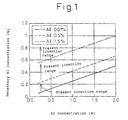
- Cu which, like Ni, is more resistant to oxidation than Fe, is an austenite-stabilizing element like Ni and Mn that also improves the strength and plating adhesion. Satisfactory plating adhesion can be achieved if the Ni and Cu concentration in 0.5 ⁇ m of the steel sheet surface layer, together with Si and Al, is such that "Ni + Cu(%) ⁇ 1/4 Si + 1/3 Al(%)". A Cu concentration of 2.0% or higher may produce Cu precipitates, thus impairing the material quality and impeding the object of the invention. From the standpoint of preventing heat fracture by Cu when Cu is added, the relationship is preferably "Cu(%) ⁇ 3 x Ni(%)".
- the ductility of the steel sheet of the invention as a final product is determined by the volume percentage of retained austenite in the product.
- the retained austenite in the microstructure is stably present in the absence of deformation, applied deformation transforms it into martensite resulting in transform-induced plasticity, thus giving satisfactory formability with high strength. If the volume percentage of retained austenite is less than 2% the effect will not be clearly recognizable. On the other hand, if the volume percentage of retained austenite is over 20%, a large amount of martensite may be present in the press forming state in cases of extremely severe shaping, which may cause problems in terms of secondary workability or impact resistance; according to the invention, therefore, the volume percentage of retained austenite is no greater than 20%.
- the structure also includes ferrite, bainite, martensite and carbides.
- Mn, Pb, Fe, Sb, Ni, Cu, Sn, Co, Cd and Cr are present in high amounts the edge corrosion resistance is impaired, and these are therefore limited to Mn: ⁇ 0.02%, Pb: ⁇ 0.01%, Fe: ⁇ 0.2%, Sb: ⁇ 0.01%, Ni: ⁇ 3.0%, Cu: ⁇ 1.5%, Sn: ⁇ 0.1%, Co: ⁇ 0.1%, Cd: ⁇ 0.01% and Cr: ⁇ 0.05%.
- the Al content of the plating is limited to no greater than 1% because when the Al content exceeds 1% the segregated Al will form a local battery in the plating, thus impairing the corrosion resistance. If Mn, Pb, Sb, Ni, Cu, Sn, Co, Cd and Cr are present in high amounts the edge corrosion resistance is impaired, and these are therefore limited to Mn: ⁇ 0.02%, Pb: ⁇ 0.01%, Sb: ⁇ 0.01%, Ni: ⁇ 3.0%, Cu: ⁇ 1.5%, Sn: ⁇ 0.1%, Co: ⁇ 0.1%, Cd: ⁇ 0.01% and Cr: ⁇ 0.05%.
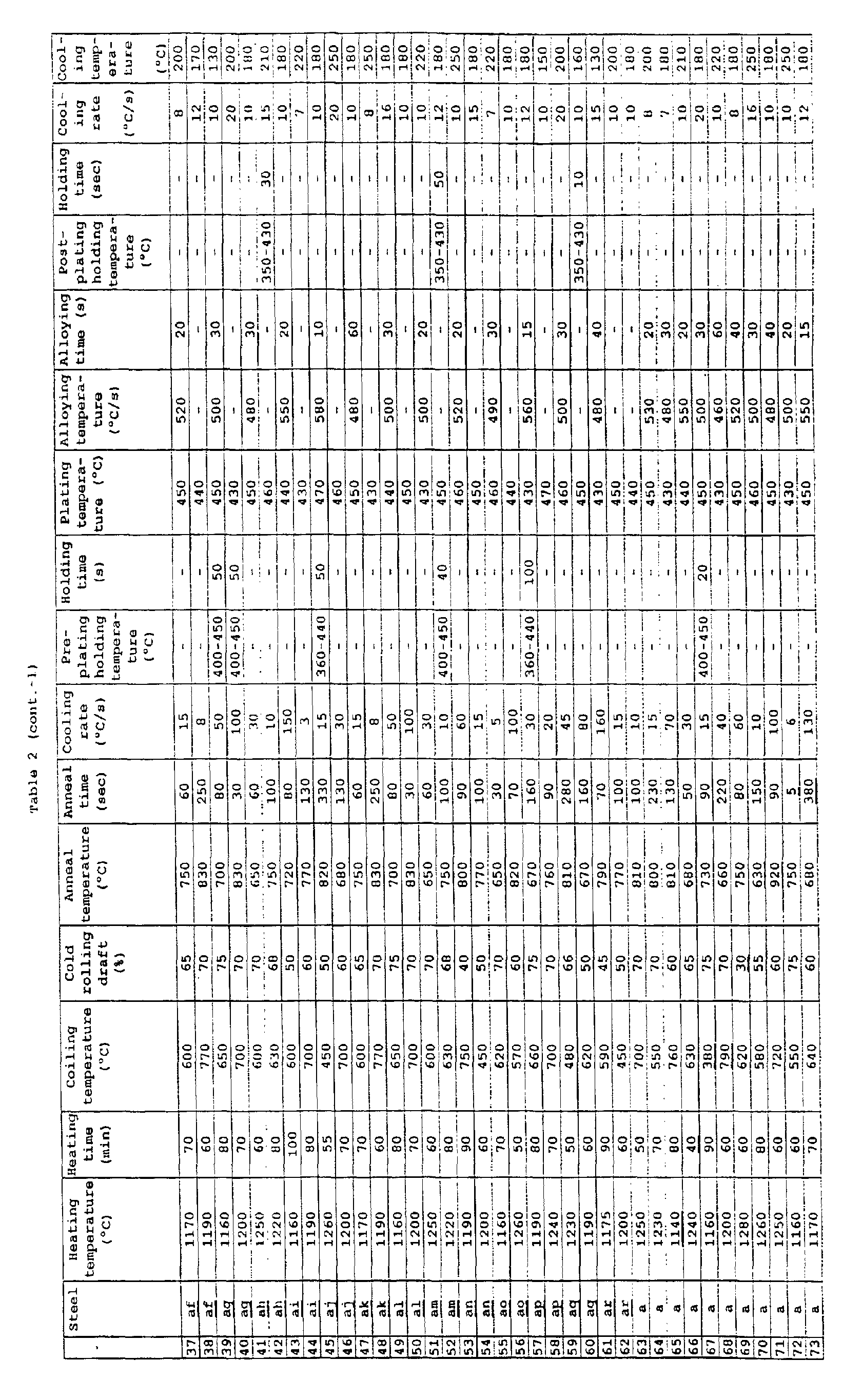
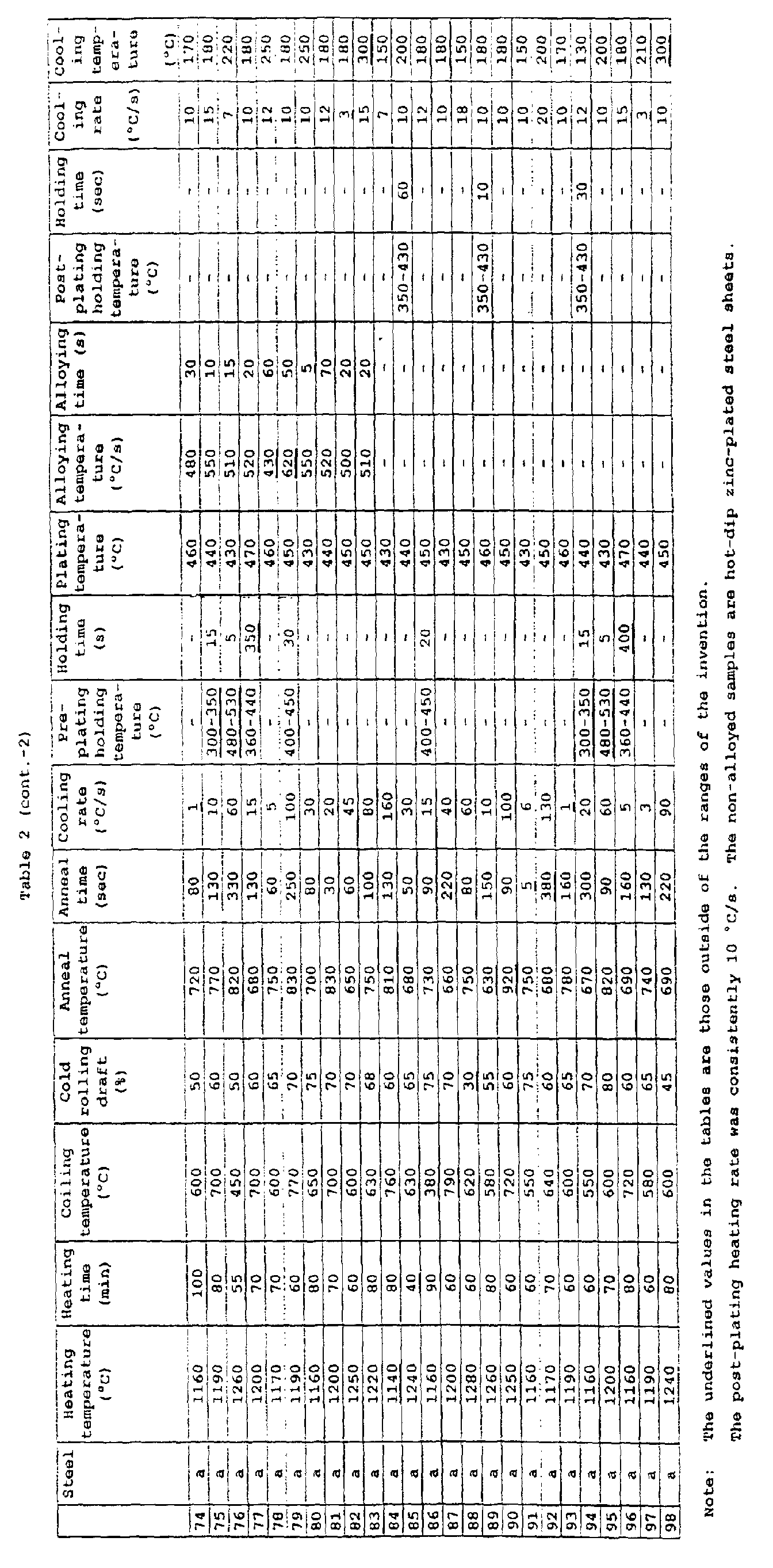
- a hot-dip galvannealed steel sheet of the invention may be obtained by casting and solidifying a steel sheet satisfying the conditions for the component composition as explained above and then heating it at 1150°C or higher for at least 45 minutes, subjecting it to hot rolling and coiling at 400-780°C, and then after descaling treatment, subjecting it to cold rolling at a reduction ratio of 35-85%, subsequently annealing from 10 seconds to 6 minutes in the two-phase temperature range of 650-900°C, cooling it to 350-500°C at a cooling rate of 2-200 °C/s, further holding it for up to 5 minutes in that temperature range depending on the case, and finally subjecting it to hot-dip galvanizing and further holding it from 5 seconds to 1 minute in a temperature range of 450-600°C prior to cooling to below 250°C at a cooling rate of at least 5 °C/s.
- the coiling temperature is preferably 550-750°C.
- the cold rolling reduction ratio is less than 35% the structure will not be sufficiently fine and the ductility will therefore be inferior due to insufficient retained austenite in the subsequent annealing step.
- the reduction ratio is greater than 85% there will be too great a load on the rolling machine, and therefore the optimum reduction ratio during cold rolling was determined to be 35-85%.
- heating is first performed in a temperature range from the Ac1 transformation point to the Ac3 transformation point to make a two-phase microstructure [ferrite + austenite]. If the heating temperature at this time is below 650°C, too much time will be required for renewed dissolution of the cementite and only a small amount of austenite will be present, and therefore the lower limit for the heating temperature is 650°C. If the heating temperature is too high the volume percentage of austenite becomes too large and the C concentration of the austenite is reduced, and therefore the upper limit for the heat temperature is 900°C. If the holding time is too short there will tend to be more non-dissolved carbides present, and the amount of austenite will be reduced. If the holding time is lengthened the crystal grains will have a greater tendency to become coarse, resulting in a poorer strength/ductility balance. According to the invention, therefore, the holding time is set to be from 10 seconds to 6 minutes.
- the plating is followed by cooling to below 250°C at a cooling rate of 5 °C/s or greater.
- the austenite with concentrated C after cooling will also precipitate carbide and decompose to bainite, such that the desired object cannot be achieved due to a reduced amount of retained austenite for improvement of the workability by transformation induced plasticity.
- a holding time of less than 5 minutes in a temperature range of 350-400°C after hot-dip zinc plating is preferred.
- the hot-dip galvanizing is followed by holding from 5 seconds to 1 minute in a temperature range of 450-600°C, and then by cooling to below 250°C at a cooling rate of at least 5 °C/s. This is for the alloying reaction between Fe and Zn, and also for structural considerations.
- the heating temperature is below 450°C the alloying reaction rate of the plating is slowed, so that the Fe concentration of the plating is lower.
- the bainite production is insufficient and the C concentration in the non-transformed austenite is also insufficient, such that martensite is produced during cooling thus impairing the formability, while the alloying reaction of the plating is also inadequate.
- the holding time is longer than one minute, the plating becomes overalloyed, thus tending to result in peeling of the plating during shaping.
- the heating temperatures and cooling temperatures for each step described above do not need to be constant so long as they are within the specified ranges, and with variation within those ranges there is no deterioration, and there is often improvement, in the properties of the final product.
- the welding test was carried out by spot welding under the conditions, welding current: 10 kA, applied pressure: 220 kg, welding time: 12 cycles, electrode diameter: 6 mm, electrode shape: domed, tip 6 ⁇ -40R, and the number of continuous spots until the point at which the nugget diameter fell below 4 t (t: sheet thickness) was evaluated.
- the evaluation scale was the following. ⁇ : >1000 continuous spots, ⁇ : 500-1000 continuous spots, ⁇ : ⁇ 500 continuous spots.
- ⁇ was defined as acceptable and ⁇ / ⁇ as unacceptable.
- the "0.5 ⁇ m steel sheet surface layer section analysis" was based on two types, measurement by EPMA analysis of a 0.5 ⁇ m steel sheet section at the plating/sheet interface of a cross-section of the plated steel sheet, and EDS analysis by TEM observation of a sample prepared by the FIB method. For the measurement, a standard sample was used to construct a calibration curve. There was practically no difference between the measurements.
Landscapes
- Chemical & Material Sciences (AREA)
- Engineering & Computer Science (AREA)
- Materials Engineering (AREA)
- Mechanical Engineering (AREA)
- Metallurgy (AREA)
- Organic Chemistry (AREA)
- Chemical Kinetics & Catalysis (AREA)
- Physics & Mathematics (AREA)
- Thermal Sciences (AREA)
- Crystallography & Structural Chemistry (AREA)
- Heat Treatment Of Sheet Steel (AREA)
- Coating With Molten Metal (AREA)
- Electroplating Methods And Accessories (AREA)
Abstract
Description
Tape test blackening (%)
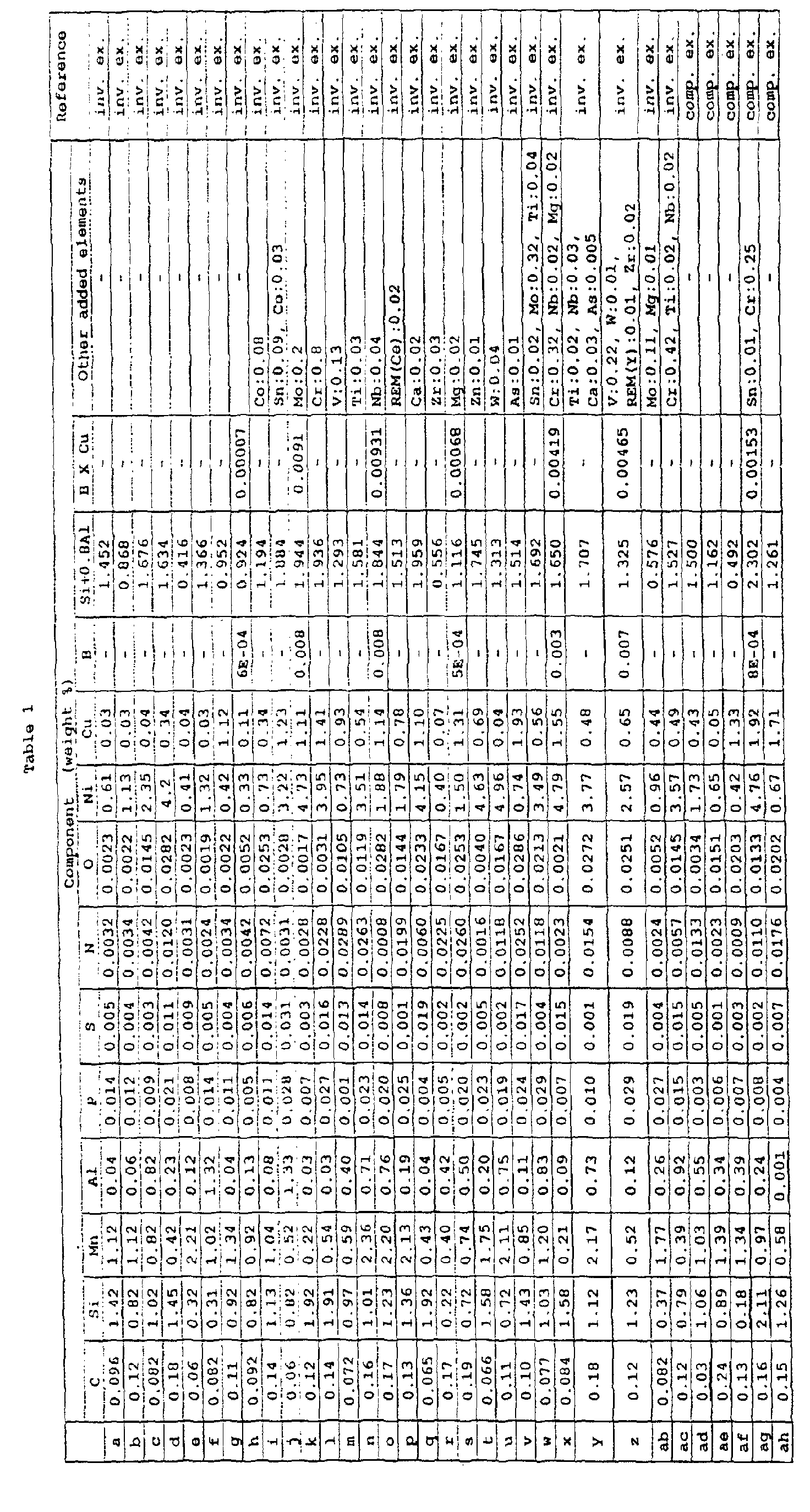


| Surface layer Ni (%) | Surface layer Cu (%) | Surface layer Co (%) | Surface layer Sn (%) | Ni+Cu+ (Co+Sn) (%) | Surface layer si (%) | Surface layer Al (%) | 1/ | TS (MPa) | E1 (%) | Residual γ (%) | | |
| 1 | 1.337 | 0.014 | - | - | 1.351 | 2.329 | 0.425 | 0.724 | 625 | 36 | 5.5 | inv. ex. |
| 2 | 1.242 | 0.015 | - | - | 1.257 | 2.484 | 0.628 | 0.830 | 611 | 38 | 6.3 | inv. ex. |
| 3 | 1.019 | 0.014 | - | - | 1.033 | 2.227 | 0.506 | 0.725 | 609 | 38 | 6.5 | inv. ex. |
| 4 | 1.113 | 0.016 | - | - | 1.129 | 2.638 | 0.694 | 0.891 | 631 | 36 | 5.4 | inv. ex. |
| 5 | 1.225 | 0.014 | - | - | 1.239 | 2.844 | 0.535 | 0.839 | 624 | 37 | 6.3 | inv. ex. |
| 6 | 1.837 | 0.042 | - | - | 1.879 | 2.076 | 0.144 | 0.567 | 645 | 35 | 4.9 | inv. ex. |
| 7 | 3.340 | 0.056 | - | - | 3.396 | 2.620 | 2.219 | 1.395 | 589 | 38 | 6.5 | inv. ex. |
| 8 | 5.321 | 0.489 | - | - | 5.810 | 3.937 | 0.571 | 1.175 | 716 | 34 | 18.5 | inv. ex. |
| 9 | 0.620 | 0.061 | - | - | 0.681 | 0.740 | 0.273 | 0.276 | 612 | 37 | 2.8 | inv. ex. |
| 10 | 1.866 | 0.044 | - | - | 1.910 | 0.852 | 3.442 | 1.361 | 563 | 39 | 4.5 | inv. ex. |
| 11 | 0.676 | 1.532 | - | - | 2.208 | 2.386 | 0.091 | 0.627 | 613 | 37 | 6.3 | inv. ex. |
| 12 | 0.445 | 0.324 | - | - | 0.770 | 2.012 | 0.347 | 0.618 | 590 | 38 | 5.5 | inv. ex. |
| 13 | 1.106 | 0.472 | - | 0.001 | 1.579 | 2.632 | 0.184 | 0.719 | 689 | 35 | 10.5 | inv. ex. |
| 14 | 4.925 | 1.329 | 0.098 | 0.123 | 6.475 | 1.947 | 3.156 | 1.539 | 616 | 36 | 3.2 | inv. ex. |
| 15 | 7.223 | 1.574 | - | - | 8.798 | 4.694 | 0.072 | 1.197 | 705 | 36 | 7.5 | inv. ex. |
| 16 | 6.406 | 2.203 | - | - | 8.609 | 4.947 | 0.079 | 1.263 | 756 | 33 | 10.3 | inv. ex. |
| 17 | 1.059 | 1.312 | - | - | 2.382 | 2.391 | 0.999 | 0.931 | 603 | 36 | 4.3 | inv. ex. |
| 18 | 4.956 | 0.809 | - | - | 5.764 | 2.428 | 1.807 | 1.209 | 805 | 35 | 13.5 | inv. ex. |
| 19 | 2.790 | 1.843 | - | - | 4.633 | 2.887 | 1.722 | 1.296 | 830 | 32 | 15.5 | inv. ex. |
| 20 | 1.985 | 1.095 | - | - | 3.080 | 3.222 | 0.422 | 0.945 | 680 | 35 | 8.3 | inv. ex. |
| 21 | 5.718 | 1.641 | - | - | 7.359 | 4.495 | 0.111 | 1.161 | 615 | 38 | 3.5 | inv. ex. |
| 22 | 0.543 | 0.105 | - | - | 0.647 | 0.546 | 1.097 | 0.502 | 604 | 36 | 14.5 | inv. ex. |
| 23 | 2.312 | 1.982 | - | - | 4.294 | 1.825 | 1.163 | 0.844 | 720 | 34 | 18.9 | inv. ex. |
| 24 | 7.288 | 1.039 | - | - | 8.328 | 4.349 | 0.499 | 1.254 | 630 | 38 | 4.5 | inv. ex. |
| 25 | 7.230 | 0.049 | - | - | 7.279 | 1.873 | 1.799 | 1.068 | 635 | 39 | 8.5 | inv. ex. |
| 26 | 1.087 | 2.823 | - | - | 3.911 | 3.701 | 0.263 | 1.013 | 640 | 36 | 6.3 | inv. ex. |
| 27 | 5.310 | 0.858 | - | 0.025 | 6.193 | 2.309 | 2.242 | 1.325 | 720 | 33 | 3.8 | inv. ex. |
| 28 | 7.311 | 2.390 | - | - | 9.701 | 4.247 | 0.210 | 1.132 | 710 | 33 | 4.5 | inv. ex. |
| 29 | 6.042 | 0.776 | - | - | 6.818 | 2.843 | 2.002 | 1.378 | 830 | 32 | 17.5 | inv. ex. |
| 30 | 3.483 | 0.927 | - | - | 4.410 | 2.979 | 0.291 | 0.842 | 620 | 36 | 8.3 | inv. ex. |
| 31 | 1.519 | 0.668 | - | - | 2.187 | 0.903 | 0.668 | 0.449 | 590 | 40 | 5.2 | inv. ex. |
| 32 | 5.172 | 0.798 | - | - | 5.970 | 2.043 | 2.201 | 1.244 | 624 | 37 | 7.5 | inv. ex. |
| 33 | 2.468 | 0.486 | - | - | 2.954 | 2.400 | 1.240 | 1.014 | 498 | 34 | 1.5 | comp.ex. |
| 34 | 2.625 | 0.596 | - | - | 3.221 | 2.389 | 1.327 | 1.040 | 504 | 35 | 1.3 | comp.ex. |
| 35 | 1.020 | 0.070 | - | - | 1.090 | 2.225 | 0.792 | 0.820 | 892 | 33 | 22.5 | comp.ex. |
| 36 | 0.925 | 0.069 | - | - | 0.994 | 2.325 | 0.932 | 0.892 | 904 | 31 | 23 | comp.ex. |
| 37 | 0.583 | 2.063 | - | - | 2.645 | 0.435 | 0.910 | 0.412 | 612 | 30 | 1.5 | comp.ex. |
| 38 | 0.625 | 2.156 | - | - | 2.781 | 0.416 | 0.892 | 0.401 | 604 | 29 | 1.8 | comp.ex. |
| 39 | 5.569 | 2.648 | 0.000 | 0.017 | 8.234 | 5.059 | 0.428 | 1.407 | 710 | 35 | 13.3 | comp.ex. |
| 40 | 6.534 | 3.142 | 0.003 | 0.010 | 9.689 | 5.539 | 0.546 | 1.567 | 720 | 36 | 14.2 | comp.ex. |
| 41 | 0.990 | 2.809 | - | - | 3.800 | 3.338 | 0.002 | 0.835 | 612 | 30 | 1.5 | comp.ex. |
| 42 | 0.980 | 2.715 | - | - | 3.695 | 3.459 | 0.004 | 0.866 | 605 | 32 | 1.8 | comp.ex. |
| 43 | 5.727 | 1.053 | - | - | 6.780 | 1.551 | 4.125 | 1.763 | 605 | 36 | 4.3 | comp.ex. |
| 44 | 6.146 | 1.214 | - | - | 7.360 | 1.429 | 3.958 | 1.677 | 600 | 37 | 4.5 | comp.ex. |
| 45 | 1.017 | 3.065 | - | - | 4.082 | 0.586 | 0.287 | 0.242 | 580 | 36 | 1.4 | comp.ex. |
| 46 | 0.814 | 2.562 | - | - | 3.376 | 0.954 | 0.359 | 0.358 | 590 | 34 | 1.3 | comp.ex. |
| 47 | 7.510 | 1.010 | - | - | 8.519 | 4.895 | 1.837 | 1.836 | 710 | 34 | 6.8 | comp.ex. |
| 48 | 8.015 | 1.136 | - | - | 9.151 | 4.526 | 1.624 | 1.673 | 705 | 33 | 7.5 | comp.ex. |
| 49 | 2.959 | 0.134 | - | - | 3.102 | 5.039 | 0.554 | 1.445 | 590 | 34 | 1.3 | comp.ex. |
| 50 | 3.015 | 0.193 | - | - | 3.208 | 4.689 | 0.456 | 1.324 | 585 | 33 | 1.8 | comp.ex. |
| 51 | 0.820 | 1.363 | - | - | 2.183 | 1.717 | 1.403 | 0.897 | 730 | 33 | 9.5 | comp.ex. |
| 52 | 0.725 | 1.236 | - | - | 1.961 | 2.016 | 1.826 | 1.113 | 725 | 34 | 10.3 | comp.ex. |
| 53 | 1.289 | 0.069 | - | - | 1.358 | 2.601 | 0.358 | 0.770 | 630 | 35 | 6.3 | comp.ex. |
| 54 | 1.302 | 0.102 | - | - | 1.404 | 2.506 | 0.334 | 0.738 | 635 | 34 | 5.3 | comp.ex. |
| 55 | 1.113 | 1.676 | - | - | 2.789 | 1.891 | 0.550 | 0.656 | 640 | 34 | 8.2 | comp.ex. |
| 56 | 1.325 | 1.893 | - | - | 3.218 | 1.793 | 0.490 | 0.612 | 630 | 35 | 7.9 | comp.ex. |
| 57 | 0.261 | 0.027 | - | - | 0.288 | 4.415 | 0.104 | 1.138 | 590 | 37 | 4.3 | comp.ex. |
| 58 | 0.325 | 0.035 | - | - | 0.360 | 4.036 | 0.089 | 1.039 | 500 | 36 | 3.8 | comp.ex. |
| 59 | 7.325 | 0.061 | - | - | 7.386 | 0.590 | 1.755 | 0.732 | 780 | 18 | 21.5 | comp.ex. |
| 60 | 6.801 | 0.063 | - | - | 6.864 | 0.756 | 2.026 | 0.864 | 790 | 15 | 23.5 | comp.ex. |
| 61 | 1.116 | 3.253 | - | - | 4.369 | 3.312 | 0.187 | 0.890 | 620 | 26 | 3.8 | comp.ex.* |
| 62 | 1.236 | 3.456 | - | - | 4.692 | 3.016 | 0.159 | 0.807 | 625 | 27 | 2.7 | comp.ex.* |
| 63 | 1.337 | 0.014 | - | - | 1.351 | 2.329 | 0.425 | 0.724 | 525 | 36 | 5.5 | comp.ex. |
| 64 | 1.113 | 0.016 | - | - | 1.129 | 2.638 | 0.694 | 0.891 | 631 | 36 | 5.4 | comp.ex. |
| 65 | 0.826 | 0.003 | - | - | 0.829 | 3.345 | 0.863 | 1.124 | 640 | 35 | 5.5 | comp.ex. |
| 66 | 0.816 | 0.004 | - | - | 0.820 | 3.015 | 0.726 | 0.996 | 620 | 35 | 6.3 | comp.ex. |
| 67 | 0.861 | 0.012 | - | - | 0.873 | 3.012 | 0.786 | 1.015 | 630 | 34 | 5.3 | comp.ex. |
| 68 | 1.325 | 0.045 | - | - | 1.370 | 2.756 | 0.426 | 0.831 | 625 | 34 | 3.5 | comp.ex.** |
| 69 | 1.426 | 0.068 | - | - | 1.494 | 2.726 | 0.531 | 0.859 | 610 | 29 | 0.6 | comp.ex. |
| 70 | 1.324 | 0.016 | - | - | 1.340 | 2.627 | 0.426 | 0.799 | 650 | 26 | 1.8 | comp.ex. |
| 71 | 1.236 | 0.013 | - | - | 1.249 | 3.456 | 0.597 | 1.063 | 580 | 30 | 1.5 | comp.ex. |
| 72 | 1.013 | 0.009 | - | - | 1.022 | 3.015 | 0.624 | 0.962 | 630 | 29 | 1.2 | comp.ex. |
| 73 | 1.106 | 0.012 | - | - | 1.118 | 2.984 | 0.601 | 0.946 | 635 | 28 | 1 | comp.ex. |
| 74 | 1.068 | 0.010 | - | - | 1.078 | 3.126 | 0.726 | 1.024 | 640 | 26 | 0 | comp.ex. |
| 75 | 1.215 | 0.015 | - | - | 1.230 | 2.957 | 0.543 | 0.920 | 645 | 27 | 1.2 | comp.ex. |
| 76 | 1.456 | 0.025 | - | - | 1.481 | 2.745 | 0.459 | 0.839 | 630 | 25 | 0 | comp.ex. |
| 77 | 1.235 | 0.014 | - | - | 1.249 | 2.924 | 0.585 | 0.926 | 635 | 26 | 0.5 | comp.ex. |
| 78 | 1.126 | 0.010 | - | - | 1.136 | 2.957 | 0.624 | 0.947 | 630 | 36 | 5.3 | comp.ex. |
| 79 | 1.198 | 0.011 | - | - | 1.209 | 2.843 | 0.546 | 0.893 | 625 | 25 | 0.3 | comp.ex. |
| 80 | 1.016 | 0.006 | - | - | 1.022 | 3.146 | 0.657 | 1.006 | 630 | 30 | 1.6 | comp.ex. |
| 81 | 1.267 | 0.009 | - | - | 1.276 | 2.782 | 0.495 | 0.861 | 620 | 26 | 0.8 | comp.ex. |
| 82 | 1.395 | 0.023 | - | - | 1.418 | 2.568 | 0.406 | 0.777 | 620 | 26 | 0.5 | comp.ex. |
| 83 | 1.304 | 0.019 | - | - | 1.323 | 2.654 | 0.416 | 0.802 | 630 | 28 | 1.1 | comp.ex. |
| 84 | 0.804 | 0.008 | - | - | 0.812 | 3.159 | 0.789 | 1.053 | 645 | 34 | 5.3 | comp.ex. |
| 85 | 0.812 | 0.009 | - | - | - 0.821 | 3.015 | 0.756 | 1.006 | 622 | 35 | 6.5 | comp.ex. |
| 86 | 0.834 | 0.011 | - | - | 0.845 | 3.214 | 0.658 | 1.023 | 635 | 33 | 5.5 | comp.ex. |
| 87 | 1.325 | 0.015 | - | - | 1.340 | 2.795 | 0.498 | 0.865 | 620 | 33 | 3.3 | comp.ex.** |
| 88 | 1.426 | 0.016 | - | - | 1.442 | 2.846 | 0.501 | 0.879 | 615 | 28 | 0.7 | comp.ex. |
| 89 | 1.325 | 0.015 | - | - | 1.340 | 2.783 | 0.504 | 0.864 | 645 | 26 | 1.3 | comp.ex. |
| 90 | 1.359 | 0.017 | - | - | 1.376 | 3.214 | 0.785 | 1.065 | 575 | 28 | 1.6 | comp.ex. |
| 91 | 1.015 | 0.010 | - | - | 1.025 | 3.012 | 0.688 | 0.982 | 625 | 27 | 1.1 | comp.ex. |
| 92 | 1.105 | 0.010 | - | - | 1.115 | 2.986 | 0.657 | 0.966 | 640 | 26 | 0.8 | comp.ex. |
| 93 | 1.168 | 0.008 | - | - | 1.176 | 2.904 | 0.604 | 0.927 | 635 | 25 | 0 | comp.ex. |
| 94 | 1.015 | 0.009 | - | - | 1.024 | 2.954 | 0.715 | 0.977 | 640 | 26 | 1.1 | comp.ex. |
| 95 | 1.235 | 0.015 | - | - | 1.250 | 2.716 | 0.546 | 0.861 | 635 | 26 | 0 | comp.ex. |
| 96 | 1.015 | 0.010 | - | - | 1.025 | 2.957 | 0.750 | 0.989 | 630 | 25 | 0.5 | comp.ex |
| 97 | 1.126 | 0.011 | - | - | 1.137 | 3.015 | 0.657 | 0.973 | 625 | 24 | 0.7 | comp.ex. |
| 98 | 1.348 | 0.013 | - | - | 1.361 | 2.647 | 0.459 | 0.815 | 635 | 27 | 0.9 | comp.ex. |
| Note: The underlined values in the tables are those outside of the ranges of the invention. The "comp. ex.*" references indicate samples with poor strength/ductility balance that did not achieve the object of the invention. The "comp. ex.**" references indicate samples that had residual oxides due to insufficient acid washing after rolling, and thus had impaired plating adhesion. The samples with Sn and Co indicated by "-" are those where the steel contained no Sn or Co, and those elements were therefore not measured. |
| Components in plating layer (%) (remainder: Zn and unavoidable impurities) | Weldability | Plating property | Plating adhesion | Reference | |||||||||||
| Fe | Al | Mn | Pb | Sb | Ni | Cu | Co | | Cd | Cr | |||||
| 1 | 0.08 | 0.24 | 0.004 | 0.002 | 0.006 | 0.168 | 0.001 | 0.002 | 0.010 | 0.004 | 0.034 | ○ | o ○ | o ○ | inv. ex. |
| 2 | 0.06 | 0.64 | 0.009 | 0.003 | 0.006 | 0.340 | 0.003 | 0.002 | 0.000 | 0.003 | 0.025 | ○ | o ○ | o ○ | inv. ex. |
| 3 | 0.11 | 0.19 | 0.003 | 0.002 | 0.007 | 0.223 | 0.004 | 0.004 | 0.002 | 0.005 | 0.011 | ○ | o ○ | o ○ | inv. ex. |
| 4 | 11.5 | 0.24 | 0.013 | 0.006 | 0.000 | 0.272 | 0.004 | 0.002 | 0.009 | 0.002 | 0.034 | ○ | o ○ | o ○ | inv. ex. |
| 5 | 10.8 | 0.26 | 0.007 | 0.008 | 0.003 | 0.222 | 0.005 | 0.011 | 0.008 | 0.003 | 0.039 | ○ | o ○ | o ○ | inv. ex. |
| 6 | 9.6 | 0.26 | 0.006 | 0.004 | 0.002 | 0.133 | 0.009 | 0.012 | 0.005 | 0.000 | 0.007 | ○ | o ○ | o ○ | inv. ex. |
| 7 | 0.07 | 0.33 | 0.008 | 0.000 | 0.003 | 0.114 | 0.003 | 0.003 | 0.002 | 0.008 | 0.026 | ○ | o ○ | o ○ | inv. ex. |
| 8 | 8.6 | 0.28 | 0.015 | 0.006 | 0.007 | 2.017 | 0.175 | 0.003 | 0.009 | 0.003 | 0.013 | ○ | o ○ | o ○ | inv. ex. |
| 9 | 9.2 | 0.27 | 0.005 | 0.002 | 0.003 | 0.191 | 0.001 | 0.003 | 0.001 | 0.000 | 0.029 | ○ | o ○ | o ○ | inv. ex. |
| 10 | 0.03 | 0.21 | 0.006 | 0.000 | 0.007 | 0.236 | 0.017 | 0.002 | 0.000 | 0.002 | 0.013 | ○ | o ○ | o ○ | inv. ex. |
| 11 | 0.05 | 0.22 | 0.001 | 0.003 | 0.005 | 0.045 | 0.045 | 0.011 | 0.007 | 0.001 | 0.017 | ○ | o ○ | o ○ | inv. ex. |
| 12 | 10.2 | 0.21 | 0.009 | 0.001 | 0.006 | 0.169 | 0.059 | 0.008 | 0.004 | 0.007 | 0.023 | ○ | o ○ | o ○ | inv. ex. |
| 13 | 0.06 | 0.30 | 0.005 | 0.003 | 0.001 | 0.203 | 0.138 | 0.006 | 0.008 | 0.005 | 0.015 | ○ | o ○ | o ○ | inv. ex. |
| 14 | 9.6 | 0.32 | 0.005 | 0.002 | 0.006 | 1.569 | 0.637 | 0.013 | 0.035 | 0.007 | 0.036 | ○ | o ○ | o ○ | inv. ex. |
| 15 | 10.2 | 0.30 | 0.003 | 0.006 | 0.002 | 2.273 | 0.659 | 0.008 | 0.005 | 0.004 | 0.018 | ○ | o ○ | o ○ | inv. ex. |
| 16 | 0.05 | 0.26 | 0.001 | 0.004 | 0.003 | 1.912 | 0.878 | 0.003 | 0.010 | 0.008 | 0.037 | ○ | o ○ | o ○ | inv. ex. |
| 17 | 10.1 | 0.34 | 0.007 | 0.008 | 0.003 | 0.307 | 0.488 | 0.011 | 0.002 | 0.008 | 0.031 | ○ | o ○ | o ○ | inv. ex. |
| 18 | 0.09 | 0.26 | 0.011 | 0.007 | 0.007 | 0.064 | 0.254 | 0.001 | 0.002 | 0.001 | 0.001 | ○ | o ○ | o ○ | inv. ex. |
| 19 | 11.5 | 0.28 | 0.006 | 0.004 | 0.004 | 0.311 | 0.350 | 0.005 | 0.011 | 0.004 | 0.020 | ○ | o ○ | o ○ | inv. ex. |
| 20 | 0.16 | 0.73 | 0.007 | 0.006 | 0.008 | 0.607 | 0.193 | 0.001 | 0.003 | 0.005 | 0.026 | ○ | o ○ | o ○ | inv. ex. |
| 21 | 8.6 | 0.19 | 0.016 | 0.004 | 0.005 | 0.512 | 0.260 | 0.007 | 0.006 | 0.005 | 0.020 | ○ | o ○ | o ○ | inv. ex. |
| 22 | 11.3 | 0.30 | 0.005 | 0.006 | 0.002 | 0.159 | 0.008 | 0.012 | 0.004 | 0.005 | 0.002 | ○ | ○ | ○ | inv. ex. |
| 23 | 10.5 | 0.24 | 0.017 | 0.006 | 0.003 | 0.820 | 0.826 | 0.006 | 0.010 | 0.004 | 0.000 | ○ | o ○ | o ○ | inv. ex. |
| 24 | 0.03 | 0.21 | 0.006 | 0.006 | 0.006 | 0.378 | 0.035 | 0.007 | 0.003 | 0.007 | 0.021 | ○ | o ○ | o ○ | inv. ex. |
| 25 | 0.05 | 0.23 | 0.007 | 0.004 | 0.004 | 2.835 | 0.009 | 0.005 | 0.001 | 0.006 | 0.008 | ○ | o ○ | o ○ | inv. ex. |
| 26 | 9.8 | 0.26 | 0.011 | 0.007 | 0.002 | 0.314 | 0.907 | 0.006 | 0.010 | 0.007 | 0.033 | ○ | o ○ | o ○ | inv. ex. |
| 27 | 0.11 | 0.30 | 0.008 | 0.006 | 0.001 | 2.070 | 0.208 | 0.005 | 0.015 | 0.004 | 0.025 | ○ | o ○ | o ○ | inv. ex. |
| 28 | 10.2 | 0.29 | 0.001 | 0.001 | 0.004 | 1.924 | 0.266 | 0.009 | 0.010 | 0.003 | 0.022 | ○ | o ○ | o ○ | inv. ex. |
| 29 | 8.6 | 0.27 | 0.009 | 0.004 | 0.006 | 0.963 | 0.167 | 0.011 | 0.006 | 0.006 | 0.037 | ○ | o ○ | o ○ | inv. ex. |
| 30 | 11.3 | 0.34 | 0.005 | 0.006 | 0.003 | 0.582 | 0.054 | 0.003 | 0.000 | 0.004 | 0.002 | ○ | o ○ | o ○ | inv. ex. |
| 31 | 0.04 | 0.20 | 0.011 | 0.000 | 0.002 | 0.412 | 0.107 | 0.011 | 0.003 | 0.001 | 0.015 | ○ | o ○ | o ○ | inv. ex. |
| 32 | 9.8 | 0.18 | 0.009 | 0.005 | 0.005 | 1.437 | 0.216 | 0.010 | 0.004 | 0.004 | 0.021 | ○ | o ○ | o ○ | inv. ex. |
| 33 | 8.6 | 0.31 | 0.001 | 0.003 | 0.004 | 0.143 | 0.044 | 0.011 | 0.010 | 0.001 | 0.035 | ○ | o ○ | o ○ | comp. ex. |
| 34 | 0.13 | 0.26 | 0.006 | 0.002 | 0.004 | 0.015 | 0.116 | 0.002 | 0.005 | 0.006 | 0.015 | ○ | o ○ | o ○ | comp. ex. |
| 35 | 10.8 | 0.19 | 0.007 | 0.000 | 0.008 | 0.179 | 0.003 | 0.003 | 0.001 | 0.002 | 0.034 | . | ○ | ○ | comp. ex. |
| 36 | 0.06 | 0.28 | 0.017 | 0.006 | 0.000 | 0.026 | 0.011 | 0.011 | 0.003 | 0.000 | 0.007 | . | ○ | ○ | comp. ex. |
| 37 | 12.3 | 0.27 | 0.007 | 0.000 | 0.007 | 0.154 | 0.376 | 0.000 | 0.004 | 0.008 | 0.012 | ○ | o ○ | o ○ | comp. ex. |
| 38 | 0.01 | 0.31 | 0.015 | 0.001 | 0.002 | 0.013 | 0.091 | 0.006 | 0.003 | 0.000 | 0.003 | ○ | o ○ | o ○ | comp. ex. |
| 39 | 10.5 | 0.34 | 0.009 | 0.007 | 0.004 | 0.692 | 0.738 | 0.007 | 0.012 | 0.001 | 0.007 | ○ | · | · | comp. ex. |
| 40 | 0.11 | 0.28 | 0.002 | 0.005 | 0.003 | 1.716 | 0.658 | 0.007 | 0.010 | 0.007 | 0.022 | ○ | · | · | comp. ex. |
| 41 | 8.6 | 0.28 | 0.006 | 0.004 | 0.007 | 0.242 | 0.382 | 0.006 | 0.011 | 0.000 | 0.039 | ○ | o ○ | o ○ | comp. ex. |
| 42 | 0.1 | 0.29 | 0.017 | 0.004 | 0.003 | 0.125 | 0.754 | 0.006 | 0.003 | 0.000 | 0.038 | ○ | o ○ | o ○ | comp. ex. |
| 43 | 11.3 | 0.35 | 0.011 | 0.007 | 0.008 | 1.013 | 0.197 | 0.004 | 0.009 | 0.004 | 0.011 | ○ | · | . | comp. ex. |
| 44 | 0.06 | 0.20 | 0.006 | 0.002 | 0.006 | 0.134 | 0.002 | 0.005 | 0.008 | 0.001 | 0.022 | ○ | · | · | comp. ex. |
| 45 | 13.3 | 0.24 | 0.011 | 0.005 | 0.007 | 0.008 | 0.718 | 0.012 | 0.012 | 0.008 | 0.029 | ○ | o ○ | o ○ | comp. ex. |
| 46 | 0.05 | 0.21 | 0.000 | 0.007 | 0.005 | 0.015 | 0.089 | 0.008 | 0.009 | 0.008 | 0.003 | ○ | o ○ | o ○ | comp. ex. |
| 47 | 8.9 | 0.84 | 0.009 | 0.003 | 0.008 | 1.118 | 0.237 | 0.003 | 0.005 | 0.001 | 0.033 | ○ | · | · | comp. ex. |
| 48 | 0.1 | 0.23 | 0.010 | 0.002 | 0.006 | 0.626 | 0.029 | 0.002 | 0.005 | 0.007 | 0.038 | ○ | · | · | comp. ex. |
| 49 | 11.3 | 0.20 | 0.001 | 0.006 | 0.007 | 0.428 | 0.034 | 0.004 | 0.007 | 0.001 | 0.022 | ○ | o ○ | o ○ | comp. ex. |
| 50 | 0.01 | 0.26 | 0.003 | 0.007 | 0.007 | 0.865 | 0.045 | 0.010 | 0.007 | 0.005 | 0.004 | ○ | o ○ | o ○ | comp. ex. |
| 51 | 10.5 | 0.20 | 0.007 | 0.004 | 0.003 | 0.151 | 0.055 | 0.007 | 0.006 | 0.002 | 0.012 | Δ | o ○ | o ○ | comp. ex. |
| 52 | 0.04 | 0.20 | 0.009 | 0.006 | 0.001 | 0.025 | 0.181 | 0.000 | 0.008 | 0.005 | 0.017 | Δ | o ○ | o ○ | comp. ex. |
| 53 | 12.2 | 0.30 | 0.018 | 0.008 | 0.001 | 0.168 | 0.016 | 0.005 | 0.002 | 0.002 | 0.011 | Δ | o ○ | o ○ | comp. ex. |
| 54 | 0.07 | 0.22 | 0.013 | 0.000 | 0.005 | 0.171 | 0.002 | 0.002 | 0.004 | 0.001 | 0.015 | Δ | o ○ | o ○ | comp. ex. |
| 55 | 10.8 | 0.26 | 0.013 | 0.006 | 0.002 | 0.283 | 0.452 | 0.009 | 0.005 | 0.002 | 0.004 | · | o ○ | o ○ | comp. ex. |
| 56 | 0.06 | 0.35 | 0.016 | 0.001 | 0.002 | 0.090 | 0.432 | 0.004 | 0.009 | 0.002 | 0.032 | · | o ○ | o ○ | comp. ex. |
| 57 | 13.5 | 0.23 | 0.012 | 0.004 | 0.005 | 0.047 | 0.002 | 0.011 | 0.007 | 0.005 | 0.037 | ○ | · | · | comp. ex. |
| 58 | 0.14 | 0.27 | 0.012 | 0.004 | 0.001 | 0.052 | 0.001 | 0.001 | 0.008 | 0.006 | 0.036 | ○ | · | · | comp. ex. |
| 59 | 10.3 | 0.27 | 0.001 | 0.004 | 0.001 | 0.237 | 0.015 | 0.009 | 0.009 | 0.005 | 0.039 | ○ | o ○ | o ○ | comp. ex. |
| 60 | 0.04 | 0.28 | 0.016 | 0.006 | 0.002 | 0.479 | 0.007 | 0.010 | 0.005 | 0.001 | 0.038 | ○ | o ○ | o ○ | comp. ex. |
| 61 | 10.5 | 0.27 | 0.015 | 0.004 | 0.006 | 0.239 | 0.595 | 0.009 | 0.001 | 0.003 | 0.011 | ○ | o ○ | o ○ | comp. ex.* |
| 62 | 0.12 | 0.30 | 0.002 | 0.001 | 0.004 | 0.297 | 0.385 | 0.011 | 0.002 | 0.005 | 0.021 | ○ | o ○ | o ○ | comp. ex.* |
| 63 | 0.08 | 1.35 | 0.004 | 0.002 | 0.006 | 0.168 | 0.001 | 0.002 | 0.010 | 0.004 | 0.034 | ○ | o ○ | o ○ | comp. ex. |
| 64 | 11.5 | 1.26 | 0.013 | 0.006 | 0.000 | 0.272 | 0.004 | 0.002 | 0.009 | 0.002 | 0.034 | ○ | o ○ | o ○ | comp. ex. |
| 65 | 9.2 | 0.32 | 0.009 | 0.005 | 0.001 | 0.013 | 0.000 | 0.005 | 0.008 | 0.003 | 0.003 | ○ | · | · | comp. ex. |
| 66 | 13.5 | 0.19 | 0.012 | 0.001 | 0.006 | 0.196 | 0.000 | 0.005 | 0.004 | 0.004 | 0.036 | ○ | · | · | comp. ex. |
| 67 | 10.5 | 0.30 | 0.000 | 0.006 | 0.006 | 0.065 | 0.001 | 0.002 | 0.000 | 0.005 | 0.008 | ○ | · | · | comp. ex. |
| 68 | 9.6 | 0.33 | 0.003 | 0.003 | 0.001 | 0.316 | 0.000 | 0.010 | 0.008 | 0.001 | 0.032 | ○ | Δ | Δ | comp. ex.** |
| 69 | 12.2 | 0.19 | 0.008 | 0.003 | 0.006 | 0.324 | 0.015 | 0.012 | 0.003 | 0.003 | 0.026 | ○ | o ○ | o ○ | comp. ex. |
| 70 | 10.5 | 0.20 | 0.003 | 0.004 | 0.005 | 0.261 | 0.001 | 0.009 | 0.004 | 0.003 | 0.029 | ○ | o ○ | o ○ | comp. ex. |
| 71 | 9.1 | 0.20 | 0.004 | 0.000 | 0.002 | 0.205 | 0.004 | 0.004 | 0.012 | 0.006 | 0.028 | ○ | ○ | ○ | comp. ex. |
| 72 | 10.1 | 0.26 | 0.018 | 0.004 | 0.007 | 0.282 | 0.001 | 0.009 | 0.006 | 0.002 | 0.031 | ○ | ○ | ○ | comp. ex. |
| 73 | 13.2 | 0.30 | 0.004 | 0.003 | 0.008 | 0.084 | 0.002 | 0.008 | 0.000 | 0.002 | 0.005 | ○ | o ○ | o ○ | comp. ex. |
| 74 | 8.34 | 0.93 | 0.015 | 0.005 | 0.006 | 0.077 | 0.001 | 0.011 | 0.002 | 0.003 | 0.005 | ○ | ○ | ○ | comp. ex. |
| 75 | 12.5 | 0.32 | 0.004 | 0.005 | 0.006 | 0.243 | 0.001 | 0.003 | 0.008 | 0.005 | 0.002 | ○ | o ○ | o ○ | comp. ex. |
| 76 | 10.3 | 0.18 | 0.012 | 0.006 | 0.004 | 0.355 | 0.002 | 0.004 | 0.011 | 0.001 | 0.009 | ○ | o ○ | o ○ | comp. ex. |
| 77 | 12.1 | 0.25 | 0.014 | 0.001 | 0.001 | 0.339 | 0.003 | 0.007 | 0.001 | 0.007 | 0.008 | ○ | o ○ | o ○ | comp. ex. |
| 78 | 5.3 | 0.33 | 0.005 | 0.006 | 0.007 | 0.197 | 0.000 | 0.012 | 0.011 | 0.007 | 0.000 | ○ | ○ | ○ | comp. ex. |
| 79 | 16.5 | 0.33 | 0.011 | 0.005 | 0.004 | 0.052 | 0.000 | 0.000 | 0.008 | 0.004 | 0.032 | ○ | o ○ | o ○ | comp. ex. |
| 80 | 5.1 | 0.24 | 0.008 | 0.004 | 0.007 | 0.183 | 0.000 | 0.007 | 0.009 | 0.002 | 0.013 | ○ | ○ | ○ | comp. ex. |
| 81 | 15.6 | 0.28 | 0.012 | 0.006 | 0.004 | 0.042 | 0.001 | 0.009 | 0.008 | 0.003 | 0.006 | ○ | o ○ | o ○ | comp. ex. |
| 82 | 9.8 | 0.30 | 0.008 | 0.007 | 0.003 | 0.165 | 0.005 | 0.003 | 0.008 | 0.005 | 0.029 | ○ | o ○ | o ○ | comp. ex. |
| 83 | 10.5 | 0.30 | 0.013 | 0.004 | 0.005 | 0.269 | 0.004 | 0.001 | 0.005 | 0.004 | 0.032 | ○ | o ○ | o ○ | comp. ex. |
| 84 | 0.04 | 0.34 | 0.015 | 0.000 | 0.008 | 0.106 | 0.001 | 0.000 | 0.003 | 0.008 | 0.000 | ○ | · | · | comp. ex. |
| 85 | 0.16 | 0.25 | 0.012 | 0.007 | 0.004 | 0.218 | 0.002 | 0.001 | 0.011 | 0.005 | 0.001 | ○ | · | · | comp. ex. |
| 86 | 0.04 | 0.20 | 0.004 | 0.006 | 0.006 | 0.052 | 0.002 | 0.004 | 0.005 | 0.006 | 0.028 | ○ | · | · | comp. ex. |
| 87 | 0.07 | 0.30 | 0.014 | 0.007 | 0.002 | 0.380 | 0.001 | 0.000 | 0.006 | 0.004 | 0.013 | ○ | Δ | Δ | comp. ex.** |
| 88 | 0.1 | 0.23 | 0.011 | 0.004 | 0.007 | 0.353 | 0.000 | 0.002 | 0.009 | 0.008 | 0.026 | ○ | o ○ | o ○ | comp. ex. |
| 89 | 0.13 | 0.29 | 0.009 | 0.008 | 0.006 | 0.394 | 0.001 | 0.006 | 0.007 | 0.004 | 0.016 | ○ | o ○ | o ○ | comp. ex. |
| 90 | 0.16 | 0.32 | 0.017 | 0.006 | 0.007 | 0.331 | 0.001 | 0.011 | 0.001 | 0.006 | 0.017 | ○ | o ○ | o ○ | comp. ex. |
| 91 | 0.16 | 0.64 | 0.014 | 0.007 | 0.002 | 0.300 | 0.001 | 0.009 | 0.008 | 0.000 | 0.019 | ○ | ○ | ○ | comp. ex. |
| 92 | 0.04 | 0.27 | 0.008 | 0.002 | 0.001 | 0.117 | 0.002 | 0.007 | 0.005 | 0.000 | 0.024 | ○ | o ○ | o ○ | comp. ex. |
| 93 | 0.16 | 0.22 | 0.08 | 0.003 | 0.007 | 0.242 | 0.002 | 0.011 | 0.004 | 0.007 | 0.002 | ○ | o ○ | o ○ | comp. ex. |
| 94 | 0.06 | 0.25 | 0.05 | 0.004 | 0.002 | 0.028 | 0.000 | 0.005 | 0.002 | 0.000 | 0.003 | ○ | ○ | ○ | comp. ex. |
| 95 | 0.13 | 0.22 | 0.015 | 0.004 | 0.001 | 0.264 | 0.003 | 0.012 | 0.007 | 0.001 | 0.005 | ○ | o ○ | o ○ | comp. ex. |
| 96 | 0.09 | 0.30 | 0.007 | 0.007 | 0.004 | 0.168 | 0.001 | 0.005 | 0.011 | 0.002 | 0.014 | ○ | ○ | ○ | comp. ex. |
| 97 | 0.11 | 0.31 | 0.010 | 0.001 | 0.003 | 0.307 | 0.003 | 0.011 | 0.007 | 0.008 | 0.001 | ○ | o ○ | o ○ | comp. ex. |
| 98 | 0.01 | 0.30 | 0.05 | 0.003 | 0.005 | 0.292 | 0.002 | 0.009 | 0.005 | 0.002 | 0.017 | ○ | o ○ | o ○ | comp. ex. |
| Note: The underlined values in the tables are those outside of the ranges of the invention. The "comp. ex.*" references indicate samples with poor strength/ductility balance that did not achieve the object of the invention. The "comp. ex.**" references indicate samples that had residual oxides due to insufficient acid washing after rolling, and thus had impaired plating adhesion. The samples with Sn and Co indicated by "-" are those where the steel contained no Sn or Co, and those elements were therefore not measured. |
Claims (15)
- A high strength hot-dip galvanized steel sheet with excellent plating adhesion and press formability, the steel sheet containing in terms of weight percent,where the relationship between Si and Al is such that 0.4(%) ≤ Si + 0.8 Al(%) ≤ 2.0% and the remainder consists of Fe and unavoidable impurities, characterized in that the volume percentage of the retained austenite in the steel sheet is 2-20% and the steel sheet surface wherein the relationship between the Ni and Si, Al in 0.5 µm of the steel sheet surface layer is such that Ni(%) ≥ 1/4 Si + 1/3 Al(%), has a Zn plating layer comprising Al: ≤1% with the remainder Zn and unavoidable impurities.C: 0.05-0.2%,Si: 0.2-2.0%,Mn: 0.2-2.5%,Al: 0.01-1.5%,Ni: 0.2-5.0%,P: <0.03% andS: <0.02%
- A high strength hot-dip galvanized steel sheet with excellent plating adhesion and press formability, characterized by also containing, in addition to the steel sheet components mentioned in claim 1 in terms of weight percent, Cu at less than 2.0%, wherein the volume percentage of the retained austenite in the steel sheet is 2-20%, and the relationship between the Ni, Cu and Si, Al in 0.5 µm of the steel sheet surface layer is such that Ni + Cu(%) ≥ 1/4 Si + 1/3 Al(%).
- A high strength hot-dip galvanized steel sheet with excellent plating adhesion and press formability, characterized by also containing, in addition to the steel sheet components mentioned in claim 2, in terms of weight percent, B at 0.0002-0.01%, wherein the relationship of Cu and B is such that B x Cu(%) ≥ 0.00005(%).
- A high strength hot-dip galvanized steel sheet with excellent plating adhesion and press formability, characterized by also containing, in addition to the steel sheet components mentioned in any of claims 1 to 3, in terms of weight percent, at least one from among Co at <0.3% and Sn at <0.3%, wherein the volume percentage of the retained austenite in the steel sheet is 2-20% and the relationship between the Ni, Cu, Co, Sn and Si, Al in 0.5 µm of the steel sheet surface layer is such that Ni + Cu + Co + Sn(%) ≥ 1/4 Si + 1/3 Al(%).
- A high strength hot-dip galvanized steel sheet with excellent plating adhesion and press formability, characterized by also containing in addition to the steel sheet components mentioned in any of claims 1 to 4, at least one from among Mo: <0.5%, Cr: <1%, V: <0.3%, Ti: <0.06%, Nb: <0.06%, REM: <0.05%, Ca: <0.05%, Zr: <0.05%, Mg: <0.05%, Zn: <0.02%, W: <0.05%, As: <0.02%, N: <0.03% and O: <0.05%.
- A high strength hot-dip galvanized steel sheet with excellent plating adhesion and press formability, characterized in that the steel sheet surface of any of claims 1 to 5 has a Zn plating layer containing at least one from among Al: ≤1%, Mn: <0.02%, Pb: <0.01%, Fe: <0.2%, Sb: <0.01%, Ni: <3.0%, Cu: <1.5%, Sn: <0.1%, Co: <0.1%, Cd: <0.01% and Cr:<0.05%, with the remainder Zn and unavoidable impurities.
- A high strength alloyed hot-dip galvanized steel sheet with excellent press formability, characterized in that a steel sheet containing in terms of weight percent,where the relationship between Si and Al is such that 0.4(%) ≤ Si + 0.8 Al(%) ≤ 2.0%, the remainder consists of Fe and unavoidable impurities, the volume percentage of said retained austenite in the steel sheet is 2-20% and the relationship between the Ni and Si, Al in 0.5 µm of the steel sheet surface layer is such that Ni(%) ≥ 1/4 Si + 1/3 Al(%), has a Zn alloy plating layer comprising Fe: 8-15%, Al: ≤1% with the remainder Zn and unavoidable impurities.C: 0.05-0.2%,Si: 0.2-2.0%,Mn: 0.2-2.5%,Al: 0.01-1.5%,Ni: 0.2-5.0%,P: <0.03% andS: <0.02%,
- A high strength hot-dip galvannealed steel sheet with excellent press formability, characterized in that a steel sheet also containing, in addition to the steel sheet components mentioned in claim 7, in terms of weight percent, Cu at less than 2.0% with the remainder Fe and unavoidable impurities, wherein the volume percentage of the retained austenite in said steel sheet is 2-20%, and the relationship between the Ni, Cu and Si, Al in 0.5 µm of the steel sheet surface layer is such that Ni + Cu(%) ≥ 1/4 Si + 1/3 Al(%), has a Zn alloy plating layer comprising Fe at 8-15% and Al at ≤1% with the remainder Zn and unavoidable impurities.
- A high strength hot-dip galvannealed steel sheet with excellent press formability, characterized in that a steel sheet also containing, in addition to the steel sheet components mentioned in claim 7, in terms of weight percent, B at 0.0002-0.01% where the relationship between Cu and B is such that B x Cu(%) ≥ 0.00005(%) with the remainder Fe and unavoidable impurities, has a Zn alloy plating layer comprising Fe at 8-15% and Al at ≤1% with the remainder Zn and unavoidable impurities.
- A high strength hot-dip galvannealed steel sheet with excellent press formability, characterized in that a steel sheet containing, in addition to the steel sheet components mentioned in any of claims 7 to 9, in terms of weight percent, at least one from among Co at <0.3% and Sn at ≤0.3% with the remainder Fe and unavoidable impurities, wherein the volume percentage of the retained austenite in said steel sheet is 2-20% and the relationship between the Ni, Cu, Co, Sn and Si, Al in 0.5 µm of the steel sheet surface layer is such that Ni + Cu + Co + Sn(%) ≥ 1/4 Si + 1/3 Al(%), has a Zn alloy plating layer comprising Fe at 8-15% and Al at ≤1% with the remainder Zn and unavoidable impurities.
- A high strength hot-dip galvannealed steel sheet with excellent press formability, characterized by also containing, in addition to the steel sheet components mentioned in any of claims 7 to 10, at least one from among Mo: <0.5%, Cr: <1%, V: <0.3%, Ti: <0.06%, Nb: <0.06%, REM: <0.05%, Ca: <0.05%, Zr: <0.05%, Mg: <0.05%, Zn: <0.02%, W: <0.05%, As: <0.02%, N: <0.03% and O: <0.05%.
- A high strength hot-dip galvannealed steel sheet with excellent plating adhesion and press formability, characterized in that the steel sheet surface of any of claims 7 to 11 has a Zn plating layer containing at least one from among Fe: 8-15%, Al: ≤1%, Mn: <0.02%, Pb: <0.01%, Sb: <0.01%, Ni: <3.0%, Cu: <1.5%, Sn: <0.1%, Co: <0.1%, Cd: <0.01% and Cr:<0.05%, with the remainder Zn and unavoidable impurities.
- A process for the manufacture of a high strength hot-dip galvanized steel sheet with excellent plating adhesion and press formability characterized by having 2-20% retained austenite and a Zn plating layer comprising Al at ≤1% with the remainder Zn and unavoidable impurities, whereby a steel sheet having the component composition of any one of claims 1 to 6 is cast and solidified and then heated at 1150° or higher for at least 45 minutes, after which it is subjected to hot rolling and coiling at 400-780°C, and then after descaling treatment is subjected to cold rolling at a reduction ratio of 35-85%, subsequently annealed from 10 seconds to 6 minutes in the two-phase temperature range of 650-900°C, and finally cooled to 350-500 °C at a cooling rate of 2-200 °C/s, subjected to hot-dip galvanizing and then cooled to below 250°C at a cooling rate of at least 5 °C/s.
- A process for the manufacture of a high strength hot-dip galvannealed steel sheet with excellent press formability characterized by having 2-20% retained austenite and a Zn alloy plating layer comprising Fe at 8-15% and Al at ≤1% with the remainder Zn and unavoidable impurities, whereby a steel sheet having the component composition of any one of claims 7 to 12 is cast and solidified and then heated at 1150°C or higher for at least 45 minutes, after which it is subjected to hot rolling and coiling at 400-780°C, and then after descaling treatment is subjected to cold rolling at a reduction ratio of 35-85%, subsequently annealed from 10 seconds to 6 minutes in the two-phase temperature range of 650-900 °C, and finally cooled to 350-500 °C at a cooling rate of 2-200 °C/s, subjected to hot-dip galvanizing and then held in a temperature range of 450-600°C for 5 seconds to 1 minute prior to cooling to below 250°C at a cooling rate of at least 5 °C/s.
- A process for the manufacture of a high strength hot-dip galvannealed steel sheet with excellent press formability according to claim 13 or 14, characterized in that said cold rolling is followed by annealing from 10 seconds to 6 minutes in the two-phase temperature range of 650-900°C and then by cooling to 350-500°C at a cooling rate of 2-200 °C/s and held in that temperature range for no more than 5 minutes.
Applications Claiming Priority (7)
| Application Number | Priority Date | Filing Date | Title |
|---|---|---|---|
| JP4331999 | 1999-02-22 | ||
| JP4331999 | 1999-02-22 | ||
| JP14142399 | 1999-05-21 | ||
| JP14142399 | 1999-05-21 | ||
| JP21798799 | 1999-07-30 | ||
| JP21798799 | 1999-07-30 | ||
| PCT/JP1999/006774 WO2000050658A1 (en) | 1999-02-22 | 1999-12-02 | High strength galvanized steel plate excellent in adhesion of plated metal and formability in press working and high strength alloy galvanized steel plate and method for production thereof |
Publications (3)
| Publication Number | Publication Date |
|---|---|
| EP1160346A1 true EP1160346A1 (en) | 2001-12-05 |
| EP1160346A4 EP1160346A4 (en) | 2003-04-16 |
| EP1160346B1 EP1160346B1 (en) | 2006-03-08 |
Family
ID=27291500
Family Applications (1)
| Application Number | Title | Priority Date | Filing Date |
|---|---|---|---|
| EP99958479A Expired - Lifetime EP1160346B1 (en) | 1999-02-22 | 1999-12-02 | High strength galvanized steel plate excellent in adhesion of plated metal and formability in press working and high strength alloy galvanized steel plate and method for production thereof |
Country Status (10)
| Country | Link |
|---|---|
| US (1) | US6517955B1 (en) |
| EP (1) | EP1160346B1 (en) |
| JP (1) | JP3990539B2 (en) |
| KR (1) | KR100441413B1 (en) |
| CN (1) | CN1098936C (en) |
| AU (1) | AU744962B2 (en) |
| CA (1) | CA2336373C (en) |
| DE (1) | DE69930291T2 (en) |
| ES (1) | ES2255768T3 (en) |
| WO (1) | WO2000050658A1 (en) |
Cited By (20)
| Publication number | Priority date | Publication date | Assignee | Title |
|---|---|---|---|---|
| WO2004063410A1 (en) * | 2003-01-15 | 2004-07-29 | Nippon Steel Corporation | High-strength hot-dip galvanized steel sheet and method for producing the same |
| EP1577407A4 (en) * | 2002-12-26 | 2006-01-25 | Nippon Steel Corp | ALLY FILLED ZINC PLATED STEEL SHEET WITH EXCELLENT PROCESSABILITY AND HIGH RESISTANCE AND METHOD OF MANUFACTURING THE SAME |
| EP1865086A1 (en) | 2006-06-07 | 2007-12-12 | ThyssenKrupp Steel AG | Manganese-boron steel, sheet-like product made of the steel and method of its production |
| WO2008102009A1 (en) * | 2007-02-23 | 2008-08-28 | Corus Staal Bv | Cold rolled and continuously annealed high strength steel strip and method for producing said steel |
| EP1867747A4 (en) * | 2005-03-31 | 2009-09-09 | Jfe Steel Corp | Alloyed hot-dip galvanized steel sheet and method for producing same |
| TWI396754B (en) * | 2008-08-05 | 2013-05-21 | 杰富意鋼鐵股份有限公司 | Method for producing high-strength hot-dip galvanized steel sheet with excellent appearance |
| CN104060172A (en) * | 2014-07-01 | 2014-09-24 | 南通志邦新材料科技有限公司 | High-toughness tool steel |
| EP2687620A4 (en) * | 2011-03-18 | 2014-10-15 | Nippon Steel & Sumitomo Metal Corp | STEEL SHEET FOR HOT STAMPED ELEMENT AND METHOD FOR MANUFACTURING THE SAME |
| CN104120358A (en) * | 2014-07-03 | 2014-10-29 | 西南石油大学 | Super-low-carbon steel containing trace tin element and having high strength, corrosion resistance and easy molding and preparation method thereof |
| EP2759617A4 (en) * | 2011-09-20 | 2015-02-18 | Jfe Steel Corp | HOT DIP GALVANIZED ALLIED STEEL SHEET HAVING EXCELLENT CORROSION RESISTANCE AFTER COATING |
| RU2557850C1 (en) * | 2014-10-21 | 2015-07-27 | Юлия Алексеевна Щепочкина | Steel |
| EP2703511A4 (en) * | 2011-04-27 | 2015-09-30 | Nippon Steel & Sumitomo Metal Corp | STEEL SHEET FOR HOT STAMPING ELEMENTS AND METHOD FOR PRODUCING THE SAME |
| US9150946B2 (en) | 2004-01-14 | 2015-10-06 | Nippon Steel & Sumitomo Metal Corporation | Hot dip galvanized high strength steel sheet excellent in plating adhesion and hole expandability and method of production of same |
| TWI506146B (en) * | 2008-08-05 | 2015-11-01 | Jfe Steel Corp | High strength cold rolled steel sheet excellent in weldability and method for manufacturing the same |
| EP2821175A4 (en) * | 2012-02-27 | 2016-01-20 | Kobe Steel Ltd | Weld metal having excellent resistance to hydrogen embrittlement |
| EP2883976A4 (en) * | 2012-08-07 | 2016-02-17 | Nippon Steel & Sumitomo Metal Corp | ZINC PLATED STEEL SHEET FOR HOT MOLDING |
| US9580781B2 (en) | 2012-11-20 | 2017-02-28 | Thyssenkrupp Steel Usa, Llc | Process for making cold-rolled dual phase steel sheet |
| US9790567B2 (en) | 2012-11-20 | 2017-10-17 | Thyssenkrupp Steel Usa, Llc | Process for making coated cold-rolled dual phase steel sheet |
| RU2643030C1 (en) * | 2017-02-13 | 2018-01-29 | Федеральное государственное унитарное предприятие "Центральный научно-исследовательский институт конструкционных материалов "Прометей"имени И.В.Горынина Национального исследовательского центра "Курчатовский институт"(НИЦ"Курчатовский институт"-ЦНИИ КМ"Прометей" | Method of production of plates from sparingly-alloy steel with high cold resistance and weldability for wide application, including in arctic conditions |
| US12241162B2 (en) | 2019-12-20 | 2025-03-04 | Posco | Aluminum-iron-plated steel sheet, having excellent mold wear resistance, for hot press forming, and manufacturing method thereof |
Families Citing this family (102)
| Publication number | Priority date | Publication date | Assignee | Title |
|---|---|---|---|---|
| JP3551878B2 (en) * | 2000-01-25 | 2004-08-11 | 住友金属工業株式会社 | High-ductility, high-hole-expansion high-tensile steel sheet and method for producing the same |
| US7875975B2 (en) * | 2000-08-18 | 2011-01-25 | Polyic Gmbh & Co. Kg | Organic integrated circuit completely encapsulated by multi-layered barrier and included in RFID tag |
| EP1310004A2 (en) * | 2000-08-18 | 2003-05-14 | Siemens Aktiengesellschaft | Organic field-effect transistor (ofet), a production method therefor, an integrated circuit constructed from the same and their uses |
| DE10063721A1 (en) * | 2000-12-20 | 2002-07-11 | Merck Patent Gmbh | Organic semiconductor, manufacturing process therefor and uses |
| JP3809074B2 (en) * | 2001-03-30 | 2006-08-16 | 新日本製鐵株式会社 | High-strength hot-dip galvanized steel sheet with excellent plating adhesion and press formability and method for producing the same |
| JP4718682B2 (en) * | 2000-12-29 | 2011-07-06 | 新日本製鐵株式会社 | High-strength galvannealed steel sheet and high-strength hot-dip galvanized steel sheet excellent in plating adhesion and press formability and manufacturing method thereof |
| KR100849974B1 (en) * | 2000-12-29 | 2008-08-01 | 니폰 스틸 코포레이션 | High strength hot-dip galvanized or galvannealed steel sheet having improved plating adhesion and press formability and process for producing the same |
| JP4947565B2 (en) * | 2001-02-16 | 2012-06-06 | 新日本製鐵株式会社 | A method for producing a high-strength hot-dip galvanized steel sheet excellent in plating adhesion and press formability. |
| JP4936300B2 (en) * | 2001-04-17 | 2012-05-23 | 新日本製鐵株式会社 | High-strength hot-dip galvanized steel sheet excellent in press workability and manufacturing method thereof |
| US7074497B2 (en) * | 2002-03-01 | 2006-07-11 | Jfe Steel Corporation | Coated steel sheet and method for manufacturing the same |
| DE10212640B4 (en) * | 2002-03-21 | 2004-02-05 | Siemens Ag | Logical components made of organic field effect transistors |
| KR100478091B1 (en) * | 2002-05-24 | 2005-03-24 | 주식회사 포스코 | Method for Manufacturing Galvanized Steel Sheet |
| DE10226370B4 (en) * | 2002-06-13 | 2008-12-11 | Polyic Gmbh & Co. Kg | Substrate for an electronic component, use of the substrate, methods for increasing the charge carrier mobility and organic field effect transistor (OFET) |
| EP1526902B1 (en) * | 2002-08-08 | 2008-05-21 | PolyIC GmbH & Co. KG | Electronic device |
| CN1726604A (en) * | 2002-11-05 | 2006-01-25 | 波尔伊克两合公司 | Organic electronic component with high-resolution structuring and method for the production thereof |
| DE10253154A1 (en) * | 2002-11-14 | 2004-05-27 | Siemens Ag | Biosensor, used to identify analyte in liquid sample, has test field with detector, where detector registers field changes as electrical signals for evaluation |
| ATE540436T1 (en) * | 2002-11-19 | 2012-01-15 | Polyic Gmbh & Co Kg | ORGANIC ELECTRONIC COMPONENT WITH THE SAME ORGANIC MATERIAL FOR AT LEAST TWO FUNCTIONAL LAYERS |
| US7442954B2 (en) * | 2002-11-19 | 2008-10-28 | Polyic Gmbh & Co. Kg | Organic electronic component comprising a patterned, semi-conducting functional layer and a method for producing said component |
| US6811624B2 (en) * | 2002-11-26 | 2004-11-02 | United States Steel Corporation | Method for production of dual phase sheet steel |
| US7311789B2 (en) * | 2002-11-26 | 2007-12-25 | United States Steel Corporation | Dual phase steel strip suitable for galvanizing |
| JP4087237B2 (en) * | 2002-12-09 | 2008-05-21 | 日新製鋼株式会社 | High workability, high strength cold-rolled steel sheet with improved corrosion resistance and spot weldability and its manufacturing method |
| CN100591789C (en) * | 2002-12-24 | 2010-02-24 | 新日本制铁株式会社 | High-strength steel sheet having excellent softening resistance and excellent burring workability in weld heat-affected zone and method for producing same |
| DE10300521A1 (en) * | 2003-01-09 | 2004-07-22 | Siemens Ag | Organoresistive memory |
| DE10302149A1 (en) * | 2003-01-21 | 2005-08-25 | Siemens Ag | Use of conductive carbon black / graphite blends for the production of low-cost electronics |
| DE502004003677D1 (en) * | 2003-01-21 | 2007-06-14 | Polyic Gmbh & Co Kg | ORGANIC ELECTRONIC COMPONENT AND METHOD FOR PRODUCING ORGANIC ELECTRONICS |
| MXPA05007878A (en) * | 2003-01-29 | 2006-02-08 | Polylc Gmbh & Co Kg | Organic storage component and corresponding triggering circuit. |
| JP4235030B2 (en) * | 2003-05-21 | 2009-03-04 | 新日本製鐵株式会社 | High-strength cold-rolled steel sheet and high-strength surface-treated steel sheet having excellent local formability and a tensile strength of 780 MPa or more with suppressed increase in hardness of the weld |
| DE10330062A1 (en) * | 2003-07-03 | 2005-01-27 | Siemens Ag | Method and device for structuring organic layers |
| DE10330064B3 (en) * | 2003-07-03 | 2004-12-09 | Siemens Ag | Organic logic gate has load field effect transistor with potential-free gate electrode in series with switching field effect transistor |
| DE10338277A1 (en) * | 2003-08-20 | 2005-03-17 | Siemens Ag | Organic capacitor with voltage controlled capacity |
| DE10340643B4 (en) * | 2003-09-03 | 2009-04-16 | Polyic Gmbh & Co. Kg | Printing method for producing a double layer for polymer electronics circuits, and thereby produced electronic component with double layer |
| DE10340644B4 (en) * | 2003-09-03 | 2010-10-07 | Polyic Gmbh & Co. Kg | Mechanical controls for organic polymer electronics |
| ES2530066T3 (en) * | 2003-11-04 | 2015-02-26 | Uec Technologies Llc | Dual phase steel strip for galvanizing |
| JP4109619B2 (en) * | 2003-12-16 | 2008-07-02 | 株式会社神戸製鋼所 | High strength steel plate with excellent elongation and stretch flangeability |
| EP1696048A4 (en) * | 2003-12-19 | 2009-03-18 | Jfe Steel Corp | Method for producing alloyed zinc hot dip galvanized steel sheet |
| DE102004002024A1 (en) * | 2004-01-14 | 2005-08-11 | Siemens Ag | Self-aligning gate organic transistor and method of making the same |
| JP4510488B2 (en) * | 2004-03-11 | 2010-07-21 | 新日本製鐵株式会社 | Hot-dip galvanized composite high-strength steel sheet excellent in formability and hole expansibility and method for producing the same |
| DE102004040831A1 (en) * | 2004-08-23 | 2006-03-09 | Polyic Gmbh & Co. Kg | Radio-tag compatible outer packaging |
| JP4610272B2 (en) * | 2004-09-22 | 2011-01-12 | 日新製鋼株式会社 | Method for producing Zn-Al-Mg alloy-plated steel sheet excellent in resistance to molten metal embrittlement cracking |
| JP4592000B2 (en) * | 2004-09-29 | 2010-12-01 | 日新製鋼株式会社 | Manufacturing method of high-strength galvannealed steel sheet with excellent workability |
| DE102004059464A1 (en) * | 2004-12-10 | 2006-06-29 | Polyic Gmbh & Co. Kg | Electronic component with modulator |
| DE102004059465A1 (en) * | 2004-12-10 | 2006-06-14 | Polyic Gmbh & Co. Kg | recognition system |
| DE102004059467A1 (en) * | 2004-12-10 | 2006-07-20 | Polyic Gmbh & Co. Kg | Gate made of organic field effect transistors |
| DE102004063435A1 (en) | 2004-12-23 | 2006-07-27 | Polyic Gmbh & Co. Kg | Organic rectifier |
| CN1303236C (en) * | 2005-02-07 | 2007-03-07 | 株洲冶炼集团有限责任公司 | Zinc bismuth multicomponent alloy used for hot dip galvanizing of steel and iron members and hot dip galvanizing method therefor |
| DE102005009820A1 (en) * | 2005-03-01 | 2006-09-07 | Polyic Gmbh & Co. Kg | Electronic assembly with organic logic switching elements |
| DE102005009819A1 (en) | 2005-03-01 | 2006-09-07 | Polyic Gmbh & Co. Kg | electronics assembly |
| US20080175743A1 (en) * | 2005-03-31 | 2008-07-24 | Jfr Steel Corporation, A Corporation Of Japan | Alloyed Hot-Dip Galvanized Steel Sheet and Method of Producing the Same |
| DE102005017655B4 (en) * | 2005-04-15 | 2008-12-11 | Polyic Gmbh & Co. Kg | Multilayer composite body with electronic function |
| KR100705243B1 (en) * | 2005-07-20 | 2007-04-10 | 현대하이스코 주식회사 | Hot-dip galvanized steel sheet of metamorphic organic plastic steel with excellent plating adhesion and formability and its manufacturing method |
| DE102005035590A1 (en) * | 2005-07-29 | 2007-02-01 | Polyic Gmbh & Co. Kg | Electronic component has flexible substrate and stack of layers including function layer on substratesurface |
| KR100711356B1 (en) * | 2005-08-25 | 2007-04-27 | 주식회사 포스코 | Galvanized steel sheet with excellent workability and its manufacturing method |
| DE102005042166A1 (en) * | 2005-09-06 | 2007-03-15 | Polyic Gmbh & Co.Kg | Organic device and such a comprehensive electrical circuit |
| DE102005044306A1 (en) * | 2005-09-16 | 2007-03-22 | Polyic Gmbh & Co. Kg | Electronic circuit and method for producing such |
| EP1767659A1 (en) * | 2005-09-21 | 2007-03-28 | ARCELOR France | Method of manufacturing multi phase microstructured steel piece |
| KR100711358B1 (en) * | 2005-12-09 | 2007-04-27 | 주식회사 포스코 | High strength cold rolled steel sheet and hot dip galvanized steel sheet with excellent moldability, baking hardening and plating characteristics, and a manufacturing method thereof |
| EP1980639B1 (en) * | 2006-02-02 | 2013-06-19 | CK Metals Co., Ltd. | Hot dip zinc plating bath and zinc-plated iron product |
| KR100797238B1 (en) * | 2006-12-26 | 2008-01-23 | 주식회사 포스코 | Manufacturing method of deep steel sheet for excellent workability |
| KR100797364B1 (en) * | 2006-12-28 | 2008-01-22 | 주식회사 포스코 | High yield ratio type ultra high strength steel sheet with excellent bending workability and method for manufacturing hot-dip galvanized steel sheet using the same |
| KR100851163B1 (en) * | 2006-12-29 | 2008-08-08 | 주식회사 포스코 | Ultra-high strength steel plate with excellent plating adhesion and bending process and manufacturing method of alloyed hot-dip galvanized steel sheet using same |
| JP5058769B2 (en) * | 2007-01-09 | 2012-10-24 | 新日本製鐵株式会社 | Manufacturing method and manufacturing equipment for high strength cold-rolled steel sheet excellent in chemical conversion processability |
| CN101675177A (en) | 2007-03-05 | 2010-03-17 | 住友金属工业株式会社 | Cold-rolled steel sheet, alloyed hot-dip galvanized steel sheet, and method for producing same |
| KR100900657B1 (en) * | 2007-05-02 | 2009-06-01 | 주식회사 포스코 | High strength hot dip galvanized steel sheet with excellent workability and manufacturing method |
| JP4176133B1 (en) * | 2007-06-06 | 2008-11-05 | 田中貴金属工業株式会社 | Probe pin |
| KR100957967B1 (en) * | 2007-12-27 | 2010-05-17 | 주식회사 포스코 | High strength cold rolled steel with excellent anisotropy in yield strength, hot dip galvanized steel sheet and manufacturing method thereof |
| KR101010971B1 (en) * | 2008-03-24 | 2011-01-26 | 주식회사 포스코 | Molded steel sheet having low temperature heat treatment characteristics, a method of manufacturing the same, a method of manufacturing a component using the same and the manufactured parts |
| RU2383417C1 (en) * | 2008-09-19 | 2010-03-10 | Федеральное Государственное Унитарное Предприятие "Центральный Научно-Исследовательский Институт Конструкционных Материалов "Прометей" (Фгуп "Цнии Км "Прометей") | Low activated corrosion resistant welding material |
| JP5126848B2 (en) * | 2008-11-04 | 2013-01-23 | 新日鐵住金株式会社 | Cold-rolled steel sheet, surface-treated steel sheet, and production method thereof |
| DE102009053368A1 (en) * | 2009-11-14 | 2011-05-19 | Bayerische Motoren Werke Aktiengesellschaft | Process and manufacturing plant for producing a sheet metal part with a corrosion protection coating |
| JP5786319B2 (en) * | 2010-01-22 | 2015-09-30 | Jfeスチール株式会社 | High strength hot-dip galvanized steel sheet with excellent burr resistance and method for producing the same |
| JP2011218436A (en) * | 2010-04-14 | 2011-11-04 | Honda Motor Co Ltd | Hot press-forming method |
| JP5765092B2 (en) * | 2010-07-15 | 2015-08-19 | Jfeスチール株式会社 | High yield ratio high-strength hot-dip galvanized steel sheet with excellent ductility and hole expansibility and method for producing the same |
| JP4883240B1 (en) * | 2010-08-04 | 2012-02-22 | Jfeスチール株式会社 | Steel sheet for hot press and method for producing hot press member using the same |
| KR101225246B1 (en) * | 2010-09-29 | 2013-01-22 | 현대하이스코 주식회사 | High strength cold-rolled dual phase steel sheet for automobile with excellent formability and method of manufacturing the cold-rolled multi phase steel sheet |
| CN102534380A (en) * | 2011-01-01 | 2012-07-04 | 齐齐哈尔轨道交通装备有限责任公司 | Steel with high impact strength and use thereof |
| CN102181801B (en) * | 2011-04-16 | 2013-05-08 | 舞阳钢铁有限责任公司 | High-weldability fine-grain low-alloy structural steel plate and production method thereof |
| CN102286716B (en) * | 2011-08-26 | 2014-11-26 | 无锡市广润金属制品有限公司 | Continuous hot dip galvanizing process for strip steel |
| KR101359238B1 (en) * | 2011-12-20 | 2014-02-06 | 주식회사 포스코 | Ultra high strength cold rolled steel having excellent coatability and workability and method for manufacturing the same |
| KR20140099544A (en) * | 2011-12-26 | 2014-08-12 | 제이에프이 스틸 가부시키가이샤 | High-strength steel sheet and method for manufacturing same |
| DE102012101018B3 (en) * | 2012-02-08 | 2013-03-14 | Thyssenkrupp Nirosta Gmbh | Process for hot dip coating a flat steel product |
| MX378125B (en) * | 2012-04-23 | 2025-03-10 | Kobe Steel Ltd | METHOD OF MANUFACTURING GALVANIZED STEEL SHEET FOR HOT STAMPING, HOT DIP GALVANIZED AND ANNEALED STEEL SHEET FOR HOT STAMPING AND METHOD OF MANUFACTURING THE SAME, AND HOT STAMPED COMPONENT. |
| DE102012106106A1 (en) * | 2012-07-06 | 2014-09-18 | Thyssenkrupp Steel Europe Ag | Method and device for avoiding zinc dust-induced surface defects in continuous strip galvanizing |
| KR101528011B1 (en) * | 2012-12-26 | 2015-06-10 | 주식회사 포스코 | Plated steel sheet for hot-press forming and hot-press formed products, method for manufacturing thereof |
| RU2529323C1 (en) * | 2013-06-27 | 2014-09-27 | Открытое акционерное общество "Северсталь" (ОАО "Северсталь") | Manufacturing method of zinc-plated strip for following application of polymer coating |
| JP2016537502A (en) * | 2013-09-19 | 2016-12-01 | タタ、スティール、アイモイデン、ベスローテン、フェンノートシャップTata Steel Ijmuiden Bv | Hot forming steel |
| CN103789641A (en) * | 2014-01-16 | 2014-05-14 | 安徽省杨氏恒泰钢管扣件加工有限公司 | High-strength stainless steel pipe material and preparation method thereof |
| KR101647223B1 (en) * | 2014-12-23 | 2016-08-10 | 주식회사 포스코 | Method for manufacturing high strength galvanized steel sheet having excellent surface property and coating adhesion |
| KR101647224B1 (en) * | 2014-12-23 | 2016-08-10 | 주식회사 포스코 | High strength galvanized steel sheet having excellent surface qualities, plating adhesion and formability and method for manufacturing the same |
| CN104789892B (en) * | 2015-03-20 | 2017-03-08 | 宝山钢铁股份有限公司 | There is low yield strength ratio high toughness thick steel plate and its manufacture method of superior low temperature impact flexibility |
| EP3382049B1 (en) * | 2015-11-26 | 2023-05-10 | JFE Steel Corporation | Method for manufacturing cold-rolled steel sheet for high-strength hot-dip galvanized steel sheet, method for manufacturing high-strength hot-dip galvanized steel sheet |
| CN105886905A (en) * | 2016-06-21 | 2016-08-24 | 泉州市惠安闽投商贸有限公司 | Alloy material for compressed air system of marine drilling platform and preparation method of alloy material |
| WO2018096387A1 (en) * | 2016-11-24 | 2018-05-31 | Arcelormittal | Hot-rolled and coated steel sheet for hot-stamping, hot-stamped coated steel part and methods for manufacturing the same |
| CN109280868A (en) * | 2017-07-20 | 2019-01-29 | 安徽宏源铁塔有限公司 | A kind of galvanized method of electric power tower steel |
| KR102020412B1 (en) | 2017-12-22 | 2019-09-10 | 주식회사 포스코 | High-strength steel sheet having excellent crash worthiness and formability, and method for manufacturing thereof |
| JP6897882B2 (en) | 2018-10-19 | 2021-07-07 | 日本製鉄株式会社 | Hot-rolled steel sheet and its manufacturing method |
| MX2021004105A (en) * | 2018-10-19 | 2021-06-08 | Nippon Steel Corp | Hot-rolled steel sheet and method for manufacturing same. |
| JP7092265B2 (en) * | 2019-06-17 | 2022-06-28 | 日本製鉄株式会社 | Steel plate |
| WO2020256010A1 (en) * | 2019-06-17 | 2020-12-24 | 日本製鉄株式会社 | High-strength steel sheet |
| KR102200225B1 (en) * | 2019-09-03 | 2021-01-07 | 주식회사 포스코 | Steel Plate For Pressure Vessel With Excellent Lateral Expansion And Manufacturing Method Thereof |
| WO2021106936A1 (en) * | 2019-11-26 | 2021-06-03 | 日本製鉄株式会社 | Hot stamp molded product and steel sheet for hot stamping |
| CN117295838B (en) * | 2021-05-21 | 2026-03-17 | 日本制铁株式会社 | Alloyed hot-dip galvanized steel sheet |
| MX2023013677A (en) | 2021-05-21 | 2024-01-08 | Nippon Steel Corp | HOT DIP GALVANIZED STEEL SHEET. |
Family Cites Families (13)
| Publication number | Priority date | Publication date | Assignee | Title |
|---|---|---|---|---|
| JPS6479345A (en) | 1987-06-03 | 1989-03-24 | Nippon Steel Corp | High-strength hot rolled steel plate excellent in workability and its production |
| JPH01230715A (en) | 1987-06-26 | 1989-09-14 | Nippon Steel Corp | Manufacture of high strength cold rolled steel sheet having superior press formability |
| JPH0733551B2 (en) | 1989-02-18 | 1995-04-12 | 新日本製鐵株式会社 | Method for producing high strength steel sheet having excellent formability |
| JP2526320B2 (en) | 1991-05-07 | 1996-08-21 | 新日本製鐵株式会社 | Method for producing high-strength galvannealed steel sheet |
| JP2526322B2 (en) | 1991-05-23 | 1996-08-21 | 新日本製鐵株式会社 | Method for producing high-strength hot-dip galvanized steel sheet and alloyed hot-dip galvanized steel sheet |
| JP3317303B2 (en) | 1991-09-17 | 2002-08-26 | 住友金属工業株式会社 | High tensile strength thin steel sheet with excellent local ductility and its manufacturing method |
| JP2738209B2 (en) * | 1992-03-02 | 1998-04-08 | 日本鋼管株式会社 | High strength and high ductility hot-dip galvanized steel sheet with excellent plating adhesion |
| JP2704350B2 (en) | 1992-11-02 | 1998-01-26 | 新日本製鐵株式会社 | Manufacturing method of high strength steel sheet with good press formability |
| US5470529A (en) * | 1994-03-08 | 1995-11-28 | Sumitomo Metal Industries, Ltd. | High tensile strength steel sheet having improved formability |
| JPH08199288A (en) * | 1995-01-24 | 1996-08-06 | Kobe Steel Ltd | High-strength steel sheet with excellent press formability and corrosion resistance and its manufacturing method |
| JP3459500B2 (en) | 1995-06-28 | 2003-10-20 | 新日本製鐵株式会社 | High-strength galvannealed steel sheet excellent in formability and plating adhesion and method for producing the same |
| DE19610675C1 (en) * | 1996-03-19 | 1997-02-13 | Thyssen Stahl Ag | Dual phase steel for cold rolled sheet or strip - contg. manganese@, aluminium@ and silicon |
| JP3750789B2 (en) * | 1999-11-19 | 2006-03-01 | 株式会社神戸製鋼所 | Hot-dip galvanized steel sheet having excellent ductility and method for producing the same |
-
1999
- 1999-12-02 EP EP99958479A patent/EP1160346B1/en not_active Expired - Lifetime
- 1999-12-02 KR KR10-2001-7000142A patent/KR100441413B1/en not_active Expired - Lifetime
- 1999-12-02 US US09/720,774 patent/US6517955B1/en not_active Expired - Lifetime
- 1999-12-02 DE DE1999630291 patent/DE69930291T2/en not_active Expired - Lifetime
- 1999-12-02 AU AU15840/00A patent/AU744962B2/en not_active Expired
- 1999-12-02 WO PCT/JP1999/006774 patent/WO2000050658A1/en not_active Ceased
- 1999-12-02 CN CN99808884A patent/CN1098936C/en not_active Expired - Lifetime
- 1999-12-02 ES ES99958479T patent/ES2255768T3/en not_active Expired - Lifetime
- 1999-12-02 CA CA002336373A patent/CA2336373C/en not_active Expired - Lifetime
- 1999-12-02 JP JP2000601220A patent/JP3990539B2/en not_active Expired - Fee Related
Cited By (29)
| Publication number | Priority date | Publication date | Assignee | Title |
|---|---|---|---|---|
| EP1577407A4 (en) * | 2002-12-26 | 2006-01-25 | Nippon Steel Corp | ALLY FILLED ZINC PLATED STEEL SHEET WITH EXCELLENT PROCESSABILITY AND HIGH RESISTANCE AND METHOD OF MANUFACTURING THE SAME |
| US7413780B2 (en) | 2002-12-26 | 2008-08-19 | Nippon Steel Corporation | High strength galvannealed steel sheet excellent in workability and a method of production of the same |
| US7294412B2 (en) | 2003-01-15 | 2007-11-13 | Nippon Steel Corporation | High-strength hop-dip galvanized steel sheet |
| US7736449B2 (en) | 2003-01-15 | 2010-06-15 | Nippon Steel Corporation | High-strength hot-dip galvanized steel sheet and method for producing the same |
| WO2004063410A1 (en) * | 2003-01-15 | 2004-07-29 | Nippon Steel Corporation | High-strength hot-dip galvanized steel sheet and method for producing the same |
| US9150946B2 (en) | 2004-01-14 | 2015-10-06 | Nippon Steel & Sumitomo Metal Corporation | Hot dip galvanized high strength steel sheet excellent in plating adhesion and hole expandability and method of production of same |
| EP1867747A4 (en) * | 2005-03-31 | 2009-09-09 | Jfe Steel Corp | Alloyed hot-dip galvanized steel sheet and method for producing same |
| EP1865086A1 (en) | 2006-06-07 | 2007-12-12 | ThyssenKrupp Steel AG | Manganese-boron steel, sheet-like product made of the steel and method of its production |
| WO2007141152A1 (en) * | 2006-06-07 | 2007-12-13 | Thyssenkrupp Steel Ag | Manganese boron steel, flat products produced from such steel, and production method |
| WO2008102009A1 (en) * | 2007-02-23 | 2008-08-28 | Corus Staal Bv | Cold rolled and continuously annealed high strength steel strip and method for producing said steel |
| EP3421634A1 (en) * | 2007-02-23 | 2019-01-02 | Tata Steel IJmuiden B.V. | Cold rolled and continuously annealed high strength steel strip and method for producing said steel |
| TWI557238B (en) * | 2008-08-05 | 2016-11-11 | 杰富意鋼鐵股份有限公司 | High strength cold rolled steel sheet excellent in weldability and method for manufacturing the same |
| TWI396754B (en) * | 2008-08-05 | 2013-05-21 | 杰富意鋼鐵股份有限公司 | Method for producing high-strength hot-dip galvanized steel sheet with excellent appearance |
| TWI506146B (en) * | 2008-08-05 | 2015-11-01 | Jfe Steel Corp | High strength cold rolled steel sheet excellent in weldability and method for manufacturing the same |
| EP2687620A4 (en) * | 2011-03-18 | 2014-10-15 | Nippon Steel & Sumitomo Metal Corp | STEEL SHEET FOR HOT STAMPED ELEMENT AND METHOD FOR MANUFACTURING THE SAME |
| US9617624B2 (en) | 2011-04-27 | 2017-04-11 | Nippon Steel Sumitomo Metal Corporation | Steel sheet for hot stamping member and method of producing same |
| EP2703511A4 (en) * | 2011-04-27 | 2015-09-30 | Nippon Steel & Sumitomo Metal Corp | STEEL SHEET FOR HOT STAMPING ELEMENTS AND METHOD FOR PRODUCING THE SAME |
| EP2759617A4 (en) * | 2011-09-20 | 2015-02-18 | Jfe Steel Corp | HOT DIP GALVANIZED ALLIED STEEL SHEET HAVING EXCELLENT CORROSION RESISTANCE AFTER COATING |
| EP2821175A4 (en) * | 2012-02-27 | 2016-01-20 | Kobe Steel Ltd | Weld metal having excellent resistance to hydrogen embrittlement |
| EP2883976A4 (en) * | 2012-08-07 | 2016-02-17 | Nippon Steel & Sumitomo Metal Corp | ZINC PLATED STEEL SHEET FOR HOT MOLDING |
| US9902135B2 (en) | 2012-08-07 | 2018-02-27 | Nippon Steel & Sumitomo Metal Corporation | Galvanized steel sheet for hot forming |
| US9790567B2 (en) | 2012-11-20 | 2017-10-17 | Thyssenkrupp Steel Usa, Llc | Process for making coated cold-rolled dual phase steel sheet |
| US9580781B2 (en) | 2012-11-20 | 2017-02-28 | Thyssenkrupp Steel Usa, Llc | Process for making cold-rolled dual phase steel sheet |
| CN104060172A (en) * | 2014-07-01 | 2014-09-24 | 南通志邦新材料科技有限公司 | High-toughness tool steel |
| CN104120358A (en) * | 2014-07-03 | 2014-10-29 | 西南石油大学 | Super-low-carbon steel containing trace tin element and having high strength, corrosion resistance and easy molding and preparation method thereof |
| CN104120358B (en) * | 2014-07-03 | 2016-08-17 | 西南石油大学 | A kind of containing trace tin element, high intensity, the ultra-low-carbon steel and preparation method thereof of corrosion-resistant and easy-formation |
| RU2557850C1 (en) * | 2014-10-21 | 2015-07-27 | Юлия Алексеевна Щепочкина | Steel |
| RU2643030C1 (en) * | 2017-02-13 | 2018-01-29 | Федеральное государственное унитарное предприятие "Центральный научно-исследовательский институт конструкционных материалов "Прометей"имени И.В.Горынина Национального исследовательского центра "Курчатовский институт"(НИЦ"Курчатовский институт"-ЦНИИ КМ"Прометей" | Method of production of plates from sparingly-alloy steel with high cold resistance and weldability for wide application, including in arctic conditions |
| US12241162B2 (en) | 2019-12-20 | 2025-03-04 | Posco | Aluminum-iron-plated steel sheet, having excellent mold wear resistance, for hot press forming, and manufacturing method thereof |
Also Published As
| Publication number | Publication date |
|---|---|
| AU1584000A (en) | 2000-09-14 |
| KR20010085282A (en) | 2001-09-07 |
| CN1310770A (en) | 2001-08-29 |
| ES2255768T3 (en) | 2006-07-01 |
| KR100441413B1 (en) | 2004-07-27 |
| WO2000050658A1 (en) | 2000-08-31 |
| DE69930291T2 (en) | 2006-12-21 |
| AU744962B2 (en) | 2002-03-07 |
| JP3990539B2 (en) | 2007-10-17 |
| EP1160346A4 (en) | 2003-04-16 |
| EP1160346B1 (en) | 2006-03-08 |
| CA2336373C (en) | 2007-02-27 |
| DE69930291D1 (en) | 2006-05-04 |
| US6517955B1 (en) | 2003-02-11 |
| CA2336373A1 (en) | 2000-08-31 |
| CN1098936C (en) | 2003-01-15 |
Similar Documents
| Publication | Publication Date | Title |
|---|---|---|
| EP1160346B1 (en) | High strength galvanized steel plate excellent in adhesion of plated metal and formability in press working and high strength alloy galvanized steel plate and method for production thereof | |
| KR100849974B1 (en) | High strength hot-dip galvanized or galvannealed steel sheet having improved plating adhesion and press formability and process for producing the same | |
| JP5162836B2 (en) | High-strength cold-rolled steel sheet excellent in hydrogen embrittlement resistance of welds and method for producing the same | |
| JPWO2000050658A1 (en) | High-strength hot-dip galvanized steel sheet and high-strength galvannealed steel sheet with excellent coating adhesion and press formability, and manufacturing method thereof | |
| KR102569628B1 (en) | Hot-pressed member, cold-rolled steel sheet for hot pressing, and manufacturing methods therefor | |
| CN111492075A (en) | Steel sheet, hot-dip galvanized steel sheet, and alloyed hot-dip galvanized steel sheet | |
| CN114645219A (en) | High-strength galvanized steel sheet and method for producing same | |
| JP2007211279A (en) | Ultra-high strength steel sheet excellent in hydrogen embrittlement resistance, its manufacturing method, manufacturing method of ultra-high strength hot-dip galvanized steel sheet, and manufacturing method of ultra-high-strength galvannealed steel sheet | |
| KR20060096002A (en) | High yield ratio high strength steel sheet and high yield ratio high weldability and ductility High strength hot dip galvanized steel sheet and high yield ratio High strength alloyed hot dip galvanized steel sheet and manufacturing method thereof | |
| US20200263283A1 (en) | Ultrahigh strength multiphase steel and method for producing a steel strip from said multiphase steel | |
| JPWO2020203979A1 (en) | Covered steel members, coated steel sheets and their manufacturing methods | |
| KR102857760B1 (en) | Hot pressed member and manufacturing method thereof | |
| WO2008082146A9 (en) | High strength zn-coated steel sheet having excellent mechanical properites and surface quality and the method for manufacturing the same | |
| CN118302546A (en) | Steels with improved processing characteristics for forming at high temperatures | |
| JP4414563B2 (en) | High-strength steel sheet excellent in formability and hole expansibility and method for producing the same | |
| JP2002080931A (en) | High-strength cold-rolled steel sheet and high-strength plated steel sheet excellent in workability and spot weldability, and method for producing the same | |
| KR20250130353A (en) | Hot stamped molded bodies and steel sheets, and methods for manufacturing them | |
| JP4947565B2 (en) | A method for producing a high-strength hot-dip galvanized steel sheet excellent in plating adhesion and press formability. | |
| JP2004292869A (en) | High-strength galvannealed steel sheet excellent in press formability and method for producing the same | |
| JP2002206139A (en) | High-strength galvannealed steel sheet and high-strength galvanized steel sheet excellent in plating adhesion and press formability, and method for producing the same | |
| JP2001192799A (en) | High-strength hot-dip galvanized steel sheet with excellent workability and its manufacturing method | |
| CN120513314A (en) | Steel sheet and plated steel sheet | |
| JP2006283156A (en) | High strength cold-rolled steel sheet excellent in formability and weldability, high-strength hot-dip galvanized steel sheet, high-strength galvannealed steel sheet, manufacturing method of high-strength cold-rolled steel sheet, and manufacturing method of high-strength hot-dip galvanized steel sheet , Manufacturing method of high strength galvannealed steel sheet | |
| CN120344688A (en) | Hot stamping parts | |
| CN120380182A (en) | Hot-stamping forming body |
Legal Events
| Date | Code | Title | Description |
|---|---|---|---|
| PUAI | Public reference made under article 153(3) epc to a published international application that has entered the european phase |
Free format text: ORIGINAL CODE: 0009012 |
|
| 17P | Request for examination filed |
Effective date: 20010201 |
|
| AK | Designated contracting states |
Kind code of ref document: A1 Designated state(s): AT BE CH CY DE DK ES FI FR GB GR IE IT LI LU MC NL PT SE |
|
| A4 | Supplementary search report drawn up and despatched |
Effective date: 20030228 |
|
| RIC1 | Information provided on ipc code assigned before grant |
Ipc: 7C 22C 38/08 B Ipc: 7C 21D 9/46 B Ipc: 7C 22C 38/58 B Ipc: 7C 22C 38/06 B Ipc: 7C 22C 38/00 A |
|
| 17Q | First examination report despatched |
Effective date: 20030722 |
|
| RBV | Designated contracting states (corrected) |
Designated state(s): BE DE ES FR GB |
|
| GRAP | Despatch of communication of intention to grant a patent |
Free format text: ORIGINAL CODE: EPIDOSNIGR1 |
|
| GRAP | Despatch of communication of intention to grant a patent |
Free format text: ORIGINAL CODE: EPIDOSNIGR1 |
|
| GRAS | Grant fee paid |
Free format text: ORIGINAL CODE: EPIDOSNIGR3 |
|
| GRAA | (expected) grant |
Free format text: ORIGINAL CODE: 0009210 |
|
| AK | Designated contracting states |
Kind code of ref document: B1 Designated state(s): BE DE ES FR GB |
|
| REG | Reference to a national code |
Ref country code: GB Ref legal event code: FG4D |
|
| REF | Corresponds to: |
Ref document number: 69930291 Country of ref document: DE Date of ref document: 20060504 Kind code of ref document: P |
|
| REG | Reference to a national code |
Ref country code: ES Ref legal event code: FG2A Ref document number: 2255768 Country of ref document: ES Kind code of ref document: T3 |
|
| ET | Fr: translation filed | ||
| PLBE | No opposition filed within time limit |
Free format text: ORIGINAL CODE: 0009261 |
|
| STAA | Information on the status of an ep patent application or granted ep patent |
Free format text: STATUS: NO OPPOSITION FILED WITHIN TIME LIMIT |
|
| 26N | No opposition filed |
Effective date: 20061211 |
|
| REG | Reference to a national code |
Ref country code: DE Ref legal event code: R082 Ref document number: 69930291 Country of ref document: DE Representative=s name: VOSSIUS & PARTNER PATENTANWAELTE RECHTSANWAELT, DE Effective date: 20130227 Ref country code: DE Ref legal event code: R082 Ref document number: 69930291 Country of ref document: DE Representative=s name: VOSSIUS & PARTNER, DE Effective date: 20130227 Ref country code: DE Ref legal event code: R081 Ref document number: 69930291 Country of ref document: DE Owner name: NIPPON STEEL & SUMITOMO METAL CORPORATION, JP Free format text: FORMER OWNER: NIPPON STEEL CORP., TOKIO/TOKYO, JP Effective date: 20130227 |
|
| REG | Reference to a national code |
Ref country code: FR Ref legal event code: CD Owner name: NIPPON STEEL & SUMITOMO METAL CORPORATION, JP Effective date: 20130913 Ref country code: FR Ref legal event code: CA Effective date: 20130913 |
|
| REG | Reference to a national code |
Ref country code: FR Ref legal event code: PLFP Year of fee payment: 17 |
|
| REG | Reference to a national code |
Ref country code: FR Ref legal event code: PLFP Year of fee payment: 18 |
|
| REG | Reference to a national code |
Ref country code: FR Ref legal event code: PLFP Year of fee payment: 19 |
|
| PGFP | Annual fee paid to national office [announced via postgrant information from national office to epo] |
Ref country code: DE Payment date: 20181120 Year of fee payment: 20 |
|
| PGFP | Annual fee paid to national office [announced via postgrant information from national office to epo] |
Ref country code: GB Payment date: 20181128 Year of fee payment: 20 Ref country code: FR Payment date: 20181121 Year of fee payment: 20 Ref country code: BE Payment date: 20181119 Year of fee payment: 20 |
|
| PGFP | Annual fee paid to national office [announced via postgrant information from national office to epo] |
Ref country code: ES Payment date: 20190103 Year of fee payment: 20 |
|
| REG | Reference to a national code |
Ref country code: DE Ref legal event code: R071 Ref document number: 69930291 Country of ref document: DE |
|
| REG | Reference to a national code |
Ref country code: BE Ref legal event code: MK Effective date: 20191202 |
|
| REG | Reference to a national code |
Ref country code: GB Ref legal event code: PE20 Expiry date: 20191201 |
|
| PG25 | Lapsed in a contracting state [announced via postgrant information from national office to epo] |
Ref country code: GB Free format text: LAPSE BECAUSE OF EXPIRATION OF PROTECTION Effective date: 20191201 |
|
| REG | Reference to a national code |
Ref country code: ES Ref legal event code: FD2A Effective date: 20200803 |
|
| PG25 | Lapsed in a contracting state [announced via postgrant information from national office to epo] |
Ref country code: ES Free format text: LAPSE BECAUSE OF EXPIRATION OF PROTECTION Effective date: 20191203 |