EP1160340A2 - Grain-oriented electrical steel sheet for low-noise transformer - Google Patents
Grain-oriented electrical steel sheet for low-noise transformer Download PDFInfo
- Publication number
- EP1160340A2 EP1160340A2 EP01112099A EP01112099A EP1160340A2 EP 1160340 A2 EP1160340 A2 EP 1160340A2 EP 01112099 A EP01112099 A EP 01112099A EP 01112099 A EP01112099 A EP 01112099A EP 1160340 A2 EP1160340 A2 EP 1160340A2
- Authority
- EP
- European Patent Office
- Prior art keywords
- steel sheet
- grain
- electrical steel
- oriented electrical
- magnetostriction
- Prior art date
- Legal status (The legal status is an assumption and is not a legal conclusion. Google has not performed a legal analysis and makes no representation as to the accuracy of the status listed.)
- Granted
Links
Images

Classifications
-
- H—ELECTRICITY
- H01—ELECTRIC ELEMENTS
- H01F—MAGNETS; INDUCTANCES; TRANSFORMERS; SELECTION OF MATERIALS FOR THEIR MAGNETIC PROPERTIES
- H01F19/00—Fixed transformers or mutual inductances of the signal type
- H01F19/04—Transformers or mutual inductances suitable for handling frequencies considerably beyond the audio range
-
- H—ELECTRICITY
- H01—ELECTRIC ELEMENTS
- H01F—MAGNETS; INDUCTANCES; TRANSFORMERS; SELECTION OF MATERIALS FOR THEIR MAGNETIC PROPERTIES
- H01F1/00—Magnets or magnetic bodies characterised by the magnetic materials therefor; Selection of materials for their magnetic properties
- H01F1/01—Magnets or magnetic bodies characterised by the magnetic materials therefor; Selection of materials for their magnetic properties of inorganic materials
- H01F1/03—Magnets or magnetic bodies characterised by the magnetic materials therefor; Selection of materials for their magnetic properties of inorganic materials characterised by their coercivity
- H01F1/12—Magnets or magnetic bodies characterised by the magnetic materials therefor; Selection of materials for their magnetic properties of inorganic materials characterised by their coercivity of soft-magnetic materials
- H01F1/14—Magnets or magnetic bodies characterised by the magnetic materials therefor; Selection of materials for their magnetic properties of inorganic materials characterised by their coercivity of soft-magnetic materials metals or alloys
- H01F1/16—Magnets or magnetic bodies characterised by the magnetic materials therefor; Selection of materials for their magnetic properties of inorganic materials characterised by their coercivity of soft-magnetic materials metals or alloys in the form of sheets
- H01F1/18—Magnets or magnetic bodies characterised by the magnetic materials therefor; Selection of materials for their magnetic properties of inorganic materials characterised by their coercivity of soft-magnetic materials metals or alloys in the form of sheets with insulating coating
-
- C—CHEMISTRY; METALLURGY
- C21—METALLURGY OF IRON
- C21D—MODIFYING THE PHYSICAL STRUCTURE OF FERROUS METALS; GENERAL DEVICES FOR HEAT TREATMENT OF FERROUS OR NON-FERROUS METALS OR ALLOYS; MAKING METAL MALLEABLE, e.g. BY DECARBURISATION OR TEMPERING
- C21D8/00—Modifying the physical properties of ferrous metals or ferrous alloys by deformation combined with, or followed by, heat treatment
- C21D8/12—Modifying the physical properties of ferrous metals or ferrous alloys by deformation combined with, or followed by, heat treatment during manufacturing of articles with special electromagnetic properties
- C21D8/1277—Modifying the physical properties of ferrous metals or ferrous alloys by deformation combined with, or followed by, heat treatment during manufacturing of articles with special electromagnetic properties involving a particular surface treatment
- C21D8/1288—Application of a tension-inducing coating
-
- Y—GENERAL TAGGING OF NEW TECHNOLOGICAL DEVELOPMENTS; GENERAL TAGGING OF CROSS-SECTIONAL TECHNOLOGIES SPANNING OVER SEVERAL SECTIONS OF THE IPC; TECHNICAL SUBJECTS COVERED BY FORMER USPC CROSS-REFERENCE ART COLLECTIONS [XRACs] AND DIGESTS
- Y10—TECHNICAL SUBJECTS COVERED BY FORMER USPC
- Y10S—TECHNICAL SUBJECTS COVERED BY FORMER USPC CROSS-REFERENCE ART COLLECTIONS [XRACs] AND DIGESTS
- Y10S428/00—Stock material or miscellaneous articles
- Y10S428/90—Magnetic feature
-
- Y—GENERAL TAGGING OF NEW TECHNOLOGICAL DEVELOPMENTS; GENERAL TAGGING OF CROSS-SECTIONAL TECHNOLOGIES SPANNING OVER SEVERAL SECTIONS OF THE IPC; TECHNICAL SUBJECTS COVERED BY FORMER USPC CROSS-REFERENCE ART COLLECTIONS [XRACs] AND DIGESTS
- Y10—TECHNICAL SUBJECTS COVERED BY FORMER USPC
- Y10S—TECHNICAL SUBJECTS COVERED BY FORMER USPC CROSS-REFERENCE ART COLLECTIONS [XRACs] AND DIGESTS
- Y10S428/00—Stock material or miscellaneous articles
- Y10S428/922—Static electricity metal bleed-off metallic stock
- Y10S428/923—Physical dimension
- Y10S428/924—Composite
- Y10S428/926—Thickness of individual layer specified
-
- Y—GENERAL TAGGING OF NEW TECHNOLOGICAL DEVELOPMENTS; GENERAL TAGGING OF CROSS-SECTIONAL TECHNOLOGIES SPANNING OVER SEVERAL SECTIONS OF THE IPC; TECHNICAL SUBJECTS COVERED BY FORMER USPC CROSS-REFERENCE ART COLLECTIONS [XRACs] AND DIGESTS
- Y10—TECHNICAL SUBJECTS COVERED BY FORMER USPC
- Y10S—TECHNICAL SUBJECTS COVERED BY FORMER USPC CROSS-REFERENCE ART COLLECTIONS [XRACs] AND DIGESTS
- Y10S428/00—Stock material or miscellaneous articles
- Y10S428/922—Static electricity metal bleed-off metallic stock
- Y10S428/9265—Special properties
- Y10S428/928—Magnetic property
-
- Y—GENERAL TAGGING OF NEW TECHNOLOGICAL DEVELOPMENTS; GENERAL TAGGING OF CROSS-SECTIONAL TECHNOLOGIES SPANNING OVER SEVERAL SECTIONS OF THE IPC; TECHNICAL SUBJECTS COVERED BY FORMER USPC CROSS-REFERENCE ART COLLECTIONS [XRACs] AND DIGESTS
- Y10—TECHNICAL SUBJECTS COVERED BY FORMER USPC
- Y10T—TECHNICAL SUBJECTS COVERED BY FORMER US CLASSIFICATION
- Y10T29/00—Metal working
- Y10T29/49—Method of mechanical manufacture
- Y10T29/49002—Electrical device making
- Y10T29/4902—Electromagnet, transformer or inductor
-
- Y—GENERAL TAGGING OF NEW TECHNOLOGICAL DEVELOPMENTS; GENERAL TAGGING OF CROSS-SECTIONAL TECHNOLOGIES SPANNING OVER SEVERAL SECTIONS OF THE IPC; TECHNICAL SUBJECTS COVERED BY FORMER USPC CROSS-REFERENCE ART COLLECTIONS [XRACs] AND DIGESTS
- Y10—TECHNICAL SUBJECTS COVERED BY FORMER USPC
- Y10T—TECHNICAL SUBJECTS COVERED BY FORMER US CLASSIFICATION
- Y10T428/00—Stock material or miscellaneous articles
- Y10T428/31504—Composite [nonstructural laminate]
- Y10T428/31678—Of metal
Definitions
- the present invention relates to an electrical steel sheet, for a low noise transformer excellent in magnetostriction property, used for an iron core of a transformer and the like.
- magnetic materials widely used for electrical and electronic apparatuses the lengths change when a magnetic field is applied (this is referred to as “magnetostriction") to cause of transformer noise and the extent thereof has become an important evaluation item in quality control.
- magnetictostriction In recent years, regulation of noise generated by electrical apparatuses is becoming stricter with an increased demand for a better living environment. Therefore, studies for lowering noise, by decreasing magnetostriction, are being carried out.
- closure domains means domains having magnetization oriented in the direction perpendicular to the direction of an applied magnetic field. Magnetostriction is caused when this magnetization is turned to a direction parallel to the magnetic field by an applied magnetic field. Accordingly, the fewer the closure domains, the smaller the magnetostriction.
- the following methods are known as means for decreasing magnetostriction:
- a fundamental frequency of magnetization for example, 100Hz in the case of an exciting current of 50 Hz in frequency
- frequencies obtained by multiplying the fundamental frequency by integral numbers for example, 200, 300, 400 Hz ---- in the case of an exciting current of 50Hz in frequency
- relatively low frequency components vibrate an iron core proper directly
- high frequency components resonate the auxiliary units of a transformer, such as a tank, a chiller, a conservator and the like.
- the vibrations decrease their intensity exponentially and become less influential at higher frequencies, technologies for reducing the low-frequency components have mainly been tackled so far.
- the object of the present invention is to provide an electrical steel sheet, for a low noise transformer, excellent in magnetostriction properties, capable of reducing high frequency components in a magnetostriction waveform and lowering noise effectively.
- the gist of the present invention is a grain-oriented electrical steel sheet, for a low noise transformer, which reduces the higher harmonic components of vibrations and greatly lowers noise perceivable by human ears by means of applying an adequate amount of coating on the surfaces without forming a glass film or after removing a formed glass film by an arbitrary method and controlling the magnetostriction waveform.
- the present inventors found that the reason for generating magnetostriction with higher harmonic waves when a transformer was magnetized at a certain frequency (usually 50 Hz or 60 Hz) might be explained by a non-smooth magnetostriction waveform, and clarified the relationship between its smoothness and film tensions.
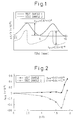
- Fig. 1 shows the change with the passage of time in the magnetostriction of two grain-oriented electrical steel sheets each having a different film tension when they are magnetized at 1.9 T and 60 Hz. It is known that the magnetostriction waveform of a grain-oriented electrical steel sheet varies greatly when laser irradiation conditions, film tensions and the like are changed. In this example, grain-oriented electrical steel sheets produced by a conventional method were employed, and, in test sample 1, the amount of film coating was decreased by 80% from the usual amount to reduce the film tension to some extent. A film tension was calculated from the amount of bending of a steel sheet developed by removing the film on one surface with an acid (formula 1).
- H the amount of bending of a sheet
- ⁇ p-p the difference between the maximum value and the minimum value of magnetostriction, is 0.62 x 10 -6 in the case of test sample 1 and 0.64 x 10 -6 in the case of test sample 2. It is estimated that the noise of both test samples 1 and 2 are at almost the same level in view of magnetostriction amplitude which is one of the conventional indicators.
- Fig. 2 is shown the relationship between magnetization magnetic flux density B and magnetostriction ⁇ B ( ⁇ l/L of a steel sheet when magnetization magnetic flux density is B T; a so-called O-p value.
- ⁇ B in Fig. 2 ⁇ B values are positive in the full range of magnetic flux density in case of the test sample 1 having a low film tension.
- ⁇ B grows bigger in the negative direction until B reaches 1.7 T, and afterwards becomes positive at a higher magnetic flux density.
- Three-phase transformers of 630 kVA were fabricated using these two materials, and their noise levels were measured when they were magnetized at 60 Hz and 1.9 T. There occurred a big difference in noise, 66 dB in case of using the test sample 1 and 73 dB in case of using the test sample 2, despite ⁇ p-p being almost equal in both cases. Then, the waveforms of these materials were studied in detail.
- Fig. 3 shows an A-weighted vibration velocity levels (LvA) at each frequency component for each of the test samples 1 and 2 when they are magnetized at 60 Hz and 1.9 T.
- LvA A-weighted vibration velocity levels
- These are the values obtained by decomposing the values of speed, which is converted from the change with the passage of time in magnetostriction, into the intensity at each frequency by Fourier transform, and then correcting the decomposed values at each frequency according to the audible level (A-weighted).
- the correction according to the audibility level means to be multiplied by a coefficient corresponding to audibility at each frequency.
- test sample 1 with a lower film tension has a smaller induced magnetic anisotropy compared with test sample 2
- closure domains that suppress the leakage of magnetic flux from surfaces increase in the vicinity of 1.7 T. These closure domains begin to disappear at 1.7 T and above, and magnetostriction increases accordingly.
- the present inventors consider that, since the variation of closure domains is large in test sample 1, the magnetostriction increases sharply, and that creates higher harmonic components and affects LvA. Such a sharp change causes the generation of noise having higher frequency components and undesirably raises the whole noise level.
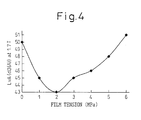
- Fig. 4 shows the relationship between film tensions and LvA.
- LvA lowers as a film tension increases, reaches the minimum point at 2.0 MPa and then increases again.
- the reason for measuring at 1.7 T is that closure domains are easily formed at this magnetic flux density and ⁇ B tends to be negative.
- ⁇ B tends to be negative.
- the magnetic flux density used for the design of transformers is in this vicinity.
- the present inventors found that the noise of electrical apparatuses such as transformers, etc. could be lowered effectively by providing a grain-oriented electrical steel sheet having a smooth magnetostriction waveform with moderate steepness realized by providing an appropriate film tension to reduce the higher harmonics, which were, in magnetostriction, highly influential on noise.
- the present inventors reached to the present invention.
- the tension imposed on a steel sheet by a film is specified to be in the range from 0.5 to 4.0 MPa based on the result in Fig. 4, to realize of moderate steepness in an actual magnetostriction waveform in order for the material to have excellent effects in lowering noise.
- the reason for setting the lower limit at 0.5 MPa is that, since steel sheets are bound together so as not to be loosened when iron cores of transformers are fabricated and the compression force thereof is 0.5 MPa or more, a tension capable of withstanding the stress of this degree is required, otherwise strains will be developed in the steel sheet by external stresses and magnetostriction grows. Also, the reason for setting the upper limit at 4.0 MPa is that, if the film tension exceeds 4.0 MPa, the waveform smoothness will be lost and LvA will increase since steel sheets contract and then stretch sharply toward saturation at 1.7 T. Further, the preferable range of a film tension is from 1.0 MPa to 3.0 MPa.
- the reason for setting a sheet thickness at 0.27 mm or more is that many of transformers are fabricated in this thickness range, and the aforementioned conditions have to be met at this sheet thickness range in order to minimize noise.
- a magnetostriction waveform can be controlled by a film tension as mentioned above is as follows. Closure domains dissipate in a demagnetization state due to the inverse effect of magnetostriction when a film tension is applied. The amount of dissipation is approximately proportional to the intensity of the film tension. These magnetic domains begin to appear when a steel sheet is magnetized at up to a magnetic flux density of about 1.7 T, and dissipate at or above said magnetic flux density. Accordingly, by appropriately controlling this tension, the magnetostriction waveform can be controlled and a smooth waveform can be developed depending on conditions.
- a grain-oriented electrical steel sheet produced by a conventional method having the thickness of 0.30 mm was coated in five different coating weight so that the imposed tensions fall within the range from 0 to 7.0 MPa.
- the magnetostriction of each of these five test samples when they were magnetized at 1.4 T, 1.7 T and 1.9 T was measured by non-contact type magnetostriction measuring device using a laser Doppler system. The results are shown in Table 1.
- test sample D which conforms to the waveform conditions of the present invention and test samples A and E which do not conform thereto, all of which were chosen from among these test samples, and the noise when they were magnetized at 50 Hz and 1.5 T was measured.
- the results are shown in Table 2.
- a grain-oriented electrical steel sheet produced by a conventional method having the thickness of 0.30 mm was coated in five different coating weights so that the imposed tensions fall within the range from 0.02 to 7.0 MPa.
- test sample C which conforms to the waveform conditions of the present invention and test samples A and E which do not conform thereto, all of which were chosen from among these test samples, and the noise when they were magnetized at 50 Hz and 1.5 T was measured.
- the results are shown in Table 4.
Landscapes
- Engineering & Computer Science (AREA)
- Chemical & Material Sciences (AREA)
- Physics & Mathematics (AREA)
- Power Engineering (AREA)
- Thermal Sciences (AREA)
- Manufacturing & Machinery (AREA)
- Crystallography & Structural Chemistry (AREA)
- Mechanical Engineering (AREA)
- Materials Engineering (AREA)
- Metallurgy (AREA)
- Organic Chemistry (AREA)
- Dispersion Chemistry (AREA)
- Electromagnetism (AREA)
- Multimedia (AREA)
- Soft Magnetic Materials (AREA)
- Manufacturing Of Steel Electrode Plates (AREA)
- Chemical Treatment Of Metals (AREA)
Abstract
Description
| Test sample No. | Film tension (MPa) | λ14 (x 10-6) | λ17 (x 10-6) | λ19 (x 10-6) | Remarks |
| A | 0 | 0.05 | 1.52 | 4.82 | Comparative example |
| B | 0.7 | 0.26 | 0.43 | 1.46 | Invented example |
| C | 1.5 | 0.03 | 0.43 | 0.95 | Invented example |
| D | 2.1 | 0.07 | 0.13 | 0.42 | Invented example |
| E | 7.0 | -0.52 | -1.13 | 0.54 | Comparative example |
| Test sample No. | Noise | Remarks |
| A | 49.5dB(A) | Conventional technology |
| D | 41.0dB(A) | Present invention |
| E | 47.8dB(A) | Conventional technology |
| Test sample No. | Film tension (MPa) | λ14 (x 10-6) | λ17 (x 10-6) | λ19 (x 10-6) | Remarks |
| A | 0.02 | 1.03 | 2.08 | 4.71 | Comparative example |
| B | 0.7 | 0.13 | 0.55 | 1.24 | Invented example |
| C | 1.4 | 0.03 | 0.04 | 0.34 | Invented example |
| D | 2.5 | 0.28 | 0.30 | 0.86 | Invented example |
| E | 7.0 | -0.63 | -1.28 | 0.43 | Comparative example |
| Test piece No. | Noise | Remarks |
| A | 47.2dB(A) | Conventional technology |
| C | 39.8dB(A) | Present invention |
| E | 46.5dB(A) | Conventional technology |
Claims (4)
- A grain-oriented electrical steel sheet, for a low-noise transformer, having a film that imposes a tension of 0.5 MPa to 4.0 MPa on the steel sheet.
- A method for producing a grain-oriented electrical steel sheet, for a low noise transformer, characterized by imposing a film tension of 0.5 MPa to 4.0 MPa on the surface by coating or a method corresponding thereto, without forming a glass film on the grain-oriented electrical steel sheet or, if a glass film is formed, after removing the glass film by an arbitrary method.
- A grain-oriented electrical steel sheet for a low noise transformer according to claim 1, characterized by having an λ19 of 1.5 x 10⁻⁶ or less.
- A grain-oriented electrical steel sheet for a low noise transformer according to claim 1 or 3, characterized by having a sheet thickness of 0.27 mm or more.
Applications Claiming Priority (4)
| Application Number | Priority Date | Filing Date | Title |
|---|---|---|---|
| JP2000160511 | 2000-05-30 | ||
| JP2000160511 | 2000-05-30 | ||
| JP2001103588A JP2002057019A (en) | 2000-05-30 | 2001-04-02 | Unidirectional magnetic steel sheet for low noise transformer |
| JP2001103588 | 2001-04-02 |
Publications (3)
| Publication Number | Publication Date |
|---|---|
| EP1160340A2 true EP1160340A2 (en) | 2001-12-05 |
| EP1160340A3 EP1160340A3 (en) | 2003-11-26 |
| EP1160340B1 EP1160340B1 (en) | 2018-08-01 |
Family
ID=26592923
Family Applications (1)
| Application Number | Title | Priority Date | Filing Date |
|---|---|---|---|
| EP01112099.5A Expired - Lifetime EP1160340B1 (en) | 2000-05-30 | 2001-05-29 | Grain-oriented electrical steel sheet for low-noise transformer |
Country Status (5)
| Country | Link |
|---|---|
| US (1) | US6387522B2 (en) |
| EP (1) | EP1160340B1 (en) |
| JP (1) | JP2002057019A (en) |
| KR (1) | KR100450621B1 (en) |
| CN (1) | CN1182262C (en) |
Families Citing this family (5)
| Publication number | Priority date | Publication date | Assignee | Title |
|---|---|---|---|---|
| DE60139222D1 (en) * | 2000-04-24 | 2009-08-27 | Nippon Steel Corp | Grain-oriented electrical steel with excellent magnetic properties |
| JP2012010461A (en) * | 2010-06-23 | 2012-01-12 | Toshiba Corp | Merging unit, transformer, and controller |
| JP5593942B2 (en) * | 2010-08-06 | 2014-09-24 | Jfeスチール株式会社 | Oriented electrical steel sheet and manufacturing method thereof |
| KR102177038B1 (en) | 2014-11-14 | 2020-11-10 | 주식회사 포스코 | Insulation coating composite for oriented electrical steel steet, oriented electrical steel steet formed insulation coating film on using the same insulation coating composite, and method of manufacturing the same oriented electrical steel steet |
| KR101952237B1 (en) * | 2015-02-05 | 2019-02-26 | 제이에프이 스틸 가부시키가이샤 | Grain-oriented electrical steel sheet, manufacturing method therefor, and method for predicting transformer noise property |
Family Cites Families (16)
| Publication number | Priority date | Publication date | Assignee | Title |
|---|---|---|---|---|
| JPS5224499B2 (en) * | 1973-01-22 | 1977-07-01 | ||
| JPS54143737A (en) * | 1978-04-28 | 1979-11-09 | Kawasaki Steel Co | Formation of chromiummfree insulating top coating for directional silicon steel plate |
| JPS5844744B2 (en) * | 1979-11-22 | 1983-10-05 | 川崎製鉄株式会社 | Method for forming a tension-applied top insulating film that does not contain chromium oxide on grain-oriented silicon steel sheets |
| US4713123A (en) * | 1985-02-22 | 1987-12-15 | Kawasaki Steel Corporation | Method of producing extra-low iron loss grain oriented silicon steel sheets |
| JP2592740B2 (en) * | 1992-01-27 | 1997-03-19 | 新日本製鐵株式会社 | Ultra-low iron loss unidirectional electrical steel sheet and method of manufacturing the same |
| DE69326792T2 (en) | 1992-04-07 | 2000-04-27 | Nippon Steel Corp., Tokio/Tokyo | Grain-oriented silicon steel sheet with low iron losses and manufacturing processes |
| JP2673767B2 (en) * | 1992-11-27 | 1997-11-05 | 新日本製鐵株式会社 | Grain-oriented electrical steel sheet having excellent iron core workability and good magnetic properties, and method for producing the same |
| JPH06346203A (en) * | 1993-06-04 | 1994-12-20 | Nippon Steel Corp | Silicon steel sheet with small magnetostriction and method of manufacturing and using the same |
| JPH07305115A (en) | 1994-05-06 | 1995-11-21 | Nippon Steel Corp | Method for producing unidirectional electrical steel sheet with excellent iron loss and magnetostriction characteristics |
| JPH08134551A (en) * | 1994-11-07 | 1996-05-28 | Nippon Steel Corp | Method for producing unidirectional electrical steel sheet with excellent iron loss and magnetostriction characteristics |
| JP2953978B2 (en) * | 1995-02-20 | 1999-09-27 | 新日本製鐵株式会社 | Thick grain-oriented electrical steel sheet having no glass coating with excellent insulating coating properties and method for producing the same |
| JPH08269562A (en) * | 1995-03-29 | 1996-10-15 | Nippon Steel Corp | Low-magnetostrictive grain-oriented silicon steel sheet and method for producing the same |
| JP3408885B2 (en) * | 1995-04-10 | 2003-05-19 | 新日本製鐵株式会社 | Low-noise grain-oriented electrical steel sheets and laminated cores |
| JPH0920926A (en) * | 1995-07-03 | 1997-01-21 | Nippon Steel Corp | Method for producing unidirectional electrical steel sheet with excellent magnetostrictive properties |
| JP3470475B2 (en) * | 1995-11-27 | 2003-11-25 | Jfeスチール株式会社 | Grain-oriented electrical steel sheet with extremely low iron loss and its manufacturing method |
| CN1163916C (en) * | 1997-12-24 | 2004-08-25 | 川崎制铁株式会社 | Grain-oriented silicon steel sheet with ultra-low core loss and method for manufacturing same |
-
2001
- 2001-04-02 JP JP2001103588A patent/JP2002057019A/en active Pending
- 2001-05-28 KR KR10-2001-0029417A patent/KR100450621B1/en not_active Expired - Lifetime
- 2001-05-29 EP EP01112099.5A patent/EP1160340B1/en not_active Expired - Lifetime
- 2001-05-30 CN CNB011193409A patent/CN1182262C/en not_active Expired - Lifetime
- 2001-05-30 US US09/870,148 patent/US6387522B2/en not_active Expired - Lifetime
Also Published As
| Publication number | Publication date |
|---|---|
| JP2002057019A (en) | 2002-02-22 |
| US6387522B2 (en) | 2002-05-14 |
| EP1160340B1 (en) | 2018-08-01 |
| CN1182262C (en) | 2004-12-29 |
| US20020012805A1 (en) | 2002-01-31 |
| CN1327075A (en) | 2001-12-19 |
| EP1160340A3 (en) | 2003-11-26 |
| KR100450621B1 (en) | 2004-09-30 |
| KR20010109125A (en) | 2001-12-08 |
Similar Documents
| Publication | Publication Date | Title |
|---|---|---|
| CN104011246B (en) | Orientation electromagnetic steel plate | |
| CN103069035B (en) | Grain-oriented electrical steel sheet, and method for producing same | |
| US6558479B2 (en) | Low iron loss and low noise grain-oriented electrical steel sheet and a method for producing the same | |
| JP7230933B2 (en) | Grain-oriented electrical steel sheet and manufacturing method thereof | |
| WO2022203089A1 (en) | Grain-oriented electrical steel sheet and method for manufacturing same | |
| US6387522B2 (en) | Grain-oriented electrical steel sheet for low-noise transformer | |
| JP4216488B2 (en) | Oriented electrical steel sheet and manufacturing method thereof | |
| JP3500103B2 (en) | Unidirectional electrical steel sheet for transformers | |
| JPH08269562A (en) | Low-magnetostrictive grain-oriented silicon steel sheet and method for producing the same | |
| JP3408885B2 (en) | Low-noise grain-oriented electrical steel sheets and laminated cores | |
| EP1220243A2 (en) | Electrical steel sheet for low-noise transformer and low-noise transformer | |
| JPH1187122A (en) | Grain-oriented electrical steel sheets for low-noise transformers | |
| JP4258853B2 (en) | Low iron loss and low noise core | |
| JP2001181804A (en) | Unidirectional magnetic steel sheet for low noise transformer | |
| JPH10256053A (en) | Iron core with small variation in iron loss characteristics | |
| JPH05222490A (en) | Grain oriented silicon steel containing super high | |
| JP2005086143A (en) | Material selection method for wound cores for transformers or reactors | |
| JPH0777171B2 (en) | Composite core | |
| JPH0822911A (en) | Stressed magnetic core |
Legal Events
| Date | Code | Title | Description |
|---|---|---|---|
| PUAI | Public reference made under article 153(3) epc to a published international application that has entered the european phase |
Free format text: ORIGINAL CODE: 0009012 |
|
| 17P | Request for examination filed |
Effective date: 20010628 |
|
| AK | Designated contracting states |
Kind code of ref document: A2 Designated state(s): AT BE CH CY DE DK ES FI FR GB GR IE IT LI LU MC NL PT SE TR |
|
| AX | Request for extension of the european patent |
Free format text: AL;LT;LV;MK;RO;SI |
|
| PUAL | Search report despatched |
Free format text: ORIGINAL CODE: 0009013 |
|
| AK | Designated contracting states |
Kind code of ref document: A3 Designated state(s): AT BE CH CY DE DK ES FI FR GB GR IE IT LI LU MC NL PT SE TR |
|
| AX | Request for extension of the european patent |
Extension state: AL LT LV MK RO SI |
|
| RIC1 | Information provided on ipc code assigned before grant |
Ipc: 7H 01F 1/147 B Ipc: 7C 21D 8/12 A Ipc: 7H 01F 1/16 B |
|
| AKX | Designation fees paid |
Designated state(s): DE FR GB IT |
|
| 17Q | First examination report despatched |
Effective date: 20091103 |
|
| RAP1 | Party data changed (applicant data changed or rights of an application transferred) |
Owner name: NIPPON STEEL & SUMITOMO METAL CORPORATION |
|
| GRAP | Despatch of communication of intention to grant a patent |
Free format text: ORIGINAL CODE: EPIDOSNIGR1 |
|
| INTG | Intention to grant announced |
Effective date: 20171117 |
|
| GRAJ | Information related to disapproval of communication of intention to grant by the applicant or resumption of examination proceedings by the epo deleted |
Free format text: ORIGINAL CODE: EPIDOSDIGR1 |
|
| GRAL | Information related to payment of fee for publishing/printing deleted |
Free format text: ORIGINAL CODE: EPIDOSDIGR3 |
|
| GRAS | Grant fee paid |
Free format text: ORIGINAL CODE: EPIDOSNIGR3 |
|
| INTC | Intention to grant announced (deleted) | ||
| RIN1 | Information on inventor provided before grant (corrected) |
Inventor name: MIZOKAMI, MASATO Inventor name: MOGI, HISASHI, Inventor name: FUJIKURA, MASAHIRO, Inventor name: SAKAIDA, AKIRA |
|
| GRAP | Despatch of communication of intention to grant a patent |
Free format text: ORIGINAL CODE: EPIDOSNIGR1 |
|
| INTG | Intention to grant announced |
Effective date: 20180515 |
|
| GRAA | (expected) grant |
Free format text: ORIGINAL CODE: 0009210 |
|
| REG | Reference to a national code |
Ref country code: DE Ref legal event code: R081 Ref document number: 60150895 Country of ref document: DE Owner name: NIPPON STEEL CORPORATION, JP Free format text: FORMER OWNER: NIPPON STEEL CORP., TOKIO/TOKYO, JP |
|
| AK | Designated contracting states |
Kind code of ref document: B1 Designated state(s): DE FR GB IT |
|
| REG | Reference to a national code |
Ref country code: GB Ref legal event code: FG4D |
|
| REG | Reference to a national code |
Ref country code: DE Ref legal event code: R096 Ref document number: 60150895 Country of ref document: DE |
|
| RIC2 | Information provided on ipc code assigned after grant |
Ipc: H01F 1/16 20060101ALI20031007BHEP Ipc: H01F 1/147 20060101ALI20031007BHEP Ipc: C21D 8/12 20060101AFI20010925BHEP |
|
| PG25 | Lapsed in a contracting state [announced via postgrant information from national office to epo] |
Ref country code: IT Free format text: LAPSE BECAUSE OF FAILURE TO SUBMIT A TRANSLATION OF THE DESCRIPTION OR TO PAY THE FEE WITHIN THE PRESCRIBED TIME-LIMIT Effective date: 20180801 |
|
| REG | Reference to a national code |
Ref country code: DE Ref legal event code: R097 Ref document number: 60150895 Country of ref document: DE |
|
| REG | Reference to a national code |
Ref country code: DE Ref legal event code: R082 Ref document number: 60150895 Country of ref document: DE Representative=s name: VOSSIUS & PARTNER PATENTANWAELTE RECHTSANWAELT, DE Ref country code: DE Ref legal event code: R081 Ref document number: 60150895 Country of ref document: DE Owner name: NIPPON STEEL CORPORATION, JP Free format text: FORMER OWNER: NIPPON STEEL & SUMITOMO METAL CORPORATION, TOKYO, JP |
|
| PLBE | No opposition filed within time limit |
Free format text: ORIGINAL CODE: 0009261 |
|
| STAA | Information on the status of an ep patent application or granted ep patent |
Free format text: STATUS: NO OPPOSITION FILED WITHIN TIME LIMIT |
|
| 26N | No opposition filed |
Effective date: 20190503 |
|
| PGFP | Annual fee paid to national office [announced via postgrant information from national office to epo] |
Ref country code: FR Payment date: 20200414 Year of fee payment: 20 Ref country code: DE Payment date: 20200519 Year of fee payment: 20 |
|
| PGFP | Annual fee paid to national office [announced via postgrant information from national office to epo] |
Ref country code: GB Payment date: 20200520 Year of fee payment: 20 |
|
| REG | Reference to a national code |
Ref country code: DE Ref legal event code: R071 Ref document number: 60150895 Country of ref document: DE |
|
| REG | Reference to a national code |
Ref country code: GB Ref legal event code: PE20 Expiry date: 20210528 |
|
| PG25 | Lapsed in a contracting state [announced via postgrant information from national office to epo] |
Ref country code: GB Free format text: LAPSE BECAUSE OF EXPIRATION OF PROTECTION Effective date: 20210528 |