EP1157734A1 - Process for producing composite semipermeable membrane - Google Patents
Process for producing composite semipermeable membrane Download PDFInfo
- Publication number
- EP1157734A1 EP1157734A1 EP99944875A EP99944875A EP1157734A1 EP 1157734 A1 EP1157734 A1 EP 1157734A1 EP 99944875 A EP99944875 A EP 99944875A EP 99944875 A EP99944875 A EP 99944875A EP 1157734 A1 EP1157734 A1 EP 1157734A1
- Authority
- EP
- European Patent Office
- Prior art keywords
- semipermeable membrane
- composite semipermeable
- carboxylic acid
- acid
- producing
- Prior art date
- Legal status (The legal status is an assumption and is not a legal conclusion. Google has not performed a legal analysis and makes no representation as to the accuracy of the status listed.)
- Granted
Links
- 239000012528 membrane Substances 0.000 title claims abstract description 103
- 239000002131 composite material Substances 0.000 title claims abstract description 74
- 238000000034 method Methods 0.000 title claims description 39
- 230000008569 process Effects 0.000 title description 4
- XLYOFNOQVPJJNP-UHFFFAOYSA-N water Substances O XLYOFNOQVPJJNP-UHFFFAOYSA-N 0.000 claims abstract description 40
- 239000002346 layers by function Substances 0.000 claims abstract description 25
- 239000004952 Polyamide Substances 0.000 claims abstract description 16
- 229920002647 polyamide Polymers 0.000 claims abstract description 16
- 150000001733 carboxylic acid esters Chemical class 0.000 claims abstract description 15
- 150000001732 carboxylic acid derivatives Chemical class 0.000 claims abstract description 14
- 239000000243 solution Substances 0.000 claims description 60
- 150000001412 amines Chemical class 0.000 claims description 40
- NGNBDVOYPDDBFK-UHFFFAOYSA-N 2-[2,4-di(pentan-2-yl)phenoxy]acetyl chloride Chemical compound CCCC(C)C1=CC=C(OCC(Cl)=O)C(C(C)CCC)=C1 NGNBDVOYPDDBFK-UHFFFAOYSA-N 0.000 claims description 38
- 239000000758 substrate Substances 0.000 claims description 32
- 239000003054 catalyst Substances 0.000 claims description 19
- 150000001875 compounds Chemical class 0.000 claims description 19
- 239000007864 aqueous solution Substances 0.000 claims description 16
- -1 Alkylene ureas Chemical class 0.000 claims description 12
- 238000012696 Interfacial polycondensation Methods 0.000 claims description 12
- 230000010933 acylation Effects 0.000 claims description 12
- 238000005917 acylation reaction Methods 0.000 claims description 12
- 125000004122 cyclic group Chemical group 0.000 claims description 12
- 150000007933 aliphatic carboxylic acids Chemical class 0.000 claims description 7
- 239000003960 organic solvent Substances 0.000 claims description 6
- 125000000217 alkyl group Chemical group 0.000 claims description 5
- 239000004760 aramid Substances 0.000 claims description 4
- 229920003235 aromatic polyamide Polymers 0.000 claims description 4
- 238000009835 boiling Methods 0.000 claims description 4
- 229910052757 nitrogen Inorganic materials 0.000 claims description 4
- 125000004433 nitrogen atom Chemical group N* 0.000 claims description 4
- 125000001424 substituent group Chemical group 0.000 claims description 4
- 235000013877 carbamide Nutrition 0.000 claims description 3
- KWYHDKDOAIKMQN-UHFFFAOYSA-N N,N,N',N'-tetramethylethylenediamine Chemical compound CN(C)CCN(C)C KWYHDKDOAIKMQN-UHFFFAOYSA-N 0.000 claims description 2
- 125000002947 alkylene group Chemical group 0.000 claims description 2
- 230000035699 permeability Effects 0.000 abstract description 17
- 238000011156 evaluation Methods 0.000 description 34
- WDKYDMULARNCIS-GQCTYLIASA-N Caffeic acid ethyl ester Chemical compound CCOC(=O)\C=C\C1=CC=C(O)C(O)=C1 WDKYDMULARNCIS-GQCTYLIASA-N 0.000 description 16
- ZMXDDKWLCZADIW-UHFFFAOYSA-N N,N-Dimethylformamide Chemical compound CN(C)C=O ZMXDDKWLCZADIW-UHFFFAOYSA-N 0.000 description 15
- SECXISVLQFMRJM-UHFFFAOYSA-N N-Methylpyrrolidone Chemical compound CN1CCCC1=O SECXISVLQFMRJM-UHFFFAOYSA-N 0.000 description 14
- 239000007788 liquid Substances 0.000 description 14
- 238000004519 manufacturing process Methods 0.000 description 14
- 239000010408 film Substances 0.000 description 12
- 239000000463 material Substances 0.000 description 12
- 230000000694 effects Effects 0.000 description 10
- KQNPFQTWMSNSAP-UHFFFAOYSA-N isobutyric acid Chemical compound CC(C)C(O)=O KQNPFQTWMSNSAP-UHFFFAOYSA-N 0.000 description 10
- 150000002430 hydrocarbons Chemical class 0.000 description 9
- 239000002904 solvent Substances 0.000 description 9
- 229930195733 hydrocarbon Natural products 0.000 description 8
- 229920002492 poly(sulfone) Polymers 0.000 description 8
- 239000011148 porous material Substances 0.000 description 8
- 239000002253 acid Substances 0.000 description 7
- 125000003118 aryl group Chemical group 0.000 description 7
- 239000002585 base Substances 0.000 description 7
- 229920006395 saturated elastomer Polymers 0.000 description 7
- 239000000126 substance Substances 0.000 description 7
- KFZMGEQAYNKOFK-UHFFFAOYSA-N Isopropanol Chemical compound CC(C)O KFZMGEQAYNKOFK-UHFFFAOYSA-N 0.000 description 6
- FAPWRFPIFSIZLT-UHFFFAOYSA-M Sodium chloride Chemical compound [Na+].[Cl-] FAPWRFPIFSIZLT-UHFFFAOYSA-M 0.000 description 6
- UWCPYKQBIPYOLX-UHFFFAOYSA-N benzene-1,3,5-tricarbonyl chloride Chemical compound ClC(=O)C1=CC(C(Cl)=O)=CC(C(Cl)=O)=C1 UWCPYKQBIPYOLX-UHFFFAOYSA-N 0.000 description 6
- 150000001805 chlorine compounds Chemical class 0.000 description 6
- 230000000052 comparative effect Effects 0.000 description 6
- 238000001035 drying Methods 0.000 description 6
- JBKVHLHDHHXQEQ-UHFFFAOYSA-N epsilon-caprolactam Chemical compound O=C1CCCCCN1 JBKVHLHDHHXQEQ-UHFFFAOYSA-N 0.000 description 6
- 229910021642 ultra pure water Inorganic materials 0.000 description 6
- 239000012498 ultrapure water Substances 0.000 description 6
- RTZKZFJDLAIYFH-UHFFFAOYSA-N Diethyl ether Chemical compound CCOCC RTZKZFJDLAIYFH-UHFFFAOYSA-N 0.000 description 5
- 230000015572 biosynthetic process Effects 0.000 description 5
- 238000006243 chemical reaction Methods 0.000 description 5
- 238000000576 coating method Methods 0.000 description 5
- 230000002708 enhancing effect Effects 0.000 description 5
- BYEVBITUADOIGY-UHFFFAOYSA-N ethyl nonanoate Chemical compound CCCCCCCCC(=O)OCC BYEVBITUADOIGY-UHFFFAOYSA-N 0.000 description 5
- 230000004907 flux Effects 0.000 description 5
- 239000007789 gas Substances 0.000 description 5
- YYZUSRORWSJGET-UHFFFAOYSA-N octanoic acid ethyl ester Natural products CCCCCCCC(=O)OCC YYZUSRORWSJGET-UHFFFAOYSA-N 0.000 description 5
- 238000000926 separation method Methods 0.000 description 5
- WZCQRUWWHSTZEM-UHFFFAOYSA-N 1,3-phenylenediamine Chemical compound NC1=CC=CC(N)=C1 WZCQRUWWHSTZEM-UHFFFAOYSA-N 0.000 description 4
- IJGRMHOSHXDMSA-UHFFFAOYSA-N Atomic nitrogen Chemical compound N#N IJGRMHOSHXDMSA-UHFFFAOYSA-N 0.000 description 4
- FERIUCNNQQJTOY-UHFFFAOYSA-N Butyric acid Chemical compound CCCC(O)=O FERIUCNNQQJTOY-UHFFFAOYSA-N 0.000 description 4
- GLUUGHFHXGJENI-UHFFFAOYSA-N Piperazine Chemical compound C1CNCCN1 GLUUGHFHXGJENI-UHFFFAOYSA-N 0.000 description 4
- CDBYLPFSWZWCQE-UHFFFAOYSA-L Sodium Carbonate Chemical compound [Na+].[Na+].[O-]C([O-])=O CDBYLPFSWZWCQE-UHFFFAOYSA-L 0.000 description 4
- 239000000654 additive Substances 0.000 description 4
- WPYMKLBDIGXBTP-UHFFFAOYSA-N benzoic acid Chemical compound OC(=O)C1=CC=CC=C1 WPYMKLBDIGXBTP-UHFFFAOYSA-N 0.000 description 4
- 239000011248 coating agent Substances 0.000 description 4
- DIOQZVSQGTUSAI-UHFFFAOYSA-N decane Chemical compound CCCCCCCCCC DIOQZVSQGTUSAI-UHFFFAOYSA-N 0.000 description 4
- 238000010612 desalination reaction Methods 0.000 description 4
- XBDQKXXYIPTUBI-UHFFFAOYSA-N dimethylselenoniopropionate Natural products CCC(O)=O XBDQKXXYIPTUBI-UHFFFAOYSA-N 0.000 description 4
- 229940018564 m-phenylenediamine Drugs 0.000 description 4
- IJXHLVMUNBOGRR-UHFFFAOYSA-N methyl nonanoate Chemical compound CCCCCCCCC(=O)OC IJXHLVMUNBOGRR-UHFFFAOYSA-N 0.000 description 4
- 239000000203 mixture Substances 0.000 description 4
- FBUKVWPVBMHYJY-UHFFFAOYSA-N nonanoic acid Chemical compound CCCCCCCCC(O)=O FBUKVWPVBMHYJY-UHFFFAOYSA-N 0.000 description 4
- 239000004745 nonwoven fabric Substances 0.000 description 4
- XUWHAWMETYGRKB-UHFFFAOYSA-N piperidin-2-one Chemical compound O=C1CCCCN1 XUWHAWMETYGRKB-UHFFFAOYSA-N 0.000 description 4
- 239000004065 semiconductor Substances 0.000 description 4
- 239000011780 sodium chloride Substances 0.000 description 4
- QTBSBXVTEAMEQO-UHFFFAOYSA-N Acetic acid Chemical compound CC(O)=O QTBSBXVTEAMEQO-UHFFFAOYSA-N 0.000 description 3
- CSCPPACGZOOCGX-UHFFFAOYSA-N Acetone Chemical compound CC(C)=O CSCPPACGZOOCGX-UHFFFAOYSA-N 0.000 description 3
- UHOVQNZJYSORNB-UHFFFAOYSA-N Benzene Chemical compound C1=CC=CC=C1 UHOVQNZJYSORNB-UHFFFAOYSA-N 0.000 description 3
- XEKOWRVHYACXOJ-UHFFFAOYSA-N Ethyl acetate Chemical compound CCOC(C)=O XEKOWRVHYACXOJ-UHFFFAOYSA-N 0.000 description 3
- RPHKINMPYFJSCF-UHFFFAOYSA-N benzene-1,3,5-triamine Chemical compound NC1=CC(N)=CC(N)=C1 RPHKINMPYFJSCF-UHFFFAOYSA-N 0.000 description 3
- 239000011247 coating layer Substances 0.000 description 3
- 238000004132 cross linking Methods 0.000 description 3
- 125000004185 ester group Chemical group 0.000 description 3
- 150000002148 esters Chemical class 0.000 description 3
- 239000003456 ion exchange resin Substances 0.000 description 3
- 229920003303 ion-exchange polymer Polymers 0.000 description 3
- 238000005259 measurement Methods 0.000 description 3
- 230000004048 modification Effects 0.000 description 3
- 238000012986 modification Methods 0.000 description 3
- 239000000178 monomer Substances 0.000 description 3
- NZMAJUHVSZBJHL-UHFFFAOYSA-N n,n-dibutylformamide Chemical compound CCCCN(C=O)CCCC NZMAJUHVSZBJHL-UHFFFAOYSA-N 0.000 description 3
- VLKZOEOYAKHREP-UHFFFAOYSA-N n-Hexane Chemical compound CCCCCC VLKZOEOYAKHREP-UHFFFAOYSA-N 0.000 description 3
- 238000012856 packing Methods 0.000 description 3
- 239000003444 phase transfer catalyst Substances 0.000 description 3
- 229920000728 polyester Polymers 0.000 description 3
- 229920000642 polymer Polymers 0.000 description 3
- 238000011084 recovery Methods 0.000 description 3
- 239000013535 sea water Substances 0.000 description 3
- 239000004094 surface-active agent Substances 0.000 description 3
- LXEJRKJRKIFVNY-UHFFFAOYSA-N terephthaloyl chloride Chemical compound ClC(=O)C1=CC=C(C(Cl)=O)C=C1 LXEJRKJRKIFVNY-UHFFFAOYSA-N 0.000 description 3
- 238000005406 washing Methods 0.000 description 3
- UWHSPZZUAYSGTB-UHFFFAOYSA-N 1,1,3,3-tetraethylurea Chemical compound CCN(CC)C(=O)N(CC)CC UWHSPZZUAYSGTB-UHFFFAOYSA-N 0.000 description 2
- VOZKAJLKRJDJLL-UHFFFAOYSA-N 2,4-diaminotoluene Chemical compound CC1=CC=C(N)C=C1N VOZKAJLKRJDJLL-UHFFFAOYSA-N 0.000 description 2
- ZWEHNKRNPOVVGH-UHFFFAOYSA-N 2-Butanone Chemical compound CCC(C)=O ZWEHNKRNPOVVGH-UHFFFAOYSA-N 0.000 description 2
- RXGUIWHIADMCFC-UHFFFAOYSA-N 2-Methylpropyl 2-methylpropionate Chemical compound CC(C)COC(=O)C(C)C RXGUIWHIADMCFC-UHFFFAOYSA-N 0.000 description 2
- FZXRXKLUIMKDEL-UHFFFAOYSA-N 2-Methylpropyl propanoate Chemical compound CCC(=O)OCC(C)C FZXRXKLUIMKDEL-UHFFFAOYSA-N 0.000 description 2
- TVZRAEYQIKYCPH-UHFFFAOYSA-N 3-(trimethylsilyl)propane-1-sulfonic acid Chemical compound C[Si](C)(C)CCCS(O)(=O)=O TVZRAEYQIKYCPH-UHFFFAOYSA-N 0.000 description 2
- XKWSWANXMRXDES-UHFFFAOYSA-N 3-methylbutyl octanoate Chemical compound CCCCCCCC(=O)OCCC(C)C XKWSWANXMRXDES-UHFFFAOYSA-N 0.000 description 2
- ZAMOUSCENKQFHK-UHFFFAOYSA-N Chlorine atom Chemical compound [Cl] ZAMOUSCENKQFHK-UHFFFAOYSA-N 0.000 description 2
- QJYYMNOTJXIOBP-UHFFFAOYSA-N Ethyl tridecanoate Chemical compound CCCCCCCCCCCCC(=O)OCC QJYYMNOTJXIOBP-UHFFFAOYSA-N 0.000 description 2
- PIICEJLVQHRZGT-UHFFFAOYSA-N Ethylenediamine Chemical compound NCCN PIICEJLVQHRZGT-UHFFFAOYSA-N 0.000 description 2
- IMNFDUFMRHMDMM-UHFFFAOYSA-N N-Heptane Chemical compound CCCCCCC IMNFDUFMRHMDMM-UHFFFAOYSA-N 0.000 description 2
- OFBQJSOFQDEBGM-UHFFFAOYSA-N Pentane Chemical compound CCCCC OFBQJSOFQDEBGM-UHFFFAOYSA-N 0.000 description 2
- XBDQKXXYIPTUBI-UHFFFAOYSA-M Propionate Chemical compound CCC([O-])=O XBDQKXXYIPTUBI-UHFFFAOYSA-M 0.000 description 2
- JUJWROOIHBZHMG-UHFFFAOYSA-N Pyridine Chemical compound C1=CC=NC=C1 JUJWROOIHBZHMG-UHFFFAOYSA-N 0.000 description 2
- DBMJMQXJHONAFJ-UHFFFAOYSA-M Sodium laurylsulphate Chemical compound [Na+].CCCCCCCCCCCCOS([O-])(=O)=O DBMJMQXJHONAFJ-UHFFFAOYSA-M 0.000 description 2
- KKEYFWRCBNTPAC-UHFFFAOYSA-N Terephthalic acid Chemical compound OC(=O)C1=CC=C(C(O)=O)C=C1 KKEYFWRCBNTPAC-UHFFFAOYSA-N 0.000 description 2
- WYURNTSHIVDZCO-UHFFFAOYSA-N Tetrahydrofuran Chemical compound C1CCOC1 WYURNTSHIVDZCO-UHFFFAOYSA-N 0.000 description 2
- XSQUKJJJFZCRTK-UHFFFAOYSA-N Urea Chemical compound NC(N)=O XSQUKJJJFZCRTK-UHFFFAOYSA-N 0.000 description 2
- 125000002723 alicyclic group Chemical group 0.000 description 2
- 125000001931 aliphatic group Chemical group 0.000 description 2
- 125000003277 amino group Chemical group 0.000 description 2
- RUOKPLVTMFHRJE-UHFFFAOYSA-N benzene-1,2,3-triamine Chemical compound NC1=CC=CC(N)=C1N RUOKPLVTMFHRJE-UHFFFAOYSA-N 0.000 description 2
- JSYBAZQQYCNZJE-UHFFFAOYSA-N benzene-1,2,4-triamine Chemical compound NC1=CC=C(N)C(N)=C1 JSYBAZQQYCNZJE-UHFFFAOYSA-N 0.000 description 2
- HTZCNXWZYVXIMZ-UHFFFAOYSA-M benzyl(triethyl)azanium;chloride Chemical compound [Cl-].CC[N+](CC)(CC)CC1=CC=CC=C1 HTZCNXWZYVXIMZ-UHFFFAOYSA-M 0.000 description 2
- 238000007664 blowing Methods 0.000 description 2
- 125000003178 carboxy group Chemical group [H]OC(*)=O 0.000 description 2
- 150000001735 carboxylic acids Chemical class 0.000 description 2
- 239000000460 chlorine Substances 0.000 description 2
- 229910052801 chlorine Inorganic materials 0.000 description 2
- NZNMSOFKMUBTKW-UHFFFAOYSA-N cyclohexanecarboxylic acid Chemical compound OC(=O)C1CCCCC1 NZNMSOFKMUBTKW-UHFFFAOYSA-N 0.000 description 2
- SNOJOKOVTYPHMC-UHFFFAOYSA-N di(piperidin-1-yl)methanone Chemical compound C1CCCCN1C(=O)N1CCCCC1 SNOJOKOVTYPHMC-UHFFFAOYSA-N 0.000 description 2
- GUVUOGQBMYCBQP-UHFFFAOYSA-N dmpu Chemical compound CN1CCCN(C)C1=O GUVUOGQBMYCBQP-UHFFFAOYSA-N 0.000 description 2
- POULHZVOKOAJMA-UHFFFAOYSA-N dodecanoic acid Chemical compound CCCCCCCCCCCC(O)=O POULHZVOKOAJMA-UHFFFAOYSA-N 0.000 description 2
- 230000008030 elimination Effects 0.000 description 2
- 238000003379 elimination reaction Methods 0.000 description 2
- RGXWDWUGBIJHDO-UHFFFAOYSA-N ethyl decanoate Chemical compound CCCCCCCCCC(=O)OCC RGXWDWUGBIJHDO-UHFFFAOYSA-N 0.000 description 2
- TVQGDYNRXLTQAP-UHFFFAOYSA-N ethyl heptanoate Chemical compound CCCCCCC(=O)OCC TVQGDYNRXLTQAP-UHFFFAOYSA-N 0.000 description 2
- SHZIWNPUGXLXDT-UHFFFAOYSA-N ethyl hexanoate Chemical compound CCCCCC(=O)OCC SHZIWNPUGXLXDT-UHFFFAOYSA-N 0.000 description 2
- MMXKVMNBHPAILY-UHFFFAOYSA-N ethyl laurate Chemical compound CCCCCCCCCCCC(=O)OCC MMXKVMNBHPAILY-UHFFFAOYSA-N 0.000 description 2
- 125000000524 functional group Chemical group 0.000 description 2
- FUZZWVXGSFPDMH-UHFFFAOYSA-N hexanoic acid Chemical compound CCCCCC(O)=O FUZZWVXGSFPDMH-UHFFFAOYSA-N 0.000 description 2
- LNCPIMCVTKXXOY-UHFFFAOYSA-N hexyl 2-methylprop-2-enoate Chemical compound CCCCCCOC(=O)C(C)=C LNCPIMCVTKXXOY-UHFFFAOYSA-N 0.000 description 2
- 238000006460 hydrolysis reaction Methods 0.000 description 2
- 238000007654 immersion Methods 0.000 description 2
- QQVIHTHCMHWDBS-UHFFFAOYSA-N isophthalic acid Chemical compound OC(=O)C1=CC=CC(C(O)=O)=C1 QQVIHTHCMHWDBS-UHFFFAOYSA-N 0.000 description 2
- GWYFCOCPABKNJV-UHFFFAOYSA-N isovaleric acid Chemical compound CC(C)CC(O)=O GWYFCOCPABKNJV-UHFFFAOYSA-N 0.000 description 2
- 239000010410 layer Substances 0.000 description 2
- BDAGIHXWWSANSR-UHFFFAOYSA-N methanoic acid Natural products OC=O BDAGIHXWWSANSR-UHFFFAOYSA-N 0.000 description 2
- QPJVMBTYPHYUOC-UHFFFAOYSA-N methyl benzoate Chemical compound COC(=O)C1=CC=CC=C1 QPJVMBTYPHYUOC-UHFFFAOYSA-N 0.000 description 2
- ZQWPRMPSCMSAJU-UHFFFAOYSA-N methyl cyclohexanecarboxylate Chemical compound COC(=O)C1CCCCC1 ZQWPRMPSCMSAJU-UHFFFAOYSA-N 0.000 description 2
- YRHYCMZPEVDGFQ-UHFFFAOYSA-N methyl decanoate Chemical compound CCCCCCCCCC(=O)OC YRHYCMZPEVDGFQ-UHFFFAOYSA-N 0.000 description 2
- UQDUPQYQJKYHQI-UHFFFAOYSA-N methyl laurate Chemical compound CCCCCCCCCCCC(=O)OC UQDUPQYQJKYHQI-UHFFFAOYSA-N 0.000 description 2
- JGHZJRVDZXSNKQ-UHFFFAOYSA-N methyl octanoate Chemical compound CCCCCCCC(=O)OC JGHZJRVDZXSNKQ-UHFFFAOYSA-N 0.000 description 2
- JNDDPBOKWCBQSM-UHFFFAOYSA-N methyl tridecanoate Chemical compound CCCCCCCCCCCCC(=O)OC JNDDPBOKWCBQSM-UHFFFAOYSA-N 0.000 description 2
- XPQPWPZFBULGKT-UHFFFAOYSA-N methyl undecanoate Chemical compound CCCCCCCCCCC(=O)OC XPQPWPZFBULGKT-UHFFFAOYSA-N 0.000 description 2
- 239000012454 non-polar solvent Substances 0.000 description 2
- BKIMMITUMNQMOS-UHFFFAOYSA-N nonane Chemical compound CCCCCCCCC BKIMMITUMNQMOS-UHFFFAOYSA-N 0.000 description 2
- TVMXDCGIABBOFY-UHFFFAOYSA-N octane Chemical compound CCCCCCCC TVMXDCGIABBOFY-UHFFFAOYSA-N 0.000 description 2
- WWZKQHOCKIZLMA-UHFFFAOYSA-N octanoic acid Chemical compound CCCCCCCC(O)=O WWZKQHOCKIZLMA-UHFFFAOYSA-N 0.000 description 2
- 239000011368 organic material Substances 0.000 description 2
- 239000012466 permeate Substances 0.000 description 2
- BASFCYQUMIYNBI-UHFFFAOYSA-N platinum Chemical compound [Pt] BASFCYQUMIYNBI-UHFFFAOYSA-N 0.000 description 2
- 238000002203 pretreatment Methods 0.000 description 2
- 235000019260 propionic acid Nutrition 0.000 description 2
- IUVKMZGDUIUOCP-BTNSXGMBSA-N quinbolone Chemical compound O([C@H]1CC[C@H]2[C@H]3[C@@H]([C@]4(C=CC(=O)C=C4CC3)C)CC[C@@]21C)C1=CCCC1 IUVKMZGDUIUOCP-BTNSXGMBSA-N 0.000 description 2
- 230000009467 reduction Effects 0.000 description 2
- 229910001927 ruthenium tetroxide Inorganic materials 0.000 description 2
- 238000009287 sand filtration Methods 0.000 description 2
- 229910000029 sodium carbonate Inorganic materials 0.000 description 2
- 235000019333 sodium laurylsulphate Nutrition 0.000 description 2
- 125000001174 sulfone group Chemical group 0.000 description 2
- IIYFAKIEWZDVMP-UHFFFAOYSA-N tridecane Chemical compound CCCCCCCCCCCCC IIYFAKIEWZDVMP-UHFFFAOYSA-N 0.000 description 2
- SZHOJFHSIKHZHA-UHFFFAOYSA-N tridecanoic acid Chemical compound CCCCCCCCCCCCC(O)=O SZHOJFHSIKHZHA-UHFFFAOYSA-N 0.000 description 2
- 238000000108 ultra-filtration Methods 0.000 description 2
- ZDPHROOEEOARMN-UHFFFAOYSA-N undecanoic acid Chemical compound CCCCCCCCCCC(O)=O ZDPHROOEEOARMN-UHFFFAOYSA-N 0.000 description 2
- NQPDZGIKBAWPEJ-UHFFFAOYSA-N valeric acid Chemical compound CCCCC(O)=O NQPDZGIKBAWPEJ-UHFFFAOYSA-N 0.000 description 2
- 238000009834 vaporization Methods 0.000 description 2
- 230000008016 vaporization Effects 0.000 description 2
- 239000002351 wastewater Substances 0.000 description 2
- WJTCHBVEUFDSIK-NWDGAFQWSA-N (2r,5s)-1-benzyl-2,5-dimethylpiperazine Chemical compound C[C@@H]1CN[C@@H](C)CN1CC1=CC=CC=C1 WJTCHBVEUFDSIK-NWDGAFQWSA-N 0.000 description 1
- HVCNEOVTZJYUAI-AATRIKPKSA-N (e)-non-4-enoic acid Chemical compound CCCC\C=C\CCC(O)=O HVCNEOVTZJYUAI-AATRIKPKSA-N 0.000 description 1
- BOSAWIQFTJIYIS-UHFFFAOYSA-N 1,1,1-trichloro-2,2,2-trifluoroethane Chemical compound FC(F)(F)C(Cl)(Cl)Cl BOSAWIQFTJIYIS-UHFFFAOYSA-N 0.000 description 1
- AVQQQNCBBIEMEU-UHFFFAOYSA-N 1,1,3,3-tetramethylurea Chemical compound CN(C)C(=O)N(C)C AVQQQNCBBIEMEU-UHFFFAOYSA-N 0.000 description 1
- NWUYHJFMYQTDRP-UHFFFAOYSA-N 1,2-bis(ethenyl)benzene;1-ethenyl-2-ethylbenzene;styrene Chemical compound C=CC1=CC=CC=C1.CCC1=CC=CC=C1C=C.C=CC1=CC=CC=C1C=C NWUYHJFMYQTDRP-UHFFFAOYSA-N 0.000 description 1
- RYHBNJHYFVUHQT-UHFFFAOYSA-N 1,4-Dioxane Chemical compound C1COCCO1 RYHBNJHYFVUHQT-UHFFFAOYSA-N 0.000 description 1
- CBCKQZAAMUWICA-UHFFFAOYSA-N 1,4-phenylenediamine Chemical compound NC1=CC=C(N)C=C1 CBCKQZAAMUWICA-UHFFFAOYSA-N 0.000 description 1
- GYSCBCSGKXNZRH-UHFFFAOYSA-N 1-benzothiophene-2-carboxamide Chemical compound C1=CC=C2SC(C(=O)N)=CC2=C1 GYSCBCSGKXNZRH-UHFFFAOYSA-N 0.000 description 1
- GGYVTHJIUNGKFZ-UHFFFAOYSA-N 1-methylpiperidin-2-one Chemical compound CN1CCCCC1=O GGYVTHJIUNGKFZ-UHFFFAOYSA-N 0.000 description 1
- LNETULKMXZVUST-UHFFFAOYSA-N 1-naphthoic acid Chemical compound C1=CC=C2C(C(=O)O)=CC=CC2=C1 LNETULKMXZVUST-UHFFFAOYSA-N 0.000 description 1
- VESLRNDUOCLYDT-UHFFFAOYSA-N 1-phenylprop-2-en-1-amine Chemical compound C=CC(N)C1=CC=CC=C1 VESLRNDUOCLYDT-UHFFFAOYSA-N 0.000 description 1
- XYHKNCXZYYTLRG-UHFFFAOYSA-N 1h-imidazole-2-carbaldehyde Chemical compound O=CC1=NC=CN1 XYHKNCXZYYTLRG-UHFFFAOYSA-N 0.000 description 1
- BAHPQISAXRFLCL-UHFFFAOYSA-N 2,4-Diaminoanisole Chemical compound COC1=CC=C(N)C=C1N BAHPQISAXRFLCL-UHFFFAOYSA-N 0.000 description 1
- VPMMJSPGZSFEAH-UHFFFAOYSA-N 2,4-diaminophenol;hydrochloride Chemical compound [Cl-].NC1=CC=C(O)C([NH3+])=C1 VPMMJSPGZSFEAH-UHFFFAOYSA-N 0.000 description 1
- NSMWYRLQHIXVAP-UHFFFAOYSA-N 2,5-dimethylpiperazine Chemical compound CC1CNC(C)CN1 NSMWYRLQHIXVAP-UHFFFAOYSA-N 0.000 description 1
- KEBDNKNVCHQIJU-UHFFFAOYSA-N 2-Methylpropyl 3-methylbutanoate Chemical compound CC(C)COC(=O)CC(C)C KEBDNKNVCHQIJU-UHFFFAOYSA-N 0.000 description 1
- UOBYKYZJUGYBDK-UHFFFAOYSA-N 2-naphthoic acid Chemical compound C1=CC=CC2=CC(C(=O)O)=CC=C21 UOBYKYZJUGYBDK-UHFFFAOYSA-N 0.000 description 1
- UENRXLSRMCSUSN-UHFFFAOYSA-N 3,5-diaminobenzoic acid Chemical compound NC1=CC(N)=CC(C(O)=O)=C1 UENRXLSRMCSUSN-UHFFFAOYSA-N 0.000 description 1
- ZDIXEQISPGRDEB-UHFFFAOYSA-N 3-Methyl-nonanoic acid Chemical compound CCCCCCC(C)CC(O)=O ZDIXEQISPGRDEB-UHFFFAOYSA-N 0.000 description 1
- GWYFCOCPABKNJV-UHFFFAOYSA-M 3-Methylbutanoic acid Natural products CC(C)CC([O-])=O GWYFCOCPABKNJV-UHFFFAOYSA-M 0.000 description 1
- GNIZQCLFRCBEGE-UHFFFAOYSA-N 3-phenylbenzene-1,2-dicarbonyl chloride Chemical compound ClC(=O)C1=CC=CC(C=2C=CC=CC=2)=C1C(Cl)=O GNIZQCLFRCBEGE-UHFFFAOYSA-N 0.000 description 1
- OSWFIVFLDKOXQC-UHFFFAOYSA-N 4-(3-methoxyphenyl)aniline Chemical compound COC1=CC=CC(C=2C=CC(N)=CC=2)=C1 OSWFIVFLDKOXQC-UHFFFAOYSA-N 0.000 description 1
- OSFGNTLIOUHOKN-UHFFFAOYSA-N 4-[benzyl(methyl)sulfamoyl]benzoic acid Chemical compound C=1C=C(C(O)=O)C=CC=1S(=O)(=O)N(C)CC1=CC=CC=C1 OSFGNTLIOUHOKN-UHFFFAOYSA-N 0.000 description 1
- AWQSAIIDOMEEOD-UHFFFAOYSA-N 5,5-Dimethyl-4-(3-oxobutyl)dihydro-2(3H)-furanone Chemical compound CC(=O)CCC1CC(=O)OC1(C)C AWQSAIIDOMEEOD-UHFFFAOYSA-N 0.000 description 1
- 239000005711 Benzoic acid Substances 0.000 description 1
- 239000005635 Caprylic acid (CAS 124-07-2) Substances 0.000 description 1
- 239000004215 Carbon black (E152) Substances 0.000 description 1
- YYLLIJHXUHJATK-UHFFFAOYSA-N Cyclohexyl acetate Chemical compound CC(=O)OC1CCCCC1 YYLLIJHXUHJATK-UHFFFAOYSA-N 0.000 description 1
- GHVNFZFCNZKVNT-UHFFFAOYSA-N Decanoic acid Natural products CCCCCCCCCC(O)=O GHVNFZFCNZKVNT-UHFFFAOYSA-N 0.000 description 1
- IAFQYUQIAOWKSB-UHFFFAOYSA-N Ethyl undecanoate Chemical compound CCCCCCCCCCC(=O)OCC IAFQYUQIAOWKSB-UHFFFAOYSA-N 0.000 description 1
- NHTMVDHEPJAVLT-UHFFFAOYSA-N Isooctane Chemical compound CC(C)CC(C)(C)C NHTMVDHEPJAVLT-UHFFFAOYSA-N 0.000 description 1
- OFOBLEOULBTSOW-UHFFFAOYSA-N Malonic acid Chemical compound OC(=O)CC(O)=O OFOBLEOULBTSOW-UHFFFAOYSA-N 0.000 description 1
- CERQOIWHTDAKMF-UHFFFAOYSA-N Methacrylic acid Chemical compound CC(=C)C(O)=O CERQOIWHTDAKMF-UHFFFAOYSA-N 0.000 description 1
- 239000005640 Methyl decanoate Substances 0.000 description 1
- NTIZESTWPVYFNL-UHFFFAOYSA-N Methyl isobutyl ketone Chemical compound CC(C)CC(C)=O NTIZESTWPVYFNL-UHFFFAOYSA-N 0.000 description 1
- UIHCLUNTQKBZGK-UHFFFAOYSA-N Methyl isobutyl ketone Natural products CCC(C)C(C)=O UIHCLUNTQKBZGK-UHFFFAOYSA-N 0.000 description 1
- BZLVMXJERCGZMT-UHFFFAOYSA-N Methyl tert-butyl ether Chemical compound COC(C)(C)C BZLVMXJERCGZMT-UHFFFAOYSA-N 0.000 description 1
- SUAKHGWARZSWIH-UHFFFAOYSA-N N,N‐diethylformamide Chemical compound CCN(CC)C=O SUAKHGWARZSWIH-UHFFFAOYSA-N 0.000 description 1
- SWGXDLRCJNEEGZ-UHFFFAOYSA-N N-cyclohexylformamide Chemical compound O=CNC1CCCCC1 SWGXDLRCJNEEGZ-UHFFFAOYSA-N 0.000 description 1
- ZWXPDGCFMMFNRW-UHFFFAOYSA-N N-methylcaprolactam Chemical compound CN1CCCCCC1=O ZWXPDGCFMMFNRW-UHFFFAOYSA-N 0.000 description 1
- CBENFWSGALASAD-UHFFFAOYSA-N Ozone Chemical compound [O-][O+]=O CBENFWSGALASAD-UHFFFAOYSA-N 0.000 description 1
- 239000002033 PVDF binder Substances 0.000 description 1
- 239000005643 Pelargonic acid Substances 0.000 description 1
- 239000004642 Polyimide Substances 0.000 description 1
- 239000004372 Polyvinyl alcohol Substances 0.000 description 1
- DWAQJAXMDSEUJJ-UHFFFAOYSA-M Sodium bisulfite Chemical compound [Na+].OS([O-])=O DWAQJAXMDSEUJJ-UHFFFAOYSA-M 0.000 description 1
- 239000005708 Sodium hypochlorite Substances 0.000 description 1
- 238000005299 abrasion Methods 0.000 description 1
- 230000001133 acceleration Effects 0.000 description 1
- 235000011054 acetic acid Nutrition 0.000 description 1
- IPBVNPXQWQGGJP-UHFFFAOYSA-N acetic acid phenyl ester Natural products CC(=O)OC1=CC=CC=C1 IPBVNPXQWQGGJP-UHFFFAOYSA-N 0.000 description 1
- KXKVLQRXCPHEJC-UHFFFAOYSA-N acetic acid trimethyl ester Natural products COC(C)=O KXKVLQRXCPHEJC-UHFFFAOYSA-N 0.000 description 1
- 230000000996 additive effect Effects 0.000 description 1
- PWAXUOGZOSVGBO-UHFFFAOYSA-N adipoyl chloride Chemical compound ClC(=O)CCCCC(Cl)=O PWAXUOGZOSVGBO-UHFFFAOYSA-N 0.000 description 1
- 239000003513 alkali Substances 0.000 description 1
- QGZKDVFQNNGYKY-UHFFFAOYSA-O ammonium group Chemical group [NH4+] QGZKDVFQNNGYKY-UHFFFAOYSA-O 0.000 description 1
- 239000008346 aqueous phase Substances 0.000 description 1
- DMLAVOWQYNRWNQ-UHFFFAOYSA-N azobenzene Chemical compound C1=CC=CC=C1N=NC1=CC=CC=C1 DMLAVOWQYNRWNQ-UHFFFAOYSA-N 0.000 description 1
- CJYXCQLOZNIMFP-UHFFFAOYSA-N azocan-2-one Chemical compound O=C1CCCCCCN1 CJYXCQLOZNIMFP-UHFFFAOYSA-N 0.000 description 1
- YDLSUFFXJYEVHW-UHFFFAOYSA-N azonan-2-one Chemical compound O=C1CCCCCCCN1 YDLSUFFXJYEVHW-UHFFFAOYSA-N 0.000 description 1
- 230000008901 benefit Effects 0.000 description 1
- FDQSRULYDNDXQB-UHFFFAOYSA-N benzene-1,3-dicarbonyl chloride Chemical compound ClC(=O)C1=CC=CC(C(Cl)=O)=C1 FDQSRULYDNDXQB-UHFFFAOYSA-N 0.000 description 1
- 235000010233 benzoic acid Nutrition 0.000 description 1
- 230000005540 biological transmission Effects 0.000 description 1
- NIHSFKGWPYEKJN-UHFFFAOYSA-N biphenylene-1,2-dicarbonyl chloride Chemical compound C1=CC=C2C3=C(C(Cl)=O)C(C(=O)Cl)=CC=C3C2=C1 NIHSFKGWPYEKJN-UHFFFAOYSA-N 0.000 description 1
- 239000004202 carbamide Substances 0.000 description 1
- 125000002843 carboxylic acid group Chemical group 0.000 description 1
- CWMPPVPFLSZGCY-SREVYHEPSA-N cis-alpha-octenoic acid Chemical compound CCCCC\C=C/C(O)=O CWMPPVPFLSZGCY-SREVYHEPSA-N 0.000 description 1
- 238000005345 coagulation Methods 0.000 description 1
- 230000015271 coagulation Effects 0.000 description 1
- 239000012612 commercial material Substances 0.000 description 1
- 229920001577 copolymer Polymers 0.000 description 1
- AKXTUELRIVKQSN-UHFFFAOYSA-N cyclobutane-1,2,3-tricarbonyl chloride Chemical compound ClC(=O)C1CC(C(Cl)=O)C1C(Cl)=O AKXTUELRIVKQSN-UHFFFAOYSA-N 0.000 description 1
- VZFUCHSFHOYXIS-UHFFFAOYSA-N cycloheptane carboxylic acid Natural products OC(=O)C1CCCCCC1 VZFUCHSFHOYXIS-UHFFFAOYSA-N 0.000 description 1
- MLCGVCXKDYTMRG-UHFFFAOYSA-N cyclohexane-1,1-dicarbonyl chloride Chemical compound ClC(=O)C1(C(Cl)=O)CCCCC1 MLCGVCXKDYTMRG-UHFFFAOYSA-N 0.000 description 1
- SSJXIUAHEKJCMH-UHFFFAOYSA-N cyclohexane-1,2-diamine Chemical compound NC1CCCCC1N SSJXIUAHEKJCMH-UHFFFAOYSA-N 0.000 description 1
- HIZMBMVNMBMUEE-UHFFFAOYSA-N cyclohexane-1,3,5-tricarbonyl chloride Chemical compound ClC(=O)C1CC(C(Cl)=O)CC(C(Cl)=O)C1 HIZMBMVNMBMUEE-UHFFFAOYSA-N 0.000 description 1
- GEQHKFFSPGPGLN-UHFFFAOYSA-N cyclohexane-1,3-diamine Chemical compound NC1CCCC(N)C1 GEQHKFFSPGPGLN-UHFFFAOYSA-N 0.000 description 1
- VKIRRGRTJUUZHS-UHFFFAOYSA-N cyclohexane-1,4-diamine Chemical compound NC1CCC(N)CC1 VKIRRGRTJUUZHS-UHFFFAOYSA-N 0.000 description 1
- YYLFLXVROAGUFH-UHFFFAOYSA-N cyclopentane-1,1-dicarbonyl chloride Chemical compound ClC(=O)C1(C(Cl)=O)CCCC1 YYLFLXVROAGUFH-UHFFFAOYSA-N 0.000 description 1
- WMPOZLHMGVKUEJ-UHFFFAOYSA-N decanedioyl dichloride Chemical compound ClC(=O)CCCCCCCCC(Cl)=O WMPOZLHMGVKUEJ-UHFFFAOYSA-N 0.000 description 1
- 230000007547 defect Effects 0.000 description 1
- 238000011033 desalting Methods 0.000 description 1
- 150000004985 diamines Chemical class 0.000 description 1
- JVSWJIKNEAIKJW-UHFFFAOYSA-N dimethyl-hexane Natural products CCCCCC(C)C JVSWJIKNEAIKJW-UHFFFAOYSA-N 0.000 description 1
- HPTQKSXAQBHFKL-UHFFFAOYSA-N dipyrrolidin-1-ylmethanone Chemical compound C1CCCN1C(=O)N1CCCC1 HPTQKSXAQBHFKL-UHFFFAOYSA-N 0.000 description 1
- 238000004090 dissolution Methods 0.000 description 1
- SNRUBQQJIBEYMU-UHFFFAOYSA-N dodecane Chemical compound CCCCCCCCCCCC SNRUBQQJIBEYMU-UHFFFAOYSA-N 0.000 description 1
- 238000004070 electrodeposition Methods 0.000 description 1
- 238000000635 electron micrograph Methods 0.000 description 1
- 125000001033 ether group Chemical group 0.000 description 1
- AKICFIBDQRYDIG-BQYQJAHWSA-N ethyl (e)-non-4-enoate Chemical compound CCCC\C=C\CCC(=O)OCC AKICFIBDQRYDIG-BQYQJAHWSA-N 0.000 description 1
- ZDAVQPOSWCQTLX-UHFFFAOYSA-N ethyl 2-ethylheptanoate Chemical compound CCCCCC(CC)C(=O)OCC ZDAVQPOSWCQTLX-UHFFFAOYSA-N 0.000 description 1
- 125000001495 ethyl group Chemical group [H]C([H])([H])C([H])([H])* 0.000 description 1
- VTSFIPHRNAESED-AATRIKPKSA-N ethyl-3-hexanoate Chemical compound CCOC(=O)C\C=C\CC VTSFIPHRNAESED-AATRIKPKSA-N 0.000 description 1
- 239000004744 fabric Substances 0.000 description 1
- 238000000445 field-emission scanning electron microscopy Methods 0.000 description 1
- 235000019253 formic acid Nutrition 0.000 description 1
- WBJINCZRORDGAQ-UHFFFAOYSA-N formic acid ethyl ester Natural products CCOC=O WBJINCZRORDGAQ-UHFFFAOYSA-N 0.000 description 1
- 125000002485 formyl group Chemical group [H]C(*)=O 0.000 description 1
- 235000015203 fruit juice Nutrition 0.000 description 1
- 238000004817 gas chromatography Methods 0.000 description 1
- 238000007429 general method Methods 0.000 description 1
- 150000004820 halides Chemical class 0.000 description 1
- 238000010438 heat treatment Methods 0.000 description 1
- GNOIPBMMFNIUFM-UHFFFAOYSA-N hexamethylphosphoric triamide Chemical compound CN(C)P(=O)(N(C)C)N(C)C GNOIPBMMFNIUFM-UHFFFAOYSA-N 0.000 description 1
- 229920001519 homopolymer Polymers 0.000 description 1
- 230000007062 hydrolysis Effects 0.000 description 1
- 125000002887 hydroxy group Chemical group [H]O* 0.000 description 1
- 125000001841 imino group Chemical group [H]N=* 0.000 description 1
- 238000010348 incorporation Methods 0.000 description 1
- 125000000468 ketone group Chemical group 0.000 description 1
- 150000002576 ketones Chemical class 0.000 description 1
- XANGOCPHPGWYJI-UHFFFAOYSA-N methyl 3-methylnonanoate Chemical compound CCCCCCC(C)CC(=O)OC XANGOCPHPGWYJI-UHFFFAOYSA-N 0.000 description 1
- 229940095102 methyl benzoate Drugs 0.000 description 1
- XKBGEWXEAPTVCK-UHFFFAOYSA-M methyltrioctylammonium chloride Chemical compound [Cl-].CCCCCCCC[N+](C)(CCCCCCCC)CCCCCCCC XKBGEWXEAPTVCK-UHFFFAOYSA-M 0.000 description 1
- ZSUUCLLIOSUIFH-UHFFFAOYSA-N n,n-di(propan-2-yl)acetamide Chemical compound CC(C)N(C(C)C)C(C)=O ZSUUCLLIOSUIFH-UHFFFAOYSA-N 0.000 description 1
- UNBDDZDKBWPHAX-UHFFFAOYSA-N n,n-di(propan-2-yl)formamide Chemical compound CC(C)N(C=O)C(C)C UNBDDZDKBWPHAX-UHFFFAOYSA-N 0.000 description 1
- 229940094933 n-dodecane Drugs 0.000 description 1
- WUQGUKHJXFDUQF-UHFFFAOYSA-N naphthalene-1,2-dicarbonyl chloride Chemical compound C1=CC=CC2=C(C(Cl)=O)C(C(=O)Cl)=CC=C21 WUQGUKHJXFDUQF-UHFFFAOYSA-N 0.000 description 1
- CHDRADPXNRULGA-UHFFFAOYSA-N naphthalene-1,3-dicarboxylic acid Chemical compound C1=CC=CC2=CC(C(=O)O)=CC(C(O)=O)=C21 CHDRADPXNRULGA-UHFFFAOYSA-N 0.000 description 1
- 229960002446 octanoic acid Drugs 0.000 description 1
- 239000012074 organic phase Substances 0.000 description 1
- 230000001590 oxidative effect Effects 0.000 description 1
- LSHSZIMRIAJWRM-UHFFFAOYSA-N oxolane-2,3-dicarbonyl chloride Chemical compound ClC(=O)C1CCOC1C(Cl)=O LSHSZIMRIAJWRM-UHFFFAOYSA-N 0.000 description 1
- KDLHZDBZIXYQEI-UHFFFAOYSA-N palladium Substances [Pd] KDLHZDBZIXYQEI-UHFFFAOYSA-N 0.000 description 1
- 229910003445 palladium oxide Inorganic materials 0.000 description 1
- 239000000123 paper Substances 0.000 description 1
- FCJSHPDYVMKCHI-UHFFFAOYSA-N phenyl benzoate Chemical compound C=1C=CC=CC=1C(=O)OC1=CC=CC=C1 FCJSHPDYVMKCHI-UHFFFAOYSA-N 0.000 description 1
- 125000001997 phenyl group Chemical group [H]C1=C([H])C([H])=C(*)C([H])=C1[H] 0.000 description 1
- 229940049953 phenylacetate Drugs 0.000 description 1
- WLJVXDMOQOGPHL-UHFFFAOYSA-N phenylacetic acid Chemical compound OC(=O)CC1=CC=CC=C1 WLJVXDMOQOGPHL-UHFFFAOYSA-N 0.000 description 1
- 150000004986 phenylenediamines Chemical class 0.000 description 1
- 150000004714 phosphonium salts Chemical class 0.000 description 1
- 238000009832 plasma treatment Methods 0.000 description 1
- 229910052697 platinum Inorganic materials 0.000 description 1
- 239000002798 polar solvent Substances 0.000 description 1
- 238000006068 polycondensation reaction Methods 0.000 description 1
- 229920001721 polyimide Polymers 0.000 description 1
- 229920002451 polyvinyl alcohol Polymers 0.000 description 1
- 229920002981 polyvinylidene fluoride Polymers 0.000 description 1
- 230000001737 promoting effect Effects 0.000 description 1
- AOHJOMMDDJHIJH-UHFFFAOYSA-N propylenediamine Chemical compound CC(N)CN AOHJOMMDDJHIJH-UHFFFAOYSA-N 0.000 description 1
- 238000000746 purification Methods 0.000 description 1
- UMJSCPRVCHMLSP-UHFFFAOYSA-N pyridine Natural products COC1=CC=CN=C1 UMJSCPRVCHMLSP-UHFFFAOYSA-N 0.000 description 1
- HNJBEVLQSNELDL-UHFFFAOYSA-N pyrrolidin-2-one Chemical compound O=C1CCCN1 HNJBEVLQSNELDL-UHFFFAOYSA-N 0.000 description 1
- 150000003242 quaternary ammonium salts Chemical class 0.000 description 1
- 238000012827 research and development Methods 0.000 description 1
- 238000001223 reverse osmosis Methods 0.000 description 1
- 150000003839 salts Chemical class 0.000 description 1
- 239000010865 sewage Substances 0.000 description 1
- 239000004289 sodium hydrogen sulphite Substances 0.000 description 1
- 235000010267 sodium hydrogen sulphite Nutrition 0.000 description 1
- SUKJFIGYRHOWBL-UHFFFAOYSA-N sodium hypochlorite Chemical compound [Na+].Cl[O-] SUKJFIGYRHOWBL-UHFFFAOYSA-N 0.000 description 1
- HFQQZARZPUDIFP-UHFFFAOYSA-M sodium;2-dodecylbenzenesulfonate Chemical compound [Na+].CCCCCCCCCCCCC1=CC=CC=C1S([O-])(=O)=O HFQQZARZPUDIFP-UHFFFAOYSA-M 0.000 description 1
- DAJSVUQLFFJUSX-UHFFFAOYSA-M sodium;dodecane-1-sulfonate Chemical compound [Na+].CCCCCCCCCCCCS([O-])(=O)=O DAJSVUQLFFJUSX-UHFFFAOYSA-M 0.000 description 1
- YLQBMQCUIZJEEH-UHFFFAOYSA-N tetrahydrofuran Natural products C=1C=COC=1 YLQBMQCUIZJEEH-UHFFFAOYSA-N 0.000 description 1
- 239000010409 thin film Substances 0.000 description 1
- 125000004149 thio group Chemical group *S* 0.000 description 1
- 125000003396 thiol group Chemical group [H]S* 0.000 description 1
- 230000001988 toxicity Effects 0.000 description 1
- 231100000419 toxicity Toxicity 0.000 description 1
- NNENFOSYDBTCBO-UHFFFAOYSA-M tributyl(hexadecyl)phosphanium;chloride Chemical compound [Cl-].CCCCCCCCCCCCCCCC[P+](CCCC)(CCCC)CCCC NNENFOSYDBTCBO-UHFFFAOYSA-M 0.000 description 1
- MRJPSQBUKGGFHS-UHFFFAOYSA-M triethyl(heptyl)azanium;chloride Chemical compound [Cl-].CCCCCCC[N+](CC)(CC)CC MRJPSQBUKGGFHS-UHFFFAOYSA-M 0.000 description 1
- MBYLVOKEDDQJDY-UHFFFAOYSA-N tris(2-aminoethyl)amine Chemical compound NCCN(CCN)CCN MBYLVOKEDDQJDY-UHFFFAOYSA-N 0.000 description 1
- RSJKGSCJYJTIGS-UHFFFAOYSA-N undecane Chemical compound CCCCCCCCCCC RSJKGSCJYJTIGS-UHFFFAOYSA-N 0.000 description 1
- 229940005605 valeric acid Drugs 0.000 description 1
- 238000009736 wetting Methods 0.000 description 1
- 239000002759 woven fabric Substances 0.000 description 1
- DYWSVUBJGFTOQC-UHFFFAOYSA-N xi-2-Ethylheptanoic acid Chemical compound CCCCCC(CC)C(O)=O DYWSVUBJGFTOQC-UHFFFAOYSA-N 0.000 description 1
- 125000006839 xylylene group Chemical group 0.000 description 1
Classifications
-
- B—PERFORMING OPERATIONS; TRANSPORTING
- B01—PHYSICAL OR CHEMICAL PROCESSES OR APPARATUS IN GENERAL
- B01D—SEPARATION
- B01D71/00—Semi-permeable membranes for separation processes or apparatus characterised by the material; Manufacturing processes specially adapted therefor
- B01D71/06—Organic material
- B01D71/56—Polyamides, e.g. polyester-amides
-
- B—PERFORMING OPERATIONS; TRANSPORTING
- B01—PHYSICAL OR CHEMICAL PROCESSES OR APPARATUS IN GENERAL
- B01D—SEPARATION
- B01D69/00—Semi-permeable membranes for separation processes or apparatus characterised by their form, structure or properties; Manufacturing processes specially adapted therefor
- B01D69/12—Composite membranes; Ultra-thin membranes
- B01D69/125—In situ manufacturing by polymerisation, polycondensation, cross-linking or chemical reaction
Definitions
- the present invention relates to a composite semipermeable membrane which can be suitably employed in, for example, the desalination of seawater and brackish water, the production of ultra-pure water for use in semiconductor washing and the like, the purification of water supplies, the production of water for boilers, the re-utilization of waste water and sewage, the recovery of electrodeposition coating materials used as undercoats for motor vehicles and the like, the concentration of fruit juice and the production of wine; and a method for the production thereof; together with a water treatment method employing same.
- Aromatic polyamide semipermeable membranes are highly rigid due to the fact that they contain benzene rings, and they have the advantage that they can be readily produced by interfacial polycondensation between an aromatic polyfunctional amine and an aromatic polyfunctional acid chloride, so they are widely employed.
- aromatic polyfunctional amine there can be used, for example, m-phenylenediamine or triaminobenzene
- aromatic polyfunctional acid chloride there can be used, for example, the commercial monomer known as trimesoyl chloride, and membrane production is easy.
- a polysulphone ultrafiltration membrane is formed on a polyester base material such as a nonwoven fabric, to produce a porous substrate, and this is coated with an aqueous solution of the polyfunctional amine such as m-phenylenediamine or triaminobenzene, after which coating is performed with a solution of for example trimesoyl chloride dissolved in a nonpolar solvent and, by a polycondensation reaction at the interface, there is formed a polyamide separating functional layer.
- the polyfunctional amine such as m-phenylenediamine or triaminobenzene
- the aforesaid aromatic polyamide semipermeable membranes are characterized by outstanding pressure resistance and resistance to hydrolysis, but there are desired semipermeable membranes which can operate at still lower pressures than existing operating pressures and, furthermore, which have high water permeability.
- a number of methods have been investigated whereby additives such as polar solvents are added either to the amine solution or to the acid chloride solution, or to both, in the formation of the polyamide separating functional layer by interfacial polycondensation.
- additives such as polar solvents are added either to the amine solution or to the acid chloride solution, or to both, in the formation of the polyamide separating functional layer by interfacial polycondensation.
- an ether such as diethyl ether, methyl t-butyl ether, tetrahydrofuran or dioxane
- a ketone such as acetone, methyl isobutyl ketone or 2-butanone
- an ester such as methyl acetate, ethyl formate or ethyl acetate
- the objectives of the present invention lie in offering a method for the production of a composite semipermeable membrane which, while maintaining a high rejection rate, is also outstanding in its water permeability compared to hitherto; and the composite semipermeable membrane produced by this method.
- the present invention relates to a method of producing a composite semipermeable membrane which is characterized in that a separating functional layer containing crosslinked polyamide is formed in the presence of 1) carboxylic acid ester with a total of 8 or more carbons, or 2) carboxylic acid; to the composite semipermeable membrane produced in this way; and to a water treatment method employing same.
- the carboxylic acid ester with a total of 8 or more carbons is not particularly restricted in the structure of its main chain and ester region, and it may have any chemical structure such as linear, branched, cyclic, saturated or unsaturated. If the total number of carbons in the carboxylic acid ester is less than 8, there is a tendency for the separating functional layer water permeability enhancement effect to be reduced, while if the total number of carbons exceeds 20 then the boiling point is high, it is difficult to eliminate the ester from the composite semipermeable membrane and it becomes difficult to manifest high water permeability. Hence, the total number of carbons is preferably in the range 8 to 20, and more preferably 8 to 12.
- carboxylic acid esters where the main chain and ester moieties comprise straight chain alkyl groups there are ethyl caproate, ethyl heptanoate, methyl caprylate, ethyl caprylate, methyl pelargonate, ethyl pelargonate, ethyl nonanoate, methyl decanoate, ethyl decanoate, methyl undecanoate, ethyl undecanoate, methyl dodecanoate, ethyl dodecanoate, methyl tridecanoate, ethyl tridecanoate and the like; as examples of cyclic unsaturated carboxylic acid esters, there are methyl benzoate, phenyl benzoate, phenyl acetate and the like; as examples of cyclic saturated carboxylic acid esters there are methyl cyclohexanecarboxylate, cyclohexyl acetate and the like;
- unsaturated alkyl carboxylic acid esters there can be employed hexyl methacrylate, ethyl trans-3-hexenoate, ethyl cis-2-octenaote, ethyl trans-4-nonenoate and the like.
- the ester may be added to the polyfunctional amine solution or to the polyfunctional acid chloride solution, or it can be used to impregnate the porous substrate.
- the concentration is not particularly restricted but, if too much is added, it can be difficult to remove from the composite semipermeable membrane formed, while if too little is added it is difficult to show any effect.
- 0.01 wt% to 50 wt% is preferred, with 0.1% to 10% being further preferred.
- an acylation catalyst refers to a catalyst which promotes hydrolysis reaction and increases the amount of carboxyl groups produced.
- nitrogen-containing organic compounds such as pyridine, dimethyl formamide, N-methylpyrrolidone, 2-pyrrolidone, 2-piperidone, N,N-dimethylformamide, N,N-diethylformamide, N,N'-dimethylpropyleneurea, 1,1'-carbonyldipyrrolidine and hexamethylphosphoramide.
- nitrogen-containing organic compounds such as pyridine, dimethyl formamide, N-methylpyrrolidone, 2-pyrrolidone, 2-piperidone, N,N-dimethylformamide, N,N-diethylformamide, N,N'-dimethylpropyleneurea, 1,1'-carbonyldipyrrolidine and hexamethylphosphoramide.
- compounds with the following structures have a higher effect in terms of enhancing the membrane properties and so are preferred.
- N-cyclohexylformamide N,N-diisopropylformamide, N,N-diisopropylacetamide and N,N-dibutylformamide.
- compounds which fall into category (2) there can be used ⁇ -valerolactam, N-methyl- ⁇ -valerolactam, ⁇ -caprolactam, N-methyl- ⁇ -caprolactam, 2-azacyclooctanone and 2-azacyclononanone.
- compounds which fall into category (3) there can be used 1,1,3,3-tetramethylurea and 1,1,3,3-tetraethylurea.
- N,N'-dimethylpropyleneurea bis(tetramethylene)urea and bis(pentamethylene)urea.
- carboxylic acid ester and acylation catalyst By jointly employing the aforesaid carboxylic acid ester and acylation catalyst, the solute separation properties and water permeability of the composite semipermeable membrane obtained are further enhanced. Moreover, this effect is further increased by jointly employing two or more types of acylation catalyst.
- the acylation catalyst may be added to the polyfunctional amine solution or the polyfunctional acid chloride solution, or it can be used to impregnate the porous substrate.
- the preferred amount added will differ according to the particular solution to which it is added.
- the amount added is preferably 0.01 to 20 wt%, with 0.1 to 10 wt% still further preferred.
- the amount added is preferably 0.01 to 10 wt%, with 0.01 to 5 wt% being still further preferred.
- the carboxylic acid used in the present invention may have any chemical structure such as linear, branched, cyclic, saturated or unsaturated.
- it may be an aliphatic carboxylic acid or an aromatic carboxylic acid.
- An aliphatic carboxylic acid is a compound comprising an aliphatic hydrocarbon group of linear, branched or cyclic molecular structure, and this hydrocarbon group may be saturated or unsaturated.
- linear saturated aliphatic carboxylic acids examples include formic acid, acetic acid, propionic acid, butyric acid, caproic acid, heptanoic acid, caprylic acid, pelargonic acid, nonanoic acid, decanoic acid, undecanoic acid, dodecanoic acid and tridecanoic acid.
- examples of branched saturated aliphatic carboxylic acids are isobutyric acid, isopentanoic acid, 2-ethylheptanoic acid and 3-methylnonanoic acid.
- unsaturated aliphatic carboxylic acids there are methacrylic acid, trans-3-hexenoic acid, cis-2-octenoic acid and trans-4-nonenoic acid
- an example of a cyclic saturated aliphatic carboxylic acid is cyclohexanecarboxylic acid.
- An aromatic carboxylic acid is a compound in which an aromatic ring is directly connected to the carboxylic acid group.
- aromatic carboxylic acids are benzoic acid, isophthalic acid, terephthalic acid, 2-naphthalenecarboxylic acid, 4-naphthalenecarboxylic acid and 2,4-naphthalenedicarboxylic acid. These carboxylic acids may be present on their own, or they may be mixed with other compounds.
- the boiling point of the carboxylic acid at normal pressure is preferably no more than 240°C. If the boiling point exceeds 240°C, then there will be insufficient vaporization of the carboxylic acid in the membrane production process, and carboxylic acid will remain on the membrane, so that high water permeability is not manifested or the solute rejection performance is lowered.
- the carboxylic acid concentration it is preferred that the optimum concentration be determined according to the particular carboxylic acid added. If the carboxylic acid concentration is too low, or too high, there is a tendency for the water permeability to be lowered.
- the amount of the aforesaid carboxylic acid is preferably in the range from 0.03 to 30 wt%, and more preferably 0.1 to 10 wt%. In the case where added to the amine solution, the amount is preferably in the range 0.1% to 30 wt%.
- the range 0.5 to 500 equivalents in terms of the polyfunctional acid halide is preferred, with the range 1.5 to 150 equivalents further preferred.
- the separating functional layer containing crosslinked polyamide there may also be present other compounds than the compounds described above.
- compounds with polar functional groups within the structure are preferred, examples of which are compounds with an ester group, keto group, ether group, sulphone group, ammonium group, amino group, imino group, hydroxyl group, carboxyl group, formyl group, sulpho group, thio group, mercapto group, sulphinyl group, sulphonyl group, sulphino group or the like.
- the crosslink density of the crosslinked polyamide is not particularly restricted but, if there is no crosslinking or if the crosslink density is too low, then the separation performance is lowered.
- the crosslink density can be controlled by means of the monomer structure, the copolymer composition and the type and amount of compounds present when forming the separating functional layer.
- the composite semipermeable membrane containing the aforesaid crosslinked polyamide can be formed by interfacial polycondensation.
- the interfacial polycondensation can be carried out by effecting contact between a solution of polyfunctional amine and a solution of polyfunctional acid chloride. More specifically, after bringing the solution containing the aforesaid polyfunctional amine into contact with the porous substrate, the excess solution is eliminated, and then contact is brought about with a solution containing the aforesaid polyfunctional acid chloride, in which the solvent used is immiscible with the solvent in the amine solution.
- polyfunctional amines such as phenylenediamines in which the two amino groups connected to the benzene have an ortho-, meta- or para-positional relationship, 1,3,5-triaminobenzene, 1,2,4-triaminobenzene, 3,5-diaminobenzoic acid, xylylene .
- diamine 2,4-diaminotoluene, 2,4-diaminotoluene, 2,4-diaminoanisole and amidol
- aliphatic amines such as ethylenediamine, propylenediamine and tris(2-aminoethyl)amine
- alicyclic polyfunctional amines such as 1,2-diaminocyclohexane, 1,4-diaminocyclohexane, 1,3-diaminocyclohexane, piperazine, 4-ainomethylpiperazine and 2,5-dimethylpiperazine.
- m-PDA m-phenylenediamine
- p-phenylenediamine 1,3,5-triaminobenzene
- ethylenediamine ethylenediamine
- piperazine m-phenylenediamine
- the solvent in the polyfunctional amine solution is not particularly restricted and should be decided taking into account the solubility of the polyfunctional amine, the miscibility with the acid chloride or solution thereof, and toxicity, flammability and cost. From such points of view, the use of water is preferred.
- the concentration thereof is preferably in the range 0.1 to 20 wt%, and more preferably in the range 0.5 to 10 wt%.
- surfactants have the effect of enhancing the wetting of the porous substrate surface and lowering the interfacial tension between the aqueous amine solution and the non-polar solvent.
- examples of such surfactants are sodium dodecyl sulphate (referred to below as DSS) and sodium dodecylbenzenesulphonate.
- DSS sodium dodecyl sulphate
- DSS sodium dodecylbenzenesulphonate
- the amount added is not particularly restricted but, if it is too great, then the interfacial tension is lowered too far and it may be difficult to control the thickness of the separating functional layer. If is too low, then it is difficult to show any effect. Hence, 0.01 to 10 wt% is preferred, with 0.1 to 5% being further preferred.
- phase transfer catalyst has the effect of promoting the reaction between the aqueous phase and the organic phase.
- phase transfer catalysts which can be employed are quaternary ammonium salts typified by n-heptyltriethylammonium chloride, trioctylmethylammonium chloride and benzyltriethylammonium chloride (the Makosza catalyst), and phosphonium salts typified by hexadecyltributylphosphonium chloride. If such a catalyst is added in excess, it may lead to a lowering of the solute rejection performance, so 0.01% to 10% is preferred, with 0.01% to 5% being further preferred.
- the compounds which can be added to the aforesaid amine solution can all also be added to the organic solvent solution containing the acid chloride which is described below.
- the interfacial polycondensation can be carried out on the porous substrate.
- first of all the aforesaid aqueous amine solution is brought into contact with the porous substrate.
- This contacting is preferably carried out uniformly and continuously on the porous substrate.
- the method of coating the porous substrate with the aqueous amine solution and the method of immersing the porous substrate in the aqueous amine solution. If the contact time between the porous substrate and the aqueous amine solution is too long, then the production efficiency is lowered, while if it is too short it is difficult to obtain stable membrane performance. Hence, a time in the range 10 seconds to 10 minutes is preferred, with from 1 to 3 minutes further preferred.
- the porous substrate is not particularly restricted but it should have the pressure resistance to withstand the operating pressure in seawater desalination and the like, and a film is preferred which essentially does not have reverse osmosis properties. Again, it is preferred that it be a substrate with a structure having uniform fine pores or having asymmetrical porosity with the pores gradually becoming larger from one face in the direction of the other, and with the size of the pores opening out at the surface being on average no more than 100 nm.
- the aforesaid porous substrate can for example be selected from commercial materials such as "Millipore Filter VSWP" made by the Millipore Corp. and "Ultrafilter UK10" made by Toyo Roshi K.K., or it can be produced in accordance with the methods described in the "Office of Saline Water Research and Development Progress Report" No.359 (1968).
- materials there can be used, for example, homopolymers such as polysulphones, polyethersulphones, polyphenylenesulphide sulphones, polyphenylenesulphones, polyimides and polyvinylidene fluoride, or blends thereof, but the use of the chemically, mechanically and thermally stable polysulphones and polyethersulphones is preferred.
- a dimethylformamide (DMF) solution of a polysulphone is coated at a fixed thickness onto a densely constructed polyester woven or nonwoven fabric as a base material, after which wet coagulation is carried out in an aqueous solution containing 0.5 wt% sodium dodecylsulphate and 2 wt% of DMF, so that there is obtained a porous substrate with the greater part of its surface covered with fine pores of diameter no more than a few tens of nm.
- DMF dimethylformamide
- the thickness of the aforesaid porous substrate and of the base material will affect the strength of the composite semipermeable membrane and the packing density when an element is produced. If too thin, then the mechanical strength will be insufficient and if too thick then the packing density when produced as an element is lowered.
- the base material thickness is preferably within the range 50 to 300 ⁇ m, and more preferably within the range 75 to 200 ⁇ m.
- the thickness of the porous substrate is preferably in the range 10 to 200 ⁇ m and more preferably in the range 30 to 100 ⁇ m.
- the porous substrate film formation can be observed by means of a scanning electron microscope, a transmission electron microscope or an atomic force microscope.
- a scanning electron microscope the porous substrate is peeled away from the base material, after which it is sectioned by a freeze-sectioning method, to produce the sample for observation of the cross-section.
- This sample is thinly coated with platinum, platinum-palladium or ruthenium tetroxide, preferably with ruthenium tetroxide, and observation carried out with a high resolution field emission type scanning electron microscope (UHR-FE-SEM) at an acceleration voltage of 3 to 6 kV.
- UHR-FE-SEM high resolution field emission type scanning electron microscope
- the high resolution field emission type scanning electron microscope there can be used for example a model S-900 type electron microscope made by Hitachi Ltd.
- the film thickness of the porous substrate and the diameter of the surface pores is determined from the electron micrograph obtained.
- the thickness and pore diameter referred to in the present invention are average values.
- the liquid After bringing the aqueous amine solution into contact with the porous substrate, the liquid is fully drained off so that no liquid droplets remain on the film. If liquid droplets remain, the locations where said liquid droplets remain following membrane formation constitute membrane defects and a reduction in the membrane performance tends to arise.
- the method used for draining off the liquid there can be used for example the method of holding the porous substrate in a vertical direction following contact with the aqueous amine solution and allowing the excess aqueous solution to flow down naturally, and/or the method of applying a flow of nitrogen or the like from a gas nozzle and forcibly driving-off the liquid.
- polyfunctional acid chloride there are, in the case of trifunctional acid chlorides, trimesoyl chloride, 1,3,5-cyclohexanetricarboxylic acid trichloride and 1,2,4-cyclobutanetricarboxylic acid trichloride; and, in the case of difunctional acid chlorides, aromatic difunctional acid chlorides like biphenyldicarboxylic acid dichloride, biphenylene dicarboxylic acid dichloride, azobenzene dicarboxylic acid dichloride, terephthaloyl chloride, isophthaloyl chloride and naphthalenedicarboxylic acid chloride, aliphatic difunctional acid chlorides like adipoyl chloride and sebacoyl chloride, and alicyclic difunctional acid chlorides like cyclopentane dicarboxylic acid dichloride, cyclohexane dicarboxylic acid dichloride and tetrahydrofuran dicarboxylic acid dich
- trimesoyl chloride trimesoyl chloride
- trimesoyl chloride trimesoyl chloride
- terephthaloyl chloride are preferred.
- acid chlorides can be used on the own or they can be used as mixtures.
- the solvent for the solution containing the acid chloride there is preferably used a solvent which is immiscible with the solvent in the amine solution and, furthermore, which dissolves the polyfunctional acid chloride. Again, it is preferred that it does not react at an effective rate with the polyfunctional acid chloride and that it does not harm the porous substrate by dissolution or the like.
- the solvent used should be of a kind such that a thin film can be formed in the interfacial polycondensation reaction.
- hydrocarbons such as pentane, hexane and heptane, or trichlorotrifluoroethane.
- hydrocarbons those that are not volatile at room temperature and normal pressure are preferred, and so hydrocarbons with at least 6 carbons are preferred. It is further preferred that they be hydrocarbons with at least 8 carbons.
- hydrocarbons there be used a hydrocarbon of flash point at least 10°C, and if the flash point is the range 10 to 300°C, this is still further preferred. If the flash point is below 10°C then handling becomes difficult, while if the flash point exceeds 300°C then the viscosity becomes marked and, again, handling becomes difficult.
- linear hydrocarbons such as n-octane, n-nonane, n-decane, n-undecane, n-dodecane and n-tridecane
- branched hydrocarbons such as isooctane
- the concentration of the polyfunctional acid chloride in the aforesaid organic solvent solution is preferably in the range 0.01 to 5 wt%, and it is further preferred that it be within the range 0.02 to 2.0 wt%.
- concentration of the polyfunctional acid chloride lies within the aforesaid range, it is possible to control the interfacial polycondensation reaction with the polyfunctional amine and the properties of the membrane.
- the contacting of the porous substrate film with the aforesaid organic solvent solution containing polyfunctional acid chloride can be carried out by coating or immersion, in the same way as the case of the polyfunctional aqueous amine solution.
- the contacting time should be sufficient such that an interfacial polycondensation reaction takes place between the polyfunctional amine and the polyfunctional acid chloride, to form the separating functional layer containing crosslinked polyamide on the porous substrate.
- the time is preferably within the range 10 seconds to 10 minutes, and more preferably within the range 20 seconds to 5 minutes.
- the excess solvent should be drained off.
- the method used for draining off the liquid there can be employed for example the method of holding the membrane in a vertical direction and allowing the excess organic solvent solution to flow off naturally, and/or the method of applying a flow of nitrogen or the like from a gas nozzle and forcibly driving-off the liquid.
- the treatment time by the aforesaid method is preferably within the range 10 seconds to 5 minutes, and more preferably within the range 1 to 3 minutes.
- drying of the membrane surface be carried out.
- the drying method can be by natural drying but the drying can also be carried out by blowing gas at the membrane face at a rate of 2 to 20 m/sec and more preferably in the range 3 to 10 m/sec, at a temperature in the range 10 to 80°C and more preferably in the range 20 to 40°C. If the rate is less than 2 m/sec, or if the temperature is less than 10°C, the drying may be incomplete, while if rate exceeds 20 m/sec or the temperature exceeds 80°C, there is a tendency for shrinkage of the porous substrate to occur due to excessive vaporization of the solvent, and a membrane of low water permeability may be produced.
- the composite semipermeable membrane obtained in this way will, as it is, show sufficiently good separation performance but it is possible to further enhance the composite semipermeable membrane rejection properties and the water permeability by the addition of, for example, a process in which the residual acid chloride is hydrolysed by contact with an aqueous solution of alkali such as sodium carbonate, a heat-treatment process in the range 50 to 150°C and preferably 50 to 130°C, for 10 seconds to 10 minutes and preferably 30 seconds to 8 minutes, or a process of immersion in an oxidizing solution such as an aqueous solution containing chlorine.
- alkali such as sodium carbonate
- the separating functional layer employing monomers, in particular a composite semipermeable membrane having a separating functional layer where the material is polyamide, but the present invention is not restricted to these.
- the formation of the separating functional layer can also be carried out by application of polymer containing polyamide, and the applied polymer can also be subjected to subsequent crosslinking. From the point of view of enhancing the chemical resistance, enhancing durability such as the abrasion resistance, and enhancing the rejection rate, the carrying out of subsequent crosslinking is preferred.
- a coating layer not only protects the separating functional layer but also makes it possible to control the surface charge and to control the solute rejection performance and the water permeability of the composite semipermeable membrane.
- the material of the coating layer is not particularly restricted and may be suitably selected according to the application, but an example is polyvinyl alcohol.
- the form of the composite semipermeable membrane in the present invention is not particularly restricted providing it has a separating functional layer, and examples include flat membranes and hollow fibres, etc.
- the separating functional layer may also be employed, together with the porous substrate, a base material, examples of which are fabrics, nonwoven fabrics, paper and the like, as described above.
- the composite semipermeable membrane obtained in the present invention can be given a spiral form together with a channelling material or the like, or hollow fibres can be bunched together, to produce an element, and this can be inserted in a pressure-resistant container and used incorporated into a module.
- an element or module form By producing an element or module form in this way, the packing density of the membrane is raised, and it is possible to fully realize the solute separation performance and water permeability of the composite semipermeable membrane, so this is preferred.
- the aforesaid element and module forms are just examples, and there is no restriction thereto.
- the aforesaid module is used as equipment in conjunction with a pressure pump and other parts, and it is also possible to produce plant in combination with pre-treatment and post-treatment equipment.
- the optimal pre-treatment equipment and post-treatment equipment should be appropriately selected according to the particular application and the treated liquid.
- these may comprise sand filtration equipment, ion-exchange resins, a mixed-bed tower, UV equipment, a cartridge polisher, an ultrafiltration device, various types of chemical treatment equipment and other such normal water treatment equipment.
- the treatment of the source water in the primary pure water system may comprise in turn sand filtration, an aforesaid module, ion-exchange resins, a mixed-bed tower and an aforesaid module again, or there may be further incorporated an aforesaid module instead of the ion-exchange resin or mixed-bed tower.
- the aforesaid module in the recovery of ultra-pure water following use thereof.
- the composite semipermeable membrane is readily contaminated by the treatment liquid, it is preferred that there be used a composite semipermeable membrane which has undergone surface modification. As described above, some examples of equipment and plant have been given but the present invention is not restricted to these.
- the operating pressure when the composite semipermeable membrane of the present invention is used by incorporation into a module is not particularly restricted but, if it is too high, the membrane is distorted and there is the possibility that the characteristics will be altered. Furthermore, if it is too low, there is the possibility that the selective separating performance will be lowered. Hence, 0.1 to 10 MPa is preferred and 0.1 to 3.0 MPa is more preferred.
- the subject of the selective separation is not particularly restricted and examples include aqueous solutions and solutions containing organic substances.
- the effects are highest in terms of aqueous solution and, in particular, the present invention can be employed in the desalination of concentrated brackish water and seawater, in the production and recovery of ultra-pure water, and in the treatment of waste water.
- a polyester nonwoven fabric was used as the base material. Furthermore, as the porous substrate, there was used a polysulphone film of thickness 50 ⁇ m formed using polysulphone polymer of molecular weight in the range 22,000 to 35,000. In this film, fine pores of average pore size in the range 10 to 30 nm were provided.
- the properties of the composite semipermeable membranes obtained were evaluated by measuring the sodium chloride rejection rate (percentage desalting) and the water flux by conducting permeation using an aqueous solution of temperature 25°C, pH 6.5 and sodium chloride concentration 1,500 ppm for 3 hours at an operating pressure of 0.74 MPa.
- IPA rejection rate percentage IPA rejection
- the sodium chloride concentration was determined by normal conductivity measurement and the isopropyl alcohol concentration was determined by normal gas chromatography measurement.
- a polysulphone film was immersed for 2 minutes in a polyfunctional amine aqueous solution containing 1.5 wt% m-phenylenediamine (below abbreviated to m-PDA), after which the face of the membrane was held vertically and liquid allowed to run off until no droplets remained.
- the polysulphone film coated with m-PDA which was obtained in this way was then brought into contact for 1 minute with an n-decane solution of polyfunctional acid chloride which contained 0.06 wt% of trimesoyl chloride (below referred to as TMC)and 3 wt% of caprylic acid ethyl ester (referred to below as CAEE).
- TMC trimesoyl chloride
- CAEE caprylic acid ethyl ester
- this coated film was immersed for 2 minutes in an aqueous solution containing 1 wt% Na 2 CO 3 and 0.3 wt% sodium dodecylsulphonate (referred to below as DSS).
- DSS aqueous solution containing 1 wt% Na 2 CO 3 and 0.3 wt% sodium dodecylsulphonate
- the semipermeable membrane obtained in this way was washed with hot water for 2 minutes at 90°C, after which it was immersed for 2 minutes in an aqueous solution of sodium hypochlorite of chlorine concentration 500 ppm and pH 7, and then kept immersed in a 0.1 wt% aqueous solution of sodium hydrogen sulphite.
- the salt rejection rate was 99.6%
- the water flux was 1.02 (m 3 .m -2 .d -1 )
- the IPA rejection rate was 93.4%.
- a composite semipermeable membrane was obtained in the same way as in Example 1 except that there was further added 0.15 wt% of N,N-dibutylformamide (hereinafter referred to as DBF) to the polyfunctional acid chloride solution.
- DBF N,N-dibutylformamide
- a composite semipermeable membrane was obtained in the same way as in Example 1 except that the concentration of the m-PDA was 1.0 wt% and there was further added 0.15 wt% of bis(pentamethylene)urea (hereinafter referred to as BPMU) to the polyfunctional acid chloride solution.
- BPMU bis(pentamethylene)urea
- a composite semipermeable membrane was obtained in the same way as in Example 1 except that there was added 1.5 wt% of N-methylpyrrolidone (hereinafter referred to as NMP) to the polyfunctional amine solution.
- NMP N-methylpyrrolidone
- a composite semipermeable membrane was obtained in the same way as in Example 4 except that the concentration of the CAEE was made 5 wt%.
- the evaluation results are shown in Table 1.
- a composite semipermeable membrane was obtained in the same way as in Example 4 except that there was further added 0.15 wt% of BMPU to the polyfunctional acid chloride solution.
- the evaluation results are shown in Table 1.
- a composite semipermeable membrane was obtained in the same way as in Example 4 except that the NMP was changed to ⁇ -caprolactam (referred to below as ⁇ -CL).
- the evaluation results are shown in Table 1.
- a composite semipermeable membrane was obtained in the same way as in Example 7 except that the concentration of the CAEE was made 5 wt%.
- the evaluation results are shown in Table 1.
- a composite semipermeable membrane was obtained in the same way as in Example 7 except that the concentration of CAEE was made 50 wt%.
- the evaluation results are shown in Table 1.
- a composite semipermeable membrane was obtained in the same way as in Example 7 except that there was further added 0.15 wt% of BPMU to the polyfunctional acid chloride solution.
- the evaluation results are shown in Table 1.
- a composite semipermeable membrane was obtained in the same way as in Example 10 except that the concentration of the m-PDA was made 1.0 wt%.
- the evaluation results are shown in Table 2.
- a composite semipermeable membrane was obtained in the same way as in Example 10 except that the concentration of the TMC was made 0.08 wt%.
- the evaluation results are shown in Table 2.
- a composite semipermeable membrane was obtained in the same way as in Example 7 except that there was further added 0.15 wt% of DBF to the polyfunctional acid chloride solution and the TMC concentration was made 0.1 wt%.
- the evaluation results are shown in Table 2.
- a composite semipermeable membrane was obtained in the same way as in Example 11 except that instead of the BPMU there was used tetraethylurea (referred to below as TEU).
- TEU tetraethylurea
- a composite semipermeable membrane was obtained in the same way as in Example 7 except that instead of the CAEE there was used methacrylic acid hexyl ester (referred to below as MAHE).
- MAHE methacrylic acid hexyl ester
- a composite semipermeable membrane was obtained in the same way as in Example 7 except that instead of the CAEE there was used pelargonic acid methyl ester (referred to below as PAME).
- PAME pelargonic acid methyl ester
- a composite semipermeable membrane was obtained in the same way as in Example 7 except that instead of the CAEE there was used pelargonic acid ethyl ester (referred to below as PAEE).
- PAEE pelargonic acid ethyl ester
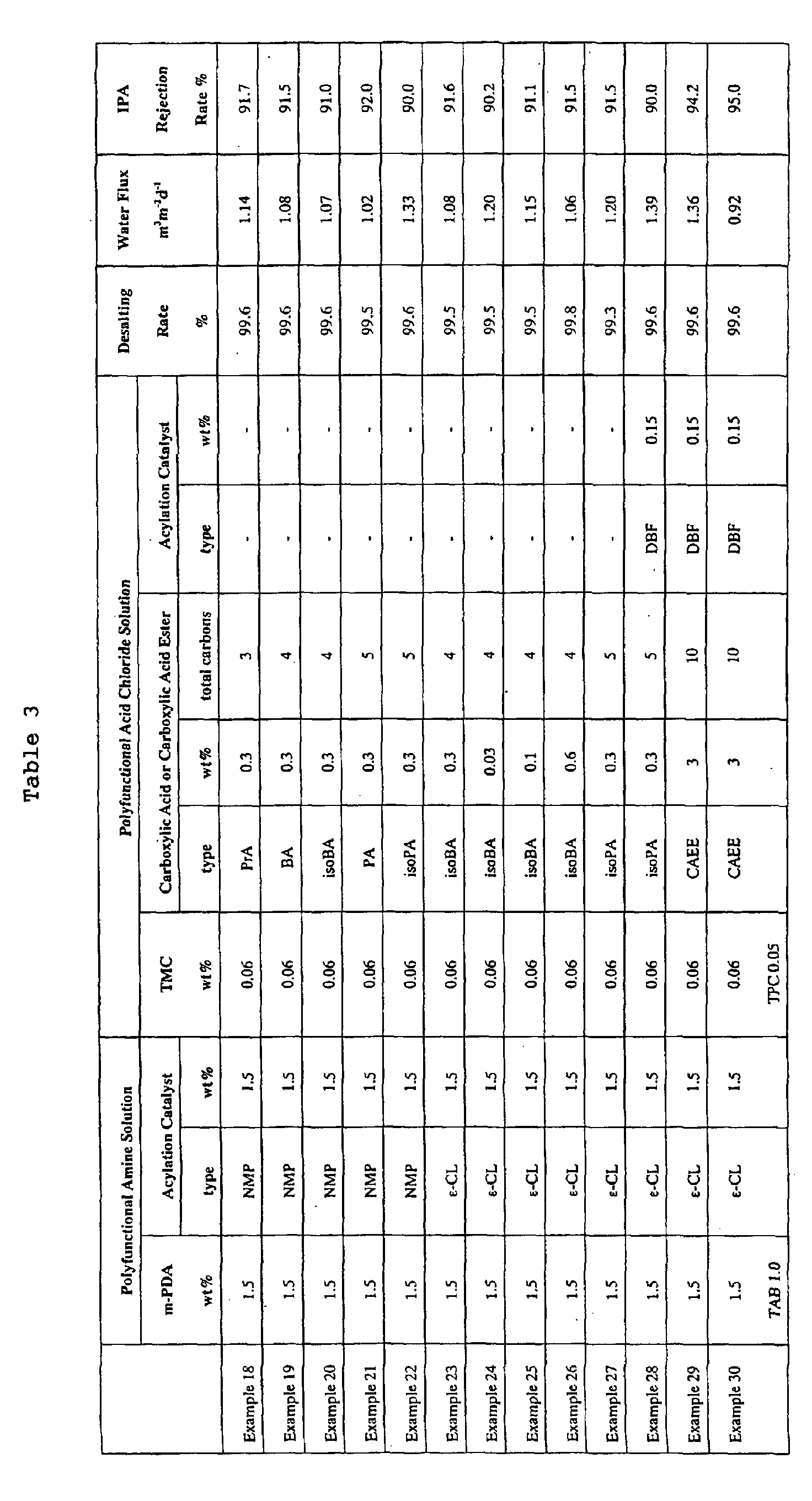
- a composite semipermeable membrane was obtained in the same way as in Example 4 except that the CAEE was changed to 0.3 wt% of propionic acid (abbreviated below to PrA).
- the evaluation results are shown in Table 3.
- a composite semipermeable membrane was obtained in the same way as in Example 4 except that the CAEE was changed to 0.3 wt% of butyric acid (abbreviated below to BA).
- the evaluation results are shown in Table 3.
- a composite semipermeable membrane was obtained in the same way as in Example 4 except that the CAEE was changed to 0.3 wt% of isobutyric acid (abbreviated below to isoBA).
- the evaluation results are shown in Table 3.
- a composite semipermeable membrane was obtained in the same way as in Example 4 except that the CAEE was changed to 0.3 wt% of valeric acid (abbreviated below to PA).
- the evaluation results are shown in Table 3.
- a composite semipermeable membrane was obtained in the same way as in Example 4 except that the CAEE was changed to 0.3 wt% of isovaleric acid (abbreviated below to isoPA).
- the evaluation results are shown in Table 3.
- a composite semipermeable membrane was obtained in the same way as in Example 20 except that the catalyst in Example 20 was changed from NMP to ⁇ -CL.
- the evaluation results are shown in Table 3.
- a composite semipermeable membrane was obtained in the same way as in Example 23 except that the concentration of the isobutyric acid in Example 23 was changed from 0.3 wt% to 0.03 wt%.
- the evaluation results are shown in Table 3.
- a composite semipermeable membrane was obtained in the same way as in Example 23 except that the concentration of isobutyric acid in Example 23 was changed from 0.3 wt% to 0.1 wt%.
- the evaluation results are shown in Table 3.
- a composite semipermeable membrane was obtained in the same way as in Example 23 except that the concentration of isobutyric acid in Example 23 was changed from 0.3 wt% to 0.6 wt%.
- the evaluation results are shown in Table 3.
- a composite semipermeable membrane was obtained in the same way as in Example 22 except that the catalyst in Example 22 was changed from NMP to ⁇ -CL.
- the evaluation results are shown in Table 3.
- a composite semipermeable membrane was obtained in the same way as in Example 22 except that the catalyst in Example 22 was changed from NMP to ⁇ -CL and 0.15% of DBF was also added to the polyfunctional acid chloride solution.
- the evaluation results are shown in Table 3.
- a composite semipermeable membrane was obtained in the same way as in Example 6 except that the catalyst in Example 6 was changed from NMP to ⁇ -CL and the BPMU was changed to DBF.
- the evaluation results are shown in Table 3.
- a composite semipermeable membrane was obtained in the same way as in Example 29 except that as the polyfunctional amine in Example 29 there was further added 1 wt% of 1,3,5-triaminobenzene (abbreviated below to TAB) and as the polyfunctional acid chloride there was further added 0.05 wt% of terephthaloyl chloride (abbreviated below to TPC).
- TAB 1,3,5-triaminobenzene
- TPC terephthaloyl chloride
- a composite semipermeable membrane was obtained in the same way as in Example 1 except that no CAEE was added.
- the evaluation results are shown in Table 4.
- a composite semipermeable membrane was obtained in the same way as in Example 4 except that no CAEE was added. The evaluation results are shown in Table 4.
- a composite semipermeable membrane was obtained in the same way as in Example 7 except that instead of the CAEE there was used propionic acid isobutyl ester (abbreviated below to PrAIBuE).
- PrAIBuE propionic acid isobutyl ester
- a composite semipermeable membrane was obtained in the same way as in Example 7 except that instead of the CAEE there was used 2-butanone (referred to below 2-BuCO). The evaluation results are shown in Table 4.
- a composite semipermeable membrane was obtained in the same way as in Example 30 except that no ⁇ -caprolactam, caprylic acid ethyl ester or dibutylformamide were added.
- the evaluation results are shown in Table 4.
- the water flux which is an index of permeability, is raised compared to systems where no addition was made. Furthermore, by a combination of carboxylic acid ester and acylation catalyst, the water flux is further raised.
Landscapes
- Chemical & Material Sciences (AREA)
- Chemical Kinetics & Catalysis (AREA)
- Separation Using Semi-Permeable Membranes (AREA)
Abstract
Description



Claims (13)
- A method of producing a composite semipermeable membrane which is characterized in that a separating functional layer containing crosslinked polyamide is formed in the presence of 1) carboxylic acid ester with a total of 8 or more carbons, or 2) carboxylic acid.
- A method of producing a composite semipermeable membrane according to Claim 1 which is characterized in that the separating functional layer containing crosslinked polyamide is formed in the presence additionally of acylation catalyst.
- A method of producing a composite semipermeable membrane according to Claim 2 which is characterized in that there are present two or more types of acylation catalyst.
- A method of producing a composite semipermeable membrane according to Claim 2 which is characterized in that, when forming the separating functional layer containing crosslinked polyamide by means of interfacial polycondensation by bringing into contact, on a porous substrate, an aqueous solution containing polyfunctional amine and a solution of polyfunctional acid chloride in an organic solvent which is immiscible with water, the acylation catalyst is included in the aforesaid aqueous solution.
- A method of producing a composite semipermeable membrane according to Claim 1 where the carboxylic acid ester with a total of 8 or more carbons is an aliphatic carboxylic acid ester with a total of 8 to 20 carbons.
- A method of producing a composite semipermeable membrane according to Claim 1 where the carboxylic acid is a carboxylic acid of boiling point no more than 240°C.
- A method of producing a composite semipermeable membrane according to Claim 2 which is characterized in that the acylation catalyst is at least one type of compound selected from the group comprising (1) to (4) below.(1) N-alkylamides or N,N-dialkylamides having an alkyl group with 3 or more carbons as a substituent group on the nitrogen atom.(2) Cyclic alkylamides or N-alkyl cyclic alkylamides having a cyclic structure with 5 or more carbons.(3) N,N,N',N'-tetraalkylureas having alkyl groups as substituent groups on the nitrogen atoms.(4) Alkylene ureas with a cyclic structure which includes an alkylene chain with 3 or more carbons.
- A method of producing a composite semipermeable membrane according to Claim 1 which is characterized in that the crosslinked polyamide is a crosslinked aromatic polyamide.
- A composite semipermeable membrane which is characterized in that it is produced by the method according to Claim 1.
- An element which is characterized in that it is constructed using a composite semipermeable membrane according to Claim 9.
- Equipment characterized in that it employs an element according to Claim 10, or plant employing same.
- A water treatment method which is characterized in that there is employed the equipment, or plant employing same, according to Claim 11.
- A water treatment method according to Claim 12 which is characterized in that the operating pressure is in the range 0.1 MPa to 3.0 MPa.
Applications Claiming Priority (1)
| Application Number | Priority Date | Filing Date | Title |
|---|---|---|---|
| PCT/JP1999/005300 WO2001023077A1 (en) | 1999-09-28 | 1999-09-28 | Process for producing composite semipermeable membrane |
Publications (3)
| Publication Number | Publication Date |
|---|---|
| EP1157734A1 true EP1157734A1 (en) | 2001-11-28 |
| EP1157734A4 EP1157734A4 (en) | 2004-04-28 |
| EP1157734B1 EP1157734B1 (en) | 2009-06-10 |
Family
ID=14236830
Family Applications (1)
| Application Number | Title | Priority Date | Filing Date |
|---|---|---|---|
| EP99944875A Expired - Lifetime EP1157734B1 (en) | 1999-09-28 | 1999-09-28 | Process for producing composite semipermeable membrane |
Country Status (7)
| Country | Link |
|---|---|
| US (1) | US6521130B1 (en) |
| EP (1) | EP1157734B1 (en) |
| KR (1) | KR100614176B1 (en) |
| CN (1) | CN1195576C (en) |
| AT (1) | ATE433342T1 (en) |
| DE (1) | DE69940981D1 (en) |
| WO (1) | WO2001023077A1 (en) |
Cited By (2)
| Publication number | Priority date | Publication date | Assignee | Title |
|---|---|---|---|---|
| WO2006051888A1 (en) * | 2004-11-15 | 2006-05-18 | Toray Industries, Inc. | Composite semipermeable membrane, production process thereof, and element, fluid separation equipment and treatment method for boron-containing water using the same |
| EP3578249A4 (en) * | 2017-01-31 | 2020-10-14 | Toray Industries, Inc. | SEMIPERMEABLE COMPOSITE MEMBRANE AND METHOD FOR PRODUCING A SEMIPERMEABLE COMPOSITE MEMBRANE |
Families Citing this family (38)
| Publication number | Priority date | Publication date | Assignee | Title |
|---|---|---|---|---|
| WO2004078328A1 (en) * | 2003-03-03 | 2004-09-16 | General Electric Company | Process for preparing semipermeable membranes |
| ATE457822T1 (en) * | 2003-06-02 | 2010-03-15 | Ge Osmonics Inc | MATERIALS FOR PROCESSING NON-AQUEOUS MIXTURES AND METHOD FOR THE PRODUCTION THEREOF |
| DK1635933T3 (en) * | 2003-06-02 | 2011-06-20 | Ge Osmonics Inc | Materials and Methods for Processing Non-Aqueous Mixtures |
| WO2005094439A2 (en) * | 2004-03-23 | 2005-10-13 | The Clorox Company | Method for diluting hypochlorite |
| DE102004045848B3 (en) * | 2004-09-20 | 2006-05-11 | Gkss-Forschungszentrum Geesthacht Gmbh | Process for producing hollow fiber membranes |
| US7727434B2 (en) * | 2005-08-16 | 2010-06-01 | General Electric Company | Membranes and methods of treating membranes |
| US7537697B2 (en) * | 2006-02-01 | 2009-05-26 | Woongjin Chemical Co., Ltd. | Selective membrane having a high fouling resistance |
| KR101479385B1 (en) * | 2010-02-16 | 2015-01-05 | 닛토덴코 가부시키가이샤 | Composite separation membrane and separation membrane element using same |
| US20130287944A1 (en) | 2011-01-24 | 2013-10-31 | Dow Global Technologies Llc | Composite polyamide membrane |
| KR101920191B1 (en) | 2011-01-24 | 2018-11-20 | 다우 글로벌 테크놀로지스 엘엘씨 | Composite polyamide membrane |
| WO2012102944A1 (en) | 2011-01-24 | 2012-08-02 | Dow Global Technologies Llc | Composite polyamide membrane |
| US9399196B2 (en) | 2011-08-31 | 2016-07-26 | Dow Global Technologies Llc | Composite polyamide membrane derived from monomer including amine-reactive and phosphorous-containing functional groups |
| CN103889563B (en) | 2011-09-29 | 2017-03-29 | 陶氏环球技术有限责任公司 | Composite polyamide membranes derived from carboxylic acid-containing acyl halide monomers |
| US9029600B2 (en) | 2011-09-29 | 2015-05-12 | Dow Global Technologies Llc | Method for preparing high purity mono-hydrolyzed acyl halide compound |
| EP2776146B1 (en) | 2012-01-06 | 2020-05-13 | DDP Specialty Electronic Materials US, Inc. | Method of preparation of a composite polyamide membrane |
| CN102512982B (en) * | 2012-01-11 | 2013-11-13 | 浙江理工大学 | Antibacterial oxidation-resistant composite reverse osmosis membrane |
| WO2014014669A1 (en) | 2012-07-19 | 2014-01-23 | Dow Global Technologies Llc | Composite polyamide membrane with improved structure |
| WO2014012240A1 (en) * | 2012-07-20 | 2014-01-23 | Rhodia Operations | Novel polyamide, preparation process therefor and uses thereof |
| EP2916936A1 (en) * | 2012-11-12 | 2015-09-16 | Nagare Membranes, LLC | Methods for reducing ion exchange and reverse salt flux phenomena in membranes for osmotically driven membrane processes |
| US9895666B2 (en) | 2013-01-14 | 2018-02-20 | Dow Global Technologies Llc | Composite polyamide membrane made using substituted benzamide monomer |
| WO2014109946A1 (en) | 2013-01-14 | 2014-07-17 | Dow Global Technologies Llc | Composite polyamide membrane |
| US9289729B2 (en) | 2013-03-16 | 2016-03-22 | Dow Global Technologies Llc | Composite polyamide membrane derived from carboxylic acid containing acyl halide monomer |
| US9051417B2 (en) | 2013-03-16 | 2015-06-09 | Dow Global Technologies Llc | Method for solubilizing carboxylic acid-containing compound in hydrocarbon solvent |
| US9051227B2 (en) | 2013-03-16 | 2015-06-09 | Dow Global Technologies Llc | In-situ method for preparing hydrolyzed acyl halide compound |
| WO2014179024A1 (en) | 2013-05-03 | 2014-11-06 | Dow Global Technologies Llc | Composite polyamide membrane derived from an aliphatic acyclic tertiary amine compound |
| JP6577468B2 (en) | 2013-12-02 | 2019-09-18 | ダウ グローバル テクノロジーズ エルエルシー | Composite polyamide membrane post-treated with nitrous acid |
| CN106170333B (en) | 2013-12-02 | 2019-02-15 | 陶氏环球技术有限责任公司 | Composite polyamide membranes treated with dihydroxyaryl compounds and nitrous acid |
| CN103657454B (en) * | 2013-12-17 | 2015-12-30 | 北京碧水源膜科技有限公司 | A kind of preparation method of novel polyamide reverse osmosis membrane |
| JP6535010B2 (en) | 2014-01-09 | 2019-06-26 | ダウ グローバル テクノロジーズ エルエルシー | Composite polyamide film with preferred azo content |
| US9981227B2 (en) | 2014-01-09 | 2018-05-29 | Dow Global Technologies Llc | Composite polyamide membrane having azo content and high acid content |
| EP3092061B1 (en) | 2014-01-09 | 2020-02-05 | Dow Global Technologies LLC | Composite polyamide membrane having high acid content and low azo content |
| US9776141B2 (en) | 2014-04-28 | 2017-10-03 | Dow Global Technologies Llc | Composite polyamide membrane post-treated with nitrous acid |
| KR102359211B1 (en) | 2014-05-14 | 2022-02-07 | 다우 글로벌 테크놀로지스 엘엘씨 | Composite polyamide membrane post-treated with nitrous acid |
| CN105983147A (en) * | 2015-01-28 | 2016-10-05 | 王寿梅 | Hemodialysis filter for nephrology department |
| WO2018112781A1 (en) * | 2016-12-21 | 2018-06-28 | Honeywell International Inc. | Reverse osmosis membrane and method of processing the same |
| CN108503001B (en) * | 2018-04-09 | 2020-10-27 | 安徽金兄弟环保科技股份有限公司 | Novel water pollution remediation agent and preparation method thereof |
| EP4732938A3 (en) * | 2018-04-30 | 2026-07-22 | Entegris, Inc. | Polyamide coated filter membrane, filters, and methods |
| CN121288562B (en) * | 2025-11-17 | 2026-06-19 | 沃顿科技股份有限公司 | High-permeability and selective reverse osmosis membrane and preparation method thereof |
Family Cites Families (19)
| Publication number | Priority date | Publication date | Assignee | Title |
|---|---|---|---|---|
| US3904519A (en) * | 1971-10-19 | 1975-09-09 | Us Interior | Reverse osmosis process using crosslinked aromatic polyamide membranes |
| DE2751910B2 (en) * | 1977-11-21 | 1979-09-20 | Hoechst Ag, 6000 Frankfurt | Permselective, asymmetric hemofiltration membrane with heteroporous structure |
| US4277344A (en) * | 1979-02-22 | 1981-07-07 | Filmtec Corporation | Interfacially synthesized reverse osmosis membrane |
| IL70415A (en) * | 1982-12-27 | 1987-07-31 | Aligena Ag | Semipermeable encapsulated membranes,their manufacture and their use |
| US4885091A (en) * | 1984-12-26 | 1989-12-05 | Allied-Signal Inc. | Process for the preparation of chlorine-resistant semipermeable membranes |
| US4761234A (en) * | 1985-08-05 | 1988-08-02 | Toray Industries, Inc. | Interfacially synthesized reverse osmosis membrane |
| US4812238A (en) * | 1987-01-15 | 1989-03-14 | The Dow Chemical Company | Membranes prepared via reaction of diazonium compounds or precursors |
| US4888116A (en) * | 1987-01-15 | 1989-12-19 | The Dow Chemical Company | Method of improving membrane properties via reaction of diazonium compounds or precursors |
| JPH01180208A (en) * | 1988-01-11 | 1989-07-18 | Toray Ind Inc | Production of compound semipermeable membrane |
| EP0432358A1 (en) * | 1989-12-13 | 1991-06-19 | Filmtec Corporation | Treated composite polyamide membranes to separate concentrated solute |
| US4960517A (en) * | 1989-12-13 | 1990-10-02 | Filmtec Corporation | Treatment of composite polyamide membranes via substitution with amine reactive reagents |
| US5258203A (en) * | 1991-02-04 | 1993-11-02 | E. I. Du Pont De Nemours And Company | Process for the manufacture of thin film composite membranes |
| JPH0726023A (en) * | 1993-07-14 | 1995-01-27 | Furukawa Electric Co Ltd:The | Method for producing organic polymer thin film |
| US5582725A (en) * | 1995-05-19 | 1996-12-10 | Bend Research, Inc. | Chlorine-resistant composite membranes with high organic rejection |
| JPH103395A (en) * | 1996-06-14 | 1998-01-06 | Hitachi Ltd | Computer resource usage information collection method |
| JP3587937B2 (en) * | 1996-07-26 | 2004-11-10 | 日東電工株式会社 | Treatment method using composite reverse osmosis membrane |
| JP3849263B2 (en) * | 1996-12-27 | 2006-11-22 | 東レ株式会社 | Composite semipermeable membrane and method for producing the same |
| US5922203A (en) * | 1997-10-07 | 1999-07-13 | Hydranautics | Amine monomers and their use in preparing interfacially synthesized membranes for reverse osmosis and nanofiltration |
| JP3647620B2 (en) * | 1997-11-07 | 2005-05-18 | 日東電工株式会社 | Method for treating highly permeable composite reverse osmosis membrane and highly permeable composite reverse osmosis membrane |
-
1999
- 1999-09-28 WO PCT/JP1999/005300 patent/WO2001023077A1/en not_active Ceased
- 1999-09-28 AT AT99944875T patent/ATE433342T1/en not_active IP Right Cessation
- 1999-09-28 CN CNB998137626A patent/CN1195576C/en not_active Expired - Fee Related
- 1999-09-28 KR KR1020017006607A patent/KR100614176B1/en not_active Expired - Fee Related
- 1999-09-28 DE DE69940981T patent/DE69940981D1/en not_active Expired - Lifetime
- 1999-09-28 US US09/856,711 patent/US6521130B1/en not_active Expired - Fee Related
- 1999-09-28 EP EP99944875A patent/EP1157734B1/en not_active Expired - Lifetime
Cited By (3)
| Publication number | Priority date | Publication date | Assignee | Title |
|---|---|---|---|---|
| WO2006051888A1 (en) * | 2004-11-15 | 2006-05-18 | Toray Industries, Inc. | Composite semipermeable membrane, production process thereof, and element, fluid separation equipment and treatment method for boron-containing water using the same |
| US7641054B2 (en) | 2004-11-15 | 2010-01-05 | Toray Industries, Inc. | Composite semipermeable membrane, production process thereof, and element, fluid separation equipment and treatment method for boron-containing water using the same |
| EP3578249A4 (en) * | 2017-01-31 | 2020-10-14 | Toray Industries, Inc. | SEMIPERMEABLE COMPOSITE MEMBRANE AND METHOD FOR PRODUCING A SEMIPERMEABLE COMPOSITE MEMBRANE |
Also Published As
| Publication number | Publication date |
|---|---|
| KR100614176B1 (en) | 2006-08-21 |
| EP1157734B1 (en) | 2009-06-10 |
| KR20010107986A (en) | 2001-12-07 |
| US6521130B1 (en) | 2003-02-18 |
| WO2001023077A1 (en) | 2001-04-05 |
| CN1328483A (en) | 2001-12-26 |
| CN1195576C (en) | 2005-04-06 |
| ATE433342T1 (en) | 2009-06-15 |
| DE69940981D1 (en) | 2009-07-23 |
| EP1157734A4 (en) | 2004-04-28 |
Similar Documents
| Publication | Publication Date | Title |
|---|---|---|
| US6521130B1 (en) | Process for producing composite semipermeable membrane | |
| US4830885A (en) | Chlorine-resistant semipermeable membranes | |
| CN108348869B (en) | Composite semipermeable membrane and method for producing same | |
| JP4284767B2 (en) | Composite semipermeable membrane, water production method using the same, and fluid separation element | |
| JP2001179061A (en) | Composite semipermeable membrane and method for producing the same | |
| JP2001286741A (en) | Reverse osmosis composite membrane and method for producing the same | |
| WO2021085600A1 (en) | Composite semipermeable membrane and manufacturing method therefor | |
| US20250352957A1 (en) | Composite semipermeable membrane and method for producing same | |
| JP2001327840A (en) | Composite semipermeable membrane and method for producing the same | |
| EP1806174B1 (en) | Process for producing semipermeable composite membrane | |
| JP5030192B2 (en) | Manufacturing method of composite semipermeable membrane | |
| JP3985387B2 (en) | Method for producing composite semipermeable membrane | |
| JP3646362B2 (en) | Semipermeable membrane and method for producing the same | |
| JP2023177791A (en) | Ultrapure water production method | |
| JP3849263B2 (en) | Composite semipermeable membrane and method for producing the same | |
| JP2000117076A (en) | Composite semipermeable membrane and method for producing the same | |
| JP2014065003A (en) | Composite semipermeable membrane and water production | |
| WO2024162434A1 (en) | Composite semipermeable membrane, composite semipermeable membrane module, fluid separation device, and method for producing composite semipermeable membrane | |
| JP3829501B2 (en) | Composite semipermeable membrane and method for producing the same | |
| EP0465649B1 (en) | Composite semipermeable membrane and production thereof | |
| JPH07284639A (en) | Method for producing composite hollow fiber membrane | |
| JP3536501B2 (en) | Method and apparatus for producing composite semipermeable membrane | |
| JP4923913B2 (en) | Composite semipermeable membrane and method for producing the same | |
| JP2003200027A (en) | Method for producing composite semipermeable membrane | |
| JPH09187631A (en) | Method and apparatus for producing composite reverse osmosis membrane |
Legal Events
| Date | Code | Title | Description |
|---|---|---|---|
| PUAI | Public reference made under article 153(3) epc to a published international application that has entered the european phase |
Free format text: ORIGINAL CODE: 0009012 |
|
| 17P | Request for examination filed |
Effective date: 20010620 |
|
| AK | Designated contracting states |
Kind code of ref document: A1 Designated state(s): AT BE CH CY DE DK ES FI FR GB GR IE IT LI LU MC NL PT SE |
|
| A4 | Supplementary search report drawn up and despatched |
Effective date: 20040311 |
|
| GRAP | Despatch of communication of intention to grant a patent |
Free format text: ORIGINAL CODE: EPIDOSNIGR1 |
|
| GRAS | Grant fee paid |
Free format text: ORIGINAL CODE: EPIDOSNIGR3 |
|
| GRAA | (expected) grant |
Free format text: ORIGINAL CODE: 0009210 |
|
| AK | Designated contracting states |
Kind code of ref document: B1 Designated state(s): AT BE CH CY DE DK ES FI FR GB GR IE IT LI LU MC NL PT SE |
|
| REG | Reference to a national code |
Ref country code: GB Ref legal event code: FG4D |
|
| REG | Reference to a national code |
Ref country code: CH Ref legal event code: EP |
|
| REG | Reference to a national code |
Ref country code: IE Ref legal event code: FG4D |
|
| REF | Corresponds to: |
Ref document number: 69940981 Country of ref document: DE Date of ref document: 20090723 Kind code of ref document: P |
|
| PG25 | Lapsed in a contracting state [announced via postgrant information from national office to epo] |
Ref country code: FI Free format text: LAPSE BECAUSE OF FAILURE TO SUBMIT A TRANSLATION OF THE DESCRIPTION OR TO PAY THE FEE WITHIN THE PRESCRIBED TIME-LIMIT Effective date: 20090610 Ref country code: AT Free format text: LAPSE BECAUSE OF FAILURE TO SUBMIT A TRANSLATION OF THE DESCRIPTION OR TO PAY THE FEE WITHIN THE PRESCRIBED TIME-LIMIT Effective date: 20090610 |
|
| NLV1 | Nl: lapsed or annulled due to failure to fulfill the requirements of art. 29p and 29m of the patents act | ||
| PG25 | Lapsed in a contracting state [announced via postgrant information from national office to epo] |
Ref country code: SE Free format text: LAPSE BECAUSE OF FAILURE TO SUBMIT A TRANSLATION OF THE DESCRIPTION OR TO PAY THE FEE WITHIN THE PRESCRIBED TIME-LIMIT Effective date: 20090910 Ref country code: NL Free format text: LAPSE BECAUSE OF FAILURE TO SUBMIT A TRANSLATION OF THE DESCRIPTION OR TO PAY THE FEE WITHIN THE PRESCRIBED TIME-LIMIT Effective date: 20090610 |
|
| PG25 | Lapsed in a contracting state [announced via postgrant information from national office to epo] |
Ref country code: ES Free format text: LAPSE BECAUSE OF FAILURE TO SUBMIT A TRANSLATION OF THE DESCRIPTION OR TO PAY THE FEE WITHIN THE PRESCRIBED TIME-LIMIT Effective date: 20090921 |
|
| PG25 | Lapsed in a contracting state [announced via postgrant information from national office to epo] |
Ref country code: BE Free format text: LAPSE BECAUSE OF FAILURE TO SUBMIT A TRANSLATION OF THE DESCRIPTION OR TO PAY THE FEE WITHIN THE PRESCRIBED TIME-LIMIT Effective date: 20090610 |
|
| PG25 | Lapsed in a contracting state [announced via postgrant information from national office to epo] |
Ref country code: PT Free format text: LAPSE BECAUSE OF FAILURE TO SUBMIT A TRANSLATION OF THE DESCRIPTION OR TO PAY THE FEE WITHIN THE PRESCRIBED TIME-LIMIT Effective date: 20091010 |
|
| PLBE | No opposition filed within time limit |
Free format text: ORIGINAL CODE: 0009261 |
|
| STAA | Information on the status of an ep patent application or granted ep patent |
Free format text: STATUS: NO OPPOSITION FILED WITHIN TIME LIMIT |
|
| PG25 | Lapsed in a contracting state [announced via postgrant information from national office to epo] |
Ref country code: MC Free format text: LAPSE BECAUSE OF NON-PAYMENT OF DUE FEES Effective date: 20090930 Ref country code: DK Free format text: LAPSE BECAUSE OF FAILURE TO SUBMIT A TRANSLATION OF THE DESCRIPTION OR TO PAY THE FEE WITHIN THE PRESCRIBED TIME-LIMIT Effective date: 20090610 |
|
| REG | Reference to a national code |
Ref country code: CH Ref legal event code: PL |
|
| 26N | No opposition filed |
Effective date: 20100311 |
|
| PG25 | Lapsed in a contracting state [announced via postgrant information from national office to epo] |
Ref country code: IE Free format text: LAPSE BECAUSE OF NON-PAYMENT OF DUE FEES Effective date: 20090928 |
|
| PG25 | Lapsed in a contracting state [announced via postgrant information from national office to epo] |
Ref country code: LI Free format text: LAPSE BECAUSE OF NON-PAYMENT OF DUE FEES Effective date: 20090930 Ref country code: GR Free format text: LAPSE BECAUSE OF FAILURE TO SUBMIT A TRANSLATION OF THE DESCRIPTION OR TO PAY THE FEE WITHIN THE PRESCRIBED TIME-LIMIT Effective date: 20090911 Ref country code: CH Free format text: LAPSE BECAUSE OF NON-PAYMENT OF DUE FEES Effective date: 20090930 |
|
| PGFP | Annual fee paid to national office [announced via postgrant information from national office to epo] |
Ref country code: FR Payment date: 20100921 Year of fee payment: 12 |
|
| PGFP | Annual fee paid to national office [announced via postgrant information from national office to epo] |
Ref country code: GB Payment date: 20100922 Year of fee payment: 12 |
|
| PGFP | Annual fee paid to national office [announced via postgrant information from national office to epo] |
Ref country code: DE Payment date: 20100922 Year of fee payment: 12 |
|
| PG25 | Lapsed in a contracting state [announced via postgrant information from national office to epo] |
Ref country code: IT Free format text: LAPSE BECAUSE OF FAILURE TO SUBMIT A TRANSLATION OF THE DESCRIPTION OR TO PAY THE FEE WITHIN THE PRESCRIBED TIME-LIMIT Effective date: 20090610 |
|
| PG25 | Lapsed in a contracting state [announced via postgrant information from national office to epo] |
Ref country code: LU Free format text: LAPSE BECAUSE OF NON-PAYMENT OF DUE FEES Effective date: 20090928 |
|
| PG25 | Lapsed in a contracting state [announced via postgrant information from national office to epo] |
Ref country code: CY Free format text: LAPSE BECAUSE OF FAILURE TO SUBMIT A TRANSLATION OF THE DESCRIPTION OR TO PAY THE FEE WITHIN THE PRESCRIBED TIME-LIMIT Effective date: 20090610 |
|
| GBPC | Gb: european patent ceased through non-payment of renewal fee |
Effective date: 20110928 |
|
| REG | Reference to a national code |
Ref country code: FR Ref legal event code: ST Effective date: 20120531 |
|
| REG | Reference to a national code |
Ref country code: DE Ref legal event code: R119 Ref document number: 69940981 Country of ref document: DE Effective date: 20120403 |
|
| PG25 | Lapsed in a contracting state [announced via postgrant information from national office to epo] |
Ref country code: DE Free format text: LAPSE BECAUSE OF NON-PAYMENT OF DUE FEES Effective date: 20120403 |
|
| PG25 | Lapsed in a contracting state [announced via postgrant information from national office to epo] |
Ref country code: FR Free format text: LAPSE BECAUSE OF NON-PAYMENT OF DUE FEES Effective date: 20110930 Ref country code: GB Free format text: LAPSE BECAUSE OF NON-PAYMENT OF DUE FEES Effective date: 20110928 |