EP1154820B1 - Breitspektrum dekontaminierung formulierung und verfahren zur deren verwendung - Google Patents
Breitspektrum dekontaminierung formulierung und verfahren zur deren verwendung Download PDFInfo
- Publication number
- EP1154820B1 EP1154820B1 EP00903467A EP00903467A EP1154820B1 EP 1154820 B1 EP1154820 B1 EP 1154820B1 EP 00903467 A EP00903467 A EP 00903467A EP 00903467 A EP00903467 A EP 00903467A EP 1154820 B1 EP1154820 B1 EP 1154820B1
- Authority
- EP
- European Patent Office
- Prior art keywords
- decontamination
- formulation
- surfactant
- buffer
- solvent
- Prior art date
- Legal status (The legal status is an assumption and is not a legal conclusion. Google has not performed a legal analysis and makes no representation as to the accuracy of the status listed.)
- Expired - Lifetime
Links
- 239000000203 mixture Substances 0.000 title claims abstract description 236
- 238000009472 formulation Methods 0.000 title claims abstract description 159
- 238000005202 decontamination Methods 0.000 title claims abstract description 136
- 230000003588 decontaminative effect Effects 0.000 title claims abstract description 125
- 238000000034 method Methods 0.000 title claims description 20
- 239000004094 surface-active agent Substances 0.000 claims abstract description 111
- 239000006184 cosolvent Substances 0.000 claims abstract description 66
- 239000000872 buffer Substances 0.000 claims abstract description 53
- XLYOFNOQVPJJNP-UHFFFAOYSA-N water Substances O XLYOFNOQVPJJNP-UHFFFAOYSA-N 0.000 claims abstract description 52
- 239000000243 solution Substances 0.000 claims abstract description 45
- 229920001451 polypropylene glycol Polymers 0.000 claims abstract description 25
- ISAOUZVKYLHALD-UHFFFAOYSA-N 1-chloro-1,3,5-triazinane-2,4,6-trione Chemical class ClN1C(=O)NC(=O)NC1=O ISAOUZVKYLHALD-UHFFFAOYSA-N 0.000 claims abstract description 19
- 239000000126 substance Substances 0.000 claims abstract description 12
- 239000004088 foaming agent Substances 0.000 claims abstract description 6
- CEJLBZWIKQJOAT-UHFFFAOYSA-N dichloroisocyanuric acid Chemical compound ClN1C(=O)NC(=O)N(Cl)C1=O CEJLBZWIKQJOAT-UHFFFAOYSA-N 0.000 claims description 55
- 125000000217 alkyl group Chemical group 0.000 claims description 34
- HEMHJVSKTPXQMS-UHFFFAOYSA-M Sodium hydroxide Chemical compound [OH-].[Na+] HEMHJVSKTPXQMS-UHFFFAOYSA-M 0.000 claims description 21
- 229910052783 alkali metal Inorganic materials 0.000 claims description 18
- 125000004432 carbon atom Chemical group C* 0.000 claims description 18
- 239000007864 aqueous solution Substances 0.000 claims description 15
- LWXVCCOAQYNXNX-UHFFFAOYSA-N lithium hypochlorite Chemical compound [Li+].Cl[O-] LWXVCCOAQYNXNX-UHFFFAOYSA-N 0.000 claims description 15
- 150000001340 alkali metals Chemical class 0.000 claims description 14
- QGZKDVFQNNGYKY-UHFFFAOYSA-O Ammonium Chemical class [NH4+] QGZKDVFQNNGYKY-UHFFFAOYSA-O 0.000 claims description 13
- -1 alkali metal salt Chemical class 0.000 claims description 13
- 229910052784 alkaline earth metal Inorganic materials 0.000 claims description 13
- 150000001412 amines Chemical class 0.000 claims description 12
- 125000002496 methyl group Chemical group [H]C([H])([H])* 0.000 claims description 12
- 150000001342 alkaline earth metals Chemical class 0.000 claims description 11
- CDBYLPFSWZWCQE-UHFFFAOYSA-L Sodium Carbonate Chemical compound [Na+].[Na+].[O-]C([O-])=O CDBYLPFSWZWCQE-UHFFFAOYSA-L 0.000 claims description 9
- CDMADVZSLOHIFP-UHFFFAOYSA-N disodium;3,7-dioxido-2,4,6,8,9-pentaoxa-1,3,5,7-tetraborabicyclo[3.3.1]nonane;decahydrate Chemical compound O.O.O.O.O.O.O.O.O.O.[Na+].[Na+].O1B([O-])OB2OB([O-])OB1O2 CDMADVZSLOHIFP-UHFFFAOYSA-N 0.000 claims description 8
- 235000010339 sodium tetraborate Nutrition 0.000 claims description 8
- 229920001223 polyethylene glycol Polymers 0.000 claims description 7
- 238000005273 aeration Methods 0.000 claims description 6
- 239000002202 Polyethylene glycol Substances 0.000 claims description 5
- 125000000484 butyl group Chemical group [H]C([*])([H])C([H])([H])C([H])([H])C([H])([H])[H] 0.000 claims description 5
- 125000004185 ester group Chemical group 0.000 claims description 5
- 125000001495 ethyl group Chemical group [H]C([H])([H])C([H])([H])* 0.000 claims description 5
- 125000001436 propyl group Chemical group [H]C([*])([H])C([H])([H])C([H])([H])[H] 0.000 claims description 5
- 125000004435 hydrogen atom Chemical group [H]* 0.000 claims description 4
- 150000003839 salts Chemical class 0.000 claims description 4
- 239000000337 buffer salt Substances 0.000 claims description 3
- 230000000593 degrading effect Effects 0.000 claims description 3
- 238000005187 foaming Methods 0.000 claims description 3
- 239000001257 hydrogen Substances 0.000 claims description 3
- 229910052739 hydrogen Inorganic materials 0.000 claims description 3
- ZFSLODLOARCGLH-UHFFFAOYSA-N isocyanuric acid Chemical compound OC1=NC(O)=NC(O)=N1 ZFSLODLOARCGLH-UHFFFAOYSA-N 0.000 claims description 3
- KEZYHIPQRGTUDU-UHFFFAOYSA-N 2-[dithiocarboxy(methyl)amino]acetic acid Chemical compound SC(=S)N(C)CC(O)=O KEZYHIPQRGTUDU-UHFFFAOYSA-N 0.000 claims description 2
- 150000002334 glycols Chemical class 0.000 claims description 2
- 239000003795 chemical substances by application Substances 0.000 abstract description 109
- 239000006260 foam Substances 0.000 abstract description 53
- 239000004480 active ingredient Substances 0.000 abstract description 46
- 230000002285 radioactive effect Effects 0.000 abstract description 19
- 238000006243 chemical reaction Methods 0.000 abstract description 18
- 230000007062 hydrolysis Effects 0.000 abstract description 18
- 238000006460 hydrolysis reaction Methods 0.000 abstract description 18
- 239000012141 concentrate Substances 0.000 abstract description 13
- 239000004615 ingredient Substances 0.000 abstract description 13
- 230000000694 effects Effects 0.000 abstract description 12
- 230000003647 oxidation Effects 0.000 abstract description 10
- 238000007254 oxidation reaction Methods 0.000 abstract description 10
- 238000000576 coating method Methods 0.000 abstract description 9
- 239000011248 coating agent Substances 0.000 abstract description 8
- 239000007853 buffer solution Substances 0.000 abstract description 5
- MUCZHBLJLSDCSD-UHFFFAOYSA-N diisopropyl fluorophosphate Chemical compound CC(C)OP(F)(=O)OC(C)C MUCZHBLJLSDCSD-UHFFFAOYSA-N 0.000 description 35
- 229960005051 fluostigmine Drugs 0.000 description 34
- WQYVRQLZKVEZGA-UHFFFAOYSA-N hypochlorite Chemical class Cl[O-] WQYVRQLZKVEZGA-UHFFFAOYSA-N 0.000 description 28
- 235000003351 Brassica cretica Nutrition 0.000 description 27
- 235000003343 Brassica rupestris Nutrition 0.000 description 27
- 235000010460 mustard Nutrition 0.000 description 27
- QKSKPIVNLNLAAV-UHFFFAOYSA-N bis(2-chloroethyl) sulfide Chemical compound ClCCSCCCl QKSKPIVNLNLAAV-UHFFFAOYSA-N 0.000 description 26
- 241000219198 Brassica Species 0.000 description 23
- IOLCXVTUBQKXJR-UHFFFAOYSA-M potassium bromide Chemical compound [K+].[Br-] IOLCXVTUBQKXJR-UHFFFAOYSA-M 0.000 description 20
- 238000012360 testing method Methods 0.000 description 14
- 231100000331 toxic Toxicity 0.000 description 12
- 230000002588 toxic effect Effects 0.000 description 12
- 239000002245 particle Substances 0.000 description 11
- 239000000047 product Substances 0.000 description 11
- 239000013043 chemical agent Substances 0.000 description 10
- 238000004895 liquid chromatography mass spectrometry Methods 0.000 description 10
- 230000005855 radiation Effects 0.000 description 10
- 239000000523 sample Substances 0.000 description 10
- 239000000460 chlorine Substances 0.000 description 9
- 239000011734 sodium Substances 0.000 description 9
- 238000004458 analytical method Methods 0.000 description 8
- 238000013459 approach Methods 0.000 description 8
- 239000007844 bleaching agent Substances 0.000 description 8
- 238000002474 experimental method Methods 0.000 description 8
- 238000002360 preparation method Methods 0.000 description 8
- 238000011109 contamination Methods 0.000 description 7
- 230000006378 damage Effects 0.000 description 7
- 238000001514 detection method Methods 0.000 description 7
- 238000004519 manufacturing process Methods 0.000 description 7
- 239000003973 paint Substances 0.000 description 7
- 239000004033 plastic Substances 0.000 description 7
- 229920003023 plastic Polymers 0.000 description 7
- 230000004044 response Effects 0.000 description 7
- 238000003860 storage Methods 0.000 description 7
- 241000193738 Bacillus anthracis Species 0.000 description 6
- JJIUCEJQJXNMHV-UHFFFAOYSA-N VX nerve agent Chemical compound CCOP(C)(=O)SCCN(C(C)C)C(C)C JJIUCEJQJXNMHV-UHFFFAOYSA-N 0.000 description 6
- 230000007423 decrease Effects 0.000 description 6
- 238000002290 gas chromatography-mass spectrometry Methods 0.000 description 6
- 239000000463 material Substances 0.000 description 6
- 229910052751 metal Inorganic materials 0.000 description 6
- 239000002184 metal Substances 0.000 description 6
- 239000013618 particulate matter Substances 0.000 description 6
- 238000005086 pumping Methods 0.000 description 6
- 239000007787 solid Substances 0.000 description 6
- ZAMOUSCENKQFHK-UHFFFAOYSA-N Chlorine atom Chemical compound [Cl] ZAMOUSCENKQFHK-UHFFFAOYSA-N 0.000 description 5
- LFQSCWFLJHTTHZ-UHFFFAOYSA-N Ethanol Chemical compound CCO LFQSCWFLJHTTHZ-UHFFFAOYSA-N 0.000 description 5
- 229910052801 chlorine Inorganic materials 0.000 description 5
- 150000001875 compounds Chemical class 0.000 description 5
- 230000007797 corrosion Effects 0.000 description 5
- 238000005260 corrosion Methods 0.000 description 5
- 238000001784 detoxification Methods 0.000 description 5
- 238000012544 monitoring process Methods 0.000 description 5
- 210000005036 nerve Anatomy 0.000 description 5
- 230000007935 neutral effect Effects 0.000 description 5
- 230000001681 protective effect Effects 0.000 description 5
- 239000013535 sea water Substances 0.000 description 5
- 229910052708 sodium Inorganic materials 0.000 description 5
- 241000219193 Brassicaceae Species 0.000 description 4
- CYTYCFOTNPOANT-UHFFFAOYSA-N Perchloroethylene Chemical group ClC(Cl)=C(Cl)Cl CYTYCFOTNPOANT-UHFFFAOYSA-N 0.000 description 4
- 230000003190 augmentative effect Effects 0.000 description 4
- 230000008901 benefit Effects 0.000 description 4
- 230000015572 biosynthetic process Effects 0.000 description 4
- 239000000356 contaminant Substances 0.000 description 4
- 238000010790 dilution Methods 0.000 description 4
- 239000012895 dilution Substances 0.000 description 4
- 239000000839 emulsion Substances 0.000 description 4
- 238000004128 high performance liquid chromatography Methods 0.000 description 4
- QWPPOHNGKGFGJK-UHFFFAOYSA-N hypochlorous acid Chemical compound ClO QWPPOHNGKGFGJK-UHFFFAOYSA-N 0.000 description 4
- 239000003112 inhibitor Substances 0.000 description 4
- 150000002500 ions Chemical class 0.000 description 4
- 239000007788 liquid Substances 0.000 description 4
- 239000007791 liquid phase Substances 0.000 description 4
- 238000006386 neutralization reaction Methods 0.000 description 4
- 231100000252 nontoxic Toxicity 0.000 description 4
- 230000003000 nontoxic effect Effects 0.000 description 4
- 230000002085 persistent effect Effects 0.000 description 4
- 230000009257 reactivity Effects 0.000 description 4
- 230000002829 reductive effect Effects 0.000 description 4
- 238000005063 solubilization Methods 0.000 description 4
- 230000007928 solubilization Effects 0.000 description 4
- 239000002904 solvent Substances 0.000 description 4
- 239000002562 thickening agent Substances 0.000 description 4
- WEVYAHXRMPXWCK-UHFFFAOYSA-N Acetonitrile Chemical compound CC#N WEVYAHXRMPXWCK-UHFFFAOYSA-N 0.000 description 3
- WDZLZBIKRZDKIE-UHFFFAOYSA-N ClN1C(N(C(C=2NC(NC1=2)=O)=O)[N+]#[C-])=O Chemical class ClN1C(N(C(C=2NC(NC1=2)=O)=O)[N+]#[C-])=O WDZLZBIKRZDKIE-UHFFFAOYSA-N 0.000 description 3
- DGAQECJNVWCQMB-PUAWFVPOSA-M Ilexoside XXIX Chemical compound C[C@@H]1CC[C@@]2(CC[C@@]3(C(=CC[C@H]4[C@]3(CC[C@@H]5[C@@]4(CC[C@@H](C5(C)C)OS(=O)(=O)[O-])C)C)[C@@H]2[C@]1(C)O)C)C(=O)O[C@H]6[C@@H]([C@H]([C@@H]([C@H](O6)CO)O)O)O.[Na+] DGAQECJNVWCQMB-PUAWFVPOSA-M 0.000 description 3
- OKKJLVBELUTLKV-UHFFFAOYSA-N Methanol Chemical compound OC OKKJLVBELUTLKV-UHFFFAOYSA-N 0.000 description 3
- DNIAPMSPPWPWGF-UHFFFAOYSA-N Propylene glycol Chemical compound CC(O)CO DNIAPMSPPWPWGF-UHFFFAOYSA-N 0.000 description 3
- 239000012736 aqueous medium Substances 0.000 description 3
- 230000003139 buffering effect Effects 0.000 description 3
- 230000003247 decreasing effect Effects 0.000 description 3
- 239000007789 gas Substances 0.000 description 3
- 231100001261 hazardous Toxicity 0.000 description 3
- 238000001819 mass spectrum Methods 0.000 description 3
- HAWPXGHAZFHHAD-UHFFFAOYSA-N mechlorethamine Chemical class ClCCN(C)CCCl HAWPXGHAZFHHAD-UHFFFAOYSA-N 0.000 description 3
- 229960004961 mechlorethamine Drugs 0.000 description 3
- 239000003958 nerve gas Substances 0.000 description 3
- 230000000269 nucleophilic effect Effects 0.000 description 3
- 239000012071 phase Substances 0.000 description 3
- 239000000843 powder Substances 0.000 description 3
- 238000005201 scrubbing Methods 0.000 description 3
- 230000003381 solubilizing effect Effects 0.000 description 3
- 241000894007 species Species 0.000 description 3
- 238000001228 spectrum Methods 0.000 description 3
- 239000007921 spray Substances 0.000 description 3
- 230000001629 suppression Effects 0.000 description 3
- YRIZYWQGELRKNT-UHFFFAOYSA-N 1,3,5-trichloro-1,3,5-triazinane-2,4,6-trione Chemical compound ClN1C(=O)N(Cl)C(=O)N(Cl)C1=O YRIZYWQGELRKNT-UHFFFAOYSA-N 0.000 description 2
- LTMRRSWNXVJMBA-UHFFFAOYSA-L 2,2-diethylpropanedioate Chemical compound CCC(CC)(C([O-])=O)C([O-])=O LTMRRSWNXVJMBA-UHFFFAOYSA-L 0.000 description 2
- XNWFRZJHXBZDAG-UHFFFAOYSA-N 2-METHOXYETHANOL Chemical compound COCCO XNWFRZJHXBZDAG-UHFFFAOYSA-N 0.000 description 2
- CMGDVUCDZOBDNL-UHFFFAOYSA-N 4-methyl-2h-benzotriazole Chemical compound CC1=CC=CC2=NNN=C12 CMGDVUCDZOBDNL-UHFFFAOYSA-N 0.000 description 2
- 241000894006 Bacteria Species 0.000 description 2
- RTZKZFJDLAIYFH-UHFFFAOYSA-N Diethyl ether Chemical compound CCOCC RTZKZFJDLAIYFH-UHFFFAOYSA-N 0.000 description 2
- LYCAIKOWRPUZTN-UHFFFAOYSA-N Ethylene glycol Chemical compound OCCO LYCAIKOWRPUZTN-UHFFFAOYSA-N 0.000 description 2
- 208000033962 Fontaine progeroid syndrome Diseases 0.000 description 2
- MHAJPDPJQMAIIY-UHFFFAOYSA-N Hydrogen peroxide Chemical compound OO MHAJPDPJQMAIIY-UHFFFAOYSA-N 0.000 description 2
- KFZMGEQAYNKOFK-UHFFFAOYSA-N Isopropanol Chemical compound CC(C)O KFZMGEQAYNKOFK-UHFFFAOYSA-N 0.000 description 2
- BPQQTUXANYXVAA-UHFFFAOYSA-N Orthosilicate Chemical compound [O-][Si]([O-])([O-])[O-] BPQQTUXANYXVAA-UHFFFAOYSA-N 0.000 description 2
- 241000700605 Viruses Species 0.000 description 2
- 238000012387 aerosolization Methods 0.000 description 2
- 125000005233 alkylalcohol group Chemical group 0.000 description 2
- XUFUCDNVOXXQQC-UHFFFAOYSA-L azane;hydroxy-(hydroxy(dioxo)molybdenio)oxy-dioxomolybdenum Chemical compound N.N.O[Mo](=O)(=O)O[Mo](O)(=O)=O XUFUCDNVOXXQQC-UHFFFAOYSA-L 0.000 description 2
- 230000015556 catabolic process Effects 0.000 description 2
- 210000004027 cell Anatomy 0.000 description 2
- 238000006731 degradation reaction Methods 0.000 description 2
- 230000001419 dependent effect Effects 0.000 description 2
- 229940028356 diethylene glycol monobutyl ether Drugs 0.000 description 2
- 230000008034 disappearance Effects 0.000 description 2
- 238000006073 displacement reaction Methods 0.000 description 2
- 230000009977 dual effect Effects 0.000 description 2
- 238000005538 encapsulation Methods 0.000 description 2
- 230000007613 environmental effect Effects 0.000 description 2
- 239000010797 grey water Substances 0.000 description 2
- JGJLWPGRMCADHB-UHFFFAOYSA-N hypobromite Chemical compound Br[O-] JGJLWPGRMCADHB-UHFFFAOYSA-N 0.000 description 2
- 230000000977 initiatory effect Effects 0.000 description 2
- 230000007774 longterm Effects 0.000 description 2
- 150000002739 metals Chemical class 0.000 description 2
- 238000002156 mixing Methods 0.000 description 2
- 210000004400 mucous membrane Anatomy 0.000 description 2
- JCGNDDUYTRNOFT-UHFFFAOYSA-N oxolane-2,4-dione Chemical compound O=C1COC(=O)C1 JCGNDDUYTRNOFT-UHFFFAOYSA-N 0.000 description 2
- 230000008569 process Effects 0.000 description 2
- 238000010791 quenching Methods 0.000 description 2
- 239000000376 reactant Substances 0.000 description 2
- 230000035484 reaction time Effects 0.000 description 2
- 238000005070 sampling Methods 0.000 description 2
- 159000000000 sodium salts Chemical class 0.000 description 2
- HQAITFAUVZBHNB-UHFFFAOYSA-N sodium;pentahydrate Chemical compound O.O.O.O.O.[Na] HQAITFAUVZBHNB-UHFFFAOYSA-N 0.000 description 2
- 238000010183 spectrum analysis Methods 0.000 description 2
- 238000003756 stirring Methods 0.000 description 2
- 239000011550 stock solution Substances 0.000 description 2
- BDHFUVZGWQCTTF-UHFFFAOYSA-M sulfonate Chemical compound [O-]S(=O)=O BDHFUVZGWQCTTF-UHFFFAOYSA-M 0.000 description 2
- 239000000725 suspension Substances 0.000 description 2
- 229950009390 symclosene Drugs 0.000 description 2
- 239000008399 tap water Substances 0.000 description 2
- 235000020679 tap water Nutrition 0.000 description 2
- 239000004711 α-olefin Substances 0.000 description 2
- LYCAIKOWRPUZTN-NMQOAUCRSA-N 1,2-dideuteriooxyethane Chemical compound [2H]OCCO[2H] LYCAIKOWRPUZTN-NMQOAUCRSA-N 0.000 description 1
- UNWRHVZXVVTASG-UHFFFAOYSA-N 1,3-dichloro-1,3,5-triazinane-2,4,6-trione;sodium Chemical compound [Na].ClN1C(=O)NC(=O)N(Cl)C1=O UNWRHVZXVVTASG-UHFFFAOYSA-N 0.000 description 1
- IVTOWMZAZSBKOT-UHFFFAOYSA-N 3-[methoxy(methyl)phosphoryl]oxy-2,2-dimethylbutane Chemical compound COP(C)(=O)OC(C)C(C)(C)C IVTOWMZAZSBKOT-UHFFFAOYSA-N 0.000 description 1
- 102000012440 Acetylcholinesterase Human genes 0.000 description 1
- 108010022752 Acetylcholinesterase Proteins 0.000 description 1
- QGZKDVFQNNGYKY-UHFFFAOYSA-N Ammonia Chemical group N QGZKDVFQNNGYKY-UHFFFAOYSA-N 0.000 description 1
- 102000006996 Aryldialkylphosphatase Human genes 0.000 description 1
- 108010008184 Aryldialkylphosphatase Proteins 0.000 description 1
- CPELXLSAUQHCOX-UHFFFAOYSA-M Bromide Chemical compound [Br-] CPELXLSAUQHCOX-UHFFFAOYSA-M 0.000 description 1
- MOMZHAUZKIBZHI-UHFFFAOYSA-N CC(C)N(CC[S+]=P(C)(O)O)C(C)C Chemical compound CC(C)N(CC[S+]=P(C)(O)O)C(C)C MOMZHAUZKIBZHI-UHFFFAOYSA-N 0.000 description 1
- VEXZGXHMUGYJMC-UHFFFAOYSA-M Chloride anion Chemical compound [Cl-] VEXZGXHMUGYJMC-UHFFFAOYSA-M 0.000 description 1
- KZBUYRJDOAKODT-UHFFFAOYSA-N Chlorine Chemical compound ClCl KZBUYRJDOAKODT-UHFFFAOYSA-N 0.000 description 1
- 206010010904 Convulsion Diseases 0.000 description 1
- RPNUMPOLZDHAAY-UHFFFAOYSA-N Diethylenetriamine Chemical compound NCCNCCN RPNUMPOLZDHAAY-UHFFFAOYSA-N 0.000 description 1
- 102000004190 Enzymes Human genes 0.000 description 1
- 108090000790 Enzymes Proteins 0.000 description 1
- 241000233866 Fungi Species 0.000 description 1
- ICZWVCDXVPRBMM-UHFFFAOYSA-N OP(F)=O Chemical class OP(F)=O ICZWVCDXVPRBMM-UHFFFAOYSA-N 0.000 description 1
- QAOWNCQODCNURD-UHFFFAOYSA-L Sulfate Chemical compound [O-]S([O-])(=O)=O QAOWNCQODCNURD-UHFFFAOYSA-L 0.000 description 1
- PJVJTCIRVMBVIA-JTQLQIEISA-N [dimethylamino(ethoxy)phosphoryl]formonitrile Chemical compound CCO[P@@](=O)(C#N)N(C)C PJVJTCIRVMBVIA-JTQLQIEISA-N 0.000 description 1
- 238000010521 absorption reaction Methods 0.000 description 1
- 239000002253 acid Substances 0.000 description 1
- 230000002378 acidificating effect Effects 0.000 description 1
- 150000007513 acids Chemical class 0.000 description 1
- 239000000654 additive Substances 0.000 description 1
- 239000000443 aerosol Substances 0.000 description 1
- 239000003945 anionic surfactant Substances 0.000 description 1
- 239000008346 aqueous phase Substances 0.000 description 1
- 239000012298 atmosphere Substances 0.000 description 1
- JXLHNMVSKXFWAO-UHFFFAOYSA-N azane;7-fluoro-2,1,3-benzoxadiazole-4-sulfonic acid Chemical compound N.OS(=O)(=O)C1=CC=C(F)C2=NON=C12 JXLHNMVSKXFWAO-UHFFFAOYSA-N 0.000 description 1
- 229940065181 bacillus anthracis Drugs 0.000 description 1
- 239000003637 basic solution Substances 0.000 description 1
- 230000004071 biological effect Effects 0.000 description 1
- 239000006161 blood agar Substances 0.000 description 1
- CODNYICXDISAEA-UHFFFAOYSA-N bromine monochloride Chemical compound BrCl CODNYICXDISAEA-UHFFFAOYSA-N 0.000 description 1
- 239000008366 buffered solution Substances 0.000 description 1
- 239000006227 byproduct Substances 0.000 description 1
- 239000012482 calibration solution Substances 0.000 description 1
- 239000003054 catalyst Substances 0.000 description 1
- 210000000170 cell membrane Anatomy 0.000 description 1
- 210000003169 central nervous system Anatomy 0.000 description 1
- 238000012512 characterization method Methods 0.000 description 1
- 239000002575 chemical warfare agent Substances 0.000 description 1
- UHZZMRAGKVHANO-UHFFFAOYSA-M chlormequat chloride Chemical compound [Cl-].C[N+](C)(C)CCCl UHZZMRAGKVHANO-UHFFFAOYSA-M 0.000 description 1
- 230000001427 coherent effect Effects 0.000 description 1
- 230000001332 colony forming effect Effects 0.000 description 1
- 230000001010 compromised effect Effects 0.000 description 1
- 239000000470 constituent Substances 0.000 description 1
- 238000010276 construction Methods 0.000 description 1
- 230000036461 convulsion Effects 0.000 description 1
- 239000008367 deionised water Substances 0.000 description 1
- 229910021641 deionized water Inorganic materials 0.000 description 1
- 239000000645 desinfectant Substances 0.000 description 1
- 238000003795 desorption Methods 0.000 description 1
- 238000005474 detonation Methods 0.000 description 1
- GSPKZYJPUDYKPI-UHFFFAOYSA-N diethoxy sulfate Chemical compound CCOOS(=O)(=O)OOCC GSPKZYJPUDYKPI-UHFFFAOYSA-N 0.000 description 1
- 150000004683 dihydrates Chemical class 0.000 description 1
- 238000007865 diluting Methods 0.000 description 1
- 239000003085 diluting agent Substances 0.000 description 1
- PXBBFIADSJLIFB-UHFFFAOYSA-O dimethyl-[(oxo-$l^{5}-phosphanylidyne)methyl]-(2-sulfanylethyl)azanium Chemical class SCC[N+](C)(C)C#P=O PXBBFIADSJLIFB-UHFFFAOYSA-O 0.000 description 1
- 239000006185 dispersion Substances 0.000 description 1
- LQZZUXJYWNFBMV-UHFFFAOYSA-N dodecan-1-ol Chemical compound CCCCCCCCCCCCO LQZZUXJYWNFBMV-UHFFFAOYSA-N 0.000 description 1
- 238000005203 dry scrubbing Methods 0.000 description 1
- 239000000428 dust Substances 0.000 description 1
- 229920001971 elastomer Polymers 0.000 description 1
- 238000003379 elimination reaction Methods 0.000 description 1
- 229940088598 enzyme Drugs 0.000 description 1
- 230000003628 erosive effect Effects 0.000 description 1
- 150000002148 esters Chemical class 0.000 description 1
- 238000011156 evaluation Methods 0.000 description 1
- 238000001704 evaporation Methods 0.000 description 1
- 230000008020 evaporation Effects 0.000 description 1
- 239000012530 fluid Substances 0.000 description 1
- 238000011010 flushing procedure Methods 0.000 description 1
- 235000013305 food Nutrition 0.000 description 1
- 239000013505 freshwater Substances 0.000 description 1
- 238000010438 heat treatment Methods 0.000 description 1
- 230000003301 hydrolyzing effect Effects 0.000 description 1
- 150000004679 hydroxides Chemical class 0.000 description 1
- WGCNASOHLSPBMP-UHFFFAOYSA-N hydroxyacetaldehyde Natural products OCC=O WGCNASOHLSPBMP-UHFFFAOYSA-N 0.000 description 1
- 239000012535 impurity Substances 0.000 description 1
- 230000006698 induction Effects 0.000 description 1
- 238000001802 infusion Methods 0.000 description 1
- 230000005865 ionizing radiation Effects 0.000 description 1
- 239000010985 leather Substances 0.000 description 1
- 231100000518 lethal Toxicity 0.000 description 1
- 230000001665 lethal effect Effects 0.000 description 1
- GIKLTQKNOXNBNY-OWOJBTEDSA-N lewisite Chemical compound Cl\C=C\[As](Cl)Cl GIKLTQKNOXNBNY-OWOJBTEDSA-N 0.000 description 1
- 231100000053 low toxicity Toxicity 0.000 description 1
- 238000005259 measurement Methods 0.000 description 1
- 239000002609 medium Substances 0.000 description 1
- 244000005700 microbiome Species 0.000 description 1
- 238000012986 modification Methods 0.000 description 1
- 230000004048 modification Effects 0.000 description 1
- 230000009972 noncorrosive effect Effects 0.000 description 1
- JRZJOMJEPLMPRA-UHFFFAOYSA-N olefin Natural products CCCCCCCC=C JRZJOMJEPLMPRA-UHFFFAOYSA-N 0.000 description 1
- 150000002978 peroxides Chemical class 0.000 description 1
- 239000000575 pesticide Substances 0.000 description 1
- 239000013502 plastic waste Substances 0.000 description 1
- 229920002635 polyurethane Polymers 0.000 description 1
- 239000004814 polyurethane Substances 0.000 description 1
- 239000012286 potassium permanganate Substances 0.000 description 1
- 230000003389 potentiating effect Effects 0.000 description 1
- 239000002243 precursor Substances 0.000 description 1
- 230000002035 prolonged effect Effects 0.000 description 1
- 150000003856 quaternary ammonium compounds Chemical class 0.000 description 1
- 230000000171 quenching effect Effects 0.000 description 1
- 239000003247 radioactive fallout Substances 0.000 description 1
- 239000012857 radioactive material Substances 0.000 description 1
- 239000011541 reaction mixture Substances 0.000 description 1
- 238000011160 research Methods 0.000 description 1
- 230000000241 respiratory effect Effects 0.000 description 1
- 230000000979 retarding effect Effects 0.000 description 1
- 239000005060 rubber Substances 0.000 description 1
- 238000011012 sanitization Methods 0.000 description 1
- 238000000926 separation method Methods 0.000 description 1
- 239000002002 slurry Substances 0.000 description 1
- 229910000029 sodium carbonate Inorganic materials 0.000 description 1
- 229940057950 sodium laureth sulfate Drugs 0.000 description 1
- PYILKOIEIHHYGD-UHFFFAOYSA-M sodium;1,5-dichloro-4,6-dioxo-1,3,5-triazin-2-olate;dihydrate Chemical compound O.O.[Na+].[O-]C1=NC(=O)N(Cl)C(=O)N1Cl PYILKOIEIHHYGD-UHFFFAOYSA-M 0.000 description 1
- SXHLENDCVBIJFO-UHFFFAOYSA-M sodium;2-[2-(2-dodecoxyethoxy)ethoxy]ethyl sulfate Chemical compound [Na+].CCCCCCCCCCCCOCCOCCOCCOS([O-])(=O)=O SXHLENDCVBIJFO-UHFFFAOYSA-M 0.000 description 1
- 230000003595 spectral effect Effects 0.000 description 1
- 238000005507 spraying Methods 0.000 description 1
- 230000006641 stabilisation Effects 0.000 description 1
- 238000011105 stabilization Methods 0.000 description 1
- 238000006467 substitution reaction Methods 0.000 description 1
- 229910021653 sulphate ion Inorganic materials 0.000 description 1
- 230000009182 swimming Effects 0.000 description 1
- 230000002195 synergetic effect Effects 0.000 description 1
- 239000011885 synergistic combination Substances 0.000 description 1
- 230000002123 temporal effect Effects 0.000 description 1
- 230000009974 thixotropic effect Effects 0.000 description 1
- 238000012549 training Methods 0.000 description 1
- 238000012795 verification Methods 0.000 description 1
- 231100000925 very toxic Toxicity 0.000 description 1
- 238000005406 washing Methods 0.000 description 1
Images








Classifications
-
- A—HUMAN NECESSITIES
- A62—LIFE-SAVING; FIRE-FIGHTING
- A62D—CHEMICAL MEANS FOR EXTINGUISHING FIRES OR FOR COMBATING OR PROTECTING AGAINST HARMFUL CHEMICAL AGENTS; CHEMICAL MATERIALS FOR USE IN BREATHING APPARATUS
- A62D3/00—Processes for making harmful chemical substances harmless or less harmful, by effecting a chemical change in the substances
- A62D3/30—Processes for making harmful chemical substances harmless or less harmful, by effecting a chemical change in the substances by reacting with chemical agents
-
- A—HUMAN NECESSITIES
- A62—LIFE-SAVING; FIRE-FIGHTING
- A62D—CHEMICAL MEANS FOR EXTINGUISHING FIRES OR FOR COMBATING OR PROTECTING AGAINST HARMFUL CHEMICAL AGENTS; CHEMICAL MATERIALS FOR USE IN BREATHING APPARATUS
- A62D3/00—Processes for making harmful chemical substances harmless or less harmful, by effecting a chemical change in the substances
- A62D3/30—Processes for making harmful chemical substances harmless or less harmful, by effecting a chemical change in the substances by reacting with chemical agents
- A62D3/36—Detoxification by using acid or alkaline reagents
-
- C—CHEMISTRY; METALLURGY
- C11—ANIMAL OR VEGETABLE OILS, FATS, FATTY SUBSTANCES OR WAXES; FATTY ACIDS THEREFROM; DETERGENTS; CANDLES
- C11D—DETERGENT COMPOSITIONS; USE OF SINGLE SUBSTANCES AS DETERGENTS; SOAP OR SOAP-MAKING; RESIN SOAPS; RECOVERY OF GLYCEROL
- C11D17/00—Detergent materials or soaps characterised by their shape or physical properties
- C11D17/04—Detergent materials or soaps characterised by their shape or physical properties combined with or containing other objects
- C11D17/041—Compositions releasably affixed on a substrate or incorporated into a dispensing means
-
- C—CHEMISTRY; METALLURGY
- C11—ANIMAL OR VEGETABLE OILS, FATS, FATTY SUBSTANCES OR WAXES; FATTY ACIDS THEREFROM; DETERGENTS; CANDLES
- C11D—DETERGENT COMPOSITIONS; USE OF SINGLE SUBSTANCES AS DETERGENTS; SOAP OR SOAP-MAKING; RESIN SOAPS; RECOVERY OF GLYCEROL
- C11D3/00—Other compounding ingredients of detergent compositions covered in group C11D1/00
- C11D3/0005—Other compounding ingredients characterised by their effect
- C11D3/0094—High foaming compositions
-
- C—CHEMISTRY; METALLURGY
- C11—ANIMAL OR VEGETABLE OILS, FATS, FATTY SUBSTANCES OR WAXES; FATTY ACIDS THEREFROM; DETERGENTS; CANDLES
- C11D—DETERGENT COMPOSITIONS; USE OF SINGLE SUBSTANCES AS DETERGENTS; SOAP OR SOAP-MAKING; RESIN SOAPS; RECOVERY OF GLYCEROL
- C11D3/00—Other compounding ingredients of detergent compositions covered in group C11D1/00
- C11D3/16—Organic compounds
- C11D3/37—Polymers
- C11D3/3703—Macromolecular compounds obtained otherwise than by reactions only involving carbon-to-carbon unsaturated bonds
- C11D3/3707—Polyethers, e.g. polyalkyleneoxides
-
- C—CHEMISTRY; METALLURGY
- C11—ANIMAL OR VEGETABLE OILS, FATS, FATTY SUBSTANCES OR WAXES; FATTY ACIDS THEREFROM; DETERGENTS; CANDLES
- C11D—DETERGENT COMPOSITIONS; USE OF SINGLE SUBSTANCES AS DETERGENTS; SOAP OR SOAP-MAKING; RESIN SOAPS; RECOVERY OF GLYCEROL
- C11D3/00—Other compounding ingredients of detergent compositions covered in group C11D1/00
- C11D3/395—Bleaching agents
- C11D3/3956—Liquid compositions
-
- C—CHEMISTRY; METALLURGY
- C11—ANIMAL OR VEGETABLE OILS, FATS, FATTY SUBSTANCES OR WAXES; FATTY ACIDS THEREFROM; DETERGENTS; CANDLES
- C11D—DETERGENT COMPOSITIONS; USE OF SINGLE SUBSTANCES AS DETERGENTS; SOAP OR SOAP-MAKING; RESIN SOAPS; RECOVERY OF GLYCEROL
- C11D3/00—Other compounding ingredients of detergent compositions covered in group C11D1/00
- C11D3/48—Medical, disinfecting agents, disinfecting, antibacterial, germicidal or antimicrobial compositions
-
- A—HUMAN NECESSITIES
- A62—LIFE-SAVING; FIRE-FIGHTING
- A62D—CHEMICAL MEANS FOR EXTINGUISHING FIRES OR FOR COMBATING OR PROTECTING AGAINST HARMFUL CHEMICAL AGENTS; CHEMICAL MATERIALS FOR USE IN BREATHING APPARATUS
- A62D2101/00—Harmful chemical substances made harmless, or less harmful, by effecting chemical change
- A62D2101/02—Chemical warfare substances, e.g. cholinesterase inhibitors
-
- Y—GENERAL TAGGING OF NEW TECHNOLOGICAL DEVELOPMENTS; GENERAL TAGGING OF CROSS-SECTIONAL TECHNOLOGIES SPANNING OVER SEVERAL SECTIONS OF THE IPC; TECHNICAL SUBJECTS COVERED BY FORMER USPC CROSS-REFERENCE ART COLLECTIONS [XRACs] AND DIGESTS
- Y10—TECHNICAL SUBJECTS COVERED BY FORMER USPC
- Y10S—TECHNICAL SUBJECTS COVERED BY FORMER USPC CROSS-REFERENCE ART COLLECTIONS [XRACs] AND DIGESTS
- Y10S588/00—Hazardous or toxic waste destruction or containment
- Y10S588/901—Compositions
Definitions
- the present invention relates to decontamination formulations and more particularly to formulations for decontaminating surfaces and/or materials contaminated with chemical and/or biological warfare agents and/or nuclear radioactive particles.
- CB agents Chemical (CW) and biological (BW) warfare agents (collectively CB agents) are becoming an increasingly important part of defence weaponry. Further, radioactive fallout or dusts have also been of concern, since nuclear devices have been added to military arsenals.
- inhalation of radioactive dusts or particulate matter can lead to significant numbers of casualties long after the attack.
- secondary aerosolization poses an ever-present threat and results in the need to wear protective masks for extended periods of time.
- BW agents are characterized as microorganisms including bacteria, viruses and fungi. They are particulate in nature and present a significant hazard long after an attack through formation of secondary aerosols which are inhaled. Unlike CW, BW agents may not result in immediate effects. A lapse of hours, days or weeks may occur before the full extent of their effects become apparent. In the case of certain BW agents, like anthrax, spore production ensures that the BW agent can remain in the environment for years while retaining biological activity. While BW agents may be readily removed from a surface they are often merely repositioned in the underlying environment and remain hazardous if disturbed.
- vesicants Three main types of persistent and semi-persistent CW agents exist. They are vesicants and two families of nerve gases, V and G, as outlined in Table I.
- Vesicants act as blistering agents that attack skin and mucous membranes and are lethal at high doses.
- V agents are in the phosphorylthiocholine class of compounds, while the G agents are phosphonofluoridates. Both share the same reaction chemistry as organophosphorous esters and pesticides. Nerve agents act on the central nervous system by reacting with the enzyme acetylcholinesterase to cause respiratory collapse, convulsions and death.
- G-agents tend to be semi-volatile and toxic by inhalation and percutaneous absorption, while V-agents are relatively non-volatile, persistent, and very toxic by the percutaneous route.
- BW agents personal protective equipment such as masks, protective suits etc. are the primary defence against contamination.
- natural weathering such as exposure to sunshine, heat and moisture may destroy the BW agent.
- hypochlorites For many BW agents, standard disinfectants can be very effective as decontaminants.
- An example is the use of hypochlorites or chlorine gas in the treatment of water supplies, swimming pools and in sanitizing food preparation equipment. Active chlorine is considered to be among the most economical yet most effective broad spectrum BW agent decontaminant.
- Hypochlorites have been shown to be effective against some of the most robust BW agents such as anthrax spores as well as viruses and bacteria. Hypochlorous acid is superior to that of hypochlorite anion as it more readily crosses the cell membrane.
- hypochlorite anion is the predominant species.
- CW agent decontamination presents a number of challenges. Following a CW agent attack, the semi-persistent or persistent nature of these agents allows them to remain toxic, not only during dissemination, but also for many hours or even days after the attack. The principal hazard occurs through direct inhalation of the vapor off-gassed from the agent or through physical contact with the skin or mucous membranes, through which it is absorbed.
- a decontamination formulation should be broad-spectrum in nature, as in most cases the actual nature of the warfare agents being faced is not known. It should be compatible with, and non-corrosive to, equipment used in its application as well as to the equipment to be decontaminated. It should not soften nor damage paints, coatings, polymeric seals or gaskets or transparencies such as windscreens. It should not interfere with in-service monitoring equipment used to verify the effectiveness of the decontamination or to locate residual contamination. It should be easy to prepare, easy to apply and remove, and remain stable for reasonable lengths of time after preparation.
- the decontamination formulation should not compromise the integrity of the foam. It should be of low toxicity, be non-flammable and have a low impact on the environment in order that training can be realistically and frequently performed.
- the formulation should be based in media capable of solubilizing and supporting detoxification of the sparingly soluble CW agents and solubilizing and degrading polymeric thickeners in which the CW agent may reside. Often, these thickeners have high adherence to surfaces and are more difficult to remove than the agents in neat form.
- the decontaminant should be in a concentrated form for mixing with water or other suitable diluent in order to reduce logistical loads on transport and storage and should be readily mixed.
- the media for dilution should be water or seawater as, in most cases, it is readily available on site and is non-toxic.
- Prior art decontamination formulations have taken advantage of the fact that CW agents can generally be oxidized or hydrolyzed, dependent upon their structure, to result in non-toxic products.
- Many BW agents are readily decontaminated by those same active ingredients, such as hypochlorite and radioactive particles are encapsulated by the surfactants utilized to cause the formulations to adhere to vertical surfaces and are removed and diluted during the removal of the formulation, generally by washing.
- V agents mustards and biological warfare agents
- oxidation has been most successful.
- Various reactants such as hypochlorites, permanganates, N-chloro and N-bromo compounds, ozonizing compounds and peroxides have been used.
- hydrolysis is normally utilized to address this family of agents. Although hydrolysis can be effective with mustards, they must be in solution before they can be hydrolyzed. Hydrolysis can be accomplished using hydroxides or hypochlorites acting as catalyst, and by water, often with the addition of metal salts to catalyze the reaction. Hydrolysis utilizing enzymes such as organophosphorus acid anhydrase has been studied, although large scale broad spectrum decontaminants are not yet available using this approach.
- Nucleophilic displacement can be used to decontaminate nerve and vesicant agents. Since it involves replacement of one group with another less active one, the processes of oxidation and hydrolysis are not necessarily employed. In order to be effective, a formulation utilizing nucleophilic displacement must provide stoichiometric replacement species for all of the CW agents it may encounter, thus adding to the logistical load of transport and storage.
- bleach powder and, to a much lesser degree, potassium permanganate.
- Bleach can convert CW agents into inert products at the liquid (Bleach solution) or liquid-solid (bleach powder) interface within a few minutes via vigorous oxidation and elimination reactions.
- the active chlorine content in bleach decreases gradually with storage time, hence an excess amount of bleach is needed for the oxidation of some agents.
- its alkalinity can be corrosive to metal surfaces. Its effectiveness is limited to removing agents from surfaces, since it is not effective in removing agents that have already penetrated into paints.
- DS2 Decontamination Solution 2
- This polar non-aqueous liquid consists, by weight, of 70% diethylenetriamine, 28% ethylene glycol monomethyl ether and 2% sodium hydroxide. At ambient temperature, it reacts with any of the HD, VX, GA or GB agents within a few seconds.
- DS2 is premixed and stored in 1.3qt cans, 5-gallon pails and 14-L containers.
- DS2 does have drawbacks. It is a highly aggressive chemical solution that is toxic and flammable. It damages paint, plastics, rubber and leather materials and, in use, leads to rapid corrosion and oxidation of some metals. It must be used in its premixed form, which poses a logistical transport problem. DS2 is corrosive to the skin, requiring personnel handling it to wear respirators with eye shields and chemically protective gloves to avoid skin contact. Ethylene glycol monomethyl ether has been identified as being toxic to personnel.
- C8 German Emulsion
- HTH high-test-hypochlorite
- C8 has several drawbacks. It must be mixed for periods of up to an hour prior to use to generate the emulsion. Even then, it is possible that no emulsion will form.
- Perchloroethylene has recently been identified by the Canadian and other governments as being environmentally unacceptable and its production and use has been discouraged. The eventual goal is to completely phase out its production. Removal of the perchloroethylene from the decontaminant would render it incapable of solubilizing thickened agents and dissolving highly insoluble CW agents.
- the surfactant designed to form the emulsion is difficult to obtain. It was originally only available from a manufacturer in West Germany, which has recently discontinued its production.
- a decontamination formulation is provided which is effective against a broad spectrum of chemical and biological warfare agents, including those with persistent spore production. Further, it is capable of encapsulating particulate radioactive material for facilitating efficient removal by scrubbing and/or rinsing.
- the decontamination formulation comprises a synergistic combination of an active decontamination agent, a co-solvent preferably undetectable by decontamination monitoring equipment which aids in solubilization of relatively insoluble chemical warfare agents and thickened agents, a buffer system to optimize the initial reaction pH above 8.5 and more preferably in the range of 10 to 11 for favoring oxidation of VX and HD and hydrolysis of G agents, and finally a surfactant to aid in encapsulation of particulate matter and formation of a reliable foam of uniform bubble size when aerated.
- the surfactant enables foaming of the formulation for coating of surfaces including adherence to vertical surfaces. This coating is stable for sufficient time to ensure effective contact and decontamination.
- the formulation of the present invention is soluble in an aqueous medium and the use of gray or seawater does not significantly affect its activity.
- the chloroisocyanuric acid is selected from the group consisting of an alkali metal of monochloroisocyanuric acid and dichloroisocyanuric acid such as sodium dichloroisocyanurate, trichloroisocyanuric acid and a combination thereof with cyanuric acid.
- the formulation may additionally comprise lithium hypochlorite to enhance the activity of the dichloroisocyanuric acid salt.
- the polypropylene glycol has the chemical formula R 1 -(OCH(CH 3 )CH 2 ) n -OR 2 , where R 1 and R 2 are independently H, an alkyl, or an ester group and n>1 or alternately, a partially etherified polypropylene glycol where one of R 1 or R 2 is independently H, or an alkyl group and n>1.
- the alkyl group may consist of a methyl, ethyl, propyl, butyl or a mixture thereof.
- the buffer system forming the decontamination formulation is a dual component inorganic buffer mixture of sodium tetraborate decahydrate and anhydrous sodium carbonate adjusted to an initial pH of from about 10 to about 11 using sodium hydroxide or, optionally, sodium metasilicate pentahydrate.
- One suitable surfactant consists of a composition of the formula [R(OCH 2 CH 2 ) n X] a M b , where R is an alkyl group having from eight to eighteen carbon atoms; n is an integer from 0 to 10; X is selected from the group of SO 3 2- , SO 4 2- , CO 3 2- and PO 4 3- , M is an alkali metal, alkaline earth metal, ammonium or amine derivative; a is the valence of M and b is the valence of [R(OCH 2 CH 2 ) n X] or a mixture thereof.
- R is an alkyl group having from eight to eighteen carbon atoms
- m is an integer from 0 to 3
- X is selected from the group of SO 3 2- , SO 4 2- , CO 3 2- and PO 4 3-
- M is an alkali metal, alkaline earth metal, ammonium or amine derivative
- a is the valence of M
- the surfactant also consists of a composition of the formulae R-OH, where R is an alkyl group having from eight to sixteen carbon atoms or mixtures thereof.
- the surfactant also consists of polypropylene glycol having the chemical formula R 1 -(OCH(CH 3 )CH 2 ) n -OR 2 , where R 1 and R 2 are independently H, an alkyl, or an ester group and n>1 or alternately, a partially etherified polypropylene glycol where one of R 1 or R 2 is independently H, or an alkyl group and n>1.
- the co-solvent and surfactant are mixed together and pumped with the source water through a pumping device.
- the first and second aqueous solutions are introduced into the stream between the pump and the aeration nozzle for delivery as a foam. Addition of the more erosive and corrosive active decontaminant and buffer to the stream after the pump is advantageous as it prolongs pump life.
- all of the ingredients may be premixed with source water and pumped simultaneously through the pumping device and the aeration nozzle, or may be introduced to the source water stream individually.
- a decontamination formulation and means for use which incorporates the known active ingredient, hypochlorite, in a uniquely buffered solution designed to be incorporated into a foam for maximal and stable coating, including vertical surfaces, for a prolonged period including NATO prescribed periods of 30 minutes.
- the formulation contains as an active ingredient, sodium dichloroisocyanurate.
- Other chloroisocyanuric acids, their alkali metal salts or a combination of acids including trichloroisocyanuric acid are also suitable for use as the active ingredient.
- alkali metal salts of monochloroisocyanuric or dichloroisocyanuric acid or a combination of any of the above salts with cyanuric acid may be used.
- the formulation of the present invention contains from about 1% to about 15%, and preferably from about 3% to about 9%, by weight, of the hydrated dichloroisocyanuric acid salt.
- the formulation may additionally comprise lithium hypochlorite to enhance the activity of the dichloroisocyanuric acid salt.
- the formulation further comprises a co-solvent consisting of from about 1% to about 10% and preferably 8% to about 10% by volume, of propylene glycol, polyethylene glycol, or derivatives or mixtures thereof.
- a co-solvent consisting of from about 1% to about 10% and preferably 8% to about 10% by volume, of propylene glycol, polyethylene glycol, or derivatives or mixtures thereof.
- the glycol co-solvent improves the solubilization of the CW agents, particularly the relatively water-insoluble mustards, and thickeners, in otherwise aqueous solutions.
- efficient solubilization is obtained in the range from about 8% upwards, whereas lower amounts will provide some solubilization properties to the formulation.
- the polypropylene glycol has the chemical formula R 1 -OCH(CH 3 )CH 2 ) n -OR 2 , where R 1 and R 2 are independently H, an alkyl, or an ester group and n>1.
- the alkyl group may consist of a methyl, ethyl, propyl, butyl or a mixture thereof.
- both R 1 and R 2 are hydrogens.
- the polypropylene glycol is a partially etherified polypropylene glycol derivative having the same formula R 1 -(OCH(CH 3 )CH 2 ) n -OR 2 , but where only one of R 1 or R 2 is independently H, or an alkyl group and n>1.
- alkyl group representing R 1 or R 2 may be a methyl, ethyl, propyl, butyl group or a mixture thereof.
- Use of certain higher molecular weight co-solvents avoids subsequent false positive detection of the co-solvent as residual contaminant.
- the formulation further comprises from about 1% to about 15% and preferably from about 1.5% to about 10%, by volume, of a surfactant.
- the surfactant is soluable in an aqueous medium and, when aerated, creates a foam.
- the amount of surfactant used varies with the amount of co-solvent, active ingredient and buffer present. In the presence of optimum levels of co-solvent, the preferred amount of surfactant is from about 6% to about 10%, by volume. On the other hand, when no co-solvent is added and relatively low amounts of active ingredient are present, the preferred amount of surfactant can be as low as 1.5% by volume.
- the surfactant wets the surfaces to be decontaminated and creates foam on dispensing, suitable for covering and adhering to vertical surfaces. In the case of radioactive dusts, the surfactant encapsulates the dusts for removal from the subject surface.
- Silv-ExTM made by Ansul Fire Protection described in US Patent 4,770,794 issued to Cundasawmy et al. September 13, 1988. More specifically, the Silv-Ex surfactant consists of 20% by weight of C 10 H 21 (OCH 2 CH 2 ) 2-3 SO 4 - Na + , 20% by weight of C 14 H 29 (OCH 2 CH 2 ) 3 SO 4 - NH4 + , 5% by weight of C 12 H 25 OH, 20% by weight of diethylene glycol monobutyl ether, 0.5% of corrosion inhibitors and 34.5% by weight of water.
- surfactants which do not contain diethylene glycol monobutyl ether are preferable as residuals, as this low molecular weight constituent can be detected by some conventional decontamination monitoring equipment (such as Graseby IonicsTM Chemical Agent Monitor or CAM) and are thus interpreted falsely as positive detection of residual contaminant.
- some conventional decontamination monitoring equipment such as Graseby IonicsTM Chemical Agent Monitor or CAM
- the components are in water.
- corrosion inhibitors can be added in very small quantities.
- corrosion inhibitors such as sodium tolyltriazo
- a combination of surfactants can be used for the preparation of the decontamination formulation.
- sodium laureth sulfate having the formula CH 3 (CH 2 ) 10 CH 2 (OCH 2 CH 2 ) 3 OSO 3 Na
- RCH CHCH 2 --SO 3 Na
- ammonium alcohol ethoxysulfate having the formula C 8-10 H 17-21 (OCH 2 CH 2 ) 2.3 OSO 3 -
- the decontamination formulation of the present invention further comprises a buffer that temporarily maintains an initial pH in the range of 10 to 11, sufficient to enable hydrolysis of G-agents and mustards and favor oxidation of the V-agents so as to produce non-toxic products.
- An initial pH in the range of 10 to 11 is sufficient to provide adequate hypochlorite ions for decontamination.
- hypochlorous acid becomes more prevalent as hypochlorite ions react with available hydrogen ions. Hypochlorous acid is the more active species with respect to the destruction of BW agents as neutral species are able to enter the cell more easily. Should BW agent survive the initial decontamination, the BW agent and decontamination formulation may continue to co-reside over time, perhaps after rinsing, and, as the pH falls, BW agent decontamination continues at an even more effective pH. Further, from an environmental standpoint, a more neutral final pH of the decontamination formulation is less hazardous.
- the buffer must be capable of buffering the release of HCI due to hydrolysis of the chloroisocyanuric salts by water. Most preferably, the pH is maintained above 8.5 during the duration available for decontamination.
- the most suitable buffering system is an inorganic buffering system, adjusted to an initial pH in the range of 10 to 11.
- Sodium salts such as a mixture of sodium tetraborate decahydrate and anydrous sodium carbonate, are preferable since quaternary ammonium compounds result in depletion of hypochlorite through reaction with the hydrolysis product of hypochlorite, chloride ion.
- the preferred solvent for the decontamination formulation of the present invention is water, including gray and seawaters.
- the decontamination formulation may further optionally include small amounts (preferably ⁇ 0.03%) of corrosion inhibitors such as sodium tolyltriazole, ammonium dimolybdate and sodium pentahydrate silicate to improve compatibility with use on metals.
- corrosion inhibitors such as sodium tolyltriazole, ammonium dimolybdate and sodium pentahydrate silicate to improve compatibility with use on metals.
- the decontamination formulation may further optionally include lithium hypochlorite to augment the active hypochlorite content of the solution over a short term, thus providing a higher level of active species in the initial stages after the addition of water.
- lithium hypochlorite is present in amounts in the range of from about 5 to about 10% by weight of the active ingredient dichloroisocyanuric acid salt and taking into account that commercially available lithium hypochlorite is normally only available as 30% pure.
- small amounts of Super Tropical Bleach (STB) or High Test Hypochlorite (HTH) below their solubilisation limits so that no solid or slurry results, could serve somewhat the same function as the addition of lithium hypochlorite.
- the decontamination formulation of the present invention may further optionally include inorganic/organic bromide to increase the reactivity of the chloroisocyanuric acid and generate low levels of hypobromite and bromine chloride.
- the decontamination formulation contains 9% sodium dichloroisocyanurate, a buffer mixture containing 0.0125M sodium tetraboratedecahydrate and 0.1M anhydrous sodium carbonate adjusted to a pH from about 10 to 11, using NaOH (full strength buffer), 9% surfactant and a total of 8% co-solvent, including co-solvent contained in the surfactant mixture.
- This formulation provides for maximal decontamination - capable of decontaminating the broad spectrum of CW and BW agents, in the liquid phase, in under 7 minutes, and provides foam production capable of coating vertical surfaces.
- the concentration of active ingredient of this first embodiment tends to compromise the performance of the resulting foam as a suppressant of dispersion or blast devices, likely due to the higher co-solvent and salt content.
- the decontamination formulation contains 6% dichloroisocyanuric acid salt, full strength buffer, 9% surfactant and a total of 8% co-solvent. This formulation provides for good decontamination and increased foam stability for decontamination of any agents or for clean up after a blast.
- the decontamination formulation contains 3% dichloroisocyanuric acid salt, a buffer in which the concentrations of the components have been reduced by 1/3 that described for full strength buffer (2/3 strength buffer), 3% surfactant and no extra added co-solvent.
- This embodiment while it provides excellent blast suppression, provides slower reacting decontamination capability.
- the decontamination formulation can be prepared either as a liquid or as foam.
- the preferred form is to create foam due to its ability to effectively coat surfaces, including vertical surfaces and to suppress vapor emissions.
- the decontamination formulation of the present invention can be prepared by first combining in a single source solution in a plastic drum, water bladder or plastic container, at approximately the final percentages, the active ingredient, co-solvent, buffer, the surfactant and fresh or seawater. The source solution is then pumped to the contamination site. For foam application, the formulation is applied using high to medium pressure pumping equipment equipped with appropriate aeration nozzles.
- the active ingredient and buffer are made up separately from the co-solvent and surfactant/foam.
- This staged approach provides improved storage life after preparation.
- the active ingredient can be made up in a single solution concentrate of the highest achievable percentage soluble in water, about 30% by weight total in water. It follows that the higher the weight percent of soluble active ingredient, the less concentrate is required to be aspirated into the main stream to achieve maximum decontamination. This solution is stable for several hours.
- the buffer mixture is prepared in a second solution at or near the solubility limits of each of the buffer salts and the pH adjusted to provide an initial pH of 10 to 11. This concentrate is stable for long periods of time.
- the active ingredient and buffer can then be introduced, into a stream of co-solvent, surfactant and water for completing the formulation and initiating decontamination.
- the concentrations of co-solvent and surfactant are dependent on one another and on the type of decontaminant applicator or inductor used. A synergistic effect can exist between these two ingredients. As well, the ambient temperature can influence the concentration of surfactant required. Therefore, one must consider these factors and adjust the concentration of the surfactant to suit the particular situation in which the formulation is to be used.
- the decontamination formulation is prepared by adding into a stream of water, the ingredients in the following order; co-solvent and surfactant, active ingredient, and buffer.
- the ingredients are pumped through an appropriate aeration nozzle to provide a relatively stable and thick foam.
- the nozzle should entrain sufficient air into the stream to create the foam without causing excessive back pressure.
- the active ingredient and the buffer are added as concentrates to the stream of water and are diluted during the application process.
- the surfactant can be added simultaneously with the buffer, however it may be advantageous to add them separately (Fig 1b) as the amount of surfactant required depends upon the ambient temperature, the surface being treated and the incident sunlight.
- hypochlorite or buffer are introduced to the stream after the pump and before the nozzle so that the pump is only exposed to water or possible pump-friendly co-solvent and surfactant. Greater pump life can be expected as it is not degraded or corroded by long-term exposure to potentially corrosive or abrasive ingredients.
- the solutions could be mixed off-line in a series of drums or tanks and, when dissolved, the contents could be pumped to source containers permanently attached to the pumps or aspirators.
- kits For field use, a practical approach is to provide appropriate quantities of each component in kit form and obtain a local source of water.
- lightweight containers such as plastic pouches or pails facilitate transport of the components to the decontamination site.
- the active ingredient which is in the form of a powder, can be weighed out in specific amounts and heat-sealed in a plastic pouch to keep it dry.
- the buffer components also available as solids, could be packaged individually or as a mixture with the active ingredient if moisture can be excluded.
- the co-solvent can likewise be measured out in appropriate quantity, diluted slightly if necessary and stored in large plastic pails with tightly sealed lids.
- the surfactant can likewise be supplied in its original shipping pail or, if prepared locally, stored in pails in pre-measured amounts similar to the co-solvent, Alternatively, the co-solvent and surfactant can be provided as a mixture and packaged together.
- the solid ingredients are then dissolved into solution in water or seawater, which are subsequently added to a pumping system as described above to obtain the decontamination formulation of the present invention at the decontamination site.
- Example 1 illustrates typical preparation of a decontamination formulation.
- Example 2 illustrates the application and effectiveness of the formulation of Example 1 as applied in a field trial for destruction of a mustard chemical agent.
- examples 3 through 5 illustrate various formulations and results for liquid phase reaction-decontamination of CB agents.
- examples 3 and 4 illustrate liquid phase reaction-decontamination of G-Type Nerve and Mustard Agents and VX Nerve Agent.
- Example 5 similarly illustrates liquid phase reaction-decontamination of a known nerve agent simulant, di-isopropyl fluorophosphate (DFP).
- DFP di-isopropyl fluorophosphate
- Example 6 illustrates the foam phase-detoxification of viable anthrax spores on military-spec painted metal coupons.
- Examples 7 and 8 demonstrate field trial results for the decontamination of a military vehicle, particularly the destruction of mustard chemical agent and foam phase removal of radioactive dusts.
- a source solution of water, buffer, co-solvent and surfactant was prepared. Separately, a solution of active ingredient was prepared. Separate preparation of the active ingredient postpones the initiation of the degradation of the hypochlorite precursor until mixed.
- a concentrate of the active ingredient was prepared from 72 liters of tap water and 18.6 kg of anhydrous sodium dichloroisocyanurate.
- the solid active ingredient was added to the water in a plastic waste overpack container and vigorously stirred with an industrial stirrer/homogenizer.
- the solution turned into an off-white milky liquid which, when gently warmed with the introduction of steam for less than five minutes turned into a translucent amber-colored fluid.
- Mechanical constraints for this particular experiment limited the solution concentration to a maximum of 5.6% active ingredient, 9% being achievable using different equipment as demonstrated in Examples 3-5.
- the source solution was prepared with 303 liters of tap water, 16.73 liters of surfactant, 26.35 liters of polypropylene glycol as co-solvent and inorganic buffer salts, more particularly, sodium tetraborate decahydrate and anhydrous sodium carbonate in sufficient amounts to provide concentrations of 0.0125M and 0.1000M respectively in the final solution.
- Sodium hydroxide was added in sufficient amounts to provide an initial pH of approximately 11, which would, after addition of the active ingredient, cause the resulting pH after stabilization to be from about 9.3 to about 9.7.
- NR-surfactant modified from the Silv-Ex formulation
- the NR-surfactant already contained 20% by weight of co-solvent and thus only sufficient additional co-solvent (26.35 liters) was added to the source solution to obtain an 8% overall solution (29.75 liters).
- the source solution and concentrate were separately stored in two plastic storage vessels.
- the source solution was pumped at 24 liters/min through pressure hose to a foam nozzle.
- the concentrate was introduced into the flow of source solution immediately downstream of the pump, through two eductors backed by small centrifugal pumps whose flow rates were constantly monitored.
- the combined eduction of the two units amounted to a total of 18.6% of the overall exit flow of foamed effluent from the nozzle.
- This combination provided a final active ingredient concentration of approximately 5.6% by weight equivalent of sodium dichloroisocyanurate dihydrate.
- Two eductors were provided in anticipation of alternate operation wherein each eductor would draw in a separate concentrate; one containing active ingredient, the other containing the buffer, co-solvent, and possibly, the surfactant components.
- the combined effluent was fed through 40 m of standard high-pressure hose to a spray lance.
- Dissemination was achieved through attachment of a foam nozzle (9 US Gal/min) (2.044 m 3 /h) to the spray lance discharge.
- foam was readily generated by pumping the formulation through the system and applying the spray from the nozzle to the sides of the target vehicle.
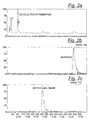
- Example 1 neutralization of mustard agent applied to a vehicle surface was evaluated in the field as follows. Approximately 150 ml of mustard was applied to the surface of a vehicle using a paintbrush. The presence of mustard agent was assessed and verified using a portable gas chromatograph/mass spectrometer (GC/MS). The decontamination formulation of Example 1 was applied to the contaminated side of the vehicle using the lance and nozzle followed by manual scrubbing of the surface using long-handled brushes. After a 30 minute wait period, the foam was washed away with water and the vehicle surface was re-surveyed using the GC/MS. Fig.
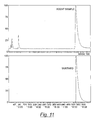
- FIG. 2 illustrates that an air sample taken near the contaminated vehicle before decontamination contained mustard agent, the top trace is the total ion current as recorded by a portable GC/MS which shows two large peaks due to internal standards (IS) and two lower peaks.
- the second trace (Fig. 2b) is an ion chromatogram set at m/z 109 and the bottom trace (Fig. 2c) is a separate ion chromatogram set at m/z 115 to detect a simulant, diethyl malonate, also present in the atmosphere from an earlier contamination.
- CB agents and simulant DFP were provided by the Canadian Single Small Scale Facility at the Canadian Defense Research Establishment Suffield (DRES) in southern Alberta, Canada and Aldrich Chemical Company, respectively.
- GB stock calibration solution was prepared by weight in acetonitrile (AcCN) and several dilutions were prepared ranging from 25 to 900 ng/ ⁇ L for calibration of the FPD, UV, and MSD responses.
- Stock solutions of the other CW agents were prepared volumetrically in AcCN and similarly diluted for calibration.
- samples were prepared in 2.0mL autosampler vials.
- the first addition was a water solution containing the surfactant and, if necessary, the co-solvent.
- buffer concentrate which had been separately prepared by adding the active ingredient, anhydrous sodium dichloroisocyanuric acid (SD), to water and heating to 29°C with stirring for 15-30 minutes.
- SD sodium dichloroisocyanuric acid
- the CB agent was added defining time zero, and aliquots, at noted elapsed times, were directly injected into the LC.
- the temperature of the vial holder was maintained at 25.0°C and a mini stirbar in the vial mixed the components.
- Fresh samples were prepared for each FPD analysis to obtain residual agent concentration profiles over time and these same solutions were subsequently analyzed by LC-MS.
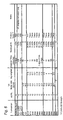
- Fig. 5 the effectiveness of several decontaminant formulations against selected G-type nerve gases GB, GA and GD and mustard gas, HD, was determined.
- the formulations tested consisted of an active ingredient, a surfactant, an inorganic buffer mixture and, optionally, co-solvent, in excess of that already present in the surfactant mixture.
- the co-solvent values in Fig. 5 represent added co-solvent and that contained in the surfactant.
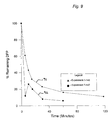
- Three decontamination formulations were assessed for effectiveness against typical G-nerve agents; the mildest formulation, using 3% w/w SD, a 2/3 strength buffer, and 1.3% w/w surfactant; an intermediate strength formulation with 6% w/w SD, full strength buffer, 4.6% w/w surfactant and an additional 6.9% w/w to 7.8% w/w co-solvent, and a full strength formulation with 9% w/w SD, full strength buffer, 4.8% w/w surfactant and 6.9% w/w additional co-solvent.
- anhydrous SD was used in preparation of the solution, percentages are quoted in terms of the equivalent amount of dihydrate. Percentages (w/w) quoted for surfactant represent double-strength surfactant.
- the intermediate formulation also tested for effectiveness against HD and demonstrated no residual HD after 2.47, 5.27, or 53.3 minutes. Verification by LC-MS could not be performed as HD cannot be detected using positive API-ES under these conditions.
- Example 3 Samples were prepared as described in Example 3. Two decontaminant formulations were assessed for effectiveness against VX-nerve agent: the mildest formulation (MILD) with 3% w/w SD, 2/3 strength buffer, and 1.3% w/w surfactant, and the full strength formulation (FS*) with 9% w/w SD, full strength buffer, 4.8% w/w surfactant and 6.9% w/w additional co-solvent. As with example 3, percentages quoted for surfactant represent double-strength surfactant.
- MILD mildest formulation
- FS* full strength formulation
- Control formulations were also examined. These included a formulation containing only full strength buffer and surfactant (Buffer/Surf) and a formulation containing all ingredients of the full strength decontaminant but without active ingredient (FS*wo/SD).
- Buffer/Surf full strength buffer and surfactant
- FS*wo/SD active ingredient
- the control formulation of buffer and surfactant (Buffer/Surf) was tested at a low concentration of VX (4 ⁇ L/mL). After six days, 42% of the VX remained and toxic product in significant quantity was detected.
- the control formulation of full strength formulation without active ingredient (FS*wo/SD) was tested against a concentration of 12 ⁇ L/mL of VX. Again, significant quantities of VX and toxic product were found at 125 minutes and 6 days. Additionally, there was evidence of VX droplets in the solution at 125 minutes indicating that saturation levels of VX were present in solution and that removal of VX from the system was slow. When full strength formulation with SD was employed in excess (18.2:1 active species/VX), all VX was destroyed in less than 7 minutes with no evidence of toxic product.
- DFP diisopropylfluorophosphate
- SD sodium dichloroisocyanurate
- KBr potassium bromide
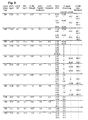
- the results and experimental parameters are summarized in the table of Fig. 7 and the graphs of Figs. 8 - 10.
- the table of Fig. 7 is divided top down into three sections representing the three formulations of SD, SD+KBr, or SD+LiOCl respectively.
- Trial 1 and Trial 2 indicate, respectively, that, on average, only 0.0108% and 0.00109% of the original material on the decontamination foam-treated coupons remained viable, translating into a 99.989% and 99.999% kill for simple contact with the decontamination foam for a period of 30 minutes.
- Data from Anthrax Spore Decontamination Trials. Experiment Colony Counts Plate 1 Plate 2 Plate 3 Plate 4 Trial 1 - Decon foam 33 26 28 21 Trial 1 - Control foam 22 x10 4 22 x10 4 29 x10 4 28 x10 4 Trial 2 - Decon foam 13 10 5 3 Trial 2 - Control foam 66 x10 4 72 x10 4 68 x10 4 78 x10 4
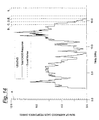
- a mass spectral analysis of the total ion and reconstructed m/z 109 chromatograms confirmed that the contaminant in the bottle and painted onto the vehicle was, indeed, mustard by reference to an authentic mass spectrum of mustard stored in the search library (Figs. 11, 12).
- Handheld Chemical Agent Monitors CAMs
- 3-Way Detector Paper displayed the characteristic red colour response indicative of blister agents when pressed onto the contaminated surface of the vehicle.
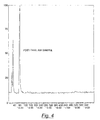
- Fig. 13a the decontamination formulation was then applied to the contaminated vehicle using a high capacity pump and two hoses fixed with foam nozzles. The vehicle was then scrubbed using long-handled brushes. During and following these steps, readings were made of the air around and downwind of the vehicle. Immediately, Chemical Agent Monitor (CAM) and air sample surveys conducted around the vehicle during the scrubbing procedure failed to detect the presence of mustard vapour, as shown by the GCMS results of Fig. 13a (total in chromatogram) and Fig. 13b (m/z 109 reconstructed mass chromatogram characteristic of mustard) compare to the corresponding traces in Fig. 11.
- CAM Chemical Agent Monitor
- each CADS II station comprises two CAMs.
- the readings of all eight CAMs (four CADS II stations X 2) were summed and displayed.
- the vertical bars in the figure denote significant actions on the part of trial personnel. Gross contamination of the vehicle was initiated at point A and decontamination commenced at point B.
- point C the audible alarm from the CADS II central control unit (CCU) had silenced and from point D onward, no further detection or bar reading of mustard vapor was observed.
- this formulation applied in this manner is effective in suppressing agent vapor from a freshly contaminated-coated military surface immediately and is effective in decontaminating mustard-contaminated military vehicles within a 30-minute period after application.
- the effectiveness of the foaming agent by itself to effect decontamination of radioactive dusts from the exterior surface of an armored vehicle was demonstrated.
- the vehicle a French AMX-10 Armored Personnel Carrier, was contaminated by spraying the exterior with 140 La particles (100-200 ⁇ m) to simulate surface contamination as might be caused by driving across contaminated dusty terrain.
- Decontamination formulation using Silv-Ex surfactant was sprayed over the surface of the vehicle using a powered pressure washer fixed with an air induction foam nozzle of the type normally used in applying fire-fighting foams. Subsequent to the application of decontaminant, the vehicle was towed to a sensing frame where radiation measurements on the exterior could be made.
- the radiation level measured inside the vehicle in the first trial was observed to be in the order of 30 mRem/hr (0.3mSv/h).
- the radiation level was observed to drop significantly (to approximately 11 mRem/hr (0.11 mSv/h)) presumably due to foam layers dropping off the sides of the vehicle during the application stage.
- the radiation level flattened off over the course of the decontamination probably due to residual particles remaining on the vehicle in areas where the foam could not drop off (top, crevices) readily.
- the radiation level dropped even further (to approx.
Landscapes
- Chemical & Material Sciences (AREA)
- Chemical Kinetics & Catalysis (AREA)
- Life Sciences & Earth Sciences (AREA)
- Organic Chemistry (AREA)
- Wood Science & Technology (AREA)
- Oil, Petroleum & Natural Gas (AREA)
- Engineering & Computer Science (AREA)
- Emergency Management (AREA)
- Health & Medical Sciences (AREA)
- Business, Economics & Management (AREA)
- General Chemical & Material Sciences (AREA)
- General Health & Medical Sciences (AREA)
- Toxicology (AREA)
- Detergent Compositions (AREA)
- Agricultural Chemicals And Associated Chemicals (AREA)
- Medicinal Preparation (AREA)
Claims (48)
- Dekontaminationsformulierung, umfassend:(a) ungefähr 1 Gew.-% bis ungefähr 15 Gew.-% einer Chlorisocyanursäure;(b) ungefähr 1 Vol.-% bis ungefähr 10 Vol.-% eines Hilfslösungsmittels, ausgewählt aus der Gruppe bestehend aus Polypropylenglycol, Polyethylenglycol und Derivaten und Gemischen davon;(c) ungefähr 1 Vol.-% bis ungefähr 15 Vol.-% eines oberflächenaktiven Stoffes;(d) einen Puffer, um die Formulierung bei einem pH von ungefähr 11 bis ungefähr 8,5 zu halten; und(e) wobei der Rest Wasser ist.
- Dekontaminationsformulierung nach Anspruch 1, worin die Chlorisocyanursäure in einer Menge von ungefähr 3 Gew.-% bis ungefähr 9 Gew.-% vorliegt.
- Dekontaminationsformulierung nach Anspruch 1, worin die Chlorisocyanursäure ausgewählt wird aus der Gruppe bestehend aus einem Alkalimetallsalz von Monochlorisocyanursäure, Dichlorisocyanursäure und einer Kombination davon mit Cyanursäure.
- Dekontaminationsformulierung nach Anspruch 3, worin das Alkalimetallsalz von Dichlorisocyanursäure Natriumdichlorisocyanurat ist.
- Dekontaminationsformulierung nach Anspruch 4, worin die Wirkung des Puffers im Lauf der Zeit nachlässt, wobei der pH auf einen pH-Wert von ungefähr 8,5 absinken gelassen wird.
- Dekontaminationsformulierung nach Anspruch 5, worin der Puffer den pH der Formulierung mindestens 30 Minuten lang über 8,5 hält.
- Dekontaminationsformulierung nach Anspruch 1, worin das Hilfslösungsmittel in einer Menge von ungefähr 6 Vol.-% bis ungefähr 10 Vol.-% vorliegt.
- Dekontaminationsformulierung nach Anspruch 1, worin das Polypropylenglycol die chemische Formel R1-(OCH(CH3)CH2)n-OR2 aufweist, worin R1 und R2 unabhängig H, ein Alkyl, oder eine Estergruppe sind und n>1.
- Dekontaminationsformulierung nach Anspruch 8, worin die Alkylgruppe, welche durch R1 oder R2 wiedergegeben wird, eine Methyl-, Ethyl-, Propyl- oder Butylgruppe oder ein Gemisch davon ist.
- Dekontaminationsformulierung nach Anspruch 8, worin mindestens einer der Reste R1 oder R2 Wasserstoff ist.
- Dekontaminationsformulierung nach Anspruch 8, worin R1 und R2 beide Wasserstoffatome sind.
- Dekontaminationsformulierung nach Anspruch 1, worin das Polypropylenglycol-Derivat ein teilweise verethertes Polypropylenglycol ist.
- Dekontaminationsformulierung nach Anspruch 12, worin das teilweise veretherte Polypropylenglycol die Formeln R1-(OCH(CH3)CH2)n-OR2 aufweist, worin einer der Reste R1 oder R2 unabhängig H oder eine Alkylgruppe ist und n≥1.
- Dekontaminationsformulierung nach Anspruch 13, worin das Alkyl, das durch R1 oder R2 wiedergegeben wird, eine Methyl-, Ethyl-, Propyl- oder Butylgruppe oder ein Gemisch davon ist.
- Dekontaminationsformulierung nach Anspruch 13, worin mindestens einer der Reste R1 oder R2 Wasserstoff ist.
- Dekontaminationsformulierung nach Anspruch 1, worin der Puffer anfänglich die Formulierung bei einem pH von ungefähr 10 bis ungefähr 11 halten kann.
- Dekontaminationsformulierung nach Anspruch 1, worin der Puffer ein Gemisch aus Natriumtetraborat-decahydrat, wasserfreiem Natriumcarbonat und Natriumhydroxid umfasst.
- Dekontaminationsformulierung nach Anspruch 1, worin der Puffer ein Gemisch aus Natriumtetraborat-decahydrat, wasserfreiem Natriumcarbonat und Natriummetasilicat-pentahydrat umfasst.
- Dekontaminationsformulierung nach Anspruch 1, worin der oberflächenaktive Stoff eine Zusammensetzung mit den Formeln [R(OCH2CH2)nX]aMb, worin R eine Alkylgruppe mit 8 bis 18 Kohlenstoffatomen ist; n eine ganze Zahl von 0 bis 10 ist; X ausgewählt wird aus der Gruppe bestehend aus SO3 2-, SO4 2-, CO3 2- und PO4 3-; M ein Alkalimetall, Erdalkalimetall, Ammonium oder Aminderivat ist; a die Wertigkeit von M ist und b die Wertigkeit von [R(OCH2CH2)nX] ist, oder Gemische davon umfasst.
- Dekontaminationsformulierung nach Anspruch 1, worin der oberflächenaktive Stoff eine Zusammensetzung mit den Formeln [R-CH=CH(CH2)m-X]aMb, worin R eine Alkylgruppe mit 8 bis 18 Kohlenstoffatomen ist; m eine ganze Zahl von 0 bis 3 ist; X ausgewählt wird aus der Gruppe bestehend aus SO3 2-, SO4 2-, CO3 2- und PO4 3-, M ein Alkalimetall, Erdalkalimetall, Ammonium oder Aminderivat ist; a die Wertigkeit von M ist und b die Wertigkeit von [R-CH=CH(CH2)m-X] ist, oder Gemische davon umfasst.
- Dekontaminationsformulierung nach Anspruch 1, worin der oberflächenaktive Stoff eine Zusammensetzung mit der Formel R-OH, worin R eine Alkylgruppe mit 8 bis 16 Kohlenstoffatomen ist, oder Gemische davon umfasst.
- Dekontaminationsformulierung nach Anspruch 1, worin das Hilfslösungsmittel eine Zusammensetzung umfasst, wie sie in den Ansprüchen 7, 8, 9, 10 und 11 beschrieben ist.
- Dekontaminationsformulierung nach Anspruch 1, außerdem umfassend Lithiumhypochlorit in einer Menge von ungefähr 5 Gew.-% bis ungefähr 10 Gew.-%, bezogen auf das Gewicht des Chlorisocyanursäuresalzes.
- Verfahren zum Herstellen einer Dekontaminationsformulierung, umfassend die Schritte des Zugebens zu einem Wasserstrom:(a) einer ersten wässrigen Lösung, umfassend bis zu ungefähr 30 Gew.-% Chlorisocyanursäure;(b) einer zweiten wässrigen Lösung, umfassend ein Gemisch aus anorganischen Puffersalzen, die auf einen Anfangs-pH von ungefähr 10 bis 11 eingestellt ist und den pH der Dekontaminationsformulierung bei ungefähr 11 bis ungefähr 8,5 halten kann;(c) eines Hilfslösungsmittels, ausgewählt aus der Gruppe bestehend aus Polypropylenglycol, Polyethylenglycol und einem Derivat und Gemisch davon; und(d) eines oberflächenaktiven Stoffes.
- Verfahren nach Anspruch 24, worin der oberflächenaktive Stoff ein Schaumbildner ist.
- Verfahren nach Anspruch 24, worin der oberflächenaktive Stoff ein Schaumbildner ist, umfassend eine Zusammensetzung mit der Formel [R(OCH2CH2)nX]aMb, worin R eine Alkylgruppe mit 8 bis 18 Kohlenstoffatomen ist; n eine ganze Zahl von 0 bis 10 ist; X ausgewählt wird aus der Gruppe bestehend aus SO3 2-, SO4 2-, CO3 2- und PO4 3-; M ein Alkalimetall, Erdalkalimetall, Ammonium oder Aminderivat ist; a die Wertigkeit von M ist und b die Wertigkeit von [R(OCH2CH2)nX] ist.
- Verfahren nach Anspruch 24, worin der oberflächenaktive Stoff ein Schaumbildner ist, umfassend eine Zusammensetzung mit der Formel [R-CH=CH(CH2)m-X]aMb, worin R eine Alkylgruppe mit 8 bis 18 Kohlenstoffatomen ist; m eine ganze Zahl von 0 bis 3 ist; X ausgewählt wird aus der Gruppe bestehend aus SO3 2-, SO4 2-, CO3 2- und PO4 3-, M ein Alkalimetall, Erdalkalimetall, Ammonium oder Aminderivat ist; a die Wertigkeit von M ist und b die Wertigkeit von [R-CH=CH(CH2)m-X] ist.
- Verfahren nach Anspruch 24, worin der oberflächenaktive Stoff eine Zusammensetzung mit der Formel R-OH, worin R eine Alkylgruppe mit 8 bis 16 Kohlenstoffatomen ist, oder Gemische davon umfasst.
- Verfahren nach Anspruch 24, worin das Hilfslösungsmittel eine Zusammensetzung umfasst, wie sie in den Ansprüchen 7, 8, 9, 10 und 11 beschrieben ist.
- Verfahren nach Anspruch 24, worin die erste wässrige Lösung außerdem ein Lithiumhypochlorit in Mengen von bis zu 10 % des Chlorisocyanursäuresalzes umfasst.
- Kit zum Bereitstellen einer Dekontaminationszusammensetzung, umfassend die folgenden Komponenten:(a) ein Dekontaminationsmittel, umfassend Chlorisocyanursäure; oder ihr Alkalimetall- oder Erdalkalimetallsalz;(b) ein Hilfslösungsmittel, ausgewählt aus der Gruppe bestehend aus Polypropylenglycolen, Polyethylenglycolen und Derivaten und Gemischen davon;(c) einen oberflächenaktiven Stoff; und(d) ein Gemisch aus Natriumtetraborat-decahydrat, wasserfreiem Natriumcarbonat und Natriumhydroxid.
- Kit nach Anspruch 31, worin das Dekontaminationsmittel außerdem Lithiumhypochlorit umfasst.
- Kit nach Anspruch 31, worin die Chlorisocyanursäure in Form eines Salzes, Natriumdichlorisocyanurat vorliegt.
- Kit nach Anspruch 31, worin der oberflächenaktive Stoff eine Zusammensetzung mit den Formeln [R(OCH2CH2)nX]aMb, worin R eine Alkylgruppe mit 8 bis 18 Kohlenstoffatomen ist; n eine ganze Zahl von 0 bis 10 ist; X ausgewählt wird aus der Gruppe bestehend aus SO3 2-, SO4 2-, CO3 2- und PO4 3-; M ein Alkalimetall, Erdalkalimetall, Ammonium oder Aminderivat ist; a die Wertigkeit von M ist und b die Wertigkeit von [R(OCH2CH2)nX] ist, oder ein Gemisch davon umfasst.
- Kit nach Anspruch 31, worin der oberflächenaktive Stoff eine Zusammensetzung mit den Formeln [R-CH=CH(CH2)m-X]aMb umfasst, worin R eine Alkylgruppe mit 8 bis 18 Kohlenstoffatomen ist; m eine ganze Zahl von 0 bis 3 ist; X ausgewählt wird aus der Gruppe bestehend aus SO3 2-, SO4 2-, CO3 2- und PO4 3-, M ein Alkalimetall, Erdalkalimetall, Ammonium oder Aminderivat ist; a die Wertigkeit von M ist und b die Wertigkeit von [R-CH=CH(CH2)m-X] ist.
- Kit nach Anspruch 31, worin der oberflächenaktive Stoff eine Zusammensetzung mit der Formel R-OH, worin R eine Alkylgruppe mit 8 bis 16 Kohlenstoffatomen ist, oder Gemische davon umfasst.
- Kit nach Anspruch 31, worin das Hilfslösungsmittel eine Zusammensetzung umfasst, wie sie in den Ansprüchen 7, 8, 9, 10 und 11 beschrieben ist.
- Kit nach Anspruch 31, worin die Zusammensetzungskomponenten (a) und (b) einzeln abgepackt sind und die Komponenten (c) und (d) als Gemisch abgepackt sind oder die Komponenten (a) und (d) als Gemisch abgepackt sind und die Komponenten (b) und (c) als Gemisch abgepackt sind.
- Kit nach Anspruch 31, worin die Zusammensetzungskomponenten einzeln abgepackt sind.
- Verfahren zum Dekontaminieren von Oberflächen, umfassend die Schritte:(a) Herstellen einer Dekontaminationsformulierung mit ungefähr 1 Gew.-% bis ungefähr 15 Gew.-% eines Chlorisocyanursäuresalzes, ungefähr 1 Vol.-% bis ungefähr 10 Vol.-% eines Hilfslösungsmittels, ausgewählt aus der Gruppe bestehend aus Polypropylenglycol, Polyethylenglycol und Derivaten und Gemischen davon, ungefähr 1 Vol.-% bis ungefähr 15 Vol.-% eines oberflächenaktiven Stoffes, und einem Puffer, um die Formulierung anfänglich bei einem pH von ungefähr 11 bis ungefähr 8,5 zu halten, und Wasser zum Bilden einer wässrigen Lösung; und(b) Auftragen der wässrigen Lösung auf kontaminierte Oberflächen.
- Dekontaminationsverfahren nach Anspruch 40, worin die Wirkung des Puffers im Laufe der Zeit nachlässt, wobei der pH auf einen pH-Wert von ungefähr 8,5 absinken gelassen wird.
- Dekontaminationsverfahren nach Anspruch 41, worin der Puffer den pH der wässrigen Lösung mindestens 30 Minuten lang über 8,5 hält.
- Dekontaminationsverfahren nach Anspruch 40, außerdem umfassend die Schritte:(a) Bilden eines Schaums aus der wässrigen Lösung; anschließend(b) Auftragen der geschäumten wässrigen Lösung auf die kontaminierte Oberfläche.
- Dekontaminationsverfahren nach Anspruch 41, worin der Schritt der Schaumbildung das Abgeben der wässrigen Lösung durch eine Belüftungsdüse umfasst.
- Dekontaminationsverfahren nach Anspruch 44, worin die Wirkung des Puffers im Laufe der Zeit nachlässt, wobei der pH auf einen pH-Wert von ungefähr 8,5 absinken gelassen wird.
- Dekontaminationsverfahren nach Anspruch 45, worin der Puffer den pH der wässrigen Lösung mindestens 30 Minuten lang über 8,5 hält.
- Dekontaminationsverfahren nach Anspruch 40, worin das Chlorisocyanursäuresalz, das Hilfslösungsmittel, der oberflächenaktive Stoff und der Puffer vor dem Auftragen auf die kontaminierte Oberfläche allesamt mit Wasser vereinigt werden.
- Dekontaminationsverfahren nach Anspruch 40, worin(a) das Hilfslösungsmittel und der oberflächenaktive Stoff mit Wasser vereinigt werden, um eine nicht abbauende Lösung zu bilden; und(b) der Puffer und das Chlorisocyanursäuresalz vor dem Auftragen auf die kontaminierte Oberfläche getrennt zu der nicht abbauenden Lösung zugegeben werden.
Applications Claiming Priority (3)
| Application Number | Priority Date | Filing Date | Title |
|---|---|---|---|
| US12097199P | 1999-02-19 | 1999-02-19 | |
| US120971P | 1999-02-19 | ||
| PCT/CA2000/000137 WO2000048684A1 (en) | 1999-02-19 | 2000-02-15 | Broad spectrum decontamination formulation and method of use |
Publications (2)
| Publication Number | Publication Date |
|---|---|
| EP1154820A1 EP1154820A1 (de) | 2001-11-21 |
| EP1154820B1 true EP1154820B1 (de) | 2002-09-25 |
Family
ID=22393622
Family Applications (1)
| Application Number | Title | Priority Date | Filing Date |
|---|---|---|---|
| EP00903467A Expired - Lifetime EP1154820B1 (de) | 1999-02-19 | 2000-02-15 | Breitspektrum dekontaminierung formulierung und verfahren zur deren verwendung |
Country Status (8)
| Country | Link |
|---|---|
| US (1) | US6525237B1 (de) |
| EP (1) | EP1154820B1 (de) |
| AT (1) | ATE224756T1 (de) |
| AU (1) | AU769408B2 (de) |
| CA (1) | CA2300698C (de) |
| DE (1) | DE60000508T2 (de) |
| IL (1) | IL144978A (de) |
| WO (1) | WO2000048684A1 (de) |
Cited By (1)
| Publication number | Priority date | Publication date | Assignee | Title |
|---|---|---|---|---|
| US7390432B2 (en) | 1998-06-30 | 2008-06-24 | Sandia Corporation | Enhanced formulations for neutralization of chemical, biological and industrial toxants |
Families Citing this family (29)
| Publication number | Priority date | Publication date | Assignee | Title |
|---|---|---|---|---|
| US6723890B2 (en) | 1998-06-30 | 2004-04-20 | Sandia Corporation | Concentrated formulations and methods for neutralizing chemical and biological toxants |
| US7282470B2 (en) * | 2002-07-19 | 2007-10-16 | Sandia Corporation | Decontamination formulation with sorbent additive |
| SI1458386T1 (sl) | 2001-12-27 | 2007-08-31 | Ortho Mcneil Pharm Inc | Aroil pirol heteroeril in metanoli, uporabni za zdravljenje motnje centralnega živčnega sistema |
| US7384183B2 (en) * | 2002-09-06 | 2008-06-10 | Global Ground Support, Llc | Mobile decontamination unit |
| AU2003297808A1 (en) | 2002-12-09 | 2004-06-30 | The Trustees Of Columbia University In The City Of New York | Peptides and methods for deactivation of organophosphorus-based nerve agents and insecticides |
| WO2004080543A2 (en) | 2003-03-12 | 2004-09-23 | Queen's University At Kingston | Method of decomposing organophosphorus compounds |
| RU2248234C2 (ru) * | 2003-04-08 | 2005-03-20 | Федеральное государственное унитарное предприятие "Государственный научно-исследовательский институт биологического приборостроения" (ФГУП "ГосНИИ БП") | Бифункциональная рецептура окислительно-нуклеофильного действия |
| WO2006076406A2 (en) * | 2005-01-11 | 2006-07-20 | Clean Earth Technologies, Llc | Formulations for the decontamination of toxic chemicals |
| CA2593822C (en) * | 2005-01-11 | 2012-08-07 | Clean Earth Technologies, Llc | Peracid/ peroxide composition and use thereof as an anti-microbial and a photosensitizer |
| CN102006910A (zh) * | 2005-06-03 | 2011-04-06 | 美国全球豪微空间公司 | 生物净化系统 |
| EP1926682A4 (de) * | 2005-06-21 | 2012-06-20 | Crosslink Polymer Res | Signalaktivierte dekontaminierungsbeschichtung |
| US7846888B2 (en) * | 2006-02-07 | 2010-12-07 | Battelle Energy Alliance, Llc | Long lasting decontamination foam |
| WO2007098555A1 (en) * | 2006-03-03 | 2007-09-07 | Anadis Ltd | Method and apparatus for containment and decontamination |
| US7718594B1 (en) | 2006-10-11 | 2010-05-18 | The United States Of America As Represented By The Secretary Of The Navy | Aqueous based chemical and biological warfare decontaminating system for extreme temperature applications |
| WO2008053440A1 (en) * | 2006-10-31 | 2008-05-08 | The Procter & Gamble Company | Portable bio-chemical decontaminant system and method of using the same |
| US20090187060A1 (en) | 2008-01-22 | 2009-07-23 | E-Z-Em, Inc. | Method and Formulation for Neutralizing Toxic Chemicals and Materials |
| US20100179368A1 (en) * | 2008-11-07 | 2010-07-15 | Aries Associates, Inc. | Novel Chemistries, Solutions, and Dispersal Systems for Decontamination of Chemical and Biological Systems |
| US20100119412A1 (en) * | 2008-11-07 | 2010-05-13 | Aries Associates, Inc. | Novel Chemistries, Solutions, and Dispersal Systems for Decontamination of Chemical and Biological Systems |
| DE102009002681A1 (de) | 2009-02-18 | 2010-09-09 | Areva Np Gmbh | Verfahren zur Dekontamination radioaktiv kontaminierter Oberflächen |
| US8518941B2 (en) * | 2010-08-19 | 2013-08-27 | American Sterilizer Company | Extreme temperature aqueous decontamination composition |
| CA2783349A1 (en) * | 2012-07-18 | 2014-01-18 | Her Majesty The Queen In Right Of Canada, As Represented By The Minister Of Environment | Decontamination of radionuclides on construction materials |
| US9499772B2 (en) | 2013-03-13 | 2016-11-22 | Battelle Energy Alliance, Llc | Methods of decontaminating surfaces and related compositions |
| CN106999618A (zh) | 2014-12-08 | 2017-08-01 | 金诺斯公司 | 用于颜料消毒的添加剂组合物及其方法 |
| EP3414311A4 (de) | 2016-02-12 | 2019-09-04 | Kinnos Inc. | Zusammensetzungen und verfahren zur verwendung bei der oberflächendekontamination |
| EP3487974A4 (de) | 2016-07-25 | 2020-08-05 | Kinnos Inc. | Vorrichtung und zugehörige zusammensetzungen und verfahren zur verwendung bei der oberflächendekontamination |
| CN109069894B (zh) * | 2017-03-03 | 2021-07-06 | 美国傲世环保科技公司 | 使用共聚物与凝聚聚合物系统的组合原位微包封处理石棉纤维和其它有害材料 |
| US11464371B2 (en) | 2018-07-12 | 2022-10-11 | Kinnos Inc. | Devices, compositions, and methods for use in surface decontamination |
| MX2021004968A (es) * | 2018-10-29 | 2021-06-15 | Dow Global Technologies Llc | Deshidratacion de gas. |
| US10369396B1 (en) | 2018-11-09 | 2019-08-06 | Battelle Memorial Institute | Assembly for decontaminating and method of manufacturing the assembly |
Family Cites Families (21)
| Publication number | Priority date | Publication date | Assignee | Title |
|---|---|---|---|---|
| JPS5271592A (en) * | 1975-12-12 | 1977-06-15 | Mitsubishi Chem Ind Ltd | Production of regenerared nylon resin |
| ZA775615B (en) | 1976-10-26 | 1978-08-30 | Stauffer Chemical Co | Hard surface cleaning composition |
| JPS5953314B2 (ja) * | 1980-04-09 | 1984-12-24 | 花王株式会社 | 発泡性組成物 |
| JPS56143300A (en) * | 1980-04-09 | 1981-11-07 | Kao Corp | Foamable composition |
| DE3036153C2 (de) * | 1980-09-23 | 1985-06-27 | Herbert Lindner Gmbh, 1000 Berlin | Vorrichtung zum Hinterschleifen und Polygonschleifen an Schleifmaschinen |
| EP0051687B1 (de) * | 1980-11-07 | 1984-05-16 | MITSUI TOATSU CHEMICALS, Inc. | Maleinimide und Verfahren zu ihrer Herstellung |
| US4543872A (en) | 1983-08-08 | 1985-10-01 | Graham Kenneth J | Blast attenuator |
| US4589341A (en) | 1984-02-10 | 1986-05-20 | Rockwood Systems Corporation | Method for explosive blast control using expanded foam |
| US4744917A (en) | 1985-07-31 | 1988-05-17 | Olin Corporation | Toxic chemical agent decontamination emulsions, their preparation and application |
| US4908215A (en) | 1986-03-06 | 1990-03-13 | Brandeis University | Hypochlorite compositions containing thiosulfate and use thereof |
| KR930009035B1 (ko) * | 1990-03-19 | 1993-09-22 | 국방과학연구소 | 수용성 제독제 조성물 |
| FR2679458A1 (fr) * | 1991-07-23 | 1993-01-29 | Commissariat Energie Atomique | Mousse de decontamination a duree de vie controlee et installation de decontamination d'objets utilisant une telle mousse. |
| KR940006580B1 (ko) | 1991-10-15 | 1994-07-22 | 금성익렉트론 주식회사 | 접착리드를 이용한 반도체 패키지 구조 및 그 제조방법 |
| DE19526380A1 (de) * | 1995-07-19 | 1997-01-23 | Henkel Ecolab Gmbh & Co Ohg | Pastöses Geschirreinigungsmittel und seine Herstellung |
| US5723095A (en) | 1995-12-28 | 1998-03-03 | Steris Corporation | Cleaner concentrate formulation for biological waste fluid handling systems |
| US5760089A (en) | 1996-03-13 | 1998-06-02 | The United States Of America As Represented By The Secretary Of The Navy | Chemical warfare agent decontaminant solution using quaternary ammonium complexes |
| US5859064A (en) | 1996-03-13 | 1999-01-12 | The United States Of America As Represented By The Secretary Of The Navy | Chemical warfare agent decontamination solution |
| AU6646798A (en) | 1997-01-10 | 1998-08-03 | Loizeaux Group Int'l Ltd | Method and apparatus for the destruction of articles |
| US5864767A (en) | 1997-06-09 | 1999-01-26 | The United States Of America As Represented By The Secretary Of The Army | Chemical biological explosive containment system |
| JP3983353B2 (ja) * | 1997-11-14 | 2007-09-26 | 花王株式会社 | 硬質体用の固形殺菌洗浄剤 |
| US6405626B1 (en) * | 1999-02-26 | 2002-06-18 | Her Majesty The Queen In Right Of Canada As Represented By The Solicitor General Acting Through The Commissioner Of The Royal Canadian Mounted Police | Decontaminating and dispersion suppressing foam formulation |
-
2000
- 2000-02-14 CA CA002300698A patent/CA2300698C/en not_active Expired - Fee Related
- 2000-02-15 DE DE60000508T patent/DE60000508T2/de not_active Expired - Lifetime
- 2000-02-15 AT AT00903467T patent/ATE224756T1/de active
- 2000-02-15 WO PCT/CA2000/000137 patent/WO2000048684A1/en not_active Ceased
- 2000-02-15 EP EP00903467A patent/EP1154820B1/de not_active Expired - Lifetime
- 2000-02-15 AU AU25302/00A patent/AU769408B2/en not_active Ceased
- 2000-02-15 IL IL14497800A patent/IL144978A/en not_active IP Right Cessation
- 2000-02-16 US US09/504,932 patent/US6525237B1/en not_active Expired - Lifetime
Cited By (1)
| Publication number | Priority date | Publication date | Assignee | Title |
|---|---|---|---|---|
| US7390432B2 (en) | 1998-06-30 | 2008-06-24 | Sandia Corporation | Enhanced formulations for neutralization of chemical, biological and industrial toxants |
Also Published As
| Publication number | Publication date |
|---|---|
| ATE224756T1 (de) | 2002-10-15 |
| IL144978A0 (en) | 2002-06-30 |
| US6525237B1 (en) | 2003-02-25 |
| WO2000048684A1 (en) | 2000-08-24 |
| CA2300698A1 (en) | 2000-08-19 |
| DE60000508D1 (de) | 2002-10-31 |
| AU2530200A (en) | 2000-09-04 |
| IL144978A (en) | 2004-12-15 |
| CA2300698C (en) | 2003-10-07 |
| EP1154820A1 (de) | 2001-11-21 |
| AU769408B2 (en) | 2004-01-29 |
| DE60000508T2 (de) | 2003-01-30 |
Similar Documents
| Publication | Publication Date | Title |
|---|---|---|
| EP1154820B1 (de) | Breitspektrum dekontaminierung formulierung und verfahren zur deren verwendung | |
| US7282470B2 (en) | Decontamination formulation with sorbent additive | |
| US6723890B2 (en) | Concentrated formulations and methods for neutralizing chemical and biological toxants | |
| US7064241B2 (en) | Chemical and biological warfare decontaminating solution using peracids and germinants in microemulsions, process and product thereof | |
| CA2328016C (en) | Formulations for neutralization of chemical and biological toxants | |
| US6569353B1 (en) | Reactive decontamination formulation | |
| CA2461872C (en) | Enhanced formulations for neutralization of chemical, biological and industrial toxants | |
| US7750199B1 (en) | Kit systems for granulated decontamination formulations | |
| US7390432B2 (en) | Enhanced formulations for neutralization of chemical, biological and industrial toxants | |
| AU2002341750A1 (en) | Enhanced formulations for neutralization of chemical, biological and industrial toxants | |
| US7723558B1 (en) | Non-corrosive, non-caustic, non-flammable, catalyst-based decontaminant formulation | |
| US7429556B2 (en) | Universal halide-enhanced decontaminating formulation | |
| US7662759B1 (en) | Decontamination formulation with additive for enhanced mold remediation | |
| AU766865B2 (en) | Decontaminating and dispersion suppressing foam formulation | |
| Tucker et al. | Decontamination formulation with sorbent additive | |
| HK1073618B (en) | Enhanced formulations for neutralization of chemical, biological and industrial toxants |
Legal Events
| Date | Code | Title | Description |
|---|---|---|---|
| PUAI | Public reference made under article 153(3) epc to a published international application that has entered the european phase |
Free format text: ORIGINAL CODE: 0009012 |
|
| 17P | Request for examination filed |
Effective date: 20010917 |
|
| AK | Designated contracting states |
Kind code of ref document: A1 Designated state(s): AT BE CH CY DE DK ES FI FR GB GR IE IT LI LU MC NL PT SE |
|
| AX | Request for extension of the european patent |
Free format text: AL;LT;LV;MK;RO;SI |
|
| GRAG | Despatch of communication of intention to grant |
Free format text: ORIGINAL CODE: EPIDOS AGRA |
|
| 17Q | First examination report despatched |
Effective date: 20020110 |
|
| GRAG | Despatch of communication of intention to grant |
Free format text: ORIGINAL CODE: EPIDOS AGRA |
|
| GRAH | Despatch of communication of intention to grant a patent |
Free format text: ORIGINAL CODE: EPIDOS IGRA |
|
| GRAH | Despatch of communication of intention to grant a patent |
Free format text: ORIGINAL CODE: EPIDOS IGRA |
|
| GRAA | (expected) grant |
Free format text: ORIGINAL CODE: 0009210 |
|
| AK | Designated contracting states |
Kind code of ref document: B1 Designated state(s): AT BE CH CY DE DK ES FI FR GB GR IE IT LI LU MC NL PT SE |
|
| PG25 | Lapsed in a contracting state [announced via postgrant information from national office to epo] |
Ref country code: BE Free format text: LAPSE BECAUSE OF FAILURE TO SUBMIT A TRANSLATION OF THE DESCRIPTION OR TO PAY THE FEE WITHIN THE PRESCRIBED TIME-LIMIT Effective date: 20020925 Ref country code: GR Free format text: LAPSE BECAUSE OF FAILURE TO SUBMIT A TRANSLATION OF THE DESCRIPTION OR TO PAY THE FEE WITHIN THE PRESCRIBED TIME-LIMIT Effective date: 20020925 |
|
| REF | Corresponds to: |
Ref document number: 224756 Country of ref document: AT Date of ref document: 20021015 Kind code of ref document: T |
|
| REG | Reference to a national code |
Ref country code: GB Ref legal event code: FG4D |
|
| REG | Reference to a national code |
Ref country code: CH Ref legal event code: EP |
|
| REG | Reference to a national code |
Ref country code: IE Ref legal event code: FG4D |
|
| REF | Corresponds to: |
Ref document number: 60000508 Country of ref document: DE Date of ref document: 20021031 |
|
| REG | Reference to a national code |
Ref country code: CH Ref legal event code: NV Representative=s name: ISLER & PEDRAZZINI AG |
|
| PG25 | Lapsed in a contracting state [announced via postgrant information from national office to epo] |
Ref country code: DK Free format text: LAPSE BECAUSE OF FAILURE TO SUBMIT A TRANSLATION OF THE DESCRIPTION OR TO PAY THE FEE WITHIN THE PRESCRIBED TIME-LIMIT Effective date: 20021225 |
|
| PG25 | Lapsed in a contracting state [announced via postgrant information from national office to epo] |
Ref country code: PT Free format text: LAPSE BECAUSE OF FAILURE TO SUBMIT A TRANSLATION OF THE DESCRIPTION OR TO PAY THE FEE WITHIN THE PRESCRIBED TIME-LIMIT Effective date: 20021226 |
|
| PG25 | Lapsed in a contracting state [announced via postgrant information from national office to epo] |
Ref country code: CY Free format text: LAPSE BECAUSE OF FAILURE TO SUBMIT A TRANSLATION OF THE DESCRIPTION OR TO PAY THE FEE WITHIN THE PRESCRIBED TIME-LIMIT Effective date: 20030215 Ref country code: LU Free format text: LAPSE BECAUSE OF NON-PAYMENT OF DUE FEES Effective date: 20030215 |
|
| PG25 | Lapsed in a contracting state [announced via postgrant information from national office to epo] |
Ref country code: IE Free format text: LAPSE BECAUSE OF NON-PAYMENT OF DUE FEES Effective date: 20030217 |
|
| PG25 | Lapsed in a contracting state [announced via postgrant information from national office to epo] |
Ref country code: MC Free format text: LAPSE BECAUSE OF NON-PAYMENT OF DUE FEES Effective date: 20030228 |
|
| ET | Fr: translation filed | ||
| PG25 | Lapsed in a contracting state [announced via postgrant information from national office to epo] |
Ref country code: ES Free format text: LAPSE BECAUSE OF FAILURE TO SUBMIT A TRANSLATION OF THE DESCRIPTION OR TO PAY THE FEE WITHIN THE PRESCRIBED TIME-LIMIT Effective date: 20030328 |
|
| PLBE | No opposition filed within time limit |
Free format text: ORIGINAL CODE: 0009261 |
|
| STAA | Information on the status of an ep patent application or granted ep patent |
Free format text: STATUS: NO OPPOSITION FILED WITHIN TIME LIMIT |
|
| 26N | No opposition filed |
Effective date: 20030626 |
|
| REG | Reference to a national code |
Ref country code: IE Ref legal event code: MM4A |
|
| PG25 | Lapsed in a contracting state [announced via postgrant information from national office to epo] |
Ref country code: IT Free format text: LAPSE BECAUSE OF NON-PAYMENT OF DUE FEES Effective date: 20050215 |
|
| REG | Reference to a national code |
Ref country code: CH Ref legal event code: PCAR Free format text: ISLER & PEDRAZZINI AG;POSTFACH 1772;8027 ZUERICH (CH) |
|
| PGRI | Patent reinstated in contracting state [announced from national office to epo] |
Ref country code: IT Effective date: 20090401 |
|
| PGFP | Annual fee paid to national office [announced via postgrant information from national office to epo] |
Ref country code: CH Payment date: 20140218 Year of fee payment: 15 Ref country code: SE Payment date: 20140218 Year of fee payment: 15 Ref country code: FI Payment date: 20140212 Year of fee payment: 15 Ref country code: NL Payment date: 20140218 Year of fee payment: 15 Ref country code: DE Payment date: 20140219 Year of fee payment: 15 |
|
| PGFP | Annual fee paid to national office [announced via postgrant information from national office to epo] |
Ref country code: IT Payment date: 20140225 Year of fee payment: 15 Ref country code: AT Payment date: 20140212 Year of fee payment: 15 Ref country code: FR Payment date: 20140219 Year of fee payment: 15 |
|
| PGFP | Annual fee paid to national office [announced via postgrant information from national office to epo] |
Ref country code: GB Payment date: 20140225 Year of fee payment: 15 |
|
| REG | Reference to a national code |
Ref country code: DE Ref legal event code: R119 Ref document number: 60000508 Country of ref document: DE |
|
| REG | Reference to a national code |
Ref country code: NL Ref legal event code: V1 Effective date: 20150901 |
|
| REG | Reference to a national code |
Ref country code: SE Ref legal event code: EUG |
|
| PG25 | Lapsed in a contracting state [announced via postgrant information from national office to epo] |
Ref country code: NL Free format text: LAPSE BECAUSE OF NON-PAYMENT OF DUE FEES Effective date: 20150901 |
|
| REG | Reference to a national code |
Ref country code: CH Ref legal event code: PL |
|
| REG | Reference to a national code |
Ref country code: AT Ref legal event code: MM01 Ref document number: 224756 Country of ref document: AT Kind code of ref document: T Effective date: 20150215 |
|
| GBPC | Gb: european patent ceased through non-payment of renewal fee |
Effective date: 20150215 |
|
| PG25 | Lapsed in a contracting state [announced via postgrant information from national office to epo] |
Ref country code: CH Free format text: LAPSE BECAUSE OF NON-PAYMENT OF DUE FEES Effective date: 20150228 Ref country code: LI Free format text: LAPSE BECAUSE OF NON-PAYMENT OF DUE FEES Effective date: 20150228 Ref country code: FI Free format text: LAPSE BECAUSE OF NON-PAYMENT OF DUE FEES Effective date: 20150215 |
|
| REG | Reference to a national code |
Ref country code: FR Ref legal event code: ST Effective date: 20151030 |
|
| PG25 | Lapsed in a contracting state [announced via postgrant information from national office to epo] |
Ref country code: SE Free format text: LAPSE BECAUSE OF NON-PAYMENT OF DUE FEES Effective date: 20150216 Ref country code: AT Free format text: LAPSE BECAUSE OF NON-PAYMENT OF DUE FEES Effective date: 20150215 |
|
| PG25 | Lapsed in a contracting state [announced via postgrant information from national office to epo] |
Ref country code: IT Free format text: LAPSE BECAUSE OF NON-PAYMENT OF DUE FEES Effective date: 20150215 |
|
| PG25 | Lapsed in a contracting state [announced via postgrant information from national office to epo] |
Ref country code: GB Free format text: LAPSE BECAUSE OF NON-PAYMENT OF DUE FEES Effective date: 20150215 Ref country code: DE Free format text: LAPSE BECAUSE OF NON-PAYMENT OF DUE FEES Effective date: 20150901 |
|
| PG25 | Lapsed in a contracting state [announced via postgrant information from national office to epo] |
Ref country code: FR Free format text: LAPSE BECAUSE OF NON-PAYMENT OF DUE FEES Effective date: 20150302 |