EP1153673A1 - Metal plate flatness controlling method and device - Google Patents
Metal plate flatness controlling method and device Download PDFInfo
- Publication number
- EP1153673A1 EP1153673A1 EP00976298A EP00976298A EP1153673A1 EP 1153673 A1 EP1153673 A1 EP 1153673A1 EP 00976298 A EP00976298 A EP 00976298A EP 00976298 A EP00976298 A EP 00976298A EP 1153673 A1 EP1153673 A1 EP 1153673A1
- Authority
- EP
- European Patent Office
- Prior art keywords
- metal sheet
- plate
- flatness
- center portion
- control
- Prior art date
- Legal status (The legal status is an assumption and is not a legal conclusion. Google has not performed a legal analysis and makes no representation as to the accuracy of the status listed.)
- Granted
Links
Images


Classifications
-
- B—PERFORMING OPERATIONS; TRANSPORTING
- B21—MECHANICAL METAL-WORKING WITHOUT ESSENTIALLY REMOVING MATERIAL; PUNCHING METAL
- B21B—ROLLING OF METAL
- B21B37/00—Control devices or methods specially adapted for metal-rolling mills or the work produced thereby
- B21B37/28—Control of flatness or profile during rolling of strip, sheets or plates
-
- B—PERFORMING OPERATIONS; TRANSPORTING
- B21—MECHANICAL METAL-WORKING WITHOUT ESSENTIALLY REMOVING MATERIAL; PUNCHING METAL
- B21B—ROLLING OF METAL
- B21B37/00—Control devices or methods specially adapted for metal-rolling mills or the work produced thereby
- B21B37/28—Control of flatness or profile during rolling of strip, sheets or plates
- B21B37/44—Control of flatness or profile during rolling of strip, sheets or plates using heating, lubricating or water-spray cooling of the product
-
- B—PERFORMING OPERATIONS; TRANSPORTING
- B21—MECHANICAL METAL-WORKING WITHOUT ESSENTIALLY REMOVING MATERIAL; PUNCHING METAL
- B21B—ROLLING OF METAL
- B21B15/00—Arrangements for performing additional metal-working operations specially combined with or arranged in, or specially adapted for use in connection with, metal-rolling mills
- B21B15/0007—Cutting or shearing the product
- B21B2015/0021—Cutting or shearing the product in the rolling direction
-
- B—PERFORMING OPERATIONS; TRANSPORTING
- B21—MECHANICAL METAL-WORKING WITHOUT ESSENTIALLY REMOVING MATERIAL; PUNCHING METAL
- B21B—ROLLING OF METAL
- B21B15/00—Arrangements for performing additional metal-working operations specially combined with or arranged in, or specially adapted for use in connection with, metal-rolling mills
- B21B2015/0071—Levelling the rolled product
-
- B—PERFORMING OPERATIONS; TRANSPORTING
- B21—MECHANICAL METAL-WORKING WITHOUT ESSENTIALLY REMOVING MATERIAL; PUNCHING METAL
- B21B—ROLLING OF METAL
- B21B45/00—Devices for surface or other treatment of work, specially combined with or arranged in, or specially adapted for use in connection with, metal-rolling mills
- B21B45/02—Devices for surface or other treatment of work, specially combined with or arranged in, or specially adapted for use in connection with, metal-rolling mills for lubricating, cooling, or cleaning
- B21B45/0203—Cooling
- B21B45/0209—Cooling devices, e.g. using gaseous coolants
- B21B2045/0212—Cooling devices, e.g. using gaseous coolants using gaseous coolants
-
- B—PERFORMING OPERATIONS; TRANSPORTING
- B21—MECHANICAL METAL-WORKING WITHOUT ESSENTIALLY REMOVING MATERIAL; PUNCHING METAL
- B21B—ROLLING OF METAL
- B21B2261/00—Product parameters
- B21B2261/20—Temperature
- B21B2261/21—Temperature profile
-
- B—PERFORMING OPERATIONS; TRANSPORTING
- B21—MECHANICAL METAL-WORKING WITHOUT ESSENTIALLY REMOVING MATERIAL; PUNCHING METAL
- B21B—ROLLING OF METAL
- B21B37/00—Control devices or methods specially adapted for metal-rolling mills or the work produced thereby
- B21B37/74—Temperature control, e.g. by cooling or heating the rolls or the product
-
- B—PERFORMING OPERATIONS; TRANSPORTING
- B21—MECHANICAL METAL-WORKING WITHOUT ESSENTIALLY REMOVING MATERIAL; PUNCHING METAL
- B21B—ROLLING OF METAL
- B21B37/00—Control devices or methods specially adapted for metal-rolling mills or the work produced thereby
- B21B37/74—Temperature control, e.g. by cooling or heating the rolls or the product
- B21B37/76—Cooling control on the run-out table
-
- B—PERFORMING OPERATIONS; TRANSPORTING
- B21—MECHANICAL METAL-WORKING WITHOUT ESSENTIALLY REMOVING MATERIAL; PUNCHING METAL
- B21B—ROLLING OF METAL
- B21B39/00—Arrangements for moving, supporting, or positioning work, or controlling its movement, combined with or arranged in, or specially adapted for use in connection with, metal-rolling mills
- B21B39/006—Pinch roll sets
-
- B—PERFORMING OPERATIONS; TRANSPORTING
- B21—MECHANICAL METAL-WORKING WITHOUT ESSENTIALLY REMOVING MATERIAL; PUNCHING METAL
- B21B—ROLLING OF METAL
- B21B45/00—Devices for surface or other treatment of work, specially combined with or arranged in, or specially adapted for use in connection with, metal-rolling mills
- B21B45/004—Heating the product
-
- B—PERFORMING OPERATIONS; TRANSPORTING
- B21—MECHANICAL METAL-WORKING WITHOUT ESSENTIALLY REMOVING MATERIAL; PUNCHING METAL
- B21B—ROLLING OF METAL
- B21B45/00—Devices for surface or other treatment of work, specially combined with or arranged in, or specially adapted for use in connection with, metal-rolling mills
- B21B45/02—Devices for surface or other treatment of work, specially combined with or arranged in, or specially adapted for use in connection with, metal-rolling mills for lubricating, cooling, or cleaning
- B21B45/0203—Cooling
- B21B45/0209—Cooling devices, e.g. using gaseous coolants
- B21B45/0215—Cooling devices, e.g. using gaseous coolants using liquid coolants, e.g. for sections, for tubes
- B21B45/0218—Cooling devices, e.g. using gaseous coolants using liquid coolants, e.g. for sections, for tubes for strips, sheets, or plates
Definitions
- the present invention relates to a method and an apparatus to control the flatness of a metal sheet or plate through; heating the edge portions and/or the center portion of the metal sheet or plate, using a heating apparatus or heating apparatuses installed between two rolling stands of a tandem finishing mill, or at the entry to and/or the exit from a reversing finishing mill, or using a heating apparatus or heating apparatuses immediately after rolling; and successively cooling the sheet or plate after finish rolling: for eliminating edge waves occurring at the edge portions of the width direction and/or center waves occurring at the center portion of the width direction in a sheet or plate of metal such as steel, aluminum, titanium and the like result from temperature difference across its width before cooling.
- Waviness (edge waves) of metal materials especially that of steel materials, which becomes apparent when the materials are cooled at a cooling process after a rolling process, has been prevented conventionally through overcompensation of the waviness by forming moderate waviness at the width center (center waves or center buckles) at a hot rolling mill or a hot leveler after the rolling.
- waviness not corrected by this method has to be corrected separately by leveling work at a subsequent conditioning process.
- Japanese Unexamined Patent Publication No. H5-269527 proposes a method to control the flatness of a metal strip by: installing a tension leveler at a position where the cooling of the strip is finished but its coiling is not yet finished; installing a shape detection roll capable of measuring the transverse tension distribution of the strip at the position immediately before the final roll of the tension leveler; and changing the screw-down setting of the shape detection roll based on the metal strip flatness information detected by itself.
- H10-263658 proposes a method to control the flatness of a metal strip by: calculating an elongation rate difference from flatness information given by a flatness gauge installed at the exit from a hot finishing mill and flatness information before coiling given by another flatness gauge installed at the entry to a coiler; and feeding the elongation difference information back to the roll bending control function of the hot finishing mill.
- Japanese Patent No. 2792788 discloses an apparatus provided with a roller leveler and an edge heater installed between a roughing mill and a finishing mill for preventing the warping of the leading end of a strip.
- the method to control the flatness of metal strips uses the information of strip flatness or elongation strain difference as the basis of the flatness control, and neither of them does considers the information of the temperature distribution across the strip width.
- the transverse temperature distribution of the strip becomes even.
- the transverse temperature distribution tends to be such that the temperature of the edge portions is lower than that of the center portion and temperature difference is generated.
- the object of the present invention which solves the problems contingent with the above conventional technologies, is to provide a method and an apparatus to control flatness, capable of improving the flatness by preventing edge waves occurring at the edge portions and center waves in a metal sheet or plate from appearing after cooling.
- the gist of the present invention therefore, is as follows:
- the temperature of an edge portion of a metal sheet or plate is defined as the surface temperature of the metal sheet or plate at a point in the range of 50 to 200 mm from the edge.
- the inventors of the present invention examined the mechanisms which deteriorate the flatness of metal sheets or plates and the measures used to improve the flatness in various ways. The principles of the present invention are described hereafter and the description is based on the drawings.
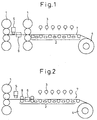
- Figs. 1 and 2 are schematic illustrations of finishing mills, and the facilities therefore, used in the production processes of hot-rolled steel sheets or plates.
- a steel sheet or plate is first rolled into a prescribed size at a finishing mill 1, transferred on a run out table (ROT) 2, cooled to a prescribed temperature by an ROT cooler 3 for the purpose of obtaining prescribed material quality, and then wound into a coil at a coiler 4.
- ROT run out table
- the coiling temperature of a steel sheet or plate ranges from 100 to 750°C depending on the material quality and, when the coil is cooled down to room temperature and unwound, there are cases that wavy deformations appear at either of its edges.
- This phenomenon called edge wave is the very flatness problem the present inventors are concerned about. It is the edge wave that becomes a problem with most hot-rolled steel sheets and plates.
- the present invention aims at preventing edge waves and center buckles which appear due to transverse temperature difference.
- the waviness may be caused by other reasons.
- the shape of the mandrel of a coiler 4 or pinch rolls (PRs) is convex and coiling tension is abnormally large, the waviness may appear in the center portion rather than the edges.
- this type of waviness is out of the scope of the present invention.
- Fig. 3 shows the definition of an edge wave.
- the steepness of a wave is expressed as the percentage figure of the edge wave height H divided by the pitch of the wave L, multiplied by 100.
- the present inventors measured the temperatures of hot-rolled steel sheets of the same steel grade and size (2 mm in thickness and 1,200 mm in width) at the same measuring point (400 m from the coil center) using a pyrometer 5 capable of measuring the temperatures at the center and 20 mm from the both edges across the width, installed between two stands of a finishing mill or at the exit from a finishing mill, and analyzed the relationship between the flatness of the sheets after cooling and the surface temperature difference between the width center and 20 mm from each of the edges.
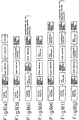
- Hot-rolled strips having good flatness and free from edge waves after unwinding can be produced according to the present invention by rolling them on a tandem finishing mill, cooling them using the ROT cooling and coiling them thereafter (see Figs. 5(a) and 6(a)).
- the strip travelling time from a finishing mill stand to the subsequent finishing mill stand is 0.5 to 1 sec.
- the same from the final finish rolling to the beginning of the cooling is 0.5 to 3 sec. and the strips are coiled under tension.
- the metal material creeps under the tension so as to decrease the stress distribution in the transverse section of the strips, and thus residual stress created during the rolling is removed and the edge waves and center buckles of the strips are already straightened.
- a highly accurate temperature control can be obtained by measuring the surface temperature of a metal sheet or plate before edge heating. To obtain a more accurately controlled shape, it is preferable to install a temperature measurement apparatus immediately before an edge heater. It is desirable to measure a temperature distribution across the strip width using a thermo-viewer or the like, otherwise, if this is impossible, to measure the temperature at three points, at the center and at 5 to 20 mm from the both edges. If an edge measuring point is less than 5 mm from an edge, the measurement will not be accurate and, if it is more than 20 mm from the edge, the measurement obtained will not represent the real condition of the edge portion.
- a reversing mill is used instead of a tandem finishing mill, and the plates are finish-rolled after heating the edges and/or the center or all the width at the entry to and/or the exit from the reversing mill.
- hot leveling is subsequently applied without being accompanied by any other conditioning processes
- plates having a better shape than in the case of no edge heating can be obtained.
- controlled cooling water cooling
- hot leveling before or after the controlled cooling
- the processes according to the present invention are schematically shown in Figs. 5(b), 5(b'), 6(a), 6(d), 6(e) and 6(g).
- the plates undergo edge heating and/or center heating after hot leveling.
- edge heating or center heating When the plates are subjected only to edge heating or center heating and then left to cool naturally, their shape is better than the case that neither the edge heating nor the center heating is applied.
- Fig. 5(c) shows an outline of the processes according to the present invention.
- the apparatus to heat the edge portions and/or the center portion is any one of an induction heater, a laser irradiation heater, a plasma irradiation heater and a gas combustion heater.
- a metal sheet or plate having a good shape is obtained by estimating the strain difference at the room temperature between the center portion and the edge portions caused by the elongation strain difference and thermal strain difference before cooling between said portions and by minimizing the estimated strain difference through reducing the temperature difference between said portions to ⁇ 50°C or less. It is preferable to reduce the temperature difference to ⁇ 25°C or less, more preferably to ⁇ 15°C or less or, ideally, to ⁇ 5°C or less. It is desirable to make the temperature distribution of a metal sheet or plate across its width as even as possible. Since it is essential to reduce the strain difference at the room temperature between a center portion and edge portions caused by the elongation strain difference and the thermal strain difference between said portions, it does not matter if the edge portions become hotter than the center portion.
- the transverse temperature distribution of a steel sheet or plate having undergone edge heating and/or center heating is made homogeneous even after a controlled cooling and, therefore, the steel sheet or plate having an excellent shape after cooling is obtained, and the product does not require cold leveling or other shape correction measures.
- the residual stress of a steel sheet or plate is decreased during processing at a hot leveler.
- the hot leveler and its leveling rolls are directly cooled with a water jet or spray to prevent roll sticking and other equipment damage by the heat of the metal sheet or plate, the metal material will also be cooled during the leveling operation. In this process, the edge portions are cooled more than the other portions, creating a temperature difference between the edge portions and the center portion.
- a steel sheet or plate having an excellent shape by heating the edge portions and/or the center portion, applying controlled cooling and/or hot leveling and then leaving the product to cool naturally.
- the shape of the sheet or plate after cooling is better than in the case of no edge heating or center heating.
- the temperature of a metal sheet or plate is controlled more accurately according to the present invention by measuring its surface temperature after completing the hot rolling and before heating the edge portions and/or the center portion (see Figs. 6(a) to 6(g)). Note that, although Figs. 6(c) and 6(f) show that the temperature measurement is done after the leveling, it may be done between the rolling and the leveling.
- the surface temperature may be measured at any position from the hot finishing mill to the edge heater and/or the center portion heater, but it is preferable for obtaining a better controlled shape of the sheet or plate to install a temperature measurement device immediately before the edge heater.
- thermo-viewer it is desirable to measure the temperature distribution across the strip width using a thermo-viewer or the like, otherwise, if this is impossible, measure the temperature at three points, the center and 5 to 20 mm from the both edges. If an edge measuring point is less than 5 mm from an edge, the measurement will not be accurate and, if it is more than 20 mm from the edge, the measurement obtained will not represent the real condition of the edge portion.
- the production processes can be simplified, since it provides that the edges of a sheet or plate can be trimmed by heating the edges using a laser irradiation heater.
- the edge portions where the thickness is reduced to below a permissible range in strip rolling, the phenomenon being called edge drop, can be trimmed off during the heating by controlling the laser output to a high level.
- the present invention provides that a metal material is transferred while being held by one or more pairs of upper and lower pinch rolls after its leading end has come out of a hot finishing mill, it is also possible to prevent the occurrence of abnormal strip behavior such as flying, waving and the like during strip transfer on the run out table.
- An ROT cooling zone is usually about 100 to 200 m long, and a strip runs a distance of tens of meters on the ROT under no tension until its leading end reaches a coiler and is wound on its mandrel to receive the tension.
- the strip shape is not corrected during the no-tension period.
- not only the temperature difference but also the residual stress at the exit from the rolling mill and change in the strip shape may disturb flatness.
- Another problem in this production stage is that, while the strip is driven by the rolling rolls of the mill towards the coiler and transferred on the ROT by the friction of its rollers, it is not held firmly at the leading end and, therefore, the leading end may hit and damage production facilities as a result of flying or waving.
- a heater 6 for heating edge and center portions was newly installed between two stands of a tandem finishing mill 1 of an existing production line, as shown in Fig. 1, as the means for heating the edge portions and the center portion, for the purpose of homogenizing the transverse temperature distribution of steel strips before they enter an ROT cooling apparatus 3.
- the strip surface temperature was measured at the strip width center and 20 mm from the edges with a radiation pyrometer 5 installed between two stands of the tandem finishing mill and immediately before the heater for the edge and center portions.
- the heating means for the edge portions and the center portion heated the portions 10 mm from the both edges of steel strips 7 passing between two stands of the tandem finishing mill 1 using a CO 2 laser heater 6.
- the heating was commenced immediately after a tension was established on the strip between the two mill stands 1.
- the flying/waving height of the strips between the two finishing mill stands 1 was controlled to 5 mm, which fact eliminated adverse effects on the heating operation and apparatus.
- An edge heater 6 was newly installed at the exit from a finishing mill 1 of an existing production line, as shown in Fig. 2, as the means for heating edges, for the purpose of homogenizing the transverse temperature distribution of steel strips before ROT cooling.
- the means for heating the edge portions heated the portions 10 mm from the both edges of the steel strips 7 using a CO 2 laser heater 6.
- the heating was commenced immediately after the leading end of steel strip 7 coming out from the finishing mill 1 went through a pinch roll unit 8 and a tension was established upon the strip by two pairs of pinch rolls to suppress flying and waving of the strips.
- the use of the laser for the heating allowed cutting of the strips under a condition of 45 kW of heat input and 0.5 m/sec. of strip travelling speed. Under said condition, it was possible to trim off the strip portions not satisfying a prescribed product thickness owing to the edge drop.
- the number of the coils having the edge waves and center buckles of the steepness of 1.5% among 1,000 coils was zero.
- the flying/waving height of the strips between the two pinch roll stands was controlled to 5 mm, which fact eliminated adverse effects on the heating operation and apparatus.
- the production method according to the present invention improves cold flatness of a hot-rolled metal strip, a post-treatment for improving strip flatness by a skin pass mill can be eliminated. Additionally, the treatment time at a subsequent processing step can be reduced, since the present invention can suppress walking and jumping of strips caused by poor flatness during the processing. Further, when the strip heating according to the present invention is applied also for the purpose of edge trimming, final products ready for shipment can be obtained at a hot rolling process without any additional treatment, and a significant cost reduction is realized.
Landscapes
- Engineering & Computer Science (AREA)
- Mechanical Engineering (AREA)
- Metal Rolling (AREA)
- Control Of Metal Rolling (AREA)
- Straightening Metal Sheet-Like Bodies (AREA)
Abstract
Description
Claims (20)
- A method to control the flatness of a metal sheet or plate characterized by: measuring the surface temperatures of the metal sheet or plate at the edge portions and the center portion across its width after one or more rolling passes at a tandem or reversing finishing mill; controlling the heating temperatures of the edge portions and/or the center portion based on the measured surface temperatures; and then water-cooling and/or hot-leveling the metal sheet or plate.
- A method to control the flatness of a metal sheet or plate characterized by: measuring the surface temperatures of the metal sheet or plate at the edge portions and the center portion across its width between two rolling stands of a tandem finishing mill; controlling the heating temperatures of the edge portions and/or the center portion based on the measured surface temperatures; and then cooling the metal sheet or plate after the finish rolling.
- A method to control the flatness of a metal sheet or plate characterized by: measuring the surface temperatures of the metal sheet or plate at the edge portions and the center portion across its width at the entry to and/or the exit from a reversing finishing mill; controlling the heating temperatures of the edge portions and/or the center portion based on the measured surface temperatures; and then cooling the metal sheet or plate after the finish rolling.
- A method to control the flatness of a metal sheet or plate characterized by: heating the edge portions and/or the center portion in the width of the metal sheet or plate after completing hot rolling; and then water-cooling and/or hot-leveling the metal sheet or plate.
- A method to control the flatness of a metal sheet or plate characterized by: hot-leveling the metal sheet or plate after completing hot rolling; heating the edge portions and/or the center portion in the width of the metal sheet or plate; and then leaving it to cool naturally in normal atmosphere or cooling it with water.
- A method to control the flatness of a metal sheet or plate according to claim 4 or 5, characterized in that the water-cooling of the metal sheet or plate is conducted on a run out table (ROT cooling), and that the metal sheet or plate is coiled after the ROT cooling.
- A method to control the flatness of a metal sheet or plate according to claim 4 or 5, characterized by leaving the metal sheet or plate to cool naturally in normal atmosphere after subjecting it to the water cooling and/or the hot leveling.
- A method to control the flatness of a metal sheet or plate according to claim 4 or 5, characterized by: measuring the surface temperatures of the metal sheet or plate at the edge portions and/or the center portion across its width after completing hot rolling and before heating it; and then controlling the heating temperatures of the edge portions and/or the center portion based on the measured temperatures.
- A method to control the flatness of a metal sheet or plate according to claim 4 or 5, characterized by controlling the heating temperatures of the edge portions of the metal sheet or plate so that the difference between the surface temperature of each edge portion measured in the range of 50 to 200 mm as edge portion and that of its center portion becomes within ±50°C.
- A method to control the flatness of a metal sheet or plate according to claim 4 or 5, characterized by controlling the heating temperature of the width center portion of the metal sheet or plate so that the difference between the average temperature of the width direction at the center portion of the metal sheet or plate and the temperature across the width not exceeding the average temperature becomes within ±10°C.
- An apparatus to control the flatness of a metal sheet or plate characterized by having: a tandem finishing mill; a means to measure the surface temperatures of the metal sheet or plate at the edge portions and the center portion across its width installed between two rolling stands of the tandem finishing mill; a means to heat the edge portions and/or the center portion in a manner to control the heating temperatures based on the measured surface temperatures; and a means to cool the metal sheet or plate at the exit from the finishing mill.
- An apparatus to control the flatness of a metal sheet or plate characterized by having: a reversing finishing mill; a means to measure the surface temperatures of the metal sheet or plate at the edge portions and the center portion across its width installed at the entry to and/or the exit from the reversing finishing mill; a means to heat the edge portions and/or the center portion in a manner to control the heating temperatures based on the measured surface temperatures; and a means to cool the metal sheet or plate at the exit from both the means to measure the surface temperatures and the finishing mill.
- An apparatus to control the flatness of a metal sheet or plate according to claim 11 or 12, characterized in that a means to heat the edge portions and/or the center portion of the metal sheet or plate is an induction heater, a laser irradiation heater, a plasma irradiation heater or a gas combustion heater.
- A method to control the flatness of a metal sheet or plate according to any one of claims 1 to 3, characterized by trimming the edge portions of the metal sheet or plate, in addition to heating the edge portions, using a laser irradiation heater.
- A method to control the flatness of a metal sheet or plate according to any one of claims 1 to 5, characterized by transferring the metal sheet or plate while holding it with a pair or two pairs of upper and lower pinch rolls after the leading end of the metal sheet or plate has left the hot finishing mill and passed through the pinch rolls.
- An apparatus to control the flatness of a metal sheet or plate characterized by having an edge heater and/or a center portion heater for the metal sheet or plate between a hot finishing mill and a water cooling apparatus and/or a hot leveler.
- An apparatus to control the flatness of a metal sheet or plate characterized by having an edge heater and/or a center portion heater for the metal sheet or plate at the exit from a hot leveler, which is installed at the exit from a hot finishing mill.
- An apparatus to control the flatness of a metal sheet or plate according to claim 16 or 17, characterized by having a controlled cooling apparatus at the exit from the edge heater and/or the center portion heater for the metal sheet or plate.
- An apparatus to control the flatness of a metal sheet or plate according to any one of claims 11 to 18, characterized by having an apparatus to measure the surface temperature of the metal sheet or plate installed between the hot finishing mill and the edge heater and/or the center portion heater for the metal sheet or plate.
- An apparatus to control the flatness of a metal sheet or plate according to claim 11 or 12, characterized by having at least a pair of upper and lower pinch rolls between the hot finishing mill and the edge heater and/or the center portion heater for the metal sheet or plate.
Applications Claiming Priority (5)
| Application Number | Priority Date | Filing Date | Title |
|---|---|---|---|
| JP32768499 | 1999-11-18 | ||
| JP32768499A JP2001137943A (en) | 1999-11-18 | 1999-11-18 | Method and apparatus for controlling flatness of metal plate |
| JP2000050759 | 2000-02-28 | ||
| JP2000050759A JP2001239312A (en) | 2000-02-28 | 2000-02-28 | Method and apparatus for controlling flatness of metal plate |
| PCT/JP2000/008093 WO2001036122A1 (en) | 1999-11-18 | 2000-11-16 | Metal plate flatness controlling method and device |
Publications (3)
| Publication Number | Publication Date |
|---|---|
| EP1153673A1 true EP1153673A1 (en) | 2001-11-14 |
| EP1153673A4 EP1153673A4 (en) | 2005-08-31 |
| EP1153673B1 EP1153673B1 (en) | 2008-06-04 |
Family
ID=26572599
Family Applications (1)
| Application Number | Title | Priority Date | Filing Date |
|---|---|---|---|
| EP00976298A Expired - Lifetime EP1153673B1 (en) | 1999-11-18 | 2000-11-16 | Metal plate flatness controlling method |
Country Status (8)
| Country | Link |
|---|---|
| US (1) | US6615633B1 (en) |
| EP (1) | EP1153673B1 (en) |
| KR (1) | KR100432682B1 (en) |
| CN (1) | CN1278792C (en) |
| AU (1) | AU760833B2 (en) |
| DE (1) | DE60039102D1 (en) |
| MX (1) | MXPA01007250A (en) |
| WO (1) | WO2001036122A1 (en) |
Cited By (4)
| Publication number | Priority date | Publication date | Assignee | Title |
|---|---|---|---|---|
| WO2009000387A1 (en) * | 2007-06-22 | 2008-12-31 | Sms Siemag Ag | Process for hot rolling and for heat treatment of a steel strip |
| WO2009024644A1 (en) | 2007-08-17 | 2009-02-26 | Outokumpu Oyj | Method and equipment of flatness control in cooling a stainless steel strip |
| WO2015043058A1 (en) * | 2013-09-26 | 2015-04-02 | 北大方正集团有限公司 | Production process for non-quenched and tempered steel |
| EP2933031A4 (en) * | 2012-12-06 | 2016-08-24 | Nippon Steel & Sumitomo Metal Corp | PROCESS FOR PRODUCING STEEL SHEET |
Families Citing this family (28)
| Publication number | Priority date | Publication date | Assignee | Title |
|---|---|---|---|---|
| KR100833012B1 (en) * | 2001-12-26 | 2008-05-27 | 주식회사 포스코 | Manufacturing method of hot rolled steel sheet for high strength boom to prevent camber during processing |
| US20060021699A1 (en) * | 2002-11-07 | 2006-02-02 | Naoki Hase | Heat-resistant flexible laminated board manufacturing method |
| EP1991375A1 (en) * | 2006-02-17 | 2008-11-19 | Alcoa Inc. | Application of induction heating to control sheet flatness in cold rolling mills |
| JP4878485B2 (en) * | 2006-03-17 | 2012-02-15 | 三菱日立製鉄機械株式会社 | Cold continuous rolling equipment |
| DE102007012688A1 (en) * | 2007-03-12 | 2008-09-18 | Sms Demag Ag | Process for the treatment of metal sheets |
| CN100515593C (en) * | 2007-09-24 | 2009-07-22 | 攀钢集团攀枝花钢铁研究院 | Comprehensive control method for strip edge thickening in common four-high hot strip continuous rolling mill |
| JP5202036B2 (en) | 2008-02-29 | 2013-06-05 | 株式会社神戸製鋼所 | Method for producing aluminum strip with excellent flatness |
| CN101780478B (en) * | 2009-01-21 | 2012-07-04 | 中冶赛迪工程技术股份有限公司 | Method and device for controlling strip shape and precision of hot rolling steel strips and plates |
| GB2468713B (en) * | 2009-03-20 | 2011-02-16 | Siemens Vai Metals Tech Ltd | Edge flatness monitoring |
| KR101134922B1 (en) | 2009-04-02 | 2012-04-17 | 주식회사 포스코 | Shape controller and shape method for steel plate of hot rolling process |
| CN101992218B (en) * | 2009-08-25 | 2013-05-01 | 鞍钢股份有限公司 | Correction method for cold-rolled strip steel plate shape control target value |
| CN102085535B (en) * | 2009-12-03 | 2012-11-14 | 唐山国丰钢铁有限公司 | Leveling control method of finishing mill |
| CN102581043B (en) * | 2011-01-18 | 2014-08-20 | 宝山钢铁股份有限公司 | Water mist cooling system and water mist cooling method for steel strip hot-rolling process |
| US9186710B2 (en) * | 2011-06-07 | 2015-11-17 | Nippon Steel & Sumitomo Metal Corporation | Method for cooling hot-rolled steel sheet |
| US9566625B2 (en) | 2011-06-07 | 2017-02-14 | Nippon Steel & Sumitomo Metal Corporation | Apparatus for cooling hot-rolled steel sheet |
| US9211574B2 (en) * | 2011-07-27 | 2015-12-15 | Nippon Steel & Sumitomo Metal Corporation | Method for manufacturing steel sheet |
| CZ306622B6 (en) * | 2011-10-27 | 2017-04-05 | Západočeská Univerzita V Plzni | A method of manufacturing a tin steel pressed piece with integrated preparation of the semi-finished product of an unequal thickness |
| KR101376565B1 (en) * | 2011-12-15 | 2014-04-02 | (주)포스코 | Method and apparatus for controlling the temperature of strip in the rapid cooling section of continuous annealing line |
| ES2649160T5 (en) | 2013-03-11 | 2024-09-30 | Novelis Inc | Improving the flatness of a laminated strip |
| CN104438356B (en) * | 2014-09-23 | 2017-04-05 | 北京首钢股份有限公司 | A kind of method for improving Thin container plate edge shape wave |
| DE102015112293A1 (en) | 2015-07-28 | 2017-02-02 | Hydro Aluminium Rolled Products Gmbh | Method and apparatus for the adaption of temperature-adapting metal bands |
| CN107159719B (en) * | 2017-05-10 | 2019-02-22 | 燕山大学 | A kind of titanium alloy plate continuous rolling temperature control device and temperature control continuous rolling method |
| CN107282648B (en) * | 2017-06-21 | 2019-01-22 | 北京科技大学 | A method for controlling the flatness of the full width of a hot-rolled strip |
| CN110665966A (en) * | 2019-10-24 | 2020-01-10 | 瓯锟科技温州有限公司 | Metal plate and strip rolling process based on liquid carbon dioxide cooling and lubrication |
| CN111283438A (en) * | 2019-12-30 | 2020-06-16 | 无锡市巨燊科技有限公司 | A kind of cold rolling forming equipment and method using carbon steel or stainless steel to prepare channel |
| CN113617843B (en) * | 2021-09-14 | 2023-03-03 | 鞍钢股份有限公司 | A Method for Eliminating Residual Stress of Hot-Rolled Strip under High Temperature State |
| CN115415332A (en) * | 2022-09-22 | 2022-12-02 | 包头钢铁(集团)有限责任公司 | Control method for cold-rolled sheet shape |
| CN119040616B (en) * | 2024-08-16 | 2025-08-26 | 武汉科技大学 | Method for avoiding warping of hot-rolled high-strength steel plates under high-temperature coiling conditions |
Family Cites Families (26)
| Publication number | Priority date | Publication date | Assignee | Title |
|---|---|---|---|---|
| JPS5522422A (en) * | 1978-08-03 | 1980-02-18 | Nippon Steel Corp | Steel plate hot rolling method and device |
| JPS5695404A (en) | 1979-12-28 | 1981-08-01 | Kawasaki Steel Corp | Manufacture of flat steel sheet |
| JPS5797813A (en) * | 1980-12-09 | 1982-06-17 | Toshiba Corp | Temperature controlling method |
| US4503697A (en) * | 1983-01-25 | 1985-03-12 | Tippins Machinery Company, Inc. | Method for hot rolling slabs |
| JPS60174833A (en) * | 1984-02-20 | 1985-09-09 | Nippon Steel Corp | Cooling method of hot steel sheet |
| JPS6289515A (en) * | 1985-10-14 | 1987-04-24 | Nippon Steel Corp | Temperature control method and device for hot rolling stock |
| JPS6293028A (en) | 1985-10-21 | 1987-04-28 | Mitsubishi Electric Corp | Bending method for plate stock by laser |
| JPH069705B2 (en) | 1986-11-18 | 1994-02-09 | 住友金属工業株式会社 | Induction heating equipment in thick steel plate production line |
| JPH0252187A (en) * | 1988-08-12 | 1990-02-21 | Kawasaki Steel Corp | Laser beam side trimmer device |
| JPH03175001A (en) | 1989-12-05 | 1991-07-30 | Romatetsuku Kk | Device for removing strain of band saw |
| JPH0466271A (en) | 1990-07-04 | 1992-03-02 | Sumitomo Metal Ind Ltd | Method for restraining camber in stripe cutting on wide and thick steel plate |
| JPH05228525A (en) | 1992-02-19 | 1993-09-07 | Sumitomo Metal Ind Ltd | Width-direction temperature control method and apparatus for hot-rolled steel strip |
| JPH06254616A (en) | 1993-03-05 | 1994-09-13 | Nippon Steel Corp | Method and apparatus for cooling thick steel plate with excellent shape |
| JP3118343B2 (en) | 1993-03-23 | 2000-12-18 | 新日本製鐵株式会社 | Method for reducing skid mark of hot finished rolled material |
| DE4309986A1 (en) * | 1993-03-29 | 1994-10-06 | Schloemann Siemag Ag | Method and device for rolling a rolled strip |
| JPH07132307A (en) | 1993-11-12 | 1995-05-23 | Sumitomo Metal Ind Ltd | Metal plate edge shape correction device |
| DE4402402B4 (en) * | 1994-01-27 | 2004-05-13 | Sms Demag Ag | Process for producing hot-rolled steel strip from continuously cast starting material and plant for carrying out the process |
| JP3283705B2 (en) | 1994-09-02 | 2002-05-20 | 新日本製鐵株式会社 | Prevention method of ear wave shape generation of thick steel plate |
| US5755128A (en) * | 1995-08-31 | 1998-05-26 | Tippins Incorporated | Method and apparatus for isothermally rolling strip product |
| DE19540978A1 (en) * | 1995-11-03 | 1997-05-07 | Schloemann Siemag Ag | Production plant for the continuous or discontinuous rolling out of hot strip |
| US6181311B1 (en) | 1996-02-23 | 2001-01-30 | Canon Kabushiki Kaisha | Liquid crystal color display apparatus and driving method thereof |
| US5927118A (en) * | 1996-05-28 | 1999-07-27 | Nkk Corporation | Method for making hot-rolled steel sheet and apparatus therefor |
| JPH105868A (en) | 1996-06-18 | 1998-01-13 | Nippon Steel Corp | Controlled cooling steel sheet shape control method |
| IT1290743B1 (en) * | 1997-04-10 | 1998-12-10 | Danieli Off Mecc | LAMINATION PROCESS FOR FLAT PRODUCTS WITH THIN THICKNESSES AND RELATED ROLLING LINE |
| JPH1129094A (en) | 1997-07-14 | 1999-02-02 | Toshio Kawakami | Twin dolphin ship |
| JPH11290946A (en) * | 1998-04-16 | 1999-10-26 | Nippon Steel Corp | Steel plate straightening method |
-
2000
- 2000-03-17 US US09/889,614 patent/US6615633B1/en not_active Expired - Lifetime
- 2000-11-16 DE DE60039102T patent/DE60039102D1/en not_active Expired - Lifetime
- 2000-11-16 WO PCT/JP2000/008093 patent/WO2001036122A1/en not_active Ceased
- 2000-11-16 CN CNB008028974A patent/CN1278792C/en not_active Expired - Lifetime
- 2000-11-16 AU AU14143/01A patent/AU760833B2/en not_active Expired
- 2000-11-16 EP EP00976298A patent/EP1153673B1/en not_active Expired - Lifetime
- 2000-11-16 KR KR10-2001-7008993A patent/KR100432682B1/en not_active Expired - Lifetime
- 2000-11-16 MX MXPA01007250A patent/MXPA01007250A/en active IP Right Grant
Cited By (4)
| Publication number | Priority date | Publication date | Assignee | Title |
|---|---|---|---|---|
| WO2009000387A1 (en) * | 2007-06-22 | 2008-12-31 | Sms Siemag Ag | Process for hot rolling and for heat treatment of a steel strip |
| WO2009024644A1 (en) | 2007-08-17 | 2009-02-26 | Outokumpu Oyj | Method and equipment of flatness control in cooling a stainless steel strip |
| EP2933031A4 (en) * | 2012-12-06 | 2016-08-24 | Nippon Steel & Sumitomo Metal Corp | PROCESS FOR PRODUCING STEEL SHEET |
| WO2015043058A1 (en) * | 2013-09-26 | 2015-04-02 | 北大方正集团有限公司 | Production process for non-quenched and tempered steel |
Also Published As
| Publication number | Publication date |
|---|---|
| CN1336853A (en) | 2002-02-20 |
| MXPA01007250A (en) | 2003-06-06 |
| AU760833B2 (en) | 2003-05-22 |
| EP1153673B1 (en) | 2008-06-04 |
| WO2001036122A1 (en) | 2001-05-25 |
| DE60039102D1 (en) | 2008-07-17 |
| KR20010101563A (en) | 2001-11-14 |
| US6615633B1 (en) | 2003-09-09 |
| KR100432682B1 (en) | 2004-05-22 |
| AU1414301A (en) | 2001-05-30 |
| CN1278792C (en) | 2006-10-11 |
| EP1153673A4 (en) | 2005-08-31 |
Similar Documents
| Publication | Publication Date | Title |
|---|---|---|
| US6615633B1 (en) | Metal plateness controlling method and device | |
| KR101453129B1 (en) | Method and equipment of flatness control in cooling a stainless steel strip | |
| US5927118A (en) | Method for making hot-rolled steel sheet and apparatus therefor | |
| CN101844162B (en) | Method for removing residual stress of hot-rolling high-strength steel | |
| US6327883B1 (en) | Method of flattening metal strip | |
| EP0738548A1 (en) | Hot-rolling method of steel piece joint during continuous hot-rolling | |
| JP2002045908A (en) | Method and apparatus for controlling flatness of metal plate | |
| JP3329186B2 (en) | Hot-rolled steel strip rolling method and apparatus | |
| EP2933031B1 (en) | Method for producing steel sheet | |
| JP2021030239A (en) | Cold tandem rolling equipment and cold tandem rolling method | |
| JP2007111706A (en) | Cold rolled steel sheet manufacturing method | |
| KR101054383B1 (en) | Hot Rolling Process Equipment and Hot Rolling Method for Shape Correction of Hot Rolled Steel Sheets | |
| JP3351239B2 (en) | Hot-rolled steel strip rolling method and apparatus | |
| CN114011885A (en) | Method for controlling plate shape of Gipa-grade hot-rolled high-strength steel in rolling process | |
| JP3848618B2 (en) | Sheet width control method in cold rolling process | |
| JP2002045907A (en) | Method and apparatus for controlling flatness of metal plate | |
| JPH08300040A (en) | Steel plate straightening method | |
| JP2021030238A (en) | Cold tandem rolling equipment and cold tandem rolling method | |
| JP3221561B2 (en) | Manufacturing method of stainless steel sheet | |
| JP2003145213A (en) | Hot rolling line and hot rolling method | |
| JP3684942B2 (en) | Cold rolled steel strip manufacturing method | |
| JPH0351482B2 (en) | ||
| JP3307213B2 (en) | Hot rolled steel strip manufacturing method | |
| JP2023018813A (en) | Method for determining torsion in hot slab width reduction, method for hot slab width reduction, and method for manufacturing hot rolled steel sheet | |
| JP2006320946A (en) | Rolling method in finish rolling mill of hot rolling line |
Legal Events
| Date | Code | Title | Description |
|---|---|---|---|
| PUAI | Public reference made under article 153(3) epc to a published international application that has entered the european phase |
Free format text: ORIGINAL CODE: 0009012 |
|
| 17P | Request for examination filed |
Effective date: 20010817 |
|
| AK | Designated contracting states |
Kind code of ref document: A1 Designated state(s): AT BE CH CY DE DK ES FI FR GB GR IE IT LI LU MC NL PT SE TR |
|
| AX | Request for extension of the european patent |
Free format text: AL;LT;LV;MK;RO;SI |
|
| RBV | Designated contracting states (corrected) |
Designated state(s): DE FR GB IT NL |
|
| A4 | Supplementary search report drawn up and despatched |
Effective date: 20050718 |
|
| GRAP | Despatch of communication of intention to grant a patent |
Free format text: ORIGINAL CODE: EPIDOSNIGR1 |
|
| GRAS | Grant fee paid |
Free format text: ORIGINAL CODE: EPIDOSNIGR3 |
|
| GRAA | (expected) grant |
Free format text: ORIGINAL CODE: 0009210 |
|
| AK | Designated contracting states |
Kind code of ref document: B1 Designated state(s): DE FR GB IT NL |
|
| REG | Reference to a national code |
Ref country code: GB Ref legal event code: FG4D |
|
| REF | Corresponds to: |
Ref document number: 60039102 Country of ref document: DE Date of ref document: 20080717 Kind code of ref document: P |
|
| PLBE | No opposition filed within time limit |
Free format text: ORIGINAL CODE: 0009261 |
|
| STAA | Information on the status of an ep patent application or granted ep patent |
Free format text: STATUS: NO OPPOSITION FILED WITHIN TIME LIMIT |
|
| 26N | No opposition filed |
Effective date: 20090305 |
|
| REG | Reference to a national code |
Ref country code: DE Ref legal event code: R082 Ref document number: 60039102 Country of ref document: DE Representative=s name: VOSSIUS & PARTNER, DE |
|
| REG | Reference to a national code |
Ref country code: DE Ref legal event code: R082 Ref document number: 60039102 Country of ref document: DE Representative=s name: VOSSIUS & PARTNER, DE Effective date: 20130422 Ref country code: DE Ref legal event code: R081 Ref document number: 60039102 Country of ref document: DE Owner name: NIPPON STEEL & SUMITOMO METAL CORPORATION, JP Free format text: FORMER OWNER: NITTETSU PLANT DESIGNING CORP., NIPPON STEEL CORP., , JP Effective date: 20130422 Ref country code: DE Ref legal event code: R081 Ref document number: 60039102 Country of ref document: DE Owner name: NITTETSU PLANT DESIGNING CORP., JP Free format text: FORMER OWNER: NITTETSU PLANT DESIGNING CORP., NIPPON STEEL CORP., , JP Effective date: 20130422 Ref country code: DE Ref legal event code: R081 Ref document number: 60039102 Country of ref document: DE Owner name: NITTETSU PLANT DESIGNING CORP., KITAKYUSHI, JP Free format text: FORMER OWNER: NITTETSU PLANT DESIGNING CORP., NIPPON STEEL CORP., , JP Effective date: 20130422 Ref country code: DE Ref legal event code: R082 Ref document number: 60039102 Country of ref document: DE Representative=s name: VOSSIUS & PARTNER PATENTANWAELTE RECHTSANWAELT, DE Effective date: 20130422 Ref country code: DE Ref legal event code: R081 Ref document number: 60039102 Country of ref document: DE Owner name: NIPPON STEEL & SUMITOMO METAL CORPORATION, JP Free format text: FORMER OWNERS: NITTETSU PLANT DESIGNING CORP., KITAKYUSHU, FUKUOKA, JP; NIPPON STEEL CORP., TOKIO/TOKYO, JP Effective date: 20130422 Ref country code: DE Ref legal event code: R081 Ref document number: 60039102 Country of ref document: DE Owner name: NITTETSU PLANT DESIGNING CORP., KITAKYUSHI, JP Free format text: FORMER OWNERS: NITTETSU PLANT DESIGNING CORP., KITAKYUSHU, FUKUOKA, JP; NIPPON STEEL CORP., TOKIO/TOKYO, JP Effective date: 20130422 |
|
| REG | Reference to a national code |
Ref country code: FR Ref legal event code: CA Effective date: 20130913 Ref country code: FR Ref legal event code: CD Owner name: NIPPON STEEL & SUMITOMO METAL CORPORATION, JP Effective date: 20130913 |
|
| REG | Reference to a national code |
Ref country code: FR Ref legal event code: PLFP Year of fee payment: 16 |
|
| REG | Reference to a national code |
Ref country code: FR Ref legal event code: PLFP Year of fee payment: 17 |
|
| REG | Reference to a national code |
Ref country code: FR Ref legal event code: PLFP Year of fee payment: 18 |
|
| REG | Reference to a national code |
Ref country code: FR Ref legal event code: PLFP Year of fee payment: 19 |
|
| REG | Reference to a national code |
Ref country code: DE Ref legal event code: R082 Ref document number: 60039102 Country of ref document: DE Representative=s name: VOSSIUS & PARTNER PATENTANWAELTE RECHTSANWAELT, DE Ref country code: DE Ref legal event code: R081 Ref document number: 60039102 Country of ref document: DE Owner name: NIPPON STEEL CORPORATION, JP Free format text: FORMER OWNERS: NIPPON STEEL & SUMITOMO METAL CORPORATION, TOKYO, JP; NITTETSU PLANT DESIGNING CORP., KITAKYU-SHI, FUKUOKA, JP Ref country code: DE Ref legal event code: R081 Ref document number: 60039102 Country of ref document: DE Owner name: NITTETSU PLANT DESIGNING CORP., KITAKYU-SHI, JP Free format text: FORMER OWNERS: NIPPON STEEL & SUMITOMO METAL CORPORATION, TOKYO, JP; NITTETSU PLANT DESIGNING CORP., KITAKYU-SHI, FUKUOKA, JP |
|
| PGFP | Annual fee paid to national office [announced via postgrant information from national office to epo] |
Ref country code: NL Payment date: 20191014 Year of fee payment: 20 Ref country code: DE Payment date: 20191105 Year of fee payment: 20 |
|
| PGFP | Annual fee paid to national office [announced via postgrant information from national office to epo] |
Ref country code: FR Payment date: 20191015 Year of fee payment: 20 Ref country code: IT Payment date: 20191108 Year of fee payment: 20 |
|
| PGFP | Annual fee paid to national office [announced via postgrant information from national office to epo] |
Ref country code: GB Payment date: 20191115 Year of fee payment: 20 |
|
| REG | Reference to a national code |
Ref country code: DE Ref legal event code: R071 Ref document number: 60039102 Country of ref document: DE |
|
| REG | Reference to a national code |
Ref country code: NL Ref legal event code: MK Effective date: 20201115 |
|
| REG | Reference to a national code |
Ref country code: GB Ref legal event code: PE20 Expiry date: 20201115 |
|
| PG25 | Lapsed in a contracting state [announced via postgrant information from national office to epo] |
Ref country code: GB Free format text: LAPSE BECAUSE OF EXPIRATION OF PROTECTION Effective date: 20201115 |