EP1152038A1 - Hemicyanine dyes and optical recording media using the same - Google Patents
Hemicyanine dyes and optical recording media using the same Download PDFInfo
- Publication number
- EP1152038A1 EP1152038A1 EP01302848A EP01302848A EP1152038A1 EP 1152038 A1 EP1152038 A1 EP 1152038A1 EP 01302848 A EP01302848 A EP 01302848A EP 01302848 A EP01302848 A EP 01302848A EP 1152038 A1 EP1152038 A1 EP 1152038A1
- Authority
- EP
- European Patent Office
- Prior art keywords
- dye
- optical recording
- recording medium
- synthesis example
- formula
- Prior art date
- Legal status (The legal status is an assumption and is not a legal conclusion. Google has not performed a legal analysis and makes no representation as to the accuracy of the status listed.)
- Withdrawn
Links
- 0 CCCC(*1)=C(CC(C)(*)N)*(P)=C1N=*[C@](*C(*)=C1P)C1P Chemical compound CCCC(*1)=C(CC(C)(*)N)*(P)=C1N=*[C@](*C(*)=C1P)C1P 0.000 description 5
Images

Classifications
-
- G—PHYSICS
- G11—INFORMATION STORAGE
- G11B—INFORMATION STORAGE BASED ON RELATIVE MOVEMENT BETWEEN RECORD CARRIER AND TRANSDUCER
- G11B7/00—Recording or reproducing by optical means, e.g. recording using a thermal beam of optical radiation by modifying optical properties or the physical structure, reproducing using an optical beam at lower power by sensing optical properties; Record carriers therefor
- G11B7/24—Record carriers characterised by shape, structure or physical properties, or by the selection of the material
- G11B7/241—Record carriers characterised by shape, structure or physical properties, or by the selection of the material characterised by the selection of the material
- G11B7/242—Record carriers characterised by shape, structure or physical properties, or by the selection of the material characterised by the selection of the material of recording layers
- G11B7/244—Record carriers characterised by shape, structure or physical properties, or by the selection of the material characterised by the selection of the material of recording layers comprising organic materials only
- G11B7/246—Record carriers characterised by shape, structure or physical properties, or by the selection of the material characterised by the selection of the material of recording layers comprising organic materials only containing dyes
-
- C—CHEMISTRY; METALLURGY
- C09—DYES; PAINTS; POLISHES; NATURAL RESINS; ADHESIVES; COMPOSITIONS NOT OTHERWISE PROVIDED FOR; APPLICATIONS OF MATERIALS NOT OTHERWISE PROVIDED FOR
- C09B—ORGANIC DYES OR CLOSELY-RELATED COMPOUNDS FOR PRODUCING DYES, e.g. PIGMENTS; MORDANTS; LAKES
- C09B23/00—Methine or polymethine dyes, e.g. cyanine dyes
- C09B23/10—The polymethine chain containing an even number of >CH- groups
-
- Y—GENERAL TAGGING OF NEW TECHNOLOGICAL DEVELOPMENTS; GENERAL TAGGING OF CROSS-SECTIONAL TECHNOLOGIES SPANNING OVER SEVERAL SECTIONS OF THE IPC; TECHNICAL SUBJECTS COVERED BY FORMER USPC CROSS-REFERENCE ART COLLECTIONS [XRACs] AND DIGESTS
- Y10—TECHNICAL SUBJECTS COVERED BY FORMER USPC
- Y10T—TECHNICAL SUBJECTS COVERED BY FORMER US CLASSIFICATION
- Y10T428/00—Stock material or miscellaneous articles
- Y10T428/21—Circular sheet or circular blank
Definitions
- the present invention relates to hemicyanine dyes and optical recording media formed using a hemicyanine dye as an optical recording material, and more particularly, to hemicyanine dyes, and a write only read many (WORM) optical recording medium capable of recording and reproducing information by laser, which employs a hemicynine dye as an optical recording material.
- WORM write only read many
- Optical recording media have a smaller recording area per recording unit than conventional magnetic recording media, so that use of optical recording media as a high density recording medium is extensively increasing.
- Optical recording media are classified into a read only memory (ROM) type for only reading recorded information, a write once read many (WORM) type which allows only one writing, and an erasable type which allows erasing of recorded information and rewriting.
- ROM read only memory
- WORM write once read many
- erasable type which allows erasing of recorded information and rewriting.
- Recordable optical recording media record and reproduce information by detecting variations in the reflectivity caused by physical deformation and changes in phase and magnetic properties of a recording layer before and after the recording.
- CD-R compact disk recordable
- WORM WORM type optical recording medium
- Disclosed optical recording materials for CD-Rs include a cyanine dye (Japanese Patent Publication No. sho 58-125246), a phthalocyanine dye (European Patent No. 676,751), an azo dye (US Patent No. 5,441,844), a dye of double salt (US Patent No. 4,626,490) and a dye of azo-metal complex (US Patent No. 5,272,047).
- DVD-R digital versatile disk recordable
- the DVD-R adopts a red diode laser having a wavelength of 630-690 nm, as a light source, and has reduced pit size and track interval, so that its information storing capacity is 6-8 times increased to CD-Rs, with improved recording density.
- Optical recording materials suitable for DVD-Rs needs a high reflectivity and good absorption at the recording wavelength, and good solubility in an organic solvent.
- the synthesis of optical recording materials must be easy with low costs. Examples of such optical recording materials for DVD-Rs include a cyanine dye (Japanese Patent Publication Nos.
- a second objective of the present invention is to provide an optical recording medium with improved recording characteristics, which is manufactured using the hemicyanine dye as an inexpensive optical recording material.
- the first objective of the present invention is achieved by a hemocyanine dye of formula (1): wherein Z is a benzene ring, naphthalene ring or anthracene ring; X 1 is S, O, Se, NR or C(CH 3 ) 2 ; X 2 is S, NR or O, where R is hydrogen or an alkyl group of 1 to 5 carbon atoms; R 1 is hydrogen, halogen atoms, an alkyl group of 1 to 3 carbon atoms or a nitro group; each of R 2 and R 5 is an alkyl group of 1 to 5 carbon atoms; each of R 3 and R 4 is hydrogen, an hydroxy group, an alkyl group of 1 to 4 carbon atoms, a halogen atom or a halide; Y is Cl, Br, I, ClO 4 , BF 4 , BrO 4 , PF 6 , CH 3 SO 3 , CF 3 SO 3 , 4-CH 3 C 6 H 4 SO 3 , C 6
- an optical recording medium comprising a transparent substrate with grooves, a recording layer including a laser absorptive dye, formed over the transparent substrate, and a reflective layer and a protective layer formed over the recording layer, wherein the dye of the recording layer is a hemicyanine dye of formula (1): wherein Z is a benzene ring, naphthalene ring or anthracene ring; X 1 is S, O, Se, NR or C(CH 3 ) 2 ; X 2 is S, NR or O, where R is hydrogen or an alkyl group of 1 to 5 carbon atoms; R 1 is hydrogen, halogen atoms, an alkyl group of 1 to 3 carbon atoms or a nitro group; each of R 2 and R 5 is an alkyl group of 1 to 5 carbon atoms; each of R 3 and R 4 is hydrogen, an hydroxy group, an alkyl group of 1 to 4 carbon atoms, a halogen atom or
- FIG. 1 is a sectional view illustrating the structure of layers stacked in an optical recording medium according to a preferred embodiment of the present invention.
- Z is a benzene ring, a naphthalene ring or an anthracene ring.
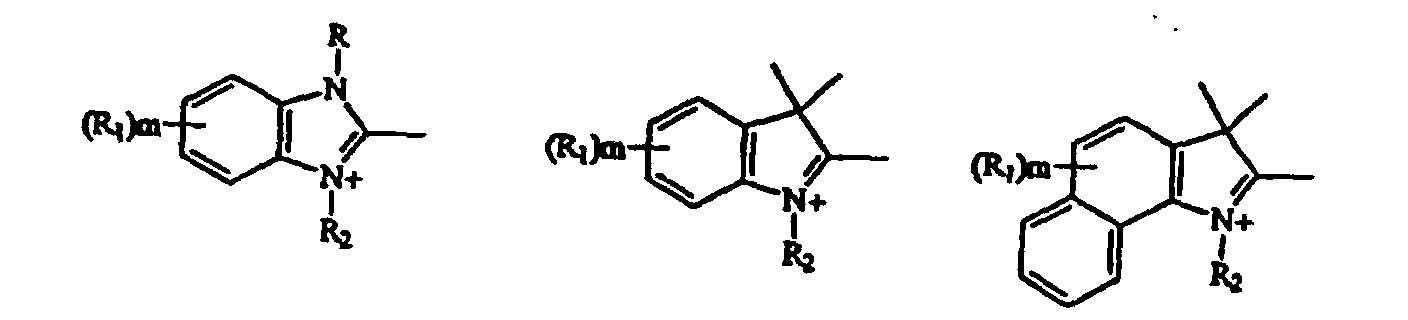
- the portion (I) including the ring indicated by Z represents a condensed ring formed by covalently coupling at least two atoms between a octagonal ring compound selected from the group consisting of thiazole ring, oxazole ring and imidazole ring, and one of the benzene ring, naphthalene ring and anthracene ring.
- a octagonal ring compound selected from the group consisting of thiazole ring, oxazole ring and imidazole ring, and one of the benzene ring, naphthalene ring and anthracene ring.
- Z is a benzene ring, naphthalene ring or anthracene ring;
- X 1 is S, O, Se, NR or C(CH 3 ) 2 ;
- X 2 is S, NR or O, where R is hydrogen or an alkyl group of 1 to 5 carbon atoms;
- R 1 is hydrogen, halogen atoms, an alkyl group of 1 to 3 carbon atoms or a nitro group;
- each of R 2 and R 5 is an alkyl group of 1 to 5 carbon atoms;
- each of R 3 and R 4 is hydrogen, an hydroxy group, an alkyl group of 1 to 4 carbon atoms, a halogen atom or a halide such as an alkyl, e.g.
- Y is Cl, Br, I, ClO 4 , BF 4 , BrO 4 , PF 6 , CH 3 SO 3 , CF 3 SO 3 , 4-CH 3 C 6 H 4 SO 3 , C 6 H 5 SO 3 , 6-SO 3 C 10 H 6 SO 3 or HSO 4 ;
- n is an integer of 0-2; and
- m is an integer of 1-2.
- the hemicyanine dye having formula (1) is a compound having formula (2) or (3) below: wherein R 1 is H, NO 2 or Cl; R 2 is CH 3 , C 2 H 5 , C 3 H 7 or C 4 H 9 ; X 1 is C(CH 3 ) 2 or S; X 2 is O or S; R 5 is C 2 H 5 , C 3 H 7 or C 4 H 9 ; and Y is ClO 4 , BF 4 , PF 6 , I, Br or Cl, and wherein X 1 is C(CH 3 ) 2 or S; X 2 is S; R 2 is CH 3 , C 2 H 5 , C 3 H 7 or C 4 H 9 ; R 5 is C 2 H 5 , C 3 H 7 or C 4 H 9 ; and Y is ClO 4 , BF 4 , PF 6 , I, Br or Cl.
- reaction scheme (I) The synthesis of the novel hemicyanine dye having formula (1) according to the present invention will be described with reference to the following reaction scheme (I).
- the hemicyanine dye having formula (1) is obtained by condensing compound (A) with compound (B).
- Each of the compounds (A) and (B) can be derived by the following process illustrated in reaction scheme (I).
- Compound (A) is derived by reacting compound (A-1) with excess halogen compound, for example, iodomethane, iodoethane, iodopropane, iodobutane.
- Compound (B) can be derived by reacting compound (B-1) with a secondary amine.
- An optical recording medium according to the present invention which is manufactured using the hemicyanine dye having formula (1) as an optical recording material, is a write once read many (WORM) type optical recording medium using a laser beam, and particularly, is a DVD-R using a short wavelength laser beam as a light source.
- WORM write once read many
- FIG. 1 is a sectional view illustrating the structure of layers stacked in an optical recording medium according to the present invention.
- a recording layer 11 which contains the hemicyanine dye having formula (1) above used as an optical recording medium
- a reflective layer 12 and a protective layer 13 are deposited in succession over a semiconductor substrate 10.
- a dummy substrate 15 can be attached to the optical recording medium using an adhesive layer 14.
- the optical recording medium of FIG. 1 can be combined with another optical recording medium having the same or different structure as or from that of FIG. 1.
- a material used for the adhesive layer 14 may be a ultraviolet (UV) curable resin, or a cationic curable resin.
- such combination with an adhesive layer can be performed using a two-sided adhesive sheet, or by a hot-melting, spin coating, dispensing (extrusion), screen printing, or roll-coat method.
- the substrate 10 is formed of a material, which is transparent to a laser beam and easy to swell by heat, and has a strong impact resistance.
- Suitable materials for the substrate 10, which meet the requirements, include polycarbonate, polymethacrylate, epoxy resin, polyester resin and polyolefin resin. These materials used for the substrate 10 have a thermal deformation temperature in the range of 80-200°C, but preferably in the range of 100-200°C.
- Pregrooves for guiding an incident laser beam during recording or reproducing are formed on the surface of the substrate 10.
- the pregrooves have a depth of 80-250 nm, and a width of 200-500 ⁇ m.
- the substrate 10 has a transmittance of 60-99%, more preferably 70-99%, with about 90% being preferred, and a thickness of 0.01-10 mm. If the transmittance or thickness of the substrate is beyond the above range, the optical recording medium characteristics are unfavorable.
- the recording layer 11 includes an organic dye which is physically deformed and decomposed by a recording laser beam.
- the recording layer 11 may include at least one hemicyanine dye having formula (1).
- the recording layer 11 can further include a singlet oxygen quencher, a light absorptive material and a radical scavenger.
- the optical recording material used in the recording layer 11 has a complex refractive index, including a real part coefficient n of 1.5-2.8 and an imaginary part coefficient k of 0.01-0.4 in the wavelength range for recording and reproduction. More preferably, the optical recording material has a refractive index of 1.8-2.3 in a wavelength range of 400-700 nm.
- the optical recording medium has a maximum absorption wavelength of 350-650 nm. If the complex refractive index and the maximum absorption wavelength of the optical recording material are beyond the above ranges, recording and reproducing characteristics in terms of recording sensitivity, push-pull, tracking and modulation factor are unfavorable.
- the recording layer 11 is formed by spin coating a composition over a substrate.
- the composition for the recording layer 11 is obtained by dissolving 0.5-10% by weight hemicyanine dye having formula (1) in a solvent of 90-99.5% by weight based on the total weight of the composition. Any solvent capable of dissolving the hemicyanine dye can be used without limitations.
- the reflective layer 12 which ensures high reflectivity for recording or reproducing, is formed of a metal having a high reflectivity as well as a high thermal conductivity, such that the reflective layer 12 is not susceptible to deform.
- Suitable metals used for the reflective layer 12 include gold (Au), aluminum (Al), silver (Ag), copper (Cu), palladium (Pd), platinum (Pt), titanium (Ti), tantalum (Ta), chromium (Cr), nickel (Ni) or an alloy of these metals.
- the reflective layer 12 has a thickness of 500-2500 ⁇ .
- the reflective layer 12 may be formed by vacuum deposition, E-beam or sputtering.
- the protective layer 13 serves to protect other constituents layers, and in particular, the reflective layer 12 of the optical recording medium.
- the protective layer 13 is formed by a common method. For example, a transparent UV curable material with strong impact resistance, such as epoxy or acrylate UV curable resin is spin-coated over the reflective layer 12, and then cured by radiation of UV rays.
- reaction mixture was evaporated in a vacuum to remove the solvent, and the residue was extracted with ether.
- ether portion was concentrated and purified by silicagel chromatography (using a mixed solvent containing hexane and ethylacetate in a ratio of 3:1 by volume as an eluent) to obtain 5-diethylamino-2-thiophenenecarboxaldehyde of orange color with a yield of 80%.
- 0.3g of the dye D1 was dissolved in 10 ml tetrafluoropropanol, and spin-coated over a substrate to form a dye thin film.
- the absorption spectrum of the obtained thin film was observed with UV-VIS-NIR spectrophotometer (UV-3101PC, Shimadzu Co.). As a result, the maximum absorption peak ( ⁇ max ) of dye D1 was shown at 590 nm.
- Dye D1 of violet color having the following formula was obtained with a yield of 85%) in the same way as in Synthesis Example 1, except that 1,2,3,3,-tetramethylpseudoindolium chloride was used instead of 1-methyl-2,3,3-trimethylpseudoindolium iodide of Synthesis Example 1.
- ⁇ max The maximum absorption peak ( ⁇ max ) of dye D2 was observed by the same method as in Synthesis Example 1. As a result, ⁇ max of dye D2 was shown at 586 nm.
- Dyes D3, D4, D5, D6 and D7 having the following formula were obtained in the same way as in Synthesis Example 2, except that HCI used in Synthesis Example 2 was replaced by HBr, H 2 SO 4 , HClO 4 , HBF 4 and HPF 6 , respectively, for Synthesis Examples 3 through 7.
- the yields of dyes D3, D4, D5, D6 and D7 were 70%, 75%, 75%, 70% and 75%, respectively.
- Y is Br for dye D3, ClO 4 for dye D4, HSO 4 for dye D5, BF 4 for dye D6, and PF 6 for dye D7.
- ⁇ max The maximum absorption peaks ( ⁇ max ) of dyes D3, D4, D5, D6 and D7 were observed by the same method as in Synthesis Example 1. As a result, ⁇ max was 590 nm for dye D3, 586 nm for dye D4, 589 nm for dye D5, 589 nm for dye D6, and 590 nm for dye D7.
- Dye D8 having the following formula was obtained with a yield of 75% in the same way as in Synthesis Example 2, except that 5-chloro-1,2,3,3,-tetramethylpseudoindolium chloride was used instead of 1-methyl-2,3,3-trimethylpseudoindolium iodide of Synthesis Example 1.
- ⁇ max The maximum absorption peak ( ⁇ max ) of dye D8 was observed by the same method as in Synthesis Example 1. As a result, ⁇ max was 596 nm for dye D8.
- Dyes D9, D10 and D11 having the following formula were obtained in the same way as in Synthesis Example 2, except that 5-chloro-2-methylene-1,3,3-trimethylindoline was used instead of 2-methylene-1,3,3-trimethylene indoline, and HCI used in Synthesis Example 2 was replaced by HClO 4 , HBF 4 and HPF 6 , respectively, for Synthesis Examples 9 through 11.
- the yields of Dyes D9, D10 and D11 were 70%, 75% and 75%, respectively.
- Y is ClO 4 for dye D9, BF 4 for dye D10, and PF 6 for dye D11.
- ⁇ max The maximum absorption peaks ( ⁇ max ) of dyes D9, D10 and D11 were observed by the same method as in Synthesis Example 1. As a result, ⁇ max was 597 nm for dye D9, 599 nm for dye D10 and 598 nm for dye D11.
- Dye D12 of violet color was obtained with a yield of 80% by the same method as in Synthesis Example 1, except that 1-methyl-2,3,3-trimethylpseudoindolium iodide was replaced by 1,2,3,3-tetramethyl-4,5-benzopseudoindolium iodide.
- ⁇ max The maximum absorption peak ( ⁇ max ) of dye D12 was observed by the same method as in Synthesis Example 1. As a result, ⁇ max was 620 nm for dye D12.
- 1,2,3,3-tetramethyl-4,5-benzopseudoindolium iodide obtained in Synthesis Example 12 was dissolved in 2M NaOH solution, and ethyl acetate was added to the solution and stirred for 2 minutes. The ethyl acetate portion was separated from the reaction mixture and HClO 4 solution was added to the separated ethyl acetate portion. The precipitate of the reaction mixture was filtered and washed with ethyl acetate several times to obtain 1,2,3,3-tetramethyl-4,5-benzopseudolium perchlorate.
- Dye D13 having the following formula was obtained with a yield of 80% in the same way as in Synthesis Example 1, except that 1-methyl-2,3,3-trimethylpseudoindolium iodide used in Synthesis Example 1 was replaced by 1,2,3,3-tetramethyl-4,5-benzopseudoindolium perchlorate.
- ⁇ max The maximum absorption peak ( ⁇ max ) of dye D13 was observed by the same method as in Synthesis Example 1. As a result, ⁇ max was 618 nm for dye D13.
- Dye 14 having the following formula was obtained in the same way as in Synthesis Example 1, except that 2-methylbenzothiazole and iodoethane were used instead of 2,3,3-trimethylidolenine and iodomethane used in Synthesis Example 1, respectively.
- the yield of dye D14 was 80%.
- ⁇ max The maximum absorption peak ( ⁇ max ) of dye D14 was observed by the same method as in Synthesis Example 1. As a result, ⁇ max was 558 nm for dye D14.
- Dye D15 having the following formula, where R is C 3 H 7 , was obtained in the same way as in Synthesis Example 1, except that iodopropane and 2-methylbenzothiazole were used instead of iodomethane and 2,3,3-trimethylidolenine used in Synthesis Example 1, respectively.
- the yield of dye D15 was 75%.
- ⁇ max The maximum absorption peak ( ⁇ max ) of dye D15 was observed by the same method as in Synthesis Example 1. As a result, ⁇ max , was 560 nm for dye D15.
- Y is ClO 4 for dye D16, BF 4 for dye D17, and PF 6 for dye D18.
- ⁇ max The maximum absorption peak ( ⁇ max ) of dye D16 was observed by the same method as in Synthesis Example 1. As a result, ⁇ max was 608 nm for dye D16, 608 nm for dye D17 and 609 nm for dye D18.
- ⁇ max The maximum absorption peak ( ⁇ max ) of dye D19 was observed by the same method as in Synthesis Example 1. As a result, ⁇ max was 597 nm for dye D19.
- Dye D20 having the following formula, was obtained in the same way as in Synthesis Example 1, except that dipropylamine and 1,2,3,3-trimethylpseudoindolium perchlorate were used instead of diethylamine and 1,2,3,3-trimethylpseudoindolium iodide were used, respectively.
- the yield of dye D20 was 85%.
- ⁇ max The maximum absorption peak ( ⁇ max ) of dye D20 was observed by the same method as in Synthesis Example 1. As a result, ⁇ max was 596 nm for dye D20.
- Dye D21 having the following formula was obtained with a yield of 85% in the same way as in Synthesis Example 19, except that 5-chloro-1,2,3,3-tetramethylpseudoindolium iodide was used instead of 1-methyl-2,3,3-trimethylpseudoindolium iodide.
- ⁇ max The maximum absorption peak ( ⁇ max ) of dye D21 was observed by the same method as in Synthesis Example 1. As a result, ⁇ max was 600 nm for dye D21.
- Dyes D22, D23 and D24 having the following formula were obtained in the same way as in Synthesis Example 2, except that 5-chloro-2-methylene-1,3,3-trimethylindoline was used instead of 2-methylene-1,3,3-trimethylindoline, and HCI used in Synthesis Example 2 was replaced by HClO 4 , HBF 4 and HPF 6 , respectively, for Synthesis Examples 22 through 24.
- the yields of dyes D22, D23 and D24 were 70%, 75% and 75%, respectively.
- Y is ClO 4 for dye D22, BF 4 for dye D23, and PF 6 for dye D24.
- ⁇ max The maximum absorption peaks ( ⁇ max ) of dyes D22, D23 and D24 were observed by the same method as in Synthesis Example 1. As a result, ⁇ max was 600 nm for dye D22, 598 nm for dye D23 and 602 nm for dye D24.
- Dyes D25, D26 and D27 having the following formula were obtained by the same way as in Synthesis Example 19, except that 1-methyl-2,3,3-trimethylpseudoindolium iodide was replaced by 5-nitro-2-methylene-1,3,3-trimethylindolium perchlorate, 5-nitro-2-methylene-1,3,3-trimethylindolium tetrafluoroborate, 5-nitro-2-methylene-1,3,3-trimethylindolium hexafluorophosphate for Synthesis Examples 25 through 27, respectively.
- the yields of dyes D25, D26 and D27 were 70%, 75% and 75%, respectively.
- Y is ClO 4 for dye D25, BF 4 for dye D26, and PF 6 for dye D27.
- ⁇ max The maximum absorption peaks ( ⁇ max ) of dyes D25, D26 and D27 were observed by the same method as in Synthesis Example 1. As a result, ⁇ max was 608 nm for dye D25, 608 nm for dye D26 and 604 nm for dye D27.
- Dye D28 having the following formula was obtained with a yield 75% by the same way as in Synthesis Example 13, except that dipropylamine was used instead of diethylamine.
- ⁇ max The maximum absorption peak ( ⁇ max ) of dye D28 was observed by the same method as in Synthesis Example 1. As a result, ⁇ max was 618 nm for dye D28.
- Dyes D29 and D30 having the following formula were obtained by the same way as in Synthesis Example 28, except that 1,2,3,3-tetramethyl-4,5-benzopseudoindolium perchlorate was replaced by1,2,3,3-tetramethyl-4,5-benzopseudoindolium tetrafluoroborate and 1,2,3,3-tetramethyl-4,5-benzopseudoindolium hexafluorophosphate for Synthesis Examples 29 and 30, respectively.
- the yield of dyes 29 and 30 was 80%.
- Y is BF 4 for dye 29 and PF 6 for dye 30.
- ⁇ max The maximum absorption peaks ( ⁇ max ) of dyes D29 and D30 were observed by the same method as in Synthesis Example 1. As a result, ⁇ max was 618 nm for dye D29 and 619 nm for dye D30.
- 5-Bromofuraldehyde was dissolved in dimethylsulfoxide (DMSO) and 1-2 drops of Aliquart 336 (tricaprylylmethylammonium chloride, produced by Aldrich Co.) was added to the solution. 10 Equivalents diethylamine was added to the mixture and refluxed for 4 days. The remaining diethylamine was removed from the reaction mixture and subjected to extraction and column chromatography to obtain 5-diethylamino-2-furaldehyde with a yield of 85%.
- DMSO dimethylsulfoxide
- Aliquart 336 tricaprylylmethylammonium chloride, produced by Aldrich Co.
- ⁇ max The maximum absorption peak ( ⁇ max ) of dye D31 was observed by the same method as in Synthesis Example 1. As a result, ⁇ max was 594 nm for dye D31.
- Dyes D32 and D33 having the following formula were obtained by the same way as in Synthesis Example 30, except that 5-chloro-1,2,3,3-tetramethylpseudoindolium perchlorate was replaced by5-chloro-1,2,3,3-tetramethylpseudoindolium tetrafluoroborate and 5-chloro-1,2,3,3-tetramethylpseudoindolium hexafluorophosphate for Synthesis Examples 32 and 33, respectively.
- the yield of dyes D32 and D33 was 85%.
- Y is BF 4 for dye D32 and PF 6 for D33.
- the maximum absorption peaks ( ⁇ max ) of dyes D32 and D33 were observed by the same method as in Synthesis Example 1. As a result, ⁇ max was 594 nm for dye D32 and 595 nm for dye D33.
- the substrate having the dye layer was dried in a vacuum oven set at 40°C for 12 hours. Then, silver (Ag) was deposited over the dye layer to form a reflective layer with a thickness of 100 nm. An acrylic UV curable resin was spin coated over the reflective layer and then cured by radiation of UV rays to form a protecting layer. The resultant substrate was combined with a dummy disk, thereby completing an optical disk.
- Optical disks were manufactured by the same way as in Example 1, except that dyes D13, D16, D22 and D31 were used instead of dye D9 for Examples 2 through 5.
- Optical disks were manufactured by the same way as in Example 1, except that cyanine series dyes, NK4321 (Hayashibara Biochemical Laboratories, INC.), NK4422 (Hayashibara Biochemical Laboratories, INC.), OM78 (Fuji Photo Film Co., LTD), NK4499 (Hayashibara Biochemical Laboratories, INC) and NK4500 (Hayashibara Biochemical Laboratories, INC.), were used for Comparative Examples 1 through 5, respectively.
- the characteristics the optical disks manufactured in Examples 1 through 5 and Comparative Examples 1 through 5 was evaluated by a DVD-R recorder (DVDR-S101, Pioneer), a dynamic characteristic evaluator (DDU-1000, Pulstec) equipped with a laser diode (LD, Nichia, Japan) having a peak wavelength of 630 nm or 650 nm, and a DVD player (DVD909, Samsung, Korea).
- the before-recording characteristic of the optical disks was evaluated using the dynamic characteristic evaluator equipped with 635 nm LD. The results are shown in Table 1.
- Rg indicates the reflectivity from pregrooves
- RI indicates the reflectivity from lands
- P-P indicates the push-pull characteristic
- Rtop indicates the maximum reflectivity
- the jitter indicates variations of reproduction signals, which is a signal uniformity index
- I14/I14H indicates the modulated amplitude of recorded signals.
- Example 2 45 48 0.25 51 8.1 0.67
- Example 5 48
- 51 0.24 54 8.0 0.66 Comparative Example 1 64.1 66 0.33 62 13 0.50 Comparative Example 2 56 59 0.30 55 12 0.58 Comparative Example 3 56 59 0.33 54 9.6 0.62 Comparative Example 4 unrecordable Comparative Example 5 unrecordable
- the recording characteristics, including jitter, of the optical disks of Examples 1 through 5, which were evaluated using the DVD-R recorder, are better than those of Comparative Examples 1. Also, the reproduction characteristics of Examples 1 through 5, evaluated with the DVD player, ensures that the optical disks are compatible with DVD players. Apparently, the optical characteristics of the optical disks of Comparative Examples are unsuitable for recording.
- the hemicyanine dye having formula (1) above is easy to synthesize with high yield.
- use of the hemicyanind dye as an optical recording medium is advantageous in terms of the manufacturing costs.
- a WORM type optical recording medium using the hemicyanine dye has improved recording characteristics in terms of jitter and modulation factor, compared with a conventional optical recording material.
Landscapes
- Chemical & Material Sciences (AREA)
- Organic Chemistry (AREA)
- Optical Record Carriers And Manufacture Thereof (AREA)
- Thermal Transfer Or Thermal Recording In General (AREA)
Abstract

Description
- The present invention relates to hemicyanine dyes and optical recording media formed using a hemicyanine dye as an optical recording material, and more particularly, to hemicyanine dyes, and a write only read many (WORM) optical recording medium capable of recording and reproducing information by laser, which employs a hemicynine dye as an optical recording material.
- Optical recording media have a smaller recording area per recording unit than conventional magnetic recording media, so that use of optical recording media as a high density recording medium is extensively increasing. Optical recording media are classified into a read only memory (ROM) type for only reading recorded information, a write once read many (WORM) type which allows only one writing, and an erasable type which allows erasing of recorded information and rewriting.
- Recordable optical recording media record and reproduce information by detecting variations in the reflectivity caused by physical deformation and changes in phase and magnetic properties of a recording layer before and after the recording.
- A compact disk recordable (CD-R) is widely known as a WORM type optical recording medium. In addition, a variety of optical recording materials, which ensure easy manufacture of such a recording medium with improved properties, have been suggested and some of them are in use. Disclosed optical recording materials for CD-Rs include a cyanine dye (Japanese Patent Publication No. sho 58-125246), a phthalocyanine dye (European Patent No. 676,751), an azo dye (US Patent No. 5,441,844), a dye of double salt (US Patent No. 4,626,490) and a dye of azo-metal complex (US Patent No. 5,272,047).
- Recently, with increased amount of information, a digital versatile disk recordable (DVD-R) with increased information storing capability has been suggested. The DVD-R adopts a red diode laser having a wavelength of 630-690 nm, as a light source, and has reduced pit size and track interval, so that its information storing capacity is 6-8 times increased to CD-Rs, with improved recording density. Optical recording materials suitable for DVD-Rs needs a high reflectivity and good absorption at the recording wavelength, and good solubility in an organic solvent. In addition, the synthesis of optical recording materials must be easy with low costs. Examples of such optical recording materials for DVD-Rs include a cyanine dye (Japanese Patent Publication Nos. hei 10-149583 and hei 9-208560) and an azo-metal complex (Japanese Patent Publication Nos. hei 10-157293 and hei 9-157301). However, it would be desirable to improve the characteristics of the conventional dyes.
- To solve the above problems, it is a first objective of the present invention to provide a novel hemicyanine dye which is easy to synthesize with high yield.
- A second objective of the present invention is to provide an optical recording medium with improved recording characteristics, which is manufactured using the hemicyanine dye as an inexpensive optical recording material.
- The first objective of the present invention is achieved by a hemocyanine dye of formula (1):wherein Z is a benzene ring, naphthalene ring or anthracene ring; X1 is S, O, Se, NR or C(CH3)2; X2 is S, NR or O, where R is hydrogen or an alkyl group of 1 to 5 carbon atoms; R1 is hydrogen, halogen atoms, an alkyl group of 1 to 3 carbon atoms or a nitro group; each of R2 and R5 is an alkyl group of 1 to 5 carbon atoms; each of R3 and R4 is hydrogen, an hydroxy group, an alkyl group of 1 to 4 carbon atoms, a halogen atom or a halide; Y is Cl, Br, I, ClO4, BF4, BrO4, PF6, CH3SO3, CF3SO3, 4-CH3C6H4SO3, C6H5SO3, 6-SO3C10H6SO3 or HSO4; n is an integer of 0-2; and m is an integer of 1-2.

- The second objective of the present invention is achieved by an optical recording medium comprising a transparent substrate with grooves, a recording layer including a laser absorptive dye, formed over the transparent substrate, and a reflective layer and a protective layer formed over the recording layer, wherein the dye of the recording layer is a hemicyanine dye of formula (1):wherein Z is a benzene ring, naphthalene ring or anthracene ring; X1 is S, O, Se, NR or C(CH3)2; X2 is S, NR or O, where R is hydrogen or an alkyl group of 1 to 5 carbon atoms; R1 is hydrogen, halogen atoms, an alkyl group of 1 to 3 carbon atoms or a nitro group; each of R2 and R5 is an alkyl group of 1 to 5 carbon atoms; each of R3 and R4 is hydrogen, an hydroxy group, an alkyl group of 1 to 4 carbon atoms, a halogen atom or a halide; Y is Cl, Br, I, ClO4, BF4, BrO4, PF6, CH3SO3, CF3SO3, 4-CH3C6H4SO3, C6H5SO3, 6-SO3C10H6SO3 or HSO4; n is an integer of 0-2; and m is an integer of 1-2.

- The above objectives and advantages of the present invention will become more apparent by describing in detail a preferred embodiment thereof with reference to the attached drawings in which:
FIG. 1 is a sectional view illustrating the structure of layers stacked in an optical recording medium according to a preferred embodiment of the present invention. - In a hemicyanine dye having formula (1) according to the present invention, Z is a benzene ring, a naphthalene ring or an anthracene ring.
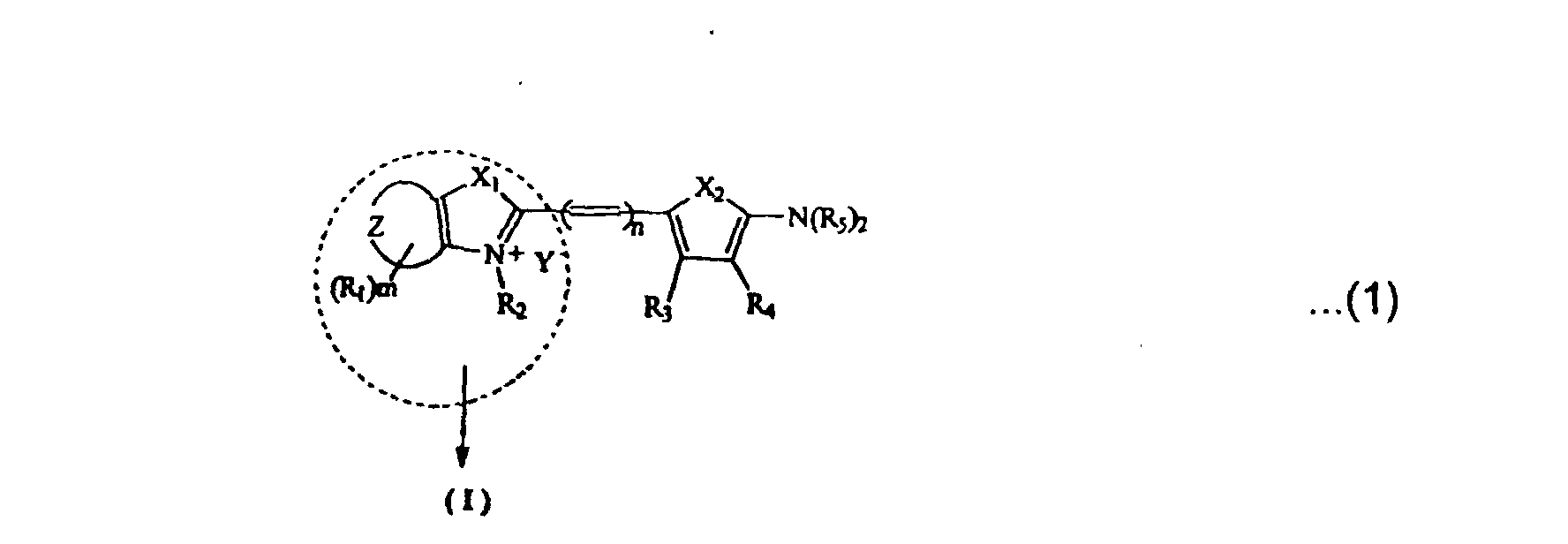
- Apparently, in formula (1), the portion (I) including the ring indicated by Z represents a condensed ring formed by covalently coupling at least two atoms between a octagonal ring compound selected from the group consisting of thiazole ring, oxazole ring and imidazole ring, and one of the benzene ring, naphthalene ring and anthracene ring. The concrete examples of the portion (I) are as follows.


 wherein Z is a benzene ring, naphthalene ring or anthracene ring; X1 is S, O, Se, NR or C(CH3)2; X2 is S, NR or O, where R is hydrogen or an alkyl group of 1 to 5 carbon atoms; R1 is hydrogen, halogen atoms, an alkyl group of 1 to 3 carbon atoms or a nitro group; each of R2 and R5 is an alkyl group of 1 to 5 carbon atoms; each of R3 and R4 is hydrogen, an hydroxy group, an alkyl group of 1 to 4 carbon atoms, a halogen atom or a halide such as an alkyl, e.g. methyl, halide; Y is Cl, Br, I, ClO4, BF4, BrO4, PF6, CH3SO3, CF3SO3, 4-CH3C6H4SO3, C6H5SO3, 6-SO3C10H6SO3 or HSO4; n is an integer of 0-2; and m is an integer of 1-2.
- Preferably, the hemicyanine dye having formula (1) is a compound having formula (2) or (3) below:wherein R1 is H, NO2 or Cl; R2 is CH3, C2H5, C3H7 or C4H9; X1 is C(CH3)2 or S; X2 is O or S; R5 is C2H5, C3H7 or C4H9; and Y is ClO4, BF4, PF6, I, Br or Cl, and
 wherein X1 is C(CH3)2 or S; X2 is S; R2 is CH3, C2H5, C3H7 or C4H9; R5 is C2H5, C3H7 or C4H9; and Y is ClO4, BF4, PF6, I, Br or Cl.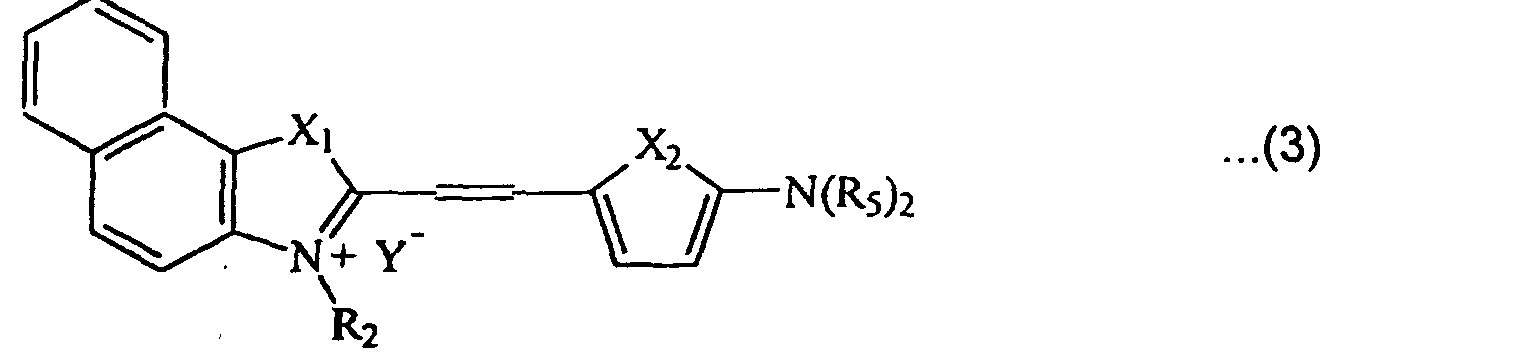
- The synthesis of the novel hemicyanine dye having formula (1) according to the present invention will be described with reference to the following reaction scheme (I). The hemicyanine dye having formula (1) is obtained by condensing compound (A) with compound (B). Each of the compounds (A) and (B) can be derived by the following process illustrated in reaction scheme (I).

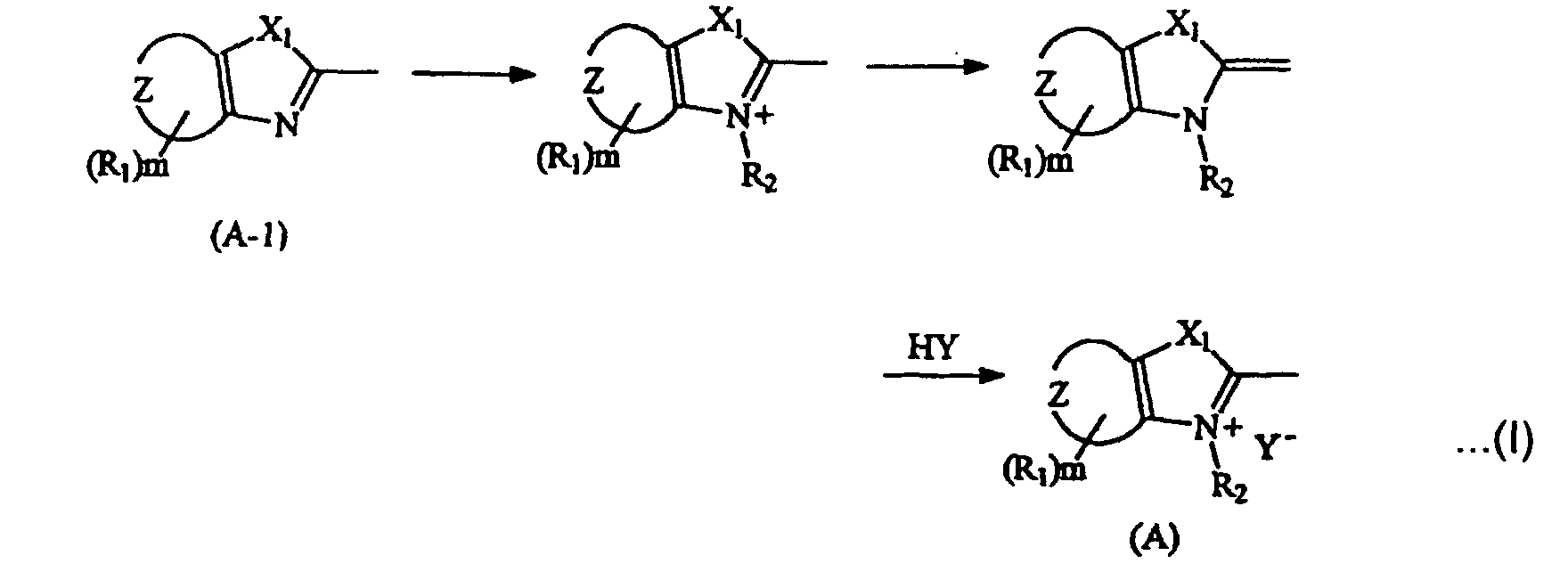

- Compound (A) is derived by reacting compound (A-1) with excess halogen compound, for example, iodomethane, iodoethane, iodopropane, iodobutane. Compound (B) can be derived by reacting compound (B-1) with a secondary amine.
- An optical recording medium according to the present invention, which is manufactured using the hemicyanine dye having formula (1) as an optical recording material, is a write once read many (WORM) type optical recording medium using a laser beam, and particularly, is a DVD-R using a short wavelength laser beam as a light source.
- FIG. 1 is a sectional view illustrating the structure of layers stacked in an optical recording medium according to the present invention. Referring to FIG. 1, a
recording layer 11, which contains the hemicyanine dye having formula (1) above used as an optical recording medium, areflective layer 12 and aprotective layer 13 are deposited in succession over asemiconductor substrate 10. - For certain cases, a
dummy substrate 15 can be attached to the optical recording medium using anadhesive layer 14. Alternatively, the optical recording medium of FIG. 1 can be combined with another optical recording medium having the same or different structure as or from that of FIG. 1. A material used for theadhesive layer 14 may be a ultraviolet (UV) curable resin, or a cationic curable resin. Also, such combination with an adhesive layer can be performed using a two-sided adhesive sheet, or by a hot-melting, spin coating, dispensing (extrusion), screen printing, or roll-coat method. - Preferably, the
substrate 10 is formed of a material, which is transparent to a laser beam and easy to swell by heat, and has a strong impact resistance. Suitable materials for thesubstrate 10, which meet the requirements, include polycarbonate, polymethacrylate, epoxy resin, polyester resin and polyolefin resin. These materials used for thesubstrate 10 have a thermal deformation temperature in the range of 80-200°C, but preferably in the range of 100-200°C. - Pregrooves for guiding an incident laser beam during recording or reproducing are formed on the surface of the
substrate 10. Preferably, the pregrooves have a depth of 80-250 nm, and a width of 200-500 µm. Preferably, thesubstrate 10 has a transmittance of 60-99%, more preferably 70-99%, with about 90% being preferred, and a thickness of 0.01-10 mm. If the transmittance or thickness of the substrate is beyond the above range, the optical recording medium characteristics are unfavorable. - The
recording layer 11 includes an organic dye which is physically deformed and decomposed by a recording laser beam. In the present invention, therecording layer 11 may include at least one hemicyanine dye having formula (1). As needed, therecording layer 11 can further include a singlet oxygen quencher, a light absorptive material and a radical scavenger. Preferably, the optical recording material used in therecording layer 11 has a complex refractive index, including a real part coefficient n of 1.5-2.8 and an imaginary part coefficient k of 0.01-0.4 in the wavelength range for recording and reproduction. More preferably, the optical recording material has a refractive index of 1.8-2.3 in a wavelength range of 400-700 nm. Preferably, the optical recording medium has a maximum absorption wavelength of 350-650 nm. If the complex refractive index and the maximum absorption wavelength of the optical recording material are beyond the above ranges, recording and reproducing characteristics in terms of recording sensitivity, push-pull, tracking and modulation factor are unfavorable. - The
recording layer 11 is formed by spin coating a composition over a substrate. The composition for therecording layer 11 is obtained by dissolving 0.5-10% by weight hemicyanine dye having formula (1) in a solvent of 90-99.5% by weight based on the total weight of the composition. Any solvent capable of dissolving the hemicyanine dye can be used without limitations. - Preferably, the
reflective layer 12, which ensures high reflectivity for recording or reproducing, is formed of a metal having a high reflectivity as well as a high thermal conductivity, such that thereflective layer 12 is not susceptible to deform. Suitable metals used for thereflective layer 12 include gold (Au), aluminum (Al), silver (Ag), copper (Cu), palladium (Pd), platinum (Pt), titanium (Ti), tantalum (Ta), chromium (Cr), nickel (Ni) or an alloy of these metals. Preferably, thereflective layer 12 has a thickness of 500-2500 Å. Thereflective layer 12 may be formed by vacuum deposition, E-beam or sputtering. - In the present invention, the
protective layer 13 serves to protect other constituents layers, and in particular, thereflective layer 12 of the optical recording medium. Theprotective layer 13 is formed by a common method. For example, a transparent UV curable material with strong impact resistance, such as epoxy or acrylate UV curable resin is spin-coated over thereflective layer 12, and then cured by radiation of UV rays. - The present invention will be described in greater detail by means of the following examples. The following examples are for illustrative purposes and are not intended to limit the scope of the invention.
- 1 Equivalent 5-bromo-2-thiophenecarboxaldehyde was dissolved in dimethylformamide, and 1-2 drops of Aliquart 336 (tricaprylylmethylammonium chloride, produced by Aldrich) was dropwise added to the solution. 10 Equivalents diethyl amine was added to the mixture and refluxed at 110°C for 5 days.
- The reaction mixture was evaporated in a vacuum to remove the solvent, and the residue was extracted with ether. The ether portion was concentrated and purified by silicagel chromatography (using a mixed solvent containing hexane and ethylacetate in a ratio of 3:1 by volume as an eluent) to obtain 5-diethylamino-2-thiophenenecarboxaldehyde of orange color with a yield of 80%.
- 1 Equivalent 2,3,3-trimethylindolene and 10 equivalents iodomethane were dissolved in ethylacetate, and refluxed at 50°C. As a result, when excess reaction product was precipitated, the precipitate was filtered and washed with ethyl acetate several times, so that 1-methyl-2,3,3-trimethylpseudoindolium iodide was obtained with a yield of 90%.
- 1.2 Equivalents 5-diethylamino-2-thiophenecarboxaldehyde and 1 equivalent 1-methyl-2,3,3-trimethylpseudoindolium iodide were dissolved in ethanol while stirring. Then, 1 drop of piperidine was added. The reaction mixture was refluxed for 5 hours and evaporated under vacuum to remove the solvent. Then, excess ethyl acetate was added to the resultant mixture, so that violet powder was precipitated. The precipitate was washed with ethyl acetate several times, so that dye D1 of violet color having the following formula was obtained with a yield of 80%.

- 0.3g of the dye D1 was dissolved in 10 ml tetrafluoropropanol, and spin-coated over a substrate to form a dye thin film. The absorption spectrum of the obtained thin film was observed with UV-VIS-NIR spectrophotometer (UV-3101PC, Shimadzu Co.). As a result, the maximum absorption peak (λmax) of dye D1 was shown at 590 nm.
- NMR (DMSO, ppm): 1.28 (t, 6H), 1.68 (s, 6H), 3.68 (q, 4H), 3.96 (s, 3H), 6.08 (d, 1H), 6.76 (d, 1H), 7.42 (t, 1H), 7.64 (t, 1H), 7.82 (d, 1H), 7.90 (d, 1H), 8.04 (d, 1H), 8.36 (d, 1H)
- 2-Methylene-1,3,3-trimethyleneindoline was dissolved in ethyl acetate and a HCI solution was dropwise added to the solution. The precipitate was filtered from the reaction mixture and washed with ethyl acetate several times to obtain 1,2,3,3,-tetramethylpseudoindolium chloride.
- Dye D1 of violet color having the following formula was obtained with a yield of 85%) in the same way as in Synthesis Example 1, except that 1,2,3,3,-tetramethylpseudoindolium chloride was used instead of 1-methyl-2,3,3-trimethylpseudoindolium iodide of Synthesis Example 1.

- The maximum absorption peak (λmax) of dye D2 was observed by the same method as in Synthesis Example 1. As a result, λmax of dye D2 was shown at 586 nm.
- NMR (DMSO, ppm): 1.28 (t, 6H), 1.68 (s, 6H), 3.68 (q, 4H), 3.96 (s, 3H), 6.08 (d, 1H), 6,76 (d, 1H), 7.42 (t, 1H), 7.64 (t, 1H), 7.82 (d, 1H), 7.90 (d, 1H), 8.04 (d, 1H), 8.36 (d, 1H)
- Dyes D3, D4, D5, D6 and D7 having the following formula were obtained in the same way as in Synthesis Example 2, except that HCI used in Synthesis Example 2 was replaced by HBr, H2SO4, HClO4, HBF4 and HPF6, respectively, for Synthesis Examples 3 through 7. The yields of dyes D3, D4, D5, D6 and D7 were 70%, 75%, 75%, 70% and 75%, respectively.

- In the formula above, Y is Br for dye D3, ClO4 for dye D4, HSO4 for dye D5, BF4 for dye D6, and PF6 for dye D7.
- The maximum absorption peaks (λmax) of dyes D3, D4, D5, D6 and D7 were observed by the same method as in Synthesis Example 1. As a result, λmax was 590 nm for dye D3, 586 nm for dye D4, 589 nm for dye D5, 589 nm for dye D6, and 590 nm for dye D7.
- NMR (DMSO, ppm): 1.28 (t, 6H), 1.68 (s, 6H), 3.68 (q, 4H), 3.96 (s, 3H), 6.08 (d, 1H), 6.76 (d, 1H), 7.42 (t, 1H), 7.64 (t, 1H), 7.82 (d, 1H), 7.90 (d, 1H), 8.04 (d, 1H), 8.36 (d, 1H)
- NMR (DMSO, ppm): 1.28 (t, 6H), 1.68 (s, 6H), 3.68 (q, 4H), 3.96 (s, 3H), 6.08 (d, 1H), 6.76 (d, 1H), 7.42 (t, 1H), 7.64 (t, 1H), 7.82 (d, 1H), 7.90 (d, 1H), 8.04 (d, 1H), 8.36 (d, 1H)
- NMR (DMSO, ppm): 1.28 (t, 6H), 1.68 (s, 6H), 3.68 (q, 4H), 3.96 (s, 3H), 6.08 (d, 1H), 6.76 (d, 1H), 7.42 (t, 1H), 7.64 (t, 1H), 7.82 (d, 1H), 7.90 (d, 1H), 8.04 (d, 1H), 8.36 (d, 1H)
- NMR (DMSO, ppm): 1.28 (t, 6H), 1.68 (s, 6H), 3.68 (q, 4H), 3.96 (s, 3H), 6.08 (d, 1H), 6.76 (d, 1H), 7.42 (t, 1H), 7.64 (t, 1H), 7.82 (d, 1H), 7.90 (d, 1H), 8.04 (d, 1H), 8.36 (d, 1H)
- NMR (DMSO, ppm): 1.28 (t, 6H), 1.68 (s, 6H), 3.68 (q, 4H), 3.96 (s, 3H), 6.08 (d, 1H), 6.76 (d, 1H), 7.42 (t, 1H), 7.64 (t, 1H), 7.82 (d, 1H), 7.90 (d, 1H), 8.04 (d, 1H), 8.36 (d, 1H)
- Dye D8 having the following formula was obtained with a yield of 75% in the same way as in Synthesis Example 2, except that 5-chloro-1,2,3,3,-tetramethylpseudoindolium chloride was used instead of 1-methyl-2,3,3-trimethylpseudoindolium iodide of Synthesis Example 1.
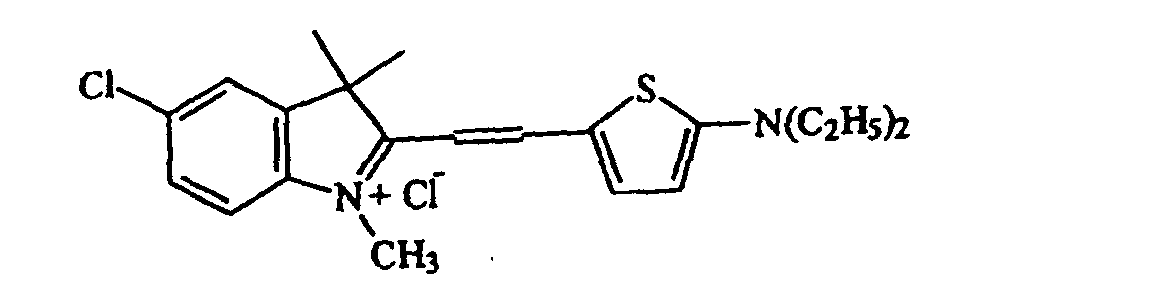
- The maximum absorption peak (λmax) of dye D8 was observed by the same method as in Synthesis Example 1. As a result, λmax was 596 nm for dye D8.
- NMR (DMSO, ppm): 1.28 (t, 6H), 1.68 (s, 6H), 3.62 (s, 3H), 3.70 (q, 4H), 6.02 (d, 1H), 6.82 (d, 1H), 7.40 (d, 1H), 7.46 (d, 1H), 7.74 (s, 1H), 8.10 (d, 1H), 8.20 (d, 1H)
- Dyes D9, D10 and D11 having the following formula were obtained in the same way as in Synthesis Example 2, except that 5-chloro-2-methylene-1,3,3-trimethylindoline was used instead of 2-methylene-1,3,3-trimethylene indoline, and HCI used in Synthesis Example 2 was replaced by HClO4, HBF4 and HPF6, respectively, for Synthesis Examples 9 through 11. The yields of Dyes D9, D10 and D11 were 70%, 75% and 75%, respectively.

- In the formula above, Y is ClO4 for dye D9, BF4 for dye D10, and PF6 for dye D11.
- The maximum absorption peaks (λmax) of dyes D9, D10 and D11 were observed by the same method as in Synthesis Example 1. As a result, λmax was 597 nm for dye D9, 599 nm for dye D10 and 598 nm for dye D11.
- NMR (DMSO, ppm): 1.28 (t, 6H), 1.68 (s, 6H), 3.62 (s, 3H), 3.70 (q, 4H), 6.04 (d, 1H), 6.82 (d, 1H), 7.40 (d, 1H), 7.46 (d, 1H), 7.76 (s, 1H), 8.06 (d, 1H), 8.36 (d, 1H)
- NMR (DMSO, ppm): 1.28 (t, 6H), 1.68 (s, 6H), 3.62 (s, 3H), 3.70 (q, 4H), 6.04 (d, 1H), 6.82 (d, 1H), 7.40 (d, 1H), 7.46 (d, 1H), 7.76 (s, 1H), 8.06 (d, 1H), 8.36 (d, 1H)
- NMR (DMSO, ppm): 1.28 (t, 6H), 1.68 (s, 6H), 3.62 (s, 3H), 3.70 (q, 4H), 6.04 (d, 1H), 6.82 (d, 1H), 7.40 (d, 1H), 7.46 (d, 1H), 7.76 (s, 1H), 8.06 (d, 1H), 8.36 (d, 1H)
- 1 Equivalent 2,3,3,-trimethyl-4,5-benzo-3H-indoline and 10 equivalents iodomethane were dissolved in ethyl acetate and refluxes at 50°C. When excess reaction product was precipitated, the precipitate was filtered and washed with ethyl acetate several times to obtain 1,2,3,3-tetramethyl-4,5-benzo-pseudindolium iodide.
- Dye D12 of violet color was obtained with a yield of 80% by the same method as in Synthesis Example 1, except that 1-methyl-2,3,3-trimethylpseudoindolium iodide was replaced by 1,2,3,3-tetramethyl-4,5-benzopseudoindolium iodide.

- The maximum absorption peak (λmax) of dye D12 was observed by the same method as in Synthesis Example 1. As a result, λmax was 620 nm for dye D12.
- NMR (DMSO, ppm): 1.28 (t, 6H), 1.92 (s, 6H), 3.68 (q, 4H), 3.78 (s, 3H), 6.12 (d, 1H), 6.72 (d, 1H), 7.52 (t, 1H), 7.66 (t, 1H), 7.74 (d, 1H), 8.02 (d, 1H), 8.08 (d, 1H), 8.12 (d, 1H), 8.26 (d, 1H), 8.48 (d, 1H)
- 1,2,3,3-tetramethyl-4,5-benzopseudoindolium iodide obtained in Synthesis Example 12 was dissolved in 2M NaOH solution, and ethyl acetate was added to the solution and stirred for 2 minutes. The ethyl acetate portion was separated from the reaction mixture and HClO4 solution was added to the separated ethyl acetate portion. The precipitate of the reaction mixture was filtered and washed with ethyl acetate several times to obtain 1,2,3,3-tetramethyl-4,5-benzopseudolium perchlorate.
- Dye D13 having the following formula was obtained with a yield of 80% in the same way as in Synthesis Example 1, except that 1-methyl-2,3,3-trimethylpseudoindolium iodide used in Synthesis Example 1 was replaced by 1,2,3,3-tetramethyl-4,5-benzopseudoindolium perchlorate.

- The maximum absorption peak (λmax) of dye D13 was observed by the same method as in Synthesis Example 1. As a result, λmax was 618 nm for dye D13.
- NMR (DMSO, ppm): 1.28 (t, 6H), 1.92 (s, 6H), 3.68 (q, 4H), 3.78 (s, 3H), 6.12 (d, 1H), 6.72 (d, 1H), 7.52 (t, 1H), 7.66 (t, 1H), 7.74 (d, 1H), 8.02 (d, 1H), 8.08 (d, 1H), 8.12 (d, 1H), 8.26 (d, 1H), 8.48 (d, 1H)
-
Dye 14 having the following formula was obtained in the same way as in Synthesis Example 1, except that 2-methylbenzothiazole and iodoethane were used instead of 2,3,3-trimethylidolenine and iodomethane used in Synthesis Example 1, respectively. The yield of dye D14 was 80%.
- The maximum absorption peak (λmax) of dye D14 was observed by the same method as in Synthesis Example 1. As a result, λmax was 558 nm for dye D14.
- NMR (DMSO, ppm): 1.28 (t, 6H), 1.34 (t, 3H), 3.60 (q, 4H), 4.56 (q, 2H), 6.56 (d, 1H), 6.64 (d, 1H), 7.45 (t, 1H), 6.40 (t, 1H), 7.86 (d, 2H), 8.08 (d, 1H), 8.10 (d, 1H)
- Dye D15 having the following formula, where R is C3H7, was obtained in the same way as in Synthesis Example 1, except that iodopropane and 2-methylbenzothiazole were used instead of iodomethane and 2,3,3-trimethylidolenine used in Synthesis Example 1, respectively. The yield of dye D15 was 75%.

- The maximum absorption peak (λmax) of dye D15 was observed by the same method as in Synthesis Example 1. As a result, λmax, was 560 nm for dye D15.
- NMR (DMSO, ppm): 1.20 (t, 6H), 1.24 (t, 3H), 1.30 (q, 2H), 3.50 (q, 4H), 4.32 (q, 2H), 6.26 (d, 1H), 6.52 (d, 1H), 7.60 (t, 1H), 7.72 (t, 1H), 7.92 (d, 1H), 8.02 (d, 1H), 8.18 (d, 1H), 8.30 (d, 1H)
- 1 Equivalent 2-methylene-1,3,3-trimethylindoline, and 10 equivalents acid mixture, which contained sulfuric acid and nitric acid in a ratio of 2:1 by equivalent, were mixed and stirred for 30 minutes. The reaction product was neutralized by slowly adding saturated NaOH solution. The precipitate of orange color was filtered from the reaction mixture and dissolved in ethyl acetate. Triethylamine was added to the solution to obtain a neutral organic substance and then extracted with ethyl acetate. Next, 5-nitro-1,2,3,3-tetramethylpseudoindolium perchlorate, 5-nitro-1,2,3,3-tetramethylpseudoindolium tetrafluoroborate and 5-nitro-1,2,3,3-tetramethylpseudoindolium hexafluorophosphorate were derived from the product with HClO4 solution, HBF4 solution and HPF6 solution, respectively. Dyes D16, D17 and D18 having the following formula were obtained by the same manner as in Synthesis Example 1, except that the derived products were used instead of 1-methyl-2,3,3-trimethylpseudoindolium iodide of Synthesis Example 1. The yields of Dyes D16, D17 and D18 were 75%.
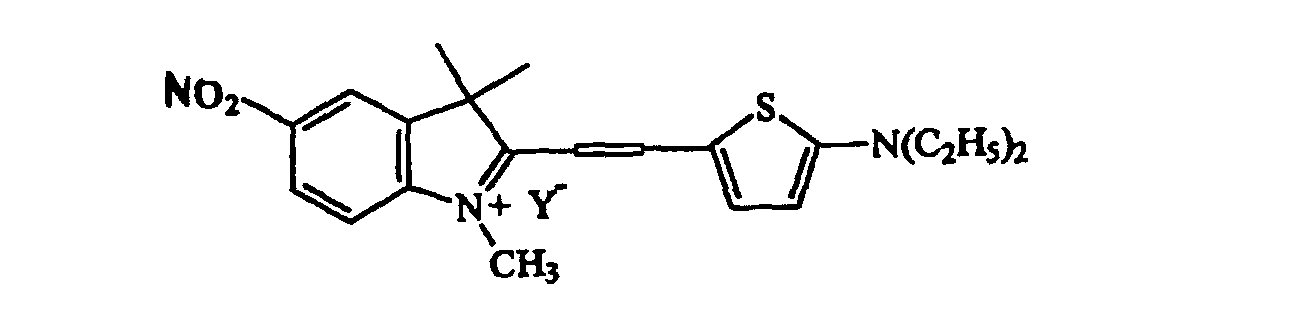
- In the formula above, Y is ClO4 for dye D16, BF4 for dye D17, and PF6 for dye D18.
- The maximum absorption peak (λmax) of dye D16 was observed by the same method as in Synthesis Example 1. As a result, λmax was 608 nm for dye D16, 608 nm for dye D17 and 609 nm for dye D18.
- NMR (DMSO, ppm): 1.25 (t, 6H), 1.70 (s, 6H), 3.60 (s, 3H), 3.78 (q, 4H), 6.04 (d, 1H), 7.02 (d, 1H), 7.46 (d, 1H), 8.14 (d, 1H), 8.30 (d, 1H), 8.40 (d, 1H), 8.48 (s, 1H)
- NMR (DMSO, ppm): 1.25 (t, 6H), 1.70(s, 6H), 3.60 (s, 3H), 3.78 (q, 4H), 6.04 (d, 1H), 7.02 (d, 1H), 7.46 (d, 1H), 8.14 (d, 1H), 8.30 (d, 1H), 8.40 (d, 1H), 8.48 (s, 1H)
- NMR (DMSO, ppm): 1.25 (t, 6H), 1.70 (s, 6H), 3.60 (s, 3H), 3.78 (q, 4H), 6.04 (d, 1H), 7.02 (d, 1H), 7.46 (d, 1H), 8.14 (d, 1H), 8.30 (d, 1H), 8.40 (d, 1H), 8.48 (s, 1H)
- 1 Equivalent 5-bromo-2-thiophenecarboxaldehyde was dissolved in dimethylformamide, and 1-2 drops of Aliquart 336 (tricaprylylmethylammonium chloride, produced by Aldrich) was dropwise added to the solution. 10 Equivalents dipropylamine was added to the mixture and refluxed for 7 days. Next, dipropylamine was removed from the reaction mixture, and subjected to extraction and column chlomatography to obtain 5-dipropylamino-2-thiophenenecarboxaldehyde with a yield of 80%.
- 5-dipropylamino-2-thiophenecarboxaldehyde, instead of 5-diethylamino-2-thiophenecarboxaldehyde used in Synthesis Example 1, was reacted with 1-methyl-2,3,3-trimethylpseudoindolium iodide, so that dye D19 of violet powder having the following formula was obtained with an yield of 80%.
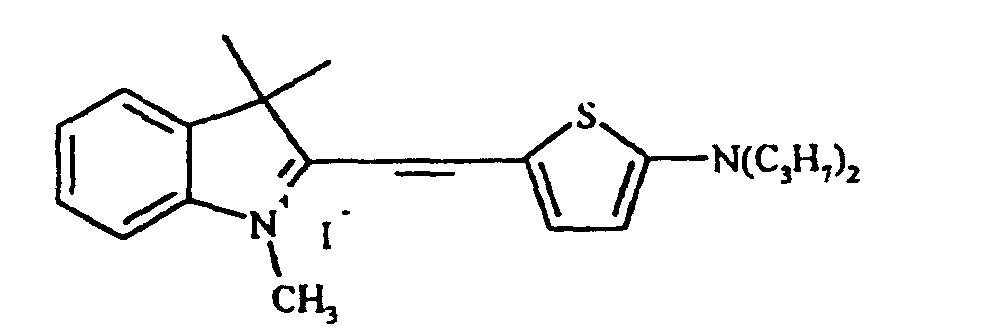
- The maximum absorption peak (λmax) of dye D19 was observed by the same method as in Synthesis Example 1. As a result, λmax was 597 nm for dye D19.
- NMR (DMSO, ppm): 0.94 (t, 6H), 1.66 (s, 6H), 1.72 (m, 4H), 3.60 (t, 4H), 3.66 (s, 3H), 6.06 (d, 1H), 6.78 (d, 1H), 7.26 (t, 1H), 7.42 (s, 1H), 7.42 (t, 1H), 7.62 (d, 1H), 8.02 (d, 1H), 8.38 (d, 1H)
- Dye D20 having the following formula, was obtained in the same way as in Synthesis Example 1, except that dipropylamine and 1,2,3,3-trimethylpseudoindolium perchlorate were used instead of diethylamine and 1,2,3,3-trimethylpseudoindolium iodide were used, respectively. The yield of dye D20 was 85%.
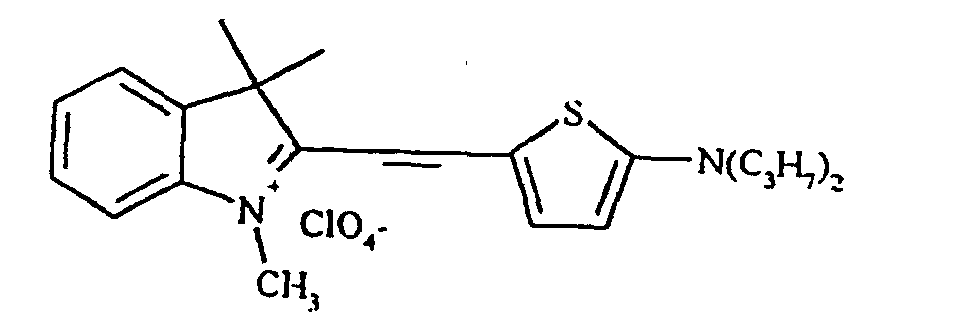
- The maximum absorption peak (λmax) of dye D20 was observed by the same method as in Synthesis Example 1. As a result, λmax was 596 nm for dye D20.
- NMR (DMSO, ppm): 0.94 (t, 6H), 1.66 (s, 6H), 1.72 (m, 4H), 3.60 (t, 4H), 3.66 (s, 3H), 6.06 (d, 1H), 6.78 (d, 1H), 7.26 (t, 1H), 7.42 (s, 1H), 7.42 (t, 1H), 7.62 (d, 1H), 8.02 (d, 1H), 8.38 (d, 1H)
- Dye D21 having the following formula was obtained with a yield of 85% in the same way as in Synthesis Example 19, except that 5-chloro-1,2,3,3-tetramethylpseudoindolium iodide was used instead of 1-methyl-2,3,3-trimethylpseudoindolium iodide.
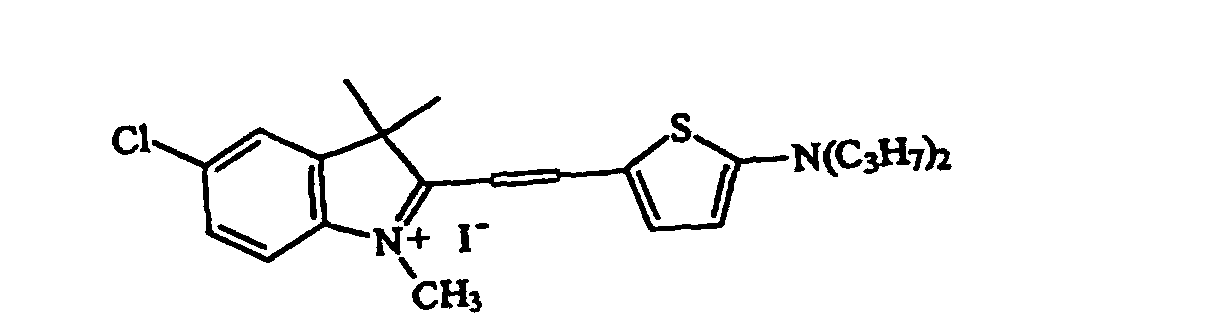
- The maximum absorption peak (λmax) of dye D21 was observed by the same method as in Synthesis Example 1. As a result, λmax was 600 nm for dye D21.
- NMR (DMSO, ppm): 0.94 (t, 6H), 1.66 (s, 6H), 1.72 (m, 4H), 3.62 (s, 3H), 3.62 (t, 4H), 6.04 (d, 1H), 6.84 (d, 1H), 7.40 (d, 1H), 7.46 (d, 1H), 7.74 (s, 1H), 8.04 (d, 1H), 8.34 (d, 1H)
- Dyes D22, D23 and D24 having the following formula were obtained in the same way as in Synthesis Example 2, except that 5-chloro-2-methylene-1,3,3-trimethylindoline was used instead of 2-methylene-1,3,3-trimethylindoline, and HCI used in Synthesis Example 2 was replaced by HClO4, HBF4 and HPF6, respectively, for Synthesis Examples 22 through 24. The yields of dyes D22, D23 and D24 were 70%, 75% and 75%, respectively.

- In the formula above, Y is ClO4 for dye D22, BF4 for dye D23, and PF6 for dye D24.
- The maximum absorption peaks (λmax) of dyes D22, D23 and D24 were observed by the same method as in Synthesis Example 1. As a result, λmax was 600 nm for dye D22, 598 nm for dye D23 and 602 nm for dye D24.
- NMR (DMSO, ppm): 0.94 (t, 6H), 1.66 (s, 6H), 1.74 (m, 4H), 3.60 (t, 4H), 3.61 (s, 3H), 6.02 (d, 1H), 6.84 (d, 1H), 7.40 (d, 1H), 7.46 (d, 1H), 7.74 (s, 1H), 8.04 (d, 1H), 8.32 (d, 1H)
- NMR (DMSO, ppm): 0.94 (t, 6H), 1.66 (s, 6H), 1.72 (m, 4H), 3.60 (t, 4H), 3.61 (s, 3H), 6.04 (d, 1H), 6.82 (d, H), 7.40 (d, 1H), 7.46 (d, 1H), 7.74 (s, 1H), 8.04 (d, 1H), 8.32 (d, 1H)
- NMR (DMSO, ppm): 0.94 (t, 6H), 1.66 (s, 6H), 1.72 (n, 4H), 3.60 (t, 4H), 3.61 (s, 3H), 6.02 (d, 1H), 6.82 (d, 1H), 7.40 (d, 1H), 7.46 (d, 1H), 7.74 (s, 1H), 8.02 (d, 1H), 8.34 (d, 1H)
- Dyes D25, D26 and D27 having the following formula were obtained by the same way as in Synthesis Example 19, except that 1-methyl-2,3,3-trimethylpseudoindolium iodide was replaced by 5-nitro-2-methylene-1,3,3-trimethylindolium perchlorate, 5-nitro-2-methylene-1,3,3-trimethylindolium tetrafluoroborate, 5-nitro-2-methylene-1,3,3-trimethylindolium hexafluorophosphate for Synthesis Examples 25 through 27, respectively. The yields of dyes D25, D26 and D27 were 70%, 75% and 75%, respectively.

- In the formula, Y is ClO4 for dye D25, BF4 for dye D26, and PF6 for dye D27.
- The maximum absorption peaks (λmax) of dyes D25, D26 and D27 were observed by the same method as in Synthesis Example 1. As a result, λmax was 608 nm for dye D25, 608 nm for dye D26 and 604 nm for dye D27.
- NMR (DMSO, ppm): 0.94 (t, 6H), 1.72 (s, 6H), 1.72 (m, 4H), 3.60 (s, 3H), 3.68 (t, 4H), 6.06 (d, 1H), 7.06 (d, 1H), 7.46 (d, 1H), 8.12 (d, 1H), 8.28 (d, 1H), 8.38 (d, 1H), 8.50 (s, 1H)
- NMR (DMSO, ppm): 0.94 (t, 6H), 1.70 (s, 6H), 1.72 (m, 4H), 3.60 (s, 3H), 3.68 (t, 4H), 6.06 (d, 1H), 7.06 (d, 1H), 7.46 (d, 1H), 8.14 (d, 1H), 8.28 (d, 1H), 8.38 (d, 1H), 8.50 (s, 1H)
- NMR (DMSO, ppm): 0.94 (t, 6H), 1.70 (s, 6H), 1.72 (m, 4H), 3.60 (s, 3H), 3.68 (t, 4H), 6.06 (d, 1H), 7.06 (d, 1H), 7.46 (d, 1H), 8.14 (d, 1H), 8.28 (s, 1H), 8.38 (d, 1H), 8.48 (s, 1H)
- Dye D28 having the following formula was obtained with a yield 75% by the same way as in Synthesis Example 13, except that dipropylamine was used instead of diethylamine.

- The maximum absorption peak (λmax) of dye D28 was observed by the same method as in Synthesis Example 1. As a result, λmax was 618 nm for dye D28.
- NMR (DMSO, ppm): 0.94 (t, 6H), 1.72 (m, 4H), 1.92 (s, 6H), 3.60 (t, 4H), 3.80 (s, 3H), 6.12 (d, 1H), 6.76 (d, 1H), 7.52 (t, 1H), 7.66 (t, 1H), 7.76 (d, 1H), 8.02 (d, 1H), 8.08 (d, 1H), 8.10 (d, 1H), 8.26 (d, 1H), 8.46 (d, 1H)
- Dyes D29 and D30 having the following formula were obtained by the same way as in Synthesis Example 28, except that 1,2,3,3-tetramethyl-4,5-benzopseudoindolium perchlorate was replaced by1,2,3,3-tetramethyl-4,5-benzopseudoindolium tetrafluoroborate and 1,2,3,3-tetramethyl-4,5-benzopseudoindolium hexafluorophosphate for Synthesis Examples 29 and 30, respectively. The yield of dyes 29 and 30 was 80%.

- In the formula, Y is BF4 for dye 29 and PF6 for dye 30.
- The maximum absorption peaks (λmax) of dyes D29 and D30 were observed by the same method as in Synthesis Example 1. As a result, λmax was 618 nm for dye D29 and 619 nm for dye D30.
- NMR (DMSO, ppm): 0.94 (t, 6H), 1.72 (m, 4H), 1.92 (s, 6H), 3.60 (t, 4H), 3.80 (s, 3H), 6.12 (d, 1H), 6.76 (d, 1H), 7.52 (t, 1H), 7.66 (t, 1H), 7.76 (d, 1H), 8.02 (d, 1H), 8.08 (d, 1H), 8.10 (d, 1H), 8.26 (d, 1H), 8.46 (d, 1H)
- NMR (DMSO, ppm): 0.94 (t, 6H), 1.72 (m, 4H), 1.92 (s, 6H), 3.60 (t, 4H), 3.80 (s, 3H), 6.12 (d, 1H), 6.76 (d, 1H), 7.52 (t, 1H), 7.66 (t, 1H), 7.76 (d, 1H), 8.02 (d, 1H), 8.08 (d, 1H), 8.10 (d, 1H), 8.26 (d, 1H), 8.46 (d, 1H)
- 5-Bromofuraldehyde was dissolved in dimethylsulfoxide (DMSO) and 1-2 drops of Aliquart 336 (tricaprylylmethylammonium chloride, produced by Aldrich Co.) was added to the solution. 10 Equivalents diethylamine was added to the mixture and refluxed for 4 days. The remaining diethylamine was removed from the reaction mixture and subjected to extraction and column chromatography to obtain 5-diethylamino-2-furaldehyde with a yield of 85%.
- 1.2 Equivalents 5-diethylamino-2-furaldehyde and 1 equivalent 5-chloro-1,2,3,3-tetramethylpseudoindolium perchlorate were dissolved in ethanol and 1 drop of piperidine was added to the solution while stirring.
- The reaction mixture was reacted under reflux for 5 hours, the solvent was removed from the reaction mixture and excess ethylacetate was added to obtain violet precipitate. The precipitate was washed several times, so that dye D31 of violet color, having the following formula, was obtained with a yield of 90%.

- The maximum absorption peak (λmax) of dye D31 was observed by the same method as in Synthesis Example 1. As a result, λmax was 594 nm for dye D31.
- NMR (DMSO, ppm): 1.28 (t, 6H), 1.64 (s, 6H), 3.50 (s, 3H), 3.74 (q, 4H), 6.04 (d, 1H), 6.36 (d, 1H), 7.28 (d, 1H), 7.41 (d, 1H), 7.60 (d, 1H), 7.67 (d, 1H), 7.90 (s, 1H)
- Dyes D32 and D33 having the following formula were obtained by the same way as in Synthesis Example 30, except that 5-chloro-1,2,3,3-tetramethylpseudoindolium perchlorate was replaced by5-chloro-1,2,3,3-tetramethylpseudoindolium tetrafluoroborate and 5-chloro-1,2,3,3-tetramethylpseudoindolium hexafluorophosphate for Synthesis Examples 32 and 33, respectively. The yield of dyes D32 and D33 was 85%.
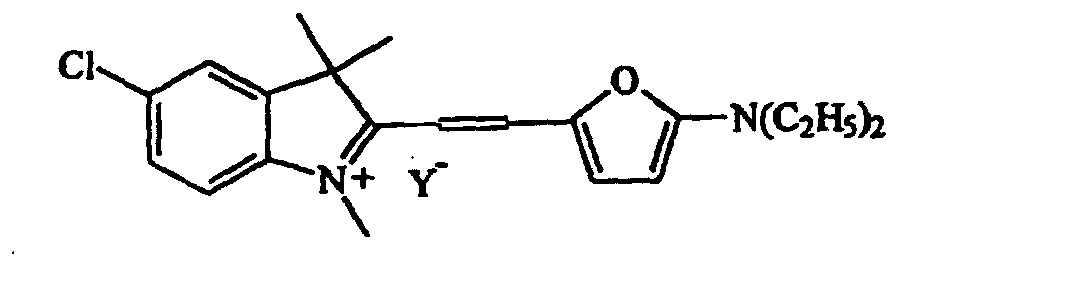
- In the formula, Y is BF4 for dye D32 and PF6 for D33. The maximum absorption peaks (λmax) of dyes D32 and D33 were observed by the same method as in Synthesis Example 1. As a result, λmax was 594 nm for dye D32 and 595 nm for dye D33.
- NMR (DMSO, ppm): 1.28 (t, 6H), 1.64 (s, 6H), 3.50 (s, 3H), 3.74 (q, 4H), 6.04 (d, 1H), 6.36 (d, 1H), 7.28 (d, 1H), 7.41 (d, 1H), 7.60 (d, 1H), 7.67 (d, 1H), 7.90 (s, 1H)
- NMR (DMSO, ppm): 1.28 (t, 6H), 1.64 (s, 6H), 3.50 (s, 3H), 3.74 (q, 4H), 6.04 (d, 1H), 6.36 (d, 1H), 7.28 (d, 1H), 7.41 (d, 1H), 7.60 (d, 1H), 7.67 (d, 1H), 7.90 (s, 1H)
- 0.30 g of Dye D9 obtained in Synthesis Example 9 and 0.30 g phenylamine series stabilizer (IRG022, Nippon Kayaku Co., Ltd) were dissolved in 10 mℓ tetrafluropropanol, and stirred at room temperature for 5 hours. The mixture was filtered with a Teflon filter (having 0.2 µm pore width) and spin-coated over a substrate to form a dye layer. The substrate was a polycarbonate substrate with 0.6 mm thickness having pregrooves with 145 nm depth, 30nm width and 800 nm track pitch.
- The substrate having the dye layer was dried in a vacuum oven set at 40°C for 12 hours. Then, silver (Ag) was deposited over the dye layer to form a reflective layer with a thickness of 100 nm. An acrylic UV curable resin was spin coated over the reflective layer and then cured by radiation of UV rays to form a protecting layer. The resultant substrate was combined with a dummy disk, thereby completing an optical disk.
- Optical disks were manufactured by the same way as in Example 1, except that dyes D13, D16, D22 and D31 were used instead of dye D9 for Examples 2 through 5.
- Optical disks were manufactured by the same way as in Example 1, except that cyanine series dyes, NK4321 (Hayashibara Biochemical Laboratories, INC.), NK4422 (Hayashibara Biochemical Laboratories, INC.), OM78 (Fuji Photo Film Co., LTD), NK4499 (Hayashibara Biochemical Laboratories, INC) and NK4500 (Hayashibara Biochemical Laboratories, INC.), were used for Comparative Examples 1 through 5, respectively.
- The characteristics the optical disks manufactured in Examples 1 through 5 and Comparative Examples 1 through 5 was evaluated by a DVD-R recorder (DVDR-S101, Pioneer), a dynamic characteristic evaluator (DDU-1000, Pulstec) equipped with a laser diode (LD, Nichia, Japan) having a peak wavelength of 630 nm or 650 nm, and a DVD player (DVD909, Samsung, Korea). The before-recording characteristic of the optical disks was evaluated using the dynamic characteristic evaluator equipped with 635 nm LD. The results are shown in Table 1. In Table 1, Rg indicates the reflectivity from pregrooves, RI indicates the reflectivity from lands, P-P indicates the push-pull characteristic, Rtop indicates the maximum reflectivity, the jitter indicates variations of reproduction signals, which is a signal uniformity index, I14/I14H indicates the modulated amplitude of recorded signals.
Example Rg (%) RI (%) P-P Rtop (%) Jitter (%) I14/I14H Example 1 47 51 0.29 56 7.8 0.72 Example 2 45 48 0.25 51 8.1 0.67 Example 3 47 53 0.33 54 7.9 0.70 Example 4 51 56 0.23 59 7.5 0.69 Example 5 48 51 0.24 54 8.0 0.66 Comparative Example 1 64.1 66 0.33 62 13 0.50 Comparative Example 2 56 59 0.30 55 12 0.58 Comparative Example 3 56 59 0.33 54 9.6 0.62 Comparative Example 4 unrecordable Comparative Example 5 unrecordable - As shown in Table 1, the recording characteristics, including jitter, of the optical disks of Examples 1 through 5, which were evaluated using the DVD-R recorder, are better than those of Comparative Examples 1. Also, the reproduction characteristics of Examples 1 through 5, evaluated with the DVD player, ensures that the optical disks are compatible with DVD players. Apparently, the optical characteristics of the optical disks of Comparative Examples are unsuitable for recording.
- As previously mentioned, the hemicyanine dye having formula (1) above is easy to synthesize with high yield. Thus, use of the hemicyanind dye as an optical recording medium is advantageous in terms of the manufacturing costs. A WORM type optical recording medium using the hemicyanine dye has improved recording characteristics in terms of jitter and modulation factor, compared with a conventional optical recording material.
- While this invention has been particularly shown and described with reference to preferred embodiments thereof, it will be understood by those skilled in the art that various changes in form and details may be made thereto without departing from the spirit and scope of the invention as defined by the appended claims.
Claims (6)
- A hemocyanine dye of formula (1):wherein Z is a benzene ring, naphthalene ring or anthracene ring; X1 is S, O, Se, NR or C(CH3)2; X2 is S, NR or O, where R is hydrogen or an alkyl group of 1 to 5 carbon atoms; R1 is hydrogen, halogen atoms, an alkyl group of 1 to 3 carbon atoms or a nitro group; each of R2 and R5 is an alkyl group of 1 to 5 carbon atoms; each of R3 and R4 is hydrogen, an hydroxy group, an alkyl group of 1 to 4 carbon atoms, a halogen atom or a halide; Y is Cl, Br, I, ClO4, BF4, BrO4, PF6, CH3SO3, CF3SO3, 4-CH3C6H4SO3, C6H5SO3, 6-SO3C10H6SO3 or HSO4; n is an integer of 0-2; and m is an integer of 1-2.

- The hemicyanine dye according to claim 1, wherein the hemicyanine dye of formula (1) is a compound of formula (2) or (3):wherein R1 is H, NO2 or Cl; R2 is CH3, C2H5, C3H7 or C4H9; X1 is C(CH3)2 or S; X2 is O or S; R5 is C2H5, C3H7 or C4H9; and Y is ClO4, BF4, PF6, I, Br or Cl, and
 wherein X1 is C(CH3)2 or S; X2 is S; R2 is CH3, C2H5, C3H7 or C4H9; R5 is C2H5, C3H7 or C4H9; and Y is ClO4, BF4, PF6, I, Br or Cl.
- An optical recording medium comprising a transparent substrate with grooves, a recording layer including a laser absorptive dye, formed over the transparent substrate, and a reflective layer and a protective layer formed over the recording layer,
wherein the dye of the recording layer is a hemicyanine dye according to claim 1 or 2. - The optical recording medium according to claim 3, wherein the hemicyanine dye of formula (1) shows a maximum absorption in the wavelength range of 350-650 nm, and has a reflective index of 1.8-2.3 in the wavelength range of 400-700 nm.
- The optical recording medium according to claim 3 or 4, wherein the substrate has a transmittance of 70-99%, and a thickness of 0.01-10 mm.
- The optical recording medium according to claim 5, wherein the substrate has a transmittance of about 90%.
Applications Claiming Priority (2)
| Application Number | Priority Date | Filing Date | Title |
|---|---|---|---|
| KR1020000023733A KR100363258B1 (en) | 2000-05-03 | 2000-05-03 | Hemicyanine dyes and optical recording medium using the same |
| KR2373000003 | 2000-05-03 |
Publications (1)
| Publication Number | Publication Date |
|---|---|
| EP1152038A1 true EP1152038A1 (en) | 2001-11-07 |
Family
ID=19667972
Family Applications (1)
| Application Number | Title | Priority Date | Filing Date |
|---|---|---|---|
| EP01302848A Withdrawn EP1152038A1 (en) | 2000-05-03 | 2001-03-27 | Hemicyanine dyes and optical recording media using the same |
Country Status (4)
| Country | Link |
|---|---|
| US (1) | US6482494B2 (en) |
| EP (1) | EP1152038A1 (en) |
| JP (1) | JP2001342365A (en) |
| KR (1) | KR100363258B1 (en) |
Cited By (3)
| Publication number | Priority date | Publication date | Assignee | Title |
|---|---|---|---|---|
| WO2002080160A1 (en) * | 2001-03-28 | 2002-10-10 | Bayer Aktiengesellschaft | Optical data carrier that contains a cationic aminoheterocyclic dye as the light-absorbing compound in the information layer |
| CN104387790A (en) * | 2014-11-04 | 2015-03-04 | 北京科技大学 | Benzindole salt dye containing thiophene group and preparation method and application of benzindole salt dye |
| CN105199422A (en) * | 2015-10-20 | 2015-12-30 | 北京科技大学 | Sulfhydryl group-containing bithiophene benzoindoles dye as well as preparation method and application thereof |
Families Citing this family (7)
| Publication number | Priority date | Publication date | Assignee | Title |
|---|---|---|---|---|
| TWI256634B (en) * | 2001-03-28 | 2006-06-11 | Bayer Ag | An optical data storage medium containing a diaza hemicyanine dye as the light-absorbing compound in the information layer |
| US7646155B2 (en) * | 2003-04-30 | 2010-01-12 | Balck & Decker Inc. | Generic motor control system |
| JP4979248B2 (en) | 2006-03-14 | 2012-07-18 | 株式会社Adeka | Optical recording medium |
| KR20080114742A (en) | 2006-03-31 | 2008-12-31 | 가부시키가이샤 아데카 | Cyanine Compounds and Optical Recording Materials |
| GB2521563B (en) * | 2012-10-03 | 2020-08-19 | Waters Technologies Corp | Chromatographic separation device with integral memory |
| KR102688598B1 (en) * | 2015-07-14 | 2024-07-25 | 에스에프씨 주식회사 | New cyanine dyes |
| CN111909236B (en) * | 2020-07-17 | 2021-12-17 | 湖北大学 | A kind of dipeptide modified cyanine dye compound and its preparation method and use |
Citations (11)
| Publication number | Priority date | Publication date | Assignee | Title |
|---|---|---|---|---|
| DE1772286A1 (en) * | 1967-04-26 | 1970-05-14 | Itek Corp | Photographic material |
| DE2215829A1 (en) * | 1971-04-08 | 1972-10-19 | Agfa-Gevaert Ag, 5090 Leverkusen | Electrophotographic recording material |
| JPS58125246A (en) * | 1982-01-22 | 1983-07-26 | Ricoh Co Ltd | Laser recording medium |
| EP0224261A2 (en) * | 1985-11-27 | 1987-06-03 | Mitsubishi Kasei Corporation | Optical recording medium |
| EP0483387A1 (en) * | 1990-05-25 | 1992-05-06 | Mitsubishi Chemical Corporation | Dye composition and optical recording medium |
| EP0528512A1 (en) * | 1991-08-20 | 1993-02-24 | Pioneer Electronic Corporation | Recording medium |
| EP0676751A1 (en) * | 1994-04-08 | 1995-10-11 | Mitsui Toatsu Chemicals, Incorporated | Optical recording media |
| JPH09208560A (en) * | 1996-01-29 | 1997-08-12 | Asahi Denka Kogyo Kk | Optical recording material |
| EP0837460A1 (en) * | 1996-10-16 | 1998-04-22 | Eastman Kodak Company | Tetra dye mixed with another dye or dyes for optical recording elements |
| JPH10149583A (en) * | 1996-11-20 | 1998-06-02 | Mitsui Chem Inc | Optical recording medium |
| EP1092753A1 (en) * | 1999-04-27 | 2001-04-18 | Kabushiki Kaisha Hayashibara Seibutsu Kagaku Kenkyujo | Cyanine dye |
Family Cites Families (9)
| Publication number | Priority date | Publication date | Assignee | Title |
|---|---|---|---|---|
| JPS60158460A (en) | 1984-01-27 | 1985-08-19 | Canon Inc | Encapsulated toner |
| JPS6357286A (en) * | 1986-08-28 | 1988-03-11 | Fuji Photo Film Co Ltd | Information recording medium |
| JPH0796334B2 (en) * | 1987-02-27 | 1995-10-18 | 富士写真フイルム株式会社 | Optical information recording medium |
| JPH0312646A (en) * | 1989-06-12 | 1991-01-21 | Asahi Chem Ind Co Ltd | Novel dyestuff recording material |
| US5312906A (en) | 1991-07-25 | 1994-05-17 | Ricoh Company, Ltd. | Optical information recording media and bisazo compounds for use therein |
| US5272047A (en) | 1992-06-26 | 1993-12-21 | Eastman Kodak Company | Optical information recording medium using azo dyes |
| JPH09157301A (en) | 1995-12-08 | 1997-06-17 | Bio Polymer Res:Kk | Manufacture of acetylcellulose with high degree of polymerization |
| JP3705879B2 (en) | 1996-11-28 | 2005-10-12 | 三井化学株式会社 | Optical recording medium |
| TW572333U (en) * | 1997-05-08 | 2004-01-11 | Matsushita Electric Industrial Co Ltd | Optical recording medium |
-
2000
- 2000-05-03 KR KR1020000023733A patent/KR100363258B1/en not_active Expired - Fee Related
-
2001
- 2001-03-27 EP EP01302848A patent/EP1152038A1/en not_active Withdrawn
- 2001-03-27 JP JP2001091225A patent/JP2001342365A/en not_active Withdrawn
- 2001-04-03 US US09/824,136 patent/US6482494B2/en not_active Expired - Fee Related
Patent Citations (11)
| Publication number | Priority date | Publication date | Assignee | Title |
|---|---|---|---|---|
| DE1772286A1 (en) * | 1967-04-26 | 1970-05-14 | Itek Corp | Photographic material |
| DE2215829A1 (en) * | 1971-04-08 | 1972-10-19 | Agfa-Gevaert Ag, 5090 Leverkusen | Electrophotographic recording material |
| JPS58125246A (en) * | 1982-01-22 | 1983-07-26 | Ricoh Co Ltd | Laser recording medium |
| EP0224261A2 (en) * | 1985-11-27 | 1987-06-03 | Mitsubishi Kasei Corporation | Optical recording medium |
| EP0483387A1 (en) * | 1990-05-25 | 1992-05-06 | Mitsubishi Chemical Corporation | Dye composition and optical recording medium |
| EP0528512A1 (en) * | 1991-08-20 | 1993-02-24 | Pioneer Electronic Corporation | Recording medium |
| EP0676751A1 (en) * | 1994-04-08 | 1995-10-11 | Mitsui Toatsu Chemicals, Incorporated | Optical recording media |
| JPH09208560A (en) * | 1996-01-29 | 1997-08-12 | Asahi Denka Kogyo Kk | Optical recording material |
| EP0837460A1 (en) * | 1996-10-16 | 1998-04-22 | Eastman Kodak Company | Tetra dye mixed with another dye or dyes for optical recording elements |
| JPH10149583A (en) * | 1996-11-20 | 1998-06-02 | Mitsui Chem Inc | Optical recording medium |
| EP1092753A1 (en) * | 1999-04-27 | 2001-04-18 | Kabushiki Kaisha Hayashibara Seibutsu Kagaku Kenkyujo | Cyanine dye |
Non-Patent Citations (3)
| Title |
|---|
| PATENT ABSTRACTS OF JAPAN vol. 007, no. 238 (P - 231) 22 October 1983 (1983-10-22) * |
| PATENT ABSTRACTS OF JAPAN vol. 1997, no. 12 25 December 1997 (1997-12-25) * |
| PATENT ABSTRACTS OF JAPAN vol. 1998, no. 11 30 September 1998 (1998-09-30) * |
Cited By (3)
| Publication number | Priority date | Publication date | Assignee | Title |
|---|---|---|---|---|
| WO2002080160A1 (en) * | 2001-03-28 | 2002-10-10 | Bayer Aktiengesellschaft | Optical data carrier that contains a cationic aminoheterocyclic dye as the light-absorbing compound in the information layer |
| CN104387790A (en) * | 2014-11-04 | 2015-03-04 | 北京科技大学 | Benzindole salt dye containing thiophene group and preparation method and application of benzindole salt dye |
| CN105199422A (en) * | 2015-10-20 | 2015-12-30 | 北京科技大学 | Sulfhydryl group-containing bithiophene benzoindoles dye as well as preparation method and application thereof |
Also Published As
| Publication number | Publication date |
|---|---|
| US6482494B2 (en) | 2002-11-19 |
| KR100363258B1 (en) | 2002-12-02 |
| JP2001342365A (en) | 2001-12-14 |
| KR20010103190A (en) | 2001-11-23 |
| US20010053429A1 (en) | 2001-12-20 |
Similar Documents
| Publication | Publication Date | Title |
|---|---|---|
| US20020001774A1 (en) | Hemicyanine dyes and optical recording media using the same | |
| US5958650A (en) | Complex polymethine dyes and their use | |
| JP2000158818A (en) | Optical recording medium | |
| JP4137771B2 (en) | Optical information recording medium and novel oxonol compound | |
| US6482494B2 (en) | Hemicyanine dyes and optical recording media using the same | |
| WO2001019923A1 (en) | Styryl dye | |
| WO2003074282A9 (en) | Rewritable optical information recording medium and recording/reproducing method, recording/reproducing device | |
| US6077584A (en) | Stabilized dye compositions for optical recording media | |
| JP2003196881A (en) | Fullerene dyestuff and its application | |
| EP1477484A1 (en) | Oxonol dye compound, optical information recording medium using the same, and optical information | |
| KR100493634B1 (en) | Benzobisazole-compound and optical recording medium containing the compound | |
| DE60109861T2 (en) | Optical recording medium and porphycene compound | |
| JP2000280621A (en) | Optical recording medium | |
| JPH10330633A (en) | Subphthalocyanin compound and optical recording medium using the same | |
| JP2003321450A (en) | Benzoindole styryl compound and high-density recording medium using the same | |
| JPH11256056A (en) | Benzopyrromethene-metal chelate compound and optical recording medium containing the sane | |
| JPH11256057A (en) | Dipyrromethene-metal chelate compound and optical recording medium containing the same | |
| EP1893414A1 (en) | Optical information-recording medium | |
| JP4313085B2 (en) | Write-once optical recording medium | |
| JP2901477B2 (en) | Optical recording medium | |
| WO1998019856A1 (en) | Multi-component dye compositions for optical recording media | |
| JP4190352B2 (en) | Optical recording material | |
| JP2000280620A (en) | Optical recording medium | |
| US20070160931A1 (en) | Organic dyes for recording layer and high density optical recording medium using the same | |
| US20070105049A1 (en) | Organic dye for recording layer and high density optical recording medium using the same |
Legal Events
| Date | Code | Title | Description |
|---|---|---|---|
| PUAI | Public reference made under article 153(3) epc to a published international application that has entered the european phase |
Free format text: ORIGINAL CODE: 0009012 |
|
| AK | Designated contracting states |
Kind code of ref document: A1 Designated state(s): CH DE FR GB LI Kind code of ref document: A1 Designated state(s): AT BE CH CY DE DK ES FI FR GB GR IE IT LI LU MC NL PT SE TR |
|
| AX | Request for extension of the european patent |
Free format text: AL;LT;LV;MK;RO;SI |
|
| 17P | Request for examination filed |
Effective date: 20011128 |
|
| AKX | Designation fees paid |
Free format text: CH DE FR GB LI |
|
| 17Q | First examination report despatched |
Effective date: 20030312 |
|
| STAA | Information on the status of an ep patent application or granted ep patent |
Free format text: STATUS: THE APPLICATION IS DEEMED TO BE WITHDRAWN |
|
| 18D | Application deemed to be withdrawn |
Effective date: 20030723 |